Marketing Management
Arab World Edition
Kotler, Keller, Hassan, Baalbaki and Shamma
Chapter 5
Creating Customer
Value, Satisfaction,
and Loyalty
Copyright © 2012 Pearson Education 5-2
Chapter Questions
1. What are customer value, satisfaction, and loyalty, and
how can companies deliver them?
2. What is the lifetime value of customers and how can
marketers maximize it?
3. How can companies cultivate strong customer
relationships?
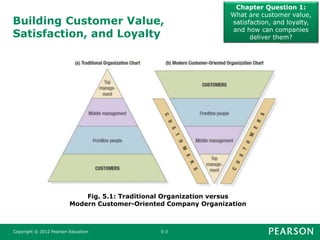
Building Customer Value,
Satisfaction, and Loyalty
Chapter Question 1:
What are customer value,
satisfaction, and loyalty,
and how can companies
deliver them?
Copyright © 2012 Pearson Education 5-3
Fig. 5.1: Traditional Organization versus
Modern Customer-Oriented Company Organization
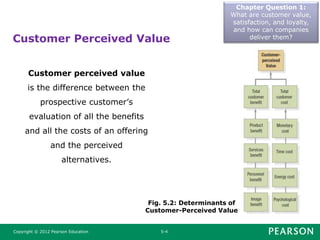
Customer Perceived Value
Chapter Question 1:
What are customer value,
satisfaction, and loyalty,
and how can companies
deliver them?
Copyright © 2012 Pearson Education 5-4
Fig. 5.2: Determinants of
Customer-Perceived Value
Customer perceived value
is the difference between the
prospective customer’s
evaluation of all the benefits
and all the costs of an offering
and the perceived
alternatives.
Customer Perceived Value
Chapter Question 1:
What are customer value,
satisfaction, and loyalty,
and how can companies
deliver them?
Copyright © 2012 Pearson Education 5-5
Often managers conduct customer value analysis . (S&W)
Steps in this analysis are:
1. Identify major attributes and benefits that customers value.
2. Assess the qualitative importance of different attributes and
benefits.
3. Assess the company’s and competitor’s performances on the
different customer values against rated importance.
4. Examine ratings of specific segments.
5. Monitor customer values over time.
Delivering High Customer Value
Chapter Question 1:
What are customer value,
satisfaction, and loyalty,
and how can companies
deliver them?
Copyright © 2012 Pearson Education 5-6
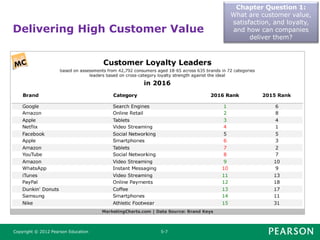
Loyalty is a deeply held commitment to re-buy or re-
patronize a preferred product or service in the future despite
situational influences and marketing efforts having the
potential to cause switching behavior.
Delivering High Customer Value
Chapter Question 1:
What are customer value,
satisfaction, and loyalty,
and how can companies
deliver them?
Copyright © 2012 Pearson Education 5-7
Delivering High Customer Value
Chapter Question 1:
What are customer value,
satisfaction, and loyalty,
and how can companies
deliver them?
Copyright © 2012 Pearson Education 5-8
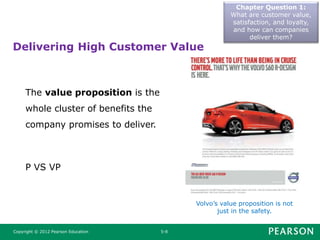
The value proposition is the
whole cluster of benefits the
company promises to deliver.
P VS VP
Volvo’s value proposition is not
just in the safety.
Total Customer Satisfaction
Chapter Question 1:
What are customer value,
satisfaction, and loyalty,
and how can companies
deliver them?
Copyright © 2012 Pearson Education 5-9
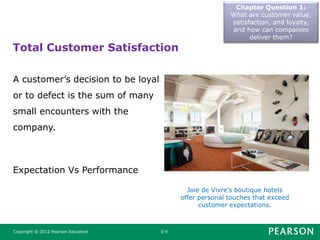
A customer’s decision to be loyal
or to defect is the sum of many
small encounters with the
company.
Expectation Vs Performance
Joie de Vivre’s boutique hotels
offer personal touches that exceed
customer expectations.
Monitoring Satisfaction
Chapter Question 1:
What are customer value,
satisfaction, and loyalty,
and how can companies
deliver them?
Copyright © 2012 Pearson Education 5-10
Measurement techniques include:
• Periodic surveys
• Customer loss rate (Stop to buy)
• Mystery shoppers
• Monitor competitive performance 80/90
Monitoring Satisfaction
Chapter Question 1:
What are customer value,
satisfaction, and loyalty,
and how can companies
deliver them?
Copyright © 2012 Pearson Education 5-11
Customer complaints
only about 5 percent from dissatisfied complain. The other 95
they just stop buying.
Monitoring Satisfaction
Chapter Question 1:
What are customer value,
satisfaction, and loyalty,
and how can companies
deliver them?
Copyright © 2012 Pearson Education 5-12
When things go wrong, how to recover customer goodwill:
1. Set up a 7-day, 24-hour free ‘hotline’ (by phone, fax, or e-mail) to
receive and act on customer complaints.
2. Contact the complaining customer as quickly as possible. Slow
responses cause growing dissatisfaction, and lead to negative word
of mouth.
3. Accept responsibility for the customer’s disappointment; don’t
blame the customer.
4. Use customer-service people who are empathic.
5. Resolve the complaint swiftly and to the customer’s satisfaction.
Maximizing Customer
Lifetime Value
Chapter Question 2:
What is the lifetime value of
customers and how can
marketers maximize it?
Copyright © 2012 Pearson Education 5-13
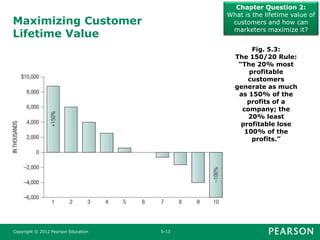
Fig. 5.3:
The 150/20 Rule:
“The 20% most
profitable
customers
generate as much
as 150% of the
profits of a
company; the
20% least
profitable lose
100% of the
profits.”
Chapter Question 2:
What is the lifetime value of
customers and how can
marketers maximize it?
Copyright © 2012 Pearson Education 5-14
• A profitable customer is a person, household, or company
that over time yields a revenue stream that exceeds by an
acceptable amount the company’s cost stream of attracting,
selling, and servicing that customer.
• Marketers can assess customer profitability individually, by
market segment, or by channel.
Customer Profitability
Chapter Question 2:
What is the lifetime value of
customers and how can
marketers maximize it?
Copyright © 2012 Pearson Education 5-15
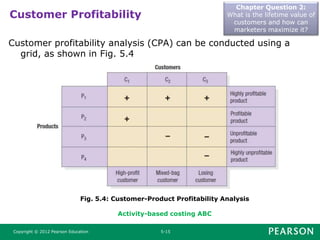
Customer profitability analysis (CPA) can be conducted using a
grid, as shown in Fig. 5.4
Customer Profitability
Fig. 5.4: Customer-Product Profitability Analysis
Activity-based costing ABC
Chapter Question 2:
What is the lifetime value of
customers and how can
marketers maximize it?
Copyright © 2012 Pearson Education 5-16
Measuring Customer Lifetime Value
Customer lifetime value (CLV) is the net present value of
the stream of future profits expected over the customer’s
lifetime purchases.
• Annual customer revenue: $500
• Average number of loyal years: 20
• Company profit margin: 10
• Customer lifetime value: $1000
Chapter Question 3:
How can companies
cultivate strong customer
relationships?
Copyright © 2012 Pearson Education 5-17
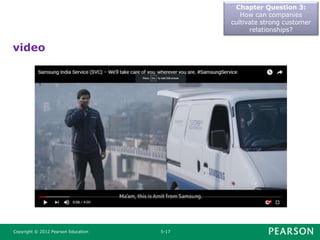
video
https://www.youtube.com/watch?v=779KwjAYTeQ
Chapter Question 3:
How can companies
cultivate strong customer
relationships?
Copyright © 2012 Pearson Education 5-18
CRM is the process of carefully managing detailed information
about individual customers and all customer touch points to
maximize customer loyalty.
Customer Relationship Management
Chapter Question 3:
How can companies
cultivate strong customer
relationships?
Copyright © 2012 Pearson Education 5-19
Framework for CRM marketing:
1.Identify prospects and customers.
2.Differentiate customers by their needs and their value to
company.
3.Interact with customers to improve knowledge of their
individual needs and build stronger relationships.
4.Customize products, services and messages to each
customer.
Customer Relationship Management
Chapter Question 3:
How can companies
cultivate strong customer
relationships?
Copyright © 2012 Pearson Education 5-20
Strategies for increasing the value of the customer base:
• Reducing the rate of customer defection.
• Increasing the longevity of the customer relationship.
• Enhancing the growth potential of each customer through
‘share of wallet’, cross-selling and up-selling.
• Making low-profit customers more profitable or terminating
them.
• Focusing disproportionate effort on high-profit customers.
Customer Relationship Management
Attracting and Retaining Customers
Chapter Question 4:
How can companies both
attract and retain
customers?
Copyright © 2012 Pearson Education 5-21
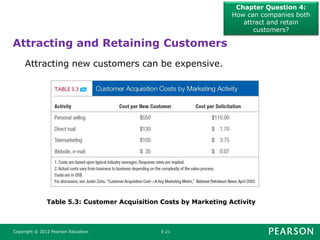
Attracting new customers can be expensive.
Table 5.3: Customer Acquisition Costs by Marketing Activity
Attracting and Retaining Customers
Chapter Question 4:
How can companies both
attract and retain
customers?
Copyright © 2012 Pearson Education 5-22
Retention dynamics:
• The average company loses 10% of its customers each year.
• A 5% reduction to the customer defection rate can increase
profits by 25% to 85%.
• The customer profit rate increases over the life of a retained
customer.
Attracting and Retaining Customers
Chapter Question 4:
How can companies both
attract and retain
customers?
Copyright © 2012 Pearson Education 5-23
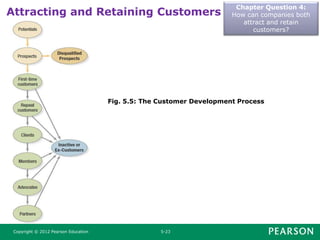
Fig. 5.5: The Customer Development Process
Chapter Question 4:
How can companies both
attract and retain
customers?
Copyright © 2012 Pearson Education 5-24
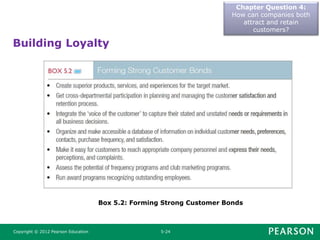
Building Loyalty
Box 5.2: Forming Strong Customer Bonds
Chapter Question 4:
How can companies both
attract and retain
customers?
Copyright © 2012 Pearson Education 5-25
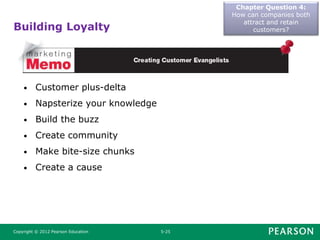
Building Loyalty
• Customer plus-delta
• Napsterize your knowledge
• Build the buzz
• Create community
• Make bite-size chunks
• Create a cause
Customer Databases and
Database Marketing
Chapter Question 5:
What is database
marketing?
Copyright © 2012 Pearson Education 5-26
A customer database is an organized collection of
comprehensive information about individual customers or
prospects that is current, accessible, and actionable for
marketing purposes.
Chapter Question 5:
What is database
marketing?
Copyright © 2012 Pearson Education 5-27
Database key concepts
Customer Databases
• Customer database
• Database marketing
• Mailing list
• Business database
• Data warehouse
• Data mining
Chapter Question 5:
What is database
marketing?
Copyright © 2012 Pearson Education 5-28
Data Warehouses and Datamining
Companies can use their databases in five key ways:
1. To identify prospects.
2. To target offers.
3. To deepen loyalty.
4. To reactivate customers.
5. To avoid mistakes.
Chapter Question 5:
What is database
marketing?
Copyright © 2012 Pearson Education 5-29
The Downside of Database Marketing and CRM
Don’t build a customer database when:
1. The product is a once-in-a-lifetime purchase.
2. Customers do not show loyalty.
3. The unit sale is very small.
4. The cost of gathering information is too high.
Chapter Question 5:
What is database
marketing?
Copyright © 2012 Pearson Education 5-30
The Downside of Database Marketing and CRM
Perils of CRM:
• Implementing CRM before creating a customer strategy
• Rolling out CRM before changing the organization to match
• Assuming more CRM technology is better
• Stalking, not wooing, customers
Credits
• Slide 1 Alamy Images: B. O’Kane
• Slide 7 Image courtesy of The Advertising Archives
• Slide 8 ‘2010 Brand Keys Customer Loyalty Leaders List’,
http://www.brandkeys.com/awards/leaders.cfm. Reproduced with
permission
• Slide 9 Joie De Vivre Hotels
• Slide 14 Larry Selden and Yoko S. Seldon, “Profitable Customer: The Key
to Great Brands,” Point, July–August 2006
• Slide 25 Customer Loyalty: How to Earn It, How to Keep It, John Wiley
and Sons (Griffin, J., 2002), p.36, copyright © 2002, John Wiley and Sons
• Slide 27 Ben McConnell and Jackie Huba, “Learning to Leverage the
Lunatic Fringe,” Point, July–August 2006, pp. 14–15; Michael Krauss,
“Work to Convert Customers into Evangelists,” Marketing News, December
15, 2006, p. 6; Ben McConnell and Jackie Huba, Creating Customer
Evangelists: How Loyal Customers Become a Loyal Sales Force (New York:
Kaplan Business, 2003); Lauren Indvik, “Google Launches Voice-to-Twitter
Service to Help Protesters in Egypt,” Mashable Social Media, January 31,
2011, http://mashable.com/2011/01/31/google-twitter-egypt-call-service/

ch_5_0.ppt

  • 2.
    Marketing Management Arab WorldEdition Kotler, Keller, Hassan, Baalbaki and Shamma Chapter 5 Creating Customer Value, Satisfaction, and Loyalty
  • 3.
    Copyright © 2012Pearson Education 5-2 Chapter Questions 1. What are customer value, satisfaction, and loyalty, and how can companies deliver them? 2. What is the lifetime value of customers and how can marketers maximize it? 3. How can companies cultivate strong customer relationships?
  • 4.
    Building Customer Value, Satisfaction,and Loyalty Chapter Question 1: What are customer value, satisfaction, and loyalty, and how can companies deliver them? Copyright © 2012 Pearson Education 5-3 Fig. 5.1: Traditional Organization versus Modern Customer-Oriented Company Organization
  • 5.
    Customer Perceived Value ChapterQuestion 1: What are customer value, satisfaction, and loyalty, and how can companies deliver them? Copyright © 2012 Pearson Education 5-4 Fig. 5.2: Determinants of Customer-Perceived Value Customer perceived value is the difference between the prospective customer’s evaluation of all the benefits and all the costs of an offering and the perceived alternatives.
  • 6.
    Customer Perceived Value ChapterQuestion 1: What are customer value, satisfaction, and loyalty, and how can companies deliver them? Copyright © 2012 Pearson Education 5-5 Often managers conduct customer value analysis . (S&W) Steps in this analysis are: 1. Identify major attributes and benefits that customers value. 2. Assess the qualitative importance of different attributes and benefits. 3. Assess the company’s and competitor’s performances on the different customer values against rated importance. 4. Examine ratings of specific segments. 5. Monitor customer values over time.
  • 7.
    Delivering High CustomerValue Chapter Question 1: What are customer value, satisfaction, and loyalty, and how can companies deliver them? Copyright © 2012 Pearson Education 5-6 Loyalty is a deeply held commitment to re-buy or re- patronize a preferred product or service in the future despite situational influences and marketing efforts having the potential to cause switching behavior.
  • 8.
    Delivering High CustomerValue Chapter Question 1: What are customer value, satisfaction, and loyalty, and how can companies deliver them? Copyright © 2012 Pearson Education 5-7
  • 9.
    Delivering High CustomerValue Chapter Question 1: What are customer value, satisfaction, and loyalty, and how can companies deliver them? Copyright © 2012 Pearson Education 5-8 The value proposition is the whole cluster of benefits the company promises to deliver. P VS VP Volvo’s value proposition is not just in the safety.
  • 10.
    Total Customer Satisfaction ChapterQuestion 1: What are customer value, satisfaction, and loyalty, and how can companies deliver them? Copyright © 2012 Pearson Education 5-9 A customer’s decision to be loyal or to defect is the sum of many small encounters with the company. Expectation Vs Performance Joie de Vivre’s boutique hotels offer personal touches that exceed customer expectations.
  • 11.
    Monitoring Satisfaction Chapter Question1: What are customer value, satisfaction, and loyalty, and how can companies deliver them? Copyright © 2012 Pearson Education 5-10 Measurement techniques include: • Periodic surveys • Customer loss rate (Stop to buy) • Mystery shoppers • Monitor competitive performance 80/90
  • 12.
    Monitoring Satisfaction Chapter Question1: What are customer value, satisfaction, and loyalty, and how can companies deliver them? Copyright © 2012 Pearson Education 5-11 Customer complaints only about 5 percent from dissatisfied complain. The other 95 they just stop buying.
  • 13.
    Monitoring Satisfaction Chapter Question1: What are customer value, satisfaction, and loyalty, and how can companies deliver them? Copyright © 2012 Pearson Education 5-12 When things go wrong, how to recover customer goodwill: 1. Set up a 7-day, 24-hour free ‘hotline’ (by phone, fax, or e-mail) to receive and act on customer complaints. 2. Contact the complaining customer as quickly as possible. Slow responses cause growing dissatisfaction, and lead to negative word of mouth. 3. Accept responsibility for the customer’s disappointment; don’t blame the customer. 4. Use customer-service people who are empathic. 5. Resolve the complaint swiftly and to the customer’s satisfaction.
  • 14.
    Maximizing Customer Lifetime Value ChapterQuestion 2: What is the lifetime value of customers and how can marketers maximize it? Copyright © 2012 Pearson Education 5-13 Fig. 5.3: The 150/20 Rule: “The 20% most profitable customers generate as much as 150% of the profits of a company; the 20% least profitable lose 100% of the profits.”
  • 15.
    Chapter Question 2: Whatis the lifetime value of customers and how can marketers maximize it? Copyright © 2012 Pearson Education 5-14 • A profitable customer is a person, household, or company that over time yields a revenue stream that exceeds by an acceptable amount the company’s cost stream of attracting, selling, and servicing that customer. • Marketers can assess customer profitability individually, by market segment, or by channel. Customer Profitability
  • 16.
    Chapter Question 2: Whatis the lifetime value of customers and how can marketers maximize it? Copyright © 2012 Pearson Education 5-15 Customer profitability analysis (CPA) can be conducted using a grid, as shown in Fig. 5.4 Customer Profitability Fig. 5.4: Customer-Product Profitability Analysis Activity-based costing ABC
  • 17.
    Chapter Question 2: Whatis the lifetime value of customers and how can marketers maximize it? Copyright © 2012 Pearson Education 5-16 Measuring Customer Lifetime Value Customer lifetime value (CLV) is the net present value of the stream of future profits expected over the customer’s lifetime purchases. • Annual customer revenue: $500 • Average number of loyal years: 20 • Company profit margin: 10 • Customer lifetime value: $1000
  • 18.
    Chapter Question 3: Howcan companies cultivate strong customer relationships? Copyright © 2012 Pearson Education 5-17 video https://www.youtube.com/watch?v=779KwjAYTeQ
  • 19.
    Chapter Question 3: Howcan companies cultivate strong customer relationships? Copyright © 2012 Pearson Education 5-18 CRM is the process of carefully managing detailed information about individual customers and all customer touch points to maximize customer loyalty. Customer Relationship Management
  • 20.
    Chapter Question 3: Howcan companies cultivate strong customer relationships? Copyright © 2012 Pearson Education 5-19 Framework for CRM marketing: 1.Identify prospects and customers. 2.Differentiate customers by their needs and their value to company. 3.Interact with customers to improve knowledge of their individual needs and build stronger relationships. 4.Customize products, services and messages to each customer. Customer Relationship Management
  • 21.
    Chapter Question 3: Howcan companies cultivate strong customer relationships? Copyright © 2012 Pearson Education 5-20 Strategies for increasing the value of the customer base: • Reducing the rate of customer defection. • Increasing the longevity of the customer relationship. • Enhancing the growth potential of each customer through ‘share of wallet’, cross-selling and up-selling. • Making low-profit customers more profitable or terminating them. • Focusing disproportionate effort on high-profit customers. Customer Relationship Management
  • 22.
    Attracting and RetainingCustomers Chapter Question 4: How can companies both attract and retain customers? Copyright © 2012 Pearson Education 5-21 Attracting new customers can be expensive. Table 5.3: Customer Acquisition Costs by Marketing Activity
  • 23.
    Attracting and RetainingCustomers Chapter Question 4: How can companies both attract and retain customers? Copyright © 2012 Pearson Education 5-22 Retention dynamics: • The average company loses 10% of its customers each year. • A 5% reduction to the customer defection rate can increase profits by 25% to 85%. • The customer profit rate increases over the life of a retained customer.
  • 24.
    Attracting and RetainingCustomers Chapter Question 4: How can companies both attract and retain customers? Copyright © 2012 Pearson Education 5-23 Fig. 5.5: The Customer Development Process
  • 25.
    Chapter Question 4: Howcan companies both attract and retain customers? Copyright © 2012 Pearson Education 5-24 Building Loyalty Box 5.2: Forming Strong Customer Bonds
  • 26.
    Chapter Question 4: Howcan companies both attract and retain customers? Copyright © 2012 Pearson Education 5-25 Building Loyalty • Customer plus-delta • Napsterize your knowledge • Build the buzz • Create community • Make bite-size chunks • Create a cause
  • 27.
    Customer Databases and DatabaseMarketing Chapter Question 5: What is database marketing? Copyright © 2012 Pearson Education 5-26 A customer database is an organized collection of comprehensive information about individual customers or prospects that is current, accessible, and actionable for marketing purposes.
  • 28.
    Chapter Question 5: Whatis database marketing? Copyright © 2012 Pearson Education 5-27 Database key concepts Customer Databases • Customer database • Database marketing • Mailing list • Business database • Data warehouse • Data mining
  • 29.
    Chapter Question 5: Whatis database marketing? Copyright © 2012 Pearson Education 5-28 Data Warehouses and Datamining Companies can use their databases in five key ways: 1. To identify prospects. 2. To target offers. 3. To deepen loyalty. 4. To reactivate customers. 5. To avoid mistakes.
  • 30.
    Chapter Question 5: Whatis database marketing? Copyright © 2012 Pearson Education 5-29 The Downside of Database Marketing and CRM Don’t build a customer database when: 1. The product is a once-in-a-lifetime purchase. 2. Customers do not show loyalty. 3. The unit sale is very small. 4. The cost of gathering information is too high.
  • 31.
    Chapter Question 5: Whatis database marketing? Copyright © 2012 Pearson Education 5-30 The Downside of Database Marketing and CRM Perils of CRM: • Implementing CRM before creating a customer strategy • Rolling out CRM before changing the organization to match • Assuming more CRM technology is better • Stalking, not wooing, customers
  • 32.
    Credits • Slide 1Alamy Images: B. O’Kane • Slide 7 Image courtesy of The Advertising Archives • Slide 8 ‘2010 Brand Keys Customer Loyalty Leaders List’, http://www.brandkeys.com/awards/leaders.cfm. Reproduced with permission • Slide 9 Joie De Vivre Hotels • Slide 14 Larry Selden and Yoko S. Seldon, “Profitable Customer: The Key to Great Brands,” Point, July–August 2006 • Slide 25 Customer Loyalty: How to Earn It, How to Keep It, John Wiley and Sons (Griffin, J., 2002), p.36, copyright © 2002, John Wiley and Sons • Slide 27 Ben McConnell and Jackie Huba, “Learning to Leverage the Lunatic Fringe,” Point, July–August 2006, pp. 14–15; Michael Krauss, “Work to Convert Customers into Evangelists,” Marketing News, December 15, 2006, p. 6; Ben McConnell and Jackie Huba, Creating Customer Evangelists: How Loyal Customers Become a Loyal Sales Force (New York: Kaplan Business, 2003); Lauren Indvik, “Google Launches Voice-to-Twitter Service to Help Protesters in Egypt,” Mashable Social Media, January 31, 2011, http://mashable.com/2011/01/31/google-twitter-egypt-call-service/