Newton’s Second Law of Motion 
8th Science
Force = Mass x Acceleration (F=ma) 
• AKA: the “Law of Force and Acceleration” 
• Newton’s second law states that the amount 
of force is equal to an objects mass times its 
acceleration. 
• The acceleration of an object is directly 
proportional to the net force & indirectly 
proportional to its’ mass.
Getting Started 
• First, you need to know the units of Force, 
Mass & Acceleration. 
– The units used for force are Newtons (N) 
– The units used for mass are kilograms (kg) 
– The acceleration units are meters per second 
squared (m/sec2).
Acceleration 
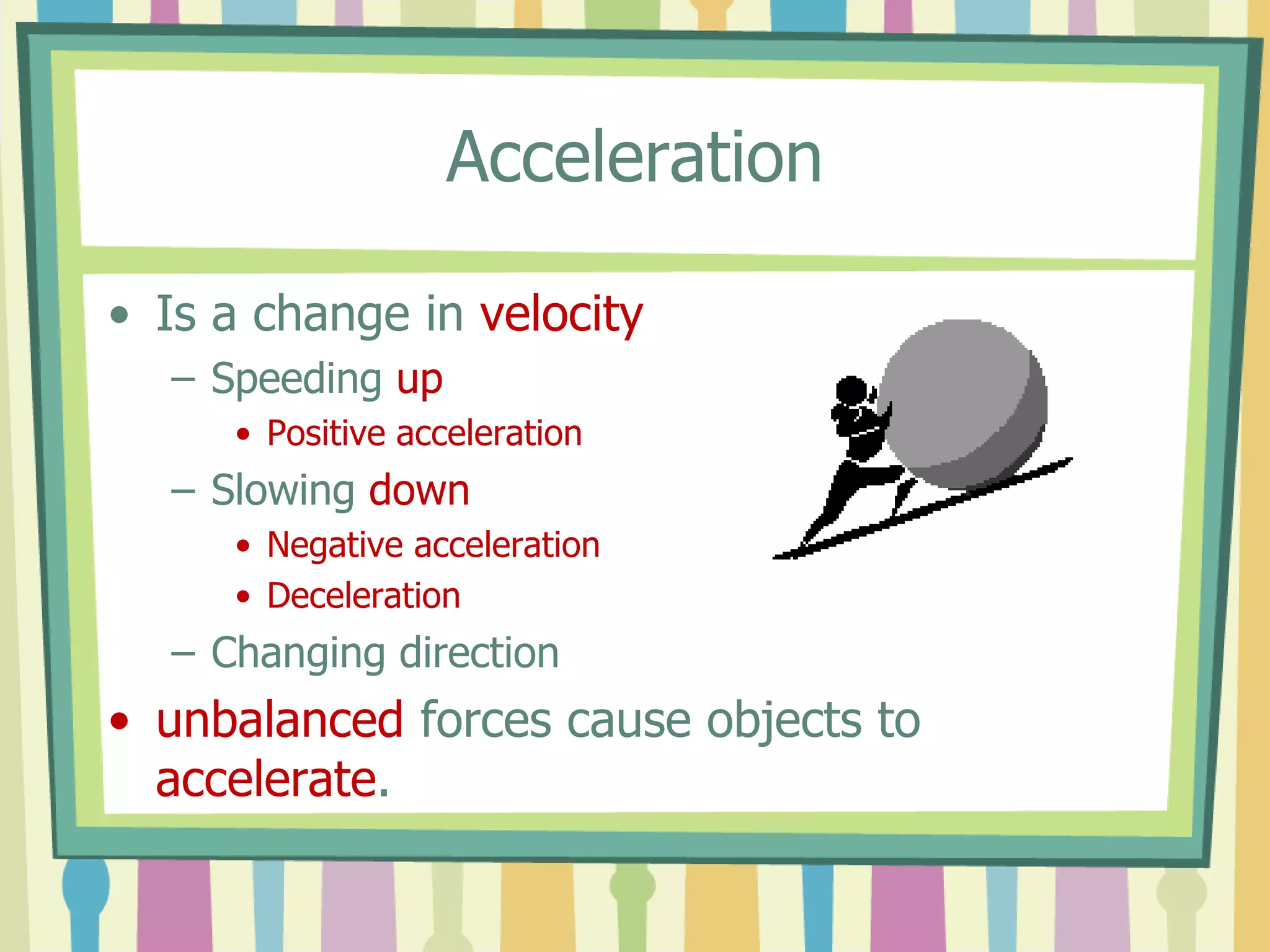
• Is a change in velocity 
– Speeding up 
• Positive acceleration 
– Slowing down 
• Negative acceleration 
• Deceleration 
– Changing direction 
• unbalanced forces cause objects to 
accelerate.
Acceleration 
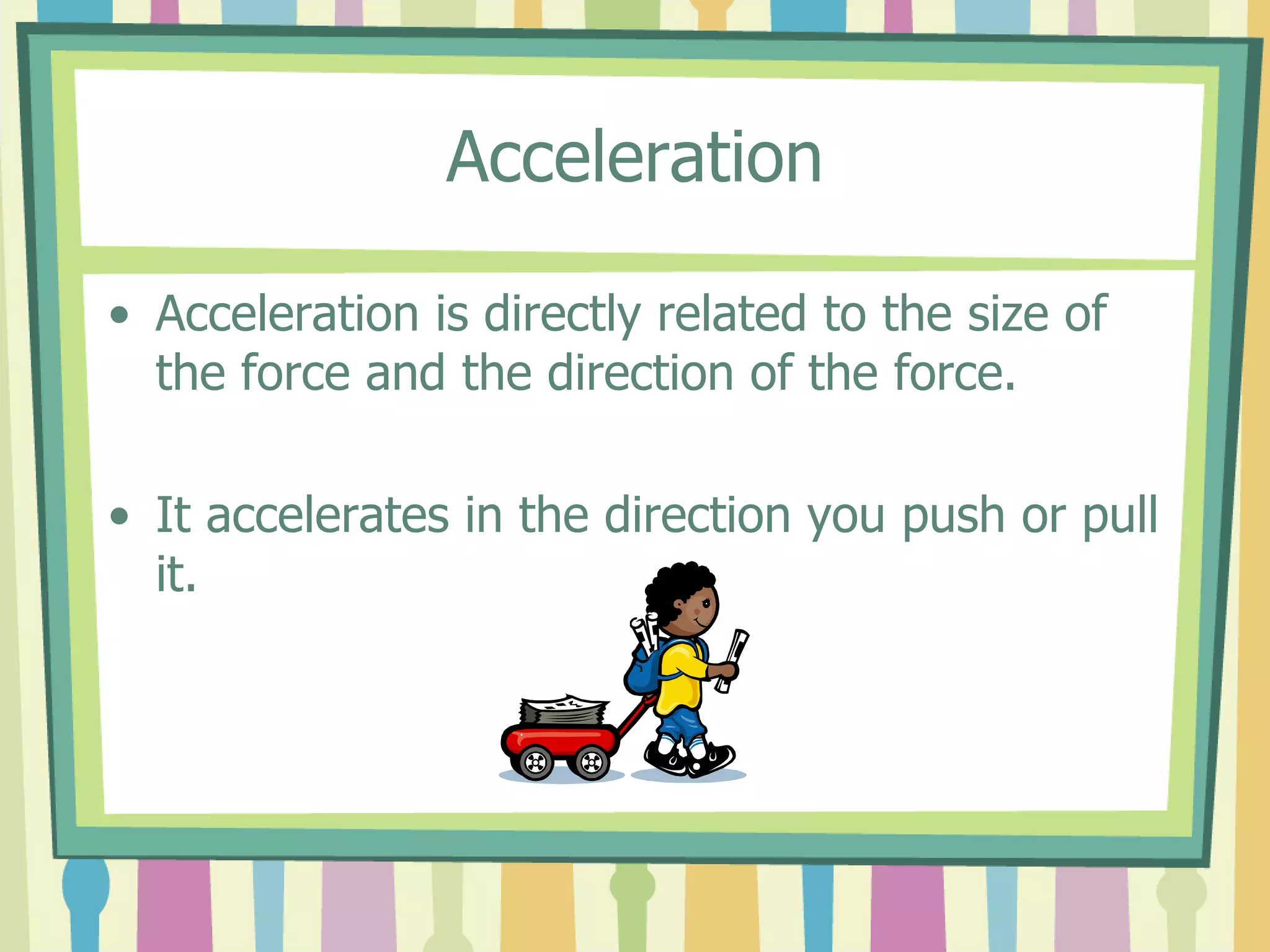
• Acceleration is directly related to the size of 
the force and the direction of the force. 
• It accelerates in the direction you push or pull 
it.
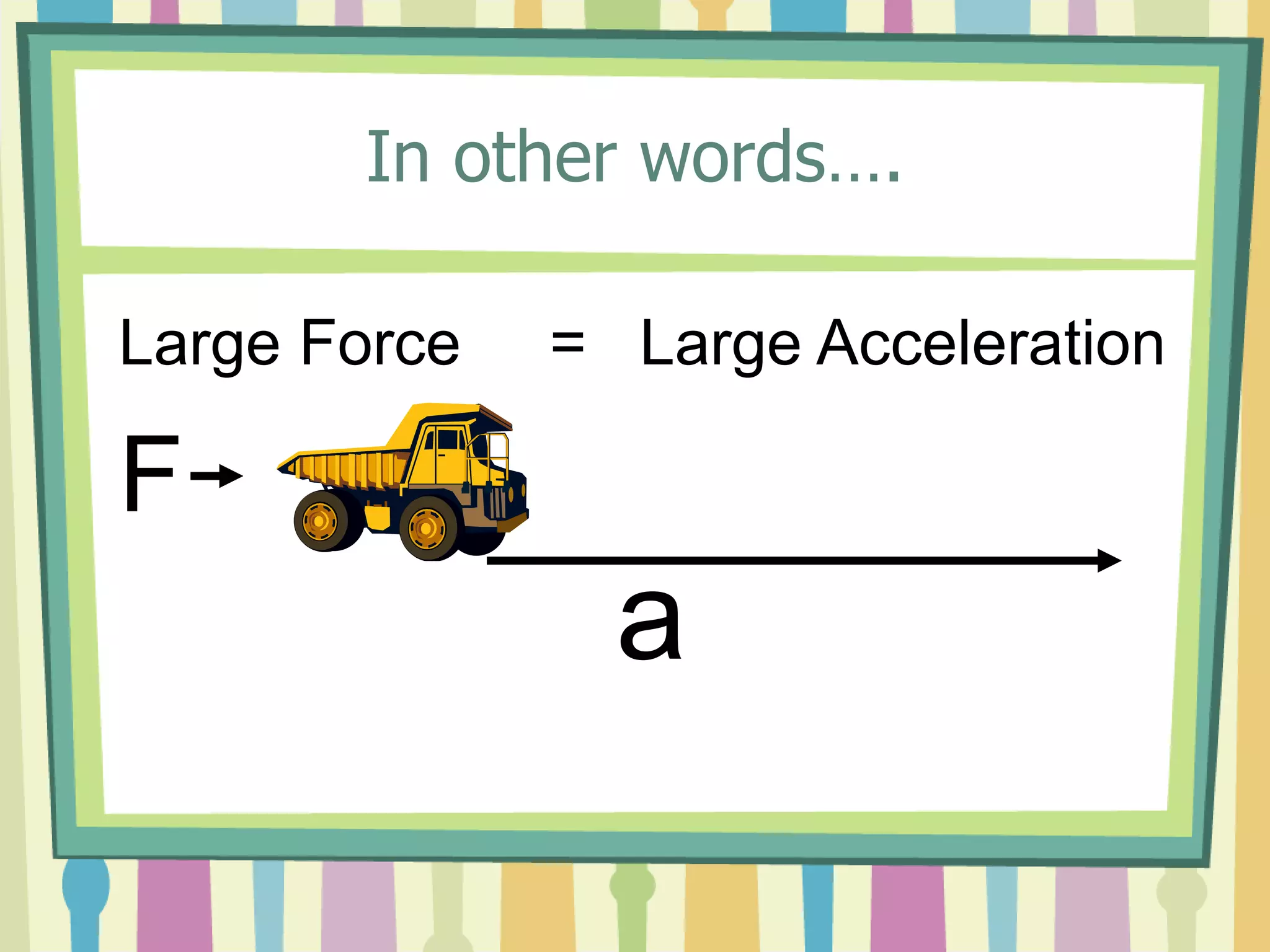
In other words…. 
Large Force = Large Acceleration 
F 
a
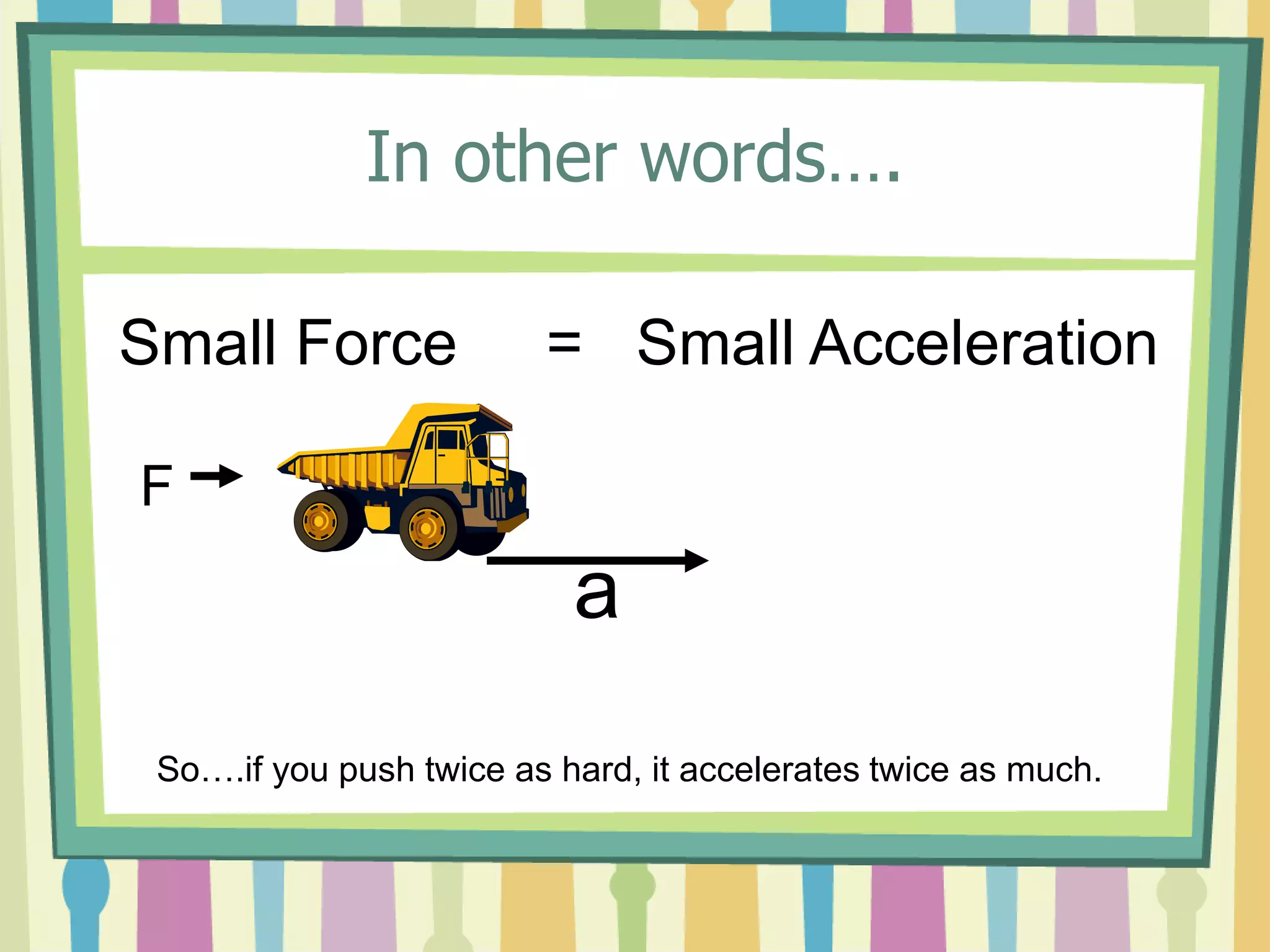
In other words…. 
Small Force = Small Acceleration 
F 
a 
So….if you push twice as hard, it accelerates twice as much.
But there is a twist…. 
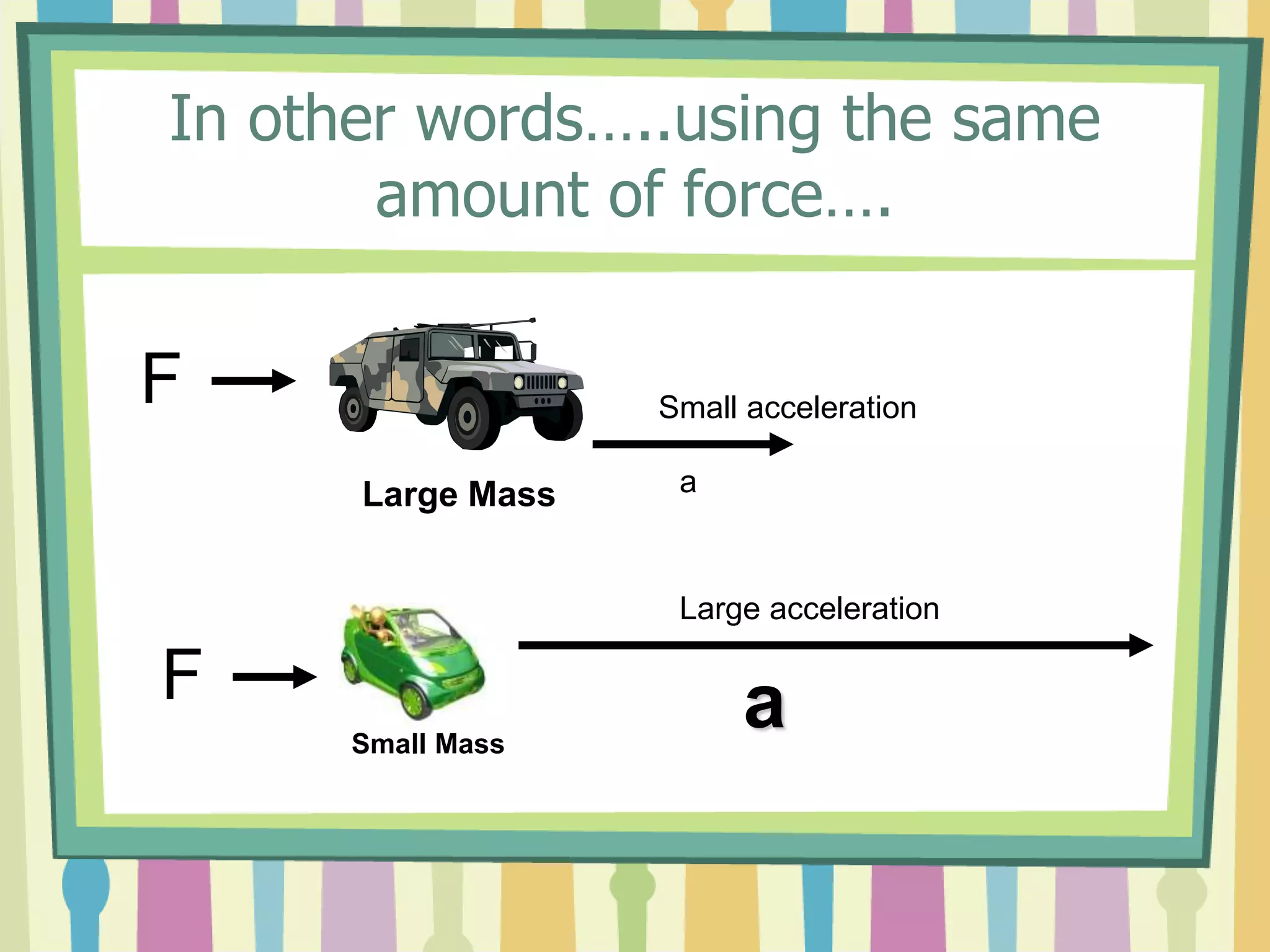
• Acceleration is INVERSELY related to the mass 
of the object.
In other words…..using the same 
amount of force…. 
F 
Small acceleration 
Large Mass a 
F 
Small Mass 
Large acceleration 
a
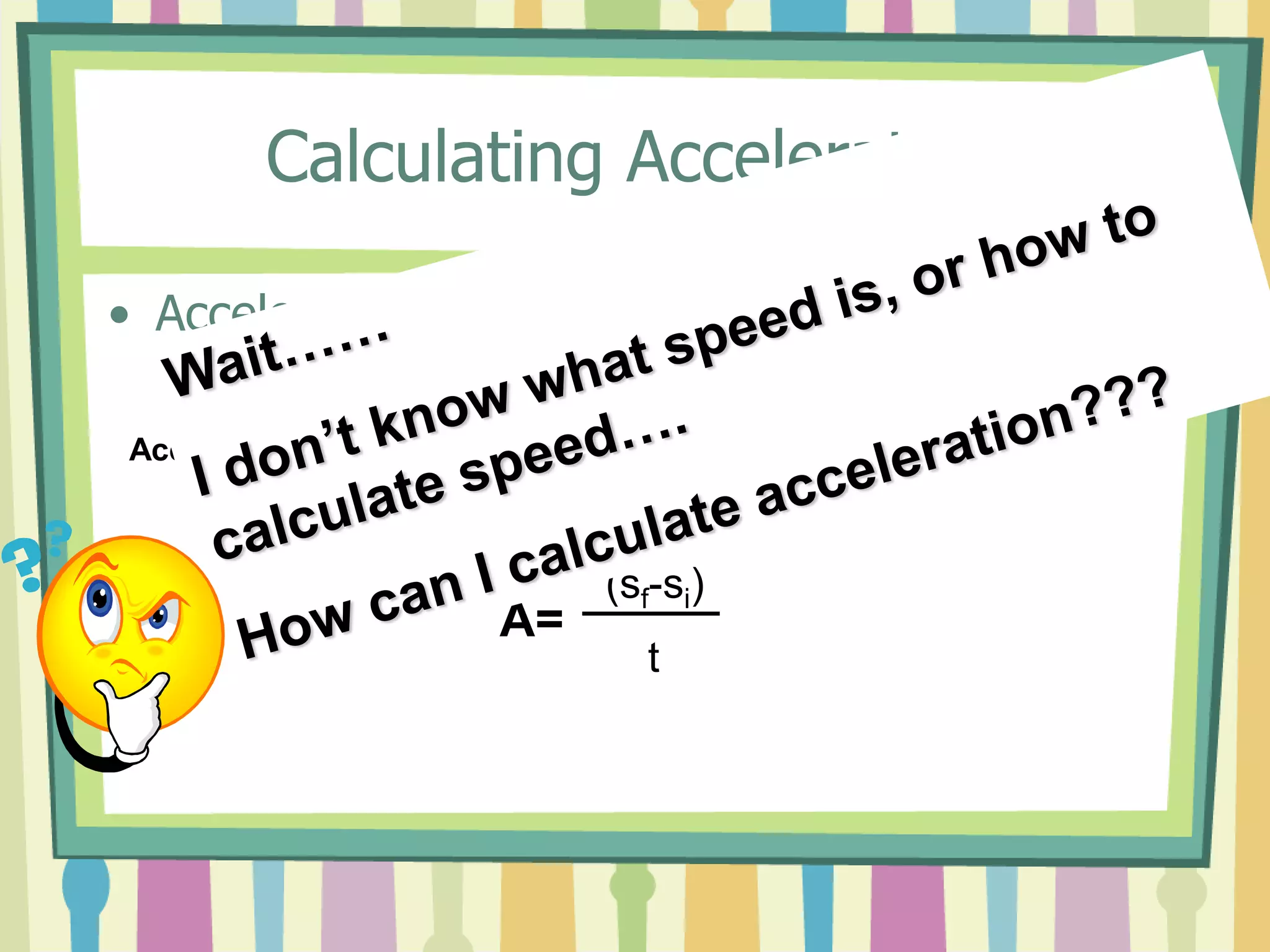
Calculating Acceleration 
• Acceleration Equation 
Acceleration = 
(final speed (in m/s) – initial speed (in m/s)) 
Time (in seconds) 
A= 
(sf-si) 
t
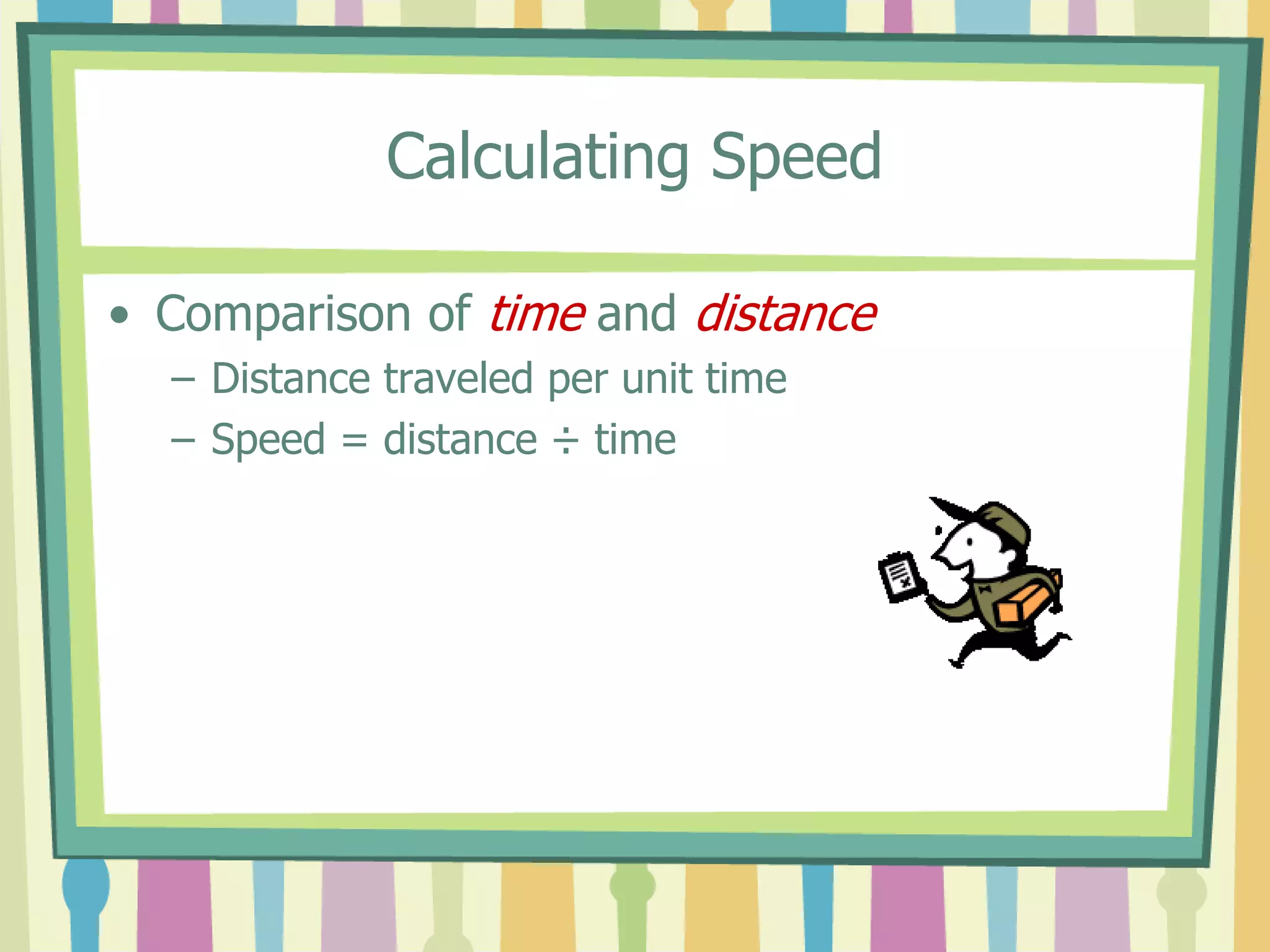
Calculating Speed 
• Comparison of time and distance 
– Distance traveled per unit time 
– Speed = distance ÷ time
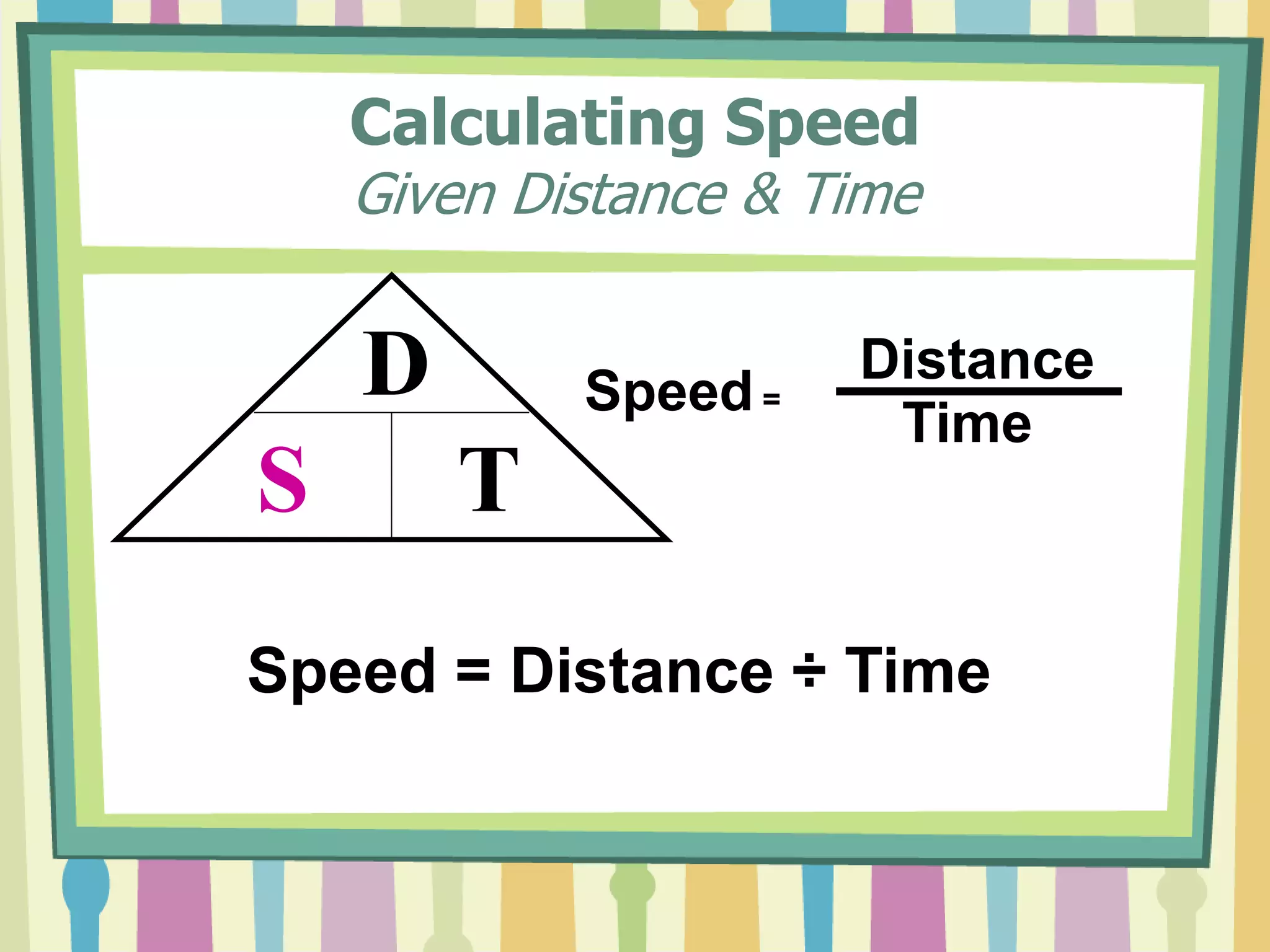
Calculating Speed 
Given Distance & Time 
D 
S T 
Speed = 
Distance 
Time 
Speed = Distance ÷ Time
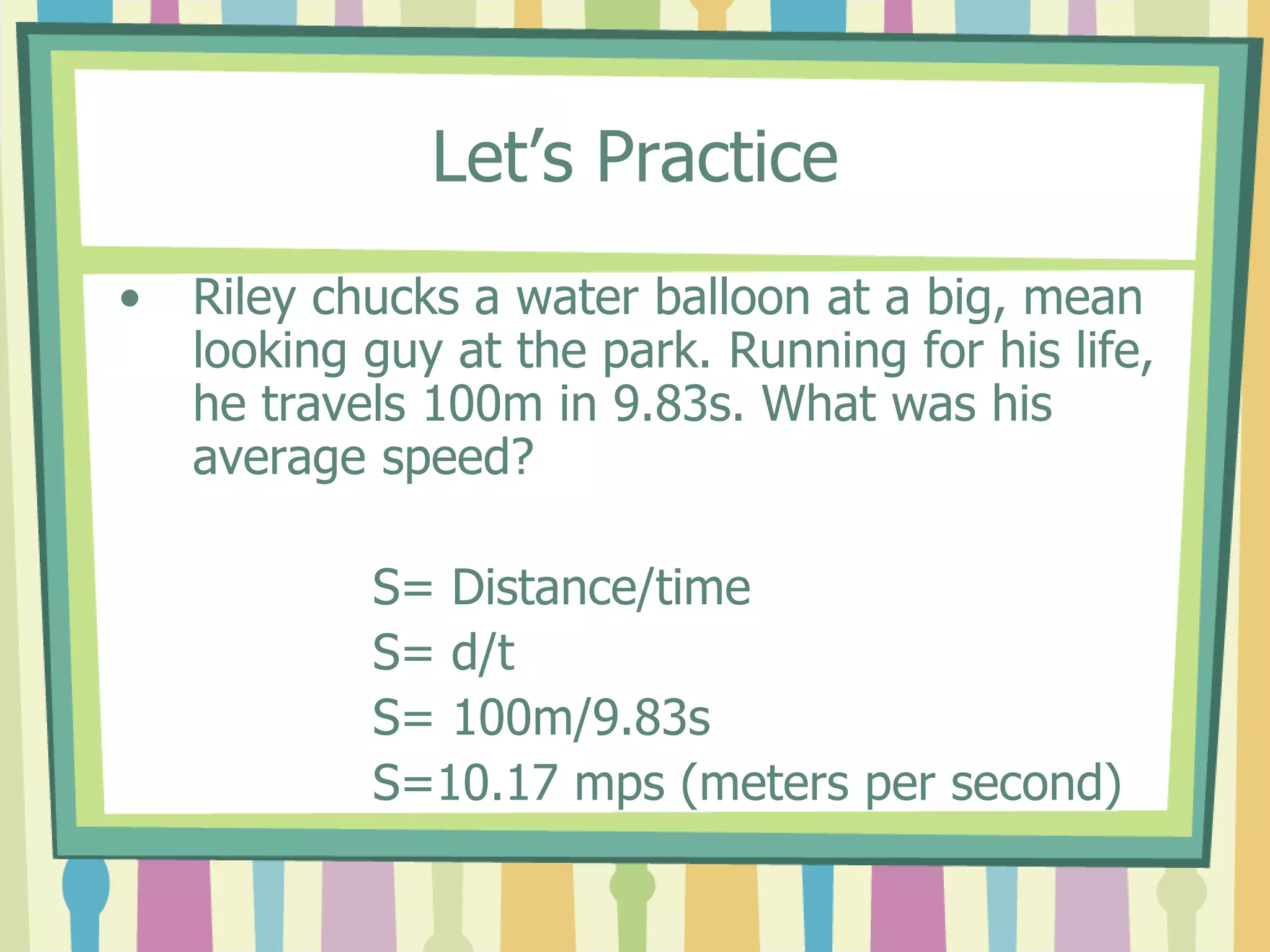
Let’s Practice 
• Riley chucks a water balloon at a big, mean 
looking guy at the park. Running for his life, 
he travels 100m in 9.83s. What was his 
average speed? 
S= Distance/time 
S= d/t 
S= 100m/9.83s 
S=10.17 mps (meters per second)
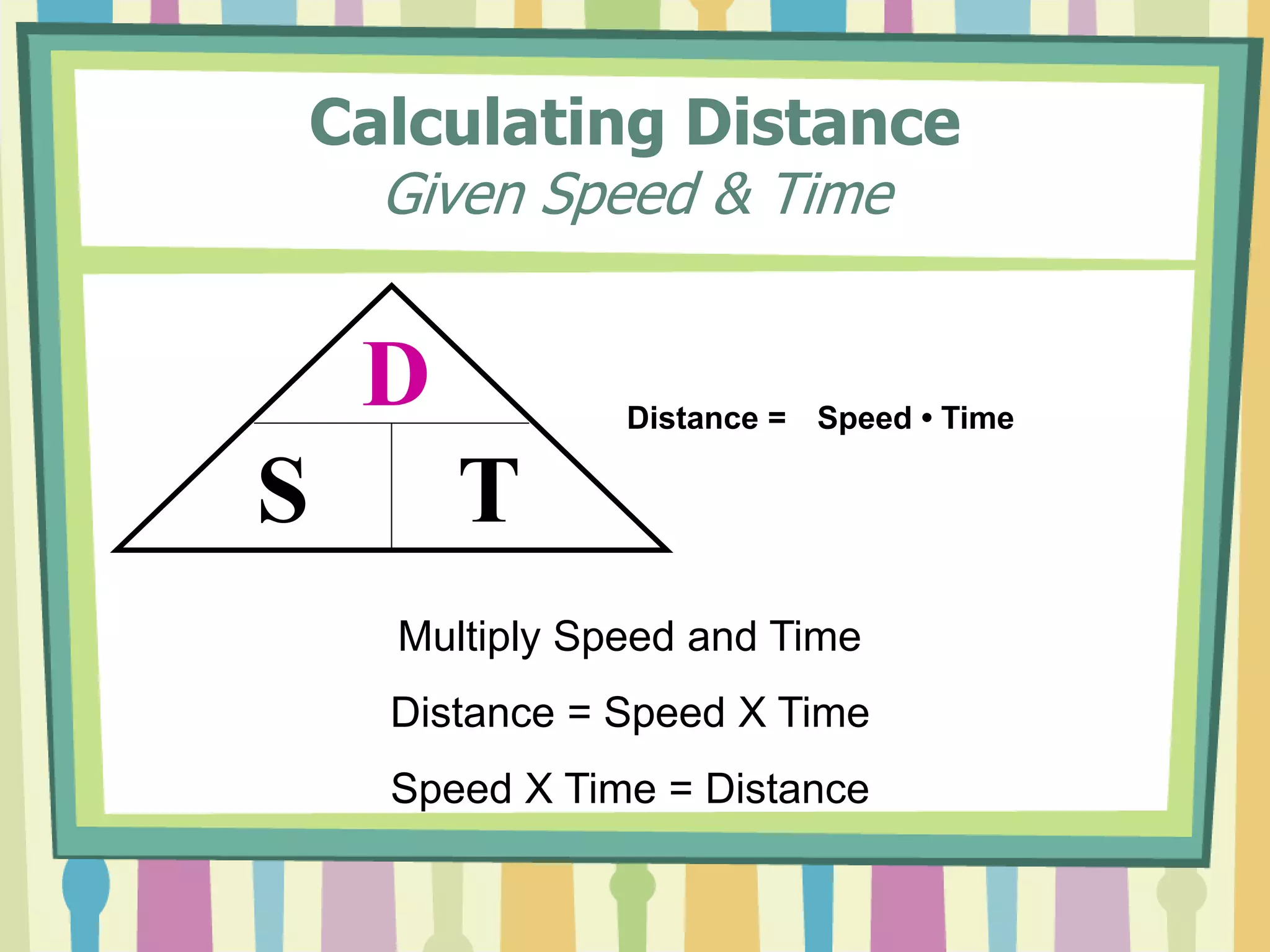
Calculating Distance 
Given Speed & Time 
D 
S T 
Distance = Speed • Time 
Multiply Speed and Time 
Distance = Speed X Time 
Speed X Time = Distance
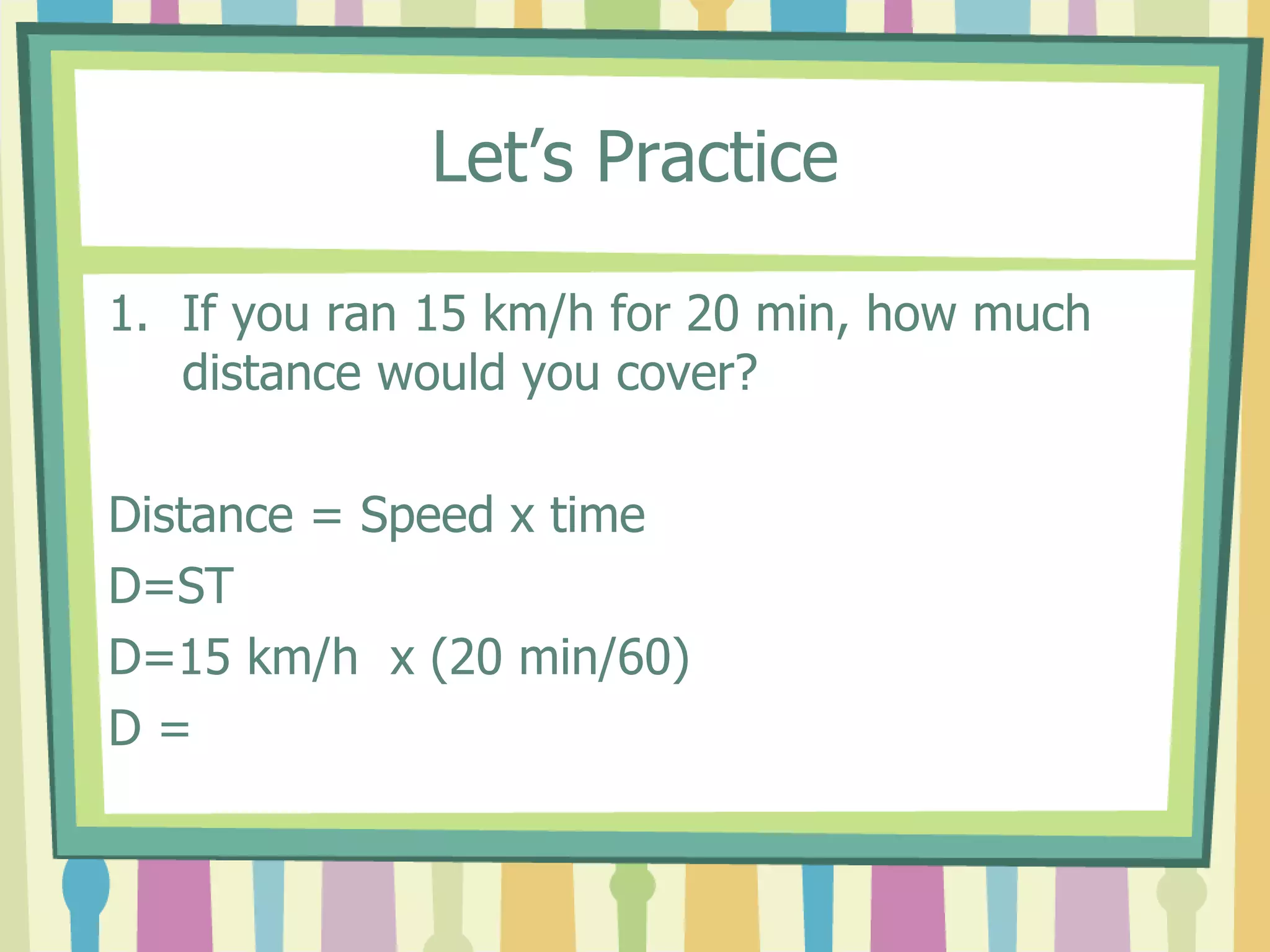
Let’s Practice 
1. If you ran 15 km/h for 20 min, how much 
distance would you cover? 
Distance = Speed x time 
D=ST 
D=15 km/h x (20 min/60) 
D =
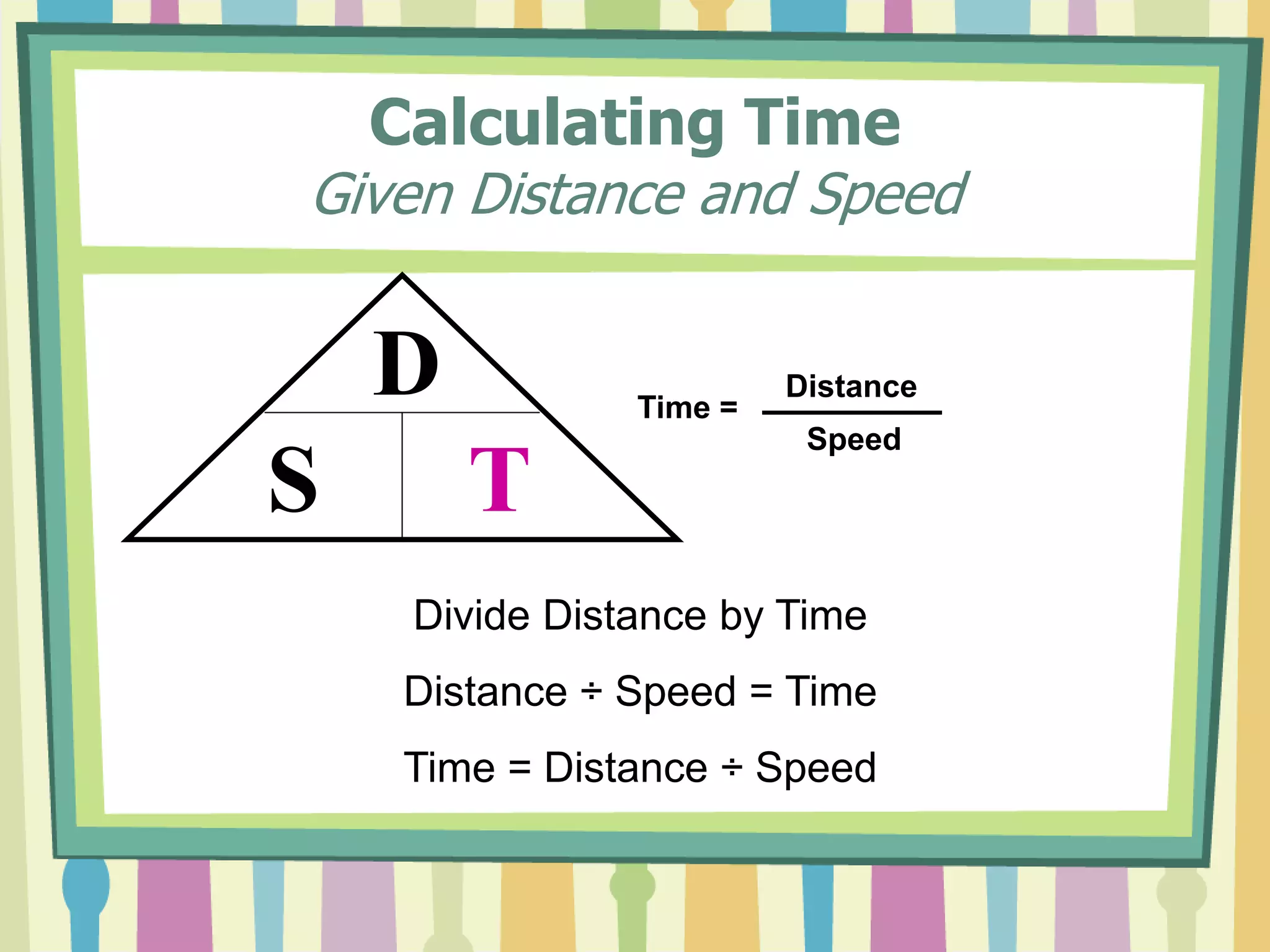
Calculating Time 
Given Distance and Speed 
D 
S T 
Time = 
Distance 
Speed 
Divide Distance by Time 
Distance ÷ Speed = Time 
Time = Distance ÷ Speed
Let’s Practice 
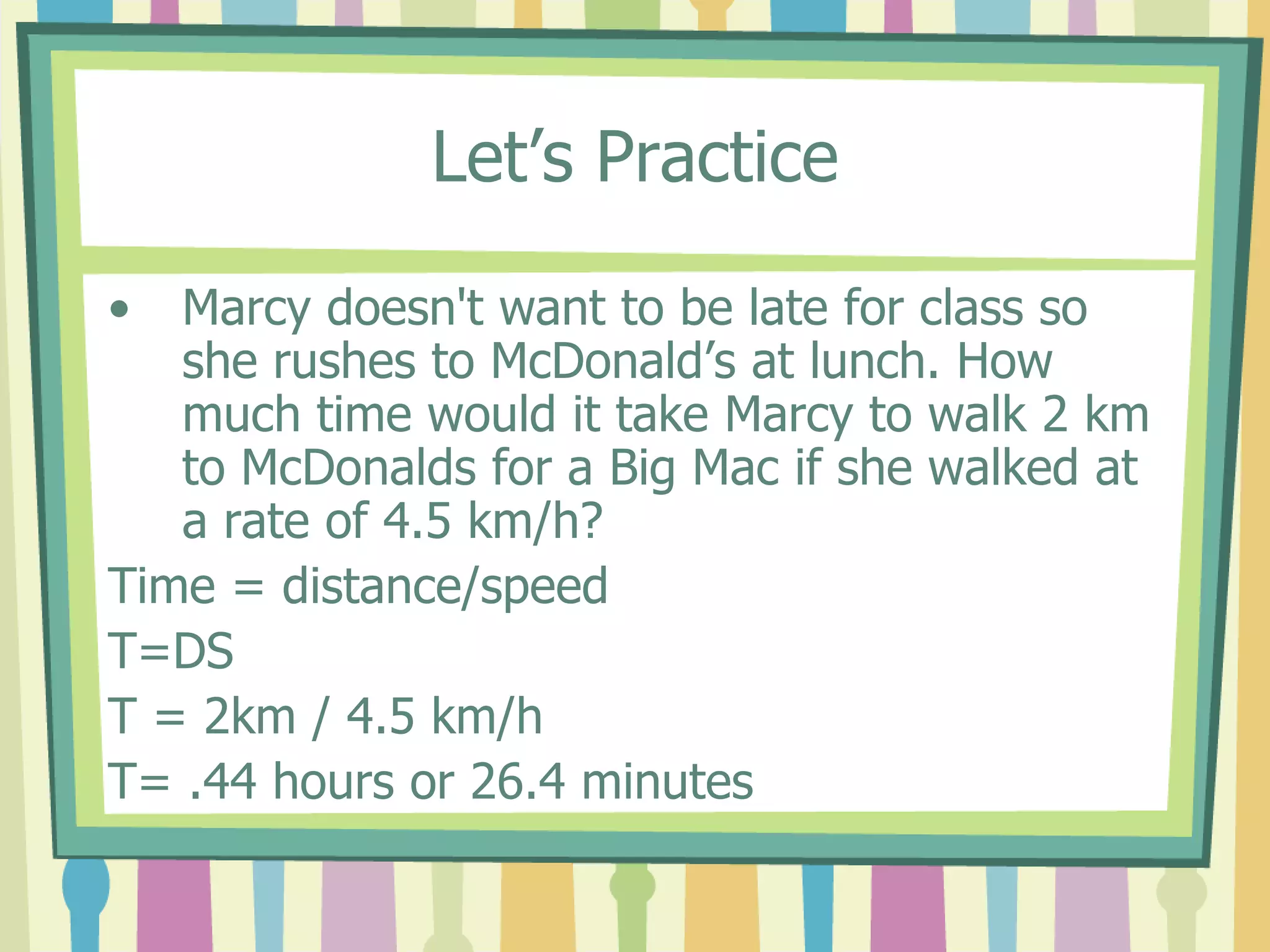
• Marcy doesn't want to be late for class so 
she rushes to McDonald’s at lunch. How 
much time would it take Marcy to walk 2 km 
to McDonalds for a Big Mac if she walked at 
a rate of 4.5 km/h? 
Time = distance/speed 
T=DS 
T = 2km / 4.5 km/h 
T= .44 hours or 26.4 minutes
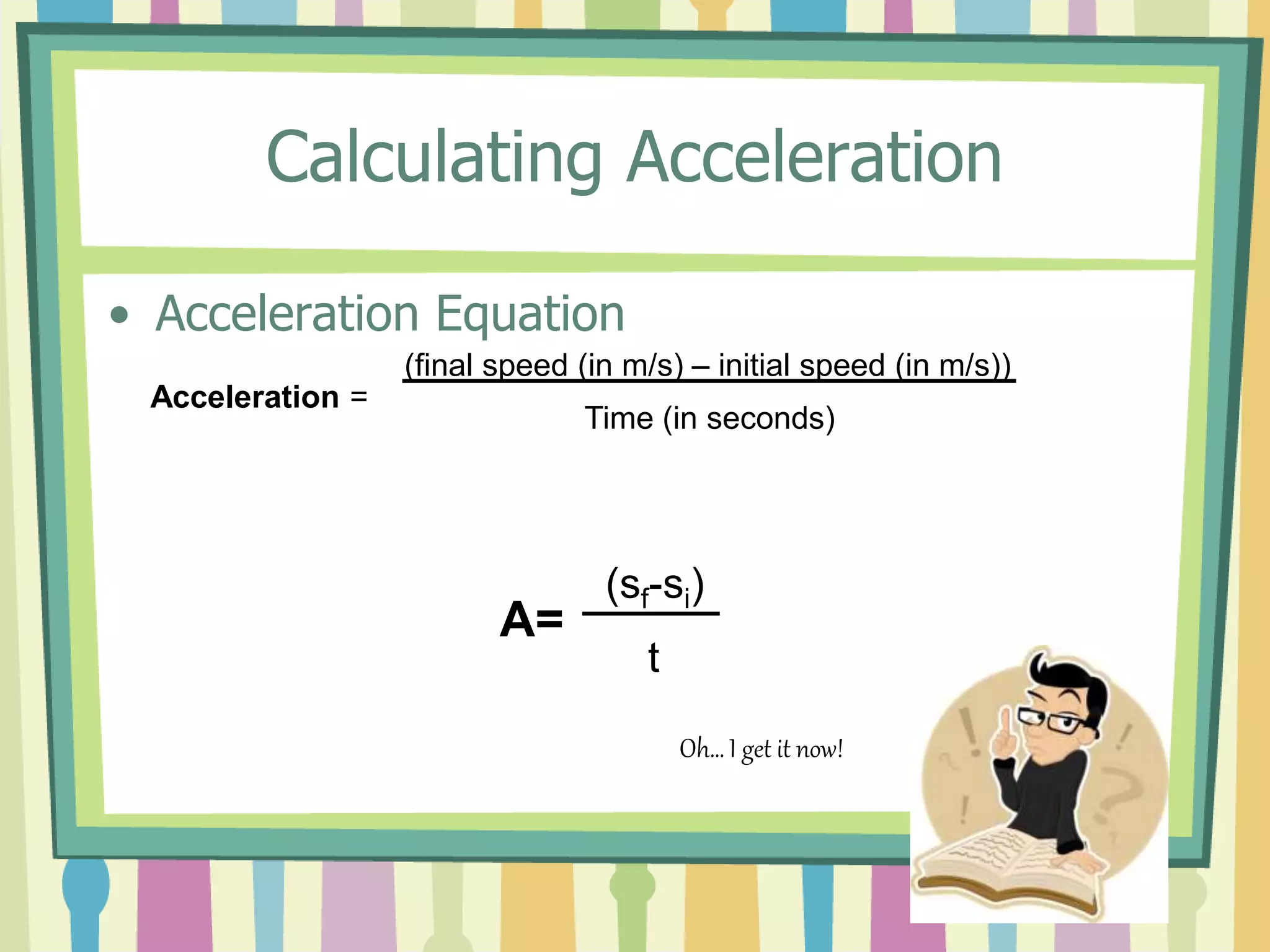
Calculating Acceleration 
• Acceleration Equation 
Acceleration = 
(final speed (in m/s) – initial speed (in m/s)) 
Time (in seconds) 
A= 
(sf-si) 
t 
Oh… I get it now!
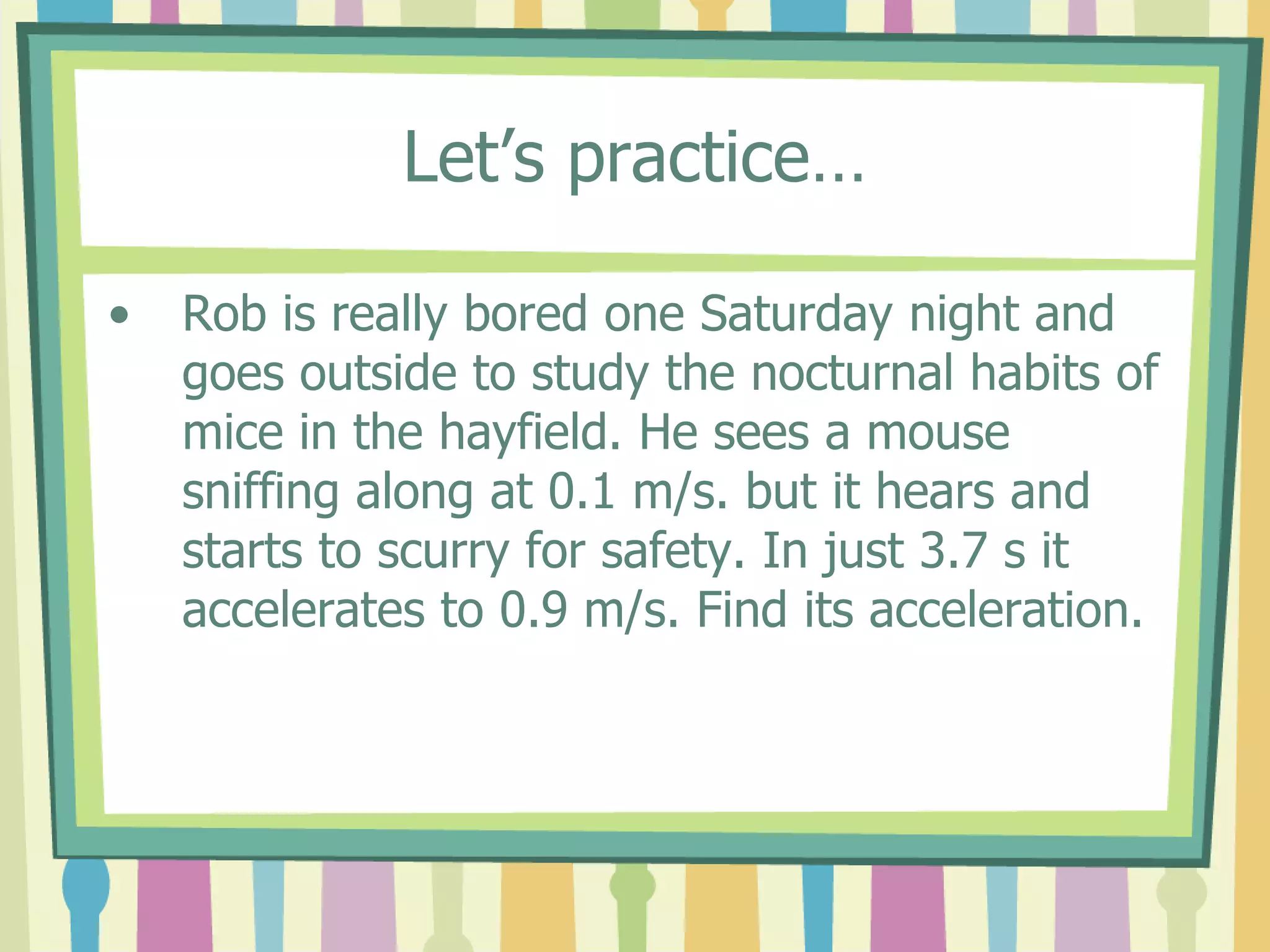
Let’s practice… 
• Rob is really bored one Saturday night and 
goes outside to study the nocturnal habits of 
mice in the hayfield. He sees a mouse 
sniffing along at 0.1 m/s. but it hears and 
starts to scurry for safety. In just 3.7 s it 
accelerates to 0.9 m/s. Find its acceleration.
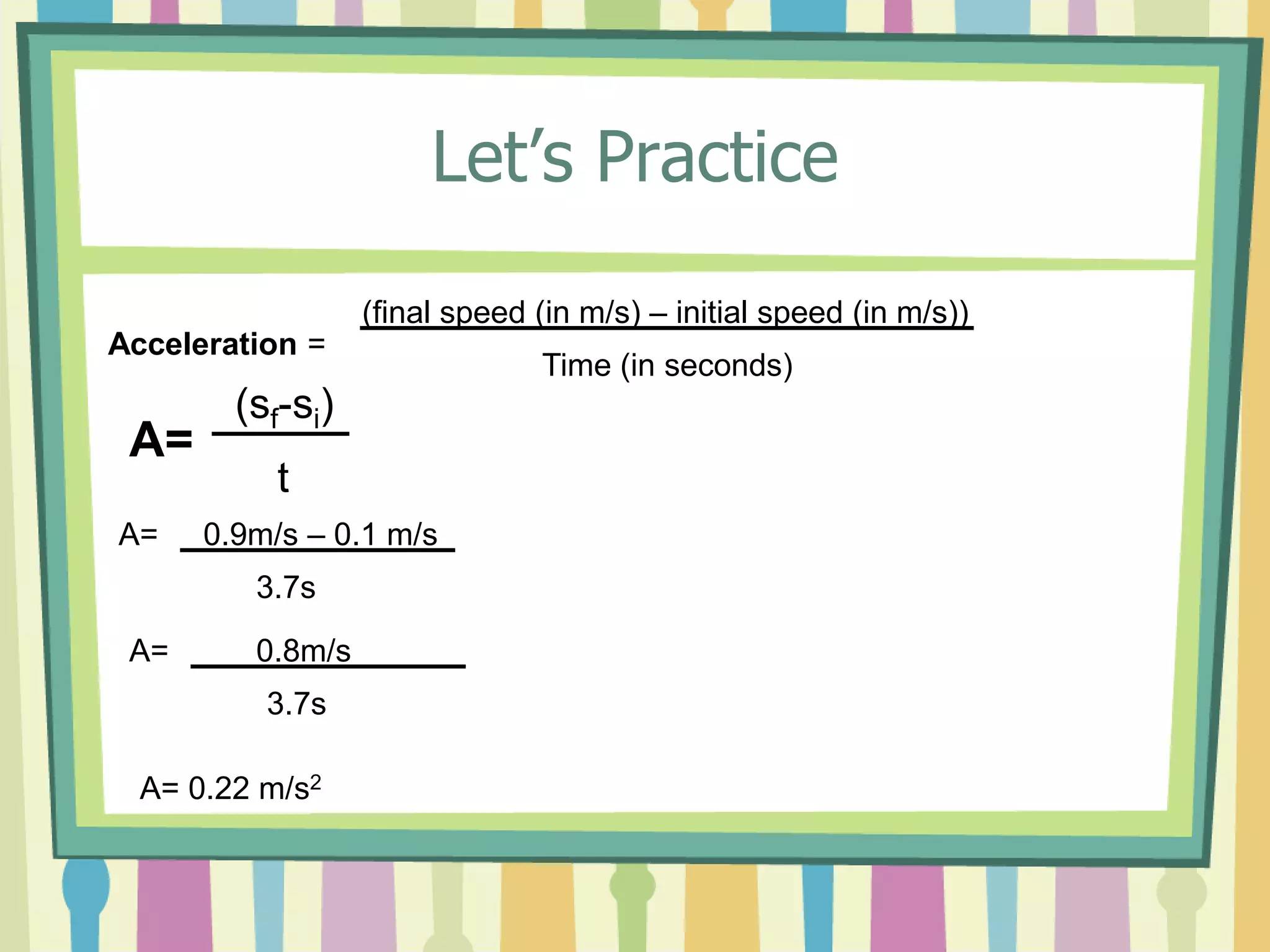
Let’s Practice 
Acceleration = 
(final speed (in m/s) – initial speed (in m/s)) 
Time (in seconds) 
A= 
(sf-si) 
t 
A= 0.9m/s – 0.1 m/s 
3.7s 
A= 0.8m/s 
3.7s 
A= 0.22 m/s2
Let’s Practice 
• A roach moves down the hall at 1.2 m/s. 
When he sees the janitor coming down the 
hall, he begins to run. After 3.2 s, he is 
moving at 3.6 m/s. What is his acceleration?
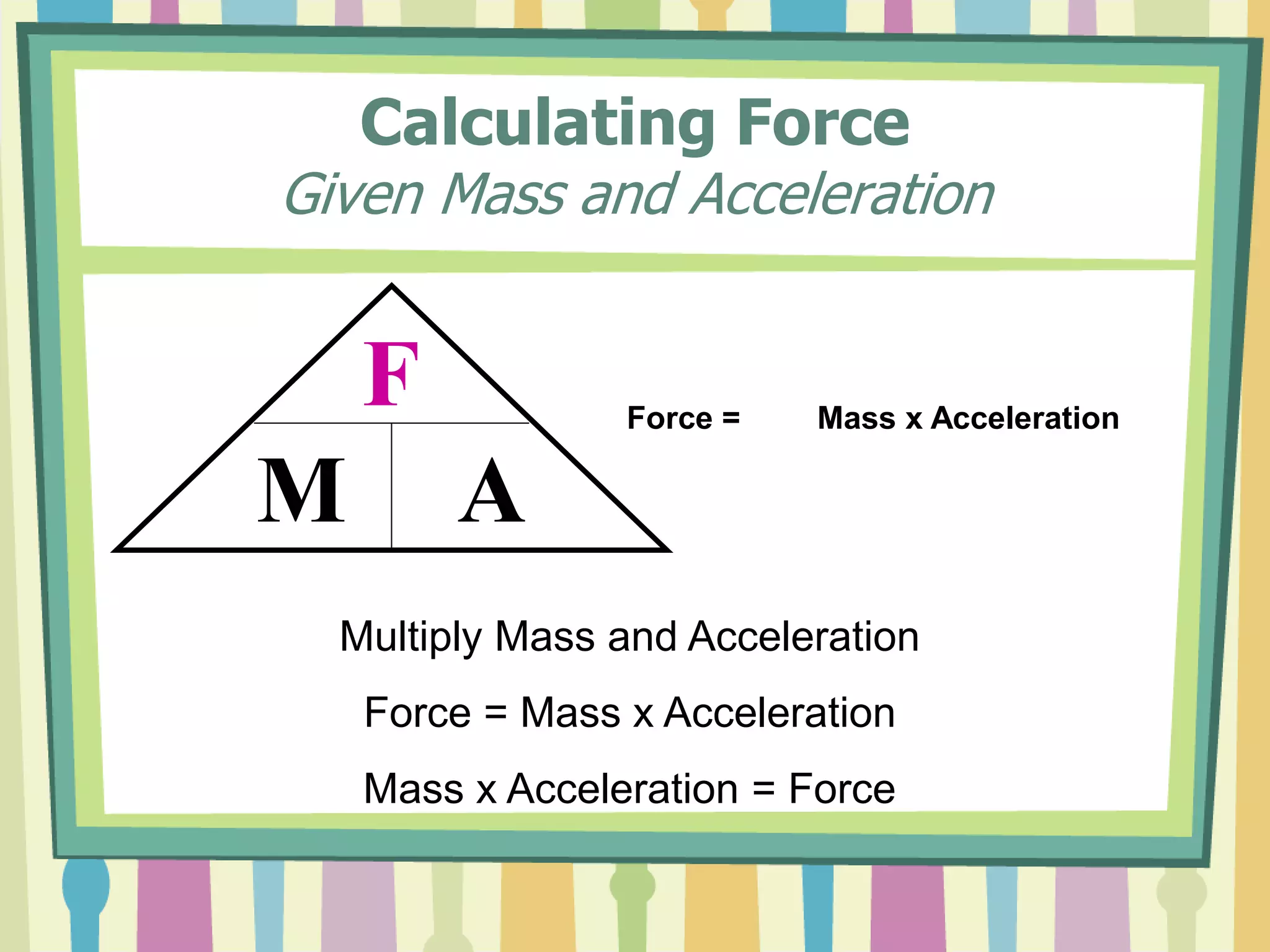
Calculating Force 
Given Mass and Acceleration 
F 
M A 
Force = Mass x Acceleration 
Multiply Mass and Acceleration 
Force = Mass x Acceleration 
Mass x Acceleration = Force
Let’s Practice 
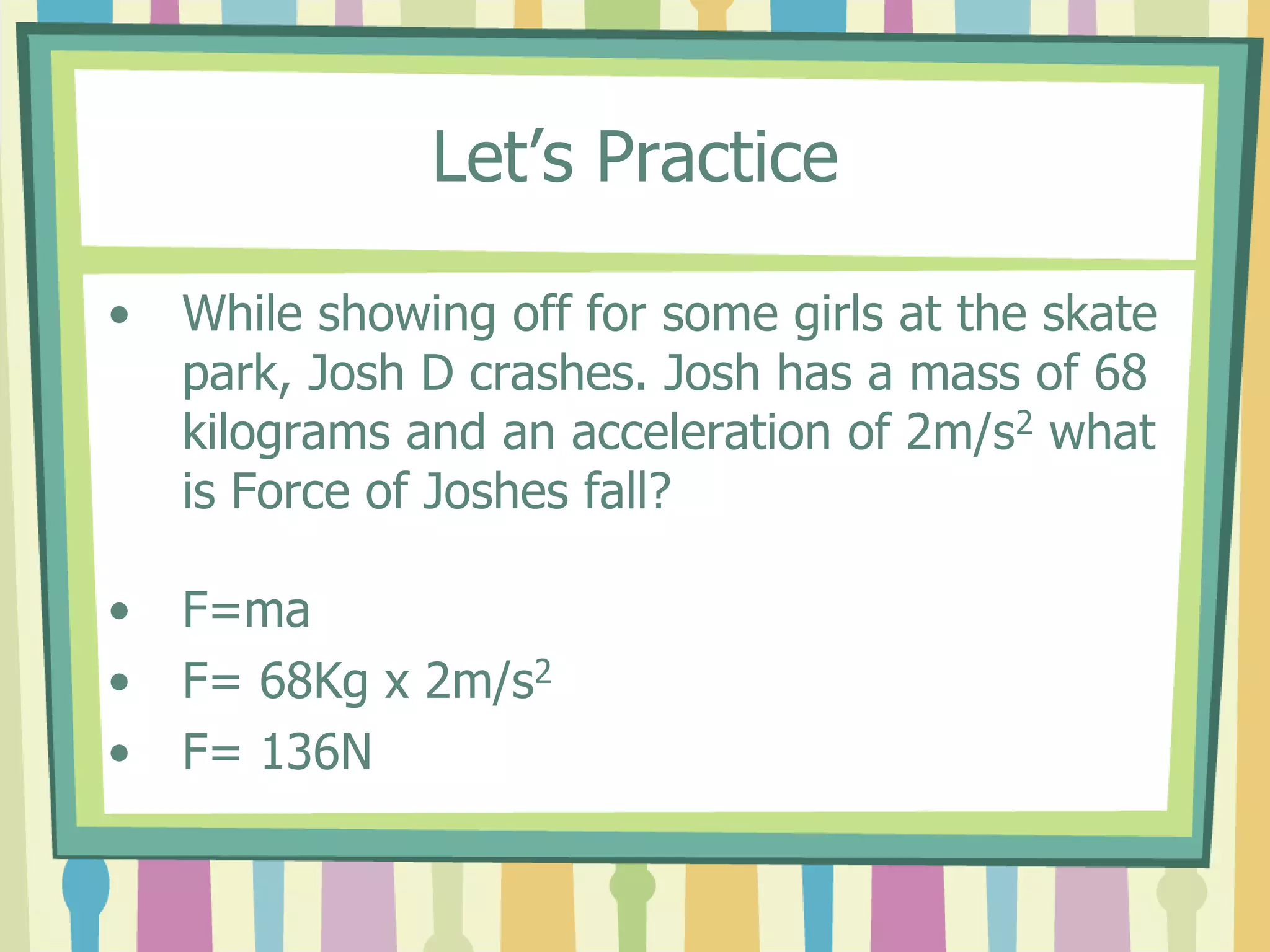
• While showing off for some girls at the skate 
park, Josh D crashes. Josh has a mass of 68 
kilograms and an acceleration of 2m/s2 what 
is Force of Joshes fall? 
• F=ma 
• F= 68Kg x 2m/s2 
• F= 136N
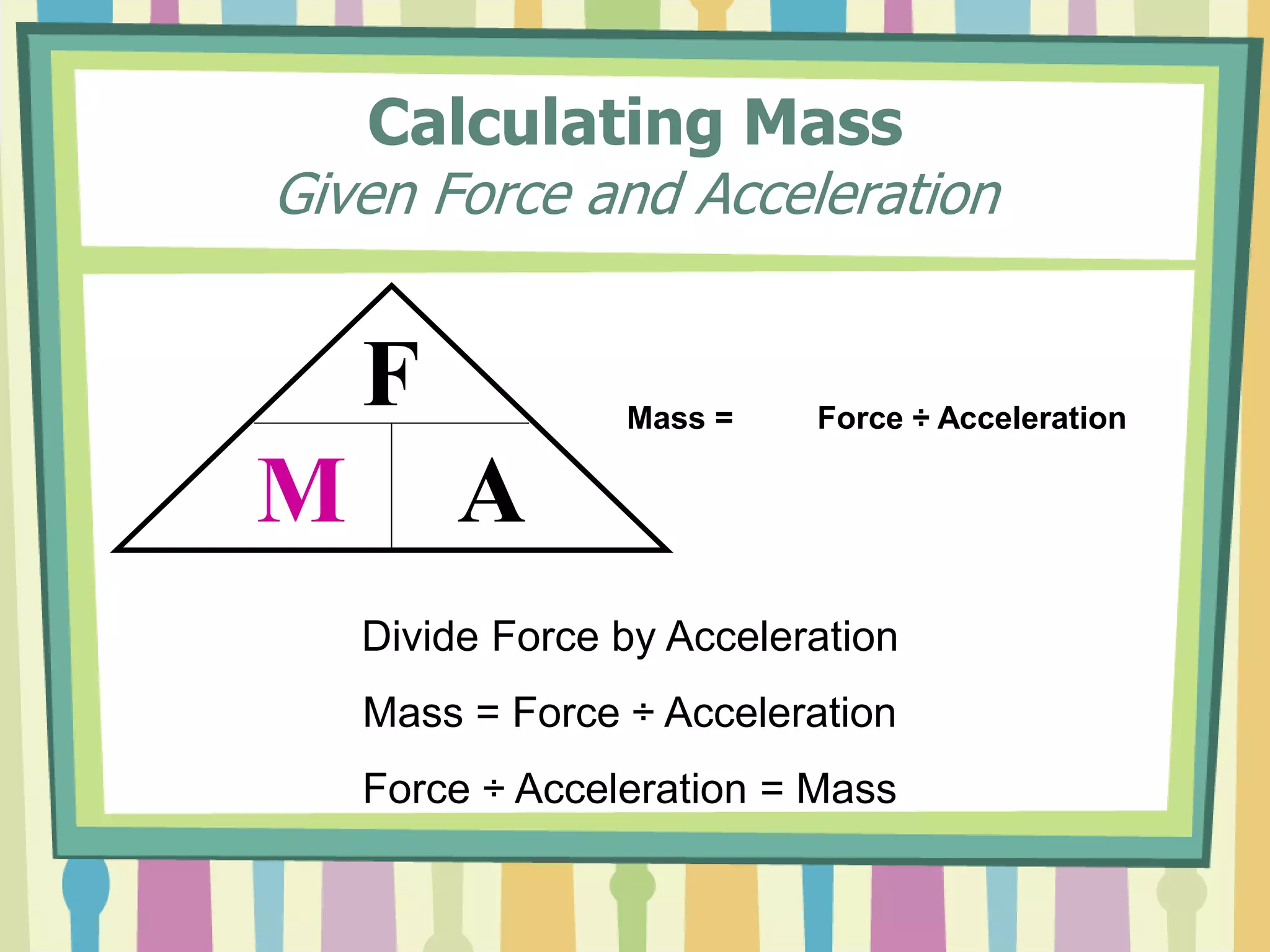
Calculating Mass 
Given Force and Acceleration 
F 
M A 
Mass = Force ÷ Acceleration 
Divide Force by Acceleration 
Mass = Force ÷ Acceleration 
Force ÷ Acceleration = Mass
Let’s Practice 
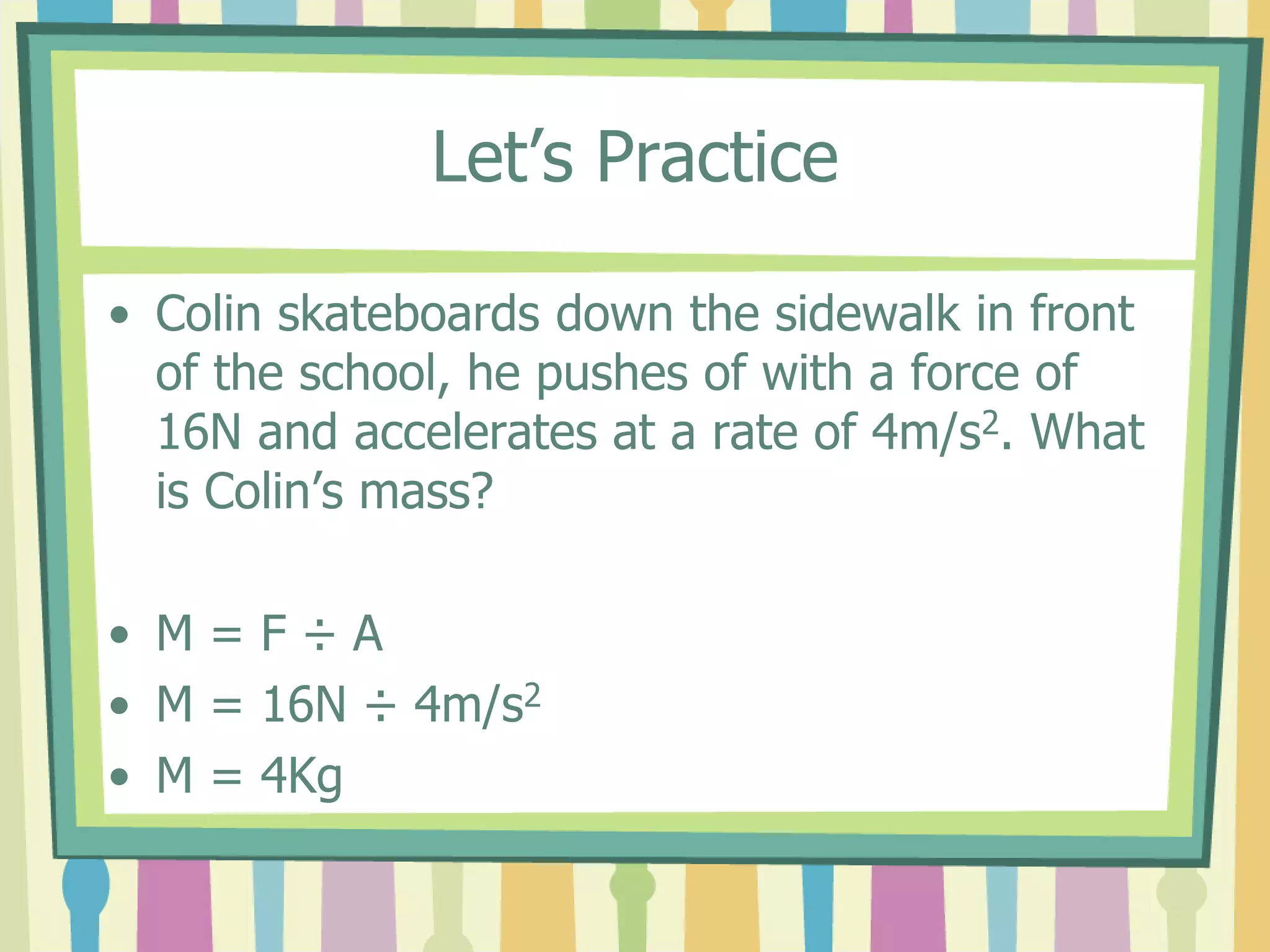
• Colin skateboards down the sidewalk in front 
of the school, he pushes of with a force of 
16N and accelerates at a rate of 4m/s2. What 
is Colin’s mass? 
• M = F ÷ A 
• M = 16N ÷ 4m/s2 
• M = 4Kg
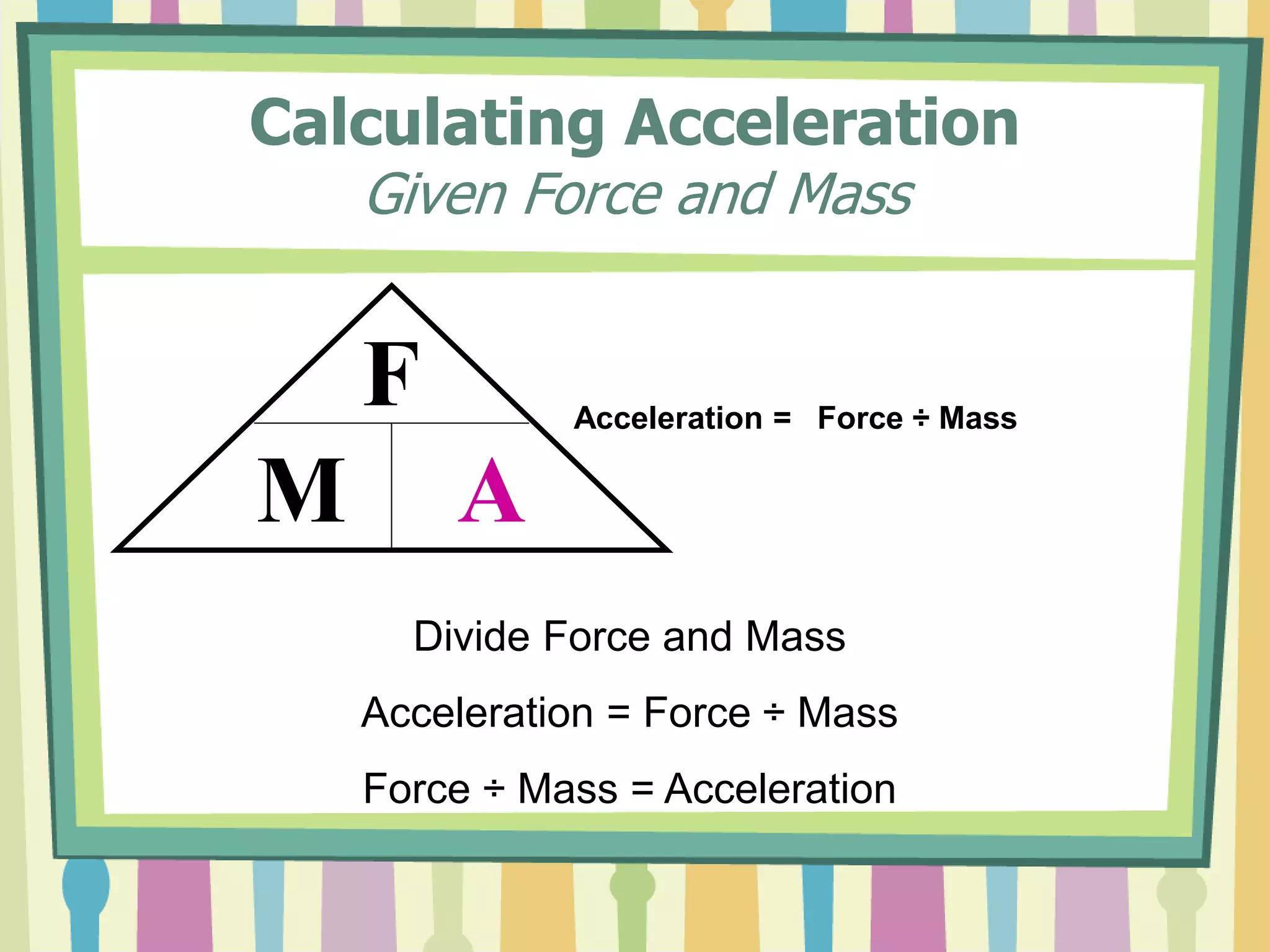
Calculating Acceleration 
Given Force and Mass 
F 
M A 
Acceleration = Force ÷ Mass 
Divide Force and Mass 
Acceleration = Force ÷ Mass 
Force ÷ Mass = Acceleration
Let’s Practice 
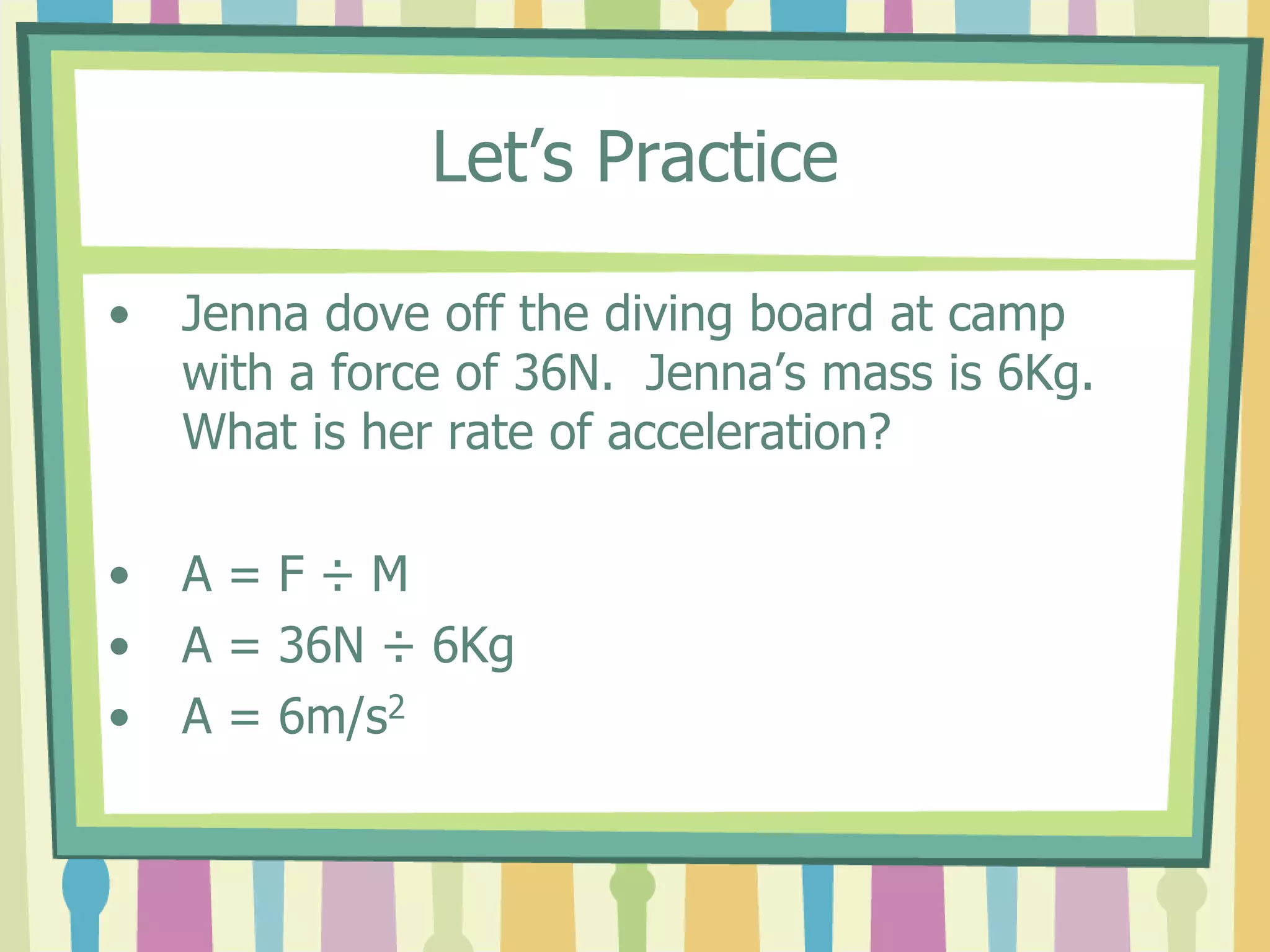
• Jenna dove off the diving board at camp 
with a force of 36N. Jenna’s mass is 6Kg. 
What is her rate of acceleration? 
• A = F ÷ M 
• A = 36N ÷ 6Kg 
• A = 6m/s2
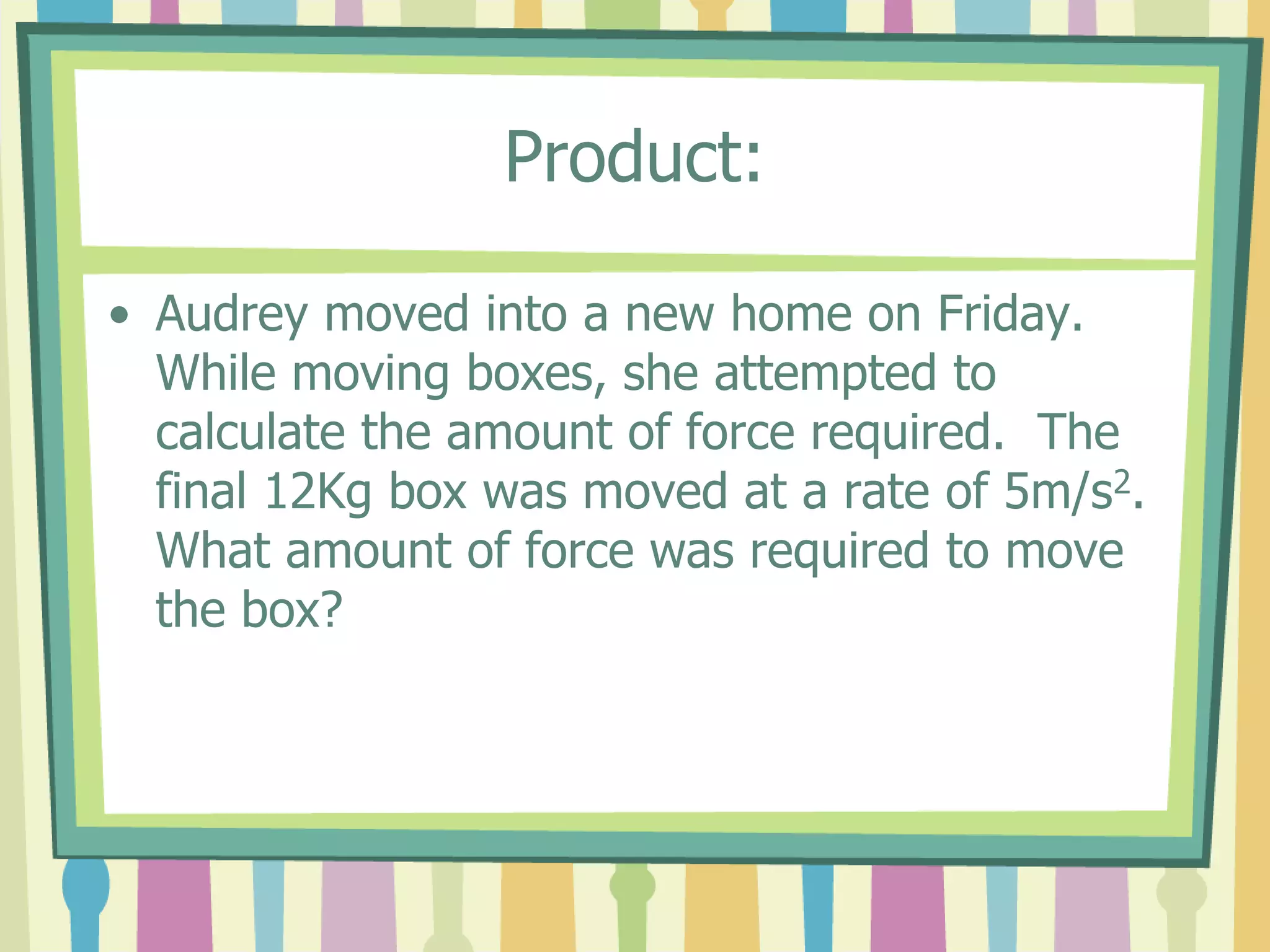
Product: 
• Audrey moved into a new home on Friday. 
While moving boxes, she attempted to 
calculate the amount of force required. The 
final 12Kg box was moved at a rate of 5m/s2. 
What amount of force was required to move 
the box?

Newton’s 2nd law of motion 2014

  • 1.
    Newton’s Second Lawof Motion 8th Science
  • 2.
    Force = Massx Acceleration (F=ma) • AKA: the “Law of Force and Acceleration” • Newton’s second law states that the amount of force is equal to an objects mass times its acceleration. • The acceleration of an object is directly proportional to the net force & indirectly proportional to its’ mass.
  • 3.
    Getting Started •First, you need to know the units of Force, Mass & Acceleration. – The units used for force are Newtons (N) – The units used for mass are kilograms (kg) – The acceleration units are meters per second squared (m/sec2).
  • 4.
    Acceleration • Isa change in velocity – Speeding up • Positive acceleration – Slowing down • Negative acceleration • Deceleration – Changing direction • unbalanced forces cause objects to accelerate.
  • 5.
    Acceleration • Accelerationis directly related to the size of the force and the direction of the force. • It accelerates in the direction you push or pull it.
  • 6.
    In other words…. Large Force = Large Acceleration F a
  • 7.
    In other words…. Small Force = Small Acceleration F a So….if you push twice as hard, it accelerates twice as much.
  • 8.
    But there isa twist…. • Acceleration is INVERSELY related to the mass of the object.
  • 9.
    In other words…..usingthe same amount of force…. F Small acceleration Large Mass a F Small Mass Large acceleration a
  • 10.
    Calculating Acceleration •Acceleration Equation Acceleration = (final speed (in m/s) – initial speed (in m/s)) Time (in seconds) A= (sf-si) t
  • 11.
    Calculating Speed •Comparison of time and distance – Distance traveled per unit time – Speed = distance ÷ time
  • 12.
    Calculating Speed GivenDistance & Time D S T Speed = Distance Time Speed = Distance ÷ Time
  • 13.
    Let’s Practice •Riley chucks a water balloon at a big, mean looking guy at the park. Running for his life, he travels 100m in 9.83s. What was his average speed? S= Distance/time S= d/t S= 100m/9.83s S=10.17 mps (meters per second)
  • 14.
    Calculating Distance GivenSpeed & Time D S T Distance = Speed • Time Multiply Speed and Time Distance = Speed X Time Speed X Time = Distance
  • 15.
    Let’s Practice 1.If you ran 15 km/h for 20 min, how much distance would you cover? Distance = Speed x time D=ST D=15 km/h x (20 min/60) D =
  • 16.
    Calculating Time GivenDistance and Speed D S T Time = Distance Speed Divide Distance by Time Distance ÷ Speed = Time Time = Distance ÷ Speed
  • 17.
    Let’s Practice •Marcy doesn't want to be late for class so she rushes to McDonald’s at lunch. How much time would it take Marcy to walk 2 km to McDonalds for a Big Mac if she walked at a rate of 4.5 km/h? Time = distance/speed T=DS T = 2km / 4.5 km/h T= .44 hours or 26.4 minutes
  • 18.
    Calculating Acceleration •Acceleration Equation Acceleration = (final speed (in m/s) – initial speed (in m/s)) Time (in seconds) A= (sf-si) t Oh… I get it now!
  • 19.
    Let’s practice… •Rob is really bored one Saturday night and goes outside to study the nocturnal habits of mice in the hayfield. He sees a mouse sniffing along at 0.1 m/s. but it hears and starts to scurry for safety. In just 3.7 s it accelerates to 0.9 m/s. Find its acceleration.
  • 20.
    Let’s Practice Acceleration= (final speed (in m/s) – initial speed (in m/s)) Time (in seconds) A= (sf-si) t A= 0.9m/s – 0.1 m/s 3.7s A= 0.8m/s 3.7s A= 0.22 m/s2
  • 21.
    Let’s Practice •A roach moves down the hall at 1.2 m/s. When he sees the janitor coming down the hall, he begins to run. After 3.2 s, he is moving at 3.6 m/s. What is his acceleration?
  • 22.
    Calculating Force GivenMass and Acceleration F M A Force = Mass x Acceleration Multiply Mass and Acceleration Force = Mass x Acceleration Mass x Acceleration = Force
  • 23.
    Let’s Practice •While showing off for some girls at the skate park, Josh D crashes. Josh has a mass of 68 kilograms and an acceleration of 2m/s2 what is Force of Joshes fall? • F=ma • F= 68Kg x 2m/s2 • F= 136N
  • 24.
    Calculating Mass GivenForce and Acceleration F M A Mass = Force ÷ Acceleration Divide Force by Acceleration Mass = Force ÷ Acceleration Force ÷ Acceleration = Mass
  • 25.
    Let’s Practice •Colin skateboards down the sidewalk in front of the school, he pushes of with a force of 16N and accelerates at a rate of 4m/s2. What is Colin’s mass? • M = F ÷ A • M = 16N ÷ 4m/s2 • M = 4Kg
  • 26.
    Calculating Acceleration GivenForce and Mass F M A Acceleration = Force ÷ Mass Divide Force and Mass Acceleration = Force ÷ Mass Force ÷ Mass = Acceleration
  • 27.
    Let’s Practice •Jenna dove off the diving board at camp with a force of 36N. Jenna’s mass is 6Kg. What is her rate of acceleration? • A = F ÷ M • A = 36N ÷ 6Kg • A = 6m/s2
  • 28.
    Product: • Audreymoved into a new home on Friday. While moving boxes, she attempted to calculate the amount of force required. The final 12Kg box was moved at a rate of 5m/s2. What amount of force was required to move the box?