7
Lesson Exemplar
for Science
for Science
Lesson
2
Quarter 1
Lesson 1
Quarter 1
Lesson Exemplar for Science 7
Quarter 1: Lesson 2 (Week 2)
S.Y. 2024-2025
This material is intended exclusively for the use of teachers participating in the implementation of the MATATAG K to 10 Curriculum during the School
Year 2024-2025. It aims to assist in delivering the curriculum content, standards, and lesson competencies. Any unauthorized reproduction, distribution,
modification, or utilization of this material beyond the designated scope is strictly prohibited and may result in appropriate legal actions and disciplinary measures.
Borrowed content included in this material are owned by their respective copyright holders. Every effort has been made to locate and obtain permission
to use these materials from their respective copyright owners. The publisher and development team do not represent nor claim ownership over them.
Every care has been taken to ensure the accuracy of the information provided in this material. For inquiries or feedback, please write or call the Office
of the Director of the Bureau of Learning Resources via telephone numbers (02) 8634-1072 and 8631-6922 or by email at blr.od@deped.gov.ph
Development Team
Writers:
• Jefferson E. Flores (Leyte Normal University)
Management Team
Philippine Normal University
Research Institute for Teacher Quality
SiMERR National Research Centre
Validator:
• Diana Lou E. Sipalay (Caloocan High School)
1
SCIENCE (CHEMISTRY) / QUARTER 1 / GRADE 7
I. CURRICULUM CONTENT, STANDARDS, AND LESSON COMPETENCIES
A. Content
Standards
The learners shall learn that there are specific processes for planning, conducting, and recording scientific
investigations
B. Performance
Standards
By the end of the quarter, the learners shall recognize that scientists use models to describe the particle model of
matter. They use diagrams and illustrations to explain the motion and arrangement of particles during changes of
state. They demonstrate an understanding of the role of solute and solvent in solutions and the factors that affect
solubility. They demonstrate skills to plan and conduct a scientific investigation
making accurate measurements and using standard units.
C. Learning
Competencies
and Objectives
Learning Competency
The learners shall be able to:
1. describe the Particle Model of Matter as “All matter is made up of tiny particles with each pure substance
having its own kind of particles.”; and
2. describe that particles are constantly in motion, have spaces between them, attract each other, and move faster
as the temperature increases (or with the addition of heat).
Lesson Objectives:
The learners shall be able to:
1. differentiate elements and compounds based on particle composition; and
2. explain how the Kinetic Molecular Theory describes the behavior of particles in terms of constant motion,
spacing between particles, and the relationship between temperature and particle speed.
C. Content • Pure Substances
• Kinetic Molecular Theory of Matter
D. Integration ▪ Exploring the nature of matter fosters a sense of curiosity about the world around us.
▪ A basic understanding of KMT contributes to scientific literacy, allowing individuals to make informed
decisions about their environment, and the products they use.
▪ The critical thinking and problem-solving skills developed in these lessons are valuable for various aspects of
life beyond science
2
II. LEARNING RESOURCES
● Worksheet for Science 7 Quarter 1 – Week 2
III. TEACHING AND LEARNING PROCEDURE NOTES TO TEACHERS
1. Activating Prior
Knowledge WEEK 2 -Day 1
1. Short Review - Particle Party!
This activity bridges the gap between atomic models and Kinetic Molecular Theory
(KMT).
Materials:
• Index cards (enough for each student)
• Markers
Essential Questions for Review:
1. What are atoms made of? (protons, neutrons, and electrons)
2. What does the particle model tell us about matter? (made of tiny
particles)
Activity for Students:
1. Imagine tiny particles representing atoms or molecules. On your index
cards, draw these "partying particles."
2. Use arrows on your cards to show the movement of the particles.
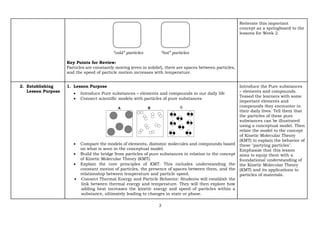
Represent "cold" particles with slow, short arrows on one side of the card
while "hot" particles with fast, long arrows.
Distribute index cards and
markers or make this their
assignment before the end of
Week 1.
Briefly remind students about
the atomic model learned in the
previous lesson.
Briefly discuss the drawings.
Ask students to explain how
their drawings relate to the
particle model and the concept
of temperature.
3
“cold” particles “hot” particles
Key Points for Review:
Particles are constantly moving (even in solids!), there are spaces between particles,
and the speed of particle motion increases with temperature.
Reiterate this important
concept as a springboard to the
lessons for Week 2.
2. Establishing
Lesson Purpose
1. Lesson Purpose
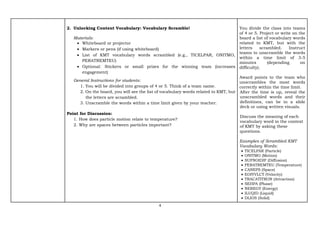
• Introduce Pure substances – elements and compounds in our daily life
• Connect scientific models with particles of pure substances
• Compare the models of elements, diatomic molecules and compounds based
on what is seen in the conceptual model.
• Build the bridge from particles of pure substances in relation to the concept
of Kinetic Molecular Theory (KMT).
• Explain the core principles of KMT: This includes understanding the
constant motion of particles, the presence of spaces between them, and the
relationship between temperature and particle speed.
• Connect Thermal Energy and Particle Behavior: Students will establish the
link between thermal energy and temperature. They will then explore how
adding heat increases the kinetic energy and speed of particles within a
substance, ultimately leading to changes in state or phase.
Introduce the Pure substances
– elements and compounds.
Teased the learners with some
important elements and
compounds they encounter in
their daily lives. Tell them that
the particles of these pure
substances can be illustrated
using a conceptual model. Then
relate the model to the concept
of Kinetic Molecular Theory
(KMT) to explain the behavior of
these "partying particles".
Emphasize that this lesson
aims to equip them with a
foundational understanding of
the Kinetic Molecular Theory
(KMT) and its applications to
particles of materials.
4
2. Unlocking Content Vocabulary: Vocabulary Scramble!
Materials:
• Whiteboard or projector
• Markers or pens (if using whiteboard)
• List of KMT vocabulary words scrambled (e.g., TICELPAR, ONITMO,
PERATREMTEU)
• Optional: Stickers or small prizes for the winning team (increases
engagement)
General Instructions for students:
1. You will be divided into groups of 4 or 5. Think of a team name.
2. On the board, you will see the list of vocabulary words related to KMT, but
the letters are scrambled.
3. Unscramble the words within a time limit given by your teacher.
Point for Discussion:
1. How does particle motion relate to temperature?
2. Why are spaces between particles important?
You divide the class into teams
of 4 or 5. Project or write on the
board a list of vocabulary words
related to KMT, but with the
letters scrambled. Instruct
teams to unscramble the words
within a time limit of 3-5
minutes (depending on
difficulty).
Award points to the team who
unscrambles the most words
correctly within the time limit.
After the time is up, reveal the
unscrambled words and their
definitions, can be in a slide
deck or using written visuals.
Discuss the meaning of each
vocabulary word in the context
of KMT by asking these
questions.
Examples of Scrambled KMT
Vocabulary Words:
• TICELPAR (Particle)
• ONITMO (Motion)
• SUFNOIDIF (Diffusion)
• PERATREMTEU (Temperature)
• CANEPS (Space)
• EOIYVLCT (Velocity)
• TRACATITRON (Attraction)
• SEHPA (Phase)
• NEREGY (Energy)
• ILUQID (Liquid)
• DLIOS (Solid)
5
• OELEUCLM (Molecule)
• ORCESF (Forces)
• NIBOILG (Boiling Point)
• SOILUBITLY (Solubility)
3. Developing and
Deepening
Understanding
Week 2 - Day 2
Lesson 1: Elements and Compounds
1. Explicitation:
Quick Questions:
• What are the basic units that make up all matter according to the particle
model? (Particles)
• How does the movement and arrangement of these particles affect the state
of matter (solid, liquid, gas)? (Students should recall that movement and
spacing influence the state.)
2. Lesson Activity: Think-Pair-Share
Processing Questions:
Can you think of any examples of different types of matter?
Do you think these materials are made up of the same tiny particles? Why or why
not?
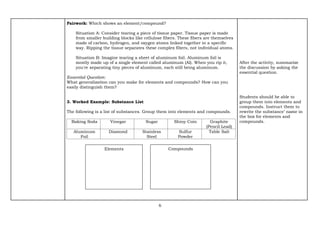
Source:
https://chem.libretexts.org/@api/deki/files/294894/Classification_of_Matter_(1).png?revision=1
Begin with a quick review of the
previous lesson on the particle
model of matter. Ask students
the quick questions.
Allow brainstorming for various
materials like water, sugar,
iron, etc.
After Processing the answers,
show the figure to the class.
Focus on the pure substances
only. You can pre-empt
Mixtures, but this will be
tackled in detail in the
succeeding weeks.
After discussing properties and
characteristics, even samples,
of pure substances, ask the
learners to evaluate the
situations.
6
Pairwork: Which shows an element/compound?
Situation A: Consider tearing a piece of tissue paper. Tissue paper is made
from smaller building blocks like cellulose fibers. These fibers are themselves
made of carbon, hydrogen, and oxygen atoms linked together in a specific
way. Ripping the tissue separates these complex fibers, not individual atoms.
Situation B: Imagine tearing a sheet of aluminum foil. Aluminum foil is
mostly made up of a single element called aluminum (Al). When you rip it,
you're separating tiny pieces of aluminum, each still being aluminum.
Essential Question:
What generalization can you make for elements and compounds? How can you
easily distinguish them?
3. Worked Example: Substance List
The following is a list of substances. Group them into elements and compounds.
Baking Soda Vinegar Sugar Shiny Coin Graphite
(Pencil Lead)
Aluminum
Foil
Diamond Stainless
Steel
Sulfur
Powder
Table Salt
After the activity, summarize
the discussion by asking the
essential question.
Students should be able to
group them into elements and
compounds. Instruct them to
rewrite the substance’ name in
the box for elements and
compounds.
Elements Compounds
7
Learning Activity
• For the activity worksheet, refer to LAS 1 in the Worksheet for Science 7
Quarter 1 – Week 2
Week 2 - Day 3
Lesson 2: The Kinetic Molecular Theory (KMT) of Matter
1. Explicitation
2. Lesson Activity: Atomic Activities
Mini-activity 1: The Shivering Statue
Instructions: Ask students to stand perfectly still, like a statue. After a few
seconds, ask them to silently shiver in place without moving their feet.
Process Question: Even though you looked like a statue, what was happening
to the tiny particles in your body (atoms and molecules)? (They were still
moving, but with less movement compared to shivering)
Explanation: Explain the concept of constant motion in KMT. Particles are
always moving, even in solids where things seem still. The shivering activity
demonstrated a small increase in particle movement.
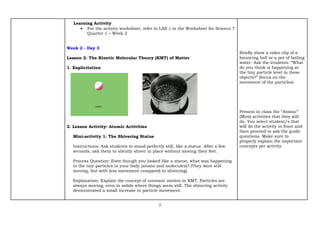
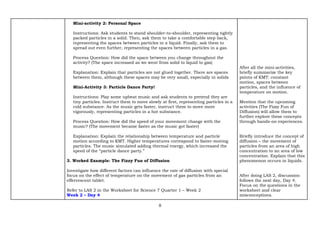
Briefly show a video clip of a
bouncing ball or a pot of boiling
water. Ask the students: “What
do you think is happening at
the tiny particle level in these
objects?” (focus on the
movement of the particles)
Present in class the “Atomic”
(Mini) activities that they will
do. You select student/s that
will do the activity in front and
then proceed to ask the guide
questions. Make sure to
properly explain the important
concepts per activity.
8
Mini-activity 2: Personal Space
Instructions: Ask students to stand shoulder-to-shoulder, representing tightly
packed particles in a solid. Then, ask them to take a comfortable step back,
representing the spaces between particles in a liquid. Finally, ask them to
spread out even further, representing the spaces between particles in a gas.
Process Question: How did the space between you change throughout the
activity? (The space increased as we went from solid to liquid to gas)
Explanation: Explain that particles are not glued together. There are spaces
between them, although these spaces may be very small, especially in solids
Mini-Activity 3: Particle Dance Party!
Instructions: Play some upbeat music and ask students to pretend they are
tiny particles. Instruct them to move slowly at first, representing particles in a
cold substance. As the music gets faster, instruct them to move more
vigorously, representing particles in a hot substance.
Process Question: How did the speed of your movement change with the
music? (The movement became faster as the music got faster)
Explanation: Explain the relationship between temperature and particle
motion according to KMT. Higher temperatures correspond to faster-moving
particles. The music simulated adding thermal energy, which increased the
speed of the “particle dance party.”
3. Worked Example: The Fizzy Fun of Diffusion
Investigate how different factors can influence the rate of diffusion with special
focus on the effect of temperature on the movement of gas particles from an
effervescent tablet.
Refer to LAS 2 in the Worksheet for Science 7 Quarter 1 – Week 2
Week 2 – Day 4
After all the mini-activities,
briefly summarize the key
points of KMT: constant
motion, spaces between
particles, and the influence of
temperature on motion.
Mention that the upcoming
activities (The Fizzy Fun of
Diffusion) will allow them to
further explore these concepts
through hands-on experiences.
Briefly introduce the concept of
diffusion – the movement of
particles from an area of high
concentration to an area of low
concentration. Explain that this
phenomenon occurs in liquids.
After doing LAS 2, discussion
follows the next day, Day 4.
Focus on the questions in the
worksheet and clear
misconceptions.
9
Processing Questions after the activity, LAS 2:
1. How do your observations relate to the concept of temperature and particle
movement according to Kinetic Molecular Theory (KMT)?
2. Explain why the bubbles seemed to move faster (or slower) in one container
compared to the other.
3. Based on this experiment, what can you predict about the rate of diffusion
of food coloring in warm water versus cold water? Why?
4. Making
Generalizations
1. Learners’ Takeaways
• Describe the key difference between an element and a compound in terms
of their composition and particles.
• How do particles behave in terms of their motion, spacing, and the
relationship between temperature and particle speed as described by the
KMT?
2. Reflection on Learning
Ask students the question:
Imagine shrinking yourself down to the size of an atom! Based on what you
learned about Kinetic Molecular Theory (KMT), describe what the world around
you would look like and how you would interact with it. Consider scenarios
like you are a solid, liquid or gas particle.
The questions shall be
answered in an interactive
discussion. Make sure to get
the correct concepts out of the
learners by using art of
questioning.
The teacher can always insert
reflection in every lesson or
activity if s/he deems necessary
not just at the end of the
lessons.
10
IV. EVALUATING LEARNING: FORMATIVE ASSESSMENT AND TEACHER’S REFLECTION NOTES TO TEACHERS
A. Evaluating
Learning
1. Formative Assessment
1. An unknown white substance is heated and produced white smoke and
black solid. What do you think is this substance?
a) a mixture
b) an element
c) a compound
d) a diatomic molecule
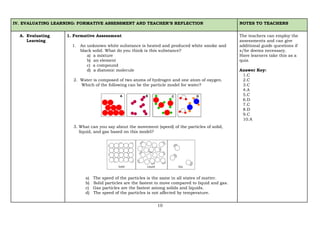
2. Water is composed of two atoms of hydrogen and one atom of oxygen.
Which of the following can be the particle model for water?
3. What can you say about the movement (speed) of the particles of solid,
liquid, and gas based on this model?
a) The speed of the particles is the same in all states of matter.
b) Solid particles are the fastest to move compared to liquid and gas.
c) Gas particles are the fastest among solids and liquids.
d) The speed of the particles is not affected by temperature.
The teachers can employ the
assessments and can give
additional guide questions if
s/he deems necessary.
Have learners take this as a
quiz.
Answer Key:
1.C
2.C
3.C
4.A
5.C
6.D
7.C
8.D
9.C
10.A
11
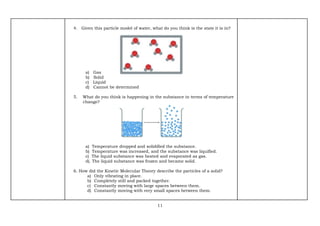
4. Given this particle model of water, what do you think is the state it is in?
a) Gas
b) Solid
c) Liquid
d) Cannot be determined
5. What do you think is happening in the substance in terms of temperature
change?
a) Temperature dropped and solidified the substance.
b) Temperature was increased, and the substance was liquified.
c) The liquid substance was heated and evaporated as gas.
d). The liquid substance was frozen and became solid.
6. How did the Kinetic Molecular Theory describe the particles of a solid?
a) Only vibrating in place.
b) Completely still and packed together.
c) Constantly moving with large spaces between them.
d) Constantly moving with very small spaces between them.
12
7. What is the movement of the particles in a gas?
a) Not moving at all.
b) Moving very slowly and tightly packed together.
c) Moving rapidly with large spaces between them.
d) Moving very slowly with large spaces between them.
8. Which has a direct relationship with temperature?
a) Size of its particles.
b) Shape of its particles.
c) Type of intermolecular forces present.
d) Average kinetic energy (speed) of its particles.
9. In the "Personal Space" mini-activity, how did the space between students
change as they went from solid to liquid to gas?
a) It decreased slightly.
b) It remained the same.
c) It increased significantly.
d) It completely disappeared.
10.The "Particle Dance Party" mini-activity demonstrated the relationship
between temperature and particle motion according to KMT. As the music
got faster, the particles (students) moved:
a) Faster.
b) Slower.
c) The same.
d) Erratically.
2. Homework (optional)
The teacher may opt to give
homework if s/he thinks the
competency is not yet mastered
13
B. Teacher’s
Remarks
Note observations on
any of the following
areas:
Effective Practices Problems Encountered
strategies explored
materials used
learner engagement/
interaction
Others
C. Teacher’s
Reflection Reflection guide or prompt can be on:
▪ principles behind the teaching
What principles and beliefs informed my lesson?
Why did I teach the lesson the way I did?
▪ students
What roles did my students play in my lesson?
What did my students learn? How did they learn?
▪ ways forward
What could I have done differently?
What can I explore in the next lesson?

Quarter1_LE_Science 7_Lesson 2_Week 2.pdf

  • 1.
    7 Lesson Exemplar for Science forScience Lesson 2 Quarter 1 Lesson 1 Quarter 1
  • 2.
    Lesson Exemplar forScience 7 Quarter 1: Lesson 2 (Week 2) S.Y. 2024-2025 This material is intended exclusively for the use of teachers participating in the implementation of the MATATAG K to 10 Curriculum during the School Year 2024-2025. It aims to assist in delivering the curriculum content, standards, and lesson competencies. Any unauthorized reproduction, distribution, modification, or utilization of this material beyond the designated scope is strictly prohibited and may result in appropriate legal actions and disciplinary measures. Borrowed content included in this material are owned by their respective copyright holders. Every effort has been made to locate and obtain permission to use these materials from their respective copyright owners. The publisher and development team do not represent nor claim ownership over them. Every care has been taken to ensure the accuracy of the information provided in this material. For inquiries or feedback, please write or call the Office of the Director of the Bureau of Learning Resources via telephone numbers (02) 8634-1072 and 8631-6922 or by email at blr.od@deped.gov.ph Development Team Writers: • Jefferson E. Flores (Leyte Normal University) Management Team Philippine Normal University Research Institute for Teacher Quality SiMERR National Research Centre Validator: • Diana Lou E. Sipalay (Caloocan High School)
  • 3.
    1 SCIENCE (CHEMISTRY) /QUARTER 1 / GRADE 7 I. CURRICULUM CONTENT, STANDARDS, AND LESSON COMPETENCIES A. Content Standards The learners shall learn that there are specific processes for planning, conducting, and recording scientific investigations B. Performance Standards By the end of the quarter, the learners shall recognize that scientists use models to describe the particle model of matter. They use diagrams and illustrations to explain the motion and arrangement of particles during changes of state. They demonstrate an understanding of the role of solute and solvent in solutions and the factors that affect solubility. They demonstrate skills to plan and conduct a scientific investigation making accurate measurements and using standard units. C. Learning Competencies and Objectives Learning Competency The learners shall be able to: 1. describe the Particle Model of Matter as “All matter is made up of tiny particles with each pure substance having its own kind of particles.”; and 2. describe that particles are constantly in motion, have spaces between them, attract each other, and move faster as the temperature increases (or with the addition of heat). Lesson Objectives: The learners shall be able to: 1. differentiate elements and compounds based on particle composition; and 2. explain how the Kinetic Molecular Theory describes the behavior of particles in terms of constant motion, spacing between particles, and the relationship between temperature and particle speed. C. Content • Pure Substances • Kinetic Molecular Theory of Matter D. Integration ▪ Exploring the nature of matter fosters a sense of curiosity about the world around us. ▪ A basic understanding of KMT contributes to scientific literacy, allowing individuals to make informed decisions about their environment, and the products they use. ▪ The critical thinking and problem-solving skills developed in these lessons are valuable for various aspects of life beyond science
  • 4.
    2 II. LEARNING RESOURCES ●Worksheet for Science 7 Quarter 1 – Week 2 III. TEACHING AND LEARNING PROCEDURE NOTES TO TEACHERS 1. Activating Prior Knowledge WEEK 2 -Day 1 1. Short Review - Particle Party! This activity bridges the gap between atomic models and Kinetic Molecular Theory (KMT). Materials: • Index cards (enough for each student) • Markers Essential Questions for Review: 1. What are atoms made of? (protons, neutrons, and electrons) 2. What does the particle model tell us about matter? (made of tiny particles) Activity for Students: 1. Imagine tiny particles representing atoms or molecules. On your index cards, draw these "partying particles." 2. Use arrows on your cards to show the movement of the particles. Represent "cold" particles with slow, short arrows on one side of the card while "hot" particles with fast, long arrows. Distribute index cards and markers or make this their assignment before the end of Week 1. Briefly remind students about the atomic model learned in the previous lesson. Briefly discuss the drawings. Ask students to explain how their drawings relate to the particle model and the concept of temperature.
  • 5.
    3 “cold” particles “hot”particles Key Points for Review: Particles are constantly moving (even in solids!), there are spaces between particles, and the speed of particle motion increases with temperature. Reiterate this important concept as a springboard to the lessons for Week 2. 2. Establishing Lesson Purpose 1. Lesson Purpose • Introduce Pure substances – elements and compounds in our daily life • Connect scientific models with particles of pure substances • Compare the models of elements, diatomic molecules and compounds based on what is seen in the conceptual model. • Build the bridge from particles of pure substances in relation to the concept of Kinetic Molecular Theory (KMT). • Explain the core principles of KMT: This includes understanding the constant motion of particles, the presence of spaces between them, and the relationship between temperature and particle speed. • Connect Thermal Energy and Particle Behavior: Students will establish the link between thermal energy and temperature. They will then explore how adding heat increases the kinetic energy and speed of particles within a substance, ultimately leading to changes in state or phase. Introduce the Pure substances – elements and compounds. Teased the learners with some important elements and compounds they encounter in their daily lives. Tell them that the particles of these pure substances can be illustrated using a conceptual model. Then relate the model to the concept of Kinetic Molecular Theory (KMT) to explain the behavior of these "partying particles". Emphasize that this lesson aims to equip them with a foundational understanding of the Kinetic Molecular Theory (KMT) and its applications to particles of materials.
  • 6.
    4 2. Unlocking ContentVocabulary: Vocabulary Scramble! Materials: • Whiteboard or projector • Markers or pens (if using whiteboard) • List of KMT vocabulary words scrambled (e.g., TICELPAR, ONITMO, PERATREMTEU) • Optional: Stickers or small prizes for the winning team (increases engagement) General Instructions for students: 1. You will be divided into groups of 4 or 5. Think of a team name. 2. On the board, you will see the list of vocabulary words related to KMT, but the letters are scrambled. 3. Unscramble the words within a time limit given by your teacher. Point for Discussion: 1. How does particle motion relate to temperature? 2. Why are spaces between particles important? You divide the class into teams of 4 or 5. Project or write on the board a list of vocabulary words related to KMT, but with the letters scrambled. Instruct teams to unscramble the words within a time limit of 3-5 minutes (depending on difficulty). Award points to the team who unscrambles the most words correctly within the time limit. After the time is up, reveal the unscrambled words and their definitions, can be in a slide deck or using written visuals. Discuss the meaning of each vocabulary word in the context of KMT by asking these questions. Examples of Scrambled KMT Vocabulary Words: • TICELPAR (Particle) • ONITMO (Motion) • SUFNOIDIF (Diffusion) • PERATREMTEU (Temperature) • CANEPS (Space) • EOIYVLCT (Velocity) • TRACATITRON (Attraction) • SEHPA (Phase) • NEREGY (Energy) • ILUQID (Liquid) • DLIOS (Solid)
  • 7.
    5 • OELEUCLM (Molecule) •ORCESF (Forces) • NIBOILG (Boiling Point) • SOILUBITLY (Solubility) 3. Developing and Deepening Understanding Week 2 - Day 2 Lesson 1: Elements and Compounds 1. Explicitation: Quick Questions: • What are the basic units that make up all matter according to the particle model? (Particles) • How does the movement and arrangement of these particles affect the state of matter (solid, liquid, gas)? (Students should recall that movement and spacing influence the state.) 2. Lesson Activity: Think-Pair-Share Processing Questions: Can you think of any examples of different types of matter? Do you think these materials are made up of the same tiny particles? Why or why not? Source: https://chem.libretexts.org/@api/deki/files/294894/Classification_of_Matter_(1).png?revision=1 Begin with a quick review of the previous lesson on the particle model of matter. Ask students the quick questions. Allow brainstorming for various materials like water, sugar, iron, etc. After Processing the answers, show the figure to the class. Focus on the pure substances only. You can pre-empt Mixtures, but this will be tackled in detail in the succeeding weeks. After discussing properties and characteristics, even samples, of pure substances, ask the learners to evaluate the situations.
  • 8.
    6 Pairwork: Which showsan element/compound? Situation A: Consider tearing a piece of tissue paper. Tissue paper is made from smaller building blocks like cellulose fibers. These fibers are themselves made of carbon, hydrogen, and oxygen atoms linked together in a specific way. Ripping the tissue separates these complex fibers, not individual atoms. Situation B: Imagine tearing a sheet of aluminum foil. Aluminum foil is mostly made up of a single element called aluminum (Al). When you rip it, you're separating tiny pieces of aluminum, each still being aluminum. Essential Question: What generalization can you make for elements and compounds? How can you easily distinguish them? 3. Worked Example: Substance List The following is a list of substances. Group them into elements and compounds. Baking Soda Vinegar Sugar Shiny Coin Graphite (Pencil Lead) Aluminum Foil Diamond Stainless Steel Sulfur Powder Table Salt After the activity, summarize the discussion by asking the essential question. Students should be able to group them into elements and compounds. Instruct them to rewrite the substance’ name in the box for elements and compounds. Elements Compounds
  • 9.
    7 Learning Activity • Forthe activity worksheet, refer to LAS 1 in the Worksheet for Science 7 Quarter 1 – Week 2 Week 2 - Day 3 Lesson 2: The Kinetic Molecular Theory (KMT) of Matter 1. Explicitation 2. Lesson Activity: Atomic Activities Mini-activity 1: The Shivering Statue Instructions: Ask students to stand perfectly still, like a statue. After a few seconds, ask them to silently shiver in place without moving their feet. Process Question: Even though you looked like a statue, what was happening to the tiny particles in your body (atoms and molecules)? (They were still moving, but with less movement compared to shivering) Explanation: Explain the concept of constant motion in KMT. Particles are always moving, even in solids where things seem still. The shivering activity demonstrated a small increase in particle movement. Briefly show a video clip of a bouncing ball or a pot of boiling water. Ask the students: “What do you think is happening at the tiny particle level in these objects?” (focus on the movement of the particles) Present in class the “Atomic” (Mini) activities that they will do. You select student/s that will do the activity in front and then proceed to ask the guide questions. Make sure to properly explain the important concepts per activity.
  • 10.
    8 Mini-activity 2: PersonalSpace Instructions: Ask students to stand shoulder-to-shoulder, representing tightly packed particles in a solid. Then, ask them to take a comfortable step back, representing the spaces between particles in a liquid. Finally, ask them to spread out even further, representing the spaces between particles in a gas. Process Question: How did the space between you change throughout the activity? (The space increased as we went from solid to liquid to gas) Explanation: Explain that particles are not glued together. There are spaces between them, although these spaces may be very small, especially in solids Mini-Activity 3: Particle Dance Party! Instructions: Play some upbeat music and ask students to pretend they are tiny particles. Instruct them to move slowly at first, representing particles in a cold substance. As the music gets faster, instruct them to move more vigorously, representing particles in a hot substance. Process Question: How did the speed of your movement change with the music? (The movement became faster as the music got faster) Explanation: Explain the relationship between temperature and particle motion according to KMT. Higher temperatures correspond to faster-moving particles. The music simulated adding thermal energy, which increased the speed of the “particle dance party.” 3. Worked Example: The Fizzy Fun of Diffusion Investigate how different factors can influence the rate of diffusion with special focus on the effect of temperature on the movement of gas particles from an effervescent tablet. Refer to LAS 2 in the Worksheet for Science 7 Quarter 1 – Week 2 Week 2 – Day 4 After all the mini-activities, briefly summarize the key points of KMT: constant motion, spaces between particles, and the influence of temperature on motion. Mention that the upcoming activities (The Fizzy Fun of Diffusion) will allow them to further explore these concepts through hands-on experiences. Briefly introduce the concept of diffusion – the movement of particles from an area of high concentration to an area of low concentration. Explain that this phenomenon occurs in liquids. After doing LAS 2, discussion follows the next day, Day 4. Focus on the questions in the worksheet and clear misconceptions.
  • 11.
    9 Processing Questions afterthe activity, LAS 2: 1. How do your observations relate to the concept of temperature and particle movement according to Kinetic Molecular Theory (KMT)? 2. Explain why the bubbles seemed to move faster (or slower) in one container compared to the other. 3. Based on this experiment, what can you predict about the rate of diffusion of food coloring in warm water versus cold water? Why? 4. Making Generalizations 1. Learners’ Takeaways • Describe the key difference between an element and a compound in terms of their composition and particles. • How do particles behave in terms of their motion, spacing, and the relationship between temperature and particle speed as described by the KMT? 2. Reflection on Learning Ask students the question: Imagine shrinking yourself down to the size of an atom! Based on what you learned about Kinetic Molecular Theory (KMT), describe what the world around you would look like and how you would interact with it. Consider scenarios like you are a solid, liquid or gas particle. The questions shall be answered in an interactive discussion. Make sure to get the correct concepts out of the learners by using art of questioning. The teacher can always insert reflection in every lesson or activity if s/he deems necessary not just at the end of the lessons.
  • 12.
    10 IV. EVALUATING LEARNING:FORMATIVE ASSESSMENT AND TEACHER’S REFLECTION NOTES TO TEACHERS A. Evaluating Learning 1. Formative Assessment 1. An unknown white substance is heated and produced white smoke and black solid. What do you think is this substance? a) a mixture b) an element c) a compound d) a diatomic molecule 2. Water is composed of two atoms of hydrogen and one atom of oxygen. Which of the following can be the particle model for water? 3. What can you say about the movement (speed) of the particles of solid, liquid, and gas based on this model? a) The speed of the particles is the same in all states of matter. b) Solid particles are the fastest to move compared to liquid and gas. c) Gas particles are the fastest among solids and liquids. d) The speed of the particles is not affected by temperature. The teachers can employ the assessments and can give additional guide questions if s/he deems necessary. Have learners take this as a quiz. Answer Key: 1.C 2.C 3.C 4.A 5.C 6.D 7.C 8.D 9.C 10.A
  • 13.
    11 4. Given thisparticle model of water, what do you think is the state it is in? a) Gas b) Solid c) Liquid d) Cannot be determined 5. What do you think is happening in the substance in terms of temperature change? a) Temperature dropped and solidified the substance. b) Temperature was increased, and the substance was liquified. c) The liquid substance was heated and evaporated as gas. d). The liquid substance was frozen and became solid. 6. How did the Kinetic Molecular Theory describe the particles of a solid? a) Only vibrating in place. b) Completely still and packed together. c) Constantly moving with large spaces between them. d) Constantly moving with very small spaces between them.
  • 14.
    12 7. What isthe movement of the particles in a gas? a) Not moving at all. b) Moving very slowly and tightly packed together. c) Moving rapidly with large spaces between them. d) Moving very slowly with large spaces between them. 8. Which has a direct relationship with temperature? a) Size of its particles. b) Shape of its particles. c) Type of intermolecular forces present. d) Average kinetic energy (speed) of its particles. 9. In the "Personal Space" mini-activity, how did the space between students change as they went from solid to liquid to gas? a) It decreased slightly. b) It remained the same. c) It increased significantly. d) It completely disappeared. 10.The "Particle Dance Party" mini-activity demonstrated the relationship between temperature and particle motion according to KMT. As the music got faster, the particles (students) moved: a) Faster. b) Slower. c) The same. d) Erratically. 2. Homework (optional) The teacher may opt to give homework if s/he thinks the competency is not yet mastered
  • 15.
    13 B. Teacher’s Remarks Note observationson any of the following areas: Effective Practices Problems Encountered strategies explored materials used learner engagement/ interaction Others C. Teacher’s Reflection Reflection guide or prompt can be on: ▪ principles behind the teaching What principles and beliefs informed my lesson? Why did I teach the lesson the way I did? ▪ students What roles did my students play in my lesson? What did my students learn? How did they learn? ▪ ways forward What could I have done differently? What can I explore in the next lesson?