29 October 2013

2.3 Force and acceleration
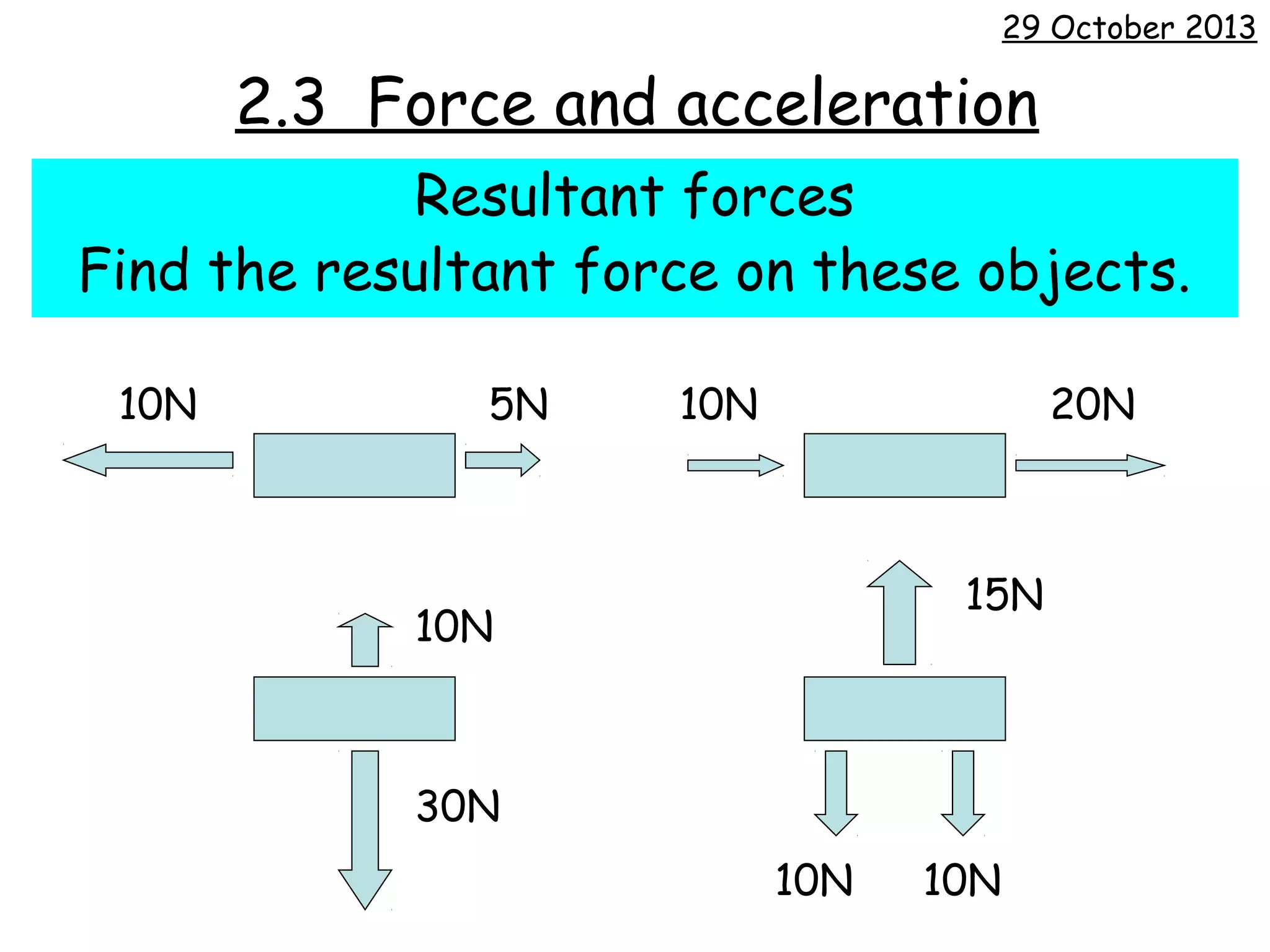
Resultant forces
Find the resultant force on these objects.
10N

5N

10N

20N

15N

10N

30N
10N

10N
29 October 2013

2.3 Force and acceleration

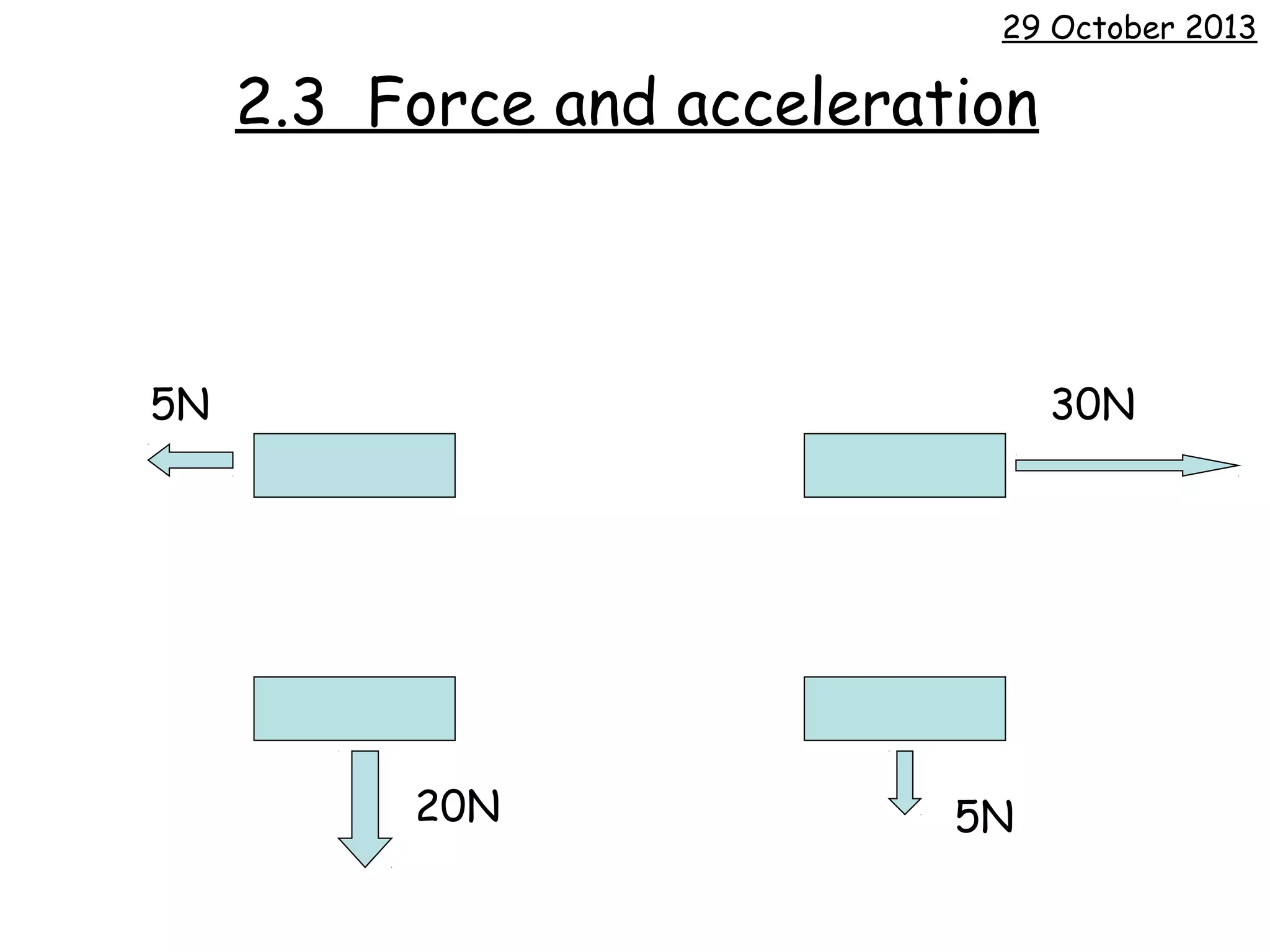
5N

30N

20N

5N
2.3 Force and acceleration

29 October 2013

LO’s
Be able to explain how force and mass affect
acceleration
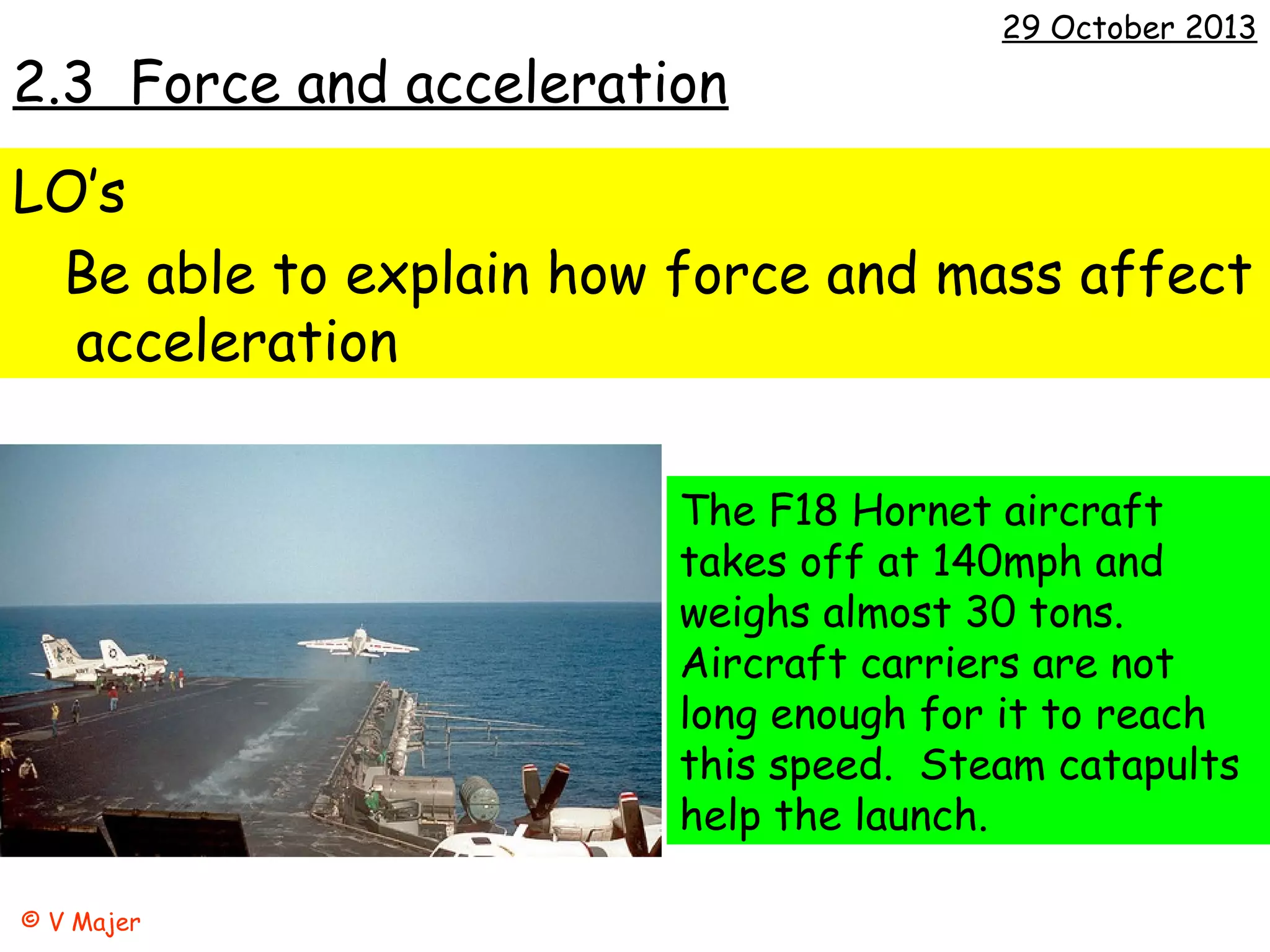
The F18 Hornet aircraft
takes off at 140mph and
weighs almost 30 tons.
Aircraft carriers are not
long enough for it to reach
this speed. Steam catapults
help the launch.
© V Majer
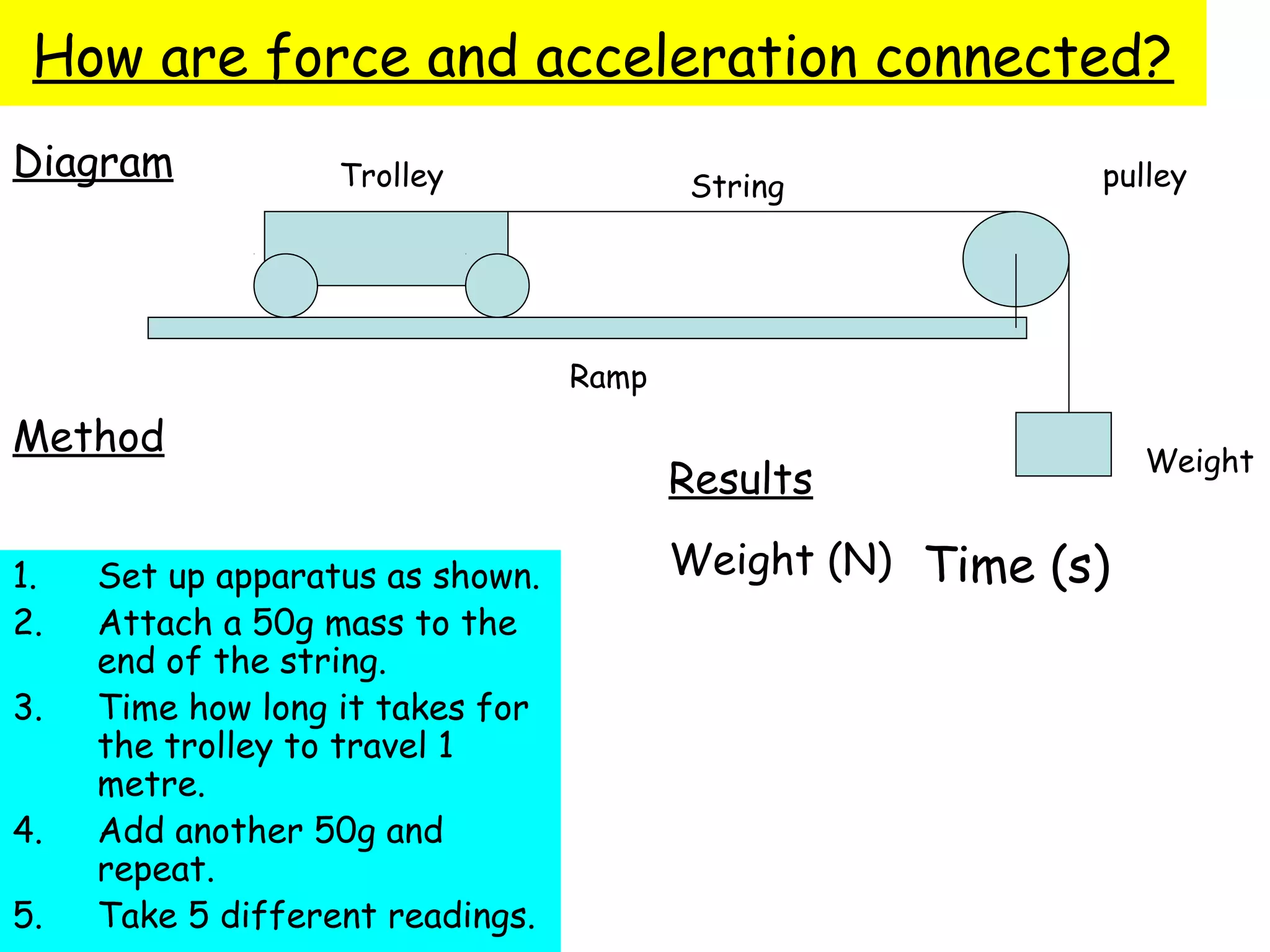
How are force and acceleration connected?
Diagram

Trolley

String

pulley

Ramp

Method
1.
2.
3.
4.
5.

Set up apparatus as shown.
Attach a 50g mass to the
end of the string.
Time how long it takes for
the trolley to travel 1
metre.
Add another 50g and
repeat.
Take 5 different readings.

Results
Weight (N) Time (s)

Weight
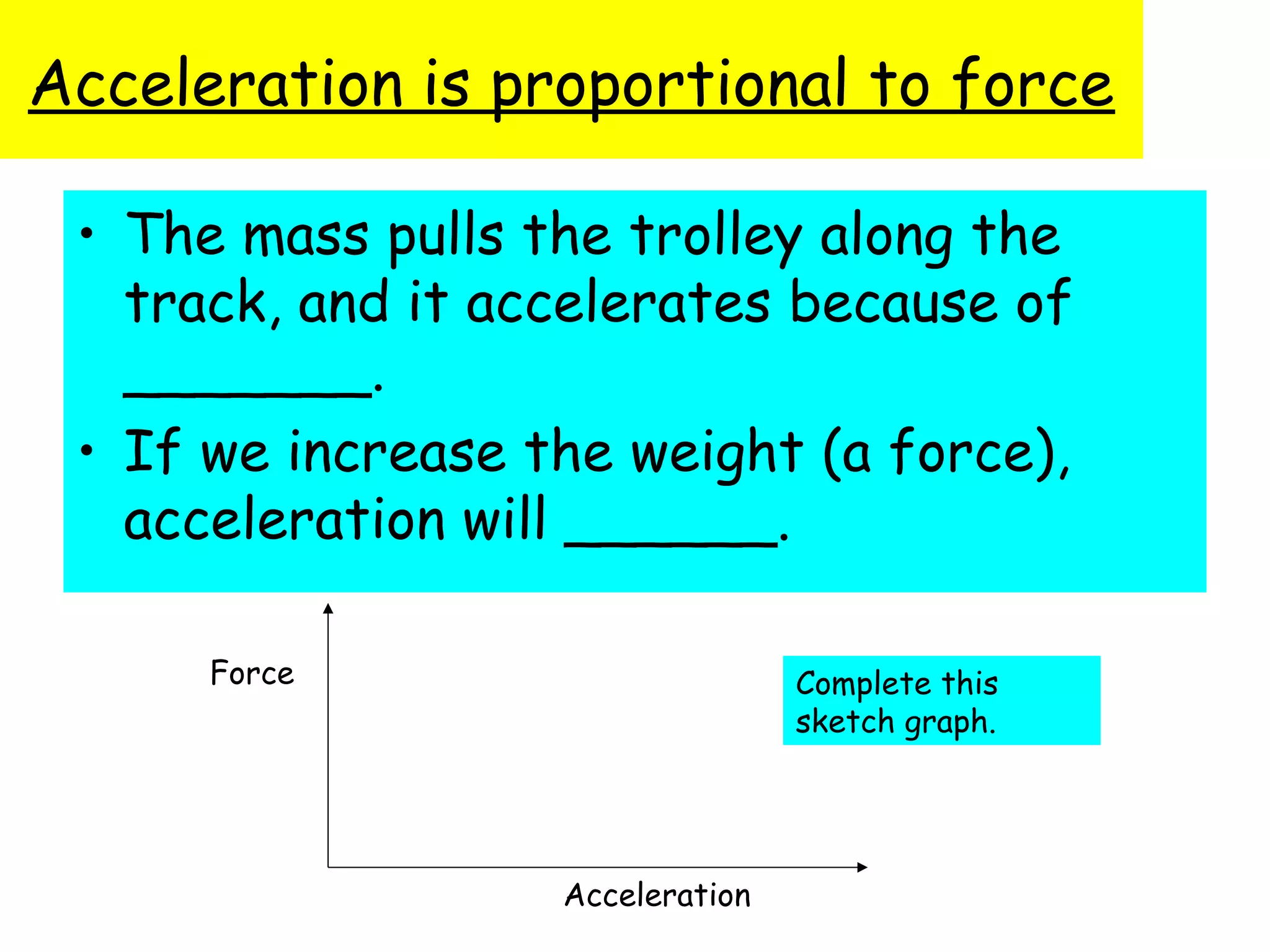
Acceleration is proportional to force
• The mass pulls the trolley along the
track, and it accelerates because of
_______.
• If we increase the weight (a force),
acceleration will ______.
Force

Complete this
sketch graph.

Acceleration
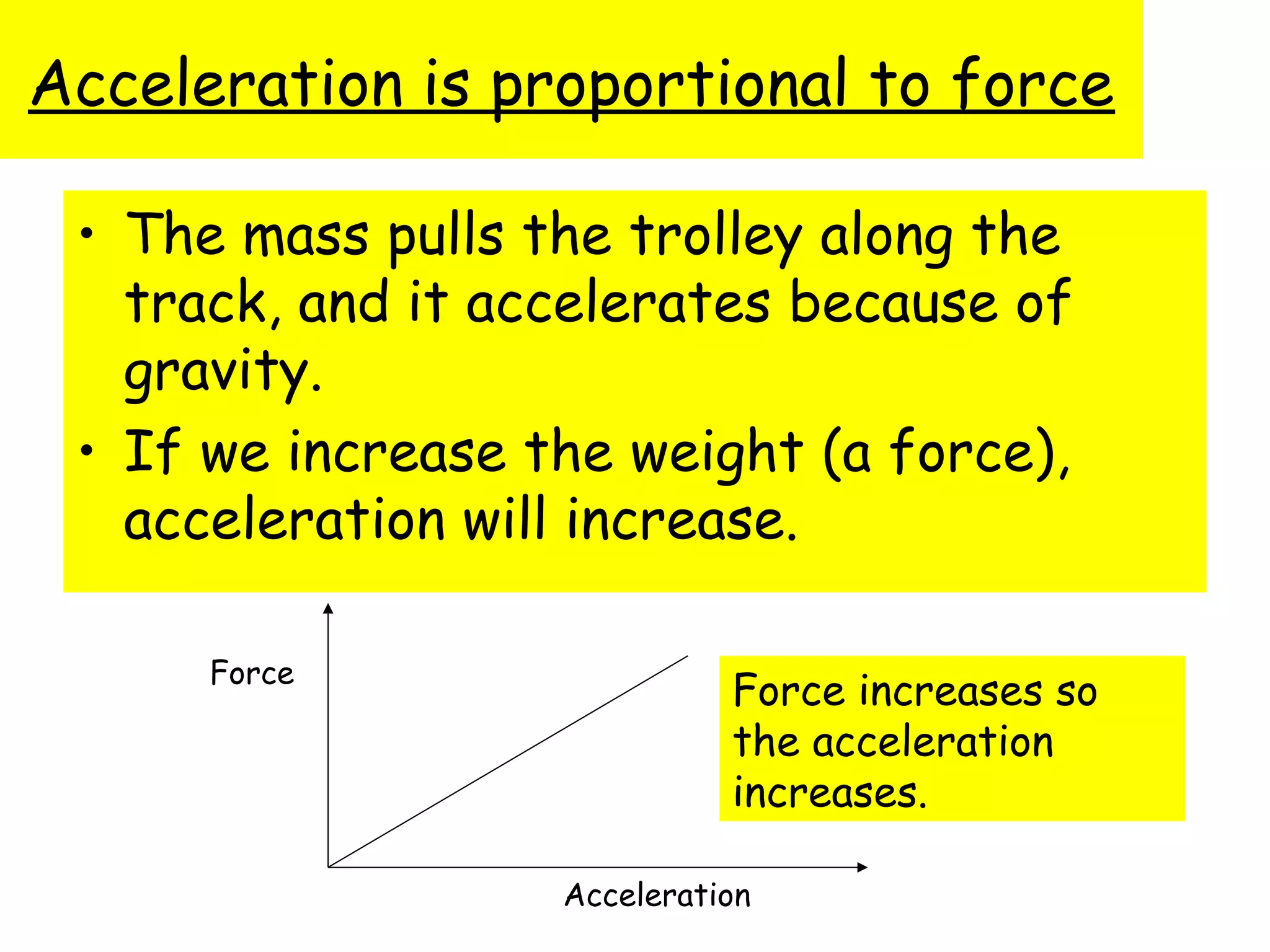
Acceleration is proportional to force
• The mass pulls the trolley along the
track, and it accelerates because of
gravity.
• If we increase the weight (a force),
acceleration will increase.
Force

Force increases so
the acceleration
increases.
Acceleration
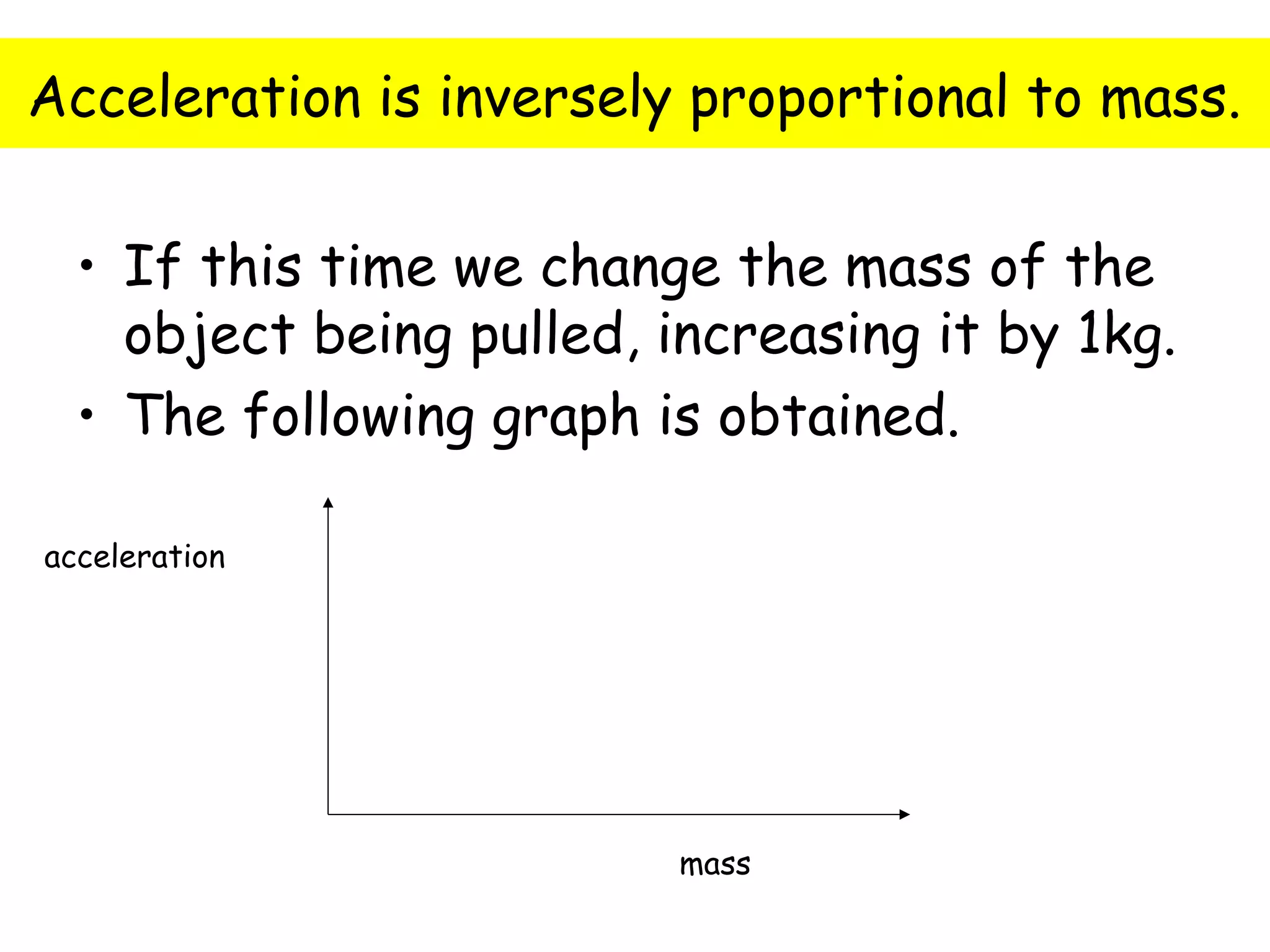
Acceleration is inversely proportional to mass.
• If this time we change the mass of the
object being pulled, increasing it by 1kg.
• The following graph is obtained.
acceleration

mass
Check
You should be able to:
All
Be able to explain that if force is increased
acceleration is increased and if Mass is increased then
acceleration is decreased.
Most
Be able to use equation ( if given)
Force = mass x acceleration.
Practical.
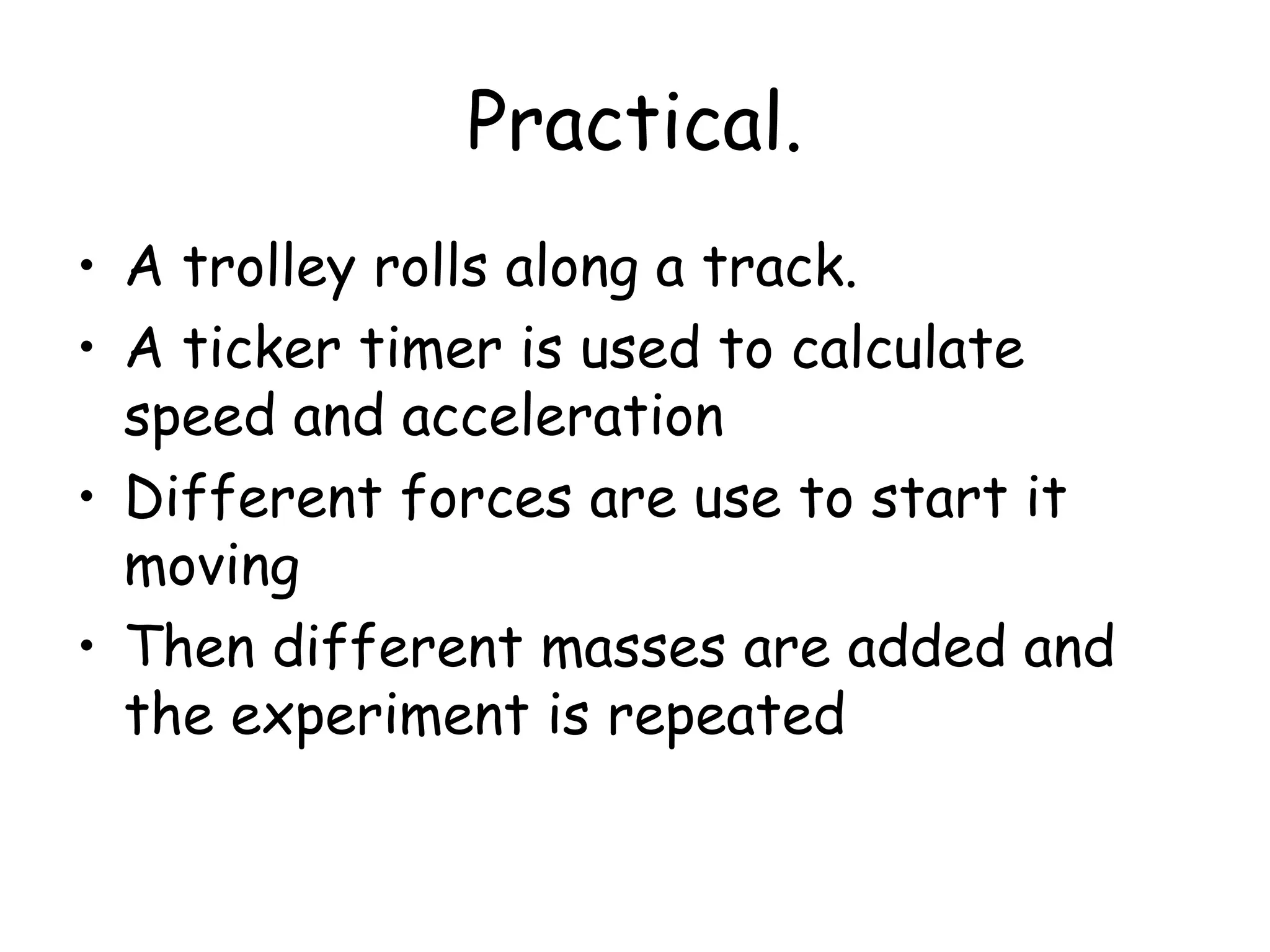
• A trolley rolls along a track.
• A ticker timer is used to calculate
speed and acceleration
• Different forces are use to start it
moving
• Then different masses are added and
the experiment is repeated
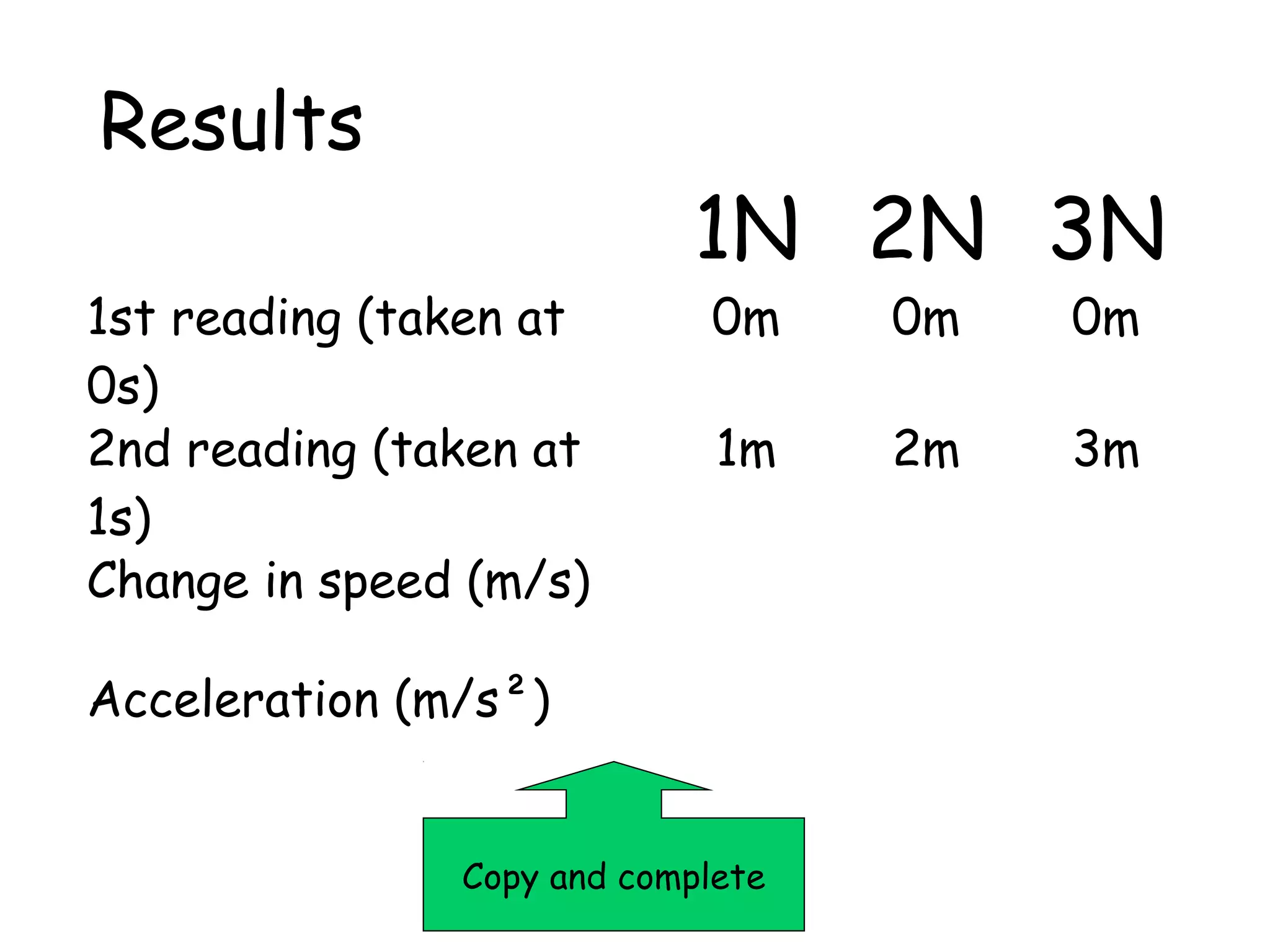
Results
1st reading (taken at
0s)
2nd reading (taken at
1s)
Change in speed (m/s)

1N 2N 3N
0m

0m

0m

1m

2m

3m

Acceleration (m/s²)
Copy and complete
Question
• What is the relationship between
the acceleration and the force?(use
an ER...ER relationship)
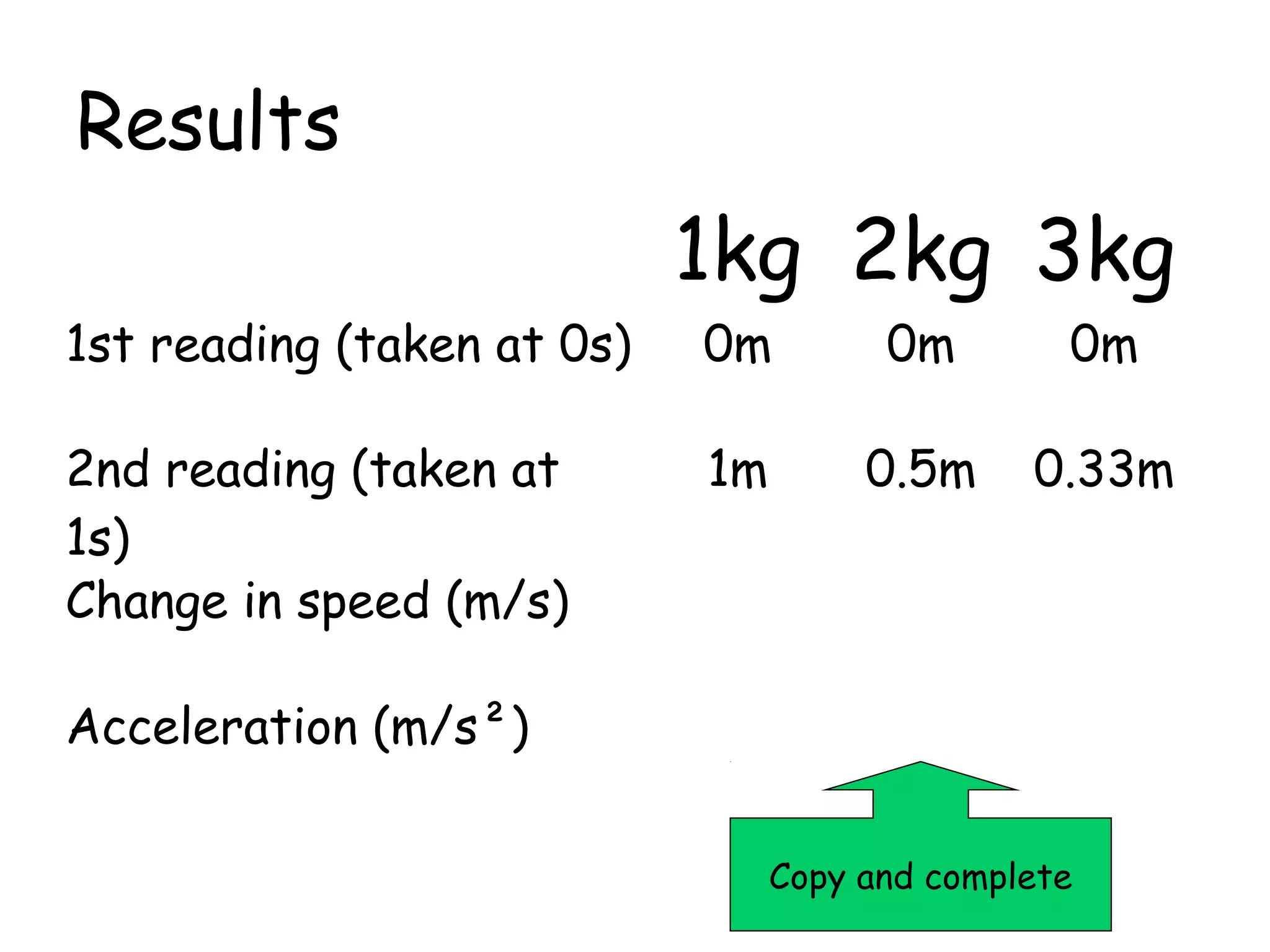
Results

1kg 2kg 3kg
1st reading (taken at 0s)

0m

0m

0m

2nd reading (taken at
1s)
Change in speed (m/s)

1m

0.5m

0.33m

Acceleration (m/s²)
Copy and complete
Question
• What is the relationship between
the acceleration and the mass?
( Use an ER............ER relationship)
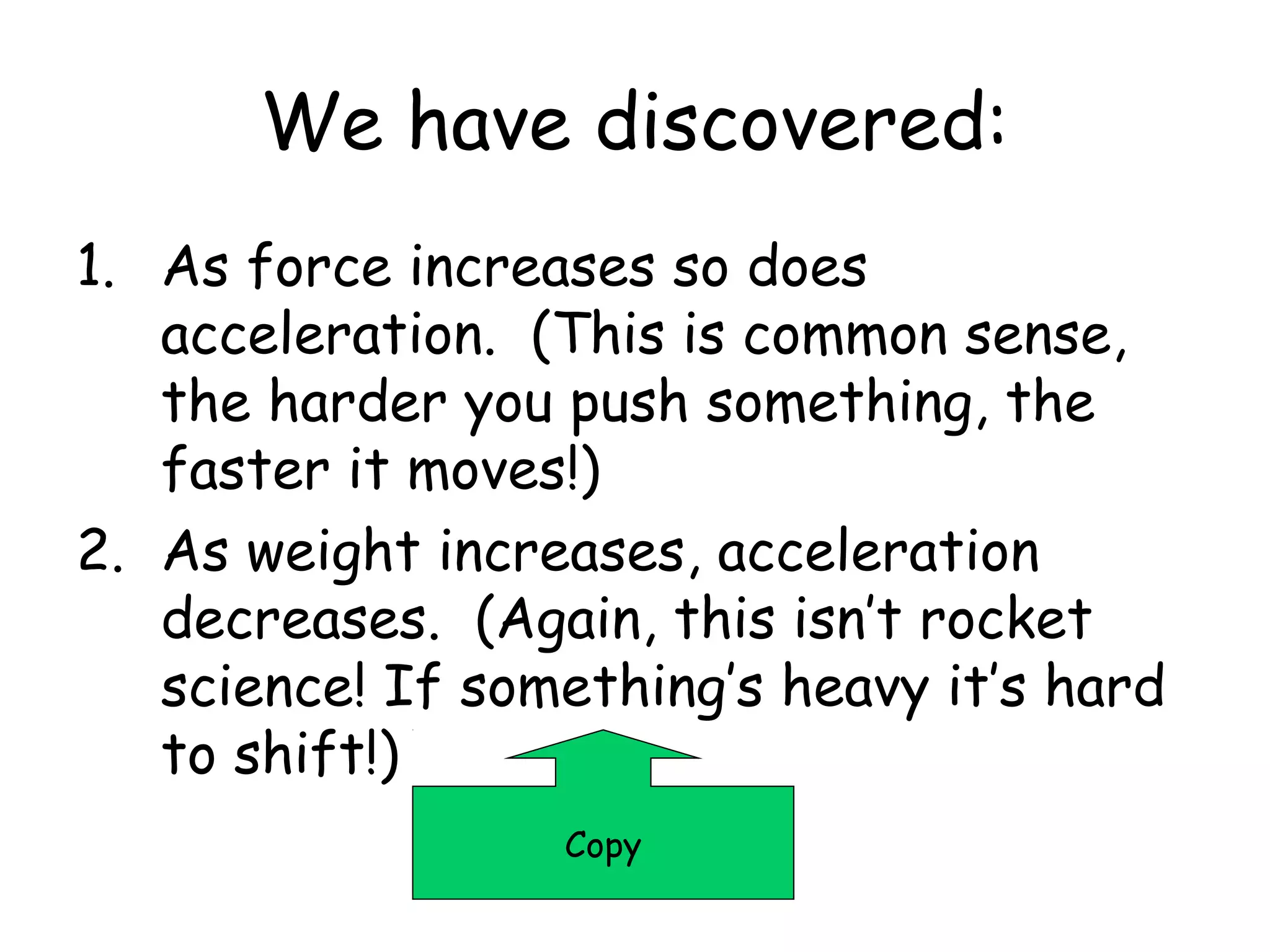
We have discovered:
1. As force increases so does
acceleration. (This is common sense,
the harder you push something, the
faster it moves!)
2. As weight increases, acceleration
decreases. (Again, this isn’t rocket
science! If something’s heavy it’s hard
to shift!)
Copy
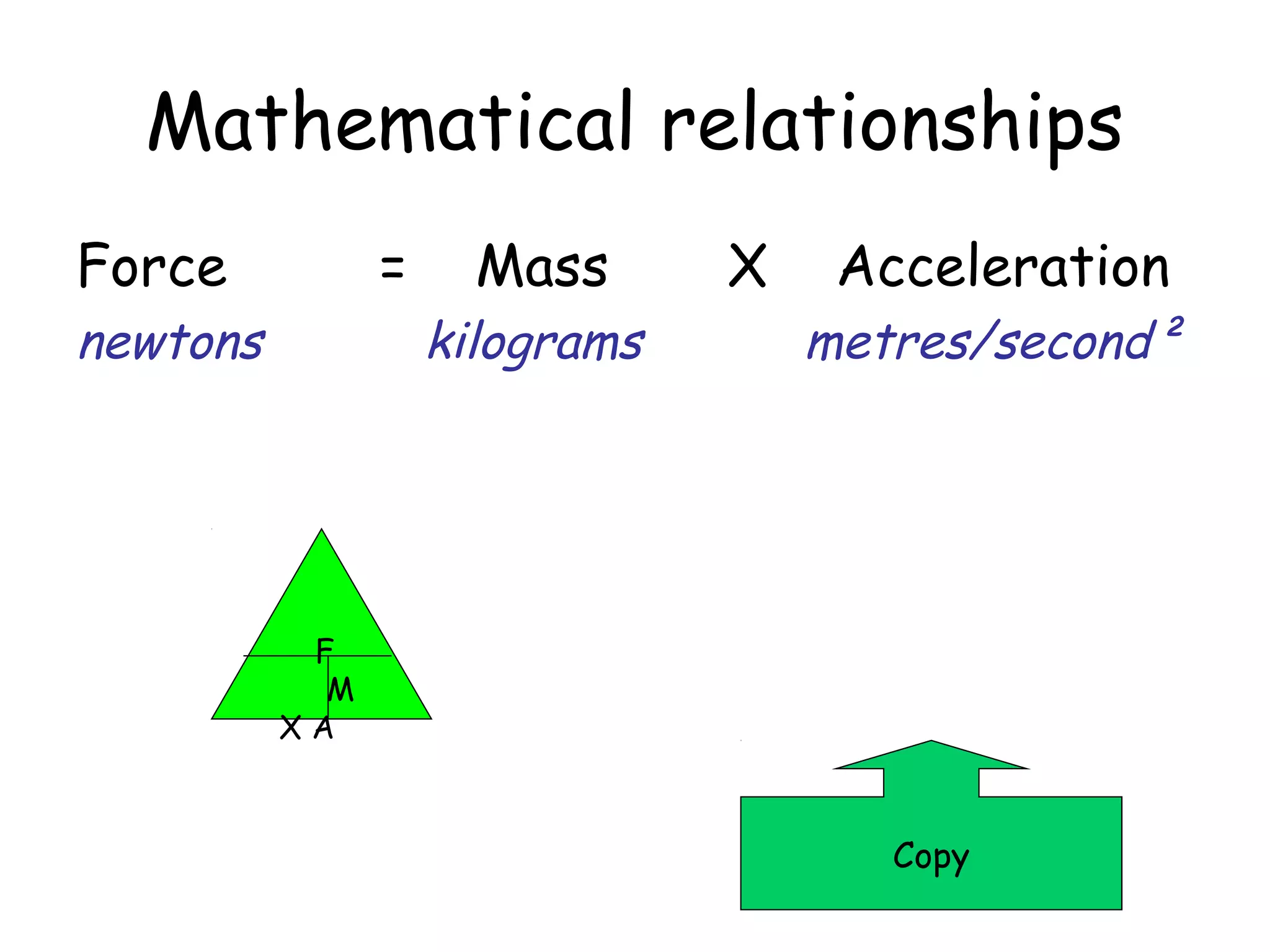
Mathematical relationships
Force

=

newtons

Mass
kilograms

X

Acceleration
metres/second²

F
M
XA

Copy

2 3 force mass acceleration

  • 1.
    29 October 2013 2.3Force and acceleration Resultant forces Find the resultant force on these objects. 10N 5N 10N 20N 15N 10N 30N 10N 10N
  • 2.
    29 October 2013 2.3Force and acceleration 5N 30N 20N 5N
  • 3.
    2.3 Force andacceleration 29 October 2013 LO’s Be able to explain how force and mass affect acceleration The F18 Hornet aircraft takes off at 140mph and weighs almost 30 tons. Aircraft carriers are not long enough for it to reach this speed. Steam catapults help the launch. © V Majer
  • 4.
    How are forceand acceleration connected? Diagram Trolley String pulley Ramp Method 1. 2. 3. 4. 5. Set up apparatus as shown. Attach a 50g mass to the end of the string. Time how long it takes for the trolley to travel 1 metre. Add another 50g and repeat. Take 5 different readings. Results Weight (N) Time (s) Weight
  • 5.
    Acceleration is proportionalto force • The mass pulls the trolley along the track, and it accelerates because of _______. • If we increase the weight (a force), acceleration will ______. Force Complete this sketch graph. Acceleration
  • 6.
    Acceleration is proportionalto force • The mass pulls the trolley along the track, and it accelerates because of gravity. • If we increase the weight (a force), acceleration will increase. Force Force increases so the acceleration increases. Acceleration
  • 7.
    Acceleration is inverselyproportional to mass. • If this time we change the mass of the object being pulled, increasing it by 1kg. • The following graph is obtained. acceleration mass
  • 8.
    Check You should beable to: All Be able to explain that if force is increased acceleration is increased and if Mass is increased then acceleration is decreased. Most Be able to use equation ( if given) Force = mass x acceleration.
  • 9.
    Practical. • A trolleyrolls along a track. • A ticker timer is used to calculate speed and acceleration • Different forces are use to start it moving • Then different masses are added and the experiment is repeated
  • 10.
    Results 1st reading (takenat 0s) 2nd reading (taken at 1s) Change in speed (m/s) 1N 2N 3N 0m 0m 0m 1m 2m 3m Acceleration (m/s²) Copy and complete
  • 11.
    Question • What isthe relationship between the acceleration and the force?(use an ER...ER relationship)
  • 12.
    Results 1kg 2kg 3kg 1streading (taken at 0s) 0m 0m 0m 2nd reading (taken at 1s) Change in speed (m/s) 1m 0.5m 0.33m Acceleration (m/s²) Copy and complete
  • 13.
    Question • What isthe relationship between the acceleration and the mass? ( Use an ER............ER relationship)
  • 14.
    We have discovered: 1.As force increases so does acceleration. (This is common sense, the harder you push something, the faster it moves!) 2. As weight increases, acceleration decreases. (Again, this isn’t rocket science! If something’s heavy it’s hard to shift!) Copy
  • 15.