GENERAL
PHYSICS 2
Second Semester
LESSON 1:
ELECTRIC
FORCE AND
ELECTRIC
FIELD
FACT OR
BLUFF
IF FACT, DANCE;
IF BLUFF, SING.
FACT or
BLUFF
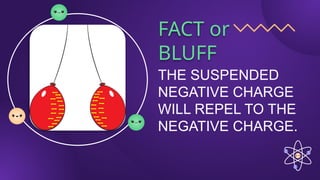
THE SUSPENDED
NEGATIVE CHARGE
WILL REPEL TO THE
NEGATIVE CHARGE.
FAC
T
FACT or
BLUFF
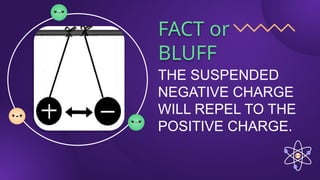
THE SUSPENDED
NEGATIVE CHARGE
WILL REPEL TO THE
POSITIVE CHARGE.
BLUF
F
FACT or
BLUFF
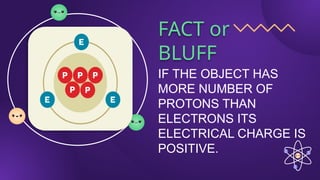
IF THE OBJECT HAS
MORE NUMBER OF
PROTONS THAN
ELECTRONS ITS
ELECTRICAL CHARGE IS
POSITIVE.
FAC
T
FACT or
BLUFF
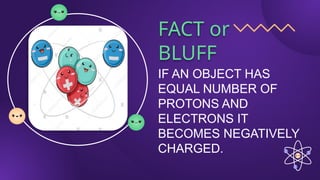
IF AN OBJECT HAS
EQUAL NUMBER OF
PROTONS AND
ELECTRONS IT
BECOMES NEGATIVELY
CHARGED.
BLUF
F
FACT or
BLUFF
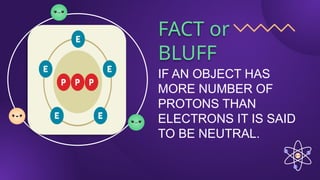
IF AN OBJECT HAS
MORE NUMBER OF
PROTONS THAN
ELECTRONS IT IS SAID
TO BE NEUTRAL.
BLUF
F
DISCUSSION
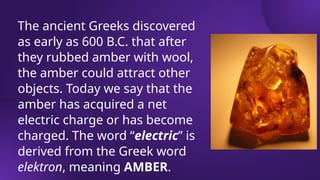
The ancient Greeks discovered
as early as 600 B.C. that after
they rubbed amber with wool,
the amber could attract other
objects. Today we say that the
amber has acquired a net
electric charge or has become
charged. The word “electric” is
derived from the Greek word
elektron, meaning AMBER.
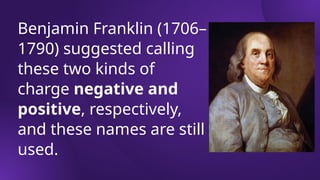
Benjamin Franklin (1706–
1790) suggested calling
these two kinds of
charge negative and
positive, respectively,
and these names are still
used.
Conductors
and
Insulators
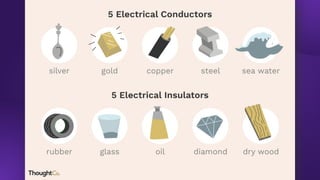
Any substance that has free electrons
and allows charge to move relatively
freely through it is called a
CONDUCTOR. The moving electrons
may collide with fixed atoms and
molecules, losing some energy, but they
can move in a conductor.
SUPERCONDUCTORS allow the
movement of charge without any loss of
Other substances, such as glass, do
not allow charges to move through
them. These are called
INSULATORS. Electrons and ions in
insulators are bound in the
structure and cannot move easily—
as much as 1023
times more slowly
than in conductors.
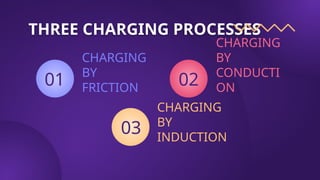
THREE CHARGING PROCESSES
02
CHARGING
BY
CONDUCTI
ON
01
CHARGING
BY
FRICTION
03
CHARGING
BY
INDUCTION
Charging by Friction
01
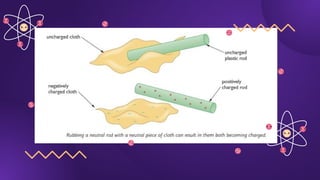
It is when two objects are rubbed
against each other, charge transfer
takes place. One of the objects loses
electrons while the other object gains
electrons
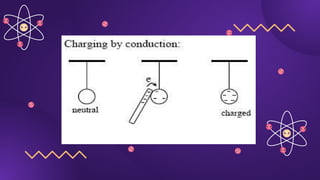
Charging by Conduction
02
It is charging an uncharged object by bringing it
close and in contact with a charged object. A
charged conductor has an unequal number of
protons and electrons, hence when an uncharged
conductor is brought near it, it discharges
electrons to stabilize itself
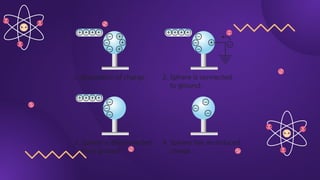
Charging by Induction
03
It is the process of charging an uncharged
conductor by bringing it near a charged
conductor without any physical contact.
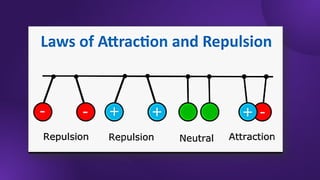
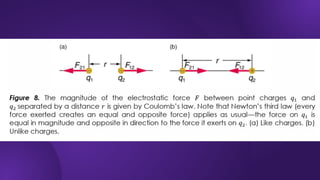
The law for electrostatic charge simply
tells us that as charges repel and unlike
charges attract.
CHARGING
The process of supplying the
electric charge to an object or
losing an electric charge from
an object.
Electric charge is conserved. It can
be transferred from one object to
another by moving electrons, but it
cannot be created nor destroyed.
ELECTRIC
FORCE AND
ELECTRIC
FIELD
Through the work of scientists in the late
18th century, the main features of the
ELECTROSTATIC FORCE—the existence
of two types of charge, the observation
that like charges repel, unlike charges
attract, and the decrease of force with
distance—were eventually refined, and
expressed as a mathematical formula.
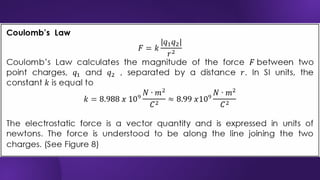
The mathematical formula for
the electrostatic force is called
COULOMB‘S LAW after the
French physicist Charles
Coulomb (1736 1806), who
performed experiments and first
proposed a formula to calculate
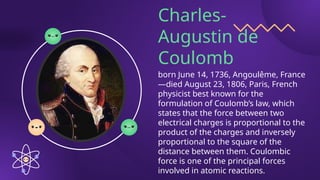
Charles-
Augustin de
Coulomb
born June 14, 1736, Angoulême, France
—died August 23, 1806, Paris, French
physicist best known for the
formulation of Coulomb’s law, which
states that the force between two
electrical charges is proportional to the
product of the charges and inversely
proportional to the square of the
distance between them. Coulombic
force is one of the principal forces
involved in atomic reactions.
Sample problem for electric force:
• The electron with a charge of
1.60x10⁻¹⁹
C and proton with
1.60x10⁻¹⁹
C of a hydrogen atom
are separated by a distance of
approximately 5.3 x 10⁻¹¹
m. Find
the magnitude of the electric
force.
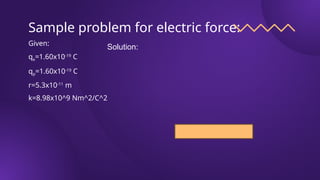
Sample problem for electric force:
Given:
qe=1.60x10⁻¹⁹
C
qp=1.60x10⁻¹⁹
C
r=5.3x10⁻¹¹
m
k=8.98x10^9 Nm^2/C^2
Solution:
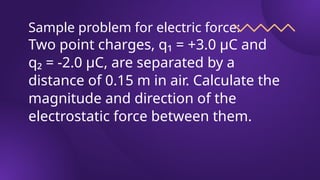
Sample problem for electric force:
Two point charges, q₁ = +3.0 μC and
q₂ = -2.0 μC, are separated by a
distance of 0.15 m in air. Calculate the
magnitude and direction of the
electrostatic force between them.
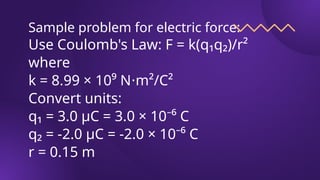
Sample problem for electric force:
Use Coulomb's Law: F = k(q₁q₂)/r²
where
k = 8.99 × 10⁹ N m²/C²
⋅
Convert units:
q₁ = 3.0 μC = 3.0 × 10⁻⁶ C
q₂ = -2.0 μC = -2.0 × 10⁻⁶ C
r = 0.15 m
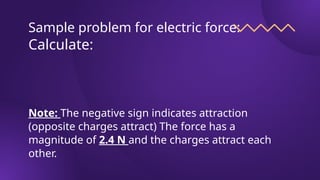
Sample problem for electric force:
Calculate:
Note: The negative sign indicates attraction
(opposite charges attract) The force has a
magnitude of 2.4 N and the charges attract each
other.
Electric Field
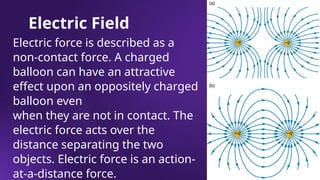
Electric force is described as a
non-contact force. A charged
balloon can have an attractive
effect upon an oppositely charged
balloon even
when they are not in contact. The
electric force acts over the
distance separating the two
objects. Electric force is an action-
at-a-distance force.
Electric Field
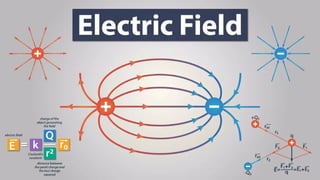
• Field forces explain action-at-a-distance phenomena
without physical contact.
• Charged objects create an electric field that alters
surrounding space.
• The electric field affects other charged objects in the
space, regardless of direct contact.
• The field persists whether the charged object is
present or not.
• As a charged object enters the field, the impact
becomes more noticeable.
The Force per Charge Ratio
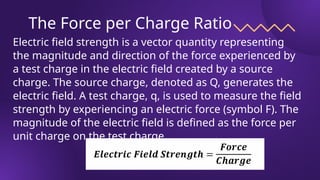
Electric field strength is a vector quantity representing
the magnitude and direction of the force experienced by
a test charge in the electric field created by a source
charge. The source charge, denoted as Q, generates the
electric field. A test charge, q, is used to measure the field
strength by experiencing an electric force (symbol F). The
magnitude of the electric field is defined as the force per
unit charge on the test charge.
The Force per Charge Ratio
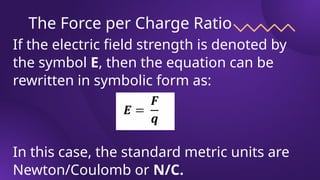
If the electric field strength is denoted by
the symbol E, then the equation can be
rewritten in symbolic form as:
In this case, the standard metric units are
Newton/Coulomb or N/C.
Another Electric Field Strength Formula
The above discussion pertained to defining
electric field strength in terms of how it is
measured. Now we will investigate a new
equation that defines electric field strength
in terms of the variables that affect the
electric
field strength.

Another Electric Field Strength Formula
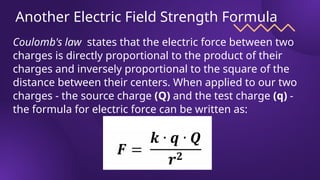
Coulomb's law states that the electric force between two
charges is directly proportional to the product of their
charges and inversely proportional to the square of the
distance between their centers. When applied to our two
charges - the source charge (Q) and the test charge (q) -
the formula for electric force can be written as:
Another Electric Field Strength Formula
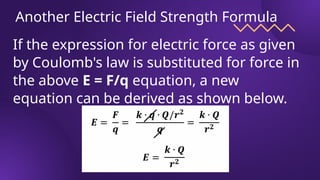
If the expression for electric force as given
by Coulomb's law is substituted for force in
the above E = F/q equation, a new
equation can be derived as shown below.
Another Electric Field Strength Formula
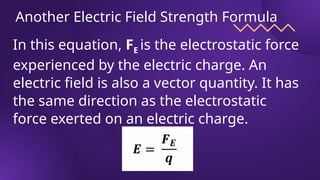
In this equation, FE is the electrostatic force
experienced by the electric charge. An
electric field is also a vector quantity. It has
the same direction as the electrostatic
force exerted on an electric charge.
Sample Problem 1
Calculate the electric field that a test
charge will experience on the following
distances from the source charge of 5.02 x
10-13
C.
a. Distance from source charge: 2.04 x 10⁻³
m
b. Distance from source charge: 1.55 x 10⁻¹²
m
Sample Problem 1
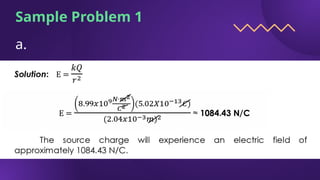
a.
Sample Problem 1
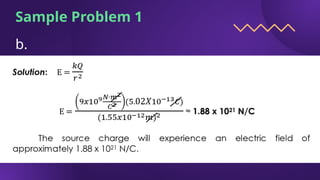
b.
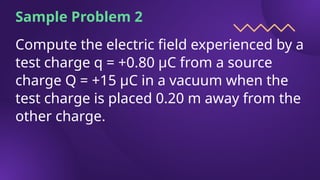
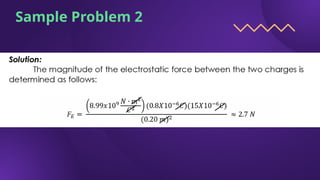
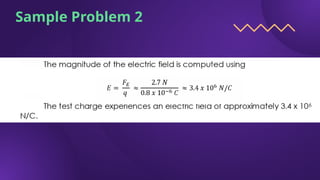
Sample Problem 2
Compute the electric field experienced by a
test charge q = +0.80 μC from a source
charge Q = +15 μC in a vacuum when the
test charge is placed 0.20 m away from the
other charge.
Sample Problem 2
Sample Problem 2
Sample Problem 2
LESSON 1-ELECTRIC-CHARGE-FIELD-FORCE-GENERAL-PHYSICS-2.pptx

LESSON 1-ELECTRIC-CHARGE-FIELD-FORCE-GENERAL-PHYSICS-2.pptx

  • 1.
  • 2.
  • 3.
    FACT OR BLUFF IF FACT,DANCE; IF BLUFF, SING.
  • 4.
    FACT or BLUFF THE SUSPENDED NEGATIVECHARGE WILL REPEL TO THE NEGATIVE CHARGE.
  • 5.
  • 6.
    FACT or BLUFF THE SUSPENDED NEGATIVECHARGE WILL REPEL TO THE POSITIVE CHARGE.
  • 7.
  • 8.
    FACT or BLUFF IF THEOBJECT HAS MORE NUMBER OF PROTONS THAN ELECTRONS ITS ELECTRICAL CHARGE IS POSITIVE.
  • 9.
  • 10.
    FACT or BLUFF IF ANOBJECT HAS EQUAL NUMBER OF PROTONS AND ELECTRONS IT BECOMES NEGATIVELY CHARGED.
  • 11.
  • 12.
    FACT or BLUFF IF ANOBJECT HAS MORE NUMBER OF PROTONS THAN ELECTRONS IT IS SAID TO BE NEUTRAL.
  • 13.
  • 14.
  • 15.
    The ancient Greeksdiscovered as early as 600 B.C. that after they rubbed amber with wool, the amber could attract other objects. Today we say that the amber has acquired a net electric charge or has become charged. The word “electric” is derived from the Greek word elektron, meaning AMBER.
  • 16.
    Benjamin Franklin (1706– 1790)suggested calling these two kinds of charge negative and positive, respectively, and these names are still used.
  • 18.
  • 19.
    Any substance thathas free electrons and allows charge to move relatively freely through it is called a CONDUCTOR. The moving electrons may collide with fixed atoms and molecules, losing some energy, but they can move in a conductor. SUPERCONDUCTORS allow the movement of charge without any loss of
  • 20.
    Other substances, suchas glass, do not allow charges to move through them. These are called INSULATORS. Electrons and ions in insulators are bound in the structure and cannot move easily— as much as 1023 times more slowly than in conductors.
  • 22.
  • 23.
    Charging by Friction 01 Itis when two objects are rubbed against each other, charge transfer takes place. One of the objects loses electrons while the other object gains electrons
  • 25.
    Charging by Conduction 02 Itis charging an uncharged object by bringing it close and in contact with a charged object. A charged conductor has an unequal number of protons and electrons, hence when an uncharged conductor is brought near it, it discharges electrons to stabilize itself
  • 27.
    Charging by Induction 03 Itis the process of charging an uncharged conductor by bringing it near a charged conductor without any physical contact. The law for electrostatic charge simply tells us that as charges repel and unlike charges attract.
  • 29.
    CHARGING The process ofsupplying the electric charge to an object or losing an electric charge from an object.
  • 30.
    Electric charge isconserved. It can be transferred from one object to another by moving electrons, but it cannot be created nor destroyed.
  • 31.
  • 32.
    Through the workof scientists in the late 18th century, the main features of the ELECTROSTATIC FORCE—the existence of two types of charge, the observation that like charges repel, unlike charges attract, and the decrease of force with distance—were eventually refined, and expressed as a mathematical formula.
  • 33.
    The mathematical formulafor the electrostatic force is called COULOMB‘S LAW after the French physicist Charles Coulomb (1736 1806), who performed experiments and first proposed a formula to calculate
  • 34.
    Charles- Augustin de Coulomb born June14, 1736, Angoulême, France —died August 23, 1806, Paris, French physicist best known for the formulation of Coulomb’s law, which states that the force between two electrical charges is proportional to the product of the charges and inversely proportional to the square of the distance between them. Coulombic force is one of the principal forces involved in atomic reactions.
  • 38.
    Sample problem forelectric force: • The electron with a charge of 1.60x10⁻¹⁹ C and proton with 1.60x10⁻¹⁹ C of a hydrogen atom are separated by a distance of approximately 5.3 x 10⁻¹¹ m. Find the magnitude of the electric force.
  • 39.
    Sample problem forelectric force: Given: qe=1.60x10⁻¹⁹ C qp=1.60x10⁻¹⁹ C r=5.3x10⁻¹¹ m k=8.98x10^9 Nm^2/C^2 Solution:
  • 40.
    Sample problem forelectric force: Two point charges, q₁ = +3.0 μC and q₂ = -2.0 μC, are separated by a distance of 0.15 m in air. Calculate the magnitude and direction of the electrostatic force between them.
  • 41.
    Sample problem forelectric force: Use Coulomb's Law: F = k(q₁q₂)/r² where k = 8.99 × 10⁹ N m²/C² ⋅ Convert units: q₁ = 3.0 μC = 3.0 × 10⁻⁶ C q₂ = -2.0 μC = -2.0 × 10⁻⁶ C r = 0.15 m
  • 42.
    Sample problem forelectric force: Calculate: Note: The negative sign indicates attraction (opposite charges attract) The force has a magnitude of 2.4 N and the charges attract each other.
  • 43.
    Electric Field Electric forceis described as a non-contact force. A charged balloon can have an attractive effect upon an oppositely charged balloon even when they are not in contact. The electric force acts over the distance separating the two objects. Electric force is an action- at-a-distance force.
  • 44.
    Electric Field • Fieldforces explain action-at-a-distance phenomena without physical contact. • Charged objects create an electric field that alters surrounding space. • The electric field affects other charged objects in the space, regardless of direct contact. • The field persists whether the charged object is present or not. • As a charged object enters the field, the impact becomes more noticeable.
  • 46.
    The Force perCharge Ratio Electric field strength is a vector quantity representing the magnitude and direction of the force experienced by a test charge in the electric field created by a source charge. The source charge, denoted as Q, generates the electric field. A test charge, q, is used to measure the field strength by experiencing an electric force (symbol F). The magnitude of the electric field is defined as the force per unit charge on the test charge.
  • 47.
    The Force perCharge Ratio If the electric field strength is denoted by the symbol E, then the equation can be rewritten in symbolic form as: In this case, the standard metric units are Newton/Coulomb or N/C.
  • 48.
    Another Electric FieldStrength Formula The above discussion pertained to defining electric field strength in terms of how it is measured. Now we will investigate a new equation that defines electric field strength in terms of the variables that affect the electric field strength.
  • 49.
    Another Electric FieldStrength Formula Coulomb's law states that the electric force between two charges is directly proportional to the product of their charges and inversely proportional to the square of the distance between their centers. When applied to our two charges - the source charge (Q) and the test charge (q) - the formula for electric force can be written as:
  • 50.
    Another Electric FieldStrength Formula If the expression for electric force as given by Coulomb's law is substituted for force in the above E = F/q equation, a new equation can be derived as shown below.
  • 51.
    Another Electric FieldStrength Formula In this equation, FE is the electrostatic force experienced by the electric charge. An electric field is also a vector quantity. It has the same direction as the electrostatic force exerted on an electric charge.
  • 52.
    Sample Problem 1 Calculatethe electric field that a test charge will experience on the following distances from the source charge of 5.02 x 10⁻¹³ C. a. Distance from source charge: 2.04 x 10⁻³ m b. Distance from source charge: 1.55 x 10⁻¹² m
  • 53.
  • 54.
  • 55.
    Sample Problem 2 Computethe electric field experienced by a test charge q = +0.80 μC from a source charge Q = +15 μC in a vacuum when the test charge is placed 0.20 m away from the other charge.
  • 56.
  • 57.
  • 58.