ECOSYSTEM
LECTURE - 9
INTRODUCTION TO ECOSYSTEM AND
DEFINITION
Introduction to Ecosystem: The word ecology is
derived from Greek word ‘Oekologic’→ Oikos
means ‘habitation’ or ‘house’ and logos means
study.
It was first coined by the German biologist Ernst
Hoeckl in 1886, who defined it as “The
comprehensive science of the relationship of the
organism to the environment”.
It can also be defined as “ The scientific study of the
relationship of living organism with each other and
with their environment”.
Ecosystem
Definition: The living community of plants and animals
(Biotic) in any area together with the non-living
components of the environment such as soil, air and water
(Abiotic) constitute the ecosystem
It is also defined as a Natural unit of living organisms and
their non living environment that interact to form a stable
system.
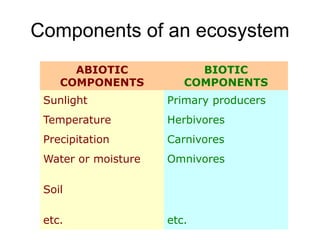
Components of an ecosystem
ABIOTIC
COMPONENTS
BIOTIC
COMPONENTS
Sunlight Primary producers
Temperature Herbivores
Precipitation Carnivores
Water or moisture Omnivores
Soil
etc. etc.
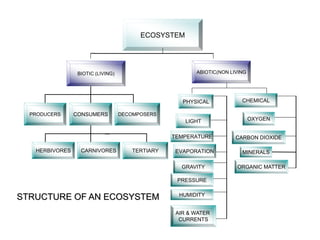
ECOSYSTEM
BIOTIC (LIVING) ABIOTIC(NON LIVING
PRODUCERS DECOMPOSERS
LIGHT
TEMPERATURE
PHYSICAL
EVAPORATION
HERBIVORES CARNIVORES
CONSUMERS
TERTIARY
CHEMICAL
OXYGEN
CARBON DIOXIDE
MINERALS
GRAVITY ORGANIC MATTER
PRESSURE
HUMIDITY
AIR & WATER
CURRENTS
STRUCTURE OF AN ECOSYSTEM
Functions of an ecosystem
• Energy
• Primary production
• Secondary production
• Food chains
• Food webs
• Biogeochemical Cycles
• Ecological pyramids
Energy Flow in the Ecosystem
• Energy flows through the ecosystem in one direction.
• On the other hand, matter moves through ecosystem in numerous
cycles. The nutrients that organisms needs to grow, live, and
reproduce are continuously taken from the abiotic environment,
consumed, and then recycled back to the environment.
• There are several such biogeochemical cycles(with biological,
geological and chemical interaction), powered directly or indirectly
by solar energy. They include Water cycle, Carbon cycle, Oxygen
cycle, Nitrogen cycle, Phosphorous cycle.
• Earth is essentially closed system- matter can not escape from it’s
boundaries.
• Energy is the ability to do work. The main source
of energy for an ecosystem is light energy derived
from the sun.
• Plants utilize only 0.02 percent of the energy that
reaches the earth.
• Plants convert light energy into chemical
energy(sugar, C6H12O6) by a process called
photosynthesis.
• Primary production refers to the amount and rate of
energy produced by autotrophs(producers) in an
ecosystem.
• It is expressed as grams/Sqm/day.
• The total amount of sugar and other organic materials
produced materials produced in plants through
photosynthesis per unit area per time is called gross
primary production.
• During photosynthesis respiration is also carried out by
the plants in which some amount of sugar is utilized.
Net primary production=Gross primary production -
Respiration
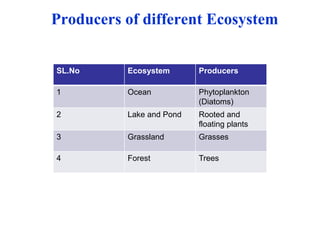
Producers of different Ecosystem
SL.No Ecosystem Producers
1 Ocean Phytoplankton
(Diatoms)
2 Lake and Pond Rooted and
floating plants
3 Grassland Grasses
4 Forest Trees
Secondary production: Consumers
• The energy trapped by the producers is utilized by the
consumers.
• Types of Consumers
1) Primary consumers/herbivores
2) Secondary consumers/carnivores(flesh eaters)
3) Tertiary consumers
Food Chain
• Each organism feeds on
some other organism to
survive in the ecosystem.
For example insects are
eaten by frog which is in
turn is the lunch for
snake, while Hawk’s
menu include snakes. The
sequence of organisms, in
which each is food for the
next is called the Food
Chain.
Example of a Food Chain
Food Web
Food chains overlap, since most organisms have
more than one item on their menu. Again an
organism can be found on the menus of many
other organisms. Thus we have a complex network
of interconnected food chains, which is called as
Food Web.
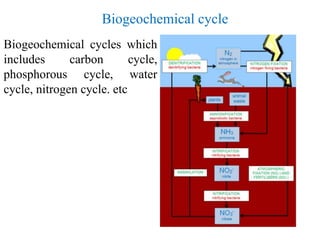
Biogeochemical cycles which
includes carbon cycle,
phosphorous cycle, water
cycle, nitrogen cycle. etc
Biogeochemical cycle
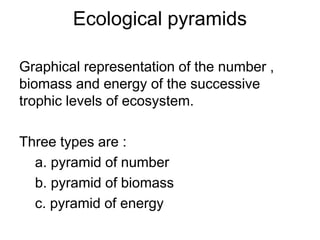
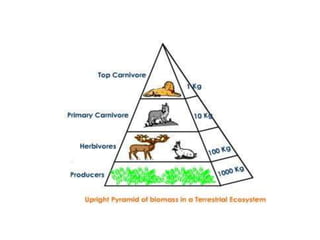
Ecological pyramids
Graphical representation of the number ,
biomass and energy of the successive
trophic levels of ecosystem.
Three types are :
a. pyramid of number
b. pyramid of biomass
c. pyramid of energy
Trophic Levels
• A trophic level is the position occupied by an organism in a
food chain.
• Trophic levels can be analyzed on an energy pyramid.
• Producers are found at the base of the pyramid and
compromise the first trophic level.
• Primary consumers make up the second trophic level.
• Secondary consumers make up the third trophic level.
• Finally tertiary consumers make up the top trophic level.
Trophic Levels Found on an
Energy Pyramid
• The greatest amount of energy is found at the base of
the pyramid.
• The least amount of energy is found at top of the
pyramid.
Source: corpuschristiisd.org/user_files/91702/Ecosystem.ppt
Biomass
• Energy is sometimes considered in terms of
biomass, the mass of all the organisms and organic
material in an area.
• There is more biomass at the trophic level of
producers and fewer at the trophic level of tertiary
consumers. (There are more plants on Earth than
there are animals.)
• Bio=life Mass=weight
• Bio + Mass = Weight of living things within an
ecosystem.
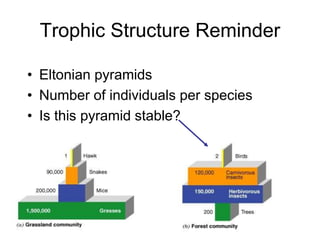
Trophic Structure Reminder
• Eltonian pyramids
• Number of individuals per species
• Is this pyramid stable?
Trophic Structure Reminder
• What if we transformed each species into
biomass instead of absolute numbers?
LECTURE 10 : Types of Ecosystem
Ecosystems
Aquatic Terrestrial
Fresh
water
Marine
water
Estuarine
water
Lentic
(standing pond)
Lotic
(Running river)
Forest Desert
Grassland Cave
Mountain
Holdridge life zones- Terrestrial Ecosystems
1. Reduction of biodiversity and forest cover
2. Rapid use of renewable resources beyond their natural capacity
3. Escalating use of energy resources
4. Unplanned infrastructural growth causes stress on fragile ecosystems
5. Use of chemicals and their disposal
6. Global warming
7. Over population
Threats to Ecosystem
The term biodiversity refers to the totality of
species, populations, communities and ecosystems,
both wild and domesticated that constitute the life
of any one area or of the entire plant.
Degree of variety in life in an ecosystem
BIODIVERSITY
Relationship between altitude,
ecosystem and biodiversity- Holdrige
Life zones
•Biodiversity’s benefits to society include contributions to medicine and
agriculture, and the provision of ecosystem goods and services.
•It is the source of food for man. Man occupies the apex of the tropic levels
and gets his food from all other organisms.
•Several important drugs and medicines are prepared from plant-based
substances. About 25% of the drugs in pharmacy are derived from only 120
species of plants.
•It has great aesthetic value. Landscapes are the delightful sites of nature in
their pure form.
The Value of Biodiversity
 India is home to 33% of the life forms found in the world, 2 % of the world
landmass 8% of the biodiversity of the world.
 It can be divided into 10 biogeographic zones and 26 biotic provinces, 33
botanical gardens, 89 national parks 275 zoos, 504 sanctuaries, 47000 species of
plants and 81000 species of animals identified in the country.
 60% of this wealth can be found in the Western Ghats
INDIA’S BIODIVERSITY
Biodiversity Conservation
3/11/2024
Source: Wikimedia
Source: Wikimedia
3/11/2024
IUCN Red List Categories
Source: IUCN
In situ Conservation Strategies
• It means the conservation of ecosystems, natural
habitats and the maintenance and recovery of viable
populations of species in their natural surrounding
and in the case of domesticated or cultivated species,
in the surroundings where they have developed their
distinctive properties.
(i) Protected areas:
These are the areas of land and/or sea, especially
dedicated to the protection and maintenance of
biological diversity and of natural and associated
cultural resources.
 Maintaining viable populations of all native species
and subspecies.
 Maintaining the number and distribution of
communities and habitats and conserving the
genetic diversity of all the existing species.
 Preventing man created introduction of exotic
species.
 Making it possible for species to shift in response to
environmental changes.
Ex situ conservation strategies :
•It is defines as the conservation of components of
biological diversity outside their natural habitat.
•Eg:- Botanical gardens, zoos, aquaria, gene banks, seed
banks, use of biotechnology and DNA preservation.
(i)Botanical gardens and zoos:-
There are more than 1500 botanical gardens and
arboreta in the world with more than 80000 species.
Similarly there are more than 800 professionally
managed zoos around the world with about 3000
species.
(ii) Biotechnological methods:-
It has provided many new conservation tools in
agriculture, animal husbandry, fisheries, forestry and
medicine..
(iii) Gene banks:-
It provides a method of conservation of diverse genetic
resources, particularly of threatened species and those
seeds which are not viable for longer periods under
natural conditions.
(iv) Conservation of DNA:-
An emerging and promising technique in preserving
biodiversity is isolation and conservation of DNA. It
can be used for endangered or even extinct species by
taking samples of material from hair, bones and
herbarium specimens of the target species.
SVALBARD GLOBAL SEED VAULT
CROPTRUST.ORG
THORNEWS.COM
SVALBARD GLOBAL SEED VAULT
Problems in Conservation:-
(1)Very little understanding of what is to be conserved,
especially with regard to complex natural ecosystems
like tropical rain forests.
(2) Limited Financial resources to protect and manage
ecosystems.
(3) Alienation of people from their natural resources
bring in resentment among local people and no
protected area.
Chapter 3 - Ecosystem _ Biodiversity.ppt

Chapter 3 - Ecosystem _ Biodiversity.ppt

  • 1.
  • 2.
    LECTURE - 9 INTRODUCTIONTO ECOSYSTEM AND DEFINITION Introduction to Ecosystem: The word ecology is derived from Greek word ‘Oekologic’→ Oikos means ‘habitation’ or ‘house’ and logos means study. It was first coined by the German biologist Ernst Hoeckl in 1886, who defined it as “The comprehensive science of the relationship of the organism to the environment”. It can also be defined as “ The scientific study of the relationship of living organism with each other and with their environment”.
  • 3.
    Ecosystem Definition: The livingcommunity of plants and animals (Biotic) in any area together with the non-living components of the environment such as soil, air and water (Abiotic) constitute the ecosystem It is also defined as a Natural unit of living organisms and their non living environment that interact to form a stable system.
  • 4.
    Components of anecosystem ABIOTIC COMPONENTS BIOTIC COMPONENTS Sunlight Primary producers Temperature Herbivores Precipitation Carnivores Water or moisture Omnivores Soil etc. etc.
  • 5.
    ECOSYSTEM BIOTIC (LIVING) ABIOTIC(NONLIVING PRODUCERS DECOMPOSERS LIGHT TEMPERATURE PHYSICAL EVAPORATION HERBIVORES CARNIVORES CONSUMERS TERTIARY CHEMICAL OXYGEN CARBON DIOXIDE MINERALS GRAVITY ORGANIC MATTER PRESSURE HUMIDITY AIR & WATER CURRENTS STRUCTURE OF AN ECOSYSTEM
  • 6.
    Functions of anecosystem • Energy • Primary production • Secondary production • Food chains • Food webs • Biogeochemical Cycles • Ecological pyramids
  • 7.
    Energy Flow inthe Ecosystem • Energy flows through the ecosystem in one direction. • On the other hand, matter moves through ecosystem in numerous cycles. The nutrients that organisms needs to grow, live, and reproduce are continuously taken from the abiotic environment, consumed, and then recycled back to the environment. • There are several such biogeochemical cycles(with biological, geological and chemical interaction), powered directly or indirectly by solar energy. They include Water cycle, Carbon cycle, Oxygen cycle, Nitrogen cycle, Phosphorous cycle. • Earth is essentially closed system- matter can not escape from it’s boundaries.
  • 8.
    • Energy isthe ability to do work. The main source of energy for an ecosystem is light energy derived from the sun. • Plants utilize only 0.02 percent of the energy that reaches the earth. • Plants convert light energy into chemical energy(sugar, C6H12O6) by a process called photosynthesis.
  • 9.
    • Primary productionrefers to the amount and rate of energy produced by autotrophs(producers) in an ecosystem. • It is expressed as grams/Sqm/day. • The total amount of sugar and other organic materials produced materials produced in plants through photosynthesis per unit area per time is called gross primary production. • During photosynthesis respiration is also carried out by the plants in which some amount of sugar is utilized. Net primary production=Gross primary production - Respiration
  • 10.
    Producers of differentEcosystem SL.No Ecosystem Producers 1 Ocean Phytoplankton (Diatoms) 2 Lake and Pond Rooted and floating plants 3 Grassland Grasses 4 Forest Trees
  • 11.
    Secondary production: Consumers •The energy trapped by the producers is utilized by the consumers. • Types of Consumers 1) Primary consumers/herbivores 2) Secondary consumers/carnivores(flesh eaters) 3) Tertiary consumers
  • 12.
    Food Chain • Eachorganism feeds on some other organism to survive in the ecosystem. For example insects are eaten by frog which is in turn is the lunch for snake, while Hawk’s menu include snakes. The sequence of organisms, in which each is food for the next is called the Food Chain.
  • 13.
    Example of aFood Chain
  • 14.
    Food Web Food chainsoverlap, since most organisms have more than one item on their menu. Again an organism can be found on the menus of many other organisms. Thus we have a complex network of interconnected food chains, which is called as Food Web.
  • 16.
    Biogeochemical cycles which includescarbon cycle, phosphorous cycle, water cycle, nitrogen cycle. etc Biogeochemical cycle
  • 17.
    Ecological pyramids Graphical representationof the number , biomass and energy of the successive trophic levels of ecosystem. Three types are : a. pyramid of number b. pyramid of biomass c. pyramid of energy
  • 18.
    Trophic Levels • Atrophic level is the position occupied by an organism in a food chain. • Trophic levels can be analyzed on an energy pyramid. • Producers are found at the base of the pyramid and compromise the first trophic level. • Primary consumers make up the second trophic level. • Secondary consumers make up the third trophic level. • Finally tertiary consumers make up the top trophic level.
  • 19.
    Trophic Levels Foundon an Energy Pyramid • The greatest amount of energy is found at the base of the pyramid. • The least amount of energy is found at top of the pyramid. Source: corpuschristiisd.org/user_files/91702/Ecosystem.ppt
  • 20.
    Biomass • Energy issometimes considered in terms of biomass, the mass of all the organisms and organic material in an area. • There is more biomass at the trophic level of producers and fewer at the trophic level of tertiary consumers. (There are more plants on Earth than there are animals.) • Bio=life Mass=weight • Bio + Mass = Weight of living things within an ecosystem.
  • 21.
    Trophic Structure Reminder •Eltonian pyramids • Number of individuals per species • Is this pyramid stable?
  • 22.
    Trophic Structure Reminder •What if we transformed each species into biomass instead of absolute numbers?
  • 26.
    LECTURE 10 :Types of Ecosystem Ecosystems Aquatic Terrestrial Fresh water Marine water Estuarine water Lentic (standing pond) Lotic (Running river) Forest Desert Grassland Cave Mountain
  • 27.
    Holdridge life zones-Terrestrial Ecosystems
  • 28.
    1. Reduction ofbiodiversity and forest cover 2. Rapid use of renewable resources beyond their natural capacity 3. Escalating use of energy resources 4. Unplanned infrastructural growth causes stress on fragile ecosystems 5. Use of chemicals and their disposal 6. Global warming 7. Over population Threats to Ecosystem
  • 29.
    The term biodiversityrefers to the totality of species, populations, communities and ecosystems, both wild and domesticated that constitute the life of any one area or of the entire plant. Degree of variety in life in an ecosystem BIODIVERSITY
  • 30.
    Relationship between altitude, ecosystemand biodiversity- Holdrige Life zones
  • 31.
    •Biodiversity’s benefits tosociety include contributions to medicine and agriculture, and the provision of ecosystem goods and services. •It is the source of food for man. Man occupies the apex of the tropic levels and gets his food from all other organisms. •Several important drugs and medicines are prepared from plant-based substances. About 25% of the drugs in pharmacy are derived from only 120 species of plants. •It has great aesthetic value. Landscapes are the delightful sites of nature in their pure form. The Value of Biodiversity
  • 32.
     India ishome to 33% of the life forms found in the world, 2 % of the world landmass 8% of the biodiversity of the world.  It can be divided into 10 biogeographic zones and 26 biotic provinces, 33 botanical gardens, 89 national parks 275 zoos, 504 sanctuaries, 47000 species of plants and 81000 species of animals identified in the country.  60% of this wealth can be found in the Western Ghats INDIA’S BIODIVERSITY
  • 33.
  • 34.
    3/11/2024 IUCN Red ListCategories Source: IUCN
  • 36.
    In situ ConservationStrategies • It means the conservation of ecosystems, natural habitats and the maintenance and recovery of viable populations of species in their natural surrounding and in the case of domesticated or cultivated species, in the surroundings where they have developed their distinctive properties.
  • 37.
    (i) Protected areas: Theseare the areas of land and/or sea, especially dedicated to the protection and maintenance of biological diversity and of natural and associated cultural resources.  Maintaining viable populations of all native species and subspecies.  Maintaining the number and distribution of communities and habitats and conserving the genetic diversity of all the existing species.  Preventing man created introduction of exotic species.  Making it possible for species to shift in response to environmental changes.
  • 38.
    Ex situ conservationstrategies : •It is defines as the conservation of components of biological diversity outside their natural habitat. •Eg:- Botanical gardens, zoos, aquaria, gene banks, seed banks, use of biotechnology and DNA preservation. (i)Botanical gardens and zoos:- There are more than 1500 botanical gardens and arboreta in the world with more than 80000 species. Similarly there are more than 800 professionally managed zoos around the world with about 3000 species.
  • 39.
    (ii) Biotechnological methods:- Ithas provided many new conservation tools in agriculture, animal husbandry, fisheries, forestry and medicine..
  • 40.
    (iii) Gene banks:- Itprovides a method of conservation of diverse genetic resources, particularly of threatened species and those seeds which are not viable for longer periods under natural conditions.
  • 41.
    (iv) Conservation ofDNA:- An emerging and promising technique in preserving biodiversity is isolation and conservation of DNA. It can be used for endangered or even extinct species by taking samples of material from hair, bones and herbarium specimens of the target species.
  • 42.
    SVALBARD GLOBAL SEEDVAULT CROPTRUST.ORG
  • 43.
  • 44.
    Problems in Conservation:- (1)Verylittle understanding of what is to be conserved, especially with regard to complex natural ecosystems like tropical rain forests. (2) Limited Financial resources to protect and manage ecosystems. (3) Alienation of people from their natural resources bring in resentment among local people and no protected area.