What we will learn? What is meant by an ecosystem The biotic and abiotic community Food chains, trophic levels, ecological pyramid Water and carbon cycles (skip) Benefits from ecosystem services
Some definitions Ecosystem: Defined area in which a community lives with interactions taking place among the organisms between the community and its non-living physical environment. An ecosystem is formed by the interactions between all living and non-living things  How do living and non-living things interact in an environment?
What is an ecosystem? System   = regularly interacting and interdependent components forming a unified whole Ecosystem  = an ecological system; = a community and its physical environment treated together as a functional system
Ecosystem Services The human economy depends upon the services performed for free by ecosystems.  The ecosystem services supplied annually are worth many trillions of dollars.  Economic development that destroys habitats and impairs services can create costs to humanity over the long term that may greatly exceed the short-term economic benefits of the development. These costs are generally hidden from traditional economic accounting, but are nonetheless real and are usually borne by society at large. http://www.epa.gov/watertrain/pdf/issue2.pdf
Ecosystems: Fundamental Characteristics Structure : Living (biotic) Nonliving (abiotic) Process : Energy flow Cycling of matter (chemicals) Change : Dynamic (not static) Succession, etc.
Abiotic components: ABIOTIC components : Solar energy  provides practically all the energy for ecosystems. Inorganic substances , e.g., sulfur, boron, tend to cycle through ecosystems. Organic compounds , such as proteins, carbohydrates, lipids, and other complex molecules, form a link between biotic and abiotic components of the system.
BIOTIC components The biotic components of an ecosystem can be classified according to their  mode of energy acquisition . In this type of classification, there are: Autotrophs  and  Heterotrophs Organisms that produce their own food from an energy source, such as the sun, and inorganic compounds. Organisms that consume other organisms as a food source.
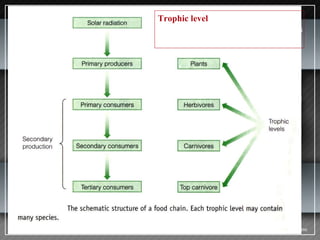
Modified from:  General Ecology , by David T. Krome Trophic level :  All the organisms that are the same number of food-chain steps from the primary source of energy
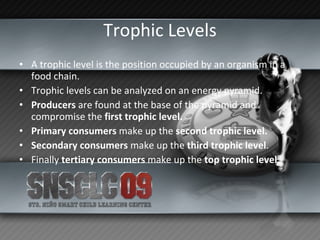
Trophic Levels A trophic level is the position occupied by an organism in a food chain. Trophic levels can be analyzed on an energy pyramid. Producers  are found at the base of the pyramid and compromise the  first trophic level.  Primary consumers  make up the  second trophic level. Secondary consumers  make up the  third trophic level . Finally  tertiary consumers  make up the  top trophic level .
Trophic Levels Found on an Energy Pyramid The greatest amount of energy is found at the base of the pyramid. The least amount of energy is found at top of the pyramid. Source: corpuschristiisd.org/user_files/91702/Ecosystem.ppt
Trophic Structure Reminder Eltonian pyramids Number of individuals per species Is this pyramid stable?
Trophic Structure Reminder What if we transformed each species into biomass instead of absolute numbers?
Biomass Energy is sometimes considered in terms of biomass, the mass of all the organisms and organic material in an area. There is  more  biomass   at the trophic level of  producers  and  fewer  at the trophic level of tertiary  consumers . (There are more plants on Earth than there are animals.) Bio=life  Mass=weight Bio + Mass = Weight of living things within an ecosystem.
Trophic Structure Reminder Express trophic structure as energy transfer  Energy pyramids can never be inverted Is there room for anyone else  at the top of this food chain?
Food Chains The producers, consumers, and decomposers of each ecosystem make up a food chain. There are many food chains in an ecosystem. Food chains show where energy is transferred and not who eats who.
Example of a Food Chain
Food Webs All the food chains in an area make up the  food web  of the area.
Food web of a hot spring © 2003 John Wiley and Sons Publishers
Fig 6.5  Food web of the harp seal. © 2003 John Wiley and Sons Publishers
Ecology  is The study of the distribution and abundance of organisms, AND the flows of energy and materials between abiotic and biotic components of ecosystems.

Ecosystem

  • 1.
  • 2.
    What we willlearn? What is meant by an ecosystem The biotic and abiotic community Food chains, trophic levels, ecological pyramid Water and carbon cycles (skip) Benefits from ecosystem services
  • 3.
    Some definitions Ecosystem:Defined area in which a community lives with interactions taking place among the organisms between the community and its non-living physical environment. An ecosystem is formed by the interactions between all living and non-living things How do living and non-living things interact in an environment?
  • 4.
    What is anecosystem? System = regularly interacting and interdependent components forming a unified whole Ecosystem = an ecological system; = a community and its physical environment treated together as a functional system
  • 5.
    Ecosystem Services Thehuman economy depends upon the services performed for free by ecosystems. The ecosystem services supplied annually are worth many trillions of dollars. Economic development that destroys habitats and impairs services can create costs to humanity over the long term that may greatly exceed the short-term economic benefits of the development. These costs are generally hidden from traditional economic accounting, but are nonetheless real and are usually borne by society at large. http://www.epa.gov/watertrain/pdf/issue2.pdf
  • 6.
    Ecosystems: Fundamental CharacteristicsStructure : Living (biotic) Nonliving (abiotic) Process : Energy flow Cycling of matter (chemicals) Change : Dynamic (not static) Succession, etc.
  • 7.
    Abiotic components: ABIOTICcomponents : Solar energy provides practically all the energy for ecosystems. Inorganic substances , e.g., sulfur, boron, tend to cycle through ecosystems. Organic compounds , such as proteins, carbohydrates, lipids, and other complex molecules, form a link between biotic and abiotic components of the system.
  • 8.
    BIOTIC components Thebiotic components of an ecosystem can be classified according to their mode of energy acquisition . In this type of classification, there are: Autotrophs and Heterotrophs Organisms that produce their own food from an energy source, such as the sun, and inorganic compounds. Organisms that consume other organisms as a food source.
  • 9.
    Modified from: General Ecology , by David T. Krome Trophic level : All the organisms that are the same number of food-chain steps from the primary source of energy
  • 10.
    Trophic Levels Atrophic level is the position occupied by an organism in a food chain. Trophic levels can be analyzed on an energy pyramid. Producers are found at the base of the pyramid and compromise the first trophic level. Primary consumers make up the second trophic level. Secondary consumers make up the third trophic level . Finally tertiary consumers make up the top trophic level .
  • 11.
    Trophic Levels Foundon an Energy Pyramid The greatest amount of energy is found at the base of the pyramid. The least amount of energy is found at top of the pyramid. Source: corpuschristiisd.org/user_files/91702/Ecosystem.ppt
  • 12.
    Trophic Structure ReminderEltonian pyramids Number of individuals per species Is this pyramid stable?
  • 13.
    Trophic Structure ReminderWhat if we transformed each species into biomass instead of absolute numbers?
  • 14.
    Biomass Energy issometimes considered in terms of biomass, the mass of all the organisms and organic material in an area. There is more biomass at the trophic level of producers and fewer at the trophic level of tertiary consumers . (There are more plants on Earth than there are animals.) Bio=life Mass=weight Bio + Mass = Weight of living things within an ecosystem.
  • 15.
    Trophic Structure ReminderExpress trophic structure as energy transfer Energy pyramids can never be inverted Is there room for anyone else at the top of this food chain?
  • 16.
    Food Chains Theproducers, consumers, and decomposers of each ecosystem make up a food chain. There are many food chains in an ecosystem. Food chains show where energy is transferred and not who eats who.
  • 17.
    Example of aFood Chain
  • 18.
    Food Webs Allthe food chains in an area make up the food web of the area.
  • 19.
    Food web ofa hot spring © 2003 John Wiley and Sons Publishers
  • 20.
    Fig 6.5 Food web of the harp seal. © 2003 John Wiley and Sons Publishers
  • 21.
    Ecology isThe study of the distribution and abundance of organisms, AND the flows of energy and materials between abiotic and biotic components of ecosystems.

Editor's Notes

  • #5 Source: www.csun.edu/science/scale/4th_grade/ppt/energy_ecosystem.ppt
  • #6 Ecosystem Services: Benefits Supplied to Human Societies by Natural Ecosystems. Issues in Ecology . No. 2, Spring 1997.
  • #8 Source: www.csun.edu/science/scale/4th_grade/ppt/energy_ecosystem.ppt
  • #13 http://eeb.bio.utk.edu/weltzin/GenEcol03/Lecture/lc_11-18-03_ecosystems.ppt ecological pyramid (alt. pyramid of numbers, Eltonian pyramid) The concept that in most food chains , the number of individuals decreases at each stage, with huge numbers of tiny individuals at the base and a few large individuals at the top, as displayed by millions of plankton , a moderate number of large fish, and a few eagles.
  • #14 http://eeb.bio.utk.edu/weltzin/GenEcol03/Lecture/lc_11-18-03_ecosystems.ppt
  • #16 http://eeb.bio.utk.edu/weltzin/GenEcol03/Lecture/lc_11-18-03_ecosystems.ppt
  • #20 Fig 6.2 Food web of a hot spring.
  • #21 Fig 6.5 Food web of the harp seal.