ENVIRONMENTAL SCIENCE
TOPIC : Ecosystem
UNIT 3:
Ecosystems
 CONCEPT OF AN ECOSYSTEM
i. Understanding ecosystems
ii. Ecosystem degradation
iii. Resource utilisation
 STRUCTURE AND FUNCTIONS OF AN ECOSYSTEM
 PRODUCERS, CONSUMERS AND DECOMPOSERS
 ENERGY FLOW IN THE ECOSYSTEM
i. water cycle
ii. Carbon cycle
iii. Oxygen cycle
iv. Nitrogen cycle
v. Energy cycle
 ECOLOGICAL SUCCESSION
 FOOD CHAINS, FOOD WEBS AND ECOLOGICAL PYRAMIDS
i. food chains
ii. food webs
iii. ecological pyramids
 TYPES OF AN ECOSYSTEM
CONCEPT OF AN ECOSYSTEM
• An ‘Ecosystem’ is a region with a specific and recognizable
landscape form such as forest, grassland, desert, wetland or coastal
area. The nature of the ecosystem is based on its geographical
features such as hills, mountains, plains, rivers, lakes, coastal areas
or islands. It is also controlled by climatic conditions such as the
amount of sunlight, the temperature and the rainfall in the region.
The geographical, climatic and soil characteristics form its non-living
(abiotic) component. These features create conditions that support
a community of plants and animals that evolution has produced to
live in these specific conditions. The living part of the ecosystem is
referred to as its biotic component.
Ecosystems are divided into terrestrial or
landbased ecosystems, and aquatic ecosystems in water. These
form the two major habitat conditions for the Earth’s living
organisms.
• Definition:
The living community of plants and animals in any
area together with the non-living components of the environment
such as soil, air and water, constitute the ecosystem.
Some ecosystems are fairly robust and are less affected by a certain
level of human disturbance. Others are highly fragile and are quickly
destroyed by human activities. Mountain ecosystems are extremely
fragile as degradation of forest cover leads to severe erosion of soil and
changes in river courses. Island ecosystems are easily affected by any
form of human activity which can lead to the rapid extinction of several
of their unique species of plants and animals. Evergreen forests and
coral reefs are also examples of species rich fragile ecosystems which
must be protected against a variety of human activities that lead to
their degradation. River and wetland ecosystems can be seriously
affected by pollution and changes in surrounding landuse.
• Understanding ecosystems :
Natural ecosystems include the
forests, grasslands, deserts, and aquatic ecosystems such as ponds, rivers, lakes,
and the sea. Man modified ecosystems include agricultural land and urban or
industrial land use patterns.
Each ecosystem has a set of common features that can be observed in the field:
• ‘What does the ecosystem look like?’
One should be able to describe specific features of the different ecosystems in
ones own surroundings. Field observations must be made in both urban and
natural surroundings.
• ‘How does the ecosystem work’?
The ecosystem functions through several biogeochemical cycles and energy
transfer mechanisms. Observe and document the components of the ecosystem
which consists of its non-living or abiotic features such as air, water, climate and
soil. Its biotic components, the various plants and animals. Both these aspects of
the ecosystem interact with each other through several functional aspects to form
Nature’s ecosystems. Plants, herbivores and carnivores can be seen to form food
chains. All these chains are joined together to form a ‘web of life’ on which man
depends. Each of these use energy that comes from the sun and powers the
ecosystem.
• Ecosystem degradation :
Ecosystems are the basis of life itself! The natural
ecosystems in the wilderness provide a variety of products and are
regions in which a number of vital ecological processes are present,
without which human civilization would not be able to exist. Ecosystems
and man: Every region of our earth has different ecosystems based on its
climatic conditions and geographical feature. There are terrestrial
ecosystems on land and aquatic ecosystems in water.
• Resource utilisation:
Most traditional societies used their
environment sustainably. Though inequality in resource utilization has
existed in every society, the number of individuals that used a large
proportion of resources was extremely limited. In recent times the
proportion of ‘rich’ people in affluent societies, grew rapidly. Inequality
thus became a serious problem. Whereas in the past many resources
such as timber and fuel wood from the forest were extracted
sustainably, this pattern has drastically changed during the last century.
STRUCTURE AND FUNCTIONS
OF AN ECOSYSTEM
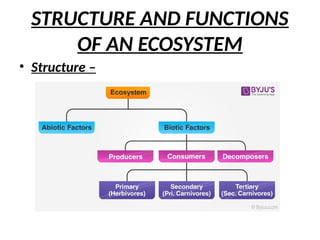
• Structure –
• Biotic Components of Ecosystems :
a) Producers (or autotrophs) - Green plants and some bacteria which manufacture
their own food.
b) Consumers (or heterotrophs) – Animals which obtain their food from producers
• Primary consumers
• Secondary consumers
• Tertiary consumers
c ) Decomposers - Bacteria and fungi that decompose dead organic matter and convert
it into simpler parts.
• Abiotic Components of an Ecosystem :
a) Physical Factors – Rainfall, Sunlight,Humidity, Temperature, Nature of soil, Water
currents.
b) Chemical Factors - Salinity of Water, Nutrients present in soil, Oxygen dissolved in
water, Percentage of water and air in soil
c) Limiting Factors - Food, water, shelter and space are limiting factors for the growth
of population of human and animals.
• Functions - Functions of an Ecosystem are as follows:
i. Food chain and food web
ii. Energy flow
iii. Ecological pyramids
 Food chain and food web- The transfer of food energy from the source (plants) through a
series of organisms by repeated eating and being eaten up is referred to as food chain.
The interlocking pattern formed by several food chains that are linked
together is called a food web.
 Energy Flow in Ecosystems-
i. First Law of Thermodynamics: energy can neither be created nor destroyed but only is
transformed from one form to another.
ii. Second Law of Thermodynamics: the second law of thermodynamics states that no energy
transformations are 100% efficient.
 Ecological Pyramid - The graphical representations of different trophic levels in an
ecosystem where producers occupy the base and the top consumer occupy the apex of the
pyramid, is known as ecological pyramid . They are used to illustrate the feeding
relationships between organisms.
Types of Ecological Pyramids
• Pyramid of number
• Pyramid of biomass
• Pyramid of energy
PRODUCERS, CONSUMERS AND
DECOMPOSERS
• Producers - Plants are the ‘producers’ in the ecosystem as they manufacture
their food by using energy from the sun. In the forest these form communities of
plant life. In the sea these include tiny algal forms to large seaweed.
• Consumers - The herbivorous animals are primary consumers as they live on
the producers. In a forest, these are the insects, amphibia, reptiles, birds and
mammals.
At a higher tropic level, there are carnivorous animals, or secondary
consumers, which live on herbivorous animals.
• Decomposers - Decomposers or detrivores are a group of organisms
consisting of small animals like worms, insects, bacteria and fungi, which break
down dead organic material into smaller particles and finally into simpler
substances that are used by plants as nutrition. Decomposition thus is a vital
function in nature, as without this, all the nutrients would be tied up in dead
matter and no new life could be produced.
ENERGY FLOW IN THE ECOSYSTEM
• Every ecosystem has several interrelated mechanisms that affect human
life. These are the water cycle, the carbon cycle, the oxygen cycle, the
nitrogen cycle and the energy cycle. While every ecosystem is controlled by
these cycles, in each ecosystem its abiotic and biotic features are distinct
from each other.
• Integration of cycle in nature - These cycles are a part of global
life processes. These biogeochcemical cycles have specific features in each
of the ecosystems. These cycles are however linked to those of adjacent
ecosystems. Their characteristics are specific to the plant and animal
communities in the region. This is related to the geographical features of
the area, the climate and the chemical composition of the soil. Together the
cycles are responsible for maintaining life on earth. If mankind disturbs
these cycles beyond the limits that nature can sustain, they will eventually
break down and lead to a degraded earth on which man will not be able to
survive.
A. The Water
Cycle
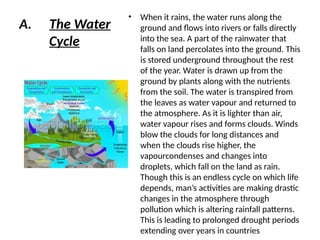
• When it rains, the water runs along the
ground and flows into rivers or falls directly
into the sea. A part of the rainwater that
falls on land percolates into the ground. This
is stored underground throughout the rest
of the year. Water is drawn up from the
ground by plants along with the nutrients
from the soil. The water is transpired from
the leaves as water vapour and returned to
the atmosphere. As it is lighter than air,
water vapour rises and forms clouds. Winds
blow the clouds for long distances and
when the clouds rise higher, the
vapourcondenses and changes into
droplets, which fall on the land as rain.
Though this is an endless cycle on which life
depends, man’s activities are making drastic
changes in the atmosphere through
pollution which is altering rainfall patterns.
This is leading to prolonged drought periods
extending over years in countries
B . The Carbon
cycle
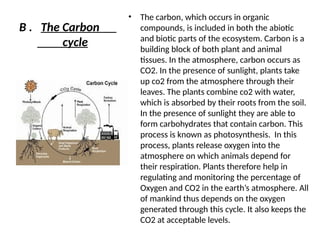
• The carbon, which occurs in organic
compounds, is included in both the abiotic
and biotic parts of the ecosystem. Carbon is a
building block of both plant and animal
tissues. In the atmosphere, carbon occurs as
CO2. In the presence of sunlight, plants take
up co2 from the atmosphere through their
leaves. The plants combine co2 with water,
which is absorbed by their roots from the soil.
In the presence of sunlight they are able to
form carbohydrates that contain carbon. This
process is known as photosynthesis. In this
process, plants release oxygen into the
atmosphere on which animals depend for
their respiration. Plants therefore help in
regulating and monitoring the percentage of
Oxygen and CO2 in the earth’s atmosphere. All
of mankind thus depends on the oxygen
generated through this cycle. It also keeps the
CO2 at acceptable levels.
C. The Oxygen
Cycle
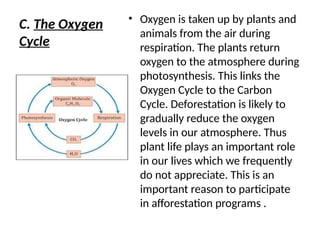
• Oxygen is taken up by plants and
animals from the air during
respiration. The plants return
oxygen to the atmosphere during
photosynthesis. This links the
Oxygen Cycle to the Carbon
Cycle. Deforestation is likely to
gradually reduce the oxygen
levels in our atmosphere. Thus
plant life plays an important role
in our lives which we frequently
do not appreciate. This is an
important reason to participate
in afforestation programs .
D. The Nitrogen
Cycle
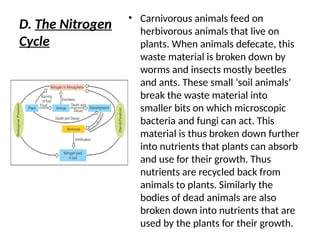
• Carnivorous animals feed on
herbivorous animals that live on
plants. When animals defecate, this
waste material is broken down by
worms and insects mostly beetles
and ants. These small ‘soil animals’
break the waste material into
smaller bits on which microscopic
bacteria and fungi can act. This
material is thus broken down further
into nutrients that plants can absorb
and use for their growth. Thus
nutrients are recycled back from
animals to plants. Similarly the
bodies of dead animals are also
broken down into nutrients that are
used by the plants for their growth.
E. The Energy
Cycle
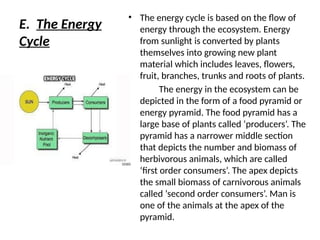
• The energy cycle is based on the flow of
energy through the ecosystem. Energy
from sunlight is converted by plants
themselves into growing new plant
material which includes leaves, flowers,
fruit, branches, trunks and roots of plants.
The energy in the ecosystem can be
depicted in the form of a food pyramid or
energy pyramid. The food pyramid has a
large base of plants called ‘producers’. The
pyramid has a narrower middle section
that depicts the number and biomass of
herbivorous animals, which are called
‘first order consumers’. The apex depicts
the small biomass of carnivorous animals
called ‘second order consumers’. Man is
one of the animals at the apex of the
pyramid.
ECOLOGICAL SUCCESSION
• Ecological succession is a process through which ecosystems tend to
change over a period of time. Succession can be related to seasonal
environmental changes, which create changes in the community of plants
and animals living in the ecosystem. Other successional events may take
much longer periods of time extending to several decades. If a forest is
cleared, it is initially colonized by a certain group of species of plants and
animals, which gradually change through an orderly process of community
development.One can predict that an opened up area will gradually be
converted into a grassland, ashrubland and finally a woodland and a forest
if permitted to do so without human interference. There is a tendency for
succession to produce a more or less stable state at the end of the
successional stages. Developmental stages in the ecosystem thus consist
of a pioneer stage, a series of changes known as serel stages, and finally a
climax stage. The successive stages are related to the way in which energy
flows through the biological system
• Food chains - The most obvious aspect of nature is that energy must pass from one
living organism to another. When herbivorous animals feed on plants, energy is transferred
from plants to animals. In an ecosystem, some of the animals feed on other living
organisms, while some feed on dead organic matter. The latter form the ‘detritus’ food
chain. At each linkage in the chain, a major part of the energy from the food is lost for daily
activities. Each chain usually has only four to five such links. However a single species may
be linked to a large number of species.
• Food web - In an ecosystem there are a very large number of interlinked chains. This
forms a food web. If the linkages in the chains that make up the web of life are disrupted
due to human activities that lead to the loss or extinction of species, the web breaks down.
• Ecological pyramid - In an ecosystem, green plants – the producers, utilize energy
directly from sunlight and convert it into matter. A large number of these organisms form
the most basic, or first ‘trophic level’ of the food pyramid. The herbivorous animals that eat
plants are at the second trophic level and are called primary consumers. The predators that
feed on them form the third trophic level and are known as secondary consumers.
FOOD CHAINS, FOOD WEBS AND
ECOLOGICAL PYRAMIDS
Types of Ecosystem
• There are very many types of ecosystems out
there, but the three major classes of
ecosystems, sometimes referred to as
‘biomes’, which are relatively contained, are
the following:
i. Freshwater Ecosystems
ii. Terrestrial Ecosystems
iii. Ocean Ecosystems
Freshwater Ecosystems
• These can be broken up into smaller ecosystems. For
instance, in the freshwater ecosystems, we find:
• Pond Ecosystems – These are usually relatively small and
contained. Most of the time, they include various types of
plants, amphibians and insects. Sometimes they include fish,
but as these cannot move around as easily as amphibians
and insects, it is less likely, and most of the time, fish are
artificially introduced to these environments by humans.
• River Ecosystems – Because rivers always link to the sea,
they are more likely to contain fish alongside the usual
plants, amphibians and insects.
Terrestrial Ecosystems
• Terrestrial ecosystems are many because there are so many different sorts of
places on Earth. Some of the most common terrestrial ecosystems that are found
are the following:
• Rainforests – Rainforests usually have extremely dense ecosystems because there
are so many different types of animals, all are living in a very small area.
• Tundra – As mentioned above, tundra usually have relatively simple ecosystems
because of the limited amount of life that can be supported in these harsh
conditions.
• Deserts – Quite the opposite of tundra in many ways, but still harsh, more
animals live in the extreme heat than they live in the extreme cold of Antarctica,
for instance.
• Forests – There are many different types of forests all over the world, including
deciduous forests and coniferous forests. These can support a lot of life and can
have very complex ecosystems.
• Grasslands – Grasslands support a wide variety of life and can have very complex
and involved ecosystems.
Ocean Ecosystems
• Ocean ecosystems are relatively contained, although they, like freshwater
ecosystems, also include certain birds that hunt for fish and insects close
to the ocean’s surface. There are different sorts of ocean ecosystems:
• Shallow water – Some tiny fish and coral only live in the shallow waters
close to land.
• Deep water – Big and even gigantic creatures can live deep in the waters
of the oceans. Some of the strangest creatures in the world live right at
the bottom of the sea.
• Warm water – Warmer waters, such as those of the Pacific Ocean, contain
some of the most impressive and intricate ecosystems in the world.
• Cold water – Less diverse, cold waters still support relatively complex
ecosystems. Plankton usually forms the base of the food chain, followed
by small fish that are either eaten by bigger fish or by other creatures such
as seals or penguins.

Environmental-Science evs-ppt-unit-3.pptx

  • 1.
  • 2.
    UNIT 3: Ecosystems  CONCEPTOF AN ECOSYSTEM i. Understanding ecosystems ii. Ecosystem degradation iii. Resource utilisation  STRUCTURE AND FUNCTIONS OF AN ECOSYSTEM  PRODUCERS, CONSUMERS AND DECOMPOSERS  ENERGY FLOW IN THE ECOSYSTEM i. water cycle ii. Carbon cycle iii. Oxygen cycle iv. Nitrogen cycle v. Energy cycle  ECOLOGICAL SUCCESSION  FOOD CHAINS, FOOD WEBS AND ECOLOGICAL PYRAMIDS i. food chains ii. food webs iii. ecological pyramids  TYPES OF AN ECOSYSTEM
  • 3.
    CONCEPT OF ANECOSYSTEM • An ‘Ecosystem’ is a region with a specific and recognizable landscape form such as forest, grassland, desert, wetland or coastal area. The nature of the ecosystem is based on its geographical features such as hills, mountains, plains, rivers, lakes, coastal areas or islands. It is also controlled by climatic conditions such as the amount of sunlight, the temperature and the rainfall in the region. The geographical, climatic and soil characteristics form its non-living (abiotic) component. These features create conditions that support a community of plants and animals that evolution has produced to live in these specific conditions. The living part of the ecosystem is referred to as its biotic component. Ecosystems are divided into terrestrial or landbased ecosystems, and aquatic ecosystems in water. These form the two major habitat conditions for the Earth’s living organisms.
  • 4.
    • Definition: The livingcommunity of plants and animals in any area together with the non-living components of the environment such as soil, air and water, constitute the ecosystem. Some ecosystems are fairly robust and are less affected by a certain level of human disturbance. Others are highly fragile and are quickly destroyed by human activities. Mountain ecosystems are extremely fragile as degradation of forest cover leads to severe erosion of soil and changes in river courses. Island ecosystems are easily affected by any form of human activity which can lead to the rapid extinction of several of their unique species of plants and animals. Evergreen forests and coral reefs are also examples of species rich fragile ecosystems which must be protected against a variety of human activities that lead to their degradation. River and wetland ecosystems can be seriously affected by pollution and changes in surrounding landuse.
  • 5.
    • Understanding ecosystems: Natural ecosystems include the forests, grasslands, deserts, and aquatic ecosystems such as ponds, rivers, lakes, and the sea. Man modified ecosystems include agricultural land and urban or industrial land use patterns. Each ecosystem has a set of common features that can be observed in the field: • ‘What does the ecosystem look like?’ One should be able to describe specific features of the different ecosystems in ones own surroundings. Field observations must be made in both urban and natural surroundings. • ‘How does the ecosystem work’? The ecosystem functions through several biogeochemical cycles and energy transfer mechanisms. Observe and document the components of the ecosystem which consists of its non-living or abiotic features such as air, water, climate and soil. Its biotic components, the various plants and animals. Both these aspects of the ecosystem interact with each other through several functional aspects to form Nature’s ecosystems. Plants, herbivores and carnivores can be seen to form food chains. All these chains are joined together to form a ‘web of life’ on which man depends. Each of these use energy that comes from the sun and powers the ecosystem.
  • 6.
    • Ecosystem degradation: Ecosystems are the basis of life itself! The natural ecosystems in the wilderness provide a variety of products and are regions in which a number of vital ecological processes are present, without which human civilization would not be able to exist. Ecosystems and man: Every region of our earth has different ecosystems based on its climatic conditions and geographical feature. There are terrestrial ecosystems on land and aquatic ecosystems in water. • Resource utilisation: Most traditional societies used their environment sustainably. Though inequality in resource utilization has existed in every society, the number of individuals that used a large proportion of resources was extremely limited. In recent times the proportion of ‘rich’ people in affluent societies, grew rapidly. Inequality thus became a serious problem. Whereas in the past many resources such as timber and fuel wood from the forest were extracted sustainably, this pattern has drastically changed during the last century.
  • 7.
    STRUCTURE AND FUNCTIONS OFAN ECOSYSTEM • Structure –
  • 8.
    • Biotic Componentsof Ecosystems : a) Producers (or autotrophs) - Green plants and some bacteria which manufacture their own food. b) Consumers (or heterotrophs) – Animals which obtain their food from producers • Primary consumers • Secondary consumers • Tertiary consumers c ) Decomposers - Bacteria and fungi that decompose dead organic matter and convert it into simpler parts. • Abiotic Components of an Ecosystem : a) Physical Factors – Rainfall, Sunlight,Humidity, Temperature, Nature of soil, Water currents. b) Chemical Factors - Salinity of Water, Nutrients present in soil, Oxygen dissolved in water, Percentage of water and air in soil c) Limiting Factors - Food, water, shelter and space are limiting factors for the growth of population of human and animals.
  • 9.
    • Functions -Functions of an Ecosystem are as follows: i. Food chain and food web ii. Energy flow iii. Ecological pyramids  Food chain and food web- The transfer of food energy from the source (plants) through a series of organisms by repeated eating and being eaten up is referred to as food chain. The interlocking pattern formed by several food chains that are linked together is called a food web.  Energy Flow in Ecosystems- i. First Law of Thermodynamics: energy can neither be created nor destroyed but only is transformed from one form to another. ii. Second Law of Thermodynamics: the second law of thermodynamics states that no energy transformations are 100% efficient.  Ecological Pyramid - The graphical representations of different trophic levels in an ecosystem where producers occupy the base and the top consumer occupy the apex of the pyramid, is known as ecological pyramid . They are used to illustrate the feeding relationships between organisms. Types of Ecological Pyramids • Pyramid of number • Pyramid of biomass • Pyramid of energy
  • 10.
    PRODUCERS, CONSUMERS AND DECOMPOSERS •Producers - Plants are the ‘producers’ in the ecosystem as they manufacture their food by using energy from the sun. In the forest these form communities of plant life. In the sea these include tiny algal forms to large seaweed. • Consumers - The herbivorous animals are primary consumers as they live on the producers. In a forest, these are the insects, amphibia, reptiles, birds and mammals. At a higher tropic level, there are carnivorous animals, or secondary consumers, which live on herbivorous animals. • Decomposers - Decomposers or detrivores are a group of organisms consisting of small animals like worms, insects, bacteria and fungi, which break down dead organic material into smaller particles and finally into simpler substances that are used by plants as nutrition. Decomposition thus is a vital function in nature, as without this, all the nutrients would be tied up in dead matter and no new life could be produced.
  • 11.
    ENERGY FLOW INTHE ECOSYSTEM • Every ecosystem has several interrelated mechanisms that affect human life. These are the water cycle, the carbon cycle, the oxygen cycle, the nitrogen cycle and the energy cycle. While every ecosystem is controlled by these cycles, in each ecosystem its abiotic and biotic features are distinct from each other. • Integration of cycle in nature - These cycles are a part of global life processes. These biogeochcemical cycles have specific features in each of the ecosystems. These cycles are however linked to those of adjacent ecosystems. Their characteristics are specific to the plant and animal communities in the region. This is related to the geographical features of the area, the climate and the chemical composition of the soil. Together the cycles are responsible for maintaining life on earth. If mankind disturbs these cycles beyond the limits that nature can sustain, they will eventually break down and lead to a degraded earth on which man will not be able to survive.
  • 12.
    A. The Water Cycle •When it rains, the water runs along the ground and flows into rivers or falls directly into the sea. A part of the rainwater that falls on land percolates into the ground. This is stored underground throughout the rest of the year. Water is drawn up from the ground by plants along with the nutrients from the soil. The water is transpired from the leaves as water vapour and returned to the atmosphere. As it is lighter than air, water vapour rises and forms clouds. Winds blow the clouds for long distances and when the clouds rise higher, the vapourcondenses and changes into droplets, which fall on the land as rain. Though this is an endless cycle on which life depends, man’s activities are making drastic changes in the atmosphere through pollution which is altering rainfall patterns. This is leading to prolonged drought periods extending over years in countries
  • 13.
    B . TheCarbon cycle • The carbon, which occurs in organic compounds, is included in both the abiotic and biotic parts of the ecosystem. Carbon is a building block of both plant and animal tissues. In the atmosphere, carbon occurs as CO2. In the presence of sunlight, plants take up co2 from the atmosphere through their leaves. The plants combine co2 with water, which is absorbed by their roots from the soil. In the presence of sunlight they are able to form carbohydrates that contain carbon. This process is known as photosynthesis. In this process, plants release oxygen into the atmosphere on which animals depend for their respiration. Plants therefore help in regulating and monitoring the percentage of Oxygen and CO2 in the earth’s atmosphere. All of mankind thus depends on the oxygen generated through this cycle. It also keeps the CO2 at acceptable levels.
  • 14.
    C. The Oxygen Cycle •Oxygen is taken up by plants and animals from the air during respiration. The plants return oxygen to the atmosphere during photosynthesis. This links the Oxygen Cycle to the Carbon Cycle. Deforestation is likely to gradually reduce the oxygen levels in our atmosphere. Thus plant life plays an important role in our lives which we frequently do not appreciate. This is an important reason to participate in afforestation programs .
  • 15.
    D. The Nitrogen Cycle •Carnivorous animals feed on herbivorous animals that live on plants. When animals defecate, this waste material is broken down by worms and insects mostly beetles and ants. These small ‘soil animals’ break the waste material into smaller bits on which microscopic bacteria and fungi can act. This material is thus broken down further into nutrients that plants can absorb and use for their growth. Thus nutrients are recycled back from animals to plants. Similarly the bodies of dead animals are also broken down into nutrients that are used by the plants for their growth.
  • 16.
    E. The Energy Cycle •The energy cycle is based on the flow of energy through the ecosystem. Energy from sunlight is converted by plants themselves into growing new plant material which includes leaves, flowers, fruit, branches, trunks and roots of plants. The energy in the ecosystem can be depicted in the form of a food pyramid or energy pyramid. The food pyramid has a large base of plants called ‘producers’. The pyramid has a narrower middle section that depicts the number and biomass of herbivorous animals, which are called ‘first order consumers’. The apex depicts the small biomass of carnivorous animals called ‘second order consumers’. Man is one of the animals at the apex of the pyramid.
  • 17.
    ECOLOGICAL SUCCESSION • Ecologicalsuccession is a process through which ecosystems tend to change over a period of time. Succession can be related to seasonal environmental changes, which create changes in the community of plants and animals living in the ecosystem. Other successional events may take much longer periods of time extending to several decades. If a forest is cleared, it is initially colonized by a certain group of species of plants and animals, which gradually change through an orderly process of community development.One can predict that an opened up area will gradually be converted into a grassland, ashrubland and finally a woodland and a forest if permitted to do so without human interference. There is a tendency for succession to produce a more or less stable state at the end of the successional stages. Developmental stages in the ecosystem thus consist of a pioneer stage, a series of changes known as serel stages, and finally a climax stage. The successive stages are related to the way in which energy flows through the biological system
  • 18.
    • Food chains- The most obvious aspect of nature is that energy must pass from one living organism to another. When herbivorous animals feed on plants, energy is transferred from plants to animals. In an ecosystem, some of the animals feed on other living organisms, while some feed on dead organic matter. The latter form the ‘detritus’ food chain. At each linkage in the chain, a major part of the energy from the food is lost for daily activities. Each chain usually has only four to five such links. However a single species may be linked to a large number of species. • Food web - In an ecosystem there are a very large number of interlinked chains. This forms a food web. If the linkages in the chains that make up the web of life are disrupted due to human activities that lead to the loss or extinction of species, the web breaks down. • Ecological pyramid - In an ecosystem, green plants – the producers, utilize energy directly from sunlight and convert it into matter. A large number of these organisms form the most basic, or first ‘trophic level’ of the food pyramid. The herbivorous animals that eat plants are at the second trophic level and are called primary consumers. The predators that feed on them form the third trophic level and are known as secondary consumers. FOOD CHAINS, FOOD WEBS AND ECOLOGICAL PYRAMIDS
  • 19.
    Types of Ecosystem •There are very many types of ecosystems out there, but the three major classes of ecosystems, sometimes referred to as ‘biomes’, which are relatively contained, are the following: i. Freshwater Ecosystems ii. Terrestrial Ecosystems iii. Ocean Ecosystems
  • 20.
    Freshwater Ecosystems • Thesecan be broken up into smaller ecosystems. For instance, in the freshwater ecosystems, we find: • Pond Ecosystems – These are usually relatively small and contained. Most of the time, they include various types of plants, amphibians and insects. Sometimes they include fish, but as these cannot move around as easily as amphibians and insects, it is less likely, and most of the time, fish are artificially introduced to these environments by humans. • River Ecosystems – Because rivers always link to the sea, they are more likely to contain fish alongside the usual plants, amphibians and insects.
  • 21.
    Terrestrial Ecosystems • Terrestrialecosystems are many because there are so many different sorts of places on Earth. Some of the most common terrestrial ecosystems that are found are the following: • Rainforests – Rainforests usually have extremely dense ecosystems because there are so many different types of animals, all are living in a very small area. • Tundra – As mentioned above, tundra usually have relatively simple ecosystems because of the limited amount of life that can be supported in these harsh conditions. • Deserts – Quite the opposite of tundra in many ways, but still harsh, more animals live in the extreme heat than they live in the extreme cold of Antarctica, for instance. • Forests – There are many different types of forests all over the world, including deciduous forests and coniferous forests. These can support a lot of life and can have very complex ecosystems. • Grasslands – Grasslands support a wide variety of life and can have very complex and involved ecosystems.
  • 22.
    Ocean Ecosystems • Oceanecosystems are relatively contained, although they, like freshwater ecosystems, also include certain birds that hunt for fish and insects close to the ocean’s surface. There are different sorts of ocean ecosystems: • Shallow water – Some tiny fish and coral only live in the shallow waters close to land. • Deep water – Big and even gigantic creatures can live deep in the waters of the oceans. Some of the strangest creatures in the world live right at the bottom of the sea. • Warm water – Warmer waters, such as those of the Pacific Ocean, contain some of the most impressive and intricate ecosystems in the world. • Cold water – Less diverse, cold waters still support relatively complex ecosystems. Plankton usually forms the base of the food chain, followed by small fish that are either eaten by bigger fish or by other creatures such as seals or penguins.