
ADISI NUKLEOFILIK
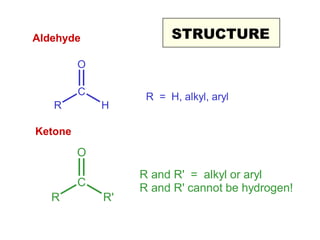
Aldehyde Ketone STRUCTURE
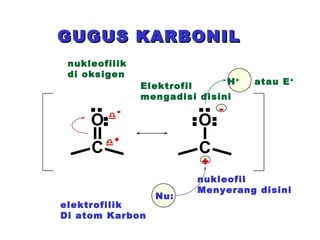
GUGUS KARBONIL  elektrofilik  Di atom Karbon nukleofilik di oksigen Nu: nukleofil  Menyerang disini H +   atau E + Elektrofil  mengadisi disini  .. :  +  - .. : : - +
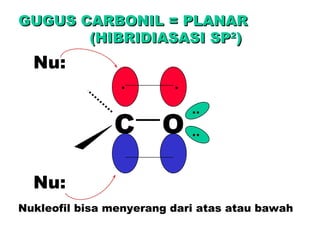
C O .. .. . . GUGUS CARBONIL = PLANAR  (HIBRIDIASASI SP 2 ) Nukleofil bisa menyerang dari atas atau bawah Nu: Nu:
ADISI NUKLEOFILIK KE C=O MEKANISME DALAM ASAM DAN DALAM BASA
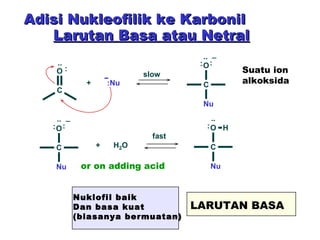
Adisi Nukleofilik ke Karbonil Larutan Basa atau Netral Suatu ion  alkoksida LARUTAN BASA Nuklofil baik Dan basa kuat (biasanya bermuatan) - or on adding acid
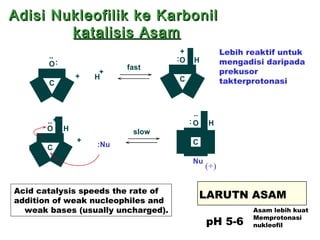
Adisi Nukleofilik ke Karbonil  katalisis Asam Acid catalysis speeds the rate of  addition of weak nucleophiles and weak bases (usually uncharged). Lebih reaktif untuk  mengadisi daripada  prekusor takterprotonasi LARUTN ASAM (+) pH 5-6 Asam lebih kuat Memprotonasi  nukleofil
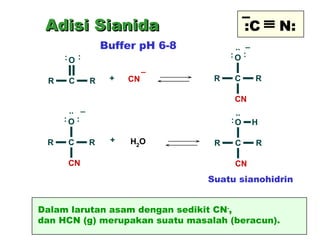
Adisi Sianida Buffer pH 6-8 Dalam larutan asam dengan sedikit CN - ,  dan HCN (g) merupakan suatu masalah (beracun). Suatu sianohidrin :C  N:
HYDROLYSIS OF THE  NITRILE GROUP
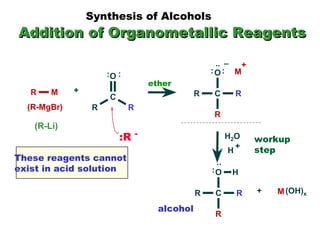
(R-Li) Addition of Organometallic Reagents ether workup step alcohol :R  - Synthesis of Alcohols These reagents cannot  exist in acid solution
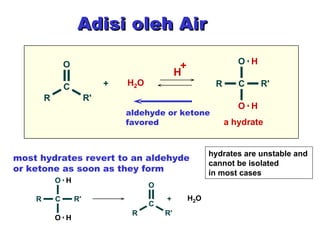
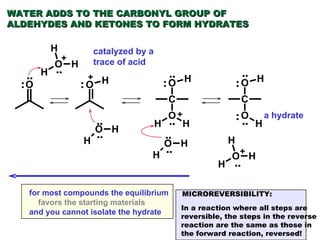
hydrates are unstable and cannot be isolated in most cases Adisi oleh Air most hydrates revert to an aldehyde  or ketone as soon as they form aldehyde or ketone favored
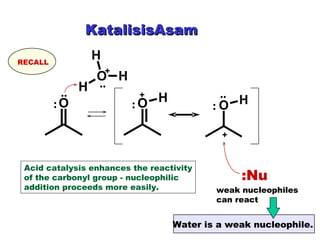
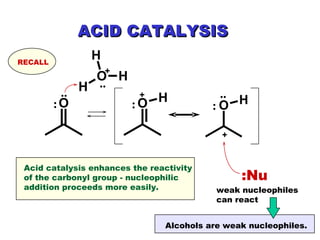
.. : : + + .. KatalisisAsam + .. : :Nu Acid catalysis enhances the reactivity of the carbonyl group - nucleophilic addition proceeds more easily. weak nucleophiles can react RECALL Water is a weak nucleophile.
.. .. .. .. .. .. .. .. .. .. : : : : : + + + a hydrate WATER ADDS TO THE CARBONYL GROUP OF  ALDEHYDES AND KETONES TO FORM HYDRATES catalyzed by a trace of acid In a reaction where all steps are reversible, the steps in the reverse reaction are the same as those in the forward reaction, reversed! MICROREVERSIBILITY: .. + for most compounds the equilibrium favors the starting materials   and you cannot isolate the hydrate
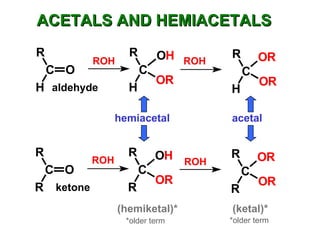
ACETALS AND HEMIACETALS
.. : : + + .. ACID CATALYSIS + .. : :Nu Acid catalysis enhances the reactivity of the carbonyl group - nucleophilic addition proceeds more easily. weak nucleophiles can react RECALL Alcohols are weak nucleophiles.
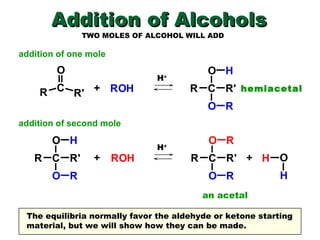
Addition of Alcohols addition of one mole addition of second mole hemiacetal an acetal H + H + TWO MOLES OF ALCOHOL WILL ADD The equilibria normally favor the aldehyde or ketone starting material, but we will show how they can be made.
aldehyde ketone hemiacetal acetal (ketal)* (hemiketal)* ACETALS AND HEMIACETALS *older term *older term
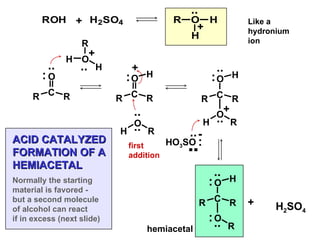
hemiacetal .. .. .. .. .. .. .. .. .. : : : : : : + + + H 2 SO 4 ACID CATALYZED FORMATION OF A HEMIACETAL + + .. + Normally the starting material is favored - but a second molecule of alcohol can react if in excess (next slide) Like a  hydronium ion first addition C O R R H O R H C O R R H O H R C O R R H R H O C O R R H R O HO 3 SO .. -
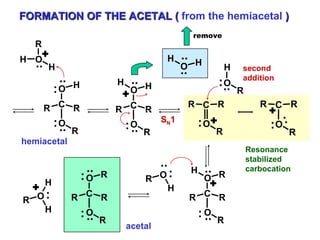
acetal : .. .. .. .. .. : : : : .. .. .. .. .. .. .. .. : : : : : : : + + + + + + FORMATION OF THE ACETAL (  from the hemiacetal  ) Resonance stabilized carbocation S N 1 second  addition hemiacetal remove
CYCLIC ACETALS
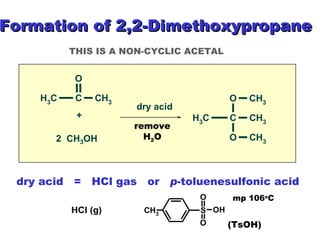
Dry acid  =  HCl gas HCl in methanol HOTs Formation of 2,2-Dimethoxypropane dry acid  =  HCl gas  or  p -toluenesulfonic acid remove H 2 O THIS IS A NON-CYCLIC ACETAL (TsOH) mp 106 o C
CARBOHYDRATES AND  SUGARS
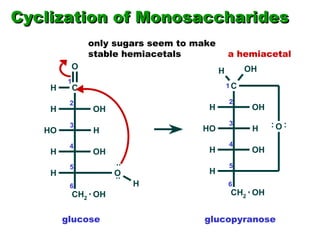
Cyclization of Monosaccharides glucose glucopyranose a hemiacetal only sugars seem to make stable hemiacetals
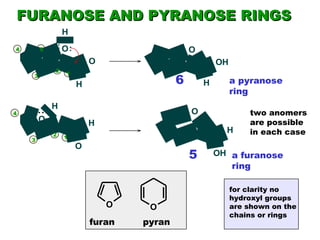
a pyranose ring a furanose ring 6 5 two anomers are possible in each case FURANOSE AND PYRANOSE RINGS for clarity no hydroxyl groups  are shown on the  chains or rings  1 2 3 4 5 1 2 3 4 furan pyran
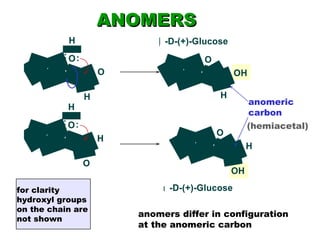
ANOMERS  for clarity hydroxyl groups  on the chain are  not shown anomeric carbon (hemiacetal) anomers differ in configuration at the anomeric carbon
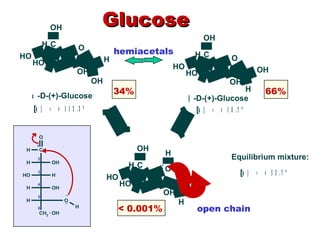
Glucose hemiacetals 66% 34% open chain < 0.001%
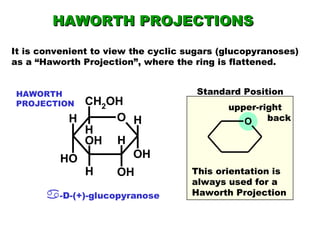
HAWORTH PROJECTIONS It is convenient to view the cyclic sugars (glucopyranoses) as a “Haworth Projection”, where the ring is flattened. upper-right back This orientation is always used for a Haworth Projection  -D-(+)-glucopyranose HAWORTH PROJECTION Standard Position
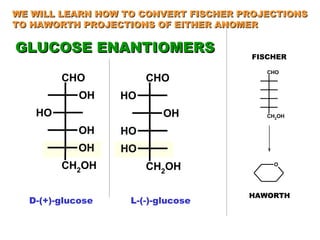
D-(+)-glucose L-(-)-glucose GLUCOSE ENANTIOMERS HAWORTH FISCHER WE WILL LEARN HOW TO CONVERT FISCHER PROJECTIONS TO HAWORTH PROJECTIONS OF EITHER ANOMER
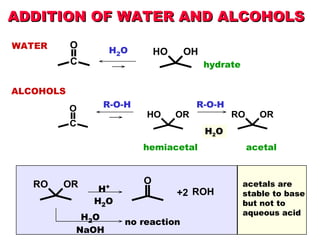
H 2 O hydrate hemiacetal acetal R-O-H H 2 O R-O-H ADDITION OF WATER AND ALCOHOLS WATER ALCOHOLS no reaction NaOH H 2 O H 2 O H + acetals are stable to base but not to aqueous acid
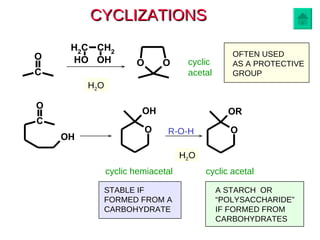
cyclic hemiacetal R-O-H H 2 O cyclic acetal cyclic acetal H 2 O OFTEN USED AS A PROTECTIVE GROUP STABLE IF  FORMED FROM A CARBOHYDRATE A STARCH  OR “ POLYSACCHARIDE” IF FORMED FROM CARBOHYDRATES CYCLIZATIONS

Adisi Nukleofilik

  • 1.
  • 2.
  • 3.
    GUGUS KARBONIL elektrofilik Di atom Karbon nukleofilik di oksigen Nu: nukleofil Menyerang disini H + atau E + Elektrofil mengadisi disini .. :  +  - .. : : - +
  • 4.
    C O .... . . GUGUS CARBONIL = PLANAR (HIBRIDIASASI SP 2 ) Nukleofil bisa menyerang dari atas atau bawah Nu: Nu:
  • 5.
    ADISI NUKLEOFILIK KEC=O MEKANISME DALAM ASAM DAN DALAM BASA
  • 6.
    Adisi Nukleofilik keKarbonil Larutan Basa atau Netral Suatu ion alkoksida LARUTAN BASA Nuklofil baik Dan basa kuat (biasanya bermuatan) - or on adding acid
  • 7.
    Adisi Nukleofilik keKarbonil katalisis Asam Acid catalysis speeds the rate of addition of weak nucleophiles and weak bases (usually uncharged). Lebih reaktif untuk mengadisi daripada prekusor takterprotonasi LARUTN ASAM (+) pH 5-6 Asam lebih kuat Memprotonasi nukleofil
  • 8.
    Adisi Sianida BufferpH 6-8 Dalam larutan asam dengan sedikit CN - , dan HCN (g) merupakan suatu masalah (beracun). Suatu sianohidrin :C N:
  • 9.
    HYDROLYSIS OF THE NITRILE GROUP
  • 10.
    (R-Li) Addition ofOrganometallic Reagents ether workup step alcohol :R - Synthesis of Alcohols These reagents cannot exist in acid solution
  • 11.
    hydrates are unstableand cannot be isolated in most cases Adisi oleh Air most hydrates revert to an aldehyde or ketone as soon as they form aldehyde or ketone favored
  • 12.
    .. : :+ + .. KatalisisAsam + .. : :Nu Acid catalysis enhances the reactivity of the carbonyl group - nucleophilic addition proceeds more easily. weak nucleophiles can react RECALL Water is a weak nucleophile.
  • 13.
    .. .. .... .. .. .. .. .. .. : : : : : + + + a hydrate WATER ADDS TO THE CARBONYL GROUP OF ALDEHYDES AND KETONES TO FORM HYDRATES catalyzed by a trace of acid In a reaction where all steps are reversible, the steps in the reverse reaction are the same as those in the forward reaction, reversed! MICROREVERSIBILITY: .. + for most compounds the equilibrium favors the starting materials and you cannot isolate the hydrate
  • 14.
  • 15.
    .. : :+ + .. ACID CATALYSIS + .. : :Nu Acid catalysis enhances the reactivity of the carbonyl group - nucleophilic addition proceeds more easily. weak nucleophiles can react RECALL Alcohols are weak nucleophiles.
  • 16.
    Addition of Alcoholsaddition of one mole addition of second mole hemiacetal an acetal H + H + TWO MOLES OF ALCOHOL WILL ADD The equilibria normally favor the aldehyde or ketone starting material, but we will show how they can be made.
  • 17.
    aldehyde ketone hemiacetalacetal (ketal)* (hemiketal)* ACETALS AND HEMIACETALS *older term *older term
  • 18.
    hemiacetal .. .... .. .. .. .. .. .. : : : : : : + + + H 2 SO 4 ACID CATALYZED FORMATION OF A HEMIACETAL + + .. + Normally the starting material is favored - but a second molecule of alcohol can react if in excess (next slide) Like a hydronium ion first addition C O R R H O R H C O R R H O H R C O R R H R H O C O R R H R O HO 3 SO .. -
  • 19.
    acetal : .... .. .. .. : : : : .. .. .. .. .. .. .. .. : : : : : : : + + + + + + FORMATION OF THE ACETAL ( from the hemiacetal ) Resonance stabilized carbocation S N 1 second addition hemiacetal remove
  • 20.
  • 21.
    Dry acid = HCl gas HCl in methanol HOTs Formation of 2,2-Dimethoxypropane dry acid = HCl gas or p -toluenesulfonic acid remove H 2 O THIS IS A NON-CYCLIC ACETAL (TsOH) mp 106 o C
  • 22.
  • 23.
    Cyclization of Monosaccharidesglucose glucopyranose a hemiacetal only sugars seem to make stable hemiacetals
  • 24.
    a pyranose ringa furanose ring 6 5 two anomers are possible in each case FURANOSE AND PYRANOSE RINGS for clarity no hydroxyl groups are shown on the chains or rings 1 2 3 4 5 1 2 3 4 furan pyran
  • 25.
    ANOMERS forclarity hydroxyl groups on the chain are not shown anomeric carbon (hemiacetal) anomers differ in configuration at the anomeric carbon
  • 26.
    Glucose hemiacetals 66%34% open chain < 0.001%
  • 27.
    HAWORTH PROJECTIONS Itis convenient to view the cyclic sugars (glucopyranoses) as a “Haworth Projection”, where the ring is flattened. upper-right back This orientation is always used for a Haworth Projection  -D-(+)-glucopyranose HAWORTH PROJECTION Standard Position
  • 28.
    D-(+)-glucose L-(-)-glucose GLUCOSEENANTIOMERS HAWORTH FISCHER WE WILL LEARN HOW TO CONVERT FISCHER PROJECTIONS TO HAWORTH PROJECTIONS OF EITHER ANOMER
  • 29.
    H 2 Ohydrate hemiacetal acetal R-O-H H 2 O R-O-H ADDITION OF WATER AND ALCOHOLS WATER ALCOHOLS no reaction NaOH H 2 O H 2 O H + acetals are stable to base but not to aqueous acid
  • 30.
    cyclic hemiacetal R-O-HH 2 O cyclic acetal cyclic acetal H 2 O OFTEN USED AS A PROTECTIVE GROUP STABLE IF FORMED FROM A CARBOHYDRATE A STARCH OR “ POLYSACCHARIDE” IF FORMED FROM CARBOHYDRATES CYCLIZATIONS