Chapter 24 Section 3:  Outer Planets
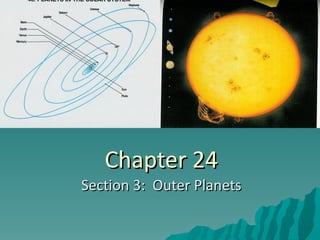
23.4 The Outer Planets Outer Planets:  Description Outer Planets:  Jupiter, Saturn, Uranus, Neptune Pluto is no longer considered a planet.  4 planets are gaseous giants  ( Jovian Planets ) Pluto and Xenon are frozen spheres Voyager 1 & 2 probed the 4 gaseous giants Jupiter, Saturn, Uranus, Neptune Pgs. 654 - 659
Jupiter: Jupiter Largest Planet in our Solar System Fifth planet in order Revolution = 11.9 years to orbit Rotation = 10 hrs. (fastest of all planets) Voyager 1 & 2 (1979) probed Jupiter Gathered information about Jupiter’s Moons’ Atmospheres Discovered 3 more moons Discovered a faint dust ring orbiting Jupiter
Jupiter’s Composition:  Hydrogen, Helium, Ammonia, Methane, & water vapor Gaseous Atmosphere, Liquid Mantle, & Solid Core Clouds form color bands; Winds up to 400 km/hr. Great Red Spot :  Continuous  Atmospheric Storm Lightning has been observed in the atmosphere  Radiates 2x as much heat as it receives Believed to be a  star  “that just didn’t make it”
Images of Jupiter
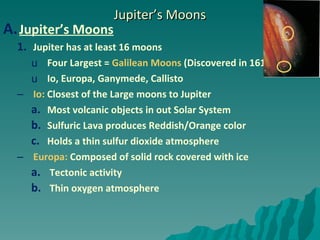
Jupiter’s Moons Jupiter’s Moons Jupiter has at least 16 moons Four Largest =   Galilean Moons   (Discovered in 1610) Io, Europa, Ganymede, Callisto Io:   Closest of the Large moons to Jupiter Most volcanic objects in out Solar System Sulfuric Lava produces Reddish/Orange color Holds a thin sulfur dioxide atmosphere Europa:   Composed of solid rock covered with ice Tectonic activity Thin oxygen atmosphere
Ganymede:  Largest moon in the Solar System Larger than Mercury, Surface covered in Ice Slushy Mantle, Solid rock core Callisto:  Composed of heavily cratered Rock/Ice Crust Water/Ice mantle with a rocky core
Galilean Moons Io with eruption Europa Ganymede Callisto
Saturn Sixth planet; 30 year orbit; 11 hr rotation 1980 & 1981 surveyed by the Voyagers “ Ringed Planet” Second Largest planet Very low density (would float in water) Atmospheric composition: Mostly hydrogen & helium; also ammonia, methane Liquid Hydrogen/helium mantle Small rocky core
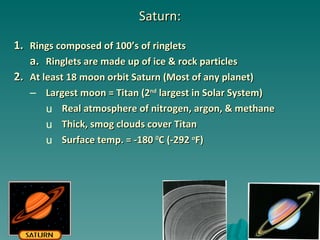
Saturn: Rings composed of 100’s of ringlets Ringlets are made up of ice & rock particles At least 18 moon orbit Saturn (Most of any planet) Largest moon = Titan (2 nd  largest in Solar System) Real atmosphere of nitrogen, argon, & methane Thick, smog clouds cover Titan Surface temp. = -180  0 C (-292  o F)
 
Uranus Smallest of the gas planets  Discovered in 1781 7 th  planet, 84 year orbit, 17 hour rotation ** Average Temp. = -328 o F
Uranus: Voyager 2 surveyed (1986) Discovered 10 unknown moons (making 15 total) 5 largest almost identical Dark color, lack atmosphere, crater riddled Discovered several dark rings Detected a magnetic field tilted 60 0  from axis Atmosphere: Hydrogen, Helium & Methane Methane gives planet a blue/green tint Liquid mantle of water, methane, & ammonia Rocky core ** Rotational axis lays on its side  (Spins like a tire)
Neptune Last of the gas planets; discovered in 1846 Orbit overlaps Pluto’s at 2 points Change position 8    9 & 9    8 1 orbit = 165 years; 1 rotation = 16 hrs Atmosphere: Hydrogen, Helium, Methane Methane gives Neptune bluish tint  Winds = 2200 km/hr; Temperature = -417  0 F Has a dark spot = storm in it’s atmosphere Liquid mantle: water, methane, & ammonia Core: solid rock
F.  Neptune  (continued) Voyager 2 detected 6 moons (Totaling 8) Largest moon =  Triton Has a thin nitrogen atmosphere Constantly erupting methane geysers Neptune also has rings (thin & thicken at different places)
 
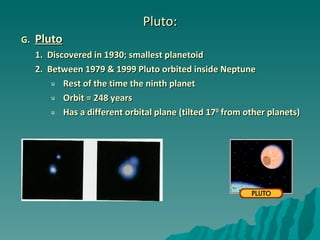
Pluto: G.  Pluto Discovered in 1930; smallest planetoid Between 1979 & 1999 Pluto orbited inside Neptune Rest of the time the ninth planet Orbit = 248 years Has a different orbital plane (tilted 17 0  from other planets)
Pluto: Pluto (continued) Surrounded by a minimal atmosphere Temperature = -364  o F Solid rocky crust One Moon, Charon (½ diameter of Pluto) Orbits very close to Pluto Sometimes considered “a double planet” with Pluto
H.  Xenon Discovered January 8 th , 2005 20 % larger than Pluto Orbital time unknown; Rotational time unknown Has one known moon Dark & cold (below -225  0 C or -373  o F) Has not been “officially” named yet
Kuiper Belt Kuiper Belt Discovered by the Hubble Telescope Vast disk of icy comets Located near Neptune’s orbit
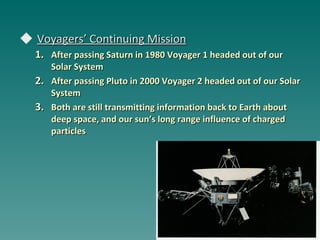
Voyagers’ Continuing Mission After passing Saturn in 1980 Voyager 1 headed out of our Solar System After passing Pluto in 2000 Voyager 2 headed out of our Solar System Both are still transmitting information back to Earth about deep space, and our sun’s long range influence of charged particles
 

Chapter 24 section 3 notes

  • 1.
    Chapter 24 Section3: Outer Planets
  • 2.
    23.4 The OuterPlanets Outer Planets: Description Outer Planets: Jupiter, Saturn, Uranus, Neptune Pluto is no longer considered a planet. 4 planets are gaseous giants ( Jovian Planets ) Pluto and Xenon are frozen spheres Voyager 1 & 2 probed the 4 gaseous giants Jupiter, Saturn, Uranus, Neptune Pgs. 654 - 659
  • 3.
    Jupiter: Jupiter LargestPlanet in our Solar System Fifth planet in order Revolution = 11.9 years to orbit Rotation = 10 hrs. (fastest of all planets) Voyager 1 & 2 (1979) probed Jupiter Gathered information about Jupiter’s Moons’ Atmospheres Discovered 3 more moons Discovered a faint dust ring orbiting Jupiter
  • 4.
    Jupiter’s Composition: Hydrogen, Helium, Ammonia, Methane, & water vapor Gaseous Atmosphere, Liquid Mantle, & Solid Core Clouds form color bands; Winds up to 400 km/hr. Great Red Spot : Continuous Atmospheric Storm Lightning has been observed in the atmosphere Radiates 2x as much heat as it receives Believed to be a star “that just didn’t make it”
  • 5.
  • 6.
    Jupiter’s Moons Jupiter’sMoons Jupiter has at least 16 moons Four Largest = Galilean Moons (Discovered in 1610) Io, Europa, Ganymede, Callisto Io: Closest of the Large moons to Jupiter Most volcanic objects in out Solar System Sulfuric Lava produces Reddish/Orange color Holds a thin sulfur dioxide atmosphere Europa: Composed of solid rock covered with ice Tectonic activity Thin oxygen atmosphere
  • 7.
    Ganymede: Largestmoon in the Solar System Larger than Mercury, Surface covered in Ice Slushy Mantle, Solid rock core Callisto: Composed of heavily cratered Rock/Ice Crust Water/Ice mantle with a rocky core
  • 8.
    Galilean Moons Iowith eruption Europa Ganymede Callisto
  • 9.
    Saturn Sixth planet;30 year orbit; 11 hr rotation 1980 & 1981 surveyed by the Voyagers “ Ringed Planet” Second Largest planet Very low density (would float in water) Atmospheric composition: Mostly hydrogen & helium; also ammonia, methane Liquid Hydrogen/helium mantle Small rocky core
  • 10.
    Saturn: Rings composedof 100’s of ringlets Ringlets are made up of ice & rock particles At least 18 moon orbit Saturn (Most of any planet) Largest moon = Titan (2 nd largest in Solar System) Real atmosphere of nitrogen, argon, & methane Thick, smog clouds cover Titan Surface temp. = -180 0 C (-292 o F)
  • 11.
  • 12.
    Uranus Smallest ofthe gas planets Discovered in 1781 7 th planet, 84 year orbit, 17 hour rotation ** Average Temp. = -328 o F
  • 13.
    Uranus: Voyager 2surveyed (1986) Discovered 10 unknown moons (making 15 total) 5 largest almost identical Dark color, lack atmosphere, crater riddled Discovered several dark rings Detected a magnetic field tilted 60 0 from axis Atmosphere: Hydrogen, Helium & Methane Methane gives planet a blue/green tint Liquid mantle of water, methane, & ammonia Rocky core ** Rotational axis lays on its side (Spins like a tire)
  • 14.
    Neptune Last ofthe gas planets; discovered in 1846 Orbit overlaps Pluto’s at 2 points Change position 8  9 & 9  8 1 orbit = 165 years; 1 rotation = 16 hrs Atmosphere: Hydrogen, Helium, Methane Methane gives Neptune bluish tint Winds = 2200 km/hr; Temperature = -417 0 F Has a dark spot = storm in it’s atmosphere Liquid mantle: water, methane, & ammonia Core: solid rock
  • 15.
    F. Neptune (continued) Voyager 2 detected 6 moons (Totaling 8) Largest moon = Triton Has a thin nitrogen atmosphere Constantly erupting methane geysers Neptune also has rings (thin & thicken at different places)
  • 16.
  • 17.
    Pluto: G. Pluto Discovered in 1930; smallest planetoid Between 1979 & 1999 Pluto orbited inside Neptune Rest of the time the ninth planet Orbit = 248 years Has a different orbital plane (tilted 17 0 from other planets)
  • 18.
    Pluto: Pluto (continued)Surrounded by a minimal atmosphere Temperature = -364 o F Solid rocky crust One Moon, Charon (½ diameter of Pluto) Orbits very close to Pluto Sometimes considered “a double planet” with Pluto
  • 19.
    H. XenonDiscovered January 8 th , 2005 20 % larger than Pluto Orbital time unknown; Rotational time unknown Has one known moon Dark & cold (below -225 0 C or -373 o F) Has not been “officially” named yet
  • 20.
    Kuiper Belt KuiperBelt Discovered by the Hubble Telescope Vast disk of icy comets Located near Neptune’s orbit
  • 21.
    Voyagers’ Continuing MissionAfter passing Saturn in 1980 Voyager 1 headed out of our Solar System After passing Pluto in 2000 Voyager 2 headed out of our Solar System Both are still transmitting information back to Earth about deep space, and our sun’s long range influence of charged particles
  • 22.