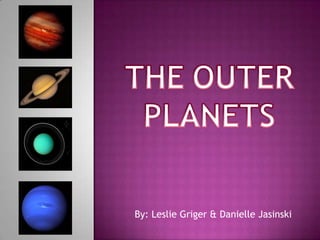
TheOuterPlanetsBy: Leslie Griger & Danielle Jasinski
JupiterHas 16 moons1 year=12 Earth yearsTemperature is -148ºC (-234ºF)Largest planet, could fit up to 1000 Earths inside itMade out of dense hydrogen, helium, water, nitrogen, and other gases over a tiny rocky coreGreat Red Spot has been there for over 300 years and it is 2 Earths in diameterRotates in about 10 hoursPossesses 62 known satellites4 of Jupiter’s moons are the size of planetsTwo and a half times the mass of all the other planets combined
SaturnHas 62 moonsMade mostly of hydrogen & heliumSecond largest planet, over 700 Earths could fit insideTemperature: -178ºC (-288ºF)1,514,500,000 km from the sunHas thousands of rings made of billions of ice & rock particlesParticle size ranges from a grain of sugar to the size of a houseEach individual ring orbits at a different speedSaturn year=29.4 Earth yearsSaturn has the largest rings of any planet
UranusTemperature is -216ºC (-357ºF)Rotates on is axis once every 17 Earth hoursHas 22 moonsGiant ball of gas & liquid, has no solid surfaceThird largest planet, over 70 Earths could fit insideOrbits the sun once every 84 Earth yearsHas 11 ringsHas 21 known satellitesUranus has a strong magnetic field Blue-green color is made up of tiny methane crystals
NeptuneNeptune year=165 Earth yearsHas 8 moonsAtmosphere=Hydrogen:85%, Helium:13%, Methane:2%Fourth largest planet, about 60 Earths could fit into Neptune Consists of hazy atmosphere & strong windsTilt of axis=28.32ºTemperature: -214ºC (-353ºF)One of Neptune’s moons, Triton has the some of the coldest temperatures in the solar system8 known satellitesNeptune’s day=16.11 hours
Similarities  of outer planetsAll are gas planetsPlanets all have ringsMade mostly of hydrogen & heliumOuter planets are all much bigger then the inner planetsAt the center is a rocky coreEvery outer planet has moons
Differences of outer planetsNeptune has by far the longest year of any planetSaturn’s rings are much larger then any other planets ringsUranus is colder then any other outer planetJupiter has a greater number of satellites then any other planet
BibliographyText"NASA - Home." NASA - Home. N.p., n.d. Web. 10 Jan. 2010. <http://www.nasa.gov/>. "Neptune." Solar Views. N.p., n.d. Web. 10 Jan. 2010. <www.solarviews.com/eng/neptune.htm>. "Saturn." Windows to the Universe. N.p., n.d. Web. 10 Jan. 2010. <http://www.windows.ucar.edu/tour/link=/saturn/saturn.html>. "Uranus - EnchantedLearning.com." ENCHANTED LEARNING HOME PAGE. N.p., n.d. Web. 18 Jan. 2010. <http://www.enchantedlearning.eruptions, volcanic, and flow along. "Jupiter." Views of the Solar System. N.p., n.d. Web. 18 Jan. 2010. <http://www.solarviews.com/eng/jupiter.
BibliographyPicture"Jupiter." Planets. N.p., n.d. Web. 18 Jan. 2010. <starbozz.files.wordpress.com/2009"Neptune." Our Solar System. N.p., n.d. Web. 18 Jan. 2010. <planetologist.files.wordpress.com/2009/03/neptune_voy2.jpg>. "Outer Planets." Solar System. N.p., n.d. Web. 18 Jan. 2010. <facweb.bhc.edu/academics/science/harwoodr/GEOL101/Study/images/OuterPlanets.jpg>. "Planets." Solar System. N.p., n.d. Web. 18 Jan. 2010. <starryskies.com/solar_system/uranus/uranus1.jpg>. "Planets." Space. N.p., n.d. Web. 18 Jan. 2010. <motivate.maths.org/conferences/conf42/Talk_images/outer_planets_small_2.jpg>. "Saturn." Outer Planets. N.p., n.d. Web. 18 Jan. 2010. <cassowary.files.wordpress.com/2008/10/saturn_false.jpg>.

The Outer Planets

  • 1.
  • 2.
    JupiterHas 16 moons1year=12 Earth yearsTemperature is -148ºC (-234ºF)Largest planet, could fit up to 1000 Earths inside itMade out of dense hydrogen, helium, water, nitrogen, and other gases over a tiny rocky coreGreat Red Spot has been there for over 300 years and it is 2 Earths in diameterRotates in about 10 hoursPossesses 62 known satellites4 of Jupiter’s moons are the size of planetsTwo and a half times the mass of all the other planets combined
  • 3.
    SaturnHas 62 moonsMademostly of hydrogen & heliumSecond largest planet, over 700 Earths could fit insideTemperature: -178ºC (-288ºF)1,514,500,000 km from the sunHas thousands of rings made of billions of ice & rock particlesParticle size ranges from a grain of sugar to the size of a houseEach individual ring orbits at a different speedSaturn year=29.4 Earth yearsSaturn has the largest rings of any planet
  • 4.
    UranusTemperature is -216ºC(-357ºF)Rotates on is axis once every 17 Earth hoursHas 22 moonsGiant ball of gas & liquid, has no solid surfaceThird largest planet, over 70 Earths could fit insideOrbits the sun once every 84 Earth yearsHas 11 ringsHas 21 known satellitesUranus has a strong magnetic field Blue-green color is made up of tiny methane crystals
  • 5.
    NeptuneNeptune year=165 EarthyearsHas 8 moonsAtmosphere=Hydrogen:85%, Helium:13%, Methane:2%Fourth largest planet, about 60 Earths could fit into Neptune Consists of hazy atmosphere & strong windsTilt of axis=28.32ºTemperature: -214ºC (-353ºF)One of Neptune’s moons, Triton has the some of the coldest temperatures in the solar system8 known satellitesNeptune’s day=16.11 hours
  • 6.
    Similarities ofouter planetsAll are gas planetsPlanets all have ringsMade mostly of hydrogen & heliumOuter planets are all much bigger then the inner planetsAt the center is a rocky coreEvery outer planet has moons
  • 7.
    Differences of outerplanetsNeptune has by far the longest year of any planetSaturn’s rings are much larger then any other planets ringsUranus is colder then any other outer planetJupiter has a greater number of satellites then any other planet
  • 8.
    BibliographyText"NASA - Home."NASA - Home. N.p., n.d. Web. 10 Jan. 2010. <http://www.nasa.gov/>. "Neptune." Solar Views. N.p., n.d. Web. 10 Jan. 2010. <www.solarviews.com/eng/neptune.htm>. "Saturn." Windows to the Universe. N.p., n.d. Web. 10 Jan. 2010. <http://www.windows.ucar.edu/tour/link=/saturn/saturn.html>. "Uranus - EnchantedLearning.com." ENCHANTED LEARNING HOME PAGE. N.p., n.d. Web. 18 Jan. 2010. <http://www.enchantedlearning.eruptions, volcanic, and flow along. "Jupiter." Views of the Solar System. N.p., n.d. Web. 18 Jan. 2010. <http://www.solarviews.com/eng/jupiter.
  • 9.
    BibliographyPicture"Jupiter." Planets. N.p.,n.d. Web. 18 Jan. 2010. <starbozz.files.wordpress.com/2009"Neptune." Our Solar System. N.p., n.d. Web. 18 Jan. 2010. <planetologist.files.wordpress.com/2009/03/neptune_voy2.jpg>. "Outer Planets." Solar System. N.p., n.d. Web. 18 Jan. 2010. <facweb.bhc.edu/academics/science/harwoodr/GEOL101/Study/images/OuterPlanets.jpg>. "Planets." Solar System. N.p., n.d. Web. 18 Jan. 2010. <starryskies.com/solar_system/uranus/uranus1.jpg>. "Planets." Space. N.p., n.d. Web. 18 Jan. 2010. <motivate.maths.org/conferences/conf42/Talk_images/outer_planets_small_2.jpg>. "Saturn." Outer Planets. N.p., n.d. Web. 18 Jan. 2010. <cassowary.files.wordpress.com/2008/10/saturn_false.jpg>.