






OBJECTIVES 
 THE OUTER PLANETS ARE JUPITER, 
SATURN,URANUS, NEPTUNE, PLUTO. 
 JUPITER, SATURN, URANUS, AND NEPTUNE 
(ALSO CALLED THE JOVIAN PLANETS) ARE 
MUCH LARGER THAN THE EARTH 
 THE ARE RICH IN HYDROGEN GAS AND/OR 
ITS COMPOUNDS, SUCH AS WATER, 
METHANE,AND AMMONIA.
…………………………. 
 THEY HAVE DEEP, THICK ATMOSPHERES 
AND NO SOLID SURFACE. 
 THEY HAVE MANY MOONS AND RINGS. 
 PLUTO IS FAR SMALLER AND HAS VERY 
DIFFERENT STRUCTURE THAN OTHER OUTER 
PLANETS. IT IS A MIX OF MAINLY ROCK AND 
FROẒEN WATER.
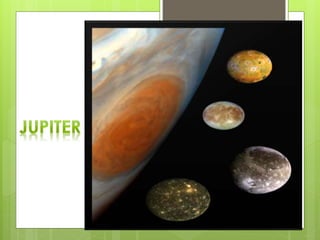
Jupiter 
 is the fifth planet from the Sun and the 
largest planet in the Solar System. 
 It is a gas giant with mass one-thousandth 
that of the Sun but is two and a half times 
the mass of all the other planets in the 
Solar System combined. 
 Jupiter is classified as a gas giant along 
with Saturn, Uranus and Neptune.
 Together, these four planets are 
sometimes referred to as the Jovian or 
outer planets 
 The Romans named the planet after 
the Roman god Jupiter. 
 Jupiter can reach unapparent 
magnitude of −2.94, bright enough to cast 
shadows
 Jupiter is primarily composed 
of hydrogen with a quarter of its mass 
being helium. 
 It may also have a rocky core of heavier 
elements, but like the other gas giants, 
Jupiter lacks a well-defined solid surface.
Orbit and rotation 
 Jupiter is the only planet that has a center of 
mass with the Sun that lies outside the volume 
of the Sun, though by only 7% of the Sun's 
radius. 
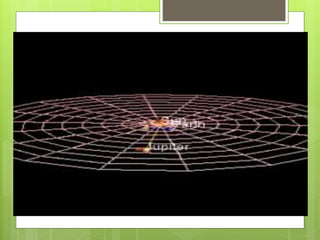
 The average distance between Jupiter and 
the Sun is 778 million km 
 There are also at least 67 moons, including the 
four large moons called the Galilean 
moons that were first discovered by Galileo 
Galilei in 1610.
ORBIT AND ROTATION
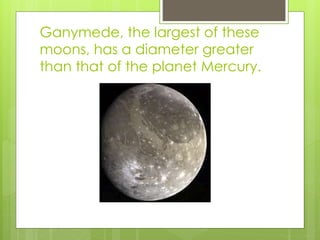
Ganymede, the largest of these 
moons, has a diameter greater 
than that of the planet Mercury.
SATURN
SATURN 
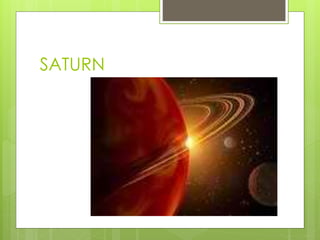
 is the sixth planet from the Sun and the 
second largest planet in the Solar System, 
after Jupiter. 
 Saturn is a gas giant with an average radius 
about nine times that Of Earth. 
 Saturn's interior is probably composed of a 
core of iron, nickel and rock, surrounded by a 
deep layer of metallic hydrogen, an 
intermediate layer of liquid 
hydrogen and liquid helium and an outer 
gaseous layer.
 The planet exhibits a pale yellow hue due to 
ammonia crystals in its upper atmosphere. 
 Sixty-two known moons orbit the planet; fifty-three 
are officially named. This does not include the 
hundreds of "moonlets" within the rings. 
 Titan, Saturn's largest and the Solar System's second 
largest moon, is larger than the planet Mercury and 
is the only moon in the Solar System to retain a 
substantial atmosphere.
Orbit and rotation 
 The average distance between Saturn and 
the Sun is over 1.4 billion kilometer's (9 AU). 
 With an average orbital speed of 9.69 km/s, it 
takes Saturn 10,759 Earth days (or about 
29½ years), to finish one revolution around the 
Sun. 
 The elliptical orbit of Saturn is inclined 2.48° 
relative to the orbital plane of the Earth.
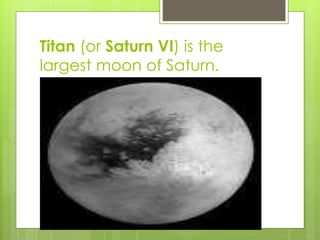
Titan (or Saturn VI) is the 
largest moon of Saturn.
URANUS
Uranus 
 is the seventh planet from the Sun. 
 It has the third-largest planetary radius and 
fourth-largest planetary mass in the Solar 
System. 
 astronomers sometimes place them in a 
separate category called "ice giants". 
 Saturn's in its primary composition of hydrogen 
and helium, contains more "ices" such as 
water ,ammonia, and methane, along with 
traces of hydrocarbons.
 It is the coldest planetary atmosphere in 
the Solar System, with a minimum 
temperature of 49 K . 
 It is the only planet whose name is derived 
from a figure from Greek mythology 
 The wind speeds on Uranus can reach 250 
meters per second (900 km/h, 560 mph).
ORBIT AND ROTATION 
 Uranus revolves around the Sun once 
every 84 Earth years. Its average distance 
from the Sun is roughly 3 billion km (about 
20 AU). 
 The intensity of sunlight on Uranus is about 
1/400 that on Earth. 
 Its orbital elements were first calculated in 
1783 by Pierre-Simon Laplace.
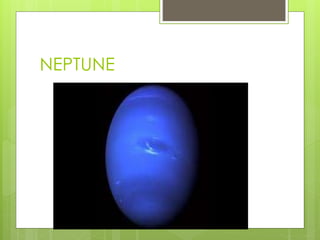
NEPTUNE
Neptune 
 is the eighth and farthest planet from 
the Sun in the Solar System. 
 It is the fourth-largest planet by diameter 
and the third-largest by mass. 
 Among the gaseous planets in the solar 
system, Neptune is the most dense.
 Neptune was the first planet found by 
mathematical prediction rather than 
by empirical observation. 
 Neptune was subsequently observed on 23 
September 1846 
 its largest moon , Triton, was discovered 
shortly thereafter, though none of the planet's 
remaining 13 moons were located 
telescopically until the 20th century.
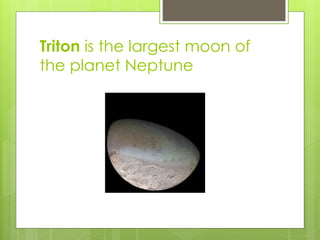
Triton is the largest moon of 
the planet Neptune
ORBIT AND ROTATION 
 The average distance between Neptune 
and the Sun is4.50 billion km (about 
30.1 AU) 
 It completes an orbit on average every 
164.79 years, subject to a variability of 
around ±0.1 years. 
 The elliptical orbit of Neptune is inclined 
1.77° compared to the Earth. Because of 
an eccentricity of 0.011.
PLUTO
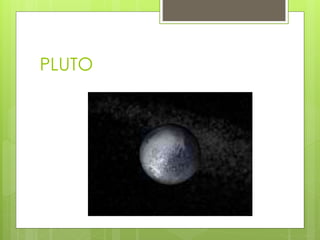
Pluto 
 Pluto, formal designation 134340 Pluto, is 
the second-most-massive known dwarf 
planet in the Solar System(after Eris) and 
the tenth-most-massive body observed 
directly orbiting the Sun. 
 Originally classified as the ninth 
planet from the Sun.
PLUTO 
 Pluto is composed primarily of rock and 
ice and is relatively small, approximately 
one-sixth the mass of the Earth's 
Moon and one-third its volume.
NEW UPDATE OF PLUTO 
 Pluto has been called "an oddball little 
planet," "the misfit of the solar system", 
and "an elusive outcast.“ 
 Pluto lies on what we consider the edge 
of the solar system. Today, it's a neglected 
little oddity in a too distant orbit. 
Someday, it may be a busy spaceport, 
gateway to the stars, and rich with tourist 
dollars.
Outer planet

Outer planet

  • 2.
    OBJECTIVES  THEOUTER PLANETS ARE JUPITER, SATURN,URANUS, NEPTUNE, PLUTO.  JUPITER, SATURN, URANUS, AND NEPTUNE (ALSO CALLED THE JOVIAN PLANETS) ARE MUCH LARGER THAN THE EARTH  THE ARE RICH IN HYDROGEN GAS AND/OR ITS COMPOUNDS, SUCH AS WATER, METHANE,AND AMMONIA.
  • 3.
    ………………………….  THEYHAVE DEEP, THICK ATMOSPHERES AND NO SOLID SURFACE.  THEY HAVE MANY MOONS AND RINGS.  PLUTO IS FAR SMALLER AND HAS VERY DIFFERENT STRUCTURE THAN OTHER OUTER PLANETS. IT IS A MIX OF MAINLY ROCK AND FROẒEN WATER.
  • 6.
    Jupiter  isthe fifth planet from the Sun and the largest planet in the Solar System.  It is a gas giant with mass one-thousandth that of the Sun but is two and a half times the mass of all the other planets in the Solar System combined.  Jupiter is classified as a gas giant along with Saturn, Uranus and Neptune.
  • 7.
     Together, thesefour planets are sometimes referred to as the Jovian or outer planets  The Romans named the planet after the Roman god Jupiter.  Jupiter can reach unapparent magnitude of −2.94, bright enough to cast shadows
  • 8.
     Jupiter isprimarily composed of hydrogen with a quarter of its mass being helium.  It may also have a rocky core of heavier elements, but like the other gas giants, Jupiter lacks a well-defined solid surface.
  • 9.
    Orbit and rotation  Jupiter is the only planet that has a center of mass with the Sun that lies outside the volume of the Sun, though by only 7% of the Sun's radius.  The average distance between Jupiter and the Sun is 778 million km  There are also at least 67 moons, including the four large moons called the Galilean moons that were first discovered by Galileo Galilei in 1610.
  • 10.
  • 11.
    Ganymede, the largestof these moons, has a diameter greater than that of the planet Mercury.
  • 13.
  • 14.
    SATURN  isthe sixth planet from the Sun and the second largest planet in the Solar System, after Jupiter.  Saturn is a gas giant with an average radius about nine times that Of Earth.  Saturn's interior is probably composed of a core of iron, nickel and rock, surrounded by a deep layer of metallic hydrogen, an intermediate layer of liquid hydrogen and liquid helium and an outer gaseous layer.
  • 15.
     The planetexhibits a pale yellow hue due to ammonia crystals in its upper atmosphere.  Sixty-two known moons orbit the planet; fifty-three are officially named. This does not include the hundreds of "moonlets" within the rings.  Titan, Saturn's largest and the Solar System's second largest moon, is larger than the planet Mercury and is the only moon in the Solar System to retain a substantial atmosphere.
  • 16.
    Orbit and rotation  The average distance between Saturn and the Sun is over 1.4 billion kilometer's (9 AU).  With an average orbital speed of 9.69 km/s, it takes Saturn 10,759 Earth days (or about 29½ years), to finish one revolution around the Sun.  The elliptical orbit of Saturn is inclined 2.48° relative to the orbital plane of the Earth.
  • 17.
    Titan (or SaturnVI) is the largest moon of Saturn.
  • 19.
  • 20.
    Uranus  isthe seventh planet from the Sun.  It has the third-largest planetary radius and fourth-largest planetary mass in the Solar System.  astronomers sometimes place them in a separate category called "ice giants".  Saturn's in its primary composition of hydrogen and helium, contains more "ices" such as water ,ammonia, and methane, along with traces of hydrocarbons.
  • 21.
     It isthe coldest planetary atmosphere in the Solar System, with a minimum temperature of 49 K .  It is the only planet whose name is derived from a figure from Greek mythology  The wind speeds on Uranus can reach 250 meters per second (900 km/h, 560 mph).
  • 22.
    ORBIT AND ROTATION  Uranus revolves around the Sun once every 84 Earth years. Its average distance from the Sun is roughly 3 billion km (about 20 AU).  The intensity of sunlight on Uranus is about 1/400 that on Earth.  Its orbital elements were first calculated in 1783 by Pierre-Simon Laplace.
  • 24.
  • 25.
    Neptune  isthe eighth and farthest planet from the Sun in the Solar System.  It is the fourth-largest planet by diameter and the third-largest by mass.  Among the gaseous planets in the solar system, Neptune is the most dense.
  • 26.
     Neptune wasthe first planet found by mathematical prediction rather than by empirical observation.  Neptune was subsequently observed on 23 September 1846  its largest moon , Triton, was discovered shortly thereafter, though none of the planet's remaining 13 moons were located telescopically until the 20th century.
  • 27.
    Triton is thelargest moon of the planet Neptune
  • 28.
    ORBIT AND ROTATION  The average distance between Neptune and the Sun is4.50 billion km (about 30.1 AU)  It completes an orbit on average every 164.79 years, subject to a variability of around ±0.1 years.  The elliptical orbit of Neptune is inclined 1.77° compared to the Earth. Because of an eccentricity of 0.011.
  • 30.
  • 31.
    Pluto  Pluto,formal designation 134340 Pluto, is the second-most-massive known dwarf planet in the Solar System(after Eris) and the tenth-most-massive body observed directly orbiting the Sun.  Originally classified as the ninth planet from the Sun.
  • 32.
    PLUTO  Plutois composed primarily of rock and ice and is relatively small, approximately one-sixth the mass of the Earth's Moon and one-third its volume.
  • 33.
    NEW UPDATE OFPLUTO  Pluto has been called "an oddball little planet," "the misfit of the solar system", and "an elusive outcast.“  Pluto lies on what we consider the edge of the solar system. Today, it's a neglected little oddity in a too distant orbit. Someday, it may be a busy spaceport, gateway to the stars, and rich with tourist dollars.