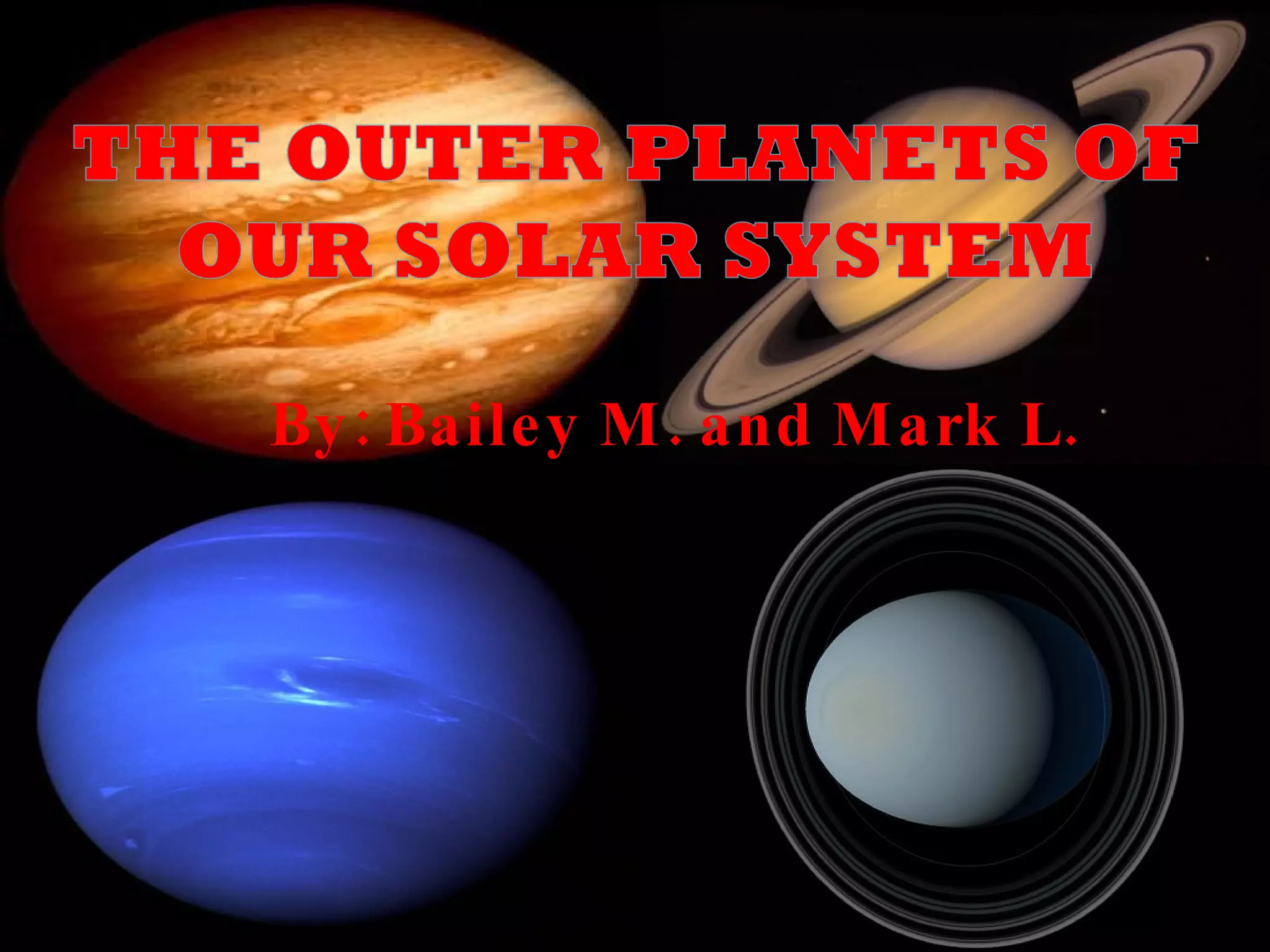
By: Bailey M. and Mark L.
Jupiter Distance from Sun: 43.3 light-minutes Period of rotation: 9 hours and 54 minutes Period of revolution: 11 years and 313 days Diameter: 142,984 km Density: 1.33 g/cm Temperature: -110°C Gravity: 236% of Earth's
Jupiter facts Jupiter is the biggest of the gas planets Jupiter is the largest planet in our solar system Jupiter’s giant red spot is a storm system that that is 400 years old and is about 3 times the size of the Earth
Saturn Distance from Sun: 1.3 light-hours Period of rotation: 10 hours and 42 minutes Period of revolution: 29 years and 155 days Diameter: 120,536km Density: 0.69 g/cm Temperature: -140°C Gravity: 92% of Earth's
Saturn facts Saturn is the second largest  Saturn is 95 times more massive than Earth Saturn has the biggest rings of the gas giants with a total diameter of 272,000km
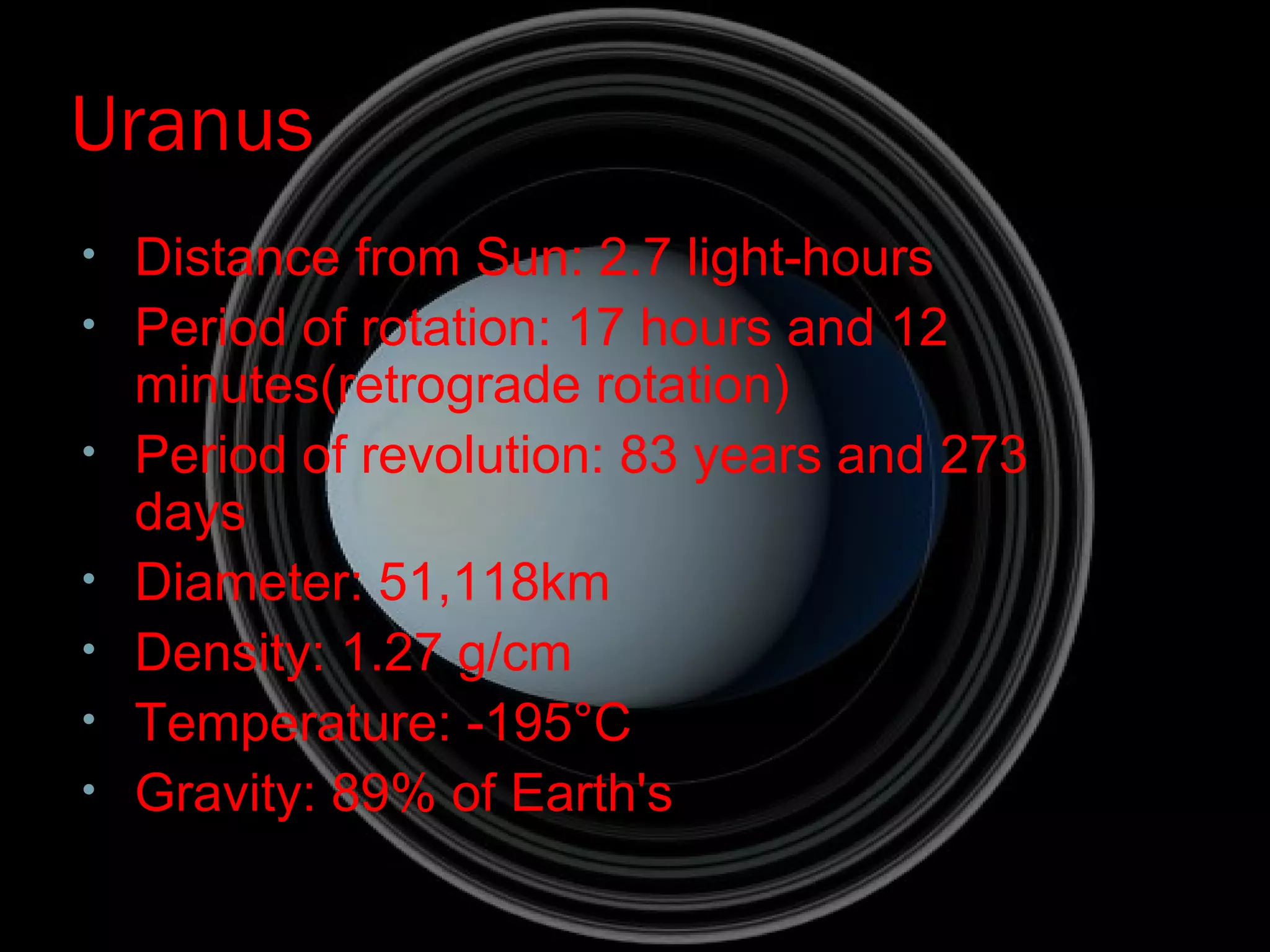
Uranus Distance from Sun: 2.7 light-hours Period of rotation: 17 hours and 12 minutes(retrograde rotation) Period of revolution: 83 years and 273 days Diameter: 51,118km Density: 1.27 g/cm Temperature: -195°C Gravity: 89% of Earth's
Uranus Uranus was discovered in 1781 by English amateur astronomer William Herschel  Uranus is tilted 90° on is axis, and it almost lies in its plane of orbit
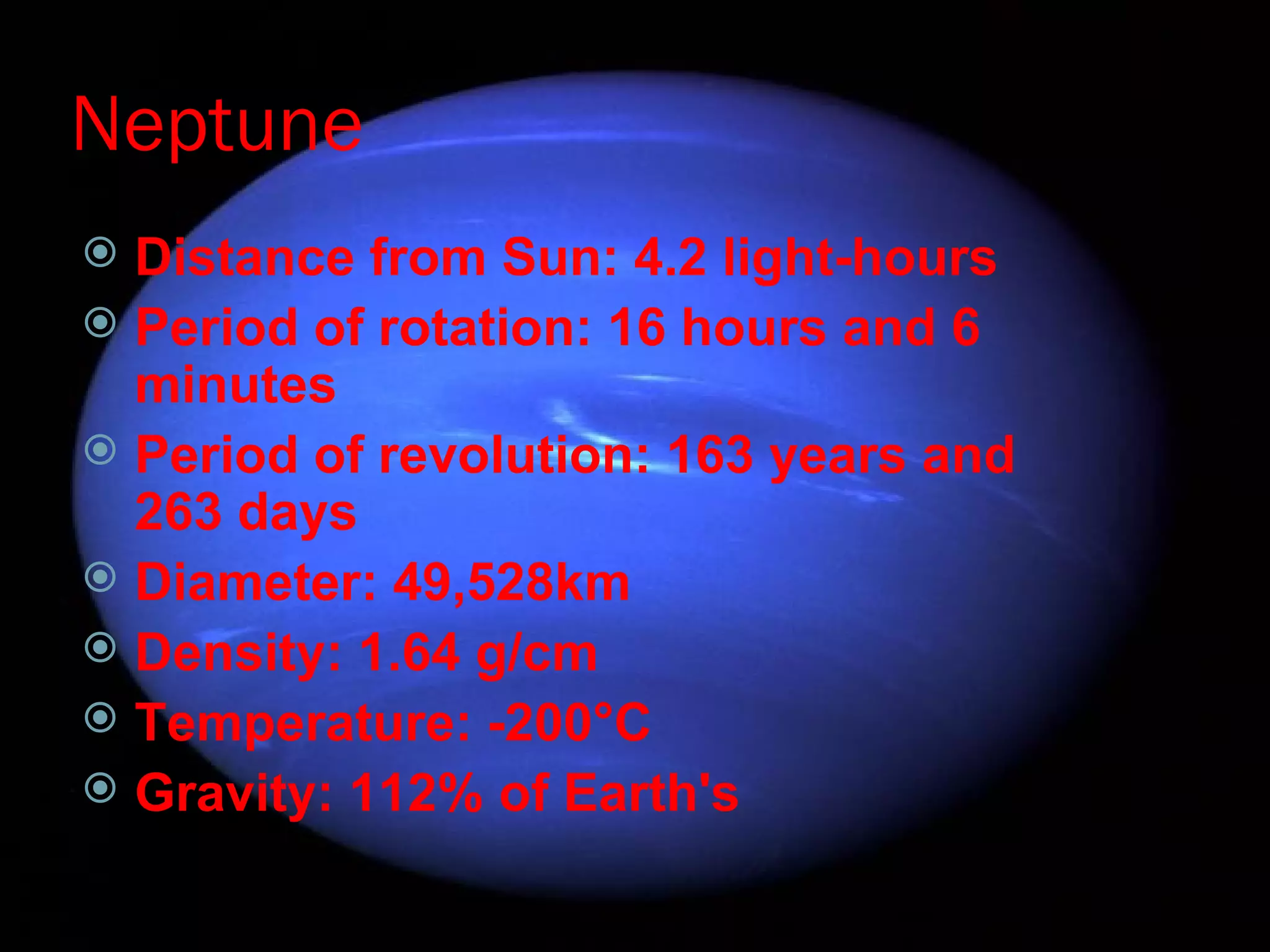
Neptune Distance from Sun: 4.2 light-hours Period of rotation: 16 hours and 6 minutes Period of revolution: 163 years and 263 days Diameter: 49,528km Density: 1.64 g/cm Temperature: -200°C Gravity: 112% of Earth's
Neptune Is the smallest of all of the gas giant planets Astrometry believe that the gravity of Neptune pulled Uranus off of it’s predicted path Neptune has a set of very narrow rings around it
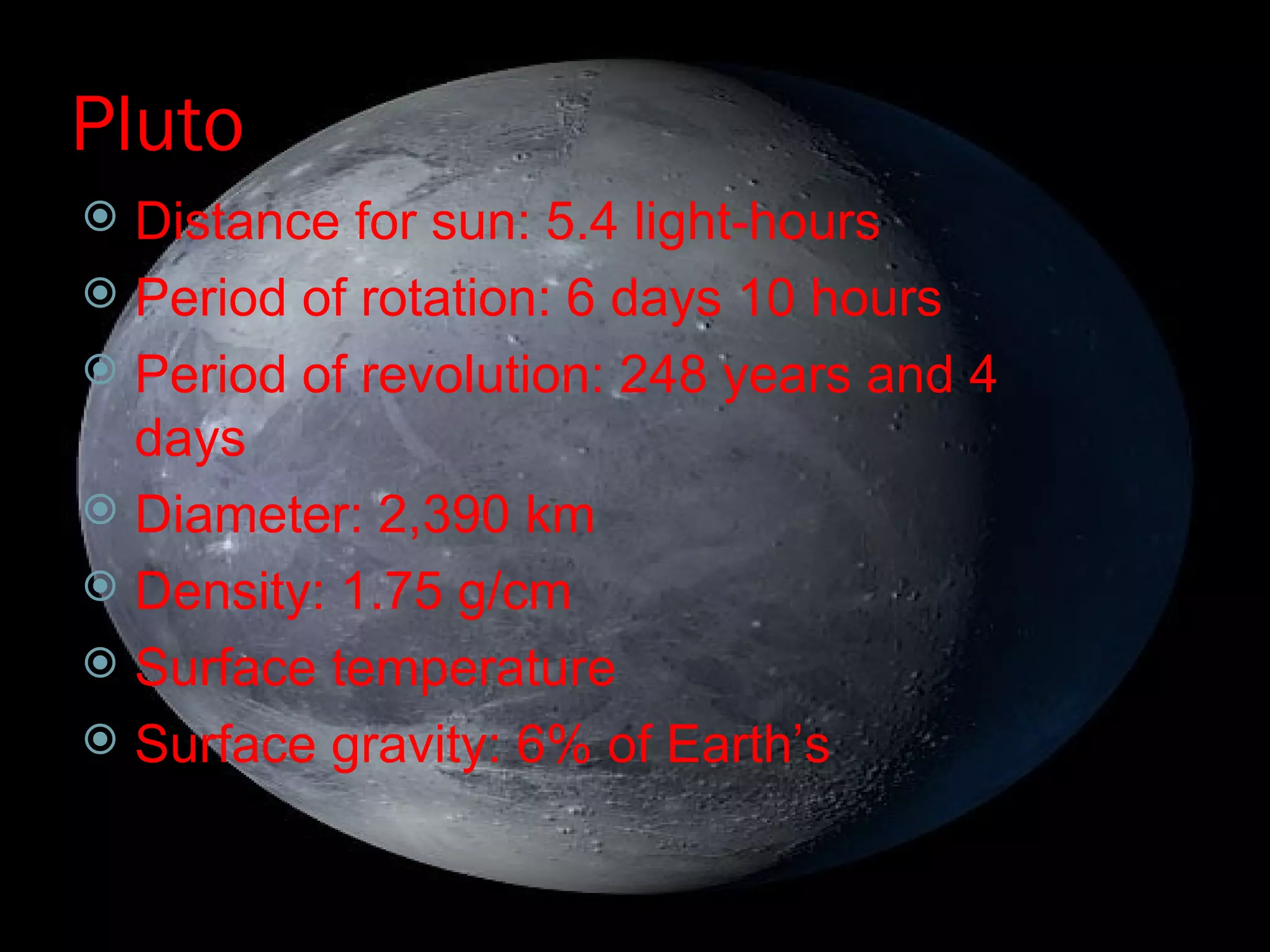
Pluto Distance for sun: 5.4 light-hours Period of rotation: 6 days 10 hours Period of revolution: 248 years and 4 days Diameter: 2,390 km Density: 1.75 g/cm  Surface temperature Surface gravity: 6% of Earth’s
Pluto facts Pluto was discovered in 1930 Pluto is the smallest planet in our Solar System Pluto was original called the mystery planet Pluto’s moon Charon is about half the size of Pluto
Works  citied &quot;PN.p., n.d. Web. 15 Jan. 2010. <scrapetv.com/News/News%20Pages/Science/images-2/jupiter-2.jpg>.  &quot;Picture of Neptune.&quot;  Picture of Neptune . N.p., n.d. Web. 15 Jan. 2010. <planetologist.files.wordpress.com/2009/03/neptune_voy2.jpg>.  &quot;Picture of Saturn.&quot;  Picture of Saturn . N.p., n.d. Web. 15 Jan. 2010. <zebu.uoregon.edu/~imamura/121/images/saturn.jpg>.  &quot;Picture of Uranus.&quot;  Picture of Uranus . N.p., n.d. Web. 15 Jan. 2010. <physics.weber.edu/palen/Phsx1040 icture of Jupiter.&quot;  Picture of Jupiter . &quot;Picture of Pluto.&quot;  Picture of Pluto . N.p., n.d. Web. 15 Jan. 2010. <learnjavafx.typepad.com/weblog/images/2008/02/07/pluto.jpg>.

The Outer Planets Of Our Solar System

  • 1.
    By: Bailey M.and Mark L.
  • 2.
    Jupiter Distance fromSun: 43.3 light-minutes Period of rotation: 9 hours and 54 minutes Period of revolution: 11 years and 313 days Diameter: 142,984 km Density: 1.33 g/cm Temperature: -110°C Gravity: 236% of Earth's
  • 3.
    Jupiter facts Jupiteris the biggest of the gas planets Jupiter is the largest planet in our solar system Jupiter’s giant red spot is a storm system that that is 400 years old and is about 3 times the size of the Earth
  • 4.
    Saturn Distance fromSun: 1.3 light-hours Period of rotation: 10 hours and 42 minutes Period of revolution: 29 years and 155 days Diameter: 120,536km Density: 0.69 g/cm Temperature: -140°C Gravity: 92% of Earth's
  • 5.
    Saturn facts Saturnis the second largest Saturn is 95 times more massive than Earth Saturn has the biggest rings of the gas giants with a total diameter of 272,000km
  • 6.
    Uranus Distance fromSun: 2.7 light-hours Period of rotation: 17 hours and 12 minutes(retrograde rotation) Period of revolution: 83 years and 273 days Diameter: 51,118km Density: 1.27 g/cm Temperature: -195°C Gravity: 89% of Earth's
  • 7.
    Uranus Uranus wasdiscovered in 1781 by English amateur astronomer William Herschel Uranus is tilted 90° on is axis, and it almost lies in its plane of orbit
  • 8.
    Neptune Distance fromSun: 4.2 light-hours Period of rotation: 16 hours and 6 minutes Period of revolution: 163 years and 263 days Diameter: 49,528km Density: 1.64 g/cm Temperature: -200°C Gravity: 112% of Earth's
  • 9.
    Neptune Is thesmallest of all of the gas giant planets Astrometry believe that the gravity of Neptune pulled Uranus off of it’s predicted path Neptune has a set of very narrow rings around it
  • 10.
    Pluto Distance forsun: 5.4 light-hours Period of rotation: 6 days 10 hours Period of revolution: 248 years and 4 days Diameter: 2,390 km Density: 1.75 g/cm Surface temperature Surface gravity: 6% of Earth’s
  • 11.
    Pluto facts Plutowas discovered in 1930 Pluto is the smallest planet in our Solar System Pluto was original called the mystery planet Pluto’s moon Charon is about half the size of Pluto
  • 12.
    Works citied&quot;PN.p., n.d. Web. 15 Jan. 2010. <scrapetv.com/News/News%20Pages/Science/images-2/jupiter-2.jpg>. &quot;Picture of Neptune.&quot; Picture of Neptune . N.p., n.d. Web. 15 Jan. 2010. <planetologist.files.wordpress.com/2009/03/neptune_voy2.jpg>. &quot;Picture of Saturn.&quot; Picture of Saturn . N.p., n.d. Web. 15 Jan. 2010. <zebu.uoregon.edu/~imamura/121/images/saturn.jpg>. &quot;Picture of Uranus.&quot; Picture of Uranus . N.p., n.d. Web. 15 Jan. 2010. <physics.weber.edu/palen/Phsx1040 icture of Jupiter.&quot; Picture of Jupiter . &quot;Picture of Pluto.&quot; Picture of Pluto . N.p., n.d. Web. 15 Jan. 2010. <learnjavafx.typepad.com/weblog/images/2008/02/07/pluto.jpg>.