Chapter 24 Section 4:  Other Objects in Space
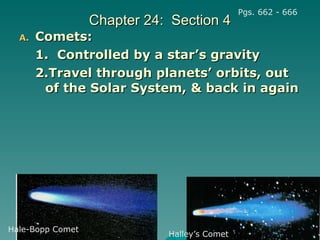
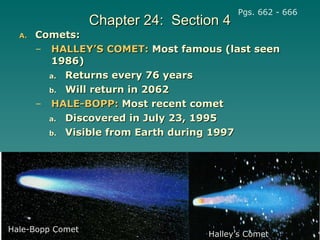
Chapter 24:  Section 4 Comets: 1.  Controlled by a star’s gravity Travel through planets’ orbits, out of the Solar System, & back in again Pgs. 662 - 666 Halley’s Comet Hale-Bopp Comet
Chapter 24:  Section 4 Comets: HALLEY’S COMET:   Most famous (last seen 1986) Returns every 76 years Will return in 2062 HALE-BOPP:   Most recent comet Discovered in July 23, 1995 Visible from Earth during 1997 Pgs. 662 - 666 Halley’s Comet Hale-Bopp Comet
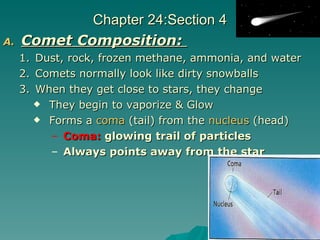
Chapter 24:Section 4 Comet Composition:  Dust, rock, frozen methane, ammonia, and water Comets normally look like dirty snowballs When they get close to stars, they change They begin to vaporize & Glow Forms a   coma   (tail) from the   nucleus   (head) Coma:   glowing trail of particles  Always points away from the star
Chapter 24:  Section 4 Comet Composition (cont’d) Comets eventually break up into space debris Oort Cloud:   large collection of comets beyond Pluto
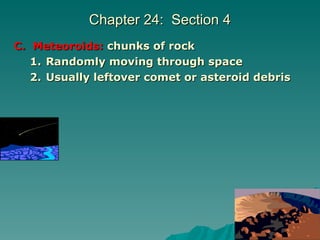
Chapter 24:  Section 4 C.  Meteoroids:   chunks of rock Randomly moving through space Usually leftover comet or asteroid debris
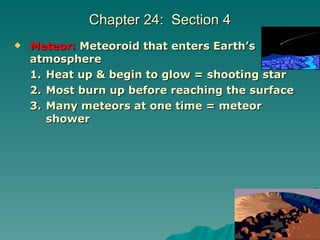
Chapter 24:  Section 4 Meteor:   Meteoroid that enters Earth’s atmosphere Heat up & begin to glow = shooting star Most burn up before reaching the surface Many meteors at one time = meteor shower
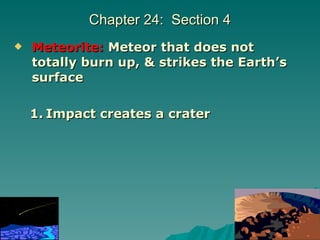
Chapter 24:  Section 4 Meteorite:   Meteor that does not totally burn up, & strikes the Earth’s surface Impact creates a crater
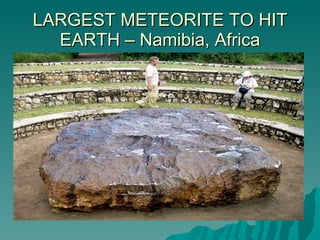
LARGEST METEORITE TO HIT EARTH – Namibia, Africa
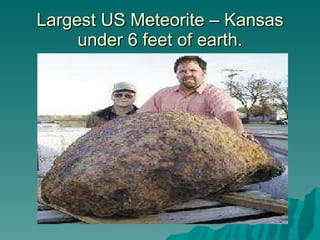
Largest US Meteorite – Kansas under 6 feet of earth.
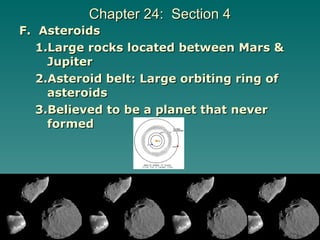
Chapter 24:  Section 4 F.  Asteroids Large rocks located between Mars & Jupiter Asteroid belt: Large orbiting ring of asteroids Believed to be a planet that never formed
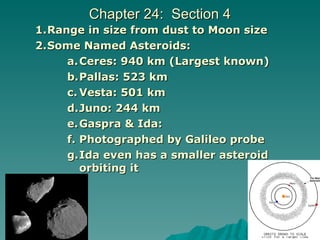
Chapter 24:  Section 4 Range in size from dust to Moon size Some Named Asteroids: Ceres: 940 km (Largest known) Pallas: 523 km Vesta: 501 km Juno: 244 km Gaspra & Ida:  Photographed by Galileo probe Ida even has a smaller asteroid orbiting it

Chapter 24: Section 4 (Other Objects in our Solar System)

  • 1.
    Chapter 24 Section4: Other Objects in Space
  • 2.
    Chapter 24: Section 4 Comets: 1. Controlled by a star’s gravity Travel through planets’ orbits, out of the Solar System, & back in again Pgs. 662 - 666 Halley’s Comet Hale-Bopp Comet
  • 3.
    Chapter 24: Section 4 Comets: HALLEY’S COMET: Most famous (last seen 1986) Returns every 76 years Will return in 2062 HALE-BOPP: Most recent comet Discovered in July 23, 1995 Visible from Earth during 1997 Pgs. 662 - 666 Halley’s Comet Hale-Bopp Comet
  • 4.
    Chapter 24:Section 4Comet Composition: Dust, rock, frozen methane, ammonia, and water Comets normally look like dirty snowballs When they get close to stars, they change They begin to vaporize & Glow Forms a coma (tail) from the nucleus (head) Coma: glowing trail of particles Always points away from the star
  • 5.
    Chapter 24: Section 4 Comet Composition (cont’d) Comets eventually break up into space debris Oort Cloud: large collection of comets beyond Pluto
  • 6.
    Chapter 24: Section 4 C. Meteoroids: chunks of rock Randomly moving through space Usually leftover comet or asteroid debris
  • 7.
    Chapter 24: Section 4 Meteor: Meteoroid that enters Earth’s atmosphere Heat up & begin to glow = shooting star Most burn up before reaching the surface Many meteors at one time = meteor shower
  • 8.
    Chapter 24: Section 4 Meteorite: Meteor that does not totally burn up, & strikes the Earth’s surface Impact creates a crater
  • 9.
    LARGEST METEORITE TOHIT EARTH – Namibia, Africa
  • 10.
    Largest US Meteorite– Kansas under 6 feet of earth.
  • 11.
    Chapter 24: Section 4 F. Asteroids Large rocks located between Mars & Jupiter Asteroid belt: Large orbiting ring of asteroids Believed to be a planet that never formed
  • 12.
    Chapter 24: Section 4 Range in size from dust to Moon size Some Named Asteroids: Ceres: 940 km (Largest known) Pallas: 523 km Vesta: 501 km Juno: 244 km Gaspra & Ida: Photographed by Galileo probe Ida even has a smaller asteroid orbiting it