Biology by Kailash Sir,
Chapter17:BREATHING&EXCHANGEOFGASES.ByMr.KailashVilegave
1
Chanakya Academy
Shahapur (Maharashtra)
Mob:9763777600/8793784923
CHAPTER 17: BREATHING & EXCHANGE OF GASES.
Part I:
When you hear the word 'respire,' you probably think of breathing. When you breathe, you are taking in oxygen
with each inhale and releasing carbon dioxide with each exhale. This gas exchange is important for respiration,
but while breathing is a physical process, respiration can be thought of as more of a chemical process. All
organisms, from a single bacterial cell to a coral reef colony to a blue whale, undergo respiration.
Food molecules absorbed after digestion are taken in, broken down, and the energy freed in the process is
used to power the organism's movements and physiological functioning. Respiration is the biochemical proc ess
in which the cells of an organism obtain energy by combining oxygen and glucose, resulting in the release of
carbon dioxide, water, and ATP (the currency of energy in cells).
Respiratory organs
These vary among different groups of animals depending on their habitats and levels of organisation.
 Simple diffusion over entire body surface helps in exchange of oxygen and carbon dioxide in
sponges, coelenterates, flatworms, etc.
 Earthworms respire through their moist skin.
 Insects have tracheal system for respiration.
 Aquatic arthropods and molluscs have gills for respiration whereas terrestrial forms have lungs.
 Among vertebrates, fishes use gills whereas birds, mammals and reptiles have proper lungs.
 Amphibians respire through moist skin, gills as well as lungs.
 Among all, mammals have a well developed and complex respiratory system.
Human Respiratory System
The respiratory system is the system in the human body that enables us to breathe.
The act of breathing includes: inhaling and exhaling air in the body the absorption of oxygen from the air in
order to produce energy; the discharge of carbon dioxide, which is the byproduct of the process.
Biology by Kailash Sir,
Chapter17:BREATHING&EXCHANGEOFGASES.ByMr.KailashVilegave
2
Chanakya Academy
Shahapur (Maharashtra)
Mob:9763777600/8793784923
The respiratory system is divided into two parts:
Upper respiratory tract:
This includes the nose, mouth, and the beginning of the trachea (the section that takes air in and lets it out).
Lower respiratory tract:
This includes the trachea, the bronchi, bronchioles and the lungs (the act of breathing takes place in this part
of the system).
The organs of the lower respiratory tract are located in the chest cavity. They are delineated and protected by
the rib cage, the chest bone (sternum), and the muscles between the ribs and the diaphragm (that constitute
a muscular partition between the chest and the abdominal cavity).
Trachea – the tube connecting the throat to the bronchi.
Bronchi – the trachea divides into two bronchi (tubes). One leads to the left lung, the other to the right lung.
Inside the lungs each of the bronchi divides into smaller bronchi.
Bronchioles - the bronchi branches off into smaller tubes called bronchioles which end in the pulmonary
alveolus.
Pulmonary alveoli – tiny sacs (air sacs) delineated by a single-layer membrane with blood capillaries at the
other end.
The exchange of gases takes place through the membrane of the pulmonary alveolus, which always contains
air: oxygen (O2) is absorbed from the air into the blood capillaries and the action of the heart circulates it
through all the tissues in the body. At the same time, carbon dioxide (CO2) is transmitted from the blood
capillaries into the alveoli and then expelled through the bronchi and the upper respiratory tract.
The inner surface of the lungs where the exchange of gases takes place is very large, due to the structure of
the air sacs of the alveoli.
Lungs – a pair of organs found in all vertebrates.
The structure of the lungs includes the bronchial tree – air tubes branching off from the bronchi into smaller
and smaller air tubes, each one ending in a pulmonary alveolus.
The Mechanism of Breathing
The act of breathing has two stages – inhalation and exhalation.
Biology by Kailash Sir,
Chapter17:BREATHING&EXCHANGEOFGASES.ByMr.KailashVilegave
3
Chanakya Academy
Shahapur (Maharashtra)
Mob:9763777600/8793784923
Inhalation – the intake of air into the lungs through expansion of chest volume.
Exhalation – the expulsion of air from the lungs through contraction of chest volume.
During inhalation –
 the muscles contract:

Contraction of the diaphragm muscle – causes the diaphragm to flatten, thus enlarging the chest cavity.
 Contraction of the rib muscles – causes the ribs to rise, thus increasing the chest volume.
The chest cavity expands, thus reducing air pressure and causing air to be passively drawn into the lungs. Air
passes from the high pressure outside the lungs to the low pressure inside the lungs.
During exhalation –
the muscles relax: The muscles are no longer contracting, they are relaxed.
 The diaphragm curves and rises, the ribs descend – and chest volume decreases.
 The chest cavity contracts thus increasing air pressure and causing the air in the lungs to be expelled
through the upper respiratory tract. Exhalation, too, is passive. Air passes from the high pressure in the
lungs to the low pressure in the upper respiratory tract.
Respiratory volumes and capacities
Biology by Kailash Sir,
Chapter17:BREATHING&EXCHANGEOFGASES.ByMr.KailashVilegave
4
Chanakya Academy
Shahapur (Maharashtra)
Mob:9763777600/8793784923
The following terms describe the various lung (respiratory) volumes:
 The tidal volume (TV), about 500 mL, is the amount of air inspired during normal, relaxed breathing.
 The inspiratory reserve volume (IRV), about 3,100 mL, is the additional air that can be forcibly
inhaled after the inspiration of a normal tidal volume.
 The expiratory reserve volume (ERV), about 1,200 mL, is the additional air that can be forcibly
exhaled after the expiration of a normal tidal volume.
 Residual volume (RV), about 1,200 mL, is the volume of air still remaining in the lungs after the
expiratory reserve volume is exhaled.

Summing specific lung volumes produces the following lung capacities:
 The total lung capacity (TLC), about 6,000 mL, is the maximum amount of air that can fill the lungs
(TLC = TV + IRV + ERV + RV).
 The vital capacity (VC), about 4,800 mL, is the total amount of air that can be expired after fully
inhaling (VC = TV + IRV + ERV = approximately 80 percent TLC). The value varies according to age
and body size.
 The inspiratory capacity (IC), about 3,600 mL, is the maximum amount of air that can be inspired (IC
= TV + IRV).
 The functional residual capacity (FRC), about 2,400 mL, is the amount of air remaining in the lungs
after a normal expiration (FRC = RV + ERV).
Some of the air in the lungs does not participate in gas exchange. Such air is located in the anatomical dead
space within bronchi and bronchioles—that is, outside the alveoli.
Exchange Of Gases
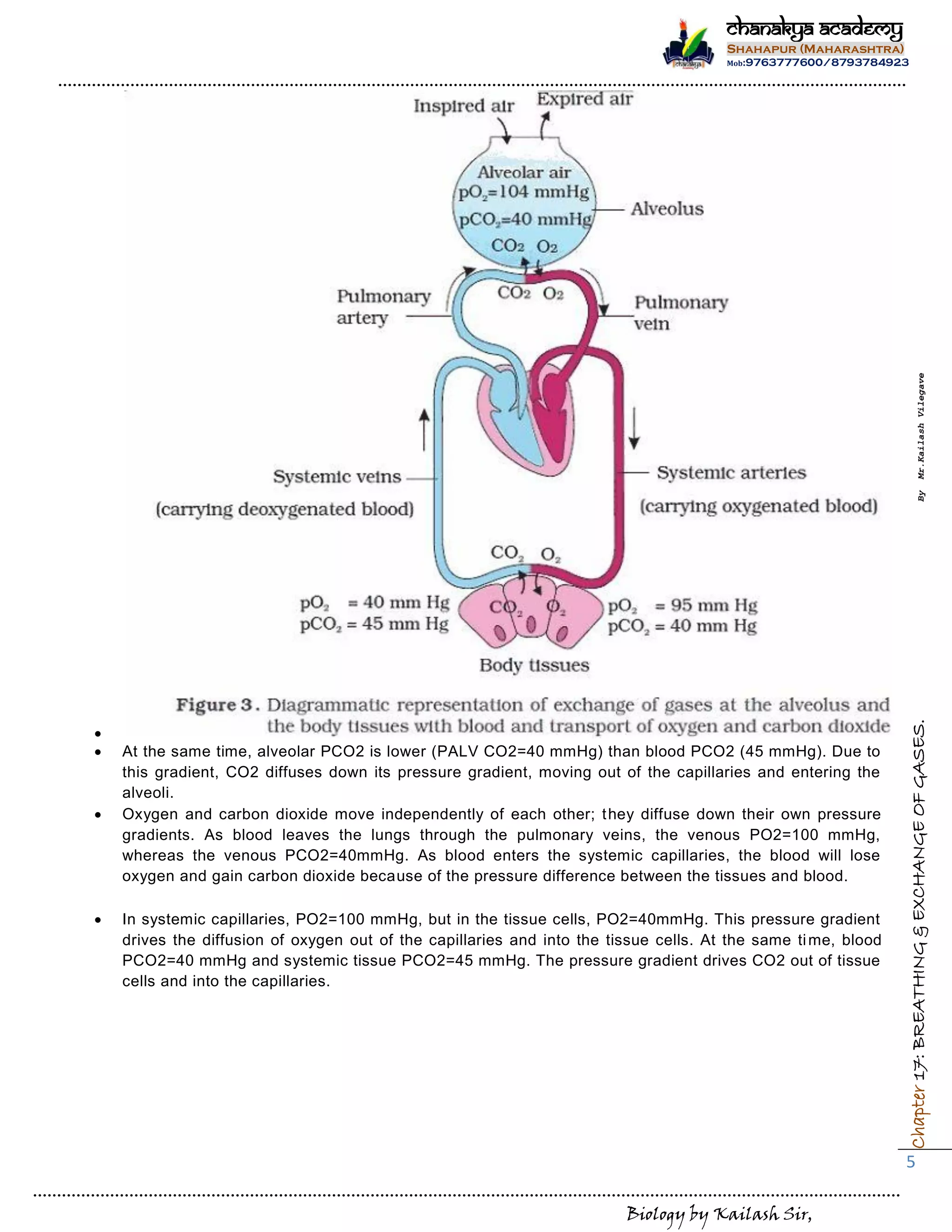
 In the lungs, oxygen diffuses out of the alveoli and into the capillaries surrounding the alveoli.
 Oxygen (about 98 percent) binds reversibly to the respiratory pigment hemoglobin found in red blood
cells.
 These red blood cells carry oxygen to the tissues where oxygen dissociates from the hemoglobin,
diffusing into the cells of the tissues.
 More specifically, alveolar PO2 is higher in the alveoli (PALVO2=100 mmHg) than blood PO2 in the
capillaries (40mmHg). Since this pressure gradient exists, oxygen can diffuse down its pressure
gradient, moving out of the alveoli and entering the blood of the capillaries where O2 binds to
hemoglobin.
Biology by Kailash Sir,
Chapter17:BREATHING&EXCHANGEOFGASES.ByMr.KailashVilegave
5
Chanakya Academy
Shahapur (Maharashtra)
Mob:9763777600/8793784923

 At the same time, alveolar PCO2 is lower (PALV CO2=40 mmHg) than blood PCO2 (45 mmHg). Due to
this gradient, CO2 diffuses down its pressure gradient, moving out of the capillaries and entering the
alveoli.
 Oxygen and carbon dioxide move independently of each other; they diffuse down their own pressure
gradients. As blood leaves the lungs through the pulmonary veins, the venous PO2=100 mmHg,
whereas the venous PCO2=40mmHg. As blood enters the systemic capillaries, the blood will lose
oxygen and gain carbon dioxide because of the pressure difference between the tissues and blood.
 In systemic capillaries, PO2=100 mmHg, but in the tissue cells, PO2=40mmHg. This pressure gradient
drives the diffusion of oxygen out of the capillaries and into the tissue cells. At the same time, blood
PCO2=40 mmHg and systemic tissue PCO2=45 mmHg. The pressure gradient drives CO2 out of tissue
cells and into the capillaries.
Biology by Kailash Sir,
Chapter17:BREATHING&EXCHANGEOFGASES.ByMr.KailashVilegave
6
Chanakya Academy
Shahapur (Maharashtra)
Mob:9763777600/8793784923
 The blood returning to the lungs through the pulmonary arteries has a venous PO2=40 mmHg and a
PCO2=45 mmHg. The blood enters the lung capillaries where the process of exchanging gases
between the capillaries and alveoli begins again .
Partial pressures
 The partial pressures of oxygen and carbon dioxide change as blood moves through the body.
 In short, the change in partial pressure from the alveoli to the capillaries drives the oxygen into the
tissues and the carbon dioxide into the blood from the tissues.
 The blood is then transported to the lungs where differences in pressure in the alveoli result in the
movement of carbon dioxide out of the blood into the lungs and oxygen into the blood.
Transport of Gases
 Blood is medium of transport for gases.
 About 97% of oxygen is transported by RBCs and rest 3% by plasma.
 70% of carbon dioxide is carried as bicarbonate, 20-25% by RBCs and rest 7% by plasma.
Transport of Oxygen
 The hemoglobin pigment of blood mainly transports oxygen.
 From alveoli of lungs, oxygen can readily diffuse into erythrocytes and combines loosely with
hemoglobin (Hb) to form a reversible compound oxyhemoglobin (HbO2).
 Combining of oxygen with hemoglobin to form oxyhemoglobin is a physical process. There is no
change in the valency of iron atom; it is ferrous in oxyhemoglobin and also in hemoglobin.
 When fully oxygenated, hemoglobin has about 97 per cent of oxygen. Hemoglobin is dark red in
colour; whereas oxyhemoglobin is bright red in colour.
 Inside the tissues, as the partial pressure of oxygen is less, oxyhemoglobin gets dissociated into
oxygen and hemoglobin.
 Further, as Po2 is much lower and Pco2 is much higher in active tissues than in passive tissues, so
much of oxygen is released from oxyhemoglobin in active tissues.
Biology by Kailash Sir,
Chapter17:BREATHING&EXCHANGEOFGASES.ByMr.KailashVilegave
7
Chanakya Academy
Shahapur (Maharashtra)
Mob:9763777600/8793784923
 High tension of oxygen favours the formation of oxyhemoglobin while low tension of oxygen favours its
dissociation.
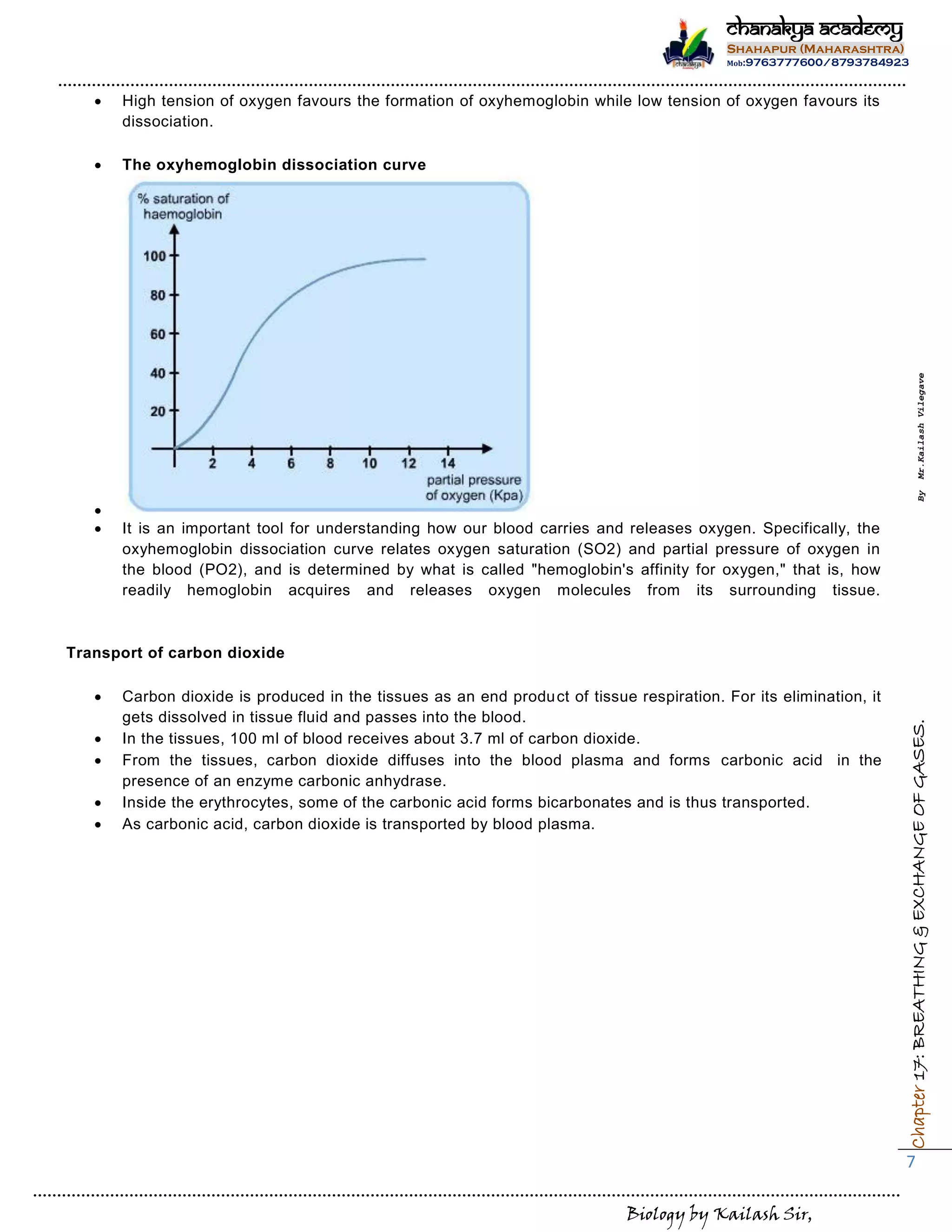
 The oxyhemoglobin dissociation curve

 It is an important tool for understanding how our blood carries and releases oxygen. Specifically, the
oxyhemoglobin dissociation curve relates oxygen saturation (SO2) and partial pressure of oxygen in
the blood (PO2), and is determined by what is called "hemoglobin's affinity for oxygen," that is, how
readily hemoglobin acquires and releases oxygen molecules from its surrounding tissue.
Transport of carbon dioxide
 Carbon dioxide is produced in the tissues as an end product of tissue respiration. For its elimination, it
gets dissolved in tissue fluid and passes into the blood.
 In the tissues, 100 ml of blood receives about 3.7 ml of carbon dioxide.
 From the tissues, carbon dioxide diffuses into the blood plasma and forms carbonic acid in the
presence of an enzyme carbonic anhydrase.
 Inside the erythrocytes, some of the carbonic acid forms bicarbonates and is thus transported.
 As carbonic acid, carbon dioxide is transported by blood plasma.
Biology by Kailash Sir,
Chapter17:BREATHING&EXCHANGEOFGASES.ByMr.KailashVilegave
8
Chanakya Academy
Shahapur (Maharashtra)
Mob:9763777600/8793784923

 If all the carbon dioxide produced by the tissues is carried by blood plasma in this way, then pH of the
blood will be lowered to about 4.5. This would immediately cause death. So only about 10% of the
CO2 produced by the tissue is actually transported as carbonic acid.
 About 20% of the total CO2 produced is transported by the hemoglobin of blood as
carbaminohaemoglobin.
 About 70 % of the total CO2 produced is transported as bicarbonate ions of the blood. Bicarbonates
are formed both in the erythrocytes and in the plasma of blood.
 In erythrocytes, CO2 from the plasma enters the erythrocytes and combines with water to form carbonic
acid in the presence of the enzyme carbonic anhydrase. Carbonic acid soon dissociates to form H+
and HCO3- ions.
 On reaching the lungs, blood is oxygenated. Oxyhemoglobin is a stronger acid than
deoxyhemoglobin. So it donates H+ ion, which joins bicarbonate to form carbonic acid and this
carbonic acid is cleaved into water and carbon dioxide by an enzyme carbonic anhydrase.
 Oxygenation of hemoglobin releases carbon dioxide from carbaminohemoglobin. By this way, every
decilitre of blood releases about 3.7 ml of carbon dioxide in the lungs. Then this carbon dioxide is
removed from the lungs by exhalation.
Regulation of Respiration
The 'respiratory centre' is composed of groups of neurons located in the medulla oblongata and pons varolii.
The respiratory centre regulates the rate and the depth of the breathing.
Biology by Kailash Sir,
Chapter17:BREATHING&EXCHANGEOFGASES.ByMr.KailashVilegave
9
Chanakya Academy
Shahapur (Maharashtra)
Mob:9763777600/8793784923
 Dorsal Respiratory Group: It is located in dorsal portion of the medulla oblongata. Nerve impulses
from here stimulate the muscles of the diaphragm to flatten the latter and the external intercostal
muscles to raise the ribs. This brings about inspiration.

 Ventral Respiratory Group: It is located in the ventrolateral part of the medulla oblongata. It issues
signals for both inspiration and expiration. Thus the ventral respiratory group can cause either
inspiration or expiration.
 Pneumotaxic Centre: It is located in the dorsal part of pons varolii. It issues impulses to all the
neurons of the dorsal respiratory group and only to the inspiratory neurons of ventral respiratory group.
The primary effect of these is to control the 'switch off point of inspiratory signal. Therefore, the
function of the pneumatic centre is primarily to limit inspiration.
 The chemoreceptors of carotid and aortic bodies are stimulated by an increase in carbon dioxide
concentration and by an increase in hydrogen ion concentration (pH) in the arterial blood. Increased
CO2 lowers the pH resulting acidosis. These chemoreceptors send signals to the inspiratory and
expiratory centres. Thus rate of breathing is increased.
Disorders of Respiratory System
 Asthma: difficulty in breathing causing wheezing due to inflammation of bronchi and bronchioles
 Emphysema: alveolar walls are damaged due to which respiratory surface is decreased, cause of this
is cigarette smoking
 Occupational Respiratory Disorders: long exposure to the dust of industries like stone breaking, etc
cause an inflammation on lung tissues and leads to lung damage.
 Chronic Bronchitis: Any irritant reaching the bronchi and bronchioles will stimulate an increased
secretion of mucus. In chronic bronchitis the air passages become clogged with mucus, and this leads
to a persistent cough.
Biology by Kailash Sir,
Chapter17:BREATHING&EXCHANGEOFGASES.ByMr.KailashVilegave
10
Chanakya Academy
Shahapur (Maharashtra)
Mob:9763777600/8793784923
 Pneumonia : An infection of the alveoli. It can be caused by many kinds of both bacteria and viruses.
Tissue fluids accumulate in the alveoli reducing the surface area exposed to air.

Chapter 17 breathing & exchange of gases part 1

  • 1.
    Biology by KailashSir, Chapter17:BREATHING&EXCHANGEOFGASES.ByMr.KailashVilegave 1 Chanakya Academy Shahapur (Maharashtra) Mob:9763777600/8793784923 CHAPTER 17: BREATHING & EXCHANGE OF GASES. Part I: When you hear the word 'respire,' you probably think of breathing. When you breathe, you are taking in oxygen with each inhale and releasing carbon dioxide with each exhale. This gas exchange is important for respiration, but while breathing is a physical process, respiration can be thought of as more of a chemical process. All organisms, from a single bacterial cell to a coral reef colony to a blue whale, undergo respiration. Food molecules absorbed after digestion are taken in, broken down, and the energy freed in the process is used to power the organism's movements and physiological functioning. Respiration is the biochemical proc ess in which the cells of an organism obtain energy by combining oxygen and glucose, resulting in the release of carbon dioxide, water, and ATP (the currency of energy in cells). Respiratory organs These vary among different groups of animals depending on their habitats and levels of organisation.  Simple diffusion over entire body surface helps in exchange of oxygen and carbon dioxide in sponges, coelenterates, flatworms, etc.  Earthworms respire through their moist skin.  Insects have tracheal system for respiration.  Aquatic arthropods and molluscs have gills for respiration whereas terrestrial forms have lungs.  Among vertebrates, fishes use gills whereas birds, mammals and reptiles have proper lungs.  Amphibians respire through moist skin, gills as well as lungs.  Among all, mammals have a well developed and complex respiratory system. Human Respiratory System The respiratory system is the system in the human body that enables us to breathe. The act of breathing includes: inhaling and exhaling air in the body the absorption of oxygen from the air in order to produce energy; the discharge of carbon dioxide, which is the byproduct of the process.
  • 2.
    Biology by KailashSir, Chapter17:BREATHING&EXCHANGEOFGASES.ByMr.KailashVilegave 2 Chanakya Academy Shahapur (Maharashtra) Mob:9763777600/8793784923 The respiratory system is divided into two parts: Upper respiratory tract: This includes the nose, mouth, and the beginning of the trachea (the section that takes air in and lets it out). Lower respiratory tract: This includes the trachea, the bronchi, bronchioles and the lungs (the act of breathing takes place in this part of the system). The organs of the lower respiratory tract are located in the chest cavity. They are delineated and protected by the rib cage, the chest bone (sternum), and the muscles between the ribs and the diaphragm (that constitute a muscular partition between the chest and the abdominal cavity). Trachea – the tube connecting the throat to the bronchi. Bronchi – the trachea divides into two bronchi (tubes). One leads to the left lung, the other to the right lung. Inside the lungs each of the bronchi divides into smaller bronchi. Bronchioles - the bronchi branches off into smaller tubes called bronchioles which end in the pulmonary alveolus. Pulmonary alveoli – tiny sacs (air sacs) delineated by a single-layer membrane with blood capillaries at the other end. The exchange of gases takes place through the membrane of the pulmonary alveolus, which always contains air: oxygen (O2) is absorbed from the air into the blood capillaries and the action of the heart circulates it through all the tissues in the body. At the same time, carbon dioxide (CO2) is transmitted from the blood capillaries into the alveoli and then expelled through the bronchi and the upper respiratory tract. The inner surface of the lungs where the exchange of gases takes place is very large, due to the structure of the air sacs of the alveoli. Lungs – a pair of organs found in all vertebrates. The structure of the lungs includes the bronchial tree – air tubes branching off from the bronchi into smaller and smaller air tubes, each one ending in a pulmonary alveolus. The Mechanism of Breathing The act of breathing has two stages – inhalation and exhalation.
  • 3.
    Biology by KailashSir, Chapter17:BREATHING&EXCHANGEOFGASES.ByMr.KailashVilegave 3 Chanakya Academy Shahapur (Maharashtra) Mob:9763777600/8793784923 Inhalation – the intake of air into the lungs through expansion of chest volume. Exhalation – the expulsion of air from the lungs through contraction of chest volume. During inhalation –  the muscles contract:  Contraction of the diaphragm muscle – causes the diaphragm to flatten, thus enlarging the chest cavity.  Contraction of the rib muscles – causes the ribs to rise, thus increasing the chest volume. The chest cavity expands, thus reducing air pressure and causing air to be passively drawn into the lungs. Air passes from the high pressure outside the lungs to the low pressure inside the lungs. During exhalation – the muscles relax: The muscles are no longer contracting, they are relaxed.  The diaphragm curves and rises, the ribs descend – and chest volume decreases.  The chest cavity contracts thus increasing air pressure and causing the air in the lungs to be expelled through the upper respiratory tract. Exhalation, too, is passive. Air passes from the high pressure in the lungs to the low pressure in the upper respiratory tract. Respiratory volumes and capacities
  • 4.
    Biology by KailashSir, Chapter17:BREATHING&EXCHANGEOFGASES.ByMr.KailashVilegave 4 Chanakya Academy Shahapur (Maharashtra) Mob:9763777600/8793784923 The following terms describe the various lung (respiratory) volumes:  The tidal volume (TV), about 500 mL, is the amount of air inspired during normal, relaxed breathing.  The inspiratory reserve volume (IRV), about 3,100 mL, is the additional air that can be forcibly inhaled after the inspiration of a normal tidal volume.  The expiratory reserve volume (ERV), about 1,200 mL, is the additional air that can be forcibly exhaled after the expiration of a normal tidal volume.  Residual volume (RV), about 1,200 mL, is the volume of air still remaining in the lungs after the expiratory reserve volume is exhaled.  Summing specific lung volumes produces the following lung capacities:  The total lung capacity (TLC), about 6,000 mL, is the maximum amount of air that can fill the lungs (TLC = TV + IRV + ERV + RV).  The vital capacity (VC), about 4,800 mL, is the total amount of air that can be expired after fully inhaling (VC = TV + IRV + ERV = approximately 80 percent TLC). The value varies according to age and body size.  The inspiratory capacity (IC), about 3,600 mL, is the maximum amount of air that can be inspired (IC = TV + IRV).  The functional residual capacity (FRC), about 2,400 mL, is the amount of air remaining in the lungs after a normal expiration (FRC = RV + ERV). Some of the air in the lungs does not participate in gas exchange. Such air is located in the anatomical dead space within bronchi and bronchioles—that is, outside the alveoli. Exchange Of Gases  In the lungs, oxygen diffuses out of the alveoli and into the capillaries surrounding the alveoli.  Oxygen (about 98 percent) binds reversibly to the respiratory pigment hemoglobin found in red blood cells.  These red blood cells carry oxygen to the tissues where oxygen dissociates from the hemoglobin, diffusing into the cells of the tissues.  More specifically, alveolar PO2 is higher in the alveoli (PALVO2=100 mmHg) than blood PO2 in the capillaries (40mmHg). Since this pressure gradient exists, oxygen can diffuse down its pressure gradient, moving out of the alveoli and entering the blood of the capillaries where O2 binds to hemoglobin.
  • 5.
    Biology by KailashSir, Chapter17:BREATHING&EXCHANGEOFGASES.ByMr.KailashVilegave 5 Chanakya Academy Shahapur (Maharashtra) Mob:9763777600/8793784923   At the same time, alveolar PCO2 is lower (PALV CO2=40 mmHg) than blood PCO2 (45 mmHg). Due to this gradient, CO2 diffuses down its pressure gradient, moving out of the capillaries and entering the alveoli.  Oxygen and carbon dioxide move independently of each other; they diffuse down their own pressure gradients. As blood leaves the lungs through the pulmonary veins, the venous PO2=100 mmHg, whereas the venous PCO2=40mmHg. As blood enters the systemic capillaries, the blood will lose oxygen and gain carbon dioxide because of the pressure difference between the tissues and blood.  In systemic capillaries, PO2=100 mmHg, but in the tissue cells, PO2=40mmHg. This pressure gradient drives the diffusion of oxygen out of the capillaries and into the tissue cells. At the same time, blood PCO2=40 mmHg and systemic tissue PCO2=45 mmHg. The pressure gradient drives CO2 out of tissue cells and into the capillaries.
  • 6.
    Biology by KailashSir, Chapter17:BREATHING&EXCHANGEOFGASES.ByMr.KailashVilegave 6 Chanakya Academy Shahapur (Maharashtra) Mob:9763777600/8793784923  The blood returning to the lungs through the pulmonary arteries has a venous PO2=40 mmHg and a PCO2=45 mmHg. The blood enters the lung capillaries where the process of exchanging gases between the capillaries and alveoli begins again . Partial pressures  The partial pressures of oxygen and carbon dioxide change as blood moves through the body.  In short, the change in partial pressure from the alveoli to the capillaries drives the oxygen into the tissues and the carbon dioxide into the blood from the tissues.  The blood is then transported to the lungs where differences in pressure in the alveoli result in the movement of carbon dioxide out of the blood into the lungs and oxygen into the blood. Transport of Gases  Blood is medium of transport for gases.  About 97% of oxygen is transported by RBCs and rest 3% by plasma.  70% of carbon dioxide is carried as bicarbonate, 20-25% by RBCs and rest 7% by plasma. Transport of Oxygen  The hemoglobin pigment of blood mainly transports oxygen.  From alveoli of lungs, oxygen can readily diffuse into erythrocytes and combines loosely with hemoglobin (Hb) to form a reversible compound oxyhemoglobin (HbO2).  Combining of oxygen with hemoglobin to form oxyhemoglobin is a physical process. There is no change in the valency of iron atom; it is ferrous in oxyhemoglobin and also in hemoglobin.  When fully oxygenated, hemoglobin has about 97 per cent of oxygen. Hemoglobin is dark red in colour; whereas oxyhemoglobin is bright red in colour.  Inside the tissues, as the partial pressure of oxygen is less, oxyhemoglobin gets dissociated into oxygen and hemoglobin.  Further, as Po2 is much lower and Pco2 is much higher in active tissues than in passive tissues, so much of oxygen is released from oxyhemoglobin in active tissues.
  • 7.
    Biology by KailashSir, Chapter17:BREATHING&EXCHANGEOFGASES.ByMr.KailashVilegave 7 Chanakya Academy Shahapur (Maharashtra) Mob:9763777600/8793784923  High tension of oxygen favours the formation of oxyhemoglobin while low tension of oxygen favours its dissociation.  The oxyhemoglobin dissociation curve   It is an important tool for understanding how our blood carries and releases oxygen. Specifically, the oxyhemoglobin dissociation curve relates oxygen saturation (SO2) and partial pressure of oxygen in the blood (PO2), and is determined by what is called "hemoglobin's affinity for oxygen," that is, how readily hemoglobin acquires and releases oxygen molecules from its surrounding tissue. Transport of carbon dioxide  Carbon dioxide is produced in the tissues as an end product of tissue respiration. For its elimination, it gets dissolved in tissue fluid and passes into the blood.  In the tissues, 100 ml of blood receives about 3.7 ml of carbon dioxide.  From the tissues, carbon dioxide diffuses into the blood plasma and forms carbonic acid in the presence of an enzyme carbonic anhydrase.  Inside the erythrocytes, some of the carbonic acid forms bicarbonates and is thus transported.  As carbonic acid, carbon dioxide is transported by blood plasma.
  • 8.
    Biology by KailashSir, Chapter17:BREATHING&EXCHANGEOFGASES.ByMr.KailashVilegave 8 Chanakya Academy Shahapur (Maharashtra) Mob:9763777600/8793784923   If all the carbon dioxide produced by the tissues is carried by blood plasma in this way, then pH of the blood will be lowered to about 4.5. This would immediately cause death. So only about 10% of the CO2 produced by the tissue is actually transported as carbonic acid.  About 20% of the total CO2 produced is transported by the hemoglobin of blood as carbaminohaemoglobin.  About 70 % of the total CO2 produced is transported as bicarbonate ions of the blood. Bicarbonates are formed both in the erythrocytes and in the plasma of blood.  In erythrocytes, CO2 from the plasma enters the erythrocytes and combines with water to form carbonic acid in the presence of the enzyme carbonic anhydrase. Carbonic acid soon dissociates to form H+ and HCO3- ions.  On reaching the lungs, blood is oxygenated. Oxyhemoglobin is a stronger acid than deoxyhemoglobin. So it donates H+ ion, which joins bicarbonate to form carbonic acid and this carbonic acid is cleaved into water and carbon dioxide by an enzyme carbonic anhydrase.  Oxygenation of hemoglobin releases carbon dioxide from carbaminohemoglobin. By this way, every decilitre of blood releases about 3.7 ml of carbon dioxide in the lungs. Then this carbon dioxide is removed from the lungs by exhalation. Regulation of Respiration The 'respiratory centre' is composed of groups of neurons located in the medulla oblongata and pons varolii. The respiratory centre regulates the rate and the depth of the breathing.
  • 9.
    Biology by KailashSir, Chapter17:BREATHING&EXCHANGEOFGASES.ByMr.KailashVilegave 9 Chanakya Academy Shahapur (Maharashtra) Mob:9763777600/8793784923  Dorsal Respiratory Group: It is located in dorsal portion of the medulla oblongata. Nerve impulses from here stimulate the muscles of the diaphragm to flatten the latter and the external intercostal muscles to raise the ribs. This brings about inspiration.   Ventral Respiratory Group: It is located in the ventrolateral part of the medulla oblongata. It issues signals for both inspiration and expiration. Thus the ventral respiratory group can cause either inspiration or expiration.  Pneumotaxic Centre: It is located in the dorsal part of pons varolii. It issues impulses to all the neurons of the dorsal respiratory group and only to the inspiratory neurons of ventral respiratory group. The primary effect of these is to control the 'switch off point of inspiratory signal. Therefore, the function of the pneumatic centre is primarily to limit inspiration.  The chemoreceptors of carotid and aortic bodies are stimulated by an increase in carbon dioxide concentration and by an increase in hydrogen ion concentration (pH) in the arterial blood. Increased CO2 lowers the pH resulting acidosis. These chemoreceptors send signals to the inspiratory and expiratory centres. Thus rate of breathing is increased. Disorders of Respiratory System  Asthma: difficulty in breathing causing wheezing due to inflammation of bronchi and bronchioles  Emphysema: alveolar walls are damaged due to which respiratory surface is decreased, cause of this is cigarette smoking  Occupational Respiratory Disorders: long exposure to the dust of industries like stone breaking, etc cause an inflammation on lung tissues and leads to lung damage.  Chronic Bronchitis: Any irritant reaching the bronchi and bronchioles will stimulate an increased secretion of mucus. In chronic bronchitis the air passages become clogged with mucus, and this leads to a persistent cough.
  • 10.
    Biology by KailashSir, Chapter17:BREATHING&EXCHANGEOFGASES.ByMr.KailashVilegave 10 Chanakya Academy Shahapur (Maharashtra) Mob:9763777600/8793784923  Pneumonia : An infection of the alveoli. It can be caused by many kinds of both bacteria and viruses. Tissue fluids accumulate in the alveoli reducing the surface area exposed to air.