Chapter 2.2 Diffusion, Imbibition and osmosis
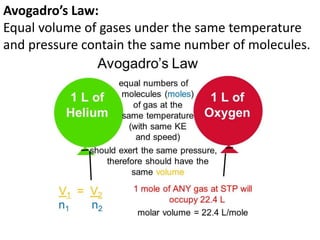
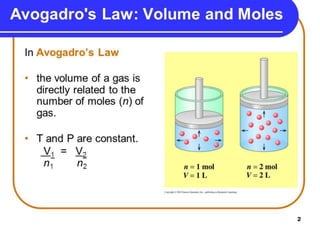
Avogadro’s Law:
Equal volume of gases under the same temperature
and pressure contain the same number of molecules.
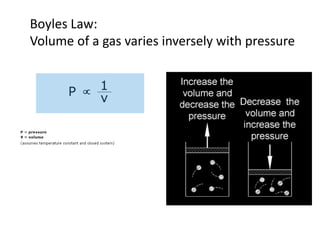
Boyles Law:
Volume of a gas varies inversely with pressure
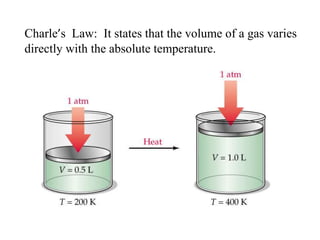
Charle’s Law: It states that the volume of a gas varies
directly with the absolute temperature.
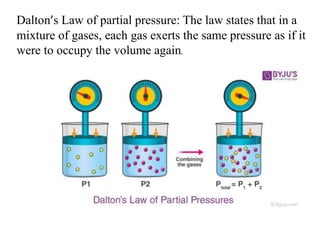
Dalton’s Law of partial pressure: The law states that in a
mixture of gases, each gas exerts the same pressure as if it
were to occupy the volume again.
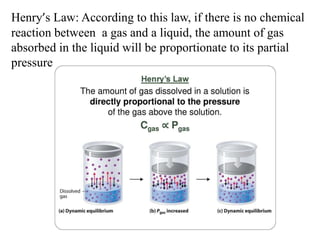
Henry’s Law: According to this law, if there is no chemical
reaction between a gas and a liquid, the amount of gas
absorbed in the liquid will be proportionate to its partial
pressure.
Graham’s Law:
It states that relative speeds of diffusion of gases are
inversely proportional to the square roots of the relative
densities
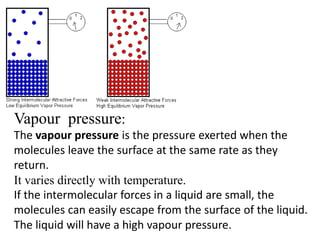
Vapour pressure:
The vapour pressure is the pressure exerted when the
molecules leave the surface at the same rate as they
return.
It varies directly with temperature.
If the intermolecular forces in a liquid are small, the
molecules can easily escape from the surface of the liquid.
The liquid will have a high vapour pressure.
Diffusion is the movement of molecules by random
agitation.
Water molecules in a solution are not static ; they are in
continuous motion, colliding with one another and
exchanging kinetic energy.
The molecules intermingle as a result of their random
thermal agitation . This is random motion is called diffusion.
As long as other forces are not acting on the molecules,
diffusion causes net movement of molecules from region of
higher concentration to regions of low concentration- that is ,
down a concentration gradient.
Reason for diffusion:
gradient of concentration , pressure or temperature
size of the Particle.
The steepness of the concentration gradient.
A gradient is the change in the value of a quantity e.g.
concentration, pressure or temperature with change in
another variable , usually distance
A change in concentration over a distance is called a
concentration gradient
A change in pressure over a distance is called a
pressure gradient
A change in temperature over a distance is called a
temperature gradient
The diffusion of particles of matter is due to their own
kinetic energy
Diffusion occurs to achieve equilibrium
Even after reaching equilibrium movement continues in
equal amounts and in opposite directions.
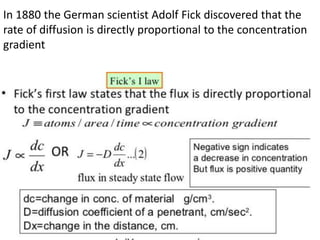
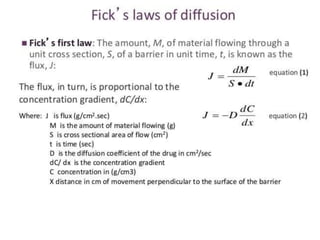
In 1880 the German scientist Adolf Fick discovered that the
rate of diffusion is directly proportional to the concentration
gradient
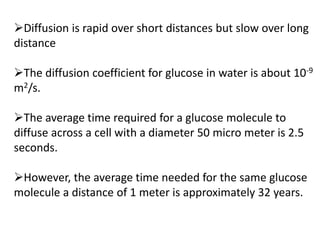
Diffusion is rapid over short distances but slow over long
distance
The diffusion coefficient for glucose in water is about 10-9
m2/s.
The average time required for a glucose molecule to
diffuse across a cell with a diameter 50 micro meter is 2.5
seconds.
However, the average time needed for the same glucose
molecule a distance of 1 meter is approximately 32 years.
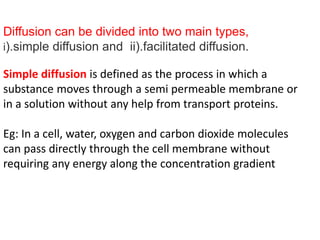
Diffusion can be divided into two main types,
i).simple diffusion and ii).facilitated diffusion.
Simple diffusion is defined as the process in which a
substance moves through a semi permeable membrane or
in a solution without any help from transport proteins.
Eg: In a cell, water, oxygen and carbon dioxide molecules
can pass directly through the cell membrane without
requiring any energy along the concentration gradient
Facilitated diffusion can be defined as the
passive movement of molecules across the cell membrane
from a region of higher concentration to a region of lower
concentration by means of a carrier molecule.
In the human body, glucose molecules, sodium and
potassium ions use carrier proteins to pass through the
cell membranes
Significance of diffusion in plants
1. The exchange gases : CO2 enters and oxygen
goes out
2.Transpiration of water vapour
3. Passive salt absorption by simple diffusion
4. Transport of substances over short distance
and translocation of food
Imbibition: It is the processes of adsorption of water by the
particles of solid substances without forming a solution.
The substance that imbibes water is called imbibant or
adsorbent and water imbibed is called imbibate.
Substances like proteins and cellulose that form colloids are
imbibants.
Amount of water imbibed is determined by the degree of
cohesion of molecules that are independent.
The tenacity with which water molecules are held on an
imbibing surface is function of their water potential.
Water molecules, adsorbed on the surface of
imbibant, lose their kinetic energy as heat therefore
heat is generated. It is called heat of hydration.
Proteins have a very high imbibibing capacity; starch
and cellulose have the least.
For imbibition to take place, the affinity between
the adsorbent and the water to be imbibed.
Water potential gradient between the adsorbent
surface and the water imbibed.
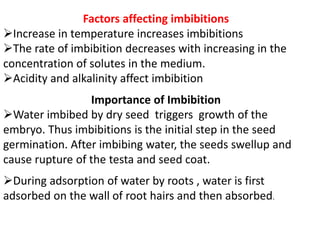
Factors affecting imbibitions
Increase in temperature increases imbibitions
The rate of imbibition decreases with increasing in the
concentration of solutes in the medium.
Acidity and alkalinity affect imbibition
Importance of Imbibition
Water imbibed by dry seed triggers growth of the
embryo. Thus imbibitions is the initial step in the seed
germination. After imbibing water, the seeds swellup and
cause rupture of the testa and seed coat.
During adsorption of water by roots , water is first
adsorbed on the wall of root hairs and then absorbed.
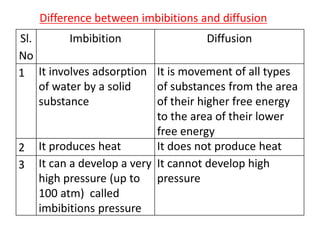
Sl.
No
Imbibition Diffusion
1 It involves adsorption
of water by a solid
substance
It is movement of all types
of substances from the area
of their higher free energy
to the area of their lower
free energy
2 It produces heat It does not produce heat
3 It can a develop a very
high pressure (up to
100 atm) called
imbibitions pressure
It cannot develop high
pressure
Difference between imbibitions and diffusion
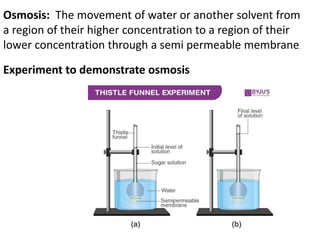
Osmosis: The movement of water or another solvent from
a region of their higher concentration to a region of their
lower concentration through a semi permeable membrane.
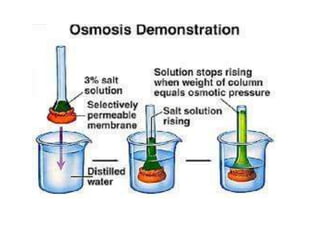
Experiment to demonstrate osmosis
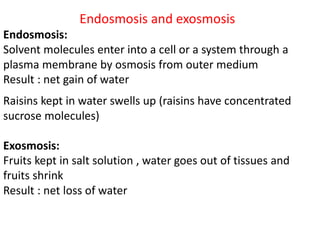
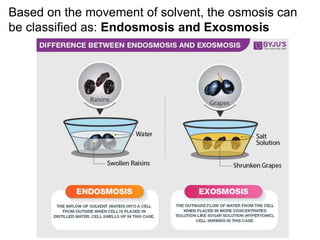
Endosmosis and exosmosis
Endosmosis:
Solvent molecules enter into a cell or a system through a
plasma membrane by osmosis from outer medium
Result : net gain of water
Raisins kept in water swells up (raisins have concentrated
sucrose molecules)
Exosmosis:
Fruits kept in salt solution , water goes out of tissues and
fruits shrink
Result : net loss of water
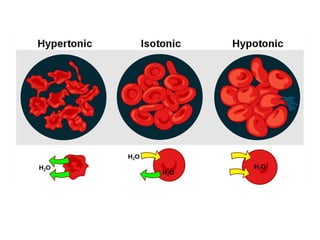
Types of Solutions: Based on the concentration of solutes
dissolved in solvent, the solutions are classified into following
types.
Hypotonic solution: When the cell is placed in an external
solution of lower concentration, endosmosis takes place i.e.,
water moves from outside to inside of the cell. Then external
solution is said to be hypotonic solution.
Hypertonic solution: When the cell is placed in the external
solution of higher concentration, ex-osmosis takes place i.e.,
water moves from inside of cell to outside the external
solution. This external solution is said to be hypertonic
solution.
Isotonic solution: The concentration of both external solution
and the cell sap is at equilibrium, then the solution is called
isotonic solution. Under such situation, neither exosmosis nor
endosmosis takes place.
Significance of osmosis in plants
Roots absorb water by osmosis
Cell to cell movement of water
Osmosis maintains turgidity of cells
Opening and closing of stomata
The resistance of plants to drought and drought
increase with increase in osmotic pressure of cells.
Movement of leaves in touch me not plant and
bursting of dry fruits
Growing points of roots remain turgid because
of osmosis and thus able to move between soil
particles .
Osmotic pressure (OP)
When a plant cell is placed in water, the water starts
entering into the cell due to osmosis.
Cell sap contains 90 % water and 10 % salts
The entry of water depends on the number of solute
particles in a solution.
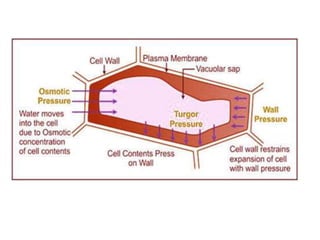
The entry of water into the cell develops a pressure.
The pressure that develops in solution when it is separated
from the solvent by a semi permeable membrane is called
is termed as osmotic pressure.
Osmotic pressure is the extra pressure applied on the
solution side to prevent the entry of solvent ( water)
through semi permeable membrane
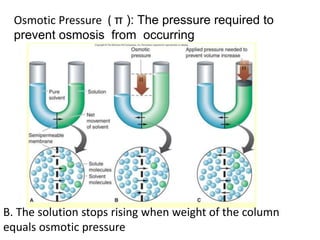
Osmotic Pressure ( π ): The pressure required to
prevent osmosis from occurring
B. The solution stops rising when weight of the column
equals osmotic pressure
Turgor pressure (TP):
When a plant cell is placed in water , water enters into the
cell due to endosmosis causing expansion of protoplasm.
The protoplasm presses against the cell wall exerting an
outward pressure on it. It is called turgor pressure.
Turgor pressure is an outward pressure exerted by the
protoplasm against the cell wall due to the entry of water .
such swollen cells are called turgid cells and the stage of the
cells is called turgidity.
Wall pressure (WP):
The cell wall being rigid and elastic, exerts an equal and
opposite pressure against the expanding protoplasm.
This pressure is called wall pressure.
So wall pressure is the pressure exerted by the cell wall
against turgor pressure.
In a cell which is fully turgid and attained normal size and
shape, TP= WP
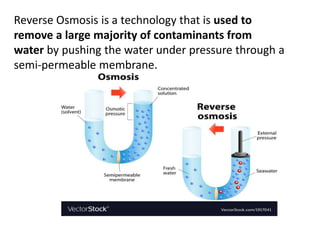
Reverse Osmosis is a technology that is used to
remove a large majority of contaminants from
water by pushing the water under pressure through a
semi-permeable membrane.
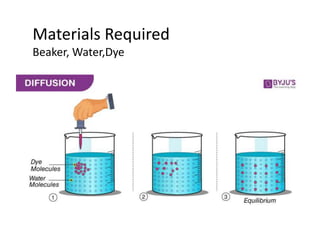
Practical No.2 Diffusion, Osmosis and Imbibition
Diffusion is a net movement of substances from an area of
its own high chemical potential into another area of lower
chemical potential.
It is dependent on a chemical potential gradient that
becomes less steep as the process proceeds.
When the gradient no longer exists or when equilibrium is
attained, then the diffusion will cease.
Materials Required
Beaker, Water,Dye
Imbibition
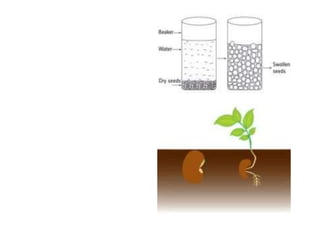
The adsorption of water by hydrophyllic materials
such as protein, starch and cellulose is known as
imbibition.
These hydrophyllic materials adsorb water from
their surroundings and swell.
Similar properties are exhibited by the clay and
insoluble organic fraction in the soil.
Imbibition is a special type of diffusion, since the
net movement of water is along with the diffusion
gradient.
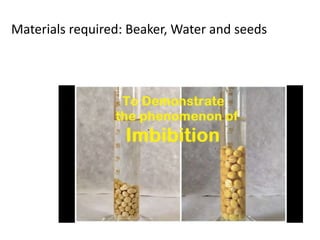
Materials required: Beaker, Water and seeds
Osmosis is defined as the movement of solvent
molecules from the region of higher concentration to a
region of lower concentration when two regions are
separated by a semi permeable membrane.
In other words, the diffusion of water across a
differentially permeable membrane from a region of
higher potential to a region of lower potential is called
osmosis.
It is important in the absorption of water in plants and
has a special role to play in the transport of water into
plant cells.
Based on the movement of solvent, the osmosis can
be classified as: Endosmosis and Exosmosis
Types of Solutions: Based on the concentration of solutes
dissolved in solvent, the solutions are classified into following
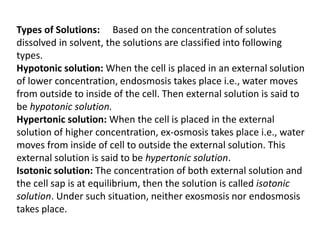
types.
Hypotonic solution: When the cell is placed in an external solution
of lower concentration, endosmosis takes place i.e., water moves
from outside to inside of the cell. Then external solution is said to
be hypotonic solution.
Hypertonic solution: When the cell is placed in the external
solution of higher concentration, ex-osmosis takes place i.e., water
moves from inside of cell to outside the external solution. This
external solution is said to be hypertonic solution.
Isotonic solution: The concentration of both external solution and
the cell sap is at equilibrium, then the solution is called isotonic
solution. Under such situation, neither exosmosis nor endosmosis
takes place.
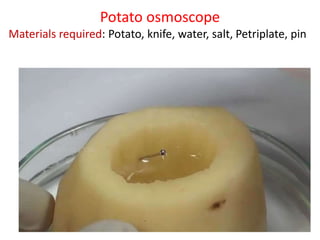
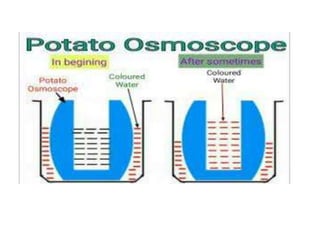
Potato osmoscope
Materials required: Potato, knife, water, salt, Petriplate, pin
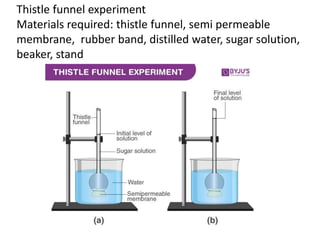
Thistle funnel experiment
Materials required: thistle funnel, semi permeable
membrane, rubber band, distilled water, sugar solution,
beaker, stand
Chapter 2.2 Diffusion, osmosis and imbibition.pptx

Chapter 2.2 Diffusion, osmosis and imbibition.pptx

  • 1.
    Chapter 2.2 Diffusion,Imbibition and osmosis
  • 2.
    Avogadro’s Law: Equal volumeof gases under the same temperature and pressure contain the same number of molecules.
  • 4.
    Boyles Law: Volume ofa gas varies inversely with pressure
  • 5.
    Charle’s Law: Itstates that the volume of a gas varies directly with the absolute temperature.
  • 6.
    Dalton’s Law ofpartial pressure: The law states that in a mixture of gases, each gas exerts the same pressure as if it were to occupy the volume again.
  • 7.
    Henry’s Law: Accordingto this law, if there is no chemical reaction between a gas and a liquid, the amount of gas absorbed in the liquid will be proportionate to its partial pressure.
  • 8.
    Graham’s Law: It statesthat relative speeds of diffusion of gases are inversely proportional to the square roots of the relative densities
  • 9.
    Vapour pressure: The vapourpressure is the pressure exerted when the molecules leave the surface at the same rate as they return. It varies directly with temperature. If the intermolecular forces in a liquid are small, the molecules can easily escape from the surface of the liquid. The liquid will have a high vapour pressure.
  • 10.
    Diffusion is themovement of molecules by random agitation. Water molecules in a solution are not static ; they are in continuous motion, colliding with one another and exchanging kinetic energy. The molecules intermingle as a result of their random thermal agitation . This is random motion is called diffusion. As long as other forces are not acting on the molecules, diffusion causes net movement of molecules from region of higher concentration to regions of low concentration- that is , down a concentration gradient.
  • 11.
    Reason for diffusion: gradientof concentration , pressure or temperature size of the Particle. The steepness of the concentration gradient. A gradient is the change in the value of a quantity e.g. concentration, pressure or temperature with change in another variable , usually distance A change in concentration over a distance is called a concentration gradient A change in pressure over a distance is called a pressure gradient A change in temperature over a distance is called a temperature gradient
  • 12.
    The diffusion ofparticles of matter is due to their own kinetic energy Diffusion occurs to achieve equilibrium Even after reaching equilibrium movement continues in equal amounts and in opposite directions.
  • 13.
    In 1880 theGerman scientist Adolf Fick discovered that the rate of diffusion is directly proportional to the concentration gradient
  • 15.
    Diffusion is rapidover short distances but slow over long distance The diffusion coefficient for glucose in water is about 10-9 m2/s. The average time required for a glucose molecule to diffuse across a cell with a diameter 50 micro meter is 2.5 seconds. However, the average time needed for the same glucose molecule a distance of 1 meter is approximately 32 years.
  • 16.
    Diffusion can bedivided into two main types, i).simple diffusion and ii).facilitated diffusion. Simple diffusion is defined as the process in which a substance moves through a semi permeable membrane or in a solution without any help from transport proteins. Eg: In a cell, water, oxygen and carbon dioxide molecules can pass directly through the cell membrane without requiring any energy along the concentration gradient
  • 17.
    Facilitated diffusion canbe defined as the passive movement of molecules across the cell membrane from a region of higher concentration to a region of lower concentration by means of a carrier molecule. In the human body, glucose molecules, sodium and potassium ions use carrier proteins to pass through the cell membranes
  • 18.
    Significance of diffusionin plants 1. The exchange gases : CO2 enters and oxygen goes out 2.Transpiration of water vapour 3. Passive salt absorption by simple diffusion 4. Transport of substances over short distance and translocation of food
  • 19.
    Imbibition: It isthe processes of adsorption of water by the particles of solid substances without forming a solution. The substance that imbibes water is called imbibant or adsorbent and water imbibed is called imbibate. Substances like proteins and cellulose that form colloids are imbibants. Amount of water imbibed is determined by the degree of cohesion of molecules that are independent. The tenacity with which water molecules are held on an imbibing surface is function of their water potential.
  • 20.
    Water molecules, adsorbedon the surface of imbibant, lose their kinetic energy as heat therefore heat is generated. It is called heat of hydration. Proteins have a very high imbibibing capacity; starch and cellulose have the least. For imbibition to take place, the affinity between the adsorbent and the water to be imbibed. Water potential gradient between the adsorbent surface and the water imbibed.
  • 21.
    Factors affecting imbibitions Increasein temperature increases imbibitions The rate of imbibition decreases with increasing in the concentration of solutes in the medium. Acidity and alkalinity affect imbibition Importance of Imbibition Water imbibed by dry seed triggers growth of the embryo. Thus imbibitions is the initial step in the seed germination. After imbibing water, the seeds swellup and cause rupture of the testa and seed coat. During adsorption of water by roots , water is first adsorbed on the wall of root hairs and then absorbed.
  • 22.
    Sl. No Imbibition Diffusion 1 Itinvolves adsorption of water by a solid substance It is movement of all types of substances from the area of their higher free energy to the area of their lower free energy 2 It produces heat It does not produce heat 3 It can a develop a very high pressure (up to 100 atm) called imbibitions pressure It cannot develop high pressure Difference between imbibitions and diffusion
  • 23.
    Osmosis: The movementof water or another solvent from a region of their higher concentration to a region of their lower concentration through a semi permeable membrane. Experiment to demonstrate osmosis
  • 24.
    Endosmosis and exosmosis Endosmosis: Solventmolecules enter into a cell or a system through a plasma membrane by osmosis from outer medium Result : net gain of water Raisins kept in water swells up (raisins have concentrated sucrose molecules) Exosmosis: Fruits kept in salt solution , water goes out of tissues and fruits shrink Result : net loss of water
  • 25.
    Types of Solutions:Based on the concentration of solutes dissolved in solvent, the solutions are classified into following types. Hypotonic solution: When the cell is placed in an external solution of lower concentration, endosmosis takes place i.e., water moves from outside to inside of the cell. Then external solution is said to be hypotonic solution. Hypertonic solution: When the cell is placed in the external solution of higher concentration, ex-osmosis takes place i.e., water moves from inside of cell to outside the external solution. This external solution is said to be hypertonic solution. Isotonic solution: The concentration of both external solution and the cell sap is at equilibrium, then the solution is called isotonic solution. Under such situation, neither exosmosis nor endosmosis takes place.
  • 26.
    Significance of osmosisin plants Roots absorb water by osmosis Cell to cell movement of water Osmosis maintains turgidity of cells Opening and closing of stomata The resistance of plants to drought and drought increase with increase in osmotic pressure of cells. Movement of leaves in touch me not plant and bursting of dry fruits Growing points of roots remain turgid because of osmosis and thus able to move between soil particles .
  • 27.
    Osmotic pressure (OP) Whena plant cell is placed in water, the water starts entering into the cell due to osmosis. Cell sap contains 90 % water and 10 % salts The entry of water depends on the number of solute particles in a solution. The entry of water into the cell develops a pressure. The pressure that develops in solution when it is separated from the solvent by a semi permeable membrane is called is termed as osmotic pressure. Osmotic pressure is the extra pressure applied on the solution side to prevent the entry of solvent ( water) through semi permeable membrane
  • 28.
    Osmotic Pressure (π ): The pressure required to prevent osmosis from occurring B. The solution stops rising when weight of the column equals osmotic pressure
  • 29.
    Turgor pressure (TP): Whena plant cell is placed in water , water enters into the cell due to endosmosis causing expansion of protoplasm. The protoplasm presses against the cell wall exerting an outward pressure on it. It is called turgor pressure. Turgor pressure is an outward pressure exerted by the protoplasm against the cell wall due to the entry of water . such swollen cells are called turgid cells and the stage of the cells is called turgidity.
  • 30.
    Wall pressure (WP): Thecell wall being rigid and elastic, exerts an equal and opposite pressure against the expanding protoplasm. This pressure is called wall pressure. So wall pressure is the pressure exerted by the cell wall against turgor pressure. In a cell which is fully turgid and attained normal size and shape, TP= WP
  • 32.
    Reverse Osmosis isa technology that is used to remove a large majority of contaminants from water by pushing the water under pressure through a semi-permeable membrane.
  • 33.
    Practical No.2 Diffusion,Osmosis and Imbibition
  • 34.
    Diffusion is anet movement of substances from an area of its own high chemical potential into another area of lower chemical potential. It is dependent on a chemical potential gradient that becomes less steep as the process proceeds. When the gradient no longer exists or when equilibrium is attained, then the diffusion will cease.
  • 35.
  • 36.
    Imbibition The adsorption ofwater by hydrophyllic materials such as protein, starch and cellulose is known as imbibition. These hydrophyllic materials adsorb water from their surroundings and swell. Similar properties are exhibited by the clay and insoluble organic fraction in the soil. Imbibition is a special type of diffusion, since the net movement of water is along with the diffusion gradient.
  • 37.
  • 39.
    Osmosis is definedas the movement of solvent molecules from the region of higher concentration to a region of lower concentration when two regions are separated by a semi permeable membrane. In other words, the diffusion of water across a differentially permeable membrane from a region of higher potential to a region of lower potential is called osmosis. It is important in the absorption of water in plants and has a special role to play in the transport of water into plant cells.
  • 40.
    Based on themovement of solvent, the osmosis can be classified as: Endosmosis and Exosmosis
  • 41.
    Types of Solutions:Based on the concentration of solutes dissolved in solvent, the solutions are classified into following types. Hypotonic solution: When the cell is placed in an external solution of lower concentration, endosmosis takes place i.e., water moves from outside to inside of the cell. Then external solution is said to be hypotonic solution. Hypertonic solution: When the cell is placed in the external solution of higher concentration, ex-osmosis takes place i.e., water moves from inside of cell to outside the external solution. This external solution is said to be hypertonic solution. Isotonic solution: The concentration of both external solution and the cell sap is at equilibrium, then the solution is called isotonic solution. Under such situation, neither exosmosis nor endosmosis takes place.
  • 43.
    Potato osmoscope Materials required:Potato, knife, water, salt, Petriplate, pin
  • 45.
    Thistle funnel experiment Materialsrequired: thistle funnel, semi permeable membrane, rubber band, distilled water, sugar solution, beaker, stand