FACTORS AFFECTING PHOTOSYNTHESIS
Presented by
Mrs.K.POORNIMA
Assistant professor
Department of Chemistry
Government College of Engineering, Salem -11
PHOTOSYNTHESIS
 It would be impossible to overestimate the importance of photosynthesis in the maintenance
of life on Earth.
 If photosynthesis ceased, there would soon be little food or other organic matter on Earth.
 Most organisms would disappear, and in time Earth’s atmosphere would become nearly
devoid of gaseous oxygen.
 The only organisms able to exist under such conditions would be the
chemosynthetic bacteria, which can utilize the chemical energy of certain inorganic
compounds.
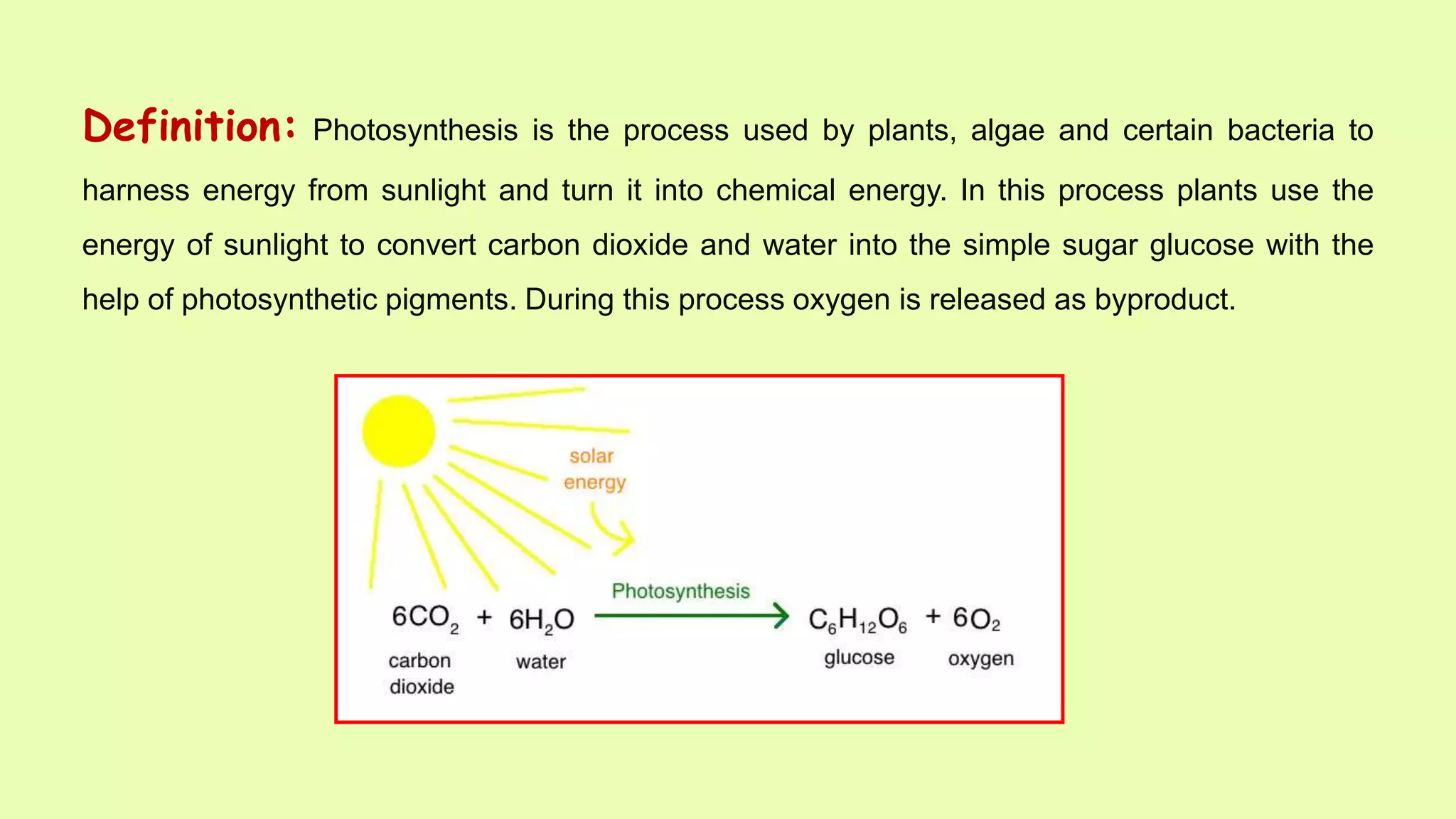
Definition: Photosynthesis is the process used by plants, algae and certain bacteria to
harness energy from sunlight and turn it into chemical energy. In this process plants use the
energy of sunlight to convert carbon dioxide and water into the simple sugar glucose with the
help of photosynthetic pigments. During this process oxygen is released as byproduct.
The significance of photosynthesis
i. Photosynthesis is important for sustaining life.
ii. It directly or indirectly affects most life on Earth.
iii. It contributes to the symbiotic relationship between plants, humans and animals.
iv. It contributes to the carbon cycle between the earth, the oceans, plants and animals.
v. Photosynthesis provides food for all living beings.
vi. It is the ultimate source of Oxygen and energy for all living organisms.
vii.Photosynthesis helps in growth and development of plants.
viii.It fixes atmospheric carbon dioxide and release oxygen in the atmosphere.
ix. It is necessary for the synthesis of organic compounds from inorganic compounds.
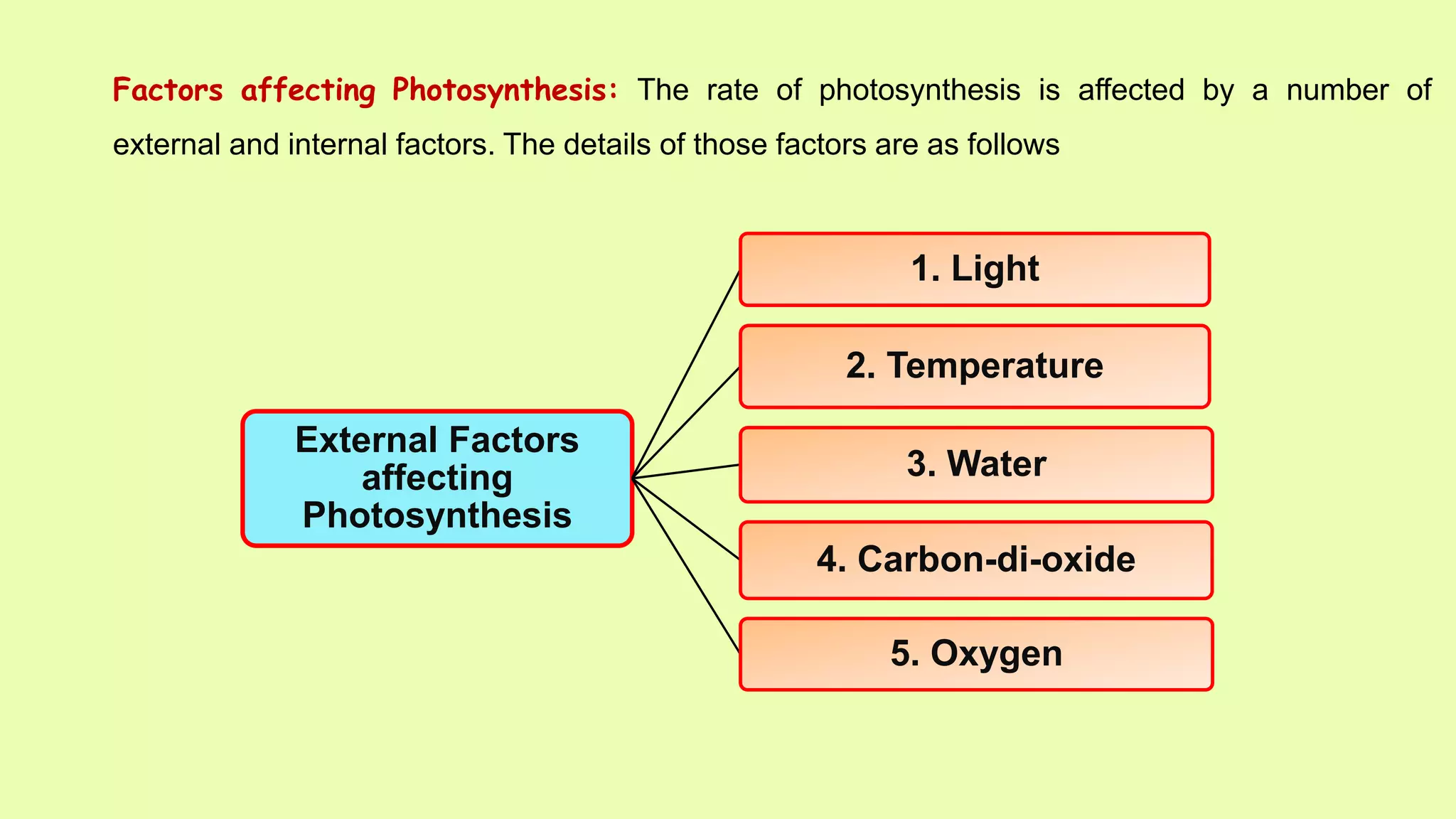
Factors affecting Photosynthesis: The rate of photosynthesis is affected by a number of
external and internal factors. The details of those factors are as follows
External Factors
affecting
Photosynthesis
1. Light
2. Temperature
3. Water
4. Carbon-di-oxide
5. Oxygen
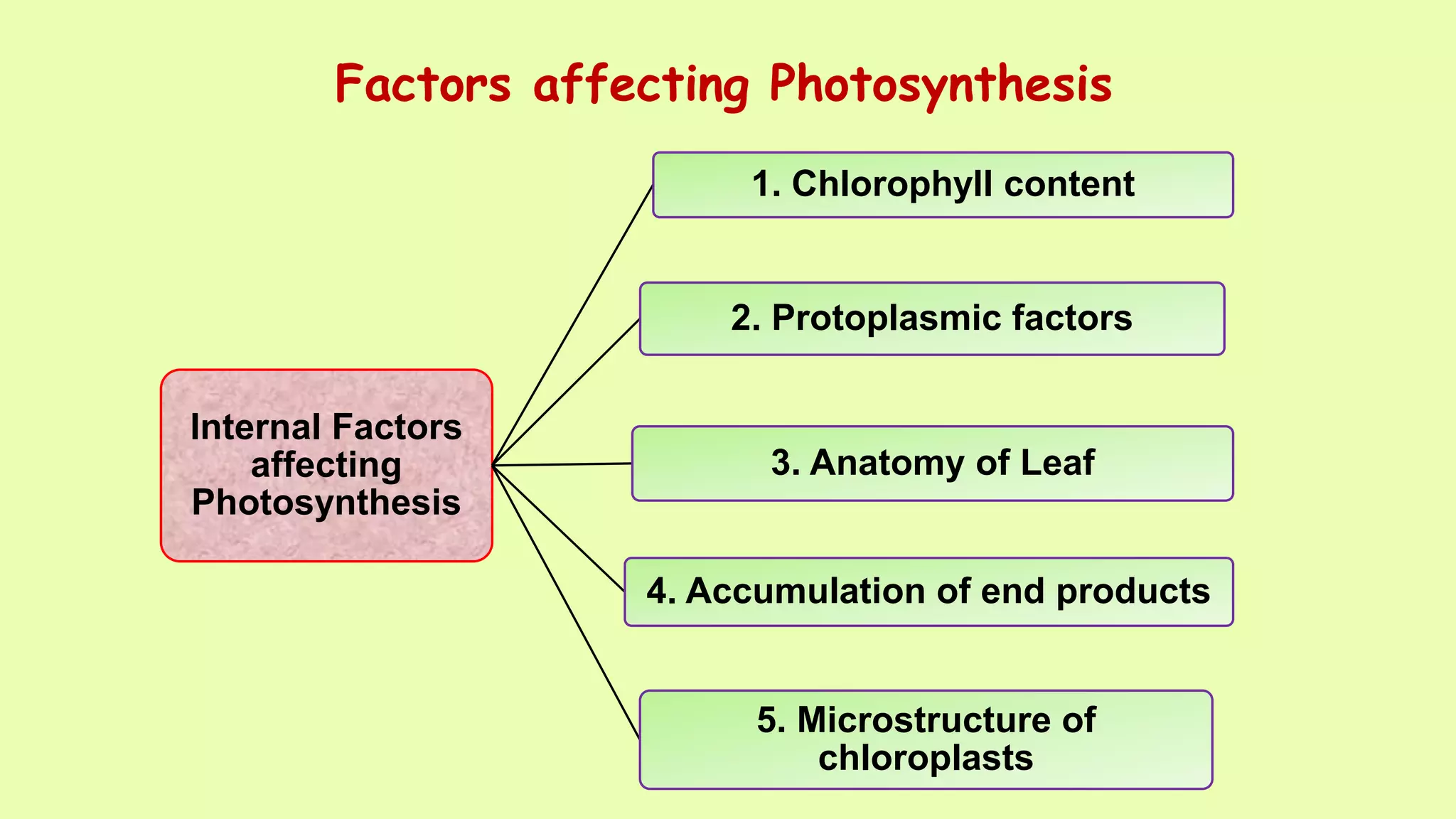
Internal Factors
affecting
Photosynthesis
1. Chlorophyll content
2. Protoplasmic factors
3. Anatomy of Leaf
4. Accumulation of end products
5. Microstructure of
chloroplasts
Factors affecting Photosynthesis
External Factors: The external factors which affect photosynthesis are as follows
1. Light:
 The light is an essential factor for photosynthesis.
 In nature the chief source of light for photosynthesis in green plants is sun light.
 Moon light has been found to be effective in some marine algae.
 Besides these, any king of artificial light like electric light can induce photosynthesis in green
plants, provided it is in the visible part of the spectrum.
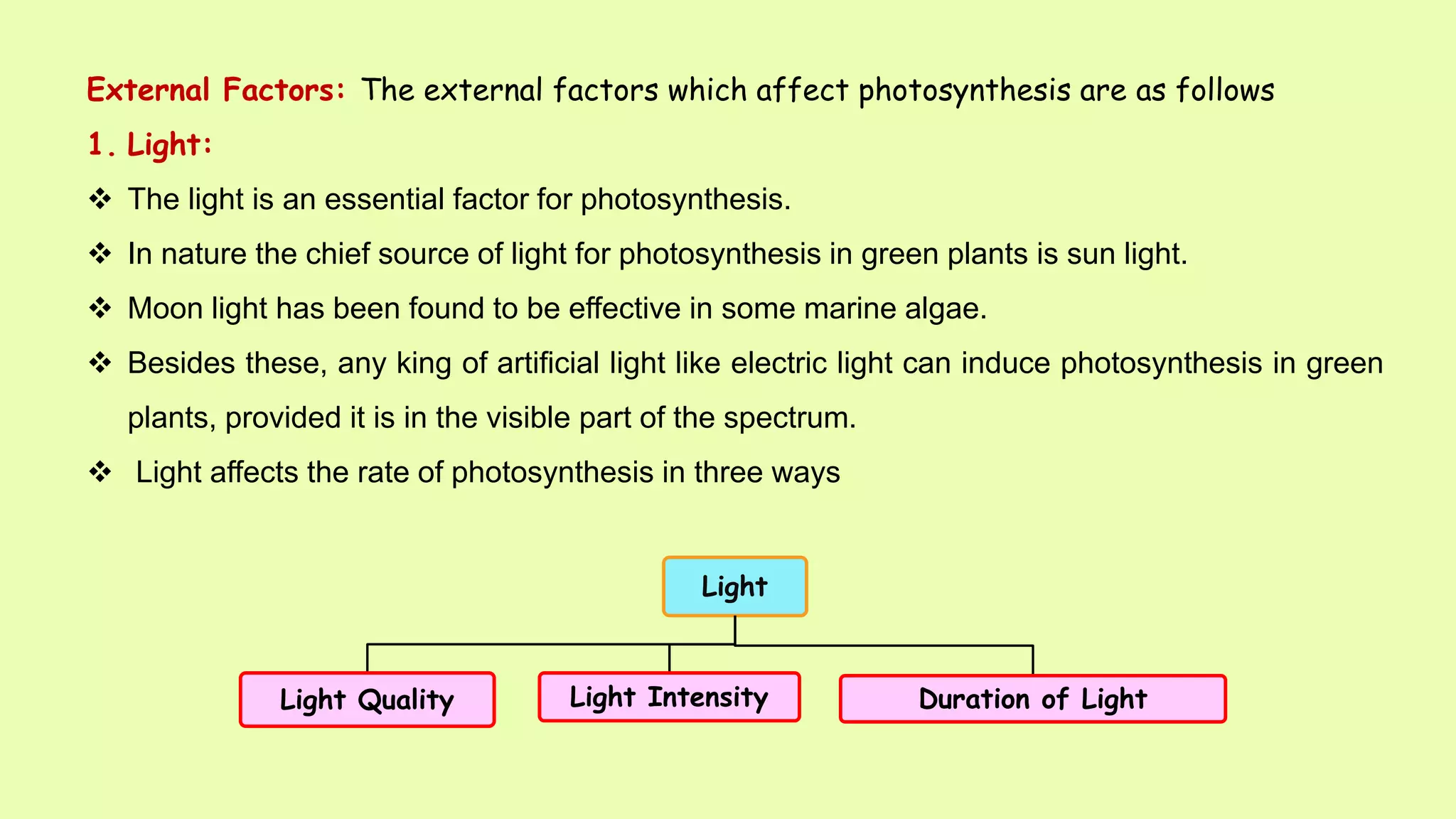
 Light affects the rate of photosynthesis in three ways
Light
Light Quality Light Intensity Duration of Light
i. Light Quality:
 Photosynthesis in green plants takes place only in the visible part of the spectrum of light.
 The rate of photosynthesis is higher in white light than in monochromatic light (light rays of a particular
wavelength).
 Although the light rays of longer wavelengths have lower energy than the light rays of shorter
wavelengths, but owing to the heavy absorption in the red part of the spectrum by chlorophylls,
maximum photosynthesis takes place in red light.
 The next highest rate of photosynthesis takes place in blue light while in green light it is minimum.
ii. Duration of Light:
 Even a brief flash of light is enough for photosynthesis to occur.
 However the rate of photosynthesis is greater in intermittent light than in continuous light.
 It is because in continuous light the assimilatory power accumulates and is not consumed in the dark
reaction at the same rate at which it is produced in light reaction.
iii. Light Intensity:
 Usually the ate of photosynthesis is greater in intense light than in diffused light.
 Sciophytes ( the plants grow in shady places) requires less intense light for optimum
photosynthesis.
 Whereas heliophytes (plants which grow in sunny places) requires more intense light for
optimum photosynthesis.
 But at very low intensity and at extremely high intensity the photosynthesis is affected.
 At very low intensity plant does not receive sufficient light energy solarization (auto oxidation
of cellular components) inhibits photosynthesis.
2. Temperature:
 Different plants have different requirement of temperatures for photosynthesis.
 Photosynthesis will stop in many plants at about freezing point but in some conifers it
takes place even at -350C.
 Similarly temperatures beyond 40 to 500C retard photosynthesis in most of the pants
 But certain xerophytes and algae growing in hot springs carry on photosynthesis is
even at 550C and 750C respectively.
 Usually an increase in temperature from 100C to about 400C brings about an increase
in the rate of the photosynthesis.
3. Water:
 Water is one of the raw materials of photosynthesis.
 The amount of water actually used in photosynthesis is very small.
 Less than 1 percent water is absorbed by the plant.
 Therefore, it cannot be a limiting factor directly.
 But the water content of the leaf often acts as a limiting factor indirectly.
 When there is a reduced water intake or availability, the stomata begin to close to avoid
loss of any water during transpiration.
 With the stomata closes down the CO2 intake also stops which affects photosynthesis.
 Therefore, the effect of water on photosynthesis is more indirect than direct.
4. Carbon-di-oxide:
 CO2 constitutes about 0.03% (330 ppm) by volume of the atmosphere.
 An increase in CO2 concentration up to about 1% increases the rate of photosynthesis.
 But very high concentration may prove toxic and the rate of photosynthesis will go down.
5. Oxygen:
 Optimum levels of oxygen are favorable for photosynthesis.
 Oxygen is needed for photorespiration in plants and the by-product of photorespiration is CO2
which is essential for photosynthesis.
 Also, the energy generated during the oxygen respiration is needed for the process of
photosynthesis as well.
 However, an increase in the oxygen levels beyond the optimum level leads to the inhibition of
photosynthesis.
Internal Factors: The internal factors which affects the rate of photosynthesis is
as follows
1. Chlorophyll content:
 Chlorophyll is essential for photosynthesis.
 In etiolated plants and the non-green parts of multicoloured leaves in some plants
photosynthesis does not take place.
 Although there are conflicting view regarding the direct relationship between chlorophyll
content and the rate of photosynthesis, but theoretically it is quite obvious that the rate
of photosynthesis should increase with an increase in the chlorophyll content provided
the other factors are also favourable.
2. Protoplasmic Factors:
 The rate of photosynthesis is also affected by protoplasmic factors.
 The most important protoplasmic factor is the enzyme complement (balance) of the
protoplasmic system.
 The hydration of protoplasm is also essential. If the cells lack water and protoplasm is
dehydrated, the rate of photosynthesis slows down.
3. Anatomy of Leaf:
 The rate of photosynthesis is also influenced by the anatomy of the leaf.
 The structural features of the leaf influence the amount of carbon dioxide that reaches
the chloroplasts.
 So the anatomy factors like the thickness of the cuticle and epidermis, structure and
distribution of stomata, distribution and relative distribution of the vascular tissue
influences the rate of photosynthesis.
4. Accumulation of the end products of photosynthesis:
 Accumulation of carbohydrates in the photosynthesizing cells retards the rate of photosynthesis.
 Quick translocation of the carbohydrates or the end products of photosynthesis will have a
favorable effect on the rate of photosynthesis.
5. Microstructure of chloroplast:
 Rate of photosynthesis is also influenced by the microstructure of chloroplasts.
 Based on the difference in the microstructure of the chloroplast the optimum temperature
required for the photosynthesis will vary from plant to plant.
THANK YOU!!!

Factors affecting photosynthesis

  • 1.
    FACTORS AFFECTING PHOTOSYNTHESIS Presentedby Mrs.K.POORNIMA Assistant professor Department of Chemistry Government College of Engineering, Salem -11
  • 2.
    PHOTOSYNTHESIS  It wouldbe impossible to overestimate the importance of photosynthesis in the maintenance of life on Earth.  If photosynthesis ceased, there would soon be little food or other organic matter on Earth.  Most organisms would disappear, and in time Earth’s atmosphere would become nearly devoid of gaseous oxygen.  The only organisms able to exist under such conditions would be the chemosynthetic bacteria, which can utilize the chemical energy of certain inorganic compounds.
  • 3.
    Definition: Photosynthesis isthe process used by plants, algae and certain bacteria to harness energy from sunlight and turn it into chemical energy. In this process plants use the energy of sunlight to convert carbon dioxide and water into the simple sugar glucose with the help of photosynthetic pigments. During this process oxygen is released as byproduct.
  • 4.
    The significance ofphotosynthesis i. Photosynthesis is important for sustaining life. ii. It directly or indirectly affects most life on Earth. iii. It contributes to the symbiotic relationship between plants, humans and animals. iv. It contributes to the carbon cycle between the earth, the oceans, plants and animals. v. Photosynthesis provides food for all living beings. vi. It is the ultimate source of Oxygen and energy for all living organisms. vii.Photosynthesis helps in growth and development of plants. viii.It fixes atmospheric carbon dioxide and release oxygen in the atmosphere. ix. It is necessary for the synthesis of organic compounds from inorganic compounds.
  • 5.
    Factors affecting Photosynthesis:The rate of photosynthesis is affected by a number of external and internal factors. The details of those factors are as follows External Factors affecting Photosynthesis 1. Light 2. Temperature 3. Water 4. Carbon-di-oxide 5. Oxygen
  • 6.
    Internal Factors affecting Photosynthesis 1. Chlorophyllcontent 2. Protoplasmic factors 3. Anatomy of Leaf 4. Accumulation of end products 5. Microstructure of chloroplasts Factors affecting Photosynthesis
  • 7.
    External Factors: Theexternal factors which affect photosynthesis are as follows 1. Light:  The light is an essential factor for photosynthesis.  In nature the chief source of light for photosynthesis in green plants is sun light.  Moon light has been found to be effective in some marine algae.  Besides these, any king of artificial light like electric light can induce photosynthesis in green plants, provided it is in the visible part of the spectrum.  Light affects the rate of photosynthesis in three ways Light Light Quality Light Intensity Duration of Light
  • 8.
    i. Light Quality: Photosynthesis in green plants takes place only in the visible part of the spectrum of light.  The rate of photosynthesis is higher in white light than in monochromatic light (light rays of a particular wavelength).  Although the light rays of longer wavelengths have lower energy than the light rays of shorter wavelengths, but owing to the heavy absorption in the red part of the spectrum by chlorophylls, maximum photosynthesis takes place in red light.  The next highest rate of photosynthesis takes place in blue light while in green light it is minimum. ii. Duration of Light:  Even a brief flash of light is enough for photosynthesis to occur.  However the rate of photosynthesis is greater in intermittent light than in continuous light.  It is because in continuous light the assimilatory power accumulates and is not consumed in the dark reaction at the same rate at which it is produced in light reaction.
  • 9.
    iii. Light Intensity: Usually the ate of photosynthesis is greater in intense light than in diffused light.  Sciophytes ( the plants grow in shady places) requires less intense light for optimum photosynthesis.  Whereas heliophytes (plants which grow in sunny places) requires more intense light for optimum photosynthesis.  But at very low intensity and at extremely high intensity the photosynthesis is affected.  At very low intensity plant does not receive sufficient light energy solarization (auto oxidation of cellular components) inhibits photosynthesis.
  • 10.
    2. Temperature:  Differentplants have different requirement of temperatures for photosynthesis.  Photosynthesis will stop in many plants at about freezing point but in some conifers it takes place even at -350C.  Similarly temperatures beyond 40 to 500C retard photosynthesis in most of the pants  But certain xerophytes and algae growing in hot springs carry on photosynthesis is even at 550C and 750C respectively.  Usually an increase in temperature from 100C to about 400C brings about an increase in the rate of the photosynthesis.
  • 11.
    3. Water:  Wateris one of the raw materials of photosynthesis.  The amount of water actually used in photosynthesis is very small.  Less than 1 percent water is absorbed by the plant.  Therefore, it cannot be a limiting factor directly.  But the water content of the leaf often acts as a limiting factor indirectly.  When there is a reduced water intake or availability, the stomata begin to close to avoid loss of any water during transpiration.  With the stomata closes down the CO2 intake also stops which affects photosynthesis.  Therefore, the effect of water on photosynthesis is more indirect than direct.
  • 12.
    4. Carbon-di-oxide:  CO2constitutes about 0.03% (330 ppm) by volume of the atmosphere.  An increase in CO2 concentration up to about 1% increases the rate of photosynthesis.  But very high concentration may prove toxic and the rate of photosynthesis will go down. 5. Oxygen:  Optimum levels of oxygen are favorable for photosynthesis.  Oxygen is needed for photorespiration in plants and the by-product of photorespiration is CO2 which is essential for photosynthesis.  Also, the energy generated during the oxygen respiration is needed for the process of photosynthesis as well.  However, an increase in the oxygen levels beyond the optimum level leads to the inhibition of photosynthesis.
  • 13.
    Internal Factors: Theinternal factors which affects the rate of photosynthesis is as follows 1. Chlorophyll content:  Chlorophyll is essential for photosynthesis.  In etiolated plants and the non-green parts of multicoloured leaves in some plants photosynthesis does not take place.  Although there are conflicting view regarding the direct relationship between chlorophyll content and the rate of photosynthesis, but theoretically it is quite obvious that the rate of photosynthesis should increase with an increase in the chlorophyll content provided the other factors are also favourable.
  • 14.
    2. Protoplasmic Factors: The rate of photosynthesis is also affected by protoplasmic factors.  The most important protoplasmic factor is the enzyme complement (balance) of the protoplasmic system.  The hydration of protoplasm is also essential. If the cells lack water and protoplasm is dehydrated, the rate of photosynthesis slows down. 3. Anatomy of Leaf:  The rate of photosynthesis is also influenced by the anatomy of the leaf.  The structural features of the leaf influence the amount of carbon dioxide that reaches the chloroplasts.  So the anatomy factors like the thickness of the cuticle and epidermis, structure and distribution of stomata, distribution and relative distribution of the vascular tissue influences the rate of photosynthesis.
  • 15.
    4. Accumulation ofthe end products of photosynthesis:  Accumulation of carbohydrates in the photosynthesizing cells retards the rate of photosynthesis.  Quick translocation of the carbohydrates or the end products of photosynthesis will have a favorable effect on the rate of photosynthesis. 5. Microstructure of chloroplast:  Rate of photosynthesis is also influenced by the microstructure of chloroplasts.  Based on the difference in the microstructure of the chloroplast the optimum temperature required for the photosynthesis will vary from plant to plant.
  • 16.