Name : Umesh Ramdas Phondekar
Reg.No.-ADPM/18/2608
Class: Jr. M.Sc.(Ag.)
Department: Plant Pathology
Mineral Nutrition in plants
• Plants are:
• Capable of making all necessary organic compounds
from inorganic compounds and elements in the
environment (autotrophic)
• Supplied with all the carbon, hydrogen, and oxygen
they could ever need (CO2, H2O)
• Required to obtain all other elements from the soil
so in a sense plants act as soil miners.
• “Mineral”: An inorganic element Acquired
mostly in the form of inorganic ions from the
Soil.
• “Nutrient”: A substance needed to survive or
necessary for the synthesis of organic
compounds
 Essentiality of mineral nutrients
 Essential:
Universal for all plants
• – Absence prevents completion of life cycle
• – Absence leads to deficiency
• – Required for some aspect of mineral nutrition
Beneficial
Often limited to a few species
• – Stimulates growth and development
• – May be required in some species
• – Examples: Na, Si, Se
 Major essential nutrients
• Essential nutrients –
• mineral nutrients that are crucial for plant growth
1. . C, H, O – absorbed as gases. Carbon and Oxygen from
atmospheric fixation in the photosynthetic reaction and
respiration. Hydrogen and Oxygen too, from water
hydrolysis.
2. N,P,K,Ca, Mg, S – Macro elements. Absorbed from soil
solution. Needed in high ratio, their concentration in tissue
is measured by percentages.
N,P,K – Major macro elements.
Ca, Mg, S – Secondary macro elements.
3. Fe, Mn, Zn, Cu, Mo, B - Micro elements. Absorbed from
soil solution needed in small quantities, their concentration
in tissue is measured in ppm.
4. B – have a very narrow range of efficiency and even slight
increase in concentration will cause damages (0.5 ppm in
soil solution)
5. Cl, Na – “Damaging nutrients”. Regularly existent in
sufficient quantity in soil and in arid areas even in excess.
The plant need small quantities from them and excess will
damage soil structure and plant tissue
Macronutrients
N – P - K
 Nitrogen-
 Is a major component of proteins, hormones,
chlorophyll, vitamins and enzymes essential for
plant life.
 Nitrogen metabolism is a major factor in stem
and leaf growth (vegetative growth).
 Excess applied quantity can delay flowering and
fruiting.
 Deficiencies can reduce yields, cause yellowing
of the leaves and stunt growth.
Function–
• Major ingredient in proteins, cell plasma and genetic
material in plants.
 Deficiency –
• damage to metabolism reactions, retention of growth
and cell elongation.
Nitrogen deficiency
Phosphorus
• Necessary for seed germination, photosynthesis, protein
formation and Almost all aspects of growth and
metabolism in plants.
• Essential for flower and fruit formation.
• Low pH (<4) results in phosphate being chemically locked
up in organic soils.
• Phosphorus must be applied close to the plant's roots.
Deficiency symptoms:
 Purple stems and leaves; maturity and growth
are retarded.
• Yields of fruit and flowers are poor
• Premature drop of fruits and flowers may often
occur
• Large applications of phosphorus without
adequate levels of zinc can cause a zinc deficiency.
Phosphorus Deficiency
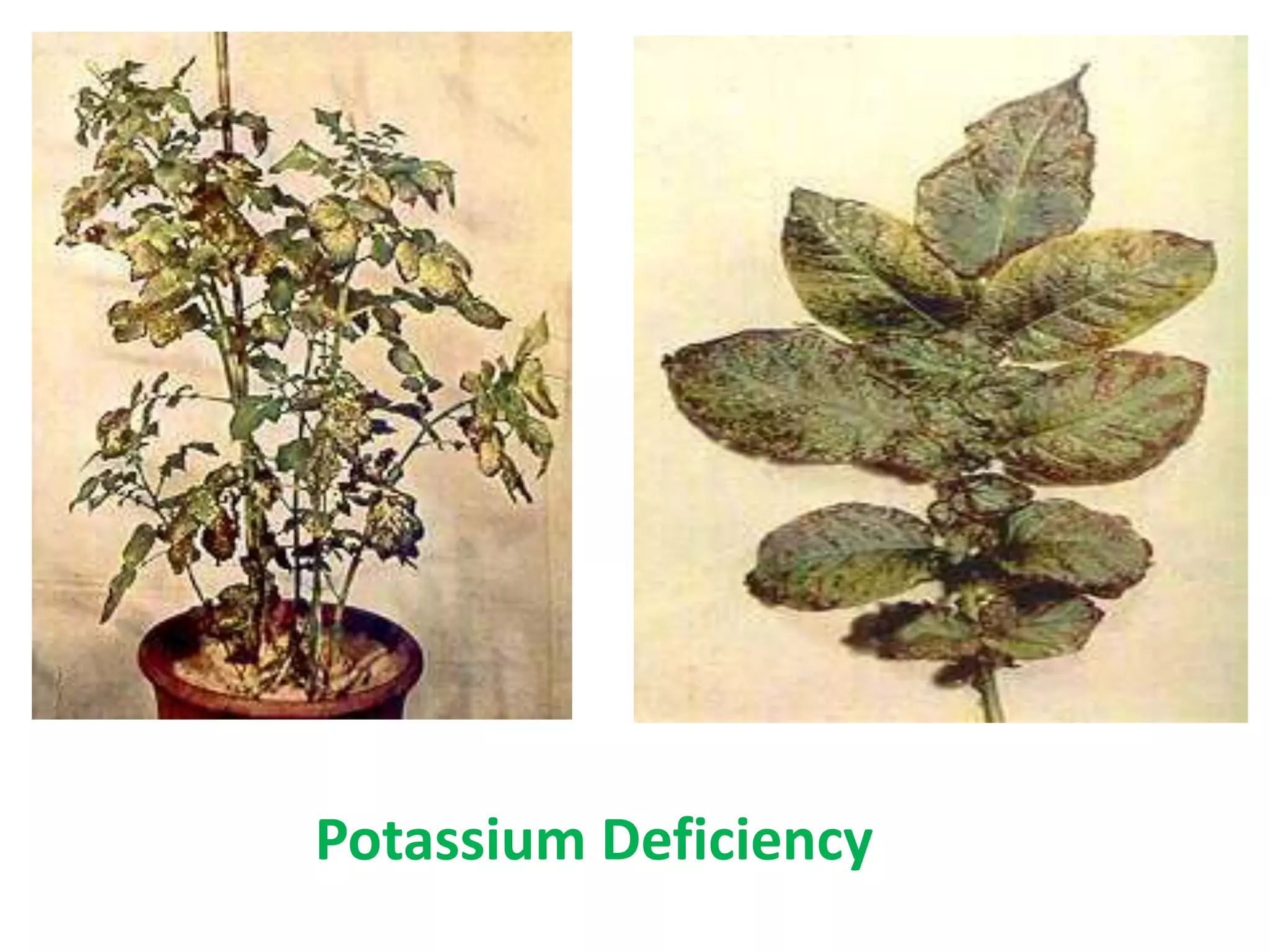
Potassium
• Necessary for formation of sugars, starches,
carbohydrates, protein synthesis.
• Necessary for cell division in roots and other parts of the
plant, Helps to adjust water balance, improves stem
rigidity and cold hardiness.
• Enhances flavor and color on fruit and vegetable crops.
• Increases the oil content of fruits and is important for
leafy crops.
• Deficiencies result in low yields, mottled, spotted or
curled leaves, scorched or burned look to leaves.
Potassium Deficiency
Secondary Elements
Mg – Ca - S
 Sulfur
 Is a structural component of amino acids, proteins,
vitamins and enzymes.
 Is essential to produce chlorophyll. It imparts flavor to
many vegetables.
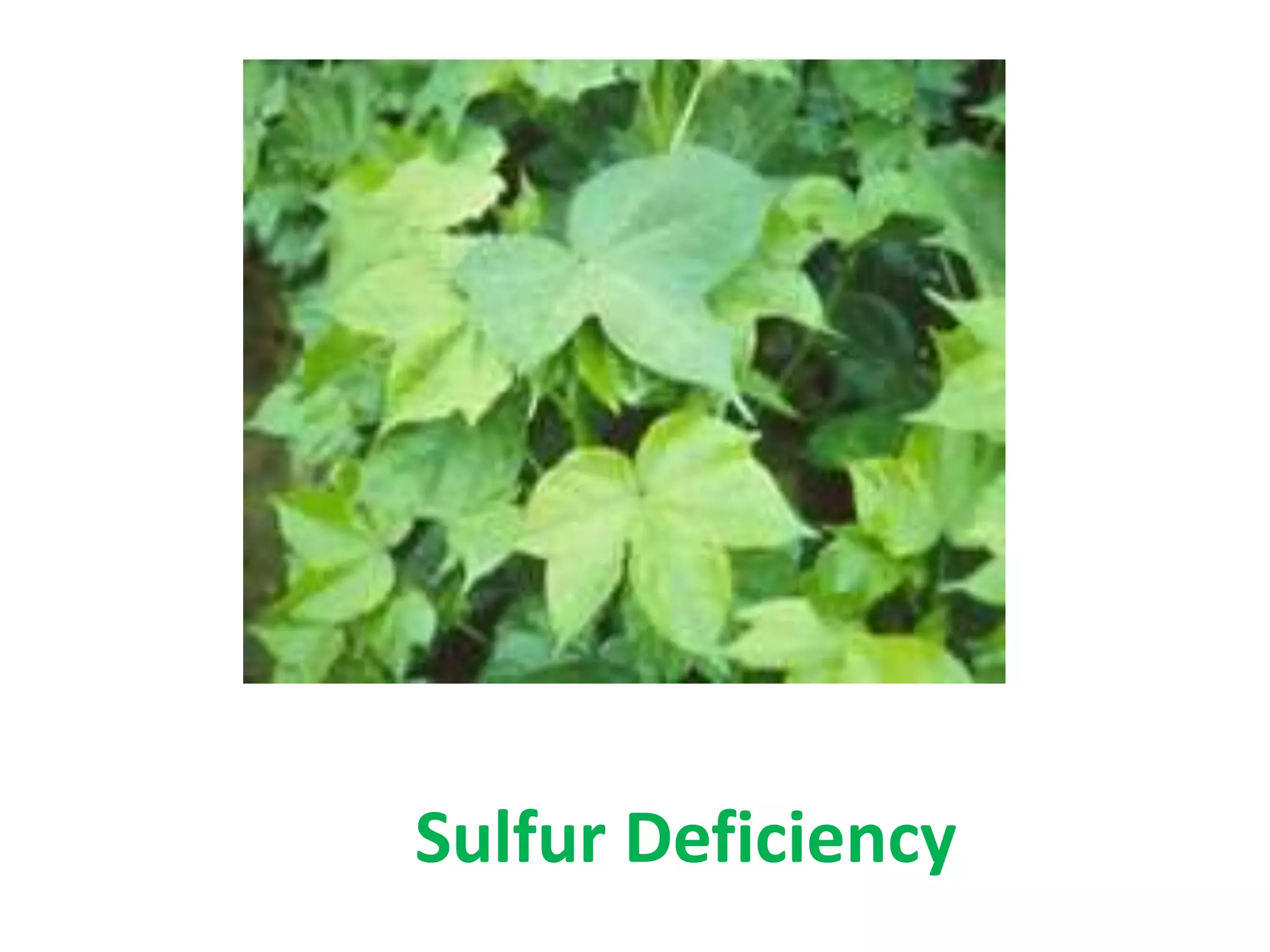
 Deficiencies show as light green leaves.
 Sulfur is readily lost by leaching from soils and should
be applied with a nutrient formula.
 Some water supplies may contain Sulfur.
Sulfur Deficiency
Magnesium
 Is a critical structural component of the chlorophyll
molecule.
 Is necessary for functioning of plant enzymes to
produce carbohydrates, sugars and fats.
 It is used for fruit and nut formation and essential for
germination of seeds.
 Deficient plants appear chlorotic, show yellowing
between veins of older leaves; leaves may droop.
 Magnesium is leached by watering and must be
supplied when feeding.
 It can be applied as a foliar spray to correct
deficiencies.
Magnesium Deficiency
 Calcium
 Activates enzymes, is a structural component of cell
walls.
 Influences water movement in cells and is necessary for
cell growth and division.
 Calcium is easily leached.
 Calcium, once deposited in plant tissue, is immobile
(nontranslocatable) so there must be a constant supply
for growth.
 Deficiency causes stunting of new growth in stems,
flowers and roots.
 Symptoms range from distorted new growth to black
spots on leaves and fruit. Yellow leaf margins may also
appear.
Calcium Deficiency
Micronutrients
Fe - Mn - B - Zn - Cu - Mo
 Iron
• Necessary for many enzyme functions and as a catalyst for
the synthesis of chlorophyll.
• Essential for the young growing parts of plants.
• Deficiencies are pale leaf color of young leaves followed by
yellowing of leaves and large veins.
• Iron is lost by leaching and is held in the lower portions of
the soil structure.
• Under conditions of high pH (alkaline) iron is rendered
unavailable to plants. When soils are alkaline, iron may be
abundant but unavailable.
Iron Deficiency
 Manganese
• Involves in enzyme activity for photosynthesis, respiration,
and nitrogen metabolism.
• Deficiency in young leaves may show a network of green
veins on a light green background similar to an iron
deficiency.
• In the advanced stages the light green parts become white,
and leaves are dropped.
• Brownish, black, or grayish spots may appear next to the
veins. In neutral or alkaline soils plants often show deficiency
symptoms.
Manganese Deficiency
 Copper
Copper is concentrated in roots of plants and plays a part
in nitrogen metabolism.
• A component of several enzymes and may be part of the
enzyme systems that use carbohydrates and proteins.
• Deficiencies cause die back of the shoot tips, and
terminal leaves develop brown spots.
• Copper is bound tightly in organic matter and may be
deficient in highly organic soils.
• It is not readily lost from soil but may often be
unavailable.
Copper Deficiency
 Molybdenum
• A structural component of the enzyme that reduces
nitrates to ammonia
• Without it, the synthesis of proteins is blocked and
plant growth stops
• Root nodule (nitrogen fixing) bacteria also require it
• Seeds may not form completely, and nitrogen deficiency
may occur if plants are lacking molybdenum
• Deficiency signs are pale green leaves with rolled or
cupped margins
Molybdenum Deficiency
 Zinc
Functions
 plant metabolism
 helps form growth hormones
 Reproduction
Deficiency symptoms
• retarded growth between nodes (rosetted)
• new leaves are thick and small
• spotted between veins, discolored veins
Zinc Deficiency
Boron
Functions
 affects water absorption by roots
 translocation of sugars
 Deficiency Symptoms
 short, thick stem tips
 young leaves of terminal buds are light green at base
 leaves become twisted and die
Boron Deficiency
 Chlorine
 Functions
• essential to some plant processes
• acts in enzyme systems
 Deficiency symptoms
• usually more problems with too much
chlorine or
• toxicity than with deficiency
Chlorine Deficiency
THANK YOU

Plant physiology

  • 2.
    Name : UmeshRamdas Phondekar Reg.No.-ADPM/18/2608 Class: Jr. M.Sc.(Ag.) Department: Plant Pathology
  • 3.
    Mineral Nutrition inplants • Plants are: • Capable of making all necessary organic compounds from inorganic compounds and elements in the environment (autotrophic) • Supplied with all the carbon, hydrogen, and oxygen they could ever need (CO2, H2O) • Required to obtain all other elements from the soil so in a sense plants act as soil miners.
  • 4.
    • “Mineral”: Aninorganic element Acquired mostly in the form of inorganic ions from the Soil. • “Nutrient”: A substance needed to survive or necessary for the synthesis of organic compounds
  • 5.
     Essentiality ofmineral nutrients  Essential: Universal for all plants • – Absence prevents completion of life cycle • – Absence leads to deficiency • – Required for some aspect of mineral nutrition Beneficial Often limited to a few species • – Stimulates growth and development • – May be required in some species • – Examples: Na, Si, Se
  • 6.
     Major essentialnutrients • Essential nutrients – • mineral nutrients that are crucial for plant growth 1. . C, H, O – absorbed as gases. Carbon and Oxygen from atmospheric fixation in the photosynthetic reaction and respiration. Hydrogen and Oxygen too, from water hydrolysis. 2. N,P,K,Ca, Mg, S – Macro elements. Absorbed from soil solution. Needed in high ratio, their concentration in tissue is measured by percentages. N,P,K – Major macro elements. Ca, Mg, S – Secondary macro elements.
  • 7.
    3. Fe, Mn,Zn, Cu, Mo, B - Micro elements. Absorbed from soil solution needed in small quantities, their concentration in tissue is measured in ppm. 4. B – have a very narrow range of efficiency and even slight increase in concentration will cause damages (0.5 ppm in soil solution) 5. Cl, Na – “Damaging nutrients”. Regularly existent in sufficient quantity in soil and in arid areas even in excess. The plant need small quantities from them and excess will damage soil structure and plant tissue
  • 8.
  • 9.
     Nitrogen-  Isa major component of proteins, hormones, chlorophyll, vitamins and enzymes essential for plant life.  Nitrogen metabolism is a major factor in stem and leaf growth (vegetative growth).  Excess applied quantity can delay flowering and fruiting.  Deficiencies can reduce yields, cause yellowing of the leaves and stunt growth.
  • 10.
    Function– • Major ingredientin proteins, cell plasma and genetic material in plants.  Deficiency – • damage to metabolism reactions, retention of growth and cell elongation.
  • 11.
  • 12.
    Phosphorus • Necessary forseed germination, photosynthesis, protein formation and Almost all aspects of growth and metabolism in plants. • Essential for flower and fruit formation. • Low pH (<4) results in phosphate being chemically locked up in organic soils. • Phosphorus must be applied close to the plant's roots.
  • 13.
    Deficiency symptoms:  Purplestems and leaves; maturity and growth are retarded. • Yields of fruit and flowers are poor • Premature drop of fruits and flowers may often occur • Large applications of phosphorus without adequate levels of zinc can cause a zinc deficiency.
  • 14.
  • 15.
    Potassium • Necessary forformation of sugars, starches, carbohydrates, protein synthesis. • Necessary for cell division in roots and other parts of the plant, Helps to adjust water balance, improves stem rigidity and cold hardiness. • Enhances flavor and color on fruit and vegetable crops. • Increases the oil content of fruits and is important for leafy crops. • Deficiencies result in low yields, mottled, spotted or curled leaves, scorched or burned look to leaves.
  • 16.
  • 17.
  • 18.
     Sulfur  Isa structural component of amino acids, proteins, vitamins and enzymes.  Is essential to produce chlorophyll. It imparts flavor to many vegetables.  Deficiencies show as light green leaves.  Sulfur is readily lost by leaching from soils and should be applied with a nutrient formula.  Some water supplies may contain Sulfur.
  • 19.
  • 20.
    Magnesium  Is acritical structural component of the chlorophyll molecule.  Is necessary for functioning of plant enzymes to produce carbohydrates, sugars and fats.  It is used for fruit and nut formation and essential for germination of seeds.  Deficient plants appear chlorotic, show yellowing between veins of older leaves; leaves may droop.  Magnesium is leached by watering and must be supplied when feeding.  It can be applied as a foliar spray to correct deficiencies.
  • 21.
  • 22.
     Calcium  Activatesenzymes, is a structural component of cell walls.  Influences water movement in cells and is necessary for cell growth and division.  Calcium is easily leached.  Calcium, once deposited in plant tissue, is immobile (nontranslocatable) so there must be a constant supply for growth.  Deficiency causes stunting of new growth in stems, flowers and roots.  Symptoms range from distorted new growth to black spots on leaves and fruit. Yellow leaf margins may also appear.
  • 23.
  • 24.
    Micronutrients Fe - Mn- B - Zn - Cu - Mo
  • 25.
     Iron • Necessaryfor many enzyme functions and as a catalyst for the synthesis of chlorophyll. • Essential for the young growing parts of plants. • Deficiencies are pale leaf color of young leaves followed by yellowing of leaves and large veins. • Iron is lost by leaching and is held in the lower portions of the soil structure. • Under conditions of high pH (alkaline) iron is rendered unavailable to plants. When soils are alkaline, iron may be abundant but unavailable.
  • 26.
  • 27.
     Manganese • Involvesin enzyme activity for photosynthesis, respiration, and nitrogen metabolism. • Deficiency in young leaves may show a network of green veins on a light green background similar to an iron deficiency. • In the advanced stages the light green parts become white, and leaves are dropped. • Brownish, black, or grayish spots may appear next to the veins. In neutral or alkaline soils plants often show deficiency symptoms.
  • 28.
  • 29.
     Copper Copper isconcentrated in roots of plants and plays a part in nitrogen metabolism. • A component of several enzymes and may be part of the enzyme systems that use carbohydrates and proteins. • Deficiencies cause die back of the shoot tips, and terminal leaves develop brown spots. • Copper is bound tightly in organic matter and may be deficient in highly organic soils. • It is not readily lost from soil but may often be unavailable.
  • 30.
  • 31.
     Molybdenum • Astructural component of the enzyme that reduces nitrates to ammonia • Without it, the synthesis of proteins is blocked and plant growth stops • Root nodule (nitrogen fixing) bacteria also require it • Seeds may not form completely, and nitrogen deficiency may occur if plants are lacking molybdenum • Deficiency signs are pale green leaves with rolled or cupped margins
  • 32.
  • 33.
     Zinc Functions  plantmetabolism  helps form growth hormones  Reproduction Deficiency symptoms • retarded growth between nodes (rosetted) • new leaves are thick and small • spotted between veins, discolored veins
  • 34.
  • 35.
    Boron Functions  affects waterabsorption by roots  translocation of sugars  Deficiency Symptoms  short, thick stem tips  young leaves of terminal buds are light green at base  leaves become twisted and die
  • 36.
  • 37.
     Chlorine  Functions •essential to some plant processes • acts in enzyme systems  Deficiency symptoms • usually more problems with too much chlorine or • toxicity than with deficiency
  • 38.
  • 39.