The Roaring
Life of the
1920’s
Timeline: What’s Going On?
• World:
• 1921 – China’s
Communist Party
is founded
• 1922 – King Tut’s
tomb is
discovered in
Egypt
• United States:
• 1923 – Time
magazine begins
publication
• 1924 – Calvin
Coolidge is
elected President
• 1928 – Herbert
Hoover is elected
President
Section 1: Changing Ways Of
Life:
• Main Idea: Americans
experienced conflicts as
customs and values
changed in the 1920’s.
• Why it Matters Now: The
way in which different
groups react to change
continues to cause
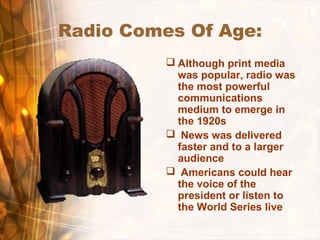
conflict today.
• Key Terms:
• Prohibition
• Speakeasy
• Bootlegger
• Key Terms / Names:
• Fundamentalist
• Clarence Darrow
• Scopes Trial
Changing Ways Of Life:
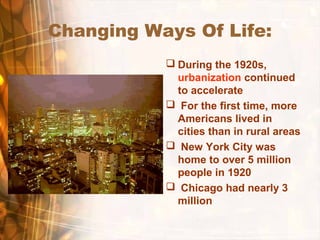
 During the 1920s,
urbanization continued
to accelerate
 For the first time, more
Americans lived in
cities than in rural areas
 New York City was
home to over 5 million
people in 1920
 Chicago had nearly 3
million
Urban vs. Rural:
 Throughout the 1920s,
Americans found
themselves caught
between urban and rural
cultures
 Urban life was
considered a world of
anonymous crowds,
strangers,
moneymakers, and
pleasure seekers
 Rural life was
considered to be safe,
with close personal ties,
hard work and morals
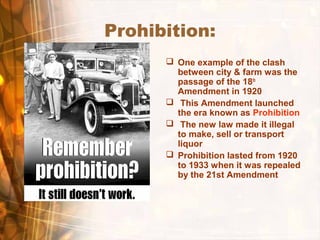
Prohibition:
 One example of the clash
between city & farm was the
passage of the 18th
Amendment in 1920
 This Amendment launched
the era known as Prohibition
 The new law made it illegal
to make, sell or transport
liquor
 Prohibition lasted from 1920
to 1933 when it was repealed
by the 21st Amendment
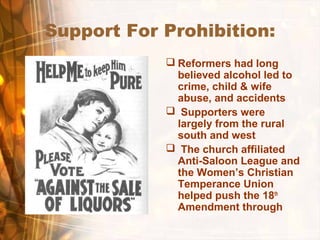
Support For Prohibition:
 Reformers had long
believed alcohol led to
crime, child & wife
abuse, and accidents
 Supporters were
largely from the rural
south and west
 The church affiliated
Anti-Saloon League and
the Women’s Christian
Temperance Union
helped push the 18th
Amendment through
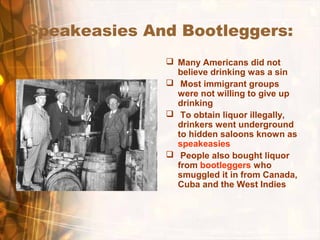
Speakeasies And Bootleggers:
 Many Americans did not
believe drinking was a sin
 Most immigrant groups
were not willing to give up
drinking
 To obtain liquor illegally,
drinkers went underground
to hidden saloons known as
speakeasies
 People also bought liquor
from bootleggers who
smuggled it in from Canada,
Cuba and the West Indies
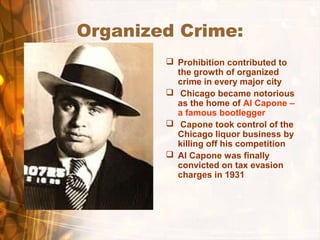
Organized Crime:
 Prohibition contributed to
the growth of organized
crime in every major city
 Chicago became notorious
as the home of Al Capone –
a famous bootlegger
 Capone took control of the
Chicago liquor business by
killing off his competition
 Al Capone was finally
convicted on tax evasion
charges in 1931
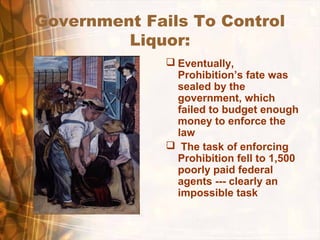
Government Fails To Control
Liquor:
 Eventually,
Prohibition’s fate was
sealed by the
government, which
failed to budget enough
money to enforce the
law
 The task of enforcing
Prohibition fell to 1,500
poorly paid federal
agents --- clearly an
impossible task
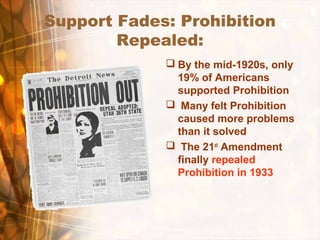
Support Fades: Prohibition
Repealed:
 By the mid-1920s, only
19% of Americans
supported Prohibition
 Many felt Prohibition
caused more problems
than it solved
 The 21st
Amendment
finally repealed
Prohibition in 1933
Science and Religion Clash:
 Another battleground during the 1920s was
between fundamentalist religious groups and
secular thinkers over the truths of science
 The Protestant movement grounded in the literal
interpretation of the bible is known as
fundamentalism
 Fundamentalists found all truth in the bible –
including science & evolution
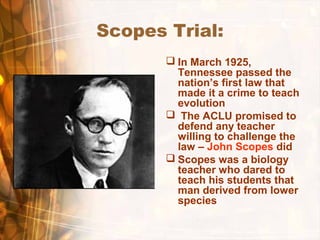
Scopes Trial:
 In March 1925,
Tennessee passed the
nation’s first law that
made it a crime to teach
evolution
 The ACLU promised to
defend any teacher
willing to challenge the
law – John Scopes did
 Scopes was a biology
teacher who dared to
teach his students that
man derived from lower
species
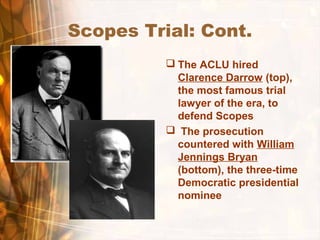
Scopes Trial: Cont.
 The ACLU hired
Clarence Darrow (top),
the most famous trial
lawyer of the era, to
defend Scopes
 The prosecution
countered with William
Jennings Bryan
(bottom), the three-time
Democratic presidential
nominee
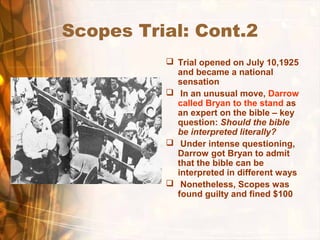
Scopes Trial: Cont.2
 Trial opened on July 10,1925
and became a national
sensation
 In an unusual move, Darrow
called Bryan to the stand as
an expert on the bible – key
question: Should the bible
be interpreted literally?
 Under intense questioning,
Darrow got Bryan to admit
that the bible can be
interpreted in different ways
 Nonetheless, Scopes was
found guilty and fined $100
The 18th
Amendment started
what era in American history?
1. Fundamentalism
2. Scopes Trial
3. Prohibition
4. The Great Depression
This was someone who
provided illegal alcohol
1. Bootlegger
2. Fundamentalist
3. Flappers
4. NAACP
Prohibition led to a rise in…
1. Bootlegging
2. Speakeasies
3. Organized crime
4. All of the above
According to fundamentalists,
alcohol caused all of the
following EXCEPT
1. Urban slums
2. Evangelism
3. Child abuse
4. Crime
Which of the following would be
less likely to support
Prohibition?
1. Recent immigrants
2. Rural residents of the South
3. Members of organized crime syndica
4. The Women’s Christian Temperance
Movement
People who supported
Prohibition tended to live in
urban areas.
1. True
2. False
Section 2: The Twenties
Woman
• Main Idea: American
women pursued new
lifestyles and assumed
new jobs and different
roles in society during the
1920’s.
• Why it Matters Now:
Workplace opportunities
and trends in family life
are still major issues for
women today.
• Key Terms:
• Flapper
• Double Standard
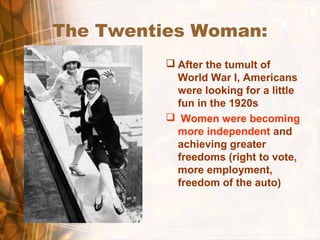
The Twenties Woman:
 After the tumult of
World War I, Americans
were looking for a little
fun in the 1920s
 Women were becoming
more independent and
achieving greater
freedoms (right to vote,
more employment,
freedom of the auto)
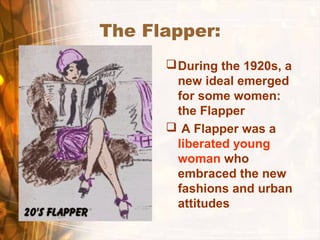
The Flapper:
During the 1920s, a
new ideal emerged
for some women:
the Flapper
 A Flapper was a
liberated young
woman who
embraced the new
fashions and urban
attitudes
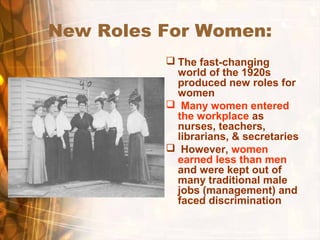
New Roles For Women:
 The fast-changing
world of the 1920s
produced new roles for
women
 Many women entered
the workplace as
nurses, teachers,
librarians, & secretaries
 However, women
earned less than men
and were kept out of
many traditional male
jobs (management) and
faced discrimination
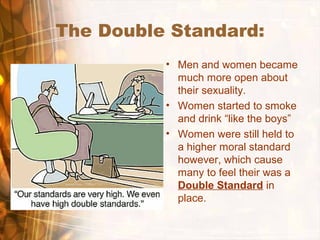
The Double Standard:
• Men and women became
much more open about
their sexuality.
• Women started to smoke
and drink “like the boys”
• Women were still held to
a higher moral standard
however, which cause
many to feel their was a
Double Standard in
place.
The Changing Family:
American birthrates declined for
several decades before the 1920s
 During the 1920s that trend increased
as birth control information became
widely available
 Birth control clinics opened and the
American Birth Control League was
founded in 1921
Modern Family Emerges:
 As the 1920s unfolded,
many features of the
modern family emerged
 Marriage was based on
romantic love, women
managed the household
and finances, and
children were not
considered laborers/
wage earners but rather
developing children
who needed nurturing
and education
Section 3: Education And
Popular Culture:
• Main Idea: The mass
media, movies, and
spectator sports played
important roles in creating
the popular culture of the
1920’s – a culture that
many artists and writers
criticized.
• Why it Matters Now:
Much of today’s popular
culture can trace its roots
to the popular culture of
the 1920’s.
• Key Names:
• Charles A. Lindbergh
• George Gershwin
• Georgia O’Keeffe
• Sinclair Lewis
• Key Names:
• F. Scott Fitzgerald
• Edna St. Vincent Millay
• Ernest Hemingway
Education And Popular Culture:
 During the 1920s,
developments in
education had a
powerful impact on the
nation
 Enrollment in high
schools quadrupled
between 1914 and 1926
 Public schools met the
challenge of educating
millions of immigrants
Expanding News Coverage:
 As literacy increased,
newspaper circulation
rose and mass-
circulation magazines
flourished
 By the end of the
1920s, ten American
magazines -- including
Reader’s Digest and
Time – boasted
circulations of over 2
million
Radio Comes Of Age:
 Although print media
was popular, radio was
the most powerful
communications
medium to emerge in
the 1920s
 News was delivered
faster and to a larger
audience
 Americans could hear
the voice of the
president or listen to
the World Series live
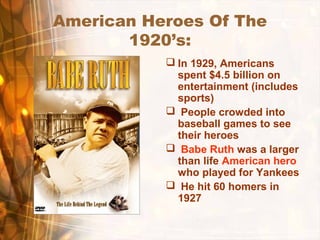
American Heroes Of The
1920’s:
 In 1929, Americans
spent $4.5 billion on
entertainment (includes
sports)
 People crowded into
baseball games to see
their heroes
 Babe Ruth was a larger
than life American hero
who played for Yankees
 He hit 60 homers in
1927
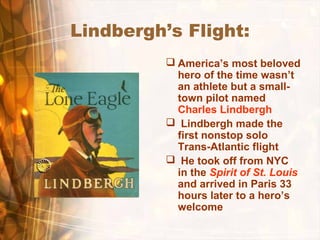
Lindbergh’s Flight:
 America’s most beloved
hero of the time wasn’t
an athlete but a small-
town pilot named
Charles Lindbergh
 Lindbergh made the
first nonstop solo
Trans-Atlantic flight
 He took off from NYC
in the Spirit of St. Louis
and arrived in Paris 33
hours later to a hero’s
welcome
Entertainment And Arts:
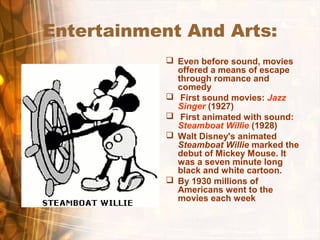
 Even before sound, movies
offered a means of escape
through romance and
comedy
 First sound movies: Jazz
Singer (1927)
 First animated with sound:
Steamboat Willie (1928)
 Walt Disney's animated
Steamboat Willie marked the
debut of Mickey Mouse. It
was a seven minute long
black and white cartoon.
 By 1930 millions of
Americans went to the
movies each week
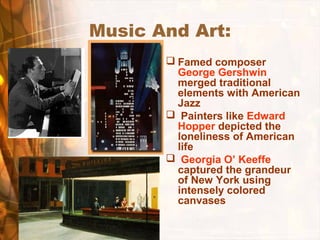
Music And Art:
 Famed composer
George Gershwin
merged traditional
elements with American
Jazz
 Painters like Edward
Hopper depicted the
loneliness of American
life
 Georgia O’ Keeffe
captured the grandeur
of New York using
intensely colored
canvases
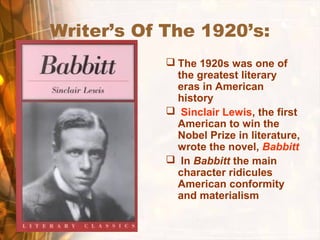
Writer’s Of The 1920’s:
 The 1920s was one of
the greatest literary
eras in American
history
 Sinclair Lewis, the first
American to win the
Nobel Prize in literature,
wrote the novel, Babbitt
 In Babbitt the main
character ridicules
American conformity
and materialism
Writer’s Of The 1920’s:
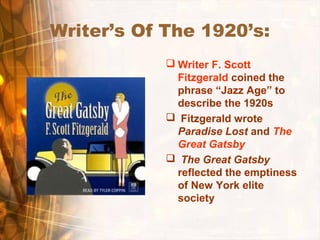
 Writer F. Scott
Fitzgerald coined the
phrase “Jazz Age” to
describe the 1920s
 Fitzgerald wrote
Paradise Lost and The
Great Gatsby
 The Great Gatsby
reflected the emptiness
of New York elite
society
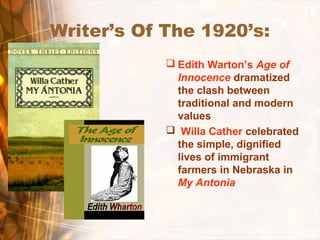
Writer’s Of The 1920’s:
 Edith Warton’s Age of
Innocence dramatized
the clash between
traditional and modern
values
 Willa Cather celebrated
the simple, dignified
lives of immigrant
farmers in Nebraska in
My Antonia
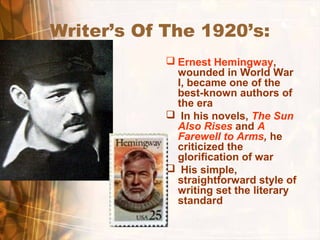
Writer’s Of The 1920’s:
 Ernest Hemingway,
wounded in World War
I, became one of the
best-known authors of
the era
 In his novels, The Sun
Also Rises and A
Farewell to Arms, he
criticized the
glorification of war
 His simple,
straightforward style of
writing set the literary
standard
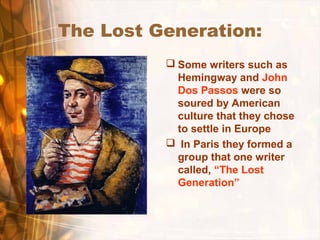
The Lost Generation:
 Some writers such as
Hemingway and John
Dos Passos were so
soured by American
culture that they chose
to settle in Europe
 In Paris they formed a
group that one writer
called, “The Lost
Generation”
Section 4: The Harlem
Renaissance
• Main Idea:African-
American ideas, politics,
art, literature, and music
flourished in Harlem and
elsewhere in the United
States.
• Why it Matters Now: The
Harlem Renaissance provided
a foundation of African-
American intellectualism to
which African-American
writers, artists, and musicians
contribute today.
• Key Terms / Names:
• Zora Neale Hurston
• James Weldon
Johnson
• Marcus Garvey
• Harlem Renaissance
• Claude McKay
• Key Terms / Names:
• Langston Hughes
• Paul Robeson
• Louis Armstrong
• Duke Ellington
• Bessie Smith
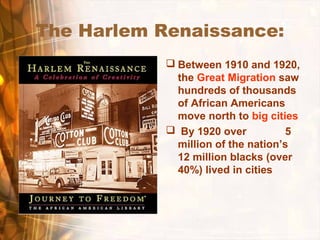
The Harlem Renaissance:
 Between 1910 and 1920,
the Great Migration saw
hundreds of thousands
of African Americans
move north to big cities
 By 1920 over 5
million of the nation’s
12 million blacks (over
40%) lived in cities
African American Goals:
Founded in 1909,
the NAACP urged
African Americans
to protest racial
violence
 W.E.B Dubois, a
founding member,
led a march of
10,000 black men in
NY to protest
violence
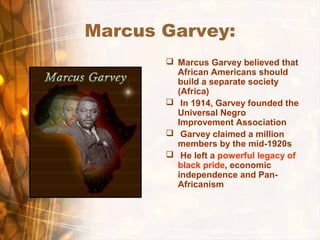
Marcus Garvey:
 Marcus Garvey believed that
African Americans should
build a separate society
(Africa)
 In 1914, Garvey founded the
Universal Negro
Improvement Association
 Garvey claimed a million
members by the mid-1920s
 He left a powerful legacy of
black pride, economic
independence and Pan-
Africanism
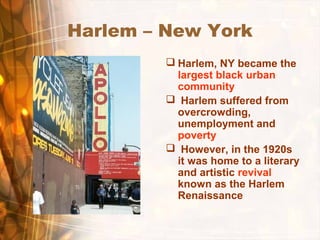
Harlem – New York
 Harlem, NY became the
largest black urban
community
 Harlem suffered from
overcrowding,
unemployment and
poverty
 However, in the 1920s
it was home to a literary
and artistic revival
known as the Harlem
Renaissance
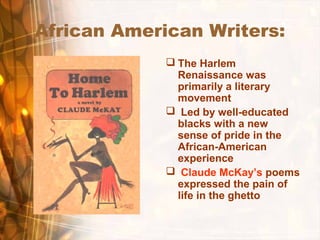
African American Writers:
 The Harlem
Renaissance was
primarily a literary
movement
 Led by well-educated
blacks with a new
sense of pride in the
African-American
experience
 Claude McKay’s poems
expressed the pain of
life in the ghetto
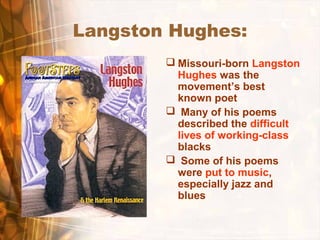
Langston Hughes:
 Missouri-born Langston
Hughes was the
movement’s best
known poet
 Many of his poems
described the difficult
lives of working-class
blacks
 Some of his poems
were put to music,
especially jazz and
blues
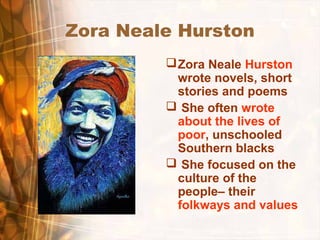
Zora Neale Hurston
Zora Neale Hurston
wrote novels, short
stories and poems
 She often wrote
about the lives of
poor, unschooled
Southern blacks
 She focused on the
culture of the
people– their
folkways and values
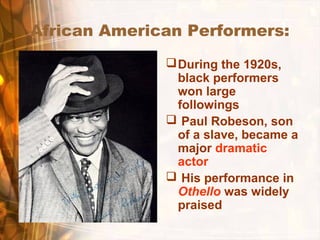
African American Performers:
During the 1920s,
black performers
won large
followings
 Paul Robeson, son
of a slave, became a
major dramatic
actor
 His performance in
Othello was widely
praised
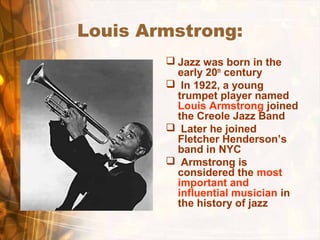
Louis Armstrong:
 Jazz was born in the
early 20th
century
 In 1922, a young
trumpet player named
Louis Armstrong joined
the Creole Jazz Band
 Later he joined
Fletcher Henderson’s
band in NYC
 Armstrong is
considered the most
important and
influential musician in
the history of jazz
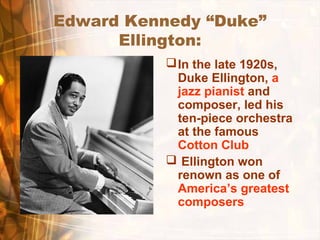
Edward Kennedy “Duke”
Ellington:
In the late 1920s,
Duke Ellington, a
jazz pianist and
composer, led his
ten-piece orchestra
at the famous
Cotton Club
 Ellington won
renown as one of
America’s greatest
composers
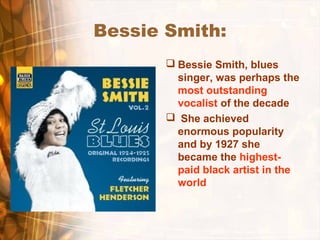
Bessie Smith:
 Bessie Smith, blues
singer, was perhaps the
most outstanding
vocalist of the decade
 She achieved
enormous popularity
and by 1927 she
became the highest-
paid black artist in the
world

Chapter 21 ppt

  • 1.
    The Roaring Life ofthe 1920’s
  • 2.
    Timeline: What’s GoingOn? • World: • 1921 – China’s Communist Party is founded • 1922 – King Tut’s tomb is discovered in Egypt • United States: • 1923 – Time magazine begins publication • 1924 – Calvin Coolidge is elected President • 1928 – Herbert Hoover is elected President
  • 3.
    Section 1: ChangingWays Of Life: • Main Idea: Americans experienced conflicts as customs and values changed in the 1920’s. • Why it Matters Now: The way in which different groups react to change continues to cause conflict today. • Key Terms: • Prohibition • Speakeasy • Bootlegger • Key Terms / Names: • Fundamentalist • Clarence Darrow • Scopes Trial
  • 4.
    Changing Ways OfLife:  During the 1920s, urbanization continued to accelerate  For the first time, more Americans lived in cities than in rural areas  New York City was home to over 5 million people in 1920  Chicago had nearly 3 million
  • 5.
    Urban vs. Rural: Throughout the 1920s, Americans found themselves caught between urban and rural cultures  Urban life was considered a world of anonymous crowds, strangers, moneymakers, and pleasure seekers  Rural life was considered to be safe, with close personal ties, hard work and morals
  • 6.
    Prohibition:  One exampleof the clash between city & farm was the passage of the 18th Amendment in 1920  This Amendment launched the era known as Prohibition  The new law made it illegal to make, sell or transport liquor  Prohibition lasted from 1920 to 1933 when it was repealed by the 21st Amendment
  • 7.
    Support For Prohibition: Reformers had long believed alcohol led to crime, child & wife abuse, and accidents  Supporters were largely from the rural south and west  The church affiliated Anti-Saloon League and the Women’s Christian Temperance Union helped push the 18th Amendment through
  • 8.
    Speakeasies And Bootleggers: Many Americans did not believe drinking was a sin  Most immigrant groups were not willing to give up drinking  To obtain liquor illegally, drinkers went underground to hidden saloons known as speakeasies  People also bought liquor from bootleggers who smuggled it in from Canada, Cuba and the West Indies
  • 9.
    Organized Crime:  Prohibitioncontributed to the growth of organized crime in every major city  Chicago became notorious as the home of Al Capone – a famous bootlegger  Capone took control of the Chicago liquor business by killing off his competition  Al Capone was finally convicted on tax evasion charges in 1931
  • 10.
    Government Fails ToControl Liquor:  Eventually, Prohibition’s fate was sealed by the government, which failed to budget enough money to enforce the law  The task of enforcing Prohibition fell to 1,500 poorly paid federal agents --- clearly an impossible task
  • 11.
    Support Fades: Prohibition Repealed: By the mid-1920s, only 19% of Americans supported Prohibition  Many felt Prohibition caused more problems than it solved  The 21st Amendment finally repealed Prohibition in 1933
  • 12.
    Science and ReligionClash:  Another battleground during the 1920s was between fundamentalist religious groups and secular thinkers over the truths of science  The Protestant movement grounded in the literal interpretation of the bible is known as fundamentalism  Fundamentalists found all truth in the bible – including science & evolution
  • 13.
    Scopes Trial:  InMarch 1925, Tennessee passed the nation’s first law that made it a crime to teach evolution  The ACLU promised to defend any teacher willing to challenge the law – John Scopes did  Scopes was a biology teacher who dared to teach his students that man derived from lower species
  • 14.
    Scopes Trial: Cont. The ACLU hired Clarence Darrow (top), the most famous trial lawyer of the era, to defend Scopes  The prosecution countered with William Jennings Bryan (bottom), the three-time Democratic presidential nominee
  • 15.
    Scopes Trial: Cont.2 Trial opened on July 10,1925 and became a national sensation  In an unusual move, Darrow called Bryan to the stand as an expert on the bible – key question: Should the bible be interpreted literally?  Under intense questioning, Darrow got Bryan to admit that the bible can be interpreted in different ways  Nonetheless, Scopes was found guilty and fined $100
  • 16.
    The 18th Amendment started whatera in American history? 1. Fundamentalism 2. Scopes Trial 3. Prohibition 4. The Great Depression
  • 17.
    This was someonewho provided illegal alcohol 1. Bootlegger 2. Fundamentalist 3. Flappers 4. NAACP
  • 18.
    Prohibition led toa rise in… 1. Bootlegging 2. Speakeasies 3. Organized crime 4. All of the above
  • 19.
    According to fundamentalists, alcoholcaused all of the following EXCEPT 1. Urban slums 2. Evangelism 3. Child abuse 4. Crime
  • 20.
    Which of thefollowing would be less likely to support Prohibition? 1. Recent immigrants 2. Rural residents of the South 3. Members of organized crime syndica 4. The Women’s Christian Temperance Movement
  • 21.
    People who supported Prohibitiontended to live in urban areas. 1. True 2. False
  • 22.
    Section 2: TheTwenties Woman • Main Idea: American women pursued new lifestyles and assumed new jobs and different roles in society during the 1920’s. • Why it Matters Now: Workplace opportunities and trends in family life are still major issues for women today. • Key Terms: • Flapper • Double Standard
  • 23.
    The Twenties Woman: After the tumult of World War I, Americans were looking for a little fun in the 1920s  Women were becoming more independent and achieving greater freedoms (right to vote, more employment, freedom of the auto)
  • 24.
    The Flapper: During the1920s, a new ideal emerged for some women: the Flapper  A Flapper was a liberated young woman who embraced the new fashions and urban attitudes
  • 25.
    New Roles ForWomen:  The fast-changing world of the 1920s produced new roles for women  Many women entered the workplace as nurses, teachers, librarians, & secretaries  However, women earned less than men and were kept out of many traditional male jobs (management) and faced discrimination
  • 26.
    The Double Standard: •Men and women became much more open about their sexuality. • Women started to smoke and drink “like the boys” • Women were still held to a higher moral standard however, which cause many to feel their was a Double Standard in place.
  • 27.
    The Changing Family: Americanbirthrates declined for several decades before the 1920s  During the 1920s that trend increased as birth control information became widely available  Birth control clinics opened and the American Birth Control League was founded in 1921
  • 28.
    Modern Family Emerges: As the 1920s unfolded, many features of the modern family emerged  Marriage was based on romantic love, women managed the household and finances, and children were not considered laborers/ wage earners but rather developing children who needed nurturing and education
  • 29.
    Section 3: EducationAnd Popular Culture: • Main Idea: The mass media, movies, and spectator sports played important roles in creating the popular culture of the 1920’s – a culture that many artists and writers criticized. • Why it Matters Now: Much of today’s popular culture can trace its roots to the popular culture of the 1920’s. • Key Names: • Charles A. Lindbergh • George Gershwin • Georgia O’Keeffe • Sinclair Lewis • Key Names: • F. Scott Fitzgerald • Edna St. Vincent Millay • Ernest Hemingway
  • 30.
    Education And PopularCulture:  During the 1920s, developments in education had a powerful impact on the nation  Enrollment in high schools quadrupled between 1914 and 1926  Public schools met the challenge of educating millions of immigrants
  • 31.
    Expanding News Coverage: As literacy increased, newspaper circulation rose and mass- circulation magazines flourished  By the end of the 1920s, ten American magazines -- including Reader’s Digest and Time – boasted circulations of over 2 million
  • 32.
    Radio Comes OfAge:  Although print media was popular, radio was the most powerful communications medium to emerge in the 1920s  News was delivered faster and to a larger audience  Americans could hear the voice of the president or listen to the World Series live
  • 33.
    American Heroes OfThe 1920’s:  In 1929, Americans spent $4.5 billion on entertainment (includes sports)  People crowded into baseball games to see their heroes  Babe Ruth was a larger than life American hero who played for Yankees  He hit 60 homers in 1927
  • 34.
    Lindbergh’s Flight:  America’smost beloved hero of the time wasn’t an athlete but a small- town pilot named Charles Lindbergh  Lindbergh made the first nonstop solo Trans-Atlantic flight  He took off from NYC in the Spirit of St. Louis and arrived in Paris 33 hours later to a hero’s welcome
  • 35.
    Entertainment And Arts: Even before sound, movies offered a means of escape through romance and comedy  First sound movies: Jazz Singer (1927)  First animated with sound: Steamboat Willie (1928)  Walt Disney's animated Steamboat Willie marked the debut of Mickey Mouse. It was a seven minute long black and white cartoon.  By 1930 millions of Americans went to the movies each week
  • 36.
    Music And Art: Famed composer George Gershwin merged traditional elements with American Jazz  Painters like Edward Hopper depicted the loneliness of American life  Georgia O’ Keeffe captured the grandeur of New York using intensely colored canvases
  • 37.
    Writer’s Of The1920’s:  The 1920s was one of the greatest literary eras in American history  Sinclair Lewis, the first American to win the Nobel Prize in literature, wrote the novel, Babbitt  In Babbitt the main character ridicules American conformity and materialism
  • 38.
    Writer’s Of The1920’s:  Writer F. Scott Fitzgerald coined the phrase “Jazz Age” to describe the 1920s  Fitzgerald wrote Paradise Lost and The Great Gatsby  The Great Gatsby reflected the emptiness of New York elite society
  • 39.
    Writer’s Of The1920’s:  Edith Warton’s Age of Innocence dramatized the clash between traditional and modern values  Willa Cather celebrated the simple, dignified lives of immigrant farmers in Nebraska in My Antonia
  • 40.
    Writer’s Of The1920’s:  Ernest Hemingway, wounded in World War I, became one of the best-known authors of the era  In his novels, The Sun Also Rises and A Farewell to Arms, he criticized the glorification of war  His simple, straightforward style of writing set the literary standard
  • 41.
    The Lost Generation: Some writers such as Hemingway and John Dos Passos were so soured by American culture that they chose to settle in Europe  In Paris they formed a group that one writer called, “The Lost Generation”
  • 42.
    Section 4: TheHarlem Renaissance • Main Idea:African- American ideas, politics, art, literature, and music flourished in Harlem and elsewhere in the United States. • Why it Matters Now: The Harlem Renaissance provided a foundation of African- American intellectualism to which African-American writers, artists, and musicians contribute today. • Key Terms / Names: • Zora Neale Hurston • James Weldon Johnson • Marcus Garvey • Harlem Renaissance • Claude McKay • Key Terms / Names: • Langston Hughes • Paul Robeson • Louis Armstrong • Duke Ellington • Bessie Smith
  • 43.
    The Harlem Renaissance: Between 1910 and 1920, the Great Migration saw hundreds of thousands of African Americans move north to big cities  By 1920 over 5 million of the nation’s 12 million blacks (over 40%) lived in cities
  • 44.
    African American Goals: Foundedin 1909, the NAACP urged African Americans to protest racial violence  W.E.B Dubois, a founding member, led a march of 10,000 black men in NY to protest violence
  • 45.
    Marcus Garvey:  MarcusGarvey believed that African Americans should build a separate society (Africa)  In 1914, Garvey founded the Universal Negro Improvement Association  Garvey claimed a million members by the mid-1920s  He left a powerful legacy of black pride, economic independence and Pan- Africanism
  • 46.
    Harlem – NewYork  Harlem, NY became the largest black urban community  Harlem suffered from overcrowding, unemployment and poverty  However, in the 1920s it was home to a literary and artistic revival known as the Harlem Renaissance
  • 47.
    African American Writers: The Harlem Renaissance was primarily a literary movement  Led by well-educated blacks with a new sense of pride in the African-American experience  Claude McKay’s poems expressed the pain of life in the ghetto
  • 48.
    Langston Hughes:  Missouri-bornLangston Hughes was the movement’s best known poet  Many of his poems described the difficult lives of working-class blacks  Some of his poems were put to music, especially jazz and blues
  • 49.
    Zora Neale Hurston ZoraNeale Hurston wrote novels, short stories and poems  She often wrote about the lives of poor, unschooled Southern blacks  She focused on the culture of the people– their folkways and values
  • 50.
    African American Performers: Duringthe 1920s, black performers won large followings  Paul Robeson, son of a slave, became a major dramatic actor  His performance in Othello was widely praised
  • 51.
    Louis Armstrong:  Jazzwas born in the early 20th century  In 1922, a young trumpet player named Louis Armstrong joined the Creole Jazz Band  Later he joined Fletcher Henderson’s band in NYC  Armstrong is considered the most important and influential musician in the history of jazz
  • 52.
    Edward Kennedy “Duke” Ellington: Inthe late 1920s, Duke Ellington, a jazz pianist and composer, led his ten-piece orchestra at the famous Cotton Club  Ellington won renown as one of America’s greatest composers
  • 53.
    Bessie Smith:  BessieSmith, blues singer, was perhaps the most outstanding vocalist of the decade  She achieved enormous popularity and by 1927 she became the highest- paid black artist in the world