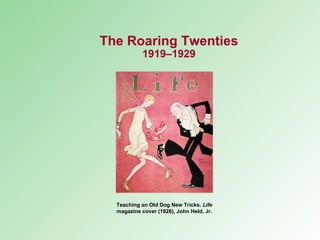
Teaching an Old Dog New Tricks.  Life  magazine cover (1926), John Held, Jr. The Roaring Twenties 1919–1929
Government supports  business Hands-off policy in  other matters The Business of America 1 SECTION
Harding and the “Return to Normalcy” The Business of America • President  Warren G. Harding   promises to return U.S. to  “ normalcy ” •  Pro-business  cabinet includes  Andrew W. Mellon  as Secretary  of  the Treasury 1 SECTION
• President Harding appoints unqualified, corrupt men, cabinet positions  (Ohio Gang) • In the  Teapot Dome Scandal   Secretary of the Interior Albert Fall: -  takes bribes -  makes illegal deals with oil executives • Harding depressed about scandals, dies suddenly (1923) continued   Harding and the “Return to Normalcy” The Business of America 1 SECTION
Coolidge Takes Over • Vice-President  Calvin Coolidge • Tries to clean up scandals, elected president  in his own right (1924) • Laissez faire —business unregulated by  government benefits the nation •  Under “laissez faire”, U.S. business  prospers • Refuses to help farmers; doesn’t believe in  government help for individuals The Business of America 1 SECTION
• President Coolidge is an  isolationist : - U.S. stays out of other nations’ affairs  except for self-defense • Helps set up the  Kellogg-Briand Pact   (1928): - 15 nations agree not to make war on each  other, only self-defense continued  Coolidge Takes Over The Business of America 1 SECTION
Technology Changes American Life • Average annual income per person rises 35 % • Americans have more money to buy goods, spend on leisure • Using assembly lines,  Henry Ford  makes cars  most people can afford • Assembly line —product moves along  conveyor belt across the factory The Business of America 1 SECTION
• Installment buying —repay borrowed  amount in small monthly payments • National advertising begins, promotes  new products • Cheap fuel powers new inventions that  make life easier continued  Technology Changes American Life The Business of America 1 SECTION
The Air Age Begins • Former WW I pilots work as: - crop-dusters, stunt fliers, flight instructors • U.S. Post Office Department begins air mail  service (1918) • Charles A. Lindbergh, Amelia Earhart fly  across the Atlantic • Pan American Airways becomes first  U.S. passenger airline (1927) The Business of America 1 SECTION
1920s bring new attitudes and lifestyles but also cause divisions and conflict. Section 2 Changes in Society
Youth in the Roaring Twenties Changes in Society • 1920s celebrates youth, young people rebel against tradition and authority • Young people stay in school longer, wear daring clothes, follow silly fads • Dance marathons are popular and  Charleston  is a favorite dance 2 SECTION
New Roles for Women • The symbol of 1920s American women  is the  flapper • 19th Amendment assures women  have the right to vote Changes in Society 2 SECTION
Prohibition and Lawlessness • 18th Amendment— Prohibition —bans  making, selling alcohol (1920) • Speakeasies  sell alcohol, bootleggers transport,  sell liquor illegally • Organized crime gangs battle for control of  bootlegging operations • Crime boss  Al Capone   seizes control of  10,000 speakeasies in Chicago • Prohibition fails, 21st Amendment repealed  Prohibition (1933) Changes in Society 2 SECTION
Changes for African Americans • In 1920s, many African Americans move North,  get better jobs • Gain some economic, political power • National Association for the Advancement of  Colored People  (NAACP) • Marcus Garvey   calls blacks to return to Africa  and form separate nation Changes in Society 2 SECTION
A Divided Society • Fundamentalism —believe in literal  interpretation of the Bible • John Scopes  breaks evolution ban,  found guilty, decision reversed • Ku Klux Klan   gains strength, tries to influence politics Changes in Society 2 SECTION
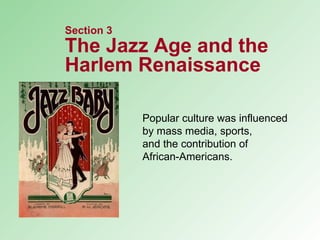
Popular culture was influenced by mass media, sports,  and the contribution of  African-Americans. Section 3 The Jazz Age and the Harlem Renaissance
More Leisure Time for Americans The Jazz Age and the Harlem Renaissance • Laborsaving appliances, shorter work  hours increase leisure time • People get higher wages, spend more  on leisure activities: -  go to movies, reading, listening    to radio, talking on phones 3 SECTION
Mass Media and Popular Culture • Mass media —communication to large  audience—takes hold in 1920s • People flock to movies to see favorite  actors and actresses such as Charlie  Chaplin • Films silent, most of 1920s, 1st talking  movie  The Jazz Singer  (1927) The Jazz Age and the Harlem Renaissance 3 SECTION
A Search for Heroes • Sporting events of all types enjoy rising attendance • Sports figures give people hope for better life, heroes such as: - Babe Ruth, baseball player - Bobby Jones, golfer - Gertrude Ederle, swimmer - Jack Dempsey, boxer The Jazz Age and the Harlem Renaissance 3 SECTION
The Lost Generation • Lost Generation —artists, writers  resent WW I, see little hope for future • Become  expatriates —people who live  in a country other than their own Ernest Hemingway F. Scott Fitzgerald Sinclair Lewis The Jazz Age and the Harlem Renaissance   3 SECTION
The Harlem Renaissance • Harlem Renaissance —burst of black  cultural activity, Harlem, NYC  • Artists develop, exchange ideas -  Langston Hughes—poet • Jazz—combines African rhythms,  blues, ragtime -  Louis Armstrong -  Duke Ellington • Starts in New Orleans The Jazz Age and the Harlem Renaissance 3 SECTION
The Roaring Twenties The End!!

Roaring twenties 2009

  • 1.
    Teaching an OldDog New Tricks. Life magazine cover (1926), John Held, Jr. The Roaring Twenties 1919–1929
  • 2.
    Government supports business Hands-off policy in other matters The Business of America 1 SECTION
  • 3.
    Harding and the“Return to Normalcy” The Business of America • President Warren G. Harding promises to return U.S. to “ normalcy ” • Pro-business cabinet includes Andrew W. Mellon as Secretary of the Treasury 1 SECTION
  • 4.
    • President Hardingappoints unqualified, corrupt men, cabinet positions (Ohio Gang) • In the Teapot Dome Scandal Secretary of the Interior Albert Fall: - takes bribes - makes illegal deals with oil executives • Harding depressed about scandals, dies suddenly (1923) continued Harding and the “Return to Normalcy” The Business of America 1 SECTION
  • 5.
    Coolidge Takes Over• Vice-President Calvin Coolidge • Tries to clean up scandals, elected president in his own right (1924) • Laissez faire —business unregulated by government benefits the nation • Under “laissez faire”, U.S. business prospers • Refuses to help farmers; doesn’t believe in government help for individuals The Business of America 1 SECTION
  • 6.
    • President Coolidgeis an isolationist : - U.S. stays out of other nations’ affairs except for self-defense • Helps set up the Kellogg-Briand Pact (1928): - 15 nations agree not to make war on each other, only self-defense continued Coolidge Takes Over The Business of America 1 SECTION
  • 7.
    Technology Changes AmericanLife • Average annual income per person rises 35 % • Americans have more money to buy goods, spend on leisure • Using assembly lines, Henry Ford makes cars most people can afford • Assembly line —product moves along conveyor belt across the factory The Business of America 1 SECTION
  • 8.
    • Installment buying—repay borrowed amount in small monthly payments • National advertising begins, promotes new products • Cheap fuel powers new inventions that make life easier continued Technology Changes American Life The Business of America 1 SECTION
  • 9.
    The Air AgeBegins • Former WW I pilots work as: - crop-dusters, stunt fliers, flight instructors • U.S. Post Office Department begins air mail service (1918) • Charles A. Lindbergh, Amelia Earhart fly across the Atlantic • Pan American Airways becomes first U.S. passenger airline (1927) The Business of America 1 SECTION
  • 10.
    1920s bring newattitudes and lifestyles but also cause divisions and conflict. Section 2 Changes in Society
  • 11.
    Youth in theRoaring Twenties Changes in Society • 1920s celebrates youth, young people rebel against tradition and authority • Young people stay in school longer, wear daring clothes, follow silly fads • Dance marathons are popular and Charleston is a favorite dance 2 SECTION
  • 12.
    New Roles forWomen • The symbol of 1920s American women is the flapper • 19th Amendment assures women have the right to vote Changes in Society 2 SECTION
  • 13.
    Prohibition and Lawlessness• 18th Amendment— Prohibition —bans making, selling alcohol (1920) • Speakeasies sell alcohol, bootleggers transport, sell liquor illegally • Organized crime gangs battle for control of bootlegging operations • Crime boss Al Capone seizes control of 10,000 speakeasies in Chicago • Prohibition fails, 21st Amendment repealed Prohibition (1933) Changes in Society 2 SECTION
  • 14.
    Changes for AfricanAmericans • In 1920s, many African Americans move North, get better jobs • Gain some economic, political power • National Association for the Advancement of Colored People (NAACP) • Marcus Garvey calls blacks to return to Africa and form separate nation Changes in Society 2 SECTION
  • 15.
    A Divided Society• Fundamentalism —believe in literal interpretation of the Bible • John Scopes breaks evolution ban, found guilty, decision reversed • Ku Klux Klan gains strength, tries to influence politics Changes in Society 2 SECTION
  • 16.
    Popular culture wasinfluenced by mass media, sports, and the contribution of African-Americans. Section 3 The Jazz Age and the Harlem Renaissance
  • 17.
    More Leisure Timefor Americans The Jazz Age and the Harlem Renaissance • Laborsaving appliances, shorter work hours increase leisure time • People get higher wages, spend more on leisure activities: - go to movies, reading, listening to radio, talking on phones 3 SECTION
  • 18.
    Mass Media andPopular Culture • Mass media —communication to large audience—takes hold in 1920s • People flock to movies to see favorite actors and actresses such as Charlie Chaplin • Films silent, most of 1920s, 1st talking movie The Jazz Singer (1927) The Jazz Age and the Harlem Renaissance 3 SECTION
  • 19.
    A Search forHeroes • Sporting events of all types enjoy rising attendance • Sports figures give people hope for better life, heroes such as: - Babe Ruth, baseball player - Bobby Jones, golfer - Gertrude Ederle, swimmer - Jack Dempsey, boxer The Jazz Age and the Harlem Renaissance 3 SECTION
  • 20.
    The Lost Generation• Lost Generation —artists, writers resent WW I, see little hope for future • Become expatriates —people who live in a country other than their own Ernest Hemingway F. Scott Fitzgerald Sinclair Lewis The Jazz Age and the Harlem Renaissance 3 SECTION
  • 21.
    The Harlem Renaissance• Harlem Renaissance —burst of black cultural activity, Harlem, NYC • Artists develop, exchange ideas - Langston Hughes—poet • Jazz—combines African rhythms, blues, ragtime - Louis Armstrong - Duke Ellington • Starts in New Orleans The Jazz Age and the Harlem Renaissance 3 SECTION
  • 22.

Editor's Notes