The
Twenties Overview
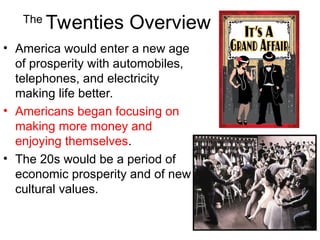
• America would enter a new age
of prosperity with automobiles,
telephones, and electricity
making life better.
• Americans began focusing on
making more money and
enjoying themselves.
• The 20s would be a period of
economic prosperity and of new
cultural values.
The Red Scare
• The end of World War 1 brought new
fears to Americans about Communists,
anarchists, and immigrants.
• In 1917, the Russians led by Lenin had
a revolution, but instead of setting up a
democracy, it became a communist
nation.
• Communists threatened to spread their
revolution to other nations in Europe.
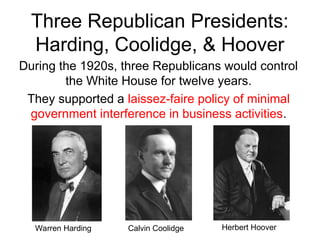
Three Republican Presidents:
Harding, Coolidge, & Hoover
During the 1920s, three Republicans would control
the White House for twelve years.
They supported a laissez-faire policy of minimal
government interference in business activities.
Warren Harding Herbert Hoover
Calvin Coolidge
Pres. Warren G. Harding
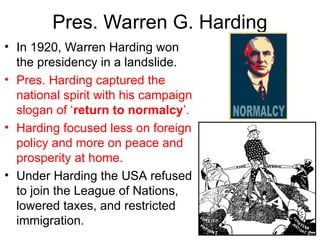
• In 1920, Warren Harding won
the presidency in a landslide.
• Pres. Harding captured the
national spirit with his campaign
slogan of ‘return to normalcy’.
• Harding focused less on foreign
policy and more on peace and
prosperity at home.
• Under Harding the USA refused
to join the League of Nations,
lowered taxes, and restricted
immigration.
Pres. Warren G. Harding
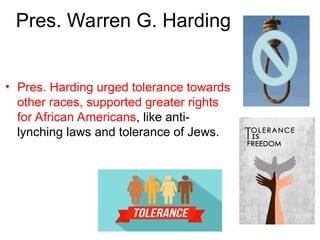
• Pres. Harding urged tolerance towards
other races, supported greater rights
for African Americans, like anti-
lynching laws and tolerance of Jews.
Pres. Calvin Coolidge
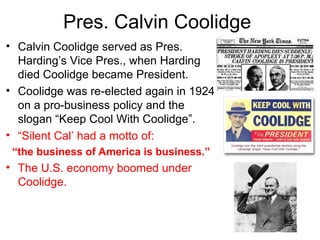
• Calvin Coolidge served as Pres.
Harding’s Vice Pres., when Harding
died Coolidge became President.
• Coolidge was re-elected again in 1924
on a pro-business policy and the
slogan “Keep Cool With Coolidge”.
• “Silent Cal’ had a motto of:
“the business of America is business.”
• The U.S. economy boomed under
Coolidge.
Pres. Herbert Hoover
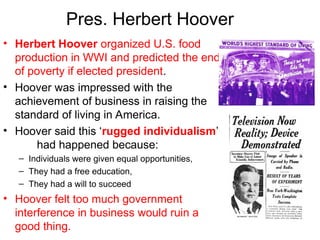
• Herbert Hoover organized U.S. food
production in WWI and predicted the end
of poverty if elected president.
• Hoover was impressed with the
achievement of business in raising the
standard of living in America.
• Hoover said this ‘rugged individualism’
had happened because:
– Individuals were given equal opportunities,
– They had a free education,
– They had a will to succeed
• Hoover felt too much government
interference in business would ruin a
good thing.
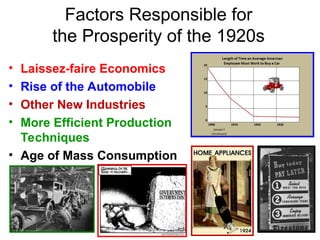
• Laissez-faire Economics
• Rise of the Automobile
• Other New Industries
• More Efficient Production
Techniques
• Age of Mass Consumption
Factors Responsible for
the Prosperity of the 1920s
The Rise of the Automobile
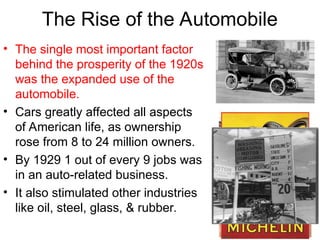
• The single most important factor
behind the prosperity of the 1920s
was the expanded use of the
automobile.
• Cars greatly affected all aspects
of American life, as ownership
rose from 8 to 24 million owners.
• By 1929 1 out of every 9 jobs was
in an auto-related business.
• It also stimulated other industries
like oil, steel, glass, & rubber.
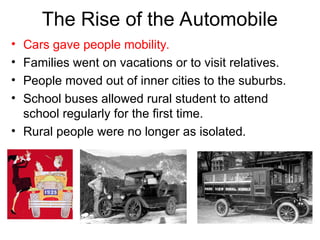
• Cars gave people mobility.
• Families went on vacations or to visit relatives.
• People moved out of inner cities to the suburbs.
• School buses allowed rural student to attend
school regularly for the first time.
• Rural people were no longer as isolated.
The Rise of the Automobile
Henry Ford
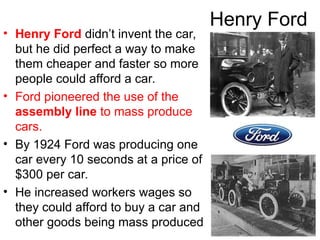
• Henry Ford didn’t invent the car,
but he did perfect a way to make
them cheaper and faster so more
people could afford a car.
• Ford pioneered the use of the
assembly line to mass produce
cars.
• By 1924 Ford was producing one
car every 10 seconds at a price of
$300 per car.
• He increased workers wages so
they could afford to buy a car and
other goods being mass produced
Rise of Other New Industries
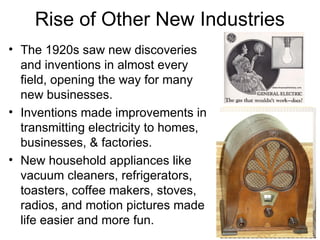
• The 1920s saw new discoveries
and inventions in almost every
field, opening the way for many
new businesses.
• Inventions made improvements in
transmitting electricity to homes,
businesses, & factories.
• New household appliances like
vacuum cleaners, refrigerators,
toasters, coffee makers, stoves,
radios, and motion pictures made
life easier and more fun.
More Efficient Production Techniques
• New manufacturing techniques,
such as the assembly line, led to
improved efficiency.
• As efficiency increased consumers
benefitted from lower prices for
goods.
• An unintended consequences of
this improved efficiency was that
skilled workers were no longer
needed leading to an increase in
unemployment.
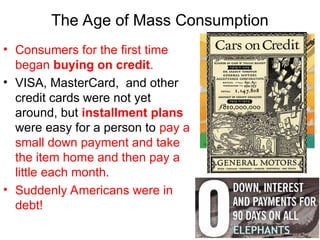
• Consumers for the first time
began buying on credit.
• VISA, MasterCard, and other
credit cards were not yet
around, but installment plans
were easy for a person to pay a
small down payment and take
the item home and then pay a
little each month.
• Suddenly Americans were in
debt!
The Age of Mass Consumption
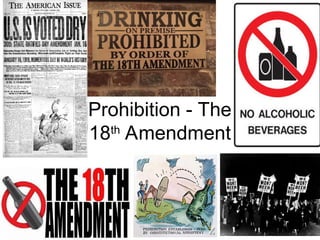
Prohibition - The
18th
Amendment
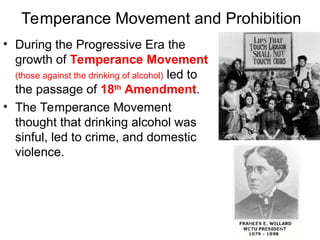
Temperance Movement and Prohibition
• During the Progressive Era the
growth of Temperance Movement
(those against the drinking of alcohol) led to
the passage of 18th
Amendment.
• The Temperance Movement
thought that drinking alcohol was
sinful, led to crime, and domestic
violence.
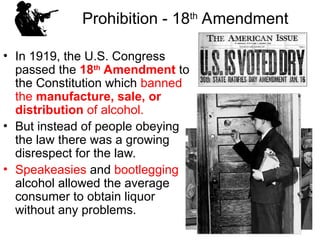
Prohibition - 18th
Amendment
• In 1919, the U.S. Congress
passed the 18th
Amendment to
the Constitution which banned
the manufacture, sale, or
distribution of alcohol.
• But instead of people obeying
the law there was a growing
disrespect for the law.
• Speakeasies and bootlegging
alcohol allowed the average
consumer to obtain liquor
without any problems.
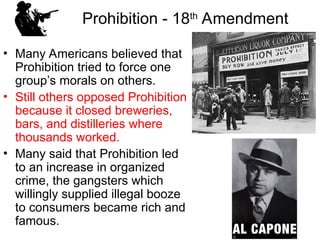
Prohibition - 18th
Amendment
• Many Americans believed that
Prohibition tried to force one
group’s morals on others.
• Still others opposed Prohibition
because it closed breweries,
bars, and distilleries where
thousands worked.
• Many said that Prohibition led
to an increase in organized
crime, the gangsters which
willingly supplied illegal booze
to consumers became rich and
famous.
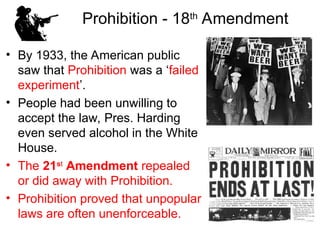
• By 1933, the American public
saw that Prohibition was a ‘failed
experiment’.
• People had been unwilling to
accept the law, Pres. Harding
even served alcohol in the White
House.
• The 21st
Amendment repealed
or did away with Prohibition.
• Prohibition proved that unpopular
laws are often unenforceable.
Prohibition - 18th
Amendment
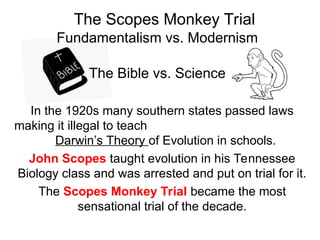
The Bible vs. Science
Fundamentalism vs. Modernism
The Scopes Monkey Trial
In the 1920s many southern states passed laws
making it illegal to teach
Darwin’s Theory of Evolution in schools.
John Scopes taught evolution in his Tennessee
Biology class and was arrested and put on trial for it.
The Scopes Monkey Trial became the most
sensational trial of the decade.
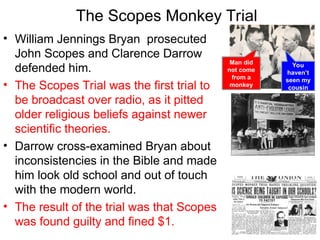
• William Jennings Bryan prosecuted
John Scopes and Clarence Darrow
defended him.
• The Scopes Trial was the first trial to
be broadcast over radio, as it pitted
older religious beliefs against newer
scientific theories.
• Darrow cross-examined Bryan about
inconsistencies in the Bible and made
him look old school and out of touch
with the modern world.
• The result of the trial was that Scopes
was found guilty and fined $1.
The Scopes Monkey Trial
Man did
not come
from a
monkey
You
haven’t
seen my
cousin
The Emergence of New Values
Traditional values that had existed in
America before the 1920s were found to be
old and outdated.
Instead, the 1920s led to newer, more
modern values which encouraged a greater
openness and self-expression.
Changes in music, art, literature, and
sexuality provided the opportunity for
expression of these freedoms.
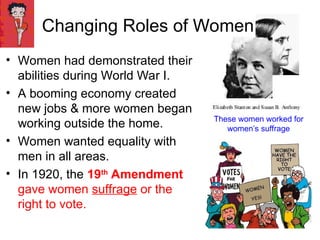
Changing Roles of Women
• Women had demonstrated their
abilities during World War I.
• A booming economy created
new jobs & more women began
working outside the home.
• Women wanted equality with
men in all areas.
• In 1920, the 19th
Amendment
gave women suffrage or the
right to vote.
These women worked for
women’s suffrage
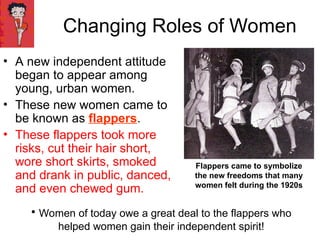
• A new independent attitude
began to appear among
young, urban women.
• These new women came to
be known as flappers.
• These flappers took more
risks, cut their hair short,
wore short skirts, smoked
and drank in public, danced,
and even chewed gum.
Changing Roles of Women
Flappers came to symbolize
the new freedoms that many
women felt during the 1920s
• Women of today owe a great deal to the flappers who
helped women gain their independent spirit!
Youth and the Lost Generation
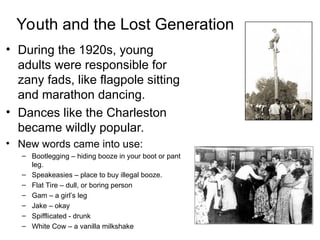
• During the 1920s, young
adults were responsible for
zany fads, like flagpole sitting
and marathon dancing.
• Dances like the Charleston
became wildly popular.
• New words came into use:
– Bootlegging – hiding booze in your boot or pant
leg.
– Speakeasies – place to buy illegal booze.
– Flat Tire – dull, or boring person
– Gam – a girl’s leg
– Jake – okay
– Spifflicated - drunk
– White Cow – a vanilla milkshake
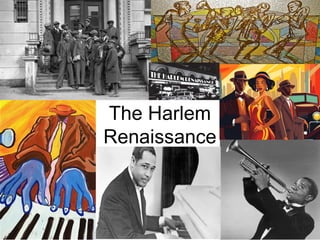
The Harlem
Renaissance
The Great Migration
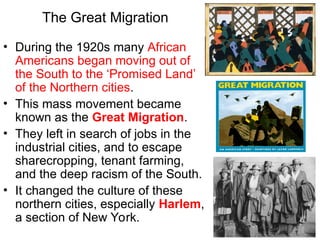
• During the 1920s many African
Americans began moving out of
the South to the ‘Promised Land’
of the Northern cities.
• This mass movement became
known as the Great Migration.
• They left in search of jobs in the
industrial cities, and to escape
sharecropping, tenant farming,
and the deep racism of the South.
• It changed the culture of these
northern cities, especially Harlem,
a section of New York.
The Harlem Renaissance
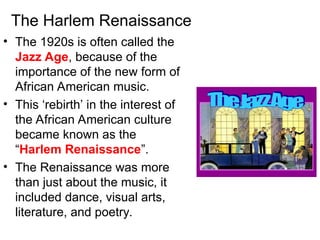
• The 1920s is often called the
Jazz Age, because of the
importance of the new form of
African American music.
• This ‘rebirth’ in the interest of
the African American culture
became known as the
“Harlem Renaissance”.
• The Renaissance was more
than just about the music, it
included dance, visual arts,
literature, and poetry.
Summary of the Roaring 20s
The 1920s was a time of great excitement and rapid
changes that ended with a crash!
The 1920s started out slowly but grew into a period of
great prosperity.
A fear of communism, immigrants, & alcohol helped
create feelings of mistrust, hatred, and unlawfulness.
Women’s suffrage, flappers, Ford cars, the Harlem
Renaissance, and new technologies made the 1920s
an exciting time to live.
The 20s roared until the stock market crashed and
brought on the Great Depression.

.................................................

  • 2.
    The Twenties Overview • Americawould enter a new age of prosperity with automobiles, telephones, and electricity making life better. • Americans began focusing on making more money and enjoying themselves. • The 20s would be a period of economic prosperity and of new cultural values.
  • 3.
    The Red Scare •The end of World War 1 brought new fears to Americans about Communists, anarchists, and immigrants. • In 1917, the Russians led by Lenin had a revolution, but instead of setting up a democracy, it became a communist nation. • Communists threatened to spread their revolution to other nations in Europe.
  • 4.
    Three Republican Presidents: Harding,Coolidge, & Hoover During the 1920s, three Republicans would control the White House for twelve years. They supported a laissez-faire policy of minimal government interference in business activities. Warren Harding Herbert Hoover Calvin Coolidge
  • 5.
    Pres. Warren G.Harding • In 1920, Warren Harding won the presidency in a landslide. • Pres. Harding captured the national spirit with his campaign slogan of ‘return to normalcy’. • Harding focused less on foreign policy and more on peace and prosperity at home. • Under Harding the USA refused to join the League of Nations, lowered taxes, and restricted immigration.
  • 6.
    Pres. Warren G.Harding • Pres. Harding urged tolerance towards other races, supported greater rights for African Americans, like anti- lynching laws and tolerance of Jews.
  • 7.
    Pres. Calvin Coolidge •Calvin Coolidge served as Pres. Harding’s Vice Pres., when Harding died Coolidge became President. • Coolidge was re-elected again in 1924 on a pro-business policy and the slogan “Keep Cool With Coolidge”. • “Silent Cal’ had a motto of: “the business of America is business.” • The U.S. economy boomed under Coolidge.
  • 8.
    Pres. Herbert Hoover •Herbert Hoover organized U.S. food production in WWI and predicted the end of poverty if elected president. • Hoover was impressed with the achievement of business in raising the standard of living in America. • Hoover said this ‘rugged individualism’ had happened because: – Individuals were given equal opportunities, – They had a free education, – They had a will to succeed • Hoover felt too much government interference in business would ruin a good thing.
  • 9.
    • Laissez-faire Economics •Rise of the Automobile • Other New Industries • More Efficient Production Techniques • Age of Mass Consumption Factors Responsible for the Prosperity of the 1920s
  • 10.
    The Rise ofthe Automobile • The single most important factor behind the prosperity of the 1920s was the expanded use of the automobile. • Cars greatly affected all aspects of American life, as ownership rose from 8 to 24 million owners. • By 1929 1 out of every 9 jobs was in an auto-related business. • It also stimulated other industries like oil, steel, glass, & rubber.
  • 11.
    • Cars gavepeople mobility. • Families went on vacations or to visit relatives. • People moved out of inner cities to the suburbs. • School buses allowed rural student to attend school regularly for the first time. • Rural people were no longer as isolated. The Rise of the Automobile
  • 12.
    Henry Ford • HenryFord didn’t invent the car, but he did perfect a way to make them cheaper and faster so more people could afford a car. • Ford pioneered the use of the assembly line to mass produce cars. • By 1924 Ford was producing one car every 10 seconds at a price of $300 per car. • He increased workers wages so they could afford to buy a car and other goods being mass produced
  • 13.
    Rise of OtherNew Industries • The 1920s saw new discoveries and inventions in almost every field, opening the way for many new businesses. • Inventions made improvements in transmitting electricity to homes, businesses, & factories. • New household appliances like vacuum cleaners, refrigerators, toasters, coffee makers, stoves, radios, and motion pictures made life easier and more fun.
  • 14.
    More Efficient ProductionTechniques • New manufacturing techniques, such as the assembly line, led to improved efficiency. • As efficiency increased consumers benefitted from lower prices for goods. • An unintended consequences of this improved efficiency was that skilled workers were no longer needed leading to an increase in unemployment.
  • 15.
    • Consumers forthe first time began buying on credit. • VISA, MasterCard, and other credit cards were not yet around, but installment plans were easy for a person to pay a small down payment and take the item home and then pay a little each month. • Suddenly Americans were in debt! The Age of Mass Consumption
  • 16.
  • 17.
    Temperance Movement andProhibition • During the Progressive Era the growth of Temperance Movement (those against the drinking of alcohol) led to the passage of 18th Amendment. • The Temperance Movement thought that drinking alcohol was sinful, led to crime, and domestic violence.
  • 18.
    Prohibition - 18th Amendment •In 1919, the U.S. Congress passed the 18th Amendment to the Constitution which banned the manufacture, sale, or distribution of alcohol. • But instead of people obeying the law there was a growing disrespect for the law. • Speakeasies and bootlegging alcohol allowed the average consumer to obtain liquor without any problems.
  • 19.
    Prohibition - 18th Amendment •Many Americans believed that Prohibition tried to force one group’s morals on others. • Still others opposed Prohibition because it closed breweries, bars, and distilleries where thousands worked. • Many said that Prohibition led to an increase in organized crime, the gangsters which willingly supplied illegal booze to consumers became rich and famous.
  • 20.
    • By 1933,the American public saw that Prohibition was a ‘failed experiment’. • People had been unwilling to accept the law, Pres. Harding even served alcohol in the White House. • The 21st Amendment repealed or did away with Prohibition. • Prohibition proved that unpopular laws are often unenforceable. Prohibition - 18th Amendment
  • 21.
    The Bible vs.Science Fundamentalism vs. Modernism The Scopes Monkey Trial In the 1920s many southern states passed laws making it illegal to teach Darwin’s Theory of Evolution in schools. John Scopes taught evolution in his Tennessee Biology class and was arrested and put on trial for it. The Scopes Monkey Trial became the most sensational trial of the decade.
  • 22.
    • William JenningsBryan prosecuted John Scopes and Clarence Darrow defended him. • The Scopes Trial was the first trial to be broadcast over radio, as it pitted older religious beliefs against newer scientific theories. • Darrow cross-examined Bryan about inconsistencies in the Bible and made him look old school and out of touch with the modern world. • The result of the trial was that Scopes was found guilty and fined $1. The Scopes Monkey Trial Man did not come from a monkey You haven’t seen my cousin
  • 23.
    The Emergence ofNew Values Traditional values that had existed in America before the 1920s were found to be old and outdated. Instead, the 1920s led to newer, more modern values which encouraged a greater openness and self-expression. Changes in music, art, literature, and sexuality provided the opportunity for expression of these freedoms.
  • 24.
    Changing Roles ofWomen • Women had demonstrated their abilities during World War I. • A booming economy created new jobs & more women began working outside the home. • Women wanted equality with men in all areas. • In 1920, the 19th Amendment gave women suffrage or the right to vote. These women worked for women’s suffrage
  • 25.
    • A newindependent attitude began to appear among young, urban women. • These new women came to be known as flappers. • These flappers took more risks, cut their hair short, wore short skirts, smoked and drank in public, danced, and even chewed gum. Changing Roles of Women Flappers came to symbolize the new freedoms that many women felt during the 1920s • Women of today owe a great deal to the flappers who helped women gain their independent spirit!
  • 26.
    Youth and theLost Generation • During the 1920s, young adults were responsible for zany fads, like flagpole sitting and marathon dancing. • Dances like the Charleston became wildly popular. • New words came into use: – Bootlegging – hiding booze in your boot or pant leg. – Speakeasies – place to buy illegal booze. – Flat Tire – dull, or boring person – Gam – a girl’s leg – Jake – okay – Spifflicated - drunk – White Cow – a vanilla milkshake
  • 27.
  • 28.
    The Great Migration •During the 1920s many African Americans began moving out of the South to the ‘Promised Land’ of the Northern cities. • This mass movement became known as the Great Migration. • They left in search of jobs in the industrial cities, and to escape sharecropping, tenant farming, and the deep racism of the South. • It changed the culture of these northern cities, especially Harlem, a section of New York.
  • 29.
    The Harlem Renaissance •The 1920s is often called the Jazz Age, because of the importance of the new form of African American music. • This ‘rebirth’ in the interest of the African American culture became known as the “Harlem Renaissance”. • The Renaissance was more than just about the music, it included dance, visual arts, literature, and poetry.
  • 30.
    Summary of theRoaring 20s The 1920s was a time of great excitement and rapid changes that ended with a crash! The 1920s started out slowly but grew into a period of great prosperity. A fear of communism, immigrants, & alcohol helped create feelings of mistrust, hatred, and unlawfulness. Women’s suffrage, flappers, Ford cars, the Harlem Renaissance, and new technologies made the 1920s an exciting time to live. The 20s roared until the stock market crashed and brought on the Great Depression.