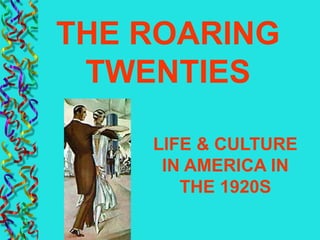
LIFE & CULTURE
IN AMERICA IN
THE 1920S
THE ROARING
TWENTIES
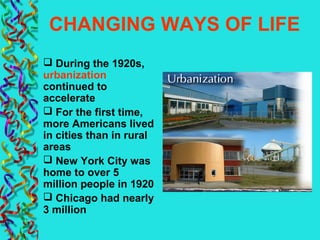
CHANGING WAYS OF LIFE
 During the 1920s,
urbanization
continued to
accelerate
 For the first time,
more Americans lived
in cities than in rural
areas
 New York City was
home to over 5
million people in 1920
 Chicago had nearly
3 million
URBAN VS. RURAL
 Throughout the 1920s,
Americans found
themselves caught
between urban and rural
cultures
 Urban life was
considered a world of
anonymous crowds,
strangers, moneymakers,
and pleasure seekers
 Rural life was
considered to be safe,
with close personal ties,
hard work and morals
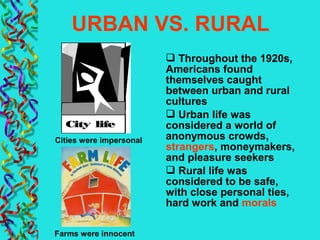
Cities were impersonal
Farms were innocent
PROHIBITION
 One example of the
clash between city &
farm was the passage
of the 18th
Amendment
in 1920
 This Amendment
launched the era
known as Prohibition
 The new law made it
illegal to make, sell or
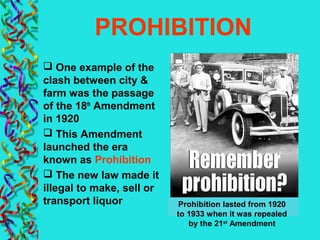
transport liquor Prohibition lasted from 1920
to 1933 when it was repealed
by the 21st
Amendment
SUPPORT FOR
PROHIBITION
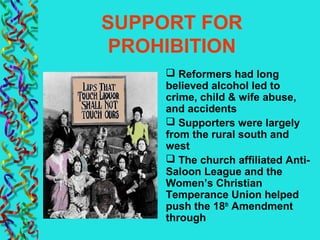
 Reformers had long
believed alcohol led to
crime, child & wife abuse,
and accidents
 Supporters were largely
from the rural south and
west
 The church affiliated Anti-
Saloon League and the
Women’s Christian
Temperance Union helped
push the 18th
Amendment
through
SPEAKEASIES AND
BOOTLEGGERS
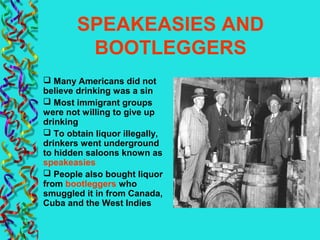
 Many Americans did not
believe drinking was a sin
 Most immigrant groups
were not willing to give up
drinking
 To obtain liquor illegally,
drinkers went underground
to hidden saloons known as
speakeasies
 People also bought liquor
from bootleggers who
smuggled it in from Canada,
Cuba and the West Indies
ORGANIZED
CRIME
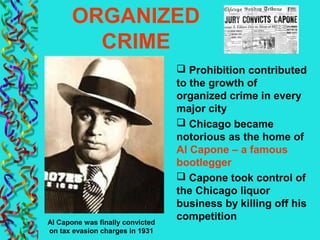
 Prohibition contributed
to the growth of
organized crime in every
major city
 Chicago became
notorious as the home of
Al Capone – a famous
bootlegger
 Capone took control of
the Chicago liquor
business by killing off his
competitionAl Capone was finally convicted
on tax evasion charges in 1931
GOVERNMENT FAILS
TO CONTROL LIQUOR
 Eventually,
Prohibition’s fate was
sealed by the
government, which
failed to budget
enough money to
enforce the law
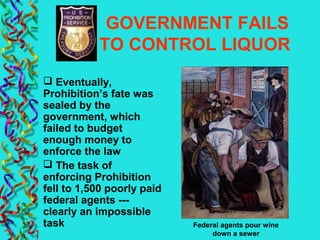
 The task of
enforcing Prohibition
fell to 1,500 poorly paid
federal agents ---
clearly an impossible
task Federal agents pour wine
down a sewer
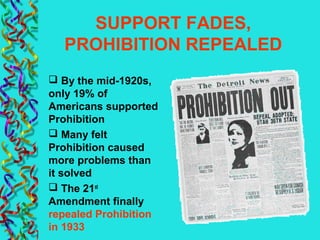
SUPPORT FADES,
PROHIBITION REPEALED
 By the mid-1920s,
only 19% of
Americans supported
Prohibition
 Many felt
Prohibition caused
more problems than
it solved
 The 21st
Amendment finally
repealed Prohibition
in 1933
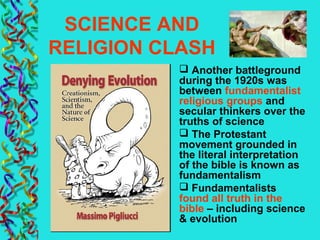
SCIENCE AND
RELIGION CLASH
 Another battleground
during the 1920s was
between fundamentalist
religious groups and
secular thinkers over the
truths of science
 The Protestant
movement grounded in
the literal interpretation
of the bible is known as
fundamentalism
 Fundamentalists
found all truth in the
bible – including science
& evolution
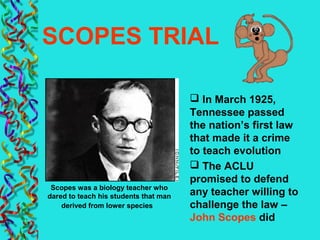
SCOPES TRIAL
 In March 1925,
Tennessee passed
the nation’s first law
that made it a crime
to teach evolution
 The ACLU
promised to defend
any teacher willing to
challenge the law –
John Scopes did
Scopes was a biology teacher who
dared to teach his students that man
derived from lower species
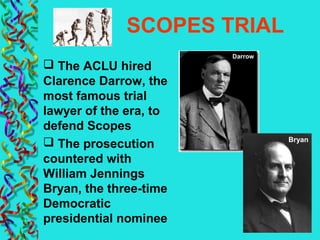
SCOPES TRIAL
 The ACLU hired
Clarence Darrow, the
most famous trial
lawyer of the era, to
defend Scopes
 The prosecution
countered with
William Jennings
Bryan, the three-time
Democratic
presidential nominee
Darrow
Bryan
SCOPES TRIAL
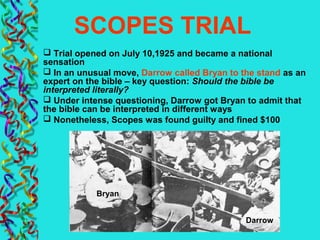
 Trial opened on July 10,1925 and became a national
sensation
 In an unusual move, Darrow called Bryan to the stand as an
expert on the bible – key question: Should the bible be
interpreted literally?
 Under intense questioning, Darrow got Bryan to admit that
the bible can be interpreted in different ways
 Nonetheless, Scopes was found guilty and fined $100
Bryan
Darrow
SECTION 2: THE TWENTIES
WOMAN
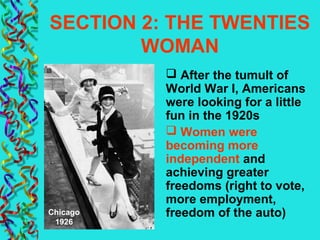
 After the tumult of
World War I, Americans
were looking for a little
fun in the 1920s
 Women were
becoming more
independent and
achieving greater
freedoms (right to vote,
more employment,
freedom of the auto)Chicago
1926
THE FLAPPER
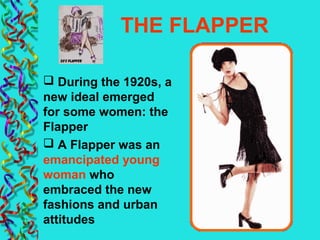
 During the 1920s, a
new ideal emerged
for some women: the
Flapper
 A Flapper was an
emancipated young
woman who
embraced the new
fashions and urban
attitudes
NEW ROLES FOR WOMEN
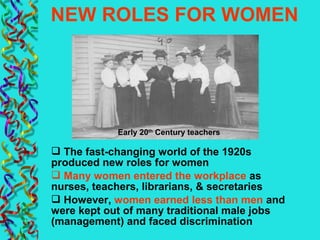
 The fast-changing world of the 1920s
produced new roles for women
 Many women entered the workplace as
nurses, teachers, librarians, & secretaries
 However, women earned less than men and
were kept out of many traditional male jobs
(management) and faced discrimination
Early 20th
Century teachers
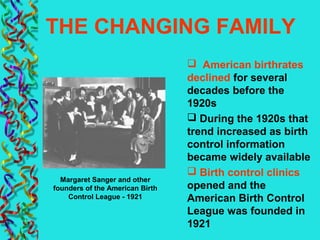
THE CHANGING FAMILY
 American birthrates
declined for several
decades before the
1920s
 During the 1920s that
trend increased as birth
control information
became widely available
 Birth control clinics
opened and the
American Birth Control
League was founded in
1921
Margaret Sanger and other
founders of the American Birth
Control League - 1921
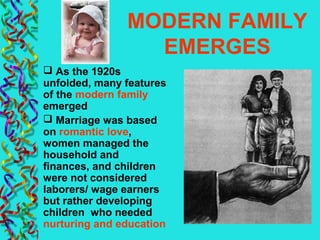
MODERN FAMILY
EMERGES
 As the 1920s
unfolded, many features
of the modern family
emerged
 Marriage was based
on romantic love,
women managed the
household and
finances, and children
were not considered
laborers/ wage earners
but rather developing
children who needed
nurturing and education
SECTION 3:
EDUCATION
AND POPULAR
CULTURE  During the 1920s,
developments in education
had a powerful impact on
the nation
 Enrollment in high
schools quadrupled
between 1914 and 1926
 Public schools met the
challenge of educating
millions of immigrants
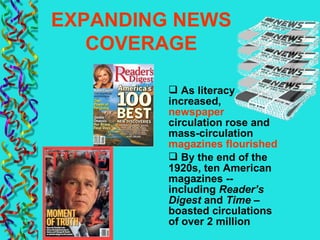
EXPANDING NEWS
COVERAGE
 As literacy
increased,
newspaper
circulation rose and
mass-circulation
magazines flourished
 By the end of the
1920s, ten American
magazines --
including Reader’s
Digest and Time –
boasted circulations
of over 2 million
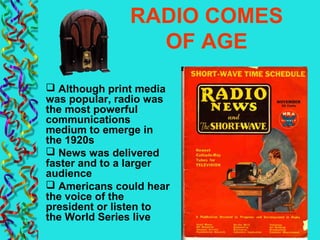
RADIO COMES
OF AGE
 Although print media
was popular, radio was
the most powerful
communications
medium to emerge in
the 1920s
 News was delivered
faster and to a larger
audience
 Americans could hear
the voice of the
president or listen to
the World Series live
AMERICAN HEROES OF
THE 20s
 In 1929, Americans
spent $4.5 billion on
entertainment (includes
sports)
 People crowded into
baseball games to see their
heroes
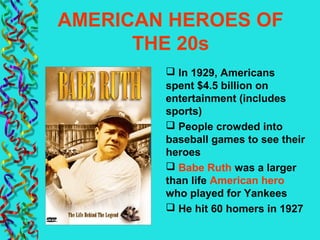
 Babe Ruth was a larger
than life American hero
who played for Yankees
 He hit 60 homers in 1927
LINDBERGH’S
FLIGHT
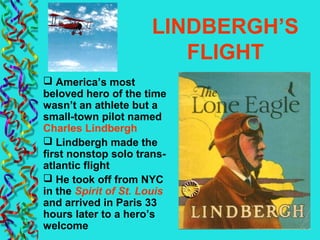
 America’s most
beloved hero of the time
wasn’t an athlete but a
small-town pilot named
Charles Lindbergh
 Lindbergh made the
first nonstop solo trans-
atlantic flight
 He took off from NYC
in the Spirit of St. Louis
and arrived in Paris 33
hours later to a hero’s
welcome
ENTERTAINMENT AND
ARTS
 Even before sound,
movies offered a means of
escape through romance
and comedy
 First sound movies: Jazz
Singer (1927)
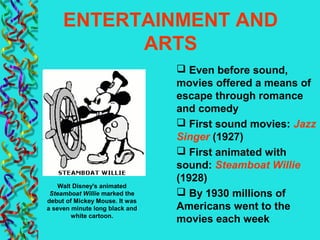
 First animated with
sound: Steamboat Willie
(1928)
 By 1930 millions of
Americans went to the
movies each week
Walt Disney's animated
Steamboat Willie marked the
debut of Mickey Mouse. It was
a seven minute long black and
white cartoon.
MUSIC AND ART
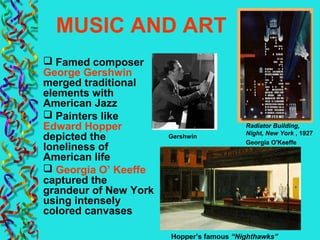
 Famed composer
George Gershwin
merged traditional
elements with
American Jazz
 Painters like
Edward Hopper
depicted the
loneliness of
American life
 Georgia O’ Keeffe
captured the
grandeur of New York
using intensely
colored canvases
Gershwin
Hopper’s famous “Nighthawks”
Radiator Building,
Night, New York , 1927
Georgia O'Keeffe
WRITERS OF THE
1920S
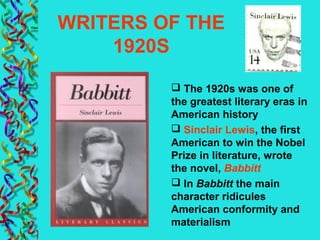
 The 1920s was one of
the greatest literary eras in
American history
 Sinclair Lewis, the first
American to win the Nobel
Prize in literature, wrote
the novel, Babbitt
 In Babbitt the main
character ridicules
American conformity and
materialism
WRITERS OF
THE 1920s
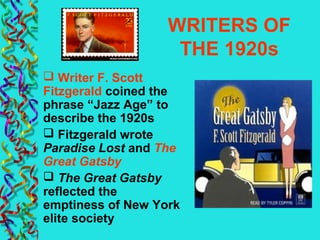
 Writer F. Scott
Fitzgerald coined the
phrase “Jazz Age” to
describe the 1920s
 Fitzgerald wrote
Paradise Lost and The
Great Gatsby
 The Great Gatsby
reflected the
emptiness of New York
elite society
WRITERS OF THE
1920S
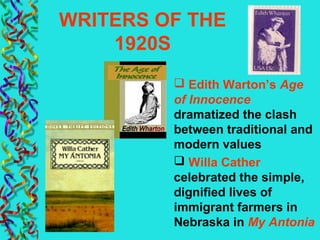
 Edith Warton’s Age
of Innocence
dramatized the clash
between traditional and
modern values
 Willa Cather
celebrated the simple,
dignified lives of
immigrant farmers in
Nebraska in My Antonia
WRITERS OF THE
1920
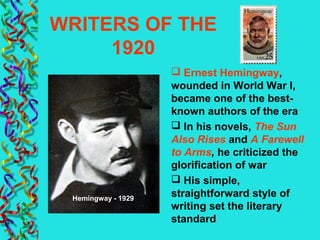
 Ernest Hemingway,
wounded in World War I,
became one of the best-
known authors of the era
 In his novels, The Sun
Also Rises and A Farewell
to Arms, he criticized the
glorification of war
 His simple,
straightforward style of
writing set the literary
standard
Hemingway - 1929
THE LOST GENERATION
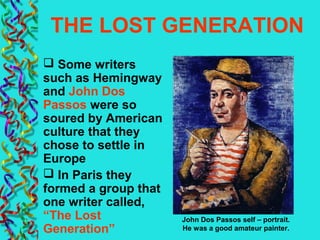
 Some writers
such as Hemingway
and John Dos
Passos were so
soured by American
culture that they
chose to settle in
Europe
 In Paris they
formed a group that
one writer called,
“The Lost
Generation”
John Dos Passos self – portrait.
He was a good amateur painter.
SECTION 4: THE HARLEM
RENAISSANCE
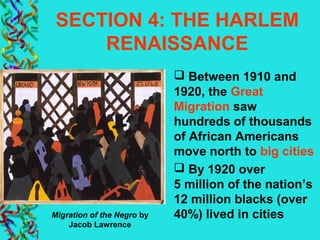
 Between 1910 and
1920, the Great
Migration saw
hundreds of thousands
of African Americans
move north to big cities
 By 1920 over
5 million of the nation’s
12 million blacks (over
40%) lived in citiesMigration of the Negro by
Jacob Lawrence
AFRICAN AMERICAN
GOALS
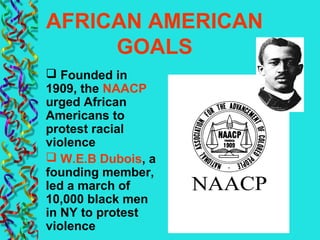
 Founded in
1909, the NAACP
urged African
Americans to
protest racial
violence
 W.E.B Dubois, a
founding member,
led a march of
10,000 black men
in NY to protest
violence
MARCUS GARVEY - UNIA
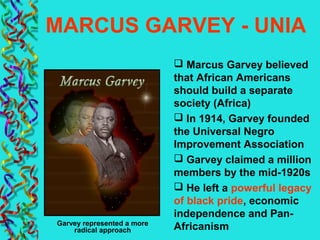
 Marcus Garvey believed
that African Americans
should build a separate
society (Africa)
 In 1914, Garvey founded
the Universal Negro
Improvement Association
 Garvey claimed a million
members by the mid-1920s
 He left a powerful legacy
of black pride, economic
independence and Pan-
AfricanismGarvey represented a more
radical approach
HARLEM, NEW YORK
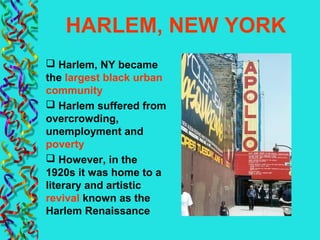
 Harlem, NY became
the largest black urban
community
 Harlem suffered from
overcrowding,
unemployment and
poverty
 However, in the
1920s it was home to a
literary and artistic
revival known as the
Harlem Renaissance
AFRICAN AMERICAN
WRITERS
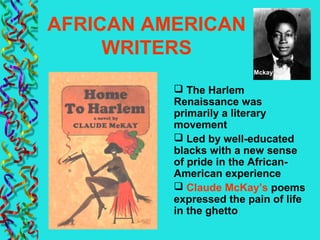
 The Harlem
Renaissance was
primarily a literary
movement
 Led by well-educated
blacks with a new sense
of pride in the African-
American experience
 Claude McKay’s poems
expressed the pain of life
in the ghetto
Mckay
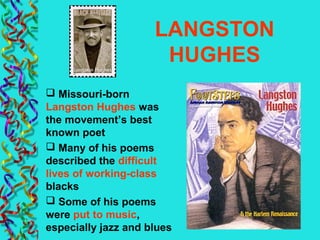
LANGSTON
HUGHES
 Missouri-born
Langston Hughes was
the movement’s best
known poet
 Many of his poems
described the difficult
lives of working-class
blacks
 Some of his poems
were put to music,
especially jazz and blues
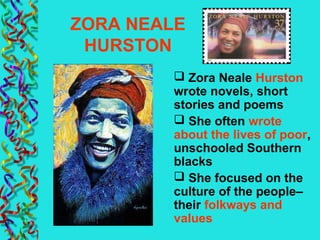
ZORA NEALE
HURSTON
 Zora Neale Hurston
wrote novels, short
stories and poems
 She often wrote
about the lives of poor,
unschooled Southern
blacks
 She focused on the
culture of the people–
their folkways and
values
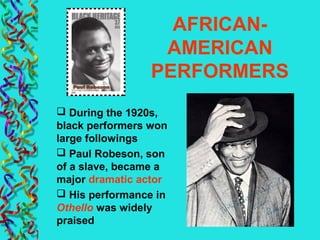
AFRICAN-
AMERICAN
PERFORMERS
 During the 1920s,
black performers won
large followings
 Paul Robeson, son
of a slave, became a
major dramatic actor
 His performance in
Othello was widely
praised
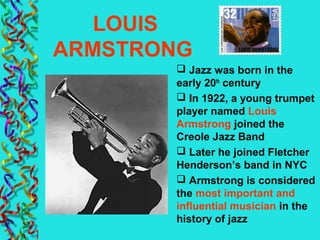
LOUIS
ARMSTRONG
 Jazz was born in the
early 20th
century
 In 1922, a young trumpet
player named Louis
Armstrong joined the
Creole Jazz Band
 Later he joined Fletcher
Henderson’s band in NYC
 Armstrong is considered
the most important and
influential musician in the
history of jazz
EDWARD
KENNEDY “DUKE”
ELLINGTON
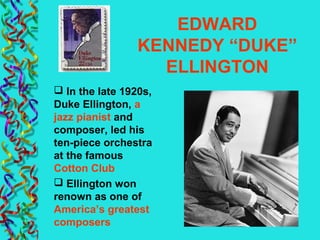
 In the late 1920s,
Duke Ellington, a
jazz pianist and
composer, led his
ten-piece orchestra
at the famous
Cotton Club
 Ellington won
renown as one of
America’s greatest
composers
BESSIE
SMITH
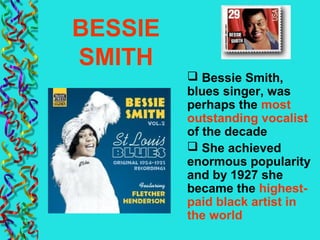
 Bessie Smith,
blues singer, was
perhaps the most
outstanding vocalist
of the decade
 She achieved
enormous popularity
and by 1927 she
became the highest-
paid black artist in
the world

HY 103 Roaring 20's

  • 1.
    LIFE & CULTURE INAMERICA IN THE 1920S THE ROARING TWENTIES
  • 2.
    CHANGING WAYS OFLIFE  During the 1920s, urbanization continued to accelerate  For the first time, more Americans lived in cities than in rural areas  New York City was home to over 5 million people in 1920  Chicago had nearly 3 million
  • 3.
    URBAN VS. RURAL Throughout the 1920s, Americans found themselves caught between urban and rural cultures  Urban life was considered a world of anonymous crowds, strangers, moneymakers, and pleasure seekers  Rural life was considered to be safe, with close personal ties, hard work and morals Cities were impersonal Farms were innocent
  • 4.
    PROHIBITION  One exampleof the clash between city & farm was the passage of the 18th Amendment in 1920  This Amendment launched the era known as Prohibition  The new law made it illegal to make, sell or transport liquor Prohibition lasted from 1920 to 1933 when it was repealed by the 21st Amendment
  • 5.
    SUPPORT FOR PROHIBITION  Reformershad long believed alcohol led to crime, child & wife abuse, and accidents  Supporters were largely from the rural south and west  The church affiliated Anti- Saloon League and the Women’s Christian Temperance Union helped push the 18th Amendment through
  • 6.
    SPEAKEASIES AND BOOTLEGGERS  ManyAmericans did not believe drinking was a sin  Most immigrant groups were not willing to give up drinking  To obtain liquor illegally, drinkers went underground to hidden saloons known as speakeasies  People also bought liquor from bootleggers who smuggled it in from Canada, Cuba and the West Indies
  • 7.
    ORGANIZED CRIME  Prohibition contributed tothe growth of organized crime in every major city  Chicago became notorious as the home of Al Capone – a famous bootlegger  Capone took control of the Chicago liquor business by killing off his competitionAl Capone was finally convicted on tax evasion charges in 1931
  • 8.
    GOVERNMENT FAILS TO CONTROLLIQUOR  Eventually, Prohibition’s fate was sealed by the government, which failed to budget enough money to enforce the law  The task of enforcing Prohibition fell to 1,500 poorly paid federal agents --- clearly an impossible task Federal agents pour wine down a sewer
  • 9.
    SUPPORT FADES, PROHIBITION REPEALED By the mid-1920s, only 19% of Americans supported Prohibition  Many felt Prohibition caused more problems than it solved  The 21st Amendment finally repealed Prohibition in 1933
  • 10.
    SCIENCE AND RELIGION CLASH Another battleground during the 1920s was between fundamentalist religious groups and secular thinkers over the truths of science  The Protestant movement grounded in the literal interpretation of the bible is known as fundamentalism  Fundamentalists found all truth in the bible – including science & evolution
  • 11.
    SCOPES TRIAL  InMarch 1925, Tennessee passed the nation’s first law that made it a crime to teach evolution  The ACLU promised to defend any teacher willing to challenge the law – John Scopes did Scopes was a biology teacher who dared to teach his students that man derived from lower species
  • 12.
    SCOPES TRIAL  TheACLU hired Clarence Darrow, the most famous trial lawyer of the era, to defend Scopes  The prosecution countered with William Jennings Bryan, the three-time Democratic presidential nominee Darrow Bryan
  • 13.
    SCOPES TRIAL  Trialopened on July 10,1925 and became a national sensation  In an unusual move, Darrow called Bryan to the stand as an expert on the bible – key question: Should the bible be interpreted literally?  Under intense questioning, Darrow got Bryan to admit that the bible can be interpreted in different ways  Nonetheless, Scopes was found guilty and fined $100 Bryan Darrow
  • 14.
    SECTION 2: THETWENTIES WOMAN  After the tumult of World War I, Americans were looking for a little fun in the 1920s  Women were becoming more independent and achieving greater freedoms (right to vote, more employment, freedom of the auto)Chicago 1926
  • 15.
    THE FLAPPER  Duringthe 1920s, a new ideal emerged for some women: the Flapper  A Flapper was an emancipated young woman who embraced the new fashions and urban attitudes
  • 16.
    NEW ROLES FORWOMEN  The fast-changing world of the 1920s produced new roles for women  Many women entered the workplace as nurses, teachers, librarians, & secretaries  However, women earned less than men and were kept out of many traditional male jobs (management) and faced discrimination Early 20th Century teachers
  • 17.
    THE CHANGING FAMILY American birthrates declined for several decades before the 1920s  During the 1920s that trend increased as birth control information became widely available  Birth control clinics opened and the American Birth Control League was founded in 1921 Margaret Sanger and other founders of the American Birth Control League - 1921
  • 18.
    MODERN FAMILY EMERGES  Asthe 1920s unfolded, many features of the modern family emerged  Marriage was based on romantic love, women managed the household and finances, and children were not considered laborers/ wage earners but rather developing children who needed nurturing and education
  • 19.
    SECTION 3: EDUCATION AND POPULAR CULTURE During the 1920s, developments in education had a powerful impact on the nation  Enrollment in high schools quadrupled between 1914 and 1926  Public schools met the challenge of educating millions of immigrants
  • 20.
    EXPANDING NEWS COVERAGE  Asliteracy increased, newspaper circulation rose and mass-circulation magazines flourished  By the end of the 1920s, ten American magazines -- including Reader’s Digest and Time – boasted circulations of over 2 million
  • 21.
    RADIO COMES OF AGE Although print media was popular, radio was the most powerful communications medium to emerge in the 1920s  News was delivered faster and to a larger audience  Americans could hear the voice of the president or listen to the World Series live
  • 22.
    AMERICAN HEROES OF THE20s  In 1929, Americans spent $4.5 billion on entertainment (includes sports)  People crowded into baseball games to see their heroes  Babe Ruth was a larger than life American hero who played for Yankees  He hit 60 homers in 1927
  • 23.
    LINDBERGH’S FLIGHT  America’s most belovedhero of the time wasn’t an athlete but a small-town pilot named Charles Lindbergh  Lindbergh made the first nonstop solo trans- atlantic flight  He took off from NYC in the Spirit of St. Louis and arrived in Paris 33 hours later to a hero’s welcome
  • 24.
    ENTERTAINMENT AND ARTS  Evenbefore sound, movies offered a means of escape through romance and comedy  First sound movies: Jazz Singer (1927)  First animated with sound: Steamboat Willie (1928)  By 1930 millions of Americans went to the movies each week Walt Disney's animated Steamboat Willie marked the debut of Mickey Mouse. It was a seven minute long black and white cartoon.
  • 25.
    MUSIC AND ART Famed composer George Gershwin merged traditional elements with American Jazz  Painters like Edward Hopper depicted the loneliness of American life  Georgia O’ Keeffe captured the grandeur of New York using intensely colored canvases Gershwin Hopper’s famous “Nighthawks” Radiator Building, Night, New York , 1927 Georgia O'Keeffe
  • 26.
    WRITERS OF THE 1920S The 1920s was one of the greatest literary eras in American history  Sinclair Lewis, the first American to win the Nobel Prize in literature, wrote the novel, Babbitt  In Babbitt the main character ridicules American conformity and materialism
  • 27.
    WRITERS OF THE 1920s Writer F. Scott Fitzgerald coined the phrase “Jazz Age” to describe the 1920s  Fitzgerald wrote Paradise Lost and The Great Gatsby  The Great Gatsby reflected the emptiness of New York elite society
  • 28.
    WRITERS OF THE 1920S Edith Warton’s Age of Innocence dramatized the clash between traditional and modern values  Willa Cather celebrated the simple, dignified lives of immigrant farmers in Nebraska in My Antonia
  • 29.
    WRITERS OF THE 1920 Ernest Hemingway, wounded in World War I, became one of the best- known authors of the era  In his novels, The Sun Also Rises and A Farewell to Arms, he criticized the glorification of war  His simple, straightforward style of writing set the literary standard Hemingway - 1929
  • 30.
    THE LOST GENERATION Some writers such as Hemingway and John Dos Passos were so soured by American culture that they chose to settle in Europe  In Paris they formed a group that one writer called, “The Lost Generation” John Dos Passos self – portrait. He was a good amateur painter.
  • 31.
    SECTION 4: THEHARLEM RENAISSANCE  Between 1910 and 1920, the Great Migration saw hundreds of thousands of African Americans move north to big cities  By 1920 over 5 million of the nation’s 12 million blacks (over 40%) lived in citiesMigration of the Negro by Jacob Lawrence
  • 32.
    AFRICAN AMERICAN GOALS  Foundedin 1909, the NAACP urged African Americans to protest racial violence  W.E.B Dubois, a founding member, led a march of 10,000 black men in NY to protest violence
  • 33.
    MARCUS GARVEY -UNIA  Marcus Garvey believed that African Americans should build a separate society (Africa)  In 1914, Garvey founded the Universal Negro Improvement Association  Garvey claimed a million members by the mid-1920s  He left a powerful legacy of black pride, economic independence and Pan- AfricanismGarvey represented a more radical approach
  • 34.
    HARLEM, NEW YORK Harlem, NY became the largest black urban community  Harlem suffered from overcrowding, unemployment and poverty  However, in the 1920s it was home to a literary and artistic revival known as the Harlem Renaissance
  • 35.
    AFRICAN AMERICAN WRITERS  TheHarlem Renaissance was primarily a literary movement  Led by well-educated blacks with a new sense of pride in the African- American experience  Claude McKay’s poems expressed the pain of life in the ghetto Mckay
  • 36.
    LANGSTON HUGHES  Missouri-born Langston Hugheswas the movement’s best known poet  Many of his poems described the difficult lives of working-class blacks  Some of his poems were put to music, especially jazz and blues
  • 37.
    ZORA NEALE HURSTON  ZoraNeale Hurston wrote novels, short stories and poems  She often wrote about the lives of poor, unschooled Southern blacks  She focused on the culture of the people– their folkways and values
  • 38.
    AFRICAN- AMERICAN PERFORMERS  During the1920s, black performers won large followings  Paul Robeson, son of a slave, became a major dramatic actor  His performance in Othello was widely praised
  • 39.
    LOUIS ARMSTRONG  Jazz wasborn in the early 20th century  In 1922, a young trumpet player named Louis Armstrong joined the Creole Jazz Band  Later he joined Fletcher Henderson’s band in NYC  Armstrong is considered the most important and influential musician in the history of jazz
  • 40.
    EDWARD KENNEDY “DUKE” ELLINGTON  Inthe late 1920s, Duke Ellington, a jazz pianist and composer, led his ten-piece orchestra at the famous Cotton Club  Ellington won renown as one of America’s greatest composers
  • 41.
    BESSIE SMITH  Bessie Smith, bluessinger, was perhaps the most outstanding vocalist of the decade  She achieved enormous popularity and by 1927 she became the highest- paid black artist in the world