FRICTION Page 1
CHAPTER 2
FRICTION
Content of Topic:
 Introduction:
o Friction
o Limiting force of Friction
o Co-efficient of Friction (µ)
o Angle of Friction
o Angle of repose
 Types of friction:
o Static Friction
o Dynamic Friction
o Sliding Friction
o Rolling Friction
 Laws of friction:
o Laws of Static Friction
o Laws of Dynamic or Kinetic Friction
Introduction:
Whenever the surfaces of two bodies are in contact, there is a limited amount of resistance to
sliding between them at the contact surfaces. This resistance to sliding is known as frictional
force.
Definition:
The property of the bodies by virtue of which a force exerted by a stationary body on the moving
body to resist the motion of moving body is called as friction.
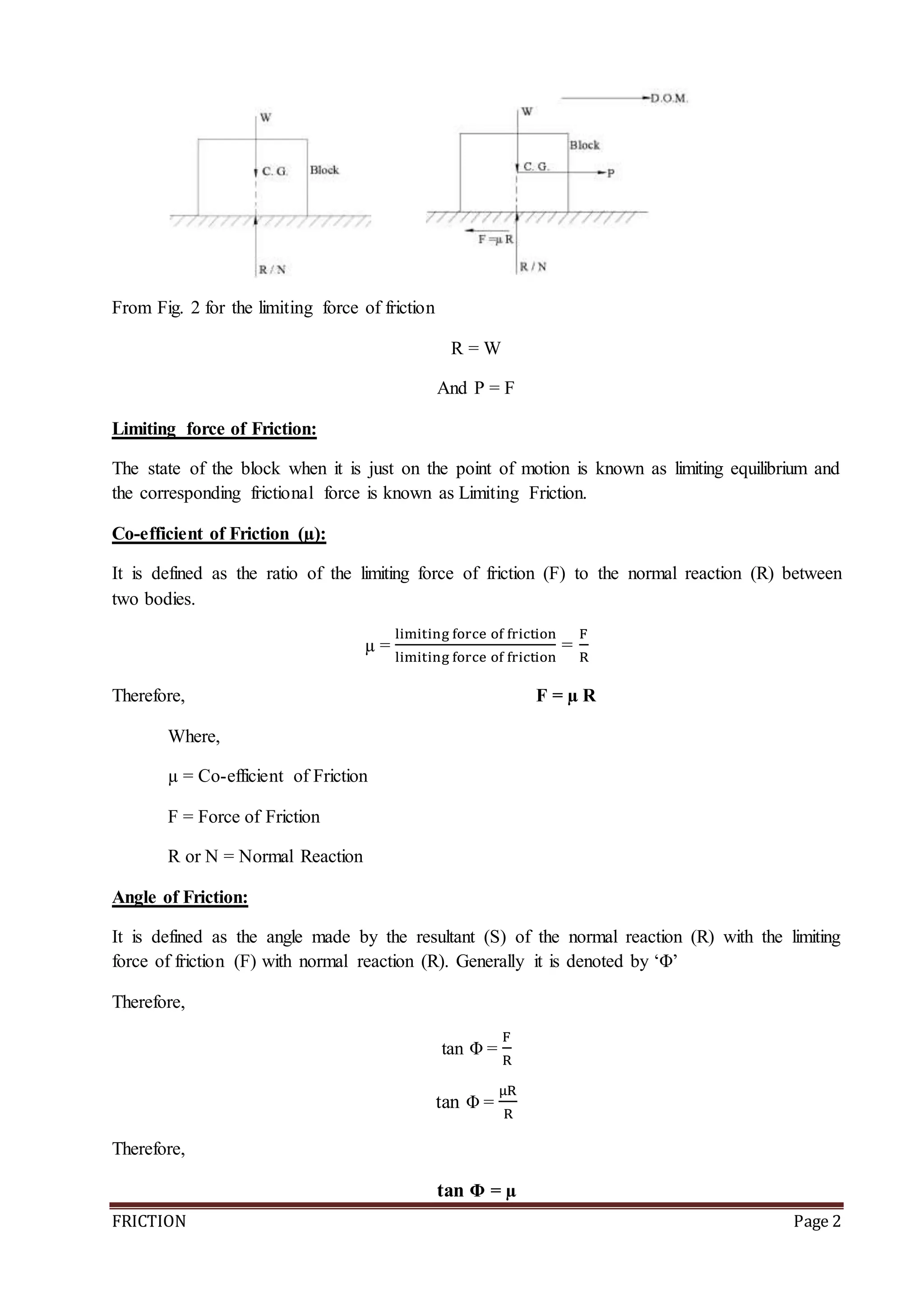
When a block of weight, W rest on the horizontal plane as shown in Fig. 1 below, the force
acting on the block are,
a) Weight ‘W’ and
b) Normal reaction ‘R’ or ‘N’ offered by the contact surface.
When the horizontal force ‘P’ is applied to the block, an opposing force ‘F’ is developed at
the contact surface as shown in Fig. 2. The block cannot move due to this frictional force for
a small value of ‘P’ force. If ‘P’ is increased, the friction force is ‘F’ also increases up to a
certain limiting value. If ‘P’ increases beyond this limit the block starts sliding over the plane.
FRICTION Page 2
From Fig. 2 for the limiting force of friction
R = W
And P = F
Limiting force of Friction:
The state of the block when it is just on the point of motion is known as limiting equilibrium and
the corresponding frictional force is known as Limiting Friction.
Co-efficient of Friction (µ):
It is defined as the ratio of the limiting force of friction (F) to the normal reaction (R) between
two bodies.
µ =
limiting force of friction
=
F
R
Therefore, F = µ R
Where,
µ = Co-efficient of Friction
F = Force of Friction
R or N = Normal Reaction
Angle of Friction:
It is defined as the angle made by the resultant (S) of the normal reaction (R) with the limiting
force of friction (F) with normal reaction (R). Generally it is denoted by ‘Φ’
Therefore,
tan Φ =
F
R
tan Φ =
µR
R
Therefore,
tan Φ = µ
FRICTION Page 3
Angle of repose:
The Angle of repose is defined as the maximum inclination of a plane at which a body remains in
equilibrium over an inclined plane with the help of friction only.
Consider a body of weight ‘W’, resting on a rough inclined plane as shown in Fig. 1 below.
Where,
R = Normal reaction acting at right angle to the inclined plane.
α = Inclination of the plane with the horizontal
F = Frictional force acting upward along the plane.
If the angle of inclination (α) gradually increased till the body just starts sliding down the plane.
This angle of inclined plane, at which a body just being to slide down the plane, is called as
Angle of repose.
Resolving the forces along the plane
F = W sin α ----------(1)
Resolving the forces along the normal to the plane
R = W cos α ----------(2)
Dividing (1) by (2)
W sin α
W cos α
=
F
R
tan α =
F
R
since tan Φ =
F
R
tan α = tan Φ
Therefore,
α = Φ
Angle of Repose = Angle of Friction
TYPES OF FRICTION:
Basically there are two types of Friction
a) Static Friction
b) Dynamic Friction
Static Friction:
FRICTION Page 4
If the two surfaces, which are in contact, are at rest, the force experienced by one surface (and
vice versa) is called as Static Friction.
Dynamic Friction:
When one surface starts moving and other is at rest, the force experienced by the moving surface
is called as Dynamic Friction. It is also called as Kinematic Friction.
Dynamic Friction is further subdivided into two types:
a) Sliding Friction
b) Rolling Friction
Sliding Friction:
It is the Friction experienced by a body when it slides over another body.
Rolling Friction:
It is the Friction experienced by a body when it rolls over another body.
Laws of friction:
It is grouped under following heads:
1) Laws of Static Friction:
a) The force of friction always acts in a direction, opposite to that in which the body
tends to move.
b) The magnitude of the force friction is exactly equal to the force, which tends to move
the body.
c) The magnitude of the limiting force of friction bears a constant ratio to the normal
reaction between the two surfaces. i.e.
F
R
= constant.
d) The force of friction is independent of area of contact between the two surfaces.
e) The force of friction depends upon the roughness of the surfaces.
2) Laws of Dynamic or Kinetic Friction:
a) The force of friction always acts in a direction, opposite to that in which the body is
moving.
b) The magnitude of kinetic friction bears a constant ratio to the normal reaction
between the two surfaces. But this ratio is slightly less than the limiting force of
friction.
c) For moderate speeds, the force of friction remains constant. But it decreases slightly
with increase of speed.
Problems:
Type I
1) A body of weight 150 N is placed on a rough horizontal plane. Determine the co-efficient of
friction when a force of 80 N just causes the body to slide over a horizontal plane.
2) A body of weight 100 N is placed on a rough horizontal plane. If the co-efficient of friction is
0.3. Determine the horizontal force required to just slide over a horizontal plane.
FRICTION Page 5
3) A force of 15 N is required to pull a body of weight 50 N on a rough horizontal plane. Find
the co-efficient of friction if the applied force makes an angle of 150 with the horizontal.
4) Solve the same problem if a push of 15 N force makes an angle of 150 with the horizontal.
5) Calculate the angle of friction for problem (1) and (3).
Type II
1) A body of weight 500 N is pulled up on an inclined plane by a force of 350 N. the inclination
of the plane is 300 to the horizontal and the force is applied parallel to the plane. Determine
the co-efficient of friction.

Chapter 2 friction

  • 1.
    FRICTION Page 1 CHAPTER2 FRICTION Content of Topic:  Introduction: o Friction o Limiting force of Friction o Co-efficient of Friction (µ) o Angle of Friction o Angle of repose  Types of friction: o Static Friction o Dynamic Friction o Sliding Friction o Rolling Friction  Laws of friction: o Laws of Static Friction o Laws of Dynamic or Kinetic Friction Introduction: Whenever the surfaces of two bodies are in contact, there is a limited amount of resistance to sliding between them at the contact surfaces. This resistance to sliding is known as frictional force. Definition: The property of the bodies by virtue of which a force exerted by a stationary body on the moving body to resist the motion of moving body is called as friction. When a block of weight, W rest on the horizontal plane as shown in Fig. 1 below, the force acting on the block are, a) Weight ‘W’ and b) Normal reaction ‘R’ or ‘N’ offered by the contact surface. When the horizontal force ‘P’ is applied to the block, an opposing force ‘F’ is developed at the contact surface as shown in Fig. 2. The block cannot move due to this frictional force for a small value of ‘P’ force. If ‘P’ is increased, the friction force is ‘F’ also increases up to a certain limiting value. If ‘P’ increases beyond this limit the block starts sliding over the plane.
  • 2.
    FRICTION Page 2 FromFig. 2 for the limiting force of friction R = W And P = F Limiting force of Friction: The state of the block when it is just on the point of motion is known as limiting equilibrium and the corresponding frictional force is known as Limiting Friction. Co-efficient of Friction (µ): It is defined as the ratio of the limiting force of friction (F) to the normal reaction (R) between two bodies. µ = limiting force of friction limiting force of friction = F R Therefore, F = µ R Where, µ = Co-efficient of Friction F = Force of Friction R or N = Normal Reaction Angle of Friction: It is defined as the angle made by the resultant (S) of the normal reaction (R) with the limiting force of friction (F) with normal reaction (R). Generally it is denoted by ‘Φ’ Therefore, tan Φ = F R tan Φ = µR R Therefore, tan Φ = µ
  • 3.
    FRICTION Page 3 Angleof repose: The Angle of repose is defined as the maximum inclination of a plane at which a body remains in equilibrium over an inclined plane with the help of friction only. Consider a body of weight ‘W’, resting on a rough inclined plane as shown in Fig. 1 below. Where, R = Normal reaction acting at right angle to the inclined plane. α = Inclination of the plane with the horizontal F = Frictional force acting upward along the plane. If the angle of inclination (α) gradually increased till the body just starts sliding down the plane. This angle of inclined plane, at which a body just being to slide down the plane, is called as Angle of repose. Resolving the forces along the plane F = W sin α ----------(1) Resolving the forces along the normal to the plane R = W cos α ----------(2) Dividing (1) by (2) W sin α W cos α = F R tan α = F R since tan Φ = F R tan α = tan Φ Therefore, α = Φ Angle of Repose = Angle of Friction TYPES OF FRICTION: Basically there are two types of Friction a) Static Friction b) Dynamic Friction Static Friction:
  • 4.
    FRICTION Page 4 Ifthe two surfaces, which are in contact, are at rest, the force experienced by one surface (and vice versa) is called as Static Friction. Dynamic Friction: When one surface starts moving and other is at rest, the force experienced by the moving surface is called as Dynamic Friction. It is also called as Kinematic Friction. Dynamic Friction is further subdivided into two types: a) Sliding Friction b) Rolling Friction Sliding Friction: It is the Friction experienced by a body when it slides over another body. Rolling Friction: It is the Friction experienced by a body when it rolls over another body. Laws of friction: It is grouped under following heads: 1) Laws of Static Friction: a) The force of friction always acts in a direction, opposite to that in which the body tends to move. b) The magnitude of the force friction is exactly equal to the force, which tends to move the body. c) The magnitude of the limiting force of friction bears a constant ratio to the normal reaction between the two surfaces. i.e. F R = constant. d) The force of friction is independent of area of contact between the two surfaces. e) The force of friction depends upon the roughness of the surfaces. 2) Laws of Dynamic or Kinetic Friction: a) The force of friction always acts in a direction, opposite to that in which the body is moving. b) The magnitude of kinetic friction bears a constant ratio to the normal reaction between the two surfaces. But this ratio is slightly less than the limiting force of friction. c) For moderate speeds, the force of friction remains constant. But it decreases slightly with increase of speed. Problems: Type I 1) A body of weight 150 N is placed on a rough horizontal plane. Determine the co-efficient of friction when a force of 80 N just causes the body to slide over a horizontal plane. 2) A body of weight 100 N is placed on a rough horizontal plane. If the co-efficient of friction is 0.3. Determine the horizontal force required to just slide over a horizontal plane.
  • 5.
    FRICTION Page 5 3)A force of 15 N is required to pull a body of weight 50 N on a rough horizontal plane. Find the co-efficient of friction if the applied force makes an angle of 150 with the horizontal. 4) Solve the same problem if a push of 15 N force makes an angle of 150 with the horizontal. 5) Calculate the angle of friction for problem (1) and (3). Type II 1) A body of weight 500 N is pulled up on an inclined plane by a force of 350 N. the inclination of the plane is 300 to the horizontal and the force is applied parallel to the plane. Determine the co-efficient of friction.