Shaik Nayeem
Engineering Mechanics
Introduction: Classification
1
Shaik Nayeem
• Engineering?
• Mechanics?
• Classification Based on Researchers
• Classical Mechanics
• Relativistic Mechanics
• Quantum Mechanics
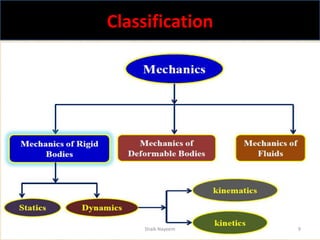
• Classification
• Mechanics of Rigid bodies
• Mechanics of Deformable bodies
• Mechanics of Fluids
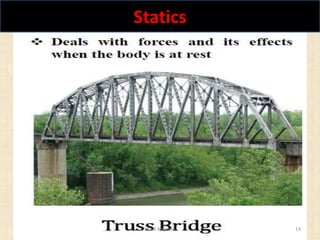
• Statics
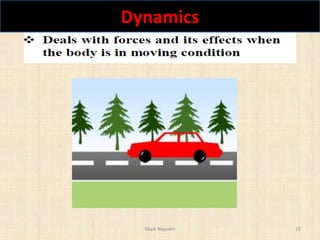
• Dynamics
Contents
Engineering?
Engineering is the application of
mathematics, empirical evidence and scientific,
economic, social, and practical knowledge
in order to
invent, innovate, design, build, maintain, research,
and improve
structures, machines, tools, systems, components,
materials, processes and organizations
Shaik Nayeem 3
Mechanics?
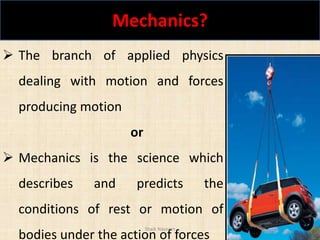
 The branch of applied physics
dealing with motion and forces
producing motion
or
 Mechanics is the science which
describes and predicts the
conditions of rest or motion of
bodies under the action of forces
Shaik Nayeem 4
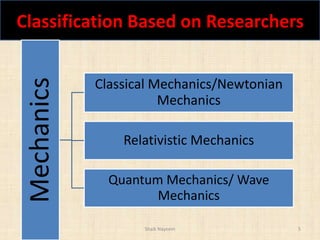
Classification Based on Researchers
Shaik Nayeem 5
Mechanics
Classical Mechanics/Newtonian
Mechanics
Relativistic Mechanics
Quantum Mechanics/ Wave
Mechanics
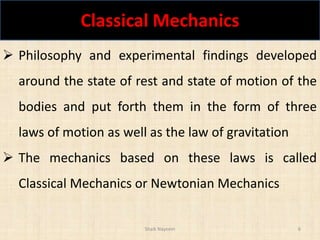
Classical Mechanics
 Philosophy and experimental findings developed
around the state of rest and state of motion of the
bodies and put forth them in the form of three
laws of motion as well as the law of gravitation
 The mechanics based on these laws is called
Classical Mechanics or Newtonian Mechanics
Shaik Nayeem 6
Relativistic Mechanics
 Albert Einstein proved that Newtonian mechanics
fails to explain the behaviour of high speed bodies
 He put the theory of Relativistic Mechanics
Shaik Nayeem 7
Quantum Mechanics
Shaik Nayeem 8
 Schrodinger and Broglie showed that Newtonian
mechanics fails to explain the behaviour of particle
when atomic distances are concerned
 They put forth the theory of Quantum Mechanics
Classification
Shaik Nayeem 9
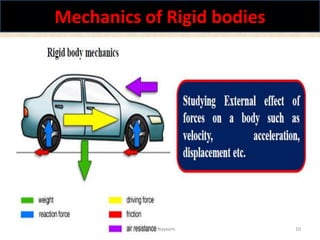
Mechanics of Rigid bodies
Shaik Nayeem 10
Mechanics of Rigid bodies (Cont…)
Shaik Nayeem 11
 Negligible deformation (no deformation) under the
action of forces
 Assuming 100% strength in the materials. Large
number of particles occupying fixed positions with
each other
 Actual structures and machines are never rigid
under the action of external loads or forces
 But the deformations induced are usually very
small which does not affect the condition of
equilibrium
Mechanics of Deformable bodies
Shaik Nayeem 12
Mechanics of Fluids
Shaik Nayeem 13
 Studying the behavior of fluid under various forces
and at different atmospheric conditions, and to
select the proper fluid for various applications
Statics
Shaik Nayeem 14
Dynamics
Shaik Nayeem 15
Dynamics( Cont…)
Shaik Nayeem 16
Kinetics: It is the branch of Dynamics, which deals
with the bodies in motion due to the application of
forces
Kinematics: It is that branch of Dynamics, which
deals with the bodies in motion, without any
reference to the forces which are responsible for the
motion
Shaik Nayeem 17
Thank You
Shaik Nayeem

Introduction to engineering mechanics: Classification

  • 1.
  • 2.
    • Engineering? • Mechanics? •Classification Based on Researchers • Classical Mechanics • Relativistic Mechanics • Quantum Mechanics • Classification • Mechanics of Rigid bodies • Mechanics of Deformable bodies • Mechanics of Fluids • Statics • Dynamics Contents
  • 3.
    Engineering? Engineering is theapplication of mathematics, empirical evidence and scientific, economic, social, and practical knowledge in order to invent, innovate, design, build, maintain, research, and improve structures, machines, tools, systems, components, materials, processes and organizations Shaik Nayeem 3
  • 4.
    Mechanics?  The branchof applied physics dealing with motion and forces producing motion or  Mechanics is the science which describes and predicts the conditions of rest or motion of bodies under the action of forces Shaik Nayeem 4
  • 5.
    Classification Based onResearchers Shaik Nayeem 5 Mechanics Classical Mechanics/Newtonian Mechanics Relativistic Mechanics Quantum Mechanics/ Wave Mechanics
  • 6.
    Classical Mechanics  Philosophyand experimental findings developed around the state of rest and state of motion of the bodies and put forth them in the form of three laws of motion as well as the law of gravitation  The mechanics based on these laws is called Classical Mechanics or Newtonian Mechanics Shaik Nayeem 6
  • 7.
    Relativistic Mechanics  AlbertEinstein proved that Newtonian mechanics fails to explain the behaviour of high speed bodies  He put the theory of Relativistic Mechanics Shaik Nayeem 7
  • 8.
    Quantum Mechanics Shaik Nayeem8  Schrodinger and Broglie showed that Newtonian mechanics fails to explain the behaviour of particle when atomic distances are concerned  They put forth the theory of Quantum Mechanics
  • 9.
  • 10.
    Mechanics of Rigidbodies Shaik Nayeem 10
  • 11.
    Mechanics of Rigidbodies (Cont…) Shaik Nayeem 11  Negligible deformation (no deformation) under the action of forces  Assuming 100% strength in the materials. Large number of particles occupying fixed positions with each other  Actual structures and machines are never rigid under the action of external loads or forces  But the deformations induced are usually very small which does not affect the condition of equilibrium
  • 12.
    Mechanics of Deformablebodies Shaik Nayeem 12
  • 13.
    Mechanics of Fluids ShaikNayeem 13  Studying the behavior of fluid under various forces and at different atmospheric conditions, and to select the proper fluid for various applications
  • 14.
  • 15.
  • 16.
    Dynamics( Cont…) Shaik Nayeem16 Kinetics: It is the branch of Dynamics, which deals with the bodies in motion due to the application of forces Kinematics: It is that branch of Dynamics, which deals with the bodies in motion, without any reference to the forces which are responsible for the motion
  • 17.
    Shaik Nayeem 17 ThankYou Shaik Nayeem