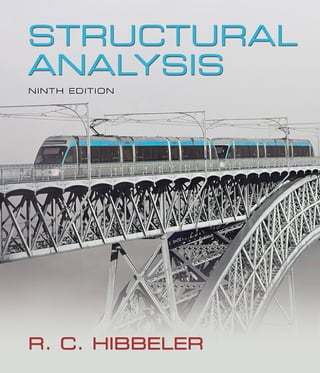
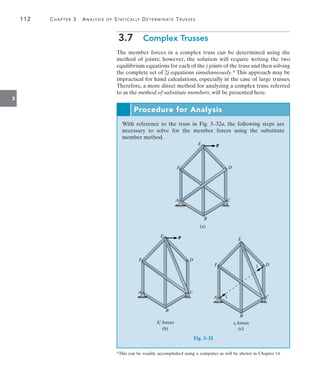
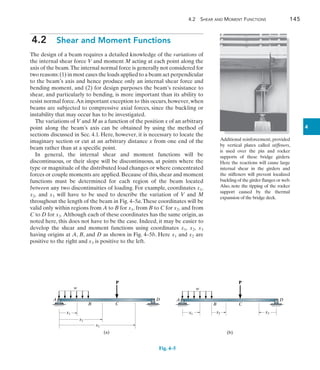
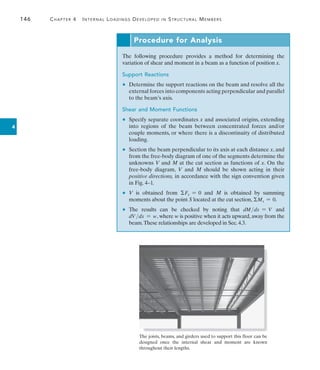
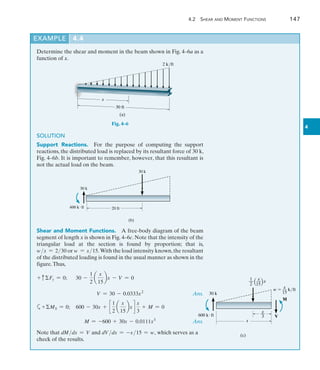
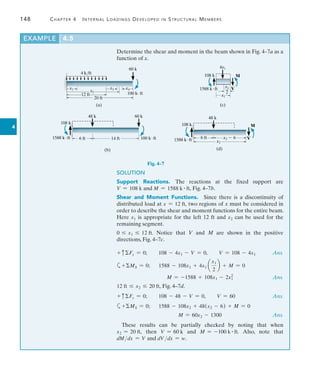
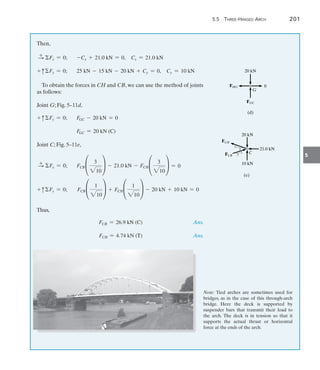
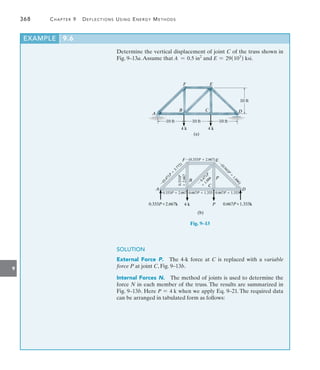
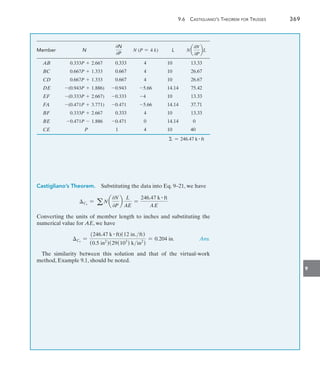
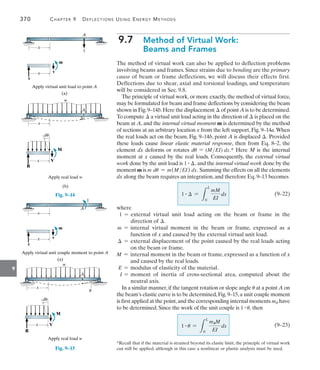
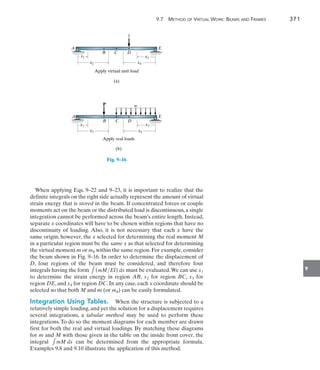
STRUCTURAL
ANALYSIS
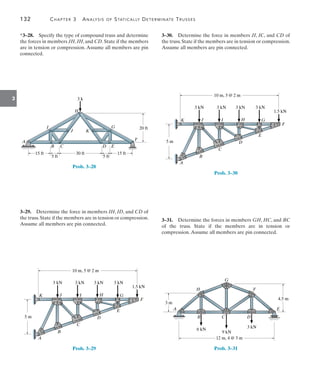
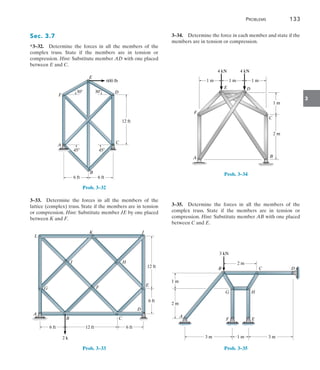
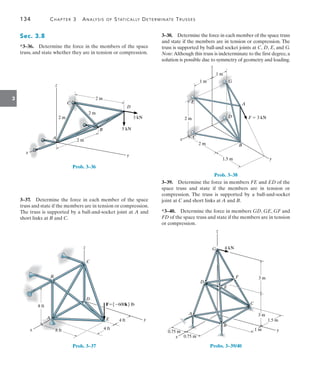
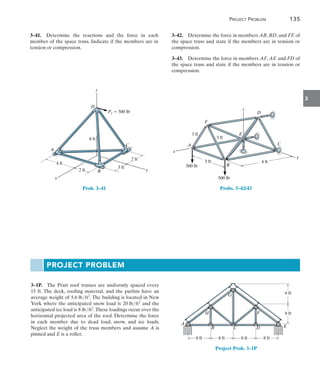
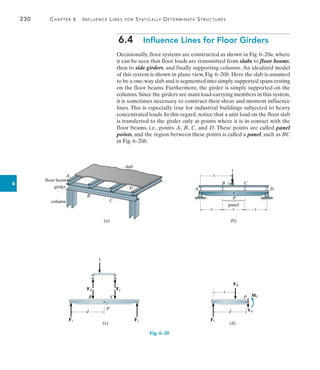
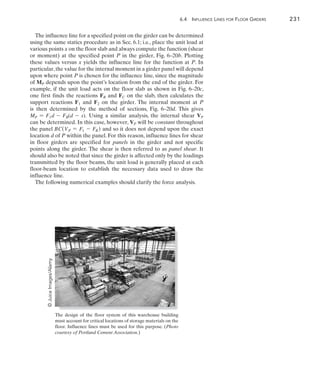
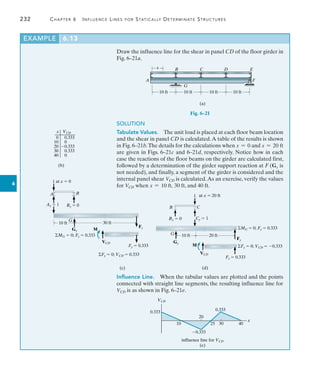
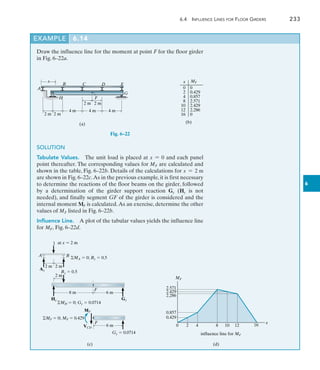
NINTH EDITION
R. C. HIBBELER
Boston Columbus Indianapolis New York San Francisco Upper Saddle River
Amsterdam Cape Town Dubai London Madrid Milan Munich Paris
Montréal Toronto Delhi Mexico City São Paulo Sydney Hong Kong
Seoul Singapore Taipei Tokyo
Library of Congress Cataloging-in-Publication Data on File
Vice President and Editorial Director, ECS: Marcia J. Horton
Acquisitions Editor: Norrin Dias
Editorial Assistant: Sandra Rodriguez
Managing Editor: Scott Disanno
Production Editor: Rose Keman
Art Director: Marta Samsel
Art Editor: Gregory Dulles
Manufacturing Manager: Mary Fischer
Manufacturing Buyer: Maura Zaldivar-Garcia
Product marketing Manager: Bram Van Kempen
Field Marketing manager: Demetrius Hall
Marketing Assistant: Jon Bryant
Cover Designer: Black Horse Designs
Cover Image: © Acnalesky/Fotolia
Photos not otherwise credited are © R.C. Hibbeler.
© 2015, 2012 by R. C. Hibbeler
Published by Pearson Prentice Hall
Pearson Education, Inc.
Upper Saddle River, New Jersey 07458
All rights reserved. No part of this book may be reproduced, in any form or by any means, without permission in writing from the
publisher.
The author and publisher of this book have used their best efforts in preparing this book. These efforts include the development,
­
research, and testing of the theories and programs to determine their effectiveness. The author and publisher make no warranty of any
kind, ­
expressed or implied with regard to these programs or the documentation contained in this book. The author and publisher shall
not be liable in any event for incidental or consequential damages in connection with, or arising out of, the furnishing, performance, or
use of these programs.
Previous editions copyright © 2012, 2009, 2006, 2002, 1999, 1995, 1990, 1985 by R. C. Hibbeler.
Pearson Education Ltd., London
Pearson Education Australia Pty. Ltd., Sydney
Pearson Education Singapore, Pte. Ltd.
Pearson Eduction North Asia Ltd., Hong Kong
Pearson Education Canada, Inc., Toronto
Pearson Educación de Mexico, S.A. de C.V.
Pearson Education--Japan, Tokyo
Pearson Education Malaysia, Pte. Ltd.
Pearson Education, Upper Saddle River, New Jersey
 Printed in the United States of America.
 10 9 8 7 6 54 3 2 1
 ISBN-10: 0-13-394284-8
 ISBN-13: 978-0-13-394284-2
www.pearsonhighered.com
To The Student
With the hope that this work will stimulate
an interest in Structural Analysis
and provide an acceptable guide to its understanding.
This page intentionally left blank
  Preface
This book is intended to provide the student with a clear and thorough
presentation of the theory and application of structural analysis as it
applies to trusses, beams, and frames. Emphasis is placed on developing
the student’s ability to both model and analyze a structure and to provide
realistic applications encountered in professional practice.
For many years now, engineers have been using matrix methods to
analyze structures. Although these methods are most efficient for a
structural analysis, it is the author’s opinion that students taking a first
course in this subject should also be well versed in some of the more
important classicial methods. Practice in applying these methods will
develop a deeper understanding of the basic engineering sciences of
statics and mechanics of materials. Also, problem-solving skills are
further developed when the various techniques are thought out and
applied in a clear and orderly way. By solving problems in this way one
can better grasp the way loads are transmitted through a structure and
obtain a more complete understanding of the way the structure deforms
under load. Finally, the classicial methods provide a means of checking
computer results rather than simply relying on the generated output.
New Material and Content Revision. This edition now includes
examples of the causes of structural failures, the concept of a load path,
and an enhanced discussion for drawing shear and moment diagrams
and the deflection of beams and frames. Chapter 17 has been added,
which now provides a discussion of structural modeling concepts and a
general description of how computer software is applied. Included are
some structural modeling projects, along with a set of problems that
require a computer analysis.
Structural Terminology. There are several places throughout the text
where illustrations and discussion of additional terminology has been
added, so that the student becomes familiar with the basic forms of
fundamental structures and the names of their members.
Problem Arrangement. Different from the previous edition, the
problems in each chapter are now placed at the end of the chapter.They
are grouped with section headings for the convenience of assigning
problems for homework.
New Problems. There are approximately 70% new problems in this
edition.They retain a balance of easy, medium, and difficult applications.
In addition, some new fundamental problems have been added that
stress the importance of drawing frame moment diagrams and drawing
deflected structures. Apart from the author, the problems have been
checked by four other parties, namely Scott Hendricks, Karim Nora,
Kurt Norlin, and Kai Beng Yap.
Additional Photos. The relevance of knowing the subject matter is
reflected by the realistic applications depicted in many new and updated
photos along with captions that are placed throughout the book.
vi	 Preface
Organization and Approach
The contents of each chapter are arranged into sections with specific topics
categorized by title headings. Discussions relevant to a particular theory
are succinct, yet thorough. In most cases, this is followed by a “procedure
for analysis” guide, which provides the student with a summary of the
important concepts and a systematic approach for applying the theory.The
example problems are solved using this outlined method in order to clarify
its numerical application. Problems are given at the end of each chapter,
and are arranged to cover the material in sequential order. Moreover, for
any topic they are arranged in approximate order of increasing difficulty.
Hallmark Elements
•   Photographs. Many photographs are used throughout the book
to explain how the principles of structural analysis apply to real-world
situations.
•   Problems. Most of the problems in the book depict realistic
situations encountered in practice. It is hoped that this realism will
both stimulate the student’s interest in structural analysis and develop
the skill to reduce any such problem from its physical description to a
model or symbolic representation to which the appropriate theory can
be applied. This modeling process is further discussed in Chapter 17.
Throughout the book there is an approximate balance of problems
using either SI or FPS units. The intent has been to develop problems
that test the student’s ability to apply the theory, keeping in mind that
those problems requiring tedious calculations can be relegated to
computer analysis.
•   Answers to Selected Problems. 
The answers to selected
problems are listed in the back of the book. Extra care has been taken
in the presentation and solution of the problems, and all the problem
sets have been reviewed and the solutions checked and rechecked to
ensure both their clarity and numerical accuracy.
•   Example Problems.  All the example problems are presented in a
concise manner and in a style that is easy to understand.
•   Illustrations. Throughout the book, an increase in two-color art
has been added, including many photorealistic illustrations that
provide a strong connection to the 3-D nature of structural engineering.
•   Triple Accuracy Checking. The edition has undergone rigorous
accuracy checking and proofing of pages. Besides the author’s review
of all art pieces and pages, Scott Hendricks of Virginia Polytechnic
Institute, Karim Nohra of the University of South Florida, and Kurt
Norlin of Laurel Technical Services rechecked the page proofs and
together reviewed the Solutions Manual.
Preface	 vii
•   Fundamental Problems. 
These problem sets are selectively
located at the end of most chapters. They offer students simple
applications of the concepts and, therefore, provide them with the
chance to develop their problem-solving skills before attempting to
solve any of the standard problems that follow. You may consider
these problems as extended examples since they all have solutions
and answers that are given in the back of the book. Additionally, the
fundamental problems offer students an excellent means of studying
for exams, and they can be used at a later time to prepare for the
exam necessary to obtain a professional engineering license.
Contents
This book is divided into three parts. The first part consists of seven
chapters that cover the classical methods of analysis for statically
determinate structures. Chapter 1 provides a discussion of the various
types of structural forms and loads. Chapter 2 discusses the
determination of forces at the supports and connections of statically
determinate beams and frames. The analysis of various types of
statically determinate trusses is given in Chapter 3, and shear and
bending-moment functions and diagrams for beams and frames are
presented in Chapter 4. In Chapter 5, the analysis of simple cable and
arch systems is presented, and in Chapter 6 influence lines for beams,
girders, and trusses are discussed. Finally, in Chapter 7 several common
techniques for the approximate analysis of statically indeterminate
structures are considered.
In the second part of the book, the analysis of statically indeterminate
structures is covered in six chapters. Geometrical methods for
calculating deflections are discussed in Chapter 8. Energy methods for
finding deflections are covered in Chapter 9. Chapter 10 covers the
analysis of statically indeterminate structures using the force method
of analysis, in addition to a discussion of influence lines for beams.Then
the displacement methods consisting of the slope-deflection method in
Chapter 11 and moment distribution in Chapter 12 are discussed.
Finally,beams and frames having nonprismatic members are considered
in Chapter 13.
The third part of the book treats the matrix analysis of structures using
the stiffness method. Trusses are discussed in Chapter 14, beams in
Chapter 15, and frames in Chapter 16. Finally, Chapter 17 provides some
basic ideas as to how to model a structure, and for using available
software for solving problem in structural analysis. A review of matrix
algebra is given in Appendix A.
viii	 Preface
Resources for Instructors
•   MasteringEngineering. This online Tutorial Homework program
allows you to integrate dynamic homework with automatic grading
and adaptive tutoring. MasteringEngineering allows you to easily track
the performance of your entire class on an assignment-by-assignment
basis, or the detailed work of an individual student.
•   Instructor’s Solutions Manual. An instructor’s solutions manual
was prepared by the author. The manual was also checked as part of
the Triple Accuracy Checking program.
•  
Presentation Resources. All art from the text is available in
PowerPoint slide and JPEG format. These files are available for
downloadfromtheInstructorResourceCenterat www.pearsonhighered.
com. If you are in need of a login and password for this site, please
contact your local Pearson Prentice Hall representative.
•  
Video Solutions. Located on the Companion Website, Video
Solutions offer step-by-step solution walkthroughs of representative
homework problems from each chapter of the text. Make efficient
use of class time and office hours by showing students the complete
and concise problem solving approaches that they can access anytime
and view at their own pace. The videos are designed to be a flexible
resource to be used however each instructor and student prefers. A
valuable tutorial resource, the videos are also helpful for student self-
evaluation as students can pause the videos to check their
understanding and work alongside the video. Access the videos at
www.pearsonhighered.com/hibbeler and follow the links for the
Structural Analysis text.
•   STRAN.  Developed by the author and Barry Nolan, a practicing
engineer, STRAN is a downloadable program for use with
Structural Analysis problems. Access STRAN on the Companion
Website, www. pearsonhighered.com/hibbeler and follow the links
for the Structural Analysis text. Complete instructions for how to
use the software are included on the Companion Website.
Resources for Students
•   MasteringEngineering. Tutorial homework problems emulate the
instrutor’s office-hour environment.
•   Companion Website. The Companion Website provides practice
and review materials including:
❍   
Video Solutions—Complete, step-by-step solution walkthroughs
of representative homework problems from each chapter.
Preface	 ix
Videos offer:
■   FullyworkedSolutions—Showingeverystepofrepresentative
homework problems, to help students make vital connections
between concepts.
■   
Self-paced Instruction—Students can navigate each problem
and select, play, rewind, fast-forward, stop, and jump-
to-sections within each problem’s solution.
■   
24/7 Access—Help whenever students need it with over
20 hours of helpful review.
❍    
STRAN—A program you can use to solve two and three
dimensional trusses and beams, and two dimensional frames.
Instructions for downloading and how to use the program are
available on the Companion Website.
An access code for the Structural Analysis, Ninth Edition Companion
Website is included with this text.To redeem the code and gain access to the
site, go to www.pearsonhighered.com/hibbeler and follow the directions on
the access code card.Access can also be purchased directly from the site.
Acknowledgments
Through the years, over one hundred of my colleagues in the teaching
profession and many of my students have made valuable suggestions
that have helped in the development of this book, and I would like to
hereby acknowledge all of their comments. I personally would like to
thank the reviewers contracted by my editor for this new edition, namely:
Delong Zuo, Texas Tech University
Husam Najm, Rutgers University
Tomasz Arciszewski, University of Colorado—Boulder
Brian Swartz, University of Hartford
Vicki May, Dartmouth College
Thomas Boothby, Penn State University
Leroy Hulsey, University of Alaska—Fairbanks
Reagan Herman, University of Houston
Des Penny, Southern Utah University
Ahmet Pamuk, Flordia State University
Also, the constructive comments from Kai Beng Yap, and Barry Nolan,
both practicing engineers are greatly appreciated. Finally, I would like to
acknowledge the support I received from my wife Conny, who has always
been very helpful in preparing the manuscript for publication.
I would greatly appreciate hearing from you if at any time you have
any comments or suggestions regarding the contents of this edition.
Russell Charles Hibbeler
hibbeler@bellsouth.net
your work...
your answer specific feedback
®
  CONTENTS
1
Types of Structures and
Loads  3
  1.1	 Introduction 3
  1.2	 Classification of Structures  4
  1.3	 Loads 9
  1.4	 Structural Design  28
	 Problems 29
	 Chapter Review  33
2
Analysis of Statically Determinate
Structures  35
  2.1	 Idealized Structure  35
  2.2	 Load Path  48
  2.3	 Principle of Superposition  49
  2.4	 Equations of Equilibrium  50
  2.5	 
Determinacy and Stability  51
  2.6	 
Application of the Equations of
­Equilibrium  58
	 Fundamental Problems  68
	 Problems 70
	 Project Problem  79
	 Chapter Review  80
3
Analysis of Statically
Determinate Trusses  83
  3.1	 Common Types of Trusses  83
  3.2	 Classification of Coplanar Trusses  89
  3.3	 The Method of Joints  96
  3.4	 Zero-Force Members  100
  3.5	 The Method of Sections  102
  3.6	 Compound Trusses  108
  3.7	 Complex Trusses  112
  3.8	 Space Trusses  116
	 Fundamental Problems  123
	 Problems 125
	 Project Problem  135
	 Chapter Review  136
4
Internal Loadings Developed
in Structural Members 139
  4.1	 
Internal Loadings at a
­Specified Point  139
  4.2	 Shear and Moment Functions  145
  4.3	
Shear and Moment Diagrams
for a Beam 150
  4.4	 
Shear and Moment Diagrams
for a Frame 160
  4.5	 
Moment Diagrams Constructed by the
Method of Superposition  165
	 Fundamental Problems  170
	 Problems 174
	 Project Problem  184
	 Chapter Review  185
	Contents	 xiii
xiv	Contents
5
Cables and Arches 187
  5.1	 Cables 187
  5.2	 
Cable Subjected to
­Concentrated Loads  188
  5.3	 
Cable Subjected to a Uniform
­Distributed Load  190
  5.4	 Arches 196
  5.5	 Three-Hinged Arch  197
	 Problems 203
	 Chapter Review  209
6
Influence Lines for Statically
­Determinate Structures 211
  6.1	 Influence Lines  211
  6.2	 Influence Lines for Beams  219
  6.3	 Qualitative Influence Lines  222
  6.4	 Influence Lines for Floor Girders  230
  6.5	 Influence Lines for Trusses  234
  6.6	 
Maximum Influence at a Point due to a
Series of Concentrated Loads  238
  6.7	 
Absolute Maximum Shear and
­Moment  248
	 Fundamental Problems  253
	 Problems 254
	 Project Problem  265
	 Chapter Review  266
Contents	 xv
7
Approximate Analysis of Statically
Indeterminate Structures 269
  7.1	 Use of Approximate Methods  269
  7.2	 Trusses 270
  7.3	 Vertical Loads on Building Frames  274
  7.4	 Portal Frames and Trusses  277
  7.5	 
Lateral Loads on Building Frames:
P­ortal Method  282
  7.6	 
Lateral Loads on Building Frames:
­Cantilever Method  288
	 Problems 294
	 Project Problem  301
	 Chapter Review  302
8
Deflections 305
  8.1	 
Deflection Diagrams and the
­Elastic Curve  305
  8.2	 Elastic-Beam Theory  311
  8.3	 The Double Integration Method  313
  8.4	 Moment-Area Theorems  320
  8.5	 Conjugate-Beam Method  330
	 Fundamental Problems  338
	 Problems 342
	 Chapter Review  346
FPO
xvi	Contents
9
Deflections Using Energy
­Methods 349
  9.1	 External Work and Strain Energy  349
  9.2	 Principle of Work and Energy  353
  9.3	 Principle of Virtual Work  354
  9.4	 Method of Virtual Work: Trusses  356
  9.5	 Castigliano’s Theorem  363
  9.6	 Castigliano’s Theorem for Trusses  364
  9.7	 
Method of Virtual Work:
Beams and Frames 370
  9.8	 
Virtual Strain Energy Caused
by ­
Axial Load, Shear, Torsion,
and ­Temperature  381
  9.9	 
Castigliano’s Theorem for Beams
and Frames 387
	 Fundamental Problems  393
	 Problems 395
	 Chapter Review  402
10
Analysis of Statically
­Indeterminate Structures
by the Force Method 405
  10.1	 Statically Indeterminate Structures  405
  10.2	 
Force Method of Analysis:
­General ­Procedure  408
  10.3	 
Maxwell’s Theorem of Reciprocal
D­
isplacements; Betti’s Law  412
  10.4	 Force Method of Analysis: Beams  413
  10.5	 Force Method of Analysis: Frames  422
Contents	 xvii
  10.6	 Force Method of Analysis: Trusses  426
  10.7	 Composite Structures  429
  10.8	 
Additional Remarks on the Force
­Method of Analysis  432
  10.9	 Symmetric Structures  433
10.10	 
Influence Lines for Statically
­Indeterminate Beams  435
10.11	 
Qualitative Influence Lines
for Frames 439
	 Fundamental Problems  446
	 Problems 447
	 Chapter Review  458
11
Displacement Method of Analysis:
Slope-Deflection Equations 461
  11.1	 
Displacement Method of Analysis:
­General Procedures  461
  11.2	 Slope-Deflection Equations  463
  11.3	 Analysis of Beams  469
  11.4	 Analysis of Frames: No Sidesway  477
  11.5	 Analysis of Frames: Sidesway  482
	 Problems 490
	 Project Problem  495
	 Chapter Review  495
xviii	Contents
12
Displacement Method of Analysis:
Moment Distribution 497
  12.1	 General Principles and Definitions  497
  12.2	 Moment Distribution for Beams  501
  12.3	 Stiffness-Factor Modifications  510
  12.4	 
Moment Distribution for Frames:
No ­Sidesway  516
  12.5	 
Moment Distribution for Frames:
­Sidesway  518
	 Problems 526
	 Chapter Review  531
13
Beams and Frames Having
­Nonprismatic Members 533
  13.1	 
Loading Properties of Nonprismatic
­Members  533
  13.2	 
Moment Distribution for Structures
­
Having Nonprismatic Members  538
  13.3	
Slope-Deflection Equations
for ­Nonprismatic Members  544
	 Problems 546
	 Chapter Review  547
Contents	 xix
14
Truss Analysis Using the
­Stiffness Method 549
  14.1	 
Fundamentals of the Stiffness
­Method  549
  14.2	 Member Stiffness Matrix  552
  14.3	 
Displacement and Force
T­ransformation Matrices  553
  14.4	 Member Global Stiffness Matrix  556
  14.5	 Truss Stiffness Matrix  557
  14.6	 
Application of the Stiffness Method for
Truss Analysis  562
  14.7	 Nodal Coordinates  570
  14.8	 
Trusses Having Thermal Changes and
Fabrication Errors  574
  14.9	 Space-Truss Analysis  580
	 Problems 582
	 Chapter Review  583
15
Beam Analysis Using the
­Stiffness Method 585
  15.1	 Preliminary Remarks  585
  15.2	 Beam-Member Stiffness Matrix  587
  15.3	 Beam-Structure Stiffness Matrix  589
  15.4	 
Application of the Stiffness Method for
Beam Analysis  589
	 Problems 602
xx	Contents
16
Plane Frame Analysis Using the
Stiffness Method 605
  16.1	 Frame-Member Stiffness Matrix  605
  16.2	 
Displacement and Force
­Transformation Matrices  607
  16.3	 
Frame-Member Global Stiffness
­Matrix  609
  16.4	 
Application of the Stiffness Method
for Frame Analysis  610
	 Problems 619
17
Structural Modeling and
­Computer Analysis 623
  17.1	 General Structural Modeling  623
  17.2	 
Modeling a Structure and its
­Members  625
  17.3	 
General Application of a Structural
­
Analysis Computer Program  630
	 Computer Problems  635
	 Problems 636
	 Project Problems  637
Appendices
A.	 
Matrix Algebra for Structural
­Analysis  640

Fundamental ­Solutions  654
Answers to Selected Problems  680
Index  693
STRUCTURAL
ANALYSIS
Chapter 1
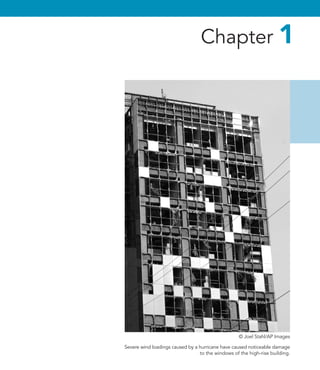
Severe wind loadings caused by a hurricane have caused noticeable damage
to the windows of the high-rise building.
© Joel Stahl/AP Images
3
Types of Structures
and Loads
This chapter provides a discussion of some of the preliminary
aspects of structural analysis. The phases of activity necessary to
produce a structure are presented first, followed by an introduction
to the basic types of structures, their components, and supports.
Finally, a brief explanation is given of the various types of loads that
must be considered for an appropriate analysis and design.
1.1  Introduction
In this text we will present many of the different ways engineers model and
then analyze the loadings and deflections of various types of structures.
Important examples related to civil engineering include buildings,bridges,
and towers; and in other branches of engineering, ship and aircraft frames,
and mechanical, and electrical supporting structures are important.
A structure refers to a system of connected parts used to support a
load. When designing a structure to serve a specified function for public
use, the engineer must account for its safety, esthetics, and serviceability,
while taking into consideration economic and environmental constraints.
Often this requires several independent studies of different solutions
before final judgment can be made as to which structural form is most
appropriate. This design process is both creative and technical and
requires a fundamental knowledge of material properties and the laws of
mechanics which govern material response. Once a preliminary design of
a structure is proposed, the structure must then be analyzed to ensure
that it has its required stiffness and strength. To analyze a structure
properly, certain idealizations must be made as to how the members are
supported and connected together. The loadings are determined from
codes and local specifications, and the forces in the members and their
displacements are found using the theory of structural analysis, which is
4	 Chapter 1  Types of Structures and Loads
1
the subject matter of this text. The results of this analysis then can be
used to redesign the structure, accounting for a more accurate
determination of the weight of the members and their size. Structural
design, therefore, follows a series of successive approximations in which
every cycle requires a structural analysis. In this book, the structural
analysis is applied to civil engineering structures; however, the method of
analysis described can also be used for structures related to other fields
of engineering.
1.2  Classification of Structures
It is important for a structural engineer to recognize the various types of
elements composing a structure and to be able to classify structures as to
their form and function.We will introduce some of these aspects now and
discuss others throughout the text.
Structural Elements.  Some of the more common elements from
which structures are composed are as follows.
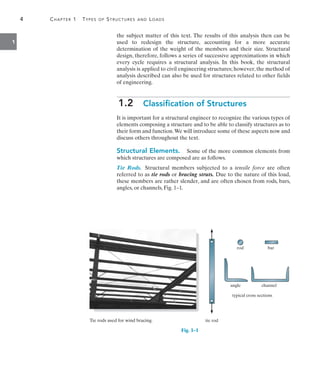
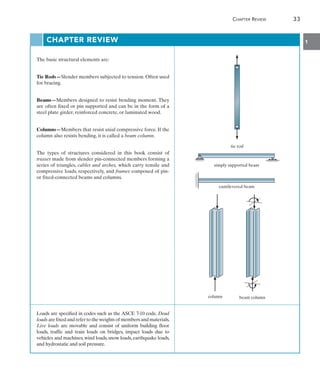
Tie Rods. Structural members subjected to a tensile force are often
referred to as tie rods or bracing struts. Due to the nature of this load,
these members are rather slender, and are often chosen from rods, bars,
angles, or channels, Fig. 1–1.
rod
tie rod
bar
angle channel
typical cross sections
rod
tie rod
bar
angle channel
typical cross sections
Tie rods used for wind bracing.
Fig. 1–1
1.2  Classification of Structures	 5
1
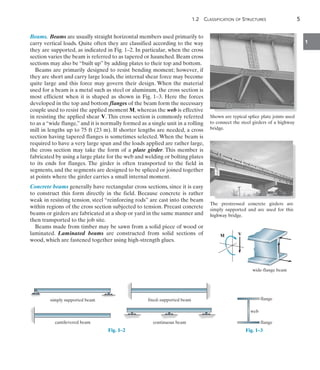
Beams. Beams are usually straight horizontal members used primarily to
carry vertical loads. Quite often they are classified according to the way
they are supported, as indicated in Fig. 1–2. In particular, when the cross
section varies the beam is referred to as tapered or haunched. Beam cross
sections may also be “built up” by adding plates to their top and bottom.
Beams are primarily designed to resist bending moment; however, if
they are short and carry large loads, the internal shear force may become
quite large and this force may govern their design. When the material
used for a beam is a metal such as steel or aluminum, the cross section is
most efficient when it is shaped as shown in Fig. 1–3. Here the forces
developed in the top and bottom flanges of the beam form the necessary
couple used to resist the applied moment M, whereas the web is effective
in resisting the applied shear V. This cross section is commonly referred
to as a “wide flange,” and it is normally formed as a single unit in a rolling
mill in lengths up to 75 ft (23 m). If shorter lengths are needed, a cross
section having tapered flanges is sometimes selected. When the beam is
required to have a very large span and the loads applied are rather large,
the cross section may take the form of a plate girder. This member is
fabricated by using a large plate for the web and welding or bolting plates
to its ends for flanges. The girder is often transported to the field in
segments, and the segments are designed to be spliced or joined together
at points where the girder carries a small internal moment.
Concrete beams generally have rectangular cross sections, since it is easy
to construct this form directly in the field. Because concrete is rather
weak in resisting tension, steel “reinforcing rods” are cast into the beam
within regions of the cross section subjected to tension. Precast concrete
beams or girders are fabricated at a shop or yard in the same manner and
then transported to the job site.
Beams made from timber may be sawn from a solid piece of wood or
laminated. Laminated beams are constructed from solid sections of
wood, which are fastened together using high-strength glues.
Shown are typical splice plate joints used
to connect the steel girders of a highway
bridge.
The prestressed concrete girders are
simply supported and are used for this
highway bridge.
simply supported beam
cantilevered beam
fixed–supported beam
continuous beam
Fig. 1–2
web
V
M
wide-flange beam
flange
flange
web
V
M
wide-flange beam
Fig. 1–3
6	 Chapter 1  Types of Structures and Loads
1
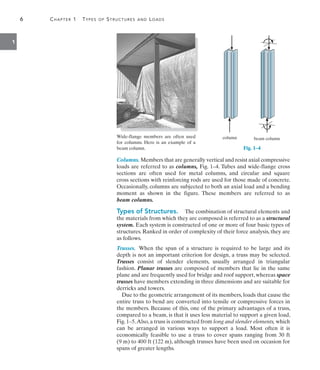
Columns. Members that are generally vertical and resist axial compressive
loads are referred to as columns, Fig. 1–4. Tubes and wide-flange cross
sections are often used for metal columns, and circular and square
cross sections with reinforcing rods are used for those made of concrete.
Occasionally, columns are subjected to both an axial load and a bending
moment as shown in the figure. These members are referred to as
beam columns.
Types of Structures.  The combination of structural elements and
the materials from which they are composed is referred to as a structural
system. Each system is constructed of one or more of four basic types of
structures. Ranked in order of complexity of their force analysis, they are
as follows.
Trusses. When the span of a structure is required to be large and its
depth is not an important criterion for design, a truss may be selected.
Trusses consist of slender elements, usually arranged in triangular
fashion. Planar trusses are composed of members that lie in the same
plane and are frequently used for bridge and roof support, whereas space
trusses have members extending in three dimensions and are suitable for
derricks and towers.
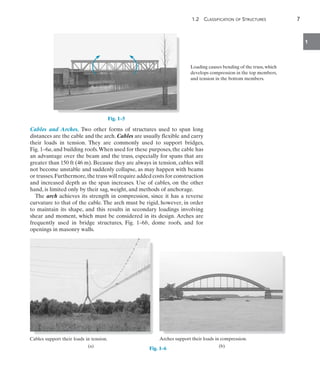
Due to the geometric arrangement of its members, loads that cause the
entire truss to bend are converted into tensile or compressive forces in
the members. Because of this, one of the primary advantages of a truss,
compared to a beam, is that it uses less material to support a given load,
Fig.1–5.Also,a truss is constructed from long and slender elements, which
can be arranged in various ways to support a load. Most often it is
economically feasible to use a truss to cover spans ranging from 30 ft
(9 m) to 400 ft (122 m), although trusses have been used on occasion for
spans of greater lengths.
Wide-flange members are often used
for columns. Here is an example of a
beam column.
beam column
column
Fig. 1–4
1.2  Classification of Structures	 7
1
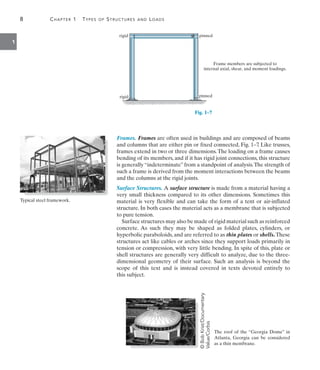
Cables and Arches. Two other forms of structures used to span long
distances are the cable and the arch. Cables are usually flexible and carry
their loads in tension. They are commonly used to support bridges,
Fig. 1–6a, and building roofs.When used for these purposes, the cable has
an advantage over the beam and the truss, especially for spans that are
greater than 150 ft (46 m). Because they are always in tension, cables will
not become unstable and suddenly collapse, as may happen with beams
or trusses.Furthermore,the truss will require added costs for construction
and increased depth as the span increases. Use of cables, on the other
hand, is limited only by their sag, weight, and methods of anchorage.
The arch achieves its strength in compression, since it has a reverse
curvature to that of the cable. The arch must be rigid, however, in order
to maintain its shape, and this results in secondary loadings involving
shear and moment, which must be considered in its design. Arches are
frequently used in bridge structures, Fig. 1–6b, dome roofs, and for
openings in masonry walls.
Arches support their loads in compression.
Fig. 1–5 
Fig. 1–6
(b)
(a)
Loading causes bending of the truss, which
develops compression in the top members,
and tension in the bottom members.
Cables support their loads in tension.
8	 Chapter 1  Types of Structures and Loads
1
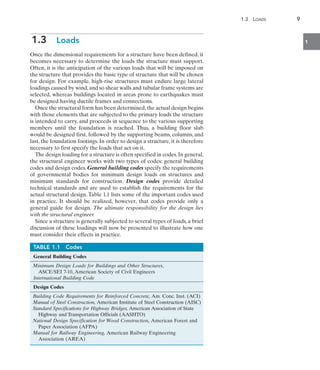
pinned
rigid
rigid pinned
Frame members are subjected to
internal axial, shear, and moment loadings.
Fig. 1–7
Frames. Frames are often used in buildings and are composed of beams
and columns that are either pin or fixed connected, Fig. 1–7
. Like trusses,
frames extend in two or three dimensions.The loading on a frame causes
bending of its members, and if it has rigid joint connections, this structure
is generally “indeterminate” from a standpoint of analysis.The strength of
such a frame is derived from the moment interactions between the beams
and the columns at the rigid joints.
Surface Structures. A surface structure is made from a material having a
very small thickness compared to its other dimensions. Sometimes this
material is very flexible and can take the form of a tent or air-inflated
structure. In both cases the material acts as a membrane that is subjected
to pure tension.
Surface structures may also be made of rigid material such as reinforced
concrete. As such they may be shaped as folded plates, cylinders, or
hyperbolic paraboloids, and are referred to as thin plates or shells. These
structures act like cables or arches since they support loads primarily in
tension or compression, with very little bending. In spite of this, plate or
shell structures are generally very difficult to analyze, due to the three-
dimensional geometry of their surface. Such an analysis is beyond the
scope of this text and is instead covered in texts devoted entirely to
this subject.
Typical steel framework.
The roof of the “Georgia Dome” in
Atlanta, Georgia can be considered
as a thin membrane.
©
Bob
Krist/Documentary
Value/Corbis
1.3  Loads	 9
1
1.3  Loads
Once the dimensional requirements for a structure have been defined, it
becomes necessary to determine the loads the structure must support.
Often, it is the anticipation of the various loads that will be imposed on
the structure that provides the basic type of structure that will be chosen
for design. For example, high-rise structures must endure large lateral
loadings caused by wind,and so shear walls and tubular frame systems are
selected, whereas buildings located in areas prone to earthquakes must
be designed having ductile frames and connections.
Once the structural form has been determined,the actual design begins
with those elements that are subjected to the primary loads the structure
is intended to carry, and proceeds in sequence to the various supporting
members until the foundation is reached. Thus, a building floor slab
would be designed first, followed by the supporting beams, columns, and
last, the foundation footings. In order to design a structure, it is therefore
necessary to first specify the loads that act on it.
The design loading for a structure is often specified in codes.In general,
the structural engineer works with two types of codes: general building
codes and design codes. General building codes specify the requirements
of governmental bodies for minimum design loads on structures and
minimum standards for construction. Design codes provide detailed
technical standards and are used to establish the requirements for the
actual structural design. Table 1.1 lists some of the important codes used
in practice. It should be realized, however, that codes provide only a
general guide for design. The ultimate responsibility for the design lies
with the structural engineer.
Since a structure is generally subjected to several types of loads, a brief
discussion of these loadings will now be presented to illustrate how one
must consider their effects in practice.
TABLE 1.1  Codes
General Building Codes
Minimum Design Loads for Buildings and Other Structures,
ASCE/SEI 7-10, American Society of Civil Engineers
International Building Code
Design Codes
Building Code Requirements for Reinforced Concrete, Am. Conc. Inst. (ACI)
Manual of Steel Construction, American Institute of Steel Construction (AISC)
Standard Specifications for Highway Bridges, American Association of State
Highway and Transportation Officials (AASHTO)
National Design Specification for Wood Construction, American Forest and
Paper Association (AFPA)
Manual for Railway Engineering, American Railway Engineering
Association (AREA)
10	 Chapter 1  Types of Structures and Loads
1
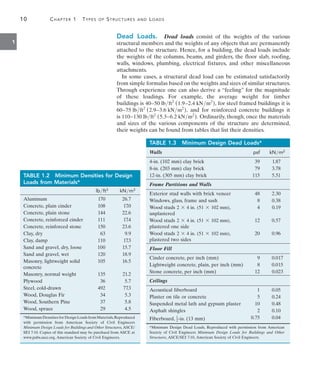
Dead Loads.  Dead loads consist of the weights of the various
structural members and the weights of any objects that are permanently
attached to the structure. Hence, for a building, the dead loads include
the weights of the columns, beams, and girders, the floor slab, roofing,
walls, windows, plumbing, electrical fixtures, and other miscellaneous
attachments.
In some cases, a structural dead load can be estimated satisfactorily
from simple formulas based on the weights and sizes of similar structures.
Through experience one can also derive a “feeling” for the magnitude
of  these loadings. For example, the average weight for timber
buildings is 40950 lbft2
(1.992.4 kNm2
), for steel framed buildings it is
60975 lbft2
(2.993.6 kNm2
), and for reinforced concrete buildings it
is 1109130 lbft2
(5.396.2 kNm2
). Ordinarily, though, once the materials
and sizes of the various components of the structure are determined,
their weights can be found from tables that list their densities.
TABLE 1.2  Minimum Densities for Design
Loads from Materials*
lbft3 kNm3
Aluminum 170 26.7
Concrete, plain cinder 108 17
.0
Concrete, plain stone 144 22.6
Concrete, reinforced cinder 111 17
.4
Concrete, reinforced stone 150 23.6
Clay, dry 63 9.9
Clay, damp 110 17
.3
Sand and gravel, dry, loose 100 15.7
Sand and gravel, wet 120 18.9
Masonry, lightweight solid
concrete
105 16.5
Masonry, normal weight 135 21.2
Plywood 36 5.7
Steel, cold-drawn 492 77
.3
Wood, Douglas Fir 34 5.3
Wood, Southern Pine 37 5.8
Wood, spruce 29 4.5
*Minimum Densities for Design Loads from Materials,Reproduced
with permission from American Society of Civil Engineers
Minimum Design Loads for Buildings and Other Structures, ASCE/
SEI 7-10. Copies of this standard may be purchaed from ASCE at
www.pubs.asce.org, American Society of Civil Engineers.
TABLE 1.3  Minimum Design Dead Loads*
Walls psf kNm2
4-in. (102 mm) clay brick 39 1.87
8-in. (203 mm) clay brick 79 3.78
12-in. (305 mm) clay brick 115 5.51
Frame Partitions and Walls
Exterior stud walls with brick veneer 48 2.30
Windows, glass, frame and sash 8 0.38
Wood studs 2 * 4 in. (51 * 102 mm),
unplastered
4 0.19
Wood studs 2 * 4 in. (51 * 102 mm),
plastered one side
12 0.57
Wood studs 2 * 4 in. (51 * 102 mm),
plastered two sides
20 0.96
Floor Fill
Cinder concrete, per inch (mm) 9 0.017
Lightweight concrete, plain, per inch (mm) 8 0.015
Stone concrete, per inch (mm) 12 0.023
Ceilings
Acoustical fiberboard 1 0.05
Plaster on tile or concrete 5 0.24
Suspended metal lath and gypsum plaster 10 0.48
Asphalt shingles 2 0.10
Fiberboard, 1
2@in. (13 mm) 0.75 0.04
*Minimum Design Dead Loads, Reproduced with permission from American
Society of Civil Engineers Minimum Design Loads for Buildings and Other
Structures, ASCE/SEI 7-10, American Society of Civil Engineers.
1.3  Loads	 11
1
The densities of typical materials used in construction are listed in
Table 1.2, and a portion of a table listing the weights of typical building
components is given in Table 1.3. Although calculation of dead loads
based on the use of tabulated data is rather straightforward, it should be
realized that in many respects these loads will have to be estimated in the
initial phase of design. These estimates include nonstructural materials
such as prefabricated facade panels, electrical and plumbing systems, etc.
Furthermore, even if the material is specified, the unit weights of
elements reported in codes may vary from those given by manufacturers,
and later use of the building may include some changes in dead loading.
As a result, estimates of dead loadings can be in error by 15% to 20%
or more.
Normally, the dead load is not large compared to the design load for
simple structures such as a beam or a single-story frame; however, for
multistory buildings it is important to have an accurate accounting of all
the dead loads in order to properly design the columns, especially for the
lower floors.
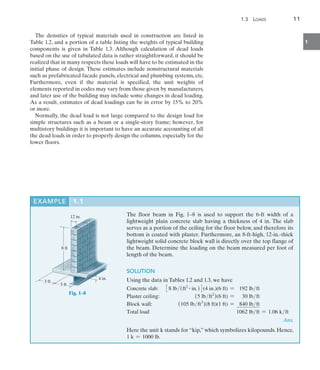
EXAMPLE 1.1 
The floor beam in Fig. 1–8 is used to support the 6-ft width of a
lightweight plain concrete slab having a thickness of 4 in. The slab
serves as a portion of the ceiling for the floor below, and therefore its
bottom is coated with plaster. Furthermore, an 8-ft-high, 12-in.-thick
lightweight solid concrete block wall is directly over the top flange of
the beam. Determine the loading on the beam measured per foot of
length of the beam.
SOLUTION
Using the data in Tables 1.2 and 1.3, we have
Concrete slab:
Plaster ceiling:
Block wall:
Total load
38 lb(ft2 # in.)4(4 in.)(6 ft) = 192 lbft
(5 lbft2
)(6 ft) = 30 lbft
(105 lbft3
)(8 ft)(1 ft) = 840 lbft
1062 lbft = 1.06 kft
 Ans.
Here the unit k stands for “kip,” which symbolizes kilopounds. Hence,
1 k = 1000 lb.
3 ft
3 ft
8 ft
4 in.
12 in.
Fig. 1–8 
12	 Chapter 1  Types of Structures and Loads
1
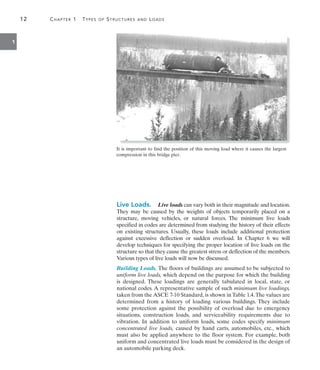
Live Loads.  Live loads can vary both in their magnitude and location.
They may be caused by the weights of objects temporarily placed on a
structure, moving vehicles, or natural forces. The minimum live loads
specified in codes are determined from studying the history of their effects
on existing structures. Usually, these loads include additional protection
against excessive deflection or sudden overload. In Chapter 6 we will
develop techniques for specifying the proper location of live loads on the
structure so that they cause the greatest stress or deflection of the members.
Various types of live loads will now be discussed.
Building Loads. The floors of buildings are assumed to be subjected to
uniform live loads, which depend on the purpose for which the building
is designed. These loadings are generally tabulated in local, state, or
national codes. A representative sample of such minimum live loadings,
taken from the ASCE 7-10 Standard, is shown in Table 1.4.The values are
determined from a history of loading various buildings. They include
some protection against the possibility of overload due to emergency
situations, construction loads, and serviceability requirements due to
vibration. In addition to uniform loads, some codes specify minimum
concentrated live loads, caused by hand carts, automobiles, etc., which
must also be applied anywhere to the floor system. For example, both
uniform and concentrated live loads must be considered in the design of
an automobile parking deck.
It is important to find the position of this moving load where it causes the largest
compression in this bridge pier.
1.3  Loads	 13
1
TABLE 1.4  Minimum Live Loads*
Live Load Live Load
Occupancy or Use psf kNm2 Occupancy or Use psf kNm2
Assembly areas and theaters Residential
Fixed seats 60 2.87 Dwellings (one- and two-family) 40 1.92
Movable seats 100 4.79 Hotels and multifamily houses
Garages (passenger cars only) 40 1.92 Private rooms and corridors 40 1.92
Office buildings Public rooms and corridors 100 4.79
Lobbies 100 4.79 Schools
Offices 50 2.40 Classrooms 40 1.92
Storage warehouse First-floor corridors 100 4.79
Light 125 6.00 Corridors above first floor 80 3.83
Heavy 250 11.97
*Minimum Live Loads, Reproduced with permission from American Society of Civil Engineers Minimum Design Loads for Buildings and Other Structures,
ASCE/SEI 7-10, American Society of Civil Engineers.
*Specific examples of the determination of tributary areas for beams and columns are
given in Sec. 2.1.
For some types of buildings having very large floor areas,many codes will
allow a reduction in the uniform live load for a floor, since it is unlikely that
the prescribed live load will occur simultaneously throughout the entire
structure at any one time. For example, ASCE 7-10 allows a reduction of
liveloadonamemberhavinganinfluencearea (KLL AT) of 400 ft2
(37.2 m2
)
or more.This reduced live load is calculated using the following equation:
		
(1–1)
where
L = 
reduced design live load per square foot or square meter of area
supported by the member.
Lo = 
unreduced design live load per square foot or square meter of
area supported by the member (see Table 1.4).
KLL = 
live load element factor. For interior columns KLL = 4.
AT = tributary area in square feet or square meters.*
The reduced live load defined by Eq. 1–1 is limited to not less than 50%
of Lo for members supporting one floor, or not less than 40% of Lo
for members supporting more than one floor. No reduction is allowed for
loads exceeding 100 lbft2
(4.79 kNm2
), or for structures used for public
assembly, garages, or roofs. Example 1.2 illustrates Eq. 1–1’s application.
L = Lo°0.25 +
15
2KLL AT
¢ (FPS units)
L = Lo°0.25 +
4.57
2KLL AT
¢ (SI units)
14	 Chapter 1  Types of Structures and Loads
1
EXAMPLE 1.2 
A two-story office building shown in the photo has interior columns
that are spaced 22 ft apart in two perpendicular directions. If the (flat)
roof loading is 20 lbft2
, determine the reduced live load supported by
a typical interior column located at ground level.
AT
22 ft
22 ft
22 ft
22 ft
Fig. 1–9
SOLUTION
As shown in Fig. 1–9, each interior column has a tributary area or
effective loaded area of AT = (22 ft)(22 ft) = 484 ft2
. A ground-floor
column therefore supports a roof live load of
FR = (20 lbft2
)(484 ft2
) = 9680 lb = 9.68 k
This load cannot be reduced, since it is not a floor load. For the second
floor, the live load is taken from Table 1.4: Lo = 50 lbft2
. Since
KLL = 4, then 4AT = 4(484 ft2
) = 1936 ft2
and 1936 ft2
7 400 ft2
, the
live load can be reduced using Eq. 1–1.Thus,
L = 50°0.25 +
15
21936
¢ = 29.55 lbft2
The load reduction here is (29.5550)100% = 59.1% 7 50%. O.K.
Therefore,
FF = (29.55 lbft2
)(484 ft2
) = 14 300 lb = 14.3 k
The total live load supported by the ground-floor column is thus
	 F = FR + FF = 9.68 k + 14.3 k = 24.0 k Ans.
1.3  Loads	 15
1
Highway Bridge Loads. The primary live loads on bridge spans are
those due to traffic, and the heaviest vehicle loading encountered is that
caused by a series of trucks. Specifications for truck loadings on highway
bridges are reported in the LRFD Bridge Design Specifications of the
American Association of State and Highway Transportation Officials
(AASHTO). For two-axle trucks, these loads are designated with an H,
followed by the weight of the truck in tons and another number which
gives the year of the specifications in which the load was reported.
H-series truck weights vary from 10 to 20 tons. However, bridges located
on major highways, which carry a great deal of traffic, are often designed
for two-axle trucks plus a one-axle semitrailer as in Fig. 1–10. These are
designated as HS loadings. In general, a truck loading selected for
design depends upon the type of bridge, its location, and the type of
traffic anticipated.
The size of the “standard truck” and the distribution of its weight is
also reported in the specifications.Although trucks are assumed to be on
the road, all lanes on the bridge need not be fully loaded with a row of
trucks to obtain the critical load, since such a loading would be highly
improbable.The details are discussed in Chapter 6.
Railroad Bridge Loads. The loadings on railroad bridges, as in Fig. 1–11,
are specified in the Specifications for Steel Railway Bridges published by
the American Railroad Engineers Association (AREA). Normally, E
loads, as originally devised by Theodore Cooper in 1894, were used for
design. B. Steinmann has since updated Cooper’s load distribution and
has devised a series of M loadings, which are currently acceptable for
design. Since train loadings involve a complicated series of concentrated
forces, to simplify hand calculations, tables and graphs are sometimes
used in conjunction with influence lines to obtain the critical load. Also,
computer programs are used for this purpose.
Fig. 1–11
Fig. 1–10
16	 Chapter 1  Types of Structures and Loads
1
Impact Loads. Moving vehicles may bounce or sidesway as they move
over a bridge, and therefore they impart an impact to the deck. The
percentage increase of the live loads due to impact is called the impact
factor, I. This factor is generally obtained from formulas developed from
experimental evidence. For example, for highway bridges the AASHTO
specifications require that
I =
50
L + 125
but not larger than 0.3
where L is the length of the span in feet that is subjected to the live load.
In some cases provisions for impact loading on the structure of a
building must also be taken into account. For example, the ASCE 7-10
Standard requires the weight of elevator machinery to be increased by
100%, and the loads on any hangers used to support floors and balconies
to be increased by 33%.
Wind Loads. When the speed of the wind is very high, it can cause
massive damage to a structure.The reason is that the pressure created by
the wind is proportional to the square of the wind speed. In large
hurricanes this speed can reach over 100 mih (161 kmh); however, by
comparison, an F5 tornado (Fujita scale) has wind speeds over 300 mih
(483 kmh)!
To understand the effect of a horizontal wind blowing over and around
a building, consider the simple structure shown in Fig. 1–12. Here the
positive pressure (pushing) on the front of the building is intensified,
because the front will arrest the flow and redirect it over the roof and
along the sides. Because air flows faster around the building, by the
Bernoulli effect this higher velocity will cause a lower pressure (suction).
This is especially true at the corners, under the eaves, and at the ridge of
the roof. Here the wind is redirected and the damage is the greatest.
Behind the building there is also a suction, which produces a wake within
the air stream.
The destruction due to the wind is increased if the building has an
opening, If the opening is at the front, then the pressure within the
building is increased and this intensifies the external suction on the back,
side walls, and the roof. If the opening is on a side wall, then the opposite
effect occurs. Air will be sucked out of the building, lowering its inside
pressure, and intensifying the pressure acting externally on the front of
the building.
1.3  Loads	 17
1
For a high-rise building, the wind loading can be quite complex, and
so these structures are often designed based on the behavior of a model
of the building, tested in a wind tunnel. When doing so, it is important
to consider the wind striking the structure from any direction.*
The effects of lateral loadings developed by wind, can cause racking,
or leaning of a building frame. To resist this effect, engineers often use
cross bracing, knee or diagonal bracing, or shear walls. Examples that
show the use of these members are indicated in the photos.
Windward
side
Leeward side
Wind produces
high pressure
(pushing).
Damage originates at
corners, under eaves, and
at the ridge of the roof.
Wind produces
low pressure
(suction).
Wind entering front of building
increases internal pressure.
Fig. 1–12
*You may want to investigate the case of the initial design of Citigroup Center.
Construction of this skyscraper was completed in New York City in 1977, and only
afterwards was it realized that the quartering winds, that is, those directed at the corners
of the building, would produce enough force to actually collapse the building. Retrofits
had to be made to the connections to provide the necessary strength to stiffen the structure.
See http://failures.wikispaces.com/Citicorp+Center.
Cross bracing. Knee bracing.
wind
Shear walls.
Diagonal bracing.
18	 Chapter 1  Types of Structures and Loads
1
Some high-rise buildings must be able to
resist hurricane winds having speeds of
over 120 mi ,h.
Hurricane winds caused this damage to a
condominium in Miami, Florida.
The effect of wind on a structure depends upon the density and
velocity of the air, the angle of incidence of the wind, the shape and
stiffness of the structure, and the roughness of its surface. For design
purposes, wind loadings can be treated using either a static or a
dynamic approach.
For the static approach, the fluctuating pressure caused by a constantly
blowing wind is approximated by a mean velocity pressure that acts on
the structure. This pressure q is defined by the air’s kinetic energy per
unit volume, q = 1
2 rV2
, where r is the density of the air and V is its
velocity.According to the ASCE 7-10 Standard, this equation is modified
to account for the structure’s height, and the terrain in which it is located.
Also the importance of the structure is considered, as it relates to the risk
to human life or the public welfare if it is damaged or loses its functionality.
This modified equation is represented by the following equation.
©
Jeff
Greenberg/Alamy
1.3  Loads	 19
1
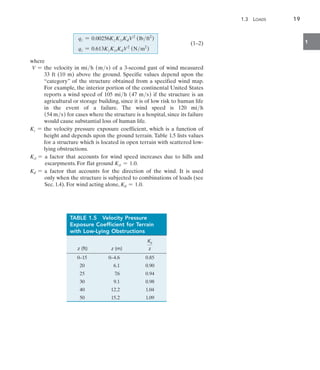
TABLE 1.5  Velocity Pressure
Exposure Coefficient for Terrain
with Low-Lying Obstructions
z (ft) z (m)
Kz
z
0–15 0–4.6 0.85
20 6.1 0.90
25 7
.6 0.94
30 9.1 0.98
40 12.2 1.04
50 15.2 1.09

(1–2)
where
V = 
the velocity in mih (ms) of a 3-second gust of wind measured
33 ft (10 m) above the ground. Specific values depend upon the
“category” of the structure obtained from a specified wind map.
For example, the interior portion of the continental United States
reports a wind speed of 105 mih (47 ms) if the structure is an
agricultural or storage building, since it is of low risk to human life
in the event of a failure. The wind speed is 120 mih
(54 ms) for cases where the structure is a hospital, since its failure
would cause substantial loss of human life.
Kz = 
the velocity pressure exposure coefficient, which is a function of
height and depends upon the ground terrain. Table 1.5 lists values
for a structure which is located in open terrain with scattered low-
lying obstructions.
Kzt = 
a factor that accounts for wind speed increases due to hills and
escarpments. For flat ground Kzt = 1.0.
Kd = 
a factor that accounts for the direction of the wind. It is used
only when the structure is subjected to combinations of loads (see
Sec. 1.4). For wind acting alone, Kd = 1.0.
qz = 0.00256KzKztKdV2
(lbft2
)
qz = 0.613KzKztKdV2
(Nm2
)
20	 Chapter 1  Types of Structures and Loads
1
Application of Eq. 1–3 will involve calculations of wind pressures from
each side of the building, with due considerations for the possibility of
either positive or negative pressures acting on the building’s interior.*
For high-rise buildings or those having a shape or location that makes
them wind sensitive, it is recommended that a dynamic approach be used to
determine the wind loadings.The methodology for doing this is also outlined
in theASCE 7-10 Standard.It requires wind-tunnel tests to be performed on
a scale model of the building and those surrounding it, in order to simulate
the natural environment. The pressure effects of the wind on the building
can be determined from pressure transducers attached to the model.Also,if
the model has stiffness characteristics that are in proper scale to the building,
then the dynamic deflections of the building can be determined.
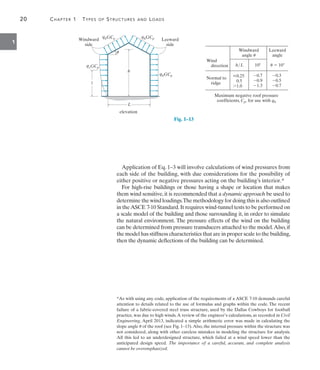
L
h
z
qhGCp qhGCp
qhGCp
qzGCp
elevation
Windward
side
Leeward
side
u
Maximum negative roof pressure
coefficients, Cp, for use with qh
Wind
direction
Normal to
ridge
h/L 10 u  10
Leeward
angle
Windward
angle u
0.7
0.9
1.3
0.3
0.5
0.7
0.25
0.5
1.0
Fig. 1–13
*As with using any code, application of the requirements of a ASCE 7-10 demands careful
attention to details related to the use of formulas and graphs within the code. The recent
failure of a fabric-covered steel truss structure, used by the Dallas Cowboys for football
practice, was due to high winds.A review of the engineer’s calculations, as recorded in Civil
Engineering, April 2013, indicated a simple arithmetic error was made in calculating the
slope angle u of the roof (see Fig. 1–13).Also, the internal pressure within the structure was
not considered, along with other careless mistakes in modeling the structure for analysis.
All this led to an underdesigned structure, which failed at a wind speed lower than the
anticipated design speed. The importance of a careful, accurate, and complete analysis
cannot be overemphasized.
1.3  Loads	 21
1
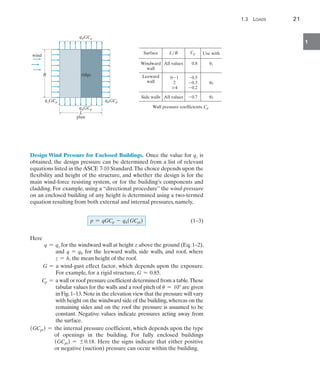
B
L
wind
qhGCp
qhGCp
qzGCp
qhGCp
ridge
plan
Surface Use with
All values
All values
Wall pressure coefficients, Cp
Side walls
Windward
wall
Leeward
wall
L/B
01
2
4
Cp
qz
qh
qh
0.8
0.5
0.3
0.2
0.7
Design Wind Pressure for Enclosed Buildings. Once the value for qz is
obtained, the design pressure can be determined from a list of relevant
equations listed in the ASCE 7-10 Standard.The choice depends upon the
flexibility and height of the structure, and whether the design is for the
main wind-force resisting system, or for the building’s components and
cladding. For example, using a “directional procedure” the wind-pressure
on an enclosed building of any height is determined using a two-termed
equation resulting from both external and internal pressures, namely,
(1–3)
Here
q = 
qz for the windward wall at height z above the ground (Eq.1–2),
and q = qh for the leeward walls, side walls, and roof, where
z = h, the mean height of the roof.
G = 
a wind-gust effect factor, which depends upon the exposure.
For example, for a rigid structure, G = 0.85.
Cp = 
a wall or roof pressure coefficient determined from a table.These
tabular values for the walls and a roof pitch of u = 10 are given
in Fig.1–13.Note in the elevation view that the pressure will vary
with height on the windward side of the building,whereas on the
remaining sides and on the roof the pressure is assumed to be
constant. Negative values indicate pressures acting away from
the surface.
(GCpi) = 
the internal pressure coefficient, which depends upon the type
of openings in the building. For fully enclosed buildings
(GCpi) = {0.18. Here the signs indicate that either positive
or negative (suction) pressure can occur within the building.
p = qGCp - qh(GCpi)
22	 Chapter 1  Types of Structures and Loads
1
EXAMPLE 1.3 
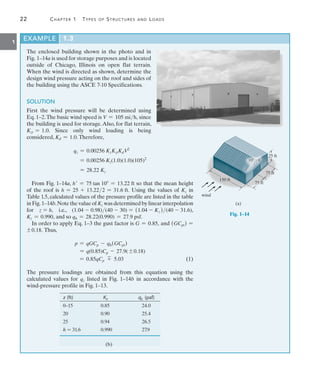
The enclosed building shown in the photo and in
Fig. 1–14a is used for storage purposes and is located
outside of Chicago, Illinois on open flat terrain.
When the wind is directed as shown, determine the
design wind pressure acting on the roof and sides of
the building using the ASCE 7-10 Specifications.
SOLUTION
First the wind pressure will be determined using
Eq. 1–2.The basic wind speed is V = 105 mih, since
the building is used for storage.Also, for flat terrain,
Kzt = 1.0. Since only wind loading is being
considered, Kd = 1.0.Therefore,
qz = 0.00256 KzKztKdV2
= 0.00256 Kz(1.0)(1.0)(105)2
= 28.22 Kz
From Fig. 1–14a, h = 75 tan 10 = 13.22 ft so that the mean height
of the roof is h = 25 + 13.222 = 31.6 ft. Using the values of Kz in
Table 1.5, calculated values of the pressure profile are listed in the table
in Fig. 1–14b.Note the value of Kz was determined by linear interpolation
for z = h, i.e., (1.04 - 0.98)(40 - 30) = (1.04 - Kz )(40 - 31.6),
Kz = 0.990, and so qh = 28.22(0.990) = 27.9 psf.
In order to apply Eq. 1–3 the gust factor is G = 0.85, and (GCpi) =
{0.18. Thus,
p = qGCp - qh(GCpi)
= q(0.85)Cp - 27.9({0.18)
= 0.85qCp | 5.03 	(1)
The pressure loadings are obtained from this equation using the
calculated values for qz listed in Fig. 1–14b in accordance with the
wind-pressure profile in Fig. 1–13.
z (ft) Kz qz  (psf)
0–15 0.85 24.0
20 0.90 25.4
25 0.94 26.5
h = 31.6 0.990 27
.9
(b)
150 ft
wind
75 ft
75 ft
25 ft
(a)
10 h¿
h¿
10
Fig. 1–14
1.3  Loads	 23
1
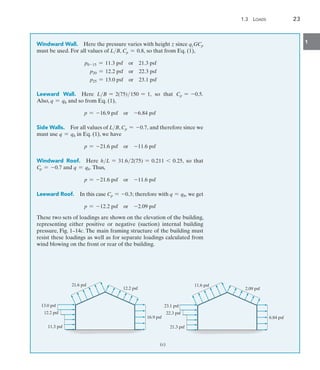
Windward Wall.  Here the pressure varies with height z since qzGCp
must be used. For all values of LB, Cp = 0.8, so that from Eq. (1),
p0-15 = 11.3 psf or 21.3 psf
p20 = 12.2 psf or 22.3 psf
p25 = 13.0 psf or 23.1 psf
Leeward Wall. Here LB = 2(75)150 = 1, so that Cp = -0.5.
Also, q = qh and so from Eq. (1),
p = -16.9 psf or -6.84 psf
Side Walls.  For all values of LB, Cp = -0.7, and therefore since we
must use q = qh in Eq. (1), we have
p = -21.6 psf or -11.6 psf
Windward Roof. Here hL = 31.62(75) = 0.211 6 0.25, so that
Cp = -0.7 and q = qh. Thus,
p = -21.6 psf or -11.6 psf
Leeward Roof.  In this case Cp = -0.3; therefore with q = qh, we get
p = -12.2 psf or -2.09 psf
These two sets of loadings are shown on the elevation of the building,
representing either positive or negative (suction) internal building
pressure, Fig. 1–14c. The main framing structure of the building must
resist these loadings as well as for separate loadings calculated from
wind blowing on the front or rear of the building.
11.3 psf
12.2 psf
13.0 psf
21.6 psf
12.2 psf
16.9 psf
(c)
21.3 psf
22.3 psf
23.1 psf
11.6 psf
2.09 psf
6.84 psf
24	 Chapter 1  Types of Structures and Loads
1
Design Wind Pressure for Signs. If the structure represents a sign, the
wind will produce a resultant force acting on the face of the sign which is
determined from
 (1–4)
Here
qh = 
the wind pressure evaluated at the height h, measured from the
ground to the top of the sign.
G = 
the wind-gust coefficient factor defined previously.
Cf = 
a force coefficient which depends upon the aspect ratio (width B of
the sign to height s of the sign), and the clear area ratio (sign height
s to the elevation h, measured from the ground to the top of the
sign). For cases of wind directed normal to the sign and through its
center, for Bs = 4, values are listed in Table 1.6.
As = 
the area of the face of the sign in ft2 (m2).
F = qhGCfAs
TABLE 1.6  Force Coefficients for
Above-Ground Solid Signs, Cf
sh Cf
1 1.35
0.9 1.45
0.5 1.70
0.2 1.80
…0.16 1.85
To allow for normal and oblique wind directions, the calculated
resultant force is assumed to act either through the geometric center of
the face of the sign or at other specified locations on the face of the sign
which depend upon the ratios sh and Bs.
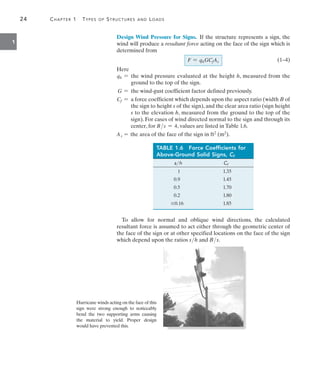
Hurricane winds acting on the face of this
sign were strong enough to noticeably
bend the two supporting arms causing
the material to yield. Proper design
would have prevented this.
1.3  Loads	 25
1
Snow Loads. In some parts of the country, roof loading due to snow can
be quite severe, and therefore protection against possible failure is of
primary concern. Design loadings typically depend on the building’s
general shape and roof geometry, wind exposure, location, its importance,
and whether or not it is heated. Like wind, snow loads in the ASCE 7-10
Standard are generally determined from a zone map reporting 50-year
recurrence intervals of an extreme snow depth. For example, on the
relatively flat elevation throughout the mid-section of Illinois and Indiana,
the ground snow loading is 20 lbft2
(0.96 kNm2
). However, for areas of
Montana, specific case studies of ground snow loadings are needed due to
the variable elevations throughout the state. Specifications for snow loads
are covered in theASCE 7-10 Standard,although no single code can cover
all the implications of this type of loading.
If a roof is flat, defined as having a slope of less than 5%, then the
pressure loading on the roof can be obtained by modifying the ground
snow loading, pg, by the following empirical formula
(1–5)
Here
Ce = 
an exposure factor which depends upon the terrain. For example,
for a fully exposed roof in an unobstructed area, Ce = 0.8, whereas
if the roof is sheltered and located in the center of a large city, then
Ce = 1.2.
Ct = 
a thermal factor which refers to the average temperature within the
building. For unheated structures kept below freezing Ct = 1.2,
whereas if the roof is supporting a normally heated structure, then
Ct = 1.0.
Is = 
the importance factor as it relates to occupancy. For example,
Is = 0.80 for agriculture and storage facilities, and Is = 1.20 for
schools and hospitals.
If pg … 20 lbft2
(0.96 kNm2
), then use the largest value for pf, either
computed from the above equation or from pf = Ispg. If pg 7 20 lbft2
(0.96 kNm2
), then use pf = Is(20 lbft2
).
pf = 0.7CeCtIspg
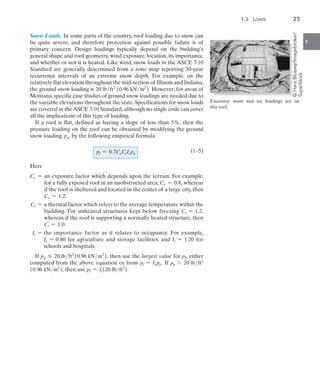
Excessive snow and ice loadings act on
this roof.
©
Hans
Blossey/Imagebroker/
SuperStock
26	 Chapter 1  Types of Structures and Loads
1
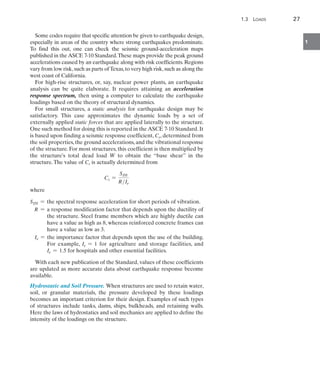
Earthquake Loads. Earthquakes produce lateral loadings on a structure
through the structure’s interaction with the ground.The magnitude of an
earthquake load depends on the amount and type of ground accelerations
and the mass and stiffness of the structure. In order to show how
earthquake loads occur, consider the simple structural model in Fig. 1–16.
This model may represent a single-story building, where the block is the
“lumped” mass of the roof, and the column has a total stiffness
representing all the building’s columns. During an earthquake, the
ground vibrates both horizontally and vertically. The horizontal
accelerations create shear forces in the column that put the block in
sequential motion with the ground. If the column is stiff and the block
has a small mass, the period of vibration of the block will be short and the
block will accelerate with the same motion as the ground and undergo
only slight relative displacements. For an actual structure that is designed
to have large amounts of bracing and stiff connections, this can be
beneficial, since less stress is developed in the members. On the other
hand, if the column in Fig. 1–16 is very flexible and the block has a large
mass, then earthquake-induced motion will cause small accelerations of
the block and large relative displacements.
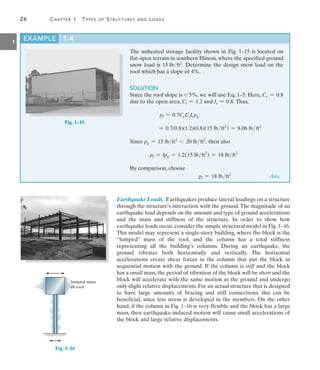
EXAMPLE 1.4
The unheated storage facility shown in Fig. 1–15 is located on
flat open terrain in southern Illinois, where the specified ground
snow load is 15 lbft2
. Determine the design snow load on the
roof which has a slope of 4%.
SOLUTION
Since the roof slope is 6 5%, we will use Eq. 1–5. Here, Ce = 0.8
due to the open area, Ct = 1.2 and Is = 0.8. Thus,
pf = 0.7CeCtIspg
= 0.7(0.8)(1.2)(0.8)(15 lbft2
) = 8.06 lbft2
Since pg = 15 lbft2
6 20 lbft2
, then also
	 pf = Ipg = 1.2(15 lbft2
) = 18 lbft2
By comparison, choose
	 pf = 18 lbft2
 Ans.
Fig. 1–15
lumped mass
of roof
Fig. 1–16
1.3  Loads	 27
1
Some codes require that specific attention be given to earthquake design,
especially in areas of the country where strong earthquakes predominate.
To find this out, one can check the seismic ground-acceleration maps
published in theASCE 7-10 Standard.These maps provide the peak ground
accelerations caused by an earthquake along with risk coefficients. Regions
vary from low risk,such as parts ofTexas,to very high risk,such as along the
west coast of California.
For high-rise structures, or, say, nuclear power plants, an earthquake
analysis can be quite elaborate. It requires attaining an acceleration
response spectrum, then using a computer to calculate the earthquake
loadings based on the theory of structural dynamics.
For small structures, a static analysis for earthquake design may be
satisfactory. This case approximates the dynamic loads by a set of
externally applied static forces that are applied laterally to the structure.
One such method for doing this is reported in the ASCE 7-10 Standard. It
is based upon finding a seismic response coefficient, Cs, determined from
the soil properties, the ground accelerations, and the vibrational response
of the structure. For most structures, this coefficient is then multiplied by
the structure’s total dead load W to obtain the “base shear” in the
structure.The value of Cs is actually determined from
Cs =
SDS
RIe
where
SDS = 
the spectral response acceleration for short periods of vibration.
R = 
a response modification factor that depends upon the ductility of
the structure. Steel frame members which are highly ductile can
have a value as high as 8, whereas reinforced concrete frames can
have a value as low as 3.
Ie = 
the importance factor that depends upon the use of the building.
For example, Ie = 1 for agriculture and storage facilities, and
Ie = 1.5 for hospitals and other essential facilities.
With each new publication of the Standard, values of these coefficients
are updated as more accurate data about earthquake response become
available.
Hydrostatic and Soil Pressure. When structures are used to retain water,
soil, or granular materials, the pressure developed by these loadings
becomes an important criterion for their design. Examples of such types
of structures include tanks, dams, ships, bulkheads, and retaining walls.
Here the laws of hydrostatics and soil mechanics are applied to define the
intensity of the loadings on the structure.
28	 Chapter 1  Types of Structures and Loads
1
Other Natural Loads. Several other types of live loads may also have to
be considered in the design of a structure, depending on its location or
use.These include the effect of blast,temperature changes,and differential
settlement of the foundation.
1.4  Structural Design
Whenever a structure is designed, it is important to give consideration to
both material and load uncertainties. These uncertainties include a
possible variability in material properties, residual stress in materials,
intended measurements being different from fabricated sizes, loadings
due to vibration or impact, and material corrosion or decay.
ASD.  Allowable-stress design (ASD) methods include both the
material and load uncertainties into a single factor of safety. The many
types of loads discussed previously can occur simultaneously on a
structure, but it is very unlikely that the maximum of all these loads
will occur at the same time. For example, both maximum wind and
earthquake loads normally do not act simultaneously on a structure.
For ­
allowable-stress design the computed elastic stress in the material
must not exceed the allowable stress for each of various load
combinations. Typical load combinations as specified by the ASCE
7-10 Standard include
	•	 dead load
	•	 0.6 (dead load) + 0.6 (wind load)
	•	 0.6 (dead load) + 0.7 (earthquake load)
LRFD.  Since uncertainty can be considered using probability theory,
there has been an increasing trend to separate material uncertainty from
load uncertainty. This method is called strength design or LRFD (load
and resistance factor design). For example, to account for the uncertainty
of loads, this method uses load factors applied to the loads or
combinations of loads. According to the ASCE 7-10 Standard, some of
the load factors and combinations are
	•	 1.4 (dead load)
	•	 1.2 (dead load) + 1.6 (live load) + 0.5 (snow load)
	•	 0.9 (dead load) + 1.0 (wind load)
	•	 0.9 (dead load) + 1.0 (earthquake load)
In all these cases, the combination of loads is thought to provide a
maximum, yet realistic loading on the structure.
Problems	 29
1
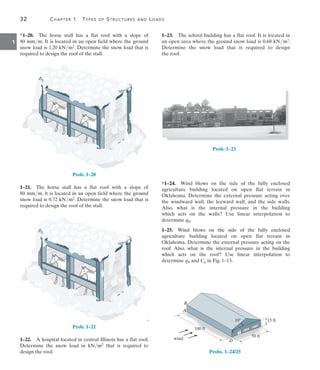
Problems
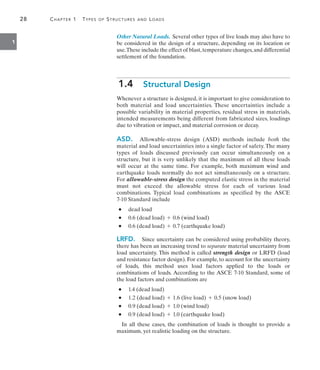
1–1.  The floor of a heavy storage warehouse building is
made of 6-in.-thick stone concrete. If the floor is a slab
having a length of 15 ft and width of 10 ft, determine the
resultant force caused by the dead load and the live load.
1–2.  The wall is 12-ft high and consists of 2 * 4 studs. On
each side is acoustical fiberboard and 4-in. clay brick.
Determine the average load in lbft of length of wall that
the wall exerts on the floor.
Prob. 1–2
1–3.  A building wall consists of 12-in. clay brick and 1
2-in.
fiberboard on one side. If the wall is 10 ft high, determine
the load in pounds per foot that it exerts on the floor.
*1–4.  The “New Jersey” barrier is commonly used during
highway construction. Determine its weight per foot of
length if it is made from plain stone concrete.
12 in.
4 in.
24 in.
6 in.
55
75
Prob. 1–4
1–5.  The precast floor beam is made from concrete having
a specific weight of 150 lbft3. If it is to be used for a floor
in an office of an office building, calculate its dead and
live loadings per foot length of beam.
4.5 ft
0.5 ft
1.5 ft
1.5 ft
0.5 ft
2 ft
Prob. 1–5
1–6.  The floor of a light storage warehouse is made of
150-mm-thick lightweight plain concrete. If the floor is a
slab having a length of 7 m and width of 3 m, determine the
resultant force caused by the dead load and the live load.
1–7.  The pre-cast T-beam has the cross-section shown.
Determine its weight per foot of length if it is made from
reinforced stone concrete and eight 3
4-in. cold-formed steel
reinforcing rods.
8 in.
8 in.
6 in. 6 in.
6 in.
15 in.
20 in.
15 in.
Prob. 1–7
30	 Chapter 1  Types of Structures and Loads
1
*1–12.  A three-story hotel has interior columns that are
spaced 20 ft apart in two perpendicular directions. If the
loading on the flat roof is estimated to be 30 lbft2,
determine the live load supported by a typical interior
column at (a) the ground-floor level, and (b) the second-
floor level.
1–13.  A hospital is to be built on open flat terrain in
central Texas. If the building is 9.1 meters high, determine
the internal pressure within the building if it is fully
enclosed.Also, what is the external wind pressure acting on
the side walls of the building? Each wall of the building is
25 meters long.
1–14.  The office building has interior columns spaced 5 m
apart in perpendicular directions. Determine the reduced
live load supported by a typical interior column located on
the first floor under the offices.
Prob. 1–14
1–15.  A hospital located in Chicago, Illinois, has a flat roof,
where the ground snow load is 25 lbft2. Determine the
design snow load on the roof of the hospital.
*1–8.  The building wall consists of 8-in. clay brick. In the
interior, the wall is made from 2 * 4 wood studs, plastered on
one side.If the wall is 10 ft high,determine the load in pounds
per foot of length of wall that the wall exerts on the floor.
10 ft
Prob. 1–8
1–9.  A building wall consists of exterior stud walls with
brick veneer and 13 mm fiberboard on one side. If the wall
is 4 m high, determine the load in kNm that it exerts on
the floor.
1–10.  The interior wall of a building is made from 2 * 4
wood studs, plastered on two sides. If the wall is 12 ft high,
determine the load in lbft of length of wall that it exerts on
the floor.
1–11.  The beam supports the roof made from asphalt
shingles and wood sheathing boards. If the boards have a
thickness of 11
2 in. and a specific weight of 50 lbft3, and the
roof’s angle of slope is 30°, determine the dead load of
the  roofing—per square foot—that is supported in the x
and y directions by the purlins.
30
purlin
sheathing
shingles
y
x
Prob. 1–11
Problems	 31
1
*1–16.  Wind blows on the side of a fully enclosed hospital
located on open flat terrain in Arizona. Determine the
external pressure acting over the windward wall, which has
a height of 30 ft.The roof is flat.
Prob. 1–16
1–17.  Wind blows on the side of the fully enclosed hospital
located on open flat terrain in Arizona. Determine the
external pressure acting on the leeward wall, which has a
length of 200 ft and a height of 30 ft.
Prob. 1–17
1–18.  Determine the resultant force acting on the face of
the sign if qh = 3.70 kPa. The sign has a width of 12 m and a
height of 3 m as indicated.
3 m
3 m
Prob. 1–18
1–19.  The light metal storage building is on open flat
terrain in central Oklahoma. If the side wall of the building
is 14 ft high, what are the two values of the external wind
pressure acting on this wall when the wind blows on the
back of the building? The roof is essentially flat and the
building is fully enclosed.
Prob. 1–19
32	 Chapter 1  Types of Structures and Loads
1
1–23.  The school building has a flat roof. It is located in
an open area where the ground snow load is 0.68 kNm2.
Determine the snow load that is required to design
the roof.
Prob. 1–23
*1–24.  Wind blows on the side of the fully enclosed
agriculture building located on open flat terrain in
Oklahoma. Determine the external pressure acting over
the windward wall, the leeward wall, and the side walls.
Also, what is the internal pressure in the building
which acts on the walls? Use linear interpolation to
determine qh.
1–25.  Wind blows on the side of the fully enclosed
agriculture building located on open flat terrain in
Oklahoma. Determine the external pressure acting on the
roof. Also, what is the internal pressure in the building
which acts on the roof? Use linear interpolation to
determine qh and Cp in Fig. 1–13.
100 ft
50 ft
wind
A
B
C
D
15 ft
10
Probs. 1–24/25
*1–20.  The horse stall has a flat roof with a slope of
80 mmm. It is located in an open field where the ground
snow load is 1.20 kNm2. Determine the snow load that is
required to design the roof of the stall.
Prob. 1–20
1–21.  The horse stall has a flat roof with a slope of
80 mmm. lt is located in an open field where the ground
snow load is 0.72 kNm2. Determine the snow load that is
required to design the roof of the stall.
.
Prob. 1–21
1–22.  A hospital located in central Illinois has a flat roof.
Determine the snow load in kNm2 that is required to
design the roof.
Chapter Review	 33
1
Chapter Review
The basic structural elements are:
Tie Rods—Slender members subjected to tension. Often used
for bracing.
Beams—Members designed to resist bending moment. They
are often fixed or pin supported and can be in the form of a
steel plate girder, reinforced concrete, or laminated wood.
Columns—Members that resist axial compressive force. If the
column also resists bending, it is called a beam column.
The types of structures considered in this book consist of
trusses made from slender pin-connected members forming a
series of triangles, cables and arches, which carry tensile and
compressive loads, respectively, and frames composed of pin-
or fixed-connected beams and columns.
Loads are specified in codes such as the ASCE 7-10 code. Dead
loads are fixed and refer to the weights of members and materials.
Live loads are movable and consist of uniform building floor
loads, traffic and train loads on bridges, impact loads due to
vehicles and machines, wind loads, snow loads, earthquake loads,
and hydrostatic and soil pressure.
tie rod
simply supported beam
cantilevered beam
beam column
column
Oftentimes the elements of a structure, like the beams and girders of this
building frame, are connected together in a manner whereby the analysis can
be considered statically determinate.
Chapter 2
© SergeyIT/Shutterstock
35
Analysis of Statically
Determinate Structures
In this chapter we will direct our attention to the most common form of
structure that the engineer will have to analyze, and that is one that lies
in a plane and is subjected to a force system that lies in the same plane.
We begin by discussing the importance of choosing an appropriate
analytical model for a structure so that the forces in the structure may
be determined with reasonable accuracy. Then the criteria necessary
for structural stability are discussed. Finally, the analysis of statically
determinate, planar, pin-connected structures is presented.
2.1  Idealized Structure
An exact analysis of a structure can never be carried out, since estimates
always have to be made of the loadings and the strength of the materials
composing the structure. Furthermore, points of application for the
loadings must also be estimated. It is important, therefore, that the
structural engineer develop the ability to model or idealize a structure so
that he or she can perform a practical force analysis of the members. In
this section we will develop the basic techniques necessary to do this.
Notice that the deck of this concrete bridge is
made so that one section can be considered roller
supported on the other section.
36	 Chapter 2  Analysis of Statically Determinate Structures
2
Support Connections.  Structural members are joined together
in various ways depending on the intent of the designer. The three types
of joints most often specified are the pin connection, the roller support,
and the fixed joint. A pin-connected joint and a roller support allow
some freedom for slight rotation, whereas a fixed joint allows no relative
rotation between the connected members and is consequently more
expensive to fabricate. Examples of these joints, fashioned in metal and
concrete, are shown in Figs. 2–1 and 2–2, respectively. For most timber
structures, the members are assumed to be pin connected, since bolting
or nailing them will not sufficiently restrain them from rotating with
respect to each other.
Idealized models used in structural analysis that represent pinned and
fixed supports and pin-connected and fixed-connected joints are shown
in Figs. 2–3a and 2–3b. In reality, however, all connections exhibit some
stiffness toward joint rotations, owing to friction and material behavior.
In this case a more appropriate model for a support or joint might be
that shown in Fig. 2–3c. If the torsional spring constant k = 0, the joint is
a pin, and if k S , the joint is fixed.
Pin-connected steel members.
(a)
typical “pin-supported” connection (metal)
(b)
typical “fixed-supported” connection (metal)
weld
weld
stiffeners
Fig. 2–1
(a)
typical “roller-supported” connection (concrete)
(b)
typical “fixed-supported” connection (concrete)
Fig. 2–2
2
	 2.1 Idealized Structure	 37
When selecting a particular model for each support or joint, the
engineer must be aware of how the assumptions will affect the actual
performance of the member and whether the assumptions are reasonable
for the structural design. For example, consider the beam shown in
Fig. 2–4a, which is used to support a concentrated load P. The angle
connection at support A is like that in Fig. 2–1a and can therefore be
idealized as a typical pin support. Furthermore, the support at B provides
an approximate point of smooth contact and so it can be idealized as a
roller. The beam’s thickness can be neglected since it is small in
comparison to the beam’s length, and therefore the idealized model of
the beam is as shown in Fig. 2–4b. The analysis of the loadings in this
beam should give results that closely approximate the loadings in the
actual beam. To show that the model is appropriate, consider a specific
case of a beam made of steel with P = 8 k (8000 lb) and L = 20 ft. One
of the major simplifications made here was assuming the support at A to
be a pin. Design of the beam using standard code procedures* indicates
that a W10 * 19 would be adequate for supporting the load. Using
one  of the deflection methods of Chapter 8, the rotation at the “pin”
support can be calculated as u = 0.0103 rad = 0.59. From Fig. 2–4c,
such a rotation only moves the top or bottom flange a distance of
 = ur = (0.0103 rad)(5.12 in.) = 0.0528 in. This small amount would
certainly be accommodated by the connection fabricated as shown in
Fig. 2–1a, and therefore the pin serves as an appropriate model.
pin support pin-connected joint
(a)
fixed support
(b)
fixed-connected joint
torsional spring support torsional spring joint
(c)
k k
Fig. 2–3
*Codes such as the Manual of Steel Construction, American Institute of Steel Construction.
L
––
2
L
––
2
A
B
P
actual beam
(a)
L
––
2
L
––
2
P
B
A
idealized beam
(b) (c)
5.12 in.
5.12 in.
0.59
0.0528 in.
0.0528 in.
0.59
Fig. 2–4
38	 Chapter 2  Analysis of Statically Determinate Structures
2
Other types of connections most commonly encountered on coplanar
structures are given in Table 2.1. It is important to be able to recognize the
symbols for these connections and the kinds of reactions they exert on their
attached members. This can easily be done by noting how the connection
prevents any degree of freedom or displacement of the member.In particular,
the support will develop a force on the member if it prevents translation of the
member, and it will develop a moment if it prevents rotation of the member.
For example, a member in contact with a smooth surface (3) is prevented
from translating only in one direction, which is perpendicular or normal to
the surface.Hence,the surface exerts only a normal force F on the member in
this direction.The magnitude of this force represents one unknown.Also note
that the member is free to rotate on the surface, so that a moment cannot be
developed by the surface on the member. As another example, the fixed
support (7) prevents both translation and rotation of a member at the point
of connection. Therefore, this type of support exerts two force components
and a moment on the member.The “curl” of the moment lies in the plane of
the page, since rotation is prevented in that plane. Hence, there are three
unknowns at a fixed support.
In reality, all supports actually exert distributed surface loads on their
contacting members. The concentrated forces and moments shown in
Table 2.1 represent the resultants of these load distributions. This
representation is, of course, an idealization; however, it is used here since
the surface area over which the distributed load acts is considerably
smaller than the total surface area of the connecting members.
A typical rocker support used for a
bridge girder.
Rollers and associated bearing pads are
used to support the prestressed concrete
girders of a highway bridge.
Concrete smooth or “roller” support. The short link is used to connect the
two girders of the highway bridge
and allow for thermal expansion of
the deck.
Steel pin support.
2
	 2.1 Idealized Structure	 39
TABLE 2.1  Supports for Coplanar Structures
Type of Connection	 Idealized Symbol	 Reaction	 Number of Unknowns
(4)
smooth pin-connected collar
F
(1) light cable

weightless link
F

(2)
rollers
rocker
F
(3)
smooth contacting surface
F
(5)
smooth pin or hinge
 Fy
Fx

Fx
(7)
fixed support
Fy
M
One unknown.The reaction is a
force that acts in the direction
of the cable or link.
One unknown.The reaction is a
force that acts perpendicular to
the surface at the point of contact.
One unknown.The reaction is a
force that acts perpendicular to
the surface at the point of contact.
One unknown.The reaction is a
force that acts perpendicular to
the surface at the point of contact.
Two unknowns.The reactions are
two force components.
Two unknowns.The reactions
are a force and a moment.
Three unknowns.The reactions are
the moment and the two force
components.
fixed-connected collar
(6)
slider
F
M
40	 Chapter 2  Analysis of Statically Determinate Structures
2
Idealized Structure.  Having stated the various ways in which the
connections on a structure can be idealized, we are now ready to discuss
some of the techniques used to represent various structural systems by
idealized models.
As a first example, consider the jib crane and trolley in Fig. 2–5a. For
the structural analysis we can neglect the thickness of the two main
members and will assume that the joint at B is fabricated to be rigid.
Furthermore, the support connection at A can be modeled as a fixed
support and the details of the trolley excluded.Thus, the members of the
idealized structure are represented by two connected lines, and the load
on the hook is represented by a single concentrated force F, Fig. 2–5b.
This idealized structure shown here as a line drawing can now be used
for applying the principles of structural analysis, which will eventually
lead to the design of its two main members.
Beams and girders are often used to support building floors. In particular,
a girder is the main load-carrying element of the floor, whereas the smaller
elements having a shorter span and connected to the girders are called
beams. Often the loads that are applied to a beam or girder are transmitted
toitbythefloorthatissupportedbythebeamorgirder.Again,itisimportant
to be able to appropriately idealize the system as a series of models, which
can be used to determine, to a close approximation, the forces acting in the
members. Consider, for example, the framing used to support a typical floor
slab in a building,Fig.2–6a.Here the slab is supported by floor joists located
at even intervals,and these in turn are supported by the two side girders AB
and CD.For analysis it is reasonable to assume that the joints are pin and/or
roller connected to the girders and that the girders are pin and/or roller
connected to the columns. The top view of the structural framing plan for
this system is shown in Fig. 2–6b. In this “graphic” scheme, notice that the
“lines” representing the joists do not touch the girders and the lines for
the girders do not touch the columns. This symbolizes pin- and/ or roller-
supported connections. On the other hand, if the framing plan is intended
to represent fixed-connected members, such as those that are welded
F
3 m
A
B
actual structure
(a)
4 m
Fig. 2–5
4 m
B
A
3 m
F
idealized structure
(b)
(a)
D
A
C
B
joist
slab
column
girder
idealized framing plan
(b)
Fig. 2–6
2
	 2.1 Idealized Structure	 41
instead of simple bolted connections, then the lines for the beams or girders
would touch the columns as in Fig. 2–7
. Similarly, a fixed-connected
overhanging beam would be represented in top view as shown in Fig. 2–8. If
reinforced concrete construction is used, the beams and girders are
represented by double lines.These systems are generally all fixed connected
and therefore the members are drawn to the supports. For example, the
structural graphic for the cast-in-place reinforced concrete system in
Fig. 2–9a is shown in top view in Fig. 2–9b. The lines for the beams are
dashed because they are below the slab.
Structural graphics and idealizations for timber structures are similar
to those made of metal. For example, the structural system shown in
Fig. 2–10a represents beam-wall construction, whereby the roof deck is
supported by wood joists, which deliver the load to a masonry wall. The
joists can be assumed to be simply supported on the wall, so that
the idealized framing plan would be like that shown in Fig. 2–10b.
fixed-connected overhanging beam
idealized beam
Fig. 2–8
fixed-connected beam
idealized beam
Fig. 2–7
(a)
Fig. 2–10
idealized framing plan
(b)
(a)
idealized framing plan
(b)
Fig. 2–9
42	 Chapter 2  Analysis of Statically Determinate Structures
2
Tributary Loadings.  When flat surfaces such as walls, floors, or
roofs are supported by a structural frame, it is necessary to determine how
the load on these surfaces is transmitted to the various structural elements
used for their support. There are generally two ways in which this can be
done. The choice depends on the geometry of the structural system, the
material from which it is made, and the method of its construction.
One-Way System.  A slab or deck that is supported such that it
delivers its load to the supporting members by one-way action, is often
referred to as a one-way slab.To illustrate the method of load transmission,
consider the framing system shown in Fig. 2–11a where the beams AB, CD,
and EF rest on the girders AE and BF. If a uniform load of 100 lbft2
is
placed on the slab,then the center beam CD is assumed to support the load
acting on the tributary area shown dark shaded on the structural framing
plan in Fig.2–11b.Member CD is therefore subjected to a linear distribution
of load of (100 lbft2
)(5 ft) = 500 lbft, shown on the idealized beam
in Fig. 2–11c. The reactions on this beam (2500 lb) would then be applied
to the center of the girders AE (and BF), shown idealized in Fig. 2–11d.
Using this same concept, do you see how the remaining portion of the slab
loading is transmitted to the ends of the girder as 1250 lb?
The structural framework of this building
consists of concrete floor joists, which were
formed on site using metal pans.These joists
are simply supported on the girders,which in
turn are simply supported on the columns.
(a)
10 ft
E
F
D
B
100 lb/ft2
A
C
5 ft
5 ft
idealized framing plan
(b)
A B
C
D
E F
2.5 ft
2.5 ft
2.5 ft
2.5 ft
Fig. 2–11
A
C D
B
500 lb/ft
2500 lb
idealized beam
(c)
2500 lb
10 ft
A E
1250 lb
2500 lb
1250 lb
5 ft 5 ft
idealized girder
(d)
2
	 2.1 Idealized Structure	 43
For some floor systems the beams and girders are connected to the
columns at the same elevation, as in Fig. 2–12a. If this is the case, the slab
can in some cases also be considered a one-way slab. For example, if the
slab is reinforced concrete with reinforcement in only one direction, or
the concrete is poured on a corrugated metal deck, as in the above photo,
then one-way action of load transmission can be assumed. On the other
hand, if the slab is reinforced in two directions, then consideration must
be given to the possibility of the load being transmitted to the supporting
members from either one or two directions. For example, consider the
slab and framing plan in Fig. 2–12b.According to the American Concrete
Institute, ACI 318 code, if L2 7 L1 and if the span ratio (L2L1) 7 2, the
slab will behave as a one-way slab, since as L1 becomes smaller, the beams
AB, CD, and EF provide the greater stiffness to carry the load.
An example of one-way slab construction of a steel frame
building having a poured concrete floor on a corrugated
metal deck. The load on the floor is considered to be
transmitted to the beams, not the girders.
Floor beams are often coped, that is, the top
flange is cut back, so that the beam is at the
same level as the girder.
girder
beam joist
column
(a)
A B
C D
E F
~
(b)
L1
L1
L2
L1
___
2
L1
___
2
Concrete slab is
reinforced in
two directions,
poured on plane
forms.
Idealized framing plan
for one-way slab action
requires L2/L1  2.
Fig. 2–12
44	 Chapter 2  Analysis of Statically Determinate Structures
2
Two-Way System.  According to the ACI 318 concrete code, if
L2 7 L1 and the support ratio (L2L1) … 2, then the load is assumed to
be transferred to the supporting beams and girders in two directions.
When this is the case the slab is referred to as a two-way slab. To show
how to treat this case, consider the square reinforced concrete slab in
Fig. 2–13a, which is supported by four 10-ft-long edge beams, AB, BD,
DC, and CA. Here L2L1 = 1. As the load on the slab intensifies,
numerous experiments have shown that 45° cracks form at the corners of
the slab. As a result, the tributary area is constructed using diagonal 45°
lines as shown in Fig. 2–13b. This produces the dark shaded tributary
area for beam AB. Hence if a uniform load of 100 lbft2
is applied to the
slab, a peak intensity of (100 lbft2
)(5 ft) = 500 lbft will be applied to
the center of beam AB, resulting in the triangular load distribution
shown in Fig. 2–13c. For other geometries that cause two-way action, a
similar For example, if L2L1 = 1.5 it is then necessary to construct 45°
lines that intersect as shown in Fig. 2–14a. This produce the dark shaded
tributary area for beam AB. A 100@lbft2
loading placed on the slab will
then produce trapezoidal and triangular distributed loads on members
AB and AC, Figs. 2–14b and 2–14c, respectively.
(a)
10 ft
10 ft
A
C
D
B
100 lb/ft2
10 ft
5 ft
10 ft
A B
C D
45
45
idealized framing plan
(b)
500 lb/ft
A B
5 ft 5 ft
idealized beam
(c)
Fig. 2–13
15 ft
5 ft 5 ft 5 ft
10 ft
5 ft
A B
C
D
45 45
idealized framing plan
(a)
500 lb/ft
A B
5 ft
idealized beam
(b)
5 ft 5 ft
500 lb/ft
A
5 ft
idealized beam
(c)
5 ft
C
Fig. 2–14
2.1 Idealized Structure	 45
2
The ability to reduce an actual structure to an idealized form, as shown
by these examples, can only be gained by experience.To provide practice
at doing this, the example problems and the problems for solution
throughout this book are presented in somewhat realistic form, and the
associated problem statements aid in explaining how the connections
and supports can be modeled by those listed in Table 2.1. In engineering
practice, if it becomes doubtful as to how to model a structure or transfer
the loads to the members,it is best to consider several idealized structures
and loadings and then design the actual structure so that it can resist the
loadings in all the idealized models.
EXAMPLE 2.1 
The floor of a classroom is to be supported by the bar joists shown in
Fig. 2–15a. Each joist is 15 ft long and they are spaced 2.5 ft on centers.
The floor itself is to be made from lightweight concrete that is 4 in.
thick. Neglect the weight of the joists and the corrugated metal deck,
and determine the load that acts along each joist.
SOLUTION
The dead load on the floor is due to the weight of the concrete slab.From
Table 1.3 for 4 in. of lightweight concrete it is (4)(8 lbft2
) = 32 lbft2
.
From Table 1.4, the live load for a classroom is 40 lbft2
. Thus the total
floor load is 32 lbft2
+ 40 lbft2
= 72 lbft2
. For the floor system,
L1 = 2.5 ft and L2 = 15 ft. Since L2L1 7 2 the concrete slab is treated
as a one-way slab. The tributary area for each joist is shown in
Fig. 2–15b.Therefore the uniform load along its length is
w = 72 lbft2
(2.5 ft) = 180 lbft
This loading and the end reactions on each joist are shown in Fig. 2–15c.
Fig. 2–15
(a)
15 ft
2.5 ft
(b)
1350 lb
(c)
1350 lb
180 lb/ft
46	 Chapter 2  Analysis of Statically Determinate Structures
2
The flat roof of the steel-frame building shown in the photo is intended
to support a total load of 2 kNm2
over its surface. Determine the roof
load within region ABCD that is transmitted to beams BC and DC.
The dimensions are shown in Fig. 2–16a.
EXAMPLE 2.2
2 m
(a)
B
A
C
D
2 m
2 m
3 m
2 m
4 m
1 2
3
A B
C
D
SOLUTION
In this case L2 = 7 m and L1 = 4 m. Since L2L1 = 1.75 6 2, we have
two-way slab action. The tributary loading along each edge beam is
shown in Fig. 2–16a, where the lighter shaded trapezoidal area ➀
of loading is transmitted to member BC. The peak intensity of this
loading is (2 kNm2
)(2 m) = 4 kNm. As a result, the distribution of 
the load along BC is as shown in Fig. 2–16b.
This process of tributary load transmission should also be calculated
for the area ➁ to the right of BC shown in Fig. 2–16a, and this load
should also be placed on BC. See the next example.
A triangular distributed loading ➂ acts on member DC, Fig. 2–16a. It
also has a maximum intensity of (2 kNm2
)(2 m) = 4 kNm, Fig. 2–16c.
Fig. 2–16
D C
4 kN/m
2 m
2 m
(c)
B C
(b)
4 kN/m
3 m
2 m 2 m
2.1 Idealized Structure	 47
2
EXAMPLE 2.3
The concrete girders shown in the photo of the passenger car parking
garage span 30 ft and are 15 ft on center. If the floor slab is 5 in. thick
and made of reinforced stone concrete, and the specified live load is
50 lbft2 (see Table 1.4), determine the distributed load the floor
system transmits to each interior girder.
SOLUTION
Here, L2 = 30 ft and L1 = 15 ft, so that L2L1 = 2. We have a two-
way slab. From Table 1.2, for reinforced stone concrete, the specific
weight of the concrete is 150 lbft3
. Thus the design floor loading is
p = 150 lbft3
a
5
12
ftb + 50 lbft2
= 112.5 lbft2
A trapezoidal distributed loading is transmitted to each interior girder
AB from each of its two sides ➀ and ➁.The maximum intensity of each
of these distributed loadings is (112.5 lbft2
)(7.5 ft) = 843.75 lbft, so
that on the girder this intensity becomes 2(843.75 lbft) = 1687.5 lbft,
Fig. 2–17b. Note: For design, consideration should also be given to the
weight of the girder.
15 ft
7.5 ft 7.5 ft
(a)
30 ft
15 ft
7.5 ft
A B
2
1
(b)
15 ft
1687.5 lb/ft
7.5 ft
A B
7.5 ft
Fig. 2–17
48	 Chapter 2  Analysis of Statically Determinate Structures
2
2.2  Load Path
The various elements that make up a structure should be designed in such
a way that they transmit the primary load acting on the structure to its
foundation in the most efficient way possible. Hence, as a first step in any
design or analysis of a structure, it is very important to understand how
the loads are transmitted through it, if damage or collapse of the structure
is to be avoided.This description is called a load path, and by visualizing
how the loads are transmitted the engineer can sometimes eliminate
unnecessary members, strengthen others, or identify where there may be
potential problems. Like a chain, which is “as strong as its weakest link”,
so a structure is only as strong as the weakest part along its load path.
To show how to construct a load path, let us consider a few examples.
In Fig. 2–18a, the loading acting on the floor of the building is transmitted
from the slab to the floor joists then to the spandrel and interior girder,
and finally to the columns and foundation footings. The loading on the
deck of the suspension bridge in Fig. 2–18b is transmitted to the hangers
or suspenders, then the cables, and finally the towers and piers.
(a)
exterior
column
interior
column
foundation
slab
floor
loading
slab
floor beam
or joist
spandrel or
edge girder
spread
footing
strip
footing
girder
Fig. 2–18
2
	 2.3 Principle of Superposition	 49
tower
cable
anchor
hanger deck
pier
(b)
Fig. 2–18
2.3  Principle of Superposition
The principle of superposition forms the basis for much of the theory of
structural analysis. It may be stated as follows: The total displacement or
internal loadings (stress) at a point in a structure subjected to several
external loadings can be determined by adding together the displacements
or internal loadings (stress) caused by each of the external loads acting
separately. For this statement to be valid it is necessary that a linear
relationship exist among the loads, stresses, and displacements.
Two requirements must be imposed for the principle of superposition
to apply:
	1.	 The material must behave in a linear-elastic manner,so that Hooke’s
law is valid, and therefore the load will be proportional to
displacement.
	2.	 The geometry of the structure must not undergo significant change
when the loads are applied, i.e., small displacement theory applies.
Large displacements will significantly change the position and
orientation of the loads. An example would be a cantilevered thin
rod subjected to a force at its end, causing it to bend.
Throughout this text, these two requirements will be satisfied. Here only
linear-elastic material behavior occurs; and the displacements produced
by the loads will not significantly change the directions of applied
loadings nor the dimensions used to compute the moments of forces.
50	 Chapter 2  Analysis of Statically Determinate Structures
2
2.4  Equations of Equilibrium
It may be recalled from statics that a structure or one of its members is in
equilibrium when it maintains a balance of force and moment. In general
this requires that the force and moment equations of equilibrium be
satisfied along three independent axes, namely,
Fx = 0 Fy = 0 Fz = 0
Mx = 0 My = 0 Mz = 0
	(2–1)
The principal load-carrying portions of most structures, however, lie in a
single plane,and since the loads are also coplanar,the above requirements
for equilibrium reduce to
Here Fx and Fy represent,respectively,the algebraic sums of the x and y
components of all the forces acting on the structure or one of its members,
and MO represents the algebraic sum of the moments of these force
components about an axis perpendicular to the x–y plane (the z axis) and
passing through point O.
Whenever these equations are applied, it is first necessary to draw a
free-body diagram of the structure or its members. If a member is selected,
it must be isolated from its supports and surroundings and its outlined
shape drawn.All the forces and couple moments must be shown that act
on the member. In this regard, the types of reactions at the supports can
be determined using Table 2.1. Also, recall that forces common to two
members act with equal magnitudes but opposite directions on the
respective free-body diagrams of the members.
If the internal loadings at a specified point in a member are to be
determined, the method of sections must be used. This requires that a
“cut” or section be made perpendicular to the axis of the member at the
point where the internal loading is to be determined. A free-body
diagram of either segment of the “cut” member is isolated and the
internal loads are then determined from the equations of equilibrium
applied to the segment. In general, the internal loadings acting at the
section will consist of a normal force N, shear force V, and bending
moment M, as shown in Fig. 2–19.
We will cover the principles of statics that are used to determine the
external reactions on structures in Sec. 2.5. Internal loadings in structural
members will be discussed in Chapter 4.
Fx = 0
Fy = 0
MO = 0
(2–2)
M M
V
V
N N
internal loadings
Fig. 2–19
2
	 2.5  Determinacy and Stability	 51
2.5  Determinacy and Stability
Before starting the force analysis of a structure, it is necessary to establish
the determinacy and stability of the structure.
Determinacy.  The equilibrium equations provide both the necessary
and sufficient conditions for equilibrium.When all the forces in a structure
can be determined strictly from these equations,the structure is referred to
as statically determinate. Structures having more unknown forces than
available equilibrium equations are called statically indeterminate. As a
general rule, a stable structure can be identified as being either statically
determinate or statically indeterminate by drawing free-body diagrams of
all its members, or selective parts of its members, and then comparing the
total number of unknown reactive force and moment components with
the total number of available equilibrium equations.* For a coplanar
structure there are at most three equilibrium equations for each part, so
that if there is a total of n parts and r force and moment reaction
components, we have
In particular, if a structure is statically indeterminate, the additional
equations needed to solve for the unknown reactions are obtained by
relating the applied loads and reactions to the displacement or slope at
different points on the structure. These equations, which are referred to
as compatibility equations, must be equal in number to the degree of
indeterminacy of the structure. Compatibility equations involve the
geometric and physical properties of the structure and will be discussed
further in Chapter 10.
We will now consider some examples to show how to classify the
determinacy of a structure.The first example considers beams;the second
example, pin-connected structures; and in the third we will discuss frame
structures. Classification of trusses will be considered in Chapter 3.
(2–3)
*Drawing the free-body diagrams is not strictly necessary, since a “mental count” of the
number of unknowns can also be made and compared with the number of equilibrium
equations.
r = 3n, statically determinate
r 7 3n, statically indeterminate
52	 Chapter 2  Analysis of Statically Determinate Structures
2
Classify each of the beams shown in Figs. 2–20a through 2–20d as
statically determinate or statically indeterminate. If statically
indeterminate, report the number of degrees of indeterminacy. The
beams are subjected to external loadings that are assumed to be
known and can act anywhere on the beams.
SOLUTION
Compound beams, i.e., those in Figs. 2–20c and 2–20d, which are
composed of pin-connected members must be disassembled. Note
that in these cases, the unknown reactive forces acting between each
member must be shown in equal but opposite pairs. The free-body
diagrams of each member are shown. Applying r = 3n or r 7 3n, the
resulting classifications are indicated.
Ans.
Ans.
Ans.
Ans.
EXAMPLE 2.4
(a)
r = 3, n = 1, 3 = 3(1) Statically determinate.
(b)
r = 5, n = 1, 5 7 3(1) Statically indeterminate to the second degree.
(c)
r = 6, n = 2, 6 = 3(2) Statically determinate.
(d)
r = 10, n = 3, 10 7 3(3) Statically indeterminate to the first degree.
Fig. 2–20
2.5  Determinacy and Stability	 53
2
Classify each of the pin-connected structures shown in Figs. 2–21a
through 2–21d as statically determinate or statically indeterminate.
If  statically indeterminate, report the number of degrees of
indeterminacy. The structures are subjected to arbitrary external
loadings that are assumed to be known and can act anywhere on the
structures.
SOLUTION
Classification of pin-connected structures is similar to that of beams.
The free-body diagrams of the members are shown. Applying r = 3n
or r 7 3n, the resulting classifications are indicated.
Ans.
Ans.
Ans.
Ans.
EXAMPLE 2.5
(a)
(b)
(c)
(d)
r = 7, n = 2, 7 7 6.
Statically indeterminate to the
first degree.
r = 9, n = 3, 9 = 9.
Statically determinate.
r = 10, n = 2, 10 7 6.
Statically indeterminate to
the fourth degree.
r = 9, n = 3, 9 = 9.
Statically determinate.
Fig. 2–21
54	 Chapter 2  Analysis of Statically Determinate Structures
2
B
A
C
D
(a)
r = 9, n = 2, 9 7 6,
Statically indeterminate to
the third degree. Ans.
Classify each of the frames shown in Figs. 2–22a through 2–22c as
statically determinate or statically indeterminate. If statically
indeterminate, report the number of degrees of indeterminacy. The
frames are subjected to external loadings that are assumed to be
known and can act anywhere on the frames.
SOLUTION
Unlike the beams and pin-connected structures of the previous
examples, frame structures consist of members that are connected
together by rigid joints. Sometimes the members form internal loops
as in Fig. 2–22a. Here ABCD forms a closed loop. In order to classify
these structures, it is necessary to use the method of sections and “cut”
the loop apart. The free-body diagrams of the sectioned parts are
drawn and the frame can then be classified. Notice that only one
section through the loop is required, since once the unknowns at the
section are determined,the internal forces at any point in the members
can then be found using the method of sections and the equations of
equilibrium.A second example of this is shown in Fig.2–22b.Although
the frame in Fig. 2–22c has no closed loops, we can use this same
method, using vertical sections, to classify it. For this case we can also
just draw its complete free-body diagram.The resulting classifications
are indicated in each figure.
(This frame has no closed
loops.) r = 9, n = 1, 9 7 3,
Statically indeterminate to the
sixth degree.
r = 18, n = 4, 18 7 12,
Statically indeterminate to the
sixth degree.
Fig. 2–22
Ans.
Ans. Ans.
(a)
r = 18, n = 3, 18 7 9,
Statically indeterminate to the ninth degree.
(c)
EXAMPLE 2.6
(b)
2
	 2.5  Determinacy and Stability	 55
Stability.  To ensure the equilibrium of a structure or its members,it is not
only necessary to satisfy the equations of equilibrium,but the members must
also be properly held or constrained by their supports regardless of how the
structure is loaded.Two situations may occur where the conditions for proper
constraint have not been met.
Partial Constraints.  Instability can occur if a structure or one of its
members has fewer reactive forces than equations of equilibrium that must
be satisfied. The structure then becomes only partially constrained. For
example, consider the member shown in Fig. 2–23 with its corresponding
free-body diagram. Here the equation Fx = 0 will not be satisfied for the
loading conditions, and therefore the member will be unstable.
Improper Constraints.  In some cases there may be as many
unknown forces as there are equations of equilibrium;however,instability
or movement of a structure or its members can develop because of
improper constraining by the supports. This can occur if all the support
reactions are concurrent at a point. An example of this is shown in
Fig. 2–24. From the free-body diagram of the beam it is seen that the
summation of moments about point O will not be equal to zero (Pd  0);
thus rotation about point O will take place.
Another way in which improper constraining leads to instability occurs
when the reactive forces are all parallel.An example of this case is shown
in Fig. 2–25. Here when an inclined force P is applied, the summation of
forces in the horizontal direction will not equal zero.
P
A
A
P
FA
MA
partial constraints
Fig. 2–23
A C
B
P
O O
FB
d
FA FC
P
d
concurrent reactions
Fig. 2–24
P
A B C
P
FA FB FC
parallel reactions
Fig. 2–25
56	 Chapter 2  Analysis of Statically Determinate Structures
2
In general, then, a structure will be geometrically unstable—that is, it will
move slightly or collapse—if there are fewer reactive forces than equations
of equilibrium; or if there are enough reactions, instability will occur if the
lines of action of the reactive forces intersect at a common point or are
parallel to one another. If the structure consists of several members or
components, local instability of one or several of these members can
generally be determined by inspection. If the members form a collapsible
mechanism, the structure will be unstable. We will now formalize these
statements for a coplanar structure having n members or components
with r unknown reactions.Since three equilibrium equations are available
for each member or component, we have
r 6 3n unstable
r Ú 3n unstable if member reactions are
concurrent or parallel or some of the
components form a collapsible mechanism
If the structure is unstable,it does not matter if it is statically determinate
or indeterminate. In all cases such types of structures must be avoided
in practice.
The following examples illustrate how structures or their members can
be classified as stable or unstable. Structures in the form of a truss will be
discussed in Chapter 3.
(2–4)
The K-bracing on this frame provides lateral
stability from wind and vertical support of the
floor girders. The framework has been sprayed
with concrete grout in order to insulate the steel
to keep it from losing its stiffness in the event
of a fire.
2.5  Determinacy and Stability	 57
2
Classify each of the structures in Figs. 2–26a through 2–26d as stable
or unstable. The structures are subjected to arbitrary external loads
that are assumed to be known.
SOLUTION
The structures are classified as indicated.
The member is stable since the reactions are nonconcurrent and
nonparallel.It is also statically determinate.          
Ans.
The member is statically indeterminate, but unstable since the three
reactions are concurrent at B.	 Ans.
The beam is statically indeterminate, but unstable since the three
reactions are all parallel. Ans.
The structure is unstable since r = 7, n = 3, so that, by Eq. 2–4,
r 6 3n, 7 6 9. Also, this can be seen by inspection, since AB can move
horizontally without restraint.			       
Ans.
B
(a)
A
A
B
(b)
B
A
B
C
(c)
A
B
C
D
(d)
Fig. 2–26
EXAMPLE 2.7 
58	 Chapter 2  Analysis of Statically Determinate Structures
2
2.6  
Application of the Equations
of Equilibrium
Occasionally, the members of a structure are connected together in such
a way that the joints can be assumed as pins. Building frames and trusses
are typical examples that are often constructed in this manner. Provided
a pin-connected coplanar structure is properly constrained and contains
no more supports or members than are necessary to prevent collapse, the
forces acting at the joints and supports can be determined by applying the
three equations of equilibrium (Fx = 0, Fy = 0, MO = 0) to each
member. Understandably, once the forces at the joints are obtained, the
size of the members, connections, and supports can then be determined
on the basis of design code specifications.
To illustrate the method of force analysis, consider the three-member
frame shown in Fig. 2–27a, which is subjected to loads P1 and P2. The
free-body diagrams of each member are shown in Fig. 2–27b. In total
there are nine unknowns; however, nine equations of equilibrium can be
written, three for each member, so the problem is statically determinate.
For the actual solution it is also possible, and sometimes convenient, to
consider a portion of the frame or its entirety when applying some of
these nine equations. For example, a free-body diagram of the entire
frame is shown in Fig. 2–27c. One could determine the three reactions Ax,
Ay, and Cx on this “rigid” pin-connected system, then analyze any two of
its members, Fig. 2–27b, to obtain the other six unknowns. Furthermore,
the answers can be checked in part by applying the three equations
of  equilibrium to the remaining “third” member. To summarize, this
problem can be solved by writing at most nine equilibrium equations
using free-body diagrams of any members and/or combinations of
connected members.Any more than nine equations written would not be
unique from the original nine and would only serve to check the results.
B
D
E
C
P2
P1
(a)
A
Bx
By Dy
Ay
Dx Ax
Dy
Dx
P1
Ex
Ey
Bx
By
P2
Ey
Ex
Cx
(b)
P1
Cx
Ax
Ay
(c)
P2
Fig. 2–27
2
	 2.6 Application of the Equations of Equilibrium	 59
Consider now the two-member frame shown in Fig. 2–28a. Here the
free-body diagrams of the members reveal six unknowns, Fig. 2–28b;
however, six equilibrium equations, three for each member, can be
written, so again the problem is statically determinate.As in the previous
case, a free-body diagram of the entire frame can also be used for part of
the analysis, Fig. 2–28c. Although, as shown, the frame has a tendency to
collapse without its supports, by rotating about the pin at B, this will not
happen since the force system acting on it must still hold it in equilibrium.
Hence, if so desired, all six unknowns can be determined by applying the
three equilibrium equations to the entire frame, Fig. 2–28c, and also to
either one of its members.
The above two examples illustrate that if a structure is properly
supported and contains no more supports or members than are necessary
to prevent collapse, the frame becomes statically determinate, and so the
unknown forces at the supports and connections can be determined from
the equations of equilibrium applied to each member. Also, if the
structure remains rigid (noncollapsible) when the supports are removed
(Fig. 2–27c), all three support reactions can be determined by applying
the three equilibrium equations to the entire structure. However, if the
structure appears to be nonrigid (collapsible) after removing the supports
(Fig. 2–28c), it must be dismembered and equilibrium of the individual
members must be considered in order to obtain enough equations to
determine all the support reactions.
B
A
D
C
P2
P1
(a)
P2
P1
(b)
Ay
Ax
Bx
By
Bx
By
Cx
Cy
B
P1
(c)
Ay
Ax
Cx
Cy
P2
Fig. 2–28
60	 Chapter 2  Analysis of Statically Determinate Structures
2
Procedure for Analysis
The following procedure provides a method for determining the
joint reactions for structures composed of pin-connected members.
Free-Body Diagrams
	 •	 Disassemble the structure and draw a free-body diagram of each
member. Also, it may be convenient to supplement a member
free-body diagram with a free-body diagram of the entire
structure. Some or all of the support reactions can then be
determined using this diagram.
	 •	 Recall that reactive forces common to two members act with
equal magnitudes but opposite directions on the respective free-
body diagrams of the members.
	 •	 All two-force members should be identified. These members,
regardless of their shape, have no external loads on them, and
therefore their free-body diagrams are represented with equal
but opposite collinear forces acting on their ends.
	 •	 In many cases it is possible to tell by inspection the proper
arrowhead sense of direction of an unknown force or couple
moment; however, if this seems difficult, the directional sense can
be assumed.
Equations of Equilibrium
	 •	 Count the total number of unknowns to make sure that an
equivalent number of equilibrium equations can be written for
solution. Except for two-force members, recall that in general
three equilibrium equations can be written for each member.
	 •	 Many times,the solution for the unknowns will be straightforward
if the moment equation MO = 0 is applied about a point (O)
that lies at the intersection of the lines of action of as many
unknown forces as possible.
	 •	 When applying the force equations Fx = 0 and Fy = 0, orient
the x and y axes along lines that will provide the simplest
reduction of the forces into their x and y components.
	 •	 If the solution of the equilibrium equations yields a negative
magnitude for an unknown force or couple moment, it indicates
that its arrowhead sense of direction is opposite to that which was
assumed on the free-body diagram.
2
	 2.6 Application of the Equations of Equilibrium	 61
How Important is the Free-Body Diagram?  For any
structural analysis it is very important! Not only does it greatly reduce
the chance for errors, by accounting for all the forces and the geometry
used in the equilibrium equations,but it is also a source of communication
to other engineers, who may check or use your calculations.
To emphase the importance of the free-body diagram, consider the
case of the collapse of the second and fourth story walkways that crossed
an open atrium in the  Kansas City Hyatt Regency Hotel. This event
occurred in July 1981, when about 2000 people assembled in the atrium
for a dance contest. Some of the observers gathered on the walkways,
then when the walkways suddenly collapsed, 114 people died, and more
than 200 were injured.
The main reason for the failure was the faulty design of the connections
used to support the walkways. The original design, shown in Fig. 2–29a,
called for single tie or hanger rods that were attached to the roof and
passed through holes in fabricated box beams, each made from two
channels welded together, Fig. 2–29c. The connection of the rods to the
beams required a nut and washer.A dispute arose between the contractor
and the engineering firm over this design since it required unconventional
fully threaded rods. As a result the design was changed to end threaded
rods as shown in ­
Fig. 2–29b.
To show why failure occurred, study the free-body diagrams of each
design, along with the equilibrium analysis of the anticipated 180 kN
loading shown in Figs. 2–29a, and 2–29b. Notice that the altered design
requires the load supported by the top washer to be twice that of the
original design. Since this new design was not properly reviewed, it
resulted in the box beam splitting open at the weld seam and the rod
pulling the washer through, resulting in the collapse, Fig. 2–29c.
Since the design of the box beam and tie rod assembly were substandard,
and did not meet code, the engineers at the firm were found to have
performed with gross negligence and unprofessional conduct.Consequently,
they lost their license and the firm went bankrupt. It seems needless to
say,but engineers are responsible for their design and will be held accountable
if anything goes wrong. So be neat and accurate in your work, and draw
your free-body diagrams!
180 kN
180 kN 180 kN
90 kN
90 kN
180 kN
90 kN
90 kN
180 kN
original design
(a)
180 kN 180 kN
180 kN 180 kN
90 kN 90 kN
180 kN
(b)
180 kN
180 kN
90 kN
load on
washer is
90 kN
90 kN
180 kN
Fig. 2–29
180 kN
180 kN 180 kN
90 kN
90 kN
180 kN
90 kN
90 kN
180 kN
load on
washer is
180 kN
180 kN
alternate design
(b)
original design
(a)
before failure
180 kN
180 kN
weld
180 kN
180 kN 180 kN
90 kN
90 kN
90 kN
90 kN
180 kN
(b)
180 kN
180 kN
90 kN
load on
washer is
90 kN
90 kN
180 kN
180 kN
180 kN 180 kN
90 kN
90 kN
180 kN
90 kN
90 kN
180 kN
load on
washer is
180 kN
180 kN
alternate design
(b)
original design
(a)
before failure
after failure
(c)
180 kN
180 kN
weld
180 kN
180 kN 180 kN
90 kN
90 kN
90 kN
90 kN
180 kN
(b)
180 kN
180 kN
90 kN
load on
washer is
90 kN
90 kN
180 kN
180 kN
180 kN 180 kN
90 kN
90 kN
180 kN
90 kN
90 kN
original design
(a)
180 kN 180 kN
180 kN 180 kN
180 kN
(b)
180 kN
180 kN
90 kN
load on
washer is
90 kN
90 kN
180 kN
180 kN
180 kN 180 kN
90 kN
90 kN
180 kN
90 kN
90 kN
180 kN
load on
washer is
180 kN
180 kN
alternate design
(b)
original design
(a)
180 kN
180 kN
weld
180 kN
180 kN 180 kN
90 kN
90 kN
90 kN
90 kN
180 kN
(b)
180 kN
180 kN
90 kN
load on
washer is
90 kN
90 kN
180 kN
62	 Chapter 2  Analysis of Statically Determinate Structures
2
Determine the reactions on the beam shown in Fig. 2–30a.
(a)
A
1 ft
60 k
60
B
50 kft
10 ft 4 ft 7 ft
10 ft 4 ft
1 ft
60 sin 60 k
50 kft
(b)
Ax
Ay By
60 cos 60 k
A
SOLUTION
Free-Body Diagram.  As shown in Fig. 2–30b, the 60-k force is
resolved into x and y components. Furthermore, the 7-ft dimension
line is not needed since a couple moment is a free vector and can
therefore act anywhere on the beam for the purpose of computing the
external reactions.
Equations of Equilibrium.  Applying Eqs. 2–2 in a sequence, using
previously calculated results, we have
Fig. 2–30
Determine the reactions on the beam in Fig. 2–31a.
SOLUTION
Free-Body Diagram.  As shown in Fig. 2–31b, the trapezoidal
distributed loading is segmented into a triangular and a uniform load.
The areas under the triangle and rectangle represent the resultant forces.
These forces act through the centroid of their corresponding areas.
Equations of Equilibrium.
+
S Fx = 0;	 Ax = 0	 Ans.
+ cFy = 0;	 Ay - 60 - 60 = 0 Ay = 120 kN Ans.
a+MA = 0; -60(4) - 60(6) + MA = 0 MA = 600 kN # m Ans.
EXAMPLE 2.9 
15 kN/m
12 m
5 kN/m
(a)
A
1
(10 kN/m)(12 m)  60 kN
6 m
5 kN/m
(b)
A
10 kN/m
4 m
Ay
Ax
MA
—
2
(5 kN/m)(12 m) 
60 kN
Fig. 2–31
+
S Fx = 0;	 Ax - 60 cos 60 = 0	 Ax = 30.0 k	Ans.
a+MA = 0;	 -60 sin 60(10) + 60 cos 60(1) + By(14) - 50 = 0	 By = 38.5 k	Ans.
+ cFy = 0;	 -60 sin 60 + 38.5 + Ay = 0	 Ay = 13.4 k	Ans.
EXAMPLE 2.8 
2.6 Application of the Equations of Equilibrium	 63
2
EXAMPLE 2.10 
Determine the reactions on the beam in Fig. 2–32a.Assume A is a pin
and the support at B is a roller (smooth surface).
7 ft 3 ft
500 lb/ft
A
B
4 ft
(a)
Fig. 2–32
SOLUTION
Free-Body Diagram.  As shown in Fig. 2–32b, the support (“roller”)
at B exerts a normal force on the beam at its point of contact.The line
of action of this force is defined by the 3–4–5 triangle.
3.5 ft 6.5 ft
3500 lb
A
(b)
Ax
Ay
4 ft
3
4
5
NB
Equations of Equilibrium.  Resolving NB into x and y components
and summing moments about A yields a direct solution for NB. Why?
Using this result, we can then obtain Ax and Ay.
a+MA = 0;	 -3500(3.5) + 14
52NB(4) + 13
52NB(10) = 0 Ans.
NB = 1331.5 lb = 1.33 k
+
S Fx = 0;	 Ax - 4
5(1331.5) = 0	 Ax = 1.07 k Ans.
+ cFy = 0;	 Ay - 3500 + 3
5(1331.5) = 0	 Ay = 2.70 k Ans.
64	 Chapter 2  Analysis of Statically Determinate Structures
2
EXAMPLE 2.11 
The compound beam in Fig. 2–33a is fixed at A. Determine the
reactions at A, B, and C. Assume that the connection at B is a pin
and C is a roller.
400 lb/ft
A
B
6000 lbft
20 ft 15 ft
C
(a)
Fig. 2–33
SOLUTION
Free-Body Diagrams.  The free-body diagram of each segment is
shown in Fig. 2–33b.Why is this problem statically determinate?
8000 lb
A B
6000 lbft
15 ft
C
(b)
Ax
MA
Ay 10 ft 10 ft
Bx
Cy
Bx
By
By
Equations of Equilibrium.  There are six unknowns.Applying the six
equations of equilibrium, using previously calculated results, we have
Segment BC:
a+MC = 0;	 -6000 + By(15) = 0	 By = 400 lb Ans.
+ cFy = 0;	 -400 + Cy = 0	
Cy = 400 lb
 Ans.
+
S Fx = 0;	 Bx = 0  Ans.
Segment AB:
a+MA = 0;	 MA - 8000(10) + 400(20) = 0
MA = 72.0 k # ft Ans.
+ cFy = 0;	 Ay - 8000 + 400 = 0	 Ay = 7.60 k Ans.
+
S Fx = 0;	 Ax - 0 = 0	 Ax = 0 Ans.
2.6 Application of the Equations of Equilibrium	 65
2
EXAMPLE 2.12 
Determine the horizontal and vertical components of reaction at the
pins A, B, and C of the two-member frame shown in Fig. 2–34a.
3 kN/m
(a)
2 m
4
3
5
8 kN
2 m
C
1.5 m
2 m
A
B
2 m
4
3
5
A
2 m
8 kN
By
Bx
Ax
Ay
1.5 m
C
6 kN
1 m
Bx
By
1 m
Cx
Cy
(b)
SOLUTION
Free-Body Diagrams.  The free-body diagram of each member is
shown in Fig. 2–34b.
Equations of Equilibrium.  Applying the six equations of equilibrium
in the following sequence allows a direct solution for each of the six
unknowns.
Member BC:
a+MC = 0;	 -By(2) + 6(1) = 0	 By = 3 kN Ans.
Member AB:
a+MA = 0;	 -8(2) - 3(2) + Bx(1.5) = 0	 Bx = 14.7 kN Ans.
+
S Fx = 0;	 Ax + 3
5(8) - 14.7 = 0	 Ax = 9.87 kN Ans.
+ cFy = 0;	 Ay - 4
5(8) - 3 = 0	 Ay = 9.40 kN Ans.
Member BC:
+
S Fx = 0;	 14.7 - Cx = 0	 Cx = 14.7 kN Ans.
+ cFy = 0;	 3 - 6 + Cy = 0 	 Cy = 3 kN Ans.
Fig. 2–34
66	 Chapter 2  Analysis of Statically Determinate Structures
2
EXAMPLE 2.13 
The side of the building in Fig. 2–35a is subjected to a wind loading
that creates a uniform normal pressure of 15 kPa on the windward
side and a suction pressure of 5 kPa on the leeward side. Determine
the horizontal and vertical components of reaction at the pin
connections A, B, and C of the supporting gable arch.
3 m
3 m
4 m
3 m
2 m
2 m
3 m
4 m
wind
(a)
A
C
B
Fig. 2–35
SOLUTION
Since the loading is evenly distributed, the central gable arch supports a
loading acting on the walls and roof of the dark-shaded tributary area.This
represents a uniform distributed load of (15 kNm2
)(4 m) = 60 kNm
on the windward side and (5 kNm2
)(4 m) = 20 kNm on the leeward
side,Fig.2–35b.
60 kN/m 20 kN/m
60 kN/m 20 kN/m
B
3 m
3 m
3 m
3 m
(b)
A C
2
	 2.6 Application of the Equations of Equilibrium	 67
Free-Body Diagrams.  Simplifying the distributed loadings, the
free-body diagrams of the entire frame and each of its parts are shown
in Fig. 2–35c.
*The problem can also be solved by applying the six equations of equilibrium only to
the two members. If this is done, it is best to first sum moments about point A on
member AB, then point C on member CB. By doing this, one obtains two equations
to be solved simultaneously for Bx and By.
180 kN
3 m
A C
45
254.6 kN
45
84.9 kN
1.5 m 1.5 m
Ax
Ay
60 kN
1.5 m
3 m
Cy
Cx
180 kN
(c)
C
45
254.6 kN
45
84.9 kN
1.5 m
Ax
Ay
60 kN
1.5 m
4.5 m
Cy
Cx
Bx
By
Bx
By
1.5 m
2.12 m
B B
A
Equations of Equilibrium.  Simultaneous solution of equations is
avoided by applying the equilibrium equations in the following
sequence using previously computed results.*
Entire Frame:
a+MA = 0;	 -(180 + 60)(1.5) - (254.6 + 84.9) cos 45(4.5)
- (254.6 sin 45)(1.5) + (84.9 sin 45)(4.5) + Cy(6) = 0
Cy = 240.0 kN Ans.
+ cFy = 0; -Ay - 254.6 sin 45 + 84.9 sin 45 + 240.0 = 0
Ay = 120.0 kN Ans.
Member AB:
a+MB = 0;	 Ax(6) + 120.0(3) + 180(4.5) - 254.6(2.12) = 0
Ax = 285.0 kN Ans.
+
S Fx = 0;	 -285.0 + 180 + 254.6 cos 45 - Bx = 0
Bx = 75.0 kN Ans.
+ cFy = 0;	 -120.0 - 254.6 sin 45 + By = 0
By = 300.0 kN Ans.
Member CB:
+
S Fx = 0;	 -Cx + 60 + 84.9 cos 45 + 75.0 = 0
Cx = 195.0 kN Ans.
68	 Chapter 2  Analysis of Statically Determinate Structures
2
Fundamental Problems
F2–1.  Determine the horizontal and vertical components
of reaction at the pins A, B, and C.
A
C
B
2 m 2 m
60 kNm
3 m
F2–1
F2–2.  Determine the horizontal and vertical components
of reaction at the pins A, B, and C.
A
B
C
2 m
10 kN/m
45
4 m
F2–2
F2–3.  Determine the horizontal and vertical components
of reaction at the pins A, B, and C.
A
B
C
10 kN/m
60
2 m 2 m
F2–3
F2–4.  Determine the horizontal and vertical components
of reaction at the roller support A, and fixed support B.
8 kN/m
4 m
1 m
10 kN
B
C
A
2 m
F2–4
F2–5.  Determine the horizontal and vertical components
of reaction at pins A, B, and C of the two-member frame.
A
B
C
3 ft
4 ft
300 lb
2 ft
2 ft
F2–5
F2–6.  Determine the components of reaction at the roller
support A and pin support C. Joint B is fixed connected.
B
A
C
6 kN
2 kN
2 m 2 m
2 m
2 m
F2–6
Fundamental Problems	 69
2
F2–9.  Determine the components of reaction at the fixed
support D and the pins A, B, and C of the three-member
frame. Neglect the thickness of the members.
A
B C
D
4 ft
2 ft
8 ft
2 k/ft
0.5 k/ft
F2–9
F2–10.  Determine the components of reaction at the fixed
support D and the pins A, B, and C of the three-member
frame. Neglect the thickness of the members.
1.5 kN/m
6 m
2 m 2 m 2 m
6 kN
8 kN 8 kN
6 kN
A
B C
D
F2–10
F2–7.  Determine the horizontal and vertical components
of reaction at the pins A, B, and D of the three-member
frame.The joint at C is fixed connected.
A
B C
D
3 kN/m
8 kN 8 kN
2 m 2 m 2 m
3 m
4 m
F2–7
F2–8.  Determine the components of reaction at the fixed
support D and the pins A, B, and C of the three-member
frame. Neglect the thickness of the members.
A
B C
D
2 m
3 m
6 kN
4 kN
6 kN
3 m
2 m 2 m
F2–8
70	 Chapter 2  Analysis of Statically Determinate Structures
2
2–6.  The frame is used to support a 2-in.-thick plywood
floor of a residential dwelling. Sketch the loading that acts
along members BG and ABCD. Set a = 6 ft, b = 18 ft.
Hint: See Tables 1.2 and 1.4.
2–7.  Solve Prob. 2–6, with a = 10 ft, b = 10 ft.
*2–8.  Solve Prob. 2–6, with a = 10 ft, b = 15 ft.
F
H
G
E
a
a
a
b
C
A
B
D
Probs. 2–6/7/8
2–9.  The steel framework is used to support the 4-in.
reinforced stone concrete slab that carries a uniform
live  loading of 400 lbft2
. Sketch the loading that acts
along  members BE and FED. Set a = 9 ft, b = 12 ft.
Hint: See Table 1.2.
2–10.  Solve Prob. 2–9, with a = 6 ft, b = 18 ft.
A
B
C
D
E
F
b
a
a
Probs. 2–9/10
Sec. 2.1
2–1.  The steel framework is used to support the reinforced
stone concrete slab that is used for an office. The slab is
200 mm thick. Sketch the loading that acts along members
BE and FED. Take a = 2 m, b = 5 m. Hint: See Tables 1.2
and 1.4.
2–2.  Solve Prob. 2–1 with a = 3 m, b = 4 m.
A
B
C
D
E
F
b a
a
Probs. 2–1/2
2–3.  The floor system used in a school classroom consists
of a 4-in. reinforced stone concrete slab. Sketch the loading
that acts along the joist BF and side girder ABCDE. Set
a = 10 ft, b = 30 ft. Hint: See Tables 1.2 and 1.4.
*2–4.  Solve Prob. 2–3 with a = 10 ft, b = 15 ft.
2–5.  Solve Prob. 2–3 with a = 7.5 ft, b = 20 ft.
A
E
b
a
a
a
a
B
C
D
F
Probs. 2–3/4/5
Problems
Problems	 71
2
*2–12.  Classify each of the frames as statically determinate
or indeterminate. If indeterminate, specify the degree of
indeterminacy.All internal joints are fixed connected.
(a)
(b)
(c)
(d)
(a)
(b)
(c)
(d)
(a)
(b)
(c)
(d)
(a)
(b)
(c)
(d)
Prob. 2–12
Sec. 2.2–2.5
2–11. Classify each of the structures as statically
determinate or indeterminate. If indeterminate, specify the
degree of indeterminacy.
(a)
(b)
(c)
(d)
(e)
Prob. 2–11
72	 Chapter 2  Analysis of Statically Determinate Structures
2
(b)
fixed
(c)
fixed fixed
pin
Prob. 2–14
2–15. Classify each of the structures as statically
determinate, statically indeterminate, stable, or unstable.
(a)
(b)
(c)
Prob. 2–15
2–13. Classify each of the structures as statically
determinate, statically indeterminate, stable, or unstable. If
indeterminate, specify the degree of indeterminacy. The
supports or connections are to be assumed as stated.
fixed
pin pin
(a)
fixed
(b)
pin
(c)
pin
pin
roller roller
roller
Prob. 2–13
2–14. Classify each of the structures as statically
determinate, statically indeterminate, stable, or unstable. If
indeterminate, specify the degree of indeterminacy. The
supports or connections are to be assumed as stated.
rocker
fixed
(a)
pin
pin
(b)
fixed
roller roller pin
pin
fixed pin
Problems	 73
2
2–17.  Classify each of the structures as statically determinate,
statically indeterminate, or unstable. If indeterminate, specify
the degree of indeterminacy.
(a)
(b)
(c)
(d)
Prob. 2–17
*2–16. Classify each of the structures as statically
determinate, statically indeterminate, or unstable. If
indeterminate, specify the degree of indeterminacy.
(a)
(b)
(c)
(d)
Prob. 2–16
74	 Chapter 2  Analysis of Statically Determinate Structures
2
2–21.  Determine the reactions at the supports A and B of
the compound beam.There is a pin at C.
A
C B
4 kN/m
6 m 4.5 m
Prob. 2–21
2–22.  Determine the reactions at the supports.
A B
5 ft
200 lb/ft
100 lb/ft
4 ft
Prob. 2–22
2–23.  Determine the reactions at the supports A and C of
the compound beam.Assume A is fixed, B is a pin, and C is
a roller.
6 kN
1.5 m 2.5 m
B
C
A
1.5 m
1.5 m
18 kN
Prob. 2–23
Sec. 2.6
*2–18.  Determine the reactions on the beam.
30 ft
8 k/ft
4 k/ft
A B
Prob. 2–18
2–19.  Determine the reactions at the supports.
12 ft
6 ft
A B
30
5k/ft
6 ft
Prob. 2–19
*2–20.  Determine the reactions on the beam.
24 ft
5 k/ft
2 k/ft
10 ft
A
B
Prob. 2–20
Problems	 75
2
2–27.  The compound beam is fixed at A and supported by
a rocker at E and C. There are hinges (pins) at D and B.
Determine the reactions at the supports.
3 m
1 m
1 m
2 m
1 m 1 m
12 kN
8 kN
A D B E
C
6 kN
Prob. 2–27
*2–28.  Determine the reactions on the beam. The support
at B can be assumed as a roller.
A
8 kN
60
B
3 m
3 m
3 m
3 m
3 m
20 kN 20 kN 20 kN 20 kN
Prob. 2–28
2–29.  Determine the reactions at the supports A, B, C,
and D.
8 ft 12 ft
9 ft
3 ft
4 ft
12 ft 9 ft
3 ft
2 k/ft 8 k 3 k/ft
A
B E F
C
D
16 k
Prob. 2–29
*2–24.  Determine the reactions on the beam. The support
at B can be assumed to be a roller.
12 ft 12 ft
B
A
2 k/ft
Prob. 2–24
2–25.  Determine the horizontal and vertical components
of reaction at the pins A and C.
A
B C
15 kN/m
45
6 m
Prob. 2–25
2–26.  Determine the reactions at the truss supports A
and B. The distributed loading is caused by wind.
A B
48 ft
600 lb/ft
400 lb/ft
48 ft
20 ft
Prob. 2–26
76	 Chapter 2  Analysis of Statically Determinate Structures
2
2–33.  Determine the horizontal and vertical components
of reaction at the supports A and C.
A C
B
4 m
6 kN/m
3 m
Prob. 2–33
2–34.  Determine the components of reaction at the
supports. Joint C is a rigid connection.
5 m
A
C
B
2 m 2 m
3
4
5
8 kN
6 kN
Prob. 2–34
2–30.  Determine the reactions at the supports A and B of
the compound beam. Assume A is a roller, C is a pin,
and B is fixed.
4 kN/m
4 kN/m
15 kN
B
C
A
3 m
1.5 m
3 m
Prob. 2–30
2–31.  The beam is subjected to the two concentrated loads
as shown. Assuming that the foundation exerts a linearly
varying load distribution on its bottom, determine the load
intensities w1 and w2 for equilibrium (a) in terms of the
parameters shown; (b) set P = 500 lb, L = 12 ft.
P 2P
w2
w1
L
__
3
L
__
3
L
__
3
Prob. 2–31
*2–32.  Determine the horizontal and vertical components
of reaction at the supports A and C. Assume the members
are pin connected at A, B, and C.
2 m 1 m
0.2 m
1.5 m
B
A
C
3 kN/m
Prob. 2–32
Problems	 77
2
2–37.  Determine the horizontal and vertical reactions at A
and C of the two-member frame.
4 m
5 m
350 N/m
A
B
C
Prob. 2–37
2–38.  The wall crane supports a load of 700 lb.Determine the
horizontal and vertical components of reaction at the pins A
and D. Also,what is the force in the cable at the winch W?
60
4 ft
D
A B
C
E
W
4 ft
700 lb
4 ft
Prob. 2–38
2–35.  The bulkhead AD is subjected to both water and
soil-backfill pressures. Assuming AD is “pinned” to the
ground at A, determine the horizontal and vertical reactions
there and also the required tension in the ground anchor
BC necessary for equilibrium. The bulkhead has a mass
of 800 kg.
6 m
4 m
310 kN/m
118 kN/m
0.5 m
C F
A
B
D
Prob. 2–35
*2–36.  Determine the reactions at the supports A and  B.
Assume the support at B is a roller. C is a fixed-
connected joint.
10 ft
7 k/ft
4 ft
4 ft
B
C
A
15 k
10 k
Prob. 2–36
78	 Chapter 2  Analysis of Statically Determinate Structures
2
2–41.  Determine the components of reaction at the pinned
supports A and C of the two-member frame. Neglect the
thickness of the members. Assume B is a pin.
6 m 6 m
4 m
2.5 m
A
B
C
6 kN/m
6 kN/m
2 kN/m
Prob. 2–41
2–42.  Determine the horizontal and vertical components
of reaction at A, C, and D. Assume the frame is pin
connected at A, C, and D, and there is a fixed-connected
joint at B.
A
C
D
B
50 kN
40 kN
4 m
6 m
1.5 m 1.5 m
15 kN/m
2 m
Prob. 2–42
2–39. Determine the horizontal and vertical force
components that the pins support at A and D exert on the
four-member frame.
250 lb/ft
3 ft
400 lb
3 ft 1 ft
A
D
B
C
Prob. 2–39
*2–40.  Determine the reactions at the supports A and D.
Assume A is fixed and B, C and D are pins.
A
B
C
A
B
D
3 ft 3 ft 3 ft
6 ft
6 ft
3 k
3 k
6 k
Prob. 2–40
Problems	 79
2
*2–44.  Determine the horizontal and vertical reactions at the
connections A and C of the gable frame. Assume that A, B,
and C are pin connections. The purlin loads such as D and E
are applied perpendicular to the center line of each girder.
6 ft
120 lb/ft
600 lb 600 lb
800 lb
800 lb
400 lb 400 lb
A C
6 ft 6 ft 6 ft
10 ft
5 ft
D G
E F
B
Prob. 2–44
2–43.  The bridge frame consists of three segments which
can be considered pinned at A, D, and E, rocker supported
at C and F, and roller supported at B. Determine the
horizontal and vertical components of reaction at all these
supports due to the loading shown.
15 ft
20 ft
5 ft 5 ft
15 ft
2 k/ft
30 ft
A
B
C F
D
E
Prob. 2–43
2–1P.  The railroad trestle bridge shown in the photo is
supported by reinforced concrete bents. Assume the two
simply supported side girders, track bed, and two rails have a
weight of 0.5 kft and the load imposed by a train is 7
.2 kft.
Each girder is 20 ft long.Apply the load over the entire bridge
and determine the compressive force in the columns of each
bent. For the analysis assume all joints are pin connected and
neglect the weight of the bent. Are these realistic
assumptions?
P P
8 ft
18 ft
A D
B C
75 75
Project Prob. 2–1P
Project Problem
80	 Chapter 2  Analysis of Statically Determinate Structures
2
Chapter Review
Supports—Structural members are often assumed to be pin connected if slight relative rotation can occur between them,
and fixed connected if no rotation is possible.
Idealized Structures—By making assumptions about the supports and connections as being either roller supported,
pinned, or fixed, the members can then be represented as lines, so that we can establish an idealized model that can be
used for analysis.
The tributary loadings on slabs can be determined by first classifying the slab as a one-way or two-way slab. As a general
rule, if L2 is the largest dimension, and L2L1 7 2, the slab will behave as a one-way slab. If L2L1 … 2, the slab will
behave as a two-way slab.
L1
L1
L2
L1
___
2
L1
___
2
One-way slab action
requires L2/L1  2.
L2
L1
Two-way slab action
requires L2/L1  2.
typical “pin-supported” connection (metal)
typical “fixed-supported” connection (metal)
L
––
2
L
––
2
P
actual beam
L
––
2
L
––
2
P
idealized beam
Chapter Review	 81
2
P
concurrent reactions
P
parallel reactions
P
partial constraint
Principle of Superposition—Either the loads or displacements can be added together provided the material is linear
elastic and only small displacements of the structure occur.
Equilibrium—Statically determinate structures can be analyzed by disassembling them and applying the equations of
equilibrium to each member. The analysis of a statically determinate structure requires first drawing the free-body
diagrams of all the members, and then applying the equations of equilibrium to each member.
gFx = 0
gFy = 0
gMO = 0
The number of equations of equilibrium for all n members of a structure is 3n. If the structure has r reactions, then the
structure is statically determinate if
r = 3n
and statically indeterminate if
r 7 3n
The additional number of equations required for the solution refers to the degree of indeterminacy.
Stability—If there are fewer reactions than equations of equilibrium, then the structure will be unstable because it is
partially constrained. Instability due to improper constraints can also occur if the lines of action of the reactions are
concurrent at a point or parallel to one another.
Chapter 3
The forces in the members of this bridge can be analyzed using either the
method of joints or the method of sections.
© Jeff Greenberg/AGE Fotostock/SuperStock 
83
Analysis of Statically
Determinate Trusses
In this chapter we will develop the procedures for analyzing statically
determinate trusses using the method of joints and the method of
sections. First, however, the determinacy and stability of a truss will
be discussed. Then the analysis of three forms of planar trusses will
be considered: simple, compound, and complex. Finally, at the end
of the chapter we will consider the analysis of a space truss.
3.1  Common Types of Trusses
A truss is a structure composed of slender members joined together at
their end points.The members commonly used in construction consist of
wooden struts, metal bars, angles, or channels. The joint connections are
usually formed by bolting or welding the ends of the members to a
common plate, called a gusset plate, as shown in Fig. 3–1, or by simply
passing a large bolt or pin through each of the members. Planar trusses lie
in a single plane and are often used to support roofs and bridges.
gusset plate
Fig. 3–1
This gusset plate is used
to connect eight members
of the truss supporting
structure for a water tank.
Gusset plates used for a wood truss.
84	 Chapter 3  Analysis of Statically Determinate Trusses
3
span
bottom cord
knee brace
gusset
plates
top cord
roof
bay
purlins
ridge purlins
Fig. 3–2
Roof Trusses.  Roof trusses are often used as part of an industrial
building frame, such as the one shown in Fig. 3–2. Here, the roof load is
transmitted to the truss at the joints by means of a series of purlins. The
roof truss along with its supporting columns is termed a bent. Ordinarily,
roof trusses are supported either by columns of wood, steel, or reinforced
concrete,or by masonry walls.To keep the bent rigid,and thereby capable
of resisting horizontal wind forces, knee braces are sometimes used at the
supporting columns. The space between adjacent bents is called a bay.
Bays are economically spaced at about 15 ft (4.6 m) for spans around
60 ft (18 m) and about 20 ft (6.1 m) for spans of 100 ft (30 m). Bays are
often tied together using diagonal bracing in order to maintain rigidity of
the building’s structure.
Trusses used to support roofs are selected on the basis of the span, the
slope, and the roof material. Some of the more common types of trusses
used are shown in Fig. 3–3. In particular, the scissors truss, Fig. 3–3a, can
be used for short spans that require overhead clearance. The Howe and
Pratt trusses, Figs. 3–3b and 3–3c, are used for roofs of moderate span,
about 60 ft (18 m) to 100 ft (30 m). If larger spans are required to
support the roof, the fan truss or Fink truss may be used, Figs. 3–3d and
3–3e. These trusses may be built with a cambered bottom cord such as
that shown in Fig. 3–3f. If a flat roof or nearly flat roof is to be selected,
the Warren truss, Fig. 3–3g, is often used. Also, the Howe and Pratt
trusses may be modified for flat roofs. Sawtooth trusses, Fig. 3–3h, are
often used where column spacing is not objectionable and uniform
lighting is important.A textile mill would be an example.The bowstring
truss, Fig. 3–3i, is sometimes selected for garages and small airplane
hangars; and the arched truss, Fig. 3–3j, although relatively expensive,
can be used for high rises and long spans such as field houses,
gymnasiums, and so on.
Although more decorative than structural,
these simple Pratt trusses are used for the
entrance of a building.
3.1  Common Types of Trusses	 85
3
scissors
(a)
Howe
(b)
Pratt
(c)
fan
(d)
Fink
(e)
cambered Fink
(f)
Warren
(g)
sawtooth
(h)
roof
window
roof
window
bowstring
(i)
three-hinged arch
(j)
Fig. 3–3
86	 Chapter 3  Analysis of Statically Determinate Trusses
3
bottom cord
panel
floor beam
portal
end post
stringers
portal
bracing
top
lateral
bracing
sway
bracing
top cord
deck
Fig. 3–4
Bridge Trusses.  The main structural elements of a typical bridge truss
are shown in Fig. 3–4. Here it is seen that a load on the deck is first
transmitted to stringers, then to floor beams, and finally to the joints of the
two supporting side trusses.The top and bottom cords of these side trusses
are connected by top and bottom lateral bracing, which serves to resist the
lateral forces caused by wind and the sidesway caused by moving vehicles
on the bridge. Additional stability is provided by the portal and sway
bracing.As in the case of many long-span trusses,a roller is provided at one
end of a bridge truss to allow for thermal expansion.
A few of the typical forms of bridge trusses currently used for single
spans are shown in Fig. 3–5. In particular, the Pratt, Howe, and Warren
trusses are normally used for spans up to 200 ft (61 m) in length. The
most common form is the Warren truss with verticals, Fig. 3–5c. For larger
spans,the height of the truss must increase to support the greater moment
developed in the center of the span as noted in Fig. 1–5. As a result, a
truss with a polygonal upper cord, such as the Parker truss, Fig. 3–5d, is
used for some savings in material. The Warren truss with verticals can
also be fabricated in this manner for spans up to 300 ft (91  m). The
greatest economy of material is obtained if the diagonals have a slope
between 45° and 60° with the horizontal. If this rule is maintained, then
for spans greater than 300 ft (91 m), the depth of the truss must increase
and consequently the panels will get longer. This results in a heavy deck
system and, to keep the weight of the deck within tolerable limits,
subdivided trusses have been developed. Typical examples include the
Baltimore and subdivided Warren trusses, Figs. 3–5e and 3–5f. Finally, the
K-truss shown in Fig. 3–5g can also be used in place of a subdivided truss,
since it accomplishes the same purpose.
Stringers, floor beams, and cross bracing
shown under a typical bridge.
Parker trusses are used to support this
bridge.
©
Bob
Herger/Getty
Images
3.1  Common Types of Trusses	 87
3
Pratt
(a)
Howe
(b)
Warren (with verticals)
(c)
Parker
(d)
Baltimore
(e)
subdivided Warren
(f)
K-truss
(g)
Fig. 3–5
88	 Chapter 3  Analysis of Statically Determinate Trusses
3
Assumptions for Design.  To design both the members and the
connections of a truss, it is first necessary to determine the force
developed in each member when the truss is subjected to a given loading.
In this regard, two important assumptions will be made in order to
idealize the truss.
	 1.	 The members are joined together by smooth pins. In cases where
bolted or welded joint connections are used, this assumption is
generally satisfactory provided the center lines of the joining
members are concurrent at a point, as in Fig. 3–1. It should
be realized, however, that the actual connections do give some
rigidity to the joint and this in turn introduces bending of
the  connected members when the truss is subjected to a load.
The bending stress developed in the members is called secondary
stress, whereas the stress in the members of the idealized truss,
having pin-connected joints, is called primary stress. A secondary
stress analysis of a truss can be performed using a computer, as
discussed in Chapter 16. For some types of truss geometries these
stresses may be large.
	 2.	 All loadings are applied at the joints. In most situations, such as for
bridge and roof trusses, this assumption is true. Frequently in the
force analysis, the weight of the members is neglected, since the
force supported by the members is large in comparison with their
weight. If the weight is to be included in the analysis, it is generally
satisfactory to apply it as a vertical force, half of its magnitude
applied at each end of the member.
Because of these two assumptions, each truss member acts as an axial
force member, and therefore the forces acting at the ends of the member
must be directed along the axis of the member. If the force tends to
elongate the member, it is a tensile force (T), Fig. 3–6a; whereas if the
force tends to shorten the member, it is a compressive force (C), Fig. 3–6b.
In the actual design of a truss it is important to state whether the force is
tensile or compressive. Most often, compression members must be made
thicker than tension members, because of the buckling or sudden
instability that may occur in compression members.
T T
C C
Fig. 3–6
(a)
(b)
3.2  Classification of Coplanar Trusses	 89
3
3.2  Classification of Coplanar Trusses
Before beginning the force analysis of a truss, it is important to classify
the truss as simple, compound, or complex, and then to be able to specify
its determinacy and stability.
Simple Truss.  To prevent collapse, the framework of a truss must be
rigid. Obviously, the four-bar frame ABCD in Fig. 3–7 will collapse unless
a diagonal, such as AC, is added for support.The simplest framework that
is rigid or stable is a triangle. Consequently, a simple truss is constructed
by starting with a basic triangular element, such as ABC in Fig. 3–8, and
connecting two members (AD and BD) to form an additional element.
Thus it is seen that as each additional element of two members is placed
on the truss, the number of joints is increased by one.
D
B
C
A
Fig. 3–8
An example of a simple truss is shown in Fig. 3–9, where the basic
“stable” triangular element is ABC, from which the remainder of the
joints, D, E, and F, are established in alphabetical sequence. For this
method of construction, however, it is important to realize that simple
trusses do not have to consist entirely of triangles. An example is shown
in Fig. 3–10, where starting with triangle ABC, bars CD and AD are
added to form joint D. Finally, bars BE and DE are added to form joint E.
B
C
E
A
D F
simple truss
Fig. 3–9
B
C
D
A
P
Fig. 3–7
B
A
C
E
D
simple truss
Fig. 3–10
90	 Chapter 3  Analysis of Statically Determinate Trusses
3
Compound Truss.  A compound truss is formed by connecting two
or more simple trusses together. Quite often this type of truss is used to
support loads acting over a large span, since it is cheaper to construct a
somewhat lighter compound truss than to use a heavier single simple truss.
There are three ways in which simple trusses are joined together to
form a compound truss.The trusses may be connected by a common joint
and bar. An example is given in Fig. 3–11a, where the shaded truss ABC
is connected to the shaded truss CDE in this manner.The trusses may be
joined by three bars, as in the case of the shaded truss ABC is connected
to the larger truss DEF, Fig. 3–11b.And finally, the trusses may be joined
where bars of a large simple truss, called the main truss, have been
replaced by simple trusses, called secondary trusses.An example is shown
in Fig. 3–11c, where dashed members of the main truss ABCDE have
been replaced by the secondary shaded trusses. If this truss carried roof
loads, the use of the secondary trusses might be more economical, since
the dashed members may be subjected to excessive bending, whereas the
secondary trusses can better transfer the load.
Complex Truss.  A complex truss is one that cannot be classified as
being either simple or compound.The truss in Fig. 3–12 is an example.
(a)
A
B E
D
C
simple
trusses
(b)
A
B
C
E
D F
simple
trusses
(c)
C
B
A D
E
secondary
simple
truss
secondary
simple
truss
secondary
simple
truss
main simple truss
Various types of compound trusses
Fig. 3–11
Complex truss
Fig. 3–12
3.2  Classification of Coplanar Trusses	 91
3
Determinacy.  For any problem in truss analysis,it should be realized
that the total number of unknowns includes the forces in b number of
bars of the truss and the total number of external support reactions r.
Since the truss members are all straight axial force members lying in
the same plane, the force system acting at each joint is coplanar
and concurrent. Consequently, rotational or moment equilibrium is
automatically satisfied at the joint (or pin), and it is only necessary to
satisfy Fx = 0 and Fy = 0 to ensure translational or force equilibrium.
Therefore, only two equations of equilibrium can be written for each
joint, and if there are j number of joints, the total number of equations
available for solution is 2j. By simply comparing the total number of
unknowns (b + r) with the total number of available equilibrium
equations, it is therefore possible to specify the determinacy for either a
simple, compound, or complex truss.We have
    		
   b + r = 2j statically determinate		
(3–1)
b + r 7 2j statically indeterminate
In particular, the degree of indeterminacy is specified by the difference in
the numbers (b + r) - 2j.
Stability.  If b + r 6 2j, a truss will be unstable,that is,a loading can be
applied to the truss that causes it to collapse, since there will be an
insufficient number of bars or reactions to constrain all the joints. Also, a
trusscanbeunstableifitisstaticallydeterminateorstaticallyindeterminate.
In this case the stability will have to be determined either by inspection or
by a force analysis.
External Stability. As stated in Sec. 2.5, a structure (or truss) is externally
unstable if all of its reactions are concurrent or parallel. For example, if a
horizontal force is applied to the top cord of each of the two trusses in
Fig.3–13,each truss will be externally unstable,since the support reactions
have lines of action that are either concurrent or parallel.
  unstable—parallel reactions
unstable—concurrent reactions
Fig. 3–13
92	 Chapter 3  Analysis of Statically Determinate Trusses
3
Internal Stability. The internal stability of a truss can often be checked
by careful inspection of the arrangement of its members. If it can be
determined that each joint is held fixed so that it cannot move in a “rigid
body” sense with respect to the other joints, then the truss will be stable.
Notice that a simple truss will always be internally stable, since by the
nature of its construction it requires starting from a basic triangular
element and adding successive “rigid elements,” each containing two
additional members and a joint. The truss in Fig. 3–14 exemplifies this
construction, where, starting with the shaded triangle element ABC, the
successive joints D, E, F, G, H have been added.
If a truss is constructed so that it does not hold its joints in a fixed
position, it will be unstable or have a “critical form.”An obvious example
of this is shown in Fig. 3–15, where it can be seen that no restraint or
fixity is provided between joints C and F or B and E, and so the truss will
collapse under a vertical load.
D C E
A
B F
H
G
Fig. 3–15
To determine the internal stability of a compound truss,it is necessary to
identify the way in which the simple trusses are connected together. For
example,the compound truss in Fig.3–16 is unstable since the inner simple
truss ABC is connected to the outer simple truss DEF using three bars,
AD, BE, and CF, which are concurrent at point O. Thus an external load
can be applied to joint A, B,or C and cause the truss ABC to rotate slightly.
O
A B
D E
F
C
Fig. 3–16
D C E
A
B F
H
G
Fig. 3–14
3.2  Classification of Coplanar Trusses	 93
3
If a truss is identified as complex, it may not be possible to tell by
inspection if it is stable. For example, it can be shown by the analysis
discussed in Sec. 3.7 that the complex truss in Fig. 3–17 is unstable or has
a “critical form” only if the dimension d = d. If d  d it is stable.
The instability of any form of truss,be it simple,compound,or complex,
may also be noticed by using a computer to solve the 2j simultaneous
equations written for all the joints of the truss. If inconsistent results are
obtained, the truss will be unstable or have a critical form.
If a computer analysis is not performed, the methods discussed
previously can be used to check the stability of the truss.To summarize, if
the truss has b bars, r external reactions, and j joints, then if
b + r 6 2j unstable
b + r Ú 2j unstable if truss support reactions
are concurrent or parallel or if
some of the components of the
truss form a collapsible mechanism
	(3–2)
Bear in mind,however,that if a truss is unstable,it does not matter whether
it is statically determinate or indeterminate. Obviously, the use of an
unstable truss is to be avoided in practice.
d¿
s
d
Fig. 3–17
94	 Chapter 3  Analysis of Statically Determinate Trusses
3
Classify each of the trusses in Fig. 3–18 as stable, unstable, statically
determinate, or statically indeterminate. The trusses are subjected to
arbitrary external loadings that are assumed to be known and can act
anywhere on the trusses.
SOLUTION
Fig. 3–18a.  Externally stable, since the reactions are not concurrent
or parallel. Since b = 19, r = 3, j = 11, then b + r = 2j or 22 = 22.
Therefore, the truss is statically determinate. By inspection the truss is
internally stable.
(a)
Fig. 3–18
Fig. 3–18b.  Externally stable. Since b = 15, r = 4, j = 9, then
b + r 7 2j or 19 7 18. The truss is statically indeterminate to the first
degree. By inspection the truss is internally stable.
(b)
EXAMPLE 3.1
3.2  Classification of Coplanar Trusses	 95
3
Fig. 3–18c.  Externally stable. Since b = 9, r = 3, j = 6, then
b + r = 2j or 12 = 12.The truss is statically determinate.By ­inspection
the truss is internally stable.
(c)
Fig. 3–18d.  Externally stable. Since b = 12, r = 3, j = 8, then
b + r 6 2j or 15 6 16. The truss is internally unstable.
(d)
96	 Chapter 3  Analysis of Statically Determinate Trusses
3
3.3  The Method of Joints
If a truss is in equilibrium, then each of its joints must also be in
equilibrium. Hence, the method of joints consists of satisfying the
equilibrium conditions Fx = 0 and Fy = 0 for the forces exerted on the
pin at each joint of the truss.
When using the method of joints, it is necessary to draw each joint’s
free-body diagram before applying the equilibrium equations. Recall
that the line of action of each member force acting on the joint is
specified from the geometry of the truss, since the force in a member
passes along the axis of the member. As an example, consider joint B
of the truss in Fig. 3–19a. From the free-body diagram, Fig. 3–19b, the
only unknowns are the magnitudes of the forces in members BA and
BC. As shown, FBA is “pulling” on the pin, which indicates that
member BA is in tension, whereas FBC is “pushing” on the pin, and
consequently member BC is in compression. These effects are clearly
demonstrated by drawing the free-body diagrams of the connected
members, Fig. 3–19c.
In all cases, the joint analysis should start at a joint having at least one
known force and at most two unknown forces, as in Fig. 3–19b. In this
way, application of Fx = 0 and Fy = 0 yields two algebraic equations
that can be solved for the two unknowns.When applying these equations,
the correct sense of an unknown member force can be determined using
one of two possible methods.
FBA
FBA
(c)
tension
FBC
FBC
Fig. 3–19
2 m
500 N
B
A C
45
2 m
(a)   
   
B
500 N
FBC (compression)
FBA (tension)
45
(b)
3.3 The Method of Joints	 97
3
	 1.	 Always assume the unknown member forces acting on the joint’s free-
body diagram to be in tension, i.e.,“pulling” on the pin. If this is done,
then numerical solution of the equilibrium equations will yield positive
scalars for members in tension and negative scalars for members in
compression. Once an unknown member force is found, use its correct
magnitude and sense (T or C) on subsequent joint free-body diagrams.
	 2.	 The correct sense of direction of an unknown member force can, in
many cases, be determined “by inspection.” For example, FBC in
Fig. 3–19b must push on the pin (compression) since its horizontal
component, FBC sin 45°, must balance the 500-N force (Fx = 0).
Likewise, FBA is a tensile force since it balances the vertical
component, FBC cos 45° (Fy = 0). In more complicated cases, the
sense of an unknown member force can be assumed; then, after
applying the equilibrium equations, the assumed sense can be
verified from the numerical results.A positive answer indicates that
the sense is correct, whereas a negative answer indicates that the
sense shown on the free-body diagram must be reversed. This is the
method we will use in the example problems which follow.
Procedure for Analysis
The following procedure provides a means for analyzing a truss using
the method of joints.
•	 Draw the free-body diagram of a joint having at least one known
force and at most two unknown forces.(If this joint is at one of the
supports, it may be necessary to calculate the external reactions at
the supports by drawing a free-body diagram of the entire truss.)
•	 Use one of the two methods previously described for establishing
the sense of an unknown force.
•	 The x and y axes should be oriented such that the forces on the
free-body diagram can be easily resolved into their x and y com-
ponents.Apply the two force equilibrium equations Fx = 0 and
Fy = 0, solve for the two unknown member forces, and verify
their correct directional sense.
•	 Continue to analyze each of the other joints, where again it is
necessary to choose a joint having at most two unknowns and at
least one known force.
•	 Once the force in a member is found from the analysis of a joint at
one of its ends, the result can be used to analyze the forces acting
on the joint at its other end.Remember,a member in compression
“pushes”on the joint and a member in tension“pulls”on the joint.
98	 Chapter 3  Analysis of Statically Determinate Trusses
3
Determine the force in each member of the roof truss shown in the
photo. The dimensions and loadings are shown in Fig. 3–20a. State
whether the members are in tension or compression.
2 kN
3 kN 3 kN
G
F
B C
A 30 30
60 60
30 30
60 60 30 30
D
E
Ay  4 kN Dy  4 kN
(a)
Ax  0
4 m 4 m 4 m
SOLUTION
Only the forces in half the members have to be determined, since the
truss is symmetric with respect to both loading and geometry.
Joint A, Fig. 3–20b.  We can start the analysis at joint A.Why? The
free-body diagram is shown in Fig. 3–20b.
+ cFy = 0;  4 - FAG sin 30 = 0 FAG = 8 kN (C) Ans.
S
+
Fx = 0;  FAB - 8 cos 30 = 0 FAB = 6.928 kN (T) Ans.
Joint G, Fig. 3–20c.  In this case note how the orientation of the x,
y axes avoids simultaneous solution of equations.
+aFy = 0;  FGB sin 60 - 3 cos 30 = 0
FGB = 3.00 kN (C) Ans.
+QFx = 0;  8 - 3 sin 30 - 3.00 cos 60 - FGF = 0
FGF = 5.00 kN (C) Ans.
Joint B, Fig. 3–20d.
+ cFy = 0;  FBF sin 60 - 3.00 sin 30 = 0
FBF = 1.73 kN (T) Ans.
S
+
Fx = 0;  FBC + 1.73 cos 60 + 3.00 cos 30 - 6.928 = 0
FBC = 3.46 kN (T) Ans.
y
x
FAG
FAB
A
4 kN
30
(b)
3 kN
y
30
x
G
8 kN
FGB
FGF
(c)
60
30
FBC
FBF
3.00 kN
6.928 kN
y
x
B
(d)
60
Fig. 3–20
EXAMPLE 3.2
3.3 The Method of Joints	 99
3
Determine the force in each member of the scissors truss shown in
Fig. 3–21a. State whether the members are in tension or compression.
The reactions at the supports are given.
SOLUTION
The truss will be analyzed in the following sequence:
Joint E, Fig. 3–21b.  Note that simultaneous solution of equations
is avoided by the x, y axes orientation.
+QFy = 0;  191.0 cos 30 - FED sin 15 = 0
FED = 639.1 lb (C) Ans.
+RFx = 0;  639.1 cos 15 - FEF - 191.0 sin 30 = 0
FEF = 521.8 lb (T) Ans.
Joint D, Fig. 3–21c.
+bFx = 0; -FDF sin 75 = 0 FDF = 0 Ans.
+aFy = 0; -FDC + 639.1 = 0 FDC = 639.1 lb (C) Ans.
Joint C, Fig. 3–21d.
S
+
Fx = 0;  FCB sin 45 - 639.1 sin 45 = 0
FCB = 639.1 lb (C) Ans.
+ cFy = 0;  -FCF - 175 + 2(639.1) cos 45 = 0
FCF = 728.8 lb (T) Ans.
Joint B, Fig. 3–21e.
+aFy = 0;  FBF sin 75 - 200 = 0  FBF = 207.1 lb (C) Ans.
+bFx = 0;  639.1 + 207.1 cos 75 - FBA = 0
FBA = 692.7 lb (C) Ans.
Joint A, Fig. 3–21f.
S
+
Fx = 0; FAF cos 30 - 692.7 cos 45 - 141.4 = 0
FAF = 728.9 lb (T) Ans.
+ cFy = 0; 125.4 - 692.7 sin 45 + 728.9 sin 30 = 0 check
Notice that since the reactions have been calculated, a further check
of the calculations can be made by analyzing the last joint F.Try it and
find out.
EXAMPLE 3.3
A
10 ft
10 ft
E
D
C
B
200 lb
175 lb
Ax  141.4 lb
Ay  125.4 lb Ey  191.0 lb
30
45 45
30
60 60
(a)
F
y
x
30
15
E
FED
FEF
191.0 lb
(b)
y
x
75 D
FDC
639.1 lb
(c)
FDF
y
x
45
C
639.1 lb
(d)
FCB
175 lb
45
FCF
y
x
B
200 lb
FBA
639.1 lb
75
FBF
(e)
y
A
141.4 lb
692.7 lb
30
FAF
45
x
125.4 lb
(f)
Fig. 3–21
100	 Chapter 3  Analysis of Statically Determinate Trusses
3
3.4  Zero-Force Members
Truss analysis using the method of joints is greatly simplified if one is able
to first determine those members that support no loading. These­
zero-force members may be necessary for the stability of the truss during
construction and to provide support if the applied loading is changed.The
zero-force members of a truss can generally be determined by inspection
of the joints, and they occur in two cases.
Case 1.  Consider the truss in Fig. 3–22a.The two members at joint C
are connected together at a right angle and there is no external load on
the joint. The free-body diagram of joint C, Fig. 3–22b, indicates that the
force in each member must be zero in order to maintain equilibrium.
Furthermore, as in the case of joint A, Fig. 3–22c, this must be true
regardless of the angle, say u, between the members.
Case 2.  Zero-force members also occur at joints having a geometry
as joint D in Fig. 3–23a. Here no external load acts on the joint, so that a
force summation in the y direction, Fig. 3–23b, which is perpendicular to
the two collinear members, requires that FDF = 0. Using this result, FC is
also a zero-force member, as indicated by the force analysis of joint F,
Fig. 3–23c.
In summary, then, if only two non-collinear members form a truss joint
and no external load or support reaction is applied to the joint, the
members must be zero-force members, Case 1. Also, if three members
form a truss joint for which two of the members are collinear, the third
member is a zero-force member, provided no external force or support
reaction is applied to the joint, Case 2. Particular attention should be
directed to these conditions of joint geometry and loading, since the
analysis of a truss can be considerably simplified by first spotting the zero-
force members.
A E D
B C
(a)
P
Fig. 3–22
x
y
FCB
FCD
C
(b)
 Fx  0; FCB  0
 Fy  0; FCD  0
 Fx  0; FAE  0  0
FAE  0
A
FAB
y
x
FAE
(c)
 Fy  0; FAB sin u  0
FAB  0 (since sin u  0)
u
Fig. 3–23
A
B
C
D
E
F
G
P
(a)
x
y
FDF FDE
D
(b)
FDC
 Fy  0; FDF  0
x
y
FFG
FCF
F
FDF  0
FFE
(c)
 Fy  0; FCF sin u  0  0
FCF  0 (since sin u  0)
u
3.4  Zero-Force Members	 101
3
EXAMPLE 3.4
Using the method of joints, indicate all the members of the truss
shown in Fig. 3–24a that have zero force.
y
x
D
FDC
FDE
(b)
u
SOLUTION
Looking for joints similar to those discussed in Figs. 3–22 and 3–23,
we have
Joint D, Fig. 3–24b.
+ cFy = 0;  FDC sin u = 0  FDC = 0 Ans.
S
+
Fx = 0;  FDE + 0 = 0  FDE = 0 Ans.
Joint E, Fig. 3–24c.
d
+
Fx = 0;  FEF = 0 Ans.
(Note that FEC = P and an analysis of joint C would yield a force in
member CF.)
Joint H, Fig. 3–24d.
+QF
y = 0;  FHB = 0 Ans.
Joint G, Fig. 3–24e.  The rocker support at G can only exert an x
component of force on the joint, i.e., Gx. Hence,
+ cF
y = 0;  FGA = 0 Ans.
Fig. 3–24
A B
C
D
E
F
G
H
(a)
P
y
x
E
FEC
FEF
0
P
(c)
y
x
H
FHB
FHF
(d)
FHA
y
x
G
FGA
Gx
(e)
FGF
102	 Chapter 3  Analysis of Statically Determinate Trusses
3
3.5  The Method of Sections
If the forces in only a few members of a truss are to be found, the method
of sections generally provides the most direct means of obtaining these
forces. The method of sections consists of passing an imaginary section
through the truss, thus cutting it into two parts. Provided the entire truss
is in equilibrium, each of the two parts must also be in equilibrium; and
as a result, the three equations of equilibrium may be applied to either
one of these two parts to determine the member forces at the“cut section.”
When the method of sections is used to determine the force in a
particular member, a decision must be made as to how to “cut” or section
the truss. Since only three independent equilibrium equations (Fx = 0,
Fy = 0, MO = 0) can be applied to the isolated portion of the truss,
try to select a section that, in general, passes through not more than three
members in which the forces are unknown. For example, consider the
truss in Fig. 3–25a. If the force in member GC is to be determined,
section aa will be appropriate. The free-body diagrams of the two parts
are shown in Figs. 3–25b and 3–25c. In particular, note that the line of
action of each force in a sectioned member is specified from the geometry
of the truss, since the force in a member passes along the axis of the
member. Also, the member forces acting on one part of the truss are
equal but opposite to those acting on the other part—Newton’s third law.
As shown, members assumed to be in tension (BC and GC) are subjected
to a “pull,” whereas the member in compression (GF) is subjected to
a “push.”
Fig. 3–25
D
C
B
A
G F E
2 m 2 m 2 m
1000 N
a
a
2 m
(a)
2 m
2 m
C
FGC
G
FGF
FBC
45
2 m
1000 N
(b)
FBC
FGC
FGF
G
45
2 m
2 m
C
Dy
Dx
Ex
(c)
3.5 The Method of Sections	 103
3
The three unknown member forces FBC, FGC, and FGF can be obtained
by applying the three equilibrium equations to the free-body diagram in
Fig. 3–25b. If, however, the free-body diagram in Fig. 3–25c is considered,
the three support reactions Dx, Dy, and Ex will have to be determined
first.Why? (This, of course, is done in the usual manner by considering a
free-body diagram of the entire truss.) When applying the equilibrium
equations, consider ways of writing the equations so as to yield a direct
solution for each of the unknowns, rather than having to solve
simultaneous equations. For example, summing moments about C in
Fig. 3–25b would yield a direct solution for FGF since FBC and FGC create
zero moment about C.Likewise,FBC can be obtained directly by summing
moments about G. Finally, FGC can be found directly from a force
summation in the vertical direction, since FGF and FBC have no vertical
components.
As in the method of joints, there are two ways in which one can
determine the correct sense of an unknown member force.
	 1.	 Always assume that the unknown member forces at the cut section
are in tension, i.e., “pulling” on the member. By doing this, the
numerical solution of the equilibrium equations will yield positive
scalars for members in tension and negative scalars for members in
compression.
	 2.	 The correct sense of an unknown member force can in many cases
be determined “by inspection.” For example, FBC is a tensile force as
represented in Fig. 3–25b, since moment equilibrium about G
requires that FBC create a moment opposite to that of the 1000-N
force. Also, FGC is tensile since its vertical component must balance
the 1000-N force. In more complicated cases, the sense of an
unknown member force may be assumed. If the solution yields a
negative scalar, it indicates that the force’s sense is opposite to that
shown on the free-body diagram. This is the method we will use in
the example problems which follow.
A truss bridge being constructed
over Lake Shasta in northern
California.
©
Hank
deLespinasse
Studios,
Inc.
104	 Chapter 3  Analysis of Statically Determinate Trusses
3
Procedure for Analysis
The following procedure provides a means for applying the method
of sections to determine the forces in the members of a truss.
Free-Body Diagram
•	 Make a decision as to how to “cut” or section the truss through
the members where forces are to be determined.
•	 Before isolating the appropriate section, it may first be necessary to
determine the truss’s external reactions,so that the three equilibrium
equations are used only to solve for member forces at the cut section.
•	 Draw the free-body diagram of that part of the sectioned truss
which has the least number of forces on it.
•	 Use one of the two methods described above for establishing the
sense of an unknown force.
Equations of Equilibrium
•	 Moments should be summed about a point that lies at the inter-
section of the lines of action of two unknown forces; in this way,
the third unknown force is determined directly from the equation.
•	 If two of the unknown forces are parallel, forces may be summed
perpendicular to the direction of these unknowns to determine
directly the third unknown force.
An example of a Warren truss (with verticals). See page 87.
3.5 The Method of Sections	 105
3
EXAMPLE 3.5
Determine the force in members GJ and CO of the roof truss shown
in the photo. The dimensions and loadings are shown in Fig. 3–26a.
State whether the members are in tension or compression. The
reactions at the supports have been calculated.
30
I
1159.3 lb
(b)
150 lb
300 lb
3.464 ft
6 ft
G
FKJ
FGJ
FGH
30
150 lb
300 lb
3.464 ft
1159.3 lb
(c)
6 ft
A
FOP
FCD
FCO
C
500 lb
300 lb
300 lb
300 lb
300 lb
30
b
a
a
b
30
150 lb
300 lb
300 lb
M
L
N
O
P
K
J
I
150 lb
1159.3 lb
1159.3 lb 3 ft
3 ft
3 ft
3 ft
3 ft
3 ft
3 ft
3 ft
Ax  0
B C D E F G H
Fig. 3–26
SOLUTION
Member CF.
Free-Body Diagram.  The force in member GJ can be obtained by
considering the section aa in Fig. 3–26a.The free-body diagram of the
right part of this section is shown in Fig. 3–26b.
Equations of Equilibrium.  A direct solution for FGJ can be obtained
by applying MI = 0. Why? For simplicity, slide FGJ to point G
(principle of transmissibility), Fig. 3–26b.Thus,
a+MI = 0;  -FGJ sin 30(6) + 300(3.464) = 0
FGJ = 346 lb (C) Ans.
Member GC.
Free-Body Diagram.  The force in CO can be obtained by using
section bb in Fig. 3–26a. The free-body diagram of the left portion of
the section is shown in Fig. 3–26c.
Equations of Equilibrium.  Moments will be summed about point
A in order to eliminate the unknowns FOP and FCD.
a+MA = 0;  -300(3.464) + FCO(6) = 0
FCO = 173 lb (T) Ans.
(a)
106	 Chapter 3  Analysis of Statically Determinate Trusses
3
EXAMPLE 3.6
Determine the force in members GF and GD of the truss shown in
Fig. 3–27a. State whether the members are in tension or compression.
The reactions at the supports have been calculated.
3 m 3 m
3 m
3 m
B C D
a
E
4.5 m
F
a
G
H
A
3 m
6 kN 8 kN 2 kN Ey  7 kN
Ay  9 kN
(a)
Ax  0
  
56.3
O
26.6
3 m 3 m
7 kN
2 kN
FCD D
FGF
FGD F
E
(b)
Fig. 3–27
SOLUTION
Free-BodyDiagram.  SectionaainFig.3–27awillbe­considered.Why?
The free-body diagram to the right of this section is shown in Fig.3–27b.
The distance EO can be determined by proportional triangles or
realizing that member GF drops vertically 4.5 - 3 = 1.5 m in 3 m,
Fig. 3–27a. Hence to drop 4.5 m from G the distance from C to O must
be 9 m.Also, the angles that FGD and FGF make with the horizontal are
tan-1
(4.53) = 56.3 and tan-1
(4.59) = 26.6, respectively.
Equations of Equilibrium.  The force in GF can be determined
directly by applying MD = 0. Why? For the calculation use the
principle of transmissibility and slide FGF to point O. Thus,
a+MD = 0;  -FGF sin 26.6(6) + 7(3) = 0
FGF = 7.83 kN (C) Ans.
The force in GD is determined directly by applying MO = 0. For
simplicity use the principle of transmissibility and slide FGD to D.
Hence,
a+MO = 0;  -7(3) + 2(6) + FGD sin 56.3(6) = 0
FGD = 1.80 kN (C) Ans.
3.5 The Method of Sections	 107
3
EXAMPLE 3.7
Determine the force in members BC and MC of the K-truss shown in
Fig. 3–28a. State whether the members are in tension or compression.
The reactions at the supports have been calculated.
K J I H
a
15 ft 15 ft 15 ft 15 ft 15 ft 15 ft
A B C D E F G
M N O P
10 ft
10 ft
a
L
Ay  2900 lb 1200 lb 1500 lb 1800 lb
(a)
Gy  1600 lb
Ax  0
FMB
FML
FBC
FLK
L
20 ft
15 ft
B
A
2900 lb 1200 lb
(b)
FBA
B
FMB
1200 lb
(c)
y
FBC
x
(d)
FMK
FMC
x
2900 lb
M
3
2
3
2
1200 lb
y
Fig. 3–28
SOLUTION
Free-Body Diagram.  Although section aa shown in Fig. 3–28a cuts
through four members, it is possible to solve for the force in member
BC using this section.The free-body diagram of the left portion of the
truss is shown in Fig. 3–28b.
Equations of Equilibrium.  Summing moments about point L
eliminates three of the unknowns, so that
a+ML = 0;  -2900(15) + FBC(20) = 0
FBC = 2175 lb (T) Ans.
Free-Body Diagrams.  The force in MC can be obtained indirectly
by first obtaining the force in MB from vertical force equilibrium of
joint B, Fig. 3–28c, i.e., FMB = 1200 lb (T). Then from the free-body
diagram in Fig. 3–28b.
+ cFy = 0;        2900 - 1200 + 1200 - FML = 0
FML = 2900 lb (T)
Using these results, the free-body diagram of joint M is shown in
Fig. 3–28d.
Equations of Equilibrium.
S
+
Fx = 0;  a
3
213
bFMC - a
3
213
bFMK = 0
+ cFy = 0;  2900 - 1200 - a
2
213
bFMC - a
2
213
bFMK = 0
	 FMK = 1532 lb (C) FMC = 1532 lb (T) Ans.
Sometimes, as in this example, application of both the method of sections
and the method of joints leads to the most direct solution to the problem.
It is also possible to solve for the force in MC by using the result for
FBC. In this case, pass a vertical section through LK, MK, MC, and BC,
Fig. 3–28a. Isolate the left section and apply MK = 0.
108	 Chapter 3  Analysis of Statically Determinate Trusses
3
Indicate how to analyze the compound truss shown in Fig. 3–29a.The
reactions at the supports have been calculated.
2 m 2 m 2 m 2 m
4 kN
2 kN
4 kN
Ay = 5 kN Ey = 5 kN
(a)
D
C
B a
4 m
a
E
2 m
2 m
H
A
Ax = 0
I J K
F
G
SOLUTION
The truss is a compound truss since the simple trusses ACH and CEG
are connected by the pin at C and the bar HG.
EXAMPLE 3.8
3.6  Compound Trusses
In Sec. 3.2 it was stated that compound trusses are formed by connecting
two or more simple trusses together either by bars or by joints.
Occasionally this type of truss is best analyzed by applying both the
method of joints and the method of sections. It is often convenient to
first recognize the type of construction as listed in Sec. 3.2 and then
perform the analysis. The following examples illustrate the procedure.
3.6  Compound Trusses	 109
3
4 sin 60 m
FHG
FJC
FBC
2 m
2 m
4 kN
5 kN
(b)
C
Section aa in Fig.3–29a cuts through bar HG and two other ­members
having unknown forces.A free-body diagram for the left part is shown
in Fig. 3–29b.The force in HG is determined as follows:
a+MC = 0;  -5(4) + 4(2) + FHG(4 sin 60) = 0
FHG = 3.46 kN (C)
We can now proceed to determine the force in each member of the
simple trusses using the method of joints. For example, the free-body
diagram of ACH is shown in Fig. 3–29c. The joints of this truss can be
analyzed in the following sequence:
Joint A: Determine the force in AB and AI.
Joint H: Determine the force in HI and HJ.
Joint I: Determine the force in IJ and IB.
Joint B: Determine the force in BC and BJ.
Joint J: Determine the force in JC.
FCD
4 kN
5 kN
(c)
3.46 kN
A
B
J
I
H
2 kN
FCK
C
Fig. 3–29
110	 Chapter 3  Analysis of Statically Determinate Trusses
3
EXAMPLE 3.9
Compound roof trusses are used in a garden center, as shown in the
photo. They have the dimensions and loading shown in Fig. 3–30a.
Indicate how to analyze this truss.
 
    
1 kN
30
a
a 30
O
P
R
S
T
Q
1 kN
N
1 kN
M
1 kN
L
1 kN
K
1 kN
J
I
H
G
F
E
D
U V
C
B
A
6 kN
6 kN 1 m
1 m
1 m
1 m 1 m 1 m
1 m
1 m
1 m
1 m 1 m 1 m
(a)
0.5 kN
0.5 kN
1 kN
1 kN
1 kN
1 kN
1 kN
O
30
1 kN
1 kN
1 kN
1 kN
1 kN
6 kN
1 m
1 m
1 m 1 m 1 m
1 m
(b)
0.5 kN
FOV
FEF
FON
SOLUTION
We can obtain the force in EF by using section aa in Fig. 3–30a. The
free-body diagram of the right segment is shown in Fig. 3–30b
a+MO = 0;  -1(1) - 1(2) - 1(3) - 1(4) - 1(5) - 0.5(6)
              
+ 6(6) - FEF (6 tan 30) = 0
FEF = 5.20 kN (T) Ans.
By inspection notice that BT, EO, and HJ are zero-force members
since + cFy = 0 at joints B, E, and H, respectively.Also, by ­
applying
+aFy = 0 (perpendicular to AO) at joints P, Q, S, and T, we
can directly determine the force in members PU, QU, SC, and TC,
­respectively.
Fig. 3–30
3.6  Compound Trusses	 111
3
EXAMPLE 3.10
Indicate how to analyze the compound truss shown in Fig. 3–31a.The
reactions at the supports have been calculated.
6 ft 6 ft 6 ft 6 ft 6 ft
Ay  3 k 3 k Fy  3 k
(a)
3 k
A
6 ft
Ax  0 45
45
D
C H
G
E
F
45
12 ft
a
B
a
Fig. 3–31
45
FCE
FDG
FBH
45
6 ft
12 ft
6 sin 45 ft
3 k 3 k
6 ft
B
(b)
45
3 k 3 k
B
3.78 k
2.68 k
A
D
2.68 k
C
(c)
45
SOLUTION
The truss may be classified as a compound truss since the simple
trusses ABCD and FEHG are connected by three nonparallel or
nonconcurrent bars, namely, CE, BH, and DG.
Using section aa in Fig. 3–31a we can determine the force in each
connecting bar.The free-body diagram of the left part of this section is
shown in Fig. 3–31b. Hence,
a+MB = 0;   -3(6) - FDG(6 sin 45) + FCE cos 45(12)
+ FCE sin 45(6) = 0(1)
+ cFy = 0;       3 - 3 - FBH sin 45 + FCE sin 45 = 0(2)
S
+ Fx = 0;         -FBH cos 45 + FDG - FCE cos 45 = 0(3)
From Eq. (2), FBH = FCE; then solving Eqs. (1) and (3) simultaneously
yields
FBH = FCE = 2.68 k (C) FDG = 3.78 k (T)
Analysis of each connected simple truss can now be performed
using the method of joints. For example, from Fig. 3–31c, this can be
done in the following sequence.
Joint A: Determine the force in AB and AD.
Joint D: Determine the force in DC and DB.
Joint C: Determine the force in CB.
112	 Chapter 3  Analysis of Statically Determinate Trusses
3
3.7  Complex Trusses
The member forces in a complex truss can be determined using the
method of joints; however, the solution will require writing the two
equilibrium equations for each of the j joints of the truss and then solving
the complete set of 2j equations simultaneously.* This approach may be
impractical for hand calculations, especially in the case of large trusses.
Therefore, a more direct method for analyzing a complex truss, referred
to as the method of substitute members, will be presented here.
Procedure for Analysis
With reference to the truss in Fig. 3–32a, the following steps are
necessary to solve for the member forces using the substitute
member method.
P
E
D
F
A C
B
(a)
P
E
D
F
A C
B
(b)
Si¿ forces
    
E
D
F
A C
B
(c)
1
1
si forces
Fig. 3–32
*This can be readily accomplished using a computer as will be shown in Chapter 14.
3.7  Complex Trusses	 113
3
Reduction to Stable Simple Truss
Determine the reactions at the supports and begin by imagining how
to analyze the truss by the method of joints, i.e., progressing from
joint to joint and solving for each member force. If a joint is reached
where there are three unknowns, remove one of the members at the
joint and replace it by an imaginary member elsewhere in the truss.
By doing this, reconstruct the truss to be a stable simple truss.
For example, in Fig. 3–32a it is observed that each joint will have
three unknown member forces acting on it. Hence we will remove
member AD and replace it with the imaginary member EC,Fig.3–32b.
This truss can now be analyzed by the method of joints for the
two types of loading that follow.
External Loading on Simple Truss
Load the simple truss with the actual loading P, then determine the
force Si
=
in each member i. In Fig. 3–32b, provided the reactions have
been determined, one could start at joint A to determine the forces
in AB and AF, then joint F to determine the forces in FE and FC,
then joint D to determine the forces in DE and DC (both of which
are zero), then joint E to determine EB and EC, and finally joint B
to determine the force in BC.
Remove External Loading from Simple Truss
Consider the simple truss without the external load P. Place equal
but opposite collinear unit loads on the truss at the two joints from
which the member was removed. If these forces develop a force si in
the ith truss member, then by proportion an unknown force x in the
removed member would exert a force xsi in the ith member.
From Fig. 3–32c the equal but opposite unit loads will create no
reactions at A and C when the equations of equilibrium are applied
to the entire truss. The si forces can be determined by analyzing the
joints in the same sequence as before, namely, joint A, then joints F,
D, E, and finally B.
Superposition
If the effects of the above two loadings are combined, the force in
the ith member of the truss will be
Si = Si
=
+ xsi(1)
In particular, for the substituted member EC in Fig. 3–32b the
force SEC = SEC
=
+ xsEC. Since member EC does not actually exist
on the original truss, we will choose x to have a magnitude such that
it yields zero force in EC. Hence,
SEC
=
+ xsEC = 0(2)
or x = -SEC
=
sEC. Once the value of x has been determined, the
force in the other members i of the complex truss can be determined
from Eq. (1).
114	 Chapter 3  Analysis of Statically Determinate Trusses
3
Determine the force in each member of the complex truss shown in
Fig. 3–33a.  Assume joints B, F, and D are on the same horizontal line.
State whether the members are in tension or compression.
3 ft
4 ft
45° 45°
C
D
F
B
A E
5 k
8 ft
(a)
Fig. 3–33
SOLUTION
Reduction to Stable Simple Truss.  By inspection, each joint has
three unknown member forces. A joint analysis can be performed
by hand if, for example, member CF is removed and member
DB substituted, Fig. 3–33b. The resulting truss is stable and will
not collapse.
External Loading on Simple Truss.  As shown in Fig. 3–33b, the
support reactions on the truss have been determined. Using the
­
method of joints, we can first analyze joint C to find the forces in
members CB and CD; then joint F, where it is seen that FA and FE are
­
zero-force members; then joint E to determine the forces in members
EB and ED; then joint D to determine the forces in DA and DB; then
finally joint B to determine the force in BA. Considering tension as
positive and compression as negative, these Si
=
forces are recorded in
column 2 of Table 1.
45 45
C
D
F
B
A
E
5 k
(b)
5 k
4.375 k 4.375 k
EXAMPLE 3.11
3.7  Complex Trusses	 115
3
C
D
B
F
A E
1 k
(c)
1 k
Remove External Loading from Simple Truss.  The unit load
­
acting on the truss is shown in Fig. 3–33c. These equal but opposite
forces create no external reactions on the truss. The joint analysis
follows the same sequence as discussed previously, namely, joints
C, F, E, D, and B. The results of the si force analysis are recorded in
column 3 of Table 1.
Superposition.  We require
SDB = SDB
=
+ xsDB = 0
Substituting the data for SDB
=
and sDB, where SDB
=
is negative since the
force is compressive, we have
-2.50 + x(1.167) = 0 x = 2.143
The values of xsi are recorded in column 4 of Table 1, and the actual
member forces Si = Si
=
+ xsi are listed in column 5.
TABLE 1 
Member Si si xsi Si
CB   3.54 -0.707 -1.52 2.02 (T)
CD -3.54 -0.707 -1.52 5.05 (C)
FA   0   0.833   1.79 1.79 (T)
FE   0   0.833   1.79 1.79 (T)
EB   0 -0.712 -1.53 1.53 (C)
ED -4.38 -0.250   -0.536 4.91 (C)
DA   5.34 -0.712 -1.53 3.81 (T)
DB -2.50   1.167   2.50 0
BA   2.50 -0.250   -0.536 1.96 (T)
CB 2.14 (T)
116	 Chapter 3  Analysis of Statically Determinate Trusses
3
3.8  Space Trusses
A space truss consists of members joined together at their ends to form a
stable three-dimensional structure.In Sec.3.2 it was shown that the simplest
form of a stable two-dimensional truss consists of the members arranged
in the form of a triangle.We then built up the simple plane truss from this
basic triangular element by adding two members at a time to form further
elements. In a similar manner, the simplest element of a stable space truss
is a tetrahedron, formed by connecting six members together with four
joints as shown in Fig. 3–34. Any additional members added to this basic
element would be redundant in supporting the force P.   
A simple space
truss can be built from this basic tetrahedral element by adding three
additional members and another joint forming multiconnected tetrahedrons.
Determinacy and Stability.  Realizing that in three dimensions
there are three equations of equilibrium available for each joint (Fx = 0,
Fy = 0, Fz = 0), then for a space truss with j number of joints, 3j
equations are available. If the truss has b number of bars and r number of
reactions,then like the case of a planar truss (Eqs.3–1 and 3–2) we can write
b + r 6 3j unstable truss
b + r = 3j statically determinate:check stability   (3–3)
b + r 7 3j statically indeterminate:check stability
The external stability of the space truss requires that the support
reactions keep the truss in force and moment equilibrium along and about
any and all axes.This can sometimes be checked by inspection, although if
the truss is unstable a solution of the equilibrium equations will give
inconsistent results. Internal stability can sometimes be checked by careful
inspection of the member arrangement. Provided each joint is held fixed
by its supports or connecting members,so that it cannot move with respect
to the other joints, the truss can be classified as internally stable. Also, if
we do a force analysis of the truss and obtain inconsistent results, then the
truss configuration will be unstable or have a “critical form.”
Assumptions for Design.  The members of a space truss may be
treated as axial-force members provided the external loading is applied
at the joints and the joints consist of ball-and-socket connections. This
assumption is justified provided the joined members at a connection
intersect at a common point and the weight of the members can be
neglected. In cases where the weight of a member is to be included in the
analysis, it is generally satisfactory to apply it as a vertical force, half of its
magnitude applied to each end of the member.
For the force analysis the supports of a space truss are generally
modeled as a short link, plane roller joint, slotted roller joint, or a
­
ball-and-socket joint. Each of these supports and their reactive force
components are shown in Table 3.1.
P
Fig. 3–34
The roof of this pavilion is supported
using a system of space trusses.
3.8 Space Trusses	 117
3
z
y
x
z
y
x
Fy
short link
z
y
x
(2)
(1)
roller
z
y
x
Fz
(3)
z
y
x
z
y
x Fz
Fx
slotted roller constrained
in a cylinder
(4)
z
y
x
ball-and-socket
z
y
x Fz
Fx
Fy
TABLE 3.1  Supports and Their Reactive Force Components
118	 Chapter 3  Analysis of Statically Determinate Trusses
3
x, y, z, Force Components.  Since the analysis of a space truss is
three-dimensional, it will often be necessary to resolve the force F in a
member into components acting along the x, y, z axes. For example, in
Fig. 3–35 member AB has a length l and known projections x, y, z along
the coordinate axes. These projections can be related to the member’s
length by the equation
l = 2x2
+ y2
+ z2
(3–4)
Since the force F acts along the axis of the member,then the components
of F can be determined by proportion as follows:
Fx = F a
x
l
b Fy = F a
y
l
b Fz = F a
z
l
b(3–5)
Notice that this requires
F = 2F2
x + F2
y + F2
z (3–6)
Use of these equations will be illustrated in Example 3.12.
Zero-Force Members.  In some cases the joint analysis of a truss
can be simplified if one is able to spot the zero-force members by
recognizing two common cases of joint geometry.
Case 1.  If all but one of the members connected to a joint lie in the
same plane, and provided no external load acts on the joint, then the
member not lying in the plane of the other members must be subjected to
zero force. The proof of this statement is shown in Fig. 3–36, where
members A, B, C lie in the x–y plane. Since the z component of FD must
be zero to satisfy Fz = 0, member D must be a zero-force member. By
the same reasoning, member D will carry a load that can be determined
from Fz = 0 if an external force acts on the joint and has a component
acting along the z axis.
A FA
z
x
y
D
C
B
FD
FC
FB
Fig. 3–36
z
Fy
F
Fz
Fx
B
x
x
A
l
z
y
y
Fig. 3–35
Because of their cost effectiveness, towers
such as these are often used to support
multiple electric transmission lines.
3.8 Space Trusses	 119
3
Case 2.  If it has been determined that all but two of several members
connected at a joint support zero force, then the two remaining
members must also support zero force, provided they do not lie along the
same line.This situation is illustrated in Fig. 3–37, where it is known that A
and C are zero-force members. Since FD is collinear with the y axis, then
application of Fx = 0 or Fz = 0 requires the x or z component of FB to
be zero. Consequently, FB = 0. This being the case, FD = 0 since Fy = 0.
B
z
x
y
D
A
FA  0
FB
FD
C
FC  0
 
Fig. 3–37
Procedure for Analysis
Either the method of sections or the method of joints can be used
to determine the forces developed in the members of a space truss.
Method of Sections
If only a few member forces are to be determined, the method of
sections may be used. When an imaginary section is passed through a
truss and the truss is separated into two parts,the force system acting on
either one of the parts must satisfy the six scalar equilibrium equations:
Fx = 0, Fy = 0, Fz = 0, Mx = 0, My = 0, Mz = 0. By
proper choice of the section and axes for summing forces and moments,
many of the unknown member forces in a space truss can be computed
directly,using a single equilibrium equation.In this regard,recall that the
moment of a force about an axis is zero provided the force is parallel to
the axis or its line of action passes through a point on the axis.
Method of Joints
Generally, if the forces in all the members of the truss must be
determined, the method of joints is most suitable for the analysis.
When using the method of joints, it is necessary to solve the three
­scalar ­equilibrium equations Fx = 0, Fy = 0, Fz = 0 at each
joint. Since it is relatively easy to draw the free-body diagrams and
apply the equations of equilibrium, the method of joints is very
consistent in its application.
Particular attention should be directed to the foregoing two cases of
joint geometry and loading, since the analysis of a space truss can be
considerably simplified by first spotting the zero-force members.
120	 Chapter 3  Analysis of Statically Determinate Trusses
3
EXAMPLE 3.12
Determine the force in each member of the space truss shown in
Fig. 3–38a. The truss is supported by a ball-and-socket joint at A, a
slotted roller joint at B, and a cable at C.
z
8 ft
8 ft
B
x
A
E
y
4 ft
4 ft
D
C
Ez = 600 lb
(a)    
z
8 ft
8 ft
x
y
4 ft
600 lb
(b)
Ay
Ax
By
Bx
Cy
Az
Fig. 3–38
SOLUTION
The truss is statically determinate since b + r = 3j or 9 + 6 = 3(5),
Fig. 3–38b.
Support Reactions.  We can obtain the support reactions from the
free-body diagram of the entire truss, Fig. 3–38b, as follows:
My = 0;	 -600(4) + Bx(8) = 0	 Bx = 300 lb
Mz = 0;	 Cy = 0	
Mx = 0;	 By(8) - 600(8) = 0	 By = 600 lb
Fx = 0;	 300 - Ax = 0	 Ax = 300 lb
Fy = 0;	 Ay - 600 = 0	 Ay = 600 lb
Fz = 0;	 Az - 600 = 0	 Az = 600 lb
3.8 Space Trusses	 121
3
B
300 lb
600 lb
FBA
FBE
FBC
x
y
z
(c)
y
600 lb
z
300 lb
600 lb
600 lb
FAE
FAD
FAC
x
1
2
45
(d)
A
z
y
x
FDC
FDE
0
D
(e)
z
y
x FCE
0
C
(f)
0
0 0
Joint B.  We can begin the method of joints at B since there are three
unknown member forces at this joint, Fig. 3–38c. The components of
FBE can be determined by proportion to the length of member BE, as
indicated by Eqs. 3–5.We have
Fy = 0;  -600 + FBE1 8
122 = 0	 FBE = 9001b (T) Ans.
Fx = 0;  300 - FBC - 9001 4
122 = 0 FBC = 0 Ans.
Fz = 0;  FBA - 9001 8
122 = 0	 FBA = 600 1b (C) Ans.
Joint A.  Using the result for FBA = 600 lb (C), the free-body
diagram of joint A is shown in Fig. 3–38d.We have
Fz = 0;       600 - 600 + FAC sin 45 = 0
         FAC = 0 Ans.
Fy = 0;            -FAEa
2
25
b + 600 = 0
        FAE = 670.8 lb (C) Ans.
Fx = 0;           -300 + FAD + 670.8a
1
25
b = 0
    FAD = 0 Ans.
Joint D.  By inspection the members at joint D, Fig. 3–38a, support
zero force,since the arrangement of the members is similar to either of
the two cases discussed in reference to Figs. 3–36 and 3–37. Also, from
Fig. 3–38e,
Fx = 0;          FDE = 0 Ans.
Fz = 0;         FDC = 0 Ans.
Joint C.  By observation of the free-body diagram, Fig. 3–38f,
FCE = 0 Ans.
122	 Chapter 3  Analysis of Statically Determinate Trusses
3
Determine the zero-force members of the truss shown in Fig. 3–39a.
The supports exert components of reaction on the truss as shown.
x
z
A
H
G
F
E
B
D
C
Bz
Az
Dy
Cz
Cy
Cx
Dz
Bx
y
2 kN
4 kN
(a)
Fig. 3–39
EXAMPLE 3.13
(b)
F
FFE
FFG
FFD
FFC
x¿
z¿
y¿
E
x¿¿
y¿¿
z¿¿
(c)
FEF
FEA
FEH
FED
SOLUTION
The free-body diagram, Fig. 3–39a, indicates there are eight unknown
reactions for which only six equations of equilibrium are available for
solution. Although this is the case, the reactions can be determined,
since b + r = 3j or 16 + 8 = 3(8).
To spot the zero-force members,we must compare the conditions of
joint geometry and loading to those of Figs. 3–36 and 3–37. Consider
joint F, Fig. 3–39b. Since members FC, FD, FE lie in the x- y plane
and FG is not in this plane, FG is a zero-force member. ( Fz = 0
must be satisfied.) In the same manner, from joint E, Fig. 3–39c,  
EF
is a zero-force member, since it does not lie in the y- z plane.
(Fx = 0 must be satisfied.) Returning to joint F, Fig. 3–39b, it can
be seen that FFD = FFC = 0, since FFE = FFG = 0, and there are no
external forces acting on the joint. Use this procedure to show that
AB is a zero force member.
The numerical force analysis of the joints can now proceed by
­analyzing joint G (FGF = 0) to determine the forces in GH, GB, GC.
Then analyze joint H to determine the forces in HE, HB, HA; joint E
to determine the forces in EA, ED; joint A to determine the forces
in AB, AD, and Az; joint B to determine the force in BC and Bx, Bz;
joint D to determine the force in DC and Dy, Dz; and finally, joint C to
determine Cx, Cy, Cz.
3
	Fundamental Problems	 123
F3–1.  Determine the force in each member of the truss
and state whether it is in tension or compression.
	
3 m
40 kN
A B
C
4 m 	 F3–1
F3–2.  Determine the force in each member of the truss
and state whether it is in tension or compression.
  
2 m
6 kN
A
D
B
C
2 m
	F3–2
F3–3.  Determine the force in each member of the truss
and state whether it is in tension or compression.
    
A B
D
3 m
3 m
C 10 kN
 F3–3
F3–4.  Determine the force in each member of the truss
and state whether it is in tension or compression.
  
8 ft
2 k
A
D
B
C
6 ft  F3–4
F3–5.  Determine the force in each member of the truss
and state whether it is in tension or compression.
   
2 m
A
D
B
C
2 m
8 kN
60
 F3–5
F3–6.  Determine the force in each member of the truss
and state whether it is in tension or compression.
  
A
H
B C D
E
G F
2 m
2 m 2 m 2 m
800 N
600 N
600 N
2 m
F3–6
FUNDAMENTAL PROBLEMS
124	 Chapter 3  Analysis of Statically Determinate Trusses
3
F3–10.	 Determine the force in members GF, CF, and CD
and state whether they are in tension or compression.
$
%  '
)
(
*
+
OE
OE OE
OE OE
IW IW IW IW
IW
IW
F3–10
F3–11.  Determine the force in members FE, FC, and BC
and state whether they are in tension or compression.
$
% 
'
) (
*
P
P
P P P
N1 N1
N1
P
P
F3–11
F3–12.  Determine the force in members GF, CF, and CD
and state whether they are in tension or compression.
$
%  '
)
(
*
+
OE OE OE
IW IW IW IW
IW
IW
F3–12
F3–7.  Determine the force in members HG, BG, and BC
and state whether they are in tension or compression.
$ + * ) (
%  '
N N N
IW IW IW IW
IW
F3–7
F3–8.  Determine the force in members HG, HC, and BC
and state whether they are in tension or compression.
$
%  '
)
(
*
+
,
-
IW IW IW IW
IW
OE
OE
OE
OE
OE
F3–8
F3–9.  Determine the force in members ED, BD, and BC
and state whether they are in tension or compression.
P
N1
N1
$
%

'
(
P P
F3–9
3
Problems
Sec. 3.1–3.2
3–1.  Classify each of the following trusses as statically
determinate, statically indeterminate, or unstable. If
indeterminate, state its degree.
(a)
(b)
(c)
(d)
Prob. 3–1
3–2.  Classify each of the following trusses as statically
determinate, indeterminate, or unstable. If indeterminate,
state its degree.
(a)
(b)
Prob. 3–2
	Problems	 125
126	 Chapter 3  Analysis of Statically Determinate Trusses
3
*3–4.  Classify each of the following trusses as statically
determinate, statically indeterminate, or unstable.
(a)
(b)
(c)
Prob. 3–4
3–3.  Classify each of the following trusses as stable,
unstable, statically determinate, or statically indeterminate.
If indeterminate state its degree.
(a)
(b)
(c)
Prob. 3–3
Problems	 127
3
Sec. 3.3–3.4
3–5.  Determine the force in each member of the truss.
State if the members are in tension or compression.Assume
all members are pin connected.
A
G F
E
B C D
3 m
2 m
2 m
2 m
5 kN 5 kN 5 kN
Prob. 3–5
3–6.  Determine the force in each member of the truss.
State if the members are in tension or compression.
60
60
4 m 4 m
B
E
D
C
A
4 m
40 kN
20 kN
Prob. 3–6
3–7.  Determine the force in each member of the truss.
State whether the members are in tension or compression.
Set P = 8 kN.
*3–8.  If the maximum force that any member can support
is 8 kN in tension and 6 kN in compression, determine the
maximum force P that can be supported at joint D.
60
60
4 m 4 m
B
E
D
C
A
4 m
P
Prob. 3–7/8
3–9.  Determine the force in each member of the truss.
State if the members are in tension or compression.
A B C
F E
D
9 ft
12 ft 12 ft 12 ft
30
2 k
4 k 4 k
Prob. 3–9
128	 Chapter 3  Analysis of Statically Determinate Trusses
3
*3–12.  Determine the force in each member of the truss.
State if the members are in tension or compression.Assume
all members are pin connected.
A
B
C
D
F
E
3 kN
3 kN
3 kN
1.5 kN
1.5 kN
3 m
3 m
3 m
3 m
2 m
2 m
Prob. 3–12
3–13.  The truss shown is used to support the floor deck.
The uniform load on the deck is 2.5 kft. This load is
transferred from the deck to the floor beams, which rest on
the top joints of the truss. Determine the force in each
member of the truss, and state if the members are in tension
or compression.Assume all members are pin connected.
2.5 k/ft
6 @ 12 ft  72 ft
12 ft
A
B
M
L
K
J
I
C D E F G
H
N
Prob. 3–13
3–10.  Determine the force in each member of the truss.
State if the members are in tension or compression.
10 kN
6 kN
A
B C
F
G E
D
2.5 m 1.5 m 1.5 m 2.5 m
3 m
Prob. 3–10
3–11.  Specify the type of compound truss and determine
the force in each member. State if the members are in
tension or compression. Assume the members are pin
connected.
4 kN
C
E
D
G
F
A B
3 m 3 m
3 m
6 kN 4 kN
45
45
45
Prob. 3–11
Problems	 129
3
3–14.  Determine the force in each member of the truss.
Indicate if the members are in tension or compression.
Assume all members are pin connected.
6 ft
6 ft
6 ft
A
B
C
D
E
F
G
9 ft
3 k
6 k
6 k
Prob. 3–14
3–15.  Determine the force in each member of the truss.
State if the members are in tension or compression.Assume
all members are pin connected.
A
B C
D
F E
G
2 m
2 m
1.5 m 3 m 1.5 m
3 kN 3 kN
6 kN
3 m
3 m
Prob. 3–15
*3–16.  The members of the truss have a mass of 5 kgm.
Lifting is done using a cable connected to joints E and G.
Determine the largest member force and specify if it is in
tension or compression. Assume half the weight of each
member can be applied as a force acting at each joint.
2 m 1 m 1 m 2 m
A
B C
D
E
F
G
30
30 30
30
60
60
P
H
Prob. 3–16
3–17.  Determine the force in each member of the truss.
State if the members are in tension or compression.
E D
C
B
A
6 kN
6 kN
2 m 2 m 2 m
1.5 m
Prob. 3–17
130	 Chapter 3  Analysis of Statically Determinate Trusses
3
3–21.  Determine the force in members FG, GD, CD and
GA of the truss. State if the members are in tension or
compression.
A
G
F
E
B
C
D
3 m
2 m
2 m
2 m
4 kN
4 kN
4 kN
Prob. 3–21
3–22.  Determine the force in members HG, HC, HB and
AB of the truss. State if the members are in tension or
compression.Assume all members are pin connected.
3–23.  Determine the force in members GF, GC, HC and
BC of the truss. State if the members are in tension or
compression.Assume all members are pin connected.
B C
E
F
G
H
I
D
A
2 m 2 m 2 m 2 m
4 m
3 kN
3 kN
3 kN
3 kN
Probs. 3–22/23
Sec. 3.5–3.6
3–18.  Determine the force in members ED,BD and BC of the
truss and indicate if the members are in tension or compression.
6 kN
6 kN
8 kN
A B
C
D
E
3 m 3 m
3 m
Prob. 3–18
3–19.  Determine the force in members JK, JN, and CD.
State if the members are in tension or compression. Identify
all the zero-force members.
B C
N O
E
F
G
H
I
J
K
L
M
D
A
2 k
20 ft 20 ft
20 ft
30 ft
2 k
Prob. 3–19
*3–20.  Determine the force in members FC, BC, and FE.
State if the members are in tension or compression.Assume
all members are pin connected.
E
C
D
8 ft
8 ft
8 ft
6 ft
6 ft
6 ft
B
A
2 k
F
1.5 k
Prob. 3–20
Problems	 131
3
*3–24.  Specify the type of compound truss and determine
the force in members JH, BJ, and BI. State if the members
are in tension or compression. The internal angle between
any two members is 60°.The truss is pin supported at A and
roller supported at F. Assume all members are pin
connected.
3 k 2 k 1.5 k
A
B
C D
E
F
G
H
J K
I
10 ft
20 ft
10 ft 10 ft
10 ft
10 ft
10 ft
10 ft
Prob. 3–24
3–25.  Determine the forces in members JI, JD, and DE of
the truss.State if the members are in tension or compression.
B
C E
F
G
H
I
J
K
L
D
A
5 kN 5 kN
15 kN 15 kN
10 kN
30 kN
20 kN
3 @ 1 m  3 m
6 @ 3 m  18 m
Prob. 3–25
3–26.  Determine the force in members HI, ID, and DC of
the truss and state if the members are in tension or
compression.
D
H
I
J
K
A
C
B
E
G
F
20 ft, 5 @ 4 ft
5 ft
2 k
4 k
4 k
4 k
4 k
Prob. 3–26
3–27.  Determine the force in members GF, FB, and BC of
the Fink truss and state if the members are in tension or
compression.
A
B
G
10 ft 10 ft 10 ft
C
30
60
30 60
F
600 lb
D
E
800 lb
800 lb
Prob. 3–27
132	 Chapter 3  Analysis of Statically Determinate Trusses
3
3–30.  Determine the force in members JI, IC, and CD of
the truss.State if the members are in tension or compression.
Assume all members are pin connected.
D
H
I
J
K
A
C
B
E
G
F
10 m, 5 @ 2 m
5 m
3 kN
3 kN 3 kN 3 kN
1.5 kN
Prob. 3–30
3–31.  Determine the forces in members GH, HC, and BC
of the truss. State if the members are in tension or
compression.Assume all members are pin connected.
9 kN
B
6 kN
C
3 kN
D
E
A
F
H
G
4.5 m
3 m
12 m, 4 @ 3 m
Prob. 3–31
*3–28.  Specify the type of compound truss and determine
the forces in members JH, IH, and CD. State if the members
are in tension or compression. Assume all members are pin
connected.
H
G
F
E
D
C
B
A
I
J K
3 k
20 ft
15 ft 15 ft
30 ft
5 ft 5 ft
Prob. 3–28
3–29.  Determine the force in members IH, ID, and CD of
the truss.State if the members are in tension or compression.
Assume all members are pin connected.
D
H
I
J
K
A
C
B
E
G
F
10 m, 5 @ 2 m
5 m
3 kN
3 kN 3 kN 3 kN
1.5 kN
Prob. 3–29
Problems	 133
3
Sec. 3.7
*3–32.  Determine the forces in all the members of the
complex truss. State if the members are in tension or
compression. Hint: Substitute member AD with one placed
between E and C.
D
E
B
C
A
F
600 lb
6 ft 6 ft
12 ft
30
30
45 45
Prob. 3–32
3–33.  Determine the forces in all the members of the
lattice (complex) truss. State if the members are in tension
or compression. Hint: Substitute member JE by one placed
between K and F.
K J
C
E
D
F
G
H
I
L
B
A
6 ft
12 ft
6 ft
6 ft 12 ft
2 k
Prob. 3–33
3–34.  Determine the force in each member and state if the
members are in tension or compression.
B
A
E
F
C
D
1 m 1 m 1 m
1 m
2 m
4 kN 4 kN
Prob. 3–34
3–35.  Determine the forces in all the members of the
complex truss. State if the members are in tension or
compression. Hint: Substitute member AB with one placed
between C and E.
2 m
3 kN
2 m
1 m
3 m 1 m 3 m
C
B
G H
E
F
A
D
Prob. 3–35
134	 Chapter 3  Analysis of Statically Determinate Trusses
3
3–38.  Determine the force in each member of the space truss
and state if the members are in tension or compression. The
truss is supported by ball-and socket joints at C, D, E, and G.
Note: Although this truss is indeterminate to the first degree, a
solution is possible due to symmetry of geometry and loading.
G
A
F  3 kN
B
C
E
y
z
x
D
1 m
2 m
2 m
1.5 m
1 m
Prob. 3–38
3–39.  Determine the force in members FE and ED of the
space truss and state if the members are in tension or
compression. The truss is supported by a ball-and-socket
joint at C and short links at A and B.
*3–40.  Determine the force in members GD, GE, GF and
FD of the space truss and state if the members are in tension
or compression.
z
x
y
4 kN
3 m
3 m
F
E
D
G
C
1.5 m
1 m
0.75 m
0.75 m
A
B
Probs. 3–39/40
Sec. 3.8
*3–36.  Determine the force in the members of the space
truss, and state whether they are in tension or compression.
x
y
z
A
B
C
2 m
2 m
2 m
2 m
D
5 kN
3 kN
Prob. 3–36
3–37.  Determine the force in each member of the space
truss and state if the members are in tension or compression.
The truss is supported by a ball-and-socket joint at A and
short links at B and C.
z
D
F 600k lb
E
C
y
B
A
x
8 ft
8 ft 4 ft
4 ft
Prob. 3–37
Project Problem	 135
3
3–41.  Determine the reactions and the force in each
member of the space truss. Indicate if the members are in
tension or compression.
z
Py  500 lb
4 ft
2 ft
x
y
8 ft
3 ft
2 ft
A
B
D
C
Prob. 3–41
3–42.  Determine the force in members AB, BD, and FE of
the space truss and state if the members are in tension or
compression.
3–43.  Determine the force in members AF, AE and FD of
the space truss and state if the members are in tension or
compression.
3 ft
3 ft
3 ft
E
A
4 ft
F
D
C
B
z
y
x
500 lb
500 lb
Probs. 3–42/43
3–1P.  The Pratt roof trusses are uniformly spaced every
15 ft. The deck, roofing material, and the purlins have an
average weight of 5.6 lbft2
. The building is located in New
York where the anticipated snow load is 20 lbft2
and the
anticipated ice load is 8 lbft2
.These loadings occur over the
horizontal projected area of the roof. Determine the force
in each member due to dead load, snow, and ice loads.
Neglect the weight of the truss members and assume A is
pinned and E is a roller.
8 ft 8 ft 8 ft 8 ft
6 ft
6 ft
A
B
H
G
F
C D E
Project Problem
Project Prob. 3–1P
3
136	 Chapter 3  Analysis of Statically Determinate Trusses
Trusses are composed of slender members joined together at
their end points to form a series of triangles.
For analysis we assume the members are pin connected, and
the loads are applied at the joints. Thus, the members will
either be in tension or compression.
Trusses can be classified in three ways:
Simple trusses are formed by starting with an initial triangular
element and connecting to it two other members and a joint
to form a second triangle, etc.
Compound trusses are formed by connecting together two or
more simple trusses using a common joint and/or additional
member.
Complex trusses are those that cannot be classified as either
simple or compound.
If the number of bars or members of a truss is b, and there
are r reactions and j joints, then if
b + r = 2j the truss will be statically determinate
b + r 7 2j the truss will be statically indeterminate
C C
T T
simple truss
compound truss
simple
trusses
compound truss
simple
trusses
complex truss
Chapter Review
Chapter Review	 137
3
The truss will be externally unstable if the reactions are
concurrent or parallel.
Internal stability can be checked by counting the number of
bars b, reactions r, and joints j.
If b + r 6 2j the truss is unstable.
If b + r Ú 2j it may still be unstable, so it becomes necessary
to inspect the truss and look for bar arrangements that form a
parallel mechanism, without forming a triangular element.
Planar trusses can be analyzed by the method of joints. This is
done by selecting each joint in sequence, having at most one
known force and at least two unknowns. The free-body
diagram of each joint is constructed and two force equations
of equilibrium, gFx = 0, gFy = 0, are written and solved for
the unknown member forces.
The method of sections requires passing a section through the
truss and then drawing a free-body diagram of one of its
sectioned parts. The member forces cut by the section are
then found from the three equations of equilibrium. Normally
a single unknown can be found if one sums moments about a
point that eliminates the two other forces.
Compound and complex trusses can also be analyzed by the
method of joints and the method of sections. The “method of
substitute members” can be used to obtain a direct solution
for the force in a particular member of a complex truss.
unstable concurrent reactions
unstable parallel reactions
unstable internally
The simply supported beams and girders of this building frame were
designed to resist the internal shear and moment acting throughout their
lengths.
Chapter 4
© Gari Wyn Williams/Alamy
139
Internal Loadings Developed
in Structural Members
Before a structural member can be proportioned, it is necessary to
determine the force and moment that act within it. In this chapter we
will develop the methods for finding these loadings at specified
points along a member’s axis and for showing the variation graphically
using the shear and moment diagrams. Applications are given for
both beams and frames.
4.1  Internal Loadings at a Specified Point
As discussed in Sec. 2.4, the internal load at a specified point in a member
can be determined by using the method of sections.In general,this loading
for a coplanar structure will consist of a normal force N, shear force V,
and bending moment M.* It should be realized, however, that these
loadings actually represent the resultants of the stress distribution acting
over the member’s cross-sectional area at the cut section. Once the
resultant internal loadings are known, the magnitude of the stress can be
determined provided an assumed distribution of stress over the
cross-sectional area is specified.
*Three-dimensional frameworks can also be subjected to a torsional moment, which tends
to twist the member about its axis.
140	 Chapter 4   Internal Loadings Developed in Structural Members
4
Sign Convention.  Before presenting a method for finding the
internal normal force, shear force, and bending moment, we will need to
establish a sign convention to define their “positive” and “negative”
values.* Although the choice is arbitrary, the sign convention to be
adopted here has been widely accepted in structural engineering practice,
and is illustrated in Fig. 4–1a. On the left-hand face of the cut member the
normal force N acts to the right,the internal shear force V acts downward,
and the moment M acts counterclockwise. In accordance with Newton’s
third law, an equal but opposite normal force, shear force, and bending
moment must act on the right-hand face of the member at the section.
Perhaps an easy way to remember this sign convention is to isolate a
small segment of the member and note that positive normal force tends
to elongate the segment, Fig. 4–1b;  
positive shear tends to rotate the
segment clockwise, Fig. 4–1c; and positive bending moment tends to bend
the segment concave upward, so as to “hold water,” Fig. 4–1d.
*This will be convenient later, in Secs. 4.2 and 4.3, where we will express V and M as
functions of x and then plot these functions. Having a sign convention is similar to assigning
coordinate directions x positive to the right and y positive upward when plotting a function
y = f(x).
M
N
V
N
V
M
(a)
N N
(b)
V
V
(c)
M M
(d)
Fig. 4–1
4.1  Internal Loadings at a Specified Point	 141
4
These hammerhead piers are tapered
due to the greater shear and moment
they must resist at their center.
Procedure for Analysis
The following procedure provides a means for applying the method
of sections to determine the internal normal force, shear force, and
bending moment at a specific location in a structural member.
Support Reactions
	 •	 Before the member is “cut” or sectioned, it may be necessary to
determine the member’s support reactions so that the equilibrium
equations are used only to solve for the internal loadings when
the member is sectioned.
	 •	 If the member is part of a pin-connected structure, the pin
reactions can be determined using the methods of Sec. 2.6.
Free-Body Diagram
	 •	 Keep all distributed loadings, couple moments, and forces acting
on the member in their exact location, then pass an imaginary
section through the member, perpendicular to its axis at the point
where the internal loading is to be determined.
	 •	 After the section is made, draw a free-body diagram of the
segment that has the least number of loads on it. At the section
indicate the unknown resultants N, V, and M acting in their
positive directions (Fig. 4–1a).
Equations of Equilibrium
	 •	 Moments should be summed at the section about axes that pass
through the centroid of the member’s cross-sectional area, in
order to eliminate the unknowns N and V and thereby obtain a
direct solution for M.
	 •	 If the solution of the equilibrium equations yields a quantity
having a negative magnitude, the assumed directional sense of the
quantity is opposite to that shown on the free-body diagram.
142	 Chapter 4   Internal Loadings Developed in Structural Members
4
The building roof shown in the photo has a weight of 1.8 kNm2
and is
supported on 8-m long simply supported beams that are spaced 1 m
apart. Each beam, shown in Fig. 4–2b transmits its loading to two
girders, located at the front and back of the building. Determine the
internal shear and moment in the front girder at point C, Fig. 4–2a.
Neglect the weight of the members.
1 m
(a)
1 m 1 m 1 m 1 m 1 m 1 m 1 m 1 m 1 m 1 m 1 m
1.2 m 1.2 m 1.2 m
3.6 kN 3.6 kN
7.2 kN
girder
43.2 kN
43.2 kN
C
7.2 kN 7.2 kN
edge
beam
girder
SOLUTION
Support Reactions.  The roof loading is transmitted to each beam
as a one-way slab (L2L1 = 8 m1 m = 8 7 2). The tributary loading
on each interior beam is therefore (1.8 kNm2
)(1 m) = 1.8 kNm.
(The two edge beams support 0.9 kNm.) From Fig. 4–2b, the reaction
of each interior beam on the girder is (1.8 kNm)(8 m)2 = 7.2 kN.
(b) 7.2 kN
beam
0.5 m
0.5 m
1.8 kN/m
7 m
7.2 kN
girder
Free-Body Diagram.  The free-body diagram of the girder is shown
in Fig. 4–2a. Notice that each column reaction is
[(2(3.6 kN) + 11(7.2 kN)]2 = 43.2 kN
The free-body diagram of the left girder segment is shown in Fig. 4–2c.
Here the internal loadings are assumed to act in their positive directions.
Equations of Equilibrium.
Fig. 4–2
EXAMPLE 4.1
(c)
MC
VC
43.2 kN
1 m 1 m
0.4 m
1.2 m 1.2 m
3.6 kN 7.2 kN 7.2 kN
C
	 + cFy = 0;    43.2 - 3.6 - 2(7.2) - VC = 0  
VC = 25.2 kN     Ans.
	 a+MC = 0;  MC + 7.2(0.4) + 7.2(1.4) + 3.6(2.4) - 43.2(1.2) = 0  
MC = 30.2 kN # m  Ans.
4.1  Internal Loadings at a Specified Point	 143
4
Determine the internal shear and moment acting at a section passing
through point C in the beam shown in Fig. 4–3a.
EXAMPLE 4.2
27 k
12 ft
(b)
6 ft
9 k 18 k
A
6 ft
18 ft
C
(a)
3 k/ft
B
Fig. 4–3
SOLUTION
Support Reactions.  Replacing the distributed load by its resultant
force and computing the reactions yields the results shown in Fig. 4–3b.
Free-Body Diagram. Segment AC will be considered since it yields
the simplest solution, Fig. 4–3c. The distributed load intensity at C is
computed by proportion, that is,
wC = (6 ft18 ft)(3 kft) = 1 kft
Equations of Equilibrium.
+ cFy = 0;   
9 - 3 - VC = 0      VC = 6 k   Ans.
a+MC = 0;  -9(6) + 3(2) + MC = 0 MC = 48 k # ft Ans.
This problem illustrates the importance of keeping the distributed
loading on the beam until after the beam is sectioned. If the beam in
Fig. 4–3b were sectioned at C, the effect of the distributed load on
segment AC would not be recognized, and the result VC = 9 k and
MC = 54 k # ft would be wrong.
1 k/ft
NC
MC
9 k
6 ft
2 ft
3 k
(c)
VC
144	 Chapter 4   Internal Loadings Developed in Structural Members
4
The 9-k force in Fig. 4–4a is supported by the floor panel DE, which in
turn is simply supported at its ends by floor beams. These beams
transmit their loads to the simply supported girder AB. Determine the
internal shear and moment acting at point C in the girder.
EXAMPLE 4.3
(a)
6 ft 6 ft
6 ft
4 ft
2 ft
9 k
A
B
C
D E
15 ft
24 ft
Fig. 4–4
12 ft 6 ft
4 ft
2 ft
9 k
3 k
5.25 k
24 ft
3.75 k
(b)
3 k
6 k
6 k
C
MC
VC
NC
A
12 ft 3 ft
3.75 k
6 k
(c)
SOLUTION
Support Reactions.  Equilibrium of the floor panel, floor beams,
and girder is shown in Fig. 4–4b. It is advisable to check these results.
Free-Body Diagram.  The free-body diagram of segment AC of the
girder will be used since it leads to the simplest solution, Fig. 4–4c.
Note that there are no loads on the floor beams supported by AC.
Equations of Equilibrium.
+ cFy = 0;        3.75 - 6 - VC = 0    VC = -2.25 k Ans.
a+MC = 0;   -3.75(15) + 6(3) + MC = 0 MC = 38.25 k # ft Ans.
   
4.2 Shear and Moment Functions	 145
4
4.2  Shear and Moment Functions
The design of a beam requires a detailed knowledge of the variations of
the internal shear force V and moment M acting at each point along the
axis of the beam.The internal normal force is generally not considered for
two reasons:(1) in most cases the loads applied to a beam act perpendicular
to the beam’s axis and hence produce only an internal shear force and
bending moment, and (2) for design purposes the beam’s resistance to
shear, and particularly to bending, is more important than its ability to
resist normal force.An important exception to this occurs, however, when
beams are subjected to compressive axial forces, since the buckling or
instability that may occur has to be investigated.
The variations of V and M as a function of the position x of an arbitrary
point along the beam’s axis can be obtained by using the method of
sections discussed in Sec. 4.1. Here, however, it is necessary to locate the
imaginary section or cut at an arbitrary distance x from one end of the
beam rather than at a specific point.
In general, the internal shear and moment functions will be
discontinuous, or their slope will be discontinuous, at points where the
type or magnitude of the distributed load changes or where concentrated
forces or couple moments are applied.Because of this,shear and moment
functions must be determined for each region of the beam located
between any two discontinuities of loading. For example, coordinates x1,
x2, and x3 will have to be used to describe the variation of V and M
throughout the length of the beam in Fig. 4–5a.These coordinates will be
valid only within regions from A to B for x1, from B to C for x2, and from
C to D for x3. Although each of these coordinates has the same origin, as
noted here, this does not have to be the case. Indeed, it may be easier to
develop the shear and moment functions using coordinates x1, x2, x3
having origins at A, B, and D as shown in Fig. 4–5b. Here x1 and x2 are
positive to the right and x3 is positive to the left.
Additional reinforcement, provided
by vertical plates called stiffeners,
is used over the pin and rocker
supports of these bridge girders.
Here the reactions will cause large
internal shear in the girders and
the stiffeners will prevent localized
buckling of the girder flanges or web.
Also, note the tipping of the rocker
support caused by the thermal
expansion of the bridge deck.
A
B C
D
P
w
x1
x2
x3
(a)
Fig. 4–5
A
B C
D
P
w
x1 x2 x3
(b)
146	 Chapter 4   Internal Loadings Developed in Structural Members
4
The joists, beams, and girders used to support this floor can be
designed once the internal shear and moment are known
throughout their lengths.
Procedure for Analysis
The following procedure provides a method for determining the
variation of shear and moment in a beam as a function of position x.
Support Reactions
	 •	 Determine the support reactions on the beam and resolve all the
external forces into components acting perpendicular and parallel
to the beam’s axis.
Shear and Moment Functions
	 •	 Specify separate coordinates x and associated origins, extending
into regions of the beam between concentrated forces and/or
couple moments, or where there is a discontinuity of distributed
loading.
	 •	 Section the beam perpendicular to its axis at each distance x, and
from the free-body diagram of one of the segments determine the
unknowns V and M at the cut section as functions of x. On the
free-body diagram, V and M should be shown acting in their
positive directions, in accordance with the sign convention given
in Fig. 4–1.
	 •	 V is obtained from Fy = 0 and M is obtained by summing
moments about the point S located at the cut section, Ms = 0.
	 •	 The results can be checked by noting that dMdx = V and
dV dx = w, where w is positive when it acts upward, away from the
beam.These relationships are developed in Sec.4.3.
4.2 Shear and Moment Functions	 147
4
Determine the shear and moment in the beam shown in Fig. 4–6a as a
function of x.
EXAMPLE 4.4
2 k/ft
x
30 ft
(a)
Fig. 4–6
SOLUTION
Support Reactions.  For the purpose of computing the support
reactions, the distributed load is replaced by its resultant force of 30 k,
Fig. 4–6b. It is important to remember, however, that this resultant is
not the actual load on the beam.
20 ft
(b)
30 k
600 kft
30 k
Shear and Moment Functions.  A free-body diagram of the beam
segment of length x is shown in Fig. 4–6c. Note that the intensity of the
triangular load at the section is found by proportion; that is,
wx = 230 or w = x15.With the load intensity known,the resultant
of the distributed loading is found in the usual manner as shown in the
figure.Thus,
+ cFy = 0;  
30 -
1
2
a
x
15
bx - V = 0
	 V = 30 - 0.0333x2
 Ans.
a+MS = 0;  600 - 30x + c
1
2
a
x
15
bx d
x
3
+ M = 0
	 M = -600 + 30x - 0.0111x3
 Ans.
Note that dMdx = V and dV dx = -x15 = w, which serves as a
check of the results.
x
(c)
600 kft
30 k
x
—
3
M
V
1 x
__ __ x
2 15
x
w  __ k/ft
15
148	 Chapter 4   Internal Loadings Developed in Structural Members
4
Determine the shear and moment in the beam shown in Fig. 4–7a as a
function of x.
EXAMPLE 4.5
60 k
x1 x3 x4
x2
12 ft
20 ft
4 k/ft
100 k· ft
(a)
Fig. 4–7
14 ft
48 k 60 k
100 kft
6 ft
108 k
1588 kft
(b)
4x1
1588 kft
108 k M
V
—
2
(c)
x1
x1
48 k
6 ft
108 k
1588 kft
M
V
x2  6
x2
(d)
SOLUTION
Support Reactions.  The reactions at the fixed support are
V = 108 k and M = 1588 k # ft, Fig. 4–7b.
Shear and Moment Functions.  Since there is a discontinuity of
distributed load at x = 12 ft, two regions of x must be considered in
order to describe the shear and moment functions for the entire beam.
Here x1 is appropriate for the left 12 ft and x2 can be used for the
remaining segment.
0 … x1 … 12 ft. Notice that V and M are shown in the positive
directions, Fig. 4–7c.
+ cFy = 0;  108 - 4x1 - V = 0,  V = 108 - 4x1 Ans.
a+MS = 0;   1588 - 108x1 + 4x1 a
x1
2
b + M = 0
	 M = -1588 + 108x1 - 2x1
2
 Ans.
12 ft … x2 … 20 ft, Fig. 4–7d.
+ cFy = 0;  108 - 48 - V = 0,  V = 60	 Ans.
a+MS = 0;  
1588 - 108x2 + 48(x2 - 6) + M = 0
	 M = 60x2 - 1300 Ans.
These results can be partially checked by noting that when
x2 = 20 ft, then V = 60 k and M = -100 k # ft. Also, note that
dMdx = V and dV dx = w.
4.2 Shear and Moment Functions	 149
4
Determine the shear and moment in the beam shown in Fig. 4–8a as a
function of x.
EXAMPLE 4.6
10 kN/m
30 kN/m
9 m
x
(a)
Fig. 4–8
75 kN
20 kN/m
9 m
(b)
90 kN 90 kN
6 m
4.5 m
105 kN
10 kN/m
SOLUTION
Support Reactions.  To determine the support reactions, the
distributed load is divided into a triangular and rectangular loading,
and these loadings are then replaced by their resultant forces. These
reactions have been computed and are shown on the beam’s­
free-body diagram, Fig. 4–8b.
Shear and Moment Functions.  A free-body diagram of the cut
section is shown in Fig. 4–8c. As above, the trapezoidal loading is
replaced by rectangular and triangular distributions. Note that the
intensity of the triangular load at the cut is found by proportion. The
resultant force of each distributed loading and its location are
indicated.Applying the equilibrium equations, we have
+ cFy = 0;   75 - 10x - c
1
2
(20)a
x
9
bx d - V = 0
	 V = 75 - 10x - 1.11x2
 Ans.
a+MS = 0;  -75x + (10x)a
x
2
b + c
1
2
(20)a
x
9
bx d
x
3
+ M = 0
	 M = 75x - 5x2
- 0.370x3
 Ans.
x
20 __ kN/m
9
10 kN/m
75 kN
10x
x
––
2
x
––
2
x
––
3
M
V
(c)
1 x
__ (20) __ x
2 9
150	 Chapter 4   Internal Loadings Developed in Structural Members
4
4.3 
Shear and Moment Diagrams
for a Beam
If the variations of V and M as functions of x obtained in Sec. 4.2 are
plotted, the graphs are termed the shear diagram and moment diagram,
respectively. In cases where a beam is subjected to several concentrated
forces, couples, and distributed loads, plotting V and M versus x can
become quite tedious since several functions must be plotted. In this
section a simpler method for constructing these diagrams is discussed—a
method based on differential relations that exist between the load, shear,
and moment.
To derive these relations, consider the beam AD in Fig. 4–9a, which is
subjected to an arbitrary distributed loading w = w(x) and a series of
concentrated forces and couples.In the following discussion,the distributed
load will be considered positive when the loading acts upward as shown.
We will consider the free-body diagram for a small segment of the beam
having a length x, Fig. 4–9b. Since this segment has been chosen at a
point x along the beam that is not subjected to a concentrated force or
couple, any results obtained will not apply at points of concentrated
loading. The internal shear force and bending moment shown on the
free-body diagram are assumed to act in the positive direction according
to the established sign convention, Fig. 4–1. Note that both the shear force
and moment acting on the right face must be increased by a small, finite
amount in order to keep the segment in equilibrium. The distributed
loading has been replaced by a concentrated force w (x) that acts at a
fractional distance P(x) from the right end, where 0 6 P 6 1. (For
example, if w is uniform or constant, then w (x) will act at 1
2 x, so P = 1
2.)
Applying the equations of equilibrium, we have
+ cFy = 0;  
V + w(x) - (V + V ) = 0
V = w(x)
a+MO = 0;  
-V x - M - w(x) P(x) + (M + M) = 0
M = V(x) + wP(x)2
M1
B C
M2
x x
F1
F2 F3
w  w(x)
w
x
D
A
(a)
Fig. 4–9
x
V  V
(b)
w(x)
w
M
V
M  M
O
P (x)
The many concentrated loadings acting
on this reinforced concrete beam create
a variation of the internal loading in the
beam. For this reason, the shear and
moment diagrams must be drawn in
order to properly design the beam.
4.3 Shear and Moment Diagrams for a Beam	 151
4
Dividing by x and taking the limit as x S 0, these equations become
			     
dV
dx
= w
		
Slope of
Shear Diagram
f = e
Intensity of
Distributed Load
(4–1)
				  
dM
dx
= V
		     
Slope of
Moment Diagram
f = 5Shear(4–2)
As noted, Eq. 4–1 states that the slope of the shear diagram at a point
(dVdx) is equal to the intensity of the distributed load w at the point.
Likewise, Eq. 4–2 states that the slope of the moment diagram (dMdx) is
equal to the intensity of the shear at the point.
Equations 4–1 and 4–2 can be “integrated” from one point to another
between concentrated forces or couples (such as from B to C in­
Fig. 4–9a), in which case
		     V =
L
wdx
	 
Change in
Shear
f = c
Area under
Distributed Loading
Diagram
(4–3)
and
	 M =
L
Vdx
	
Change in
Moment
f = e
Area under
Shear Diagram
(4–4)
As noted, Eq. 4–3 states that the change in the shear between any two
points on a beam equals the area under the distributed loading diagram
between the points. Likewise, Eq. 4–4 states that the change in the moment
between the two points equals the area under the shear diagram between the
points.If the areas under the load and shear diagrams are easy to compute,
Eqs. 4–3 and 4–4 provide a method for determining the numerical values
of the shear and moment at various points along a beam.
152	 Chapter 4   Internal Loadings Developed in Structural Members
4
From the derivation it should be noted that Eqs. 4–1 and 4–3 cannot
be used at points where a concentrated force acts, since these equations
do not account for the sudden change in shear at these points. Similarly,
because of a discontinuity of moment Eqs. 4–2 and 4–4 cannot be used at
points where a couple moment is applied. In order to account for these
two cases, we must consider the free-body diagrams of differential
elements of the beam in Fig. 4–9a which are located at concentrated
force and couple moments. Examples of these elements are shown in
Figs. 4–10a and 4–10b, respectively. From Fig. 4–10a it is seen that force
equilibrium requires the change in shear to be
+ cFy = 0;	 V = F(4–5)
Thus, when F acts upward on the beam, V is positive, so that the shear
diagram shows a “jump” upward. Likewise, if F acts downward, the jump
(V ) is downward.From Fig.4–10b,letting x S 0, moment equilibrium
requires the change in moment to be
a+MO = 0;	 M = M(4–6)
In this case, if an external couple moment M is applied clockwise, M is
positive, so that the moment diagram jumps upward, and when M acts
counterclockwise, the jump (M) must be downward.
Table 4.1 illustrates application of Eqs. 4–1, 4–2, 4–5, and 4–6 to some
common loading cases assuming V and M retain positive values. The
slope at various points on each curve is indicated. None of these results
should be memorized; rather, each should be studied carefully so that
one becomes fully aware of how the shear and moment diagrams can be
constructed on the basis of knowing the variation of the slope from the
load and shear diagrams, respectively. It would be well worth the time
and effort to self-test your understanding of these concepts by covering
over the shear and moment diagram columns in the table and then trying
to reconstruct these diagrams on the basis of knowing the loading.
F
M
V V  V
M  M
(a)
x
Fig. 4–10
M¿
M
V  x
V  V
(b)
M  M
O
4.3 Shear and Moment Diagrams for a Beam	 153
4
	Loading	 ShearDiagram,
dV
dx
= w	 Moment Diagram,
dM
dx
= V
TABLE 4.1  Relationship between Loading, Shear, and Moment
slope  VR
MR
P
VR
ML
VL
VL
VR
slope  VL
ML
MR
ML MR
M¿
ML
MR
MR
VR
ML
VL
MR
VR
ML
VL
VL
VL
VL
VR
VR
VR
MR
ML
slope  VL
slope  VR
MR
slope  VR
ML
slope  VL
MR
ML
slope  VL
MR
VR
ML
VL
w0
w0
slope  w1
slope  w2
w1
w1
w2
w2
0
0
0
slope  w2
slope  w1
slope  VR
0
0
zero slope
zero slope zero slope
constant slope
negative increasing slope positive decreasing slope
positive decreasing slope
negative decreasing slope
positive constant slopes
154	 Chapter 4   Internal Loadings Developed in Structural Members
4
Procedure for Analysis
The following procedure provides a method for constructing the
shear and moment diagrams for a beam using Eqs. 4–1 through 4–6.
Support Reactions
	 •	 Determine the support reactions and resolve the forces acting on
the beam into components which are perpendicular and parallel
to the beam’s axis.
Shear Diagram
	 •	 Establish the V and x axes and plot the values of the shear at the
two ends of the beam.
	 •	 Since dVdx = w, the slope of the shear diagram at any point is
equal to the intensity of the distributed loading at the point. (Note
that w is positive when it acts upward.) Begin by sketching the
slope at the end points.
	 •	 If a numerical value of the shear is to be determined at the point,
one can find this value either by using the method of sections as
discussed in Sec. 4.1 or by using Eq. 4–3, which states that the
change in the shear force is equal to the area under the distributed
loading diagram.
	 •	 Since w(x) is integrated to obtain V(x), if w(x) is a curve of degree
n, then V(x) will be a curve of degree n + 1. For example, if w(x) is
uniform, V(x) will be linear.
Moment Diagram
	 •	 Establish the M and x axes and plot the values of the moment at
the ends of the beam.
	 •	 Since dMdx = V, the slope of the moment diagram at any point
is equal to the intensity of the shear at the point. Begin by
sketching the slope at the end points.
	 •	 At the point where the shear is zero, dMdx = 0, and therefore
this may be a point of maximum or minimum moment.
	 •	 If the numerical value of the moment is to be determined at a
point,one can find this value either by using the method of sections
as discussed in Sec. 4.1 or by using Eq. 4–4, which states that the
change in the moment is equal to the area under the shear diagram.
	 •	 Since V(x) is integrated to obtain M(x), if V(x) is a curve of degree
n, then M(x) will be a curve of degree n + 1. For example, if V(x) is
linear, M(x) will be parabolic.
4.3 Shear and Moment Diagrams for a Bea
m
	 155
4
EXAMPLE 4.7 
The two horizontal members of the power line support frame are
subjected to the cable loadings shown in Fig. 4–11a. Draw the shear
and moment diagrams for each member.
SOLUTION
Support Reactions.  Each pole exerts a force of 6 kN on each
member as shown on the free-body diagram.
Shear Diagram.  The end points x = 0, V = -4 kN and x = 6 m,
V = 4 kN are plotted first, Fig. 4–11b.As indicated, the shear between
each concentrated force is constant since w = dVdx = 0. The shear
just to the right of point B (or C and D) can be determined by the
method of sections. Fig. 4–11d. The shear diagram can also be
established by “following the load” on the free-body diagram.
Beginning at A the 4 kN load acts downward so VA = -4 kN. No load
acts between A and B so the slope is zero and the shear is constant.
At B the 6 kN force acts upward, so the shear jumps up 6 kN, from
-4 kN to +2 kN. Again, the slope remains constant until it reaches
the 4 kN load, where the downward force of 4 kN drops the shear
from 2 to −2, etc.
Moment Diagram.  The moment at the end points x = 0, M = 0
and x = 6 m, M = 0 is plotted first, Fig. 4–11c. The slope of the
moment diagram within each 1.5-m-long region is constant because V
is constant. Specific values of the moment, such as at C, can be
determined by the method of sections, Fig. 4–11d, or by finding the
change in moment by the area under the shear diagram. For example,
since MA = 0 at A, then at C, MC = MA + MAC = 0 + (-4)(1.5)
+ 2(1.5) = -3 kN # m.
6 kN
6 kN
4 kN 4 kN
4 kN
1.5 m 1.5 m 1.5 m 1.5 m
(c)
(b)
(a)
1.5
6 6
3
3
2
4
4.5 6
x (m)
M (kNm)
8
2
4
3
1.5 4.5 6
x (m)
V (kN)
A B C D E
V negative constant
M slope negative constant
V positive constant
M slope positive constant
w  0
V slope  0
w  0
V slope  0
6 kN
4 kN
1.5 m 1.5 m
(d)
VC
MC
Fig. 4–11
156	 Chapter 4   Internal Loadings Developed in Structural Members
4
EXAMPLE 4.8 
Draw the shear and moment diagrams for the beam in Fig. 4–12a.
9 m
20 kN/m
(a)
Fig. 4–12
SOLUTION
Support Reactions.  The reactions have been calculated and are
shown on the free-body diagram of the beam, Fig. 4–12b.
Shear Diagram.  The end points x = 0, V = +30 kN and x = 9 m,
V = -60 kN are first plotted. Note that the shear diagram starts with
zero slope since w = 0 at x = 0, and ends with a slope of
w = -20 kNm.
The point of zero shear can be found by using the method of sections
from a beam segment of length x, Fig. 4–12e.We require V = 0, so that
+ cFy = 0;   30 -
1
2
c 20a
x
9
b d x = 0 x = 5.20 m
Moment Diagram.  For 0 6 x 6 5.20 m the value of shear is
positive but decreasing and so the slope of the moment diagram is
also positive and decreasing (dMdx = V).At x = 5.20 m, dMdx = 0.
Likewise for 5.20 m 6 x 6 9 m, the shear and so the slope of the
moment diagram are negative increasing as indicated.
The maximum value of moment is at x = 5.20 m since
dMdx = V = 0 at this point,Fig.4–12d.From the free-body diagram in
Fig. 4–12e we have
a+MS = 0;	 -30(5.20) +
1
2
c 20a
5.20
9
b d (5.20)a
5.20
3
b + M = 0
M = 104 kN # m
V (kN)
30
60
x (m)
(c)
5.20 m
20 kN/m
(b)
30 kN 60 kN
104
M (kNm)
x (m)
(d)
V positive decreasing
M slope positive decreasing
w negative increasing
V slope negative increasing
V negative increasing
M slope negative increasing
(e)
30 kN
[20 ]x
1
—
2
x
—
9
x
—
9
20
V
M
x
x
—
3
4.3 Shear and Moment Diagrams for a Beam	 157
4
EXAMPLE 4.9 
Draw the shear and moment diagrams for each of the beams shown in
Fig. 4–13.
SOLUTION
In each case the support reactions have been calculated and are shown
in the top figures. Following the techniques outlined in the previous
examples, the shear and moment diagrams are shown under each
beam. Carefully notice how they were established, based on the slope
and moment, where dVdx = w and dMdx = V. Calculated values
are found using the method of sections or finding the areas under the
load or shear diagrams.
3 m
30 kN
8 kN/m
1.5 m
42 kNm
15 kNm
15
2.64
42
30
6
1.5
12
1.5 4.5
x (m)
x (m)
V (kN)
M (kNm)
(b)
w negative increasing
V slope negative increasing
Starts at
zero slope
V negative increasing
M slope negative increasing
Starts at
zero slope
Ends at
slope of 30
Ends at
slope of 8
Fig. 4–13
3 m
9 kN 9 kN
6 kN/m
3 m
x (m)
x (m)
V (kN)
M (kNm)
9
3
3 6
–9
18
(a)
w negative increasing
V slope negative increasing
V negative increasing
M slope negative increasing
Starts at
slope
of 9
Ends at
slope
of 9
4 ft
6 k/ft
15 k
8 k
47 k
4 ft
(c)
4
80
20
8
x (ft)
M (kft)
20 kft
15
8
8
32
4
x (ft)
V (k)
V positive decreasing
M slope positive decreasing
w negative constant
V slope negative constant
Ends at
slope of 8
Starts at
slope of 15
158	 Chapter 4   Internal Loadings Developed in Structural Members
4
EXAMPLE 4.10 
The beam shown in the photo is used to support a portion of the
overhang for the entranceway of the building.The idealized model for
the beam with the load acting on it is shown in Fig. 4–14a. Assume B
is a roller and C is pinned. Draw the shear and moment diagrams for
the beam.
SOLUTION
Support Reactions.  The reactions are calculated in the usual
manner.The results are shown in Fig. 4–14b.
Shear Diagram.  The shear at the ends of the beam is plotted
first,  i.e., VA = 0 and VC = -2.19 kN, Fig. 4–14c. To find the shear
to  the left of B use the method of sections for segment AB, or
calculate  the area under the distributed loading diagram, i.e.,
V = VB - 0 = -10(0.75), VB- = -7.50 kN. The support reaction
causes the shear to jump up -7.50 + 15.31 = 7.81 kN. The point of
zero shear can be determined from the slope -10 kNm, or by
proportional triangles, 7.81x = 2.19(1 - x), x = 0.781 m. Notice
how the V diagram follows the negative slope, defined by the constant
negative distributed loading.
Moment Diagram.  The moment at the end points is plotted
first,  MA = MC = 0, Fig. 4–14d. The values of -2.81 and 0.239
on  the  moment diagram can be calculated by the method of
sections,  or  by finding the areas under the shear diagram. For
example, M = MB - 0 = 1
2(-7.50)(0.75) = -2.81, MB = -2.81kN #m.
Likewise, show that the maximum positive moment is 0.239 kN # m.
Notice how the M diagram is formed, by following the slope, defined
by the V diagram.
0.75 m
10 kN/m
1 m
A B C
(a)
0.75 m
10 kN/m
1 m
A B C
2.19 kN
15.31 kN
(b)
x (m)
V (kN)
7.50
2.19
7.81
0.781 m
(c)
Starts at
slope
of 10
Slope
ends
at 10
2.81
0.239
x (m)
M (kNm)
(d)
Starts at
zero slope
Ends at slope
of 2.19
Fig. 4–14
4.3 Shear and Moment Diagrams for a Beam	 159
4
EXAMPLE 4.11 
Draw the shear and moment diagrams for the compound beam shown
in Fig. 4–15a.Assume the supports at A and C are rollers and B and E
are pin connections.
20 k 5 k 3 k/ft
60 kft
4 k
16 k
16 k
0
45 k 6 k
0
(b)
M (kft)
64
60
2
10 16 20
96
180
32
x (ft)
(d)
A B C D E
10 ft 6 ft 4 ft 6 ft
5 k
2 k/ft
3 k/ft
60 k · ft
(a)
6 ft
V (k)
4 2 10 16 20
16
21
24
6
32
x (ft)
(c)
SOLUTION
Support Reactions.  Once the beam segments are disconnected
from the pin at B, the support reactions can be calculated as shown in
Fig. 4–15b.
Shear Diagram.  As usual, we start by plotting the end shear at A
and E, Fig. 4–15c. The shape of the V diagram is formed by following
its slope, defined by the loading. Try to establish the values of shear
using the appropriate areas under the load diagram (w curve) to find
the change in shear. The zero value for shear at x = 2 ft can either be
found by proportional triangles, or by using statics, as was done in
Fig.  4–12e of Example 4.8.
Moment Diagram.  The end moments MA = 60 k # ft and ME = 0
are plotted first, Fig. 4–15d. Study the diagram and note how the
various curves are established using dMdx = V. Verify the numerical
values for the peaks using statics or by calculating the appropriate
areas under the shear diagram to find the change in moment.
Fig. 4–15
160	 Chapter 4   Internal Loadings Developed in Structural Members
4
4.4  
Shear and Moment Diagrams
for a Frame
Recall that a frame is composed of several connected members that are
either fixed or pin connected at their ends.The design of these structures
often requires drawing the shear and moment diagrams for each of the
members.To analyze any problem, we can use the procedure for analysis
outlined in Sec. 4.3. This requires first determining the reactions at the
frame supports.Then,using the method of sections,we find the axial force,
shear force, and moment acting at the ends of each member. Provided all
loadings are resolved into components acting parallel and perpendicular
to the member’s axis, the shear and moment diagrams for each member
can then be drawn as described previously.
When drawing the moment diagram, one of two sign conventions is
used in practice. In particular, if the frame is made of reinforced concrete,
designers often draw the moment diagram positive on the tension side of
the frame. In other words, if the moment produces tension on the outer
surface of the frame, the moment diagram is drawn positive on this side.
Since concrete has a low tensile strength, it will then be possible to tell at
a glance on which side of the frame the reinforcement steel must be
placed. In this text, however, we will use the opposite sign convention
and always draw the moment diagram positive on the compression side of
the member. This convention follows that used for beams discussed in
Sec. 4.1.
The following examples illustrate this procedure numerically.
The simply supported girder of this concrete building frame was
designed by first drawing its shear and moment diagrams.
4.4 Shear and Moment Diagrams for a Frame	 161
4
EXAMPLE 4.12 
Draw the moment diagram for the tapered frame shown in Fig. 4–16a.
Assume the support at A is a roller and B is a pin.
15 ft
5 k
C
5 ft
6 ft
3 k
(a)
A
B
15 ft
5 k
5 ft
6 ft
3 k
3 k
1 k
(b)
6 k
5 ft
3 k
6 k
15 kft
3 k
6 k
A
5 k 1 k
3 k
15 kft
3 k
15 kft
C
6 k
15 kft
3 k
1 k
B
15 ft
1 k
3 k
(c)
15
15
15
6
11
(d)
M (kft)
member CB
member AC
M (kft)
x (ft)
x (ft)
SOLUTION
Support Reactions.  The support reactions are shown on the free-body
diagram of the entire frame, Fig. 4–16b. Using these results, the frame is
then sectioned into two members, and the internal reactions at the joint
ends of the members are determined, Fig. 4–16c. Note that the external
5-k load is shown only on the free-body diagram of the joint at C.
Moment Diagram.  In accordance with our positive sign convention,
and using the techniques discussed in Sec. 4.3, the moment diagrams for
the frame members are shown in Fig. 4–16d.
Fig. 4–16
162	 Chapter 4   Internal Loadings Developed in Structural Members
4
EXAMPLE 4.13 
Draw the shear and moment diagrams for the frame shown in
Fig. 4–17a.Assume A is a pin, C is a roller, and B is a fixed joint.
40 kN/m
B
4 m
4 m
C
3 m
2 m
80 kN
A
(a)
120 kN
2 m
6 m
80 kN
(b)
1.5 m
Cy  82.5 kN
36.87
Ay  2.5 kN
Ax  120 kN
SOLUTION
Support Reactions.  The free-body diagram of the entire frame is
shown in Fig. 4–17b. Here the distributed load, which represents wind
loading, has been replaced by its resultant, and the reactions have
been computed.The frame is then sectioned at joint B and the internal
loadings at B are determined, Fig. 4–17c. As a check, equilibrium is
satisfied at joint B, which is also shown in the figure.
Shear and Moment Diagrams.  The components of the distributed
load, (72 kN)(5 m) = 14.4 kNm and (96 kN)(5 m) = 19.2 kNm,
are shown on member AB, Fig. 4–17d. The associated shear and
moment diagrams are drawn for each member as shown in Figs. 4–17d
and 4–17e.
Fig. 4–17
4.4 Shear and Moment Diagrams for a Frame	 163
4
96 kN
2 kN
36.87
1.5 kN
72 kN
96 kN
72 kN
36.87
170 kNm
B
2 kN
1.5 kN
A
36.87
170 kNm
2.5 kN
B
170 kNm
1.5 kN
2 kN
B
2.5 kN
170 kNm
80 kN
C
82.5 kN
(c)
14.4 kN/m
70 kN
97.5 kN
A
19.2 kN/m
5 m
B
170 kNm
1.5 kN
2 kN
x (m)
4.86
2
170.1 170
4.86
x (m)
V (kN)
M (kNm)
70
(d)
B
2.5 kN
170 kNm
80 kN
C
82.5 kN
(e)
x (m)
2.5
V (kN)
2
82.5
M (kNm)
170 165
2
x (m)
164	 Chapter 4   Internal Loadings Developed in Structural Members
4
EXAMPLE 4.14 
Draw the shear and moment diagrams for the frame shown in
Fig. 4–18a. Assume A is a pin, C is a roller, and B is a fixed joint.
Neglect the thickness of the members.
SOLUTION
Notice that the distributed load acts over a length of
10 ft 22 = 14.14 ft. The reactions on the entire frame are calculated
and shown on its free-body diagram, Fig. 4–18b. From this diagram the
free-body diagrams of each member are drawn, Fig. 4–18c. The
distributedloadingonBChascomponentsalongBCandperpendicular
to its axis of (0.1414 kft) cos 45 = (0.1414 kft) sin 45 = 0.1 kft
as shown. Using these results, the shear and moment diagrams are also
shown in Fig. 4–18c.
10 ft
0.1414 k/ft
10 ft
10 ft
A
B
C
(a)
Fig. 4–18
10 ft
1
4
.
1
4
f
t
1
.
0
6

5
0
.
3
5
4
k
1
0
.
6
0
.
6
2
5
0.5 k
0.5 k
2 k
2 k
(c)
0.5 k
1.06 k
1.77 k
1.77 k
2 k
0.5 k
1.06 k
0.1 k/ft
0.1 k/ft
5 kft
5 kft
5 kft
5 kft
M
(
k

f
t
)
M
(kft)
V
(
k
)
x
(
f
t
)
0.5
V
(k)
x
(ft)
–5
x
(ft)
x
(
f
t
)
20 ft
5 ft
(0.1414 k/ft)(14.14 ft)  2 k 0.5 k
0.5 k
2 k
(b)
4.5  Moment Diagrams Constructed by the Method of Superposition	 165
4
4.5  
Moment Diagrams Constructed by
the Method of Superposition
Since beams are used primarily to resist bending stress, it is important
that the moment diagram accompany the solution for their design. In
Sec. 4.3 the moment diagram was constructed by first drawing the shear
diagram. If we use the principle of superposition, however, each of the
loads on the beam can be treated separately and the moment diagram
can then be constructed in a series of parts rather than a single and
sometimes complicated shape. It will be shown later in the text that this
can be particularly advantageous when applying geometric deflection
methods to determine both the deflection of a beam and the reactions
on statically indeterminate beams.
Most loadings on beams in structural analysis will be a combination of
the loadings shown in Fig. 4–19. Construction of the associated moment
diagrams has been discussed in Example 4.8.
P
L
M
PL
x
(a)
Fig. 4–19
M0
L
M
x
(b)
M0
L
L
M
x
(c)
w0
parabolic curve
w0 L2
______
2
L
M
x
(d)
w0
w0 L2
______
6
cubic curve
166	 Chapter 4   Internal Loadings Developed in Structural Members
4
To understand how to use the method of superposition to construct
the moment diagram consider the simply supported beam at the top of
Fig. 4–20a. Here the reactions have been calculated and so the force
system on the beam produces a zero force and moment resultant. The
moment diagram for this case is shown at the top of Fig. 4–20b. Note that
this same moment diagram is produced for the cantilevered beam when it
is subjected to the same statically equivalent system of loads as the
simply supported beam. Rather than considering all the loads on this
beam simultaneously when drawing the moment diagram, we can instead
superimpose the results of the loads acting separately on the three
cantilevered beams shown in Fig. 4–20a.Thus, if the moment diagram for
each cantilevered beam is drawn, Fig. 4–20b, the superposition of these
diagrams yields the resultant moment diagram for the simply supported
beam. For example, from each of the separate moment diagrams, the
moment at end A is MA = -200 - 300 + 500 = 0, as verified by the
top moment diagram in Fig. 4–20b. In some cases it is often easier to
construct and use a separate series of statically equivalent moment
diagrams for a beam, rather than construct the beam’s more complicated
“resultant” moment diagram.
4 k/ft
A
300 kft
B
10 ft 10 ft
15 k 25 k
4 k/ft
10 ft
40 k
200 kft


10 ft
300 kft
300 kft

20 ft
500 kft
25 k
25 k
superposition of cantilevered beams
(a)
4 k/ft
A
300 kft
B
10 ft 10 ft
15 k 25 k
Fig. 4–20
M (kft)
250
50
x (ft)
resultant moment diagram
M (kft)
200


x (ft)
M (kft)
x (ft)

300
M (kft)
x (ft)
500
superposition of associated moment diagrams
(b)
4.5  Moment Diagrams Constructed by the Method of Superposition	 167
4
In a similar manner,we can also simplify construction of the“resultant”
moment diagram for a beam by using a superposition of “simply
supported” beams. For example, the loading on the beam shown at the
top of Fig. 4–21a is equivalent to the beam loadings shown below it.
Consequently, the separate moment diagrams for each of these three
beams can be used rather than drawing the resultant moment diagram
shown in Fig. 4–21b.
5 kN/m
12 m
20 kNm 40 kNm


5 kN/m
12 m

12 m
20 kNm
12 m
40 kNm
superposition of simply supported beams
(a)
M (kNm)
20
40
x (m)
resultant moment diagram
M (kNm)
x (m)


60.3
90
M (kNm)
x (m)
–20

M (kNm)
x (m)
40
superposition of associated moment diagrams
(b)
Fig. 4–21
168	 Chapter 4   Internal Loadings Developed in Structural Members
4
Draw the moment diagrams for the beam shown at the top of Fig.4–22a
usingthemethodofsuperposition.Considerthebeamtobecantilevered
from the support at B.
SOLUTION
If the beam were supported as a cantilever from B, it would be
subjected to the statically equivalent loadings shown in Fig. 4–22a.The
superimposed three cantilevered beams are shown below it together
with their associated moment diagrams in Fig. 4–22b. (As an aid to
their construction, refer to Fig. 4–19.) Although not needed here, the
sum of these diagrams will yield the resultant moment diagram for the
beam. For practice, try drawing this diagram and check the results.
EXAMPLE 4.15


superposition of associated moment diagrams
(b)
M (kft)
187.5
x (ft)
x (ft)
x (ft)
M (kft)
150
337.5
Fig. 4–22
5 k/ft
5 k/ft
A
B
150 kft
150 kft
5 ft 15 ft
22.5 k
22.5 k
15 k
5 ft 15 ft
22.5 k 15 k
150 kft

15 ft
superposition of cantilevered beams
(a)


5 k/ft
15 ft
A
B
4.5  Moment Diagrams Constructed by the Method of Superposition	 169
4
Draw the moment diagrams for the beam shown at the top of ­­
Fig. 4–23a
using the method of superposition.Consider the beam to be cantilevered
from the pin at A.
SOLUTION
The superimposed cantilevered beams are shown in Fig. 4–23a
together with their associated moment diagrams, Fig. 4–23b. Notice
that the reaction at the pin (22.5 k) is not considered since it produces
no moment diagram. As an exercise verify that the resultant moment
diagram is given at the top of Fig. 4–23b.
EXAMPLE 4.16 
5 k/ft
A
B
5 k/ft
15 k
15 k
superposition of cantilevered from A beams
(a)
B
225 kft
37.5 k


15 ft
5 ft
15 k
150 kft
22.5 k
15 ft
375 kft
5 ft
150 kft
150 kft
15 ft
Fig. 4–23
24.3
x (ft)
150
150
375
225
M (kft)
M (kft)
superposition of associated moment diagrams
(b)


x (ft)
M (kft)
x (ft)
M (kft)
x (ft)
16.6 ft
170	 Chapter 4   Internal Loadings Developed in Structural Members
4
Fundamental Problems
F4–4.	 Determine the internal normal force, shear force,
and bending moment acting at point C in the beam.
A
B
300 lb/ft
3 ft
1.5 ft
1.5 ft
C
F4–4
F4–5.	 Determine the internal normal force, shear force,
and bending moment acting at point C in the beam.
1.5 m
3 m
3 m
45
A B
C
5 kN/m
F4–5
F4–6.	 Determine the internal normal force, shear force,
and bending moment acting at point C in the beam.
800 lb
600 lb
A
C
B
150 lb/ft
3 ft 3 ft
3 ft 6 ft
F4–6
F4–1.	 Determine the internal normal force, shear force,
and bending moment acting at point C in the beam.
A
C
B
2 m 1 m 2 m
1 m
10 kN
20 kNm
F4–1
F4–2.	 Determine the internal normal force, shear force,
and bending moment acting at point C in the beam.
A B
8 kN/m
4 kN/m
1.5 m 1.5 m
C
F4–2
F4–3.	 Determine the internal normal force, shear force,
and bending moment acting at point C in the beam.
A B
C
6 kN/m
1.5 m 3 m
1.5 m
F4–3
Fundamental Problems	 171
4
F4–7.	 Determine the internal shear and moment in the
beam as a function of x.
B
3 m
6 kN
18 kN/m
A
x
F4–7
F4–8.	 Determine the internal shear and moment in the
beam as a function of x.
A B
12 kN/m
6 m
x
F4–8
F4–9.	 Determine the internal shear and moment in the
beam as a function of x throughout the beam.
A B
8 kN/m
4 m 4 m
x
F4–9
F4–10.	 Determine the internal shear and moment in the
beam as a function of x throughout the beam.
5 kN/m
A B
2 m 2 m
x
15 kN ·m
20 kN ·m
F4–10
F4–11.	 Determine the internal shear and moment in the
beam as a function of x throughout the beam.
5 kN/m
A
2 m 2 m
15 kN
x
F4–11
F4–12.	 Determine the internal shear and moment in the
beam as a function of x throughout the beam.
A B
2 k/ft
12 ft 12 ft
x
18 k
F4–12
172	 Chapter 4   Internal Loadings Developed in Structural Members
4
F4–13.  Draw the shear and moment diagrams for the
beam. Indicate values at the supports and at the points
where a change in load occurs.
B
2 m
2 m
3 kN
A
8 kN
F4–13
F4–14.  Draw the shear and moment diagrams for the
beam. Indicate values at the supports and at the points
where a change in load occurs.
B
A
4 m 2 m
2 m
6 kN
6 kN ·m
8 kN
F4–14
F4–15.  Draw the shear and moment diagrams for the
beam. Indicate values at the supports and at the points
where a change in load occurs.
2 k/ft
A
10 ft
30 k·ft
F4–15
F4–16.  Draw the shear and moment diagrams for the
beam. Indicate values at the supports and at the points
where a change in load occurs.
12 ft 12 ft
6 k/ft
A B
18 k
x
F4–16
F4–17.  Draw the shear and moment diagrams for the
beam. Indicate values at the supports and at the points
where a change in load occurs.
A B
2 kN/m
2 kN/m
4.5 m
4.5 m
F4–17
F4–18.  Draw the shear and moment diagrams for the
beam. Indicate values at the supports and at the points
where a change in load occurs.
A B
4 kN/m
1.5 m 2 m 1.5 m
F4–18
F4–19.  Draw the shear and moment diagrams for the
beam. Indicate values at the supports and at the points
where a change in load occurs.
A B
6 kN/m
2 m 2 m 2 m
6 kN/m
F4–19
F4–20.  Draw the shear and moment diagrams for the
beam. Indicate values at the supports and at the points
where a change in load occurs.
A B
2 k/ft
6 ft 6 ft
F4–20
Fundamental Problems	 173
4
F4–21.  Draw the moment diagrams for the frame.Assume
the frame is pin connected at B.
4 ft
3 k/ft
6 ft
5 ft
8 k
5 ft
C
A
B
F4–21
F4–22.  Draw the moment diagrams for the frame.Assume
the frame is pin connected at A, B, and C and fixed
connected at E and D.
30 kN
2 kN/m
2 m
6 m
B
A E
C D
2 m
3 m
F4–22
F4–23.  Draw the moment diagrams for the frame.Assume
the frame is pinned at C and the members are fixed
connected at B.
300 lb/ft
6 ft
8 ft
C
A
B
45
F4–23
F4–24.  Draw the moment diagrams for the frame.Assume
the frame is pin connected at A, B, and C.
6 kN/m
4 kN/m
4 m
3 m
6 m
C
B
A
F4–24
174	 Chapter 4   Internal Loadings Developed in Structural Members
4
Problems
4–3.  The boom DF of the jib crane and the column DE
have a uniform weight of 50 lbft. If the hoist and load
weigh 300 lb, determine the internal normal force, shear
force, and bending moment in the crane at points A, B,
and C.
5 ft
7 ft
C
D
F
E
B A
300 lb
2 ft 8 ft 3 ft
Prob. 4–3
*4–4.  Determine the internal normal force, shear force,
and bending moment at point D.Take w = 150 Nm.
4–5.  The beam AB will fail if the maximum internal
moment at D reaches 800 N # m or the normal force in
member BC becomes 1500 N. Determine the largest load w
it can support.
4 m
A
D
B
C
4 m
4 m
3 m
w
Probs. 4–4/5
Sec. 4.1
4–1.  Determine the internal normal force, shear force, and
bending moment in the beam at points C and D.  Assume
the support at A is a pin and B is a roller.
6 kN
20 kN·m
B
A C D
1 m 1 m 2 m 2 m
Prob. 4–1
4–2.  Determine the internal normal force, shear force, and
bending moment at point C.
A
C
B
2 m 2 m 2 m
2 m
6 kN
12 kNm 12 kNm
6 kN
Prob. 4–2
Problems	 175
4
4–6.  Determine the internal normal force, shear force, and
bending moment in the beam at points C and D.  Assume
the support at A is a roller and B is a pin.
A B
1.5 m
1.5 m
4 kN/m
C D
1.5 m
1.5 m
Prob. 4–6
4–7.  Determine the internal normal force, shear force, and
bending moment acting at point C, located just to the right
of the 12-kN force.
A B
6 kN/m
4 m 4 m
C
12 kN
Prob. 4–7
*4–8.  Determine the internal normal force, shear force,
and bending moment in the beam at points C and D. Assume
the support at A is a roller and B is a pin.
3 m 3 m
D
C
A B
6 kN/m
3 m
Prob. 4–8
4–9.  Determine the internal normal force, shear force, and
bending moment at point C.
A B
C
6 kN/m
3 m 3 m 3 m 3 m
12 kN
Prob. 4–9
4–10.  Determine the internal normal force, shear force,
and bending moment in the beam at points B and C. The
support at A is a roller and D is pinned.
3 ft
4 ft
C
A
B
8 ft
800 lb/ft
3 ft
D
Prob. 4–10
4–11.  Determine the internal normal force, shear force,
and bending moment in the beam at point C, located just to
the left of the 800-lb force.
A
B
300 lb/ft
6 ft
6 ft
6 ft
C
800 lb
Prob. 4–11
176	 Chapter 4   Internal Loadings Developed in Structural Members
4
Sec. 4.2
*4–12.  Determine the shear and moment throughout the
beam as a function of x.
B
A
x
a b
L
P
Prob. 4–12
4–13.  Draw the shear and moment diagrams for the beam.
Also, express the shear and moment in the beam as a
function of x within the region 2 m 6 x 6 10 m.
2 m 8 m
1 m
1500 N
800 N
B
A
x
Prob. 4–13
4–14.  Determine the shear and moment throughout the
beam as a function of x.
B
A
x
a b
M0
L
Prob. 4–14
4–15.  Determine the shear and moment in the beam as a
function of x, where 2 m 6 x 6 4 m.
2 m
x
2 m 4 m
14 kN
14 kN
A B
20 kNm
Prob. 4–15
*4–16.  Determine the shear and moment throughout the
beam as a function of x.
A B
8 kN/m
3 m
3 m
x
Prob. 4–16
4–17.  Determine the shear and moment throughout the
beam as a function of x.
1 m 1 m 1 m
8 kN
8 kN
4 kN
A
x
Prob. 4–17
Problems	 177
4
4–18.  Determine the shear and moment throughout the
beam as functions of x.
6 ft 4 ft
2 k/ft
8 k
x
10 k
40 kft
Prob. 4–18
4–19.  Determine the shear and moment throughout the
beam as functions of x.
A B
x
4 ft 4 ft
150 lb/ft
6 ft
250 lb
250 lb
Prob. 4–19
*4–20.  Determine the shear and moment in the beam as
functions of x.
x
B
A
w0
L
__
2
L
__
2
Prob. 4–20
4–21.  Determine the shear and moment in the beam as a
function of x.
A
P
x
w
B
30 ft
Prob. 4–21
4–22.  Determine the shear and moment throughout the
beam as functions of x.
x
10 ft
3000 lbft
10 ft
A B
200 lb/ft
Prob. 4–22
178	 Chapter 4   Internal Loadings Developed in Structural Members
4
Sec. 4.3
4–23.  Draw the shear and moment diagrams for the beam.
8 ft
A
B
500 lb
200 lb 300 lb
8 ft 8 ft
Prob. 4–23
*4–24.  Draw the shear and moment diagrams for the beam.
4 ft
4 ft
4 ft
4 ft
4 ft
2 k 2 k 2 k
4 ft
4 ft
4 ft
4 ft
4 ft
A
2 k
Prob. 4–24
4–25.  Draw the shear and moment diagrams for the beam.
B
A
2 m 4 m
0.4 m
6 kN
3
5
4
0.6 m
N1ÃP
Prob. 4–25
4–26.  Draw the shear and moment diagrams for the beam.
Assume the support at A is a roller.
3 m 3 m
4 m
15 kN/m
80 kN
40 kN
D
B C
A
Prob. 4–26
4–27.  Draw the shear and moment diagrams for the beam.
15 ft
600 lbft
A B
400 lb/ft
Prob. 4–27
*4–28.  Draw the shear and moment diagrams for the beam.
A B
3 m 6 m 3 m
5 kN/m
10 kN 10 kN
Prob. 4–28
4–29.  Draw the shear and moment diagrams for the beam.
1 m 2 m
A
10 kN
10 kN/m
Prob. 4–29
Problems	 179
4
4–30.  Draw the shear and moment diagrams for the beam.
1 m 1 m
4 m
8 kN 4 kN
1 m
1 m
4 kN/m
Prob. 4–30
4–31.  Draw the shear and moment diagrams for the
compound beam.
B
A C
D
2 m 1 m 1 m
5 kN/m
Prob. 4–31
*4–32.  Draw the shear and moment diagrams for the beam.
6 ft 12 ft
A
B
600 lb/ft
Prob. 4–32
4–33.  Draw the shear and moment diagrams for the beam.
A B
600 lb/ft 600 lb/ft
6 ft
6 ft 12 ft
Prob. 4–33
4–34.  Draw the shear and moment diagrams for the beam.
x
4 ft 4 ft 4 ft 4 ft
200 lb/ft
C D E F G
A B
Prob. 4–34
4–35.  Draw the shear and moment diagrams for the
compound beam.
B
A
6 ft
150 lb/ft 150 lb/ft
3 ft
C
Prob. 4–35
*4–36.  Draw the shear and moment diagrams for the beam.
A B
6 kN/m
3 m 1.5 m
1.5 m
6 kN
Prob. 4–36
4–37.  Draw the shear and moment diagrams for the beam.
Assume the support at B is a pin.
B
8 kN/m
1.5 m 6 m
A
Prob. 4–37
180	 Chapter 4   Internal Loadings Developed in Structural Members
4
Sec. 4.4
4–38.  Draw the shear and moment diagrams for each of
the three members of the frame. Assume the frame is pin
connected at A, C, and D and there is a fixed joint at B.
15 kN/m
50 kN
40 kN
A
D
B C
1.5 m 1.5 m
2 m
4 m
6 m
Prob. 4–38
4–39.  Draw the shear and moment diagrams for each
member of the frame.
0.2 k/ft
4 ft 4 ft
4 ft
A
B
C
8 ft
0.8 k 0.8 k 1.2 k
Prob. 4–39
*4–40.  Draw the shear and moment diagrams for each
member of the frame. Assume A is a rocker, and D is
pinned.
2 k/ft
8 ft 4 ft
15 ft
D
A
B C
4 k
3 k
Prob. 4–40
4–41.  Draw the shear and moment diagrams for each
member of the frame.The joint at B is fixed connected.
3 m
5 m
4 kN/m
A
B
C
60
Prob. 4–41
Problems	 181
4
4–42.  Draw the shear and moment diagrams for each
member of the frame. Assume A is fixed, the joint at B is a
pin, and support C is a roller.
B
A
C
0.5 k/ft
20 k
8 ft
6 ft 6 ft
3
4
5
Prob. 4–42
4–43.  Draw the shear and moment diagrams for each
member of the frame.Assume the frame is roller supported
at A and pin supported at C.
A
B C
3 m 3 m
4 m
3 kN/m
24 kN
Prob. 4–43
*4–44.  Draw the shear and moment diagrams for each
member of the frame. Assume the joints at A, B, and C are
pin connected.
500 lb
750 lb
250 lb
4 ft
4 ft
2 ft
2 ft
B
A
C
12 ft
30
80 lb/ft
Prob. 4–44
4–45.  Draw the shear and moment diagrams for each
member of the frame.
6 kN/m
6 m
4 m
D
A
B C
6 kN
Prob. 4–45
182	 Chapter 4   Internal Loadings Developed in Structural Members
4
4–46.  Draw the shear and moment diagrams for each
member of the frame. Assume joints B and C are fixed
connected.
1.25 k
1.8 k
2 k/ft
8 ft
15 ft
4 ft
A
B
C
D
Prob. 4–46
4–47.  Draw the shear and moment diagrams for each
member of the frame.
4 kN 4 kN
4 m
300 N/m
200 N/m
3 m 3 m 3 m
2 m 2 m
A
B C
D
Prob. 4–47
*4–48. Leg BC on the framework can be designed to
extend either outward as shown, or inward with the support
C positioned below the center 2-k load. Draw the moment
diagrams for the frame in each case, to make a comparison
of the two designs.
4 ft 4 ft
2 k
4 ft
8 ft
4 ft
A B
C
2 k 2 k
Prob. 4–48
4–49.  Draw the shear and moment diagrams for each
member of the frame. The members are pin connected at
A, B, and C.
45
A
B C
8 kN 8 kN
3 kN/m
2 m 2 m
2 m
6 m
Prob. 4–49
Problems	 183
4
Sec. 4.5
4–50.  Draw the moment diagrams for the beam using the
method of superposition.The beam is cantilevered from A.
IW IW
IW
$
OE OE OE
1200 lbft
Prob. 4–50
4–51.  Draw the moment diagrams for the beam using the
method of superposition.
80 lb/ft
12 ft
12 ft
600 lb
Prob. 4–51
*4–52.  Draw the moment diagrams for the beam using the
method of superposition. Consider the beam to be simply
supported.Assume A is a pin and B is a roller.
4–53.  Solve Prob. 4–52 by considering the beam to be
cantilevered from the support at A.
50 lb/ft
10 ft
A B
800 lb
10 ft
750 lbft
Probs. 4–52/53
4–54.  Draw the moment diagrams for the beam using the
method of superposition. Consider the beam to be
cantilevered from the pin support at A.
4–55.  Draw the moment diagrams for the beam using the
method of superposition. Consider the beam to be
cantilevered from the rocker at B.
*4–56.  Draw the moment diagrams for beam using the
method of superposition. Consider the beam to be
cantilevered from end C.
40 kN/m
20 kN
150 kNm
A
B
8 m 3 m
Probs. 4–54/55/56
4–57.  Draw the moment diagrams for the beam using the
method of superposition. Consider the beam to be
cantilevered from end C.
30 kN
80 kNm
4 kN/m
A
B
C
8 m 4 m
Prob. 4–57
4–58.  Draw the moment diagrams for the beam using
the  method of superposition. Consider the beam to be
cantilevered from the support at A.
6 kN
15 kNm
6 kN/m
A
B C
6 m 3 m
Prob. 4–58
4
184	 Chapter 4   Internal Loadings Developed in Structural Members
4–1P.  The balcony located on the third floor of a motel is
shown in the photo. It is constructed using a 4-in.-thick
concrete (plain stone) slab which rests on the four simply
supported floor beams, two cantilevered side girders AB and
HG, and the front and rear girders. The idealized framing
plan with average dimensions is shown in the adjacent figure.
According to local code, the balcony live load is 45 psf. Draw
the shear and moment diagrams for the front girder BG and
a side girder AB. Assume the front girder is a channel that
has a weight of 25 lbft and the side girders are wide flange
sections that have a weight of 45 lbft. Neglect the weight of
the floor beams and front railing. For this solution treat each
of the five slabs as two-way slabs.
A
B C D E F
H
G
6 ft
4 ft 4 ft 4 ft 4 ft 4 ft
Prob. 4–1P
1.5 ft 1.5 ft 1.5 ft 1.5 ft 1.5 ft
A
C D E F
B
Prob. 4–2P
PROJECT PROBLEMS
4–2P.  The canopy shown in the photo provides shelter for
the entrance of a building. Consider all members to be
simply supported. The bar joists at C, D, E, F each have a
weight of 135 lb and are 20 ft long.The roof is 4 in. thick and
is to be plain lightweight concrete having a density of
102 lbft3
. Live load caused by drifting snow is assumed to
be trapezoidal, with 60 psf at the right (against the wall) and
20 psf at the left (overhang). Assume the concrete slab is
simply supported between the joists. Draw the shear and
moment diagrams for the side girder AB. Neglect its weight.
Chapter Review	 185
4
Chapter Review
Structural members subjected to planar loads support an
internal normal force N, shear force V, and bending moment
M. To find these values at a specific point in a member, the
method of sections must be used. This requires drawing a free-
body diagram of a segment of the member, and then applying
the three equations of equilibrium. Always show the three
internal loadings on the section in their positive directions.
The internal shear and moment can be expressed as a function
of x along the member by establishing the origin at a fixed
point (normally at the left end of the member, and then using
the method of sections, where the section is made a distance x
from the origin). For members subjected to several loads,
different x coordinates must extend between the loads.
P
w
x1
x2
x3
M
N
V
N
V
M
positive sign convention
MR
P
VR
ML ML
VL
VL
V M
VR
x x
MR
M¿
ML
MR
M¿
P
Using the method of superposition, the moment diagrams for a member can be represented by a series of simpler shapes.
The shapes represent the moment diagram for each of the separate loadings. The resultant moment diagram is then the
algebraic addition of the separate diagrams.
Shear and moment diagrams for structural members can be drawn by plotting the shear and moment functions.They also
can be plotted using the two graphical relationships.
	
dV
dx
= w	
dM
dx
= V
	
Slope of
Shear Diagram
f = e
Intensity of
Distributed Load
	
Slope of
Moment Diagram
f = eShear
Note that a point of zero shear locates the point of maximum moment since V = dMdx = 0.
A force acting downward on the beam will cause the shear diagram to jump downwards, and a counterclockwise couple
moment will cause the moment diagram to jump downwards.
This is an example of a parabolic through-arch bridge, because it the deck of
the bridge runs through it.
Chapter 5
© Oleksiy Maksymenko Photography/Alamy
187
Cables and Arches
Cables and arches often form the main load-carrying element in
many types of structures, and in this chapter we will discuss some of
the important aspects related to their structural analysis. The chapter
begins with a general discussion of cables, followed by an analysis
of cables subjected to a concentrated load and to a uniform
distributed load. Since most arches are statically indeterminate,
only the special case of a three-hinged arch will be considered. The
analysis of this structure will provide some insight regarding the
fundamental behavior of all arched structures.
5.1  Cables
Cables are often used in engineering structures for support and to transmit
loads from one member to another. When used to support suspension
roofs, bridges, and trolley wheels, cables form the main load-carrying
element in the structure. In the force analysis of such systems, the weight
of the cable itself may be neglected; however, when cables are used as
guys for radio antennas, electrical transmission lines, and derricks, the
cable weight may become important and must be included in the structural
analysis. Two cases will be considered in the sections that follow: a cable
subjected to concentrated loads and a cable subjected to a distributed
load.Provided these loadings are coplanar with the cable,the requirements
for equilibrium are formulated in an identical manner.
188	 Chapter 5   Cables and Arches
5
When deriving the necessary relations between the force in the cable
and its slope, we will make the assumption that the cable is perfectly
flexible and inextensible. Due to its flexibility, the cable offers no
resistance to shear or bending and, therefore, the force acting in the cable
is always tangent to the cable at points along its length.Being inextensible,
the cable has a constant length both before and after the load is applied.
As a result, once the load is applied, the geometry of the cable remains
fixed, and the cable or a segment of it can be treated as a rigid body.
5.2  
Cable Subjected to Concentrated
Loads
When a cable of negligible weight supports several concentrated loads,
the cable takes the form of several straight-line segments, each of which
is subjected to a constant tensile force. Consider, for example, the cable
shown in Fig. 5–1. Here u specifies the angle of the cable’s cord AB, and L
is the cable’s span. If the distances L1, L2, and L3 and the loads P1 and P2
are known,then the problem is to determine the nine unknowns consisting
of the tension in each of the three segments, the four components of
reaction at A and B, and the sags yC and yD at the two points C and D. For
the solution we can write two equations of force equilibrium at each of
points A,B,C,and D.This results in a total of eight equations.To complete
the solution, it will be necessary to know something about the geometry
of the cable in order to obtain the necessary ninth equation. For example,
if the cable’s total length  is specified,then the Pythagorean theorem can
be used to relate  to each of the three segmental lengths,written in terms
of u, yC, yD, L1, L2, and L3. Unfortunately, this type of problem cannot be
solved easily by hand. Another possibility, however, is to specify one of
the sags, either yC or yD, instead of the cable length. By doing this, the
equilibrium equations are then sufficient for obtaining the unknown
forces and the remaining sag. Once the sag at each point of loading is
obtained,  can then be determined by trigonometry.
When performing an equilibrium analysis for a problem of this type,
the forces in the cable can also be obtained by writing the equations of
equilibrium for the entire cable or any portion thereof. The following
example numerically illustrates these concepts.
yC yD
C
D
A
B
L1 L2 L3
L
P1
P2
u
Fig. 5–1
The deck of this harp cable-stayed bridge is
supported by a series of cables attached at
various points along the deck and pylons.
5.2  Cable Subjected to Concentrated Loads	 189
5
Determine the tension in each segment of the cable shown in Fig. 5–2a.
Also, what is the dimension h?
SOLUTION
By inspection, there are four unknown external reactions (Ax, Ay, Dx,
and Dy) and three unknown cable tensions, one in each cable segment.
These seven unknowns along with the sag h can be determined from
the eight available equilibrium equations (Fx = 0, Fy = 0) applied
to points A through D.
A more direct approach to the solution is to recognize that the slope
of cable CD is specified, and so a free-body diagram of the entire
cable is shown in Fig. 5–2b. We can obtain the tension in segment CD
as follows:
a+MA = 0;
TCD(35)(2 m) + TCD(45)(5.5 m) - 3 kN(2 m) - 8 kN(4 m) = 0
	 TCD = 6.79 kN Ans.
Now we can analyze the equilibrium of points C and B in sequence.
Point C (Fig. 5–2c);
S
+
Fx = 0;  6.79 kN (35) - TBC cos uBC = 0
+ cFy = 0;  6.79 kN (45) - 8 kN + TBC sin uBC = 0
	 uBC = 32.3 TBC = 4.82 kN Ans.
Point B (Fig. 5–2d);
S
+
Fx = 0;  -TBA cos uBA + 4.82 kN cos 32.3 = 0
+ cFy = 0;  TBA sin uBA - 4.82 kN sin 32.3 - 3 kN = 0
	 uBA = 53.8 TBA = 6.90 kN Ans.
Hence, from Fig. 5–2a,
	 h = (2 m) tan 53.8 = 2.74 m Ans.
EXAMPLE 5.1
2 m
3 kN
8 kN
2 m 1.5 m
2 m
2 m
h
A
B
C
(a)
D
2 m 2 m
D
(b)
1.5 m
3
4
5
3 kN
8 kN
2 m
A
B
C
TCD
Ay
Ax
y
x
C
TBC
6.79 kN
uBC
8 kN
(c)
3
4
5
Fig. 5–2
y
x
B
TBA
uBA
3 kN
(d)
4.82 kN
32.3
190	 Chapter 5   Cables and Arches
5
5.3  
Cable Subjected to a Uniform
Distributed Load
Cables provide a very effective means of supporting the dead weight of
girders or bridge decks having very long spans. A suspension bridge is a
typical example, in which the deck is suspended from the cable using a
series of close and equally spaced hangers.
In order to analyze this problem, we will first determine the shape of a
cable subjected to a uniform horizontally distributed vertical load w0,
Fig. 5–3a. Here the x, y axes have their origin located at the lowest point
on the cable, such that the slope is zero at this point. The free-body
diagram of a small segment of the cable having a length s is shown in
Fig. 5–3b. Since the tensile force in the cable changes continuously in
both magnitude and direction along the cable’s length, this change is
denoted on the free-body diagram by T. The distributed load is
represented by its resultant force w0x, which acts at x2 from point O.
Applying the equations of equilibrium yields
   S
+ Fx = 0;  -T cos u + (T + T) cos(u + u) = 0
    + cFy = 0;  -T sin u - w0(x) + (T + T) sin(u + u) = 0
a+MO = 0;  w0(x)(x2) - T cos u y + T sin u x = 0
Dividing each of these equations by x and taking the limit as x S 0,
and hence y S 0, u S 0, and T S 0, we obtain
	
d(T cos u)
dx
= 0 (5–1)
	  
d(T sin u)
dx
= w0 (5–2)
	
dy
dx
= tan u (5–3)
Integrating Eq. 5–1, where T = FH at x = 0, we have:
	 T cos u = FH (5–4)
which indicates the horizontal component of force at any point along the
cable remains constant.
Integrating Eq. 5–2, realizing that T sin u = 0 at x = 0, gives
	 T sin u = w0x (5–5)
Dividing Eq. 5–5 by Eq. 5–4 eliminates T. Then using Eq. 5–3, we can
obtain the slope at any point,
	 tan u =
dy
dx
=
w0x
FH
(5–6)
w0
L
x x
h
(a)
x
y
Fig. 5–3
x
s
T
O
T  T
y
x
–––
2
w0(x)
(b)
u  u
u
5.3  Cable Subjected to a Uniform Distributed Load	 191
5
Performing a second integration with y = 0 at x = 0 yields
	 y =
w0
2FH
x2
(5–7)
This is the equation of a parabola. The constant FH may be obtained by
using the boundary condition y = h at x = L. Thus,
	 FH =
w0L2
2h
 (5–8)
Finally, substituting into Eq. 5–7 yields
	 y =
h
L2
x2
 (5–9)
From Eq. 5–4, the maximum tension in the cable occurs when u is
maximum; i.e., at x = L. Hence, from Eqs. 5–4 and 5–5,
	 Tmax = 2FH
2
+ (w0L)2
 (5–10)
Or, using Eq. 5–8, we can express Tmax in terms of w0, i.e.,
	 Tmax = w0L21 + (L2h)2
(5–11)
Realize that we have neglected the weight of the cable, which is
uniform along the length of the cable, and not along its horizontal
projection. Actually, a cable subjected to its own weight and free of any
other loads will take the form of a catenary curve. However, if the sag-to-
span ratio is small, which is the case for most structural applications, this
curve closely approximates a parabolic shape, as determined here.
From the results of this analysis, it follows that a cable will maintain a
parabolic shape, provided the dead load of the deck for a suspension
bridge or a suspended girder will be uniformly distributed over the
horizontal projected length of the cable. Hence, if the girder in Fig. 5–4a
is supported by a series of hangers, which are close and uniformly spaced,
the load in each hanger must be the same so as to ensure that the cable
has a parabolic shape.
Using this assumption, we can perform the structural analysis of the
girder or any other framework which is freely suspended from the cable.
In particular, if the girder is simply supported as well as supported by the
cable, the analysis will be statically indeterminate to the first degree,
Fig. 5–4b. However, if the girder has an internal pin at some intermediate
point along its length, Fig. 5–4c, then this provides a condition of zero
moment, and so a determinate structural analysis of the girder can be
performed.
(a)
Fig. 5–4
(b)
(c)
The Verrazano-Narrows
Bridge at the entrance
to New York Harbor has
a main span of 4260 ft
(1.30 km).
©
Bethlehem
Steel
Corporation
192	 Chapter 5   Cables and Arches
5
The cable in Fig. 5–5a supports a girder which weighs 850 lbft.
Determine the tension in the cable at points A, B, and C.
EXAMPLE 5.2
C
100 ft
20 ft
(a)
A
B
40 ft
Fig. 5–5
(b)
100 ft  x¿
40 ft
20 ft
A
C
B
y
x¿
x
SOLUTION
The origin of the coordinate axes is established at point B, the lowest
point on the cable, where the slope is zero, Fig. 5–5b. From Eq. 5–7, the
parabolic equation for the cable is:
	 y =
w0
2FH
x2
=
850 lbft
2FH
x2
=
425
FH
x2
(1)
Assuming point C is located x from B, we have
20 =
425
FH
x=2
	 FH = 21.25x=2
(2)
Also, for point A,
40 =
425
FH
[-(100 - x)]2
	 40 =
425
21.25x=2
[-(100 - x)]2
x=2
+ 200x - 10 000 = 0
x = 41.42 ft
5.3  Cable Subjected to a Uniform Distributed Load	 193
5
Thus, from Eqs. 2 and 1 (or Eq. 5–6) we have
FH = 21.25(41.42)2
= 36 459.2 lb
	
dy
dx
=
850
36 459.2
x = 0.02331x(3)
At point A,
x = -(100 - 41.42) = -58.58 ft
tan uA =
dy
dx
`
x= -58.58
= 0.02331(-58.58) = -1.366
uA = -53.79
Using Eq. 5–4,
	 TA =
FH
cos uA
=
36 459.2
cos(-53.79)
= 61.7 k Ans.
At point B, x = 0,
tan uB =
dy
dx
`
x=0
= 0, uB = 0
	 TB =
FH
cos uB
=
36 459.2
cos 0
= 36.5 k Ans.
At point C,
   x = 41.42 ft
tan uC =
dy
dx
`
x=41.42
= 0.02331(41.42) = 0.9657
uC = 44.0
	 TC =
FH
cos uC
=
36 459.2
cos 44.0
= 50.7 k Ans.
194	 Chapter 5   Cables and Arches
5
The suspension bridge in Fig. 5–6a is constructed using the two
stiffening trusses that are pin connected at their ends C and supported
by a pin at A and a rocker at B. Determine the maximum tension in
the cable IH. The cable has a parabolic shape and the bridge is
subjected to the single load of 50 kN.
EXAMPLE 5.3
50 kN
A
D
F G C
B
E
4 @ 3 m  12 m 4 @ 3 m  12 m
8 m
6 m
(a)
I H
SOLUTION
The free-body diagram of the cable-truss system is shown in Fig. 5–6b.
According to Eq. 5–4 (T cos u = FH), the horizontal component of
cable tension at I and H must be constant, FH. Taking moments about
B, we have
a+MB = 0;  -Iy(24 m) - Ay(24 m) + 50 kN(9 m) = 0
Iy + Ay = 18.75
50 kN
24 m
(b)
Ay By
9 m
FH FH
Iy
Hy
Ax
B
Fig. 5–6
5.3  Cable Subjected to a Uniform Distributed Load	 195
5
If only half the suspended structure is considered, Fig. 5–6c, then
summing moments about the pin at C, we have
a+MC = 0;  FH (14 m) - FH (6 m) - Iy (12 m) - Ay(12 m) = 0
Iy + Ay = 0.667FH
From these two equations,
18.75 = 0.667FH
FH = 28.125 kN
To obtain the maximum tension in the cable, we will use Eq. 5–11, but
first it is necessary to determine the value of an assumed uniform
distributed loading w0 from Eq. 5–8:
w0 =
2FHh
L2
=
2(28.125 kN)(8 m)
(12 m)2
= 3.125 kNm
Thus, using Eq. 5–11, we have
Tmax = w0L 21 + (L2h)2
= 3.125(12 m)21 + (12 m2(8 m))2
= 46.9 kN  Ans.
12 m
6 m
14 m
C
(c)
Ay
FH
FH
Cx
Cy
Iy
Ax
196	 Chapter 5   Cables and Arches
5
5.4  Arches
Like cables, arches can be used to reduce the bending moments in
long-span structures. Essentially, an arch acts as an inverted cable, so it
receives its load mainly in compression although, because of its rigidity,
it must also resist some bending and shear depending upon how it is
loaded and shaped. In particular, if the arch has a parabolic shape and it
is subjected to a uniform horizontally distributed vertical load, then from
the analysis of cables it follows that only compressive forces will be
resisted by the arch. Under these conditions the arch shape is called a
funicular arch because no bending or shear forces occur within the arch.
A typical arch is shown in Fig. 5–7, which specifies some of the
nomenclature used to define its geometry. Depending upon the
application, several types of arches can be selected to support a loading.
A fixed arch, Fig. 5–8a, is often made from reinforced concrete.Although
it may require less material to construct than other types of arches, it
must have solid foundation abutments since it is indeterminate to the
third degree and, consequently, additional stresses can be introduced
into the arch due to relative settlement of its supports. A two-hinged
arch, Fig. 5–8b, is commonly made from metal or timber. It is
indeterminate to the first degree, and although it is not as rigid as a fixed
arch, it is somewhat insensitive to settlement. We could make this
structure statically determinate by replacing one of the hinges with a
roller. Doing so, however, would remove the capacity of the structure to
resist bending along its span, and as a result it would serve as a curved
beam, and not as an arch. A three-hinged arch, Fig. 5–8c, which is also
made from metal or timber, is statically determinate. Unlike statically
indeterminate arches, it is not affected by settlement or temperature
changes. Finally, if two-and three-hinged arches are to be constructed
without the need for larger foundation abutments and if clearance is not
a problem, then the supports can be connected with a tie rod, Fig. 5–8d.
A tied arch allows the structure to behave as a rigid unit, since the tie rod
carries the horizontal component of thrust at the supports. It is also
unaffected by relative settlement of the supports.
extrados
(or back)
abutment
intrados
(or soffit)
haunch
centerline
rise
springline
crown
Fig. 5–7
(a)
fixed arch
(b)
two-hinged arch
Fig. 5–8
(c)
three-hinged arch
(d)
tied arch
5.5 Three-Hinged Arch	 197
5
5.5  Three-Hinged Arch
To provide some insight as to how arches transmit loads, we will now
consider the analysis of a three-hinged arch such as the one shown in
Fig. 5–9a. In this case, the third hinge is located at the crown and the
supports are located at different elevations. In order to determine the
reactions at the supports, the arch is disassembled and the free-body
diagram of each member is shown in Fig. 5–9b. Here there are six
unknowns for which six equations of equilibrium are available. One
method of solving this problem is to apply the moment equilibrium
equations about points A and B. Simultaneous solution will yield the
reactions Cx and Cy. The support reactions are then determined from the
force equations of equilibrium. Once obtained, the internal normal force,
shear, and moment loadings at any point along the arch can be found
using the method of sections. Here, of course, the section should be taken
perpendicular to the axis of the arch at the point considered. For example,
the free-body diagram for segment AD is shown in Fig. 5–9c.
Three-hinged arches can also take the form of two pin-connected
trusses, each of which would replace the arch ribs AC and CB in Fig. 5–9a.
The analysis of this form follows the same procedure outlined above.The
following examples numerically illustrate these concepts.
This three-hinge truss arch is used to support
a pedestrian walkway.This bridge is referred
to as a “through-arch bridge.”
(a)
A
C
B
D
P1
P2
Fig. 5–9
(b)
P1
P2
Ax
Ay
Cy
Cx
Cx
Cy
By
Bx
Ax
Ay
(c)
VD
ND
MD
198	 Chapter 5   Cables and Arches
5
The three-hinged open-spandrel deck arch bridge like the one shown
in the photo has a parabolic shape. If this arch were to support a
uniform load and have the dimensions shown in Fig. 5–10a, show that
the arch is subjected only to axial compression at any intermediate
point such as point D.Assume the load is uniformly transmitted to the
arch ribs.
EXAMPLE 5.4
A
B
C
y
50 ft 25 ft 25 ft
25 ft
x
500 lb/ft
y  x2
(50)2
(a)
D
25
Fig. 5–10
SOLUTION
Here the supports are at the same elevation. The free-body diagrams
of the entire arch and part BC are shown in Fig. 5–10b and Fig. 5–10c.
Applying the equations of equilibrium, we have:
Ay
B
50 ft 50 ft
50 k
(b)
Ax
Cy
Cx
Entire arch:
a+MA = 0;  
Cy(100 ft) - 50 k(50 ft) = 0
Cy = 25 k
5.5 Three-Hinged Arch	 199
5
Arch segment BC:
a+MB = 0;	 -25 k(25 ft) + 25 k(50 ft) - Cx(25 ft) = 0
Cx = 25 k
S
+ Fx = 0;	 Bx = 25 k
+ cFy = 0;	 By - 25 k + 25 k = 0
By = 0
A section of the arch taken through point D, x = 25 ft,
y = -25(25)2
(50)2
= -6.25 ft, is shown in Fig. 5–10d. The slope of
the segment at D is
tan u =
dy
dx
=
-50
(50)2
x `
x =25 ft
= -0.5
u = -26.6
Applying the equations of equilibrium, Fig. 5–10d we have
S
+ Fx = 0; 	 25 k - ND cos 26.6 - VD sin 26.6 = 0
+ cFy = 0;	 -12.5 k + ND sin 26.6 - VD cos 26.6 = 0
a+MD = 0;	 MD + 12.5 k(12.5 ft) - 25 k(6.25 ft) = 0
	 ND = 28.0 k Ans.
	 VD = 0 Ans.
	 MD = 0 Ans.
Note: If the arch had a different shape or if the load were nonuniform,
then the internal shear and moment would be nonzero. Also, if a
simply supported beam were used to support the distributed loading,
it would have to resist a maximum bending moment of M = 625 k ~ ft.
By comparison, it is more efficient to structurally resist the load in
direct compression (although one must consider the possibility of
buckling) than to resist the load by a bending moment.
25 ft
25 k
(c)
Cy
Cx
25 ft
25 ft
By
Bx
B
12.5 ft
12.5 k
(d)
B
D
12.5 ft
26.6
ND
26.6
VD
MD
25 k
6.25 ft
200	 Chapter 5   Cables and Arches
5
EXAMPLE 5.5
The three-hinged tied arch is subjected to the loading shown in
Fig. 5–11a. Determine the force in members CH and CB. The dashed
member GF of the truss is intended to carry no force.
4 m
1 m
1 m
A
3 m 3 m 3 m 3 m
B
H
D
F
G
15 kN 20 kN
15 kN
C
E
(a)
Fig. 5–11
A
15 kN
20 kN
15 kN
E
(b)
Ay
Ax
Ey
3 m 3 m 3 m 3 m
SOLUTION
The support reactions can be obtained from a free-body diagram of
the entire arch, Fig. 5–11b:
5 m
3 m 3 m
15 kN 20 kN
(c)
Cx
Cy
25 kN
FAE
0
C
a+MA = 0;  Ey(12m) - 15 kN(3m) - 20 kN(6 m) - 15 kN(9 m) = 0
Ey = 25 kN
S
+ Fx = 0;	 Ax = 0
+c Fy = 0;	 Ay - 15 kN - 20 kN - 15 kN + 25 kN = 0
Ay = 25 kN
The force components acting at joint C can be determined by
considering the free-body diagram of the left part of the arch,Fig.5–11c.
First, we determine the force FAE:
a+MC = 0;	 FAE (5 m) - 25 kN(6 m) + 15 kN(3 m) = 0
FAE = 21.0 kN
5.5 Three-Hinged Arch	 201
5
Then,
S
+ Fx = 0;   
-Cx + 21.0 kN = 0, Cx = 21.0 kN
+ cFy = 0;	 25 kN - 15 kN - 20 kN + Cy = 0, Cy = 10 kN
To obtain the forces in CH and CB, we can use the method of joints
as follows:
Joint G; Fig. 5–11d,
+ cFy = 0;	 FGC - 20 kN = 0
	 FGC = 20 kN (C)
Joint C; Fig. 5–11e,
S
+ Fx = 0;	 FCB °
3
210
¢ - 21.0 kN - FCH°
3
210
¢ = 0
+ cFy = 0;	 FCB °
1
210
¢ + FCH°
1
210
¢ - 20 kN + 10 kN = 0
Thus,
	 FCB = 26.9 kN (C) Ans.
	 FCH = 4.74 kN (T) Ans.
FGC
FHG 0
20 kN
(d)
G
FCH
20 kN
3
1
FCB
10 kN
3
1
21.0 kN
(e)
C
Note: Tied arches are sometimes used for
bridges, as in the case of this through-arch
bridge. Here the deck is supported by
suspender bars that transmit their load to
the arch. The deck is in tension so that it
supports the actual thrust or horizontal
force at the ends of the arch.
202	 Chapter 5   Cables and Arches
5
The three-hinged trussed arch shown in Fig. 5–12a supports the
symmetric loading. Determine the required height h1 of the joints B
and D, so that the arch takes a funicular shape. Member HG is
intended to carry no force.
EXAMPLE 5.6
5 k 5 k 5 k 5 k
I
J
B
C
D
A
H G F
E
5 k
(a)
10 ft 10 ft
15 ft
h1 h1
10 ft 10 ft
Fig. 5–12
SOLUTION
For a symmetric loading, the funicular shape for the arch must be
parabolic as indicated by the dashed line (Fig. 5–12b). Here we must
find the equation which fits this shape. With the x, y axes having an
origin at C, the equation is of the form y = -cx2
. To obtain the
constant c, we require
-(15 ft) = -c(20 ft)2
	 c = 0.0375ft
Therefore,
yD = -(0.0375ft)(10 ft)2
= -3.75 ft
So that from Fig. 5–12a,
	 h1 = 15 ft - 3.75 ft = 11.25 ft Ans.
Using this value, if the method of joints is now applied to the truss, the
results will show that the top cord and diagonal members will all be
zero-force members, and the symmetric loading will be supported
only by the bottom cord members AB, BC, CD, and DE of the truss.
10 ft 10 ft
15 ft
yD
y  cx2
x
y
C
D
E
(b)
5
5–3.  Determine the forces P1 and P2 needed to hold the
cable in the position shown, i.e., so segment BC remains
horizontal.
A
P1 P2
8 kN
2 m
3 m
B C
D
E
4 m
4 m 5 m
1.5 m
Prob. 5–3
*5–4.  The cable supports the loading shown. Determine
the distance x and the tension in cable BC. Set P = 100 lb.
5–5.  The cable supports the loading shown. Determine
the magnitude of the horizontal force P so that x = 6 ft.
5 ft
2 ft
2 ft
P
D
400 lb
C
B
A
x
8 ft
Probs. 5–4/5
Sec. 5.1–5.2
5–1.  Determine the tension in each segment of the cable
and the distance yD.
7 m
B
A
D
C
4 m 5 m 3 m
2 kN
4 kN
yD
2 m
Prob. 5–1
5–2.  The cable supports the loading shown. Determine the
magnitude of the vertical force P so that yC = 6 ft.
5 ft
2 ft
3 ft
3 k
D
C
B
A
yC
5
4
3
8 ft
P
Prob. 5–2
Problems
	Problems	 203
204	 Chapter 5   Cables and Arches
5
Sec. 5.3
*5–8. 
The cable supports the uniform load of
w0 = 600 lbft. Determine the tension in the cable at each
support A and B.
15 ft
A
B
10 ft
25 ft
w0
Prob. 5–8
5–9.  Determine the maximum and minimum tension in
the cable.
10 m
16 kN/m
2 m
y
x
A B
10 m
Prob. 5–9
5–6.  Determine the tension in each segment of the cable
and the cable’s total length.
4 ft 5 ft
A
3 ft
B
7 ft
C
D
50 lb
100 lb
Prob. 5–6
5–7.  The cable supports the three loads shown.Determine the
magnitude of P1 if P2 = 3 kN and yB = 0.8 m. Also find
the sag yD.
0.4 m
1.2 m
1.2 m
2 m 1.5 m
E
B
C
D
yB yD
1.4 m
P2 P2
P1
Prob. 5–7
Problems	 205
5
5–13.  The trusses are pin connected and suspended from
the parabolic cable. Determine the maximum force in the
cable when the structure is subjected to the loading shown.
4 k
5 k
A
F G H B
C
I
J
K
16 ft
4 @ 12 ft  48 ft 4 @ 12 ft  48 ft
D E
6 ft
14 ft
Prob. 5–13
5–14.  Determine the maximum and minimum tension in the
parabolic cable and the force in each of the hangers.The girder
is subjected to the uniform load and is pin connected at B.
5–15.  Draw the shear and moment diagrams for the pin
connected girders AB and BC.The cable has a parabolic shape.
A
D
B
C
E
30 ft
9 ft
1 ft
10 ft
10 ft
2 k/ft
Probs. 5–14/15
5–10.  The cable is subjected to a uniform loading of
w = 250lbft. Determine the maximum and minimum
tension in the cable.
60 ft
15 ft
w
Prob. 5–10
5–11.  The cable is subjected to a uniform loading of
w = 250lbft. Determine the maximum and minimum
tension in the cable.
50 ft
6 ft
w
Prob. 5–11
*5–12.  The cable will break when the maximum tension
reaches Tmax = 12 kN. Determine the uniform distributed
load w required to develop this maximum tension.
15 m
6 m
w
Prob. 5–12
206	 Chapter 5   Cables and Arches
5
5–19.  The beams AB and BC are supported by the cable
that has a parabolic shape. Determine the tension in the
cable at points D, F, and E, and the force in each of the
equally spaced hangers.
A
B
2 m
3 kN 5 kN
C
F
D
E
2 m 2 m 2 m 2 m 2 m 2 m 2 m
9 m
3 m 3 m
Prob. 5–19
*5–20.  The cable AB is subjected to a uniform loading of
300 lbft. If the weight of the cable is neglected and the
slope angles at points A and B are 30 and 45, respectively,
determine the curve that defines the cable shape and the
maximum tension developed in the cable.
20 ft
300 lb/ft
y
x
A
B
45
30
Prob. 5–20
*5–16.  The cable will break when the maximum tension
reaches Tmax = 5000 kN. Determine the maximum uniform
distributed load w required to develop this maximum
tension.
5–17.  The cable is subjected to a uniform loading of
w = 60 kNm. Determine the maximum and minimum
tension in cable.
100 m
12 m
w
Probs. 5–16/17
5–18.  The beams AB and BC are supported by the cable
that has a parabolic shape. Determine the tension in the
cable at points D, F, and E.
A
B
3 ft 3 ft 3 ft 3 ft 3 ft 3 ft 3 ft 3 ft
4 k 6 k
C
F
D
E
8 ft
4 ft
Prob. 5–18
Problems	 207
5
5–23.  The three-hinged spandrel arch is subjected to the
loading shown. Determine the internal moment in the arch
at point D.
$
%

P
N1
N1 N1
N1 N1
N1 N1
N1
P
P P P P P P
P P P
'
Prob. 5–23
*5–24.  The tied three-hinged truss arch is subjected to the
loading shown. Determine the components of reaction at A
and C, and the tension in the tie rod.
18 ft 15 ft
20 ft
6 ft 8 ft
25 ft 25 ft
12 13
5
A C
B
6 k 8 k
30
Prob. 5–24
Sec. 5.4–5.5
5–21.  Determine the horizontal and vertical components
of reaction at A, B, and C of the three-hinged arch.Assume
A, B, and C are pin connected.
4 m
3 m 5 m 8 m 4 m
8 m
A
C
B
10 kN
5 kN
Prob. 5–21
5–22.  Determine the magnitudes of the resultant forces at
the pins A, B, and C of the three-hinged arched roof truss.
3 m
5 m
3 m
3 m 5 m
2 m
2 m
B
C
A
8 kN
10 kN 6 kN
5 kN
Prob. 5–22
208	 Chapter 5   Cables and Arches
5
5–25.  The bridge is constructed as a three-hinged trussed
arch. Determine the horizontal and vertical components of
reaction at the hinges (pins) at A, B, and C. The dashed
member DE is intended to carry no force.
5–26.  Determine the design heights h1, h2, and h3 of the
bottom cord of the truss so the three-hinged trussed arch
responds as a funicular arch.
30 ft 30 ft
30 ft 30 ft 30 ft
10 ft
D E
20 k
20 k
60 k 40 k
40 k
B
A C
100 ft
30 ft
h1
h2
h3
30 ft 30 ft
Probs. 5–25/26
5–27.  The laminated-wood three-hinged arch is subjected
to the loading shown. Determine the horizontal and vertical
components of reactions at the pins A, B, and C, and draw
the moment diagram for member AB.
12 ft
16 ft 16 ft
B
A C
3 k
2 k
5 ft
3 k
2 k
5 ft
Prob. 5–27
*5–28.  Determine the horizontal and vertical components of
reaction at A, B, and C of the three-hinged arch.Assume A, B,
and C are pin connected.
5 ft
4 ft 7 ft 10 ft 5 ft
8 ft
A
C
B
4 k
3 k 2 ft
Prob. 5–28
5–29.  The arch structure is subjected to the loading shown.
Determine the horizontal and vertical components of
reaction at A and C, and the force in member AC.
400 lb/ft
A
B
C
8 ft 8 ft
3 k
4 ft
4 ft
Prob. 5–29
Chapter Review	 209
5
Cables support their loads in tension if we consider them
perfectly flexible.
If the cable is subjected to concentrated loads then the
force acting in each cable segment is determined by
applying the equations of equilibrium to the free-body
diagram of groups of segments of the cable or to the
joints where the forces are applied.
If the cable supports a uniform load over a projected
horizontal distance, then the shape of the cable takes the
form of a parabola.
Arches are designed primarily to carry a compressive
force.A parabolic shape is required to support a uniform
loading distributed over its horizontal projection.
Three-hinged arches are statically determinate and can
be analyzed by separating the two members and applying
the equations of equilibrium to each member.
Chapter Review
L1 L2 L3
L
P1
P2
w0
L
h
x
y
three-hinged arch
The train produces a moving load that must be considered using influence
lines when designing the girders of this bridge.
Chapter 6
© Asb63/Fotolia
211
Influence Lines for Statically
Determinate Structures
Influence lines have important application for the design of structures
that resist large live loads. In this chapter we will discuss how to draw
the influence line for a statically determinate structure. The theory is
applied to structures subjected to a distributed load or a series of
concentrated forces, and specific applications to floor girders and
bridge trusses are given. The determination of the absolute
maximum live shear and moment in a member is discussed at the
end of the chapter.
6.1  Influence Lines
In the previous chapters we developed techniques for analyzing the forces
in structural members due to dead or fixed loads. It was shown that the
shear and moment diagrams represent the most descriptive methods for
displaying the variation of these loads in a member. If a structure is
subjected to a live or moving load, however, the variation of the shear and
bending moment in the member is best described using the influence line.
An influence line represents the variation of either the reaction, shear, or
moment, at a specific point in a member as a concentrated force moves
over the member. Once this line is constructed, one can tell at a glance
where the moving load should be placed on the structure so that it creates
the greatest influence at the specified point. Furthermore, the magnitude
of the associated reaction, shear, or moment at the point can then
be calculated from the ordinates of the influence-line diagram. For these
reasons, influence lines play an important part in the design of bridges,
industrial crane rails, conveyors, and other structures where loads move
across their span.
212	 Chapter 6   Influence Lines for Statically Determinate Structures
6
Although the procedure for constructing an influence line is rather
basic, one should clearly be aware of the difference between constructing
an influence line and constructing a shear or moment diagram. Influence
lines represent the effect of a moving load only at a specified point on a
member, whereas shear and moment diagrams represent the effect of
fixed loads at all points along the axis of the member.
Procedure for Analysis
Either of the following two procedures can be used to construct the
influence line at a specific point P in a member for any function
(reaction, shear, or moment). For both of these procedures we will
choose the moving force to have a dimensionless magnitude of unity.*
Tabulate Values
	 •	 Place a unit load at various locations, x, along the member, and at
each location use statics to determine the value of the function
(reaction, shear, or moment) at the specified point.
	 •	 If the influence line for a vertical force reaction at a point on a
beam is to be constructed, consider the reaction to be positive at
the point when it acts upward on the beam.
	 •	 If a shear or moment influence line is to be drawn for a point, take
the shear or moment at the point as positive according to the same
sign convention used for drawing shear and moment diagrams.
(See Fig. 4–1.)
	 •	 All statically determinate beams will have influence lines that
consist of straight line segments. After some practice one should
be able to minimize computations and locate the unit load only at
points representing the end points of each line segment.
	 •	 To avoid errors, it is recommended that one first construct a table,
listing “unit load at x” versus the corresponding value of the
function calculated at the specific point; that is, “reaction R,”
“shear V,” or “moment M.” Once the load has been placed at
various points along the span of the member, the tabulated values
can be plotted and the influence-line segments constructed.
Influence-Line Equations
	 •	 The influence line can also be constructed by placing the unit
load at a variable position x on the member and then computing
the value of R, V, or M at the point as a function of x. In this
manner, the equations of the various line segments composing
the influence line can be determined and plotted.
*The reason for this choice will be explained in Sec. 6.2.
6.1  Influence Lines	 213
6
Influence-Line Equation.  Rather than placing the unit load at specific
points on the beam and plotting the values of Ay for each point, we can
place the unit load a variable distance x from A, Fig. 6–1f. The reaction
Ay as a function of x can be determined from
a+MB = 0;  -Ay(10) + (10 - x)(1) - 0
Ay = 1 - 1
10 x
This is the equation of the influence line, plotted in Fig. 6–1e.
(a)
A
B
10 ft
Fig. 6–1
x
10 ft
(f)
Ay
1
By
EXAMPLE 6.1
10 ft
(b)
Ay
1
By
x  2.5 ft
 MB  0; Ay (10)  1 (7.5)  0
Ay  0.75
(e)
Ay
x
10
1
Ay  1  __ x
10
1
influence line for Ay
x  5 ft
10 ft
(c)
Ay
1
By
 MB  0; Ay (10)  1 (5)  0
Ay  0.5
1
0.75
0.5
0.25
0
(d)
x Ay
0
2.5
5
7.5
10
Construct the influence line for the vertical reaction at A of the beam
in Fig. 6–1a.
SOLUTION
Tabulate Values.  A unit load is placed on the beam at each selected
point x and the value of Ay is calculated by summing moments about B.
For example, when x = 2.5 ft and x = 5 ft, see Figs. 6–1b and 6–1c,
respectively. The results for Ay are entered in the table, Fig. 6–1d.
A plot of these values yields the influence line for the reaction at A,
Fig. 6–1e. This line or diagram gives the reaction at A as the unit load
moves from one position to the next along the beam.
214	 Chapter 6   Influence Lines for Statically Determinate Structures
6
Construct the influence line for the vertical reaction at B of the beam
in Fig. 6–2a.
EXAMPLE 6.2
(a)
A B
5 m 5 m
x
1
Fig. 6–2
SOLUTION
Tabulate Values.  Using statics,verify that the values for the reaction
By listed in the table, Fig. 6–2b, are correctly computed for each
position x of the unit load. A plot of the values yields the influence
line in Fig. 6–2c.
0
0.5
1
1.5
2
(b)
x By
0
2.5
5
7.5
10
By
2
1
By  __ x
5
x
10
(c)
influence line for By
Influence-Line Equation.  We must determine the reaction By when
the unit load is placed a distance x from A, Fig. 6–2d. Applying the
moment equation about A,
a+MA = 0;  By(5) - 1(x) = 0
By = 1
5 x
This is plotted in Fig. 6–2c.
A B
x
5 m 5 m
(d)
Ay By
1
6.1  Influence Lines	 215
6
Fig. 6–3
0.25
0.75
C 10 ft
(b)
1
2.5
ft
0.25
MC
VC
 Fy  0; VC  0.25
0.75
C 10 ft
(c)
1
1
2.5
ft
0.25
MC
VC
 Fy  0; VC  0.75
0.25
VC
0.75
2.5
–0.25
10
x
(e)
influence line for VC
1
VC  1  __ x
10
1
VC   __ x
10
Influence-Line Equations. Here two equations have to be
determined, since there are two segments for the influence line due to
the discontinuity of shear at C. First we determine Ay, Fig. 6–3f. Using
the result we then obtain the internal shear at C for each region,
Fig. 6–3g.The equations are plotted in Fig. 6–3e.
x
Ay
C 10 ft
(f)
1
Ay(10)  1(10  x)  0
MB  0;
1
 __ x
10
Ay  1
By
 
x
(g)
0  x  2.5 ft
x
1
MC
VC
2.5 ft
MC
VC
2.5 ft
1
By
2.5 ft  x  10 ft
1
Ay  1  __ x
10
1
1  __ x
10
1
 __ x
10
 1 VC  0
VC 
1
Ay  1  __ x
10
Fy  0; 1
1  __ x
10
1
 __ x
10
 VC  0
VC  1
Fy  0;
(d)
x VC
0
2.5
2.5
5
7.5
10
0
0.25
0.75
0.5
0.25
0
2.5 ft
10 ft
C
(a)
A
B
EXAMPLE 6.3
Construct the influence line for the shear at point C of the beam in
Fig. 6–3a.
SOLUTION
Tabulate Values.  At each selected position x of the unit load, the
method of sections is used to calculate the value of VC. Note in particular
that the unit load must be placed just to the left (x = 2.5-
) and just to
the right (x = 2.5+
) of point C since the shear is discontinuous at C,
Figs. 6–3b and 6–3c.A plot of the values in Fig. 6–3d yields the influence
line for the shear at C, Fig. 6–3e. Here the diagram gives the shear at C
as the unit load moves from one position to the next along the beam.
216	 Chapter 6   Influence Lines for Statically Determinate Structures
6
(b)
x VC
0
4
4
8
12
0
0.5
0.5
0
0.5
0.5
0.5
0.5
VC
4
8
1
VC  1  __ x
8
1
VC   __ x
8
12
x
(c)
influence line for VC
C
4 m 4 m 4 m
B
(a)
1
x
A
Fig. 6–4
Influence-Line Equations.  From Fig. 6–4d, verify that
VC = -1
8 x     0 … x 6 4 m
VC = 1 - 1
8 x   4 m 6 x … 12 m
These equations are plotted in Fig. 6–4c.
(d)
0  x  4 m
x
1
MC
VC
4 m
Ay  1  x
1
__
8
x
MC
VC
4 m
Ay  1  x
1
__
8
1
By
4 m  x  12 m
EXAMPLE 6.4
Construct the influence line for the shear at point C of the beam in
Fig. 6–4a.
SOLUTION
Tabulate Values.  Using statics and the method of sections, verify
that the values of the shear VC at point C in Fig. 6–4b correspond to
each position x of the unit load on the beam. A plot of the values in
Fig. 6–4b yields the influence line in Fig. 6–4c.
6.1  Influence Lines	 217
6
Construct the influence line for the moment at point C of the beam in
Fig. 6–5a.
SOLUTION
Tabulate Values.  At each selected position of the unit load, the
value of MC is calculated using the method of sections. For example,
see Fig. 6–5b for x = 2.5 ft. A plot of the values in Fig. 6–5c yields
the influence line for the moment at C, Fig. 6–5d. This diagram gives
the moment at C as the unit load moves from one position to the next
along the beam.
10 ft
5 ft
A C
B
(a)
Fig. 6–5
(b)
C
0.25
0.75
5 ft
MC
VC
MC  0; MC  0.25 (5)  0
MC  1.25
1
2.5 ft
0.25
(c)
x MC
0
2.5
5
7.5
10
0
1.25
2.5
1.25
0 5 10
x
2.5
(d)
influence line for MC
MC 1
MC  5  __ x
2
1
MC  __ x
2
Influence-Line Equations.  The two line segments for the influence
line can be determined using MC = 0 along with the method of
sections shown in Fig. 6–5e. These equations when plotted yield the
influence line shown in Fig. 6–5d.
(e)
x
1
MC
VC
5 ft
1
Ay  1  __ x
10
x MC
VC
5 ft
1
By
1
Ay  1  __ x
10
a+MC = 0;  MC + 1(5 - x) - 11 - 1
10 x25 = 0   a+MC = 0;   MC - 11 - 1
10 x25 = 0
	 MC = 1
2x  0 … x 6 5 ft	 MC = 5 - 1
2x   5 ft 6 x … 10 ft
EXAMPLE 6.5
218	 Chapter 6   Influence Lines for Statically Determinate Structures
6
Construct the influence line for the moment at point C of the beam in
Fig. 6–6a.
C
(a)
B
4 m 4 m 4 m
1
x
A
Fig. 6–6
SOLUTION
Tabulate Values.  Using statics and the method of sections, verify
that the values of the moment MC at point C in Fig. 6–6b correspond to
each position x of the unit load.A plot of the values in Fig. 6–6b yields
the influence line in Fig. 6–6c.
EXAMPLE 6.6
(b)
MC
x
0
4
8
12
0
2
0
2
         
2
4
8 12
MC
2
x
(c)
influence line for MC
Influence-Line Equations.  From Fig. 6–6d verify that
MC = 1
2x 0 … x 6 4 m
MC = 4 - 1
2x 4 m 6 x … 12 m
These equations are plotted in Fig. 6–6c.
(d)
0  x  4 m
x
1
MC
VC
4 m
x
MC
VC
4 m
1
By
4 m  x  12 m
1
Ay  1  __ x
8
1
Ay  1  __ x
8
6.2  Influence Lines for Beams	 219
6
6.2  Influence Lines for Beams
Since beams (or girders) often form the main load-carrying elements of a
floor system or bridge deck, it is important to be able to construct the
influence lines for the reactions, shear, or moment at any specified point
in a beam.
Loadings.  Once the influence line for a function (reaction, shear, or
moment) has been constructed, it will then be possible to position the live
loads on the beam which will produce the maximum value of the function.
Two types of loadings will now be considered.
Concentrated Force. Since the numerical values of a function for an
influence line are determined using a dimensionless unit load, then for
any concentrated force F acting on the beam at any position x,the value of
the function can be found by multiplying the ordinate of the influence line
at the position x by the magnitude of F.For example,consider the influence
line for the reaction at A for the beam AB, Fig. 6–7
. If the unit load is at
x = 1
2 L, the reaction at A is Ay = 1
2 as indicated from the influence line.
Hence,if the force F lb is at this same point,the reaction is Ay = 11
22(F) lb.
Of course, this same value can also be determined by statics. Obviously,
the maximum influence caused by F occurs when it is placed on the beam
at the same location as the peak of the influence line—in this case at
x = 0, where the reaction would be Ay = (1)(F) lb.
Uniform Load. Consider a portion of a beam subjected to a uniform load
w0, Fig.6–8.As shown,each dx segment of this load creates a concentrated
force of dF = w0 dx on the beam. If dF is located at x, where the beam’s
influence-line ordinate for some function (reaction, shear, moment) is y,
then the value of the function is (dF)(y) = (w0 dx)y. The effect of all the
concentrated forces dF is determined by integrating over the entire length
of the beam, that is, 1w0y dx = w0 1y dx. Also, since 1y dx is equivalent
to the area under the influence line,then,in general,the value of a function
caused by a uniform distributed load is simply the area under the influence
line for the function multiplied by the intensity of the uniform load. For
example, in the case of a uniformly loaded beam shown in Fig. 6–9, the
reaction Ay can be determined from the influence line as
Ay = (area)(w0) = 31
2(1)(L)4w0 = 1
2w0L. This value can of course also be
determined from statics.
A B
L
Ay
w0
     
1
L
x
Ay
influence line for Ay
Fig. 6–9
B
A
L
F
1
x  __ L
2
1
1
––
2
Ay
1
––
2
L L
x
influence line for Ay
Fig. 6–7
x
dx
dF  w0 dx
w0
dx
y
x
influence line for function
Fig. 6–8
220	 Chapter 6   Influence Lines for Statically Determinate Structures
6
EXAMPLE 6.7
Determine the maximum positive shear that can be developed at point
C in the beam shown in Fig. 6–10a due to a concentrated moving load
of 4000 lb and a uniform moving load of 2000 lbft.
influence line for VC
VC
0.75
0.25
2.5 10
x
(b)
SOLUTION
The influence line for the shear at C has been established in
Example 6.3 and is shown in Fig. 6–10b.
Concentrated Force.  The maximum positive shear at C will occur
when the 4000-lb force is located at x = 2.5+
ft, since this is the positive
peak of the influence line.The ordinate of this peak is +0.75; so that
VC = 0.75(4000 lb) = 3000 lb
Uniform Load.  The uniform moving load creates the maximum
positive influence for VC when the load acts on the beam between
x = 2.5+
ft and x = 10 ft, since within this region the influence line
has a positive area.The magnitude of VC due to this loading is
VC = 31
2(10 ft - 2.5 ft)(0.75)42000 lbft = 5625 lb
Total Maximum Shear at C.
	 (VC)max = 3000 lb + 5625 lb = 8625 lb Ans.
Notice that once the positions of the loads have been established using
the influence line,Fig.6–10c,this value of (VC)max can also be determined
using statics and the method of sections. Show that this is the case.
B
C
2.5 ft
10 ft
(c)
4000 lb
2000 lb/ft
A
(a)
B
2.5 ft
10 ft
C
A
Fig. 6–10
6.2  Influence Lines for Beams	 221
6
The frame structure shown in Fig. 6–11a is used to support a hoist for
transferring loads for storage at points underneath it.It is anticipated
that the load on the dolly is 3 kN and the beam CB has a mass of
24 kgm. Assume the dolly has negligible size and can travel the
entire length of the beam. Also, assume A is a pin and B is a roller.
Determine the maximum vertical support reactions at A and B and
the maximum moment in the beam at D.
1 m 1.5 m 1.5 m
3 kN
A B
D
C
(a)
SOLUTION
Maximum Reaction at A.  We first draw the influence line for Ay,
Fig. 6–11b. Specifically, when a unit load is at A the reaction at A is
1 as shown.The ordinate at C, is 1.33. Here the maximum value for Ay
occurs when the dolly is at C. Since the dead load (beam weight) must
be placed over the entire length of the beam, we have,
(Ay )max = 3000(1.33) + 24(9.81)31
2 (4)(1.33)4
	 = 4.63 kN Ans.
Maximum Reaction at B.  The influence line (or beam) takes the
shape shown in Fig. 6–11c. The values at C and B are determined by
statics. Here the dolly must be at B.Thus,
(By )max = 3000(1) + 24(9.81)31
2 (3)(1)4 + 24(9.81)31
2 (1)(-0.333)4
	 = 3.31 kN Ans.
Maximum Moment at D.  The influence line has the shape shown
in Fig. 6–11d.The values at C and D are determined from statics. Here,
(MD)max = 3000(0.75) + 24(9.81)31
2 (1)(-0.5)4 + 24(9.81)31
2 (3)(0.75)4
	 = 2.46 kN # m Ans.
EXAMPLE 6.8
x
1 m
Ay
1.33
1
(b)
influence line for Ay
3 m
1 m
0.333
1
x
By
(c)
influence line for By
1.5 m
0.5
0.75
x
MD
1.5 m
1 m
(d)
influence line for MD
Fig. 6–11
222	 Chapter 6   Influence Lines for Statically Determinate Structures
6
6.3  Qualitative Influence Lines
In 1886, Heinrich Müller-Breslau developed a technique for
rapidly constructing the shape of an influence line. Referred to as the
­
Müller-Breslau principle, it states that the influence line for a function
(reaction, shear, or moment) is to the same scale as the deflected shape of
the beam when the beam is acted upon by the function. In order to draw
the deflected shape properly,the capacity of the beam to resist the applied
function must be removed so the beam can deflect when the function is
applied. For example, consider the beam in Fig. 6–12a. If the shape of the
influence line for the vertical reaction at A is to be determined, the pin is
first replaced by a roller guide as shown in Fig. 6–12b. A roller guide is
necessary since the beam must still resist a horizontal force at A but no
vertical force. When the positive (upward) force Ay is then applied at A,
the beam deflects to the dashed position,* which represents the general
shape of the influence line for Ay, Fig. 6–12c. (Numerical values for this
specific case have been calculated in Example 6.1.) If the shape of the
influence line for the shear at C is to be determined, Fig. 6–13a,
the connection at C may be symbolized by a roller guide as shown in
Fig. 6–13b.This device will resist a moment and axial force but no shear.†
Applying a positive shear force VC to the beam at C and allowing the
beam to deflect to the dashed position, we find the influence-line shape
as shown in Fig. 6–13c. Finally, if the shape of the influence line for the
moment at C, Fig. 6–14a, is to be determined, an internal hinge or pin is
placed at C, since this connection resists axial and shear forces but cannot
resist a moment, Fig. 6–14b.Applying positive moments MC to the beam,
the beam then deflects to the dashed position, which is the shape of the
influence line, Fig. 6–14c.
The proof of the Müller-Breslau principle can be established using the
principle of virtual work. Recall that work is the product of either a linear
*Throughout the discussion all deflected positions are drawn to an exaggerated scale
to illustrate the concept.
†Here the rollers symbolize supports that carry loads both in tension or compression.
See Table 2.1, support (2).
A
(a)
Ay
A
deflected shape
(b)
Ay
x
influence line for Ay
(c)
Fig. 6–12
Design of this bridge girder is based on
influence lines that must be constructed for
this train loading.
6.3  Qualitative Influence Lines	 223
6
displacement and force in the direction of the displacement or a rotational
displacement and moment in the direction of the displacement. If a rigid
body (beam) is in equilibrium, the sum of all the forces and moments on
it must be equal to zero. Consequently, if the body is given an imaginary
or virtual displacement, the work done by all these forces and couple
moments must also be equal to zero. Consider, for example, the simply
supported beam shown in Fig. 6–15a, which is subjected to a unit load
placed at an arbitrary point along its length. If the beam is given a virtual
(or imaginary) displacement dy at the support A, Fig. 6–15b, then only
the support reaction Ay and the unit load do virtual work. Specifically, Ay
does positive work Ay dy and the unit load does negative work, -1dy.
(The support at B does not move and therefore the force at B does no
work.) Since the beam is in equilibrium and therefore does not actually
move, the virtual work sums to zero, i.e.,
Ay dy - 1 dy = 0
If dy is set equal to 1, then
Ay = dy
In other words, the value of Ay represents the ordinate of the influence
line at the position of the unit load. Since this value is equivalent to the
displacement dy at the position of the unit load, it shows that the shape
of the influence line for the reaction at A has been established. This
proves the Müller-Breslau principle for reactions.
C
(a)
Fig. 6–13
C
VC
VC
deflected shape
(b)
VC
x
influence line for VC
(c)
C
(a)
MC
influence line for MC
(c)
x
deflected shape
C
MC MC
(b)
Fig. 6–14
B
C
1
A
(a)
Fig. 6–15
C
1
A
B
(b)
Ay
dy dy¿
224	 Chapter 6   Influence Lines for Statically Determinate Structures
6
In the same manner, if the beam is sectioned at C, and the beam
undergoes a virtual displacement dy at this point, Fig. 6–15c, then only
the internal shear at C and the unit load do work. Thus, the virtual work
equation is
VC dy - 1 dy = 0
Again, if dy = 1, then
VC = dy
and the shape of the influence line for the shear at C has been established.
A
VC
(c)
VC 1
B
dy dy¿
Fig. 6–15
Lastly, assume a hinge or pin is introduced into the beam at point C,
Fig. 6–15d. If a virtual rotation df is introduced at the pin, virtual work
will be done only by the internal moment and the unit load. So
MC df - 1 dy = 0
Setting df = 1, it is seen that
MC = dy
which indicates that the deflected beam has the same shape as the
influence line for the internal moment at point C (see Fig. 6–14).
Obviously, the Müller-Breslau principle provides a quick method for
establishing the shape of the influence line. Once this is known, the
ordinates at the peaks can be determined by using the basic method
discussed in Sec. 6.1. Also, by simply knowing the general shape of the
influence line, it is possible to locate the live load on the beam and then
determine the maximum value of the function by using statics.
Example 6.12 illustrates this technique.
C
MC
(d)
MC
1
B
A
df
dy¿
6.3  Qualitative Influence Lines	 225
6
For each beam in Fig. 6–16a through 6–16c, sketch the influence line
for the vertical reaction at A.
SOLUTION
The support is replaced by a roller guide at A since it will resist Ax, but
not Ay.The force Ay is then applied.
(a)
A
Ay
A
deflected shape
Ay
influence line for Ay
x
Fig. 6–16
A
(b)
Ay
A
deflected shape
Ay
x
influence line for Ay
Again, a roller guide is placed at A and the force Ay is applied.
A double-roller guide must be used at A in this case, since this type of
support will resist both a moment MA at the fixed support and axial
load Ax, but will not resist Ay.
A
(c)
Ay
A deflected shape
Ay
x
influence line for Ay
EXAMPLE 6.9
226	 Chapter 6   Influence Lines for Statically Determinate Structures
6
For each beam in Figs. 6–17a through 6–17c, sketch the influence line
for the shear at B.
SOLUTION
The roller guide is introduced at B and the positive shear VB is applied.
Notice that the right segment of the beam will not deflect since the
roller at A actually constrains the beam from moving vertically, either
up or down. [See support (2) in Table 2.1.]
EXAMPLE 6.10
(a)
A
B
VB
VB
A
B
deflected shape
VB
influence line for VB
x
Fig. 6–17
Placing the roller guide at B and applying the positive shear at B
yields the deflected shape and corresponding influence line.
Again, the roller guide is placed at B, the positive shear is applied, and
the deflected shape and corresponding influence line are shown. Note
that the left segment of the beam does not deflect, due to the fixed
support.
B B
VB
VB
deflected shape influence line for VB
VB
x
(c)
B B
VB
VB
deflected shape influence line for VB
VB
x
(b)
6.3  Qualitative Influence Lines	 227
6
For each beam in Figs. 6–18a through Fig. 6–18c, sketch the influence
line for the moment at B.
SOLUTION
A hinge is introduced at B and positive moments MB are applied to the
beam.The deflected shape and corresponding influence line are shown.
(a)
B B
MB MB
deflected shape
x
MB
influence line for MB
Fig. 6–18
Placing a hinge at B and applying positive moments MB to the beam
yields the deflected shape and influence line.
B
(b)
B
MB
deflected shape
MB MB
x
influence line for MB
With the hinge and positive moment at B the deflected shape and
influence line are shown. The left segment of the beam is constrained
from moving due to the fixed wall at A.
A
B
(c)
B
deflected shape
A
MB MB MB
x
influence line for MB
EXAMPLE 6.11
228	 Chapter 6   Influence Lines for Statically Determinate Structures
6
Determine the maximum positive moment that can be developed at
point D in the beam shown in Fig. 6–19a due to a concentrated moving
load of 4000 lb, a uniform moving load of 300 lbft, and a beam weight
of 200 lbft.
EXAMPLE 6.12
5 ft 5 ft 5 ft 10 ft
A
B
C
D
E
(a)
Fig. 6–19
SOLUTION
A hinge is placed at D and positive moments MD are applied to the
beam.The deflected shape and corresponding influence line are shown
in Fig.6–19b.Immediately one recognizes that the concentrated moving
load of 4000 lb creates a maximum positive moment at D when it is
placed at D, i.e., the peak of the influence line. Also, the uniform
moving load of 300 lbft must extend from C to E in order to cover the
region where the area of the influence line is positive. Finally, the
uniform dead weight of 200 lbft acts over the entire length of the beam.
The loading is shown on the beam in Fig. 6–19c. Knowing the position
of the loads, we can now determine the maximum moment at D using
statics. In Fig. 6–19d the reactions on BE have been calculated.
Sectioning the beam at D and using segment DE, Fig. 6–19e, we have
a+MD = 0;  -MD - 5000(5) + 4750(10) = 0
	 MD = 22 500 lb # ft = 22.5 k # ft	 Ans.
deflected shape
MD
5 10
15 25
x
h¿
h
(b)
influence line for MD
MD MD
D
6.3  Qualitative Influence Lines	 229
6
D
200 lb/ft
500 lb/ft
4000 lb
B
A
5 ft
5 ft
5 ft 10 ft
(c)
E
C
15 ft
5 ft
2.5 ft 7.5 ft
4000 lb 7500 lb
1000 lb
1000 lb
2.5 ft
5 ft 5 ft
(d)
Ax  0
Ay  500 lb By  500 lb
Bx  0
By  500 lb Cy  8250 lb Ey  4750 lb
10 ft
1
5 ft 5 ft 5 ft
0 0
0
0.667
0
0
0 0.333
0.333
10 ft
E
(f)
MD  3.33
VD  0.333
4000 lb 5000 lb
Ey  4750 lb
5 ft 5 ft
D
MD
VD
E
(e)
This problem can also be worked by using numerical values for the
influence line as in Sec. 6.1. Actually, by inspection of Fig. 6–19b, only
the peak value h at D must be determined.This requires placing a unit
load on the beam at D in Fig. 6–19a and then solving for the internal
moment in the beam at D. The calculations are shown in Fig. 6–19f.
Thus MD = h = 3.33. By proportional triangles, h(10 - 5) =
3.33(15 - 10) or h = 3.33. Hence, with the loading on the beam as
in Fig. 6–19c, using the areas and peak values of the influence line,
Fig. 6–19b, we have
MD = 500c
1
2
(25 - 10)(3.33)d + 4000(3.33) - 200c
1
2
(10)(3.33)d
= 22 500 lb # ft = 22.5 k # ft	 Ans.
230	 Chapter 6   Influence Lines for Statically Determinate Structures
6
6.4  Influence Lines for Floor Girders
Occasionally, floor systems are constructed as shown in Fig. 6–20a, where
it can be seen that floor loads are transmitted from slabs to floor beams,
then to side girders, and finally supporting columns. An idealized model
of this system is shown in plane view, Fig. 6–20b. Here the slab is assumed
to be a one-way slab and is segmented into simply supported spans resting
on the floor beams. Furthermore, the girder is simply supported on the
columns. Since the girders are main load-carrying members in this system,
it is sometimes necessary to construct their shear and moment influence
lines. This is especially true for industrial buildings subjected to heavy
concentrated loads. In this regard, notice that a unit load on the floor slab
is transferred to the girder only at points where it is in contact with the
floor beams, i.e., points A, B, C, and D. These points are called panel
points, and the region between these points is called a panel, such as BC
in Fig. 6–20b.
slab
floor beam
girder
column
A
B
C
D
(a)
P
A
B C
D
x
s
s
s
panel
(b)
1
P
1
d
(c)
FB FC
B C
F1 F2
d
F1
P
s
FB
MP
VP
(d)
Fig. 6–20
6.4  Influence Lines for Floor Girders	 231
6
The influence line for a specified point on the girder can be determined
using the same statics procedure as in Sec. 6.1; i.e., place the unit load at
various points x on the floor slab and always compute the function (shear
or moment) at the specified point P in the girder, Fig. 6–20b. Plotting
these values versus x yields the influence line for the function at P. In
particular,the value for the internal moment in a girder panel will depend
upon where point P is chosen for the influence line, since the magnitude
of MP depends upon the point’s location from the end of the girder. For
example, if the unit load acts on the floor slab as shown in Fig. 6–20c,
one first finds the reactions FB and FC on the slab, then calculates the
support reactions F1 and F2 on the girder. The internal moment at P
is  then  determined by the method of sections, Fig. 6–20d. This gives
MP = F1d - FB(d - s). Using a similar analysis, the internal shear VP
can be determined. In this case, however, VP will be constant throughout
the panel BC(VP = F1 - FB ) and so it does not depend upon the exact
location d of P within the panel. For this reason, influence lines for shear
in floor girders are specified for panels in the girder and not specific
points along the girder. The shear is then referred to as panel shear. It
should also be noted that since the girder is affected only by the loadings
transmitted by the floor beams, the unit load is generally placed at each
floor-beam location to establish the necessary data used to draw the
influence line.
The following numerical examples should clarify the force analysis.
The design of the floor system of this warehouse building
must account for critical locations of storage materials on the
floor. Influence lines must be used for this purpose. (Photo
courtesy of Portland Cement Association.)
©
Juice
Images/Alamy
232	 Chapter 6   Influence Lines for Statically Determinate Structures
6
EXAMPLE 6.13
Draw the influence line for the shear in panel CD of the floor girder in
Fig. 6–21a.
G
A
B C D
x
(a)
E
10 ft 10 ft 10 ft 10 ft
F
(b)
x VCD
0
10
20
30
40
0.333
0
0.333
0.333
0
SOLUTION
Tabulate Values.  The unit load is placed at each floor beam location
and the shear in panel CD is calculated.A table of the results is shown
in Fig.6–21b.The details for the calculations when x = 0 and x = 20 ft
are given in Figs. 6–21c and 6–21d, respectively. Notice how in each
case the reactions of the floor beams on the girder are calculated first,
followed by a determination of the girder support reaction at F (Gy is
not needed), and finally, a segment of the girder is considered and the
internal panel shear VCD is calculated.As an exercise, verify the values
for VCD when x = 10 ft, 30 ft, and 40 ft.
G
(c)
10 ft 30 ft
A B
M
MG  0; Fy  0.333
Gy
Fy
1
By  0
Ay  1
Fy  0.333
VCD
Fy  0; VCD  0.333
at x  0
G
(d)
B
1
M
C
10 ft 20 ft
at x  20 ft
MG  0; Fy  0.333
Gy
Fy
By  0
Fy  0.333
VCD
Fy  0; VCD  0.333
Cy  1
Influence Line.  When the tabular values are plotted and the points
connected with straight line segments, the resulting influence line for
VCD is as shown in Fig. 6–21e.
0.333
0.333
0.333
VCD
10
20
25 30 40
x
influence line for VCD
(e)
Fig. 6–21
6.4  Influence Lines for Floor Girders	 233
6
Draw the influence line for the moment at point F for the floor girder
in Fig. 6–22a.
EXAMPLE 6.14
A
B C D
x
(a)
2 m 2 m
E
4 m 4 m 4 m
F
2 m 2 m
H
G
Fig. 6–22
(b)
x MF
0
2
4
8
10
12
16
0
0.429
0.857
2.571
2.429
2.286
0
SOLUTION
Tabulate Values.  The unit load is placed at x = 0 and each panel
point thereafter. The corresponding values for MF are calculated and
shown in the table, Fig. 6–22b. Details of the calculations for x = 2 m
are shown in Fig. 6–22c.As in the previous example, it is first necessary
to determine the reactions of the floor beams on the girder, followed
by a determination of the girder support reaction Gy (Hy is not
needed), and finally segment GF of the girder is considered and the
internal moment MF is calculated.As an exercise, determine the other
values of MF listed in Fig. 6–22b.
Influence Line.  A plot of the tabular values yields the influence line
for MF, Fig. 6–22d.
A B
1
Ay
By  0.5
MA  0; By  0.5
2 m
Hy
8 m 6 m
F
MH  0; Gy  0.0714
Gy
6 m
F
Gy  0.0714
VCD
MF
MF  0; MF  0.429
(c)
2 m 2 m
at x  2 m
MF
0.429
0.857
2.286
2.429
2.571
0 2 4 8 10 12 16
x
(d)
influence line for MF
234	 Chapter 6   Influence Lines for Statically Determinate Structures
6
6.5  Influence Lines for Trusses
Trusses are often used as primary load-carrying elements for bridges.
Hence,for design it is important to be able to construct the influence lines
for each of its members.As shown in Fig. 6–23, the loading on the bridge
deck is transmitted to stringers, which in turn transmit the loading to floor
beams and then to the joints along the bottom cord of the truss. Since the
truss members are affected only by the joint loading, we can therefore
obtain the ordinate values of the influence line for a member by loading
each joint along the deck with a unit load and then use the method of
joints or the method of sections to calculate the force in the member.The
data can be arranged in tabular form, listing “unit load at joint” versus
“force in member.” As a convention, if the member force is tensile it is
considered a positive value; if it is compressive it is negative.The influence
line for the member is constructed by plotting the data and drawing
straight lines between the points.
The following examples illustrate the method of construction.
The members of this truss bridge were
designed using influence lines in accordance
with the AASHTO specifications.
bottom cord
panel
floor beam
portal
end post
stringers
portal
bracing
sway
bracing
top cord
deck
lateral
bracing
Fig. 6–23
6.5  Influence Lines for Trusses	 235
6
Draw the influence line for the force in member GB of the bridge
truss shown in Fig. 6–24a.
EXAMPLE 6.15
A
B C D
E
H G F
6 m 6 m 6 m 6 m
6 m
(a)
1
Fig. 6–24
SOLUTION
Tabulate Values.  Here each successive joint at the bottom cord is
loaded with a unit load and the force in member GB is calculated
using the method of sections, Fig. 6–24b. For example, placing the unit
load at x = 6 m (joint B), the support reaction at E is calculated first,
Fig. 6–24a, then passing a section through HG, GB, BC and isolating
the right segment, the force in GB is determined, Fig. 6–24c. In the
same manner, determine the other values listed in the table.
Influence Line.  Plotting the tabular data and connecting the points
yields the influence line for member GB, Fig. 6–24d. Since the
influence line extends over the entire span of the truss, member GB is
referred to as a primary member. This means GB is subjected to a
force regardless of where the bridge deck (roadway) is loaded, except,
of course, at x = 8 m. The point of zero force, x = 8 m, is determined
by similar triangles between x = 6 m and x = 12 m, that is,
(0.354 + 0.707)(12 - 6) = 0.354x, x = 2 m, so x = 6 + 2 = 8 m.
(b)
x FGB
0
6
12
18
24
0
0.354
0.707
0.354
0
0.25
Fy  0; 0.25  FGB sin 45  0
FGB  0.354
FHG
FGB
FBC
45
(c)
0.354
0.354
0.707
6
8 12 18 24
(d)
FGB
influence line for FGB
x
236	 Chapter 6   Influence Lines for Statically Determinate Structures
6
Draw the influence line for the force in member CG of the bridge
truss shown in Fig. 6–25a.
EXAMPLE 6.16
A
B C D
E
H G F
6 m 6 m 6 m 6 m
6 m
(a)
Fig. 6–25
(b)
x FGC
0
6
12
18
24
0
0
1
0
0
FCG
FCD
FCB
1
C
(c)
SOLUTION
Tabulate Values.  A table of unit-load position at the joints of the
bottom cord versus the force in member CG is shown in Fig. 6–25b.
These values are easily obtained by isolating joint C, Fig. 6–25c. Here
it is seen that CG is a zero-force member unless the unit load is applied
at joint C, in which case FCG = 1 (T).
Influence Line.  Plotting the tabular data and connecting the points
yields the influence line for member CG as shown in Fig. 6–25d. In
particular, notice that when the unit load is at x = 9 m, the force in
member CG is FCG = 0.5. This situation requires the unit load to be
placed on the bridge deck between the joints. The transference of this
load from the deck to the truss is shown in Fig. 6–25e. From this one
can see that indeed FCG = 0.5 by analyzing the equilibrium of joint C,
Fig. 6–25f. Since the influence line for CG does not extend over the
entire span of the truss, Fig. 6–25d, member CG is referred to as a
secondary member.
FCG
1
6 12 18 24
x
(d)
influence line for FCG
x  9 m
(e)
0.5 0.5
truss loading
0.5 0.5
1
deck
loading
FCG  0.5
FCD
FCB
0.5
C
(f)
6.5  Influence Lines for Trusses	 237
6
In order to determine the maximum force in each member of the
Warren truss, shown in the photo, we must first draw the influence
lines for each of its members. If we consider a similar truss as shown in
Fig. 6–26a, determine the largest force that can be developed in
member BC due to a moving force of 25 k and a moving distributed
load of 0.6 kft.The loading is applied at the top cord.
EXAMPLE 6.17
Fig. 6–26
A
20 ft 20 ft 20 ft 20 ft
(a)
B C D E
H G
J F
15 ft
1
I
(b)
x FBC
0
20
40
60
80
0
1
0.667
0.333
0
SOLUTION
Tabulate Values.  A table of unit-load position x at the joints along
the top cord versus the force in member BC is shown in Fig. 6–26b.
The method of sections can be used for the calculations. For example,
when the unit load is at joint I (x = 20 ft), Fig. 6–26a, the reaction Ey is
determined first (Ev = 0.25). Then the truss is sectioned through BC,
IC, and HI, and the right segment is isolated, Fig. 6–26c. One obtains
FBC by summing moments about point I, to eliminate FHI and FIC. In a
similar manner determine the other values in Fig. 6–26b.
Influence Line.  A plot of the tabular values yields the influence line,
Fig. 6–26d. By inspection, BC is a primary member.Why?
Concentrated Live Force.  The largest force in member BC occurs
when the moving force of 25 k is placed at x = 20 ft. Thus,
FBC = (1.00)(25) = 25.0 k
Distributed Live Load.  The uniform live load must be placed
over the entire deck of the truss to create the largest tensile force in
BC.* Thus,
FBC = 31
2 (80)(1.00)40.6 = 24.0 k
Total Maximum Force.
	 (FBC)max = 25.0 k + 24.0 k = 49.0 k	 Ans.
0.25
 MI  0; FBC (15)  0.25(60)  0
FBC  1.00 (T)
FHI
FIC
FBC
60 ft
(c)
15 ft
I
FBC
20
x
80
1
influence line for FBC
(d)
*The largest tensile force in member GB of Example 6.15 is created when the distributed
load acts on the deck of the truss from x = 0 to x = 8 m, Fig. 6–24d.
238	 Chapter 6   Influence Lines for Statically Determinate Structures
6
6.6  
Maximum Influence at a Point due
to a Series of Concentrated Loads
Once the influence line for a reaction, shear, or moment has been
established for a point in a structure, the maximum effect caused by a
moving concentrated force is determined by multiplying the peak ordinate
of the influence line by the magnitude of the force.In some cases,however,
several concentrated forces may move along the structure. An example
would be the wheel loadings of a truck or train such as shown in Fig. 6–27.
In order to determine the maximum effect in this case, either a trial-and-
error procedure can be used or a method that is based on the change in
the reaction, shear, or moment that takes place as the load is moved. Each
of these methods will now be explained.
Shear.  Consider the simply supported beam with the associated
influence line for the shear at point C in Fig. 6–28a. The maximum
positive shear at point C is to be determined due to the series of
concentrated (wheel) loads which move from right to left over the beam.
The critical loading will occur when one of the loads is placed just to the
right of point C, which is coincident with the positive peak of the
influence line.By trial and error each of three possible cases can therefore
be investigated, Fig. 6–28b.We have
Case 1: (VC)1 = 1(0.75) + 4(0.625) + 4(0.5) = 5.25 k
Case 2: (VC)2 = 1(-0.125) + 4(0.75) + 4(0.625) = 5.375 k
Case 3: (VC)3 = 1(0) + 4(-0.125) + 4(0.75) = 2.5 k
Case 2, with the 1-k force located 5+
ft from the left support, yields the
largest value for VC and therefore represents the critical loading.
Actually, investigation of Case 3 is unnecessary, since by inspection
such an arrangement of loads would yield a value of (VC)3 that would be
less than (VC)2.
As the train passes over this girder bridge
the engine and its cars will exert vertical
reactions on the girder.These along with the
dead load of the bridge must be considered
for design.
Fig. 6–27
6.6 Maximum Influence at a Point due to a Series of Concentrated Loads	 239
6
Fig. 6–28
1 k 4 k 4 k
5 ft 5 ft
10 ft
A
C
B
VC 0.75 0.625
0.5
0.25
10 15 20 40
x
Case 1
1 k 4 k 4 k
5 ft 5 ft
A
C
B
VC
0.75 0.625
10 15 40
x
5 ft
5
0.125
Case 2
0.25
1 k 4 k 4 k
5 ft
C
B
VC
0.75
0.25
10 40
x
5 ft
5
0.125
Case 3
(b)
influence line for VC
(a)
VC
0.75
10 40
x
0.25
A
C
B
10 ft 30 ft 5 ft
5 ft
1 k 4 k 4 k
240	 Chapter 6   Influence Lines for Statically Determinate Structures
6
When many concentrated loads act on the span, as in the case of the
loadings shown in Fig. 6–27, the trial-and-error computations can be
tedious. Instead, the critical position of the loads can be determined in a
more direct manner by finding the change in shear, V, which occurs
when the loads move from Case 1 to Case 2, then from Case 2 to Case 3,
and so on.As long as each computed V is positive, the new position will
yield a larger shear in the beam at C than the previous position. Each
movement is investigated until a negative change in shear is calculated.
When this occurs, the previous position of the loads will give the
critical value.
To illustrate this method numerically consider again the beam, loading,
and influence line for VC, shown in Fig. 6–28a. Since the slope is
s = 0.75(40 - 10) = 0.2510 = 0.025
and the jump at C has a magnitude of
0.75 + 0.25 = 1,
then when the loads of Case 1 move 5 ft to Case 2, Fig. 6–28b, the 1-k load
jumps down (-1) and all the loads move up the slope of the influence
line.this causes a change of shear of
V1-2 = 1(-1) + [1 + 4 + 4](0.025)(5) = +0.125 k
Since this result is positive, Case 2 will yield a larger value for VC than
Case 1. [Compare the answers for (VC)1 and (VC)2 previously calculated,
where indeed (VC)2 = (VC)1 + 0.125.] Investigating V293, which occurs
when Case 2 moves to Case 3, Fig. 6–28b, we must account for the
downward (negative) jump of the 4-k load and the 5-ft horizontal
movement of all the loads up the slope of the influence line.We have
V2-3 = 4(-1) + (1 + 4 + 4)(0.025)(5) = -2.875 k
Since V293 is negative, Case 2 is the position of the critical loading, as
determined previously.
6.6 Maximum Influence at a Point due to a Series of Concentrated Loads	 241
6
1 k 4 k 4 k
5 ft 5 ft
A
C
B
VC
0.75 0.625
10 15 40
x
5 ft
5
0.125
Case 2
0.25
Fig. 6–28 (repeated)
1 k 4 k 4 k
5 ft
C
B
VC
0.75
0.25
10 40
x
5 ft
5
0.125
Case 3
(b)
A
C
B
10 ft 30 ft
1 k 4 k 4 k
5 ft
5 ft
1 k 4 k 4 k
5 ft 5 ft
10 ft
A
C
B
VC 0.75
0.625
0.5
0.25
10 15 20 40
x
Case 1
influence line for VC
(a)
VC
0.75
10 40
x
0.25
242	 Chapter 6   Influence Lines for Statically Determinate Structures
6
Moment.  We can also use the foregoing methods to determine the
critical position of a series of concentrated forces so that they create the
largest internal moment at a specific point in a structure. Of course, it is
first necessary to draw the influence line for the moment at the point.
As an example, consider the beam, loading, and influence line for the
moment at point C in Fig. 6–29a. If each of the three concentrated forces
is placed on the beam, coincident with the peak of the influence line, we
will obtain the greatest influence from each force. The three cases of
loading are shown in Fig. 6–29b.When the loads of Case 1 are moved 4 ft
to the left to Case 2, it is observed that the 2-k load decreases M1-2,
since the slope (7.510) is downward, Fig. 6–29a. Likewise, the 4-k and
3-k forces cause an increase of M1-2, since the slope [7.5(40 - 10)] is
upward.We have
M1-2 = -2a
7.5
10
b(4) + (4 + 3)a
7.5
40 - 10
b(4) = 1.0 k # ft
Since M1-2 is positive, we must further investigate moving the loads 6 ft
from Case 2 to Case 3.
M2-3 = -(2 + 4)a
7.5
10
b(6) + 3a
7.5
40 - 10
b(6) = -22.5 k # ft
Here the change is negative, so the greatest moment at C will occur when
the beam is loaded as shown in Case 2, Fig. 6–29c.The maximum moment
at C is therefore
(MC)max = 2(4.5) + 4(7.5) + 3(6.0) = 57.0 k # ft
The following examples further illustrate this method.
The girders of this bridge must resist the
maximum moment caused by the weight of
this jet plane as it passes over it.
6.6 Maximum Influence at a Point due to a Series of Concentrated Loads	 243
6
A
C
2 k 4 k 3 k
4 ft
10 ft 6 ft
B
Case 1
A
C
2 k 4 k 3 k
4 ft
6 ft 6 ft
B
Case 2
A
C
2 k 4 k 3 k
4 ft 6 ft
B
Case 3
(b)
4.5
7.5
6.0
6 10 16 40
MC
x
(c)
MC
A
C
B
10 ft 30 ft
2 k 4 k 3 k
6 ft
4 ft
7.5
10 40
(a)
x
influence line for MC
Fig. 6–29
244	 Chapter 6   Influence Lines for Statically Determinate Structures
6
EXAMPLE 6.18
6 ft
(a)
A
C
10 ft 10 ft 3 ft
6 ft
4 k 9 k 15 k 10 k
B
Fig. 6–30
SOLUTION
The influence line for the shear at B is shown in Fig. 6–30b.
x
0.5
10 20
(b)
0.5
VB
influence line for VB
3-ft Movement of 4-k Load.  Imagine that the 4-k load acts just to
the right of point B so that we obtain its maximum positive influence.
Since the beam segment BC is 10 ft long, the 10-k load is not as yet on
the beam. When the truck moves 3 ft to the left, the 4-k load jumps
downward on the influence line 1 unit and the 4-k, 9-k, and 15-k loads
create a positive increase in VB, since the slope is upward to the left.
Although the 10-k load also moves forward 3 ft, it is still not on the
beam.Thus,
VB = 4(-1) + (4 + 9 + 15)a
0.5
10
b3 = +0.2 k
6-ft Movement of 9-k Load.  When the 9-k load acts just to the
right of B, and then the truck moves 6 ft to the left, we have
VB = 9(-1) + (4 + 9 + 15)a
0.5
10
b(6) + 10a
0.5
10
b(4) = +1.4 k
Note in the calculation that the 10-k load only moves 4 ft on the beam.
Determine the maximum positive shear created at point B in the
beam shown in Fig. 6–30a due to the wheel loads of the moving truck.
6.6 Maximum Influence at a Point due to a Series of Concentrated Loads	 245
6
6-ft Movement of 15-k Load.  If the 15-k load is positioned just to
the right of B and then the truck moves 6 ft to the left, the 4-k load
moves only 1 ft until it is off the beam, and likewise the 9-k load moves
only 4 ft until it is off the beam. Hence,
VB = 15(-1) + 4a
0.5
10
b(1) + 9a
0.5
10
b(4) + (15 + 10)a
0.5
10
b(6)
= -5.5 k
Since VB is now negative, the correct position of the loads occurs
when the 15-k load is just to the right of point B, Fig. 6–30c.
Consequently,
(VB)max = 4(-0.05) + 9(-0.2) + 15(0.5) + 10(0.2)
= 7.5 k	 Ans.
In practice one also has to consider motion of the truck from left to
right and then choose the maximum value between these two
situations.
6 ft
A C
3 ft 6 ft
4 k 9 k 15 k 10 k
B
1 ft 4 ft
(c)
x
0.5
10 20
0.5
VB
1 4
0.05
0.2
16
0.2
246	 Chapter 6   Influence Lines for Statically Determinate Structures
6
Determine the maximum positive moment created at point B in the
beam shown in Fig. 6–31a due to the wheel loads of the crane.
EXAMPLE 6.19
A B C
4 kN
8 kN
3 kN
2 m
3 m
2 m 3 m 2 m
(a)
Fig. 6–31
2 m 3 m
A B
4 kN
8 kN
3 kN
2 m
3 m
(b)
MB
1.20
2
5
0.8
x
0.4
7
influence line for MB
2 m
SOLUTION
The influence line for the moment at B is shown in Fig. 6–31b.
2-m Movement of 3-kN Load.  If the 3-kN load is assumed to act at
B and then moves 2 m to the right, Fig. 6–31b, the change in moment is
MB = -3a
1.20
3
b(2) + 8a
1.20
2
b(2) = 7.20 kN # m
Why is the 4-kN load not included in the calculations?
3-m Movement of 8-kN Load.  If the 8-kN load is assumed to act at
B and then moves 3 m to the right, the change in moment is
MB = -3a
1.20
3
b(3) - 8a
1.20
3
b(3) + 4a
1.20
2
b(2)
	 = -8.40 kN # m
Notice here that the 4-kN load was initially 1 m off the beam, and
therefore moves only 2 m on the beam.
Since there is a sign change in MB, the correct position of the loads
for maximum positive moment at B occurs when the 8-kN force is
at B, Fig. 6–31b.Therefore,
(MB)max = 8(1.20) + 3(0.4) = 10.8 kN # m     
Ans.
6.6 Maximum Influence at a Point due to a Series of Concentrated Loads	 247
6
EXAMPLE 6.20
Determine the maximum compressive force developed in member
BG of the side truss in Fig. 6–32a due to the right side wheel loads of
the car and trailer. Assume the loads are applied directly to the truss
and move only to the right.
A B C D E
3 m 3 m 3 m 3 m
4 m
(a)
1.5 kN
4 kN
2 kN
H G F
3 m 2 m
Fig. 6–32
3
4 6 9 12
0.3125
0.625
FBG
x
(b)
influence line for FBG
SOLUTION
The influence line for the force in member BG is shown in Fig. 6–32b.
Here a trial-and-error approach for the solution will be used. Since we
want the greatest negative (compressive) force in BG, we begin as
follows:
1.5-kN Load at Point C.  In this case
FBG = 1.5 kN(-0.625) + 4(0) + 2 kNa
0.3125
3 m
b(1 m)
      = -0.729 kN
4-kN Load at Point C.  By inspection this would seem a more
reasonable case than the previous one.
FBG = 4 kN(-0.625) + 1.5 kNa
-0.625
6 m
b(4 m) + 2 kN(0.3125)
	 = -2.50 kN
2-kN Load at Point C.  In this case all loads will create a compressive
force in BC.
FBG = 2 kN(-0.625) + 4 kNa
-0.625
6 m
b(3 m) + 1.5 kNa
-0.625
6 m
b(1 m)
= -2.66 kN	 Ans.
Since this final case results in the largest answer, the critical loading
occurs when the 2-kN load is at C.
248	 Chapter 6   Influence Lines for Statically Determinate Structures
6
6.7  
Absolute Maximum Shear
and Moment
In Sec. 6.6 we developed the methods for computing the maximum shear
and moment at a specified point in a beam due to a series of concentrated
moving loads.A more general problem involves the determination of both
the location of the point in the beam and the position of the loading on the
beam so that one can obtain the absolute maximum shear and moment
caused by the loads. If the beam is cantilevered or simply supported, this
problem can be readily solved.
Shear.  For a cantilevered beam the absolute maximum shear will
occur at a point located just next to the fixed support. The maximum
shear is found by the method of sections, with the loads positioned
anywhere on the span, Fig. 6–33.
For simply supported beams the absolute maximum shear will occur
just next to one of the supports. For example, if the loads are equivalent,
they are positioned so that the first one in sequence is placed close to the
support, as in Fig. 6–34.
Moment.  The absolute maximum moment for a cantilevered beam
occurs at the same point where absolute maximum shear occurs,although
in this case the concentrated loads should be positioned at the far end of
the beam, as in Fig. 6–35.
For a simply supported beam the critical position of the loads and the
associated absolute maximum moment cannot, in general, be determined
by inspection. We can, however, determine the position analytically. For
purposes of discussion, consider a beam subjected to the forces F1, F2, F3
shown in Fig.6–36a.Since the moment diagram for a series of concentrated
forces consists of straight line segments having peaks at each force, the
absolute maximum moment will occur under one of the forces. Assume
this maximum moment occurs under F2. The position of the loads F1, F2,
F3 on the beam will be specified by the distance x, measured from F2 to
the beam’s centerline as shown. To determine a specific value of x, we
first obtain the resultant force of the system, FR, and its distance
V
abs
max
Fig. 6–33
V
abs
max
Fig. 6–34
Mabs
max
Fig. 6–35
F1
F2 F3
FR
By
Ay
A B
x
d2
d1
L
—
2
L
—
2
(a)
( x)
_
x¿
_
x¿
Fig. 6–36
F1
d1
Ay
L
—
2
(  x)
M2
V2
(b)
6.7 Absolute Maximum Shear and Moment	 249
6
x measured from F2. Once this is done, moments are summed about B,
which yields the beam’s left reaction, Ay, that is,
MB = 0;	 Ay =
1
L
(FR )c
L
2
- (x - x)d
If the beam is sectioned just to the left of F2, the resulting free-body
diagram is shown in Fig. 6–36b.The moment M2 under F2 is therefore
M = 0;   M2 = Aya
L
2
- xb - F1d1
  =
1
L
(FR)c
L
2
- (x - x)d a
L
2
- xb - F1d1
  =
FRL
4
-
FRx
2
-
FRx2
L
+
FRxx
L
- F1d1
For maximum M2 we require
dM2
dx
=
-2FRx
L
+
FRx
L
= 0
or
x =
x
2
Hence, we may conclude that the absolute maximum moment in a
simply supported beam occurs under one of the concentrated forces, such
that this force is positioned on the beam so that it and the resultant force of
the system are equidistant from the beam’s centerline. Since there are a
series of loads on the span (for example, F1, F2, F3 in Fig. 6–36a), this
principle will have to be applied to each load in the series and the
corresponding maximum moment computed. By comparison, the largest
moment is the absolute maximum.As a general rule, though, the absolute
maximum moment often occurs under the largest force lying nearest the
resultant force of the system.
Envelope of Maximum Influence-Line Values.  Rules or
formulations for determining the absolute maximum shear or moment
are difficult to establish for beams supported in ways other than the
cantilever or simple support discussed here. An elementary way to
proceed to solve this problem, however, requires constructing influence
lines for the shear or moment at selected points along the entire length of
the beam and then computing the maximum shear or moment in the beam
for each point using the methods of Sec. 6.6. These values when plotted
yield an“envelope of maximums,”from which both the absolute maximum
value of shear or moment and its location can be found. Obviously, a
computer solution for this problem is desirable for complicated situations,
since the work can be rather tedious if carried out by hand calculations.
The absolute maximum moment in this
girder bridge is the result of the moving
concentrated loads caused by the wheels of
these train cars. The cars must be in the
critical position,and the location of the point
in the girder where the absolute maximum
moment occurs must be identified.
250	 Chapter 6   Influence Lines for Statically Determinate Structures
6
Determine the absolute maximum moment in the simply supported
bridge deck shown in Fig. 6–37a.
10 ft
1 k
2 k
FR  4.5 k
_
x6.67ft
30 ft
A
B
C
(a)
5 ft
1.5 k
SOLUTION
The magnitude and position of the resultant force of the system are
determined first, Fig. 6–37a.We have
+ TFR = F;       FR = 2 + 1.5 + 1 = 4.5 k
c+MRC
= MC;    4.5x = 1.5(10) + 1(15)
x = 6.67 ft
Let us first assume the absolute maximum moment occurs under the
1.5-k load.The load and the resultant force are positioned equidistant
from the beam’s centerline, Fig. 6–37b. Calculating Ay first, Fig. 6–37b,
we have
a+MB = 0;  -Ay(30) + 4.5(16.67) = 0 Ay = 2.50 k
Now using the left section of the beam, Fig. 6–37c, yields
a+MS = 0;  -2.50(16.67) + 2(10) + MS = 0
MS = 21.7 k # ft
Ay  2.5 k
10 ft
MS
VS
1.5 k
2 k
6.67 ft
(c)
Fig. 6–37
EXAMPLE 6.21
FR  4.5 k
A
B
15 ft
Ay By
(b)
15 ft
2 k 1.5 k 1 k
6.67 ft 6.67 ft
1.67 ft
5 ft
6.7 Absolute Maximum Shear and Moment	 251
6
There is a possibility that the absolute maximum moment may
­
occur under the 2-k load, since 2 k 7 1.5 k and FR is between both 2 k
and 1.5 k. To investigate this case, the 2-k load and FR are ­
positioned
­
equidistant from the beam’s centerline, Fig. 6–37d. Show that
Ay = 1.75 k as ­
indicated in Fig. 6–37e and that
MS = 20.4 k # ft
By comparison, the absolute maximum moment is
MS = 21.7 k # ft Ans.
which occurs under the 1.5-k load, when the loads are positioned on
the beam as shown in Fig. 6–37b.
FR  4.5 k
15 ft
Ay By
(d)
2 k 1.5 k
3.33 ft
11.67 ft
1 k
Ay  1.75 k
11.67 ft
MS
VS
2 k
(e)
252	 Chapter 6   Influence Lines for Statically Determinate Structures
6
The truck has a mass of 2 Mg and a center of gravity at G as shown in
Fig. 6–38a. Determine the absolute maximum moment developed in
the simply supported bridge deck due to the truck’s weight.The bridge
has a length of 10 m.
SOLUTION
As noted in Fig.6–38a,the weight of the truck, 2(103
)kg(9.81 ms2
) =
19.62kN, and the wheel reactions have been calculated by statics.
Since the largest reaction occurs at the front wheel, we will select this
wheel along with the resultant force and position them equidistant
from the centerline of the bridge, Fig. 6–38b. Using the resultant force
rather than the wheel loads, the vertical reaction at B is then
a+MA = 0;    By(10) - 19.62(4.5) = 0
By = 8.829 kN
The maximum moment occurs under the front wheel loading. Using
the right section of the bridge deck, Fig. 6–38c, we have
a+MS = 0;    8.829(4.5) - Ms = 0
Ms = 39.7 kN # m Ans.
5 m 5 m
(b)
(c)
A B
Ay By
6.54 kN
13.08 kN
13.08 kN
8.83 kN
0.5 m
0.5 m
19.62 kN
4.5 m
Vs
Ms
Fig. 6–38
EXAMPLE 6.22
(a)
6.54 kN 13.08 kN
1 m
2 m
19.62 kN
G
Fundamental Problems	 253
6
Fundamental Problems
F6–1.  Use the Müller-Breslau principle to sketch the
influence lines for the vertical reaction at A, the shear at C,
and the moment at C.
C
A B
F6–1
F6–2.  Use the Müller-Breslau principle to sketch the
influence lines for the vertical reaction at A, the shear at D,
and the moment at B.
D
C
A
B
F6–2
F6–3.  Use the Müller-Breslau principle to sketch the
influence lines for the vertical reaction at A, the shear at D,
and the moment at D.
A
C
B
D
F6–3
F6–4.  Use the Müller-Breslau principle to sketch the
influence lines for the vertical reaction at A, the shear at B,
and the moment at B.
C
A
B
F6–4
F6–5.  Use the Müller-Breslau principle to sketch the
influence lines for the vertical reaction at A, the shear at C,
and the moment at C.
D E
C B
A
F6–5
F6–6.  Use the Müller-Breslau principle to sketch the
influence lines for the vertical reaction at A, the shear just
to the left of the roller support at E, and the moment at A.
A
C
B
D
E
F6–6
F6–7.  The beam supports a distributed live load of
1.5 kNm and single concentrated load of 8 kN. The dead
load is 2 kNm. Determine (a) the maximum positive
moment at C, (b) the maximum positive shear at C.
A C
B
2 m 2 m
2 m
F6–7
F6–8.  The beam supports a distributed live load of 2 kNm
and single concentrated load of 6 kN. The dead load is
4 kNm. Determine (a) the maximum vertical positive
reaction at C, (b) the maximum negative moment at A.
A
C
D
B
3 m 3 m
3 m
F6–8
254	 Chapter 6   Influence Lines for Statically Determinate Structures
6
Problems
Sec. 6.1–6.3
6–1.  Draw the influence lines for (a) the moment at C,
(b) the vertical reaction at B, and (c) the shear at C.Assume
B is a fixed support. Solve this problem using the basic
method of Sec. 6.1.
6–2.  Solve Prob. 6–1 using the Müller-Breslau principle.
B
4 ft
8 ft
A
C
Probs. 6–1/2
6–3.  Draw the influence lines for (a) the vertical reaction
at A, (b) the moment at C, and (c) the shear just to the left
of the support at B. Solve this problem using the basic
method of Sec. 6.1.
*6–4.  Solve Prob. 6–3 using the Müller-Breslau principle.
6 ft
A
C
B
6 ft
6 ft 6 ft
Probs. 6–3/4
6–5.  Draw the influence lines for (a) the vertical reaction
at B, (b) the shear just to the right of the rocker at A, and
(c) the moment at C. Solve this problem using the basic
method of Sec. 6.1.
6–6.  Solve Prob. 6–5 using Müller-Breslau’s principle.
6 ft 6 ft
A
C
6 ft
B
Probs. 6–5/6
6–7.  Draw the influence line for (a) the moment at B,
(b) the shear at C, and (c) the vertical reaction at B. Solve
this problem using the basic method of Sec. 6.1. Hint: The
support at A resists only a horizontal force and a bending
moment.
*6–8.  Solve Prob. 6–7 using the Müller-Breslau principle.
B
C
4 m 4 m 4 m
A
Probs. 6–7/8
6–9.  Draw the influence line for (a) the vertical reaction
at A, (b) the shear at C, and (c) the moment at C. Solve this
problem using the basic method of Sec. 6.1. Assume A is a
roller and B is a pin.
6–10.  Solve Prob. 6–9 using Müller-Breslau’s principle.
A
3 m 6 m
B
C
Probs. 6–9/10
6–11.  Draw the influence lines for (a) the vertical reaction
at B, (b) the shear just to the left of B, and (c) the moment
at B. Solve this problem using the basic method of Sec. 6.1.
Assume A is a pin and B is a roller.
*6–12.  Solve Prob. 6–11 using Müller-Breslau’s principle.
B
C
A
6 m 3 m
Probs. 6–11/12
Problems	 255
6
6–17.  A uniform live load of 300 lbft and a single live
concentrated force of 1500 lb are to be placed on the beam.
The beam has a weight of 150 lbft. Determine (a) the
maximum vertical reaction at support B, and (b) the
maximum negative moment at point B.Assume the support
at A is a pin and B is a roller.
B
A
20 ft 10 ft
Prob. 6–17
6–18.  The beam supports a uniform dead load of 0.4 kft,
a live load of 1.5 kft, and a single live concentrated force of
8 k. Determine (a) the maximum positive moment at C, and
(b) the maximum positive vertical reaction at B. Assume A
is a roller and B is a pin.
B C A
10 ft 10 ft 15 ft
Prob. 6–18
6–19.  The beam is used to support a dead load of 0.6 kft,
a live load of 2 kft and a concentrated live load of 8 k.
Determine (a) the maximum positive (upward) reaction at
A, (b) the maximum positive moment at C, and (c) the
maximum positive shear just to the right of the support
at A.Assume the support at A is a pin and B is a roller.
B
C
A
5 ft
10 ft 10 ft 10 ft
Prob. 6–19
6–13.  Draw the influence line for (a) the moment at C,
(b) the shear just to the right of the support at B, and (c) the
vertical reaction at B. Solve this problem using the basic
method of Sec. 6.1.Assume A is a pin and B is a roller.
6–14.  Solve Prob. 6–13 using the Müller-Breslau principle.
1 m 1 m
A B
C
3 m 1 m
Probs. 6–13/14
6–15.  The beam is subjected to a uniform dead load of
1.2 kNm and a single live load of 40 kN. Determine (a)
the maximum moment created by these loads at C, and (b)
the maximum positive shear at C.Assume A is a pin, and B
is a roller.
A
6 m 6 m
B
C
40 kN
Prob. 6–15
*6–16.  Draw the influence line for (a) the force in the cable
BC, (b) the vertical reaction at A, and (c) the moment at D.
A
C
D
B
E
4.5 ft 4.5 ft 3 ft
12 ft
Prob. 6–16
256	 Chapter 6   Influence Lines for Statically Determinate Structures
6
6–23.  The beam supports a uniform dead load of 500 Nm
and a single live concentrated force of 3000 N. Determine
(a) the maximum negative moment at E, and (b) the
maximum positive shear at E. Assume the support at A is a
pin, B and D are rollers, and C is a pin.
D
E
A B C
3 m 3 m 3 m 3 m
Prob. 6–23
*6–24.  The beam is used to support a dead load of 400 lbft,
a live load of 2 kft, and a concentrated live load of 8 k.
Determine (a) the maximum positive vertical reaction at A,
(b) the maximum positive shear just to the right of the
support at A, and (c) the maximum negative moment at C.
Assume A is a roller, C is fixed, and B is pinned.
A B C
15 ft
10 ft
10 ft
Prob. 6–24
6–25.  Draw the influence line for (a) the vertical reaction
at A, (b) the shear just to the right of B, and (c) the moment
at A.Assume A is fixed, C is a roller, and B is a pin.
A B C
6 m 4 m 4 m
Prob. 6–25
*6–20.  The compound beam is subjected to a uniform
dead load of 1.5 kNm and a single live load of 10 kN.
Determine (a) the maximum negative moment created by
these loads at A, and (b) the maximum positive shear at B.
Assume A is a fixed support, B is a pin, and C is a roller.
A B C
5 m 10 m
Prob. 6–20
6–21.  Where should a single 500-lb live load be placed on
the beam so it causes the largest moment at D? What is this
moment? Assume the support at A is fixed, B is pinned, and
C is a roller.
D
A B C
8 ft 8 ft 20 ft
Prob. 6–21
6–22.  The beam is subjected to a uniform live load of
1.2 kNm, a dead load of 0.5 kNm, and a single live load of
40 kN.Determine (a) the maximum positive moment created
by these loads at E, and (b) the maximum positive shear at
E.Assume A and C are roller, and B is a short link.
4 m 4 m 4 m 4 m
E
B C
D
A
Prob. 6–22
Problems	 257
6
6–29.  Draw the influence line for (a) the shear in panel
BC of the girder, and (b) the moment at D.
B
A C D E F
2 m
2 m
2 m
2 m
2 m
Prob. 6–29
6–30.  A uniform live load of 250 lbft and a single
concentrated live force of 1.5 k are to be placed on the floor
beams. Determine (a) the maximum positive shear in panel
AB, and (b) the maximum moment at D. Assume only
vertical reaction occur at the supports.
15 ft
5 ft
10 ft 10 ft 15 ft
A
E
G D H
B F
C
5 ft 5 ft
Prob. 6–30
6–31.  A uniform live load of 16 kNm and a single
concentrated live force of 34 kN are placed on the top
beams. If the beams also support a uniform dead load of
3 kNm, determine (a) the maximum positive shear in panel
BC of the girder and (b) the maximum positive moment in
the girder at C.Assume B is a roller and D is a pin.
B
C
D
A E
4 m 4 m 4 m 4 m
Prob. 6–31
Sec. 6.4
6–26.  A uniform live load of 1.8 kNm and a single
concentrated live force of 4 kN are placed on the floor
beams. Determine (a) the maximum positive shear in panel
BC of the girder and (b) the maximum moment in the
girder at G.
A
0.5 m
0.25 m 0.25 m
0.5 m 0.5 m 0.5 m
B C
G D E F
Prob. 6–26
6–27.  Draw the influence line for the moment at E in the
girder. Determine the maximum positive moment in the
girder at E if a single concentrated live force of 5 kN and a
uniform live load of 1.5 kNm can be placed on the floor
beams.Assume A is a pin and D is a roller.
C D
E
B
A
2 m 4 m
4 m
Prob. 6–27
*6–28.  A uniform live load of 2 kft and a single
concentrated live force of 6 k are placed on the floor beams.
If the beams also support a uniform dead load of 350 lbft,
determine (a) the maximum positive shear in panel CD of
the girder and (b) the maximum negative moment in the
girder at D.Assume the support at C is a roller and E is a pin.
D E
C
A
B
3 ft 3 ft 3 ft 3 ft
Prob. 6–28
258	 Chapter 6   Influence Lines for Statically Determinate Structures
6
6–35.  Draw the influence line for the shear in panel CD of
the girder. Determine the maximum negative live shear in
panel CD due to a uniform live load of 500 lbft acting on
the top beams.
8 ft
D
A B C
8 ft 8 ft 8 ft 8 ft
Prob. 6–35
*6–36.  A uniform live load of 6.5 kNm and a single
concentrated live force of 15 kN are placed on the floor
beams. If the beams also support a uniform dead load of
600  Nm, determine (a) the maximum positive shear in
panel CD of the girder and (b) the maximum positive
moment in the girder at D.
4 m 4 m 4 m 4 m
E
B C D
A
Prob. 6–36
6–37.  A uniform live load of 1.75 kNm and a single
concentrated live force of 8 kN are placed on the floor beams.
If the beams also support a uniform dead load of 250 Nm,
determine (a) the maximum negative shear in panel BC of
the girder and (b) the maximum positive moment at B.
C
3 m 1.5 m
1.5 m
A
B
D
Prob. 6–37
*6–32.  A uniform live load of 0.4 kft and a single
concentrated live force of 6 k are placed on the floor beams.
Determine (a) the maximum positive shear in panel EF of
the girder, and (b) the maximum positive moment at H.
E
H F
G
D
C
B
A
6 ft
3 ft
3 ft
6 ft 6 ft 6 ft
6 ft
Prob. 6–32
6–33.  A uniform live load of 300 lbft and a single
concentrated live force of 2 k are to be placed on the floor
beams. Determine (a) the maximum negative shear in panel
AB, and (b) the maximum negative moment at B. Assume
the supports at A and E are pins and the pipe columns only
exert vertical reactions on the beams.
C D E
B
A
4 ft 4 ft
4 ft 4 ft 4 ft
Prob. 6–33
6–34.  A uniform live load of 8 kNm and a single
concentrated live force of 12 kN are placed on the floor
beams. If the beams also support a uniform dead load of
400  Nm, determine (a) the maximum positive shear in
panel CD of the girder and (b) the maximum positive
moment in the girder at C.
4 m 4 m 4 m 4 m
E
B C D
A
Prob. 6–34
Problems	 259
6
6–45.  Draw the influence line for the force in (a) member
EH and (b) member JE.
6–46.  Draw the influence line for the force in member JI.
6–47.  Draw the influence line for the force in member AL.
L K J I H
B C D E F
G
A
4 m 4 m 4 m 4 m 4 m 4 m
3 m
Probs. 6–45/46/47
*6–48.  Draw the influence line for the force in member
BC of the Warren truss. Indicate numerical values for the
peaks.All members have the same length.
G F E
A
B C
D
60
60
20 ft 20 ft 20 ft
Prob. 6–48
6–49.  Draw the influence line for the force in member CD
of the Baltimore truss.
6–50.  Draw the influence line for the force in member PG
of the Baltimore truss.
A
B C D E F G H I
T
W
S R Q P
O N V
J K L
M
12 @25 ft  300 ft
25 ft
25 ft
Probs. 6–49/50
Sec. 6.5
6–38.  Draw the influence line for the force in (a) member
KJ and (b) member CJ.
6–39.  Draw the influence line for the force in (a) member
JI, (b) member IE, and (c) member EF.
A
L K J I H
B C D E F
G
6 ft
6 ft
6 ft
6 ft
6 ft
6 ft
8 ft
Probs. 6–38/39
*6–40.  Draw the influence line for the force in member KJ.
6–41.  Draw the influence line for the force in member JE.
A
L K J I H
B C D E F G
8 ft
8 ft
8 ft
8 ft
8 ft
8 ft
8 ft
Probs. 6–40/41
6–42.  Draw the influence line for the force in member CD.
6–43.  Draw the influence line for the force in member JK.
*6–44.  Draw the influence line for the force in member DK.
L K J I H
B C D E F
G
A
2 m 2 m 2 m 2 m 2 m 2 m
1.5 m
Probs. 6–42/43/44
260	 Chapter 6   Influence Lines for Statically Determinate Structures
6
6–59.  Draw the influence line for the force in member
GD, then determine the maximum force (tension or
compression) that can be developed in this member due to
a uniform live load of 3 kNm that acts on the bridge deck
along the bottom cord of the truss.
B C D
E
A
F
H
G
4.5 m
3 m
12 m, 4 @ 3 m
Prob. 6–59
*6–60.  Draw the influence line for the force in member
CD, and then determine the maximum force (tension or
compression) that can be developed in this member due to
a uniform live load of 800 lbft which acts along the bottom
cord of the truss.
A E
B
H
C
C
G
D
F
10 ft 10 ft 10 ft 10 ft
10 ft
Prob. 6–60
6–61.  Draw the influence line for the force in member CF,
and then determine the maximum force (tension or
compression) that can be developed in this member due to
a uniform live load of 800 lbft which is transmitted to the
truss along the bottom cord.
A E
B
H
C
C
G
D
F
10 ft 10 ft 10 ft 10 ft
10 ft
Prob. 6–61
6–51.  Draw the influence line for the force in member RQ
of the Baltimore truss.
*6–52.  Draw the influence line for the force in member
TC of the Baltimore truss.
6–53.  Draw the influence line for the force in member NP
of the Baltimore truss.
6–54.  Draw the influence line for the force in member RN
of the Baltimore truss.
6–55.  Draw the influence line for the force in member NG
of the Baltimore truss.
*6–56.  Draw the influence line for the force in member
CO of the Baltimore truss.
A
B C D E F G H I
T
W
S R Q P
O N V
J K L
M
12 @25 ft  300 ft
25 ft
25 ft
Probs. 6–51/52/53/54/55/56
6–57.  Draw the influence line for the force in member CD.
L K J I H
G
F
E
D
C
B
A
4 m 4 m 4 m 4 m 4 m 4 m
3 m
Prob. 6–57
6–58.  Draw the influence line for the force in member KJ.
L K J I H
G
F
E
D
C
B
A
4 m 4 m 4 m 4 m 4 m 4 m
3 m
Prob. 6–58
Problems	 261
6
Sec. 6.6
6–62.  Determine the maximum moment at point C on the
single girder caused by the moving dolly that has a mass of
2 Mg and a mass center at G.Assume A is a roller.
G
5 m 5 m 5 m
C B
A 1.5 m
0.5 m
Prob. 6–62
6–63.  Determine the maximum moment in the suspended
rail at point B if the rail supports the load of 2.5 k on the
trolley.
8 ft 8 ft
6 ft
6 ft
A B C
2.5 k
2 ft
1 ft
Prob. 6–63
*6–64.  Determine the maximum live moment at C caused
by the moving loads.
6–65.  Determine the maximum live shear at C caused by
the moving loads.
20 ft 30 ft
C
A B
2 k
2 k
4 k
6 k
3 ft 4 ft 3 ft
Probs. 6–64/65
6–66.  Determine the maximum positive moment at the
splice C on the side girder caused by the moving load which
travels along the center of the bridge.
B
C
A
8 m 8 m 8 m
4 kN
4 m
8 kN
Prob. 6–66
6–67.  Determine the maximum moment at C caused by
the moving load.
15 ft 15 ft
A C B
2 ft 1 ft
2400 lb
Prob. 6–67
*6–68.  The truck and trailer exerts the wheel reactions
shown on the deck of the girder bridge. Determine the
largest moment it exerts in the splice at C.Assume the truck
travels in either direction along the center of the deck, and
therefore transfers half of the load shown to each of the two
side girders. Assume the splice is a fixed connection and,
like the girder, can support both shear and moment.
C B
A
1m
1.5m 2m 5 m
10 m
1 kN
6 kN
2 kN
4 kN
Prob. 6–68
262	 Chapter 6   Influence Lines for Statically Determinate Structures
6
Sec. 6.7
6–71.  The truck has a mass of 4 Mg and mass center at G1,
and the trailer has a mass of 1 Mg and mass center at G2.
Determine the absolute maximum live moment developed
in the bridge.
8 m
A B
G1
G2
1.5 m
0.75 m
1.5 m
Prob. 6–71
*6–72.  The truck has a mass of 4-Mg and mass center at G.
Determine the absolute maximum live moment developed
in the bridge.
8 m
A B
G
1.5 m
0.75 m
Prob. 6–72
6–73.  Determine the absolute maximum live moment in
the girder bridge due to the loading shown. The load is
applied directly to the girder.
15 ft 15 ft 15 ft
A B C D
10 ft
2400 lb
1800 lb
Prob. 6–73
6–69.  Draw the influence line for the force in member GF
of the bridge truss. Determine the maximum live force
(tension or compression) that can be developed in the
member due to a 5-k truck having the wheel loads shown.
Assume the truck can travel in either direction along the
center of the deck, so that half the load shown is transferred
to each of the two side trusses. Also assume the members
are pin connected at the gusset plates.
20 ft 20 ft 20 ft 20 ft
15 ft
8 ft
3 k 2 k
A
B C D
E
F
G
H
I
J
Prob. 6–69
6–70.  The 9-k truck exerts the wheel reactions shown on
the deck of a girder bridge. Determine (a) the largest live
shear it creates in the splice at C,and (b) the largest moment
it exerts in the splice. Assume the truck travels in either
direction along the center of the deck, and therefore
transfers half of the load shown in each of the two side
girders.Assume the splice is a fixed connection and, like the
girder, can support both shear and moment.
B
C
A
15 ft
20 ft 40 ft
3 k
15 ft
20 ft 40 ft
6 k
Prob. 6–70
Problems	 263
6
6–74.  Determine the absolute maximum live shear
and absolute maximum live moment in the jib beam AB
due to the crane loading. The end constraints require
0.1 m … x … 3.9 m.
A B
12 kN
x
4 m
Prob. 6–74
6–75.  The maximum wheel loadings for the wheels of a
crane that is used in an industrial building are given. The
crane travels along the runway girders that are simply
supported on columns. Determine (a) the absolute
maximum shear in an intermediate girder AB, and (b) the
absolute maximum moment in the girder.
B
A
5 ft
18 ft
12 k
8 k
Prob. 6–75
*6–76.  The cart has a mass of 2 Mg and center of mass
at G. Determine the maximum live moment created in the
side girder at C as it crosses the bridge. Assume the cart
travels along the center of the deck, so that half the load
shown is transferred to each of the two side girders.
A
A
G
1 m
C B
0.75 m
0.5 m
2 m
B
2 m
Prob. 6–76
6–77.  Determine the absolute maximum shear in the beam
due to the loading shown.
12 m
20 kN
25 kN
40 kN
4 m
A B
1.5 m
Prob. 6–77
6–78.  Determine the absolute maximum moment in the
beam due to the loading shown.
12 m
20 kN
25 kN
40 kN
4 m
A B
1.5 m
Prob. 6–78
264	 Chapter 6   Influence Lines for Statically Determinate Structures
6
6–82.  Determine the absolute maximum shear in the
beam due to the loading shown.
30 ft
3 k
6 k
2 k
3 ft
3 ft
5 ft
4 k
Prob. 6–82
6–83.  Determine the absolute maximum moment in the
bridge due to the loading shown.
30 ft
3 k
6 k
2 k
3 ft
3 ft
5 ft
4 k
Prob. 6–83
*6–84.  The trolley rolls at C and D along the bottom and
top flange of beam AB. Determine the absolute maximum
moment developed in the beam if the load supported by the
trolley is 2 k. Assume the support at A is a pin and at
B a roller.
A
D
B
C
1 ft
0.5 ft
20 ft
Prob. 6–84
6–79.  Determine the absolute maximum shear in the
bridge girder due to the loading shown.
*6–80.  Determine the absolute maximum moment in the
bridge girder due to the loading shown.
12 m
3 m
10 kN
A
5 kN
B
Probs. 6–79/80
6–81.  Determine the absolute maximum live moment in
the bridge.
40 ft
A B
2 k
3 ft 6 ft
4 ft
2 k
4 k
6 k
Prob. 6–81
Project Problems	 265
6
6–2P.  A simply supported pedestrian bridge is to be
constructed in a city park and two designs have been
proposed as shown in case a and case b. The truss members
are to be made from timber.The deck consists of 1.5-m-long
planks that have a mass of 20 kgm2
.A local code states the
live load on the deck is required to be 5 kPa with an impact
factor of 0.2. Consider the deck to be simply supported on
stringers. Floor beams then transmit the load to the bottom
joints of the truss. (See Fig. 6–23.) In each case find the
member subjected to the largest tension and largest
compression load and suggest why you would choose one
design over the other. Neglect the weights of the truss
members.
1.25 m 1.25 m 1.25 m 1.25 m
1.25 m
case a
A
B C D
E
E
F
G
H
E
1.25 m 1.25 m 1.25 m 1.25 m
1.25 m
case b
A
B C D
F
G
H
Project Problems
6–1P.  The chain hoist on the wall crane can be placed
anywhere along the boom (0.1 m 6 x 6 3.4 m) and has a
rated capacity of 28 kN. Use an impact factor of 0.3 and
determine the absolute maximum bending moment in the
boom and the maximum force developed in the tie rod BC.
The boom is pinned to the wall column at its left end A.
Neglect the size of the trolley at D.
Prob. 6–2P
0.75 m
3 m
x
0.5 m
0.1 m
28 kN
A
D
B
C
Prob. 6–1P
266	 Chapter 6   Influence Lines for Statically Determinate Structures
6
An influence line indicates the value of a reaction, shear, or moment at a specific point on a member, as a unit load moves
over the member.
Once the influence line for a reaction, shear, or moment (function) is constructed, then it will be possible to locate the
live load on the member to produce the maximum positive or negative value of the function.
A concentrated live force is applied at the positive (negative) peaks of the influence line. The value of the function is
then equal to the product of the influence line ordinate and the magnitude of the force.
CHAPTER REVIEW
B
A
L
F
1
x  __ L
2
Ay
1
1
––
2
Ay
1
––
2
L
1
––
2 )F
Ay  (
L
x
A uniform distributed load extends over a positive (negative) region of the influence line.The value of the function is then
equal to the product of the area under the influence line for the region and the magnitude of the uniform load.
A B
L
Ay
w0 Ay
1
L
x
1
––
2
(1)(L)(w0)
Ay 
The general shape of the influence line can be established using the Müller-Breslau principle,which states that the influence
line for a reaction, shear, or moment is to the same scale as the deflected shape of the member when it is acted upon by the
reaction, shear, or moment.
A
(a)
Ay
deflected shape
(b)
6
Influence lines for floor girders and trusses can be established by placing the unit load at each panel point or joint, and
calculating the value of the required reaction, shear, or moment.
When a series of concentrated loads pass over the member, then the various positions of the load on the member have to
be considered to determine the largest shear or moment in the member. In general, place the loadings so that each
contributes its maximum influence, as determined by multiplying each load by the ordinate of the influence line. This
process of finding the actual position can be done using a trial-and-error procedure, or by finding the change in either the
shear or moment when the loads are moved from one position to another. Each moment is investigated until a negative
change in the shear or moment occurs. Once this happens the previous position will define the critical loading.
V
abs
max
Absolute maximum shear in a cantilever or simply
supported beam will occur at a support, when one of the
loads is placed next to the support.
Absolute maximum moment in a cantilevered beam occurs
when the series of concentrated loads are placed at the
farthest point away from the fixed support.
To determine the absolute maximum moment in a simply
supported beam, the resultant of the force system is first
determined. Then it, along with one of the concentrated
forces in the system is positioned so that these two forces
are equidistant from the centerline of the beam. The
maximum moment then occurs under the selected force.
Each force in the system is selected in this manner, and by
comparison the largest for all these cases is the absolute
maximum moment.(f)
V
abs
max
Mabs
max
F1
F2 F3
FR
By
Ay
L
—
2
—
2
L
—
2
_
x¿
_
x¿ —
2
_
x¿
	 Chapter Review	 267
The portal frame of this bridge must resist the lateral loads caused by traffic
and wind. Because this frame is statically indeterminate, an approximate
analysis can be made of the loadings to design the members, before a more
exact structural analysis is considered.
Chapter 7
© Chris Aschenbrener/Alamy
269
Approximate Analysis of
Statically Indeterminate
Structures
In this chapter we will present some of the approximate methods
used to analyze statically indeterminate trusses and frames. These
methods were developed on the basis of structural behavior, and
their accuracy in most cases compares favorably with more exact
methods of analysis. Although not all types of structural forms will
be discussed here, it is hoped that enough insight is gained from
the study of these methods so that one can judge what would be
the best approximations to make when performing an approximate
force analysis of a statically indeterminate structure.
7.1  Use of Approximate Methods
When a model is used to represent any structure, the analysis of it must
satisfy both the conditions of equilibrium and compatibility of displacement
at the joints.As will be shown in later chapters of this text,the compatibility
conditions for a statically indeterminate structure can be related to the
loads provided we know the material’s modulus of elasticity and the size
and shape of the members.For an initial design,however,we will not know
a member’s size, and so a statically indeterminate analysis cannot be
considered. For analysis a simpler model of the structure must be
developed, one that is statically determinate. Once this model is specified,
the analysis of it is called an approximate analysis. By performing an
approximate analysis, a preliminary design of the members of a structure
can be made, and when this is complete, the more exact indeterminate
analysis can then be performed and the design refined. An approximate
analysis also provides insight as to a structure’s behavior under load and
is beneficial when checking a more exact analysis or when time, money, or
capability are not available for performing the more exact analysis.
270	 Chapter 7  Approximate Analysis of Statically Indeterminate Structures
7
Realize that, in a general sense, all methods of structural analysis are
approximate, simply because the actual conditions of loading, geometry,
material behavior, and joint resistance at the supports are never known in
an exact sense.In this text,however,the statically indeterminate analysis of
a structure will be referred to as an exact analysis, and the simpler statically
determinate analysis will be referred to as the approximate analysis.
7.2  Trusses
A common type of truss often used for lateral bracing of a building or for
the top and bottom cords of a bridge is shown in Fig. 7–1a. (Also see
Fig. 3–4.)When used for this purpose,this truss is not considered a primary
element for the support of the structure,and as a result it is often analyzed
by approximate methods. In the case shown, it will be noticed that if a
diagonal is removed from each of the three panels, it will render the truss
statically determinate. Hence, the truss is statically indeterminate to the
third degree (using Eq. 3–1, b + r 7 2j, or 16 + 3 7 8(2)) and therefore
we must make three assumptions regarding the bar forces in order to
reduce the truss to one that is statically determinate. These assumptions
can be made with regard to the cross-diagonals, realizing that when one
diagonal in a panel is in tension the corresponding cross-diagonal will be
in compression.This is evident from Fig. 7–1b, where the “panel shear” V
is carried by the vertical component of tensile force in member a and the
vertical component of compressive force in member b. Two methods of
analysis are generally acceptable.
Method 1: 
If the diagonals are intentionally designed to be long
and slender, it is reasonable to assume that they cannot
support a compressive force; otherwise, they may easily
buckle. Hence the panel shear is resisted entirely by the
tension diagonal, whereas the compressive diagonal is
assumed to be a zero-force member.
Method 2: 
If the diagonal members are intended to be
constructed from large rolled sections such as angles
or channels,they may be equally capable of supporting
a tensile and compressive force. Here we will assume
that the tension and compression diagonals each
carry half the panel shear.
Both of these methods of approximate analysis are illustrated
numerically in the following examples.
a
b
P2
P1
(a)
R1 R2
Fig. 7–1
F2
F1
R1
Fb
Fa
V  R1
(b)
An approximate method can be used to determine the forces in
the cross bracing in each panel of this bascule railroad bridge.
Here the cross members are thin and so we can assume they carry
no compressive force.
7.2 Trusses	 271
7
EXAMPLE 7.1
Determine (approximately) the forces in the members of the truss
shown in Fig. 7–2a. The diagonals are to be designed to support both
tensile and compressive forces, and therefore each is assumed to carry
half the panel shear.The support reactions have been computed.
10 kN 10 kN
20 kN
(a)
A
4 m
3 m
C
D
E
20 kN
F
4 m
Fig. 7–2
SOLUTION
By inspection the truss is statically indeterminate to the second
degree. The two assumptions require the tensile and compressive
diagonals to carry equal forces, that is, FFB = FAE = F
. For a vertical
section through the left panel, Fig. 7–2b, we have
+ cFy = 0; 20 - 10 - 213
52F = 0 F = 8.33 kN Ans.
so that
	 FFB = 8.33 kN (T) Ans.
	 FAE = 8.33 kN (C) Ans.
a+MA = 0; -8.3314
52(3) + FFE(3) = 0 FFE = 6.67 kN (C) Ans.
a+MF = 0; -8.3314
52(3) + FAB(3) = 0 FAB = 6.67 kN (T) Ans.
From joint A, Fig. 7–2c,
+ cFy = 0; FAF - 8.3313
52 - 10 = 0 FAF = 15 kN (T) Ans.
A vertical section through the right panel is shown in Fig. 7–2d.
Show that
	 FDB = 8.33 kN (T), FED = 6.67 kN (C) Ans.
	 FEC = 8.33 kN (C), FBC = 6.67 kN (T) Ans.
Furthermore, using the free-body diagrams of joints D and E,
Figs. 7–2e and 7–2f, show that
FDC = 5 kN (C)  Ans.
FEB = 10 kN (T) Ans.
F
A
3 m
10 kN
20 kN
FFE
FFB  F
FAE  F
FAB
V  10 kN
3
4
5
(b)
3
4
5
FAF
A
10 kN
6.67 kN
8.33 kN
5
4
3
(c)
D
C
3 m
10 kN
FED
FDB
FEC
FBC
V  10 kN 3
4
5
(d)
4
5
3
FDC
D
6.67 kN
8.33 kN
5 3
4
(e)
FEB
E
6.67 kN
8.33 kN
5 3
4
(f)
6.67 kN
5
4
3
8.33 kN
272	 Chapter 7  Approximate Analysis of Statically Indeterminate Structures
7
Cross bracing is used to provide lateral support for this bridge deck due
to the wind and unbalanced traffic loads. Determine (approximately)
the forces in the members of this truss.Assume the diagonals are slender
and therefore will not support a compressive force. The loads and
support reactions are shown in Fig. 7–3a.
EXAMPLE 7.2
(a)
8 k
A
8 k
15 ft 15 ft 15 ft 15 ft
B C D E
2 k
15 ft
F
4 k
G
4 k
H
4 k
I
2 k
J
Fig. 7–3
SOLUTION
By inspection the truss is statically indeterminate to the fourth degree.
Thus the four assumptions to be used require that each compression
diagonal sustain zero force. Hence, from a vertical section through the
left panel, Fig. 7–3b, we have
	 FAI = 0	 Ans.
+ cFy = 0;	 8 - 2 - FJB cos 45 = 0
	 FJB = 8.49 k (T)	 Ans.
a+MA = 0;	 -8.49 sin 45(15) + FJI(15) = 0
	 FJI = 6 k (C)	 Ans.
a+MJ = 0;	 -FAB(15) = 0
	 FAB = 0	 Ans.
From joint A, Fig. 7–3c,
	 FJA = 8 k (C)	 Ans.
8 k
A
2 k
J
V  6 k
FAI  0
FAB
FJB
FJI
15 ft
(b)
45
45
A
8 k
0
0
FJA
(c)
7.2 Trusses	 273
7
A vertical section of the truss through members IH, IC, BH, and BC
is shown in Fig. 7–3d.The panel shear is V = Fy = 8 - 2 - 4 = 2 k.
We require
	 FBH = 0	 Ans.
+ cFy = 0;	 8 - 2 - 4 - FIC cos 45 = 0
	 FIC = 2.83 k (T)	 Ans.
a+MB = 0;	 -8(15) + 2(15) - 2.83 sin 45(15) + FIH(15) = 0
	 FIH = 8 k (C)	 Ans.
a+MI = 0;	 -8(15) + 2(15) + FBC(15) = 0
	 FBC = 6 k (T)	 Ans.
From joint B, Fig. 7–3e,
+ cFy = 0; 8.49 sin 45 - FBI = 0
	 FBI = 6 k (C)	 Ans.
The forces in the other members can be determined by symmetry,
except FCH; however, from joint C, Fig. 7–3f, we have
+ cFy = 0;	 2(2.83 sin 45) - FCH = 0
	 FCH = 4 k (C) 	 Ans.
8 k
A
15 ft
B
4 k
I
2 k
J
V  2 k
FIH
FIC
FBH  0
FBC
15 ft
45
45
(d)
FBI
8.49 k
6 k
0
0
45
45
45
B
(e)
FCH
2.83 k
6 k
2.83 k
6 k
45
45
C
(f)
274	 Chapter 7  Approximate Analysis of Statically Indeterminate Structures
7
7.3  Vertical Loads on Building Frames
Building frames often consist of girders that are rigidly connected to
columns so that the entire structure is better able to resist the effects of
lateral forces due to wind and earthquake. An example of such a rigid
framework, often called a building bent, is shown in Fig. 7–4.
In practice, a structural engineer can use several techniques for
performing an approximate analysis of a building bent. Each is based
upon knowing how the structure will deform under load. One technique
would be to consider only the members within a localized region of the
structure.This is possible provided the deflections of the members within
the region cause little disturbance to the members outside the region.
Most often, however, the deflection curve of the entire structure is
considered. From this, the approximate location of points of inflection,
that is, the points where the member changes its curvature, can be
specified. These points can be considered as pins since there is zero
moment within the member at the points of inflection. We will use this
idea in this section to analyze the forces on building frames due to
vertical loads, and in Secs. 7.5 and 7.6 an approximate analysis for frames
subjected to lateral loads will be presented. Since the frame can
be  subjected to both of these loadings simultaneously, then, provided
the  material remains elastic, the resultant loading is determined by
superposition.
Assumptions for Approximate Analysis.  Consider a typical
girder located within a building bent and subjected to a uniform vertical
load, as shown in Fig. 7–5a. The column supports at A and B will each
exert three reactions on the girder, and therefore the girder will be
statically indeterminate to the third degree (6 reactions – 3 equations of
equilibrium). To make the girder statically determinate, an approximate
analysis will therefore require three assumptions. If the columns are
extremely stiff, no rotation at A and B will occur, and the deflection
curve for the girder will look like that shown in Fig. 7–5b. Using one of
typical building frame
Fig. 7–4
7.3  Vertical Loads on Building Frames	 275
7
the methods presented in Chapters 9 through 11,an exact analysis reveals
that for this case inflection points, or points of zero moment, occur at
0.21L from each support. If, however, the column connections at A and B
are very flexible, then like a simply supported beam, zero moment will
occur at the supports, Fig. 7–5c. In reality, however, the columns will
provide some flexibility at the supports, and therefore we will assume
that zero moment occurs at the average point between the two extremes,
i.e., at (0.21L + 0)2  0.1L from each support, Fig. 7–5d. Furthermore,
an exact analysis of frames supporting vertical loads indicates that the
axial forces in the girder are negligible.
In summary then, each girder of length L may be modeled by a simply
supported span of length 0.8L resting on two cantilevered ends, each
having a length of 0.1L, Fig. 7–5e. The following three assumptions are
incorporated in this model:
	1.	
There is zero moment in the girder, 0.1L from the left support.
	2.	
There is zero moment in the girder, 0.1L from the right support.
	3.	
The girder does not support an axial force.
By using statics,the internal loadings in the girders can now be obtained
and a preliminary design of their cross sections can be made. Be aware,
however, that this method has this limited application. For example, it
cannot be extended to give the force and moment reactions at the supports
on the frame.The intent here is simply to approximate the loadings within
the girders.The following example illustrates this numerically.
w column
column
girder
A B
L
(a)
Fig. 7–5
w
A B
L
points of zero
moment
0.21L 0.21L
fixed supported
(b)
w
A B
L
simply supported
(c)
point of
zero
moment
point of
zero
moment
w
L
assumed points of zero
moment
0.1L
approximate case
(d)
0.1L
w
0.1L
model
(e)
0.1L
0.8L
276	 Chapter 7  Approximate Analysis of Statically Indeterminate Structures
7
EXAMPLE 7.3
Determine (approximately) the moment at the joints E and C caused
by members EF and CD of the building bent in Fig. 7–6a.
Fig. 7–6
800 lb/ft
E F
C D
A B
800 lb/ft
20 ft
(a)
800 lb/ft
16 ft
800 lb/ft
2 ft 2 ft
(b)
SOLUTION
For an approximate analysis the frame is modeled as shown in Fig.7–6b.
Note that the cantilevered spans supporting the center portion of the
girder have a length of 0.1L = 0.1(20) = 2 ft. Equilibrium requires the
end reactions for the center portion of the girder to be 6400 lb,Fig.7–6c.
The cantilevered spans are then subjected to a reaction moment of
	 M = 1600(1) + 6400(2) = 14 400 lb # ft = 14.4 k # ft	 Ans.
This approximate moment, with opposite direction, acts on the joints
at E and C, Fig. 7–6a. Using the results, the approximate moment
diagram for one of the girders is shown in Fig. 7–6d.
16 ft
6400 lb 6400 lb
12 800 lb
1600 lb 6400 lb
14 400 lbft 14 400 lbft
1600 lb
6400 lb
8000 lb 8000 lb
2 ft 2 ft
(c)
M (kft)
x (ft)
20
18
2
14.4
25.6
(d)
7.4 Portal Frames and Trusses	 277
7
7.4  Portal Frames and Trusses
Frames.  Portal frames are frequently used over the entrance of a
bridge* and as a main stiffening element in building design in order to
transfer horizontal or lateral forces applied at the top of the frame to the
foundation. On bridges, these frames resist the forces caused by wind,
earthquake, and unbalanced traffic loading on the bridge deck. Portals
can be pin supported, fixed supported, or supported by partial fixity.The
approximate analysis of each case will now be discussed for a simple
three-member portal.
Pin Supported. A typical pin-supported portal frame is shown in
Fig.  7–7a. Since four unknowns exist at the supports but only three
equilibrium equations are available for solution, this structure is statically
indeterminate to the first degree. Consequently, only one assumption
must be made to reduce the frame to one that is statically determinate.
The elastic deflection of the portal is shown in Fig. 7–7b. This diagram
indicates that a point of inflection, that is, where the moment changes
from positive bending to negative bending, is located approximately at
the girder’s midpoint. Since the moment in the girder is zero at this point,
we can assume a hinge exists there and then proceed to determine the
reactions at the supports using statics. If this is done, it is found that
the horizontal reactions (shear) at the base of each column are equal and
the other reactions are those indicated in Fig. 7–7c. Furthermore, the
moment diagrams for this frame are indicated in Fig. 7–7d.
l
h
P
(a)
Fig. 7–7
l
h
P
 
assumed
hinge
(b)
l
—
2
P
—
2
P
—
l
Ph
—
2
l
Ph
—
h
2
P
—
l
Ph
—
2
P
—
l
Ph
—
h
P
(c)
l
—
2
2
Ph
—
2
Ph
—
2
Ph
—
2
Ph
—
moment
diagram
(d)
*See Fig. 3–4. 
278	 Chapter 7  Approximate Analysis of Statically Indeterminate Structures
7
Fixed Supported. Portals with two fixed supports, Fig. 7–8a, are statically
indeterminate to the third degree since there are a total of six unknowns
at the supports. If the vertical members have equal lengths and cross-
sectional areas, the frame will deflect as shown in Fig. 7–8b. For this case
we will assume points of inflection occur at the midpoints of all three
members, and therefore hinges are placed at these points. The reactions
and moment diagrams for each member can therefore be determined by
dismembering the frame at the hinges and applying the  equations of
equilibrium to each of the four parts. The results are shown in Fig. 7–8c.
Note that, as in the case of the pin-connected portal, the horizontal
reactions (shear) at the base of each column are equal. The moment
diagram for this frame is indicated in Fig. 7–8d.
l
h
P
(a)
h
P
(b)
 
assumed
hinges
P
2
h
—
2l
Ph
—
2
P
—
2
l
—
2
P
—
2l
Ph
—
2
P
—
2l
Ph
—
2
P
—
2l
Ph
—
2l
Ph
— 2l
Ph
—
2
P
—
4
Ph
—
2
P
—
2l
Ph
—
4
Ph
—
2
P
—
2l
Ph
—
2
h
—
(c)
2
P
—
4
Ph
—
(d)
moment
diagram
4
Ph
—
4
Ph
—
4
Ph
—
4
Ph
—
4
Ph
—
Partial Fixity. Since it is both difficult and costly to construct a perfectly
fixed support or foundation for a portal frame, it is conservative
and somewhat realistic to assume a slight rotation occurs at the supports,
Fig. 7–9.As a result, the points of inflection on the columns lie somewhere
between the case of having a pin-supported portal, Fig. 7–7b, where the
“inflection points” are at the supports (base of columns), and a fixed-
supported portal,Fig.7–8b,where the inflection points are at the center of
the columns. Many engineers arbitrarily define the location at h3,
Fig. 7–9, and therefore place hinges at these points, and also at the center
of the girder.
P
(e)
assumed
hinges
3
h
—
3
h
—
u u
Fig. 7–9
Fig. 7–8
7.4 Portal Frames and Trusses	 279
7
Trusses.  When a portal is used to span large distances, a truss may be
used in place of the horizontal girder. Such a structure is used on large
bridgesandastransversebentsforlargeauditoriumsandindustrialbuildings.
An example of a typical industrial building along with the terminology of its
members is shown in Fig. 7–10a. If we consider the approximate analysis of
one of its portal frames,Fig.7–10b,then the suspended roof truss is assumed
to be pin connected at its points of attachment to the columns.
Furthermore, the truss keeps the columns straight within the region of
attachment when the portal is subjected to the sidesway , Fig. 7–10c.
Consequently, we can analyze trussed portals using the same assumptions
as those used for simple portal frames.For pin-supported columns,assume
the horizontal reactions (shear) are equal, as in Fig. 7–7c. For fixed-
supported columns loaded at their top, assume the horizontal reactions
are equal and an inflection point (or hinge) occurs on each column,
measured midway between the base of the column and the lowest point of
truss member connection to the column. See Fig. 7–8c and Fig. 7–10c.
The following example illustrates how to determine the forces in the
members of a trussed portal using the approximate method of analysis
described above.
(a)
bay
portal or transverse
bent
diagonal
roof bracing
purlin
eave
truss girt knee
brace
P
h
l
(b)
P
(c)


P
—
2
P
—
2
h
—
2
assumed
hinges
Fig. 7–10
280	 Chapter 7  Approximate Analysis of Statically Indeterminate Structures
7
EXAMPLE 7.4
Determine by approximate methods the forces acting in the members
of the Warren portal shown in Fig. 7–11a.
(a)
8 m
4 m 2 m
2 m
2 m
7 m
4 m
C D E
B H
F
G
A
I
40 kN
Fig. 7–11
3.5 m
40 kN
V  20 kN
N
V  20 kN
J
A
K
N
M
N
V  20 kN
V  20 kN
N
N
V  20 kN
3.5 m
M
N
V  20 kN
5.5 m
(b)
SOLUTION
The truss portion B, C, F, G acts as a rigid unit. Since the supports are
fixed, a point of inflection is assumed to exist 7 m2 = 3.5 m above
A and I, and equal horizontal reactions or shear act at the base of the
columns,i.e., Fx = 0; V = 40 kN2 = 20 kN.With these assumptions,
we can separate the structure at the hinges J and K, Fig. 7–11b, and
determine the reactions on the columns as follows:
Lower Half of Column
a+MA = 0; M - 3.5(20) = 0 M = 70 kN # m
Upper Portion of Column
a+MJ = 0; -40(5.5) + N(8) = 0 N = 27.5 kN
7.4 Portal Frames and Trusses	 281
7
Using the method of sections, Fig. 7–11c, we can now proceed to
obtain the forces in members CD, BD, and BH.
+ cFy = 0;	 -27.5 + FBD sin 45 = 0	 FBD = 38.9 kN (T)	Ans.
a+MB = 0;  -20(3.5) - 40(2) + FCD(2) = 0   FCD = 75 kN (C)	 Ans.
a+MD = 0;	 FBH(2) - 20(5.5) + 27.5(2) = 0 	 FBH = 27.5 kN (T)	Ans.
In a similar manner, show that one obtains the results on the free-
body diagram of column FGI in Fig. 7–11d. Using these results, we can
now find the force in each of the other truss members of the portal
using the method of joints.
Joint D, Fig. 7–11e
+ cFy = 0;  FDH sin 45 - 38.9 sin 45 = 0 FDH = 38.9 kN (C)	 Ans.
S
+ Fx = 0;  75 - 2(38.9 cos 45) - FDE = 0 FDE = 20 kN (C)	 Ans.
Joint H, Fig. 7–11f
+ cFy = 0;  FHE sin 45 - 38.9 sin 45 = 0 FHE = 38.9 kN (T)	 Ans.
These results are summarized in Fig. 7–11g.
40 kN
20 kN
2 m
3.5 m
27.5 kN
2 m
FCD
FBD
FBH
45
B
(c)
D
20 kN
2 m
3.5 m
27.5 kN
2 m
45
G
35 kN
E
38.9 kN
27.5 kN
(d)
FDE
FDH
45 45
75 kN
38.9 kN
y
x
D
(e)
FHE
45 45
27.5 kN
y
x
H
38.9 kN
27.5 kN
(f)
40 kN
20 kN
70 kNm
27.5 kN 27.5 kN
70 kNm
20 kN
C D E F
B
H
G
75 kN(C) 20 kN(C) 35 kN(T)
27.5 kN (T)
3
8
.
9
k
N
(
T
)
27.5 kN (C)
38.9 kN
(C) 38.9 kN
(T)
(g)
3
8
.
9
k
N
(
C
)
282	 Chapter 7  Approximate Analysis of Statically Indeterminate Structures
7
7.5  
Lateral Loads on Building Frames:
Portal Method
In Sec. 7.4 we discussed the action of lateral loads on portal frames and
found that for a frame fixed supported at its base, points of inflection
occur at approximately the center of each girder and column and the
columns carry equal shear loads, Fig. 7–8. A building bent deflects in the
same way as a portal frame, Fig. 7–12a, and therefore it would be
appropriate to assume inflection points occur at the center of the columns
and girders. If we consider each bent of the frame to be composed of a
series of portals, Fig. 7–12b, then as a further assumption, the interior
columns would represent the effect of two portal columns and would
therefore carry twice the shear V as the two exterior columns.
(a)
P
 inflection point
(b)
V V V V
Fig. 7–12
7.5 Lateral Loads on Building Frames: Portal Method	 283
7
In summary, the portal method for analyzing fixed-supported building
frames requires the following assumptions:
	1.	 A hinge is placed at the center of each girder, since this is assumed
to be a point of zero moment.
	2.	 A hinge is placed at the center of each column, since this is assumed
to be a point of zero moment.
	3.	 At a given floor level the shear at the interior column hinges is
twice that at the exterior column hinges,since the frame is considered
to be a superposition of portals.
These assumptions provide an adequate reduction of the frame to one
that is statically determinate yet stable under loading.
By comparison with the more exact statically indeterminate analysis,
the portal method is most suitable for buildings having low elevation and
uniform framing.The reason for this has to do with the structure’s action
under load. In this regard, consider the frame as acting like a cantilevered
beam that is fixed to the ground. Recall from mechanics of materials that
shear resistance becomes more important in the design of short beams,
whereas bending is more important if the beam is long. (See Sec. 7.6.)
The portal method is based on the assumption related to shear as stated
in item 3 above.
The following examples illustrate how to apply the portal method to
analyze a building bent.
The portal method of analysis can be used to (approximately) perform a lateral-load
analysis of this single-story frame.
284	 Chapter 7  Approximate Analysis of Statically Indeterminate Structures
7
Fig. 7–13
B M D N F O G
I J K L
A C E H
1200 lb
12 ft
16 ft 16 ft 16 ft
(a)
1200 lb
V
Iy
I
2V
Jy
J
2V
Ky
K
V
Ly
L
(b)
Determine (approximately) the reactions at the base of the columns
of the frame shown in Fig. 7–13a. Use the portal method of analysis.
EXAMPLE 7.5
SOLUTION
Applying the first two assumptions of the portal method, we place
hinges at the centers of the girders and columns of the frame,
Fig. 7–13a.A section through the column hinges at I, J, K, L yields the
free-body diagram shown in Fig. 7–13b. Here the third assumption
regarding the column shears applies.We require
S
+ Fx = 0; 1200 - 6V = 0 V = 200 lb
Using this result, we can now proceed to dismember the frame at
the hinges and determine their reactions. As a general rule, always
start this analysis at the corner or joint where the horizontal load is
applied. Hence, the free-body diagram of segment IBM is shown in
Fig. 7–13c.The three reaction components at the hinges Iy, Mx, and My
are determined by applying MM = 0, Fx = 0, Fy = 0, respectively.
The adjacent segment MJN is analyzed next, Fig. 7–13d, followed by
segment NKO, Fig. 7–13e, and finally segment OGL, Fig. 7–13f. Using
these results,the free-body diagrams of the columns with their support
reactions are shown in Fig. 7–13g.
7.5 Lateral Loads on Building Frames: Portal Method	 285
7
I
1200 lb
Iy  150 lb
8 ft
6 ft
200 lb
M
Mx  1000 lb
My  150 lb
(c)
B
	
Jy  0
150 lb
J
8 ft
400 lb
Nx = 600 lb
Ny  150 lb
8 ft
1000 lb
6 ft
(d)
M
N
Ky  0
8 ft
400 lb
O
Ox = 200 lb
Oy = 150 lb
8 ft
600 lb
150 lb 6 ft
(e)
N
K
	
O G
L
Ly  150 lb
8 ft
6 ft
200 lb
200 lb
150 lb
(f)
If the horizontal segments of the girders in Figs. 7–13c, d, e and f are
considered, show that the moment diagram for the girder looks like
that shown in Fig. 7–13h.
L
K
J
I
Ax  200 lb
6 ft
150 lb
(g)
200 lb
MA  1200 lbft
Ay  150 lb
Cx  400 lb
6 ft
400 lb
MC  2400 lbft
Ex  400 lb
6 ft
400 lb
ME  2400 lbft
Hx  200 lb
6 ft
150 lb
200 lb
MH  1200 lbft
Hy  150 lb
(h)
1.2
1.2 1.2
1.2 1.2 1.2
M (kft)
8 16 24 32 40 48
x (ft)
286	 Chapter 7  Approximate Analysis of Statically Indeterminate Structures
7
20 kN
30 kN
G R H S I
D M E N F
O P Q
J K L
A C
5 m
6 m
8 m 8 m
(a)
B
Fig. 7–14
20 kN
V
Oy
2.5 m
2V
Py
V
Qy
20 kN
5 m
30 kN
3 m
V¿
Jy
2V¿
Ky
V¿
Ly
(b)
Determine (approximately) the reactions at the base of the columns
of the frame shown in Fig. 7–14a. Use the portal method of analysis.
EXAMPLE 7.6
SOLUTION
First hinges are placed at the centers of the girders and columns of the
frame, Fig. 7–14a. A section through the hinges at O, P, Q and J, K, L
yields the free-body diagrams shown in Fig. 7–14b. The column shears
are calculated as follows:
S
+ Fx = 0;	 20 - 4V = 0	 V = 5 kN
S
+ Fx = 0;	 20 + 30 - 4V  = 0	 V  = 12.5 kN
7.5 Lateral Loads on Building Frames: Portal Method	 287
7
Using these results, we can now proceed to analyze each part of the
frame. The analysis starts with the corner segment OGR, Fig. 7–14c.
The three unknowns Oy, Rx, and Ry have been calculated using the
equations of equilibrium.With these results segment OJM is analyzed
next, Fig. 7–14d; then segment JA, Fig. 7–14e; RPS, Fig. 7–14f; PMKN,
Fig. 7–14g; and KB, Fig. 7–14h. Complete this example and analyze
segments SIQ,then QNL,and finally LC,and show that Cx = 12.5 kN,
Cy = 15.625 kN, and MC = 37.5 kN # m. Also, use the results and show
that the moment diagram for DMENF is given in Fig. 7–14i.
20 kN
Oy  3.125 kN
4 m
2.5 m
5 kN
Rx  15 kN
Ry  3.125 kN
(c)
G
O
R
2.5 m
4 m
R
10 kN
4 m
P
S
Sx  5 kN
Sy  3.125 kN
Py  0
(f)
3.125 kN
15 kN
30 kN
Jy  15.625 kN
4 m
3 m
Mx  22.5 kN
My  12.5 kN
(d)
2.5 m
3.125 kN
5 kN
O
M
J
12.5 kN
M
4 m
Ky  0
4 m
2.5 m
3 m
10 kN
22.5 kN
12.5 kN
25 kN
Ny  12.5 kN
Nx  7.5 kN
(g)
P
K
N
J
A
3 m
15.625 kN
12.5 kN
Ax  12.5 kN
MA  37.5 kNm
Ay  15.625 kN
(e)
K
B
3 m
25 kN
Bx  25 kN
MB  75 kNm
By  0
(h)
(i)
50 50
50 50
M (kNm)
4 8 12 16
x (m)
288	 Chapter 7  Approximate Analysis of Statically Indeterminate Structures
7
7.6  
Lateral Loads on Building Frames:
Cantilever Method
The cantilever method is based on the same action as a long cantilevered
beam subjected to a transverse load. It may be recalled from mechanics
of materials that such a loading causes a bending stress in the beam that
varies linearly from the beam’s neutral axis,Fig.7–15a.In a similar manner,
the lateral loads on a frame tend to tip the frame over, or cause a rotation
of the frame about a “neutral axis” lying in a horizontal plane that passes
through the columns between each floor. To counteract this tipping, the
axial forces (or stress) in the columns will be tensile on one side of
the neutral axis and compressive on the other side, Fig. 7–15b. Like the
cantilevered beam, it therefore seems reasonable to assume this axial
stress has a linear variation from the centroid of the column areas or
neutral axis. The cantilever method is therefore appropriate if the frame is
tall and slender, or has columns with different cross-sectional areas.
P
beam
(a)
Fig. 7–15
building frame
(b)
7.6 Lateral Loads on Building Frames: Cantilever Method	 289
7
In summary, using the cantilever method, the following assumptions
apply to a fixed-supported frame.
	1.	
A hinge is placed at the center of each girder, since this is assumed
to be a point of zero moment.
	2.	
A hinge is placed at the center of each column, since this is assumed
to be a point of zero moment.
	3.	
The axial stress in a column is proportional to its distance from the
centroid of the cross-sectional areas of the columns at a given floor
level. Since stress equals force per area, then in the special case of
the columns having equal cross-sectional areas, the force in a
column is also proportional to its distance from the centroid of the
column areas.
These three assumptions reduce the frame to one that is both stable and
statically determinate.
The following examples illustrate how to apply the cantilever method
to analyze a building bent.
The building framework has rigid connections.A lateral-load analysis can be performed
(approximately) by using the cantilever method of analysis.
290	 Chapter 7  Approximate Analysis of Statically Indeterminate Structures
7
EXAMPLE 7.7
C
4 m
30 kN
15 kN
4 m
B
A
G
H
I
J
D
K
E
L
F
6 m
(a)
Fig. 7–16
6 m
(b)
–
x  3 m
Determine (approximately) the reactions at the base of the columns
of the frame shown in Fig. 7–16a. The columns are assumed to have
equal cross-sectional areas. Use the cantilever method of analysis.
SOLUTION
First hinges are placed at the midpoints of the columns and girders.
The locations of these points are indicated by the letters G through L
in Fig. 7–16a.The centroid of the columns’ cross-sectional areas can be
determined by inspection, Fig. 7–16b, or analytically as follows:
x =
x
A
A
=
0(A) + 6(A)
A + A
= 3 m
The axial stress in each column is thus proportional to its distance
from this point. Here the columns have the same cross-sectional area,
and so the force in each column is also proportional to its distance
from the centroid. Hence, a section through the hinges H and K at the
top story yields the free-body diagram shown in Fig. 7–16c. Note how
the column to the left of the centroid must be subjected to tension and
the one on the right is subjected to compression. This is necessary in
order to counteract the tipping caused by the 30-kN force. Summing
moments about the neutral axis, we have
a+M = 0;	 -30(2) + 3 Hy + 3 Ky = 0
The unknowns can be related by proportional triangles, Fig. 7–16c,
that is,
Hy
3
=
Ky
3
or Hy = Ky
Thus,
Hy = Ky = 10 kN
30 kN
2 m
Hx
Hy Ky
Kx
3 m 3 m
(c)
7.6 Lateral Loads on Building Frames: Cantilever Method	 291
7
In a similar manner, using a section of the frame through the hinges
at G and L, Fig. 7–16d, we have
a+M = 0;	 -30(6) - 15(2) + 3Gy + 3Ly = 0
Since Gy3 = Ly3   or   Gy = Ly, then
Gy = Ly = 35 kN
Each part of the frame can now be analyzed using the above results.
As in Examples 7.5 and 7.6, we begin at the upper corner where the
applied loading occurs, i.e., segment HCI, Fig. 7–16a. Applying the
three equations of equilibrium, MI = 0, Fx = 0, Fy = 0, yields
the results for Hx, Ix, and Iy, respectively, shown on the free-body
diagram in Fig. 7–16e. Using these results, segment IDK is analyzed
next, Fig. 7–16f; followed by HJG, Fig. 7–16g; then KJL, Fig. 7–16h; and
finally the bottom portions of the columns, Fig. 7–16i and Fig. 7–16j.
The moment diagrams for each girder are shown in Fig. 7–16k.
30 kN
4 m
Gx
Gy Ly
Lx
3 m 3 m
(d)
15 kN
2 m
30 kN
2 m
3 m
Hx  15 kN
10 kN
Ix  15 kN
Iy  10 kN
I
(e)
C
H
	
15 kN
10 kN
3 m
2 m
Kx  15 kN
10 kN
(f)
D
I
K
15 kN
10 kN
15 kN
2 m
2 m
3 m
Jx  7.5 kN
Jy  25 kN
35 kN
Gx  22.5 kN
(g)
J
G
H
	
10 kN
15 kN
25 kN
3 m
7.5 kN
2 m
2 m
Lx  22.5 kN
35 kN
(h)
K
J
L
	
2 m
35 kN
22.5 kN
Fx  22.5 kN
MF  45 kNm
Fy  35 kN
(j)
L
F
30
30
M (kNm)
3
6
3
6
x (m)
(k)
75
75
M (kNm)
x (m)
2 m
35 kN
22.5 kN
Ax  22.5 kN
MA  45 kNm
Ay  35 kN
(i)
G
A
292	 Chapter 7  Approximate Analysis of Statically Indeterminate Structures
7
Fig. 7–17
8 k
10 k
12 ft
16 ft
L
E
P Q R
10 in2
I J K
8 in2
6 in2
10 in2
8 in2
6 in2
F G H
O
N
M 10 in2
10 in2
A B C D
20 ft 15 ft 25 ft
(a)
20 ft
(b)
15 ft 25 ft
10 in.2
8 in.2
6 in.2
10 in.2
–
x
EXAMPLE 7.8
Show how to determine (approximately) the reactions at the base of
the columns of the frame shown in Fig. 7–17a. The columns have the
cross-sectional areas shown in Fig. 7–17b. Use the cantilever method
of analysis.
28.53 ft 31.47 ft
(c)
8.53 ft 6.47 ft
SN
SO
SL
SM
8 k
6 ft
Lx
Mx
My  0.239 Ly
Nx
Ny  0.136 Ly
Ox
Oy  1.103 Ly
Ly
28.53 ft 31.47 ft
(d)
8.53 ft 6.47 ft
8 k
12 ft
10 k
Ex
Fx Gx
Hx
Ey  3.627 k Fy  0.868 k Gy  0.494 k
Hy  4.001 k
8.53 ft 6.47 ft
28.53 ft 31.47 ft
(e)
8 ft
SOLUTION
First, hinges are assumed to exist at the centers of the girders and
columns of the frame, Fig. 7–17d and Fig. 7–17e. The centroid of the
columns’ cross-sectional areas is determined from Fig. 7–17b as
follows:
x =
x
A
A
=
0(10) + 20(8) + 35(6) + 60(10)
10 + 8 + 6 + 10
= 28.53 ft
First we will consider the section through hinges at L, M, N and O.
7.6 Lateral Loads on Building Frames: Cantilever Method	 293
7
In this problem the columns have different cross-sectional areas, so we
must consider the axial stress in each column to be proportional to its
distance from the neutral axis, located at x = 28.53 ft.
We can relate the column stresses by proportional triangles,
Fig. 7–17c. Expressing the relations in terms of the force in each
column, since s = FA, we have
sM =
8.53 ft
28.53 ft
sL;	
My
8 in2
=
8.53
28.53
a
Ly
10 in2
b My = 0.239Ly
sN =
6.47 ft
28.53 ft
sL;	
Ny
6 in2
=
6.47
28.53
a
Ly
10 in2
b Ny = 0.136Ly
sO =
31.47 ft
28.53 ft
sL;	
Oy
10 in2
=
31.47
28.53
a
Ly
10 in2
b Oy = 1.103Ly
Now that each force is related to Ly, the free-body diagram is shown in
Fig. 7–17d.
Note how the columns to the left of the centroid are subjected to
tension and those on the right are subjected to compression. Why?
Summing moments about the neutral axis, we have
a+M = 0;	 -8 k (6 ft) + Ly(28.53 ft) + (0.239Ly )(8.53 ft)
	 + (0.136Ly )(6.47 ft) + (1.103Ly )(31.47 ft) = 0
Solving,
Ly = 0.725 k My = 0.174 k Ny = 0.0987 k Oy = 0.800 k
Using this same method, show that one obtains the results in
Fig. 7–17e for the columns at E, F, G, and H.
We can now proceed to analyze each part of the frame. As in the
previous examples, we begin with the upper corner segment LP,
Fig. 7–17f. Using the calculated results, segment LEI is analyzed next,
Fig. 7–17g, followed by segment EA, Fig. 7–17h. One can continue to
analyze the other segments in sequence, i.e., PQM, then MJFI, then
FB, and so on.
8 k
6 ft
10 ft
Py  0.725 k
Px  6.791 k
Lx  1.209 k
0.725 k
(f)
P
L
Ex  2.720 k
3.627 k
10 k
8 ft
6 ft
10 ft
1.209 k
0.725 k
Ix  8.489 k
Iy  2.902 k
(g)
L
I
E
3.627 k
8 ft
MA  21.764 kft
2.720 k
Ay  3.627 k
Ax  2.720 k
(h)
E
A
294	 Chapter 7  Approximate Analysis of Statically Indeterminate Structures
7
Problems
Sec. 7.1–7.2
7–1.  Determine (approximately) the force in each member
of the truss. Assume the diagonals can support either a
tensile or a compressive force.
7–2.  Solve Prob. 7–1 assuming that the diagonals cannot
support a compressive force.
4 m
3 m
4 kN
E
4 m
8 kN
D
6 kN
F
A
B
C
Probs. 7–1/2
7–3.  Determine (approximately) the force in each member
of the truss. Assume the diagonals can support either a
tensile or a compressive force.
*7–4. Determine (approximately) the force in each
member of the truss.Assume the diagonals cannot support a
compressive force.
I
J H G F
A B C E
4 m
3 m
5 kN 10 kN 5 kN
D
3 m 3 m 3 m
Probs. 7–3/4
7–5. Determine (approximately) the force in each
member of the truss. Assume the diagonals can support
either a tensile or a compressive force.
7–6.  Solve Prob. 7–5 assuming that the diagonals cannot
support a compressive force.
3 m
3 m 3 m 3 m
15 kN 30 kN 30 kN 15 kN
H
A D
B C
G F
9 kN
E
Probs. 7–5/6
7–7.  Determine (approximately) the force in each
member of the truss. Assume the diagonals can support
either a tensile or compressive force.
*7–8.  Solve Prob. 7–7 assuming that the diagonals cannot
support a compressive force.
8 ft
6 ft
600 lb
E
8 ft
300 lb
D
200 lb
F
A
B
C
Probs. 7–7/8
Problems	 295
7
7–11.  Determine (approximately) the force in each member
of the truss.Assume the diagonals can support either a tensile
or compressive force.
8 kN
1.5 m
E
F
A
B
C
D
10 kN
2 m
2 m
Prob. 7–11
*7–12.  Determine (approximately) the force in each
member of the truss. Assume the diagonals cannot support
a compressive force.
8 kN
1.5 m
E
F
A
B
C
D
10 kN
2 m
2 m
Prob. 7–12
7–9.  Determine (approximately) the force in each member
of the truss. Assume the diagonals can support both tensile
and compressive forces.
15 ft
15 ft
2 k
2 k
1.5 k
15 ft
15 ft
E
F
A B
C
G
D
Prob. 7–9
7–10.  Determine (approximately) the force in each member
of the truss. Assume the four diagonals cannot support a
compressive force.
15 ft
15 ft
2 k
2 k
1.5 k
15 ft
15 ft
E
F
A B
C
G
D
Prob. 7–10
296	 Chapter 7  Approximate Analysis of Statically Indeterminate Structures
7
7–15.  Draw the approximate moment diagrams for each
of the five girders.
A B D
E
F
K
L
G
H I J
C
5 kN/m
5 kN/m
3 kN/m
8 m 8 m 8 m
Prob. 7–15
*7–16.  Draw the approximate moment diagrams for each
of the four girders.
12 ft
12 ft
20 ft 40 ft
A B
0.5 k/ft
3 k/ft 2 k/ft
C
Prob. 7–16
Sec. 7.3
7–13.  Determine (approximately) the internal moment that
member EF exerts on joint E and the internal moment that
member FG exerts on joint F.
6 m
A B C D
E F G H
8 m 6 m
6 m
3 kN/m
Prob. 7–13
7–14.  Determine (approximately) the internal moments at
joints F and D.
600 lb/ft
F
E
A B C
D
20 ft 15 ft
Prob. 7–14
Problems	 297
7
Sec. 7.4
7–19.  Determine (approximately) the support reactions
at A and B of the portal frame. Assume the supports are
(a) pinned, and (b) fixed.
6 m
4 m
12 kN
A
D C
B
Prob. 7–19
*7–20.  Determine (approximately) the internal moment
and shear at the ends of each member of the portal frame.
Assume the supports at A and D are partially fixed, such
that an inflection point is located at h3 from the bottom of
each column.
P
B
A
C
D
b
h
Prob. 7–20
7–17.  Determine (approximately) the internal moments at
joint H from HG, and at joint J from JI and JK.
A
H
I
B
G F
K
L
E
D
J
C
5 kN/m
5 kN/m
5 kN/m
4 m
4 m
3 m
Prob. 7–17
7–18.  Determine (approximately) the internal moments at
joint F from FG, and at joint E from ED of the frame.
15 ft
20 ft
A
D
F
C
H
G
E
B
300 lb/ft
800 lb/ft
Prob. 7–18
298	 Chapter 7  Approximate Analysis of Statically Indeterminate Structures
7
7–25.  Draw (approximately) the moment diagram for
column AGF of the portal. Assume all truss members and
the columns to be pin connected at their ends. Also
determine the force in all the truss members.
2 m 2 m
1.5 m
5 m
A B
D
G
F
C
E
4 kN
8 kN
Prob. 7–25
7–26.  Draw (approximately) the moment diagram for
column AGF of the portal. Assume all the members of the
truss to be pin connected at their ends. The columns are
fixed at A and B. Also determine the force in all the truss
members.
2 m 2 m
1.5 m
5 m
A B
D
G
F
C
E
4 kN
8 kN
Prob. 7–26
7–21.  Determine (approximately) the force in each truss
member of the portal frame. Assume all members of the
truss to be pin connected at their ends.
7–22.  Solve Prob. 7–21 if the supports at A and B are fixed
instead of pinned.
3 ft
6 k
B
A
E
H
F
D
I
C
9 ft
6 ft
8 ft 8 ft
3 ft
Probs. 7–21/22
7–23.  Determine (approximately) the force in each truss
member of the portal frame. Also find the reactions at the
fixed column supports A and B.Assume all members of the
truss to be pin connected at their ends.
*7–24.  Solve Prob. 7–23 if the supports at A and B are
pinned instead of fixed.
8 ft
2 k
8 ft
6 ft
12 ft
A B
C D
F
E
G
1 k
Probs. 7–23/24
Problems	 299
7
7–30.  Draw (approximately) the moment diagram for
column ACD of the portal. Assume all truss members and
the columns to be pin connected at their ends. Also
determine the force in members FG, FH, and EH.
7–31.  Solve Prob. 7–30 if the supports at A and B are fixed
instead of pinned.
D
C
E H I
K
F
L
J
G
8 ft 8 ft 8 ft 8 ft
12 ft
3 ft
6 ft
6 ft
A
4 k
B
Probs. 7–30/31
*7–32.  Draw (approximately) the moment diagram for
column AJI of the portal.Assume all truss members and the
columns to be pin connected at their ends. Also determine
the force in members HG, HL, and KL.
7–33.  Solve Prob. 7–32 if the supports at A and B are fixed
instead of pinned.
4 kN
2 kN
O
K L M N
A B
C
D
E
F
G
J
I
H
1.5 m
4 m
1 m
6 @ 1.5 m  9 m
Probs. 7–32/33
7–27.  Determine (approximately) the force in each truss
member of the portal frame. Also, find the reactions at the
column supports A and B.Assume all members of the truss
and the columns to be pin connected at their ends.
8 m
1.5 m
3 m
12 kN
A
F I
G
B
2 m
1.5 m
H
C D E
3 m 3 m
10 kN
Prob. 7–27
*7–28.  Determine (approximately) the force in members
GF, GK, and JK of the portal frame.Also find the reactions
at the fixed column supports A and B.Assume all members
of the truss to be connected at their ends.
7–29.  Solve Prob. 7–28 if the supports at A and B are pin
connected instead of fixed.
D
C
E
H
I
K
F
L
J
G
8 ft 8 ft 8 ft 8 ft
12 ft
3 ft
6 ft
A
4 k
B
Probs. 7–28/29
300	 Chapter 7  Approximate Analysis of Statically Indeterminate Structures
7
7–39.  Use the portal method of analysis and draw the
moment diagram for column AFE.
*7–40.  Solve Prob. 7–39 using the cantilever method of
analysis.All the columns have the same cross-sectional area.
12 ft
15 ft
4 k
5 k
A
D
E
F
C
B
12 ft
Probs. 7–39/40
7–41.  Usetheportalmethodanddetermine(approximately)
the reactions at A.
7–42.  Use the cantilever method and determine (approx­
i­
mately) the reactions at A. All of the columns have the
same cross-sectional area.
3 k
18 ft 20 ft
15 ft
15 ft
G
F
E
H
D
C
B
A
I
4 k
Probs. 7–41/42
Sec. 7.5–7.6
7–34.  Use the portal method of analysis and draw the
moment diagram for girder FED.
6 m
A B C
E D
F
8 m 8 m
15 kN
Prob. 7–34
7–35.  Usetheportalmethodanddetermine(approximately)
the reactions at A, B, C, and D of the frame.
*7–36.  Draw (approximately) the moment diagram for the
girder EFGH. Use the portal method.
20 ft
A B C D
E F G H
30 ft 20 ft
8 k
20 ft
Probs. 7–35/36
7–37.  Draw the moment diagram for girder EFGH.Use the
portal method of analysis.
7–38.  Solve Prob. 7–37 using the cantilever method of
analysis. Each column has the same cross-sectional area.
20 ft
10 k
12 ft
8 k I J
E F G H
A B C D
20 ft 20 ft
12 ft
Probs. 7–37/38
Project Problems	 301
7
7–45.  Draw the moment diagram for girder IJKL of the
building frame. Use the portal method of analysis.
7–46.  Solve Prob. 7–45 using the cantilever method of
analysis. Each column has the cross-sectional area indicated.
20 kN
24 (103
) m2
Area 16 (103
) m2
16 (103
) m2
24 (103
) m2
4 m 5 m 4 m
4 m
4 m
J K L
G
F
E H
D
C
B
A
I
40 kN
Probs. 7–45/46
7–43.  Draw (approximately) the moment diagram for
girder PQRST and column BGLQ of the building frame.
Use the portal method.
*7–44.  Draw (approximately) the moment diagram for
girder PQRST and column BGLQ of the building frame.
All columns have the same cross-sectional area. Use the
cantilever method.
4 k
8 k
8 k
20 ft 20 ft 30 ft 30 ft
15 ft
15 ft
15 ft
P Q R S T
K L M N O
F G H I J
A B C D E
Probs. 7–43/44
Project Problems
7–1P.  The railroad trestle bridge shown in the photo is
supported by reinforced concrete bents. Assume the two
simply supported side girders, track bed, and two rails have a
weight of 0.5 kft and the load imposed by a train is
7.2 kft (see Fig. 1–11). Each girder is 20 ft long. Apply the
load over the entire bridge and determine the compressive
force in the columns of each bent. For the analysis assume all
joints are pin connected and neglect the weight of the bent.
Are these realistic assumptions?
P P
8 ft
18 ft
A D
B C
75 75
Project Prob. 7–1P
7
302	 Chapter 7  Approximate Analysis of Statically Indeterminate Structures
An approximate structural analysis is used to reduce a
statically indeterminate structure to one that is statically
determinate. By doing so a preliminary design of the members
can be made,and once complete,the more exact indeterminate
analysis can then be performed and the design refined.
Trusses having cross-diagonal bracing within their panels can
be analyzed by assuming the tension diagonal supports the
panel shear and the compressive diagonal is a zero-force
member. This is reasonable if the members are long and
slender. For larger cross sections, it is reasonable to assume
each diagonal carries one-half the panel shear.
a
b
R1 R2
P1 P2
F2
F1
R1
Fb
Fa
V  R1
The approximate analysis of a vertical uniform load acting on
a girder of length L of a fixed-connected building frame can
be approximated by assuming that the girder does not support
an axial load, and there are inflection points (hinges) located
0.1L from the supports.
w
L
w
0.1L 0.1L
0.8L
CHAPTER REVIEW
Chapter Review	 303
7
Portal frames having fixed supports are approximately analyzed by assuming there are hinges at the midpoint of each
column height, measured to the bottom of the truss bracing. Also, for these, and pin-supported frames, each column is
assumed to support half the shear load on the frame.
P
h
l
P
h
—
2
 
P
—
2
P
—
2
assumed
hinges
P
 inflection point
P
V
N N
V
2V
Portal method
Cantilever method
P
For fixed-connected building frames subjected to lateral loads, we can assume there are hinges at the centers of the
columns and girders. If the frame has a low elevation, shear resistance is important and so we can use the portal method,
where the interior columns at any floor level carry twice the shear as that of the exterior columns. For tall slender
frames, the cantilever method can be used, where the axial stress in a column is proportional to its distance from the
centroid of the cross-sectional area of all the columns at a given floor level.
Chapter 8
FPO
The deflection of the overhanging segments of this bridge deck must
be carefully monitored while it is under construction.
© Lev Kropotov/Shutterstock
305
Deflections
In this chapter we will show how to determine the elastic deflections
of a beam using the method of double integration and two important
geometrical methods, namely, the moment-area theorems and the
conjugate-beam method. Double integration is used to obtain
equations which define the slope and the elastic curve. The geometric
methods provide a way to obtain the slope and deflection at specific
points on the beam. Each of these methods has particular advantages
or disadvantages, which will be discussed when each method is
presented.
8.1 
Deflection Diagrams and the
Elastic Curve
Deflections of structures can occur from various sources, such as loads,
temperature, fabrication errors, or settlement. In design, deflections must
be limited in order to provide integrity and stability of roofs, and prevent
cracking of attached brittle materials such as concrete, plaster or glass.
Furthermore, a structure must not vibrate or deflect severely in order to
“appear” safe for its occupants. More important, though, deflections at
specified points in a structure must be determined if one is to analyze
statically indeterminate structures.
The deflections to be considered throughout this text apply only to
structures having linear elastic material response. Under this condition, a
structure subjected to a load will return to its original undeformed
position after the load is removed.The deflection of a structure is caused
by its internal loadings such as normal force, shear force, or bending
moment. For beams and frames, however, the greatest deflections are
most often caused by internal bending, whereas internal axial forces cause
the deflections of a truss.
306	 Chapter 8   Deflections
8
Before the slope or displacement of a point on a beam or frame is
determined, it is often helpful to sketch the deflected shape of the
structure when it is loaded in order to partially check the results. This
deflection diagram represents the elastic curve or locus of points which
defines the displaced position of the centroid of the cross section along
the members. For most problems the elastic curve can be sketched
without much difficulty.When doing so, however, it is necessary to know
the restrictions as to slope or displacement that often occur at a support
or a connection. With reference to Table 8.1, supports that resist a force,
such as a pin, restrict displacement; and those that resist moment, such as
a fixed wall, restrict rotation. Note also that deflection of frame members
that are fixed connected (4) causes the joint to rotate the connected
members by the same amount u. On the other hand, if a pin connection is
used at the joint, the members will each have a different slope or rotation
at the pin, since the pin cannot support a moment (5).
TABLE 8.1
(1)
  0
roller or rocker
(2)
  0
pin
(3)
  0
u  0
fixed support
(4)
fixed-connected joint
(5)
pin-connected joint
u
u
u
u
u2
u1
The two-member frames support both the dead load
of the roof and a live snow loading. The frame can be
considered pinned at the wall, fixed at the ground,
and having a fixed-connected joint.
8.1  Deflection Diagrams and the Elastic Curve	 307
8
If the elastic curve seems difficult to establish, it is suggested that the
moment diagram for the beam or frame be drawn first. By our sign
convention for moments established in Chapter 4, a positive moment
tends to bend a beam or horizontal member concave upward, Fig. 8–1.
Likewise, a negative moment tends to bend the beam or member concave
downward, Fig. 8–2. Therefore, if the shape of the moment diagram is
known, it will be easy to construct the elastic curve and vice versa. For
example, consider the beam in Fig. 8–3 with its associated moment
diagram. Due to the pin-and-roller support, the displacement at A and D
must be zero. Within the region of negative moment, the elastic curve is
concave downward; and within the region of positive moment, the elastic
curve is concave upward. In particular, there must be an inflection point
at the point where the curve changes from concave down to concave up,
since this is a point of zero moment. Using these same principles, note
how the elastic curve for the beam in Fig. 8–4 was drawn based on its
moment diagram. In particular, realize that the positive moment reaction
from the wall keeps the initial slope of the beam horizontal.
M M
positive moment,
concave upward
Fig. 8–1
M M
negative moment,
concave downward
Fig. 8–2
beam
P1
P2
B C D
M
x
moment diagram
inflection point
deflection curve
A
M
M
Fig. 8–3
beam
P1
M
M
M
x
moment diagram
inflection point
deflection curve
P2
Fig. 8–4
308	 Chapter 8   Deflections
8
Being able to draw the deflection curve also helps engineers in locating
the steel needed to reinforce a concrete beam, column, or wall. Concrete
is rather weak in tension, so regions of a concrete structural member
where tensile stresses are developed are reinforced with steel bars, called
reinforcing rods. These rods prevent or control any cracking that may
occur within these regions. Examples of the required placement of
reinforcing steel in two beams is shown in Fig. 8–5. Notice how each
member deflects under the load, how the internal moment acts, and the
placement of the steel needed to resist the tensile stress caused by the
bending.
reinforcing
steel
tension
cracks
simply supported beam
overhang beam
Fig. 8–5
8.1  Deflection Diagrams and the Elastic Curve	 309
8
EXAMPLE 8.1
Draw the deflected shape of each of the beams shown in Fig. 8–6.
SOLUTION
In Fig. 8–6a the roller at A allows free rotation with no deflection
while the fixed wall at B prevents both rotation and deflection. The
deflected shape is shown by the bold line. In Fig. 8–6b, no rotation or
deflection can occur at A and B. In Fig. 8–6c, the couple moment will
rotate end A. This will cause deflections at both ends of the beam
since no deflection is possible at B and C. Notice that segment CD
remains undeformed (a straight line) since no internal load acts within
it. In Fig. 8–6d, the pin (internal hinge) at B allows free rotation, and
so the slope of the deflection curve will suddenly change at this point
while the beam is constrained by its supports. In Fig. 8–6e, the
compound beam deflects as shown. The slope abruptly changes on
each side of the pin at B. Finally, in Fig. 8–6f, span BC will deflect
concave upwards due to the load. Since the beam is continuous, the
end spans will deflect concave downwards.
Fig. 8–6
A
(a)
P
B A
w
(b)
B
M
D
B
A
C
(c)
D
A C
B
(d)
P
C
B
(e)
P
A
B
w
A D
C
(f)
310	 Chapter 8   Deflections
8
EXAMPLE 8.2
Draw the deflected shapes of each of the frames shown in Fig. 8–7.
(a)
Inflection
point
Inflection
point
A D
B C
P
(b)
A F E
B C D
P
Inflection
point
Inflection
point
Inflection
point
(c)
A H G F
B C D E
w
Inflection
point
Inflection
point
SOLUTION
In Fig. 8–7a, when the load P pushes joints B and C to the right, it will
cause clockwise rotation of each column as shown by the dark lines at
each joint.As a result, joints B and C must rotate clockwise. Since the
90° angle between the connected members must be maintained at
these joints, the beam BC will deform so that its curvature is reversed
from concave up on the left to concave down on the right. Note that
this will produce a point of inflection within the beam.
In Fig. 8–7b, P displaces joints B, C, and D to the right, causing each
column to bend as shown.The fixed joints B, C, D must maintain their
90° angles,and so the joints rotate as shown by the dark lines.Therefore
members BC and CD must have a reversed curvature, with an
inflection point near their midpoint.
In Fig. 8–7c, the vertical loading on this symmetric frame will bend
beam CD concave upwards, causing clockwise rotation of joint C and
counterclockwise rotation of joint D as shown by the dark lines. Since
the 90° angle at the joints must be maintained, the columns bend as
shown. This causes spans BC and DE to be concave downwards,
resulting in counterclockwise rotation at B and clockwise rotation at E.
The columns therefore bend as shown. Finally, in Fig. 8–7d, the loads
push joints B and C to the right, which bends the columns as shown.
The fixed joint B maintains its 90° angle; however, no restriction on the
relative rotation between the members at C is possible since the joint is
a pin. Consequently, member CD does not have a reverse curvature.
Fig. 8–7
(d)
A F
E
D
B
C
P
P
Inflection
point
8.2 Elastic-Beam Theory	 311
8
8.2  Elastic-Beam Theory
In this section we will develop two important differential equations that
relate the internal moment in a beam to the displacement and slope of its
elastic curve. These equations form the basis for the deflection methods
presented in this chapter, and for this reason the assumptions and
limitations used in their development should be fully understood.
To derive these relationships, we will limit the analysis to the most
common case of an initially straight beam that is elastically deformed by
loads applied perpendicular to the beam’s x axis and lying in the x9v
plane of symmetry for the beam’s cross-sectional area, Fig. 8–8a. Due to
the loading, the deformation of the beam is caused by both the internal
shear force and bending moment. If the beam has a length that is much
greater than its depth,the greatest deformation will be caused by bending,
and therefore we will direct our attention to its effects. Deflections caused
by shear will be discussed later in the chapter.
When the internal moment M deforms the element of the beam, each
cross section remains plane and the angle between them becomes du,
Fig.  8–8b. The arc dx that represents a portion of the elastic curve
intersects the neutral axis for each cross section.The radius of curvature
for this arc is defined as the distance r, which is measured from the center
of curvature O to dx. Any arc on the element other than dx is subjected
to a normal strain. For example, the strain in arc ds, located at a position
y from the neutral axis, is P = (ds - ds)ds. However, ds = dx = r du
and ds = (r - y) du, and so
P =
(r - y) du - r du
r du
or
1
r
= -
P
y
If the material is homogeneous and behaves in a linear elastic manner,
then Hooke’s law applies, P = sE.Also,since the flexure formula applies,
s = -MyI. Combining these equations and substituting into the above
equation, we have
	
1
r
=
M
EI
	(8–1)
Here
r = 
the radius of curvature at a specific point on the elastic curve
(1r is referred to as the curvature)
M = 
the internal moment in the beam at the point where r is to be
determined
E = the material’s modulus of elasticity
I = the beam’s moment of inertia computed about the neutral axis
(a)
A B
x
dx
v
P
w
u
Fig. 8–8
(b)
y y
dx
ds
dx
ds¿
before
deformation
after
deformation
du
M M
O¿
r r
312	 Chapter 8   Deflections
8
The product EI in this equation is referred to as the flexural rigidity,
and it is always a positive quantity. Since dx = r du, then from Eq. 8–1,
	 du =
M
EI
dx(8–2)
If we choose the v axis positive upward, Fig. 8–8a, and if we can express
the curvature (1r) in terms of x and v, we can then determine the elastic
curve for the beam. In most calculus books it is shown that this curvature
relationship is
1
r
=
d2
vdx2
31 + (dvdx)2
432
Therefore,
	
M
EI
=
d2
vdx2
31 + (dvdx)2
432
	(8–3)
This equation represents a nonlinear second-order differential equation.
Its solution,v = f(x), gives the exact shape of the elastic curve—assuming,
of course, that beam deflections occur only due to bending. In order to
facilitate the solution of a greater number of problems, Eq. 8–3 will be
modified by making an important simplification. Since the slope of the
elastic curve for most structures is very small, we will use small deflection
theory and assume dvdx  0. Consequently its square will be negligible
compared to unity and therefore Eq. 8–3 reduces to
	
(8–4)
It should also be pointed out that by assuming dvdx  0, the original
lengthofthebeam’saxisxandthearcofitselasticcurvewillbeapproximately
the same. In other words, ds in Fig. 8–8b is approximately equal to dx, since
ds = 2dx2
+ dv2
= 21 + (dvdx)2
dx  dx
This result implies that points on the elastic curve will only be displaced
vertically and not horizontally.
Tabulated Results.  In the next section we will show how to apply
Eq. 8–4 to find the slope of a beam and the equation of its elastic curve.
The results from such an analysis for some common beam loadings often
encountered in structural analysis are given in the table on the inside
front cover of this book. Also listed are the slope and displacement at
critical points on the beam. Obviously, no single table can account for the
many different cases of loading and geometry that are encountered in
practice.When a table is not available or is incomplete, the displacement
or slope of a specific point on a beam or frame can be determined by
using the double integration method or one of the other methods
discussed in this and the next chapter.
d2
v
dx2
=
M
EI
8.3 The Double Integration Method	 313
8
8.3  The Double Integration Method
Once M is expressed as a function of position x, then successive
integrations of Eq. 8–4 will yield the beam’s slope, u  tan u = dvdx =
1(MEI) dx (Eq. 8–2), and the equation of the elastic curve,
v = f(x) = 111(MEI) dx2 dx, respectively. For each integration it is
necessary to introduce a “constant of integration” and then solve for
the constants to obtain a unique solution for a particular problem.
Recall from Sec. 4.2 that if the loading on a beam is discontinuous—
that is, it consists of a series of several distributed and concentrated
loads—then several functions must be written for the internal moment,
each valid within the region between the discontinuities. For example,
consider the beam shown in Fig. 8–9. The internal moment in regions
AB, BC,and CD must be written in terms of the x1, x2, and x3 coordinates.
Once these functions are integrated through the application of Eq. 8–4
and the constants of integration determined, the functions will give the
slope and deflection (elastic curve) for each region of the beam for
which they are valid. With these functions we can then determine the
slope and deflection at any point along the beam.
Sign Convention.  When applying Eq. 8–4, it is important to use
the proper sign for M as established by the sign convention that was used
in the derivation of this equation, Fig. 8–10a. Furthermore, recall that
positive deflection, v, is upward, and as a result, the positive slope angle u
will be measured counterclockwise from the x axis.The reason for this is
shown in Fig. 8–10b. Here, positive increases dx and dv in x and v create
an increase du that is counterclockwise. Also, since the slope angle u will
be very small, its value in radians can be determined directly from
u  tan u = dvdx.
Boundary and Continuity Conditions.  The constants of
integration are determined by evaluating the functions for slope or
displacement at a particular point on the beam where the value of the
function is known. These values are called boundary conditions. For
example, if the beam is supported by a roller or pin, then it is required
that the displacement be zero at these points.Also, at a fixed support the
slope and displacement are both zero.
If a single x coordinate cannot be used to express the equation for
the beam’s slope or the elastic curve, then continuity conditions must
be used to evaluate some of the integration constants. Consider the
beam in Fig. 8–11. Here the x1 and x2 coordinates are valid only
within the regions AB and BC, respectively. Once the functions for the
slope and deflection are obtained, they must give the same values
for  the  slope and deflection at point B, x1 = x2 = a, so that the
elastic curve is physically continuous. Expressed mathematically, this
requires u1(a) = u2(a) and v1(a) = v2(a). These equations can be used
to determine two constants of integration.
A D
P
w
x1
x2
x3
C
B
Fig. 8–9
M M
(a)
Fig. 8–10
v
x
dv
v
r
r
x
dx
O¿
u
du
elastic curve
ds
(b)
A
P
x1
x2
C
B
v1,v2
a b
v
u
Fig. 8–11
314	 Chapter 8   Deflections
8
Procedure for Analysis
The following procedure provides a method for determining the
slope and deflection of a beam (or shaft) using the method of double
­
integration. It should be realized that this method is suitable only for
elastic deflections for which the beam’s slope is very small.­
Furthermore,
the method considers only deflections due to bending. ­Additional
­
deflection due to shear generally represents only a few percent of the
bending deflection,and so it is usually neglected in ­
engineering practice.
Elastic Curve
•	 Draw an exaggerated view of the beam’s elastic curve. Recall
that points of zero slope and zero displacement occur at a fixed
­
support, and zero displacement occurs at pin and roller supports.
•	 Establish the x and v coordinate axes.The x axis must be parallel
to the undeflected beam and its origin at the left side of the beam,
with a positive direction to the right.
•	 If several discontinuous loads are present,establish x coordinates that
are valid for each region of the beam between the discontinuities.
•	 In all cases,the associated positive v axis should be directed upward.
Load or Moment Function
•	 For each region in which there is an x coordinate, express the
­internal moment M as a function of x.
•	 Always assume that M acts in the positive direction when applying
the equation of moment equilibrium to determine M = f(x).
Slope and Elastic Curve
•	 Provided EI is constant, apply the moment equation EId2
vdx2
=
M(x), which requires two integrations. For each integration it is
important to include a constant of integration. The constants are
determined using the boundary conditions for the supports and
the continuity conditions that apply to slope and displacement at
points where two functions meet.
•	 Once the integration constants are determined and substituted
back into the slope and deflection equations, the slope and
­displacement at specific points on the elastic curve can be
determined. The numerical values obtained can be checked
graphically by comparing them with the sketch of the elastic curve.
•	 Positive values for slope are counterclockwise and positive
­
displacement is upward.
8.3 The Double Integration Metho
d
	 315
8
Example	 8.3
Each simply supported floor joist shown in the photo is subjected
to a uniform design loading of 4 kNm, Fig. 8–12a. Determine the
­
maximum deflection of the joist. EI is constant.
4 kN/m
(a)
10 m
x
20 kN 20 kN
x
_
2
(4 x) N
(b)
x
20 kN
M
V
Fig. 8–12
Elastic Curve.  Due to symmetry, the joist’s maximum deflection
will occur at its center. Only a single x coordinate is needed to
determine the internal moment.
Moment Function.  From the free-body diagram,Fig. 8–12b,we have
M = 20x - 4x a
x
2
b = 20x - 2x2
Slope and Elastic Curve.  Applying Eq.8–4 and integrating twice gives
	 EI
d2
v
dx2
= 20x - 2x2
	 EI
dv
dx
= 10x2
- 0.6667x3
+ C1
EIv = 3.333x3
- 0.1667x4
+ C1x + C2
Here v = 0 at x = 0 so that C2 = 0, and v = 0 at x = 10, so that
C1 = -166.7. The equation of the elastic curve is therefore
EIv = 3.333x3
- 0.1667x4
- 166.7x
At x = 5 m, note that dvdx = 0. The maximum deflection is
­therefore
	 vmax = -
521
EI
 Ans.
316	 Chapter 8   Deflections
8
Example	 8.4
The cantilevered beam shown in Fig. 8–13a is subjected to a couple
moment M0 at its end. Determine the equation of the elastic curve.
EI is constant.
SOLUTION
Elastic Curve.  The load tends to deflect the beam as shown in
Fig.  8–13a. By inspection, the internal moment can be represented
throughout the beam using a single x coordinate.
Moment Function.  From the free-body diagram, with M acting in
the positive direction, Fig. 8–13b, we have
M = M0
Slope and Elastic Curve.  ApplyingEq.8–4andintegratingtwice yields
	 EI
d2
v
dx2
= M0(1)
	 EI
dv
dx
= M0x + C1(2)
	 EIv =
M0x2
2
+ C1x + C2(3)
L
x A
M0
(a)
x
M
M0
(b)
Fig. 8–13
8.3 The Double Integration Method	 317
8
Using the boundary conditions dvdx = 0 at x = 0 and v = 0 at
x = 0, then C1 = C2 = 0. Substituting these results into Eqs. (2) and
(3) with u = dvdx, we get
	 u =
M0x
EI
	 v =
M0x2
2EI
 Ans.
Maximum slope and displacement occur at A (x = L), for which
	 uA =
M0L
EI
(4)
	 vA =
M0L2
2EI
(5)
The positive result for uA indicates counterclockwise rotation and the
positive result for vA indicates that vA is upward. This agrees with the
results sketched in Fig. 8–13a.
In order to obtain some idea as to the actual magnitude of the slope
and displacement at the end A, consider the beam in Fig. 8–13a to
have a length of 12 ft, support a couple moment of 15 k # ft, and be
made of steel having Est = 29(103
) ksi. If this beam were designed
without a factor of safety by assuming the allowable normal stress is
equal to the yield stress sallow = 36 ksi, then a W6 * 9 would be found
to be adequate (I = 16.4 in.4
). From Eqs. (4) and (5) we get
uA =
15 k # ft(12 in.ft)(12 ft)(12 in.ft)
29(103
) kin2
(16.4 in4
)
= 0.0545 rad
vA =
15 k # ft(12 in.ft)(12 ft)2
(12 in.1 ft)2
2(29(103
) kin2
)(16.4 in4
)
= 3.92 in.
Since u2
A = 0.00297 rad2
V 1, this justifies the use of Eq. 8–4, rather
than applying the more exact Eq. 8–3, for determining the deflection
of the beam.Also, since this numerical application is for a cantilevered
beam, we have obtained larger values for maximum u and v than
would have been obtained if the beam were supported using pins,
rollers, or other supports.
318	 Chapter 8   Deflections
8
Example	 8.5
The beam in Fig. 8–14a is subjected to a load P at its end. Determine
the displacement at C. EI is constant.
SOLUTION
Elastic Curve.  The beam deflects into the shape shown in Fig. 8–14a.
Due to the loading, two x coordinates must be considered.
Moment Functions.  Using the free-body diagrams shown in Fig.8–14b,
we have
M1 = -
P
2
x1 0 … x1 … 2a
M2 = -
P
2
x2 +
3P
2
(x2 - 2a)
= Px2 - 3Pa 2a … x2 … 3a
Slope and Elastic Curve.  Applying Eq. 8–4,
for x1,	 EI
d2
v1
dx2
1
= -
P
2
x1
	 EI
dv1
dx1
= -
P
4
x2
1 + C1(1)
	 EIv1 = -
P
12
x3
1 + C1x1 + C2(2)
x2
A
P
C
B
2a a
x1
(a)
vC
x1
P
__
2
V1
M1
V2
M2
x2
P
––
2 3P
___
2
2a
(b)
x1
P
__
2
V1
M1
V2
M2
x2
P
––
2 3P
___
2
2a
(b)
Fig. 8–14
8.3 The Double Integration Method	 319
8
For x2,	 EI
d2
v2
dx2
2
= Px2 - 3Pa
	 EI
dv2
dx2
=
P
2
x2
2 - 3Pax2 + C3(3)
	 EIv2 =
P
6
x3
2 -
3
2
Pax2
2 + C3x2 + C4(4)
The four constants of integration are determined using three
boundary conditions, namely, v1 = 0 at x1 = 0, v1 = 0 at x1 = 2a, and
v2 = 0 at x2 = 2a, and one continuity equation. Here the continuity
of slope at the roller requires dv1dx1 = dv2dx2 at x1 = x2 = 2a.
(Note that continuity of displacement at B has been indirectly
considered in the boundary conditions, since v1 = v2 = 0 at
x1 = x2 = 2a.) Applying these four conditions yields
v1 = 0 at x1 = 0;	 0 = 0 + 0 + C2
v1 = 0 at x1 = 2a;	 0 = -
P
12
(2a)3
+ C1(2a) + C2
v2 = 0 at x2 = 2a;	 0 =
P
6
(2a)3
-
3
2
Pa(2a)2
+ C3(2a) + C4
dv1(2a)
dx1
=
dv2(2a)
dx2
;	 -
P
4
(2a)2
+ C1 =
P
2
(2a)2
- 3Pa(2a) + C3
Solving, we obtain
C1 =
Pa2
3
C2 = 0 C3 =
10
3
Pa2
C4 = -2Pa3
Substituting C3 and C4 into Eq. (4) gives
v2 =
P
6EI
x3
2 -
3
2
Pa
EI
x2
2 +
10Pa2
3EI
x2 -
2Pa3
EI
The displacement at C is determined by setting x2 = 3a. We get
	 vC = -
Pa3
EI
 Ans.
320	 Chapter 8   Deflections
8
8.4  Moment-Area Theorems
The initial ideas for the two moment-area theorems were developed by
Otto Mohr and later stated formally by Charles E. Greene in 1873.These
theorems provide a semigraphical technique for determining the
slope and deflection at a specific point on a beam due to bending. They
are particularly advantageous when used to solve problems involving
beams subjected to a series of concentrated loadings or having segments
with different moments of inertia.
To develop the theorems, reference is made to the beam in Fig. 8–15a.
If we draw the moment diagram for the beam and then divide it by the
flexural rigidity, EI, the “MEI diagram” shown in Fig. 8–15b results.
By Eq. 8–2,
du = a
M
EI
b dx
Thus it can be seen that the change du in the slope of the tangents on
either side of the element dx is equal to the lighter-shaded area under the
MEI diagram. Integrating from point A on the elastic curve to point B,
Fig. 8–15c, we have
	 uBA =
L
B
A
M
EI
dx(8–5)
This equation forms the basis for the first moment-area theorem.
Theorem 1: The change in slope between any two points on the
elastic curve equals the area of the M ,EI diagram between these
two points.
The notation uBA is referred to as the angle of the tangent at B
measured with respect to the tangent at A, Fig. 8–15c. From the proof it
should be evident that this angle is measured counterclockwise from
tangent A to tangent B if the area of the MEI diagram is positive,
Fig. 8–15b. Conversely, if this area is negative, or below the x axis, the
angle uBA is measured clockwise from tangent A to tangent B.
Furthermore, from the dimensions of Eq. 8–5, uBA is measured in radians.
A B
elastic curve
tan B tan A
uB/A
(c)
(a)
A B
w
x dx
M
___
EI M
___
EI
A B
x dx
(b)
x
Fig. 8–15
8.4 Moment-Area Theorems	 321
8
The second moment-area theorem is based on the relative deviation of
tangents to the elastic curve. Shown in Fig. 8–15d is a greatly exaggerated
view of the vertical deviation dt of the tangents on each side of the
differential element dx. This deviation is measured along a vertical line
passing through point A. Since the slope of the elastic curve and its
deflection are assumed to be very small, it is satisfactory to approximate
the length of each tangent line by x and the arc ds by dt. Using the
circular-arc formula s = ur, where r is of length x, we can write dt = x du.
Using Eq. 8–2, du = (MEI) dx, the vertical deviation of the tangent at A
with respect to the tangent at B can be found by integration, in which case
	 tAB =
L
B
A
x
M
EI
dx(8–6)
Recall from statics that the centroid of an area is determined from
x 1dA = 1x dA. Since 1MEI dx represents an area of the MEI
diagram, we can also write
	 tAB = x
L
B
A
M
EI
dx(8–7)
Here x is the distance from the vertical axis through A to the centroid of
the area between A and B, Fig. 8–15e.
The second moment-area theorem can now be stated as follows:
Theorem 2: The vertical deviation of the tangent at a point (A) on
the elastic curve with respect to the tangent extended from another
point (B) equals the “moment” of the area under the M ,EI diagram
between the two points (A and B). This moment is computed about
point A (the point on the elastic curve), where the deviation tAB is to
be determined.
Provided the moment of a positive MEI area from A to B is
determined, as in Fig. 8–15e, it indicates that the tangent at point A is
above the tangent to the curve extended from point B, Fig. 8–15f.
Similarly, negative MEI areas indicate that the tangent at A is below the
tangent extended from B. Note that in general tAB is not equal to tBA,
which is shown in Fig. 8–15f. Specifically, the moment of the area under
the MEI diagram between A and B is determined about point A to find
tAB, and it is determined about point B to find tBA.
It is important to realize that the moment-area theorems can only be
used to determine the angles or deviations between two tangents on the
beam’s elastic curve. In general, they do not give a direct solution for the
slope or displacement at a point on the beam.These unknowns must first
be related to the angles or vertical deviations of tangents at points on the
elastic curve. Usually the tangents at the supports are drawn in this
regard since these points do not undergo displacement and/or have zero
slope. Specific cases for establishing these geometric relationships are
given in the example problems.
A B
_
x
(e)
x
M
___
EI
elastic curve
x dx
A B
tan A
ds¿
dt
tan B
(d)
tA/B
elastic curve
A
B
tan A
tA/B tB/A
tan B
(f)
322	 Chapter 8   Deflections
8
Procedure for Analysis
The following procedure provides a method that may be used to determine the
displacement and slope at a point on the elastic curve of a beam using the
moment-area theorems.
MEI Diagram
	 •	 Determine the support reactions and draw the beam’s MEI diagram.
	 •	 If the beam is loaded with concentrated forces, the MEI diagram will consist of
a series of straight line segments, and the areas and their moments required for
the moment-area theorems will be relatively easy to compute.
	 •	 If the loading consists of a series of concentrated forces and distributed loads, it
may be simpler to compute the required MEI areas and their moments by
drawing the MEI diagram in parts,using the method of superposition as discussed
in Sec. 4.5. In any case, the MEI diagram will consist of parabolic or perhaps
higher-order curves, and it is suggested that the table on the inside back cover be
used to locate the area and centroid under each curve.
Elastic Curve
	 •	 Draw an exaggerated view of the beam’s elastic curve. Recall that points of zero
slope occur at fixed supports and zero displacement occurs at all fixed, pin, and
roller supports.
	 •	 If it becomes difficult to draw the general shape of the elastic curve, use the
moment (or MEI) diagram.Realize that when the beam is subjected to a positive
moment the beam bends concave up, whereas negative moment bends the beam
concave down. Furthermore, an inflection point or change in curvature occurs
where the moment in the beam (or MEI) is zero.
	 •	 The displacement and slope to be determined should be indicated on the curve.
Since the moment-area theorems apply only between two tangents, attention
should be given as to which tangents should be constructed so that the angles or
deviations between them will lead to the solution of the problem. In this regard, the
tangents at the points of unknown slope and displacement and at the supports should
be considered, since the beam usually has zero displacement and/or zero slope at
the supports.
Moment-Area Theorems
	 •	 Apply Theorem 1 to determine the angle between two tangents, and Theorem 2 to
determine vertical deviations between these tangents.
	 •	 Realize that Theorem 2 in general will not yield the displacement of a point on
the elastic curve. When applied properly, it will only give the vertical distance or
deviation of a tangent at point A on the elastic curve from the tangent at B.
	 •	 After applying either Theorem 1 or Theorem 2, the algebraic sign of the answer
can be verified from the angle or deviation as indicated on the elastic curve.
8.4 Moment-Area Theorems	 323
8
Example	 8.6
2 k
A
C
B
30 ft
15 ft
(a)
15 ft 15 ft
M
––
EI
A
B C
x
60
 __
EI
30
 __
EI
(b)
tan B
A
tan C
tan A
C
B
uB/A
uC/A
(c)
uB
uC
Fig. 8–16
Determine the slope at points B and C of the beam shown in Fig. 8–16a.
Take E = 29(103
) ksi and I = 600in4
.
SOLUTION
M ,EI Diagram.  This diagram is shown in Fig. 8–16b. It is easier to
solve the problem in terms of EI and substitute the numerical data as
a last step.
Elastic Curve.  The 2-k load causes the beam to deflect as shown in
Fig. 8–16c. (The beam is deflected concave down, since MEI is
negative.) Here the tangent at A (the support) is always horizontal.
The tangents at B and C are also indicated.We are required to find uB
and uC. By the construction, the angle between tan A and tan B, that is,
uBA, is equivalent to uB.
uB = uBA
Also,
uC = uCA
Moment-Area Theorem.  Applying Theorem 1, uBA is equal to the
area under the MEI diagram between points A and B; that is,
uB = uBA = - a
30 k # ft
EI
b(15 ft) -
1
2
a
60 k # ft
EI
-
30 k # ft
EI
b(15 ft)
= -
675 k # ft2
EI
Substituting numerical data for E and I, and converting feet to inches,
we have
uB =
-675 k # ft2
(144 in2
1 ft2
)
29(103
) kin2
(600 in4
)
= -0.00559 rad  Ans.
The negative sign indicates that the angle is measured clockwise from
A, Fig. 8–16c.
In a similar manner, the area under the MEI diagram between
points A and C equals uCA. We have
uC = uCA =
1
2
a -
60 k # ft
EI
b(30 ft) = -
900 k # ft2
EI
Substituting numerical values for EI, we have
uC =
-900 k # ft2
(144 in2
ft2
)
29(103
) kin2
(600 in4
)
= -0.00745 rad  Ans.
324	 Chapter 8   Deflections
8
Example	 8.7
Determine the deflection at points B and C of the beam shown in
Fig.  8–17a. Values for the moment of inertia of each segment are
­
indicated in the figure.Take E = 200 GPa.
SOLUTION
M ,EI Diagram.  By inspection, the moment diagram for the beam is
a rectangle. Here we will construct the MEI diagram relative to IBC,
realizing that IAB = 2IBC. Fig. 8–17b. Numerical data for EIBC will be
substituted as a last step.
Elastic Curve.  The couple moment at C causes the beam to deflect
as shown in Fig. 8–17c. The tangents at A (the support), B, and C are
indicated. We are required to find B and C. These displacements
can be related directly to the deviations between the tangents, so that
from the construction B is equal to the deviation of tan B relative to
tan A; that is,
B = tBA
Also,
C = tCA
Moment-Area Theorem.  Applying Theorem 2, tBA is equal to the
moment of the area under the MEIBC diagram between A and B
computed about point B, since this is the point where the tangential
deviation is to be determined. Hence, from Fig. 8–17b,
B = tBA = c
250 N # m
EIBC
(4 m)d (2 m) =
2000 N # m3
EIBC
Substituting the numerical data yields
B =
2000 N # m3
3200(109
) Nm2
4 34(106
) mm4
(1 m4
(103
)4
mm4
)4
= 0.0025 m = 2.5 mm.  Ans.
Likewise, for tCA we must compute the moment of the entire
MEIBC diagram from A to C about point C.We have
C = tCA = c
250 N # m
EIBC
(4 m)d (5 m) + c
500 N # m
EIBC
(3 m)d (1.5 m)
=
7250 N # m3
EIBC
=
7250 N # m3
3200(109
) Nm2
4 34(106
)(10-12
) m4
4
= 0.00906 m = 9.06 mm Ans.
Since both answers are positive, they indicate that points B and C lie
above the tangent at A.
(a)
4 m
IAB  8(106
) mm4
3 m
IBC  4(106
)mm4
A
B C 500 Nm
4 m
2 m
3 m
A B C
250
____
EIBC
M
____
EIBC
500
____
EIBC
x
(b)
tan B
A
tan A
B  tB/A
B
Ctan C
C  tC/A
(c)
Fig. 8–17
8.4 Moment-Area Theorems	 325
8
Example	 8.8
Determine the slope at point C of the beam in Fig. 8–18a. E = 200 GPa,
I = 6(106
) mm4
.
SOLUTION
M ,EI Diagram.  Fig. 8–18b.
Elastic Curve.  Since the loading is applied symmetrically to the
beam, the elastic curve is symmetric, as shown in Fig. 8–18c. We are
required to find uC. This can easily be done, realizing that the tangent
at D is horizontal, and therefore, by the construction, the angle uDC
between tan C and tan D is equal to uC; that is,
uC = uDC
Moment-Area Theorem.  Using Theorem 1, uDC is equal to the
shaded area under the MEI diagram between points C and D.We have
uC = uDC = 3 ma
30 kN # m
EI
b +
1
2
(3 m)a
60 kN # m
EI
-
30 kN # m
EI
b
=
135 kN # m2
EI
Thus,
	 uC =
135 kN # m2
3200(106
) kNm2
4 36(106
)(10-12
) m4
4
= 0.112 rad Ans.
20 kN
3 m 3 m 6 m
C D
(a)
A
B
3 m
(b)
C D
x
M
___
EI 60
___
EI
30
___
EI
A B
3 m 6 m
uD/C
horizontal
tan D
tan C
D
C
uC
(c)
Fig. 8–18
326	 Chapter 8   Deflections
8
Example	 8.9
8 k
6 ft 12 ft 6 ft
C
(a)
A
B
(b)
x
M
___
EI
36
___
EI
12
___
EI
6 ft 6 ft
12 ft
Determine the slope at point C of the beam in Fig. 8–19a.
E = 29(103
) ksi, I = 600 in4
.
SOLUTION
M ,EI Diagram.  Fig. 8–19b.
Elastic Curve.  The elastic curve is shown in Fig. 8–19c. We are
required to find uC. To do this, establish tangents at A, B (the supports),
and C and note that uCA is the angle between the tangents at A and C.
Also, the angle f in Fig. 8–19c can be found using f = tBA LAB. This
equation is valid since tBA is actually very small, so that tBA can be
approximated by the length of a circular arc defined by a radius of
LAB = 24 ft and sweep of f.(Recall that s = ur.) From the geometry of
Fig. 8–19c, we have
uC = f - uCA =
tBA
24
- uCA
Moment-Area Theorems.  Using Theorem 1, uCA is equivalent to the
area under the MEI diagram between points A and C; that is,
uCA =
1
2
(6 ft)a
12 k # ft
EI
b =
36 k # ft2
EI
Applying Theorem 2, tBA is equivalent to the moment of the area
under the MEI diagram between B and A about point B, since this is
the point where the tangential deviation is to be determined.We have
tBA = c 6 ft +
1
3
(18 ft)d c
1
2
(18 ft)a
36 k # ft
EI
b d
+
2
3
(6 ft)c
1
2
(6 ft)a
36 k # ft
EI
b d
	 =
4320 k # ft3
EI
Substituting these results into Eq. 1, we have
uC =
4320 k # ft3
(24 ft) EI
-
36 k # ft2
EI
=
144 k # ft2
EI
so that
uC =
144 k # ft2
29(103
) kin2
(144 in2
ft2
) 600 in4
(1 ft4
(12)4
in4
)
= 0.00119 rad  Ans.
tan B
tan C
C
uC
(c)
A
uC/A
tB/A
B
tan A
f
Fig. 8–19
(1)
8.4 Moment-Area Theorems	 327
8
Example	 8.10
Determine the deflection at C of the beam shown in Fig. 8–20a. Take
E = 29(103
) ksi, I = 21 in4
.
SOLUTION
M ,EI Diagram.  Fig. 8–20b.
Elastic Curve.  Here we are required to find C, Fig. 8–20c.This is not
necessarily the maximum deflection of the beam, since the loading and
hence the elastic curve are not symmetric. Also indicated in Fig. 8–20c
are the tangents at A, B (the supports), and C. If tAB is determined, then
 can be found from proportional triangles, that is, 12 = tAB 24 or
 = tAB 2. From the construction in Fig. 8–20c, we have
	 C =
tAB
2
- tCB(1)
Moment-Area Theorem.  We will apply Theorem 2 to determine
tAB and tCB. Here tAB is the moment of the MEI diagram between
A and B about point A,
tAB = c
1
3
(24 ft)d c
1
2
(24 ft)a
5 k # ft
EI
b d =
480 k # ft3
EI
and tCB is the moment of the MEI diagram between C and B about C.
tCB = c
1
3
(12 ft)d c
1
2
(12 ft)a
2.5 k # ft
EI
b d =
60 k # ft3
EI
Substituting these results into Eq. (1) yields
C =
1
2
a
480 k # ft3
EI
b -
60 k # ft3
EI
=
180 k # ft3
EI
Working in units of kips and inches, we have
	 C =
180 k # ft3
(1728 in3
ft3
)
29(103
) kin2
(21 in4
)
	 = 0.511 in.  Ans.
A
5 kft
12 ft 12 ft
C
(a)
B
(b)
x
M
___
EI
2.5
___
EI
5
___
EI
12 ft 12 ft
12 ft 12 ft
C
C
tan A
A
tan C
B
tan B
tC/B
¿
tA/B
(c)
Fig. 8–20
328	 Chapter 8   Deflections
8
Example	 8.11
6 kN/m
8 m 8 m
C
A
B
(a)
24 kN
72 kN
M
___
EI
8 m 8 m
x
192
 ___
EI
(b)
C
¿
tan A
tan C
tan B tB/A
A
B
C
(c)
Fig. 8–21
Determine the deflection at point C of the beam shown in Fig. 8–21a.
E = 200 GPa, I = 250(106
) mm4
.
SOLUTION
M ,EI Diagram.  As shown in Fig. 8–21b, this diagram consists of a
triangular and a parabolic segment.
Elastic Curve.  The loading causes the beam to deform as shown in
Fig. 8–21c. We are required to find C. By constructing tangents at A,
B (the supports), and C, it is seen that C = tCA - . However, 
can be related to tBA by proportional triangles, that is, 16 = tBA 8
or  = 2tBA. Hence
	 C = tCA - 2tBA(1)
Moment-Area Theorem.  We will apply Theorem 2 to ­
determine
tCA and tBA. Using the table on the inside back cover for the
­
parabolic segment and considering the moment of the MEI diagram
­between A and C about point C, we have
tCA = c
3
4
(8 m)d c
1
3
(8 m)a -
192 kN # m
EI
b d
+ c
1
3
(8 m) + 8 m d c
1
2
(8 m)a -
192 kN # m
EI
b d
	 = -
11 264 kN # m3
EI
The moment of the MEI diagram between A and B about point B gives
tBA = c
1
3
(8 m)d c
1
2
(8 m)a -
192 kN # m
EI
b d = -
2048 kN # m3
EI
Why are these terms negative? Substituting the results into Eq. (1) yields
C = -
11 264 kN # m3
EI
- 2a -
2048 kN # m3
EI
b
= -
7168 kN # m3
EI
Thus,
	 C =
-7168 kN # m3
3200(106
) kNm2
4 3250(106
)(10-12
) m4
4
	 = -0.143 m  Ans.
8.4 Moment-Area Theorems	 329
8
Example	 8.12
A
30 kNm
10 kN
2 m 2 m
5 kN 5 kN
2 m
B C
(a)
D
(b)
2 4 6
x
2
+
+
4 6
x
4 6
x
M
—
EI
M
—
EI 10
—–
EI
10
—–
EI
20
—–
EI
–30
—
—
EI
M
—
EI
(c)
2 m
tC/B
tan C
tan B
uB
uB
Fig. 8–22
Determine the slope at the roller B of the double overhang beam
shown in Fig. 8–22a.Take E = 200 GPa, I = 18(106
) mm4
.
SOLUTION

M ,EI Diagram. The MEI diagram can be simplified by drawing it
in parts as discussed in Sec. 4.5. Here we will consider the MEI
diagrams for the three loadings each acting on a cantilever beam fixed
at D, Fig. 8–22b. (The 10-kN load is not considered since it produces
no moment about D.)
Elastic Curve.  If tangents are drawn at B and C, Fig. 8–22c, the
slope B can be determined by finding tCB, and for small angles,
	 uB =
tCB
2 m
(1)
Moment Area Theorem.  To determine tCB we apply the moment
area theorem by finding the moment of the MEI diagram between
BC about point C.This only involves the shaded area under two of the
diagrams in Fig. 8–22b.Thus,
tCB = (1 m)c (2 m)a
-30 kN # m
EI
b d + a
2 m
3
b c
1
2
(2 m)a
10 kN # m
EI
b d
= -
53.33 kN # m3
EI
Substituting the positive value into Eq. (1),
	 uB =
53.33 kN # m3
(2 m)3200(106
) kNm3
4 318(106
)(10-12
) m4
4
	 = 0.00741 rad  Ans.
330	 Chapter 8   Deflections
8
8.5  Conjugate-Beam Method
The conjugate-beam method was developed by H.Müller-Breslau in 1865.
Essentially, it requires the same amount of computation as the moment-
area theorems to determine a beam’s slope or deflection at a specific
point. However, this method relies only on the principles of statics, and
hence its application will be more familiar.
The basis for the method comes from the similarity of Eq. 4–1 and 4–2
to Eq. 8–2 and Eq. 8–4. To show this similarity, we can write these
equations as follows:
dV
dx
= w
du
dx
=
M
EI
4
d2
M
dx2
= w
d2
v
dx2
=
M
EI
Or integrating,
V =
L
w dx
D D
u =
L
a
M
EI
b dx
5
M =
L
c
L
w dx d dx
D D
v =
L
c
L
a
M
EI
b dx d dx
Here the shear V compares with the slope u, the moment M compares
with the displacement v, and the external load w compares with the
MEI diagram.To make use of this comparison we will now consider a
beam having the same length as the real beam, but referred to here as
the “conjugate beam,” Fig. 8–23. The conjugate beam is “loaded” with
the MEI diagram derived from the load w on the real beam. From the
above comparisons, we can state two theorems related to the conjugate
beam, namely,
Theorem 1:The slope at a point in the real beam is numerically equal
to the shear at the corresponding point in the conjugate beam.
Theorem 2: The displacement of a point in the real beam is
numerically equal to the moment at the corresponding point in the
conjugate beam.
Conjugate-Beam Supports.  When drawing the conjugate beam
it is important that the shear and moment developed at the supports of
theconjugatebeamaccountforthecorrespondingslopeanddisplacement
of the real beam at its supports, a consequence of Theorems 1 and 2.
L
A B
w
real beam
L
A¿ B¿
conjugate beam
M
___
EI
Fig. 8–23
8.5  Conjugate-Beam Method	 331
8
For example, as shown in Table 8.2, a pin or roller support at the end of
the real beam provides zero displacement, but the beam has a nonzero
slope. Consequently, from Theorems 1 and 2, the conjugate beam must be
supported by a pin or roller, since this support has zero moment but has a
shear or end reaction.When the real beam is fixed supported (3), both the
slope and displacement at the support are zero. Here the conjugate beam
has a free end, since at this end there is zero shear and zero moment.
Corresponding real and conjugate-beam supports for other cases are listed
in the table. Examples of real and conjugate beams are shown in Fig. 8–24.
Note that,as a rule,neglecting axial force,statically determinate real beams
have statically determinate conjugate beams; and statically indeterminate
real beams, as in the last case in Fig. 8–24, become unstable conjugate
beams.Although this occurs, the MEI loading will provide the necessary
“equilibrium” to hold the conjugate beam stable.
Real Beam Conjugate Beam
1)
2)
3)
4)
5)
6)
7)
  0
pin
  0
roller
  0
fixed
 free
internal pin
internal roller
hinge
M  0
V
pin
M  0
V
roller
M  0
V  0
free
M
V
fixed
M  0
V
hinge
M  0
V
hinge
M
V
internal roller
u
u
u
u  0
  0
u
  0
u

u
Table 8.2 
332	 Chapter 8   Deflections
8
real beam conjugate beam
Fig. 8–24
Procedure for Analysis
The following procedure provides a method that may be used to ­
determine
the displacement and slope at a point on the elastic curve of a beam using the
­conjugate-beam method.
Conjugate Beam
	 •	 Draw the conjugate beam for the real beam.This beam has the same length
as the real beam and has corresponding supports as listed in Table 8.2.
	 •	 In general, if the real support allows a slope, the conjugate support must
develop a shear; and if the real support allows a displacement, the conjugate
support must develop a moment.
	 •	 The conjugate beam is loaded with the real beam’s MEI diagram. This
loading is assumed to be distributed over the conjugate beam and is directed
upward when MEI is positive and downward when MEI is negative. In
other words, the loading always acts away from the beam.
Equilibrium
	 •	 Using the equations of equilibrium, determine the reactions at the conjugate
beam’s supports.
	 •	 Section the conjugate beam at the point where the slope u and displacement
 of the real beam are to be determined. At the section show the unknown
shear V  and moment M acting in their positive sense.
	 •	 Determine the shear and moment using the equations of equilibrium. V  and
M equal u and , respectively, for the real beam. In particular, if these values
are positive, the slope is counterclockwise and the displacement is upward.
8.5  Conjugate-Beam Metho
d
	 333
8
Example	 8.13
Determine the slope and deflection at point B of the steel beam shown
in Fig. 8–25a. The reactions have been computed. E = 29(103
) ksi,
I = 800 in4
.
SOLUTION
Conjugate Beam.  The conjugate beam is shown in Fig. 8–25b.
The supports at A and B correspond to supports A and B on the
real beam, Table 8.2. It is important to understand why this is so. The
MEI diagram is negative, so the distributed load acts downward, i.e.,
away from the beam.
Equilibrium. Since uB and B are to be determined, we must
­compute VB and MB in the conjugate beam, Fig. 8–25c.
+ cF
y = 0;	 -
562.5 k # ft2
EI
- VB = 0
	 uB = VB = -
562.5 k # ft2
EI
=
-562.5 k # ft2
29(103
) kin2
(144 in2
ft2
)800 in4
(1 ft4
(12)4
in4
)
= -0.00349 rad 	 Ans.
a+MB = 0;	
562.5 k # ft2
EI
(25 ft) + MB = 0
B = MB = -
14 062.5 k # ft3
EI
	 =
-14 062.5 k # ft3
29(103
)(144) kft2
3800(12)4
4 ft4
	 = -0.0873 ft = -1.05 in.  Ans.
The negative signs indicate the slope of the beam is measured
clockwise and the displacement is downward, Fig. 8–25d.
5 k
15 ft 15 ft
A
B
75 kft
real beam
(a)
5 k
Fig. 8–25
15 ft 15 ft
A¿ B¿
75
__
EI
conjugate beam
(b)
5 ft 25 ft
562.5
_____
EI
MB¿
VB¿
reactions
(c)
A
B
(d)
uB
B
334	 Chapter 8   Deflections
8
Example	 8.14
9 m 3 m
8 kN
2 kN 6 kN
real beam
(a)
B
Fig. 8–26
18
__
EI
9 m 3 m
conjugate beam
(b)
A¿ B¿
6 m
external reactions
(c)
81
__
EI
4 m 2 m
27
__
EI
45
__
EI
63
__
EI
18 x 2x
__ _  __
EI 9 EI
M¿
A¿
x
internal reactions
(d)
45
__
EI
V¿  0
DeterminethemaximumdeflectionofthesteelbeamshowninFig.8–26a.
The reactions have been computed. E = 200 GPa, I = 60(106
) mm4
.
SOLUTION
Conjugate Beam.  The conjugate beam loaded with the MEI
­
diagram is shown in Fig. 8–26b. Since the MEI diagram is positive,
the distributed load acts upward (away from the beam).
Equilibrium.  The external reactions on the conjugate beam are
determined first and are indicated on the free-body diagram in
Fig. 8–26c. Maximum deflection of the real beam occurs at the point
where the slope of the beam is zero. This corresponds to the same
point in the conjugate beam where the shear is zero. ­Assuming this
point acts within the region 0 … x … 9 m from A , we can isolate the
section shown in Fig. 8–26d. Note that the peak of the ­
distributed
loading was determined from proportional triangles, that is,
wx = (18EI)9. We require V  = 0 so that
+ cFy = 0;	 -
45
EI
+
1
2
a
2x
EI
bx = 0
x = 6.71 m (0 … x … 9 m) OK
Using this value for x, the maximum deflection in the real beam
­
corresponds to the moment M. Hence,
a+M = 0;	
45
EI
(6.71) - c
1
2
a
2(6.71)
EI
b6.71d
1
3
(6.71) + M = 0
max = M = -
201.2 kN # m3
EI
=
-201.2 kN # m3
3200(106
) kNm2
4 360(106
) mm4
(1 m4
(103
)4
mm4
)4
= -0.0168 m = -16.8 mm  Ans.
The negative sign indicates the deflection is downward.
8.5  Conjugate-Beam Metho
d
	 335
8
Example	 8.15
12 ft 12 ft
6 ft 6 ft
6 k 8 k 6 k
10 k 10 k
I¿ = 900 in4
I = 450 in4 I = 450 in4
A B
C
C
real beam
(a)
Fig. 8–27
12 18 24 36
120 120
144
M (kft)
x (ft)
moment diagram
(b)
120
___
EI
60
___
EI
72
___
EI
60
___
EI
120
___
EI
12 ft 12 ft
6 ft 6 ft
C¿
A¿ B¿
conjugate beam
(c)
8 ft
720
___
EI 72
___
EI
A¿ B¿
external reactions
(d)
8 ft
10 ft
10 ft
720
___
EI
720
___
EI
1116
____
EI
1116
____
EI
18 ft
720
___
EI
36
___
EI
A¿
C¿
internal reactions
(e)
10 ft
1116
____
EI
360
___
EI
3 ft
2 ft
VC¿
MC¿
The girder in Fig. 8–27a is made from a continuous beam and
reinforced at its center with cover plates where its moment of inertia
is larger. The 12-ft end segments have a moment of inertia of
I = 450 in4
, and the center portion has a moment of inertia of
I = 900 in4
. Determine the deflection at the center C. Take
E = 29(103
) ksi. The reactions have been calculated.
SOLUTION
Conjugate Beam.  The moment diagram for the beam is determined
first, Fig. 8–27b. Since I = 2I, for simplicity, we can express the load on
the conjugate beam in terms of the constant EI, as shown in Fig. 8–27c.
Equilibrium.  The reactions on the conjugate beam can be
calculated by the symmetry of the loading or using the equations of
equilibrium.The results are shown in Fig. 8–27d. Since the deflection
at C is to be determined, we must compute the internal moment at
C. Using the method of sections, segment AC is isolated and
the ­
resultants of the distributed loads and their locations are
determined, Fig. 8–27e. Thus,
a+MC = 0;	
1116
EI
(18) -
720
EI
(10) -
360
EI
(3) -
36
EI
(2) + MC = 0
MC = -
11 736 k # ft3
EI
Substituting the numerical data for EI and converting units, we have
	 C = MC = -
11 736 k # ft3
(1728 in3
ft3
)
29(103
) kin2
(450 in4
)
= -1.55 in. Ans.
The negative sign indicates that the deflection is downward.
336	 Chapter 8   Deflections
8
Example	 8.16
Determine the displacement of the pin at B and the slope of each
beam segment connected to the pin for the compound beam shown in
Fig. 8–28a. E = 29(103
) ksi, I = 30 in4
.
SOLUTION
Conjugate Beam.  The elastic curve for the beam is shown in
Fig. 8–28b in order to identify the unknown displacement B and
the slopes (uB)L and (uB)R to the left and right of the pin. Using
Table 8.2, the conjugate beam is shown in Fig. 8–28c. For simplicity in
calculation, the MEI diagram has been drawn in parts using the
principle of superposition as ­
described in Sec. 4.5. Here the beam
is cantilevered from the left support, A. The ­
moment diagrams for
the 8-k load, the reactive force Cy = 2 k, and the 30@k # ft loading
are ­
given. Notice that negative regions of this diagram develop a
­
downward distributed load and positive regions have a distributed
load that acts upward.
12 ft
8 k
real beam
(a)
A B
12 ft 15 ft
C
30 kft
A
8 k
C
30 kft
elastic curve
(b)
B
B
(uB)R (uB)L
Fig. 8–28
78
–––
EI
15 ft
B¿
conjugate beam
(c)
12 ft 12 ft
A¿ C¿
30
–––
EI
96
–––
EI
B¿
external reactions
(d)
11 ft
576
___
EI
20 ft
228.6
_____
EI
1170
____
EI 15 ft
4.5 ft
3.6
___
EI
1521
____
EI
8.5  Conjugate-Beam Method	 337
8
Equilibrium.  The external reactions at B and C are calculated first
and the results are indicated in Fig. 8–28d. In order to determine (uB)R,
the conjugate beam is sectioned just to the right of B and the shear
force (VB)R is computed, Fig. 8–28e.Thus,
+ cFy = 0;	 (VB)R +
225
EI
-
450
EI
-
3.6
EI
= 0
	 (uB)R = (VB)R =
228.6 k # ft2
EI
=
228.6 k # ft2
329(103
)(144) kft2
4 330(12)4
4 ft4
= 0.0378 rad  Ans.
The internal moment at B yields the displacement of the pin.Thus,
a+MB = 0;	 -MB +
225
EI
(5) -
450
EI
(7.5) -
3.6
EI
(15) = 0
	 B = MB = -
2304 k # ft3
EI
	 =
-2304 k # ft3
329(103
)(144) kft2
4 330(12)4
4 ft4
	 = -0.381 ft = -4.58 in.  Ans.
The slope (uB)L can be found from a section of beam just to the left
of B, Fig. 8–28f.Thus,
+ cFy = 0;   (VB)L +
228.6
EI
+
225
EI
-
450
EI
-
3.6
EI
= 0
	 (uB)L = (VB)L = 0 Ans.
Obviously, B = MB for this segment is the same as previously
calculated, since the moment arms are only slightly different in
Figs. 8–28e and 8–28f.
(e)
MB¿
(VB¿)R
15 ft
7.5 ft
5 ft
3.6
___
EI
225
___
EI
450
___
EI
B¿
(f)
15 ft
7.5 ft
5 ft
225
___
EI
450
___
EI
MB¿
(VB¿)L
B¿
228.6
____
EI
3.6
___
EI
338	 Chapter 8   Deflections
8
FUNDAMENTAL PROBLEMS
F8–1.  Draw the deflected shape of each beam.
	 (a) 
	 (b)
	 (c)
F8–2.  Draw the deflected shape of each beam.
	
(a)
(b)
(c)
(d) 
F8–1
F8–3.  Draw the deflected shape of each frame.
(a)
(b)   (c)
F8–4.  Draw the deflected shape of each frame.
(a)
(b)
F8–3
F8–4
F8–2
8
	Fundamental Problems	 339
F8–7.  Determine the equation of the elastic curve for the
beam using the x coordinate that is valid for 0 6 x 6 L. EI
is constant.
L
x
P
F8–7
F8–8.  Determine the equation of the elastic curve for the
beam using the x coordinate that is valid for 0 6 x 6 L. EI
is constant.
A
L
B
M0
x
F8–8
F8–9.  Determine the equation of the elastic curve for the
beam using the x coordinate that is valid for 0 6 x 6 L. EI
is constant.
x
A B
L
__
2
L
__
2
M0
F8–9
F8–5.  Draw the deflected shape of each frame.
(b)
(c)
(a)
F8–5
F8–6.  Determine the equation of the elastic curve for the
beam using the x coordinate that is valid for 0 6 x 6 L. EI
is constant.
L
__
2
L
__
2
x
A B
P
F8–6
340	 Chapter 8   Deflections
8
F8–10.  Determine the equation of the elastic curve for the
beam using the x coordinate that is valid for 0 6 x 6 L. EI
is constant.
w
L
x
F8–10
F8–11.  Determine the equation of the elastic curve for the
beam using the x coordinate that is valid for 0 6 x 6 L. EI
is constant.
L
x
w0
F8–11
F8–12.  Use the moment-area theorems and determine
the slope at A and deflection at A. EI is constant.
F8–13.  Solve Prob. F8–12 using the conjugate beam
method.
3 m
A B
6 kN
F8–12/13
F8–14.  Use the moment-area theorems and determine the
slope at B and deflection at B. EI is constant.
F8–15.  Solve Prob. F8–14 using the conjugate beam
method.
A
4 m
B
8 kNm
F8–14/15
8
	Fundamental Problems	 341
F8–16.  Use the moment-area theorems and determine the
slope at A and displacement at C. EI is constant.
F8–17.  Solve Prob. F8–16 using the conjugate beam
method.
A
C
B
5 kNm
1.5 m 1.5 m
F8–16/17
F8–18.  Use the moment-area theorems and determine the
slope at A and displacement at C. EI is constant.
F8–19.  Solve Prob. F8–18 using the conjugate beam
method.
A
8 kN
C
3 m 3 m
B
F8–18/19
F8–20.  Use the moment-area theorems and determine
the slope at A and displacement at C. EI is constant.
F8–21.  Solve Prob. F8–20 using the conjugate beam
method.
A
4 kN 4 kN
2 m 2 m
4 m 4 m
B
C
F8–20/21
F8–22.  Use the moment-area theorems and determine
the slope at B and displacement at B. EI is constant.
F8–23.  Solve Prob. F8–22 using the conjugate beam
method.
A
2 m 2 m
9 kN
B
F8–22/23
342	 Chapter 8   Deflections
8
8–6.  Determine the equations of the elastic curve for the
beam using the x coordinate. Specify the slope at A and the
maximum deflection of the beam. EI is constant.
A
L
B
M0
M0
x
Prob. 8–6
8–7.  Determine the equations of the elastic curve using
the xl and x2 coordinates. EI is constant.
A
B
L
a b
x1
x2
P
Prob. 8–7
*8–8.  Determine the equations of the elastic curve using
the coordinates x1 and x2 and specify the slope at C and
displacement at B. EI is constant.
8–9.  Determine the equations of the elastic curve using
the coordinates x1 and x3 and specify the slope at B and
deflection at C. EI is constant.
B
A
a
x1
x3
x2
a
w
C
Probs. 8–8/9
PROBLEMS
Sec. 8.1–8.3
8–1.  Determine the equations of the elastic curve for the
beam using the xl and x2 coordinates. Specify the slope at A
and the maximum deflection. EI is constant.
A B
P
P
L
x2
x1
a a
Prob. 8–1
8–2.  The bar is supported by a roller constraint at B, which
allows vertical displacement but resists axial load and moment.
If the bar is subjected to the loading shown, determine the
slope at A and the deflection at C. EI is constant.
8–3.  Determine the deflection at B of the bar in Prob. 8–2.
P
A
C
B
L
2
L
2
Probs. 8–2/3
*8–4.  Determine the equations of the elastic curve using
the coordinates x1 and x2 and specify the slope and deflection
at B. EI is constant.
8–5.  Determine the equations of the elastic curve using
the coordinates x1 and x3 and specify the slope and deflection
at point B. EI is constant.
L
A
B
a
w
x1
x2 x3
C
Probs. 8–4/5
8
	Problems	 343
8–18.  Determine the slope at D and the displacement at
the end C of the beam. EI is constant. Use the moment-area
theorems.
8–19.  Solve Prob. 8–18 using the conjugate-beam method.
B
D
A C
3 m 3 m
60 kN
3 m
Probs. 8–18/19
*8–20.  Determine the slope and the displacement at the
end C of the beam. E = 200 GPa, I = 70(106
) mm4
. Use
the moment-area theorems.
8–21.  Solve Prob. 8–20 using the conjugate-beam method.
B
D
A C
3 m 3 m
8 kN
4 kN
3 m
Probs. 8–20/21
8–22.  Determine the displacement and slope at C. EI is
constant. Use the moment-area theorems.
8–23.  Solve Prob. 8–22 using the conjugate-beam method.
M0
L
A
B
C
L
Probs. 8–22/23
Sec. 8.4–8.5
8–10.  Determine the slope at B and the maximum
displacement of the beam. Use the moment-area theorems.
Take E = 29(103
) ksi, I = 500 in4
.
8–11.  Solve Prob. 8–10 using the conjugate-beam method.
6 ft 6 ft
A
B
C
15 k
Probs. 8–10/11
*8–12.  Use the moment-area theorems and determine the
slope at A and displacement at C. EI is constant.
8–13.  Solve Prob. 8–12 using the conjugate beam method.
A
6 kN
C
3 m 3 m
B
1.5 m
Probs. 8–12/13
8–14.  Determine the value of a so that the slope at A is equal
to zero. EI is constant. Use the moment-area theorems.
8–15.  Solve Prob. 8–14 using the conjugate-beam method.
*8–16.  Determine the value of a so that the displacement
at C is equal to zero. EI is constant. Use the moment-area
theorems.
8–17.  Solve Prob. 8–16 using the conjugate-beam method.
A D
P
B
C
P
a
L
__
2
L
__
2
Probs. 8–14/15/16/17
344	 Chapter 8   Deflections
8
8–30.  Determine the displacement at B. EI is constant.
Use the conjugate-beam method.
2 m 2 m
A B
8 kN 8 kN
Prob. 8–30
8–31.  Determine the slope at A and the displacement
at D. EI is constant. Use the moment-area theorems.
a a a
B
A C
D
P
Prob. 8–31
*8–32.  Determine the slope at B and the displacement
at C. EI is constant. Use the moment-area theorems.
a a a
A
C
P P
B
Prob. 8–32
8–33.  Determine the slope at B and the displacement at C.
EI is constant. Use the conjugate-beam method.
a a a
A
C
P P
B
Prob. 8–33
*8–24.  Determine the slope at B and the maximum
displacement of the beam. Use the moment-area theorems.
Take E = 29(103
) ksi, I = 500 in4
.
8–25.  Solve Prob. 8–24 using the conjugate-beam method.
9 ft 9 ft
A
B C
8 k
Probs. 8–24/25
8–26.  Determine the slope and displacement at C. EI is
constant. Use the moment-area theorems.
8–27.  Solve Prob. 8–26 using the conjugate-beam method.
A C B
P
P
a a 2a
Probs. 8–26/27
*8–28.  Determine the slope and the displacement at C. EI
is constant. Use the moment-area theorems.
8–29.  Solve Prob. 8–28 using the conjugate-beam method.
a
a
A
B
C
M0
Probs. 8–28/29
Problems	 345
8
8–34.  Determine the displacement at the center B of the
beam and the slope at A. EI is constant. Use the moment-
area theorems.
8–35.  Solve Prob. 8–34 using the conjugate-beam method.
C
B
A
L
––
2
L
––
2
M0
Probs. 8–34/35
*8–36.  Determine the slope to the left and right of B and
the displacement at D. EI is constant. Use the moment-area
theorems.
9 ft 9 ft 9 ft
A B C D
12 k
Prob. 8–36
8–37.  Determine the displacement at C and the slope at B.
EI is constant. Use the conjugate-beam method.
A
B C
6 ft
12 ft
6 k ft
.
Prob. 8–37
8–38.  Determine the displacement at C and the slope
at D. Assume A is a fixed support, B is a pin, and D is a
roller. Use the conjugate-beam method.
3 m 3 m
60 kN
3 m
A B
D
C
Prob. 8–38
8
346	 Chapter 8   Deflections
The deflection of a member (or structure) can always be
established provided the moment diagram is known,
because positive moment will tend to bend the member
concave upwards, and negative moment will tend to bend
the member concave downwards. Likewise, the general
shape of the moment diagram can be determined if the
deflection curve is known.
beam
P1
P2
inflection point
deflection curve
M
x
moment diagram
Deflection of a beam due to bending can be determined
by using double integration of the equation.
d2
v
dx2
=
M
EI
Here the internal moment M must be expressed as a
function of the x coordinates that extend across the beam.
The constants of integration are obtained from the
boundary conditions, such as zero deflection at a pin or
roller support and zero deflection and slope at a fixed
support. If several x coordinates are necessary, then the
continuity of slope and deflection must be considered,
where at x1 = x2 = a, u1(a) = u2(a) and v1(a) = v2(a).
P
x1
x2
v1,v2
a b
v
u
CHAPTER REVIEW
Chapter Review	 347
8
If the moment diagram has a simple shape, the moment-area theorems or the conjugate beam method can be used to
determine the deflection and slope at a point on the beam.
The moment-area theorems consider the angles and vertical deviation between the tangents at two points A and B on the
elastic curve. The change in slope is found from the area under the MEI diagram between the two points, and the
deviation is determined from the moment of the MEI diagram area about the point where the deviation occurs.
The conjugate beam method is very methodical and requires application of the principles of statics. Quite simply, one
establishes the conjugate beam using Table 8.2, then considers the loading as the MEI diagram.The slope (deflection) at
a point on the real beam is then equal to the shear (moment) at the same point on the conjugate beam.
L
A B
w
real beam
L
A¿ B¿
conjugate beam
M
___
EI
A B
w
A
B
uB/A  Area of M/EI diagram
tan B tan A
uB/A
A B
_
x
(b)
x
M
___
EI
A
B
tan A
tA/B tB/A
tan B
tA/B  (Area of M/EI diagram)
_
x
The deflection of the ends of this arch as it is being constructed can be
determined using the energy methods.
Chapter 9
© Il Fede/Fotolia
349
Deflections Using
Energy Methods
In this chapter, we will show how to apply energy methods to solve
problems involving slope and deflection. The chapter begins with a
discussion of work and strain energy, followed by a development of
the principle of work and energy. The method of virtual work and
Castigliano’s theorem are then developed, and these methods are
used to determine the displacements at points on trusses, beams,
and frames.
9.1  External Work and Strain Energy
The semigraphical methods presented in the previous chapters are very
effective for finding the displacements and slopes at points in beams
subjected to rather simple loadings. For more complicated loadings or for
structures such as trusses and frames, it is suggested that energy methods
be used for the computations. Most energy methods are based on the
conservation of energy principle, which states that the work done by all
the external forces acting on a structure, Ue, is transformed into internal
work or strain energy, Ui, which is developed when the structure deforms.
If the material’s elastic limit is not exceeded, the elastic strain energy will
return the structure to its undeformed state when the loads are removed.
The conservation of energy principle can be stated mathematically as
(9–1)
Before developing any of the energy methods based on this principle,
however, we will first determine the external work and strain energy caused
by a force and a moment. The formulations to be presented will provide a
basis for understanding the work and energy methods that follow.
Ue = Ui
350	 Chapter 9   Deflections Using Energy Methods
9
External Work—Force.  When a force F undergoes a displacement
dx in the same direction as the force, the work done is dUe = F dx. If the
total displacement is x, the work becomes
	 Ue =
L
x
0
F dx(9–2)
Consider now the effect caused by an axial force applied to the end of a
bar as shown in Fig. 9–1a. As the magnitude of F is gradually increased
from zero to some limiting value F = P, the final elongation of the bar
becomes . If the material has a linear elastic response, then F = (P)x.
Substituting into Eq. 9–2, and integrating from 0 to , we get
	 Ue = 1
2 P(9–3)
which represents the shaded triangular area in Fig. 9–1a.
We may also conclude from this that as a force is gradually applied to
the bar, and its magnitude builds linearly from zero to some value P, the
work done is equal to the average force magnitude (P2) times the
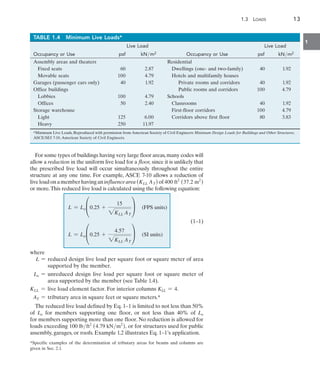
displacement ().

F
F
x
P
L A

P
F  __ x

(a)
Fig. 9–1
9.1 External Work and Strain Energy	 351
9
Suppose now that P is already applied to the bar and that another force F
is now applied, so the bar deflects further by an amount , Fig. 9–1b.
The work done by P (not F) when the bar undergoes the further
deflection  is then
	 Ue = P	(9–4)
Here the work represents the shaded rectangular area in Fig. 9–1b. In this
case P does not change its magnitude since  is caused only by
F. Therefore, work is simply the force magnitude (P) times the
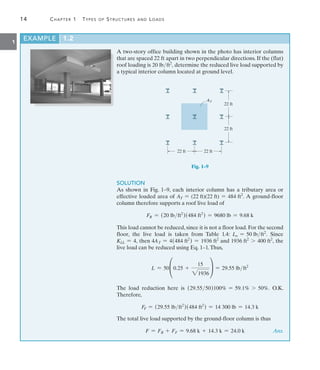
displacement ).
In summary, then, when a force P is applied to the bar, followed by
application of the force F, the total work done by both forces is
represented by the triangular area ACE in Fig. 9–1b.The triangular area
ABG represents the work of P that is caused by its displacement ,
the  triangular area BCD represents the work of F since this force
causes a displacement , and lastly, the shaded rectangular area
BDEG represents the additional work done by P when displaced  as
caused by F.
External Work—Moment.  The work of a moment is defined by
the product of the magnitude of the moment M and the angle du through
which it rotates, that is, dUe = M du, Fig. 9–2. If the total angle of rotation
is u radians, the work becomes
	 Ue =
L
u
0
M du(9–5)
As in the case of force, if the moment is applied gradually to a structure
having linear elastic response from zero to M, the work is then
	 Ue = 1
2 Mu	(9–6)
However, if the moment is already applied to the structure and other
loadings further distort the structure by an amount u, then M rotates u,
and the work is
	 Ue = Mu	(9–7)
M
du
Fig. 9–2
¿
P
F
x
A

F¿

P
F¿  P
B
G
D
E
C
(b)
¿
Fig. 9–1
352	 Chapter 9   Deflections Using Energy Methods
9
Strain Energy—Axial Force.  When an axial force N is applied
gradually to the bar in Fig. 9–3, it will strain the material such that the
external work done by N will be converted into strain energy, which is
stored in the bar (Eq. 9–1). Provided the material is linearly elastic,
Hooke’s law is valid, s = EP, and if the bar has a constant cross-sectional
area A and length L, the normal stress is s = NA and the final strain is
P = L. Consequently, NA = E(L), and the final deflection is
	  =
NL
AE
	(9–8)
Substituting into Eq. 9–3, with P = N, the strain energy in the bar is
therefore
	 Ui =
N2
L
2AE
	(9–9)
Strain Energy—Bending.  Consider the beam shown in Fig. 9–4a,
which is distorted by the gradually applied loading P and w. These
loads create an internal moment M in the beam at a section located a
distance x from the left support. The resulting rotation of the differential
element dx, Fig. 9–4b, can be found from Eq. 8–2, that is, du = (MEI) dx.
Consequently,  the strain energy, or work stored in the element, is
determined from Eq.9–6 since the internal moment is gradually developed.
Hence,
	 dUi =
M2
dx
2EI
	(9–10)
The strain energy for the beam is determined by integrating this result
over the beam’s entire length L.The result is
	 Ui =
L
L
0
M2
dx
2EI
	(9–11)
P
x dx
w
L
(a)  
du
dx
M M
(b)
Fig. 9–4

N
L A
Fig. 9–3
9.2 Principle of Work and Energy	 353
9
9.2  Principle of Work and Energy
Now that the work and strain energy for a force and a moment have
been formulated, we will illustrate how the conservation of energy or
the principle of work and energy can be applied to determine the
displacement at a point on a structure. To do this, consider finding the
displacement  at the point where the force P is applied to the cantilever
beam in Fig. 9–5. From Eq. 9–3, the external work is Ue = 1
2 P. To obtain
the resulting strain energy, we must first determine the internal moment
as a function of position x in the beam and then apply Eq. 9–11. In this
case M = -Px, so that
Ui =
L
L
0
M2
dx
2EI
=
L
L
0
(-Px)2
dx
2EI
=
1
6
P2
L3
EI
Equating the external work to internal strain energy and solving for the
unknown displacement , we have
Ue = Ui
1
2
P =
1
6
P2
L3
EI
 =
PL3
3EI
Although the solution here is quite direct, application of this method is
limited to only a few select problems. It will be noted that only one load
may be applied to the structure, since if more than one load were applied,
there would be an unknown displacement under each load, and yet it is
possible to write only one “work” equation for the beam. Furthermore,
only the displacement under the force can be obtained, since the external
work depends upon both the force and its corresponding displacement.
One way to circumvent these limitations is to use the method of virtual
work or Castigliano’s theorem, both of which are explained in the
following sections.
P
L
P
V x
M
Fig. 9–5
354	 Chapter 9   Deflections Using Energy Methods
9
9.3  Principle of Virtual Work
The principle of virtual work was developed by John Bernoulli in 1717
and is sometimes referred to as the unit-load method.It provides a general
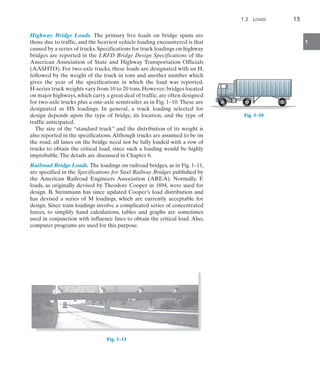
means of obtaining the displacement and slope at a specific point on a
structure, be it a beam, frame, or truss.
Before developing the principle of virtual work, it is necessary to
make some general statements regarding the principle of work and
energy, which was discussed in the previous section. If we take a
deformable structure of any shape or size and apply a series of external
loads P to it,  it will cause internal loads u at points throughout the
structure. It is necessary that the external and internal loads be related by
the equations of equilibrium. As a consequence of these loadings,
external displacements  will occur at the P loads and internal
displacements d will occur at each point of internal load u. In general,
these displacements do not have to be elastic, and they may not be
related to the loads; however, the external and internal displacements
must be related by the compatibility of the displacements. In other words,
if the external displacements are known, the corresponding internal
displacements are uniquely defined. In general, then, the principle of
work and energy states:
	
P = ud
Work of Work of
External Loads Internal Loads
	(9–12)
Based on this concept, the principle of virtual work will now be
developed. To do this, we will consider the structure (or body) to be of
arbitrary shape as shown in Fig. 9–6b.* Suppose it is necessary to
determine the displacement  of point A on the body caused by the “real
loads” P1, P2, and P3. It is to be understood that these loads cause no
movement of the supports; in general, however, they can strain the
material beyond the elastic limit. Since no external load acts on the body
at A and in the direction of , the displacement  can be determined by
first placing on the body a “virtual” load such that this force P acts in
the same direction as , Fig. 9–6a. For convenience, which will be
apparent later, we will choose P to have a “unit” magnitude, that is,
P = 1. The term “virtual” is used to describe the load, since it is
imaginary and does not actually exist as part of the real loading. The unit
load (P)does,however,createaninternalvirtualloaduinarepresentative
element or fiber of the body, as shown in Fig. 9–6a. Here it is required
that P and u be related by the equations of equilibrium.†
*This arbitrary shape will later represent a specific truss, beam, or frame.
†Although these loads will cause virtual displacements, we will not be concerned with their
magnitudes.
L
P¿  1
Apply virtual load P¿  1
(a)
u
u
A
L
Apply real loads P1, P2, P3
(b)
dL
P1
P2
P3
A

Fig. 9–6
9.3 Principle of Virtual Work	 355
9
Once the virtual loadings are applied, then the body is subjected to the
real loads P1, P2, and P3, Fig. 9–6b. Point A will be displaced an amount ,
causing the element to deform an amount dL. As a result, the external
virtual force P and internal virtual load u “ride along” by  and dL,
respectively, and therefore perform external virtual work of 1 #  on the
body and internal virtual work of u # dL on the element. Realizing that the
external virtual work is equal to the internal virtual work done on all
the elements of the body, we can write the virtual-work equation as
	 virtual loadings
1 #  = u # dL(9–13)
real displacements
where
P = 1 = external virtual unit load acting in the direction of .
u = internal virtual load acting on the element in the direction of dL.
 = external displacement caused by the real loads.
dL = internal deformation of the element caused by the real loads.
By choosing P = 1, it can be seen that the solution for  follows directly,
since (1) = u dL.
In a similar manner,if the rotational displacement or slope of the tangent
at a point on a structure is to be determined, a virtual couple moment M
having a “unit” magnitude is applied at the point. As a consequence, this
couple moment causes a virtual load uU in one of the elements of the body.
Assuming that the real loads deform the element an amount dL, the
rotation u can be found from the virtual-work equation
	 virtual loadings
1 # u = uu
# dL(9–14)
real displacements
where
M = 1 = external virtual unit couple moment acting in the direction of u.
uu = internal virtual load acting on an element in the direction of dL.
u =   
external rotational displacement or slope in radians caused by the
real loads.
dL = internal deformation of the element caused by the real loads.
This method for applying the principle of virtual work is often referred
to as the method of virtual forces, since a virtual force is applied resulting
in the calculation of a real displacement. The equation of virtual
work in this case represents a compatibility requirement for the structure.
Although not important here, realize that we can also apply the principle
356	 Chapter 9   Deflections Using Energy Methods
9
of virtual work as a method of virtual displacements. In this case virtual
displacements are imposed on the structure while the structure is subjected
to real loadings. This method can be used to determine a force on or in a
structure,* so that the equation of virtual work is then expressed as an
equilibrium requirement.
9.4  Method of Virtual Work: Trusses
We can use the method of virtual work to determine the displacement of
a truss joint when the truss is subjected to an external loading,temperature
change, or fabrication errors. Each of these situations will now be
discussed.
External Loading.  For the purpose of explanation let us consider
the vertical displacement  of joint B of the truss in Fig. 9–7a. Here a
typical element of the truss would be one of its members having a length L,
Fig. 9–7b. If the applied loadings P1 and P2 cause a linear elastic material
response, then this element deforms an amount L = NLAE, where N is
the normal or axial force in the member, caused by the loads. Applying
Eq. 9–13, the virtual-work equation for the truss is therefore
	 1 #  = a
nNL
AE
	(9–15)
where
1 = 
external virtual unit load acting on the truss joint in the stated
direction of .
n = 
internal virtual normal force in a truss member caused by the
external virtual unit load.
 = external joint displacement caused by the real loads on the truss.
N = internal normal force in a truss member caused by the real loads.
L = length of a member.
A = cross-sectional area of a member.
E = modulus of elasticity of a member.
The formulation of this equation follows naturally from the development
in Sec. 9.3. Here the external virtual unit load creates internal virtual
forces n in each of the truss members. The real loads then cause the truss
joint to be displaced  in the same direction as the virtual unit load, and
each member is displaced NLAE in the same direction as its respective n
force. Consequently, the external virtual work 1 #  equals the internal
virtual work or the internal (virtual) strain energy stored in all the truss
members, that is, nNLAE.
*It was used in this manner in Sec. 6.3 with reference to the Müller-Breslau principle.
(a)
Apply virtual unit load to B
1
B
L
B
P2
P1

Apply real loads P1, P2
(b)
Fig. 9–7
9.4  Method of Virtual Work: Trusses	 357
9
Temperature.  In some cases, truss members may change their
length due to temperature. If a is the coefficient of thermal expansion for
a member and T is the change in its temperature, the change in length
of a member is L = a T L. Hence,we can determine the displacement
of a selected truss joint due to this temperature change from Eq. 9–13,
written as
		(9–16)
where
1 = 
external virtual unit load acting on the truss joint in the stated
direction of .
n = 
internal virtual normal force in a truss member caused by the
external virtual unit load.
 = external joint displacement caused by the temperature change.
a = coefficient of thermal expansion of member.
T = change in temperature of member.
L = length of member.
Fabrication Errors and Camber.  Occasionally, errors in
fabricating the lengths of the members of a truss may occur. Also, in
some cases truss members must be made slightly longer or shorter
in order to give the truss a camber. Camber is often built into a bridge
truss so that the bottom cord will curve upward by an amount
equivalent to the downward deflection of the cord when subjected to
the bridge’s full dead weight. If a truss member is shorter or longer
than intended, the displacement of a truss joint from its expected
position can be determined from direct application of Eq. 9–13,
written as
		(9–17)
where
1 = 
external virtual unit load acting on the truss joint in the stated
direction of .
n = 
internal virtual normal force in a truss member caused by the
external virtual unit load.
 = 
external joint displacement caused by the fabrication errors.
L = 
difference in length of the member from its intended size as caused
by a fabrication error.
A combination of the right sides of Eqs. 9–15 through 9–17 will be
necessary if both external loads act on the truss and some of the members
undergo a thermal change or have been fabricated with the wrong
dimensions.
1 #  = na T L
1 #  = n L
358	 Chapter 9   Deflections Using Energy Methods
9
Procedure for Analysis
The following procedure may be used to determine a specific
displacement of any joint on a truss using the method of virtual work.
Virtual Forces n
	 •	 Place the unit load on the truss at the joint where the desired
displacement is to be determined.The load should be in the same
direction as the specified displacement, e.g., horizontal or vertical.
	 •	 With the unit load so placed, and all the real loads removed from
the truss, use the method of joints or the method of sections and
calculate the internal n force in each truss member. Assume that
tensile forces are positive and compressive forces are negative.
Real Forces N
	 •	 Use the method of sections or the method of joints to determine
the N force in each member. These forces are caused only by the
real loads acting on the truss. Again, assume tensile forces are
positive and compressive forces are negative.
Virtual-Work Equation
	 •	 Apply the equation of virtual work, to determine the desired
displacement. It is important to retain the algebraic sign for each
of the corresponding n and N forces when substituting these
terms into the equation.
	 •	 If the resultant sum nNLAE is positive, the displacement  is
in the same direction as the unit load. If a negative value results,
 is opposite to the unit load.
	 •	 When applying 1 #  = na TL, realize that if any of the
members undergoes an increase in temperature, T will be
positive, whereas a decrease in temperature results in a negative
value for T.
	 •	 For 1 #  = n L, when a fabrication error increases the length of
a member, L is positive, whereas a decrease in length is negative.
	 •	 When applying any formula, attention should be paid to the units
of each numerical quantity. In particular, the virtual unit load can
either be assigned no units, or have any arbitrary unit (lb, kip, N,
etc.), since the n forces will have these same units, and as a result
the units for both the virtual unit load and the n forces will cancel
from both sides of the equation.
9
	 9.4  Method of Virtual Work: Trusses	 359
EXAMPLE 9.1
Determine the vertical displacement of joint C of the steel truss shown
in Fig. 9–8a. The cross-sectional area of each member is A = 0.5 in2
and E = 29(103
) ksi.
B
A C D
F E
10 ft 10 ft 10 ft
10 ft
(a)
4 k 4 k
SOLUTION
Virtual Forces n.  Only a vertical 1-k load is placed at joint C, and
the force in each member is calculated using the method of joints.The
results are shown in Fig. 9–8b. Positive numbers indicate tensile forces
and negative numbers indicate compressive forces.
Real Forces N.  The real forces in the members are calculated using
the method of joints.The results are shown in Fig. 9–8c.
Virtual-Work Equation.  Arranging the data in tabular form,we have
Member n (k) N (k) L (ft) nNL (k2 # ft)
AB 0.333 4 10 13.33
BC 0.667 4 10 26.67
CD 0.667 4 10 26.67
DE -0.943 -5.66 14.14 75.42
FE -0.333 -4 10 13.33
EB -0.471 0 14.14 0
BF 0.333 4 10 13.33
AF -0.471 -5.66 14.14 37.71
CE 1 4 10 40
246.47
Thus	 1 k # Cv
= a
nNL
AE
=
246.47 k2 # ft
AE
Converting the units of member length to inches and substituting the
numerical values for A and E, we have
1 k # Cv
=
(246.47 k2 # ft)(12 in.ft)
(0.5 in2
)(29(103
) kin2
)
	 Cv
= 0.204 in. Ans.
virtual forces n
(b)
0.333 k
1 k 0.667 k
0.667 k
0.667 k
0.333 k

0
.
4
7
1
k
0.333
k
0.333 k

0.471
k 1 k

0
.
9
4
3
k
real forces N
(c)
4 k 4 k 4 k
4 k
4 k 4 k

5.66
k
4 k
4 k
4 k
0

5.66
k
4 k
Fig. 9–8
9
360	 Chapter 9   Deflections Using Energy Methods
The cross-sectional area of each member of the truss shown in
Fig.9–9a is A = 400 mm2
and E = 200 GPa. (a) Determine the vertical
displacement of joint C if a 4-kN force is applied to the truss at C.
(b) If no loads act on the truss,what would be the vertical displacement
of joint C if member AB were 5 mm too short?
3 m
4 kN
C
A
B
4 m 4 m
(a)
Fig. 9–9
SOLUTION
Part (a)
Virtual Forces n.  Since the vertical displacement of joint C is to be
determined, a virtual force of 1 kN is applied at C in the vertical
direction. The units of this force are the same as those of the real
loading. The support reactions at A and B are calculated and the
n force in each member is determined by the method of joints as
shown on the free-body diagrams of joints A and B, Fig. 9–9b.
EXAMPLE 9.2
1 kN
C
A B

0.833 kN
(b)

0.833 kN
0.667 kN
0.5 kN 0.5 kN
A
0.833 kN
0.5 kN
0.667 kN
4
3
5
0.833 kN
0.667 kN
0.5 kN
B
4
3 5
virtual forces n
Real Forces N.  The joint analysis of A and B when the real load of
4 kN is applied to the truss is given in Fig. 9–9c.
9.4  Method of Virtual Work: Trusses	 361
9
4 kN
C
A
B
2.5 kN
(c)

2.5 kN
2 kN
1.5 kN 1.5 kN
A
2.5 kN
1.5 kN
2 kN
4
3
5
2.5 kN
2 kN
1.5 kN
B
4
3 5
real forces N
4 kN
4 kN
Virtual-Work Equation.  Since AE is constant, each of the terms
nNL can be arranged in tabular form and computed. Here positive
numbers indicate tensile forces and negative numbers indicate
compressive forces.
Member n (kN) N (kN) L (m) n NL (kN2 # m)
AB 0.667 2 8 10.67
AC -0.833 2.5 5 -10.41
CB -0.833 -2.5 5 10.41
10.67
Thus,
1 kN # Cy
= a
nNL
AE
=
10.67 kN2 # m
AE
Substituting the values A = 400 mm2
= 400(10-6
) m2
, E = 200 GPa =
200(106
) kNm2
, we have
1 kN # Cv
=
10.67 kN2 # m
400(10-6
) m2
(200(106
) kNm2
)
	 Cv
= 0.000133 m = 0.133 mm Ans.
Part (b). Here we must apply Eq. 9–17. Since the vertical
displacement of C is to be determined, we can use the results of
Fig. 9–9b. Only member AB undergoes a change in length, namely,
of L = -0.005 m.
Thus,
1 #  = n L
1 kN # Cv
= (0.667 kN)(-0.005 m)
	 Cv
= -0.00333 m = -3.33 mm Ans.
The negative sign indicates joint C is displaced upward, opposite to
the 1-kN vertical load. Note that if the 4-kN load and fabrication
error  are both accounted for, the resultant displacement is then
Cv
= 0.133 - 3.33 = -3.20 mm (upward).
362	 Chapter 9   Deflections Using Energy Methods
9
Determine the vertical displacement of joint C of the steel truss shown
in Fig. 9–10a. Due to radiant heating from the wall, member AD is
subjected to an increase in temperature of T = +120F. Take
a = 0.6(10-5
)F and E = 29(103
) ksi. The cross-sectional area of
each member is indicated in the figure.
EXAMPLE 9.3
80 k
2 in2
1
.
5
i
n
2
2 in2
wall
2 in2
2 in2
60 k
8 ft
D
C
B
A
(a)
6 ft
Fig. 9–10
0.75 k
virtual forces n
(b)
0.75 k
1 k 1 k
1 k

1
.
2
5
k
0
0
0.75 k
120 k
real forces N
(c)
120 k
80 k
60 k
80 k

1
0
0
k
80 k
0
60 k
80 k
SOLUTION
Virtual Forces n.  A vertical 1-k load is applied to the truss at joint C,
and the forces in the members are computed, Fig. 9–10b.
Real Forces N.  Since the n forces in members AB and BC are zero,
the N forces in these members do not have to be computed. Why? For
completion, though, the entire real-force analysis is shown in Fig. 9–10c.
Virtual-Work Equation.  Both loads and temperature affect the
deformation; therefore, Eqs. 9–15 and 9–16 are combined. Working in
units of kips and inches, we have
1 # Cv
= a
nNL
AE
+ na T L
=
(0.75)(120)(6)(12)
2329(103
)4
+
(1)(80)(8)(12)
2329(103
)4
+
(-1.25)(-100)(10)(12)
1.5329(103
)4
+ (1)30.6(10-5
)4(120)(8)(12)
Cv
= 0.658 in. Ans.
9.5  Castigliano’s Theorem	 363
9
9.5  Castigliano’s Theorem
In 1879 Alberto Castigliano, an Italian railroad engineer, published a
book in which he outlined a method for determining the deflection or
slope at a point in a structure, be it a truss, beam, or frame.This method,
which is referred to as Castigliano’s second theorem, or the method of
least work, applies only to structures that have constant temperature,
unyielding supports, and linear elastic material response. If the
displacement of a point is to be determined, the theorem states that it
is equal to the first partial derivative of the strain energy in the
structure with respect to a force acting at the point and in the direction
of displacement. In a similar manner, the slope at a point in a structure
is equal to the first partial derivative of the strain energy in the
structure with respect to a couple moment acting at the point and in
the direction of rotation.
To derive Castigliano’s second theorem, consider a body (structure) of
any arbitrary shape which is subjected to a series of n forces P1, P2, . . . , Pn.
Since the external work done by these loads is equal to the internal strain
energy stored in the body, we can write
Ui = Ue
The external work is a function of the external loads (Ue =  1Pdx).
Thus,
Ui = Ue = f(P1, P2, g, Pn)
Now, if any one of the forces, say Pi, is increased by a differential amount
dPi, the internal work is also increased such that the new strain energy
becomes
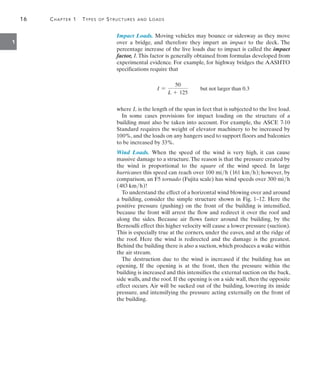
Ui + dUi = Ui +
0Ui
0Pi
dPi(9–18)
This value, however, should not depend on the sequence in which the n
forces are applied to the body. For example, if we apply dPi to the body first,
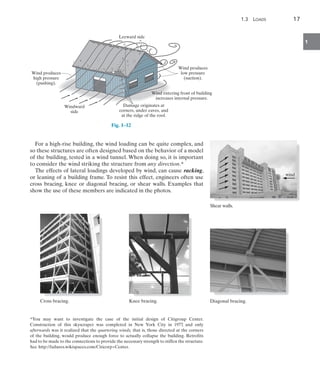
then this will cause the body to be displaced a differential amount di in the
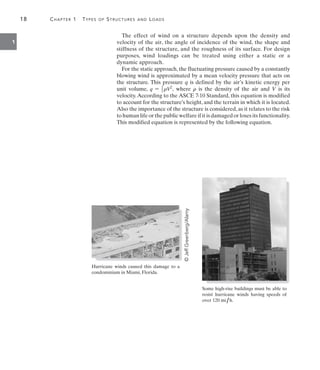
direction of dPi. By Eq. 9–3 1Ue = 1
2 P2, the increment of strain energy
would be 1
2 dPi di. This quantity,however,is a second-order differential and
may be neglected. Further application of the loads P1, P2, . . . , Pn, which
displace the body 1, 2, . . . , n, yields the strain energy.
	 Ui + dUi = Ui + dPii(9–19)
Here, as before, Ui is the internal strain energy in the body, caused by the
loads P1, P2, . . . , Pn, and dUi = dPii is the additional strain energy caused
by dPi. (Eq. 9–4, Ue = P.)
In summary, then, Eq. 9–18 represents the strain energy in the body
determined by first applying the loads P1, P2, . . . , Pn, then dPi, and
Eq.9–19 represents the strain energy determined by first applying dPi and
364	 Chapter 9   Deflections Using Energy Methods
9
then the loads P1, P2, . . . , Pn. Since these two equations must be equal,
we require
	 i =
0Ui
0Pi
(9–20)
which proves the theorem; i.e., the displacement i in the direction of Pi is
equal to the first partial derivative of the strain energy with respect to Pi.*
It should be noted that Eq. 9–20 is a statement regarding the structure’s
compatibility. Also, the above derivation requires that only conservative
forces be considered for the analysis. These forces do work that is
independent of the path and therefore create no energy loss. Since forces
causing a linear elastic response are conservative, the theorem is
restricted to linear elastic behavior of the material. This is unlike the
method of virtual force discussed in the previous section, which applied
to both elastic and inelastic behavior.
9.6  Castigliano’s Theorem for Trusses
The strain energy for a member of a truss is given by Eq. 9–9,
Ui = N2
L2AE. Substituting this equation into Eq. 9–20 and omitting the
subscript i, we have
 =
0
0Pa
N2
L
2AE
It is generally easier to perform the differentiation prior to summation. In
the general case L, A, and E are constant for a given member, and
therefore we may write
	  = a N a
0N
0P
b
L
AE
(9–21)
where
 = external joint displacement of the truss.
  P = external force applied to the truss joint in the direction of .
N = internal force in a member caused by both the force P and the loads
on the truss.
 L = length of a member.
A = cross-sectional area of a member.
 E = modulus of elasticity of a member.
*Castigliano’s first theorem is similar to his second theorem; however, it relates the load Pi to
the partial derivative of the strain energy with respect to the corresponding displacement,that
is, Pi = 0Ui0i. The proof is similar to that given above and, like the method of virtual
displacement,Castigliano’s first theorem applies to both elastic and inelastic material behavior.
This theorem is another way of expressing the equilibrium requirements for a structure, and
since it has very limited use in structural analysis, it will not be discussed in this book.
9.6  Castigliano’s Theorem for Trusses	 365
9
This equation is similar to that used for the method of virtual work,
Eq. 9–15 (1 #  = nNLAE), except n is replaced by 0N0P. Notice that
in order to determine this partial derivative it will be necessary to treat P
as a variable (not a specific numerical quantity), and furthermore, each
member force N must be expressed as a function of P. As a result,
computing 0N0P generally requires slightly more calculation than that
required to compute each n force directly. These terms will of course be
the same, since n or 0N0P is simply the change of the internal member
force with respect to the load P, or the change in member force per
unit load.
Procedure for Analysis
The following procedure provides a method that may be used to
determine the displacement of any joint of a truss using Castigliano’s
theorem.
External Force P
	 •	 Place a force P on the truss at the joint where the desired
displacement is to be determined.This force is assumed to have a
variable magnitude in order to obtain the change 0N0P. Be sure
P is directed along the line of action of the displacement.
Internal Forces N
	 •	 Determine the force N in each member caused by both the real
(numerical) loads and the variable force P.Assume tensile forces
are positive and compressive forces are negative.
	 •	 Compute the respective partial derivative 0N0P for each
member.
	 •	 After N and 0N0P have been determined, assign P its numerical
value if it has replaced a real force on the truss. Otherwise, set P
equal to zero.
Castigliano’s Theorem
	 •	 Apply Castigliano’s theorem to determine the desired
displacement . It is important to retain the algebraic signs for
corresponding values of N and 0N0P when substituting these
terms into the equation.
	 •	 If the resultant sum N(0N0P)LAE is positive,  is in the same
direction as P. If a negative value results,  is opposite to P.
9
366	 Chapter 9   Deflections Using Energy Methods
Determine the vertical displacement of joint C of the truss shown in
Fig. 9–11a. The cross-sectional area of each member is A = 400 mm2
and E = 200 GPa.
SOLUTION
External Force P.  A vertical force P is applied to the truss at joint C,
since this is where the vertical displacement is to be determined,
Fig. 9–11b.
Internal Forces N.  The reactions at the truss supports at A and B
are determined and the results are shown in Fig. 9–11b. Using the
method of joints, the N forces in each member are determined,
Fig. 9–11c.* For convenience, these results along with the partial
derivatives 0N0P are listed in tabular form as follows:
EXAMPLE 9.4
4 m 4 m
3 m
A
B
C
(a)
4 kN
4 m 4 m
3 m
A
B
C
(b)
4 kN
P
0.5P  1.5 kN
0.5P  1.5 kN
4 kN
Member N
0N
0P
N(P = 0) L N a
0N
0P
bL
AB 0.667P + 2 0.667 2 8 10.67
AC -(0.833P - 2.5) -0.833 2.5 5 -10.42
BC -(0.833P + 2.5) -0.833 -2.5 5 10.42
 = 10.67 kN # m
Since P does not actually exist as a real load on the truss, we require
P = 0 in the table above.
Castigliano’s Theorem.  Applying Eq. 9–21, we have
Cv
= a Na
0N
0P
b
L
AE
=
10.67 kN # m
AE
Substituting A = 400 mm2
= 400(10-6
) m2
, E = 200 GPa = 200(109
) Pa,
and converting the units of N from kN to N, we have
Cv
=
10.67(103
) N # m
400(10-6
) m2
(200(109
) Nm2
)
= 0.000133 m = 0.133 mm Ans.
This solution should be compared with the virtual-work method of
Example 9.2.
*It may be more convenient to analyze the truss with just the 4-kN load on it, then
analyze the truss with the P load on it. The results can then be added together to give
the N forces.
Fig. 9–11
(c)
B
3
4
5
NAB  0.667P  2 kN
0.5P  1.5 kN
NBC  0.833P  2.5 kN
A
0.5P  1.5 kN
4 kN
NAB  0.667P  2 kN
NAC  0.833P  2.5 kN
3
4
5
9
	 9.6  Castigliano’s Theorem for Trusses	 367
EXAMPLE 9.5
Determine the horizontal displacement of joint D of the truss shown
in Fig. 9–12a. Take E = 29(103
) ksi. The cross-sectional area of each
member is indicated in the figure.
12 ft 12 ft
9 ft 0.5 in
2
1 in2 1 in2
0.75
in
2
0.5 in 2
D
B
C
10 k
(a)
A
Fig. 9–12
SOLUTION
External Force P.  Since the horizontal displacement of D is to be
determined, a horizontal variable force P is applied to joint D,
Fig. 9–12b.
Internal Forces N.  Using the method of joints, the force N in each
member is computed.* Again, when applying Eq. 9–21, we set P = 0
since this force does not actually exist on the truss. The results are
shown in Fig. 9–12b.Arranging the data in tabular form, we have
Member N
0N
0P
N (P = 0) L N a
0N
0P
bL
AB -13.33 0 -13.33 12 0
BC -13.33 0 -13.33 12 0
CD 16.67 0 16.67 15 0
DA 16.67 + 1.25P 1.25 16.67 15 312.50
BD -(20 + 0.75P) -0.75 - 20 9 135.00
Castigliano’s Theorem.  Applying Eq. 9–21, we have
Dh
= a N a
0N
0P
b
L
AE
= 0 + 0 + 0 +
312.50 k # ft(12 in.ft)
(0.5 in2
)329(103
) kin2
4
+
135.00 k # ft(12 in.ft)
(0.75 in2
)329(103
) kin2
4
	 = 0.333 in. Ans.
P
10
20  0.75P
(20

0.75P)
10  0.75P
13.33
13.33
16.67 
1.25P
16.67
P
(b)
*As in the preceding example, it may be preferable to perform a separate analysis of
the truss loaded with 10 k and loaded with P and then superimpose the results.
9
368	 Chapter 9   Deflections Using Energy Methods
Determine the vertical displacement of joint C of the truss shown in
Fig. 9–13a.Assume that A = 0.5 in2
and E = 29(103
) ksi.
4 k P
P
0.667P1.333k
0.333P2.667k
0.667P  1.333
0.667P  1.333
0.333P  2.667
(0.333P  2.667)

(
0
.
4
7
1
P

3
.
7
7
2
)
0.333P

2.667 
0.471P

1.886
B
C
D
E
F

(
0
.
9
4
3
P

1
.
8
8
6
)
A
(b)
Fig. 9–13
SOLUTION
External Force P.  The 4-k force at C is replaced with a variable
force P at joint C, Fig. 9–13b.
Internal Forces N.  The method of joints is used to determine the
force N in each member of the truss. The results are summarized in
Fig. 9–13b. Here P = 4 k when we apply Eq. 9–21. The required data
can be arranged in tabulated form as follows:
EXAMPLE 9.6
B
A
C D
F E
10 ft
(a)
4 k 4 k
10 ft 10 ft 10 ft
9
	 9.6  Castigliano’s Theorem for Trusses	 369
Member N
0N
0P
N (P = 4 k) L N a
0N
0P
bL
AB 0.333P + 2.667 0.333 4 10 13.33
BC 0.667P + 1.333 0.667 4 10 26.67
CD 0.667P + 1.333 0.667 4 10 26.67
DE -(0.943P + 1.886) -0.943 -5.66 14.14 75.42
EF -(0.333P + 2.667) -0.333 -4 10 13.33
FA -(0.471P + 3.771) -0.471 -5.66 14.14 37.71
BF 0.333P + 2.667 0.333 4 10 13.33
BE -0.471P - 1.886 -0.471 0 14.14 0
CE P 1 4 10 40
 = 246.47 k # ft
Castigliano’s Theorem.  Substituting the data into Eq. 9–21, we have
Cv
= a Na
0N
0P
b
L
AE
=
246.47 k # ft
AE
Converting the units of member length to inches and substituting the
numerical value for AE, we have
	 Cv
=
(246.47 k # ft)(12 in.ft)
(0.5 in2
)(29(103
) kin2
)
= 0.204 in.	 Ans.
The similarity between this solution and that of the virtual-work
method, Example 9.1, should be noted.
370	 Chapter 9   Deflections Using Energy Methods
9
9.7  
Method of Virtual Work:
Beams and Frames
The method of virtual work can also be applied to deflection problems
involving beams and frames. Since strains due to bending are the primary
cause of beam or frame deflections, we will discuss their effects first.
Deflections due to shear, axial and torsional loadings, and temperature
will be considered in Sec. 9.8.
The principle of virtual work, or more exactly, the method of virtual force,
may be formulated for beam and frame deflections by considering the beam
shown in Fig.9–14b.Here the displacement  of point A is to be determined.
To compute  a virtual unit load acting in the direction of  is placed on the
beam at A, and the internal virtual moment m is determined by the method
of sections at an arbitrary location x from the left support, Fig. 9–14a.When
the real loads act on the beam, Fig. 9–14b, point A is displaced . Provided
these loads cause linear elastic material response, then from Eq. 8–2, the
element dx deforms or rotates du = (MEI) dx.* Here M is the internal
moment at x caused by the real loads. Consequently, the external virtual
work done by the unit load is 1 # , and the internal virtual work done by the
moment m is m du = m(MEI) dx. Summing the effects on all the elements
dx along the beam requires an integration, and therefore Eq. 9–13 becomes
		(9–22)
where
1 = 
external virtual unit load acting on the beam or frame in the
direction of .
m = 
internal virtual moment in the beam or frame, expressed as a
function of x and caused by the external virtual unit load.
 = 
external displacement of the point caused by the real loads acting
on the beam or frame.
M = 
internal moment in the beam or frame, expressed as a function of x
and caused by the real loads.
E = modulus of elasticity of the material.
I = 
moment of inertia of cross-sectional area, computed about the
neutral axis.
In a similar manner,if the tangent rotation or slope angle u at a point A on
the beam’s elastic curve is to be determined,Fig.9–15,a unit couple moment
is first applied at the point,and the corresponding internal moments mu have
to be determined. Since the work of the unit couple is 1 # u, then
		(9–23)
1 #  =
L
L
0
mM
EI
dx
1 # u =
L
L
0
muM
EI
dx
A
x
1
Apply virtual unit load to point A
x
(a)
m
v
r
x
Apply real load w
A

w
(b)
x
M
du
V
R
Fig. 9–14
A
x
1
Apply virtual unit couple moment to point A
x
(a)
m
v
r
x
Apply real load w
A
w
x
M
du
u
V
R
Fig. 9–15
*Recall that if the material is strained beyond its elastic limit, the principle of virtual work
can still be applied, although in this case a nonlinear or plastic analysis must be used.
9.7  Method of Virtual Work: Beams and Frames 	 371
9
x1
Apply virtual unit load
(a)
A
x2
x3
x4
B C D
E
1
x1
Apply real loads
(b)
A
w
x2
x3
x4
B C D
E
P
Fig. 9–16
When applying Eqs. 9–22 and 9–23, it is important to realize that the
definite integrals on the right side actually represent the amount of virtual
strain energy that is stored in the beam. If concentrated forces or couple
moments act on the beam or the distributed load is discontinuous, a single
integration cannot be performed across the beam’s entire length. Instead,
separate x coordinates will have to be chosen within regions that have no
discontinuity of loading. Also, it is not necessary that each x have the
same origin; however, the x selected for determining the real moment M
in a particular region must be the same x as that selected for determining
the virtual moment m or mu within the same region.For example,consider
the beam shown in Fig. 9–16. In order to determine the displacement of
D, four regions of the beam must be considered, and therefore four
integrals having the form 1(mMEI) dx must be evaluated.We can use x1
to determine the strain energy in region AB, x2 for region BC, x3 for
region DE, and x4 for region DC. In any case, each x coordinate should be
selected so that both M and m (or mu) can be easily formulated.
Integration Using Tables.  When the structure is subjected to a
relatively simple loading, and yet the solution for a displacement requires
several integrations, a tabular method may be used to perform these
integrations. To do so the moment diagrams for each member are drawn
first for both the real and virtual loadings. By matching these diagrams
for m and M with those given in the table on the inside front cover, the
integral 1mM dx can be determined from the appropriate formula.
Examples 9.8 and 9.10 illustrate the application of this method.
372	 Chapter 9   Deflections Using Energy Methods
9
Procedure for Analysis
The following procedure may be used to determine the displacement
and/or the slope at a point on the elastic curve of a beam or frame
using the method of virtual work.
Virtual Moments m or mu
	 •	 Place a unit load on the beam or frame at the point and in the
direction of the desired displacement.
	 •	 If the slope is to be determined, place a unit couple moment at
the point.
	 •	 Establish appropriate x coordinates that are valid within regions
of the beam or frame where there is no discontinuity of real or
virtual load.
	 •	 With the virtual load in place, and all the real loads removed from
the beam or frame, calculate the internal moment m or mu as a
function of each x coordinate.
	 •	 Assume m or mu acts in the conventional positive direction as
indicated in Fig. 4–1.
Real Moments
	 •	 Using the same x coordinates as those established for m or mu,
determine the internal moments M caused only by the real loads.
	 •	 Since m or mu was assumed to act in the conventional positive
direction, it is important that positive M acts in this same direction.
This is necessary since positive or negative internal work depends
upon the directional sense of load (defined by {m or {mu) and
displacement (defined by {M dxEI).
Virtual-Work Equation
	 •	 Apply the equation of virtual work to determine the desired
displacement  or rotation u. It is important to retain the
algebraic sign of each integral calculated within its specified
region.
	 •	 If the algebraic sum of all the integrals for the entire beam or
frame is positive,  or u is in the same direction as the virtual unit
load or unit couple moment, respectively. If a negative value
results, the direction of  or u is opposite to that of the unit load
or unit couple moment.
9
	 9.7  Method of Virtual Work: Beams and Frames 	 373
Determine the displacement of point B of the steel beam shown in
Fig. 9–17a.Take E = 200 GPa, I = 500(106
) mm4
.
12 kN/m
10 m
B
A
(a)
SOLUTION
Virtual Moment m.  The vertical displacement of point B is obtained
by placing a virtual unit load of 1 kN at B, Fig. 9–17b. By inspection
there are no discontinuities of loading on the beam for both the real
and virtual loads.Thus, a single x coordinate can be used to determine
the virtual strain energy.This coordinate will be selected with its origin
at B, since then the reactions at A do not have to be determined in
order to find the internal moments m and M. Using the method of
sections, the internal moment m is formulated as shown in Fig. 9–17b.
Real Moment M.  Using the same x coordinate, the internal moment
M is formulated as shown in Fig. 9–17c.
Virtual-Work Equation.  The vertical displacement of B is thus
1 kN # B =
L
L
0
mM
EI
dx =
L
10
0
(-1x)(-6x2
) dx
EI
1 kN # B =
15(103
) kN2 # m3
EI
or
B =
15(103
) kN # m3
200(106
) kNm2
(500(106
) mm4
)(10-12
m4
mm4
)
= 0.150 m = 150 mm Ans.
EXAMPLE 9.7
10 m
A
B
1 kN
x
x
1 kN
v
m 1x
virtual load
(b)
10 m
A
B
x
x
12x
V
M 6x2
real load
(c)
12 kN/m
x
__
2
Fig. 9–17
9
374	 Chapter 9   Deflections Using Energy Methods
Determine the slope u at point B of the steel beam shown in Fig. 9–18a.
Take E = 200 GPa, I = 60(106
) mm4
.
3 kN
A
5 m 5 m
B C
(a)
Fig. 9–18
SOLUTION
Virtual Moment mu.  The slope at B is determined by placing a
virtual unit couple moment of 1 kN # m at B, Fig. 9–18b. Here two x
coordinates must be selected in order to determine the total virtual
strain energy in the beam. Coordinate x1 accounts for the strain
energy within segment AB and coordinate x2 accounts for that
in  segment BC. The internal moments mu within each of these
segments are computed using the method of sections as shown
in Fig. 9–18b.
1 kNm
A
x1
B C
virtual load
(b)
x2
x1
mu1
 0
v1
x2
5 m
B
1 kNm
mu2
 1
v2
EXAMPLE 9.8
9
	 9.7  Method of Virtual Work: Beams and Frames 	 375
3 kN
A
B
x1 x2 x1
M1 3x1
V1
3 kN
(c)
real load
x2
5 m
B
M2 3 (5  x2)
V2
3 kN
C
Real Moments M.  Using the same coordinates x1 and x2, the
internal moments M are computed as shown in Fig. 9–18c.
Virtual-Work Equation.  The slope at B is thus given by
1 # uB =
L
L
0
muM
EI
dx
=
L
5
0
(0)(-3x1) dx1
EI
+
L
5
0
(1)[-3(5 + x2)] dx2
EI
uB =
-112.5 kN # m2
EI
(1)
We can also evaluate the integrals 1muM dx graphically, using the
table given on the inside front cover of the book. To do so it is first
necessary to draw the moment diagrams for the beams in Figs. 9–18b
and 9–18c. These are shown in Figs. 9–18d and 9–18e, respectively.
Since there is no moment m for 0 … x 6 5 m, we use only the shaded
rectangular and trapezoidal areas to evaluate the integral. Finding
these shapes in the appropriate row and column of the table, we have
L
10
5
muM dx = 1
2 mu(M1 + M2)L = 1
2 (1)(-15 - 30)5
= -112.5 kN2 # m3
This is the same value as that determined in Eq. 1.Thus,
(1 kN # m) # uB =
-112.5 kN2 # m3
200(106
) kNm2
360(106
) mm4
4(10-12
m4
mm4
)
uB = -0.00938 rad Ans.
The negative sign indicates uB is opposite to the direction of the virtual
couple moment shown in Fig. 9–18b.
5 10
1
x (m)
(d)
mu (kNm)
5 10
M (kNm)
x (m)
(e)
15
30
9
376	 Chapter 9   Deflections Using Energy Methods
Determine the displacement at D of the steel beam in Fig. 9–19a.Take
E = 29(103
) ksi, I = 800 in4
.
(a)
B C
D
A
10 ft 10 ft 15 ft
80 kft
6 k
Fig. 9–19
SOLUTION
Virtual Moments m.  The beam is subjected to a virtual unit load at
D as shown in Fig. 9–19b. By inspection, three coordinates, such as x1,
x2, and x3, must be used to cover all the regions of the beam. Notice
that these coordinates cover regions where no discontinuities in either
real or virtual load occur. The internal moments m have been
computed in Fig. 9–19b using the method of sections.
x3
0.75 k
x2
1.75 k
x1
1 k
x1
1 k
v1
m1 1x1
x2
1.75 k
1 k
x2  15
v2
m2  0.75x2 15
x3
0.75 k
v3
m3 0.75x3
(b)
virtual load
EXAMPLE 9.9
9
	 9.7  Method of Virtual Work: Beams and Frames 	 377
x3
1 k
x2
7 k
x1
80 kft
6 k
x1
V1
M1  0
x2
7 k
V2
M2  7x2
x3
1 k
V3
M3  80  1x3
80 kft
real load
(c)
Real Moments M.  The reactions on the beam are computed first;
then, using the same x coordinates as those used for m, the internal
moments M are determined as shown in Fig. 9–19c.
Virtual-Work Equation.  Applying the equation of virtual work to
the beam using the data in Figs. 9–19b and 9–19c, we have
1 # D =
L
L
0
mM
EI
dx
=
L
15
0
(-1x1)(0) dx1
EI
+
L
10
0
(0.75x2 - 15)(7x2) dx2
EI
+
L
10
0
(-0.75x3)(80 - 1x3) dx3
EI
D =
0
EI
-
3500
EI
-
2750
EI
= -
6250 k # ft3
EI
or
D =
-6250 k # ft3
(12)3
in3
ft3
29(103
) kin2
(800 in4
)
= -0.466 in. Ans.
The negative sign indicates the displacement is upward, opposite to
the downward unit load, Fig. 9–19b.Also note that m1 did not actually
have to be calculated since M1 = 0.
9
378	 Chapter 9   Deflections Using Energy Methods
Determine the horizontal displacement of point C on the frame shown
in Fig. 9–20a.Take E = 29(103
) ksi and I = 600 in4
for both members.
8 ft
B
C
4 k/ft
x1
A
10 ft
x2
(a)
Fig. 9–20
SOLUTION
Virtual Moments m.  For convenience, the coordinates x1 and x2 in
Fig. 9–20a will be used. A horizontal unit load is applied at C,
Fig. 9–20b. Why? The support reactions and internal virtual moments
are computed as shown.
1 k
1.25 k
8 ft
10 ft
1.25 k
1 k
virtual load
(b)
x1
n1
v1
m1  1x1
x2
1.25 k
1 k
n2
v2
m2  1.25x2
1.25 k
1 k
EXAMPLE 9.10
9
	 9.7  Method of Virtual Work: Beams and Frames 	 379
25 k
8 ft
5 ft
25 k
40 k
real load
(c)
x1
__
2
N1
V1
M1  40x1  2x1
2
x2
25 k
N2
V2
M2  25x2
40 k
25 k
40 k
4x1 x1
Real Moments M.  In a similar manner the support reactions and
real moments are computed as shown in Fig. 9–20c.
Virtual-Work Equation.  Using the data in Figs. 9–20b and 9–20c,
we have
1 # Ch
=
L
L
0
mM
EI
dx =
L
10
0
(1x1)(40x1 - 2x1
2
)dx1
EI
+
L
8
0
(1.25x2)(25x2)dx2
EI
Ch
=
8333.3
EI
+
5333.3
EI
=
13 666.7 k # ft3
EI
(1)
If desired, the integrals 1mMdx can also be evaluated graphically
using the table on the inside front cover. The moment diagrams for the
frame in Figs. 9–20b and 9–20c are shown in Figs. 9–20d and 9–20e,
respectively.Thus,using the formulas for similar shapes in the table yields
L
mM dx = 5
12(10)(200)(10) + 1
3(10)(200)(8)
= 8333.3 + 5333.3 = 13 666.7 k2 # ft3
This is the same as that calculated in Eq. 1.Thus
	
Ch
=
13 666.7 k # ft2
329(103
) kin2
((12)2
in2
ft2
)4 3600 in (ft4
(12)4
in4
)4
= 0.113 ft = 1.36 in. Ans.
10 kft
10 kft
8 ft
10 ft
(d)
200 kft
200 kft
8 ft
10 ft
(e)
9
380	 Chapter 9   Deflections Using Energy Methods
Determine the tangential rotation at point C of the frame shown in
Fig. 9–21a.Take E = 200 GPa, I = 15(106
) mm4
.
1 kNm
x1
1 kNm
1 kNm
x1
n1
v1
mu1
 1
1 kNm
x2
x2
1 kNm
n2
v2
mu2
 1
virtual load
(b)
 
SOLUTION
Virtual Moments mu.  The coordinates x1 and x2 shown in Fig. 9–21a
will be used. A unit couple moment is applied at C and the internal
moments mu are calculated, Fig. 9–21b.
Real Moments M.  In a similar manner, the real moments M are
calculated as shown in Fig. 9–21c.
Virtual-Work Equation.  Using the data in Figs. 9–21b and 9–21c,
we have
1 # uC =
L
L
0
muM
EI
dx =
L
3
0
(-1)(-2.5x1) dx1
EI
+
L
2
0
(1)(7.5) dx2
EI
uC =
11.25
EI
+
15
EI
=
26.25 kN # m2
EI
or
uC =
26.25 kN # m2
200(106
) kNm2
315(106
) mm4
4(10-12
m4
mm4
)
= 0.00875 rad Ans.
EXAMPLE 9.11
2 m
3 m
5 kN
C
x1
B
A
60
x2
(a)
Fig. 9–21
5 kN
x1
x1
N1
V1
x2
7.5 kNm
x2
N2
V2
M2  7.5
real load
(c)
7.5 kNm
5 kN
30
5 kN 5 kN
7.5 kNm
5 kN
M1  2.5x1
1.5 m
9.8  Virtual Strain Energy Caused by Axial Load, Shear, Torsion, and Temperature	 381
9
9.8 
Virtual Strain Energy Caused by Axial
Load, Shear, Torsion, and Temperature
Although deflections of beams and frames are caused primarily by
bending strain energy, in some structures the additional strain energy of
axial load,shear,torsion,and perhaps temperature may become important.
Each of these effects will now be considered.
Axial Load.  Frame members can be subjected to axial loads, and the
virtual strain energy caused by these loadings has been established in
Sec. 9.4. For members having a constant cross-sectional area, we have
	 Un =
nNL
AE
	(9–24)
where
n = internal virtual axial load caused by the external virtual unit load.
N = internal axial force in the member caused by the real loads.
E = modulus of elasticity for the material.
A = cross-sectional area of the member.
L = member’s length.
Shear.  In order to determine the virtual strain energy in a beam due
to shear, we will consider the beam element dx shown in Fig. 9–22. The
shearing distortion dy of the element as caused by the real loads is
dy = g dx. If the shearing strain g is caused by linear elastic material
response, then Hooke’s law applies, g = tG. Therefore, dy = (tG) dx.
We can express the shear stress as t = K(V A), where K is a form factor
that depends upon the shape of the beam’s cross-sectional area A. Hence,
we can write dy = K(V GA) dx. The internal virtual work done by a
virtual shear force v, acting on the element while it is deformed dy, is
therefore dUs = v dy = v(KV GA) dx. For the entire beam, the virtual
strain energy is determined by integration.
	 Us =
L
L
0
K a
vV
GA
b dx	(9–25)
where
v = 
internal virtual shear in the member, expressed as a function of x
and caused by the external virtual unit load.
V = 
internal shear in the member, expressed as a function of x and
caused by the real loads.
A = cross-sectional area of the member.
K = form factor for the cross-sectional area:
K = 1.2 for rectangular cross sections.
K = 109 for circular cross sections.
K  1 for wide-flange and I-beams,where A is the area of the web.
G = shear modulus of elasticity for the material.
V V
dx
dy

Fig. 9–22
382	 Chapter 9   Deflections Using Energy Methods
9
Torsion.  Often three-dimensional frameworks are subjected to torsional
loadings. If the member has a circular cross-sectional area, no warping of its
cross section will occur when it is loaded.As a result,the virtual strain energy
in the member can easily be derived.To do so consider an element dx of the
member that is subjected to an applied torque T, Fig. 9–23. This torque
causes a shear strain of g = (cdu)dx. Provided linear elastic material
response occurs, then g = tG, where t = TcJ. Thus, the angle of twist
du = (g dx)c = (tGc) dx = (TGJ) dx. If a virtual unit load is applied to
the structure that causes an internal virtual torque t in the member, then
after applying the real loads, the virtual strain energy in the member of
length dx will be dUt = t du = tT dxGJ. Integrating over the length L of
the member yields
	 Ut =
tTL
GJ
	(9–26)
where
t = internal virtual torque caused by the external virtual unit load.
T = internal torque in the member caused by the real loads.
G = shear modulus of elasticity for the material.
J = 
polar moment of inertia for the cross section, J = pc4
2, where c is
the radius of the cross-sectional area.
L = member’s length.
The virtual strain energy due to torsion for members having noncircular
cross-sectional areas is determined using a more rigorous analysis than
that presented here.
Temperature.  In Sec. 9.4 we considered the effect of a uniform
temperature change T on a truss member and indicated that the member
will elongate or shorten by an amount L = a TL. In some cases,
however, a structural member can be subjected to a temperature
difference across its depth, as in the case of the beam shown in Fig. 9–24a.
If this occurs, it is possible to determine the displacement of points along
the elastic curve of the beam by using the principle of virtual work.To do
so we must first compute the amount of rotation of a differential element
dx of the beam as caused by the thermal gradient that acts over the
beam’s cross section. For the sake of discussion we will choose the most
common case of a beam having a neutral axis located at the mid-depth
(c) of the beam. If we plot the temperature profile, Fig. 9–24b, it will be
noted that the mean temperature is Tm = (T1 + T2)2. If T1 7 T2, the
temperature difference at the top of the element causes strain elongation,
while that at the bottom causes strain contraction. In both cases the
difference in temperature is Tm = T1 - Tm = Tm - T2.
dx
du
g
T
T
c
Fig. 9–23
9.8  Virtual Strain Energy Caused by Axial Load, Shear, Torsion, and Temperature	 383
9
dx
T1
T1  T2
T2
(a)
Since the thermal change of length at the top and bottom is
dx = a Tm dx, Fig. 9–24c, then the rotation of the element is
du =
a Tm dx
c
If we apply a virtual unit load at a point on the beam where a
displacement is to be determined, or apply a virtual unit couple moment
at a point where a rotational displacement of the tangent is to be
determined, then this loading creates a virtual moment m in the beam at
the point where the element dx is located. When the temperature
gradient is imposed, the virtual strain energy in the beam is then
	 Utemp =
L
L
0
ma Tm dx
c
	(9–27)
where
m = 
internal virtual moment in the beam expressed as a function of x
and caused by the external virtual unit load or unit couple
moment.
a = coefficient of thermal expansion.
Tm = 
temperature difference between the mean temperature and the
temperature at the top or bottom of the beam.
c = mid-depth of the beam.
Unless otherwise stated, this text will consider only beam and frame
deflections due to bending. In general, though, beam and frame members
may be subjected to several of the other loadings discussed in this section.
However, as previously mentioned, the additional deflections caused by
shear and axial force alter the deflection of beams by only a few percent
and are therefore generally ignored for even“small”two- or three-member
frame analysis of one-story height. If these and the other effects of torsion
and temperature are to be considered for the analysis, then one simply
adds their virtual strain energy as defined by Eqs. 9–24 through 9–27 to the
equation of virtual work defined by Eq. 9–22 or Eq. 9–23. The following
examples illustrate application of these equations.
T1  T2
Tm  _______
2
T2
c
c
T1 Tm
Tm
temperature profile
(b)
c
c
dx
dx
dx
(c)
du
positive rotation
M
Fig. 9–24
9
384	 Chapter 9   Deflections Using Energy Methods
Determine the horizontal displacement of point C on the frame shown
in Fig. 9–25a. Take E = 29(103
) ksi, G = 12(103
) ksi, I = 600 in4
, and
A = 80 in2
for both members. The cross-sectional area is rectangular.
Include the internal strain energy due to axial load and shear.
8 ft
B
C
4 k/ft
x1
A
10 ft
x2
(a)
Fig. 9–25
SOLUTION
Here we must apply a horizontal unit load at C. The necessary
free-body diagrams for the real and virtual loadings are shown in
Figs. 9–25b and 9–25c.
EXAMPLE 9.12
1 k
1.25 k
8 ft
10 ft
1.25 k
1 k
virtual load
(b)
x1
m1  1x1
x2
1.25 k
1 k
m2  1.25x2
v2  1.25
1.25 k
1 k
v1  1
n2  1
n1  1.25
 
25 k
8 ft
5 ft
25 k
40 k
real load
(c)
x1
__
2
M1  40x1  2x1
2
x2
25 k
M2  25x2
N2  0
N1  25
40 k
25 k
40 k
4x1 x1
V2  25
V1  40  4x1
9
	 9.8  Virtual Strain Energy Caused by Axial Load, Shear, Torsion, and Temperature	 385
Bending.  The virtual strain energy due to bending has been
determined in Example 9.10.There it was shown that
Ub =
L
L
0
mM dx
EI
=
13 666.7 k2 # ft3
EI
=
13 666.7 k2 # ft3
(123
in3
1 ft3
)
329(103
) kin2
4(600 in4
)
= 1.357 in. # k
Axial load.  From the data in Fig. 9–25b and 9–25c, we have
Ua = a
nNL
AE
=
1.25 k(25 k)(120 in.)
80 in2
329(103
) kin2
4
+
1 k(0)(96 in.)
80 in2
329(103
) kin2
4
= 0.001616 in. # k
Shear.  Applying Eq. 9–25 with K = 1.2 for rectangular cross
sections, and using the shear functions shown in Fig. 9–25b and 9–25c,
we have
Us =
L
L
0
K a
vV
GA
b dx
=
L
10
0
1.2(1)(40 - 4x1) dx1
GA
+
L
8
0
1.2(-1.25)(-25) dx2
GA
=
540 k2 # ft(12 in.ft)
312(103
) kin2
4(80 in2
)
= 0.00675 in. # k
Applying the equation of virtual work, we have
1 k # Ch
= 1.357 in. # k + 0.001616 in. # k + 0.00675 in. # k
Ch
= 1.37 in. Ans.

Including the effects of shear and axial load contributed only a 0.6%
increase in the answer to that determined only from bending.
9
386	 Chapter 9   Deflections Using Energy Methods
EXAMPLE 9.13
The beam shown in Fig. 9–26a is used in a building subjected to two
different thermal environments. If the temperature at the top surface
of the beam is 80°F and at the bottom surface is 160°F, determine the
vertical deflection of the beam at its midpoint due to the temperature
gradient.Take a = 6.5(10-6
)F.
SOLUTION
Since the deflection at the center of the beam is to be determined, a
virtual unit load is placed there and the internal virtual moment in the
beam is calculated, Fig. 9–26b.
The mean temperature at the center of the beam is (160 + 80)2 =
120F, so that for application of Eq. 9–27, Tm = 120F - 80F =
40F. Also, c = 10 in.2 = 5 in. Applying the principle of virtual work,
we have
1 lb # Cv
=
L
L
0
ma Tm dx
c
= 2
L
60 in.
0
11
2 x26.5(10-6
)F(40F)
5 in.
dx
Cv
= 0.0936 in. Ans.
The result indicates a very negligible deflection.
10 in.
80 F
160 F
10 ft
(a)
1 lb
5 ft 5 ft
1
_ lb
2
1
_ lb
2
1
_ lb
2
x x
x
1
m  _ x
2
v
virtual load
(b)
Fig. 9–26
9.9  Castigliano’s Theorem for Beams and Frames	 387
9
9.9  
Castigliano’s Theorem for Beams
and Frames
The internal bending strain energy for a beam or frame is given by
Eq. 9–11 (Ui = 1M2
dx2EI). Substituting this equation into Eq. 9–20
(i = 0Ui0Pi) and omitting the subscript i, we have
 =
0
0PL
L
0
M2
dx
2EI
Rather than squaring the expression for internal moment M, integrating,
and then taking the partial derivative, it is generally easier to differentiate
prior to integration. Provided E and I are constant, we have
	 (9–28)
where
 = 
external displacement of the point caused by the real loads
acting on the beam or frame.
P = 
external force applied to the beam or frame in the direction of .
M = 
internal moment in the beam or frame, expressed as a function of
x and caused by both the force P and the real loads on the beam.
E = modulus of elasticity of beam material.
I = 
moment of inertia of cross-sectional area computed about the
neutral axis.
If the slope u at a point is to be determined, we must find the partial
derivative of the internal moment M with respect to an external couple
moment M acting at the point, i.e.,
	 (9–29)
The above equations are similar to those used for the method of virtual
work, Eqs. 9–22 and 9–23, except 0M0P and 0M0M replace m and mu,
respectively. As in the case for trusses, slightly more calculation is
generally required to determine the partial derivatives and apply
Castigliano’s theorem rather than use the method of virtual work. Also,
recall that this theorem applies only to material having a linear elastic
response. If a more complete accountability of strain energy in the
structure is desired,the strain energy due to shear,axial force,and torsion
must be included. The derivations for shear and torsion follow the same
development as Eqs. 9–25 and 9–26. The strain energies and their
derivatives are, respectively,
 =
L
L
0
M a
0M
0P
b
dx
EI
u =
L
L
0
M a
0M
0M
b
dx
EI
388	 Chapter 9   Deflections Using Energy Methods
9
Us = K
L
L
0
V2
dx
2AG
0Us
0P
=
L
L
0
V
AG
a
0V
0P
b dx
Ut =
L
L
0
T2
dx
2JG
0Ut
0P
=
L
L
0
T
JG
a
0T
0P
b dx
These effects,however,will not be included in the analysis of the problems
in this text since beam and frame deflections are caused mainly by bending
strain energy. Larger frames, or those with unusual geometry, can be
analyzed by computer, where these effects can readily be incorporated
into the analysis.
Procedure for Analysis
The following procedure provides a method that may be used to
determine the deflection and/or slope at a point in a beam or frame
using Castigliano’s theorem.
External Force P or Couple Moment M’
	 •	 Place a force P on the beam or frame at the point and in the
direction of the desired displacement.
	 •	 If the slope is to be determined, place a couple moment M at
the point.
	 •	 It is assumed that both P and M have a variable magnitude in
order to obtain the changes 0M0P or 0M0M.
Internal Moments M
	 •	 Establish appropriate x coordinates that are valid within regions
of the beam or frame where there is no discontinuity of force,
distributed load, or couple moment.
	 •	 Calculate the internal moment M as a function of P or M and
each x coordinate. Also, compute the partial derivative 0M0P or
0M0M for each coordinate x.
	 •	 After M and 0M0P or 0M0M have been determined, assign P
or M its numerical value if it has replaced a real force or couple
moment. Otherwise, set P or M equal to zero.
Castigliano’s Theorem
	 •	 Apply Eq. 9–28 or 9–29 to determine the desired displacement 
or slope u. It is important to retain the algebraic signs for
corresponding values of M and 0M0P or 0M0M.
	 •	 If the resultant sum of all the definite integrals is positive,  or u
is in the same direction as P or M.
9.9  Castigliano’s Theorem for Beams and Frames	 389
9
EXAMPLE 9.14
Determine the displacement of point B of the beam shown in
Fig. 9–27a.Take E = 200 GPa, I = 500(106
) mm4
.
SOLUTION
External Force P.  A vertical force P is placed on the beam at B as
shown in Fig. 9–27b.
Internal Moments M.  A single x coordinate is needed for the
solution, since there are no discontinuities of loading between A and B.
Using the method of sections, Fig. 9–27c, we have
a+M = 0; -M - (12x)a
x
2
b - Px = 0
M = -6x2
- Px
0M
0P
= -x
Setting P = 0, its actual value, yields
M = -6x2 0M
0P
= -x
Castigliano’s Theorem.  Applying Eq. 9–28, we have
B =
L
L
0
M a
0M
0P
b
dx
EI
=
L
10
0
(-6x2
)(-x) dx
EI
=
15(103
) kN # m3
EI
or
B =
15(103
) kN # m3
200(106
) kNm2
3500(106
) mm4
4(10-12
m4
mm4
)
	 = 0.150 m = 150 mm Ans.
The similarity between this solution and that of the virtual-work
method, Example 9.7, should be noted.
12 kN/m
10 m
(b)
P
x
P
x
12 x
x
_
2
M
V
(c)
12 kN/m
10 m
B
A
(a)
Fig. 9–27
9
390	 Chapter 9   Deflections Using Energy Methods
Determine the slope at point B of the beam shown in Fig. 9–28a.Take
E = 200 GPa, I = 60(106
) mm4
.
SOLUTION
External Couple Moment M’.  Since the slope at point B is to be
determined, an external couple M is placed on the beam at this point,
Fig. 9–28b.
Internal Moments M.  Two coordinates, x1 and x2, must be used to
determine the internal moments within the beam since there is a
discontinuity, M, at B. As shown in Fig. 9–28b, x1 ranges from A to B
and x2 ranges from B to C. Using the method of sections, Fig. 9–28c, the
internal moments and the partial derivatives are computed as follows:
For x1:
a+M = 0;   M1 + 3x1 = 0
M1 = -3x1
0M1
0M
= 0
For x2:
a+M = 0;   M2 - M + 3(5 + x2) = 0
M2 = M - 3(5 + x2)
0M2
0M
= 1
Castigliano’s Theorem.  Setting M = 0, its actual value, and
applying Eq. 9–29, we have
uB =
L
L
0
M a
0M
0M
b
dx
EI
=
L
5
0
(-3x1)(0) dx1
EI
+
L
5
0
-3(5 + x2)(1) dx2
EI
= -
112.5 kN # m2
EI
or
uB =
-112.5 kN # m2
200(106
) kNm2
360(106
) mm4
4(10-12
m4
mm4
)
= -0.00938 rad Ans.
The negative sign indicates that uB is opposite to the direction of the
couple moment M. Note the similarity between this solution and that
of Example 9.8.
EXAMPLE 9.15
3 kN
5 m
B
A
(a)
5 m
C
3 kN
x1
B
A
(b)
C
x2
M¿
Fig. 9–28
3 kN
x1
M1
V1
x2
5 m
3 kN
M¿
M2
V2
(c)
9
	 9.9  Castigliano’s Theorem for Beams and Frames	 391
20 kN
8 kN/m
C
4 m 4 m
A B
(a)
Determine the vertical displacement of point C of the beam shown in
Fig. 9–29a.Take E = 200 GPa, I = 150(106
) mm4
.
SOLUTION
External Force P.  A vertical force P is applied at point C,
Fig. 9–29b. Later this force will be set equal to a fixed value of 20 kN.
Internal Moments M.  In this case two x coordinates are needed for
the integration, Fig. 9–29b, since the load is discontinuous at C. Using
the method of sections, Fig. 9–29c, we have
For x1:
a+M = 0;    -(24 + 0.5P)x1 + 8x1 a
x1
2
b + M1 = 0
M1 = (24 + 0.5P)x1 - 4x2
1
0M1
0P
= 0.5x1
For x2:
a+M = 0;    -M2 + (8 + 0.5P)x2 = 0
M2 = (8 + 0.5P)x2
0M2
0P
= 0.5x2
Castigliano’s Theorem.  Setting P = 20 kN, its actual value, and
applying Eq. 9–28 yields
Cv
=
L
L
0
M a
0M
0P
b
dx
EI
=
L
4
0
(34x1 - 4x1
2
)(0.5x1) dx1
EI
+
L
4
0
(18x2)(0.5x2) dx2
EI
=
234.7 kN # m3
EI
+
192 kN # m3
EI
=
426.7 kN # m3
EI
or
Cv
=
426.7 kN # m3
200(106
) kNm2
3150(106
) mm4
4(10-12
m4
mm4
)
	 = 0.0142 m = 14.2 mm Ans.
EXAMPLE 9.16
Fig. 9–29
P
8 kN/m
x1 x2
24  0.5P 8  0.5P
(b)
x2
x1
24  0.5P 8  0.5P
M2
V2
x1
___
2
8x1
M1
V1
(c)
9
392	 Chapter 9   Deflections Using Energy Methods
Determine the slope at point C of the two-member frame shown in
Fig.9–30a.The support at A is fixed.Take E = 29(103
) ksi, I = 600 in4
.
SOLUTION
External Couple Moment M’.  A variable moment M is applied to
the frame at point C, since the slope at this point is to be determined,
Fig. 9–30b. Later this moment will be set equal to zero.
Internal Moments M.  Due to the discontinuity of internal loading
at B, two coordinates, x1 and x2, are chosen as shown in Fig. 9–30b.
Using the method of sections, Fig. 9–30c, we have
For x1:
a+M = 0;  -M1 - 2x1 a
x1
2
b - M = 0
M1 = -1x1
2
+ M2
0M1
0M
= -1
For x2:
a+M = 0;  -M2 - 24(x2 cos 60 + 6) - M = 0
M2 = -24(x2 cos 60 + 6) - M
0M2
0M
= -1
Castigliano’s Theorem. Setting M = 0 and applying Eq. 9–29
yields
uC =
L
L
0
M a
0M
0M
b
dx
EI
=
L
12
0
1-x1
2
2(-1) dx1
EI
+
L
10
0
-24(x2 cos 60 + 6)(-1) dx2
EI
=
576 k # ft2
EI
+
2040 k # ft2
EI
=
2616 k # ft2
EI
uC =
2616 k # ft2
(144 in2
ft2
)
29(103
) kin2
(600 in4
)
= 0.0216 rad Ans.
EXAMPLE 9.17
12 ft
C
B
A
10 ft
60
2 k/ft
(a)
Fig. 9–30
12 ft
C
B
A
10 ft
2 k/ft
x2 x1 M¿
(b)
6 ft
B
24 k
x2
M¿
(c)
V2
M2
N2
x2 cos 60  6 ft
x1 M¿
2x1
M1
V1
x1
___
2
60
Fundamental Problems	 393
9
F9–7.  Determine the vertical displacement of joint D.
AE is constant. Use the principle of virtual work.
F9–8.  Solve Prob. F9–7 using Castigliano’s theorem.
C
A
B
D
3 m
P
N1
F9–7/8
F9–9.  Determine the vertical displacement of joint B.
AE is constant. Use the principle of virtual work.
F9–10.  Solve Prob. F9–9 using Castigliano’s theorem.
2 m
8 kN
E
A
D
B
C
1.5 m 1.5 m
F9–9/10
F9–11.  Determine the vertical displacement of joint C.
AE is constant. Use the principle of virtual work.
F9–12.  Solve Prob. F9–11 using Castigliano’s theorem.
H
C D
B
E
A
G F
2 m
2 m 2 m 2 m
40 kN
30 kN 30 kN
2 m
F9–11/12
Fundamental Problems
F9–1.  Determine the vertical displacement of joint B.
AE is constant. Use the principle of virtual work.
F9–2.  Solve Prob. F9–2 using Castigliano’s theorem.
	
A
B
C
8 ft
6 ft
150 lb
 F9–1/2
F9–3.  Determine the horizontal displacement of joint A.
AE is constant. Use the principle of virtual work.
F9–4.  Solve Prob. F9–3 using Castigliano’s theorem.
	
C
A B
D
2 m
7 kN
2 m
60
 F9–3/4
F9–5.  Determine the horizontal displacement of joint D.
AE is constant. Use the principle of virtual work.
F9–6.  Solve Prob. F9–5 using Castigliano’s theorem.
	
3 m
6 kN
A
D
B
C
3 m
6 kN
 F9–5/6
9
394	 Chapter 9   Deflections Using Energy Methods
F9–13.  Determine the slope and displacement at point A.
EI is constant. Use the principle of virtual work.
F9–14.  Solve Prob. F9–13 using Castigliano’s theorem.
A B
30 kN
3 m
F9–13/14
F9–15.  Determine the slope and displacement at point A.
EI is constant. Use the principle of virtual work.
F9–16.  Solve Prob. F9–15 using Castigliano’s theorem.
A B
3 m
4 kNm
F9–15/16
F9–17.  Determine the slope and displacement at point B.
EI is constant. Use the principle of virtual work.
F9–18.  Solve Prob. F9–17 using Castigliano’s theorem.
A
18 kN/m
3 m
B
F9–17/18
F9–19.  Determine the slope at A and displacement at
point C. EI is constant. Use the principle of virtual work.
F9–20.  Solve Prob. F9–19 using Castigliano’s theorem.
A B
C
4 m
4 m
8 kN/m
F9–19/20
F9–21.  Determine the slope and displacement at point C.
EI is constant. Use the principle of virtual work.
F9–22.  Solve Prob. F9–21 using Castigliano’s theorem.
A
C
B
12 kN
2 m
2 m
F9–21/22
F9–23.  Determine the displacement at point C. EI is
constant. Use the principle of virtual work.
F9–24.  Solve Prob. F9–23 using Castigliano’s theorem.
A B
C
6 m
6 m
12 kN/m
F9–23/24
9
	Problems	 395
Sec. 9.1–9.6
9–1.  Determine the horizontal displacement of joint C.
Assume the members are pin connected at their end points.
Take A = 200 mm2
, and E = 200 GPa for each member. Use
the method of virtual work.
9–2.  Solve Prob. 9–1 using Castigliano’s theorem.
D
C
B
4 m
A
3 m
8 kN
3 m
Probs. 9–1/2
9–3.  Use the method of virtual work and determine the
vertical displacement of point A. Each steel member has a
cross-sectional area of 400 mm2
, E = 200 GPa.
*9–4.  Solve Prob. 9–3 using Castigliano’s theorem.
9–5.  Use the method of virtual work and determine the
vertical displacement of point B. Each A-36 steel member
has a cross-sectional area of 400 mm2
, E = 200 GPa.
9–6.  Solve Prob. 9–5 using Castigliano’s theorem.
D
C
B
2 m
A
1.5 m
E
30 kN
20 kN
1.5 m
Probs. 9–3/4/5/6
9–7.  Determine the vertical displacement of joint A. Each
bar is made of steel and has the cross-sectional area shown.
Take E = 29(103
) ksi. Use the method of virtual work.
*9–8.  Solve Prob. 9–7 using Castigliano’s theorem.
6 k
6 k
A
B
C
E D
4 ft
4 ft
4 ft
3 in.2
2 in.2
2 in.2
2 in.2
3 in.2
3 in.2
3 in.2
Probs. 9–7/8
9–9.  Use the method of virtual work and determine the
vertical displacement of joint H. Each steel member has a
cross-sectional area of 4.5 in2.
9–10.  Solve Prob. 9–9 using Castigliano’s theorem.
E
9 ft
A
I
B
12 ft
H
C
G
D
6 kip
12 ft
12 ft
12 ft
8 kip
6 kip
F
J
Probs. 9–9/10
PROBLEMS
9
396	 Chapter 9   Deflections Using Energy Methods
9–15.  Determine the vertical displacement of joint A.
Assume the members are pin connected at their end points.
Take A = 2 in2
and E = 29 (103
) for each member. Use the
method of virtual work.
*9–16.  Solve Prob. 9–15 using Castigliano’s theorem.
A
B C
E
8 ft
1000 lb 500 lb
8 ft
8 ft
D
Probs. 9–15/16
9–17.  Determine the vertical displacement of joint A if
members AB and BC experience a temperature increase of
T = 200F. Take A = 2 in2
and E = 29(103
) ksi. Also,
a = 6.60 (10-6
)F.
9–18.  Determine the vertical displacement of joint A if
member AE is fabricated 0.5 in. too short.
A
B C
E
8 ft 8 ft
8 ft
D
Probs. 9–17/18
9–11.  Determine the vertical displacement of joint A of
the truss. Each member has a cross-sectional area of
A = 300 mm2
. E = 200 GPa. Use the method of virtual work.
*9–12.  Solve Prob. 9–11 using Castigliano’s theorem.
4 m
3 m 3 m
16 kN
8 kN
A
B
D
E
C
Probs. 9–11/12
9–13.  Determine the vertical displacement of joint C.
Assume the members are pin connected at their end points.
AE is constant. Use the method of virtual work.
9–14.  Solve Prob. 9–13 using Castigliano’s theorem.
E
6 ft
6 ft
6 ft
6 ft
6 ft
A
B
H
C
G
D
8 k
12 k
F
4 k
Probs. 9–13/14
Problems	 397
9
9–23.  Determine the displacement at point D. Use the
principle of virtual work. EI is constant.
12 ft 10 ft 10 ft
B D
A
C
2 k/ft
Prob. 9–23
*9–24.  Determine the slope and displacement at the end C
of the beam E = 200 GPa, I = 70(106) mm4. Use the method
of virtual work.
9–25.  Solve Prob. 9–24 using Castigliano’s theorem.
B
D
A C
3 m 3 m
8 kN
4 kN
3 m
Probs. 9–24/25
Sec. 9.7–9.9
9–19.  Determine the displacement of point C and the
slope at point B. EI is constant. Use the principle of
virtual work.
*9–20.  Solve Prob. 9–19 using Castigliano’s theorem.
B
C
P
L
2
L
2
Probs. 9–19/20
9–21.  Determine the slope and displacement at point C.
Use the principle of virtual work. EI is constant.
9–22.  Solve Prob. 9–21 using Castigliano’s theorem.
A
15 kN
3 m
3 m
B
C
6 kN/m
Probs. 9–21/22
9
398	 Chapter 9   Deflections Using Energy Methods
9–30.  Determine the slope and displacement at point C.
EI is constant. Use the method of virtual work.
9–31.  Solve Prob. 9–30 using Castigliano’s theorem.
B
C
6 m 3 m
A
12 kN/m
Probs. 9–30/31
*9–32.  Determine the displacement of point C. Use the
method of virtual work. EI is constant.
9–33.  Solve Prob. 9–32 using Castigliano’s theorem.
B
A
C
6 m 6 m
6 kN/m
Probs. 9–32/33
9–26.  Determine the displacement and slope at point C of
the cantilever beam.The moment of inertia of each segment
is indicated in the figure. Take E = 29(103
) ksi. Use the
principle of virtual work.
9–27.  Solve Prob. 9–26 using Castigliano’s theorem.
A B
C
10 ft
IAB  500 in.4 IBC  200 in.4
5 ft
3 k
Probs. 9–26/27
*9–28.  Determine the displacement and slope at point C
of the cantilever beam. The moment of inertia of each
segment is indicated in the figure. Take E = 29(103
) ksi.
Use the principle of virtual work.
9–29.  Solve Prob. 9–28 using Castigliano’s theorem.
A B C
6 ft
IAB  500 in.4 IBC  200 in.4
3 ft
50 kft
Probs. 9–28/29
Problems	 399
9
9–34.  Determine the slope and displacement at point B.
Assume the support at A is a pin and C is a roller.
Take  E = 29(103
) ksi, I = 300 in4
. Use the method of
virtual work.
9–35.  Solve Prob. 9–34 using Castigliano’s theorem.
B
A C
4 k/ft
10 ft 5 ft
Probs. 9–34/35
*9–36.  Determine the slope and displacement at point B.
Assume the support at A is a pin and C is a roller. Account
for the additional strain energy due to shear. Take
E = 29(103
) ksi, I = 300 in4
, G = 12(103
) ksi, and assume
AB has a cross-sectional area of A = 7.50 in2
. Use the
method of virtual work.
B
A C
4 k/ft
10 ft 5 ft
Prob. 9–36
9–37.  Determine the displacement of point C. Use the
method of virtual work. EI is constant.
9–38.  Solve Prob. 9–37 using Castigliano’s theorem.
B
A
C
w0
L
__
2
L
__
2
Probs. 9–37/38
9–39.  Use the method of virtual work and determine the
displacement of point C of the beam made from steel.
E = 29(103
) ksi, I = 245 in4
.
*9–40.  Use the method of virtual work and determine the
slope at A of the beam made from steel. E = 29(103
) ksi,
I = 245 in4
.
9–41.  Solve Prob. 9–40 using Castigliano’s theorem.
5 ft
8 k
5 ft
A B
D
8 k
5 ft 5 ft
C
Probs. 9–39/40/41
9–42.  Determine the displacement at point D. Use the
principle of virtual work. EI is constant.
8 k
4 ft
4 ft
3 k/ft
B
A C
4 ft 4 ft
D
Prob. 9–42
9–43.  Determine the displacement at point D. Use
Castigliano’s theorem. EI is constant.
8 k
4 ft
4 ft
3 k/ft
B
A C
4 ft 4 ft
D
Prob. 9–43
9
400	 Chapter 9   Deflections Using Energy Methods
9–49.  Determine the vertical displacement of joint D. Use
the method of virtual work. Take E = 29(103) ksi. Assume
the members are pin connected at their ends.
9–50.  Solve Prob. 9–49 using Castigliano’s theorem.
6 ft
A
D
6 k
C B
4 in.2
4 in.2
8 ft
2 in.2
2 in.2
Probs. 9–49/50
9–51.  Determine the horizontal displacement at C. Take
E  = 29(103) ksi, I = 150 in4 for each member. Use the
method of virtual work.
*9–52.  Solve Prob. 9–51 using Castigliano’s theorem.
9–53.  Determine the horizontal displacement of the
rocker at B. Take E = 29(103) ksi, I = 150 in4 for each
member. Use the method of virtual work.
9–54.  Solve Prob. 9–53 using Castigliano’s theorem.
A B
C D
10 ft
8 k
8 ft
Probs. 9–51/52/53/54
*9–44.  Determine the horizontal displacement at A. Take
E = 29(103
) ksi. The moment of inertia of each segment of
the frame is indicated in the figure. Assume D is a pin
support. Use the method of virtual work.
9–45.  Solve Prob. 9–44 using Castigliano’s theorem.
B C
A D
10 ft IAB  500 in.4
IBC  800 in.4
ICD  500 in.4
10 ft
2 k/ft
Probs. 9–44/45
9–46.  The L-shaped frame is made from two fixed-connected
segments.Determine the horizontal displacement of the end C.
Use the method of virtual work. EI is constant.
9–47.  TheL-shaped frame ismade from two fixed-connected
segments. Determine the slope at point C. Use the method of
virtual work. EI is constant.
*9–48.  Solve Prob. 9–47 using Castigliano’s theorem.
B
C
A
4 m
3 m
15 kN/m
Probs. 9–46/47/48
Problems	 401
9
9–59.  The bent rod has a radius of 0.75 in. Determine the
displacement at C in the direction of the 150-1b force.
Include the effects of bending, axial, shear, and torsional
strain energy. Use the method of virtual work. Take
E = 29 (103) ksi, G = 11(103) ksi.
*9–60.  Solve Prob. 9–59 using Castigliano’s theorem.
3 ft
3 ft
z
4 ft
y
x
A
B C
150 lb
Probs. 9–59/60
9–61.  Determine the vertical displacement of joint C.
Assume the supports at A and E are pins and joint C is pin
connected. EI is constant. Use the method of virtual work.
9–62.  Solve Prob. 9–61 using Castigliano’s theorem.
A
B
D
E
C
6 ft
10 ft
8 k
8 ft 8 ft
Probs. 9–61/62
9–55.  Determine the vertical displacement of point C.
EI is constant. Use the method of virtual work.
*9–56.  Solve Prob. 9–55 using Castigliano’s theorem.
A
3 m
2 m
C
18 kN/ m
B
Probs. 9–55/56
9–57. Determine the slope at A and the vertical
displacement at B. Use the method of virtual work.
9–58.  Solve Prob. 9–57 using Castigliano’s theorem.
4 m
10 kN/m
3 m
4 m
A
C
B
Probs. 9–57/58
9
402	 Chapter 9   Deflections Using Energy Methods
CHAPTER REVIEW
All energy methods are based on the conservation of energy principle, which states that the work done by all external
forces acting on the structure, Ue, is transformed into internal work or strain energy. Ui, developed in the members when
the structure deforms.
A force (moment) does work U when it undergoes a displacement (rotation) in the direction of the force (moment).
The principle of virtual work is based upon the work done by a “virtual” or imaginary unit force. If the deflection (rotation) at
a point on the structure is to be obtained, a unit virtual force (couple moment) is applied to the structure at the point. This
causes internal virtual loadings in the structure. The virtual work is then developed when the real loads are placed on the
structure causing it to deform.
Truss displacements are found using
If the displacement is caused by temperature, or fabrication errors, then
Ue = Ui
U  P
P

U  Mu
M
u
1 #  = na TL 1 #  = n L
1 #  = a
nNL
AE
Chapter Review	 403
9
For beams and frames, the displacement (rotation) is defined from
Castigliano’s second theorem, called the method of least work, can be used to determine the deflections in structures that
respond elastically. It states that the displacement (rotation) at a point on a structure is equal to the first partial derivative
of the strain energy in the structure with respect to a force P (couple moment M) acting at the point and in the direction
of the displacement (rotation). For a truss
For beams and frames
A

w
A
1
A 1
	 1 #  =
L
L
0
mM
EI
dx	 1 # u =
L
L
0
muM
EI
dx
 = aNa
0N
0P
b
L
AE
 =
L
L
0
Ma
0M
0P
b
dx
EI
u =
L
L
0
Ma
0M
0M
b
dx
EI
The fixed-connected joints of this concrete framework make this a statically
indeterminate structure.
Chapter 10
© Tony Freeman/Science Source
405
Analysis of Statically
Indeterminate Structures
by the Force Method
In this chapter we will apply the force or flexibility method to analyze
statically indeterminate trusses, beams, and frames. At the end of
the chapter we will present a method for drawing the influence line
for a statically indeterminate beam or frame.
10.1  Statically Indeterminate Structures
Recall from Sec. 2.4 that a structure of any type is classified as statically
indeterminate when the number of unknown reactions or internal forces
exceeds the number of equilibrium equations available for its analysis.
In this section we will discuss the merits of using indeterminate structures
and two fundamental ways in which they may be analyzed. Realize that
most of the structures designed today are statically indeterminate. This
indeterminacy may arise as a result of added supports or members, or by
the general form of the structure. For example, reinforced concrete
buildings are almost always statically indeterminate since the columns
and beams are poured as continuous members through the joints and
over supports.
406	 Chapter 10  Analysis of Statically Indeterminate Structures by the Force Method
10
Advantages and Disadvantages.  Although the analysis of a
statically indeterminate structure is more involved than that of a statically
determinate one, there are usually several very important reasons for
choosing this type of structure for design. Most important, for a given
loading the maximum stress and deflection of an indeterminate structure
are generally smaller than those of its statically determinate counterpart.
For example, the statically indeterminate, fixed-supported beam in
Fig.  10–1a will be subjected to a maximum moment of Mmax = PL8,
whereas the same beam, when simply supported, Fig. 10–1b, will
be subjected to twice the moment, that is, Mmax = PL4. As a result, the
fixed-supported beam has one fourth the deflection and one half
the stress at its center of the one that is simply supported.
Anotherimportantreasonforselectingastaticallyindeterminatestructure
is because it has a tendency to redistribute its load to its redundant supports
in cases where faulty design or overloading occurs. In these cases, the
structure maintains its stability and collapse is prevented.This is particularly
important when sudden lateral loads, such as wind or earthquake, are
imposed on the structure.To illustrate, consider again the fixed-end beam in
Fig. 10–1a. As P is increased, the beam’s material at the walls and at the
center of the beam begins to yield and forms localized“plastic hinges,”which
causes the beam to deflect as if it were hinged or pin connected at these
points. Although the deflection becomes large, the walls will develop
horizontal force and moment reactions that will hold the beam and thus
prevent it from totally collapsing. In the case of the simply supported beam,
Fig. 10–1b, an excessive load P will cause the “plastic hinge” to form only at
the center of the beam, and due to the large vertical deflection, the supports
will not develop the horizontal force and moment reactions that may be
necessary to prevent total collapse.
Although statically indeterminate structures can support a loading
with thinner members and with increased stability compared to their
statically determinate counterparts, there are cases when these
advantages may instead become disadvantages. The cost savings in
material must be compared with the added cost necessary to fabricate
the structure, since oftentimes it becomes more costly to construct the
supports and joints of an indeterminate structure compared to one that
is determinate. More important, though, because statically indeterminate
structures have redundant support reactions, one has to be very careful
to prevent differential displacement of the supports, since this effect will
introduce internal stress in the structure. For example, if the wall at one
end of the fixed-end beam in Fig. 10–1a were to settle, stress would be
developed in the beam because of this “forced” deformation. On the
other hand, if the beam were simply supported or statically determinate,
Fig. 10–1b, then any settlement of its end would not cause the beam to
deform, and therefore no stress would be developed in the beam. In
general, then, any deformation, such as that caused by relative support
displacement, or changes in member lengths caused by temperature or
fabrication errors, will introduce additional stresses in the structure,
which must be considered when designing indeterminate structures.
L
––
2
P
(a)
L
––
2
Fig. 10–1
L
––
2
L
––
2
P
(b)
10.1 Statically Indeterminate Structures	 407
10
Methods of Analysis.  When analyzing any indeterminate structure,
it is necessary to satisfy equilibrium, compatibility, and force-displacement
requirements for the structure. Equilibrium is satisfied when the reactive
forces hold the structure at rest, and compatibility is satisfied when the
various segments of the structure fit together without intentional breaks or
overlaps. The force-displacement requirements depend upon the way the
structure’s material responds to loads. In this text we have assumed this to
be a linear elastic response. In general there are two different ways to
satisfy these three requirements. For a statically indeterminate structure,
they are the force or flexibility method, and the displacement or
stiffness method.
Force Method.  The force method was originally developed by
James Clerk Maxwell in 1864 and later refined by Otto Mohr and Heinrich
Müller-Breslau.This method was one of the first available for the analysis
of statically indeterminate structures. Since compatibility forms the basis
for this method, it has sometimes been referred to as the compatibility
method or the method of consistent displacements.This method consists of
writing equations that satisfy the compatibility and force-displacement
requirements for the structure in order to determine the redundant forces.
Once these forces have been determined, the remaining reactive forces
onthestructurearedeterminedbysatisfyingtheequilibriumrequirements.
The fundamental principles involved in applying this method are easy to
understand and develop, and they will be discussed in this chapter.
Displacement Method.  The displacement method of analysis is
based on first writing force-displacement relations for the members and
then satisfying the equilibrium requirements for the structure. In this case
the unknowns in the equations are displacements.Once the displacements
are obtained, the forces are determined from the compatibility and force-
displacement equations. We will study some of the classical techniques
used to apply the displacement method in Chapters 11 and 12. Since
almost all present day computer software for structural analysis is
developed using this method we will present a matrix formulation of the
displacement method in Chapters 14, 15, and 16.
Each of these two methods of analysis, which are outlined in Fig. 10–2,
has particular advantages and disadvantages, depending upon the
geometry of the structure and its degree of indeterminacy.A discussion of
the usefulness of each method will be given after each has been presented.
Unknowns
Equations Used
for Solution
Coefficients of
the Unknowns
Force Method Forces
Compatibility
and Force Displacement
Flexibility
Coefficients
Displacement Method Displacements
Equilibrium
and Force Displacement
Stiffness
Coefficients
Fig. 10–2 
408	 Chapter 10  Analysis of Statically Indeterminate Structures by the Force Method
10
10.2 
Force Method of Analysis:
General Procedure
Perhaps the best way to illustrate the principles involved in the force
method of analysis is to consider the beam shown in Fig. 10–3a. If its free-
body diagram were drawn,there would be four unknown support reactions;
and since three equilibrium equations are available for solution, the beam
is indeterminate to the first degree.Consequently,one additional equation
is necessary for solution.To obtain this equation, we will use the principle
of superposition and consider the compatibility of displacement at one of
the supports. This is done by choosing one of the support reactions as
“redundant” and temporarily removing its effect on the beam so that the
beam then becomes statically determinate and stable.This beam is referred
to as the primary structure. Here we will remove the restraining action of
the rocker at B. As a result, the load P will cause B to be displaced
downward by an amount B as shown in Fig. 10–3b. By superposition,
however, the unknown reaction at B, i.e., By, causes the beam at B to be
displaced BB
=
upward, Fig. 10–3c. Here the first letter in this double-
subscript notation refers to the point (B) where the deflection is specified,
and the second letter refers to the point (B) where the unknown reaction
acts. Assuming positive displacements act upward, then from Figs. 10–3a
through 10–3c we can write the necessary compatibility equation at the
rocker as
(+ c )	 0 = -B + BB
=
Let us now denote the displacement at B caused by a unit load acting
in the direction of By as the linear flexibility coefficient fBB, Fig. 10–3d.
Using the same scheme for this double-subscript notation as above,
fBB is the deflection at B caused by a unit load at B. Since the material
behaves in a linear-elastic manner, a force of By acting at B, instead of
the unit load, will cause a proportionate increase in fBB. Thus we can
write
BB
=
= By fBB
When written in this format, it can be seen that the linear flexibility
coefficient fBB is a measure of the deflection per unit force, and so its units
are mN, ftlb, etc. The compatibility equation above can therefore be
written in terms of the unknown By as
0 = -B + By fBB
A
P
B
actual beam
(a)
Fig. 10–3


primary structure
P
A B
(b)
B
A
B
redundant By applied
By
¿BB  By fBB
(c)
A
B
(d)
fBB
1
10.2 Force Method of Analysis: General Procedure	 409
10
Using the methods of Chapter 8 or 9, or the deflection table on the inside
front cover of the book, the appropriate load-displacement relations for
the deflection B, Fig. 10–3b, and the flexibility coefficient fBB, Fig. 10–3d,
can be obtained and the solution for By determined, that is, By = BfBB.
Once this is accomplished, the three reactions at the wall A can then be
found from the equations of equilibrium.
As stated previously, the choice of the redundant is arbitrary. For
example, the moment at A, Fig. 10–4a, can be determined directly by
removing the capacity of the beam to support a moment at A, that is,
by  replacing the fixed support by a pin. As shown in Fig. 10–4b, the
rotation at A caused by the load P is uA, and the rotation at A caused by
the redundant MA at A is uAA
=
,Fig.10–4c.If we denote an angular flexibility
coefficient aAA as the angular displacement at A caused by a unit couple
moment applied to A, Fig. 10–4d, then
uAA
=
= MAaAA
Thus,theangularflexibilitycoefficientmeasurestheangulardisplacement
per unit couple moment, and therefore it has units of radN # m or
radlb # ft, etc. The compatibility equation for rotation at A therefore
requires
(c+ )	 0 = uA + MAaAA
In this case, MA = -uAaAA, a negative value, which simply means that
MA acts in the opposite direction to the unit couple moment.
P
A
B
actual beam
(a)

Fig. 10–4
P
A
B
primary structure
(b)
uA
A B
redundant MA applied
(c)
u¿AA  MAaAA
MA

A B
(d)
1
aAA
410	 Chapter 10  Analysis of Statically Indeterminate Structures by the Force Method
10
A third example that illustrates application of the force method is
given in Fig. 10–5a. Here the beam is indeterminate to the second degree
and therefore two compatibility equations will be necessary for the
solution. We will choose the vertical forces at the roller supports, B and
C, as redundants. The resultant statically determinate beam deflects as
shown in Fig. 10–5b when the redundants are removed. Each redundant
force, which is assumed to act downward, deflects this beam as shown in
Fig. 10–5c and 10–5d, respectively. Here the flexibility coefficients* fBB
and fCB are found from a unit load acting at B, Fig. 10–5e; and fCC and fBC
are found from a unit load acting at C, Fig. 10–5f. By superposition, the
compatibility equations for the deflection at B and C, respectively, are
(+ T )	 0 = B + By fBB + Cy fBC
(+ T )	 0 = C + By fCB + Cy fCC
Once the load-displacement relations are established using the methods
of Chapters 8 or 9, these equations may be solved simultaneously for the
two unknown forces By and Cy.
Having illustrated the application of the force method of analysis by
example, we will now discuss its application in general terms and then we
will use it as a basis for solving problems involving trusses, beams, and
frames. For all these cases, however, realize that since the method
depends on superposition of displacements, it is necessary that the
material remain linear elastic when loaded. Also, recognize that any
external reaction or internal loading at a point in the structure can be
directly determined by first releasing the capacity of the structure to
support the loading and then writing a compatibility equation at the
point. See Example 10.4.
P1
actual beam
P2
A D
C
B
(a)

Fig. 10–5
primary structure
P2
P1
A D
C
B
(b)
B C

redundant By applied
A D
C
B
(c)
¿BB  By fBB
By
¿CB  By fCB

redundant Cy applied
A D
C
B
(d)
Cy
¿BC  Cy fBC ¿CC  Cy fCC
A D
C
B
(e)
fBB
1
fCB
A D
C
B
(f)
fBC fCC
1
* fBB is the deflection at B caused by a unit load at B; fCB the deflection at C caused by a
unit load at B.
(10–1)
10.2 Force Method of Analysis: General Procedure	 411
10
Procedure for Analysis
The following procedure provides a general method for determining
the reactions or internal loadings of statically indeterminate struc-
tures using the force or flexibility method of analysis.
Principle of Superposition
Determine the number of degrees n to which the structure is
­
indeterminate. Then specify the n unknown redundant forces or
­
moments that must be removed from the structure in order to make
it statically determinate and stable. Using the principle of superposi-
tion, draw the statically indeterminate structure and show it to be
equal to a series of corresponding statically determinate structures.
The primary structure supports the same external loads as the stati-
cally indeterminate structure, and each of the other structures added
to the primary structure shows the structure loaded with a separate
redundant force or moment. Also, sketch the elastic curve on each
structure and indicate symbolically the displacement or rotation at
the point of each redundant force or moment.
Compatibility Equations
Write a compatibility equation for the displacement or rotation at each
point where there is a redundant force or moment. These equations
should be expressed in terms of the unknown redundants and their cor-
responding flexibility coefficients obtained from unit loads or unit cou-
ple moments that are collinear with the redundant forces or moments.
Determine all the deflections and flexibility coefficients using the
table on the inside front cover or the methods of Chapter 8 or 9.*
Substitute these load-displacement relations into the compatibility
equations and solve for the unknown redundants. In particular, if a
numerical value for a redundant is negative,it indicates the ­redundant
acts opposite to its corresponding unit force or unit couple moment.
Equilibrium Equations
Drawafree-bodydiagramofthestructure.Sincetheredundant­forces
and/or moments have been calculated, the remaining ­
unknown reac-
tions can be determined from the equations of equilibrium.
It should be realized that once all the support reactions have been
­
obtained, the shear and moment diagrams can then be drawn, and
the deflection at any point on the structure can be determined using the
same methods outlined previously for statically determinate ­
structures.
*It is suggested that if the MEI diagram for a beam consists of simple segments, the
moment-area theorems or the conjugate-beam method be used. Beams with complicated
MEI diagrams, that is, those with many curved segments (parabolic, cubic, etc.), can be
readily analyzed using the method of virtual work or by Castigliano’s second theorem.
412	 Chapter 10  Analysis of Statically Indeterminate Structures by the Force Method
10
10.3  
Maxwell’s Theorem of Reciprocal
Displacements; Betti’s Law
When Maxwell developed the force method of analysis, he also published
a theorem that relates the flexibility coefficients of any two points on an
elastic structure—be it a truss,a beam,or a frame.This theorem is referred
to as the theorem of reciprocal displacements and may be stated as
follows: The displacement of a point B on a structure due to a unit load
acting at point A is equal to the displacement of point A when the unit load
is acting at point B, that is, fBA = fAB.
Proof of this theorem is easily demonstrated using the principle of
virtual work. For example, consider the beam in Fig. 10–6. When a real
unit load acts at A, assume that the internal moments in the beam are
represented by mA. To determine the flexibility coefficient at B, that is,
fBA, a virtual unit load is placed at B, Fig. 10–7, and the internal moments
mB are computed.Then applying Eq. 9–18 yields
fBA =
L
mBmA
EI
dx
Likewise, if the flexibility coefficient fAB is to be determined when a real
unit load acts at B, Fig. 10–7, then mB represents the internal moments in
the beam due to a real unit load. Furthermore, mA represents the internal
moments due to a virtual unit load at A, Fig. 10–6. Hence,
fAB =
L
mAmB
EI
dx
B
A
1
fBA
Fig. 10–6
A
fAB
1
B
Fig. 10–7
10.4 Force Method of Analysis: Beams	 413
10
Both integrals obviously give the same result,which proves the theorem.The
theorem also applies for reciprocal rotations, and may be stated as follows:
The rotation at point B on a structure due to a unit couple moment acting at
point A is equal to the rotation at point A when the unit couple moment is
acting at point B. Furthermore, using a unit force and unit couple moment,
applied at separate points on the structure,we may also state:The rotation in
radians at point B on a structure due to a unit load acting at pointA is equal to
the displacement at point A when a unit couple moment is acting at point B.
As a consequence of this theorem, some work can be saved when
applying the force method to problems that are statically indeterminate
to the second degree or higher. For example, only one of the two
flexibility coefficients fBC or fCB has to be calculated in Eqs. 10–1, since
fBC = fCB. 
Furthermore, the theorem of reciprocal displacements has
applications in structural model analysis and for constructing influence
lines using the Müller-Breslau principle (see Sec. 10.10).
When the theorem of reciprocal displacements is formalized in a more
general sense, it is referred to as Betti’s law. Briefly stated: The virtual
work dUAB done by a system of forces PB that undergo a displacement
caused by a system of forces PA is equal to the virtual work dUBA caused
by the forces PA when the structure deforms due to the system of forces
PB. In other words, dUAB = dUBA. The proof of this statement is similar
to that given above for the reciprocal-displacement theorem.
10.4  Force Method of Analysis: Beams
The force method applied to beams was outlined in Sec. 10.2. Using the
Procedure for Analysis also given in Sec. 10.2, we will present several
examples that illustrate the application of this technique. Before we do,
however, it is worth mentioning a case where engineers have designed
a structure that has the advantages of being statically indeterminate, yet
the analysis of it is reduced to one that is statically determinate. It is a
These bridge girders are statically indeterminate, since
they are continuous over their piers.
414	 Chapter 10  Analysis of Statically Indeterminate Structures by the Force Method
10
trussed cantilever bridge, such as the one shown in the photo. It consists
of two cantilevered sections AB and CD, and a center suspended span
BC that was floated out and lifted in place. This span was pinned at B
and suspended from C by a primary vertical member CE.The advantages
for using this design can be explained by considering the three simple
beams resting on supports at, A, B, C, and D, as shown in Fig. 10–8a.
When a uniform distributed loading is applied to each beam it produces
a maximum moment of 0.125 wL2. If instead a continuous beam is used,
Fig. 10–8b, then a statically indeterminate analysis would produce a
moment diagram that has a maximum moment in the beam of 0.10 wL2.
Although this is a 25% reduction in the maximum moment,unfortunately
any slight settlement of one of the bridge piers would introduce larger
reactions at the supports, and also larger moments in the beam. To get
around this disadvantage, pins can be introduced in the span at the
points E and F of zero moment, Fig. 10–8c. The beam then becomes
statically determinate and yet continuity of the span is maintained. In
this case any settlement of a support would not affect the reactions.The
cantilevered bridge span works on the same principle. Here one side of
the span, AB in the photo, is supported by a pin and the other side by a
vertical member in order to allow free horizontal movement, to
accommodate the traction force (friction) of vehicles on the deck and
its thermal expansion and contraction.
A
B C
D
Cantilever bridge.
M
w
x
(a)
L
A B C D
w
w
w
L L
L L
E F
L
w
M
x
0.125 wL2
0.08 wL2
0.10 wL2
0.025 wL2
(b)
0.448 L
Fig. 10–8
A
B C
E
D
10.4 Force Method of Analysis: Beams	 415
10
EXAMPLE 10.1
Determine the reaction at the roller support B of the beam shown in
Fig. 10–9a. EI is constant.
(a)
50 kN
6 m
6 m
actual beam
C
A B

(b)
50 kN
A B

primary structure
B
C
uC
A B
redundant By applied
¿BB  By fBB
By
Fig. 10–9
SOLUTION
Principle of Superposition.  By inspection, the beam is statically
indeterminate to the first degree.The redundant will be taken as By so
that this force can be determined directly. Fig. 10–9b shows application
of the principle of superposition.Notice that removal of the redundant
requires that the roller support or the constraining action of the beam
in the direction of By be removed. Here we have assumed that By acts
upward on the beam.
Compatibility Equation.  Taking positive displacement as upward,
Fig. 10–9b, we have
(+ c )	 0 = -B + By fBB	(1)
The terms B and fBB are easily obtained using the table on the inside
front cover. In particular, note that B = C + uC(6 m). Thus,
	 B =
P(L2)3
3EI
+
P(L2)2
2EI
a
L
2
b
=
(50 kN)(6 m)3
3EI
+
(50 kN)(6 m)2
2EI
(6 m) =
9000 kN # m3
EI
T
	 fBB =
PL3
3EI
=
1(12 m)3
3EI
=
576 m3
EI
c
Substituting these results into Eq. (1) yields
(+ c )	 0 = -
9000
EI
+ Bya
576
EI
b	 By = 15.6 kN	 Ans.
If this reaction is placed on the free-body diagram of the beam, the
reactions at A can be obtained from the three equations of equilibrium,
Fig. 10–9c.
Having determined all the reactions, the moment diagram can be
constructed as shown in Fig. 10–9d.
6 m 6 m
50 kN
112 kNm
34.4 kN
15.6 kN
(c)
(d)
M (kNm)
112
6
3.27
12
x (m)
93.8
416	 Chapter 10  Analysis of Statically Indeterminate Structures by the Force Method
10
Draw the shear and moment diagrams for the beam shown in Fig.10–10a.
The support at B settles 1.5 in.Take E = 29(103
) ksi, I = 750 in4
.
EXAMPLE 10.2
A
C
B
20 k
1.5 in.
actual beam
12 ft 12 ft 24 ft
(a)
B
20 k
B
primary structure
B
By
¿BB  By fBB
redundant By applied
A C C
A
(b)
 
Fig. 10–10
SOLUTION
Principle of Superposition.  By inspection,the beam is indeterminate
to the first degree.The center support B will be chosen as the redundant,
so that the roller at B is removed, Fig. 10–10b. Here By is assumed to act
downward on the beam.
Compatibility Equation.  With reference to point B in Fig. 10–10b,
using units of inches, we require
(+ T )	 1.5 in. = B + By fBB	(1)
We will use the table on the inside front cover. Note that for B the
equation for the deflection curve requires 0 6 x 6 a. Since x = 24 ft,
then a = 36 ft.Thus,
B =
Pbx
6LEI
(L2
- b2
- x2
) =
20(12)(24)
6(48)EI
3(48)2
- (12)2
- (24)2
4
	 =
31,680 k # ft3
EI
	 fBB =
PL3
48EI
=
1(48)3
48EI
=
2304 ft3
EI
Substituting these values into Eq. (1), we get
	 1.5 in. (29(103
) kin2
)(750 in4
)
	 = 31,680 k # ft3
(12in.ft)3
+ By(2304 ft3
)(12 in.ft)3
	 By = -5.56 k
The negative sign indicates that By acts upward on the beam.
10.4 Force Method of Analysis: Beams	 417
10
Equilibrium Equations.  From the free-body diagram shown in
Fig. 10–10c we have
a+ MA = 0;	 -20(12) + 5.56(24) + Cy(48) = 0
Cy = 2.22 k
+ cFy = 0;	 Ay - 20 + 5.56 + 2.22 = 0
Ay = 12.22 k
Using these results, verify the shear and moment diagrams shown in
Fig. 10–10d.
24 ft
Ay  12.22 k
20 k
(c)
12 ft 12 ft
A
5.56 k Cy  2.22 k
C
12
V (k)
x (ft)
24 48
12.22
7.78 2.22
146.7
M (kft)
x (ft)
53.3
48
12 24
(d)
418	 Chapter 10  Analysis of Statically Indeterminate Structures by the Force Method
10
Draw the shear and moment diagrams for the beam shown in
Fig. 10–11a. EI is constant. Neglect the effects of axial load.
SOLUTION
Principle of Superposition.  Since axial load is neglected, the beam
is indeterminate to the second degree.The two end moments at A and
B will be considered as the redundants. The beam’s capacity to resist
these moments is removed by placing a pin at A and a rocker at B.The
principle of superposition applied to the beam is shown in Fig. 10–11b.
Compatibility Equations.  Reference to points A and B,Fig.10–11b,
requires
(c+ )	 0 = uA + MAaAA + MBaAB(1)
(a+)	 0 = uB + MAaBA + MBaBB(2)
EXAMPLE 10.3
A B
10 ft 10 ft
(a)
2 k/ft
Fig. 10–11
u¿BB  MBaBB
actual beam

A B
primary structure
2 k/ft

uA
uB
A B
redundant moment MB applied
A B
redundant moment MA applied

u¿AA  MAaAA
u¿AB  MBaAB
u¿BA  MAaBA
MB
MA
(b)
10.4 Force Method of Analysis: Beams	 419
10
The required slopes and angular flexibility coefficients can be
determined using the table on the inside front cover.We have
	 uA =
3wL3
128EI
=
3(2)(20)3
128EI
=
375
EI
	 uB =
7wL3
384EI
=
7(2)(20)3
384EI
=
291.7
EI
aAA =
ML
3EI
=
1(20)
3EI
=
6.67
EI
aBB =
ML
3EI
=
1(20)
3EI
=
6.67
EI
aAB =
ML
6EI
=
1(20)
6EI
=
3.33
EI
Note that aBA = aAB, a consequence of Maxwell’s theorem of
reciprocal displacements.
Substituting the data into Eqs. (1) and (2) yields
0 =
375
EI
+ MAa
6.67
EI
b + MBa
3.33
EI
b
	 0 =
291.7
EI
+ MAa
3.33
EI
b + MBa
6.67
EI
b
Canceling EI and solving these equations simultaneously, we have
MA = -45.8 k # ft MB = -20.8 k # ft
Using these results, the end shears are calculated, Fig. 10–11c, and the
shear and moment diagrams plotted.
10 ft 10 ft
2 k/ft
16.25 k
45.8 kft
3.75 k
20.8 kft
10
8.125
V (k)
16.25
3.75
20 x (ft)
8.125
M (kft)
45.8
20.8
20 x (ft)
14.4
3.63
(c)
A B
20.2
420	 Chapter 10  Analysis of Statically Indeterminate Structures by the Force Method
Design Projects
10
Determine the reactions at the supports for the beam shown in
Fig. 10–12a. EI is constant.
SOLUTION
Principle of Superposition. By inspection, the beam is
indeterminate to the first degree. Here, for the sake of illustration, we
will choose the internal moment at support B as the redundant.
Consequently, the beam is cut open and end pins or an internal hinge
are placed at B in order to release only the capacity of the beam to
resist moment at this point, Fig. 10–12b. The internal moment at B is
applied to the beam in Fig. 10–12c.
Compatibility Equations.  From Fig. 10–12a we require the relative
rotation of one end of one beam with respect to the end of the other
beam to be zero, that is,
(c+ )	 uB + MBaBB = 0
where
uB = u=
B + u
B
and
aBB = a=
BB + a
BB
EXAMPLE 10.4
120 lb/ft 500 lb
A C
B
12 ft 5 ft 5 ft
actual beam
(a)
Fig. 10–12

120 lb/ft 500 lb
A C
B
primary structure
(b)
u¿B u¿B

(c)
MB MB
redundant MB applied
MB a¿BB MB a–BB
10.4 Force Method of Analysis: Beams	 421
10
The slopes and angular flexibility coefficients can be determined
from the table on the inside front cover, that is,
	 u=
B =
wL3
24EI
=
120(12)3
24EI
=
8640 lb # ft2
EI
	 u
B =
PL2
16EI
=
500(10)2
16EI
=
3125 lb # ft2
EI
a=
BB =
ML
3EI
=
1(12)
3EI
=
4 ft
EI
	 a
BB =
ML
3EI
=
1(10)
3EI
=
3.33 ft
EI
Thus
8640 lb # ft2
EI
+
3125 lb # ft2
EI
+ MBa
4 ft
EI
+
3.33 ft
EI
b = 0
MB = -1604 lb # ft
The negative sign indicates MB acts in the opposite direction to that
shown in Fig. 10–12c. Using this result, the reactions at the supports
are calculated as shown in Fig. 10–12d. Furthermore, the shear and
moment diagrams are shown in Fig. 10–12e.
120 lb/ft
586 lb 1264 lb
854 lb 410 lb
854 lb
1604 lbft 1604 lbft
410 lb
500 lb
89.6 lb
(d)
B A D C
V (lb)
x (ft)
586
4.89
12
854
410
17 22
89.6
M (lbft)
x (ft)
1432
4.89
12
1602
17 22
448
(e)
422	 Chapter 10  Analysis of Statically Indeterminate Structures by the Force Method
10
EXAMPLE 10.5
The saddle bent shown in the photo is used to support the bridge deck.
Assuming EI is constant, a drawing of it along with the dimensions
and loading is shown in Fig. 10–13a. Determine the horizontal support
reaction at A.
10.5  Force Method of Analysis: Frames
The force method is very useful for solving problems involving statically
indeterminate frames that have a single story and unusual geometry, such
as gabled frames. Problems involving multistory frames, or those with a
high degree of indeterminacy, are best solved using the slope-deflection,
moment-distribution, or the stiffness method discussed in later chapters.
The following examples illustrate the application of the force method
using the procedure for analysis outlined in Sec. 10.2.
10 m 5 m 5 m
5 m
40 kN/m
(a)
A B
Fig. 10–13
40 kN/m
A
(b)
Redundant force Ax applied
Primary structure
AxfAA
Ax

SOLUTION
Principle of Superposition.  By inspection the frame is statically
indeterminate to the first degree.To obtain a direct solution for Ax we
will choose this reaction to be the redundant. Consequently, the pin at
A is replaced by a rocker, since a rocker will not constrain A in
the horizontal direction. The principle of superposition applied to the
idealized model of the frame is shown in Fig. 10–13b. Notice how
the frame deflects in each case.
10.5 Force Method of Analysis: Frames	 423
10
Compatibility Equation.  Reference to point A in Fig.10–13b requires
(S
+ ) 	 0 = A + Ax fAA(1)
The terms A and fAA will be determined using the method of virtual
work. Because of symmetry of geometry and loading we need only
three x coordinates. These and the internal moments are shown in
Figs. 10–13c and 10–13d. It is important that each x coordinate be the
same for both the real and virtual loadings.Also,the positive directions
for M and m must be the same.
For A we require application of real loads, Fig. 10–13c, and a virtual
unit load at A, Fig. 10–13d.Thus,
A =
L
L
0
Mm
EI
dx = 2
L
5
0
(0)(1x1)dx1
EI
+ 2
L
5
0
(200x2)(-5)dx2
EI
	 + 2
L
5
0
(1000 + 200x3 - 20x2
3)(-5)dx3
EI
	 = 0 -
25000
EI
-
66 666.7
EI
= -
91666.7
EI
For fAA we require application of a real unit load and a virtual unit load
acting at A, Fig. 10–13d.Thus,
fAA =
L
L
0
mm
EI
dx = 2
L
5
0
(1x1)2
dx1
EI
+ 2
L
5
0
(5)2
dx2 + 2
L
5
0
(5)2
dx3
	 =
583.33
EI
Substituting the results into Eq. (1) and solving yields
0 =
-91666.7
EI
+ Axa
583.33
EI
b
	 Ax = 157 kN Ans.
Draw the free-body diagram for the bent and show that Ay = By =
200 kN, and Bx = Ax = 157 kN.
40 kN/m
200 kN 200 kN
m2  200x2
m1  0
x2
x1
x3
5 m
m3  200(5  x3)  40x3
x3
__
2
 1000  200x3  20x3
2
(c)
1 1
m1  1x1
m2  5 m3  5
x1
x2
x3
5 m 5 m
(d)
424	 Chapter 10  Analysis of Statically Indeterminate Structures by the Force Method
10
EXAMPLE 10.6
Determine the moment at the fixed support A for the frame shown in
Fig. 10–14a.The support at B is a rocker. EI is constant.
4 ft
8 ft
3 ft
A
B
100 lb/ft
5 ft
C
(a)
A
B
100 lb/ft
C
actual frame

A
B
C
primary structure
uA

A
B
C
redundant MA
applied
MAaAA
MA
(b)
100 lb/ft
SOLUTION
Principle of Superposition.  The frame is indeterminate to the first
degree. A direct solution for MA can be obtained by choosing this as
the redundant.Thus the capacity of the frame to support a moment at
A is removed and therefore a pin is used at A for support.The principle
of superposition applied to the frame is shown in Fig. 10–14b.
Compatibility Equation.  Reference to point A in Fig.10–14b requires
(c+ )	 0 = uA + MAaAA(1)
As in the preceding example, uA and aAA will be computed using the
method of virtual work. The frame’s x coordinates and internal
moments are shown in Figs. 10–14c and 10–14d.
Fig. 10–14
10.5 Force Method of Analysis: Frames	 425
10
For uA we require application of the real loads, Fig. 10–14c, and a
virtual unit couple moment at A, Fig. 10–14d.Thus,
	 uA = a
L
L
0
Mmu dx
EI
	 =
L
8
0
(29.17x1)(1 - 0.0833x1) dx1
EI
	 +
L
5
0
1296.7x2 - 50x 2
2
2(0.0667x2)dx2
EI
	 =
518.5
EI
+
303.2
EI
=
821.8
EI
For aAA we require application of a real unit couple moment and a
virtual unit couple moment acting at A, Fig. 10–14d.Thus,
	 aAA = a
L
L
0
mumu
EI
dx
	 =
L
8
0
(1 - 0.0833x1)2
dx1
EI
+
L
5
0
(0.0667x2)2
dx2
EI
	 =
3.85
EI
+
0.185
EI
=
4.04
EI
Substituting these results into Eq. (1) and solving yields
	 0 =
821.8
EI
+ MAa
4.04
EI
b MA = -204 lb # ft Ans.
The negative sign indicates MA acts in the opposite direction to that
shown in Fig. 10–14b.
222.5 lb
296.7 lb
370.8 lb
x2
3
4
5
M2  296.7x2  50x2
2
x1
29.17 lb
300 lb
M1  29.17x1
(c)
500 lb
0.05
0.0667
0.0833
x2
m2  0.0667x2
x1
0.0833
0
m1  10.0833x1
1
(d)
426	 Chapter 10  Analysis of Statically Indeterminate Structures by the Force Method
10
EXAMPLE 10.7
Determine the force in member AC of the truss shown in Fig. 10–15a.
AE is the same for all the members.
SOLUTION
Principle of Superposition.  By inspection the truss is indeterminate
to the first degree.* Since the force in member AC is to be determined,
member AC will be chosen as the redundant. This requires “cutting”
this member so that it cannot sustain a force, thereby making the truss
statically determinate and stable. The principle of superposition
applied to the truss is shown in Fig. 10–15b.
Compatibility Equation.  With reference to member AC in Fig.10–15b,
we require the relative displacement AC, which occurs at the ends of the
cut member AC due to the 400-lb load, plus the relative displacement
FAC fACAC caused by the redundant force acting alone,to be equal to zero,
that is,
	 0 = AC + F
AC fAC AC(1)
10.6  Force Method of Analysis: Trusses
The degree of indeterminacy of a truss can usually be determined by
inspection; however, if this becomes difficult, use Eq. 3–1, b + r 7 2j.
Here the unknowns are represented by the number of bar forces (b) plus
the support reactions (r), and the number of available equilibrium
equations is 2j since two equations can be written for each of the ( j) joints.
The force method is quite suitable for analyzing trusses that are
statically indeterminate to the first or second degree. The following
examples illustrate application of this method using the procedure for
analysis outlined in Sec. 10.2.
C
400 lb
6 ft
B
8 ft
D
A
(a)
Fig. 10–15
*Applying Eq. 3–1, b + r 7 2j or 6 + 3 7 2(4), 9 7 8, 9 - 8 = 1st degree.
C
400 lb
B
D
A
C
400 lb
B
D
A
C
B
D
A
actual truss
 AC
FAC
FAC
FAC fAC AC

primary structure redundant FAC applied
(b)
10.6 Force Method of Analysis: Trusses	 427
10
Heretheflexibilitycoefficient fACAC representstherelativedisplacement
of the cut ends of member AC caused by a “real” unit load acting at the
cut ends of member AC. This term, fACAC, and AC will be computed
using the method of virtual work.The force analysis,using the method of
joints, is summarized in Figs. 10–15c and 10–15d.
For AC we require application of the real load of 400 lb, Fig. 10–15c,
and a virtual unit force acting at the cut ends of member AC,
Fig. 10–15d.Thus,
	 AC = a
nNL
AE
= 2c
(-0.8)(400)(8)
AE
d +
(-0.6)(0)(6)
AE
+
(-0.6)(300)(6)
AE
	 +
(1)(-500)(10)
AE
+
(1)(0)(10)
AE
	 = -
11 200
AE
For fAC AC we require application of real unit forces and virtual unit
forces acting on the cut ends of member AC, Fig. 10–15d.Thus,
	 fAC AC = a
n2
L
AE
= 2c
(-0.8)2
(8)
AE
d + 2c
(-0.6)2
(6)
AE
d + 2c
(1)2
10
AE
d
	 =
34.56
AE
Substituting the data into Eq. (1) and solving yields
0 = -
11 200
AE
+
34.56
AE
FAC
	 F
AC = 324 lb (T) Ans.
Since the numerical result is positive, AC is subjected to tension as
assumed,Fig.10–15b.Using this result,the forces in the other members
can be found by equilibrium, using the method of joints.
400 lb
C
B
D
A
(c)
400
500
300 0 0
400
300 lb
300 lb
400 lb
C
B
D
A
0.6
0.8
1
1
1
1
0.6
(d)
0.8
428	 Chapter 10  Analysis of Statically Indeterminate Structures by the Force Method
10
Determine the force in each member of the truss shown in Fig.10–16a if
the turnbuckle on member AC is used to shorten the member by 0.5 in.
Each bar has a cross-sectional area of 0.2 in2
, and E = 29(106
) psi.
EXAMPLE 10.8
C
B
6 ft
8 ft
actual truss
(a)
C
B
D
FAC
FAC fACAC
FAC
redundant FAC applied
C
B
D
A
∆AC = 0
primary structure
(b)
+
=
A
D
A
Fig. 10–16
SOLUTION
Principle of Superposition.  This truss has the same geometry as
that in Example 10.7
. Since AC has been shortened, we will choose it
as the redundant, Fig. 10–16b.
Compatibility Equation.  Since no external loads act on the primary
structure (truss), there will be no relative displacement between the
ends of the sectioned member caused by load; that is, AC = 0. The
flexibility coefficient fAC AC has been determined in Example 10.7, so
fAC AC =
34.56
AE
Assuming the amount by which the bar is shortened is positive, the
compatibility equation for the bar is therefore
0.5 in. = 0 +
34.56
AE
F
AC
Realizing that fAC AC is a measure of displacement per unit force,we have
0.5 in. = 0 +
34.56 ft(12 in.ft)
(0.2 in2
)329(106
) lbin2
4
F
AC
Thus,
	 F
AC = 6993 lb = 6.99 k (T) Ans.
Since no external forces act on the truss, the external reactions are
zero. Therefore, using F
AC and analyzing the truss by the method of
joints yields the results shown in Fig. 10–16c.
C
B
D
A
(c)
5.59 k (C)
5.59 k (C)
4.20 k (C) 4.20 k (C)
6.99 k (T) 6.99 k (T)
10.7  Composite Structures	 429
10
10.7  Composite Structures
Composite structures are composed of some members subjected only
to axial force, while other members are subjected to bending. If the
structure is statically indeterminate,the force method can conveniently
be used for its analysis.The following example illustrates the procedure.
EXAMPLE 10.9
The simply supported queen-post trussed beam shown in the photo is
to be designed to support a uniform load of 2 kNm. The dimensions
of the structure are shown in Fig. 10–17a. Determine the force
developed in member CE. Neglect the thickness of the beam and
assume the truss members are pin connected to the beam. Also,
neglect the effect of axial compression and shear in the beam. The
cross-sectional area of each strut is 400 mm2, and for the beam
I = 20(106
) mm4
.Take E = 200GPa.
A B D
C
F
E
2 m 2 m
2 m
1 m
(a)
Actual structure
2 kN/ m
Fig. 10–17
SOLUTION
Principle of Superposition.  If the force in one of the truss members
is known,then the force in all the other members,as well as in the beam,
can be determined by statics. Hence, the structure is indeterminate to
the first degree. For solution the force in member CE is chosen as the
redundant.This member is therefore sectioned to eliminate its capacity
to sustain a force.The principle of superposition applied to the structure
is shown in Fig. 10–17b.
Compatibility Equation.  With reference to the relative displacement
of the cut ends of member CE, Fig. 10–17b, we require
	 0 = CE + FCE fCE CE (1)
2 kN/ m
(b)
Primary structure
CE
Redundant FCE applied
FCE fCECE
FCE
FCE
430	 Chapter 10  Analysis of Statically Indeterminate Structures by the Force Method
10
The method of virtual work will be used to find CE and fCE CE. The
necessary force analysis is shown in Figs. 10–17c and 10–17d.
2x2
x2
––
2
2 kN/ m
0
0
0
0
0
0
6 kN
6 kN
0
0
6 kN
6 kN
M1  6x1  x 2
2x1
V1
M2  6x2  x2
2
V2
x1
––
2
(c)
x2
x1
1.118
1.118
1.118
0.5 0.5
1
1
m1  0.5x1
n
v
x1
(d)
1
2
1.118
0.5
m2  0.5x2  0.5(x2  2)
 1
x2
2 m
1
2
1
10.7  Composite Structures	 431
10
For CE we require application of the real loads, Fig. 10–17c, and a
virtual unit load applied to the cut ends of member CE, Fig. 10–17d.
Here we will use symmetry of both loading and geometry, and only
consider the bending strain energy in the beam and, of course, the
axial strain energy in the truss members.Thus,
CE =
L
L
0
Mm
EI
dx + a
nNL
AE
= 2
L
2
0
(6x1 - x2
1)(-0.5x1)dx1
EI
	 + 2
L
3
2
(6x2 - x2
2)(-1)dx2
EI
+ 2a
(1.118)(0)(25)
AE
b
	 + 2a
(-0.5)(0)(1)
AE
b + a
1(0)2
AE
b
	 = -
12
EI
-
17.33
EI
+ 0 + 0 + 0
	 =
-29.33(103
)
200(109
)(20)(10-6
)
= -7.333(10-3
) m
For fCE CE we require application of a real unit load and a virtual
unit load at the cut ends of member CE, Fig. 10–17d.Thus,
fCE CE =
L
L
0
m2
dx
EI
+ a
n2
L
AE
= 2
L
2
0
(-0.5x1)2
dx1
EI
+ 2
L
3
2
(-1)2
dx2
EI
	 + 2a
(1.118)2
(25)
AE
b + 2a
(-0.5)2
(1)
AE
b + a
(1)2
(2)
AE
b
	 =
1.3333
EI
+
2
EI
+
5.590
AE
+
0.5
AE
+
2
AE
	 =
3.333(103
)
200(109
)(20)(10-6
)
+
8.090(103
)
400(10-6
)(200(109
))
	 = 0.9345(10-3
) mkN
Substituting the data into Eq. (1) yields
	 0 = -7.333(10-3
) m + FCE(0.9345(10-3
) mkN)
	 FCE = 7.85 kN Ans.
432	 Chapter 10  Analysis of Statically Indeterminate Structures by the Force Method
10
10.8  
Additional Remarks on the Force
Method of Analysis
Now that the basic ideas regarding the force method have been developed,
we will proceed to generalize its application and discuss its usefulness.
When computing the flexibility coefficients, fij (or aij), for the structure,
it will be noticed that they depend only on the material and geometrical
properties of the members and not on the loading of the primary structure.
Hence these values,once determined,can be used to compute the reactions
for any loading.
For a structure having n redundant reactions, Rn, we can write n
compatibility equations, namely:
1 + f11R1 + f12R2 + g + f1nRn = 0
2 + f21R1 + f22R2 + g + f2nRn = 0
f
n + fn1R1 + fn2R2 + g + fnn Rn = 0
Here the displacements, 1, . c, n, are caused by both the real loads on
the primary structure and by support settlement or dimensional changes
due to temperature differences or fabrication errors in the members. To
simplifycomputationforstructureshavingalargedegreeofindeterminacy,
the above equations can be recast into a matrix form,
	 D
f11 f12 g f1n
f21 f22 g f2n
f
fn1 fn2 g fnn
T D
R1
R2
Rn
T = - D
1
2
f
n
T (10–2)
or simply
fR  
In particular,note that fij = fji ( f12 = f21, etc.),a consequence of Maxwell’s
theorem of reciprocal displacements (or Betti’s law). Hence the flexibility
matrix will be symmetric, and this feature is beneficial when solving large
sets of linear equations, as in the case of a highly indeterminate structure.
Throughout this chapter we have determined the flexibility coefficients
using the method of virtual work as it applies to the entire structure. It is
possible, however, to obtain these coefficients for each member of the
structure, and then, using transformation equations, to obtain their values
for the entire structure. This approach is covered in books devoted to
matrix analysis of structures, and will not be covered in this text.*
*See, for example, H. C. Martin, Introduction to Matrix Methods of Structural Analysis,
McGraw-Hill, New York.
10.9 Symmetric Structures	 433
10
Although the details for applying the force method of analysis using
computer methods will also be omitted here, we can make some general
observations and comments that apply when using this method to solve
problems that are highly indeterminate and thus involve large sets of
equations.In this regard,numerical accuracy for the solution is improved if
the flexibility coefficients located near the main diagonal of the f matrix are
larger than those located off the diagonal. To achieve this, some thought
should be given to selection of the primary structure. To facilitate
computations of fij, it is also desirable to choose the primary structure so
that it is somewhat symmetric. This will tend to yield some flexibility
coefficients that are similar or may be zero. Lastly, the deflected shape of
the primary structure should be similar to that of the actual structure. If
this occurs, then the redundants will induce only small corrections to the
primary structure, which results in a more accurate solution of Eq. 10–2.
10.9  Symmetric Structures
A structural analysis of any highly indeterminate structure, or for that
matter, even a statically determinate structure, can be simplified provided
the designer or analyst can recognize those structures that are symmetric
and support either symmetric or antisymmetric loadings. In a general
sense, a structure can be classified as being symmetric provided half of it
develops the same internal loadings and deflections as its mirror image
reflected about its central axis. Normally symmetry requires the material
composition, geometry, supports, and loading to be the same on each side
of the structure. However, this does not always have to be the case. Notice
that for horizontal stability a pin is required to support the beam and truss
in Figs. 10–18a and 10–18b. Here the horizontal reaction at the pin is zero,
and so both of these structures will deflect and produce the same internal
loading as their reflected counterpart. As a result, they can be classified
as being symmetric. Realize that this would not be the case for the frame,
Fig. 10–18c, if the fixed support at A was replaced by a pin, since then the
deflected shape and internal loadings would not be the same on its left
and right sides.
Fig. 10–18
(b)
w
axis of symmetry
P1 P2
(a)
axis of symmetry
axis of symmetry
(c)
A
w
434	 Chapter 10  Analysis of Statically Indeterminate Structures by the Force Method
10
Sometimes a symmetric structure supports an antisymmetric loading,
that is, the loading on its reflected side has the opposite direction, such as
shown by the two examples in Fig. 10–19. Provided the structure is
symmetric and its loading is either symmetric or antisymmetric, then a
structural analysis will only have to be performed on half the members of
the structure since the same (symmetric) or opposite (antisymmetric)
results will be produced on the other half. If a structure is symmetric and
its applied loading is unsymmetrical, then it is possible to transform this
loading into symmetric and antisymmetric components. To do this, the
loading is first divided in half, then it is reflected to the other side of the
structure and both symmetric and antisymmetric components are
produced. For example, the loading on the beam in Fig. 10–20a is divided
by two and reflected about the beam’s axis of symmetry. From this, the
symmetric and antisymmetric components of the load are produced as
shown in Fig. 10–20b. When added together these components produce
the original loading.A separate structural analysis can now be performed
using the symmetric and antisymmetric loading components and the
results superimposed to obtain the actual behavior of the structure.
Antisymmetric loading
P
P
w w
Fig. 10–19
8 kN 2 kN/m

(a)
Fig. 10–20
(b)
4 kN 4 kN
1 kN/m

symmetric loading
4 kN
4 kN
1 kN/m
1 kN/m
antisymmetric loading
10.10 Influence Lines for Statically Indeterminate Beams	 435
10
10.10  
Influence Lines for Statically
Indeterminate Beams
In Sec. 6.3 we discussed the use of the Müller-Breslau principle for
drawing the influence line for the reaction, shear, and moment at a point
in a statically determinate beam.In this section we will extend this method
and apply it to statically indeterminate beams.
Recall that, for a beam, the Müller-Breslau principle states that the
influence line for a function (reaction, shear, or moment) is to the same scale
as the deflected shape of the beam when the beam is acted upon by the
function. To draw the deflected shape properly, the capacity of the beam to
resist the applied function must be removed so the beam can deflect when
the function is applied. For statically determinate beams, the deflected
shapes (or the influence lines) will be a series of straight line segments. For
statically indeterminate beams, curves will result. Construction of each of
the three types of influence lines (reaction, shear, and moment) will now
be discussed for a statically indeterminate beam. In each case we will
illustrate the validity of the Müller-Breslau principle using Maxwell’s
theorem of reciprocal displacements.
Reaction at A.  To determine the influence line for the reaction at A
in Fig. 10–21a, a unit load is placed on the beam at successive points, and
at each point the reaction at A must be determined. A plot of these
results yields the influence line. For example, when the load is at point D,
Fig. 10–21a, the reaction at A, which represents the ordinate of the
influence line at D, can be determined by the force method. To do this,
the principle of superposition is applied, as shown in Figs. 10–21a through
10–21c. The compatibility equation for point A is thus 0 = fAD + Ay fAA
or Ay = -fADfAA; however, by Maxwell’s theorem of reciprocal
displacements fAD = -fDA, Fig. 10–21d, so that we can also compute Ay
(or the ordinate of the influence line at D) using the equation
Ay = a
1
fAA
b fDA
By comparison, the Müller-Breslau principle requires removal of the
support at A and application of a vertical unit load. The resulting
deflection curve, Fig. 10–21d, is to some scale the shape of the influence
line for Ay. From the equation above, however, it is seen that the scale
factor is 1f
AA.
A C
B
(a)
1
D
actual beam
Fig. 10–21
fAD
A
C
B
(b)
1
D
primary structure


Ay fAA
A
C
B
(c)
redundant Ay applied
Ay
fAA
A
C
B
(d)
1
D
fDA
436	 Chapter 10  Analysis of Statically Indeterminate Structures by the Force Method
10
Shear at E.  If the influence line for the shear at point E of the beam
in Fig. 10–22a is to be determined, then by the Müller-Breslau principle
the beam is imagined cut open at this point and a sliding device is inserted
at E, Fig. 10–22b.This device will transmit a moment and normal force but
no shear. When the beam deflects due to positive unit shear loads acting
at E, the slope on each side of the guide remains the same, and the
deflection curve represents to some scale the influence line for the shear
at E, Fig. 10–22c. Had the basic method for establishing the influence line
for the shear at E been applied, it would then be necessary to apply a unit
load at each point D and compute the internal shear at E, Fig. 10–22a.
This value, VE, would represent the ordinate of the influence line at D.
Using the force method and Maxwell’s theorem of reciprocal
displacements, as in the previous case, it can be shown that
VE = a
1
fEE
b fDE
This again establishes the validity of the Müller-Breslau principle,
namely, a positive unit shear load applied to the beam at E, Fig. 10–22c,
will cause the beam to deflect into the shape of the influence line for the
shear at E. Here the scale factor is (1fEE).
(a)
D
E
A C
Fig. 10–22
(b)
E
1
1
(c)
E
1
1
fEE
D
fDE
10.10 Influence Lines for Statically Indeterminate Beams	 437
10
Moment at E.  The influence line for the moment at E in Fig. 10–23a
can be determined by placing a pin or hinge at E, since this connection
transmits normal and shear forces but cannot resist a moment, Fig. 10–23b.
Applying a positive unit couple moment, the beam then deflects to the
dashed position in Fig.10–23c,which yields to some scale the influence line,
again a consequence of the Müller-Breslau principle. Using the force
method and Maxwell’s reciprocal theorem, we can show that
ME = a
1
aEE
b fDE
The scale factor here is (1aEE).
(a)
D
E
A C
E
1 1
(b)
(c)
E
1 1
D
fDE
aEE
Fig. 10–23
438	 Chapter 10  Analysis of Statically Indeterminate Structures by the Force Method
10
Procedure for Analysis
The following procedure provides a method for establishing the
­
influence line for the reaction, shear, or moment at a point on a
beam using the Müller-Breslau technique.
Qualitative Influence Line
At the point on the beam for which the influence line is to be
­
determined, place a connection that will remove the capacity of the
beam to support the function of the influence line. If the function
is a vertical reaction, use a vertical roller guide; if the function is
shear, use a sliding device; or if the function is moment, use a pin
or hinge. Place a unit load at the connection acting on the beam in
the “­
positive direction” of the function. Draw the deflection curve
for the beam. This curve represents to some scale the shape of the
influence line for the beam.
Quantitative Influence Line
If numerical values of the influence line are to be determined,
compute the displacement of successive points along the beam
when the beam is subjected to the unit load placed at the connec-
tion mentioned above. Divide each value of displacement by the
displacement determined at the point where the unit load acts. By
applying this scalar factor, the resulting values are the ordinates
of the influence line.
Influence lines for the continuous
girder of this trestle were constructed
in order to properly design the girder.
10.11  Qualitative Influence Lines for Frames	 439
10
10.11  
Qualitative Influence Lines
for Frames
The Müller-Breslau principle provides a quick method and is of great
value for establishing the general shape of the influence line for building
frames. Once the influence-line shape is known, one can immediately
specify the location of the live loads so as to create the greatest influence
of the function (reaction, shear, or moment) in the frame. For example,
the shape of the influence line for the positive moment at the center I of
girder FG of the frame in Fig. 10–24a is shown by the dashed lines. Thus,
uniform loads would be placed only on girders AB, CD, and FG in order
to create the largest positive moment at I. With the frame loaded in this
manner, Fig. 10–24b, an indeterminate analysis of the frame could then be
performed to determine the critical moment at I.
A
E
B
F
C
G
D
H
I
(a)
A
E
B
F
C
G
D
H
I
(a)
Fig. 10–24
A
E
B
F
C
G
D
H
I
(b)
440	 Chapter 10  Analysis of Statically Indeterminate Structures by the Force Method
10
Draw the influence line for the vertical reaction at A for the beam in
Fig. 10–25a. EI is constant. Plot numerical values every 6 ft.
EXAMPLE 10.10
18 ft
A
B
(a)
Fig. 10–25
SOLUTION
The capacity of the beam to resist the reaction Ay is removed. This is
done using a vertical roller device shown in Fig. 10–25b. Applying a
vertical unit load at A yields the shape of the influence line shown in
Fig. 10–25c.
In order to determine ordinates of the influence line we will use the
conjugate-beam method. The reactions at A and B on the “real beam,”
when subjected to the unit load at A, are shown in Fig. 10–25b. The
corresponding conjugate beam is shown in Fig. 10–25d. Notice that the
support at A remains the same as that for A in Fig.10–25b.This is because
a vertical roller device on the conjugate beam supports a moment but no
shear, corresponding to a displacement but no slope at A on the real
beam, Fig. 10–25c. The reactions at the supports of the conjugate beam
have been computed and are shown in Fig. 10–25d.The displacements of
points on the real beam, Fig. 10–25b, will now be computed.
6 ft
6 ft 6 ft
B
real beam
(b)
1 k
18 kft
C D
1 k
A
   
qualitative influence line
for reaction at A
(c)
1 k
A
B
6 ft
B¿
conjugate beam
(d)
6 ft
6 ft
C¿ D¿
1944
____
EI
18
__
EI
12
__
EI
6
__
EI 162
___
EI
A¿
10.11  Qualitative Influence Lines for Frames	 441
10
For B, since no moment exists on the conjugate beam at B,
Fig. 10–25d, then
B = MB = 0
For D, Fig. 10–25e:
MD = 0;	 D = MD =
162
EI
(6) -
1
2
a
6
EI
b(6)(2) =
936
EI
For C, Fig. 10–25f:
MC = 0;	 C = MC =
162
EI
(12) -
1
2
a
12
EI
b(12)(4) =
1656
EI
For A, Fig. 10–25d:
A = MA =
1944
EI
Since a vertical 1-k load acting at A on the beam in Fig. 10–25a will
cause a vertical reaction at A of 1 k, the displacement at A,
A = 1944EI, should correspond to a numerical value of 1 for the
influence-line ordinate at A. Thus, dividing the other computed
displacements by this factor, we obtain
x Ay
A 1
C 0.852
D 0.481
B 0
A plot of these values yields the influence line shown in Fig. 10–25g.
6 12 18
x
0.852
0.481
1
Ay
quantitative influence line
for reaction at A
(g)
6 ft
MD¿
VD¿
162
___
EI
6
__
EI
(e)
12 ft
12 ft
MC¿
MC¿
VC¿
VC¿
12
___
EI
12
___
EI
(f)
(f)
162
____
EI
162
____
EI
442	 Chapter 10  Analysis of Statically Indeterminate Structures by the Force Method
10
Draw the influence line for the shear at D for the beam in Fig. 10–26a.
EI is constant. Plot numerical values every 9 ft.
EXAMPLE 10.11
A
C
B
(a)
D
9 ft 9 ft 18 ft
Fig. 10–26
SOLUTION
The capacity of the beam to resist shear at D is removed.This is done
using the roller device shown in Fig. 10–26b. Applying a positive unit
shear at D yields the shape of the influence line shown in Fig. 10–26c.
The support reactions at A, B, and C on the “real beam” when
subjected to the unit shear at D are shown in Fig. 10–26b. The
corresponding conjugate beam is shown in Fig. 10–26d. Here an
external couple moment MD must be applied at D in order to cause a
different internal moment just to the left and just to the right of D.
These internal moments correspond to the displacements just to the
left and just to the right of D on the real beam, Fig. 10–26c. The
reactions at the supports A, B, C and the external moment MD on
the conjugate beam have been computed and are shown in Fig. 10–26e.
As an exercise verify the calculations.
	
real beam
(b)
D
9 kft
B
C
9 kft
9 ft 9 ft 18 ft
1 k 1 k
1 k
2 k 1 k
	
qualitative influence line
for shear at D
(c)
D
1 k
1 k
	
conjugate beam
(d)
A¿
B¿
C¿
9 ft 9 ft 18 ft
D¿
MD¿
18
___
EI
	
(e)
A¿
B¿
C¿
12 ft 6 ft
D¿
0
6 ft 12 ft
0
B¿
54
__
EI
108
___
EI
162
___
EI
270
___
EI
3888
____
EI
162
___
EI
108
___
EI
10.11  Qualitative Influence Lines for Frames	 443
10
Since there is a discontinuity of moment at D, the internal moment
just to the left and right of D will be computed. Just to the left of D,
Fig. 10–26f, we have
MD=
L
= 0;	 DL
= MD=
L
=
40.5
EI
(3) -
270
EI
(9) = -
2308.5
EI
Just to the right of D, Fig. 10–26g, we have
MD=
R
= 0;	 DR
= MD=
R
=
40.5
EI
(3) -
270
EI
(9) +
3888
EI
=
1579.5
EI
From Fig. 10–26e,
A = MA = 0 B = MB = 0 C = MC = 0
For point E, Fig. 10–26b, using the method of sections at the
corresponding point E on the conjugate beam, Fig. 10–26h, we have
ME = 0;	 E = ME =
40.5
EI
(3) -
54
EI
(9) = -
364.5
EI
The ordinates of the influence line are obtained by dividing each of
the above values by the scale factor MD = 3888EI. We have
x VD
A 0
DL -0.594
DR 0.406
B 0
E -0.0938
C 0
A plot of these values yields the influence line shown in Fig. 10–26i.
quantitative influence line
for shear at D
(i)
VD
x
0 9 18
27 36
0.406
0.0938
0.594
(f)
(f)
6 ft
6 ft
40.5
___
EI
40.5
___
EI
270
___
EI
270
___
EI
MD¿L
MD¿L
3 ft
3 ft
VD¿L
VD¿L
9
__
EI
9
__
EI
(g)
(g)
6 ft
6 ft
MD¿R
MD¿R
3 ft
3 ft
VD¿R
VD¿R
40.5
___
EI
40.5
___
EI
270
___
EI
270
___
EI
3888
____
EI
3888
____
EI
9
__
EI
9
__
EI
(h)
(h)
6 ft
6 ft
ME¿
ME¿
3 ft
3 ft
VE¿
VE¿
40.5
___
EI
40.5
___
EI
54
__
EI
54
__
EI
9
__
EI
9
__
EI
444	 Chapter 10  Analysis of Statically Indeterminate Structures by the Force Method
10
Draw the influence line for the moment at D for the beam in Fig. 10–27a.
EI is constant. Plot numerical values every 9 ft.
EXAMPLE 10.12
A
C
B
(a)
D
9 ft 9 ft 18 ft
Fig. 10–27
SOLUTION
A hinge is inserted at D in order to remove the capacity of the beam
to resist moment at this point, Fig. 10–27b. Applying positive unit
couple moments at D yields the influence line shown in Fig. 10–27c.
The reactions at A, B, and C on the “real beam” when subjected to
the unit couple moments at D are shown in Fig. 10–27b. The
corresponding conjugate beam and its reactions are shown in
Fig. 10–27d. It is suggested that the reactions be verified in both
cases. From Fig. 10–27d, note that
real beam
(b)
D
9 kft
B
C
9 kft
9 ft 9 ft 18 ft
1 k 1 k
1 k
2 k 1 k
qualitative influence line for moment at D
(c)
D
1 kft
1 kft
a
DD
	     (d)
D¿
A¿
B¿
C¿
E¿
9 ft 9 ft 9 ft 9 ft
18
__
EI
48
__
EI
6
__
EI
2
__
EI
A = MA = 0 B = MB = 0 C = MC = 0
10.11  Qualitative Influence Lines for Frames	 445
10
	 (e)
6 ft
18
___
EI
MD¿
3 ft
VD¿
4.5
___
EI 1
___
EI
	 (f)
6 ft
ME¿
3 ft
VE¿
4.5
___
EI
6
___
EI
1
___
EI
For point D, Fig. 10–27e:
MD = 0;	 D = MD =
4.5
EI
(3) +
18
EI
(9) =
175.5
EI
For point E, Fig. 10–27f:
ME = 0;	 E = ME =
4.5
EI
(3) -
6
EI
(9) = -
40.5
EI
The angular displacement aDD at D of the “real beam” in Fig. 10–27c
is defined by the reaction at D on the conjugate beam. This factor,
Dy
=
= 48EI, is divided into the above values to give the ordinates of
the influence line, that is,
x MD
A 0
D 3.656
B 0
E -0.844
C 0
A plot of these values yields the influence line shown in Fig. 10–27g.
quantitative influence line
for moment at D
(g)
MD
x
0
9 18
27 36
3.656
0.844
446	 Chapter 10  Analysis of Statically Indeterminate Structures by the Force Method
10
FUNDAMENTAL PROBLEMS
F10–1.  Determine the reactions at the fixed support at A
and the roller at B. EI is constant.
2 m
A B
40 kN
2 m
F10–1
F10–2.  Determine the reactions at the fixed supports at A
and the roller at B. EI is constant.
L
A
w0
B
F10–2
F10–3.  Determine the reactions at the fixed support at A
and the roller at B. Support B settles 5 mm. Take
E = 200 GPa and I = 300(106
) mm4
.
6 m
10 kN/m
A
B
F10–3
F10–4.  Determine the reactions at the pin at A and the
rollers at B and C.
A
B
C
L L
M0
F10–4
F10–5.  Determine the reactions at the pin A and the
rollers at B and C on the beam. EI is constant.
A
B
C
50 kN
4 m
2 m
2 m
F10–5
F10–6.  Determine the reactions at the pin at A and the
rollers at B and C on the beam. Support B settles 5 mm.
Take E = 200 GPa, I = 300(106
) mm4
.
A
B
C
6 m
6 m
10 kN/m
F10–6
Problems	 447
10
Problems
*10–4.  Determine the reactions at the supports A, B,
and  C; then draw the shear and moment diagram. EI is
constant.
C
A
B
P P
L
2
L
2
L
2
L
2
Prob. 10–4
10–5.  Determine the reactions at the supports, then draw
the moment diagram.Assume the support at B is a roller. EI
is constant.
A
8 ft 8 ft
400 lbft
B C
Prob. 10–5
10–6.  Determine the reactions at the supports, then draw
the moment diagram. Assume B and C are rollers and A is
pinned. The support at B settles downward 0.25 ft. Take
E = 29(103
) ksi, I = 500 in4
.
A C
B
12 ft
3 k/ft
12 ft
Prob. 10–6
Sec. 10.1–10.4
10–1.  Determine the reactions at the supports then draw
the moment diagram.Assume the support at B is a roller.
B
A
12 ft
500 lb/ft
Prob. 10–1
10–2.  Determine the reactions at the supports A, B, and C,
then draw the shear and moment diagrams. EI is constant.
6 ft 12 ft
3 kip/ft
A
B
C
6 ft
12 kip
Prob. 10–2
10–3.  Determine the reactions at the supports, then draw
the moment diagram.Assume the support at B is a roller. EI
is constant.
A
L
B
w
Prob. 10–3
448	 Chapter 10  Analysis of Statically Indeterminate Structures by the Force Method
10
10–7.  Determine the value of a so that the maximum
positive moment has the same magnitude as the maximum
negative moment. EI is constant.
L
a
P
Prob. 10–7
*10–8.  Draw the moment diagram. Assume A and C are
rollers and B is pinned. EI is constant.
A C
B
6 m 6 m 6 m 6 m
50 kN 25 kN
Prob. 10–8
10–9.  Draw the moment diagram for the beam. Assume
the support at A is fixed and B and C are rollers. EI is
constant. Use the three-moment equation.
50 N
200 mm
10 mm
A
B
k  2 N/mm
Prob. 10–9
10–10.  Determine the reactions at the supports. The
moment of inertia for each segment is shown in the figure.
Assume the support at B is a roller.Take E = 29(103
) ksi.
A B C
18 ft 12 ft
IAB  600 in4 IBC  300 in4
15 kft
Prob. 10–10
10–11.  If the pin support B settles 0.5 in., determine the
maximum moment developed in the beam. Take
E = 29(103
) ksi, I = 300 in4.
A C
B
12 ft 12 ft
Prob. 10–11
*10–12.  Determine the moment reactions at the supports A
and B, then draw the moment diagram. EI is constant.
A B
L
––
3
L
––
3
L
––
3
M0 M0
Prob. 10–12
Problems	 449
10
Sec. 10.5
10–13.  Determine the reactions at the supports.Assume A
and C are pins and the joint at B is fixed connected. EI is
constant.
B
A
C
9 ft
18 ft
4 k/ft
2 k/ft
Prob. 10–13
10–14.  Determine the reactions at the supports, then draw
the moment diagrams for each member. EI is constant.
A
B
C
3 m
6 kN/m
12 kN
2 m
2 m
Prob. 10–14
10–15.  Determine the reactions at the supports, then draw
the moment diagram for each member. EI is constant.
B
A
C
12 ft
6 ft
6 ft
10 k
Prob. 10–15
*10–16.  Determine the reactions at the supports.Assume A
is fixed connected. E is constant.
B
C
A
20 kN
3 m
3 m
9 m
8 kN/m
IAB  1250 (106
) mm4
IBC  625 (106
) mm4
Prob. 10–16
450	 Chapter 10  Analysis of Statically Indeterminate Structures by the Force Method
10
10–17.  Determine the reactions at the supports, then draw
the moment diagram for each member. EI is constant.
B
A
C
4 m
3 m
8 kN/m
Prob. 10–17
10–18.  Determine the reactions at the supports.Assume A
is a fixed and the joint at B is fixed connected.EI is constant.
6 m
8 m
C
B
4 kN/m
A
Prob. 10–18
10–19.  Determine the reactions at the supports. E is
constant.
A
B C
D
10 ft
10 ft
IBC  800 in.4
IAB  600 in.4
ICD  600 in.4
10 k
3 k/ft
Prob. 10–19
*10–20.  Determine the reactions at the supports, then
draw the moment diagram for each member. EI is constant.
4 m
5 m
C
D
B
A
I1
I2  2I1
I1
12 kN
Prob. 10–20
Problems	 451
10
10–21.  Determine the reactions at the supports.Assume A
and D are pins. EI is constant.
B C
A
D
8 k
20 ft
15 ft
10 ft
Prob. 10–21
10–22.  Determine the reactions at the supports, then draw
the moment diagrams for each member. Assume A and B
are pins and the joint at C is fixed connected. EI is constant.
4 m
B
4 m
C
A
6 m
80 kN
Prob. 10–22
10–23.  Determine the reactions at the supports.Assume A
and B are pins. EI is constant.
B
C
D
A
5 m
4 m
9 kN/m
Prob. 10–23
*10–24.  Two boards each having the same EI and length L
are crossed perpendicular to each other as shown.Determine
the vertical reactions at the supports.Assume the boards just
touch each other before the load P is applied.
A
C
D
B
P
L
—
2
L
—
2
L
—
2
L
—
2
Prob. 10–24
452	 Chapter 10  Analysis of Statically Indeterminate Structures by the Force Method
10
Sec. 10.6
10–25.  Determine the force in each member. AE is
constant.
A
C
D
B
2 m
2 m
4 kN
2 m
Prob. 10–25
10–26.  Determine the force in each member of the truss.
The cross-sectional area of each member is indicated in the
figure. E = 29(103
) ksi. Assume the members are pin
connected at their ends.
A B
C
4 ft
8 k
6 k
3 ft
1 in.2
1 in.2
1 in.2
1 in.2
2 in.
2
2 in. 2
D
Prob. 10–26
10–27.  Determine the force in member AC of the truss.
AE is constant.
10 kN
D
C
B
E
A
3 m
3 m
4 m
Prob. 10–27
*10–28.  Determine the force in member BE of the
pin-connected truss. AE is constant.
A
1.5 m
2 m
B
C
D
E
2 m
12 kN
6 kN
Prob. 10–28
Problems	 453
10
10–29.  Determine the force in member AD of the pin-
connected truss. AE is constant.
C
D
E
A
B
8 kN 12 kN 8 kN
2 m
2 m 2 m
Prob. 10–29
10–30.  Determine the force in member BD. AE is constant.
10–31.  Determine the force in member BC. AE is constant.
A D
C
B
4 m
3 m
2 kN
5 kN
3
4
5
Probs. 10–30/31
*10–32.  Determine the force in each member of the truss.
AE is constant.
12 ft
5 ft
2 in2
2 in2
3 in2
3 in2
3 in2
D
C
A B
5 ft
8k
Prob. 10–32
10–33.  Determine the force in member GB of the truss.
AE is constant.
10 ft
10 k
10ft 10 ft 10 ft
15 k 5 k
H
B C D
E
A
G F
10 ft
Prob. 10–33
454	 Chapter 10  Analysis of Statically Indeterminate Structures by the Force Method
10
Sec. 10.7
10–34.  Determine the reactions at the supports, then draw
the moment diagram. Each spring is originally unstretched
and has a stiffness k = 12 EIL3. EI is constant.
A
B
L L
k
w
C
k
Prob. 10–34
10–35.  The trussed beam supports the two loads of 3 k. If
the two cables have a cross sectional area of 0.5 in2 and the
strut CF has a cross sectional area of 3 in2, determine the
force in the strut. Neglect both the depth and axial
compression in the beam. Take E = 29(103) ksi for all
members.Also, IAE = 450 in4.
8 ft 8 ft 8 ft 8 ft
12 ft
3 k 3 k
C
E
F
D
B
A
Prob. 10–35
*10–36. The trussed beam supports the uniform
distributed loading. If all the truss members have a cross-
sectional area of 1.25 in2, determine the force in member
BC. Neglect both the depth and axial compression in the
beam. Take E = 29(103
) ksi for all members. Also, for the
beam IAD = 750 in4
.Assume A is a pin and D is a rocker.
A
B
D
C
E
4 ft 4 ft
4 ft 4 ft
3 ft
5 k/ft
Prob. 10–36
10–37.  The king-post trussed beam supports a concentrated
force of 40 k at its center. Determine the force in each of the
three struts. The struts each have a cross-sectional area of
2  in2. Assume they are pin connected at their end points.
Neglect both the depth of the beam and the effect of axial
compression in the beam. Take E = 29(103) ksi for both the
beam and struts.Also, IAB = 400 in4.
10–38.  Determine the maximum moment in the beam in
Prob. 10–37
.
5 ft
12 ft
40 k
12 ft
A
C
B
D
Probs. 10–37/38
Problems	 455
10
10–39.  Determine the reactions at the fixed support D. EI
is constant for both beams.
A
C
D
P
B
L
2
L
2
Prob. 10–39
*10–40. The beam AB has a moment of inertia
I = 800(106
)mm4
, and rests on the smooth supports at its
ends. A 50 mm in diameter post CD is placed at the center
of the beam. If the temperature of the rod is increased by
100 °C, determine the force developed in the rod.The beam
and rod are both made of steel for which E = 200 GPa and
a = 11.7(10-6
)C.
2 m
3 m 3 m
A B
C
D
10 kN/m
Prob. 10–40
10–41.  The compound beam segments meet in the center
using a smooth contact (roller). Determine the reactions at
the fixed supports A and B when the load P is applied. EI is
constant.
L L
A C
B
P
Prob. 10–41
10–42.  The structural assembly supports the loading
shown. Draw the moment diagrams for each of the beams.
Take I = 100(106
) mm4
for the beams and A = 200 mm2
for
the tie rod. All members are made of steel for which
E = 200 GPa.
4 m
12 kN/m
6 m
4 m
20 kN
A
B
C
D
E
Prob. 10–42
456	 Chapter 10  Analysis of Statically Indeterminate Structures by the Force Method
10
Sec. 10.10–10.11
10–43.  Draw the influence line for the reaction at C. Plot
numerical values at the peaks.Assume A is a pin and B and
C are rollers. EI is constant.
A C
6 m 6 m
B
Prob. 10–43
*10–44.  Draw the influence line for the moment at A. Plot
numerical values at the peaks. Assume A is fixed and the
support at B is a roller. EI is constant.
10–45.  Draw the influence line for the vertical reaction
at B. Plot numerical values at the peaks. Assume A is fixed
and the support at B is a roller. EI is constant.
A B
3 m 3 m
Probs. 10–44/45
10–46.  Draw the influence line for the shear at C. Plot
numerical values every 1.5 m. Assume A is fixed and the
support at B is a roller. EI is constant.
A B
C
3 m 3 m
Prob. 10–46
10–47.  Draw the influence line for the reaction at C. Plot
the numerical values every 5 ft. EI is constant.
A
B
C
15 ft
15 ft
Prob. 10–47
*10–48.  Sketch the influence line for (a) the vertical
reaction at C, (b) the moment at B, and (c) the shear at E. In
each case, indicate on a sketch of the beam where a uniform
distributed live load should be placed so as to cause a
maximum positive value of these functions. Assume the
beam is fixed at F.
2 m
A B
C D E F
2 m
4 m 2 m 2 m
Prob. 10–48
10–49.  Sketch the influence line for (a) the vertical
reaction at C, (b) the moment at B, and (c) the shear at E. In
each case, indicate on a sketch of the beam where a uniform
distributed live load should be placed so as to cause a
maximum positive value of these functions. Assume the
beam is fixed at F.
2 m
A B C D E F
2 m 4 m 2 m 2 m
Prob. 10–49
Problems	 457
10
10–50.  Use the Müller-Breslau principle to sketch the
general shape of the influence line for the moment at A.
A
B
Prob. 10–50
10–51.  Use the Müller-Breslau principle to sketch the
general shape of the influence line for the moment at A and
the shear at B.
B
A
Prob. 10–51
*10–52.  Use the Müller-Breslau principle to sketch the
general shape of the influence line for the moment at A.
A
B
Prob. 10–52
10–53.  Use the Müller-Breslau principle to sketch the
general shape of the influence line for the moment at A and
the shear at B.
B
A
Prob. 10–53
458	 Chapter 10  Analysis of Statically Indeterminate Structures by the Force Method
10
The analysis of a statically indeterminate structure requires satisfying equilibrium,compatibility,and the force-displacement
relationships for the structure. A force method of analysis consists of writing equations that satisfy compatibility and the
force-displacement requirements, which then gives a direct solution for the redundant reactions. Once obtained, the
remaining reactions are found from the equilibrium equations.
Simplification of the force method is possible, using
Maxwell’s theorem of reciprocal displacements, which
states that the displacement of a point B on a structure
due to a unit load acting at point A, fBA , is equal to the
displacement of point A when the load acts at B, fAB.
Chapter Review
A
P
B
actual beam
(a)
+ T 0 = B - By fBB
 
primary structure
P
A B
B
A
B
redundant By applied
By
¿BB  By fBB
B
A
1
fBA
A
fAB
1
B
fBA = fAB
Chapter Review	 459
10
The analysis of a statically indeterminate structure can be
simplified if the structure has symmetry of material,
geometry, and loading about its central axis. In particular,
structures having an asymmetric loading can be replaced
with a superposition of a symmetric and antisymmetric load.
8 kN 2 kN/m

4 kN 4 kN
1 kN/m

symmetric loading
4 kN
4 kN
1 kN/m
1 kN/m
antisymmetric loading
A
A
1 1
influence line shape for moment at A
Influence lines for statically indeterminate structures will
consist of curved lines. They can be sketched using the
Müller-Breslau principle, which states that the influence
line shape for either the reaction, shear, or moment is to the
same scale as the deflected shape of the structure when it is
acted upon by the reaction, shear, or moment, respectively.
By using Maxwell’s theorem of reciprocal deflections, it is
possible to obtain specific values of the ordinates of an
influence line.
The members of this concrete building frame are all fixed connected, and so
the frame is statically indeterminate.
Chapter 11
© Tim Gainey/Alamy
461
Displacement Method
of Analysis: Slope-
Deflection Equations
In this chapter we will briefly outline the basic ideas for analyzing
structures using the displacement method of analysis. Once these
concepts have been presented, we will develop the general
equations of slope deflection and then use them to analyze statically
indeterminate beams and frames.
11.1 
Displacement Method of Analysis:
General Procedures
All structures must satisfy equilibrium, load-displacement, and
compatibility of displacements requirements in order to ensure their
safety. It was stated in Sec. 10.1 that there are two different ways to satisfy
these requirements when analyzing a statically indeterminate structure.
The force method of analysis, discussed in the previous chapter, is based
on identifying the unknown redundant forces and then satisfying the
structure’s compatibility equations. This is done by expressing the
displacements in terms of the loads by using the load-displacement
relations. The solution of the resultant equations yields the redundant
reactions, and then the equilibrium equations are used to determine the
remaining reactions on the structure.
The displacement method works the opposite way. It first requires
satisfying equilibrium equations for the structure. To do this the
unknown displacements are written in terms of the loads by using
the load-displacement relations, then these equations are solved for the
displacements. Once the displacements are obtained, the unknown
loads  are determined from the compatibility equations using the
load-displacement relations. Every displacement method follows this
462	 Chapter 11   Displacement Method of Analysis: Slope-Deflection Equations
11
general procedure. In this chapter, the procedure will be generalized
to produce the slope-deflection equations. In Chapter 12, the
moment-distribution method will be developed.This method sidesteps
the calculation of the displacements and instead makes it possible to
apply a series of converging corrections that allow direct calculation
of the end moments. Finally, in Chapters 14, 15, and 16, we will illustrate
how to apply this method using matrix analysis, making it suitable for
use on a computer.
In the discussion that follows we will show how to identify the unknown
displacements in a structure and we will develop some of the important
load-displacement relations for beam and frame members. The results
will be used in the next section and in later chapters as the basis for
applying the displacement method of analysis.
Degrees of Freedom.  When a structure is loaded, specified
points on it, called nodes, will undergo unknown displacements. These
displacements are referred to as the degrees of freedom for the structure,
and in the displacement method of analysis it is important to specify
these degrees of freedom since they become the unknowns when the
method is applied. The number of these unknowns is referred to as the
degree in which the structure is kinematically indeterminate.
To determine the kinematic indeterminacy we can imagine the
structure to consist of a series of members connected to nodes, which are
usually located at joints, supports, at the ends of a member, or where the
members have a sudden change in cross section. In three dimensions,
each node on a frame or beam can have at most three linear displacements
and three rotational displacements; and in two dimensions, each node
can have  at  most two linear displacements and one rotational
displacement. Furthermore, nodal displacements may be restricted by
the supports, or due to assumptions based on the behavior of the
structure. For example, if the structure is a beam and only deformation
due to bending is considered, then there can be no linear displacement
along the axis of the beam since this displacement is caused by axial-
force deformation.
To clarify these concepts we will consider some examples, beginning
with the beam in Fig. 11–1a. Here any load P applied to the beam will
cause node A only to rotate (neglecting axial deformation), while node B
is completely restricted from moving. Hence the beam has only one
unknown degree of freedom, uA, and is therefore kinematically
indeterminate to the first degree.The beam in Fig.11–1b has nodes at A,B,
and C, and so has four degrees of freedom, designated by the rotational
displacements uA, uB, uC, and the vertical displacement C. It is
kinematically indeterminate to the fourth degree. Consider now the frame
in Fig. 11–1c. Again, if we neglect axial deformation of the members, an
arbitrary loading P applied to the frame can cause nodes B and C to rotate,
and these nodes can be displaced horizontally by an equal amount. The
frame therefore has three degrees of freedom, uB, uC, B, and thus it is
kinematically indeterminate to the third degree.
uA
A
B
(a)
P
A
B
(b)
P
C
C
uB
uA
uC
Fig. 11–1
P
B B
C
uC
uB
A
D
(c)
C  B
11.2 Slope-Deflection Equations	 463
11
In summary, specifying the kinematic indeterminacy or the number of
unconstrained degrees of freedom for the structure is a necessary first step
when applying a displacement method of analysis. It identifies the number
of unknowns in the problem, based on the assumptions made regarding
the deformation behavior of the structure. Furthermore, once these nodal
displacements are known, the deformation of the structural members can
be completely specified, and the loadings within the members obtained.
11.2  Slope-Deflection Equations
As indicated previously, the method of consistent displacements studied
in Chapter 10 is called a force method of analysis, because it requires
writing equations that relate the unknown forces or moments in a
structure. Unfortunately, its use is limited to structures which are not
highly indeterminate.This is because much work is required to set up the
compatibility equations, and furthermore each equation written involves
all the unknowns, making it difficult to solve the resulting set of equations
unless a computer is available. By comparison, the slope-deflection
method is not as involved. As we shall see, it requires less work both to
write the necessary equations for the solution of a problem and to solve
these equations for the unknown displacements and associated internal
loads. Also, the method can be easily programmed on a computer and
used to analyze a wide range of indeterminate structures.
The slope-deflection method was originally developed by Heinrich
Manderla and Otto Mohr for the purpose of studying secondary stresses
in trusses. Later, in 1915, G.A. Maney developed a refined version of this
technique and applied it to the analysis of indeterminate beams and
framed structures.
General Case.  The slope-deflection method is so named since it
relates the unknown slopes and deflections to the applied load on a
structure. In order to develop the general form of the slope-deflection
equations, we will consider the typical span AB of a continuous beam as
shown in Fig. 11–2, which is subjected to the arbitrary loading and has a
constant EI.We wish to relate the beam’s internal end moments MAB and
MBA in terms of its three degrees of freedom, namely, its angular
displacements uA and uB, and linear displacement  which could be
caused by a relative settlement between the supports. Since we will
be  developing a formula, moments and angular displacements will be
considered positive when they act clockwise on the span, as shown in
Fig. 11–2. Furthermore, the linear displacement  is considered positive
as shown, since this displacement causes the cord of the span and the
span’s cord angle c to rotate clockwise.
The slope-deflection equations can be obtained by using the principle of
superposition by considering separately the moments developed at each
support due to each of the displacements,uA, uB, and , and then the loads.
uA c
uB
deflection
curve
MBA
MAB
EI is constant
positive sign convention
cord
L
w
P
A B
Fig. 11–2
464	 Chapter 11   Displacement Method of Analysis: Slope-Deflection Equations
11
A B
real beam
uA
MAB
L
(a)
MBA
conjugate beam
(b)
A¿ B¿
MAB
____
EI
MBA
____
EI
V¿A  uA
Fig. 11–3
Angular Displacement at A, UA.  Consider node A of the
member shown in Fig. 11–3a to rotate uA while its far-end node B is held
fixed.To determine the moment MAB needed to cause this displacement,
we will use the conjugate-beam method. For this case the conjugate
beam is shown in Fig. 11–3b. Notice that the end shear at A  acts
downward on the beam, since uA is clockwise.The deflection of the “real
beam” in Fig. 11–3a is to be zero at A and B, and therefore the
corresponding sum of the moments at each end A  and B of the conjugate
beam must also be zero.This yields
a+MA = 0;   c
1
2
a
MAB
EI
bL d
L
3
- c
1
2
a
MBA
EI
bL d
2L
3
= 0
a+MB = 0;   c
1
2
a
MBA
EI
bL d
L
3
- c
1
2
a
MAB
EI
bL d
2L
3
+ uAL = 0
from which we obtain the following load-displacement relationships.
MAB =
4EI
L
uA 	(11–1)
MBA =
2EI
L
uA	(11–2)
Angular Displacement at B, UB.  In a similar manner, if end
B of the beam rotates to its final position uB, while end A is held fixed,
Fig. 11–4, we can relate the applied moment MBA to the angular
displacement uB and the reaction moment MAB at the wall.The results are
MBA =
4EI
L
uB	 	(11–3)
MAB =
2EI
L
uB	 	(11–4)
11.2 Slope-Deflection Equations	 465
11
Relative Linear Displacement, .  If the far node B of the
member is displaced relative to A, so that the cord of the member rotates
clockwise (positive displacement) and yet both ends do not rotate, then
equal but opposite moment and shear reactions are developed in the
member, Fig. 11–5a. As before, the moment M can be related to
the displacement  using the conjugate-beam method. In this case, the
conjugate beam, Fig. 11–5b, is free at both ends, since the real beam
(member) is fixed supported. However, due to the displacement of the real
beam at B, the moment at the end B of the conjugate beam must have a
magnitude of  as indicated.* Summing moments about B, we have
a+MB = 0;  c
1
2
M
EI
(L)a
2
3
L b d - c
1
2
M
EI
(L)a
1
3
L b d -  = 0
MAB = MBA = M =
-6EI
L2
 	(11–5)
By our sign convention, this induced moment is negative since for
equilibrium it acts counterclockwise on the member.
A B
uB
MAB
L
MBA
Fig. 11–4
*The moment diagrams shown on the conjugate beam were determined by the method of
superposition for a simply supported beam, as explained in Sec. 4.5.
A
B
M
V
V
M

real beam
(a)
L
conjugate beam
(b)
A¿

B¿
M
___
EI
M
___
EI
Fig. 11–5
466	 Chapter 11   Displacement Method of Analysis: Slope-Deflection Equations
11
P
A B
V
M
V
M
real beam
(a)
L
__
2
L
__
2
Fig. 11–6
conjugate beam
(b)
PL
___
4EI
A¿ B¿
M
___
EI
M
___
EI
Fixed-End Moments.  In the previous cases we have considered
relationships between the displacements and the necessary moments
MAB and MBA acting at nodes A and B, respectively. In general, however,
the linear or angular displacements of the nodes are caused by loadings
acting on the span of the member, not by moments acting at its nodes. In
order to develop the slope-deflection equations, we must transform these
span loadings into equivalent moments acting at the nodes and then use
the load-displacement relationships just derived. This is done simply by
finding the reaction moment that each load develops at the nodes. For
example, consider the fixed-supported member shown in Fig. 11–6a,
which is subjected to a concentrated load P at its center. The conjugate
beam for this case is shown in Fig. 11–6b. Since we require the slope at
each end to be zero,
+ cFy = 0;  c
1
2
a
PL
4EI
bL d - 2c
1
2
a
M
EI
bL d = 0
M =
PL
8
This moment is called a fixed-end moment (FEM). Note that according
to our sign convention, it is negative at node A (counterclockwise) and
positive at node B (clockwise). For convenience in solving problems,
fixed-end moments have been calculated for other loadings and are
tabulated on the inside back cover of the book. Assuming these FEMs
have been determined for a specific problem (Fig. 11–7), we have
MAB = (FEM)AB MBA = (FEM)BA	(11–6)
A
w
P
(FEM)AB
B
(FEM)BA
Fig. 11–7
11.2 Slope-Deflection Equations	 467
11
Slope-Deflection Equation.  If the end moments due to each
displacement (Eqs. 11–1 through 11–5) and the loading (Eq. 11–6) are
added together, the resultant moments at the ends can be written as
MAB = 2Ea
I
L
b c 2uA + uB - 3a

L
b d + (FEM)AB
MBA = 2Ea
I
L
b c 2uB + uA - 3a

L
b d + (FEM)BA
Since these two equations are similar, the result can be expressed as a
single equation. Referring to one end of the span as the near end (N) and
the other end as the far end (F), and letting the member stiffness be
represented as k = IL, and the span’s cord rotation as c (psi) = L, we
can write
where
MN = 
internal moment in the near end of the span; this moment is
positive clockwise when acting on the span.
E, k = modulus of elasticity of material and span stiffness k = IL.
uN, uF = 
near- and far-end slopes or angular displacements of the
span at the supports; the angles are measured in radians and
are positive clockwise.
c = span rotation of its cord due to a linear displacement, that is,
c = L; this angle is measured in radians and is positive
clockwise.
(FEM)N = 
fixed-end moment at the near-end support; the moment
is positive clockwise when acting on the span; refer to the
table on the inside back cover for various loading
conditions.
From the derivation Eq.11–8 is both a compatibility and load-displacement
relationship found by considering only the effects of bending and
neglecting axial and shear deformations. It is referred to as the general
slope-deflection equation. When used for the solution of problems, this
equation is applied twice for each member span (AB); that is, application
is from A to B and from B to A for span AB in Fig. 11–2.
This pedestrian bridge has a reinforced
concrete deck. Since it extends over
all its supports, it is indeterminate
to the second degree. The slope
deflection equations provide a
convenient method for finding the
internal moments in each span.
(11–7)
(11–8)
MN = 2Ek(2uN + uF - 3c) + (FEM)N
For Internal Span or End Span with Far End Fixed
468	 Chapter 11   Displacement Method of Analysis: Slope-Deflection Equations
11
Pin-Supported End Span.  Occasionally an end span of a beam
or frame is supported by a pin or roller at its far end, Fig. 11–8a. When
this occurs, the moment at the roller or pin must be zero; and provided
the angular displacement uB at this support does not have to be
determined, we can modify the general slope-deflection equation so that
it has to be applied only once to the span rather than twice.To do this we
will apply Eq. 11–8 or Eqs. 11–7 to each end of the beam in Fig. 11–8.This
results in the following two equations:
MN = 2Ek(2uN + uF - 3c) + (FEM)N
0 = 2Ek(2uF + uN - 3c) + 0
	(11–9)
Here the (FEM)F is equal to zero since the far end is pinned, Fig. 11–8b.
Furthermore, the (FEM)N can be obtained, for example, using the table in
the right-hand column on the inside back cover of this book. Multiplying
the first equation by 2 and subtracting the second equation from it
eliminates the unknown uF and yields
Since the moment at the far end is zero, only one application of this
equation is necessary for the end span. This simplifies the analysis since
the general equation, Eq. 11–8, would require two applications for this
span and therefore involve the (extra) unknown angular displacement uB
(or uF) at the end support.
To summarize application of the slope-deflection equations, consider
the continuous beam shown in Fig. 11–9, which has four degrees of
freedom. Here Eq. 11–8 can be applied twice to each of the three spans,
i.e., from A to B, B to A, B to C, C to B, C to D, and D to C. These
equations would involve the four unknown rotations, uA, uB, uC, uD. Since
the end moments at A and D are zero, however, it is not necessary to
determine uA and uD. A shorter solution occurs if we apply Eq. 11–10
from B to A and C to D and then apply Eq. 11–8 from B to C and C to B.
These four equations will involve only the unknown rotations uB and uC.
L
(a)
w
P
A B
uA
uB
MAB
MAB

Fig. 11–8
w
(b)
A
B
P
(FEM)AB
MN = 3Ek(uN - c) + (FEM)N
Only for End Span with Far End Pinned or Roller Supported

(11–10)
w
P1
A
B C
D
uB
uA uC uD
P2 P3
Fig. 11–9
11.3 Analysis of Beams	 469
11
11.3  Analysis of Beams
Procedure for Analysis
Degrees of Freedom
Label all the supports and joints (nodes) in order to identify the spans
of the beam or frame between the nodes. By drawing the deflected
shape of the structure, it will be possible to identify the number of
degrees of freedom. Here each node can possibly have an angular
displacement and a linear displacement. Compatibility at the nodes
is maintained provided the members that are fixed connected to a
node undergo the same displacements as the node. If these
displacements are unknown, and in general they will be, then for
convenience assume they act in the positive direction so as to cause
clockwise rotation of a member or joint, Fig. 11–2.
Slope-Deflection Equations
The slope-deflection equations relate the unknown moments applied
to the nodes to the displacements of the nodes for any span of the
structure.If a load exists on the span,compute the FEMs using the table
given on the inside back cover.Also,if a node has a linear displacement,
, compute c = L for the adjacent spans.Apply Eq. 11–8 to each
end of the span, thereby generating two slope-deflection equations for
each span.However,if a span at the end of a continuous beam or frame
is pin supported, apply Eq. 11–10 only to the restrained end, thereby
generating one slope-deflection equation for the span.
Equilibrium Equations
Write an equilibrium equation for each unknown degree of freedom
for the structure. Each of these equations should be expressed in
terms of unknown internal moments as specified by the slope-
deflection equations. For beams and frames write the moment
equation of equilibrium at each support, and for frames also write
joint moment equations of equilibrium. If the frame sidesways or
deflects horizontally,column shears should be related to the moments
at the ends of the column.This is discussed in Sec. 11.5.
Substitute the slope-deflection equations into the equilibrium
equations and solve for the unknown joint displacements. These
results are then substituted into the slope-deflection equations to
determine the internal moments at the ends of each member. If any
of the results are negative, they indicate counterclockwise rotation;
whereas positive moments and displacements are applied clockwise.
470	 Chapter 11   Displacement Method of Analysis: Slope-Deflection Equations
11
Draw the shear and moment diagrams for the beam shown in
Fig. 11–10a. EI is constant.
SOLUTION
Slope-Deflection Equations.  Two spans must be considered in this
problem. Since there is no span having the far end pinned or roller
supported, Eq. 11–8 applies to the solution. Using the formulas for the
FEMs tabulated for the triangular loading given on the inside back
cover, we have
(FEM)BC = -
wL2
30
= -
6(6)2
30
= -7.2 kN # m
(FEM)CB =
wL2
20
=
6(6)2
20
= 10.8 kN # m
Note that (FEM)BC is negative since it acts counterclockwise on the
beam at B. Also, (FEM)AB = (FEM)BA = 0 since there is no load on
span AB.
In order to identify the unknowns, the elastic curve for the beam is
shown in Fig. 11–10b. As indicated, there are four unknown internal
moments. Only the slope at B, uB, is unknown. Since A and C are fixed
supports, uA = uC = 0. Also, since the supports do not settle, nor are
they displaced up or down, cAB = cBC = 0. For span AB, considering
A to be the near end and B to be the far end, we have
   MN = 2Ea
I
L
b(2uN + uF - 3c) + (FEM)N
MAB = 2Ea
I
8
b[2(0) + uB - 3(0)] + 0 =
EI
4
uB   
(1)
Now, considering B to be the near end and A to be the far end, we have
MBA = 2Ea
I
8
b[2uB + 0 - 3(0)] + 0 =
EI
2
uB	(2)
In a similar manner, for span BC we have
MBC = 2Ea
I
6
b[2uB + 0 - 3(0)] - 7.2 =
2EI
3
uB - 7.2  (3)
MCB = 2Ea
I
6
b[2(0) + uB - 3(0)] + 10.8 =
EI
3
uB + 10.8  (4)
EXAMPLE 11.1
A B
(a)
8 m 6 m
C
6 kN/m
A B
C
MBA
MBC
uB
uB
MCB
MAB
(b)
Fig. 11–10
11.3 Analysis of Beams	 471
11
Equilibrium Equations.  The above four equations contain five
unknowns. The necessary fifth equation comes from the condition of
moment equilibrium at support B.The free-body diagram of a segment
of the beam at B is shown in Fig. 11–10c. Here MBA and MBC are
assumed to act in the positive direction to be consistent with the slope-
deflection equations.* The beam shears contribute negligible moment
about B since the segment is of differential length.Thus,
a+MB = 0;     MBA + MBC = 0	(5)
To solve, substitute Eqs. (2) and (3) into Eq. (5), which yields
uB =
6.17
EI
Resubstituting this value into Eqs. (1)–(4) yields
MAB = 1.54 kN # m
MBA = 3.09 kN # m
MBC = -3.09 kN # m
MCB = 12.86 kN # m
The negative value for MBC indicates that this moment acts
counterclockwise on the beam, not clockwise as shown in Fig. 11–10b.
Using these results, the shears at the end spans are determined from
the equilibrium equations, Fig. 11–10d. The free-body diagram of the
entire beam and the shear and moment diagrams are shown in
Fig. 11–10e.
*Clockwise on the beam segment, but—by the principle of action, equal but opposite
reaction—counterclockwise on the support.
MBC
VBR
VBL
MBA
(c)
By
8 m
1.54 kNm
Ay  0.579 kN
ByL
 0.579 kN
3.09 kNm
(d)
6 m
6 kN/m
ByR
 4.37 kN
3.09 kNm
Cy  13.63 kN
12.86 kNm
4.95 kN
0.579 kN
1.54 kNm 13.63 kN
12.86 kNm
0.579
V (kN)
8 14
10.96 x (m)
4.37
13.63
1.54
M (kNm)
8 14
10.96
x (m)
3.09
12.86
2.67
(e)
6 kN/m
5.47
472	 Chapter 11   Displacement Method of Analysis: Slope-Deflection Equations
11
EXAMPLE 11.2
Draw the shear and moment diagrams for the beam shown in
Fig. 11–11a. EI is constant.
8 ft
24 ft
4 ft
2 k/ft
B
A
C
12 k
(a)
Fig. 11–11
SOLUTION
Slope-Deflection Equations.  Two spans must be considered in this
problem. Equation 11–8 applies to span AB.We can use Eq. 11–10 for
span BC since the end C is on a roller. Using the formulas for the
FEMs tabulated on the inside back cover, we have
(FEM)AB = -
wL2
12
= -
1
12
(2)(24)2
= -96 k # ft
(FEM)BA =
wL2
12
=
1
12
(2)(24)2
= 96 k # ft
(FEM)BC = -
3PL
16
= -
3(12)(8)
16
= -18 k # ft
Note that (FEM)AB and (FEM)BC are negative since they act
counterclockwise on the beam at A and B, respectively.Also, since the
supports do not settle, cAB = cBC = 0. Applying Eq. 11–8 for span
AB and realizing that uA = 0, we have
MN = 2Ea
I
L
b(2uN + uF - 3c) + (FEM)N
MAB = 2Ea
I
24
b[2(0) + uB - 3(0)] - 96
MAB = 0.08333EIuB - 96	(1)
MBA = 2Ea
I
24
b[2uB + 0 - 3(0)] + 96
MBA = 0.1667EIuB + 96	(2)
Applying Eq. 11–10 with B as the near end and C as the far end, we have
MN = 3Ea
I
L
b(uN - c) + (FEM)N
MBC = 3Ea
I
8
b(uB - 0) - 18
MBC = 0.375EIuB - 18	(3)
Remember that Eq. 11–10 is not applied from C (near end) to B
(far end).
11.3 Analysis of Beams	 473
11
Equilibrium Equations.  The above three equations contain four
unknowns. The necessary fourth equation comes from the conditions
of equilibrium at the support B. The free-body diagram is shown in
Fig. 11–11b.We have
a+MB = 0;     MBA + MBC = 0	(4)
To solve, substitute Eqs. (2) and (3) into Eq. (4), which yields
uB = -
144.0
EI
Since uB is negative (counterclockwise) the elastic curve for the beam
has been correctly drawn in Fig. 11–11a. Substituting uB into
Eqs. (1)–(3), we get
MAB = -108.0 k # ft
MBA = 72.0 k # ft
MBC = -72.0 k # ft
Using these data for the moments, the shear reactions at the ends of
the beam spans have been determined in Fig. 11–11c. The shear and
moment diagrams are plotted in Fig. 11–11d.
B
MBC
VBR
By
VBL
MBA
(b)
72 kft
72 kft
VBR
 15 k
VBR
 15 k
4 ft
4 ft 4 ft
4 ft
12 k
12 k
72 kft
72 kft
VBL
 22.5 k
VBL
 22.5 k
Cy  3.0 k
Cy  3.0 k
48 k
48 k
VA  25.5 k
VA  25.5 k
108 kft
108 kft 12 ft
12 ft 12 ft
12 ft
(c)
(c)
V (k)
x (ft)
25.5
22.5
12.75
15
24 28
3
32
(d)
M (kft)
x (ft)
108
72
12.75
54.6
24 28 32
12
474	 Chapter 11   Displacement Method of Analysis: Slope-Deflection Equations
11
Determine the moment at A and B for the beam shown in Fig. 11–12a.
The support at B is displaced (settles) 80 mm. Take E = 200 GPa,
I = 5(106
) mm4
.
4 m 3 m
A
B
C
8 kN
(a)
Fig. 11–12
SOLUTION
Slope-Deflection Equations.  Only one span (AB) must be
considered in this problem since the moment MBC due to the overhang
can be calculated from statics. Since there is no loading on span AB,
the FEMs are zero. As shown in Fig. 11–12b, the downward
displacement (settlement) of B causes the cord for span AB to rotate
clockwise.Thus,
cAB = cBA =
0.08 m
4
= 0.02 rad
The stiffness for AB is
k =
I
L
=
5(106
) mm4
(10-12
) m4
mm4
4 m
= 1.25(10-6
) m3
Applying the slope-deflection equation, Eq. 11–8, to span AB, with
uA = 0, we have
MN = 2Ea
I
L
b(2uN + uF - 3c) + (FEM)N
B
cBA
cAB
A
(b)
8000 N
8000 N
By
By
MBA
MBA 8000 N(3 m)
8000 N(3 m)
VBL
VBL
(c)
(c)
MAB = 2(200(109
) Nm2
)31.25(10-6
) m3
4[2(0) + uB - 3(0.02)] + 0(1)
MBA = 2(200(109
) Nm2
)31.25(10-6
) m3
4[2uB + 0 - 3(0.02)] + 0(2)
Equilibrium Equations.  The free-body diagram of the beam at
support B is shown in Fig. 11–12c. Moment equilibrium requires
a+MB = 0;    MBA - 8000 N(3 m) = 0
Substituting Eq. (2) into this equation yields
1(106
)uB - 30(103
) = 24(103
)
uB = 0.054 rad
Thus, from Eqs. (1) and (2),
MAB = -3.00 kN # m
MBA = 24.0 kN # m
EXAMPLE 11.3
11.3 Analysis of Beams	 475
11
Determine the internal moments at the supports of the beam shown
in Fig. 11–13a. The roller support at C is pushed downward 0.1 ft by
the force P.Take E = 29(103
) ksi, I = 1500 in4
.
24 ft
A
B
C
(a)
20 ft 15 ft
D
1.5 k/ft
P
			 Fig. 11–13
SOLUTION
Slope-Deflection Equations.  Three spans must be considered in
this problem. Equation 11–8 applies since the end supports A and D
are fixed.Also, only span AB has FEMs.
  (FEM)AB = -
wL2
12
= -
1
12
(1.5)(24)2
= -72.0 k # ft
(FEM)BA =
wL2
12
=
1
12
(1.5)(24)2
= 72.0 k # ft
As shown in Fig. 11–13b, the displacement (or settlement) of the
support C causes cBC to be positive, since the cord for span BC rotates
clockwise, and cCD to be negative, since the cord for span CD rotates
counterclockwise. Hence,
cBC =
0.1 ft
20 ft
= 0.005 rad cCD = -
0.1 ft
15 ft
= -0.00667 rad
Also, expressing the units for the stiffness in feet, we have
kAB =
1500
24(12)4
= 0.003014 ft3
kBC =
1500
20(12)4
= 0.003617 ft3
kCD =
1500
15(12)4
= 0.004823 ft3
Noting that uA = uD = 0 since A and D are fixed supports, and
applying the slope-deflection Eq. 11–8 twice to each span, we have
EXAMPLE 11.4
C
B
0.1 ft
cCD
cCD
cBC
cBC
(b)
20 ft 15 ft
D
476	 Chapter 11   Displacement Method of Analysis: Slope-Deflection Equations
11
For span AB:
  MAB = 2329(103
)(12)2
4(0.003014)32(0) + uB - 3(0)4 - 72
  MAB = 25 173.6uB - 72(1)
  MBA = 2329(103
)(12)2
4(0.003014)32uB + 0 - 3(0)4 + 72
  MBA = 50 347.2uB + 72(2)
For span BC:
  MBC = 2329(103
)(12)2
4(0.003617)32uB + uC - 3(0.005)4 + 0
  MBC = 60 416.7uB + 30 208.3uC - 453.1(3)
  MCB = 2329(103
)(12)2
4(0.003617)32uC + uB - 3(0.005)4 + 0
  MCB = 60 416.7uC + 30 208.3uB - 453.1(4)
For span CD:
MCD = 2329(103
)(12)2
4(0.004823)32uC + 0 - 3(-0.00667)4 + 0
MCD = 80 555.6uC + 0 + 805.6(5)
MDC = 2329(103
)(12)2
4(0.004823)32(0) + uC - 3(-0.00667)4 + 0
MDC = 40 277.8uC + 805.6(6)
Equilibrium Equations.  These six equations contain eight unknowns.
Writing the moment equilibrium equations for the supports at B and C,
Fig. 10–13b, we have
a+MB = 0;      
MBA + MBC = 0(7)
a+MC = 0;      MCB + MCD = 0(8)
In order to solve, substitute Eqs. (2) and (3) into Eq. (7), and Eqs. (4)
and (5) into Eq. (8).This yields
uC + 3.667uB = 0.01262
-uC - 0.214uB = 0.00250
Thus,
uB = 0.00438 rad uC = -0.00344 rad
The negative value for uC indicates counterclockwise rotation of the
tangent at C,Fig.11–13a.Substituting these values into Eqs.(1)–(6) yields
	 MAB = 38.2 k # ft Ans.
	 MBA = 292 k # ft Ans.
	 MBC = -292 k # ft Ans.
	 MCB = -529 k # ft Ans.
	 MCD = 529 k # ft Ans.
	 MDC = 667 k # ft Ans.
Apply these end moments to spans BC and CD and show that
VCL
= 41.05 k, VCR
= -79.73 k and the force on the roller is P = 121 k.
24 ft
A B
C
(a)
20 ft 15 ft
D
1.5 k/ft
P
B
B
(b)
(b)
C
C
P
P
MBC
MBC
VBR
VBR
By
By
VBL
VBL
MBA
MBA
MCD
MCD
VCR
VCR
VCL
VCL
MCB
MCB
11.4 Analysis of Frames: No Sidesway	 477
11
11.4  Analysis of Frames: No Sidesway
A frame will not sidesway, or be displaced to the left or right, provided it
is properly restrained.Examples are shown in Fig.11–14.Also,no sidesway
will occur in an unrestrained frame provided it is symmetric with respect
to both loading and geometry, as shown in Fig. 11–15. For both cases the
term c in the slope-deflection equations is equal to zero, since bending
does not cause the joints to have a linear displacement.
The following examples illustrate application of the slope-deflection
equations using the procedure for analysis outlined in Sec. 11.3 for these
types of frames.
w
P
Fig. 11–14
w
w w
w w
w
Fig. 11–15
478	 Chapter 11   Displacement Method of Analysis: Slope-Deflection Equations
11
Determine the moments at each joint of the frame shown in
Fig. 11–16a. EI is constant.
SOLUTION
Slope-Deflection Equations.  Three spans must be considered in
this problem: AB, BC, and CD. Since the spans are fixed supported at
A and D, Eq. 11–8 applies for the solution.
From the table on the inside back cover, the FEMs for BC are
(FEM)BC = -
5wL2
96
= -
5(24)(8)2
96
= -80 kN # m
(FEM)CB =
5wL2
96
=
5(24)(8)2
96
= 80 kN # m
Note that uA = uD = 0 and cAB = cBC = cCD = 0, since no sidesway
will occur.
Applying Eq. 11–8, we have
MN = 2Ek(2uN + uF - 3c) + (FEM)N
MAB = 2Ea
I
12
b[2(0) + uB - 3(0)] + 0
	 MAB = 0.1667EIuB(1)
MBA = 2Ea
I
12
b[2uB + 0 - 3(0)] + 0
	 MBA = 0.333EIuB(2)
MBC = 2Ea
I
8
b[2uB + uC - 3(0)] - 80
	 MBC = 0.5EIuB + 0.25EIuC - 80(3)
MCB = 2Ea
I
8
b[2uC + uB - 3(0)] + 80
	 MCB = 0.5EIuC + 0.25EIuB + 80(4)
MCD = 2Ea
I
12
b[2uC + 0 - 3(0)] + 0
MCD = 0.333EIuC(5)
MDC = 2Ea
I
12
b[2(0) + uC - 3(0)] + 0
MDC = 0.1667EIuC(6)
B
24 kN/m
C
A
D
8 m
12 m
(a)
Fig. 11–16
EXAMPLE 11.5
11.4 Analysis of Frames: No Sidesway	 479
11
Equilibrium Equations.  The preceding six equations contain eight
unknowns. The remaining two equilibrium equations come from
moment equilibrium at joints B and C, Fig. 11–16b.We have
	 MBA + MBC = 0(7)
	 MCB + MCD = 0(8)
To solve these eight equations, substitute Eqs. (2) and (3) into
Eq. (7) and substitute Eqs. (4) and (5) into Eq. (8).We get
0.833EIuB + 0.25EIuC = 80
0.833EIuC + 0.25EIuB = -80
Solving simultaneously yields
uB = -uC =
137.1
EI
which conforms with the way the frame deflects as shown in
Fig. 11–16a. Substituting into Eqs. (1)–(6), we get
	 MAB = 22.9 kN # m Ans.
	 MBA = 45.7 kN # m Ans.
	 MBC = -45.7 kN # m Ans.
	 MCB = 45.7 kN # m Ans.
	 MCD = -45.7 kN # m Ans.
	 MDC = -22.9 kN # m Ans.
Using these results, the reactions at the ends of each member can be
determined from the equations of equilibrium, and the moment
diagram for the frame can be drawn, Fig. 11–16c.
B
B
MBC
MBC
MBA
MBA
C
C
MCB
MCB
MCD
MCD
(b)
(b)
82.3 kNm
45.7 kNm
45.7 kNm
22.9 kNm
45.7 kNm
(c)
22.9 kNm
480	 Chapter 11   Displacement Method of Analysis: Slope-Deflection Equations
11
Determine the internal moments at each joint of the frame shown in
Fig. 11–17a. The moment of inertia for each member is given in the
figure.Take E = 29(103
) ksi.
3 k/ft
6 k
8 ft
8 ft
15 ft
B
A
C
D
E
400 in4
200 in4
800 in4
650 in4
(a)
12 ft
Fig. 11–17
SOLUTION
Slope-Deflection Equations.  Four spans must be considered in this
problem. Equation 11–8 applies to spans AB and BC, and Eq. 11–10
will be applied to CD and CE, because the ends at D and E are pinned.
Computing the member stiffnesses, we have
kAB =
400
15(12)4
= 0.001286 ft3
kCD =
200
15(12)4
= 0.000643 ft3
kBC =
800
16(12)4
= 0.002411 ft3
kCE =
650
12(12)4
= 0.002612 ft3
The FEMs due to the loadings are
(FEM)BC = -
PL
8
= -
6(16)
8
= -12 k # ft
(FEM)CB =
PL
8
=
6(16)
8
= 12 k # ft
(FEM)CE = -
wL2
8
= -
3(12)2
8
= -54 k # ft
Applying Eqs. 11–8 and 11–10 to the frame and noting that uA = 0,
cAB = cBC = cCD = cCE = 0 since no sidesway occurs, we have
MN = 2Ek(2uN + uF - 3c) + (FEM)N
MAB = 2329(103
)(12)2
4(0.001286)[2(0) + uB - 3(0)] + 0
MAB = 10740.7uB(1)
EXAMPLE 11.6
11.4 Analysis of Frames: No Sidesway	 481
11
MBA = 2329(103
)(12)2
4(0.001286)[2uB + 0 - 3(0)] + 0
MBA = 21 481.5uB(2)
MBC = 2329(103
)(12)2
4(0.002411)[2uB + uC - 3(0)] - 12
MBC = 40 277.8uB + 20 138.9uC - 12(3)
MCB = 2329(103
)(12)2
4(0.002411)[2uC + uB - 3(0)] + 12
MCB = 20 138.9uB + 40 277.8uC + 12(4)
MN = 3Ek(uN - c) + (FEM)N
MCD = 3329(103
)(12)2
4(0.000643)[uC - 0] + 0(5)
MCD = 8055.6uC
MCE = 3329(103
)(12)2
4(0.002612)[uC - 0] - 54
MCE = 32 725.7uC - 54(6)
Equations of Equilibrium.  These six equations contain eight
unknowns. Two moment equilibrium equations can be written for
joints B and C, Fig. 11–17b.We have
	 MBA + MBC = 0(7)
	 MCB + MCD + MCE = 0(8)
In order to solve,substitute Eqs.(2) and (3) into Eq.(7),and Eqs. (4)–(6)
into Eq. (8).This gives
61 759.3uB + 20 138.9uC = 12
20 138.9uB + 81 059.0uC = 42
Solving these equations simultaneously yields
uB = 2.758(10-5
) rad uC = 5.113(10-4
) rad
These values, being clockwise, tend to distort the frame as shown in
Fig.11–17a.Substituting these values into Eqs.(1)–(6) and solving,we get
	 MAB = 0.296 k # ft Ans.
	 MBA = 0.592 k # ft Ans.
	 MBC = -0.592 k # ft Ans.
	 MCB = 33.1 k # ft Ans.
	 MCD = 4.12 k # ft Ans.
	 MCE = -37.3 k # ft Ans.
MBC
MBC
MBA
MBA
B
B C
C
MCE
MCE
MCD
MCD
MCB
MCB
(b)
(b)
482	 Chapter 11   Displacement Method of Analysis: Slope-Deflection Equations
11
11.5  Analysis of Frames: Sidesway
A frame will sidesway, or be displaced to the side, when it or the loading
acting on it is nonsymmetric. To illustrate this effect, consider the frame
shown in Fig.11–18.Here the loading P causes unequal moments MBC and
MCB at the joints B and C, respectively. MBC tends to displace joint B to
the right, whereas MCB tends to displace joint C to the left. Since MBC is
larger than MCB, the net result is a sidesway  of both joints B and C to
the right, as shown in the figure.* When applying the slope-deflection
equation to each column of this frame, we must therefore consider the
column rotation c (since c = L) as unknown in the equation. As a
result an extra equilibrium equation must be included for the solution. In
the previous sections it was shown that unknown angular displacements u
were related by joint moment equilibrium equations. In a similar manner,
when unknown joint linear displacements  (or span rotations c) occur,
we must write force equilibrium equations in order to obtain the complete
solution. The unknowns in these equations, however, must only involve
the internal moments acting at the ends of the columns, since the slope-
deflection equations involve these moments. The technique for solving
problems for frames with sidesway is best illustrated by examples.
*Recall that the deformation of all three members due to shear and axial force is neglected.
A D
P
B
C
 
MBC MCB
L
Fig. 11–18
EXAMPLE 11.7
Determine the moments at each joint of the frame shown in­
Fig. 11–19a. EI is constant.
SOLUTION
Slope-Deflection Equations.  Since the ends A and D are fixed,
Eq. 11–8 applies for all three spans of the frame. Sidesway occurs here
since both the applied loading and the geometry of the frame are
nonsymmetric.Here the load is applied directly to joint B and therefore
no FEMs act at the joints.As shown in Fig. 11–19a, both joints B and C
are assumed to be displaced an equal amount . Consequently,
cAB = 12 and cDC = 18. Both terms are positive since the cords
of members AB and CD “rotate” clockwise. Relating cAB to cDC, we
have cAB = (1812)cDC. Applying Eq. 11–8 to the frame, we have
B
C
A
D
18 ft
 
40 k
12 ft
15 ft
(a)
Fig. 11–19
MAB = 2Ea
I
12
b c2(0) + uB - 3a
18
12
cDCb d + 0 = EI(0.1667uB - 0.75cDC)(1)
MBA = 2Ea
I
12
b c2uB + 0 - 3a
18
12
cDCb d + 0 = EI(0.333uB - 0.75cDC)(2)
MBC = 2Ea
I
15
b 32uB + uC - 3(0)4 + 0 = EI(0.267uB + 0.133uC)(3)
11.5 Analysis of Frames: Sidesway	 483
11
MCB = 2Ea
I
15
b[2uC + uB - 3(0)] + 0 = EI(0.267uC + 0.133uB)
MCD = 2Ea
I
18
b[2uC + 0 - 3cDC] + 0 = EI(0.222uC - 0.333cDC)
MDC = 2Ea
I
18
b[2(0) + uC - 3cDC] + 0 = EI(0.111uC - 0.333cDC)
Equations of Equilibrium. The six equations contain nine
unknowns. Two moment equilibrium equations for joints B and C,
Fig. 11–19b, can be written, namely,
MBA + MBC = 0
MCB + MCD = 0
Since a horizontal displacement  occurs, we will consider summing
forces on the entire frame in the x direction.This yields
+
S Fx = 0;	 40 - VA - VD = 0
The horizontal reactions or column shears VA and VD can be related
to the internal moments by considering the free-body diagram of each
column separately, Fig. 11–19c.We have
MB = 0;	 VA = -
MAB + MBA
12
MC = 0;	 VD = -
MDC + MCD
18
Thus,
	 40 +
MAB + MBA
12
+
MDC + MCD
18
= 0
In order to solve, substitute Eqs. (2) and (3) into Eq. (7), Eqs. (4)
and (5) into Eq. (8), and Eqs. (1), (2), (5), (6) into Eq. (9).This yields
0.6uB + 0.133uC - 0.75cDC = 0
0.133uB + 0.489uC - 0.333cDC = 0
0.5uB + 0.222uC - 1.944cDC = -
480
EI
Solving simultaneously, we have
EIuB = 438.81 EIuC = 136.18 EIcDC = 375.26
Finally, using these results and solving Eqs. (1)–(6) yields
	 MAB = -208 k # ft Ans.
	 MBA = -135 k # ft Ans.
	 MBC = 135 k # ft Ans.
	 MCB = 94.8 k # ft Ans.
	 MCD = -94.8 k # ft Ans.
	 MDC = -110 k # ft Ans.
B
B
MBC
MBC
MBA
MBA
C
C
MCB
MCB
MCD
MCD
(b)
(b)
40 k
40 k
B
MBA
MAB
VA
12 ft
C
MCD
18 ft
MDC
VD
(c)
  (4)
  (5)
  (6)
  (7)
  (8)
  (9)
484	 Chapter 11   Displacement Method of Analysis: Slope-Deflection Equations
11
Determine the moments at each joint of the frame shown in
Fig. 11–20a.The supports at A and D are fixed and joint C is assumed
pin connected. EI is constant for each member.
SOLUTION
Slope-Deflection Equations.  We will apply Eq. 11–8 to member
AB since it is fixed connected at both ends. Equation 11–10 can be
applied from B to C and from D to C since the pin at C supports zero
moment. As shown by the deflection diagram, Fig. 11–20b, there is an
unknown linear displacement  of the frame and unknown angular
displacement uB at joint B.* Due to , the cord members AB and CD
rotate clockwise, c = cAB = cDC = 4. Realizing that uA = uD = 0
and that there are no FEMs for the members, we have
MN = 2Ea
I
L
b(2uN + uF - 3c) + (FEM)N
	 MAB = 2Ea
I
4
b[2(0) + uB - 3c] + 0(1)
	 MBA = 2Ea
I
4
b(2uB + 0 - 3c) + 0(2)
MN = 3Ea
I
L
b(uN - c) + (FEM)N
	 MBC = 3Ea
I
3
b(uB - 0) + 0(3)
	 MDC = 3Ea
I
4
b(0 - c) + 0(4)
Equilibrium Equations. 
Moment equilibrium of joint B,
Fig. 11–20c, requires
	 MBA + MBC = 0(5)
If forces are summed for the entire frame in the horizontal direction,
we have
+
S Fx = 0;	 10 - VA - VD = 0(6)
As shown on the free-body diagram of each column,Fig.11–20d,we have
MB = 0;	 VA = -
MAB + MBA
4
MC = 0;	 VD = -
MDC
4
3 m
10 kN
4 m
A
B C
D
(a)
Fig. 11–20
uB
uB uCB
uCD
cCD
cAB
C
B
A D
 
(b)
MBC
MBC
10 kN
10 kN
MBA
MBA
(c)
(c)
*The angular displacements uCB and uCD at joint C (pin) are not included in the analysis
since Eq. 11–10 is to be used.
EXAMPLE 11.8
11.5 Analysis of Frames: Sidesway	 485
11
Thus, from Eq. (6),
	 10 +
MAB + MBA
4
+
MDC
4
= 0(7)
Substituting the slope-deflection equations into Eqs. (5) and (7) and
simplifying yields
uB =
3
4
c
10 +
EI
4
a
3
2
uB -
15
4
cb = 0
Thus,
uB =
240
21EI
c =
320
21EI
Substituting these values into Eqs. (1)–(4), we have
MAB = -17.1 kN # m,  MBA = -11.4 kN # m Ans.
MBC = 11.4 kN # m,   
MDC = -11.4 kN # m Ans.
Using these results, the end reactions on each member can be
determined from the equations of equilibrium, Fig. 11–20e. The
moment diagram for the frame is shown in Fig. 11–20f.
MBA
MBA
VB
VB
VA
VA
MAB
MAB
VC
VC
VD
VD
MDC
MDC
(d)
(d)
10 kN
10 kN
(e)
(e)
7.14 kN
7.14 kN
3.81 kN
3.81 kN
3.81 kN
3.81 kN
3.81 kN
3.81 kN
11.4 kNm
11.4 kNm
11.4 kNm
11.4 kNm
2.86 kN
2.86 kN
2.86 kN
2.86 kN
3.81 kN
3.81 kN 3.81 kN
3.81 kN
2.86 kN
2.86 kN
2.86 kN
2.86 kN
3.81 kN
3.81 kN
11.4 kNm
11.4 kNm
2.86 kN
2.86 kN
3.81 kN
3.81 kN
11.4 kNm
11.4 kNm
17.1 kNm
17.1 kNm
11.4 kNm
11.4 kNm
7.14 kN
7.14 kN
7.14 kN
7.14 kN
3.81 kN
3.81 kN
11.4
11.4
17.1 11.4
(f)
486	 Chapter 11   Displacement Method of Analysis: Slope-Deflection Equations
11
Explain how the moments in each joint of the two-story frame shown
in Fig. 11–21a are determined. EI is constant.
SOLUTION
Slope-Deflection Equation.  Since the supports at A and F are
fixed, Eq. 11–8 applies for all six spans of the frame. No FEMs have to
be calculated, since the applied loading acts at the joints. Here the
loading displaces joints B and E an amount 1, and C and D an
amount 1 + 2. As a result, members AB and FE undergo rotations
of c1 = 15 and BC and ED undergo rotations of c2 = 25.
Applying Eq. 11–8 to the frame yields
MAB = 2Ea
I
5
b[2(0) + uB - 3c1] + 0(1)
MBA = 2Ea
I
5
b[2uB + 0 - 3c1] + 0(2)
MBC = 2Ea
I
5
b[2uB + uC - 3c2] + 0(3)
MCB = 2Ea
I
5
b[2uC + uB - 3c2] + 0(4)
MCD = 2Ea
I
7
b[2uC + uD - 3(0)] + 0(5)
MDC = 2Ea
I
7
b[2uD + uC - 3(0)] + 0(6)
MBE = 2Ea
I
7
b[2uB + uE - 3(0)] + 0(7)
MEB = 2Ea
I
7
b[2uE + uB - 3(0)] + 0(8)
MED = 2Ea
I
5
b[2uE + uD - 3c2] + 0(9)
MDE = 2Ea
I
5
b[2uD + uE - 3c2] + 0(10)
MFE = 2Ea
I
5
b[2(0) + uE - 3c1] + 0(11)
MEF = 2Ea
I
5
b[2uE + 0 - 3c1] + 0(12)
These 12 equations contain 18 unknowns.
A
B
D
E
C
F
40 kN
80 kN
5 m
(a)
5 m
1
1
1  2 1  2
7 m
Fig. 11–21
EXAMPLE 11.9
11.5 Analysis of Frames: Sidesway	 487
11
Equilibrium Equations.  Moment equilibrium of joints B,C,D,and E,
Fig. 11–21b, requires
	 MBA + MBE + MBC = 0(13)
	 MCB + MCD = 0(14)
	 MDC + MDE = 0(15)
	 MEF + MEB + MED = 0(16)
As in the preceding examples, the shear at the base of all the columns
for any story must balance the applied horizontal loads, Fig. 11–21c.
This yields
+
S Fx = 0;	 40 - VBC - VED = 0
	 40 +
MBC + MCB
5
+
MED + MDE
5
= 0(17)
+
S Fx = 0;	    40 + 80 - VAB - VFE = 0
	 120 +
MAB + MBA
5
+
MEF + MFE
5
= 0(18)
Solution requires substituting Eqs. (1)–(12) into Eqs. (13)–(18), which
yields six equations having six unknowns, c1, c2, uB, uC, uD, and uE.
These equations can then be solved simultaneously. The results are
resubstituted into Eqs. (1)–(12), which yields the moments at
the joints.
MBC
MBC
MBE
MBE
MBA
MBA
B
B
C
C
MCB
MCB
MCD
MCD
MDC
MDC
MDE
MDE
D
D
MED
MED
MEB
MEB
MEF
MEF
E
E
(b)
(b)
40 kN
40 kN
VBC
VBC VED
VED
40 kN
40 kN
80 kN
80 kN
VAB
VAB VFE
VFE
(c)
(c)
488	 Chapter 11   Displacement Method of Analysis: Slope-Deflection Equations
11
Determine the moments at each joint of the frame shown in
Fig. 11–22a. EI is constant for each member.
60
2 k/ft
12 ft
20 ft
A
B C
D
10 ft
(a) Fig. 11–22
60
20 ft
A
B C
D
10 ft
(b)
2
B¿
1
c2
c1
c3
C¿
3
12 ft
EXAMPLE 11.10
SOLUTION
Slope-Deflection Equations.  Equation 11–8 applies to each of the
three spans.The FEMs are
(FEM)BC = -
wL2
12
= -
2(12)2
12
= -24 k # ft
(FEM)CB =
wL2
12
=
2(12)2
12
= 24 k # ft
The sloping member AB causes the frame to sidesway to the right as
shown in Fig. 11–22a.As a result, joints B and C are subjected to both
rotational and linear displacements. The linear displacements are
shown in Fig. 11–22b, where B moves 1 to B and C moves 3 to C.
These displacements cause the members’ cords to rotate c1, c3
(clockwise) and -c2 (counterclockwise) as shown.* Hence,
c1 =
1
10
c2 = -
2
12
c3 =
3
20
As shown in Fig. 11–22c, the three displacements can be related. For
example, 2 = 0.51 and 3 = 0.8661. Thus, from the above
equations we have
c2 = -0.417c1 c3 = 0.433c1
Using these results, the slope-deflection equations for the frame are
*Recall that distortions due to axial forces are neglected and the arc displacements
BB and CC can be considered as straight lines, since c1 and c3 are actually very small.
(c)
60
3
1
2
11.5 Analysis of Frames: Sidesway	 489
11
MAB = 2Ea
I
10
b[2(0) + uB - 3c1] + 0(1)
MBA = 2Ea
I
10
b[2uB + 0 - 3c1] + 0(2)
MBC = 2Ea
I
12
b[2uB + uC - 3(-0.417c1)] - 24(3)
MCB = 2Ea
I
12
b[2uC + uB - 3(-0.417c1)] + 24(4)
MCD = 2Ea
I
20
b[2uC + 0 - 3(0.433c1)] + 0(5)
MDC = 2Ea
I
20
b[2(0) + uC - 3(0.433c1)] + 0(6)
These six equations contain nine unknowns.
Equations of Equilibrium.  Moment equilibrium at joints B and C
yields
	 MBA + MBC = 0(7)
	 MCD + MCB = 0(8)
The necessary third equilibrium equation can be obtained by summing
moments about point O on the entire frame, Fig. 11–22d. This
eliminates the unknown normal forces NA and ND, and therefore
c+MO = 0;
MAB + MDC - a
MAB + MBA
10
b(34) - a
MDC + MCD
20
b(40.78) - 24(6) = 0
	 -2.4MAB - 3.4MBA - 2.04MCD - 1.04MDC - 144 = 0(9)
Substituting Eqs. (2) and (3) into Eq. (7), Eqs. (4) and (5) into Eq. (8),
and Eqs. (1), (2), (5), and (6) into Eq. (9) yields
0.733uB + 0.167uC - 0.392c1 =
24
EI
0.167uB + 0.533uC + 0.0784c1 = -
24
EI
-1.840uB - 0.512uC + 3.880c1 =
144
EI
Solving these equations simultaneously yields
EIuB = 87.67 EIuC = -82.3 EIc1 = 67.83
Substituting these values into Eqs. (1)–(6), we have
MAB = -23.2 k # ft MBC = 5.63 k # ft MCD = -25.3 k # ft Ans.
MBA = -5.63 k # ft MCB = 25.3 k # ft MDC = -17.0 k # ft Ans.
10 ft
10 ft
24 ft
24 ft
30
30
20.78 ft
20.78 ft
24 k
24 k
20 ft
20 ft
ND
ND
MDC
MDC
MAB  MBA
VA  ___________
10
MAB  MBA
VA  ___________
10
MDC  MCD
VD  ___________
20
MDC  MCD
VD  ___________
20
6 ft
6 ft 6 ft
6 ft
NA
NA
MAB
MAB
(d)
(d)
O
O
490	 Chapter 11   Displacement Method of Analysis: Slope-Deflection Equations
11
Sec. 11.1–11.3
11–1.  Determine the moments at A and B, then draw the
moment diagram for the beam. EI is constant.
L L
A B
M0
C
Prob. 11–1
11–2. 
The continuous beam supports the three
concentrated loads. Determine the maximum moment in
the beam and then draw the moment diagram. EI
is constant.
A
C
D
P
L
––
2
L
––
2
L
––
2
L
––
2
L
––
2
L
––
2
P
P
B
Prob. 11–2
11–3.  Determine the moments at B and C of the
overhanging beam, then draw the bending moment diagram.
EI is constant. Assume the beam is supported by a pin at A
and rollers at B and C.
D
A B C
8 ft
12 ft
12 ft
1200 lb/ft
Prob. 11–3
*11–4.  Determine the internal moments at the supports A,B,
and C, then draw the moment diagram. Assume A is pinned,
and B and C are rollers. EI is constant.
8 ft 8 ft
4 ft
A B C
4 ft
3 k/ft
Prob. 11–4
11–5.  Determine the moment at B, then draw the moment
diagram for the beam. Assume the supports at A and C are
fixed. EI is constant.
20 kN
15 kN
8 m 4 m
4 m
A B C
Prob. 11–5
11–6.  Determine the reactions at the supports, then draw
the moment diagram. Assume A and D are pins and B
and  C are rollers. The support at B settles 0.03 ft. Take
E = 29(103) ksi and I = 4500 in2.
A B C D
4 ft 4 ft 4 ft 6 ft 6 ft
12 ft
6 k 6 k 8 k
Prob. 11–6
PROBLEMS
Problems	 491
11
11–10.  Determine the moments at A, B, and C. The
support at B settles 0.15 ft. E = 29(103) ksi and I = 8000 in4.
Assume the supports at B and C are rollers and A is fixed.
A
20 ft 30 ft
B C
240 lb/ft
300 lb/ft
Prob. 11–10
11–11.  Determine the moments at A, B, and C, then draw
the moment diagram for the beam.Assume the support at A
is fixed. B and C are rollers, and D is a pin. EI is constant.
A B C D
4 ft 4 ft 4 ft 12 ft 12 ft
6 k 6 k
3 k/ft
Prob. 11–11
*11–12.  Determine the moments at B and C, then draw
the moment diagram.Assume A, B, and C are rollers and D
is pinned. EI is constant.
12 m 12 m 12 m
4 kN/m
A B C D
Prob. 11–12
11–7.  Determine the internal moments at A and B, then
draw the moment diagram. Assume B and C are rollers. EI
is constant.
A B C
10 kN/m
6 m 3 m
Prob. 11–7
*11–8.  Determine the moments at A, B, and C, then draw
the moment diagram. EI is constant. Assume the support
at B is a roller and A and C are fixed.
8 ft 8 ft 18 ft
A B C
6 k 0.5 k/ft
Prob. 11–8
11–9.  Determine the reactions at A, B, and C, then draw
the moment diagram for the beam. Assume the supports
at A and C are pins. EI is constant.
3 k/ft
8 ft 10 ft
A B C
Prob. 11–9
492	 Chapter 11   Displacement Method of Analysis: Slope-Deflection Equations
11
11–15.  Determine the moments at each joint and support
of the battered-column frame. The joints and supports are
fixed connected. EI is constant.
12 ft 12 ft 12 ft
16 ft
A
B C
D
1200 lb/ft
Prob. 11–15
*11–16.  Determine the moment at each joint of the gable
frame. The roof load is transmitted to each of the purlins
over simply supported sections of the roof decking.Assume
the supports at A and E are pins and the joints are fixed
connected. EI is constant.
12 ft
5 ft
5 ft
5 ft
5 ft
5 ft
5 ft
1200 lb/ft
A
B
C
D
E
12 ft 12 ft
1200 lb/ft
Prob. 11–16
Sec. 11.4
11–13.  Determine the moments at B, C, and D, then draw
the moment diagram for ABDE.Assume A is pinned, D is a
roller, and C is fixed. EI is constant.
8 k
15 ft 12 ft
A B D
C
2 k/ft
12 ft
E
8 ft
Prob. 11–13
11–14.  Determine the horizontal and vertical components
of reaction at A and C.Assume A and C are pins and B is a
fixed joint.Take E = 29(103
)ksi.
B
A
10 ft 10 ft
3 k
2 k
IBC = 400 in4
IAB = 900 in4
C
15 ft
0.5 k/ft
Prob. 11–14
Problems	 493
11
11–19.  Determine the moment at B,then draw the moment
diagram for each member of the frame.Assume the supports
at A and C are pinned and B is a fixed joint. EI is constant.
6 ft 8 ft
12 ft
B C
A
2 k
Prob. 11–19
*11–20.  The frame at the rear or the truck is made by
welding pipe segments together. If the applied load is
1500 lb, determine the moments at the fixed joints B, C, D,
and E. Assume the supports at A and F are pinned. EI
is constant.
D
C
B
A
E
1500 lb
1.5 ft 1 ft 1 ft 1.5 ft
2 ft
4 ft
F
Prob. 11–20
11–17.  Determine the moments at the ends of each
member of the frame. The supports at A and C and joint B
are fixed connected. EI is constant.
C
4 kN
8 kN
3 kN
3 m 3 m 3 m
6 m
A B
D
Prob. 11–17
11–18.  When the 15 kN/m load is applied to the three-
member frame the support at D settles 10 mm. Determine
the moment acting at each of the fixed supports A, C, and D.
The members are pin connected at B, E = 200 GPa, and
I = 800(106) mm4.
A
D
C
B
3 m
3 m
4 m
15 kN/m
Prob. 11–18
494	 Chapter 11   Displacement Method of Analysis: Slope-Deflection Equations
11
11–23.  Determine the moments at each joint and fixed
support, then draw the moment diagram. EI is constant.
20 ft
10 ft
15 ft
A
B C
D
8 k
Prob. 11–23
*11–24.  Determine the moments at A, B, C, and D then
draw the moment diagram. The members are fixed
connected at the supports and joints. EI is constant.
6 ft
6 ft
15 k
A
B C
D
4 k/ft
15 ft
Prob. 11–24
Sec. 11.5
11–21.  The wood frame is subjected to the load of 6 kN.
Determine the moments at the fixed joints A, B, and D.The
joint at C is pinned. EI is constant.
B
A D
C
4 m
4 m
6 kN
Prob. 11–21
11–22.  Determine the moments at each joint and support.
There are fixed connections at B and C and fixed supports
at A and D. EI is constant.
6 k/ft
A
B C
D
18 ft
24 ft
Prob. 11–22
11
	 Chapter Review 495
11–1P.  The roof is supported by joists that rest on two
girders. Each joist can be considered simply supported, and
the front girder can be considered attached to the three
columns by a pin at A and rollers at B and C. Assume the
roof will be made from 3 in.-thick cinder concrete, and each
joist has a weight of 550 lb. According to code the roof will
be subjected to a snow loading of 25 psf. The joists have a
length of 25 ft. Draw the shear and moment diagrams for
the girder.Assume the supporting columns are rigid.
PROJECT PROBLEM
3 ft
A B C
3 ft 3 ft 3 ft 3 ft 3 ft 3 ft 3 ft
Prob. 11–1P
Chapter Review
The unknown displacements of a structure are referred to as the degrees of freedom for the structure. They consist of
either joint displacements or rotations.
The slope-deflection equations relate the unknown moments at each joint of a structural member to the unknown
rotations that occur there. The following equation is applied twice to each member or span, considering each side as the
“near” end and its counterpart as the far end.
MN = 2Ek(2uN + uF - 3c) + (FEM)N
For Internal Span or End Span with Far End Fixed
This equation is only applied once, where the “far” end is at the pin or roller support.
MN = 3Ek(uN - c) + (FEM)N
Only for End Span with Far End Pinned or Roller Supported
Once the slope-deflection equations are written, they are substituted into the equations of moment equilibrium at each
joint and then solved for the unknown displacements. If the structure (frame) has sidesway, then an unknown horizontal
displacement at each floor level will occur, and the unknown column shears must be related to the moments at the joints,
using both the force and moment equilibrium equations. Once the unknown displacements are obtained, the unknown
reactions are found from the load-displacement relations.
Chapter 12
Here is an example of a statically indeterminate steel building frame.
A portion of the frame can be modeled and then analyzed by the
moment distribution method.
© David Grossman/Science Source
497
Displacement Method
of Analysis: Moment
Distribution
The moment-distribution method is a displacement method of
analysis that is easy to apply once certain elastic constants have
been determined. In this chapter we will first state the important
definitions and concepts for moment distribution and then apply
the method to solve problems involving statically indeterminate
beams and frames. Application to multistory frames is discussed in
the last part of the chapter.
12.1  General Principles and Definitions
The method of analyzing beams and frames using moment distribution
was developed by Hardy Cross, in 1930.At the time this method was first
published it attracted immediate attention, and it has been recognized as
one of the most notable advances in structural analysis during the
twentieth century.
As will be explained in detail later, moment distribution is a method of
successive approximations that may be carried out to any desired degree
of accuracy. Essentially, the method begins by assuming each joint of a
structure is fixed.Then, by unlocking and locking each joint in succession,
the internal moments at the joints are “distributed” and balanced until
the joints have rotated to their final or nearly final positions. It will be
found that this process of calculation is both repetitive and easy to apply.
Before explaining the techniques of moment distribution, however,
certain definitions and concepts must be presented.
498	 Chapter 12   Displacement Method of Analysis: Moment Distribution
12
Sign Convention.  We will establish the same sign convention as
that established for the slope-deflection equations: Clockwise moments
that act on the member are considered positive, whereas counterclockwise
moments are negative, Fig. 12–1.
Fixed-End Moments (FEMs).  The moments at the “walls” or
fixed joints of a loaded member are called fixed-end moments. These
moments can be determined from the table given on the inside back
cover, depending upon the type of loading on the member. For example,
the beam loaded as shown in Fig. 12–2 has fixed-end moments of
FEM = PL8 = 800(10)8 = 1000 N # m. Noting the action of these
moments on the beam and applying our sign convention, it is seen that
MAB = -1000 N # m and MBA = +1000 N # m.
Member Stiffness Factor.  Consider the beam in Fig. 12–3, which
is pinned at one end and fixed at the other.Application of the moment M
causes the end A to rotate through an angle uA. In Chapter 11 we related
M to uA using the conjugate-beam method.This resulted in Eq. 11–1, that
is, M = (4EIL) uA. The term in parentheses
	
K =
4EI
L
Far End Fixed
(12–1)
is referred to as the stiffness factor at A and can be defined as the amount
of moment M required to rotate the end A of the beam uA = 1 rad.
MAB
B
A
MBA
P
w
Fig. 12–1
800 N
MBA
MAB
5 m
5 m
B
A
Fig. 12–2
M¿
M
A
B
uA
Fig. 12–3
12.1  General Principles and Definitions	 499
12
Joint Stiffness Factor.  If several members are fixed connected to
a joint and each of their far ends is fixed, then by the principle of
superposition, the total stiffness factor at the joint is the sum of the
member stiffness factors at the joint, that is, KT = K. For example,
consider the frame joint A in Fig. 12–4a. The numerical value of each
member stiffness factor is determined from Eq. 12–1 and listed in the
figure. Using these values, the total stiffness factor of joint A is
KT = K = 4000 + 5000 + 1000 = 10 000. This value represents the
amount of moment needed to rotate the joint through an angle of 1 rad.
Distribution Factor (DF).  If a moment M is applied to a fixed
connected joint, the connecting members will each supply a portion of
the resisting moment necessary to satisfy moment equilibrium at the
joint.That fraction of the total resisting moment supplied by the member
is called the distribution factor (DF). To obtain its value, imagine the
joint is fixed connected to n members. If an applied moment M causes
the joint to rotate an amount u, then each member i rotates by this same
amount. If the stiffness factor of the ith member is Ki, then the moment
contributed by the member is Mi = Kiu. Since equilibrium requires
M = M1 + M2 + Á + Mn = K1u + K2u + Á + Knu = uKi then the
distribution factor for the ith member is
	 DFi =
Mi
M
=
Kiu
uKi

Canceling the common term u, it is seen that the distribution factor for a
member is equal to the stiffness factor of the member divided by the
total stiffness factor for the joint; that is, in general,
	 DF =
K
K
 (12–2)
For example, the distribution factors for members AB, AC, and AD at
joint A in Fig. 12–4a are
DFAB = 400010 000 = 0.4
DFAC = 500010 000 = 0.5
DFAD = 100010 000 = 0.1
As a result, if M = 2000 N # m acts at joint A, Fig. 12–4b, the equilibrium
moments exerted by the members on the joint, Fig. 12–4c, are
MAB = 0.4(2000) = 800 N # m
MAC = 0.5(2000) = 1000 N # m
MAD = 0.1(2000) = 200 N # m
D
A
B
C
KAD  1000 KAB  4000
KAC  5000
(a)
D
A
B
C
M  2000 Nm
(b)
200 Nm
1000 Nm
800 Nm
M  2000 Nm
(c)
Fig. 12–4
500	 Chapter 12   Displacement Method of Analysis: Moment Distribution
12
Member Relative-Stiffness Factor.  Quite often a continuous
beam or a frame will be made from the same material so its modulus of
elasticity E will be the same for all the members. If this is the case, the
common factor 4E in Eq. 12–1 will cancel from the numerator and
denominator of Eq. 12–2 when the distribution factor for a joint is
determined. Hence, it is easier just to determine the member’s
relative-stiffness factor
	
KR =
I
L
Far End Fixed
 (12–3)
and use this for the computations of the DF.
Carry-Over Factor.  Consider again the beam in Fig. 12–3. It was
shown in Chapter 11 that MAB = (4EIL) uA (Eq. 11–1) and
MBA = (2EIL) uA (Eq.11–2).Solving for uA and equating these equations
we get MBA = MAB 2. In other words, the moment M at the pin induces a
moment of M = 1
2 M at the wall. The carry-over factor represents the
fraction of M that is “carried over” from the pin to the wall. Hence, in the
case of a beam with the far end fixed, the carry-over factor is +1
2. The plus
sign indicates both moments act in the same direction.
M¿
M
A
B
uA
Fig. 12–3
The statically indeterminate loading in bridge girders that
are continuous over their piers can be determined using
the method of moment distribution.
12.2 Moment Distribution for Beams	 501
12
12.2  Moment Distribution for Beams
Moment distribution is based on the principle of successively locking and
unlocking the joints of a structure in order to allow the moments at the
joints to be distributed and balanced.The best way to explain the method
is by examples.
Consider the beam with a constant modulus of elasticity E and having
the dimensions and loading shown in Fig. 12–5a. Before we begin, we
must first determine the distribution factors at the two ends of each span.
Using Eq. 12–1, K = 4EIL, the stiffness factors on either side of B are
KBA =
4E(300)
15
= 4E(20) in4
ft KBC =
4E(600)
20
= 4E(30) in4
ft
Thus, using Eq. 12–2, DF = KK, for the ends connected to joint B, we
have
DFBA =
4E(20)
4E(20) + 4E(30)
= 0.4
DFBC =
4E(30)
4E(20) + 4E(30)
= 0.6
At the walls, joint A and joint C, the distribution factor depends on the
member stiffness factor and the “stiffness factor” of the wall. Since in
theory it would take an “infinite” size moment to rotate the wall one
radian, the wall stiffness factor is infinite.Thus for joints A and C we have
DFAB =
4E(20)
 + 4E(20)
= 0
DFCB =
4E(30)
 + 4E(30)
= 0
Note that the above results could also have been obtained if the relative
stiffness factor KR = IL (Eq. 12–3) had been used for the calculations.
Furthermore, as long as a consistent set of units is used for the stiffness
factor, the DF will always be dimensionless, and at a joint, except where
it is located at a fixed wall, the sum of the DFs will always equal 1.
Having computed the DFs, we will now determine the FEMs. Only
span BC is loaded, and using the table on the inside back cover for a
uniform load, we have
(FEM)BC = -
wL2
12
= -
240(20)2
12
= -8000 lb # ft
(FEM)CB =
wL2
12
=
240(20)2
12
= 8000 lb # ft
A B
C
IAB  300 in4 IBC  600 in4
15 ft 20 ft
240 lb/ft
(a)
Fig. 12–5
502	 Chapter 12   Displacement Method of Analysis: Moment Distribution
12
We begin by assuming joint B is fixed or locked.The fixed-end moment
at B then holds span BC in this fixed or locked position as shown in
Fig. 12–5b. This, of course, does not represent the actual equilibrium
situation at B, since the moments on each side of this joint must be equal
but opposite.To correct this, we will apply an equal, but opposite moment
of 8000 lb # ft to the joint and allow the joint to rotate freely, Fig. 12–5c.
As a result, portions of this moment are distributed in spans BC and BA
in accordance with the DFs (or stiffness) of these spans at the joint.
Specifically,the moment in BA is 0.4(8000) = 3200 lb # ft and the moment
in BC is 0.6(8000) = 4800 lb # ft. Finally, due to the released rotation that
takes place at B, these moments must be “carried over” since moments
are developed at the far ends of the span. Using the carry-over factor of
+1
2, the results are shown in Fig. 12–5d.
This example indicates the basic steps necessary when distributing
moments at a joint: Determine the unbalanced moment acting at the
initially “locked” joint, unlock the joint and apply an equal but opposite
unbalanced moment to correct the equilibrium, distribute the moment
among the connecting spans, and carry the moment in each span over to
its other end.The steps are usually presented in tabular form as indicated
in Fig. 12–5e. Here the notation Dist, CO indicates a line where moments
are distributed, then carried over. In this particular case only one cycle of
moment distribution is necessary, since the wall supports at A and C
“absorb” the moments and no further joints have to be balanced or
unlocked to satisfy joint equilibrium. Once distributed in this manner,
the moments at each joint are summed, yielding the final results shown
on the bottom line of the table in Fig. 12–5e. Notice that joint B is now in
equilibrium. Since MBC is negative, this moment is applied to span BC in
a counterclockwise sense as shown on free-body diagrams of the beam
spans in Fig. 12–5f. With the end moments known, the end shears have
been computed from the equations of equilibrium applied to each of
these spans.
Consider now the same beam, except the support at C is a rocker,
Fig. 12–6a. In this case only one member is at joint C, so the distribution
factor for member CB at joint C is
DFCB =
4E(30)
4E(30)
= 1
A
B
C
8000 lbft
240 lb/ft
8000 lbft
joint B held fixed
(b)
8000 lbft
A
B
C
8000 lbft
correction moment applied to joint B
(c)
moment at B distributed
(d)
1600 lbft 3200 lbft 4800 lbft 2400 lbft
8000 lbft
(e)
Joint
Member
DF
FEM
M
A
AB
0
1600
1600
B
BA
0.4
3200 4800 2400
3200
8000
10 400
0.6
8000
3200
BC
0
CB
C
Dist,CO
240 lb/ft
15 ft 20 ft
(f)
1600 lbft
VA  320 lb
VBL
 320 lb
3200 lbft
VBR
 2040 lb VC  2760 lb
10 400 lbft
Fig. 12–5
12.2 Moment Distribution for Beams	 503
12
The other distribution factors and the FEMs are the same as computed
previously. They are listed on lines 1 and 2 of the table in Fig. 12–6b.
Initially, we will assume joints B and C are locked.We begin by unlocking
joint C and placing an equilibrating moment of -8000 lb # ft at the
joint.  The entire moment is distributed in member CB since
(1)(-8000) lb # ft = -8000 lb # ft. The arrow on line 3 indicates that
1
2(-8000) lb # ft = -4000 lb # ft is carried over to joint B since joint C has
been allowed to rotate freely. Joint C is now relocked. Since the total
moment at C is balanced, a line is placed under the -8000@lb # ft moment.
We will now consider the unbalanced -12 000@lb # ft moment at joint B.
Here for equilibrium, a +12 000@lb # ft moment is applied to B and this
joint is unlocked such that portions of the moment are distributed into
BA and BC, that is, (0.4)(12 000) = 4800 lb # ft and (0.6)(12 000) =
7200 lb # ft as shown on line 4. Also note that +1
2 of these moments must
be carried over to the fixed wall A and roller C since joint B has rotated.
Joint B is now relocked. Again joint C is unlocked and the unbalanced
moment at the roller is distributed as was done previously. The results
are on line 5. Successively locking and unlocking joints B and C will
essentially diminish the size of the moment to be balanced until it
becomes negligible compared with the original moments, line 14. Each of
the steps on lines 3 through 14 should be thoroughly understood.
Summing the moments, the final results are shown on line 15, where it is
seen that the final moments now satisfy joint equilibrium.
A B
C
IAB  300 in4 IBC  600 in4
15 ft 20 ft
240 lb/ft
(a)
Fig. 12–6
A
AB
0.4
B C
BA BC CB
0.6
0 1
8000
4000
7200
4800
8000
8000
3600
3600
1800
540
540
270
1080
81
162
81
40.5
12.2
24.3
12.2
6.1
1.8
3.6
1.8
0.9
0.5
720
108
16.2
2.4
0.4
2400
360
54
8.1
1.2
Joint
Member
DF
FEM
M 2823.3 5647.0 5647.0 0
1
2
3
4
5
6
7
8
9
10
11
12
13
14
15
(b)
504	 Chapter 12   Displacement Method of Analysis: Moment Distribution
12
Rather than applying the moment distribution process successively to
each joint,as illustrated here,it is also possible to apply it to all joints at the
same time.This scheme is shown in the table in Fig. 12–6c. In this case, we
start by fixing all the joints and then balancing and distributing the fixed-
end moments at both joints B and C, line 3. Unlocking joints B and C
simultaneously (joint A is always fixed), the moments are then carried
over to the end of each span, line 4.Again the joints are relocked, and the
moments are balanced and distributed, line 5. Unlocking the joints once
again allows the moments to be carried over,as shown in line 6.Continuing,
we obtain the final results, as before, listed on line 24. By comparison, this
method gives a slower convergence to the answer than does the previous
method; however, in many cases this method will be more efficient to
apply, and for this reason we will use it in the examples that follow. Finally,
using the results in either Fig. 12–6b or 12–6c, the free-body diagrams of
each beam span are drawn as shown in Fig. 12–6d.
Although several steps were involved in obtaining the final results
here, the work required is rather methodical since it requires application
of a series of arithmetical steps, rather than solving a set of equations as
in the slope deflection method. It should be noted, however, that the
Joint
Member
DF
FEM
A
AB
0.4
B C
BA BC CB
0.6
0 1
8000
4800
1600
8000
8000
2400
2400
2400
1200
1200
720
1200
360
600
360
8.1
480
240
72
36
10.8
1600
800
240
1
2
3
4
5
6
7
8
9
10
11
12
13
14
15
(c)
Dist.
CO
Dist.
CO
Dist.
CO
Dist.
CO
Dist.
CO
Dist.
CO
Dist.
CO
Dist.
CO
Dist.
CO
Dist.
CO
Dist.
3200
120
36
18
17
18
19
20
21
22
23
M 2823 5647 5647 0 24
5.4
2.7
0.81
0.40
5.4
1.62
0.80
0.24
4000
360
180
108
90
54
27
16.2
13.5
2.43
4.05
1.22
– 2.02
0.37
0.61
180
180
54
54
27
27
8.1
8.1
4.05
4.05
1.22
1.22
0.61
0.61
16
Fig. 12–6
240 lb/ft
2823.3 lbft
15 ft
20 ft
5647.0 lbft
5647.0 lbft
VA  564.7 lb
VBL
 564.7 lb
VBR
 2682.4 lb VC  2117.6 lb
(d)
12.2 Moment Distribution for Beams	 505
12
fundamental process of moment distribution follows the same procedure
as any displacement method. There the process is to establish load-
displacement relations at each joint and then satisfy joint equilibrium
requirements by determining the correct angular displacement for the
joint (compatibility). Here, however, the equilibrium and compatibility
of rotation at the joint is satisfied directly, using a “moment balance”
process that incorporates the load-deflection relations (stiffness factors).
Further simplification for using moment distribution is possible, and this
will be discussed in the next section.
Procedure for Analysis
The following procedure provides a general method for determining
the end moments on beam spans using moment distribution.
Distribution Factors and Fixed-End Moments
The joints on the beam should be identified and the stiffness factors
for each span at the joints should be calculated. Using these values
the distribution factors can be determined from DF = K gK.
Remember that DF = 0 for a fixed end and DF = 1 for an end pin or
roller support.
The fixed-end moments for each loaded span are determined
using the table given on the inside back cover. Positive FEMs act
clockwise on the span and negative FEMs act counterclockwise. For
convenience, these values can be recorded in tabular form, similar to
that shown in Fig. 12–6c.
Moment Distribution Process
Assume that all joints at which the moments in the connecting spans
must be determined are initially locked.Then:
	 1.	
Determine the moment that is needed to put each joint in
equilibrium.
	 2.	 Release or“unlock”the joints and distribute the counterbalancing
moments into the connecting span at each joint.
	 3.	Carry these moments in each span over to its other end by
multiplying each moment by the carry-over factor +1
2.
By repeating this cycle of locking and unlocking the joints, it will
be found that the moment corrections will diminish since the beam
tends to achieve its final deflected shape. When a small enough
value for the corrections is obtained, the process of cycling should
be stopped with no “carry-over” of the last moments. Each column
of FEMs, distributed moments, and carry-over moments should then
be added. If this is done correctly, moment equilibrium at the joints
will be achieved.
506	 Chapter 12   Displacement Method of Analysis: Moment Distribution
12
EXAMPLE 12.1
Determine the internal moments at each support of the beam shown
in Fig. 12–7a. EI is constant.
12 m 12 m
4 m 4 m
A B C D
20 kN/m
250 kN
(a)
Fig. 12–7
SOLUTION
The distribution factors at each joint must be computed first.* The
stiffness factors for the members are
KAB =
4EI
12
KBC =
4EI
12
KCD =
4EI
8
Therefore,
DFAB = DFDC = 0 DFBA = DFBC =
4EI12
4EI12 + 4EI12
= 0.5
DFCB =
4EI12
4EI12 + 4EI8
= 0.4 DFCD =
4EI8
4EI12 + 4EI8
= 0.6
The fixed-end moments are
(FEM)BC = -
wL2
12
=
-20(12)2
12
= -240 kN # m (FEM)CB =
wL2
12
=
20(12)2
12
= 240 kN # m
(FEM)CD = -
PL
8
=
-250(8)
8
= -250 kN # m (FEM)DC =
PL
8
=
250(8)
8
= 250 kN # m
Starting with the FEMs, line 4, Fig. 12–7b, the moments at joints B and
C are distributed simultaneously, line 5. These moments are then
carried over simultaneously to the respective ends of each span, line 6.
The resulting moments are again simultaneously distributed and
carried over, lines 7 and 8.The process is continued until the resulting
moments are diminished an appropriate amount, line 13.The resulting
moments are found by summation, line 14.
Placing the moments on each beam span and applying the equations
of equilibrium yields the end shears shown in Fig. 12–7c and the
bending-moment diagram for the entire beam, Fig. 12–7d.
* Here we have used the stiffness factor 4EIL; however, the relative stiffness
factor IL could also have been used.
12.2 Moment Distribution for Beams	 507
12
A
AB
0.5
B C
BA BC CB
0.5
0 0.4
240
120
2
120 4
60
1
0.5
0.2
6
12
60
62.5 125.2 125.2 281.5
1
2
(b)
D
DC
CD
0.6 0
0.5
240
24
6
0.3
250
36
18
250
3
281.5 234.3
3
4
5
6
7
8
9
3
0.02
1
6
0.05
0.3
0.05
0.1
0.3
0.6
3
1.2
0.02
0.01
1.8
0.01
0.2
0.9
10
11
12
13
14
Joint
Member
DF
FEM
M
Dist.
CO
Dist.
CO
Dist.
CO
Dist.
CO
Dist.
62.5 kNm
62.5 kNm
15.6 kN
15.6 kN
15.6 kN
15.6 kN
125.2 kNm
125.2 kNm 281.5 kNm
281.5 kNm
12 m
12 m
B
B
A
A
C
C
B
B
20 kN/m
20 kN/m
133.0 kN
133.0 kN
107.0 kN
107.0 kN
250 kN
250 kN
12 m
12 m
4 m
4 m 4 m
4 m
130.9 kN
130.9 kN 119.1 kN
119.1 kN
234.3 kNm
234.3 kNm
C
C D
D
(c)
(c)
M (kNm)
x (m)
62.5
4.2 12
17.3
24
28
32
125.2
281.5
234.3
160.9
242.1
(d)
508	 Chapter 12   Displacement Method of Analysis: Moment Distribution
12
EXAMPLE 12.2
Determine the internal moment at each support of the beam shown in
Fig. 12–8a.The moment of inertia of each span is indicated.
400 lb
10 ft 20 ft 15 ft
60 lb/ft
IAB  500 in4
A
B C D
IBC  750 in4 ICD  600 in4
(a)
Fig. 12–8
SOLUTION
In this problem a moment does not get distributed in the overhanging
span AB, and so the distribution factor (DF)BA = 0. The stiffness of
span BC is based on 4EIL since the pin rocker is not at the far end of
the beam. The stiffness factors, distribution factors, and fixed-end
moments are computed as follows:
KBC =
4E(750)
20
= 150E KCD =
4E(600)
15
= 160E
DFBC = 1 - (DF)BA = 1 - 0 = 1
DFCB =
150E
150E + 160E
= 0.484
DFCD =
160E
150E + 160E
= 0.516
DFDC =
160E
 + 160E
= 0
Due to the overhang,
(FEM)BA = 400 lb(10 ft) = 4000 lb # ft
(FEM)BC = -
wL2
12
= -
60(20)2
12
= -2000 lb # ft
(FEM)CB =
wL2
12
=
60(20)2
12
= 2000 lb # ft
These values are listed on the fourth line of the table, Fig. 12–8b.
The overhanging span requires the internal moment to the left of B to
be  +4000 lb # ft. Balancing at joint B requires an internal moment
of -4000 lb # ft to the right of B.As shown on the fifth line of the table
-2000 lb # ft is added to BC in order to satisfy this condition. The
distribution and carry-over operations proceed in the usual manner
as indicated.
12.2 Moment Distribution for Beams	 509
12
Since the internal moments are known, the moment diagram for the
beam can be constructed (Fig. 12–8c).
B C
BC CB
1
0 0.484
2000
4000
2000
484
968
1000
242
117.1
121
242
4000 4000 587.1
(b)
D
DC
CD
0.516 0
242
1032
587.1 293.6
484 484
58.6
29.3
14.2
7.1
7.1
3.5
3.5
29.3
29.3
58.6
58.6
0.8
0.8
0.4
0.4
0.1
0.1
2000
14.6
7.1
3.5
1.7
1.8
0.9
0.4
0.2
0.2
0.1
516
124.9
62.4
15.1
7.6
1.8
0.9
0.2
0.1
0.1
0.4
0.9
3.8
7.6
31.2
62.4
258
516
Joint
Member
DF
FEM
M
Dist.
CO
Dist.
CO
Dist.
CO
Dist.
CO
Dist.
CO
Dist.
CO
Dist.
CO
Dist.
CO
Dist.
CO
Dist.
400 lb
4000 lbft
400 lb
10 ft
770.6 lb
20 ft
429.4 lb
587.1 lbft
58.5 lb 293.6 lbft
58.5 lb
15 ft
60 lb/ft
M (lbft)
10
22.8
30
4000
587.1
949.1
x (ft)
(c)
293.6
510	 Chapter 12   Displacement Method of Analysis: Moment Distribution
12
12.3  Stiffness-Factor Modifications
In the previous examples of moment distribution we have considered
each beam span to be constrained by a fixed support (locked joint) at
its far end when distributing and carrying over the moments. For this
reason we have computed the stiffness factors, distribution factors, and
the carry-over factors based on the case shown in Fig. 12–9. Here, of
course, the stiffness factor is K = 4EIL (Eq. 12–1), and the carry-over
factor is +1
2.
In some cases it is possible to modify the stiffness factor of a particular
beam span and thereby simplify the process of moment distribution.
Three cases where this frequently occurs in practice will now be
considered.
Member Pin Supported at Far End.  Many indeterminate
beams have their far end span supported by an end pin (or roller) as in
the case of joint B in Fig. 12–10a. Here the applied moment M rotates the
end A by an amount u. To determine u, the shear in the conjugate beam
at A must be determined, Fig. 12–10b.We have
a+MB = 0;  VA
=
(L) -
1
2
a
M
EI
bL a
2
3
L b = 0
VA
=
= u =
ML
3EI
or
M =
3EI
L
u
Thus, the stiffness factor for this beam is
K =
3EI
L
Far End Pinned
or Roller Supported
Also, note that the carry-over factor is zero, since the pin at B does not
support a moment.By comparison,then,if the far end was fixed supported,
the stiffness factor K = 4EIL would have to be modified by 3
4 to model
the case of having the far end pin supported. If this modification is
considered, the moment distribution process is simplified since the end
pin does not have to be unlocked–locked successively when distributing
the moments. Also, since the end span is pinned, the fixed-end moments
for the span are computed using the values in the right column of the
table on the inside back cover. Example 12.4 illustrates how to apply
these simplifications.
L
unlocked
joint locked
joint
4 EI
M  ____ u
L
1
__ M
2
u
Fig. 12–9
L
unlocked
joint
MAB
B
end
pin
A
real beam
(a)
u
Fig. 12–10
L
B¿
A¿
VA¿ VB¿
conjugate beam
(b)
M
__
EI
1 M
_ (__) (L)
2 EI
1
_ L
3
2
_ L
3
(12–4)
12.3 Stiffness-Factor Modifications	 511
12
Symmetric Beam and Loading.  If a beam is symmetric with
respect to both its loading and geometry, the bending-moment diagram
for the beam will also be symmetric. As a result, a modification of the
stiffness factor for the center span can be made, so that moments in the
beam only have to be distributed through joints lying on either half of
the beam. To develop the appropriate stiffness-factor modification,
consider the beam shown in Fig. 12–11a. Due to the symmetry, the
internal moments at B and C are equal.Assuming this value to be M, the
conjugate beam for span BC is shown in Fig. 12–11b.The slope u at each
end is therefore
a+MC= = 0;   -VB(L) +
M
EI
(L)a
L
2
b = 0
VB = u =
ML
2EI
or
M =
2EI
L
u
The stiffness factor for the center span is therefore
	
K =
2EI
L
Symmetric Beam and Loading
(12–5)
Thus, moments for only half the beam can be distributed provided the
stiffness factor for the center span is computed using Eq. 12–5. By
comparison, the center span’s stiffness factor will be one half that usually
determined using K = 4EIL.
A D
L
L¿ L¿
P
C
B
P
real beam
(a)
u u
Fig. 12–11
B¿ C¿
VB¿ VC¿
L
__
2
L
__
2
M
___ L
EI
M
___
EI
conjugate beam
(b)
512	 Chapter 12   Displacement Method of Analysis: Moment Distribution
12
Symmetric Beam with Antisymmetric Loading.  If a
symmetric beam is subjected to antisymmetric loading, the resulting
moment diagram will be antisymmetric. As in the previous case, we can
modify the stiffness factor of the center span so that only one half of the
beam has to be considered for the moment-distribution analysis.
Consider the beam in Fig. 12–12a. The conjugate beam for its center
span BC is shown in Fig. 12–12b. Due to the antisymmetric loading, the
internal moment at B is equal, but opposite to that at C. Assuming this
value to be M, the slope u at each end is determined as follows:
a+MC = 0;  -VB(L) +
1
2
a
M
EI
b a
L
2
b a
5L
6
b -
1
2
a
M
EI
b a
L
2
b a
L
6
b = 0
VB = u =
ML
6EI
or
M =
6EI
L
u
The stiffness factor for the center span is, therefore,
K =
6EI
L
Symmetric Beam with
Antisymmetric Loading
(12–6)
Thus, when the stiffness factor for the beam’s center span is computed
using Eq. 12–6, the moments in only half the beam have to be distributed.
Here the stiffness factor is one and a half times as large as that determined
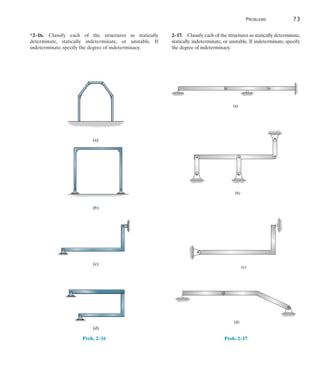
using K = 4EIL.
A D
L
L¿ L¿
C
B
P
real beam
(a)
P
u
u
Fig. 12–12
B¿
C¿
VB¿
VC¿
5
__ L
6
1
__ L
6
conjugate beam
(b)
1 M L
__ (__) (__)
2 EI 2
1 M L
__ (__) (__)
2 EI 2
M
__
EI
M
__
EI
12.3 Stiffness-Factor Modifications	 513
12
Determine the internal moments at the supports for the beam shown
in Fig. 12–13a. EI is constant.
EXAMPLE 12.3
A B
AB BA BC
1 0.667 0.333
0 108.9 108.9
(b)
Joint
Member
DF
M
60
48.9
133.3
24.4
FEM
Dist.
Fig. 12–13
15 ft 20 ft 15 ft
A B C D
4 k/ft
(a)
SOLUTION
By inspection, the beam and loading are symmetrical. Thus, we will
apply K = 2EIL to compute the stiffness factor of the center span
BC and therefore use only the left half of the beam for the analysis.
The analysis can be shortened even further by using K = 3EIL for
computing the stiffness factor of segment AB since the far end A is
pinned. Furthermore, the distribution of moment at A can be skipped
by using the FEM for a triangular loading on a span with one end
fixed and the other pinned.Thus,
KAB =
3EI
15
(using Eq. 1294)
KBC =
2EI
20
(using Eq. 1295)
DFAB =
3EI15
3EI15
= 1
DFBA =
3EI15
3EI15 + 2EI20
= 0.667
DFBC =
2EI20
3EI15 + 2EI20
= 0.333
(FEM)BA =
wL2
15
=
4(15)2
15
= 60 k # ft
(FEM)BC = -
wL2
12
= -
4(20)2
12
= -133.3 k # ft
These data are listed in the table in Fig. 12–13b. Computing the
stiffness factors as shown above considerably reduces the analysis,
since only joint B must be balanced and carry-overs to joints A and C
are not necessary. Obviously, joint C is subjected to the same internal
moment of 108.9 k # ft.
514	 Chapter 12   Displacement Method of Analysis: Moment Distribution
12
Determine the internal moments at the supports of the beam shown
in Fig. 12–14a.The moment of inertia of the two spans is shown in the
figure.
EXAMPLE 12.4
20 ft
15 ft
240 lb/ft
IAB  300 in4
A
B C
IBC  600 in4
(a)
Fig. 12–14
SOLUTION
Since the beam is roller supported at its far end C, the stiffness of span
BC will be computed on the basis of K = 3EIL. We have
KAB =
4EI
L
=
4E(300)
15
= 80E
KBC =
3EI
L
=
3E(600)
20
= 90E
Thus,
DFAB =
80E
 + 80E
= 0
DFBA =
80E
80E + 90E
= 0.4706
DFBC =
90E
80E + 90E
= 0.5294
DFCB =
90E
90E
= 1
Further simplification of the distribution method for this problem is
possible by realizing that a single fixed-end moment for the end
span BC can be used. Using the right-hand column of the table on the
inside back cover for a uniformly loaded span having one side fixed,
the other pinned, we have
(FEM)BC = -
wL2
8
=
-240(20)2
8
= -12 000 lb # ft
12.3 Stiffness-Factor Modifications	 515
12
The foregoing data are entered into the table in Fig. 12–14b and the
moment distribution is carried out. By comparison with Fig. 12–6b,
this method considerably simplifies the distribution.
Using the results, the beam’s end shears and moment diagrams are
shown in Fig. 12–14c.
0
A C
AB BA BC
0.4706 0.5294
2823.6 5647.2 5647.2
(b)
CB
1
0
B
6352.8
12 000
2823.6
5647.2
Joint
Member
DF
FEM
M
Dist.
CO
M (lbft)
M (lbft)
x (ft)
x (ft)
2824
2824
5647
5647
9343
9343
15
15
26.2
26.2
(c)
(c)
20 ft
20 ft
240 lb/ft
240 lb/ft
2118 lb
2118 lb
2682 lb
2682 lb
564.7 lb
564.7 lb
5647 lbft
5647 lbft 5647 lbft
5647 lbft
3247 lb
3247 lb
15 ft
15 ft
564.7 lb
564.7 lb
2824 lbft
2824 lbft
516	 Chapter 12   Displacement Method of Analysis: Moment Distribution
12
EXAMPLE 12.5
Determine the internal moments at the joints of the frame shown in
Fig. 12–15a. There is a pin at E and D and a fixed support at A. EI is
constant.
A B C D E
AB BA CD DC EC
BC CB CE
0.330 1 1
44.6
135
10.1
30.7
1.7
5.1
0.4
1.2
0.1
0.2
0.455
61.4
135
10.1
22.3
2.3
5.1
0.4
0.8
0.1
0.2
89.1
0.545
73.6
12.2
2.8
0.4
0.1
89.1
0
36.8
6.1
1.4
0.2
44.5 115
0.298
40.2
9.1
1.5
0.4
0.0
51.2
0.372
50.2
11.5
1.9
0.4
0.1
64.1
(b)
Joint
Member
DF
FEM
M
Dist.
CO
Dist.
CO
Dist.
CO
Dist.
CO
Dist.
5 k/ft
20 k
15 ft
18 ft
12 ft
A
B
C
D
E
(a)
Fig. 12–15
12.4  
Moment Distribution for Frames:
No Sidesway
Application of the moment-distribution method for frames having no
sidesway follows the same procedure as that given for beams.To minimize
the chance for errors, it is suggested that the analysis be arranged in a
tabular form, as in the previous examples. Also, the distribution of
moments can be shortened if the stiffness factor of a span can be modified
as indicated in the previous section.
12.4 Moment Distribution for Frames: No Sidesway	 517
12
SOLUTION
By inspection, the pin at E will prevent the frame from sidesway. The
stiffness factors of CD and CE can be computed using K = 3EIL since
the far ends are pinned.Also, the 20-k load does not contribute a FEM
since it is applied at joint B.Thus,
KAB =
4EI
15
KBC =
4EI
18
KCD =
3EI
15
KCE =
3EI
12
	 DFAB = 0
	 DFBA =
4EI15
4EI15 + 4EI18
= 0.545
	 DFBC = 1 - 0.545 = 0.455
	 DFCB =
4EI18
4EI18 + 3EI15 + 3EI12
= 0.330
	 DFCD =
3EI15
4EI18 + 3EI15 + 3EI12
= 0.298
	 DFCE = 1 - 0.330 - 0.298 = 0.372
	 DFDC = 1 DFEC = 1
	 (FEM)BC =
-wL2
12
=
-5(18)2
12
= -135 k # ft
	 (FEM)CB =
wL2
12
=
5(18)2
12
= 135 k # ft
The data are shown in the table in Fig. 12–15b. Here the distribution
of moments successively goes to joints B and C. The final moments
are shown on the last line.
Using these data, the moment diagram for the frame is constructed
in Fig. 12–15c.
(c)
44.5 kft
89.1 kft
89.1 kft
51.2 kft
101 kft
64.1 kft
115 kft
518	 Chapter 12   Displacement Method of Analysis: Moment Distribution
12 12.5  
Moment Distribution for Frames:
Sidesway
It has been shown in Sec. 11.5 that frames that are nonsymmetrical or
subjected to nonsymmetrical loadings have a tendency to sidesway. An
example of one such case is shown in Fig.12–16a.Here the applied loading
P will create unequal moments at joints B and C such that the frame will
deflect an amount  to the right. To determine this deflection and the
internal moments at the joints using moment distribution, we will use the
principle of superposition. In this regard, the frame in Fig. 12–16b is first
considered held from sidesway by applying an artificial joint support at
C. Moment distribution is applied and then by statics the restraining force
R is determined.The equal, but opposite, restraining force is then applied
to the frame, Fig. 12–16c, and the moments in the frame are calculated.
One method for doing this last step requires first assuming a numerical
value for one of the internal moments,say MBA
=
. Using moment distribution
and statics, the deflection  and external force R corresponding to the
assumed value of MBA
=
can then be determined. Since linear elastic
deformations occur, the force R develops moments in the frame that are
proportional to those developed by R. For example, if MBA
=
and R are
known, the moment at B developed by R will be MBA = MBA
=
(RR).
Addition of the joint moments for both cases, Fig. 12–16b and c, will yield
the actual moments in the frame,Fig.12–16a.Application of this technique
is illustrated in Examples 12.6 through 12.8.
Multistory Frames.  Quite often, multistory frameworks may have
several independent joint displacements, and consequently the moment
distribution analysis using the above techniques will involve more
computation. Consider, for example, the two-story frame shown in
Fig. 12–17a.This structure can have two independent joint displacements,
since the sidesway 1 of the first story is independent of any displacement
artificial joint removed
(sidesway)
(c)
B
A D
C
R
P
B
A D
C
artificial joint applied
(no sidesway)
(b)
R


P

B
A
C
D
(a)

Fig. 12–16
12.5 Moment Distribution for Frames: Sidesway	 519
12
2 of the second story.Unfortunately,these displacements are not known
initially, so the analysis must proceed on the basis of superposition, in the
same manner as discussed previously. In this case, two restraining forces
R1 and R2 are applied, Fig. 12–17b, and the fixed-end moments are
determined and distributed. Using the equations of equilibrium, the
numerical values of R1 and R2 are then determined. Next, the restraint at
the floor of the first story is removed and the floor is given a displacement
. This displacement causes fixed-end moments (FEMs) in the frame,
which can be assigned specific numerical values. By distributing these
moments and using the equations of equilibrium, the associated
numerical values of R1
=
and R2
=
can be determined. In a similar manner,
the floor of the second story is then given a displacement , Fig. 12–17d.
Assuming numerical values for the fixed-end moments, the moment
distribution and equilibrium analysis will yield specific values of R1

and
R2

. Since the last two steps associated with Fig. 12–17c and d depend on
assumed values of the FEMs, correction factors C and C must be
applied to the distributed moments. With reference to the restraining
forces in Fig. 12–17c and 12–17d, we require equal but opposite
application of R1 and R2 to the frame, such that
R2 = -CR2
=
+ CR2

R1 = +CR1
=
- CR1

Simultaneous solution of these equations yields the values of C and C.
These correction factors are then multiplied by the internal joint moments
found from the moment distribution in Fig. 12–17c and 12–17d. The
resultant moments are then found by adding these corrected moments to
those obtained for the frame in Fig. 12–17b.
Other types of frames having independent joint displacements can be
analyzed using this same procedure; however, it must be admitted that
the foregoing method does require quite a bit of numerical calculation.
Although some techniques have been developed to shorten the
calculations, it is best to solve these types of problems on a computer,
preferably using a matrix analysis. The techniques for doing this will be
discussed in Chapter 16.
This statically indeterminate concrete building
frame can be subjected to sidesway due to wind
and earthquake loadings.
(d)
¿¿
¿¿ ¿¿
¿¿
R¿¿
2
R¿¿
1
(c)
¿
¿

R1¿
R2¿
(b)
P2
P1
P3
P4

R2
R1
(a)
P2
P1
P3
P4
2
1

Fig. 12–17
520	 Chapter 12   Displacement Method of Analysis: Moment Distribution
12
Determine the moments at each joint of the frame shown in
Fig. 12–18a. EI is constant.
SOLUTION
First we consider the frame held from sidesway as shown in Fig.12–18b.
We have
(FEM)BC = -
16(4)2
(1)
(5)2
= -10.24 kN # m
	 (FEM)CB =
16(1)2
(4)
(5)2
= 2.56 kN # m
The stiffness factor of each span is computed on the basis of 4EIL or
by using the relative-stiffness factor IL. The DFs and the moment
distribution are shown in the table, Fig. 12–18d. Using these results,
the equations of equilibrium are applied to the free-body diagrams of
the columns in order to determine Ax and Dx Fig. 12–18e. From the
free-body diagram of the entire frame (not shown) the joint restraint
R in Fig. 12–18b has a magnitude of
Fx = 0;  R = 1.73 kN - 0.81 kN = 0.92 kN
An equal but opposite value of R = 0.92 kN must now be applied to
the frame at C and the internal moments computed, Fig. 12–18c. To
solve the problem of computing these moments, we will assume a
force R is applied at C, causing the frame to deflect  as shown in
Fig. 12–18f. Here the joints at B and C are temporarily restrained from
rotating, and as a result the fixed-end moments at the ends of the
columns are determined from the formula for deflection found on the
inside back cover, that is,
EXAMPLE 12.6
16 kN
B
A
C
D
1 m 4 m
5 m
5 m
(a)
=
(b)
16 kN
B
A D
C
R

Joint A B C D
Member AB BA BC CB CD DC
DF 0 0.5 0.5 0.5 0.5 0
FEM
5.12 1.28
0.32
0.32
0.02
2.56
0.16
0.16
5.12
10.24
0.32
0.64
0.32
0.64
0.02
0.04
1.28
0.08
0.08
0.64
0.64
0.04
M 2.88 5.78 5.78
1.28
2.56
1.28
2.56
0.08
0.16
0.08
0.16
2.72 2.72 1.32
(d)
Dist.
CO
Dist.
CO
Dist.
CO
Dist.
2.72 kNm
2.72 kNm
5.78 kNm
5.78 kNm
1.32 kNm
1.32 kNm
2.88 kNm
2.88 kNm
Dx  0.81 kN
Dx  0.81 kN
Ax  1.73 kN
Ax  1.73 kN
5 m
5 m 5 m
5 m
(e)
(e)
Fig. 12–18
B
A D
C
R
(c)
12.5 Moment Distribution for Frames: Sidesway	 521
12
Joint A B C D
Member AB BA BC CB CD DC
DF 0 0.5 0.5 0.5 0.5 0
FEM
50
12.5
3.125
0.78
25
50
12.5
25
50 50
12.5
3.125
6.25
0.78
1.56
M 80.00 60.00 60.00
(g)
100
6.25
1.56
0.39
100 100
0.195 0.195
0.39
12.5
25 25
3.125
6.25
0.78
1.56
60.00
0.195
0.39
60.00 80.00
100
3.125
0.78
0.195
0.39
1.56
6.25
Dist.
CO
Dist.
CO
Dist.
CO
Dist.
CO
Dist.
60 kNm
60 kNm
60 kNm
60 kNm
80 kNm
80 kNm
80 kNm
80 kNm
Dx  28 kN
Dx  28 kN
Ax  28 kN
Ax  28 kN
5 m
5 m 5 m
5 m
(h)
(h)
B
B
A
A
C
C
D
D
(f)
(f)
¿
¿ ¿
¿
R¿
R¿
100 kNm
100 kNm
100 kNm
100 kNm 100 kNm
100 kNm
100 kNm
100 kNm
M =
6EI
L2
Since both B and C happen to be displaced the same amount ,
and AB and DC have the same E, I, and L, the FEM in AB will be the
same as that in DC.As shown in Fig. 12–18f, we will arbitrarily assume
this fixed-end moment to be
(FEM)AB = (FEM)BA = (FEM)CD = (FEM)DC = -100 kN # m
Anegativesignisnecessarysincethemomentmustactcounterclockwise
on the column for deflection  to the right.The value of R associated
with this -100 kN # m moment can now be determined. The moment
distribution of the FEMs is shown in Fig. 12–18g. From equilibrium,
the horizontal reactions at A and D are calculated, Fig. 12–18h. Thus,
for the entire frame we require
Fx = 0;	 R = 28 + 28 = 56.0 kN
Hence, R = 56.0 kN creates the moments tabulated in Fig. 12–18g.
Corresponding moments caused by R = 0.92 kN can be determined by
proportion.Therefore, the resultant moment in the frame, Fig. 12–18a, is
equal to the sum of those calculated for the frame in Fig. 12–18b plus
the proportionate amount of those for the frame in Fig.12–18c.We have
	 MAB = 2.88 + 0.92
56.0(-80) = 1.57 kN # m Ans.
	 MBA = 5.78 + 0.92
56.0(-60) = 4.79 kN # m  Ans.
	 MBC = -5.78 + 0.92
56.0(60) = -4.79 kN # m Ans.
	 MCB = 2.72 + 0.92
56.0(60) = 3.71 kN # m Ans.
	 MCD = -2.72 + 0.92
56.0(-60) = -3.71 kN # m Ans.
	 MDC = -1.32 + 0.92
56.0(-80) = -2.63 kN # m Ans.
522	 Chapter 12   Displacement Method of Analysis: Moment Distribution
12
Determine the moments at each joint of the frame shown in Fig.12–19a.
The moment of inertia of each member is indicated in the figure.
EXAMPLE 12.7
Joint A B C D
Member AB BA BC CB CD DC
DF 0 0.615 0.385 0.5 0.5 1
FEM
14.76 9.24
24
12
24
12
3.69
0.713
0.18
7.38
1.84
0.357
2.31
6
0.447
1.16
0.11
0.29
2.31
4.62
0.58
1.16
0.11
0.224
2.31
0.58
0.11
M 9.58 19.34 19.34 15.00 15.00 0
(d)
Dist.
CO
Dist.
CO
Dist.
CO
Dist.
Fig. 12–19

2 k/ft
A
B
(b)
C
D
R
2 k/ft
10 ft
12 ft
15 ft
A
B
(a)
C
IBC = 1500 in4
I
AB
=
2000
in
4
I
DC
=
2500
in
4
=
D
A
B
(c)
C
D
R
SOLUTION
The frame is first held from sidesway as shown in Fig. 12–19b. The
internal moments are computed at the joints as indicated in Fig. 12–19d.
Here the stiffness factor of CD was computed using 3EIL since there
is a pin at D.Calculation of the horizontal reactions at A and D is shown
in Fig. 12–19e.Thus, for the entire frame,
Fx = 0;	 R = 2.89 - 1.00 = 1.89 k
10 ft
10 ft
19.34 kft
19.34 kft
9.58 kft
9.58 kft
Ax  2.89 k
Ax  2.89 k
15 ft
15 ft
15.00 kft
15.00 kft
Dx  1.00 k
Dx  1.00 k
(e)
(e)
12.5 Moment Distribution for Frames: Sidesway	 523
12
The opposite force is now applied to the frame as shown in Fig. 12–19c.
As in the previous example, we will consider a force R acting as shown
in Fig. 12–19f. As a result, joints B and C are displaced by the same
amount . The fixed-end moments for BA are computed from
(FEM)AB = (FEM)BA = -
6EI
L2
= -
6E(2000)
(10)2
However, from the table on the inside back cover, for CD we have
(FEM)CD = -
3EI
L2
= -
3E(2500)
(15)2
Assuming the FEM for AB is -100 k # ft as shown in Fig. 12–19f,
the  corresponding FEM at C, causing the same , is found by
comparison, i.e.,
 = -
(-100)(10)2
6E(2000)
= -
(FEM)CD(15)2
3E(2500)
(FEM)CD = -27.78 k # ft
Moment distribution for these FEMs is tabulated in Fig. 12–19g.
Computation of the horizontal reactions at A and D is shown in
Fig. 12–19h.Thus, for the entire frame,
Fx = 0;	 R = 11.0 + 1.55 = 12.55 k
The resultant moments in the frame are therefore
	 MAB = 9.58 + 1 1.89
12.552(-69.91) = -0.948 k # ft Ans.
	 MBA = 19.34 + 1 1.89
12.552(-40.01) = 13.3 k # ft Ans.
	 MBC = -19.34 + 1 1.89
12.552(40.01) = -13.3 k # ft Ans.
	 MCB = 15.00 + 1 1.89
12.552(23.31) = 18.5 k # ft Ans.
	 MCD = -15.00 + 1 1.89
12.552(-23.31) = -18.5 k # ft Ans.
Joint A B C D
Member AB BA BC CB CD DC
DF 0 0.615 0.385 0.5 0.5 1
FEM
61.5 38.5 13.89 13.89
4.27
2.96
0.20
100
30.75
2.14
2.67
6.94
1.85
4.81
0.13
0.33
9.625
19.25
0.67
1.34
0.46
0.92
9.625
0.67
0.46
M 69.9140.01 40.01 23.31 23.31 0
(g)
1.48
100 27.78
CO
Dist.
Dist.
CO
Dist.
CO
Dist.
A
B
(f)
C
D
R¿
100 kft 27.78 kft
100 kft
¿ ¿
(f)
10 ft
40.01 kft
69.91 kft
A¿x  11.0 k
15 ft
23.31 kft
D¿x  1.55 k
(h)
524	 Chapter 12   Displacement Method of Analysis: Moment Distribution
12
Determine the moments at each joint of the frame shown in Fig.12–20a.
EI is constant.
EXAMPLE 12.8
A
B C
D
(c)
R
8 k
20 k
A
B C
D
(b)
R

8 k
A
B C
D
6 ft 5 ft 5 ft 6 ft
8 ft
1
0
f
t
1
0
f
t
=
(a)
20 k
Fig. 12–20
SOLUTION
First sidesway is prevented by the restraining force R, Fig. 12–20b.The
FEMs for member BC are
(FEM)BC = -
8(10)
8
= -10 k # ft (FEM)CB =
8(10)
8
= 10 k # ft
Since spans AB and DC are pinned at their ends, the stiffness factor is
computed using 3EIL.The moment distribution is shown in Fig.12–20d.
Using these results, the horizontal reactions at A and D must be
determined. This is done using an equilibrium analysis of each member,
Fig.12–20e.Summing moments about points B and C on each leg,we have
a+MB = 0;	 -5.97 + Ax(8) - 4(6) = 0 Ax = 3.75 k
a+MC = 0;	 5.97 - Dx(8) + 4(6) = 0	 Dx = 3.75 k
Thus, for the entire frame,
Fx = 0;	 R = 3.75 - 3.75 + 20 = 20 k
Joint A B C D
Member AB BA BC CB CD DC
DF 1 0.429 0.571 0.571 0.429 1
FEM
5.71
10
1.63
2.86
0.47
0.82
0.13
0.24
M 0
4.29
1.23
0.35
0.10
5.97 5.97 5.97
4.29
1.23
0.35
0.10
5.97 0
(d)
5.71
10
1.63
2.86
0.47
0.82
0.13
0.24
Dist.
CO
Dist.
CO
Dist.
CO
Dist.
4 k
6 ft
8 ft
VB
5.97 kft
4 k
Ax
4 k
6 ft
8 ft
VC
5.97 kft
4 k
Dx
C
B
A D
8 k
5 ft 5 ft
20 k R
VB
5.97 kft
VC
4 k 4 k
5.97 kft
(e)
12.5 Moment Distribution for Frames: Sidesway	 525
12
The opposite force R is now applied to the frame as shown in
Fig. 12–20c. In order to determine the internal moments developed by
R we will first consider the force R acting as shown in Fig. 12–20f.
Here the dashed lines do not represent the distortion of the frame
members; instead, they are constructed as straight lines extended to
the final positions B and C of points B and C, respectively. Due to
the symmetry of the frame, the displacement BB = CC = .
Furthermore, these displacements cause BC to rotate. The vertical
distance between B and C is 1.2, as shown on the displacement
diagram, Fig. 12–20g. Since each span undergoes end-point
displacements that cause the spans to rotate, fixed-end moments are
induced in the spans.These are:(FEM)BA = (FEM)CD = -3EI(10)2
,
(FEM)BC = (FEM)CB = 6EI(1.2)(10)2
.
Notice that for BA and CD the moments are negative since clockwise
rotation of the span causes a counterclockwise FEM.
If we arbitrarily assign a value of (FEM)BA = (FEM)CD = -100 k # ft,
then equating  in the above formulas yields (FEM)BC = (FEM)CB =
240 k # ft. These moments are applied to the frame and distributed,
Fig. 12–20h. Using these results, the equilibrium analysis is shown in
Fig. 12–20i. For each leg, we have
a+MB = 0;	 -Ax
=
(8) + 29.36(6) + 146.80 = 0 Ax
=
= 40.37 k
a+MC = 0;	 -Dx
=
(8) + 29.36(6) + 146.80 = 0 Dx
=
= 40.37 k
Thus, for the entire frame,
Fx = 0;	 R = 40.37 + 40.37 = 80.74 k
The resultant moments in the frame are therefore
	 MBA = 5.97 + 1 20
80.742(-146.80) = -30.4 k # ft Ans.
	 MBC = -5.97 + 1 20
80.742(146.80) = 30.4 k # ft Ans.
	 MCB = 5.97 + 1 20
80.742(146.80) = 42.3 k # ft Ans.
	 MCD = -5.97 + 1 20
80.742(-146.80) = -42.3 k # ft Ans.
36.9
36.9
B, C
¿
¿
C¿
B¿
0.6¿
0.6¿
(g)
B
C
D
A
R¿
(f)
36.9
B¿
¿ ¿ C¿
36.9
Joint A B C D
Member AB BA BC CB CD DC
DF 1 0.429 0.571 0.571 0.429 1
FEM
79.94
240
17.15
4.89
1.40
22.82
39.97
6.52
11.41
1.86
3.26
0 146.80 146.80 0
(h)
0.40 0.53
0.93
79.94
240
22.82
39.97
6.52
11.41
1.86
3.26
0.53
0.93
60.06
17.15
4.89
1.40
100
60.06
100
0.40
146.80 146.80
Dist.
CO
Dist.
CO
Dist.
CO
Dist.
CO
Dist.
M
6 ft
8 ft
V¿B
146.80 kft
29.36 k
A¿x
6 ft
8 ft
D¿x
C
B
A D
10 ft R¿
146.80 kft
V¿C
146.80 kft
(i)
29.36 k
29.36 k 29.36 k
29.36 k
146.80 kft
29.36 k
526	 Chapter 12   Displacement Method of Analysis: Moment Distribution
12
*12–4.  Determine the internal moment in the beam at B,
then draw the moment diagram.Assume C is a pin.Segment
AB has a moment of interia of IAB = 0.75 IBC. E is constant.
5 m 6 m
A B C
12 kN/m
8 kN/m
Prob. 12–4
12–5.  Determine the moments at A, B, and C, then draw
the moment diagram. Assume the support at B is a roller
and A and C are fixed. EI is constant.
8 ft 8 ft 18 ft
6 k 0.5 k/ft
A B C
Prob. 12–5
12–6.  Determine the moments at B and C, then draw the
moment diagram for the beam. All connections are pins.
Assume the horizontal reactions are zero. EI is constant.
A B
C
D
4 m
12 kN/m
12 kN/m
4 m
4 m
Prob. 12–6
Sec. 12.1–12.3
12–1.  Determine the moments at A, B, and C, then draw
the moment diagram for the beam.The moment of inertia of
each span is indicated in the figure.Assume the support at B
is a roller and A and C are fixed. E = 29(103
) ksi.
24 ft 8 ft 8 ft
30 k
800 lb/ft
A B
C
IAB  900 in4
IBC  1200 in4
Prob. 12–1
12–2.  Determine the moments at A, B, and C, then draw
the moment diagram for the beam. Assume the supports
at A and C are fixed and B is a roller. EI is constant.
8 ft
8 ft 8 ft
2 k 2 k 2 k
8 ft
A B C
16 ft
Prob. 12–2
12–3.  Determine the moments at A, B, and C, then draw
the moment diagram for the beam. Assume the supports
at A and C are fixed. EI is constant.
8 ft 8 ft
25 k 25 k
8 ft
A B C
24 ft
Prob. 12–3
Problems
Problems	 527
12
12–10.  Determine the moments at A, B, and C, then draw
the moment diagram for the girder DE.Assume the support
at B is a pin and A and C are rollers. The distributed load
rests on simply supported floor boards that transmit the
load to the floor beams. EI is constant.
1500 lb/ft
8 ft 10 ft 10 ft 8 ft
D A B C E
Prob. 12–10
12–11.  Determine the moments at A and B, then draw the
moment diagram.Assume the support at B is a roller, C is a
pin, and A is fixed.
A
5 m 2.5 m
B
C
12 kN/m
Prob. 12–11
*12–12.  Determine the moments at A, B, and C, then draw
the moment diagram. EI is constant.
3 m 4 m 4 m 2 m
2 kN/m
A
B C D
E
18 kN
Prob. 12–12
12–7.  Determine the moments at the supports, then
draw the moment diagram. Assume A and D are fixed. EI
is constant.
10 ft 18 ft 15 ft
4 k/ft
A B C D
Prob. 12–7
*12–8.  The beam is subjected to the loading shown.
Determine the reactions at the supports, then draw moment
diagram. EI is constant.
12 ft 12 ft
24 ft
2 k/ft 2 k/ft
B
A
C
D
Prob. 12–8
12–9.  The bar is pin connected at each indicated point. If
the normal force in the bar can be neglected, determine the
vertical reaction at each pin. EI is constant.
16 kN
16 kN
4 m 4 m 4 m 4 m
8 m
A B C D
Prob. 12–9
528	 Chapter 12   Displacement Method of Analysis: Moment Distribution
12
12–15.  Determine the reactions at A and D. Assume the
supports at A and D are fixed and B and C are fixed
connected. EI is constant.
8 k/ft
A
B C
D
15 ft
24 ft
Prob. 12–15
*12–16.  Determine the moments at D and C, then draw
the moment diagram for each member of the frame.
Assume the supports at A and B are pins and D and C are
fixed joints. EI is constant.
B
C
D
A
12 ft
9 ft
5 k/ft
Prob. 12–16
Sec. 12.4
12–13.  Determine the moment at B, then draw the
moment diagram for each member of the frame. Assume
the supports at A and C are pins. EI is constant.
B C
A
6 m
5 m
8 kN/m
Prob. 12–13
12–14.  Determine the internal moments acting at each
joint.Assume A, D, and E are pinned and B and C are fixed
joints.The moment of inertia of each member is listed in the
figure. E = 29(103
) ksi.
4 k/ft
6 ft 18 ft
A B
C
D E
IABC  800 in4
IBD  600 in4
ICE  1000 in4
6 ft
6 ft
20 k
Prob. 12–14
Problems	 529
12
12–17.  Determine the moments acting at the ends of each
member, then draw the moment diagram. Assume B is a
fixed joint and A and D are pin supported and C is fixed.
E = 29(103
) ksi. IABC = 700 in4, and IBD = 1100 in4.
18 ft 12 ft
A B C
D
5 k/ft
3 ft
3 ft
3 ft
3 k
3 k
Prob. 12–17
12–18.  Determine the moments at each joint of the frame,
then draw the moment diagram for member BCE. Assume
B, C, and E are fixed connected and A and D are pins
E = 29(103
) ksi.
2 k
3 k
8 ft
8 ft
0.5 k/ft
A D
E
B
C
IBC  400 in4
ICE  400 in4
IAB  600 in4
IDC  500 in4
24 ft 12 ft
Prob. 12–18
12–19.  Determine the moment at B, then draw the
moment diagram for each member of the frame. Support A
is pinned. EI is constant.
12 ft 5 ft
A B
C
1.5 k/ft
12 ft
Prob. 12–19
*12–20.  Determine the moments at A, C, and D, then
draw the moment diagram for each member of the frame.
Support A and joints C and D are fixed connected. EI
is constant.
6 kN/m
A
D E
B
C
8 m
6 m
7 m
Prob. 12–20
530	 Chapter 12   Displacement Method of Analysis: Moment Distribution
12
12–23.  Determine the moments at the ends of each
member of the frame. The members are fixed connected at
the supports and joints. EI is the same for each member.
B C
D
A
6 ft
6 ft 15 ft
20 k
15 k
4 k/ft
Prob. 12–23
*12–24.  Determine the moments acting at the ends of
each member. Assume the joints are fixed connected and
A and B are fixed supports. EI is constant.
B
C
A
D
0.2 k/ft
20 ft
18 ft
12 ft
Prob. 12–24
Sec. 12.5
12–21.  Determine the moments at B and C and then draw
the moment diagram. Assume A and D are pins and B and
C are fixed-connected joints. EI is constant.
12 ft
6 ft
6 ft
12 k
12 k
3 k/ft
A
B C
D
18 ft
Prob. 12–21
12–22.  Determine the moments acting at the ends of each
member. Assume the joints are fixed connected and A and
D are fixed supports. EI is constant.
15 ft
20 ft
800 lb/ft
1500 lb/ft
A
B C
D
Prob. 12–22
Chapter Review	 531
12
12–26.  Determine the moments at C and D, then draw the
moment diagram for each member of the frame. Assume
the supports at A and B are pins. EI is constant.
B
C
A
D
12 ft
6 ft
8 ft
3 k
Prob. 12–26
12–25.  Determine the horizontal and vertical components
of reaction at the pin supports A and D. EI is constant.
12 ft
8 ft
2 ft
5 ft 5 ft
A
B C
D
10 k
Prob. 12–25
Moment distribution is a method of successive approximations that can be carried out to any desired degree of accuracy.
It initially requires locking all the joints of the structure. The equilibrium moment at each joint is then determined, the
joints are unlocked and this moment is distributed onto each connecting member, and half its value is carried over to
the other side of the span. This cycle of locking and unlocking the joints is repeated until the carry-over moments
become acceptably small. The process then stops and the moment at each joint is the sum of the moments from each
cycle of locking and unlocking.
The process of moment distribution is conveniently done in tabular form. Before starting, the fixed-end moment for
each span must be calculated using the table on the inside back cover of the book.The distribution factors are found by
dividing a member’s stiffness by the total stiffness of the joint. For members having a far end fixed, use K = 4EIL; for a
far-end pinned or roller supported member, K = 3EIL; for a symmetric span and loading, K = 2EIL; and for an
antisymmetric loading, K = 6EIL. Remember that the distribution factor for a fixed end is DF = 0, and for a pin or
roller-supported end, DF = 1.
Chapter Review
The use of variable-moment-of-inertia girders has reduced considerably the
deadweight loading of each of these spans.
Chapter 13
© Stockphoto Mania/Shutterstock
533
Beams and Frames
Having Nonprismatic
Members
In this chapter we will apply the slope-deflection and moment-
distribution methods to analyze beams and frames composed of
nonprismatic members. We will first discuss how the necessary carry-
over factors, stiffness factors, and fixed-end moments are obtained.
This is followed by a discussion related to using tabular values often
published in design literature. Finally, the analysis of statically
indeterminate structures using the slope-deflection and moment-
distribution methods will be discussed.
13.1  
Loading Properties of Nonprismatic
Members
Often, to save material, girders used for long spans on bridges and
buildings are designed to be nonprismatic, that is, to have a variable
moment of inertia. The most common forms of structural members that
are nonprismatic have haunches that are either stepped, tapered, or
parabolic, Fig. 13–1. Provided we can express the member’s moment of
inertia as a function of the length coordinate x, then we can use the
principle of virtual work or Castigliano’s theorem as discussed in Chapter 9
to find its deflection.The equations are
 =
L
l
0
Mm
EI
dx or  =
L
l
0
0M
0P
M
EI
dx
If the member’s geometry and loading require evaluation of an integral
that cannot be determined in closed form, then Simpson’s rule or some
other numerical technique will have to be used to carry out the integration.
stepped haunches
tapered haunches
parabolic haunches
Fig. 13–1
534	 Chapter 13   Beams and Frames Having Nonprismatic Members
13
If the slope deflection equations or moment distribution are used to
determine the reactions on a nonprismatic member, then we must first
calculate the following properties for the member.
Fixed-End Moments (FEM).  The end moment reactions on the
member that is assumed fixed supported, Fig. 13–2a.
Stiffness Factor (K).  The magnitude of moment that must be
applied to the end of the member such that the end rotates through an
angle of u = 1 rad. Here the moment is applied at the pin support, while
the other end is assumed fixed, Fig. 13–2b.
Carry-Over Factor (COF).  Represents the numerical fraction (C)
of the moment that is “carried over” from the pin-supported end to the
wall, Fig. 13–2c.
Once obtained, the computations for the stiffness and carry-over
factors can be checked, in part, by noting an important relationship that
exists between them. In this regard, consider the beam in Fig. 13–3
subjected to the loads and deflections shown. Application of the
Maxwell-Betti reciprocal theorem requires the work done by the loads in
Fig. 13–3a acting through the displacements in Fig. 13–3b be equal to the
work of the loads in Fig. 13–3b acting through the displacements in
Fig. 13–3a, that is,
UAB = UBA
KA(0) + CABKA(1) = CBA KB(1) + KB(0)
or
	 CABKA = CBA KB	(13–1)
Hence, once determined, the stiffness and carry-over factors must satisfy
Eq. 13–1.
The tapered concrete hammerhead pier is
used to support the girders of this highway
bridge.
w
P
(FEM)A
(FEM)B
(a)
A
B K
u (1 rad)
(b)
A
B
K
(c)
A
B
M  CK
Fig. 13–2
13.1  Loading Properties of Nonprismatic Members	 535
13
These properties can be obtained using, for example, the conjugate
beam method or an energy method. However, considerable labor is often
involved in the process. As a result, graphs and tables have been made
available to determine this data for common shapes used in structural
design. One such source is the Handbook of Frame Constants, published
by the Portland Cement Association.* A portion of these tables, taken
from this publication, is listed here as Tables 13.1 and 13.2. A more
complete tabular form of the data is given in the PCA handbook along
with the relevant derivations of formulas used.
The nomenclature is defined as follows:
aA, aB = 
ratio of the length of haunch at ends A and B to the length
of span.
b = 
ratio of the distance from the concentrated load to end A to
the length of span.
CAB, CBA = 
carry-over factors of member AB at ends A and B,
respectively.
hA, hB = depth of member at ends A and B, respectively.
hC = depth of member at minimum section.
IC = moment of inertia of section at minimum depth.
kAB, kBA = stiffness factor at ends A and B, respectively.
L = length of member.
MAB, MBA = 
fixed-end moment at ends A and B, respectively; specified
in tables for uniform load w or concentrated force P.
rA, rB = 
ratios for rectangular cross-sectional areas, where
rA = (hA - hC)hC, rB = (hB - hC)hC.
As noted, the fixed-end moments and carry-over factors are found from
the tables. The absolute stiffness factor can be determined using the
tabulated stiffness factors and found from
	 KA =
kABEIC
L
KB =
kBA EIC
L
	(13–2)
Application of the use of the tables will be illustrated in Example 13.1.
*Handbook of Frame Constants. Portland Cement Association, Chicago, Illinois.
uA (1 rad)
KA
CABKA
(a)
A
B
uB (1 rad)
KB
B
A
(b)
CBAKB
Fig. 13–3
Timber frames having a variable
moment of inertia are often
used in the construction of
churches.
©
Lisa
S.
Engelbrecht/Danita
Delimont/Alamy
13
536
Table
13.1 
Tapered
Haunches—Constant
Width
r
A
h
C
bL
P
a
A
L
a
B
L
L
r
B
h
C
h
C
A
B
Concentrated
Load
FEM–Coef.
:
PL
Haunch
Load
at
Right
Haunch
Carry-over
Factors
Stiffness
Factors
Unif.
Load
FEM
Coef.
:
wL
2
b
Left
Right
0.1
0.3
0.5
0.7
0.9
FEM
Coef.
:
w
A
L
2
FEM
Coef.
:
w
B
L
2
a
B
r
B
C
AB
C
BA
k
AB
k
BA
M
AB
M
BA
M
AB
M
BA
M
AB
M
BA
M
AB
M
BA
M
AB
M
BA
M
AB
M
BA
M
AB
M
BA
M
AB
M
BA
a
A
=
0.3   a
B
=
variable   r
A
=
1.0   r
B
=
variable
0.2
0.4
0.543
0.765
9.19
6.52
0.1194
0.0791
0.0935
0.0034
0.2185
0.0384
0.1955
0.1147
0.0889
0.1601
0.0096
0.0870
0.0133
0.0008
0.0006
0.0058
0.6
0.576
0.758
9.53
7.24
0.1152
0.0851
0.0934
0.0038
0.2158
0.0422
0.1883
0.1250
0.0798
0.1729
0.0075
0.0898
0.0133
0.0009
0.0005
0.0060
1.0
0.622
0.748
10.06
8.37
0.1089
0.0942
0.0931
0.0042
0.2118
0.0480
0.1771
0.1411
0.0668
0.1919
0.0047
0.0935
0.0132
0.0011
0.0004
0.0062
1.5
0.660
0.740
10.52
9.38
0.1037
0.1018
0.0927
0.0047
0.2085
0.0530
0.1678
0.1550
0.0559
0.2078
0.0028
0.0961
0.0130
0.0012
0.0002
0.0064
2.0
0.684
0.734
10.83
10.09
0.1002
0.1069
0.0924
0.0050
0.2062
0.0565
0.1614
0.1645
0.0487
0.2185
0.0019
0.0974
0.0129
0.0013
0.0001
0.0065
0.3
0.4
0.579
0.741
9.47
7.40
0.1175
0.0822
0.0934
0.0037
0.2164
0.0419
0.1909
0.1225
0.0856
0.1649
0.0100
0.0861
0.0133
0.0009
0.0022
0.0118
0.6
0.629
0.726
9.98
8.64
0.1120
0.0902
0.0931
0.0042
0.2126
0.0477
0.1808
0.1379
0.0747
0.1807
0.0080
0.0888
0.0132
0.0010
0.0018
0.0124
1.0
0.705
0.705
10.85
10.85
0.1034
0.1034
0.0924
0.0052
0.2063
0.0577
0.1640
0.1640
0.0577
0.2063
0.0052
0.0924
0.0131
0.0013
0.0013
0.0131
1.5
0.771
0.689
11.70
13.10
0.0956
0.1157
0.0917
0.0062
0.2002
0.0675
0.1483
0.1892
0.0428
0.2294
0.0033
0.0953
0.0129
0.0015
0.0008
0.0137
2.0
0.817
0.678
12.33
14.85
0.0901
0.1246
0.0913
0.0069
0.1957
0.0750
0.1368
0.2080
0.0326
0.2455
0.0022
0.0968
0.0128
0.0017
0.0006
0.0141
a
A
=
0.2   a
B
=
variable   r
A
=
1.5   r
B
=
variable
0.2
0.4
0.569
0.714
7.97
6.35
0.1166
0.0799
0.0966
0.0019
0.2186
0.0377
0.1847
0.1183
0.0821
0.1626
0.0088
0.0873
0.0064
0.0001
0.0006
0.0058
0.6
0.603
0.707
8.26
7.04
0.1127
0.0858
0.0965
0.0021
0.2163
0.0413
0.1778
0.1288
0.0736
0.1752
0.0068
0.0901
0.0064
0.0001
0.0005
0.0060
1.0
0.652
0.698
8.70
8.12
0.1069
0.0947
0.0963
0.0023
0.2127
0.0468
0.1675
0.1449
0.0616
0.1940
0.0043
0.0937
0.0064
0.0002
0.0004
0.0062
1.5
0.691
0.691
9.08
9.08
0.1021
0.1021
0.0962
0.0025
0.2097
0.0515
0.1587
0.1587
0.0515
0.2097
0.0025
0.0962
0.0064
0.0002
0.0002
0.0064
2.0
0.716
0.686
9.34
9.75
0.0990
0.1071
0.0960
0.0028
0.2077
0.0547
0.1528
0.1681
0.0449
0.2202
0.0017
0.0975
0.0064
0.0002
0.0001
0.0065
0.3
0.4
0.607
0.692
8.21
7.21
0.1148
0.0829
0.0965
0.0021
0.2168
0.0409
0.1801
0.1263
0.0789
0.1674
0.0091
0.0866
0.0064
0.0002
0.0020
0.0118
0.6
0.699
0.678
8.65
8.40
0.1098
0.0907
0.0964
0.0024
0.2135
0.0464
0.1706
0.1418
0.0688
0.1831
0.0072
0.0892
0.0064
0.0002
0.0017
0.0123
1.0
0.740
0.660
9.38
10.52
0.1018
0.1037
0.0961
0.0028
0.2078
0.0559
0.1550
0.1678
0.0530
0.2085
0.0047
0.0927
0.0064
0.0002
0.0012
0.0130
1.5
0.809
0.645
10.09
12.66
0.0947
0.1156
0.0958
0.0033
0.2024
0.0651
0.1403
0.1928
0.0393
0.2311
0.0029
0.0950
0.0063
0.0003
0.0008
0.0137
2.0
0.857
0.636
10.62
14.32
0.0897
0.1242
0.0955
0.0038
0.1985
0.0720
0.1296
0.2119
0.0299
0.2469
0.0020
0.0968
0.0063
0.0003
0.0005
0.0141
Note:
All
carry-over
factors
are
negative
and
all
stiffness
factors
are
positive.
©
Straight
Haunches-Constant
Width,
Handbook
of
Frame
Constants.
Portland
Cement
Association,
Chicago
Illinois,
Portland
Cement
Association.
13
Table
13.2 
Parabolic
Haunches—Constant
Width
r
A
h
C
bL
P
a
A
L
a
B
L
L
r
B
h
C
A
B
h
C
Concentrated
Load
FEM–Coef.
:
PL
Haunch
Load
at
Right
Haunch
Carry-over
Factors
Stiffness
Factors
Unif.
Load
FEM
Coef.
:
wL
2
b
Left
Right
0.1
0.3
0.5
0.7
0.9
FEM
Coef.
:
w
A
L
2
FEM
Coef.
:
w
B
L
2
a
B
r
B
C
AB
C
BA
k
AB
k
BA
M
AB
M
BA
M
AB
M
BA
M
AB
M
BA
M
AB
M
BA
M
AB
M
BA
M
AB
M
BA
M
AB
M
BA
M
AB
M
BA
a
A
=
0.2   a
B
=
variable   r
A
=
1.0   r
B
=
variable
0.2
0.4
0.558
0.627
6.08
5.40
0.1022
0.0841
0.0938
0.0033
0.1891
0.0502
0.1572
0.1261
0.0715
0.1618
0.0073
0.0877
0.0032
0.0001
0.0002
0.0030
0.6
0.582
0.624
6.21
5.80
0.0995
0.0887
0.0936
0.0036
0.1872
0.0535
0.1527
0.1339
0.0663
0.1708
0.0058
0.0902
0.0032
0.0001
0.0002
0.0031
1.0
0.619
0.619
6.41
6.41
0.0956
0.0956
0.0935
0.0038
0.1844
0.0584
0.1459
0.1459
0.0584
0.1844
0.0038
0.0935
0.0032
0.0001
0.0001
0.0032
1.5
0.649
0.614
6.59
6.97
0.0921
0.1015
0.0933
0.0041
0.1819
0.0628
0.1399
0.1563
0.0518
0.1962
0.0025
0.0958
0.0032
0.0001
0.0001
0.0032
2.0
0.671
0.611
6.71
7.38
0.0899
0.1056
0.0932
0.0044
0.1801
0.0660
0.1358
0.1638
0.0472
0.2042
0.0017
0.0971
0.0032
0.0001
0.0000
0.0033
0.3
0.4
0.588
0.616
6.22
5.93
0.1002
0.0877
0.0937
0.0035
0.1873
0.0537
0.1532
0.1339
0.0678
0.1686
0.0073
0.0877
0.0032
0.0001
0.0007
0.0063
0.6
0.625
0.609
6.41
6.58
0.0966
0.0942
0.0935
0.0039
0.1845
0.0587
0.1467
0.1455
0.0609
0.1808
0.0057
0.0902
0.0032
0.0001
0.0005
0.0065
1.0
0.683
0.598
6.73
7.68
0.0911
0.1042
0.0932
0.0044
0.1801
0.0669
0.1365
0.1643
0.0502
0.2000
0.0037
0.0936
0.0031
0.0001
0.0004
0.0068
1.5
0.735
0.589
7.02
8.76
0.0862
0.1133
0.0929
0.0050
0.1760
0.0746
0.1272
0.1819
0.0410
0.2170
0.0023
0.0959
0.0031
0.0001
0.0003
0.0070
2.0
0.772
0.582
7.25
9.61
0.0827
0.1198
0.0927
0.0054
0.1730
0.0805
0.1203
0.1951
0.0345
0.2293
0.0016
0.0972
0.0031
0.0001
0.0002
0.0072
a
A
=
0.5   a
B
=
variable   r
A
=
1.0   r
B
=
variable
0.2
0.4
0.488
0.807
9.85
5.97
0.1214
0.0753
0.0929
0.0034
0.2131
0.0371
0.2021
0.1061
0.0979
0.1506
0.0105
0.0863
0.0171
0.0017
0.0003
0.0030
0.6
0.515
0.803
10.10
6.45
0.1183
0.0795
0.0928
0.0036
0.2110
0.0404
0.1969
0.1136
0.0917
0.1600
0.0083
0.0892
0.0170
0.0018
0.0002
0.0030
1.0
0.547
0.796
10.51
7.22
0.1138
0.0865
0.0926
0.0040
0.2079
0.0448
0.1890
0.1245
0.0809
0.1740
0.0056
0.0928
0.0168
0.0020
0.0001
0.0031
1.5
0.571
0.786
10.90
7.90
0.1093
0.0922
0.0923
0.0043
0.2055
0.0485
0.1818
0.1344
0.0719
0.1862
0.0035
0.0951
0.0167
0.0021
0.0001
0.0032
2.0
0.590
0.784
11.17
8.40
0.1063
0.0961
0.0922
0.0046
0.2041
0.0506
0.1764
0.1417
0.0661
0.1948
0.0025
0.0968
0.0166
0.0022
0.0001
0.0032
0.5
0.4
0.554
0.753
10.42
7.66
0.1170
0.0811
0.0926
0.0040
0.2087
0.0442
0.1924
0.1205
0.0898
0.1595
0.0107
0.0853
0.0169
0.0020
0.0042
0.0145
0.6
0.606
0.730
10.96
9.12
0.1115
0.0889
0.0922
0.0046
0.2045
0.0506
0.1820
0.1360
0.0791
0.1738
0.0086
0.0878
0.0167
0.0022
0.0036
0.0152
1.0
0.694
0.694
12.03
12.03
0.1025
0.1025
0.0915
0.0057
0.1970
0.0626
0.1639
0.1639
0.0626
0.1970
0.0057
0.0915
0.0164
0.0028
0.0028
0.0164
1.5
0.781
0.664
13.12
15.47
0.0937
0.1163
0.0908
0.0070
0.1891
0.0759
0.1456
0.1939
0.0479
0.2187
0.0039
0.0940
0.0160
0.0034
0.0021
0.0174
2.0
0.850
0.642
14.09
18.64
0.0870
0.1275
0.0901
0.0082
0.1825
0.0877
0.1307
0.2193
0.0376
0.2348
0.0027
0.0957
0.0157
0.0039
0.0016
0.0181
Note:
All
carry-over
factors
are
negative
and
all
stiffness
factors
are
positive.
537
©
Parabolic
Haunches-Constant
Width,
Handbook
of
Frame
Constants.
Portland
Cement
Association,
Chicago
Illinois,
Portland
Cement
Association.
538	 Chapter 13   Beams and Frames Having Nonprismatic Members
13
13.2 
Moment Distribution for Structures
Having Nonprismatic Members
Once the fixed-end moments and stiffness and carry-over factors for the
nonprismatic members of a structure have been determined, application
of the moment-distribution method follows the same procedure as
outlined in Chapter 12. In this regard, recall that the distribution of
moments may be shortened if a member stiffness factor is modified to
account for conditions of end-span pin support and structure symmetry
or antisymmetry. Similar modifications can also be made to nonprismatic
members.
Beam Pin Supported at Far End.  Consider the beam in
Fig. 13–4a, which is pinned at its far end B. The absolute stiffness factor
K=
A is the moment applied at A such that it rotates the beam at A,
uA = 1 rad. It can be determined as follows. First assume that B is
temporarily fixed and a moment KA is applied at A, Fig. 13–4b. The
moment induced at B is CABKA, where CAB is the carry-over factor
from A to B.Second,since B is not to be fixed,application of the opposite
moment CABKA to the beam, Fig. 13–4c, will induce a moment CBA CABKA
at end A. By superposition, the result of these two applications of
moment yields the beam loaded as shown in Fig. 13–4a. Hence it can be
seen that the absolute stiffness factor of the beam at A is
	 KA
=
= KA (1 - CABCBA ) 	(13–3)
Here KA is the absolute stiffness factor of the beam, assuming it to be
fixed at the far end B. For example, in the case of a prismatic beam,
KA = 4EIL and CAB = CBA = 1
2. Substituting into Eq. 13–3 yields
K=
A = 3EIL, the same as Eq. 12–4.
K¿
A
A
uA (1 rad)
B
(a)

K¿
A
A
uA (1 rad)
B
B
(b)
CABKA
CABKA


B
CABKA
uA (1 rad)
CBACABKA
A
(c)
Fig. 13–4
13.2 Moment Distribution for Structures Having Nonprismatic Members	 539
13
Symmetric Beam and Loading.  Here we must determine the
moment KA
=
needed to rotate end A, uA = +1 rad, while uB = -1 rad,
Fig. 13–5a. In this case we first assume that end B is fixed and apply the
moment KA at A, Fig. 13–5b. Next we apply a negative moment KB to
end B assuming that end A is fixed.This results in a moment of CBA KB at
end A as shown in Fig. 13–5c. Superposition of these two applications of
moment at A yields the results of Fig. 13–5a.We require
KA
=
= KA - CBA KB
Using Eq. 13–1 (CBA KB = CABKA), we can also write
	 KA
=
= KA (1 - CAB ) 	 (13–4)
In the case of a prismatic beam, KA = 4EIL and CAB = 1
2, so that
KA
=
= 2EIL, which is the same as Eq. 12–5.
B
uB (1 rad)
K¿
A
(a)
K¿
A
A
uA (1 rad)

KA
A
uA (1 rad)
CABKA
B
(b)

A
uB (1 rad)
KB
(c)
B
CBAKB
Fig. 13–5
540	 Chapter 13   Beams and Frames Having Nonprismatic Members
13
Symmetric Beam with Antisymmetric Loading.  In the case
of a symmetric beam with antisymmetric loading, we must determine KA
=
such that equal rotations occur at the ends of the beam, Fig. 13–6a.To do
this, we first fix end B and apply the moment KA at A, Fig. 13–6b.
Likewise, application of KB at end B while end A is fixed is shown in
Fig. 13–6c. Superposition of both cases yields the results of Fig. 13–6a.
Hence,
KA
=
= KA + CBA KB
or, using Eq. 13–1 (CBA KB = CABKA ), we have for the absolute stiffness
	
KA
=
= KA (1 + CAB )
	
(13–5)
Substituting the data for a prismatic member, KA = 4EIL and CAB = 1
2,
yields KA
=
= 6EIL, which is the same as Eq. 12–6.
K¿
A
A
uA (1 rad)
K¿
A
uB (1 rad)
(a)
B

KA
A
uA (1 rad)
CABKA
B
(b)

A
KB
uB (1 rad)
B
(c)
CBAKB
Fig. 13–6
Fig. 13–7
(a)
A
(FEM)AB
(FEM)BA
B
L


uA  __
L 
uB  __
L


A B
(b)
13.2 Moment Distribution for Structures Having Nonprismatic Members	 541
13
Relative Joint Translation of Beam.  Fixed-end moments are
developed in a nonprismatic member if it has a relative joint translation
 between its ends A and B, Fig. 13–7a. In order to determine these
moments, we proceed as follows. First consider the ends A and B to be
pin connected and allow end B of the beam to be displaced a distance 
such that the end rotations are uA = uB = L, Fig. 13–7b. Second,
assume that B is fixed and apply a moment of MA
=
= -KA (L) to
end A such that it rotates the end uA = -L, Fig. 13–7c.Third, assume
that A is fixed and apply a moment MB
=
= -KB(L) to end B such that
it rotates the end uB = -L, Fig. 13–7d. Since the total sum of these
three operations yields the condition shown in Fig. 13–7a, we have at A
(FEM)AB = -KA

L
- CBA KB

L
Applying Eq. 13–1 (CBA KB = CABKA ) yields
	 (FEM)AB = -KA

L
(1 + CAB ) 	(13–6)
A similar expression can be written for end B. Recall that for a prismatic
member KA = 4EIL and CAB = 1
2. Thus (FEM)AB = -6EIL2
, which
is the same as Eq. 11–5.
If end B is pinned rather than fixed,Fig.13–8,the fixed-end moment at A
can be determined in a manner similar to that described above.The result is
	 (FEM)AB
=
= -KA

L
(1 - CABCBA ) 	(13–7)
Here it is seen that for a prismatic member this equation gives
(FEM)AB
=
= -3EIL2
, which is the same as that listed on the inside
back cover.
The following example illustrates application of the moment-distribution
method to structures having nonprismatic members. Once the fixed-end
moments and stiffness and carry-over factors have been determined, and
the stiffness factor modified according to the equations given above, the
procedure for analysis is the same as that discussed in Chapter 12.

A
B
(d)

CBAKB
__
L

KB
__
L

uB  __
L

CABKA
__
L

KA
__
L

uA  __
L
B
A
(c)

Fig. 13–7
(FEM)¿
AB

B
A
L
Fig. 13–8
542	 Chapter 13   Beams and Frames Having Nonprismatic Members
13
Determine the internal moments at the supports of the beam shown
in Fig. 13–9a.The beam has a thickness of 1 ft and E is constant.
3 ft
30 k
2 k/ft
5 ft
C
25 ft
5 ft 15 ft 5 ft 5 ft
10 ft
(a)
5 ft
4 ft
A B
2 ft
4 ft
2 ft
Fig. 13–9
SOLUTION
Since the haunches are parabolic, we will use Table 13.2 to obtain the
moment-distribution properties of the beam.
Span AB
aA = aB =
5
25
= 0.2 rA = rB =
4 - 2
2
= 1.0
Entering Table 13.2 with these ratios, we find
CAB = CBA = 0.619
kAB = kBA = 6.41
Using Eqs. 13–2,
KAB = KBA =
kEIC
L
=
6.41E1 1
122(1)(2)3
25
= 0.171E
Since the far end of span BA is pinned, we will modify the stiffness
factor of BA using Eq. 13–3.We have
KBA
=
= KBA (1 - CABCBA ) = 0.171E[1 - 0.619(0.619)] = 0.105E
Uniform load,Table 13.2,
(FEM)AB = -(0.0956)(2)(25)2
= -119.50 k # ft
(FEM)BA = 119.50 k # ft
EXAMPLE 13.1
13.2 Moment Distribution for Structures Having Nonprismatic Members	 543
13
Span BC
aB = aC =
5
10
= 0.5 rB =
4 - 2
2
= 1.0
rC =
5 - 2
2
= 1.5
From Table 13.2 we find
CBC = 0.781 CCB = 0.664
kBC = 13.12 kCB = 15.47
Thus, from Eqs. 13–2,
KBC =
kEIC
L
=
13.12E1 1
122(1)(2)3
10
= 0.875E
KCB =
kEIC
L
=
15.47E1 1
122(1)(2)3
10
= 1.031E
Concentrated load,
b =
3
10
= 0.3
(FEM)BC = -0.1891(30)(10) = -56.73 k # ft
(FEM)CB = 0.0759(30)(10) = 22.77 k # ft
Using the foregoing values for the stiffness factors, the distribution
factors are computed and entered in the table, Fig. 13–9b.The moment
distribution follows the same procedure outlined in Chapter 12. The
results in k # ft are shown on the last line of the table.
Joint A B C
Member AB BA BC CB
K 0.171E 0.105E 0.875E 1.031E
FEM
6.72 56.05
56.73 22.77
7.91 66.06
43.78
51.59
M 0 178.84 178.84 72.60
DF 1 0.107 0.893 0
COF 0.619 0.619 0.781 0.664
119.50
119.50 119.50
73.97
(b)
Dist.
CO
Dist.
CO
Fig. 13–9
544	 Chapter 13   Beams and Frames Having Nonprismatic Members
13
13.3 
Slope-Deflection Equations
for Nonprismatic Members
The slope-deflection equations for prismatic members were developed in
Chapter 11. In this section we will generalize the form of these equations
so that they apply as well to nonprismatic members.To do this, we will use
the results of the previous section and proceed to formulate the equations
in the same manner discussed in Chapter 11,that is,considering the effects
caused by the loads, relative joint displacement, and each joint rotation
separately, and then superimposing the results.
Loads.  Loads are specified by the fixed-end moments (FEM)AB and
(FEM)BA acting at the ends A and B of the span. Positive moments act
clockwise.
Relative Joint Translation.  When a relative displacement  between
the joints occurs, the induced moments are determined from Eq. 13–6.
At end A this moment is - 3KA L 4(1 + CAB ) and at end B it
is - 3KBL 4(1 + CBA ).
Rotation at A.  If end A rotates uA, the required moment in the span at
A is KAuA. Also, this induces a moment of CABKAuA = CBA KBuA at end B.
Rotation at B.  If end B rotates uB, a moment of KBuB must act at end B,
and the moment induced at end A is CBA KBuB = CABKAuB.
The total end moments caused by these effects yield the generalized
slope-deflection equations, which can therefore be written as
MAB = KA JuA + CABuB -

L
(1 + CAB ) R + (FEM)AB
MBA = KB JuB + CBAuA -

L
(1 + CBA ) R + (FEM)BA
Since these two equations are similar, we can express them as a single
equation. Referring to one end of the span as the near end (N) and the
other end as the far end (F), and representing the member rotation as
c = L, we have
		(13–8)
Here
MN = 
internal moment at the near end of the span; this moment is
positive clockwise when acting on the span.
KN = 
absolute stiffness of the near end determined from tables or
by calculation.
MN = KN1uN + CNuF - c(1 + CN )2 + (FEM)N
13.3 Slope-Deflection Equations for Nonprismatic Members	 545
13
uN, uF = 
near- and far-end slopes of the span at the supports; the
angles are measured in radians and are positive clockwise.
c = 
span cord rotation due to a linear displacement, c = L;
this angle is measured in radians and is positive clockwise.
(FEM)N = 
fixed-end moment at the near-end support; the moment is
positive clockwise when acting on the span and is obtained
from tables or by calculations.
Application of the equation follows the same procedure outlined in
Chapter 11 and therefore will not be discussed here. In particular, note
that Eq. 13–8 reduces to Eq. 11–8 when applied to members that are
prismatic.
Light-weight metal buildings are often designed using
frame members having variable moments of inertia.
A continuous, reinforced-concrete highway bridge.
546	 Chapter 13   Beams and Frames Having Nonprismatic Members
13
13–5.  Use the moment-distribution method to determine
the moment at each joint of the bridge frame. E is constant.
Use Table 13.1 to compute the necessary frame constants.
The members are each 1 ft thick.
13–6.  Solve Prob. 13–5 using the slope-deflection equations.
30 ft
4 ft 4 ft
2 ft 2 ft
9 ft 8 ft
2 ft
25 ft
40 ft 30 ft
D
C
B
F G
A
4 k/ft
Probs. 13–5/6
13–7.  Apply the moment-distribution method to determine
the moment at each joint of the symmetric parabolic
haunched frame. Supports A and D are fixed. Use Table 13.2.
The members are each 1 ft thick. E is constant.
*13–8.  Solve Prob.13–7 using the slope-deflection equations.
3.2 ft 3.2 ft
15 ft
5 ft
2.5 ft
2 k
8 ft 8 ft
A D
B C
3 ft 3 ft
Probs. 13–7/8
Sec. 13.1–13.3
13–1.  Determine the moments at A, B, and C by the
moment-distribution method.Assume the supports at A and
C are fixed and a roller support at B is on a rigid base. The
girder has a thickness of 4 ft. Use Table 13.1. E is constant.
The haunches are tapered.
13–2.  Solve Prob. 13–1 using the slope-deflection equations.
6 ft
4 ft 4 ft
2 ft
A C
4 ft 4 ft
4 ft
6 ft
B
20 ft 20 ft
8 k/ft
Probs. 13–1/2
13–3.  Apply the moment-distribution method to determine
the moment at each joint of the parabolic haunched frame.
Supports A and B are fixed.UseTable 13.2.The members are
each 1 ft thick. E is constant.
*13–4.  Solve Prob. 13–3 using the slope-deflection equations.
5 ft
40 ft
40 ft
2 ft
2 ft
8 ft
12 ft
C
B
A
1.5 k/ft
4 ft
Probs. 13–3/4
Problems
Chapter Review	 547
13
13–9.  Use the moment-distribution method to determine
the moment at each joint of the frame. Assume that E is
constant and the members have a thickness of 1 ft. The
supports at A and C are pinned and the joints at B and D
are fixed connected. Use Table 13.1.
13–10.  Solve Prob.13–9 using the slope-deflection equations.
A
B C
D
6 k
9 ft 12 ft
1 ft
1 ft 1 ft
6 ft
9 ft
6 k
20 ft
2.5 ft
2.5 ft
6 ft
Probs. 13–9/10
13–11.  Use the moment-distribution method to determine
the moment at each joint of the symmetric bridge frame.
Supports F and E are fixed and B and C are fixed connected.
The haunches are tapered so use Table 13.2. Assume E is
constant and the members are each 1 ft thick.
*13–12.  Solve Prob. 13–11 using the slope-deflection
equations.
4 ft
3 ft
2 ft
2 ft
30 ft
30 ft 30 ft 30 ft
3 ft
D
C
B
E F
A
2 k/ft
40 ft
40 ft 40 ft
12 ft
Probs. 13–11/12
CHAPTER REVIEW
Non-prismatic members having a variable moment of inertia are often used on long-span bridges and building frames to
save material.
A structural analysis using non-prismatic members can be performed using either the slope-deflection equations or
moment distribution. If this is done, it then becomes necessary to obtain the fixed-end moments, stiffness factors, and carry-
over factors for the member. One way to obtain these values is to use the conjugate beam method, although the work is
somewhat tedious. It is also possible to obtain these values from tabulated data, such as published by the Portland Cement
Association.
If the moment distribution method is used, then the process can be simplified if the stiffness of some of the members is
modified.
The space-truss analysis of electrical transmission towers can be performed using the stiffness method.
Chapter 14
© P.G. Bowater/Science Source
549
Truss Analysis Using
the Stiffness Method
In this chapter we will explain the basic fundamentals of using the
stiffness method for analyzing structures. It will be shown that this
method, although tedious to do by hand, is quite suited for use on
a computer. Examples of specific applications to planar trusses will
be given. The method will then be expanded to include space-truss
analysis. Beams and framed structures will be discussed in the next
chapters.
14.1  
Fundamentals of the Stiffness Method
There are essentially two ways in which structures can be analyzed using
matrix methods.The stiffness method, to be used in this and the following
chapters, is a displacement method of analysis. A force method, called
the flexibility method, as outlined in Sec. 9.1, can also be used to analyze
structures; however, this method will not be presented in this text. There
are several reasons for this. Most important, the stiffness method can be
used to analyze both statically determinate and indeterminate structures,
whereas the flexibility method requires a different procedure for each of
these two cases. Also, the stiffness method yields the displacements and
forces directly, whereas with the flexibility method the displacements are
not obtained directly. Furthermore, it is generally much easier to
formulate the necessary matrices for the computer operations using the
stiffness method; and once this is done, the computer calculations can be
performed efficiently.
550	 Chapter 14  Truss Analysis Using the Stiffness Method
14
Application of the stiffness method requires subdividing the structure
into a series of discrete finite elements and identifying their end points as
nodes. For truss analysis, the finite elements are represented by each of
the members that compose the truss, and the nodes represent the joints.
The force-displacement properties of each element are determined and
then related to one another using the force equilibrium equations written
at the nodes.These relationships,for the entire structure,are then grouped
together into what is called the structure stiffness matrix K. Once it is
established, the unknown displacements of the nodes can then be
determined for any given loading on the structure. When these
displacements are known, the external and internal forces in the structure
can be calculated using the force-displacement relations for each member.
Before developing a formal procedure for applying the stiffness method,
it is first necessary to establish some preliminary definitions and concepts.
Member and Node Identification.  One of the first steps
when applying the stiffness method is to identify the elements or
members of the structure and their nodes. We will specify each member
by a number enclosed within a square, and use a number enclosed within
a circle to identify the nodes. Also, the “near” and “far” ends of the
member must be identified. This will be done using an arrow written
along the member, with the head of the arrow directed toward the far
end. Examples of member, node, and “direction” identification for a truss
are shown in Fig.14–1a.These assignments have all been done arbitrarily.*
Global and Member Coordinates.  Sinceloadsanddisplacements
are vector quantities, it is necessary to establish a coordinate system in
order to specify their correct sense of direction. Here we will use two
different types of coordinate systems. A single global or structure
coordinate system, x, y, will be used to specify the sense of each of the
external force and displacement components at the nodes, Fig. 14–1a. A
local or member coordinate system will be used for each member to
specify the sense of direction of its displacements and internal loadings.
This system will be identified using x, y axes with the origin at the
“near”node and the x axis extending toward the“far”node.An example
for truss member 4 is shown in Fig. 14–1b.
*For large trusses, matrix manipulations using K are actually more efficient using selective
numbering of the members in a wave pattern, that is, starting from top to bottom, then
bottom to top, etc.
14.1 Fundamentals of the Stiffness Method	 551
14
Kinematic Indeterminacy. As discussed in Sec. 11.1, the
unconstrained degrees of freedom for the truss represent the primary
unknowns of any displacement method, and therefore these must be
identified. As a general rule there are two degrees of freedom, or two
possible displacements,for each joint (node).For application,each degree
of freedom will be specified on the truss using a code number, shown at
the joint or node,and referenced to its positive global coordinate direction
using an associated arrow. For example, the truss in Fig. 14–1a has eight
degrees of freedom, which have been identified by the “code numbers” 1
through 8 as shown. The truss is kinematically indeterminate to the fifth
degree because of these eight possible displacements: 1 through 5
represent unknown or unconstrained degrees of freedom, and 6 through 8
represent constrained degrees of freedom. Due to the constraints, the
displacements here are zero.For later application,the lowest code numbers
will always be used to identify the unknown displacements (unconstrained
degrees of freedom) and the highest code numbers will be used to identify
the known displacements (constrained degrees of freedom).The reason for
choosing this method of identification has to do with the convenience of
later partitioning the structure stiffness matrix, so that the unknown
displacements can be found in the most direct manner.
Once the truss is labeled and the code numbers are specified, the
structure stiffness matrix K can then be determined. To do this we must
first establish a member stiffness matrix k for each member of the truss.
This matrix is used to express the member’s load-displacement relations
in terms of the local coordinates. Since all the members of the truss are
not in the same direction, we must develop a means for transforming
these quantities from each member’s local x, y coordinate system to
the structure’s global x, y coordinate system.This can be done using force
and displacement transformation matrices.Once established,the elements
of the member stiffness matrix are transformed from local to global
coordinates and then assembled to create the structure stiffness matrix.
Using K, as stated previously, we can determine the node displacements
first, followed by the support reactions and the member forces. We will
now elaborate on the development of this method.
The structural framework of this aircraft
hangar is constructed entirely of trusses, in
order to significantly reduce the weight of
the structure. (Courtesy of Bethlehem Steel
Corporation).
(a)
3
4
2
1
1
3
5
2
4
2
1
5
6
4
3
8
7
y
x
Fig. 14–1
4
3
2
y¿
x¿
(b)
© Bethlehem Steel Corporation
552	 Chapter 14  Truss Analysis Using the Stiffness Method
14
(a)
y¿
x¿
q¿F
dN
q¿
N
(b)
y¿
x¿
q–
F
dF
q–
N

x¿
(c)
y¿
qF
dF
dN

qN
Fig. 14–2
*A review of matrix algebra is given in Appendix A.
14.2  Member Stiffness Matrix
In this section we will establish the stiffness matrix for a single truss member
using local x, y coordinates, oriented as shown in Fig. 14–2.The terms in
this matrix will represent the load-displacement relations for the member.
A truss member can only be displaced along its axis (x axis) since the
loads are applied along this axis. Two independent displacements are
therefore possible.When a positive displacement dN is imposed on the near
end of the member while the far end is held pinned, Fig. 14–2a, the forces
developed at the ends of the members are
q=
N =
AE
L
dN q=
F = -
AE
L
dN
Note that q=
F is negative since for equilibrium it acts in the negative x
direction. Likewise, a positive displacement dF at the far end, keeping the
near end pinned, Fig. 14–2b, results in member forces of
q
N = -
AE
L
dF q
F =
AE
L
dF
By superposition, Fig. 14–2c, the resultant forces caused by both
displacements are
qN =
AE
L
dN -
AE
L
dF	(14–1)
qF = -
AE
L
dN +
AE
L
dF	(14–2)
These load-displacement equations may be written in matrix form* as
c
qN
qF
d =
AE
L
c
1 -1
-1 1
d c
dN
dF
d
or
	 (14–3)
where
k =
AE
L
c
1 -1
-1 1
d 	(14–4)
This matrix, k, is called the member stiffness matrix, and it is of the same
form for each member of the truss.The four elements that comprise it are
called member stiffness influence coefficients,k=
ij. Physically,k=
ij represents the
q = kd
14.3 Displacement and Force Transformation Matrices	 553
14
force at joint i when a unit displacement is imposed at joint j. For example,
if i = j = 1, then k=
11 is the force at the near joint when the far joint is held
fixed, and the near joint undergoes a displacement of dN = 1, i.e.,
qN = k=
11 =
AE
L
Likewise,the force at the far joint is determined from i = 2, j = 1, so that
qF = k=
21 = -
AE
L
These two terms represent the first column of the member stiffness
matrix. In the same manner, the second column of this matrix represents
the forces in the member only when the far end of the member undergoes
a unit displacement.
14.3  
Displacement and Force
Transformation Matrices
Since a truss is composed of many members (elements),we will now develop
a method for transforming the member forces q and displacements d defined
in local coordinates to global coordinates. For the sake of convention, we
will consider the global coordinates positive x to the right and positive y
upward. The smallest angles between the positive x, y global axes and the
positive x local axis will be defined as ux and uy as shown in Fig. 14–3.The
cosines of these angles will be used in the matrix analysis that follows.These
will be identified as lx = cos ux, ly = cos uy. Numerical values for lx and ly
can easily be generated by a computer once the x,y coordinates of the near
end N and far end F of the member have been specified. For example,
consider member NF of the truss shown in Fig. 14–4. Here the coordinates
of N and F are (xN, yN) and (xF, yF), respectively.* Thus,
lx = cos ux =
xF - xN
L
=
xF - xN
2(xF - xN)2
+ (yF - yN)2
	(14–5)
ly = cos uy =
yF - yN
L
=
yF - yN
2(xF - xN)2
+ (yF - yN)2
	 (14–6)
The algebraic signs in these “generalized” equations will automatically
account for members that are oriented in other quadrants of the x–y plane.
*The origin can be located at any convenient point. Usually, however, it is located where
the x, y coordinates of all the nodes will be positive, as shown in Fig. 14–4.
y¿
x¿
x
F
y
N
ux
uy
Fig. 14–3
x¿
F (far)
N (near)
x
y
yF
yN
xN
xF
uy
ux
Fig. 14–4
554	 Chapter 14  Truss Analysis Using the Stiffness Method
14
*The change in ux or uy will be neglected, since it is very small.
(a)
F
x¿
y
x
DNx
DNx cos ux
N
ux
(b)
DNy
DNy cos uy
F
x
y
x¿
N
uy
(c)
y
x¿
F
N
DFx cos ux
DFx
x
ux
Fig. 14–5
(d)
N
y
x
F
DFy cos uy
DFy
uy
x¿
Displacement Transformation Matrix.  In global coordinates
each end of the member can have two degrees of freedom or independent
displacements; namely, joint N has DNx and DNy, Figs. 14–5a and 14–5b,
and joint F has DFx and DFy, Figs. 14–5c and 14–5d.We will now consider
each of these displacements separately, in order to determine its
component displacement along the member. When the far end is held
pinned and the near end is given a global displacement DNx, Fig. 14–5a,
the corresponding displacement (deformation) along the member is
DNx cos ux.* Likewise, a displacement DNy will cause the member to be
displaced DNy cos uy along the x axis, Fig. 14–5b.The effect of both global
displacements causes the member to be displaced
dN = DNx cos ux + DNy cos uy
In a similar manner, positive displacements DFx and DFy successively
applied at the far end F, while the near end is held pinned, Figs. 14–5c
and 14–5d, will cause the member to be displaced
dF = DFx cos ux + DFy cos uy
Letting lx = cos ux and ly = cos uy represent the direction cosines for
the member, we have
dN = DNxlx + DNyly
dF = DFxlx + DFyly
which can be written in matrix form as
c
dN
dF
d = c
lx ly 0 0
0 0 lx ly
d D
DNx
DNy
DFx
DFy
T 	(14–7)
or
d = TD 		 (14–8)
where
T = c
lx ly 0 0
0 0 lx ly
d 		 (14–9)
From the above derivation, T transforms the four global x, y displace-
ments D into the two local x displacements d. Hence, T is referred to as
the displacement transformation matrix.
14.3 Displacement and Force Transformation Matrices	 555
14
x
QNy
qN
QNx
y
x¿
F
N
(a)
uy
ux
QFy qF
QFx
x¿
y
F
N
x
uy
(b)
ux
Fig. 14–6
Force Transformation Matrix.  Consider now application of the
force qN to the near end of the member, the far end held pinned,
Fig. 14–6a. Here the global force components of qN at N are
QNx = qN cos ux QNy = qN cos uy
Likewise,if qF is applied to the bar,Fig.14–6b,the global force components
at F are
QFx = qF cos ux QFy = qF cos uy
Using the direction cosines lx = cos ux, ly = cos uy, these equations
become
QNx = qNlx QNy = qNly
QFx = qFlx QFy = qFly
which can be written in matrix form as
D
QNx
QNy
QFx
QFy
T = D
lx 0
ly 0
0 lx
0 ly
T c
qN
qF
d 		 (14–10)
or
Q = TT
q 	(14–11)
where
TT
= D
lx 0
ly 0
0 lx
0 ly
T 	(14–12)
In this case TT
transforms the two local (x) forces q acting at the ends of
the member into the four global (x, y) force components Q.By comparison,
this force transformation matrix is the transpose of the displacement
transformation matrix, Eq. 14–9.
556	 Chapter 14  Truss Analysis Using the Stiffness Method
14
14.4  Member Global Stiffness Matrix
We will now combine the results of the preceding sections and determine
the stiffness matrix for a member which relates the member’s global force
components Q to its global displacements D. If we substitute Eq. 14–8
(d = TD) into Eq. 14–3 (q = kd), we can determine the member’s
forces q in terms of the global displacements D at its end points, namely,
q = kTD 	(14–13)
Substituting this equation into Eq. 14–11, Q = TT
q, yields the final result,
Q = TT
kTD
or
Q = kD 	(14–14)
where
k = TT
kT 	(14–15)
The matrix k is the member stiffness matrix in global coordinates. Since
TT
, T, and k are known, we have
k = D
lx 0
ly 0
0 lx
0 ly
T
AE
L
c
1 -1
-1 1
d c
lx ly 0 0
0 0 lx ly
d
Performing the matrix operations yields
k =
AE
L
Nx Ny Fx Fy
D
lx
2
lxly -lx
2
-lxly
lxly ly
2
-lxly -ly
2
-lx
2
-lxly lx
2
lxly
-lxly -ly
2
lxly ly
2
T
Nx
Ny
Fx
Fy
	
(14–16)
14.5 Truss Stiffness Matrix	 557
14
The location of each element in this 4 * 4 symmetric matrix is
referenced with each global degree of freedom associated with the near
end N, followed by the far end F. This is indicated by the code number
notation along the rows and columns, that is, Nx, Ny, Fx, Fy. Here k
represents the force-displacement relations for the member when the
components of force and displacement at the ends of the member are in
the global or x, y directions. Each of the terms in the matrix is therefore
a stiffness influence coefficient kij, which denotes the x or y force
component at i needed to cause an associated unit x or y displacement
component at j. As a result, each identified column of the matrix
represents the four force components developed at the ends of the
member when the identified end undergoes a unit displacement related
to its matrix column. For example, a unit displacement DNx = 1 will
create the four force components on the member shown in the first
column of the matrix.
14.5  Truss Stiffness Matrix
Once all the member stiffness matrices are formed in global coordinates,
it becomes necessary to assemble them in the proper order so that the
stiffness matrix K for the entire truss can be found. This process of
combining the member matrices depends on careful identification of the
elements in each member matrix.As discussed in the previous section,this
is done by designating the rows and columns of the matrix by the four
code numbers Nx, Ny, Fx, Fy used to identify the two global degrees of
freedom that can occur at each end of the member (see Eq. 14–16). The
structure stiffness matrix will then have an order that will be equal to the
highest code number assigned to the truss, since this represents the total
number of degrees of freedom for the structure.When the k matrices are
assembled, each element in k will then be placed in its same row and
column designation in the structure stiffness matrix K. In particular, when
two or more members are connected to the same joint or node, then some
of the elements of each member’s k matrix will be assigned to the same
position in the K matrix. When this occurs, the elements assigned to the
common location must be added together algebraically. The reason for
this becomes clear if one realizes that each element of the k matrix
represents the resistance of the member to an applied force at its end. In
this way, adding these resistances in the x or y direction when forming the
K matrix determines the total resistance of each joint to a unit displacement
in the x or y direction.
This method of assembling the member matrices to form the structure
stiffness matrix will now be demonstrated by two numerical examples.
Although this process is somewhat tedious when done by hand, it is
rather easy to program on a computer.
558	 Chapter 14  Truss Analysis Using the Stiffness Method
14
EXAMPLE 14.1
Determine the structure stiffness matrix for the two-member truss
shown in Fig. 14–7a. AE is constant.
3 ft
4 ft
1
2 3
(a)
Fig. 14–7
SOLUTION
By inspection, 2 will have two unknown displacement components,
whereas joints 1 and 3 are constrained from displacement.
Consequently, the displacement components at joint 2 are code
numbered first, followed by those at joints 3 and 1 , Fig. 14–7b. The
origin of the global coordinate system can be located at any point. For
convenience, we will choose joint 2 as shown. The members are
identified arbitrarily and arrows are written along the two members to
identify the near and far ends of each member. The direction cosines
and the stiffness matrix for each member can now be determined.
Member 1. Since 2 is the near end and 3 is the far end, then by
Eqs. 14–5 and 14–6, we have
lx =
3 - 0
3
= 1 ly =
0 - 0
3
= 0
Using Eq. 14–16, dividing each element by L = 3 ft, we have
k1 = AE
1 2 3 4
D
0.333 0 -0.333 0
0 0 0 0
-0.333 0 0.333 0
0 0 0 0
T
1
2
3
4
The calculations can be checked in part by noting that k1 is symmetric.
Note that the rows and columns in k1 are identified by the x, y degrees
of freedom at the near end, followed by the far end, that is, 1, 2, 3, 4,
respectively, for member 1, Fig. 14–7b.This is done in order to identify
the elements for later assembly into the K matrix.
3 ft
4 ft
2 3
1
6
5
2
1
4
3
1
2
x
y
(b)
14.5 Truss Stiffness Matrix	 559
14
Member 2. Since 2 is the near end and 1 is the far end, we have
lx =
3 - 0
5
= 0.6 ly =
4 - 0
5
= 0.8
Thus Eq. 14–16 with L = 5 ft becomes
k2 = AE
1 2 5 6
D
0.072 0.096 -0.072 -0.096
0.096 0.128 -0.096 -0.128
-0.072 -0.096 0.072 0.096
-0.096 -0.128 0.096 0.128
T
1
2
5
6
Here the rows and columns are identified as 1, 2, 5, 6, since these
numbers represent, respectively, the x, y degrees of freedom at the
near and far ends of member 2.
Structure Stiffness Matrix.  This matrix has an order of 6 * 6 since
there are six designated degrees of freedom for the truss, Fig. 14–7b.
Corresponding elements of the above two matrices are added
algebraically to form the structure stiffness matrix.Perhaps the assembly
process is easier to see if the missing numerical columns and rows in k1
and k2 are expanded with zeros to form two 6 * 6 matrices.Then
K = k1 + k2
K = AE
1 2 3 4 5 6
F
0.333 0 -0.333 0 0 0
0 0 0 0 0 0
-0.333 0 0.333 0 0 0
0 0 0 0 0 0
0 0 0 0 0 0
0 0 0 0 0 0
V
1
2
3
4
5
6
+ AE
1 2 3 4 5 6
F
0.072 0.096 0 0 -0.072 -0.096
0.096 0.128 0 0 -0.096 -0.128
0 0 0 0 0 0
0 0 0 0 0 0
-0.072 -0.096 0 0 0.072 0.096
-0.096 -0.128 0 0 0.096 0.128
V
1
2
3
4
5
6
   K = AE  F
0.405 0.096 -0.333 0 -0.072 -0.096
0.096 0.128 0 0 -0.096 -0.128
-0.333 0 0.333 0 0 0
0 0 0 0 0 0
-0.072 -0.096 0 0 0.072 0.096
-0.096 -0.128 0 0 0.096 0.128
V
If a computer is used for this operation, generally one starts with K
having all zero elements; then as the member global stiffness matrices
are generated, they are placed directly into their respective element
positions in the K matrix, rather than developing the member stiffness
matrices, storing them, then assembling them.
560	 Chapter 14  Truss Analysis Using the Stiffness Method
14
Determine the structure stiffness matrix for the truss shown in
Fig. 14–8a. AE is constant.
SOLUTION
Although the truss is statically indeterminate to the first degree, this
will present no difficulty for obtaining the structure stiffness matrix.
Each joint and member are arbitrarily identified numerically, and
the near and far ends are indicated by the arrows along the members.
As shown in Fig. 14–8b, the unconstrained displacements are code
numbered first. There are eight degrees of freedom for the truss,
and so K will be an 8 * 8 matrix. In order to keep all the joint
coordinates positive, the origin of the global coordinates is chosen
at 1 . Equations 14–5, 14–6, and 14–16 will now be applied to each
member.
Member 1. Here L = 10 ft, so that
lx =
10 - 0
10
= 1 ly =
0 - 0
10
= 0
k1 = AE
1 2 6 5
D
0.1 0 -0.1 0
0 0 0 0
-0.1 0 0.1 0
0 0 0 0
T
1
2
6
5
Member 2. Here L = 1022 ft, so that
lx =
10 - 0
1022
= 0.707 ly =
10 - 0
1022
= 0.707
k2 = AE
1 2 7 8
D
0.035 0.035 -0.035 -0.035
0.035 0.035 -0.035 -0.035
-0.035 -0.035 0.035 0.035
-0.035 -0.035 0.035 0.035
T
1
2
7
8
Member 3. Here L = 10 ft, so that
lx =
0 - 0
10
= 0 ly =
10 - 0
10
= 1
k3 = AE
1 2 3 4
D
0 0 0 0
0 0.1 0 -0.1
0 0 0 0
0 -0.1 0 0.1
T
1
2
3
4
EXAMPLE 14.2
10 ft
10 ft
(a)
10 ft
10 ft
4
y
3
4
4
8
3
6
2
5
5
x
6
2
1
1
2
3
(b)
1
7
6
Fig. 14–8
14.5 Truss Stiffness Matrix	 561
14
Member 4. Here L = 10 ft, so that
lx =
10 - 0
10
= 1 ly =
10 - 10
10
= 0
k4 = AE
3 4 7 8
D
0.1 0 -0.1 0
0 0 0 0
-0.1 0 0.1 0
0 0 0 0
T
3
4
7
8
Member 5. Here L = 1022 ft, so that
lx =
10 - 0
1022
= 0.707 ly =
0 - 10
1022
= -0.707
k5 = AE
3 4 6 5
D
0.035 -0.035 -0.035 0.035
-0.035 0.035 0.035 -0.035
-0.035 0.035 0.035 -0.035
0.035 -0.035 -0.035 0.035
T
3
4
6
5
Member 6. Here L = 10 ft, so that
lx =
10 - 10
10
= 0 ly =
10 - 0
10
= 1
k6 = AE
6 5 7 8
D
0 0 0 0
0 0.1 0 -0.1
0 0 0 0
0 -0.1 0 0.1
T
6
5
7
8
Structure Stiffness Matrix.  The foregoing six matrices can now be
assembled into the 8 * 8 K matrix by algebraically adding their
corresponding elements. For example, since (k11)1 = AE(0.1),
(k11)2 = AE(0.035), (k11)3 = (k11)4 = (k11)5 = (k11)6 = 0, then,
K11 = AE(0.1 + 0.035) = AE(0.135), and so on.The final result is thus,
K = AE
8
H
0.135 0.035 0 0 0 -0.1 -0.035 -0.035
0.035 0.135 0 -0.1 0 0 -0.035 -0.035
0 0 0.135 -0.035 0.035 -0.035 -0.1 0
0 -0.1 -0.035 0.135 -0.035 0.035 0 0
0 0 0.035 -0.035 0.135 -0.035 0 -0.1
-0.1 0 -0.035 0.035 -0.035 0.135 0 0
-0.035 -0.035 -0.1 0 0 0 0.135 0.035
-0.035 -0.035 0 0 -0.1 0 0.035 0.135
X
1
2
3
4
5
6
7
8
 Ans.
1	2	3	
4	 5	6	7	8
562	 Chapter 14  Truss Analysis Using the Stiffness Method
14
14.6 
Application of the Stiffness Method
for Truss Analysis
Once the structure stiffness matrix is formed,the global force components Q
acting on the truss can then be related to its global displacements D using
	 Q = KD(14–17)
This equation is referred to as the structure stiffness equation. Since we
have always assigned the lowest code numbers to identify the uncon­
strained degrees of freedom,this will allow us now to partition this equation
in the following form*:
	 (14–18)
Here
Qk, Dk = 
known external loads and displacements; the loads here exist
on the truss as part of the problem, and the displacements are
generally specified as zero due to support constraints such as
pins or rollers.
Qu, Du = 
unknown loads and displacements; the loads here represent
the unknown support reactions, and the displacements are at
joints where motion is unconstrained in a particular direction.
  K = 
structure stiffness matrix,which is partitioned to be compatible
with the partitioning of Q and D.
Expanding Eq. 14–18 yields
	 Qk = K11Du + K12Dk(14–19)
	 Qu = K21Du + K22Dk(14–20)
Most often Dk = 0 since the supports are not displaced. Provided this is
the case, Eq. 14–19 becomes
Qk = K11Du
Since the elements in the partitioned matrix K11 represent the total
resistance at a truss joint to a unit displacement in either the x or y
direction, then the above equation symbolizes the collection of all the
force equilibrium equations applied to the joints where the external loads
are zero or have a known value (Qk). Solving for Du, we have
	 Du = [K11]-1
Qk (14–21)
From this equation we can obtain a direct solution for all the unknown
joint displacements; then using Eq. 14–20 with Dk = 0 yields
	 Qu = K21Du(14–22)
from which the unknown support reactions can be determined. The
member forces can be determined using Eq. 14–13, namely
q = kTD
c
Qk
Qu
d = c
K11 K12
K21 K22
d c
Du
Dk
d
*This partitioning scheme will become obvious in the numerical examples that follow.
14.6 Application of the Stiffness Method for Truss Analysis	 563
14
Expanding this equation yields
c
qN
qF
d =
AE
L
c
1 -1
-1 1
d c
lx ly 0 0
0 0 lx ly
d D
DNx
DNy
DFx
DFy
T
Since qN = -qF for equilibrium,only one of the forces has to be found.Here
we will determine qF, the one that exerts tension in the member, Fig. 14–2c.
	 (14–23)
In particular, if the computed result using this equation is negative, the
member is then in compression.
Procedure for Analysis
The following method provides a means for determining the unknown
displacements and support reactions for a truss using the stiffness method.
Notation
	 •	 Establish the x,y global coordinate system.The origin is usually located
at the joint for which the coordinates for all the other joints are positive.
	 •	 Identify each joint and member numerically,and arbitrarily specify the
near and far ends of each member symbolically by directing an arrow
along the member with the head directed towards the far end.
	 •	 Specify the two code numbers at each joint,using the lowest numbers
to identify unconstrained degrees of freedom, followed by the highest
numbers to identify the constrained degrees of freedom.
	 •	 From the problem, establish Dk and Qk.
Structure Stiffness Matrix
	 •	 For each member determine x and y and the member stiffness
matrix using Eq. 14–16.
	 •	 Assemble these matrices to form the stiffness matrix for the entire
truss as explained in Sec. 14.5. As a partial check of the calculations,
the member and structure stiffness matrices should be symmetric.
Displacements and Loads
	 •	 Partition the structure stiffness matrix as indicated by Eq. 14–18.
	 •	 Determine the unknown joint displacements Du using Eq. 14–21, the
support reactions Qu using Eq. 14–22, and each member force qF
using Eq. 14–23.
qF =
AE
L
[-lx -ly lx ly]D
DNx
DNy
DFx
DFy
T
564	 Chapter 14  Truss Analysis Using the Stiffness Method
14
Determine the force in each member of the two-member truss shown
in Fig. 14–9a. AE is constant.
SOLUTION
Notation.  The origin of x, y and the numbering of the joints and
members are shown in Fig. 14–9b. Also, the near and far ends of each
member are identified by arrows, and code numbers are used at each
joint. By inspection it is seen that the known external displacements
are D3 = D4 = D5 = D6 = 0. Also, the known external loads are
Q1 = 0, Q2 = -2 k. Hence,
Dk = D
0
0
0
0
T
3
4
5
6
Qk = c
0
-2
d
1
2
Structure Stiffness Matrix.  Using the same notation as used here,
this matrix has been developed in Example 14.1.
Displacements and Loads.  Writing Eq. 14–17, Q = KD, for the
truss we have
3 ft
4 ft
(a)
2 k
Fig. 14–9
F
0
-2
Q3
Q4
Q5
Q6
V = AE F
0.405 0.096 -0.333 0 -0.072 -0.096
0.096 0.128 0 0 -0.096 -0.128
-0.333 0 0.333 0 0 0
0 0 0 0 0 0
-0.072 -0.096 0 0 0.072 0.096
-0.096 -0.128 0 0 0.096 0.128
V F
D1
D2
0
0
0
0
V  (1)
From this equation we can now identify K11 and thereby determine
Du. It is seen that the matrix multiplication, like Eq. 14–19, yields
c
0
-2
d = AE c
0.405 0.096
0.096 0.128
d c
D1
D2
d + c
0
0
d
Here it is easy to solve by a direct expansion,
0 = AE(0.405D1 + 0.096D2)
-2 = AE(0.096D1 + 0.128D2)
Physically these equations represent Fx = 0 and Fy = 0 applied to
joint 2 . Solving, we get
D1 =
4.505
AE
D2 =
-19.003
AE
EXAMPLE 14.3
14.6 Application of the Stiffness Method for Truss Analysis	 565
14
By inspection of Fig. 14–9b, one would indeed expect a rightward and
downward displacement to occur at joint 2 as indicated by the
positive and negative signs of these answers.
Using these results, the support reactions are now obtained from
Eq. (1), written in the form of Eq. 14–20 (or Eq. 14–22) as
D
Q3
Q4
Q5
Q6
T = AE D
-0.333 0
0 0
-0.072 -0.096
-0.096 -0.128
T
1
AE
c
4.505
-19.003
d + D
0
0
0
0
T
Expanding and solving for the reactions,
Q3 = -0.333(4.505) = -1.5 k
Q4 = 0
Q5 = -0.072(4.505) - 0.096(-19.003) = 1.5 k
Q6 = -0.096(4.505) - 0.128(-19.003) = 2.0 k
The force in each member is found from Eq. 14–23. Using the data
for lx and ly in Example 14.1, we have
Member 1:  lx = 1, ly = 0, L = 3 ft
q1 =
AE
3
1 2 3 4
3 -1 0 1 04
1
AE
D
4.505
-19.003
0
0
T
1
2
3
4
	 =
1
3
[-4.505] = -1.5 k Ans.
Member 2:  lx = 0.6, ly = 0.8, L = 5 ft
q2 =
AE
5
1 2 5 6
3 -0.6 -0.8 0.6 0.84
1
AE
D
4.505
-19.003
0
0
T
1
2
5
6
	 
=
1
5
[-0.6(4.505) - 0.8(-19.003)] = 2.5 k Ans.
These answers can of course be verified by equilibrium, applied at
joint 2 .
2 3
1
6
5
2
1
4
3
1
2
x
y
(b)
2 k
566	 Chapter 14  Truss Analysis Using the Stiffness Method
14
Determine the support reactions and the force in member 2 of the
truss shown in Fig. 14–10a. AE is constant.
SOLUTION
Notation.  The joints and members are numbered and the origin of
the x, y axes is established at 1 , Fig. 14–10b. Also, arrows are used
to reference the near and far ends of each member. Using the code
­
numbers,where the lowest numbers denote the unconstrained degrees
of freedom, Fig. 14–10b, we have
Dk = C
0
0
0
S
6
7
8
Qk = E
0
0
2
-4
0
U
1
2
3
4
5
Structure Stiffness Matrix.  This matrix has been determined in
Example 14.2 using the same notation as in Fig. 14–10b.
Displacements and Loads.  For this problem Q = KD is
H
0
0
2
-4
0
Q6
Q7
Q8
X = AE H
0.135 0.035 0 0 0 -0.1 -0.035 -0.035
0.035 0.135 0 -0.1 0 0 -0.035 -0.035
0 0 0.135 -0.035 0.035 -0.035 -0.1 0
0 -0.1 -0.035 0.135 -0.035 0.035 0 0
0 0 0.035 -0.035 0.135 -0.035 0 -0.1
-0.1 0 -0.035 0.035 -0.035 0.135 0 0
-0.035 -0.035 -0.1 0 0 0 0.135 0.035
-0.035 -0.035 0 0 -0.1 0 0.035 0.135
X H
D1
D2
D3
D4
D5
0
0
0
X 	(1)
Multiplying so as to formulate the unknown displacement equation
14–18, we get
E
0
0
2
-4
0
U = AE E
0.135 0.035 0 0 0
0.035 0.135 0 -0.1 0
0 0 0.135 -0.035 0.035
0 -0.1 -0.035 0.135 -0.035
0 0 0.035 -0.035 0.135
U E
D1
D2
D3
D4
D5
U + E
0
0
0
0
0
U
EXAMPLE 14.4
10 ft
10 ft
(a)
2 k
4 k
2
4
y
3
8
5
x
1
2
(b)
4 k
2 k 7
6
4 4 3
2
1
6
5
2
1
3
Fig. 14–10
14.6 Application of the Stiffness Method for Truss Analysis	 567
14
Expanding and solving the equations for the displacements yields
E
D1
D2
D3
D4
D5
U =
1
AE
E
17.94
-69.20
-2.06
-87.14
-22.06
U
Developing Eq. 14–20 from Eq. (1) using the calculated results, we
have
C
Q6
Q7
Q8
S = AE C
-0.1 0 -0.035 0.035 -0.035
-0.035 -0.035 -0.1 0 0
-0.035 -0.035 0 0 -0.1
S
1
AE
E
17.94
-69.20
-2.06
-87.14
-22.06
U + C
0
0
0
S
Expanding and computing the support reactions yields
	 Q6 = -4.0 k	 Ans.
	 Q7 = 2.0 k	 Ans.
	 Q8 = 4.0 k	 Ans.
The negative sign for Q6 indicates that the rocker support reaction
acts in the negative x direction. The force in member 2 is found from
Eq. 14–23, where from Example 14.2, lx = 0.707, ly = 0.707,
L = 1012 ft. Thus,
q2 =
AE
1022
[-0.707 -0.707 0.707 0.707]
1
AE
D
17.94
-69.20
0
0
T
	 = 2.56 k	 Ans.
568	 Chapter 14  Truss Analysis Using the Stiffness Method
14
EXAMPLE 14.5
Determine the force in member 2 of the assembly in Fig. 14–11a if the
support at joint 1 settles downward 25 mm.Take AE = 8(103
) kN.
SOLUTION
Notation.  For convenience the origin of the global coordinates in
Fig. 14–11b is established at joint 3 , and as usual the lowest code num-
bers are used to reference the unconstrained degrees of freedom.Thus,
Dk = F
0
-0.025
0
0
0
0
V
3
4
5
6
7
8
Qk = c
0
0
d
1
2
Structure Stiffness Matrix.  Using Eq. 14–16, we have
Member 1:  lx = 0, ly = 1, L = 3 m, so that
k1 = AE
3 4 1 2
D
0 0 0 0
0 0.333 0 -0.333
0 0 0 0
0 -0.333 0 0.333
T
3
4
1
2
Member 2:  lx = -0.8, ly = -0.6, L = 5 m, so that
k2 = AE
1 2 5 6
D
0.128 0.096 -0.128 -0.096
0.096 0.072 -0.096 -0.072
-0.128 -0.096 0.128 0.096
-0.096 -0.072 0.096 0.072
T
1
2
5
6
Member 3:  lx = 1, ly = 0, L = 4 m, so that
k3 = AE
7 8 1 2
D
0.25 0 -0.25 0
0 0 0 0
-0.25 0 0.25 0
0 0 0 0
T
7
8
1
2
By assembling these matrices, the structure stiffness matrix becomes
K = AE
1 2 3 4 5 6 7 8
H
0.378 0.096 0 0 -0.128 -0.096 -0.25 0
0.096 0.405 0 -0.333 -0.096 -0.072 0 0
0 0 0 0 0 0 0 0
0 -0.333 0 0.333 0 0 0 0
-0.128 -0.096 0 0 0.128 0.096 0 0
-0.096 -0.072 0 0 0.096 0.072 0 0
-0.25 0 0 0 0 0 0.25 0
0 0 0 0 0 0 0 0
X
1
2
3
4
5
6
7
8
1
3
2
1
4 m
3 m
(a)
2
4
3
Fig. 14–11
7
1
3
2
1
2
1
2
4
3
4
8
6
5
3
(b)
x
y
14.6 Application of the Stiffness Method for Truss Analysis	 569
14
2
11.1 kN
8.34 kN
13.9 kN
3
4
5
(c)
Displacements and Loads. Here Q = KD yields
H
0
0
Q3
Q4
Q5
Q6
Q7
Q8
X = AE H
0.378 0.096 0 0 -0.128 -0.096 -0.25 0
0.096 0.405 0 -0.333 -0.096 -0.072 0 0
0 0 0 0 0 0 0 0
0 -0.333 0 0.333 0 0 0 0
-0.128 -0.096 0 0 0.128 0.096 0 0
-0.096 -0.072 0 0 0.096 0.072 0 0
-0.25 0 0 0 0 0 0.25 0
0 0 0 0 0 0 0 0
X H
D1
D2
0
-0.025
0
0
0
0
X
Developing the solution for the displacements, Eq. 14–19, we have
c
0
0
d = AE c
0.378 0.096
0.096 0.405
d c
D1
D2
d + AE c
0 0 -0.128 -0.096 -0.25 0
0 -0.333 -0.096 -0.072 0 0
d F
0
-0.025
0
0
0
0
V
which yields
0 = AE3(0.378D1 + 0.096D2) + 04
	 0 = AE3(0.096D1 + 0.405D2) + 0.008334
Solving these equations simultaneously gives
D1 = 0.00556 m
	 D2 = -0.021875 m
Although the support reactions do not have to be calculated, if needed
they can be found from the expansion defined by Eq. 14–20. Using
Eq. 14–23 to determine the force in member 2 yields
Member 2:  lx = -0.8, ly = -0.6, L = 5 m, AE = 8(103
) kN,
so that
q2 =
8(103
)
5
[0.8 0.6 -0.8 -0.6]D
0.00556
-0.021875
0
0
T
	 =
8(103
)
5
(0.00444 - 0.0131) = -13.9 kN 	 Ans.
Using the same procedure, show that the force in member 1 is
q1 = 8.34 kN and in member 3, q3 = 11.1 kN. The results are shown
on the free-body diagram of joint 2 ,Fig.14–11c,which can be checked
to be in equilibrium.
570	 Chapter 14  Truss Analysis Using the Stiffness Method
14
14.7  Nodal Coordinates
On occasion a truss can be supported by a roller placed on an incline, and
when this occurs the constraint of zero deflection at the support (node)
cannot be directly defined using a single horizontal and vertical global
coordinate system. For example, consider the truss in Fig. 14–12a. The
condition of zero displacement at node 1 is defined only along the y axis,
and because the roller can displace along the x axis this node will have
displacement components along both global coordinate axes, x, y. For this
reason we cannot include the zero displacement condition at this node
when writing the global stiffness equation for the truss using x, y axes
without making some modifications to the matrix analysis procedure.
To solve this problem, so that it can easily be incorporated into a
computer analysis, we will use a set of nodal coordinates x, y located at
the inclined support.These axes are oriented such that the reactions and
support displacements are along each of the coordinate axes, Fig. 14–12a.
In order to determine the global stiffness equation for the truss, it then
becomes necessary to develop force and displacement transformation
matrices for each of the connecting members at this support so that the
results can be summed within the same global x, y coordinate system.To
show how this is done, consider truss member 1 in Fig. 14–12b, having a
global coordinate system x, y at the near node N , and a nodal coordinate
system x, y at the far node F .When displacements D occur so that they
have components along each of these axes as shown in Fig. 14–12c, the
displacements d in the x direction along the ends of the member become
dN = DNx cos ux + DNy cos uy
dF = DFx cos ux + DFy cos uy
y
x
x–
y–
(a)
2
3
3
2
1
1
Fig. 14–12
14.7 Nodal Coordinates	 571
14
These equations can be written in matrix form as
c
dN
dF
d = c
lx ly 0 0
0 0 lx ly
d D
DNx
DNy
DFx
DFy
T
Likewise, forces q at the near and far ends of the member, Fig. 14–12d,
have components Q along the global axes of
QNx = qN cos ux QNy = qN cos uy
QFx = qF cos ux QFy = qF cos uy
which can be expressed as
D
QNx
QNy
QFx
QFy
T = D
lx 0
ly 0
0 lx
0 ly
T c
qN
qF
d
The displacement and force transformation matrices in the above
equations are used to develop the member stiffness matrix for this
situation.Applying Eq. 14–15, we have
k = TT
kT
k = D
lx 0
ly 0
0 lx
0 ly
T
AE
L
c
1 -1
-1 1
d c
lx ly 0 0
0 0 lx ly
d
Performing the matrix operations yields,
	 k =
AE
L
D
lx
2
lxly -lxlx -lxly
lxly ly
2
-lylx -lyly
-lxlx -lylx lx
2
lxly
-lxly -lyly lxly ly
2
T 	(14–24)
This stiffness matrix is then used for each member that is connected to
an inclined roller support, and the process of assembling the matrices to
form the structure stiffness matrix follows the standard procedure. The
following example problem illustrates its application.
y¿
y
x
x–
y–
x¿
global coordinates
nodal
coordinates
local
coordinates
(b)
F
N
y
x
F
N
x–
y–
x¿
global
coordinates
(c)
DNy
DFy–
DFx–
DNy cos uy
DNx cos ux
DFx– cos ux–
DFy– cos uy–
DNx
uy
ux
uy–
ux–
y
x
y–
x–
x¿
(d)
qN
qF
F
N
QNy
QFx–
QFy–
QNx
uy
ux
ux–
uy–
572	 Chapter 14  Truss Analysis Using the Stiffness Method
14
Determine the support reactions for the truss shown in Fig. 14–13a.
SOLUTION
Notation.  Since the roller support at 2 is on an incline, we must use
nodal coordinates at this node.The joints and members are numbered
and the global x, y axes are established at node 3 , Fig. 14–13b. Notice
that the code numbers 3 and 4 are along the x, y axes in order to use
the condition that D4 = 0.
Member Stiffness Matrices.  The stiffness matrices for members
1 and 2 must be developed using Eq. 14–24 since these members have
code numbers in the direction of global and nodal axes. The stiffness
matrix for member 3 is determined in the usual manner.
Member 1.  Fig. 14–13c, lx = 1, ly = 0, lx = 0.707, ly = -0.707
k1 = AE
5 6 3 4
D
0.25 0 -0.17675 0.17675
0 0 0 0
-0.17675 0 0.125 -0.125
0.17675 0 -0.125 0.125
T
5
6
3
4
Member 2.  Fig.14–13d,lx = 0, ly = -1, lx = -0.707, ly = -0.707
k2 = AE
1 2 3 4
D
0 0 0 0
0 0.3333 -0.2357 -0.2357
0 -0.2357 0.1667 0.1667
0 -0.2357 0.1667 0.1667
T
1
2
3
4
Member 3.  lx = 0.8, ly = 0.6
k3 = AE
5 6 1 2
D
0.128 0.096 -0.128 -0.096
0.096 0.072 -0.096 -0.072
-0.128 -0.096 0.128 0.096
-0.096 -0.072 0.096 0.072
T
5
6
1
2
EXAMPLE 14.6
4 m
(a)
3 m
45
30 kN
1
2
3
Fig. 14–13
(b)
45
30 kN
1
2
5
6
2
3
1
2
4 3
1
3
y–
y
x–
x
1
y¿
x¿
y– x–
ux–  45
(c)
uy–  135
(d)
x¿
y– x–
y¿
2
ux– 135
uy– 135
14.7 Nodal Coordinates	 573
14
Structure Stiffness Matrix.  Assembling these matrices to determine
the structure stiffness matrix, we have
F
30
0
0
Q4
Q5
Q6
V = AE F
0.128 0.096 0 0 -0.128 -0.096
0.096 0.4053 -0.2357 -0.2357 -0.096 -0.072
0 -0.2357 0.2917 0.0417 -0.17675 0
0 -0.2357 0.0417 0.2917 0.17675 0
-0.128 -0.096 -0.17675 0.17675 0.378 0.096
-0.096 -0.072 0 0 0.096 0.072
V F
D1
D2
D3
0
0
0
V (1)
Carrying out the matrix multiplication of the upper partitioned matrices,
the three unknown displacements D are determined from solving the
resulting simultaneous equations, i.e.,
D1 =
352.5
AE
	 D2 =
-157.5
AE
	 D3 =
-127.3
AE
The unknown reactions Q are obtained from the multiplication of the
lower partitioned matrices in Eq. (1). Using the computed
displacements, we have,
Q4 = 0(352.5) - 0.2357(-157.5) + 0.0417(-127.3)
	 = 31.8 kN	 Ans.
Q5 = -0.128(352.5) - 0.096(-157.5) - 0.17675 (-127.3)
	 = -7.5 kN	 Ans.
Q6 = -0.096(352.5) - 0.072(-157.5) + 0(-127.3)
	 = -22.5 kN	 Ans.
574	 Chapter 14  Truss Analysis Using the Stiffness Method
14
14.8  
Trusses Having Thermal Changes
and Fabrication Errors
If some of the members of the truss are subjected to an increase or
decrease in length due to thermal changes or fabrication errors, then it is
necessary to use the method of superposition to obtain the solution.This
requires three steps. First, the fixed-end forces necessary to prevent
movement of the nodes as caused by temperature or fabrication are
calculated. Second, the equal but opposite forces are placed on the truss
at the nodes and the displacements of the nodes are calculated using the
matrix analysis.Finally,the actual forces in the members and the reactions
on the truss are determined by superposing these two results. This
procedure,of course,is only necessary if the truss is statically indeterminate.
If the truss is statically determinate, the displacements at the nodes can
be found by this method; however, the temperature changes and
fabrication errors will not affect the reactions and the member forces
since the truss is free to adjust to these changes of length.
Thermal Effects.  If a truss member of length L is subjected to a
temperature increase T, the member will undergo an increase in length
of L = aTL, where a is the coefficient of thermal expansion.
A compressive force q0 applied to the member will cause a decrease in
the member’s length of L = q0LAE. If we equate these two
displacements, then q0 = AEaT. This force will hold the nodes of the
member fixed as shown in Fig. 14–14, and so we have
(qN)0 = AEaT
(qF)0 = -AEaT
Realize that if a temperature decrease occurs, then T becomes negative
and these forces reverse direction to hold the member in equilibrium.
We can transform these two forces into global coordinates using
Eq. 14–10, which yields
	 D
(QNx)0
(QNy)0
(QFx)0
(QFy)0
T = D
lx 0
ly 0
0 lx
0 ly
T AEaT c
1
-1
d = AEaT D
lx
ly
-lx
-ly
T 	(14–25)
Fabrication Errors.  If a truss member is made too long by an
amount L before it is fitted into a truss, then the force q0 needed to
keep the member at its design length L is q0 = AELL, and so for the
member in Fig. 14–14, we have
(qN)0 =
AEL
L
(qF)0 = -
AEL
L
y¿
x¿
(qN)0
(qF)0
L
F
N
Fig. 14–14
14.8 Trusses Having Thermal Changes and Fabrication Errors	 575
14
If the member is originally too short, then L becomes negative and
these forces will reverse.
In global coordinates, these forces are
	 D
(QNx)0
(QNy)0
(QFx)0
(QFy)0
T =
AEL
L
D
lx
ly
-lx
-ly
T 	(14–26)
Matrix Analysis.  In the general case, with the truss subjected to
applied forces, temperature changes, and fabrication errors, the initial
force-displacement relationship for the truss then becomes
	 Q = KD + Q0	(14–27)
Here Q0 is a column matrix for the entire truss of the initial fixed-end
forces caused by the temperature changes and fabrication errors of the
members defined in Eqs. 14–25 and 14–26.We can partition this equation
in the following form
c
Qk
Qu
d = c
K11 K12
K21 K22
d c
Du
Dk
d + c
(Qk)0
(Qu)0
d
Carrying out the multiplication, we obtain
	 Qk = K11Du + K12Dk + (Qk)0	(14–28)
	 Qu = K21Du + K22Dk + (Qu)0	(14–29)
According to the superposition procedure described above, the unknown
displacements Du are determined from the first equation by subtracting
K12Dk and (Qk)0 from both sides and then solving for Du. This yields
Du = K11
-1
(Qk - K12Dk - (Qk)0)
Once these nodal displacements are obtained,the member forces are then
determined by superposition, i.e.,
q = kTD + q0
If this equation is expanded to determine the force at the far end of the
member, we obtain
	 qF =
AE
L
[-lx -ly lx ly ]D
DNx
DNy
DFx
DFy
T + (qF)0	(14–30)
This result is similar to Eq. 14–23, except here we have the additional
term (qF)0 which represents the initial fixed-end member force due to
temperature changes and/or fabrication error as defined previously.
Realize that if the computed result from this equation is negative, the
member will be in compression.
The following two examples illustrate application of this procedure.
576	 Chapter 14  Truss Analysis Using the Stiffness Method
14
Determine the force in members 1 and 2 of the pin-connected
assembly of Fig. 14–15 if member 2 was made 0.01 m too short before
it was fitted into place.Take AE = 8(103
) kN.
EXAMPLE 14.7
1
3
2
1
4 m
3 m
2
4
3
2
8
6
y
1
3
5
x
4
7
Fig. 14–15
SOLUTION
Since the member is short, then L = -0.01 m, and therefore
applying Eq. 14–26 to member 2, with lx = -0.8, ly = -0.6, we have
D
(Q1)0
(Q2)0
(Q5)0
(Q6)0
T =
AE(-0.01)
5
D
-0.8
-0.6
0.8
0.6
T = AE D
0.0016
0.0012
-0.0016
-0.0012
T
1
2
5
6
The structure stiffness matrix for this assembly has been estab­
lished in Example 14.5. Applying Eq. 14–27, we have
H
0
0
Q3
Q4
Q5
Q6
Q7
Q8
X = AE H
0.378 0.096 0 0 -0.128 -0.096 -0.25 0
0.096 0.405 0 -0.333 -0.096 -0.072 0 0
0 0 0 0 0 0 0 0
0 -0.333 0 0.333 0 0 0 0
-0.128 -0.096 0 0 0.128 0.096 0 0
-0.096 -0.072 0 0 0.096 0.072 0 0
-0.25 0 0 0 0 0 0.25 0
0 0 0 0 0 0 0 0
X H
D1
D2
0
0
0
0
0
0
X + AE H
0.0016
0.0012
0
0
-0.0016
-0.0012
0
0
X (1)
14.8 Trusses Having Thermal Changes and Fabrication Errors	 577
14
Partitioning the matrices as shown and carrying out the multiplication
to obtain the equations for the unknown displacements yields
c
0
0
d = AE c
0.378 0.096
0.096 0.405
d c
D1
D2
d + AE c
0 0 -0.128 -0.096 -0.25 0
0 -0.333 -0.096 -0.072 0 0
d F
0
0
0
0
0
0
V + AE c
0.0016
0.0012
d
which gives
0 = AE [0.378D1 + 0.096D2] + AE[0] + AE[0.0016]
0 = AE [0.096D1 + 0.405D2] + AE[0] + AE[0.0012]
Solving these equations simultaneously,
D1 = -0.003704 m
D2 = -0.002084 m
Although not needed,the reactions Q can be found from the expansion
of Eq. (1) following the format of Eq. 14–29.
In order to determine the force in members 1 and 2 we must apply
Eq. 14–30, in which case we have
Member 1.  lx = 0, ly = 1, L = 3 m, AE = 8(103
) kN, so that
q1 =
8(103
)
3
[0 -1 0 1]D
0
0
-0.003704
-0.002084
T + [0]
	 q1 = -5.56 kN	 Ans.
Member 2.  lx = -0.8, ly = -0.6, L = 5 m, AE = 8(103
) kN, so
q2 =
8(103
)
5
[0.8 0.6 -0.8 -0.6]D
-0.003704
-0.002084
0
0
T -
8(103
) (-0.01)
5
	q2 = 9.26 kN	 Ans.
578	 Chapter 14  Truss Analysis Using the Stiffness Method
14
Member 2 of the truss shown in Fig. 14–16 is subjected to an increase
in temperature of 150F. Determine the force developed in member 2.
Take a = 6.5(10-6
)F, E = 29(106
) lbin2
. Each member has a cross-
sectional area of A = 0.75 in2
.
EXAMPLE 14.8
10 ft
4
3
1
4
y
8
3
10 ft
2
1
3 4
2
6
2
5
5
x
6
7
1
Fig. 14–16
SOLUTION
Since there is a temperature increase, T = +150F.Applying Eq.14–25
to member 2, where lx = 0.7071, ly = 0.7071, we have
D
(Q1)0
(Q2)0
(Q7)0
(Q8)0
T = AE(6.5) (10-6
) (150)D
0.7071
0.7071
-0.7071
-0.7071
T = AE D
0.000689325
0.000689325
-0.000689325
-0.000689325
T
1
2
7
8
The stiffness matrix for this truss has been developed in Example 14.2.
H
0
0
0
0
0
Q6
Q7
Q8
X = AE H
0.135 0.035 0 0 0 -0.1 -0.035 -0.035
0.035 0.135 0 -0.1 0 0 -0.035 -0.035
0 0 0.135 -0.035 0.035 -0.035 -0.1 0
0 -0.1 -0.035 0.135 -0.035 0.035 0 0
0 0 0.035 -0.035 0.135 -0.035 0 -0.1
-0.1 0 -0.035 0.035 -0.035 0.135 0 0
-0.035 -0.035 -0.1 0 0 0 0.135 0.035
-0.035 -0.035 0 0 -0.1 0 0.035 0.135
X H
D1
D2
D3
D4
D5
0
0
0
X + AE H
0.000689325
0.000689325
0
0
0
0
-0.000689325
-0.000689325
X
1
2
3
4
5
6
7
8
(1)
14.8 Trusses Having Thermal Changes and Fabrication Errors	 579
14
Expanding to determine the equations of the unknown displacements,
and solving these equations simultaneously, yields
D1 = -0.002027 ft
	 D2 = -0.01187 ft
D3 = -0.002027 ft
D4 = -0.009848 ft
D5 = -0.002027 ft
Using Eq. 14–30 to determine the force in member 2, we have
q2 =
0.75329(106
)4
1022
[-0.707 -0.707 0.707 0.707]D
-0.002027
-0.01187
0
0
T - 0.75329(106
)4 36.5(10-6
)4(150)
= -6093 lb = -6.09 k	 Ans.
Note that the temperature increase of member 2 will not cause any
reactions on the truss since externally the truss is statically determinate.
To show this, consider the matrix expansion of Eq. (1) for determining
the reactions. Using the results for the displacements, we have
Q6 = AE[-0.1(-0.002027) + 0 - 0.035(-0.002027)
+ 0.035(-0.009848) - 0.035(-0.002027)] + AE[0] = 0
Q7 = AE[-0.035(-0.002027) - 0.035(-0.01187)
- 0.1(-0.002027) + 0 + 0] + AE[-0.000689325] = 0
Q8 = AE[-0.035(-0.002027) - 0.035(-0.01187) + 0
+ 0 - 0.1(-0.002027)] + AE[-0.000689325] = 0
580	 Chapter 14  Truss Analysis Using the Stiffness Method
14
14.9  Space-Truss Analysis
The analysis of both statically determinate and indeterminate space
trusses can be performed by using the same procedure discussed
previously. To account for the three-dimensional aspects of the problem,
however, additional elements must be included in the transformation
matrix T. In this regard, consider the truss member shown in Fig. 14–17.
The stiffness matrix for the member defined in terms of the local
coordinate x is given by Eq. 14–4. Furthermore, by inspection of Fig.
14–17, the direction cosines between the global and local coordinates can
be found using equations analogous to Eqs. 14–5 and 14–6, that is,
	 lx = cos ux =
xF - xN
L
	 =
xF - xN
2(xF - xN)2
+ (yF - yN)2
+ (zF - zN)2
(14–31)
	 ly = cos uy =
yF - yN
L
	 =
yF - yN
2(xF - xN)2
+ (yF - yN)2
+ (zF - zN)2
(14–32)
	 lz = cos uz =
zF - zN
L
	 =
zF - zN
2(xF - xN)2
+ (yF - yN)2
+ (zF - zN)2
(14–33)
As a result of the third dimension, the transformation matrix, Eq. 14–9,
becomes
T = c
lx ly lz 0 0 0
0 0 0 lx ly lz
d
Substituting this and Eq. 14–4 into Eq. 14–15, k = TT
kT, yields
k = F
lx 0
ly 0
lz 0
0 lx
0 ly
0 lz
V
AE
L
c
1 -1
-1 1
d c
lx ly lz 0 0 0
0 0 0 lx ly lz
d
F
x¿
L
6
5
4
3
2
1
N
x
z
y
yN
xN
yF
xF
zF
zN
uy
ux
uz
Fig. 14–17
14.9 Space-Truss Analysis	 581
14
Carrying out the matrix multiplication yields the symmetric matrix
k =
AE
L
Nx Ny Nz Fx Fy Fz
F
lx
2
lxly lxlz
lylx ly
2
lylz
lzlx lzly lz
2
-lx
2
-lxly -lxlz
-lylx -ly
2
-lylz
-lzlx -lzly -lz
2
-lx
2
-lxly -lxlz
-lylx -ly
2
-lylz
-lzlx -lzly -lz
2
lx
2
lxly lxlz
lylx ly
2
lylz
lzlx lzly lz
2
V
Nx
Ny
Nz
Fx
Fy
Fz

(14–34)
This equation represents the member stiffness matrix expressed in global
coordinates. The code numbers along the rows and columns reference
the x, y, z directions at the near end, Nx, Ny, Nz, followed by those at the
far end, Fx, Fy, Fz.
For computer programming, it is generally more efficient to use
Eq. 14–34 than to carry out the matrix multiplication TT
kT for each
member. Computer storage space is saved if the “structure” stiffness
matrix K is first initialized with all zero elements; then as the elements of
each member stiffness matrix are generated, they are placed directly into
their respective positions in K. After the structure stiffness matrix has
been developed,the same procedure outlined in Sec.14.6 can be followed
to determine the joint displacements, support reactions, and internal
member forces.
The roof of this building is supported by a series of space
trusses.
582	 Chapter 14  Truss Analysis Using the Stiffness Method
14
PROBLEMS
14–1.  Determine the stiffness matrix K for the truss.
AE is constant.
14–2.  Determine the force in each member of the truss in
Prob. 14–1. AE is constant.
1 2 3
1
3 4 7
8
5
6
2
3
4
2 k
5 k
2
1
8 ft
8 ft 6 ft
Probs. 14–1/2
14–3.  Determine the stiffness matrix K for the truss. Take
A = 0.0015 m2 and E = 200 GPa for each member.
*14–4.  Determine the vertical deflection at joint 2 and
the force in member 4 of the truss in Prob. 14–3. Take
A = 0.0015 m2 and E = 200 GPa for each member.
3 4
2
5
1
2
3
4
1
2
12 kN
1
4
3
8
7
6
5
3 m
4 m 4 m
Probs. 14–3/4
14–5.  Determine the stiffness matrix K for the truss. AE is
constant.
14–6.  Determine the horizontal displacement of joint 3
and the force in member 1. AE is constant.
3
9
4
4
2
3
1
8 k
3
4
5
5 1
6
2
6
10 ft
10 ft
1
10
8
7
2
5
10 ft
Probs. 14–5/6
14–7.  Determine the stiffness matrix K for the truss. AE is
constant.
*14–8.  Determine the force in members 1 and 5 of the
truss in Prob. 14–7
. AE is constant.
2 kN
5
6
4
7
8 2
1
4
2 m
2 m 90
3
5
1
2
4
2
3
3
1
Probs. 14–7/8
Chapter Review	 583
14
14–9.  Determine the stiffness matrix K for the truss.
Take A = 0.0015 m2 and E = 200 GPa for each member.
1
6
5
3
3 m
2
7
8
7 kN
4 m
4
5
1
4 3
2
1 3
2
4
6
Prob. 14–9
14–10.  Determine the force in member 6 of the truss in
Prob. 14–9. Take A = 0.0015 m2 and E = 200 GPa for each
member.
1
6
5
3
3 m
2
7
8
7 kN
4 m
4
5
1
4 3
2
1 3
2
4
6
Prob. 14–10
14–11.  Determine the stiffness matrix K for the truss.
AE is constant.
3 m
4 m
6 5
2
3
4
1
3
1
1
2
3
2
3 kN
45
Prob. 14–11
*14–12.  Determine the vertical displacement of joint 2
and the support reactions. AE is constant.
3 m
4 m
6 5
2
3
4
1
3
1
1
2
3
2
3 kN
45
Prob. 14–12
CHAPTER REVIEW
The stiffness method is the preferred method for analyzing structures using a computer. It first requires identifying the
number of structural elements and their nodes. The global coordinates for the entire structure are then established, and
each member’s local coordinate system is located so that its origin is at a selected near end, such that the positive x axis
extends towards the far end.
Formulation of the method first requires that each member stiffness matrix k be constructed. It relates the loads at the
ends of the member, q, to their displacements, d, where q = kd. Then, using the transformation matrix T, the local
displacements d are related to the global displacements D, where d = TD.Also, the local forces q are transformed into the
global forces Q using the transformation matrix T, i.e., Q = TT
q. When these matrices are combined, one obtains the
member’s stiffness matrix K in global coordinates, k = TT
kT. Assembling all the member stiffness matrices yields the
stiffness matrix K for the entire structure.
The displacements and loads on the structure are then obtained by partitioning Q = KD, such that the unknown
displacements are obtained from Du = 3K114 -1
Qk, provided the supports do not displace. Finally, the support reactions are
obtained from Qu = K21, Du, and each member force is found from q = kTD.
The statically indeterminate loading in bridge girders that are continuous
over their piers can be determined using the stiffness method.
Chapter 15
© Bright/Fotolia
585
Beam Analysis Using
the Stiffness Method
The concepts presented in the previous chapter will be extended
here and applied to the analysis of beams. It will be shown that
once the member stiffness matrix and the transformation matrix
have been developed, the procedure for application is exactly the
same as that for trusses. Special consideration will be given to cases
of differential settlement and temperature.
15.1  Preliminary Remarks
Before we show how the stiffness method applies to beams, we will first
discuss some preliminary concepts and definitions related to these members.
Member and Node Identification.  In order to apply the
stiffness method to beams, we must first determine how to subdivide
the beam into its component finite elements. In general, each element must
be free from load and have a prismatic cross section. For this reason the
nodes of each element are located at a support or at points where members
are connected together, where an external force is applied, where the cross-
sectional area suddenly changes, or where the vertical or rotational
displacement at a point is to be determined.For example,consider the beam
in Fig. 15–1a. Using the same scheme as that for trusses, four nodes are
specified numerically within a circle, and the three elements are identified
numerically within a square. Also, notice that the “near” and “far” ends of
each element are identified by the arrows written alongside each element.
(a)
x
y
2 3
1
1
3
5
6
2 4
7
1
8
3
P
2 4
Fig. 15–1
586	 Chapter 15   Beam Analysis Using the Stiffness Method
15
Global and Member Coordinates.  The global coordinate
system will be identified using x, y, z axes that generally have their origin
at a node and are positioned so that the nodes at other points on the
beam all have positive coordinates, Fig. 15–1a. The local or member
x, y, z coordinates have their origin at the “near” end of each element,
and the positive x axis is directed towards the “far” end. Figure 15–1b
shows these coordinates for element 2. In both cases we have used a
right-handed coordinate system, so that if the fingers of the right hand
are curled from the x (x) axis towards the y (y) axis, the thumb points
in the positive direction of the z (z) axis, which is directed out of the
page. Notice that for each beam element the x and x axes will be
collinear and the global and member coordinates will all be parallel.
Therefore, unlike the case for trusses, here we will not need to develop
transformation matrices between these coordinate systems.
Kinematic Indeterminacy.  Once the elements and nodes have
been identified, and the global coordinate system has been established,
the degrees of freedom for the beam and its kinematic determinacy can
be determined. If we consider the effects of both bending and shear,
then each node on a beam can have two degrees of freedom, namely, a
vertical displacement and a rotation. As in the case of trusses, these
linear and rotational displacements will be identified by code numbers.
The lowest code numbers will be used to identify the unknown
displacements (unconstrained degrees of freedom), and the highest
numbers are used to identify the known displacements (constrained
degrees of freedom). Recall that the reason for choosing this method of
identification has to do with the convenience of later partitioning the
structure stiffness matrix, so that the unknown displacements can be
found in the most direct manner.
To show an example of code-number labeling, consider again the
continuousbeaminFig.15–1a.Herethebeamiskinematicallyindeterminate
to the fourth degree. There are eight degrees of freedom, for which code
numbers 1 through 4 represent the unknown displacements,and numbers 5
through 8 represent the known displacements, which in this case are all
zero. As another example, the beam in Fig. 15–2a can be subdivided into
three elements and four nodes. In particular, notice that the internal hinge
at node 3 deflects the same for both elements 2 and 3;however,the rotation
at the end of each element is different. For this reason three code numbers
are used to show these deflections. Here there are nine degrees of freedom,
five of which are unknown, as shown in Fig. 15–2b, and four known; again
they are all zero.Finally,consider the slider mechanism used on the beam in
Fig. 15–3a. Here the deflection of the beam is shown in Fig. 15–3b, and so
there are five unknown deflection components labeled with the lowest
code numbers.The beam is kinematically indeterminate to the fifth degree.
Development of the stiffness method for beams follows a similar
procedure as that used for trusses. First we must establish the stiffness
matrix for each element, and then these matrices are combined to
form the beam or structure stiffness matrix. Using the structure
2
x¿
y¿
(b)
2 3
1 2 3
3
2 4
P
5
8
4 1 7
6
2
3
(a)
1
9
D1
D2
D4 D5
D3
(b)
Fig. 15–2
D4
D2
D3
D3
D1
D5
(b)
Fig. 15–3
1 2 3
1 3
2
4
P
4 6
5 7
9 3
8 12
(a)
Fig. 15–1 (cont.)
15.2  Beam-Member Stiffness Matrix	 587
15
matrix equation, we can then proceed to determine the unknown
displacements at the nodes and from this determine the reactions on
the beam and the internal shear and moment at the nodes.
15.2  Beam-Member Stiffness Matrix
In this section we will develop the stiffness matrix for a beam element
or member having a constant cross-sectional area and referenced from
the local x, y, z coordinate system, Fig. 15–4. The origin of the
coordinates is placed at the “near” end N, and the positive x axis
extends toward the “far” end F. There are two reactions at each end of
the element,consisting of shear forces qNy and qFy and bending moments
qNz and qFz. These loadings all act in the positive coordinate directions.
In particular, the moments qNz and qFz are positive counterclockwise,
since by the right-hand rule the moment vectors are then directed along
the positive z axis, which is out of the page.
Linear and angular displacements associated with these loadings also
follow this same positive sign convention. We will now impose each of
these displacements separately and then determine the loadings acting
on the member caused by each displacement.
x¿
y¿
N
qNy¿ dNy¿
qNz¿ dNz¿ F
qFy¿ dFy¿
positive sign convention
qFz¿ dFz¿
Fig. 15–4
y Displacements.  When a positive displacement dNy is imposed
while other possible displacements are prevented, the resulting shear
forces and bending moments that are created are shown in Fig. 15–5a.
In particular, the moment has been developed in Sec. 11.2 as Eq. 11–5.
Likewise, when dFy is imposed, the required shear forces and bending
moments are given in Fig. 15–5b.
y¿
x¿
(a)
y¿ displacements
y¿
x¿
(b)
dFy¿
12EI
qNy¿  _____ dNy¿
L3
12EI
qFy¿  _____ dNy¿
L3
12EI
qNy¿  _____ dFy¿
L3
12EI
qFy¿  _____ dFy¿
L3
6EI
qNz¿  ____ dNy¿
L2
6EI
qNz¿  ____ dFy¿
L2
6EI
qFz¿  ____ dFy¿
L2
6EI
qFz¿  ____ dNy¿
L2
dNy¿
Fig. 15–5
588	 Chapter 15   Beam Analysis Using the Stiffness Method
15
zRotations.  If a positive rotation dNz  
is imposed while all other
possible displacements are prevented, the required shear forces and
moments necessary for the deformation are shown in Fig. 15–6a.
In particular, the moment results have been developed in Sec. 11.2 as
Eqs. 11–1 and 11–2. Likewise, when 
dFz  
is imposed, the resultant
loadings are shown in Fig. 15–6b.
By superposition, if the above results in Figs. 15–5 and 15–6 are added,
the resulting four load-displacement relations for the member can be
expressed in matrix form as

(15–1)
These equations can also be written in abbreviated form as
	 q = kd	(15–2)
The symmetric matrix k in Eq. 15–1 is referred to as the member stiffness
matrix. The 16 influence coefficients kij that comprise it account for the
shear-force and bending-moment displacements of the member. Physically
these coefficients represent the load on the member when the member
undergoes a specified unit displacement.For example,if dNy = 1, Fig.15–5a,
while all other displacements are zero, the member will be subjected only
to  the four loadings indicated in the first column of the k matrix. In a
similar manner, the other columns of the k matrix are the member loadings
for unit displacements identified by the degree-of-freedom code numbers
listed above the columns. From the development, both equilibrium and
compatibility of displacements have been satisfied.Also, it should be noted
that this matrix is the same in both the local and global coordinates since the
x, y, z axes are parallel to x, y, z and, therefore, transformation matrices
are not needed between the coordinates.
H
qNy
qNz
qFy
qFz
X =
Ny Nz Fy Fz
H
12EI
L3
6EI
L2
-
12EI
L3
6EI
L2
6EI
L2
4EI
L
-
6EI
L2
2EI
L
-
12EI
L3
-
6EI
L2
12EI
L3
-
6EI
L2
6EI
L2
2EI
L
-
6EI
L2
4EI
L
X H
dNy
dNz
dFy
dFz
X
dNz¿
(a)
6EI
qNy¿  ____ dNz¿
L2
6EI
qFy¿  ____ dNz¿
L2
2EI
qFz¿  ____ dNz¿
L
4EI
qNz¿  ____ dNz¿
L
x¿
y¿
dFz¿
6EI
qNy¿  ____ dFz¿
L2
6EI
qFy¿  ____ dFz¿
L2
4EI
qFz¿  ____ dFz¿
L
2EI
qNz¿  ____ dFz¿
L
y¿
x¿
(b)
Fig. 15–6
15.4 Application of the Stiffness Method for Beam Analysis	 589
15
15.3  Beam-Structure Stiffness Matrix
Once all the member stiffness matrices have been found, we must
assemble them into the structure stiffness matrix K.This process depends
on first knowing the location of each element in the member stiffness
matrix. Here the rows and columns of each k matrix (Eq. 15–1) are
identified by the two code numbers at the near end of the member
(Ny, Nz) followed by those at the far end (Fy, Fz). Therefore, when
assembling the matrices,each element must be placed in the same location
of the K matrix. In this way, K will have an order that will be equal to the
highest code number assigned to the beam, since this represents the total
number of degrees of freedom. Also, where several members are
connected to a node, their member stiffness influence coefficients will
have the same position in the K matrix and therefore must be algebraically
added together to determine the nodal stiffness influence coefficient for
the structure.This is necessary since each coefficient represents the nodal
resistance of the structure in a particular direction (y or z) when a unit
displacement (y or z) occurs either at the same or at another node. For
example, K23 represents the load in the direction and at the location of
code number “2” when a unit displacement occurs in the direction and at
the location of code number “3.”
15.4  
Application of the Stiffness Method
for Beam Analysis
After the structure stiffness matrix is determined, the loads at the nodes
of the beam can be related to the displacements using the structure
stiffness equation
Q = KD
Here Q and D are column matrices that represent both the known and
unknown loads and displacements. Partitioning the stiffness matrix into
the known and unknown elements of load and displacement, we have
c
Qk
Qu
d = c
K11 K12
K21 K22
d c
Du
Dk
d
which when expanded yields the two equations
	 Qk = K11Du + K12Dk	(15–3)
	 Qu = K21Du + K22Dk	(15–4)
The unknown displacements Du are determined from the first of these
equations. Using these values, the support reactions Qu are computed for
the second equation.
590	 Chapter 15   Beam Analysis Using the Stiffness Method
15
Intermediate Loadings.  For application, it is important that the
elements of the beam be free of loading along its length.This is necessary
since the stiffness matrix for each element was developed for loadings
applied only at its ends. (See Fig. 15–4.) Oftentimes, however, beams will
support a distributed loading,and this condition will require modification
in order to perform the matrix analysis.
To handle this case,we will use the principle of superposition in a manner
similar to that used for trusses discussed in Sec.14.8.To show its application,
consider the beam element of length L in Fig. 15–7a, which is subjected to
the uniform distributed load w. First we will apply fixed-end moments and
reactions to the element, which will be used in the stiffness method,
Fig. 15–7b. We will refer to these loadings as a column matrix -q0. Then
the distributed loading and its reactions q0 are applied, Fig. 15–7c. The
actual loading within the beam is determined by adding these two results.
The fixed-end reactions for other cases of loading are given on the inside
back cover. In addition to solving problems involving lateral loadings such
as this,we can also use this method to solve problems involving temperature
changes or fabrication errors.
Member Forces.  The shear and moment at the ends of each beam
element can be determined using Eq. 15–2 and adding on any fixed-end
reactions q0 if the element is subjected to an intermediate loading.
We have
	 q = kd + q0	(15–5)
If the results are negative, it indicates that the loading acts in the opposite
direction to that shown in Fig. 15–4.
fixed-end
element loading
on joints
(b)
wL
___
2
wL
___
2 wL
___
2
wL
___
2
wL
2
____
12
wL
2
____
12
wL
2
____
12
wL
2
____
12
w
actual loading and
reactions on fixed-
supported element
(c)

Fig. 15–7
L
w
actual loading
(a)
15.4 Application of the Stiffness Method for Beam Analysis	 591
15
Procedure for Analysis
The following method provides a means of determining the
displacements, support reactions, and internal loadings for
the  members or finite elements of a statically determinate or
statically indeterminate beam.
Notation
	 •	 Divide the beam into finite elements and arbitrarily identify each
element and its nodes. Use a number written in a circle for a node
and a number written in a square for a member. Usually an element
extends between points of support,points of concentrated loads,and
joints, or to points where internal loadings or displacements are to
be determined.Also, E and I for the elements must be constants.
	 •	 Specify the near and far ends of each element symbolically by
directing an arrow along the element, with the head directed
toward the far end.
	 •	 At each nodal point specify numerically the y and z code numbers.
In all cases use the lowest code numbers to identify all the
unconstrained degrees of freedom, followed by the remaining or
highest numbers to identify the degrees of freedom that are
constrained.
	 •	 From the problem, establish the known displacements Dk and
known external loads Qk Include any reversed fixed-end loadings
if an element supports an intermediate load.
Structure Stiffness Matrix
	 •	 Apply Eq.15–1 to determine the stiffness matrix for each element
expressed in global coordinates.
	 •	 After each member stiffness matrix is determined, and the rows
and columns are identified with the appropriate code numbers,
assemble the matrices to determine the structure stiffness matrix K.
As a partial check, the member and structure stiffness matrices
should all be symmetric.
Displacements and Loads
	 •	 Partition the structure stiffness equation and carry out the matrix
multiplication in order to determine the unknown displacements
Du and support reactions Qu.
	 •	 The internal shear and moment q at the ends of each beam
element can be determined from Eq. 15–5, accounting for the
additional fixed-end loadings.
592	 Chapter 15   Beam Analysis Using the Stiffness Method
15
Determine the reactions at the supports of the beam shown in
Fig. 15–8a. EI is constant.
(a)
5 kN
2 m 2 m
Fig. 15–8
SOLUTION
Notation.  The beam has two elements and three nodes, which are
identified in Fig. 15–8b. The code numbers 1 through 6 are indicated
such that the lowest numbers 1–4 identify the unconstrained degrees of
freedom.
The known load and displacement matrices are
Qk = D
0
-5
0
0
T
1
2
3
4
Dk = c
0
0
d
5
6
(b)
1 2
6 5 2
1
3
4
3
1
5 kN
2
Member Stiffness Matrices.  Each of the two member stiffness
matrices is determined from Eq. 15–1. Note carefully how the code
numbers for each column and row are established.
k1 = EI
6 4 5 3
D
1.5 1.5 -1.5 1.5
1.5 2 -1.5 1
-1.5 -1.5 1.5 -1.5
1.5 1 -1.5 2
T
6
4
5
3
k2 = EI
5 3 2 1
D
1.5 1.5 -1.5 1.5
1.5 2 -1.5 1
-1.5 -1.5 1.5 -1.5
1.5 1 -1.5 2
T
5
3
2
1
EXAMPLE 15.1
15.4 Application of the Stiffness Method for Beam Analysis	 593
15
Displacements and Loads.  We can now assemble these elements
into the structure stiffness matrix. For example, element
K11 = 0 + 2 = 2, K55 = 1.5 + 1.5 = 3, etc.Thus,
Q = KD
F
0
-5
0
0
Q5
Q6
V
= EI
1 2 3 4 5 6
F
2 -1.5 1 0 1.5 0
-1.5 1.5 -1.5 0 -1.5 0
1 -1.5 4 1 0 1.5
0 0 1 2 -1.5 1.5
1.5 -1.5 0 -1.5 3 -1.5
0 0 1.5 1.5 -1.5 1.5
V F
D1
D2
D3
D4
0
0
V
The matrices are partitioned as shown. Carrying out the multiplication
for the first four rows, we have
0 = 2D1 - 1.5D2 + D3 + 0
-
5
EI
= -1.5D1 + 1.5D2 - 1.5D3 + 0
0 = D1 - 1.5D2 + 4D3 + D4
0 = 0 + 0 + D3 + 2D4
Solving,
D1 = -
16.67
EI
D2 = -
26.67
EI
D3 = -
6.67
EI
D4 =
3.33
EI
Using these results, and multiplying the last two rows, gives
Q5 = 1.5EIa -
16.67
EI
b - 1.5EIa -
26.67
EI
b + 0 - 1.5EIa
3.33
EI
b
= 10 kN Ans.
Q6 = 0 + 0 + 1.5EIa -
6.67
EI
b + 1.5EIa
3.33
EI
b
= -5 kN Ans.
594	 Chapter 15   Beam Analysis Using the Stiffness Method
15
Determine the internal shear and moment in member 1 of the
compound beam shown in Fig. 15–9a. EI is constant.
SOLUTION
Notation.  When the beam deflects, the internal pin will allow a
single deflection, however, the slope of each connected member will
be different.Also, a slope at the roller will occur.These four unknown
degrees of freedom are labeled with the code numbers 1, 2, 3, and 4,
Fig. 15–9b.
Qk = ≥
0
0
0
-M0
¥
1
2
3
4
Dk = C
0
0
0
S
5
6
7
Member Stiffness Matrices.  Applying Eq. 15–1 to each member,
in accordance with the code numbers shown in Fig. 15–9b, we have
EXAMPLE 15.2
(a)
1 2
L L
M0
(b)
1 2
L L
6 3 5
4
2
1
7
2 3
1
M0
Fig. 15–9
k1 = EI
6 7 3 1
H
12
L3
6
L2
-
12
L3
6
L2
6
L2
4
L
-
6
L2
2
L
-
12
L3
-
6
L2
12
L3
-
6
L2
6
L2
2
L
-
6
L2
4
L
X
6
7
3
1
  
k2 = EI
3 2 5 4
H
12
L3
6
L2
-
12
L3
6
L2
6
L2
4
L
-
6
L2
2
L
-
12
L3
-
6
L2
12
L3
-
6
L2
6
L2
2
L
-
6
L2
4
L
X
3
2
5
4
Displacements and Loads.  The structure stiffness matrix is formed
by assembling the elements of the member stiffness matrices.Applying
the structure matrix equation, we have
Q = KD
15.4 Application of the Stiffness Method for Beam Analysis	 595
15
1
2
3
4
5
6
7
0
0
0
-M0
Q5
Q6
Q7
= EI
1 2 3 4 5 6 7
4
L
0 -
6
L2
0 0
6
L2
2
L
0
4
L
6
L2
2
L
-
6
L2
0 0
-
6
L2
6
L2
24
L3
6
L2
-
12
L3
-
12
L3
-
6
L2
0
2
L
6
L2
4
L
-
6
L2
0 0
0 -
6
L2
-
12
L3
-
6
L2
12
L3
0 0
6
L2
0 -
12
L3
0 0
12
L3
6
L2
2
L
0 -
6
L2
0 0
6
L2
4
L
D1
D2
D3
D4
0
0
0
1
2
3
4
5
6
7
Multiplying the first four rows to determine the displacement yields
0 =
4
L
D1 -
6
L2
D3
0 =
4
L
D2 +
6
L2
D3 +
2
L
D4
0 = -
6
L2
D1 +
6
L2
D2 +
24
L3
D3 +
6
L2
D4
-M0 =
2
L
D2 +
6
L2
D3 +
4
L
D4
So that
D1 =
M0L
2EI
D2 = -
M0L
6EI
D3 =
M0L2
3EI
D4 = -
2M0L
3EI
Using these results, the reaction Q5 is obtained from the multiplication
of the fifth row.
Q5 = -
6EI
L2
a -
M0L
6EI
b -
12EI
L3
a
M0L2
3EI
b -
6EI
L2
a -
2M0L
3EI
b
Q5 =
M0
L
 Ans.
This result can be easily checked by statics applied to member 2.
I Y I Y I Y
Y
596	 Chapter 15   Beam Analysis Using the Stiffness Method
15
The beam in Fig. 15–10a is subjected to the two couple moments. If the
center support ➁ settles 1.5 mm, determine the reactions at the
supports. Assume the roller supports at ➀ and ➂ can pull down or
push up on the beam.Take E = 200 GPa and I = 22(10-6
) m4
.
EXAMPLE 15.3
(a)
4 kNm
1 2
2 m 2 m
4 kNm
3
1
2
Fig. 15–10
3 2
6
(b)
4 kNm
1 2
2 m 2 m
4 kNm
3
1
5
1
4
2
SOLUTION
Notation.  The beam has two elements and three unknown degrees of
freedom. These are labeled with the lowest code numbers, Fig. 15–10b.
Here the known load and displacement matrices are
Qk = C
4
0
-4
S
1
2
3
Dk = C
0
-0.0015
0
S
4
5
6
Member Stiffness Matrices.  The member stiffness matrices are
determined using Eq. 15–1 in accordance with the code numbers and
member directions shown in Fig. 15–10b.We have,
15.4 Application of the Stiffness Method for Beam Analysis	 597
15
k1 = EI
6 3 5 2
D
1.5 1.5 -1.5 1.5
1.5 2 -1.5 1
-1.5 -1.5 1.5 -1.5
1.5 1 -1.5 2
T
6
3
5
2
k2 = EI
5 2 4 1
D
1.5 1.5 -1.5 1.5
1.5 2 -1.5 1
-1.5 -1.5 1.5 -1.5
1.5 1 -1.5 2
T
5
2
4
1
Displacements and Loads.  Assembling the structure stiffness
matrix and writing the stiffness equation for the structure, yields
F
4
0
-4
Q4
Q5
Q6
V
= EI
1 2 3 4 5 6
F
2 1 0 -1.5 1.5 0
1 4 1 -1.5 0 1.5
0 1 2 0 -1.5 1.5
-1.5 -1.5 0 1.5 -1.5 0
1.5 0 -1.5 -1.5 3 -1.5
0 1.5 1.5 0 -1.5 1.5
V F
D1
D2
D3
0
-0.0015
0
V
Solving for the unknown displacements,
4
EI
= 2D1 + D2 + 0D3 - 1.5(0) + 1.5(-0.0015) + 0
0 = 1D1 + 4D2 + 1D3 - 1.5(0) + 0 + 0
-4
EI
= 0D1 + 1D2 + 2D3 + 0 - 1.5(-0.0015) + 0
Substituting EI = 200(106
)(22)(10-6
), and solving,
D1 = 0.001580 rad,  D2 = 0,  D3 = -0.001580 rad
Using these results, the support reactions are therefore
Q4 = 200(106
)22(10-6
)[-1.5(0.001580) - 1.5(0) + 0 + 1.5(0) - 1.5(-0.0015) + 0] = -0.525 kN Ans.
Q5 = 200(106
)22(10-6
)[1.5(0.001580) + 0 - 1.5(-0.001580) - 1.5(0) + 3(-0.0015) - 1.5(0)] = 1.05 kN  Ans.
Q6 = 200(106
)22(10-6
)[0 + 1.5(0) + 1.5(-0.001580) + 0 - 1.5(-0.0015) + 1.5(0)] = -0.525 kN Ans.
598	 Chapter 15   Beam Analysis Using the Stiffness Method
15
Determine the moment developed at support A of the beam shown in
Fig. 15–11a. Assume the roller supports can pull down or push up on
the beam.Take E = 29(103
) ksi, I = 510 in4
.
SOLUTION
Notation.  Here the beam has two unconstrained degrees of ­freedom,
identified by the code numbers 1 and 2.
The matrix analysis requires that the external loading be applied at
the nodes, and therefore the distributed and concentrated loads are
replaced by their equivalent fixed-end moments,which are determined
from the table on the inside back cover. (See Example 11.2.) Note that
no external loads are placed at ➀ and no external vertical forces are
placed at ➁ since the reactions at code numbers 3, 4 and 5 are to be
unknowns in the load matrix. Using superposition, the results of the
matrix analysis for the loading in Fig. 15–11b will later be modified by
the loads shown in Fig. 15–11c. From Fig. 15–11b, the known
displacement and load matrices are
Dk = C
0
0
0
S
4
5
6
Qk = c
144
1008
d
1
2
Member Stiffness Matrices.  Each of the two member stiffness
matrices is determined from Eq. 15–1.
Member 1:
12EI
L3
=
12(29)(103
)(510)
[24(12)]3
= 7.430
6EI
L2
=
6(29)(103
)(510)
[24(12)]2
= 1069.9
4EI
L
=
4(29)(103
)(510)
24(12)
= 205 417
2EI
L
=
2(29)(103
)(510)
24(12)
= 102 708
k1 =
4 3 5 2
D
7.430 1069.9 -7.430 1069.9
1069.9 205 417 -1069.9 102 708
-7.430 -1069.9 7.430 -1069.9
1069.9 102 708 -1069.9 205 417
T
4
3
5
2
Member 2:
12EI
L3
=
12(29)(103
)(510)
[8(12)]3
= 200.602
6EI
L2
=
6(29)(103
)(510)
[8(12)]2
= 9628.91
12 k
2 k/ft
A B
C
24 ft
4 ft 4 ft
(a)
1 1
3
4
96 kft  12 kft  1008 kin. 12 kft  144 kin.
2
5
2
6
1
2 2 3
beam to be analyzed by stiffness method
(b)
Fig. 15–11
12 k
2 k/ft
24 k
12 kft  144 kin.
96 kft  1152 kin.
beam subjected to actual load and
fixed-supported reactions
(c)
A B
C
24 k
6 k 6 k
EXAMPLE 15.4
15.4 Application of the Stiffness Method for Beam Analysis	 599
15
4EI
L
=
4(29)(103
)(510)
8(12)
= 616 250
2EI
L
=
2(29)(103
)(510)
8(12)
= 308 125
k2 =
5 2 6 1
D
200.602 9628.91 -200.602 9628.91
9628.91 616 250 -9628.91 308 125
-200.602 -9628.91 200.602 -9628.91
9628.91 308 125 -9628.91 616 250
T
5
2
6
1
Displacements and Loads.  We require
Q = KD
F
144
1008
Q3
Q4
Q5
Q6
V =
1 2 3 4 5 6
F
616 250 308 125 0 0 9628.91 -9628.91
308 125 821 667 102 708 1069.9 8559.01 -9628.91
0 102 708 205 417 1069.9 -1069.9 0
0 1069.9 1069.9 7.430 -7.430 0
9628.91 8559.01 -1069.9 -7.430 208.03 -200.602
-9628.91 -9628.91 0 0 -200.602 200.602
V F
D1
D2
0
0
0
0
V
Solving in the usual manner,
144 = 616 250D1 + 308 125D2
1008 = 308 125D1 + 821 667D2
D1 = -0.4673(10-3
) in.
D2 = 1.40203(10-3
) in.
Thus,
Q3 = 0 + 102 708(1.40203)(10-3
) = 144 k # in. = 12 k # ft
The actual moment at A must include the fixed-supported reaction of
+96 k # ft shown in Fig. 15–11c, along with the calculated result for Q3.
Thus,
MAB = 12 k # ft + 96 k # ft = 108 k # ftd Ans.
This result compares with that determined in Example 11.2.
Although not required here, we can determine the internal moment
and shear at B by considering, for example, member 1, node 2,
Fig. 15–11b.The result requires expanding
q1 = k1d + (q0)1
D
q4
q3
q5
q2
T =
4 3 5 2
D
7.430 1069.9 -7.430 1069.9
1069.9 205 417 -1069.9 102 708
-7.430 -1069.9 7.430 -1069.9
1069.9 102 708 -1069.9 205 417
T D
0
0
0
1.40203
T (10-3
) + D
24
1152
24
-1152
T
600	 Chapter 15   Beam Analysis Using the Stiffness Method
15
Determine the deflection at ➀ and the reactions on the beam shown
in Fig. 15–12a. EI is constant.
EXAMPLE 15.5
2 m 2 m
(a)
1
P
Fig. 15–12
4 2 6
3 5
1
(b)
1
3
2
P
1 2
SOLUTION
Notation.  The beam is divided into two elements and the nodes and
members are identified along with the directions from the near to far
ends, Fig. 15–12b. The unknown deflections are shown in Fig. 15–12c.
In particular, notice that a rotational displacement D4 does not occur
because of the roller constraint.
Member Stiffness Matrices. Since EI is constant and the members
are of equal length, the member stiffness matrices are identical. Using
the code numbers to identify each column and row in accordance with
Eq. 15–1 and Fig. 15–12b, we have
k1 = EI
3 4 1 2
D
1.5 1.5 -1.5 1.5
1.5 2 -1.5 1
-1.5 -1.5 1.5 -1.5
1.5 1 -1.5 2
T
3
4
1
2
k2 = EI
1 2 5 6
D
1.5 1.5 -1.5 1.5
1.5 2 -1.5 1
-1.5 -1.5 1.5 -1.5
1.5 1 -1.5 2
T
1
2
5
6
15.4 Application of the Stiffness Method for Beam Analysis	 601
15
Displacements and Loads.  Assembling the member stiffness
matrices into the structure stiffness matrix, and applying the structure
stiffness matrix equation, we have
Q = KD
F
-P
0
0
Q4
Q5
Q6
V = EI
1 2 3 4 5 6
F
3 0 -1.5 -1.5 -1.5 1.5
0 4 1.5 1 -1.5 1
-1.5 1.5 1.5 1.5 0 0
-1.5 1 1.5 2 0 0
-1.5 -1.5 0 0 1.5 -1.5
1.5 1 0 0 -1.5 2
V F
D1
D2
D3
0
0
0
V
Solving for the displacements yields
-
P
EI
= 3D1 + 0D2 - 1.5D3
0 = 0D1 + 4D2 + 1.5D3
0 = -1.5D1 + 1.5D2 + 1.5D3
D1 = -
1.667P
EI
D2 =
P
EI
D3 = -
2.667P
EI
 Ans.
Note that the signs of the results match the directions of the deflections
shown in Fig. 15–12c. Using these results, the reactions therefore are
Q4 = -1.5EIa -
1.667P
EI
b + 1EIa
P
EI
b + 1.5EIa -
2.667P
EI
b
= -0.5P Ans.
Q5 = -1.5EIa -
1.667P
EI
b - 1.5EIa
P
EI
b + 0a -
2.667P
EI
b
= P Ans.
Q6 = 1.5EIa -
1.667P
EI
b + 1EIa
P
EI
b + 0a -
2.667P
EI
b
= -1.5P Ans.
(c)
D3
D1
D2
602	 Chapter 15   Beam Analysis Using the Stiffness Method
15
*15–4.  Determine the reactions at the supports ➀, ➁,
and ➂. Assume ➀ is pinned ➁ and ➂ are rollers. EI is
constant.
8 ft
12 ft
12 ft
2 k/ft
1
1
1
2
2 3
2 3
8 k
Prob. 15–4
15–5.  Determine the moments at ➁ and ➂. Assume ➁
and ➂ are rollers and ➀ and ➃ are pins. EI is constant.
1 2 3
1 2 3
10 ft 10 ft 10 ft
3 k/ft
1 2 3
5 6 7 8
4
4
Prob. 15–5
15–6.  Determine the internal moment in the beam at ➀
and ➁. EI is constant.Assume ➁ and ➂ are rollers.
3 m
6 m
10 kN/m
3 1 2
2
1 2
1 3
Prob. 15–6
15–1.  Determine the internal moment in the beam at ➀
and ➁.Assume ➁ is a roller and ➂ is a pin. EI is constant.
30 kN
2.5 m
2.5 m
2.5 m
2
5
6
4 3
1
2
3
1 2
1
Prob. 15–1
15–2.  Determine the reactions at the supports. EI is
constant.
3
1
1 2
6 kN/m
2 m
3
6
1 m 1 m
5
4
2 1
12 kN
2
Prob. 15–2
15–3.  Determine the reactions at the supports ➀, ➁, and ➂.
Assume ➀ is pinned, ➁ and ➂ are rollers. EI is constant.
4 ft
8 ft
8 ft
4 ft
3 k/ft
2
1
1 2 3
3
2
1
Prob. 15–3
Problems
Problems	 603
15
15–7.  Determine the moments at the supports ➀ and ➂. EI
is constant.Assume joint ➁ is a roller.
4 m
3 m 3 m
15 kN/m
2 1 3
2
1 2
1 3
25 kN
Prob. 15–7
*15–8.  Determine the moments at the supports.Assume ➁
is a roller. EI is constant.
6 m 8 m
25 kN/m
1
4
3 2 5
6
1
2 3
1 2
Prob. 15–8
15–9.  Determine the reactions at the supports. There is a
slider at ➀. EI is constant.
L
w
1
2
1
3
1
2
4
Prob. 15–9
15–10.  Determine the moments at ➀ and ➂.Assume ➁ is
a roller and ➀ and ➂ are fixed.Also, here EI is constant.
2 k/ft
3 k/ft
36 ft
6
4 2
5 1
24 ft
1 2
1
2 3
Prob. 15–10
15–11.  Determine the moments at ➀ and ➂ if the support
➁ settles 0.1 ft.Assume ➁ is a roller and ➀ and ➂ are fixed.
EI = 9500 k # ft2.
2 k/ft
3 k/ft
36 ft
6
4 2
5 1
24 ft
1 2
1
2 3
Prob. 15–11
The frame of this building is statically indeterminate. The force analysis can
be done using the stiffness method.
Chapter 16
© Joe Gough/Fotolia
605
Plane Frame Analysis
Using the Stiffness
Method
The concepts presented in the previous chapters on trusses and
beams will be extended in this chapter and applied to the analysis
of frames. It will be shown that the procedure for the solution is
similar to that for beams, but will require the use of transformation
matrices since frame members are oriented in different directions.
16.1  Frame-Member Stiffness Matrix
In this section we will develop the stiffness matrix for a prismatic frame
member referenced from the local x, y, z coordinate system,
Fig.16–1.Here the member is subjected to axial loads qNx, qFx, shear loads
qNy, qFy, and bending moments qNz, qFz at its near and far ends,
respectively. These loadings all act in the positive coordinate directions
along with their associated displacements. As in the case of beams, the
moments qNz and qFz are positive counterclockwise, since by the
right-hand rule the moment vectors are then directed along the positive
z axis, which is out of the page.
We have considered each of the load-displacement relationships caused
by these loadings in the previous chapters.The axial load was discussed in
reference to Fig. 14–2, the shear load in reference to Fig. 15–5, and the
bending moment in reference to Fig. 15–6. By superposition, if these
x¿
y¿
N
qNy¿ dNy¿
qNx¿ dNx¿ qNz¿ dNz¿
F
qFy¿ dFy¿
qFz¿ dFz¿
qFx¿ dFx¿
positive sign convention
Fig. 16–1
606	 Chapter 16  Plane Frame Analysis Using the Stiffness Method
16
results  are added, the resulting six load-displacement relations for the
member can be expressed in matrix form as
This pedestrian bridge takes the form of a “Vendreel truss.” Strictly not a truss
since the diagonals are absent, it forms a statically indeterminate box framework,
which can be analyzed using the stiffness method.
or in abbreviated form as
	 q = kd(16–2)
The member stiffness matrix k consists of thirty-six influence coefficients
that physically represent the load on the member when the member
undergoes a specified unit displacement. Specifically, each column in the
matrix represents the member loadings for unit displacements identified
by the degree-of-freedom coding listed above the columns. From the
assembly, both equilibrium and compatibility of displacements have
been satisfied.
12EI
L3
12EI
L3
6EI
L2
6EI
L2
AE
L

AE
L

AE
L
AE
L

0
0 0 0 dNx¿
Nx¿ Ny¿ Nz¿ Fx¿ Fy¿ Fz¿
qNx¿
0 0 dNy¿
qNy¿
6EI
L2
4EI
L
2EI
L
6EI
L2

0 0 dNz¿
qNz¿

12EI
L3
12EI
L3
6EI
L2

6EI
L2

0 0
0 0 0 0 dFx¿
qFx¿
dFy¿
qFy¿
6EI
L2
6EI
L2
2EI
L
4EI
L

0 0 dFz¿
qFz¿
   (16–1)
16.2 Displacement and Force Transformation Matrices	 607
16
16.2  
Displacement and Force
Transformation Matrices
As in the case for trusses, we must be able to transform the internal
member loads q and deformations d from local x, y, z coordinates to
global x, y, z coordinates. For this reason transformation matrices are
needed.
Displacement Transformation Matrix.  Consider the frame
member shown in Fig. 16–2a. Here it is seen that a global coordinate
displacement DNx creates local coordinate displacements
dNx = DNx cos ux dNy = -DNx cos uy
Likewise, a global coordinate displacement DNy, Fig. 16–2b, creates local
coordinate displacements of
dNx = DNy cos uy dNy = DNy cos ux
Finally, since the z and z axes are coincident, that is, directed out of the
page, a rotation DNz about z causes a corresponding rotation dNz about
z. Thus,
dNz = DNz
In a similar manner, if global displacements DFx in the x direction, DFy
in the y direction, and a rotation DFz are imposed on the far end of the
member, the resulting transformation equations are, respectively,
	 dFx = DFx cos ux dFy = -DFx cos uy
	 dFx = DFy cos uy dFy = DFy cos ux
	 dFz = DFz
Letting lx = cos ux, ly = cos uy represent the direction cosines of the
member, we can write the superposition of displacements in matrix
form as
	 F
dNx
dNy
dNz
dFx
dFy
dFz
V = F
lx ly 0 0 0 0
-ly lx 0 0 0 0
0 0 1 0 0 0
0 0 0 lx ly 0
0 0 0 -ly lx 0
0 0 0 0 0 1
V F
DNx
DNy
DNz
DFx
DFy
DFz
V (16–3)
or
	 d = TD(16–4)
By inspection, T transforms the six global x, y, z displacements D into
the six local x, y, z displacements d. Hence T is referred to as the
displacement transformation matrix.
(b)
DNy uy
ux
dNy¿  DNy cos ux
dNx¿  DNy cos uy
y¿
x¿
y
x
Fig. 16–2
DNx
(a)
dNy¿  DNx cos uy
dNx¿  DNx cos ux
uy
ux
y¿
x¿
y
x
608	 Chapter 16  Plane Frame Analysis Using the Stiffness Method
16
Force Transformation Matrix.  If we now apply each component
of load to the near end of the member, we can determine how to
transform the load components from local to global coordinates.
Applying qNx, Fig. 16–3a, it can be seen that
QNx = qNx cos ux QNy = qNx cos uy
If qNy is applied, Fig. 16–3b, then its components are
QNx = -qNy cos uy QNy = qNy cos ux
Finally, since qNz is collinear with QNz, we have
QNz = qNz
In a similar manner, end loads of qFx, qFy, qFz will yield the following
respective components:
QFx = qFx cos ux   QFy = qFx cos uy
QFx = -qFy cos uy QFy = qFy cos ux
QFz = qFz
These equations,assembled in matrix form with lx = cos ux, ly = cos uy, yield

 (16–5)
or
Q = TT
q(16–6)
Here, as stated, TT
transforms the six member loads expressed in local
coordinates into the six loadings expressed in global coordinates.
F
QNx
QNy
QNz
QFx
QFy
QFz
V = F
lx -ly 0 0 0 0
ly lx 0 0 0 0
0 0 1 0 0 0
0 0 0 lx -ly 0
0 0 0 ly lx 0
0 0 0 0 0 1
V F
qNx
qNy
qNz
qFx
qFy
qFz
V
x
(a)
qNx¿
QNx  qNx¿ cos ux
QNy  qNx¿ cos uy
ux
uy
x¿
y¿
y
x
(b)
qNy¿
QNx  qNy¿ cos uy
QNy  qNy¿ cos ux
x¿
y¿
y
uy
ux
Fig. 16–3
16.3  Frame-Member Global Stiffness Matrix	 609
16
16.3  Frame-Member Global Stiffness Matrix
The results of the previous section will now be combined in order to
determine the stiffness matrix for a member that relates the global
loadings Q to the global displacements D. To do this, substitute Eq. 16–4
(d = TD) into Eq. 16–2 (q = kd). We have
		(16–7)
Here the member forces q are related to the global displacements D.
Substituting this result into Eq. 16–6 (Q = TT
q) yields the final result,
	 Q = TT
kTD(16–8)
or
where
k = TT
kT(16–9)
Here k represents the global stiffness matrix for the member. We can
obtain its value in generalized form using Eqs. 16–5, 16–1, and 16–3 and
performing the matrix operations.This yields the final result,
AE
L
lx
2 ly
2
12EI
L3
 

AE
L
lxly
12EI
L3
 

ly
6EI
L2

AE
L
lx
2 ly
2
12EI
L3
 

AE
L
lxly
12EI
L3
 

ly
6EI
L2
AE
L
lx
2 ly
2
12EI
L3
 

AE
L
lxly
12EI
L3
 

ly
6EI
L2
AE
L
lxly
12EI
L3
 

AE
L
lx
2
ly
2
12EI
L3
 

lx
6EI
L2
AE
L
lxly
12EI
L3
 

AE
L
lx
2
ly
2
12EI
L3
 

lx
6EI
L2


ly
6EI
L2

lx
6EI
L2
4EI
L
ly
6EI
L2
 lx
6EI
L2
2EI
L
ly
6EI
L2
 lx
6EI
L2
4EI
L
ly
6EI
L2

lx
6EI
L2
2EI
L
AE
L
ly
2
12EI
L3
 

 lx
2
AE
L
12EI
L3
 

 lxly
lx
6EI
L2

AE
L
ly
2
12EI
L3
 
 lx
2
AE
L
12EI
L3
 
 lxly
lx
6EI
L2

AE
L
lx
2 ly
2
12EI
L3
 

AE
L
lxly
12EI
L3
 

ly
6EI
L2


Nx
Nx Ny Nz Fx Fy Fz
Ny
Nz
Fx
Fy
Fz
k 
Note that this 6 * 6 matrix is symmetric. Furthermore, the location of
each element is associated with the coding at the near end, Nx, Ny, Nz,
followed by that of the far end, Fx, Fy, Fz, which is listed at the top of the
columns and along the rows. Like the k matrix, each column of the
k matrix represents the coordinate loads on the member at the nodes
that are necessary to resist a unit displacement in the direction defined
by the coding of the column.For example,the first column of k represents
the global coordinate loadings at the near and far ends caused by a unit
displacement at the near end in the x direction, that is, DNx.
q = kTD
Q = kD
(16–10)
610	 Chapter 16  Plane Frame Analysis Using the Stiffness Method
16
16.4 
Application of the Stiffness Method
for Frame Analysis
Once the member stiffness matrices are established,they may be assembled
into the structure stiffness matrix in the usual manner. By writing the
structure matrix equation, the displacements at the unconstrained nodes
can be determined, followed by the reactions and internal loadings at the
nodes. Lateral loads acting on a member, fabrication errors, temperature
changes, inclined supports, and internal supports are handled in the same
manner as was outlined for trusses and beams.
Procedure for Analysis
The following method provides a means of finding the displacements,
support reactions, and internal loadings for members of statically
determinate and indeterminate frames.
Notation
•	 Divide the structure into finite elements and arbitrarily identify each
element and its nodes. Elements usually extend between points of
support, points of concentrated loads, corners or joints, or to points
where internal loadings or displacements are to be determined.
•	 Establish the x,y,z, global coordinate system,usually for convenience
with the origin located at a nodal point on one of the elements and
the axes located such that all the nodes have positive coordinates.
•	 At each nodal point of the frame, specify numerically the three
x, y,z coding components.In all cases use the lowest code numbers
to identify all the unconstrained degrees of freedom, followed by
the remaining or highest code numbers to identify the constrained
degrees of freedom.
•	 From the problem, establish the known displacements Dk and
known external loads Qk.When establishing Qk be sure to ­
include
any reversed fixed-end loadings if an element supports an inter-
mediate load.
Structure Stiffness Matrix
•	 Apply Eq. 16–10 to determine the stiffness matrix for each
­element expressedinglobalcoordinates.Inparticular,the­direction
­cosines lx and ly are determined from the x, y ­
coordinates of at
the ends of the element, Eqs. 14–5 and 14–6.
•	 After each member stiffness matrix is written, and the six rows
and columns are identified with the near and far code numbers,
merge the matrices to form the structure stiffness matrix K. As a
partial check, the element and structure stiffness matrices should
all be symmetric.
16.4 Application of the Stiffness Method for Frame Analysis	 611
16
Determine the loadings at the joints of the two-member frame shown
in Fig. 16–4a. Take I = 500 in4
, A = 10 in2
, and E = 29(103
) ksi for
both members.
SOLUTION
Notation.  By inspection, the frame has two elements and three
nodes, which are identified as shown in Fig. 16–4b. The origin of the
global coordinate system is located at ➀. The code numbers at the
nodes are specified with the unconstrained degrees of freedom
numbered first. From the constraints at ➀ and ➂, and the applied
loading, we have
Dk = D
0
0
0
0
T
6
7
8
9
Qk = E
5
0
0
0
0
U
1
2
3
4
5
Structure Stiffness Matrix.  The following terms are common to
both element stiffness matrices:
AE
L
=
10329(103
)4
20(12)
= 1208.3 kin.
12EI
L3
=
12329(103
)(500)4
320(12)43
= 12.6 kin.
Displacements and Loads
•	 Partition the stiffness matrix as indicated by Eq.14–18.Expansion
then leads to
Qk = K11Du + K12Dk
Qu = K21Du + K22Dk
	 The unknown displacements Du are determined from the first of
these equations. Using these values, the support reactions Qu are
computed from the second equation. Finally, the internal loadings
q at the ends of the members can be computed from Eq. 16–7,
namely
q = kTD
	 If the results of any of the unknowns are calculated as ­
negative
quantities, it indicates they act in the negative coordinate
­directions.
20 ft
5 k
20 ft
(a)
EXAMPLE 16.1
(b)
y
x
5
6
4
2
1
8
1
2
2
3
7
3
5 k
9
1
Fig. 16–4
612	 Chapter 16  Plane Frame Analysis Using the Stiffness Method
16
Member 1:
lx =
20 - 0
20
= 1 ly =
0 - 0
20
= 0
Substituting the data into Eq. 16–10, we have
The rows and columns of this 6 * 6 matrix are identified by the three
x, y, z code numbers, first at the near end and followed by the far end,
that is, 4, 6, 5, 1, 2, 3, respectively, Fig. 16–4b. This is done for later
assembly of the elements.
Member 2:
lx =
20 - 20
20
= 0 ly =
-20 - 0
20
= -1
Substituting the data into Eq. 16–10 yields
k2 =
1 2 3 7 8 9
F
12.6 0 1510.4 -12.6 0 1510.4
0 1208.3 0 0 -1208.3 0
1510.4 0 241.7(103
) -1510.4 0 120.83(103
)
-12.6 0 -1510.4 12.6 0 -1510.4
0 -1208.3 0 0 1208.3 0
1510.4 0 120.83(103
) -1510.4 0 241.7(103
)
V
1
2
3
7
8
9
As usual, column and row identification is referenced by the three
code numbers in x,y,z sequence for the near and far ends,respectively,
that is, 1, 2, 3, then 7, 8, 9, Fig. 16–4b.
6EI
L2
=
6329(103
)(500)4
320(12)42
= 1510.4 k
4EI
L
=
4329(103
)(500)4
20(12)
= 241.7(103
) k # in.
2EI
L
=
2329(103
)(500)4
20(12)
= 120.83(103
) k # in.
k1 =
4 6 5 1 2 3
F
1208.3 0 0 -1208.3 0 0
0 12.6 1510.4 0 -12.6 1510.4
0 1510.4 241.7(103
) 0 -1510.4 120.83(103
)
-1208.3 0 0 1208.3 0 0
0 -12.6 -1510.4 0 12.6 -1510.4
0 1510.4 120.83(103
) 0 -1510.4 241.7(103
)
V
4
6
5
1
2
3
16.4 Application of the Stiffness Method for Frame Analysis	 613
16
The structure stiffness matrix is determined by assembling k1 and
k2. The result, shown partitioned, as Q = KD, is
1 2 3
1220.9
5 0 1510.4
0
0
0
0
0
Q6
Q7
Q8
Q9
1220.9 1510.4
1510.4 1510.4 483.3(103
)
1208.3 0 0
0 1510.4 120.83(103
)

0 12.6 1510.4
12.6 0 1510.4
0 1208.3 0
1510.4 0 120.83(103
)
4 5 6 7
1208.3 0 0 12.6
0 1510.4 12.6 0
0 120.83(103
) 1510.4 1510.4
1208.3 0 0 0
0 241.7(103
) 1510.4 0
0 1510.4 12.6 0
0 0 0 12.6
0 0 0 0
0 0 0 1510.4
8 9
0 1510.4
1208.3 0
0 120.83(103
)
0 0
0 0 (1)
0 0
0 1510.4
1208.3 0
0 241.7(103
)
D1
D2
D3
D4
D5
0
0
0
0
Displacements and Loads.  Expanding to determine the displace-
ments yields
E
5
0
0
0
0
U = E
1220.9 0 1510.4 -1208.3 0
0 1220.9 -1510.4 0 -1510.4
1510.4 -1510.4 483.3(103
) 0 120.83(103
)
-1208.3 0 0 1208.3 0
0 -1510.4 120.83(103
) 0 241.7(103
)
U E
D1
D2
D3
D4
D5
U + E
0
0
0
0
0
U
Solving, we obtain
E
D1
D2
D3
D4
D5
U = E
0.696 in.
-1.55(10-3
) in.
-2.488(10-3
) rad
0.696 in.
1.234(10-3
) rad
U
Using these results, the support reactions are determined from Eq. (1)
as follows:
D
Q6
Q7
Q8
Q9
T =
1 2 3 4 5
E
0 -12.6 1510.4 0 1510.4
-12.6 0 -1510.4 0 0
0 -1208.3 0 0 0
1510.4 0 120.83(103
) 0 0
U E
0.696
-1.55(10-3
)
-2.488(10-3
)
0.696
1.234(10-3
)
U
+ D
0
0
0
0
T = D
-1.87 k
-5.00 k
1.87 k
750 k # in.
T Ans.
614	 Chapter 16  Plane Frame Analysis Using the Stiffness Method
16
The internal loadings at node ➁ can be determined by applying
Eq. 16–7 to member 1. Here k1
=
is defined by Eq. 16–1 and T1 by
Eq. 16–3.Thus,
q1 = k1T1D =
4 6 5 1 2 3
F
1208.3 0 0 -1208.3 0 0
0 12.6 1510.4 0 -12.6 1510.4
0 1510.4 241.7(103
) 0 -1510.4 120.83(103
)
-1208.3 0 0 1208.3 0 0
0 -12.6 -1510.4 0 12.6 -1510.4
0 1510.4 120.83(103
) 0 -1510.4 241.7(103
)
V F
1 0 0 0 0 0
0 1 0 0 0 0
0 0 1 0 0 0
0 0 0 1 0 0
0 0 0 0 1 0
0 0 0 0 0 1
V F
0.696
0
1.234(10-3
)
0.696
-1.55(10-3
)
-2.488(10-3
)
V
4
6
5
1
2
3
Note the appropriate arrangement of the elements in the matrices as
indicated by the code numbers alongside the columns and rows.
Solving yields
	 F
q4
q6
q5
q1
q2
q3
V = F
0
-1.87 k
0
0
1.87 k
-450 k # in.
V  Ans.
The above results are shown in Fig. 16–4c. The directions of these
vectors are in accordance with the positive directions defined in
Fig. 16–1. Furthermore, the origin of the local x, y, z axes is at the
near end of the member. In a similar manner, the free-body diagram
of member 2 is shown in Fig. 16–4d.
y¿
1.87 k
1.87 k
450 kin.
x¿
(c)     
 
1.87 k
450 kin. 5 k
1.87 k
750 kin.
5 k
(d)
y¿
x¿
Fig. 16–4
16.4 Application of the Stiffness Method for Frame Analysis	 615
16
EXAMPLE 16.2
Determine the loadings at the ends of each member of the frame
shown in Fig. 16–5a.Take I = 600 in4
, A = 12 in2
, and E = 29(103
) ksi
for each member.
SOLUTION
Notation.  To perform a matrix analysis, the distributed loading
acting on the horizontal member will be replaced by equivalent end
moments and shears computed from statics and the table listed on the
inside back cover. (Note that no external force of 30 k or moment of
1200 k # in. is placed at ➂ since the reactions at code numbers 8 and 9
are to be unknowns in the load matrix.) Then using superposition, the
results obtained for the frame in Fig. 16–5b will be modified for this
member by the loads shown in Fig. 16–5c.
As shown in Fig. 16–5b, the nodes and members are numbered and
the origin of the global coordinate system is placed at node ➀. As
usual, the code numbers are specified with numbers assigned first to
the unconstrained degrees of freedom.Thus,
Dk = F
0
0
0
0
0
0
V
4
5
6
7
8
9
Qk = C
0
-30
-1200
S
1
2
3
Structure Stiffness Matrix
Member 1:
AE
L
=
12329(103
)4
25(12)
= 1160 kin.
12EI
L3
=
12329(103
)4600
325(12)43
= 7.73 kin.
6EI
L2
=
6329(103
)4600
325(12)42
= 1160 k
4EI
L
=
4329(103
)4600
25(12)
= 232(103
) k # in.
2EI
L
=
2329(103
)4600
25(12)
= 116(103
) k # in.
lx =
20 - 0
25
= 0.8 ly =
15 - 0
25
= 0.6
20 ft
3 k/ft
20 ft
15 ft
(a)
Fig. 16–5
30 k
y
x
1
2
2
1
3
6
5
4
2
3
1
9
8
7
1200 kin.
(b)
3 k/ft
20 ft
30 k
30 k

1
__ (3)(20)2
 100 kft
12
100 kft
(1200 kin.)
(c)
(1200 kin.)
616	 Chapter 16  Plane Frame Analysis Using the Stiffness Method
16
Applying Eq. 16–10, we have
k1 =
4 5 6 1 2 3
F
745.18 553.09 -696 -745.18 -553.09 -696
553.09 422.55 928 -553.09 -422.55 928
-696 928 232(103
) 696 -928 116(103
)
-745.18 -553.09 696 745.18 553.09 696
-553.09 -422.55 -928 553.09 422.55 -928
-696 928 116(103
) 696 -928 232(103
)
V
4
5
6
1
2
3
Member 2:
AE
L
=
12329(103
)4
20(12)
= 1450 kin.
12EI
L3
=
12329(103
)4600
320(12)43
= 15.10 kin.
6EI
L2
=
6329(103
)4600
320(12)42
= 1812.50 k
4EI
L
=
4329(103
)4600
20(12)
= 2.90(105
) k # in.
2EI
L
=
2329(103
)4600
320(12)4
= 1.45(105
) k # in.
lx =
40 - 20
20
= 1 ly =
15 - 15
20
= 0
Thus, Eq. 16–10 becomes
k2 =
1 2 3 7 8 9
F
1450 0 0 -1450 0 0
0 15.10 1812.50 0 -15.10 1812.50
0 1812.50 290(103
) 0 -1812.50 145(103
)
-1450 0 0 1450 0 0
0 -15.10 -1812.50 0 15.10 -1812.50
0 1812.50 145(103
) 0 -1812.50 290(103
)
V
1
2
3
7
8
9
16.4 Application of the Stiffness Method for Frame Analysis	 617
16
The structure stiffness matrix, included in Q = KD, becomes
0
30
1200
Q4 0
0
0
0
0
0
D1
D2
D3
Q5

Q6
Q7
Q8
Q9
2195.18
553.09
696
745.18
553.09
696
1450
0
0
553.09
437.65
884.5
553.09
422.55
928
0
0
15.10 1812.50
1812.50 145(103
)
696
884.5
522(103
)
696
928
116(103
)
745.18
553.09
696
745.18
553.09
696
553.09
422.55
928
553.09
422.55
928
696
928
116(103
)
696
928
232(103
)
1450
0
0
0
0
0
0
0
0
0
0
0
0
0
0
0
0
1450
15.10
1812.50
0
0
0
0
0
0
1812.50
145(103
)
0
0
0
0
15.10 1812.50
1812.50 290(103
)
1 2 3 4 5 6 7 8 9
(1)
DisplacementsandLoads.  Expandingtodeterminethedisplacements,
and solving, we have
C
0
-30
-1200
S = C
2195.18 553.09 696
553.09 437.65 884.5
696 884.5 522(103
)
S C
D1
D2
D3
S + C
0
0
0
S
C
D1
D2
D3
S = C
0.0247 in.
-0.0954 in.
-0.00217 rad
S
Using these results, the support reactions are determined from
Eq. (1) as follows:
F
Q4
Q5
Q6
Q7
Q8
Q9
V = F
-745.18 -553.09 -696
-553.09 -422.55 928
696 -928 116(103
)
-1450 0 0
0 -15.10 -1812.50
0 1812.50 145(103
)
V C
0.0247
-0.0954
-0.00217
S + F
0
0
0
0
0
0
V = F
35.85 k
24.63 k
-145.99 k # in.
-35.85 k
5.37 k
-487.60 k # in.
V
618	 Chapter 16  Plane Frame Analysis Using the Stiffness Method
16
The internal loadings can be determined from Eq. 16–7 applied to
members 1 and 2. In the case of member 1, q = k=
1T1D, where k=
1 is
determined from Eq. 16–1, and T1 from Eq. 16–3.Thus,
        4     5      6   1    2      3
F
q4
q5
q6
q1
q2
q3
V = F
1160 0 0 -1160 0 0
0 7.73 1160 0 -7.73 1160
0 1160 232(103
) 0 -1160 116(103
)
-1160 0 0 1160 0 0
0 -7.73 -1160 0 7.73 -1160
0 1160 116(103
) 0 -1160 232(103
)
V F
0.8 0.6 0 0 0 0
-0.6 0.8 0 0 0 0
0 0 1 0 0 0
0 0 0 0.8 0.6 0
0 0 0 -0.6 0.8 0
0 0 0 0 0 1
V F
0
0
0
0.0247
-0.0954
-0.00217
V
4
5
6
1
2
3
Here the code numbers indicate the rows and columns for the near
and far ends of the member, respectively, that is, 4, 5, 6, then 1, 2, 3,
Fig. 16–5b.Thus,
F
q4
q5
q6
q1
q2
q3
V = F
43.5 k
-1.81 k
-146 k # in.
-43.5 k
1.81 k
-398 k # in.
V        Ans.
These results are shown in Fig. 16–5d.
A similar analysis is performed for member 2.The results are shown
at the left in Fig. 16–5e. For this member we must superimpose the
loadings of Fig. 16–5c, so that the final results for member 2 are shown
to the right.
3 k/ft
35.85 k
802.3 kin.
5.37 k
5.37 k
35.85 k
35.85 k
487.6 kin.
30 k
1200 kin. 1200 kin.
30 k
3 k/ft
24.6 k
398 kin.
(e)
35.85 k
35.4 k
1688 kin.
 
Fig. 16–5
y¿
(d)
x¿
43.5 k
146 kin.
1.81 k
1.81 k
398 kin.
43.5 k
Problems	 619
16
*16–4. Determine the horizontal displacement of
joint ➁. Also compute the support reactions. Take
E = 29(103) ksi, I = 450 in4, A = 8 in2 for each member. All
joints are fixed connected.
50 kft
3
12 ft
8 ft
1
1
12
8 11
4
10
7
9
5
6
4
2
3
3
2
1
4 k
2
Prob. 16–4
16–5.  Determine the structure stiffness matrix K for each
member of the frame. Take E = 29(103) ksi, I = 700 in4,
A = 30 in2 for each member.
16–6.  Determine the internal loadings at the ends of each
member. Take E = 29(103) ksi, I = 700 in4, A = 30 in2 for
each member.
1
5
8
1
3
2
2
2 3
7
4
6
8 k
12 ft
1
6 ft 6 ft
9
Probs. 16–5/6
16–1.  Determine the structure stiffness matrix K for each
member of the frame. Assume ➂ is pinned and ➀ is fixed.
Take E = 200 GPa, I = 300(106) mm4, A = 21(103) mm2
for each member.
16–2.  Determine the support reactions at ➀ and ➂.Assume
➂ is pinned and ➀ is fixed. Take E = 200 GPa,
I = 300(106) mm4, A = 21(103) mm2 for each member.
2
1
2
3
2
300 kN · m
1
9
5 m
4 m
3
6
4
5
1
8
7
Probs. 16–1/2
16–3.  Determine the structure stiffness matrix K for each
member of the frame. Take E = 29(103) ksi, I = 450 in4,
A = 8 in2 for each member.All joints are fixed connected.
50 kft
3
12 ft
8 ft
1
1
12
8 11
4
10
7
9
5
6
4
2
3
3
2
1
4 k
2
Prob. 16–3
Problems
620	 Chapter 16  Plane Frame Analysis Using the Stiffness Method
16
16–11.  Determine the structure stiffness matrix K, for
each member of the frame.Take E = 29(103) ksi, I = 700 in4,
A = 30 in2 for each member. Joint ➀ is pin connected.
*16–12.  Determine the support reactions at ➀ and ➂.Take
E = 29(103) ksi, I = 700 in4, A = 30 in2 for each member. Joint
➀ is pin connected.
12 ft
12 ft
5 k
2
1
3
2 7
1
4
6
9
8
5
2
1
3
2 k/ft
Probs. 16–11/12
16–13.  Determine the structure stiffness matrix K for the
frame. Take E = 29(103) ksi, I = 600 in4, A = 10 in2 for each
member.Assume joints ➀ and ➂ are pinned; joint ➁ is fixed.
1
2
9
8
3
2
1
3
8 ft
5 k
6 ft
6 ft
1
2
4
7
6
5
Prob. 16–13
16–7.  Determine the structure stiffness matrix K for
the frame. Take E = 29(103) ksi, I = 650 in4, A = 20 in2 for
each member.
*16–8.  Determine the components of displacement at ➀.
Take E = 29(103) ksi,I = 650 in4,A = 20 in2 for each member.
2
1
6
5
4
2
1
3
2
1
6 k
4 k
3
9
8
7
12 ft
10 ft
Probs. 16–7/8
16–9.  Determine the structure stiffness matrix K for the
frame. Assume ➀ and ➂ are pins. Take E = 29(103) ksi,
I = 600 in4, A = 10 in2 for each member.
16–10.  Determine the internal loadings at the ends of each
member. Assume ➀ and ➂ are pins. Take E = 29(103) ksi,
I = 600 in4, A = 10 in2 for each member.
9
1 2
3
1
2
2
200 lb/ft
1
3
6
4
8 ft
12 ft
5
8
7
Probs. 16–9/10
Problems	 621
16
*16–16.  Determine the structure stiffness matrix K for the
two-member frame. Take E = 200 GPa, I = 350(106) mm4,
A = 20(103) mm2 for each member. Joints 1 and 3 are pinned
and joint 2 is fixed.
2
1
3
6
7
5
9
8
2
20 kN
12 kN/m
4
1
2
1
3
3 m 2 m 2 m
4 m
Prob. 16–16
16–17.  Determine the support reactions at ➀ and ➂ in.Take
E = 200 GPa, I = 350(106) mm4, A = 20(103) mm2 for each
member. Joints ➀ and ➂ are pinned and joint ➁ is fixed.
2
1
3
6
7
5
9
8
2
20 kN
12 kN/m
4
1
2
1
3
3 m 2 m 2 m
4 m
Prob. 16–17
16–14.  Determine the rotation at ➀ and ➂ and the support
reactions. Take E = 29(103) ksi, I = 600 in4, A = 10 in2 for
each member. Assume joints ➀ and ➂ are pinned; joint ➁
is fixed.
1
2
9
8
3
2
1
3
8 ft
5 k
6 ft
6 ft
1
2
4
7
6
5
Prob. 16–14
16–15.  Determine the reactions at the supports ➀ and ➃.
Joints ➀ and ➃ are pin connected and ➁ and ➂ are fixed
connected. Take E = 29(103) ksi, I = 700 in4, A = 15 in2 for
each member.
3
10 ft
400 lb/ft
8 ft
1
1
12
8
11 4
10
7
9
5
6
4
2
3
3
2
1
2
Prob. 16–15
Chapter 17
It is important to know how to properly model the elements of a structure
before doing a structural analysis using a computer program.
© Andrea Izzotti/Shutterstock
623
Structural Modeling
and Computer Analysis
Throughout the text we have presented some ideas as to how to
model a structure so that a reliable structural analysis can be
performed. In this chapter we will extend these ideas and show how
it applies when the analysis is done on a computer. This process will
include a description of how geometric, load, and material data are
assembled and then used as input for one of many different
structural analysis computer programs currently available.
17.1  General Structural Modeling
In a general sense, a structural analysis is performed in order to
determine the internal loadings within a structure, and to find the
deflection of its components, when the structure is subjected to a variety
of loadings. To do this it is first necessary to select a form for the
structure, such as a truss or frame, and then develop a model of this form
that can be used for the analysis. The model must account for the
geometry of each of the members, the types of connections, the loadings,
and the material properties. The modeling process must be such that
reasonable yet conservative results are obtained. This is especially true
for structures that are occupied by large groups of people, such as
assembly halls, schools, and hospitals. Keep in mind that a computer
analysis may be accurate when calculating a numerical answer, but the
final results can lead to disastrous consequences if the prepared model
provides the wrong computer input.
624	 Chapter 17   Structural Modeling and Computer Analysis
17
As noted in the previous chapters, there are many different types of
structural forms that may be used to support a loading. Choosing the
correct form to fulfill a specific function is both a science and an art.
Oftentimes, models for several different forms have to be considered,
and each analyzed to find the one that is economically feasible, and at
the same time provides both safety and reliability. A typical example
would be choosing a steel frame structure having light gage metal walls
and roof, versus one built from masonry and wood. The behavior of
each of these structures is different under load, and the model for each
also depends upon the way it is constructed. The selection of some
structural forms has a limited use. For example, truss and girder bridges
are often used for short spans, and suspension or cable-stayed bridges
for longer spans.
Not only is it necessary to select a particular model for the form of a
structure, but the elements that make it up may not have a unique
pattern. For example, if a truss bridge is selected, then the form of the
truss, such as a Pratt or Warren truss, must also be determined, as
discussed in Sec. 3.1. Floor systems in buildings also vary in their details,
as noted in Sec. 2.1,and models for each must be clearly specified.Proper
selection for complex projects comes from experience, and normally
requires a team effort, working in close contact with the architects who
have conceived the project.
To ensure public safety, the building criteria for the design of some
structures requires the structure to remain stable after some of its
primary supporting members are removed. This requirement follows in
the aftermath of the tragic 1995 bombing of the Murrah Federal Building
in Oklahoma City. Investigators concluded that the majority of deaths
were the result not of the blast,but of the progressive collapse of portions
of all the floors in the front of the structure. As a result, the design of
many federal buildings, and some high-rise commercial buildings, now
require the structure to remain in a stable position when possible loss of
its primary members occurs.A complete structural analysis will therefore
requires a careful investigation of the load paths for several different
cases of structural support, and a model of each case.
In the following sections we will review this modeling process as it
applies to basic structural elements, various supports and connections,
loadings, and materials. Once the model is constructed, and a structural
analysis performed, the computed results should be checked to be sure
they parallel our intuition about the structural behavior. If this does not
occur, then we may have to improve the modeling process, or justify the
calculations based on professional judgment.
17.2  Modeling a Structure and its Members	 625
17
17.2 
Modeling a Structure and its
Members
The various types of structural members have been described in Sec. 1.2.
Here we will present a summary description of these members, and
illustrate how each can be modeled.
Tie Rods.  Sometimes called bracing struts, these members are
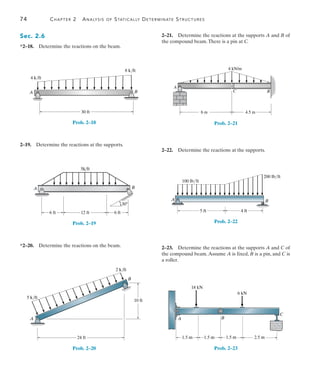
intended to only support a tensile force. They have many applications in
structures, and an example, along with its support connection, is shown in
the photos in Fig. 17–1a. Because they are slender, the supports for these
members are always assumed to be pin connections. Consequently, the
model of this element is shown in Fig. 17–1b.
Fig. 17–1
(a)
(b)
T T
626	 Chapter 17   Structural Modeling and Computer Analysis
17
Beams and Girders.  Beams are normally prismatic members that
support loadings applied perpendicular to their length.A girder provides
support for beams that are connected to it, as in the case of a building
girder that supports a series of floor beams, Fig. 17–2a. One sometimes
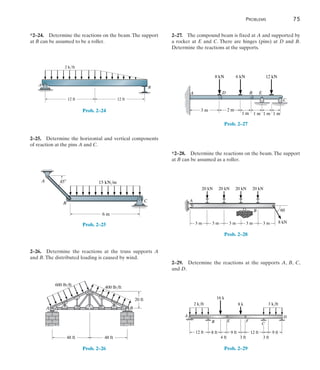
has to be careful about selecting the proper support for these members.
If the support is a simple bolted connection, as in Fig. 17–2b, it should be
modeled as a pin. This is because codes generally restrict the elastic
deflection of a beam, and so the support rotation will generally be very
small. Choosing pin supports will lead to a more conservative approach
to the design of the member. For example, consider the moment
diagrams for the simply-supported, partially fixed, and fixed-supported
beams that carry the same uniform distributed loading, Fig. 17–3. The
internal moment is largest in the simply-supported case, and so this
beam must have a higher strength and stiffness to resist the loading
compared to the other two cases.
(a)
Fig. 17–2
(b)
Fig. 17–3
w
L
Mmax  0.125 wL2
Simply-supported beam
Mmax  0.08 wL2
w
L
Partially fixed-
supported beam
0.1 L
(approx.)
0.1 L
(approx.)
M  0.045 wL2 Mmax  0.0833 wL2
M  0.0417 wL2
w
L
Fixed-supported
beam
0.21 L 0.21 L
17.2  Modeling a Structure and its Members	 627
17
Beams can also have cross sections that are tapered or haunched,
Fig.  17–4a, or they can be built up by adding plates to their top
and bottom, Fig. 17–4b. Apart from its supports, a model of the
haunched beam to be used for a computer analysis can be represented
by a series of fixed-connected prismatic segments, where “nodes” are
placed at the joints of each segment. Using good judgment, the number
of segments selected for this division should be reasonable. It would be
conservative to select the smallest end of each tapered size to represent
the thickness of each prismatic segment, as shown in Fig. 17–4a.
Treatment of beams in this manner also applies to cases where an
unusual distributed load is applied to the beam. Computer software
usually accommodates uniform, triangular, and trapezoidal loadings. If
a unique loading is not incorporated into the computer program, then it
can be approximated by a series of segmented uniform distributed
loadings, acting on joined segments of the beam. A conservative
approach would be to select the highest intensity of the distributed
loading within each segment, as shown in Fig. 17–5.
Fig. 17–4
(a)
Haunched
beam
Model
(b)
Built-up beam
Actual loading
Model of loading
Fig. 17–5
628	 Chapter 17   Structural Modeling and Computer Analysis
17
Columns.  As discussed in Sec. 1.2, a column will carry a compressive
load in direct bearing, that is, the load will pass through the centroid of the
cross section.As with beams, the end supports should be modeled so that
the results will provide a conservative approach to the design. For
example, if a concentric load is applied to the column in Fig. 17–6a, and its
supports are modeled as a pin, Fig. 17–6b, then the cross section of the
column must be designed to have a greater stiffness to prevent buckling,
compared to the same column modeled as having fixed supports,
Fig. 17–6c.* As another example, if a corbel is attached to a column it will
carry an eccentric load, thereby creating a beam column, Fig. 17–7a. Here
the model of the column should be dimensioned so that the load is applied
at a conservative distance away from the bending axis of the column’s
cross section, thus ensuring further safety against buckling, Fig. 17–7b.
General Structure.  In Sec. 1.3 we discussed the various dead and
live loads that must be considered when designing a structure. These are
all specified in codes, and as noted in Sec. 1.4, there is a trend to use
probability theory to account for the uncertainty of the loads by using
load factors and applying them in various combinations. Once obtained,
good engineering judgment is expected, so that the loading is applied to
the model of the structure in a reasonably conservative manner. Not only
must the magnitude of the loads be determined, but their locations on
the model must also be specified. Generally the dimensions for the
model are reported centerline to centerline for each of the members. In
the case of uncertainty, always use larger dimensions, so that larger
internal loadings are calculated, and thereby produce a safe design.
Fig. 17–6
(a)
P
L
(b)
Pinned
P
L
(c)
Fixed
(a)
Beam column
e1
P
Fig. 17–7
(b)
e2  e1
P
*The sudden instability of a column, or buckling, is discussed in Mechanics of Materials,
9/e, R.C. Hibbeler, Pearson Education.
17.2  Modeling a Structure and its Members	 629
17
By establishing the load path one can make reasonable assumptions
for load transference from one member to another. See Sec. 2.2. For
example, a roof that is supported by trusses is often attached to purlins,
but sometimes it is directly applied to the entire top cord of the truss,
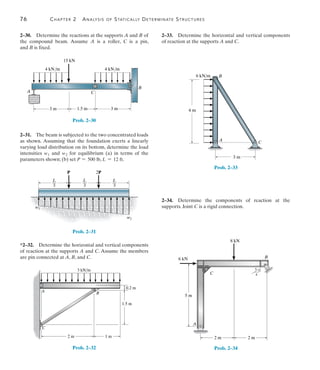
Fig. 17–8a. When this occurs, the resultant of the distribution of load
between the joints can generally be divided equally and be considered
as a point loading on each of the joints. Fig. 17–8b.
As a second example, consider the effect of the wind on the front of a
metal building, modeled as shown in Fig. 17–9a. Cross bracing, using tie
rods between each bay, prevents the building from racking or leaning, as
shown by the dashed lines. In the actual building, the purlins would also
restrain the building since they are attached to each of the frames, and
the roof would also be firmly attached to the purlins. In Sec. 7.2, using
approximate analysis, we have shown how to reduce a statically
indeterminate cross-braced truss system to one that is statically
determinate in order to simplify the analysis. For the case here, the tie
rods can be conservatively designed by neglecting the support provided
by the roof assembly, and assuming only the rods in tension provide the
necessary resistance against collapse.In other words,the rods are assumed
not to support a significant compressive force since their cross section is
small, and so they can easily buckle. Only the four rods shown on the
model in Fig. 17–9b are assumed to resist the wind loading.The other four
rods provide support if the wind loading acts on the opposite side.
Actual structure
(a)
Fig. 17–8
Model
(b)
(a)
wind
purlin
(b)
wind
T
T
T
T
Fig. 17–9
630	 Chapter 17   Structural Modeling and Computer Analysis
17
Consideration should also be given to the material strength and
stiffness of the structure. Strength properties include choosing allowable
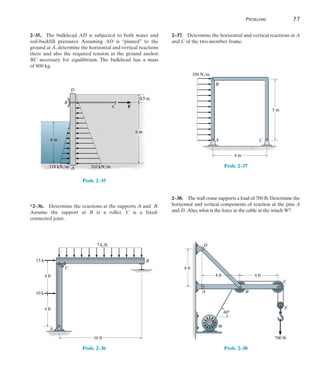
stresses that ensure the elastic limit or the ultimate stress is not exceeded,
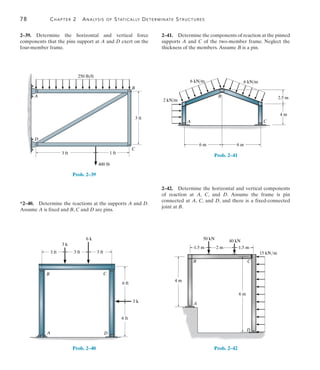
and possibly a stress limit that prevents fatigue or fracture in the case of
cyclic loadings or temperature variations.
The material properties that are relevant for an elastic analysis include
the modulus of elasticity,the shear modulus,Poisson’s ratio,the coefficient
of thermal expansion, and the specific weight or the density of the
material. In particular, the stiffness of the structure is dependent upon its
modulus of elasticity E. For steel, this property remains fairly constant
from one specimen of steel to another, unless the material undergoes
drastic changes in temperature. Care, however, must be given to the
selection of E for concrete and wood, because of the variability that can
occur within these materials.As time passes, all these material properties
can be affected by atmospheric corrosion, as in the case of steel and
concrete,and decay,in case of wood.As mentioned in Sec. 1.4,a resistance
factor is often used to account for the variability of a material as it relates
to its strength and stiffness properties.
17.3 
General Application of a Structural
Analysis Computer Program
Once the model of the structure is established and the load and material
properties are specified, then all this data should be tabulated for use in
an available computer program. The most popular structural analysis
programs currently available, such as STAAD, RISA, and SAP, are all
based on the stiffness method of matrix analysis, described in Chapters 13
through 15.* Although each of these programs has a slightly different
interface, they all require the engineer to input the data using a specified
format.The following is a description of a general way to do this, although
many codes will streamline this procedure, as we will discuss later.
*A more complete coverage of this method, including the effects of torsion in three-
dimensional frames, is given in books on matrix analysis.
17.3 General Application of a Structural Analysis Computer Program	 631
17
Preliminary Steps.  Before using any program it is first necessary
to numerically identify the members and joints, called nodes, of the
structure and establish both global and local coordinate systems in order
to specify the structure’s geometry and loading.To do this, you may want
to make a sketch of the structure and specify each member with a number
enclosed within a square, and use a number enclosed within a circle to
identify the nodes. In some programs, the “near” and “far” ends of the
member must be identified.This is done using an arrow written along the
member,with the head of the arrow directed toward the far end.Member,
node, and “direction” identification for a plane truss, beam, and plane
frame are shown in Figs. 17–10, 17–11, and 17–12. In Fig. 17–10 node ➁ is
at the “near end” of member 4 and node ➂ is at its “far end.” These
assignments can all be done arbitrarily. Notice, however, that the nodes
on the truss are always at the joints, since this is where the loads are
applied and the displacements and member forces are to be determined.
For beams and frames, the nodes are at the supports, at a corner or joint,
at an internal pin,or at a point where the linear or rotational displacement
is to be determined, Figs. 17–11 and 17–12.
Since loads and displacements are vector quantities, it is necessary to
establish a coordinate system in order to specify their correct sense of
direction. Here we must use two types of coordinate systems.
3 4
2
1
1
3
5
2
4
y
x
200 N
2 m
2 m
4 m
Fig. 17–10
3
2
4
x¿
y¿
x
y
2
1
1 3
2
300 N
1.5 m
1.5 m 2 m
Fig. 17–11
Fig. 17–12
2 3
4
4
3
2
1
1
x
y
400 N/m
500 N
5
4 m
3 m
2 m
1.5 m
0.75 m
4
3
5
3
4
x¿
y¿
3
632	 Chapter 17   Structural Modeling and Computer Analysis
17
Global Coordinates.  A single global or structure coordinate system,
using right-handed x, y, z axes, is used to specify the location of each node
relative to the origin, and to identify the sense of each of the external load
and displacement components at the nodes. It is convenient to locate the
origin at a node so that all the other nodes have positive coordinates. See
each figure.
Local Coordinates.  A local or member coordinate system is used to
specify the location and direction of external loadings acting on beam and
frame members and for any structure, to provide a means of interpreting
the computed results of internal loadings acting at the nodes of each
member. This system can be identified using right-handed x, y, z axes
with the origin at the “near” node and the x axis extending along the
member toward the “far” node. Examples for truss member 4 and frame
member 3 are shown in Figs. 17–10 and 17–12, respectively.
Program Operation.  When any program is executed, a menu
should appear which allows various selections for inputting the data and
getting the results. The following explains the items used for input data.
For any problem, be sure to use a consistent set of units for numerical
quantities.
General Structure Information.  This item should generally be selected
first in order to assign a problem title and identify the type of structure to
be analyzed—truss, beam, or frame.
Node Data.  Enter, in turn, each node number and its far and near end
global coordinates.
Member Data.  Enter, in turn, each member number, the near and far
node numbers, and the member properties, E (modulus of elasticity), A
(cross-sectional area), and/or I (moment of inertia and/or the polar
moment of inertia or other suitable torsional constant required for three-
dimensional frames*). If these member properties are unknown then
provided the structure is statically determinate, these values can be set
equal to one. This can also be done if the structure is statically
indeterminate, provided there is no support settlement, and the members
all have the same cross section and are made from the same material. In
both these cases the computed results will then give the correct reactions
and internal forces, but not the correct displacements.
*Quite often a pre-set structural shape, e.g., a wide-flange or W shape, can be selected
when the program has a database of its geometric properties.
3 4
2
1
1
3
5
2
4
y
x
200 N
2 m
2 m
4 m
Fig. 17–10 (repeated)
3
2
4
x¿
y¿
17.3 General Application of a Structural Analysis Computer Program	 633
17
If an internal hinge or pin connects two members of a beam or frame,
then the release of moment must be specified at that node. For example,
member 3 of the frame in Fig. 17–12 has a pin at the far node, ➃. In a like
manner, this pin can also be identified at the near node of member 4.
Support Data.  Enter, in turn, each node located at a support, and
specify the called for global coordinate directions in which restraint
occurs. For example, since node ➄ of the frame in Fig. 17–12 is a fixed
support, a zero is entered for the x, y, and z (rotational) directions;
however,if this support settles downward 0.003 m,then the value entered
for y would be -0.003.
Load Data.  Loads are specified either at nodes, or on members. Enter
the algebraic values of nodal loadings relative to the global coordinates.
For example, for the truss in Fig. 17–10 the loading at node ➁ is in the y
direction and has a value of -200. For beam and frame members the
loadings and their location are generally referenced using the local
coordinates. For example, the distributed loading on member 2 of the
frame in Fig. 17–12 is specified with an intensity of -400 Nm located
0.75 m from the near node ➁ and -400 Nm located 3 m from this node.
Results.  Once all the data is entered, then the problem can be solved.
One obtains the external reactions on the structure and the displacements
and internal loadings at each node, along with a graphic of the deflected
structure.As a partial check of the results a statics check is often given at
each of the nodes. It is very important that you never fully trust the results
obtained. Instead, it would be wise to perform an intuitive structural
analysis using one of the many classical methods discussed in the text to
further check the output. After all, the structural engineer must take full
responsibility for both the modeling and computing of final results.
x
y
2
1
1 3
2
300 N
1.5 m
1.5 m 2 m
Fig. 17–11 (repeated)
3
4
x¿
y¿
3
Fig. 17–12 (repeated)
2 3
4
4
3
2
1
1
x
y
400 N/m
500 N
5
4 m
3 m
2 m
1.5 m
0.75 m
4
3
5
634	 Chapter 17   Structural Modeling and Computer Analysis
17
Automatic Assembly.  All the above steps of structural layout,
establishing the global and local coordinate systems, and specifying the
load data, are sometimes automatically incorporated within the program.
For example, one can construct a scaled drawing of the structure on the
monitor, either by specifying the end point coordinates of each member,
or by mouse clicking the global coordinates of the member’s end points.
Once that is done, the program will automatically establish the near and
far sides of each member, along with its local coordinates. Another
approach, if allowed, would be to use a drafting program, such as
AutoCAD, to build the structure, and then input this graphic into the
structural analysis program.
The load data can also be entered onto this graphical interface. This
way the operator can visually check to be sure the load is applied to the
structure in the correct direction. Specifications for the load can either
be in local or global coordinates. For example, if the structure is a gabled
frame, a distributed wind loading would be applied normal to the
inclined roof member, and so local coordinates would be selected when
this loading in entered, Fig. 17–13a. Since gravity loads, such as dead
load,floor and roof live loads,and snow load,all act vertically downward,
they would be entered by selecting horizontal and vertical global
coordinates, Fig. 17–13b.
Many programs used for structural analysis and design also have a load
combination feature. The engineer simply specifics the type of loading,
such a dead loads, wind load, snow load, etc., and then the program will
calculate each of these loadings according to the equations and
requirements of the code, such as ASCE 7. Finally, the combinations of
the loadings, such as those described in Sec. 1.4, are then applied to the
structure and used for the analysis.
Fig. 17–13
(a)
Wind loading
local coordinates
x¿
y¿
(b)
Weight global
coordinates
x¿
y¿
Computer Problems	 635
17
*C17–4.  Use a computer program to determine the
reactions the beam.Assume A is fixed. EI is constant.
8 ft
8 ft
15 ft
20 ft
A D
C
B
12 k
4 k/ft
C17–4
*C17–5.  Use a computer program to determine the
reactions on the beam. Assume A and D are pins and B
and C are rollers. EI is constant.
A B C D
8 ft
8 ft 20 ft
3 k/ft
C17–5
*C17–6.  Use a computer program to determine the
reactions on the beam.Assume A is fixed. EI is constant.
4 m 4 m
5 m
A
D
C
B
8 kN/m 12 kN/m
C17–6
*C17–7.  Use a computer program to determine the
reactions on the beam. Assume A and D are pins and B
and C are rollers. EI is constant.
A B C D
3 m 3 m
8 m
15 kN/m
C17–7
Computer Problems
*C17–1.  Useacomputerprogramanddeterminethereactions
on the truss and the force in each member.AE is constant.
12 kN
A
E D
C
B
60
2 m
2 m
C17–1
*C17–2.  Use a computer problem and determine the
reactions on the truss and the force in each member. AE is
constant.
E
C
D
8 ft
6 ft
B
A
6 ft
8 ft 8 ft
6 ft
2 k
F
1.5 k
C17–2
*C17–3.  Use a computer program to determine the force
in member 14 of the truss. AE is constant.
12
1
2
6
5
8
8
7
10
14
3
3 k
5 k
12 ft
6 ft
8 ft 8 ft
3 5
4
9
1
2
7
6
4
11
13
C17–3
636	 Chapter 17   Structural Modeling and Computer Analysis
17
*C17–8.  Use a computer program to determine the
reactions on the frame. AE and EI are constant.
A D
15 k
B C
20 ft
24 ft
1.5 k/ft
C17–8
*C17–9.  Use a computer program to determine the
reactions on the frame. Assume A, B, D and F are pins. AE
and EI are constant.
A
B C E
F
6 m 4 m
8 m
8 kN
D
C17–9
*C17–10.  Use a computer program to determine the
reactions on the frame. Assume A, B, and C are pins. AE
and EI are constant.
A B C
E
F
3 m 2 m
3 m
8 kN
D
15 kN/m
C17–10
*C17–11.  Use a computer program to determine the
reactions on the frame. AE and EI are constant.
A D
500 lb
B C
8 ft
15 ft
800 lb/ft
C17–11
Project Problems	 637
17
P17–1.  The photo shows a structural assembly designed to support medical equipment in an operating room of a hospital. It is
anticipated that this equipment weighs 1 k. Each of the side beams has a cross-sectional area of 3.50 in2 and moment of inertia of
22.0 in4.The ends of these beams are welded to the girders as shown.The assembly is bolted to the side beams. Model one of the
side beams, and justify any assumptions you have made. Perform a computer analysis and use the results to draw the moment
diagram of one of the side beams.As a partial check of the results, determine the maximum moment in this beam using a classical
method such as moment distribution, or use the deflection tables. Neglect the weight of the members, and take E = 29(103
) ksi.
P17–1
3 ft
7 ft
7 ft
2 ft
3 ft
1 ft
1 ft
1 k
B
A
Project Problems
638	 Chapter 17   Structural Modeling and Computer Analysis
17
P17–3.  The steel-trussed bent shown in the photo is used to support a portion of the pedestrian bridge. It is constructed using
two wide-flange columns, each having a cross-sectional area of 4.44 in2 and a moment of inertia of 48.0 in4.A similar member is
used at the top to support the bridge loading, estimated to be 8 k as shown in the figure.The ends of this member are welded to
the columns, and the bottom of the columns are welded to base plates which in turn are bolted into the concrete. Each truss
member has a cross-sectional area of 2.63 in2.and is bolted at its ends to gusset plates.These plates are welded to the web of each
column. Establish a structural model of the bent and justify any assumptions you have made. Using this model, determine the
forces in the truss members and find the largest axial force in the columns using a computer program for the structural analysis.
Neglect the weight of the members and use the centerline dimensions shown in the figure. Compare your results with those
obtained using the method of joints to calculate the force in some of the members.Take E = 29(103) ksi.
P17–2.  The concrete bridge pier, shown in the photo, supports a portion of a highway bridge.The centerline dimensions and
the anticipated loading on the cap or top beam are shown in the figure. This beam has the cross section shown. The columns
each have a diameter of 400 mm and are fixed-connected to the beam. Establish a structural model of the pier and justify any
assumptions you have made. Perform a computer analysis to determine the maximum moment in the beam.As a partial check
of the results, determine this moment using a classical method such as moment distribution or the deflection tables. Neglect
the weight of the members and the effect of the steel reinforcement within the concrete.Take E = 29.0 GPa.
P17–2
10 10
B
A C
800 kN 800 kN
1100 kN
0.75 m 0.75 m
1.5 m
1.5 m
450 mm
300 mm
P17–3
4 k
4 k
1 ft
1 ft
6 ft
8 ft
10 ft
5 ft
10 ft
Project Problems	 639
17
P17–4.  The load capacity of the historical Pratt truss shown in the photo is to be investigated when the load on the bottom
girder AB is 600 lbft. A drawing of the bridge shows the centerline dimensions of the members. All the members are bolted
to gusset plates. The vertical and half-diagonal members each have a cross sectional area of 3.60 in2, and each of the main
diagonal members and the top cord have a cross-sectional area of 5.80 in2.The side girder has a cross sectional area of 13.2 in2
and a moment of inertia of 350 in4. Establish a structural model of the bridge truss and justify any assumptions you have made.
Perform a computer analysis to determine the force in each member of the truss. From the results, draw the moment diagram
for the side girder. Check your results by using the method of sections to determine the force in some of the truss members.
Neglect the weight of the members and take E = 29(103) ksi.
P17–5.  The pavilion shown in the photo consists of an open roof supported by five trussed frames. Each of these frames
consists of members CD and DE that have a cross-sectional area of 8.08(10-3) m2 and a moment of inertia of 45.8(10-6) m4.
All the other members have a cross-sectional area of 5.35(10-3) m2 and moment of inertia of 4.46(10-6) m4. The joints are fully
welded, and the columns rest on base plates that are bolted onto a concrete foundation. The wind load acting on one side of
the roof and distributed to the frame is 1.20 kNm.The centerline geometry of the structure is shown in the figure. Establish a
structural model of the frame and justify any assumptions you have made. Perform a computer analysis to determine the force
at each joint. Use the results and draw the moment diagram for the horizontal member AB. As a partial check of the results,
calculate the tensile force in this member assuming the frame system is pin connected and acts as a truss. Neglect the weight of
the members and take E = 200 GPa.
15 ft
A B
15 ft
15 ft
15 ft15 ft15 ft15 ft15 ft
P17–4
P17–5
4 m
A B
E
C
D
4 m
7 m
2 m
1.25 m
1.20 kN/m
640
Appendix
 
A
Matrix Algebra for
Structural Analysis
A.1 
Basic Definitions and Types
of Matrices
With the accessibility of desk top computers,application of matrix algebra
for the analysis of structures has become widespread. Matrix algebra
provides an appropriate tool for this analysis, since it is relatively easy to
formulate the solution in a concise form and then perform the actual
matrix manipulations using a computer.For this reason it is important that
the structural engineer be familiar with the fundamental operations of this
type of mathematics.
Matrix. A matrix is a rectangular arrangement of numbers having m
rows and n columns. The numbers, which are called elements, are
assembled within brackets. For example, the A matrix is written as:
A = D
a11 a12 g a1n
a21 a22 g a2n
f
am1 am2 g amn
T
Such a matrix is said to have an order of m * n (m by n). Notice that the
first subscript for an element denotes its row position and the second
subscript denotes its column position. In general, then, aij is the element
located in the ith row and jth column.
Row Matrix.  If the matrix consists only of elements in a single row,
it is called a row matrix. For example, a 1 * n row matrix is written as
A = [a1 a2 g an]
Here only a single subscript is used to denote an element, since the row
subscript is always understood to be equal to 1, that is, a1 = a11, a2 = a12,
and so on.
A.1  Basic Definitions and Types of Matrices	 641
A
Column Matrix.  A matrix with elements stacked in a single column
is called a column matrix.The m * 1 column matrix is
A = D
a1
a2
f
am
T
Here the subscript notation symbolizes a1 = a11, a2 = a21, and so on.
Square Matrix.  When the number of rows in a matrix equals the
number of columns, the matrix is referred to as a square matrix. An
n * n square matrix would be
A = D
a11 a12 g a1n
a21 a22 g a2n
f
an1 an2 g ann
T
Diagonal Matrix.  When all the elements of a square matrix are
zero except along the main diagonal, running down from left to right, the
matrix is called a diagonal matrix. For example,
A = C
a11 0 0
0 a22 0
0 0 a33
S
Unit or Identity Matrix. The unit or identity matrix is a diagonal
matrix with all the diagonal elements equal to unity. For example,
I = C
1 0 0
0 1 0
0 0 1
S
Symmetric Matrix. A square matrix is symmetric provided aij = aji.
For example,
A = C
3 5 2
5 -1 4
2 4 8
S
642	 Appendix A   Matrix Algebra for Structural Analysis
A
A.2  Matrix Operations
Equality of Matrices. Matrices A and B are said to be equal if
they are of the same order and each of their corresponding elements are
equal, that is, aij = bij. For example, if
A = c
2 6
4 -3
d B = c
2 6
4 -3
d
then A = B.
Addition and Subtraction of Matrices.  Two matrices can be
added together or subtracted from one another if they are of the same
order. The result is obtained by adding or subtracting the corresponding
elements. For example, if
A = c
6 7
2 -1
d B = c
-5 8
1 4
d
then
A + B = c
1 15
3 3
d A - B = c
11 -1
1 -5
d
Multiplication by a Scalar.  When a matrix is multiplied by a scalar,
each element of the matrix is multiplied by the scalar. For example, if
A = c
4 1
6 -2
d k = -6
then
kA = c
-24 -6
-36 12
d
Matrix Multiplication.  Two matrices A and B can be multiplied
together only if they are conformable. This condition is satisfied if the
number of columns in A equals the number of rows in B. For example, if
A = c
a11 a12
a21 a22
d B = c
b11 b12 b13
b21 b22 b23
d (A–1)
then AB can be determined since A has two columns and B has two rows.
Notice, however, that BA is not possible.Why?
A.2  Matrix Operations	 643
A
If matrix A having an order of (m * n) is multiplied by matrix B
having an order of (n * q) it will yield a matrix C having an order of
(m * q), that is,
A B = C
(m * n)(n * q) (m * q)
The elements of matrix C are found using the elements aij of A and bij
of B as follows:
cij = a
n
k =1
aikbkj(A–2)
The methodology of this formula can be explained by a few simple
examples. Consider
A = c
2 4 3
-1 6 1
d B = C
2
6
7
S
By inspection, the product C = AB is possible since the matrices are
conformable, that is, A has three columns and B has three rows. By
Eq. A–2, the multiplication will yield matrix C having two rows and one
column.The results are obtained as follows:
c11: Multiply the elements in the first row of A by corresponding elements
in the column of B and add the results; that is,
c11 = c1 = 2(2) + 4(6) + 3(7) = 49
c21: Multiply the elements in the second row of A by corresponding
elements in the column of B and add the results; that is,
c21 = c2 = -1(2) + 6(6) + 1(7) = 41
Thus
C = c
49
41
d
644	 Appendix A   Matrix Algebra for Structural Analysis
A
As a second example, consider
A = C
5 3
4 1
-2 8
S B = c
2 7
-3 4
d
Here again the product C = AB can be found since A has two columns
and B has two rows.The resulting matrix C will have three rows and two
columns.The elements are obtained as follows:
c11 = 5(2) + 3(-3) = 1	 (first row of A times first column of B)
c12 = 5(7) + 3(4) = 47	 (first row of A times second column of B)
c21 = 4(2) + 1(-3) = 5	 (second row of A times first column of B)
c22 = 4(7) + 1(4) = 32	 (second row of A times second column of B)
c31 = -2(2) + 8(-3) = -28	 (third row of A times first column of B)
c32 = -2(7) + 8(4) = 18	 (third row of A times second column of B)
The scheme for multiplication follows application of Eq.A–2.Thus,
C = C
1 47
5 32
-28 18
S
Notice also that BA does not exist, since written in this manner the
matrices are nonconformable.
The following rules apply to matrix multiplication.
 1.  In general the product of two matrices is not commutative:
AB  BA(A–3)
  2.  The distributive law is valid:
A(B + C) = AB + AC(A–4)
 3.  The associative law is valid:
A(BC) = (AB)C(A–5)
Transposed Matrix.  A matrix may be transposed by interchanging
its rows and columns. For example, if
A = C
a11 a12 a13
a21 a22 a23
a31 a32 a33
S B = [b1 b2 b3]
A.2  Matrix Operations	 645
A
Then
AT
= C
a11 a21 a31
a12 a22 a32
a13 a23 a33
S BT
= C
b1
b2
b3
S
Notice that AB is nonconformable and so the product does not exist.
(A has three columns and B has one row.) Alternatively, multiplication
ABT
is possible since here the matrices are conformable (A has three
columns and BT
has three rows).The following properties for transposed
matrices hold:
(A + B)T
= AT
+ BT
(A–6)
(kA)T
= kAT
(A–7)
(AB)T
= BT
AT
(A–8)
This last identity will be illustrated by example. If
A = c
6 2
1 -3
d B = c
4 3
2 5
d
Then, by Eq.A–8,
a c
6 2
1 -3
d c
4 3
2 5
d b
T
= c
4 2
3 5
d c
6 1
2 -3
d
a c
28 28
-2 -12
d b
T
= c
28 -2
28 -12
d
c
28 -2
28 -12
d = c
28 -2
28 -12
d
Matrix Partitioning.  A matrix can be subdivided into submatrices
by partitioning. For example,
A = C
a11 a12 a13 a14
a21 a22 a23 a24
a31 a32 a33 a34
S = c
A11 A12
A21 A22
d
Here the submatrices are
A11 = [a11] A12 = [a12 a13 a14]
A21 = c
a21
a31
d A22 = c
a22 a23 a24
a32 a33 a34
d
646	 Appendix A   Matrix Algebra for Structural Analysis
A
The rules of matrix algebra apply to partitioned matrices provided the
partitioning is conformable. For example, corresponding submatrices of
A and B can be added or subtracted provided they have an equal number
of rows and columns. Likewise, matrix multiplication is possible provided
the respective number of columns and rows of both A and B and their
submatrices are equal. For instance, if
A = C
4 1 -1
-2 0 -5
6 3 8
S B = C
2 -1
0 8
7 4
S
then the product AB exists, since the number of columns of A equals the
number of rows of B (three). Likewise, the partitioned matrices are
conformable for multiplication since A is partitioned into two columns
and B is partitioned into two rows, that is,
AB = c
A11 A12
A21 A22
d c
B11
B21
d = c
A11B11 + A12B21
A21B11 + A22B21
d
Multiplication of the submatrices yields
A11B11 = c
4 1
-2 0
d c
2 -1
0 8
d = c
8 4
-4 2
d
A12B21 = c
-1
-5
d [7 4] = c
-7 -4
-35 -20
d
A21B11 = [6 3]c
2 -1
0 8
d = [12 18]
A22B21 = [8][7 4] = [56 32]
AB = D
c
8
-4
4
2
d + c
-7
-35
-4
-20
d
[12 18] + [56 32]
T = C
1 0
-39 -18
68 50
S
A.3  Determinants
In the next section we will discuss how to invert a matrix. Since this
operation requires an evaluation of the determinant of the matrix, we will
now discuss some of the basic properties of determinants.
A determinant is a square array of numbers enclosed within vertical
bars. For example, an nth-order determinant, having n rows and n
columns, is
 A  = 4
a11 a12 g a1n
a21 a22 g a2n
f
an1 an2 g ann
4 (A–9)
A.3  Determinants	 647
A
Evaluation of this determinant leads to a single numerical value which
can be determined using Laplace’s expansion.This method makes use of
the determinant’s minors and cofactors. Specifically, each element aij of a
determinant of nth order has a minor Mij which is a determinant of order
n - 1. This determinant (minor) remains when the ith row and jth column
in which the aij element is contained is canceled out. If the minor is
multiplied by (-1)i+j
it is called the cofactor of aij and is denoted as
Cij = (-1)i+j
Mij(A–10)
For example, consider the third-order determinant
3
a11 a12 a13
a21 a22 a23
a31 a32 a33
3
The cofactors for the elements in the first row are
C11 = (-1)1+1
`
a22 a23
a32 a33
` = `
a22 a23
a32 a33
`
C12 = (-1)1+2
`
a21 a23
a31 a33
` = - `
a21 a23
a31 a33
`
C13 = (-1)1+3
`
a21 a22
a31 a32
` = `
a21 a22
a31 a32
`
Laplace’s expansion for a determinant of order n, Eq. A–9, states that
the numerical value represented by the determinant is equal to the sum
of the products of the elements of any row or column and their respective
cofactors, i.e.,
D = ai1Ci1 + ai2Ci2 + g + ainCin (i = 1, 2, c, or n)
or(A–11)
D = a1jC1j + a2jC2j + g + anjCnj (j = 1, 2, c, or n)
For application,it is seen that due to the cofactors the number D is defined
in terms of n determinants (cofactors) of order n - 1 each. These
determinants can each be reevaluated using the same formula, whereby
one must then evaluate (n - 1) determinants of order (n - 2), and so
on.The process of evaluation continues until the remaining determinants
to be evaluated reduce to the second order, whereby the cofactors of the
elements are single elements of D. Consider, for example, the following
second-order determinant
D = `
3 5
-1 2
`
We can evaluate D along the top row of elements, which yields
D = 3(-1)1+1
(2) + 5(-1)1+2
(-1) = 11
Or, for example, using the second column of elements, we have
D = 5(-1)1+2
(-1) + 2(-1)2+2
(3) = 11
648	 Appendix A   Matrix Algebra for Structural Analysis
A
Rather than using Eqs. A–11, it is perhaps easier to realize that the
evaluation of a second-order determinant can be performed by
multiplying the elements of the diagonal, from top left down to right, and
subtract from this the product of the elements from top right down to
left, i.e., follow the arrow,
D = `
3 5
-1 2
` = 3(2) - 5(-1) = 11
Consider next the third-order determinant
 D = 3
1 3 -1
4 2 6
-1 0 2
3
Using Eq.A–11, we can evaluate  D using the elements either along the
top row or the first column, that is
D = (1)(-1)1+1
`
2 6
0 2
` + (3)(-1)1+2
`
4 6
-1 2
` + (-1)(-1)1+3
`
4 2
-1 0
`
= 1(4 - 0) - 3(8 + 6) - 1(0 + 2) = -40
D = 1(-1)1+1
`
2 6
0 2
` + 4(-1)2+1
`
3 -1
0 2
` + (-1)(-1)3+1
`
3 -1
2 6
`
= 1(4 - 0) - 4(6 - 0) - 1(18 + 2) = -40
As an exercise try to evaluate  D using the elements along the second row.
A.4  Inverse of a Matrix
Consider the following set of three linear equations:
a11x1 + a12x2 + a13x3 = c1
a21x1 + a22x2 + a23x3 = c2
a31x1 + a32x2 + a33x3 = c3
which can be written in matrix form as
C
a11 a12 a13
a21 a22 a23
a31 a32 a33
S C
x1
x2
x3
S = C
c1
c2
c3
S (A–12)
Ax = C(A–13)
A.4 Inverse of a Matrix	 649
A
One would think that a solution for x could be determined by dividing C
by A; however, division is not possible in matrix algebra. Instead, one
multiplies by the inverse of the matrix. The inverse of the matrix A is
another matrix of the same order and symbolically written as A-1
. It has
the following property,
AA-1
= A-1
A = I
where I is an identity matrix. Multiplying both sides of Eq. A–13 by A-1
,
we obtain
A-1
Ax = A-1
C
Since A-1
Ax = Ix = x, we have
x = A-1
C(A–14)
Provided A-1
can be obtained, a solution for x is possible.
For hand calculation the method used to formulate A-1
can be
developed using Cramer’s rule. The development will not be given here;
instead, only the results are given.* In this regard, the elements in the
matrices of Eq.A–14 can be written as
x = A-1
C
C
x1
x2
x3
S =
1
 A 
C
C11 C21 C31
C12 C22 C32
C13 C23 C33
S C
c1
c2
c3
S  (A–15)
Here  A  is an evaluation of the determinant of the coefficient matrix A,
which is determined using the Laplace expansion discussed in Sec. A.3.
The square matrix containing the cofactors Cij is called the adjoint matrix.
By comparison it can be seen that the inverse matrix A-1
is obtained from
A by first replacing each element aij by its cofactor Cij, then transposing
the resulting matrix, yielding the adjoint matrix, and finally multiplying
the adjoint matrix by 1  A  .
To illustrate how to obtain A-1
numerically, we will consider the
solution of the following set of linear equations:
x1 - x2 + x3 = -1
-x1 + x2 + x3 = -1(A–16)
x1 + 2x2 - 2x3 = 5
Here
A = C
1 -1 1
-1 1 1
1 2 -2
S
*See Kreyszig, E., Advanced Engineering Mathematics, John Wiley  Sons, Inc., New York.
650	 Appendix A   Matrix Algebra for Structural Analysis
A
The cofactor matrix for A is
C = F
`
1
2
1
-2
` - `
-1
1
1
-2
` `
-1
1
1
2
`
- `
-1
2
1
-2
` `
1
1
1
-2
` - `
1
1
-1
2
`
`
-1
1
1
1
` - `
1
-1
1
1
` `
1
-1
-1
1
`
V
Evaluating the determinants and taking the transpose, the adjoint
matrix is
CT
= C
-4 0 -2
-1 -3 -2
-3 -3 0
S
Since
A = †
1 -1 1
-1 1 1
1 2 -2
† = -6
The inverse of A is, therefore,
A-1
= -
1
6
C
-4 0 -2
-1 -3 -2
-3 -3 0
S
Solution of Eqs.A–16 yields
C
x1
x2
x3
S = -
1
6
C
-4 0 -2
-1 -3 -2
-3 -3 0
S C
-1
-1
5
S
x1 = -1
6 3(-4)(-1) + 0(-1) + (-2)(5)4 = 1
x2 = -1
6 3(-1)(-1) + (-3)(-1) + (-2)(5)4 = 1
x3 = -1
6 3(-3)(-1) + (-3)(-1) + (0)(5)4 = -1
Obviously, the numerical calculations are quite expanded for larger
sets of equations. For this reason, computers are used in structural
analysis to determine the inverse of matrices.
A.5 The Gauss Method for Solving Simultaneous Equations	 651
A
A.5 
The Gauss Method for Solving
Simultaneous Equations
When many simultaneous linear equations have to be solved, the Gauss
elimination method may be used because of its numerical efficiency.
Application of this method requires solving one of a set of n equations for
an unknown, say x1, in terms of all the other unknowns, x2, x3, c , xn.
Substituting this so-called pivotal equation into the remaining equations
leaves a set of n - 1 equations with n - 1 unknowns. Repeating the
process by solving one of these equations for x2 in terms of the n - 2
remaining unknowns x3, x4, c , xn forms the second pivotal equation.
This equation is then substituted into the other equations, leaving a set of
n - 3 equations with n - 3 unknowns.The process is repeated until one
is left with a pivotal equation having one unknown, which is then solved.
The other unknowns are then determined by successive back substitution
into the other pivotal equations. To improve the accuracy of solution,
when developing each pivotal equation one should always select the
equation of the set having the largest numerical coefficient for the
unknown one is trying to eliminate.The process will now be illustrated by
an example.
Solve the following set of equations using Gauss elimination:
-2x1 + 8x2 + 2x3 = 2(A–17)
2x1 - x2 + x3 = 2(A–18)
4x1 - 5x2 + 3x3 = 4(A–19)
We will begin by eliminating x1. The largest coefficient of x1 is in
Eq. A–19; hence, we will take it to be the pivotal equation. Solving for
x1, we have
x1 = 1 + 1.25x2 - 0.75x3(A–20)
Substituting into Eqs.A–17 and A–18 and simplifying yields
2.75x2 + 1.75x3 = 2(A–21)
1.5x2 - 0.5x3 = 0(A–22)
Next we eliminate x2. Choosing Eq. A–21 for the pivotal equation since
the coefficient of x2 is largest here, we have
x2 = 0.727 - 0.636x3(A–23)
Substituting this equation into Eq. A–22 and simplifying yields the final
pivotal equation, which can be solved for x3. This yields x3 = 0.75.
Substituting this value into the pivotal Eq.A–23 gives x2 = 0.25. Finally,
from pivotal Eq.A–20 we get x1 = 0.75.
652	 Appendix A   Matrix Algebra for Structural Analysis
A
Problems
A–1. If A = c
4 2 -3
6 1 5
d and B = c
4 -1 0
2 0 8
d ,
determine A + B and A - 2B.
A–2.  If A = c
3 5
-2 7
d , determine A + AT
.
A–3.  If A = [6 1 3] and B = [1 6 3] show that
(A + B)T
= AT
+ BT
.
A–4.  If A = C
1
0
5
S and  B = [2 -1 3], determine AB.
A–5.  If A = C
6 2 2
-5 1 1
0 3 1
S and B = C
-1 3 1
2 -5 1
0 7 5
S ,
determine AB.
A–6.  Determine BA for the matrices of Prob.A–5.
A–7.  If A = c
5 7
-2 1
d and B = c
6
7
d , determine AB.
A–8.  If A = c
1 8 4
1 2 3
d and B = C
3
2
-6
S , determine AB.
A–9.  If A = c
2 7 3
-2 1 0
d and B = C
6
9
-1
S , determine AB.
A–10.  If A = C
6 4 2
2 1 1
0 -3 1
S and B = C
-1 3 -2
2 4 1
0 7 5
S ,
determine AB.
Problems	 653
A
A–11.  If A = c
2 5
1 3
d , determine AAT
.
A–12.  Show that the distributive law is valid, i.e.,
A(B + C) = AB + AC, if
A = c
2 1 6
4 5 3
d , B = C
3
1
-6
S ,   C = C
5
-1
2
S .
A–13.  Show that the associative law is valid, i.e.,
A(BC) = (AB)C, if
A = c
2 1 6
4 5 3
d , B = C
3
1
-6
S , C = [5 -1 2].
A–14.  
Evaluate the determinants `
2 5
7 1
` and
†
1 3 5
2 7 1
3 8 6
† .
A–15.  If A = c
5 1
3 -2
d , determine A-1
.
A–16.  If A = C
0 1 3
2 5 0
1 -1 2
S , determine A-1
.
A–17.  Solve the equations -x1 + 4x2 + x3 = 1,
2x1 - x2 + x3 = 2, and 4x1 - 5x2 + 3x3 = 4 using the
matrix equation X = A-1
C.
A–18.  
Solve the equations in Prob. A–17 using the Gauss
elimination method.
A–19.  Solve the equations x1 - x2 + x3 = -1,
-x1 + x2 + x3 = -1, and x1 + 2x2 - 2x3 = 5 using the
matrix equation X = A-1
B.
A–20.  Solve the equations in Prob. A–19 using the Gauss
elimination method.
Fundamental Solutions
Chapter 2
F2–1.	 a+ MA = 0;   60 - FBC13
52(4) = 0   FBC = 25.0 kN
	 a+ MB = 0;   60 - Ay(4) = 0
	 Ay = 15.0 kN Ans.
	 S
+ Fx = 0;   Ax - 25.014
52 = 0      
	 Ax = 20.0 kN Ans.
	 Bx = Cx = 25.014
52 = 20.0 kN
	 By = Cy = 25.013
52 = 15.0 kN Ans.
F2–2. a+ MA = 0;   FBC sin 45(4) - 10(4)(2) = 0
	 FBC =
20
sin 45
kN
a+ MB = 0;   10(4)(2) - Ay(4) = 0
Ay = 20.0 kN Ans.
S
+ Fx = 0;    Ax - a
20
sin 45
b(cos 45) = 0
	 Ax = 20.0 kN Ans.
Bx = Cx = a
20
sin 45
b(cos 45) = 20.0 kN Ans.
By = Cy = a
20
sin 45
b(sin 45) = 20.0 kN Ans.
F2–3.	 a+ MA = 0;   FBC sin 60(4) - 10(2)(1) = 0
	 FBC =
5
sin 60
kN
  a+ MB = 0;	   10(2)(3) - Ay(4) = 0
	 Ay = 15.0 kN Ans.
S
+ Fx = 0;    a
5
sin 60
b(cos 60) - Ax = 0
	 Ax = 2.89 kN Ans.
	 Bx = Cx = a
5
sin 60
b(cos 60) = 2.89 kN Ans.
	 By = Cy = a
5
sin 60
b(sin 60) = 5.00 kN Ans.
F2–4. Member AC
	
a+ MC = 0;   10(3) - NA(4) = 0    NA = 7.50 kN Ans.
a+ MA = 0;   Cy(4) - 10(1) = 0   Cy = 2.50 kN
Member BC
S
+ Fx = 0;   Bx = 0 Ans.
+ cFy = 0;   By - 2.50 - 8(2) = 0   By = 18.5 kN Ans.
a+ MB = 0;	   2.50(2) + 8(2)(1) - MB = 0 
MB = 21.0 kN # m  Ans.
F2–5.	  a+ MA = 0;   FBC13
52(4) + FBC14
52(3) - 300(2) = 0
	 FBC = 125 lb
	
S
+ Fx = 0;    Ax - 12514
52 = 0   Ax = 100 lb Ans.
+ cFy = 0;   Ay + 12513
52 - 300 = 0
	 Ay = 225 lb Ans.
	 Bx = Cx = 12514
52 = 100 lb Ans.
	 By = Cy = 12513
52 = 75.0 lb Ans.
F2–6. 	
a+ MC = 0;   6(2) + 2(2) - NA(4) = 0
	 NA = 4.00 kN Ans.
	 S
+ Fx = 0;   Cx - 2 = 0   Cx = 2.00 kN Ans.
+ cFy = 0;    Cy + 4.00 - 6 = 0    Cy = 2.00 kNAns.
F2–7.
2.5 m
3 (5)
3 m
4 m
8 kN 8 kN
2 m 2 m 2 m
4 m
Ax
Ay
Dx
Dy
Bx Bx
By
By
3
5
4
Member AB
a+ MA = 0; Bx(4) - By(3) - 3(5)(2.5) = 0
Member BCD
a+ MD = 0; 8(2) + 8(4) - Bx(4) - By(6) = 0
Bx = 10.25 kN   By = 1.167 kN = 1.17 kN Ans.
Member AB
S
+ Fx = 0;   -Ax + 3(5)14
52 - 10.25 = 0
Ax = 1.75 kN Ans.
+ cFy = 0;          Ay - (3)(5)13
52 - 1.167 = 0
Ay = 10.167 kN = 10.2 kN  Ans.
Member BCD
S
+ Fx = 0; 	
10.25 - Dx = 0 Dx = 10.25 kN Ans.
+ cFy = 0; Dy + 1.167 - 8 - 8 = 0
Dy = 14.833 kN = 14.8 kN  Ans.
Fundamental Solutions 	 655
F2–9.	
F2–8.
Ax
Bx
Bx
Cx
Cy
Cy
Cx
By
By
2 m
3 m
6 kN
4 kN
6 kN
3 m
2 m 2 m
6 m
Ay
Dy
MD
Dx
Ax
Bx
Bx
Cx
Cy
Cy
Cx
By
By
4 ft
3 ft
2(8) k
0.5(6) k
3 ft
4 ft
4 ft
Ay
Dy
MD
Dx
Member AB
a+ MA = 0;    Bx(6) - 4(3) = 0    Bx = 2.00 kN Ans.
a+ MB = 0;    4(3) - Ax(6) = 0    Ax = 2.00 kN Ans.
Member BC
S
+ Fx = 0;    2.00 - Cx = 0    Cx = 2.00 kN Ans.
a+ MC = 0;    6(2) + 6(4) - By(6) = 0    By = 6.00 kN Ans.
a+ MB = 0;    Cy(6) - 6(2) - 6(4) = 0    Cy = 6.00 kNAns.
Member AB
+ cFy = 0;    Ay - 6.00 = 0	    Ay = 6.00 kN Ans.
Member CD
S
+ Fx = 0;    2.00 - Dx = 0    Dx = 2.00 kN Ans.
+ cFy = 0;    Dy - 6.00 = 0    Dy = 6.00 kN Ans.
a+ MD = 0;    MD - 2.00(6) = 0    MD = 12.0 kN # m Ans.
Member AB
a+ MA = 0;    Bx(6) - 0.5(6)(3) = 0     Bx = 1.50 k Ans.
a+ MB = 0;    0.5(6)(3) - Ax(6) = 0    Ax = 1.50 k Ans.
Member BC
a+ MC = 0;    2(8)(4) - By(8) = 0    By = 8.00 k Ans.
a+ MB = 0;    Cy(8) - 2(8)(4) = 0    Cy = 8.00 k Ans.
S
+ Fx = 0;    1.50 - Cx = 0    Cx = 1.50 k Ans.
Member AB
+ cFy = 0;    Ay - 8.00 = 0    Ay = 8.00 k Ans.
Member CD
S
+ Fx = 0;    1.50 - Dx = 0    Dx = 1.50 k Ans.
+ cFy = 0;    Dy - 8.00 = 0    Dy = 8.00 k Ans.
a+ MD = 0;    MD - 1.50(4) = 0    MD = 6.00 k # ft Ans.
656	 Fundamental Solutions
F2–10. Chapter 3
F3–1.  Joint C
S
+ Fx = 0;    40 - FCB14
52 = 0    FCB = 50.0 kN(C) Ans.
+ cFy = 0;    50.013
52 - FCA = 0    FCA = 30.0 kN(T) Ans.
Joint B
S
+ Fx = 0;    50.014
52 - FBA = 0    FBA = 40.0 kN (T) Ans.
+ cFy = 0;    NB - 50.013
52 = 0    	NB = 30.0 kN
F3–2.	Joint B
+ cFy = 0;     FBC sin 45 - 6 = 0
FBC = 8.485 kN (T) = 8.49 kN (T) Ans.
S
+ Fx = 0;    FBA - 8.485 cos 45 = 0	
FBA = 6.00 kN (C) Ans.
Joint C
2 m 2 m 2 m
6 kN
8 kN 8 kN
6 kN
Ax
Bx
Bx
Cx
Cy
Cy
Cx
By
By
3 m
3 m
1.5 (6) kN
Ay
Dy
MD
Dx
NB
FBA
B
3
5
4
FCB  50.0 kN
FBA
FBC
B
6 kN
45
FCD
FCA
C
8.485 kN
45
Member BC
a+ MB = 0;	    Cy(6) - 8(2) - 8(4) - 6(6) = 0
Cy = 14.0 kN Ans.
a+ MC = 0;    	8(2) + 8(4) + 6(6) - By(6) = 0
By = 14.0 kN Ans.
Member AB
a+ MA = 0;    Bx = 0 Ans.
S
+ Fx = 0;     Ax = 0 Ans.
	+ cFy = 0;    Ay - 14.0 = 0    Ay = 14.0 kN Ans.
Member BC
	S
+ Fx = 0;     Cx = 0 Ans.
Member CD
S
+ Fx = 0;     Dx - 1.5(6) = 0    Dx = 9.00 kN Ans.
+ cFy = 0;    Dy - 14.0 = 0    Dy = 14.0 kN Ans.
a+ MD = 0;    1.5(6)(3) - MD = 0    MD = 27.0 kN # m Ans.
FCA
FCB
40
C
3
5
4
S
+ Fx = 0;   8.485 cos 45 - FCD = 0 
 	  FCD = 6.00 kN (T) Ans.
+ cFy = 0;   FCA - 8.485 sin 45 = 0
  
FCA = 6.00 kN (C) Ans.
Fundamental Solutions 	 657
F3–3.	Joint C
S
+ Fx = 0;   10 - FCD cos 45 = 0
FCD = 14.14 kN (T) = 14.1kN(T) Ans.
+ cFy = 0;   FCB - 14.14 sin 45 = 0
FCB = 10.0 kN (C) Ans.
Joint D
+QFx = 0;   14.14 - FDA = 0	
FDA = 14.14 kN (T) = 14.1 kN (T) Ans.
a+ Fy = 0;   FDB = 0 Ans.
Joint B 10 kN
FBA
NB
B
S
+ Fx = 0;   FBA = 0 Ans.
+ cFy = 0;   NB - 10.0 = 0	   NB = 10.0 kN
F3–4.	Joint D
2 k
FDA
FDC
D
S
+ Fx = 0;   FDC - 2 = 0   FDC = 2.00 k (T) Ans.
+ cFy = 0;   FDA = 0 Ans.
Joint C
FCA
FCB
2 C
3
5
4
FCD FCB
C
45
10 kN
FDA FDB
D
14.14 kN
S
+ Fx = 0;    FCA13
52 - 2 = 0
FCA = 3.333 k (C) = 3.33 k (C) Ans.
+ cFy = 0;   3.33314
52 - FCB = 0
FCB = 2.667 k (T) = 2.67 k (T) Ans.
Joint A
FAB
NA
3.333 k
3
5
4
S
+ Fx = 0;   FAB - 3.33313
52 = 0   FAB = 2.00 k (T) Ans.
+ cFy = 0;   NA - 3.33314
52 = 0   NA = 2.667 k
F3–5.	 Joint D
	
FDA
FDC
S
+ Fx = 0;   FDC = 0 Ans.
+ cFy = 0;   FDA = 0 Ans.
Joint C
	
FCA
FCB
C
8 kN
45 60
S
+ Fx = 0;   8 cos 60 - FCA cos 45 = 0
FCA = 5.657 kN (T) = 5.66 kN (T) Ans.
+ cFy = 0;	   FCB - 5.657 sin 45 - 8 sin 60 = 0
FCB = 10.93 kN (C) = 10.9 kN (C) Ans.
Joint B
	 FAB
NB
10.93 kN
S
+ Fx = 0;      FAB = 0 Ans.
+ cFy = 0;     NB = 10.93 kN
658	 Fundamental Solutions
F3–6.	 Entire truss
a+ MA = 0;    Ey(8) - 600(2) - 800(4) - 600(6) = 0
Ey = 1000 N
Joint E
FED
FEF
1000 N
45
+ cFy = 0;    1000 - FEF sin 45 = 0
FEF = 1414.21 N (C) = 1.41 kN (C)Ans.
S
+ Fx = 0;    1414.21 cos 45 - FED = 0	
FED = 1000 N (T) = 1.00 kN (T) Ans.
Joint F
F
FFD
FFG
1414.21 N
45
S
+ Fx = 0;    FFG - 1414.21 cos 45 = 0	
FFG = 1000 N (C) = 1.00 kN (C) Ans.
+ cFy = 0;    1414.21 sin 45 - FFD = 0
FFD = 1000 N (T) = 1.00 kN (T) Ans.
Joint D
FDC
FDG
600 N
1000 N
1000 N
45
+ cFy = 0;    1000 - 600 - FDG sin 45 = 0  
FDG = 565.69 N (C) = 566 N (C) Ans.
S
+ Fx = 0;    1000 + 565.69 cos 45 - FDC = 0
FDC = 1400 N (T) = 1.40 kN (T) Ans.
Joint C FCG
800 N
+ cFy = 0;    FCG - 800 = 0	    FCG = 800 N (T) Ans.
Due to symmetry,
FBC = FDC = 1.40 kN (T)    FBG = FDG = 566 N (C)
FHG = FFG = 1.00 kN (C) Ans.
FHB = FFD = 1.00 kN (T)    FAH = FEF = 1.41 kN (C)
FAB = FED = 1.00 kN (T) Ans.
F3–7.	 For the entire truss
a+ ME = 0;    2(5) + 2(10) + 2(15) - Ay(20) = 0
Ay = 3.00 k
S
+ Fx = 0;    Ax = 0
For the left segment
 + cFy = 0;    3.00 - 2 - FBG sin 45 = 0 
FBG = 1.41 k (C) Ans.
a+ MB = 0;     FHG(5) - 3(5) = 0
FHG = 3.00 k (C) Ans.
a+ MG = 0;    FBC(5) + 2(5) - 3.00(10) = 0
FBC = 4.00 k (T) Ans.
	
5 ft
3.0 k
2.0 k
5 ft
5 ft
45
FBG
FBC
G
B
FHG
Fundamental Solutions 	 659
F3–8.	 For the entire truss
a+ ME = 0;    600(16) + 600(12) + 600(8) + 600(4)
- Ay(16) = 0
Ay = 1500 lb
S
+ Fx = 0;    Ax = 0
For the left segment
a+ MC = 0;    FHI (3) + 600(4) + 600(8) - 1500(8) = 0
FHI = 1600 lb (C)
a+ MI = 0;    FBC(3) + 600(4) - 1500(4) = 0
FBC = 1200 lb (T) Ans.
3 ft
4 ft 4 ft
1500 lb
600 lb
3
5
4
FBC
FCI
FHI
I
C
600 lb
Joint H
S
+ Fx = 0;    1600 - FHG = 0    FHG = 1600 lb (C) Ans.
+ cFy = 0;    FHC - 600 = 0    FHC = 600 lb (C) Ans.
F3–9.	 For the entire truss
a+ MA = 0;	    NC(4) - 8(2) - 6(2) = 0    NC = 7.00 kN
Consider the right segment
+ cFy = 0;	    7.00 - FBD sin 45 = 0
FBD = 9.899 kN (T) = 9.90 kN (T) Ans.
 a+ MB = 0;    7.00(2) - 6(2) - FED(2) = 0
FED = 1.00 kN (C) Ans.
a+ MD = 0;    0 - FBC(2) = 0    FBC = 0 Ans.
2 m
7.00 kN
6.00 kN
2 m
45
FED
FBD
FBC
B
D
F3–10.	 For the entire truss
a+MA = 0;    NE(32) - 400(8) - 400(16) - 400(24)
- 400(32) = 0
NE = 1000 lb
Consider the right segment
a 
+ ME = 0;	    400(8) - FCF13
52(16) = 0 
FCF = 333.33 lb (C) = 333 lb (C) Ans.
a+ MC = 0;    1000(16) - 400(16) - 400(8)
- FGF13
52(16) = 0
FGF = 666.67 lb (C) = 667 lb (C) Ans.
a 
+ MF = 0;	    1000(8) - 400(8) - FCD(6) = 0
FCD = 800 lb (T) Ans.
6 ft
8 ft 8 ft
C
F
E
1000 lb
400 lb
400 lb
3
3
5
5
4
4
FCD
FCF
FGF
F3–11.	 For the entire truss
a+ MA = 0;    ND(6) - 2(6) - 4(3) = 0    ND = 4.00 kN
Consider the right segment
+ cFy = 0; 	    4.00 - 2 - FFC sin 45 = 0
FFC = 2.828 kN (C) = 2.83 kN (C) Ans.
a+ MF = 0; 	    4.00(3) - 2(3) - FBC(1.5) = 0
FBC = 4.00 kN (T)  Ans.
a+ MC = 0; 	    4.00(1.5) - 2(1.5) - FFE(1.5) = 0
FFE = 2.00 kN (C)  Ans.
	
3 m
2 kN
F
4 kN
1.5 m
1.5 m
45
FFC
FFE
FBC C
1600 lb
600 lb
FHC
FHG
660	 Fundamental Solutions
F3–12.	 For the entire truss
a+ MA = 0; NE(16) - 500(4) - 500(8) - 500(12) = 0
NE = 750 lb
Consider the right segment
a+ MF = 0; 	  750(4) - FCD(3) = 0
FCD = 1000 lb (T)  Ans.
a+ MC = 0; 	 750(8) - 500(4) - FGF a
1
217
b(16) = 0
FGF = 1030.78 lb = 1.03 k (C)  Ans.
a+ MO = 0; FCF13
52(16) + 500(12) - 750(8) = 0
FCF = 0  Ans.
3 ft
4 ft 4 ft 8 ft
C
F
O
750 lb
500 lb
1
3
5
4
4
FCD
FCF
FGF
17
Chapter 4
F4–1.	 a+ MA = 0;   By(2) + 20 - 10(4) = 0
By = 10.0 kN
Segment CB
S
+ Fx = 0;   NC = 0 Ans.
+ cFy = 0;  VC + 10 - 10 = 0
VC = 0 Ans.
a+ MC = 0; 	  -MC + 10(1) - 10(3) = 0 
MC = -20 kN # m Ans.
F4–2.   
a+ MA = 0; By(3) - 4(1.5)(0.75)
- 8(1.5)(2.25) = 0
By = 10.5 kN
Segment CB
S
+ Fx = 0;  NC = 0 Ans.
+ cFy = 0;	 VC + 10.5 - 8(1.5) = 0	 VC = 1.50 kN Ans.
a+ MC = 0;  	10.5(1.5) - 8(1.5)(0.75) - MC = 0
MC = 6.75 kN # m Ans.
F4–3.	
  
a+ MB = 0;  
1
2
(6)(6)(3) - Ay(6) = 0
Ay = 9.00 kN
S
+ Fx = 0;    Ax = 0
Segment AC
S
+ Fx = 0; NC = 0 Ans.
+ cFy = 0;       9.00 -
1
2
(3)(1.5) - VC = 0 
VC = 6.75 kN    Ans.
a+ MC = 0;   MC +
1
2
(3)(1.5)(0.5) - 9.00(1.5) = 0
MC = 12.4 kN # m Ans.
F4–4.	  a+ MB = 0;  300(3)(1.5) -
1
2
(300)(3)(1)
- Ay(3) = 0
Ay = 300 lb
S
+ Fx = 0;    Ax = 0
Segment AC
S
+ Fx = 0;    NC = 0 Ans.
+ cFy = 0;   300 - 300(1.5) - VC = 0
VC = -150 lb Ans.
aMC = 0; 	 MC + 300(1.5)(0.75) - 300(1.5) = 0
MC = 112.5 lb Ans.
F4–5.	Reactions
a+ MA = 0;	 FB sin 45(3) - 5(6)(3) = 0	 FB = 42.43 kN
S
+ Fx = 0;   42.43 cos 45 - Ax = 0   Ax = 30.0 kN
+ cFy = 0;   42.43 sin 45 - 5(6) - Ay = 0   Ay = 0
Segment AC
S
+ Fx = 0;   NC - 30.0 = 0    NC = 30.0 kN Ans.
+ cFy = 0;   -5(1.5) - VC = 0     VC = -7.50 kN Ans.
a+ MC = 0;   MC + 5(1.5)(0.75) = 0	
MC = -5.625 kN # m Ans.
F4–6.	Reactions
a+MA = 0;    By(15) - 150(9)(10.5) - 600(6) - 800(3) = 0
By = 1345 lb
Segment CB
S
+ Fx = 0;   NC = 0 Ans.
+ cFy = 0;   VC + 1345 - 150(6) = 0   VC = -445 lb Ans.
a+ MC = 0; 	
1345(6) - 150(6)(3) - MC = 0
MC = 5370 lb # ft = 5.37 k # ft Ans.
Fundamental Solutions 	 661
F4–7.	 Left segment
+ cFy = 0; -6 -
1
2
a
18
3
xb(x) - V = 0
V = 5 -3x2
- 66 kN Ans.
a+ MO = 0; 	 M +
1
2
a
18
3
xb(x)a
x
3
b + 6x = 0
M = 5-x3
- 6x6 kN # m Ans.
F4–8.	Reaction
a+ MB = 0;   
1
2
(12)(6)(2) - Ay(6) = 0   Ay = 12.0 kN
Left segment
+ cFy = 0; 	  12.0 -
1
2
a
12
6
x b(x) - V = 0
V = 512.0 - x2
6 kN Ans.
a+ MO = 0;   	M +
1
2
a
12
6
xb(x)a
x
3
b - 12.0x = 0
M = e12.0x -
1
3
x3
f kN # m  Ans.
F4–9.	Reactions
a+ MA = 0;   By(8) - 8(4)(6) = 0   By = 24.0 kN
a+ MB = 0;   8(4)(2) - Ay(8) = 0   Ay = 8.00 kN
0 … x 6 4 m left segment
+ cFy = 0;   8.00 - V = 0   V = {8} kN Ans.
a+ MO = 0;   M - 8.00x = 0   M = {8x} kN # m Ans.
4 m 6 x 6 8 m right segment
+ cFy = 0;   V + 24.0 - 8(8 - x) = 0 
V = {40 - 8x} kN Ans.
a+ MO = 0; 24.0(8 - x) - 8(8 - x)a
8 - x
2
b - M = 0
	
M = 5-4x2
+ 40x - 646 kN # m Ans.
F4–10.	 0 … x 6 2 m
+ cFy = 0; V = 0 Ans.
a+ MO = 0;	 M + 20 = 0	 M = -20 kN # m  Ans.
2 m 6 x … 4 m
+ cFy = 0;	 -5(x - 2) - V = 0	
V = 510 - 5x 6 kN Ans.
a+ MO = 0;  M + 5(x - 2)a
x - 2
2
b + 15 + 20 = 0
M = e -
5
2
x2
+ 10x - 45f kN # m Ans.
F4–11.	Reactions
+ cFy = 0;    Ay - 5(2) - 15 = 0    Ay = 25.0 kN
a+ MA = 0;  MA - 5(2)(1) - 15(4) = 0
MA = 70.0 kN # m
0 … x 6 2 m left segment
+ cFy = 0;    25.0 - 5x - V = 0
V = 525 - 5x 6 kN Ans.
a+ MO = 0;  M + 5xa
x
2
b + 70.0 - 25.0x = 0
M = e -
5
2
x2
+ 25x - 70f kN # m Ans.
2 m 6 x … 4 m right segment
+ cFy = 0;   V - 15 = 0   V = 15 kN Ans.
a+ MO = 0;  -M - 15(4 - x) = 0 
M = 515x - 606 kN # m  Ans.
F4–12.	 Support reactions
a+ MA = 0; 	
By(24) - 2(12)(6) - 18(12) = 0
By = 15.0 k
a+ MB = 0; 	
18(12) + 2(12)(18) - Ay(24) = 0
Ay = 27.0 k
0 … x 6 12 ft left segment
+ cFy = 0;    27.0 - 2x - V = 0
V = {27 - 2x} k Ans.
a+ MO = 0;  M + 2xa
x
2
b - 27.0x = 0 
M = 5 -x2
+ 27x6 k # ft  Ans.
12 ft 6 x … 24 ft right segment
+ cFy = 0;    V + 15.0 = 0    V = {-15 k} Ans.
a+ MO = 0; 	 15.0(24 - x) - M = 0 
M = {-15x + 360} k # ft Ans.
662	 Fundamental Solutions
F4–13.
V (kN)
0
11
2 4
3
x (m)
M (kNm)
0
28
2 4
6
x (m)
	
F4–14.
V (kN)
0
4
8.5
0.5
6 8
x (m)
6
M (kNm)
0
4 6 8
24
7
6
x (m)
F4–15.
V (k)
10
20
x (ft)
	
10
M (kft)
70
30
x (ft)
30
F4–16.
V (k)
0
10.5 12 24
9
27
x (ft)
63
	
M (kft)
0
10.5 12
330.75
324
24
x (ft)
F4–17.
4.5
V (kN)
0
4.5
4.5 9
x (m)
	
M (kNm)
0
6.75
4.5 9
x (m)
F4–18.
4
3
V (kN)
0
4
3
2.5
3.5
1.5 5
x (m)
	
3.5
1.5
M (kNm)
1.5 1.5
0
2.5
0.5
5
x (m)
Fundamental Solutions 	 663
F4–19.
V (kN)
0
2
12
4
12
6
x (m)
	
M (kNm)
0
2 4 6
x (m)
12 12
F4–20.
6
V (k)
0
6
6
12
x (ft)
0
6
24
12
x (ft)
M (kft)
F4–21.
40
5
M (kft)
x (ft)
24
1.67
6.67
4.17
M (kft)
0 x (ft)
F4–22.
90
3 5
90
M (kNm)
0
7
x (m)
x (m)
M (kNm)
90
54
F4–23.
M (lbft)
x (ft)
3529
	
F4–24.
M (kNm)
x (m)
0
9.24
3.46
M (lbft)
0
1.04
x (ft)
3691
3529
2.5 m
5 m
x (m)
18.75
M (kNm)
4
5
3
664	 Fundamental Solutions
Chapter 6
F6–1.
A
B
x
Ay
	
A
B
C
x
MC
F6–2.
A
C
B
x
Ay
	
A x
MB
C
B
F6–3.
A
C
B
x
Ay
A
B
C
x
VC
A
C
D
B
x
VD
F6–4.
A
C
x
Ay
F6–5.
D
E
B
A
x
Ay
F6–6.
Ay
A
D
E C
B
x
A
C
D
B
x
VD
D
B
A x
MD
C
A
C
B
x
VB
B
A x
MB
C
D
E
C
B
A
x
VC
D
E
C B
A
x
MC
A
D
E C
B
x
VE
A
D
E C
B
x
MA
Fundamental Solutions 	 665
F6–7.
VC
0
6
0.5
0.5
0.5
2 4
x (m)
(MC)max(+) = 8(1) + c
1
2
(6 - 2)(1)d (1.5)
+ c
1
2
(2)(-1)d (2) + c
1
2
(6 - 2)(1)d (2)
  = 13.0 kN # m  Ans.
 
(VC)max(+) = 8(0.5) + c
1
2
(2)(0.5)d (1.5) + c
1
2
(6 - 4)(0.5)d (1.5)
+ c
1
2
(2)(0.5)d (2) + c
1
2
(4 - 2)(-0.5)d (2) +
 c
1
2
(6 - 4)(0.5)d (2)
= 6.50 kN  Ans.
F6–8.
Cy
0
9
2
3 6
x (m)
a) (Cy)max(+) = 6(2) + c
1
2
(9 - 3)(2)d (2)
+ c
1
2
(9 - 3)(2)d (4) = 48 kN Ans.
b) (MA)max(-) = 6(-3) + c
1
2
(6 - 0)(-3)d (2)
+ c
1
2
(6 - 0)(-3)d (4) + c
1
2
(9 - 6)(3)d (4)
	   = -54 kN # m  Ans.
Chapter 8
F8–1.
F8–2.
D
E
(c)
G
6
1
1
2 4
x (m)
0
MC
9
3
3
3 6
x (m)
0
MA
666	 Fundamental Solutions
F8–3.
F8–4.	
F8–5.
(a)
(b)
(c)
F8–6.	For 0 … x1 6
L
2
	 M1 =
P
2
x1
	 EI
d2
v1
dx2
1
=
P
2
x1
	 EI
dv1
dx1
=
P
4
x2
1 + C1(1)
	 EI v1 =
P
12
x3
1 + C1x1 + C2(2)
	For
L
2
6 x2 … L
	 M2 =
P
2
(L - x2) =
PL
2
-
P
2
x2
	 EI
d2
v2
dx2
2
=
PL
2
-
P
2
x2
	 EI
dv2
dx2
=
PL
2
x2 -
P
4
x2
2 + C3 (3)
	 EI v2 =
PL
4
x2
2 -
P
12
x3
2 + C3x2 + C4(4)
Fundamental Solutions 	 667
	 v1 = 0   at  x1 = 0.    From Eq (2),     C2 = 0
	
dv1
dx1
= 0       at      x1 =
L
2
.      From Eq (1),    C1 = -
PL2
16
	
dv2
dx2
= 0       at       x2 =
L
2
.      From Eq (3),    C3 = -
3PL2
16
	 v2 = 0     at    x2 = L.    From Eq (4),    C4 =
PL3
48
	 v1 =
Px1
48EI
(4x2
1 - 3L2
) Ans.
	 v2 =
P
48EI
(-4x3
2 + 12Lx2
2 - 9L2
x2 + L3
) Ans.
F8–7.	 M = Px - PL
	 EI
d2
v
dx2
= Px - PL
	 EI
dv
dx
=
P
2
x2
- PLx + C1 		 (1)
	 EI v =
P
6
x3
-
PL
2
x2
+ C1x + C2 	(2)
	
dv
dx
= 0   at        x = 0.    From Eq (1),     C1 = 0
	 v = 0      at       x = 0.      From Eq (2),  C2 = 0
	 v =
Px
6EI
(x2
- 3Lx)  Ans.
F8–8.	 M = M0 -
M0
L
x
	 EI
d2
v
dx2
= M0 -
M0
L
x
	 EI
dv
dx
= M0x -
M0
2L
x2
+ C1
	 EI v =
M0
2
x2
-
M0
6L
x3
+ C1x + C2 	(1)
	 v = 0  at       x = 0.      From Eq (1),  C2 = 0
	 v = 0    at    x = L.     From Eq (1),  C1 = -
M0L
3
	 v =
M0
6EIL
(-x3 + 3Lx2 - 2L2x) Ans.
F8–9.	For 0 … x1 6
L
2
	 M = -
M0
L
x1
	 EI
d2
v1
dx2
1
= -
M0
L
x1
	 EI
dv1
dx1
= -
M0
2L
x2
1 + C1 			 (1)
	 EIv1 = -
M0
6L
x3
1 + C1x1 + C2		 (2)
	For
L
2
6 x2 … L
	 M = M0 -
M0
L
x2
	 EI
d2
v2
dy2
2
= M0 -
M0
L
x2
	 EI
dv2
dx2
= M0x2 -
M0
2L
x2
2 + C3		 (3)
	 EIv2 =
M0
2
x2
2 -
M0
6L
x3
2 + C3x2 + C4	(4)
	 v1 = 0    at    x1 = 0.    From Eq (2),    C2 = 0
	 v2 = 0    at    x2 = L.    From Eq (4),
	 0 = C3L + C4 +
M0L2
3
(5)
	
dv1
dx1
=
dv2
dx2
    at    x1 = x2 =
L
2
.  From Eqs (1)
	 and (3),    C1 - C3 =
M0L
2
(6)
	 v1 = v2    at    x1 = x2 =
L
2
.    From Eqs (2) and (4),
 	 C1L - C3L - 2C4 =
M0L2
4
(7)
	 Solving Eqs (5), (6) and (7)
	 C4 =
M0L2
8
  C3 = -
11M0L
24
 C1 =
M0L
24
	 v1 =
M0
24EIL
1-4x3
1 + L2
x12 Ans.
	 v2 =
M0
24EIL
1-4x3
2 + 12Lx2
2 - 11L2
x2 + 3L3
2 Ans.
668	 Fundamental Solutions
F8–10.	 M = -
w
2
x2
+ wLx -
wL2
2
	 EI
d2
v
dx2
= -
w
2
x2
+ wLx -
wL2
2
	 EI
dy
dx
= -
w
6
x3
+
wL
2
x2
-
wL2
2
x + C1	(1)
        EI v = -
w
24
x4
+
wL
6
x3
-
wL2
4
x2
+ C1x + C2	(2)
	
dv
dx
= 0  at    x = 0.  From Eq (1)    C1 = 0
	 v1 = 0  at   x = 0.   From Eq (2)   C2 = 0
	 v =
w
24EI
(-x4
+ 4Lx3
- 6L2
x2
) Ans.
F8–11.	 M = -
w0
6L
x3
	 EI
d2
v
dx2
= -
w0
6L
x3
	 EI
dv
dx
= -
w0
24L
x4
+ C1	(1)
	 EI v = -
w0
120L
x5
+ C1x + C2	(2)
	
dv
dx
= 0   at  x = L.  From Eq (1),  C1 =
w0L3
24
	 v = 0     at       x = L.  From Eq (2),  C2 = -
w0L4
30
	 v =
w0
120EIL
(-x5
+ 5L4
x - 4L5
) Ans.
F8–12.	
tan A
uA/B
uA
tA/B
A
0
3
x (m)
M
—
EI
18 kNm
————
EI
uA = uAB  = `
1
2
a
-18 kN # m
EI
b(3 m) ` =
27 kN # m2
EI
  d Ans.
A = tAB  = ` c
1
2
a
-18 kN # m
EI
b(3 m)d c
2
3
(3 m)d `
=
54 kN # m3
EI
T Ans.
F8–13.	
(3 m)
(3 m)
2
—
3
1
—
2
18 kNm
—————
EI
18 kNm
—————
EI
M¿A
V¿A
+ cFy = 0;   V
A -
1
2
a
18 kN # m
EI
b(3 m) = 0
uA =
27 kN # m2
EI
  d Ans.
a+ MA = 0; -M
A - c
1
2
a
18 kN # m
EI
b(3 m) d c
2
3
(3 m) d = 0
M
A = A = -
54 kN # m3
EI
=
54 kN # m3
EI
T  Ans.
Fundamental Solutions 	 669
F8–14.	
tan A
tan B
uB/A
uB
B  tB/A
4
x (m)
M
—
EI 8 kNm
————
EI
uB = uBA  = a
8 kN # m
EI
b(4 m) =
32 kN # m2
EI
  a Ans.
B = tBA  = c a
8 kN # m
EI
b(4 m)d c
1
2
(4 m)d
	 =
64 kN # m3
EI
c Ans.
F8–15.	
2 m
M¿B
V¿B
(4 m)
8 kNm
————
EI
+ cFy = 0;   a
8 kN # m
EI
b(4 m) - VB = 0       
uB =
32 kN # m2
EI
a Ans.
a+ MB = 0;   M
B - c a
8 kN # m
EI
b(4 m) d (2 m) = 0
 MB = B =
64 kN # m3
EI
c  Ans.
F8–16.	
tan B
tan C
uA
tC/A
C
tB/A
tan A
¿
  3
1.5
x (m)
M
—
EI
5 kNm
————
EI
2.5 kNm
————
EI
tBA = c
1
2
a
5 kN # m
EI
b(3 m) d c
2
3
(3 m) d =
15 kN # m3
EI
tCA = c
1
2
a
2.5 kN # m
EI
b(1.5 m)d c
2
3
(1.5 m)d
 + c a
2.5 kN # m
EI
b(1.5 m)d c
1
2
(1.5 m)d
=
4.6875 kN # m3
EI
 =
1
2
tBA =
1
2
a
15 kN # m3
EI
b =
7.5 kN # m3
EI
uA =
tBA 
LAB
=
15 kN # m3
EI
3 m
=
5 kN # m2
EI
   c	 Ans.
C =  - tCA =
7.5 kN # m3
EI
-
4.6875 kN # m3
EI
=
2.81 kN # m3
EI
T Ans.
F8–17.
(3 m)
1
—
2
5 kNm2
————
EI
2.5 kNm2
—————
EI
5 kNm
————
EI
1 m 2 m
2.5 kNm2
—————
EI
0.5 m
1.5 m
M¿C
V¿C
(1.5 m)
1
—
2
2.5 kNm
————
EI
+ cFy = 0;  -V
A -
5 kN # m2
EI
= 0  
uA = V
A = -
5 kN # m2
EI
=
5 kN # m2
EI
  c Ans.
a+ MC = 0; c
1
2
a
2.5 kN # m
EI
b(1.5 m)d (0.5 m)
- a
2.5 kN # m2
EI
b(1.5 m) - MC = 0
C = MC = -
2.8125 kN # m3
EI
=
2.81 kN # m3
EI
T  Ans.
670	 Fundamental Solutions
F8–18.
uA
tan C
tan A
uC/A
C
¿
tC/A
6
3
0
x (m)
M
—
EI 12 kNm
————
EI
uA = uCA =
1
2
a
12 kN # m
EI
b(3 m) =
18 kN # m2
EI
  c Ans.
tCA = c
1
2
a
12 kN # m
EI
b(3 m) d c
1
3
(3 m) d =
18 kN # m3
EI
 = uALAC = a
18 kN # m2
EI
b(3 m) =
54 kN # m3
EI
C =  - tCA =
54 kN # m3
EI
-
18 kN # m3
EI
=
36 kN #m3
EI
TAns.
F8–19.	
18 kNm2
————
EI
18 kNm2
————
EI
(6 m)
1
—
2
12 kNm
————
EI
18 kNm2
————
EI
(3 m)
1
—
2
12 kNm
————
EI 1 m
3 m
M¿C
V¿C
+ cFy = 0;      -V
A -
18 kN # m2
EI
= 0
V'A = uA = -
18 kN # m2
EI
=
18 kN # m2
EI
c Ans.
a+ MC = 0;   M
C + a
18 kN # m2
EI
b(3 m)
	 - c
1
2
a
12 kN # m
EI
b(3 m)d (1 m) = 0
M
C = C = -
36 kN # m3
EI
=
36 kN # m3
EI
T  Ans.
F8–20.	
uA
tan C
tan A
uC/A
C
¿
tC/A
8
4
2 6
0
x (m)
M
—
EI 8 kNm
————
EI
8 kNm
————
EI
uA = uCA =
1
2
a
8 kN # m
EI
b(2 m) + a
8 kN # m
EI
b(2 m)
	 =
24 kN # m2
EI
c Ans.
tCA = c
1
2
a
8 kN # m
EI
b(2 m)d c 2 m +
1
3
(2 m)d
 + c a
8 kN # m
EI
b(2 m)d (1 m) =
37.33 kN # m3
EI
 = uALAC = a
24 kN # m2
EI
b(4 m) =
96 kN # m3
EI
C =  - tCA =
96 kN # m2
EI
-
37.33 kN # m3
EI
=
58.7 kN #m3
EI
T Ans.
Fundamental Solutions 	 671
F8–21.	
24 kNm2
————
EI
24 kNm2
————
EI
(4 m) 
1
—
2
48 kNm2
————
EI
(4 m) 
8 kNm
———
EI
8 kNm
———
EI
4 m 4 m
24 kNm2
————
EI
(2 m)
8 kNm
———
EI
(2 m)
8 kNm
———
EI
1.667 m 1 m
4 m
M¿C
V¿C
1
—
2
+ cFy = 0;   -V
A -
24 kN # m2
EI
= 0
uA = V
A =
24 kN # m2
EI
  c Ans.
a+ MC = 0;    MC + a
24 kN # m2
EI
b (4 m)
	 - c
1
2
a
8 kN # m
EI
b(2 m)d (2.667 m)
		
- a
8 kN # m
EI
b(2 m)(1 m) = 0
C = M
C =
58.7 kN # m3
EI
T  Ans.
F8–22.
tan A
tan B
M
—
EI
18 kNm
————
EI
uB/A
uB
tB/A
4
2
x (m)
M
—
EI
18 kNm
————
EI
uB = uBA = `
1
2
a -
18 kN # m
EI
b(2 m) ` =
18 kN # m2
EI
c  Ans.
B = tBA  = ` c
1
2
a -
18 kN # m
EI
b(2 m)d c 2 m +
2
3
(2 m) d `
  =
60 kN # m3
EI
T
F8–23.	
(2 m)
(2 m)
2
—
3
2 m
1
—
2
18 kNm
————
EI
M¿B
V¿B
+ cFy = 0;  -V
B -
1
2
a
18 kN # m
EI
b(2 m) = 0
uB = -
18 kN # m2
EI
=
18 kN # m2
EI
  c Ans.
a+ MB = 0;    M
B + c
1
2
a
18 kN # m
EI
b(2 m)d
			 c
2
3
(2 m) + 2 m d = 0
M
B = B = -
60 kN # m3
EI
=
60 kN # m3
EI
T Ans.
672	 Fundamental Solutions
Chapter 9
F9–1. 
Member n (lb) N (lb) L (ft) nNL (lb2 # ft)
AB -1.667 -250 10 4166.67
AC 1  150 6   900.00
BC  1.333  200 8 2133.33
 7200
Thus,
1 lb # Bv
= a
nNL
AE
=
7200 lb2 # ft
AE
Bv
=
7200 lb # ft
AE
T Ans.
F9–2.
Member N
dN
dP
N (P = 150 lb) L (ft) N a
dN
dP
bL (lb # ft)
AB -1.667P -1.667 -250 10 4166.67
AC P 1  150 6 900.00
BC 1.333P 1.333  200 8 2133.33
 7200
Bv
= aN a
dN
dP
b
L
AE
=
7200 lb # ft
AE
T Ans.
F9–3.	
Member n (kN) N (kN) L (m) nNL (kN2 # m)
AB 1 -4.041 2 -8.0829
AC 0  8.0829 2 0
BC 0 -8.0829 2 0
CD 0  8.0829 1 0
 -8.0829
Thus,
1 kN # Ah
= a
nNL
AE
= -
8.0829 kN2 # m
AE
Ah
= -
8.08 kN # m
AE
=
8.08 kN # m
AE
S  Ans.
F9–4.	
Member N (kN)
dN
dP
N (P = 0)(kN) L (m) N a
dN
dP
bL (kN #m)
AB P - 4.041 1 -4.041 2 -8.083
AC  8.083 0  8.083 2 0
BC -8.083 0 -8.083 2 0
CD 8.083 0  8.083 1 0
 –8.083
Ah
= aNa
dN
dP
b
L
AE
= -
8.083 kN # m
AE
=
8.08 kN # m
AE
SAns.
F9–5.	
Member n (kN) N (kN) L (m) nNL (kN2 # m)
AB  0 0 3 0
AC     
1.414 8.485 322 50.91
BC –1 –6 3 18.00
AD  0 –6 3 0
CD –1 0 3 0
 68.91
1 kN # Dh
= a
nNL
AE
=
68.91 kN2 # m
AE
Dh
=
68.9 kN # m
AE
S  Ans.
F9–6.	
Member N (kN)
dN
dP
N (P = 0)(kN) L (m) N a
dN
dP
bL (kN #m)
AB 0 0 0 3 0
AC 22(P + 6) 22 622 322 50.91
BC -(P + 6) -1 -6 3 18.00
AD -6 0 -6 3 0
CD -p -1 0 3 0
 68.91
Dh
= Na
dN
dP
b
L
AE
=
68.9 kN # m
AE
S  Ans.
Fundamental Solutions 	 673
F9–7.	
Member n (kN) N (kN) L (m) nNL (kN2 # m)
AB  0.375 18.75 3 21.09
BC  0.375 18.75 3 21.09
AD -0.625 -31.25 5 97.66
CD -0.625 -31.25 5 97.66
BD 0  50 4 0
 237
.5
1 kN # Dv
= a
nNL
AE
=
237.5 kN2 # m
AE
Dv
=
237.5 kN # m
AE
T Ans.
F9–8.	
Member N (kN)
dN
dP
N (P = 0)(kN) L (m) N a
dN
dP
bL (kN #m)
AB 3
8P + 18.75 0.375 18.75 3 21.09
BC 3
8P + 18.75 0.375 18.75 3 21.09
AD -15
8 P + 31.252 -0.625 –31.25 5 97.66
CD -15
8 P + 31.252 -0.625 –31.25 5 97.66
BD 50 0 50 4 0
 237
.5
Dv
= aNa
dN
dP
b
L
AE
=
237.5 kN # m
AE
T Ans.
F9–9.	
Member n (kN) N (kN) L (m) nNL (kN2 # m)
AB 0 –6 1.5 0
BC 0 –6 1.5 0
BD 1 0 2 0
CD 0  10 2.5 0
AD –1.25 –10 2.5 31.25
DE  0.75  12 1.5 13.5
 44.75
1 kN # Bv
= a
nNL
AE
=
44.75 kN2 # m
AE
,	 Bv
=
44.75 kN # m
AE
T Ans.
674	 Fundamental Solutions
F9–10.	
N (kN)
dN
dP
N (P = 0)(kN) L (m) N a
dN
dP
bL (kN #m)
AB –6 0 –6 1.5 0
BC –6 0 –6 1.5 0
BD P 1 0 2 0
CD 10 0 10 2.5 0
AD -(1.25P + 10) –1.25 –10 2.5 31.25
DE 0.75P + 12 0.75 12 1.5 13.5
 44.75
Bv
= aNa
dN
dp
b
L
AE
=
44.75 kN # m
AE
T	 Ans.
F9–11.	
Member n (kN) N (kN) L (m) nNL (kN2 # m)
AB 0.5 50 2 50.00
DE 0.5 50 2 50.00
BC 0.5 50 2 50.00
CD 0.5 50 2 50.00
AH -0.7071 -70.71 222 141.42
EF -0.7071 -70.71 222 141.42
BH 0 30 2 0
DF 0 30 2 0
CH 0.7071 28.28 222 56.57
CF 0.7071 28.28 222 56.57
CG 0 0 2 0
GH –1 –70 2 140.00
FG –1 –70 2 140.00
 875.98
1 kN # Cv
= a
nNL
AE
=
875.98 kN2 # m
AE
,	 Cv
=
876 kN # m
AE
T	 Ans.
Fundamental Solutions 	 675
F9–13.	 For the slope,
1 kN # m # uA =
L
2
0
muM
EI
dx =
L
3m
0
(-1)(-30x)
EI
dx
=
135 kN2 # m3
EI
 uA =
135 kN # m2
EI
d Ans.
For the displacement,
1 kN # Av
=
L
L
0
mM
EI
dx =
L
3m
0
(-x)(-30x)
EI
dx =
270 kN2 # m3
EI
Av
=
270 kN # m3
EI
T Ans.
F9–14.	 For the slope, M = -30x - M. Then,
0M
0M
= -1.
Set M = 0. Then, M = (-30x) kN # m.
uA =
L
L
0
Ma
0M
0M
b
dx
EI
=
L
3 m
0
(-30x)(-1)dx
EI
 =
135 kN # m2
EI
d Ans.
For the displacement, M = -Px. Then
0M
0P
= -x.
Set P = 30 kN. Then M = (-30x) kN # m.
Av
=
L
L
0
Ma
0M
0P
b
dx
EI
=
L
3m
0
(-30x)(-x)dx
EI
=
270 kN # m3
EI
T
F9–15.	 For the slope, mu = 1 kN # m and M = 4 kN # m.
1 kN # m # uA =
L
L
0
muM
EI
dx =
L
3m
0
(1)(4)dx
EI
=
12 kN2 # m3
EI
uA =
12 kN # m2
EI
b Ans.
For the displacement, m = x kN # m and M = 4 kN # m.
1 kN # Av
=
L
L
0
mM
EI
dx =
L
3m
0
x(4)dx
EI
=
18 kN2 # m3
EI
Av
=
18 kN # m3
EI
c Ans.
F9–12.	
Member N (kN)
dN
dP
N (P = 40 kN) L (m) N a
dN
dP
bL (kN # m)
AB 0.5P + 30 0.5 50 2 50.00
DE 0.5P + 30 0.5 50 2 50.00
BC 0.5P + 30 0.5 50 2 50.00
CD 0.5P + 30 0.5 50 2 50.00
AH -(0.7071P + 42.43) –0.7071 –70.71 222 141.42
EF -(0.7071P + 42.43) –0.7071 –70.71 222 141.42
BH 30 0  30 2 0
DF 30 0  30 2 0
CH 0.7071P 0.707l 28.28 222 56.57
CF 0.7071P 0.707l 28.28 222 56.57
CG 0 0 0 2 0
GH -(P + 30) –1 –70 2 140.00
FG -(P + 30) –1 –70 2 140.00
 875.98
Cv
= aN a
dN
dP
b
L
AE
=
875.98 kN # m
AE
Cv
=
876 kN # m
AE
T Ans.
676	 Fundamental Solutions
F9–16.	 For the slope, M = M. Then
0M
0M
= 1.
Set M = 4 kN # m. Then M = 4 kN # m.
uA =
L
L
0
M a
0M
0M
b
dx
EI
=
L
3m
0
4(1)dx
EI
=
12 kN # m2
EI
  b Ans.
For the displacement, M = (Px + 4) kN # m. Then
0M
0P
= x.
Set P = 0. Then M = 4 kN # m.
Av
=
L
L
0
Ma
0M
0P
b
dx
EI
=
L
3m
0
4(x)dx
EI
=
18 kN # m3
EI
c  Ans.
F9–17.	 For the slope, mu = -1 kN # m and
M = (-x3
) kN # m.
1kN #m #uB =
L
L
0
muM
EI
dx =
L
3m
0
(-1)(-x3
)
EI
dx =
20.25kN2 # m3
EI
uB =
20.25 kN # m2
EI
  c Ans.
For the displacement, m = (-x) kN # m and
M = (-x3
) kN # m.
1 kN # Bv
=
L
L
0
mM
EI
dx =
L
3m
0
(-x)(-x
3
)
EI
dx
=
48.6 kN
2 # m
3
EI
Bv
=
48.6 kN # m3
EI
T Ans.
F9–18.	 For the slope, M = - (M + x3
) kN # m. Then
0M
0M
= -1.
Set M = 0. Then M = (-x3
) kN # m.
uB =
L
L
0
Ma
0M
0M
b
dx
EI
=
L
3m
0
(-x3
)(-1)dx
EI
=
20.25 kN # m2
EI
  c Ans.
For the displacement, M = - (Px + x3
) kN # m.
Then
0M
0P
= -x. Set P = 0, then M = (-x3
) kN # m.
Bv
=
L
L
0
M a
dM
0P
b
dx
EI
=
L
3m
0
(-x3
)(-x)dx
EI
=
48.6 kN # m3
EI
T Ans.
F9–19.	 For the slope, mu = (1 - 0.125x) kN # m and
M = (32x - 4x2
) kN # m.
1 kN # m # uA =
L
L
0
muM
EI
dx =
L
8m
0
(1 - 0.125x)(32x - 4x2
)
EI
dx
=
170.67 kN2 # m3
EI
uA =
171 kN # m2
EI
  c Ans.
For the displacement, m = (0.5x) kN # m and
M = (32x - 4x2
) kN # m.
1 kN#Cv
=
L
mM
EI
dx = 2
L
4m
0
0.5x(32x - 4x2
)
EI
dx
=
426.67 kN2 #m3
EI
Cv
=
427 kN # m3
EI
T Ans.
F9–20.	 For the slope, M = M - 0.125Mx + 32x - 4x2
.
Then
0M
0M
= 1 - 0.125x.
Set M = 0, then M = (32x - 4x2
) kN # m.
uA =
L
L
0
M a
0M
0M
b
dx
EI
=
L
8m
0
(32x - 4x2
)(1 - 0.125x)
EI
dx
   =
170.67 kN # m2
EI
=
171 kN # m2
EI
  c Ans.
For the displacement, M = 0.5Px + 32x - 4x2
. Then
0M
0P
= 0.5x. Set P = 0, then M = (32x - 4x2
) kN # m.
Cv
=
L
Ma
0M
0P
b
dx
EI
= 2
L
4m
0
(32x - 4x2
)(0.5x)dx
EI
=
426.67 kN # m3
EI
=
427 kN # m3
EI
T  Ans.
Fundamental Solutions 	 677
F9–21.	 For the slope, (mu)1 = 0, (mu)2 = -1 kN # m,
M1 = (-12x1) kN # m, and M2 = -12(x2 + 2) kN # m.
1 kN # m # uC =
L
L
0
muM
EI
dx =
L
2m
0
0(-12x1)
EI
dx
+
L
2m
0
(-1)3 -12(x2 + 2)4
EI
dx
1 kN # m # uC =
72 kN2 # m3
EI
uC =
72 kN # m2
EI
d Ans.
For the displacement, m1 = 0, m2 = -x2, M1 = (-12x1) kN#m,
and M2 = -12(x2 + 2) kN # m.
1 kN # C =
L
L
0
mM
EI
dx =
L
2m
0
0(-12x1)
EI
dx
+
L
2m
0
(-x2)3-12(x2 + 2)4
EI
dx
1 kN # Cv
=
80 kN2 # m3
EI
Cv
=
80 kN # m3
EI
T  Ans.
F9–22.	 For the slope, M1 = (-12x1) kN # m, and
M2 = -12(x2 + 2) - M.
Thus,
0M1
0M
= 0 and
0M2
0M
= -1. Set M = 0, M2 = -12(x2 + 2).
uC =
L
L
0
M a
0M
0M
b
dx
EI
=
L
2 m
0
-12x1(0)
EI
dx +
L
2
0
3-12(x2 + 2)4(-1)
EI
dx
=
72 kN # m
EI
d Ans.
For the displacement,M1 = (-12x1) kN # m and
M2 = -12(x2 + 2) - Px2.
Thus,
0M1
0P
= 0 and
0M2
0P
= -x2. Set P = 0,
M2 = -12(x2 + 2) kN # m.
C =
L
L
0
M a
0M
0P
b
dx
EI
=
L
2m
0
(-12x1)(0)
EI
dx +
L
2m
0
3 -12(x2 + 2)4(-x2)
EI
dx
=
80 kN # m3
EI
T
F9–23.	
M1 = 0.5x1, M2 = 0.5x2, M1 = a24x1 -
1
6
x1
3
b kN # m
and M2 = a48x2 - 6x2
2 +
1
6
x2
2b kN # m.
1 kN # Cv
=
L
L
0
mM
EI
dx =
L
6m
0
(0.5x1)a24x1 -
1
6
x3
1b
EI
dx1 +
L
6m
0
(0.5x2)a48x2 - 6x2
2 +
1
6
x3
2b
EI
dx2
	 =
1620 kN2 # m3
EI
 
Cv
=
1620 kN # m3
EI
T Ans.
F9–24.	 M1 = 0.5Px1 + 24x1 -
1
6
x3
1,
M2 = 0.5Px2 + 48x2 - 6x 2
2 +
1
6
x3
2.
Then
0M1
0P
= 0.5x1,
0M2
0P
= 0.5x2.
Set P = 0, M1 = a24x1 -
1
6
x3
1b kN # m and
M2 = a48x2 - 6x 2
2 +
1
6
x3
2b kN # m
Cv
=
L
L
0
Ma
0M
0P
b
dx
EI
=
L
6 m
0
a24x1 -
1
6
x3
1b(0.5x1)
EI
dx1
+
L
6 m
0
a48x2 - 6x 2
2 +
1
6
x3
2b(0.5x2)
EI
dx2
=
1620 kN # m3
EI
T  Ans.
678	 Fundamental Solutions
Chapter 10
F10–1.	Superposition
B =
Px2
6EI
(3L - x) =
40(22
)
6EI
33(4) - 24 =
266.67 kN # m3
EI
T
fBB =
(L2)3
3EI
=
L3
24EI
=
43
24EI
=
2.667 m3
EI
c
B = B + By fBB
(+ c) 0 = -
266.67 kN # m3
EI
+ By a
2.667 m3
EI
b
By = 100 kN Ans.
Equilibrium
S
+ Fx = 0 ;  Ax = 0 Ans.
+ c gFy = 0;  100 - 40 - Ay = 0  Ay = 60 kN Ans.
a+ gMA = 0;  
100(2) - 40(4) - MA = 0
MA = 40 kN # m Ans.
F10–2.	Superposition
B =
L
L
0
mM
EI
dx =
L
L
0
(-x)a -
w0
6L
x3
b
EI
dx =
w0L4
30 EI
T
fBB =
L
L
0
mm
EI
dx =
L
L
0
(-x)(-x)
EI
dx =
L3
3EI
T
B = B + By fBB
(+T ) 0 =
w0L4
30 EI
+ Bya
L3
3EI
b By = -
w0L
10
=
w0L
10
cAns.
Equilibrium
S
+ Fx = 0;   Ax = 0
+ cFy = 0;  Ay -
1
2
w0L +
w0L
10
= 0  Ay =
2w0L
5
 Ans.
a+ MA = 0;  MA +
w0L
10
(L) - a
1
2
w0Lb a
L
3
b = 0
 MA =
w0L2
15
 Ans.
F10–3.	Superposition

B =
wL4
8EI
=
10(64
)
8EI
=
1620 kN # m3
EI
=
1620(103
) N # m3
3200(109
) Nm2
4 3300(10-6
) m4
4
= 0.027 mT
fBB =
L3
3EI
=
63
3EI
=
72 m3
EI
=
72 m3
3200(109
) Nm2
4 3300(10-6
) m4
4
= 1.2(10-6
)mNc
B = B + By fBB
( +T )5(10-3
) m = 0.027m + By3 -1.2(10-6
) mN4
By = 18.33(103
) N = 18.33 kN = 18.3 kN  Ans.
Equilibrium
S
+ Fx = 0;   Ax = 0 Ans.
+ cFy = 0;  Ay + 18.33 - 60 = 0
Ay = 41.67 kN = 41.7 kN Ans.
a+ MA = 0;  MA + 18.33(6) - 60(3) = 0
MA = 70.0 kN # m Ans.
F10–4.	Superposition
B =
M0 x
6EILAC
(L2
AC - x2
) =
M0(L)
6EI(2L)
3(2L)2
- L2
4 =
M0L2
4EI
T
fBB =
L3
AC
48EI
=
(2L)3
48EI
=
L3
6EI
c
B = B + By fBB
(+ c ) 0 = -
M0L2
4EI
+ By a
L3
6EI
b By =
3M0
2L
 Ans.
Equilibrium
S
+ Fx = 0;   Ax = 0 Ans.
a+ MA = 0;  
-Cy(2L) +
3M0
2L
(L) - M0 = 0 	
Cy =
M0
4L
 Ans.
+ cFy = 0; 
3M0
2L
-
M0
4L
- Ay = 0    Ay =
5M0
4L
 Ans.
Fundamental Solutions 	 679
F10–5.	Superposition
B =
Pbx
6EILAC
(L2
AC - b2
- x2
) =
50(2)(4)
6EI(8)
(82
- 22
- 42
)
=
366.67 kN # m3
EI
T
fBB =
L3
AC
48EI
=
83
48EI
=
10.667 m3
EI
c
B = B + By fBB
(+ c ) 0 = -
366.67 kN # m3
EI
+ By a
10.667 m3
EI
b
By = 34.375 kN = 34.4 kN Ans.
Equilibrium
a+ MA = 0;  34.375(4) - 50(2) - Cy(8) = 0
Cy = 4.6875 kN = 4.69 kN  Ans.
+ cFy = 0;  Ay + 34.375 - 50 - 4.6875 = 0
Ay = 20.3125 kN = 20.3 kN  Ans.
S
+ Fx = 0;   Ax = 0 Ans.
F10–6.	 B =
5wL4
AC
384EI
=
5(10)(124
)
384EI
=
2700 kN # m3
EI
=
2700(103
) N # m3
3200(109
) Nm2
4 3300(10-6
) m4
4
= 0.045 m T
fBB =
L3
AC
48EI
=
123
48EI
=
36 m3
EI
=
36 m3
3200(109
) Nm2
4 3300(10-6
) m4
4
= 0.6(10-6
) mN c
B = B + By fBB
(+ T ) 5(10-3
) m = 0.045m + By 3 -0.6(10-6
) mN
By = 66.67(103
) N = 66.7 kN Ans.
Equilibrium
a+ MA = 0;   Cy(12) + 66.67(6) - 120(6) = 0
Cy = 26.67 kN = 26.7 kN  Ans.
+ cFy = 0;    Ay + 26.67 + 66.67 - 120 = 0
Ay = 26.67 kN = 26.7 kN  Ans.
S
+ Fx = 0;   Ax = 0 	 Ans.
680
Answers to Selected Problems
Chapter 1
1–1.	 48.3 k
1–2.	 1008 lbft
1–3.	 1.16 kft
1–5.	 DL = 638 lbft; LL = 225 lbft
1–6.	 173 kN
1–7.	 633 lbft
1–9.	 9.36 kNm
1–10.	 240 lbft
1–11.	 px = 4.12 psf ; py = 7.14 psf
1–13.	Internal: p = {199 Nm2
;
	External: p = -657 Nm2
1–14.	 0.96 kNm2
1–15.	 24 lbft2
1–17.	 -21.9 psf or -8.85 psf
1–18.	 192 kN
1–19.	 -9.96 psf or -18.6 psf
1–21.	 0.576 kNm2
1–22.	 1.15 kNm2
1–23.	 0.816 kNm2
1–25.	 External windward: -14.1 psf;
	 External leeward: -6.83 psf;
	Internal: {3.85 psf
Chapter 2
2–1.	 BE: 14.2 kNm; FED: 35.6 kN at E
2–2.	 BE: wmax = 21.4 kNm;
	 FED: 
wmax = 10.7 kNm
26.7 kN at E
2–3.	 BF: 0.9 kft; ABCDE: 13.5 k at B, C and D
2–5.	 BF: 0.675 kft; ABCDE: 6.75 k at B, C and D
2–6.	 BG: 276 lbft; ABCD: 2484 lb at B and C
2–7.	 BG: wmax = 460 lbft; ABCD: wmax = 230 lbft
2–9.	 BE: wmax = 4.05 kft
	 FED: 
wmax = 2.025 kft 15.2 k at E
2–10.	 BE: 2.70 kft; FED: 24.3 k at E
2–11.	 a.  Statically determinate.
	 b.  Statically indeterminate to second degree.
	 c.  Statically determinate.
	 d.  Statically indeterminate to first degree.
	 e.  Statically indeterminate to first degree.
2–13.	 a. 
Stable and statically indeterminate to first ­
degree.
	 b.  Stable and statically determinate.
	 c. 
Stable and statically indeterminate to first ­
degree.
2–14.	 a. Unstable.
	 b.  Stable and statically determinate.
	 c. 
Stable and statically indeterminate to
­second degree.
2–15.	 a. Unstable.
	 b.  Statically determinate.
	 c.  Statically determinate.
2–17.	 a.  Statically determinate.
	 b.  Statically determinate.
	 c.  Stable and statically determinate.
	 d. Unstable.
2–18.	 Ay = 80.0 k; By = 100 k; Bx = 0
2–19.	 FB = 52.0 k; Ax = 26.0 k; Ay = 45 k
2–21.	 Ay = 4.00 kN; MB = 63.0 kN # m; By = 17.0 kN;
Bx = 0
2–22.	 Ax = 0; Ay = 480 lb; By = 620 lb
2–23.	 NC = 2.25 kN; By = 3.75 kN; Ax = 0;
Ay = 21.75 kN; MA = 38.25 kN # m
2–25.	 Cy = 45.0 kN; Cx = 45.0 kN; Ax = 45.0 kN;
Ay = 45.0 kN
2–26.	 By = 5.12 kN; Ay = 14.7 kN; Bx = 20.0 kN
2–27.	 NE = 12.0 kN; NC = 4.00 kN; Ax = 0;
Ay = 10.0 kN; MA = 30.0 kN # m
2–29.	 By = 16 k; Ay = 10 k; Cy = 30 k; Dy = 12 k
2–30.	 NA = 13.0 kN; Bx = 0; By = 26.0 kN;
MB = 60.0 kN # m
2–31.	 w1 =
2P
L
; w2 =
4P
L
; For P = 500 lb, L = 12 ft:
	 w1 = 83.3 lbft; w2 = 167 lbft
2–33.	 Ax = 12.0 kN; Ay = 16.0 kN; Cx = 12.0 kN;
Cy = 16.0 kN
2–34.	 NB = 7.42 kN; Ax = 1.55 kN; Ay = 2.06 kN;
2–35.	 F = 311 kN; Ax = 460 kN; Ay = 7.85 kN
2–37.	 Ax = 875 N; Ay = 1.09 kN; Cx = 875 N;
Cy = 1.09 kN
2–38.	 T = 350 lb; Ay = 700 lb; Ax = 1.88 k; Dx = 1.70 k;
Dy = 1.70 k
2–39.	 Ay = 500 lb; Ax = 1067 lb; Dx = 1067 lb;
Dy = 900 lb
2–41.	 Ax = 6.96 kN; Ay = 34.7 kN; Cx = 15.0 kN;
Cy = 37.3 kN
2–42.	 Cx = 45.0 kN; Dx = 45.0 kN; Cy = 7.00 kN;
Ay = 83.0 kN; Ax = 45.0 kN; Dy = 7.00 kN
2–43.	 By = 30 k; Dx = 0; Dy = 30 k; Cy = 135 k;
Ax = 0; Ay = 75 k; Fy = 135 k; Ex = 0; Ey = 75 k
2–1P.	 79.7 k
Answers to Selected Problems	 681
Chapter 3
3–1.	 a. Unstable.
	 b.  Statically indeterminate to first degree.
	 c.   Statically determinate.
	 d.  Statically determinate.
3–2.	 a. 
Internally and externally stable.
Statically determinate.
	 b. 
Internally and externally stable.
Statically indeterminate to second degree.
3–3.	 a. 
Internally and externally stable.
Statically determinate.
	 b. 
Internally and externally stable.
Statically indeterminate to first degree.
	 c.   Internally unstable.
3–5.	 FED = 8.33 kN (T); FCD = 6.67 kN (C);
FBC = 6.67 kN (C); FCE = 5 kN (T);
FGF = 20 kN (T); FGA = 15 kN (T);
FAF = 18.0 kN (C); FAB = 10.0 kN (C);
FBE = 4.17 kN (C); FFB = 7.50 kN (T);
FFE = 12.5 kN (T)
3–6.	 FDC = 40.4 kN (C); FDE = 20.2 kN (T);
FCE = 5.77 kN (C); FCB = 17.3 kN (C);
FBA = 28.9 kN (C); FBE = 5.77 kN (T)
3–7.	 FDC = 9.24 kN (T); FDE = 4.62 kN (C);
FCE = 9.24 kN (C); FCB = 9.24 kN (T);
FBE = 9.24 kN (C); FBA = 9.24 kN (T);
FEA = 4.62 kN (C)
3–9.	 FAF = 3.33 k (T); FAB = 2.67 k (C);
FBF = 9.00 k (C); FBC = 2.67 k (C);
FFC = 5.00 k (T); FFE = 1.33 k (C);
FCE = 3.00 k (C); FCD = 1.33 k (T);
FDE = 1.67 k (C)
3–10.	 FGB = FBF = 0; FDE = 13.8 kN (C);
FDC = 11.1 kN (T); FEF = 13.8 kN (C);
FEC = 6.00 kN (C); FCF = 5.37 kN (T);
FCB = 5.07 kN (T); FFG = 10.8 kN (C);
FGA = 10.8 kN (C); FBA = 5.07 kN (T)
3–11.	 FED = FDC = 0; FEF = FCG = 0;
FDF = FDG = 4.24 kN (C);
FAF = FGB = 4.24 kN (C); FAB = 3 kN (T);
FEA = FCB = 4 kN (C)
3–13.	 FAB = 0; FAN = 90.0 k (C); FNB = 106 k (T);
FNM = 75.0 k (C); FML = 75.0 k (C);
FMB = 30.0 k (C); FBL = 63.6 k (C);
FBC = 120 k (T); FCD = 120 k (T); FCL = 0;
FLD = 21.2 k (T); FLK = 135 k (C);
FKD = 30.0 k (C); FFG = 0; FHI = 75.0 k (C);
FIF = 30.0 k (C); FEF = 120 k (T); FJE = 0;
FKJ = 135 k (C)
3–14.	 FED = 6.71 k (T); FEF = 6.00 k (C);
FFD = 6.00 k (T); FFG = 6.00 k (C);
FDG = 6.71 k (C); FDC = 13.4 k (T);
FGC = 9.00 k (T); FGA = 12.0 k (C);
FCA = 8.49 k (C); FCB = 20.1 k (T)
3–15.	 FGF = FEF = 2.25 kN (C);
FGB = FEC = 3.75 kN (T); FAB = FDC = 0;
FAG = FDE = 6.00 kN (C);
FBF = FCF = 3.75 kN (C); FCB = 4.50 kN (T)
3–17.	 FDC = 10.0 kN (C); FDE = 8.00 kN (C);
FCE = 34.2 kN (T); FCB = 24.0 kN (C);
FEA = 24.0 kN (T); FEB = 12.0 kN (C);
FBA = 30.0 kN (C)
3–18.	 FBD = 7.00 kN (T); FBC = 1.00 kN (T);
FED = 7.00 kN (C)
3–19.	 FCD = 2.00 k (T);FJN = 2.50 k (T);FJK = 4.03 k (C);
	Members KN, NL, MB, BL, CL, IO, OH, GE, EH,
HD are zero force members.
3–21.	 FFG = 5.33 kN (C); FGD = 3.33 kN (C);
FCD = 10.0 kN (T); FGA = 8.00 kN (C)
3–22.	 FHB = 0; FAB = 3.00 kN (T); FHC = 5.41 kN (T);
FHG = 6.71 kN (C)
3–23.	 FGC = 3.00 kN (C); FBC = 3.00 kN (T);
FGF = 6.71 kN (C); FHC = 5.41 kN (T);
3–25.	 FJI = 117.5 kN (C); FDE = 97.5 kN (T);
FJD = 61.7 kN (C)
3–26.	 FHI = 16.0 k (T);FID = 8.94 k (T);FDC = 24.7 k (C);
3–27.	 FGF = 1.80 k (C); FFB = 693 lb (T);
FBC = 1.21 k (T)
3–29.	 FIH = 6.00 kN (T); FID = 4.24 kN (T);
FCD = 10.1 kN (C)
3–30.	 FJI = 9.00 kN (T); FIC = 6.00 kN (C);
FCD = 10.1 kN (C)
3–31.	 FBC = 9.75 kN (T); FHC = 1.06 kN (C);
FGH = 10.1 kN (C)
3–33.	 FAB = 0; FAG = 1.50 k (C); FGB = 0.707 k (T);
FGL = 0.500 k (C); FGI = 0.707 k (C);
FLI = 0.707 k (T); FLK = 0.500 k (C);
FIK = 0.707 k (C); FIF = 0.707 k (T);
FBF = 2.12 k (T); 	
FBC = 1.00 k (C);
FFC = 0.707 k (T); FFH = 2.12 k (T);
FKH = 0.707 k (T); FKJ = 1.50 k (C);
FJH = 2.12 k (T); FCD = 0; 	
FDE = 0.500 k (C);
FCE = 0.707 k (C); FHE = 0.707 k (T);
FJE = 1.50 k (C)
3–34.	 FAD = 0; FAF = 4.00 kN (C); FFD = 8.94 kN (T);
FFE = 11.3 kN (C); FBC = 4.00 kN (C);
FCE = 8.94 kN (T); FBE = 0; FCD = 11.3 kN (C);
FED = 16.0 kN (C)
3–35.	 FAB = 3.90 kN (C); FBC = 2.50 kN (C);
FCD = 2.50 kN (C);
FBG = FGF = FGH = FCH = FHE = 0
3–37.	 FDE = FCD = FAD = FCE = FAC = 0;
FAE = 671 lb (C); FBE = 900 lb (T); FBC = 0;
FAB = 600 lb (C)
682	 Answers to Selected Problems
3–38.	 FBC = FBD = 1.34 kN (C); FAB = 2.4 kN (C);
FAG = FAE = 1.01 kN (T); FBG = 1.80 kN (T);
FBE = 1.80 kN (T)
3–39.	 FFE = 0; FED = 0
3–41.	 Cz = 0; Az = 667 lb; Bz = 667 lb; Cy = 300 lb;
Ay = 200 lb; Bx = 0; FAD = 786 lb (T);
FAC = 391 lb (C); FAB = 167 lb (T);
FBD = 731 lb (C); FBC = 250 lb (T); FDC = 0
3–42.	 FAB = 287 lb (C); FFE = 962 lb (C);
FBD = 962 lb (T)
3–43.	 FAE = 0; FAF = 577 lb (T); FFD = 770 lb (T)
3–1P.	 FHG = 7.00 k (C); FGF = 7.00 k (C);
FGC = 4.20 k (T); FDE = FAB = 8.40 k (T);
FDC = FBC = 8.40 k (T); FEF = FAH = 10.5 k (C);
	 FBH = FDF = 0; FHC = FFC = 3.50 k (C)
Chapter 4
4–1.	 NC = 0; VC = 0.667 kN; MC = 0.667 kN # m;
ND = 0; VD = -5.33 kN; MD = -9.33 kN # m
4–2.	 NC = 0; VC = 0; MC = -24.0 kN # m
4–3.	 NA = 0; VA = 450 lb; MA = -1.125 kip # ft;
NB = 0; VB = 850 lb; MB = -6.325 kip # ft;
VC = 0; NC = -1.20 kip; MC = -8.125 kip # ft
4–5.	 w = 100 Nm
4–6.	 NC = 0; VC = -0 .75 kN; MC = -0.375 kN # m;
ND = 0; VD = 1.25 kN; MD = 1.875 kN # m
4–7.	 NC = 0; VC = 0; MC = 48.0 kN # m
4–9.	 NC = 0; VC = 10.5 kN; MC = 40.5 kN # m
4–10.	 NB = 0; VB = -600 lb; MB = -600 lb # ft;
NC = 0; VC = 2000 lb; MC = 9600 lb # ft
4–11.	 NC = 0; VC = 250 lb; MC = 1500 lb # ft
4–13.	 M = (-9.9x + 1600) N # m
4–14.	 For 0 … x 6 a, V =
MO
L
; M =
MO
L
x;
	 For a 6 x … L, V =
MO
L
; 	M = -
MO
L
(L - x)
4–15.	 V = 1.00 kN; M = (x + 28) kN # m
4–17.	 For 0 … x 6 1 m, V = -4 kN; M = {-4x} kN # m;
For 1 m 6 x 6 2 m, V = {-12} kN # m;
	 M = {-12x + 8} kN # m; For 2 m 6 x … 3 m,
	 V = {-20} kN; M = {-20x + 24} kN # m
4–18.	 For 0 … x 6 6 ft, V = {30.0 - 2x} k;
	 M = 5-x2
+ 30.0x - 2166 k # ft;
For 6 ft 6 x … 10 ft, V = 8.00 k;
	 M = {8.00x - 120} k # ft
4–19.	 For 0 … x 6 4 ft, V = -250 lb;
M = {-250x} lb # ft; V = {1050 - 150x} lb;
	 For 4 ft 6 x 6 10 ft,
M = 5-75x2
+ 1050x - 40006 lb # ft
	 For 10 ft 6 x … 14 ft, V = 250 lb;
M = {250x - 3500} lb # ft
4–21.	 V = -
wx2
60
- P; M = -
wx3
180
- Px
4–22.	For 0 … x 10 ft, V = {1350 - 200x} lb;
	 M = 51350x - 100x2
6 lb # ft;
For 10 ft 6 x … 20 ft, V = -650 lb;
	 M = {-650x + 10,000} lb # ft
4–23.	 Vmax = -386 lb; Mmax = -2400 lb # ft
4–25.	 Vmax = -4.89 kN; Mmax = -20 kN # m
4–26.	 Vmax = -143 kN; Mmax = 372 kN # m
4–27.	 Vmax = -3040 lb; Mmax = 11.6 k # ft
4–29.	 Vmax = -30.0 kN; Mmax = -50.0 kN # m
4–30.	 Vmax = 15.5 kN; Mmax = 30.0 kN # m
4–31.	 Vmax = {10.0 kN; Mmax = -7.50 kN # m
4–33.	 Vmax = {1800 lb; Mmax = -3600 lb # ft
4–34.	 Vmax = {1200 lb; Mmax = 6400 lb # ft
4–35.	 Vmax = -375 lb; Mmax = -675 lb # ft
4–37.	 Vmax = 24.5 kN; Mmax = 34.5 kN # m
4–38.	 Vmax = 83.0 kN; Mmax = -180 kN # m
4–39.	 Vmax = 2.8 k; Mmax = -30.4 k # ft
4–41.	 Vmax = -13.75 kN; Mmax = 23.6 kN # m
4–42.	 Vmax = 20.0 k; Mmax = -144 k # ft
4–43.	 Vmax = 16.0 kN; Mmax = 24.0 kN # m
4–45.	 Vmax = 16.0 kN; Mmax = 26.7 kN # m
4–46.	 Vmax = 11.7 k; Mmax = 34.0 k # ft
4–47.	 Vmax = 4.10 kN; Mmax = 18.8 kN # m
4–49.	 Vmax = {9.00 kN; Mmax = 16.0 kN # m
4–1P.	 Front girder: Mmax = 14.9 k # ft;
	 Side girder: Mmax = 37.3 k # ft
4–2P.	 Vmax = -2475 lb; Mmax = 5389 lb # ft
Chapter 5
5–1.	 TBC = 1.60 kN; TCD = 3.72 kN; TAB = 2.99 kN;
yD = 2.10 m
5–2.	 P = 7.14 k
5–3.	 P2 = 10.3 kN; P1 = 17.1 kN
5–5.	 P = 89.4 lb
5–6.	 TAB = 67.2 lb; TBC = 34.4 lb; TCD = 97.5 lb;
LT = 22.0 ft
5–7.	 yD = 0.644 m; P1 = 6.58 kN
5–9.	 Tmin = 400 kN; Tmax = 431 kN
5–10.	 Tmin = 7.50 k; Tmax = 10.6 k
5–11.	 Tmax = 14.4 k; Tmin = 13.0 k
5–13.	 Tmax = 10.9 k
5–14.	 Fmin = 100 k; Fmax = 117 k; T = 10 k
5–15.	 Mmax = 6.25 k # ft
5–17.	 Tmin = 6.25 MN; Tmax = 6.93 MN
5–18.	 TD = TE = 11.7 k; TF = 9.75 k
5–19.	 FF = 7.0 kN; FE = FD = 8.75 kN; T = 1.31 kN
5–21.	 By = 1.43 kN; Bx = 4.64 kN; Ax = 4.64 kN;
Ay = 8.57 kN; Cx = 4.64 kN; Cy = 6.43 kN
Answers to Selected Problems	 683
5–22.	 FA = 19.9 kN; FB = 11.9 kN; FC = 10.4 kN
5–23.	 MD = 10.8 kN # m
5–25.	 Bx = 46.7 k; By = 5.00 k; Ax = 46.7 k; Ay = 95.0 k;
Cx = 46.7 k; Cy = 85 k
5–26.	 h1 = 43.75 ft; h2 = 75.0 ft; h3 = 93.75 ft
5–27.	 Bx = 2.72 k; By = 0.216 k; Ax = 2.72 k;
Ay = 3.78 k; Cx = 0.276 k; Cy = 0.216 k
5–29.	 FAC = 0.850 k; NC = 2.35 k; Ax = 0.200 k;
Ay = 0.850 k
Chapter 6
6–15.	 (MC)max = 142 kN # m; (VC)max = 20 kN
6–17.	 (By )max (+) = 12.4 k; (MB )max (-) = -37.5 k # ft
6–18.	 (MC)max (+) = 112.5 k # ft; (By )max (+) = 24.75 k
6–19.	 (Ay )max (+) = 70.1 k; (MC)max (+) = 151 k # ft;
(VA + )max (+) = 40.1 k
6–21.	 At point B. (MD)max = -4 k # ft
6–22.	 (ME)max (+) = 89.6 kN # m; (VE)max (+) = 24.6 kN
6–23.	 (ME)max (-) = -13.5 kN # m; (VE)max (+) = 5.25 kN
6–26.	 (VBC)max (+) = 7.15 kN; (MG)max (-) = -9.81 kN # m
6–27.	 (ME)max (+) = 30.0 kN # m
6–30.	 (VAB )max = 2.73 k; (MD)max = 61.25 k # ft
6–31.	 (VBC)max = 109 kN; (MC)max = 196 kN # m
6–33.	 (VAB )max (-) = -3.80 k; (MB )max (-) = -15.2 k # ft
6–34.	 (VCD)max (+) = 17.6 kN; (MC)max (+) = 164 kN # m
6–35.	 -6 k
6–37.	 (VBC)max (-) = -8.21 kN; (MB )max (+) = 12.3 kN # m
6–59.	 5.79 kN (T)
6–61.	 7.54 k (T)
6–62.	 44.1 kN # m
6–63.	 -8.75 k # ft
6–65.	 6.92 k
6–66.	 20.0 kN # m
6–67.	 16.8 k # ft
6–69.	 FGF = 0
6–70.	 (VC)max = 2.62 k; (MC)max = 52.5 k # ft
6–71.	 67.8 kN # m
6–73.	 8.04 kip # ft
6–74.	 Vmax = +12 kN; Mmax = -46.8 kN # m
6–75.	 Vmax = 17.8 k; Mmax = 71.1 k # ft
6–77.	 67.5 kN
6–78.	 164 kN # m
6–79.	 13.75 kN
6–81.	 114 k # ft
6–82.	 12.5 k
6–83.	 90.1 k # ft
6–1P.	 Mmax = 30.9 kN # m; Tmax = 169 kN
6–2P.	Case a: 
Fmax (C) = 12.3 kN; Fmax (T) = 8.71 kN
	Case b: 
Fmax (C) = 12.3 kN; Fmax (T) = 11.6 kN
	 Choose Case a.
Chapter 7
7–1.	 FBF = 1.67 kN (T); FAE = 1.67 kN (C);
	 FEF = 1.33 kN (C); FAB = 1.33 kN (T);
	 FBD = 1.67 kN (T); FCE = 1.67 kN (C);
	 FDE = 1.33 kN (C); FBC = 1.33 kN (T);
	 FAF = 7.00 kN (C); FBE = 2.00 kN (C);
	 FCD = 9.00 kN (C)
7–2.	 FAE = 0; FBF = 3.33 kN (T); FEF = 2.67 kN (C);
	 FAB = 0; FCE = 0; FBD = 3.33 kN (T);
FDE = 2.67 kN (C); FBC = 0; FAF = 8.00 kN (C);
FBE = 4.00 kN (C); FCD = 10.0 kN (C)
7–3.	 FAB = FDE = 1.875 kN (C);
FBC = FDC = 1.875 kN (C);
	
FJI = FGF = 1.875 kN (T);
FIH = FHG = 1.875 kN (T);
	
FJB = FFD = 3.125 kN (C);
	 FAI = FGE = 3.125 kN (T);
	 FIC = FGC = 3.125 kN (T);
	 FBH = FHD = 3.125 kN (C);
	 FJA = FEF = 2.50 kN (C);
	 FIB = FDG = 5 kN (C); FHC = 5 kN (C)
7–5.	 FBH = 23.3 kN (T); FAG = 23.3 kN (C);
FGH = 16.5 kN (C); FAB = 7.50 kN (T);
	
FCG = 2.12 kN (T); FBF = 2.12 kN (C);
FBC = 25.5 kN (T); FFG = 34.5 kN (C);
FCE = 19.1 kN (T); FDF = 19.1 kN (C);
FCD = 13.5 kN (T); FEF = 22.5 kN (C);
FAH = 31.5 kN (C); FBG = 15.0 kN (C);
FCF = 15.0 kN (C); FDE = 28.5 kN (C)
7–6.	 FAG = 0; FBH = 46.7 kN (T); FAB = 9.00 kN (C);
	 FGH = 33.0 kN (C); FBF = 0; FCG = 4.24 kN (T);
	 FFG = 36.0 kN (C); FBC = 24.0 kN (T); FDF = 0;
	 FCE = 38.2 kN (T); FCD = 0; FEF = 36.0 kN (C);
	 FAH = 48.0 kN (C); FBG = 33.0 kN (C);
FCF = 30.0 kN (C); FDE = 42.0 kN (C)
7–7.	 FFB = 250 lb (T); FAE = 250 lb (C);
FFE = 200 lb (C); FAB = 200 lb (T);
	 FAF = 350 lb (C); FBD = 250 lb (T);
	 FCE = 250 lb (C); FDE = 200 lb (C);
	 FBC = 200 lb (T); FCD = 450 lb (C);
	 FBE = 300 lb (C)
7–9.	 FCF = 2.48 k (T); 	
FDG = 2.48 k (C);
FFG = 3.25 k (C); FCD = 3.25 k (T);
	 FBG = 3.89 k (T); FAC = 3.89 k (C);
	 FBC = 7.75 k (T); FAG = 7.75 k (C);
	 FEF = 2.12 k (C); FDE = 1.50 k (T);
	 FDF = 0.250 k (C); FCG = 1.00 k (C);
	 FAB = 2.75 k (T)
7–10.	 FDG = FAC = 0; FCF = 4.95 k (T);
	 FCD = 1.50 k (T); FFG = 5.00 k (C);
	 FBG = 7.78 k (T); FBC = 5.00 k (T);
684	 Answers to Selected Problems
	 FAG = 10.5 k (C); FEF = 2.12 k (C);
FDE = 1.50 k (T); FDF = 2.00 k (C);
FCG = 5.50 k (C); FAB = 0
7–11.	 FCE = 6.67 kN (C); FDF = 6.67 kN (T);
FCD = 5.33 kN (C); FEF = 5.33 kN (T);
	 FBF = 15.0 kN (C); FAC = 15.0 kN (T);
	 FBC = 22.7 kN (C); FAF = 22.7 kN (T);
	 FDE = 4.00 kN (C); FCF = 5.00 kN (C);
	 FAB = 9.00 kN (T)
7–13.	 ME = 4.86 kN # m; MF = 8.64 kN # m
7–14.	 MF = 10.8 k # ft; MD = 6.075 k # ft
7–17.	 MHG = 2.025 kN # m; MJI = 2.025 kN # m;
	 MJK = 3.60 kN # m
7–18.	 MF = 5.40 k # ft; ME = 8.10 k # ft
7–19.	 Pinned: 
Ax = 6.00 kN; Ay = 18.0 kN;
Bx = 6.00 kN; By = 18.0 kN
	 Fixed: 
Ax = 6.00 kN; Ay = 9.00 kN;
MA = 18.0 kN # m; Bx = 6.00 kN;
By = 9.00 kN; MB = 18.0 kN # m
7–21.	 FEH = FFI = 0; FEG = 10.5 k (C); FCD = 0;
	 FGH = FCH = 9.375 k (T); FFG = 4.50 k (T);
	 FDI = FGI = 9.375 k (C)
7–22.	 FEH = FFI = 0; FEG = 8.25 k (C); FCD = 0;
	 FGH = FCH = 6.56 k (T); FFG = 2.25 k (T);
	 FDI = FGI = 6.56 k (C)
7–23.	 Ax = 1.50 k; Ay = 1.875 k; MA = 9.00 k # ft;
	 Bx = 1.50 k; By = 1.875 k; MB = 9.00 k # ft;
	 FDG = 3.125 k (C); FCD = 2.00 k (T);
FFG = 1.00 k (C); FDF = 3.125 k (T);
FDE = 3.00 k (C)
7–25.	 FEG = 27.5 kN (T); FEF = 24.0 kN (C);
	 FCG = 4.00 kN (C); FCE = 27.5 kN (C);
	 FDE = 20.0 kN (T)
7–26.	 FEG = 15.0 kN (T); FCG = 4.00 kN (C);
	 FEF = 14.0 kN (C); FCE = 15.0 kN (C);
	 FDE = 10.0 kN (T)
7–27.	 Ax = Bx = 11.0 kN; Ay = By = 32.7 kN;
	 FCG = 40.8 kN (T); FFG = 54.0 kN (C);
	 FCD = 18.5 kN (T); FGD = 40.8 kN (C);
	 FGH = 5.00 kN (C); FDH = 40.8 kN (T);
	 FDE = 30.5 kN (C); FHE = 40.8 kN (C);
	 FHI = 44.0 kN (T)
7–29.	 Ax = 2.00 k; Ay = 1.875 k; Bx = 2.00 k;
By = 1.875 k; FGK = 3.125 k (C); FGF = 0;
	 FJK = 0.500 k (T)
7–30.	 FFG = 0; FEH = 0.500 k (T); FFH = 3.125 k (C)
7–31.	 FFG = 0; FEH = 0.500 k (C); FFH = 1.875 k (C)
7–33.	 FHG = 2.52 kN (C); FKL = 1.86 kN (T);
FHL = 2.99 kN (C)
7–1P.	 F = 79.7 k
	 It is not reasonable to assume the members are
pin connected, since such a framework is unstable.
Chapter 8
8–1.	 uA =
Pa(a - L)
2EI
; 	
v1 =
Px1
6EI
3x1
2
+ 3a(a - L)4;
	 v2 =
Pa
6EI
33x2(x2 - L) + a2
4;
	 vmax =
Pa
24EI
(4a2
- 3L2
)
8–2.	 uA =
3
8
PL2
EI
; vC =
PL3
6EI
8–3.	 vB =
11PL3
48EI
8–5.	 uB =
wa3
6EI
; v1 =
wx1
2
24EI
(-x1
2
+ 4ax1 - 6a2
);
	 v3 =
wa3
24EI
(4x3 + a - 4L);
	 vB =
wa3
24EI
(a - 4L)
8–6.	 v =
M0x
2EI
(x - L)
	 uA =
M0L
2EI
	 vmax =
M0L2
8EI
8–7.	 v1 =
Pb
6EIL
3x1
3
- (L2
- b2
)x14
	 v2 =
Pa
6EIL
33x2
2
L - x3
2 - (2L2
+ a2
)x2 + a2
L4
8–9.	 uB =
7wa3
6EI
; v1 =
wax1
12EI
(2x1
2
- 9ax1);
	 vC =
7wa4
12EI
	 v3 =
w
24EI
(-x3
4
+ 8ax3
3
- 24a2
x3
2
+ 4a3
x3 - a4
)
8–10.	 uB = 0.00268 rad
	 max = 0.322 in
8–11.	 uB = 0.00268 rad
	 max = 0.322 in
8–13.	 C =
18.6 kN # m3
EI
	 uA =
11.8 kN # m2
EI
8–14.	 0.153 L
8–15.	 0.153 L
8–17.	
L
3
8–18.	 uD =
45 kN # m2
EI
	 C =
1620 kN # m3
EI
Answers to Selected Problems	 685
8–19.	 C =
1620 kN # m3
EI
	 uD =
45 kN # m2
EI
8–21.	 uC = 0.00171 rad
	 C = 3.86 mm
8–22.	 uC =
4
3
M0L
EI
	 C =
5M0L2
6EI
8–23.	 uC =
4M0L
3EI
; C =
5M0L2
6EI
8–25.	 uB = 0.00322 rad
	 max = 0.579 in.
8–26.	 uC =
Pa2
8EI
	 C =
9Pa3
4EI
8–27.	 uC =
Pa2
8EI
	 C =
9Pa3
4EI
8–29.	 uC =
M0a
EI
	 C =
M0a2
2EI
8–30.	 B =
224 kN # m3
EI
8–31.	 uA =
7Pa2
6EI
	 D =
Pa3
4EI
8–33.	 uB =
5Pa2
12EI
	 C =
3Pa3
4EI
8–34.	 B =
M0L2
16EI
, uA =
M0L
3EI
8–35.	 B =
M0L2
16EI
, uA =
M0L
3EI
8–37.	 uB =
24 k # ft2
EI
	 C =
252 k # ft3
EI
8–38.	 uD =
180 kN # m2
EI
	 C =
405 kN # m3
EI
Chapter 9
9–1.	 5.15 mm
9–2.	 5.15 mm
9–3.	 6.23 mm
9–5.	 3.79 mm
9–6.	 3.79 mm
9–7.	 0.0579 in
9–9.	 0.156 in.
9–10.	 0.156 in.
9–11.	 6.95 mm
9–13.	
809 k # ft
AE
9–14.	
809 k # ft
AE
9–15.	 0.0341 in.
9–17.	 0.507 in.
9–18.	 1.12 in.
9–19.	 C =
PL3
48 EI
	 uB =
PL2
16 EI
9–21.	 uC =
3.375 kN # m2
EI
	 C =
118 kN # m3
EI
9–22.	 uC =
3.375 kN # m2
EI
	 C =
118 kN # m3
EI
9–23.	 D =
12,519 k # ft3
EI
9–25.	 C = 3.86 mm
	 uC = 0.00171 rad
9–26.	 uC = 0.00391 rad
	 C = 0.425 in
9–27.	 uC = 0.00391 rad
	 C = 0.425 in
9–29.	 uC = 0.00670
	 C = 0.282 in.
9–30.	 uC =
49.5 kN # m2
EI
	 C =
140 kN # m3
EI
9–31.	 uC =
49.5 kN # m2
EI
	 C =
140 kN # m3
EI
686	 Answers to Selected Problems
9–33.	 C =
1037 kN # m3
EI
9–34.	 uB = 0.00448 rad
	 B = 0.455 in
9–35.	 uB = 0.00448 rad
	 B = 0.455 in
9–37.	
w0L4
120EI
9–38.	
w0L4
120EI
9–39.	 0.122 in.
9–41.	 4.05(10-2
) rad
9–42.	
1397 k # ft3
EI
9–43.	
1397 k # ft3
EI
9–45.	 0.124 in
9–46.	
962 kN # m3
EI
9–47.	
337.5 kN # m2
EI
9–49.	 0.0433 in
9–50.	 0.0433 in
9–51.	 1.91 in.
9–53.	 2.33 in.
9–54.	 2.33 in.
9–55.	
211 kN # m3
EI
9–57.	 uA =
16.7 kN # m2
EI
;
	 Bv
=
18.1 kN # m3
EI
9–58.	 uA =
16.7 kN # m2
EI
;
	 Bv
=
18.1 kN # m3
EI
9–59.	 1.70 in.
9–61.	
667 k # ft 3
EI
9–62.	
667 k # ft 3
EI
Chapter 10
10–1.	 By = 600 lb; Ax = 0; Ay = 2400 lb;
MA = 4800 lb # ft
10–2.	 Cx = 0; By = 30.75 kip; Ay = 2.625 kip;
	 Cy = 14.6 kip
10–3.	 By =
3wL
8
; MA =
wL2
8
; Ay =
5wL
8
; Ax = 0
10–5.	 Ax = 0; Ay = 75 lb; By = 75 lb; MA = 200 lb # ft
10–6.	 Ax = 0; Ay = Cy = 17.1 k; By = 37.7 k
10–7.	 0.414 L
10–10.	 By = 1.25 k; Ax = 0; Ay = 1.25 k;
MA = 7.50 k # ft
10–11.	 By = 8.74 k; Mmax = 52.4 k # ft
10–13.	 Cx = 3.75 k
	 Ax = 21.75 k; Cy = 42.4 k;
	 Ay = 29.6 k
10–14.	 Cy = 18.75 kN
	 Ax = 12.0 kN; Ay = 0.750 kN;
	 MA = 5.25 kN # m
10–15.	 Ay = 0.9375 k; Cx = 10.0 k; Cy = 0.975 k;
	 MC = 48.75 k # ft
10–17.	 Ay = 14.8 kN; Cx = 0; Cy = 17.2 kN;
	 MC = 4.92 kN # m
10–18.	 MA = 55.4 kN # m; Ax = 24 kN; Cy = 2.08 kN;
	 Ay = 2.08 kN; MB = 16.6 kN # m
10–19.	 Ay = 18.2 k
	 Dx = 10.0 k; Dy = 11.8 k; 	MD = 67.5 k # ft
10–21.	 Dx = 5.41 k
	 Ax = 2.59 k; Dy = 4.65 k; Ay = 4.65 k
10–22.	 Ax = 31.4 kN; Ay = 11.4 kN; Bx = 48.6 kN;
	 By = 11.4 kN; MC = 68.6 kN # m
10–23.	 Bx = 1.53 kN
	 Ax = 1.53 kN; By = 7.50 kN; Ay = 15.0 kN
10–25.	 FCD = 2.83 kN (C); FAD = 2.83 kN (T); FBD = 0
10–26.	 FCB = 3.06 k (C); FAC = 0.823 k (C);
	 FDC = 6.58 k (T); FDB = 5.10 k (T);
	 FAB = 10.1 k (C); FDA = 4.94 k (T)
10–27.	 7.91 kN (C)
10–29.	 2.73 kN (T)
10–30.	 2.13 kN (T)
10–31.	 3.70 kN (C)
10–33.	 1.19 k (T)
10–34.	 Fsp =
3wL
10
; By =
7wL
5
10–35.	 3.02 k
10–37.	 FCD = 32.4 k (C)
	 FCA = FCB = 42.1 k (T)
10–38.	 Mmax = 45.8 k # ft
10–39.	 Dx = 0; Dx =
P
2
; 	
MD =
PL
6
10–41.	 Ay =
P
2
; Ax = 0; 	MA =
PL
2
; By =
P
2
;
	 Bx = 0; MB =
PL
2
Answers to Selected Problems	 687
Chapter 11
11–1.	 MBC =
2
7
M0; MAB = -
1
7
M0;
	 MBA = -
2
7
M0
11–2.	 Mmax =
7
40
PL
11–3.	 MCD = -38.4 k # ft; MBA = -9.60 k # ft;
	 MBC = 9.60 k # ft; MCB = 38.4 k # ft
11–5.	 MAB = 5 kN # m; 	MBA = 10 kN # m;
	 MBC = -10 kN # m; MCB = 25 kN # m
11–6.	 Ay = 61.8 k; Dy = 34.3 k; By = 144 k;
	 Cy = 136 k
11–7.	 MAB = 2.25 kN # m; MBA = 4.50 kN # m;
	 MBC = -4.50 kN # m
11–9.	 Ay = 10.7 k; By = 14.4 k;
	 Cy = -1.07 k
11–10.	 MAB = -2680 k # ft; MBA = -1720 k # ft;
	 MBC = 1720 k # ft; MCB = 0
11–11.	 MAB = -24.5 k # ft; MBA = -0.923 k # ft;
	 MBC = 0.923 k # ft; MCB = 27.2 k # ft;
	 MCD = -27.2 k # ft
11–13.	 MBA = 42.9 k # ft; MBD = -20.7 k # ft;
	 MDB = 64.0 k # ft; MBC = -22.2 k # ft;
	 MCB = -11.1 k # ft
11–14.	 Ax = 2.95 k; Ay = 4.10 k; Cx = 4.55 k;
	 Cy = 0.902 k
11–15.	 MAB = 3.93 k # ft; MBA = 7.85 k # ft;
	 MBC = -7.85 k # ft; MCB = 7.85 k # ft;
	 MCD = -7.85 k # ft; MDC = -3.93 k # ft
11–17.	 MAB = -1.50 kN # m; MCB = 1.50 kN # m;
	 MBA = 6.00 kN # m; MBC = 3.00 kN # m
11–18.	 MAB = -330 kN # m; MCB = 400 kN # m;
	 MDB = 0
11–19.	 MBC = -2.90 k # ft; MBA = 2.90 k # ft
11–21.	 MAB = -10.4 kN # m; MBA = -6.26 kN # m;
	 MBC = 6.26 kN # m; MDC = -7.30 kN # m
11–22.	 MAB = -4.64 k # ft; MBA = -110 k # ft;
	 MBC = 110 k # ft; 	
MCB = 155 k # ft; 	
MCD = -155 k # ft; MDC = -243 k # ft
11–23.	 MAB = -19.4 k # ft; MBA = -15.0 k # ft;
	 MBC = 15.0 k # ft; MCB = 20.1 k # ft;
	 MCD = -20.1 k # ft; MDC = -36.9 k # ft
11–1P.	 Mmax = 14.0 k # ft
Chapter 12
12–1.	 MAB = -34.8 k # ft; MBA = 45.6 k # ft;
	 MBC = -45.6 k # ft; MCB = 67.2 k # ft
12–2.	 MAB = 6.67 k # ft; MBA = 13.3 k # ft;
	 MBC = -13.3 k # ft; MCB = 23.3 k # ft
12–3.	 MAB = -167 k # ft; MBA = 66.7 k # ft;
	 MBC = -66.7 k # ft; MCB = -33.3 k # ft
12–5.	 MAB = -11.6 k # ft; MBA = 12.8 k # ft;
	 MBC = -12.8 k # ft; MCB = 13.8 k # ft
12–6.	 MBA = 16.0 kN # m; MBC = -16.0 kN # m;
	 MCB = 16.0 kN # m; MCD = -16.0 kN # m
12–7.	 MAB = 44.4 k # ft; MBA = 88.8 k # ft;
	 MBC = -88.8 k # ft; MCB = 72.4 k # ft;
	 MCD = -72.4 k # ft; MDC = -36.2 k # ft
12–9.	 Ay = 6 kN; Dy = 6 kN
12–10.	 MAD = 48 k # ft; MAB = -48 k # ft;
	 MBA = -24 k # ft; MBC = 24 k # ft;
	 MCB = 48 k # ft; MCE = -48 k # ft
12–11.	 MAB = -30 kN # m; MBA = 15 kN # m;
	 MBC = -15 kN # m
12–13.	 MBA = 19.6 kN # m; MBC = -19.6 kN # m
12–14.	 MAB = 0; MBA = 76.2 k # ft; MBD = 21.8 k # ft;
	 MBC = -98.0 k # ft; MCB = 89.4 k # ft;
	 MCE = -89.4 k # ft; MEC = 0; MDB = 0
12–15.	 Ax = 29.3 k; Ay = 96.0 k; MA = 146 k # ft;
	 Dx = 29.3 k; Dy = 96.0 k; MD = 146 k # ft
12–17.	 MAB = 0; MBA = 181 k # ft; MBD = -77.3 k # ft;
	 MBC = -103 k # ft; MCB = 38.3 k # ft;
	 MDB = 0
12–18.	 MBA = 19.9 k # ft; MBC = -19.9 k # ft;
	 MCB = 22.4 k # ft; MCD = -6.77 k # ft;
	 MCE = -15.6 k # ft
12–19.	 MB = -14.9 k # ft
12–21.	 MBA = 168 k # ft; 	
MBD = -168 k # ft;
	 MDB = -47.8 k # ft; MDE = 47.8 k # ft;
	 MAB = MDC = 0
12–22.	 MAB = -24.8 k # ft; MBA = 26.1 k # ft;
	 MBC = -26.1 k # ft; MCB = 50.7 k # ft;
	 MCD = -50.7 k # ft; MDC = -40.7 k # ft
12–23.	 MAB = -94.5 k # ft; MBA = -2.19 k # ft;
	 MBC = 2.19 k # ft; MCB = 116 k # ft;
	 MCD = -116 k # ft; MDC = -118 k # ft
12–25.	 Ax = 2.44 k; Ay = 6.50 k; Dx = 2.44 k;
	 Dy = 3.50 k
12–26.	 MDA = 14.2 k # ft; MDC = -14.2 k # ft;
	 MCD = -7.54 k # ft; MCB = 7.54 k # ft
Chapter 13
13–1.	 MAB = -348 k # ft; MBA = 301 k # ft;
	 MBC = -301 k # ft; MCB = 348 k # ft
13–2.	 MAB = -348 k # ft; MBA = 301 k # ft;
	 MBC = -301 k # ft; MCB = 348 k # ft
688	 Answers to Selected Problems
13–3.	 MAC = 37.6 k # ft; MCA = 75.1 k # ft;
	 MCB = -75.1 k # ft; MBC = 369 k # ft
13–5.	 MAB = 0; MBA = -42.3 k # ft;
	 MBF = -44.7 k # ft; MBC = 87.0 k # ft;
	 MCB = 185 k # ft; MCE = 213 k # ft;
	 MCD = -398 k # ft; MEC = 106 k # ft;
	 MFB = -22.4 k # ft; MDC = 0
13–6.	 MAB = 0; MBA = -42.3 k # ft;
	 MBF = -44.7 k # ft; MBC = 87.0 k # ft;
	 MCB = 185 k # ft; MCE = 213 k # ft;
	 MCD = -398 k # ft; MEC = 106 k # ft;
	 MFB = -22.4 k # ft; MDC = 0
13–7.	 MAB = 1.75 k # ft; MBA = 3.51 k # ft;
	 MBC = -3.51 k # ft; MCB = 3.51 k # ft;
	 MCD = -3.51 k # ft; MDC = -1.75 k # ft
13–9.	 MBA = 29.0 k # ft; MBC = -29.0 k # ft;
	 MCB = 29.0 k # ft; MCD = -29.0 k # ft
13–10.	 MBA = 29.0 k # ft; MBC = -29.0 k # ft
	 MCB = 29.0 k # ft; MCD = -29.0 k # ft
13–11.	 MCD = MBA = 180 k # ft; MCF = MBE = 94.6 k # ft
	 MCB = MBC = -274 k # ft; MFC = MEB = 47.3 k # ft
Chapter 14
14–1.
	 K = AE
8.0194E-02 3.8058E-03 -4.419E-02 4.419E-02 0 0 -0.036 -0.048
3.8058E-03 0.2332 4.419E-02 -4.419E-02 0 -0.125 -0.048 -0.064
-4.419E-02 4.419E-02 4.419E-02 -4.419E-02 0 0 0 0
4.419E-02 -4.419E-02 -4.419E-02 4.419E-02 0 0 0 0
0 0 0 0 0 0 0 0
0 -0.125 0 0 0 0.125 0 0
-0.036 -0.048 0 0 0 0 0.036 0.048
-0.048 -0.064 0 0 0 0 0.048 0.064
14–2.	 q1 = 4.52 k
	 q2 = 1.20 k
	 q3 = -3.00 k
14–3.
	 K = 106
0.15 0 0 0 -0.075 0 -0.075 0
0 0.1 0 -0.1 0 0 0 0
0 0 0.0768 0 -0.0384 -0.0288 -0.0384 0.0288
0 -0.1 0 0.1432 -0.0288 -0.0216 -0.0288 -0.0216
-0.075 0 -0.0384 -0.0288 0.1134 0.0288 0 0
0 0 -0.0288 -0.0216 0.028 0.0216 0 0
-0.075 0 -0.0384 0.0288 0 0 0.1134 -0.0288
0 0 0.0288 -0.0216 0 0 -0.0288 0.0216
14–5.	
K = AE
0.03536 -0.03536 0 0 -0.03536 0.03536 0 0 0 0
-0.03536 0.13536 0 -0.10 0.03536 -0.03536 0 0 0 0
0 0 0.10 0 -0.10 0 0 0 0 0
0 -0.10 0 0.20 0 0 0 0 0 -0.10
-0.03536 0.03536 -0.10 0 0.17071 0 0 0 -0.03536 -0.03536
0.03536 -0.03536 0 0 0 0.17071 0 -10 -0.03536 -0.03536
0 0 0 0 0 0 0 0 0 0
0 0 0 0 0 -0.10 0 -0.10 0 0
0 0 0 0 -0.03536 -0.03536 0 0 0.03536 0.03536
0 0 0 -0.10 -0.03536 -0.03536 0 0 0.03536 0.03536
Answers to Selected Problems	 689
14–6.	 D1 =
933
AE
	 q1 = 11.3 k (C)
14–7.
	 K = AE
0.8536 0.3536 -0.3536 -0.3536 0 0 -0.5 0
0.3536 0.3536 -0.3536 -0.3536 0 0 0 0
-0.3536 -0.3536 1.0606 0.3536 -0.3536 -0.3536 -0.3536 0.3536
-0.3536 -0.3536 0.3536 1.0606 -0.3536 -0.3536 0.3536 -0.3536
0 0 -0.3536 -0.3536 0.8536 0.3536 0 -0.5
0 0 -0.3536 -0.3536 0.3536 0.3536 0 0
-0.5 0 -0.3536 0.3536 0 0 0.8536 -0.3536
0 0 0.3536 -0.3536 -0.5 0 -0.3536 0.8536
14–9.
	 K = 103
113.4 28.8 -38.4 -28.8 0 0 -75 0
28.8 121.6 -28.8 -21.6 0 100 0 0
-38.4 -28.8 113.4 28.8 -75 0 0 0
-28.8 -21.6 28.8 121.6 0 0 0 -100
0 0 -75 0 113.4 -28.8 -38.4 28.8
0 -100 0 0 -28.8 121.6 28.8 -21.6
-75 0 0 0 -38.4 28.8 113.4 -28.8
0 0 0 -100 28.8 -21.6 -28.8 121.6
14–10.	 q6 = 729 N
14–11.	
K = AE
F
1 2 3 4 5 6
0.40533 0.096 0.01697 -0.11879 -0.33333 0 1
0.096 0.128 0.02263 -0.15839 0 0 2
0.01697 0.02263 0.129 -0.153 0 0.17678 3
-0.11879 -0.15839 -0.153 0.321 0 -0.17678
V
4
-0.33333 0 0 0 0.33333 0 5
0 0 0.17678 -0.17678 0 0.25 6
Chapter 15
15–1.	 q6 = 22.5 kN # m; q2 = -11.25 kN # m
15–2.	 Q4 = 4.125 kN; Q5 = 15.75 kN;
	 Q6 = 4.125 kN
15–3.	 F1 = F3 = 25.5 k; F2 = 21.0 k
15–5.	 M2 = M3 = 30.0 k # ft
15–6.	 M3 = 2.25 kN # m; M1 = 4.50 kN # m
15–7.	 M2 = 18.5 kN # m; M3 = 20.4 kN # m
15–9.	 Q2 = -
wL2
6
; Q3 = wL; Q4 = -
wL2
3
15–10.	 Q3 = 122 k # ft; Q5 = 230 k # ft
15–11.  Q3 = 131 k # ft; Q5 = 236 k # ft
690	 Answers to Selected Problems
16–2.	 Q5 = -36.3 kN
	 Q6 = -46.4 kN
	 Q7 = 36.3 kN
	 Q8 = 46.4 kN
	 Q9 = 77.1 kN # m
16–3.
	 K =
2469.11 0 3776.04 -2416.67 0 0 -52.44 0 3776.04 0 0 0
0 1782.11 8496.09 0 -177.00 8496.09 0 -1611.11 0 0 0 0
3776.04 8496.09 906250 0 -8496.09 271875 -3776.04 0 181250 0 0 0
-2416.67 0 0 2469.11 0 3776.04 0 0 0 -52.44 0 3776.04
0 -177.00 -8496.09 0 1788.11 -8496.09 0 0 0 0 -1611.11 0
0 8496.09 271875 3776.04 -8496.09 906250 0 0 0 -3776.04 0 181250
-52.44 0 -3776.04 0 0 0 52.44 0 -3776.04 0 0 0
0 -1611.11 0 0 0 0 0 1611.11 0 0 0 0
3776.04 0 181250 0 0 0 -3776.04 0 362500 0 0 0
	
	 0	 0	 0	 –52.44	 0	–3776.04	0	 0	 0	 52.44	 0	
–3776.04
	 0	0	0	0	
–1611.11	
0	0	0	0	0	
1611.11	
0
	 0	0	0	
3776.04	
0	
181250	
0	0	0	
–3776.04	
0	
362500
16–5.	
K = I
6123.25 0 5873.84 0 5873.84 -6041.67 0 -81.58 0
0 6123.25 5873.84 5873.84 0 0 -81.58 0 -6041.67
5873.84 5873.84 1127777.78 281944.44 281944.44 0 -5873.84 -5873.84 0
0 5871.84 281944.44 561888.89 0 0 -5873.84 0 0
5873.84 0 281944.44 0 563888.89 0 0 -5873.84 0
-6041.67 0 0 0 0 6041.67 0 0 0
0 -81.58 -5873.84 -5873.84 0 0 81.53 0 0
-81.58 0 -5873.84 0 -5873.84 0 0 81.85 0
0 -6041.67 0 0 0 0 0 0 6041.67
Y
16–6.	 Q7 = 4.00 k
	 Q8 = 0
	 Q9 = 4.00 k
Chapter 16
16–1. 
K = I
851250 0 22500 22500 -11250 0 -840000 0 0
0 1055760 -14400 0 0 -1050000 0 -5760 -14400
22500 -14400 108000 30000 -22500 0 0 14400 24000
22500 0 30000 60000 -22500 0 0 0 0
-11250 0 -22500 -22500 11250 0 0 0 0
0 -1050000 0 0 0 1050000 0 0 0
-840000 0 0 0 0 0 840000 0 0
0 -5760 14400 0 0 0 0 5760 14400
0 -14400 24000 0 0 0 0 14400 48000
Y
Answers to Selected Problems	 691
16–7.	
K = I
4833.33 0 0 -4833.33 0 0 0 0 0
0 130.90 7854.17 0 -130.90 7854.17 0 0 0
0 7854.17 628333.33 0 -7854.17 314166.67 0 0 0
-4833.33 0 0 4909.08 0 5454.28 -75.75 0 5454.28
0 -130.90 -7854.17 0 4158.68 -7854.17 0 -4027.78 0
0 7854.17 314166.67 5454.28 -7854.17 1151944.44 -5454.28 0 261805.55
0 0 0 -75.75 0 -5454.28 75.75 0 -5454.28
0 0 0 0 -4027.78 0 0 4027.78 0
0 0 0 5454.28 0 261805.55 -5454.28 0 523611.11
Y
16–9.	
K = I
2249.89 0 11328.13 11328.13 0 -236.00 0 -2013.89 0
0 3090.76 -5034.72 0 -5034.72 0 -3020.83 0 -69.93
11328.13 -5034.72 1208333.33 362500 241666.67 -11328.13 0 0 5034.72
11328.13 0 362500 725000 0 -11328.13 0 0 0
0 -5034.72 241666.67 0 483333.33 0 0 0 5034.72
-236.00 0 -11328.13 -11328.13 0 236.00 0 0 0
0 -3020.83 0 0 0 0 3020.83 0 0
-2013.89 0 0 0 0 0 0 2013.89 0
0 -69.93 5034.72 0 5034.72 0 0 0 69.93
Y
16–10.	 For member 1:
qNx = 0.260 k; qNy = 1.03 k; qNz = 0; qFx = -0.260 k; qFy = 1.37 k; qFz = -2.08 k # ft
	 For member 2:
qNx = 1.37 k; qNy = 0.260 k; qNz = 2.08 k # ft; qFx = -1.37 k; qFy = -0.260 k; qFz = 0
16–11.
	 k1 = F
81.581 0 -5873.843 -81.581 0 -5873.843
0 6041.667 0 0 -6041.667 0
-5873.843 0 563888.88 5873.843 0 281944.44
-81.581 0 5873.843 81.581 0 5873.843
0 -6041.667 0 0 6041.667 0
-5873.843 0 281944.44 5873.843 0 563888.88
V
	 k2 = F
6041.667 0 0 -6041.667 0 0
0 81.581 5873.843 0 -81.581 5873.843
0 5873.843 563888.88 0 -5873.843 281944.44
-6041.667 0 0 6041.667 0 0
0 -81.581 -5873.843 0 81.581 -5873.843
0 5873.843 281944.44 0 -5873.843 563888.88
V
692	 Answers to Selected Problems
16–13.	
K = I
2249.892 0 11328.125 11328.125 0 -236 0 -2013.89 0
0 3090.76 -5034.722 0 -5034.722 0 -3020.833 0 -69.927
11328.125 -5034.722 1208.33(102
) 362500 241666.67 -11328.125 0 0 5034.722
11328.125 0 362500 725000 0 -11328.125 0 0 0
0 -5034.722 241666.67 0 483333.33 0 0 0 5034.722
-236 0 -11328.125 -11328.125 0 236 0 0 0
0 -3020.833 0 0 0 0 3020.833 0 0
-2013.89 0 0 0 0 0 0 2013.89 0
0 -69.927 5034.722 0 5034.722 0 0 0 69.927
Y
16–14.	 D4 = -0.0680(10-3
) rad; D5 = -0.271(10-3
) rad; Q6 = -0.818 k; Q7 = 3.05 k; Q8 = 0.818 k; Q9 = 1.95 k
16–15.	 Q9 = -1.11 k; Q10 = 2.50 k; Q11 = -2.89 k; Q12 = -2.50 k
16–17.	 Q6 = 8.50 kN; Q7 = 52.6 kN; Q8 = 56.5 kN; Q9 = 3.43 kN
693
Index
Acceleration response spectrum, 27
Adjoint matrix, 647
Allowable-stress design (ASD) methods, 28
American Association of State and Highway
Transportation Officials (AASHTO), 9, 15
American Concrete Institute (ACI), 9
American Forest and Paper Association (AFPA), 9
American Institute of Steel Construction (AISC), 9
American Railroad Engineers Association
(AREA), 9, 15
American Society of Civil Engineers (ASCE), 9
Angular displacements (u), 463–464, 587–588
Angular flexibility coefficient, 409
Approximate analysis, 268–303
assumptions for, 274–275, 283, 289
building frames, 274–293, 302–303
cantilever method for, 288–293, 303
lateral loads, 282–293, 303
models used for, 269–270
portal frames and trusses, 277–281, 303
portal method for, 282–287
, 303
trusses, 270–273, 279–281, 302
vertical loads, 270–276, 302
Arches, 7
, 33, 196–202, 209
fixed, 196
funicular, 196
parabolic shape of, 196, 209
structural systems of, 7
, 33
three-hinged, 196–202, 209
tied, 196
two-hinged, 196
uniform distributed loads and, 196, 209
Atmospheric corrosion, 630
Automatic assembly for computer analysis, 634
Axial force, 88, 305, 352, 552–555, 605–606
beam deflections and, 305, 352
effect on virtual strain energy, 381
frame displacements and, 605–606
stiffness analysis and, 552–555, 605–606
truss member displacement and, 88,
552–555
Baltimore truss, 86–87
Bay, 84
Beam columns, 6
Beams, 5, 33, 36–37
, 40–41, 145–159, 165–169,
219–229, 238–252, 266, 304–347
, 370–392,
403, 413–421, 435–438, 463–476, 498–515,
532–547
, 584–603, 626–627
absolute maximum shear and moment of,
248–252, 267
angular displacements (u), 463–464, 587–588
axisymmetric loadings of, 512, 540
bending moment (M) variations along
(functions), 145–149
cantilevered, 166, 248–249, 414
carry-over factor (COF), 500, 502, 534–537
Castigliano’s theorem for, 387–392, 403
concentrated forces on, 219
concentrated series of loads on, 238–252
concrete, 5
conjugate-beam method for, 330–337
, 347
continuous, 414
deflections, 222–229, 266, 304–347
,
370–392, 403
displacement methods for, 469–476, 498–515
distributed loads along, 150–151
distribution factor (DF), 499, 501
double integration method for, 313–319, 346
elastic curve for, 305–311, 313–314,
320–329, 346
elastic-beam theory for, 311–312
energy methods for displacement of,
370–392, 403
fixed support, 306, 331
fixed-end moments (FEM), 466–468, 498,
501–504, 534–537, 541, 544–545
flanges, 5
force method for, 413–421
framing plans using, 40–41
free, 331
global (structure) coordinate system for, 586
hinged, 331, 437
idealized structure members, 36–37, 40–41
inflection point, 307
influence lines for, 219–229, 238–252, 266,
435–438
intermediate loadings on, 590
internal bending moment (M) and, 305–319,
330–337
, 346
internal loadings on, 145–159, 165–169
internal virtual moment of, 370
joint connections, 36–37, 306, 498–515
kinematic indeterminacy of, 586–587
laminated, 5
linear displacements (≤), 463, 465, 587–588
live loads and, 219–229, 238–252, 266
member (local) coordinate system for, 586
member forces of, 590
member stiffness (k), 467,
member stiffness matrix (k), 587–588
modeling of, 626–627
moment-area theorems for, 320–329, 347
moment diagrams for, 150–159, 165–169
moment distribution for, 501–515, 538–543
moments at points, 437
Müller-Breslau principle for, 222–229, 266,
435–438
node identification, 466, 585–586
nonprismatic members, 532–547
pin-supported, 306, 331, 437, 468, 510, 538
procedures for analysis of, 146, 154, 314, 322,
332, 372, 388, 438, 469, 505, 591
reactions at points, 435
reinforcing rods, 308–309
relationships between loading, shear and
moment in, 152–153
relative joint translation of, 541, 544–545
roller or rocker supported, 306, 331
rotational displacement of, 370–380, 387, 403,
544, 588
shear and moment diagrams for, 150–159
shear force (V) and, 330–337, 436, 587–590
shear force (V) variations along (functions),
145–149
sign conventions for, 140, 152, 463, 498, 587
simply supported, 167, 248–249
slope-deflection equations for, 463–468,
544–545
statically determinate, 219–229, 238–252, 266,
304–347, 370–392, 403
statically indeterminate, 413–421, 435–438,
463–476, 498–515
stiffness factor (K), 498–501, 510–515,
534–540
stiffness matrix (K) for, 589
stiffness method for, 584–603
structural elements of, 5, 33
superposition, method of for design of,
165–169
support connections, 36–37, 306, 330–331,
538
symmetric, 511–512, 539–540
symmetric loadings of, 511, 539
uniform loads on, 219
unit displacement, 588–589
virtual strain energy and, 381–386
virtual work, method of for, 370–380, 403
web, 5
Bending, 277–287, 303, 304–347, 352. See also
Deflection
approximate analysis, 282–287, 303
curvature (r), radius of, 311–312
deflections due to, 304–347
elastic curve for, 305–311, 313–314, 320–329,
346
inflection point, 307
moment diagrams for, 307
portal frames and trusses, 277–281
portal method for, 282–287, 303
strain energy and, 352
Bending moment (M), 139–149, 152–153, 185,
211–218, 242–243, 246–247, 248–252,
266–267, 307–319, 330–337, 346, 587–590,
605–606
absolute maximum, 248–252, 267
beams, 145–149, 587–590
concentrated loads and, 242–243, 246–252,
267
deflections and, 307–319, 330–337, 346
determination of, 139–144, 185
elastic-beam theory, 311–312
elastic curve and, 307, 311–312
frame displacements and, 605–606
functions, 145–149, 185
influence lines for, 211–218, 266
internal, 139–149, 185, 307–319, 330–337, 346
maximum influence at a point, 242–243,
246–247, 267
procedures for analysis of, 141, 146
relationships with loading and shear,
152–153
sign convention for, 140, 152, 307
, 313
stiffness method and, 587–590, 605–606
variations along beams, 145–149
Bent (columns), 84
Betti’s law, 412–413
Boundary conditions for double integration
method, 313
Bowstring truss, 84–85
Bracing, 86
Bracing struts, 4
Bridges, 15, 86–87, 234–237, 414. See also Portal
frames;Trusses
bracing, 86
cantilevered, 414
deck, 86
floor beams, 86
force method for, 414
highway, 15
influence lines for, 234–237
joint loadings, 234–237
load transmission in, 234
loads, 15
railroad, 15
stringers, 86, 234
trusses, 86–87, 234–237
694	 Index
Building and design codes, 9
Building frames, 274–293, 302–303. See also
Frames
approximate analysis of, 274–293, 302–303
cantilever method for, 288–293, 303
fixed supported, 278, 303
lateral loads, 282–293, 303
pin supported, 277
, 303
portal method for, 282–287
, 303
vertical loads, 274–276, 302
Building loads, 12–14, 16–17
, 21–23
minimum for occupancy, 12–14
wind direction effects on, 16–17
wind pressure and, 21–23
Cables, 7
, 33, 39, 187–195, 209
catenary curve of, 191
concentrated loads and, 188–189, 209
flexibility of, 188
inextensible property, 188
parabolic shape of, 191, 209
structural systems of, 7
, 33, 187
support connections, 39
uniform distributed loads and, 190–195, 209
Camber, 357
Cantilever method of analysis, 288–293, 303
Cantilevered beams, 166, 248–249, 267
, 414
Cantilevered bridge analysis, 414
Carry-over factor (COF), 500, 502, 534–537
Castigliano’s theorem (second), 363–369,
387–392, 403, 533
beams, 387–392, 403
frames, 387–392, 403
linear elastic response and, 363–364
nonprismatic members, 533
procedures of analysis using,365,388
rotational displacement for, 363–369,
387–392, 403
trusses, 363–369, 403
Catenary curve, 191
Center of curvature (O¿), 311
Collars, 39
Column matrix, 639
Columns, 6, 33, 230, 628
modeling of, 628
structural members as, 6, 33, 230
Compatibility equations, 51, 407–411, 432–433, 458
determinacy and, 51
force method using, 407–411, 432–433, 458
Complex truss, 90, 93, 112–115, 136–137
classification as, 90
method of substitute members for,
112–115, 137
procedure for analysis of, 112–113
stability of, 93
superposition of loadings, 113
Composite structures, force analysis of, 429–431
Compound truss, 90, 92, 108–111, 136
analysis of, 108–111
classification as, 90
stability of, 92
Compressive force (C), 88, 96–97
Computer analysis, 622–638
automatic assembly, 634
global (structure) coordinates for, 632, 634
load data input, 633–634
local (member) coordinates for, 632, 634
member data input, 632
node data input, 632–633
node identification for, 631–632
preliminary steps, 631
program operation, 632
structural modeling for, 622–629
structure information, 632–633
support data input, 633
Concentrated loads, 188–189, 209, 219, 238–252, 267
absolute maximum moment and shear from,
248–252, 267
beams, 219, 238–252, 266–267
cables, 188–189, 209
influence lines and,219,238–252,267
maximum at a point, 238–247
moment and, 242–243, 248–252, 267
series of, 238–247
shear and, 240–241, 248, 267
Concrete beams, 5
Conjugate-beam method, 330–337, 347, 535
beam deflection analysis, 330–337, 347
nonprismatic members, 535
procedure for analysis using, 332
supports for, 330–331
theorems for, 330
zero displacement of, 331
Conservation of energy principle, 349, 353, 402
Constrained degrees of freedom, 551, 586
Continuity conditions for double integration
method, 313
Continuous beams, 414
Coordinates, 550, 553–555, 570–573, 586, 632, 634
beams, 586
computer analysis and, 632, 634
global (structure) system, 550, 553–555, 586,
632, 634
member (local) system, 550, 553–555, 586,
632, 634
nodal, 570–573, 632
stiffness method use of, 550
transformation matrices for, 553–555
trusses, 550, 553–555
Coplanar truss, 89–95
Cord rotation (c), 467
Couple moments, 355, 387
Cross-diagonal bracing, 270–273, 302
Curvature (r), radius of, 311–312
Data input, 632–634. See also Computer analysis
Dead loads, 10–11, 33, 628
densities for, 10
design standards, 10–11, 33
modeling and, 628
Deck, 86
Deflections, 222–229, 266, 304–347, 348–403, 533.
See also Displacement
axial forces and, 305
beams, 222–229, 266, 304–347, 370–392, 403
bending, 304–347
Castigliano’s theorem (second) for, 363–369,
387–392, 403, 533
conjugate-beam method for, 330–337, 347
conservation of energy principle, 349, 353, 402
curvature (r), radius of, 311–312
diagrams, 305–310, 346
double integration method for, 313–319, 346
elastic-beam theory for, 311–312
elastic curve for, 305–311, 313–314, 320–329,
346
energy methods for, 348–403
flexural rigidity (M/EI), 312
force and, 348–403
frames, 305–310, 370–392, 403
inflection point, 307, 310
influence lines for, 222–229, 266
internal bending moment (M) and, 305–319,
330–337, 346
moment-area theorems for, 320–329, 347
moment diagrams for, 307
Müller-Breslau principle for, 222–229, 266
nonprismatic members, 533
procedures for analysis of, 314, 322, 332, 358,
365, 372, 388
reinforcing rods, 308–309
rotational (displacement), 351–352, 355,
370–380, 387
, 402–403
shear force (V) and, 330–337
supports and, 306, 330–331
trusses, 356–362, 364–369, 402–403
virtual work, method of, 224, 356–362,
370–380, 402–403, 533
Degree of indeterminacy, 51, 91
Degrees of freedom, 462–463, 459, 551, 586
beams, 586
constrained, 551, 586
displacement method and, 462–463, 459
kinematic indeterminacy and, 462–463, 551,
586
stiffness method and, 551, 586
trusses, 551
unconstrained, 551, 586
Determinacy, 51–54, 91, 116, 136, 462–463
compatibility equations for, 51
degree of, 51, 91
degrees of freedom and, 462–463
equilibrium equations for, 51–54, 91, 116
kinematic indeterminacy, 462–463
structural determination of, 51–54
trusses, 91, 116, 136
Determinants of matrices, 644–646
Diagonal matrix, 639
Displacement method, 407, 460–495, 496–531,
532–547, 549. See also Stiffness method
beam analysis, 469–476, 498–515
carry-over factor (CO), 500, 502
degrees of freedom for, 462–463, 495
fixed-end moments (FEM), 466–468, 498,
501–504, 519, 534–537, 541, 544–545
force method compared to, 407
, 549
frame analysis, 477–489, 496–500, 516–525
moment distribution for, 496–531
nonprismatic member analysis, 532–547
procedure for, 461–463
procedures for analysis using, 469, 505
relative joint translation, 541, 544
sidesway effects and, 482–489, 518–525
slope-deflection equations for, 460–495
statically indeterminate structures, 407,
460–492
stiffness factor (K), 498–501, 510–515, 531,
534–537, 538–540
symmetric beam analysis, 511–512, 539–540
Displacement transformation (T) matrix, 551,
553–554, 607
Displacements, 348–403, 405–413, 432–433,
458, 461–465, 482–489, 518–525, 551,
586–589, 605–606. See also Deflections;
Displacement method; Energy methods;
Force method
angular (u), 463–464, 587–588
beams, 370–380, 387, 403, 463–465, 586–589
Castigliano’s theorem (second) for, 363–369,
387–392, 403
compatibility equations for, 407–411,
432–433, 458
deflection per unit force, 408
degrees of freedom, 462–463, 459, 551, 586
equilibrium of, 407, 411, 458
external work and, 350–351
flexibility coefficients, 408–410, 412–413, 432
force (), 350–380, 387–392, 402–403
force-displacement requirements, 407, 458
force method for analysis of, 407–411,
432–433, 458
frames, 370–380, 387, 403, 482–489, 518–525,
605–606
joints, 482–489, 518–525
linear (), 463, 465, 587–588
Index	 695
Maxwell’s theorem of reciprocal, 412–413, 458
methods of analysis for, 405–407
, 461–463
moment (u), 351–352, 355, 370–380, 387
,
402–403
moment distribution for, 518–525
nodes, 466
rotational, 370–380, 387
, 403, 544, 588
sidesway, 482–489, 518–525
slope-deflection equations for, 463–465,
518–525
statically determinate structures, 348–403
statically indeterminate structures, 405–407
,
412–413, 458, 461–465, 482–489, 518–525
stiffness factor (K), 498–501, 510–515, 531,
530–531
stiffness matrix for, 553, 557
, 588–589
stiffness method for analysis of, 605–606
strain energy and, 352, 381–386
trusses, 356–362, 364–369, 402, 551, 553, 557
unit, 553, 557
, 588–589
virtual work method for analysis of, 356–362,
370–380, 402–403, 412–413
Distributed loads along beams, 150–151
Distribution factor (DF), 499, 501
Double integration method, 313–319, 346
beam deflection analysis, 313–319, 346
boundary conditions for, 313
continuity conditions for, 313
procedures for analysis using, 314
sign convention for, 313
Earthquake loads, 26–27
acceleration response spectrum, 27
dynamic analysis of, 26–27
static analysis of, 27
Elastic-beam theory, 311–312
Elastic curve, 305–314, 320–329, 346–347
center of curvature (O¿), 311
deflection diagram representation of,
306–307
, 346
deflections and, 305–311, 313–314,
320–329, 346
elastic-beam theory and, 311–312
flexural rigidity (EI), 312
inflection point, 307
moment-area theorems for, 320–329, 347
radius of curvature (r), 311–312
slope and, 306–307
, 313, 320–329
Elastic strain energy, 349. See also Strain energy
Elements of a matrix, 638
End spans, pin-supported, 468
Energy methods, 348–403
beam analysis, 370–392, 403
Castigliano’s theorem (second), 363–369,
387–392, 403
conservation of energy principle, 349,
353, 402
displacements (deflections), 348–403
external work, 349–353, 363–364, 402
force displacements (), 350–380, 387–392,
402–403
frame analysis, 370–392, 403
procedures for analysis using, 358, 365,
372, 388
moment displacements (u), 351–352, 355,
370–380, 387
, 402–403
rotational displacements, 348–403
strain energy and, 349–353, 363–364,
381–386, 402
truss analysis, 356–362, 364–369, 402–403
virtual strain energy and, 381–386
virtual work, method of, 356–362, 370–380,
402–403
virtual work, principle of, 354–356, 370, 402
work and energy, principle of, 353
Equilibrium, 50–51, 58–67, 81, 91, 116, 407, 411, 458,
499, 501, 531
compatibility equations and, 51
determinacy and, 51, 58–59, 81, 91, 116
displacements, 407, 411, 458
distribution factor (DF), 499, 501
equations of, 50, 58–67, 81
force analysis method, 58–60, 407, 411, 458
free-body diagrams for, 50, 58–67
joints, 499, 501, 531
moment distribution and, 499, 501, 531
procedure for analysis using, 60
requirements for, 50
statically determinate structures, 58–67, 81
statically indeterminate structures, 81, 407,
411, 458, 499, 501, 531
structural stability and, 55–56
trusses, 91, 116
Exact analysis, 270
External loading, 356, 590
global (structure) coordinate system for, 590
truss displacement and, 356
External stability, 91, 116, 137
External work, 349–353, 363–364, 402
conservation of energy principle, 349,
353, 402
deflection (rotational displacement) and,
349–353, 363–364, 402
force and, 350–351
moment of, 351
principle of work and energy, 353
strain energy and, 349–353, 402
Fabrication errors in trusses, 357, 402, 574–579
Fan truss, 85
Finite elements, 550
Fink trusses, 84–85
Fixed arch, 196
Fixed-end moments (FEM), 466–468, 498, 501–504,
519, 534–537, 541, 544–545
beams, 466–498, 501–504, 534–537, 541,
544–545
frames, 498, 519
haunch properties, 534–537
moment distribution and, 498, 501–504, 519,
544–545
nonprismatic members, 534–537, 541,
544–545
relative joint translation of beams, 541
slope-deflection equations and, 466–468,
498, 541
Fixed-support connections, 36–37, 39, 80, 278–279,
303, 306, 331
deflection and, 306, 331
idealized structures, 36–37, 39, 80
portal frames and trusses, 278–279, 303
zero displacement from, 331
Flanges, 5
Flexibility coefficients, 408–410, 412–413, 432
angular, 409
force method of analysis using, 408–410,
412–413, 432
linear, 408–409
matrix form, analysis using, 432
Maxwell’s theorem of reciprocal
displacements, 412–413
Flexibility method, see Force method
Flexibility of cables, 188
Flexural rigidity (EI), 312
Floors, 40–47, 80, 230–233, 267
beams, 40–41, 230
columns, 230
girders, 40, 230–233, 267
idealized structure of, 40–47, 80
influence lines for, 230–233, 267
joists, 40
load transmission, 230
panel points, 230–233
one-way (slab) system, 42–43, 80, 230
tributary loadings, 42–43
two-way (slab) system, 44–45, 80
Force, 4–5, 24, 38–40, 50, 88, 96–107, 118–119,
139–144, 145–149, 185, 211–219, 266,
350–380, 387–392, 402–403, 552–555,
587–590. See also Loads
axial, 88, 305, 352, 552–555
Castigliano’s theorem for, 363–369, 387–392,
403
compressive (C), 88, 96–97
concentrated, 219
energy methods of analysis and, 350–380,
387–392, 402–403
equilibrium of, 50
external work (P) as, 350–351
idealized structures, 38–40
influence lines for reactions, 211–218, 266
internal loadings and, 139–144, 145–149, 185
line of action, 96
magnitude of, 96
method of joints and, 96–99
method of sections and, 102–107
normal (N), 38, 139–144, 185
principle of work and energy for, 353
resultant force coefficients, 24
resultant (F) reactions, 38–40
rotational displacement () from, 350–380,
387–392, 402–403
shear (V), 5, 139–144, 145–149, 185, 587–590
stiffness method and, 552–555, 587–590
strain energy and, 352
structural member, 4–5, 590
tensile (T), 4, 88, 96–97
trusses members, 88, 96–107, 118–119
unknown, determination of, 96–97, 103
virtual work and, 354–362, 370–380, 402–403
x, y, z components, 118
zero-force members, 100–101, 118–119
Force method, 58–60, 404–459, 549
angular flexibility coefficient, 409
beam analysis, 413–421, 435–438
Betti’s law, 412–413
compatibility of displacements for, 407–411,
432–433, 458
composite structures, 429–431
deflection per unit force, 408
displacement method compared to, 407, 549
equilibrium equations for, 58–60
equilibrium of displacements, 407, 411, 458
flexibility coefficients, 408–410, 412–413, 432
flexibility matrix, 432–433
force-displacement requirements, 407, 458
frame analysis, 422–425, 439–445
influence lines, 435–445, 459
linear flexibility coefficient, 408–409
Maxwell’s theorem of reciprocal
displacements for, 412–413, 435–438, 458
procedure for, 408–411, 458
procedure for analysis using, 411
statically indeterminate structures, 404–459
symmetric structures, 433–434, 459
truss analysis, 426–428
unit load and, 408–410
Force transformation (Q) matrix, 555, 574–579, 608
Frames, 8, 33, 40–41, 160–164, 274–293, 302–303,
305–310, 370–392, 403, 422–425, 439–445,
477–489, 496–500, 516–525, 604–621
approximate analysis of, 274–293, 302–303
axial force and, 605–606
bending moments and, 605–606
building, 274–293, 302–303
696	 Index
Frames (continued)
cantilever method for, 288–293, 303
Castigliano’s theorem for, 387–392, 403
deflection diagram for, 306–311
deflections of, 305–310, 370–392, 403
displacement method for, 477–489, 496–500,
516–525
displacement transformation (T) matrix
for, 607
elastic curve for, 305–310
fixed-end moments (FEM), 498, 519
fixed supported, 278, 303
force method for, 422–425
force transformation (Q) matrix for, 608
global stiffness matrix (k) for, 609
idealized structure plans, 40–41
inflection point, 307
, 310
influence lines for, 439–445
internal loads in, 160–164
internal virtual moment of, 370
joint displacement, 482–489, 518–525
lateral loads on, 282–293, 303
load-displacement relationships, 605–606
member stiffness matrix (k) for, 605–606, 609
moment diagrams for, 307
moment distribution for, 496–500, 516–525
multistory, 518–519
pin supported, 277
, 303
portal method for, 282–287
, 303
portals, 277–281, 303
procedures for analysis of, 372, 388, 610–611
restrained to prevent sidesway, 477–481,
516–517
rotational displacement of, 370–380, 387
, 403
shear and moment diagrams for, 160–164
shear force and, 605–606
sidesway of, 482–489, 518–525
sign convention for internal loads, 140, 160
slope-deflection equations for, 477–489
statically determinate, 370–392, 403
statically indeterminate, 422–425, 439–445,
477–489, 477–489, 496–500, 516–525
stiffness factor (K), 408–500, 531
structure stiffness matrix (K) for, 610–611
stiffness method for, 604–621
structural systems as, 8, 33
supports and, 306
vertical loads on, 274–276, 302
virtual strain energy and, 381–386
virtual work, method of for, 370–380, 403
Free-body diagrams, 50, 58–67
equilibrium equations and, 50, 58–67
importance of, 61
method of sections for, 50
procedure for analysis using, 60
Funicular arch, 196
Gauss method for solving equations, 649
Girders, 5, 38, 40, 230–233, 267
, 626–627
framing plans using, 40
idealized structure members, 38
influence lines for, 230–233, 267
modeling of, 626–627
panel points, 230–233
structural loads and, 5
support connections, 38
Global (structure) coordinate system, 550,
553–555, 586, 632, 634
Gusset plate, 83
Handbook of Frame Constants, 535
Haunches, 533–537
. See also Nonprismatic
members
Hinge connections, 39, 331, 437
Howe trusses, 84–87
Hydrostatic pressure (loads), 27
Idealized structures, 35–47, 80
beams, 36–37, 40–41
framing plans, 40–41
girders, 38, 40
joint connections for, 36–37
line drawings for, 40–41
models of, 36–37
support connections for, 36–39, 80
tributary loadings of, 42–47, 80
Identity matrix, 639
Impact factor (loads), 16
Inextensible property of cables, 188
Inflection point, 307, 310
Influence area, 13
Influence lines, 210–267, 435–445, 459
absolute maximum shear and moment,
248–252, 267
beams, 219–229, 238–252, 266, 435–438
bending moments (M) and, 211–218, 242–243,
246–247
, 248–252, 266–267
concentrated loads, 219, 238–247, 267
connection devices used for,435–457
construction of, 211–218, 266
curve reactions for, 435–437
deflection and, 222–229, 266, 435–439
envelope of maximum values, 249
floor girders, 230–233, 267
force reactions and, 211–218, 266, 435
frames, 439–445
live loads and, 210–267
maximum at a point, 238–247
Maxwell’s theorem of reciprocal
displacements and, 435–438
moment (M) and, 242–243, 248–252, 267, 437
Müller-Breslau principle for, 222–229, 266,
435–438
procedure for analysis of, 212, 438
qualitative, 222–229, 266, 439–445
series of concentrated loads and, 238–252, 267
shear (V) and, 211–218, 231, 240–241,
244–245, 248, 266–267, 436
statically determinate structures, 210–267
statically indeterminate structures, 435–445,
459
trusses, 234–237, 267
uniform loads, 219
unit load for, 212, 219
Internal loads, 138–185, 304–347, 590
beams, 150–159, 165–169, 304–347
internal bending moment (M) and, 305–319,
330–337, 346
bending moment (M), 139–149, 185, 305–319,
330–337, 346
deflections by, 304–347
elastic curve for, 305–311, 313–314,
320–329, 346
frames, 160–164, 305–307, 310
local (member) coordinate system for, 590
method of sections for, 139–144
moment diagrams for, 165–169
normal force (N) and, 139–144, 185
procedures for analysis of, 141, 146, 154
shear and moment diagrams for, 150–164,
185
shear and moment functions of, 145–149, 158
shear force (V) and, 139–149, 185, 330–337
sign convention for, 140, 152
specific points, at, 139–144, 185
superposition, method of for, 165–169, 185
Internal stability, 92–93, 116, 137
Inverse of a matrix, 646–648
Joint connections, 36–37, 83, 88, 116–117, 306, 331,
482–489, 496–531, 541, 544
beams, 306, 331, 498–515, 541
carry-over factor (CO), 500, 502
deflection and, 306, 331
displacement of, 482–489, 518–525
distribution factor (DF), 499, 501
fixed-end moments (FEM), 498, 501–504,
541
frames, 482–489, 516–525
idealized structures, 36–37
moment distribution method for, 496–531
nonprismatic members, 541, 544
procedure for analysis of, 505
relative joint translation, 541, 544
rotation at, 544
sidesway and, 482–489, 518–525
statically indeterminate structures, 496–531
trusses, 83, 88, 116–117
Joint loadings, trusses, 88, 234–237
Joint reactions, procedure for analysis of, 60
Joint stiffness factor, 499
K-truss, 86–87
Kinematic indeterminacy, 462–463, 551, 586–587
Knee braces, 84
Laminated beams, 5
Laplace expansion, 645
Lateral loads, 282–293, 303
bending from, 282–287
building frames, 282–293, 303
cantilever method, 288–293, 303
portal method, 282–287, 303
rotation (tipping) from, 288–293
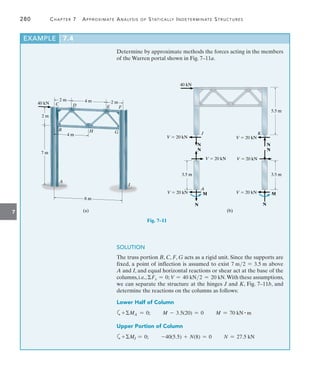
Line of action, 96
Linear displacements (), 463, 465, 587–588
Linear elastic response, 305, 363–364, 381–382
Castigliano’s theorem and, 363–364
deflections and, 305
strain energy and, 381–382
Linear flexibility coefficient, 408–409
Live loads, 12–28, 33, 210–267, 628–629
absolute maximum shear and moment
caused by, 248–252, 267
beams, 219–229, 238–252, 266
bridges, 15
buildings, 12–14
earthquake, 26–27
floor girders, 230–233, 267
impact factor, 16
influence area, 13
influence lines for, 210–267
modeling and, 628–629
procedure for analysis of, 212
reduction of, 13–14
series of concentrated, 238–247, 267
snow, 25–26
structures and, 12–28, 33
trusses, 234–237, 267
uniform, 12–14
wind, 16–24, 629
Load and resistance design factor (LRFD), 28
Load-displacement relationships, 552–555,
587–590, 605–606
axial forces, 552–555
bending moments, 587–590
combined axial, bending, and shear,
605–606
shear forces, 587–590
Loads, 9–28, 33, 42–49, 80, 88, 138–185, 188–196,
209, 212, 219, 238–252, 267, 268–303, 356,
408–410, 511–512, 533–537, 539–540, 544,
552–555, 590, 628–629, 633–634. See also
Force; Influence lines
antisymmetric in symmetric beams,
512, 540
arches, 196, 209
assumption analysis of, 268–303
axial, 552–555
Index	 697
beams, 150–151, 219, 238–252, 266–267
,
539–540, 544, 590
building and design codes for, 9
buildings, 12–14
cable structures, 188–195, 209
concentrated, 188–189, 209, 238–252, 267
data input for computer analysis, 633–634
dead, 10–11, 33, 628
distributed, 150–151
frames, 274–293, 302–303
earthquake, 26–27
external, 356
haunches, 533–537
highway bridges, 15
hydrostatic, 27
idealized structures, 42–49, 80
impact, 16
influence lines and, 212, 219, 408–410, 435
intermediate, 590
internal, 138–185
lateral, 282–293, 302–303
live, 12–28, 33, 628–629
load path, 48–49
modeling and, 628–629
natural, 25–28
nonprismatic members, 533–537
, 539–540, 544
Portland Cement Association publications
for, 535–537
railroad bridges, 15
series of, 238–247
snow, 25–26
soil pressure, 27
stiffness factor (K) modifications for,
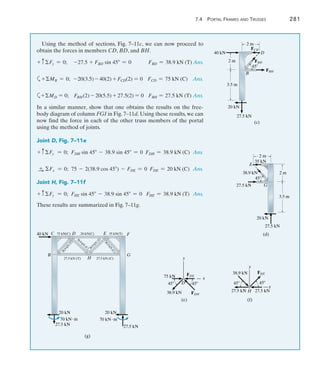
511–512
stiffness method and, 552–555
structural members, in, 138–185
structures and, 9–28, 33
symmetric in symmetric beams, 511, 539
tributary, 42–47
, 80
truss joints, 88
trusses, 270–273, 279–281, 302, 356, 552–555
uniform, 12–14, 190–196, 209, 219
unit, 212, 219, 408–410, 435
vertical, 270–276, 302
wind, 16–24
Magnitude, 96
Matrices, 432–433, 550–561, 574–579, 581, 587–588,
605–611, 638–653. See also Stiffness
matrix
addition and subtraction of, 640
adjoint, 647
column, 639
determinants of, 644–646
diagonal, 639
displacement transformation (T), 551,
553–554, 607
elements, 638
equality of, 640
flexibility, 432
force method and, 432–433
force transformation (Q), 551, 555, 574–579,
608
frames, 605–611
Gauss method for solving equations, 649
identity, 639
inverse of, 646–648
member stiffness (k), 551–553, 556–557,
581, 587–588, 605–606, 609
multiplication of, 640–642
order of, 638
partitioning, 643–644
row, 638
scalars and, 640
square, 639
structural analysis and, 638–653
structure stiffness (K), 550–551, 557–561,
589, 610–611
symmetric, 581, 639
transformation, 553–555
transposed, 642–643
trusses, 550–553, 556–561
unit, 639
Matrix methods, 432–433, 549–551
comparison of, 407, 549
coordinate systems for, 550
flexibility (force method) matrix, 432–433
kinematic indeterminacy and, 551
node identification, 466, 550
stiffness (displacement method) matrix,
549–551
Maxwell’s theorem of reciprocal displacements,
412–413, 435–438, 458
Member (local) coordinate system, 550, 553–555,
586, 632, 634
Member data input, 632
Member-relative stiffness factor, 500
Member stiffness factor, 498
Member stiffness influence coefficients, 552–553
Member stiffness matrix, see Stiffness matrix
Method of joints for, 96–99, 119, 137
Method of least work, see Castigliano’s theorem
Method of sections, 50, 102–107, 119, 137, 139–144
internal loads determined from, 50, 139–144
planar truss analysis, 102–107, 137
procedures of analysis using, 104, 119, 141
space truss analysis, 119
Method of substitute members, 112–115, 137
Method of virtual displacements, 356
Method of virtual forces, 355
Modeling, see Structural modeling
Moment diagrams, 150–169, 185
beams, 150–159
cantilevered beams, 166
frames, 160–164
procedure for construction of, 154
simply supported beams, 167
slope of, 151, 153, 185
superposition, method of for construction of,
165–169, 185
Moment distribution, 496–531, 538–543
beams, 463–476, 498–515, 538–543
carry-over factor (CO), 500, 502,
displacement method of analysis using,
496–531
distribution factor (DF), 499, 501
fixed-end moments (FEM), 498, 501–504,
519, 541
frames, 496–500, 516–525
joint connections and, 496–531
nonprismatic members, 538–543
pin-supported beams, 510, 538
principles of, 497–500
procedure for analysis using, 505
relative joint translation, 541
sidesway effects on, 518–525
sign convention for, 498
statically indeterminate structures, 496–531
stiffness factor (K), 498–501, 510–515, 531,
538–540
symmetric beams, 511–512, 539–540
Moment-area theorems, 320–329, 347
beam deflection analysis, 320–329, 347
first theorem, 320
procedures for analysis using, 322
second theorem, 321
Moments (M), 139–149, 152–153, 166–167, 185,
211–218, 242–243, 248–252, 267, 305–319,
330–337, 346, 351–352, 355, 370–380,
387–392, 402–403, 437, 587–590, 605–606.
See also Bending moments; Fixed-end
moments (FEM)
absolute maximum, 248–252, 267
beam points, 437
bending, 139–149, 185, 211–218, 242–243,
246–247, 248–252, 266–267, 587–590,
605–606
Castigliano’s theorem and, 387–392, 403
couple, 355, 387
deflection and, 305–319, 330–337, 346
displacements (u), 351–352, 355, 370–380, 387,
402–403
energy methods of analysis, 351–352, 355,
370–380, 387–392, 402–403
external work and, 351, 402
influence lines and, 211–218, 242–243,
248–252, 267, 437
internal bending, 305–319, 330–337, 346
internal loads as, 139–149, 185, 305–319,
330–337, 346
maximum at a point, 242–243, 246–247
relationships with loading and shear,
152–153
resultant, 139, 167
sign convention for, 140, 152, 307
stiffness method and, 587–590, 605–606
strain energy and, 352
superposition and, 166–167
virtual work, method of, 370–380, 403
work (magnitude), 347
Müller-Breslau principle, 222–229, 266, 435–438
deflection and, 222–229, 266
hinge or pin displacement, 224
influence lines and, 222–229, 266, 435
Maxwell’s theorem of reciprocal
displacements and, 435–438
roller guide displacement, 222–224
statically determinate beams, 222–229, 266
statically indeterminate beams, 435–438
Nodes, 466, 550, 570–573, 585–586, 631–633
beams, 466, 585–586
computers analysis and, 631–633
coordinates for, 550, 570–573, 632
data input, 632–633
degrees of freedom and, 466
force (flexibility) method of analysis
and, 466
identification of, 466, 550, 585–586, 631
stiffness method of analysis and, 550
trusses, 570–573
Nonprismatic members, 532–547
beams, 538–543
carry-over factor (COF), 534–537
conjugate-beam method for, 535
deflections, equations for, 533
fixed-end moments (FEM), 534–537, 541,
544–545
haunches, 533–537
loading properties of, 533–537
moment distribution for, 538–543
pin-supported, 538
Portland Cement Association publications
for, 535–537
relative joint translation of, 541, 544
rotation of, 544–545
slope-deflection equations for, 544–546
stiffness factor (K), 534–537, 538–540
symmetric, 539–540
Normal force (N), 139–144, 185
Panel points, 230–233
Panel region, 230
Panel shear, 231
Parabolic haunches, 533, 537
Parabolic shapes, 191, 196, 209
Parker truss, 86–87
Partial fixity of portal frames, 278
698	 Index
Partitioning of a matrix, 643–644
Pin-supported connections, 36–37
, 39, 88, 277
, 279,
STRUCTURAL ANALYSIS NINTH EDITION R. C. HIBBELER

STRUCTURAL ANALYSIS NINTH EDITION R. C. HIBBELER

  • 2.
    STRUCTURAL ANALYSIS NINTH EDITION R. C.HIBBELER Boston Columbus Indianapolis New York San Francisco Upper Saddle River Amsterdam Cape Town Dubai London Madrid Milan Munich Paris Montréal Toronto Delhi Mexico City São Paulo Sydney Hong Kong Seoul Singapore Taipei Tokyo
  • 3.
    Library of CongressCataloging-in-Publication Data on File Vice President and Editorial Director, ECS: Marcia J. Horton Acquisitions Editor: Norrin Dias Editorial Assistant: Sandra Rodriguez Managing Editor: Scott Disanno Production Editor: Rose Keman Art Director: Marta Samsel Art Editor: Gregory Dulles Manufacturing Manager: Mary Fischer Manufacturing Buyer: Maura Zaldivar-Garcia Product marketing Manager: Bram Van Kempen Field Marketing manager: Demetrius Hall Marketing Assistant: Jon Bryant Cover Designer: Black Horse Designs Cover Image: © Acnalesky/Fotolia Photos not otherwise credited are © R.C. Hibbeler. © 2015, 2012 by R. C. Hibbeler Published by Pearson Prentice Hall Pearson Education, Inc. Upper Saddle River, New Jersey 07458 All rights reserved. No part of this book may be reproduced, in any form or by any means, without permission in writing from the publisher. The author and publisher of this book have used their best efforts in preparing this book. These efforts include the development, ­ research, and testing of the theories and programs to determine their effectiveness. The author and publisher make no warranty of any kind, ­ expressed or implied with regard to these programs or the documentation contained in this book. The author and publisher shall not be liable in any event for incidental or consequential damages in connection with, or arising out of, the furnishing, performance, or use of these programs. Previous editions copyright © 2012, 2009, 2006, 2002, 1999, 1995, 1990, 1985 by R. C. Hibbeler. Pearson Education Ltd., London Pearson Education Australia Pty. Ltd., Sydney Pearson Education Singapore, Pte. Ltd. Pearson Eduction North Asia Ltd., Hong Kong Pearson Education Canada, Inc., Toronto Pearson Educación de Mexico, S.A. de C.V. Pearson Education--Japan, Tokyo Pearson Education Malaysia, Pte. Ltd. Pearson Education, Upper Saddle River, New Jersey Printed in the United States of America. 10 9 8 7 6 54 3 2 1 ISBN-10: 0-13-394284-8 ISBN-13: 978-0-13-394284-2 www.pearsonhighered.com
  • 4.
    To The Student Withthe hope that this work will stimulate an interest in Structural Analysis and provide an acceptable guide to its understanding.
  • 5.
  • 6.
      Preface This book isintended to provide the student with a clear and thorough presentation of the theory and application of structural analysis as it applies to trusses, beams, and frames. Emphasis is placed on developing the student’s ability to both model and analyze a structure and to provide realistic applications encountered in professional practice. For many years now, engineers have been using matrix methods to analyze structures. Although these methods are most efficient for a structural analysis, it is the author’s opinion that students taking a first course in this subject should also be well versed in some of the more important classicial methods. Practice in applying these methods will develop a deeper understanding of the basic engineering sciences of statics and mechanics of materials. Also, problem-solving skills are further developed when the various techniques are thought out and applied in a clear and orderly way. By solving problems in this way one can better grasp the way loads are transmitted through a structure and obtain a more complete understanding of the way the structure deforms under load. Finally, the classicial methods provide a means of checking computer results rather than simply relying on the generated output. New Material and Content Revision. This edition now includes examples of the causes of structural failures, the concept of a load path, and an enhanced discussion for drawing shear and moment diagrams and the deflection of beams and frames. Chapter 17 has been added, which now provides a discussion of structural modeling concepts and a general description of how computer software is applied. Included are some structural modeling projects, along with a set of problems that require a computer analysis. Structural Terminology. There are several places throughout the text where illustrations and discussion of additional terminology has been added, so that the student becomes familiar with the basic forms of fundamental structures and the names of their members. Problem Arrangement. Different from the previous edition, the problems in each chapter are now placed at the end of the chapter.They are grouped with section headings for the convenience of assigning problems for homework. New Problems. There are approximately 70% new problems in this edition.They retain a balance of easy, medium, and difficult applications. In addition, some new fundamental problems have been added that stress the importance of drawing frame moment diagrams and drawing deflected structures. Apart from the author, the problems have been checked by four other parties, namely Scott Hendricks, Karim Nora, Kurt Norlin, and Kai Beng Yap. Additional Photos. The relevance of knowing the subject matter is reflected by the realistic applications depicted in many new and updated photos along with captions that are placed throughout the book.
  • 7.
    vi Preface Organization andApproach The contents of each chapter are arranged into sections with specific topics categorized by title headings. Discussions relevant to a particular theory are succinct, yet thorough. In most cases, this is followed by a “procedure for analysis” guide, which provides the student with a summary of the important concepts and a systematic approach for applying the theory.The example problems are solved using this outlined method in order to clarify its numerical application. Problems are given at the end of each chapter, and are arranged to cover the material in sequential order. Moreover, for any topic they are arranged in approximate order of increasing difficulty. Hallmark Elements •   Photographs. Many photographs are used throughout the book to explain how the principles of structural analysis apply to real-world situations. •   Problems. Most of the problems in the book depict realistic situations encountered in practice. It is hoped that this realism will both stimulate the student’s interest in structural analysis and develop the skill to reduce any such problem from its physical description to a model or symbolic representation to which the appropriate theory can be applied. This modeling process is further discussed in Chapter 17. Throughout the book there is an approximate balance of problems using either SI or FPS units. The intent has been to develop problems that test the student’s ability to apply the theory, keeping in mind that those problems requiring tedious calculations can be relegated to computer analysis. •   Answers to Selected Problems.  The answers to selected problems are listed in the back of the book. Extra care has been taken in the presentation and solution of the problems, and all the problem sets have been reviewed and the solutions checked and rechecked to ensure both their clarity and numerical accuracy. •   Example Problems.  All the example problems are presented in a concise manner and in a style that is easy to understand. •   Illustrations. Throughout the book, an increase in two-color art has been added, including many photorealistic illustrations that provide a strong connection to the 3-D nature of structural engineering. •   Triple Accuracy Checking. The edition has undergone rigorous accuracy checking and proofing of pages. Besides the author’s review of all art pieces and pages, Scott Hendricks of Virginia Polytechnic Institute, Karim Nohra of the University of South Florida, and Kurt Norlin of Laurel Technical Services rechecked the page proofs and together reviewed the Solutions Manual.
  • 8.
    Preface vii •   FundamentalProblems.  These problem sets are selectively located at the end of most chapters. They offer students simple applications of the concepts and, therefore, provide them with the chance to develop their problem-solving skills before attempting to solve any of the standard problems that follow. You may consider these problems as extended examples since they all have solutions and answers that are given in the back of the book. Additionally, the fundamental problems offer students an excellent means of studying for exams, and they can be used at a later time to prepare for the exam necessary to obtain a professional engineering license. Contents This book is divided into three parts. The first part consists of seven chapters that cover the classical methods of analysis for statically determinate structures. Chapter 1 provides a discussion of the various types of structural forms and loads. Chapter 2 discusses the determination of forces at the supports and connections of statically determinate beams and frames. The analysis of various types of statically determinate trusses is given in Chapter 3, and shear and bending-moment functions and diagrams for beams and frames are presented in Chapter 4. In Chapter 5, the analysis of simple cable and arch systems is presented, and in Chapter 6 influence lines for beams, girders, and trusses are discussed. Finally, in Chapter 7 several common techniques for the approximate analysis of statically indeterminate structures are considered. In the second part of the book, the analysis of statically indeterminate structures is covered in six chapters. Geometrical methods for calculating deflections are discussed in Chapter 8. Energy methods for finding deflections are covered in Chapter 9. Chapter 10 covers the analysis of statically indeterminate structures using the force method of analysis, in addition to a discussion of influence lines for beams.Then the displacement methods consisting of the slope-deflection method in Chapter 11 and moment distribution in Chapter 12 are discussed. Finally,beams and frames having nonprismatic members are considered in Chapter 13. The third part of the book treats the matrix analysis of structures using the stiffness method. Trusses are discussed in Chapter 14, beams in Chapter 15, and frames in Chapter 16. Finally, Chapter 17 provides some basic ideas as to how to model a structure, and for using available software for solving problem in structural analysis. A review of matrix algebra is given in Appendix A.
  • 9.
    viii Preface Resources forInstructors •   MasteringEngineering. This online Tutorial Homework program allows you to integrate dynamic homework with automatic grading and adaptive tutoring. MasteringEngineering allows you to easily track the performance of your entire class on an assignment-by-assignment basis, or the detailed work of an individual student. •   Instructor’s Solutions Manual. An instructor’s solutions manual was prepared by the author. The manual was also checked as part of the Triple Accuracy Checking program. •   Presentation Resources. All art from the text is available in PowerPoint slide and JPEG format. These files are available for downloadfromtheInstructorResourceCenterat www.pearsonhighered. com. If you are in need of a login and password for this site, please contact your local Pearson Prentice Hall representative. •   Video Solutions. Located on the Companion Website, Video Solutions offer step-by-step solution walkthroughs of representative homework problems from each chapter of the text. Make efficient use of class time and office hours by showing students the complete and concise problem solving approaches that they can access anytime and view at their own pace. The videos are designed to be a flexible resource to be used however each instructor and student prefers. A valuable tutorial resource, the videos are also helpful for student self- evaluation as students can pause the videos to check their understanding and work alongside the video. Access the videos at www.pearsonhighered.com/hibbeler and follow the links for the Structural Analysis text. •   STRAN.  Developed by the author and Barry Nolan, a practicing engineer, STRAN is a downloadable program for use with Structural Analysis problems. Access STRAN on the Companion Website, www. pearsonhighered.com/hibbeler and follow the links for the Structural Analysis text. Complete instructions for how to use the software are included on the Companion Website. Resources for Students •   MasteringEngineering. Tutorial homework problems emulate the instrutor’s office-hour environment. •   Companion Website. The Companion Website provides practice and review materials including: ❍    Video Solutions—Complete, step-by-step solution walkthroughs of representative homework problems from each chapter.
  • 10.
    Preface ix Videos offer: ■  FullyworkedSolutions—Showingeverystepofrepresentative homework problems, to help students make vital connections between concepts. ■    Self-paced Instruction—Students can navigate each problem and select, play, rewind, fast-forward, stop, and jump- to-sections within each problem’s solution. ■    24/7 Access—Help whenever students need it with over 20 hours of helpful review. ❍     STRAN—A program you can use to solve two and three dimensional trusses and beams, and two dimensional frames. Instructions for downloading and how to use the program are available on the Companion Website. An access code for the Structural Analysis, Ninth Edition Companion Website is included with this text.To redeem the code and gain access to the site, go to www.pearsonhighered.com/hibbeler and follow the directions on the access code card.Access can also be purchased directly from the site. Acknowledgments Through the years, over one hundred of my colleagues in the teaching profession and many of my students have made valuable suggestions that have helped in the development of this book, and I would like to hereby acknowledge all of their comments. I personally would like to thank the reviewers contracted by my editor for this new edition, namely: Delong Zuo, Texas Tech University Husam Najm, Rutgers University Tomasz Arciszewski, University of Colorado—Boulder Brian Swartz, University of Hartford Vicki May, Dartmouth College Thomas Boothby, Penn State University Leroy Hulsey, University of Alaska—Fairbanks Reagan Herman, University of Houston Des Penny, Southern Utah University Ahmet Pamuk, Flordia State University Also, the constructive comments from Kai Beng Yap, and Barry Nolan, both practicing engineers are greatly appreciated. Finally, I would like to acknowledge the support I received from my wife Conny, who has always been very helpful in preparing the manuscript for publication. I would greatly appreciate hearing from you if at any time you have any comments or suggestions regarding the contents of this edition. Russell Charles Hibbeler hibbeler@bellsouth.net
  • 11.
  • 12.
  • 13.
      CONTENTS 1 Types of Structuresand Loads  3   1.1 Introduction 3   1.2 Classification of Structures  4   1.3 Loads 9   1.4 Structural Design  28 Problems 29 Chapter Review  33 2 Analysis of Statically Determinate Structures  35   2.1 Idealized Structure  35   2.2 Load Path  48   2.3 Principle of Superposition  49   2.4 Equations of Equilibrium  50   2.5 Determinacy and Stability  51   2.6 Application of the Equations of ­Equilibrium  58 Fundamental Problems  68 Problems 70 Project Problem  79 Chapter Review  80
  • 14.
    3 Analysis of Statically DeterminateTrusses  83   3.1 Common Types of Trusses  83   3.2 Classification of Coplanar Trusses  89   3.3 The Method of Joints  96   3.4 Zero-Force Members  100   3.5 The Method of Sections  102   3.6 Compound Trusses  108   3.7 Complex Trusses  112   3.8 Space Trusses  116 Fundamental Problems  123 Problems 125 Project Problem  135 Chapter Review  136 4 Internal Loadings Developed in Structural Members 139   4.1 Internal Loadings at a ­Specified Point  139   4.2 Shear and Moment Functions  145   4.3 Shear and Moment Diagrams for a Beam 150   4.4 Shear and Moment Diagrams for a Frame 160   4.5 Moment Diagrams Constructed by the Method of Superposition  165 Fundamental Problems  170 Problems 174 Project Problem  184 Chapter Review  185 Contents xiii
  • 15.
    xiv Contents 5 Cables and Arches 187  5.1 Cables 187   5.2 Cable Subjected to ­Concentrated Loads  188   5.3 Cable Subjected to a Uniform ­Distributed Load  190   5.4 Arches 196   5.5 Three-Hinged Arch  197 Problems 203 Chapter Review  209 6 Influence Lines for Statically ­Determinate Structures 211   6.1 Influence Lines  211   6.2 Influence Lines for Beams  219   6.3 Qualitative Influence Lines  222   6.4 Influence Lines for Floor Girders  230   6.5 Influence Lines for Trusses  234   6.6 Maximum Influence at a Point due to a Series of Concentrated Loads  238   6.7 Absolute Maximum Shear and ­Moment  248 Fundamental Problems  253 Problems 254 Project Problem  265 Chapter Review  266
  • 16.
    Contents xv 7 Approximate Analysisof Statically Indeterminate Structures 269   7.1 Use of Approximate Methods  269   7.2 Trusses 270   7.3 Vertical Loads on Building Frames  274   7.4 Portal Frames and Trusses  277   7.5 Lateral Loads on Building Frames: P­ortal Method  282   7.6 Lateral Loads on Building Frames: ­Cantilever Method  288 Problems 294 Project Problem  301 Chapter Review  302 8 Deflections 305   8.1 Deflection Diagrams and the ­Elastic Curve  305   8.2 Elastic-Beam Theory  311   8.3 The Double Integration Method  313   8.4 Moment-Area Theorems  320   8.5 Conjugate-Beam Method  330 Fundamental Problems  338 Problems 342 Chapter Review  346 FPO
  • 17.
    xvi Contents 9 Deflections Using Energy ­Methods 349  9.1 External Work and Strain Energy  349   9.2 Principle of Work and Energy  353   9.3 Principle of Virtual Work  354   9.4 Method of Virtual Work: Trusses  356   9.5 Castigliano’s Theorem  363   9.6 Castigliano’s Theorem for Trusses  364   9.7 Method of Virtual Work: Beams and Frames 370   9.8 Virtual Strain Energy Caused by ­ Axial Load, Shear, Torsion, and ­Temperature  381   9.9 Castigliano’s Theorem for Beams and Frames 387 Fundamental Problems  393 Problems 395 Chapter Review  402 10 Analysis of Statically ­Indeterminate Structures by the Force Method 405   10.1 Statically Indeterminate Structures  405   10.2 Force Method of Analysis: ­General ­Procedure  408   10.3 Maxwell’s Theorem of Reciprocal D­ isplacements; Betti’s Law  412   10.4 Force Method of Analysis: Beams  413   10.5 Force Method of Analysis: Frames  422
  • 18.
    Contents xvii   10.6 Force Method of Analysis: Trusses  426   10.7 Composite Structures  429   10.8 Additional Remarks on the Force ­Method of Analysis  432   10.9 Symmetric Structures  433 10.10 Influence Lines for Statically ­Indeterminate Beams  435 10.11 Qualitative Influence Lines for Frames 439 Fundamental Problems  446 Problems 447 Chapter Review  458 11 Displacement Method of Analysis: Slope-Deflection Equations 461   11.1 Displacement Method of Analysis: ­General Procedures  461   11.2 Slope-Deflection Equations  463   11.3 Analysis of Beams  469   11.4 Analysis of Frames: No Sidesway  477   11.5 Analysis of Frames: Sidesway  482 Problems 490 Project Problem  495 Chapter Review  495
  • 19.
    xviii Contents 12 Displacement Method ofAnalysis: Moment Distribution 497   12.1 General Principles and Definitions  497   12.2 Moment Distribution for Beams  501   12.3 Stiffness-Factor Modifications  510   12.4 Moment Distribution for Frames: No ­Sidesway  516   12.5 Moment Distribution for Frames: ­Sidesway  518 Problems 526 Chapter Review  531 13 Beams and Frames Having ­Nonprismatic Members 533   13.1 Loading Properties of Nonprismatic ­Members  533   13.2 Moment Distribution for Structures ­ Having Nonprismatic Members  538   13.3 Slope-Deflection Equations for ­Nonprismatic Members  544 Problems 546 Chapter Review  547
  • 20.
    Contents xix 14 Truss AnalysisUsing the ­Stiffness Method 549   14.1 Fundamentals of the Stiffness ­Method  549   14.2 Member Stiffness Matrix  552   14.3 Displacement and Force T­ransformation Matrices  553   14.4 Member Global Stiffness Matrix  556   14.5 Truss Stiffness Matrix  557   14.6 Application of the Stiffness Method for Truss Analysis  562   14.7 Nodal Coordinates  570   14.8 Trusses Having Thermal Changes and Fabrication Errors  574   14.9 Space-Truss Analysis  580 Problems 582 Chapter Review  583 15 Beam Analysis Using the ­Stiffness Method 585   15.1 Preliminary Remarks  585   15.2 Beam-Member Stiffness Matrix  587   15.3 Beam-Structure Stiffness Matrix  589   15.4 Application of the Stiffness Method for Beam Analysis  589 Problems 602
  • 21.
    xx Contents 16 Plane Frame AnalysisUsing the Stiffness Method 605   16.1 Frame-Member Stiffness Matrix  605   16.2 Displacement and Force ­Transformation Matrices  607   16.3 Frame-Member Global Stiffness ­Matrix  609   16.4 Application of the Stiffness Method for Frame Analysis  610 Problems 619 17 Structural Modeling and ­Computer Analysis 623   17.1 General Structural Modeling  623   17.2 Modeling a Structure and its ­Members  625   17.3 General Application of a Structural ­ Analysis Computer Program  630 Computer Problems  635 Problems 636 Project Problems  637 Appendices A. Matrix Algebra for Structural ­Analysis  640 Fundamental ­Solutions  654 Answers to Selected Problems  680 Index  693
  • 22.
  • 23.
    Chapter 1 Severe windloadings caused by a hurricane have caused noticeable damage to the windows of the high-rise building. © Joel Stahl/AP Images
  • 24.
    3 Types of Structures andLoads This chapter provides a discussion of some of the preliminary aspects of structural analysis. The phases of activity necessary to produce a structure are presented first, followed by an introduction to the basic types of structures, their components, and supports. Finally, a brief explanation is given of the various types of loads that must be considered for an appropriate analysis and design. 1.1  Introduction In this text we will present many of the different ways engineers model and then analyze the loadings and deflections of various types of structures. Important examples related to civil engineering include buildings,bridges, and towers; and in other branches of engineering, ship and aircraft frames, and mechanical, and electrical supporting structures are important. A structure refers to a system of connected parts used to support a load. When designing a structure to serve a specified function for public use, the engineer must account for its safety, esthetics, and serviceability, while taking into consideration economic and environmental constraints. Often this requires several independent studies of different solutions before final judgment can be made as to which structural form is most appropriate. This design process is both creative and technical and requires a fundamental knowledge of material properties and the laws of mechanics which govern material response. Once a preliminary design of a structure is proposed, the structure must then be analyzed to ensure that it has its required stiffness and strength. To analyze a structure properly, certain idealizations must be made as to how the members are supported and connected together. The loadings are determined from codes and local specifications, and the forces in the members and their displacements are found using the theory of structural analysis, which is
  • 25.
    4 Chapter 1  Typesof Structures and Loads 1 the subject matter of this text. The results of this analysis then can be used to redesign the structure, accounting for a more accurate determination of the weight of the members and their size. Structural design, therefore, follows a series of successive approximations in which every cycle requires a structural analysis. In this book, the structural analysis is applied to civil engineering structures; however, the method of analysis described can also be used for structures related to other fields of engineering. 1.2  Classification of Structures It is important for a structural engineer to recognize the various types of elements composing a structure and to be able to classify structures as to their form and function.We will introduce some of these aspects now and discuss others throughout the text. Structural Elements.  Some of the more common elements from which structures are composed are as follows. Tie Rods. Structural members subjected to a tensile force are often referred to as tie rods or bracing struts. Due to the nature of this load, these members are rather slender, and are often chosen from rods, bars, angles, or channels, Fig. 1–1. rod tie rod bar angle channel typical cross sections rod tie rod bar angle channel typical cross sections Tie rods used for wind bracing. Fig. 1–1
  • 26.
    1.2  Classification ofStructures 5 1 Beams. Beams are usually straight horizontal members used primarily to carry vertical loads. Quite often they are classified according to the way they are supported, as indicated in Fig. 1–2. In particular, when the cross section varies the beam is referred to as tapered or haunched. Beam cross sections may also be “built up” by adding plates to their top and bottom. Beams are primarily designed to resist bending moment; however, if they are short and carry large loads, the internal shear force may become quite large and this force may govern their design. When the material used for a beam is a metal such as steel or aluminum, the cross section is most efficient when it is shaped as shown in Fig. 1–3. Here the forces developed in the top and bottom flanges of the beam form the necessary couple used to resist the applied moment M, whereas the web is effective in resisting the applied shear V. This cross section is commonly referred to as a “wide flange,” and it is normally formed as a single unit in a rolling mill in lengths up to 75 ft (23 m). If shorter lengths are needed, a cross section having tapered flanges is sometimes selected. When the beam is required to have a very large span and the loads applied are rather large, the cross section may take the form of a plate girder. This member is fabricated by using a large plate for the web and welding or bolting plates to its ends for flanges. The girder is often transported to the field in segments, and the segments are designed to be spliced or joined together at points where the girder carries a small internal moment. Concrete beams generally have rectangular cross sections, since it is easy to construct this form directly in the field. Because concrete is rather weak in resisting tension, steel “reinforcing rods” are cast into the beam within regions of the cross section subjected to tension. Precast concrete beams or girders are fabricated at a shop or yard in the same manner and then transported to the job site. Beams made from timber may be sawn from a solid piece of wood or laminated. Laminated beams are constructed from solid sections of wood, which are fastened together using high-strength glues. Shown are typical splice plate joints used to connect the steel girders of a highway bridge. The prestressed concrete girders are simply supported and are used for this highway bridge. simply supported beam cantilevered beam fixed–supported beam continuous beam Fig. 1–2 web V M wide-flange beam flange flange web V M wide-flange beam Fig. 1–3
  • 27.
    6 Chapter 1  Typesof Structures and Loads 1 Columns. Members that are generally vertical and resist axial compressive loads are referred to as columns, Fig. 1–4. Tubes and wide-flange cross sections are often used for metal columns, and circular and square cross sections with reinforcing rods are used for those made of concrete. Occasionally, columns are subjected to both an axial load and a bending moment as shown in the figure. These members are referred to as beam columns. Types of Structures.  The combination of structural elements and the materials from which they are composed is referred to as a structural system. Each system is constructed of one or more of four basic types of structures. Ranked in order of complexity of their force analysis, they are as follows. Trusses. When the span of a structure is required to be large and its depth is not an important criterion for design, a truss may be selected. Trusses consist of slender elements, usually arranged in triangular fashion. Planar trusses are composed of members that lie in the same plane and are frequently used for bridge and roof support, whereas space trusses have members extending in three dimensions and are suitable for derricks and towers. Due to the geometric arrangement of its members, loads that cause the entire truss to bend are converted into tensile or compressive forces in the members. Because of this, one of the primary advantages of a truss, compared to a beam, is that it uses less material to support a given load, Fig.1–5.Also,a truss is constructed from long and slender elements, which can be arranged in various ways to support a load. Most often it is economically feasible to use a truss to cover spans ranging from 30 ft (9 m) to 400 ft (122 m), although trusses have been used on occasion for spans of greater lengths. Wide-flange members are often used for columns. Here is an example of a beam column. beam column column Fig. 1–4
  • 28.
    1.2  Classification ofStructures 7 1 Cables and Arches. Two other forms of structures used to span long distances are the cable and the arch. Cables are usually flexible and carry their loads in tension. They are commonly used to support bridges, Fig. 1–6a, and building roofs.When used for these purposes, the cable has an advantage over the beam and the truss, especially for spans that are greater than 150 ft (46 m). Because they are always in tension, cables will not become unstable and suddenly collapse, as may happen with beams or trusses.Furthermore,the truss will require added costs for construction and increased depth as the span increases. Use of cables, on the other hand, is limited only by their sag, weight, and methods of anchorage. The arch achieves its strength in compression, since it has a reverse curvature to that of the cable. The arch must be rigid, however, in order to maintain its shape, and this results in secondary loadings involving shear and moment, which must be considered in its design. Arches are frequently used in bridge structures, Fig. 1–6b, dome roofs, and for openings in masonry walls. Arches support their loads in compression. Fig. 1–5  Fig. 1–6 (b) (a) Loading causes bending of the truss, which develops compression in the top members, and tension in the bottom members. Cables support their loads in tension.
  • 29.
    8 Chapter 1  Typesof Structures and Loads 1 pinned rigid rigid pinned Frame members are subjected to internal axial, shear, and moment loadings. Fig. 1–7 Frames. Frames are often used in buildings and are composed of beams and columns that are either pin or fixed connected, Fig. 1–7 . Like trusses, frames extend in two or three dimensions.The loading on a frame causes bending of its members, and if it has rigid joint connections, this structure is generally “indeterminate” from a standpoint of analysis.The strength of such a frame is derived from the moment interactions between the beams and the columns at the rigid joints. Surface Structures. A surface structure is made from a material having a very small thickness compared to its other dimensions. Sometimes this material is very flexible and can take the form of a tent or air-inflated structure. In both cases the material acts as a membrane that is subjected to pure tension. Surface structures may also be made of rigid material such as reinforced concrete. As such they may be shaped as folded plates, cylinders, or hyperbolic paraboloids, and are referred to as thin plates or shells. These structures act like cables or arches since they support loads primarily in tension or compression, with very little bending. In spite of this, plate or shell structures are generally very difficult to analyze, due to the three- dimensional geometry of their surface. Such an analysis is beyond the scope of this text and is instead covered in texts devoted entirely to this subject. Typical steel framework. The roof of the “Georgia Dome” in Atlanta, Georgia can be considered as a thin membrane. © Bob Krist/Documentary Value/Corbis
  • 30.
    1.3  Loads 9 1 1.3 Loads Once the dimensional requirements for a structure have been defined, it becomes necessary to determine the loads the structure must support. Often, it is the anticipation of the various loads that will be imposed on the structure that provides the basic type of structure that will be chosen for design. For example, high-rise structures must endure large lateral loadings caused by wind,and so shear walls and tubular frame systems are selected, whereas buildings located in areas prone to earthquakes must be designed having ductile frames and connections. Once the structural form has been determined,the actual design begins with those elements that are subjected to the primary loads the structure is intended to carry, and proceeds in sequence to the various supporting members until the foundation is reached. Thus, a building floor slab would be designed first, followed by the supporting beams, columns, and last, the foundation footings. In order to design a structure, it is therefore necessary to first specify the loads that act on it. The design loading for a structure is often specified in codes.In general, the structural engineer works with two types of codes: general building codes and design codes. General building codes specify the requirements of governmental bodies for minimum design loads on structures and minimum standards for construction. Design codes provide detailed technical standards and are used to establish the requirements for the actual structural design. Table 1.1 lists some of the important codes used in practice. It should be realized, however, that codes provide only a general guide for design. The ultimate responsibility for the design lies with the structural engineer. Since a structure is generally subjected to several types of loads, a brief discussion of these loadings will now be presented to illustrate how one must consider their effects in practice. TABLE 1.1  Codes General Building Codes Minimum Design Loads for Buildings and Other Structures, ASCE/SEI 7-10, American Society of Civil Engineers International Building Code Design Codes Building Code Requirements for Reinforced Concrete, Am. Conc. Inst. (ACI) Manual of Steel Construction, American Institute of Steel Construction (AISC) Standard Specifications for Highway Bridges, American Association of State Highway and Transportation Officials (AASHTO) National Design Specification for Wood Construction, American Forest and Paper Association (AFPA) Manual for Railway Engineering, American Railway Engineering Association (AREA)
  • 31.
    10 Chapter 1  Typesof Structures and Loads 1 Dead Loads.  Dead loads consist of the weights of the various structural members and the weights of any objects that are permanently attached to the structure. Hence, for a building, the dead loads include the weights of the columns, beams, and girders, the floor slab, roofing, walls, windows, plumbing, electrical fixtures, and other miscellaneous attachments. In some cases, a structural dead load can be estimated satisfactorily from simple formulas based on the weights and sizes of similar structures. Through experience one can also derive a “feeling” for the magnitude of  these loadings. For example, the average weight for timber buildings is 40950 lbft2 (1.992.4 kNm2 ), for steel framed buildings it is 60975 lbft2 (2.993.6 kNm2 ), and for reinforced concrete buildings it is 1109130 lbft2 (5.396.2 kNm2 ). Ordinarily, though, once the materials and sizes of the various components of the structure are determined, their weights can be found from tables that list their densities. TABLE 1.2  Minimum Densities for Design Loads from Materials* lbft3 kNm3 Aluminum 170 26.7 Concrete, plain cinder 108 17 .0 Concrete, plain stone 144 22.6 Concrete, reinforced cinder 111 17 .4 Concrete, reinforced stone 150 23.6 Clay, dry 63 9.9 Clay, damp 110 17 .3 Sand and gravel, dry, loose 100 15.7 Sand and gravel, wet 120 18.9 Masonry, lightweight solid concrete 105 16.5 Masonry, normal weight 135 21.2 Plywood 36 5.7 Steel, cold-drawn 492 77 .3 Wood, Douglas Fir 34 5.3 Wood, Southern Pine 37 5.8 Wood, spruce 29 4.5 *Minimum Densities for Design Loads from Materials,Reproduced with permission from American Society of Civil Engineers Minimum Design Loads for Buildings and Other Structures, ASCE/ SEI 7-10. Copies of this standard may be purchaed from ASCE at www.pubs.asce.org, American Society of Civil Engineers. TABLE 1.3  Minimum Design Dead Loads* Walls psf kNm2 4-in. (102 mm) clay brick 39 1.87 8-in. (203 mm) clay brick 79 3.78 12-in. (305 mm) clay brick 115 5.51 Frame Partitions and Walls Exterior stud walls with brick veneer 48 2.30 Windows, glass, frame and sash 8 0.38 Wood studs 2 * 4 in. (51 * 102 mm), unplastered 4 0.19 Wood studs 2 * 4 in. (51 * 102 mm), plastered one side 12 0.57 Wood studs 2 * 4 in. (51 * 102 mm), plastered two sides 20 0.96 Floor Fill Cinder concrete, per inch (mm) 9 0.017 Lightweight concrete, plain, per inch (mm) 8 0.015 Stone concrete, per inch (mm) 12 0.023 Ceilings Acoustical fiberboard 1 0.05 Plaster on tile or concrete 5 0.24 Suspended metal lath and gypsum plaster 10 0.48 Asphalt shingles 2 0.10 Fiberboard, 1 2@in. (13 mm) 0.75 0.04 *Minimum Design Dead Loads, Reproduced with permission from American Society of Civil Engineers Minimum Design Loads for Buildings and Other Structures, ASCE/SEI 7-10, American Society of Civil Engineers.
  • 32.
    1.3  Loads 11 1 Thedensities of typical materials used in construction are listed in Table 1.2, and a portion of a table listing the weights of typical building components is given in Table 1.3. Although calculation of dead loads based on the use of tabulated data is rather straightforward, it should be realized that in many respects these loads will have to be estimated in the initial phase of design. These estimates include nonstructural materials such as prefabricated facade panels, electrical and plumbing systems, etc. Furthermore, even if the material is specified, the unit weights of elements reported in codes may vary from those given by manufacturers, and later use of the building may include some changes in dead loading. As a result, estimates of dead loadings can be in error by 15% to 20% or more. Normally, the dead load is not large compared to the design load for simple structures such as a beam or a single-story frame; however, for multistory buildings it is important to have an accurate accounting of all the dead loads in order to properly design the columns, especially for the lower floors. EXAMPLE 1.1  The floor beam in Fig. 1–8 is used to support the 6-ft width of a lightweight plain concrete slab having a thickness of 4 in. The slab serves as a portion of the ceiling for the floor below, and therefore its bottom is coated with plaster. Furthermore, an 8-ft-high, 12-in.-thick lightweight solid concrete block wall is directly over the top flange of the beam. Determine the loading on the beam measured per foot of length of the beam. SOLUTION Using the data in Tables 1.2 and 1.3, we have Concrete slab: Plaster ceiling: Block wall: Total load 38 lb(ft2 # in.)4(4 in.)(6 ft) = 192 lbft (5 lbft2 )(6 ft) = 30 lbft (105 lbft3 )(8 ft)(1 ft) = 840 lbft 1062 lbft = 1.06 kft Ans. Here the unit k stands for “kip,” which symbolizes kilopounds. Hence, 1 k = 1000 lb. 3 ft 3 ft 8 ft 4 in. 12 in. Fig. 1–8 
  • 33.
    12 Chapter 1  Typesof Structures and Loads 1 Live Loads.  Live loads can vary both in their magnitude and location. They may be caused by the weights of objects temporarily placed on a structure, moving vehicles, or natural forces. The minimum live loads specified in codes are determined from studying the history of their effects on existing structures. Usually, these loads include additional protection against excessive deflection or sudden overload. In Chapter 6 we will develop techniques for specifying the proper location of live loads on the structure so that they cause the greatest stress or deflection of the members. Various types of live loads will now be discussed. Building Loads. The floors of buildings are assumed to be subjected to uniform live loads, which depend on the purpose for which the building is designed. These loadings are generally tabulated in local, state, or national codes. A representative sample of such minimum live loadings, taken from the ASCE 7-10 Standard, is shown in Table 1.4.The values are determined from a history of loading various buildings. They include some protection against the possibility of overload due to emergency situations, construction loads, and serviceability requirements due to vibration. In addition to uniform loads, some codes specify minimum concentrated live loads, caused by hand carts, automobiles, etc., which must also be applied anywhere to the floor system. For example, both uniform and concentrated live loads must be considered in the design of an automobile parking deck. It is important to find the position of this moving load where it causes the largest compression in this bridge pier.
  • 34.
    1.3  Loads 13 1 TABLE1.4  Minimum Live Loads* Live Load Live Load Occupancy or Use psf kNm2 Occupancy or Use psf kNm2 Assembly areas and theaters Residential Fixed seats 60 2.87 Dwellings (one- and two-family) 40 1.92 Movable seats 100 4.79 Hotels and multifamily houses Garages (passenger cars only) 40 1.92 Private rooms and corridors 40 1.92 Office buildings Public rooms and corridors 100 4.79 Lobbies 100 4.79 Schools Offices 50 2.40 Classrooms 40 1.92 Storage warehouse First-floor corridors 100 4.79 Light 125 6.00 Corridors above first floor 80 3.83 Heavy 250 11.97 *Minimum Live Loads, Reproduced with permission from American Society of Civil Engineers Minimum Design Loads for Buildings and Other Structures, ASCE/SEI 7-10, American Society of Civil Engineers. *Specific examples of the determination of tributary areas for beams and columns are given in Sec. 2.1. For some types of buildings having very large floor areas,many codes will allow a reduction in the uniform live load for a floor, since it is unlikely that the prescribed live load will occur simultaneously throughout the entire structure at any one time. For example, ASCE 7-10 allows a reduction of liveloadonamemberhavinganinfluencearea (KLL AT) of 400 ft2 (37.2 m2 ) or more.This reduced live load is calculated using the following equation: (1–1) where L = reduced design live load per square foot or square meter of area supported by the member. Lo = unreduced design live load per square foot or square meter of area supported by the member (see Table 1.4). KLL = live load element factor. For interior columns KLL = 4. AT = tributary area in square feet or square meters.* The reduced live load defined by Eq. 1–1 is limited to not less than 50% of Lo for members supporting one floor, or not less than 40% of Lo for members supporting more than one floor. No reduction is allowed for loads exceeding 100 lbft2 (4.79 kNm2 ), or for structures used for public assembly, garages, or roofs. Example 1.2 illustrates Eq. 1–1’s application. L = Lo°0.25 + 15 2KLL AT ¢ (FPS units) L = Lo°0.25 + 4.57 2KLL AT ¢ (SI units)
  • 35.
    14 Chapter 1  Typesof Structures and Loads 1 EXAMPLE 1.2  A two-story office building shown in the photo has interior columns that are spaced 22 ft apart in two perpendicular directions. If the (flat) roof loading is 20 lbft2 , determine the reduced live load supported by a typical interior column located at ground level. AT 22 ft 22 ft 22 ft 22 ft Fig. 1–9 SOLUTION As shown in Fig. 1–9, each interior column has a tributary area or effective loaded area of AT = (22 ft)(22 ft) = 484 ft2 . A ground-floor column therefore supports a roof live load of FR = (20 lbft2 )(484 ft2 ) = 9680 lb = 9.68 k This load cannot be reduced, since it is not a floor load. For the second floor, the live load is taken from Table 1.4: Lo = 50 lbft2 . Since KLL = 4, then 4AT = 4(484 ft2 ) = 1936 ft2 and 1936 ft2 7 400 ft2 , the live load can be reduced using Eq. 1–1.Thus, L = 50°0.25 + 15 21936 ¢ = 29.55 lbft2 The load reduction here is (29.5550)100% = 59.1% 7 50%. O.K. Therefore, FF = (29.55 lbft2 )(484 ft2 ) = 14 300 lb = 14.3 k The total live load supported by the ground-floor column is thus F = FR + FF = 9.68 k + 14.3 k = 24.0 k Ans.
  • 36.
    1.3  Loads 15 1 HighwayBridge Loads. The primary live loads on bridge spans are those due to traffic, and the heaviest vehicle loading encountered is that caused by a series of trucks. Specifications for truck loadings on highway bridges are reported in the LRFD Bridge Design Specifications of the American Association of State and Highway Transportation Officials (AASHTO). For two-axle trucks, these loads are designated with an H, followed by the weight of the truck in tons and another number which gives the year of the specifications in which the load was reported. H-series truck weights vary from 10 to 20 tons. However, bridges located on major highways, which carry a great deal of traffic, are often designed for two-axle trucks plus a one-axle semitrailer as in Fig. 1–10. These are designated as HS loadings. In general, a truck loading selected for design depends upon the type of bridge, its location, and the type of traffic anticipated. The size of the “standard truck” and the distribution of its weight is also reported in the specifications.Although trucks are assumed to be on the road, all lanes on the bridge need not be fully loaded with a row of trucks to obtain the critical load, since such a loading would be highly improbable.The details are discussed in Chapter 6. Railroad Bridge Loads. The loadings on railroad bridges, as in Fig. 1–11, are specified in the Specifications for Steel Railway Bridges published by the American Railroad Engineers Association (AREA). Normally, E loads, as originally devised by Theodore Cooper in 1894, were used for design. B. Steinmann has since updated Cooper’s load distribution and has devised a series of M loadings, which are currently acceptable for design. Since train loadings involve a complicated series of concentrated forces, to simplify hand calculations, tables and graphs are sometimes used in conjunction with influence lines to obtain the critical load. Also, computer programs are used for this purpose. Fig. 1–11 Fig. 1–10
  • 37.
    16 Chapter 1  Typesof Structures and Loads 1 Impact Loads. Moving vehicles may bounce or sidesway as they move over a bridge, and therefore they impart an impact to the deck. The percentage increase of the live loads due to impact is called the impact factor, I. This factor is generally obtained from formulas developed from experimental evidence. For example, for highway bridges the AASHTO specifications require that I = 50 L + 125 but not larger than 0.3 where L is the length of the span in feet that is subjected to the live load. In some cases provisions for impact loading on the structure of a building must also be taken into account. For example, the ASCE 7-10 Standard requires the weight of elevator machinery to be increased by 100%, and the loads on any hangers used to support floors and balconies to be increased by 33%. Wind Loads. When the speed of the wind is very high, it can cause massive damage to a structure.The reason is that the pressure created by the wind is proportional to the square of the wind speed. In large hurricanes this speed can reach over 100 mih (161 kmh); however, by comparison, an F5 tornado (Fujita scale) has wind speeds over 300 mih (483 kmh)! To understand the effect of a horizontal wind blowing over and around a building, consider the simple structure shown in Fig. 1–12. Here the positive pressure (pushing) on the front of the building is intensified, because the front will arrest the flow and redirect it over the roof and along the sides. Because air flows faster around the building, by the Bernoulli effect this higher velocity will cause a lower pressure (suction). This is especially true at the corners, under the eaves, and at the ridge of the roof. Here the wind is redirected and the damage is the greatest. Behind the building there is also a suction, which produces a wake within the air stream. The destruction due to the wind is increased if the building has an opening, If the opening is at the front, then the pressure within the building is increased and this intensifies the external suction on the back, side walls, and the roof. If the opening is on a side wall, then the opposite effect occurs. Air will be sucked out of the building, lowering its inside pressure, and intensifying the pressure acting externally on the front of the building.
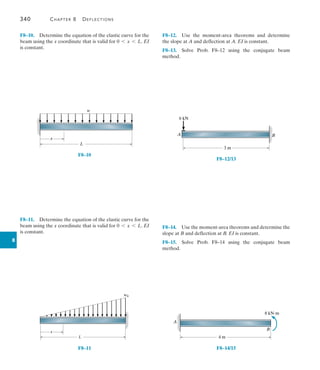
  • 38.
    1.3  Loads 17 1 Fora high-rise building, the wind loading can be quite complex, and so these structures are often designed based on the behavior of a model of the building, tested in a wind tunnel. When doing so, it is important to consider the wind striking the structure from any direction.* The effects of lateral loadings developed by wind, can cause racking, or leaning of a building frame. To resist this effect, engineers often use cross bracing, knee or diagonal bracing, or shear walls. Examples that show the use of these members are indicated in the photos. Windward side Leeward side Wind produces high pressure (pushing). Damage originates at corners, under eaves, and at the ridge of the roof. Wind produces low pressure (suction). Wind entering front of building increases internal pressure. Fig. 1–12 *You may want to investigate the case of the initial design of Citigroup Center. Construction of this skyscraper was completed in New York City in 1977, and only afterwards was it realized that the quartering winds, that is, those directed at the corners of the building, would produce enough force to actually collapse the building. Retrofits had to be made to the connections to provide the necessary strength to stiffen the structure. See http://failures.wikispaces.com/Citicorp+Center. Cross bracing. Knee bracing. wind Shear walls. Diagonal bracing.
  • 39.
    18 Chapter 1  Typesof Structures and Loads 1 Some high-rise buildings must be able to resist hurricane winds having speeds of over 120 mi ,h. Hurricane winds caused this damage to a condominium in Miami, Florida. The effect of wind on a structure depends upon the density and velocity of the air, the angle of incidence of the wind, the shape and stiffness of the structure, and the roughness of its surface. For design purposes, wind loadings can be treated using either a static or a dynamic approach. For the static approach, the fluctuating pressure caused by a constantly blowing wind is approximated by a mean velocity pressure that acts on the structure. This pressure q is defined by the air’s kinetic energy per unit volume, q = 1 2 rV2 , where r is the density of the air and V is its velocity.According to the ASCE 7-10 Standard, this equation is modified to account for the structure’s height, and the terrain in which it is located. Also the importance of the structure is considered, as it relates to the risk to human life or the public welfare if it is damaged or loses its functionality. This modified equation is represented by the following equation. © Jeff Greenberg/Alamy
  • 40.
    1.3  Loads 19 1 TABLE1.5  Velocity Pressure Exposure Coefficient for Terrain with Low-Lying Obstructions z (ft) z (m) Kz z 0–15 0–4.6 0.85 20 6.1 0.90 25 7 .6 0.94 30 9.1 0.98 40 12.2 1.04 50 15.2 1.09 (1–2) where V = the velocity in mih (ms) of a 3-second gust of wind measured 33 ft (10 m) above the ground. Specific values depend upon the “category” of the structure obtained from a specified wind map. For example, the interior portion of the continental United States reports a wind speed of 105 mih (47 ms) if the structure is an agricultural or storage building, since it is of low risk to human life in the event of a failure. The wind speed is 120 mih (54 ms) for cases where the structure is a hospital, since its failure would cause substantial loss of human life. Kz = the velocity pressure exposure coefficient, which is a function of height and depends upon the ground terrain. Table 1.5 lists values for a structure which is located in open terrain with scattered low- lying obstructions. Kzt = a factor that accounts for wind speed increases due to hills and escarpments. For flat ground Kzt = 1.0. Kd = a factor that accounts for the direction of the wind. It is used only when the structure is subjected to combinations of loads (see Sec. 1.4). For wind acting alone, Kd = 1.0. qz = 0.00256KzKztKdV2 (lbft2 ) qz = 0.613KzKztKdV2 (Nm2 )
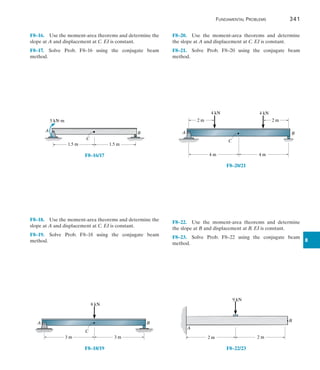
  • 41.
    20 Chapter 1  Typesof Structures and Loads 1 Application of Eq. 1–3 will involve calculations of wind pressures from each side of the building, with due considerations for the possibility of either positive or negative pressures acting on the building’s interior.* For high-rise buildings or those having a shape or location that makes them wind sensitive, it is recommended that a dynamic approach be used to determine the wind loadings.The methodology for doing this is also outlined in theASCE 7-10 Standard.It requires wind-tunnel tests to be performed on a scale model of the building and those surrounding it, in order to simulate the natural environment. The pressure effects of the wind on the building can be determined from pressure transducers attached to the model.Also,if the model has stiffness characteristics that are in proper scale to the building, then the dynamic deflections of the building can be determined. L h z qhGCp qhGCp qhGCp qzGCp elevation Windward side Leeward side u Maximum negative roof pressure coefficients, Cp, for use with qh Wind direction Normal to ridge h/L 10 u 10 Leeward angle Windward angle u 0.7 0.9 1.3 0.3 0.5 0.7 0.25 0.5 1.0 Fig. 1–13 *As with using any code, application of the requirements of a ASCE 7-10 demands careful attention to details related to the use of formulas and graphs within the code. The recent failure of a fabric-covered steel truss structure, used by the Dallas Cowboys for football practice, was due to high winds.A review of the engineer’s calculations, as recorded in Civil Engineering, April 2013, indicated a simple arithmetic error was made in calculating the slope angle u of the roof (see Fig. 1–13).Also, the internal pressure within the structure was not considered, along with other careless mistakes in modeling the structure for analysis. All this led to an underdesigned structure, which failed at a wind speed lower than the anticipated design speed. The importance of a careful, accurate, and complete analysis cannot be overemphasized.
  • 42.
    1.3  Loads 21 1 B L wind qhGCp qhGCp qzGCp qhGCp ridge plan SurfaceUse with All values All values Wall pressure coefficients, Cp Side walls Windward wall Leeward wall L/B 01 2 4 Cp qz qh qh 0.8 0.5 0.3 0.2 0.7 Design Wind Pressure for Enclosed Buildings. Once the value for qz is obtained, the design pressure can be determined from a list of relevant equations listed in the ASCE 7-10 Standard.The choice depends upon the flexibility and height of the structure, and whether the design is for the main wind-force resisting system, or for the building’s components and cladding. For example, using a “directional procedure” the wind-pressure on an enclosed building of any height is determined using a two-termed equation resulting from both external and internal pressures, namely, (1–3) Here q = qz for the windward wall at height z above the ground (Eq.1–2), and q = qh for the leeward walls, side walls, and roof, where z = h, the mean height of the roof. G = a wind-gust effect factor, which depends upon the exposure. For example, for a rigid structure, G = 0.85. Cp = a wall or roof pressure coefficient determined from a table.These tabular values for the walls and a roof pitch of u = 10 are given in Fig.1–13.Note in the elevation view that the pressure will vary with height on the windward side of the building,whereas on the remaining sides and on the roof the pressure is assumed to be constant. Negative values indicate pressures acting away from the surface. (GCpi) = the internal pressure coefficient, which depends upon the type of openings in the building. For fully enclosed buildings (GCpi) = {0.18. Here the signs indicate that either positive or negative (suction) pressure can occur within the building. p = qGCp - qh(GCpi)
  • 43.
    22 Chapter 1  Typesof Structures and Loads 1 EXAMPLE 1.3  The enclosed building shown in the photo and in Fig. 1–14a is used for storage purposes and is located outside of Chicago, Illinois on open flat terrain. When the wind is directed as shown, determine the design wind pressure acting on the roof and sides of the building using the ASCE 7-10 Specifications. SOLUTION First the wind pressure will be determined using Eq. 1–2.The basic wind speed is V = 105 mih, since the building is used for storage.Also, for flat terrain, Kzt = 1.0. Since only wind loading is being considered, Kd = 1.0.Therefore, qz = 0.00256 KzKztKdV2 = 0.00256 Kz(1.0)(1.0)(105)2 = 28.22 Kz From Fig. 1–14a, h = 75 tan 10 = 13.22 ft so that the mean height of the roof is h = 25 + 13.222 = 31.6 ft. Using the values of Kz in Table 1.5, calculated values of the pressure profile are listed in the table in Fig. 1–14b.Note the value of Kz was determined by linear interpolation for z = h, i.e., (1.04 - 0.98)(40 - 30) = (1.04 - Kz )(40 - 31.6), Kz = 0.990, and so qh = 28.22(0.990) = 27.9 psf. In order to apply Eq. 1–3 the gust factor is G = 0.85, and (GCpi) = {0.18. Thus, p = qGCp - qh(GCpi) = q(0.85)Cp - 27.9({0.18) = 0.85qCp | 5.03 (1) The pressure loadings are obtained from this equation using the calculated values for qz listed in Fig. 1–14b in accordance with the wind-pressure profile in Fig. 1–13. z (ft) Kz qz  (psf) 0–15 0.85 24.0 20 0.90 25.4 25 0.94 26.5 h = 31.6 0.990 27 .9 (b) 150 ft wind 75 ft 75 ft 25 ft (a) 10 h¿ h¿ 10 Fig. 1–14
  • 44.
    1.3  Loads 23 1 WindwardWall.  Here the pressure varies with height z since qzGCp must be used. For all values of LB, Cp = 0.8, so that from Eq. (1), p0-15 = 11.3 psf or 21.3 psf p20 = 12.2 psf or 22.3 psf p25 = 13.0 psf or 23.1 psf Leeward Wall. Here LB = 2(75)150 = 1, so that Cp = -0.5. Also, q = qh and so from Eq. (1), p = -16.9 psf or -6.84 psf Side Walls.  For all values of LB, Cp = -0.7, and therefore since we must use q = qh in Eq. (1), we have p = -21.6 psf or -11.6 psf Windward Roof. Here hL = 31.62(75) = 0.211 6 0.25, so that Cp = -0.7 and q = qh. Thus, p = -21.6 psf or -11.6 psf Leeward Roof.  In this case Cp = -0.3; therefore with q = qh, we get p = -12.2 psf or -2.09 psf These two sets of loadings are shown on the elevation of the building, representing either positive or negative (suction) internal building pressure, Fig. 1–14c. The main framing structure of the building must resist these loadings as well as for separate loadings calculated from wind blowing on the front or rear of the building. 11.3 psf 12.2 psf 13.0 psf 21.6 psf 12.2 psf 16.9 psf (c) 21.3 psf 22.3 psf 23.1 psf 11.6 psf 2.09 psf 6.84 psf
  • 45.
    24 Chapter 1  Typesof Structures and Loads 1 Design Wind Pressure for Signs. If the structure represents a sign, the wind will produce a resultant force acting on the face of the sign which is determined from (1–4) Here qh = the wind pressure evaluated at the height h, measured from the ground to the top of the sign. G = the wind-gust coefficient factor defined previously. Cf = a force coefficient which depends upon the aspect ratio (width B of the sign to height s of the sign), and the clear area ratio (sign height s to the elevation h, measured from the ground to the top of the sign). For cases of wind directed normal to the sign and through its center, for Bs = 4, values are listed in Table 1.6. As = the area of the face of the sign in ft2 (m2). F = qhGCfAs TABLE 1.6  Force Coefficients for Above-Ground Solid Signs, Cf sh Cf 1 1.35 0.9 1.45 0.5 1.70 0.2 1.80 …0.16 1.85 To allow for normal and oblique wind directions, the calculated resultant force is assumed to act either through the geometric center of the face of the sign or at other specified locations on the face of the sign which depend upon the ratios sh and Bs. Hurricane winds acting on the face of this sign were strong enough to noticeably bend the two supporting arms causing the material to yield. Proper design would have prevented this.
  • 46.
    1.3  Loads 25 1 SnowLoads. In some parts of the country, roof loading due to snow can be quite severe, and therefore protection against possible failure is of primary concern. Design loadings typically depend on the building’s general shape and roof geometry, wind exposure, location, its importance, and whether or not it is heated. Like wind, snow loads in the ASCE 7-10 Standard are generally determined from a zone map reporting 50-year recurrence intervals of an extreme snow depth. For example, on the relatively flat elevation throughout the mid-section of Illinois and Indiana, the ground snow loading is 20 lbft2 (0.96 kNm2 ). However, for areas of Montana, specific case studies of ground snow loadings are needed due to the variable elevations throughout the state. Specifications for snow loads are covered in theASCE 7-10 Standard,although no single code can cover all the implications of this type of loading. If a roof is flat, defined as having a slope of less than 5%, then the pressure loading on the roof can be obtained by modifying the ground snow loading, pg, by the following empirical formula (1–5) Here Ce = an exposure factor which depends upon the terrain. For example, for a fully exposed roof in an unobstructed area, Ce = 0.8, whereas if the roof is sheltered and located in the center of a large city, then Ce = 1.2. Ct = a thermal factor which refers to the average temperature within the building. For unheated structures kept below freezing Ct = 1.2, whereas if the roof is supporting a normally heated structure, then Ct = 1.0. Is = the importance factor as it relates to occupancy. For example, Is = 0.80 for agriculture and storage facilities, and Is = 1.20 for schools and hospitals. If pg … 20 lbft2 (0.96 kNm2 ), then use the largest value for pf, either computed from the above equation or from pf = Ispg. If pg 7 20 lbft2 (0.96 kNm2 ), then use pf = Is(20 lbft2 ). pf = 0.7CeCtIspg Excessive snow and ice loadings act on this roof. © Hans Blossey/Imagebroker/ SuperStock
  • 47.
    26 Chapter 1  Typesof Structures and Loads 1 Earthquake Loads. Earthquakes produce lateral loadings on a structure through the structure’s interaction with the ground.The magnitude of an earthquake load depends on the amount and type of ground accelerations and the mass and stiffness of the structure. In order to show how earthquake loads occur, consider the simple structural model in Fig. 1–16. This model may represent a single-story building, where the block is the “lumped” mass of the roof, and the column has a total stiffness representing all the building’s columns. During an earthquake, the ground vibrates both horizontally and vertically. The horizontal accelerations create shear forces in the column that put the block in sequential motion with the ground. If the column is stiff and the block has a small mass, the period of vibration of the block will be short and the block will accelerate with the same motion as the ground and undergo only slight relative displacements. For an actual structure that is designed to have large amounts of bracing and stiff connections, this can be beneficial, since less stress is developed in the members. On the other hand, if the column in Fig. 1–16 is very flexible and the block has a large mass, then earthquake-induced motion will cause small accelerations of the block and large relative displacements. EXAMPLE 1.4 The unheated storage facility shown in Fig. 1–15 is located on flat open terrain in southern Illinois, where the specified ground snow load is 15 lbft2 . Determine the design snow load on the roof which has a slope of 4%. SOLUTION Since the roof slope is 6 5%, we will use Eq. 1–5. Here, Ce = 0.8 due to the open area, Ct = 1.2 and Is = 0.8. Thus, pf = 0.7CeCtIspg = 0.7(0.8)(1.2)(0.8)(15 lbft2 ) = 8.06 lbft2 Since pg = 15 lbft2 6 20 lbft2 , then also pf = Ipg = 1.2(15 lbft2 ) = 18 lbft2 By comparison, choose pf = 18 lbft2 Ans. Fig. 1–15 lumped mass of roof Fig. 1–16
  • 48.
    1.3  Loads 27 1 Somecodes require that specific attention be given to earthquake design, especially in areas of the country where strong earthquakes predominate. To find this out, one can check the seismic ground-acceleration maps published in theASCE 7-10 Standard.These maps provide the peak ground accelerations caused by an earthquake along with risk coefficients. Regions vary from low risk,such as parts ofTexas,to very high risk,such as along the west coast of California. For high-rise structures, or, say, nuclear power plants, an earthquake analysis can be quite elaborate. It requires attaining an acceleration response spectrum, then using a computer to calculate the earthquake loadings based on the theory of structural dynamics. For small structures, a static analysis for earthquake design may be satisfactory. This case approximates the dynamic loads by a set of externally applied static forces that are applied laterally to the structure. One such method for doing this is reported in the ASCE 7-10 Standard. It is based upon finding a seismic response coefficient, Cs, determined from the soil properties, the ground accelerations, and the vibrational response of the structure. For most structures, this coefficient is then multiplied by the structure’s total dead load W to obtain the “base shear” in the structure.The value of Cs is actually determined from Cs = SDS RIe where SDS = the spectral response acceleration for short periods of vibration. R = a response modification factor that depends upon the ductility of the structure. Steel frame members which are highly ductile can have a value as high as 8, whereas reinforced concrete frames can have a value as low as 3. Ie = the importance factor that depends upon the use of the building. For example, Ie = 1 for agriculture and storage facilities, and Ie = 1.5 for hospitals and other essential facilities. With each new publication of the Standard, values of these coefficients are updated as more accurate data about earthquake response become available. Hydrostatic and Soil Pressure. When structures are used to retain water, soil, or granular materials, the pressure developed by these loadings becomes an important criterion for their design. Examples of such types of structures include tanks, dams, ships, bulkheads, and retaining walls. Here the laws of hydrostatics and soil mechanics are applied to define the intensity of the loadings on the structure.
  • 49.
    28 Chapter 1  Typesof Structures and Loads 1 Other Natural Loads. Several other types of live loads may also have to be considered in the design of a structure, depending on its location or use.These include the effect of blast,temperature changes,and differential settlement of the foundation. 1.4  Structural Design Whenever a structure is designed, it is important to give consideration to both material and load uncertainties. These uncertainties include a possible variability in material properties, residual stress in materials, intended measurements being different from fabricated sizes, loadings due to vibration or impact, and material corrosion or decay. ASD.  Allowable-stress design (ASD) methods include both the material and load uncertainties into a single factor of safety. The many types of loads discussed previously can occur simultaneously on a structure, but it is very unlikely that the maximum of all these loads will occur at the same time. For example, both maximum wind and earthquake loads normally do not act simultaneously on a structure. For ­ allowable-stress design the computed elastic stress in the material must not exceed the allowable stress for each of various load combinations. Typical load combinations as specified by the ASCE 7-10 Standard include • dead load • 0.6 (dead load) + 0.6 (wind load) • 0.6 (dead load) + 0.7 (earthquake load) LRFD.  Since uncertainty can be considered using probability theory, there has been an increasing trend to separate material uncertainty from load uncertainty. This method is called strength design or LRFD (load and resistance factor design). For example, to account for the uncertainty of loads, this method uses load factors applied to the loads or combinations of loads. According to the ASCE 7-10 Standard, some of the load factors and combinations are • 1.4 (dead load) • 1.2 (dead load) + 1.6 (live load) + 0.5 (snow load) • 0.9 (dead load) + 1.0 (wind load) • 0.9 (dead load) + 1.0 (earthquake load) In all these cases, the combination of loads is thought to provide a maximum, yet realistic loading on the structure.
  • 50.
    Problems 29 1 Problems 1–1.  Thefloor of a heavy storage warehouse building is made of 6-in.-thick stone concrete. If the floor is a slab having a length of 15 ft and width of 10 ft, determine the resultant force caused by the dead load and the live load. 1–2.  The wall is 12-ft high and consists of 2 * 4 studs. On each side is acoustical fiberboard and 4-in. clay brick. Determine the average load in lbft of length of wall that the wall exerts on the floor. Prob. 1–2 1–3.  A building wall consists of 12-in. clay brick and 1 2-in. fiberboard on one side. If the wall is 10 ft high, determine the load in pounds per foot that it exerts on the floor. *1–4.  The “New Jersey” barrier is commonly used during highway construction. Determine its weight per foot of length if it is made from plain stone concrete. 12 in. 4 in. 24 in. 6 in. 55 75 Prob. 1–4 1–5.  The precast floor beam is made from concrete having a specific weight of 150 lbft3. If it is to be used for a floor in an office of an office building, calculate its dead and live loadings per foot length of beam. 4.5 ft 0.5 ft 1.5 ft 1.5 ft 0.5 ft 2 ft Prob. 1–5 1–6.  The floor of a light storage warehouse is made of 150-mm-thick lightweight plain concrete. If the floor is a slab having a length of 7 m and width of 3 m, determine the resultant force caused by the dead load and the live load. 1–7.  The pre-cast T-beam has the cross-section shown. Determine its weight per foot of length if it is made from reinforced stone concrete and eight 3 4-in. cold-formed steel reinforcing rods. 8 in. 8 in. 6 in. 6 in. 6 in. 15 in. 20 in. 15 in. Prob. 1–7
  • 51.
    30 Chapter 1  Typesof Structures and Loads 1 *1–12.  A three-story hotel has interior columns that are spaced 20 ft apart in two perpendicular directions. If the loading on the flat roof is estimated to be 30 lbft2, determine the live load supported by a typical interior column at (a) the ground-floor level, and (b) the second- floor level. 1–13.  A hospital is to be built on open flat terrain in central Texas. If the building is 9.1 meters high, determine the internal pressure within the building if it is fully enclosed.Also, what is the external wind pressure acting on the side walls of the building? Each wall of the building is 25 meters long. 1–14.  The office building has interior columns spaced 5 m apart in perpendicular directions. Determine the reduced live load supported by a typical interior column located on the first floor under the offices. Prob. 1–14 1–15.  A hospital located in Chicago, Illinois, has a flat roof, where the ground snow load is 25 lbft2. Determine the design snow load on the roof of the hospital. *1–8.  The building wall consists of 8-in. clay brick. In the interior, the wall is made from 2 * 4 wood studs, plastered on one side.If the wall is 10 ft high,determine the load in pounds per foot of length of wall that the wall exerts on the floor. 10 ft Prob. 1–8 1–9.  A building wall consists of exterior stud walls with brick veneer and 13 mm fiberboard on one side. If the wall is 4 m high, determine the load in kNm that it exerts on the floor. 1–10.  The interior wall of a building is made from 2 * 4 wood studs, plastered on two sides. If the wall is 12 ft high, determine the load in lbft of length of wall that it exerts on the floor. 1–11.  The beam supports the roof made from asphalt shingles and wood sheathing boards. If the boards have a thickness of 11 2 in. and a specific weight of 50 lbft3, and the roof’s angle of slope is 30°, determine the dead load of the  roofing—per square foot—that is supported in the x and y directions by the purlins. 30 purlin sheathing shingles y x Prob. 1–11
  • 52.
    Problems 31 1 *1–16.  Windblows on the side of a fully enclosed hospital located on open flat terrain in Arizona. Determine the external pressure acting over the windward wall, which has a height of 30 ft.The roof is flat. Prob. 1–16 1–17.  Wind blows on the side of the fully enclosed hospital located on open flat terrain in Arizona. Determine the external pressure acting on the leeward wall, which has a length of 200 ft and a height of 30 ft. Prob. 1–17 1–18.  Determine the resultant force acting on the face of the sign if qh = 3.70 kPa. The sign has a width of 12 m and a height of 3 m as indicated. 3 m 3 m Prob. 1–18 1–19.  The light metal storage building is on open flat terrain in central Oklahoma. If the side wall of the building is 14 ft high, what are the two values of the external wind pressure acting on this wall when the wind blows on the back of the building? The roof is essentially flat and the building is fully enclosed. Prob. 1–19
  • 53.
    32 Chapter 1  Typesof Structures and Loads 1 1–23.  The school building has a flat roof. It is located in an open area where the ground snow load is 0.68 kNm2. Determine the snow load that is required to design the roof. Prob. 1–23 *1–24.  Wind blows on the side of the fully enclosed agriculture building located on open flat terrain in Oklahoma. Determine the external pressure acting over the windward wall, the leeward wall, and the side walls. Also, what is the internal pressure in the building which acts on the walls? Use linear interpolation to determine qh. 1–25.  Wind blows on the side of the fully enclosed agriculture building located on open flat terrain in Oklahoma. Determine the external pressure acting on the roof. Also, what is the internal pressure in the building which acts on the roof? Use linear interpolation to determine qh and Cp in Fig. 1–13. 100 ft 50 ft wind A B C D 15 ft 10 Probs. 1–24/25 *1–20.  The horse stall has a flat roof with a slope of 80 mmm. It is located in an open field where the ground snow load is 1.20 kNm2. Determine the snow load that is required to design the roof of the stall. Prob. 1–20 1–21.  The horse stall has a flat roof with a slope of 80 mmm. lt is located in an open field where the ground snow load is 0.72 kNm2. Determine the snow load that is required to design the roof of the stall. . Prob. 1–21 1–22.  A hospital located in central Illinois has a flat roof. Determine the snow load in kNm2 that is required to design the roof.
  • 54.
    Chapter Review 33 1 ChapterReview The basic structural elements are: Tie Rods—Slender members subjected to tension. Often used for bracing. Beams—Members designed to resist bending moment. They are often fixed or pin supported and can be in the form of a steel plate girder, reinforced concrete, or laminated wood. Columns—Members that resist axial compressive force. If the column also resists bending, it is called a beam column. The types of structures considered in this book consist of trusses made from slender pin-connected members forming a series of triangles, cables and arches, which carry tensile and compressive loads, respectively, and frames composed of pin- or fixed-connected beams and columns. Loads are specified in codes such as the ASCE 7-10 code. Dead loads are fixed and refer to the weights of members and materials. Live loads are movable and consist of uniform building floor loads, traffic and train loads on bridges, impact loads due to vehicles and machines, wind loads, snow loads, earthquake loads, and hydrostatic and soil pressure. tie rod simply supported beam cantilevered beam beam column column
  • 55.
    Oftentimes the elementsof a structure, like the beams and girders of this building frame, are connected together in a manner whereby the analysis can be considered statically determinate. Chapter 2 © SergeyIT/Shutterstock
  • 56.
    35 Analysis of Statically DeterminateStructures In this chapter we will direct our attention to the most common form of structure that the engineer will have to analyze, and that is one that lies in a plane and is subjected to a force system that lies in the same plane. We begin by discussing the importance of choosing an appropriate analytical model for a structure so that the forces in the structure may be determined with reasonable accuracy. Then the criteria necessary for structural stability are discussed. Finally, the analysis of statically determinate, planar, pin-connected structures is presented. 2.1  Idealized Structure An exact analysis of a structure can never be carried out, since estimates always have to be made of the loadings and the strength of the materials composing the structure. Furthermore, points of application for the loadings must also be estimated. It is important, therefore, that the structural engineer develop the ability to model or idealize a structure so that he or she can perform a practical force analysis of the members. In this section we will develop the basic techniques necessary to do this. Notice that the deck of this concrete bridge is made so that one section can be considered roller supported on the other section.
  • 57.
    36 Chapter 2  Analysisof Statically Determinate Structures 2 Support Connections.  Structural members are joined together in various ways depending on the intent of the designer. The three types of joints most often specified are the pin connection, the roller support, and the fixed joint. A pin-connected joint and a roller support allow some freedom for slight rotation, whereas a fixed joint allows no relative rotation between the connected members and is consequently more expensive to fabricate. Examples of these joints, fashioned in metal and concrete, are shown in Figs. 2–1 and 2–2, respectively. For most timber structures, the members are assumed to be pin connected, since bolting or nailing them will not sufficiently restrain them from rotating with respect to each other. Idealized models used in structural analysis that represent pinned and fixed supports and pin-connected and fixed-connected joints are shown in Figs. 2–3a and 2–3b. In reality, however, all connections exhibit some stiffness toward joint rotations, owing to friction and material behavior. In this case a more appropriate model for a support or joint might be that shown in Fig. 2–3c. If the torsional spring constant k = 0, the joint is a pin, and if k S , the joint is fixed. Pin-connected steel members. (a) typical “pin-supported” connection (metal) (b) typical “fixed-supported” connection (metal) weld weld stiffeners Fig. 2–1 (a) typical “roller-supported” connection (concrete) (b) typical “fixed-supported” connection (concrete) Fig. 2–2
  • 58.
    2 2.1 Idealized Structure 37 When selecting a particular model for each support or joint, the engineer must be aware of how the assumptions will affect the actual performance of the member and whether the assumptions are reasonable for the structural design. For example, consider the beam shown in Fig. 2–4a, which is used to support a concentrated load P. The angle connection at support A is like that in Fig. 2–1a and can therefore be idealized as a typical pin support. Furthermore, the support at B provides an approximate point of smooth contact and so it can be idealized as a roller. The beam’s thickness can be neglected since it is small in comparison to the beam’s length, and therefore the idealized model of the beam is as shown in Fig. 2–4b. The analysis of the loadings in this beam should give results that closely approximate the loadings in the actual beam. To show that the model is appropriate, consider a specific case of a beam made of steel with P = 8 k (8000 lb) and L = 20 ft. One of the major simplifications made here was assuming the support at A to be a pin. Design of the beam using standard code procedures* indicates that a W10 * 19 would be adequate for supporting the load. Using one  of the deflection methods of Chapter 8, the rotation at the “pin” support can be calculated as u = 0.0103 rad = 0.59. From Fig. 2–4c, such a rotation only moves the top or bottom flange a distance of = ur = (0.0103 rad)(5.12 in.) = 0.0528 in. This small amount would certainly be accommodated by the connection fabricated as shown in Fig. 2–1a, and therefore the pin serves as an appropriate model. pin support pin-connected joint (a) fixed support (b) fixed-connected joint torsional spring support torsional spring joint (c) k k Fig. 2–3 *Codes such as the Manual of Steel Construction, American Institute of Steel Construction. L –– 2 L –– 2 A B P actual beam (a) L –– 2 L –– 2 P B A idealized beam (b) (c) 5.12 in. 5.12 in. 0.59 0.0528 in. 0.0528 in. 0.59 Fig. 2–4
  • 59.
    38 Chapter 2  Analysisof Statically Determinate Structures 2 Other types of connections most commonly encountered on coplanar structures are given in Table 2.1. It is important to be able to recognize the symbols for these connections and the kinds of reactions they exert on their attached members. This can easily be done by noting how the connection prevents any degree of freedom or displacement of the member.In particular, the support will develop a force on the member if it prevents translation of the member, and it will develop a moment if it prevents rotation of the member. For example, a member in contact with a smooth surface (3) is prevented from translating only in one direction, which is perpendicular or normal to the surface.Hence,the surface exerts only a normal force F on the member in this direction.The magnitude of this force represents one unknown.Also note that the member is free to rotate on the surface, so that a moment cannot be developed by the surface on the member. As another example, the fixed support (7) prevents both translation and rotation of a member at the point of connection. Therefore, this type of support exerts two force components and a moment on the member.The “curl” of the moment lies in the plane of the page, since rotation is prevented in that plane. Hence, there are three unknowns at a fixed support. In reality, all supports actually exert distributed surface loads on their contacting members. The concentrated forces and moments shown in Table 2.1 represent the resultants of these load distributions. This representation is, of course, an idealization; however, it is used here since the surface area over which the distributed load acts is considerably smaller than the total surface area of the connecting members. A typical rocker support used for a bridge girder. Rollers and associated bearing pads are used to support the prestressed concrete girders of a highway bridge. Concrete smooth or “roller” support. The short link is used to connect the two girders of the highway bridge and allow for thermal expansion of the deck. Steel pin support.
  • 60.
    2 2.1 Idealized Structure 39 TABLE 2.1  Supports for Coplanar Structures Type of Connection Idealized Symbol Reaction Number of Unknowns (4) smooth pin-connected collar F (1) light cable weightless link F (2) rollers rocker F (3) smooth contacting surface F (5) smooth pin or hinge Fy Fx Fx (7) fixed support Fy M One unknown.The reaction is a force that acts in the direction of the cable or link. One unknown.The reaction is a force that acts perpendicular to the surface at the point of contact. One unknown.The reaction is a force that acts perpendicular to the surface at the point of contact. One unknown.The reaction is a force that acts perpendicular to the surface at the point of contact. Two unknowns.The reactions are two force components. Two unknowns.The reactions are a force and a moment. Three unknowns.The reactions are the moment and the two force components. fixed-connected collar (6) slider F M
  • 61.
    40 Chapter 2  Analysisof Statically Determinate Structures 2 Idealized Structure.  Having stated the various ways in which the connections on a structure can be idealized, we are now ready to discuss some of the techniques used to represent various structural systems by idealized models. As a first example, consider the jib crane and trolley in Fig. 2–5a. For the structural analysis we can neglect the thickness of the two main members and will assume that the joint at B is fabricated to be rigid. Furthermore, the support connection at A can be modeled as a fixed support and the details of the trolley excluded.Thus, the members of the idealized structure are represented by two connected lines, and the load on the hook is represented by a single concentrated force F, Fig. 2–5b. This idealized structure shown here as a line drawing can now be used for applying the principles of structural analysis, which will eventually lead to the design of its two main members. Beams and girders are often used to support building floors. In particular, a girder is the main load-carrying element of the floor, whereas the smaller elements having a shorter span and connected to the girders are called beams. Often the loads that are applied to a beam or girder are transmitted toitbythefloorthatissupportedbythebeamorgirder.Again,itisimportant to be able to appropriately idealize the system as a series of models, which can be used to determine, to a close approximation, the forces acting in the members. Consider, for example, the framing used to support a typical floor slab in a building,Fig.2–6a.Here the slab is supported by floor joists located at even intervals,and these in turn are supported by the two side girders AB and CD.For analysis it is reasonable to assume that the joints are pin and/or roller connected to the girders and that the girders are pin and/or roller connected to the columns. The top view of the structural framing plan for this system is shown in Fig. 2–6b. In this “graphic” scheme, notice that the “lines” representing the joists do not touch the girders and the lines for the girders do not touch the columns. This symbolizes pin- and/ or roller- supported connections. On the other hand, if the framing plan is intended to represent fixed-connected members, such as those that are welded F 3 m A B actual structure (a) 4 m Fig. 2–5 4 m B A 3 m F idealized structure (b) (a) D A C B joist slab column girder idealized framing plan (b) Fig. 2–6
  • 62.
    2 2.1 Idealized Structure 41 instead of simple bolted connections, then the lines for the beams or girders would touch the columns as in Fig. 2–7 . Similarly, a fixed-connected overhanging beam would be represented in top view as shown in Fig. 2–8. If reinforced concrete construction is used, the beams and girders are represented by double lines.These systems are generally all fixed connected and therefore the members are drawn to the supports. For example, the structural graphic for the cast-in-place reinforced concrete system in Fig. 2–9a is shown in top view in Fig. 2–9b. The lines for the beams are dashed because they are below the slab. Structural graphics and idealizations for timber structures are similar to those made of metal. For example, the structural system shown in Fig. 2–10a represents beam-wall construction, whereby the roof deck is supported by wood joists, which deliver the load to a masonry wall. The joists can be assumed to be simply supported on the wall, so that the idealized framing plan would be like that shown in Fig. 2–10b. fixed-connected overhanging beam idealized beam Fig. 2–8 fixed-connected beam idealized beam Fig. 2–7 (a) Fig. 2–10 idealized framing plan (b) (a) idealized framing plan (b) Fig. 2–9
  • 63.
    42 Chapter 2  Analysisof Statically Determinate Structures 2 Tributary Loadings.  When flat surfaces such as walls, floors, or roofs are supported by a structural frame, it is necessary to determine how the load on these surfaces is transmitted to the various structural elements used for their support. There are generally two ways in which this can be done. The choice depends on the geometry of the structural system, the material from which it is made, and the method of its construction. One-Way System.  A slab or deck that is supported such that it delivers its load to the supporting members by one-way action, is often referred to as a one-way slab.To illustrate the method of load transmission, consider the framing system shown in Fig. 2–11a where the beams AB, CD, and EF rest on the girders AE and BF. If a uniform load of 100 lbft2 is placed on the slab,then the center beam CD is assumed to support the load acting on the tributary area shown dark shaded on the structural framing plan in Fig.2–11b.Member CD is therefore subjected to a linear distribution of load of (100 lbft2 )(5 ft) = 500 lbft, shown on the idealized beam in Fig. 2–11c. The reactions on this beam (2500 lb) would then be applied to the center of the girders AE (and BF), shown idealized in Fig. 2–11d. Using this same concept, do you see how the remaining portion of the slab loading is transmitted to the ends of the girder as 1250 lb? The structural framework of this building consists of concrete floor joists, which were formed on site using metal pans.These joists are simply supported on the girders,which in turn are simply supported on the columns. (a) 10 ft E F D B 100 lb/ft2 A C 5 ft 5 ft idealized framing plan (b) A B C D E F 2.5 ft 2.5 ft 2.5 ft 2.5 ft Fig. 2–11 A C D B 500 lb/ft 2500 lb idealized beam (c) 2500 lb 10 ft A E 1250 lb 2500 lb 1250 lb 5 ft 5 ft idealized girder (d)
  • 64.
    2 2.1 Idealized Structure 43 For some floor systems the beams and girders are connected to the columns at the same elevation, as in Fig. 2–12a. If this is the case, the slab can in some cases also be considered a one-way slab. For example, if the slab is reinforced concrete with reinforcement in only one direction, or the concrete is poured on a corrugated metal deck, as in the above photo, then one-way action of load transmission can be assumed. On the other hand, if the slab is reinforced in two directions, then consideration must be given to the possibility of the load being transmitted to the supporting members from either one or two directions. For example, consider the slab and framing plan in Fig. 2–12b.According to the American Concrete Institute, ACI 318 code, if L2 7 L1 and if the span ratio (L2L1) 7 2, the slab will behave as a one-way slab, since as L1 becomes smaller, the beams AB, CD, and EF provide the greater stiffness to carry the load. An example of one-way slab construction of a steel frame building having a poured concrete floor on a corrugated metal deck. The load on the floor is considered to be transmitted to the beams, not the girders. Floor beams are often coped, that is, the top flange is cut back, so that the beam is at the same level as the girder. girder beam joist column (a) A B C D E F ~ (b) L1 L1 L2 L1 ___ 2 L1 ___ 2 Concrete slab is reinforced in two directions, poured on plane forms. Idealized framing plan for one-way slab action requires L2/L1 2. Fig. 2–12
  • 65.
    44 Chapter 2  Analysisof Statically Determinate Structures 2 Two-Way System.  According to the ACI 318 concrete code, if L2 7 L1 and the support ratio (L2L1) … 2, then the load is assumed to be transferred to the supporting beams and girders in two directions. When this is the case the slab is referred to as a two-way slab. To show how to treat this case, consider the square reinforced concrete slab in Fig. 2–13a, which is supported by four 10-ft-long edge beams, AB, BD, DC, and CA. Here L2L1 = 1. As the load on the slab intensifies, numerous experiments have shown that 45° cracks form at the corners of the slab. As a result, the tributary area is constructed using diagonal 45° lines as shown in Fig. 2–13b. This produces the dark shaded tributary area for beam AB. Hence if a uniform load of 100 lbft2 is applied to the slab, a peak intensity of (100 lbft2 )(5 ft) = 500 lbft will be applied to the center of beam AB, resulting in the triangular load distribution shown in Fig. 2–13c. For other geometries that cause two-way action, a similar For example, if L2L1 = 1.5 it is then necessary to construct 45° lines that intersect as shown in Fig. 2–14a. This produce the dark shaded tributary area for beam AB. A 100@lbft2 loading placed on the slab will then produce trapezoidal and triangular distributed loads on members AB and AC, Figs. 2–14b and 2–14c, respectively. (a) 10 ft 10 ft A C D B 100 lb/ft2 10 ft 5 ft 10 ft A B C D 45 45 idealized framing plan (b) 500 lb/ft A B 5 ft 5 ft idealized beam (c) Fig. 2–13 15 ft 5 ft 5 ft 5 ft 10 ft 5 ft A B C D 45 45 idealized framing plan (a) 500 lb/ft A B 5 ft idealized beam (b) 5 ft 5 ft 500 lb/ft A 5 ft idealized beam (c) 5 ft C Fig. 2–14
  • 66.
    2.1 Idealized Structure 45 2 Theability to reduce an actual structure to an idealized form, as shown by these examples, can only be gained by experience.To provide practice at doing this, the example problems and the problems for solution throughout this book are presented in somewhat realistic form, and the associated problem statements aid in explaining how the connections and supports can be modeled by those listed in Table 2.1. In engineering practice, if it becomes doubtful as to how to model a structure or transfer the loads to the members,it is best to consider several idealized structures and loadings and then design the actual structure so that it can resist the loadings in all the idealized models. EXAMPLE 2.1  The floor of a classroom is to be supported by the bar joists shown in Fig. 2–15a. Each joist is 15 ft long and they are spaced 2.5 ft on centers. The floor itself is to be made from lightweight concrete that is 4 in. thick. Neglect the weight of the joists and the corrugated metal deck, and determine the load that acts along each joist. SOLUTION The dead load on the floor is due to the weight of the concrete slab.From Table 1.3 for 4 in. of lightweight concrete it is (4)(8 lbft2 ) = 32 lbft2 . From Table 1.4, the live load for a classroom is 40 lbft2 . Thus the total floor load is 32 lbft2 + 40 lbft2 = 72 lbft2 . For the floor system, L1 = 2.5 ft and L2 = 15 ft. Since L2L1 7 2 the concrete slab is treated as a one-way slab. The tributary area for each joist is shown in Fig. 2–15b.Therefore the uniform load along its length is w = 72 lbft2 (2.5 ft) = 180 lbft This loading and the end reactions on each joist are shown in Fig. 2–15c. Fig. 2–15 (a) 15 ft 2.5 ft (b) 1350 lb (c) 1350 lb 180 lb/ft
  • 67.
    46 Chapter 2  Analysisof Statically Determinate Structures 2 The flat roof of the steel-frame building shown in the photo is intended to support a total load of 2 kNm2 over its surface. Determine the roof load within region ABCD that is transmitted to beams BC and DC. The dimensions are shown in Fig. 2–16a. EXAMPLE 2.2 2 m (a) B A C D 2 m 2 m 3 m 2 m 4 m 1 2 3 A B C D SOLUTION In this case L2 = 7 m and L1 = 4 m. Since L2L1 = 1.75 6 2, we have two-way slab action. The tributary loading along each edge beam is shown in Fig. 2–16a, where the lighter shaded trapezoidal area ➀ of loading is transmitted to member BC. The peak intensity of this loading is (2 kNm2 )(2 m) = 4 kNm. As a result, the distribution of  the load along BC is as shown in Fig. 2–16b. This process of tributary load transmission should also be calculated for the area ➁ to the right of BC shown in Fig. 2–16a, and this load should also be placed on BC. See the next example. A triangular distributed loading ➂ acts on member DC, Fig. 2–16a. It also has a maximum intensity of (2 kNm2 )(2 m) = 4 kNm, Fig. 2–16c. Fig. 2–16 D C 4 kN/m 2 m 2 m (c) B C (b) 4 kN/m 3 m 2 m 2 m
  • 68.
    2.1 Idealized Structure 47 2 EXAMPLE2.3 The concrete girders shown in the photo of the passenger car parking garage span 30 ft and are 15 ft on center. If the floor slab is 5 in. thick and made of reinforced stone concrete, and the specified live load is 50 lbft2 (see Table 1.4), determine the distributed load the floor system transmits to each interior girder. SOLUTION Here, L2 = 30 ft and L1 = 15 ft, so that L2L1 = 2. We have a two- way slab. From Table 1.2, for reinforced stone concrete, the specific weight of the concrete is 150 lbft3 . Thus the design floor loading is p = 150 lbft3 a 5 12 ftb + 50 lbft2 = 112.5 lbft2 A trapezoidal distributed loading is transmitted to each interior girder AB from each of its two sides ➀ and ➁.The maximum intensity of each of these distributed loadings is (112.5 lbft2 )(7.5 ft) = 843.75 lbft, so that on the girder this intensity becomes 2(843.75 lbft) = 1687.5 lbft, Fig. 2–17b. Note: For design, consideration should also be given to the weight of the girder. 15 ft 7.5 ft 7.5 ft (a) 30 ft 15 ft 7.5 ft A B 2 1 (b) 15 ft 1687.5 lb/ft 7.5 ft A B 7.5 ft Fig. 2–17
  • 69.
    48 Chapter 2  Analysisof Statically Determinate Structures 2 2.2  Load Path The various elements that make up a structure should be designed in such a way that they transmit the primary load acting on the structure to its foundation in the most efficient way possible. Hence, as a first step in any design or analysis of a structure, it is very important to understand how the loads are transmitted through it, if damage or collapse of the structure is to be avoided.This description is called a load path, and by visualizing how the loads are transmitted the engineer can sometimes eliminate unnecessary members, strengthen others, or identify where there may be potential problems. Like a chain, which is “as strong as its weakest link”, so a structure is only as strong as the weakest part along its load path. To show how to construct a load path, let us consider a few examples. In Fig. 2–18a, the loading acting on the floor of the building is transmitted from the slab to the floor joists then to the spandrel and interior girder, and finally to the columns and foundation footings. The loading on the deck of the suspension bridge in Fig. 2–18b is transmitted to the hangers or suspenders, then the cables, and finally the towers and piers. (a) exterior column interior column foundation slab floor loading slab floor beam or joist spandrel or edge girder spread footing strip footing girder Fig. 2–18
  • 70.
    2 2.3 Principle ofSuperposition 49 tower cable anchor hanger deck pier (b) Fig. 2–18 2.3  Principle of Superposition The principle of superposition forms the basis for much of the theory of structural analysis. It may be stated as follows: The total displacement or internal loadings (stress) at a point in a structure subjected to several external loadings can be determined by adding together the displacements or internal loadings (stress) caused by each of the external loads acting separately. For this statement to be valid it is necessary that a linear relationship exist among the loads, stresses, and displacements. Two requirements must be imposed for the principle of superposition to apply: 1. The material must behave in a linear-elastic manner,so that Hooke’s law is valid, and therefore the load will be proportional to displacement. 2. The geometry of the structure must not undergo significant change when the loads are applied, i.e., small displacement theory applies. Large displacements will significantly change the position and orientation of the loads. An example would be a cantilevered thin rod subjected to a force at its end, causing it to bend. Throughout this text, these two requirements will be satisfied. Here only linear-elastic material behavior occurs; and the displacements produced by the loads will not significantly change the directions of applied loadings nor the dimensions used to compute the moments of forces.
  • 71.
    50 Chapter 2  Analysisof Statically Determinate Structures 2 2.4  Equations of Equilibrium It may be recalled from statics that a structure or one of its members is in equilibrium when it maintains a balance of force and moment. In general this requires that the force and moment equations of equilibrium be satisfied along three independent axes, namely, Fx = 0 Fy = 0 Fz = 0 Mx = 0 My = 0 Mz = 0 (2–1) The principal load-carrying portions of most structures, however, lie in a single plane,and since the loads are also coplanar,the above requirements for equilibrium reduce to Here Fx and Fy represent,respectively,the algebraic sums of the x and y components of all the forces acting on the structure or one of its members, and MO represents the algebraic sum of the moments of these force components about an axis perpendicular to the x–y plane (the z axis) and passing through point O. Whenever these equations are applied, it is first necessary to draw a free-body diagram of the structure or its members. If a member is selected, it must be isolated from its supports and surroundings and its outlined shape drawn.All the forces and couple moments must be shown that act on the member. In this regard, the types of reactions at the supports can be determined using Table 2.1. Also, recall that forces common to two members act with equal magnitudes but opposite directions on the respective free-body diagrams of the members. If the internal loadings at a specified point in a member are to be determined, the method of sections must be used. This requires that a “cut” or section be made perpendicular to the axis of the member at the point where the internal loading is to be determined. A free-body diagram of either segment of the “cut” member is isolated and the internal loads are then determined from the equations of equilibrium applied to the segment. In general, the internal loadings acting at the section will consist of a normal force N, shear force V, and bending moment M, as shown in Fig. 2–19. We will cover the principles of statics that are used to determine the external reactions on structures in Sec. 2.5. Internal loadings in structural members will be discussed in Chapter 4. Fx = 0 Fy = 0 MO = 0 (2–2) M M V V N N internal loadings Fig. 2–19
  • 72.
    2 2.5  Determinacyand Stability 51 2.5  Determinacy and Stability Before starting the force analysis of a structure, it is necessary to establish the determinacy and stability of the structure. Determinacy.  The equilibrium equations provide both the necessary and sufficient conditions for equilibrium.When all the forces in a structure can be determined strictly from these equations,the structure is referred to as statically determinate. Structures having more unknown forces than available equilibrium equations are called statically indeterminate. As a general rule, a stable structure can be identified as being either statically determinate or statically indeterminate by drawing free-body diagrams of all its members, or selective parts of its members, and then comparing the total number of unknown reactive force and moment components with the total number of available equilibrium equations.* For a coplanar structure there are at most three equilibrium equations for each part, so that if there is a total of n parts and r force and moment reaction components, we have In particular, if a structure is statically indeterminate, the additional equations needed to solve for the unknown reactions are obtained by relating the applied loads and reactions to the displacement or slope at different points on the structure. These equations, which are referred to as compatibility equations, must be equal in number to the degree of indeterminacy of the structure. Compatibility equations involve the geometric and physical properties of the structure and will be discussed further in Chapter 10. We will now consider some examples to show how to classify the determinacy of a structure.The first example considers beams;the second example, pin-connected structures; and in the third we will discuss frame structures. Classification of trusses will be considered in Chapter 3. (2–3) *Drawing the free-body diagrams is not strictly necessary, since a “mental count” of the number of unknowns can also be made and compared with the number of equilibrium equations. r = 3n, statically determinate r 7 3n, statically indeterminate
  • 73.
    52 Chapter 2  Analysisof Statically Determinate Structures 2 Classify each of the beams shown in Figs. 2–20a through 2–20d as statically determinate or statically indeterminate. If statically indeterminate, report the number of degrees of indeterminacy. The beams are subjected to external loadings that are assumed to be known and can act anywhere on the beams. SOLUTION Compound beams, i.e., those in Figs. 2–20c and 2–20d, which are composed of pin-connected members must be disassembled. Note that in these cases, the unknown reactive forces acting between each member must be shown in equal but opposite pairs. The free-body diagrams of each member are shown. Applying r = 3n or r 7 3n, the resulting classifications are indicated. Ans. Ans. Ans. Ans. EXAMPLE 2.4 (a) r = 3, n = 1, 3 = 3(1) Statically determinate. (b) r = 5, n = 1, 5 7 3(1) Statically indeterminate to the second degree. (c) r = 6, n = 2, 6 = 3(2) Statically determinate. (d) r = 10, n = 3, 10 7 3(3) Statically indeterminate to the first degree. Fig. 2–20
  • 74.
    2.5  Determinacy andStability 53 2 Classify each of the pin-connected structures shown in Figs. 2–21a through 2–21d as statically determinate or statically indeterminate. If  statically indeterminate, report the number of degrees of indeterminacy. The structures are subjected to arbitrary external loadings that are assumed to be known and can act anywhere on the structures. SOLUTION Classification of pin-connected structures is similar to that of beams. The free-body diagrams of the members are shown. Applying r = 3n or r 7 3n, the resulting classifications are indicated. Ans. Ans. Ans. Ans. EXAMPLE 2.5 (a) (b) (c) (d) r = 7, n = 2, 7 7 6. Statically indeterminate to the first degree. r = 9, n = 3, 9 = 9. Statically determinate. r = 10, n = 2, 10 7 6. Statically indeterminate to the fourth degree. r = 9, n = 3, 9 = 9. Statically determinate. Fig. 2–21
  • 75.
    54 Chapter 2  Analysisof Statically Determinate Structures 2 B A C D (a) r = 9, n = 2, 9 7 6, Statically indeterminate to the third degree. Ans. Classify each of the frames shown in Figs. 2–22a through 2–22c as statically determinate or statically indeterminate. If statically indeterminate, report the number of degrees of indeterminacy. The frames are subjected to external loadings that are assumed to be known and can act anywhere on the frames. SOLUTION Unlike the beams and pin-connected structures of the previous examples, frame structures consist of members that are connected together by rigid joints. Sometimes the members form internal loops as in Fig. 2–22a. Here ABCD forms a closed loop. In order to classify these structures, it is necessary to use the method of sections and “cut” the loop apart. The free-body diagrams of the sectioned parts are drawn and the frame can then be classified. Notice that only one section through the loop is required, since once the unknowns at the section are determined,the internal forces at any point in the members can then be found using the method of sections and the equations of equilibrium.A second example of this is shown in Fig.2–22b.Although the frame in Fig. 2–22c has no closed loops, we can use this same method, using vertical sections, to classify it. For this case we can also just draw its complete free-body diagram.The resulting classifications are indicated in each figure. (This frame has no closed loops.) r = 9, n = 1, 9 7 3, Statically indeterminate to the sixth degree. r = 18, n = 4, 18 7 12, Statically indeterminate to the sixth degree. Fig. 2–22 Ans. Ans. Ans. (a) r = 18, n = 3, 18 7 9, Statically indeterminate to the ninth degree. (c) EXAMPLE 2.6 (b)
  • 76.
    2 2.5  Determinacyand Stability 55 Stability.  To ensure the equilibrium of a structure or its members,it is not only necessary to satisfy the equations of equilibrium,but the members must also be properly held or constrained by their supports regardless of how the structure is loaded.Two situations may occur where the conditions for proper constraint have not been met. Partial Constraints.  Instability can occur if a structure or one of its members has fewer reactive forces than equations of equilibrium that must be satisfied. The structure then becomes only partially constrained. For example, consider the member shown in Fig. 2–23 with its corresponding free-body diagram. Here the equation Fx = 0 will not be satisfied for the loading conditions, and therefore the member will be unstable. Improper Constraints.  In some cases there may be as many unknown forces as there are equations of equilibrium;however,instability or movement of a structure or its members can develop because of improper constraining by the supports. This can occur if all the support reactions are concurrent at a point. An example of this is shown in Fig. 2–24. From the free-body diagram of the beam it is seen that the summation of moments about point O will not be equal to zero (Pd 0); thus rotation about point O will take place. Another way in which improper constraining leads to instability occurs when the reactive forces are all parallel.An example of this case is shown in Fig. 2–25. Here when an inclined force P is applied, the summation of forces in the horizontal direction will not equal zero. P A A P FA MA partial constraints Fig. 2–23 A C B P O O FB d FA FC P d concurrent reactions Fig. 2–24 P A B C P FA FB FC parallel reactions Fig. 2–25
  • 77.
    56 Chapter 2  Analysisof Statically Determinate Structures 2 In general, then, a structure will be geometrically unstable—that is, it will move slightly or collapse—if there are fewer reactive forces than equations of equilibrium; or if there are enough reactions, instability will occur if the lines of action of the reactive forces intersect at a common point or are parallel to one another. If the structure consists of several members or components, local instability of one or several of these members can generally be determined by inspection. If the members form a collapsible mechanism, the structure will be unstable. We will now formalize these statements for a coplanar structure having n members or components with r unknown reactions.Since three equilibrium equations are available for each member or component, we have r 6 3n unstable r Ú 3n unstable if member reactions are concurrent or parallel or some of the components form a collapsible mechanism If the structure is unstable,it does not matter if it is statically determinate or indeterminate. In all cases such types of structures must be avoided in practice. The following examples illustrate how structures or their members can be classified as stable or unstable. Structures in the form of a truss will be discussed in Chapter 3. (2–4) The K-bracing on this frame provides lateral stability from wind and vertical support of the floor girders. The framework has been sprayed with concrete grout in order to insulate the steel to keep it from losing its stiffness in the event of a fire.
  • 78.
    2.5  Determinacy andStability 57 2 Classify each of the structures in Figs. 2–26a through 2–26d as stable or unstable. The structures are subjected to arbitrary external loads that are assumed to be known. SOLUTION The structures are classified as indicated. The member is stable since the reactions are nonconcurrent and nonparallel.It is also statically determinate.           Ans. The member is statically indeterminate, but unstable since the three reactions are concurrent at B. Ans. The beam is statically indeterminate, but unstable since the three reactions are all parallel. Ans. The structure is unstable since r = 7, n = 3, so that, by Eq. 2–4, r 6 3n, 7 6 9. Also, this can be seen by inspection, since AB can move horizontally without restraint.         Ans. B (a) A A B (b) B A B C (c) A B C D (d) Fig. 2–26 EXAMPLE 2.7 
  • 79.
    58 Chapter 2  Analysisof Statically Determinate Structures 2 2.6  Application of the Equations of Equilibrium Occasionally, the members of a structure are connected together in such a way that the joints can be assumed as pins. Building frames and trusses are typical examples that are often constructed in this manner. Provided a pin-connected coplanar structure is properly constrained and contains no more supports or members than are necessary to prevent collapse, the forces acting at the joints and supports can be determined by applying the three equations of equilibrium (Fx = 0, Fy = 0, MO = 0) to each member. Understandably, once the forces at the joints are obtained, the size of the members, connections, and supports can then be determined on the basis of design code specifications. To illustrate the method of force analysis, consider the three-member frame shown in Fig. 2–27a, which is subjected to loads P1 and P2. The free-body diagrams of each member are shown in Fig. 2–27b. In total there are nine unknowns; however, nine equations of equilibrium can be written, three for each member, so the problem is statically determinate. For the actual solution it is also possible, and sometimes convenient, to consider a portion of the frame or its entirety when applying some of these nine equations. For example, a free-body diagram of the entire frame is shown in Fig. 2–27c. One could determine the three reactions Ax, Ay, and Cx on this “rigid” pin-connected system, then analyze any two of its members, Fig. 2–27b, to obtain the other six unknowns. Furthermore, the answers can be checked in part by applying the three equations of  equilibrium to the remaining “third” member. To summarize, this problem can be solved by writing at most nine equilibrium equations using free-body diagrams of any members and/or combinations of connected members.Any more than nine equations written would not be unique from the original nine and would only serve to check the results. B D E C P2 P1 (a) A Bx By Dy Ay Dx Ax Dy Dx P1 Ex Ey Bx By P2 Ey Ex Cx (b) P1 Cx Ax Ay (c) P2 Fig. 2–27
  • 80.
    2 2.6 Application ofthe Equations of Equilibrium 59 Consider now the two-member frame shown in Fig. 2–28a. Here the free-body diagrams of the members reveal six unknowns, Fig. 2–28b; however, six equilibrium equations, three for each member, can be written, so again the problem is statically determinate.As in the previous case, a free-body diagram of the entire frame can also be used for part of the analysis, Fig. 2–28c. Although, as shown, the frame has a tendency to collapse without its supports, by rotating about the pin at B, this will not happen since the force system acting on it must still hold it in equilibrium. Hence, if so desired, all six unknowns can be determined by applying the three equilibrium equations to the entire frame, Fig. 2–28c, and also to either one of its members. The above two examples illustrate that if a structure is properly supported and contains no more supports or members than are necessary to prevent collapse, the frame becomes statically determinate, and so the unknown forces at the supports and connections can be determined from the equations of equilibrium applied to each member. Also, if the structure remains rigid (noncollapsible) when the supports are removed (Fig. 2–27c), all three support reactions can be determined by applying the three equilibrium equations to the entire structure. However, if the structure appears to be nonrigid (collapsible) after removing the supports (Fig. 2–28c), it must be dismembered and equilibrium of the individual members must be considered in order to obtain enough equations to determine all the support reactions. B A D C P2 P1 (a) P2 P1 (b) Ay Ax Bx By Bx By Cx Cy B P1 (c) Ay Ax Cx Cy P2 Fig. 2–28
  • 81.
    60 Chapter 2  Analysisof Statically Determinate Structures 2 Procedure for Analysis The following procedure provides a method for determining the joint reactions for structures composed of pin-connected members. Free-Body Diagrams • Disassemble the structure and draw a free-body diagram of each member. Also, it may be convenient to supplement a member free-body diagram with a free-body diagram of the entire structure. Some or all of the support reactions can then be determined using this diagram. • Recall that reactive forces common to two members act with equal magnitudes but opposite directions on the respective free- body diagrams of the members. • All two-force members should be identified. These members, regardless of their shape, have no external loads on them, and therefore their free-body diagrams are represented with equal but opposite collinear forces acting on their ends. • In many cases it is possible to tell by inspection the proper arrowhead sense of direction of an unknown force or couple moment; however, if this seems difficult, the directional sense can be assumed. Equations of Equilibrium • Count the total number of unknowns to make sure that an equivalent number of equilibrium equations can be written for solution. Except for two-force members, recall that in general three equilibrium equations can be written for each member. • Many times,the solution for the unknowns will be straightforward if the moment equation MO = 0 is applied about a point (O) that lies at the intersection of the lines of action of as many unknown forces as possible. • When applying the force equations Fx = 0 and Fy = 0, orient the x and y axes along lines that will provide the simplest reduction of the forces into their x and y components. • If the solution of the equilibrium equations yields a negative magnitude for an unknown force or couple moment, it indicates that its arrowhead sense of direction is opposite to that which was assumed on the free-body diagram.
  • 82.
    2 2.6 Application ofthe Equations of Equilibrium 61 How Important is the Free-Body Diagram?  For any structural analysis it is very important! Not only does it greatly reduce the chance for errors, by accounting for all the forces and the geometry used in the equilibrium equations,but it is also a source of communication to other engineers, who may check or use your calculations. To emphase the importance of the free-body diagram, consider the case of the collapse of the second and fourth story walkways that crossed an open atrium in the  Kansas City Hyatt Regency Hotel. This event occurred in July 1981, when about 2000 people assembled in the atrium for a dance contest. Some of the observers gathered on the walkways, then when the walkways suddenly collapsed, 114 people died, and more than 200 were injured. The main reason for the failure was the faulty design of the connections used to support the walkways. The original design, shown in Fig. 2–29a, called for single tie or hanger rods that were attached to the roof and passed through holes in fabricated box beams, each made from two channels welded together, Fig. 2–29c. The connection of the rods to the beams required a nut and washer.A dispute arose between the contractor and the engineering firm over this design since it required unconventional fully threaded rods. As a result the design was changed to end threaded rods as shown in ­ Fig. 2–29b. To show why failure occurred, study the free-body diagrams of each design, along with the equilibrium analysis of the anticipated 180 kN loading shown in Figs. 2–29a, and 2–29b. Notice that the altered design requires the load supported by the top washer to be twice that of the original design. Since this new design was not properly reviewed, it resulted in the box beam splitting open at the weld seam and the rod pulling the washer through, resulting in the collapse, Fig. 2–29c. Since the design of the box beam and tie rod assembly were substandard, and did not meet code, the engineers at the firm were found to have performed with gross negligence and unprofessional conduct.Consequently, they lost their license and the firm went bankrupt. It seems needless to say,but engineers are responsible for their design and will be held accountable if anything goes wrong. So be neat and accurate in your work, and draw your free-body diagrams! 180 kN 180 kN 180 kN 90 kN 90 kN 180 kN 90 kN 90 kN 180 kN original design (a) 180 kN 180 kN 180 kN 180 kN 90 kN 90 kN 180 kN (b) 180 kN 180 kN 90 kN load on washer is 90 kN 90 kN 180 kN Fig. 2–29 180 kN 180 kN 180 kN 90 kN 90 kN 180 kN 90 kN 90 kN 180 kN load on washer is 180 kN 180 kN alternate design (b) original design (a) before failure 180 kN 180 kN weld 180 kN 180 kN 180 kN 90 kN 90 kN 90 kN 90 kN 180 kN (b) 180 kN 180 kN 90 kN load on washer is 90 kN 90 kN 180 kN 180 kN 180 kN 180 kN 90 kN 90 kN 180 kN 90 kN 90 kN 180 kN load on washer is 180 kN 180 kN alternate design (b) original design (a) before failure after failure (c) 180 kN 180 kN weld 180 kN 180 kN 180 kN 90 kN 90 kN 90 kN 90 kN 180 kN (b) 180 kN 180 kN 90 kN load on washer is 90 kN 90 kN 180 kN 180 kN 180 kN 180 kN 90 kN 90 kN 180 kN 90 kN 90 kN original design (a) 180 kN 180 kN 180 kN 180 kN 180 kN (b) 180 kN 180 kN 90 kN load on washer is 90 kN 90 kN 180 kN 180 kN 180 kN 180 kN 90 kN 90 kN 180 kN 90 kN 90 kN 180 kN load on washer is 180 kN 180 kN alternate design (b) original design (a) 180 kN 180 kN weld 180 kN 180 kN 180 kN 90 kN 90 kN 90 kN 90 kN 180 kN (b) 180 kN 180 kN 90 kN load on washer is 90 kN 90 kN 180 kN
  • 83.
    62 Chapter 2  Analysisof Statically Determinate Structures 2 Determine the reactions on the beam shown in Fig. 2–30a. (a) A 1 ft 60 k 60 B 50 kft 10 ft 4 ft 7 ft 10 ft 4 ft 1 ft 60 sin 60 k 50 kft (b) Ax Ay By 60 cos 60 k A SOLUTION Free-Body Diagram.  As shown in Fig. 2–30b, the 60-k force is resolved into x and y components. Furthermore, the 7-ft dimension line is not needed since a couple moment is a free vector and can therefore act anywhere on the beam for the purpose of computing the external reactions. Equations of Equilibrium.  Applying Eqs. 2–2 in a sequence, using previously calculated results, we have Fig. 2–30 Determine the reactions on the beam in Fig. 2–31a. SOLUTION Free-Body Diagram.  As shown in Fig. 2–31b, the trapezoidal distributed loading is segmented into a triangular and a uniform load. The areas under the triangle and rectangle represent the resultant forces. These forces act through the centroid of their corresponding areas. Equations of Equilibrium. + S Fx = 0; Ax = 0 Ans. + cFy = 0; Ay - 60 - 60 = 0 Ay = 120 kN Ans. a+MA = 0; -60(4) - 60(6) + MA = 0 MA = 600 kN # m Ans. EXAMPLE 2.9  15 kN/m 12 m 5 kN/m (a) A 1 (10 kN/m)(12 m) 60 kN 6 m 5 kN/m (b) A 10 kN/m 4 m Ay Ax MA — 2 (5 kN/m)(12 m) 60 kN Fig. 2–31 + S Fx = 0; Ax - 60 cos 60 = 0 Ax = 30.0 k Ans. a+MA = 0; -60 sin 60(10) + 60 cos 60(1) + By(14) - 50 = 0 By = 38.5 k Ans. + cFy = 0; -60 sin 60 + 38.5 + Ay = 0 Ay = 13.4 k Ans. EXAMPLE 2.8 
  • 84.
    2.6 Application of theEquations of Equilibrium 63 2 EXAMPLE 2.10  Determine the reactions on the beam in Fig. 2–32a.Assume A is a pin and the support at B is a roller (smooth surface). 7 ft 3 ft 500 lb/ft A B 4 ft (a) Fig. 2–32 SOLUTION Free-Body Diagram.  As shown in Fig. 2–32b, the support (“roller”) at B exerts a normal force on the beam at its point of contact.The line of action of this force is defined by the 3–4–5 triangle. 3.5 ft 6.5 ft 3500 lb A (b) Ax Ay 4 ft 3 4 5 NB Equations of Equilibrium.  Resolving NB into x and y components and summing moments about A yields a direct solution for NB. Why? Using this result, we can then obtain Ax and Ay. a+MA = 0; -3500(3.5) + 14 52NB(4) + 13 52NB(10) = 0 Ans. NB = 1331.5 lb = 1.33 k + S Fx = 0; Ax - 4 5(1331.5) = 0 Ax = 1.07 k Ans. + cFy = 0; Ay - 3500 + 3 5(1331.5) = 0 Ay = 2.70 k Ans.
  • 85.
    64 Chapter 2  Analysisof Statically Determinate Structures 2 EXAMPLE 2.11  The compound beam in Fig. 2–33a is fixed at A. Determine the reactions at A, B, and C. Assume that the connection at B is a pin and C is a roller. 400 lb/ft A B 6000 lbft 20 ft 15 ft C (a) Fig. 2–33 SOLUTION Free-Body Diagrams.  The free-body diagram of each segment is shown in Fig. 2–33b.Why is this problem statically determinate? 8000 lb A B 6000 lbft 15 ft C (b) Ax MA Ay 10 ft 10 ft Bx Cy Bx By By Equations of Equilibrium.  There are six unknowns.Applying the six equations of equilibrium, using previously calculated results, we have Segment BC: a+MC = 0; -6000 + By(15) = 0 By = 400 lb Ans. + cFy = 0; -400 + Cy = 0 Cy = 400 lb Ans. + S Fx = 0; Bx = 0 Ans. Segment AB: a+MA = 0; MA - 8000(10) + 400(20) = 0 MA = 72.0 k # ft Ans. + cFy = 0; Ay - 8000 + 400 = 0 Ay = 7.60 k Ans. + S Fx = 0; Ax - 0 = 0 Ax = 0 Ans.
  • 86.
    2.6 Application of theEquations of Equilibrium 65 2 EXAMPLE 2.12  Determine the horizontal and vertical components of reaction at the pins A, B, and C of the two-member frame shown in Fig. 2–34a. 3 kN/m (a) 2 m 4 3 5 8 kN 2 m C 1.5 m 2 m A B 2 m 4 3 5 A 2 m 8 kN By Bx Ax Ay 1.5 m C 6 kN 1 m Bx By 1 m Cx Cy (b) SOLUTION Free-Body Diagrams.  The free-body diagram of each member is shown in Fig. 2–34b. Equations of Equilibrium.  Applying the six equations of equilibrium in the following sequence allows a direct solution for each of the six unknowns. Member BC: a+MC = 0; -By(2) + 6(1) = 0 By = 3 kN Ans. Member AB: a+MA = 0; -8(2) - 3(2) + Bx(1.5) = 0 Bx = 14.7 kN Ans. + S Fx = 0; Ax + 3 5(8) - 14.7 = 0 Ax = 9.87 kN Ans. + cFy = 0; Ay - 4 5(8) - 3 = 0 Ay = 9.40 kN Ans. Member BC: + S Fx = 0; 14.7 - Cx = 0 Cx = 14.7 kN Ans. + cFy = 0; 3 - 6 + Cy = 0 Cy = 3 kN Ans. Fig. 2–34
  • 87.
    66 Chapter 2  Analysisof Statically Determinate Structures 2 EXAMPLE 2.13  The side of the building in Fig. 2–35a is subjected to a wind loading that creates a uniform normal pressure of 15 kPa on the windward side and a suction pressure of 5 kPa on the leeward side. Determine the horizontal and vertical components of reaction at the pin connections A, B, and C of the supporting gable arch. 3 m 3 m 4 m 3 m 2 m 2 m 3 m 4 m wind (a) A C B Fig. 2–35 SOLUTION Since the loading is evenly distributed, the central gable arch supports a loading acting on the walls and roof of the dark-shaded tributary area.This represents a uniform distributed load of (15 kNm2 )(4 m) = 60 kNm on the windward side and (5 kNm2 )(4 m) = 20 kNm on the leeward side,Fig.2–35b. 60 kN/m 20 kN/m 60 kN/m 20 kN/m B 3 m 3 m 3 m 3 m (b) A C
  • 88.
    2 2.6 Application ofthe Equations of Equilibrium 67 Free-Body Diagrams.  Simplifying the distributed loadings, the free-body diagrams of the entire frame and each of its parts are shown in Fig. 2–35c. *The problem can also be solved by applying the six equations of equilibrium only to the two members. If this is done, it is best to first sum moments about point A on member AB, then point C on member CB. By doing this, one obtains two equations to be solved simultaneously for Bx and By. 180 kN 3 m A C 45 254.6 kN 45 84.9 kN 1.5 m 1.5 m Ax Ay 60 kN 1.5 m 3 m Cy Cx 180 kN (c) C 45 254.6 kN 45 84.9 kN 1.5 m Ax Ay 60 kN 1.5 m 4.5 m Cy Cx Bx By Bx By 1.5 m 2.12 m B B A Equations of Equilibrium.  Simultaneous solution of equations is avoided by applying the equilibrium equations in the following sequence using previously computed results.* Entire Frame: a+MA = 0; -(180 + 60)(1.5) - (254.6 + 84.9) cos 45(4.5) - (254.6 sin 45)(1.5) + (84.9 sin 45)(4.5) + Cy(6) = 0 Cy = 240.0 kN Ans. + cFy = 0; -Ay - 254.6 sin 45 + 84.9 sin 45 + 240.0 = 0 Ay = 120.0 kN Ans. Member AB: a+MB = 0; Ax(6) + 120.0(3) + 180(4.5) - 254.6(2.12) = 0 Ax = 285.0 kN Ans. + S Fx = 0; -285.0 + 180 + 254.6 cos 45 - Bx = 0 Bx = 75.0 kN Ans. + cFy = 0; -120.0 - 254.6 sin 45 + By = 0 By = 300.0 kN Ans. Member CB: + S Fx = 0; -Cx + 60 + 84.9 cos 45 + 75.0 = 0 Cx = 195.0 kN Ans.
  • 89.
    68 Chapter 2  Analysisof Statically Determinate Structures 2 Fundamental Problems F2–1.  Determine the horizontal and vertical components of reaction at the pins A, B, and C. A C B 2 m 2 m 60 kNm 3 m F2–1 F2–2.  Determine the horizontal and vertical components of reaction at the pins A, B, and C. A B C 2 m 10 kN/m 45 4 m F2–2 F2–3.  Determine the horizontal and vertical components of reaction at the pins A, B, and C. A B C 10 kN/m 60 2 m 2 m F2–3 F2–4.  Determine the horizontal and vertical components of reaction at the roller support A, and fixed support B. 8 kN/m 4 m 1 m 10 kN B C A 2 m F2–4 F2–5.  Determine the horizontal and vertical components of reaction at pins A, B, and C of the two-member frame. A B C 3 ft 4 ft 300 lb 2 ft 2 ft F2–5 F2–6.  Determine the components of reaction at the roller support A and pin support C. Joint B is fixed connected. B A C 6 kN 2 kN 2 m 2 m 2 m 2 m F2–6
  • 90.
    Fundamental Problems 69 2 F2–9. Determine the components of reaction at the fixed support D and the pins A, B, and C of the three-member frame. Neglect the thickness of the members. A B C D 4 ft 2 ft 8 ft 2 k/ft 0.5 k/ft F2–9 F2–10.  Determine the components of reaction at the fixed support D and the pins A, B, and C of the three-member frame. Neglect the thickness of the members. 1.5 kN/m 6 m 2 m 2 m 2 m 6 kN 8 kN 8 kN 6 kN A B C D F2–10 F2–7.  Determine the horizontal and vertical components of reaction at the pins A, B, and D of the three-member frame.The joint at C is fixed connected. A B C D 3 kN/m 8 kN 8 kN 2 m 2 m 2 m 3 m 4 m F2–7 F2–8.  Determine the components of reaction at the fixed support D and the pins A, B, and C of the three-member frame. Neglect the thickness of the members. A B C D 2 m 3 m 6 kN 4 kN 6 kN 3 m 2 m 2 m F2–8
  • 91.
    70 Chapter 2  Analysisof Statically Determinate Structures 2 2–6.  The frame is used to support a 2-in.-thick plywood floor of a residential dwelling. Sketch the loading that acts along members BG and ABCD. Set a = 6 ft, b = 18 ft. Hint: See Tables 1.2 and 1.4. 2–7.  Solve Prob. 2–6, with a = 10 ft, b = 10 ft. *2–8.  Solve Prob. 2–6, with a = 10 ft, b = 15 ft. F H G E a a a b C A B D Probs. 2–6/7/8 2–9.  The steel framework is used to support the 4-in. reinforced stone concrete slab that carries a uniform live  loading of 400 lbft2 . Sketch the loading that acts along  members BE and FED. Set a = 9 ft, b = 12 ft. Hint: See Table 1.2. 2–10.  Solve Prob. 2–9, with a = 6 ft, b = 18 ft. A B C D E F b a a Probs. 2–9/10 Sec. 2.1 2–1.  The steel framework is used to support the reinforced stone concrete slab that is used for an office. The slab is 200 mm thick. Sketch the loading that acts along members BE and FED. Take a = 2 m, b = 5 m. Hint: See Tables 1.2 and 1.4. 2–2.  Solve Prob. 2–1 with a = 3 m, b = 4 m. A B C D E F b a a Probs. 2–1/2 2–3.  The floor system used in a school classroom consists of a 4-in. reinforced stone concrete slab. Sketch the loading that acts along the joist BF and side girder ABCDE. Set a = 10 ft, b = 30 ft. Hint: See Tables 1.2 and 1.4. *2–4.  Solve Prob. 2–3 with a = 10 ft, b = 15 ft. 2–5.  Solve Prob. 2–3 with a = 7.5 ft, b = 20 ft. A E b a a a a B C D F Probs. 2–3/4/5 Problems
  • 92.
    Problems 71 2 *2–12.  Classifyeach of the frames as statically determinate or indeterminate. If indeterminate, specify the degree of indeterminacy.All internal joints are fixed connected. (a) (b) (c) (d) (a) (b) (c) (d) (a) (b) (c) (d) (a) (b) (c) (d) Prob. 2–12 Sec. 2.2–2.5 2–11. Classify each of the structures as statically determinate or indeterminate. If indeterminate, specify the degree of indeterminacy. (a) (b) (c) (d) (e) Prob. 2–11
  • 93.
    72 Chapter 2  Analysisof Statically Determinate Structures 2 (b) fixed (c) fixed fixed pin Prob. 2–14 2–15. Classify each of the structures as statically determinate, statically indeterminate, stable, or unstable. (a) (b) (c) Prob. 2–15 2–13. Classify each of the structures as statically determinate, statically indeterminate, stable, or unstable. If indeterminate, specify the degree of indeterminacy. The supports or connections are to be assumed as stated. fixed pin pin (a) fixed (b) pin (c) pin pin roller roller roller Prob. 2–13 2–14. Classify each of the structures as statically determinate, statically indeterminate, stable, or unstable. If indeterminate, specify the degree of indeterminacy. The supports or connections are to be assumed as stated. rocker fixed (a) pin pin (b) fixed roller roller pin pin fixed pin
  • 94.
    Problems 73 2 2–17.  Classifyeach of the structures as statically determinate, statically indeterminate, or unstable. If indeterminate, specify the degree of indeterminacy. (a) (b) (c) (d) Prob. 2–17 *2–16. Classify each of the structures as statically determinate, statically indeterminate, or unstable. If indeterminate, specify the degree of indeterminacy. (a) (b) (c) (d) Prob. 2–16
  • 95.
    74 Chapter 2  Analysisof Statically Determinate Structures 2 2–21.  Determine the reactions at the supports A and B of the compound beam.There is a pin at C. A C B 4 kN/m 6 m 4.5 m Prob. 2–21 2–22.  Determine the reactions at the supports. A B 5 ft 200 lb/ft 100 lb/ft 4 ft Prob. 2–22 2–23.  Determine the reactions at the supports A and C of the compound beam.Assume A is fixed, B is a pin, and C is a roller. 6 kN 1.5 m 2.5 m B C A 1.5 m 1.5 m 18 kN Prob. 2–23 Sec. 2.6 *2–18.  Determine the reactions on the beam. 30 ft 8 k/ft 4 k/ft A B Prob. 2–18 2–19.  Determine the reactions at the supports. 12 ft 6 ft A B 30 5k/ft 6 ft Prob. 2–19 *2–20.  Determine the reactions on the beam. 24 ft 5 k/ft 2 k/ft 10 ft A B Prob. 2–20
  • 96.
    Problems 75 2 2–27.  Thecompound beam is fixed at A and supported by a rocker at E and C. There are hinges (pins) at D and B. Determine the reactions at the supports. 3 m 1 m 1 m 2 m 1 m 1 m 12 kN 8 kN A D B E C 6 kN Prob. 2–27 *2–28.  Determine the reactions on the beam. The support at B can be assumed as a roller. A 8 kN 60 B 3 m 3 m 3 m 3 m 3 m 20 kN 20 kN 20 kN 20 kN Prob. 2–28 2–29.  Determine the reactions at the supports A, B, C, and D. 8 ft 12 ft 9 ft 3 ft 4 ft 12 ft 9 ft 3 ft 2 k/ft 8 k 3 k/ft A B E F C D 16 k Prob. 2–29 *2–24.  Determine the reactions on the beam. The support at B can be assumed to be a roller. 12 ft 12 ft B A 2 k/ft Prob. 2–24 2–25.  Determine the horizontal and vertical components of reaction at the pins A and C. A B C 15 kN/m 45 6 m Prob. 2–25 2–26.  Determine the reactions at the truss supports A and B. The distributed loading is caused by wind. A B 48 ft 600 lb/ft 400 lb/ft 48 ft 20 ft Prob. 2–26
  • 97.
    76 Chapter 2  Analysisof Statically Determinate Structures 2 2–33.  Determine the horizontal and vertical components of reaction at the supports A and C. A C B 4 m 6 kN/m 3 m Prob. 2–33 2–34.  Determine the components of reaction at the supports. Joint C is a rigid connection. 5 m A C B 2 m 2 m 3 4 5 8 kN 6 kN Prob. 2–34 2–30.  Determine the reactions at the supports A and B of the compound beam. Assume A is a roller, C is a pin, and B is fixed. 4 kN/m 4 kN/m 15 kN B C A 3 m 1.5 m 3 m Prob. 2–30 2–31.  The beam is subjected to the two concentrated loads as shown. Assuming that the foundation exerts a linearly varying load distribution on its bottom, determine the load intensities w1 and w2 for equilibrium (a) in terms of the parameters shown; (b) set P = 500 lb, L = 12 ft. P 2P w2 w1 L __ 3 L __ 3 L __ 3 Prob. 2–31 *2–32.  Determine the horizontal and vertical components of reaction at the supports A and C. Assume the members are pin connected at A, B, and C. 2 m 1 m 0.2 m 1.5 m B A C 3 kN/m Prob. 2–32
  • 98.
    Problems 77 2 2–37.  Determinethe horizontal and vertical reactions at A and C of the two-member frame. 4 m 5 m 350 N/m A B C Prob. 2–37 2–38.  The wall crane supports a load of 700 lb.Determine the horizontal and vertical components of reaction at the pins A and D. Also,what is the force in the cable at the winch W? 60 4 ft D A B C E W 4 ft 700 lb 4 ft Prob. 2–38 2–35.  The bulkhead AD is subjected to both water and soil-backfill pressures. Assuming AD is “pinned” to the ground at A, determine the horizontal and vertical reactions there and also the required tension in the ground anchor BC necessary for equilibrium. The bulkhead has a mass of 800 kg. 6 m 4 m 310 kN/m 118 kN/m 0.5 m C F A B D Prob. 2–35 *2–36.  Determine the reactions at the supports A and  B. Assume the support at B is a roller. C is a fixed- connected joint. 10 ft 7 k/ft 4 ft 4 ft B C A 15 k 10 k Prob. 2–36
  • 99.
    78 Chapter 2  Analysisof Statically Determinate Structures 2 2–41.  Determine the components of reaction at the pinned supports A and C of the two-member frame. Neglect the thickness of the members. Assume B is a pin. 6 m 6 m 4 m 2.5 m A B C 6 kN/m 6 kN/m 2 kN/m Prob. 2–41 2–42.  Determine the horizontal and vertical components of reaction at A, C, and D. Assume the frame is pin connected at A, C, and D, and there is a fixed-connected joint at B. A C D B 50 kN 40 kN 4 m 6 m 1.5 m 1.5 m 15 kN/m 2 m Prob. 2–42 2–39. Determine the horizontal and vertical force components that the pins support at A and D exert on the four-member frame. 250 lb/ft 3 ft 400 lb 3 ft 1 ft A D B C Prob. 2–39 *2–40.  Determine the reactions at the supports A and D. Assume A is fixed and B, C and D are pins. A B C A B D 3 ft 3 ft 3 ft 6 ft 6 ft 3 k 3 k 6 k Prob. 2–40
  • 100.
    Problems 79 2 *2–44.  Determinethe horizontal and vertical reactions at the connections A and C of the gable frame. Assume that A, B, and C are pin connections. The purlin loads such as D and E are applied perpendicular to the center line of each girder. 6 ft 120 lb/ft 600 lb 600 lb 800 lb 800 lb 400 lb 400 lb A C 6 ft 6 ft 6 ft 10 ft 5 ft D G E F B Prob. 2–44 2–43.  The bridge frame consists of three segments which can be considered pinned at A, D, and E, rocker supported at C and F, and roller supported at B. Determine the horizontal and vertical components of reaction at all these supports due to the loading shown. 15 ft 20 ft 5 ft 5 ft 15 ft 2 k/ft 30 ft A B C F D E Prob. 2–43 2–1P.  The railroad trestle bridge shown in the photo is supported by reinforced concrete bents. Assume the two simply supported side girders, track bed, and two rails have a weight of 0.5 kft and the load imposed by a train is 7 .2 kft. Each girder is 20 ft long.Apply the load over the entire bridge and determine the compressive force in the columns of each bent. For the analysis assume all joints are pin connected and neglect the weight of the bent. Are these realistic assumptions? P P 8 ft 18 ft A D B C 75 75 Project Prob. 2–1P Project Problem
  • 101.
    80 Chapter 2  Analysisof Statically Determinate Structures 2 Chapter Review Supports—Structural members are often assumed to be pin connected if slight relative rotation can occur between them, and fixed connected if no rotation is possible. Idealized Structures—By making assumptions about the supports and connections as being either roller supported, pinned, or fixed, the members can then be represented as lines, so that we can establish an idealized model that can be used for analysis. The tributary loadings on slabs can be determined by first classifying the slab as a one-way or two-way slab. As a general rule, if L2 is the largest dimension, and L2L1 7 2, the slab will behave as a one-way slab. If L2L1 … 2, the slab will behave as a two-way slab. L1 L1 L2 L1 ___ 2 L1 ___ 2 One-way slab action requires L2/L1 2. L2 L1 Two-way slab action requires L2/L1 2. typical “pin-supported” connection (metal) typical “fixed-supported” connection (metal) L –– 2 L –– 2 P actual beam L –– 2 L –– 2 P idealized beam
  • 102.
    Chapter Review 81 2 P concurrentreactions P parallel reactions P partial constraint Principle of Superposition—Either the loads or displacements can be added together provided the material is linear elastic and only small displacements of the structure occur. Equilibrium—Statically determinate structures can be analyzed by disassembling them and applying the equations of equilibrium to each member. The analysis of a statically determinate structure requires first drawing the free-body diagrams of all the members, and then applying the equations of equilibrium to each member. gFx = 0 gFy = 0 gMO = 0 The number of equations of equilibrium for all n members of a structure is 3n. If the structure has r reactions, then the structure is statically determinate if r = 3n and statically indeterminate if r 7 3n The additional number of equations required for the solution refers to the degree of indeterminacy. Stability—If there are fewer reactions than equations of equilibrium, then the structure will be unstable because it is partially constrained. Instability due to improper constraints can also occur if the lines of action of the reactions are concurrent at a point or parallel to one another.
  • 103.
    Chapter 3 The forcesin the members of this bridge can be analyzed using either the method of joints or the method of sections. © Jeff Greenberg/AGE Fotostock/SuperStock 
  • 104.
    83 Analysis of Statically DeterminateTrusses In this chapter we will develop the procedures for analyzing statically determinate trusses using the method of joints and the method of sections. First, however, the determinacy and stability of a truss will be discussed. Then the analysis of three forms of planar trusses will be considered: simple, compound, and complex. Finally, at the end of the chapter we will consider the analysis of a space truss. 3.1  Common Types of Trusses A truss is a structure composed of slender members joined together at their end points.The members commonly used in construction consist of wooden struts, metal bars, angles, or channels. The joint connections are usually formed by bolting or welding the ends of the members to a common plate, called a gusset plate, as shown in Fig. 3–1, or by simply passing a large bolt or pin through each of the members. Planar trusses lie in a single plane and are often used to support roofs and bridges. gusset plate Fig. 3–1 This gusset plate is used to connect eight members of the truss supporting structure for a water tank. Gusset plates used for a wood truss.
  • 105.
    84 Chapter 3  Analysisof Statically Determinate Trusses 3 span bottom cord knee brace gusset plates top cord roof bay purlins ridge purlins Fig. 3–2 Roof Trusses.  Roof trusses are often used as part of an industrial building frame, such as the one shown in Fig. 3–2. Here, the roof load is transmitted to the truss at the joints by means of a series of purlins. The roof truss along with its supporting columns is termed a bent. Ordinarily, roof trusses are supported either by columns of wood, steel, or reinforced concrete,or by masonry walls.To keep the bent rigid,and thereby capable of resisting horizontal wind forces, knee braces are sometimes used at the supporting columns. The space between adjacent bents is called a bay. Bays are economically spaced at about 15 ft (4.6 m) for spans around 60 ft (18 m) and about 20 ft (6.1 m) for spans of 100 ft (30 m). Bays are often tied together using diagonal bracing in order to maintain rigidity of the building’s structure. Trusses used to support roofs are selected on the basis of the span, the slope, and the roof material. Some of the more common types of trusses used are shown in Fig. 3–3. In particular, the scissors truss, Fig. 3–3a, can be used for short spans that require overhead clearance. The Howe and Pratt trusses, Figs. 3–3b and 3–3c, are used for roofs of moderate span, about 60 ft (18 m) to 100 ft (30 m). If larger spans are required to support the roof, the fan truss or Fink truss may be used, Figs. 3–3d and 3–3e. These trusses may be built with a cambered bottom cord such as that shown in Fig. 3–3f. If a flat roof or nearly flat roof is to be selected, the Warren truss, Fig. 3–3g, is often used. Also, the Howe and Pratt trusses may be modified for flat roofs. Sawtooth trusses, Fig. 3–3h, are often used where column spacing is not objectionable and uniform lighting is important.A textile mill would be an example.The bowstring truss, Fig. 3–3i, is sometimes selected for garages and small airplane hangars; and the arched truss, Fig. 3–3j, although relatively expensive, can be used for high rises and long spans such as field houses, gymnasiums, and so on. Although more decorative than structural, these simple Pratt trusses are used for the entrance of a building.
  • 106.
    3.1  Common Typesof Trusses 85 3 scissors (a) Howe (b) Pratt (c) fan (d) Fink (e) cambered Fink (f) Warren (g) sawtooth (h) roof window roof window bowstring (i) three-hinged arch (j) Fig. 3–3
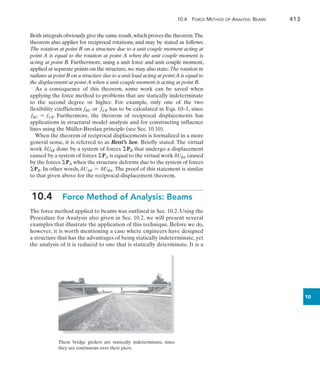
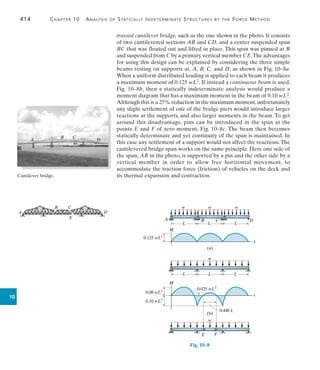
  • 107.
    86 Chapter 3  Analysisof Statically Determinate Trusses 3 bottom cord panel floor beam portal end post stringers portal bracing top lateral bracing sway bracing top cord deck Fig. 3–4 Bridge Trusses.  The main structural elements of a typical bridge truss are shown in Fig. 3–4. Here it is seen that a load on the deck is first transmitted to stringers, then to floor beams, and finally to the joints of the two supporting side trusses.The top and bottom cords of these side trusses are connected by top and bottom lateral bracing, which serves to resist the lateral forces caused by wind and the sidesway caused by moving vehicles on the bridge. Additional stability is provided by the portal and sway bracing.As in the case of many long-span trusses,a roller is provided at one end of a bridge truss to allow for thermal expansion. A few of the typical forms of bridge trusses currently used for single spans are shown in Fig. 3–5. In particular, the Pratt, Howe, and Warren trusses are normally used for spans up to 200 ft (61 m) in length. The most common form is the Warren truss with verticals, Fig. 3–5c. For larger spans,the height of the truss must increase to support the greater moment developed in the center of the span as noted in Fig. 1–5. As a result, a truss with a polygonal upper cord, such as the Parker truss, Fig. 3–5d, is used for some savings in material. The Warren truss with verticals can also be fabricated in this manner for spans up to 300 ft (91  m). The greatest economy of material is obtained if the diagonals have a slope between 45° and 60° with the horizontal. If this rule is maintained, then for spans greater than 300 ft (91 m), the depth of the truss must increase and consequently the panels will get longer. This results in a heavy deck system and, to keep the weight of the deck within tolerable limits, subdivided trusses have been developed. Typical examples include the Baltimore and subdivided Warren trusses, Figs. 3–5e and 3–5f. Finally, the K-truss shown in Fig. 3–5g can also be used in place of a subdivided truss, since it accomplishes the same purpose. Stringers, floor beams, and cross bracing shown under a typical bridge. Parker trusses are used to support this bridge. © Bob Herger/Getty Images
  • 108.
    3.1  Common Typesof Trusses 87 3 Pratt (a) Howe (b) Warren (with verticals) (c) Parker (d) Baltimore (e) subdivided Warren (f) K-truss (g) Fig. 3–5
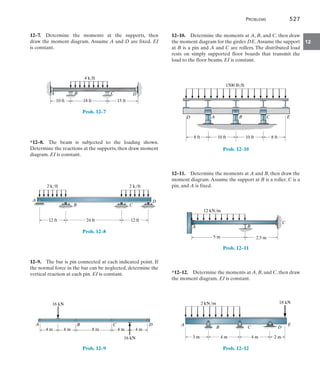
  • 109.
    88 Chapter 3  Analysisof Statically Determinate Trusses 3 Assumptions for Design.  To design both the members and the connections of a truss, it is first necessary to determine the force developed in each member when the truss is subjected to a given loading. In this regard, two important assumptions will be made in order to idealize the truss. 1. The members are joined together by smooth pins. In cases where bolted or welded joint connections are used, this assumption is generally satisfactory provided the center lines of the joining members are concurrent at a point, as in Fig. 3–1. It should be realized, however, that the actual connections do give some rigidity to the joint and this in turn introduces bending of the  connected members when the truss is subjected to a load. The bending stress developed in the members is called secondary stress, whereas the stress in the members of the idealized truss, having pin-connected joints, is called primary stress. A secondary stress analysis of a truss can be performed using a computer, as discussed in Chapter 16. For some types of truss geometries these stresses may be large. 2. All loadings are applied at the joints. In most situations, such as for bridge and roof trusses, this assumption is true. Frequently in the force analysis, the weight of the members is neglected, since the force supported by the members is large in comparison with their weight. If the weight is to be included in the analysis, it is generally satisfactory to apply it as a vertical force, half of its magnitude applied at each end of the member. Because of these two assumptions, each truss member acts as an axial force member, and therefore the forces acting at the ends of the member must be directed along the axis of the member. If the force tends to elongate the member, it is a tensile force (T), Fig. 3–6a; whereas if the force tends to shorten the member, it is a compressive force (C), Fig. 3–6b. In the actual design of a truss it is important to state whether the force is tensile or compressive. Most often, compression members must be made thicker than tension members, because of the buckling or sudden instability that may occur in compression members. T T C C Fig. 3–6 (a) (b)
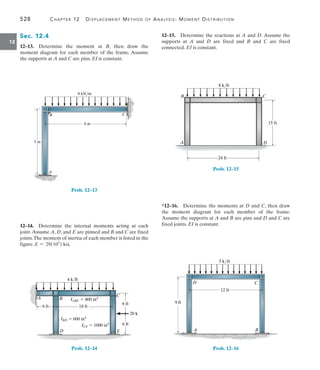
  • 110.
    3.2  Classification ofCoplanar Trusses 89 3 3.2  Classification of Coplanar Trusses Before beginning the force analysis of a truss, it is important to classify the truss as simple, compound, or complex, and then to be able to specify its determinacy and stability. Simple Truss.  To prevent collapse, the framework of a truss must be rigid. Obviously, the four-bar frame ABCD in Fig. 3–7 will collapse unless a diagonal, such as AC, is added for support.The simplest framework that is rigid or stable is a triangle. Consequently, a simple truss is constructed by starting with a basic triangular element, such as ABC in Fig. 3–8, and connecting two members (AD and BD) to form an additional element. Thus it is seen that as each additional element of two members is placed on the truss, the number of joints is increased by one. D B C A Fig. 3–8 An example of a simple truss is shown in Fig. 3–9, where the basic “stable” triangular element is ABC, from which the remainder of the joints, D, E, and F, are established in alphabetical sequence. For this method of construction, however, it is important to realize that simple trusses do not have to consist entirely of triangles. An example is shown in Fig. 3–10, where starting with triangle ABC, bars CD and AD are added to form joint D. Finally, bars BE and DE are added to form joint E. B C E A D F simple truss Fig. 3–9 B C D A P Fig. 3–7 B A C E D simple truss Fig. 3–10
  • 111.
    90 Chapter 3  Analysisof Statically Determinate Trusses 3 Compound Truss.  A compound truss is formed by connecting two or more simple trusses together. Quite often this type of truss is used to support loads acting over a large span, since it is cheaper to construct a somewhat lighter compound truss than to use a heavier single simple truss. There are three ways in which simple trusses are joined together to form a compound truss.The trusses may be connected by a common joint and bar. An example is given in Fig. 3–11a, where the shaded truss ABC is connected to the shaded truss CDE in this manner.The trusses may be joined by three bars, as in the case of the shaded truss ABC is connected to the larger truss DEF, Fig. 3–11b.And finally, the trusses may be joined where bars of a large simple truss, called the main truss, have been replaced by simple trusses, called secondary trusses.An example is shown in Fig. 3–11c, where dashed members of the main truss ABCDE have been replaced by the secondary shaded trusses. If this truss carried roof loads, the use of the secondary trusses might be more economical, since the dashed members may be subjected to excessive bending, whereas the secondary trusses can better transfer the load. Complex Truss.  A complex truss is one that cannot be classified as being either simple or compound.The truss in Fig. 3–12 is an example. (a) A B E D C simple trusses (b) A B C E D F simple trusses (c) C B A D E secondary simple truss secondary simple truss secondary simple truss main simple truss Various types of compound trusses Fig. 3–11 Complex truss Fig. 3–12
  • 112.
    3.2  Classification ofCoplanar Trusses 91 3 Determinacy.  For any problem in truss analysis,it should be realized that the total number of unknowns includes the forces in b number of bars of the truss and the total number of external support reactions r. Since the truss members are all straight axial force members lying in the same plane, the force system acting at each joint is coplanar and concurrent. Consequently, rotational or moment equilibrium is automatically satisfied at the joint (or pin), and it is only necessary to satisfy Fx = 0 and Fy = 0 to ensure translational or force equilibrium. Therefore, only two equations of equilibrium can be written for each joint, and if there are j number of joints, the total number of equations available for solution is 2j. By simply comparing the total number of unknowns (b + r) with the total number of available equilibrium equations, it is therefore possible to specify the determinacy for either a simple, compound, or complex truss.We have         b + r = 2j statically determinate (3–1) b + r 7 2j statically indeterminate In particular, the degree of indeterminacy is specified by the difference in the numbers (b + r) - 2j. Stability.  If b + r 6 2j, a truss will be unstable,that is,a loading can be applied to the truss that causes it to collapse, since there will be an insufficient number of bars or reactions to constrain all the joints. Also, a trusscanbeunstableifitisstaticallydeterminateorstaticallyindeterminate. In this case the stability will have to be determined either by inspection or by a force analysis. External Stability. As stated in Sec. 2.5, a structure (or truss) is externally unstable if all of its reactions are concurrent or parallel. For example, if a horizontal force is applied to the top cord of each of the two trusses in Fig.3–13,each truss will be externally unstable,since the support reactions have lines of action that are either concurrent or parallel.   unstable—parallel reactions unstable—concurrent reactions Fig. 3–13
  • 113.
    92 Chapter 3  Analysisof Statically Determinate Trusses 3 Internal Stability. The internal stability of a truss can often be checked by careful inspection of the arrangement of its members. If it can be determined that each joint is held fixed so that it cannot move in a “rigid body” sense with respect to the other joints, then the truss will be stable. Notice that a simple truss will always be internally stable, since by the nature of its construction it requires starting from a basic triangular element and adding successive “rigid elements,” each containing two additional members and a joint. The truss in Fig. 3–14 exemplifies this construction, where, starting with the shaded triangle element ABC, the successive joints D, E, F, G, H have been added. If a truss is constructed so that it does not hold its joints in a fixed position, it will be unstable or have a “critical form.”An obvious example of this is shown in Fig. 3–15, where it can be seen that no restraint or fixity is provided between joints C and F or B and E, and so the truss will collapse under a vertical load. D C E A B F H G Fig. 3–15 To determine the internal stability of a compound truss,it is necessary to identify the way in which the simple trusses are connected together. For example,the compound truss in Fig.3–16 is unstable since the inner simple truss ABC is connected to the outer simple truss DEF using three bars, AD, BE, and CF, which are concurrent at point O. Thus an external load can be applied to joint A, B,or C and cause the truss ABC to rotate slightly. O A B D E F C Fig. 3–16 D C E A B F H G Fig. 3–14
  • 114.
    3.2  Classification ofCoplanar Trusses 93 3 If a truss is identified as complex, it may not be possible to tell by inspection if it is stable. For example, it can be shown by the analysis discussed in Sec. 3.7 that the complex truss in Fig. 3–17 is unstable or has a “critical form” only if the dimension d = d. If d d it is stable. The instability of any form of truss,be it simple,compound,or complex, may also be noticed by using a computer to solve the 2j simultaneous equations written for all the joints of the truss. If inconsistent results are obtained, the truss will be unstable or have a critical form. If a computer analysis is not performed, the methods discussed previously can be used to check the stability of the truss.To summarize, if the truss has b bars, r external reactions, and j joints, then if b + r 6 2j unstable b + r Ú 2j unstable if truss support reactions are concurrent or parallel or if some of the components of the truss form a collapsible mechanism (3–2) Bear in mind,however,that if a truss is unstable,it does not matter whether it is statically determinate or indeterminate. Obviously, the use of an unstable truss is to be avoided in practice. d¿ s d Fig. 3–17
  • 115.
    94 Chapter 3  Analysisof Statically Determinate Trusses 3 Classify each of the trusses in Fig. 3–18 as stable, unstable, statically determinate, or statically indeterminate. The trusses are subjected to arbitrary external loadings that are assumed to be known and can act anywhere on the trusses. SOLUTION Fig. 3–18a.  Externally stable, since the reactions are not concurrent or parallel. Since b = 19, r = 3, j = 11, then b + r = 2j or 22 = 22. Therefore, the truss is statically determinate. By inspection the truss is internally stable. (a) Fig. 3–18 Fig. 3–18b.  Externally stable. Since b = 15, r = 4, j = 9, then b + r 7 2j or 19 7 18. The truss is statically indeterminate to the first degree. By inspection the truss is internally stable. (b) EXAMPLE 3.1
  • 116.
    3.2  Classification ofCoplanar Trusses 95 3 Fig. 3–18c.  Externally stable. Since b = 9, r = 3, j = 6, then b + r = 2j or 12 = 12.The truss is statically determinate.By ­inspection the truss is internally stable. (c) Fig. 3–18d.  Externally stable. Since b = 12, r = 3, j = 8, then b + r 6 2j or 15 6 16. The truss is internally unstable. (d)
  • 117.
    96 Chapter 3  Analysisof Statically Determinate Trusses 3 3.3  The Method of Joints If a truss is in equilibrium, then each of its joints must also be in equilibrium. Hence, the method of joints consists of satisfying the equilibrium conditions Fx = 0 and Fy = 0 for the forces exerted on the pin at each joint of the truss. When using the method of joints, it is necessary to draw each joint’s free-body diagram before applying the equilibrium equations. Recall that the line of action of each member force acting on the joint is specified from the geometry of the truss, since the force in a member passes along the axis of the member. As an example, consider joint B of the truss in Fig. 3–19a. From the free-body diagram, Fig. 3–19b, the only unknowns are the magnitudes of the forces in members BA and BC. As shown, FBA is “pulling” on the pin, which indicates that member BA is in tension, whereas FBC is “pushing” on the pin, and consequently member BC is in compression. These effects are clearly demonstrated by drawing the free-body diagrams of the connected members, Fig. 3–19c. In all cases, the joint analysis should start at a joint having at least one known force and at most two unknown forces, as in Fig. 3–19b. In this way, application of Fx = 0 and Fy = 0 yields two algebraic equations that can be solved for the two unknowns.When applying these equations, the correct sense of an unknown member force can be determined using one of two possible methods. FBA FBA (c) tension FBC FBC Fig. 3–19 2 m 500 N B A C 45 2 m (a)        B 500 N FBC (compression) FBA (tension) 45 (b)
  • 118.
    3.3 The Method ofJoints 97 3 1. Always assume the unknown member forces acting on the joint’s free- body diagram to be in tension, i.e.,“pulling” on the pin. If this is done, then numerical solution of the equilibrium equations will yield positive scalars for members in tension and negative scalars for members in compression. Once an unknown member force is found, use its correct magnitude and sense (T or C) on subsequent joint free-body diagrams. 2. The correct sense of direction of an unknown member force can, in many cases, be determined “by inspection.” For example, FBC in Fig. 3–19b must push on the pin (compression) since its horizontal component, FBC sin 45°, must balance the 500-N force (Fx = 0). Likewise, FBA is a tensile force since it balances the vertical component, FBC cos 45° (Fy = 0). In more complicated cases, the sense of an unknown member force can be assumed; then, after applying the equilibrium equations, the assumed sense can be verified from the numerical results.A positive answer indicates that the sense is correct, whereas a negative answer indicates that the sense shown on the free-body diagram must be reversed. This is the method we will use in the example problems which follow. Procedure for Analysis The following procedure provides a means for analyzing a truss using the method of joints. • Draw the free-body diagram of a joint having at least one known force and at most two unknown forces.(If this joint is at one of the supports, it may be necessary to calculate the external reactions at the supports by drawing a free-body diagram of the entire truss.) • Use one of the two methods previously described for establishing the sense of an unknown force. • The x and y axes should be oriented such that the forces on the free-body diagram can be easily resolved into their x and y com- ponents.Apply the two force equilibrium equations Fx = 0 and Fy = 0, solve for the two unknown member forces, and verify their correct directional sense. • Continue to analyze each of the other joints, where again it is necessary to choose a joint having at most two unknowns and at least one known force. • Once the force in a member is found from the analysis of a joint at one of its ends, the result can be used to analyze the forces acting on the joint at its other end.Remember,a member in compression “pushes”on the joint and a member in tension“pulls”on the joint.
  • 119.
    98 Chapter 3  Analysisof Statically Determinate Trusses 3 Determine the force in each member of the roof truss shown in the photo. The dimensions and loadings are shown in Fig. 3–20a. State whether the members are in tension or compression. 2 kN 3 kN 3 kN G F B C A 30 30 60 60 30 30 60 60 30 30 D E Ay 4 kN Dy 4 kN (a) Ax 0 4 m 4 m 4 m SOLUTION Only the forces in half the members have to be determined, since the truss is symmetric with respect to both loading and geometry. Joint A, Fig. 3–20b.  We can start the analysis at joint A.Why? The free-body diagram is shown in Fig. 3–20b. + cFy = 0;  4 - FAG sin 30 = 0 FAG = 8 kN (C) Ans. S + Fx = 0;  FAB - 8 cos 30 = 0 FAB = 6.928 kN (T) Ans. Joint G, Fig. 3–20c.  In this case note how the orientation of the x, y axes avoids simultaneous solution of equations. +aFy = 0;  FGB sin 60 - 3 cos 30 = 0 FGB = 3.00 kN (C) Ans. +QFx = 0;  8 - 3 sin 30 - 3.00 cos 60 - FGF = 0 FGF = 5.00 kN (C) Ans. Joint B, Fig. 3–20d. + cFy = 0;  FBF sin 60 - 3.00 sin 30 = 0 FBF = 1.73 kN (T) Ans. S + Fx = 0;  FBC + 1.73 cos 60 + 3.00 cos 30 - 6.928 = 0 FBC = 3.46 kN (T) Ans. y x FAG FAB A 4 kN 30 (b) 3 kN y 30 x G 8 kN FGB FGF (c) 60 30 FBC FBF 3.00 kN 6.928 kN y x B (d) 60 Fig. 3–20 EXAMPLE 3.2
  • 120.
    3.3 The Method ofJoints 99 3 Determine the force in each member of the scissors truss shown in Fig. 3–21a. State whether the members are in tension or compression. The reactions at the supports are given. SOLUTION The truss will be analyzed in the following sequence: Joint E, Fig. 3–21b.  Note that simultaneous solution of equations is avoided by the x, y axes orientation. +QFy = 0;  191.0 cos 30 - FED sin 15 = 0 FED = 639.1 lb (C) Ans. +RFx = 0;  639.1 cos 15 - FEF - 191.0 sin 30 = 0 FEF = 521.8 lb (T) Ans. Joint D, Fig. 3–21c. +bFx = 0; -FDF sin 75 = 0 FDF = 0 Ans. +aFy = 0; -FDC + 639.1 = 0 FDC = 639.1 lb (C) Ans. Joint C, Fig. 3–21d. S + Fx = 0;  FCB sin 45 - 639.1 sin 45 = 0 FCB = 639.1 lb (C) Ans. + cFy = 0;  -FCF - 175 + 2(639.1) cos 45 = 0 FCF = 728.8 lb (T) Ans. Joint B, Fig. 3–21e. +aFy = 0;  FBF sin 75 - 200 = 0  FBF = 207.1 lb (C) Ans. +bFx = 0;  639.1 + 207.1 cos 75 - FBA = 0 FBA = 692.7 lb (C) Ans. Joint A, Fig. 3–21f. S + Fx = 0; FAF cos 30 - 692.7 cos 45 - 141.4 = 0 FAF = 728.9 lb (T) Ans. + cFy = 0; 125.4 - 692.7 sin 45 + 728.9 sin 30 = 0 check Notice that since the reactions have been calculated, a further check of the calculations can be made by analyzing the last joint F.Try it and find out. EXAMPLE 3.3 A 10 ft 10 ft E D C B 200 lb 175 lb Ax 141.4 lb Ay 125.4 lb Ey 191.0 lb 30 45 45 30 60 60 (a) F y x 30 15 E FED FEF 191.0 lb (b) y x 75 D FDC 639.1 lb (c) FDF y x 45 C 639.1 lb (d) FCB 175 lb 45 FCF y x B 200 lb FBA 639.1 lb 75 FBF (e) y A 141.4 lb 692.7 lb 30 FAF 45 x 125.4 lb (f) Fig. 3–21
  • 121.
    100 Chapter 3  Analysisof Statically Determinate Trusses 3 3.4  Zero-Force Members Truss analysis using the method of joints is greatly simplified if one is able to first determine those members that support no loading. These­ zero-force members may be necessary for the stability of the truss during construction and to provide support if the applied loading is changed.The zero-force members of a truss can generally be determined by inspection of the joints, and they occur in two cases. Case 1.  Consider the truss in Fig. 3–22a.The two members at joint C are connected together at a right angle and there is no external load on the joint. The free-body diagram of joint C, Fig. 3–22b, indicates that the force in each member must be zero in order to maintain equilibrium. Furthermore, as in the case of joint A, Fig. 3–22c, this must be true regardless of the angle, say u, between the members. Case 2.  Zero-force members also occur at joints having a geometry as joint D in Fig. 3–23a. Here no external load acts on the joint, so that a force summation in the y direction, Fig. 3–23b, which is perpendicular to the two collinear members, requires that FDF = 0. Using this result, FC is also a zero-force member, as indicated by the force analysis of joint F, Fig. 3–23c. In summary, then, if only two non-collinear members form a truss joint and no external load or support reaction is applied to the joint, the members must be zero-force members, Case 1. Also, if three members form a truss joint for which two of the members are collinear, the third member is a zero-force member, provided no external force or support reaction is applied to the joint, Case 2. Particular attention should be directed to these conditions of joint geometry and loading, since the analysis of a truss can be considerably simplified by first spotting the zero- force members. A E D B C (a) P Fig. 3–22 x y FCB FCD C (b) Fx 0; FCB 0 Fy 0; FCD 0 Fx 0; FAE 0 0 FAE 0 A FAB y x FAE (c) Fy 0; FAB sin u 0 FAB 0 (since sin u 0) u Fig. 3–23 A B C D E F G P (a) x y FDF FDE D (b) FDC Fy 0; FDF 0 x y FFG FCF F FDF 0 FFE (c) Fy 0; FCF sin u 0 0 FCF 0 (since sin u 0) u
  • 122.
    3.4  Zero-Force Members 101 3 EXAMPLE 3.4 Using the method of joints, indicate all the members of the truss shown in Fig. 3–24a that have zero force. y x D FDC FDE (b) u SOLUTION Looking for joints similar to those discussed in Figs. 3–22 and 3–23, we have Joint D, Fig. 3–24b. + cFy = 0;  FDC sin u = 0  FDC = 0 Ans. S + Fx = 0;  FDE + 0 = 0  FDE = 0 Ans. Joint E, Fig. 3–24c. d + Fx = 0;  FEF = 0 Ans. (Note that FEC = P and an analysis of joint C would yield a force in member CF.) Joint H, Fig. 3–24d. +QF y = 0;  FHB = 0 Ans. Joint G, Fig. 3–24e.  The rocker support at G can only exert an x component of force on the joint, i.e., Gx. Hence, + cF y = 0;  FGA = 0 Ans. Fig. 3–24 A B C D E F G H (a) P y x E FEC FEF 0 P (c) y x H FHB FHF (d) FHA y x G FGA Gx (e) FGF
  • 123.
    102 Chapter 3  Analysisof Statically Determinate Trusses 3 3.5  The Method of Sections If the forces in only a few members of a truss are to be found, the method of sections generally provides the most direct means of obtaining these forces. The method of sections consists of passing an imaginary section through the truss, thus cutting it into two parts. Provided the entire truss is in equilibrium, each of the two parts must also be in equilibrium; and as a result, the three equations of equilibrium may be applied to either one of these two parts to determine the member forces at the“cut section.” When the method of sections is used to determine the force in a particular member, a decision must be made as to how to “cut” or section the truss. Since only three independent equilibrium equations (Fx = 0, Fy = 0, MO = 0) can be applied to the isolated portion of the truss, try to select a section that, in general, passes through not more than three members in which the forces are unknown. For example, consider the truss in Fig. 3–25a. If the force in member GC is to be determined, section aa will be appropriate. The free-body diagrams of the two parts are shown in Figs. 3–25b and 3–25c. In particular, note that the line of action of each force in a sectioned member is specified from the geometry of the truss, since the force in a member passes along the axis of the member. Also, the member forces acting on one part of the truss are equal but opposite to those acting on the other part—Newton’s third law. As shown, members assumed to be in tension (BC and GC) are subjected to a “pull,” whereas the member in compression (GF) is subjected to a “push.” Fig. 3–25 D C B A G F E 2 m 2 m 2 m 1000 N a a 2 m (a) 2 m 2 m C FGC G FGF FBC 45 2 m 1000 N (b) FBC FGC FGF G 45 2 m 2 m C Dy Dx Ex (c)
  • 124.
    3.5 The Method ofSections 103 3 The three unknown member forces FBC, FGC, and FGF can be obtained by applying the three equilibrium equations to the free-body diagram in Fig. 3–25b. If, however, the free-body diagram in Fig. 3–25c is considered, the three support reactions Dx, Dy, and Ex will have to be determined first.Why? (This, of course, is done in the usual manner by considering a free-body diagram of the entire truss.) When applying the equilibrium equations, consider ways of writing the equations so as to yield a direct solution for each of the unknowns, rather than having to solve simultaneous equations. For example, summing moments about C in Fig. 3–25b would yield a direct solution for FGF since FBC and FGC create zero moment about C.Likewise,FBC can be obtained directly by summing moments about G. Finally, FGC can be found directly from a force summation in the vertical direction, since FGF and FBC have no vertical components. As in the method of joints, there are two ways in which one can determine the correct sense of an unknown member force. 1. Always assume that the unknown member forces at the cut section are in tension, i.e., “pulling” on the member. By doing this, the numerical solution of the equilibrium equations will yield positive scalars for members in tension and negative scalars for members in compression. 2. The correct sense of an unknown member force can in many cases be determined “by inspection.” For example, FBC is a tensile force as represented in Fig. 3–25b, since moment equilibrium about G requires that FBC create a moment opposite to that of the 1000-N force. Also, FGC is tensile since its vertical component must balance the 1000-N force. In more complicated cases, the sense of an unknown member force may be assumed. If the solution yields a negative scalar, it indicates that the force’s sense is opposite to that shown on the free-body diagram. This is the method we will use in the example problems which follow. A truss bridge being constructed over Lake Shasta in northern California. © Hank deLespinasse Studios, Inc.
  • 125.
    104 Chapter 3  Analysisof Statically Determinate Trusses 3 Procedure for Analysis The following procedure provides a means for applying the method of sections to determine the forces in the members of a truss. Free-Body Diagram • Make a decision as to how to “cut” or section the truss through the members where forces are to be determined. • Before isolating the appropriate section, it may first be necessary to determine the truss’s external reactions,so that the three equilibrium equations are used only to solve for member forces at the cut section. • Draw the free-body diagram of that part of the sectioned truss which has the least number of forces on it. • Use one of the two methods described above for establishing the sense of an unknown force. Equations of Equilibrium • Moments should be summed about a point that lies at the inter- section of the lines of action of two unknown forces; in this way, the third unknown force is determined directly from the equation. • If two of the unknown forces are parallel, forces may be summed perpendicular to the direction of these unknowns to determine directly the third unknown force. An example of a Warren truss (with verticals). See page 87.
  • 126.
    3.5 The Method ofSections 105 3 EXAMPLE 3.5 Determine the force in members GJ and CO of the roof truss shown in the photo. The dimensions and loadings are shown in Fig. 3–26a. State whether the members are in tension or compression. The reactions at the supports have been calculated. 30 I 1159.3 lb (b) 150 lb 300 lb 3.464 ft 6 ft G FKJ FGJ FGH 30 150 lb 300 lb 3.464 ft 1159.3 lb (c) 6 ft A FOP FCD FCO C 500 lb 300 lb 300 lb 300 lb 300 lb 30 b a a b 30 150 lb 300 lb 300 lb M L N O P K J I 150 lb 1159.3 lb 1159.3 lb 3 ft 3 ft 3 ft 3 ft 3 ft 3 ft 3 ft 3 ft Ax 0 B C D E F G H Fig. 3–26 SOLUTION Member CF. Free-Body Diagram.  The force in member GJ can be obtained by considering the section aa in Fig. 3–26a.The free-body diagram of the right part of this section is shown in Fig. 3–26b. Equations of Equilibrium.  A direct solution for FGJ can be obtained by applying MI = 0. Why? For simplicity, slide FGJ to point G (principle of transmissibility), Fig. 3–26b.Thus, a+MI = 0;  -FGJ sin 30(6) + 300(3.464) = 0 FGJ = 346 lb (C) Ans. Member GC. Free-Body Diagram.  The force in CO can be obtained by using section bb in Fig. 3–26a. The free-body diagram of the left portion of the section is shown in Fig. 3–26c. Equations of Equilibrium.  Moments will be summed about point A in order to eliminate the unknowns FOP and FCD. a+MA = 0;  -300(3.464) + FCO(6) = 0 FCO = 173 lb (T) Ans. (a)
  • 127.
    106 Chapter 3  Analysisof Statically Determinate Trusses 3 EXAMPLE 3.6 Determine the force in members GF and GD of the truss shown in Fig. 3–27a. State whether the members are in tension or compression. The reactions at the supports have been calculated. 3 m 3 m 3 m 3 m B C D a E 4.5 m F a G H A 3 m 6 kN 8 kN 2 kN Ey 7 kN Ay 9 kN (a) Ax 0    56.3 O 26.6 3 m 3 m 7 kN 2 kN FCD D FGF FGD F E (b) Fig. 3–27 SOLUTION Free-BodyDiagram.  SectionaainFig.3–27awillbe­considered.Why? The free-body diagram to the right of this section is shown in Fig.3–27b. The distance EO can be determined by proportional triangles or realizing that member GF drops vertically 4.5 - 3 = 1.5 m in 3 m, Fig. 3–27a. Hence to drop 4.5 m from G the distance from C to O must be 9 m.Also, the angles that FGD and FGF make with the horizontal are tan-1 (4.53) = 56.3 and tan-1 (4.59) = 26.6, respectively. Equations of Equilibrium.  The force in GF can be determined directly by applying MD = 0. Why? For the calculation use the principle of transmissibility and slide FGF to point O. Thus, a+MD = 0;  -FGF sin 26.6(6) + 7(3) = 0 FGF = 7.83 kN (C) Ans. The force in GD is determined directly by applying MO = 0. For simplicity use the principle of transmissibility and slide FGD to D. Hence, a+MO = 0;  -7(3) + 2(6) + FGD sin 56.3(6) = 0 FGD = 1.80 kN (C) Ans.
  • 128.
    3.5 The Method ofSections 107 3 EXAMPLE 3.7 Determine the force in members BC and MC of the K-truss shown in Fig. 3–28a. State whether the members are in tension or compression. The reactions at the supports have been calculated. K J I H a 15 ft 15 ft 15 ft 15 ft 15 ft 15 ft A B C D E F G M N O P 10 ft 10 ft a L Ay 2900 lb 1200 lb 1500 lb 1800 lb (a) Gy 1600 lb Ax 0 FMB FML FBC FLK L 20 ft 15 ft B A 2900 lb 1200 lb (b) FBA B FMB 1200 lb (c) y FBC x (d) FMK FMC x 2900 lb M 3 2 3 2 1200 lb y Fig. 3–28 SOLUTION Free-Body Diagram.  Although section aa shown in Fig. 3–28a cuts through four members, it is possible to solve for the force in member BC using this section.The free-body diagram of the left portion of the truss is shown in Fig. 3–28b. Equations of Equilibrium.  Summing moments about point L eliminates three of the unknowns, so that a+ML = 0;  -2900(15) + FBC(20) = 0 FBC = 2175 lb (T) Ans. Free-Body Diagrams.  The force in MC can be obtained indirectly by first obtaining the force in MB from vertical force equilibrium of joint B, Fig. 3–28c, i.e., FMB = 1200 lb (T). Then from the free-body diagram in Fig. 3–28b. + cFy = 0;        2900 - 1200 + 1200 - FML = 0 FML = 2900 lb (T) Using these results, the free-body diagram of joint M is shown in Fig. 3–28d. Equations of Equilibrium. S + Fx = 0;  a 3 213 bFMC - a 3 213 bFMK = 0 + cFy = 0;  2900 - 1200 - a 2 213 bFMC - a 2 213 bFMK = 0 FMK = 1532 lb (C) FMC = 1532 lb (T) Ans. Sometimes, as in this example, application of both the method of sections and the method of joints leads to the most direct solution to the problem. It is also possible to solve for the force in MC by using the result for FBC. In this case, pass a vertical section through LK, MK, MC, and BC, Fig. 3–28a. Isolate the left section and apply MK = 0.
  • 129.
    108 Chapter 3  Analysisof Statically Determinate Trusses 3 Indicate how to analyze the compound truss shown in Fig. 3–29a.The reactions at the supports have been calculated. 2 m 2 m 2 m 2 m 4 kN 2 kN 4 kN Ay = 5 kN Ey = 5 kN (a) D C B a 4 m a E 2 m 2 m H A Ax = 0 I J K F G SOLUTION The truss is a compound truss since the simple trusses ACH and CEG are connected by the pin at C and the bar HG. EXAMPLE 3.8 3.6  Compound Trusses In Sec. 3.2 it was stated that compound trusses are formed by connecting two or more simple trusses together either by bars or by joints. Occasionally this type of truss is best analyzed by applying both the method of joints and the method of sections. It is often convenient to first recognize the type of construction as listed in Sec. 3.2 and then perform the analysis. The following examples illustrate the procedure.
  • 130.
    3.6  Compound Trusses 109 3 4 sin 60 m FHG FJC FBC 2 m 2 m 4 kN 5 kN (b) C Section aa in Fig.3–29a cuts through bar HG and two other ­members having unknown forces.A free-body diagram for the left part is shown in Fig. 3–29b.The force in HG is determined as follows: a+MC = 0;  -5(4) + 4(2) + FHG(4 sin 60) = 0 FHG = 3.46 kN (C) We can now proceed to determine the force in each member of the simple trusses using the method of joints. For example, the free-body diagram of ACH is shown in Fig. 3–29c. The joints of this truss can be analyzed in the following sequence: Joint A: Determine the force in AB and AI. Joint H: Determine the force in HI and HJ. Joint I: Determine the force in IJ and IB. Joint B: Determine the force in BC and BJ. Joint J: Determine the force in JC. FCD 4 kN 5 kN (c) 3.46 kN A B J I H 2 kN FCK C Fig. 3–29
  • 131.
    110 Chapter 3  Analysisof Statically Determinate Trusses 3 EXAMPLE 3.9 Compound roof trusses are used in a garden center, as shown in the photo. They have the dimensions and loading shown in Fig. 3–30a. Indicate how to analyze this truss.        1 kN 30 a a 30 O P R S T Q 1 kN N 1 kN M 1 kN L 1 kN K 1 kN J I H G F E D U V C B A 6 kN 6 kN 1 m 1 m 1 m 1 m 1 m 1 m 1 m 1 m 1 m 1 m 1 m 1 m (a) 0.5 kN 0.5 kN 1 kN 1 kN 1 kN 1 kN 1 kN O 30 1 kN 1 kN 1 kN 1 kN 1 kN 6 kN 1 m 1 m 1 m 1 m 1 m 1 m (b) 0.5 kN FOV FEF FON SOLUTION We can obtain the force in EF by using section aa in Fig. 3–30a. The free-body diagram of the right segment is shown in Fig. 3–30b a+MO = 0;  -1(1) - 1(2) - 1(3) - 1(4) - 1(5) - 0.5(6)                + 6(6) - FEF (6 tan 30) = 0 FEF = 5.20 kN (T) Ans. By inspection notice that BT, EO, and HJ are zero-force members since + cFy = 0 at joints B, E, and H, respectively.Also, by ­ applying +aFy = 0 (perpendicular to AO) at joints P, Q, S, and T, we can directly determine the force in members PU, QU, SC, and TC, ­respectively. Fig. 3–30
  • 132.
    3.6  Compound Trusses 111 3 EXAMPLE 3.10 Indicate how to analyze the compound truss shown in Fig. 3–31a.The reactions at the supports have been calculated. 6 ft 6 ft 6 ft 6 ft 6 ft Ay 3 k 3 k Fy 3 k (a) 3 k A 6 ft Ax 0 45 45 D C H G E F 45 12 ft a B a Fig. 3–31 45 FCE FDG FBH 45 6 ft 12 ft 6 sin 45 ft 3 k 3 k 6 ft B (b) 45 3 k 3 k B 3.78 k 2.68 k A D 2.68 k C (c) 45 SOLUTION The truss may be classified as a compound truss since the simple trusses ABCD and FEHG are connected by three nonparallel or nonconcurrent bars, namely, CE, BH, and DG. Using section aa in Fig. 3–31a we can determine the force in each connecting bar.The free-body diagram of the left part of this section is shown in Fig. 3–31b. Hence, a+MB = 0;   -3(6) - FDG(6 sin 45) + FCE cos 45(12) + FCE sin 45(6) = 0(1) + cFy = 0;       3 - 3 - FBH sin 45 + FCE sin 45 = 0(2) S + Fx = 0;         -FBH cos 45 + FDG - FCE cos 45 = 0(3) From Eq. (2), FBH = FCE; then solving Eqs. (1) and (3) simultaneously yields FBH = FCE = 2.68 k (C) FDG = 3.78 k (T) Analysis of each connected simple truss can now be performed using the method of joints. For example, from Fig. 3–31c, this can be done in the following sequence. Joint A: Determine the force in AB and AD. Joint D: Determine the force in DC and DB. Joint C: Determine the force in CB.
  • 133.
    112 Chapter 3  Analysisof Statically Determinate Trusses 3 3.7  Complex Trusses The member forces in a complex truss can be determined using the method of joints; however, the solution will require writing the two equilibrium equations for each of the j joints of the truss and then solving the complete set of 2j equations simultaneously.* This approach may be impractical for hand calculations, especially in the case of large trusses. Therefore, a more direct method for analyzing a complex truss, referred to as the method of substitute members, will be presented here. Procedure for Analysis With reference to the truss in Fig. 3–32a, the following steps are necessary to solve for the member forces using the substitute member method. P E D F A C B (a) P E D F A C B (b) Si¿ forces      E D F A C B (c) 1 1 si forces Fig. 3–32 *This can be readily accomplished using a computer as will be shown in Chapter 14.
  • 134.
    3.7  Complex Trusses 113 3 Reduction to Stable Simple Truss Determine the reactions at the supports and begin by imagining how to analyze the truss by the method of joints, i.e., progressing from joint to joint and solving for each member force. If a joint is reached where there are three unknowns, remove one of the members at the joint and replace it by an imaginary member elsewhere in the truss. By doing this, reconstruct the truss to be a stable simple truss. For example, in Fig. 3–32a it is observed that each joint will have three unknown member forces acting on it. Hence we will remove member AD and replace it with the imaginary member EC,Fig.3–32b. This truss can now be analyzed by the method of joints for the two types of loading that follow. External Loading on Simple Truss Load the simple truss with the actual loading P, then determine the force Si = in each member i. In Fig. 3–32b, provided the reactions have been determined, one could start at joint A to determine the forces in AB and AF, then joint F to determine the forces in FE and FC, then joint D to determine the forces in DE and DC (both of which are zero), then joint E to determine EB and EC, and finally joint B to determine the force in BC. Remove External Loading from Simple Truss Consider the simple truss without the external load P. Place equal but opposite collinear unit loads on the truss at the two joints from which the member was removed. If these forces develop a force si in the ith truss member, then by proportion an unknown force x in the removed member would exert a force xsi in the ith member. From Fig. 3–32c the equal but opposite unit loads will create no reactions at A and C when the equations of equilibrium are applied to the entire truss. The si forces can be determined by analyzing the joints in the same sequence as before, namely, joint A, then joints F, D, E, and finally B. Superposition If the effects of the above two loadings are combined, the force in the ith member of the truss will be Si = Si = + xsi(1) In particular, for the substituted member EC in Fig. 3–32b the force SEC = SEC = + xsEC. Since member EC does not actually exist on the original truss, we will choose x to have a magnitude such that it yields zero force in EC. Hence, SEC = + xsEC = 0(2) or x = -SEC = sEC. Once the value of x has been determined, the force in the other members i of the complex truss can be determined from Eq. (1).
  • 135.
    114 Chapter 3  Analysisof Statically Determinate Trusses 3 Determine the force in each member of the complex truss shown in Fig. 3–33a.  Assume joints B, F, and D are on the same horizontal line. State whether the members are in tension or compression. 3 ft 4 ft 45° 45° C D F B A E 5 k 8 ft (a) Fig. 3–33 SOLUTION Reduction to Stable Simple Truss.  By inspection, each joint has three unknown member forces. A joint analysis can be performed by hand if, for example, member CF is removed and member DB substituted, Fig. 3–33b. The resulting truss is stable and will not collapse. External Loading on Simple Truss.  As shown in Fig. 3–33b, the support reactions on the truss have been determined. Using the ­ method of joints, we can first analyze joint C to find the forces in members CB and CD; then joint F, where it is seen that FA and FE are ­ zero-force members; then joint E to determine the forces in members EB and ED; then joint D to determine the forces in DA and DB; then finally joint B to determine the force in BA. Considering tension as positive and compression as negative, these Si = forces are recorded in column 2 of Table 1. 45 45 C D F B A E 5 k (b) 5 k 4.375 k 4.375 k EXAMPLE 3.11
  • 136.
    3.7  Complex Trusses 115 3 C D B F A E 1 k (c) 1 k Remove External Loading from Simple Truss.  The unit load ­ acting on the truss is shown in Fig. 3–33c. These equal but opposite forces create no external reactions on the truss. The joint analysis follows the same sequence as discussed previously, namely, joints C, F, E, D, and B. The results of the si force analysis are recorded in column 3 of Table 1. Superposition.  We require SDB = SDB = + xsDB = 0 Substituting the data for SDB = and sDB, where SDB = is negative since the force is compressive, we have -2.50 + x(1.167) = 0 x = 2.143 The values of xsi are recorded in column 4 of Table 1, and the actual member forces Si = Si = + xsi are listed in column 5. TABLE 1  Member Si si xsi Si CB   3.54 -0.707 -1.52 2.02 (T) CD -3.54 -0.707 -1.52 5.05 (C) FA   0   0.833   1.79 1.79 (T) FE   0   0.833   1.79 1.79 (T) EB   0 -0.712 -1.53 1.53 (C) ED -4.38 -0.250   -0.536 4.91 (C) DA   5.34 -0.712 -1.53 3.81 (T) DB -2.50   1.167   2.50 0 BA   2.50 -0.250   -0.536 1.96 (T) CB 2.14 (T)
  • 137.
    116 Chapter 3  Analysisof Statically Determinate Trusses 3 3.8  Space Trusses A space truss consists of members joined together at their ends to form a stable three-dimensional structure.In Sec.3.2 it was shown that the simplest form of a stable two-dimensional truss consists of the members arranged in the form of a triangle.We then built up the simple plane truss from this basic triangular element by adding two members at a time to form further elements. In a similar manner, the simplest element of a stable space truss is a tetrahedron, formed by connecting six members together with four joints as shown in Fig. 3–34. Any additional members added to this basic element would be redundant in supporting the force P.    A simple space truss can be built from this basic tetrahedral element by adding three additional members and another joint forming multiconnected tetrahedrons. Determinacy and Stability.  Realizing that in three dimensions there are three equations of equilibrium available for each joint (Fx = 0, Fy = 0, Fz = 0), then for a space truss with j number of joints, 3j equations are available. If the truss has b number of bars and r number of reactions,then like the case of a planar truss (Eqs.3–1 and 3–2) we can write b + r 6 3j unstable truss b + r = 3j statically determinate:check stability   (3–3) b + r 7 3j statically indeterminate:check stability The external stability of the space truss requires that the support reactions keep the truss in force and moment equilibrium along and about any and all axes.This can sometimes be checked by inspection, although if the truss is unstable a solution of the equilibrium equations will give inconsistent results. Internal stability can sometimes be checked by careful inspection of the member arrangement. Provided each joint is held fixed by its supports or connecting members,so that it cannot move with respect to the other joints, the truss can be classified as internally stable. Also, if we do a force analysis of the truss and obtain inconsistent results, then the truss configuration will be unstable or have a “critical form.” Assumptions for Design.  The members of a space truss may be treated as axial-force members provided the external loading is applied at the joints and the joints consist of ball-and-socket connections. This assumption is justified provided the joined members at a connection intersect at a common point and the weight of the members can be neglected. In cases where the weight of a member is to be included in the analysis, it is generally satisfactory to apply it as a vertical force, half of its magnitude applied to each end of the member. For the force analysis the supports of a space truss are generally modeled as a short link, plane roller joint, slotted roller joint, or a ­ ball-and-socket joint. Each of these supports and their reactive force components are shown in Table 3.1. P Fig. 3–34 The roof of this pavilion is supported using a system of space trusses.
  • 138.
    3.8 Space Trusses 117 3 z y x z y x Fy shortlink z y x (2) (1) roller z y x Fz (3) z y x z y x Fz Fx slotted roller constrained in a cylinder (4) z y x ball-and-socket z y x Fz Fx Fy TABLE 3.1  Supports and Their Reactive Force Components
  • 139.
    118 Chapter 3  Analysisof Statically Determinate Trusses 3 x, y, z, Force Components.  Since the analysis of a space truss is three-dimensional, it will often be necessary to resolve the force F in a member into components acting along the x, y, z axes. For example, in Fig. 3–35 member AB has a length l and known projections x, y, z along the coordinate axes. These projections can be related to the member’s length by the equation l = 2x2 + y2 + z2 (3–4) Since the force F acts along the axis of the member,then the components of F can be determined by proportion as follows: Fx = F a x l b Fy = F a y l b Fz = F a z l b(3–5) Notice that this requires F = 2F2 x + F2 y + F2 z (3–6) Use of these equations will be illustrated in Example 3.12. Zero-Force Members.  In some cases the joint analysis of a truss can be simplified if one is able to spot the zero-force members by recognizing two common cases of joint geometry. Case 1.  If all but one of the members connected to a joint lie in the same plane, and provided no external load acts on the joint, then the member not lying in the plane of the other members must be subjected to zero force. The proof of this statement is shown in Fig. 3–36, where members A, B, C lie in the x–y plane. Since the z component of FD must be zero to satisfy Fz = 0, member D must be a zero-force member. By the same reasoning, member D will carry a load that can be determined from Fz = 0 if an external force acts on the joint and has a component acting along the z axis. A FA z x y D C B FD FC FB Fig. 3–36 z Fy F Fz Fx B x x A l z y y Fig. 3–35 Because of their cost effectiveness, towers such as these are often used to support multiple electric transmission lines.
  • 140.
    3.8 Space Trusses 119 3 Case2.  If it has been determined that all but two of several members connected at a joint support zero force, then the two remaining members must also support zero force, provided they do not lie along the same line.This situation is illustrated in Fig. 3–37, where it is known that A and C are zero-force members. Since FD is collinear with the y axis, then application of Fx = 0 or Fz = 0 requires the x or z component of FB to be zero. Consequently, FB = 0. This being the case, FD = 0 since Fy = 0. B z x y D A FA 0 FB FD C FC 0   Fig. 3–37 Procedure for Analysis Either the method of sections or the method of joints can be used to determine the forces developed in the members of a space truss. Method of Sections If only a few member forces are to be determined, the method of sections may be used. When an imaginary section is passed through a truss and the truss is separated into two parts,the force system acting on either one of the parts must satisfy the six scalar equilibrium equations: Fx = 0, Fy = 0, Fz = 0, Mx = 0, My = 0, Mz = 0. By proper choice of the section and axes for summing forces and moments, many of the unknown member forces in a space truss can be computed directly,using a single equilibrium equation.In this regard,recall that the moment of a force about an axis is zero provided the force is parallel to the axis or its line of action passes through a point on the axis. Method of Joints Generally, if the forces in all the members of the truss must be determined, the method of joints is most suitable for the analysis. When using the method of joints, it is necessary to solve the three ­scalar ­equilibrium equations Fx = 0, Fy = 0, Fz = 0 at each joint. Since it is relatively easy to draw the free-body diagrams and apply the equations of equilibrium, the method of joints is very consistent in its application. Particular attention should be directed to the foregoing two cases of joint geometry and loading, since the analysis of a space truss can be considerably simplified by first spotting the zero-force members.
  • 141.
    120 Chapter 3  Analysisof Statically Determinate Trusses 3 EXAMPLE 3.12 Determine the force in each member of the space truss shown in Fig. 3–38a. The truss is supported by a ball-and-socket joint at A, a slotted roller joint at B, and a cable at C. z 8 ft 8 ft B x A E y 4 ft 4 ft D C Ez = 600 lb (a)     z 8 ft 8 ft x y 4 ft 600 lb (b) Ay Ax By Bx Cy Az Fig. 3–38 SOLUTION The truss is statically determinate since b + r = 3j or 9 + 6 = 3(5), Fig. 3–38b. Support Reactions.  We can obtain the support reactions from the free-body diagram of the entire truss, Fig. 3–38b, as follows: My = 0; -600(4) + Bx(8) = 0 Bx = 300 lb Mz = 0; Cy = 0 Mx = 0; By(8) - 600(8) = 0 By = 600 lb Fx = 0; 300 - Ax = 0 Ax = 300 lb Fy = 0; Ay - 600 = 0 Ay = 600 lb Fz = 0; Az - 600 = 0 Az = 600 lb
  • 142.
    3.8 Space Trusses 121 3 B 300lb 600 lb FBA FBE FBC x y z (c) y 600 lb z 300 lb 600 lb 600 lb FAE FAD FAC x 1 2 45 (d) A z y x FDC FDE 0 D (e) z y x FCE 0 C (f) 0 0 0 Joint B.  We can begin the method of joints at B since there are three unknown member forces at this joint, Fig. 3–38c. The components of FBE can be determined by proportion to the length of member BE, as indicated by Eqs. 3–5.We have Fy = 0;  -600 + FBE1 8 122 = 0 FBE = 9001b (T) Ans. Fx = 0;  300 - FBC - 9001 4 122 = 0 FBC = 0 Ans. Fz = 0;  FBA - 9001 8 122 = 0 FBA = 600 1b (C) Ans. Joint A.  Using the result for FBA = 600 lb (C), the free-body diagram of joint A is shown in Fig. 3–38d.We have Fz = 0;       600 - 600 + FAC sin 45 = 0          FAC = 0 Ans. Fy = 0;            -FAEa 2 25 b + 600 = 0         FAE = 670.8 lb (C) Ans. Fx = 0;           -300 + FAD + 670.8a 1 25 b = 0     FAD = 0 Ans. Joint D.  By inspection the members at joint D, Fig. 3–38a, support zero force,since the arrangement of the members is similar to either of the two cases discussed in reference to Figs. 3–36 and 3–37. Also, from Fig. 3–38e, Fx = 0;          FDE = 0 Ans. Fz = 0;         FDC = 0 Ans. Joint C.  By observation of the free-body diagram, Fig. 3–38f, FCE = 0 Ans.
  • 143.
    122 Chapter 3  Analysisof Statically Determinate Trusses 3 Determine the zero-force members of the truss shown in Fig. 3–39a. The supports exert components of reaction on the truss as shown. x z A H G F E B D C Bz Az Dy Cz Cy Cx Dz Bx y 2 kN 4 kN (a) Fig. 3–39 EXAMPLE 3.13 (b) F FFE FFG FFD FFC x¿ z¿ y¿ E x¿¿ y¿¿ z¿¿ (c) FEF FEA FEH FED SOLUTION The free-body diagram, Fig. 3–39a, indicates there are eight unknown reactions for which only six equations of equilibrium are available for solution. Although this is the case, the reactions can be determined, since b + r = 3j or 16 + 8 = 3(8). To spot the zero-force members,we must compare the conditions of joint geometry and loading to those of Figs. 3–36 and 3–37. Consider joint F, Fig. 3–39b. Since members FC, FD, FE lie in the x- y plane and FG is not in this plane, FG is a zero-force member. ( Fz = 0 must be satisfied.) In the same manner, from joint E, Fig. 3–39c,   EF is a zero-force member, since it does not lie in the y- z plane. (Fx = 0 must be satisfied.) Returning to joint F, Fig. 3–39b, it can be seen that FFD = FFC = 0, since FFE = FFG = 0, and there are no external forces acting on the joint. Use this procedure to show that AB is a zero force member. The numerical force analysis of the joints can now proceed by ­analyzing joint G (FGF = 0) to determine the forces in GH, GB, GC. Then analyze joint H to determine the forces in HE, HB, HA; joint E to determine the forces in EA, ED; joint A to determine the forces in AB, AD, and Az; joint B to determine the force in BC and Bx, Bz; joint D to determine the force in DC and Dy, Dz; and finally, joint C to determine Cx, Cy, Cz.
  • 144.
    3 Fundamental Problems 123 F3–1. Determine the force in each member of the truss and state whether it is in tension or compression. 3 m 40 kN A B C 4 m F3–1 F3–2.  Determine the force in each member of the truss and state whether it is in tension or compression.    2 m 6 kN A D B C 2 m F3–2 F3–3.  Determine the force in each member of the truss and state whether it is in tension or compression.      A B D 3 m 3 m C 10 kN F3–3 F3–4.  Determine the force in each member of the truss and state whether it is in tension or compression.    8 ft 2 k A D B C 6 ft F3–4 F3–5.  Determine the force in each member of the truss and state whether it is in tension or compression.     2 m A D B C 2 m 8 kN 60 F3–5 F3–6.  Determine the force in each member of the truss and state whether it is in tension or compression.    A H B C D E G F 2 m 2 m 2 m 2 m 800 N 600 N 600 N 2 m F3–6 FUNDAMENTAL PROBLEMS
  • 145.
    124 Chapter 3  Analysisof Statically Determinate Trusses 3 F3–10. Determine the force in members GF, CF, and CD and state whether they are in tension or compression. $ % ' ) ( * + OE OE OE OE OE IW IW IW IW IW IW F3–10 F3–11.  Determine the force in members FE, FC, and BC and state whether they are in tension or compression. $ % ' ) ( * P P P P P N1 N1 N1 P P F3–11 F3–12.  Determine the force in members GF, CF, and CD and state whether they are in tension or compression. $ % ' ) ( * + OE OE OE IW IW IW IW IW IW F3–12 F3–7.  Determine the force in members HG, BG, and BC and state whether they are in tension or compression. $ + * ) ( % ' N N N IW IW IW IW IW F3–7 F3–8.  Determine the force in members HG, HC, and BC and state whether they are in tension or compression. $ % ' ) ( * + , - IW IW IW IW IW OE OE OE OE OE F3–8 F3–9.  Determine the force in members ED, BD, and BC and state whether they are in tension or compression. P N1 N1 $ % ' ( P P F3–9
  • 146.
    3 Problems Sec. 3.1–3.2 3–1.  Classifyeach of the following trusses as statically determinate, statically indeterminate, or unstable. If indeterminate, state its degree. (a) (b) (c) (d) Prob. 3–1 3–2.  Classify each of the following trusses as statically determinate, indeterminate, or unstable. If indeterminate, state its degree. (a) (b) Prob. 3–2 Problems 125
  • 147.
    126 Chapter 3  Analysisof Statically Determinate Trusses 3 *3–4.  Classify each of the following trusses as statically determinate, statically indeterminate, or unstable. (a) (b) (c) Prob. 3–4 3–3.  Classify each of the following trusses as stable, unstable, statically determinate, or statically indeterminate. If indeterminate state its degree. (a) (b) (c) Prob. 3–3
  • 148.
    Problems 127 3 Sec. 3.3–3.4 3–5. Determine the force in each member of the truss. State if the members are in tension or compression.Assume all members are pin connected. A G F E B C D 3 m 2 m 2 m 2 m 5 kN 5 kN 5 kN Prob. 3–5 3–6.  Determine the force in each member of the truss. State if the members are in tension or compression. 60 60 4 m 4 m B E D C A 4 m 40 kN 20 kN Prob. 3–6 3–7.  Determine the force in each member of the truss. State whether the members are in tension or compression. Set P = 8 kN. *3–8.  If the maximum force that any member can support is 8 kN in tension and 6 kN in compression, determine the maximum force P that can be supported at joint D. 60 60 4 m 4 m B E D C A 4 m P Prob. 3–7/8 3–9.  Determine the force in each member of the truss. State if the members are in tension or compression. A B C F E D 9 ft 12 ft 12 ft 12 ft 30 2 k 4 k 4 k Prob. 3–9
  • 149.
    128 Chapter 3  Analysisof Statically Determinate Trusses 3 *3–12.  Determine the force in each member of the truss. State if the members are in tension or compression.Assume all members are pin connected. A B C D F E 3 kN 3 kN 3 kN 1.5 kN 1.5 kN 3 m 3 m 3 m 3 m 2 m 2 m Prob. 3–12 3–13.  The truss shown is used to support the floor deck. The uniform load on the deck is 2.5 kft. This load is transferred from the deck to the floor beams, which rest on the top joints of the truss. Determine the force in each member of the truss, and state if the members are in tension or compression.Assume all members are pin connected. 2.5 k/ft 6 @ 12 ft 72 ft 12 ft A B M L K J I C D E F G H N Prob. 3–13 3–10.  Determine the force in each member of the truss. State if the members are in tension or compression. 10 kN 6 kN A B C F G E D 2.5 m 1.5 m 1.5 m 2.5 m 3 m Prob. 3–10 3–11.  Specify the type of compound truss and determine the force in each member. State if the members are in tension or compression. Assume the members are pin connected. 4 kN C E D G F A B 3 m 3 m 3 m 6 kN 4 kN 45 45 45 Prob. 3–11
  • 150.
    Problems 129 3 3–14.  Determinethe force in each member of the truss. Indicate if the members are in tension or compression. Assume all members are pin connected. 6 ft 6 ft 6 ft A B C D E F G 9 ft 3 k 6 k 6 k Prob. 3–14 3–15.  Determine the force in each member of the truss. State if the members are in tension or compression.Assume all members are pin connected. A B C D F E G 2 m 2 m 1.5 m 3 m 1.5 m 3 kN 3 kN 6 kN 3 m 3 m Prob. 3–15 *3–16.  The members of the truss have a mass of 5 kgm. Lifting is done using a cable connected to joints E and G. Determine the largest member force and specify if it is in tension or compression. Assume half the weight of each member can be applied as a force acting at each joint. 2 m 1 m 1 m 2 m A B C D E F G 30 30 30 30 60 60 P H Prob. 3–16 3–17.  Determine the force in each member of the truss. State if the members are in tension or compression. E D C B A 6 kN 6 kN 2 m 2 m 2 m 1.5 m Prob. 3–17
  • 151.
    130 Chapter 3  Analysisof Statically Determinate Trusses 3 3–21.  Determine the force in members FG, GD, CD and GA of the truss. State if the members are in tension or compression. A G F E B C D 3 m 2 m 2 m 2 m 4 kN 4 kN 4 kN Prob. 3–21 3–22.  Determine the force in members HG, HC, HB and AB of the truss. State if the members are in tension or compression.Assume all members are pin connected. 3–23.  Determine the force in members GF, GC, HC and BC of the truss. State if the members are in tension or compression.Assume all members are pin connected. B C E F G H I D A 2 m 2 m 2 m 2 m 4 m 3 kN 3 kN 3 kN 3 kN Probs. 3–22/23 Sec. 3.5–3.6 3–18.  Determine the force in members ED,BD and BC of the truss and indicate if the members are in tension or compression. 6 kN 6 kN 8 kN A B C D E 3 m 3 m 3 m Prob. 3–18 3–19.  Determine the force in members JK, JN, and CD. State if the members are in tension or compression. Identify all the zero-force members. B C N O E F G H I J K L M D A 2 k 20 ft 20 ft 20 ft 30 ft 2 k Prob. 3–19 *3–20.  Determine the force in members FC, BC, and FE. State if the members are in tension or compression.Assume all members are pin connected. E C D 8 ft 8 ft 8 ft 6 ft 6 ft 6 ft B A 2 k F 1.5 k Prob. 3–20
  • 152.
    Problems 131 3 *3–24.  Specifythe type of compound truss and determine the force in members JH, BJ, and BI. State if the members are in tension or compression. The internal angle between any two members is 60°.The truss is pin supported at A and roller supported at F. Assume all members are pin connected. 3 k 2 k 1.5 k A B C D E F G H J K I 10 ft 20 ft 10 ft 10 ft 10 ft 10 ft 10 ft 10 ft Prob. 3–24 3–25.  Determine the forces in members JI, JD, and DE of the truss.State if the members are in tension or compression. B C E F G H I J K L D A 5 kN 5 kN 15 kN 15 kN 10 kN 30 kN 20 kN 3 @ 1 m 3 m 6 @ 3 m 18 m Prob. 3–25 3–26.  Determine the force in members HI, ID, and DC of the truss and state if the members are in tension or compression. D H I J K A C B E G F 20 ft, 5 @ 4 ft 5 ft 2 k 4 k 4 k 4 k 4 k Prob. 3–26 3–27.  Determine the force in members GF, FB, and BC of the Fink truss and state if the members are in tension or compression. A B G 10 ft 10 ft 10 ft C 30 60 30 60 F 600 lb D E 800 lb 800 lb Prob. 3–27
  • 153.
    132 Chapter 3  Analysisof Statically Determinate Trusses 3 3–30.  Determine the force in members JI, IC, and CD of the truss.State if the members are in tension or compression. Assume all members are pin connected. D H I J K A C B E G F 10 m, 5 @ 2 m 5 m 3 kN 3 kN 3 kN 3 kN 1.5 kN Prob. 3–30 3–31.  Determine the forces in members GH, HC, and BC of the truss. State if the members are in tension or compression.Assume all members are pin connected. 9 kN B 6 kN C 3 kN D E A F H G 4.5 m 3 m 12 m, 4 @ 3 m Prob. 3–31 *3–28.  Specify the type of compound truss and determine the forces in members JH, IH, and CD. State if the members are in tension or compression. Assume all members are pin connected. H G F E D C B A I J K 3 k 20 ft 15 ft 15 ft 30 ft 5 ft 5 ft Prob. 3–28 3–29.  Determine the force in members IH, ID, and CD of the truss.State if the members are in tension or compression. Assume all members are pin connected. D H I J K A C B E G F 10 m, 5 @ 2 m 5 m 3 kN 3 kN 3 kN 3 kN 1.5 kN Prob. 3–29
  • 154.
    Problems 133 3 Sec. 3.7 *3–32. Determine the forces in all the members of the complex truss. State if the members are in tension or compression. Hint: Substitute member AD with one placed between E and C. D E B C A F 600 lb 6 ft 6 ft 12 ft 30 30 45 45 Prob. 3–32 3–33.  Determine the forces in all the members of the lattice (complex) truss. State if the members are in tension or compression. Hint: Substitute member JE by one placed between K and F. K J C E D F G H I L B A 6 ft 12 ft 6 ft 6 ft 12 ft 2 k Prob. 3–33 3–34.  Determine the force in each member and state if the members are in tension or compression. B A E F C D 1 m 1 m 1 m 1 m 2 m 4 kN 4 kN Prob. 3–34 3–35.  Determine the forces in all the members of the complex truss. State if the members are in tension or compression. Hint: Substitute member AB with one placed between C and E. 2 m 3 kN 2 m 1 m 3 m 1 m 3 m C B G H E F A D Prob. 3–35
  • 155.
    134 Chapter 3  Analysisof Statically Determinate Trusses 3 3–38.  Determine the force in each member of the space truss and state if the members are in tension or compression. The truss is supported by ball-and socket joints at C, D, E, and G. Note: Although this truss is indeterminate to the first degree, a solution is possible due to symmetry of geometry and loading. G A F 3 kN B C E y z x D 1 m 2 m 2 m 1.5 m 1 m Prob. 3–38 3–39.  Determine the force in members FE and ED of the space truss and state if the members are in tension or compression. The truss is supported by a ball-and-socket joint at C and short links at A and B. *3–40.  Determine the force in members GD, GE, GF and FD of the space truss and state if the members are in tension or compression. z x y 4 kN 3 m 3 m F E D G C 1.5 m 1 m 0.75 m 0.75 m A B Probs. 3–39/40 Sec. 3.8 *3–36.  Determine the force in the members of the space truss, and state whether they are in tension or compression. x y z A B C 2 m 2 m 2 m 2 m D 5 kN 3 kN Prob. 3–36 3–37.  Determine the force in each member of the space truss and state if the members are in tension or compression. The truss is supported by a ball-and-socket joint at A and short links at B and C. z D F 600k lb E C y B A x 8 ft 8 ft 4 ft 4 ft Prob. 3–37
  • 156.
    Project Problem 135 3 3–41. Determine the reactions and the force in each member of the space truss. Indicate if the members are in tension or compression. z Py 500 lb 4 ft 2 ft x y 8 ft 3 ft 2 ft A B D C Prob. 3–41 3–42.  Determine the force in members AB, BD, and FE of the space truss and state if the members are in tension or compression. 3–43.  Determine the force in members AF, AE and FD of the space truss and state if the members are in tension or compression. 3 ft 3 ft 3 ft E A 4 ft F D C B z y x 500 lb 500 lb Probs. 3–42/43 3–1P.  The Pratt roof trusses are uniformly spaced every 15 ft. The deck, roofing material, and the purlins have an average weight of 5.6 lbft2 . The building is located in New York where the anticipated snow load is 20 lbft2 and the anticipated ice load is 8 lbft2 .These loadings occur over the horizontal projected area of the roof. Determine the force in each member due to dead load, snow, and ice loads. Neglect the weight of the truss members and assume A is pinned and E is a roller. 8 ft 8 ft 8 ft 8 ft 6 ft 6 ft A B H G F C D E Project Problem Project Prob. 3–1P
  • 157.
    3 136 Chapter 3  Analysisof Statically Determinate Trusses Trusses are composed of slender members joined together at their end points to form a series of triangles. For analysis we assume the members are pin connected, and the loads are applied at the joints. Thus, the members will either be in tension or compression. Trusses can be classified in three ways: Simple trusses are formed by starting with an initial triangular element and connecting to it two other members and a joint to form a second triangle, etc. Compound trusses are formed by connecting together two or more simple trusses using a common joint and/or additional member. Complex trusses are those that cannot be classified as either simple or compound. If the number of bars or members of a truss is b, and there are r reactions and j joints, then if b + r = 2j the truss will be statically determinate b + r 7 2j the truss will be statically indeterminate C C T T simple truss compound truss simple trusses compound truss simple trusses complex truss Chapter Review
  • 158.
    Chapter Review 137 3 Thetruss will be externally unstable if the reactions are concurrent or parallel. Internal stability can be checked by counting the number of bars b, reactions r, and joints j. If b + r 6 2j the truss is unstable. If b + r Ú 2j it may still be unstable, so it becomes necessary to inspect the truss and look for bar arrangements that form a parallel mechanism, without forming a triangular element. Planar trusses can be analyzed by the method of joints. This is done by selecting each joint in sequence, having at most one known force and at least two unknowns. The free-body diagram of each joint is constructed and two force equations of equilibrium, gFx = 0, gFy = 0, are written and solved for the unknown member forces. The method of sections requires passing a section through the truss and then drawing a free-body diagram of one of its sectioned parts. The member forces cut by the section are then found from the three equations of equilibrium. Normally a single unknown can be found if one sums moments about a point that eliminates the two other forces. Compound and complex trusses can also be analyzed by the method of joints and the method of sections. The “method of substitute members” can be used to obtain a direct solution for the force in a particular member of a complex truss. unstable concurrent reactions unstable parallel reactions unstable internally
  • 159.
    The simply supportedbeams and girders of this building frame were designed to resist the internal shear and moment acting throughout their lengths. Chapter 4 © Gari Wyn Williams/Alamy
  • 160.
    139 Internal Loadings Developed inStructural Members Before a structural member can be proportioned, it is necessary to determine the force and moment that act within it. In this chapter we will develop the methods for finding these loadings at specified points along a member’s axis and for showing the variation graphically using the shear and moment diagrams. Applications are given for both beams and frames. 4.1  Internal Loadings at a Specified Point As discussed in Sec. 2.4, the internal load at a specified point in a member can be determined by using the method of sections.In general,this loading for a coplanar structure will consist of a normal force N, shear force V, and bending moment M.* It should be realized, however, that these loadings actually represent the resultants of the stress distribution acting over the member’s cross-sectional area at the cut section. Once the resultant internal loadings are known, the magnitude of the stress can be determined provided an assumed distribution of stress over the cross-sectional area is specified. *Three-dimensional frameworks can also be subjected to a torsional moment, which tends to twist the member about its axis.
  • 161.
    140 Chapter 4  Internal Loadings Developed in Structural Members 4 Sign Convention.  Before presenting a method for finding the internal normal force, shear force, and bending moment, we will need to establish a sign convention to define their “positive” and “negative” values.* Although the choice is arbitrary, the sign convention to be adopted here has been widely accepted in structural engineering practice, and is illustrated in Fig. 4–1a. On the left-hand face of the cut member the normal force N acts to the right,the internal shear force V acts downward, and the moment M acts counterclockwise. In accordance with Newton’s third law, an equal but opposite normal force, shear force, and bending moment must act on the right-hand face of the member at the section. Perhaps an easy way to remember this sign convention is to isolate a small segment of the member and note that positive normal force tends to elongate the segment, Fig. 4–1b;   positive shear tends to rotate the segment clockwise, Fig. 4–1c; and positive bending moment tends to bend the segment concave upward, so as to “hold water,” Fig. 4–1d. *This will be convenient later, in Secs. 4.2 and 4.3, where we will express V and M as functions of x and then plot these functions. Having a sign convention is similar to assigning coordinate directions x positive to the right and y positive upward when plotting a function y = f(x). M N V N V M (a) N N (b) V V (c) M M (d) Fig. 4–1
  • 162.
    4.1  Internal Loadingsat a Specified Point 141 4 These hammerhead piers are tapered due to the greater shear and moment they must resist at their center. Procedure for Analysis The following procedure provides a means for applying the method of sections to determine the internal normal force, shear force, and bending moment at a specific location in a structural member. Support Reactions • Before the member is “cut” or sectioned, it may be necessary to determine the member’s support reactions so that the equilibrium equations are used only to solve for the internal loadings when the member is sectioned. • If the member is part of a pin-connected structure, the pin reactions can be determined using the methods of Sec. 2.6. Free-Body Diagram • Keep all distributed loadings, couple moments, and forces acting on the member in their exact location, then pass an imaginary section through the member, perpendicular to its axis at the point where the internal loading is to be determined. • After the section is made, draw a free-body diagram of the segment that has the least number of loads on it. At the section indicate the unknown resultants N, V, and M acting in their positive directions (Fig. 4–1a). Equations of Equilibrium • Moments should be summed at the section about axes that pass through the centroid of the member’s cross-sectional area, in order to eliminate the unknowns N and V and thereby obtain a direct solution for M. • If the solution of the equilibrium equations yields a quantity having a negative magnitude, the assumed directional sense of the quantity is opposite to that shown on the free-body diagram.
  • 163.
    142 Chapter 4  Internal Loadings Developed in Structural Members 4 The building roof shown in the photo has a weight of 1.8 kNm2 and is supported on 8-m long simply supported beams that are spaced 1 m apart. Each beam, shown in Fig. 4–2b transmits its loading to two girders, located at the front and back of the building. Determine the internal shear and moment in the front girder at point C, Fig. 4–2a. Neglect the weight of the members. 1 m (a) 1 m 1 m 1 m 1 m 1 m 1 m 1 m 1 m 1 m 1 m 1 m 1.2 m 1.2 m 1.2 m 3.6 kN 3.6 kN 7.2 kN girder 43.2 kN 43.2 kN C 7.2 kN 7.2 kN edge beam girder SOLUTION Support Reactions.  The roof loading is transmitted to each beam as a one-way slab (L2L1 = 8 m1 m = 8 7 2). The tributary loading on each interior beam is therefore (1.8 kNm2 )(1 m) = 1.8 kNm. (The two edge beams support 0.9 kNm.) From Fig. 4–2b, the reaction of each interior beam on the girder is (1.8 kNm)(8 m)2 = 7.2 kN. (b) 7.2 kN beam 0.5 m 0.5 m 1.8 kN/m 7 m 7.2 kN girder Free-Body Diagram.  The free-body diagram of the girder is shown in Fig. 4–2a. Notice that each column reaction is [(2(3.6 kN) + 11(7.2 kN)]2 = 43.2 kN The free-body diagram of the left girder segment is shown in Fig. 4–2c. Here the internal loadings are assumed to act in their positive directions. Equations of Equilibrium. Fig. 4–2 EXAMPLE 4.1 (c) MC VC 43.2 kN 1 m 1 m 0.4 m 1.2 m 1.2 m 3.6 kN 7.2 kN 7.2 kN C + cFy = 0;    43.2 - 3.6 - 2(7.2) - VC = 0   VC = 25.2 kN     Ans. a+MC = 0;  MC + 7.2(0.4) + 7.2(1.4) + 3.6(2.4) - 43.2(1.2) = 0   MC = 30.2 kN # m  Ans.
  • 164.
    4.1  Internal Loadingsat a Specified Point 143 4 Determine the internal shear and moment acting at a section passing through point C in the beam shown in Fig. 4–3a. EXAMPLE 4.2 27 k 12 ft (b) 6 ft 9 k 18 k A 6 ft 18 ft C (a) 3 k/ft B Fig. 4–3 SOLUTION Support Reactions.  Replacing the distributed load by its resultant force and computing the reactions yields the results shown in Fig. 4–3b. Free-Body Diagram. Segment AC will be considered since it yields the simplest solution, Fig. 4–3c. The distributed load intensity at C is computed by proportion, that is, wC = (6 ft18 ft)(3 kft) = 1 kft Equations of Equilibrium. + cFy = 0;    9 - 3 - VC = 0      VC = 6 k   Ans. a+MC = 0;  -9(6) + 3(2) + MC = 0 MC = 48 k # ft Ans. This problem illustrates the importance of keeping the distributed loading on the beam until after the beam is sectioned. If the beam in Fig. 4–3b were sectioned at C, the effect of the distributed load on segment AC would not be recognized, and the result VC = 9 k and MC = 54 k # ft would be wrong. 1 k/ft NC MC 9 k 6 ft 2 ft 3 k (c) VC
  • 165.
    144 Chapter 4  Internal Loadings Developed in Structural Members 4 The 9-k force in Fig. 4–4a is supported by the floor panel DE, which in turn is simply supported at its ends by floor beams. These beams transmit their loads to the simply supported girder AB. Determine the internal shear and moment acting at point C in the girder. EXAMPLE 4.3 (a) 6 ft 6 ft 6 ft 4 ft 2 ft 9 k A B C D E 15 ft 24 ft Fig. 4–4 12 ft 6 ft 4 ft 2 ft 9 k 3 k 5.25 k 24 ft 3.75 k (b) 3 k 6 k 6 k C MC VC NC A 12 ft 3 ft 3.75 k 6 k (c) SOLUTION Support Reactions.  Equilibrium of the floor panel, floor beams, and girder is shown in Fig. 4–4b. It is advisable to check these results. Free-Body Diagram.  The free-body diagram of segment AC of the girder will be used since it leads to the simplest solution, Fig. 4–4c. Note that there are no loads on the floor beams supported by AC. Equations of Equilibrium. + cFy = 0;        3.75 - 6 - VC = 0    VC = -2.25 k Ans. a+MC = 0;   -3.75(15) + 6(3) + MC = 0 MC = 38.25 k # ft Ans.    
  • 166.
    4.2 Shear and MomentFunctions 145 4 4.2  Shear and Moment Functions The design of a beam requires a detailed knowledge of the variations of the internal shear force V and moment M acting at each point along the axis of the beam.The internal normal force is generally not considered for two reasons:(1) in most cases the loads applied to a beam act perpendicular to the beam’s axis and hence produce only an internal shear force and bending moment, and (2) for design purposes the beam’s resistance to shear, and particularly to bending, is more important than its ability to resist normal force.An important exception to this occurs, however, when beams are subjected to compressive axial forces, since the buckling or instability that may occur has to be investigated. The variations of V and M as a function of the position x of an arbitrary point along the beam’s axis can be obtained by using the method of sections discussed in Sec. 4.1. Here, however, it is necessary to locate the imaginary section or cut at an arbitrary distance x from one end of the beam rather than at a specific point. In general, the internal shear and moment functions will be discontinuous, or their slope will be discontinuous, at points where the type or magnitude of the distributed load changes or where concentrated forces or couple moments are applied.Because of this,shear and moment functions must be determined for each region of the beam located between any two discontinuities of loading. For example, coordinates x1, x2, and x3 will have to be used to describe the variation of V and M throughout the length of the beam in Fig. 4–5a.These coordinates will be valid only within regions from A to B for x1, from B to C for x2, and from C to D for x3. Although each of these coordinates has the same origin, as noted here, this does not have to be the case. Indeed, it may be easier to develop the shear and moment functions using coordinates x1, x2, x3 having origins at A, B, and D as shown in Fig. 4–5b. Here x1 and x2 are positive to the right and x3 is positive to the left. Additional reinforcement, provided by vertical plates called stiffeners, is used over the pin and rocker supports of these bridge girders. Here the reactions will cause large internal shear in the girders and the stiffeners will prevent localized buckling of the girder flanges or web. Also, note the tipping of the rocker support caused by the thermal expansion of the bridge deck. A B C D P w x1 x2 x3 (a) Fig. 4–5 A B C D P w x1 x2 x3 (b)
  • 167.
    146 Chapter 4  Internal Loadings Developed in Structural Members 4 The joists, beams, and girders used to support this floor can be designed once the internal shear and moment are known throughout their lengths. Procedure for Analysis The following procedure provides a method for determining the variation of shear and moment in a beam as a function of position x. Support Reactions • Determine the support reactions on the beam and resolve all the external forces into components acting perpendicular and parallel to the beam’s axis. Shear and Moment Functions • Specify separate coordinates x and associated origins, extending into regions of the beam between concentrated forces and/or couple moments, or where there is a discontinuity of distributed loading. • Section the beam perpendicular to its axis at each distance x, and from the free-body diagram of one of the segments determine the unknowns V and M at the cut section as functions of x. On the free-body diagram, V and M should be shown acting in their positive directions, in accordance with the sign convention given in Fig. 4–1. • V is obtained from Fy = 0 and M is obtained by summing moments about the point S located at the cut section, Ms = 0. • The results can be checked by noting that dMdx = V and dV dx = w, where w is positive when it acts upward, away from the beam.These relationships are developed in Sec.4.3.
  • 168.
    4.2 Shear and MomentFunctions 147 4 Determine the shear and moment in the beam shown in Fig. 4–6a as a function of x. EXAMPLE 4.4 2 k/ft x 30 ft (a) Fig. 4–6 SOLUTION Support Reactions.  For the purpose of computing the support reactions, the distributed load is replaced by its resultant force of 30 k, Fig. 4–6b. It is important to remember, however, that this resultant is not the actual load on the beam. 20 ft (b) 30 k 600 kft 30 k Shear and Moment Functions.  A free-body diagram of the beam segment of length x is shown in Fig. 4–6c. Note that the intensity of the triangular load at the section is found by proportion; that is, wx = 230 or w = x15.With the load intensity known,the resultant of the distributed loading is found in the usual manner as shown in the figure.Thus, + cFy = 0;   30 - 1 2 a x 15 bx - V = 0 V = 30 - 0.0333x2 Ans. a+MS = 0;  600 - 30x + c 1 2 a x 15 bx d x 3 + M = 0 M = -600 + 30x - 0.0111x3 Ans. Note that dMdx = V and dV dx = -x15 = w, which serves as a check of the results. x (c) 600 kft 30 k x — 3 M V 1 x __ __ x 2 15 x w __ k/ft 15
  • 169.
    148 Chapter 4  Internal Loadings Developed in Structural Members 4 Determine the shear and moment in the beam shown in Fig. 4–7a as a function of x. EXAMPLE 4.5 60 k x1 x3 x4 x2 12 ft 20 ft 4 k/ft 100 k· ft (a) Fig. 4–7 14 ft 48 k 60 k 100 kft 6 ft 108 k 1588 kft (b) 4x1 1588 kft 108 k M V — 2 (c) x1 x1 48 k 6 ft 108 k 1588 kft M V x2 6 x2 (d) SOLUTION Support Reactions.  The reactions at the fixed support are V = 108 k and M = 1588 k # ft, Fig. 4–7b. Shear and Moment Functions.  Since there is a discontinuity of distributed load at x = 12 ft, two regions of x must be considered in order to describe the shear and moment functions for the entire beam. Here x1 is appropriate for the left 12 ft and x2 can be used for the remaining segment. 0 … x1 … 12 ft. Notice that V and M are shown in the positive directions, Fig. 4–7c. + cFy = 0;  108 - 4x1 - V = 0,  V = 108 - 4x1 Ans. a+MS = 0;   1588 - 108x1 + 4x1 a x1 2 b + M = 0 M = -1588 + 108x1 - 2x1 2 Ans. 12 ft … x2 … 20 ft, Fig. 4–7d. + cFy = 0;  108 - 48 - V = 0,  V = 60 Ans. a+MS = 0;   1588 - 108x2 + 48(x2 - 6) + M = 0 M = 60x2 - 1300 Ans. These results can be partially checked by noting that when x2 = 20 ft, then V = 60 k and M = -100 k # ft. Also, note that dMdx = V and dV dx = w.
  • 170.
    4.2 Shear and MomentFunctions 149 4 Determine the shear and moment in the beam shown in Fig. 4–8a as a function of x. EXAMPLE 4.6 10 kN/m 30 kN/m 9 m x (a) Fig. 4–8 75 kN 20 kN/m 9 m (b) 90 kN 90 kN 6 m 4.5 m 105 kN 10 kN/m SOLUTION Support Reactions.  To determine the support reactions, the distributed load is divided into a triangular and rectangular loading, and these loadings are then replaced by their resultant forces. These reactions have been computed and are shown on the beam’s­ free-body diagram, Fig. 4–8b. Shear and Moment Functions.  A free-body diagram of the cut section is shown in Fig. 4–8c. As above, the trapezoidal loading is replaced by rectangular and triangular distributions. Note that the intensity of the triangular load at the cut is found by proportion. The resultant force of each distributed loading and its location are indicated.Applying the equilibrium equations, we have + cFy = 0;   75 - 10x - c 1 2 (20)a x 9 bx d - V = 0 V = 75 - 10x - 1.11x2 Ans. a+MS = 0;  -75x + (10x)a x 2 b + c 1 2 (20)a x 9 bx d x 3 + M = 0 M = 75x - 5x2 - 0.370x3 Ans. x 20 __ kN/m 9 10 kN/m 75 kN 10x x –– 2 x –– 2 x –– 3 M V (c) 1 x __ (20) __ x 2 9
  • 171.
    150 Chapter 4  Internal Loadings Developed in Structural Members 4 4.3  Shear and Moment Diagrams for a Beam If the variations of V and M as functions of x obtained in Sec. 4.2 are plotted, the graphs are termed the shear diagram and moment diagram, respectively. In cases where a beam is subjected to several concentrated forces, couples, and distributed loads, plotting V and M versus x can become quite tedious since several functions must be plotted. In this section a simpler method for constructing these diagrams is discussed—a method based on differential relations that exist between the load, shear, and moment. To derive these relations, consider the beam AD in Fig. 4–9a, which is subjected to an arbitrary distributed loading w = w(x) and a series of concentrated forces and couples.In the following discussion,the distributed load will be considered positive when the loading acts upward as shown. We will consider the free-body diagram for a small segment of the beam having a length x, Fig. 4–9b. Since this segment has been chosen at a point x along the beam that is not subjected to a concentrated force or couple, any results obtained will not apply at points of concentrated loading. The internal shear force and bending moment shown on the free-body diagram are assumed to act in the positive direction according to the established sign convention, Fig. 4–1. Note that both the shear force and moment acting on the right face must be increased by a small, finite amount in order to keep the segment in equilibrium. The distributed loading has been replaced by a concentrated force w (x) that acts at a fractional distance P(x) from the right end, where 0 6 P 6 1. (For example, if w is uniform or constant, then w (x) will act at 1 2 x, so P = 1 2.) Applying the equations of equilibrium, we have + cFy = 0;   V + w(x) - (V + V ) = 0 V = w(x) a+MO = 0;   -V x - M - w(x) P(x) + (M + M) = 0 M = V(x) + wP(x)2 M1 B C M2 x x F1 F2 F3 w w(x) w x D A (a) Fig. 4–9 x V V (b) w(x) w M V M M O P (x) The many concentrated loadings acting on this reinforced concrete beam create a variation of the internal loading in the beam. For this reason, the shear and moment diagrams must be drawn in order to properly design the beam.
  • 172.
    4.3 Shear and MomentDiagrams for a Beam 151 4 Dividing by x and taking the limit as x S 0, these equations become       dV dx = w Slope of Shear Diagram f = e Intensity of Distributed Load (4–1)    dM dx = V       Slope of Moment Diagram f = 5Shear(4–2) As noted, Eq. 4–1 states that the slope of the shear diagram at a point (dVdx) is equal to the intensity of the distributed load w at the point. Likewise, Eq. 4–2 states that the slope of the moment diagram (dMdx) is equal to the intensity of the shear at the point. Equations 4–1 and 4–2 can be “integrated” from one point to another between concentrated forces or couples (such as from B to C in­ Fig. 4–9a), in which case      V = L wdx   Change in Shear f = c Area under Distributed Loading Diagram (4–3) and M = L Vdx Change in Moment f = e Area under Shear Diagram (4–4) As noted, Eq. 4–3 states that the change in the shear between any two points on a beam equals the area under the distributed loading diagram between the points. Likewise, Eq. 4–4 states that the change in the moment between the two points equals the area under the shear diagram between the points.If the areas under the load and shear diagrams are easy to compute, Eqs. 4–3 and 4–4 provide a method for determining the numerical values of the shear and moment at various points along a beam.
  • 173.
    152 Chapter 4  Internal Loadings Developed in Structural Members 4 From the derivation it should be noted that Eqs. 4–1 and 4–3 cannot be used at points where a concentrated force acts, since these equations do not account for the sudden change in shear at these points. Similarly, because of a discontinuity of moment Eqs. 4–2 and 4–4 cannot be used at points where a couple moment is applied. In order to account for these two cases, we must consider the free-body diagrams of differential elements of the beam in Fig. 4–9a which are located at concentrated force and couple moments. Examples of these elements are shown in Figs. 4–10a and 4–10b, respectively. From Fig. 4–10a it is seen that force equilibrium requires the change in shear to be + cFy = 0; V = F(4–5) Thus, when F acts upward on the beam, V is positive, so that the shear diagram shows a “jump” upward. Likewise, if F acts downward, the jump (V ) is downward.From Fig.4–10b,letting x S 0, moment equilibrium requires the change in moment to be a+MO = 0; M = M(4–6) In this case, if an external couple moment M is applied clockwise, M is positive, so that the moment diagram jumps upward, and when M acts counterclockwise, the jump (M) must be downward. Table 4.1 illustrates application of Eqs. 4–1, 4–2, 4–5, and 4–6 to some common loading cases assuming V and M retain positive values. The slope at various points on each curve is indicated. None of these results should be memorized; rather, each should be studied carefully so that one becomes fully aware of how the shear and moment diagrams can be constructed on the basis of knowing the variation of the slope from the load and shear diagrams, respectively. It would be well worth the time and effort to self-test your understanding of these concepts by covering over the shear and moment diagram columns in the table and then trying to reconstruct these diagrams on the basis of knowing the loading. F M V V V M M (a) x Fig. 4–10 M¿ M V x V V (b) M M O
  • 174.
    4.3 Shear and MomentDiagrams for a Beam 153 4 Loading ShearDiagram, dV dx = w Moment Diagram, dM dx = V TABLE 4.1  Relationship between Loading, Shear, and Moment slope VR MR P VR ML VL VL VR slope VL ML MR ML MR M¿ ML MR MR VR ML VL MR VR ML VL VL VL VL VR VR VR MR ML slope VL slope VR MR slope VR ML slope VL MR ML slope VL MR VR ML VL w0 w0 slope w1 slope w2 w1 w1 w2 w2 0 0 0 slope w2 slope w1 slope VR 0 0 zero slope zero slope zero slope constant slope negative increasing slope positive decreasing slope positive decreasing slope positive decreasing slope negative decreasing slope positive constant slopes
  • 175.
    154 Chapter 4  Internal Loadings Developed in Structural Members 4 Procedure for Analysis The following procedure provides a method for constructing the shear and moment diagrams for a beam using Eqs. 4–1 through 4–6. Support Reactions • Determine the support reactions and resolve the forces acting on the beam into components which are perpendicular and parallel to the beam’s axis. Shear Diagram • Establish the V and x axes and plot the values of the shear at the two ends of the beam. • Since dVdx = w, the slope of the shear diagram at any point is equal to the intensity of the distributed loading at the point. (Note that w is positive when it acts upward.) Begin by sketching the slope at the end points. • If a numerical value of the shear is to be determined at the point, one can find this value either by using the method of sections as discussed in Sec. 4.1 or by using Eq. 4–3, which states that the change in the shear force is equal to the area under the distributed loading diagram. • Since w(x) is integrated to obtain V(x), if w(x) is a curve of degree n, then V(x) will be a curve of degree n + 1. For example, if w(x) is uniform, V(x) will be linear. Moment Diagram • Establish the M and x axes and plot the values of the moment at the ends of the beam. • Since dMdx = V, the slope of the moment diagram at any point is equal to the intensity of the shear at the point. Begin by sketching the slope at the end points. • At the point where the shear is zero, dMdx = 0, and therefore this may be a point of maximum or minimum moment. • If the numerical value of the moment is to be determined at a point,one can find this value either by using the method of sections as discussed in Sec. 4.1 or by using Eq. 4–4, which states that the change in the moment is equal to the area under the shear diagram. • Since V(x) is integrated to obtain M(x), if V(x) is a curve of degree n, then M(x) will be a curve of degree n + 1. For example, if V(x) is linear, M(x) will be parabolic.
  • 176.
    4.3 Shear and MomentDiagrams for a Bea m 155 4 EXAMPLE 4.7  The two horizontal members of the power line support frame are subjected to the cable loadings shown in Fig. 4–11a. Draw the shear and moment diagrams for each member. SOLUTION Support Reactions.  Each pole exerts a force of 6 kN on each member as shown on the free-body diagram. Shear Diagram.  The end points x = 0, V = -4 kN and x = 6 m, V = 4 kN are plotted first, Fig. 4–11b.As indicated, the shear between each concentrated force is constant since w = dVdx = 0. The shear just to the right of point B (or C and D) can be determined by the method of sections. Fig. 4–11d. The shear diagram can also be established by “following the load” on the free-body diagram. Beginning at A the 4 kN load acts downward so VA = -4 kN. No load acts between A and B so the slope is zero and the shear is constant. At B the 6 kN force acts upward, so the shear jumps up 6 kN, from -4 kN to +2 kN. Again, the slope remains constant until it reaches the 4 kN load, where the downward force of 4 kN drops the shear from 2 to −2, etc. Moment Diagram.  The moment at the end points x = 0, M = 0 and x = 6 m, M = 0 is plotted first, Fig. 4–11c. The slope of the moment diagram within each 1.5-m-long region is constant because V is constant. Specific values of the moment, such as at C, can be determined by the method of sections, Fig. 4–11d, or by finding the change in moment by the area under the shear diagram. For example, since MA = 0 at A, then at C, MC = MA + MAC = 0 + (-4)(1.5) + 2(1.5) = -3 kN # m. 6 kN 6 kN 4 kN 4 kN 4 kN 1.5 m 1.5 m 1.5 m 1.5 m (c) (b) (a) 1.5 6 6 3 3 2 4 4.5 6 x (m) M (kNm) 8 2 4 3 1.5 4.5 6 x (m) V (kN) A B C D E V negative constant M slope negative constant V positive constant M slope positive constant w 0 V slope 0 w 0 V slope 0 6 kN 4 kN 1.5 m 1.5 m (d) VC MC Fig. 4–11
  • 177.
    156 Chapter 4  Internal Loadings Developed in Structural Members 4 EXAMPLE 4.8  Draw the shear and moment diagrams for the beam in Fig. 4–12a. 9 m 20 kN/m (a) Fig. 4–12 SOLUTION Support Reactions.  The reactions have been calculated and are shown on the free-body diagram of the beam, Fig. 4–12b. Shear Diagram.  The end points x = 0, V = +30 kN and x = 9 m, V = -60 kN are first plotted. Note that the shear diagram starts with zero slope since w = 0 at x = 0, and ends with a slope of w = -20 kNm. The point of zero shear can be found by using the method of sections from a beam segment of length x, Fig. 4–12e.We require V = 0, so that + cFy = 0;   30 - 1 2 c 20a x 9 b d x = 0 x = 5.20 m Moment Diagram.  For 0 6 x 6 5.20 m the value of shear is positive but decreasing and so the slope of the moment diagram is also positive and decreasing (dMdx = V).At x = 5.20 m, dMdx = 0. Likewise for 5.20 m 6 x 6 9 m, the shear and so the slope of the moment diagram are negative increasing as indicated. The maximum value of moment is at x = 5.20 m since dMdx = V = 0 at this point,Fig.4–12d.From the free-body diagram in Fig. 4–12e we have a+MS = 0; -30(5.20) + 1 2 c 20a 5.20 9 b d (5.20)a 5.20 3 b + M = 0 M = 104 kN # m V (kN) 30 60 x (m) (c) 5.20 m 20 kN/m (b) 30 kN 60 kN 104 M (kNm) x (m) (d) V positive decreasing M slope positive decreasing w negative increasing V slope negative increasing V negative increasing M slope negative increasing (e) 30 kN [20 ]x 1 — 2 x — 9 x — 9 20 V M x x — 3
  • 178.
    4.3 Shear and MomentDiagrams for a Beam 157 4 EXAMPLE 4.9  Draw the shear and moment diagrams for each of the beams shown in Fig. 4–13. SOLUTION In each case the support reactions have been calculated and are shown in the top figures. Following the techniques outlined in the previous examples, the shear and moment diagrams are shown under each beam. Carefully notice how they were established, based on the slope and moment, where dVdx = w and dMdx = V. Calculated values are found using the method of sections or finding the areas under the load or shear diagrams. 3 m 30 kN 8 kN/m 1.5 m 42 kNm 15 kNm 15 2.64 42 30 6 1.5 12 1.5 4.5 x (m) x (m) V (kN) M (kNm) (b) w negative increasing V slope negative increasing Starts at zero slope V negative increasing M slope negative increasing Starts at zero slope Ends at slope of 30 Ends at slope of 8 Fig. 4–13 3 m 9 kN 9 kN 6 kN/m 3 m x (m) x (m) V (kN) M (kNm) 9 3 3 6 –9 18 (a) w negative increasing V slope negative increasing V negative increasing M slope negative increasing Starts at slope of 9 Ends at slope of 9 4 ft 6 k/ft 15 k 8 k 47 k 4 ft (c) 4 80 20 8 x (ft) M (kft) 20 kft 15 8 8 32 4 x (ft) V (k) V positive decreasing M slope positive decreasing w negative constant V slope negative constant Ends at slope of 8 Starts at slope of 15
  • 179.
    158 Chapter 4  Internal Loadings Developed in Structural Members 4 EXAMPLE 4.10  The beam shown in the photo is used to support a portion of the overhang for the entranceway of the building.The idealized model for the beam with the load acting on it is shown in Fig. 4–14a. Assume B is a roller and C is pinned. Draw the shear and moment diagrams for the beam. SOLUTION Support Reactions.  The reactions are calculated in the usual manner.The results are shown in Fig. 4–14b. Shear Diagram.  The shear at the ends of the beam is plotted first,  i.e., VA = 0 and VC = -2.19 kN, Fig. 4–14c. To find the shear to  the left of B use the method of sections for segment AB, or calculate  the area under the distributed loading diagram, i.e., V = VB - 0 = -10(0.75), VB- = -7.50 kN. The support reaction causes the shear to jump up -7.50 + 15.31 = 7.81 kN. The point of zero shear can be determined from the slope -10 kNm, or by proportional triangles, 7.81x = 2.19(1 - x), x = 0.781 m. Notice how the V diagram follows the negative slope, defined by the constant negative distributed loading. Moment Diagram.  The moment at the end points is plotted first,  MA = MC = 0, Fig. 4–14d. The values of -2.81 and 0.239 on  the  moment diagram can be calculated by the method of sections,  or  by finding the areas under the shear diagram. For example, M = MB - 0 = 1 2(-7.50)(0.75) = -2.81, MB = -2.81kN #m. Likewise, show that the maximum positive moment is 0.239 kN # m. Notice how the M diagram is formed, by following the slope, defined by the V diagram. 0.75 m 10 kN/m 1 m A B C (a) 0.75 m 10 kN/m 1 m A B C 2.19 kN 15.31 kN (b) x (m) V (kN) 7.50 2.19 7.81 0.781 m (c) Starts at slope of 10 Slope ends at 10 2.81 0.239 x (m) M (kNm) (d) Starts at zero slope Ends at slope of 2.19 Fig. 4–14
  • 180.
    4.3 Shear and MomentDiagrams for a Beam 159 4 EXAMPLE 4.11  Draw the shear and moment diagrams for the compound beam shown in Fig. 4–15a.Assume the supports at A and C are rollers and B and E are pin connections. 20 k 5 k 3 k/ft 60 kft 4 k 16 k 16 k 0 45 k 6 k 0 (b) M (kft) 64 60 2 10 16 20 96 180 32 x (ft) (d) A B C D E 10 ft 6 ft 4 ft 6 ft 5 k 2 k/ft 3 k/ft 60 k · ft (a) 6 ft V (k) 4 2 10 16 20 16 21 24 6 32 x (ft) (c) SOLUTION Support Reactions.  Once the beam segments are disconnected from the pin at B, the support reactions can be calculated as shown in Fig. 4–15b. Shear Diagram.  As usual, we start by plotting the end shear at A and E, Fig. 4–15c. The shape of the V diagram is formed by following its slope, defined by the loading. Try to establish the values of shear using the appropriate areas under the load diagram (w curve) to find the change in shear. The zero value for shear at x = 2 ft can either be found by proportional triangles, or by using statics, as was done in Fig.  4–12e of Example 4.8. Moment Diagram.  The end moments MA = 60 k # ft and ME = 0 are plotted first, Fig. 4–15d. Study the diagram and note how the various curves are established using dMdx = V. Verify the numerical values for the peaks using statics or by calculating the appropriate areas under the shear diagram to find the change in moment. Fig. 4–15
  • 181.
    160 Chapter 4  Internal Loadings Developed in Structural Members 4 4.4  Shear and Moment Diagrams for a Frame Recall that a frame is composed of several connected members that are either fixed or pin connected at their ends.The design of these structures often requires drawing the shear and moment diagrams for each of the members.To analyze any problem, we can use the procedure for analysis outlined in Sec. 4.3. This requires first determining the reactions at the frame supports.Then,using the method of sections,we find the axial force, shear force, and moment acting at the ends of each member. Provided all loadings are resolved into components acting parallel and perpendicular to the member’s axis, the shear and moment diagrams for each member can then be drawn as described previously. When drawing the moment diagram, one of two sign conventions is used in practice. In particular, if the frame is made of reinforced concrete, designers often draw the moment diagram positive on the tension side of the frame. In other words, if the moment produces tension on the outer surface of the frame, the moment diagram is drawn positive on this side. Since concrete has a low tensile strength, it will then be possible to tell at a glance on which side of the frame the reinforcement steel must be placed. In this text, however, we will use the opposite sign convention and always draw the moment diagram positive on the compression side of the member. This convention follows that used for beams discussed in Sec. 4.1. The following examples illustrate this procedure numerically. The simply supported girder of this concrete building frame was designed by first drawing its shear and moment diagrams.
  • 182.
    4.4 Shear and MomentDiagrams for a Frame 161 4 EXAMPLE 4.12  Draw the moment diagram for the tapered frame shown in Fig. 4–16a. Assume the support at A is a roller and B is a pin. 15 ft 5 k C 5 ft 6 ft 3 k (a) A B 15 ft 5 k 5 ft 6 ft 3 k 3 k 1 k (b) 6 k 5 ft 3 k 6 k 15 kft 3 k 6 k A 5 k 1 k 3 k 15 kft 3 k 15 kft C 6 k 15 kft 3 k 1 k B 15 ft 1 k 3 k (c) 15 15 15 6 11 (d) M (kft) member CB member AC M (kft) x (ft) x (ft) SOLUTION Support Reactions.  The support reactions are shown on the free-body diagram of the entire frame, Fig. 4–16b. Using these results, the frame is then sectioned into two members, and the internal reactions at the joint ends of the members are determined, Fig. 4–16c. Note that the external 5-k load is shown only on the free-body diagram of the joint at C. Moment Diagram.  In accordance with our positive sign convention, and using the techniques discussed in Sec. 4.3, the moment diagrams for the frame members are shown in Fig. 4–16d. Fig. 4–16
  • 183.
    162 Chapter 4  Internal Loadings Developed in Structural Members 4 EXAMPLE 4.13  Draw the shear and moment diagrams for the frame shown in Fig. 4–17a.Assume A is a pin, C is a roller, and B is a fixed joint. 40 kN/m B 4 m 4 m C 3 m 2 m 80 kN A (a) 120 kN 2 m 6 m 80 kN (b) 1.5 m Cy 82.5 kN 36.87 Ay 2.5 kN Ax 120 kN SOLUTION Support Reactions.  The free-body diagram of the entire frame is shown in Fig. 4–17b. Here the distributed load, which represents wind loading, has been replaced by its resultant, and the reactions have been computed.The frame is then sectioned at joint B and the internal loadings at B are determined, Fig. 4–17c. As a check, equilibrium is satisfied at joint B, which is also shown in the figure. Shear and Moment Diagrams.  The components of the distributed load, (72 kN)(5 m) = 14.4 kNm and (96 kN)(5 m) = 19.2 kNm, are shown on member AB, Fig. 4–17d. The associated shear and moment diagrams are drawn for each member as shown in Figs. 4–17d and 4–17e. Fig. 4–17
  • 184.
    4.4 Shear and MomentDiagrams for a Frame 163 4 96 kN 2 kN 36.87 1.5 kN 72 kN 96 kN 72 kN 36.87 170 kNm B 2 kN 1.5 kN A 36.87 170 kNm 2.5 kN B 170 kNm 1.5 kN 2 kN B 2.5 kN 170 kNm 80 kN C 82.5 kN (c) 14.4 kN/m 70 kN 97.5 kN A 19.2 kN/m 5 m B 170 kNm 1.5 kN 2 kN x (m) 4.86 2 170.1 170 4.86 x (m) V (kN) M (kNm) 70 (d) B 2.5 kN 170 kNm 80 kN C 82.5 kN (e) x (m) 2.5 V (kN) 2 82.5 M (kNm) 170 165 2 x (m)
  • 185.
    164 Chapter 4  Internal Loadings Developed in Structural Members 4 EXAMPLE 4.14  Draw the shear and moment diagrams for the frame shown in Fig. 4–18a. Assume A is a pin, C is a roller, and B is a fixed joint. Neglect the thickness of the members. SOLUTION Notice that the distributed load acts over a length of 10 ft 22 = 14.14 ft. The reactions on the entire frame are calculated and shown on its free-body diagram, Fig. 4–18b. From this diagram the free-body diagrams of each member are drawn, Fig. 4–18c. The distributedloadingonBChascomponentsalongBCandperpendicular to its axis of (0.1414 kft) cos 45 = (0.1414 kft) sin 45 = 0.1 kft as shown. Using these results, the shear and moment diagrams are also shown in Fig. 4–18c. 10 ft 0.1414 k/ft 10 ft 10 ft A B C (a) Fig. 4–18 10 ft 1 4 . 1 4 f t 1 . 0 6 5 0 . 3 5 4 k 1 0 . 6 0 . 6 2 5 0.5 k 0.5 k 2 k 2 k (c) 0.5 k 1.06 k 1.77 k 1.77 k 2 k 0.5 k 1.06 k 0.1 k/ft 0.1 k/ft 5 kft 5 kft 5 kft 5 kft M ( k f t ) M (kft) V ( k ) x ( f t ) 0.5 V (k) x (ft) –5 x (ft) x ( f t ) 20 ft 5 ft (0.1414 k/ft)(14.14 ft) 2 k 0.5 k 0.5 k 2 k (b)
  • 186.
    4.5  Moment DiagramsConstructed by the Method of Superposition 165 4 4.5  Moment Diagrams Constructed by the Method of Superposition Since beams are used primarily to resist bending stress, it is important that the moment diagram accompany the solution for their design. In Sec. 4.3 the moment diagram was constructed by first drawing the shear diagram. If we use the principle of superposition, however, each of the loads on the beam can be treated separately and the moment diagram can then be constructed in a series of parts rather than a single and sometimes complicated shape. It will be shown later in the text that this can be particularly advantageous when applying geometric deflection methods to determine both the deflection of a beam and the reactions on statically indeterminate beams. Most loadings on beams in structural analysis will be a combination of the loadings shown in Fig. 4–19. Construction of the associated moment diagrams has been discussed in Example 4.8. P L M PL x (a) Fig. 4–19 M0 L M x (b) M0 L L M x (c) w0 parabolic curve w0 L2 ______ 2 L M x (d) w0 w0 L2 ______ 6 cubic curve
  • 187.
    166 Chapter 4  Internal Loadings Developed in Structural Members 4 To understand how to use the method of superposition to construct the moment diagram consider the simply supported beam at the top of Fig. 4–20a. Here the reactions have been calculated and so the force system on the beam produces a zero force and moment resultant. The moment diagram for this case is shown at the top of Fig. 4–20b. Note that this same moment diagram is produced for the cantilevered beam when it is subjected to the same statically equivalent system of loads as the simply supported beam. Rather than considering all the loads on this beam simultaneously when drawing the moment diagram, we can instead superimpose the results of the loads acting separately on the three cantilevered beams shown in Fig. 4–20a.Thus, if the moment diagram for each cantilevered beam is drawn, Fig. 4–20b, the superposition of these diagrams yields the resultant moment diagram for the simply supported beam. For example, from each of the separate moment diagrams, the moment at end A is MA = -200 - 300 + 500 = 0, as verified by the top moment diagram in Fig. 4–20b. In some cases it is often easier to construct and use a separate series of statically equivalent moment diagrams for a beam, rather than construct the beam’s more complicated “resultant” moment diagram. 4 k/ft A 300 kft B 10 ft 10 ft 15 k 25 k 4 k/ft 10 ft 40 k 200 kft 10 ft 300 kft 300 kft 20 ft 500 kft 25 k 25 k superposition of cantilevered beams (a) 4 k/ft A 300 kft B 10 ft 10 ft 15 k 25 k Fig. 4–20 M (kft) 250 50 x (ft) resultant moment diagram M (kft) 200 x (ft) M (kft) x (ft) 300 M (kft) x (ft) 500 superposition of associated moment diagrams (b)
  • 188.
    4.5  Moment DiagramsConstructed by the Method of Superposition 167 4 In a similar manner,we can also simplify construction of the“resultant” moment diagram for a beam by using a superposition of “simply supported” beams. For example, the loading on the beam shown at the top of Fig. 4–21a is equivalent to the beam loadings shown below it. Consequently, the separate moment diagrams for each of these three beams can be used rather than drawing the resultant moment diagram shown in Fig. 4–21b. 5 kN/m 12 m 20 kNm 40 kNm 5 kN/m 12 m 12 m 20 kNm 12 m 40 kNm superposition of simply supported beams (a) M (kNm) 20 40 x (m) resultant moment diagram M (kNm) x (m) 60.3 90 M (kNm) x (m) –20 M (kNm) x (m) 40 superposition of associated moment diagrams (b) Fig. 4–21
  • 189.
    168 Chapter 4  Internal Loadings Developed in Structural Members 4 Draw the moment diagrams for the beam shown at the top of Fig.4–22a usingthemethodofsuperposition.Considerthebeamtobecantilevered from the support at B. SOLUTION If the beam were supported as a cantilever from B, it would be subjected to the statically equivalent loadings shown in Fig. 4–22a.The superimposed three cantilevered beams are shown below it together with their associated moment diagrams in Fig. 4–22b. (As an aid to their construction, refer to Fig. 4–19.) Although not needed here, the sum of these diagrams will yield the resultant moment diagram for the beam. For practice, try drawing this diagram and check the results. EXAMPLE 4.15 superposition of associated moment diagrams (b) M (kft) 187.5 x (ft) x (ft) x (ft) M (kft) 150 337.5 Fig. 4–22 5 k/ft 5 k/ft A B 150 kft 150 kft 5 ft 15 ft 22.5 k 22.5 k 15 k 5 ft 15 ft 22.5 k 15 k 150 kft 15 ft superposition of cantilevered beams (a) 5 k/ft 15 ft A B
  • 190.
    4.5  Moment DiagramsConstructed by the Method of Superposition 169 4 Draw the moment diagrams for the beam shown at the top of ­­ Fig. 4–23a using the method of superposition.Consider the beam to be cantilevered from the pin at A. SOLUTION The superimposed cantilevered beams are shown in Fig. 4–23a together with their associated moment diagrams, Fig. 4–23b. Notice that the reaction at the pin (22.5 k) is not considered since it produces no moment diagram. As an exercise verify that the resultant moment diagram is given at the top of Fig. 4–23b. EXAMPLE 4.16  5 k/ft A B 5 k/ft 15 k 15 k superposition of cantilevered from A beams (a) B 225 kft 37.5 k 15 ft 5 ft 15 k 150 kft 22.5 k 15 ft 375 kft 5 ft 150 kft 150 kft 15 ft Fig. 4–23 24.3 x (ft) 150 150 375 225 M (kft) M (kft) superposition of associated moment diagrams (b) x (ft) M (kft) x (ft) M (kft) x (ft) 16.6 ft
  • 191.
    170 Chapter 4  Internal Loadings Developed in Structural Members 4 Fundamental Problems F4–4. Determine the internal normal force, shear force, and bending moment acting at point C in the beam. A B 300 lb/ft 3 ft 1.5 ft 1.5 ft C F4–4 F4–5. Determine the internal normal force, shear force, and bending moment acting at point C in the beam. 1.5 m 3 m 3 m 45 A B C 5 kN/m F4–5 F4–6. Determine the internal normal force, shear force, and bending moment acting at point C in the beam. 800 lb 600 lb A C B 150 lb/ft 3 ft 3 ft 3 ft 6 ft F4–6 F4–1. Determine the internal normal force, shear force, and bending moment acting at point C in the beam. A C B 2 m 1 m 2 m 1 m 10 kN 20 kNm F4–1 F4–2. Determine the internal normal force, shear force, and bending moment acting at point C in the beam. A B 8 kN/m 4 kN/m 1.5 m 1.5 m C F4–2 F4–3. Determine the internal normal force, shear force, and bending moment acting at point C in the beam. A B C 6 kN/m 1.5 m 3 m 1.5 m F4–3
  • 192.
    Fundamental Problems 171 4 F4–7. Determine the internal shear and moment in the beam as a function of x. B 3 m 6 kN 18 kN/m A x F4–7 F4–8. Determine the internal shear and moment in the beam as a function of x. A B 12 kN/m 6 m x F4–8 F4–9. Determine the internal shear and moment in the beam as a function of x throughout the beam. A B 8 kN/m 4 m 4 m x F4–9 F4–10. Determine the internal shear and moment in the beam as a function of x throughout the beam. 5 kN/m A B 2 m 2 m x 15 kN ·m 20 kN ·m F4–10 F4–11. Determine the internal shear and moment in the beam as a function of x throughout the beam. 5 kN/m A 2 m 2 m 15 kN x F4–11 F4–12. Determine the internal shear and moment in the beam as a function of x throughout the beam. A B 2 k/ft 12 ft 12 ft x 18 k F4–12
  • 193.
    172 Chapter 4  Internal Loadings Developed in Structural Members 4 F4–13.  Draw the shear and moment diagrams for the beam. Indicate values at the supports and at the points where a change in load occurs. B 2 m 2 m 3 kN A 8 kN F4–13 F4–14.  Draw the shear and moment diagrams for the beam. Indicate values at the supports and at the points where a change in load occurs. B A 4 m 2 m 2 m 6 kN 6 kN ·m 8 kN F4–14 F4–15.  Draw the shear and moment diagrams for the beam. Indicate values at the supports and at the points where a change in load occurs. 2 k/ft A 10 ft 30 k·ft F4–15 F4–16.  Draw the shear and moment diagrams for the beam. Indicate values at the supports and at the points where a change in load occurs. 12 ft 12 ft 6 k/ft A B 18 k x F4–16 F4–17.  Draw the shear and moment diagrams for the beam. Indicate values at the supports and at the points where a change in load occurs. A B 2 kN/m 2 kN/m 4.5 m 4.5 m F4–17 F4–18.  Draw the shear and moment diagrams for the beam. Indicate values at the supports and at the points where a change in load occurs. A B 4 kN/m 1.5 m 2 m 1.5 m F4–18 F4–19.  Draw the shear and moment diagrams for the beam. Indicate values at the supports and at the points where a change in load occurs. A B 6 kN/m 2 m 2 m 2 m 6 kN/m F4–19 F4–20.  Draw the shear and moment diagrams for the beam. Indicate values at the supports and at the points where a change in load occurs. A B 2 k/ft 6 ft 6 ft F4–20
  • 194.
    Fundamental Problems 173 4 F4–21. Draw the moment diagrams for the frame.Assume the frame is pin connected at B. 4 ft 3 k/ft 6 ft 5 ft 8 k 5 ft C A B F4–21 F4–22.  Draw the moment diagrams for the frame.Assume the frame is pin connected at A, B, and C and fixed connected at E and D. 30 kN 2 kN/m 2 m 6 m B A E C D 2 m 3 m F4–22 F4–23.  Draw the moment diagrams for the frame.Assume the frame is pinned at C and the members are fixed connected at B. 300 lb/ft 6 ft 8 ft C A B 45 F4–23 F4–24.  Draw the moment diagrams for the frame.Assume the frame is pin connected at A, B, and C. 6 kN/m 4 kN/m 4 m 3 m 6 m C B A F4–24
  • 195.
    174 Chapter 4  Internal Loadings Developed in Structural Members 4 Problems 4–3.  The boom DF of the jib crane and the column DE have a uniform weight of 50 lbft. If the hoist and load weigh 300 lb, determine the internal normal force, shear force, and bending moment in the crane at points A, B, and C. 5 ft 7 ft C D F E B A 300 lb 2 ft 8 ft 3 ft Prob. 4–3 *4–4.  Determine the internal normal force, shear force, and bending moment at point D.Take w = 150 Nm. 4–5.  The beam AB will fail if the maximum internal moment at D reaches 800 N # m or the normal force in member BC becomes 1500 N. Determine the largest load w it can support. 4 m A D B C 4 m 4 m 3 m w Probs. 4–4/5 Sec. 4.1 4–1.  Determine the internal normal force, shear force, and bending moment in the beam at points C and D.  Assume the support at A is a pin and B is a roller. 6 kN 20 kN·m B A C D 1 m 1 m 2 m 2 m Prob. 4–1 4–2.  Determine the internal normal force, shear force, and bending moment at point C. A C B 2 m 2 m 2 m 2 m 6 kN 12 kNm 12 kNm 6 kN Prob. 4–2
  • 196.
    Problems 175 4 4–6.  Determinethe internal normal force, shear force, and bending moment in the beam at points C and D.  Assume the support at A is a roller and B is a pin. A B 1.5 m 1.5 m 4 kN/m C D 1.5 m 1.5 m Prob. 4–6 4–7.  Determine the internal normal force, shear force, and bending moment acting at point C, located just to the right of the 12-kN force. A B 6 kN/m 4 m 4 m C 12 kN Prob. 4–7 *4–8.  Determine the internal normal force, shear force, and bending moment in the beam at points C and D. Assume the support at A is a roller and B is a pin. 3 m 3 m D C A B 6 kN/m 3 m Prob. 4–8 4–9.  Determine the internal normal force, shear force, and bending moment at point C. A B C 6 kN/m 3 m 3 m 3 m 3 m 12 kN Prob. 4–9 4–10.  Determine the internal normal force, shear force, and bending moment in the beam at points B and C. The support at A is a roller and D is pinned. 3 ft 4 ft C A B 8 ft 800 lb/ft 3 ft D Prob. 4–10 4–11.  Determine the internal normal force, shear force, and bending moment in the beam at point C, located just to the left of the 800-lb force. A B 300 lb/ft 6 ft 6 ft 6 ft C 800 lb Prob. 4–11
  • 197.
    176 Chapter 4  Internal Loadings Developed in Structural Members 4 Sec. 4.2 *4–12.  Determine the shear and moment throughout the beam as a function of x. B A x a b L P Prob. 4–12 4–13.  Draw the shear and moment diagrams for the beam. Also, express the shear and moment in the beam as a function of x within the region 2 m 6 x 6 10 m. 2 m 8 m 1 m 1500 N 800 N B A x Prob. 4–13 4–14.  Determine the shear and moment throughout the beam as a function of x. B A x a b M0 L Prob. 4–14 4–15.  Determine the shear and moment in the beam as a function of x, where 2 m 6 x 6 4 m. 2 m x 2 m 4 m 14 kN 14 kN A B 20 kNm Prob. 4–15 *4–16.  Determine the shear and moment throughout the beam as a function of x. A B 8 kN/m 3 m 3 m x Prob. 4–16 4–17.  Determine the shear and moment throughout the beam as a function of x. 1 m 1 m 1 m 8 kN 8 kN 4 kN A x Prob. 4–17
  • 198.
    Problems 177 4 4–18.  Determinethe shear and moment throughout the beam as functions of x. 6 ft 4 ft 2 k/ft 8 k x 10 k 40 kft Prob. 4–18 4–19.  Determine the shear and moment throughout the beam as functions of x. A B x 4 ft 4 ft 150 lb/ft 6 ft 250 lb 250 lb Prob. 4–19 *4–20.  Determine the shear and moment in the beam as functions of x. x B A w0 L __ 2 L __ 2 Prob. 4–20 4–21.  Determine the shear and moment in the beam as a function of x. A P x w B 30 ft Prob. 4–21 4–22.  Determine the shear and moment throughout the beam as functions of x. x 10 ft 3000 lbft 10 ft A B 200 lb/ft Prob. 4–22
  • 199.
    178 Chapter 4  Internal Loadings Developed in Structural Members 4 Sec. 4.3 4–23.  Draw the shear and moment diagrams for the beam. 8 ft A B 500 lb 200 lb 300 lb 8 ft 8 ft Prob. 4–23 *4–24.  Draw the shear and moment diagrams for the beam. 4 ft 4 ft 4 ft 4 ft 4 ft 2 k 2 k 2 k 4 ft 4 ft 4 ft 4 ft 4 ft A 2 k Prob. 4–24 4–25.  Draw the shear and moment diagrams for the beam. B A 2 m 4 m 0.4 m 6 kN 3 5 4 0.6 m N1ÃP Prob. 4–25 4–26.  Draw the shear and moment diagrams for the beam. Assume the support at A is a roller. 3 m 3 m 4 m 15 kN/m 80 kN 40 kN D B C A Prob. 4–26 4–27.  Draw the shear and moment diagrams for the beam. 15 ft 600 lbft A B 400 lb/ft Prob. 4–27 *4–28.  Draw the shear and moment diagrams for the beam. A B 3 m 6 m 3 m 5 kN/m 10 kN 10 kN Prob. 4–28 4–29.  Draw the shear and moment diagrams for the beam. 1 m 2 m A 10 kN 10 kN/m Prob. 4–29
  • 200.
    Problems 179 4 4–30.  Drawthe shear and moment diagrams for the beam. 1 m 1 m 4 m 8 kN 4 kN 1 m 1 m 4 kN/m Prob. 4–30 4–31.  Draw the shear and moment diagrams for the compound beam. B A C D 2 m 1 m 1 m 5 kN/m Prob. 4–31 *4–32.  Draw the shear and moment diagrams for the beam. 6 ft 12 ft A B 600 lb/ft Prob. 4–32 4–33.  Draw the shear and moment diagrams for the beam. A B 600 lb/ft 600 lb/ft 6 ft 6 ft 12 ft Prob. 4–33 4–34.  Draw the shear and moment diagrams for the beam. x 4 ft 4 ft 4 ft 4 ft 200 lb/ft C D E F G A B Prob. 4–34 4–35.  Draw the shear and moment diagrams for the compound beam. B A 6 ft 150 lb/ft 150 lb/ft 3 ft C Prob. 4–35 *4–36.  Draw the shear and moment diagrams for the beam. A B 6 kN/m 3 m 1.5 m 1.5 m 6 kN Prob. 4–36 4–37.  Draw the shear and moment diagrams for the beam. Assume the support at B is a pin. B 8 kN/m 1.5 m 6 m A Prob. 4–37
  • 201.
    180 Chapter 4  Internal Loadings Developed in Structural Members 4 Sec. 4.4 4–38.  Draw the shear and moment diagrams for each of the three members of the frame. Assume the frame is pin connected at A, C, and D and there is a fixed joint at B. 15 kN/m 50 kN 40 kN A D B C 1.5 m 1.5 m 2 m 4 m 6 m Prob. 4–38 4–39.  Draw the shear and moment diagrams for each member of the frame. 0.2 k/ft 4 ft 4 ft 4 ft A B C 8 ft 0.8 k 0.8 k 1.2 k Prob. 4–39 *4–40.  Draw the shear and moment diagrams for each member of the frame. Assume A is a rocker, and D is pinned. 2 k/ft 8 ft 4 ft 15 ft D A B C 4 k 3 k Prob. 4–40 4–41.  Draw the shear and moment diagrams for each member of the frame.The joint at B is fixed connected. 3 m 5 m 4 kN/m A B C 60 Prob. 4–41
  • 202.
    Problems 181 4 4–42.  Drawthe shear and moment diagrams for each member of the frame. Assume A is fixed, the joint at B is a pin, and support C is a roller. B A C 0.5 k/ft 20 k 8 ft 6 ft 6 ft 3 4 5 Prob. 4–42 4–43.  Draw the shear and moment diagrams for each member of the frame.Assume the frame is roller supported at A and pin supported at C. A B C 3 m 3 m 4 m 3 kN/m 24 kN Prob. 4–43 *4–44.  Draw the shear and moment diagrams for each member of the frame. Assume the joints at A, B, and C are pin connected. 500 lb 750 lb 250 lb 4 ft 4 ft 2 ft 2 ft B A C 12 ft 30 80 lb/ft Prob. 4–44 4–45.  Draw the shear and moment diagrams for each member of the frame. 6 kN/m 6 m 4 m D A B C 6 kN Prob. 4–45
  • 203.
    182 Chapter 4  Internal Loadings Developed in Structural Members 4 4–46.  Draw the shear and moment diagrams for each member of the frame. Assume joints B and C are fixed connected. 1.25 k 1.8 k 2 k/ft 8 ft 15 ft 4 ft A B C D Prob. 4–46 4–47.  Draw the shear and moment diagrams for each member of the frame. 4 kN 4 kN 4 m 300 N/m 200 N/m 3 m 3 m 3 m 2 m 2 m A B C D Prob. 4–47 *4–48. Leg BC on the framework can be designed to extend either outward as shown, or inward with the support C positioned below the center 2-k load. Draw the moment diagrams for the frame in each case, to make a comparison of the two designs. 4 ft 4 ft 2 k 4 ft 8 ft 4 ft A B C 2 k 2 k Prob. 4–48 4–49.  Draw the shear and moment diagrams for each member of the frame. The members are pin connected at A, B, and C. 45 A B C 8 kN 8 kN 3 kN/m 2 m 2 m 2 m 6 m Prob. 4–49
  • 204.
    Problems 183 4 Sec. 4.5 4–50. Draw the moment diagrams for the beam using the method of superposition.The beam is cantilevered from A. IW IW IW $ OE OE OE 1200 lbft Prob. 4–50 4–51.  Draw the moment diagrams for the beam using the method of superposition. 80 lb/ft 12 ft 12 ft 600 lb Prob. 4–51 *4–52.  Draw the moment diagrams for the beam using the method of superposition. Consider the beam to be simply supported.Assume A is a pin and B is a roller. 4–53.  Solve Prob. 4–52 by considering the beam to be cantilevered from the support at A. 50 lb/ft 10 ft A B 800 lb 10 ft 750 lbft Probs. 4–52/53 4–54.  Draw the moment diagrams for the beam using the method of superposition. Consider the beam to be cantilevered from the pin support at A. 4–55.  Draw the moment diagrams for the beam using the method of superposition. Consider the beam to be cantilevered from the rocker at B. *4–56.  Draw the moment diagrams for beam using the method of superposition. Consider the beam to be cantilevered from end C. 40 kN/m 20 kN 150 kNm A B 8 m 3 m Probs. 4–54/55/56 4–57.  Draw the moment diagrams for the beam using the method of superposition. Consider the beam to be cantilevered from end C. 30 kN 80 kNm 4 kN/m A B C 8 m 4 m Prob. 4–57 4–58.  Draw the moment diagrams for the beam using the  method of superposition. Consider the beam to be cantilevered from the support at A. 6 kN 15 kNm 6 kN/m A B C 6 m 3 m Prob. 4–58
  • 205.
    4 184 Chapter 4  Internal Loadings Developed in Structural Members 4–1P.  The balcony located on the third floor of a motel is shown in the photo. It is constructed using a 4-in.-thick concrete (plain stone) slab which rests on the four simply supported floor beams, two cantilevered side girders AB and HG, and the front and rear girders. The idealized framing plan with average dimensions is shown in the adjacent figure. According to local code, the balcony live load is 45 psf. Draw the shear and moment diagrams for the front girder BG and a side girder AB. Assume the front girder is a channel that has a weight of 25 lbft and the side girders are wide flange sections that have a weight of 45 lbft. Neglect the weight of the floor beams and front railing. For this solution treat each of the five slabs as two-way slabs. A B C D E F H G 6 ft 4 ft 4 ft 4 ft 4 ft 4 ft Prob. 4–1P 1.5 ft 1.5 ft 1.5 ft 1.5 ft 1.5 ft A C D E F B Prob. 4–2P PROJECT PROBLEMS 4–2P.  The canopy shown in the photo provides shelter for the entrance of a building. Consider all members to be simply supported. The bar joists at C, D, E, F each have a weight of 135 lb and are 20 ft long.The roof is 4 in. thick and is to be plain lightweight concrete having a density of 102 lbft3 . Live load caused by drifting snow is assumed to be trapezoidal, with 60 psf at the right (against the wall) and 20 psf at the left (overhang). Assume the concrete slab is simply supported between the joists. Draw the shear and moment diagrams for the side girder AB. Neglect its weight.
  • 206.
    Chapter Review 185 4 ChapterReview Structural members subjected to planar loads support an internal normal force N, shear force V, and bending moment M. To find these values at a specific point in a member, the method of sections must be used. This requires drawing a free- body diagram of a segment of the member, and then applying the three equations of equilibrium. Always show the three internal loadings on the section in their positive directions. The internal shear and moment can be expressed as a function of x along the member by establishing the origin at a fixed point (normally at the left end of the member, and then using the method of sections, where the section is made a distance x from the origin). For members subjected to several loads, different x coordinates must extend between the loads. P w x1 x2 x3 M N V N V M positive sign convention MR P VR ML ML VL VL V M VR x x MR M¿ ML MR M¿ P Using the method of superposition, the moment diagrams for a member can be represented by a series of simpler shapes. The shapes represent the moment diagram for each of the separate loadings. The resultant moment diagram is then the algebraic addition of the separate diagrams. Shear and moment diagrams for structural members can be drawn by plotting the shear and moment functions.They also can be plotted using the two graphical relationships. dV dx = w dM dx = V Slope of Shear Diagram f = e Intensity of Distributed Load Slope of Moment Diagram f = eShear Note that a point of zero shear locates the point of maximum moment since V = dMdx = 0. A force acting downward on the beam will cause the shear diagram to jump downwards, and a counterclockwise couple moment will cause the moment diagram to jump downwards.
  • 207.
    This is anexample of a parabolic through-arch bridge, because it the deck of the bridge runs through it. Chapter 5 © Oleksiy Maksymenko Photography/Alamy
  • 208.
    187 Cables and Arches Cablesand arches often form the main load-carrying element in many types of structures, and in this chapter we will discuss some of the important aspects related to their structural analysis. The chapter begins with a general discussion of cables, followed by an analysis of cables subjected to a concentrated load and to a uniform distributed load. Since most arches are statically indeterminate, only the special case of a three-hinged arch will be considered. The analysis of this structure will provide some insight regarding the fundamental behavior of all arched structures. 5.1  Cables Cables are often used in engineering structures for support and to transmit loads from one member to another. When used to support suspension roofs, bridges, and trolley wheels, cables form the main load-carrying element in the structure. In the force analysis of such systems, the weight of the cable itself may be neglected; however, when cables are used as guys for radio antennas, electrical transmission lines, and derricks, the cable weight may become important and must be included in the structural analysis. Two cases will be considered in the sections that follow: a cable subjected to concentrated loads and a cable subjected to a distributed load.Provided these loadings are coplanar with the cable,the requirements for equilibrium are formulated in an identical manner.
  • 209.
    188 Chapter 5  Cables and Arches 5 When deriving the necessary relations between the force in the cable and its slope, we will make the assumption that the cable is perfectly flexible and inextensible. Due to its flexibility, the cable offers no resistance to shear or bending and, therefore, the force acting in the cable is always tangent to the cable at points along its length.Being inextensible, the cable has a constant length both before and after the load is applied. As a result, once the load is applied, the geometry of the cable remains fixed, and the cable or a segment of it can be treated as a rigid body. 5.2  Cable Subjected to Concentrated Loads When a cable of negligible weight supports several concentrated loads, the cable takes the form of several straight-line segments, each of which is subjected to a constant tensile force. Consider, for example, the cable shown in Fig. 5–1. Here u specifies the angle of the cable’s cord AB, and L is the cable’s span. If the distances L1, L2, and L3 and the loads P1 and P2 are known,then the problem is to determine the nine unknowns consisting of the tension in each of the three segments, the four components of reaction at A and B, and the sags yC and yD at the two points C and D. For the solution we can write two equations of force equilibrium at each of points A,B,C,and D.This results in a total of eight equations.To complete the solution, it will be necessary to know something about the geometry of the cable in order to obtain the necessary ninth equation. For example, if the cable’s total length is specified,then the Pythagorean theorem can be used to relate to each of the three segmental lengths,written in terms of u, yC, yD, L1, L2, and L3. Unfortunately, this type of problem cannot be solved easily by hand. Another possibility, however, is to specify one of the sags, either yC or yD, instead of the cable length. By doing this, the equilibrium equations are then sufficient for obtaining the unknown forces and the remaining sag. Once the sag at each point of loading is obtained, can then be determined by trigonometry. When performing an equilibrium analysis for a problem of this type, the forces in the cable can also be obtained by writing the equations of equilibrium for the entire cable or any portion thereof. The following example numerically illustrates these concepts. yC yD C D A B L1 L2 L3 L P1 P2 u Fig. 5–1 The deck of this harp cable-stayed bridge is supported by a series of cables attached at various points along the deck and pylons.
  • 210.
    5.2  Cable Subjectedto Concentrated Loads 189 5 Determine the tension in each segment of the cable shown in Fig. 5–2a. Also, what is the dimension h? SOLUTION By inspection, there are four unknown external reactions (Ax, Ay, Dx, and Dy) and three unknown cable tensions, one in each cable segment. These seven unknowns along with the sag h can be determined from the eight available equilibrium equations (Fx = 0, Fy = 0) applied to points A through D. A more direct approach to the solution is to recognize that the slope of cable CD is specified, and so a free-body diagram of the entire cable is shown in Fig. 5–2b. We can obtain the tension in segment CD as follows: a+MA = 0; TCD(35)(2 m) + TCD(45)(5.5 m) - 3 kN(2 m) - 8 kN(4 m) = 0 TCD = 6.79 kN Ans. Now we can analyze the equilibrium of points C and B in sequence. Point C (Fig. 5–2c); S + Fx = 0;  6.79 kN (35) - TBC cos uBC = 0 + cFy = 0;  6.79 kN (45) - 8 kN + TBC sin uBC = 0 uBC = 32.3 TBC = 4.82 kN Ans. Point B (Fig. 5–2d); S + Fx = 0;  -TBA cos uBA + 4.82 kN cos 32.3 = 0 + cFy = 0;  TBA sin uBA - 4.82 kN sin 32.3 - 3 kN = 0 uBA = 53.8 TBA = 6.90 kN Ans. Hence, from Fig. 5–2a, h = (2 m) tan 53.8 = 2.74 m Ans. EXAMPLE 5.1 2 m 3 kN 8 kN 2 m 1.5 m 2 m 2 m h A B C (a) D 2 m 2 m D (b) 1.5 m 3 4 5 3 kN 8 kN 2 m A B C TCD Ay Ax y x C TBC 6.79 kN uBC 8 kN (c) 3 4 5 Fig. 5–2 y x B TBA uBA 3 kN (d) 4.82 kN 32.3
  • 211.
    190 Chapter 5  Cables and Arches 5 5.3  Cable Subjected to a Uniform Distributed Load Cables provide a very effective means of supporting the dead weight of girders or bridge decks having very long spans. A suspension bridge is a typical example, in which the deck is suspended from the cable using a series of close and equally spaced hangers. In order to analyze this problem, we will first determine the shape of a cable subjected to a uniform horizontally distributed vertical load w0, Fig. 5–3a. Here the x, y axes have their origin located at the lowest point on the cable, such that the slope is zero at this point. The free-body diagram of a small segment of the cable having a length s is shown in Fig. 5–3b. Since the tensile force in the cable changes continuously in both magnitude and direction along the cable’s length, this change is denoted on the free-body diagram by T. The distributed load is represented by its resultant force w0x, which acts at x2 from point O. Applying the equations of equilibrium yields    S + Fx = 0;  -T cos u + (T + T) cos(u + u) = 0     + cFy = 0;  -T sin u - w0(x) + (T + T) sin(u + u) = 0 a+MO = 0;  w0(x)(x2) - T cos u y + T sin u x = 0 Dividing each of these equations by x and taking the limit as x S 0, and hence y S 0, u S 0, and T S 0, we obtain d(T cos u) dx = 0 (5–1)    d(T sin u) dx = w0 (5–2) dy dx = tan u (5–3) Integrating Eq. 5–1, where T = FH at x = 0, we have: T cos u = FH (5–4) which indicates the horizontal component of force at any point along the cable remains constant. Integrating Eq. 5–2, realizing that T sin u = 0 at x = 0, gives T sin u = w0x (5–5) Dividing Eq. 5–5 by Eq. 5–4 eliminates T. Then using Eq. 5–3, we can obtain the slope at any point, tan u = dy dx = w0x FH (5–6) w0 L x x h (a) x y Fig. 5–3 x s T O T T y x ––– 2 w0(x) (b) u u u
  • 212.
    5.3  Cable Subjectedto a Uniform Distributed Load 191 5 Performing a second integration with y = 0 at x = 0 yields y = w0 2FH x2 (5–7) This is the equation of a parabola. The constant FH may be obtained by using the boundary condition y = h at x = L. Thus, FH = w0L2 2h (5–8) Finally, substituting into Eq. 5–7 yields y = h L2 x2 (5–9) From Eq. 5–4, the maximum tension in the cable occurs when u is maximum; i.e., at x = L. Hence, from Eqs. 5–4 and 5–5, Tmax = 2FH 2 + (w0L)2 (5–10) Or, using Eq. 5–8, we can express Tmax in terms of w0, i.e., Tmax = w0L21 + (L2h)2 (5–11) Realize that we have neglected the weight of the cable, which is uniform along the length of the cable, and not along its horizontal projection. Actually, a cable subjected to its own weight and free of any other loads will take the form of a catenary curve. However, if the sag-to- span ratio is small, which is the case for most structural applications, this curve closely approximates a parabolic shape, as determined here. From the results of this analysis, it follows that a cable will maintain a parabolic shape, provided the dead load of the deck for a suspension bridge or a suspended girder will be uniformly distributed over the horizontal projected length of the cable. Hence, if the girder in Fig. 5–4a is supported by a series of hangers, which are close and uniformly spaced, the load in each hanger must be the same so as to ensure that the cable has a parabolic shape. Using this assumption, we can perform the structural analysis of the girder or any other framework which is freely suspended from the cable. In particular, if the girder is simply supported as well as supported by the cable, the analysis will be statically indeterminate to the first degree, Fig. 5–4b. However, if the girder has an internal pin at some intermediate point along its length, Fig. 5–4c, then this provides a condition of zero moment, and so a determinate structural analysis of the girder can be performed. (a) Fig. 5–4 (b) (c) The Verrazano-Narrows Bridge at the entrance to New York Harbor has a main span of 4260 ft (1.30 km). © Bethlehem Steel Corporation
  • 213.
    192 Chapter 5  Cables and Arches 5 The cable in Fig. 5–5a supports a girder which weighs 850 lbft. Determine the tension in the cable at points A, B, and C. EXAMPLE 5.2 C 100 ft 20 ft (a) A B 40 ft Fig. 5–5 (b) 100 ft x¿ 40 ft 20 ft A C B y x¿ x SOLUTION The origin of the coordinate axes is established at point B, the lowest point on the cable, where the slope is zero, Fig. 5–5b. From Eq. 5–7, the parabolic equation for the cable is: y = w0 2FH x2 = 850 lbft 2FH x2 = 425 FH x2 (1) Assuming point C is located x from B, we have 20 = 425 FH x=2 FH = 21.25x=2 (2) Also, for point A, 40 = 425 FH [-(100 - x)]2 40 = 425 21.25x=2 [-(100 - x)]2 x=2 + 200x - 10 000 = 0 x = 41.42 ft
  • 214.
    5.3  Cable Subjectedto a Uniform Distributed Load 193 5 Thus, from Eqs. 2 and 1 (or Eq. 5–6) we have FH = 21.25(41.42)2 = 36 459.2 lb dy dx = 850 36 459.2 x = 0.02331x(3) At point A, x = -(100 - 41.42) = -58.58 ft tan uA = dy dx ` x= -58.58 = 0.02331(-58.58) = -1.366 uA = -53.79 Using Eq. 5–4, TA = FH cos uA = 36 459.2 cos(-53.79) = 61.7 k Ans. At point B, x = 0, tan uB = dy dx ` x=0 = 0, uB = 0 TB = FH cos uB = 36 459.2 cos 0 = 36.5 k Ans. At point C,    x = 41.42 ft tan uC = dy dx ` x=41.42 = 0.02331(41.42) = 0.9657 uC = 44.0 TC = FH cos uC = 36 459.2 cos 44.0 = 50.7 k Ans.
  • 215.
    194 Chapter 5  Cables and Arches 5 The suspension bridge in Fig. 5–6a is constructed using the two stiffening trusses that are pin connected at their ends C and supported by a pin at A and a rocker at B. Determine the maximum tension in the cable IH. The cable has a parabolic shape and the bridge is subjected to the single load of 50 kN. EXAMPLE 5.3 50 kN A D F G C B E 4 @ 3 m 12 m 4 @ 3 m 12 m 8 m 6 m (a) I H SOLUTION The free-body diagram of the cable-truss system is shown in Fig. 5–6b. According to Eq. 5–4 (T cos u = FH), the horizontal component of cable tension at I and H must be constant, FH. Taking moments about B, we have a+MB = 0;  -Iy(24 m) - Ay(24 m) + 50 kN(9 m) = 0 Iy + Ay = 18.75 50 kN 24 m (b) Ay By 9 m FH FH Iy Hy Ax B Fig. 5–6
  • 216.
    5.3  Cable Subjectedto a Uniform Distributed Load 195 5 If only half the suspended structure is considered, Fig. 5–6c, then summing moments about the pin at C, we have a+MC = 0;  FH (14 m) - FH (6 m) - Iy (12 m) - Ay(12 m) = 0 Iy + Ay = 0.667FH From these two equations, 18.75 = 0.667FH FH = 28.125 kN To obtain the maximum tension in the cable, we will use Eq. 5–11, but first it is necessary to determine the value of an assumed uniform distributed loading w0 from Eq. 5–8: w0 = 2FHh L2 = 2(28.125 kN)(8 m) (12 m)2 = 3.125 kNm Thus, using Eq. 5–11, we have Tmax = w0L 21 + (L2h)2 = 3.125(12 m)21 + (12 m2(8 m))2 = 46.9 kN Ans. 12 m 6 m 14 m C (c) Ay FH FH Cx Cy Iy Ax
  • 217.
    196 Chapter 5  Cables and Arches 5 5.4  Arches Like cables, arches can be used to reduce the bending moments in long-span structures. Essentially, an arch acts as an inverted cable, so it receives its load mainly in compression although, because of its rigidity, it must also resist some bending and shear depending upon how it is loaded and shaped. In particular, if the arch has a parabolic shape and it is subjected to a uniform horizontally distributed vertical load, then from the analysis of cables it follows that only compressive forces will be resisted by the arch. Under these conditions the arch shape is called a funicular arch because no bending or shear forces occur within the arch. A typical arch is shown in Fig. 5–7, which specifies some of the nomenclature used to define its geometry. Depending upon the application, several types of arches can be selected to support a loading. A fixed arch, Fig. 5–8a, is often made from reinforced concrete.Although it may require less material to construct than other types of arches, it must have solid foundation abutments since it is indeterminate to the third degree and, consequently, additional stresses can be introduced into the arch due to relative settlement of its supports. A two-hinged arch, Fig. 5–8b, is commonly made from metal or timber. It is indeterminate to the first degree, and although it is not as rigid as a fixed arch, it is somewhat insensitive to settlement. We could make this structure statically determinate by replacing one of the hinges with a roller. Doing so, however, would remove the capacity of the structure to resist bending along its span, and as a result it would serve as a curved beam, and not as an arch. A three-hinged arch, Fig. 5–8c, which is also made from metal or timber, is statically determinate. Unlike statically indeterminate arches, it is not affected by settlement or temperature changes. Finally, if two-and three-hinged arches are to be constructed without the need for larger foundation abutments and if clearance is not a problem, then the supports can be connected with a tie rod, Fig. 5–8d. A tied arch allows the structure to behave as a rigid unit, since the tie rod carries the horizontal component of thrust at the supports. It is also unaffected by relative settlement of the supports. extrados (or back) abutment intrados (or soffit) haunch centerline rise springline crown Fig. 5–7 (a) fixed arch (b) two-hinged arch Fig. 5–8 (c) three-hinged arch (d) tied arch
  • 218.
    5.5 Three-Hinged Arch 197 5 5.5 Three-Hinged Arch To provide some insight as to how arches transmit loads, we will now consider the analysis of a three-hinged arch such as the one shown in Fig. 5–9a. In this case, the third hinge is located at the crown and the supports are located at different elevations. In order to determine the reactions at the supports, the arch is disassembled and the free-body diagram of each member is shown in Fig. 5–9b. Here there are six unknowns for which six equations of equilibrium are available. One method of solving this problem is to apply the moment equilibrium equations about points A and B. Simultaneous solution will yield the reactions Cx and Cy. The support reactions are then determined from the force equations of equilibrium. Once obtained, the internal normal force, shear, and moment loadings at any point along the arch can be found using the method of sections. Here, of course, the section should be taken perpendicular to the axis of the arch at the point considered. For example, the free-body diagram for segment AD is shown in Fig. 5–9c. Three-hinged arches can also take the form of two pin-connected trusses, each of which would replace the arch ribs AC and CB in Fig. 5–9a. The analysis of this form follows the same procedure outlined above.The following examples numerically illustrate these concepts. This three-hinge truss arch is used to support a pedestrian walkway.This bridge is referred to as a “through-arch bridge.” (a) A C B D P1 P2 Fig. 5–9 (b) P1 P2 Ax Ay Cy Cx Cx Cy By Bx Ax Ay (c) VD ND MD
  • 219.
    198 Chapter 5  Cables and Arches 5 The three-hinged open-spandrel deck arch bridge like the one shown in the photo has a parabolic shape. If this arch were to support a uniform load and have the dimensions shown in Fig. 5–10a, show that the arch is subjected only to axial compression at any intermediate point such as point D.Assume the load is uniformly transmitted to the arch ribs. EXAMPLE 5.4 A B C y 50 ft 25 ft 25 ft 25 ft x 500 lb/ft y x2 (50)2 (a) D 25 Fig. 5–10 SOLUTION Here the supports are at the same elevation. The free-body diagrams of the entire arch and part BC are shown in Fig. 5–10b and Fig. 5–10c. Applying the equations of equilibrium, we have: Ay B 50 ft 50 ft 50 k (b) Ax Cy Cx Entire arch: a+MA = 0;   Cy(100 ft) - 50 k(50 ft) = 0 Cy = 25 k
  • 220.
    5.5 Three-Hinged Arch 199 5 Archsegment BC: a+MB = 0; -25 k(25 ft) + 25 k(50 ft) - Cx(25 ft) = 0 Cx = 25 k S + Fx = 0; Bx = 25 k + cFy = 0; By - 25 k + 25 k = 0 By = 0 A section of the arch taken through point D, x = 25 ft, y = -25(25)2 (50)2 = -6.25 ft, is shown in Fig. 5–10d. The slope of the segment at D is tan u = dy dx = -50 (50)2 x ` x =25 ft = -0.5 u = -26.6 Applying the equations of equilibrium, Fig. 5–10d we have S + Fx = 0; 25 k - ND cos 26.6 - VD sin 26.6 = 0 + cFy = 0; -12.5 k + ND sin 26.6 - VD cos 26.6 = 0 a+MD = 0; MD + 12.5 k(12.5 ft) - 25 k(6.25 ft) = 0 ND = 28.0 k Ans. VD = 0 Ans. MD = 0 Ans. Note: If the arch had a different shape or if the load were nonuniform, then the internal shear and moment would be nonzero. Also, if a simply supported beam were used to support the distributed loading, it would have to resist a maximum bending moment of M = 625 k ~ ft. By comparison, it is more efficient to structurally resist the load in direct compression (although one must consider the possibility of buckling) than to resist the load by a bending moment. 25 ft 25 k (c) Cy Cx 25 ft 25 ft By Bx B 12.5 ft 12.5 k (d) B D 12.5 ft 26.6 ND 26.6 VD MD 25 k 6.25 ft
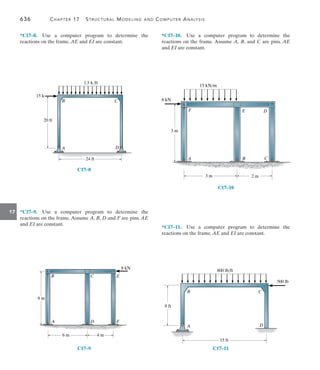
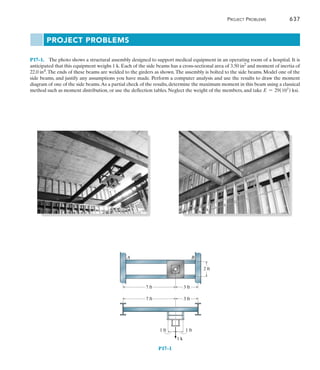
  • 221.
    200 Chapter 5  Cables and Arches 5 EXAMPLE 5.5 The three-hinged tied arch is subjected to the loading shown in Fig. 5–11a. Determine the force in members CH and CB. The dashed member GF of the truss is intended to carry no force. 4 m 1 m 1 m A 3 m 3 m 3 m 3 m B H D F G 15 kN 20 kN 15 kN C E (a) Fig. 5–11 A 15 kN 20 kN 15 kN E (b) Ay Ax Ey 3 m 3 m 3 m 3 m SOLUTION The support reactions can be obtained from a free-body diagram of the entire arch, Fig. 5–11b: 5 m 3 m 3 m 15 kN 20 kN (c) Cx Cy 25 kN FAE 0 C a+MA = 0;  Ey(12m) - 15 kN(3m) - 20 kN(6 m) - 15 kN(9 m) = 0 Ey = 25 kN S + Fx = 0; Ax = 0 +c Fy = 0; Ay - 15 kN - 20 kN - 15 kN + 25 kN = 0 Ay = 25 kN The force components acting at joint C can be determined by considering the free-body diagram of the left part of the arch,Fig.5–11c. First, we determine the force FAE: a+MC = 0; FAE (5 m) - 25 kN(6 m) + 15 kN(3 m) = 0 FAE = 21.0 kN
  • 222.
    5.5 Three-Hinged Arch 201 5 Then, S +Fx = 0;    -Cx + 21.0 kN = 0, Cx = 21.0 kN + cFy = 0; 25 kN - 15 kN - 20 kN + Cy = 0, Cy = 10 kN To obtain the forces in CH and CB, we can use the method of joints as follows: Joint G; Fig. 5–11d, + cFy = 0; FGC - 20 kN = 0 FGC = 20 kN (C) Joint C; Fig. 5–11e, S + Fx = 0; FCB ° 3 210 ¢ - 21.0 kN - FCH° 3 210 ¢ = 0 + cFy = 0; FCB ° 1 210 ¢ + FCH° 1 210 ¢ - 20 kN + 10 kN = 0 Thus, FCB = 26.9 kN (C) Ans. FCH = 4.74 kN (T) Ans. FGC FHG 0 20 kN (d) G FCH 20 kN 3 1 FCB 10 kN 3 1 21.0 kN (e) C Note: Tied arches are sometimes used for bridges, as in the case of this through-arch bridge. Here the deck is supported by suspender bars that transmit their load to the arch. The deck is in tension so that it supports the actual thrust or horizontal force at the ends of the arch.
  • 223.
    202 Chapter 5  Cables and Arches 5 The three-hinged trussed arch shown in Fig. 5–12a supports the symmetric loading. Determine the required height h1 of the joints B and D, so that the arch takes a funicular shape. Member HG is intended to carry no force. EXAMPLE 5.6 5 k 5 k 5 k 5 k I J B C D A H G F E 5 k (a) 10 ft 10 ft 15 ft h1 h1 10 ft 10 ft Fig. 5–12 SOLUTION For a symmetric loading, the funicular shape for the arch must be parabolic as indicated by the dashed line (Fig. 5–12b). Here we must find the equation which fits this shape. With the x, y axes having an origin at C, the equation is of the form y = -cx2 . To obtain the constant c, we require -(15 ft) = -c(20 ft)2 c = 0.0375ft Therefore, yD = -(0.0375ft)(10 ft)2 = -3.75 ft So that from Fig. 5–12a, h1 = 15 ft - 3.75 ft = 11.25 ft Ans. Using this value, if the method of joints is now applied to the truss, the results will show that the top cord and diagonal members will all be zero-force members, and the symmetric loading will be supported only by the bottom cord members AB, BC, CD, and DE of the truss. 10 ft 10 ft 15 ft yD y cx2 x y C D E (b)
  • 224.
    5 5–3.  Determine theforces P1 and P2 needed to hold the cable in the position shown, i.e., so segment BC remains horizontal. A P1 P2 8 kN 2 m 3 m B C D E 4 m 4 m 5 m 1.5 m Prob. 5–3 *5–4.  The cable supports the loading shown. Determine the distance x and the tension in cable BC. Set P = 100 lb. 5–5.  The cable supports the loading shown. Determine the magnitude of the horizontal force P so that x = 6 ft. 5 ft 2 ft 2 ft P D 400 lb C B A x 8 ft Probs. 5–4/5 Sec. 5.1–5.2 5–1.  Determine the tension in each segment of the cable and the distance yD. 7 m B A D C 4 m 5 m 3 m 2 kN 4 kN yD 2 m Prob. 5–1 5–2.  The cable supports the loading shown. Determine the magnitude of the vertical force P so that yC = 6 ft. 5 ft 2 ft 3 ft 3 k D C B A yC 5 4 3 8 ft P Prob. 5–2 Problems Problems 203
  • 225.
    204 Chapter 5  Cables and Arches 5 Sec. 5.3 *5–8.  The cable supports the uniform load of w0 = 600 lbft. Determine the tension in the cable at each support A and B. 15 ft A B 10 ft 25 ft w0 Prob. 5–8 5–9.  Determine the maximum and minimum tension in the cable. 10 m 16 kN/m 2 m y x A B 10 m Prob. 5–9 5–6.  Determine the tension in each segment of the cable and the cable’s total length. 4 ft 5 ft A 3 ft B 7 ft C D 50 lb 100 lb Prob. 5–6 5–7.  The cable supports the three loads shown.Determine the magnitude of P1 if P2 = 3 kN and yB = 0.8 m. Also find the sag yD. 0.4 m 1.2 m 1.2 m 2 m 1.5 m E B C D yB yD 1.4 m P2 P2 P1 Prob. 5–7
  • 226.
    Problems 205 5 5–13.  Thetrusses are pin connected and suspended from the parabolic cable. Determine the maximum force in the cable when the structure is subjected to the loading shown. 4 k 5 k A F G H B C I J K 16 ft 4 @ 12 ft 48 ft 4 @ 12 ft 48 ft D E 6 ft 14 ft Prob. 5–13 5–14.  Determine the maximum and minimum tension in the parabolic cable and the force in each of the hangers.The girder is subjected to the uniform load and is pin connected at B. 5–15.  Draw the shear and moment diagrams for the pin connected girders AB and BC.The cable has a parabolic shape. A D B C E 30 ft 9 ft 1 ft 10 ft 10 ft 2 k/ft Probs. 5–14/15 5–10.  The cable is subjected to a uniform loading of w = 250lbft. Determine the maximum and minimum tension in the cable. 60 ft 15 ft w Prob. 5–10 5–11.  The cable is subjected to a uniform loading of w = 250lbft. Determine the maximum and minimum tension in the cable. 50 ft 6 ft w Prob. 5–11 *5–12.  The cable will break when the maximum tension reaches Tmax = 12 kN. Determine the uniform distributed load w required to develop this maximum tension. 15 m 6 m w Prob. 5–12
  • 227.
    206 Chapter 5  Cables and Arches 5 5–19.  The beams AB and BC are supported by the cable that has a parabolic shape. Determine the tension in the cable at points D, F, and E, and the force in each of the equally spaced hangers. A B 2 m 3 kN 5 kN C F D E 2 m 2 m 2 m 2 m 2 m 2 m 2 m 9 m 3 m 3 m Prob. 5–19 *5–20.  The cable AB is subjected to a uniform loading of 300 lbft. If the weight of the cable is neglected and the slope angles at points A and B are 30 and 45, respectively, determine the curve that defines the cable shape and the maximum tension developed in the cable. 20 ft 300 lb/ft y x A B 45 30 Prob. 5–20 *5–16.  The cable will break when the maximum tension reaches Tmax = 5000 kN. Determine the maximum uniform distributed load w required to develop this maximum tension. 5–17.  The cable is subjected to a uniform loading of w = 60 kNm. Determine the maximum and minimum tension in cable. 100 m 12 m w Probs. 5–16/17 5–18.  The beams AB and BC are supported by the cable that has a parabolic shape. Determine the tension in the cable at points D, F, and E. A B 3 ft 3 ft 3 ft 3 ft 3 ft 3 ft 3 ft 3 ft 4 k 6 k C F D E 8 ft 4 ft Prob. 5–18
  • 228.
    Problems 207 5 5–23.  Thethree-hinged spandrel arch is subjected to the loading shown. Determine the internal moment in the arch at point D. $ % P N1 N1 N1 N1 N1 N1 N1 N1 P P P P P P P P P P ' Prob. 5–23 *5–24.  The tied three-hinged truss arch is subjected to the loading shown. Determine the components of reaction at A and C, and the tension in the tie rod. 18 ft 15 ft 20 ft 6 ft 8 ft 25 ft 25 ft 12 13 5 A C B 6 k 8 k 30 Prob. 5–24 Sec. 5.4–5.5 5–21.  Determine the horizontal and vertical components of reaction at A, B, and C of the three-hinged arch.Assume A, B, and C are pin connected. 4 m 3 m 5 m 8 m 4 m 8 m A C B 10 kN 5 kN Prob. 5–21 5–22.  Determine the magnitudes of the resultant forces at the pins A, B, and C of the three-hinged arched roof truss. 3 m 5 m 3 m 3 m 5 m 2 m 2 m B C A 8 kN 10 kN 6 kN 5 kN Prob. 5–22
  • 229.
    208 Chapter 5  Cables and Arches 5 5–25.  The bridge is constructed as a three-hinged trussed arch. Determine the horizontal and vertical components of reaction at the hinges (pins) at A, B, and C. The dashed member DE is intended to carry no force. 5–26.  Determine the design heights h1, h2, and h3 of the bottom cord of the truss so the three-hinged trussed arch responds as a funicular arch. 30 ft 30 ft 30 ft 30 ft 30 ft 10 ft D E 20 k 20 k 60 k 40 k 40 k B A C 100 ft 30 ft h1 h2 h3 30 ft 30 ft Probs. 5–25/26 5–27.  The laminated-wood three-hinged arch is subjected to the loading shown. Determine the horizontal and vertical components of reactions at the pins A, B, and C, and draw the moment diagram for member AB. 12 ft 16 ft 16 ft B A C 3 k 2 k 5 ft 3 k 2 k 5 ft Prob. 5–27 *5–28.  Determine the horizontal and vertical components of reaction at A, B, and C of the three-hinged arch.Assume A, B, and C are pin connected. 5 ft 4 ft 7 ft 10 ft 5 ft 8 ft A C B 4 k 3 k 2 ft Prob. 5–28 5–29.  The arch structure is subjected to the loading shown. Determine the horizontal and vertical components of reaction at A and C, and the force in member AC. 400 lb/ft A B C 8 ft 8 ft 3 k 4 ft 4 ft Prob. 5–29
  • 230.
    Chapter Review 209 5 Cablessupport their loads in tension if we consider them perfectly flexible. If the cable is subjected to concentrated loads then the force acting in each cable segment is determined by applying the equations of equilibrium to the free-body diagram of groups of segments of the cable or to the joints where the forces are applied. If the cable supports a uniform load over a projected horizontal distance, then the shape of the cable takes the form of a parabola. Arches are designed primarily to carry a compressive force.A parabolic shape is required to support a uniform loading distributed over its horizontal projection. Three-hinged arches are statically determinate and can be analyzed by separating the two members and applying the equations of equilibrium to each member. Chapter Review L1 L2 L3 L P1 P2 w0 L h x y three-hinged arch
  • 231.
    The train producesa moving load that must be considered using influence lines when designing the girders of this bridge. Chapter 6 © Asb63/Fotolia
  • 232.
    211 Influence Lines forStatically Determinate Structures Influence lines have important application for the design of structures that resist large live loads. In this chapter we will discuss how to draw the influence line for a statically determinate structure. The theory is applied to structures subjected to a distributed load or a series of concentrated forces, and specific applications to floor girders and bridge trusses are given. The determination of the absolute maximum live shear and moment in a member is discussed at the end of the chapter. 6.1  Influence Lines In the previous chapters we developed techniques for analyzing the forces in structural members due to dead or fixed loads. It was shown that the shear and moment diagrams represent the most descriptive methods for displaying the variation of these loads in a member. If a structure is subjected to a live or moving load, however, the variation of the shear and bending moment in the member is best described using the influence line. An influence line represents the variation of either the reaction, shear, or moment, at a specific point in a member as a concentrated force moves over the member. Once this line is constructed, one can tell at a glance where the moving load should be placed on the structure so that it creates the greatest influence at the specified point. Furthermore, the magnitude of the associated reaction, shear, or moment at the point can then be calculated from the ordinates of the influence-line diagram. For these reasons, influence lines play an important part in the design of bridges, industrial crane rails, conveyors, and other structures where loads move across their span.
  • 233.
    212 Chapter 6  Influence Lines for Statically Determinate Structures 6 Although the procedure for constructing an influence line is rather basic, one should clearly be aware of the difference between constructing an influence line and constructing a shear or moment diagram. Influence lines represent the effect of a moving load only at a specified point on a member, whereas shear and moment diagrams represent the effect of fixed loads at all points along the axis of the member. Procedure for Analysis Either of the following two procedures can be used to construct the influence line at a specific point P in a member for any function (reaction, shear, or moment). For both of these procedures we will choose the moving force to have a dimensionless magnitude of unity.* Tabulate Values • Place a unit load at various locations, x, along the member, and at each location use statics to determine the value of the function (reaction, shear, or moment) at the specified point. • If the influence line for a vertical force reaction at a point on a beam is to be constructed, consider the reaction to be positive at the point when it acts upward on the beam. • If a shear or moment influence line is to be drawn for a point, take the shear or moment at the point as positive according to the same sign convention used for drawing shear and moment diagrams. (See Fig. 4–1.) • All statically determinate beams will have influence lines that consist of straight line segments. After some practice one should be able to minimize computations and locate the unit load only at points representing the end points of each line segment. • To avoid errors, it is recommended that one first construct a table, listing “unit load at x” versus the corresponding value of the function calculated at the specific point; that is, “reaction R,” “shear V,” or “moment M.” Once the load has been placed at various points along the span of the member, the tabulated values can be plotted and the influence-line segments constructed. Influence-Line Equations • The influence line can also be constructed by placing the unit load at a variable position x on the member and then computing the value of R, V, or M at the point as a function of x. In this manner, the equations of the various line segments composing the influence line can be determined and plotted. *The reason for this choice will be explained in Sec. 6.2.
  • 234.
    6.1  Influence Lines 213 6 Influence-Line Equation.  Rather than placing the unit load at specific points on the beam and plotting the values of Ay for each point, we can place the unit load a variable distance x from A, Fig. 6–1f. The reaction Ay as a function of x can be determined from a+MB = 0;  -Ay(10) + (10 - x)(1) - 0 Ay = 1 - 1 10 x This is the equation of the influence line, plotted in Fig. 6–1e. (a) A B 10 ft Fig. 6–1 x 10 ft (f) Ay 1 By EXAMPLE 6.1 10 ft (b) Ay 1 By x 2.5 ft MB 0; Ay (10) 1 (7.5) 0 Ay 0.75 (e) Ay x 10 1 Ay 1 __ x 10 1 influence line for Ay x 5 ft 10 ft (c) Ay 1 By MB 0; Ay (10) 1 (5) 0 Ay 0.5 1 0.75 0.5 0.25 0 (d) x Ay 0 2.5 5 7.5 10 Construct the influence line for the vertical reaction at A of the beam in Fig. 6–1a. SOLUTION Tabulate Values.  A unit load is placed on the beam at each selected point x and the value of Ay is calculated by summing moments about B. For example, when x = 2.5 ft and x = 5 ft, see Figs. 6–1b and 6–1c, respectively. The results for Ay are entered in the table, Fig. 6–1d. A plot of these values yields the influence line for the reaction at A, Fig. 6–1e. This line or diagram gives the reaction at A as the unit load moves from one position to the next along the beam.
  • 235.
    214 Chapter 6  Influence Lines for Statically Determinate Structures 6 Construct the influence line for the vertical reaction at B of the beam in Fig. 6–2a. EXAMPLE 6.2 (a) A B 5 m 5 m x 1 Fig. 6–2 SOLUTION Tabulate Values.  Using statics,verify that the values for the reaction By listed in the table, Fig. 6–2b, are correctly computed for each position x of the unit load. A plot of the values yields the influence line in Fig. 6–2c. 0 0.5 1 1.5 2 (b) x By 0 2.5 5 7.5 10 By 2 1 By __ x 5 x 10 (c) influence line for By Influence-Line Equation.  We must determine the reaction By when the unit load is placed a distance x from A, Fig. 6–2d. Applying the moment equation about A, a+MA = 0;  By(5) - 1(x) = 0 By = 1 5 x This is plotted in Fig. 6–2c. A B x 5 m 5 m (d) Ay By 1
  • 236.
    6.1  Influence Lines 215 6 Fig. 6–3 0.25 0.75 C 10 ft (b) 1 2.5 ft 0.25 MC VC Fy 0; VC 0.25 0.75 C 10 ft (c) 1 1 2.5 ft 0.25 MC VC Fy 0; VC 0.75 0.25 VC 0.75 2.5 –0.25 10 x (e) influence line for VC 1 VC 1 __ x 10 1 VC __ x 10 Influence-Line Equations. Here two equations have to be determined, since there are two segments for the influence line due to the discontinuity of shear at C. First we determine Ay, Fig. 6–3f. Using the result we then obtain the internal shear at C for each region, Fig. 6–3g.The equations are plotted in Fig. 6–3e. x Ay C 10 ft (f) 1 Ay(10) 1(10 x) 0 MB 0; 1 __ x 10 Ay 1 By   x (g) 0 x 2.5 ft x 1 MC VC 2.5 ft MC VC 2.5 ft 1 By 2.5 ft x 10 ft 1 Ay 1 __ x 10 1 1 __ x 10 1 __ x 10 1 VC 0 VC 1 Ay 1 __ x 10 Fy 0; 1 1 __ x 10 1 __ x 10 VC 0 VC 1 Fy 0; (d) x VC 0 2.5 2.5 5 7.5 10 0 0.25 0.75 0.5 0.25 0 2.5 ft 10 ft C (a) A B EXAMPLE 6.3 Construct the influence line for the shear at point C of the beam in Fig. 6–3a. SOLUTION Tabulate Values.  At each selected position x of the unit load, the method of sections is used to calculate the value of VC. Note in particular that the unit load must be placed just to the left (x = 2.5- ) and just to the right (x = 2.5+ ) of point C since the shear is discontinuous at C, Figs. 6–3b and 6–3c.A plot of the values in Fig. 6–3d yields the influence line for the shear at C, Fig. 6–3e. Here the diagram gives the shear at C as the unit load moves from one position to the next along the beam.
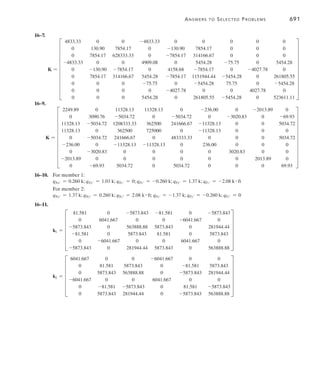
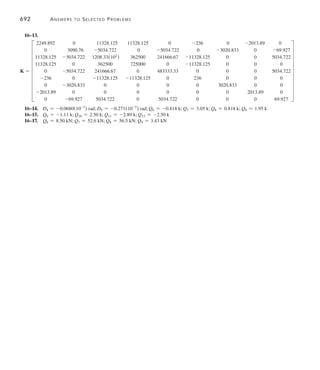
  • 237.
    216 Chapter 6  Influence Lines for Statically Determinate Structures 6 (b) x VC 0 4 4 8 12 0 0.5 0.5 0 0.5 0.5 0.5 0.5 VC 4 8 1 VC 1 __ x 8 1 VC __ x 8 12 x (c) influence line for VC C 4 m 4 m 4 m B (a) 1 x A Fig. 6–4 Influence-Line Equations.  From Fig. 6–4d, verify that VC = -1 8 x     0 … x 6 4 m VC = 1 - 1 8 x   4 m 6 x … 12 m These equations are plotted in Fig. 6–4c. (d) 0 x 4 m x 1 MC VC 4 m Ay 1 x 1 __ 8 x MC VC 4 m Ay 1 x 1 __ 8 1 By 4 m x 12 m EXAMPLE 6.4 Construct the influence line for the shear at point C of the beam in Fig. 6–4a. SOLUTION Tabulate Values.  Using statics and the method of sections, verify that the values of the shear VC at point C in Fig. 6–4b correspond to each position x of the unit load on the beam. A plot of the values in Fig. 6–4b yields the influence line in Fig. 6–4c.
  • 238.
    6.1  Influence Lines 217 6 Construct the influence line for the moment at point C of the beam in Fig. 6–5a. SOLUTION Tabulate Values.  At each selected position of the unit load, the value of MC is calculated using the method of sections. For example, see Fig. 6–5b for x = 2.5 ft. A plot of the values in Fig. 6–5c yields the influence line for the moment at C, Fig. 6–5d. This diagram gives the moment at C as the unit load moves from one position to the next along the beam. 10 ft 5 ft A C B (a) Fig. 6–5 (b) C 0.25 0.75 5 ft MC VC MC 0; MC 0.25 (5) 0 MC 1.25 1 2.5 ft 0.25 (c) x MC 0 2.5 5 7.5 10 0 1.25 2.5 1.25 0 5 10 x 2.5 (d) influence line for MC MC 1 MC 5 __ x 2 1 MC __ x 2 Influence-Line Equations.  The two line segments for the influence line can be determined using MC = 0 along with the method of sections shown in Fig. 6–5e. These equations when plotted yield the influence line shown in Fig. 6–5d. (e) x 1 MC VC 5 ft 1 Ay 1 __ x 10 x MC VC 5 ft 1 By 1 Ay 1 __ x 10 a+MC = 0;  MC + 1(5 - x) - 11 - 1 10 x25 = 0   a+MC = 0;   MC - 11 - 1 10 x25 = 0 MC = 1 2x  0 … x 6 5 ft MC = 5 - 1 2x   5 ft 6 x … 10 ft EXAMPLE 6.5
  • 239.
    218 Chapter 6  Influence Lines for Statically Determinate Structures 6 Construct the influence line for the moment at point C of the beam in Fig. 6–6a. C (a) B 4 m 4 m 4 m 1 x A Fig. 6–6 SOLUTION Tabulate Values.  Using statics and the method of sections, verify that the values of the moment MC at point C in Fig. 6–6b correspond to each position x of the unit load.A plot of the values in Fig. 6–6b yields the influence line in Fig. 6–6c. EXAMPLE 6.6 (b) MC x 0 4 8 12 0 2 0 2           2 4 8 12 MC 2 x (c) influence line for MC Influence-Line Equations.  From Fig. 6–6d verify that MC = 1 2x 0 … x 6 4 m MC = 4 - 1 2x 4 m 6 x … 12 m These equations are plotted in Fig. 6–6c. (d) 0 x 4 m x 1 MC VC 4 m x MC VC 4 m 1 By 4 m x 12 m 1 Ay 1 __ x 8 1 Ay 1 __ x 8
  • 240.
    6.2  Influence Linesfor Beams 219 6 6.2  Influence Lines for Beams Since beams (or girders) often form the main load-carrying elements of a floor system or bridge deck, it is important to be able to construct the influence lines for the reactions, shear, or moment at any specified point in a beam. Loadings.  Once the influence line for a function (reaction, shear, or moment) has been constructed, it will then be possible to position the live loads on the beam which will produce the maximum value of the function. Two types of loadings will now be considered. Concentrated Force. Since the numerical values of a function for an influence line are determined using a dimensionless unit load, then for any concentrated force F acting on the beam at any position x,the value of the function can be found by multiplying the ordinate of the influence line at the position x by the magnitude of F.For example,consider the influence line for the reaction at A for the beam AB, Fig. 6–7 . If the unit load is at x = 1 2 L, the reaction at A is Ay = 1 2 as indicated from the influence line. Hence,if the force F lb is at this same point,the reaction is Ay = 11 22(F) lb. Of course, this same value can also be determined by statics. Obviously, the maximum influence caused by F occurs when it is placed on the beam at the same location as the peak of the influence line—in this case at x = 0, where the reaction would be Ay = (1)(F) lb. Uniform Load. Consider a portion of a beam subjected to a uniform load w0, Fig.6–8.As shown,each dx segment of this load creates a concentrated force of dF = w0 dx on the beam. If dF is located at x, where the beam’s influence-line ordinate for some function (reaction, shear, moment) is y, then the value of the function is (dF)(y) = (w0 dx)y. The effect of all the concentrated forces dF is determined by integrating over the entire length of the beam, that is, 1w0y dx = w0 1y dx. Also, since 1y dx is equivalent to the area under the influence line,then,in general,the value of a function caused by a uniform distributed load is simply the area under the influence line for the function multiplied by the intensity of the uniform load. For example, in the case of a uniformly loaded beam shown in Fig. 6–9, the reaction Ay can be determined from the influence line as Ay = (area)(w0) = 31 2(1)(L)4w0 = 1 2w0L. This value can of course also be determined from statics. A B L Ay w0       1 L x Ay influence line for Ay Fig. 6–9 B A L F 1 x __ L 2 1 1 –– 2 Ay 1 –– 2 L L x influence line for Ay Fig. 6–7 x dx dF w0 dx w0 dx y x influence line for function Fig. 6–8
  • 241.
    220 Chapter 6  Influence Lines for Statically Determinate Structures 6 EXAMPLE 6.7 Determine the maximum positive shear that can be developed at point C in the beam shown in Fig. 6–10a due to a concentrated moving load of 4000 lb and a uniform moving load of 2000 lbft. influence line for VC VC 0.75 0.25 2.5 10 x (b) SOLUTION The influence line for the shear at C has been established in Example 6.3 and is shown in Fig. 6–10b. Concentrated Force.  The maximum positive shear at C will occur when the 4000-lb force is located at x = 2.5+ ft, since this is the positive peak of the influence line.The ordinate of this peak is +0.75; so that VC = 0.75(4000 lb) = 3000 lb Uniform Load.  The uniform moving load creates the maximum positive influence for VC when the load acts on the beam between x = 2.5+ ft and x = 10 ft, since within this region the influence line has a positive area.The magnitude of VC due to this loading is VC = 31 2(10 ft - 2.5 ft)(0.75)42000 lbft = 5625 lb Total Maximum Shear at C. (VC)max = 3000 lb + 5625 lb = 8625 lb Ans. Notice that once the positions of the loads have been established using the influence line,Fig.6–10c,this value of (VC)max can also be determined using statics and the method of sections. Show that this is the case. B C 2.5 ft 10 ft (c) 4000 lb 2000 lb/ft A (a) B 2.5 ft 10 ft C A Fig. 6–10
  • 242.
    6.2  Influence Linesfor Beams 221 6 The frame structure shown in Fig. 6–11a is used to support a hoist for transferring loads for storage at points underneath it.It is anticipated that the load on the dolly is 3 kN and the beam CB has a mass of 24 kgm. Assume the dolly has negligible size and can travel the entire length of the beam. Also, assume A is a pin and B is a roller. Determine the maximum vertical support reactions at A and B and the maximum moment in the beam at D. 1 m 1.5 m 1.5 m 3 kN A B D C (a) SOLUTION Maximum Reaction at A.  We first draw the influence line for Ay, Fig. 6–11b. Specifically, when a unit load is at A the reaction at A is 1 as shown.The ordinate at C, is 1.33. Here the maximum value for Ay occurs when the dolly is at C. Since the dead load (beam weight) must be placed over the entire length of the beam, we have, (Ay )max = 3000(1.33) + 24(9.81)31 2 (4)(1.33)4 = 4.63 kN Ans. Maximum Reaction at B.  The influence line (or beam) takes the shape shown in Fig. 6–11c. The values at C and B are determined by statics. Here the dolly must be at B.Thus, (By )max = 3000(1) + 24(9.81)31 2 (3)(1)4 + 24(9.81)31 2 (1)(-0.333)4 = 3.31 kN Ans. Maximum Moment at D.  The influence line has the shape shown in Fig. 6–11d.The values at C and D are determined from statics. Here, (MD)max = 3000(0.75) + 24(9.81)31 2 (1)(-0.5)4 + 24(9.81)31 2 (3)(0.75)4 = 2.46 kN # m Ans. EXAMPLE 6.8 x 1 m Ay 1.33 1 (b) influence line for Ay 3 m 1 m 0.333 1 x By (c) influence line for By 1.5 m 0.5 0.75 x MD 1.5 m 1 m (d) influence line for MD Fig. 6–11
  • 243.
    222 Chapter 6  Influence Lines for Statically Determinate Structures 6 6.3  Qualitative Influence Lines In 1886, Heinrich Müller-Breslau developed a technique for rapidly constructing the shape of an influence line. Referred to as the ­ Müller-Breslau principle, it states that the influence line for a function (reaction, shear, or moment) is to the same scale as the deflected shape of the beam when the beam is acted upon by the function. In order to draw the deflected shape properly,the capacity of the beam to resist the applied function must be removed so the beam can deflect when the function is applied. For example, consider the beam in Fig. 6–12a. If the shape of the influence line for the vertical reaction at A is to be determined, the pin is first replaced by a roller guide as shown in Fig. 6–12b. A roller guide is necessary since the beam must still resist a horizontal force at A but no vertical force. When the positive (upward) force Ay is then applied at A, the beam deflects to the dashed position,* which represents the general shape of the influence line for Ay, Fig. 6–12c. (Numerical values for this specific case have been calculated in Example 6.1.) If the shape of the influence line for the shear at C is to be determined, Fig. 6–13a, the connection at C may be symbolized by a roller guide as shown in Fig. 6–13b.This device will resist a moment and axial force but no shear.† Applying a positive shear force VC to the beam at C and allowing the beam to deflect to the dashed position, we find the influence-line shape as shown in Fig. 6–13c. Finally, if the shape of the influence line for the moment at C, Fig. 6–14a, is to be determined, an internal hinge or pin is placed at C, since this connection resists axial and shear forces but cannot resist a moment, Fig. 6–14b.Applying positive moments MC to the beam, the beam then deflects to the dashed position, which is the shape of the influence line, Fig. 6–14c. The proof of the Müller-Breslau principle can be established using the principle of virtual work. Recall that work is the product of either a linear *Throughout the discussion all deflected positions are drawn to an exaggerated scale to illustrate the concept. †Here the rollers symbolize supports that carry loads both in tension or compression. See Table 2.1, support (2). A (a) Ay A deflected shape (b) Ay x influence line for Ay (c) Fig. 6–12 Design of this bridge girder is based on influence lines that must be constructed for this train loading.
  • 244.
    6.3  Qualitative InfluenceLines 223 6 displacement and force in the direction of the displacement or a rotational displacement and moment in the direction of the displacement. If a rigid body (beam) is in equilibrium, the sum of all the forces and moments on it must be equal to zero. Consequently, if the body is given an imaginary or virtual displacement, the work done by all these forces and couple moments must also be equal to zero. Consider, for example, the simply supported beam shown in Fig. 6–15a, which is subjected to a unit load placed at an arbitrary point along its length. If the beam is given a virtual (or imaginary) displacement dy at the support A, Fig. 6–15b, then only the support reaction Ay and the unit load do virtual work. Specifically, Ay does positive work Ay dy and the unit load does negative work, -1dy. (The support at B does not move and therefore the force at B does no work.) Since the beam is in equilibrium and therefore does not actually move, the virtual work sums to zero, i.e., Ay dy - 1 dy = 0 If dy is set equal to 1, then Ay = dy In other words, the value of Ay represents the ordinate of the influence line at the position of the unit load. Since this value is equivalent to the displacement dy at the position of the unit load, it shows that the shape of the influence line for the reaction at A has been established. This proves the Müller-Breslau principle for reactions. C (a) Fig. 6–13 C VC VC deflected shape (b) VC x influence line for VC (c) C (a) MC influence line for MC (c) x deflected shape C MC MC (b) Fig. 6–14 B C 1 A (a) Fig. 6–15 C 1 A B (b) Ay dy dy¿
  • 245.
    224 Chapter 6  Influence Lines for Statically Determinate Structures 6 In the same manner, if the beam is sectioned at C, and the beam undergoes a virtual displacement dy at this point, Fig. 6–15c, then only the internal shear at C and the unit load do work. Thus, the virtual work equation is VC dy - 1 dy = 0 Again, if dy = 1, then VC = dy and the shape of the influence line for the shear at C has been established. A VC (c) VC 1 B dy dy¿ Fig. 6–15 Lastly, assume a hinge or pin is introduced into the beam at point C, Fig. 6–15d. If a virtual rotation df is introduced at the pin, virtual work will be done only by the internal moment and the unit load. So MC df - 1 dy = 0 Setting df = 1, it is seen that MC = dy which indicates that the deflected beam has the same shape as the influence line for the internal moment at point C (see Fig. 6–14). Obviously, the Müller-Breslau principle provides a quick method for establishing the shape of the influence line. Once this is known, the ordinates at the peaks can be determined by using the basic method discussed in Sec. 6.1. Also, by simply knowing the general shape of the influence line, it is possible to locate the live load on the beam and then determine the maximum value of the function by using statics. Example 6.12 illustrates this technique. C MC (d) MC 1 B A df dy¿
  • 246.
    6.3  Qualitative InfluenceLines 225 6 For each beam in Fig. 6–16a through 6–16c, sketch the influence line for the vertical reaction at A. SOLUTION The support is replaced by a roller guide at A since it will resist Ax, but not Ay.The force Ay is then applied. (a) A Ay A deflected shape Ay influence line for Ay x Fig. 6–16 A (b) Ay A deflected shape Ay x influence line for Ay Again, a roller guide is placed at A and the force Ay is applied. A double-roller guide must be used at A in this case, since this type of support will resist both a moment MA at the fixed support and axial load Ax, but will not resist Ay. A (c) Ay A deflected shape Ay x influence line for Ay EXAMPLE 6.9
  • 247.
    226 Chapter 6  Influence Lines for Statically Determinate Structures 6 For each beam in Figs. 6–17a through 6–17c, sketch the influence line for the shear at B. SOLUTION The roller guide is introduced at B and the positive shear VB is applied. Notice that the right segment of the beam will not deflect since the roller at A actually constrains the beam from moving vertically, either up or down. [See support (2) in Table 2.1.] EXAMPLE 6.10 (a) A B VB VB A B deflected shape VB influence line for VB x Fig. 6–17 Placing the roller guide at B and applying the positive shear at B yields the deflected shape and corresponding influence line. Again, the roller guide is placed at B, the positive shear is applied, and the deflected shape and corresponding influence line are shown. Note that the left segment of the beam does not deflect, due to the fixed support. B B VB VB deflected shape influence line for VB VB x (c) B B VB VB deflected shape influence line for VB VB x (b)
  • 248.
    6.3  Qualitative InfluenceLines 227 6 For each beam in Figs. 6–18a through Fig. 6–18c, sketch the influence line for the moment at B. SOLUTION A hinge is introduced at B and positive moments MB are applied to the beam.The deflected shape and corresponding influence line are shown. (a) B B MB MB deflected shape x MB influence line for MB Fig. 6–18 Placing a hinge at B and applying positive moments MB to the beam yields the deflected shape and influence line. B (b) B MB deflected shape MB MB x influence line for MB With the hinge and positive moment at B the deflected shape and influence line are shown. The left segment of the beam is constrained from moving due to the fixed wall at A. A B (c) B deflected shape A MB MB MB x influence line for MB EXAMPLE 6.11
  • 249.
    228 Chapter 6  Influence Lines for Statically Determinate Structures 6 Determine the maximum positive moment that can be developed at point D in the beam shown in Fig. 6–19a due to a concentrated moving load of 4000 lb, a uniform moving load of 300 lbft, and a beam weight of 200 lbft. EXAMPLE 6.12 5 ft 5 ft 5 ft 10 ft A B C D E (a) Fig. 6–19 SOLUTION A hinge is placed at D and positive moments MD are applied to the beam.The deflected shape and corresponding influence line are shown in Fig.6–19b.Immediately one recognizes that the concentrated moving load of 4000 lb creates a maximum positive moment at D when it is placed at D, i.e., the peak of the influence line. Also, the uniform moving load of 300 lbft must extend from C to E in order to cover the region where the area of the influence line is positive. Finally, the uniform dead weight of 200 lbft acts over the entire length of the beam. The loading is shown on the beam in Fig. 6–19c. Knowing the position of the loads, we can now determine the maximum moment at D using statics. In Fig. 6–19d the reactions on BE have been calculated. Sectioning the beam at D and using segment DE, Fig. 6–19e, we have a+MD = 0;  -MD - 5000(5) + 4750(10) = 0 MD = 22 500 lb # ft = 22.5 k # ft Ans. deflected shape MD 5 10 15 25 x h¿ h (b) influence line for MD MD MD D
  • 250.
    6.3  Qualitative InfluenceLines 229 6 D 200 lb/ft 500 lb/ft 4000 lb B A 5 ft 5 ft 5 ft 10 ft (c) E C 15 ft 5 ft 2.5 ft 7.5 ft 4000 lb 7500 lb 1000 lb 1000 lb 2.5 ft 5 ft 5 ft (d) Ax 0 Ay 500 lb By 500 lb Bx 0 By 500 lb Cy 8250 lb Ey 4750 lb 10 ft 1 5 ft 5 ft 5 ft 0 0 0 0.667 0 0 0 0.333 0.333 10 ft E (f) MD 3.33 VD 0.333 4000 lb 5000 lb Ey 4750 lb 5 ft 5 ft D MD VD E (e) This problem can also be worked by using numerical values for the influence line as in Sec. 6.1. Actually, by inspection of Fig. 6–19b, only the peak value h at D must be determined.This requires placing a unit load on the beam at D in Fig. 6–19a and then solving for the internal moment in the beam at D. The calculations are shown in Fig. 6–19f. Thus MD = h = 3.33. By proportional triangles, h(10 - 5) = 3.33(15 - 10) or h = 3.33. Hence, with the loading on the beam as in Fig. 6–19c, using the areas and peak values of the influence line, Fig. 6–19b, we have MD = 500c 1 2 (25 - 10)(3.33)d + 4000(3.33) - 200c 1 2 (10)(3.33)d = 22 500 lb # ft = 22.5 k # ft Ans.
  • 251.
    230 Chapter 6  Influence Lines for Statically Determinate Structures 6 6.4  Influence Lines for Floor Girders Occasionally, floor systems are constructed as shown in Fig. 6–20a, where it can be seen that floor loads are transmitted from slabs to floor beams, then to side girders, and finally supporting columns. An idealized model of this system is shown in plane view, Fig. 6–20b. Here the slab is assumed to be a one-way slab and is segmented into simply supported spans resting on the floor beams. Furthermore, the girder is simply supported on the columns. Since the girders are main load-carrying members in this system, it is sometimes necessary to construct their shear and moment influence lines. This is especially true for industrial buildings subjected to heavy concentrated loads. In this regard, notice that a unit load on the floor slab is transferred to the girder only at points where it is in contact with the floor beams, i.e., points A, B, C, and D. These points are called panel points, and the region between these points is called a panel, such as BC in Fig. 6–20b. slab floor beam girder column A B C D (a) P A B C D x s s s panel (b) 1 P 1 d (c) FB FC B C F1 F2 d F1 P s FB MP VP (d) Fig. 6–20
  • 252.
    6.4  Influence Linesfor Floor Girders 231 6 The influence line for a specified point on the girder can be determined using the same statics procedure as in Sec. 6.1; i.e., place the unit load at various points x on the floor slab and always compute the function (shear or moment) at the specified point P in the girder, Fig. 6–20b. Plotting these values versus x yields the influence line for the function at P. In particular,the value for the internal moment in a girder panel will depend upon where point P is chosen for the influence line, since the magnitude of MP depends upon the point’s location from the end of the girder. For example, if the unit load acts on the floor slab as shown in Fig. 6–20c, one first finds the reactions FB and FC on the slab, then calculates the support reactions F1 and F2 on the girder. The internal moment at P is  then  determined by the method of sections, Fig. 6–20d. This gives MP = F1d - FB(d - s). Using a similar analysis, the internal shear VP can be determined. In this case, however, VP will be constant throughout the panel BC(VP = F1 - FB ) and so it does not depend upon the exact location d of P within the panel. For this reason, influence lines for shear in floor girders are specified for panels in the girder and not specific points along the girder. The shear is then referred to as panel shear. It should also be noted that since the girder is affected only by the loadings transmitted by the floor beams, the unit load is generally placed at each floor-beam location to establish the necessary data used to draw the influence line. The following numerical examples should clarify the force analysis. The design of the floor system of this warehouse building must account for critical locations of storage materials on the floor. Influence lines must be used for this purpose. (Photo courtesy of Portland Cement Association.) © Juice Images/Alamy
  • 253.
    232 Chapter 6  Influence Lines for Statically Determinate Structures 6 EXAMPLE 6.13 Draw the influence line for the shear in panel CD of the floor girder in Fig. 6–21a. G A B C D x (a) E 10 ft 10 ft 10 ft 10 ft F (b) x VCD 0 10 20 30 40 0.333 0 0.333 0.333 0 SOLUTION Tabulate Values.  The unit load is placed at each floor beam location and the shear in panel CD is calculated.A table of the results is shown in Fig.6–21b.The details for the calculations when x = 0 and x = 20 ft are given in Figs. 6–21c and 6–21d, respectively. Notice how in each case the reactions of the floor beams on the girder are calculated first, followed by a determination of the girder support reaction at F (Gy is not needed), and finally, a segment of the girder is considered and the internal panel shear VCD is calculated.As an exercise, verify the values for VCD when x = 10 ft, 30 ft, and 40 ft. G (c) 10 ft 30 ft A B M MG 0; Fy 0.333 Gy Fy 1 By 0 Ay 1 Fy 0.333 VCD Fy 0; VCD 0.333 at x 0 G (d) B 1 M C 10 ft 20 ft at x 20 ft MG 0; Fy 0.333 Gy Fy By 0 Fy 0.333 VCD Fy 0; VCD 0.333 Cy 1 Influence Line.  When the tabular values are plotted and the points connected with straight line segments, the resulting influence line for VCD is as shown in Fig. 6–21e. 0.333 0.333 0.333 VCD 10 20 25 30 40 x influence line for VCD (e) Fig. 6–21
  • 254.
    6.4  Influence Linesfor Floor Girders 233 6 Draw the influence line for the moment at point F for the floor girder in Fig. 6–22a. EXAMPLE 6.14 A B C D x (a) 2 m 2 m E 4 m 4 m 4 m F 2 m 2 m H G Fig. 6–22 (b) x MF 0 2 4 8 10 12 16 0 0.429 0.857 2.571 2.429 2.286 0 SOLUTION Tabulate Values.  The unit load is placed at x = 0 and each panel point thereafter. The corresponding values for MF are calculated and shown in the table, Fig. 6–22b. Details of the calculations for x = 2 m are shown in Fig. 6–22c.As in the previous example, it is first necessary to determine the reactions of the floor beams on the girder, followed by a determination of the girder support reaction Gy (Hy is not needed), and finally segment GF of the girder is considered and the internal moment MF is calculated.As an exercise, determine the other values of MF listed in Fig. 6–22b. Influence Line.  A plot of the tabular values yields the influence line for MF, Fig. 6–22d. A B 1 Ay By 0.5 MA 0; By 0.5 2 m Hy 8 m 6 m F MH 0; Gy 0.0714 Gy 6 m F Gy 0.0714 VCD MF MF 0; MF 0.429 (c) 2 m 2 m at x 2 m MF 0.429 0.857 2.286 2.429 2.571 0 2 4 8 10 12 16 x (d) influence line for MF
  • 255.
    234 Chapter 6  Influence Lines for Statically Determinate Structures 6 6.5  Influence Lines for Trusses Trusses are often used as primary load-carrying elements for bridges. Hence,for design it is important to be able to construct the influence lines for each of its members.As shown in Fig. 6–23, the loading on the bridge deck is transmitted to stringers, which in turn transmit the loading to floor beams and then to the joints along the bottom cord of the truss. Since the truss members are affected only by the joint loading, we can therefore obtain the ordinate values of the influence line for a member by loading each joint along the deck with a unit load and then use the method of joints or the method of sections to calculate the force in the member.The data can be arranged in tabular form, listing “unit load at joint” versus “force in member.” As a convention, if the member force is tensile it is considered a positive value; if it is compressive it is negative.The influence line for the member is constructed by plotting the data and drawing straight lines between the points. The following examples illustrate the method of construction. The members of this truss bridge were designed using influence lines in accordance with the AASHTO specifications. bottom cord panel floor beam portal end post stringers portal bracing sway bracing top cord deck lateral bracing Fig. 6–23
  • 256.
    6.5  Influence Linesfor Trusses 235 6 Draw the influence line for the force in member GB of the bridge truss shown in Fig. 6–24a. EXAMPLE 6.15 A B C D E H G F 6 m 6 m 6 m 6 m 6 m (a) 1 Fig. 6–24 SOLUTION Tabulate Values.  Here each successive joint at the bottom cord is loaded with a unit load and the force in member GB is calculated using the method of sections, Fig. 6–24b. For example, placing the unit load at x = 6 m (joint B), the support reaction at E is calculated first, Fig. 6–24a, then passing a section through HG, GB, BC and isolating the right segment, the force in GB is determined, Fig. 6–24c. In the same manner, determine the other values listed in the table. Influence Line.  Plotting the tabular data and connecting the points yields the influence line for member GB, Fig. 6–24d. Since the influence line extends over the entire span of the truss, member GB is referred to as a primary member. This means GB is subjected to a force regardless of where the bridge deck (roadway) is loaded, except, of course, at x = 8 m. The point of zero force, x = 8 m, is determined by similar triangles between x = 6 m and x = 12 m, that is, (0.354 + 0.707)(12 - 6) = 0.354x, x = 2 m, so x = 6 + 2 = 8 m. (b) x FGB 0 6 12 18 24 0 0.354 0.707 0.354 0 0.25 Fy 0; 0.25 FGB sin 45 0 FGB 0.354 FHG FGB FBC 45 (c) 0.354 0.354 0.707 6 8 12 18 24 (d) FGB influence line for FGB x
  • 257.
    236 Chapter 6  Influence Lines for Statically Determinate Structures 6 Draw the influence line for the force in member CG of the bridge truss shown in Fig. 6–25a. EXAMPLE 6.16 A B C D E H G F 6 m 6 m 6 m 6 m 6 m (a) Fig. 6–25 (b) x FGC 0 6 12 18 24 0 0 1 0 0 FCG FCD FCB 1 C (c) SOLUTION Tabulate Values.  A table of unit-load position at the joints of the bottom cord versus the force in member CG is shown in Fig. 6–25b. These values are easily obtained by isolating joint C, Fig. 6–25c. Here it is seen that CG is a zero-force member unless the unit load is applied at joint C, in which case FCG = 1 (T). Influence Line.  Plotting the tabular data and connecting the points yields the influence line for member CG as shown in Fig. 6–25d. In particular, notice that when the unit load is at x = 9 m, the force in member CG is FCG = 0.5. This situation requires the unit load to be placed on the bridge deck between the joints. The transference of this load from the deck to the truss is shown in Fig. 6–25e. From this one can see that indeed FCG = 0.5 by analyzing the equilibrium of joint C, Fig. 6–25f. Since the influence line for CG does not extend over the entire span of the truss, Fig. 6–25d, member CG is referred to as a secondary member. FCG 1 6 12 18 24 x (d) influence line for FCG x 9 m (e) 0.5 0.5 truss loading 0.5 0.5 1 deck loading FCG 0.5 FCD FCB 0.5 C (f)
  • 258.
    6.5  Influence Linesfor Trusses 237 6 In order to determine the maximum force in each member of the Warren truss, shown in the photo, we must first draw the influence lines for each of its members. If we consider a similar truss as shown in Fig. 6–26a, determine the largest force that can be developed in member BC due to a moving force of 25 k and a moving distributed load of 0.6 kft.The loading is applied at the top cord. EXAMPLE 6.17 Fig. 6–26 A 20 ft 20 ft 20 ft 20 ft (a) B C D E H G J F 15 ft 1 I (b) x FBC 0 20 40 60 80 0 1 0.667 0.333 0 SOLUTION Tabulate Values.  A table of unit-load position x at the joints along the top cord versus the force in member BC is shown in Fig. 6–26b. The method of sections can be used for the calculations. For example, when the unit load is at joint I (x = 20 ft), Fig. 6–26a, the reaction Ey is determined first (Ev = 0.25). Then the truss is sectioned through BC, IC, and HI, and the right segment is isolated, Fig. 6–26c. One obtains FBC by summing moments about point I, to eliminate FHI and FIC. In a similar manner determine the other values in Fig. 6–26b. Influence Line.  A plot of the tabular values yields the influence line, Fig. 6–26d. By inspection, BC is a primary member.Why? Concentrated Live Force.  The largest force in member BC occurs when the moving force of 25 k is placed at x = 20 ft. Thus, FBC = (1.00)(25) = 25.0 k Distributed Live Load.  The uniform live load must be placed over the entire deck of the truss to create the largest tensile force in BC.* Thus, FBC = 31 2 (80)(1.00)40.6 = 24.0 k Total Maximum Force. (FBC)max = 25.0 k + 24.0 k = 49.0 k Ans. 0.25 MI 0; FBC (15) 0.25(60) 0 FBC 1.00 (T) FHI FIC FBC 60 ft (c) 15 ft I FBC 20 x 80 1 influence line for FBC (d) *The largest tensile force in member GB of Example 6.15 is created when the distributed load acts on the deck of the truss from x = 0 to x = 8 m, Fig. 6–24d.
  • 259.
    238 Chapter 6  Influence Lines for Statically Determinate Structures 6 6.6  Maximum Influence at a Point due to a Series of Concentrated Loads Once the influence line for a reaction, shear, or moment has been established for a point in a structure, the maximum effect caused by a moving concentrated force is determined by multiplying the peak ordinate of the influence line by the magnitude of the force.In some cases,however, several concentrated forces may move along the structure. An example would be the wheel loadings of a truck or train such as shown in Fig. 6–27. In order to determine the maximum effect in this case, either a trial-and- error procedure can be used or a method that is based on the change in the reaction, shear, or moment that takes place as the load is moved. Each of these methods will now be explained. Shear.  Consider the simply supported beam with the associated influence line for the shear at point C in Fig. 6–28a. The maximum positive shear at point C is to be determined due to the series of concentrated (wheel) loads which move from right to left over the beam. The critical loading will occur when one of the loads is placed just to the right of point C, which is coincident with the positive peak of the influence line.By trial and error each of three possible cases can therefore be investigated, Fig. 6–28b.We have Case 1: (VC)1 = 1(0.75) + 4(0.625) + 4(0.5) = 5.25 k Case 2: (VC)2 = 1(-0.125) + 4(0.75) + 4(0.625) = 5.375 k Case 3: (VC)3 = 1(0) + 4(-0.125) + 4(0.75) = 2.5 k Case 2, with the 1-k force located 5+ ft from the left support, yields the largest value for VC and therefore represents the critical loading. Actually, investigation of Case 3 is unnecessary, since by inspection such an arrangement of loads would yield a value of (VC)3 that would be less than (VC)2. As the train passes over this girder bridge the engine and its cars will exert vertical reactions on the girder.These along with the dead load of the bridge must be considered for design. Fig. 6–27
  • 260.
    6.6 Maximum Influence ata Point due to a Series of Concentrated Loads 239 6 Fig. 6–28 1 k 4 k 4 k 5 ft 5 ft 10 ft A C B VC 0.75 0.625 0.5 0.25 10 15 20 40 x Case 1 1 k 4 k 4 k 5 ft 5 ft A C B VC 0.75 0.625 10 15 40 x 5 ft 5 0.125 Case 2 0.25 1 k 4 k 4 k 5 ft C B VC 0.75 0.25 10 40 x 5 ft 5 0.125 Case 3 (b) influence line for VC (a) VC 0.75 10 40 x 0.25 A C B 10 ft 30 ft 5 ft 5 ft 1 k 4 k 4 k
  • 261.
    240 Chapter 6  Influence Lines for Statically Determinate Structures 6 When many concentrated loads act on the span, as in the case of the loadings shown in Fig. 6–27, the trial-and-error computations can be tedious. Instead, the critical position of the loads can be determined in a more direct manner by finding the change in shear, V, which occurs when the loads move from Case 1 to Case 2, then from Case 2 to Case 3, and so on.As long as each computed V is positive, the new position will yield a larger shear in the beam at C than the previous position. Each movement is investigated until a negative change in shear is calculated. When this occurs, the previous position of the loads will give the critical value. To illustrate this method numerically consider again the beam, loading, and influence line for VC, shown in Fig. 6–28a. Since the slope is s = 0.75(40 - 10) = 0.2510 = 0.025 and the jump at C has a magnitude of 0.75 + 0.25 = 1, then when the loads of Case 1 move 5 ft to Case 2, Fig. 6–28b, the 1-k load jumps down (-1) and all the loads move up the slope of the influence line.this causes a change of shear of V1-2 = 1(-1) + [1 + 4 + 4](0.025)(5) = +0.125 k Since this result is positive, Case 2 will yield a larger value for VC than Case 1. [Compare the answers for (VC)1 and (VC)2 previously calculated, where indeed (VC)2 = (VC)1 + 0.125.] Investigating V293, which occurs when Case 2 moves to Case 3, Fig. 6–28b, we must account for the downward (negative) jump of the 4-k load and the 5-ft horizontal movement of all the loads up the slope of the influence line.We have V2-3 = 4(-1) + (1 + 4 + 4)(0.025)(5) = -2.875 k Since V293 is negative, Case 2 is the position of the critical loading, as determined previously.
  • 262.
    6.6 Maximum Influence ata Point due to a Series of Concentrated Loads 241 6 1 k 4 k 4 k 5 ft 5 ft A C B VC 0.75 0.625 10 15 40 x 5 ft 5 0.125 Case 2 0.25 Fig. 6–28 (repeated) 1 k 4 k 4 k 5 ft C B VC 0.75 0.25 10 40 x 5 ft 5 0.125 Case 3 (b) A C B 10 ft 30 ft 1 k 4 k 4 k 5 ft 5 ft 1 k 4 k 4 k 5 ft 5 ft 10 ft A C B VC 0.75 0.625 0.5 0.25 10 15 20 40 x Case 1 influence line for VC (a) VC 0.75 10 40 x 0.25
  • 263.
    242 Chapter 6  Influence Lines for Statically Determinate Structures 6 Moment.  We can also use the foregoing methods to determine the critical position of a series of concentrated forces so that they create the largest internal moment at a specific point in a structure. Of course, it is first necessary to draw the influence line for the moment at the point. As an example, consider the beam, loading, and influence line for the moment at point C in Fig. 6–29a. If each of the three concentrated forces is placed on the beam, coincident with the peak of the influence line, we will obtain the greatest influence from each force. The three cases of loading are shown in Fig. 6–29b.When the loads of Case 1 are moved 4 ft to the left to Case 2, it is observed that the 2-k load decreases M1-2, since the slope (7.510) is downward, Fig. 6–29a. Likewise, the 4-k and 3-k forces cause an increase of M1-2, since the slope [7.5(40 - 10)] is upward.We have M1-2 = -2a 7.5 10 b(4) + (4 + 3)a 7.5 40 - 10 b(4) = 1.0 k # ft Since M1-2 is positive, we must further investigate moving the loads 6 ft from Case 2 to Case 3. M2-3 = -(2 + 4)a 7.5 10 b(6) + 3a 7.5 40 - 10 b(6) = -22.5 k # ft Here the change is negative, so the greatest moment at C will occur when the beam is loaded as shown in Case 2, Fig. 6–29c.The maximum moment at C is therefore (MC)max = 2(4.5) + 4(7.5) + 3(6.0) = 57.0 k # ft The following examples further illustrate this method. The girders of this bridge must resist the maximum moment caused by the weight of this jet plane as it passes over it.
  • 264.
    6.6 Maximum Influence ata Point due to a Series of Concentrated Loads 243 6 A C 2 k 4 k 3 k 4 ft 10 ft 6 ft B Case 1 A C 2 k 4 k 3 k 4 ft 6 ft 6 ft B Case 2 A C 2 k 4 k 3 k 4 ft 6 ft B Case 3 (b) 4.5 7.5 6.0 6 10 16 40 MC x (c) MC A C B 10 ft 30 ft 2 k 4 k 3 k 6 ft 4 ft 7.5 10 40 (a) x influence line for MC Fig. 6–29
  • 265.
    244 Chapter 6  Influence Lines for Statically Determinate Structures 6 EXAMPLE 6.18 6 ft (a) A C 10 ft 10 ft 3 ft 6 ft 4 k 9 k 15 k 10 k B Fig. 6–30 SOLUTION The influence line for the shear at B is shown in Fig. 6–30b. x 0.5 10 20 (b) 0.5 VB influence line for VB 3-ft Movement of 4-k Load.  Imagine that the 4-k load acts just to the right of point B so that we obtain its maximum positive influence. Since the beam segment BC is 10 ft long, the 10-k load is not as yet on the beam. When the truck moves 3 ft to the left, the 4-k load jumps downward on the influence line 1 unit and the 4-k, 9-k, and 15-k loads create a positive increase in VB, since the slope is upward to the left. Although the 10-k load also moves forward 3 ft, it is still not on the beam.Thus, VB = 4(-1) + (4 + 9 + 15)a 0.5 10 b3 = +0.2 k 6-ft Movement of 9-k Load.  When the 9-k load acts just to the right of B, and then the truck moves 6 ft to the left, we have VB = 9(-1) + (4 + 9 + 15)a 0.5 10 b(6) + 10a 0.5 10 b(4) = +1.4 k Note in the calculation that the 10-k load only moves 4 ft on the beam. Determine the maximum positive shear created at point B in the beam shown in Fig. 6–30a due to the wheel loads of the moving truck.
  • 266.
    6.6 Maximum Influence ata Point due to a Series of Concentrated Loads 245 6 6-ft Movement of 15-k Load.  If the 15-k load is positioned just to the right of B and then the truck moves 6 ft to the left, the 4-k load moves only 1 ft until it is off the beam, and likewise the 9-k load moves only 4 ft until it is off the beam. Hence, VB = 15(-1) + 4a 0.5 10 b(1) + 9a 0.5 10 b(4) + (15 + 10)a 0.5 10 b(6) = -5.5 k Since VB is now negative, the correct position of the loads occurs when the 15-k load is just to the right of point B, Fig. 6–30c. Consequently, (VB)max = 4(-0.05) + 9(-0.2) + 15(0.5) + 10(0.2) = 7.5 k Ans. In practice one also has to consider motion of the truck from left to right and then choose the maximum value between these two situations. 6 ft A C 3 ft 6 ft 4 k 9 k 15 k 10 k B 1 ft 4 ft (c) x 0.5 10 20 0.5 VB 1 4 0.05 0.2 16 0.2
  • 267.
    246 Chapter 6  Influence Lines for Statically Determinate Structures 6 Determine the maximum positive moment created at point B in the beam shown in Fig. 6–31a due to the wheel loads of the crane. EXAMPLE 6.19 A B C 4 kN 8 kN 3 kN 2 m 3 m 2 m 3 m 2 m (a) Fig. 6–31 2 m 3 m A B 4 kN 8 kN 3 kN 2 m 3 m (b) MB 1.20 2 5 0.8 x 0.4 7 influence line for MB 2 m SOLUTION The influence line for the moment at B is shown in Fig. 6–31b. 2-m Movement of 3-kN Load.  If the 3-kN load is assumed to act at B and then moves 2 m to the right, Fig. 6–31b, the change in moment is MB = -3a 1.20 3 b(2) + 8a 1.20 2 b(2) = 7.20 kN # m Why is the 4-kN load not included in the calculations? 3-m Movement of 8-kN Load.  If the 8-kN load is assumed to act at B and then moves 3 m to the right, the change in moment is MB = -3a 1.20 3 b(3) - 8a 1.20 3 b(3) + 4a 1.20 2 b(2) = -8.40 kN # m Notice here that the 4-kN load was initially 1 m off the beam, and therefore moves only 2 m on the beam. Since there is a sign change in MB, the correct position of the loads for maximum positive moment at B occurs when the 8-kN force is at B, Fig. 6–31b.Therefore, (MB)max = 8(1.20) + 3(0.4) = 10.8 kN # m      Ans.
  • 268.
    6.6 Maximum Influence ata Point due to a Series of Concentrated Loads 247 6 EXAMPLE 6.20 Determine the maximum compressive force developed in member BG of the side truss in Fig. 6–32a due to the right side wheel loads of the car and trailer. Assume the loads are applied directly to the truss and move only to the right. A B C D E 3 m 3 m 3 m 3 m 4 m (a) 1.5 kN 4 kN 2 kN H G F 3 m 2 m Fig. 6–32 3 4 6 9 12 0.3125 0.625 FBG x (b) influence line for FBG SOLUTION The influence line for the force in member BG is shown in Fig. 6–32b. Here a trial-and-error approach for the solution will be used. Since we want the greatest negative (compressive) force in BG, we begin as follows: 1.5-kN Load at Point C.  In this case FBG = 1.5 kN(-0.625) + 4(0) + 2 kNa 0.3125 3 m b(1 m)       = -0.729 kN 4-kN Load at Point C.  By inspection this would seem a more reasonable case than the previous one. FBG = 4 kN(-0.625) + 1.5 kNa -0.625 6 m b(4 m) + 2 kN(0.3125) = -2.50 kN 2-kN Load at Point C.  In this case all loads will create a compressive force in BC. FBG = 2 kN(-0.625) + 4 kNa -0.625 6 m b(3 m) + 1.5 kNa -0.625 6 m b(1 m) = -2.66 kN Ans. Since this final case results in the largest answer, the critical loading occurs when the 2-kN load is at C.
  • 269.
    248 Chapter 6  Influence Lines for Statically Determinate Structures 6 6.7  Absolute Maximum Shear and Moment In Sec. 6.6 we developed the methods for computing the maximum shear and moment at a specified point in a beam due to a series of concentrated moving loads.A more general problem involves the determination of both the location of the point in the beam and the position of the loading on the beam so that one can obtain the absolute maximum shear and moment caused by the loads. If the beam is cantilevered or simply supported, this problem can be readily solved. Shear.  For a cantilevered beam the absolute maximum shear will occur at a point located just next to the fixed support. The maximum shear is found by the method of sections, with the loads positioned anywhere on the span, Fig. 6–33. For simply supported beams the absolute maximum shear will occur just next to one of the supports. For example, if the loads are equivalent, they are positioned so that the first one in sequence is placed close to the support, as in Fig. 6–34. Moment.  The absolute maximum moment for a cantilevered beam occurs at the same point where absolute maximum shear occurs,although in this case the concentrated loads should be positioned at the far end of the beam, as in Fig. 6–35. For a simply supported beam the critical position of the loads and the associated absolute maximum moment cannot, in general, be determined by inspection. We can, however, determine the position analytically. For purposes of discussion, consider a beam subjected to the forces F1, F2, F3 shown in Fig.6–36a.Since the moment diagram for a series of concentrated forces consists of straight line segments having peaks at each force, the absolute maximum moment will occur under one of the forces. Assume this maximum moment occurs under F2. The position of the loads F1, F2, F3 on the beam will be specified by the distance x, measured from F2 to the beam’s centerline as shown. To determine a specific value of x, we first obtain the resultant force of the system, FR, and its distance V abs max Fig. 6–33 V abs max Fig. 6–34 Mabs max Fig. 6–35 F1 F2 F3 FR By Ay A B x d2 d1 L — 2 L — 2 (a) ( x) _ x¿ _ x¿ Fig. 6–36 F1 d1 Ay L — 2 ( x) M2 V2 (b)
  • 270.
    6.7 Absolute Maximum Shearand Moment 249 6 x measured from F2. Once this is done, moments are summed about B, which yields the beam’s left reaction, Ay, that is, MB = 0; Ay = 1 L (FR )c L 2 - (x - x)d If the beam is sectioned just to the left of F2, the resulting free-body diagram is shown in Fig. 6–36b.The moment M2 under F2 is therefore M = 0;   M2 = Aya L 2 - xb - F1d1   = 1 L (FR)c L 2 - (x - x)d a L 2 - xb - F1d1   = FRL 4 - FRx 2 - FRx2 L + FRxx L - F1d1 For maximum M2 we require dM2 dx = -2FRx L + FRx L = 0 or x = x 2 Hence, we may conclude that the absolute maximum moment in a simply supported beam occurs under one of the concentrated forces, such that this force is positioned on the beam so that it and the resultant force of the system are equidistant from the beam’s centerline. Since there are a series of loads on the span (for example, F1, F2, F3 in Fig. 6–36a), this principle will have to be applied to each load in the series and the corresponding maximum moment computed. By comparison, the largest moment is the absolute maximum.As a general rule, though, the absolute maximum moment often occurs under the largest force lying nearest the resultant force of the system. Envelope of Maximum Influence-Line Values.  Rules or formulations for determining the absolute maximum shear or moment are difficult to establish for beams supported in ways other than the cantilever or simple support discussed here. An elementary way to proceed to solve this problem, however, requires constructing influence lines for the shear or moment at selected points along the entire length of the beam and then computing the maximum shear or moment in the beam for each point using the methods of Sec. 6.6. These values when plotted yield an“envelope of maximums,”from which both the absolute maximum value of shear or moment and its location can be found. Obviously, a computer solution for this problem is desirable for complicated situations, since the work can be rather tedious if carried out by hand calculations. The absolute maximum moment in this girder bridge is the result of the moving concentrated loads caused by the wheels of these train cars. The cars must be in the critical position,and the location of the point in the girder where the absolute maximum moment occurs must be identified.
  • 271.
    250 Chapter 6  Influence Lines for Statically Determinate Structures 6 Determine the absolute maximum moment in the simply supported bridge deck shown in Fig. 6–37a. 10 ft 1 k 2 k FR 4.5 k _ x6.67ft 30 ft A B C (a) 5 ft 1.5 k SOLUTION The magnitude and position of the resultant force of the system are determined first, Fig. 6–37a.We have + TFR = F;       FR = 2 + 1.5 + 1 = 4.5 k c+MRC = MC;    4.5x = 1.5(10) + 1(15) x = 6.67 ft Let us first assume the absolute maximum moment occurs under the 1.5-k load.The load and the resultant force are positioned equidistant from the beam’s centerline, Fig. 6–37b. Calculating Ay first, Fig. 6–37b, we have a+MB = 0;  -Ay(30) + 4.5(16.67) = 0 Ay = 2.50 k Now using the left section of the beam, Fig. 6–37c, yields a+MS = 0;  -2.50(16.67) + 2(10) + MS = 0 MS = 21.7 k # ft Ay 2.5 k 10 ft MS VS 1.5 k 2 k 6.67 ft (c) Fig. 6–37 EXAMPLE 6.21 FR 4.5 k A B 15 ft Ay By (b) 15 ft 2 k 1.5 k 1 k 6.67 ft 6.67 ft 1.67 ft 5 ft
  • 272.
    6.7 Absolute Maximum Shearand Moment 251 6 There is a possibility that the absolute maximum moment may ­ occur under the 2-k load, since 2 k 7 1.5 k and FR is between both 2 k and 1.5 k. To investigate this case, the 2-k load and FR are ­ positioned ­ equidistant from the beam’s centerline, Fig. 6–37d. Show that Ay = 1.75 k as ­ indicated in Fig. 6–37e and that MS = 20.4 k # ft By comparison, the absolute maximum moment is MS = 21.7 k # ft Ans. which occurs under the 1.5-k load, when the loads are positioned on the beam as shown in Fig. 6–37b. FR 4.5 k 15 ft Ay By (d) 2 k 1.5 k 3.33 ft 11.67 ft 1 k Ay 1.75 k 11.67 ft MS VS 2 k (e)
  • 273.
    252 Chapter 6  Influence Lines for Statically Determinate Structures 6 The truck has a mass of 2 Mg and a center of gravity at G as shown in Fig. 6–38a. Determine the absolute maximum moment developed in the simply supported bridge deck due to the truck’s weight.The bridge has a length of 10 m. SOLUTION As noted in Fig.6–38a,the weight of the truck, 2(103 )kg(9.81 ms2 ) = 19.62kN, and the wheel reactions have been calculated by statics. Since the largest reaction occurs at the front wheel, we will select this wheel along with the resultant force and position them equidistant from the centerline of the bridge, Fig. 6–38b. Using the resultant force rather than the wheel loads, the vertical reaction at B is then a+MA = 0;    By(10) - 19.62(4.5) = 0 By = 8.829 kN The maximum moment occurs under the front wheel loading. Using the right section of the bridge deck, Fig. 6–38c, we have a+MS = 0;    8.829(4.5) - Ms = 0 Ms = 39.7 kN # m Ans. 5 m 5 m (b) (c) A B Ay By 6.54 kN 13.08 kN 13.08 kN 8.83 kN 0.5 m 0.5 m 19.62 kN 4.5 m Vs Ms Fig. 6–38 EXAMPLE 6.22 (a) 6.54 kN 13.08 kN 1 m 2 m 19.62 kN G
  • 274.
    Fundamental Problems 253 6 FundamentalProblems F6–1.  Use the Müller-Breslau principle to sketch the influence lines for the vertical reaction at A, the shear at C, and the moment at C. C A B F6–1 F6–2.  Use the Müller-Breslau principle to sketch the influence lines for the vertical reaction at A, the shear at D, and the moment at B. D C A B F6–2 F6–3.  Use the Müller-Breslau principle to sketch the influence lines for the vertical reaction at A, the shear at D, and the moment at D. A C B D F6–3 F6–4.  Use the Müller-Breslau principle to sketch the influence lines for the vertical reaction at A, the shear at B, and the moment at B. C A B F6–4 F6–5.  Use the Müller-Breslau principle to sketch the influence lines for the vertical reaction at A, the shear at C, and the moment at C. D E C B A F6–5 F6–6.  Use the Müller-Breslau principle to sketch the influence lines for the vertical reaction at A, the shear just to the left of the roller support at E, and the moment at A. A C B D E F6–6 F6–7.  The beam supports a distributed live load of 1.5 kNm and single concentrated load of 8 kN. The dead load is 2 kNm. Determine (a) the maximum positive moment at C, (b) the maximum positive shear at C. A C B 2 m 2 m 2 m F6–7 F6–8.  The beam supports a distributed live load of 2 kNm and single concentrated load of 6 kN. The dead load is 4 kNm. Determine (a) the maximum vertical positive reaction at C, (b) the maximum negative moment at A. A C D B 3 m 3 m 3 m F6–8
  • 275.
    254 Chapter 6  Influence Lines for Statically Determinate Structures 6 Problems Sec. 6.1–6.3 6–1.  Draw the influence lines for (a) the moment at C, (b) the vertical reaction at B, and (c) the shear at C.Assume B is a fixed support. Solve this problem using the basic method of Sec. 6.1. 6–2.  Solve Prob. 6–1 using the Müller-Breslau principle. B 4 ft 8 ft A C Probs. 6–1/2 6–3.  Draw the influence lines for (a) the vertical reaction at A, (b) the moment at C, and (c) the shear just to the left of the support at B. Solve this problem using the basic method of Sec. 6.1. *6–4.  Solve Prob. 6–3 using the Müller-Breslau principle. 6 ft A C B 6 ft 6 ft 6 ft Probs. 6–3/4 6–5.  Draw the influence lines for (a) the vertical reaction at B, (b) the shear just to the right of the rocker at A, and (c) the moment at C. Solve this problem using the basic method of Sec. 6.1. 6–6.  Solve Prob. 6–5 using Müller-Breslau’s principle. 6 ft 6 ft A C 6 ft B Probs. 6–5/6 6–7.  Draw the influence line for (a) the moment at B, (b) the shear at C, and (c) the vertical reaction at B. Solve this problem using the basic method of Sec. 6.1. Hint: The support at A resists only a horizontal force and a bending moment. *6–8.  Solve Prob. 6–7 using the Müller-Breslau principle. B C 4 m 4 m 4 m A Probs. 6–7/8 6–9.  Draw the influence line for (a) the vertical reaction at A, (b) the shear at C, and (c) the moment at C. Solve this problem using the basic method of Sec. 6.1. Assume A is a roller and B is a pin. 6–10.  Solve Prob. 6–9 using Müller-Breslau’s principle. A 3 m 6 m B C Probs. 6–9/10 6–11.  Draw the influence lines for (a) the vertical reaction at B, (b) the shear just to the left of B, and (c) the moment at B. Solve this problem using the basic method of Sec. 6.1. Assume A is a pin and B is a roller. *6–12.  Solve Prob. 6–11 using Müller-Breslau’s principle. B C A 6 m 3 m Probs. 6–11/12
  • 276.
    Problems 255 6 6–17.  Auniform live load of 300 lbft and a single live concentrated force of 1500 lb are to be placed on the beam. The beam has a weight of 150 lbft. Determine (a) the maximum vertical reaction at support B, and (b) the maximum negative moment at point B.Assume the support at A is a pin and B is a roller. B A 20 ft 10 ft Prob. 6–17 6–18.  The beam supports a uniform dead load of 0.4 kft, a live load of 1.5 kft, and a single live concentrated force of 8 k. Determine (a) the maximum positive moment at C, and (b) the maximum positive vertical reaction at B. Assume A is a roller and B is a pin. B C A 10 ft 10 ft 15 ft Prob. 6–18 6–19.  The beam is used to support a dead load of 0.6 kft, a live load of 2 kft and a concentrated live load of 8 k. Determine (a) the maximum positive (upward) reaction at A, (b) the maximum positive moment at C, and (c) the maximum positive shear just to the right of the support at A.Assume the support at A is a pin and B is a roller. B C A 5 ft 10 ft 10 ft 10 ft Prob. 6–19 6–13.  Draw the influence line for (a) the moment at C, (b) the shear just to the right of the support at B, and (c) the vertical reaction at B. Solve this problem using the basic method of Sec. 6.1.Assume A is a pin and B is a roller. 6–14.  Solve Prob. 6–13 using the Müller-Breslau principle. 1 m 1 m A B C 3 m 1 m Probs. 6–13/14 6–15.  The beam is subjected to a uniform dead load of 1.2 kNm and a single live load of 40 kN. Determine (a) the maximum moment created by these loads at C, and (b) the maximum positive shear at C.Assume A is a pin, and B is a roller. A 6 m 6 m B C 40 kN Prob. 6–15 *6–16.  Draw the influence line for (a) the force in the cable BC, (b) the vertical reaction at A, and (c) the moment at D. A C D B E 4.5 ft 4.5 ft 3 ft 12 ft Prob. 6–16
  • 277.
    256 Chapter 6  Influence Lines for Statically Determinate Structures 6 6–23.  The beam supports a uniform dead load of 500 Nm and a single live concentrated force of 3000 N. Determine (a) the maximum negative moment at E, and (b) the maximum positive shear at E. Assume the support at A is a pin, B and D are rollers, and C is a pin. D E A B C 3 m 3 m 3 m 3 m Prob. 6–23 *6–24.  The beam is used to support a dead load of 400 lbft, a live load of 2 kft, and a concentrated live load of 8 k. Determine (a) the maximum positive vertical reaction at A, (b) the maximum positive shear just to the right of the support at A, and (c) the maximum negative moment at C. Assume A is a roller, C is fixed, and B is pinned. A B C 15 ft 10 ft 10 ft Prob. 6–24 6–25.  Draw the influence line for (a) the vertical reaction at A, (b) the shear just to the right of B, and (c) the moment at A.Assume A is fixed, C is a roller, and B is a pin. A B C 6 m 4 m 4 m Prob. 6–25 *6–20.  The compound beam is subjected to a uniform dead load of 1.5 kNm and a single live load of 10 kN. Determine (a) the maximum negative moment created by these loads at A, and (b) the maximum positive shear at B. Assume A is a fixed support, B is a pin, and C is a roller. A B C 5 m 10 m Prob. 6–20 6–21.  Where should a single 500-lb live load be placed on the beam so it causes the largest moment at D? What is this moment? Assume the support at A is fixed, B is pinned, and C is a roller. D A B C 8 ft 8 ft 20 ft Prob. 6–21 6–22.  The beam is subjected to a uniform live load of 1.2 kNm, a dead load of 0.5 kNm, and a single live load of 40 kN.Determine (a) the maximum positive moment created by these loads at E, and (b) the maximum positive shear at E.Assume A and C are roller, and B is a short link. 4 m 4 m 4 m 4 m E B C D A Prob. 6–22
  • 278.
    Problems 257 6 6–29.  Drawthe influence line for (a) the shear in panel BC of the girder, and (b) the moment at D. B A C D E F 2 m 2 m 2 m 2 m 2 m Prob. 6–29 6–30.  A uniform live load of 250 lbft and a single concentrated live force of 1.5 k are to be placed on the floor beams. Determine (a) the maximum positive shear in panel AB, and (b) the maximum moment at D. Assume only vertical reaction occur at the supports. 15 ft 5 ft 10 ft 10 ft 15 ft A E G D H B F C 5 ft 5 ft Prob. 6–30 6–31.  A uniform live load of 16 kNm and a single concentrated live force of 34 kN are placed on the top beams. If the beams also support a uniform dead load of 3 kNm, determine (a) the maximum positive shear in panel BC of the girder and (b) the maximum positive moment in the girder at C.Assume B is a roller and D is a pin. B C D A E 4 m 4 m 4 m 4 m Prob. 6–31 Sec. 6.4 6–26.  A uniform live load of 1.8 kNm and a single concentrated live force of 4 kN are placed on the floor beams. Determine (a) the maximum positive shear in panel BC of the girder and (b) the maximum moment in the girder at G. A 0.5 m 0.25 m 0.25 m 0.5 m 0.5 m 0.5 m B C G D E F Prob. 6–26 6–27.  Draw the influence line for the moment at E in the girder. Determine the maximum positive moment in the girder at E if a single concentrated live force of 5 kN and a uniform live load of 1.5 kNm can be placed on the floor beams.Assume A is a pin and D is a roller. C D E B A 2 m 4 m 4 m Prob. 6–27 *6–28.  A uniform live load of 2 kft and a single concentrated live force of 6 k are placed on the floor beams. If the beams also support a uniform dead load of 350 lbft, determine (a) the maximum positive shear in panel CD of the girder and (b) the maximum negative moment in the girder at D.Assume the support at C is a roller and E is a pin. D E C A B 3 ft 3 ft 3 ft 3 ft Prob. 6–28
  • 279.
    258 Chapter 6  Influence Lines for Statically Determinate Structures 6 6–35.  Draw the influence line for the shear in panel CD of the girder. Determine the maximum negative live shear in panel CD due to a uniform live load of 500 lbft acting on the top beams. 8 ft D A B C 8 ft 8 ft 8 ft 8 ft Prob. 6–35 *6–36.  A uniform live load of 6.5 kNm and a single concentrated live force of 15 kN are placed on the floor beams. If the beams also support a uniform dead load of 600  Nm, determine (a) the maximum positive shear in panel CD of the girder and (b) the maximum positive moment in the girder at D. 4 m 4 m 4 m 4 m E B C D A Prob. 6–36 6–37.  A uniform live load of 1.75 kNm and a single concentrated live force of 8 kN are placed on the floor beams. If the beams also support a uniform dead load of 250 Nm, determine (a) the maximum negative shear in panel BC of the girder and (b) the maximum positive moment at B. C 3 m 1.5 m 1.5 m A B D Prob. 6–37 *6–32.  A uniform live load of 0.4 kft and a single concentrated live force of 6 k are placed on the floor beams. Determine (a) the maximum positive shear in panel EF of the girder, and (b) the maximum positive moment at H. E H F G D C B A 6 ft 3 ft 3 ft 6 ft 6 ft 6 ft 6 ft Prob. 6–32 6–33.  A uniform live load of 300 lbft and a single concentrated live force of 2 k are to be placed on the floor beams. Determine (a) the maximum negative shear in panel AB, and (b) the maximum negative moment at B. Assume the supports at A and E are pins and the pipe columns only exert vertical reactions on the beams. C D E B A 4 ft 4 ft 4 ft 4 ft 4 ft Prob. 6–33 6–34.  A uniform live load of 8 kNm and a single concentrated live force of 12 kN are placed on the floor beams. If the beams also support a uniform dead load of 400  Nm, determine (a) the maximum positive shear in panel CD of the girder and (b) the maximum positive moment in the girder at C. 4 m 4 m 4 m 4 m E B C D A Prob. 6–34
  • 280.
    Problems 259 6 6–45.  Drawthe influence line for the force in (a) member EH and (b) member JE. 6–46.  Draw the influence line for the force in member JI. 6–47.  Draw the influence line for the force in member AL. L K J I H B C D E F G A 4 m 4 m 4 m 4 m 4 m 4 m 3 m Probs. 6–45/46/47 *6–48.  Draw the influence line for the force in member BC of the Warren truss. Indicate numerical values for the peaks.All members have the same length. G F E A B C D 60 60 20 ft 20 ft 20 ft Prob. 6–48 6–49.  Draw the influence line for the force in member CD of the Baltimore truss. 6–50.  Draw the influence line for the force in member PG of the Baltimore truss. A B C D E F G H I T W S R Q P O N V J K L M 12 @25 ft 300 ft 25 ft 25 ft Probs. 6–49/50 Sec. 6.5 6–38.  Draw the influence line for the force in (a) member KJ and (b) member CJ. 6–39.  Draw the influence line for the force in (a) member JI, (b) member IE, and (c) member EF. A L K J I H B C D E F G 6 ft 6 ft 6 ft 6 ft 6 ft 6 ft 8 ft Probs. 6–38/39 *6–40.  Draw the influence line for the force in member KJ. 6–41.  Draw the influence line for the force in member JE. A L K J I H B C D E F G 8 ft 8 ft 8 ft 8 ft 8 ft 8 ft 8 ft Probs. 6–40/41 6–42.  Draw the influence line for the force in member CD. 6–43.  Draw the influence line for the force in member JK. *6–44.  Draw the influence line for the force in member DK. L K J I H B C D E F G A 2 m 2 m 2 m 2 m 2 m 2 m 1.5 m Probs. 6–42/43/44
  • 281.
    260 Chapter 6  Influence Lines for Statically Determinate Structures 6 6–59.  Draw the influence line for the force in member GD, then determine the maximum force (tension or compression) that can be developed in this member due to a uniform live load of 3 kNm that acts on the bridge deck along the bottom cord of the truss. B C D E A F H G 4.5 m 3 m 12 m, 4 @ 3 m Prob. 6–59 *6–60.  Draw the influence line for the force in member CD, and then determine the maximum force (tension or compression) that can be developed in this member due to a uniform live load of 800 lbft which acts along the bottom cord of the truss. A E B H C C G D F 10 ft 10 ft 10 ft 10 ft 10 ft Prob. 6–60 6–61.  Draw the influence line for the force in member CF, and then determine the maximum force (tension or compression) that can be developed in this member due to a uniform live load of 800 lbft which is transmitted to the truss along the bottom cord. A E B H C C G D F 10 ft 10 ft 10 ft 10 ft 10 ft Prob. 6–61 6–51.  Draw the influence line for the force in member RQ of the Baltimore truss. *6–52.  Draw the influence line for the force in member TC of the Baltimore truss. 6–53.  Draw the influence line for the force in member NP of the Baltimore truss. 6–54.  Draw the influence line for the force in member RN of the Baltimore truss. 6–55.  Draw the influence line for the force in member NG of the Baltimore truss. *6–56.  Draw the influence line for the force in member CO of the Baltimore truss. A B C D E F G H I T W S R Q P O N V J K L M 12 @25 ft 300 ft 25 ft 25 ft Probs. 6–51/52/53/54/55/56 6–57.  Draw the influence line for the force in member CD. L K J I H G F E D C B A 4 m 4 m 4 m 4 m 4 m 4 m 3 m Prob. 6–57 6–58.  Draw the influence line for the force in member KJ. L K J I H G F E D C B A 4 m 4 m 4 m 4 m 4 m 4 m 3 m Prob. 6–58
  • 282.
    Problems 261 6 Sec. 6.6 6–62. Determine the maximum moment at point C on the single girder caused by the moving dolly that has a mass of 2 Mg and a mass center at G.Assume A is a roller. G 5 m 5 m 5 m C B A 1.5 m 0.5 m Prob. 6–62 6–63.  Determine the maximum moment in the suspended rail at point B if the rail supports the load of 2.5 k on the trolley. 8 ft 8 ft 6 ft 6 ft A B C 2.5 k 2 ft 1 ft Prob. 6–63 *6–64.  Determine the maximum live moment at C caused by the moving loads. 6–65.  Determine the maximum live shear at C caused by the moving loads. 20 ft 30 ft C A B 2 k 2 k 4 k 6 k 3 ft 4 ft 3 ft Probs. 6–64/65 6–66.  Determine the maximum positive moment at the splice C on the side girder caused by the moving load which travels along the center of the bridge. B C A 8 m 8 m 8 m 4 kN 4 m 8 kN Prob. 6–66 6–67.  Determine the maximum moment at C caused by the moving load. 15 ft 15 ft A C B 2 ft 1 ft 2400 lb Prob. 6–67 *6–68.  The truck and trailer exerts the wheel reactions shown on the deck of the girder bridge. Determine the largest moment it exerts in the splice at C.Assume the truck travels in either direction along the center of the deck, and therefore transfers half of the load shown to each of the two side girders. Assume the splice is a fixed connection and, like the girder, can support both shear and moment. C B A 1m 1.5m 2m 5 m 10 m 1 kN 6 kN 2 kN 4 kN Prob. 6–68
  • 283.
    262 Chapter 6  Influence Lines for Statically Determinate Structures 6 Sec. 6.7 6–71.  The truck has a mass of 4 Mg and mass center at G1, and the trailer has a mass of 1 Mg and mass center at G2. Determine the absolute maximum live moment developed in the bridge. 8 m A B G1 G2 1.5 m 0.75 m 1.5 m Prob. 6–71 *6–72.  The truck has a mass of 4-Mg and mass center at G. Determine the absolute maximum live moment developed in the bridge. 8 m A B G 1.5 m 0.75 m Prob. 6–72 6–73.  Determine the absolute maximum live moment in the girder bridge due to the loading shown. The load is applied directly to the girder. 15 ft 15 ft 15 ft A B C D 10 ft 2400 lb 1800 lb Prob. 6–73 6–69.  Draw the influence line for the force in member GF of the bridge truss. Determine the maximum live force (tension or compression) that can be developed in the member due to a 5-k truck having the wheel loads shown. Assume the truck can travel in either direction along the center of the deck, so that half the load shown is transferred to each of the two side trusses. Also assume the members are pin connected at the gusset plates. 20 ft 20 ft 20 ft 20 ft 15 ft 8 ft 3 k 2 k A B C D E F G H I J Prob. 6–69 6–70.  The 9-k truck exerts the wheel reactions shown on the deck of a girder bridge. Determine (a) the largest live shear it creates in the splice at C,and (b) the largest moment it exerts in the splice. Assume the truck travels in either direction along the center of the deck, and therefore transfers half of the load shown in each of the two side girders.Assume the splice is a fixed connection and, like the girder, can support both shear and moment. B C A 15 ft 20 ft 40 ft 3 k 15 ft 20 ft 40 ft 6 k Prob. 6–70
  • 284.
    Problems 263 6 6–74.  Determinethe absolute maximum live shear and absolute maximum live moment in the jib beam AB due to the crane loading. The end constraints require 0.1 m … x … 3.9 m. A B 12 kN x 4 m Prob. 6–74 6–75.  The maximum wheel loadings for the wheels of a crane that is used in an industrial building are given. The crane travels along the runway girders that are simply supported on columns. Determine (a) the absolute maximum shear in an intermediate girder AB, and (b) the absolute maximum moment in the girder. B A 5 ft 18 ft 12 k 8 k Prob. 6–75 *6–76.  The cart has a mass of 2 Mg and center of mass at G. Determine the maximum live moment created in the side girder at C as it crosses the bridge. Assume the cart travels along the center of the deck, so that half the load shown is transferred to each of the two side girders. A A G 1 m C B 0.75 m 0.5 m 2 m B 2 m Prob. 6–76 6–77.  Determine the absolute maximum shear in the beam due to the loading shown. 12 m 20 kN 25 kN 40 kN 4 m A B 1.5 m Prob. 6–77 6–78.  Determine the absolute maximum moment in the beam due to the loading shown. 12 m 20 kN 25 kN 40 kN 4 m A B 1.5 m Prob. 6–78
  • 285.
    264 Chapter 6  Influence Lines for Statically Determinate Structures 6 6–82.  Determine the absolute maximum shear in the beam due to the loading shown. 30 ft 3 k 6 k 2 k 3 ft 3 ft 5 ft 4 k Prob. 6–82 6–83.  Determine the absolute maximum moment in the bridge due to the loading shown. 30 ft 3 k 6 k 2 k 3 ft 3 ft 5 ft 4 k Prob. 6–83 *6–84.  The trolley rolls at C and D along the bottom and top flange of beam AB. Determine the absolute maximum moment developed in the beam if the load supported by the trolley is 2 k. Assume the support at A is a pin and at B a roller. A D B C 1 ft 0.5 ft 20 ft Prob. 6–84 6–79.  Determine the absolute maximum shear in the bridge girder due to the loading shown. *6–80.  Determine the absolute maximum moment in the bridge girder due to the loading shown. 12 m 3 m 10 kN A 5 kN B Probs. 6–79/80 6–81.  Determine the absolute maximum live moment in the bridge. 40 ft A B 2 k 3 ft 6 ft 4 ft 2 k 4 k 6 k Prob. 6–81
  • 286.
    Project Problems 265 6 6–2P. A simply supported pedestrian bridge is to be constructed in a city park and two designs have been proposed as shown in case a and case b. The truss members are to be made from timber.The deck consists of 1.5-m-long planks that have a mass of 20 kgm2 .A local code states the live load on the deck is required to be 5 kPa with an impact factor of 0.2. Consider the deck to be simply supported on stringers. Floor beams then transmit the load to the bottom joints of the truss. (See Fig. 6–23.) In each case find the member subjected to the largest tension and largest compression load and suggest why you would choose one design over the other. Neglect the weights of the truss members. 1.25 m 1.25 m 1.25 m 1.25 m 1.25 m case a A B C D E E F G H E 1.25 m 1.25 m 1.25 m 1.25 m 1.25 m case b A B C D F G H Project Problems 6–1P.  The chain hoist on the wall crane can be placed anywhere along the boom (0.1 m 6 x 6 3.4 m) and has a rated capacity of 28 kN. Use an impact factor of 0.3 and determine the absolute maximum bending moment in the boom and the maximum force developed in the tie rod BC. The boom is pinned to the wall column at its left end A. Neglect the size of the trolley at D. Prob. 6–2P 0.75 m 3 m x 0.5 m 0.1 m 28 kN A D B C Prob. 6–1P
  • 287.
    266 Chapter 6  Influence Lines for Statically Determinate Structures 6 An influence line indicates the value of a reaction, shear, or moment at a specific point on a member, as a unit load moves over the member. Once the influence line for a reaction, shear, or moment (function) is constructed, then it will be possible to locate the live load on the member to produce the maximum positive or negative value of the function. A concentrated live force is applied at the positive (negative) peaks of the influence line. The value of the function is then equal to the product of the influence line ordinate and the magnitude of the force. CHAPTER REVIEW B A L F 1 x __ L 2 Ay 1 1 –– 2 Ay 1 –– 2 L 1 –– 2 )F Ay ( L x A uniform distributed load extends over a positive (negative) region of the influence line.The value of the function is then equal to the product of the area under the influence line for the region and the magnitude of the uniform load. A B L Ay w0 Ay 1 L x 1 –– 2 (1)(L)(w0) Ay The general shape of the influence line can be established using the Müller-Breslau principle,which states that the influence line for a reaction, shear, or moment is to the same scale as the deflected shape of the member when it is acted upon by the reaction, shear, or moment. A (a) Ay deflected shape (b)
  • 288.
    6 Influence lines forfloor girders and trusses can be established by placing the unit load at each panel point or joint, and calculating the value of the required reaction, shear, or moment. When a series of concentrated loads pass over the member, then the various positions of the load on the member have to be considered to determine the largest shear or moment in the member. In general, place the loadings so that each contributes its maximum influence, as determined by multiplying each load by the ordinate of the influence line. This process of finding the actual position can be done using a trial-and-error procedure, or by finding the change in either the shear or moment when the loads are moved from one position to another. Each moment is investigated until a negative change in the shear or moment occurs. Once this happens the previous position will define the critical loading. V abs max Absolute maximum shear in a cantilever or simply supported beam will occur at a support, when one of the loads is placed next to the support. Absolute maximum moment in a cantilevered beam occurs when the series of concentrated loads are placed at the farthest point away from the fixed support. To determine the absolute maximum moment in a simply supported beam, the resultant of the force system is first determined. Then it, along with one of the concentrated forces in the system is positioned so that these two forces are equidistant from the centerline of the beam. The maximum moment then occurs under the selected force. Each force in the system is selected in this manner, and by comparison the largest for all these cases is the absolute maximum moment.(f) V abs max Mabs max F1 F2 F3 FR By Ay L — 2 — 2 L — 2 _ x¿ _ x¿ — 2 _ x¿ Chapter Review 267
  • 289.
    The portal frameof this bridge must resist the lateral loads caused by traffic and wind. Because this frame is statically indeterminate, an approximate analysis can be made of the loadings to design the members, before a more exact structural analysis is considered. Chapter 7 © Chris Aschenbrener/Alamy
  • 290.
    269 Approximate Analysis of StaticallyIndeterminate Structures In this chapter we will present some of the approximate methods used to analyze statically indeterminate trusses and frames. These methods were developed on the basis of structural behavior, and their accuracy in most cases compares favorably with more exact methods of analysis. Although not all types of structural forms will be discussed here, it is hoped that enough insight is gained from the study of these methods so that one can judge what would be the best approximations to make when performing an approximate force analysis of a statically indeterminate structure. 7.1  Use of Approximate Methods When a model is used to represent any structure, the analysis of it must satisfy both the conditions of equilibrium and compatibility of displacement at the joints.As will be shown in later chapters of this text,the compatibility conditions for a statically indeterminate structure can be related to the loads provided we know the material’s modulus of elasticity and the size and shape of the members.For an initial design,however,we will not know a member’s size, and so a statically indeterminate analysis cannot be considered. For analysis a simpler model of the structure must be developed, one that is statically determinate. Once this model is specified, the analysis of it is called an approximate analysis. By performing an approximate analysis, a preliminary design of the members of a structure can be made, and when this is complete, the more exact indeterminate analysis can then be performed and the design refined. An approximate analysis also provides insight as to a structure’s behavior under load and is beneficial when checking a more exact analysis or when time, money, or capability are not available for performing the more exact analysis.
  • 291.
    270 Chapter 7  ApproximateAnalysis of Statically Indeterminate Structures 7 Realize that, in a general sense, all methods of structural analysis are approximate, simply because the actual conditions of loading, geometry, material behavior, and joint resistance at the supports are never known in an exact sense.In this text,however,the statically indeterminate analysis of a structure will be referred to as an exact analysis, and the simpler statically determinate analysis will be referred to as the approximate analysis. 7.2  Trusses A common type of truss often used for lateral bracing of a building or for the top and bottom cords of a bridge is shown in Fig. 7–1a. (Also see Fig. 3–4.)When used for this purpose,this truss is not considered a primary element for the support of the structure,and as a result it is often analyzed by approximate methods. In the case shown, it will be noticed that if a diagonal is removed from each of the three panels, it will render the truss statically determinate. Hence, the truss is statically indeterminate to the third degree (using Eq. 3–1, b + r 7 2j, or 16 + 3 7 8(2)) and therefore we must make three assumptions regarding the bar forces in order to reduce the truss to one that is statically determinate. These assumptions can be made with regard to the cross-diagonals, realizing that when one diagonal in a panel is in tension the corresponding cross-diagonal will be in compression.This is evident from Fig. 7–1b, where the “panel shear” V is carried by the vertical component of tensile force in member a and the vertical component of compressive force in member b. Two methods of analysis are generally acceptable. Method 1:  If the diagonals are intentionally designed to be long and slender, it is reasonable to assume that they cannot support a compressive force; otherwise, they may easily buckle. Hence the panel shear is resisted entirely by the tension diagonal, whereas the compressive diagonal is assumed to be a zero-force member. Method 2:  If the diagonal members are intended to be constructed from large rolled sections such as angles or channels,they may be equally capable of supporting a tensile and compressive force. Here we will assume that the tension and compression diagonals each carry half the panel shear. Both of these methods of approximate analysis are illustrated numerically in the following examples. a b P2 P1 (a) R1 R2 Fig. 7–1 F2 F1 R1 Fb Fa V R1 (b) An approximate method can be used to determine the forces in the cross bracing in each panel of this bascule railroad bridge. Here the cross members are thin and so we can assume they carry no compressive force.
  • 292.
    7.2 Trusses 271 7 EXAMPLE 7.1 Determine(approximately) the forces in the members of the truss shown in Fig. 7–2a. The diagonals are to be designed to support both tensile and compressive forces, and therefore each is assumed to carry half the panel shear.The support reactions have been computed. 10 kN 10 kN 20 kN (a) A 4 m 3 m C D E 20 kN F 4 m Fig. 7–2 SOLUTION By inspection the truss is statically indeterminate to the second degree. The two assumptions require the tensile and compressive diagonals to carry equal forces, that is, FFB = FAE = F . For a vertical section through the left panel, Fig. 7–2b, we have + cFy = 0; 20 - 10 - 213 52F = 0 F = 8.33 kN Ans. so that FFB = 8.33 kN (T) Ans. FAE = 8.33 kN (C) Ans. a+MA = 0; -8.3314 52(3) + FFE(3) = 0 FFE = 6.67 kN (C) Ans. a+MF = 0; -8.3314 52(3) + FAB(3) = 0 FAB = 6.67 kN (T) Ans. From joint A, Fig. 7–2c, + cFy = 0; FAF - 8.3313 52 - 10 = 0 FAF = 15 kN (T) Ans. A vertical section through the right panel is shown in Fig. 7–2d. Show that FDB = 8.33 kN (T), FED = 6.67 kN (C) Ans. FEC = 8.33 kN (C), FBC = 6.67 kN (T) Ans. Furthermore, using the free-body diagrams of joints D and E, Figs. 7–2e and 7–2f, show that FDC = 5 kN (C) Ans. FEB = 10 kN (T) Ans. F A 3 m 10 kN 20 kN FFE FFB F FAE F FAB V 10 kN 3 4 5 (b) 3 4 5 FAF A 10 kN 6.67 kN 8.33 kN 5 4 3 (c) D C 3 m 10 kN FED FDB FEC FBC V 10 kN 3 4 5 (d) 4 5 3 FDC D 6.67 kN 8.33 kN 5 3 4 (e) FEB E 6.67 kN 8.33 kN 5 3 4 (f) 6.67 kN 5 4 3 8.33 kN
  • 293.
    272 Chapter 7  ApproximateAnalysis of Statically Indeterminate Structures 7 Cross bracing is used to provide lateral support for this bridge deck due to the wind and unbalanced traffic loads. Determine (approximately) the forces in the members of this truss.Assume the diagonals are slender and therefore will not support a compressive force. The loads and support reactions are shown in Fig. 7–3a. EXAMPLE 7.2 (a) 8 k A 8 k 15 ft 15 ft 15 ft 15 ft B C D E 2 k 15 ft F 4 k G 4 k H 4 k I 2 k J Fig. 7–3 SOLUTION By inspection the truss is statically indeterminate to the fourth degree. Thus the four assumptions to be used require that each compression diagonal sustain zero force. Hence, from a vertical section through the left panel, Fig. 7–3b, we have FAI = 0 Ans. + cFy = 0; 8 - 2 - FJB cos 45 = 0 FJB = 8.49 k (T) Ans. a+MA = 0; -8.49 sin 45(15) + FJI(15) = 0 FJI = 6 k (C) Ans. a+MJ = 0; -FAB(15) = 0 FAB = 0 Ans. From joint A, Fig. 7–3c, FJA = 8 k (C) Ans. 8 k A 2 k J V 6 k FAI 0 FAB FJB FJI 15 ft (b) 45 45 A 8 k 0 0 FJA (c)
  • 294.
    7.2 Trusses 273 7 A verticalsection of the truss through members IH, IC, BH, and BC is shown in Fig. 7–3d.The panel shear is V = Fy = 8 - 2 - 4 = 2 k. We require FBH = 0 Ans. + cFy = 0; 8 - 2 - 4 - FIC cos 45 = 0 FIC = 2.83 k (T) Ans. a+MB = 0; -8(15) + 2(15) - 2.83 sin 45(15) + FIH(15) = 0 FIH = 8 k (C) Ans. a+MI = 0; -8(15) + 2(15) + FBC(15) = 0 FBC = 6 k (T) Ans. From joint B, Fig. 7–3e, + cFy = 0; 8.49 sin 45 - FBI = 0 FBI = 6 k (C) Ans. The forces in the other members can be determined by symmetry, except FCH; however, from joint C, Fig. 7–3f, we have + cFy = 0; 2(2.83 sin 45) - FCH = 0 FCH = 4 k (C) Ans. 8 k A 15 ft B 4 k I 2 k J V 2 k FIH FIC FBH 0 FBC 15 ft 45 45 (d) FBI 8.49 k 6 k 0 0 45 45 45 B (e) FCH 2.83 k 6 k 2.83 k 6 k 45 45 C (f)
  • 295.
    274 Chapter 7  ApproximateAnalysis of Statically Indeterminate Structures 7 7.3  Vertical Loads on Building Frames Building frames often consist of girders that are rigidly connected to columns so that the entire structure is better able to resist the effects of lateral forces due to wind and earthquake. An example of such a rigid framework, often called a building bent, is shown in Fig. 7–4. In practice, a structural engineer can use several techniques for performing an approximate analysis of a building bent. Each is based upon knowing how the structure will deform under load. One technique would be to consider only the members within a localized region of the structure.This is possible provided the deflections of the members within the region cause little disturbance to the members outside the region. Most often, however, the deflection curve of the entire structure is considered. From this, the approximate location of points of inflection, that is, the points where the member changes its curvature, can be specified. These points can be considered as pins since there is zero moment within the member at the points of inflection. We will use this idea in this section to analyze the forces on building frames due to vertical loads, and in Secs. 7.5 and 7.6 an approximate analysis for frames subjected to lateral loads will be presented. Since the frame can be  subjected to both of these loadings simultaneously, then, provided the  material remains elastic, the resultant loading is determined by superposition. Assumptions for Approximate Analysis.  Consider a typical girder located within a building bent and subjected to a uniform vertical load, as shown in Fig. 7–5a. The column supports at A and B will each exert three reactions on the girder, and therefore the girder will be statically indeterminate to the third degree (6 reactions – 3 equations of equilibrium). To make the girder statically determinate, an approximate analysis will therefore require three assumptions. If the columns are extremely stiff, no rotation at A and B will occur, and the deflection curve for the girder will look like that shown in Fig. 7–5b. Using one of typical building frame Fig. 7–4
  • 296.
    7.3  Vertical Loadson Building Frames 275 7 the methods presented in Chapters 9 through 11,an exact analysis reveals that for this case inflection points, or points of zero moment, occur at 0.21L from each support. If, however, the column connections at A and B are very flexible, then like a simply supported beam, zero moment will occur at the supports, Fig. 7–5c. In reality, however, the columns will provide some flexibility at the supports, and therefore we will assume that zero moment occurs at the average point between the two extremes, i.e., at (0.21L + 0)2 0.1L from each support, Fig. 7–5d. Furthermore, an exact analysis of frames supporting vertical loads indicates that the axial forces in the girder are negligible. In summary then, each girder of length L may be modeled by a simply supported span of length 0.8L resting on two cantilevered ends, each having a length of 0.1L, Fig. 7–5e. The following three assumptions are incorporated in this model: 1. There is zero moment in the girder, 0.1L from the left support. 2. There is zero moment in the girder, 0.1L from the right support. 3. The girder does not support an axial force. By using statics,the internal loadings in the girders can now be obtained and a preliminary design of their cross sections can be made. Be aware, however, that this method has this limited application. For example, it cannot be extended to give the force and moment reactions at the supports on the frame.The intent here is simply to approximate the loadings within the girders.The following example illustrates this numerically. w column column girder A B L (a) Fig. 7–5 w A B L points of zero moment 0.21L 0.21L fixed supported (b) w A B L simply supported (c) point of zero moment point of zero moment w L assumed points of zero moment 0.1L approximate case (d) 0.1L w 0.1L model (e) 0.1L 0.8L
  • 297.
    276 Chapter 7  ApproximateAnalysis of Statically Indeterminate Structures 7 EXAMPLE 7.3 Determine (approximately) the moment at the joints E and C caused by members EF and CD of the building bent in Fig. 7–6a. Fig. 7–6 800 lb/ft E F C D A B 800 lb/ft 20 ft (a) 800 lb/ft 16 ft 800 lb/ft 2 ft 2 ft (b) SOLUTION For an approximate analysis the frame is modeled as shown in Fig.7–6b. Note that the cantilevered spans supporting the center portion of the girder have a length of 0.1L = 0.1(20) = 2 ft. Equilibrium requires the end reactions for the center portion of the girder to be 6400 lb,Fig.7–6c. The cantilevered spans are then subjected to a reaction moment of M = 1600(1) + 6400(2) = 14 400 lb # ft = 14.4 k # ft Ans. This approximate moment, with opposite direction, acts on the joints at E and C, Fig. 7–6a. Using the results, the approximate moment diagram for one of the girders is shown in Fig. 7–6d. 16 ft 6400 lb 6400 lb 12 800 lb 1600 lb 6400 lb 14 400 lbft 14 400 lbft 1600 lb 6400 lb 8000 lb 8000 lb 2 ft 2 ft (c) M (kft) x (ft) 20 18 2 14.4 25.6 (d)
  • 298.
    7.4 Portal Frames andTrusses 277 7 7.4  Portal Frames and Trusses Frames.  Portal frames are frequently used over the entrance of a bridge* and as a main stiffening element in building design in order to transfer horizontal or lateral forces applied at the top of the frame to the foundation. On bridges, these frames resist the forces caused by wind, earthquake, and unbalanced traffic loading on the bridge deck. Portals can be pin supported, fixed supported, or supported by partial fixity.The approximate analysis of each case will now be discussed for a simple three-member portal. Pin Supported. A typical pin-supported portal frame is shown in Fig.  7–7a. Since four unknowns exist at the supports but only three equilibrium equations are available for solution, this structure is statically indeterminate to the first degree. Consequently, only one assumption must be made to reduce the frame to one that is statically determinate. The elastic deflection of the portal is shown in Fig. 7–7b. This diagram indicates that a point of inflection, that is, where the moment changes from positive bending to negative bending, is located approximately at the girder’s midpoint. Since the moment in the girder is zero at this point, we can assume a hinge exists there and then proceed to determine the reactions at the supports using statics. If this is done, it is found that the horizontal reactions (shear) at the base of each column are equal and the other reactions are those indicated in Fig. 7–7c. Furthermore, the moment diagrams for this frame are indicated in Fig. 7–7d. l h P (a) Fig. 7–7 l h P assumed hinge (b) l — 2 P — 2 P — l Ph — 2 l Ph — h 2 P — l Ph — 2 P — l Ph — h P (c) l — 2 2 Ph — 2 Ph — 2 Ph — 2 Ph — moment diagram (d) *See Fig. 3–4. 
  • 299.
    278 Chapter 7  ApproximateAnalysis of Statically Indeterminate Structures 7 Fixed Supported. Portals with two fixed supports, Fig. 7–8a, are statically indeterminate to the third degree since there are a total of six unknowns at the supports. If the vertical members have equal lengths and cross- sectional areas, the frame will deflect as shown in Fig. 7–8b. For this case we will assume points of inflection occur at the midpoints of all three members, and therefore hinges are placed at these points. The reactions and moment diagrams for each member can therefore be determined by dismembering the frame at the hinges and applying the  equations of equilibrium to each of the four parts. The results are shown in Fig. 7–8c. Note that, as in the case of the pin-connected portal, the horizontal reactions (shear) at the base of each column are equal. The moment diagram for this frame is indicated in Fig. 7–8d. l h P (a) h P (b) assumed hinges P 2 h — 2l Ph — 2 P — 2 l — 2 P — 2l Ph — 2 P — 2l Ph — 2 P — 2l Ph — 2l Ph — 2l Ph — 2 P — 4 Ph — 2 P — 2l Ph — 4 Ph — 2 P — 2l Ph — 2 h — (c) 2 P — 4 Ph — (d) moment diagram 4 Ph — 4 Ph — 4 Ph — 4 Ph — 4 Ph — Partial Fixity. Since it is both difficult and costly to construct a perfectly fixed support or foundation for a portal frame, it is conservative and somewhat realistic to assume a slight rotation occurs at the supports, Fig. 7–9.As a result, the points of inflection on the columns lie somewhere between the case of having a pin-supported portal, Fig. 7–7b, where the “inflection points” are at the supports (base of columns), and a fixed- supported portal,Fig.7–8b,where the inflection points are at the center of the columns. Many engineers arbitrarily define the location at h3, Fig. 7–9, and therefore place hinges at these points, and also at the center of the girder. P (e) assumed hinges 3 h — 3 h — u u Fig. 7–9 Fig. 7–8
  • 300.
    7.4 Portal Frames andTrusses 279 7 Trusses.  When a portal is used to span large distances, a truss may be used in place of the horizontal girder. Such a structure is used on large bridgesandastransversebentsforlargeauditoriumsandindustrialbuildings. An example of a typical industrial building along with the terminology of its members is shown in Fig. 7–10a. If we consider the approximate analysis of one of its portal frames,Fig.7–10b,then the suspended roof truss is assumed to be pin connected at its points of attachment to the columns. Furthermore, the truss keeps the columns straight within the region of attachment when the portal is subjected to the sidesway , Fig. 7–10c. Consequently, we can analyze trussed portals using the same assumptions as those used for simple portal frames.For pin-supported columns,assume the horizontal reactions (shear) are equal, as in Fig. 7–7c. For fixed- supported columns loaded at their top, assume the horizontal reactions are equal and an inflection point (or hinge) occurs on each column, measured midway between the base of the column and the lowest point of truss member connection to the column. See Fig. 7–8c and Fig. 7–10c. The following example illustrates how to determine the forces in the members of a trussed portal using the approximate method of analysis described above. (a) bay portal or transverse bent diagonal roof bracing purlin eave truss girt knee brace P h l (b) P (c) P — 2 P — 2 h — 2 assumed hinges Fig. 7–10
  • 301.
    280 Chapter 7  ApproximateAnalysis of Statically Indeterminate Structures 7 EXAMPLE 7.4 Determine by approximate methods the forces acting in the members of the Warren portal shown in Fig. 7–11a. (a) 8 m 4 m 2 m 2 m 2 m 7 m 4 m C D E B H F G A I 40 kN Fig. 7–11 3.5 m 40 kN V 20 kN N V 20 kN J A K N M N V 20 kN V 20 kN N N V 20 kN 3.5 m M N V 20 kN 5.5 m (b) SOLUTION The truss portion B, C, F, G acts as a rigid unit. Since the supports are fixed, a point of inflection is assumed to exist 7 m2 = 3.5 m above A and I, and equal horizontal reactions or shear act at the base of the columns,i.e., Fx = 0; V = 40 kN2 = 20 kN.With these assumptions, we can separate the structure at the hinges J and K, Fig. 7–11b, and determine the reactions on the columns as follows: Lower Half of Column a+MA = 0; M - 3.5(20) = 0 M = 70 kN # m Upper Portion of Column a+MJ = 0; -40(5.5) + N(8) = 0 N = 27.5 kN
  • 302.
    7.4 Portal Frames andTrusses 281 7 Using the method of sections, Fig. 7–11c, we can now proceed to obtain the forces in members CD, BD, and BH. + cFy = 0; -27.5 + FBD sin 45 = 0 FBD = 38.9 kN (T) Ans. a+MB = 0;  -20(3.5) - 40(2) + FCD(2) = 0   FCD = 75 kN (C) Ans. a+MD = 0; FBH(2) - 20(5.5) + 27.5(2) = 0 FBH = 27.5 kN (T) Ans. In a similar manner, show that one obtains the results on the free- body diagram of column FGI in Fig. 7–11d. Using these results, we can now find the force in each of the other truss members of the portal using the method of joints. Joint D, Fig. 7–11e + cFy = 0;  FDH sin 45 - 38.9 sin 45 = 0 FDH = 38.9 kN (C) Ans. S + Fx = 0;  75 - 2(38.9 cos 45) - FDE = 0 FDE = 20 kN (C) Ans. Joint H, Fig. 7–11f + cFy = 0;  FHE sin 45 - 38.9 sin 45 = 0 FHE = 38.9 kN (T) Ans. These results are summarized in Fig. 7–11g. 40 kN 20 kN 2 m 3.5 m 27.5 kN 2 m FCD FBD FBH 45 B (c) D 20 kN 2 m 3.5 m 27.5 kN 2 m 45 G 35 kN E 38.9 kN 27.5 kN (d) FDE FDH 45 45 75 kN 38.9 kN y x D (e) FHE 45 45 27.5 kN y x H 38.9 kN 27.5 kN (f) 40 kN 20 kN 70 kNm 27.5 kN 27.5 kN 70 kNm 20 kN C D E F B H G 75 kN(C) 20 kN(C) 35 kN(T) 27.5 kN (T) 3 8 . 9 k N ( T ) 27.5 kN (C) 38.9 kN (C) 38.9 kN (T) (g) 3 8 . 9 k N ( C )
  • 303.
    282 Chapter 7  ApproximateAnalysis of Statically Indeterminate Structures 7 7.5  Lateral Loads on Building Frames: Portal Method In Sec. 7.4 we discussed the action of lateral loads on portal frames and found that for a frame fixed supported at its base, points of inflection occur at approximately the center of each girder and column and the columns carry equal shear loads, Fig. 7–8. A building bent deflects in the same way as a portal frame, Fig. 7–12a, and therefore it would be appropriate to assume inflection points occur at the center of the columns and girders. If we consider each bent of the frame to be composed of a series of portals, Fig. 7–12b, then as a further assumption, the interior columns would represent the effect of two portal columns and would therefore carry twice the shear V as the two exterior columns. (a) P inflection point (b) V V V V Fig. 7–12
  • 304.
    7.5 Lateral Loads onBuilding Frames: Portal Method 283 7 In summary, the portal method for analyzing fixed-supported building frames requires the following assumptions: 1. A hinge is placed at the center of each girder, since this is assumed to be a point of zero moment. 2. A hinge is placed at the center of each column, since this is assumed to be a point of zero moment. 3. At a given floor level the shear at the interior column hinges is twice that at the exterior column hinges,since the frame is considered to be a superposition of portals. These assumptions provide an adequate reduction of the frame to one that is statically determinate yet stable under loading. By comparison with the more exact statically indeterminate analysis, the portal method is most suitable for buildings having low elevation and uniform framing.The reason for this has to do with the structure’s action under load. In this regard, consider the frame as acting like a cantilevered beam that is fixed to the ground. Recall from mechanics of materials that shear resistance becomes more important in the design of short beams, whereas bending is more important if the beam is long. (See Sec. 7.6.) The portal method is based on the assumption related to shear as stated in item 3 above. The following examples illustrate how to apply the portal method to analyze a building bent. The portal method of analysis can be used to (approximately) perform a lateral-load analysis of this single-story frame.
  • 305.
    284 Chapter 7  ApproximateAnalysis of Statically Indeterminate Structures 7 Fig. 7–13 B M D N F O G I J K L A C E H 1200 lb 12 ft 16 ft 16 ft 16 ft (a) 1200 lb V Iy I 2V Jy J 2V Ky K V Ly L (b) Determine (approximately) the reactions at the base of the columns of the frame shown in Fig. 7–13a. Use the portal method of analysis. EXAMPLE 7.5 SOLUTION Applying the first two assumptions of the portal method, we place hinges at the centers of the girders and columns of the frame, Fig. 7–13a.A section through the column hinges at I, J, K, L yields the free-body diagram shown in Fig. 7–13b. Here the third assumption regarding the column shears applies.We require S + Fx = 0; 1200 - 6V = 0 V = 200 lb Using this result, we can now proceed to dismember the frame at the hinges and determine their reactions. As a general rule, always start this analysis at the corner or joint where the horizontal load is applied. Hence, the free-body diagram of segment IBM is shown in Fig. 7–13c.The three reaction components at the hinges Iy, Mx, and My are determined by applying MM = 0, Fx = 0, Fy = 0, respectively. The adjacent segment MJN is analyzed next, Fig. 7–13d, followed by segment NKO, Fig. 7–13e, and finally segment OGL, Fig. 7–13f. Using these results,the free-body diagrams of the columns with their support reactions are shown in Fig. 7–13g.
  • 306.
    7.5 Lateral Loads onBuilding Frames: Portal Method 285 7 I 1200 lb Iy 150 lb 8 ft 6 ft 200 lb M Mx 1000 lb My 150 lb (c) B Jy 0 150 lb J 8 ft 400 lb Nx = 600 lb Ny 150 lb 8 ft 1000 lb 6 ft (d) M N Ky 0 8 ft 400 lb O Ox = 200 lb Oy = 150 lb 8 ft 600 lb 150 lb 6 ft (e) N K O G L Ly 150 lb 8 ft 6 ft 200 lb 200 lb 150 lb (f) If the horizontal segments of the girders in Figs. 7–13c, d, e and f are considered, show that the moment diagram for the girder looks like that shown in Fig. 7–13h. L K J I Ax 200 lb 6 ft 150 lb (g) 200 lb MA 1200 lbft Ay 150 lb Cx 400 lb 6 ft 400 lb MC 2400 lbft Ex 400 lb 6 ft 400 lb ME 2400 lbft Hx 200 lb 6 ft 150 lb 200 lb MH 1200 lbft Hy 150 lb (h) 1.2 1.2 1.2 1.2 1.2 1.2 M (kft) 8 16 24 32 40 48 x (ft)
  • 307.
    286 Chapter 7  ApproximateAnalysis of Statically Indeterminate Structures 7 20 kN 30 kN G R H S I D M E N F O P Q J K L A C 5 m 6 m 8 m 8 m (a) B Fig. 7–14 20 kN V Oy 2.5 m 2V Py V Qy 20 kN 5 m 30 kN 3 m V¿ Jy 2V¿ Ky V¿ Ly (b) Determine (approximately) the reactions at the base of the columns of the frame shown in Fig. 7–14a. Use the portal method of analysis. EXAMPLE 7.6 SOLUTION First hinges are placed at the centers of the girders and columns of the frame, Fig. 7–14a. A section through the hinges at O, P, Q and J, K, L yields the free-body diagrams shown in Fig. 7–14b. The column shears are calculated as follows: S + Fx = 0; 20 - 4V = 0 V = 5 kN S + Fx = 0; 20 + 30 - 4V = 0 V = 12.5 kN
  • 308.
    7.5 Lateral Loads onBuilding Frames: Portal Method 287 7 Using these results, we can now proceed to analyze each part of the frame. The analysis starts with the corner segment OGR, Fig. 7–14c. The three unknowns Oy, Rx, and Ry have been calculated using the equations of equilibrium.With these results segment OJM is analyzed next, Fig. 7–14d; then segment JA, Fig. 7–14e; RPS, Fig. 7–14f; PMKN, Fig. 7–14g; and KB, Fig. 7–14h. Complete this example and analyze segments SIQ,then QNL,and finally LC,and show that Cx = 12.5 kN, Cy = 15.625 kN, and MC = 37.5 kN # m. Also, use the results and show that the moment diagram for DMENF is given in Fig. 7–14i. 20 kN Oy 3.125 kN 4 m 2.5 m 5 kN Rx 15 kN Ry 3.125 kN (c) G O R 2.5 m 4 m R 10 kN 4 m P S Sx 5 kN Sy 3.125 kN Py 0 (f) 3.125 kN 15 kN 30 kN Jy 15.625 kN 4 m 3 m Mx 22.5 kN My 12.5 kN (d) 2.5 m 3.125 kN 5 kN O M J 12.5 kN M 4 m Ky 0 4 m 2.5 m 3 m 10 kN 22.5 kN 12.5 kN 25 kN Ny 12.5 kN Nx 7.5 kN (g) P K N J A 3 m 15.625 kN 12.5 kN Ax 12.5 kN MA 37.5 kNm Ay 15.625 kN (e) K B 3 m 25 kN Bx 25 kN MB 75 kNm By 0 (h) (i) 50 50 50 50 M (kNm) 4 8 12 16 x (m)
  • 309.
    288 Chapter 7  ApproximateAnalysis of Statically Indeterminate Structures 7 7.6  Lateral Loads on Building Frames: Cantilever Method The cantilever method is based on the same action as a long cantilevered beam subjected to a transverse load. It may be recalled from mechanics of materials that such a loading causes a bending stress in the beam that varies linearly from the beam’s neutral axis,Fig.7–15a.In a similar manner, the lateral loads on a frame tend to tip the frame over, or cause a rotation of the frame about a “neutral axis” lying in a horizontal plane that passes through the columns between each floor. To counteract this tipping, the axial forces (or stress) in the columns will be tensile on one side of the neutral axis and compressive on the other side, Fig. 7–15b. Like the cantilevered beam, it therefore seems reasonable to assume this axial stress has a linear variation from the centroid of the column areas or neutral axis. The cantilever method is therefore appropriate if the frame is tall and slender, or has columns with different cross-sectional areas. P beam (a) Fig. 7–15 building frame (b)
  • 310.
    7.6 Lateral Loads onBuilding Frames: Cantilever Method 289 7 In summary, using the cantilever method, the following assumptions apply to a fixed-supported frame. 1. A hinge is placed at the center of each girder, since this is assumed to be a point of zero moment. 2. A hinge is placed at the center of each column, since this is assumed to be a point of zero moment. 3. The axial stress in a column is proportional to its distance from the centroid of the cross-sectional areas of the columns at a given floor level. Since stress equals force per area, then in the special case of the columns having equal cross-sectional areas, the force in a column is also proportional to its distance from the centroid of the column areas. These three assumptions reduce the frame to one that is both stable and statically determinate. The following examples illustrate how to apply the cantilever method to analyze a building bent. The building framework has rigid connections.A lateral-load analysis can be performed (approximately) by using the cantilever method of analysis.
  • 311.
    290 Chapter 7  ApproximateAnalysis of Statically Indeterminate Structures 7 EXAMPLE 7.7 C 4 m 30 kN 15 kN 4 m B A G H I J D K E L F 6 m (a) Fig. 7–16 6 m (b) – x 3 m Determine (approximately) the reactions at the base of the columns of the frame shown in Fig. 7–16a. The columns are assumed to have equal cross-sectional areas. Use the cantilever method of analysis. SOLUTION First hinges are placed at the midpoints of the columns and girders. The locations of these points are indicated by the letters G through L in Fig. 7–16a.The centroid of the columns’ cross-sectional areas can be determined by inspection, Fig. 7–16b, or analytically as follows: x = x A A = 0(A) + 6(A) A + A = 3 m The axial stress in each column is thus proportional to its distance from this point. Here the columns have the same cross-sectional area, and so the force in each column is also proportional to its distance from the centroid. Hence, a section through the hinges H and K at the top story yields the free-body diagram shown in Fig. 7–16c. Note how the column to the left of the centroid must be subjected to tension and the one on the right is subjected to compression. This is necessary in order to counteract the tipping caused by the 30-kN force. Summing moments about the neutral axis, we have a+M = 0; -30(2) + 3 Hy + 3 Ky = 0 The unknowns can be related by proportional triangles, Fig. 7–16c, that is, Hy 3 = Ky 3 or Hy = Ky Thus, Hy = Ky = 10 kN 30 kN 2 m Hx Hy Ky Kx 3 m 3 m (c)
  • 312.
    7.6 Lateral Loads onBuilding Frames: Cantilever Method 291 7 In a similar manner, using a section of the frame through the hinges at G and L, Fig. 7–16d, we have a+M = 0; -30(6) - 15(2) + 3Gy + 3Ly = 0 Since Gy3 = Ly3   or   Gy = Ly, then Gy = Ly = 35 kN Each part of the frame can now be analyzed using the above results. As in Examples 7.5 and 7.6, we begin at the upper corner where the applied loading occurs, i.e., segment HCI, Fig. 7–16a. Applying the three equations of equilibrium, MI = 0, Fx = 0, Fy = 0, yields the results for Hx, Ix, and Iy, respectively, shown on the free-body diagram in Fig. 7–16e. Using these results, segment IDK is analyzed next, Fig. 7–16f; followed by HJG, Fig. 7–16g; then KJL, Fig. 7–16h; and finally the bottom portions of the columns, Fig. 7–16i and Fig. 7–16j. The moment diagrams for each girder are shown in Fig. 7–16k. 30 kN 4 m Gx Gy Ly Lx 3 m 3 m (d) 15 kN 2 m 30 kN 2 m 3 m Hx 15 kN 10 kN Ix 15 kN Iy 10 kN I (e) C H 15 kN 10 kN 3 m 2 m Kx 15 kN 10 kN (f) D I K 15 kN 10 kN 15 kN 2 m 2 m 3 m Jx 7.5 kN Jy 25 kN 35 kN Gx 22.5 kN (g) J G H 10 kN 15 kN 25 kN 3 m 7.5 kN 2 m 2 m Lx 22.5 kN 35 kN (h) K J L 2 m 35 kN 22.5 kN Fx 22.5 kN MF 45 kNm Fy 35 kN (j) L F 30 30 M (kNm) 3 6 3 6 x (m) (k) 75 75 M (kNm) x (m) 2 m 35 kN 22.5 kN Ax 22.5 kN MA 45 kNm Ay 35 kN (i) G A
  • 313.
    292 Chapter 7  ApproximateAnalysis of Statically Indeterminate Structures 7 Fig. 7–17 8 k 10 k 12 ft 16 ft L E P Q R 10 in2 I J K 8 in2 6 in2 10 in2 8 in2 6 in2 F G H O N M 10 in2 10 in2 A B C D 20 ft 15 ft 25 ft (a) 20 ft (b) 15 ft 25 ft 10 in.2 8 in.2 6 in.2 10 in.2 – x EXAMPLE 7.8 Show how to determine (approximately) the reactions at the base of the columns of the frame shown in Fig. 7–17a. The columns have the cross-sectional areas shown in Fig. 7–17b. Use the cantilever method of analysis. 28.53 ft 31.47 ft (c) 8.53 ft 6.47 ft SN SO SL SM 8 k 6 ft Lx Mx My 0.239 Ly Nx Ny 0.136 Ly Ox Oy 1.103 Ly Ly 28.53 ft 31.47 ft (d) 8.53 ft 6.47 ft 8 k 12 ft 10 k Ex Fx Gx Hx Ey 3.627 k Fy 0.868 k Gy 0.494 k Hy 4.001 k 8.53 ft 6.47 ft 28.53 ft 31.47 ft (e) 8 ft SOLUTION First, hinges are assumed to exist at the centers of the girders and columns of the frame, Fig. 7–17d and Fig. 7–17e. The centroid of the columns’ cross-sectional areas is determined from Fig. 7–17b as follows: x = x A A = 0(10) + 20(8) + 35(6) + 60(10) 10 + 8 + 6 + 10 = 28.53 ft First we will consider the section through hinges at L, M, N and O.
  • 314.
    7.6 Lateral Loads onBuilding Frames: Cantilever Method 293 7 In this problem the columns have different cross-sectional areas, so we must consider the axial stress in each column to be proportional to its distance from the neutral axis, located at x = 28.53 ft. We can relate the column stresses by proportional triangles, Fig. 7–17c. Expressing the relations in terms of the force in each column, since s = FA, we have sM = 8.53 ft 28.53 ft sL; My 8 in2 = 8.53 28.53 a Ly 10 in2 b My = 0.239Ly sN = 6.47 ft 28.53 ft sL; Ny 6 in2 = 6.47 28.53 a Ly 10 in2 b Ny = 0.136Ly sO = 31.47 ft 28.53 ft sL; Oy 10 in2 = 31.47 28.53 a Ly 10 in2 b Oy = 1.103Ly Now that each force is related to Ly, the free-body diagram is shown in Fig. 7–17d. Note how the columns to the left of the centroid are subjected to tension and those on the right are subjected to compression. Why? Summing moments about the neutral axis, we have a+M = 0; -8 k (6 ft) + Ly(28.53 ft) + (0.239Ly )(8.53 ft) + (0.136Ly )(6.47 ft) + (1.103Ly )(31.47 ft) = 0 Solving, Ly = 0.725 k My = 0.174 k Ny = 0.0987 k Oy = 0.800 k Using this same method, show that one obtains the results in Fig. 7–17e for the columns at E, F, G, and H. We can now proceed to analyze each part of the frame. As in the previous examples, we begin with the upper corner segment LP, Fig. 7–17f. Using the calculated results, segment LEI is analyzed next, Fig. 7–17g, followed by segment EA, Fig. 7–17h. One can continue to analyze the other segments in sequence, i.e., PQM, then MJFI, then FB, and so on. 8 k 6 ft 10 ft Py 0.725 k Px 6.791 k Lx 1.209 k 0.725 k (f) P L Ex 2.720 k 3.627 k 10 k 8 ft 6 ft 10 ft 1.209 k 0.725 k Ix 8.489 k Iy 2.902 k (g) L I E 3.627 k 8 ft MA 21.764 kft 2.720 k Ay 3.627 k Ax 2.720 k (h) E A
  • 315.
    294 Chapter 7  ApproximateAnalysis of Statically Indeterminate Structures 7 Problems Sec. 7.1–7.2 7–1.  Determine (approximately) the force in each member of the truss. Assume the diagonals can support either a tensile or a compressive force. 7–2.  Solve Prob. 7–1 assuming that the diagonals cannot support a compressive force. 4 m 3 m 4 kN E 4 m 8 kN D 6 kN F A B C Probs. 7–1/2 7–3.  Determine (approximately) the force in each member of the truss. Assume the diagonals can support either a tensile or a compressive force. *7–4. Determine (approximately) the force in each member of the truss.Assume the diagonals cannot support a compressive force. I J H G F A B C E 4 m 3 m 5 kN 10 kN 5 kN D 3 m 3 m 3 m Probs. 7–3/4 7–5. Determine (approximately) the force in each member of the truss. Assume the diagonals can support either a tensile or a compressive force. 7–6.  Solve Prob. 7–5 assuming that the diagonals cannot support a compressive force. 3 m 3 m 3 m 3 m 15 kN 30 kN 30 kN 15 kN H A D B C G F 9 kN E Probs. 7–5/6 7–7.  Determine (approximately) the force in each member of the truss. Assume the diagonals can support either a tensile or compressive force. *7–8.  Solve Prob. 7–7 assuming that the diagonals cannot support a compressive force. 8 ft 6 ft 600 lb E 8 ft 300 lb D 200 lb F A B C Probs. 7–7/8
  • 316.
    Problems 295 7 7–11.  Determine(approximately) the force in each member of the truss.Assume the diagonals can support either a tensile or compressive force. 8 kN 1.5 m E F A B C D 10 kN 2 m 2 m Prob. 7–11 *7–12.  Determine (approximately) the force in each member of the truss. Assume the diagonals cannot support a compressive force. 8 kN 1.5 m E F A B C D 10 kN 2 m 2 m Prob. 7–12 7–9.  Determine (approximately) the force in each member of the truss. Assume the diagonals can support both tensile and compressive forces. 15 ft 15 ft 2 k 2 k 1.5 k 15 ft 15 ft E F A B C G D Prob. 7–9 7–10.  Determine (approximately) the force in each member of the truss. Assume the four diagonals cannot support a compressive force. 15 ft 15 ft 2 k 2 k 1.5 k 15 ft 15 ft E F A B C G D Prob. 7–10
  • 317.
    296 Chapter 7  ApproximateAnalysis of Statically Indeterminate Structures 7 7–15.  Draw the approximate moment diagrams for each of the five girders. A B D E F K L G H I J C 5 kN/m 5 kN/m 3 kN/m 8 m 8 m 8 m Prob. 7–15 *7–16.  Draw the approximate moment diagrams for each of the four girders. 12 ft 12 ft 20 ft 40 ft A B 0.5 k/ft 3 k/ft 2 k/ft C Prob. 7–16 Sec. 7.3 7–13.  Determine (approximately) the internal moment that member EF exerts on joint E and the internal moment that member FG exerts on joint F. 6 m A B C D E F G H 8 m 6 m 6 m 3 kN/m Prob. 7–13 7–14.  Determine (approximately) the internal moments at joints F and D. 600 lb/ft F E A B C D 20 ft 15 ft Prob. 7–14
  • 318.
    Problems 297 7 Sec. 7.4 7–19. Determine (approximately) the support reactions at A and B of the portal frame. Assume the supports are (a) pinned, and (b) fixed. 6 m 4 m 12 kN A D C B Prob. 7–19 *7–20.  Determine (approximately) the internal moment and shear at the ends of each member of the portal frame. Assume the supports at A and D are partially fixed, such that an inflection point is located at h3 from the bottom of each column. P B A C D b h Prob. 7–20 7–17.  Determine (approximately) the internal moments at joint H from HG, and at joint J from JI and JK. A H I B G F K L E D J C 5 kN/m 5 kN/m 5 kN/m 4 m 4 m 3 m Prob. 7–17 7–18.  Determine (approximately) the internal moments at joint F from FG, and at joint E from ED of the frame. 15 ft 20 ft A D F C H G E B 300 lb/ft 800 lb/ft Prob. 7–18
  • 319.
    298 Chapter 7  ApproximateAnalysis of Statically Indeterminate Structures 7 7–25.  Draw (approximately) the moment diagram for column AGF of the portal. Assume all truss members and the columns to be pin connected at their ends. Also determine the force in all the truss members. 2 m 2 m 1.5 m 5 m A B D G F C E 4 kN 8 kN Prob. 7–25 7–26.  Draw (approximately) the moment diagram for column AGF of the portal. Assume all the members of the truss to be pin connected at their ends. The columns are fixed at A and B. Also determine the force in all the truss members. 2 m 2 m 1.5 m 5 m A B D G F C E 4 kN 8 kN Prob. 7–26 7–21.  Determine (approximately) the force in each truss member of the portal frame. Assume all members of the truss to be pin connected at their ends. 7–22.  Solve Prob. 7–21 if the supports at A and B are fixed instead of pinned. 3 ft 6 k B A E H F D I C 9 ft 6 ft 8 ft 8 ft 3 ft Probs. 7–21/22 7–23.  Determine (approximately) the force in each truss member of the portal frame. Also find the reactions at the fixed column supports A and B.Assume all members of the truss to be pin connected at their ends. *7–24.  Solve Prob. 7–23 if the supports at A and B are pinned instead of fixed. 8 ft 2 k 8 ft 6 ft 12 ft A B C D F E G 1 k Probs. 7–23/24
  • 320.
    Problems 299 7 7–30.  Draw(approximately) the moment diagram for column ACD of the portal. Assume all truss members and the columns to be pin connected at their ends. Also determine the force in members FG, FH, and EH. 7–31.  Solve Prob. 7–30 if the supports at A and B are fixed instead of pinned. D C E H I K F L J G 8 ft 8 ft 8 ft 8 ft 12 ft 3 ft 6 ft 6 ft A 4 k B Probs. 7–30/31 *7–32.  Draw (approximately) the moment diagram for column AJI of the portal.Assume all truss members and the columns to be pin connected at their ends. Also determine the force in members HG, HL, and KL. 7–33.  Solve Prob. 7–32 if the supports at A and B are fixed instead of pinned. 4 kN 2 kN O K L M N A B C D E F G J I H 1.5 m 4 m 1 m 6 @ 1.5 m 9 m Probs. 7–32/33 7–27.  Determine (approximately) the force in each truss member of the portal frame. Also, find the reactions at the column supports A and B.Assume all members of the truss and the columns to be pin connected at their ends. 8 m 1.5 m 3 m 12 kN A F I G B 2 m 1.5 m H C D E 3 m 3 m 10 kN Prob. 7–27 *7–28.  Determine (approximately) the force in members GF, GK, and JK of the portal frame.Also find the reactions at the fixed column supports A and B.Assume all members of the truss to be connected at their ends. 7–29.  Solve Prob. 7–28 if the supports at A and B are pin connected instead of fixed. D C E H I K F L J G 8 ft 8 ft 8 ft 8 ft 12 ft 3 ft 6 ft A 4 k B Probs. 7–28/29
  • 321.
    300 Chapter 7  ApproximateAnalysis of Statically Indeterminate Structures 7 7–39.  Use the portal method of analysis and draw the moment diagram for column AFE. *7–40.  Solve Prob. 7–39 using the cantilever method of analysis.All the columns have the same cross-sectional area. 12 ft 15 ft 4 k 5 k A D E F C B 12 ft Probs. 7–39/40 7–41.  Usetheportalmethodanddetermine(approximately) the reactions at A. 7–42.  Use the cantilever method and determine (approx­ i­ mately) the reactions at A. All of the columns have the same cross-sectional area. 3 k 18 ft 20 ft 15 ft 15 ft G F E H D C B A I 4 k Probs. 7–41/42 Sec. 7.5–7.6 7–34.  Use the portal method of analysis and draw the moment diagram for girder FED. 6 m A B C E D F 8 m 8 m 15 kN Prob. 7–34 7–35.  Usetheportalmethodanddetermine(approximately) the reactions at A, B, C, and D of the frame. *7–36.  Draw (approximately) the moment diagram for the girder EFGH. Use the portal method. 20 ft A B C D E F G H 30 ft 20 ft 8 k 20 ft Probs. 7–35/36 7–37.  Draw the moment diagram for girder EFGH.Use the portal method of analysis. 7–38.  Solve Prob. 7–37 using the cantilever method of analysis. Each column has the same cross-sectional area. 20 ft 10 k 12 ft 8 k I J E F G H A B C D 20 ft 20 ft 12 ft Probs. 7–37/38
  • 322.
    Project Problems 301 7 7–45. Draw the moment diagram for girder IJKL of the building frame. Use the portal method of analysis. 7–46.  Solve Prob. 7–45 using the cantilever method of analysis. Each column has the cross-sectional area indicated. 20 kN 24 (103 ) m2 Area 16 (103 ) m2 16 (103 ) m2 24 (103 ) m2 4 m 5 m 4 m 4 m 4 m J K L G F E H D C B A I 40 kN Probs. 7–45/46 7–43.  Draw (approximately) the moment diagram for girder PQRST and column BGLQ of the building frame. Use the portal method. *7–44.  Draw (approximately) the moment diagram for girder PQRST and column BGLQ of the building frame. All columns have the same cross-sectional area. Use the cantilever method. 4 k 8 k 8 k 20 ft 20 ft 30 ft 30 ft 15 ft 15 ft 15 ft P Q R S T K L M N O F G H I J A B C D E Probs. 7–43/44 Project Problems 7–1P.  The railroad trestle bridge shown in the photo is supported by reinforced concrete bents. Assume the two simply supported side girders, track bed, and two rails have a weight of 0.5 kft and the load imposed by a train is 7.2 kft (see Fig. 1–11). Each girder is 20 ft long. Apply the load over the entire bridge and determine the compressive force in the columns of each bent. For the analysis assume all joints are pin connected and neglect the weight of the bent. Are these realistic assumptions? P P 8 ft 18 ft A D B C 75 75 Project Prob. 7–1P
  • 323.
    7 302 Chapter 7  ApproximateAnalysis of Statically Indeterminate Structures An approximate structural analysis is used to reduce a statically indeterminate structure to one that is statically determinate. By doing so a preliminary design of the members can be made,and once complete,the more exact indeterminate analysis can then be performed and the design refined. Trusses having cross-diagonal bracing within their panels can be analyzed by assuming the tension diagonal supports the panel shear and the compressive diagonal is a zero-force member. This is reasonable if the members are long and slender. For larger cross sections, it is reasonable to assume each diagonal carries one-half the panel shear. a b R1 R2 P1 P2 F2 F1 R1 Fb Fa V R1 The approximate analysis of a vertical uniform load acting on a girder of length L of a fixed-connected building frame can be approximated by assuming that the girder does not support an axial load, and there are inflection points (hinges) located 0.1L from the supports. w L w 0.1L 0.1L 0.8L CHAPTER REVIEW
  • 324.
    Chapter Review 303 7 Portalframes having fixed supports are approximately analyzed by assuming there are hinges at the midpoint of each column height, measured to the bottom of the truss bracing. Also, for these, and pin-supported frames, each column is assumed to support half the shear load on the frame. P h l P h — 2 P — 2 P — 2 assumed hinges P inflection point P V N N V 2V Portal method Cantilever method P For fixed-connected building frames subjected to lateral loads, we can assume there are hinges at the centers of the columns and girders. If the frame has a low elevation, shear resistance is important and so we can use the portal method, where the interior columns at any floor level carry twice the shear as that of the exterior columns. For tall slender frames, the cantilever method can be used, where the axial stress in a column is proportional to its distance from the centroid of the cross-sectional area of all the columns at a given floor level.
  • 325.
    Chapter 8 FPO The deflectionof the overhanging segments of this bridge deck must be carefully monitored while it is under construction. © Lev Kropotov/Shutterstock
  • 326.
    305 Deflections In this chapterwe will show how to determine the elastic deflections of a beam using the method of double integration and two important geometrical methods, namely, the moment-area theorems and the conjugate-beam method. Double integration is used to obtain equations which define the slope and the elastic curve. The geometric methods provide a way to obtain the slope and deflection at specific points on the beam. Each of these methods has particular advantages or disadvantages, which will be discussed when each method is presented. 8.1  Deflection Diagrams and the Elastic Curve Deflections of structures can occur from various sources, such as loads, temperature, fabrication errors, or settlement. In design, deflections must be limited in order to provide integrity and stability of roofs, and prevent cracking of attached brittle materials such as concrete, plaster or glass. Furthermore, a structure must not vibrate or deflect severely in order to “appear” safe for its occupants. More important, though, deflections at specified points in a structure must be determined if one is to analyze statically indeterminate structures. The deflections to be considered throughout this text apply only to structures having linear elastic material response. Under this condition, a structure subjected to a load will return to its original undeformed position after the load is removed.The deflection of a structure is caused by its internal loadings such as normal force, shear force, or bending moment. For beams and frames, however, the greatest deflections are most often caused by internal bending, whereas internal axial forces cause the deflections of a truss.
  • 327.
    306 Chapter 8  Deflections 8 Before the slope or displacement of a point on a beam or frame is determined, it is often helpful to sketch the deflected shape of the structure when it is loaded in order to partially check the results. This deflection diagram represents the elastic curve or locus of points which defines the displaced position of the centroid of the cross section along the members. For most problems the elastic curve can be sketched without much difficulty.When doing so, however, it is necessary to know the restrictions as to slope or displacement that often occur at a support or a connection. With reference to Table 8.1, supports that resist a force, such as a pin, restrict displacement; and those that resist moment, such as a fixed wall, restrict rotation. Note also that deflection of frame members that are fixed connected (4) causes the joint to rotate the connected members by the same amount u. On the other hand, if a pin connection is used at the joint, the members will each have a different slope or rotation at the pin, since the pin cannot support a moment (5). TABLE 8.1 (1) 0 roller or rocker (2) 0 pin (3) 0 u 0 fixed support (4) fixed-connected joint (5) pin-connected joint u u u u u2 u1 The two-member frames support both the dead load of the roof and a live snow loading. The frame can be considered pinned at the wall, fixed at the ground, and having a fixed-connected joint.
  • 328.
    8.1  Deflection Diagramsand the Elastic Curve 307 8 If the elastic curve seems difficult to establish, it is suggested that the moment diagram for the beam or frame be drawn first. By our sign convention for moments established in Chapter 4, a positive moment tends to bend a beam or horizontal member concave upward, Fig. 8–1. Likewise, a negative moment tends to bend the beam or member concave downward, Fig. 8–2. Therefore, if the shape of the moment diagram is known, it will be easy to construct the elastic curve and vice versa. For example, consider the beam in Fig. 8–3 with its associated moment diagram. Due to the pin-and-roller support, the displacement at A and D must be zero. Within the region of negative moment, the elastic curve is concave downward; and within the region of positive moment, the elastic curve is concave upward. In particular, there must be an inflection point at the point where the curve changes from concave down to concave up, since this is a point of zero moment. Using these same principles, note how the elastic curve for the beam in Fig. 8–4 was drawn based on its moment diagram. In particular, realize that the positive moment reaction from the wall keeps the initial slope of the beam horizontal. M M positive moment, concave upward Fig. 8–1 M M negative moment, concave downward Fig. 8–2 beam P1 P2 B C D M x moment diagram inflection point deflection curve A M M Fig. 8–3 beam P1 M M M x moment diagram inflection point deflection curve P2 Fig. 8–4
  • 329.
    308 Chapter 8  Deflections 8 Being able to draw the deflection curve also helps engineers in locating the steel needed to reinforce a concrete beam, column, or wall. Concrete is rather weak in tension, so regions of a concrete structural member where tensile stresses are developed are reinforced with steel bars, called reinforcing rods. These rods prevent or control any cracking that may occur within these regions. Examples of the required placement of reinforcing steel in two beams is shown in Fig. 8–5. Notice how each member deflects under the load, how the internal moment acts, and the placement of the steel needed to resist the tensile stress caused by the bending. reinforcing steel tension cracks simply supported beam overhang beam Fig. 8–5
  • 330.
    8.1  Deflection Diagramsand the Elastic Curve 309 8 EXAMPLE 8.1 Draw the deflected shape of each of the beams shown in Fig. 8–6. SOLUTION In Fig. 8–6a the roller at A allows free rotation with no deflection while the fixed wall at B prevents both rotation and deflection. The deflected shape is shown by the bold line. In Fig. 8–6b, no rotation or deflection can occur at A and B. In Fig. 8–6c, the couple moment will rotate end A. This will cause deflections at both ends of the beam since no deflection is possible at B and C. Notice that segment CD remains undeformed (a straight line) since no internal load acts within it. In Fig. 8–6d, the pin (internal hinge) at B allows free rotation, and so the slope of the deflection curve will suddenly change at this point while the beam is constrained by its supports. In Fig. 8–6e, the compound beam deflects as shown. The slope abruptly changes on each side of the pin at B. Finally, in Fig. 8–6f, span BC will deflect concave upwards due to the load. Since the beam is continuous, the end spans will deflect concave downwards. Fig. 8–6 A (a) P B A w (b) B M D B A C (c) D A C B (d) P C B (e) P A B w A D C (f)
  • 331.
    310 Chapter 8  Deflections 8 EXAMPLE 8.2 Draw the deflected shapes of each of the frames shown in Fig. 8–7. (a) Inflection point Inflection point A D B C P (b) A F E B C D P Inflection point Inflection point Inflection point (c) A H G F B C D E w Inflection point Inflection point SOLUTION In Fig. 8–7a, when the load P pushes joints B and C to the right, it will cause clockwise rotation of each column as shown by the dark lines at each joint.As a result, joints B and C must rotate clockwise. Since the 90° angle between the connected members must be maintained at these joints, the beam BC will deform so that its curvature is reversed from concave up on the left to concave down on the right. Note that this will produce a point of inflection within the beam. In Fig. 8–7b, P displaces joints B, C, and D to the right, causing each column to bend as shown.The fixed joints B, C, D must maintain their 90° angles,and so the joints rotate as shown by the dark lines.Therefore members BC and CD must have a reversed curvature, with an inflection point near their midpoint. In Fig. 8–7c, the vertical loading on this symmetric frame will bend beam CD concave upwards, causing clockwise rotation of joint C and counterclockwise rotation of joint D as shown by the dark lines. Since the 90° angle at the joints must be maintained, the columns bend as shown. This causes spans BC and DE to be concave downwards, resulting in counterclockwise rotation at B and clockwise rotation at E. The columns therefore bend as shown. Finally, in Fig. 8–7d, the loads push joints B and C to the right, which bends the columns as shown. The fixed joint B maintains its 90° angle; however, no restriction on the relative rotation between the members at C is possible since the joint is a pin. Consequently, member CD does not have a reverse curvature. Fig. 8–7 (d) A F E D B C P P Inflection point
  • 332.
    8.2 Elastic-Beam Theory 311 8 8.2 Elastic-Beam Theory In this section we will develop two important differential equations that relate the internal moment in a beam to the displacement and slope of its elastic curve. These equations form the basis for the deflection methods presented in this chapter, and for this reason the assumptions and limitations used in their development should be fully understood. To derive these relationships, we will limit the analysis to the most common case of an initially straight beam that is elastically deformed by loads applied perpendicular to the beam’s x axis and lying in the x9v plane of symmetry for the beam’s cross-sectional area, Fig. 8–8a. Due to the loading, the deformation of the beam is caused by both the internal shear force and bending moment. If the beam has a length that is much greater than its depth,the greatest deformation will be caused by bending, and therefore we will direct our attention to its effects. Deflections caused by shear will be discussed later in the chapter. When the internal moment M deforms the element of the beam, each cross section remains plane and the angle between them becomes du, Fig.  8–8b. The arc dx that represents a portion of the elastic curve intersects the neutral axis for each cross section.The radius of curvature for this arc is defined as the distance r, which is measured from the center of curvature O to dx. Any arc on the element other than dx is subjected to a normal strain. For example, the strain in arc ds, located at a position y from the neutral axis, is P = (ds - ds)ds. However, ds = dx = r du and ds = (r - y) du, and so P = (r - y) du - r du r du or 1 r = - P y If the material is homogeneous and behaves in a linear elastic manner, then Hooke’s law applies, P = sE.Also,since the flexure formula applies, s = -MyI. Combining these equations and substituting into the above equation, we have 1 r = M EI (8–1) Here r = the radius of curvature at a specific point on the elastic curve (1r is referred to as the curvature) M = the internal moment in the beam at the point where r is to be determined E = the material’s modulus of elasticity I = the beam’s moment of inertia computed about the neutral axis (a) A B x dx v P w u Fig. 8–8 (b) y y dx ds dx ds¿ before deformation after deformation du M M O¿ r r
  • 333.
    312 Chapter 8  Deflections 8 The product EI in this equation is referred to as the flexural rigidity, and it is always a positive quantity. Since dx = r du, then from Eq. 8–1, du = M EI dx(8–2) If we choose the v axis positive upward, Fig. 8–8a, and if we can express the curvature (1r) in terms of x and v, we can then determine the elastic curve for the beam. In most calculus books it is shown that this curvature relationship is 1 r = d2 vdx2 31 + (dvdx)2 432 Therefore, M EI = d2 vdx2 31 + (dvdx)2 432 (8–3) This equation represents a nonlinear second-order differential equation. Its solution,v = f(x), gives the exact shape of the elastic curve—assuming, of course, that beam deflections occur only due to bending. In order to facilitate the solution of a greater number of problems, Eq. 8–3 will be modified by making an important simplification. Since the slope of the elastic curve for most structures is very small, we will use small deflection theory and assume dvdx 0. Consequently its square will be negligible compared to unity and therefore Eq. 8–3 reduces to (8–4) It should also be pointed out that by assuming dvdx 0, the original lengthofthebeam’saxisxandthearcofitselasticcurvewillbeapproximately the same. In other words, ds in Fig. 8–8b is approximately equal to dx, since ds = 2dx2 + dv2 = 21 + (dvdx)2 dx dx This result implies that points on the elastic curve will only be displaced vertically and not horizontally. Tabulated Results.  In the next section we will show how to apply Eq. 8–4 to find the slope of a beam and the equation of its elastic curve. The results from such an analysis for some common beam loadings often encountered in structural analysis are given in the table on the inside front cover of this book. Also listed are the slope and displacement at critical points on the beam. Obviously, no single table can account for the many different cases of loading and geometry that are encountered in practice.When a table is not available or is incomplete, the displacement or slope of a specific point on a beam or frame can be determined by using the double integration method or one of the other methods discussed in this and the next chapter. d2 v dx2 = M EI
  • 334.
    8.3 The Double IntegrationMethod 313 8 8.3  The Double Integration Method Once M is expressed as a function of position x, then successive integrations of Eq. 8–4 will yield the beam’s slope, u tan u = dvdx = 1(MEI) dx (Eq. 8–2), and the equation of the elastic curve, v = f(x) = 111(MEI) dx2 dx, respectively. For each integration it is necessary to introduce a “constant of integration” and then solve for the constants to obtain a unique solution for a particular problem. Recall from Sec. 4.2 that if the loading on a beam is discontinuous— that is, it consists of a series of several distributed and concentrated loads—then several functions must be written for the internal moment, each valid within the region between the discontinuities. For example, consider the beam shown in Fig. 8–9. The internal moment in regions AB, BC,and CD must be written in terms of the x1, x2, and x3 coordinates. Once these functions are integrated through the application of Eq. 8–4 and the constants of integration determined, the functions will give the slope and deflection (elastic curve) for each region of the beam for which they are valid. With these functions we can then determine the slope and deflection at any point along the beam. Sign Convention.  When applying Eq. 8–4, it is important to use the proper sign for M as established by the sign convention that was used in the derivation of this equation, Fig. 8–10a. Furthermore, recall that positive deflection, v, is upward, and as a result, the positive slope angle u will be measured counterclockwise from the x axis.The reason for this is shown in Fig. 8–10b. Here, positive increases dx and dv in x and v create an increase du that is counterclockwise. Also, since the slope angle u will be very small, its value in radians can be determined directly from u tan u = dvdx. Boundary and Continuity Conditions.  The constants of integration are determined by evaluating the functions for slope or displacement at a particular point on the beam where the value of the function is known. These values are called boundary conditions. For example, if the beam is supported by a roller or pin, then it is required that the displacement be zero at these points.Also, at a fixed support the slope and displacement are both zero. If a single x coordinate cannot be used to express the equation for the beam’s slope or the elastic curve, then continuity conditions must be used to evaluate some of the integration constants. Consider the beam in Fig. 8–11. Here the x1 and x2 coordinates are valid only within the regions AB and BC, respectively. Once the functions for the slope and deflection are obtained, they must give the same values for  the  slope and deflection at point B, x1 = x2 = a, so that the elastic curve is physically continuous. Expressed mathematically, this requires u1(a) = u2(a) and v1(a) = v2(a). These equations can be used to determine two constants of integration. A D P w x1 x2 x3 C B Fig. 8–9 M M (a) Fig. 8–10 v x dv v r r x dx O¿ u du elastic curve ds (b) A P x1 x2 C B v1,v2 a b v u Fig. 8–11
  • 335.
    314 Chapter 8  Deflections 8 Procedure for Analysis The following procedure provides a method for determining the slope and deflection of a beam (or shaft) using the method of double ­ integration. It should be realized that this method is suitable only for elastic deflections for which the beam’s slope is very small.­ Furthermore, the method considers only deflections due to bending. ­Additional ­ deflection due to shear generally represents only a few percent of the bending deflection,and so it is usually neglected in ­ engineering practice. Elastic Curve • Draw an exaggerated view of the beam’s elastic curve. Recall that points of zero slope and zero displacement occur at a fixed ­ support, and zero displacement occurs at pin and roller supports. • Establish the x and v coordinate axes.The x axis must be parallel to the undeflected beam and its origin at the left side of the beam, with a positive direction to the right. • If several discontinuous loads are present,establish x coordinates that are valid for each region of the beam between the discontinuities. • In all cases,the associated positive v axis should be directed upward. Load or Moment Function • For each region in which there is an x coordinate, express the ­internal moment M as a function of x. • Always assume that M acts in the positive direction when applying the equation of moment equilibrium to determine M = f(x). Slope and Elastic Curve • Provided EI is constant, apply the moment equation EId2 vdx2 = M(x), which requires two integrations. For each integration it is important to include a constant of integration. The constants are determined using the boundary conditions for the supports and the continuity conditions that apply to slope and displacement at points where two functions meet. • Once the integration constants are determined and substituted back into the slope and deflection equations, the slope and ­displacement at specific points on the elastic curve can be determined. The numerical values obtained can be checked graphically by comparing them with the sketch of the elastic curve. • Positive values for slope are counterclockwise and positive ­ displacement is upward.
  • 336.
    8.3 The Double IntegrationMetho d 315 8 Example 8.3 Each simply supported floor joist shown in the photo is subjected to a uniform design loading of 4 kNm, Fig. 8–12a. Determine the ­ maximum deflection of the joist. EI is constant. 4 kN/m (a) 10 m x 20 kN 20 kN x _ 2 (4 x) N (b) x 20 kN M V Fig. 8–12 Elastic Curve.  Due to symmetry, the joist’s maximum deflection will occur at its center. Only a single x coordinate is needed to determine the internal moment. Moment Function.  From the free-body diagram,Fig. 8–12b,we have M = 20x - 4x a x 2 b = 20x - 2x2 Slope and Elastic Curve.  Applying Eq.8–4 and integrating twice gives EI d2 v dx2 = 20x - 2x2 EI dv dx = 10x2 - 0.6667x3 + C1 EIv = 3.333x3 - 0.1667x4 + C1x + C2 Here v = 0 at x = 0 so that C2 = 0, and v = 0 at x = 10, so that C1 = -166.7. The equation of the elastic curve is therefore EIv = 3.333x3 - 0.1667x4 - 166.7x At x = 5 m, note that dvdx = 0. The maximum deflection is ­therefore vmax = - 521 EI Ans.
  • 337.
    316 Chapter 8  Deflections 8 Example 8.4 The cantilevered beam shown in Fig. 8–13a is subjected to a couple moment M0 at its end. Determine the equation of the elastic curve. EI is constant. SOLUTION Elastic Curve.  The load tends to deflect the beam as shown in Fig.  8–13a. By inspection, the internal moment can be represented throughout the beam using a single x coordinate. Moment Function.  From the free-body diagram, with M acting in the positive direction, Fig. 8–13b, we have M = M0 Slope and Elastic Curve.  ApplyingEq.8–4andintegratingtwice yields EI d2 v dx2 = M0(1) EI dv dx = M0x + C1(2) EIv = M0x2 2 + C1x + C2(3) L x A M0 (a) x M M0 (b) Fig. 8–13
  • 338.
    8.3 The Double IntegrationMethod 317 8 Using the boundary conditions dvdx = 0 at x = 0 and v = 0 at x = 0, then C1 = C2 = 0. Substituting these results into Eqs. (2) and (3) with u = dvdx, we get u = M0x EI v = M0x2 2EI Ans. Maximum slope and displacement occur at A (x = L), for which uA = M0L EI (4) vA = M0L2 2EI (5) The positive result for uA indicates counterclockwise rotation and the positive result for vA indicates that vA is upward. This agrees with the results sketched in Fig. 8–13a. In order to obtain some idea as to the actual magnitude of the slope and displacement at the end A, consider the beam in Fig. 8–13a to have a length of 12 ft, support a couple moment of 15 k # ft, and be made of steel having Est = 29(103 ) ksi. If this beam were designed without a factor of safety by assuming the allowable normal stress is equal to the yield stress sallow = 36 ksi, then a W6 * 9 would be found to be adequate (I = 16.4 in.4 ). From Eqs. (4) and (5) we get uA = 15 k # ft(12 in.ft)(12 ft)(12 in.ft) 29(103 ) kin2 (16.4 in4 ) = 0.0545 rad vA = 15 k # ft(12 in.ft)(12 ft)2 (12 in.1 ft)2 2(29(103 ) kin2 )(16.4 in4 ) = 3.92 in. Since u2 A = 0.00297 rad2 V 1, this justifies the use of Eq. 8–4, rather than applying the more exact Eq. 8–3, for determining the deflection of the beam.Also, since this numerical application is for a cantilevered beam, we have obtained larger values for maximum u and v than would have been obtained if the beam were supported using pins, rollers, or other supports.
  • 339.
    318 Chapter 8  Deflections 8 Example 8.5 The beam in Fig. 8–14a is subjected to a load P at its end. Determine the displacement at C. EI is constant. SOLUTION Elastic Curve.  The beam deflects into the shape shown in Fig. 8–14a. Due to the loading, two x coordinates must be considered. Moment Functions.  Using the free-body diagrams shown in Fig.8–14b, we have M1 = - P 2 x1 0 … x1 … 2a M2 = - P 2 x2 + 3P 2 (x2 - 2a) = Px2 - 3Pa 2a … x2 … 3a Slope and Elastic Curve.  Applying Eq. 8–4, for x1, EI d2 v1 dx2 1 = - P 2 x1 EI dv1 dx1 = - P 4 x2 1 + C1(1) EIv1 = - P 12 x3 1 + C1x1 + C2(2) x2 A P C B 2a a x1 (a) vC x1 P __ 2 V1 M1 V2 M2 x2 P –– 2 3P ___ 2 2a (b) x1 P __ 2 V1 M1 V2 M2 x2 P –– 2 3P ___ 2 2a (b) Fig. 8–14
  • 340.
    8.3 The Double IntegrationMethod 319 8 For x2, EI d2 v2 dx2 2 = Px2 - 3Pa EI dv2 dx2 = P 2 x2 2 - 3Pax2 + C3(3) EIv2 = P 6 x3 2 - 3 2 Pax2 2 + C3x2 + C4(4) The four constants of integration are determined using three boundary conditions, namely, v1 = 0 at x1 = 0, v1 = 0 at x1 = 2a, and v2 = 0 at x2 = 2a, and one continuity equation. Here the continuity of slope at the roller requires dv1dx1 = dv2dx2 at x1 = x2 = 2a. (Note that continuity of displacement at B has been indirectly considered in the boundary conditions, since v1 = v2 = 0 at x1 = x2 = 2a.) Applying these four conditions yields v1 = 0 at x1 = 0; 0 = 0 + 0 + C2 v1 = 0 at x1 = 2a; 0 = - P 12 (2a)3 + C1(2a) + C2 v2 = 0 at x2 = 2a; 0 = P 6 (2a)3 - 3 2 Pa(2a)2 + C3(2a) + C4 dv1(2a) dx1 = dv2(2a) dx2 ; - P 4 (2a)2 + C1 = P 2 (2a)2 - 3Pa(2a) + C3 Solving, we obtain C1 = Pa2 3 C2 = 0 C3 = 10 3 Pa2 C4 = -2Pa3 Substituting C3 and C4 into Eq. (4) gives v2 = P 6EI x3 2 - 3 2 Pa EI x2 2 + 10Pa2 3EI x2 - 2Pa3 EI The displacement at C is determined by setting x2 = 3a. We get vC = - Pa3 EI Ans.
  • 341.
    320 Chapter 8  Deflections 8 8.4  Moment-Area Theorems The initial ideas for the two moment-area theorems were developed by Otto Mohr and later stated formally by Charles E. Greene in 1873.These theorems provide a semigraphical technique for determining the slope and deflection at a specific point on a beam due to bending. They are particularly advantageous when used to solve problems involving beams subjected to a series of concentrated loadings or having segments with different moments of inertia. To develop the theorems, reference is made to the beam in Fig. 8–15a. If we draw the moment diagram for the beam and then divide it by the flexural rigidity, EI, the “MEI diagram” shown in Fig. 8–15b results. By Eq. 8–2, du = a M EI b dx Thus it can be seen that the change du in the slope of the tangents on either side of the element dx is equal to the lighter-shaded area under the MEI diagram. Integrating from point A on the elastic curve to point B, Fig. 8–15c, we have uBA = L B A M EI dx(8–5) This equation forms the basis for the first moment-area theorem. Theorem 1: The change in slope between any two points on the elastic curve equals the area of the M ,EI diagram between these two points. The notation uBA is referred to as the angle of the tangent at B measured with respect to the tangent at A, Fig. 8–15c. From the proof it should be evident that this angle is measured counterclockwise from tangent A to tangent B if the area of the MEI diagram is positive, Fig. 8–15b. Conversely, if this area is negative, or below the x axis, the angle uBA is measured clockwise from tangent A to tangent B. Furthermore, from the dimensions of Eq. 8–5, uBA is measured in radians. A B elastic curve tan B tan A uB/A (c) (a) A B w x dx M ___ EI M ___ EI A B x dx (b) x Fig. 8–15
  • 342.
    8.4 Moment-Area Theorems 321 8 Thesecond moment-area theorem is based on the relative deviation of tangents to the elastic curve. Shown in Fig. 8–15d is a greatly exaggerated view of the vertical deviation dt of the tangents on each side of the differential element dx. This deviation is measured along a vertical line passing through point A. Since the slope of the elastic curve and its deflection are assumed to be very small, it is satisfactory to approximate the length of each tangent line by x and the arc ds by dt. Using the circular-arc formula s = ur, where r is of length x, we can write dt = x du. Using Eq. 8–2, du = (MEI) dx, the vertical deviation of the tangent at A with respect to the tangent at B can be found by integration, in which case tAB = L B A x M EI dx(8–6) Recall from statics that the centroid of an area is determined from x 1dA = 1x dA. Since 1MEI dx represents an area of the MEI diagram, we can also write tAB = x L B A M EI dx(8–7) Here x is the distance from the vertical axis through A to the centroid of the area between A and B, Fig. 8–15e. The second moment-area theorem can now be stated as follows: Theorem 2: The vertical deviation of the tangent at a point (A) on the elastic curve with respect to the tangent extended from another point (B) equals the “moment” of the area under the M ,EI diagram between the two points (A and B). This moment is computed about point A (the point on the elastic curve), where the deviation tAB is to be determined. Provided the moment of a positive MEI area from A to B is determined, as in Fig. 8–15e, it indicates that the tangent at point A is above the tangent to the curve extended from point B, Fig. 8–15f. Similarly, negative MEI areas indicate that the tangent at A is below the tangent extended from B. Note that in general tAB is not equal to tBA, which is shown in Fig. 8–15f. Specifically, the moment of the area under the MEI diagram between A and B is determined about point A to find tAB, and it is determined about point B to find tBA. It is important to realize that the moment-area theorems can only be used to determine the angles or deviations between two tangents on the beam’s elastic curve. In general, they do not give a direct solution for the slope or displacement at a point on the beam.These unknowns must first be related to the angles or vertical deviations of tangents at points on the elastic curve. Usually the tangents at the supports are drawn in this regard since these points do not undergo displacement and/or have zero slope. Specific cases for establishing these geometric relationships are given in the example problems. A B _ x (e) x M ___ EI elastic curve x dx A B tan A ds¿ dt tan B (d) tA/B elastic curve A B tan A tA/B tB/A tan B (f)
  • 343.
    322 Chapter 8  Deflections 8 Procedure for Analysis The following procedure provides a method that may be used to determine the displacement and slope at a point on the elastic curve of a beam using the moment-area theorems. MEI Diagram • Determine the support reactions and draw the beam’s MEI diagram. • If the beam is loaded with concentrated forces, the MEI diagram will consist of a series of straight line segments, and the areas and their moments required for the moment-area theorems will be relatively easy to compute. • If the loading consists of a series of concentrated forces and distributed loads, it may be simpler to compute the required MEI areas and their moments by drawing the MEI diagram in parts,using the method of superposition as discussed in Sec. 4.5. In any case, the MEI diagram will consist of parabolic or perhaps higher-order curves, and it is suggested that the table on the inside back cover be used to locate the area and centroid under each curve. Elastic Curve • Draw an exaggerated view of the beam’s elastic curve. Recall that points of zero slope occur at fixed supports and zero displacement occurs at all fixed, pin, and roller supports. • If it becomes difficult to draw the general shape of the elastic curve, use the moment (or MEI) diagram.Realize that when the beam is subjected to a positive moment the beam bends concave up, whereas negative moment bends the beam concave down. Furthermore, an inflection point or change in curvature occurs where the moment in the beam (or MEI) is zero. • The displacement and slope to be determined should be indicated on the curve. Since the moment-area theorems apply only between two tangents, attention should be given as to which tangents should be constructed so that the angles or deviations between them will lead to the solution of the problem. In this regard, the tangents at the points of unknown slope and displacement and at the supports should be considered, since the beam usually has zero displacement and/or zero slope at the supports. Moment-Area Theorems • Apply Theorem 1 to determine the angle between two tangents, and Theorem 2 to determine vertical deviations between these tangents. • Realize that Theorem 2 in general will not yield the displacement of a point on the elastic curve. When applied properly, it will only give the vertical distance or deviation of a tangent at point A on the elastic curve from the tangent at B. • After applying either Theorem 1 or Theorem 2, the algebraic sign of the answer can be verified from the angle or deviation as indicated on the elastic curve.
  • 344.
    8.4 Moment-Area Theorems 323 8 Example 8.6 2 k A C B 30 ft 15 ft (a) 15 ft 15 ft M –– EI A B C x 60 __ EI 30 __ EI (b) tan B A tan C tan A C B uB/A uC/A (c) uB uC Fig. 8–16 Determine the slope at points B and C of the beam shown in Fig. 8–16a. Take E = 29(103 ) ksi and I = 600in4 . SOLUTION M ,EI Diagram.  This diagram is shown in Fig. 8–16b. It is easier to solve the problem in terms of EI and substitute the numerical data as a last step. Elastic Curve.  The 2-k load causes the beam to deflect as shown in Fig. 8–16c. (The beam is deflected concave down, since MEI is negative.) Here the tangent at A (the support) is always horizontal. The tangents at B and C are also indicated.We are required to find uB and uC. By the construction, the angle between tan A and tan B, that is, uBA, is equivalent to uB. uB = uBA Also, uC = uCA Moment-Area Theorem.  Applying Theorem 1, uBA is equal to the area under the MEI diagram between points A and B; that is, uB = uBA = - a 30 k # ft EI b(15 ft) - 1 2 a 60 k # ft EI - 30 k # ft EI b(15 ft) = - 675 k # ft2 EI Substituting numerical data for E and I, and converting feet to inches, we have uB = -675 k # ft2 (144 in2 1 ft2 ) 29(103 ) kin2 (600 in4 ) = -0.00559 rad Ans. The negative sign indicates that the angle is measured clockwise from A, Fig. 8–16c. In a similar manner, the area under the MEI diagram between points A and C equals uCA. We have uC = uCA = 1 2 a - 60 k # ft EI b(30 ft) = - 900 k # ft2 EI Substituting numerical values for EI, we have uC = -900 k # ft2 (144 in2 ft2 ) 29(103 ) kin2 (600 in4 ) = -0.00745 rad Ans.
  • 345.
    324 Chapter 8  Deflections 8 Example 8.7 Determine the deflection at points B and C of the beam shown in Fig.  8–17a. Values for the moment of inertia of each segment are ­ indicated in the figure.Take E = 200 GPa. SOLUTION M ,EI Diagram.  By inspection, the moment diagram for the beam is a rectangle. Here we will construct the MEI diagram relative to IBC, realizing that IAB = 2IBC. Fig. 8–17b. Numerical data for EIBC will be substituted as a last step. Elastic Curve.  The couple moment at C causes the beam to deflect as shown in Fig. 8–17c. The tangents at A (the support), B, and C are indicated. We are required to find B and C. These displacements can be related directly to the deviations between the tangents, so that from the construction B is equal to the deviation of tan B relative to tan A; that is, B = tBA Also, C = tCA Moment-Area Theorem.  Applying Theorem 2, tBA is equal to the moment of the area under the MEIBC diagram between A and B computed about point B, since this is the point where the tangential deviation is to be determined. Hence, from Fig. 8–17b, B = tBA = c 250 N # m EIBC (4 m)d (2 m) = 2000 N # m3 EIBC Substituting the numerical data yields B = 2000 N # m3 3200(109 ) Nm2 4 34(106 ) mm4 (1 m4 (103 )4 mm4 )4 = 0.0025 m = 2.5 mm. Ans. Likewise, for tCA we must compute the moment of the entire MEIBC diagram from A to C about point C.We have C = tCA = c 250 N # m EIBC (4 m)d (5 m) + c 500 N # m EIBC (3 m)d (1.5 m) = 7250 N # m3 EIBC = 7250 N # m3 3200(109 ) Nm2 4 34(106 )(10-12 ) m4 4 = 0.00906 m = 9.06 mm Ans. Since both answers are positive, they indicate that points B and C lie above the tangent at A. (a) 4 m IAB 8(106 ) mm4 3 m IBC 4(106 )mm4 A B C 500 Nm 4 m 2 m 3 m A B C 250 ____ EIBC M ____ EIBC 500 ____ EIBC x (b) tan B A tan A B tB/A B Ctan C C tC/A (c) Fig. 8–17
  • 346.
    8.4 Moment-Area Theorems 325 8 Example 8.8 Determine the slope at point C of the beam in Fig. 8–18a. E = 200 GPa, I = 6(106 ) mm4 . SOLUTION M ,EI Diagram.  Fig. 8–18b. Elastic Curve.  Since the loading is applied symmetrically to the beam, the elastic curve is symmetric, as shown in Fig. 8–18c. We are required to find uC. This can easily be done, realizing that the tangent at D is horizontal, and therefore, by the construction, the angle uDC between tan C and tan D is equal to uC; that is, uC = uDC Moment-Area Theorem.  Using Theorem 1, uDC is equal to the shaded area under the MEI diagram between points C and D.We have uC = uDC = 3 ma 30 kN # m EI b + 1 2 (3 m)a 60 kN # m EI - 30 kN # m EI b = 135 kN # m2 EI Thus, uC = 135 kN # m2 3200(106 ) kNm2 4 36(106 )(10-12 ) m4 4 = 0.112 rad Ans. 20 kN 3 m 3 m 6 m C D (a) A B 3 m (b) C D x M ___ EI 60 ___ EI 30 ___ EI A B 3 m 6 m uD/C horizontal tan D tan C D C uC (c) Fig. 8–18
  • 347.
    326 Chapter 8  Deflections 8 Example 8.9 8 k 6 ft 12 ft 6 ft C (a) A B (b) x M ___ EI 36 ___ EI 12 ___ EI 6 ft 6 ft 12 ft Determine the slope at point C of the beam in Fig. 8–19a. E = 29(103 ) ksi, I = 600 in4 . SOLUTION M ,EI Diagram.  Fig. 8–19b. Elastic Curve.  The elastic curve is shown in Fig. 8–19c. We are required to find uC. To do this, establish tangents at A, B (the supports), and C and note that uCA is the angle between the tangents at A and C. Also, the angle f in Fig. 8–19c can be found using f = tBA LAB. This equation is valid since tBA is actually very small, so that tBA can be approximated by the length of a circular arc defined by a radius of LAB = 24 ft and sweep of f.(Recall that s = ur.) From the geometry of Fig. 8–19c, we have uC = f - uCA = tBA 24 - uCA Moment-Area Theorems.  Using Theorem 1, uCA is equivalent to the area under the MEI diagram between points A and C; that is, uCA = 1 2 (6 ft)a 12 k # ft EI b = 36 k # ft2 EI Applying Theorem 2, tBA is equivalent to the moment of the area under the MEI diagram between B and A about point B, since this is the point where the tangential deviation is to be determined.We have tBA = c 6 ft + 1 3 (18 ft)d c 1 2 (18 ft)a 36 k # ft EI b d + 2 3 (6 ft)c 1 2 (6 ft)a 36 k # ft EI b d = 4320 k # ft3 EI Substituting these results into Eq. 1, we have uC = 4320 k # ft3 (24 ft) EI - 36 k # ft2 EI = 144 k # ft2 EI so that uC = 144 k # ft2 29(103 ) kin2 (144 in2 ft2 ) 600 in4 (1 ft4 (12)4 in4 ) = 0.00119 rad Ans. tan B tan C C uC (c) A uC/A tB/A B tan A f Fig. 8–19 (1)
  • 348.
    8.4 Moment-Area Theorems 327 8 Example 8.10 Determine the deflection at C of the beam shown in Fig. 8–20a. Take E = 29(103 ) ksi, I = 21 in4 . SOLUTION M ,EI Diagram.  Fig. 8–20b. Elastic Curve.  Here we are required to find C, Fig. 8–20c.This is not necessarily the maximum deflection of the beam, since the loading and hence the elastic curve are not symmetric. Also indicated in Fig. 8–20c are the tangents at A, B (the supports), and C. If tAB is determined, then can be found from proportional triangles, that is, 12 = tAB 24 or = tAB 2. From the construction in Fig. 8–20c, we have C = tAB 2 - tCB(1) Moment-Area Theorem.  We will apply Theorem 2 to determine tAB and tCB. Here tAB is the moment of the MEI diagram between A and B about point A, tAB = c 1 3 (24 ft)d c 1 2 (24 ft)a 5 k # ft EI b d = 480 k # ft3 EI and tCB is the moment of the MEI diagram between C and B about C. tCB = c 1 3 (12 ft)d c 1 2 (12 ft)a 2.5 k # ft EI b d = 60 k # ft3 EI Substituting these results into Eq. (1) yields C = 1 2 a 480 k # ft3 EI b - 60 k # ft3 EI = 180 k # ft3 EI Working in units of kips and inches, we have C = 180 k # ft3 (1728 in3 ft3 ) 29(103 ) kin2 (21 in4 ) = 0.511 in. Ans. A 5 kft 12 ft 12 ft C (a) B (b) x M ___ EI 2.5 ___ EI 5 ___ EI 12 ft 12 ft 12 ft 12 ft C C tan A A tan C B tan B tC/B ¿ tA/B (c) Fig. 8–20
  • 349.
    328 Chapter 8  Deflections 8 Example 8.11 6 kN/m 8 m 8 m C A B (a) 24 kN 72 kN M ___ EI 8 m 8 m x 192 ___ EI (b) C ¿ tan A tan C tan B tB/A A B C (c) Fig. 8–21 Determine the deflection at point C of the beam shown in Fig. 8–21a. E = 200 GPa, I = 250(106 ) mm4 . SOLUTION M ,EI Diagram.  As shown in Fig. 8–21b, this diagram consists of a triangular and a parabolic segment. Elastic Curve.  The loading causes the beam to deform as shown in Fig. 8–21c. We are required to find C. By constructing tangents at A, B (the supports), and C, it is seen that C = tCA - . However, can be related to tBA by proportional triangles, that is, 16 = tBA 8 or = 2tBA. Hence C = tCA - 2tBA(1) Moment-Area Theorem.  We will apply Theorem 2 to ­ determine tCA and tBA. Using the table on the inside back cover for the ­ parabolic segment and considering the moment of the MEI diagram ­between A and C about point C, we have tCA = c 3 4 (8 m)d c 1 3 (8 m)a - 192 kN # m EI b d + c 1 3 (8 m) + 8 m d c 1 2 (8 m)a - 192 kN # m EI b d = - 11 264 kN # m3 EI The moment of the MEI diagram between A and B about point B gives tBA = c 1 3 (8 m)d c 1 2 (8 m)a - 192 kN # m EI b d = - 2048 kN # m3 EI Why are these terms negative? Substituting the results into Eq. (1) yields C = - 11 264 kN # m3 EI - 2a - 2048 kN # m3 EI b = - 7168 kN # m3 EI Thus, C = -7168 kN # m3 3200(106 ) kNm2 4 3250(106 )(10-12 ) m4 4 = -0.143 m Ans.
  • 350.
    8.4 Moment-Area Theorems 329 8 Example 8.12 A 30 kNm 10 kN 2 m 2 m 5 kN 5 kN 2 m B C (a) D (b) 2 4 6 x 2 + + 4 6 x 4 6 x M — EI M — EI 10 —– EI 10 —– EI 20 —– EI –30 — — EI M — EI (c) 2 m tC/B tan C tan B uB uB Fig. 8–22 Determine the slope at the roller B of the double overhang beam shown in Fig. 8–22a.Take E = 200 GPa, I = 18(106 ) mm4 . SOLUTION M ,EI Diagram. The MEI diagram can be simplified by drawing it in parts as discussed in Sec. 4.5. Here we will consider the MEI diagrams for the three loadings each acting on a cantilever beam fixed at D, Fig. 8–22b. (The 10-kN load is not considered since it produces no moment about D.) Elastic Curve.  If tangents are drawn at B and C, Fig. 8–22c, the slope B can be determined by finding tCB, and for small angles, uB = tCB 2 m (1) Moment Area Theorem.  To determine tCB we apply the moment area theorem by finding the moment of the MEI diagram between BC about point C.This only involves the shaded area under two of the diagrams in Fig. 8–22b.Thus, tCB = (1 m)c (2 m)a -30 kN # m EI b d + a 2 m 3 b c 1 2 (2 m)a 10 kN # m EI b d = - 53.33 kN # m3 EI Substituting the positive value into Eq. (1), uB = 53.33 kN # m3 (2 m)3200(106 ) kNm3 4 318(106 )(10-12 ) m4 4 = 0.00741 rad Ans.
  • 351.
    330 Chapter 8  Deflections 8 8.5  Conjugate-Beam Method The conjugate-beam method was developed by H.Müller-Breslau in 1865. Essentially, it requires the same amount of computation as the moment- area theorems to determine a beam’s slope or deflection at a specific point. However, this method relies only on the principles of statics, and hence its application will be more familiar. The basis for the method comes from the similarity of Eq. 4–1 and 4–2 to Eq. 8–2 and Eq. 8–4. To show this similarity, we can write these equations as follows: dV dx = w du dx = M EI 4 d2 M dx2 = w d2 v dx2 = M EI Or integrating, V = L w dx D D u = L a M EI b dx 5 M = L c L w dx d dx D D v = L c L a M EI b dx d dx Here the shear V compares with the slope u, the moment M compares with the displacement v, and the external load w compares with the MEI diagram.To make use of this comparison we will now consider a beam having the same length as the real beam, but referred to here as the “conjugate beam,” Fig. 8–23. The conjugate beam is “loaded” with the MEI diagram derived from the load w on the real beam. From the above comparisons, we can state two theorems related to the conjugate beam, namely, Theorem 1:The slope at a point in the real beam is numerically equal to the shear at the corresponding point in the conjugate beam. Theorem 2: The displacement of a point in the real beam is numerically equal to the moment at the corresponding point in the conjugate beam. Conjugate-Beam Supports.  When drawing the conjugate beam it is important that the shear and moment developed at the supports of theconjugatebeamaccountforthecorrespondingslopeanddisplacement of the real beam at its supports, a consequence of Theorems 1 and 2. L A B w real beam L A¿ B¿ conjugate beam M ___ EI Fig. 8–23
  • 352.
    8.5  Conjugate-Beam Method 331 8 For example, as shown in Table 8.2, a pin or roller support at the end of the real beam provides zero displacement, but the beam has a nonzero slope. Consequently, from Theorems 1 and 2, the conjugate beam must be supported by a pin or roller, since this support has zero moment but has a shear or end reaction.When the real beam is fixed supported (3), both the slope and displacement at the support are zero. Here the conjugate beam has a free end, since at this end there is zero shear and zero moment. Corresponding real and conjugate-beam supports for other cases are listed in the table. Examples of real and conjugate beams are shown in Fig. 8–24. Note that,as a rule,neglecting axial force,statically determinate real beams have statically determinate conjugate beams; and statically indeterminate real beams, as in the last case in Fig. 8–24, become unstable conjugate beams.Although this occurs, the MEI loading will provide the necessary “equilibrium” to hold the conjugate beam stable. Real Beam Conjugate Beam 1) 2) 3) 4) 5) 6) 7) 0 pin 0 roller 0 fixed free internal pin internal roller hinge M 0 V pin M 0 V roller M 0 V 0 free M V fixed M 0 V hinge M 0 V hinge M V internal roller u u u u 0 0 u 0 u u Table 8.2 
  • 353.
    332 Chapter 8  Deflections 8 real beam conjugate beam Fig. 8–24 Procedure for Analysis The following procedure provides a method that may be used to ­ determine the displacement and slope at a point on the elastic curve of a beam using the ­conjugate-beam method. Conjugate Beam • Draw the conjugate beam for the real beam.This beam has the same length as the real beam and has corresponding supports as listed in Table 8.2. • In general, if the real support allows a slope, the conjugate support must develop a shear; and if the real support allows a displacement, the conjugate support must develop a moment. • The conjugate beam is loaded with the real beam’s MEI diagram. This loading is assumed to be distributed over the conjugate beam and is directed upward when MEI is positive and downward when MEI is negative. In other words, the loading always acts away from the beam. Equilibrium • Using the equations of equilibrium, determine the reactions at the conjugate beam’s supports. • Section the conjugate beam at the point where the slope u and displacement of the real beam are to be determined. At the section show the unknown shear V and moment M acting in their positive sense. • Determine the shear and moment using the equations of equilibrium. V and M equal u and , respectively, for the real beam. In particular, if these values are positive, the slope is counterclockwise and the displacement is upward.
  • 354.
    8.5  Conjugate-Beam Metho d 333 8 Example 8.13 Determine the slope and deflection at point B of the steel beam shown in Fig. 8–25a. The reactions have been computed. E = 29(103 ) ksi, I = 800 in4 . SOLUTION Conjugate Beam.  The conjugate beam is shown in Fig. 8–25b. The supports at A and B correspond to supports A and B on the real beam, Table 8.2. It is important to understand why this is so. The MEI diagram is negative, so the distributed load acts downward, i.e., away from the beam. Equilibrium. Since uB and B are to be determined, we must ­compute VB and MB in the conjugate beam, Fig. 8–25c. + cF y = 0; - 562.5 k # ft2 EI - VB = 0 uB = VB = - 562.5 k # ft2 EI = -562.5 k # ft2 29(103 ) kin2 (144 in2 ft2 )800 in4 (1 ft4 (12)4 in4 ) = -0.00349 rad Ans. a+MB = 0; 562.5 k # ft2 EI (25 ft) + MB = 0 B = MB = - 14 062.5 k # ft3 EI = -14 062.5 k # ft3 29(103 )(144) kft2 3800(12)4 4 ft4 = -0.0873 ft = -1.05 in. Ans. The negative signs indicate the slope of the beam is measured clockwise and the displacement is downward, Fig. 8–25d. 5 k 15 ft 15 ft A B 75 kft real beam (a) 5 k Fig. 8–25 15 ft 15 ft A¿ B¿ 75 __ EI conjugate beam (b) 5 ft 25 ft 562.5 _____ EI MB¿ VB¿ reactions (c) A B (d) uB B
  • 355.
    334 Chapter 8  Deflections 8 Example 8.14 9 m 3 m 8 kN 2 kN 6 kN real beam (a) B Fig. 8–26 18 __ EI 9 m 3 m conjugate beam (b) A¿ B¿ 6 m external reactions (c) 81 __ EI 4 m 2 m 27 __ EI 45 __ EI 63 __ EI 18 x 2x __ _ __ EI 9 EI M¿ A¿ x internal reactions (d) 45 __ EI V¿ 0 DeterminethemaximumdeflectionofthesteelbeamshowninFig.8–26a. The reactions have been computed. E = 200 GPa, I = 60(106 ) mm4 . SOLUTION Conjugate Beam.  The conjugate beam loaded with the MEI ­ diagram is shown in Fig. 8–26b. Since the MEI diagram is positive, the distributed load acts upward (away from the beam). Equilibrium.  The external reactions on the conjugate beam are determined first and are indicated on the free-body diagram in Fig. 8–26c. Maximum deflection of the real beam occurs at the point where the slope of the beam is zero. This corresponds to the same point in the conjugate beam where the shear is zero. ­Assuming this point acts within the region 0 … x … 9 m from A , we can isolate the section shown in Fig. 8–26d. Note that the peak of the ­ distributed loading was determined from proportional triangles, that is, wx = (18EI)9. We require V = 0 so that + cFy = 0; - 45 EI + 1 2 a 2x EI bx = 0 x = 6.71 m (0 … x … 9 m) OK Using this value for x, the maximum deflection in the real beam ­ corresponds to the moment M. Hence, a+M = 0; 45 EI (6.71) - c 1 2 a 2(6.71) EI b6.71d 1 3 (6.71) + M = 0 max = M = - 201.2 kN # m3 EI = -201.2 kN # m3 3200(106 ) kNm2 4 360(106 ) mm4 (1 m4 (103 )4 mm4 )4 = -0.0168 m = -16.8 mm Ans. The negative sign indicates the deflection is downward.
  • 356.
    8.5  Conjugate-Beam Metho d 335 8 Example 8.15 12 ft 12 ft 6 ft 6 ft 6 k 8 k 6 k 10 k 10 k I¿ = 900 in4 I = 450 in4 I = 450 in4 A B C C real beam (a) Fig. 8–27 12 18 24 36 120 120 144 M (kft) x (ft) moment diagram (b) 120 ___ EI 60 ___ EI 72 ___ EI 60 ___ EI 120 ___ EI 12 ft 12 ft 6 ft 6 ft C¿ A¿ B¿ conjugate beam (c) 8 ft 720 ___ EI 72 ___ EI A¿ B¿ external reactions (d) 8 ft 10 ft 10 ft 720 ___ EI 720 ___ EI 1116 ____ EI 1116 ____ EI 18 ft 720 ___ EI 36 ___ EI A¿ C¿ internal reactions (e) 10 ft 1116 ____ EI 360 ___ EI 3 ft 2 ft VC¿ MC¿ The girder in Fig. 8–27a is made from a continuous beam and reinforced at its center with cover plates where its moment of inertia is larger. The 12-ft end segments have a moment of inertia of I = 450 in4 , and the center portion has a moment of inertia of I = 900 in4 . Determine the deflection at the center C. Take E = 29(103 ) ksi. The reactions have been calculated. SOLUTION Conjugate Beam.  The moment diagram for the beam is determined first, Fig. 8–27b. Since I = 2I, for simplicity, we can express the load on the conjugate beam in terms of the constant EI, as shown in Fig. 8–27c. Equilibrium.  The reactions on the conjugate beam can be calculated by the symmetry of the loading or using the equations of equilibrium.The results are shown in Fig. 8–27d. Since the deflection at C is to be determined, we must compute the internal moment at C. Using the method of sections, segment AC is isolated and the ­ resultants of the distributed loads and their locations are determined, Fig. 8–27e. Thus, a+MC = 0; 1116 EI (18) - 720 EI (10) - 360 EI (3) - 36 EI (2) + MC = 0 MC = - 11 736 k # ft3 EI Substituting the numerical data for EI and converting units, we have C = MC = - 11 736 k # ft3 (1728 in3 ft3 ) 29(103 ) kin2 (450 in4 ) = -1.55 in. Ans. The negative sign indicates that the deflection is downward.
  • 357.
    336 Chapter 8  Deflections 8 Example 8.16 Determine the displacement of the pin at B and the slope of each beam segment connected to the pin for the compound beam shown in Fig. 8–28a. E = 29(103 ) ksi, I = 30 in4 . SOLUTION Conjugate Beam.  The elastic curve for the beam is shown in Fig. 8–28b in order to identify the unknown displacement B and the slopes (uB)L and (uB)R to the left and right of the pin. Using Table 8.2, the conjugate beam is shown in Fig. 8–28c. For simplicity in calculation, the MEI diagram has been drawn in parts using the principle of superposition as ­ described in Sec. 4.5. Here the beam is cantilevered from the left support, A. The ­ moment diagrams for the 8-k load, the reactive force Cy = 2 k, and the 30@k # ft loading are ­ given. Notice that negative regions of this diagram develop a ­ downward distributed load and positive regions have a distributed load that acts upward. 12 ft 8 k real beam (a) A B 12 ft 15 ft C 30 kft A 8 k C 30 kft elastic curve (b) B B (uB)R (uB)L Fig. 8–28 78 ––– EI 15 ft B¿ conjugate beam (c) 12 ft 12 ft A¿ C¿ 30 ––– EI 96 ––– EI B¿ external reactions (d) 11 ft 576 ___ EI 20 ft 228.6 _____ EI 1170 ____ EI 15 ft 4.5 ft 3.6 ___ EI 1521 ____ EI
  • 358.
    8.5  Conjugate-Beam Method 337 8 Equilibrium.  The external reactions at B and C are calculated first and the results are indicated in Fig. 8–28d. In order to determine (uB)R, the conjugate beam is sectioned just to the right of B and the shear force (VB)R is computed, Fig. 8–28e.Thus, + cFy = 0; (VB)R + 225 EI - 450 EI - 3.6 EI = 0 (uB)R = (VB)R = 228.6 k # ft2 EI = 228.6 k # ft2 329(103 )(144) kft2 4 330(12)4 4 ft4 = 0.0378 rad Ans. The internal moment at B yields the displacement of the pin.Thus, a+MB = 0; -MB + 225 EI (5) - 450 EI (7.5) - 3.6 EI (15) = 0 B = MB = - 2304 k # ft3 EI = -2304 k # ft3 329(103 )(144) kft2 4 330(12)4 4 ft4 = -0.381 ft = -4.58 in. Ans. The slope (uB)L can be found from a section of beam just to the left of B, Fig. 8–28f.Thus, + cFy = 0;   (VB)L + 228.6 EI + 225 EI - 450 EI - 3.6 EI = 0 (uB)L = (VB)L = 0 Ans. Obviously, B = MB for this segment is the same as previously calculated, since the moment arms are only slightly different in Figs. 8–28e and 8–28f. (e) MB¿ (VB¿)R 15 ft 7.5 ft 5 ft 3.6 ___ EI 225 ___ EI 450 ___ EI B¿ (f) 15 ft 7.5 ft 5 ft 225 ___ EI 450 ___ EI MB¿ (VB¿)L B¿ 228.6 ____ EI 3.6 ___ EI
  • 359.
    338 Chapter 8  Deflections 8 FUNDAMENTAL PROBLEMS F8–1.  Draw the deflected shape of each beam. (a) (b) (c) F8–2.  Draw the deflected shape of each beam. (a) (b) (c) (d) F8–1 F8–3.  Draw the deflected shape of each frame. (a) (b)   (c) F8–4.  Draw the deflected shape of each frame. (a) (b) F8–3 F8–4 F8–2
  • 360.
    8 Fundamental Problems 339 F8–7. Determine the equation of the elastic curve for the beam using the x coordinate that is valid for 0 6 x 6 L. EI is constant. L x P F8–7 F8–8.  Determine the equation of the elastic curve for the beam using the x coordinate that is valid for 0 6 x 6 L. EI is constant. A L B M0 x F8–8 F8–9.  Determine the equation of the elastic curve for the beam using the x coordinate that is valid for 0 6 x 6 L. EI is constant. x A B L __ 2 L __ 2 M0 F8–9 F8–5.  Draw the deflected shape of each frame. (b) (c) (a) F8–5 F8–6.  Determine the equation of the elastic curve for the beam using the x coordinate that is valid for 0 6 x 6 L. EI is constant. L __ 2 L __ 2 x A B P F8–6
  • 361.
    340 Chapter 8  Deflections 8 F8–10.  Determine the equation of the elastic curve for the beam using the x coordinate that is valid for 0 6 x 6 L. EI is constant. w L x F8–10 F8–11.  Determine the equation of the elastic curve for the beam using the x coordinate that is valid for 0 6 x 6 L. EI is constant. L x w0 F8–11 F8–12.  Use the moment-area theorems and determine the slope at A and deflection at A. EI is constant. F8–13.  Solve Prob. F8–12 using the conjugate beam method. 3 m A B 6 kN F8–12/13 F8–14.  Use the moment-area theorems and determine the slope at B and deflection at B. EI is constant. F8–15.  Solve Prob. F8–14 using the conjugate beam method. A 4 m B 8 kNm F8–14/15
  • 362.
    8 Fundamental Problems 341 F8–16. Use the moment-area theorems and determine the slope at A and displacement at C. EI is constant. F8–17.  Solve Prob. F8–16 using the conjugate beam method. A C B 5 kNm 1.5 m 1.5 m F8–16/17 F8–18.  Use the moment-area theorems and determine the slope at A and displacement at C. EI is constant. F8–19.  Solve Prob. F8–18 using the conjugate beam method. A 8 kN C 3 m 3 m B F8–18/19 F8–20.  Use the moment-area theorems and determine the slope at A and displacement at C. EI is constant. F8–21.  Solve Prob. F8–20 using the conjugate beam method. A 4 kN 4 kN 2 m 2 m 4 m 4 m B C F8–20/21 F8–22.  Use the moment-area theorems and determine the slope at B and displacement at B. EI is constant. F8–23.  Solve Prob. F8–22 using the conjugate beam method. A 2 m 2 m 9 kN B F8–22/23
  • 363.
    342 Chapter 8  Deflections 8 8–6.  Determine the equations of the elastic curve for the beam using the x coordinate. Specify the slope at A and the maximum deflection of the beam. EI is constant. A L B M0 M0 x Prob. 8–6 8–7.  Determine the equations of the elastic curve using the xl and x2 coordinates. EI is constant. A B L a b x1 x2 P Prob. 8–7 *8–8.  Determine the equations of the elastic curve using the coordinates x1 and x2 and specify the slope at C and displacement at B. EI is constant. 8–9.  Determine the equations of the elastic curve using the coordinates x1 and x3 and specify the slope at B and deflection at C. EI is constant. B A a x1 x3 x2 a w C Probs. 8–8/9 PROBLEMS Sec. 8.1–8.3 8–1.  Determine the equations of the elastic curve for the beam using the xl and x2 coordinates. Specify the slope at A and the maximum deflection. EI is constant. A B P P L x2 x1 a a Prob. 8–1 8–2.  The bar is supported by a roller constraint at B, which allows vertical displacement but resists axial load and moment. If the bar is subjected to the loading shown, determine the slope at A and the deflection at C. EI is constant. 8–3.  Determine the deflection at B of the bar in Prob. 8–2. P A C B L 2 L 2 Probs. 8–2/3 *8–4.  Determine the equations of the elastic curve using the coordinates x1 and x2 and specify the slope and deflection at B. EI is constant. 8–5.  Determine the equations of the elastic curve using the coordinates x1 and x3 and specify the slope and deflection at point B. EI is constant. L A B a w x1 x2 x3 C Probs. 8–4/5
  • 364.
    8 Problems 343 8–18.  Determinethe slope at D and the displacement at the end C of the beam. EI is constant. Use the moment-area theorems. 8–19.  Solve Prob. 8–18 using the conjugate-beam method. B D A C 3 m 3 m 60 kN 3 m Probs. 8–18/19 *8–20.  Determine the slope and the displacement at the end C of the beam. E = 200 GPa, I = 70(106 ) mm4 . Use the moment-area theorems. 8–21.  Solve Prob. 8–20 using the conjugate-beam method. B D A C 3 m 3 m 8 kN 4 kN 3 m Probs. 8–20/21 8–22.  Determine the displacement and slope at C. EI is constant. Use the moment-area theorems. 8–23.  Solve Prob. 8–22 using the conjugate-beam method. M0 L A B C L Probs. 8–22/23 Sec. 8.4–8.5 8–10.  Determine the slope at B and the maximum displacement of the beam. Use the moment-area theorems. Take E = 29(103 ) ksi, I = 500 in4 . 8–11.  Solve Prob. 8–10 using the conjugate-beam method. 6 ft 6 ft A B C 15 k Probs. 8–10/11 *8–12.  Use the moment-area theorems and determine the slope at A and displacement at C. EI is constant. 8–13.  Solve Prob. 8–12 using the conjugate beam method. A 6 kN C 3 m 3 m B 1.5 m Probs. 8–12/13 8–14.  Determine the value of a so that the slope at A is equal to zero. EI is constant. Use the moment-area theorems. 8–15.  Solve Prob. 8–14 using the conjugate-beam method. *8–16.  Determine the value of a so that the displacement at C is equal to zero. EI is constant. Use the moment-area theorems. 8–17.  Solve Prob. 8–16 using the conjugate-beam method. A D P B C P a L __ 2 L __ 2 Probs. 8–14/15/16/17
  • 365.
    344 Chapter 8  Deflections 8 8–30.  Determine the displacement at B. EI is constant. Use the conjugate-beam method. 2 m 2 m A B 8 kN 8 kN Prob. 8–30 8–31.  Determine the slope at A and the displacement at D. EI is constant. Use the moment-area theorems. a a a B A C D P Prob. 8–31 *8–32.  Determine the slope at B and the displacement at C. EI is constant. Use the moment-area theorems. a a a A C P P B Prob. 8–32 8–33.  Determine the slope at B and the displacement at C. EI is constant. Use the conjugate-beam method. a a a A C P P B Prob. 8–33 *8–24.  Determine the slope at B and the maximum displacement of the beam. Use the moment-area theorems. Take E = 29(103 ) ksi, I = 500 in4 . 8–25.  Solve Prob. 8–24 using the conjugate-beam method. 9 ft 9 ft A B C 8 k Probs. 8–24/25 8–26.  Determine the slope and displacement at C. EI is constant. Use the moment-area theorems. 8–27.  Solve Prob. 8–26 using the conjugate-beam method. A C B P P a a 2a Probs. 8–26/27 *8–28.  Determine the slope and the displacement at C. EI is constant. Use the moment-area theorems. 8–29.  Solve Prob. 8–28 using the conjugate-beam method. a a A B C M0 Probs. 8–28/29
  • 366.
    Problems 345 8 8–34.  Determinethe displacement at the center B of the beam and the slope at A. EI is constant. Use the moment- area theorems. 8–35.  Solve Prob. 8–34 using the conjugate-beam method. C B A L –– 2 L –– 2 M0 Probs. 8–34/35 *8–36.  Determine the slope to the left and right of B and the displacement at D. EI is constant. Use the moment-area theorems. 9 ft 9 ft 9 ft A B C D 12 k Prob. 8–36 8–37.  Determine the displacement at C and the slope at B. EI is constant. Use the conjugate-beam method. A B C 6 ft 12 ft 6 k ft . Prob. 8–37 8–38.  Determine the displacement at C and the slope at D. Assume A is a fixed support, B is a pin, and D is a roller. Use the conjugate-beam method. 3 m 3 m 60 kN 3 m A B D C Prob. 8–38
  • 367.
    8 346 Chapter 8  Deflections The deflection of a member (or structure) can always be established provided the moment diagram is known, because positive moment will tend to bend the member concave upwards, and negative moment will tend to bend the member concave downwards. Likewise, the general shape of the moment diagram can be determined if the deflection curve is known. beam P1 P2 inflection point deflection curve M x moment diagram Deflection of a beam due to bending can be determined by using double integration of the equation. d2 v dx2 = M EI Here the internal moment M must be expressed as a function of the x coordinates that extend across the beam. The constants of integration are obtained from the boundary conditions, such as zero deflection at a pin or roller support and zero deflection and slope at a fixed support. If several x coordinates are necessary, then the continuity of slope and deflection must be considered, where at x1 = x2 = a, u1(a) = u2(a) and v1(a) = v2(a). P x1 x2 v1,v2 a b v u CHAPTER REVIEW
  • 368.
    Chapter Review 347 8 Ifthe moment diagram has a simple shape, the moment-area theorems or the conjugate beam method can be used to determine the deflection and slope at a point on the beam. The moment-area theorems consider the angles and vertical deviation between the tangents at two points A and B on the elastic curve. The change in slope is found from the area under the MEI diagram between the two points, and the deviation is determined from the moment of the MEI diagram area about the point where the deviation occurs. The conjugate beam method is very methodical and requires application of the principles of statics. Quite simply, one establishes the conjugate beam using Table 8.2, then considers the loading as the MEI diagram.The slope (deflection) at a point on the real beam is then equal to the shear (moment) at the same point on the conjugate beam. L A B w real beam L A¿ B¿ conjugate beam M ___ EI A B w A B uB/A Area of M/EI diagram tan B tan A uB/A A B _ x (b) x M ___ EI A B tan A tA/B tB/A tan B tA/B (Area of M/EI diagram) _ x
  • 369.
    The deflection ofthe ends of this arch as it is being constructed can be determined using the energy methods. Chapter 9 © Il Fede/Fotolia
  • 370.
    349 Deflections Using Energy Methods Inthis chapter, we will show how to apply energy methods to solve problems involving slope and deflection. The chapter begins with a discussion of work and strain energy, followed by a development of the principle of work and energy. The method of virtual work and Castigliano’s theorem are then developed, and these methods are used to determine the displacements at points on trusses, beams, and frames. 9.1  External Work and Strain Energy The semigraphical methods presented in the previous chapters are very effective for finding the displacements and slopes at points in beams subjected to rather simple loadings. For more complicated loadings or for structures such as trusses and frames, it is suggested that energy methods be used for the computations. Most energy methods are based on the conservation of energy principle, which states that the work done by all the external forces acting on a structure, Ue, is transformed into internal work or strain energy, Ui, which is developed when the structure deforms. If the material’s elastic limit is not exceeded, the elastic strain energy will return the structure to its undeformed state when the loads are removed. The conservation of energy principle can be stated mathematically as (9–1) Before developing any of the energy methods based on this principle, however, we will first determine the external work and strain energy caused by a force and a moment. The formulations to be presented will provide a basis for understanding the work and energy methods that follow. Ue = Ui
  • 371.
    350 Chapter 9  Deflections Using Energy Methods 9 External Work—Force.  When a force F undergoes a displacement dx in the same direction as the force, the work done is dUe = F dx. If the total displacement is x, the work becomes Ue = L x 0 F dx(9–2) Consider now the effect caused by an axial force applied to the end of a bar as shown in Fig. 9–1a. As the magnitude of F is gradually increased from zero to some limiting value F = P, the final elongation of the bar becomes . If the material has a linear elastic response, then F = (P)x. Substituting into Eq. 9–2, and integrating from 0 to , we get Ue = 1 2 P(9–3) which represents the shaded triangular area in Fig. 9–1a. We may also conclude from this that as a force is gradually applied to the bar, and its magnitude builds linearly from zero to some value P, the work done is equal to the average force magnitude (P2) times the displacement (). F F x P L A P F __ x (a) Fig. 9–1
  • 372.
    9.1 External Work andStrain Energy 351 9 Suppose now that P is already applied to the bar and that another force F is now applied, so the bar deflects further by an amount , Fig. 9–1b. The work done by P (not F) when the bar undergoes the further deflection  is then Ue = P (9–4) Here the work represents the shaded rectangular area in Fig. 9–1b. In this case P does not change its magnitude since is caused only by F. Therefore, work is simply the force magnitude (P) times the displacement ). In summary, then, when a force P is applied to the bar, followed by application of the force F, the total work done by both forces is represented by the triangular area ACE in Fig. 9–1b.The triangular area ABG represents the work of P that is caused by its displacement , the  triangular area BCD represents the work of F since this force causes a displacement , and lastly, the shaded rectangular area BDEG represents the additional work done by P when displaced as caused by F. External Work—Moment.  The work of a moment is defined by the product of the magnitude of the moment M and the angle du through which it rotates, that is, dUe = M du, Fig. 9–2. If the total angle of rotation is u radians, the work becomes Ue = L u 0 M du(9–5) As in the case of force, if the moment is applied gradually to a structure having linear elastic response from zero to M, the work is then Ue = 1 2 Mu (9–6) However, if the moment is already applied to the structure and other loadings further distort the structure by an amount u, then M rotates u, and the work is Ue = Mu (9–7) M du Fig. 9–2 ¿ P F x A F¿ P F¿ P B G D E C (b) ¿ Fig. 9–1
  • 373.
    352 Chapter 9  Deflections Using Energy Methods 9 Strain Energy—Axial Force.  When an axial force N is applied gradually to the bar in Fig. 9–3, it will strain the material such that the external work done by N will be converted into strain energy, which is stored in the bar (Eq. 9–1). Provided the material is linearly elastic, Hooke’s law is valid, s = EP, and if the bar has a constant cross-sectional area A and length L, the normal stress is s = NA and the final strain is P = L. Consequently, NA = E(L), and the final deflection is = NL AE (9–8) Substituting into Eq. 9–3, with P = N, the strain energy in the bar is therefore Ui = N2 L 2AE (9–9) Strain Energy—Bending.  Consider the beam shown in Fig. 9–4a, which is distorted by the gradually applied loading P and w. These loads create an internal moment M in the beam at a section located a distance x from the left support. The resulting rotation of the differential element dx, Fig. 9–4b, can be found from Eq. 8–2, that is, du = (MEI) dx. Consequently,  the strain energy, or work stored in the element, is determined from Eq.9–6 since the internal moment is gradually developed. Hence, dUi = M2 dx 2EI (9–10) The strain energy for the beam is determined by integrating this result over the beam’s entire length L.The result is Ui = L L 0 M2 dx 2EI (9–11) P x dx w L (a)   du dx M M (b) Fig. 9–4 N L A Fig. 9–3
  • 374.
    9.2 Principle of Workand Energy 353 9 9.2  Principle of Work and Energy Now that the work and strain energy for a force and a moment have been formulated, we will illustrate how the conservation of energy or the principle of work and energy can be applied to determine the displacement at a point on a structure. To do this, consider finding the displacement at the point where the force P is applied to the cantilever beam in Fig. 9–5. From Eq. 9–3, the external work is Ue = 1 2 P. To obtain the resulting strain energy, we must first determine the internal moment as a function of position x in the beam and then apply Eq. 9–11. In this case M = -Px, so that Ui = L L 0 M2 dx 2EI = L L 0 (-Px)2 dx 2EI = 1 6 P2 L3 EI Equating the external work to internal strain energy and solving for the unknown displacement , we have Ue = Ui 1 2 P = 1 6 P2 L3 EI = PL3 3EI Although the solution here is quite direct, application of this method is limited to only a few select problems. It will be noted that only one load may be applied to the structure, since if more than one load were applied, there would be an unknown displacement under each load, and yet it is possible to write only one “work” equation for the beam. Furthermore, only the displacement under the force can be obtained, since the external work depends upon both the force and its corresponding displacement. One way to circumvent these limitations is to use the method of virtual work or Castigliano’s theorem, both of which are explained in the following sections. P L P V x M Fig. 9–5
  • 375.
    354 Chapter 9  Deflections Using Energy Methods 9 9.3  Principle of Virtual Work The principle of virtual work was developed by John Bernoulli in 1717 and is sometimes referred to as the unit-load method.It provides a general means of obtaining the displacement and slope at a specific point on a structure, be it a beam, frame, or truss. Before developing the principle of virtual work, it is necessary to make some general statements regarding the principle of work and energy, which was discussed in the previous section. If we take a deformable structure of any shape or size and apply a series of external loads P to it,  it will cause internal loads u at points throughout the structure. It is necessary that the external and internal loads be related by the equations of equilibrium. As a consequence of these loadings, external displacements will occur at the P loads and internal displacements d will occur at each point of internal load u. In general, these displacements do not have to be elastic, and they may not be related to the loads; however, the external and internal displacements must be related by the compatibility of the displacements. In other words, if the external displacements are known, the corresponding internal displacements are uniquely defined. In general, then, the principle of work and energy states: P = ud Work of Work of External Loads Internal Loads (9–12) Based on this concept, the principle of virtual work will now be developed. To do this, we will consider the structure (or body) to be of arbitrary shape as shown in Fig. 9–6b.* Suppose it is necessary to determine the displacement of point A on the body caused by the “real loads” P1, P2, and P3. It is to be understood that these loads cause no movement of the supports; in general, however, they can strain the material beyond the elastic limit. Since no external load acts on the body at A and in the direction of , the displacement can be determined by first placing on the body a “virtual” load such that this force P acts in the same direction as , Fig. 9–6a. For convenience, which will be apparent later, we will choose P to have a “unit” magnitude, that is, P = 1. The term “virtual” is used to describe the load, since it is imaginary and does not actually exist as part of the real loading. The unit load (P)does,however,createaninternalvirtualloaduinarepresentative element or fiber of the body, as shown in Fig. 9–6a. Here it is required that P and u be related by the equations of equilibrium.† *This arbitrary shape will later represent a specific truss, beam, or frame. †Although these loads will cause virtual displacements, we will not be concerned with their magnitudes. L P¿ 1 Apply virtual load P¿ 1 (a) u u A L Apply real loads P1, P2, P3 (b) dL P1 P2 P3 A Fig. 9–6
  • 376.
    9.3 Principle of VirtualWork 355 9 Once the virtual loadings are applied, then the body is subjected to the real loads P1, P2, and P3, Fig. 9–6b. Point A will be displaced an amount , causing the element to deform an amount dL. As a result, the external virtual force P and internal virtual load u “ride along” by and dL, respectively, and therefore perform external virtual work of 1 # on the body and internal virtual work of u # dL on the element. Realizing that the external virtual work is equal to the internal virtual work done on all the elements of the body, we can write the virtual-work equation as virtual loadings 1 # = u # dL(9–13) real displacements where P = 1 = external virtual unit load acting in the direction of . u = internal virtual load acting on the element in the direction of dL. = external displacement caused by the real loads. dL = internal deformation of the element caused by the real loads. By choosing P = 1, it can be seen that the solution for follows directly, since (1) = u dL. In a similar manner,if the rotational displacement or slope of the tangent at a point on a structure is to be determined, a virtual couple moment M having a “unit” magnitude is applied at the point. As a consequence, this couple moment causes a virtual load uU in one of the elements of the body. Assuming that the real loads deform the element an amount dL, the rotation u can be found from the virtual-work equation virtual loadings 1 # u = uu # dL(9–14) real displacements where M = 1 = external virtual unit couple moment acting in the direction of u. uu = internal virtual load acting on an element in the direction of dL. u =    external rotational displacement or slope in radians caused by the real loads. dL = internal deformation of the element caused by the real loads. This method for applying the principle of virtual work is often referred to as the method of virtual forces, since a virtual force is applied resulting in the calculation of a real displacement. The equation of virtual work in this case represents a compatibility requirement for the structure. Although not important here, realize that we can also apply the principle
  • 377.
    356 Chapter 9  Deflections Using Energy Methods 9 of virtual work as a method of virtual displacements. In this case virtual displacements are imposed on the structure while the structure is subjected to real loadings. This method can be used to determine a force on or in a structure,* so that the equation of virtual work is then expressed as an equilibrium requirement. 9.4  Method of Virtual Work: Trusses We can use the method of virtual work to determine the displacement of a truss joint when the truss is subjected to an external loading,temperature change, or fabrication errors. Each of these situations will now be discussed. External Loading.  For the purpose of explanation let us consider the vertical displacement of joint B of the truss in Fig. 9–7a. Here a typical element of the truss would be one of its members having a length L, Fig. 9–7b. If the applied loadings P1 and P2 cause a linear elastic material response, then this element deforms an amount L = NLAE, where N is the normal or axial force in the member, caused by the loads. Applying Eq. 9–13, the virtual-work equation for the truss is therefore 1 # = a nNL AE (9–15) where 1 = external virtual unit load acting on the truss joint in the stated direction of . n = internal virtual normal force in a truss member caused by the external virtual unit load. = external joint displacement caused by the real loads on the truss. N = internal normal force in a truss member caused by the real loads. L = length of a member. A = cross-sectional area of a member. E = modulus of elasticity of a member. The formulation of this equation follows naturally from the development in Sec. 9.3. Here the external virtual unit load creates internal virtual forces n in each of the truss members. The real loads then cause the truss joint to be displaced in the same direction as the virtual unit load, and each member is displaced NLAE in the same direction as its respective n force. Consequently, the external virtual work 1 # equals the internal virtual work or the internal (virtual) strain energy stored in all the truss members, that is, nNLAE. *It was used in this manner in Sec. 6.3 with reference to the Müller-Breslau principle. (a) Apply virtual unit load to B 1 B L B P2 P1 Apply real loads P1, P2 (b) Fig. 9–7
  • 378.
    9.4  Method ofVirtual Work: Trusses 357 9 Temperature.  In some cases, truss members may change their length due to temperature. If a is the coefficient of thermal expansion for a member and T is the change in its temperature, the change in length of a member is L = a T L. Hence,we can determine the displacement of a selected truss joint due to this temperature change from Eq. 9–13, written as (9–16) where 1 = external virtual unit load acting on the truss joint in the stated direction of . n = internal virtual normal force in a truss member caused by the external virtual unit load. = external joint displacement caused by the temperature change. a = coefficient of thermal expansion of member. T = change in temperature of member. L = length of member. Fabrication Errors and Camber.  Occasionally, errors in fabricating the lengths of the members of a truss may occur. Also, in some cases truss members must be made slightly longer or shorter in order to give the truss a camber. Camber is often built into a bridge truss so that the bottom cord will curve upward by an amount equivalent to the downward deflection of the cord when subjected to the bridge’s full dead weight. If a truss member is shorter or longer than intended, the displacement of a truss joint from its expected position can be determined from direct application of Eq. 9–13, written as (9–17) where 1 = external virtual unit load acting on the truss joint in the stated direction of . n = internal virtual normal force in a truss member caused by the external virtual unit load. = external joint displacement caused by the fabrication errors. L = difference in length of the member from its intended size as caused by a fabrication error. A combination of the right sides of Eqs. 9–15 through 9–17 will be necessary if both external loads act on the truss and some of the members undergo a thermal change or have been fabricated with the wrong dimensions. 1 # = na T L 1 # = n L
  • 379.
    358 Chapter 9  Deflections Using Energy Methods 9 Procedure for Analysis The following procedure may be used to determine a specific displacement of any joint on a truss using the method of virtual work. Virtual Forces n • Place the unit load on the truss at the joint where the desired displacement is to be determined.The load should be in the same direction as the specified displacement, e.g., horizontal or vertical. • With the unit load so placed, and all the real loads removed from the truss, use the method of joints or the method of sections and calculate the internal n force in each truss member. Assume that tensile forces are positive and compressive forces are negative. Real Forces N • Use the method of sections or the method of joints to determine the N force in each member. These forces are caused only by the real loads acting on the truss. Again, assume tensile forces are positive and compressive forces are negative. Virtual-Work Equation • Apply the equation of virtual work, to determine the desired displacement. It is important to retain the algebraic sign for each of the corresponding n and N forces when substituting these terms into the equation. • If the resultant sum nNLAE is positive, the displacement is in the same direction as the unit load. If a negative value results, is opposite to the unit load. • When applying 1 # = na TL, realize that if any of the members undergoes an increase in temperature, T will be positive, whereas a decrease in temperature results in a negative value for T. • For 1 # = n L, when a fabrication error increases the length of a member, L is positive, whereas a decrease in length is negative. • When applying any formula, attention should be paid to the units of each numerical quantity. In particular, the virtual unit load can either be assigned no units, or have any arbitrary unit (lb, kip, N, etc.), since the n forces will have these same units, and as a result the units for both the virtual unit load and the n forces will cancel from both sides of the equation.
  • 380.
    9 9.4  Methodof Virtual Work: Trusses 359 EXAMPLE 9.1 Determine the vertical displacement of joint C of the steel truss shown in Fig. 9–8a. The cross-sectional area of each member is A = 0.5 in2 and E = 29(103 ) ksi. B A C D F E 10 ft 10 ft 10 ft 10 ft (a) 4 k 4 k SOLUTION Virtual Forces n.  Only a vertical 1-k load is placed at joint C, and the force in each member is calculated using the method of joints.The results are shown in Fig. 9–8b. Positive numbers indicate tensile forces and negative numbers indicate compressive forces. Real Forces N.  The real forces in the members are calculated using the method of joints.The results are shown in Fig. 9–8c. Virtual-Work Equation.  Arranging the data in tabular form,we have Member n (k) N (k) L (ft) nNL (k2 # ft) AB 0.333 4 10 13.33 BC 0.667 4 10 26.67 CD 0.667 4 10 26.67 DE -0.943 -5.66 14.14 75.42 FE -0.333 -4 10 13.33 EB -0.471 0 14.14 0 BF 0.333 4 10 13.33 AF -0.471 -5.66 14.14 37.71 CE 1 4 10 40 246.47 Thus 1 k # Cv = a nNL AE = 246.47 k2 # ft AE Converting the units of member length to inches and substituting the numerical values for A and E, we have 1 k # Cv = (246.47 k2 # ft)(12 in.ft) (0.5 in2 )(29(103 ) kin2 ) Cv = 0.204 in. Ans. virtual forces n (b) 0.333 k 1 k 0.667 k 0.667 k 0.667 k 0.333 k 0 . 4 7 1 k 0.333 k 0.333 k 0.471 k 1 k 0 . 9 4 3 k real forces N (c) 4 k 4 k 4 k 4 k 4 k 4 k 5.66 k 4 k 4 k 4 k 0 5.66 k 4 k Fig. 9–8
  • 381.
    9 360 Chapter 9  Deflections Using Energy Methods The cross-sectional area of each member of the truss shown in Fig.9–9a is A = 400 mm2 and E = 200 GPa. (a) Determine the vertical displacement of joint C if a 4-kN force is applied to the truss at C. (b) If no loads act on the truss,what would be the vertical displacement of joint C if member AB were 5 mm too short? 3 m 4 kN C A B 4 m 4 m (a) Fig. 9–9 SOLUTION Part (a) Virtual Forces n.  Since the vertical displacement of joint C is to be determined, a virtual force of 1 kN is applied at C in the vertical direction. The units of this force are the same as those of the real loading. The support reactions at A and B are calculated and the n force in each member is determined by the method of joints as shown on the free-body diagrams of joints A and B, Fig. 9–9b. EXAMPLE 9.2 1 kN C A B 0.833 kN (b) 0.833 kN 0.667 kN 0.5 kN 0.5 kN A 0.833 kN 0.5 kN 0.667 kN 4 3 5 0.833 kN 0.667 kN 0.5 kN B 4 3 5 virtual forces n Real Forces N.  The joint analysis of A and B when the real load of 4 kN is applied to the truss is given in Fig. 9–9c.
  • 382.
    9.4  Method ofVirtual Work: Trusses 361 9 4 kN C A B 2.5 kN (c) 2.5 kN 2 kN 1.5 kN 1.5 kN A 2.5 kN 1.5 kN 2 kN 4 3 5 2.5 kN 2 kN 1.5 kN B 4 3 5 real forces N 4 kN 4 kN Virtual-Work Equation.  Since AE is constant, each of the terms nNL can be arranged in tabular form and computed. Here positive numbers indicate tensile forces and negative numbers indicate compressive forces. Member n (kN) N (kN) L (m) n NL (kN2 # m) AB 0.667 2 8 10.67 AC -0.833 2.5 5 -10.41 CB -0.833 -2.5 5 10.41 10.67 Thus, 1 kN # Cy = a nNL AE = 10.67 kN2 # m AE Substituting the values A = 400 mm2 = 400(10-6 ) m2 , E = 200 GPa = 200(106 ) kNm2 , we have 1 kN # Cv = 10.67 kN2 # m 400(10-6 ) m2 (200(106 ) kNm2 ) Cv = 0.000133 m = 0.133 mm Ans. Part (b). Here we must apply Eq. 9–17. Since the vertical displacement of C is to be determined, we can use the results of Fig. 9–9b. Only member AB undergoes a change in length, namely, of L = -0.005 m. Thus, 1 # = n L 1 kN # Cv = (0.667 kN)(-0.005 m) Cv = -0.00333 m = -3.33 mm Ans. The negative sign indicates joint C is displaced upward, opposite to the 1-kN vertical load. Note that if the 4-kN load and fabrication error  are both accounted for, the resultant displacement is then Cv = 0.133 - 3.33 = -3.20 mm (upward).
  • 383.
    362 Chapter 9  Deflections Using Energy Methods 9 Determine the vertical displacement of joint C of the steel truss shown in Fig. 9–10a. Due to radiant heating from the wall, member AD is subjected to an increase in temperature of T = +120F. Take a = 0.6(10-5 )F and E = 29(103 ) ksi. The cross-sectional area of each member is indicated in the figure. EXAMPLE 9.3 80 k 2 in2 1 . 5 i n 2 2 in2 wall 2 in2 2 in2 60 k 8 ft D C B A (a) 6 ft Fig. 9–10 0.75 k virtual forces n (b) 0.75 k 1 k 1 k 1 k 1 . 2 5 k 0 0 0.75 k 120 k real forces N (c) 120 k 80 k 60 k 80 k 1 0 0 k 80 k 0 60 k 80 k SOLUTION Virtual Forces n.  A vertical 1-k load is applied to the truss at joint C, and the forces in the members are computed, Fig. 9–10b. Real Forces N.  Since the n forces in members AB and BC are zero, the N forces in these members do not have to be computed. Why? For completion, though, the entire real-force analysis is shown in Fig. 9–10c. Virtual-Work Equation.  Both loads and temperature affect the deformation; therefore, Eqs. 9–15 and 9–16 are combined. Working in units of kips and inches, we have 1 # Cv = a nNL AE + na T L = (0.75)(120)(6)(12) 2329(103 )4 + (1)(80)(8)(12) 2329(103 )4 + (-1.25)(-100)(10)(12) 1.5329(103 )4 + (1)30.6(10-5 )4(120)(8)(12) Cv = 0.658 in. Ans.
  • 384.
    9.5  Castigliano’s Theorem 363 9 9.5  Castigliano’s Theorem In 1879 Alberto Castigliano, an Italian railroad engineer, published a book in which he outlined a method for determining the deflection or slope at a point in a structure, be it a truss, beam, or frame.This method, which is referred to as Castigliano’s second theorem, or the method of least work, applies only to structures that have constant temperature, unyielding supports, and linear elastic material response. If the displacement of a point is to be determined, the theorem states that it is equal to the first partial derivative of the strain energy in the structure with respect to a force acting at the point and in the direction of displacement. In a similar manner, the slope at a point in a structure is equal to the first partial derivative of the strain energy in the structure with respect to a couple moment acting at the point and in the direction of rotation. To derive Castigliano’s second theorem, consider a body (structure) of any arbitrary shape which is subjected to a series of n forces P1, P2, . . . , Pn. Since the external work done by these loads is equal to the internal strain energy stored in the body, we can write Ui = Ue The external work is a function of the external loads (Ue = 1Pdx). Thus, Ui = Ue = f(P1, P2, g, Pn) Now, if any one of the forces, say Pi, is increased by a differential amount dPi, the internal work is also increased such that the new strain energy becomes Ui + dUi = Ui + 0Ui 0Pi dPi(9–18) This value, however, should not depend on the sequence in which the n forces are applied to the body. For example, if we apply dPi to the body first, then this will cause the body to be displaced a differential amount di in the direction of dPi. By Eq. 9–3 1Ue = 1 2 P2, the increment of strain energy would be 1 2 dPi di. This quantity,however,is a second-order differential and may be neglected. Further application of the loads P1, P2, . . . , Pn, which displace the body 1, 2, . . . , n, yields the strain energy. Ui + dUi = Ui + dPii(9–19) Here, as before, Ui is the internal strain energy in the body, caused by the loads P1, P2, . . . , Pn, and dUi = dPii is the additional strain energy caused by dPi. (Eq. 9–4, Ue = P.) In summary, then, Eq. 9–18 represents the strain energy in the body determined by first applying the loads P1, P2, . . . , Pn, then dPi, and Eq.9–19 represents the strain energy determined by first applying dPi and
  • 385.
    364 Chapter 9  Deflections Using Energy Methods 9 then the loads P1, P2, . . . , Pn. Since these two equations must be equal, we require i = 0Ui 0Pi (9–20) which proves the theorem; i.e., the displacement i in the direction of Pi is equal to the first partial derivative of the strain energy with respect to Pi.* It should be noted that Eq. 9–20 is a statement regarding the structure’s compatibility. Also, the above derivation requires that only conservative forces be considered for the analysis. These forces do work that is independent of the path and therefore create no energy loss. Since forces causing a linear elastic response are conservative, the theorem is restricted to linear elastic behavior of the material. This is unlike the method of virtual force discussed in the previous section, which applied to both elastic and inelastic behavior. 9.6  Castigliano’s Theorem for Trusses The strain energy for a member of a truss is given by Eq. 9–9, Ui = N2 L2AE. Substituting this equation into Eq. 9–20 and omitting the subscript i, we have = 0 0Pa N2 L 2AE It is generally easier to perform the differentiation prior to summation. In the general case L, A, and E are constant for a given member, and therefore we may write = a N a 0N 0P b L AE (9–21) where = external joint displacement of the truss.   P = external force applied to the truss joint in the direction of . N = internal force in a member caused by both the force P and the loads on the truss.  L = length of a member. A = cross-sectional area of a member.  E = modulus of elasticity of a member. *Castigliano’s first theorem is similar to his second theorem; however, it relates the load Pi to the partial derivative of the strain energy with respect to the corresponding displacement,that is, Pi = 0Ui0i. The proof is similar to that given above and, like the method of virtual displacement,Castigliano’s first theorem applies to both elastic and inelastic material behavior. This theorem is another way of expressing the equilibrium requirements for a structure, and since it has very limited use in structural analysis, it will not be discussed in this book.
  • 386.
    9.6  Castigliano’s Theoremfor Trusses 365 9 This equation is similar to that used for the method of virtual work, Eq. 9–15 (1 # = nNLAE), except n is replaced by 0N0P. Notice that in order to determine this partial derivative it will be necessary to treat P as a variable (not a specific numerical quantity), and furthermore, each member force N must be expressed as a function of P. As a result, computing 0N0P generally requires slightly more calculation than that required to compute each n force directly. These terms will of course be the same, since n or 0N0P is simply the change of the internal member force with respect to the load P, or the change in member force per unit load. Procedure for Analysis The following procedure provides a method that may be used to determine the displacement of any joint of a truss using Castigliano’s theorem. External Force P • Place a force P on the truss at the joint where the desired displacement is to be determined.This force is assumed to have a variable magnitude in order to obtain the change 0N0P. Be sure P is directed along the line of action of the displacement. Internal Forces N • Determine the force N in each member caused by both the real (numerical) loads and the variable force P.Assume tensile forces are positive and compressive forces are negative. • Compute the respective partial derivative 0N0P for each member. • After N and 0N0P have been determined, assign P its numerical value if it has replaced a real force on the truss. Otherwise, set P equal to zero. Castigliano’s Theorem • Apply Castigliano’s theorem to determine the desired displacement . It is important to retain the algebraic signs for corresponding values of N and 0N0P when substituting these terms into the equation. • If the resultant sum N(0N0P)LAE is positive, is in the same direction as P. If a negative value results, is opposite to P.
  • 387.
    9 366 Chapter 9  Deflections Using Energy Methods Determine the vertical displacement of joint C of the truss shown in Fig. 9–11a. The cross-sectional area of each member is A = 400 mm2 and E = 200 GPa. SOLUTION External Force P.  A vertical force P is applied to the truss at joint C, since this is where the vertical displacement is to be determined, Fig. 9–11b. Internal Forces N.  The reactions at the truss supports at A and B are determined and the results are shown in Fig. 9–11b. Using the method of joints, the N forces in each member are determined, Fig. 9–11c.* For convenience, these results along with the partial derivatives 0N0P are listed in tabular form as follows: EXAMPLE 9.4 4 m 4 m 3 m A B C (a) 4 kN 4 m 4 m 3 m A B C (b) 4 kN P 0.5P 1.5 kN 0.5P 1.5 kN 4 kN Member N 0N 0P N(P = 0) L N a 0N 0P bL AB 0.667P + 2 0.667 2 8 10.67 AC -(0.833P - 2.5) -0.833 2.5 5 -10.42 BC -(0.833P + 2.5) -0.833 -2.5 5 10.42 = 10.67 kN # m Since P does not actually exist as a real load on the truss, we require P = 0 in the table above. Castigliano’s Theorem.  Applying Eq. 9–21, we have Cv = a Na 0N 0P b L AE = 10.67 kN # m AE Substituting A = 400 mm2 = 400(10-6 ) m2 , E = 200 GPa = 200(109 ) Pa, and converting the units of N from kN to N, we have Cv = 10.67(103 ) N # m 400(10-6 ) m2 (200(109 ) Nm2 ) = 0.000133 m = 0.133 mm Ans. This solution should be compared with the virtual-work method of Example 9.2. *It may be more convenient to analyze the truss with just the 4-kN load on it, then analyze the truss with the P load on it. The results can then be added together to give the N forces. Fig. 9–11 (c) B 3 4 5 NAB 0.667P 2 kN 0.5P 1.5 kN NBC 0.833P 2.5 kN A 0.5P 1.5 kN 4 kN NAB 0.667P 2 kN NAC 0.833P 2.5 kN 3 4 5
  • 388.
    9 9.6  Castigliano’sTheorem for Trusses 367 EXAMPLE 9.5 Determine the horizontal displacement of joint D of the truss shown in Fig. 9–12a. Take E = 29(103 ) ksi. The cross-sectional area of each member is indicated in the figure. 12 ft 12 ft 9 ft 0.5 in 2 1 in2 1 in2 0.75 in 2 0.5 in 2 D B C 10 k (a) A Fig. 9–12 SOLUTION External Force P.  Since the horizontal displacement of D is to be determined, a horizontal variable force P is applied to joint D, Fig. 9–12b. Internal Forces N.  Using the method of joints, the force N in each member is computed.* Again, when applying Eq. 9–21, we set P = 0 since this force does not actually exist on the truss. The results are shown in Fig. 9–12b.Arranging the data in tabular form, we have Member N 0N 0P N (P = 0) L N a 0N 0P bL AB -13.33 0 -13.33 12 0 BC -13.33 0 -13.33 12 0 CD 16.67 0 16.67 15 0 DA 16.67 + 1.25P 1.25 16.67 15 312.50 BD -(20 + 0.75P) -0.75 - 20 9 135.00 Castigliano’s Theorem.  Applying Eq. 9–21, we have Dh = a N a 0N 0P b L AE = 0 + 0 + 0 + 312.50 k # ft(12 in.ft) (0.5 in2 )329(103 ) kin2 4 + 135.00 k # ft(12 in.ft) (0.75 in2 )329(103 ) kin2 4 = 0.333 in. Ans. P 10 20 0.75P (20 0.75P) 10 0.75P 13.33 13.33 16.67 1.25P 16.67 P (b) *As in the preceding example, it may be preferable to perform a separate analysis of the truss loaded with 10 k and loaded with P and then superimpose the results.
  • 389.
    9 368 Chapter 9  Deflections Using Energy Methods Determine the vertical displacement of joint C of the truss shown in Fig. 9–13a.Assume that A = 0.5 in2 and E = 29(103 ) ksi. 4 k P P 0.667P1.333k 0.333P2.667k 0.667P 1.333 0.667P 1.333 0.333P 2.667 (0.333P 2.667) ( 0 . 4 7 1 P 3 . 7 7 2 ) 0.333P 2.667 0.471P 1.886 B C D E F ( 0 . 9 4 3 P 1 . 8 8 6 ) A (b) Fig. 9–13 SOLUTION External Force P.  The 4-k force at C is replaced with a variable force P at joint C, Fig. 9–13b. Internal Forces N.  The method of joints is used to determine the force N in each member of the truss. The results are summarized in Fig. 9–13b. Here P = 4 k when we apply Eq. 9–21. The required data can be arranged in tabulated form as follows: EXAMPLE 9.6 B A C D F E 10 ft (a) 4 k 4 k 10 ft 10 ft 10 ft
  • 390.
    9 9.6  Castigliano’sTheorem for Trusses 369 Member N 0N 0P N (P = 4 k) L N a 0N 0P bL AB 0.333P + 2.667 0.333 4 10 13.33 BC 0.667P + 1.333 0.667 4 10 26.67 CD 0.667P + 1.333 0.667 4 10 26.67 DE -(0.943P + 1.886) -0.943 -5.66 14.14 75.42 EF -(0.333P + 2.667) -0.333 -4 10 13.33 FA -(0.471P + 3.771) -0.471 -5.66 14.14 37.71 BF 0.333P + 2.667 0.333 4 10 13.33 BE -0.471P - 1.886 -0.471 0 14.14 0 CE P 1 4 10 40 = 246.47 k # ft Castigliano’s Theorem.  Substituting the data into Eq. 9–21, we have Cv = a Na 0N 0P b L AE = 246.47 k # ft AE Converting the units of member length to inches and substituting the numerical value for AE, we have Cv = (246.47 k # ft)(12 in.ft) (0.5 in2 )(29(103 ) kin2 ) = 0.204 in. Ans. The similarity between this solution and that of the virtual-work method, Example 9.1, should be noted.
  • 391.
    370 Chapter 9  Deflections Using Energy Methods 9 9.7  Method of Virtual Work: Beams and Frames The method of virtual work can also be applied to deflection problems involving beams and frames. Since strains due to bending are the primary cause of beam or frame deflections, we will discuss their effects first. Deflections due to shear, axial and torsional loadings, and temperature will be considered in Sec. 9.8. The principle of virtual work, or more exactly, the method of virtual force, may be formulated for beam and frame deflections by considering the beam shown in Fig.9–14b.Here the displacement of point A is to be determined. To compute a virtual unit load acting in the direction of is placed on the beam at A, and the internal virtual moment m is determined by the method of sections at an arbitrary location x from the left support, Fig. 9–14a.When the real loads act on the beam, Fig. 9–14b, point A is displaced . Provided these loads cause linear elastic material response, then from Eq. 8–2, the element dx deforms or rotates du = (MEI) dx.* Here M is the internal moment at x caused by the real loads. Consequently, the external virtual work done by the unit load is 1 # , and the internal virtual work done by the moment m is m du = m(MEI) dx. Summing the effects on all the elements dx along the beam requires an integration, and therefore Eq. 9–13 becomes (9–22) where 1 = external virtual unit load acting on the beam or frame in the direction of . m = internal virtual moment in the beam or frame, expressed as a function of x and caused by the external virtual unit load. = external displacement of the point caused by the real loads acting on the beam or frame. M = internal moment in the beam or frame, expressed as a function of x and caused by the real loads. E = modulus of elasticity of the material. I = moment of inertia of cross-sectional area, computed about the neutral axis. In a similar manner,if the tangent rotation or slope angle u at a point A on the beam’s elastic curve is to be determined,Fig.9–15,a unit couple moment is first applied at the point,and the corresponding internal moments mu have to be determined. Since the work of the unit couple is 1 # u, then (9–23) 1 # = L L 0 mM EI dx 1 # u = L L 0 muM EI dx A x 1 Apply virtual unit load to point A x (a) m v r x Apply real load w A w (b) x M du V R Fig. 9–14 A x 1 Apply virtual unit couple moment to point A x (a) m v r x Apply real load w A w x M du u V R Fig. 9–15 *Recall that if the material is strained beyond its elastic limit, the principle of virtual work can still be applied, although in this case a nonlinear or plastic analysis must be used.
  • 392.
    9.7  Method ofVirtual Work: Beams and Frames 371 9 x1 Apply virtual unit load (a) A x2 x3 x4 B C D E 1 x1 Apply real loads (b) A w x2 x3 x4 B C D E P Fig. 9–16 When applying Eqs. 9–22 and 9–23, it is important to realize that the definite integrals on the right side actually represent the amount of virtual strain energy that is stored in the beam. If concentrated forces or couple moments act on the beam or the distributed load is discontinuous, a single integration cannot be performed across the beam’s entire length. Instead, separate x coordinates will have to be chosen within regions that have no discontinuity of loading. Also, it is not necessary that each x have the same origin; however, the x selected for determining the real moment M in a particular region must be the same x as that selected for determining the virtual moment m or mu within the same region.For example,consider the beam shown in Fig. 9–16. In order to determine the displacement of D, four regions of the beam must be considered, and therefore four integrals having the form 1(mMEI) dx must be evaluated.We can use x1 to determine the strain energy in region AB, x2 for region BC, x3 for region DE, and x4 for region DC. In any case, each x coordinate should be selected so that both M and m (or mu) can be easily formulated. Integration Using Tables.  When the structure is subjected to a relatively simple loading, and yet the solution for a displacement requires several integrations, a tabular method may be used to perform these integrations. To do so the moment diagrams for each member are drawn first for both the real and virtual loadings. By matching these diagrams for m and M with those given in the table on the inside front cover, the integral 1mM dx can be determined from the appropriate formula. Examples 9.8 and 9.10 illustrate the application of this method.
  • 393.
    372 Chapter 9  Deflections Using Energy Methods 9 Procedure for Analysis The following procedure may be used to determine the displacement and/or the slope at a point on the elastic curve of a beam or frame using the method of virtual work. Virtual Moments m or mu • Place a unit load on the beam or frame at the point and in the direction of the desired displacement. • If the slope is to be determined, place a unit couple moment at the point. • Establish appropriate x coordinates that are valid within regions of the beam or frame where there is no discontinuity of real or virtual load. • With the virtual load in place, and all the real loads removed from the beam or frame, calculate the internal moment m or mu as a function of each x coordinate. • Assume m or mu acts in the conventional positive direction as indicated in Fig. 4–1. Real Moments • Using the same x coordinates as those established for m or mu, determine the internal moments M caused only by the real loads. • Since m or mu was assumed to act in the conventional positive direction, it is important that positive M acts in this same direction. This is necessary since positive or negative internal work depends upon the directional sense of load (defined by {m or {mu) and displacement (defined by {M dxEI). Virtual-Work Equation • Apply the equation of virtual work to determine the desired displacement or rotation u. It is important to retain the algebraic sign of each integral calculated within its specified region. • If the algebraic sum of all the integrals for the entire beam or frame is positive, or u is in the same direction as the virtual unit load or unit couple moment, respectively. If a negative value results, the direction of or u is opposite to that of the unit load or unit couple moment.
  • 394.
    9 9.7  Methodof Virtual Work: Beams and Frames 373 Determine the displacement of point B of the steel beam shown in Fig. 9–17a.Take E = 200 GPa, I = 500(106 ) mm4 . 12 kN/m 10 m B A (a) SOLUTION Virtual Moment m.  The vertical displacement of point B is obtained by placing a virtual unit load of 1 kN at B, Fig. 9–17b. By inspection there are no discontinuities of loading on the beam for both the real and virtual loads.Thus, a single x coordinate can be used to determine the virtual strain energy.This coordinate will be selected with its origin at B, since then the reactions at A do not have to be determined in order to find the internal moments m and M. Using the method of sections, the internal moment m is formulated as shown in Fig. 9–17b. Real Moment M.  Using the same x coordinate, the internal moment M is formulated as shown in Fig. 9–17c. Virtual-Work Equation.  The vertical displacement of B is thus 1 kN # B = L L 0 mM EI dx = L 10 0 (-1x)(-6x2 ) dx EI 1 kN # B = 15(103 ) kN2 # m3 EI or B = 15(103 ) kN # m3 200(106 ) kNm2 (500(106 ) mm4 )(10-12 m4 mm4 ) = 0.150 m = 150 mm Ans. EXAMPLE 9.7 10 m A B 1 kN x x 1 kN v m 1x virtual load (b) 10 m A B x x 12x V M 6x2 real load (c) 12 kN/m x __ 2 Fig. 9–17
  • 395.
    9 374 Chapter 9  Deflections Using Energy Methods Determine the slope u at point B of the steel beam shown in Fig. 9–18a. Take E = 200 GPa, I = 60(106 ) mm4 . 3 kN A 5 m 5 m B C (a) Fig. 9–18 SOLUTION Virtual Moment mu.  The slope at B is determined by placing a virtual unit couple moment of 1 kN # m at B, Fig. 9–18b. Here two x coordinates must be selected in order to determine the total virtual strain energy in the beam. Coordinate x1 accounts for the strain energy within segment AB and coordinate x2 accounts for that in  segment BC. The internal moments mu within each of these segments are computed using the method of sections as shown in Fig. 9–18b. 1 kNm A x1 B C virtual load (b) x2 x1 mu1 0 v1 x2 5 m B 1 kNm mu2 1 v2 EXAMPLE 9.8
  • 396.
    9 9.7  Methodof Virtual Work: Beams and Frames 375 3 kN A B x1 x2 x1 M1 3x1 V1 3 kN (c) real load x2 5 m B M2 3 (5 x2) V2 3 kN C Real Moments M.  Using the same coordinates x1 and x2, the internal moments M are computed as shown in Fig. 9–18c. Virtual-Work Equation.  The slope at B is thus given by 1 # uB = L L 0 muM EI dx = L 5 0 (0)(-3x1) dx1 EI + L 5 0 (1)[-3(5 + x2)] dx2 EI uB = -112.5 kN # m2 EI (1) We can also evaluate the integrals 1muM dx graphically, using the table given on the inside front cover of the book. To do so it is first necessary to draw the moment diagrams for the beams in Figs. 9–18b and 9–18c. These are shown in Figs. 9–18d and 9–18e, respectively. Since there is no moment m for 0 … x 6 5 m, we use only the shaded rectangular and trapezoidal areas to evaluate the integral. Finding these shapes in the appropriate row and column of the table, we have L 10 5 muM dx = 1 2 mu(M1 + M2)L = 1 2 (1)(-15 - 30)5 = -112.5 kN2 # m3 This is the same value as that determined in Eq. 1.Thus, (1 kN # m) # uB = -112.5 kN2 # m3 200(106 ) kNm2 360(106 ) mm4 4(10-12 m4 mm4 ) uB = -0.00938 rad Ans. The negative sign indicates uB is opposite to the direction of the virtual couple moment shown in Fig. 9–18b. 5 10 1 x (m) (d) mu (kNm) 5 10 M (kNm) x (m) (e) 15 30
  • 397.
    9 376 Chapter 9  Deflections Using Energy Methods Determine the displacement at D of the steel beam in Fig. 9–19a.Take E = 29(103 ) ksi, I = 800 in4 . (a) B C D A 10 ft 10 ft 15 ft 80 kft 6 k Fig. 9–19 SOLUTION Virtual Moments m.  The beam is subjected to a virtual unit load at D as shown in Fig. 9–19b. By inspection, three coordinates, such as x1, x2, and x3, must be used to cover all the regions of the beam. Notice that these coordinates cover regions where no discontinuities in either real or virtual load occur. The internal moments m have been computed in Fig. 9–19b using the method of sections. x3 0.75 k x2 1.75 k x1 1 k x1 1 k v1 m1 1x1 x2 1.75 k 1 k x2 15 v2 m2 0.75x2 15 x3 0.75 k v3 m3 0.75x3 (b) virtual load EXAMPLE 9.9
  • 398.
    9 9.7  Methodof Virtual Work: Beams and Frames 377 x3 1 k x2 7 k x1 80 kft 6 k x1 V1 M1 0 x2 7 k V2 M2 7x2 x3 1 k V3 M3 80 1x3 80 kft real load (c) Real Moments M.  The reactions on the beam are computed first; then, using the same x coordinates as those used for m, the internal moments M are determined as shown in Fig. 9–19c. Virtual-Work Equation.  Applying the equation of virtual work to the beam using the data in Figs. 9–19b and 9–19c, we have 1 # D = L L 0 mM EI dx = L 15 0 (-1x1)(0) dx1 EI + L 10 0 (0.75x2 - 15)(7x2) dx2 EI + L 10 0 (-0.75x3)(80 - 1x3) dx3 EI D = 0 EI - 3500 EI - 2750 EI = - 6250 k # ft3 EI or D = -6250 k # ft3 (12)3 in3 ft3 29(103 ) kin2 (800 in4 ) = -0.466 in. Ans. The negative sign indicates the displacement is upward, opposite to the downward unit load, Fig. 9–19b.Also note that m1 did not actually have to be calculated since M1 = 0.
  • 399.
    9 378 Chapter 9  Deflections Using Energy Methods Determine the horizontal displacement of point C on the frame shown in Fig. 9–20a.Take E = 29(103 ) ksi and I = 600 in4 for both members. 8 ft B C 4 k/ft x1 A 10 ft x2 (a) Fig. 9–20 SOLUTION Virtual Moments m.  For convenience, the coordinates x1 and x2 in Fig. 9–20a will be used. A horizontal unit load is applied at C, Fig. 9–20b. Why? The support reactions and internal virtual moments are computed as shown. 1 k 1.25 k 8 ft 10 ft 1.25 k 1 k virtual load (b) x1 n1 v1 m1 1x1 x2 1.25 k 1 k n2 v2 m2 1.25x2 1.25 k 1 k EXAMPLE 9.10
  • 400.
    9 9.7  Methodof Virtual Work: Beams and Frames 379 25 k 8 ft 5 ft 25 k 40 k real load (c) x1 __ 2 N1 V1 M1 40x1 2x1 2 x2 25 k N2 V2 M2 25x2 40 k 25 k 40 k 4x1 x1 Real Moments M.  In a similar manner the support reactions and real moments are computed as shown in Fig. 9–20c. Virtual-Work Equation.  Using the data in Figs. 9–20b and 9–20c, we have 1 # Ch = L L 0 mM EI dx = L 10 0 (1x1)(40x1 - 2x1 2 )dx1 EI + L 8 0 (1.25x2)(25x2)dx2 EI Ch = 8333.3 EI + 5333.3 EI = 13 666.7 k # ft3 EI (1) If desired, the integrals 1mMdx can also be evaluated graphically using the table on the inside front cover. The moment diagrams for the frame in Figs. 9–20b and 9–20c are shown in Figs. 9–20d and 9–20e, respectively.Thus,using the formulas for similar shapes in the table yields L mM dx = 5 12(10)(200)(10) + 1 3(10)(200)(8) = 8333.3 + 5333.3 = 13 666.7 k2 # ft3 This is the same as that calculated in Eq. 1.Thus Ch = 13 666.7 k # ft2 329(103 ) kin2 ((12)2 in2 ft2 )4 3600 in (ft4 (12)4 in4 )4 = 0.113 ft = 1.36 in. Ans. 10 kft 10 kft 8 ft 10 ft (d) 200 kft 200 kft 8 ft 10 ft (e)
  • 401.
    9 380 Chapter 9  Deflections Using Energy Methods Determine the tangential rotation at point C of the frame shown in Fig. 9–21a.Take E = 200 GPa, I = 15(106 ) mm4 . 1 kNm x1 1 kNm 1 kNm x1 n1 v1 mu1 1 1 kNm x2 x2 1 kNm n2 v2 mu2 1 virtual load (b)   SOLUTION Virtual Moments mu.  The coordinates x1 and x2 shown in Fig. 9–21a will be used. A unit couple moment is applied at C and the internal moments mu are calculated, Fig. 9–21b. Real Moments M.  In a similar manner, the real moments M are calculated as shown in Fig. 9–21c. Virtual-Work Equation.  Using the data in Figs. 9–21b and 9–21c, we have 1 # uC = L L 0 muM EI dx = L 3 0 (-1)(-2.5x1) dx1 EI + L 2 0 (1)(7.5) dx2 EI uC = 11.25 EI + 15 EI = 26.25 kN # m2 EI or uC = 26.25 kN # m2 200(106 ) kNm2 315(106 ) mm4 4(10-12 m4 mm4 ) = 0.00875 rad Ans. EXAMPLE 9.11 2 m 3 m 5 kN C x1 B A 60 x2 (a) Fig. 9–21 5 kN x1 x1 N1 V1 x2 7.5 kNm x2 N2 V2 M2 7.5 real load (c) 7.5 kNm 5 kN 30 5 kN 5 kN 7.5 kNm 5 kN M1 2.5x1 1.5 m
  • 402.
    9.8  Virtual StrainEnergy Caused by Axial Load, Shear, Torsion, and Temperature 381 9 9.8  Virtual Strain Energy Caused by Axial Load, Shear, Torsion, and Temperature Although deflections of beams and frames are caused primarily by bending strain energy, in some structures the additional strain energy of axial load,shear,torsion,and perhaps temperature may become important. Each of these effects will now be considered. Axial Load.  Frame members can be subjected to axial loads, and the virtual strain energy caused by these loadings has been established in Sec. 9.4. For members having a constant cross-sectional area, we have Un = nNL AE (9–24) where n = internal virtual axial load caused by the external virtual unit load. N = internal axial force in the member caused by the real loads. E = modulus of elasticity for the material. A = cross-sectional area of the member. L = member’s length. Shear.  In order to determine the virtual strain energy in a beam due to shear, we will consider the beam element dx shown in Fig. 9–22. The shearing distortion dy of the element as caused by the real loads is dy = g dx. If the shearing strain g is caused by linear elastic material response, then Hooke’s law applies, g = tG. Therefore, dy = (tG) dx. We can express the shear stress as t = K(V A), where K is a form factor that depends upon the shape of the beam’s cross-sectional area A. Hence, we can write dy = K(V GA) dx. The internal virtual work done by a virtual shear force v, acting on the element while it is deformed dy, is therefore dUs = v dy = v(KV GA) dx. For the entire beam, the virtual strain energy is determined by integration. Us = L L 0 K a vV GA b dx (9–25) where v = internal virtual shear in the member, expressed as a function of x and caused by the external virtual unit load. V = internal shear in the member, expressed as a function of x and caused by the real loads. A = cross-sectional area of the member. K = form factor for the cross-sectional area: K = 1.2 for rectangular cross sections. K = 109 for circular cross sections. K 1 for wide-flange and I-beams,where A is the area of the web. G = shear modulus of elasticity for the material. V V dx dy Fig. 9–22
  • 403.
    382 Chapter 9  Deflections Using Energy Methods 9 Torsion.  Often three-dimensional frameworks are subjected to torsional loadings. If the member has a circular cross-sectional area, no warping of its cross section will occur when it is loaded.As a result,the virtual strain energy in the member can easily be derived.To do so consider an element dx of the member that is subjected to an applied torque T, Fig. 9–23. This torque causes a shear strain of g = (cdu)dx. Provided linear elastic material response occurs, then g = tG, where t = TcJ. Thus, the angle of twist du = (g dx)c = (tGc) dx = (TGJ) dx. If a virtual unit load is applied to the structure that causes an internal virtual torque t in the member, then after applying the real loads, the virtual strain energy in the member of length dx will be dUt = t du = tT dxGJ. Integrating over the length L of the member yields Ut = tTL GJ (9–26) where t = internal virtual torque caused by the external virtual unit load. T = internal torque in the member caused by the real loads. G = shear modulus of elasticity for the material. J = polar moment of inertia for the cross section, J = pc4 2, where c is the radius of the cross-sectional area. L = member’s length. The virtual strain energy due to torsion for members having noncircular cross-sectional areas is determined using a more rigorous analysis than that presented here. Temperature.  In Sec. 9.4 we considered the effect of a uniform temperature change T on a truss member and indicated that the member will elongate or shorten by an amount L = a TL. In some cases, however, a structural member can be subjected to a temperature difference across its depth, as in the case of the beam shown in Fig. 9–24a. If this occurs, it is possible to determine the displacement of points along the elastic curve of the beam by using the principle of virtual work.To do so we must first compute the amount of rotation of a differential element dx of the beam as caused by the thermal gradient that acts over the beam’s cross section. For the sake of discussion we will choose the most common case of a beam having a neutral axis located at the mid-depth (c) of the beam. If we plot the temperature profile, Fig. 9–24b, it will be noted that the mean temperature is Tm = (T1 + T2)2. If T1 7 T2, the temperature difference at the top of the element causes strain elongation, while that at the bottom causes strain contraction. In both cases the difference in temperature is Tm = T1 - Tm = Tm - T2. dx du g T T c Fig. 9–23
  • 404.
    9.8  Virtual StrainEnergy Caused by Axial Load, Shear, Torsion, and Temperature 383 9 dx T1 T1 T2 T2 (a) Since the thermal change of length at the top and bottom is dx = a Tm dx, Fig. 9–24c, then the rotation of the element is du = a Tm dx c If we apply a virtual unit load at a point on the beam where a displacement is to be determined, or apply a virtual unit couple moment at a point where a rotational displacement of the tangent is to be determined, then this loading creates a virtual moment m in the beam at the point where the element dx is located. When the temperature gradient is imposed, the virtual strain energy in the beam is then Utemp = L L 0 ma Tm dx c (9–27) where m = internal virtual moment in the beam expressed as a function of x and caused by the external virtual unit load or unit couple moment. a = coefficient of thermal expansion. Tm = temperature difference between the mean temperature and the temperature at the top or bottom of the beam. c = mid-depth of the beam. Unless otherwise stated, this text will consider only beam and frame deflections due to bending. In general, though, beam and frame members may be subjected to several of the other loadings discussed in this section. However, as previously mentioned, the additional deflections caused by shear and axial force alter the deflection of beams by only a few percent and are therefore generally ignored for even“small”two- or three-member frame analysis of one-story height. If these and the other effects of torsion and temperature are to be considered for the analysis, then one simply adds their virtual strain energy as defined by Eqs. 9–24 through 9–27 to the equation of virtual work defined by Eq. 9–22 or Eq. 9–23. The following examples illustrate application of these equations. T1 T2 Tm _______ 2 T2 c c T1 Tm Tm temperature profile (b) c c dx dx dx (c) du positive rotation M Fig. 9–24
  • 405.
    9 384 Chapter 9  Deflections Using Energy Methods Determine the horizontal displacement of point C on the frame shown in Fig. 9–25a. Take E = 29(103 ) ksi, G = 12(103 ) ksi, I = 600 in4 , and A = 80 in2 for both members. The cross-sectional area is rectangular. Include the internal strain energy due to axial load and shear. 8 ft B C 4 k/ft x1 A 10 ft x2 (a) Fig. 9–25 SOLUTION Here we must apply a horizontal unit load at C. The necessary free-body diagrams for the real and virtual loadings are shown in Figs. 9–25b and 9–25c. EXAMPLE 9.12 1 k 1.25 k 8 ft 10 ft 1.25 k 1 k virtual load (b) x1 m1 1x1 x2 1.25 k 1 k m2 1.25x2 v2 1.25 1.25 k 1 k v1 1 n2 1 n1 1.25   25 k 8 ft 5 ft 25 k 40 k real load (c) x1 __ 2 M1 40x1 2x1 2 x2 25 k M2 25x2 N2 0 N1 25 40 k 25 k 40 k 4x1 x1 V2 25 V1 40 4x1
  • 406.
    9 9.8  VirtualStrain Energy Caused by Axial Load, Shear, Torsion, and Temperature 385 Bending.  The virtual strain energy due to bending has been determined in Example 9.10.There it was shown that Ub = L L 0 mM dx EI = 13 666.7 k2 # ft3 EI = 13 666.7 k2 # ft3 (123 in3 1 ft3 ) 329(103 ) kin2 4(600 in4 ) = 1.357 in. # k Axial load.  From the data in Fig. 9–25b and 9–25c, we have Ua = a nNL AE = 1.25 k(25 k)(120 in.) 80 in2 329(103 ) kin2 4 + 1 k(0)(96 in.) 80 in2 329(103 ) kin2 4 = 0.001616 in. # k Shear.  Applying Eq. 9–25 with K = 1.2 for rectangular cross sections, and using the shear functions shown in Fig. 9–25b and 9–25c, we have Us = L L 0 K a vV GA b dx = L 10 0 1.2(1)(40 - 4x1) dx1 GA + L 8 0 1.2(-1.25)(-25) dx2 GA = 540 k2 # ft(12 in.ft) 312(103 ) kin2 4(80 in2 ) = 0.00675 in. # k Applying the equation of virtual work, we have 1 k # Ch = 1.357 in. # k + 0.001616 in. # k + 0.00675 in. # k Ch = 1.37 in. Ans. Including the effects of shear and axial load contributed only a 0.6% increase in the answer to that determined only from bending.
  • 407.
    9 386 Chapter 9  Deflections Using Energy Methods EXAMPLE 9.13 The beam shown in Fig. 9–26a is used in a building subjected to two different thermal environments. If the temperature at the top surface of the beam is 80°F and at the bottom surface is 160°F, determine the vertical deflection of the beam at its midpoint due to the temperature gradient.Take a = 6.5(10-6 )F. SOLUTION Since the deflection at the center of the beam is to be determined, a virtual unit load is placed there and the internal virtual moment in the beam is calculated, Fig. 9–26b. The mean temperature at the center of the beam is (160 + 80)2 = 120F, so that for application of Eq. 9–27, Tm = 120F - 80F = 40F. Also, c = 10 in.2 = 5 in. Applying the principle of virtual work, we have 1 lb # Cv = L L 0 ma Tm dx c = 2 L 60 in. 0 11 2 x26.5(10-6 )F(40F) 5 in. dx Cv = 0.0936 in. Ans. The result indicates a very negligible deflection. 10 in. 80 F 160 F 10 ft (a) 1 lb 5 ft 5 ft 1 _ lb 2 1 _ lb 2 1 _ lb 2 x x x 1 m _ x 2 v virtual load (b) Fig. 9–26
  • 408.
    9.9  Castigliano’s Theoremfor Beams and Frames 387 9 9.9  Castigliano’s Theorem for Beams and Frames The internal bending strain energy for a beam or frame is given by Eq. 9–11 (Ui = 1M2 dx2EI). Substituting this equation into Eq. 9–20 (i = 0Ui0Pi) and omitting the subscript i, we have = 0 0PL L 0 M2 dx 2EI Rather than squaring the expression for internal moment M, integrating, and then taking the partial derivative, it is generally easier to differentiate prior to integration. Provided E and I are constant, we have (9–28) where = external displacement of the point caused by the real loads acting on the beam or frame. P = external force applied to the beam or frame in the direction of . M = internal moment in the beam or frame, expressed as a function of x and caused by both the force P and the real loads on the beam. E = modulus of elasticity of beam material. I = moment of inertia of cross-sectional area computed about the neutral axis. If the slope u at a point is to be determined, we must find the partial derivative of the internal moment M with respect to an external couple moment M acting at the point, i.e., (9–29) The above equations are similar to those used for the method of virtual work, Eqs. 9–22 and 9–23, except 0M0P and 0M0M replace m and mu, respectively. As in the case for trusses, slightly more calculation is generally required to determine the partial derivatives and apply Castigliano’s theorem rather than use the method of virtual work. Also, recall that this theorem applies only to material having a linear elastic response. If a more complete accountability of strain energy in the structure is desired,the strain energy due to shear,axial force,and torsion must be included. The derivations for shear and torsion follow the same development as Eqs. 9–25 and 9–26. The strain energies and their derivatives are, respectively, = L L 0 M a 0M 0P b dx EI u = L L 0 M a 0M 0M b dx EI
  • 409.
    388 Chapter 9  Deflections Using Energy Methods 9 Us = K L L 0 V2 dx 2AG 0Us 0P = L L 0 V AG a 0V 0P b dx Ut = L L 0 T2 dx 2JG 0Ut 0P = L L 0 T JG a 0T 0P b dx These effects,however,will not be included in the analysis of the problems in this text since beam and frame deflections are caused mainly by bending strain energy. Larger frames, or those with unusual geometry, can be analyzed by computer, where these effects can readily be incorporated into the analysis. Procedure for Analysis The following procedure provides a method that may be used to determine the deflection and/or slope at a point in a beam or frame using Castigliano’s theorem. External Force P or Couple Moment M’ • Place a force P on the beam or frame at the point and in the direction of the desired displacement. • If the slope is to be determined, place a couple moment M at the point. • It is assumed that both P and M have a variable magnitude in order to obtain the changes 0M0P or 0M0M. Internal Moments M • Establish appropriate x coordinates that are valid within regions of the beam or frame where there is no discontinuity of force, distributed load, or couple moment. • Calculate the internal moment M as a function of P or M and each x coordinate. Also, compute the partial derivative 0M0P or 0M0M for each coordinate x. • After M and 0M0P or 0M0M have been determined, assign P or M its numerical value if it has replaced a real force or couple moment. Otherwise, set P or M equal to zero. Castigliano’s Theorem • Apply Eq. 9–28 or 9–29 to determine the desired displacement or slope u. It is important to retain the algebraic signs for corresponding values of M and 0M0P or 0M0M. • If the resultant sum of all the definite integrals is positive, or u is in the same direction as P or M.
  • 410.
    9.9  Castigliano’s Theoremfor Beams and Frames 389 9 EXAMPLE 9.14 Determine the displacement of point B of the beam shown in Fig. 9–27a.Take E = 200 GPa, I = 500(106 ) mm4 . SOLUTION External Force P.  A vertical force P is placed on the beam at B as shown in Fig. 9–27b. Internal Moments M.  A single x coordinate is needed for the solution, since there are no discontinuities of loading between A and B. Using the method of sections, Fig. 9–27c, we have a+M = 0; -M - (12x)a x 2 b - Px = 0 M = -6x2 - Px 0M 0P = -x Setting P = 0, its actual value, yields M = -6x2 0M 0P = -x Castigliano’s Theorem.  Applying Eq. 9–28, we have B = L L 0 M a 0M 0P b dx EI = L 10 0 (-6x2 )(-x) dx EI = 15(103 ) kN # m3 EI or B = 15(103 ) kN # m3 200(106 ) kNm2 3500(106 ) mm4 4(10-12 m4 mm4 ) = 0.150 m = 150 mm Ans. The similarity between this solution and that of the virtual-work method, Example 9.7, should be noted. 12 kN/m 10 m (b) P x P x 12 x x _ 2 M V (c) 12 kN/m 10 m B A (a) Fig. 9–27
  • 411.
    9 390 Chapter 9  Deflections Using Energy Methods Determine the slope at point B of the beam shown in Fig. 9–28a.Take E = 200 GPa, I = 60(106 ) mm4 . SOLUTION External Couple Moment M’.  Since the slope at point B is to be determined, an external couple M is placed on the beam at this point, Fig. 9–28b. Internal Moments M.  Two coordinates, x1 and x2, must be used to determine the internal moments within the beam since there is a discontinuity, M, at B. As shown in Fig. 9–28b, x1 ranges from A to B and x2 ranges from B to C. Using the method of sections, Fig. 9–28c, the internal moments and the partial derivatives are computed as follows: For x1: a+M = 0;   M1 + 3x1 = 0 M1 = -3x1 0M1 0M = 0 For x2: a+M = 0;   M2 - M + 3(5 + x2) = 0 M2 = M - 3(5 + x2) 0M2 0M = 1 Castigliano’s Theorem.  Setting M = 0, its actual value, and applying Eq. 9–29, we have uB = L L 0 M a 0M 0M b dx EI = L 5 0 (-3x1)(0) dx1 EI + L 5 0 -3(5 + x2)(1) dx2 EI = - 112.5 kN # m2 EI or uB = -112.5 kN # m2 200(106 ) kNm2 360(106 ) mm4 4(10-12 m4 mm4 ) = -0.00938 rad Ans. The negative sign indicates that uB is opposite to the direction of the couple moment M. Note the similarity between this solution and that of Example 9.8. EXAMPLE 9.15 3 kN 5 m B A (a) 5 m C 3 kN x1 B A (b) C x2 M¿ Fig. 9–28 3 kN x1 M1 V1 x2 5 m 3 kN M¿ M2 V2 (c)
  • 412.
    9 9.9  Castigliano’sTheorem for Beams and Frames 391 20 kN 8 kN/m C 4 m 4 m A B (a) Determine the vertical displacement of point C of the beam shown in Fig. 9–29a.Take E = 200 GPa, I = 150(106 ) mm4 . SOLUTION External Force P.  A vertical force P is applied at point C, Fig. 9–29b. Later this force will be set equal to a fixed value of 20 kN. Internal Moments M.  In this case two x coordinates are needed for the integration, Fig. 9–29b, since the load is discontinuous at C. Using the method of sections, Fig. 9–29c, we have For x1: a+M = 0;    -(24 + 0.5P)x1 + 8x1 a x1 2 b + M1 = 0 M1 = (24 + 0.5P)x1 - 4x2 1 0M1 0P = 0.5x1 For x2: a+M = 0;    -M2 + (8 + 0.5P)x2 = 0 M2 = (8 + 0.5P)x2 0M2 0P = 0.5x2 Castigliano’s Theorem.  Setting P = 20 kN, its actual value, and applying Eq. 9–28 yields Cv = L L 0 M a 0M 0P b dx EI = L 4 0 (34x1 - 4x1 2 )(0.5x1) dx1 EI + L 4 0 (18x2)(0.5x2) dx2 EI = 234.7 kN # m3 EI + 192 kN # m3 EI = 426.7 kN # m3 EI or Cv = 426.7 kN # m3 200(106 ) kNm2 3150(106 ) mm4 4(10-12 m4 mm4 ) = 0.0142 m = 14.2 mm Ans. EXAMPLE 9.16 Fig. 9–29 P 8 kN/m x1 x2 24 0.5P 8 0.5P (b) x2 x1 24 0.5P 8 0.5P M2 V2 x1 ___ 2 8x1 M1 V1 (c)
  • 413.
    9 392 Chapter 9  Deflections Using Energy Methods Determine the slope at point C of the two-member frame shown in Fig.9–30a.The support at A is fixed.Take E = 29(103 ) ksi, I = 600 in4 . SOLUTION External Couple Moment M’.  A variable moment M is applied to the frame at point C, since the slope at this point is to be determined, Fig. 9–30b. Later this moment will be set equal to zero. Internal Moments M.  Due to the discontinuity of internal loading at B, two coordinates, x1 and x2, are chosen as shown in Fig. 9–30b. Using the method of sections, Fig. 9–30c, we have For x1: a+M = 0;  -M1 - 2x1 a x1 2 b - M = 0 M1 = -1x1 2 + M2 0M1 0M = -1 For x2: a+M = 0;  -M2 - 24(x2 cos 60 + 6) - M = 0 M2 = -24(x2 cos 60 + 6) - M 0M2 0M = -1 Castigliano’s Theorem. Setting M = 0 and applying Eq. 9–29 yields uC = L L 0 M a 0M 0M b dx EI = L 12 0 1-x1 2 2(-1) dx1 EI + L 10 0 -24(x2 cos 60 + 6)(-1) dx2 EI = 576 k # ft2 EI + 2040 k # ft2 EI = 2616 k # ft2 EI uC = 2616 k # ft2 (144 in2 ft2 ) 29(103 ) kin2 (600 in4 ) = 0.0216 rad Ans. EXAMPLE 9.17 12 ft C B A 10 ft 60 2 k/ft (a) Fig. 9–30 12 ft C B A 10 ft 2 k/ft x2 x1 M¿ (b) 6 ft B 24 k x2 M¿ (c) V2 M2 N2 x2 cos 60 6 ft x1 M¿ 2x1 M1 V1 x1 ___ 2 60
  • 414.
    Fundamental Problems 393 9 F9–7. Determine the vertical displacement of joint D. AE is constant. Use the principle of virtual work. F9–8.  Solve Prob. F9–7 using Castigliano’s theorem. C A B D 3 m P N1 F9–7/8 F9–9.  Determine the vertical displacement of joint B. AE is constant. Use the principle of virtual work. F9–10.  Solve Prob. F9–9 using Castigliano’s theorem. 2 m 8 kN E A D B C 1.5 m 1.5 m F9–9/10 F9–11.  Determine the vertical displacement of joint C. AE is constant. Use the principle of virtual work. F9–12.  Solve Prob. F9–11 using Castigliano’s theorem. H C D B E A G F 2 m 2 m 2 m 2 m 40 kN 30 kN 30 kN 2 m F9–11/12 Fundamental Problems F9–1.  Determine the vertical displacement of joint B. AE is constant. Use the principle of virtual work. F9–2.  Solve Prob. F9–2 using Castigliano’s theorem. A B C 8 ft 6 ft 150 lb F9–1/2 F9–3.  Determine the horizontal displacement of joint A. AE is constant. Use the principle of virtual work. F9–4.  Solve Prob. F9–3 using Castigliano’s theorem. C A B D 2 m 7 kN 2 m 60 F9–3/4 F9–5.  Determine the horizontal displacement of joint D. AE is constant. Use the principle of virtual work. F9–6.  Solve Prob. F9–5 using Castigliano’s theorem. 3 m 6 kN A D B C 3 m 6 kN F9–5/6
  • 415.
    9 394 Chapter 9  Deflections Using Energy Methods F9–13.  Determine the slope and displacement at point A. EI is constant. Use the principle of virtual work. F9–14.  Solve Prob. F9–13 using Castigliano’s theorem. A B 30 kN 3 m F9–13/14 F9–15.  Determine the slope and displacement at point A. EI is constant. Use the principle of virtual work. F9–16.  Solve Prob. F9–15 using Castigliano’s theorem. A B 3 m 4 kNm F9–15/16 F9–17.  Determine the slope and displacement at point B. EI is constant. Use the principle of virtual work. F9–18.  Solve Prob. F9–17 using Castigliano’s theorem. A 18 kN/m 3 m B F9–17/18 F9–19.  Determine the slope at A and displacement at point C. EI is constant. Use the principle of virtual work. F9–20.  Solve Prob. F9–19 using Castigliano’s theorem. A B C 4 m 4 m 8 kN/m F9–19/20 F9–21.  Determine the slope and displacement at point C. EI is constant. Use the principle of virtual work. F9–22.  Solve Prob. F9–21 using Castigliano’s theorem. A C B 12 kN 2 m 2 m F9–21/22 F9–23.  Determine the displacement at point C. EI is constant. Use the principle of virtual work. F9–24.  Solve Prob. F9–23 using Castigliano’s theorem. A B C 6 m 6 m 12 kN/m F9–23/24
  • 416.
    9 Problems 395 Sec. 9.1–9.6 9–1. Determine the horizontal displacement of joint C. Assume the members are pin connected at their end points. Take A = 200 mm2 , and E = 200 GPa for each member. Use the method of virtual work. 9–2.  Solve Prob. 9–1 using Castigliano’s theorem. D C B 4 m A 3 m 8 kN 3 m Probs. 9–1/2 9–3.  Use the method of virtual work and determine the vertical displacement of point A. Each steel member has a cross-sectional area of 400 mm2 , E = 200 GPa. *9–4.  Solve Prob. 9–3 using Castigliano’s theorem. 9–5.  Use the method of virtual work and determine the vertical displacement of point B. Each A-36 steel member has a cross-sectional area of 400 mm2 , E = 200 GPa. 9–6.  Solve Prob. 9–5 using Castigliano’s theorem. D C B 2 m A 1.5 m E 30 kN 20 kN 1.5 m Probs. 9–3/4/5/6 9–7.  Determine the vertical displacement of joint A. Each bar is made of steel and has the cross-sectional area shown. Take E = 29(103 ) ksi. Use the method of virtual work. *9–8.  Solve Prob. 9–7 using Castigliano’s theorem. 6 k 6 k A B C E D 4 ft 4 ft 4 ft 3 in.2 2 in.2 2 in.2 2 in.2 3 in.2 3 in.2 3 in.2 Probs. 9–7/8 9–9.  Use the method of virtual work and determine the vertical displacement of joint H. Each steel member has a cross-sectional area of 4.5 in2. 9–10.  Solve Prob. 9–9 using Castigliano’s theorem. E 9 ft A I B 12 ft H C G D 6 kip 12 ft 12 ft 12 ft 8 kip 6 kip F J Probs. 9–9/10 PROBLEMS
  • 417.
    9 396 Chapter 9  Deflections Using Energy Methods 9–15.  Determine the vertical displacement of joint A. Assume the members are pin connected at their end points. Take A = 2 in2 and E = 29 (103 ) for each member. Use the method of virtual work. *9–16.  Solve Prob. 9–15 using Castigliano’s theorem. A B C E 8 ft 1000 lb 500 lb 8 ft 8 ft D Probs. 9–15/16 9–17.  Determine the vertical displacement of joint A if members AB and BC experience a temperature increase of T = 200F. Take A = 2 in2 and E = 29(103 ) ksi. Also, a = 6.60 (10-6 )F. 9–18.  Determine the vertical displacement of joint A if member AE is fabricated 0.5 in. too short. A B C E 8 ft 8 ft 8 ft D Probs. 9–17/18 9–11.  Determine the vertical displacement of joint A of the truss. Each member has a cross-sectional area of A = 300 mm2 . E = 200 GPa. Use the method of virtual work. *9–12.  Solve Prob. 9–11 using Castigliano’s theorem. 4 m 3 m 3 m 16 kN 8 kN A B D E C Probs. 9–11/12 9–13.  Determine the vertical displacement of joint C. Assume the members are pin connected at their end points. AE is constant. Use the method of virtual work. 9–14.  Solve Prob. 9–13 using Castigliano’s theorem. E 6 ft 6 ft 6 ft 6 ft 6 ft A B H C G D 8 k 12 k F 4 k Probs. 9–13/14
  • 418.
    Problems 397 9 9–23.  Determinethe displacement at point D. Use the principle of virtual work. EI is constant. 12 ft 10 ft 10 ft B D A C 2 k/ft Prob. 9–23 *9–24.  Determine the slope and displacement at the end C of the beam E = 200 GPa, I = 70(106) mm4. Use the method of virtual work. 9–25.  Solve Prob. 9–24 using Castigliano’s theorem. B D A C 3 m 3 m 8 kN 4 kN 3 m Probs. 9–24/25 Sec. 9.7–9.9 9–19.  Determine the displacement of point C and the slope at point B. EI is constant. Use the principle of virtual work. *9–20.  Solve Prob. 9–19 using Castigliano’s theorem. B C P L 2 L 2 Probs. 9–19/20 9–21.  Determine the slope and displacement at point C. Use the principle of virtual work. EI is constant. 9–22.  Solve Prob. 9–21 using Castigliano’s theorem. A 15 kN 3 m 3 m B C 6 kN/m Probs. 9–21/22
  • 419.
    9 398 Chapter 9  Deflections Using Energy Methods 9–30.  Determine the slope and displacement at point C. EI is constant. Use the method of virtual work. 9–31.  Solve Prob. 9–30 using Castigliano’s theorem. B C 6 m 3 m A 12 kN/m Probs. 9–30/31 *9–32.  Determine the displacement of point C. Use the method of virtual work. EI is constant. 9–33.  Solve Prob. 9–32 using Castigliano’s theorem. B A C 6 m 6 m 6 kN/m Probs. 9–32/33 9–26.  Determine the displacement and slope at point C of the cantilever beam.The moment of inertia of each segment is indicated in the figure. Take E = 29(103 ) ksi. Use the principle of virtual work. 9–27.  Solve Prob. 9–26 using Castigliano’s theorem. A B C 10 ft IAB 500 in.4 IBC 200 in.4 5 ft 3 k Probs. 9–26/27 *9–28.  Determine the displacement and slope at point C of the cantilever beam. The moment of inertia of each segment is indicated in the figure. Take E = 29(103 ) ksi. Use the principle of virtual work. 9–29.  Solve Prob. 9–28 using Castigliano’s theorem. A B C 6 ft IAB 500 in.4 IBC 200 in.4 3 ft 50 kft Probs. 9–28/29
  • 420.
    Problems 399 9 9–34.  Determinethe slope and displacement at point B. Assume the support at A is a pin and C is a roller. Take  E = 29(103 ) ksi, I = 300 in4 . Use the method of virtual work. 9–35.  Solve Prob. 9–34 using Castigliano’s theorem. B A C 4 k/ft 10 ft 5 ft Probs. 9–34/35 *9–36.  Determine the slope and displacement at point B. Assume the support at A is a pin and C is a roller. Account for the additional strain energy due to shear. Take E = 29(103 ) ksi, I = 300 in4 , G = 12(103 ) ksi, and assume AB has a cross-sectional area of A = 7.50 in2 . Use the method of virtual work. B A C 4 k/ft 10 ft 5 ft Prob. 9–36 9–37.  Determine the displacement of point C. Use the method of virtual work. EI is constant. 9–38.  Solve Prob. 9–37 using Castigliano’s theorem. B A C w0 L __ 2 L __ 2 Probs. 9–37/38 9–39.  Use the method of virtual work and determine the displacement of point C of the beam made from steel. E = 29(103 ) ksi, I = 245 in4 . *9–40.  Use the method of virtual work and determine the slope at A of the beam made from steel. E = 29(103 ) ksi, I = 245 in4 . 9–41.  Solve Prob. 9–40 using Castigliano’s theorem. 5 ft 8 k 5 ft A B D 8 k 5 ft 5 ft C Probs. 9–39/40/41 9–42.  Determine the displacement at point D. Use the principle of virtual work. EI is constant. 8 k 4 ft 4 ft 3 k/ft B A C 4 ft 4 ft D Prob. 9–42 9–43.  Determine the displacement at point D. Use Castigliano’s theorem. EI is constant. 8 k 4 ft 4 ft 3 k/ft B A C 4 ft 4 ft D Prob. 9–43
  • 421.
    9 400 Chapter 9  Deflections Using Energy Methods 9–49.  Determine the vertical displacement of joint D. Use the method of virtual work. Take E = 29(103) ksi. Assume the members are pin connected at their ends. 9–50.  Solve Prob. 9–49 using Castigliano’s theorem. 6 ft A D 6 k C B 4 in.2 4 in.2 8 ft 2 in.2 2 in.2 Probs. 9–49/50 9–51.  Determine the horizontal displacement at C. Take E  = 29(103) ksi, I = 150 in4 for each member. Use the method of virtual work. *9–52.  Solve Prob. 9–51 using Castigliano’s theorem. 9–53.  Determine the horizontal displacement of the rocker at B. Take E = 29(103) ksi, I = 150 in4 for each member. Use the method of virtual work. 9–54.  Solve Prob. 9–53 using Castigliano’s theorem. A B C D 10 ft 8 k 8 ft Probs. 9–51/52/53/54 *9–44.  Determine the horizontal displacement at A. Take E = 29(103 ) ksi. The moment of inertia of each segment of the frame is indicated in the figure. Assume D is a pin support. Use the method of virtual work. 9–45.  Solve Prob. 9–44 using Castigliano’s theorem. B C A D 10 ft IAB 500 in.4 IBC 800 in.4 ICD 500 in.4 10 ft 2 k/ft Probs. 9–44/45 9–46.  The L-shaped frame is made from two fixed-connected segments.Determine the horizontal displacement of the end C. Use the method of virtual work. EI is constant. 9–47.  TheL-shaped frame ismade from two fixed-connected segments. Determine the slope at point C. Use the method of virtual work. EI is constant. *9–48.  Solve Prob. 9–47 using Castigliano’s theorem. B C A 4 m 3 m 15 kN/m Probs. 9–46/47/48
  • 422.
    Problems 401 9 9–59.  Thebent rod has a radius of 0.75 in. Determine the displacement at C in the direction of the 150-1b force. Include the effects of bending, axial, shear, and torsional strain energy. Use the method of virtual work. Take E = 29 (103) ksi, G = 11(103) ksi. *9–60.  Solve Prob. 9–59 using Castigliano’s theorem. 3 ft 3 ft z 4 ft y x A B C 150 lb Probs. 9–59/60 9–61.  Determine the vertical displacement of joint C. Assume the supports at A and E are pins and joint C is pin connected. EI is constant. Use the method of virtual work. 9–62.  Solve Prob. 9–61 using Castigliano’s theorem. A B D E C 6 ft 10 ft 8 k 8 ft 8 ft Probs. 9–61/62 9–55.  Determine the vertical displacement of point C. EI is constant. Use the method of virtual work. *9–56.  Solve Prob. 9–55 using Castigliano’s theorem. A 3 m 2 m C 18 kN/ m B Probs. 9–55/56 9–57. Determine the slope at A and the vertical displacement at B. Use the method of virtual work. 9–58.  Solve Prob. 9–57 using Castigliano’s theorem. 4 m 10 kN/m 3 m 4 m A C B Probs. 9–57/58
  • 423.
    9 402 Chapter 9  Deflections Using Energy Methods CHAPTER REVIEW All energy methods are based on the conservation of energy principle, which states that the work done by all external forces acting on the structure, Ue, is transformed into internal work or strain energy. Ui, developed in the members when the structure deforms. A force (moment) does work U when it undergoes a displacement (rotation) in the direction of the force (moment). The principle of virtual work is based upon the work done by a “virtual” or imaginary unit force. If the deflection (rotation) at a point on the structure is to be obtained, a unit virtual force (couple moment) is applied to the structure at the point. This causes internal virtual loadings in the structure. The virtual work is then developed when the real loads are placed on the structure causing it to deform. Truss displacements are found using If the displacement is caused by temperature, or fabrication errors, then Ue = Ui U P P U Mu M u 1 # = na TL 1 # = n L 1 # = a nNL AE
  • 424.
    Chapter Review 403 9 Forbeams and frames, the displacement (rotation) is defined from Castigliano’s second theorem, called the method of least work, can be used to determine the deflections in structures that respond elastically. It states that the displacement (rotation) at a point on a structure is equal to the first partial derivative of the strain energy in the structure with respect to a force P (couple moment M) acting at the point and in the direction of the displacement (rotation). For a truss For beams and frames A w A 1 A 1 1 # = L L 0 mM EI dx 1 # u = L L 0 muM EI dx = aNa 0N 0P b L AE = L L 0 Ma 0M 0P b dx EI u = L L 0 Ma 0M 0M b dx EI
  • 425.
    The fixed-connected jointsof this concrete framework make this a statically indeterminate structure. Chapter 10 © Tony Freeman/Science Source
  • 426.
    405 Analysis of Statically IndeterminateStructures by the Force Method In this chapter we will apply the force or flexibility method to analyze statically indeterminate trusses, beams, and frames. At the end of the chapter we will present a method for drawing the influence line for a statically indeterminate beam or frame. 10.1  Statically Indeterminate Structures Recall from Sec. 2.4 that a structure of any type is classified as statically indeterminate when the number of unknown reactions or internal forces exceeds the number of equilibrium equations available for its analysis. In this section we will discuss the merits of using indeterminate structures and two fundamental ways in which they may be analyzed. Realize that most of the structures designed today are statically indeterminate. This indeterminacy may arise as a result of added supports or members, or by the general form of the structure. For example, reinforced concrete buildings are almost always statically indeterminate since the columns and beams are poured as continuous members through the joints and over supports.
  • 427.
    406 Chapter 10  Analysisof Statically Indeterminate Structures by the Force Method 10 Advantages and Disadvantages.  Although the analysis of a statically indeterminate structure is more involved than that of a statically determinate one, there are usually several very important reasons for choosing this type of structure for design. Most important, for a given loading the maximum stress and deflection of an indeterminate structure are generally smaller than those of its statically determinate counterpart. For example, the statically indeterminate, fixed-supported beam in Fig.  10–1a will be subjected to a maximum moment of Mmax = PL8, whereas the same beam, when simply supported, Fig. 10–1b, will be subjected to twice the moment, that is, Mmax = PL4. As a result, the fixed-supported beam has one fourth the deflection and one half the stress at its center of the one that is simply supported. Anotherimportantreasonforselectingastaticallyindeterminatestructure is because it has a tendency to redistribute its load to its redundant supports in cases where faulty design or overloading occurs. In these cases, the structure maintains its stability and collapse is prevented.This is particularly important when sudden lateral loads, such as wind or earthquake, are imposed on the structure.To illustrate, consider again the fixed-end beam in Fig. 10–1a. As P is increased, the beam’s material at the walls and at the center of the beam begins to yield and forms localized“plastic hinges,”which causes the beam to deflect as if it were hinged or pin connected at these points. Although the deflection becomes large, the walls will develop horizontal force and moment reactions that will hold the beam and thus prevent it from totally collapsing. In the case of the simply supported beam, Fig. 10–1b, an excessive load P will cause the “plastic hinge” to form only at the center of the beam, and due to the large vertical deflection, the supports will not develop the horizontal force and moment reactions that may be necessary to prevent total collapse. Although statically indeterminate structures can support a loading with thinner members and with increased stability compared to their statically determinate counterparts, there are cases when these advantages may instead become disadvantages. The cost savings in material must be compared with the added cost necessary to fabricate the structure, since oftentimes it becomes more costly to construct the supports and joints of an indeterminate structure compared to one that is determinate. More important, though, because statically indeterminate structures have redundant support reactions, one has to be very careful to prevent differential displacement of the supports, since this effect will introduce internal stress in the structure. For example, if the wall at one end of the fixed-end beam in Fig. 10–1a were to settle, stress would be developed in the beam because of this “forced” deformation. On the other hand, if the beam were simply supported or statically determinate, Fig. 10–1b, then any settlement of its end would not cause the beam to deform, and therefore no stress would be developed in the beam. In general, then, any deformation, such as that caused by relative support displacement, or changes in member lengths caused by temperature or fabrication errors, will introduce additional stresses in the structure, which must be considered when designing indeterminate structures. L –– 2 P (a) L –– 2 Fig. 10–1 L –– 2 L –– 2 P (b)
  • 428.
    10.1 Statically Indeterminate Structures 407 10 Methods of Analysis.  When analyzing any indeterminate structure, it is necessary to satisfy equilibrium, compatibility, and force-displacement requirements for the structure. Equilibrium is satisfied when the reactive forces hold the structure at rest, and compatibility is satisfied when the various segments of the structure fit together without intentional breaks or overlaps. The force-displacement requirements depend upon the way the structure’s material responds to loads. In this text we have assumed this to be a linear elastic response. In general there are two different ways to satisfy these three requirements. For a statically indeterminate structure, they are the force or flexibility method, and the displacement or stiffness method. Force Method.  The force method was originally developed by James Clerk Maxwell in 1864 and later refined by Otto Mohr and Heinrich Müller-Breslau.This method was one of the first available for the analysis of statically indeterminate structures. Since compatibility forms the basis for this method, it has sometimes been referred to as the compatibility method or the method of consistent displacements.This method consists of writing equations that satisfy the compatibility and force-displacement requirements for the structure in order to determine the redundant forces. Once these forces have been determined, the remaining reactive forces onthestructurearedeterminedbysatisfyingtheequilibriumrequirements. The fundamental principles involved in applying this method are easy to understand and develop, and they will be discussed in this chapter. Displacement Method.  The displacement method of analysis is based on first writing force-displacement relations for the members and then satisfying the equilibrium requirements for the structure. In this case the unknowns in the equations are displacements.Once the displacements are obtained, the forces are determined from the compatibility and force- displacement equations. We will study some of the classical techniques used to apply the displacement method in Chapters 11 and 12. Since almost all present day computer software for structural analysis is developed using this method we will present a matrix formulation of the displacement method in Chapters 14, 15, and 16. Each of these two methods of analysis, which are outlined in Fig. 10–2, has particular advantages and disadvantages, depending upon the geometry of the structure and its degree of indeterminacy.A discussion of the usefulness of each method will be given after each has been presented. Unknowns Equations Used for Solution Coefficients of the Unknowns Force Method Forces Compatibility and Force Displacement Flexibility Coefficients Displacement Method Displacements Equilibrium and Force Displacement Stiffness Coefficients Fig. 10–2 
  • 429.
    408 Chapter 10  Analysisof Statically Indeterminate Structures by the Force Method 10 10.2  Force Method of Analysis: General Procedure Perhaps the best way to illustrate the principles involved in the force method of analysis is to consider the beam shown in Fig. 10–3a. If its free- body diagram were drawn,there would be four unknown support reactions; and since three equilibrium equations are available for solution, the beam is indeterminate to the first degree.Consequently,one additional equation is necessary for solution.To obtain this equation, we will use the principle of superposition and consider the compatibility of displacement at one of the supports. This is done by choosing one of the support reactions as “redundant” and temporarily removing its effect on the beam so that the beam then becomes statically determinate and stable.This beam is referred to as the primary structure. Here we will remove the restraining action of the rocker at B. As a result, the load P will cause B to be displaced downward by an amount B as shown in Fig. 10–3b. By superposition, however, the unknown reaction at B, i.e., By, causes the beam at B to be displaced BB = upward, Fig. 10–3c. Here the first letter in this double- subscript notation refers to the point (B) where the deflection is specified, and the second letter refers to the point (B) where the unknown reaction acts. Assuming positive displacements act upward, then from Figs. 10–3a through 10–3c we can write the necessary compatibility equation at the rocker as (+ c ) 0 = -B + BB = Let us now denote the displacement at B caused by a unit load acting in the direction of By as the linear flexibility coefficient fBB, Fig. 10–3d. Using the same scheme for this double-subscript notation as above, fBB is the deflection at B caused by a unit load at B. Since the material behaves in a linear-elastic manner, a force of By acting at B, instead of the unit load, will cause a proportionate increase in fBB. Thus we can write BB = = By fBB When written in this format, it can be seen that the linear flexibility coefficient fBB is a measure of the deflection per unit force, and so its units are mN, ftlb, etc. The compatibility equation above can therefore be written in terms of the unknown By as 0 = -B + By fBB A P B actual beam (a) Fig. 10–3 primary structure P A B (b) B A B redundant By applied By ¿BB By fBB (c) A B (d) fBB 1
  • 430.
    10.2 Force Method ofAnalysis: General Procedure 409 10 Using the methods of Chapter 8 or 9, or the deflection table on the inside front cover of the book, the appropriate load-displacement relations for the deflection B, Fig. 10–3b, and the flexibility coefficient fBB, Fig. 10–3d, can be obtained and the solution for By determined, that is, By = BfBB. Once this is accomplished, the three reactions at the wall A can then be found from the equations of equilibrium. As stated previously, the choice of the redundant is arbitrary. For example, the moment at A, Fig. 10–4a, can be determined directly by removing the capacity of the beam to support a moment at A, that is, by  replacing the fixed support by a pin. As shown in Fig. 10–4b, the rotation at A caused by the load P is uA, and the rotation at A caused by the redundant MA at A is uAA = ,Fig.10–4c.If we denote an angular flexibility coefficient aAA as the angular displacement at A caused by a unit couple moment applied to A, Fig. 10–4d, then uAA = = MAaAA Thus,theangularflexibilitycoefficientmeasurestheangulardisplacement per unit couple moment, and therefore it has units of radN # m or radlb # ft, etc. The compatibility equation for rotation at A therefore requires (c+ ) 0 = uA + MAaAA In this case, MA = -uAaAA, a negative value, which simply means that MA acts in the opposite direction to the unit couple moment. P A B actual beam (a) Fig. 10–4 P A B primary structure (b) uA A B redundant MA applied (c) u¿AA MAaAA MA A B (d) 1 aAA
  • 431.
    410 Chapter 10  Analysisof Statically Indeterminate Structures by the Force Method 10 A third example that illustrates application of the force method is given in Fig. 10–5a. Here the beam is indeterminate to the second degree and therefore two compatibility equations will be necessary for the solution. We will choose the vertical forces at the roller supports, B and C, as redundants. The resultant statically determinate beam deflects as shown in Fig. 10–5b when the redundants are removed. Each redundant force, which is assumed to act downward, deflects this beam as shown in Fig. 10–5c and 10–5d, respectively. Here the flexibility coefficients* fBB and fCB are found from a unit load acting at B, Fig. 10–5e; and fCC and fBC are found from a unit load acting at C, Fig. 10–5f. By superposition, the compatibility equations for the deflection at B and C, respectively, are (+ T ) 0 = B + By fBB + Cy fBC (+ T ) 0 = C + By fCB + Cy fCC Once the load-displacement relations are established using the methods of Chapters 8 or 9, these equations may be solved simultaneously for the two unknown forces By and Cy. Having illustrated the application of the force method of analysis by example, we will now discuss its application in general terms and then we will use it as a basis for solving problems involving trusses, beams, and frames. For all these cases, however, realize that since the method depends on superposition of displacements, it is necessary that the material remain linear elastic when loaded. Also, recognize that any external reaction or internal loading at a point in the structure can be directly determined by first releasing the capacity of the structure to support the loading and then writing a compatibility equation at the point. See Example 10.4. P1 actual beam P2 A D C B (a) Fig. 10–5 primary structure P2 P1 A D C B (b) B C redundant By applied A D C B (c) ¿BB By fBB By ¿CB By fCB redundant Cy applied A D C B (d) Cy ¿BC Cy fBC ¿CC Cy fCC A D C B (e) fBB 1 fCB A D C B (f) fBC fCC 1 * fBB is the deflection at B caused by a unit load at B; fCB the deflection at C caused by a unit load at B. (10–1)
  • 432.
    10.2 Force Method ofAnalysis: General Procedure 411 10 Procedure for Analysis The following procedure provides a general method for determining the reactions or internal loadings of statically indeterminate struc- tures using the force or flexibility method of analysis. Principle of Superposition Determine the number of degrees n to which the structure is ­ indeterminate. Then specify the n unknown redundant forces or ­ moments that must be removed from the structure in order to make it statically determinate and stable. Using the principle of superposi- tion, draw the statically indeterminate structure and show it to be equal to a series of corresponding statically determinate structures. The primary structure supports the same external loads as the stati- cally indeterminate structure, and each of the other structures added to the primary structure shows the structure loaded with a separate redundant force or moment. Also, sketch the elastic curve on each structure and indicate symbolically the displacement or rotation at the point of each redundant force or moment. Compatibility Equations Write a compatibility equation for the displacement or rotation at each point where there is a redundant force or moment. These equations should be expressed in terms of the unknown redundants and their cor- responding flexibility coefficients obtained from unit loads or unit cou- ple moments that are collinear with the redundant forces or moments. Determine all the deflections and flexibility coefficients using the table on the inside front cover or the methods of Chapter 8 or 9.* Substitute these load-displacement relations into the compatibility equations and solve for the unknown redundants. In particular, if a numerical value for a redundant is negative,it indicates the ­redundant acts opposite to its corresponding unit force or unit couple moment. Equilibrium Equations Drawafree-bodydiagramofthestructure.Sincetheredundant­forces and/or moments have been calculated, the remaining ­ unknown reac- tions can be determined from the equations of equilibrium. It should be realized that once all the support reactions have been ­ obtained, the shear and moment diagrams can then be drawn, and the deflection at any point on the structure can be determined using the same methods outlined previously for statically determinate ­ structures. *It is suggested that if the MEI diagram for a beam consists of simple segments, the moment-area theorems or the conjugate-beam method be used. Beams with complicated MEI diagrams, that is, those with many curved segments (parabolic, cubic, etc.), can be readily analyzed using the method of virtual work or by Castigliano’s second theorem.
  • 433.
    412 Chapter 10  Analysisof Statically Indeterminate Structures by the Force Method 10 10.3  Maxwell’s Theorem of Reciprocal Displacements; Betti’s Law When Maxwell developed the force method of analysis, he also published a theorem that relates the flexibility coefficients of any two points on an elastic structure—be it a truss,a beam,or a frame.This theorem is referred to as the theorem of reciprocal displacements and may be stated as follows: The displacement of a point B on a structure due to a unit load acting at point A is equal to the displacement of point A when the unit load is acting at point B, that is, fBA = fAB. Proof of this theorem is easily demonstrated using the principle of virtual work. For example, consider the beam in Fig. 10–6. When a real unit load acts at A, assume that the internal moments in the beam are represented by mA. To determine the flexibility coefficient at B, that is, fBA, a virtual unit load is placed at B, Fig. 10–7, and the internal moments mB are computed.Then applying Eq. 9–18 yields fBA = L mBmA EI dx Likewise, if the flexibility coefficient fAB is to be determined when a real unit load acts at B, Fig. 10–7, then mB represents the internal moments in the beam due to a real unit load. Furthermore, mA represents the internal moments due to a virtual unit load at A, Fig. 10–6. Hence, fAB = L mAmB EI dx B A 1 fBA Fig. 10–6 A fAB 1 B Fig. 10–7
  • 434.
    10.4 Force Method ofAnalysis: Beams 413 10 Both integrals obviously give the same result,which proves the theorem.The theorem also applies for reciprocal rotations, and may be stated as follows: The rotation at point B on a structure due to a unit couple moment acting at point A is equal to the rotation at point A when the unit couple moment is acting at point B. Furthermore, using a unit force and unit couple moment, applied at separate points on the structure,we may also state:The rotation in radians at point B on a structure due to a unit load acting at pointA is equal to the displacement at point A when a unit couple moment is acting at point B. As a consequence of this theorem, some work can be saved when applying the force method to problems that are statically indeterminate to the second degree or higher. For example, only one of the two flexibility coefficients fBC or fCB has to be calculated in Eqs. 10–1, since fBC = fCB.  Furthermore, the theorem of reciprocal displacements has applications in structural model analysis and for constructing influence lines using the Müller-Breslau principle (see Sec. 10.10). When the theorem of reciprocal displacements is formalized in a more general sense, it is referred to as Betti’s law. Briefly stated: The virtual work dUAB done by a system of forces PB that undergo a displacement caused by a system of forces PA is equal to the virtual work dUBA caused by the forces PA when the structure deforms due to the system of forces PB. In other words, dUAB = dUBA. The proof of this statement is similar to that given above for the reciprocal-displacement theorem. 10.4  Force Method of Analysis: Beams The force method applied to beams was outlined in Sec. 10.2. Using the Procedure for Analysis also given in Sec. 10.2, we will present several examples that illustrate the application of this technique. Before we do, however, it is worth mentioning a case where engineers have designed a structure that has the advantages of being statically indeterminate, yet the analysis of it is reduced to one that is statically determinate. It is a These bridge girders are statically indeterminate, since they are continuous over their piers.
  • 435.
    414 Chapter 10  Analysisof Statically Indeterminate Structures by the Force Method 10 trussed cantilever bridge, such as the one shown in the photo. It consists of two cantilevered sections AB and CD, and a center suspended span BC that was floated out and lifted in place. This span was pinned at B and suspended from C by a primary vertical member CE.The advantages for using this design can be explained by considering the three simple beams resting on supports at, A, B, C, and D, as shown in Fig. 10–8a. When a uniform distributed loading is applied to each beam it produces a maximum moment of 0.125 wL2. If instead a continuous beam is used, Fig. 10–8b, then a statically indeterminate analysis would produce a moment diagram that has a maximum moment in the beam of 0.10 wL2. Although this is a 25% reduction in the maximum moment,unfortunately any slight settlement of one of the bridge piers would introduce larger reactions at the supports, and also larger moments in the beam. To get around this disadvantage, pins can be introduced in the span at the points E and F of zero moment, Fig. 10–8c. The beam then becomes statically determinate and yet continuity of the span is maintained. In this case any settlement of a support would not affect the reactions.The cantilevered bridge span works on the same principle. Here one side of the span, AB in the photo, is supported by a pin and the other side by a vertical member in order to allow free horizontal movement, to accommodate the traction force (friction) of vehicles on the deck and its thermal expansion and contraction. A B C D Cantilever bridge. M w x (a) L A B C D w w w L L L L E F L w M x 0.125 wL2 0.08 wL2 0.10 wL2 0.025 wL2 (b) 0.448 L Fig. 10–8 A B C E D
  • 436.
    10.4 Force Method ofAnalysis: Beams 415 10 EXAMPLE 10.1 Determine the reaction at the roller support B of the beam shown in Fig. 10–9a. EI is constant. (a) 50 kN 6 m 6 m actual beam C A B (b) 50 kN A B primary structure B C uC A B redundant By applied ¿BB By fBB By Fig. 10–9 SOLUTION Principle of Superposition.  By inspection, the beam is statically indeterminate to the first degree.The redundant will be taken as By so that this force can be determined directly. Fig. 10–9b shows application of the principle of superposition.Notice that removal of the redundant requires that the roller support or the constraining action of the beam in the direction of By be removed. Here we have assumed that By acts upward on the beam. Compatibility Equation.  Taking positive displacement as upward, Fig. 10–9b, we have (+ c ) 0 = -B + By fBB (1) The terms B and fBB are easily obtained using the table on the inside front cover. In particular, note that B = C + uC(6 m). Thus, B = P(L2)3 3EI + P(L2)2 2EI a L 2 b = (50 kN)(6 m)3 3EI + (50 kN)(6 m)2 2EI (6 m) = 9000 kN # m3 EI T fBB = PL3 3EI = 1(12 m)3 3EI = 576 m3 EI c Substituting these results into Eq. (1) yields (+ c ) 0 = - 9000 EI + Bya 576 EI b By = 15.6 kN Ans. If this reaction is placed on the free-body diagram of the beam, the reactions at A can be obtained from the three equations of equilibrium, Fig. 10–9c. Having determined all the reactions, the moment diagram can be constructed as shown in Fig. 10–9d. 6 m 6 m 50 kN 112 kNm 34.4 kN 15.6 kN (c) (d) M (kNm) 112 6 3.27 12 x (m) 93.8
  • 437.
    416 Chapter 10  Analysisof Statically Indeterminate Structures by the Force Method 10 Draw the shear and moment diagrams for the beam shown in Fig.10–10a. The support at B settles 1.5 in.Take E = 29(103 ) ksi, I = 750 in4 . EXAMPLE 10.2 A C B 20 k 1.5 in. actual beam 12 ft 12 ft 24 ft (a) B 20 k B primary structure B By ¿BB By fBB redundant By applied A C C A (b) Fig. 10–10 SOLUTION Principle of Superposition.  By inspection,the beam is indeterminate to the first degree.The center support B will be chosen as the redundant, so that the roller at B is removed, Fig. 10–10b. Here By is assumed to act downward on the beam. Compatibility Equation.  With reference to point B in Fig. 10–10b, using units of inches, we require (+ T ) 1.5 in. = B + By fBB (1) We will use the table on the inside front cover. Note that for B the equation for the deflection curve requires 0 6 x 6 a. Since x = 24 ft, then a = 36 ft.Thus, B = Pbx 6LEI (L2 - b2 - x2 ) = 20(12)(24) 6(48)EI 3(48)2 - (12)2 - (24)2 4 = 31,680 k # ft3 EI fBB = PL3 48EI = 1(48)3 48EI = 2304 ft3 EI Substituting these values into Eq. (1), we get 1.5 in. (29(103 ) kin2 )(750 in4 ) = 31,680 k # ft3 (12in.ft)3 + By(2304 ft3 )(12 in.ft)3 By = -5.56 k The negative sign indicates that By acts upward on the beam.
  • 438.
    10.4 Force Method ofAnalysis: Beams 417 10 Equilibrium Equations.  From the free-body diagram shown in Fig. 10–10c we have a+ MA = 0; -20(12) + 5.56(24) + Cy(48) = 0 Cy = 2.22 k + cFy = 0; Ay - 20 + 5.56 + 2.22 = 0 Ay = 12.22 k Using these results, verify the shear and moment diagrams shown in Fig. 10–10d. 24 ft Ay 12.22 k 20 k (c) 12 ft 12 ft A 5.56 k Cy 2.22 k C 12 V (k) x (ft) 24 48 12.22 7.78 2.22 146.7 M (kft) x (ft) 53.3 48 12 24 (d)
  • 439.
    418 Chapter 10  Analysisof Statically Indeterminate Structures by the Force Method 10 Draw the shear and moment diagrams for the beam shown in Fig. 10–11a. EI is constant. Neglect the effects of axial load. SOLUTION Principle of Superposition.  Since axial load is neglected, the beam is indeterminate to the second degree.The two end moments at A and B will be considered as the redundants. The beam’s capacity to resist these moments is removed by placing a pin at A and a rocker at B.The principle of superposition applied to the beam is shown in Fig. 10–11b. Compatibility Equations.  Reference to points A and B,Fig.10–11b, requires (c+ ) 0 = uA + MAaAA + MBaAB(1) (a+) 0 = uB + MAaBA + MBaBB(2) EXAMPLE 10.3 A B 10 ft 10 ft (a) 2 k/ft Fig. 10–11 u¿BB MBaBB actual beam A B primary structure 2 k/ft uA uB A B redundant moment MB applied A B redundant moment MA applied u¿AA MAaAA u¿AB MBaAB u¿BA MAaBA MB MA (b)
  • 440.
    10.4 Force Method ofAnalysis: Beams 419 10 The required slopes and angular flexibility coefficients can be determined using the table on the inside front cover.We have uA = 3wL3 128EI = 3(2)(20)3 128EI = 375 EI uB = 7wL3 384EI = 7(2)(20)3 384EI = 291.7 EI aAA = ML 3EI = 1(20) 3EI = 6.67 EI aBB = ML 3EI = 1(20) 3EI = 6.67 EI aAB = ML 6EI = 1(20) 6EI = 3.33 EI Note that aBA = aAB, a consequence of Maxwell’s theorem of reciprocal displacements. Substituting the data into Eqs. (1) and (2) yields 0 = 375 EI + MAa 6.67 EI b + MBa 3.33 EI b 0 = 291.7 EI + MAa 3.33 EI b + MBa 6.67 EI b Canceling EI and solving these equations simultaneously, we have MA = -45.8 k # ft MB = -20.8 k # ft Using these results, the end shears are calculated, Fig. 10–11c, and the shear and moment diagrams plotted. 10 ft 10 ft 2 k/ft 16.25 k 45.8 kft 3.75 k 20.8 kft 10 8.125 V (k) 16.25 3.75 20 x (ft) 8.125 M (kft) 45.8 20.8 20 x (ft) 14.4 3.63 (c) A B 20.2
  • 441.
    420 Chapter 10  Analysisof Statically Indeterminate Structures by the Force Method Design Projects 10 Determine the reactions at the supports for the beam shown in Fig. 10–12a. EI is constant. SOLUTION Principle of Superposition. By inspection, the beam is indeterminate to the first degree. Here, for the sake of illustration, we will choose the internal moment at support B as the redundant. Consequently, the beam is cut open and end pins or an internal hinge are placed at B in order to release only the capacity of the beam to resist moment at this point, Fig. 10–12b. The internal moment at B is applied to the beam in Fig. 10–12c. Compatibility Equations.  From Fig. 10–12a we require the relative rotation of one end of one beam with respect to the end of the other beam to be zero, that is, (c+ ) uB + MBaBB = 0 where uB = u= B + u B and aBB = a= BB + a BB EXAMPLE 10.4 120 lb/ft 500 lb A C B 12 ft 5 ft 5 ft actual beam (a) Fig. 10–12 120 lb/ft 500 lb A C B primary structure (b) u¿B u¿B (c) MB MB redundant MB applied MB a¿BB MB a–BB
  • 442.
    10.4 Force Method ofAnalysis: Beams 421 10 The slopes and angular flexibility coefficients can be determined from the table on the inside front cover, that is, u= B = wL3 24EI = 120(12)3 24EI = 8640 lb # ft2 EI u B = PL2 16EI = 500(10)2 16EI = 3125 lb # ft2 EI a= BB = ML 3EI = 1(12) 3EI = 4 ft EI a BB = ML 3EI = 1(10) 3EI = 3.33 ft EI Thus 8640 lb # ft2 EI + 3125 lb # ft2 EI + MBa 4 ft EI + 3.33 ft EI b = 0 MB = -1604 lb # ft The negative sign indicates MB acts in the opposite direction to that shown in Fig. 10–12c. Using this result, the reactions at the supports are calculated as shown in Fig. 10–12d. Furthermore, the shear and moment diagrams are shown in Fig. 10–12e. 120 lb/ft 586 lb 1264 lb 854 lb 410 lb 854 lb 1604 lbft 1604 lbft 410 lb 500 lb 89.6 lb (d) B A D C V (lb) x (ft) 586 4.89 12 854 410 17 22 89.6 M (lbft) x (ft) 1432 4.89 12 1602 17 22 448 (e)
  • 443.
    422 Chapter 10  Analysisof Statically Indeterminate Structures by the Force Method 10 EXAMPLE 10.5 The saddle bent shown in the photo is used to support the bridge deck. Assuming EI is constant, a drawing of it along with the dimensions and loading is shown in Fig. 10–13a. Determine the horizontal support reaction at A. 10.5  Force Method of Analysis: Frames The force method is very useful for solving problems involving statically indeterminate frames that have a single story and unusual geometry, such as gabled frames. Problems involving multistory frames, or those with a high degree of indeterminacy, are best solved using the slope-deflection, moment-distribution, or the stiffness method discussed in later chapters. The following examples illustrate the application of the force method using the procedure for analysis outlined in Sec. 10.2. 10 m 5 m 5 m 5 m 40 kN/m (a) A B Fig. 10–13 40 kN/m A (b) Redundant force Ax applied Primary structure AxfAA Ax SOLUTION Principle of Superposition.  By inspection the frame is statically indeterminate to the first degree.To obtain a direct solution for Ax we will choose this reaction to be the redundant. Consequently, the pin at A is replaced by a rocker, since a rocker will not constrain A in the horizontal direction. The principle of superposition applied to the idealized model of the frame is shown in Fig. 10–13b. Notice how the frame deflects in each case.
  • 444.
    10.5 Force Method ofAnalysis: Frames 423 10 Compatibility Equation.  Reference to point A in Fig.10–13b requires (S + ) 0 = A + Ax fAA(1) The terms A and fAA will be determined using the method of virtual work. Because of symmetry of geometry and loading we need only three x coordinates. These and the internal moments are shown in Figs. 10–13c and 10–13d. It is important that each x coordinate be the same for both the real and virtual loadings.Also,the positive directions for M and m must be the same. For A we require application of real loads, Fig. 10–13c, and a virtual unit load at A, Fig. 10–13d.Thus, A = L L 0 Mm EI dx = 2 L 5 0 (0)(1x1)dx1 EI + 2 L 5 0 (200x2)(-5)dx2 EI + 2 L 5 0 (1000 + 200x3 - 20x2 3)(-5)dx3 EI = 0 - 25000 EI - 66 666.7 EI = - 91666.7 EI For fAA we require application of a real unit load and a virtual unit load acting at A, Fig. 10–13d.Thus, fAA = L L 0 mm EI dx = 2 L 5 0 (1x1)2 dx1 EI + 2 L 5 0 (5)2 dx2 + 2 L 5 0 (5)2 dx3 = 583.33 EI Substituting the results into Eq. (1) and solving yields 0 = -91666.7 EI + Axa 583.33 EI b Ax = 157 kN Ans. Draw the free-body diagram for the bent and show that Ay = By = 200 kN, and Bx = Ax = 157 kN. 40 kN/m 200 kN 200 kN m2 200x2 m1 0 x2 x1 x3 5 m m3 200(5 x3) 40x3 x3 __ 2 1000 200x3 20x3 2 (c) 1 1 m1 1x1 m2 5 m3 5 x1 x2 x3 5 m 5 m (d)
  • 445.
    424 Chapter 10  Analysisof Statically Indeterminate Structures by the Force Method 10 EXAMPLE 10.6 Determine the moment at the fixed support A for the frame shown in Fig. 10–14a.The support at B is a rocker. EI is constant. 4 ft 8 ft 3 ft A B 100 lb/ft 5 ft C (a) A B 100 lb/ft C actual frame A B C primary structure uA A B C redundant MA applied MAaAA MA (b) 100 lb/ft SOLUTION Principle of Superposition.  The frame is indeterminate to the first degree. A direct solution for MA can be obtained by choosing this as the redundant.Thus the capacity of the frame to support a moment at A is removed and therefore a pin is used at A for support.The principle of superposition applied to the frame is shown in Fig. 10–14b. Compatibility Equation.  Reference to point A in Fig.10–14b requires (c+ ) 0 = uA + MAaAA(1) As in the preceding example, uA and aAA will be computed using the method of virtual work. The frame’s x coordinates and internal moments are shown in Figs. 10–14c and 10–14d. Fig. 10–14
  • 446.
    10.5 Force Method ofAnalysis: Frames 425 10 For uA we require application of the real loads, Fig. 10–14c, and a virtual unit couple moment at A, Fig. 10–14d.Thus, uA = a L L 0 Mmu dx EI = L 8 0 (29.17x1)(1 - 0.0833x1) dx1 EI + L 5 0 1296.7x2 - 50x 2 2 2(0.0667x2)dx2 EI = 518.5 EI + 303.2 EI = 821.8 EI For aAA we require application of a real unit couple moment and a virtual unit couple moment acting at A, Fig. 10–14d.Thus, aAA = a L L 0 mumu EI dx = L 8 0 (1 - 0.0833x1)2 dx1 EI + L 5 0 (0.0667x2)2 dx2 EI = 3.85 EI + 0.185 EI = 4.04 EI Substituting these results into Eq. (1) and solving yields 0 = 821.8 EI + MAa 4.04 EI b MA = -204 lb # ft Ans. The negative sign indicates MA acts in the opposite direction to that shown in Fig. 10–14b. 222.5 lb 296.7 lb 370.8 lb x2 3 4 5 M2 296.7x2 50x2 2 x1 29.17 lb 300 lb M1 29.17x1 (c) 500 lb 0.05 0.0667 0.0833 x2 m2 0.0667x2 x1 0.0833 0 m1 10.0833x1 1 (d)
  • 447.
    426 Chapter 10  Analysisof Statically Indeterminate Structures by the Force Method 10 EXAMPLE 10.7 Determine the force in member AC of the truss shown in Fig. 10–15a. AE is the same for all the members. SOLUTION Principle of Superposition.  By inspection the truss is indeterminate to the first degree.* Since the force in member AC is to be determined, member AC will be chosen as the redundant. This requires “cutting” this member so that it cannot sustain a force, thereby making the truss statically determinate and stable. The principle of superposition applied to the truss is shown in Fig. 10–15b. Compatibility Equation.  With reference to member AC in Fig.10–15b, we require the relative displacement AC, which occurs at the ends of the cut member AC due to the 400-lb load, plus the relative displacement FAC fACAC caused by the redundant force acting alone,to be equal to zero, that is, 0 = AC + F AC fAC AC(1) 10.6  Force Method of Analysis: Trusses The degree of indeterminacy of a truss can usually be determined by inspection; however, if this becomes difficult, use Eq. 3–1, b + r 7 2j. Here the unknowns are represented by the number of bar forces (b) plus the support reactions (r), and the number of available equilibrium equations is 2j since two equations can be written for each of the ( j) joints. The force method is quite suitable for analyzing trusses that are statically indeterminate to the first or second degree. The following examples illustrate application of this method using the procedure for analysis outlined in Sec. 10.2. C 400 lb 6 ft B 8 ft D A (a) Fig. 10–15 *Applying Eq. 3–1, b + r 7 2j or 6 + 3 7 2(4), 9 7 8, 9 - 8 = 1st degree. C 400 lb B D A C 400 lb B D A C B D A actual truss AC FAC FAC FAC fAC AC primary structure redundant FAC applied (b)
  • 448.
    10.6 Force Method ofAnalysis: Trusses 427 10 Heretheflexibilitycoefficient fACAC representstherelativedisplacement of the cut ends of member AC caused by a “real” unit load acting at the cut ends of member AC. This term, fACAC, and AC will be computed using the method of virtual work.The force analysis,using the method of joints, is summarized in Figs. 10–15c and 10–15d. For AC we require application of the real load of 400 lb, Fig. 10–15c, and a virtual unit force acting at the cut ends of member AC, Fig. 10–15d.Thus, AC = a nNL AE = 2c (-0.8)(400)(8) AE d + (-0.6)(0)(6) AE + (-0.6)(300)(6) AE + (1)(-500)(10) AE + (1)(0)(10) AE = - 11 200 AE For fAC AC we require application of real unit forces and virtual unit forces acting on the cut ends of member AC, Fig. 10–15d.Thus, fAC AC = a n2 L AE = 2c (-0.8)2 (8) AE d + 2c (-0.6)2 (6) AE d + 2c (1)2 10 AE d = 34.56 AE Substituting the data into Eq. (1) and solving yields 0 = - 11 200 AE + 34.56 AE FAC F AC = 324 lb (T) Ans. Since the numerical result is positive, AC is subjected to tension as assumed,Fig.10–15b.Using this result,the forces in the other members can be found by equilibrium, using the method of joints. 400 lb C B D A (c) 400 500 300 0 0 400 300 lb 300 lb 400 lb C B D A 0.6 0.8 1 1 1 1 0.6 (d) 0.8
  • 449.
    428 Chapter 10  Analysisof Statically Indeterminate Structures by the Force Method 10 Determine the force in each member of the truss shown in Fig.10–16a if the turnbuckle on member AC is used to shorten the member by 0.5 in. Each bar has a cross-sectional area of 0.2 in2 , and E = 29(106 ) psi. EXAMPLE 10.8 C B 6 ft 8 ft actual truss (a) C B D FAC FAC fACAC FAC redundant FAC applied C B D A ∆AC = 0 primary structure (b) + = A D A Fig. 10–16 SOLUTION Principle of Superposition.  This truss has the same geometry as that in Example 10.7 . Since AC has been shortened, we will choose it as the redundant, Fig. 10–16b. Compatibility Equation.  Since no external loads act on the primary structure (truss), there will be no relative displacement between the ends of the sectioned member caused by load; that is, AC = 0. The flexibility coefficient fAC AC has been determined in Example 10.7, so fAC AC = 34.56 AE Assuming the amount by which the bar is shortened is positive, the compatibility equation for the bar is therefore 0.5 in. = 0 + 34.56 AE F AC Realizing that fAC AC is a measure of displacement per unit force,we have 0.5 in. = 0 + 34.56 ft(12 in.ft) (0.2 in2 )329(106 ) lbin2 4 F AC Thus, F AC = 6993 lb = 6.99 k (T) Ans. Since no external forces act on the truss, the external reactions are zero. Therefore, using F AC and analyzing the truss by the method of joints yields the results shown in Fig. 10–16c. C B D A (c) 5.59 k (C) 5.59 k (C) 4.20 k (C) 4.20 k (C) 6.99 k (T) 6.99 k (T)
  • 450.
    10.7  Composite Structures 429 10 10.7  Composite Structures Composite structures are composed of some members subjected only to axial force, while other members are subjected to bending. If the structure is statically indeterminate,the force method can conveniently be used for its analysis.The following example illustrates the procedure. EXAMPLE 10.9 The simply supported queen-post trussed beam shown in the photo is to be designed to support a uniform load of 2 kNm. The dimensions of the structure are shown in Fig. 10–17a. Determine the force developed in member CE. Neglect the thickness of the beam and assume the truss members are pin connected to the beam. Also, neglect the effect of axial compression and shear in the beam. The cross-sectional area of each strut is 400 mm2, and for the beam I = 20(106 ) mm4 .Take E = 200GPa. A B D C F E 2 m 2 m 2 m 1 m (a) Actual structure 2 kN/ m Fig. 10–17 SOLUTION Principle of Superposition.  If the force in one of the truss members is known,then the force in all the other members,as well as in the beam, can be determined by statics. Hence, the structure is indeterminate to the first degree. For solution the force in member CE is chosen as the redundant.This member is therefore sectioned to eliminate its capacity to sustain a force.The principle of superposition applied to the structure is shown in Fig. 10–17b. Compatibility Equation.  With reference to the relative displacement of the cut ends of member CE, Fig. 10–17b, we require 0 = CE + FCE fCE CE (1) 2 kN/ m (b) Primary structure CE Redundant FCE applied FCE fCECE FCE FCE
  • 451.
    430 Chapter 10  Analysisof Statically Indeterminate Structures by the Force Method 10 The method of virtual work will be used to find CE and fCE CE. The necessary force analysis is shown in Figs. 10–17c and 10–17d. 2x2 x2 –– 2 2 kN/ m 0 0 0 0 0 0 6 kN 6 kN 0 0 6 kN 6 kN M1 6x1 x 2 2x1 V1 M2 6x2 x2 2 V2 x1 –– 2 (c) x2 x1 1.118 1.118 1.118 0.5 0.5 1 1 m1 0.5x1 n v x1 (d) 1 2 1.118 0.5 m2 0.5x2 0.5(x2 2) 1 x2 2 m 1 2 1
  • 452.
    10.7  Composite Structures 431 10 For CE we require application of the real loads, Fig. 10–17c, and a virtual unit load applied to the cut ends of member CE, Fig. 10–17d. Here we will use symmetry of both loading and geometry, and only consider the bending strain energy in the beam and, of course, the axial strain energy in the truss members.Thus, CE = L L 0 Mm EI dx + a nNL AE = 2 L 2 0 (6x1 - x2 1)(-0.5x1)dx1 EI + 2 L 3 2 (6x2 - x2 2)(-1)dx2 EI + 2a (1.118)(0)(25) AE b + 2a (-0.5)(0)(1) AE b + a 1(0)2 AE b = - 12 EI - 17.33 EI + 0 + 0 + 0 = -29.33(103 ) 200(109 )(20)(10-6 ) = -7.333(10-3 ) m For fCE CE we require application of a real unit load and a virtual unit load at the cut ends of member CE, Fig. 10–17d.Thus, fCE CE = L L 0 m2 dx EI + a n2 L AE = 2 L 2 0 (-0.5x1)2 dx1 EI + 2 L 3 2 (-1)2 dx2 EI + 2a (1.118)2 (25) AE b + 2a (-0.5)2 (1) AE b + a (1)2 (2) AE b = 1.3333 EI + 2 EI + 5.590 AE + 0.5 AE + 2 AE = 3.333(103 ) 200(109 )(20)(10-6 ) + 8.090(103 ) 400(10-6 )(200(109 )) = 0.9345(10-3 ) mkN Substituting the data into Eq. (1) yields 0 = -7.333(10-3 ) m + FCE(0.9345(10-3 ) mkN) FCE = 7.85 kN Ans.
  • 453.
    432 Chapter 10  Analysisof Statically Indeterminate Structures by the Force Method 10 10.8  Additional Remarks on the Force Method of Analysis Now that the basic ideas regarding the force method have been developed, we will proceed to generalize its application and discuss its usefulness. When computing the flexibility coefficients, fij (or aij), for the structure, it will be noticed that they depend only on the material and geometrical properties of the members and not on the loading of the primary structure. Hence these values,once determined,can be used to compute the reactions for any loading. For a structure having n redundant reactions, Rn, we can write n compatibility equations, namely: 1 + f11R1 + f12R2 + g + f1nRn = 0 2 + f21R1 + f22R2 + g + f2nRn = 0 f n + fn1R1 + fn2R2 + g + fnn Rn = 0 Here the displacements, 1, . c, n, are caused by both the real loads on the primary structure and by support settlement or dimensional changes due to temperature differences or fabrication errors in the members. To simplifycomputationforstructureshavingalargedegreeofindeterminacy, the above equations can be recast into a matrix form, D f11 f12 g f1n f21 f22 g f2n f fn1 fn2 g fnn T D R1 R2 Rn T = - D 1 2 f n T (10–2) or simply fR In particular,note that fij = fji ( f12 = f21, etc.),a consequence of Maxwell’s theorem of reciprocal displacements (or Betti’s law). Hence the flexibility matrix will be symmetric, and this feature is beneficial when solving large sets of linear equations, as in the case of a highly indeterminate structure. Throughout this chapter we have determined the flexibility coefficients using the method of virtual work as it applies to the entire structure. It is possible, however, to obtain these coefficients for each member of the structure, and then, using transformation equations, to obtain their values for the entire structure. This approach is covered in books devoted to matrix analysis of structures, and will not be covered in this text.* *See, for example, H. C. Martin, Introduction to Matrix Methods of Structural Analysis, McGraw-Hill, New York.
  • 454.
    10.9 Symmetric Structures 433 10 Althoughthe details for applying the force method of analysis using computer methods will also be omitted here, we can make some general observations and comments that apply when using this method to solve problems that are highly indeterminate and thus involve large sets of equations.In this regard,numerical accuracy for the solution is improved if the flexibility coefficients located near the main diagonal of the f matrix are larger than those located off the diagonal. To achieve this, some thought should be given to selection of the primary structure. To facilitate computations of fij, it is also desirable to choose the primary structure so that it is somewhat symmetric. This will tend to yield some flexibility coefficients that are similar or may be zero. Lastly, the deflected shape of the primary structure should be similar to that of the actual structure. If this occurs, then the redundants will induce only small corrections to the primary structure, which results in a more accurate solution of Eq. 10–2. 10.9  Symmetric Structures A structural analysis of any highly indeterminate structure, or for that matter, even a statically determinate structure, can be simplified provided the designer or analyst can recognize those structures that are symmetric and support either symmetric or antisymmetric loadings. In a general sense, a structure can be classified as being symmetric provided half of it develops the same internal loadings and deflections as its mirror image reflected about its central axis. Normally symmetry requires the material composition, geometry, supports, and loading to be the same on each side of the structure. However, this does not always have to be the case. Notice that for horizontal stability a pin is required to support the beam and truss in Figs. 10–18a and 10–18b. Here the horizontal reaction at the pin is zero, and so both of these structures will deflect and produce the same internal loading as their reflected counterpart. As a result, they can be classified as being symmetric. Realize that this would not be the case for the frame, Fig. 10–18c, if the fixed support at A was replaced by a pin, since then the deflected shape and internal loadings would not be the same on its left and right sides. Fig. 10–18 (b) w axis of symmetry P1 P2 (a) axis of symmetry axis of symmetry (c) A w
  • 455.
    434 Chapter 10  Analysisof Statically Indeterminate Structures by the Force Method 10 Sometimes a symmetric structure supports an antisymmetric loading, that is, the loading on its reflected side has the opposite direction, such as shown by the two examples in Fig. 10–19. Provided the structure is symmetric and its loading is either symmetric or antisymmetric, then a structural analysis will only have to be performed on half the members of the structure since the same (symmetric) or opposite (antisymmetric) results will be produced on the other half. If a structure is symmetric and its applied loading is unsymmetrical, then it is possible to transform this loading into symmetric and antisymmetric components. To do this, the loading is first divided in half, then it is reflected to the other side of the structure and both symmetric and antisymmetric components are produced. For example, the loading on the beam in Fig. 10–20a is divided by two and reflected about the beam’s axis of symmetry. From this, the symmetric and antisymmetric components of the load are produced as shown in Fig. 10–20b. When added together these components produce the original loading.A separate structural analysis can now be performed using the symmetric and antisymmetric loading components and the results superimposed to obtain the actual behavior of the structure. Antisymmetric loading P P w w Fig. 10–19 8 kN 2 kN/m (a) Fig. 10–20 (b) 4 kN 4 kN 1 kN/m symmetric loading 4 kN 4 kN 1 kN/m 1 kN/m antisymmetric loading
  • 456.
    10.10 Influence Lines forStatically Indeterminate Beams 435 10 10.10  Influence Lines for Statically Indeterminate Beams In Sec. 6.3 we discussed the use of the Müller-Breslau principle for drawing the influence line for the reaction, shear, and moment at a point in a statically determinate beam.In this section we will extend this method and apply it to statically indeterminate beams. Recall that, for a beam, the Müller-Breslau principle states that the influence line for a function (reaction, shear, or moment) is to the same scale as the deflected shape of the beam when the beam is acted upon by the function. To draw the deflected shape properly, the capacity of the beam to resist the applied function must be removed so the beam can deflect when the function is applied. For statically determinate beams, the deflected shapes (or the influence lines) will be a series of straight line segments. For statically indeterminate beams, curves will result. Construction of each of the three types of influence lines (reaction, shear, and moment) will now be discussed for a statically indeterminate beam. In each case we will illustrate the validity of the Müller-Breslau principle using Maxwell’s theorem of reciprocal displacements. Reaction at A.  To determine the influence line for the reaction at A in Fig. 10–21a, a unit load is placed on the beam at successive points, and at each point the reaction at A must be determined. A plot of these results yields the influence line. For example, when the load is at point D, Fig. 10–21a, the reaction at A, which represents the ordinate of the influence line at D, can be determined by the force method. To do this, the principle of superposition is applied, as shown in Figs. 10–21a through 10–21c. The compatibility equation for point A is thus 0 = fAD + Ay fAA or Ay = -fADfAA; however, by Maxwell’s theorem of reciprocal displacements fAD = -fDA, Fig. 10–21d, so that we can also compute Ay (or the ordinate of the influence line at D) using the equation Ay = a 1 fAA b fDA By comparison, the Müller-Breslau principle requires removal of the support at A and application of a vertical unit load. The resulting deflection curve, Fig. 10–21d, is to some scale the shape of the influence line for Ay. From the equation above, however, it is seen that the scale factor is 1f AA. A C B (a) 1 D actual beam Fig. 10–21 fAD A C B (b) 1 D primary structure Ay fAA A C B (c) redundant Ay applied Ay fAA A C B (d) 1 D fDA
  • 457.
    436 Chapter 10  Analysisof Statically Indeterminate Structures by the Force Method 10 Shear at E.  If the influence line for the shear at point E of the beam in Fig. 10–22a is to be determined, then by the Müller-Breslau principle the beam is imagined cut open at this point and a sliding device is inserted at E, Fig. 10–22b.This device will transmit a moment and normal force but no shear. When the beam deflects due to positive unit shear loads acting at E, the slope on each side of the guide remains the same, and the deflection curve represents to some scale the influence line for the shear at E, Fig. 10–22c. Had the basic method for establishing the influence line for the shear at E been applied, it would then be necessary to apply a unit load at each point D and compute the internal shear at E, Fig. 10–22a. This value, VE, would represent the ordinate of the influence line at D. Using the force method and Maxwell’s theorem of reciprocal displacements, as in the previous case, it can be shown that VE = a 1 fEE b fDE This again establishes the validity of the Müller-Breslau principle, namely, a positive unit shear load applied to the beam at E, Fig. 10–22c, will cause the beam to deflect into the shape of the influence line for the shear at E. Here the scale factor is (1fEE). (a) D E A C Fig. 10–22 (b) E 1 1 (c) E 1 1 fEE D fDE
  • 458.
    10.10 Influence Lines forStatically Indeterminate Beams 437 10 Moment at E.  The influence line for the moment at E in Fig. 10–23a can be determined by placing a pin or hinge at E, since this connection transmits normal and shear forces but cannot resist a moment, Fig. 10–23b. Applying a positive unit couple moment, the beam then deflects to the dashed position in Fig.10–23c,which yields to some scale the influence line, again a consequence of the Müller-Breslau principle. Using the force method and Maxwell’s reciprocal theorem, we can show that ME = a 1 aEE b fDE The scale factor here is (1aEE). (a) D E A C E 1 1 (b) (c) E 1 1 D fDE aEE Fig. 10–23
  • 459.
    438 Chapter 10  Analysisof Statically Indeterminate Structures by the Force Method 10 Procedure for Analysis The following procedure provides a method for establishing the ­ influence line for the reaction, shear, or moment at a point on a beam using the Müller-Breslau technique. Qualitative Influence Line At the point on the beam for which the influence line is to be ­ determined, place a connection that will remove the capacity of the beam to support the function of the influence line. If the function is a vertical reaction, use a vertical roller guide; if the function is shear, use a sliding device; or if the function is moment, use a pin or hinge. Place a unit load at the connection acting on the beam in the “­ positive direction” of the function. Draw the deflection curve for the beam. This curve represents to some scale the shape of the influence line for the beam. Quantitative Influence Line If numerical values of the influence line are to be determined, compute the displacement of successive points along the beam when the beam is subjected to the unit load placed at the connec- tion mentioned above. Divide each value of displacement by the displacement determined at the point where the unit load acts. By applying this scalar factor, the resulting values are the ordinates of the influence line. Influence lines for the continuous girder of this trestle were constructed in order to properly design the girder.
  • 460.
    10.11  Qualitative InfluenceLines for Frames 439 10 10.11  Qualitative Influence Lines for Frames The Müller-Breslau principle provides a quick method and is of great value for establishing the general shape of the influence line for building frames. Once the influence-line shape is known, one can immediately specify the location of the live loads so as to create the greatest influence of the function (reaction, shear, or moment) in the frame. For example, the shape of the influence line for the positive moment at the center I of girder FG of the frame in Fig. 10–24a is shown by the dashed lines. Thus, uniform loads would be placed only on girders AB, CD, and FG in order to create the largest positive moment at I. With the frame loaded in this manner, Fig. 10–24b, an indeterminate analysis of the frame could then be performed to determine the critical moment at I. A E B F C G D H I (a) A E B F C G D H I (a) Fig. 10–24 A E B F C G D H I (b)
  • 461.
    440 Chapter 10  Analysisof Statically Indeterminate Structures by the Force Method 10 Draw the influence line for the vertical reaction at A for the beam in Fig. 10–25a. EI is constant. Plot numerical values every 6 ft. EXAMPLE 10.10 18 ft A B (a) Fig. 10–25 SOLUTION The capacity of the beam to resist the reaction Ay is removed. This is done using a vertical roller device shown in Fig. 10–25b. Applying a vertical unit load at A yields the shape of the influence line shown in Fig. 10–25c. In order to determine ordinates of the influence line we will use the conjugate-beam method. The reactions at A and B on the “real beam,” when subjected to the unit load at A, are shown in Fig. 10–25b. The corresponding conjugate beam is shown in Fig. 10–25d. Notice that the support at A remains the same as that for A in Fig.10–25b.This is because a vertical roller device on the conjugate beam supports a moment but no shear, corresponding to a displacement but no slope at A on the real beam, Fig. 10–25c. The reactions at the supports of the conjugate beam have been computed and are shown in Fig. 10–25d.The displacements of points on the real beam, Fig. 10–25b, will now be computed. 6 ft 6 ft 6 ft B real beam (b) 1 k 18 kft C D 1 k A     qualitative influence line for reaction at A (c) 1 k A B 6 ft B¿ conjugate beam (d) 6 ft 6 ft C¿ D¿ 1944 ____ EI 18 __ EI 12 __ EI 6 __ EI 162 ___ EI A¿
  • 462.
    10.11  Qualitative InfluenceLines for Frames 441 10 For B, since no moment exists on the conjugate beam at B, Fig. 10–25d, then B = MB = 0 For D, Fig. 10–25e: MD = 0; D = MD = 162 EI (6) - 1 2 a 6 EI b(6)(2) = 936 EI For C, Fig. 10–25f: MC = 0; C = MC = 162 EI (12) - 1 2 a 12 EI b(12)(4) = 1656 EI For A, Fig. 10–25d: A = MA = 1944 EI Since a vertical 1-k load acting at A on the beam in Fig. 10–25a will cause a vertical reaction at A of 1 k, the displacement at A, A = 1944EI, should correspond to a numerical value of 1 for the influence-line ordinate at A. Thus, dividing the other computed displacements by this factor, we obtain x Ay A 1 C 0.852 D 0.481 B 0 A plot of these values yields the influence line shown in Fig. 10–25g. 6 12 18 x 0.852 0.481 1 Ay quantitative influence line for reaction at A (g) 6 ft MD¿ VD¿ 162 ___ EI 6 __ EI (e) 12 ft 12 ft MC¿ MC¿ VC¿ VC¿ 12 ___ EI 12 ___ EI (f) (f) 162 ____ EI 162 ____ EI
  • 463.
    442 Chapter 10  Analysisof Statically Indeterminate Structures by the Force Method 10 Draw the influence line for the shear at D for the beam in Fig. 10–26a. EI is constant. Plot numerical values every 9 ft. EXAMPLE 10.11 A C B (a) D 9 ft 9 ft 18 ft Fig. 10–26 SOLUTION The capacity of the beam to resist shear at D is removed.This is done using the roller device shown in Fig. 10–26b. Applying a positive unit shear at D yields the shape of the influence line shown in Fig. 10–26c. The support reactions at A, B, and C on the “real beam” when subjected to the unit shear at D are shown in Fig. 10–26b. The corresponding conjugate beam is shown in Fig. 10–26d. Here an external couple moment MD must be applied at D in order to cause a different internal moment just to the left and just to the right of D. These internal moments correspond to the displacements just to the left and just to the right of D on the real beam, Fig. 10–26c. The reactions at the supports A, B, C and the external moment MD on the conjugate beam have been computed and are shown in Fig. 10–26e. As an exercise verify the calculations. real beam (b) D 9 kft B C 9 kft 9 ft 9 ft 18 ft 1 k 1 k 1 k 2 k 1 k qualitative influence line for shear at D (c) D 1 k 1 k conjugate beam (d) A¿ B¿ C¿ 9 ft 9 ft 18 ft D¿ MD¿ 18 ___ EI (e) A¿ B¿ C¿ 12 ft 6 ft D¿ 0 6 ft 12 ft 0 B¿ 54 __ EI 108 ___ EI 162 ___ EI 270 ___ EI 3888 ____ EI 162 ___ EI 108 ___ EI
  • 464.
    10.11  Qualitative InfluenceLines for Frames 443 10 Since there is a discontinuity of moment at D, the internal moment just to the left and right of D will be computed. Just to the left of D, Fig. 10–26f, we have MD= L = 0; DL = MD= L = 40.5 EI (3) - 270 EI (9) = - 2308.5 EI Just to the right of D, Fig. 10–26g, we have MD= R = 0; DR = MD= R = 40.5 EI (3) - 270 EI (9) + 3888 EI = 1579.5 EI From Fig. 10–26e, A = MA = 0 B = MB = 0 C = MC = 0 For point E, Fig. 10–26b, using the method of sections at the corresponding point E on the conjugate beam, Fig. 10–26h, we have ME = 0; E = ME = 40.5 EI (3) - 54 EI (9) = - 364.5 EI The ordinates of the influence line are obtained by dividing each of the above values by the scale factor MD = 3888EI. We have x VD A 0 DL -0.594 DR 0.406 B 0 E -0.0938 C 0 A plot of these values yields the influence line shown in Fig. 10–26i. quantitative influence line for shear at D (i) VD x 0 9 18 27 36 0.406 0.0938 0.594 (f) (f) 6 ft 6 ft 40.5 ___ EI 40.5 ___ EI 270 ___ EI 270 ___ EI MD¿L MD¿L 3 ft 3 ft VD¿L VD¿L 9 __ EI 9 __ EI (g) (g) 6 ft 6 ft MD¿R MD¿R 3 ft 3 ft VD¿R VD¿R 40.5 ___ EI 40.5 ___ EI 270 ___ EI 270 ___ EI 3888 ____ EI 3888 ____ EI 9 __ EI 9 __ EI (h) (h) 6 ft 6 ft ME¿ ME¿ 3 ft 3 ft VE¿ VE¿ 40.5 ___ EI 40.5 ___ EI 54 __ EI 54 __ EI 9 __ EI 9 __ EI
  • 465.
    444 Chapter 10  Analysisof Statically Indeterminate Structures by the Force Method 10 Draw the influence line for the moment at D for the beam in Fig. 10–27a. EI is constant. Plot numerical values every 9 ft. EXAMPLE 10.12 A C B (a) D 9 ft 9 ft 18 ft Fig. 10–27 SOLUTION A hinge is inserted at D in order to remove the capacity of the beam to resist moment at this point, Fig. 10–27b. Applying positive unit couple moments at D yields the influence line shown in Fig. 10–27c. The reactions at A, B, and C on the “real beam” when subjected to the unit couple moments at D are shown in Fig. 10–27b. The corresponding conjugate beam and its reactions are shown in Fig. 10–27d. It is suggested that the reactions be verified in both cases. From Fig. 10–27d, note that real beam (b) D 9 kft B C 9 kft 9 ft 9 ft 18 ft 1 k 1 k 1 k 2 k 1 k qualitative influence line for moment at D (c) D 1 kft 1 kft a DD      (d) D¿ A¿ B¿ C¿ E¿ 9 ft 9 ft 9 ft 9 ft 18 __ EI 48 __ EI 6 __ EI 2 __ EI A = MA = 0 B = MB = 0 C = MC = 0
  • 466.
    10.11  Qualitative InfluenceLines for Frames 445 10 (e) 6 ft 18 ___ EI MD¿ 3 ft VD¿ 4.5 ___ EI 1 ___ EI (f) 6 ft ME¿ 3 ft VE¿ 4.5 ___ EI 6 ___ EI 1 ___ EI For point D, Fig. 10–27e: MD = 0; D = MD = 4.5 EI (3) + 18 EI (9) = 175.5 EI For point E, Fig. 10–27f: ME = 0; E = ME = 4.5 EI (3) - 6 EI (9) = - 40.5 EI The angular displacement aDD at D of the “real beam” in Fig. 10–27c is defined by the reaction at D on the conjugate beam. This factor, Dy = = 48EI, is divided into the above values to give the ordinates of the influence line, that is, x MD A 0 D 3.656 B 0 E -0.844 C 0 A plot of these values yields the influence line shown in Fig. 10–27g. quantitative influence line for moment at D (g) MD x 0 9 18 27 36 3.656 0.844
  • 467.
    446 Chapter 10  Analysisof Statically Indeterminate Structures by the Force Method 10 FUNDAMENTAL PROBLEMS F10–1.  Determine the reactions at the fixed support at A and the roller at B. EI is constant. 2 m A B 40 kN 2 m F10–1 F10–2.  Determine the reactions at the fixed supports at A and the roller at B. EI is constant. L A w0 B F10–2 F10–3.  Determine the reactions at the fixed support at A and the roller at B. Support B settles 5 mm. Take E = 200 GPa and I = 300(106 ) mm4 . 6 m 10 kN/m A B F10–3 F10–4.  Determine the reactions at the pin at A and the rollers at B and C. A B C L L M0 F10–4 F10–5.  Determine the reactions at the pin A and the rollers at B and C on the beam. EI is constant. A B C 50 kN 4 m 2 m 2 m F10–5 F10–6.  Determine the reactions at the pin at A and the rollers at B and C on the beam. Support B settles 5 mm. Take E = 200 GPa, I = 300(106 ) mm4 . A B C 6 m 6 m 10 kN/m F10–6
  • 468.
    Problems 447 10 Problems *10–4.  Determinethe reactions at the supports A, B, and  C; then draw the shear and moment diagram. EI is constant. C A B P P L 2 L 2 L 2 L 2 Prob. 10–4 10–5.  Determine the reactions at the supports, then draw the moment diagram.Assume the support at B is a roller. EI is constant. A 8 ft 8 ft 400 lbft B C Prob. 10–5 10–6.  Determine the reactions at the supports, then draw the moment diagram. Assume B and C are rollers and A is pinned. The support at B settles downward 0.25 ft. Take E = 29(103 ) ksi, I = 500 in4 . A C B 12 ft 3 k/ft 12 ft Prob. 10–6 Sec. 10.1–10.4 10–1.  Determine the reactions at the supports then draw the moment diagram.Assume the support at B is a roller. B A 12 ft 500 lb/ft Prob. 10–1 10–2.  Determine the reactions at the supports A, B, and C, then draw the shear and moment diagrams. EI is constant. 6 ft 12 ft 3 kip/ft A B C 6 ft 12 kip Prob. 10–2 10–3.  Determine the reactions at the supports, then draw the moment diagram.Assume the support at B is a roller. EI is constant. A L B w Prob. 10–3
  • 469.
    448 Chapter 10  Analysisof Statically Indeterminate Structures by the Force Method 10 10–7.  Determine the value of a so that the maximum positive moment has the same magnitude as the maximum negative moment. EI is constant. L a P Prob. 10–7 *10–8.  Draw the moment diagram. Assume A and C are rollers and B is pinned. EI is constant. A C B 6 m 6 m 6 m 6 m 50 kN 25 kN Prob. 10–8 10–9.  Draw the moment diagram for the beam. Assume the support at A is fixed and B and C are rollers. EI is constant. Use the three-moment equation. 50 N 200 mm 10 mm A B k 2 N/mm Prob. 10–9 10–10.  Determine the reactions at the supports. The moment of inertia for each segment is shown in the figure. Assume the support at B is a roller.Take E = 29(103 ) ksi. A B C 18 ft 12 ft IAB 600 in4 IBC 300 in4 15 kft Prob. 10–10 10–11.  If the pin support B settles 0.5 in., determine the maximum moment developed in the beam. Take E = 29(103 ) ksi, I = 300 in4. A C B 12 ft 12 ft Prob. 10–11 *10–12.  Determine the moment reactions at the supports A and B, then draw the moment diagram. EI is constant. A B L –– 3 L –– 3 L –– 3 M0 M0 Prob. 10–12
  • 470.
    Problems 449 10 Sec. 10.5 10–13. Determine the reactions at the supports.Assume A and C are pins and the joint at B is fixed connected. EI is constant. B A C 9 ft 18 ft 4 k/ft 2 k/ft Prob. 10–13 10–14.  Determine the reactions at the supports, then draw the moment diagrams for each member. EI is constant. A B C 3 m 6 kN/m 12 kN 2 m 2 m Prob. 10–14 10–15.  Determine the reactions at the supports, then draw the moment diagram for each member. EI is constant. B A C 12 ft 6 ft 6 ft 10 k Prob. 10–15 *10–16.  Determine the reactions at the supports.Assume A is fixed connected. E is constant. B C A 20 kN 3 m 3 m 9 m 8 kN/m IAB 1250 (106 ) mm4 IBC 625 (106 ) mm4 Prob. 10–16
  • 471.
    450 Chapter 10  Analysisof Statically Indeterminate Structures by the Force Method 10 10–17.  Determine the reactions at the supports, then draw the moment diagram for each member. EI is constant. B A C 4 m 3 m 8 kN/m Prob. 10–17 10–18.  Determine the reactions at the supports.Assume A is a fixed and the joint at B is fixed connected.EI is constant. 6 m 8 m C B 4 kN/m A Prob. 10–18 10–19.  Determine the reactions at the supports. E is constant. A B C D 10 ft 10 ft IBC 800 in.4 IAB 600 in.4 ICD 600 in.4 10 k 3 k/ft Prob. 10–19 *10–20.  Determine the reactions at the supports, then draw the moment diagram for each member. EI is constant. 4 m 5 m C D B A I1 I2 2I1 I1 12 kN Prob. 10–20
  • 472.
    Problems 451 10 10–21.  Determinethe reactions at the supports.Assume A and D are pins. EI is constant. B C A D 8 k 20 ft 15 ft 10 ft Prob. 10–21 10–22.  Determine the reactions at the supports, then draw the moment diagrams for each member. Assume A and B are pins and the joint at C is fixed connected. EI is constant. 4 m B 4 m C A 6 m 80 kN Prob. 10–22 10–23.  Determine the reactions at the supports.Assume A and B are pins. EI is constant. B C D A 5 m 4 m 9 kN/m Prob. 10–23 *10–24.  Two boards each having the same EI and length L are crossed perpendicular to each other as shown.Determine the vertical reactions at the supports.Assume the boards just touch each other before the load P is applied. A C D B P L — 2 L — 2 L — 2 L — 2 Prob. 10–24
  • 473.
    452 Chapter 10  Analysisof Statically Indeterminate Structures by the Force Method 10 Sec. 10.6 10–25.  Determine the force in each member. AE is constant. A C D B 2 m 2 m 4 kN 2 m Prob. 10–25 10–26.  Determine the force in each member of the truss. The cross-sectional area of each member is indicated in the figure. E = 29(103 ) ksi. Assume the members are pin connected at their ends. A B C 4 ft 8 k 6 k 3 ft 1 in.2 1 in.2 1 in.2 1 in.2 2 in. 2 2 in. 2 D Prob. 10–26 10–27.  Determine the force in member AC of the truss. AE is constant. 10 kN D C B E A 3 m 3 m 4 m Prob. 10–27 *10–28.  Determine the force in member BE of the pin-connected truss. AE is constant. A 1.5 m 2 m B C D E 2 m 12 kN 6 kN Prob. 10–28
  • 474.
    Problems 453 10 10–29.  Determinethe force in member AD of the pin- connected truss. AE is constant. C D E A B 8 kN 12 kN 8 kN 2 m 2 m 2 m Prob. 10–29 10–30.  Determine the force in member BD. AE is constant. 10–31.  Determine the force in member BC. AE is constant. A D C B 4 m 3 m 2 kN 5 kN 3 4 5 Probs. 10–30/31 *10–32.  Determine the force in each member of the truss. AE is constant. 12 ft 5 ft 2 in2 2 in2 3 in2 3 in2 3 in2 D C A B 5 ft 8k Prob. 10–32 10–33.  Determine the force in member GB of the truss. AE is constant. 10 ft 10 k 10ft 10 ft 10 ft 15 k 5 k H B C D E A G F 10 ft Prob. 10–33
  • 475.
    454 Chapter 10  Analysisof Statically Indeterminate Structures by the Force Method 10 Sec. 10.7 10–34.  Determine the reactions at the supports, then draw the moment diagram. Each spring is originally unstretched and has a stiffness k = 12 EIL3. EI is constant. A B L L k w C k Prob. 10–34 10–35.  The trussed beam supports the two loads of 3 k. If the two cables have a cross sectional area of 0.5 in2 and the strut CF has a cross sectional area of 3 in2, determine the force in the strut. Neglect both the depth and axial compression in the beam. Take E = 29(103) ksi for all members.Also, IAE = 450 in4. 8 ft 8 ft 8 ft 8 ft 12 ft 3 k 3 k C E F D B A Prob. 10–35 *10–36. The trussed beam supports the uniform distributed loading. If all the truss members have a cross- sectional area of 1.25 in2, determine the force in member BC. Neglect both the depth and axial compression in the beam. Take E = 29(103 ) ksi for all members. Also, for the beam IAD = 750 in4 .Assume A is a pin and D is a rocker. A B D C E 4 ft 4 ft 4 ft 4 ft 3 ft 5 k/ft Prob. 10–36 10–37.  The king-post trussed beam supports a concentrated force of 40 k at its center. Determine the force in each of the three struts. The struts each have a cross-sectional area of 2  in2. Assume they are pin connected at their end points. Neglect both the depth of the beam and the effect of axial compression in the beam. Take E = 29(103) ksi for both the beam and struts.Also, IAB = 400 in4. 10–38.  Determine the maximum moment in the beam in Prob. 10–37 . 5 ft 12 ft 40 k 12 ft A C B D Probs. 10–37/38
  • 476.
    Problems 455 10 10–39.  Determinethe reactions at the fixed support D. EI is constant for both beams. A C D P B L 2 L 2 Prob. 10–39 *10–40. The beam AB has a moment of inertia I = 800(106 )mm4 , and rests on the smooth supports at its ends. A 50 mm in diameter post CD is placed at the center of the beam. If the temperature of the rod is increased by 100 °C, determine the force developed in the rod.The beam and rod are both made of steel for which E = 200 GPa and a = 11.7(10-6 )C. 2 m 3 m 3 m A B C D 10 kN/m Prob. 10–40 10–41.  The compound beam segments meet in the center using a smooth contact (roller). Determine the reactions at the fixed supports A and B when the load P is applied. EI is constant. L L A C B P Prob. 10–41 10–42.  The structural assembly supports the loading shown. Draw the moment diagrams for each of the beams. Take I = 100(106 ) mm4 for the beams and A = 200 mm2 for the tie rod. All members are made of steel for which E = 200 GPa. 4 m 12 kN/m 6 m 4 m 20 kN A B C D E Prob. 10–42
  • 477.
    456 Chapter 10  Analysisof Statically Indeterminate Structures by the Force Method 10 Sec. 10.10–10.11 10–43.  Draw the influence line for the reaction at C. Plot numerical values at the peaks.Assume A is a pin and B and C are rollers. EI is constant. A C 6 m 6 m B Prob. 10–43 *10–44.  Draw the influence line for the moment at A. Plot numerical values at the peaks. Assume A is fixed and the support at B is a roller. EI is constant. 10–45.  Draw the influence line for the vertical reaction at B. Plot numerical values at the peaks. Assume A is fixed and the support at B is a roller. EI is constant. A B 3 m 3 m Probs. 10–44/45 10–46.  Draw the influence line for the shear at C. Plot numerical values every 1.5 m. Assume A is fixed and the support at B is a roller. EI is constant. A B C 3 m 3 m Prob. 10–46 10–47.  Draw the influence line for the reaction at C. Plot the numerical values every 5 ft. EI is constant. A B C 15 ft 15 ft Prob. 10–47 *10–48.  Sketch the influence line for (a) the vertical reaction at C, (b) the moment at B, and (c) the shear at E. In each case, indicate on a sketch of the beam where a uniform distributed live load should be placed so as to cause a maximum positive value of these functions. Assume the beam is fixed at F. 2 m A B C D E F 2 m 4 m 2 m 2 m Prob. 10–48 10–49.  Sketch the influence line for (a) the vertical reaction at C, (b) the moment at B, and (c) the shear at E. In each case, indicate on a sketch of the beam where a uniform distributed live load should be placed so as to cause a maximum positive value of these functions. Assume the beam is fixed at F. 2 m A B C D E F 2 m 4 m 2 m 2 m Prob. 10–49
  • 478.
    Problems 457 10 10–50.  Usethe Müller-Breslau principle to sketch the general shape of the influence line for the moment at A. A B Prob. 10–50 10–51.  Use the Müller-Breslau principle to sketch the general shape of the influence line for the moment at A and the shear at B. B A Prob. 10–51 *10–52.  Use the Müller-Breslau principle to sketch the general shape of the influence line for the moment at A. A B Prob. 10–52 10–53.  Use the Müller-Breslau principle to sketch the general shape of the influence line for the moment at A and the shear at B. B A Prob. 10–53
  • 479.
    458 Chapter 10  Analysisof Statically Indeterminate Structures by the Force Method 10 The analysis of a statically indeterminate structure requires satisfying equilibrium,compatibility,and the force-displacement relationships for the structure. A force method of analysis consists of writing equations that satisfy compatibility and the force-displacement requirements, which then gives a direct solution for the redundant reactions. Once obtained, the remaining reactions are found from the equilibrium equations. Simplification of the force method is possible, using Maxwell’s theorem of reciprocal displacements, which states that the displacement of a point B on a structure due to a unit load acting at point A, fBA , is equal to the displacement of point A when the load acts at B, fAB. Chapter Review A P B actual beam (a) + T 0 = B - By fBB primary structure P A B B A B redundant By applied By ¿BB By fBB B A 1 fBA A fAB 1 B fBA = fAB
  • 480.
    Chapter Review 459 10 Theanalysis of a statically indeterminate structure can be simplified if the structure has symmetry of material, geometry, and loading about its central axis. In particular, structures having an asymmetric loading can be replaced with a superposition of a symmetric and antisymmetric load. 8 kN 2 kN/m 4 kN 4 kN 1 kN/m symmetric loading 4 kN 4 kN 1 kN/m 1 kN/m antisymmetric loading A A 1 1 influence line shape for moment at A Influence lines for statically indeterminate structures will consist of curved lines. They can be sketched using the Müller-Breslau principle, which states that the influence line shape for either the reaction, shear, or moment is to the same scale as the deflected shape of the structure when it is acted upon by the reaction, shear, or moment, respectively. By using Maxwell’s theorem of reciprocal deflections, it is possible to obtain specific values of the ordinates of an influence line.
  • 481.
    The members ofthis concrete building frame are all fixed connected, and so the frame is statically indeterminate. Chapter 11 © Tim Gainey/Alamy
  • 482.
    461 Displacement Method of Analysis:Slope- Deflection Equations In this chapter we will briefly outline the basic ideas for analyzing structures using the displacement method of analysis. Once these concepts have been presented, we will develop the general equations of slope deflection and then use them to analyze statically indeterminate beams and frames. 11.1  Displacement Method of Analysis: General Procedures All structures must satisfy equilibrium, load-displacement, and compatibility of displacements requirements in order to ensure their safety. It was stated in Sec. 10.1 that there are two different ways to satisfy these requirements when analyzing a statically indeterminate structure. The force method of analysis, discussed in the previous chapter, is based on identifying the unknown redundant forces and then satisfying the structure’s compatibility equations. This is done by expressing the displacements in terms of the loads by using the load-displacement relations. The solution of the resultant equations yields the redundant reactions, and then the equilibrium equations are used to determine the remaining reactions on the structure. The displacement method works the opposite way. It first requires satisfying equilibrium equations for the structure. To do this the unknown displacements are written in terms of the loads by using the load-displacement relations, then these equations are solved for the displacements. Once the displacements are obtained, the unknown loads  are determined from the compatibility equations using the load-displacement relations. Every displacement method follows this
  • 483.
    462 Chapter 11  Displacement Method of Analysis: Slope-Deflection Equations 11 general procedure. In this chapter, the procedure will be generalized to produce the slope-deflection equations. In Chapter 12, the moment-distribution method will be developed.This method sidesteps the calculation of the displacements and instead makes it possible to apply a series of converging corrections that allow direct calculation of the end moments. Finally, in Chapters 14, 15, and 16, we will illustrate how to apply this method using matrix analysis, making it suitable for use on a computer. In the discussion that follows we will show how to identify the unknown displacements in a structure and we will develop some of the important load-displacement relations for beam and frame members. The results will be used in the next section and in later chapters as the basis for applying the displacement method of analysis. Degrees of Freedom.  When a structure is loaded, specified points on it, called nodes, will undergo unknown displacements. These displacements are referred to as the degrees of freedom for the structure, and in the displacement method of analysis it is important to specify these degrees of freedom since they become the unknowns when the method is applied. The number of these unknowns is referred to as the degree in which the structure is kinematically indeterminate. To determine the kinematic indeterminacy we can imagine the structure to consist of a series of members connected to nodes, which are usually located at joints, supports, at the ends of a member, or where the members have a sudden change in cross section. In three dimensions, each node on a frame or beam can have at most three linear displacements and three rotational displacements; and in two dimensions, each node can have  at  most two linear displacements and one rotational displacement. Furthermore, nodal displacements may be restricted by the supports, or due to assumptions based on the behavior of the structure. For example, if the structure is a beam and only deformation due to bending is considered, then there can be no linear displacement along the axis of the beam since this displacement is caused by axial- force deformation. To clarify these concepts we will consider some examples, beginning with the beam in Fig. 11–1a. Here any load P applied to the beam will cause node A only to rotate (neglecting axial deformation), while node B is completely restricted from moving. Hence the beam has only one unknown degree of freedom, uA, and is therefore kinematically indeterminate to the first degree.The beam in Fig.11–1b has nodes at A,B, and C, and so has four degrees of freedom, designated by the rotational displacements uA, uB, uC, and the vertical displacement C. It is kinematically indeterminate to the fourth degree. Consider now the frame in Fig. 11–1c. Again, if we neglect axial deformation of the members, an arbitrary loading P applied to the frame can cause nodes B and C to rotate, and these nodes can be displaced horizontally by an equal amount. The frame therefore has three degrees of freedom, uB, uC, B, and thus it is kinematically indeterminate to the third degree. uA A B (a) P A B (b) P C C uB uA uC Fig. 11–1 P B B C uC uB A D (c) C B
  • 484.
    11.2 Slope-Deflection Equations 463 11 Insummary, specifying the kinematic indeterminacy or the number of unconstrained degrees of freedom for the structure is a necessary first step when applying a displacement method of analysis. It identifies the number of unknowns in the problem, based on the assumptions made regarding the deformation behavior of the structure. Furthermore, once these nodal displacements are known, the deformation of the structural members can be completely specified, and the loadings within the members obtained. 11.2  Slope-Deflection Equations As indicated previously, the method of consistent displacements studied in Chapter 10 is called a force method of analysis, because it requires writing equations that relate the unknown forces or moments in a structure. Unfortunately, its use is limited to structures which are not highly indeterminate.This is because much work is required to set up the compatibility equations, and furthermore each equation written involves all the unknowns, making it difficult to solve the resulting set of equations unless a computer is available. By comparison, the slope-deflection method is not as involved. As we shall see, it requires less work both to write the necessary equations for the solution of a problem and to solve these equations for the unknown displacements and associated internal loads. Also, the method can be easily programmed on a computer and used to analyze a wide range of indeterminate structures. The slope-deflection method was originally developed by Heinrich Manderla and Otto Mohr for the purpose of studying secondary stresses in trusses. Later, in 1915, G.A. Maney developed a refined version of this technique and applied it to the analysis of indeterminate beams and framed structures. General Case.  The slope-deflection method is so named since it relates the unknown slopes and deflections to the applied load on a structure. In order to develop the general form of the slope-deflection equations, we will consider the typical span AB of a continuous beam as shown in Fig. 11–2, which is subjected to the arbitrary loading and has a constant EI.We wish to relate the beam’s internal end moments MAB and MBA in terms of its three degrees of freedom, namely, its angular displacements uA and uB, and linear displacement which could be caused by a relative settlement between the supports. Since we will be  developing a formula, moments and angular displacements will be considered positive when they act clockwise on the span, as shown in Fig. 11–2. Furthermore, the linear displacement is considered positive as shown, since this displacement causes the cord of the span and the span’s cord angle c to rotate clockwise. The slope-deflection equations can be obtained by using the principle of superposition by considering separately the moments developed at each support due to each of the displacements,uA, uB, and , and then the loads. uA c uB deflection curve MBA MAB EI is constant positive sign convention cord L w P A B Fig. 11–2
  • 485.
    464 Chapter 11  Displacement Method of Analysis: Slope-Deflection Equations 11 A B real beam uA MAB L (a) MBA conjugate beam (b) A¿ B¿ MAB ____ EI MBA ____ EI V¿A uA Fig. 11–3 Angular Displacement at A, UA.  Consider node A of the member shown in Fig. 11–3a to rotate uA while its far-end node B is held fixed.To determine the moment MAB needed to cause this displacement, we will use the conjugate-beam method. For this case the conjugate beam is shown in Fig. 11–3b. Notice that the end shear at A acts downward on the beam, since uA is clockwise.The deflection of the “real beam” in Fig. 11–3a is to be zero at A and B, and therefore the corresponding sum of the moments at each end A and B of the conjugate beam must also be zero.This yields a+MA = 0;   c 1 2 a MAB EI bL d L 3 - c 1 2 a MBA EI bL d 2L 3 = 0 a+MB = 0;   c 1 2 a MBA EI bL d L 3 - c 1 2 a MAB EI bL d 2L 3 + uAL = 0 from which we obtain the following load-displacement relationships. MAB = 4EI L uA (11–1) MBA = 2EI L uA (11–2) Angular Displacement at B, UB.  In a similar manner, if end B of the beam rotates to its final position uB, while end A is held fixed, Fig. 11–4, we can relate the applied moment MBA to the angular displacement uB and the reaction moment MAB at the wall.The results are MBA = 4EI L uB (11–3) MAB = 2EI L uB (11–4)
  • 486.
    11.2 Slope-Deflection Equations 465 11 RelativeLinear Displacement, .  If the far node B of the member is displaced relative to A, so that the cord of the member rotates clockwise (positive displacement) and yet both ends do not rotate, then equal but opposite moment and shear reactions are developed in the member, Fig. 11–5a. As before, the moment M can be related to the displacement using the conjugate-beam method. In this case, the conjugate beam, Fig. 11–5b, is free at both ends, since the real beam (member) is fixed supported. However, due to the displacement of the real beam at B, the moment at the end B of the conjugate beam must have a magnitude of as indicated.* Summing moments about B, we have a+MB = 0;  c 1 2 M EI (L)a 2 3 L b d - c 1 2 M EI (L)a 1 3 L b d - = 0 MAB = MBA = M = -6EI L2 (11–5) By our sign convention, this induced moment is negative since for equilibrium it acts counterclockwise on the member. A B uB MAB L MBA Fig. 11–4 *The moment diagrams shown on the conjugate beam were determined by the method of superposition for a simply supported beam, as explained in Sec. 4.5. A B M V V M real beam (a) L conjugate beam (b) A¿ B¿ M ___ EI M ___ EI Fig. 11–5
  • 487.
    466 Chapter 11  Displacement Method of Analysis: Slope-Deflection Equations 11 P A B V M V M real beam (a) L __ 2 L __ 2 Fig. 11–6 conjugate beam (b) PL ___ 4EI A¿ B¿ M ___ EI M ___ EI Fixed-End Moments.  In the previous cases we have considered relationships between the displacements and the necessary moments MAB and MBA acting at nodes A and B, respectively. In general, however, the linear or angular displacements of the nodes are caused by loadings acting on the span of the member, not by moments acting at its nodes. In order to develop the slope-deflection equations, we must transform these span loadings into equivalent moments acting at the nodes and then use the load-displacement relationships just derived. This is done simply by finding the reaction moment that each load develops at the nodes. For example, consider the fixed-supported member shown in Fig. 11–6a, which is subjected to a concentrated load P at its center. The conjugate beam for this case is shown in Fig. 11–6b. Since we require the slope at each end to be zero, + cFy = 0;  c 1 2 a PL 4EI bL d - 2c 1 2 a M EI bL d = 0 M = PL 8 This moment is called a fixed-end moment (FEM). Note that according to our sign convention, it is negative at node A (counterclockwise) and positive at node B (clockwise). For convenience in solving problems, fixed-end moments have been calculated for other loadings and are tabulated on the inside back cover of the book. Assuming these FEMs have been determined for a specific problem (Fig. 11–7), we have MAB = (FEM)AB MBA = (FEM)BA (11–6) A w P (FEM)AB B (FEM)BA Fig. 11–7
  • 488.
    11.2 Slope-Deflection Equations 467 11 Slope-DeflectionEquation.  If the end moments due to each displacement (Eqs. 11–1 through 11–5) and the loading (Eq. 11–6) are added together, the resultant moments at the ends can be written as MAB = 2Ea I L b c 2uA + uB - 3a L b d + (FEM)AB MBA = 2Ea I L b c 2uB + uA - 3a L b d + (FEM)BA Since these two equations are similar, the result can be expressed as a single equation. Referring to one end of the span as the near end (N) and the other end as the far end (F), and letting the member stiffness be represented as k = IL, and the span’s cord rotation as c (psi) = L, we can write where MN = internal moment in the near end of the span; this moment is positive clockwise when acting on the span. E, k = modulus of elasticity of material and span stiffness k = IL. uN, uF = near- and far-end slopes or angular displacements of the span at the supports; the angles are measured in radians and are positive clockwise. c = span rotation of its cord due to a linear displacement, that is, c = L; this angle is measured in radians and is positive clockwise. (FEM)N = fixed-end moment at the near-end support; the moment is positive clockwise when acting on the span; refer to the table on the inside back cover for various loading conditions. From the derivation Eq.11–8 is both a compatibility and load-displacement relationship found by considering only the effects of bending and neglecting axial and shear deformations. It is referred to as the general slope-deflection equation. When used for the solution of problems, this equation is applied twice for each member span (AB); that is, application is from A to B and from B to A for span AB in Fig. 11–2. This pedestrian bridge has a reinforced concrete deck. Since it extends over all its supports, it is indeterminate to the second degree. The slope deflection equations provide a convenient method for finding the internal moments in each span. (11–7) (11–8) MN = 2Ek(2uN + uF - 3c) + (FEM)N For Internal Span or End Span with Far End Fixed
  • 489.
    468 Chapter 11  Displacement Method of Analysis: Slope-Deflection Equations 11 Pin-Supported End Span.  Occasionally an end span of a beam or frame is supported by a pin or roller at its far end, Fig. 11–8a. When this occurs, the moment at the roller or pin must be zero; and provided the angular displacement uB at this support does not have to be determined, we can modify the general slope-deflection equation so that it has to be applied only once to the span rather than twice.To do this we will apply Eq. 11–8 or Eqs. 11–7 to each end of the beam in Fig. 11–8.This results in the following two equations: MN = 2Ek(2uN + uF - 3c) + (FEM)N 0 = 2Ek(2uF + uN - 3c) + 0 (11–9) Here the (FEM)F is equal to zero since the far end is pinned, Fig. 11–8b. Furthermore, the (FEM)N can be obtained, for example, using the table in the right-hand column on the inside back cover of this book. Multiplying the first equation by 2 and subtracting the second equation from it eliminates the unknown uF and yields Since the moment at the far end is zero, only one application of this equation is necessary for the end span. This simplifies the analysis since the general equation, Eq. 11–8, would require two applications for this span and therefore involve the (extra) unknown angular displacement uB (or uF) at the end support. To summarize application of the slope-deflection equations, consider the continuous beam shown in Fig. 11–9, which has four degrees of freedom. Here Eq. 11–8 can be applied twice to each of the three spans, i.e., from A to B, B to A, B to C, C to B, C to D, and D to C. These equations would involve the four unknown rotations, uA, uB, uC, uD. Since the end moments at A and D are zero, however, it is not necessary to determine uA and uD. A shorter solution occurs if we apply Eq. 11–10 from B to A and C to D and then apply Eq. 11–8 from B to C and C to B. These four equations will involve only the unknown rotations uB and uC. L (a) w P A B uA uB MAB MAB Fig. 11–8 w (b) A B P (FEM)AB MN = 3Ek(uN - c) + (FEM)N Only for End Span with Far End Pinned or Roller Supported (11–10) w P1 A B C D uB uA uC uD P2 P3 Fig. 11–9
  • 490.
    11.3 Analysis of Beams 469 11 11.3  Analysis of Beams Procedure for Analysis Degrees of Freedom Label all the supports and joints (nodes) in order to identify the spans of the beam or frame between the nodes. By drawing the deflected shape of the structure, it will be possible to identify the number of degrees of freedom. Here each node can possibly have an angular displacement and a linear displacement. Compatibility at the nodes is maintained provided the members that are fixed connected to a node undergo the same displacements as the node. If these displacements are unknown, and in general they will be, then for convenience assume they act in the positive direction so as to cause clockwise rotation of a member or joint, Fig. 11–2. Slope-Deflection Equations The slope-deflection equations relate the unknown moments applied to the nodes to the displacements of the nodes for any span of the structure.If a load exists on the span,compute the FEMs using the table given on the inside back cover.Also,if a node has a linear displacement, , compute c = L for the adjacent spans.Apply Eq. 11–8 to each end of the span, thereby generating two slope-deflection equations for each span.However,if a span at the end of a continuous beam or frame is pin supported, apply Eq. 11–10 only to the restrained end, thereby generating one slope-deflection equation for the span. Equilibrium Equations Write an equilibrium equation for each unknown degree of freedom for the structure. Each of these equations should be expressed in terms of unknown internal moments as specified by the slope- deflection equations. For beams and frames write the moment equation of equilibrium at each support, and for frames also write joint moment equations of equilibrium. If the frame sidesways or deflects horizontally,column shears should be related to the moments at the ends of the column.This is discussed in Sec. 11.5. Substitute the slope-deflection equations into the equilibrium equations and solve for the unknown joint displacements. These results are then substituted into the slope-deflection equations to determine the internal moments at the ends of each member. If any of the results are negative, they indicate counterclockwise rotation; whereas positive moments and displacements are applied clockwise.
  • 491.
    470 Chapter 11  Displacement Method of Analysis: Slope-Deflection Equations 11 Draw the shear and moment diagrams for the beam shown in Fig. 11–10a. EI is constant. SOLUTION Slope-Deflection Equations.  Two spans must be considered in this problem. Since there is no span having the far end pinned or roller supported, Eq. 11–8 applies to the solution. Using the formulas for the FEMs tabulated for the triangular loading given on the inside back cover, we have (FEM)BC = - wL2 30 = - 6(6)2 30 = -7.2 kN # m (FEM)CB = wL2 20 = 6(6)2 20 = 10.8 kN # m Note that (FEM)BC is negative since it acts counterclockwise on the beam at B. Also, (FEM)AB = (FEM)BA = 0 since there is no load on span AB. In order to identify the unknowns, the elastic curve for the beam is shown in Fig. 11–10b. As indicated, there are four unknown internal moments. Only the slope at B, uB, is unknown. Since A and C are fixed supports, uA = uC = 0. Also, since the supports do not settle, nor are they displaced up or down, cAB = cBC = 0. For span AB, considering A to be the near end and B to be the far end, we have    MN = 2Ea I L b(2uN + uF - 3c) + (FEM)N MAB = 2Ea I 8 b[2(0) + uB - 3(0)] + 0 = EI 4 uB    (1) Now, considering B to be the near end and A to be the far end, we have MBA = 2Ea I 8 b[2uB + 0 - 3(0)] + 0 = EI 2 uB (2) In a similar manner, for span BC we have MBC = 2Ea I 6 b[2uB + 0 - 3(0)] - 7.2 = 2EI 3 uB - 7.2  (3) MCB = 2Ea I 6 b[2(0) + uB - 3(0)] + 10.8 = EI 3 uB + 10.8  (4) EXAMPLE 11.1 A B (a) 8 m 6 m C 6 kN/m A B C MBA MBC uB uB MCB MAB (b) Fig. 11–10
  • 492.
    11.3 Analysis of Beams 471 11 Equilibrium Equations.  The above four equations contain five unknowns. The necessary fifth equation comes from the condition of moment equilibrium at support B.The free-body diagram of a segment of the beam at B is shown in Fig. 11–10c. Here MBA and MBC are assumed to act in the positive direction to be consistent with the slope- deflection equations.* The beam shears contribute negligible moment about B since the segment is of differential length.Thus, a+MB = 0;     MBA + MBC = 0 (5) To solve, substitute Eqs. (2) and (3) into Eq. (5), which yields uB = 6.17 EI Resubstituting this value into Eqs. (1)–(4) yields MAB = 1.54 kN # m MBA = 3.09 kN # m MBC = -3.09 kN # m MCB = 12.86 kN # m The negative value for MBC indicates that this moment acts counterclockwise on the beam, not clockwise as shown in Fig. 11–10b. Using these results, the shears at the end spans are determined from the equilibrium equations, Fig. 11–10d. The free-body diagram of the entire beam and the shear and moment diagrams are shown in Fig. 11–10e. *Clockwise on the beam segment, but—by the principle of action, equal but opposite reaction—counterclockwise on the support. MBC VBR VBL MBA (c) By 8 m 1.54 kNm Ay 0.579 kN ByL 0.579 kN 3.09 kNm (d) 6 m 6 kN/m ByR 4.37 kN 3.09 kNm Cy 13.63 kN 12.86 kNm 4.95 kN 0.579 kN 1.54 kNm 13.63 kN 12.86 kNm 0.579 V (kN) 8 14 10.96 x (m) 4.37 13.63 1.54 M (kNm) 8 14 10.96 x (m) 3.09 12.86 2.67 (e) 6 kN/m 5.47
  • 493.
    472 Chapter 11  Displacement Method of Analysis: Slope-Deflection Equations 11 EXAMPLE 11.2 Draw the shear and moment diagrams for the beam shown in Fig. 11–11a. EI is constant. 8 ft 24 ft 4 ft 2 k/ft B A C 12 k (a) Fig. 11–11 SOLUTION Slope-Deflection Equations.  Two spans must be considered in this problem. Equation 11–8 applies to span AB.We can use Eq. 11–10 for span BC since the end C is on a roller. Using the formulas for the FEMs tabulated on the inside back cover, we have (FEM)AB = - wL2 12 = - 1 12 (2)(24)2 = -96 k # ft (FEM)BA = wL2 12 = 1 12 (2)(24)2 = 96 k # ft (FEM)BC = - 3PL 16 = - 3(12)(8) 16 = -18 k # ft Note that (FEM)AB and (FEM)BC are negative since they act counterclockwise on the beam at A and B, respectively.Also, since the supports do not settle, cAB = cBC = 0. Applying Eq. 11–8 for span AB and realizing that uA = 0, we have MN = 2Ea I L b(2uN + uF - 3c) + (FEM)N MAB = 2Ea I 24 b[2(0) + uB - 3(0)] - 96 MAB = 0.08333EIuB - 96 (1) MBA = 2Ea I 24 b[2uB + 0 - 3(0)] + 96 MBA = 0.1667EIuB + 96 (2) Applying Eq. 11–10 with B as the near end and C as the far end, we have MN = 3Ea I L b(uN - c) + (FEM)N MBC = 3Ea I 8 b(uB - 0) - 18 MBC = 0.375EIuB - 18 (3) Remember that Eq. 11–10 is not applied from C (near end) to B (far end).
  • 494.
    11.3 Analysis of Beams 473 11 Equilibrium Equations.  The above three equations contain four unknowns. The necessary fourth equation comes from the conditions of equilibrium at the support B. The free-body diagram is shown in Fig. 11–11b.We have a+MB = 0;     MBA + MBC = 0 (4) To solve, substitute Eqs. (2) and (3) into Eq. (4), which yields uB = - 144.0 EI Since uB is negative (counterclockwise) the elastic curve for the beam has been correctly drawn in Fig. 11–11a. Substituting uB into Eqs. (1)–(3), we get MAB = -108.0 k # ft MBA = 72.0 k # ft MBC = -72.0 k # ft Using these data for the moments, the shear reactions at the ends of the beam spans have been determined in Fig. 11–11c. The shear and moment diagrams are plotted in Fig. 11–11d. B MBC VBR By VBL MBA (b) 72 kft 72 kft VBR 15 k VBR 15 k 4 ft 4 ft 4 ft 4 ft 12 k 12 k 72 kft 72 kft VBL 22.5 k VBL 22.5 k Cy 3.0 k Cy 3.0 k 48 k 48 k VA 25.5 k VA 25.5 k 108 kft 108 kft 12 ft 12 ft 12 ft 12 ft (c) (c) V (k) x (ft) 25.5 22.5 12.75 15 24 28 3 32 (d) M (kft) x (ft) 108 72 12.75 54.6 24 28 32 12
  • 495.
    474 Chapter 11  Displacement Method of Analysis: Slope-Deflection Equations 11 Determine the moment at A and B for the beam shown in Fig. 11–12a. The support at B is displaced (settles) 80 mm. Take E = 200 GPa, I = 5(106 ) mm4 . 4 m 3 m A B C 8 kN (a) Fig. 11–12 SOLUTION Slope-Deflection Equations.  Only one span (AB) must be considered in this problem since the moment MBC due to the overhang can be calculated from statics. Since there is no loading on span AB, the FEMs are zero. As shown in Fig. 11–12b, the downward displacement (settlement) of B causes the cord for span AB to rotate clockwise.Thus, cAB = cBA = 0.08 m 4 = 0.02 rad The stiffness for AB is k = I L = 5(106 ) mm4 (10-12 ) m4 mm4 4 m = 1.25(10-6 ) m3 Applying the slope-deflection equation, Eq. 11–8, to span AB, with uA = 0, we have MN = 2Ea I L b(2uN + uF - 3c) + (FEM)N B cBA cAB A (b) 8000 N 8000 N By By MBA MBA 8000 N(3 m) 8000 N(3 m) VBL VBL (c) (c) MAB = 2(200(109 ) Nm2 )31.25(10-6 ) m3 4[2(0) + uB - 3(0.02)] + 0(1) MBA = 2(200(109 ) Nm2 )31.25(10-6 ) m3 4[2uB + 0 - 3(0.02)] + 0(2) Equilibrium Equations.  The free-body diagram of the beam at support B is shown in Fig. 11–12c. Moment equilibrium requires a+MB = 0;    MBA - 8000 N(3 m) = 0 Substituting Eq. (2) into this equation yields 1(106 )uB - 30(103 ) = 24(103 ) uB = 0.054 rad Thus, from Eqs. (1) and (2), MAB = -3.00 kN # m MBA = 24.0 kN # m EXAMPLE 11.3
  • 496.
    11.3 Analysis of Beams 475 11 Determine the internal moments at the supports of the beam shown in Fig. 11–13a. The roller support at C is pushed downward 0.1 ft by the force P.Take E = 29(103 ) ksi, I = 1500 in4 . 24 ft A B C (a) 20 ft 15 ft D 1.5 k/ft P Fig. 11–13 SOLUTION Slope-Deflection Equations.  Three spans must be considered in this problem. Equation 11–8 applies since the end supports A and D are fixed.Also, only span AB has FEMs.   (FEM)AB = - wL2 12 = - 1 12 (1.5)(24)2 = -72.0 k # ft (FEM)BA = wL2 12 = 1 12 (1.5)(24)2 = 72.0 k # ft As shown in Fig. 11–13b, the displacement (or settlement) of the support C causes cBC to be positive, since the cord for span BC rotates clockwise, and cCD to be negative, since the cord for span CD rotates counterclockwise. Hence, cBC = 0.1 ft 20 ft = 0.005 rad cCD = - 0.1 ft 15 ft = -0.00667 rad Also, expressing the units for the stiffness in feet, we have kAB = 1500 24(12)4 = 0.003014 ft3 kBC = 1500 20(12)4 = 0.003617 ft3 kCD = 1500 15(12)4 = 0.004823 ft3 Noting that uA = uD = 0 since A and D are fixed supports, and applying the slope-deflection Eq. 11–8 twice to each span, we have EXAMPLE 11.4 C B 0.1 ft cCD cCD cBC cBC (b) 20 ft 15 ft D
  • 497.
    476 Chapter 11  Displacement Method of Analysis: Slope-Deflection Equations 11 For span AB:   MAB = 2329(103 )(12)2 4(0.003014)32(0) + uB - 3(0)4 - 72   MAB = 25 173.6uB - 72(1)   MBA = 2329(103 )(12)2 4(0.003014)32uB + 0 - 3(0)4 + 72   MBA = 50 347.2uB + 72(2) For span BC:   MBC = 2329(103 )(12)2 4(0.003617)32uB + uC - 3(0.005)4 + 0   MBC = 60 416.7uB + 30 208.3uC - 453.1(3)   MCB = 2329(103 )(12)2 4(0.003617)32uC + uB - 3(0.005)4 + 0   MCB = 60 416.7uC + 30 208.3uB - 453.1(4) For span CD: MCD = 2329(103 )(12)2 4(0.004823)32uC + 0 - 3(-0.00667)4 + 0 MCD = 80 555.6uC + 0 + 805.6(5) MDC = 2329(103 )(12)2 4(0.004823)32(0) + uC - 3(-0.00667)4 + 0 MDC = 40 277.8uC + 805.6(6) Equilibrium Equations.  These six equations contain eight unknowns. Writing the moment equilibrium equations for the supports at B and C, Fig. 10–13b, we have a+MB = 0;       MBA + MBC = 0(7) a+MC = 0;      MCB + MCD = 0(8) In order to solve, substitute Eqs. (2) and (3) into Eq. (7), and Eqs. (4) and (5) into Eq. (8).This yields uC + 3.667uB = 0.01262 -uC - 0.214uB = 0.00250 Thus, uB = 0.00438 rad uC = -0.00344 rad The negative value for uC indicates counterclockwise rotation of the tangent at C,Fig.11–13a.Substituting these values into Eqs.(1)–(6) yields MAB = 38.2 k # ft Ans. MBA = 292 k # ft Ans. MBC = -292 k # ft Ans. MCB = -529 k # ft Ans. MCD = 529 k # ft Ans. MDC = 667 k # ft Ans. Apply these end moments to spans BC and CD and show that VCL = 41.05 k, VCR = -79.73 k and the force on the roller is P = 121 k. 24 ft A B C (a) 20 ft 15 ft D 1.5 k/ft P B B (b) (b) C C P P MBC MBC VBR VBR By By VBL VBL MBA MBA MCD MCD VCR VCR VCL VCL MCB MCB
  • 498.
    11.4 Analysis of Frames:No Sidesway 477 11 11.4  Analysis of Frames: No Sidesway A frame will not sidesway, or be displaced to the left or right, provided it is properly restrained.Examples are shown in Fig.11–14.Also,no sidesway will occur in an unrestrained frame provided it is symmetric with respect to both loading and geometry, as shown in Fig. 11–15. For both cases the term c in the slope-deflection equations is equal to zero, since bending does not cause the joints to have a linear displacement. The following examples illustrate application of the slope-deflection equations using the procedure for analysis outlined in Sec. 11.3 for these types of frames. w P Fig. 11–14 w w w w w w Fig. 11–15
  • 499.
    478 Chapter 11  Displacement Method of Analysis: Slope-Deflection Equations 11 Determine the moments at each joint of the frame shown in Fig. 11–16a. EI is constant. SOLUTION Slope-Deflection Equations.  Three spans must be considered in this problem: AB, BC, and CD. Since the spans are fixed supported at A and D, Eq. 11–8 applies for the solution. From the table on the inside back cover, the FEMs for BC are (FEM)BC = - 5wL2 96 = - 5(24)(8)2 96 = -80 kN # m (FEM)CB = 5wL2 96 = 5(24)(8)2 96 = 80 kN # m Note that uA = uD = 0 and cAB = cBC = cCD = 0, since no sidesway will occur. Applying Eq. 11–8, we have MN = 2Ek(2uN + uF - 3c) + (FEM)N MAB = 2Ea I 12 b[2(0) + uB - 3(0)] + 0 MAB = 0.1667EIuB(1) MBA = 2Ea I 12 b[2uB + 0 - 3(0)] + 0 MBA = 0.333EIuB(2) MBC = 2Ea I 8 b[2uB + uC - 3(0)] - 80 MBC = 0.5EIuB + 0.25EIuC - 80(3) MCB = 2Ea I 8 b[2uC + uB - 3(0)] + 80 MCB = 0.5EIuC + 0.25EIuB + 80(4) MCD = 2Ea I 12 b[2uC + 0 - 3(0)] + 0 MCD = 0.333EIuC(5) MDC = 2Ea I 12 b[2(0) + uC - 3(0)] + 0 MDC = 0.1667EIuC(6) B 24 kN/m C A D 8 m 12 m (a) Fig. 11–16 EXAMPLE 11.5
  • 500.
    11.4 Analysis of Frames:No Sidesway 479 11 Equilibrium Equations.  The preceding six equations contain eight unknowns. The remaining two equilibrium equations come from moment equilibrium at joints B and C, Fig. 11–16b.We have MBA + MBC = 0(7) MCB + MCD = 0(8) To solve these eight equations, substitute Eqs. (2) and (3) into Eq. (7) and substitute Eqs. (4) and (5) into Eq. (8).We get 0.833EIuB + 0.25EIuC = 80 0.833EIuC + 0.25EIuB = -80 Solving simultaneously yields uB = -uC = 137.1 EI which conforms with the way the frame deflects as shown in Fig. 11–16a. Substituting into Eqs. (1)–(6), we get MAB = 22.9 kN # m Ans. MBA = 45.7 kN # m Ans. MBC = -45.7 kN # m Ans. MCB = 45.7 kN # m Ans. MCD = -45.7 kN # m Ans. MDC = -22.9 kN # m Ans. Using these results, the reactions at the ends of each member can be determined from the equations of equilibrium, and the moment diagram for the frame can be drawn, Fig. 11–16c. B B MBC MBC MBA MBA C C MCB MCB MCD MCD (b) (b) 82.3 kNm 45.7 kNm 45.7 kNm 22.9 kNm 45.7 kNm (c) 22.9 kNm
  • 501.
    480 Chapter 11  Displacement Method of Analysis: Slope-Deflection Equations 11 Determine the internal moments at each joint of the frame shown in Fig. 11–17a. The moment of inertia for each member is given in the figure.Take E = 29(103 ) ksi. 3 k/ft 6 k 8 ft 8 ft 15 ft B A C D E 400 in4 200 in4 800 in4 650 in4 (a) 12 ft Fig. 11–17 SOLUTION Slope-Deflection Equations.  Four spans must be considered in this problem. Equation 11–8 applies to spans AB and BC, and Eq. 11–10 will be applied to CD and CE, because the ends at D and E are pinned. Computing the member stiffnesses, we have kAB = 400 15(12)4 = 0.001286 ft3 kCD = 200 15(12)4 = 0.000643 ft3 kBC = 800 16(12)4 = 0.002411 ft3 kCE = 650 12(12)4 = 0.002612 ft3 The FEMs due to the loadings are (FEM)BC = - PL 8 = - 6(16) 8 = -12 k # ft (FEM)CB = PL 8 = 6(16) 8 = 12 k # ft (FEM)CE = - wL2 8 = - 3(12)2 8 = -54 k # ft Applying Eqs. 11–8 and 11–10 to the frame and noting that uA = 0, cAB = cBC = cCD = cCE = 0 since no sidesway occurs, we have MN = 2Ek(2uN + uF - 3c) + (FEM)N MAB = 2329(103 )(12)2 4(0.001286)[2(0) + uB - 3(0)] + 0 MAB = 10740.7uB(1) EXAMPLE 11.6
  • 502.
    11.4 Analysis of Frames:No Sidesway 481 11 MBA = 2329(103 )(12)2 4(0.001286)[2uB + 0 - 3(0)] + 0 MBA = 21 481.5uB(2) MBC = 2329(103 )(12)2 4(0.002411)[2uB + uC - 3(0)] - 12 MBC = 40 277.8uB + 20 138.9uC - 12(3) MCB = 2329(103 )(12)2 4(0.002411)[2uC + uB - 3(0)] + 12 MCB = 20 138.9uB + 40 277.8uC + 12(4) MN = 3Ek(uN - c) + (FEM)N MCD = 3329(103 )(12)2 4(0.000643)[uC - 0] + 0(5) MCD = 8055.6uC MCE = 3329(103 )(12)2 4(0.002612)[uC - 0] - 54 MCE = 32 725.7uC - 54(6) Equations of Equilibrium.  These six equations contain eight unknowns. Two moment equilibrium equations can be written for joints B and C, Fig. 11–17b.We have MBA + MBC = 0(7) MCB + MCD + MCE = 0(8) In order to solve,substitute Eqs.(2) and (3) into Eq.(7),and Eqs. (4)–(6) into Eq. (8).This gives 61 759.3uB + 20 138.9uC = 12 20 138.9uB + 81 059.0uC = 42 Solving these equations simultaneously yields uB = 2.758(10-5 ) rad uC = 5.113(10-4 ) rad These values, being clockwise, tend to distort the frame as shown in Fig.11–17a.Substituting these values into Eqs.(1)–(6) and solving,we get MAB = 0.296 k # ft Ans. MBA = 0.592 k # ft Ans. MBC = -0.592 k # ft Ans. MCB = 33.1 k # ft Ans. MCD = 4.12 k # ft Ans. MCE = -37.3 k # ft Ans. MBC MBC MBA MBA B B C C MCE MCE MCD MCD MCB MCB (b) (b)
  • 503.
    482 Chapter 11  Displacement Method of Analysis: Slope-Deflection Equations 11 11.5  Analysis of Frames: Sidesway A frame will sidesway, or be displaced to the side, when it or the loading acting on it is nonsymmetric. To illustrate this effect, consider the frame shown in Fig.11–18.Here the loading P causes unequal moments MBC and MCB at the joints B and C, respectively. MBC tends to displace joint B to the right, whereas MCB tends to displace joint C to the left. Since MBC is larger than MCB, the net result is a sidesway of both joints B and C to the right, as shown in the figure.* When applying the slope-deflection equation to each column of this frame, we must therefore consider the column rotation c (since c = L) as unknown in the equation. As a result an extra equilibrium equation must be included for the solution. In the previous sections it was shown that unknown angular displacements u were related by joint moment equilibrium equations. In a similar manner, when unknown joint linear displacements (or span rotations c) occur, we must write force equilibrium equations in order to obtain the complete solution. The unknowns in these equations, however, must only involve the internal moments acting at the ends of the columns, since the slope- deflection equations involve these moments. The technique for solving problems for frames with sidesway is best illustrated by examples. *Recall that the deformation of all three members due to shear and axial force is neglected. A D P B C MBC MCB L Fig. 11–18 EXAMPLE 11.7 Determine the moments at each joint of the frame shown in­ Fig. 11–19a. EI is constant. SOLUTION Slope-Deflection Equations.  Since the ends A and D are fixed, Eq. 11–8 applies for all three spans of the frame. Sidesway occurs here since both the applied loading and the geometry of the frame are nonsymmetric.Here the load is applied directly to joint B and therefore no FEMs act at the joints.As shown in Fig. 11–19a, both joints B and C are assumed to be displaced an equal amount . Consequently, cAB = 12 and cDC = 18. Both terms are positive since the cords of members AB and CD “rotate” clockwise. Relating cAB to cDC, we have cAB = (1812)cDC. Applying Eq. 11–8 to the frame, we have B C A D 18 ft 40 k 12 ft 15 ft (a) Fig. 11–19 MAB = 2Ea I 12 b c2(0) + uB - 3a 18 12 cDCb d + 0 = EI(0.1667uB - 0.75cDC)(1) MBA = 2Ea I 12 b c2uB + 0 - 3a 18 12 cDCb d + 0 = EI(0.333uB - 0.75cDC)(2) MBC = 2Ea I 15 b 32uB + uC - 3(0)4 + 0 = EI(0.267uB + 0.133uC)(3)
  • 504.
    11.5 Analysis of Frames:Sidesway 483 11 MCB = 2Ea I 15 b[2uC + uB - 3(0)] + 0 = EI(0.267uC + 0.133uB) MCD = 2Ea I 18 b[2uC + 0 - 3cDC] + 0 = EI(0.222uC - 0.333cDC) MDC = 2Ea I 18 b[2(0) + uC - 3cDC] + 0 = EI(0.111uC - 0.333cDC) Equations of Equilibrium. The six equations contain nine unknowns. Two moment equilibrium equations for joints B and C, Fig. 11–19b, can be written, namely, MBA + MBC = 0 MCB + MCD = 0 Since a horizontal displacement occurs, we will consider summing forces on the entire frame in the x direction.This yields + S Fx = 0; 40 - VA - VD = 0 The horizontal reactions or column shears VA and VD can be related to the internal moments by considering the free-body diagram of each column separately, Fig. 11–19c.We have MB = 0; VA = - MAB + MBA 12 MC = 0; VD = - MDC + MCD 18 Thus, 40 + MAB + MBA 12 + MDC + MCD 18 = 0 In order to solve, substitute Eqs. (2) and (3) into Eq. (7), Eqs. (4) and (5) into Eq. (8), and Eqs. (1), (2), (5), (6) into Eq. (9).This yields 0.6uB + 0.133uC - 0.75cDC = 0 0.133uB + 0.489uC - 0.333cDC = 0 0.5uB + 0.222uC - 1.944cDC = - 480 EI Solving simultaneously, we have EIuB = 438.81 EIuC = 136.18 EIcDC = 375.26 Finally, using these results and solving Eqs. (1)–(6) yields MAB = -208 k # ft Ans. MBA = -135 k # ft Ans. MBC = 135 k # ft Ans. MCB = 94.8 k # ft Ans. MCD = -94.8 k # ft Ans. MDC = -110 k # ft Ans. B B MBC MBC MBA MBA C C MCB MCB MCD MCD (b) (b) 40 k 40 k B MBA MAB VA 12 ft C MCD 18 ft MDC VD (c)   (4)   (5)   (6)   (7)   (8)   (9)
  • 505.
    484 Chapter 11  Displacement Method of Analysis: Slope-Deflection Equations 11 Determine the moments at each joint of the frame shown in Fig. 11–20a.The supports at A and D are fixed and joint C is assumed pin connected. EI is constant for each member. SOLUTION Slope-Deflection Equations.  We will apply Eq. 11–8 to member AB since it is fixed connected at both ends. Equation 11–10 can be applied from B to C and from D to C since the pin at C supports zero moment. As shown by the deflection diagram, Fig. 11–20b, there is an unknown linear displacement of the frame and unknown angular displacement uB at joint B.* Due to , the cord members AB and CD rotate clockwise, c = cAB = cDC = 4. Realizing that uA = uD = 0 and that there are no FEMs for the members, we have MN = 2Ea I L b(2uN + uF - 3c) + (FEM)N MAB = 2Ea I 4 b[2(0) + uB - 3c] + 0(1) MBA = 2Ea I 4 b(2uB + 0 - 3c) + 0(2) MN = 3Ea I L b(uN - c) + (FEM)N MBC = 3Ea I 3 b(uB - 0) + 0(3) MDC = 3Ea I 4 b(0 - c) + 0(4) Equilibrium Equations.  Moment equilibrium of joint B, Fig. 11–20c, requires MBA + MBC = 0(5) If forces are summed for the entire frame in the horizontal direction, we have + S Fx = 0; 10 - VA - VD = 0(6) As shown on the free-body diagram of each column,Fig.11–20d,we have MB = 0; VA = - MAB + MBA 4 MC = 0; VD = - MDC 4 3 m 10 kN 4 m A B C D (a) Fig. 11–20 uB uB uCB uCD cCD cAB C B A D (b) MBC MBC 10 kN 10 kN MBA MBA (c) (c) *The angular displacements uCB and uCD at joint C (pin) are not included in the analysis since Eq. 11–10 is to be used. EXAMPLE 11.8
  • 506.
    11.5 Analysis of Frames:Sidesway 485 11 Thus, from Eq. (6), 10 + MAB + MBA 4 + MDC 4 = 0(7) Substituting the slope-deflection equations into Eqs. (5) and (7) and simplifying yields uB = 3 4 c 10 + EI 4 a 3 2 uB - 15 4 cb = 0 Thus, uB = 240 21EI c = 320 21EI Substituting these values into Eqs. (1)–(4), we have MAB = -17.1 kN # m,  MBA = -11.4 kN # m Ans. MBC = 11.4 kN # m,    MDC = -11.4 kN # m Ans. Using these results, the end reactions on each member can be determined from the equations of equilibrium, Fig. 11–20e. The moment diagram for the frame is shown in Fig. 11–20f. MBA MBA VB VB VA VA MAB MAB VC VC VD VD MDC MDC (d) (d) 10 kN 10 kN (e) (e) 7.14 kN 7.14 kN 3.81 kN 3.81 kN 3.81 kN 3.81 kN 3.81 kN 3.81 kN 11.4 kNm 11.4 kNm 11.4 kNm 11.4 kNm 2.86 kN 2.86 kN 2.86 kN 2.86 kN 3.81 kN 3.81 kN 3.81 kN 3.81 kN 2.86 kN 2.86 kN 2.86 kN 2.86 kN 3.81 kN 3.81 kN 11.4 kNm 11.4 kNm 2.86 kN 2.86 kN 3.81 kN 3.81 kN 11.4 kNm 11.4 kNm 17.1 kNm 17.1 kNm 11.4 kNm 11.4 kNm 7.14 kN 7.14 kN 7.14 kN 7.14 kN 3.81 kN 3.81 kN 11.4 11.4 17.1 11.4 (f)
  • 507.
    486 Chapter 11  Displacement Method of Analysis: Slope-Deflection Equations 11 Explain how the moments in each joint of the two-story frame shown in Fig. 11–21a are determined. EI is constant. SOLUTION Slope-Deflection Equation.  Since the supports at A and F are fixed, Eq. 11–8 applies for all six spans of the frame. No FEMs have to be calculated, since the applied loading acts at the joints. Here the loading displaces joints B and E an amount 1, and C and D an amount 1 + 2. As a result, members AB and FE undergo rotations of c1 = 15 and BC and ED undergo rotations of c2 = 25. Applying Eq. 11–8 to the frame yields MAB = 2Ea I 5 b[2(0) + uB - 3c1] + 0(1) MBA = 2Ea I 5 b[2uB + 0 - 3c1] + 0(2) MBC = 2Ea I 5 b[2uB + uC - 3c2] + 0(3) MCB = 2Ea I 5 b[2uC + uB - 3c2] + 0(4) MCD = 2Ea I 7 b[2uC + uD - 3(0)] + 0(5) MDC = 2Ea I 7 b[2uD + uC - 3(0)] + 0(6) MBE = 2Ea I 7 b[2uB + uE - 3(0)] + 0(7) MEB = 2Ea I 7 b[2uE + uB - 3(0)] + 0(8) MED = 2Ea I 5 b[2uE + uD - 3c2] + 0(9) MDE = 2Ea I 5 b[2uD + uE - 3c2] + 0(10) MFE = 2Ea I 5 b[2(0) + uE - 3c1] + 0(11) MEF = 2Ea I 5 b[2uE + 0 - 3c1] + 0(12) These 12 equations contain 18 unknowns. A B D E C F 40 kN 80 kN 5 m (a) 5 m 1 1 1 2 1 2 7 m Fig. 11–21 EXAMPLE 11.9
  • 508.
    11.5 Analysis of Frames:Sidesway 487 11 Equilibrium Equations.  Moment equilibrium of joints B,C,D,and E, Fig. 11–21b, requires MBA + MBE + MBC = 0(13) MCB + MCD = 0(14) MDC + MDE = 0(15) MEF + MEB + MED = 0(16) As in the preceding examples, the shear at the base of all the columns for any story must balance the applied horizontal loads, Fig. 11–21c. This yields + S Fx = 0; 40 - VBC - VED = 0 40 + MBC + MCB 5 + MED + MDE 5 = 0(17) + S Fx = 0;     40 + 80 - VAB - VFE = 0 120 + MAB + MBA 5 + MEF + MFE 5 = 0(18) Solution requires substituting Eqs. (1)–(12) into Eqs. (13)–(18), which yields six equations having six unknowns, c1, c2, uB, uC, uD, and uE. These equations can then be solved simultaneously. The results are resubstituted into Eqs. (1)–(12), which yields the moments at the joints. MBC MBC MBE MBE MBA MBA B B C C MCB MCB MCD MCD MDC MDC MDE MDE D D MED MED MEB MEB MEF MEF E E (b) (b) 40 kN 40 kN VBC VBC VED VED 40 kN 40 kN 80 kN 80 kN VAB VAB VFE VFE (c) (c)
  • 509.
    488 Chapter 11  Displacement Method of Analysis: Slope-Deflection Equations 11 Determine the moments at each joint of the frame shown in Fig. 11–22a. EI is constant for each member. 60 2 k/ft 12 ft 20 ft A B C D 10 ft (a) Fig. 11–22 60 20 ft A B C D 10 ft (b) 2 B¿ 1 c2 c1 c3 C¿ 3 12 ft EXAMPLE 11.10 SOLUTION Slope-Deflection Equations.  Equation 11–8 applies to each of the three spans.The FEMs are (FEM)BC = - wL2 12 = - 2(12)2 12 = -24 k # ft (FEM)CB = wL2 12 = 2(12)2 12 = 24 k # ft The sloping member AB causes the frame to sidesway to the right as shown in Fig. 11–22a.As a result, joints B and C are subjected to both rotational and linear displacements. The linear displacements are shown in Fig. 11–22b, where B moves 1 to B and C moves 3 to C. These displacements cause the members’ cords to rotate c1, c3 (clockwise) and -c2 (counterclockwise) as shown.* Hence, c1 = 1 10 c2 = - 2 12 c3 = 3 20 As shown in Fig. 11–22c, the three displacements can be related. For example, 2 = 0.51 and 3 = 0.8661. Thus, from the above equations we have c2 = -0.417c1 c3 = 0.433c1 Using these results, the slope-deflection equations for the frame are *Recall that distortions due to axial forces are neglected and the arc displacements BB and CC can be considered as straight lines, since c1 and c3 are actually very small. (c) 60 3 1 2
  • 510.
    11.5 Analysis of Frames:Sidesway 489 11 MAB = 2Ea I 10 b[2(0) + uB - 3c1] + 0(1) MBA = 2Ea I 10 b[2uB + 0 - 3c1] + 0(2) MBC = 2Ea I 12 b[2uB + uC - 3(-0.417c1)] - 24(3) MCB = 2Ea I 12 b[2uC + uB - 3(-0.417c1)] + 24(4) MCD = 2Ea I 20 b[2uC + 0 - 3(0.433c1)] + 0(5) MDC = 2Ea I 20 b[2(0) + uC - 3(0.433c1)] + 0(6) These six equations contain nine unknowns. Equations of Equilibrium.  Moment equilibrium at joints B and C yields MBA + MBC = 0(7) MCD + MCB = 0(8) The necessary third equilibrium equation can be obtained by summing moments about point O on the entire frame, Fig. 11–22d. This eliminates the unknown normal forces NA and ND, and therefore c+MO = 0; MAB + MDC - a MAB + MBA 10 b(34) - a MDC + MCD 20 b(40.78) - 24(6) = 0 -2.4MAB - 3.4MBA - 2.04MCD - 1.04MDC - 144 = 0(9) Substituting Eqs. (2) and (3) into Eq. (7), Eqs. (4) and (5) into Eq. (8), and Eqs. (1), (2), (5), and (6) into Eq. (9) yields 0.733uB + 0.167uC - 0.392c1 = 24 EI 0.167uB + 0.533uC + 0.0784c1 = - 24 EI -1.840uB - 0.512uC + 3.880c1 = 144 EI Solving these equations simultaneously yields EIuB = 87.67 EIuC = -82.3 EIc1 = 67.83 Substituting these values into Eqs. (1)–(6), we have MAB = -23.2 k # ft MBC = 5.63 k # ft MCD = -25.3 k # ft Ans. MBA = -5.63 k # ft MCB = 25.3 k # ft MDC = -17.0 k # ft Ans. 10 ft 10 ft 24 ft 24 ft 30 30 20.78 ft 20.78 ft 24 k 24 k 20 ft 20 ft ND ND MDC MDC MAB MBA VA ___________ 10 MAB MBA VA ___________ 10 MDC MCD VD ___________ 20 MDC MCD VD ___________ 20 6 ft 6 ft 6 ft 6 ft NA NA MAB MAB (d) (d) O O
  • 511.
    490 Chapter 11  Displacement Method of Analysis: Slope-Deflection Equations 11 Sec. 11.1–11.3 11–1.  Determine the moments at A and B, then draw the moment diagram for the beam. EI is constant. L L A B M0 C Prob. 11–1 11–2.  The continuous beam supports the three concentrated loads. Determine the maximum moment in the beam and then draw the moment diagram. EI is constant. A C D P L –– 2 L –– 2 L –– 2 L –– 2 L –– 2 L –– 2 P P B Prob. 11–2 11–3.  Determine the moments at B and C of the overhanging beam, then draw the bending moment diagram. EI is constant. Assume the beam is supported by a pin at A and rollers at B and C. D A B C 8 ft 12 ft 12 ft 1200 lb/ft Prob. 11–3 *11–4.  Determine the internal moments at the supports A,B, and C, then draw the moment diagram. Assume A is pinned, and B and C are rollers. EI is constant. 8 ft 8 ft 4 ft A B C 4 ft 3 k/ft Prob. 11–4 11–5.  Determine the moment at B, then draw the moment diagram for the beam. Assume the supports at A and C are fixed. EI is constant. 20 kN 15 kN 8 m 4 m 4 m A B C Prob. 11–5 11–6.  Determine the reactions at the supports, then draw the moment diagram. Assume A and D are pins and B and  C are rollers. The support at B settles 0.03 ft. Take E = 29(103) ksi and I = 4500 in2. A B C D 4 ft 4 ft 4 ft 6 ft 6 ft 12 ft 6 k 6 k 8 k Prob. 11–6 PROBLEMS
  • 512.
    Problems 491 11 11–10.  Determinethe moments at A, B, and C. The support at B settles 0.15 ft. E = 29(103) ksi and I = 8000 in4. Assume the supports at B and C are rollers and A is fixed. A 20 ft 30 ft B C 240 lb/ft 300 lb/ft Prob. 11–10 11–11.  Determine the moments at A, B, and C, then draw the moment diagram for the beam.Assume the support at A is fixed. B and C are rollers, and D is a pin. EI is constant. A B C D 4 ft 4 ft 4 ft 12 ft 12 ft 6 k 6 k 3 k/ft Prob. 11–11 *11–12.  Determine the moments at B and C, then draw the moment diagram.Assume A, B, and C are rollers and D is pinned. EI is constant. 12 m 12 m 12 m 4 kN/m A B C D Prob. 11–12 11–7.  Determine the internal moments at A and B, then draw the moment diagram. Assume B and C are rollers. EI is constant. A B C 10 kN/m 6 m 3 m Prob. 11–7 *11–8.  Determine the moments at A, B, and C, then draw the moment diagram. EI is constant. Assume the support at B is a roller and A and C are fixed. 8 ft 8 ft 18 ft A B C 6 k 0.5 k/ft Prob. 11–8 11–9.  Determine the reactions at A, B, and C, then draw the moment diagram for the beam. Assume the supports at A and C are pins. EI is constant. 3 k/ft 8 ft 10 ft A B C Prob. 11–9
  • 513.
    492 Chapter 11  Displacement Method of Analysis: Slope-Deflection Equations 11 11–15.  Determine the moments at each joint and support of the battered-column frame. The joints and supports are fixed connected. EI is constant. 12 ft 12 ft 12 ft 16 ft A B C D 1200 lb/ft Prob. 11–15 *11–16.  Determine the moment at each joint of the gable frame. The roof load is transmitted to each of the purlins over simply supported sections of the roof decking.Assume the supports at A and E are pins and the joints are fixed connected. EI is constant. 12 ft 5 ft 5 ft 5 ft 5 ft 5 ft 5 ft 1200 lb/ft A B C D E 12 ft 12 ft 1200 lb/ft Prob. 11–16 Sec. 11.4 11–13.  Determine the moments at B, C, and D, then draw the moment diagram for ABDE.Assume A is pinned, D is a roller, and C is fixed. EI is constant. 8 k 15 ft 12 ft A B D C 2 k/ft 12 ft E 8 ft Prob. 11–13 11–14.  Determine the horizontal and vertical components of reaction at A and C.Assume A and C are pins and B is a fixed joint.Take E = 29(103 )ksi. B A 10 ft 10 ft 3 k 2 k IBC = 400 in4 IAB = 900 in4 C 15 ft 0.5 k/ft Prob. 11–14
  • 514.
    Problems 493 11 11–19.  Determinethe moment at B,then draw the moment diagram for each member of the frame.Assume the supports at A and C are pinned and B is a fixed joint. EI is constant. 6 ft 8 ft 12 ft B C A 2 k Prob. 11–19 *11–20.  The frame at the rear or the truck is made by welding pipe segments together. If the applied load is 1500 lb, determine the moments at the fixed joints B, C, D, and E. Assume the supports at A and F are pinned. EI is constant. D C B A E 1500 lb 1.5 ft 1 ft 1 ft 1.5 ft 2 ft 4 ft F Prob. 11–20 11–17.  Determine the moments at the ends of each member of the frame. The supports at A and C and joint B are fixed connected. EI is constant. C 4 kN 8 kN 3 kN 3 m 3 m 3 m 6 m A B D Prob. 11–17 11–18.  When the 15 kN/m load is applied to the three- member frame the support at D settles 10 mm. Determine the moment acting at each of the fixed supports A, C, and D. The members are pin connected at B, E = 200 GPa, and I = 800(106) mm4. A D C B 3 m 3 m 4 m 15 kN/m Prob. 11–18
  • 515.
    494 Chapter 11  Displacement Method of Analysis: Slope-Deflection Equations 11 11–23.  Determine the moments at each joint and fixed support, then draw the moment diagram. EI is constant. 20 ft 10 ft 15 ft A B C D 8 k Prob. 11–23 *11–24.  Determine the moments at A, B, C, and D then draw the moment diagram. The members are fixed connected at the supports and joints. EI is constant. 6 ft 6 ft 15 k A B C D 4 k/ft 15 ft Prob. 11–24 Sec. 11.5 11–21.  The wood frame is subjected to the load of 6 kN. Determine the moments at the fixed joints A, B, and D.The joint at C is pinned. EI is constant. B A D C 4 m 4 m 6 kN Prob. 11–21 11–22.  Determine the moments at each joint and support. There are fixed connections at B and C and fixed supports at A and D. EI is constant. 6 k/ft A B C D 18 ft 24 ft Prob. 11–22
  • 516.
    11 Chapter Review495 11–1P.  The roof is supported by joists that rest on two girders. Each joist can be considered simply supported, and the front girder can be considered attached to the three columns by a pin at A and rollers at B and C. Assume the roof will be made from 3 in.-thick cinder concrete, and each joist has a weight of 550 lb. According to code the roof will be subjected to a snow loading of 25 psf. The joists have a length of 25 ft. Draw the shear and moment diagrams for the girder.Assume the supporting columns are rigid. PROJECT PROBLEM 3 ft A B C 3 ft 3 ft 3 ft 3 ft 3 ft 3 ft 3 ft Prob. 11–1P Chapter Review The unknown displacements of a structure are referred to as the degrees of freedom for the structure. They consist of either joint displacements or rotations. The slope-deflection equations relate the unknown moments at each joint of a structural member to the unknown rotations that occur there. The following equation is applied twice to each member or span, considering each side as the “near” end and its counterpart as the far end. MN = 2Ek(2uN + uF - 3c) + (FEM)N For Internal Span or End Span with Far End Fixed This equation is only applied once, where the “far” end is at the pin or roller support. MN = 3Ek(uN - c) + (FEM)N Only for End Span with Far End Pinned or Roller Supported Once the slope-deflection equations are written, they are substituted into the equations of moment equilibrium at each joint and then solved for the unknown displacements. If the structure (frame) has sidesway, then an unknown horizontal displacement at each floor level will occur, and the unknown column shears must be related to the moments at the joints, using both the force and moment equilibrium equations. Once the unknown displacements are obtained, the unknown reactions are found from the load-displacement relations.
  • 517.
    Chapter 12 Here isan example of a statically indeterminate steel building frame. A portion of the frame can be modeled and then analyzed by the moment distribution method. © David Grossman/Science Source
  • 518.
    497 Displacement Method of Analysis:Moment Distribution The moment-distribution method is a displacement method of analysis that is easy to apply once certain elastic constants have been determined. In this chapter we will first state the important definitions and concepts for moment distribution and then apply the method to solve problems involving statically indeterminate beams and frames. Application to multistory frames is discussed in the last part of the chapter. 12.1  General Principles and Definitions The method of analyzing beams and frames using moment distribution was developed by Hardy Cross, in 1930.At the time this method was first published it attracted immediate attention, and it has been recognized as one of the most notable advances in structural analysis during the twentieth century. As will be explained in detail later, moment distribution is a method of successive approximations that may be carried out to any desired degree of accuracy. Essentially, the method begins by assuming each joint of a structure is fixed.Then, by unlocking and locking each joint in succession, the internal moments at the joints are “distributed” and balanced until the joints have rotated to their final or nearly final positions. It will be found that this process of calculation is both repetitive and easy to apply. Before explaining the techniques of moment distribution, however, certain definitions and concepts must be presented.
  • 519.
    498 Chapter 12  Displacement Method of Analysis: Moment Distribution 12 Sign Convention.  We will establish the same sign convention as that established for the slope-deflection equations: Clockwise moments that act on the member are considered positive, whereas counterclockwise moments are negative, Fig. 12–1. Fixed-End Moments (FEMs).  The moments at the “walls” or fixed joints of a loaded member are called fixed-end moments. These moments can be determined from the table given on the inside back cover, depending upon the type of loading on the member. For example, the beam loaded as shown in Fig. 12–2 has fixed-end moments of FEM = PL8 = 800(10)8 = 1000 N # m. Noting the action of these moments on the beam and applying our sign convention, it is seen that MAB = -1000 N # m and MBA = +1000 N # m. Member Stiffness Factor.  Consider the beam in Fig. 12–3, which is pinned at one end and fixed at the other.Application of the moment M causes the end A to rotate through an angle uA. In Chapter 11 we related M to uA using the conjugate-beam method.This resulted in Eq. 11–1, that is, M = (4EIL) uA. The term in parentheses K = 4EI L Far End Fixed (12–1) is referred to as the stiffness factor at A and can be defined as the amount of moment M required to rotate the end A of the beam uA = 1 rad. MAB B A MBA P w Fig. 12–1 800 N MBA MAB 5 m 5 m B A Fig. 12–2 M¿ M A B uA Fig. 12–3
  • 520.
    12.1  General Principlesand Definitions 499 12 Joint Stiffness Factor.  If several members are fixed connected to a joint and each of their far ends is fixed, then by the principle of superposition, the total stiffness factor at the joint is the sum of the member stiffness factors at the joint, that is, KT = K. For example, consider the frame joint A in Fig. 12–4a. The numerical value of each member stiffness factor is determined from Eq. 12–1 and listed in the figure. Using these values, the total stiffness factor of joint A is KT = K = 4000 + 5000 + 1000 = 10 000. This value represents the amount of moment needed to rotate the joint through an angle of 1 rad. Distribution Factor (DF).  If a moment M is applied to a fixed connected joint, the connecting members will each supply a portion of the resisting moment necessary to satisfy moment equilibrium at the joint.That fraction of the total resisting moment supplied by the member is called the distribution factor (DF). To obtain its value, imagine the joint is fixed connected to n members. If an applied moment M causes the joint to rotate an amount u, then each member i rotates by this same amount. If the stiffness factor of the ith member is Ki, then the moment contributed by the member is Mi = Kiu. Since equilibrium requires M = M1 + M2 + Á + Mn = K1u + K2u + Á + Knu = uKi then the distribution factor for the ith member is DFi = Mi M = Kiu uKi Canceling the common term u, it is seen that the distribution factor for a member is equal to the stiffness factor of the member divided by the total stiffness factor for the joint; that is, in general, DF = K K (12–2) For example, the distribution factors for members AB, AC, and AD at joint A in Fig. 12–4a are DFAB = 400010 000 = 0.4 DFAC = 500010 000 = 0.5 DFAD = 100010 000 = 0.1 As a result, if M = 2000 N # m acts at joint A, Fig. 12–4b, the equilibrium moments exerted by the members on the joint, Fig. 12–4c, are MAB = 0.4(2000) = 800 N # m MAC = 0.5(2000) = 1000 N # m MAD = 0.1(2000) = 200 N # m D A B C KAD 1000 KAB 4000 KAC 5000 (a) D A B C M 2000 Nm (b) 200 Nm 1000 Nm 800 Nm M 2000 Nm (c) Fig. 12–4
  • 521.
    500 Chapter 12  Displacement Method of Analysis: Moment Distribution 12 Member Relative-Stiffness Factor.  Quite often a continuous beam or a frame will be made from the same material so its modulus of elasticity E will be the same for all the members. If this is the case, the common factor 4E in Eq. 12–1 will cancel from the numerator and denominator of Eq. 12–2 when the distribution factor for a joint is determined. Hence, it is easier just to determine the member’s relative-stiffness factor KR = I L Far End Fixed (12–3) and use this for the computations of the DF. Carry-Over Factor.  Consider again the beam in Fig. 12–3. It was shown in Chapter 11 that MAB = (4EIL) uA (Eq. 11–1) and MBA = (2EIL) uA (Eq.11–2).Solving for uA and equating these equations we get MBA = MAB 2. In other words, the moment M at the pin induces a moment of M = 1 2 M at the wall. The carry-over factor represents the fraction of M that is “carried over” from the pin to the wall. Hence, in the case of a beam with the far end fixed, the carry-over factor is +1 2. The plus sign indicates both moments act in the same direction. M¿ M A B uA Fig. 12–3 The statically indeterminate loading in bridge girders that are continuous over their piers can be determined using the method of moment distribution.
  • 522.
    12.2 Moment Distribution forBeams 501 12 12.2  Moment Distribution for Beams Moment distribution is based on the principle of successively locking and unlocking the joints of a structure in order to allow the moments at the joints to be distributed and balanced.The best way to explain the method is by examples. Consider the beam with a constant modulus of elasticity E and having the dimensions and loading shown in Fig. 12–5a. Before we begin, we must first determine the distribution factors at the two ends of each span. Using Eq. 12–1, K = 4EIL, the stiffness factors on either side of B are KBA = 4E(300) 15 = 4E(20) in4 ft KBC = 4E(600) 20 = 4E(30) in4 ft Thus, using Eq. 12–2, DF = KK, for the ends connected to joint B, we have DFBA = 4E(20) 4E(20) + 4E(30) = 0.4 DFBC = 4E(30) 4E(20) + 4E(30) = 0.6 At the walls, joint A and joint C, the distribution factor depends on the member stiffness factor and the “stiffness factor” of the wall. Since in theory it would take an “infinite” size moment to rotate the wall one radian, the wall stiffness factor is infinite.Thus for joints A and C we have DFAB = 4E(20) + 4E(20) = 0 DFCB = 4E(30) + 4E(30) = 0 Note that the above results could also have been obtained if the relative stiffness factor KR = IL (Eq. 12–3) had been used for the calculations. Furthermore, as long as a consistent set of units is used for the stiffness factor, the DF will always be dimensionless, and at a joint, except where it is located at a fixed wall, the sum of the DFs will always equal 1. Having computed the DFs, we will now determine the FEMs. Only span BC is loaded, and using the table on the inside back cover for a uniform load, we have (FEM)BC = - wL2 12 = - 240(20)2 12 = -8000 lb # ft (FEM)CB = wL2 12 = 240(20)2 12 = 8000 lb # ft A B C IAB 300 in4 IBC 600 in4 15 ft 20 ft 240 lb/ft (a) Fig. 12–5
  • 523.
    502 Chapter 12  Displacement Method of Analysis: Moment Distribution 12 We begin by assuming joint B is fixed or locked.The fixed-end moment at B then holds span BC in this fixed or locked position as shown in Fig. 12–5b. This, of course, does not represent the actual equilibrium situation at B, since the moments on each side of this joint must be equal but opposite.To correct this, we will apply an equal, but opposite moment of 8000 lb # ft to the joint and allow the joint to rotate freely, Fig. 12–5c. As a result, portions of this moment are distributed in spans BC and BA in accordance with the DFs (or stiffness) of these spans at the joint. Specifically,the moment in BA is 0.4(8000) = 3200 lb # ft and the moment in BC is 0.6(8000) = 4800 lb # ft. Finally, due to the released rotation that takes place at B, these moments must be “carried over” since moments are developed at the far ends of the span. Using the carry-over factor of +1 2, the results are shown in Fig. 12–5d. This example indicates the basic steps necessary when distributing moments at a joint: Determine the unbalanced moment acting at the initially “locked” joint, unlock the joint and apply an equal but opposite unbalanced moment to correct the equilibrium, distribute the moment among the connecting spans, and carry the moment in each span over to its other end.The steps are usually presented in tabular form as indicated in Fig. 12–5e. Here the notation Dist, CO indicates a line where moments are distributed, then carried over. In this particular case only one cycle of moment distribution is necessary, since the wall supports at A and C “absorb” the moments and no further joints have to be balanced or unlocked to satisfy joint equilibrium. Once distributed in this manner, the moments at each joint are summed, yielding the final results shown on the bottom line of the table in Fig. 12–5e. Notice that joint B is now in equilibrium. Since MBC is negative, this moment is applied to span BC in a counterclockwise sense as shown on free-body diagrams of the beam spans in Fig. 12–5f. With the end moments known, the end shears have been computed from the equations of equilibrium applied to each of these spans. Consider now the same beam, except the support at C is a rocker, Fig. 12–6a. In this case only one member is at joint C, so the distribution factor for member CB at joint C is DFCB = 4E(30) 4E(30) = 1 A B C 8000 lbft 240 lb/ft 8000 lbft joint B held fixed (b) 8000 lbft A B C 8000 lbft correction moment applied to joint B (c) moment at B distributed (d) 1600 lbft 3200 lbft 4800 lbft 2400 lbft 8000 lbft (e) Joint Member DF FEM M A AB 0 1600 1600 B BA 0.4 3200 4800 2400 3200 8000 10 400 0.6 8000 3200 BC 0 CB C Dist,CO 240 lb/ft 15 ft 20 ft (f) 1600 lbft VA 320 lb VBL 320 lb 3200 lbft VBR 2040 lb VC 2760 lb 10 400 lbft Fig. 12–5
  • 524.
    12.2 Moment Distribution forBeams 503 12 The other distribution factors and the FEMs are the same as computed previously. They are listed on lines 1 and 2 of the table in Fig. 12–6b. Initially, we will assume joints B and C are locked.We begin by unlocking joint C and placing an equilibrating moment of -8000 lb # ft at the joint.  The entire moment is distributed in member CB since (1)(-8000) lb # ft = -8000 lb # ft. The arrow on line 3 indicates that 1 2(-8000) lb # ft = -4000 lb # ft is carried over to joint B since joint C has been allowed to rotate freely. Joint C is now relocked. Since the total moment at C is balanced, a line is placed under the -8000@lb # ft moment. We will now consider the unbalanced -12 000@lb # ft moment at joint B. Here for equilibrium, a +12 000@lb # ft moment is applied to B and this joint is unlocked such that portions of the moment are distributed into BA and BC, that is, (0.4)(12 000) = 4800 lb # ft and (0.6)(12 000) = 7200 lb # ft as shown on line 4. Also note that +1 2 of these moments must be carried over to the fixed wall A and roller C since joint B has rotated. Joint B is now relocked. Again joint C is unlocked and the unbalanced moment at the roller is distributed as was done previously. The results are on line 5. Successively locking and unlocking joints B and C will essentially diminish the size of the moment to be balanced until it becomes negligible compared with the original moments, line 14. Each of the steps on lines 3 through 14 should be thoroughly understood. Summing the moments, the final results are shown on line 15, where it is seen that the final moments now satisfy joint equilibrium. A B C IAB 300 in4 IBC 600 in4 15 ft 20 ft 240 lb/ft (a) Fig. 12–6 A AB 0.4 B C BA BC CB 0.6 0 1 8000 4000 7200 4800 8000 8000 3600 3600 1800 540 540 270 1080 81 162 81 40.5 12.2 24.3 12.2 6.1 1.8 3.6 1.8 0.9 0.5 720 108 16.2 2.4 0.4 2400 360 54 8.1 1.2 Joint Member DF FEM M 2823.3 5647.0 5647.0 0 1 2 3 4 5 6 7 8 9 10 11 12 13 14 15 (b)
  • 525.
    504 Chapter 12  Displacement Method of Analysis: Moment Distribution 12 Rather than applying the moment distribution process successively to each joint,as illustrated here,it is also possible to apply it to all joints at the same time.This scheme is shown in the table in Fig. 12–6c. In this case, we start by fixing all the joints and then balancing and distributing the fixed- end moments at both joints B and C, line 3. Unlocking joints B and C simultaneously (joint A is always fixed), the moments are then carried over to the end of each span, line 4.Again the joints are relocked, and the moments are balanced and distributed, line 5. Unlocking the joints once again allows the moments to be carried over,as shown in line 6.Continuing, we obtain the final results, as before, listed on line 24. By comparison, this method gives a slower convergence to the answer than does the previous method; however, in many cases this method will be more efficient to apply, and for this reason we will use it in the examples that follow. Finally, using the results in either Fig. 12–6b or 12–6c, the free-body diagrams of each beam span are drawn as shown in Fig. 12–6d. Although several steps were involved in obtaining the final results here, the work required is rather methodical since it requires application of a series of arithmetical steps, rather than solving a set of equations as in the slope deflection method. It should be noted, however, that the Joint Member DF FEM A AB 0.4 B C BA BC CB 0.6 0 1 8000 4800 1600 8000 8000 2400 2400 2400 1200 1200 720 1200 360 600 360 8.1 480 240 72 36 10.8 1600 800 240 1 2 3 4 5 6 7 8 9 10 11 12 13 14 15 (c) Dist. CO Dist. CO Dist. CO Dist. CO Dist. CO Dist. CO Dist. CO Dist. CO Dist. CO Dist. CO Dist. 3200 120 36 18 17 18 19 20 21 22 23 M 2823 5647 5647 0 24 5.4 2.7 0.81 0.40 5.4 1.62 0.80 0.24 4000 360 180 108 90 54 27 16.2 13.5 2.43 4.05 1.22 – 2.02 0.37 0.61 180 180 54 54 27 27 8.1 8.1 4.05 4.05 1.22 1.22 0.61 0.61 16 Fig. 12–6 240 lb/ft 2823.3 lbft 15 ft 20 ft 5647.0 lbft 5647.0 lbft VA 564.7 lb VBL 564.7 lb VBR 2682.4 lb VC 2117.6 lb (d)
  • 526.
    12.2 Moment Distribution forBeams 505 12 fundamental process of moment distribution follows the same procedure as any displacement method. There the process is to establish load- displacement relations at each joint and then satisfy joint equilibrium requirements by determining the correct angular displacement for the joint (compatibility). Here, however, the equilibrium and compatibility of rotation at the joint is satisfied directly, using a “moment balance” process that incorporates the load-deflection relations (stiffness factors). Further simplification for using moment distribution is possible, and this will be discussed in the next section. Procedure for Analysis The following procedure provides a general method for determining the end moments on beam spans using moment distribution. Distribution Factors and Fixed-End Moments The joints on the beam should be identified and the stiffness factors for each span at the joints should be calculated. Using these values the distribution factors can be determined from DF = K gK. Remember that DF = 0 for a fixed end and DF = 1 for an end pin or roller support. The fixed-end moments for each loaded span are determined using the table given on the inside back cover. Positive FEMs act clockwise on the span and negative FEMs act counterclockwise. For convenience, these values can be recorded in tabular form, similar to that shown in Fig. 12–6c. Moment Distribution Process Assume that all joints at which the moments in the connecting spans must be determined are initially locked.Then: 1. Determine the moment that is needed to put each joint in equilibrium. 2. Release or“unlock”the joints and distribute the counterbalancing moments into the connecting span at each joint. 3. Carry these moments in each span over to its other end by multiplying each moment by the carry-over factor +1 2. By repeating this cycle of locking and unlocking the joints, it will be found that the moment corrections will diminish since the beam tends to achieve its final deflected shape. When a small enough value for the corrections is obtained, the process of cycling should be stopped with no “carry-over” of the last moments. Each column of FEMs, distributed moments, and carry-over moments should then be added. If this is done correctly, moment equilibrium at the joints will be achieved.
  • 527.
    506 Chapter 12  Displacement Method of Analysis: Moment Distribution 12 EXAMPLE 12.1 Determine the internal moments at each support of the beam shown in Fig. 12–7a. EI is constant. 12 m 12 m 4 m 4 m A B C D 20 kN/m 250 kN (a) Fig. 12–7 SOLUTION The distribution factors at each joint must be computed first.* The stiffness factors for the members are KAB = 4EI 12 KBC = 4EI 12 KCD = 4EI 8 Therefore, DFAB = DFDC = 0 DFBA = DFBC = 4EI12 4EI12 + 4EI12 = 0.5 DFCB = 4EI12 4EI12 + 4EI8 = 0.4 DFCD = 4EI8 4EI12 + 4EI8 = 0.6 The fixed-end moments are (FEM)BC = - wL2 12 = -20(12)2 12 = -240 kN # m (FEM)CB = wL2 12 = 20(12)2 12 = 240 kN # m (FEM)CD = - PL 8 = -250(8) 8 = -250 kN # m (FEM)DC = PL 8 = 250(8) 8 = 250 kN # m Starting with the FEMs, line 4, Fig. 12–7b, the moments at joints B and C are distributed simultaneously, line 5. These moments are then carried over simultaneously to the respective ends of each span, line 6. The resulting moments are again simultaneously distributed and carried over, lines 7 and 8.The process is continued until the resulting moments are diminished an appropriate amount, line 13.The resulting moments are found by summation, line 14. Placing the moments on each beam span and applying the equations of equilibrium yields the end shears shown in Fig. 12–7c and the bending-moment diagram for the entire beam, Fig. 12–7d. * Here we have used the stiffness factor 4EIL; however, the relative stiffness factor IL could also have been used.
  • 528.
    12.2 Moment Distribution forBeams 507 12 A AB 0.5 B C BA BC CB 0.5 0 0.4 240 120 2 120 4 60 1 0.5 0.2 6 12 60 62.5 125.2 125.2 281.5 1 2 (b) D DC CD 0.6 0 0.5 240 24 6 0.3 250 36 18 250 3 281.5 234.3 3 4 5 6 7 8 9 3 0.02 1 6 0.05 0.3 0.05 0.1 0.3 0.6 3 1.2 0.02 0.01 1.8 0.01 0.2 0.9 10 11 12 13 14 Joint Member DF FEM M Dist. CO Dist. CO Dist. CO Dist. CO Dist. 62.5 kNm 62.5 kNm 15.6 kN 15.6 kN 15.6 kN 15.6 kN 125.2 kNm 125.2 kNm 281.5 kNm 281.5 kNm 12 m 12 m B B A A C C B B 20 kN/m 20 kN/m 133.0 kN 133.0 kN 107.0 kN 107.0 kN 250 kN 250 kN 12 m 12 m 4 m 4 m 4 m 4 m 130.9 kN 130.9 kN 119.1 kN 119.1 kN 234.3 kNm 234.3 kNm C C D D (c) (c) M (kNm) x (m) 62.5 4.2 12 17.3 24 28 32 125.2 281.5 234.3 160.9 242.1 (d)
  • 529.
    508 Chapter 12  Displacement Method of Analysis: Moment Distribution 12 EXAMPLE 12.2 Determine the internal moment at each support of the beam shown in Fig. 12–8a.The moment of inertia of each span is indicated. 400 lb 10 ft 20 ft 15 ft 60 lb/ft IAB 500 in4 A B C D IBC 750 in4 ICD 600 in4 (a) Fig. 12–8 SOLUTION In this problem a moment does not get distributed in the overhanging span AB, and so the distribution factor (DF)BA = 0. The stiffness of span BC is based on 4EIL since the pin rocker is not at the far end of the beam. The stiffness factors, distribution factors, and fixed-end moments are computed as follows: KBC = 4E(750) 20 = 150E KCD = 4E(600) 15 = 160E DFBC = 1 - (DF)BA = 1 - 0 = 1 DFCB = 150E 150E + 160E = 0.484 DFCD = 160E 150E + 160E = 0.516 DFDC = 160E + 160E = 0 Due to the overhang, (FEM)BA = 400 lb(10 ft) = 4000 lb # ft (FEM)BC = - wL2 12 = - 60(20)2 12 = -2000 lb # ft (FEM)CB = wL2 12 = 60(20)2 12 = 2000 lb # ft These values are listed on the fourth line of the table, Fig. 12–8b. The overhanging span requires the internal moment to the left of B to be  +4000 lb # ft. Balancing at joint B requires an internal moment of -4000 lb # ft to the right of B.As shown on the fifth line of the table -2000 lb # ft is added to BC in order to satisfy this condition. The distribution and carry-over operations proceed in the usual manner as indicated.
  • 530.
    12.2 Moment Distribution forBeams 509 12 Since the internal moments are known, the moment diagram for the beam can be constructed (Fig. 12–8c). B C BC CB 1 0 0.484 2000 4000 2000 484 968 1000 242 117.1 121 242 4000 4000 587.1 (b) D DC CD 0.516 0 242 1032 587.1 293.6 484 484 58.6 29.3 14.2 7.1 7.1 3.5 3.5 29.3 29.3 58.6 58.6 0.8 0.8 0.4 0.4 0.1 0.1 2000 14.6 7.1 3.5 1.7 1.8 0.9 0.4 0.2 0.2 0.1 516 124.9 62.4 15.1 7.6 1.8 0.9 0.2 0.1 0.1 0.4 0.9 3.8 7.6 31.2 62.4 258 516 Joint Member DF FEM M Dist. CO Dist. CO Dist. CO Dist. CO Dist. CO Dist. CO Dist. CO Dist. CO Dist. CO Dist. 400 lb 4000 lbft 400 lb 10 ft 770.6 lb 20 ft 429.4 lb 587.1 lbft 58.5 lb 293.6 lbft 58.5 lb 15 ft 60 lb/ft M (lbft) 10 22.8 30 4000 587.1 949.1 x (ft) (c) 293.6
  • 531.
    510 Chapter 12  Displacement Method of Analysis: Moment Distribution 12 12.3  Stiffness-Factor Modifications In the previous examples of moment distribution we have considered each beam span to be constrained by a fixed support (locked joint) at its far end when distributing and carrying over the moments. For this reason we have computed the stiffness factors, distribution factors, and the carry-over factors based on the case shown in Fig. 12–9. Here, of course, the stiffness factor is K = 4EIL (Eq. 12–1), and the carry-over factor is +1 2. In some cases it is possible to modify the stiffness factor of a particular beam span and thereby simplify the process of moment distribution. Three cases where this frequently occurs in practice will now be considered. Member Pin Supported at Far End.  Many indeterminate beams have their far end span supported by an end pin (or roller) as in the case of joint B in Fig. 12–10a. Here the applied moment M rotates the end A by an amount u. To determine u, the shear in the conjugate beam at A must be determined, Fig. 12–10b.We have a+MB = 0;  VA = (L) - 1 2 a M EI bL a 2 3 L b = 0 VA = = u = ML 3EI or M = 3EI L u Thus, the stiffness factor for this beam is K = 3EI L Far End Pinned or Roller Supported Also, note that the carry-over factor is zero, since the pin at B does not support a moment.By comparison,then,if the far end was fixed supported, the stiffness factor K = 4EIL would have to be modified by 3 4 to model the case of having the far end pin supported. If this modification is considered, the moment distribution process is simplified since the end pin does not have to be unlocked–locked successively when distributing the moments. Also, since the end span is pinned, the fixed-end moments for the span are computed using the values in the right column of the table on the inside back cover. Example 12.4 illustrates how to apply these simplifications. L unlocked joint locked joint 4 EI M ____ u L 1 __ M 2 u Fig. 12–9 L unlocked joint MAB B end pin A real beam (a) u Fig. 12–10 L B¿ A¿ VA¿ VB¿ conjugate beam (b) M __ EI 1 M _ (__) (L) 2 EI 1 _ L 3 2 _ L 3 (12–4)
  • 532.
    12.3 Stiffness-Factor Modifications 511 12 SymmetricBeam and Loading.  If a beam is symmetric with respect to both its loading and geometry, the bending-moment diagram for the beam will also be symmetric. As a result, a modification of the stiffness factor for the center span can be made, so that moments in the beam only have to be distributed through joints lying on either half of the beam. To develop the appropriate stiffness-factor modification, consider the beam shown in Fig. 12–11a. Due to the symmetry, the internal moments at B and C are equal.Assuming this value to be M, the conjugate beam for span BC is shown in Fig. 12–11b.The slope u at each end is therefore a+MC= = 0;   -VB(L) + M EI (L)a L 2 b = 0 VB = u = ML 2EI or M = 2EI L u The stiffness factor for the center span is therefore K = 2EI L Symmetric Beam and Loading (12–5) Thus, moments for only half the beam can be distributed provided the stiffness factor for the center span is computed using Eq. 12–5. By comparison, the center span’s stiffness factor will be one half that usually determined using K = 4EIL. A D L L¿ L¿ P C B P real beam (a) u u Fig. 12–11 B¿ C¿ VB¿ VC¿ L __ 2 L __ 2 M ___ L EI M ___ EI conjugate beam (b)
  • 533.
    512 Chapter 12  Displacement Method of Analysis: Moment Distribution 12 Symmetric Beam with Antisymmetric Loading.  If a symmetric beam is subjected to antisymmetric loading, the resulting moment diagram will be antisymmetric. As in the previous case, we can modify the stiffness factor of the center span so that only one half of the beam has to be considered for the moment-distribution analysis. Consider the beam in Fig. 12–12a. The conjugate beam for its center span BC is shown in Fig. 12–12b. Due to the antisymmetric loading, the internal moment at B is equal, but opposite to that at C. Assuming this value to be M, the slope u at each end is determined as follows: a+MC = 0;  -VB(L) + 1 2 a M EI b a L 2 b a 5L 6 b - 1 2 a M EI b a L 2 b a L 6 b = 0 VB = u = ML 6EI or M = 6EI L u The stiffness factor for the center span is, therefore, K = 6EI L Symmetric Beam with Antisymmetric Loading (12–6) Thus, when the stiffness factor for the beam’s center span is computed using Eq. 12–6, the moments in only half the beam have to be distributed. Here the stiffness factor is one and a half times as large as that determined using K = 4EIL. A D L L¿ L¿ C B P real beam (a) P u u Fig. 12–12 B¿ C¿ VB¿ VC¿ 5 __ L 6 1 __ L 6 conjugate beam (b) 1 M L __ (__) (__) 2 EI 2 1 M L __ (__) (__) 2 EI 2 M __ EI M __ EI
  • 534.
    12.3 Stiffness-Factor Modifications 513 12 Determinethe internal moments at the supports for the beam shown in Fig. 12–13a. EI is constant. EXAMPLE 12.3 A B AB BA BC 1 0.667 0.333 0 108.9 108.9 (b) Joint Member DF M 60 48.9 133.3 24.4 FEM Dist. Fig. 12–13 15 ft 20 ft 15 ft A B C D 4 k/ft (a) SOLUTION By inspection, the beam and loading are symmetrical. Thus, we will apply K = 2EIL to compute the stiffness factor of the center span BC and therefore use only the left half of the beam for the analysis. The analysis can be shortened even further by using K = 3EIL for computing the stiffness factor of segment AB since the far end A is pinned. Furthermore, the distribution of moment at A can be skipped by using the FEM for a triangular loading on a span with one end fixed and the other pinned.Thus, KAB = 3EI 15 (using Eq. 1294) KBC = 2EI 20 (using Eq. 1295) DFAB = 3EI15 3EI15 = 1 DFBA = 3EI15 3EI15 + 2EI20 = 0.667 DFBC = 2EI20 3EI15 + 2EI20 = 0.333 (FEM)BA = wL2 15 = 4(15)2 15 = 60 k # ft (FEM)BC = - wL2 12 = - 4(20)2 12 = -133.3 k # ft These data are listed in the table in Fig. 12–13b. Computing the stiffness factors as shown above considerably reduces the analysis, since only joint B must be balanced and carry-overs to joints A and C are not necessary. Obviously, joint C is subjected to the same internal moment of 108.9 k # ft.
  • 535.
    514 Chapter 12  Displacement Method of Analysis: Moment Distribution 12 Determine the internal moments at the supports of the beam shown in Fig. 12–14a.The moment of inertia of the two spans is shown in the figure. EXAMPLE 12.4 20 ft 15 ft 240 lb/ft IAB 300 in4 A B C IBC 600 in4 (a) Fig. 12–14 SOLUTION Since the beam is roller supported at its far end C, the stiffness of span BC will be computed on the basis of K = 3EIL. We have KAB = 4EI L = 4E(300) 15 = 80E KBC = 3EI L = 3E(600) 20 = 90E Thus, DFAB = 80E + 80E = 0 DFBA = 80E 80E + 90E = 0.4706 DFBC = 90E 80E + 90E = 0.5294 DFCB = 90E 90E = 1 Further simplification of the distribution method for this problem is possible by realizing that a single fixed-end moment for the end span BC can be used. Using the right-hand column of the table on the inside back cover for a uniformly loaded span having one side fixed, the other pinned, we have (FEM)BC = - wL2 8 = -240(20)2 8 = -12 000 lb # ft
  • 536.
    12.3 Stiffness-Factor Modifications 515 12 Theforegoing data are entered into the table in Fig. 12–14b and the moment distribution is carried out. By comparison with Fig. 12–6b, this method considerably simplifies the distribution. Using the results, the beam’s end shears and moment diagrams are shown in Fig. 12–14c. 0 A C AB BA BC 0.4706 0.5294 2823.6 5647.2 5647.2 (b) CB 1 0 B 6352.8 12 000 2823.6 5647.2 Joint Member DF FEM M Dist. CO M (lbft) M (lbft) x (ft) x (ft) 2824 2824 5647 5647 9343 9343 15 15 26.2 26.2 (c) (c) 20 ft 20 ft 240 lb/ft 240 lb/ft 2118 lb 2118 lb 2682 lb 2682 lb 564.7 lb 564.7 lb 5647 lbft 5647 lbft 5647 lbft 5647 lbft 3247 lb 3247 lb 15 ft 15 ft 564.7 lb 564.7 lb 2824 lbft 2824 lbft
  • 537.
    516 Chapter 12  Displacement Method of Analysis: Moment Distribution 12 EXAMPLE 12.5 Determine the internal moments at the joints of the frame shown in Fig. 12–15a. There is a pin at E and D and a fixed support at A. EI is constant. A B C D E AB BA CD DC EC BC CB CE 0.330 1 1 44.6 135 10.1 30.7 1.7 5.1 0.4 1.2 0.1 0.2 0.455 61.4 135 10.1 22.3 2.3 5.1 0.4 0.8 0.1 0.2 89.1 0.545 73.6 12.2 2.8 0.4 0.1 89.1 0 36.8 6.1 1.4 0.2 44.5 115 0.298 40.2 9.1 1.5 0.4 0.0 51.2 0.372 50.2 11.5 1.9 0.4 0.1 64.1 (b) Joint Member DF FEM M Dist. CO Dist. CO Dist. CO Dist. CO Dist. 5 k/ft 20 k 15 ft 18 ft 12 ft A B C D E (a) Fig. 12–15 12.4  Moment Distribution for Frames: No Sidesway Application of the moment-distribution method for frames having no sidesway follows the same procedure as that given for beams.To minimize the chance for errors, it is suggested that the analysis be arranged in a tabular form, as in the previous examples. Also, the distribution of moments can be shortened if the stiffness factor of a span can be modified as indicated in the previous section.
  • 538.
    12.4 Moment Distribution forFrames: No Sidesway 517 12 SOLUTION By inspection, the pin at E will prevent the frame from sidesway. The stiffness factors of CD and CE can be computed using K = 3EIL since the far ends are pinned.Also, the 20-k load does not contribute a FEM since it is applied at joint B.Thus, KAB = 4EI 15 KBC = 4EI 18 KCD = 3EI 15 KCE = 3EI 12 DFAB = 0 DFBA = 4EI15 4EI15 + 4EI18 = 0.545 DFBC = 1 - 0.545 = 0.455 DFCB = 4EI18 4EI18 + 3EI15 + 3EI12 = 0.330 DFCD = 3EI15 4EI18 + 3EI15 + 3EI12 = 0.298 DFCE = 1 - 0.330 - 0.298 = 0.372 DFDC = 1 DFEC = 1 (FEM)BC = -wL2 12 = -5(18)2 12 = -135 k # ft (FEM)CB = wL2 12 = 5(18)2 12 = 135 k # ft The data are shown in the table in Fig. 12–15b. Here the distribution of moments successively goes to joints B and C. The final moments are shown on the last line. Using these data, the moment diagram for the frame is constructed in Fig. 12–15c. (c) 44.5 kft 89.1 kft 89.1 kft 51.2 kft 101 kft 64.1 kft 115 kft
  • 539.
    518 Chapter 12  Displacement Method of Analysis: Moment Distribution 12 12.5  Moment Distribution for Frames: Sidesway It has been shown in Sec. 11.5 that frames that are nonsymmetrical or subjected to nonsymmetrical loadings have a tendency to sidesway. An example of one such case is shown in Fig.12–16a.Here the applied loading P will create unequal moments at joints B and C such that the frame will deflect an amount to the right. To determine this deflection and the internal moments at the joints using moment distribution, we will use the principle of superposition. In this regard, the frame in Fig. 12–16b is first considered held from sidesway by applying an artificial joint support at C. Moment distribution is applied and then by statics the restraining force R is determined.The equal, but opposite, restraining force is then applied to the frame, Fig. 12–16c, and the moments in the frame are calculated. One method for doing this last step requires first assuming a numerical value for one of the internal moments,say MBA = . Using moment distribution and statics, the deflection and external force R corresponding to the assumed value of MBA = can then be determined. Since linear elastic deformations occur, the force R develops moments in the frame that are proportional to those developed by R. For example, if MBA = and R are known, the moment at B developed by R will be MBA = MBA = (RR). Addition of the joint moments for both cases, Fig. 12–16b and c, will yield the actual moments in the frame,Fig.12–16a.Application of this technique is illustrated in Examples 12.6 through 12.8. Multistory Frames.  Quite often, multistory frameworks may have several independent joint displacements, and consequently the moment distribution analysis using the above techniques will involve more computation. Consider, for example, the two-story frame shown in Fig. 12–17a.This structure can have two independent joint displacements, since the sidesway 1 of the first story is independent of any displacement artificial joint removed (sidesway) (c) B A D C R P B A D C artificial joint applied (no sidesway) (b) R P B A C D (a) Fig. 12–16
  • 540.
    12.5 Moment Distribution forFrames: Sidesway 519 12 2 of the second story.Unfortunately,these displacements are not known initially, so the analysis must proceed on the basis of superposition, in the same manner as discussed previously. In this case, two restraining forces R1 and R2 are applied, Fig. 12–17b, and the fixed-end moments are determined and distributed. Using the equations of equilibrium, the numerical values of R1 and R2 are then determined. Next, the restraint at the floor of the first story is removed and the floor is given a displacement . This displacement causes fixed-end moments (FEMs) in the frame, which can be assigned specific numerical values. By distributing these moments and using the equations of equilibrium, the associated numerical values of R1 = and R2 = can be determined. In a similar manner, the floor of the second story is then given a displacement , Fig. 12–17d. Assuming numerical values for the fixed-end moments, the moment distribution and equilibrium analysis will yield specific values of R1 and R2 . Since the last two steps associated with Fig. 12–17c and d depend on assumed values of the FEMs, correction factors C and C must be applied to the distributed moments. With reference to the restraining forces in Fig. 12–17c and 12–17d, we require equal but opposite application of R1 and R2 to the frame, such that R2 = -CR2 = + CR2 R1 = +CR1 = - CR1 Simultaneous solution of these equations yields the values of C and C. These correction factors are then multiplied by the internal joint moments found from the moment distribution in Fig. 12–17c and 12–17d. The resultant moments are then found by adding these corrected moments to those obtained for the frame in Fig. 12–17b. Other types of frames having independent joint displacements can be analyzed using this same procedure; however, it must be admitted that the foregoing method does require quite a bit of numerical calculation. Although some techniques have been developed to shorten the calculations, it is best to solve these types of problems on a computer, preferably using a matrix analysis. The techniques for doing this will be discussed in Chapter 16. This statically indeterminate concrete building frame can be subjected to sidesway due to wind and earthquake loadings. (d) ¿¿ ¿¿ ¿¿ ¿¿ R¿¿ 2 R¿¿ 1 (c) ¿ ¿ R1¿ R2¿ (b) P2 P1 P3 P4 R2 R1 (a) P2 P1 P3 P4 2 1 Fig. 12–17
  • 541.
    520 Chapter 12  Displacement Method of Analysis: Moment Distribution 12 Determine the moments at each joint of the frame shown in Fig. 12–18a. EI is constant. SOLUTION First we consider the frame held from sidesway as shown in Fig.12–18b. We have (FEM)BC = - 16(4)2 (1) (5)2 = -10.24 kN # m (FEM)CB = 16(1)2 (4) (5)2 = 2.56 kN # m The stiffness factor of each span is computed on the basis of 4EIL or by using the relative-stiffness factor IL. The DFs and the moment distribution are shown in the table, Fig. 12–18d. Using these results, the equations of equilibrium are applied to the free-body diagrams of the columns in order to determine Ax and Dx Fig. 12–18e. From the free-body diagram of the entire frame (not shown) the joint restraint R in Fig. 12–18b has a magnitude of Fx = 0;  R = 1.73 kN - 0.81 kN = 0.92 kN An equal but opposite value of R = 0.92 kN must now be applied to the frame at C and the internal moments computed, Fig. 12–18c. To solve the problem of computing these moments, we will assume a force R is applied at C, causing the frame to deflect as shown in Fig. 12–18f. Here the joints at B and C are temporarily restrained from rotating, and as a result the fixed-end moments at the ends of the columns are determined from the formula for deflection found on the inside back cover, that is, EXAMPLE 12.6 16 kN B A C D 1 m 4 m 5 m 5 m (a) = (b) 16 kN B A D C R Joint A B C D Member AB BA BC CB CD DC DF 0 0.5 0.5 0.5 0.5 0 FEM 5.12 1.28 0.32 0.32 0.02 2.56 0.16 0.16 5.12 10.24 0.32 0.64 0.32 0.64 0.02 0.04 1.28 0.08 0.08 0.64 0.64 0.04 M 2.88 5.78 5.78 1.28 2.56 1.28 2.56 0.08 0.16 0.08 0.16 2.72 2.72 1.32 (d) Dist. CO Dist. CO Dist. CO Dist. 2.72 kNm 2.72 kNm 5.78 kNm 5.78 kNm 1.32 kNm 1.32 kNm 2.88 kNm 2.88 kNm Dx 0.81 kN Dx 0.81 kN Ax 1.73 kN Ax 1.73 kN 5 m 5 m 5 m 5 m (e) (e) Fig. 12–18 B A D C R (c)
  • 542.
    12.5 Moment Distribution forFrames: Sidesway 521 12 Joint A B C D Member AB BA BC CB CD DC DF 0 0.5 0.5 0.5 0.5 0 FEM 50 12.5 3.125 0.78 25 50 12.5 25 50 50 12.5 3.125 6.25 0.78 1.56 M 80.00 60.00 60.00 (g) 100 6.25 1.56 0.39 100 100 0.195 0.195 0.39 12.5 25 25 3.125 6.25 0.78 1.56 60.00 0.195 0.39 60.00 80.00 100 3.125 0.78 0.195 0.39 1.56 6.25 Dist. CO Dist. CO Dist. CO Dist. CO Dist. 60 kNm 60 kNm 60 kNm 60 kNm 80 kNm 80 kNm 80 kNm 80 kNm Dx 28 kN Dx 28 kN Ax 28 kN Ax 28 kN 5 m 5 m 5 m 5 m (h) (h) B B A A C C D D (f) (f) ¿ ¿ ¿ ¿ R¿ R¿ 100 kNm 100 kNm 100 kNm 100 kNm 100 kNm 100 kNm 100 kNm 100 kNm M = 6EI L2 Since both B and C happen to be displaced the same amount , and AB and DC have the same E, I, and L, the FEM in AB will be the same as that in DC.As shown in Fig. 12–18f, we will arbitrarily assume this fixed-end moment to be (FEM)AB = (FEM)BA = (FEM)CD = (FEM)DC = -100 kN # m Anegativesignisnecessarysincethemomentmustactcounterclockwise on the column for deflection to the right.The value of R associated with this -100 kN # m moment can now be determined. The moment distribution of the FEMs is shown in Fig. 12–18g. From equilibrium, the horizontal reactions at A and D are calculated, Fig. 12–18h. Thus, for the entire frame we require Fx = 0; R = 28 + 28 = 56.0 kN Hence, R = 56.0 kN creates the moments tabulated in Fig. 12–18g. Corresponding moments caused by R = 0.92 kN can be determined by proportion.Therefore, the resultant moment in the frame, Fig. 12–18a, is equal to the sum of those calculated for the frame in Fig. 12–18b plus the proportionate amount of those for the frame in Fig.12–18c.We have MAB = 2.88 + 0.92 56.0(-80) = 1.57 kN # m Ans. MBA = 5.78 + 0.92 56.0(-60) = 4.79 kN # m Ans. MBC = -5.78 + 0.92 56.0(60) = -4.79 kN # m Ans. MCB = 2.72 + 0.92 56.0(60) = 3.71 kN # m Ans. MCD = -2.72 + 0.92 56.0(-60) = -3.71 kN # m Ans. MDC = -1.32 + 0.92 56.0(-80) = -2.63 kN # m Ans.
  • 543.
    522 Chapter 12  Displacement Method of Analysis: Moment Distribution 12 Determine the moments at each joint of the frame shown in Fig.12–19a. The moment of inertia of each member is indicated in the figure. EXAMPLE 12.7 Joint A B C D Member AB BA BC CB CD DC DF 0 0.615 0.385 0.5 0.5 1 FEM 14.76 9.24 24 12 24 12 3.69 0.713 0.18 7.38 1.84 0.357 2.31 6 0.447 1.16 0.11 0.29 2.31 4.62 0.58 1.16 0.11 0.224 2.31 0.58 0.11 M 9.58 19.34 19.34 15.00 15.00 0 (d) Dist. CO Dist. CO Dist. CO Dist. Fig. 12–19 2 k/ft A B (b) C D R 2 k/ft 10 ft 12 ft 15 ft A B (a) C IBC = 1500 in4 I AB = 2000 in 4 I DC = 2500 in 4 = D A B (c) C D R SOLUTION The frame is first held from sidesway as shown in Fig. 12–19b. The internal moments are computed at the joints as indicated in Fig. 12–19d. Here the stiffness factor of CD was computed using 3EIL since there is a pin at D.Calculation of the horizontal reactions at A and D is shown in Fig. 12–19e.Thus, for the entire frame, Fx = 0; R = 2.89 - 1.00 = 1.89 k 10 ft 10 ft 19.34 kft 19.34 kft 9.58 kft 9.58 kft Ax 2.89 k Ax 2.89 k 15 ft 15 ft 15.00 kft 15.00 kft Dx 1.00 k Dx 1.00 k (e) (e)
  • 544.
    12.5 Moment Distribution forFrames: Sidesway 523 12 The opposite force is now applied to the frame as shown in Fig. 12–19c. As in the previous example, we will consider a force R acting as shown in Fig. 12–19f. As a result, joints B and C are displaced by the same amount . The fixed-end moments for BA are computed from (FEM)AB = (FEM)BA = - 6EI L2 = - 6E(2000) (10)2 However, from the table on the inside back cover, for CD we have (FEM)CD = - 3EI L2 = - 3E(2500) (15)2 Assuming the FEM for AB is -100 k # ft as shown in Fig. 12–19f, the  corresponding FEM at C, causing the same , is found by comparison, i.e., = - (-100)(10)2 6E(2000) = - (FEM)CD(15)2 3E(2500) (FEM)CD = -27.78 k # ft Moment distribution for these FEMs is tabulated in Fig. 12–19g. Computation of the horizontal reactions at A and D is shown in Fig. 12–19h.Thus, for the entire frame, Fx = 0; R = 11.0 + 1.55 = 12.55 k The resultant moments in the frame are therefore MAB = 9.58 + 1 1.89 12.552(-69.91) = -0.948 k # ft Ans. MBA = 19.34 + 1 1.89 12.552(-40.01) = 13.3 k # ft Ans. MBC = -19.34 + 1 1.89 12.552(40.01) = -13.3 k # ft Ans. MCB = 15.00 + 1 1.89 12.552(23.31) = 18.5 k # ft Ans. MCD = -15.00 + 1 1.89 12.552(-23.31) = -18.5 k # ft Ans. Joint A B C D Member AB BA BC CB CD DC DF 0 0.615 0.385 0.5 0.5 1 FEM 61.5 38.5 13.89 13.89 4.27 2.96 0.20 100 30.75 2.14 2.67 6.94 1.85 4.81 0.13 0.33 9.625 19.25 0.67 1.34 0.46 0.92 9.625 0.67 0.46 M 69.9140.01 40.01 23.31 23.31 0 (g) 1.48 100 27.78 CO Dist. Dist. CO Dist. CO Dist. A B (f) C D R¿ 100 kft 27.78 kft 100 kft ¿ ¿ (f) 10 ft 40.01 kft 69.91 kft A¿x 11.0 k 15 ft 23.31 kft D¿x 1.55 k (h)
  • 545.
    524 Chapter 12  Displacement Method of Analysis: Moment Distribution 12 Determine the moments at each joint of the frame shown in Fig.12–20a. EI is constant. EXAMPLE 12.8 A B C D (c) R 8 k 20 k A B C D (b) R 8 k A B C D 6 ft 5 ft 5 ft 6 ft 8 ft 1 0 f t 1 0 f t = (a) 20 k Fig. 12–20 SOLUTION First sidesway is prevented by the restraining force R, Fig. 12–20b.The FEMs for member BC are (FEM)BC = - 8(10) 8 = -10 k # ft (FEM)CB = 8(10) 8 = 10 k # ft Since spans AB and DC are pinned at their ends, the stiffness factor is computed using 3EIL.The moment distribution is shown in Fig.12–20d. Using these results, the horizontal reactions at A and D must be determined. This is done using an equilibrium analysis of each member, Fig.12–20e.Summing moments about points B and C on each leg,we have a+MB = 0; -5.97 + Ax(8) - 4(6) = 0 Ax = 3.75 k a+MC = 0; 5.97 - Dx(8) + 4(6) = 0 Dx = 3.75 k Thus, for the entire frame, Fx = 0; R = 3.75 - 3.75 + 20 = 20 k Joint A B C D Member AB BA BC CB CD DC DF 1 0.429 0.571 0.571 0.429 1 FEM 5.71 10 1.63 2.86 0.47 0.82 0.13 0.24 M 0 4.29 1.23 0.35 0.10 5.97 5.97 5.97 4.29 1.23 0.35 0.10 5.97 0 (d) 5.71 10 1.63 2.86 0.47 0.82 0.13 0.24 Dist. CO Dist. CO Dist. CO Dist. 4 k 6 ft 8 ft VB 5.97 kft 4 k Ax 4 k 6 ft 8 ft VC 5.97 kft 4 k Dx C B A D 8 k 5 ft 5 ft 20 k R VB 5.97 kft VC 4 k 4 k 5.97 kft (e)
  • 546.
    12.5 Moment Distribution forFrames: Sidesway 525 12 The opposite force R is now applied to the frame as shown in Fig. 12–20c. In order to determine the internal moments developed by R we will first consider the force R acting as shown in Fig. 12–20f. Here the dashed lines do not represent the distortion of the frame members; instead, they are constructed as straight lines extended to the final positions B and C of points B and C, respectively. Due to the symmetry of the frame, the displacement BB = CC = . Furthermore, these displacements cause BC to rotate. The vertical distance between B and C is 1.2, as shown on the displacement diagram, Fig. 12–20g. Since each span undergoes end-point displacements that cause the spans to rotate, fixed-end moments are induced in the spans.These are:(FEM)BA = (FEM)CD = -3EI(10)2 , (FEM)BC = (FEM)CB = 6EI(1.2)(10)2 . Notice that for BA and CD the moments are negative since clockwise rotation of the span causes a counterclockwise FEM. If we arbitrarily assign a value of (FEM)BA = (FEM)CD = -100 k # ft, then equating in the above formulas yields (FEM)BC = (FEM)CB = 240 k # ft. These moments are applied to the frame and distributed, Fig. 12–20h. Using these results, the equilibrium analysis is shown in Fig. 12–20i. For each leg, we have a+MB = 0; -Ax = (8) + 29.36(6) + 146.80 = 0 Ax = = 40.37 k a+MC = 0; -Dx = (8) + 29.36(6) + 146.80 = 0 Dx = = 40.37 k Thus, for the entire frame, Fx = 0; R = 40.37 + 40.37 = 80.74 k The resultant moments in the frame are therefore MBA = 5.97 + 1 20 80.742(-146.80) = -30.4 k # ft Ans. MBC = -5.97 + 1 20 80.742(146.80) = 30.4 k # ft Ans. MCB = 5.97 + 1 20 80.742(146.80) = 42.3 k # ft Ans. MCD = -5.97 + 1 20 80.742(-146.80) = -42.3 k # ft Ans. 36.9 36.9 B, C ¿ ¿ C¿ B¿ 0.6¿ 0.6¿ (g) B C D A R¿ (f) 36.9 B¿ ¿ ¿ C¿ 36.9 Joint A B C D Member AB BA BC CB CD DC DF 1 0.429 0.571 0.571 0.429 1 FEM 79.94 240 17.15 4.89 1.40 22.82 39.97 6.52 11.41 1.86 3.26 0 146.80 146.80 0 (h) 0.40 0.53 0.93 79.94 240 22.82 39.97 6.52 11.41 1.86 3.26 0.53 0.93 60.06 17.15 4.89 1.40 100 60.06 100 0.40 146.80 146.80 Dist. CO Dist. CO Dist. CO Dist. CO Dist. M 6 ft 8 ft V¿B 146.80 kft 29.36 k A¿x 6 ft 8 ft D¿x C B A D 10 ft R¿ 146.80 kft V¿C 146.80 kft (i) 29.36 k 29.36 k 29.36 k 29.36 k 146.80 kft 29.36 k
  • 547.
    526 Chapter 12  Displacement Method of Analysis: Moment Distribution 12 *12–4.  Determine the internal moment in the beam at B, then draw the moment diagram.Assume C is a pin.Segment AB has a moment of interia of IAB = 0.75 IBC. E is constant. 5 m 6 m A B C 12 kN/m 8 kN/m Prob. 12–4 12–5.  Determine the moments at A, B, and C, then draw the moment diagram. Assume the support at B is a roller and A and C are fixed. EI is constant. 8 ft 8 ft 18 ft 6 k 0.5 k/ft A B C Prob. 12–5 12–6.  Determine the moments at B and C, then draw the moment diagram for the beam. All connections are pins. Assume the horizontal reactions are zero. EI is constant. A B C D 4 m 12 kN/m 12 kN/m 4 m 4 m Prob. 12–6 Sec. 12.1–12.3 12–1.  Determine the moments at A, B, and C, then draw the moment diagram for the beam.The moment of inertia of each span is indicated in the figure.Assume the support at B is a roller and A and C are fixed. E = 29(103 ) ksi. 24 ft 8 ft 8 ft 30 k 800 lb/ft A B C IAB 900 in4 IBC 1200 in4 Prob. 12–1 12–2.  Determine the moments at A, B, and C, then draw the moment diagram for the beam. Assume the supports at A and C are fixed and B is a roller. EI is constant. 8 ft 8 ft 8 ft 2 k 2 k 2 k 8 ft A B C 16 ft Prob. 12–2 12–3.  Determine the moments at A, B, and C, then draw the moment diagram for the beam. Assume the supports at A and C are fixed. EI is constant. 8 ft 8 ft 25 k 25 k 8 ft A B C 24 ft Prob. 12–3 Problems
  • 548.
    Problems 527 12 12–10.  Determinethe moments at A, B, and C, then draw the moment diagram for the girder DE.Assume the support at B is a pin and A and C are rollers. The distributed load rests on simply supported floor boards that transmit the load to the floor beams. EI is constant. 1500 lb/ft 8 ft 10 ft 10 ft 8 ft D A B C E Prob. 12–10 12–11.  Determine the moments at A and B, then draw the moment diagram.Assume the support at B is a roller, C is a pin, and A is fixed. A 5 m 2.5 m B C 12 kN/m Prob. 12–11 *12–12.  Determine the moments at A, B, and C, then draw the moment diagram. EI is constant. 3 m 4 m 4 m 2 m 2 kN/m A B C D E 18 kN Prob. 12–12 12–7.  Determine the moments at the supports, then draw the moment diagram. Assume A and D are fixed. EI is constant. 10 ft 18 ft 15 ft 4 k/ft A B C D Prob. 12–7 *12–8.  The beam is subjected to the loading shown. Determine the reactions at the supports, then draw moment diagram. EI is constant. 12 ft 12 ft 24 ft 2 k/ft 2 k/ft B A C D Prob. 12–8 12–9.  The bar is pin connected at each indicated point. If the normal force in the bar can be neglected, determine the vertical reaction at each pin. EI is constant. 16 kN 16 kN 4 m 4 m 4 m 4 m 8 m A B C D Prob. 12–9
  • 549.
    528 Chapter 12  Displacement Method of Analysis: Moment Distribution 12 12–15.  Determine the reactions at A and D. Assume the supports at A and D are fixed and B and C are fixed connected. EI is constant. 8 k/ft A B C D 15 ft 24 ft Prob. 12–15 *12–16.  Determine the moments at D and C, then draw the moment diagram for each member of the frame. Assume the supports at A and B are pins and D and C are fixed joints. EI is constant. B C D A 12 ft 9 ft 5 k/ft Prob. 12–16 Sec. 12.4 12–13.  Determine the moment at B, then draw the moment diagram for each member of the frame. Assume the supports at A and C are pins. EI is constant. B C A 6 m 5 m 8 kN/m Prob. 12–13 12–14.  Determine the internal moments acting at each joint.Assume A, D, and E are pinned and B and C are fixed joints.The moment of inertia of each member is listed in the figure. E = 29(103 ) ksi. 4 k/ft 6 ft 18 ft A B C D E IABC 800 in4 IBD 600 in4 ICE 1000 in4 6 ft 6 ft 20 k Prob. 12–14
  • 550.
    Problems 529 12 12–17.  Determinethe moments acting at the ends of each member, then draw the moment diagram. Assume B is a fixed joint and A and D are pin supported and C is fixed. E = 29(103 ) ksi. IABC = 700 in4, and IBD = 1100 in4. 18 ft 12 ft A B C D 5 k/ft 3 ft 3 ft 3 ft 3 k 3 k Prob. 12–17 12–18.  Determine the moments at each joint of the frame, then draw the moment diagram for member BCE. Assume B, C, and E are fixed connected and A and D are pins E = 29(103 ) ksi. 2 k 3 k 8 ft 8 ft 0.5 k/ft A D E B C IBC 400 in4 ICE 400 in4 IAB 600 in4 IDC 500 in4 24 ft 12 ft Prob. 12–18 12–19.  Determine the moment at B, then draw the moment diagram for each member of the frame. Support A is pinned. EI is constant. 12 ft 5 ft A B C 1.5 k/ft 12 ft Prob. 12–19 *12–20.  Determine the moments at A, C, and D, then draw the moment diagram for each member of the frame. Support A and joints C and D are fixed connected. EI is constant. 6 kN/m A D E B C 8 m 6 m 7 m Prob. 12–20
  • 551.
    530 Chapter 12  Displacement Method of Analysis: Moment Distribution 12 12–23.  Determine the moments at the ends of each member of the frame. The members are fixed connected at the supports and joints. EI is the same for each member. B C D A 6 ft 6 ft 15 ft 20 k 15 k 4 k/ft Prob. 12–23 *12–24.  Determine the moments acting at the ends of each member. Assume the joints are fixed connected and A and B are fixed supports. EI is constant. B C A D 0.2 k/ft 20 ft 18 ft 12 ft Prob. 12–24 Sec. 12.5 12–21.  Determine the moments at B and C and then draw the moment diagram. Assume A and D are pins and B and C are fixed-connected joints. EI is constant. 12 ft 6 ft 6 ft 12 k 12 k 3 k/ft A B C D 18 ft Prob. 12–21 12–22.  Determine the moments acting at the ends of each member. Assume the joints are fixed connected and A and D are fixed supports. EI is constant. 15 ft 20 ft 800 lb/ft 1500 lb/ft A B C D Prob. 12–22
  • 552.
    Chapter Review 531 12 12–26. Determine the moments at C and D, then draw the moment diagram for each member of the frame. Assume the supports at A and B are pins. EI is constant. B C A D 12 ft 6 ft 8 ft 3 k Prob. 12–26 12–25.  Determine the horizontal and vertical components of reaction at the pin supports A and D. EI is constant. 12 ft 8 ft 2 ft 5 ft 5 ft A B C D 10 k Prob. 12–25 Moment distribution is a method of successive approximations that can be carried out to any desired degree of accuracy. It initially requires locking all the joints of the structure. The equilibrium moment at each joint is then determined, the joints are unlocked and this moment is distributed onto each connecting member, and half its value is carried over to the other side of the span. This cycle of locking and unlocking the joints is repeated until the carry-over moments become acceptably small. The process then stops and the moment at each joint is the sum of the moments from each cycle of locking and unlocking. The process of moment distribution is conveniently done in tabular form. Before starting, the fixed-end moment for each span must be calculated using the table on the inside back cover of the book.The distribution factors are found by dividing a member’s stiffness by the total stiffness of the joint. For members having a far end fixed, use K = 4EIL; for a far-end pinned or roller supported member, K = 3EIL; for a symmetric span and loading, K = 2EIL; and for an antisymmetric loading, K = 6EIL. Remember that the distribution factor for a fixed end is DF = 0, and for a pin or roller-supported end, DF = 1. Chapter Review
  • 553.
    The use ofvariable-moment-of-inertia girders has reduced considerably the deadweight loading of each of these spans. Chapter 13 © Stockphoto Mania/Shutterstock
  • 554.
    533 Beams and Frames Having Nonprismatic Members Inthis chapter we will apply the slope-deflection and moment- distribution methods to analyze beams and frames composed of nonprismatic members. We will first discuss how the necessary carry- over factors, stiffness factors, and fixed-end moments are obtained. This is followed by a discussion related to using tabular values often published in design literature. Finally, the analysis of statically indeterminate structures using the slope-deflection and moment- distribution methods will be discussed. 13.1  Loading Properties of Nonprismatic Members Often, to save material, girders used for long spans on bridges and buildings are designed to be nonprismatic, that is, to have a variable moment of inertia. The most common forms of structural members that are nonprismatic have haunches that are either stepped, tapered, or parabolic, Fig. 13–1. Provided we can express the member’s moment of inertia as a function of the length coordinate x, then we can use the principle of virtual work or Castigliano’s theorem as discussed in Chapter 9 to find its deflection.The equations are = L l 0 Mm EI dx or = L l 0 0M 0P M EI dx If the member’s geometry and loading require evaluation of an integral that cannot be determined in closed form, then Simpson’s rule or some other numerical technique will have to be used to carry out the integration. stepped haunches tapered haunches parabolic haunches Fig. 13–1
  • 555.
    534 Chapter 13  Beams and Frames Having Nonprismatic Members 13 If the slope deflection equations or moment distribution are used to determine the reactions on a nonprismatic member, then we must first calculate the following properties for the member. Fixed-End Moments (FEM).  The end moment reactions on the member that is assumed fixed supported, Fig. 13–2a. Stiffness Factor (K).  The magnitude of moment that must be applied to the end of the member such that the end rotates through an angle of u = 1 rad. Here the moment is applied at the pin support, while the other end is assumed fixed, Fig. 13–2b. Carry-Over Factor (COF).  Represents the numerical fraction (C) of the moment that is “carried over” from the pin-supported end to the wall, Fig. 13–2c. Once obtained, the computations for the stiffness and carry-over factors can be checked, in part, by noting an important relationship that exists between them. In this regard, consider the beam in Fig. 13–3 subjected to the loads and deflections shown. Application of the Maxwell-Betti reciprocal theorem requires the work done by the loads in Fig. 13–3a acting through the displacements in Fig. 13–3b be equal to the work of the loads in Fig. 13–3b acting through the displacements in Fig. 13–3a, that is, UAB = UBA KA(0) + CABKA(1) = CBA KB(1) + KB(0) or CABKA = CBA KB (13–1) Hence, once determined, the stiffness and carry-over factors must satisfy Eq. 13–1. The tapered concrete hammerhead pier is used to support the girders of this highway bridge. w P (FEM)A (FEM)B (a) A B K u (1 rad) (b) A B K (c) A B M CK Fig. 13–2
  • 556.
    13.1  Loading Propertiesof Nonprismatic Members 535 13 These properties can be obtained using, for example, the conjugate beam method or an energy method. However, considerable labor is often involved in the process. As a result, graphs and tables have been made available to determine this data for common shapes used in structural design. One such source is the Handbook of Frame Constants, published by the Portland Cement Association.* A portion of these tables, taken from this publication, is listed here as Tables 13.1 and 13.2. A more complete tabular form of the data is given in the PCA handbook along with the relevant derivations of formulas used. The nomenclature is defined as follows: aA, aB = ratio of the length of haunch at ends A and B to the length of span. b = ratio of the distance from the concentrated load to end A to the length of span. CAB, CBA = carry-over factors of member AB at ends A and B, respectively. hA, hB = depth of member at ends A and B, respectively. hC = depth of member at minimum section. IC = moment of inertia of section at minimum depth. kAB, kBA = stiffness factor at ends A and B, respectively. L = length of member. MAB, MBA = fixed-end moment at ends A and B, respectively; specified in tables for uniform load w or concentrated force P. rA, rB = ratios for rectangular cross-sectional areas, where rA = (hA - hC)hC, rB = (hB - hC)hC. As noted, the fixed-end moments and carry-over factors are found from the tables. The absolute stiffness factor can be determined using the tabulated stiffness factors and found from KA = kABEIC L KB = kBA EIC L (13–2) Application of the use of the tables will be illustrated in Example 13.1. *Handbook of Frame Constants. Portland Cement Association, Chicago, Illinois. uA (1 rad) KA CABKA (a) A B uB (1 rad) KB B A (b) CBAKB Fig. 13–3 Timber frames having a variable moment of inertia are often used in the construction of churches. © Lisa S. Engelbrecht/Danita Delimont/Alamy
  • 557.
    13 536 Table 13.1  Tapered Haunches—Constant Width r A h C bL P a A L a B L L r B h C h C A B Concentrated Load FEM–Coef. : PL Haunch Load at Right Haunch Carry-over Factors Stiffness Factors Unif. Load FEM Coef. : wL 2 b Left Right 0.1 0.3 0.5 0.7 0.9 FEM Coef. : w A L 2 FEM Coef. : w B L 2 a B r B C AB C BA k AB k BA M AB M BA M AB M BA M AB M BA M AB M BA M AB M BA M AB M BA M AB M BA M AB M BA a A = 0.3   a B = variable   r A = 1.0   r B = variable 0.2 0.4 0.543 0.765 9.19 6.52 0.1194 0.0791 0.0935 0.0034 0.2185 0.0384 0.1955 0.1147 0.0889 0.1601 0.0096 0.0870 0.0133 0.0008 0.0006 0.0058 0.6 0.576 0.758 9.53 7.24 0.1152 0.0851 0.0934 0.0038 0.2158 0.0422 0.1883 0.1250 0.0798 0.1729 0.0075 0.0898 0.0133 0.0009 0.0005 0.0060 1.0 0.622 0.748 10.06 8.37 0.1089 0.0942 0.0931 0.0042 0.2118 0.0480 0.1771 0.1411 0.0668 0.1919 0.0047 0.0935 0.0132 0.0011 0.0004 0.0062 1.5 0.660 0.740 10.52 9.38 0.1037 0.1018 0.0927 0.0047 0.2085 0.0530 0.1678 0.1550 0.0559 0.2078 0.0028 0.0961 0.0130 0.0012 0.0002 0.0064 2.0 0.684 0.734 10.83 10.09 0.1002 0.1069 0.0924 0.0050 0.2062 0.0565 0.1614 0.1645 0.0487 0.2185 0.0019 0.0974 0.0129 0.0013 0.0001 0.0065 0.3 0.4 0.579 0.741 9.47 7.40 0.1175 0.0822 0.0934 0.0037 0.2164 0.0419 0.1909 0.1225 0.0856 0.1649 0.0100 0.0861 0.0133 0.0009 0.0022 0.0118 0.6 0.629 0.726 9.98 8.64 0.1120 0.0902 0.0931 0.0042 0.2126 0.0477 0.1808 0.1379 0.0747 0.1807 0.0080 0.0888 0.0132 0.0010 0.0018 0.0124 1.0 0.705 0.705 10.85 10.85 0.1034 0.1034 0.0924 0.0052 0.2063 0.0577 0.1640 0.1640 0.0577 0.2063 0.0052 0.0924 0.0131 0.0013 0.0013 0.0131 1.5 0.771 0.689 11.70 13.10 0.0956 0.1157 0.0917 0.0062 0.2002 0.0675 0.1483 0.1892 0.0428 0.2294 0.0033 0.0953 0.0129 0.0015 0.0008 0.0137 2.0 0.817 0.678 12.33 14.85 0.0901 0.1246 0.0913 0.0069 0.1957 0.0750 0.1368 0.2080 0.0326 0.2455 0.0022 0.0968 0.0128 0.0017 0.0006 0.0141 a A = 0.2   a B = variable   r A = 1.5   r B = variable 0.2 0.4 0.569 0.714 7.97 6.35 0.1166 0.0799 0.0966 0.0019 0.2186 0.0377 0.1847 0.1183 0.0821 0.1626 0.0088 0.0873 0.0064 0.0001 0.0006 0.0058 0.6 0.603 0.707 8.26 7.04 0.1127 0.0858 0.0965 0.0021 0.2163 0.0413 0.1778 0.1288 0.0736 0.1752 0.0068 0.0901 0.0064 0.0001 0.0005 0.0060 1.0 0.652 0.698 8.70 8.12 0.1069 0.0947 0.0963 0.0023 0.2127 0.0468 0.1675 0.1449 0.0616 0.1940 0.0043 0.0937 0.0064 0.0002 0.0004 0.0062 1.5 0.691 0.691 9.08 9.08 0.1021 0.1021 0.0962 0.0025 0.2097 0.0515 0.1587 0.1587 0.0515 0.2097 0.0025 0.0962 0.0064 0.0002 0.0002 0.0064 2.0 0.716 0.686 9.34 9.75 0.0990 0.1071 0.0960 0.0028 0.2077 0.0547 0.1528 0.1681 0.0449 0.2202 0.0017 0.0975 0.0064 0.0002 0.0001 0.0065 0.3 0.4 0.607 0.692 8.21 7.21 0.1148 0.0829 0.0965 0.0021 0.2168 0.0409 0.1801 0.1263 0.0789 0.1674 0.0091 0.0866 0.0064 0.0002 0.0020 0.0118 0.6 0.699 0.678 8.65 8.40 0.1098 0.0907 0.0964 0.0024 0.2135 0.0464 0.1706 0.1418 0.0688 0.1831 0.0072 0.0892 0.0064 0.0002 0.0017 0.0123 1.0 0.740 0.660 9.38 10.52 0.1018 0.1037 0.0961 0.0028 0.2078 0.0559 0.1550 0.1678 0.0530 0.2085 0.0047 0.0927 0.0064 0.0002 0.0012 0.0130 1.5 0.809 0.645 10.09 12.66 0.0947 0.1156 0.0958 0.0033 0.2024 0.0651 0.1403 0.1928 0.0393 0.2311 0.0029 0.0950 0.0063 0.0003 0.0008 0.0137 2.0 0.857 0.636 10.62 14.32 0.0897 0.1242 0.0955 0.0038 0.1985 0.0720 0.1296 0.2119 0.0299 0.2469 0.0020 0.0968 0.0063 0.0003 0.0005 0.0141 Note: All carry-over factors are negative and all stiffness factors are positive. © Straight Haunches-Constant Width, Handbook of Frame Constants. Portland Cement Association, Chicago Illinois, Portland Cement Association.
  • 558.
    13 Table 13.2  Parabolic Haunches—Constant Width r A h C bL P a A L a B L L r B h C A B h C Concentrated Load FEM–Coef. : PL Haunch Load at Right Haunch Carry-over Factors Stiffness Factors Unif. Load FEM Coef. : wL 2 b Left Right 0.1 0.3 0.5 0.7 0.9 FEM Coef. : w A L 2 FEM Coef. : w B L 2 a B r B C AB C BA k AB k BA M AB M BA M AB M BA M AB M BA M AB M BA M AB M BA M AB M BA M AB M BA M AB M BA a A = 0.2   a B = variable   r A = 1.0   r B = variable 0.2 0.4 0.558 0.627 6.08 5.40 0.1022 0.0841 0.0938 0.0033 0.1891 0.0502 0.1572 0.1261 0.0715 0.1618 0.0073 0.0877 0.0032 0.0001 0.0002 0.0030 0.6 0.582 0.624 6.21 5.80 0.0995 0.0887 0.0936 0.0036 0.1872 0.0535 0.1527 0.1339 0.0663 0.1708 0.0058 0.0902 0.0032 0.0001 0.0002 0.0031 1.0 0.619 0.619 6.41 6.41 0.0956 0.0956 0.0935 0.0038 0.1844 0.0584 0.1459 0.1459 0.0584 0.1844 0.0038 0.0935 0.0032 0.0001 0.0001 0.0032 1.5 0.649 0.614 6.59 6.97 0.0921 0.1015 0.0933 0.0041 0.1819 0.0628 0.1399 0.1563 0.0518 0.1962 0.0025 0.0958 0.0032 0.0001 0.0001 0.0032 2.0 0.671 0.611 6.71 7.38 0.0899 0.1056 0.0932 0.0044 0.1801 0.0660 0.1358 0.1638 0.0472 0.2042 0.0017 0.0971 0.0032 0.0001 0.0000 0.0033 0.3 0.4 0.588 0.616 6.22 5.93 0.1002 0.0877 0.0937 0.0035 0.1873 0.0537 0.1532 0.1339 0.0678 0.1686 0.0073 0.0877 0.0032 0.0001 0.0007 0.0063 0.6 0.625 0.609 6.41 6.58 0.0966 0.0942 0.0935 0.0039 0.1845 0.0587 0.1467 0.1455 0.0609 0.1808 0.0057 0.0902 0.0032 0.0001 0.0005 0.0065 1.0 0.683 0.598 6.73 7.68 0.0911 0.1042 0.0932 0.0044 0.1801 0.0669 0.1365 0.1643 0.0502 0.2000 0.0037 0.0936 0.0031 0.0001 0.0004 0.0068 1.5 0.735 0.589 7.02 8.76 0.0862 0.1133 0.0929 0.0050 0.1760 0.0746 0.1272 0.1819 0.0410 0.2170 0.0023 0.0959 0.0031 0.0001 0.0003 0.0070 2.0 0.772 0.582 7.25 9.61 0.0827 0.1198 0.0927 0.0054 0.1730 0.0805 0.1203 0.1951 0.0345 0.2293 0.0016 0.0972 0.0031 0.0001 0.0002 0.0072 a A = 0.5   a B = variable   r A = 1.0   r B = variable 0.2 0.4 0.488 0.807 9.85 5.97 0.1214 0.0753 0.0929 0.0034 0.2131 0.0371 0.2021 0.1061 0.0979 0.1506 0.0105 0.0863 0.0171 0.0017 0.0003 0.0030 0.6 0.515 0.803 10.10 6.45 0.1183 0.0795 0.0928 0.0036 0.2110 0.0404 0.1969 0.1136 0.0917 0.1600 0.0083 0.0892 0.0170 0.0018 0.0002 0.0030 1.0 0.547 0.796 10.51 7.22 0.1138 0.0865 0.0926 0.0040 0.2079 0.0448 0.1890 0.1245 0.0809 0.1740 0.0056 0.0928 0.0168 0.0020 0.0001 0.0031 1.5 0.571 0.786 10.90 7.90 0.1093 0.0922 0.0923 0.0043 0.2055 0.0485 0.1818 0.1344 0.0719 0.1862 0.0035 0.0951 0.0167 0.0021 0.0001 0.0032 2.0 0.590 0.784 11.17 8.40 0.1063 0.0961 0.0922 0.0046 0.2041 0.0506 0.1764 0.1417 0.0661 0.1948 0.0025 0.0968 0.0166 0.0022 0.0001 0.0032 0.5 0.4 0.554 0.753 10.42 7.66 0.1170 0.0811 0.0926 0.0040 0.2087 0.0442 0.1924 0.1205 0.0898 0.1595 0.0107 0.0853 0.0169 0.0020 0.0042 0.0145 0.6 0.606 0.730 10.96 9.12 0.1115 0.0889 0.0922 0.0046 0.2045 0.0506 0.1820 0.1360 0.0791 0.1738 0.0086 0.0878 0.0167 0.0022 0.0036 0.0152 1.0 0.694 0.694 12.03 12.03 0.1025 0.1025 0.0915 0.0057 0.1970 0.0626 0.1639 0.1639 0.0626 0.1970 0.0057 0.0915 0.0164 0.0028 0.0028 0.0164 1.5 0.781 0.664 13.12 15.47 0.0937 0.1163 0.0908 0.0070 0.1891 0.0759 0.1456 0.1939 0.0479 0.2187 0.0039 0.0940 0.0160 0.0034 0.0021 0.0174 2.0 0.850 0.642 14.09 18.64 0.0870 0.1275 0.0901 0.0082 0.1825 0.0877 0.1307 0.2193 0.0376 0.2348 0.0027 0.0957 0.0157 0.0039 0.0016 0.0181 Note: All carry-over factors are negative and all stiffness factors are positive. 537 © Parabolic Haunches-Constant Width, Handbook of Frame Constants. Portland Cement Association, Chicago Illinois, Portland Cement Association.
  • 559.
    538 Chapter 13  Beams and Frames Having Nonprismatic Members 13 13.2  Moment Distribution for Structures Having Nonprismatic Members Once the fixed-end moments and stiffness and carry-over factors for the nonprismatic members of a structure have been determined, application of the moment-distribution method follows the same procedure as outlined in Chapter 12. In this regard, recall that the distribution of moments may be shortened if a member stiffness factor is modified to account for conditions of end-span pin support and structure symmetry or antisymmetry. Similar modifications can also be made to nonprismatic members. Beam Pin Supported at Far End.  Consider the beam in Fig. 13–4a, which is pinned at its far end B. The absolute stiffness factor K= A is the moment applied at A such that it rotates the beam at A, uA = 1 rad. It can be determined as follows. First assume that B is temporarily fixed and a moment KA is applied at A, Fig. 13–4b. The moment induced at B is CABKA, where CAB is the carry-over factor from A to B.Second,since B is not to be fixed,application of the opposite moment CABKA to the beam, Fig. 13–4c, will induce a moment CBA CABKA at end A. By superposition, the result of these two applications of moment yields the beam loaded as shown in Fig. 13–4a. Hence it can be seen that the absolute stiffness factor of the beam at A is KA = = KA (1 - CABCBA ) (13–3) Here KA is the absolute stiffness factor of the beam, assuming it to be fixed at the far end B. For example, in the case of a prismatic beam, KA = 4EIL and CAB = CBA = 1 2. Substituting into Eq. 13–3 yields K= A = 3EIL, the same as Eq. 12–4. K¿ A A uA (1 rad) B (a) K¿ A A uA (1 rad) B B (b) CABKA CABKA B CABKA uA (1 rad) CBACABKA A (c) Fig. 13–4
  • 560.
    13.2 Moment Distribution forStructures Having Nonprismatic Members 539 13 Symmetric Beam and Loading.  Here we must determine the moment KA = needed to rotate end A, uA = +1 rad, while uB = -1 rad, Fig. 13–5a. In this case we first assume that end B is fixed and apply the moment KA at A, Fig. 13–5b. Next we apply a negative moment KB to end B assuming that end A is fixed.This results in a moment of CBA KB at end A as shown in Fig. 13–5c. Superposition of these two applications of moment at A yields the results of Fig. 13–5a.We require KA = = KA - CBA KB Using Eq. 13–1 (CBA KB = CABKA), we can also write KA = = KA (1 - CAB ) (13–4) In the case of a prismatic beam, KA = 4EIL and CAB = 1 2, so that KA = = 2EIL, which is the same as Eq. 12–5. B uB (1 rad) K¿ A (a) K¿ A A uA (1 rad) KA A uA (1 rad) CABKA B (b) A uB (1 rad) KB (c) B CBAKB Fig. 13–5
  • 561.
    540 Chapter 13  Beams and Frames Having Nonprismatic Members 13 Symmetric Beam with Antisymmetric Loading.  In the case of a symmetric beam with antisymmetric loading, we must determine KA = such that equal rotations occur at the ends of the beam, Fig. 13–6a.To do this, we first fix end B and apply the moment KA at A, Fig. 13–6b. Likewise, application of KB at end B while end A is fixed is shown in Fig. 13–6c. Superposition of both cases yields the results of Fig. 13–6a. Hence, KA = = KA + CBA KB or, using Eq. 13–1 (CBA KB = CABKA ), we have for the absolute stiffness KA = = KA (1 + CAB ) (13–5) Substituting the data for a prismatic member, KA = 4EIL and CAB = 1 2, yields KA = = 6EIL, which is the same as Eq. 12–6. K¿ A A uA (1 rad) K¿ A uB (1 rad) (a) B KA A uA (1 rad) CABKA B (b) A KB uB (1 rad) B (c) CBAKB Fig. 13–6 Fig. 13–7 (a) A (FEM)AB (FEM)BA B L uA __ L uB __ L A B (b)
  • 562.
    13.2 Moment Distribution forStructures Having Nonprismatic Members 541 13 Relative Joint Translation of Beam.  Fixed-end moments are developed in a nonprismatic member if it has a relative joint translation between its ends A and B, Fig. 13–7a. In order to determine these moments, we proceed as follows. First consider the ends A and B to be pin connected and allow end B of the beam to be displaced a distance such that the end rotations are uA = uB = L, Fig. 13–7b. Second, assume that B is fixed and apply a moment of MA = = -KA (L) to end A such that it rotates the end uA = -L, Fig. 13–7c.Third, assume that A is fixed and apply a moment MB = = -KB(L) to end B such that it rotates the end uB = -L, Fig. 13–7d. Since the total sum of these three operations yields the condition shown in Fig. 13–7a, we have at A (FEM)AB = -KA L - CBA KB L Applying Eq. 13–1 (CBA KB = CABKA ) yields (FEM)AB = -KA L (1 + CAB ) (13–6) A similar expression can be written for end B. Recall that for a prismatic member KA = 4EIL and CAB = 1 2. Thus (FEM)AB = -6EIL2 , which is the same as Eq. 11–5. If end B is pinned rather than fixed,Fig.13–8,the fixed-end moment at A can be determined in a manner similar to that described above.The result is (FEM)AB = = -KA L (1 - CABCBA ) (13–7) Here it is seen that for a prismatic member this equation gives (FEM)AB = = -3EIL2 , which is the same as that listed on the inside back cover. The following example illustrates application of the moment-distribution method to structures having nonprismatic members. Once the fixed-end moments and stiffness and carry-over factors have been determined, and the stiffness factor modified according to the equations given above, the procedure for analysis is the same as that discussed in Chapter 12. A B (d) CBAKB __ L KB __ L uB __ L CABKA __ L KA __ L uA __ L B A (c) Fig. 13–7 (FEM)¿ AB B A L Fig. 13–8
  • 563.
    542 Chapter 13  Beams and Frames Having Nonprismatic Members 13 Determine the internal moments at the supports of the beam shown in Fig. 13–9a.The beam has a thickness of 1 ft and E is constant. 3 ft 30 k 2 k/ft 5 ft C 25 ft 5 ft 15 ft 5 ft 5 ft 10 ft (a) 5 ft 4 ft A B 2 ft 4 ft 2 ft Fig. 13–9 SOLUTION Since the haunches are parabolic, we will use Table 13.2 to obtain the moment-distribution properties of the beam. Span AB aA = aB = 5 25 = 0.2 rA = rB = 4 - 2 2 = 1.0 Entering Table 13.2 with these ratios, we find CAB = CBA = 0.619 kAB = kBA = 6.41 Using Eqs. 13–2, KAB = KBA = kEIC L = 6.41E1 1 122(1)(2)3 25 = 0.171E Since the far end of span BA is pinned, we will modify the stiffness factor of BA using Eq. 13–3.We have KBA = = KBA (1 - CABCBA ) = 0.171E[1 - 0.619(0.619)] = 0.105E Uniform load,Table 13.2, (FEM)AB = -(0.0956)(2)(25)2 = -119.50 k # ft (FEM)BA = 119.50 k # ft EXAMPLE 13.1
  • 564.
    13.2 Moment Distribution forStructures Having Nonprismatic Members 543 13 Span BC aB = aC = 5 10 = 0.5 rB = 4 - 2 2 = 1.0 rC = 5 - 2 2 = 1.5 From Table 13.2 we find CBC = 0.781 CCB = 0.664 kBC = 13.12 kCB = 15.47 Thus, from Eqs. 13–2, KBC = kEIC L = 13.12E1 1 122(1)(2)3 10 = 0.875E KCB = kEIC L = 15.47E1 1 122(1)(2)3 10 = 1.031E Concentrated load, b = 3 10 = 0.3 (FEM)BC = -0.1891(30)(10) = -56.73 k # ft (FEM)CB = 0.0759(30)(10) = 22.77 k # ft Using the foregoing values for the stiffness factors, the distribution factors are computed and entered in the table, Fig. 13–9b.The moment distribution follows the same procedure outlined in Chapter 12. The results in k # ft are shown on the last line of the table. Joint A B C Member AB BA BC CB K 0.171E 0.105E 0.875E 1.031E FEM 6.72 56.05 56.73 22.77 7.91 66.06 43.78 51.59 M 0 178.84 178.84 72.60 DF 1 0.107 0.893 0 COF 0.619 0.619 0.781 0.664 119.50 119.50 119.50 73.97 (b) Dist. CO Dist. CO Fig. 13–9
  • 565.
    544 Chapter 13  Beams and Frames Having Nonprismatic Members 13 13.3  Slope-Deflection Equations for Nonprismatic Members The slope-deflection equations for prismatic members were developed in Chapter 11. In this section we will generalize the form of these equations so that they apply as well to nonprismatic members.To do this, we will use the results of the previous section and proceed to formulate the equations in the same manner discussed in Chapter 11,that is,considering the effects caused by the loads, relative joint displacement, and each joint rotation separately, and then superimposing the results. Loads.  Loads are specified by the fixed-end moments (FEM)AB and (FEM)BA acting at the ends A and B of the span. Positive moments act clockwise. Relative Joint Translation.  When a relative displacement between the joints occurs, the induced moments are determined from Eq. 13–6. At end A this moment is - 3KA L 4(1 + CAB ) and at end B it is - 3KBL 4(1 + CBA ). Rotation at A.  If end A rotates uA, the required moment in the span at A is KAuA. Also, this induces a moment of CABKAuA = CBA KBuA at end B. Rotation at B.  If end B rotates uB, a moment of KBuB must act at end B, and the moment induced at end A is CBA KBuB = CABKAuB. The total end moments caused by these effects yield the generalized slope-deflection equations, which can therefore be written as MAB = KA JuA + CABuB - L (1 + CAB ) R + (FEM)AB MBA = KB JuB + CBAuA - L (1 + CBA ) R + (FEM)BA Since these two equations are similar, we can express them as a single equation. Referring to one end of the span as the near end (N) and the other end as the far end (F), and representing the member rotation as c = L, we have (13–8) Here MN = internal moment at the near end of the span; this moment is positive clockwise when acting on the span. KN = absolute stiffness of the near end determined from tables or by calculation. MN = KN1uN + CNuF - c(1 + CN )2 + (FEM)N
  • 566.
    13.3 Slope-Deflection Equations for NonprismaticMembers 545 13 uN, uF = near- and far-end slopes of the span at the supports; the angles are measured in radians and are positive clockwise. c = span cord rotation due to a linear displacement, c = L; this angle is measured in radians and is positive clockwise. (FEM)N = fixed-end moment at the near-end support; the moment is positive clockwise when acting on the span and is obtained from tables or by calculations. Application of the equation follows the same procedure outlined in Chapter 11 and therefore will not be discussed here. In particular, note that Eq. 13–8 reduces to Eq. 11–8 when applied to members that are prismatic. Light-weight metal buildings are often designed using frame members having variable moments of inertia. A continuous, reinforced-concrete highway bridge.
  • 567.
    546 Chapter 13  Beams and Frames Having Nonprismatic Members 13 13–5.  Use the moment-distribution method to determine the moment at each joint of the bridge frame. E is constant. Use Table 13.1 to compute the necessary frame constants. The members are each 1 ft thick. 13–6.  Solve Prob. 13–5 using the slope-deflection equations. 30 ft 4 ft 4 ft 2 ft 2 ft 9 ft 8 ft 2 ft 25 ft 40 ft 30 ft D C B F G A 4 k/ft Probs. 13–5/6 13–7.  Apply the moment-distribution method to determine the moment at each joint of the symmetric parabolic haunched frame. Supports A and D are fixed. Use Table 13.2. The members are each 1 ft thick. E is constant. *13–8.  Solve Prob.13–7 using the slope-deflection equations. 3.2 ft 3.2 ft 15 ft 5 ft 2.5 ft 2 k 8 ft 8 ft A D B C 3 ft 3 ft Probs. 13–7/8 Sec. 13.1–13.3 13–1.  Determine the moments at A, B, and C by the moment-distribution method.Assume the supports at A and C are fixed and a roller support at B is on a rigid base. The girder has a thickness of 4 ft. Use Table 13.1. E is constant. The haunches are tapered. 13–2.  Solve Prob. 13–1 using the slope-deflection equations. 6 ft 4 ft 4 ft 2 ft A C 4 ft 4 ft 4 ft 6 ft B 20 ft 20 ft 8 k/ft Probs. 13–1/2 13–3.  Apply the moment-distribution method to determine the moment at each joint of the parabolic haunched frame. Supports A and B are fixed.UseTable 13.2.The members are each 1 ft thick. E is constant. *13–4.  Solve Prob. 13–3 using the slope-deflection equations. 5 ft 40 ft 40 ft 2 ft 2 ft 8 ft 12 ft C B A 1.5 k/ft 4 ft Probs. 13–3/4 Problems
  • 568.
    Chapter Review 547 13 13–9. Use the moment-distribution method to determine the moment at each joint of the frame. Assume that E is constant and the members have a thickness of 1 ft. The supports at A and C are pinned and the joints at B and D are fixed connected. Use Table 13.1. 13–10.  Solve Prob.13–9 using the slope-deflection equations. A B C D 6 k 9 ft 12 ft 1 ft 1 ft 1 ft 6 ft 9 ft 6 k 20 ft 2.5 ft 2.5 ft 6 ft Probs. 13–9/10 13–11.  Use the moment-distribution method to determine the moment at each joint of the symmetric bridge frame. Supports F and E are fixed and B and C are fixed connected. The haunches are tapered so use Table 13.2. Assume E is constant and the members are each 1 ft thick. *13–12.  Solve Prob. 13–11 using the slope-deflection equations. 4 ft 3 ft 2 ft 2 ft 30 ft 30 ft 30 ft 30 ft 3 ft D C B E F A 2 k/ft 40 ft 40 ft 40 ft 12 ft Probs. 13–11/12 CHAPTER REVIEW Non-prismatic members having a variable moment of inertia are often used on long-span bridges and building frames to save material. A structural analysis using non-prismatic members can be performed using either the slope-deflection equations or moment distribution. If this is done, it then becomes necessary to obtain the fixed-end moments, stiffness factors, and carry- over factors for the member. One way to obtain these values is to use the conjugate beam method, although the work is somewhat tedious. It is also possible to obtain these values from tabulated data, such as published by the Portland Cement Association. If the moment distribution method is used, then the process can be simplified if the stiffness of some of the members is modified.
  • 569.
    The space-truss analysisof electrical transmission towers can be performed using the stiffness method. Chapter 14 © P.G. Bowater/Science Source
  • 570.
    549 Truss Analysis Using theStiffness Method In this chapter we will explain the basic fundamentals of using the stiffness method for analyzing structures. It will be shown that this method, although tedious to do by hand, is quite suited for use on a computer. Examples of specific applications to planar trusses will be given. The method will then be expanded to include space-truss analysis. Beams and framed structures will be discussed in the next chapters. 14.1  Fundamentals of the Stiffness Method There are essentially two ways in which structures can be analyzed using matrix methods.The stiffness method, to be used in this and the following chapters, is a displacement method of analysis. A force method, called the flexibility method, as outlined in Sec. 9.1, can also be used to analyze structures; however, this method will not be presented in this text. There are several reasons for this. Most important, the stiffness method can be used to analyze both statically determinate and indeterminate structures, whereas the flexibility method requires a different procedure for each of these two cases. Also, the stiffness method yields the displacements and forces directly, whereas with the flexibility method the displacements are not obtained directly. Furthermore, it is generally much easier to formulate the necessary matrices for the computer operations using the stiffness method; and once this is done, the computer calculations can be performed efficiently.
  • 571.
    550 Chapter 14  TrussAnalysis Using the Stiffness Method 14 Application of the stiffness method requires subdividing the structure into a series of discrete finite elements and identifying their end points as nodes. For truss analysis, the finite elements are represented by each of the members that compose the truss, and the nodes represent the joints. The force-displacement properties of each element are determined and then related to one another using the force equilibrium equations written at the nodes.These relationships,for the entire structure,are then grouped together into what is called the structure stiffness matrix K. Once it is established, the unknown displacements of the nodes can then be determined for any given loading on the structure. When these displacements are known, the external and internal forces in the structure can be calculated using the force-displacement relations for each member. Before developing a formal procedure for applying the stiffness method, it is first necessary to establish some preliminary definitions and concepts. Member and Node Identification.  One of the first steps when applying the stiffness method is to identify the elements or members of the structure and their nodes. We will specify each member by a number enclosed within a square, and use a number enclosed within a circle to identify the nodes. Also, the “near” and “far” ends of the member must be identified. This will be done using an arrow written along the member, with the head of the arrow directed toward the far end. Examples of member, node, and “direction” identification for a truss are shown in Fig.14–1a.These assignments have all been done arbitrarily.* Global and Member Coordinates.  Sinceloadsanddisplacements are vector quantities, it is necessary to establish a coordinate system in order to specify their correct sense of direction. Here we will use two different types of coordinate systems. A single global or structure coordinate system, x, y, will be used to specify the sense of each of the external force and displacement components at the nodes, Fig. 14–1a. A local or member coordinate system will be used for each member to specify the sense of direction of its displacements and internal loadings. This system will be identified using x, y axes with the origin at the “near”node and the x axis extending toward the“far”node.An example for truss member 4 is shown in Fig. 14–1b. *For large trusses, matrix manipulations using K are actually more efficient using selective numbering of the members in a wave pattern, that is, starting from top to bottom, then bottom to top, etc.
  • 572.
    14.1 Fundamentals of theStiffness Method 551 14 Kinematic Indeterminacy. As discussed in Sec. 11.1, the unconstrained degrees of freedom for the truss represent the primary unknowns of any displacement method, and therefore these must be identified. As a general rule there are two degrees of freedom, or two possible displacements,for each joint (node).For application,each degree of freedom will be specified on the truss using a code number, shown at the joint or node,and referenced to its positive global coordinate direction using an associated arrow. For example, the truss in Fig. 14–1a has eight degrees of freedom, which have been identified by the “code numbers” 1 through 8 as shown. The truss is kinematically indeterminate to the fifth degree because of these eight possible displacements: 1 through 5 represent unknown or unconstrained degrees of freedom, and 6 through 8 represent constrained degrees of freedom. Due to the constraints, the displacements here are zero.For later application,the lowest code numbers will always be used to identify the unknown displacements (unconstrained degrees of freedom) and the highest code numbers will be used to identify the known displacements (constrained degrees of freedom).The reason for choosing this method of identification has to do with the convenience of later partitioning the structure stiffness matrix, so that the unknown displacements can be found in the most direct manner. Once the truss is labeled and the code numbers are specified, the structure stiffness matrix K can then be determined. To do this we must first establish a member stiffness matrix k for each member of the truss. This matrix is used to express the member’s load-displacement relations in terms of the local coordinates. Since all the members of the truss are not in the same direction, we must develop a means for transforming these quantities from each member’s local x, y coordinate system to the structure’s global x, y coordinate system.This can be done using force and displacement transformation matrices.Once established,the elements of the member stiffness matrix are transformed from local to global coordinates and then assembled to create the structure stiffness matrix. Using K, as stated previously, we can determine the node displacements first, followed by the support reactions and the member forces. We will now elaborate on the development of this method. The structural framework of this aircraft hangar is constructed entirely of trusses, in order to significantly reduce the weight of the structure. (Courtesy of Bethlehem Steel Corporation). (a) 3 4 2 1 1 3 5 2 4 2 1 5 6 4 3 8 7 y x Fig. 14–1 4 3 2 y¿ x¿ (b) © Bethlehem Steel Corporation
  • 573.
    552 Chapter 14  TrussAnalysis Using the Stiffness Method 14 (a) y¿ x¿ q¿F dN q¿ N (b) y¿ x¿ q– F dF q– N x¿ (c) y¿ qF dF dN qN Fig. 14–2 *A review of matrix algebra is given in Appendix A. 14.2  Member Stiffness Matrix In this section we will establish the stiffness matrix for a single truss member using local x, y coordinates, oriented as shown in Fig. 14–2.The terms in this matrix will represent the load-displacement relations for the member. A truss member can only be displaced along its axis (x axis) since the loads are applied along this axis. Two independent displacements are therefore possible.When a positive displacement dN is imposed on the near end of the member while the far end is held pinned, Fig. 14–2a, the forces developed at the ends of the members are q= N = AE L dN q= F = - AE L dN Note that q= F is negative since for equilibrium it acts in the negative x direction. Likewise, a positive displacement dF at the far end, keeping the near end pinned, Fig. 14–2b, results in member forces of q N = - AE L dF q F = AE L dF By superposition, Fig. 14–2c, the resultant forces caused by both displacements are qN = AE L dN - AE L dF (14–1) qF = - AE L dN + AE L dF (14–2) These load-displacement equations may be written in matrix form* as c qN qF d = AE L c 1 -1 -1 1 d c dN dF d or (14–3) where k = AE L c 1 -1 -1 1 d (14–4) This matrix, k, is called the member stiffness matrix, and it is of the same form for each member of the truss.The four elements that comprise it are called member stiffness influence coefficients,k= ij. Physically,k= ij represents the q = kd
  • 574.
    14.3 Displacement and ForceTransformation Matrices 553 14 force at joint i when a unit displacement is imposed at joint j. For example, if i = j = 1, then k= 11 is the force at the near joint when the far joint is held fixed, and the near joint undergoes a displacement of dN = 1, i.e., qN = k= 11 = AE L Likewise,the force at the far joint is determined from i = 2, j = 1, so that qF = k= 21 = - AE L These two terms represent the first column of the member stiffness matrix. In the same manner, the second column of this matrix represents the forces in the member only when the far end of the member undergoes a unit displacement. 14.3  Displacement and Force Transformation Matrices Since a truss is composed of many members (elements),we will now develop a method for transforming the member forces q and displacements d defined in local coordinates to global coordinates. For the sake of convention, we will consider the global coordinates positive x to the right and positive y upward. The smallest angles between the positive x, y global axes and the positive x local axis will be defined as ux and uy as shown in Fig. 14–3.The cosines of these angles will be used in the matrix analysis that follows.These will be identified as lx = cos ux, ly = cos uy. Numerical values for lx and ly can easily be generated by a computer once the x,y coordinates of the near end N and far end F of the member have been specified. For example, consider member NF of the truss shown in Fig. 14–4. Here the coordinates of N and F are (xN, yN) and (xF, yF), respectively.* Thus, lx = cos ux = xF - xN L = xF - xN 2(xF - xN)2 + (yF - yN)2 (14–5) ly = cos uy = yF - yN L = yF - yN 2(xF - xN)2 + (yF - yN)2 (14–6) The algebraic signs in these “generalized” equations will automatically account for members that are oriented in other quadrants of the x–y plane. *The origin can be located at any convenient point. Usually, however, it is located where the x, y coordinates of all the nodes will be positive, as shown in Fig. 14–4. y¿ x¿ x F y N ux uy Fig. 14–3 x¿ F (far) N (near) x y yF yN xN xF uy ux Fig. 14–4
  • 575.
    554 Chapter 14  TrussAnalysis Using the Stiffness Method 14 *The change in ux or uy will be neglected, since it is very small. (a) F x¿ y x DNx DNx cos ux N ux (b) DNy DNy cos uy F x y x¿ N uy (c) y x¿ F N DFx cos ux DFx x ux Fig. 14–5 (d) N y x F DFy cos uy DFy uy x¿ Displacement Transformation Matrix.  In global coordinates each end of the member can have two degrees of freedom or independent displacements; namely, joint N has DNx and DNy, Figs. 14–5a and 14–5b, and joint F has DFx and DFy, Figs. 14–5c and 14–5d.We will now consider each of these displacements separately, in order to determine its component displacement along the member. When the far end is held pinned and the near end is given a global displacement DNx, Fig. 14–5a, the corresponding displacement (deformation) along the member is DNx cos ux.* Likewise, a displacement DNy will cause the member to be displaced DNy cos uy along the x axis, Fig. 14–5b.The effect of both global displacements causes the member to be displaced dN = DNx cos ux + DNy cos uy In a similar manner, positive displacements DFx and DFy successively applied at the far end F, while the near end is held pinned, Figs. 14–5c and 14–5d, will cause the member to be displaced dF = DFx cos ux + DFy cos uy Letting lx = cos ux and ly = cos uy represent the direction cosines for the member, we have dN = DNxlx + DNyly dF = DFxlx + DFyly which can be written in matrix form as c dN dF d = c lx ly 0 0 0 0 lx ly d D DNx DNy DFx DFy T (14–7) or d = TD (14–8) where T = c lx ly 0 0 0 0 lx ly d (14–9) From the above derivation, T transforms the four global x, y displace- ments D into the two local x displacements d. Hence, T is referred to as the displacement transformation matrix.
  • 576.
    14.3 Displacement and ForceTransformation Matrices 555 14 x QNy qN QNx y x¿ F N (a) uy ux QFy qF QFx x¿ y F N x uy (b) ux Fig. 14–6 Force Transformation Matrix.  Consider now application of the force qN to the near end of the member, the far end held pinned, Fig. 14–6a. Here the global force components of qN at N are QNx = qN cos ux QNy = qN cos uy Likewise,if qF is applied to the bar,Fig.14–6b,the global force components at F are QFx = qF cos ux QFy = qF cos uy Using the direction cosines lx = cos ux, ly = cos uy, these equations become QNx = qNlx QNy = qNly QFx = qFlx QFy = qFly which can be written in matrix form as D QNx QNy QFx QFy T = D lx 0 ly 0 0 lx 0 ly T c qN qF d (14–10) or Q = TT q (14–11) where TT = D lx 0 ly 0 0 lx 0 ly T (14–12) In this case TT transforms the two local (x) forces q acting at the ends of the member into the four global (x, y) force components Q.By comparison, this force transformation matrix is the transpose of the displacement transformation matrix, Eq. 14–9.
  • 577.
    556 Chapter 14  TrussAnalysis Using the Stiffness Method 14 14.4  Member Global Stiffness Matrix We will now combine the results of the preceding sections and determine the stiffness matrix for a member which relates the member’s global force components Q to its global displacements D. If we substitute Eq. 14–8 (d = TD) into Eq. 14–3 (q = kd), we can determine the member’s forces q in terms of the global displacements D at its end points, namely, q = kTD (14–13) Substituting this equation into Eq. 14–11, Q = TT q, yields the final result, Q = TT kTD or Q = kD (14–14) where k = TT kT (14–15) The matrix k is the member stiffness matrix in global coordinates. Since TT , T, and k are known, we have k = D lx 0 ly 0 0 lx 0 ly T AE L c 1 -1 -1 1 d c lx ly 0 0 0 0 lx ly d Performing the matrix operations yields k = AE L Nx Ny Fx Fy D lx 2 lxly -lx 2 -lxly lxly ly 2 -lxly -ly 2 -lx 2 -lxly lx 2 lxly -lxly -ly 2 lxly ly 2 T Nx Ny Fx Fy (14–16)
  • 578.
    14.5 Truss Stiffness Matrix 557 14 The location of each element in this 4 * 4 symmetric matrix is referenced with each global degree of freedom associated with the near end N, followed by the far end F. This is indicated by the code number notation along the rows and columns, that is, Nx, Ny, Fx, Fy. Here k represents the force-displacement relations for the member when the components of force and displacement at the ends of the member are in the global or x, y directions. Each of the terms in the matrix is therefore a stiffness influence coefficient kij, which denotes the x or y force component at i needed to cause an associated unit x or y displacement component at j. As a result, each identified column of the matrix represents the four force components developed at the ends of the member when the identified end undergoes a unit displacement related to its matrix column. For example, a unit displacement DNx = 1 will create the four force components on the member shown in the first column of the matrix. 14.5  Truss Stiffness Matrix Once all the member stiffness matrices are formed in global coordinates, it becomes necessary to assemble them in the proper order so that the stiffness matrix K for the entire truss can be found. This process of combining the member matrices depends on careful identification of the elements in each member matrix.As discussed in the previous section,this is done by designating the rows and columns of the matrix by the four code numbers Nx, Ny, Fx, Fy used to identify the two global degrees of freedom that can occur at each end of the member (see Eq. 14–16). The structure stiffness matrix will then have an order that will be equal to the highest code number assigned to the truss, since this represents the total number of degrees of freedom for the structure.When the k matrices are assembled, each element in k will then be placed in its same row and column designation in the structure stiffness matrix K. In particular, when two or more members are connected to the same joint or node, then some of the elements of each member’s k matrix will be assigned to the same position in the K matrix. When this occurs, the elements assigned to the common location must be added together algebraically. The reason for this becomes clear if one realizes that each element of the k matrix represents the resistance of the member to an applied force at its end. In this way, adding these resistances in the x or y direction when forming the K matrix determines the total resistance of each joint to a unit displacement in the x or y direction. This method of assembling the member matrices to form the structure stiffness matrix will now be demonstrated by two numerical examples. Although this process is somewhat tedious when done by hand, it is rather easy to program on a computer.
  • 579.
    558 Chapter 14  TrussAnalysis Using the Stiffness Method 14 EXAMPLE 14.1 Determine the structure stiffness matrix for the two-member truss shown in Fig. 14–7a. AE is constant. 3 ft 4 ft 1 2 3 (a) Fig. 14–7 SOLUTION By inspection, 2 will have two unknown displacement components, whereas joints 1 and 3 are constrained from displacement. Consequently, the displacement components at joint 2 are code numbered first, followed by those at joints 3 and 1 , Fig. 14–7b. The origin of the global coordinate system can be located at any point. For convenience, we will choose joint 2 as shown. The members are identified arbitrarily and arrows are written along the two members to identify the near and far ends of each member. The direction cosines and the stiffness matrix for each member can now be determined. Member 1. Since 2 is the near end and 3 is the far end, then by Eqs. 14–5 and 14–6, we have lx = 3 - 0 3 = 1 ly = 0 - 0 3 = 0 Using Eq. 14–16, dividing each element by L = 3 ft, we have k1 = AE 1 2 3 4 D 0.333 0 -0.333 0 0 0 0 0 -0.333 0 0.333 0 0 0 0 0 T 1 2 3 4 The calculations can be checked in part by noting that k1 is symmetric. Note that the rows and columns in k1 are identified by the x, y degrees of freedom at the near end, followed by the far end, that is, 1, 2, 3, 4, respectively, for member 1, Fig. 14–7b.This is done in order to identify the elements for later assembly into the K matrix. 3 ft 4 ft 2 3 1 6 5 2 1 4 3 1 2 x y (b)
  • 580.
    14.5 Truss Stiffness Matrix 559 14 Member 2. Since 2 is the near end and 1 is the far end, we have lx = 3 - 0 5 = 0.6 ly = 4 - 0 5 = 0.8 Thus Eq. 14–16 with L = 5 ft becomes k2 = AE 1 2 5 6 D 0.072 0.096 -0.072 -0.096 0.096 0.128 -0.096 -0.128 -0.072 -0.096 0.072 0.096 -0.096 -0.128 0.096 0.128 T 1 2 5 6 Here the rows and columns are identified as 1, 2, 5, 6, since these numbers represent, respectively, the x, y degrees of freedom at the near and far ends of member 2. Structure Stiffness Matrix.  This matrix has an order of 6 * 6 since there are six designated degrees of freedom for the truss, Fig. 14–7b. Corresponding elements of the above two matrices are added algebraically to form the structure stiffness matrix.Perhaps the assembly process is easier to see if the missing numerical columns and rows in k1 and k2 are expanded with zeros to form two 6 * 6 matrices.Then K = k1 + k2 K = AE 1 2 3 4 5 6 F 0.333 0 -0.333 0 0 0 0 0 0 0 0 0 -0.333 0 0.333 0 0 0 0 0 0 0 0 0 0 0 0 0 0 0 0 0 0 0 0 0 V 1 2 3 4 5 6 + AE 1 2 3 4 5 6 F 0.072 0.096 0 0 -0.072 -0.096 0.096 0.128 0 0 -0.096 -0.128 0 0 0 0 0 0 0 0 0 0 0 0 -0.072 -0.096 0 0 0.072 0.096 -0.096 -0.128 0 0 0.096 0.128 V 1 2 3 4 5 6    K = AE  F 0.405 0.096 -0.333 0 -0.072 -0.096 0.096 0.128 0 0 -0.096 -0.128 -0.333 0 0.333 0 0 0 0 0 0 0 0 0 -0.072 -0.096 0 0 0.072 0.096 -0.096 -0.128 0 0 0.096 0.128 V If a computer is used for this operation, generally one starts with K having all zero elements; then as the member global stiffness matrices are generated, they are placed directly into their respective element positions in the K matrix, rather than developing the member stiffness matrices, storing them, then assembling them.
  • 581.
    560 Chapter 14  TrussAnalysis Using the Stiffness Method 14 Determine the structure stiffness matrix for the truss shown in Fig. 14–8a. AE is constant. SOLUTION Although the truss is statically indeterminate to the first degree, this will present no difficulty for obtaining the structure stiffness matrix. Each joint and member are arbitrarily identified numerically, and the near and far ends are indicated by the arrows along the members. As shown in Fig. 14–8b, the unconstrained displacements are code numbered first. There are eight degrees of freedom for the truss, and so K will be an 8 * 8 matrix. In order to keep all the joint coordinates positive, the origin of the global coordinates is chosen at 1 . Equations 14–5, 14–6, and 14–16 will now be applied to each member. Member 1. Here L = 10 ft, so that lx = 10 - 0 10 = 1 ly = 0 - 0 10 = 0 k1 = AE 1 2 6 5 D 0.1 0 -0.1 0 0 0 0 0 -0.1 0 0.1 0 0 0 0 0 T 1 2 6 5 Member 2. Here L = 1022 ft, so that lx = 10 - 0 1022 = 0.707 ly = 10 - 0 1022 = 0.707 k2 = AE 1 2 7 8 D 0.035 0.035 -0.035 -0.035 0.035 0.035 -0.035 -0.035 -0.035 -0.035 0.035 0.035 -0.035 -0.035 0.035 0.035 T 1 2 7 8 Member 3. Here L = 10 ft, so that lx = 0 - 0 10 = 0 ly = 10 - 0 10 = 1 k3 = AE 1 2 3 4 D 0 0 0 0 0 0.1 0 -0.1 0 0 0 0 0 -0.1 0 0.1 T 1 2 3 4 EXAMPLE 14.2 10 ft 10 ft (a) 10 ft 10 ft 4 y 3 4 4 8 3 6 2 5 5 x 6 2 1 1 2 3 (b) 1 7 6 Fig. 14–8
  • 582.
    14.5 Truss Stiffness Matrix 561 14 Member 4. Here L = 10 ft, so that lx = 10 - 0 10 = 1 ly = 10 - 10 10 = 0 k4 = AE 3 4 7 8 D 0.1 0 -0.1 0 0 0 0 0 -0.1 0 0.1 0 0 0 0 0 T 3 4 7 8 Member 5. Here L = 1022 ft, so that lx = 10 - 0 1022 = 0.707 ly = 0 - 10 1022 = -0.707 k5 = AE 3 4 6 5 D 0.035 -0.035 -0.035 0.035 -0.035 0.035 0.035 -0.035 -0.035 0.035 0.035 -0.035 0.035 -0.035 -0.035 0.035 T 3 4 6 5 Member 6. Here L = 10 ft, so that lx = 10 - 10 10 = 0 ly = 10 - 0 10 = 1 k6 = AE 6 5 7 8 D 0 0 0 0 0 0.1 0 -0.1 0 0 0 0 0 -0.1 0 0.1 T 6 5 7 8 Structure Stiffness Matrix.  The foregoing six matrices can now be assembled into the 8 * 8 K matrix by algebraically adding their corresponding elements. For example, since (k11)1 = AE(0.1), (k11)2 = AE(0.035), (k11)3 = (k11)4 = (k11)5 = (k11)6 = 0, then, K11 = AE(0.1 + 0.035) = AE(0.135), and so on.The final result is thus, K = AE 8 H 0.135 0.035 0 0 0 -0.1 -0.035 -0.035 0.035 0.135 0 -0.1 0 0 -0.035 -0.035 0 0 0.135 -0.035 0.035 -0.035 -0.1 0 0 -0.1 -0.035 0.135 -0.035 0.035 0 0 0 0 0.035 -0.035 0.135 -0.035 0 -0.1 -0.1 0 -0.035 0.035 -0.035 0.135 0 0 -0.035 -0.035 -0.1 0 0 0 0.135 0.035 -0.035 -0.035 0 0 -0.1 0 0.035 0.135 X 1 2 3 4 5 6 7 8 Ans. 1 2 3 4 5 6 7 8
  • 583.
    562 Chapter 14  TrussAnalysis Using the Stiffness Method 14 14.6  Application of the Stiffness Method for Truss Analysis Once the structure stiffness matrix is formed,the global force components Q acting on the truss can then be related to its global displacements D using Q = KD(14–17) This equation is referred to as the structure stiffness equation. Since we have always assigned the lowest code numbers to identify the uncon­ strained degrees of freedom,this will allow us now to partition this equation in the following form*: (14–18) Here Qk, Dk = known external loads and displacements; the loads here exist on the truss as part of the problem, and the displacements are generally specified as zero due to support constraints such as pins or rollers. Qu, Du = unknown loads and displacements; the loads here represent the unknown support reactions, and the displacements are at joints where motion is unconstrained in a particular direction.   K = structure stiffness matrix,which is partitioned to be compatible with the partitioning of Q and D. Expanding Eq. 14–18 yields Qk = K11Du + K12Dk(14–19) Qu = K21Du + K22Dk(14–20) Most often Dk = 0 since the supports are not displaced. Provided this is the case, Eq. 14–19 becomes Qk = K11Du Since the elements in the partitioned matrix K11 represent the total resistance at a truss joint to a unit displacement in either the x or y direction, then the above equation symbolizes the collection of all the force equilibrium equations applied to the joints where the external loads are zero or have a known value (Qk). Solving for Du, we have Du = [K11]-1 Qk (14–21) From this equation we can obtain a direct solution for all the unknown joint displacements; then using Eq. 14–20 with Dk = 0 yields Qu = K21Du(14–22) from which the unknown support reactions can be determined. The member forces can be determined using Eq. 14–13, namely q = kTD c Qk Qu d = c K11 K12 K21 K22 d c Du Dk d *This partitioning scheme will become obvious in the numerical examples that follow.
  • 584.
    14.6 Application of theStiffness Method for Truss Analysis 563 14 Expanding this equation yields c qN qF d = AE L c 1 -1 -1 1 d c lx ly 0 0 0 0 lx ly d D DNx DNy DFx DFy T Since qN = -qF for equilibrium,only one of the forces has to be found.Here we will determine qF, the one that exerts tension in the member, Fig. 14–2c. (14–23) In particular, if the computed result using this equation is negative, the member is then in compression. Procedure for Analysis The following method provides a means for determining the unknown displacements and support reactions for a truss using the stiffness method. Notation • Establish the x,y global coordinate system.The origin is usually located at the joint for which the coordinates for all the other joints are positive. • Identify each joint and member numerically,and arbitrarily specify the near and far ends of each member symbolically by directing an arrow along the member with the head directed towards the far end. • Specify the two code numbers at each joint,using the lowest numbers to identify unconstrained degrees of freedom, followed by the highest numbers to identify the constrained degrees of freedom. • From the problem, establish Dk and Qk. Structure Stiffness Matrix • For each member determine x and y and the member stiffness matrix using Eq. 14–16. • Assemble these matrices to form the stiffness matrix for the entire truss as explained in Sec. 14.5. As a partial check of the calculations, the member and structure stiffness matrices should be symmetric. Displacements and Loads • Partition the structure stiffness matrix as indicated by Eq. 14–18. • Determine the unknown joint displacements Du using Eq. 14–21, the support reactions Qu using Eq. 14–22, and each member force qF using Eq. 14–23. qF = AE L [-lx -ly lx ly]D DNx DNy DFx DFy T
  • 585.
    564 Chapter 14  TrussAnalysis Using the Stiffness Method 14 Determine the force in each member of the two-member truss shown in Fig. 14–9a. AE is constant. SOLUTION Notation.  The origin of x, y and the numbering of the joints and members are shown in Fig. 14–9b. Also, the near and far ends of each member are identified by arrows, and code numbers are used at each joint. By inspection it is seen that the known external displacements are D3 = D4 = D5 = D6 = 0. Also, the known external loads are Q1 = 0, Q2 = -2 k. Hence, Dk = D 0 0 0 0 T 3 4 5 6 Qk = c 0 -2 d 1 2 Structure Stiffness Matrix.  Using the same notation as used here, this matrix has been developed in Example 14.1. Displacements and Loads.  Writing Eq. 14–17, Q = KD, for the truss we have 3 ft 4 ft (a) 2 k Fig. 14–9 F 0 -2 Q3 Q4 Q5 Q6 V = AE F 0.405 0.096 -0.333 0 -0.072 -0.096 0.096 0.128 0 0 -0.096 -0.128 -0.333 0 0.333 0 0 0 0 0 0 0 0 0 -0.072 -0.096 0 0 0.072 0.096 -0.096 -0.128 0 0 0.096 0.128 V F D1 D2 0 0 0 0 V (1) From this equation we can now identify K11 and thereby determine Du. It is seen that the matrix multiplication, like Eq. 14–19, yields c 0 -2 d = AE c 0.405 0.096 0.096 0.128 d c D1 D2 d + c 0 0 d Here it is easy to solve by a direct expansion, 0 = AE(0.405D1 + 0.096D2) -2 = AE(0.096D1 + 0.128D2) Physically these equations represent Fx = 0 and Fy = 0 applied to joint 2 . Solving, we get D1 = 4.505 AE D2 = -19.003 AE EXAMPLE 14.3
  • 586.
    14.6 Application of theStiffness Method for Truss Analysis 565 14 By inspection of Fig. 14–9b, one would indeed expect a rightward and downward displacement to occur at joint 2 as indicated by the positive and negative signs of these answers. Using these results, the support reactions are now obtained from Eq. (1), written in the form of Eq. 14–20 (or Eq. 14–22) as D Q3 Q4 Q5 Q6 T = AE D -0.333 0 0 0 -0.072 -0.096 -0.096 -0.128 T 1 AE c 4.505 -19.003 d + D 0 0 0 0 T Expanding and solving for the reactions, Q3 = -0.333(4.505) = -1.5 k Q4 = 0 Q5 = -0.072(4.505) - 0.096(-19.003) = 1.5 k Q6 = -0.096(4.505) - 0.128(-19.003) = 2.0 k The force in each member is found from Eq. 14–23. Using the data for lx and ly in Example 14.1, we have Member 1:  lx = 1, ly = 0, L = 3 ft q1 = AE 3 1 2 3 4 3 -1 0 1 04 1 AE D 4.505 -19.003 0 0 T 1 2 3 4 = 1 3 [-4.505] = -1.5 k Ans. Member 2:  lx = 0.6, ly = 0.8, L = 5 ft q2 = AE 5 1 2 5 6 3 -0.6 -0.8 0.6 0.84 1 AE D 4.505 -19.003 0 0 T 1 2 5 6   = 1 5 [-0.6(4.505) - 0.8(-19.003)] = 2.5 k Ans. These answers can of course be verified by equilibrium, applied at joint 2 . 2 3 1 6 5 2 1 4 3 1 2 x y (b) 2 k
  • 587.
    566 Chapter 14  TrussAnalysis Using the Stiffness Method 14 Determine the support reactions and the force in member 2 of the truss shown in Fig. 14–10a. AE is constant. SOLUTION Notation.  The joints and members are numbered and the origin of the x, y axes is established at 1 , Fig. 14–10b. Also, arrows are used to reference the near and far ends of each member. Using the code ­ numbers,where the lowest numbers denote the unconstrained degrees of freedom, Fig. 14–10b, we have Dk = C 0 0 0 S 6 7 8 Qk = E 0 0 2 -4 0 U 1 2 3 4 5 Structure Stiffness Matrix.  This matrix has been determined in Example 14.2 using the same notation as in Fig. 14–10b. Displacements and Loads.  For this problem Q = KD is H 0 0 2 -4 0 Q6 Q7 Q8 X = AE H 0.135 0.035 0 0 0 -0.1 -0.035 -0.035 0.035 0.135 0 -0.1 0 0 -0.035 -0.035 0 0 0.135 -0.035 0.035 -0.035 -0.1 0 0 -0.1 -0.035 0.135 -0.035 0.035 0 0 0 0 0.035 -0.035 0.135 -0.035 0 -0.1 -0.1 0 -0.035 0.035 -0.035 0.135 0 0 -0.035 -0.035 -0.1 0 0 0 0.135 0.035 -0.035 -0.035 0 0 -0.1 0 0.035 0.135 X H D1 D2 D3 D4 D5 0 0 0 X (1) Multiplying so as to formulate the unknown displacement equation 14–18, we get E 0 0 2 -4 0 U = AE E 0.135 0.035 0 0 0 0.035 0.135 0 -0.1 0 0 0 0.135 -0.035 0.035 0 -0.1 -0.035 0.135 -0.035 0 0 0.035 -0.035 0.135 U E D1 D2 D3 D4 D5 U + E 0 0 0 0 0 U EXAMPLE 14.4 10 ft 10 ft (a) 2 k 4 k 2 4 y 3 8 5 x 1 2 (b) 4 k 2 k 7 6 4 4 3 2 1 6 5 2 1 3 Fig. 14–10
  • 588.
    14.6 Application of theStiffness Method for Truss Analysis 567 14 Expanding and solving the equations for the displacements yields E D1 D2 D3 D4 D5 U = 1 AE E 17.94 -69.20 -2.06 -87.14 -22.06 U Developing Eq. 14–20 from Eq. (1) using the calculated results, we have C Q6 Q7 Q8 S = AE C -0.1 0 -0.035 0.035 -0.035 -0.035 -0.035 -0.1 0 0 -0.035 -0.035 0 0 -0.1 S 1 AE E 17.94 -69.20 -2.06 -87.14 -22.06 U + C 0 0 0 S Expanding and computing the support reactions yields Q6 = -4.0 k Ans. Q7 = 2.0 k Ans. Q8 = 4.0 k Ans. The negative sign for Q6 indicates that the rocker support reaction acts in the negative x direction. The force in member 2 is found from Eq. 14–23, where from Example 14.2, lx = 0.707, ly = 0.707, L = 1012 ft. Thus, q2 = AE 1022 [-0.707 -0.707 0.707 0.707] 1 AE D 17.94 -69.20 0 0 T = 2.56 k Ans.
  • 589.
    568 Chapter 14  TrussAnalysis Using the Stiffness Method 14 EXAMPLE 14.5 Determine the force in member 2 of the assembly in Fig. 14–11a if the support at joint 1 settles downward 25 mm.Take AE = 8(103 ) kN. SOLUTION Notation.  For convenience the origin of the global coordinates in Fig. 14–11b is established at joint 3 , and as usual the lowest code num- bers are used to reference the unconstrained degrees of freedom.Thus, Dk = F 0 -0.025 0 0 0 0 V 3 4 5 6 7 8 Qk = c 0 0 d 1 2 Structure Stiffness Matrix.  Using Eq. 14–16, we have Member 1:  lx = 0, ly = 1, L = 3 m, so that k1 = AE 3 4 1 2 D 0 0 0 0 0 0.333 0 -0.333 0 0 0 0 0 -0.333 0 0.333 T 3 4 1 2 Member 2:  lx = -0.8, ly = -0.6, L = 5 m, so that k2 = AE 1 2 5 6 D 0.128 0.096 -0.128 -0.096 0.096 0.072 -0.096 -0.072 -0.128 -0.096 0.128 0.096 -0.096 -0.072 0.096 0.072 T 1 2 5 6 Member 3:  lx = 1, ly = 0, L = 4 m, so that k3 = AE 7 8 1 2 D 0.25 0 -0.25 0 0 0 0 0 -0.25 0 0.25 0 0 0 0 0 T 7 8 1 2 By assembling these matrices, the structure stiffness matrix becomes K = AE 1 2 3 4 5 6 7 8 H 0.378 0.096 0 0 -0.128 -0.096 -0.25 0 0.096 0.405 0 -0.333 -0.096 -0.072 0 0 0 0 0 0 0 0 0 0 0 -0.333 0 0.333 0 0 0 0 -0.128 -0.096 0 0 0.128 0.096 0 0 -0.096 -0.072 0 0 0.096 0.072 0 0 -0.25 0 0 0 0 0 0.25 0 0 0 0 0 0 0 0 0 X 1 2 3 4 5 6 7 8 1 3 2 1 4 m 3 m (a) 2 4 3 Fig. 14–11 7 1 3 2 1 2 1 2 4 3 4 8 6 5 3 (b) x y
  • 590.
    14.6 Application of theStiffness Method for Truss Analysis 569 14 2 11.1 kN 8.34 kN 13.9 kN 3 4 5 (c) Displacements and Loads. Here Q = KD yields H 0 0 Q3 Q4 Q5 Q6 Q7 Q8 X = AE H 0.378 0.096 0 0 -0.128 -0.096 -0.25 0 0.096 0.405 0 -0.333 -0.096 -0.072 0 0 0 0 0 0 0 0 0 0 0 -0.333 0 0.333 0 0 0 0 -0.128 -0.096 0 0 0.128 0.096 0 0 -0.096 -0.072 0 0 0.096 0.072 0 0 -0.25 0 0 0 0 0 0.25 0 0 0 0 0 0 0 0 0 X H D1 D2 0 -0.025 0 0 0 0 X Developing the solution for the displacements, Eq. 14–19, we have c 0 0 d = AE c 0.378 0.096 0.096 0.405 d c D1 D2 d + AE c 0 0 -0.128 -0.096 -0.25 0 0 -0.333 -0.096 -0.072 0 0 d F 0 -0.025 0 0 0 0 V which yields 0 = AE3(0.378D1 + 0.096D2) + 04 0 = AE3(0.096D1 + 0.405D2) + 0.008334 Solving these equations simultaneously gives D1 = 0.00556 m D2 = -0.021875 m Although the support reactions do not have to be calculated, if needed they can be found from the expansion defined by Eq. 14–20. Using Eq. 14–23 to determine the force in member 2 yields Member 2:  lx = -0.8, ly = -0.6, L = 5 m, AE = 8(103 ) kN, so that q2 = 8(103 ) 5 [0.8 0.6 -0.8 -0.6]D 0.00556 -0.021875 0 0 T = 8(103 ) 5 (0.00444 - 0.0131) = -13.9 kN Ans. Using the same procedure, show that the force in member 1 is q1 = 8.34 kN and in member 3, q3 = 11.1 kN. The results are shown on the free-body diagram of joint 2 ,Fig.14–11c,which can be checked to be in equilibrium.
  • 591.
    570 Chapter 14  TrussAnalysis Using the Stiffness Method 14 14.7  Nodal Coordinates On occasion a truss can be supported by a roller placed on an incline, and when this occurs the constraint of zero deflection at the support (node) cannot be directly defined using a single horizontal and vertical global coordinate system. For example, consider the truss in Fig. 14–12a. The condition of zero displacement at node 1 is defined only along the y axis, and because the roller can displace along the x axis this node will have displacement components along both global coordinate axes, x, y. For this reason we cannot include the zero displacement condition at this node when writing the global stiffness equation for the truss using x, y axes without making some modifications to the matrix analysis procedure. To solve this problem, so that it can easily be incorporated into a computer analysis, we will use a set of nodal coordinates x, y located at the inclined support.These axes are oriented such that the reactions and support displacements are along each of the coordinate axes, Fig. 14–12a. In order to determine the global stiffness equation for the truss, it then becomes necessary to develop force and displacement transformation matrices for each of the connecting members at this support so that the results can be summed within the same global x, y coordinate system.To show how this is done, consider truss member 1 in Fig. 14–12b, having a global coordinate system x, y at the near node N , and a nodal coordinate system x, y at the far node F .When displacements D occur so that they have components along each of these axes as shown in Fig. 14–12c, the displacements d in the x direction along the ends of the member become dN = DNx cos ux + DNy cos uy dF = DFx cos ux + DFy cos uy y x x– y– (a) 2 3 3 2 1 1 Fig. 14–12
  • 592.
    14.7 Nodal Coordinates 571 14 Theseequations can be written in matrix form as c dN dF d = c lx ly 0 0 0 0 lx ly d D DNx DNy DFx DFy T Likewise, forces q at the near and far ends of the member, Fig. 14–12d, have components Q along the global axes of QNx = qN cos ux QNy = qN cos uy QFx = qF cos ux QFy = qF cos uy which can be expressed as D QNx QNy QFx QFy T = D lx 0 ly 0 0 lx 0 ly T c qN qF d The displacement and force transformation matrices in the above equations are used to develop the member stiffness matrix for this situation.Applying Eq. 14–15, we have k = TT kT k = D lx 0 ly 0 0 lx 0 ly T AE L c 1 -1 -1 1 d c lx ly 0 0 0 0 lx ly d Performing the matrix operations yields, k = AE L D lx 2 lxly -lxlx -lxly lxly ly 2 -lylx -lyly -lxlx -lylx lx 2 lxly -lxly -lyly lxly ly 2 T (14–24) This stiffness matrix is then used for each member that is connected to an inclined roller support, and the process of assembling the matrices to form the structure stiffness matrix follows the standard procedure. The following example problem illustrates its application. y¿ y x x– y– x¿ global coordinates nodal coordinates local coordinates (b) F N y x F N x– y– x¿ global coordinates (c) DNy DFy– DFx– DNy cos uy DNx cos ux DFx– cos ux– DFy– cos uy– DNx uy ux uy– ux– y x y– x– x¿ (d) qN qF F N QNy QFx– QFy– QNx uy ux ux– uy–
  • 593.
    572 Chapter 14  TrussAnalysis Using the Stiffness Method 14 Determine the support reactions for the truss shown in Fig. 14–13a. SOLUTION Notation.  Since the roller support at 2 is on an incline, we must use nodal coordinates at this node.The joints and members are numbered and the global x, y axes are established at node 3 , Fig. 14–13b. Notice that the code numbers 3 and 4 are along the x, y axes in order to use the condition that D4 = 0. Member Stiffness Matrices.  The stiffness matrices for members 1 and 2 must be developed using Eq. 14–24 since these members have code numbers in the direction of global and nodal axes. The stiffness matrix for member 3 is determined in the usual manner. Member 1.  Fig. 14–13c, lx = 1, ly = 0, lx = 0.707, ly = -0.707 k1 = AE 5 6 3 4 D 0.25 0 -0.17675 0.17675 0 0 0 0 -0.17675 0 0.125 -0.125 0.17675 0 -0.125 0.125 T 5 6 3 4 Member 2.  Fig.14–13d,lx = 0, ly = -1, lx = -0.707, ly = -0.707 k2 = AE 1 2 3 4 D 0 0 0 0 0 0.3333 -0.2357 -0.2357 0 -0.2357 0.1667 0.1667 0 -0.2357 0.1667 0.1667 T 1 2 3 4 Member 3.  lx = 0.8, ly = 0.6 k3 = AE 5 6 1 2 D 0.128 0.096 -0.128 -0.096 0.096 0.072 -0.096 -0.072 -0.128 -0.096 0.128 0.096 -0.096 -0.072 0.096 0.072 T 5 6 1 2 EXAMPLE 14.6 4 m (a) 3 m 45 30 kN 1 2 3 Fig. 14–13 (b) 45 30 kN 1 2 5 6 2 3 1 2 4 3 1 3 y– y x– x 1 y¿ x¿ y– x– ux– 45 (c) uy– 135 (d) x¿ y– x– y¿ 2 ux– 135 uy– 135
  • 594.
    14.7 Nodal Coordinates 573 14 StructureStiffness Matrix.  Assembling these matrices to determine the structure stiffness matrix, we have F 30 0 0 Q4 Q5 Q6 V = AE F 0.128 0.096 0 0 -0.128 -0.096 0.096 0.4053 -0.2357 -0.2357 -0.096 -0.072 0 -0.2357 0.2917 0.0417 -0.17675 0 0 -0.2357 0.0417 0.2917 0.17675 0 -0.128 -0.096 -0.17675 0.17675 0.378 0.096 -0.096 -0.072 0 0 0.096 0.072 V F D1 D2 D3 0 0 0 V (1) Carrying out the matrix multiplication of the upper partitioned matrices, the three unknown displacements D are determined from solving the resulting simultaneous equations, i.e., D1 = 352.5 AE D2 = -157.5 AE D3 = -127.3 AE The unknown reactions Q are obtained from the multiplication of the lower partitioned matrices in Eq. (1). Using the computed displacements, we have, Q4 = 0(352.5) - 0.2357(-157.5) + 0.0417(-127.3) = 31.8 kN Ans. Q5 = -0.128(352.5) - 0.096(-157.5) - 0.17675 (-127.3) = -7.5 kN Ans. Q6 = -0.096(352.5) - 0.072(-157.5) + 0(-127.3) = -22.5 kN Ans.
  • 595.
    574 Chapter 14  TrussAnalysis Using the Stiffness Method 14 14.8  Trusses Having Thermal Changes and Fabrication Errors If some of the members of the truss are subjected to an increase or decrease in length due to thermal changes or fabrication errors, then it is necessary to use the method of superposition to obtain the solution.This requires three steps. First, the fixed-end forces necessary to prevent movement of the nodes as caused by temperature or fabrication are calculated. Second, the equal but opposite forces are placed on the truss at the nodes and the displacements of the nodes are calculated using the matrix analysis.Finally,the actual forces in the members and the reactions on the truss are determined by superposing these two results. This procedure,of course,is only necessary if the truss is statically indeterminate. If the truss is statically determinate, the displacements at the nodes can be found by this method; however, the temperature changes and fabrication errors will not affect the reactions and the member forces since the truss is free to adjust to these changes of length. Thermal Effects.  If a truss member of length L is subjected to a temperature increase T, the member will undergo an increase in length of L = aTL, where a is the coefficient of thermal expansion. A compressive force q0 applied to the member will cause a decrease in the member’s length of L = q0LAE. If we equate these two displacements, then q0 = AEaT. This force will hold the nodes of the member fixed as shown in Fig. 14–14, and so we have (qN)0 = AEaT (qF)0 = -AEaT Realize that if a temperature decrease occurs, then T becomes negative and these forces reverse direction to hold the member in equilibrium. We can transform these two forces into global coordinates using Eq. 14–10, which yields D (QNx)0 (QNy)0 (QFx)0 (QFy)0 T = D lx 0 ly 0 0 lx 0 ly T AEaT c 1 -1 d = AEaT D lx ly -lx -ly T (14–25) Fabrication Errors.  If a truss member is made too long by an amount L before it is fitted into a truss, then the force q0 needed to keep the member at its design length L is q0 = AELL, and so for the member in Fig. 14–14, we have (qN)0 = AEL L (qF)0 = - AEL L y¿ x¿ (qN)0 (qF)0 L F N Fig. 14–14
  • 596.
    14.8 Trusses Having ThermalChanges and Fabrication Errors 575 14 If the member is originally too short, then L becomes negative and these forces will reverse. In global coordinates, these forces are D (QNx)0 (QNy)0 (QFx)0 (QFy)0 T = AEL L D lx ly -lx -ly T (14–26) Matrix Analysis.  In the general case, with the truss subjected to applied forces, temperature changes, and fabrication errors, the initial force-displacement relationship for the truss then becomes Q = KD + Q0 (14–27) Here Q0 is a column matrix for the entire truss of the initial fixed-end forces caused by the temperature changes and fabrication errors of the members defined in Eqs. 14–25 and 14–26.We can partition this equation in the following form c Qk Qu d = c K11 K12 K21 K22 d c Du Dk d + c (Qk)0 (Qu)0 d Carrying out the multiplication, we obtain Qk = K11Du + K12Dk + (Qk)0 (14–28) Qu = K21Du + K22Dk + (Qu)0 (14–29) According to the superposition procedure described above, the unknown displacements Du are determined from the first equation by subtracting K12Dk and (Qk)0 from both sides and then solving for Du. This yields Du = K11 -1 (Qk - K12Dk - (Qk)0) Once these nodal displacements are obtained,the member forces are then determined by superposition, i.e., q = kTD + q0 If this equation is expanded to determine the force at the far end of the member, we obtain qF = AE L [-lx -ly lx ly ]D DNx DNy DFx DFy T + (qF)0 (14–30) This result is similar to Eq. 14–23, except here we have the additional term (qF)0 which represents the initial fixed-end member force due to temperature changes and/or fabrication error as defined previously. Realize that if the computed result from this equation is negative, the member will be in compression. The following two examples illustrate application of this procedure.
  • 597.
    576 Chapter 14  TrussAnalysis Using the Stiffness Method 14 Determine the force in members 1 and 2 of the pin-connected assembly of Fig. 14–15 if member 2 was made 0.01 m too short before it was fitted into place.Take AE = 8(103 ) kN. EXAMPLE 14.7 1 3 2 1 4 m 3 m 2 4 3 2 8 6 y 1 3 5 x 4 7 Fig. 14–15 SOLUTION Since the member is short, then L = -0.01 m, and therefore applying Eq. 14–26 to member 2, with lx = -0.8, ly = -0.6, we have D (Q1)0 (Q2)0 (Q5)0 (Q6)0 T = AE(-0.01) 5 D -0.8 -0.6 0.8 0.6 T = AE D 0.0016 0.0012 -0.0016 -0.0012 T 1 2 5 6 The structure stiffness matrix for this assembly has been estab­ lished in Example 14.5. Applying Eq. 14–27, we have H 0 0 Q3 Q4 Q5 Q6 Q7 Q8 X = AE H 0.378 0.096 0 0 -0.128 -0.096 -0.25 0 0.096 0.405 0 -0.333 -0.096 -0.072 0 0 0 0 0 0 0 0 0 0 0 -0.333 0 0.333 0 0 0 0 -0.128 -0.096 0 0 0.128 0.096 0 0 -0.096 -0.072 0 0 0.096 0.072 0 0 -0.25 0 0 0 0 0 0.25 0 0 0 0 0 0 0 0 0 X H D1 D2 0 0 0 0 0 0 X + AE H 0.0016 0.0012 0 0 -0.0016 -0.0012 0 0 X (1)
  • 598.
    14.8 Trusses Having ThermalChanges and Fabrication Errors 577 14 Partitioning the matrices as shown and carrying out the multiplication to obtain the equations for the unknown displacements yields c 0 0 d = AE c 0.378 0.096 0.096 0.405 d c D1 D2 d + AE c 0 0 -0.128 -0.096 -0.25 0 0 -0.333 -0.096 -0.072 0 0 d F 0 0 0 0 0 0 V + AE c 0.0016 0.0012 d which gives 0 = AE [0.378D1 + 0.096D2] + AE[0] + AE[0.0016] 0 = AE [0.096D1 + 0.405D2] + AE[0] + AE[0.0012] Solving these equations simultaneously, D1 = -0.003704 m D2 = -0.002084 m Although not needed,the reactions Q can be found from the expansion of Eq. (1) following the format of Eq. 14–29. In order to determine the force in members 1 and 2 we must apply Eq. 14–30, in which case we have Member 1.  lx = 0, ly = 1, L = 3 m, AE = 8(103 ) kN, so that q1 = 8(103 ) 3 [0 -1 0 1]D 0 0 -0.003704 -0.002084 T + [0] q1 = -5.56 kN Ans. Member 2.  lx = -0.8, ly = -0.6, L = 5 m, AE = 8(103 ) kN, so q2 = 8(103 ) 5 [0.8 0.6 -0.8 -0.6]D -0.003704 -0.002084 0 0 T - 8(103 ) (-0.01) 5 q2 = 9.26 kN Ans.
  • 599.
    578 Chapter 14  TrussAnalysis Using the Stiffness Method 14 Member 2 of the truss shown in Fig. 14–16 is subjected to an increase in temperature of 150F. Determine the force developed in member 2. Take a = 6.5(10-6 )F, E = 29(106 ) lbin2 . Each member has a cross- sectional area of A = 0.75 in2 . EXAMPLE 14.8 10 ft 4 3 1 4 y 8 3 10 ft 2 1 3 4 2 6 2 5 5 x 6 7 1 Fig. 14–16 SOLUTION Since there is a temperature increase, T = +150F.Applying Eq.14–25 to member 2, where lx = 0.7071, ly = 0.7071, we have D (Q1)0 (Q2)0 (Q7)0 (Q8)0 T = AE(6.5) (10-6 ) (150)D 0.7071 0.7071 -0.7071 -0.7071 T = AE D 0.000689325 0.000689325 -0.000689325 -0.000689325 T 1 2 7 8 The stiffness matrix for this truss has been developed in Example 14.2. H 0 0 0 0 0 Q6 Q7 Q8 X = AE H 0.135 0.035 0 0 0 -0.1 -0.035 -0.035 0.035 0.135 0 -0.1 0 0 -0.035 -0.035 0 0 0.135 -0.035 0.035 -0.035 -0.1 0 0 -0.1 -0.035 0.135 -0.035 0.035 0 0 0 0 0.035 -0.035 0.135 -0.035 0 -0.1 -0.1 0 -0.035 0.035 -0.035 0.135 0 0 -0.035 -0.035 -0.1 0 0 0 0.135 0.035 -0.035 -0.035 0 0 -0.1 0 0.035 0.135 X H D1 D2 D3 D4 D5 0 0 0 X + AE H 0.000689325 0.000689325 0 0 0 0 -0.000689325 -0.000689325 X 1 2 3 4 5 6 7 8 (1)
  • 600.
    14.8 Trusses Having ThermalChanges and Fabrication Errors 579 14 Expanding to determine the equations of the unknown displacements, and solving these equations simultaneously, yields D1 = -0.002027 ft D2 = -0.01187 ft D3 = -0.002027 ft D4 = -0.009848 ft D5 = -0.002027 ft Using Eq. 14–30 to determine the force in member 2, we have q2 = 0.75329(106 )4 1022 [-0.707 -0.707 0.707 0.707]D -0.002027 -0.01187 0 0 T - 0.75329(106 )4 36.5(10-6 )4(150) = -6093 lb = -6.09 k Ans. Note that the temperature increase of member 2 will not cause any reactions on the truss since externally the truss is statically determinate. To show this, consider the matrix expansion of Eq. (1) for determining the reactions. Using the results for the displacements, we have Q6 = AE[-0.1(-0.002027) + 0 - 0.035(-0.002027) + 0.035(-0.009848) - 0.035(-0.002027)] + AE[0] = 0 Q7 = AE[-0.035(-0.002027) - 0.035(-0.01187) - 0.1(-0.002027) + 0 + 0] + AE[-0.000689325] = 0 Q8 = AE[-0.035(-0.002027) - 0.035(-0.01187) + 0 + 0 - 0.1(-0.002027)] + AE[-0.000689325] = 0
  • 601.
    580 Chapter 14  TrussAnalysis Using the Stiffness Method 14 14.9  Space-Truss Analysis The analysis of both statically determinate and indeterminate space trusses can be performed by using the same procedure discussed previously. To account for the three-dimensional aspects of the problem, however, additional elements must be included in the transformation matrix T. In this regard, consider the truss member shown in Fig. 14–17. The stiffness matrix for the member defined in terms of the local coordinate x is given by Eq. 14–4. Furthermore, by inspection of Fig. 14–17, the direction cosines between the global and local coordinates can be found using equations analogous to Eqs. 14–5 and 14–6, that is, lx = cos ux = xF - xN L = xF - xN 2(xF - xN)2 + (yF - yN)2 + (zF - zN)2 (14–31) ly = cos uy = yF - yN L = yF - yN 2(xF - xN)2 + (yF - yN)2 + (zF - zN)2 (14–32) lz = cos uz = zF - zN L = zF - zN 2(xF - xN)2 + (yF - yN)2 + (zF - zN)2 (14–33) As a result of the third dimension, the transformation matrix, Eq. 14–9, becomes T = c lx ly lz 0 0 0 0 0 0 lx ly lz d Substituting this and Eq. 14–4 into Eq. 14–15, k = TT kT, yields k = F lx 0 ly 0 lz 0 0 lx 0 ly 0 lz V AE L c 1 -1 -1 1 d c lx ly lz 0 0 0 0 0 0 lx ly lz d F x¿ L 6 5 4 3 2 1 N x z y yN xN yF xF zF zN uy ux uz Fig. 14–17
  • 602.
    14.9 Space-Truss Analysis 581 14 Carryingout the matrix multiplication yields the symmetric matrix k = AE L Nx Ny Nz Fx Fy Fz F lx 2 lxly lxlz lylx ly 2 lylz lzlx lzly lz 2 -lx 2 -lxly -lxlz -lylx -ly 2 -lylz -lzlx -lzly -lz 2 -lx 2 -lxly -lxlz -lylx -ly 2 -lylz -lzlx -lzly -lz 2 lx 2 lxly lxlz lylx ly 2 lylz lzlx lzly lz 2 V Nx Ny Nz Fx Fy Fz (14–34) This equation represents the member stiffness matrix expressed in global coordinates. The code numbers along the rows and columns reference the x, y, z directions at the near end, Nx, Ny, Nz, followed by those at the far end, Fx, Fy, Fz. For computer programming, it is generally more efficient to use Eq. 14–34 than to carry out the matrix multiplication TT kT for each member. Computer storage space is saved if the “structure” stiffness matrix K is first initialized with all zero elements; then as the elements of each member stiffness matrix are generated, they are placed directly into their respective positions in K. After the structure stiffness matrix has been developed,the same procedure outlined in Sec.14.6 can be followed to determine the joint displacements, support reactions, and internal member forces. The roof of this building is supported by a series of space trusses.
  • 603.
    582 Chapter 14  TrussAnalysis Using the Stiffness Method 14 PROBLEMS 14–1.  Determine the stiffness matrix K for the truss. AE is constant. 14–2.  Determine the force in each member of the truss in Prob. 14–1. AE is constant. 1 2 3 1 3 4 7 8 5 6 2 3 4 2 k 5 k 2 1 8 ft 8 ft 6 ft Probs. 14–1/2 14–3.  Determine the stiffness matrix K for the truss. Take A = 0.0015 m2 and E = 200 GPa for each member. *14–4.  Determine the vertical deflection at joint 2 and the force in member 4 of the truss in Prob. 14–3. Take A = 0.0015 m2 and E = 200 GPa for each member. 3 4 2 5 1 2 3 4 1 2 12 kN 1 4 3 8 7 6 5 3 m 4 m 4 m Probs. 14–3/4 14–5.  Determine the stiffness matrix K for the truss. AE is constant. 14–6.  Determine the horizontal displacement of joint 3 and the force in member 1. AE is constant. 3 9 4 4 2 3 1 8 k 3 4 5 5 1 6 2 6 10 ft 10 ft 1 10 8 7 2 5 10 ft Probs. 14–5/6 14–7.  Determine the stiffness matrix K for the truss. AE is constant. *14–8.  Determine the force in members 1 and 5 of the truss in Prob. 14–7 . AE is constant. 2 kN 5 6 4 7 8 2 1 4 2 m 2 m 90 3 5 1 2 4 2 3 3 1 Probs. 14–7/8
  • 604.
    Chapter Review 583 14 14–9. Determine the stiffness matrix K for the truss. Take A = 0.0015 m2 and E = 200 GPa for each member. 1 6 5 3 3 m 2 7 8 7 kN 4 m 4 5 1 4 3 2 1 3 2 4 6 Prob. 14–9 14–10.  Determine the force in member 6 of the truss in Prob. 14–9. Take A = 0.0015 m2 and E = 200 GPa for each member. 1 6 5 3 3 m 2 7 8 7 kN 4 m 4 5 1 4 3 2 1 3 2 4 6 Prob. 14–10 14–11.  Determine the stiffness matrix K for the truss. AE is constant. 3 m 4 m 6 5 2 3 4 1 3 1 1 2 3 2 3 kN 45 Prob. 14–11 *14–12.  Determine the vertical displacement of joint 2 and the support reactions. AE is constant. 3 m 4 m 6 5 2 3 4 1 3 1 1 2 3 2 3 kN 45 Prob. 14–12 CHAPTER REVIEW The stiffness method is the preferred method for analyzing structures using a computer. It first requires identifying the number of structural elements and their nodes. The global coordinates for the entire structure are then established, and each member’s local coordinate system is located so that its origin is at a selected near end, such that the positive x axis extends towards the far end. Formulation of the method first requires that each member stiffness matrix k be constructed. It relates the loads at the ends of the member, q, to their displacements, d, where q = kd. Then, using the transformation matrix T, the local displacements d are related to the global displacements D, where d = TD.Also, the local forces q are transformed into the global forces Q using the transformation matrix T, i.e., Q = TT q. When these matrices are combined, one obtains the member’s stiffness matrix K in global coordinates, k = TT kT. Assembling all the member stiffness matrices yields the stiffness matrix K for the entire structure. The displacements and loads on the structure are then obtained by partitioning Q = KD, such that the unknown displacements are obtained from Du = 3K114 -1 Qk, provided the supports do not displace. Finally, the support reactions are obtained from Qu = K21, Du, and each member force is found from q = kTD.
  • 605.
    The statically indeterminateloading in bridge girders that are continuous over their piers can be determined using the stiffness method. Chapter 15 © Bright/Fotolia
  • 606.
    585 Beam Analysis Using theStiffness Method The concepts presented in the previous chapter will be extended here and applied to the analysis of beams. It will be shown that once the member stiffness matrix and the transformation matrix have been developed, the procedure for application is exactly the same as that for trusses. Special consideration will be given to cases of differential settlement and temperature. 15.1  Preliminary Remarks Before we show how the stiffness method applies to beams, we will first discuss some preliminary concepts and definitions related to these members. Member and Node Identification.  In order to apply the stiffness method to beams, we must first determine how to subdivide the beam into its component finite elements. In general, each element must be free from load and have a prismatic cross section. For this reason the nodes of each element are located at a support or at points where members are connected together, where an external force is applied, where the cross- sectional area suddenly changes, or where the vertical or rotational displacement at a point is to be determined.For example,consider the beam in Fig. 15–1a. Using the same scheme as that for trusses, four nodes are specified numerically within a circle, and the three elements are identified numerically within a square. Also, notice that the “near” and “far” ends of each element are identified by the arrows written alongside each element. (a) x y 2 3 1 1 3 5 6 2 4 7 1 8 3 P 2 4 Fig. 15–1
  • 607.
    586 Chapter 15  Beam Analysis Using the Stiffness Method 15 Global and Member Coordinates.  The global coordinate system will be identified using x, y, z axes that generally have their origin at a node and are positioned so that the nodes at other points on the beam all have positive coordinates, Fig. 15–1a. The local or member x, y, z coordinates have their origin at the “near” end of each element, and the positive x axis is directed towards the “far” end. Figure 15–1b shows these coordinates for element 2. In both cases we have used a right-handed coordinate system, so that if the fingers of the right hand are curled from the x (x) axis towards the y (y) axis, the thumb points in the positive direction of the z (z) axis, which is directed out of the page. Notice that for each beam element the x and x axes will be collinear and the global and member coordinates will all be parallel. Therefore, unlike the case for trusses, here we will not need to develop transformation matrices between these coordinate systems. Kinematic Indeterminacy.  Once the elements and nodes have been identified, and the global coordinate system has been established, the degrees of freedom for the beam and its kinematic determinacy can be determined. If we consider the effects of both bending and shear, then each node on a beam can have two degrees of freedom, namely, a vertical displacement and a rotation. As in the case of trusses, these linear and rotational displacements will be identified by code numbers. The lowest code numbers will be used to identify the unknown displacements (unconstrained degrees of freedom), and the highest numbers are used to identify the known displacements (constrained degrees of freedom). Recall that the reason for choosing this method of identification has to do with the convenience of later partitioning the structure stiffness matrix, so that the unknown displacements can be found in the most direct manner. To show an example of code-number labeling, consider again the continuousbeaminFig.15–1a.Herethebeamiskinematicallyindeterminate to the fourth degree. There are eight degrees of freedom, for which code numbers 1 through 4 represent the unknown displacements,and numbers 5 through 8 represent the known displacements, which in this case are all zero. As another example, the beam in Fig. 15–2a can be subdivided into three elements and four nodes. In particular, notice that the internal hinge at node 3 deflects the same for both elements 2 and 3;however,the rotation at the end of each element is different. For this reason three code numbers are used to show these deflections. Here there are nine degrees of freedom, five of which are unknown, as shown in Fig. 15–2b, and four known; again they are all zero.Finally,consider the slider mechanism used on the beam in Fig. 15–3a. Here the deflection of the beam is shown in Fig. 15–3b, and so there are five unknown deflection components labeled with the lowest code numbers.The beam is kinematically indeterminate to the fifth degree. Development of the stiffness method for beams follows a similar procedure as that used for trusses. First we must establish the stiffness matrix for each element, and then these matrices are combined to form the beam or structure stiffness matrix. Using the structure 2 x¿ y¿ (b) 2 3 1 2 3 3 2 4 P 5 8 4 1 7 6 2 3 (a) 1 9 D1 D2 D4 D5 D3 (b) Fig. 15–2 D4 D2 D3 D3 D1 D5 (b) Fig. 15–3 1 2 3 1 3 2 4 P 4 6 5 7 9 3 8 12 (a) Fig. 15–1 (cont.)
  • 608.
    15.2  Beam-Member StiffnessMatrix 587 15 matrix equation, we can then proceed to determine the unknown displacements at the nodes and from this determine the reactions on the beam and the internal shear and moment at the nodes. 15.2  Beam-Member Stiffness Matrix In this section we will develop the stiffness matrix for a beam element or member having a constant cross-sectional area and referenced from the local x, y, z coordinate system, Fig. 15–4. The origin of the coordinates is placed at the “near” end N, and the positive x axis extends toward the “far” end F. There are two reactions at each end of the element,consisting of shear forces qNy and qFy and bending moments qNz and qFz. These loadings all act in the positive coordinate directions. In particular, the moments qNz and qFz are positive counterclockwise, since by the right-hand rule the moment vectors are then directed along the positive z axis, which is out of the page. Linear and angular displacements associated with these loadings also follow this same positive sign convention. We will now impose each of these displacements separately and then determine the loadings acting on the member caused by each displacement. x¿ y¿ N qNy¿ dNy¿ qNz¿ dNz¿ F qFy¿ dFy¿ positive sign convention qFz¿ dFz¿ Fig. 15–4 y Displacements.  When a positive displacement dNy is imposed while other possible displacements are prevented, the resulting shear forces and bending moments that are created are shown in Fig. 15–5a. In particular, the moment has been developed in Sec. 11.2 as Eq. 11–5. Likewise, when dFy is imposed, the required shear forces and bending moments are given in Fig. 15–5b. y¿ x¿ (a) y¿ displacements y¿ x¿ (b) dFy¿ 12EI qNy¿ _____ dNy¿ L3 12EI qFy¿ _____ dNy¿ L3 12EI qNy¿ _____ dFy¿ L3 12EI qFy¿ _____ dFy¿ L3 6EI qNz¿ ____ dNy¿ L2 6EI qNz¿ ____ dFy¿ L2 6EI qFz¿ ____ dFy¿ L2 6EI qFz¿ ____ dNy¿ L2 dNy¿ Fig. 15–5
  • 609.
    588 Chapter 15  Beam Analysis Using the Stiffness Method 15 zRotations.  If a positive rotation dNz   is imposed while all other possible displacements are prevented, the required shear forces and moments necessary for the deformation are shown in Fig. 15–6a. In particular, the moment results have been developed in Sec. 11.2 as Eqs. 11–1 and 11–2. Likewise, when  dFz   is imposed, the resultant loadings are shown in Fig. 15–6b. By superposition, if the above results in Figs. 15–5 and 15–6 are added, the resulting four load-displacement relations for the member can be expressed in matrix form as (15–1) These equations can also be written in abbreviated form as q = kd (15–2) The symmetric matrix k in Eq. 15–1 is referred to as the member stiffness matrix. The 16 influence coefficients kij that comprise it account for the shear-force and bending-moment displacements of the member. Physically these coefficients represent the load on the member when the member undergoes a specified unit displacement.For example,if dNy = 1, Fig.15–5a, while all other displacements are zero, the member will be subjected only to  the four loadings indicated in the first column of the k matrix. In a similar manner, the other columns of the k matrix are the member loadings for unit displacements identified by the degree-of-freedom code numbers listed above the columns. From the development, both equilibrium and compatibility of displacements have been satisfied.Also, it should be noted that this matrix is the same in both the local and global coordinates since the x, y, z axes are parallel to x, y, z and, therefore, transformation matrices are not needed between the coordinates. H qNy qNz qFy qFz X = Ny Nz Fy Fz H 12EI L3 6EI L2 - 12EI L3 6EI L2 6EI L2 4EI L - 6EI L2 2EI L - 12EI L3 - 6EI L2 12EI L3 - 6EI L2 6EI L2 2EI L - 6EI L2 4EI L X H dNy dNz dFy dFz X dNz¿ (a) 6EI qNy¿ ____ dNz¿ L2 6EI qFy¿ ____ dNz¿ L2 2EI qFz¿ ____ dNz¿ L 4EI qNz¿ ____ dNz¿ L x¿ y¿ dFz¿ 6EI qNy¿ ____ dFz¿ L2 6EI qFy¿ ____ dFz¿ L2 4EI qFz¿ ____ dFz¿ L 2EI qNz¿ ____ dFz¿ L y¿ x¿ (b) Fig. 15–6
  • 610.
    15.4 Application of theStiffness Method for Beam Analysis 589 15 15.3  Beam-Structure Stiffness Matrix Once all the member stiffness matrices have been found, we must assemble them into the structure stiffness matrix K.This process depends on first knowing the location of each element in the member stiffness matrix. Here the rows and columns of each k matrix (Eq. 15–1) are identified by the two code numbers at the near end of the member (Ny, Nz) followed by those at the far end (Fy, Fz). Therefore, when assembling the matrices,each element must be placed in the same location of the K matrix. In this way, K will have an order that will be equal to the highest code number assigned to the beam, since this represents the total number of degrees of freedom. Also, where several members are connected to a node, their member stiffness influence coefficients will have the same position in the K matrix and therefore must be algebraically added together to determine the nodal stiffness influence coefficient for the structure.This is necessary since each coefficient represents the nodal resistance of the structure in a particular direction (y or z) when a unit displacement (y or z) occurs either at the same or at another node. For example, K23 represents the load in the direction and at the location of code number “2” when a unit displacement occurs in the direction and at the location of code number “3.” 15.4  Application of the Stiffness Method for Beam Analysis After the structure stiffness matrix is determined, the loads at the nodes of the beam can be related to the displacements using the structure stiffness equation Q = KD Here Q and D are column matrices that represent both the known and unknown loads and displacements. Partitioning the stiffness matrix into the known and unknown elements of load and displacement, we have c Qk Qu d = c K11 K12 K21 K22 d c Du Dk d which when expanded yields the two equations Qk = K11Du + K12Dk (15–3) Qu = K21Du + K22Dk (15–4) The unknown displacements Du are determined from the first of these equations. Using these values, the support reactions Qu are computed for the second equation.
  • 611.
    590 Chapter 15  Beam Analysis Using the Stiffness Method 15 Intermediate Loadings.  For application, it is important that the elements of the beam be free of loading along its length.This is necessary since the stiffness matrix for each element was developed for loadings applied only at its ends. (See Fig. 15–4.) Oftentimes, however, beams will support a distributed loading,and this condition will require modification in order to perform the matrix analysis. To handle this case,we will use the principle of superposition in a manner similar to that used for trusses discussed in Sec.14.8.To show its application, consider the beam element of length L in Fig. 15–7a, which is subjected to the uniform distributed load w. First we will apply fixed-end moments and reactions to the element, which will be used in the stiffness method, Fig. 15–7b. We will refer to these loadings as a column matrix -q0. Then the distributed loading and its reactions q0 are applied, Fig. 15–7c. The actual loading within the beam is determined by adding these two results. The fixed-end reactions for other cases of loading are given on the inside back cover. In addition to solving problems involving lateral loadings such as this,we can also use this method to solve problems involving temperature changes or fabrication errors. Member Forces.  The shear and moment at the ends of each beam element can be determined using Eq. 15–2 and adding on any fixed-end reactions q0 if the element is subjected to an intermediate loading. We have q = kd + q0 (15–5) If the results are negative, it indicates that the loading acts in the opposite direction to that shown in Fig. 15–4. fixed-end element loading on joints (b) wL ___ 2 wL ___ 2 wL ___ 2 wL ___ 2 wL 2 ____ 12 wL 2 ____ 12 wL 2 ____ 12 wL 2 ____ 12 w actual loading and reactions on fixed- supported element (c) Fig. 15–7 L w actual loading (a)
  • 612.
    15.4 Application of theStiffness Method for Beam Analysis 591 15 Procedure for Analysis The following method provides a means of determining the displacements, support reactions, and internal loadings for the  members or finite elements of a statically determinate or statically indeterminate beam. Notation • Divide the beam into finite elements and arbitrarily identify each element and its nodes. Use a number written in a circle for a node and a number written in a square for a member. Usually an element extends between points of support,points of concentrated loads,and joints, or to points where internal loadings or displacements are to be determined.Also, E and I for the elements must be constants. • Specify the near and far ends of each element symbolically by directing an arrow along the element, with the head directed toward the far end. • At each nodal point specify numerically the y and z code numbers. In all cases use the lowest code numbers to identify all the unconstrained degrees of freedom, followed by the remaining or highest numbers to identify the degrees of freedom that are constrained. • From the problem, establish the known displacements Dk and known external loads Qk Include any reversed fixed-end loadings if an element supports an intermediate load. Structure Stiffness Matrix • Apply Eq.15–1 to determine the stiffness matrix for each element expressed in global coordinates. • After each member stiffness matrix is determined, and the rows and columns are identified with the appropriate code numbers, assemble the matrices to determine the structure stiffness matrix K. As a partial check, the member and structure stiffness matrices should all be symmetric. Displacements and Loads • Partition the structure stiffness equation and carry out the matrix multiplication in order to determine the unknown displacements Du and support reactions Qu. • The internal shear and moment q at the ends of each beam element can be determined from Eq. 15–5, accounting for the additional fixed-end loadings.
  • 613.
    592 Chapter 15  Beam Analysis Using the Stiffness Method 15 Determine the reactions at the supports of the beam shown in Fig. 15–8a. EI is constant. (a) 5 kN 2 m 2 m Fig. 15–8 SOLUTION Notation.  The beam has two elements and three nodes, which are identified in Fig. 15–8b. The code numbers 1 through 6 are indicated such that the lowest numbers 1–4 identify the unconstrained degrees of freedom. The known load and displacement matrices are Qk = D 0 -5 0 0 T 1 2 3 4 Dk = c 0 0 d 5 6 (b) 1 2 6 5 2 1 3 4 3 1 5 kN 2 Member Stiffness Matrices.  Each of the two member stiffness matrices is determined from Eq. 15–1. Note carefully how the code numbers for each column and row are established. k1 = EI 6 4 5 3 D 1.5 1.5 -1.5 1.5 1.5 2 -1.5 1 -1.5 -1.5 1.5 -1.5 1.5 1 -1.5 2 T 6 4 5 3 k2 = EI 5 3 2 1 D 1.5 1.5 -1.5 1.5 1.5 2 -1.5 1 -1.5 -1.5 1.5 -1.5 1.5 1 -1.5 2 T 5 3 2 1 EXAMPLE 15.1
  • 614.
    15.4 Application of theStiffness Method for Beam Analysis 593 15 Displacements and Loads.  We can now assemble these elements into the structure stiffness matrix. For example, element K11 = 0 + 2 = 2, K55 = 1.5 + 1.5 = 3, etc.Thus, Q = KD F 0 -5 0 0 Q5 Q6 V = EI 1 2 3 4 5 6 F 2 -1.5 1 0 1.5 0 -1.5 1.5 -1.5 0 -1.5 0 1 -1.5 4 1 0 1.5 0 0 1 2 -1.5 1.5 1.5 -1.5 0 -1.5 3 -1.5 0 0 1.5 1.5 -1.5 1.5 V F D1 D2 D3 D4 0 0 V The matrices are partitioned as shown. Carrying out the multiplication for the first four rows, we have 0 = 2D1 - 1.5D2 + D3 + 0 - 5 EI = -1.5D1 + 1.5D2 - 1.5D3 + 0 0 = D1 - 1.5D2 + 4D3 + D4 0 = 0 + 0 + D3 + 2D4 Solving, D1 = - 16.67 EI D2 = - 26.67 EI D3 = - 6.67 EI D4 = 3.33 EI Using these results, and multiplying the last two rows, gives Q5 = 1.5EIa - 16.67 EI b - 1.5EIa - 26.67 EI b + 0 - 1.5EIa 3.33 EI b = 10 kN Ans. Q6 = 0 + 0 + 1.5EIa - 6.67 EI b + 1.5EIa 3.33 EI b = -5 kN Ans.
  • 615.
    594 Chapter 15  Beam Analysis Using the Stiffness Method 15 Determine the internal shear and moment in member 1 of the compound beam shown in Fig. 15–9a. EI is constant. SOLUTION Notation.  When the beam deflects, the internal pin will allow a single deflection, however, the slope of each connected member will be different.Also, a slope at the roller will occur.These four unknown degrees of freedom are labeled with the code numbers 1, 2, 3, and 4, Fig. 15–9b. Qk = ≥ 0 0 0 -M0 ¥ 1 2 3 4 Dk = C 0 0 0 S 5 6 7 Member Stiffness Matrices.  Applying Eq. 15–1 to each member, in accordance with the code numbers shown in Fig. 15–9b, we have EXAMPLE 15.2 (a) 1 2 L L M0 (b) 1 2 L L 6 3 5 4 2 1 7 2 3 1 M0 Fig. 15–9 k1 = EI 6 7 3 1 H 12 L3 6 L2 - 12 L3 6 L2 6 L2 4 L - 6 L2 2 L - 12 L3 - 6 L2 12 L3 - 6 L2 6 L2 2 L - 6 L2 4 L X 6 7 3 1    k2 = EI 3 2 5 4 H 12 L3 6 L2 - 12 L3 6 L2 6 L2 4 L - 6 L2 2 L - 12 L3 - 6 L2 12 L3 - 6 L2 6 L2 2 L - 6 L2 4 L X 3 2 5 4 Displacements and Loads.  The structure stiffness matrix is formed by assembling the elements of the member stiffness matrices.Applying the structure matrix equation, we have Q = KD
  • 616.
    15.4 Application of theStiffness Method for Beam Analysis 595 15 1 2 3 4 5 6 7 0 0 0 -M0 Q5 Q6 Q7 = EI 1 2 3 4 5 6 7 4 L 0 - 6 L2 0 0 6 L2 2 L 0 4 L 6 L2 2 L - 6 L2 0 0 - 6 L2 6 L2 24 L3 6 L2 - 12 L3 - 12 L3 - 6 L2 0 2 L 6 L2 4 L - 6 L2 0 0 0 - 6 L2 - 12 L3 - 6 L2 12 L3 0 0 6 L2 0 - 12 L3 0 0 12 L3 6 L2 2 L 0 - 6 L2 0 0 6 L2 4 L D1 D2 D3 D4 0 0 0 1 2 3 4 5 6 7 Multiplying the first four rows to determine the displacement yields 0 = 4 L D1 - 6 L2 D3 0 = 4 L D2 + 6 L2 D3 + 2 L D4 0 = - 6 L2 D1 + 6 L2 D2 + 24 L3 D3 + 6 L2 D4 -M0 = 2 L D2 + 6 L2 D3 + 4 L D4 So that D1 = M0L 2EI D2 = - M0L 6EI D3 = M0L2 3EI D4 = - 2M0L 3EI Using these results, the reaction Q5 is obtained from the multiplication of the fifth row. Q5 = - 6EI L2 a - M0L 6EI b - 12EI L3 a M0L2 3EI b - 6EI L2 a - 2M0L 3EI b Q5 = M0 L Ans. This result can be easily checked by statics applied to member 2. I Y I Y I Y Y
  • 617.
    596 Chapter 15  Beam Analysis Using the Stiffness Method 15 The beam in Fig. 15–10a is subjected to the two couple moments. If the center support ➁ settles 1.5 mm, determine the reactions at the supports. Assume the roller supports at ➀ and ➂ can pull down or push up on the beam.Take E = 200 GPa and I = 22(10-6 ) m4 . EXAMPLE 15.3 (a) 4 kNm 1 2 2 m 2 m 4 kNm 3 1 2 Fig. 15–10 3 2 6 (b) 4 kNm 1 2 2 m 2 m 4 kNm 3 1 5 1 4 2 SOLUTION Notation.  The beam has two elements and three unknown degrees of freedom. These are labeled with the lowest code numbers, Fig. 15–10b. Here the known load and displacement matrices are Qk = C 4 0 -4 S 1 2 3 Dk = C 0 -0.0015 0 S 4 5 6 Member Stiffness Matrices.  The member stiffness matrices are determined using Eq. 15–1 in accordance with the code numbers and member directions shown in Fig. 15–10b.We have,
  • 618.
    15.4 Application of theStiffness Method for Beam Analysis 597 15 k1 = EI 6 3 5 2 D 1.5 1.5 -1.5 1.5 1.5 2 -1.5 1 -1.5 -1.5 1.5 -1.5 1.5 1 -1.5 2 T 6 3 5 2 k2 = EI 5 2 4 1 D 1.5 1.5 -1.5 1.5 1.5 2 -1.5 1 -1.5 -1.5 1.5 -1.5 1.5 1 -1.5 2 T 5 2 4 1 Displacements and Loads.  Assembling the structure stiffness matrix and writing the stiffness equation for the structure, yields F 4 0 -4 Q4 Q5 Q6 V = EI 1 2 3 4 5 6 F 2 1 0 -1.5 1.5 0 1 4 1 -1.5 0 1.5 0 1 2 0 -1.5 1.5 -1.5 -1.5 0 1.5 -1.5 0 1.5 0 -1.5 -1.5 3 -1.5 0 1.5 1.5 0 -1.5 1.5 V F D1 D2 D3 0 -0.0015 0 V Solving for the unknown displacements, 4 EI = 2D1 + D2 + 0D3 - 1.5(0) + 1.5(-0.0015) + 0 0 = 1D1 + 4D2 + 1D3 - 1.5(0) + 0 + 0 -4 EI = 0D1 + 1D2 + 2D3 + 0 - 1.5(-0.0015) + 0 Substituting EI = 200(106 )(22)(10-6 ), and solving, D1 = 0.001580 rad,  D2 = 0,  D3 = -0.001580 rad Using these results, the support reactions are therefore Q4 = 200(106 )22(10-6 )[-1.5(0.001580) - 1.5(0) + 0 + 1.5(0) - 1.5(-0.0015) + 0] = -0.525 kN Ans. Q5 = 200(106 )22(10-6 )[1.5(0.001580) + 0 - 1.5(-0.001580) - 1.5(0) + 3(-0.0015) - 1.5(0)] = 1.05 kN Ans. Q6 = 200(106 )22(10-6 )[0 + 1.5(0) + 1.5(-0.001580) + 0 - 1.5(-0.0015) + 1.5(0)] = -0.525 kN Ans.
  • 619.
    598 Chapter 15  Beam Analysis Using the Stiffness Method 15 Determine the moment developed at support A of the beam shown in Fig. 15–11a. Assume the roller supports can pull down or push up on the beam.Take E = 29(103 ) ksi, I = 510 in4 . SOLUTION Notation.  Here the beam has two unconstrained degrees of ­freedom, identified by the code numbers 1 and 2. The matrix analysis requires that the external loading be applied at the nodes, and therefore the distributed and concentrated loads are replaced by their equivalent fixed-end moments,which are determined from the table on the inside back cover. (See Example 11.2.) Note that no external loads are placed at ➀ and no external vertical forces are placed at ➁ since the reactions at code numbers 3, 4 and 5 are to be unknowns in the load matrix. Using superposition, the results of the matrix analysis for the loading in Fig. 15–11b will later be modified by the loads shown in Fig. 15–11c. From Fig. 15–11b, the known displacement and load matrices are Dk = C 0 0 0 S 4 5 6 Qk = c 144 1008 d 1 2 Member Stiffness Matrices.  Each of the two member stiffness matrices is determined from Eq. 15–1. Member 1: 12EI L3 = 12(29)(103 )(510) [24(12)]3 = 7.430 6EI L2 = 6(29)(103 )(510) [24(12)]2 = 1069.9 4EI L = 4(29)(103 )(510) 24(12) = 205 417 2EI L = 2(29)(103 )(510) 24(12) = 102 708 k1 = 4 3 5 2 D 7.430 1069.9 -7.430 1069.9 1069.9 205 417 -1069.9 102 708 -7.430 -1069.9 7.430 -1069.9 1069.9 102 708 -1069.9 205 417 T 4 3 5 2 Member 2: 12EI L3 = 12(29)(103 )(510) [8(12)]3 = 200.602 6EI L2 = 6(29)(103 )(510) [8(12)]2 = 9628.91 12 k 2 k/ft A B C 24 ft 4 ft 4 ft (a) 1 1 3 4 96 kft 12 kft 1008 kin. 12 kft 144 kin. 2 5 2 6 1 2 2 3 beam to be analyzed by stiffness method (b) Fig. 15–11 12 k 2 k/ft 24 k 12 kft 144 kin. 96 kft 1152 kin. beam subjected to actual load and fixed-supported reactions (c) A B C 24 k 6 k 6 k EXAMPLE 15.4
  • 620.
    15.4 Application of theStiffness Method for Beam Analysis 599 15 4EI L = 4(29)(103 )(510) 8(12) = 616 250 2EI L = 2(29)(103 )(510) 8(12) = 308 125 k2 = 5 2 6 1 D 200.602 9628.91 -200.602 9628.91 9628.91 616 250 -9628.91 308 125 -200.602 -9628.91 200.602 -9628.91 9628.91 308 125 -9628.91 616 250 T 5 2 6 1 Displacements and Loads.  We require Q = KD F 144 1008 Q3 Q4 Q5 Q6 V = 1 2 3 4 5 6 F 616 250 308 125 0 0 9628.91 -9628.91 308 125 821 667 102 708 1069.9 8559.01 -9628.91 0 102 708 205 417 1069.9 -1069.9 0 0 1069.9 1069.9 7.430 -7.430 0 9628.91 8559.01 -1069.9 -7.430 208.03 -200.602 -9628.91 -9628.91 0 0 -200.602 200.602 V F D1 D2 0 0 0 0 V Solving in the usual manner, 144 = 616 250D1 + 308 125D2 1008 = 308 125D1 + 821 667D2 D1 = -0.4673(10-3 ) in. D2 = 1.40203(10-3 ) in. Thus, Q3 = 0 + 102 708(1.40203)(10-3 ) = 144 k # in. = 12 k # ft The actual moment at A must include the fixed-supported reaction of +96 k # ft shown in Fig. 15–11c, along with the calculated result for Q3. Thus, MAB = 12 k # ft + 96 k # ft = 108 k # ftd Ans. This result compares with that determined in Example 11.2. Although not required here, we can determine the internal moment and shear at B by considering, for example, member 1, node 2, Fig. 15–11b.The result requires expanding q1 = k1d + (q0)1 D q4 q3 q5 q2 T = 4 3 5 2 D 7.430 1069.9 -7.430 1069.9 1069.9 205 417 -1069.9 102 708 -7.430 -1069.9 7.430 -1069.9 1069.9 102 708 -1069.9 205 417 T D 0 0 0 1.40203 T (10-3 ) + D 24 1152 24 -1152 T
  • 621.
    600 Chapter 15  Beam Analysis Using the Stiffness Method 15 Determine the deflection at ➀ and the reactions on the beam shown in Fig. 15–12a. EI is constant. EXAMPLE 15.5 2 m 2 m (a) 1 P Fig. 15–12 4 2 6 3 5 1 (b) 1 3 2 P 1 2 SOLUTION Notation.  The beam is divided into two elements and the nodes and members are identified along with the directions from the near to far ends, Fig. 15–12b. The unknown deflections are shown in Fig. 15–12c. In particular, notice that a rotational displacement D4 does not occur because of the roller constraint. Member Stiffness Matrices. Since EI is constant and the members are of equal length, the member stiffness matrices are identical. Using the code numbers to identify each column and row in accordance with Eq. 15–1 and Fig. 15–12b, we have k1 = EI 3 4 1 2 D 1.5 1.5 -1.5 1.5 1.5 2 -1.5 1 -1.5 -1.5 1.5 -1.5 1.5 1 -1.5 2 T 3 4 1 2 k2 = EI 1 2 5 6 D 1.5 1.5 -1.5 1.5 1.5 2 -1.5 1 -1.5 -1.5 1.5 -1.5 1.5 1 -1.5 2 T 1 2 5 6
  • 622.
    15.4 Application of theStiffness Method for Beam Analysis 601 15 Displacements and Loads.  Assembling the member stiffness matrices into the structure stiffness matrix, and applying the structure stiffness matrix equation, we have Q = KD F -P 0 0 Q4 Q5 Q6 V = EI 1 2 3 4 5 6 F 3 0 -1.5 -1.5 -1.5 1.5 0 4 1.5 1 -1.5 1 -1.5 1.5 1.5 1.5 0 0 -1.5 1 1.5 2 0 0 -1.5 -1.5 0 0 1.5 -1.5 1.5 1 0 0 -1.5 2 V F D1 D2 D3 0 0 0 V Solving for the displacements yields - P EI = 3D1 + 0D2 - 1.5D3 0 = 0D1 + 4D2 + 1.5D3 0 = -1.5D1 + 1.5D2 + 1.5D3 D1 = - 1.667P EI D2 = P EI D3 = - 2.667P EI Ans. Note that the signs of the results match the directions of the deflections shown in Fig. 15–12c. Using these results, the reactions therefore are Q4 = -1.5EIa - 1.667P EI b + 1EIa P EI b + 1.5EIa - 2.667P EI b = -0.5P Ans. Q5 = -1.5EIa - 1.667P EI b - 1.5EIa P EI b + 0a - 2.667P EI b = P Ans. Q6 = 1.5EIa - 1.667P EI b + 1EIa P EI b + 0a - 2.667P EI b = -1.5P Ans. (c) D3 D1 D2
  • 623.
    602 Chapter 15  Beam Analysis Using the Stiffness Method 15 *15–4.  Determine the reactions at the supports ➀, ➁, and ➂. Assume ➀ is pinned ➁ and ➂ are rollers. EI is constant. 8 ft 12 ft 12 ft 2 k/ft 1 1 1 2 2 3 2 3 8 k Prob. 15–4 15–5.  Determine the moments at ➁ and ➂. Assume ➁ and ➂ are rollers and ➀ and ➃ are pins. EI is constant. 1 2 3 1 2 3 10 ft 10 ft 10 ft 3 k/ft 1 2 3 5 6 7 8 4 4 Prob. 15–5 15–6.  Determine the internal moment in the beam at ➀ and ➁. EI is constant.Assume ➁ and ➂ are rollers. 3 m 6 m 10 kN/m 3 1 2 2 1 2 1 3 Prob. 15–6 15–1.  Determine the internal moment in the beam at ➀ and ➁.Assume ➁ is a roller and ➂ is a pin. EI is constant. 30 kN 2.5 m 2.5 m 2.5 m 2 5 6 4 3 1 2 3 1 2 1 Prob. 15–1 15–2.  Determine the reactions at the supports. EI is constant. 3 1 1 2 6 kN/m 2 m 3 6 1 m 1 m 5 4 2 1 12 kN 2 Prob. 15–2 15–3.  Determine the reactions at the supports ➀, ➁, and ➂. Assume ➀ is pinned, ➁ and ➂ are rollers. EI is constant. 4 ft 8 ft 8 ft 4 ft 3 k/ft 2 1 1 2 3 3 2 1 Prob. 15–3 Problems
  • 624.
    Problems 603 15 15–7.  Determinethe moments at the supports ➀ and ➂. EI is constant.Assume joint ➁ is a roller. 4 m 3 m 3 m 15 kN/m 2 1 3 2 1 2 1 3 25 kN Prob. 15–7 *15–8.  Determine the moments at the supports.Assume ➁ is a roller. EI is constant. 6 m 8 m 25 kN/m 1 4 3 2 5 6 1 2 3 1 2 Prob. 15–8 15–9.  Determine the reactions at the supports. There is a slider at ➀. EI is constant. L w 1 2 1 3 1 2 4 Prob. 15–9 15–10.  Determine the moments at ➀ and ➂.Assume ➁ is a roller and ➀ and ➂ are fixed.Also, here EI is constant. 2 k/ft 3 k/ft 36 ft 6 4 2 5 1 24 ft 1 2 1 2 3 Prob. 15–10 15–11.  Determine the moments at ➀ and ➂ if the support ➁ settles 0.1 ft.Assume ➁ is a roller and ➀ and ➂ are fixed. EI = 9500 k # ft2. 2 k/ft 3 k/ft 36 ft 6 4 2 5 1 24 ft 1 2 1 2 3 Prob. 15–11
  • 625.
    The frame ofthis building is statically indeterminate. The force analysis can be done using the stiffness method. Chapter 16 © Joe Gough/Fotolia
  • 626.
    605 Plane Frame Analysis Usingthe Stiffness Method The concepts presented in the previous chapters on trusses and beams will be extended in this chapter and applied to the analysis of frames. It will be shown that the procedure for the solution is similar to that for beams, but will require the use of transformation matrices since frame members are oriented in different directions. 16.1  Frame-Member Stiffness Matrix In this section we will develop the stiffness matrix for a prismatic frame member referenced from the local x, y, z coordinate system, Fig.16–1.Here the member is subjected to axial loads qNx, qFx, shear loads qNy, qFy, and bending moments qNz, qFz at its near and far ends, respectively. These loadings all act in the positive coordinate directions along with their associated displacements. As in the case of beams, the moments qNz and qFz are positive counterclockwise, since by the right-hand rule the moment vectors are then directed along the positive z axis, which is out of the page. We have considered each of the load-displacement relationships caused by these loadings in the previous chapters.The axial load was discussed in reference to Fig. 14–2, the shear load in reference to Fig. 15–5, and the bending moment in reference to Fig. 15–6. By superposition, if these x¿ y¿ N qNy¿ dNy¿ qNx¿ dNx¿ qNz¿ dNz¿ F qFy¿ dFy¿ qFz¿ dFz¿ qFx¿ dFx¿ positive sign convention Fig. 16–1
  • 627.
    606 Chapter 16  PlaneFrame Analysis Using the Stiffness Method 16 results  are added, the resulting six load-displacement relations for the member can be expressed in matrix form as This pedestrian bridge takes the form of a “Vendreel truss.” Strictly not a truss since the diagonals are absent, it forms a statically indeterminate box framework, which can be analyzed using the stiffness method. or in abbreviated form as q = kd(16–2) The member stiffness matrix k consists of thirty-six influence coefficients that physically represent the load on the member when the member undergoes a specified unit displacement. Specifically, each column in the matrix represents the member loadings for unit displacements identified by the degree-of-freedom coding listed above the columns. From the assembly, both equilibrium and compatibility of displacements have been satisfied. 12EI L3 12EI L3 6EI L2 6EI L2 AE L AE L AE L AE L 0 0 0 0 dNx¿ Nx¿ Ny¿ Nz¿ Fx¿ Fy¿ Fz¿ qNx¿ 0 0 dNy¿ qNy¿ 6EI L2 4EI L 2EI L 6EI L2 0 0 dNz¿ qNz¿ 12EI L3 12EI L3 6EI L2 6EI L2 0 0 0 0 0 0 dFx¿ qFx¿ dFy¿ qFy¿ 6EI L2 6EI L2 2EI L 4EI L 0 0 dFz¿ qFz¿   (16–1)
  • 628.
    16.2 Displacement and ForceTransformation Matrices 607 16 16.2  Displacement and Force Transformation Matrices As in the case for trusses, we must be able to transform the internal member loads q and deformations d from local x, y, z coordinates to global x, y, z coordinates. For this reason transformation matrices are needed. Displacement Transformation Matrix.  Consider the frame member shown in Fig. 16–2a. Here it is seen that a global coordinate displacement DNx creates local coordinate displacements dNx = DNx cos ux dNy = -DNx cos uy Likewise, a global coordinate displacement DNy, Fig. 16–2b, creates local coordinate displacements of dNx = DNy cos uy dNy = DNy cos ux Finally, since the z and z axes are coincident, that is, directed out of the page, a rotation DNz about z causes a corresponding rotation dNz about z. Thus, dNz = DNz In a similar manner, if global displacements DFx in the x direction, DFy in the y direction, and a rotation DFz are imposed on the far end of the member, the resulting transformation equations are, respectively, dFx = DFx cos ux dFy = -DFx cos uy dFx = DFy cos uy dFy = DFy cos ux dFz = DFz Letting lx = cos ux, ly = cos uy represent the direction cosines of the member, we can write the superposition of displacements in matrix form as F dNx dNy dNz dFx dFy dFz V = F lx ly 0 0 0 0 -ly lx 0 0 0 0 0 0 1 0 0 0 0 0 0 lx ly 0 0 0 0 -ly lx 0 0 0 0 0 0 1 V F DNx DNy DNz DFx DFy DFz V (16–3) or d = TD(16–4) By inspection, T transforms the six global x, y, z displacements D into the six local x, y, z displacements d. Hence T is referred to as the displacement transformation matrix. (b) DNy uy ux dNy¿ DNy cos ux dNx¿ DNy cos uy y¿ x¿ y x Fig. 16–2 DNx (a) dNy¿ DNx cos uy dNx¿ DNx cos ux uy ux y¿ x¿ y x
  • 629.
    608 Chapter 16  PlaneFrame Analysis Using the Stiffness Method 16 Force Transformation Matrix.  If we now apply each component of load to the near end of the member, we can determine how to transform the load components from local to global coordinates. Applying qNx, Fig. 16–3a, it can be seen that QNx = qNx cos ux QNy = qNx cos uy If qNy is applied, Fig. 16–3b, then its components are QNx = -qNy cos uy QNy = qNy cos ux Finally, since qNz is collinear with QNz, we have QNz = qNz In a similar manner, end loads of qFx, qFy, qFz will yield the following respective components: QFx = qFx cos ux   QFy = qFx cos uy QFx = -qFy cos uy QFy = qFy cos ux QFz = qFz These equations,assembled in matrix form with lx = cos ux, ly = cos uy, yield  (16–5) or Q = TT q(16–6) Here, as stated, TT transforms the six member loads expressed in local coordinates into the six loadings expressed in global coordinates. F QNx QNy QNz QFx QFy QFz V = F lx -ly 0 0 0 0 ly lx 0 0 0 0 0 0 1 0 0 0 0 0 0 lx -ly 0 0 0 0 ly lx 0 0 0 0 0 0 1 V F qNx qNy qNz qFx qFy qFz V x (a) qNx¿ QNx qNx¿ cos ux QNy qNx¿ cos uy ux uy x¿ y¿ y x (b) qNy¿ QNx qNy¿ cos uy QNy qNy¿ cos ux x¿ y¿ y uy ux Fig. 16–3
  • 630.
    16.3  Frame-Member GlobalStiffness Matrix 609 16 16.3  Frame-Member Global Stiffness Matrix The results of the previous section will now be combined in order to determine the stiffness matrix for a member that relates the global loadings Q to the global displacements D. To do this, substitute Eq. 16–4 (d = TD) into Eq. 16–2 (q = kd). We have (16–7) Here the member forces q are related to the global displacements D. Substituting this result into Eq. 16–6 (Q = TT q) yields the final result, Q = TT kTD(16–8) or where k = TT kT(16–9) Here k represents the global stiffness matrix for the member. We can obtain its value in generalized form using Eqs. 16–5, 16–1, and 16–3 and performing the matrix operations.This yields the final result, AE L lx 2 ly 2 12EI L3 AE L lxly 12EI L3 ly 6EI L2 AE L lx 2 ly 2 12EI L3 AE L lxly 12EI L3 ly 6EI L2 AE L lx 2 ly 2 12EI L3 AE L lxly 12EI L3 ly 6EI L2 AE L lxly 12EI L3 AE L lx 2 ly 2 12EI L3 lx 6EI L2 AE L lxly 12EI L3 AE L lx 2 ly 2 12EI L3 lx 6EI L2 ly 6EI L2 lx 6EI L2 4EI L ly 6EI L2 lx 6EI L2 2EI L ly 6EI L2 lx 6EI L2 4EI L ly 6EI L2 lx 6EI L2 2EI L AE L ly 2 12EI L3 lx 2 AE L 12EI L3 lxly lx 6EI L2 AE L ly 2 12EI L3 lx 2 AE L 12EI L3 lxly lx 6EI L2 AE L lx 2 ly 2 12EI L3 AE L lxly 12EI L3 ly 6EI L2 Nx Nx Ny Nz Fx Fy Fz Ny Nz Fx Fy Fz k Note that this 6 * 6 matrix is symmetric. Furthermore, the location of each element is associated with the coding at the near end, Nx, Ny, Nz, followed by that of the far end, Fx, Fy, Fz, which is listed at the top of the columns and along the rows. Like the k matrix, each column of the k matrix represents the coordinate loads on the member at the nodes that are necessary to resist a unit displacement in the direction defined by the coding of the column.For example,the first column of k represents the global coordinate loadings at the near and far ends caused by a unit displacement at the near end in the x direction, that is, DNx. q = kTD Q = kD (16–10)
  • 631.
    610 Chapter 16  PlaneFrame Analysis Using the Stiffness Method 16 16.4  Application of the Stiffness Method for Frame Analysis Once the member stiffness matrices are established,they may be assembled into the structure stiffness matrix in the usual manner. By writing the structure matrix equation, the displacements at the unconstrained nodes can be determined, followed by the reactions and internal loadings at the nodes. Lateral loads acting on a member, fabrication errors, temperature changes, inclined supports, and internal supports are handled in the same manner as was outlined for trusses and beams. Procedure for Analysis The following method provides a means of finding the displacements, support reactions, and internal loadings for members of statically determinate and indeterminate frames. Notation • Divide the structure into finite elements and arbitrarily identify each element and its nodes. Elements usually extend between points of support, points of concentrated loads, corners or joints, or to points where internal loadings or displacements are to be determined. • Establish the x,y,z, global coordinate system,usually for convenience with the origin located at a nodal point on one of the elements and the axes located such that all the nodes have positive coordinates. • At each nodal point of the frame, specify numerically the three x, y,z coding components.In all cases use the lowest code numbers to identify all the unconstrained degrees of freedom, followed by the remaining or highest code numbers to identify the constrained degrees of freedom. • From the problem, establish the known displacements Dk and known external loads Qk.When establishing Qk be sure to ­ include any reversed fixed-end loadings if an element supports an inter- mediate load. Structure Stiffness Matrix • Apply Eq. 16–10 to determine the stiffness matrix for each ­element expressedinglobalcoordinates.Inparticular,the­direction ­cosines lx and ly are determined from the x, y ­ coordinates of at the ends of the element, Eqs. 14–5 and 14–6. • After each member stiffness matrix is written, and the six rows and columns are identified with the near and far code numbers, merge the matrices to form the structure stiffness matrix K. As a partial check, the element and structure stiffness matrices should all be symmetric.
  • 632.
    16.4 Application of theStiffness Method for Frame Analysis 611 16 Determine the loadings at the joints of the two-member frame shown in Fig. 16–4a. Take I = 500 in4 , A = 10 in2 , and E = 29(103 ) ksi for both members. SOLUTION Notation.  By inspection, the frame has two elements and three nodes, which are identified as shown in Fig. 16–4b. The origin of the global coordinate system is located at ➀. The code numbers at the nodes are specified with the unconstrained degrees of freedom numbered first. From the constraints at ➀ and ➂, and the applied loading, we have Dk = D 0 0 0 0 T 6 7 8 9 Qk = E 5 0 0 0 0 U 1 2 3 4 5 Structure Stiffness Matrix.  The following terms are common to both element stiffness matrices: AE L = 10329(103 )4 20(12) = 1208.3 kin. 12EI L3 = 12329(103 )(500)4 320(12)43 = 12.6 kin. Displacements and Loads • Partition the stiffness matrix as indicated by Eq.14–18.Expansion then leads to Qk = K11Du + K12Dk Qu = K21Du + K22Dk The unknown displacements Du are determined from the first of these equations. Using these values, the support reactions Qu are computed from the second equation. Finally, the internal loadings q at the ends of the members can be computed from Eq. 16–7, namely q = kTD If the results of any of the unknowns are calculated as ­ negative quantities, it indicates they act in the negative coordinate ­directions. 20 ft 5 k 20 ft (a) EXAMPLE 16.1 (b) y x 5 6 4 2 1 8 1 2 2 3 7 3 5 k 9 1 Fig. 16–4
  • 633.
    612 Chapter 16  PlaneFrame Analysis Using the Stiffness Method 16 Member 1: lx = 20 - 0 20 = 1 ly = 0 - 0 20 = 0 Substituting the data into Eq. 16–10, we have The rows and columns of this 6 * 6 matrix are identified by the three x, y, z code numbers, first at the near end and followed by the far end, that is, 4, 6, 5, 1, 2, 3, respectively, Fig. 16–4b. This is done for later assembly of the elements. Member 2: lx = 20 - 20 20 = 0 ly = -20 - 0 20 = -1 Substituting the data into Eq. 16–10 yields k2 = 1 2 3 7 8 9 F 12.6 0 1510.4 -12.6 0 1510.4 0 1208.3 0 0 -1208.3 0 1510.4 0 241.7(103 ) -1510.4 0 120.83(103 ) -12.6 0 -1510.4 12.6 0 -1510.4 0 -1208.3 0 0 1208.3 0 1510.4 0 120.83(103 ) -1510.4 0 241.7(103 ) V 1 2 3 7 8 9 As usual, column and row identification is referenced by the three code numbers in x,y,z sequence for the near and far ends,respectively, that is, 1, 2, 3, then 7, 8, 9, Fig. 16–4b. 6EI L2 = 6329(103 )(500)4 320(12)42 = 1510.4 k 4EI L = 4329(103 )(500)4 20(12) = 241.7(103 ) k # in. 2EI L = 2329(103 )(500)4 20(12) = 120.83(103 ) k # in. k1 = 4 6 5 1 2 3 F 1208.3 0 0 -1208.3 0 0 0 12.6 1510.4 0 -12.6 1510.4 0 1510.4 241.7(103 ) 0 -1510.4 120.83(103 ) -1208.3 0 0 1208.3 0 0 0 -12.6 -1510.4 0 12.6 -1510.4 0 1510.4 120.83(103 ) 0 -1510.4 241.7(103 ) V 4 6 5 1 2 3
  • 634.
    16.4 Application of theStiffness Method for Frame Analysis 613 16 The structure stiffness matrix is determined by assembling k1 and k2. The result, shown partitioned, as Q = KD, is 1 2 3 1220.9 5 0 1510.4 0 0 0 0 0 Q6 Q7 Q8 Q9 1220.9 1510.4 1510.4 1510.4 483.3(103 ) 1208.3 0 0 0 1510.4 120.83(103 ) 0 12.6 1510.4 12.6 0 1510.4 0 1208.3 0 1510.4 0 120.83(103 ) 4 5 6 7 1208.3 0 0 12.6 0 1510.4 12.6 0 0 120.83(103 ) 1510.4 1510.4 1208.3 0 0 0 0 241.7(103 ) 1510.4 0 0 1510.4 12.6 0 0 0 0 12.6 0 0 0 0 0 0 0 1510.4 8 9 0 1510.4 1208.3 0 0 120.83(103 ) 0 0 0 0 (1) 0 0 0 1510.4 1208.3 0 0 241.7(103 ) D1 D2 D3 D4 D5 0 0 0 0 Displacements and Loads.  Expanding to determine the displace- ments yields E 5 0 0 0 0 U = E 1220.9 0 1510.4 -1208.3 0 0 1220.9 -1510.4 0 -1510.4 1510.4 -1510.4 483.3(103 ) 0 120.83(103 ) -1208.3 0 0 1208.3 0 0 -1510.4 120.83(103 ) 0 241.7(103 ) U E D1 D2 D3 D4 D5 U + E 0 0 0 0 0 U Solving, we obtain E D1 D2 D3 D4 D5 U = E 0.696 in. -1.55(10-3 ) in. -2.488(10-3 ) rad 0.696 in. 1.234(10-3 ) rad U Using these results, the support reactions are determined from Eq. (1) as follows: D Q6 Q7 Q8 Q9 T = 1 2 3 4 5 E 0 -12.6 1510.4 0 1510.4 -12.6 0 -1510.4 0 0 0 -1208.3 0 0 0 1510.4 0 120.83(103 ) 0 0 U E 0.696 -1.55(10-3 ) -2.488(10-3 ) 0.696 1.234(10-3 ) U + D 0 0 0 0 T = D -1.87 k -5.00 k 1.87 k 750 k # in. T Ans.
  • 635.
    614 Chapter 16  PlaneFrame Analysis Using the Stiffness Method 16 The internal loadings at node ➁ can be determined by applying Eq. 16–7 to member 1. Here k1 = is defined by Eq. 16–1 and T1 by Eq. 16–3.Thus, q1 = k1T1D = 4 6 5 1 2 3 F 1208.3 0 0 -1208.3 0 0 0 12.6 1510.4 0 -12.6 1510.4 0 1510.4 241.7(103 ) 0 -1510.4 120.83(103 ) -1208.3 0 0 1208.3 0 0 0 -12.6 -1510.4 0 12.6 -1510.4 0 1510.4 120.83(103 ) 0 -1510.4 241.7(103 ) V F 1 0 0 0 0 0 0 1 0 0 0 0 0 0 1 0 0 0 0 0 0 1 0 0 0 0 0 0 1 0 0 0 0 0 0 1 V F 0.696 0 1.234(10-3 ) 0.696 -1.55(10-3 ) -2.488(10-3 ) V 4 6 5 1 2 3 Note the appropriate arrangement of the elements in the matrices as indicated by the code numbers alongside the columns and rows. Solving yields F q4 q6 q5 q1 q2 q3 V = F 0 -1.87 k 0 0 1.87 k -450 k # in. V Ans. The above results are shown in Fig. 16–4c. The directions of these vectors are in accordance with the positive directions defined in Fig. 16–1. Furthermore, the origin of the local x, y, z axes is at the near end of the member. In a similar manner, the free-body diagram of member 2 is shown in Fig. 16–4d. y¿ 1.87 k 1.87 k 450 kin. x¿ (c)        1.87 k 450 kin. 5 k 1.87 k 750 kin. 5 k (d) y¿ x¿ Fig. 16–4
  • 636.
    16.4 Application of theStiffness Method for Frame Analysis 615 16 EXAMPLE 16.2 Determine the loadings at the ends of each member of the frame shown in Fig. 16–5a.Take I = 600 in4 , A = 12 in2 , and E = 29(103 ) ksi for each member. SOLUTION Notation.  To perform a matrix analysis, the distributed loading acting on the horizontal member will be replaced by equivalent end moments and shears computed from statics and the table listed on the inside back cover. (Note that no external force of 30 k or moment of 1200 k # in. is placed at ➂ since the reactions at code numbers 8 and 9 are to be unknowns in the load matrix.) Then using superposition, the results obtained for the frame in Fig. 16–5b will be modified for this member by the loads shown in Fig. 16–5c. As shown in Fig. 16–5b, the nodes and members are numbered and the origin of the global coordinate system is placed at node ➀. As usual, the code numbers are specified with numbers assigned first to the unconstrained degrees of freedom.Thus, Dk = F 0 0 0 0 0 0 V 4 5 6 7 8 9 Qk = C 0 -30 -1200 S 1 2 3 Structure Stiffness Matrix Member 1: AE L = 12329(103 )4 25(12) = 1160 kin. 12EI L3 = 12329(103 )4600 325(12)43 = 7.73 kin. 6EI L2 = 6329(103 )4600 325(12)42 = 1160 k 4EI L = 4329(103 )4600 25(12) = 232(103 ) k # in. 2EI L = 2329(103 )4600 25(12) = 116(103 ) k # in. lx = 20 - 0 25 = 0.8 ly = 15 - 0 25 = 0.6 20 ft 3 k/ft 20 ft 15 ft (a) Fig. 16–5 30 k y x 1 2 2 1 3 6 5 4 2 3 1 9 8 7 1200 kin. (b) 3 k/ft 20 ft 30 k 30 k 1 __ (3)(20)2 100 kft 12 100 kft (1200 kin.) (c) (1200 kin.)
  • 637.
    616 Chapter 16  PlaneFrame Analysis Using the Stiffness Method 16 Applying Eq. 16–10, we have k1 = 4 5 6 1 2 3 F 745.18 553.09 -696 -745.18 -553.09 -696 553.09 422.55 928 -553.09 -422.55 928 -696 928 232(103 ) 696 -928 116(103 ) -745.18 -553.09 696 745.18 553.09 696 -553.09 -422.55 -928 553.09 422.55 -928 -696 928 116(103 ) 696 -928 232(103 ) V 4 5 6 1 2 3 Member 2: AE L = 12329(103 )4 20(12) = 1450 kin. 12EI L3 = 12329(103 )4600 320(12)43 = 15.10 kin. 6EI L2 = 6329(103 )4600 320(12)42 = 1812.50 k 4EI L = 4329(103 )4600 20(12) = 2.90(105 ) k # in. 2EI L = 2329(103 )4600 320(12)4 = 1.45(105 ) k # in. lx = 40 - 20 20 = 1 ly = 15 - 15 20 = 0 Thus, Eq. 16–10 becomes k2 = 1 2 3 7 8 9 F 1450 0 0 -1450 0 0 0 15.10 1812.50 0 -15.10 1812.50 0 1812.50 290(103 ) 0 -1812.50 145(103 ) -1450 0 0 1450 0 0 0 -15.10 -1812.50 0 15.10 -1812.50 0 1812.50 145(103 ) 0 -1812.50 290(103 ) V 1 2 3 7 8 9
  • 638.
    16.4 Application of theStiffness Method for Frame Analysis 617 16 The structure stiffness matrix, included in Q = KD, becomes 0 30 1200 Q4 0 0 0 0 0 0 D1 D2 D3 Q5 Q6 Q7 Q8 Q9 2195.18 553.09 696 745.18 553.09 696 1450 0 0 553.09 437.65 884.5 553.09 422.55 928 0 0 15.10 1812.50 1812.50 145(103 ) 696 884.5 522(103 ) 696 928 116(103 ) 745.18 553.09 696 745.18 553.09 696 553.09 422.55 928 553.09 422.55 928 696 928 116(103 ) 696 928 232(103 ) 1450 0 0 0 0 0 0 0 0 0 0 0 0 0 0 0 0 1450 15.10 1812.50 0 0 0 0 0 0 1812.50 145(103 ) 0 0 0 0 15.10 1812.50 1812.50 290(103 ) 1 2 3 4 5 6 7 8 9 (1) DisplacementsandLoads.  Expandingtodeterminethedisplacements, and solving, we have C 0 -30 -1200 S = C 2195.18 553.09 696 553.09 437.65 884.5 696 884.5 522(103 ) S C D1 D2 D3 S + C 0 0 0 S C D1 D2 D3 S = C 0.0247 in. -0.0954 in. -0.00217 rad S Using these results, the support reactions are determined from Eq. (1) as follows: F Q4 Q5 Q6 Q7 Q8 Q9 V = F -745.18 -553.09 -696 -553.09 -422.55 928 696 -928 116(103 ) -1450 0 0 0 -15.10 -1812.50 0 1812.50 145(103 ) V C 0.0247 -0.0954 -0.00217 S + F 0 0 0 0 0 0 V = F 35.85 k 24.63 k -145.99 k # in. -35.85 k 5.37 k -487.60 k # in. V
  • 639.
    618 Chapter 16  PlaneFrame Analysis Using the Stiffness Method 16 The internal loadings can be determined from Eq. 16–7 applied to members 1 and 2. In the case of member 1, q = k= 1T1D, where k= 1 is determined from Eq. 16–1, and T1 from Eq. 16–3.Thus,         4     5      6   1    2      3 F q4 q5 q6 q1 q2 q3 V = F 1160 0 0 -1160 0 0 0 7.73 1160 0 -7.73 1160 0 1160 232(103 ) 0 -1160 116(103 ) -1160 0 0 1160 0 0 0 -7.73 -1160 0 7.73 -1160 0 1160 116(103 ) 0 -1160 232(103 ) V F 0.8 0.6 0 0 0 0 -0.6 0.8 0 0 0 0 0 0 1 0 0 0 0 0 0 0.8 0.6 0 0 0 0 -0.6 0.8 0 0 0 0 0 0 1 V F 0 0 0 0.0247 -0.0954 -0.00217 V 4 5 6 1 2 3 Here the code numbers indicate the rows and columns for the near and far ends of the member, respectively, that is, 4, 5, 6, then 1, 2, 3, Fig. 16–5b.Thus, F q4 q5 q6 q1 q2 q3 V = F 43.5 k -1.81 k -146 k # in. -43.5 k 1.81 k -398 k # in. V        Ans. These results are shown in Fig. 16–5d. A similar analysis is performed for member 2.The results are shown at the left in Fig. 16–5e. For this member we must superimpose the loadings of Fig. 16–5c, so that the final results for member 2 are shown to the right. 3 k/ft 35.85 k 802.3 kin. 5.37 k 5.37 k 35.85 k 35.85 k 487.6 kin. 30 k 1200 kin. 1200 kin. 30 k 3 k/ft 24.6 k 398 kin. (e) 35.85 k 35.4 k 1688 kin. Fig. 16–5 y¿ (d) x¿ 43.5 k 146 kin. 1.81 k 1.81 k 398 kin. 43.5 k
  • 640.
    Problems 619 16 *16–4. Determine thehorizontal displacement of joint ➁. Also compute the support reactions. Take E = 29(103) ksi, I = 450 in4, A = 8 in2 for each member. All joints are fixed connected. 50 kft 3 12 ft 8 ft 1 1 12 8 11 4 10 7 9 5 6 4 2 3 3 2 1 4 k 2 Prob. 16–4 16–5.  Determine the structure stiffness matrix K for each member of the frame. Take E = 29(103) ksi, I = 700 in4, A = 30 in2 for each member. 16–6.  Determine the internal loadings at the ends of each member. Take E = 29(103) ksi, I = 700 in4, A = 30 in2 for each member. 1 5 8 1 3 2 2 2 3 7 4 6 8 k 12 ft 1 6 ft 6 ft 9 Probs. 16–5/6 16–1.  Determine the structure stiffness matrix K for each member of the frame. Assume ➂ is pinned and ➀ is fixed. Take E = 200 GPa, I = 300(106) mm4, A = 21(103) mm2 for each member. 16–2.  Determine the support reactions at ➀ and ➂.Assume ➂ is pinned and ➀ is fixed. Take E = 200 GPa, I = 300(106) mm4, A = 21(103) mm2 for each member. 2 1 2 3 2 300 kN · m 1 9 5 m 4 m 3 6 4 5 1 8 7 Probs. 16–1/2 16–3.  Determine the structure stiffness matrix K for each member of the frame. Take E = 29(103) ksi, I = 450 in4, A = 8 in2 for each member.All joints are fixed connected. 50 kft 3 12 ft 8 ft 1 1 12 8 11 4 10 7 9 5 6 4 2 3 3 2 1 4 k 2 Prob. 16–3 Problems
  • 641.
    620 Chapter 16  PlaneFrame Analysis Using the Stiffness Method 16 16–11.  Determine the structure stiffness matrix K, for each member of the frame.Take E = 29(103) ksi, I = 700 in4, A = 30 in2 for each member. Joint ➀ is pin connected. *16–12.  Determine the support reactions at ➀ and ➂.Take E = 29(103) ksi, I = 700 in4, A = 30 in2 for each member. Joint ➀ is pin connected. 12 ft 12 ft 5 k 2 1 3 2 7 1 4 6 9 8 5 2 1 3 2 k/ft Probs. 16–11/12 16–13.  Determine the structure stiffness matrix K for the frame. Take E = 29(103) ksi, I = 600 in4, A = 10 in2 for each member.Assume joints ➀ and ➂ are pinned; joint ➁ is fixed. 1 2 9 8 3 2 1 3 8 ft 5 k 6 ft 6 ft 1 2 4 7 6 5 Prob. 16–13 16–7.  Determine the structure stiffness matrix K for the frame. Take E = 29(103) ksi, I = 650 in4, A = 20 in2 for each member. *16–8.  Determine the components of displacement at ➀. Take E = 29(103) ksi,I = 650 in4,A = 20 in2 for each member. 2 1 6 5 4 2 1 3 2 1 6 k 4 k 3 9 8 7 12 ft 10 ft Probs. 16–7/8 16–9.  Determine the structure stiffness matrix K for the frame. Assume ➀ and ➂ are pins. Take E = 29(103) ksi, I = 600 in4, A = 10 in2 for each member. 16–10.  Determine the internal loadings at the ends of each member. Assume ➀ and ➂ are pins. Take E = 29(103) ksi, I = 600 in4, A = 10 in2 for each member. 9 1 2 3 1 2 2 200 lb/ft 1 3 6 4 8 ft 12 ft 5 8 7 Probs. 16–9/10
  • 642.
    Problems 621 16 *16–16.  Determinethe structure stiffness matrix K for the two-member frame. Take E = 200 GPa, I = 350(106) mm4, A = 20(103) mm2 for each member. Joints 1 and 3 are pinned and joint 2 is fixed. 2 1 3 6 7 5 9 8 2 20 kN 12 kN/m 4 1 2 1 3 3 m 2 m 2 m 4 m Prob. 16–16 16–17.  Determine the support reactions at ➀ and ➂ in.Take E = 200 GPa, I = 350(106) mm4, A = 20(103) mm2 for each member. Joints ➀ and ➂ are pinned and joint ➁ is fixed. 2 1 3 6 7 5 9 8 2 20 kN 12 kN/m 4 1 2 1 3 3 m 2 m 2 m 4 m Prob. 16–17 16–14.  Determine the rotation at ➀ and ➂ and the support reactions. Take E = 29(103) ksi, I = 600 in4, A = 10 in2 for each member. Assume joints ➀ and ➂ are pinned; joint ➁ is fixed. 1 2 9 8 3 2 1 3 8 ft 5 k 6 ft 6 ft 1 2 4 7 6 5 Prob. 16–14 16–15.  Determine the reactions at the supports ➀ and ➃. Joints ➀ and ➃ are pin connected and ➁ and ➂ are fixed connected. Take E = 29(103) ksi, I = 700 in4, A = 15 in2 for each member. 3 10 ft 400 lb/ft 8 ft 1 1 12 8 11 4 10 7 9 5 6 4 2 3 3 2 1 2 Prob. 16–15
  • 643.
    Chapter 17 It isimportant to know how to properly model the elements of a structure before doing a structural analysis using a computer program. © Andrea Izzotti/Shutterstock
  • 644.
    623 Structural Modeling and ComputerAnalysis Throughout the text we have presented some ideas as to how to model a structure so that a reliable structural analysis can be performed. In this chapter we will extend these ideas and show how it applies when the analysis is done on a computer. This process will include a description of how geometric, load, and material data are assembled and then used as input for one of many different structural analysis computer programs currently available. 17.1  General Structural Modeling In a general sense, a structural analysis is performed in order to determine the internal loadings within a structure, and to find the deflection of its components, when the structure is subjected to a variety of loadings. To do this it is first necessary to select a form for the structure, such as a truss or frame, and then develop a model of this form that can be used for the analysis. The model must account for the geometry of each of the members, the types of connections, the loadings, and the material properties. The modeling process must be such that reasonable yet conservative results are obtained. This is especially true for structures that are occupied by large groups of people, such as assembly halls, schools, and hospitals. Keep in mind that a computer analysis may be accurate when calculating a numerical answer, but the final results can lead to disastrous consequences if the prepared model provides the wrong computer input.
  • 645.
    624 Chapter 17  Structural Modeling and Computer Analysis 17 As noted in the previous chapters, there are many different types of structural forms that may be used to support a loading. Choosing the correct form to fulfill a specific function is both a science and an art. Oftentimes, models for several different forms have to be considered, and each analyzed to find the one that is economically feasible, and at the same time provides both safety and reliability. A typical example would be choosing a steel frame structure having light gage metal walls and roof, versus one built from masonry and wood. The behavior of each of these structures is different under load, and the model for each also depends upon the way it is constructed. The selection of some structural forms has a limited use. For example, truss and girder bridges are often used for short spans, and suspension or cable-stayed bridges for longer spans. Not only is it necessary to select a particular model for the form of a structure, but the elements that make it up may not have a unique pattern. For example, if a truss bridge is selected, then the form of the truss, such as a Pratt or Warren truss, must also be determined, as discussed in Sec. 3.1. Floor systems in buildings also vary in their details, as noted in Sec. 2.1,and models for each must be clearly specified.Proper selection for complex projects comes from experience, and normally requires a team effort, working in close contact with the architects who have conceived the project. To ensure public safety, the building criteria for the design of some structures requires the structure to remain stable after some of its primary supporting members are removed. This requirement follows in the aftermath of the tragic 1995 bombing of the Murrah Federal Building in Oklahoma City. Investigators concluded that the majority of deaths were the result not of the blast,but of the progressive collapse of portions of all the floors in the front of the structure. As a result, the design of many federal buildings, and some high-rise commercial buildings, now require the structure to remain in a stable position when possible loss of its primary members occurs.A complete structural analysis will therefore requires a careful investigation of the load paths for several different cases of structural support, and a model of each case. In the following sections we will review this modeling process as it applies to basic structural elements, various supports and connections, loadings, and materials. Once the model is constructed, and a structural analysis performed, the computed results should be checked to be sure they parallel our intuition about the structural behavior. If this does not occur, then we may have to improve the modeling process, or justify the calculations based on professional judgment.
  • 646.
    17.2  Modeling aStructure and its Members 625 17 17.2  Modeling a Structure and its Members The various types of structural members have been described in Sec. 1.2. Here we will present a summary description of these members, and illustrate how each can be modeled. Tie Rods.  Sometimes called bracing struts, these members are intended to only support a tensile force. They have many applications in structures, and an example, along with its support connection, is shown in the photos in Fig. 17–1a. Because they are slender, the supports for these members are always assumed to be pin connections. Consequently, the model of this element is shown in Fig. 17–1b. Fig. 17–1 (a) (b) T T
  • 647.
    626 Chapter 17  Structural Modeling and Computer Analysis 17 Beams and Girders.  Beams are normally prismatic members that support loadings applied perpendicular to their length.A girder provides support for beams that are connected to it, as in the case of a building girder that supports a series of floor beams, Fig. 17–2a. One sometimes has to be careful about selecting the proper support for these members. If the support is a simple bolted connection, as in Fig. 17–2b, it should be modeled as a pin. This is because codes generally restrict the elastic deflection of a beam, and so the support rotation will generally be very small. Choosing pin supports will lead to a more conservative approach to the design of the member. For example, consider the moment diagrams for the simply-supported, partially fixed, and fixed-supported beams that carry the same uniform distributed loading, Fig. 17–3. The internal moment is largest in the simply-supported case, and so this beam must have a higher strength and stiffness to resist the loading compared to the other two cases. (a) Fig. 17–2 (b) Fig. 17–3 w L Mmax 0.125 wL2 Simply-supported beam Mmax 0.08 wL2 w L Partially fixed- supported beam 0.1 L (approx.) 0.1 L (approx.) M 0.045 wL2 Mmax 0.0833 wL2 M 0.0417 wL2 w L Fixed-supported beam 0.21 L 0.21 L
  • 648.
    17.2  Modeling aStructure and its Members 627 17 Beams can also have cross sections that are tapered or haunched, Fig.  17–4a, or they can be built up by adding plates to their top and bottom, Fig. 17–4b. Apart from its supports, a model of the haunched beam to be used for a computer analysis can be represented by a series of fixed-connected prismatic segments, where “nodes” are placed at the joints of each segment. Using good judgment, the number of segments selected for this division should be reasonable. It would be conservative to select the smallest end of each tapered size to represent the thickness of each prismatic segment, as shown in Fig. 17–4a. Treatment of beams in this manner also applies to cases where an unusual distributed load is applied to the beam. Computer software usually accommodates uniform, triangular, and trapezoidal loadings. If a unique loading is not incorporated into the computer program, then it can be approximated by a series of segmented uniform distributed loadings, acting on joined segments of the beam. A conservative approach would be to select the highest intensity of the distributed loading within each segment, as shown in Fig. 17–5. Fig. 17–4 (a) Haunched beam Model (b) Built-up beam Actual loading Model of loading Fig. 17–5
  • 649.
    628 Chapter 17  Structural Modeling and Computer Analysis 17 Columns.  As discussed in Sec. 1.2, a column will carry a compressive load in direct bearing, that is, the load will pass through the centroid of the cross section.As with beams, the end supports should be modeled so that the results will provide a conservative approach to the design. For example, if a concentric load is applied to the column in Fig. 17–6a, and its supports are modeled as a pin, Fig. 17–6b, then the cross section of the column must be designed to have a greater stiffness to prevent buckling, compared to the same column modeled as having fixed supports, Fig. 17–6c.* As another example, if a corbel is attached to a column it will carry an eccentric load, thereby creating a beam column, Fig. 17–7a. Here the model of the column should be dimensioned so that the load is applied at a conservative distance away from the bending axis of the column’s cross section, thus ensuring further safety against buckling, Fig. 17–7b. General Structure.  In Sec. 1.3 we discussed the various dead and live loads that must be considered when designing a structure. These are all specified in codes, and as noted in Sec. 1.4, there is a trend to use probability theory to account for the uncertainty of the loads by using load factors and applying them in various combinations. Once obtained, good engineering judgment is expected, so that the loading is applied to the model of the structure in a reasonably conservative manner. Not only must the magnitude of the loads be determined, but their locations on the model must also be specified. Generally the dimensions for the model are reported centerline to centerline for each of the members. In the case of uncertainty, always use larger dimensions, so that larger internal loadings are calculated, and thereby produce a safe design. Fig. 17–6 (a) P L (b) Pinned P L (c) Fixed (a) Beam column e1 P Fig. 17–7 (b) e2 e1 P *The sudden instability of a column, or buckling, is discussed in Mechanics of Materials, 9/e, R.C. Hibbeler, Pearson Education.
  • 650.
    17.2  Modeling aStructure and its Members 629 17 By establishing the load path one can make reasonable assumptions for load transference from one member to another. See Sec. 2.2. For example, a roof that is supported by trusses is often attached to purlins, but sometimes it is directly applied to the entire top cord of the truss, Fig. 17–8a. When this occurs, the resultant of the distribution of load between the joints can generally be divided equally and be considered as a point loading on each of the joints. Fig. 17–8b. As a second example, consider the effect of the wind on the front of a metal building, modeled as shown in Fig. 17–9a. Cross bracing, using tie rods between each bay, prevents the building from racking or leaning, as shown by the dashed lines. In the actual building, the purlins would also restrain the building since they are attached to each of the frames, and the roof would also be firmly attached to the purlins. In Sec. 7.2, using approximate analysis, we have shown how to reduce a statically indeterminate cross-braced truss system to one that is statically determinate in order to simplify the analysis. For the case here, the tie rods can be conservatively designed by neglecting the support provided by the roof assembly, and assuming only the rods in tension provide the necessary resistance against collapse.In other words,the rods are assumed not to support a significant compressive force since their cross section is small, and so they can easily buckle. Only the four rods shown on the model in Fig. 17–9b are assumed to resist the wind loading.The other four rods provide support if the wind loading acts on the opposite side. Actual structure (a) Fig. 17–8 Model (b) (a) wind purlin (b) wind T T T T Fig. 17–9
  • 651.
    630 Chapter 17  Structural Modeling and Computer Analysis 17 Consideration should also be given to the material strength and stiffness of the structure. Strength properties include choosing allowable stresses that ensure the elastic limit or the ultimate stress is not exceeded, and possibly a stress limit that prevents fatigue or fracture in the case of cyclic loadings or temperature variations. The material properties that are relevant for an elastic analysis include the modulus of elasticity,the shear modulus,Poisson’s ratio,the coefficient of thermal expansion, and the specific weight or the density of the material. In particular, the stiffness of the structure is dependent upon its modulus of elasticity E. For steel, this property remains fairly constant from one specimen of steel to another, unless the material undergoes drastic changes in temperature. Care, however, must be given to the selection of E for concrete and wood, because of the variability that can occur within these materials.As time passes, all these material properties can be affected by atmospheric corrosion, as in the case of steel and concrete,and decay,in case of wood.As mentioned in Sec. 1.4,a resistance factor is often used to account for the variability of a material as it relates to its strength and stiffness properties. 17.3  General Application of a Structural Analysis Computer Program Once the model of the structure is established and the load and material properties are specified, then all this data should be tabulated for use in an available computer program. The most popular structural analysis programs currently available, such as STAAD, RISA, and SAP, are all based on the stiffness method of matrix analysis, described in Chapters 13 through 15.* Although each of these programs has a slightly different interface, they all require the engineer to input the data using a specified format.The following is a description of a general way to do this, although many codes will streamline this procedure, as we will discuss later. *A more complete coverage of this method, including the effects of torsion in three- dimensional frames, is given in books on matrix analysis.
  • 652.
    17.3 General Application ofa Structural Analysis Computer Program 631 17 Preliminary Steps.  Before using any program it is first necessary to numerically identify the members and joints, called nodes, of the structure and establish both global and local coordinate systems in order to specify the structure’s geometry and loading.To do this, you may want to make a sketch of the structure and specify each member with a number enclosed within a square, and use a number enclosed within a circle to identify the nodes. In some programs, the “near” and “far” ends of the member must be identified.This is done using an arrow written along the member,with the head of the arrow directed toward the far end.Member, node, and “direction” identification for a plane truss, beam, and plane frame are shown in Figs. 17–10, 17–11, and 17–12. In Fig. 17–10 node ➁ is at the “near end” of member 4 and node ➂ is at its “far end.” These assignments can all be done arbitrarily. Notice, however, that the nodes on the truss are always at the joints, since this is where the loads are applied and the displacements and member forces are to be determined. For beams and frames, the nodes are at the supports, at a corner or joint, at an internal pin,or at a point where the linear or rotational displacement is to be determined, Figs. 17–11 and 17–12. Since loads and displacements are vector quantities, it is necessary to establish a coordinate system in order to specify their correct sense of direction. Here we must use two types of coordinate systems. 3 4 2 1 1 3 5 2 4 y x 200 N 2 m 2 m 4 m Fig. 17–10 3 2 4 x¿ y¿ x y 2 1 1 3 2 300 N 1.5 m 1.5 m 2 m Fig. 17–11 Fig. 17–12 2 3 4 4 3 2 1 1 x y 400 N/m 500 N 5 4 m 3 m 2 m 1.5 m 0.75 m 4 3 5 3 4 x¿ y¿ 3
  • 653.
    632 Chapter 17  Structural Modeling and Computer Analysis 17 Global Coordinates.  A single global or structure coordinate system, using right-handed x, y, z axes, is used to specify the location of each node relative to the origin, and to identify the sense of each of the external load and displacement components at the nodes. It is convenient to locate the origin at a node so that all the other nodes have positive coordinates. See each figure. Local Coordinates.  A local or member coordinate system is used to specify the location and direction of external loadings acting on beam and frame members and for any structure, to provide a means of interpreting the computed results of internal loadings acting at the nodes of each member. This system can be identified using right-handed x, y, z axes with the origin at the “near” node and the x axis extending along the member toward the “far” node. Examples for truss member 4 and frame member 3 are shown in Figs. 17–10 and 17–12, respectively. Program Operation.  When any program is executed, a menu should appear which allows various selections for inputting the data and getting the results. The following explains the items used for input data. For any problem, be sure to use a consistent set of units for numerical quantities. General Structure Information.  This item should generally be selected first in order to assign a problem title and identify the type of structure to be analyzed—truss, beam, or frame. Node Data.  Enter, in turn, each node number and its far and near end global coordinates. Member Data.  Enter, in turn, each member number, the near and far node numbers, and the member properties, E (modulus of elasticity), A (cross-sectional area), and/or I (moment of inertia and/or the polar moment of inertia or other suitable torsional constant required for three- dimensional frames*). If these member properties are unknown then provided the structure is statically determinate, these values can be set equal to one. This can also be done if the structure is statically indeterminate, provided there is no support settlement, and the members all have the same cross section and are made from the same material. In both these cases the computed results will then give the correct reactions and internal forces, but not the correct displacements. *Quite often a pre-set structural shape, e.g., a wide-flange or W shape, can be selected when the program has a database of its geometric properties. 3 4 2 1 1 3 5 2 4 y x 200 N 2 m 2 m 4 m Fig. 17–10 (repeated) 3 2 4 x¿ y¿
  • 654.
    17.3 General Application ofa Structural Analysis Computer Program 633 17 If an internal hinge or pin connects two members of a beam or frame, then the release of moment must be specified at that node. For example, member 3 of the frame in Fig. 17–12 has a pin at the far node, ➃. In a like manner, this pin can also be identified at the near node of member 4. Support Data.  Enter, in turn, each node located at a support, and specify the called for global coordinate directions in which restraint occurs. For example, since node ➄ of the frame in Fig. 17–12 is a fixed support, a zero is entered for the x, y, and z (rotational) directions; however,if this support settles downward 0.003 m,then the value entered for y would be -0.003. Load Data.  Loads are specified either at nodes, or on members. Enter the algebraic values of nodal loadings relative to the global coordinates. For example, for the truss in Fig. 17–10 the loading at node ➁ is in the y direction and has a value of -200. For beam and frame members the loadings and their location are generally referenced using the local coordinates. For example, the distributed loading on member 2 of the frame in Fig. 17–12 is specified with an intensity of -400 Nm located 0.75 m from the near node ➁ and -400 Nm located 3 m from this node. Results.  Once all the data is entered, then the problem can be solved. One obtains the external reactions on the structure and the displacements and internal loadings at each node, along with a graphic of the deflected structure.As a partial check of the results a statics check is often given at each of the nodes. It is very important that you never fully trust the results obtained. Instead, it would be wise to perform an intuitive structural analysis using one of the many classical methods discussed in the text to further check the output. After all, the structural engineer must take full responsibility for both the modeling and computing of final results. x y 2 1 1 3 2 300 N 1.5 m 1.5 m 2 m Fig. 17–11 (repeated) 3 4 x¿ y¿ 3 Fig. 17–12 (repeated) 2 3 4 4 3 2 1 1 x y 400 N/m 500 N 5 4 m 3 m 2 m 1.5 m 0.75 m 4 3 5
  • 655.
    634 Chapter 17  Structural Modeling and Computer Analysis 17 Automatic Assembly.  All the above steps of structural layout, establishing the global and local coordinate systems, and specifying the load data, are sometimes automatically incorporated within the program. For example, one can construct a scaled drawing of the structure on the monitor, either by specifying the end point coordinates of each member, or by mouse clicking the global coordinates of the member’s end points. Once that is done, the program will automatically establish the near and far sides of each member, along with its local coordinates. Another approach, if allowed, would be to use a drafting program, such as AutoCAD, to build the structure, and then input this graphic into the structural analysis program. The load data can also be entered onto this graphical interface. This way the operator can visually check to be sure the load is applied to the structure in the correct direction. Specifications for the load can either be in local or global coordinates. For example, if the structure is a gabled frame, a distributed wind loading would be applied normal to the inclined roof member, and so local coordinates would be selected when this loading in entered, Fig. 17–13a. Since gravity loads, such as dead load,floor and roof live loads,and snow load,all act vertically downward, they would be entered by selecting horizontal and vertical global coordinates, Fig. 17–13b. Many programs used for structural analysis and design also have a load combination feature. The engineer simply specifics the type of loading, such a dead loads, wind load, snow load, etc., and then the program will calculate each of these loadings according to the equations and requirements of the code, such as ASCE 7. Finally, the combinations of the loadings, such as those described in Sec. 1.4, are then applied to the structure and used for the analysis. Fig. 17–13 (a) Wind loading local coordinates x¿ y¿ (b) Weight global coordinates x¿ y¿
  • 656.
    Computer Problems 635 17 *C17–4. Use a computer program to determine the reactions the beam.Assume A is fixed. EI is constant. 8 ft 8 ft 15 ft 20 ft A D C B 12 k 4 k/ft C17–4 *C17–5.  Use a computer program to determine the reactions on the beam. Assume A and D are pins and B and C are rollers. EI is constant. A B C D 8 ft 8 ft 20 ft 3 k/ft C17–5 *C17–6.  Use a computer program to determine the reactions on the beam.Assume A is fixed. EI is constant. 4 m 4 m 5 m A D C B 8 kN/m 12 kN/m C17–6 *C17–7.  Use a computer program to determine the reactions on the beam. Assume A and D are pins and B and C are rollers. EI is constant. A B C D 3 m 3 m 8 m 15 kN/m C17–7 Computer Problems *C17–1.  Useacomputerprogramanddeterminethereactions on the truss and the force in each member.AE is constant. 12 kN A E D C B 60 2 m 2 m C17–1 *C17–2.  Use a computer problem and determine the reactions on the truss and the force in each member. AE is constant. E C D 8 ft 6 ft B A 6 ft 8 ft 8 ft 6 ft 2 k F 1.5 k C17–2 *C17–3.  Use a computer program to determine the force in member 14 of the truss. AE is constant. 12 1 2 6 5 8 8 7 10 14 3 3 k 5 k 12 ft 6 ft 8 ft 8 ft 3 5 4 9 1 2 7 6 4 11 13 C17–3
  • 657.
    636 Chapter 17  Structural Modeling and Computer Analysis 17 *C17–8.  Use a computer program to determine the reactions on the frame. AE and EI are constant. A D 15 k B C 20 ft 24 ft 1.5 k/ft C17–8 *C17–9.  Use a computer program to determine the reactions on the frame. Assume A, B, D and F are pins. AE and EI are constant. A B C E F 6 m 4 m 8 m 8 kN D C17–9 *C17–10.  Use a computer program to determine the reactions on the frame. Assume A, B, and C are pins. AE and EI are constant. A B C E F 3 m 2 m 3 m 8 kN D 15 kN/m C17–10 *C17–11.  Use a computer program to determine the reactions on the frame. AE and EI are constant. A D 500 lb B C 8 ft 15 ft 800 lb/ft C17–11
  • 658.
    Project Problems 637 17 P17–1. The photo shows a structural assembly designed to support medical equipment in an operating room of a hospital. It is anticipated that this equipment weighs 1 k. Each of the side beams has a cross-sectional area of 3.50 in2 and moment of inertia of 22.0 in4.The ends of these beams are welded to the girders as shown.The assembly is bolted to the side beams. Model one of the side beams, and justify any assumptions you have made. Perform a computer analysis and use the results to draw the moment diagram of one of the side beams.As a partial check of the results, determine the maximum moment in this beam using a classical method such as moment distribution, or use the deflection tables. Neglect the weight of the members, and take E = 29(103 ) ksi. P17–1 3 ft 7 ft 7 ft 2 ft 3 ft 1 ft 1 ft 1 k B A Project Problems
  • 659.
    638 Chapter 17  Structural Modeling and Computer Analysis 17 P17–3.  The steel-trussed bent shown in the photo is used to support a portion of the pedestrian bridge. It is constructed using two wide-flange columns, each having a cross-sectional area of 4.44 in2 and a moment of inertia of 48.0 in4.A similar member is used at the top to support the bridge loading, estimated to be 8 k as shown in the figure.The ends of this member are welded to the columns, and the bottom of the columns are welded to base plates which in turn are bolted into the concrete. Each truss member has a cross-sectional area of 2.63 in2.and is bolted at its ends to gusset plates.These plates are welded to the web of each column. Establish a structural model of the bent and justify any assumptions you have made. Using this model, determine the forces in the truss members and find the largest axial force in the columns using a computer program for the structural analysis. Neglect the weight of the members and use the centerline dimensions shown in the figure. Compare your results with those obtained using the method of joints to calculate the force in some of the members.Take E = 29(103) ksi. P17–2.  The concrete bridge pier, shown in the photo, supports a portion of a highway bridge.The centerline dimensions and the anticipated loading on the cap or top beam are shown in the figure. This beam has the cross section shown. The columns each have a diameter of 400 mm and are fixed-connected to the beam. Establish a structural model of the pier and justify any assumptions you have made. Perform a computer analysis to determine the maximum moment in the beam.As a partial check of the results, determine this moment using a classical method such as moment distribution or the deflection tables. Neglect the weight of the members and the effect of the steel reinforcement within the concrete.Take E = 29.0 GPa. P17–2 10 10 B A C 800 kN 800 kN 1100 kN 0.75 m 0.75 m 1.5 m 1.5 m 450 mm 300 mm P17–3 4 k 4 k 1 ft 1 ft 6 ft 8 ft 10 ft 5 ft 10 ft
  • 660.
    Project Problems 639 17 P17–4. The load capacity of the historical Pratt truss shown in the photo is to be investigated when the load on the bottom girder AB is 600 lbft. A drawing of the bridge shows the centerline dimensions of the members. All the members are bolted to gusset plates. The vertical and half-diagonal members each have a cross sectional area of 3.60 in2, and each of the main diagonal members and the top cord have a cross-sectional area of 5.80 in2.The side girder has a cross sectional area of 13.2 in2 and a moment of inertia of 350 in4. Establish a structural model of the bridge truss and justify any assumptions you have made. Perform a computer analysis to determine the force in each member of the truss. From the results, draw the moment diagram for the side girder. Check your results by using the method of sections to determine the force in some of the truss members. Neglect the weight of the members and take E = 29(103) ksi. P17–5.  The pavilion shown in the photo consists of an open roof supported by five trussed frames. Each of these frames consists of members CD and DE that have a cross-sectional area of 8.08(10-3) m2 and a moment of inertia of 45.8(10-6) m4. All the other members have a cross-sectional area of 5.35(10-3) m2 and moment of inertia of 4.46(10-6) m4. The joints are fully welded, and the columns rest on base plates that are bolted onto a concrete foundation. The wind load acting on one side of the roof and distributed to the frame is 1.20 kNm.The centerline geometry of the structure is shown in the figure. Establish a structural model of the frame and justify any assumptions you have made. Perform a computer analysis to determine the force at each joint. Use the results and draw the moment diagram for the horizontal member AB. As a partial check of the results, calculate the tensile force in this member assuming the frame system is pin connected and acts as a truss. Neglect the weight of the members and take E = 200 GPa. 15 ft A B 15 ft 15 ft 15 ft15 ft15 ft15 ft15 ft P17–4 P17–5 4 m A B E C D 4 m 7 m 2 m 1.25 m 1.20 kN/m
  • 661.
    640 Appendix   A Matrix Algebra for StructuralAnalysis A.1  Basic Definitions and Types of Matrices With the accessibility of desk top computers,application of matrix algebra for the analysis of structures has become widespread. Matrix algebra provides an appropriate tool for this analysis, since it is relatively easy to formulate the solution in a concise form and then perform the actual matrix manipulations using a computer.For this reason it is important that the structural engineer be familiar with the fundamental operations of this type of mathematics. Matrix. A matrix is a rectangular arrangement of numbers having m rows and n columns. The numbers, which are called elements, are assembled within brackets. For example, the A matrix is written as: A = D a11 a12 g a1n a21 a22 g a2n f am1 am2 g amn T Such a matrix is said to have an order of m * n (m by n). Notice that the first subscript for an element denotes its row position and the second subscript denotes its column position. In general, then, aij is the element located in the ith row and jth column. Row Matrix.  If the matrix consists only of elements in a single row, it is called a row matrix. For example, a 1 * n row matrix is written as A = [a1 a2 g an] Here only a single subscript is used to denote an element, since the row subscript is always understood to be equal to 1, that is, a1 = a11, a2 = a12, and so on.
  • 662.
    A.1  Basic Definitionsand Types of Matrices 641 A Column Matrix.  A matrix with elements stacked in a single column is called a column matrix.The m * 1 column matrix is A = D a1 a2 f am T Here the subscript notation symbolizes a1 = a11, a2 = a21, and so on. Square Matrix.  When the number of rows in a matrix equals the number of columns, the matrix is referred to as a square matrix. An n * n square matrix would be A = D a11 a12 g a1n a21 a22 g a2n f an1 an2 g ann T Diagonal Matrix.  When all the elements of a square matrix are zero except along the main diagonal, running down from left to right, the matrix is called a diagonal matrix. For example, A = C a11 0 0 0 a22 0 0 0 a33 S Unit or Identity Matrix. The unit or identity matrix is a diagonal matrix with all the diagonal elements equal to unity. For example, I = C 1 0 0 0 1 0 0 0 1 S Symmetric Matrix. A square matrix is symmetric provided aij = aji. For example, A = C 3 5 2 5 -1 4 2 4 8 S
  • 663.
    642 Appendix A  Matrix Algebra for Structural Analysis A A.2  Matrix Operations Equality of Matrices. Matrices A and B are said to be equal if they are of the same order and each of their corresponding elements are equal, that is, aij = bij. For example, if A = c 2 6 4 -3 d B = c 2 6 4 -3 d then A = B. Addition and Subtraction of Matrices.  Two matrices can be added together or subtracted from one another if they are of the same order. The result is obtained by adding or subtracting the corresponding elements. For example, if A = c 6 7 2 -1 d B = c -5 8 1 4 d then A + B = c 1 15 3 3 d A - B = c 11 -1 1 -5 d Multiplication by a Scalar.  When a matrix is multiplied by a scalar, each element of the matrix is multiplied by the scalar. For example, if A = c 4 1 6 -2 d k = -6 then kA = c -24 -6 -36 12 d Matrix Multiplication.  Two matrices A and B can be multiplied together only if they are conformable. This condition is satisfied if the number of columns in A equals the number of rows in B. For example, if A = c a11 a12 a21 a22 d B = c b11 b12 b13 b21 b22 b23 d (A–1) then AB can be determined since A has two columns and B has two rows. Notice, however, that BA is not possible.Why?
  • 664.
    A.2  Matrix Operations 643 A If matrix A having an order of (m * n) is multiplied by matrix B having an order of (n * q) it will yield a matrix C having an order of (m * q), that is, A B = C (m * n)(n * q) (m * q) The elements of matrix C are found using the elements aij of A and bij of B as follows: cij = a n k =1 aikbkj(A–2) The methodology of this formula can be explained by a few simple examples. Consider A = c 2 4 3 -1 6 1 d B = C 2 6 7 S By inspection, the product C = AB is possible since the matrices are conformable, that is, A has three columns and B has three rows. By Eq. A–2, the multiplication will yield matrix C having two rows and one column.The results are obtained as follows: c11: Multiply the elements in the first row of A by corresponding elements in the column of B and add the results; that is, c11 = c1 = 2(2) + 4(6) + 3(7) = 49 c21: Multiply the elements in the second row of A by corresponding elements in the column of B and add the results; that is, c21 = c2 = -1(2) + 6(6) + 1(7) = 41 Thus C = c 49 41 d
  • 665.
    644 Appendix A  Matrix Algebra for Structural Analysis A As a second example, consider A = C 5 3 4 1 -2 8 S B = c 2 7 -3 4 d Here again the product C = AB can be found since A has two columns and B has two rows.The resulting matrix C will have three rows and two columns.The elements are obtained as follows: c11 = 5(2) + 3(-3) = 1 (first row of A times first column of B) c12 = 5(7) + 3(4) = 47 (first row of A times second column of B) c21 = 4(2) + 1(-3) = 5 (second row of A times first column of B) c22 = 4(7) + 1(4) = 32 (second row of A times second column of B) c31 = -2(2) + 8(-3) = -28 (third row of A times first column of B) c32 = -2(7) + 8(4) = 18 (third row of A times second column of B) The scheme for multiplication follows application of Eq.A–2.Thus, C = C 1 47 5 32 -28 18 S Notice also that BA does not exist, since written in this manner the matrices are nonconformable. The following rules apply to matrix multiplication.  1.  In general the product of two matrices is not commutative: AB BA(A–3)   2.  The distributive law is valid: A(B + C) = AB + AC(A–4)  3.  The associative law is valid: A(BC) = (AB)C(A–5) Transposed Matrix.  A matrix may be transposed by interchanging its rows and columns. For example, if A = C a11 a12 a13 a21 a22 a23 a31 a32 a33 S B = [b1 b2 b3]
  • 666.
    A.2  Matrix Operations 645 A Then AT = C a11 a21 a31 a12 a22 a32 a13 a23 a33 S BT = C b1 b2 b3 S Notice that AB is nonconformable and so the product does not exist. (A has three columns and B has one row.) Alternatively, multiplication ABT is possible since here the matrices are conformable (A has three columns and BT has three rows).The following properties for transposed matrices hold: (A + B)T = AT + BT (A–6) (kA)T = kAT (A–7) (AB)T = BT AT (A–8) This last identity will be illustrated by example. If A = c 6 2 1 -3 d B = c 4 3 2 5 d Then, by Eq.A–8, a c 6 2 1 -3 d c 4 3 2 5 d b T = c 4 2 3 5 d c 6 1 2 -3 d a c 28 28 -2 -12 d b T = c 28 -2 28 -12 d c 28 -2 28 -12 d = c 28 -2 28 -12 d Matrix Partitioning.  A matrix can be subdivided into submatrices by partitioning. For example, A = C a11 a12 a13 a14 a21 a22 a23 a24 a31 a32 a33 a34 S = c A11 A12 A21 A22 d Here the submatrices are A11 = [a11] A12 = [a12 a13 a14] A21 = c a21 a31 d A22 = c a22 a23 a24 a32 a33 a34 d
  • 667.
    646 Appendix A  Matrix Algebra for Structural Analysis A The rules of matrix algebra apply to partitioned matrices provided the partitioning is conformable. For example, corresponding submatrices of A and B can be added or subtracted provided they have an equal number of rows and columns. Likewise, matrix multiplication is possible provided the respective number of columns and rows of both A and B and their submatrices are equal. For instance, if A = C 4 1 -1 -2 0 -5 6 3 8 S B = C 2 -1 0 8 7 4 S then the product AB exists, since the number of columns of A equals the number of rows of B (three). Likewise, the partitioned matrices are conformable for multiplication since A is partitioned into two columns and B is partitioned into two rows, that is, AB = c A11 A12 A21 A22 d c B11 B21 d = c A11B11 + A12B21 A21B11 + A22B21 d Multiplication of the submatrices yields A11B11 = c 4 1 -2 0 d c 2 -1 0 8 d = c 8 4 -4 2 d A12B21 = c -1 -5 d [7 4] = c -7 -4 -35 -20 d A21B11 = [6 3]c 2 -1 0 8 d = [12 18] A22B21 = [8][7 4] = [56 32] AB = D c 8 -4 4 2 d + c -7 -35 -4 -20 d [12 18] + [56 32] T = C 1 0 -39 -18 68 50 S A.3  Determinants In the next section we will discuss how to invert a matrix. Since this operation requires an evaluation of the determinant of the matrix, we will now discuss some of the basic properties of determinants. A determinant is a square array of numbers enclosed within vertical bars. For example, an nth-order determinant, having n rows and n columns, is A = 4 a11 a12 g a1n a21 a22 g a2n f an1 an2 g ann 4 (A–9)
  • 668.
    A.3  Determinants 647 A Evaluationof this determinant leads to a single numerical value which can be determined using Laplace’s expansion.This method makes use of the determinant’s minors and cofactors. Specifically, each element aij of a determinant of nth order has a minor Mij which is a determinant of order n - 1. This determinant (minor) remains when the ith row and jth column in which the aij element is contained is canceled out. If the minor is multiplied by (-1)i+j it is called the cofactor of aij and is denoted as Cij = (-1)i+j Mij(A–10) For example, consider the third-order determinant 3 a11 a12 a13 a21 a22 a23 a31 a32 a33 3 The cofactors for the elements in the first row are C11 = (-1)1+1 ` a22 a23 a32 a33 ` = ` a22 a23 a32 a33 ` C12 = (-1)1+2 ` a21 a23 a31 a33 ` = - ` a21 a23 a31 a33 ` C13 = (-1)1+3 ` a21 a22 a31 a32 ` = ` a21 a22 a31 a32 ` Laplace’s expansion for a determinant of order n, Eq. A–9, states that the numerical value represented by the determinant is equal to the sum of the products of the elements of any row or column and their respective cofactors, i.e., D = ai1Ci1 + ai2Ci2 + g + ainCin (i = 1, 2, c, or n) or(A–11) D = a1jC1j + a2jC2j + g + anjCnj (j = 1, 2, c, or n) For application,it is seen that due to the cofactors the number D is defined in terms of n determinants (cofactors) of order n - 1 each. These determinants can each be reevaluated using the same formula, whereby one must then evaluate (n - 1) determinants of order (n - 2), and so on.The process of evaluation continues until the remaining determinants to be evaluated reduce to the second order, whereby the cofactors of the elements are single elements of D. Consider, for example, the following second-order determinant D = ` 3 5 -1 2 ` We can evaluate D along the top row of elements, which yields D = 3(-1)1+1 (2) + 5(-1)1+2 (-1) = 11 Or, for example, using the second column of elements, we have D = 5(-1)1+2 (-1) + 2(-1)2+2 (3) = 11
  • 669.
    648 Appendix A  Matrix Algebra for Structural Analysis A Rather than using Eqs. A–11, it is perhaps easier to realize that the evaluation of a second-order determinant can be performed by multiplying the elements of the diagonal, from top left down to right, and subtract from this the product of the elements from top right down to left, i.e., follow the arrow, D = ` 3 5 -1 2 ` = 3(2) - 5(-1) = 11 Consider next the third-order determinant D = 3 1 3 -1 4 2 6 -1 0 2 3 Using Eq.A–11, we can evaluate D using the elements either along the top row or the first column, that is D = (1)(-1)1+1 ` 2 6 0 2 ` + (3)(-1)1+2 ` 4 6 -1 2 ` + (-1)(-1)1+3 ` 4 2 -1 0 ` = 1(4 - 0) - 3(8 + 6) - 1(0 + 2) = -40 D = 1(-1)1+1 ` 2 6 0 2 ` + 4(-1)2+1 ` 3 -1 0 2 ` + (-1)(-1)3+1 ` 3 -1 2 6 ` = 1(4 - 0) - 4(6 - 0) - 1(18 + 2) = -40 As an exercise try to evaluate D using the elements along the second row. A.4  Inverse of a Matrix Consider the following set of three linear equations: a11x1 + a12x2 + a13x3 = c1 a21x1 + a22x2 + a23x3 = c2 a31x1 + a32x2 + a33x3 = c3 which can be written in matrix form as C a11 a12 a13 a21 a22 a23 a31 a32 a33 S C x1 x2 x3 S = C c1 c2 c3 S (A–12) Ax = C(A–13)
  • 670.
    A.4 Inverse of aMatrix 649 A One would think that a solution for x could be determined by dividing C by A; however, division is not possible in matrix algebra. Instead, one multiplies by the inverse of the matrix. The inverse of the matrix A is another matrix of the same order and symbolically written as A-1 . It has the following property, AA-1 = A-1 A = I where I is an identity matrix. Multiplying both sides of Eq. A–13 by A-1 , we obtain A-1 Ax = A-1 C Since A-1 Ax = Ix = x, we have x = A-1 C(A–14) Provided A-1 can be obtained, a solution for x is possible. For hand calculation the method used to formulate A-1 can be developed using Cramer’s rule. The development will not be given here; instead, only the results are given.* In this regard, the elements in the matrices of Eq.A–14 can be written as x = A-1 C C x1 x2 x3 S = 1 A C C11 C21 C31 C12 C22 C32 C13 C23 C33 S C c1 c2 c3 S (A–15) Here A is an evaluation of the determinant of the coefficient matrix A, which is determined using the Laplace expansion discussed in Sec. A.3. The square matrix containing the cofactors Cij is called the adjoint matrix. By comparison it can be seen that the inverse matrix A-1 is obtained from A by first replacing each element aij by its cofactor Cij, then transposing the resulting matrix, yielding the adjoint matrix, and finally multiplying the adjoint matrix by 1 A . To illustrate how to obtain A-1 numerically, we will consider the solution of the following set of linear equations: x1 - x2 + x3 = -1 -x1 + x2 + x3 = -1(A–16) x1 + 2x2 - 2x3 = 5 Here A = C 1 -1 1 -1 1 1 1 2 -2 S *See Kreyszig, E., Advanced Engineering Mathematics, John Wiley Sons, Inc., New York.
  • 671.
    650 Appendix A  Matrix Algebra for Structural Analysis A The cofactor matrix for A is C = F ` 1 2 1 -2 ` - ` -1 1 1 -2 ` ` -1 1 1 2 ` - ` -1 2 1 -2 ` ` 1 1 1 -2 ` - ` 1 1 -1 2 ` ` -1 1 1 1 ` - ` 1 -1 1 1 ` ` 1 -1 -1 1 ` V Evaluating the determinants and taking the transpose, the adjoint matrix is CT = C -4 0 -2 -1 -3 -2 -3 -3 0 S Since A = † 1 -1 1 -1 1 1 1 2 -2 † = -6 The inverse of A is, therefore, A-1 = - 1 6 C -4 0 -2 -1 -3 -2 -3 -3 0 S Solution of Eqs.A–16 yields C x1 x2 x3 S = - 1 6 C -4 0 -2 -1 -3 -2 -3 -3 0 S C -1 -1 5 S x1 = -1 6 3(-4)(-1) + 0(-1) + (-2)(5)4 = 1 x2 = -1 6 3(-1)(-1) + (-3)(-1) + (-2)(5)4 = 1 x3 = -1 6 3(-3)(-1) + (-3)(-1) + (0)(5)4 = -1 Obviously, the numerical calculations are quite expanded for larger sets of equations. For this reason, computers are used in structural analysis to determine the inverse of matrices.
  • 672.
    A.5 The Gauss Methodfor Solving Simultaneous Equations 651 A A.5  The Gauss Method for Solving Simultaneous Equations When many simultaneous linear equations have to be solved, the Gauss elimination method may be used because of its numerical efficiency. Application of this method requires solving one of a set of n equations for an unknown, say x1, in terms of all the other unknowns, x2, x3, c , xn. Substituting this so-called pivotal equation into the remaining equations leaves a set of n - 1 equations with n - 1 unknowns. Repeating the process by solving one of these equations for x2 in terms of the n - 2 remaining unknowns x3, x4, c , xn forms the second pivotal equation. This equation is then substituted into the other equations, leaving a set of n - 3 equations with n - 3 unknowns.The process is repeated until one is left with a pivotal equation having one unknown, which is then solved. The other unknowns are then determined by successive back substitution into the other pivotal equations. To improve the accuracy of solution, when developing each pivotal equation one should always select the equation of the set having the largest numerical coefficient for the unknown one is trying to eliminate.The process will now be illustrated by an example. Solve the following set of equations using Gauss elimination: -2x1 + 8x2 + 2x3 = 2(A–17) 2x1 - x2 + x3 = 2(A–18) 4x1 - 5x2 + 3x3 = 4(A–19) We will begin by eliminating x1. The largest coefficient of x1 is in Eq. A–19; hence, we will take it to be the pivotal equation. Solving for x1, we have x1 = 1 + 1.25x2 - 0.75x3(A–20) Substituting into Eqs.A–17 and A–18 and simplifying yields 2.75x2 + 1.75x3 = 2(A–21) 1.5x2 - 0.5x3 = 0(A–22) Next we eliminate x2. Choosing Eq. A–21 for the pivotal equation since the coefficient of x2 is largest here, we have x2 = 0.727 - 0.636x3(A–23) Substituting this equation into Eq. A–22 and simplifying yields the final pivotal equation, which can be solved for x3. This yields x3 = 0.75. Substituting this value into the pivotal Eq.A–23 gives x2 = 0.25. Finally, from pivotal Eq.A–20 we get x1 = 0.75.
  • 673.
    652 Appendix A  Matrix Algebra for Structural Analysis A Problems A–1. If A = c 4 2 -3 6 1 5 d and B = c 4 -1 0 2 0 8 d , determine A + B and A - 2B. A–2.  If A = c 3 5 -2 7 d , determine A + AT . A–3.  If A = [6 1 3] and B = [1 6 3] show that (A + B)T = AT + BT . A–4.  If A = C 1 0 5 S and  B = [2 -1 3], determine AB. A–5.  If A = C 6 2 2 -5 1 1 0 3 1 S and B = C -1 3 1 2 -5 1 0 7 5 S , determine AB. A–6.  Determine BA for the matrices of Prob.A–5. A–7.  If A = c 5 7 -2 1 d and B = c 6 7 d , determine AB. A–8.  If A = c 1 8 4 1 2 3 d and B = C 3 2 -6 S , determine AB. A–9.  If A = c 2 7 3 -2 1 0 d and B = C 6 9 -1 S , determine AB. A–10.  If A = C 6 4 2 2 1 1 0 -3 1 S and B = C -1 3 -2 2 4 1 0 7 5 S , determine AB.
  • 674.
    Problems 653 A A–11.  IfA = c 2 5 1 3 d , determine AAT . A–12.  Show that the distributive law is valid, i.e., A(B + C) = AB + AC, if A = c 2 1 6 4 5 3 d , B = C 3 1 -6 S ,   C = C 5 -1 2 S . A–13.  Show that the associative law is valid, i.e., A(BC) = (AB)C, if A = c 2 1 6 4 5 3 d , B = C 3 1 -6 S , C = [5 -1 2]. A–14.  Evaluate the determinants ` 2 5 7 1 ` and † 1 3 5 2 7 1 3 8 6 † . A–15.  If A = c 5 1 3 -2 d , determine A-1 . A–16.  If A = C 0 1 3 2 5 0 1 -1 2 S , determine A-1 . A–17.  Solve the equations -x1 + 4x2 + x3 = 1, 2x1 - x2 + x3 = 2, and 4x1 - 5x2 + 3x3 = 4 using the matrix equation X = A-1 C. A–18.  Solve the equations in Prob. A–17 using the Gauss elimination method. A–19.  Solve the equations x1 - x2 + x3 = -1, -x1 + x2 + x3 = -1, and x1 + 2x2 - 2x3 = 5 using the matrix equation X = A-1 B. A–20.  Solve the equations in Prob. A–19 using the Gauss elimination method.
  • 675.
    Fundamental Solutions Chapter 2 F2–1. a+ MA = 0;   60 - FBC13 52(4) = 0   FBC = 25.0 kN a+ MB = 0;   60 - Ay(4) = 0 Ay = 15.0 kN Ans. S + Fx = 0;   Ax - 25.014 52 = 0       Ax = 20.0 kN Ans. Bx = Cx = 25.014 52 = 20.0 kN By = Cy = 25.013 52 = 15.0 kN Ans. F2–2. a+ MA = 0;   FBC sin 45(4) - 10(4)(2) = 0 FBC = 20 sin 45 kN a+ MB = 0;   10(4)(2) - Ay(4) = 0 Ay = 20.0 kN Ans. S + Fx = 0;    Ax - a 20 sin 45 b(cos 45) = 0 Ax = 20.0 kN Ans. Bx = Cx = a 20 sin 45 b(cos 45) = 20.0 kN Ans. By = Cy = a 20 sin 45 b(sin 45) = 20.0 kN Ans. F2–3. a+ MA = 0;   FBC sin 60(4) - 10(2)(1) = 0 FBC = 5 sin 60 kN   a+ MB = 0;    10(2)(3) - Ay(4) = 0 Ay = 15.0 kN Ans. S + Fx = 0;    a 5 sin 60 b(cos 60) - Ax = 0 Ax = 2.89 kN Ans. Bx = Cx = a 5 sin 60 b(cos 60) = 2.89 kN Ans. By = Cy = a 5 sin 60 b(sin 60) = 5.00 kN Ans. F2–4. Member AC a+ MC = 0;   10(3) - NA(4) = 0    NA = 7.50 kN Ans. a+ MA = 0;   Cy(4) - 10(1) = 0   Cy = 2.50 kN Member BC S + Fx = 0;   Bx = 0 Ans. + cFy = 0;   By - 2.50 - 8(2) = 0   By = 18.5 kN Ans. a+ MB = 0;    2.50(2) + 8(2)(1) - MB = 0  MB = 21.0 kN # m Ans. F2–5.  a+ MA = 0;   FBC13 52(4) + FBC14 52(3) - 300(2) = 0 FBC = 125 lb S + Fx = 0;    Ax - 12514 52 = 0   Ax = 100 lb Ans. + cFy = 0;   Ay + 12513 52 - 300 = 0 Ay = 225 lb Ans. Bx = Cx = 12514 52 = 100 lb Ans. By = Cy = 12513 52 = 75.0 lb Ans. F2–6. a+ MC = 0;   6(2) + 2(2) - NA(4) = 0 NA = 4.00 kN Ans. S + Fx = 0;   Cx - 2 = 0   Cx = 2.00 kN Ans. + cFy = 0;    Cy + 4.00 - 6 = 0    Cy = 2.00 kNAns. F2–7. 2.5 m 3 (5) 3 m 4 m 8 kN 8 kN 2 m 2 m 2 m 4 m Ax Ay Dx Dy Bx Bx By By 3 5 4 Member AB a+ MA = 0; Bx(4) - By(3) - 3(5)(2.5) = 0 Member BCD a+ MD = 0; 8(2) + 8(4) - Bx(4) - By(6) = 0 Bx = 10.25 kN   By = 1.167 kN = 1.17 kN Ans. Member AB S + Fx = 0;   -Ax + 3(5)14 52 - 10.25 = 0 Ax = 1.75 kN Ans. + cFy = 0;          Ay - (3)(5)13 52 - 1.167 = 0 Ay = 10.167 kN = 10.2 kN Ans. Member BCD S + Fx = 0; 10.25 - Dx = 0 Dx = 10.25 kN Ans. + cFy = 0; Dy + 1.167 - 8 - 8 = 0 Dy = 14.833 kN = 14.8 kN Ans.
  • 676.
    Fundamental Solutions 655 F2–9. F2–8. Ax Bx Bx Cx Cy Cy Cx By By 2 m 3 m 6 kN 4 kN 6 kN 3 m 2 m 2 m 6 m Ay Dy MD Dx Ax Bx Bx Cx Cy Cy Cx By By 4 ft 3 ft 2(8) k 0.5(6) k 3 ft 4 ft 4 ft Ay Dy MD Dx Member AB a+ MA = 0;    Bx(6) - 4(3) = 0    Bx = 2.00 kN Ans. a+ MB = 0;    4(3) - Ax(6) = 0    Ax = 2.00 kN Ans. Member BC S + Fx = 0;    2.00 - Cx = 0    Cx = 2.00 kN Ans. a+ MC = 0;    6(2) + 6(4) - By(6) = 0    By = 6.00 kN Ans. a+ MB = 0;    Cy(6) - 6(2) - 6(4) = 0    Cy = 6.00 kNAns. Member AB + cFy = 0;    Ay - 6.00 = 0     Ay = 6.00 kN Ans. Member CD S + Fx = 0;    2.00 - Dx = 0    Dx = 2.00 kN Ans. + cFy = 0;    Dy - 6.00 = 0    Dy = 6.00 kN Ans. a+ MD = 0;    MD - 2.00(6) = 0    MD = 12.0 kN # m Ans. Member AB a+ MA = 0;    Bx(6) - 0.5(6)(3) = 0     Bx = 1.50 k Ans. a+ MB = 0;    0.5(6)(3) - Ax(6) = 0    Ax = 1.50 k Ans. Member BC a+ MC = 0;    2(8)(4) - By(8) = 0    By = 8.00 k Ans. a+ MB = 0;    Cy(8) - 2(8)(4) = 0    Cy = 8.00 k Ans. S + Fx = 0;    1.50 - Cx = 0    Cx = 1.50 k Ans. Member AB + cFy = 0;    Ay - 8.00 = 0    Ay = 8.00 k Ans. Member CD S + Fx = 0;    1.50 - Dx = 0    Dx = 1.50 k Ans. + cFy = 0;    Dy - 8.00 = 0    Dy = 8.00 k Ans. a+ MD = 0;    MD - 1.50(4) = 0    MD = 6.00 k # ft Ans.
  • 677.
    656 Fundamental Solutions F2–10.Chapter 3 F3–1.  Joint C S + Fx = 0;    40 - FCB14 52 = 0    FCB = 50.0 kN(C) Ans. + cFy = 0;    50.013 52 - FCA = 0    FCA = 30.0 kN(T) Ans. Joint B S + Fx = 0;    50.014 52 - FBA = 0    FBA = 40.0 kN (T) Ans. + cFy = 0;    NB - 50.013 52 = 0     NB = 30.0 kN F3–2. Joint B + cFy = 0;     FBC sin 45 - 6 = 0 FBC = 8.485 kN (T) = 8.49 kN (T) Ans. S + Fx = 0;    FBA - 8.485 cos 45 = 0 FBA = 6.00 kN (C) Ans. Joint C 2 m 2 m 2 m 6 kN 8 kN 8 kN 6 kN Ax Bx Bx Cx Cy Cy Cx By By 3 m 3 m 1.5 (6) kN Ay Dy MD Dx NB FBA B 3 5 4 FCB 50.0 kN FBA FBC B 6 kN 45 FCD FCA C 8.485 kN 45 Member BC a+ MB = 0;     Cy(6) - 8(2) - 8(4) - 6(6) = 0 Cy = 14.0 kN Ans. a+ MC = 0;     8(2) + 8(4) + 6(6) - By(6) = 0 By = 14.0 kN Ans. Member AB a+ MA = 0;    Bx = 0 Ans. S + Fx = 0;     Ax = 0 Ans. + cFy = 0;    Ay - 14.0 = 0    Ay = 14.0 kN Ans. Member BC S + Fx = 0;     Cx = 0 Ans. Member CD S + Fx = 0;     Dx - 1.5(6) = 0    Dx = 9.00 kN Ans. + cFy = 0;    Dy - 14.0 = 0    Dy = 14.0 kN Ans. a+ MD = 0;    1.5(6)(3) - MD = 0    MD = 27.0 kN # m Ans. FCA FCB 40 C 3 5 4 S + Fx = 0;   8.485 cos 45 - FCD = 0     FCD = 6.00 kN (T) Ans. + cFy = 0;   FCA - 8.485 sin 45 = 0    FCA = 6.00 kN (C) Ans.
  • 678.
    Fundamental Solutions 657 F3–3. Joint C S + Fx = 0;   10 - FCD cos 45 = 0 FCD = 14.14 kN (T) = 14.1kN(T) Ans. + cFy = 0;   FCB - 14.14 sin 45 = 0 FCB = 10.0 kN (C) Ans. Joint D +QFx = 0;   14.14 - FDA = 0 FDA = 14.14 kN (T) = 14.1 kN (T) Ans. a+ Fy = 0;   FDB = 0 Ans. Joint B 10 kN FBA NB B S + Fx = 0;   FBA = 0 Ans. + cFy = 0;   NB - 10.0 = 0    NB = 10.0 kN F3–4. Joint D 2 k FDA FDC D S + Fx = 0;   FDC - 2 = 0   FDC = 2.00 k (T) Ans. + cFy = 0;   FDA = 0 Ans. Joint C FCA FCB 2 C 3 5 4 FCD FCB C 45 10 kN FDA FDB D 14.14 kN S + Fx = 0;    FCA13 52 - 2 = 0 FCA = 3.333 k (C) = 3.33 k (C) Ans. + cFy = 0;   3.33314 52 - FCB = 0 FCB = 2.667 k (T) = 2.67 k (T) Ans. Joint A FAB NA 3.333 k 3 5 4 S + Fx = 0;   FAB - 3.33313 52 = 0   FAB = 2.00 k (T) Ans. + cFy = 0;   NA - 3.33314 52 = 0   NA = 2.667 k F3–5. Joint D FDA FDC S + Fx = 0;   FDC = 0 Ans. + cFy = 0;   FDA = 0 Ans. Joint C FCA FCB C 8 kN 45 60 S + Fx = 0;   8 cos 60 - FCA cos 45 = 0 FCA = 5.657 kN (T) = 5.66 kN (T) Ans. + cFy = 0;    FCB - 5.657 sin 45 - 8 sin 60 = 0 FCB = 10.93 kN (C) = 10.9 kN (C) Ans. Joint B FAB NB 10.93 kN S + Fx = 0;      FAB = 0 Ans. + cFy = 0;     NB = 10.93 kN
  • 679.
    658 Fundamental Solutions F3–6. Entire truss a+ MA = 0;    Ey(8) - 600(2) - 800(4) - 600(6) = 0 Ey = 1000 N Joint E FED FEF 1000 N 45 + cFy = 0;    1000 - FEF sin 45 = 0 FEF = 1414.21 N (C) = 1.41 kN (C)Ans. S + Fx = 0;    1414.21 cos 45 - FED = 0 FED = 1000 N (T) = 1.00 kN (T) Ans. Joint F F FFD FFG 1414.21 N 45 S + Fx = 0;    FFG - 1414.21 cos 45 = 0 FFG = 1000 N (C) = 1.00 kN (C) Ans. + cFy = 0;    1414.21 sin 45 - FFD = 0 FFD = 1000 N (T) = 1.00 kN (T) Ans. Joint D FDC FDG 600 N 1000 N 1000 N 45 + cFy = 0;    1000 - 600 - FDG sin 45 = 0   FDG = 565.69 N (C) = 566 N (C) Ans. S + Fx = 0;    1000 + 565.69 cos 45 - FDC = 0 FDC = 1400 N (T) = 1.40 kN (T) Ans. Joint C FCG 800 N + cFy = 0;    FCG - 800 = 0     FCG = 800 N (T) Ans. Due to symmetry, FBC = FDC = 1.40 kN (T)    FBG = FDG = 566 N (C) FHG = FFG = 1.00 kN (C) Ans. FHB = FFD = 1.00 kN (T)    FAH = FEF = 1.41 kN (C) FAB = FED = 1.00 kN (T) Ans. F3–7. For the entire truss a+ ME = 0;    2(5) + 2(10) + 2(15) - Ay(20) = 0 Ay = 3.00 k S + Fx = 0;    Ax = 0 For the left segment  + cFy = 0;    3.00 - 2 - FBG sin 45 = 0  FBG = 1.41 k (C) Ans. a+ MB = 0;     FHG(5) - 3(5) = 0 FHG = 3.00 k (C) Ans. a+ MG = 0;    FBC(5) + 2(5) - 3.00(10) = 0 FBC = 4.00 k (T) Ans. 5 ft 3.0 k 2.0 k 5 ft 5 ft 45 FBG FBC G B FHG
  • 680.
    Fundamental Solutions 659 F3–8. For the entire truss a+ ME = 0;    600(16) + 600(12) + 600(8) + 600(4) - Ay(16) = 0 Ay = 1500 lb S + Fx = 0;    Ax = 0 For the left segment a+ MC = 0;    FHI (3) + 600(4) + 600(8) - 1500(8) = 0 FHI = 1600 lb (C) a+ MI = 0;    FBC(3) + 600(4) - 1500(4) = 0 FBC = 1200 lb (T) Ans. 3 ft 4 ft 4 ft 1500 lb 600 lb 3 5 4 FBC FCI FHI I C 600 lb Joint H S + Fx = 0;    1600 - FHG = 0    FHG = 1600 lb (C) Ans. + cFy = 0;    FHC - 600 = 0    FHC = 600 lb (C) Ans. F3–9. For the entire truss a+ MA = 0;     NC(4) - 8(2) - 6(2) = 0    NC = 7.00 kN Consider the right segment + cFy = 0;     7.00 - FBD sin 45 = 0 FBD = 9.899 kN (T) = 9.90 kN (T) Ans.  a+ MB = 0;    7.00(2) - 6(2) - FED(2) = 0 FED = 1.00 kN (C) Ans. a+ MD = 0;    0 - FBC(2) = 0    FBC = 0 Ans. 2 m 7.00 kN 6.00 kN 2 m 45 FED FBD FBC B D F3–10. For the entire truss a+MA = 0;    NE(32) - 400(8) - 400(16) - 400(24) - 400(32) = 0 NE = 1000 lb Consider the right segment a  + ME = 0;     400(8) - FCF13 52(16) = 0  FCF = 333.33 lb (C) = 333 lb (C) Ans. a+ MC = 0;    1000(16) - 400(16) - 400(8) - FGF13 52(16) = 0 FGF = 666.67 lb (C) = 667 lb (C) Ans. a  + MF = 0;     1000(8) - 400(8) - FCD(6) = 0 FCD = 800 lb (T) Ans. 6 ft 8 ft 8 ft C F E 1000 lb 400 lb 400 lb 3 3 5 5 4 4 FCD FCF FGF F3–11. For the entire truss a+ MA = 0;    ND(6) - 2(6) - 4(3) = 0    ND = 4.00 kN Consider the right segment + cFy = 0;     4.00 - 2 - FFC sin 45 = 0 FFC = 2.828 kN (C) = 2.83 kN (C) Ans. a+ MF = 0;     4.00(3) - 2(3) - FBC(1.5) = 0 FBC = 4.00 kN (T) Ans. a+ MC = 0;     4.00(1.5) - 2(1.5) - FFE(1.5) = 0 FFE = 2.00 kN (C) Ans. 3 m 2 kN F 4 kN 1.5 m 1.5 m 45 FFC FFE FBC C 1600 lb 600 lb FHC FHG
  • 681.
    660 Fundamental Solutions F3–12. For the entire truss a+ MA = 0; NE(16) - 500(4) - 500(8) - 500(12) = 0 NE = 750 lb Consider the right segment a+ MF = 0;   750(4) - FCD(3) = 0 FCD = 1000 lb (T) Ans. a+ MC = 0; 750(8) - 500(4) - FGF a 1 217 b(16) = 0 FGF = 1030.78 lb = 1.03 k (C) Ans. a+ MO = 0; FCF13 52(16) + 500(12) - 750(8) = 0 FCF = 0 Ans. 3 ft 4 ft 4 ft 8 ft C F O 750 lb 500 lb 1 3 5 4 4 FCD FCF FGF 17 Chapter 4 F4–1. a+ MA = 0;   By(2) + 20 - 10(4) = 0 By = 10.0 kN Segment CB S + Fx = 0;   NC = 0 Ans. + cFy = 0;  VC + 10 - 10 = 0 VC = 0 Ans. a+ MC = 0;   -MC + 10(1) - 10(3) = 0  MC = -20 kN # m Ans. F4–2.    a+ MA = 0; By(3) - 4(1.5)(0.75) - 8(1.5)(2.25) = 0 By = 10.5 kN Segment CB S + Fx = 0;  NC = 0 Ans. + cFy = 0; VC + 10.5 - 8(1.5) = 0 VC = 1.50 kN Ans. a+ MC = 0;   10.5(1.5) - 8(1.5)(0.75) - MC = 0 MC = 6.75 kN # m Ans. F4–3.    a+ MB = 0;   1 2 (6)(6)(3) - Ay(6) = 0 Ay = 9.00 kN S + Fx = 0;    Ax = 0 Segment AC S + Fx = 0; NC = 0 Ans. + cFy = 0;       9.00 - 1 2 (3)(1.5) - VC = 0  VC = 6.75 kN    Ans. a+ MC = 0;   MC + 1 2 (3)(1.5)(0.5) - 9.00(1.5) = 0 MC = 12.4 kN # m Ans. F4–4.   a+ MB = 0;  300(3)(1.5) - 1 2 (300)(3)(1) - Ay(3) = 0 Ay = 300 lb S + Fx = 0;    Ax = 0 Segment AC S + Fx = 0;    NC = 0 Ans. + cFy = 0;   300 - 300(1.5) - VC = 0 VC = -150 lb Ans. aMC = 0; MC + 300(1.5)(0.75) - 300(1.5) = 0 MC = 112.5 lb Ans. F4–5. Reactions a+ MA = 0; FB sin 45(3) - 5(6)(3) = 0 FB = 42.43 kN S + Fx = 0;   42.43 cos 45 - Ax = 0   Ax = 30.0 kN + cFy = 0;   42.43 sin 45 - 5(6) - Ay = 0   Ay = 0 Segment AC S + Fx = 0;   NC - 30.0 = 0    NC = 30.0 kN Ans. + cFy = 0;   -5(1.5) - VC = 0     VC = -7.50 kN Ans. a+ MC = 0;   MC + 5(1.5)(0.75) = 0 MC = -5.625 kN # m Ans. F4–6. Reactions a+MA = 0;    By(15) - 150(9)(10.5) - 600(6) - 800(3) = 0 By = 1345 lb Segment CB S + Fx = 0;   NC = 0 Ans. + cFy = 0;   VC + 1345 - 150(6) = 0   VC = -445 lb Ans. a+ MC = 0; 1345(6) - 150(6)(3) - MC = 0 MC = 5370 lb # ft = 5.37 k # ft Ans.
  • 682.
    Fundamental Solutions 661 F4–7. Left segment + cFy = 0; -6 - 1 2 a 18 3 xb(x) - V = 0 V = 5 -3x2 - 66 kN Ans. a+ MO = 0;  M + 1 2 a 18 3 xb(x)a x 3 b + 6x = 0 M = 5-x3 - 6x6 kN # m Ans. F4–8. Reaction a+ MB = 0;    1 2 (12)(6)(2) - Ay(6) = 0   Ay = 12.0 kN Left segment + cFy = 0;   12.0 - 1 2 a 12 6 x b(x) - V = 0 V = 512.0 - x2 6 kN Ans. a+ MO = 0;    M + 1 2 a 12 6 xb(x)a x 3 b - 12.0x = 0 M = e12.0x - 1 3 x3 f kN # m Ans. F4–9. Reactions a+ MA = 0;   By(8) - 8(4)(6) = 0   By = 24.0 kN a+ MB = 0;   8(4)(2) - Ay(8) = 0   Ay = 8.00 kN 0 … x 6 4 m left segment + cFy = 0;   8.00 - V = 0   V = {8} kN Ans. a+ MO = 0;   M - 8.00x = 0   M = {8x} kN # m Ans. 4 m 6 x 6 8 m right segment + cFy = 0;   V + 24.0 - 8(8 - x) = 0  V = {40 - 8x} kN Ans. a+ MO = 0; 24.0(8 - x) - 8(8 - x)a 8 - x 2 b - M = 0 M = 5-4x2 + 40x - 646 kN # m Ans. F4–10. 0 … x 6 2 m + cFy = 0; V = 0 Ans. a+ MO = 0; M + 20 = 0 M = -20 kN # m Ans. 2 m 6 x … 4 m + cFy = 0; -5(x - 2) - V = 0 V = 510 - 5x 6 kN Ans. a+ MO = 0;  M + 5(x - 2)a x - 2 2 b + 15 + 20 = 0 M = e - 5 2 x2 + 10x - 45f kN # m Ans. F4–11. Reactions + cFy = 0;    Ay - 5(2) - 15 = 0    Ay = 25.0 kN a+ MA = 0;  MA - 5(2)(1) - 15(4) = 0 MA = 70.0 kN # m 0 … x 6 2 m left segment + cFy = 0;    25.0 - 5x - V = 0 V = 525 - 5x 6 kN Ans. a+ MO = 0;  M + 5xa x 2 b + 70.0 - 25.0x = 0 M = e - 5 2 x2 + 25x - 70f kN # m Ans. 2 m 6 x … 4 m right segment + cFy = 0;   V - 15 = 0   V = 15 kN Ans. a+ MO = 0;  -M - 15(4 - x) = 0  M = 515x - 606 kN # m Ans. F4–12. Support reactions a+ MA = 0; By(24) - 2(12)(6) - 18(12) = 0 By = 15.0 k a+ MB = 0; 18(12) + 2(12)(18) - Ay(24) = 0 Ay = 27.0 k 0 … x 6 12 ft left segment + cFy = 0;    27.0 - 2x - V = 0 V = {27 - 2x} k Ans. a+ MO = 0;  M + 2xa x 2 b - 27.0x = 0  M = 5 -x2 + 27x6 k # ft Ans. 12 ft 6 x … 24 ft right segment + cFy = 0;    V + 15.0 = 0    V = {-15 k} Ans. a+ MO = 0;  15.0(24 - x) - M = 0  M = {-15x + 360} k # ft Ans.
  • 683.
    662 Fundamental Solutions F4–13. V(kN) 0 11 2 4 3 x (m) M (kNm) 0 28 2 4 6 x (m) F4–14. V (kN) 0 4 8.5 0.5 6 8 x (m) 6 M (kNm) 0 4 6 8 24 7 6 x (m) F4–15. V (k) 10 20 x (ft) 10 M (kft) 70 30 x (ft) 30 F4–16. V (k) 0 10.5 12 24 9 27 x (ft) 63 M (kft) 0 10.5 12 330.75 324 24 x (ft) F4–17. 4.5 V (kN) 0 4.5 4.5 9 x (m) M (kNm) 0 6.75 4.5 9 x (m) F4–18. 4 3 V (kN) 0 4 3 2.5 3.5 1.5 5 x (m) 3.5 1.5 M (kNm) 1.5 1.5 0 2.5 0.5 5 x (m)
  • 684.
    Fundamental Solutions 663 F4–19. V (kN) 0 2 12 4 12 6 x (m) M (kNm) 0 2 4 6 x (m) 12 12 F4–20. 6 V (k) 0 6 6 12 x (ft) 0 6 24 12 x (ft) M (kft) F4–21. 40 5 M (kft) x (ft) 24 1.67 6.67 4.17 M (kft) 0 x (ft) F4–22. 90 3 5 90 M (kNm) 0 7 x (m) x (m) M (kNm) 90 54 F4–23. M (lbft) x (ft) 3529 F4–24. M (kNm) x (m) 0 9.24 3.46 M (lbft) 0 1.04 x (ft) 3691 3529 2.5 m 5 m x (m) 18.75 M (kNm) 4 5 3
  • 685.
    664 Fundamental Solutions Chapter6 F6–1. A B x Ay A B C x MC F6–2. A C B x Ay A x MB C B F6–3. A C B x Ay A B C x VC A C D B x VD F6–4. A C x Ay F6–5. D E B A x Ay F6–6. Ay A D E C B x A C D B x VD D B A x MD C A C B x VB B A x MB C D E C B A x VC D E C B A x MC A D E C B x VE A D E C B x MA
  • 686.
    Fundamental Solutions 665 F6–7. VC 0 6 0.5 0.5 0.5 2 4 x (m) (MC)max(+) = 8(1) + c 1 2 (6 - 2)(1)d (1.5) + c 1 2 (2)(-1)d (2) + c 1 2 (6 - 2)(1)d (2)   = 13.0 kN # m Ans.   (VC)max(+) = 8(0.5) + c 1 2 (2)(0.5)d (1.5) + c 1 2 (6 - 4)(0.5)d (1.5) + c 1 2 (2)(0.5)d (2) + c 1 2 (4 - 2)(-0.5)d (2) +  c 1 2 (6 - 4)(0.5)d (2) = 6.50 kN Ans. F6–8. Cy 0 9 2 3 6 x (m) a) (Cy)max(+) = 6(2) + c 1 2 (9 - 3)(2)d (2) + c 1 2 (9 - 3)(2)d (4) = 48 kN Ans. b) (MA)max(-) = 6(-3) + c 1 2 (6 - 0)(-3)d (2) + c 1 2 (6 - 0)(-3)d (4) + c 1 2 (9 - 6)(3)d (4)   = -54 kN # m Ans. Chapter 8 F8–1. F8–2. D
  • 687.
  • 688.
  • 689.
  • 690.
    666 Fundamental Solutions F8–3. F8–4. F8–5. (a) (b) (c) F8–6. For0 … x1 6 L 2 M1 = P 2 x1 EI d2 v1 dx2 1 = P 2 x1 EI dv1 dx1 = P 4 x2 1 + C1(1) EI v1 = P 12 x3 1 + C1x1 + C2(2) For L 2 6 x2 … L M2 = P 2 (L - x2) = PL 2 - P 2 x2 EI d2 v2 dx2 2 = PL 2 - P 2 x2 EI dv2 dx2 = PL 2 x2 - P 4 x2 2 + C3 (3) EI v2 = PL 4 x2 2 - P 12 x3 2 + C3x2 + C4(4)
  • 691.
    Fundamental Solutions 667 v1 = 0   at  x1 = 0.    From Eq (2),     C2 = 0 dv1 dx1 = 0       at      x1 = L 2 .      From Eq (1),    C1 = - PL2 16 dv2 dx2 = 0       at       x2 = L 2 .      From Eq (3),    C3 = - 3PL2 16 v2 = 0     at    x2 = L.    From Eq (4),    C4 = PL3 48 v1 = Px1 48EI (4x2 1 - 3L2 ) Ans. v2 = P 48EI (-4x3 2 + 12Lx2 2 - 9L2 x2 + L3 ) Ans. F8–7. M = Px - PL EI d2 v dx2 = Px - PL EI dv dx = P 2 x2 - PLx + C1 (1) EI v = P 6 x3 - PL 2 x2 + C1x + C2 (2) dv dx = 0   at        x = 0.    From Eq (1),     C1 = 0 v = 0      at       x = 0.      From Eq (2),  C2 = 0 v = Px 6EI (x2 - 3Lx) Ans. F8–8. M = M0 - M0 L x EI d2 v dx2 = M0 - M0 L x EI dv dx = M0x - M0 2L x2 + C1 EI v = M0 2 x2 - M0 6L x3 + C1x + C2 (1) v = 0  at       x = 0.      From Eq (1),  C2 = 0 v = 0    at    x = L.     From Eq (1),  C1 = - M0L 3 v = M0 6EIL (-x3 + 3Lx2 - 2L2x) Ans. F8–9. For 0 … x1 6 L 2 M = - M0 L x1 EI d2 v1 dx2 1 = - M0 L x1 EI dv1 dx1 = - M0 2L x2 1 + C1 (1) EIv1 = - M0 6L x3 1 + C1x1 + C2 (2) For L 2 6 x2 … L M = M0 - M0 L x2 EI d2 v2 dy2 2 = M0 - M0 L x2 EI dv2 dx2 = M0x2 - M0 2L x2 2 + C3 (3) EIv2 = M0 2 x2 2 - M0 6L x3 2 + C3x2 + C4 (4) v1 = 0    at    x1 = 0.    From Eq (2),    C2 = 0 v2 = 0    at    x2 = L.    From Eq (4), 0 = C3L + C4 + M0L2 3 (5) dv1 dx1 = dv2 dx2     at    x1 = x2 = L 2 .  From Eqs (1) and (3),    C1 - C3 = M0L 2 (6) v1 = v2    at    x1 = x2 = L 2 .    From Eqs (2) and (4),   C1L - C3L - 2C4 = M0L2 4 (7) Solving Eqs (5), (6) and (7) C4 = M0L2 8   C3 = - 11M0L 24  C1 = M0L 24 v1 = M0 24EIL 1-4x3 1 + L2 x12 Ans. v2 = M0 24EIL 1-4x3 2 + 12Lx2 2 - 11L2 x2 + 3L3 2 Ans.
  • 692.
    668 Fundamental Solutions F8–10. M = - w 2 x2 + wLx - wL2 2 EI d2 v dx2 = - w 2 x2 + wLx - wL2 2 EI dy dx = - w 6 x3 + wL 2 x2 - wL2 2 x + C1 (1)         EI v = - w 24 x4 + wL 6 x3 - wL2 4 x2 + C1x + C2 (2) dv dx = 0  at    x = 0.  From Eq (1)    C1 = 0 v1 = 0  at   x = 0.   From Eq (2)   C2 = 0 v = w 24EI (-x4 + 4Lx3 - 6L2 x2 ) Ans. F8–11. M = - w0 6L x3 EI d2 v dx2 = - w0 6L x3 EI dv dx = - w0 24L x4 + C1 (1) EI v = - w0 120L x5 + C1x + C2 (2) dv dx = 0   at  x = L.  From Eq (1),  C1 = w0L3 24 v = 0     at       x = L.  From Eq (2),  C2 = - w0L4 30 v = w0 120EIL (-x5 + 5L4 x - 4L5 ) Ans. F8–12. tan A uA/B uA tA/B A 0 3 x (m) M — EI 18 kNm ———— EI uA = uAB = ` 1 2 a -18 kN # m EI b(3 m) ` = 27 kN # m2 EI   d Ans. A = tAB = ` c 1 2 a -18 kN # m EI b(3 m)d c 2 3 (3 m)d ` = 54 kN # m3 EI T Ans. F8–13. (3 m) (3 m) 2 — 3 1 — 2 18 kNm ————— EI 18 kNm ————— EI M¿A V¿A + cFy = 0;   V A - 1 2 a 18 kN # m EI b(3 m) = 0 uA = 27 kN # m2 EI   d Ans. a+ MA = 0; -M A - c 1 2 a 18 kN # m EI b(3 m) d c 2 3 (3 m) d = 0 M A = A = - 54 kN # m3 EI = 54 kN # m3 EI T Ans.
  • 693.
    Fundamental Solutions 669 F8–14. tan A tan B uB/A uB B tB/A 4 x (m) M — EI 8 kNm ———— EI uB = uBA = a 8 kN # m EI b(4 m) = 32 kN # m2 EI   a Ans. B = tBA = c a 8 kN # m EI b(4 m)d c 1 2 (4 m)d = 64 kN # m3 EI c Ans. F8–15. 2 m M¿B V¿B (4 m) 8 kNm ———— EI + cFy = 0;   a 8 kN # m EI b(4 m) - VB = 0        uB = 32 kN # m2 EI a Ans. a+ MB = 0;   M B - c a 8 kN # m EI b(4 m) d (2 m) = 0  MB = B = 64 kN # m3 EI c Ans. F8–16. tan B tan C uA tC/A C tB/A tan A ¿   3 1.5 x (m) M — EI 5 kNm ———— EI 2.5 kNm ———— EI tBA = c 1 2 a 5 kN # m EI b(3 m) d c 2 3 (3 m) d = 15 kN # m3 EI tCA = c 1 2 a 2.5 kN # m EI b(1.5 m)d c 2 3 (1.5 m)d + c a 2.5 kN # m EI b(1.5 m)d c 1 2 (1.5 m)d = 4.6875 kN # m3 EI = 1 2 tBA = 1 2 a 15 kN # m3 EI b = 7.5 kN # m3 EI uA = tBA LAB = 15 kN # m3 EI 3 m = 5 kN # m2 EI    c Ans. C = - tCA = 7.5 kN # m3 EI - 4.6875 kN # m3 EI = 2.81 kN # m3 EI T Ans. F8–17. (3 m) 1 — 2 5 kNm2 ———— EI 2.5 kNm2 ————— EI 5 kNm ———— EI 1 m 2 m 2.5 kNm2 ————— EI 0.5 m 1.5 m M¿C V¿C (1.5 m) 1 — 2 2.5 kNm ———— EI + cFy = 0;  -V A - 5 kN # m2 EI = 0   uA = V A = - 5 kN # m2 EI = 5 kN # m2 EI   c Ans. a+ MC = 0; c 1 2 a 2.5 kN # m EI b(1.5 m)d (0.5 m) - a 2.5 kN # m2 EI b(1.5 m) - MC = 0 C = MC = - 2.8125 kN # m3 EI = 2.81 kN # m3 EI T Ans.
  • 694.
    670 Fundamental Solutions F8–18. uA tanC tan A uC/A C ¿ tC/A 6 3 0 x (m) M — EI 12 kNm ———— EI uA = uCA = 1 2 a 12 kN # m EI b(3 m) = 18 kN # m2 EI   c Ans. tCA = c 1 2 a 12 kN # m EI b(3 m) d c 1 3 (3 m) d = 18 kN # m3 EI = uALAC = a 18 kN # m2 EI b(3 m) = 54 kN # m3 EI C = - tCA = 54 kN # m3 EI - 18 kN # m3 EI = 36 kN #m3 EI TAns. F8–19. 18 kNm2 ———— EI 18 kNm2 ———— EI (6 m) 1 — 2 12 kNm ———— EI 18 kNm2 ———— EI (3 m) 1 — 2 12 kNm ———— EI 1 m 3 m M¿C V¿C + cFy = 0;      -V A - 18 kN # m2 EI = 0 V'A = uA = - 18 kN # m2 EI = 18 kN # m2 EI c Ans. a+ MC = 0;   M C + a 18 kN # m2 EI b(3 m) - c 1 2 a 12 kN # m EI b(3 m)d (1 m) = 0 M C = C = - 36 kN # m3 EI = 36 kN # m3 EI T Ans. F8–20. uA tan C tan A uC/A C ¿ tC/A 8 4 2 6 0 x (m) M — EI 8 kNm ———— EI 8 kNm ———— EI uA = uCA = 1 2 a 8 kN # m EI b(2 m) + a 8 kN # m EI b(2 m) = 24 kN # m2 EI c Ans. tCA = c 1 2 a 8 kN # m EI b(2 m)d c 2 m + 1 3 (2 m)d + c a 8 kN # m EI b(2 m)d (1 m) = 37.33 kN # m3 EI = uALAC = a 24 kN # m2 EI b(4 m) = 96 kN # m3 EI C = - tCA = 96 kN # m2 EI - 37.33 kN # m3 EI = 58.7 kN #m3 EI T Ans.
  • 695.
    Fundamental Solutions 671 F8–21. 24 kNm2 ———— EI 24 kNm2 ———— EI (4 m) 1 — 2 48 kNm2 ———— EI (4 m) 8 kNm ——— EI 8 kNm ——— EI 4 m 4 m 24 kNm2 ———— EI (2 m) 8 kNm ——— EI (2 m) 8 kNm ——— EI 1.667 m 1 m 4 m M¿C V¿C 1 — 2 + cFy = 0;   -V A - 24 kN # m2 EI = 0 uA = V A = 24 kN # m2 EI   c Ans. a+ MC = 0;    MC + a 24 kN # m2 EI b (4 m) - c 1 2 a 8 kN # m EI b(2 m)d (2.667 m) - a 8 kN # m EI b(2 m)(1 m) = 0 C = M C = 58.7 kN # m3 EI T Ans. F8–22. tan A tan B M — EI 18 kNm ———— EI uB/A uB tB/A 4 2 x (m) M — EI 18 kNm ———— EI uB = uBA = ` 1 2 a - 18 kN # m EI b(2 m) ` = 18 kN # m2 EI c  Ans. B = tBA = ` c 1 2 a - 18 kN # m EI b(2 m)d c 2 m + 2 3 (2 m) d `   = 60 kN # m3 EI T F8–23. (2 m) (2 m) 2 — 3 2 m 1 — 2 18 kNm ———— EI M¿B V¿B + cFy = 0;  -V B - 1 2 a 18 kN # m EI b(2 m) = 0 uB = - 18 kN # m2 EI = 18 kN # m2 EI   c Ans. a+ MB = 0;    M B + c 1 2 a 18 kN # m EI b(2 m)d c 2 3 (2 m) + 2 m d = 0 M B = B = - 60 kN # m3 EI = 60 kN # m3 EI T Ans.
  • 696.
    672 Fundamental Solutions Chapter9 F9–1.  Member n (lb) N (lb) L (ft) nNL (lb2 # ft) AB -1.667 -250 10 4166.67 AC 1  150 6   900.00 BC  1.333  200 8 2133.33 7200 Thus, 1 lb # Bv = a nNL AE = 7200 lb2 # ft AE Bv = 7200 lb # ft AE T Ans. F9–2. Member N dN dP N (P = 150 lb) L (ft) N a dN dP bL (lb # ft) AB -1.667P -1.667 -250 10 4166.67 AC P 1  150 6 900.00 BC 1.333P 1.333  200 8 2133.33 7200 Bv = aN a dN dP b L AE = 7200 lb # ft AE T Ans. F9–3. Member n (kN) N (kN) L (m) nNL (kN2 # m) AB 1 -4.041 2 -8.0829 AC 0  8.0829 2 0 BC 0 -8.0829 2 0 CD 0  8.0829 1 0 -8.0829 Thus, 1 kN # Ah = a nNL AE = - 8.0829 kN2 # m AE Ah = - 8.08 kN # m AE = 8.08 kN # m AE S Ans. F9–4. Member N (kN) dN dP N (P = 0)(kN) L (m) N a dN dP bL (kN #m) AB P - 4.041 1 -4.041 2 -8.083 AC  8.083 0  8.083 2 0 BC -8.083 0 -8.083 2 0 CD 8.083 0  8.083 1 0 –8.083 Ah = aNa dN dP b L AE = - 8.083 kN # m AE = 8.08 kN # m AE SAns. F9–5. Member n (kN) N (kN) L (m) nNL (kN2 # m) AB  0 0 3 0 AC      1.414 8.485 322 50.91 BC –1 –6 3 18.00 AD  0 –6 3 0 CD –1 0 3 0 68.91 1 kN # Dh = a nNL AE = 68.91 kN2 # m AE Dh = 68.9 kN # m AE S Ans. F9–6. Member N (kN) dN dP N (P = 0)(kN) L (m) N a dN dP bL (kN #m) AB 0 0 0 3 0 AC 22(P + 6) 22 622 322 50.91 BC -(P + 6) -1 -6 3 18.00 AD -6 0 -6 3 0 CD -p -1 0 3 0 68.91 Dh = Na dN dP b L AE = 68.9 kN # m AE S Ans.
  • 697.
    Fundamental Solutions 673 F9–7. Member n (kN) N (kN) L (m) nNL (kN2 # m) AB  0.375 18.75 3 21.09 BC  0.375 18.75 3 21.09 AD -0.625 -31.25 5 97.66 CD -0.625 -31.25 5 97.66 BD 0  50 4 0 237 .5 1 kN # Dv = a nNL AE = 237.5 kN2 # m AE Dv = 237.5 kN # m AE T Ans. F9–8. Member N (kN) dN dP N (P = 0)(kN) L (m) N a dN dP bL (kN #m) AB 3 8P + 18.75 0.375 18.75 3 21.09 BC 3 8P + 18.75 0.375 18.75 3 21.09 AD -15 8 P + 31.252 -0.625 –31.25 5 97.66 CD -15 8 P + 31.252 -0.625 –31.25 5 97.66 BD 50 0 50 4 0 237 .5 Dv = aNa dN dP b L AE = 237.5 kN # m AE T Ans. F9–9. Member n (kN) N (kN) L (m) nNL (kN2 # m) AB 0 –6 1.5 0 BC 0 –6 1.5 0 BD 1 0 2 0 CD 0  10 2.5 0 AD –1.25 –10 2.5 31.25 DE  0.75  12 1.5 13.5 44.75 1 kN # Bv = a nNL AE = 44.75 kN2 # m AE , Bv = 44.75 kN # m AE T Ans.
  • 698.
    674 Fundamental Solutions F9–10. N(kN) dN dP N (P = 0)(kN) L (m) N a dN dP bL (kN #m) AB –6 0 –6 1.5 0 BC –6 0 –6 1.5 0 BD P 1 0 2 0 CD 10 0 10 2.5 0 AD -(1.25P + 10) –1.25 –10 2.5 31.25 DE 0.75P + 12 0.75 12 1.5 13.5 44.75 Bv = aNa dN dp b L AE = 44.75 kN # m AE T Ans. F9–11. Member n (kN) N (kN) L (m) nNL (kN2 # m) AB 0.5 50 2 50.00 DE 0.5 50 2 50.00 BC 0.5 50 2 50.00 CD 0.5 50 2 50.00 AH -0.7071 -70.71 222 141.42 EF -0.7071 -70.71 222 141.42 BH 0 30 2 0 DF 0 30 2 0 CH 0.7071 28.28 222 56.57 CF 0.7071 28.28 222 56.57 CG 0 0 2 0 GH –1 –70 2 140.00 FG –1 –70 2 140.00 875.98 1 kN # Cv = a nNL AE = 875.98 kN2 # m AE , Cv = 876 kN # m AE T Ans.
  • 699.
    Fundamental Solutions 675 F9–13. For the slope, 1 kN # m # uA = L 2 0 muM EI dx = L 3m 0 (-1)(-30x) EI dx = 135 kN2 # m3 EI  uA = 135 kN # m2 EI d Ans. For the displacement, 1 kN # Av = L L 0 mM EI dx = L 3m 0 (-x)(-30x) EI dx = 270 kN2 # m3 EI Av = 270 kN # m3 EI T Ans. F9–14. For the slope, M = -30x - M. Then, 0M 0M = -1. Set M = 0. Then, M = (-30x) kN # m. uA = L L 0 Ma 0M 0M b dx EI = L 3 m 0 (-30x)(-1)dx EI  = 135 kN # m2 EI d Ans. For the displacement, M = -Px. Then 0M 0P = -x. Set P = 30 kN. Then M = (-30x) kN # m. Av = L L 0 Ma 0M 0P b dx EI = L 3m 0 (-30x)(-x)dx EI = 270 kN # m3 EI T F9–15. For the slope, mu = 1 kN # m and M = 4 kN # m. 1 kN # m # uA = L L 0 muM EI dx = L 3m 0 (1)(4)dx EI = 12 kN2 # m3 EI uA = 12 kN # m2 EI b Ans. For the displacement, m = x kN # m and M = 4 kN # m. 1 kN # Av = L L 0 mM EI dx = L 3m 0 x(4)dx EI = 18 kN2 # m3 EI Av = 18 kN # m3 EI c Ans. F9–12. Member N (kN) dN dP N (P = 40 kN) L (m) N a dN dP bL (kN # m) AB 0.5P + 30 0.5 50 2 50.00 DE 0.5P + 30 0.5 50 2 50.00 BC 0.5P + 30 0.5 50 2 50.00 CD 0.5P + 30 0.5 50 2 50.00 AH -(0.7071P + 42.43) –0.7071 –70.71 222 141.42 EF -(0.7071P + 42.43) –0.7071 –70.71 222 141.42 BH 30 0  30 2 0 DF 30 0  30 2 0 CH 0.7071P 0.707l 28.28 222 56.57 CF 0.7071P 0.707l 28.28 222 56.57 CG 0 0 0 2 0 GH -(P + 30) –1 –70 2 140.00 FG -(P + 30) –1 –70 2 140.00 875.98 Cv = aN a dN dP b L AE = 875.98 kN # m AE Cv = 876 kN # m AE T Ans.
  • 700.
    676 Fundamental Solutions F9–16. For the slope, M = M. Then 0M 0M = 1. Set M = 4 kN # m. Then M = 4 kN # m. uA = L L 0 M a 0M 0M b dx EI = L 3m 0 4(1)dx EI = 12 kN # m2 EI   b Ans. For the displacement, M = (Px + 4) kN # m. Then 0M 0P = x. Set P = 0. Then M = 4 kN # m. Av = L L 0 Ma 0M 0P b dx EI = L 3m 0 4(x)dx EI = 18 kN # m3 EI c Ans. F9–17. For the slope, mu = -1 kN # m and M = (-x3 ) kN # m. 1kN #m #uB = L L 0 muM EI dx = L 3m 0 (-1)(-x3 ) EI dx = 20.25kN2 # m3 EI uB = 20.25 kN # m2 EI   c Ans. For the displacement, m = (-x) kN # m and M = (-x3 ) kN # m. 1 kN # Bv = L L 0 mM EI dx = L 3m 0 (-x)(-x 3 ) EI dx = 48.6 kN 2 # m 3 EI Bv = 48.6 kN # m3 EI T Ans. F9–18. For the slope, M = - (M + x3 ) kN # m. Then 0M 0M = -1. Set M = 0. Then M = (-x3 ) kN # m. uB = L L 0 Ma 0M 0M b dx EI = L 3m 0 (-x3 )(-1)dx EI = 20.25 kN # m2 EI   c Ans. For the displacement, M = - (Px + x3 ) kN # m. Then 0M 0P = -x. Set P = 0, then M = (-x3 ) kN # m. Bv = L L 0 M a dM 0P b dx EI = L 3m 0 (-x3 )(-x)dx EI = 48.6 kN # m3 EI T Ans. F9–19. For the slope, mu = (1 - 0.125x) kN # m and M = (32x - 4x2 ) kN # m. 1 kN # m # uA = L L 0 muM EI dx = L 8m 0 (1 - 0.125x)(32x - 4x2 ) EI dx = 170.67 kN2 # m3 EI uA = 171 kN # m2 EI   c Ans. For the displacement, m = (0.5x) kN # m and M = (32x - 4x2 ) kN # m. 1 kN#Cv = L mM EI dx = 2 L 4m 0 0.5x(32x - 4x2 ) EI dx = 426.67 kN2 #m3 EI Cv = 427 kN # m3 EI T Ans. F9–20. For the slope, M = M - 0.125Mx + 32x - 4x2 . Then 0M 0M = 1 - 0.125x. Set M = 0, then M = (32x - 4x2 ) kN # m. uA = L L 0 M a 0M 0M b dx EI = L 8m 0 (32x - 4x2 )(1 - 0.125x) EI dx    = 170.67 kN # m2 EI = 171 kN # m2 EI   c Ans. For the displacement, M = 0.5Px + 32x - 4x2 . Then 0M 0P = 0.5x. Set P = 0, then M = (32x - 4x2 ) kN # m. Cv = L Ma 0M 0P b dx EI = 2 L 4m 0 (32x - 4x2 )(0.5x)dx EI = 426.67 kN # m3 EI = 427 kN # m3 EI T Ans.
  • 701.
    Fundamental Solutions 677 F9–21. For the slope, (mu)1 = 0, (mu)2 = -1 kN # m, M1 = (-12x1) kN # m, and M2 = -12(x2 + 2) kN # m. 1 kN # m # uC = L L 0 muM EI dx = L 2m 0 0(-12x1) EI dx + L 2m 0 (-1)3 -12(x2 + 2)4 EI dx 1 kN # m # uC = 72 kN2 # m3 EI uC = 72 kN # m2 EI d Ans. For the displacement, m1 = 0, m2 = -x2, M1 = (-12x1) kN#m, and M2 = -12(x2 + 2) kN # m. 1 kN # C = L L 0 mM EI dx = L 2m 0 0(-12x1) EI dx + L 2m 0 (-x2)3-12(x2 + 2)4 EI dx 1 kN # Cv = 80 kN2 # m3 EI Cv = 80 kN # m3 EI T Ans. F9–22. For the slope, M1 = (-12x1) kN # m, and M2 = -12(x2 + 2) - M. Thus, 0M1 0M = 0 and 0M2 0M = -1. Set M = 0, M2 = -12(x2 + 2). uC = L L 0 M a 0M 0M b dx EI = L 2 m 0 -12x1(0) EI dx + L 2 0 3-12(x2 + 2)4(-1) EI dx = 72 kN # m EI d Ans. For the displacement,M1 = (-12x1) kN # m and M2 = -12(x2 + 2) - Px2. Thus, 0M1 0P = 0 and 0M2 0P = -x2. Set P = 0, M2 = -12(x2 + 2) kN # m. C = L L 0 M a 0M 0P b dx EI = L 2m 0 (-12x1)(0) EI dx + L 2m 0 3 -12(x2 + 2)4(-x2) EI dx = 80 kN # m3 EI T F9–23. M1 = 0.5x1, M2 = 0.5x2, M1 = a24x1 - 1 6 x1 3 b kN # m and M2 = a48x2 - 6x2 2 + 1 6 x2 2b kN # m. 1 kN # Cv = L L 0 mM EI dx = L 6m 0 (0.5x1)a24x1 - 1 6 x3 1b EI dx1 + L 6m 0 (0.5x2)a48x2 - 6x2 2 + 1 6 x3 2b EI dx2 = 1620 kN2 # m3 EI   Cv = 1620 kN # m3 EI T Ans. F9–24. M1 = 0.5Px1 + 24x1 - 1 6 x3 1, M2 = 0.5Px2 + 48x2 - 6x 2 2 + 1 6 x3 2. Then 0M1 0P = 0.5x1, 0M2 0P = 0.5x2. Set P = 0, M1 = a24x1 - 1 6 x3 1b kN # m and M2 = a48x2 - 6x 2 2 + 1 6 x3 2b kN # m Cv = L L 0 Ma 0M 0P b dx EI = L 6 m 0 a24x1 - 1 6 x3 1b(0.5x1) EI dx1 + L 6 m 0 a48x2 - 6x 2 2 + 1 6 x3 2b(0.5x2) EI dx2 = 1620 kN # m3 EI T Ans.
  • 702.
    678 Fundamental Solutions Chapter10 F10–1. Superposition B = Px2 6EI (3L - x) = 40(22 ) 6EI 33(4) - 24 = 266.67 kN # m3 EI T fBB = (L2)3 3EI = L3 24EI = 43 24EI = 2.667 m3 EI c B = B + By fBB (+ c) 0 = - 266.67 kN # m3 EI + By a 2.667 m3 EI b By = 100 kN Ans. Equilibrium S + Fx = 0 ;  Ax = 0 Ans. + c gFy = 0;  100 - 40 - Ay = 0  Ay = 60 kN Ans. a+ gMA = 0;   100(2) - 40(4) - MA = 0 MA = 40 kN # m Ans. F10–2. Superposition B = L L 0 mM EI dx = L L 0 (-x)a - w0 6L x3 b EI dx = w0L4 30 EI T fBB = L L 0 mm EI dx = L L 0 (-x)(-x) EI dx = L3 3EI T B = B + By fBB (+T ) 0 = w0L4 30 EI + Bya L3 3EI b By = - w0L 10 = w0L 10 cAns. Equilibrium S + Fx = 0;   Ax = 0 + cFy = 0;  Ay - 1 2 w0L + w0L 10 = 0  Ay = 2w0L 5 Ans. a+ MA = 0;  MA + w0L 10 (L) - a 1 2 w0Lb a L 3 b = 0  MA = w0L2 15 Ans. F10–3. Superposition B = wL4 8EI = 10(64 ) 8EI = 1620 kN # m3 EI = 1620(103 ) N # m3 3200(109 ) Nm2 4 3300(10-6 ) m4 4 = 0.027 mT fBB = L3 3EI = 63 3EI = 72 m3 EI = 72 m3 3200(109 ) Nm2 4 3300(10-6 ) m4 4 = 1.2(10-6 )mNc B = B + By fBB ( +T )5(10-3 ) m = 0.027m + By3 -1.2(10-6 ) mN4 By = 18.33(103 ) N = 18.33 kN = 18.3 kN Ans. Equilibrium S + Fx = 0;   Ax = 0 Ans. + cFy = 0;  Ay + 18.33 - 60 = 0 Ay = 41.67 kN = 41.7 kN Ans. a+ MA = 0;  MA + 18.33(6) - 60(3) = 0 MA = 70.0 kN # m Ans. F10–4. Superposition B = M0 x 6EILAC (L2 AC - x2 ) = M0(L) 6EI(2L) 3(2L)2 - L2 4 = M0L2 4EI T fBB = L3 AC 48EI = (2L)3 48EI = L3 6EI c B = B + By fBB (+ c ) 0 = - M0L2 4EI + By a L3 6EI b By = 3M0 2L Ans. Equilibrium S + Fx = 0;   Ax = 0 Ans. a+ MA = 0;   -Cy(2L) + 3M0 2L (L) - M0 = 0 Cy = M0 4L Ans. + cFy = 0;  3M0 2L - M0 4L - Ay = 0    Ay = 5M0 4L Ans.
  • 703.
    Fundamental Solutions 679 F10–5. Superposition B = Pbx 6EILAC (L2 AC - b2 - x2 ) = 50(2)(4) 6EI(8) (82 - 22 - 42 ) = 366.67 kN # m3 EI T fBB = L3 AC 48EI = 83 48EI = 10.667 m3 EI c B = B + By fBB (+ c ) 0 = - 366.67 kN # m3 EI + By a 10.667 m3 EI b By = 34.375 kN = 34.4 kN Ans. Equilibrium a+ MA = 0;  34.375(4) - 50(2) - Cy(8) = 0 Cy = 4.6875 kN = 4.69 kN Ans. + cFy = 0;  Ay + 34.375 - 50 - 4.6875 = 0 Ay = 20.3125 kN = 20.3 kN Ans. S + Fx = 0;   Ax = 0 Ans. F10–6. B = 5wL4 AC 384EI = 5(10)(124 ) 384EI = 2700 kN # m3 EI = 2700(103 ) N # m3 3200(109 ) Nm2 4 3300(10-6 ) m4 4 = 0.045 m T fBB = L3 AC 48EI = 123 48EI = 36 m3 EI = 36 m3 3200(109 ) Nm2 4 3300(10-6 ) m4 4 = 0.6(10-6 ) mN c B = B + By fBB (+ T ) 5(10-3 ) m = 0.045m + By 3 -0.6(10-6 ) mN By = 66.67(103 ) N = 66.7 kN Ans. Equilibrium a+ MA = 0;   Cy(12) + 66.67(6) - 120(6) = 0 Cy = 26.67 kN = 26.7 kN Ans. + cFy = 0;    Ay + 26.67 + 66.67 - 120 = 0 Ay = 26.67 kN = 26.7 kN Ans. S + Fx = 0;   Ax = 0 Ans.
  • 704.
    680 Answers to SelectedProblems Chapter 1 1–1. 48.3 k 1–2. 1008 lbft 1–3. 1.16 kft 1–5. DL = 638 lbft; LL = 225 lbft 1–6. 173 kN 1–7. 633 lbft 1–9. 9.36 kNm 1–10. 240 lbft 1–11. px = 4.12 psf ; py = 7.14 psf 1–13. Internal: p = {199 Nm2 ; External: p = -657 Nm2 1–14. 0.96 kNm2 1–15. 24 lbft2 1–17. -21.9 psf or -8.85 psf 1–18. 192 kN 1–19. -9.96 psf or -18.6 psf 1–21. 0.576 kNm2 1–22. 1.15 kNm2 1–23. 0.816 kNm2 1–25. External windward: -14.1 psf; External leeward: -6.83 psf; Internal: {3.85 psf Chapter 2 2–1. BE: 14.2 kNm; FED: 35.6 kN at E 2–2. BE: wmax = 21.4 kNm; FED: wmax = 10.7 kNm 26.7 kN at E 2–3. BF: 0.9 kft; ABCDE: 13.5 k at B, C and D 2–5. BF: 0.675 kft; ABCDE: 6.75 k at B, C and D 2–6. BG: 276 lbft; ABCD: 2484 lb at B and C 2–7. BG: wmax = 460 lbft; ABCD: wmax = 230 lbft 2–9. BE: wmax = 4.05 kft FED: wmax = 2.025 kft 15.2 k at E 2–10. BE: 2.70 kft; FED: 24.3 k at E 2–11. a.  Statically determinate. b.  Statically indeterminate to second degree. c.  Statically determinate. d.  Statically indeterminate to first degree. e.  Statically indeterminate to first degree. 2–13. a.  Stable and statically indeterminate to first ­ degree. b.  Stable and statically determinate. c.  Stable and statically indeterminate to first ­ degree. 2–14. a. Unstable. b.  Stable and statically determinate. c.  Stable and statically indeterminate to ­second degree. 2–15. a. Unstable. b.  Statically determinate. c.  Statically determinate. 2–17. a.  Statically determinate. b.  Statically determinate. c.  Stable and statically determinate. d. Unstable. 2–18. Ay = 80.0 k; By = 100 k; Bx = 0 2–19. FB = 52.0 k; Ax = 26.0 k; Ay = 45 k 2–21. Ay = 4.00 kN; MB = 63.0 kN # m; By = 17.0 kN; Bx = 0 2–22. Ax = 0; Ay = 480 lb; By = 620 lb 2–23. NC = 2.25 kN; By = 3.75 kN; Ax = 0; Ay = 21.75 kN; MA = 38.25 kN # m 2–25. Cy = 45.0 kN; Cx = 45.0 kN; Ax = 45.0 kN; Ay = 45.0 kN 2–26. By = 5.12 kN; Ay = 14.7 kN; Bx = 20.0 kN 2–27. NE = 12.0 kN; NC = 4.00 kN; Ax = 0; Ay = 10.0 kN; MA = 30.0 kN # m 2–29. By = 16 k; Ay = 10 k; Cy = 30 k; Dy = 12 k 2–30. NA = 13.0 kN; Bx = 0; By = 26.0 kN; MB = 60.0 kN # m 2–31. w1 = 2P L ; w2 = 4P L ; For P = 500 lb, L = 12 ft: w1 = 83.3 lbft; w2 = 167 lbft 2–33. Ax = 12.0 kN; Ay = 16.0 kN; Cx = 12.0 kN; Cy = 16.0 kN 2–34. NB = 7.42 kN; Ax = 1.55 kN; Ay = 2.06 kN; 2–35. F = 311 kN; Ax = 460 kN; Ay = 7.85 kN 2–37. Ax = 875 N; Ay = 1.09 kN; Cx = 875 N; Cy = 1.09 kN 2–38. T = 350 lb; Ay = 700 lb; Ax = 1.88 k; Dx = 1.70 k; Dy = 1.70 k 2–39. Ay = 500 lb; Ax = 1067 lb; Dx = 1067 lb; Dy = 900 lb 2–41. Ax = 6.96 kN; Ay = 34.7 kN; Cx = 15.0 kN; Cy = 37.3 kN 2–42. Cx = 45.0 kN; Dx = 45.0 kN; Cy = 7.00 kN; Ay = 83.0 kN; Ax = 45.0 kN; Dy = 7.00 kN 2–43. By = 30 k; Dx = 0; Dy = 30 k; Cy = 135 k; Ax = 0; Ay = 75 k; Fy = 135 k; Ex = 0; Ey = 75 k 2–1P. 79.7 k
  • 705.
    Answers to SelectedProblems 681 Chapter 3 3–1. a. Unstable. b.  Statically indeterminate to first degree. c.   Statically determinate. d.  Statically determinate. 3–2. a.  Internally and externally stable. Statically determinate. b.  Internally and externally stable. Statically indeterminate to second degree. 3–3. a.  Internally and externally stable. Statically determinate. b.  Internally and externally stable. Statically indeterminate to first degree. c.   Internally unstable. 3–5. FED = 8.33 kN (T); FCD = 6.67 kN (C); FBC = 6.67 kN (C); FCE = 5 kN (T); FGF = 20 kN (T); FGA = 15 kN (T); FAF = 18.0 kN (C); FAB = 10.0 kN (C); FBE = 4.17 kN (C); FFB = 7.50 kN (T); FFE = 12.5 kN (T) 3–6. FDC = 40.4 kN (C); FDE = 20.2 kN (T); FCE = 5.77 kN (C); FCB = 17.3 kN (C); FBA = 28.9 kN (C); FBE = 5.77 kN (T) 3–7. FDC = 9.24 kN (T); FDE = 4.62 kN (C); FCE = 9.24 kN (C); FCB = 9.24 kN (T); FBE = 9.24 kN (C); FBA = 9.24 kN (T); FEA = 4.62 kN (C) 3–9. FAF = 3.33 k (T); FAB = 2.67 k (C); FBF = 9.00 k (C); FBC = 2.67 k (C); FFC = 5.00 k (T); FFE = 1.33 k (C); FCE = 3.00 k (C); FCD = 1.33 k (T); FDE = 1.67 k (C) 3–10. FGB = FBF = 0; FDE = 13.8 kN (C); FDC = 11.1 kN (T); FEF = 13.8 kN (C); FEC = 6.00 kN (C); FCF = 5.37 kN (T); FCB = 5.07 kN (T); FFG = 10.8 kN (C); FGA = 10.8 kN (C); FBA = 5.07 kN (T) 3–11. FED = FDC = 0; FEF = FCG = 0; FDF = FDG = 4.24 kN (C); FAF = FGB = 4.24 kN (C); FAB = 3 kN (T); FEA = FCB = 4 kN (C) 3–13. FAB = 0; FAN = 90.0 k (C); FNB = 106 k (T); FNM = 75.0 k (C); FML = 75.0 k (C); FMB = 30.0 k (C); FBL = 63.6 k (C); FBC = 120 k (T); FCD = 120 k (T); FCL = 0; FLD = 21.2 k (T); FLK = 135 k (C); FKD = 30.0 k (C); FFG = 0; FHI = 75.0 k (C); FIF = 30.0 k (C); FEF = 120 k (T); FJE = 0; FKJ = 135 k (C) 3–14. FED = 6.71 k (T); FEF = 6.00 k (C); FFD = 6.00 k (T); FFG = 6.00 k (C); FDG = 6.71 k (C); FDC = 13.4 k (T); FGC = 9.00 k (T); FGA = 12.0 k (C); FCA = 8.49 k (C); FCB = 20.1 k (T) 3–15. FGF = FEF = 2.25 kN (C); FGB = FEC = 3.75 kN (T); FAB = FDC = 0; FAG = FDE = 6.00 kN (C); FBF = FCF = 3.75 kN (C); FCB = 4.50 kN (T) 3–17. FDC = 10.0 kN (C); FDE = 8.00 kN (C); FCE = 34.2 kN (T); FCB = 24.0 kN (C); FEA = 24.0 kN (T); FEB = 12.0 kN (C); FBA = 30.0 kN (C) 3–18. FBD = 7.00 kN (T); FBC = 1.00 kN (T); FED = 7.00 kN (C) 3–19. FCD = 2.00 k (T);FJN = 2.50 k (T);FJK = 4.03 k (C); Members KN, NL, MB, BL, CL, IO, OH, GE, EH, HD are zero force members. 3–21. FFG = 5.33 kN (C); FGD = 3.33 kN (C); FCD = 10.0 kN (T); FGA = 8.00 kN (C) 3–22. FHB = 0; FAB = 3.00 kN (T); FHC = 5.41 kN (T); FHG = 6.71 kN (C) 3–23. FGC = 3.00 kN (C); FBC = 3.00 kN (T); FGF = 6.71 kN (C); FHC = 5.41 kN (T); 3–25. FJI = 117.5 kN (C); FDE = 97.5 kN (T); FJD = 61.7 kN (C) 3–26. FHI = 16.0 k (T);FID = 8.94 k (T);FDC = 24.7 k (C); 3–27. FGF = 1.80 k (C); FFB = 693 lb (T); FBC = 1.21 k (T) 3–29. FIH = 6.00 kN (T); FID = 4.24 kN (T); FCD = 10.1 kN (C) 3–30. FJI = 9.00 kN (T); FIC = 6.00 kN (C); FCD = 10.1 kN (C) 3–31. FBC = 9.75 kN (T); FHC = 1.06 kN (C); FGH = 10.1 kN (C) 3–33. FAB = 0; FAG = 1.50 k (C); FGB = 0.707 k (T); FGL = 0.500 k (C); FGI = 0.707 k (C); FLI = 0.707 k (T); FLK = 0.500 k (C); FIK = 0.707 k (C); FIF = 0.707 k (T); FBF = 2.12 k (T); FBC = 1.00 k (C); FFC = 0.707 k (T); FFH = 2.12 k (T); FKH = 0.707 k (T); FKJ = 1.50 k (C); FJH = 2.12 k (T); FCD = 0; FDE = 0.500 k (C); FCE = 0.707 k (C); FHE = 0.707 k (T); FJE = 1.50 k (C) 3–34. FAD = 0; FAF = 4.00 kN (C); FFD = 8.94 kN (T); FFE = 11.3 kN (C); FBC = 4.00 kN (C); FCE = 8.94 kN (T); FBE = 0; FCD = 11.3 kN (C); FED = 16.0 kN (C) 3–35. FAB = 3.90 kN (C); FBC = 2.50 kN (C); FCD = 2.50 kN (C); FBG = FGF = FGH = FCH = FHE = 0 3–37. FDE = FCD = FAD = FCE = FAC = 0; FAE = 671 lb (C); FBE = 900 lb (T); FBC = 0; FAB = 600 lb (C)
  • 706.
    682 Answers toSelected Problems 3–38. FBC = FBD = 1.34 kN (C); FAB = 2.4 kN (C); FAG = FAE = 1.01 kN (T); FBG = 1.80 kN (T); FBE = 1.80 kN (T) 3–39. FFE = 0; FED = 0 3–41. Cz = 0; Az = 667 lb; Bz = 667 lb; Cy = 300 lb; Ay = 200 lb; Bx = 0; FAD = 786 lb (T); FAC = 391 lb (C); FAB = 167 lb (T); FBD = 731 lb (C); FBC = 250 lb (T); FDC = 0 3–42. FAB = 287 lb (C); FFE = 962 lb (C); FBD = 962 lb (T) 3–43. FAE = 0; FAF = 577 lb (T); FFD = 770 lb (T) 3–1P. FHG = 7.00 k (C); FGF = 7.00 k (C); FGC = 4.20 k (T); FDE = FAB = 8.40 k (T); FDC = FBC = 8.40 k (T); FEF = FAH = 10.5 k (C); FBH = FDF = 0; FHC = FFC = 3.50 k (C) Chapter 4 4–1. NC = 0; VC = 0.667 kN; MC = 0.667 kN # m; ND = 0; VD = -5.33 kN; MD = -9.33 kN # m 4–2. NC = 0; VC = 0; MC = -24.0 kN # m 4–3. NA = 0; VA = 450 lb; MA = -1.125 kip # ft; NB = 0; VB = 850 lb; MB = -6.325 kip # ft; VC = 0; NC = -1.20 kip; MC = -8.125 kip # ft 4–5. w = 100 Nm 4–6. NC = 0; VC = -0 .75 kN; MC = -0.375 kN # m; ND = 0; VD = 1.25 kN; MD = 1.875 kN # m 4–7. NC = 0; VC = 0; MC = 48.0 kN # m 4–9. NC = 0; VC = 10.5 kN; MC = 40.5 kN # m 4–10. NB = 0; VB = -600 lb; MB = -600 lb # ft; NC = 0; VC = 2000 lb; MC = 9600 lb # ft 4–11. NC = 0; VC = 250 lb; MC = 1500 lb # ft 4–13. M = (-9.9x + 1600) N # m 4–14. For 0 … x 6 a, V = MO L ; M = MO L x; For a 6 x … L, V = MO L ; M = - MO L (L - x) 4–15. V = 1.00 kN; M = (x + 28) kN # m 4–17. For 0 … x 6 1 m, V = -4 kN; M = {-4x} kN # m; For 1 m 6 x 6 2 m, V = {-12} kN # m; M = {-12x + 8} kN # m; For 2 m 6 x … 3 m, V = {-20} kN; M = {-20x + 24} kN # m 4–18. For 0 … x 6 6 ft, V = {30.0 - 2x} k; M = 5-x2 + 30.0x - 2166 k # ft; For 6 ft 6 x … 10 ft, V = 8.00 k; M = {8.00x - 120} k # ft 4–19. For 0 … x 6 4 ft, V = -250 lb; M = {-250x} lb # ft; V = {1050 - 150x} lb; For 4 ft 6 x 6 10 ft, M = 5-75x2 + 1050x - 40006 lb # ft For 10 ft 6 x … 14 ft, V = 250 lb; M = {250x - 3500} lb # ft 4–21. V = - wx2 60 - P; M = - wx3 180 - Px 4–22. For 0 … x 10 ft, V = {1350 - 200x} lb; M = 51350x - 100x2 6 lb # ft; For 10 ft 6 x … 20 ft, V = -650 lb; M = {-650x + 10,000} lb # ft 4–23. Vmax = -386 lb; Mmax = -2400 lb # ft 4–25. Vmax = -4.89 kN; Mmax = -20 kN # m 4–26. Vmax = -143 kN; Mmax = 372 kN # m 4–27. Vmax = -3040 lb; Mmax = 11.6 k # ft 4–29. Vmax = -30.0 kN; Mmax = -50.0 kN # m 4–30. Vmax = 15.5 kN; Mmax = 30.0 kN # m 4–31. Vmax = {10.0 kN; Mmax = -7.50 kN # m 4–33. Vmax = {1800 lb; Mmax = -3600 lb # ft 4–34. Vmax = {1200 lb; Mmax = 6400 lb # ft 4–35. Vmax = -375 lb; Mmax = -675 lb # ft 4–37. Vmax = 24.5 kN; Mmax = 34.5 kN # m 4–38. Vmax = 83.0 kN; Mmax = -180 kN # m 4–39. Vmax = 2.8 k; Mmax = -30.4 k # ft 4–41. Vmax = -13.75 kN; Mmax = 23.6 kN # m 4–42. Vmax = 20.0 k; Mmax = -144 k # ft 4–43. Vmax = 16.0 kN; Mmax = 24.0 kN # m 4–45. Vmax = 16.0 kN; Mmax = 26.7 kN # m 4–46. Vmax = 11.7 k; Mmax = 34.0 k # ft 4–47. Vmax = 4.10 kN; Mmax = 18.8 kN # m 4–49. Vmax = {9.00 kN; Mmax = 16.0 kN # m 4–1P. Front girder: Mmax = 14.9 k # ft; Side girder: Mmax = 37.3 k # ft 4–2P. Vmax = -2475 lb; Mmax = 5389 lb # ft Chapter 5 5–1. TBC = 1.60 kN; TCD = 3.72 kN; TAB = 2.99 kN; yD = 2.10 m 5–2. P = 7.14 k 5–3. P2 = 10.3 kN; P1 = 17.1 kN 5–5. P = 89.4 lb 5–6. TAB = 67.2 lb; TBC = 34.4 lb; TCD = 97.5 lb; LT = 22.0 ft 5–7. yD = 0.644 m; P1 = 6.58 kN 5–9. Tmin = 400 kN; Tmax = 431 kN 5–10. Tmin = 7.50 k; Tmax = 10.6 k 5–11. Tmax = 14.4 k; Tmin = 13.0 k 5–13. Tmax = 10.9 k 5–14. Fmin = 100 k; Fmax = 117 k; T = 10 k 5–15. Mmax = 6.25 k # ft 5–17. Tmin = 6.25 MN; Tmax = 6.93 MN 5–18. TD = TE = 11.7 k; TF = 9.75 k 5–19. FF = 7.0 kN; FE = FD = 8.75 kN; T = 1.31 kN 5–21. By = 1.43 kN; Bx = 4.64 kN; Ax = 4.64 kN; Ay = 8.57 kN; Cx = 4.64 kN; Cy = 6.43 kN
  • 707.
    Answers to SelectedProblems 683 5–22. FA = 19.9 kN; FB = 11.9 kN; FC = 10.4 kN 5–23. MD = 10.8 kN # m 5–25. Bx = 46.7 k; By = 5.00 k; Ax = 46.7 k; Ay = 95.0 k; Cx = 46.7 k; Cy = 85 k 5–26. h1 = 43.75 ft; h2 = 75.0 ft; h3 = 93.75 ft 5–27. Bx = 2.72 k; By = 0.216 k; Ax = 2.72 k; Ay = 3.78 k; Cx = 0.276 k; Cy = 0.216 k 5–29. FAC = 0.850 k; NC = 2.35 k; Ax = 0.200 k; Ay = 0.850 k Chapter 6 6–15. (MC)max = 142 kN # m; (VC)max = 20 kN 6–17. (By )max (+) = 12.4 k; (MB )max (-) = -37.5 k # ft 6–18. (MC)max (+) = 112.5 k # ft; (By )max (+) = 24.75 k 6–19. (Ay )max (+) = 70.1 k; (MC)max (+) = 151 k # ft; (VA + )max (+) = 40.1 k 6–21. At point B. (MD)max = -4 k # ft 6–22. (ME)max (+) = 89.6 kN # m; (VE)max (+) = 24.6 kN 6–23. (ME)max (-) = -13.5 kN # m; (VE)max (+) = 5.25 kN 6–26. (VBC)max (+) = 7.15 kN; (MG)max (-) = -9.81 kN # m 6–27. (ME)max (+) = 30.0 kN # m 6–30. (VAB )max = 2.73 k; (MD)max = 61.25 k # ft 6–31. (VBC)max = 109 kN; (MC)max = 196 kN # m 6–33. (VAB )max (-) = -3.80 k; (MB )max (-) = -15.2 k # ft 6–34. (VCD)max (+) = 17.6 kN; (MC)max (+) = 164 kN # m 6–35. -6 k 6–37. (VBC)max (-) = -8.21 kN; (MB )max (+) = 12.3 kN # m 6–59. 5.79 kN (T) 6–61. 7.54 k (T) 6–62. 44.1 kN # m 6–63. -8.75 k # ft 6–65. 6.92 k 6–66. 20.0 kN # m 6–67. 16.8 k # ft 6–69. FGF = 0 6–70. (VC)max = 2.62 k; (MC)max = 52.5 k # ft 6–71. 67.8 kN # m 6–73. 8.04 kip # ft 6–74. Vmax = +12 kN; Mmax = -46.8 kN # m 6–75. Vmax = 17.8 k; Mmax = 71.1 k # ft 6–77. 67.5 kN 6–78. 164 kN # m 6–79. 13.75 kN 6–81. 114 k # ft 6–82. 12.5 k 6–83. 90.1 k # ft 6–1P. Mmax = 30.9 kN # m; Tmax = 169 kN 6–2P. Case a: Fmax (C) = 12.3 kN; Fmax (T) = 8.71 kN Case b: Fmax (C) = 12.3 kN; Fmax (T) = 11.6 kN Choose Case a. Chapter 7 7–1. FBF = 1.67 kN (T); FAE = 1.67 kN (C); FEF = 1.33 kN (C); FAB = 1.33 kN (T); FBD = 1.67 kN (T); FCE = 1.67 kN (C); FDE = 1.33 kN (C); FBC = 1.33 kN (T); FAF = 7.00 kN (C); FBE = 2.00 kN (C); FCD = 9.00 kN (C) 7–2. FAE = 0; FBF = 3.33 kN (T); FEF = 2.67 kN (C); FAB = 0; FCE = 0; FBD = 3.33 kN (T); FDE = 2.67 kN (C); FBC = 0; FAF = 8.00 kN (C); FBE = 4.00 kN (C); FCD = 10.0 kN (C) 7–3. FAB = FDE = 1.875 kN (C); FBC = FDC = 1.875 kN (C); FJI = FGF = 1.875 kN (T); FIH = FHG = 1.875 kN (T); FJB = FFD = 3.125 kN (C); FAI = FGE = 3.125 kN (T); FIC = FGC = 3.125 kN (T); FBH = FHD = 3.125 kN (C); FJA = FEF = 2.50 kN (C); FIB = FDG = 5 kN (C); FHC = 5 kN (C) 7–5. FBH = 23.3 kN (T); FAG = 23.3 kN (C); FGH = 16.5 kN (C); FAB = 7.50 kN (T); FCG = 2.12 kN (T); FBF = 2.12 kN (C); FBC = 25.5 kN (T); FFG = 34.5 kN (C); FCE = 19.1 kN (T); FDF = 19.1 kN (C); FCD = 13.5 kN (T); FEF = 22.5 kN (C); FAH = 31.5 kN (C); FBG = 15.0 kN (C); FCF = 15.0 kN (C); FDE = 28.5 kN (C) 7–6. FAG = 0; FBH = 46.7 kN (T); FAB = 9.00 kN (C); FGH = 33.0 kN (C); FBF = 0; FCG = 4.24 kN (T); FFG = 36.0 kN (C); FBC = 24.0 kN (T); FDF = 0; FCE = 38.2 kN (T); FCD = 0; FEF = 36.0 kN (C); FAH = 48.0 kN (C); FBG = 33.0 kN (C); FCF = 30.0 kN (C); FDE = 42.0 kN (C) 7–7. FFB = 250 lb (T); FAE = 250 lb (C); FFE = 200 lb (C); FAB = 200 lb (T); FAF = 350 lb (C); FBD = 250 lb (T); FCE = 250 lb (C); FDE = 200 lb (C); FBC = 200 lb (T); FCD = 450 lb (C); FBE = 300 lb (C) 7–9. FCF = 2.48 k (T); FDG = 2.48 k (C); FFG = 3.25 k (C); FCD = 3.25 k (T); FBG = 3.89 k (T); FAC = 3.89 k (C); FBC = 7.75 k (T); FAG = 7.75 k (C); FEF = 2.12 k (C); FDE = 1.50 k (T); FDF = 0.250 k (C); FCG = 1.00 k (C); FAB = 2.75 k (T) 7–10. FDG = FAC = 0; FCF = 4.95 k (T); FCD = 1.50 k (T); FFG = 5.00 k (C); FBG = 7.78 k (T); FBC = 5.00 k (T);
  • 708.
    684 Answers toSelected Problems FAG = 10.5 k (C); FEF = 2.12 k (C); FDE = 1.50 k (T); FDF = 2.00 k (C); FCG = 5.50 k (C); FAB = 0 7–11. FCE = 6.67 kN (C); FDF = 6.67 kN (T); FCD = 5.33 kN (C); FEF = 5.33 kN (T); FBF = 15.0 kN (C); FAC = 15.0 kN (T); FBC = 22.7 kN (C); FAF = 22.7 kN (T); FDE = 4.00 kN (C); FCF = 5.00 kN (C); FAB = 9.00 kN (T) 7–13. ME = 4.86 kN # m; MF = 8.64 kN # m 7–14. MF = 10.8 k # ft; MD = 6.075 k # ft 7–17. MHG = 2.025 kN # m; MJI = 2.025 kN # m; MJK = 3.60 kN # m 7–18. MF = 5.40 k # ft; ME = 8.10 k # ft 7–19. Pinned: Ax = 6.00 kN; Ay = 18.0 kN; Bx = 6.00 kN; By = 18.0 kN Fixed: Ax = 6.00 kN; Ay = 9.00 kN; MA = 18.0 kN # m; Bx = 6.00 kN; By = 9.00 kN; MB = 18.0 kN # m 7–21. FEH = FFI = 0; FEG = 10.5 k (C); FCD = 0; FGH = FCH = 9.375 k (T); FFG = 4.50 k (T); FDI = FGI = 9.375 k (C) 7–22. FEH = FFI = 0; FEG = 8.25 k (C); FCD = 0; FGH = FCH = 6.56 k (T); FFG = 2.25 k (T); FDI = FGI = 6.56 k (C) 7–23. Ax = 1.50 k; Ay = 1.875 k; MA = 9.00 k # ft; Bx = 1.50 k; By = 1.875 k; MB = 9.00 k # ft; FDG = 3.125 k (C); FCD = 2.00 k (T); FFG = 1.00 k (C); FDF = 3.125 k (T); FDE = 3.00 k (C) 7–25. FEG = 27.5 kN (T); FEF = 24.0 kN (C); FCG = 4.00 kN (C); FCE = 27.5 kN (C); FDE = 20.0 kN (T) 7–26. FEG = 15.0 kN (T); FCG = 4.00 kN (C); FEF = 14.0 kN (C); FCE = 15.0 kN (C); FDE = 10.0 kN (T) 7–27. Ax = Bx = 11.0 kN; Ay = By = 32.7 kN; FCG = 40.8 kN (T); FFG = 54.0 kN (C); FCD = 18.5 kN (T); FGD = 40.8 kN (C); FGH = 5.00 kN (C); FDH = 40.8 kN (T); FDE = 30.5 kN (C); FHE = 40.8 kN (C); FHI = 44.0 kN (T) 7–29. Ax = 2.00 k; Ay = 1.875 k; Bx = 2.00 k; By = 1.875 k; FGK = 3.125 k (C); FGF = 0; FJK = 0.500 k (T) 7–30. FFG = 0; FEH = 0.500 k (T); FFH = 3.125 k (C) 7–31. FFG = 0; FEH = 0.500 k (C); FFH = 1.875 k (C) 7–33. FHG = 2.52 kN (C); FKL = 1.86 kN (T); FHL = 2.99 kN (C) 7–1P. F = 79.7 k It is not reasonable to assume the members are pin connected, since such a framework is unstable. Chapter 8 8–1. uA = Pa(a - L) 2EI ; v1 = Px1 6EI 3x1 2 + 3a(a - L)4; v2 = Pa 6EI 33x2(x2 - L) + a2 4; vmax = Pa 24EI (4a2 - 3L2 ) 8–2. uA = 3 8 PL2 EI ; vC = PL3 6EI 8–3. vB = 11PL3 48EI 8–5. uB = wa3 6EI ; v1 = wx1 2 24EI (-x1 2 + 4ax1 - 6a2 ); v3 = wa3 24EI (4x3 + a - 4L); vB = wa3 24EI (a - 4L) 8–6. v = M0x 2EI (x - L) uA = M0L 2EI vmax = M0L2 8EI 8–7. v1 = Pb 6EIL 3x1 3 - (L2 - b2 )x14 v2 = Pa 6EIL 33x2 2 L - x3 2 - (2L2 + a2 )x2 + a2 L4 8–9. uB = 7wa3 6EI ; v1 = wax1 12EI (2x1 2 - 9ax1); vC = 7wa4 12EI v3 = w 24EI (-x3 4 + 8ax3 3 - 24a2 x3 2 + 4a3 x3 - a4 ) 8–10. uB = 0.00268 rad max = 0.322 in 8–11. uB = 0.00268 rad max = 0.322 in 8–13. C = 18.6 kN # m3 EI uA = 11.8 kN # m2 EI 8–14. 0.153 L 8–15. 0.153 L 8–17. L 3 8–18. uD = 45 kN # m2 EI C = 1620 kN # m3 EI
  • 709.
    Answers to SelectedProblems 685 8–19. C = 1620 kN # m3 EI uD = 45 kN # m2 EI 8–21. uC = 0.00171 rad C = 3.86 mm 8–22. uC = 4 3 M0L EI C = 5M0L2 6EI 8–23. uC = 4M0L 3EI ; C = 5M0L2 6EI 8–25. uB = 0.00322 rad max = 0.579 in. 8–26. uC = Pa2 8EI C = 9Pa3 4EI 8–27. uC = Pa2 8EI C = 9Pa3 4EI 8–29. uC = M0a EI C = M0a2 2EI 8–30. B = 224 kN # m3 EI 8–31. uA = 7Pa2 6EI D = Pa3 4EI 8–33. uB = 5Pa2 12EI C = 3Pa3 4EI 8–34. B = M0L2 16EI , uA = M0L 3EI 8–35. B = M0L2 16EI , uA = M0L 3EI 8–37. uB = 24 k # ft2 EI C = 252 k # ft3 EI 8–38. uD = 180 kN # m2 EI C = 405 kN # m3 EI Chapter 9 9–1. 5.15 mm 9–2. 5.15 mm 9–3. 6.23 mm 9–5. 3.79 mm 9–6. 3.79 mm 9–7. 0.0579 in 9–9. 0.156 in. 9–10. 0.156 in. 9–11. 6.95 mm 9–13. 809 k # ft AE 9–14. 809 k # ft AE 9–15. 0.0341 in. 9–17. 0.507 in. 9–18. 1.12 in. 9–19. C = PL3 48 EI uB = PL2 16 EI 9–21. uC = 3.375 kN # m2 EI C = 118 kN # m3 EI 9–22. uC = 3.375 kN # m2 EI C = 118 kN # m3 EI 9–23. D = 12,519 k # ft3 EI 9–25. C = 3.86 mm uC = 0.00171 rad 9–26. uC = 0.00391 rad C = 0.425 in 9–27. uC = 0.00391 rad C = 0.425 in 9–29. uC = 0.00670 C = 0.282 in. 9–30. uC = 49.5 kN # m2 EI C = 140 kN # m3 EI 9–31. uC = 49.5 kN # m2 EI C = 140 kN # m3 EI
  • 710.
    686 Answers toSelected Problems 9–33. C = 1037 kN # m3 EI 9–34. uB = 0.00448 rad B = 0.455 in 9–35. uB = 0.00448 rad B = 0.455 in 9–37. w0L4 120EI 9–38. w0L4 120EI 9–39. 0.122 in. 9–41. 4.05(10-2 ) rad 9–42. 1397 k # ft3 EI 9–43. 1397 k # ft3 EI 9–45. 0.124 in 9–46. 962 kN # m3 EI 9–47. 337.5 kN # m2 EI 9–49. 0.0433 in 9–50. 0.0433 in 9–51. 1.91 in. 9–53. 2.33 in. 9–54. 2.33 in. 9–55. 211 kN # m3 EI 9–57. uA = 16.7 kN # m2 EI ; Bv = 18.1 kN # m3 EI 9–58. uA = 16.7 kN # m2 EI ; Bv = 18.1 kN # m3 EI 9–59. 1.70 in. 9–61. 667 k # ft 3 EI 9–62. 667 k # ft 3 EI Chapter 10 10–1. By = 600 lb; Ax = 0; Ay = 2400 lb; MA = 4800 lb # ft 10–2. Cx = 0; By = 30.75 kip; Ay = 2.625 kip; Cy = 14.6 kip 10–3. By = 3wL 8 ; MA = wL2 8 ; Ay = 5wL 8 ; Ax = 0 10–5. Ax = 0; Ay = 75 lb; By = 75 lb; MA = 200 lb # ft 10–6. Ax = 0; Ay = Cy = 17.1 k; By = 37.7 k 10–7. 0.414 L 10–10. By = 1.25 k; Ax = 0; Ay = 1.25 k; MA = 7.50 k # ft 10–11. By = 8.74 k; Mmax = 52.4 k # ft 10–13. Cx = 3.75 k Ax = 21.75 k; Cy = 42.4 k; Ay = 29.6 k 10–14. Cy = 18.75 kN Ax = 12.0 kN; Ay = 0.750 kN; MA = 5.25 kN # m 10–15. Ay = 0.9375 k; Cx = 10.0 k; Cy = 0.975 k; MC = 48.75 k # ft 10–17. Ay = 14.8 kN; Cx = 0; Cy = 17.2 kN; MC = 4.92 kN # m 10–18. MA = 55.4 kN # m; Ax = 24 kN; Cy = 2.08 kN; Ay = 2.08 kN; MB = 16.6 kN # m 10–19. Ay = 18.2 k Dx = 10.0 k; Dy = 11.8 k; MD = 67.5 k # ft 10–21. Dx = 5.41 k Ax = 2.59 k; Dy = 4.65 k; Ay = 4.65 k 10–22. Ax = 31.4 kN; Ay = 11.4 kN; Bx = 48.6 kN; By = 11.4 kN; MC = 68.6 kN # m 10–23. Bx = 1.53 kN Ax = 1.53 kN; By = 7.50 kN; Ay = 15.0 kN 10–25. FCD = 2.83 kN (C); FAD = 2.83 kN (T); FBD = 0 10–26. FCB = 3.06 k (C); FAC = 0.823 k (C); FDC = 6.58 k (T); FDB = 5.10 k (T); FAB = 10.1 k (C); FDA = 4.94 k (T) 10–27. 7.91 kN (C) 10–29. 2.73 kN (T) 10–30. 2.13 kN (T) 10–31. 3.70 kN (C) 10–33. 1.19 k (T) 10–34. Fsp = 3wL 10 ; By = 7wL 5 10–35. 3.02 k 10–37. FCD = 32.4 k (C) FCA = FCB = 42.1 k (T) 10–38. Mmax = 45.8 k # ft 10–39. Dx = 0; Dx = P 2 ; MD = PL 6 10–41. Ay = P 2 ; Ax = 0; MA = PL 2 ; By = P 2 ; Bx = 0; MB = PL 2
  • 711.
    Answers to SelectedProblems 687 Chapter 11 11–1. MBC = 2 7 M0; MAB = - 1 7 M0; MBA = - 2 7 M0 11–2. Mmax = 7 40 PL 11–3. MCD = -38.4 k # ft; MBA = -9.60 k # ft; MBC = 9.60 k # ft; MCB = 38.4 k # ft 11–5. MAB = 5 kN # m; MBA = 10 kN # m; MBC = -10 kN # m; MCB = 25 kN # m 11–6. Ay = 61.8 k; Dy = 34.3 k; By = 144 k; Cy = 136 k 11–7. MAB = 2.25 kN # m; MBA = 4.50 kN # m; MBC = -4.50 kN # m 11–9. Ay = 10.7 k; By = 14.4 k; Cy = -1.07 k 11–10. MAB = -2680 k # ft; MBA = -1720 k # ft; MBC = 1720 k # ft; MCB = 0 11–11. MAB = -24.5 k # ft; MBA = -0.923 k # ft; MBC = 0.923 k # ft; MCB = 27.2 k # ft; MCD = -27.2 k # ft 11–13. MBA = 42.9 k # ft; MBD = -20.7 k # ft; MDB = 64.0 k # ft; MBC = -22.2 k # ft; MCB = -11.1 k # ft 11–14. Ax = 2.95 k; Ay = 4.10 k; Cx = 4.55 k; Cy = 0.902 k 11–15. MAB = 3.93 k # ft; MBA = 7.85 k # ft; MBC = -7.85 k # ft; MCB = 7.85 k # ft; MCD = -7.85 k # ft; MDC = -3.93 k # ft 11–17. MAB = -1.50 kN # m; MCB = 1.50 kN # m; MBA = 6.00 kN # m; MBC = 3.00 kN # m 11–18. MAB = -330 kN # m; MCB = 400 kN # m; MDB = 0 11–19. MBC = -2.90 k # ft; MBA = 2.90 k # ft 11–21. MAB = -10.4 kN # m; MBA = -6.26 kN # m; MBC = 6.26 kN # m; MDC = -7.30 kN # m 11–22. MAB = -4.64 k # ft; MBA = -110 k # ft; MBC = 110 k # ft; MCB = 155 k # ft; MCD = -155 k # ft; MDC = -243 k # ft 11–23. MAB = -19.4 k # ft; MBA = -15.0 k # ft; MBC = 15.0 k # ft; MCB = 20.1 k # ft; MCD = -20.1 k # ft; MDC = -36.9 k # ft 11–1P. Mmax = 14.0 k # ft Chapter 12 12–1. MAB = -34.8 k # ft; MBA = 45.6 k # ft; MBC = -45.6 k # ft; MCB = 67.2 k # ft 12–2. MAB = 6.67 k # ft; MBA = 13.3 k # ft; MBC = -13.3 k # ft; MCB = 23.3 k # ft 12–3. MAB = -167 k # ft; MBA = 66.7 k # ft; MBC = -66.7 k # ft; MCB = -33.3 k # ft 12–5. MAB = -11.6 k # ft; MBA = 12.8 k # ft; MBC = -12.8 k # ft; MCB = 13.8 k # ft 12–6. MBA = 16.0 kN # m; MBC = -16.0 kN # m; MCB = 16.0 kN # m; MCD = -16.0 kN # m 12–7. MAB = 44.4 k # ft; MBA = 88.8 k # ft; MBC = -88.8 k # ft; MCB = 72.4 k # ft; MCD = -72.4 k # ft; MDC = -36.2 k # ft 12–9. Ay = 6 kN; Dy = 6 kN 12–10. MAD = 48 k # ft; MAB = -48 k # ft; MBA = -24 k # ft; MBC = 24 k # ft; MCB = 48 k # ft; MCE = -48 k # ft 12–11. MAB = -30 kN # m; MBA = 15 kN # m; MBC = -15 kN # m 12–13. MBA = 19.6 kN # m; MBC = -19.6 kN # m 12–14. MAB = 0; MBA = 76.2 k # ft; MBD = 21.8 k # ft; MBC = -98.0 k # ft; MCB = 89.4 k # ft; MCE = -89.4 k # ft; MEC = 0; MDB = 0 12–15. Ax = 29.3 k; Ay = 96.0 k; MA = 146 k # ft; Dx = 29.3 k; Dy = 96.0 k; MD = 146 k # ft 12–17. MAB = 0; MBA = 181 k # ft; MBD = -77.3 k # ft; MBC = -103 k # ft; MCB = 38.3 k # ft; MDB = 0 12–18. MBA = 19.9 k # ft; MBC = -19.9 k # ft; MCB = 22.4 k # ft; MCD = -6.77 k # ft; MCE = -15.6 k # ft 12–19. MB = -14.9 k # ft 12–21. MBA = 168 k # ft; MBD = -168 k # ft; MDB = -47.8 k # ft; MDE = 47.8 k # ft; MAB = MDC = 0 12–22. MAB = -24.8 k # ft; MBA = 26.1 k # ft; MBC = -26.1 k # ft; MCB = 50.7 k # ft; MCD = -50.7 k # ft; MDC = -40.7 k # ft 12–23. MAB = -94.5 k # ft; MBA = -2.19 k # ft; MBC = 2.19 k # ft; MCB = 116 k # ft; MCD = -116 k # ft; MDC = -118 k # ft 12–25. Ax = 2.44 k; Ay = 6.50 k; Dx = 2.44 k; Dy = 3.50 k 12–26. MDA = 14.2 k # ft; MDC = -14.2 k # ft; MCD = -7.54 k # ft; MCB = 7.54 k # ft Chapter 13 13–1. MAB = -348 k # ft; MBA = 301 k # ft; MBC = -301 k # ft; MCB = 348 k # ft 13–2. MAB = -348 k # ft; MBA = 301 k # ft; MBC = -301 k # ft; MCB = 348 k # ft
  • 712.
    688 Answers toSelected Problems 13–3. MAC = 37.6 k # ft; MCA = 75.1 k # ft; MCB = -75.1 k # ft; MBC = 369 k # ft 13–5. MAB = 0; MBA = -42.3 k # ft; MBF = -44.7 k # ft; MBC = 87.0 k # ft; MCB = 185 k # ft; MCE = 213 k # ft; MCD = -398 k # ft; MEC = 106 k # ft; MFB = -22.4 k # ft; MDC = 0 13–6. MAB = 0; MBA = -42.3 k # ft; MBF = -44.7 k # ft; MBC = 87.0 k # ft; MCB = 185 k # ft; MCE = 213 k # ft; MCD = -398 k # ft; MEC = 106 k # ft; MFB = -22.4 k # ft; MDC = 0 13–7. MAB = 1.75 k # ft; MBA = 3.51 k # ft; MBC = -3.51 k # ft; MCB = 3.51 k # ft; MCD = -3.51 k # ft; MDC = -1.75 k # ft 13–9. MBA = 29.0 k # ft; MBC = -29.0 k # ft; MCB = 29.0 k # ft; MCD = -29.0 k # ft 13–10. MBA = 29.0 k # ft; MBC = -29.0 k # ft MCB = 29.0 k # ft; MCD = -29.0 k # ft 13–11. MCD = MBA = 180 k # ft; MCF = MBE = 94.6 k # ft MCB = MBC = -274 k # ft; MFC = MEB = 47.3 k # ft Chapter 14 14–1. K = AE 8.0194E-02 3.8058E-03 -4.419E-02 4.419E-02 0 0 -0.036 -0.048 3.8058E-03 0.2332 4.419E-02 -4.419E-02 0 -0.125 -0.048 -0.064 -4.419E-02 4.419E-02 4.419E-02 -4.419E-02 0 0 0 0 4.419E-02 -4.419E-02 -4.419E-02 4.419E-02 0 0 0 0 0 0 0 0 0 0 0 0 0 -0.125 0 0 0 0.125 0 0 -0.036 -0.048 0 0 0 0 0.036 0.048 -0.048 -0.064 0 0 0 0 0.048 0.064 14–2. q1 = 4.52 k q2 = 1.20 k q3 = -3.00 k 14–3. K = 106 0.15 0 0 0 -0.075 0 -0.075 0 0 0.1 0 -0.1 0 0 0 0 0 0 0.0768 0 -0.0384 -0.0288 -0.0384 0.0288 0 -0.1 0 0.1432 -0.0288 -0.0216 -0.0288 -0.0216 -0.075 0 -0.0384 -0.0288 0.1134 0.0288 0 0 0 0 -0.0288 -0.0216 0.028 0.0216 0 0 -0.075 0 -0.0384 0.0288 0 0 0.1134 -0.0288 0 0 0.0288 -0.0216 0 0 -0.0288 0.0216 14–5. K = AE 0.03536 -0.03536 0 0 -0.03536 0.03536 0 0 0 0 -0.03536 0.13536 0 -0.10 0.03536 -0.03536 0 0 0 0 0 0 0.10 0 -0.10 0 0 0 0 0 0 -0.10 0 0.20 0 0 0 0 0 -0.10 -0.03536 0.03536 -0.10 0 0.17071 0 0 0 -0.03536 -0.03536 0.03536 -0.03536 0 0 0 0.17071 0 -10 -0.03536 -0.03536 0 0 0 0 0 0 0 0 0 0 0 0 0 0 0 -0.10 0 -0.10 0 0 0 0 0 0 -0.03536 -0.03536 0 0 0.03536 0.03536 0 0 0 -0.10 -0.03536 -0.03536 0 0 0.03536 0.03536
  • 713.
    Answers to SelectedProblems 689 14–6. D1 = 933 AE q1 = 11.3 k (C) 14–7. K = AE 0.8536 0.3536 -0.3536 -0.3536 0 0 -0.5 0 0.3536 0.3536 -0.3536 -0.3536 0 0 0 0 -0.3536 -0.3536 1.0606 0.3536 -0.3536 -0.3536 -0.3536 0.3536 -0.3536 -0.3536 0.3536 1.0606 -0.3536 -0.3536 0.3536 -0.3536 0 0 -0.3536 -0.3536 0.8536 0.3536 0 -0.5 0 0 -0.3536 -0.3536 0.3536 0.3536 0 0 -0.5 0 -0.3536 0.3536 0 0 0.8536 -0.3536 0 0 0.3536 -0.3536 -0.5 0 -0.3536 0.8536 14–9. K = 103 113.4 28.8 -38.4 -28.8 0 0 -75 0 28.8 121.6 -28.8 -21.6 0 100 0 0 -38.4 -28.8 113.4 28.8 -75 0 0 0 -28.8 -21.6 28.8 121.6 0 0 0 -100 0 0 -75 0 113.4 -28.8 -38.4 28.8 0 -100 0 0 -28.8 121.6 28.8 -21.6 -75 0 0 0 -38.4 28.8 113.4 -28.8 0 0 0 -100 28.8 -21.6 -28.8 121.6 14–10. q6 = 729 N 14–11. K = AE F 1 2 3 4 5 6 0.40533 0.096 0.01697 -0.11879 -0.33333 0 1 0.096 0.128 0.02263 -0.15839 0 0 2 0.01697 0.02263 0.129 -0.153 0 0.17678 3 -0.11879 -0.15839 -0.153 0.321 0 -0.17678 V 4 -0.33333 0 0 0 0.33333 0 5 0 0 0.17678 -0.17678 0 0.25 6 Chapter 15 15–1. q6 = 22.5 kN # m; q2 = -11.25 kN # m 15–2. Q4 = 4.125 kN; Q5 = 15.75 kN; Q6 = 4.125 kN 15–3. F1 = F3 = 25.5 k; F2 = 21.0 k 15–5. M2 = M3 = 30.0 k # ft 15–6. M3 = 2.25 kN # m; M1 = 4.50 kN # m 15–7. M2 = 18.5 kN # m; M3 = 20.4 kN # m 15–9. Q2 = - wL2 6 ; Q3 = wL; Q4 = - wL2 3 15–10. Q3 = 122 k # ft; Q5 = 230 k # ft 15–11.  Q3 = 131 k # ft; Q5 = 236 k # ft
  • 714.
    690 Answers toSelected Problems 16–2. Q5 = -36.3 kN Q6 = -46.4 kN Q7 = 36.3 kN Q8 = 46.4 kN Q9 = 77.1 kN # m 16–3. K = 2469.11 0 3776.04 -2416.67 0 0 -52.44 0 3776.04 0 0 0 0 1782.11 8496.09 0 -177.00 8496.09 0 -1611.11 0 0 0 0 3776.04 8496.09 906250 0 -8496.09 271875 -3776.04 0 181250 0 0 0 -2416.67 0 0 2469.11 0 3776.04 0 0 0 -52.44 0 3776.04 0 -177.00 -8496.09 0 1788.11 -8496.09 0 0 0 0 -1611.11 0 0 8496.09 271875 3776.04 -8496.09 906250 0 0 0 -3776.04 0 181250 -52.44 0 -3776.04 0 0 0 52.44 0 -3776.04 0 0 0 0 -1611.11 0 0 0 0 0 1611.11 0 0 0 0 3776.04 0 181250 0 0 0 -3776.04 0 362500 0 0 0 0 0 0 –52.44 0 –3776.04 0 0 0 52.44 0 –3776.04 0 0 0 0 –1611.11 0 0 0 0 0 1611.11 0 0 0 0 3776.04 0 181250 0 0 0 –3776.04 0 362500 16–5. K = I 6123.25 0 5873.84 0 5873.84 -6041.67 0 -81.58 0 0 6123.25 5873.84 5873.84 0 0 -81.58 0 -6041.67 5873.84 5873.84 1127777.78 281944.44 281944.44 0 -5873.84 -5873.84 0 0 5871.84 281944.44 561888.89 0 0 -5873.84 0 0 5873.84 0 281944.44 0 563888.89 0 0 -5873.84 0 -6041.67 0 0 0 0 6041.67 0 0 0 0 -81.58 -5873.84 -5873.84 0 0 81.53 0 0 -81.58 0 -5873.84 0 -5873.84 0 0 81.85 0 0 -6041.67 0 0 0 0 0 0 6041.67 Y 16–6. Q7 = 4.00 k Q8 = 0 Q9 = 4.00 k Chapter 16 16–1.  K = I 851250 0 22500 22500 -11250 0 -840000 0 0 0 1055760 -14400 0 0 -1050000 0 -5760 -14400 22500 -14400 108000 30000 -22500 0 0 14400 24000 22500 0 30000 60000 -22500 0 0 0 0 -11250 0 -22500 -22500 11250 0 0 0 0 0 -1050000 0 0 0 1050000 0 0 0 -840000 0 0 0 0 0 840000 0 0 0 -5760 14400 0 0 0 0 5760 14400 0 -14400 24000 0 0 0 0 14400 48000 Y
  • 715.
    Answers to SelectedProblems 691 16–7. K = I 4833.33 0 0 -4833.33 0 0 0 0 0 0 130.90 7854.17 0 -130.90 7854.17 0 0 0 0 7854.17 628333.33 0 -7854.17 314166.67 0 0 0 -4833.33 0 0 4909.08 0 5454.28 -75.75 0 5454.28 0 -130.90 -7854.17 0 4158.68 -7854.17 0 -4027.78 0 0 7854.17 314166.67 5454.28 -7854.17 1151944.44 -5454.28 0 261805.55 0 0 0 -75.75 0 -5454.28 75.75 0 -5454.28 0 0 0 0 -4027.78 0 0 4027.78 0 0 0 0 5454.28 0 261805.55 -5454.28 0 523611.11 Y 16–9. K = I 2249.89 0 11328.13 11328.13 0 -236.00 0 -2013.89 0 0 3090.76 -5034.72 0 -5034.72 0 -3020.83 0 -69.93 11328.13 -5034.72 1208333.33 362500 241666.67 -11328.13 0 0 5034.72 11328.13 0 362500 725000 0 -11328.13 0 0 0 0 -5034.72 241666.67 0 483333.33 0 0 0 5034.72 -236.00 0 -11328.13 -11328.13 0 236.00 0 0 0 0 -3020.83 0 0 0 0 3020.83 0 0 -2013.89 0 0 0 0 0 0 2013.89 0 0 -69.93 5034.72 0 5034.72 0 0 0 69.93 Y 16–10. For member 1: qNx = 0.260 k; qNy = 1.03 k; qNz = 0; qFx = -0.260 k; qFy = 1.37 k; qFz = -2.08 k # ft For member 2: qNx = 1.37 k; qNy = 0.260 k; qNz = 2.08 k # ft; qFx = -1.37 k; qFy = -0.260 k; qFz = 0 16–11. k1 = F 81.581 0 -5873.843 -81.581 0 -5873.843 0 6041.667 0 0 -6041.667 0 -5873.843 0 563888.88 5873.843 0 281944.44 -81.581 0 5873.843 81.581 0 5873.843 0 -6041.667 0 0 6041.667 0 -5873.843 0 281944.44 5873.843 0 563888.88 V k2 = F 6041.667 0 0 -6041.667 0 0 0 81.581 5873.843 0 -81.581 5873.843 0 5873.843 563888.88 0 -5873.843 281944.44 -6041.667 0 0 6041.667 0 0 0 -81.581 -5873.843 0 81.581 -5873.843 0 5873.843 281944.44 0 -5873.843 563888.88 V
  • 716.
    692 Answers toSelected Problems 16–13. K = I 2249.892 0 11328.125 11328.125 0 -236 0 -2013.89 0 0 3090.76 -5034.722 0 -5034.722 0 -3020.833 0 -69.927 11328.125 -5034.722 1208.33(102 ) 362500 241666.67 -11328.125 0 0 5034.722 11328.125 0 362500 725000 0 -11328.125 0 0 0 0 -5034.722 241666.67 0 483333.33 0 0 0 5034.722 -236 0 -11328.125 -11328.125 0 236 0 0 0 0 -3020.833 0 0 0 0 3020.833 0 0 -2013.89 0 0 0 0 0 0 2013.89 0 0 -69.927 5034.722 0 5034.722 0 0 0 69.927 Y 16–14. D4 = -0.0680(10-3 ) rad; D5 = -0.271(10-3 ) rad; Q6 = -0.818 k; Q7 = 3.05 k; Q8 = 0.818 k; Q9 = 1.95 k 16–15. Q9 = -1.11 k; Q10 = 2.50 k; Q11 = -2.89 k; Q12 = -2.50 k 16–17. Q6 = 8.50 kN; Q7 = 52.6 kN; Q8 = 56.5 kN; Q9 = 3.43 kN
  • 717.
    693 Index Acceleration response spectrum,27 Adjoint matrix, 647 Allowable-stress design (ASD) methods, 28 American Association of State and Highway Transportation Officials (AASHTO), 9, 15 American Concrete Institute (ACI), 9 American Forest and Paper Association (AFPA), 9 American Institute of Steel Construction (AISC), 9 American Railroad Engineers Association (AREA), 9, 15 American Society of Civil Engineers (ASCE), 9 Angular displacements (u), 463–464, 587–588 Angular flexibility coefficient, 409 Approximate analysis, 268–303 assumptions for, 274–275, 283, 289 building frames, 274–293, 302–303 cantilever method for, 288–293, 303 lateral loads, 282–293, 303 models used for, 269–270 portal frames and trusses, 277–281, 303 portal method for, 282–287 , 303 trusses, 270–273, 279–281, 302 vertical loads, 270–276, 302 Arches, 7 , 33, 196–202, 209 fixed, 196 funicular, 196 parabolic shape of, 196, 209 structural systems of, 7 , 33 three-hinged, 196–202, 209 tied, 196 two-hinged, 196 uniform distributed loads and, 196, 209 Atmospheric corrosion, 630 Automatic assembly for computer analysis, 634 Axial force, 88, 305, 352, 552–555, 605–606 beam deflections and, 305, 352 effect on virtual strain energy, 381 frame displacements and, 605–606 stiffness analysis and, 552–555, 605–606 truss member displacement and, 88, 552–555 Baltimore truss, 86–87 Bay, 84 Beam columns, 6 Beams, 5, 33, 36–37 , 40–41, 145–159, 165–169, 219–229, 238–252, 266, 304–347 , 370–392, 403, 413–421, 435–438, 463–476, 498–515, 532–547 , 584–603, 626–627 absolute maximum shear and moment of, 248–252, 267 angular displacements (u), 463–464, 587–588 axisymmetric loadings of, 512, 540 bending moment (M) variations along (functions), 145–149 cantilevered, 166, 248–249, 414 carry-over factor (COF), 500, 502, 534–537 Castigliano’s theorem for, 387–392, 403 concentrated forces on, 219 concentrated series of loads on, 238–252 concrete, 5 conjugate-beam method for, 330–337 , 347 continuous, 414 deflections, 222–229, 266, 304–347 , 370–392, 403 displacement methods for, 469–476, 498–515 distributed loads along, 150–151 distribution factor (DF), 499, 501 double integration method for, 313–319, 346 elastic curve for, 305–311, 313–314, 320–329, 346 elastic-beam theory for, 311–312 energy methods for displacement of, 370–392, 403 fixed support, 306, 331 fixed-end moments (FEM), 466–468, 498, 501–504, 534–537, 541, 544–545 flanges, 5 force method for, 413–421 framing plans using, 40–41 free, 331 global (structure) coordinate system for, 586 hinged, 331, 437 idealized structure members, 36–37, 40–41 inflection point, 307 influence lines for, 219–229, 238–252, 266, 435–438 intermediate loadings on, 590 internal bending moment (M) and, 305–319, 330–337 , 346 internal loadings on, 145–159, 165–169 internal virtual moment of, 370 joint connections, 36–37, 306, 498–515 kinematic indeterminacy of, 586–587 laminated, 5 linear displacements (≤), 463, 465, 587–588 live loads and, 219–229, 238–252, 266 member (local) coordinate system for, 586 member forces of, 590 member stiffness (k), 467, member stiffness matrix (k), 587–588 modeling of, 626–627 moment-area theorems for, 320–329, 347 moment diagrams for, 150–159, 165–169 moment distribution for, 501–515, 538–543 moments at points, 437 Müller-Breslau principle for, 222–229, 266, 435–438 node identification, 466, 585–586 nonprismatic members, 532–547 pin-supported, 306, 331, 437, 468, 510, 538 procedures for analysis of, 146, 154, 314, 322, 332, 372, 388, 438, 469, 505, 591 reactions at points, 435 reinforcing rods, 308–309 relationships between loading, shear and moment in, 152–153 relative joint translation of, 541, 544–545 roller or rocker supported, 306, 331 rotational displacement of, 370–380, 387, 403, 544, 588 shear and moment diagrams for, 150–159 shear force (V) and, 330–337, 436, 587–590 shear force (V) variations along (functions), 145–149 sign conventions for, 140, 152, 463, 498, 587 simply supported, 167, 248–249 slope-deflection equations for, 463–468, 544–545 statically determinate, 219–229, 238–252, 266, 304–347, 370–392, 403 statically indeterminate, 413–421, 435–438, 463–476, 498–515 stiffness factor (K), 498–501, 510–515, 534–540 stiffness matrix (K) for, 589 stiffness method for, 584–603 structural elements of, 5, 33 superposition, method of for design of, 165–169 support connections, 36–37, 306, 330–331, 538 symmetric, 511–512, 539–540 symmetric loadings of, 511, 539 uniform loads on, 219 unit displacement, 588–589 virtual strain energy and, 381–386 virtual work, method of for, 370–380, 403 web, 5 Bending, 277–287, 303, 304–347, 352. See also Deflection approximate analysis, 282–287, 303 curvature (r), radius of, 311–312 deflections due to, 304–347 elastic curve for, 305–311, 313–314, 320–329, 346 inflection point, 307 moment diagrams for, 307 portal frames and trusses, 277–281 portal method for, 282–287, 303 strain energy and, 352 Bending moment (M), 139–149, 152–153, 185, 211–218, 242–243, 246–247, 248–252, 266–267, 307–319, 330–337, 346, 587–590, 605–606 absolute maximum, 248–252, 267 beams, 145–149, 587–590 concentrated loads and, 242–243, 246–252, 267 deflections and, 307–319, 330–337, 346 determination of, 139–144, 185 elastic-beam theory, 311–312 elastic curve and, 307, 311–312 frame displacements and, 605–606 functions, 145–149, 185 influence lines for, 211–218, 266 internal, 139–149, 185, 307–319, 330–337, 346 maximum influence at a point, 242–243, 246–247, 267 procedures for analysis of, 141, 146 relationships with loading and shear, 152–153 sign convention for, 140, 152, 307 , 313 stiffness method and, 587–590, 605–606 variations along beams, 145–149 Bent (columns), 84 Betti’s law, 412–413 Boundary conditions for double integration method, 313 Bowstring truss, 84–85 Bracing, 86 Bracing struts, 4 Bridges, 15, 86–87, 234–237, 414. See also Portal frames;Trusses bracing, 86 cantilevered, 414 deck, 86 floor beams, 86 force method for, 414 highway, 15 influence lines for, 234–237 joint loadings, 234–237 load transmission in, 234 loads, 15 railroad, 15 stringers, 86, 234 trusses, 86–87, 234–237
  • 718.
    694 Index Building anddesign codes, 9 Building frames, 274–293, 302–303. See also Frames approximate analysis of, 274–293, 302–303 cantilever method for, 288–293, 303 fixed supported, 278, 303 lateral loads, 282–293, 303 pin supported, 277 , 303 portal method for, 282–287 , 303 vertical loads, 274–276, 302 Building loads, 12–14, 16–17 , 21–23 minimum for occupancy, 12–14 wind direction effects on, 16–17 wind pressure and, 21–23 Cables, 7 , 33, 39, 187–195, 209 catenary curve of, 191 concentrated loads and, 188–189, 209 flexibility of, 188 inextensible property, 188 parabolic shape of, 191, 209 structural systems of, 7 , 33, 187 support connections, 39 uniform distributed loads and, 190–195, 209 Camber, 357 Cantilever method of analysis, 288–293, 303 Cantilevered beams, 166, 248–249, 267 , 414 Cantilevered bridge analysis, 414 Carry-over factor (COF), 500, 502, 534–537 Castigliano’s theorem (second), 363–369, 387–392, 403, 533 beams, 387–392, 403 frames, 387–392, 403 linear elastic response and, 363–364 nonprismatic members, 533 procedures of analysis using,365,388 rotational displacement for, 363–369, 387–392, 403 trusses, 363–369, 403 Catenary curve, 191 Center of curvature (O¿), 311 Collars, 39 Column matrix, 639 Columns, 6, 33, 230, 628 modeling of, 628 structural members as, 6, 33, 230 Compatibility equations, 51, 407–411, 432–433, 458 determinacy and, 51 force method using, 407–411, 432–433, 458 Complex truss, 90, 93, 112–115, 136–137 classification as, 90 method of substitute members for, 112–115, 137 procedure for analysis of, 112–113 stability of, 93 superposition of loadings, 113 Composite structures, force analysis of, 429–431 Compound truss, 90, 92, 108–111, 136 analysis of, 108–111 classification as, 90 stability of, 92 Compressive force (C), 88, 96–97 Computer analysis, 622–638 automatic assembly, 634 global (structure) coordinates for, 632, 634 load data input, 633–634 local (member) coordinates for, 632, 634 member data input, 632 node data input, 632–633 node identification for, 631–632 preliminary steps, 631 program operation, 632 structural modeling for, 622–629 structure information, 632–633 support data input, 633 Concentrated loads, 188–189, 209, 219, 238–252, 267 absolute maximum moment and shear from, 248–252, 267 beams, 219, 238–252, 266–267 cables, 188–189, 209 influence lines and,219,238–252,267 maximum at a point, 238–247 moment and, 242–243, 248–252, 267 series of, 238–247 shear and, 240–241, 248, 267 Concrete beams, 5 Conjugate-beam method, 330–337, 347, 535 beam deflection analysis, 330–337, 347 nonprismatic members, 535 procedure for analysis using, 332 supports for, 330–331 theorems for, 330 zero displacement of, 331 Conservation of energy principle, 349, 353, 402 Constrained degrees of freedom, 551, 586 Continuity conditions for double integration method, 313 Continuous beams, 414 Coordinates, 550, 553–555, 570–573, 586, 632, 634 beams, 586 computer analysis and, 632, 634 global (structure) system, 550, 553–555, 586, 632, 634 member (local) system, 550, 553–555, 586, 632, 634 nodal, 570–573, 632 stiffness method use of, 550 transformation matrices for, 553–555 trusses, 550, 553–555 Coplanar truss, 89–95 Cord rotation (c), 467 Couple moments, 355, 387 Cross-diagonal bracing, 270–273, 302 Curvature (r), radius of, 311–312 Data input, 632–634. See also Computer analysis Dead loads, 10–11, 33, 628 densities for, 10 design standards, 10–11, 33 modeling and, 628 Deck, 86 Deflections, 222–229, 266, 304–347, 348–403, 533. See also Displacement axial forces and, 305 beams, 222–229, 266, 304–347, 370–392, 403 bending, 304–347 Castigliano’s theorem (second) for, 363–369, 387–392, 403, 533 conjugate-beam method for, 330–337, 347 conservation of energy principle, 349, 353, 402 curvature (r), radius of, 311–312 diagrams, 305–310, 346 double integration method for, 313–319, 346 elastic-beam theory for, 311–312 elastic curve for, 305–311, 313–314, 320–329, 346 energy methods for, 348–403 flexural rigidity (M/EI), 312 force and, 348–403 frames, 305–310, 370–392, 403 inflection point, 307, 310 influence lines for, 222–229, 266 internal bending moment (M) and, 305–319, 330–337, 346 moment-area theorems for, 320–329, 347 moment diagrams for, 307 Müller-Breslau principle for, 222–229, 266 nonprismatic members, 533 procedures for analysis of, 314, 322, 332, 358, 365, 372, 388 reinforcing rods, 308–309 rotational (displacement), 351–352, 355, 370–380, 387 , 402–403 shear force (V) and, 330–337 supports and, 306, 330–331 trusses, 356–362, 364–369, 402–403 virtual work, method of, 224, 356–362, 370–380, 402–403, 533 Degree of indeterminacy, 51, 91 Degrees of freedom, 462–463, 459, 551, 586 beams, 586 constrained, 551, 586 displacement method and, 462–463, 459 kinematic indeterminacy and, 462–463, 551, 586 stiffness method and, 551, 586 trusses, 551 unconstrained, 551, 586 Determinacy, 51–54, 91, 116, 136, 462–463 compatibility equations for, 51 degree of, 51, 91 degrees of freedom and, 462–463 equilibrium equations for, 51–54, 91, 116 kinematic indeterminacy, 462–463 structural determination of, 51–54 trusses, 91, 116, 136 Determinants of matrices, 644–646 Diagonal matrix, 639 Displacement method, 407, 460–495, 496–531, 532–547, 549. See also Stiffness method beam analysis, 469–476, 498–515 carry-over factor (CO), 500, 502 degrees of freedom for, 462–463, 495 fixed-end moments (FEM), 466–468, 498, 501–504, 519, 534–537, 541, 544–545 force method compared to, 407 , 549 frame analysis, 477–489, 496–500, 516–525 moment distribution for, 496–531 nonprismatic member analysis, 532–547 procedure for, 461–463 procedures for analysis using, 469, 505 relative joint translation, 541, 544 sidesway effects and, 482–489, 518–525 slope-deflection equations for, 460–495 statically indeterminate structures, 407, 460–492 stiffness factor (K), 498–501, 510–515, 531, 534–537, 538–540 symmetric beam analysis, 511–512, 539–540 Displacement transformation (T) matrix, 551, 553–554, 607 Displacements, 348–403, 405–413, 432–433, 458, 461–465, 482–489, 518–525, 551, 586–589, 605–606. See also Deflections; Displacement method; Energy methods; Force method angular (u), 463–464, 587–588 beams, 370–380, 387, 403, 463–465, 586–589 Castigliano’s theorem (second) for, 363–369, 387–392, 403 compatibility equations for, 407–411, 432–433, 458 deflection per unit force, 408 degrees of freedom, 462–463, 459, 551, 586 equilibrium of, 407, 411, 458 external work and, 350–351 flexibility coefficients, 408–410, 412–413, 432 force (), 350–380, 387–392, 402–403 force-displacement requirements, 407, 458 force method for analysis of, 407–411, 432–433, 458 frames, 370–380, 387, 403, 482–489, 518–525, 605–606 joints, 482–489, 518–525 linear (), 463, 465, 587–588
  • 719.
    Index 695 Maxwell’s theoremof reciprocal, 412–413, 458 methods of analysis for, 405–407 , 461–463 moment (u), 351–352, 355, 370–380, 387 , 402–403 moment distribution for, 518–525 nodes, 466 rotational, 370–380, 387 , 403, 544, 588 sidesway, 482–489, 518–525 slope-deflection equations for, 463–465, 518–525 statically determinate structures, 348–403 statically indeterminate structures, 405–407 , 412–413, 458, 461–465, 482–489, 518–525 stiffness factor (K), 498–501, 510–515, 531, 530–531 stiffness matrix for, 553, 557 , 588–589 stiffness method for analysis of, 605–606 strain energy and, 352, 381–386 trusses, 356–362, 364–369, 402, 551, 553, 557 unit, 553, 557 , 588–589 virtual work method for analysis of, 356–362, 370–380, 402–403, 412–413 Distributed loads along beams, 150–151 Distribution factor (DF), 499, 501 Double integration method, 313–319, 346 beam deflection analysis, 313–319, 346 boundary conditions for, 313 continuity conditions for, 313 procedures for analysis using, 314 sign convention for, 313 Earthquake loads, 26–27 acceleration response spectrum, 27 dynamic analysis of, 26–27 static analysis of, 27 Elastic-beam theory, 311–312 Elastic curve, 305–314, 320–329, 346–347 center of curvature (O¿), 311 deflection diagram representation of, 306–307 , 346 deflections and, 305–311, 313–314, 320–329, 346 elastic-beam theory and, 311–312 flexural rigidity (EI), 312 inflection point, 307 moment-area theorems for, 320–329, 347 radius of curvature (r), 311–312 slope and, 306–307 , 313, 320–329 Elastic strain energy, 349. See also Strain energy Elements of a matrix, 638 End spans, pin-supported, 468 Energy methods, 348–403 beam analysis, 370–392, 403 Castigliano’s theorem (second), 363–369, 387–392, 403 conservation of energy principle, 349, 353, 402 displacements (deflections), 348–403 external work, 349–353, 363–364, 402 force displacements (), 350–380, 387–392, 402–403 frame analysis, 370–392, 403 procedures for analysis using, 358, 365, 372, 388 moment displacements (u), 351–352, 355, 370–380, 387 , 402–403 rotational displacements, 348–403 strain energy and, 349–353, 363–364, 381–386, 402 truss analysis, 356–362, 364–369, 402–403 virtual strain energy and, 381–386 virtual work, method of, 356–362, 370–380, 402–403 virtual work, principle of, 354–356, 370, 402 work and energy, principle of, 353 Equilibrium, 50–51, 58–67, 81, 91, 116, 407, 411, 458, 499, 501, 531 compatibility equations and, 51 determinacy and, 51, 58–59, 81, 91, 116 displacements, 407, 411, 458 distribution factor (DF), 499, 501 equations of, 50, 58–67, 81 force analysis method, 58–60, 407, 411, 458 free-body diagrams for, 50, 58–67 joints, 499, 501, 531 moment distribution and, 499, 501, 531 procedure for analysis using, 60 requirements for, 50 statically determinate structures, 58–67, 81 statically indeterminate structures, 81, 407, 411, 458, 499, 501, 531 structural stability and, 55–56 trusses, 91, 116 Exact analysis, 270 External loading, 356, 590 global (structure) coordinate system for, 590 truss displacement and, 356 External stability, 91, 116, 137 External work, 349–353, 363–364, 402 conservation of energy principle, 349, 353, 402 deflection (rotational displacement) and, 349–353, 363–364, 402 force and, 350–351 moment of, 351 principle of work and energy, 353 strain energy and, 349–353, 402 Fabrication errors in trusses, 357, 402, 574–579 Fan truss, 85 Finite elements, 550 Fink trusses, 84–85 Fixed arch, 196 Fixed-end moments (FEM), 466–468, 498, 501–504, 519, 534–537, 541, 544–545 beams, 466–498, 501–504, 534–537, 541, 544–545 frames, 498, 519 haunch properties, 534–537 moment distribution and, 498, 501–504, 519, 544–545 nonprismatic members, 534–537, 541, 544–545 relative joint translation of beams, 541 slope-deflection equations and, 466–468, 498, 541 Fixed-support connections, 36–37, 39, 80, 278–279, 303, 306, 331 deflection and, 306, 331 idealized structures, 36–37, 39, 80 portal frames and trusses, 278–279, 303 zero displacement from, 331 Flanges, 5 Flexibility coefficients, 408–410, 412–413, 432 angular, 409 force method of analysis using, 408–410, 412–413, 432 linear, 408–409 matrix form, analysis using, 432 Maxwell’s theorem of reciprocal displacements, 412–413 Flexibility method, see Force method Flexibility of cables, 188 Flexural rigidity (EI), 312 Floors, 40–47, 80, 230–233, 267 beams, 40–41, 230 columns, 230 girders, 40, 230–233, 267 idealized structure of, 40–47, 80 influence lines for, 230–233, 267 joists, 40 load transmission, 230 panel points, 230–233 one-way (slab) system, 42–43, 80, 230 tributary loadings, 42–43 two-way (slab) system, 44–45, 80 Force, 4–5, 24, 38–40, 50, 88, 96–107, 118–119, 139–144, 145–149, 185, 211–219, 266, 350–380, 387–392, 402–403, 552–555, 587–590. See also Loads axial, 88, 305, 352, 552–555 Castigliano’s theorem for, 363–369, 387–392, 403 compressive (C), 88, 96–97 concentrated, 219 energy methods of analysis and, 350–380, 387–392, 402–403 equilibrium of, 50 external work (P) as, 350–351 idealized structures, 38–40 influence lines for reactions, 211–218, 266 internal loadings and, 139–144, 145–149, 185 line of action, 96 magnitude of, 96 method of joints and, 96–99 method of sections and, 102–107 normal (N), 38, 139–144, 185 principle of work and energy for, 353 resultant force coefficients, 24 resultant (F) reactions, 38–40 rotational displacement () from, 350–380, 387–392, 402–403 shear (V), 5, 139–144, 145–149, 185, 587–590 stiffness method and, 552–555, 587–590 strain energy and, 352 structural member, 4–5, 590 tensile (T), 4, 88, 96–97 trusses members, 88, 96–107, 118–119 unknown, determination of, 96–97, 103 virtual work and, 354–362, 370–380, 402–403 x, y, z components, 118 zero-force members, 100–101, 118–119 Force method, 58–60, 404–459, 549 angular flexibility coefficient, 409 beam analysis, 413–421, 435–438 Betti’s law, 412–413 compatibility of displacements for, 407–411, 432–433, 458 composite structures, 429–431 deflection per unit force, 408 displacement method compared to, 407, 549 equilibrium equations for, 58–60 equilibrium of displacements, 407, 411, 458 flexibility coefficients, 408–410, 412–413, 432 flexibility matrix, 432–433 force-displacement requirements, 407, 458 frame analysis, 422–425, 439–445 influence lines, 435–445, 459 linear flexibility coefficient, 408–409 Maxwell’s theorem of reciprocal displacements for, 412–413, 435–438, 458 procedure for, 408–411, 458 procedure for analysis using, 411 statically indeterminate structures, 404–459 symmetric structures, 433–434, 459 truss analysis, 426–428 unit load and, 408–410 Force transformation (Q) matrix, 555, 574–579, 608 Frames, 8, 33, 40–41, 160–164, 274–293, 302–303, 305–310, 370–392, 403, 422–425, 439–445, 477–489, 496–500, 516–525, 604–621 approximate analysis of, 274–293, 302–303 axial force and, 605–606 bending moments and, 605–606 building, 274–293, 302–303
  • 720.
    696 Index Frames (continued) cantilevermethod for, 288–293, 303 Castigliano’s theorem for, 387–392, 403 deflection diagram for, 306–311 deflections of, 305–310, 370–392, 403 displacement method for, 477–489, 496–500, 516–525 displacement transformation (T) matrix for, 607 elastic curve for, 305–310 fixed-end moments (FEM), 498, 519 fixed supported, 278, 303 force method for, 422–425 force transformation (Q) matrix for, 608 global stiffness matrix (k) for, 609 idealized structure plans, 40–41 inflection point, 307 , 310 influence lines for, 439–445 internal loads in, 160–164 internal virtual moment of, 370 joint displacement, 482–489, 518–525 lateral loads on, 282–293, 303 load-displacement relationships, 605–606 member stiffness matrix (k) for, 605–606, 609 moment diagrams for, 307 moment distribution for, 496–500, 516–525 multistory, 518–519 pin supported, 277 , 303 portal method for, 282–287 , 303 portals, 277–281, 303 procedures for analysis of, 372, 388, 610–611 restrained to prevent sidesway, 477–481, 516–517 rotational displacement of, 370–380, 387 , 403 shear and moment diagrams for, 160–164 shear force and, 605–606 sidesway of, 482–489, 518–525 sign convention for internal loads, 140, 160 slope-deflection equations for, 477–489 statically determinate, 370–392, 403 statically indeterminate, 422–425, 439–445, 477–489, 477–489, 496–500, 516–525 stiffness factor (K), 408–500, 531 structure stiffness matrix (K) for, 610–611 stiffness method for, 604–621 structural systems as, 8, 33 supports and, 306 vertical loads on, 274–276, 302 virtual strain energy and, 381–386 virtual work, method of for, 370–380, 403 Free-body diagrams, 50, 58–67 equilibrium equations and, 50, 58–67 importance of, 61 method of sections for, 50 procedure for analysis using, 60 Funicular arch, 196 Gauss method for solving equations, 649 Girders, 5, 38, 40, 230–233, 267 , 626–627 framing plans using, 40 idealized structure members, 38 influence lines for, 230–233, 267 modeling of, 626–627 panel points, 230–233 structural loads and, 5 support connections, 38 Global (structure) coordinate system, 550, 553–555, 586, 632, 634 Gusset plate, 83 Handbook of Frame Constants, 535 Haunches, 533–537 . See also Nonprismatic members Hinge connections, 39, 331, 437 Howe trusses, 84–87 Hydrostatic pressure (loads), 27 Idealized structures, 35–47, 80 beams, 36–37, 40–41 framing plans, 40–41 girders, 38, 40 joint connections for, 36–37 line drawings for, 40–41 models of, 36–37 support connections for, 36–39, 80 tributary loadings of, 42–47, 80 Identity matrix, 639 Impact factor (loads), 16 Inextensible property of cables, 188 Inflection point, 307, 310 Influence area, 13 Influence lines, 210–267, 435–445, 459 absolute maximum shear and moment, 248–252, 267 beams, 219–229, 238–252, 266, 435–438 bending moments (M) and, 211–218, 242–243, 246–247 , 248–252, 266–267 concentrated loads, 219, 238–247, 267 connection devices used for,435–457 construction of, 211–218, 266 curve reactions for, 435–437 deflection and, 222–229, 266, 435–439 envelope of maximum values, 249 floor girders, 230–233, 267 force reactions and, 211–218, 266, 435 frames, 439–445 live loads and, 210–267 maximum at a point, 238–247 Maxwell’s theorem of reciprocal displacements and, 435–438 moment (M) and, 242–243, 248–252, 267, 437 Müller-Breslau principle for, 222–229, 266, 435–438 procedure for analysis of, 212, 438 qualitative, 222–229, 266, 439–445 series of concentrated loads and, 238–252, 267 shear (V) and, 211–218, 231, 240–241, 244–245, 248, 266–267, 436 statically determinate structures, 210–267 statically indeterminate structures, 435–445, 459 trusses, 234–237, 267 uniform loads, 219 unit load for, 212, 219 Internal loads, 138–185, 304–347, 590 beams, 150–159, 165–169, 304–347 internal bending moment (M) and, 305–319, 330–337, 346 bending moment (M), 139–149, 185, 305–319, 330–337, 346 deflections by, 304–347 elastic curve for, 305–311, 313–314, 320–329, 346 frames, 160–164, 305–307, 310 local (member) coordinate system for, 590 method of sections for, 139–144 moment diagrams for, 165–169 normal force (N) and, 139–144, 185 procedures for analysis of, 141, 146, 154 shear and moment diagrams for, 150–164, 185 shear and moment functions of, 145–149, 158 shear force (V) and, 139–149, 185, 330–337 sign convention for, 140, 152 specific points, at, 139–144, 185 superposition, method of for, 165–169, 185 Internal stability, 92–93, 116, 137 Inverse of a matrix, 646–648 Joint connections, 36–37, 83, 88, 116–117, 306, 331, 482–489, 496–531, 541, 544 beams, 306, 331, 498–515, 541 carry-over factor (CO), 500, 502 deflection and, 306, 331 displacement of, 482–489, 518–525 distribution factor (DF), 499, 501 fixed-end moments (FEM), 498, 501–504, 541 frames, 482–489, 516–525 idealized structures, 36–37 moment distribution method for, 496–531 nonprismatic members, 541, 544 procedure for analysis of, 505 relative joint translation, 541, 544 rotation at, 544 sidesway and, 482–489, 518–525 statically indeterminate structures, 496–531 trusses, 83, 88, 116–117 Joint loadings, trusses, 88, 234–237 Joint reactions, procedure for analysis of, 60 Joint stiffness factor, 499 K-truss, 86–87 Kinematic indeterminacy, 462–463, 551, 586–587 Knee braces, 84 Laminated beams, 5 Laplace expansion, 645 Lateral loads, 282–293, 303 bending from, 282–287 building frames, 282–293, 303 cantilever method, 288–293, 303 portal method, 282–287, 303 rotation (tipping) from, 288–293 Line of action, 96 Linear displacements (), 463, 465, 587–588 Linear elastic response, 305, 363–364, 381–382 Castigliano’s theorem and, 363–364 deflections and, 305 strain energy and, 381–382 Linear flexibility coefficient, 408–409 Live loads, 12–28, 33, 210–267, 628–629 absolute maximum shear and moment caused by, 248–252, 267 beams, 219–229, 238–252, 266 bridges, 15 buildings, 12–14 earthquake, 26–27 floor girders, 230–233, 267 impact factor, 16 influence area, 13 influence lines for, 210–267 modeling and, 628–629 procedure for analysis of, 212 reduction of, 13–14 series of concentrated, 238–247, 267 snow, 25–26 structures and, 12–28, 33 trusses, 234–237, 267 uniform, 12–14 wind, 16–24, 629 Load and resistance design factor (LRFD), 28 Load-displacement relationships, 552–555, 587–590, 605–606 axial forces, 552–555 bending moments, 587–590 combined axial, bending, and shear, 605–606 shear forces, 587–590 Loads, 9–28, 33, 42–49, 80, 88, 138–185, 188–196, 209, 212, 219, 238–252, 267, 268–303, 356, 408–410, 511–512, 533–537, 539–540, 544, 552–555, 590, 628–629, 633–634. See also Force; Influence lines antisymmetric in symmetric beams, 512, 540 arches, 196, 209 assumption analysis of, 268–303 axial, 552–555
  • 721.
    Index 697 beams, 150–151,219, 238–252, 266–267 , 539–540, 544, 590 building and design codes for, 9 buildings, 12–14 cable structures, 188–195, 209 concentrated, 188–189, 209, 238–252, 267 data input for computer analysis, 633–634 dead, 10–11, 33, 628 distributed, 150–151 frames, 274–293, 302–303 earthquake, 26–27 external, 356 haunches, 533–537 highway bridges, 15 hydrostatic, 27 idealized structures, 42–49, 80 impact, 16 influence lines and, 212, 219, 408–410, 435 intermediate, 590 internal, 138–185 lateral, 282–293, 302–303 live, 12–28, 33, 628–629 load path, 48–49 modeling and, 628–629 natural, 25–28 nonprismatic members, 533–537 , 539–540, 544 Portland Cement Association publications for, 535–537 railroad bridges, 15 series of, 238–247 snow, 25–26 soil pressure, 27 stiffness factor (K) modifications for, 511–512 stiffness method and, 552–555 structural members, in, 138–185 structures and, 9–28, 33 symmetric in symmetric beams, 511, 539 tributary, 42–47 , 80 truss joints, 88 trusses, 270–273, 279–281, 302, 356, 552–555 uniform, 12–14, 190–196, 209, 219 unit, 212, 219, 408–410, 435 vertical, 270–276, 302 wind, 16–24 Magnitude, 96 Matrices, 432–433, 550–561, 574–579, 581, 587–588, 605–611, 638–653. See also Stiffness matrix addition and subtraction of, 640 adjoint, 647 column, 639 determinants of, 644–646 diagonal, 639 displacement transformation (T), 551, 553–554, 607 elements, 638 equality of, 640 flexibility, 432 force method and, 432–433 force transformation (Q), 551, 555, 574–579, 608 frames, 605–611 Gauss method for solving equations, 649 identity, 639 inverse of, 646–648 member stiffness (k), 551–553, 556–557, 581, 587–588, 605–606, 609 multiplication of, 640–642 order of, 638 partitioning, 643–644 row, 638 scalars and, 640 square, 639 structural analysis and, 638–653 structure stiffness (K), 550–551, 557–561, 589, 610–611 symmetric, 581, 639 transformation, 553–555 transposed, 642–643 trusses, 550–553, 556–561 unit, 639 Matrix methods, 432–433, 549–551 comparison of, 407, 549 coordinate systems for, 550 flexibility (force method) matrix, 432–433 kinematic indeterminacy and, 551 node identification, 466, 550 stiffness (displacement method) matrix, 549–551 Maxwell’s theorem of reciprocal displacements, 412–413, 435–438, 458 Member (local) coordinate system, 550, 553–555, 586, 632, 634 Member data input, 632 Member-relative stiffness factor, 500 Member stiffness factor, 498 Member stiffness influence coefficients, 552–553 Member stiffness matrix, see Stiffness matrix Method of joints for, 96–99, 119, 137 Method of least work, see Castigliano’s theorem Method of sections, 50, 102–107, 119, 137, 139–144 internal loads determined from, 50, 139–144 planar truss analysis, 102–107, 137 procedures of analysis using, 104, 119, 141 space truss analysis, 119 Method of substitute members, 112–115, 137 Method of virtual displacements, 356 Method of virtual forces, 355 Modeling, see Structural modeling Moment diagrams, 150–169, 185 beams, 150–159 cantilevered beams, 166 frames, 160–164 procedure for construction of, 154 simply supported beams, 167 slope of, 151, 153, 185 superposition, method of for construction of, 165–169, 185 Moment distribution, 496–531, 538–543 beams, 463–476, 498–515, 538–543 carry-over factor (CO), 500, 502, displacement method of analysis using, 496–531 distribution factor (DF), 499, 501 fixed-end moments (FEM), 498, 501–504, 519, 541 frames, 496–500, 516–525 joint connections and, 496–531 nonprismatic members, 538–543 pin-supported beams, 510, 538 principles of, 497–500 procedure for analysis using, 505 relative joint translation, 541 sidesway effects on, 518–525 sign convention for, 498 statically indeterminate structures, 496–531 stiffness factor (K), 498–501, 510–515, 531, 538–540 symmetric beams, 511–512, 539–540 Moment-area theorems, 320–329, 347 beam deflection analysis, 320–329, 347 first theorem, 320 procedures for analysis using, 322 second theorem, 321 Moments (M), 139–149, 152–153, 166–167, 185, 211–218, 242–243, 248–252, 267, 305–319, 330–337, 346, 351–352, 355, 370–380, 387–392, 402–403, 437, 587–590, 605–606. See also Bending moments; Fixed-end moments (FEM) absolute maximum, 248–252, 267 beam points, 437 bending, 139–149, 185, 211–218, 242–243, 246–247, 248–252, 266–267, 587–590, 605–606 Castigliano’s theorem and, 387–392, 403 couple, 355, 387 deflection and, 305–319, 330–337, 346 displacements (u), 351–352, 355, 370–380, 387, 402–403 energy methods of analysis, 351–352, 355, 370–380, 387–392, 402–403 external work and, 351, 402 influence lines and, 211–218, 242–243, 248–252, 267, 437 internal bending, 305–319, 330–337, 346 internal loads as, 139–149, 185, 305–319, 330–337, 346 maximum at a point, 242–243, 246–247 relationships with loading and shear, 152–153 resultant, 139, 167 sign convention for, 140, 152, 307 stiffness method and, 587–590, 605–606 strain energy and, 352 superposition and, 166–167 virtual work, method of, 370–380, 403 work (magnitude), 347 Müller-Breslau principle, 222–229, 266, 435–438 deflection and, 222–229, 266 hinge or pin displacement, 224 influence lines and, 222–229, 266, 435 Maxwell’s theorem of reciprocal displacements and, 435–438 roller guide displacement, 222–224 statically determinate beams, 222–229, 266 statically indeterminate beams, 435–438 Nodes, 466, 550, 570–573, 585–586, 631–633 beams, 466, 585–586 computers analysis and, 631–633 coordinates for, 550, 570–573, 632 data input, 632–633 degrees of freedom and, 466 force (flexibility) method of analysis and, 466 identification of, 466, 550, 585–586, 631 stiffness method of analysis and, 550 trusses, 570–573 Nonprismatic members, 532–547 beams, 538–543 carry-over factor (COF), 534–537 conjugate-beam method for, 535 deflections, equations for, 533 fixed-end moments (FEM), 534–537, 541, 544–545 haunches, 533–537 loading properties of, 533–537 moment distribution for, 538–543 pin-supported, 538 Portland Cement Association publications for, 535–537 relative joint translation of, 541, 544 rotation of, 544–545 slope-deflection equations for, 544–546 stiffness factor (K), 534–537, 538–540 symmetric, 539–540 Normal force (N), 139–144, 185 Panel points, 230–233 Panel region, 230 Panel shear, 231 Parabolic haunches, 533, 537 Parabolic shapes, 191, 196, 209 Parker truss, 86–87 Partial fixity of portal frames, 278
  • 722.
    698 Index Partitioning ofa matrix, 643–644 Pin-supported connections, 36–37 , 39, 88, 277 , 279,