September 2022
Refresher
Week 1
Situation 1 – The portable seat shown is braced
by a cable .
Given the following data:
Dimensions:
0.80 m; 0.30 m; 0.40 m
0.40 m; 0.20 m; 0.20 m
Load 2300 N
Coeff. of friction at surfaces and 0.25
Neglect friction at .
1. How much is the reaction at (N)?
A. 956.5 C. 862.5
B. 1343.5 D. 1437.5
2. Compute the tensile force of the cable .
A. 3881 C. 3917
B. 4365 D. 4169
3. Compute the reaction (N) at .
A. 1524 C. 1384
B. 1481 D. 1454
Situation 1 – The portable seat shown is braced
by a cable .
Given the following data:
Dimensions:
0.80 m; 0.30 m; 0.40 m
0.40 m; 0.20 m; 0.20 m
Load 2300 N
Coeff. of friction at surfaces and 0.25
Neglect friction at .
3. Compute the reaction (N) at .
A. 1524 B. 1481 C. 1384 D. 1454
0.3 2300 N
0.4
0.2
0.2
0.4
0.8
Σ 0 2300 0.3 0.8 0
862.5 N
Σ 0 2300 862.5 1437.5 N
#$% &' 0.25 862.5 215.625 N
Σ 0 ()*
215.625 N
#$% & 0.25 1437.5 359.375 N
, 215.625 - 1437.5
, ./01. 02 3
1437.5 N
215.625 N
Q3 D 13.55 29.48 17.03 39.24
Situation 1 – The portable seat shown is braced
by a cable .
Given the following data:
Dimensions:
0.80 m; 0.30 m; 0.40 m
0.40 m; 0.20 m; 0.20 m
Load 2300 N
Coeff. of friction at surfaces and 0.25
Neglect friction at .
1. How much is the reaction at (N)?
A. 956.5 C. 862.5
B. 1343.5 D. 1437.5
0.3 2300 N
0.4
0.2
0.2
0.4
0.8
0.8
Σ 4 0 2300 0.3 0.8 0
862.5 N
862.5 N
1437.5 N
215.625 N
Q1 C 9.66 7.67 73.8 8.47
Situation 1 – The portable seat shown is braced
by a cable .
Given the following data:
Dimensions:
0.80 m; 0.30 m; 0.40 m
0.40 m; 0.20 m; 0.20 m
Load 2300 N
Coeff. of friction at surfaces and 0.25
Neglect friction at .
2. Compute the tensile force of the cable .
A. 3881 C. 3917
B. 4365 D. 4169
0.2
0.2
0.4
0.8
862.5 N
1437.5 N
215.625 N
567
Σ 8 0
1437.5 0.4 - 862.5 0.4
0.4
215.625 0.4
567 0.2 0
567 /.92. :0 3
567
/2 <
567
2300 0.8 /2 215.625 0.4
0.2
567 /.92. :0 3
Q2 D 28.19 20.82 29.38 20.42
Situation 2 – The 630-N ceiling shown is in the form
of an isosceles triangle with two angles equal to
60° and an altitude to of 1.5 m. It is supported
by three vertical cables at each .
4. Compute the tension (N) in the cable at .
A. 210 C. 260
B. 140 D. 180
5. How much is the tension (N) in the cable at ?
A. 180 C. 140
B. 210 D. 260
6. What is the stress (MPa) of the cable at if it has
a cross-sectional area of 12.5 mm2?
A. 15.2 C. 16.8
B. 12.4 D. 24.6
Situation 2 – The 630-N ceiling shown is in the form
of an isosceles triangle with two angles equal to
60° and an altitude to of 1.5 m. It is supported
by three vertical cables at each .
4. Compute the tension (N) in the cable at .
A. 210 B. 140 C. 260 D. 180
5. How much is the tension (N) in the cable at ?
A. 180 B. 210 C. 140 D. 260
6. What is the stress (MPa) of the cable at if it has
a cross-sectional area of 12.5 mm2?
A. 15.2 B. 12.4 C. 16.8 D. 24.6
54
5'
58
Σ 8' 0 54ℎ ℎ/3 0
54 /3
∠ ∠
Σ 0 58 - 5' 2 /3
Σ 4? 0 58 5'
58 5' /3
54 58 5' /3 630/3
@.A 3
<BC
5'
'
210
12.5
.9. 2 DEF
Q4 A 67.23 7.77 10.56 13.84
Q5 B 15.84 65.34 11.95 6.37
Q6 C 10.36 9.66 72.81 6.37
G
H
I J
K
L
Situation 3 – The stresses acting on
the element is presented in the
Mohr circle as shown.
Given: I 30 MPa; J 15 MPa
L 45 MPa; K 40 MPa
7. What is the value (MPa) of the
normal stress GM?
A. 15 C. 60
B. 30 D. 45
8. Compute the maximum principal
stress (MPa).
A. 75.2 C. 66.6
B. 86.9 D. 58.7
9. How much is the maximum
shearing stress (MPa) on the
element.
A. 72.8 C. 65.3
B. 54.8 D. 60.2
GM
G%
H%M
HM%
Situation 3 – The stresses acting on
the element is presented in the
Mohr circle as shown.
Given: I 30 MPa; J 15 MPa
L 45 MPa; K 40 MPa
7. What is the value (MPa) of the
normal stress GM?
A. 15 C. 60
B. 30 D. 45
8. Compute the maximum principal
stress (MPa).
A. 75.2 C. 66.6
B. 86.9 D. 58.7
9. How much is the maximum
shearing stress (MPa) on the
element.
A. 72.8 C. 65.3
B. 54.8 D. 60.2
G
H
30 15
40
45
GM
G%
H%M
HM%
N
G% 60 MPa
GM 30 MPa
G%
GM
45
, 45 - 40
, 60.208 MPa
G#$% 15 - , :0. @A2 DEF
H#$% , 9A. @A2 DEF
G#$%
H#$%
Q7 B 17.93 17.33 29.78 33.76
Q8 A 67.93 12.25 12.15 6.77
Q9 D 7.97 8.67 15.84 66.63
Situation 4 – A girder of a bridge with a span
of 24 m is simply supported at its ends.
The girder is crossed by a standard H
loading consisting of a front wheel load of
17.8 kN and a rear wheel load of 71.2 kN
which are 4.3 m apart. Determine the
following forces on the girder due to these
loads:
10. The maximum support reaction (kN).
A. 76.3 C. 85.8
B. 96.3 D. 102.4
11. The maximum bending moment (kN-m).
A. 632.8 C. 496.4
B. 724.2 D. 587.4
12. The maximum shear (kN) at midspan.
A. 41.3 C. 98.7
B. 56.9 D. 102.5
R 24 m
Situation 4 – A girder of a bridge with a span
of 24 m is simply supported at its ends.
The girder is crossed by a standard H
loading consisting of a front wheel load of
17.8 kN and a rear wheel load of 71.2 kN
which are 4.3 m apart. Determine the
following forces on the girder due to these
loads:
10. The maximum support reaction (kN).
A. 76.3 C. 85.8
B. 96.3 D. 102.4
11. The maximum bending moment (kN-m).
A. 632.8 C. 496.4
B. 724.2 D. 587.4
12. The maximum shear (kN) at midspan.
A. 41.3 C. 98.7
B. 56.9 D. 102.5
R 24 m
TU 71.2 kN TW 17.8 kN
K 4.3
,4
,#$%
,8
,4
T TU - TW 89 kN
TR TWK
R
89 24 17.8 4.3
24
20. 2. X3
#$%
TR TWK
4TR
89 24 17.8 4.3
4 89 24
/Y9. /@ X3 Z
Q10 C 13.15 15.94 62.25 7.57
Q11 C 19.42 12.25 47.61 20.02
Situation 4 – A girder of a bridge with a span
of 24 m is simply supported at its ends.
The girder is crossed by a standard H
loading consisting of a front wheel load of
17.8 kN and a rear wheel load of 71.2 kN
which are 4.3 m apart. Determine the
following forces on the girder due to these
loads:
12. The maximum shear (kN) at midspan.
A. 41.3 C. 98.7
B. 56.9 D. 102.5
I
R
2
12 m J
R
2
12 m
[
[
K 4.3 7.7
[
I.L. for '
TU 71.2 kN TW 17.8 kN
K 4.3
0.5
12
7.7 0.321
I/R 0.5
J/R 0.5
'()*
71.2 0.5 - 17.8 0.321
'()*
/.. 1. X3
Q12 A 34.26 23.41 28.39 13.25
Situation 5 – The GERTC signage is
supported by a hallow circular pole as
shown. Given the following data:
Dimensions:
I 0.4 ]; _ 2.4 ]
ℎ 1.2 ]; 9 ]
Outside diameter of pole = 270 mm
Thickness of pole = 12 mm
Wind force acting on the signage = 5 kN
13. Determine the maximum bending stress
(MPa) in the pole due to wind force.
A. 95.4 B. 72.5 C. 79.9 D. 102.8
14. Compute the maximum longitudinal
shearing stress (MPa) in the pole due to
wind force.
A. 1.28 B. 0.87 C. 1.03 D. 1.45
15. How much is the maximum torsional
shearing stress (MPa) in the pole due to
wind force?
A. 8.9 B. 9.2 C. 7.4 D. 6.7
Situation 5 – The GERTC signage is
supported by a hallow circular pole as
shown. Given the following data:
Dimensions:
I 0.4 ]; _ 2.4 ]
ℎ 1.2 ]; 9 ]
Outside diameter of pole = 270 mm
Thickness of pole = 12 mm
Wind force acting on the signage = 5 kN
13. Determine the maximum bending stress
(MPa) in the pole due to wind force.
A. 95.4 B. 72.5 C. 79.9 D. 102.8
14. Compute the maximum longitudinal
shearing stress (MPa) in the pole due to
wind force.
A. 1.28 B. 0.87 C. 1.03 D. 1.45
15. How much is the maximum torsional
shearing stress (MPa) in the pole due to
wind force?
A. 8.9 B. 9.2 C. 7.4 D. 6.7
Base of pole

#$% 5 kN
#$% 5 9.6 48 kN m
5#$% 5 1.6 8 kN m
270 mm
K 246 mm
<U()*
L
`
48 a 10b cd
e
bf cdgh fbg
:Y. Y DEF
Q13 C 24.5 22.21 35.86 16.04
Situation 5 – The GERTC signage is
supported by a hallow circular pole as
shown. Given the following data:
14. Compute the maximum longitudinal
shearing stress (MPa) in the pole due to
wind force.
A. 1.28 B. 0.87 C. 1.03 D. 1.45
15. How much is the maximum torsional
shearing stress (MPa) in the pole due to
wind force?
A. 8.9 B. 9.2 C. 7.4 D. 6.7
Base of pole

#$% 5 kN
#$% 48 kN m
5#$% 8 kN m
270 mm
K 246 mm
; , 135 mm
; i 123 mm < ()*
4
3j
, - ,i - i
,f if
< ()*
4 5000
3j
135 - 135 123 - 123
135f 123f
< ()*
.. A@: DEF
<U()*
:Y. Y DEF Q14 C 28.19 20.02 37.15 13.25
Situation 5 – The GERTC signage is
supported by a hallow circular pole as
shown. Given the following data:
14. Compute the maximum longitudinal
shearing stress (MPa) in the pole due to
wind force.
A. 1.28 B. 0.87 C. 1.03 D. 1.45
15. How much is the maximum torsional
shearing stress (MPa) in the pole due to
wind force?
A. 8.9 B. 9.2 C. 7.4 D. 6.7
Base of pole

#$% 5 kN
#$% 48 kN m
5#$% 8 kN m
270 mm
K 246 mm
; , 135 mm
; i 123 mm < klmnop
165
j f Kf
< ()*
.. A@: DEF
<U()*
:Y. Y DEF
< klmnop
16 8 a 10b
270
j 270f 246f
< klmnop
9. 99 DEF
Q15 D 27.99 19.02 34.46 16.73
Situation 6 – A vertical angle is axially
loaded along its neutral axis as shown.
Properties of 1L 100 ×100 × 9 mm
Area, 1,720 mm
I 29 mm
Yield strength, M 248 MPa
Allowable weld shear stress = 98 MPa
16. How much is the tensile capacity (kN) of
the angle?
A. 296.2 C. 289.7
B. 321.4 D. 255.9
17. Using 9 mm longitudinal welds only,
compute the value of R (mm).
A. 236.9 C. 254.2
B. 215.5 D. 291.4
18. Using 9 mm longitudinal welds and 8
mm transverse weld, compute the value
of R (mm).
A. 232 C. 205
B. 247 D. 223
I
R
R
T
R
R
Situation 6 – A vertical angle is axially
loaded along its neutral axis as shown.
Properties of 1L 100 ×100 × 9 mm
Area, 1,720 mm
I 29 mm
Yield strength, M 248 MPa
Allowable weld shear stress = 98 MPa
16. How much is the tensile capacity (kN) of
the angle?
A. 296.2 C. 289.7
B. 321.4 D. 255.9
17. Using 9 mm longitudinal welds only,
compute the value of R (mm).
A. 236.9 C. 254.2
B. 215.5 D. 291.4
18. Using 9 mm longitudinal welds and 8
mm transverse weld, compute the value
of R (mm).
A. 232 C. 205
B. 247 D. 223
29
T
100
71
TB()* B r 0.6 248 1720
@00. Y19 X3
Q16 D 22.31 19.22 35.06 21.71
T
T
29
71
R
R
T 255.936 kN
Situation 6 – A vertical angle is axially
loaded along its neutral axis as shown.
Properties of 1L 100 ×100 × 9 mm
Area, 1,720 mm
I 29 mm
Yield strength, M 248 MPa
Allowable weld shear stress = 98 MPa
17. Using 9 mm longitudinal welds only,
compute the value of R (mm).
A. 236.9 C. 254.2
B. 215.5 D. 291.4
18. Using 9 mm longitudinal welds and 8
mm transverse weld, compute the value
of R (mm).
A. 232 C. 205
B. 247 D. 223
Σ st
0 T 100 255.936 71 0
T 181.715 kN
T u v u 0.707wR
181,715 98x0.707 9 R y
R @Y.. / ZZ
Q17 D 24.8 24.2 35.56 13.45
Situation 6 – A vertical angle is axially
loaded along its neutral axis as shown.
Properties of 1L 100 ×100 × 9 mm
Area, 1,720 mm
I 29 mm
Yield strength, M 248 MPa
Allowable weld shear stress = 98 MPa
18. Using 9 mm longitudinal welds and 8
mm transverse weld, compute the value
of R (mm).
A. 232 C. 205
B. 247 D. 223
T
T
T
50 50
29
71
R
R
T 255.936 kN
T u v u 0.707w R
98x0.707 8 100 y
T
T 55.429 kN
Σ st
0
T 100 - 255.936 71 0
T 154 kN
55.429 50
T u v u 0.707wR
154,000 98x0.707 9 R y
R @/: ZZ
Q18 B 22.61 20.02 25.2 30.38
J 250
ℎ
500
N.A.
J 250
ℎ
500
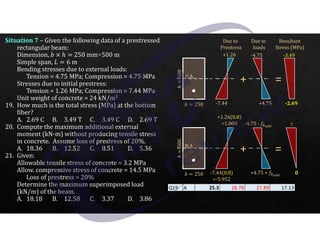
Situation 7 – Given the following data of a prestressed
rectangular beam:
Dimension, J a ℎ 250 mm×500 m
Simple span, R 6 m
Bending stresses due to external loads:
Tension = 4.75 MPa; Compression = 4.75 MPa
Stresses due to initial prestress:
Tension = 1.26 MPa; Compression = 7.44 MPa
Unit weight of concrete = 24 kN/m3
19. How much is the total stress (MPa) at the bottom
fiber?
A. 2.69 C B. 3.49 T C. 3.49 C D. 2.69 T
20. Compute the maximum additional external
moment (kN-m) without producing tensile stress
in concrete. Assume loss of prestress of 20%.
A. 18.36 B. 12.52 C. 8.51 D. 5.36
21. Given:
Allowable tensile stress of concrete = 3.2 MPa
Allow. compressive stress of concrete = 14.5 MPa
Loss of prestress = 20%
Determine the maximum superimposed load
(kN/m) of the beam.
A. 18.18 B. 12.58 C. 3.37 D. 3.86
Due to
Prestress
+1.26
-7.44
Due to
loads
-4.75
+4.75
+
N.A.
=
-3.49
-2.69
Resultant
Stress (MPa)
+1.26(0.8)
=1.008
-7.44(0.8)
=-5.952
-4.75 - <U)zz
+4.75 + <U)zz
+ =
?
0
Q19 A 25.3 28.78 27.89 17.13
J 250
ℎ
500
N.A.
J 250
ℎ
500
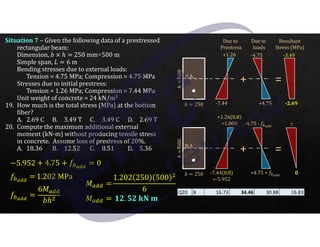
Situation 7 – Given the following data of a prestressed
rectangular beam:
Dimension, J a ℎ 250 mm×500 m
Simple span, R 6 m
Bending stresses due to external loads:
Tension = 4.75 MPa; Compression = 4.75 MPa
Stresses due to initial prestress:
Tension = 1.26 MPa; Compression = 7.44 MPa
Unit weight of concrete = 24 kN/m3
19. How much is the total stress (MPa) at the bottom
fiber?
A. 2.69 C B. 3.49 T C. 3.49 C D. 2.69 T
20. Compute the maximum additional external
moment (kN-m) without producing tensile stress
in concrete. Assume loss of prestress of 20%.
A. 18.36 B. 12.52 C. 8.51 D. 5.36
Due to
Prestress
+1.26
-7.44
Due to
loads
-4.75
+4.75
+
N.A.
=
-3.49
-2.69
Resultant
Stress (MPa)
+1.26(0.8)
=1.008
-7.44(0.8)
=-5.952
-4.75 - <U)zz
+4.75 + <U)zz
+ =
?
0
5.952 - 4.75 - <U)zz
0
<U)zz
1.202 MPa
<U)zz
6 ${{
Jℎ
${{
1.202 250 500
6
${{ .@. 0@ X3 Z
Q20 B 16.73 34.46 30.88 16.83
J 250
ℎ
500
N.A.
Situation 7 –
21. Given:
Allowable tensile stress of concrete = 3.2 MPa
Allow. compressive stress of concrete = 14.5 MPa
Loss of prestress = 20%
Determine the maximum superimposed load
(kN/m) of the beam.
A. 18.18 B. 12.58 C. 3.37 D. 3.86
Due to
Prestress
Due to
loads
Resultant
Stress (MPa)
+1.26(0.8)
=1.008 T
-7.44(0.8)
=5.952 (C)
<U(C)
<U T
+ =
} 14.5 C
} 3.2 T
1.008 - <U } 14.5
<U()*
15.508 MPa
5.952 - <U } 3.2
<U()*
9.152 MPa
↑
<U()*
6
Jℎ
9.152 250 500
6
95.33 kN m
_R
8
_ 8 95.33 /6
_ 21.18 kN/m
_U €•Jℎ 24 0.25 0.5
_U 3 kN/m
_W‚ƒ 21.18 3
_W‚ƒ .2. .2 X3/Z
Q21 A 21.41 30.38 19.42 27.19
Situation 8 – A 450-mm square tied column is
reinforced with eight 25-mm-diameter bars
equally distributed on its sides. The column
unsupported height is 2.60 m and sidesway is
prevented by shear walls („ 1). Concrete
strength is 20.7 MPa and steel strength is 415
MPa. Use 40 mm cover measure from center of
main reinforcement. Tie diameter is 12 mm. Use
W 200 GPa.
1. Compute the maximum nominal axial strength
(kN) of the column.
A. 5,123 C. 4,098
B. 4,269 D. 4,355
2. Determine the balanced nominal load (kN). Use
concrete strain of 0.003 and steel yield strain of
<M/ W.
A. 2,365 C. 1,952
B. 1,673 D. 2,087
3. How much is the balanced nominal moment (kN-
m)?
A. 632 C. 563
B. 487 D. 425
40
40 185 185
450 mm
450
mm
N
25mm
Situation 8 – A 450-mm square tied column is
reinforced with eight 25-mm-diameter bars
equally distributed on its sides. The column
unsupported height is 2.60 m and sidesway is
prevented by shear walls („ 1). Concrete
strength is 20.7 MPa and steel strength is 415
MPa. Use 40 mm cover measure from center of
main reinforcement. Tie diameter is 12 mm. Use
W 200 GPa.
1. Compute the maximum nominal axial strength
(kN) of the column.
A. 5,123 C. 4,098
B. 4,269 D. 4,355
40
40 185 185
450 mm
450
mm
N
25mm
r 450 450 202,500 mm
U j/4 25 491 mm
WB 8 U 3,928 mm
T… 0.85<•
†
r WB - <M WB
T… 0.85 20.7 202,500 3,928
- 415 3,928
T… 5,124 kN
T‡()*
0.8T… 0.8 5,124
/AYY X3
Q22 C 14.74 35.76 23.01 24.9
Situation 8 – A 450-mm square tied column is
reinforced with eight 25-mm-diameter bars
equally distributed on its sides. The column
unsupported height is 2.60 m and sidesway is
prevented by shear walls („ 1). Concrete
strength is 20.7 MPa and steel strength is 415
MPa. Use 40 mm cover measure from center of
main reinforcement. Tie diameter is 12 mm. Use
W 200 GPa.
2. Determine the balanced nominal load (kN). Use
concrete strain of 0.003 and steel yield strain of
<M/ W.
A. 2,365 C. 1,952
B. 1,673 D. 2,087
3. How much is the balanced nominal moment (kN-
m)?
A. 632 C. 563
B. 487 D. 425
450 mm
40
40 185 185
450
mm
N
LU
I
Neutral
axis
K
25mm
K 450 40 410 mm
LU
600K
600 - <M
600 410
600 - 415
242.4 mm
I ˆ LU
ˆ 0.85
I 206 mm
Situation 8 –
<M 415 MPa; <•
†
20.7 MPa; ˆ 0.85
U 491 mm
2. Determine the balanced nominal load (kN). Use
concrete strain of 0.003 and steel yield strain of
<M/ W.
A. 2,365 B. 1,673 C. 1,952 D. 2,087
3. How much is the balanced nominal moment (kN-
m)?
A. 632 B. 487 C. 563 D. 425
450 mm
40
40 185 185
450
mm
N
LU
I
•
W
5 W
TU‡
‰U
0.85<•
†
Neutral
axis
185 185
225
K
40
25mm
K 410 mm LU 242.4 mm I 206 mm
5 3 U <M 3 491 415 611.29 kN
• 0.85<•
†
• 0.85 20.7 450 206
• 1631.06 kN
<W
†
600
LU K′
L
<‹ 600
242.4 40
242.4
501 MPa Œ <M
<‹ 600
242.4 225
242.4
43.1 MPa
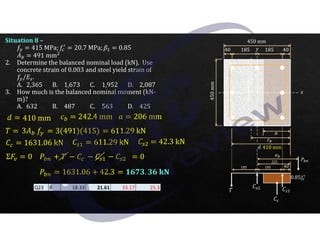
Situation 8 –
<M 415 MPa; <•
†
20.7 MPa; ˆ 0.85
U 491 mm
2. Determine the balanced nominal load (kN). Use
concrete strain of 0.003 and steel yield strain of
<M/ W.
A. 2,365 B. 1,673 C. 1,952 D. 2,087
3. How much is the balanced nominal moment (kN-
m)?
A. 632 B. 487 C. 563 D. 425
450 mm
40
40 185 185
450
mm
N
LU
I
•
W
5 W
TU‡
‰U
0.85<•
†
Neutral
axis
185 185
225
K
40
25mm
K 410 mm LU 242.4 mm I 206 mm
5 3 U <M 3 491 415 611.29 kN
• 1631.06 kN
<‹ <‹ 43.1 MPa
410 mm
<M
W 3 U <M 3 491 415 611.29 kN
W 2 U <W 2 491 43.1 42.3 kN
Situation 8 –
<M 415 MPa; <•
†
20.7 MPa; ˆ 0.85
U 491 mm
2. Determine the balanced nominal load (kN). Use
concrete strain of 0.003 and steel yield strain of
<M/ W.
A. 2,365 B. 1,673 C. 1,952 D. 2,087
3. How much is the balanced nominal moment (kN-
m)?
A. 632 B. 487 C. 563 D. 425
450 mm
40
40 185 185
450
mm
N
LU
I
•
W
5 W
TU‡
‰U
0.85<•
†
Neutral
axis
185 185
225
K
40
25mm
K 410 mm LU 242.4 mm I 206 mm
5 3 U <M 3 491 415 611.29 kN
• 1631.06 kN 410 mm
W 611.29 kN W 42.3 kN
Σ 0 TU‡ - 5 • W W 0
TU‡ 1631.06 - 42.3 .9:1. 19 X3
Q23 B 18.33 21.61 33.17 25.3
Situation 8 –
<M 415 MPa; <•
†
20.7 MPa; ˆ 0.85
U 491 mm
3. How much is the balanced nominal moment (kN-
m)?
A. 632 B. 487 C. 563 D. 425
450 mm
40
40 185 185
450
mm
N
LU
I
• W
5 W
TU‡
‰U
0.85<•
†
Neutral
axis
185 185
225
K
40
25mm
•
K 410 mm LU 242.4 mm I 206 mm
5 3 U <M 3 491 415 611.29 kN
• 1631.06 kN
410 mm
W 611.29 kN W 42.3 kN
Σ Ž 0 TU‡‰U
TU‡ .9:1. 19 X3
W 185 - 5 185 - • 225 I/2
225
I
2
TU‡‰U U‡ 611.29 185 - 611.29 185
- 1631.06 225 206/2
U‡ /@0. .: X3 Z
Q24 D 14.34 30.48 36.06 17.43
Situation 9 – Given the following data of a square
column footing:
Footing dimension: 2 m × 2 m
Column dimension: 400 mm×400 mm
Effective depth of footing K 350 mm
<•
†
27.5 MPa; <M 415 MPa
Allowable shear stress at ultimate loads:
Two-way shear = 1.73 MPa
One-way shear = 0.89 MPa
Shear • 0.75; Moment, • 0.90
25. Compute the maximum factored axial load
capacity (kN) of the footing based on wide-
beam shear.
A. 2365 B. 2075 C. 1752 D. 2536
26. Compute the maximum factored axial load
capacity (kN) of the footing based on punching
shear.
A. 1070 B. 980 C. 1580 D. 1240
27. If the required moment at the column face at
ultimate condition is 350 kN-m, compute the
required number of 20 mm diameter bars in
each direction.
A. 9 B. 8 C. 10 D. 11
2 m
2
m
0.4
0.4
K
•‡
•‡ 2 0.4 /2 0.8 m
‘‚
T‚
’Br
T‚
2 2
0.25T‚
0.8 0.35 0.45 m

‚ ‘‚ 2 0.25T‚ 2 0.45
0.225T‚ kN
Situation 9 – Given the following data of a square
column footing:
Footing dimension: 2 m × 2 m
Column dimension: 400 mm×400 mm
Effective depth of footing K 350 mm
<•
†
27.5 MPa; <M 415 MPa
Allowable shear stress at ultimate loads:
Two-way shear = 1.73 MPa
One-way shear = 0.89 MPa
Shear • 0.75; Moment, • 0.90
25. Compute the maximum factored axial load
capacity (kN) of the footing based on wide-
beam shear.
A. 2365 B. 2075 C. 1752 D. 2536
26. Compute the maximum factored axial load
capacity (kN) of the footing based on punching
shear.
A. 1070 B. 980 C. 1580 D. 1240
2 m
2
m
0.4
0.4
K
•‡
•‡ 0.8 m ‘‚ 0.25T‚

‚ 0.225T‚
“•

‚
•JuK
0.89
0.225T‚ 1000
0.75 2000 350
T‚ @A:9. 9: X3
Q25 B 30.88 32.67 20.42 14.44
Situation 9 – Given the following data of a square
column footing:
Footing dimension: 2 m × 2 m
Column dimension: 400 mm×400 mm
Effective depth of footing K 350 mm
<•
†
27.5 MPa; <M 415 MPa
Allowable shear stress at ultimate loads:
Two-way shear = 1.73 MPa
One-way shear = 0.89 MPa
Shear • 0.75; Moment, • 0.90
25. Compute the maximum factored axial load
capacity (kN) of the footing based on wide-
beam shear.
A. 2365 B. 2075 C. 1752 D. 2536
26. Compute the maximum factored axial load
capacity (kN) of the footing based on punching
shear.
A. 1070 B. 980 C. 1580 D. 1240
2 m
2
m
0.4
0.4
•‡
•‡ 0.8 m
‘‚ 0.25T‚
K/2
K/2
A. / - ” A. :0
A.
/
-
”
A.
:0

‚ T‚ ‘‚ 0.75

‚ 0.8594T‚
T‚ 0.25T‚ 0.75
kN
“•

‚
•J…K
1.73
0.8594T‚ a 10
0.75 4 a 750 350
T‚ .020 X3
Q26 C 24.3 21.02 22.31 30.68
Situation 9 –
Effective depth of footing K 350 mm
<•
†
27.5 MPa; <M 415 MPa
Shear • 0.75; Moment, • 0.90
27. If the required moment at the column face at
ultimate condition is 350 kN-m, compute the
required number of 20 mm diameter bars in
each direction.
A. 9 B. 8 C. 10 D. 11
2 m
2
m
0.4
0.4
•‡
‚ 350 kN m J 2000 mm
,‡
‚
•JK
350 a 10b
0.9 2000 350
,‡ 1.587 MPa
•
0.85<•
†
<M
1 1
2,‡
0.85<•
†
• 0.00396
•#–‡
1.4
<M
1.4
415
0.0037
←
W •JK 0.00396 2000 350
W 2,772 mm
˜ d
W
d
2,772
e
f 20
8.82
Q27 A 22.01 28.78 32.67 14.24
Situation 10 – Given the following data of
the beam shown:
Length, R 10 m
Uniform load, _ 15 kN/m
28. If 2 m, how much is the maximum
bending moment (kN-m) in the beam?
A. 37.5 C. 30
B. 42.5 D. 32.5
29. Compute the value of (m) such that
the moment at the midspan is zero.
A. 2.1 C. 2.5
B. 2.7 D. 2.0
30. Determine the value of (m) such
that the maximum flexural stress in the
beam is the least possible value.
A. 3.65 C. 5.86
B. 2.07 D. 5.24
R 10 m
_ 15 kN/m
, 75 , 75
5 m
,8 ,' 15 10 /2 75 kN
75 5 15 5 5/2 187.5 75
™
5
2 m
8 7.5 2 30 kN m
187.5 75 2 37.5 kN m
187.5 75 0
@. 0 Z
8 15 /2 7.5
0.2071R 0.2071 10 2.071 m
10 2 2.071 0. 202 Z
Q28 A 62.45 8.76 19.22 9.06
Q29 C 13.65 12.55 54.18 19.22
Q30 C 20.52 24.2 28.09 25.7
psad 1.pdf

psad 1.pdf

  • 1.
  • 7.
    Situation 1 –The portable seat shown is braced by a cable . Given the following data: Dimensions: 0.80 m; 0.30 m; 0.40 m 0.40 m; 0.20 m; 0.20 m Load 2300 N Coeff. of friction at surfaces and 0.25 Neglect friction at . 1. How much is the reaction at (N)? A. 956.5 C. 862.5 B. 1343.5 D. 1437.5 2. Compute the tensile force of the cable . A. 3881 C. 3917 B. 4365 D. 4169 3. Compute the reaction (N) at . A. 1524 C. 1384 B. 1481 D. 1454
  • 8.
    Situation 1 –The portable seat shown is braced by a cable . Given the following data: Dimensions: 0.80 m; 0.30 m; 0.40 m 0.40 m; 0.20 m; 0.20 m Load 2300 N Coeff. of friction at surfaces and 0.25 Neglect friction at . 3. Compute the reaction (N) at . A. 1524 B. 1481 C. 1384 D. 1454 0.3 2300 N 0.4 0.2 0.2 0.4 0.8 Σ 0 2300 0.3 0.8 0 862.5 N Σ 0 2300 862.5 1437.5 N #$% &' 0.25 862.5 215.625 N Σ 0 ()* 215.625 N #$% & 0.25 1437.5 359.375 N , 215.625 - 1437.5 , ./01. 02 3 1437.5 N 215.625 N Q3 D 13.55 29.48 17.03 39.24
  • 9.
    Situation 1 –The portable seat shown is braced by a cable . Given the following data: Dimensions: 0.80 m; 0.30 m; 0.40 m 0.40 m; 0.20 m; 0.20 m Load 2300 N Coeff. of friction at surfaces and 0.25 Neglect friction at . 1. How much is the reaction at (N)? A. 956.5 C. 862.5 B. 1343.5 D. 1437.5 0.3 2300 N 0.4 0.2 0.2 0.4 0.8 0.8 Σ 4 0 2300 0.3 0.8 0 862.5 N 862.5 N 1437.5 N 215.625 N Q1 C 9.66 7.67 73.8 8.47
  • 10.
    Situation 1 –The portable seat shown is braced by a cable . Given the following data: Dimensions: 0.80 m; 0.30 m; 0.40 m 0.40 m; 0.20 m; 0.20 m Load 2300 N Coeff. of friction at surfaces and 0.25 Neglect friction at . 2. Compute the tensile force of the cable . A. 3881 C. 3917 B. 4365 D. 4169 0.2 0.2 0.4 0.8 862.5 N 1437.5 N 215.625 N 567 Σ 8 0 1437.5 0.4 - 862.5 0.4 0.4 215.625 0.4 567 0.2 0 567 /.92. :0 3 567 /2 < 567 2300 0.8 /2 215.625 0.4 0.2 567 /.92. :0 3 Q2 D 28.19 20.82 29.38 20.42
  • 12.
    Situation 2 –The 630-N ceiling shown is in the form of an isosceles triangle with two angles equal to 60° and an altitude to of 1.5 m. It is supported by three vertical cables at each . 4. Compute the tension (N) in the cable at . A. 210 C. 260 B. 140 D. 180 5. How much is the tension (N) in the cable at ? A. 180 C. 140 B. 210 D. 260 6. What is the stress (MPa) of the cable at if it has a cross-sectional area of 12.5 mm2? A. 15.2 C. 16.8 B. 12.4 D. 24.6
  • 13.
    Situation 2 –The 630-N ceiling shown is in the form of an isosceles triangle with two angles equal to 60° and an altitude to of 1.5 m. It is supported by three vertical cables at each . 4. Compute the tension (N) in the cable at . A. 210 B. 140 C. 260 D. 180 5. How much is the tension (N) in the cable at ? A. 180 B. 210 C. 140 D. 260 6. What is the stress (MPa) of the cable at if it has a cross-sectional area of 12.5 mm2? A. 15.2 B. 12.4 C. 16.8 D. 24.6 54 5' 58 Σ 8' 0 54ℎ ℎ/3 0 54 /3 ∠ ∠ Σ 0 58 - 5' 2 /3 Σ 4? 0 58 5' 58 5' /3 54 58 5' /3 630/3 @.A 3 <BC 5' ' 210 12.5 .9. 2 DEF Q4 A 67.23 7.77 10.56 13.84 Q5 B 15.84 65.34 11.95 6.37 Q6 C 10.36 9.66 72.81 6.37
  • 15.
    G H I J K L Situation 3– The stresses acting on the element is presented in the Mohr circle as shown. Given: I 30 MPa; J 15 MPa L 45 MPa; K 40 MPa 7. What is the value (MPa) of the normal stress GM? A. 15 C. 60 B. 30 D. 45 8. Compute the maximum principal stress (MPa). A. 75.2 C. 66.6 B. 86.9 D. 58.7 9. How much is the maximum shearing stress (MPa) on the element. A. 72.8 C. 65.3 B. 54.8 D. 60.2 GM G% H%M HM%
  • 16.
    Situation 3 –The stresses acting on the element is presented in the Mohr circle as shown. Given: I 30 MPa; J 15 MPa L 45 MPa; K 40 MPa 7. What is the value (MPa) of the normal stress GM? A. 15 C. 60 B. 30 D. 45 8. Compute the maximum principal stress (MPa). A. 75.2 C. 66.6 B. 86.9 D. 58.7 9. How much is the maximum shearing stress (MPa) on the element. A. 72.8 C. 65.3 B. 54.8 D. 60.2 G H 30 15 40 45 GM G% H%M HM% N G% 60 MPa GM 30 MPa G% GM 45 , 45 - 40 , 60.208 MPa G#$% 15 - , :0. @A2 DEF H#$% , 9A. @A2 DEF G#$% H#$% Q7 B 17.93 17.33 29.78 33.76 Q8 A 67.93 12.25 12.15 6.77 Q9 D 7.97 8.67 15.84 66.63
  • 18.
    Situation 4 –A girder of a bridge with a span of 24 m is simply supported at its ends. The girder is crossed by a standard H loading consisting of a front wheel load of 17.8 kN and a rear wheel load of 71.2 kN which are 4.3 m apart. Determine the following forces on the girder due to these loads: 10. The maximum support reaction (kN). A. 76.3 C. 85.8 B. 96.3 D. 102.4 11. The maximum bending moment (kN-m). A. 632.8 C. 496.4 B. 724.2 D. 587.4 12. The maximum shear (kN) at midspan. A. 41.3 C. 98.7 B. 56.9 D. 102.5 R 24 m
  • 19.
    Situation 4 –A girder of a bridge with a span of 24 m is simply supported at its ends. The girder is crossed by a standard H loading consisting of a front wheel load of 17.8 kN and a rear wheel load of 71.2 kN which are 4.3 m apart. Determine the following forces on the girder due to these loads: 10. The maximum support reaction (kN). A. 76.3 C. 85.8 B. 96.3 D. 102.4 11. The maximum bending moment (kN-m). A. 632.8 C. 496.4 B. 724.2 D. 587.4 12. The maximum shear (kN) at midspan. A. 41.3 C. 98.7 B. 56.9 D. 102.5 R 24 m TU 71.2 kN TW 17.8 kN K 4.3 ,4 ,#$% ,8 ,4 T TU - TW 89 kN TR TWK R 89 24 17.8 4.3 24 20. 2. X3 #$% TR TWK 4TR 89 24 17.8 4.3 4 89 24 /Y9. /@ X3 Z Q10 C 13.15 15.94 62.25 7.57 Q11 C 19.42 12.25 47.61 20.02
  • 20.
    Situation 4 –A girder of a bridge with a span of 24 m is simply supported at its ends. The girder is crossed by a standard H loading consisting of a front wheel load of 17.8 kN and a rear wheel load of 71.2 kN which are 4.3 m apart. Determine the following forces on the girder due to these loads: 12. The maximum shear (kN) at midspan. A. 41.3 C. 98.7 B. 56.9 D. 102.5 I R 2 12 m J R 2 12 m [ [ K 4.3 7.7 [ I.L. for ' TU 71.2 kN TW 17.8 kN K 4.3 0.5 12 7.7 0.321 I/R 0.5 J/R 0.5 '()* 71.2 0.5 - 17.8 0.321 '()* /.. 1. X3 Q12 A 34.26 23.41 28.39 13.25
  • 22.
    Situation 5 –The GERTC signage is supported by a hallow circular pole as shown. Given the following data: Dimensions: I 0.4 ]; _ 2.4 ] ℎ 1.2 ]; 9 ] Outside diameter of pole = 270 mm Thickness of pole = 12 mm Wind force acting on the signage = 5 kN 13. Determine the maximum bending stress (MPa) in the pole due to wind force. A. 95.4 B. 72.5 C. 79.9 D. 102.8 14. Compute the maximum longitudinal shearing stress (MPa) in the pole due to wind force. A. 1.28 B. 0.87 C. 1.03 D. 1.45 15. How much is the maximum torsional shearing stress (MPa) in the pole due to wind force? A. 8.9 B. 9.2 C. 7.4 D. 6.7
  • 23.
    Situation 5 –The GERTC signage is supported by a hallow circular pole as shown. Given the following data: Dimensions: I 0.4 ]; _ 2.4 ] ℎ 1.2 ]; 9 ] Outside diameter of pole = 270 mm Thickness of pole = 12 mm Wind force acting on the signage = 5 kN 13. Determine the maximum bending stress (MPa) in the pole due to wind force. A. 95.4 B. 72.5 C. 79.9 D. 102.8 14. Compute the maximum longitudinal shearing stress (MPa) in the pole due to wind force. A. 1.28 B. 0.87 C. 1.03 D. 1.45 15. How much is the maximum torsional shearing stress (MPa) in the pole due to wind force? A. 8.9 B. 9.2 C. 7.4 D. 6.7 Base of pole #$% 5 kN #$% 5 9.6 48 kN m 5#$% 5 1.6 8 kN m 270 mm K 246 mm <U()* L ` 48 a 10b cd e bf cdgh fbg :Y. Y DEF Q13 C 24.5 22.21 35.86 16.04
  • 24.
    Situation 5 –The GERTC signage is supported by a hallow circular pole as shown. Given the following data: 14. Compute the maximum longitudinal shearing stress (MPa) in the pole due to wind force. A. 1.28 B. 0.87 C. 1.03 D. 1.45 15. How much is the maximum torsional shearing stress (MPa) in the pole due to wind force? A. 8.9 B. 9.2 C. 7.4 D. 6.7 Base of pole #$% 5 kN #$% 48 kN m 5#$% 8 kN m 270 mm K 246 mm ; , 135 mm ; i 123 mm < ()* 4 3j , - ,i - i ,f if < ()* 4 5000 3j 135 - 135 123 - 123 135f 123f < ()* .. A@: DEF <U()* :Y. Y DEF Q14 C 28.19 20.02 37.15 13.25
  • 25.
    Situation 5 –The GERTC signage is supported by a hallow circular pole as shown. Given the following data: 14. Compute the maximum longitudinal shearing stress (MPa) in the pole due to wind force. A. 1.28 B. 0.87 C. 1.03 D. 1.45 15. How much is the maximum torsional shearing stress (MPa) in the pole due to wind force? A. 8.9 B. 9.2 C. 7.4 D. 6.7 Base of pole #$% 5 kN #$% 48 kN m 5#$% 8 kN m 270 mm K 246 mm ; , 135 mm ; i 123 mm < klmnop 165 j f Kf < ()* .. A@: DEF <U()* :Y. Y DEF < klmnop 16 8 a 10b 270 j 270f 246f < klmnop 9. 99 DEF Q15 D 27.99 19.02 34.46 16.73
  • 27.
    Situation 6 –A vertical angle is axially loaded along its neutral axis as shown. Properties of 1L 100 ×100 × 9 mm Area, 1,720 mm I 29 mm Yield strength, M 248 MPa Allowable weld shear stress = 98 MPa 16. How much is the tensile capacity (kN) of the angle? A. 296.2 C. 289.7 B. 321.4 D. 255.9 17. Using 9 mm longitudinal welds only, compute the value of R (mm). A. 236.9 C. 254.2 B. 215.5 D. 291.4 18. Using 9 mm longitudinal welds and 8 mm transverse weld, compute the value of R (mm). A. 232 C. 205 B. 247 D. 223 I R R T
  • 28.
    R R Situation 6 –A vertical angle is axially loaded along its neutral axis as shown. Properties of 1L 100 ×100 × 9 mm Area, 1,720 mm I 29 mm Yield strength, M 248 MPa Allowable weld shear stress = 98 MPa 16. How much is the tensile capacity (kN) of the angle? A. 296.2 C. 289.7 B. 321.4 D. 255.9 17. Using 9 mm longitudinal welds only, compute the value of R (mm). A. 236.9 C. 254.2 B. 215.5 D. 291.4 18. Using 9 mm longitudinal welds and 8 mm transverse weld, compute the value of R (mm). A. 232 C. 205 B. 247 D. 223 29 T 100 71 TB()* B r 0.6 248 1720 @00. Y19 X3 Q16 D 22.31 19.22 35.06 21.71
  • 29.
    T T 29 71 R R T 255.936 kN Situation6 – A vertical angle is axially loaded along its neutral axis as shown. Properties of 1L 100 ×100 × 9 mm Area, 1,720 mm I 29 mm Yield strength, M 248 MPa Allowable weld shear stress = 98 MPa 17. Using 9 mm longitudinal welds only, compute the value of R (mm). A. 236.9 C. 254.2 B. 215.5 D. 291.4 18. Using 9 mm longitudinal welds and 8 mm transverse weld, compute the value of R (mm). A. 232 C. 205 B. 247 D. 223 Σ st 0 T 100 255.936 71 0 T 181.715 kN T u v u 0.707wR 181,715 98x0.707 9 R y R @Y.. / ZZ Q17 D 24.8 24.2 35.56 13.45
  • 30.
    Situation 6 –A vertical angle is axially loaded along its neutral axis as shown. Properties of 1L 100 ×100 × 9 mm Area, 1,720 mm I 29 mm Yield strength, M 248 MPa Allowable weld shear stress = 98 MPa 18. Using 9 mm longitudinal welds and 8 mm transverse weld, compute the value of R (mm). A. 232 C. 205 B. 247 D. 223 T T T 50 50 29 71 R R T 255.936 kN T u v u 0.707w R 98x0.707 8 100 y T T 55.429 kN Σ st 0 T 100 - 255.936 71 0 T 154 kN 55.429 50 T u v u 0.707wR 154,000 98x0.707 9 R y R @/: ZZ Q18 B 22.61 20.02 25.2 30.38
  • 32.
    J 250 ℎ 500 N.A. J 250 ℎ 500 Situation7 – Given the following data of a prestressed rectangular beam: Dimension, J a ℎ 250 mm×500 m Simple span, R 6 m Bending stresses due to external loads: Tension = 4.75 MPa; Compression = 4.75 MPa Stresses due to initial prestress: Tension = 1.26 MPa; Compression = 7.44 MPa Unit weight of concrete = 24 kN/m3 19. How much is the total stress (MPa) at the bottom fiber? A. 2.69 C B. 3.49 T C. 3.49 C D. 2.69 T 20. Compute the maximum additional external moment (kN-m) without producing tensile stress in concrete. Assume loss of prestress of 20%. A. 18.36 B. 12.52 C. 8.51 D. 5.36 21. Given: Allowable tensile stress of concrete = 3.2 MPa Allow. compressive stress of concrete = 14.5 MPa Loss of prestress = 20% Determine the maximum superimposed load (kN/m) of the beam. A. 18.18 B. 12.58 C. 3.37 D. 3.86 Due to Prestress +1.26 -7.44 Due to loads -4.75 +4.75 + N.A. = -3.49 -2.69 Resultant Stress (MPa) +1.26(0.8) =1.008 -7.44(0.8) =-5.952 -4.75 - <U)zz +4.75 + <U)zz + = ? 0 Q19 A 25.3 28.78 27.89 17.13
  • 33.
    J 250 ℎ 500 N.A. J 250 ℎ 500 Situation7 – Given the following data of a prestressed rectangular beam: Dimension, J a ℎ 250 mm×500 m Simple span, R 6 m Bending stresses due to external loads: Tension = 4.75 MPa; Compression = 4.75 MPa Stresses due to initial prestress: Tension = 1.26 MPa; Compression = 7.44 MPa Unit weight of concrete = 24 kN/m3 19. How much is the total stress (MPa) at the bottom fiber? A. 2.69 C B. 3.49 T C. 3.49 C D. 2.69 T 20. Compute the maximum additional external moment (kN-m) without producing tensile stress in concrete. Assume loss of prestress of 20%. A. 18.36 B. 12.52 C. 8.51 D. 5.36 Due to Prestress +1.26 -7.44 Due to loads -4.75 +4.75 + N.A. = -3.49 -2.69 Resultant Stress (MPa) +1.26(0.8) =1.008 -7.44(0.8) =-5.952 -4.75 - <U)zz +4.75 + <U)zz + = ? 0 5.952 - 4.75 - <U)zz 0 <U)zz 1.202 MPa <U)zz 6 ${{ Jℎ ${{ 1.202 250 500 6 ${{ .@. 0@ X3 Z Q20 B 16.73 34.46 30.88 16.83
  • 34.
    J 250 ℎ 500 N.A. Situation 7– 21. Given: Allowable tensile stress of concrete = 3.2 MPa Allow. compressive stress of concrete = 14.5 MPa Loss of prestress = 20% Determine the maximum superimposed load (kN/m) of the beam. A. 18.18 B. 12.58 C. 3.37 D. 3.86 Due to Prestress Due to loads Resultant Stress (MPa) +1.26(0.8) =1.008 T -7.44(0.8) =5.952 (C) <U(C) <U T + = } 14.5 C } 3.2 T 1.008 - <U } 14.5 <U()* 15.508 MPa 5.952 - <U } 3.2 <U()* 9.152 MPa ↑ <U()* 6 Jℎ 9.152 250 500 6 95.33 kN m _R 8 _ 8 95.33 /6 _ 21.18 kN/m _U €•Jℎ 24 0.25 0.5 _U 3 kN/m _W‚ƒ 21.18 3 _W‚ƒ .2. .2 X3/Z Q21 A 21.41 30.38 19.42 27.19
  • 36.
    Situation 8 –A 450-mm square tied column is reinforced with eight 25-mm-diameter bars equally distributed on its sides. The column unsupported height is 2.60 m and sidesway is prevented by shear walls („ 1). Concrete strength is 20.7 MPa and steel strength is 415 MPa. Use 40 mm cover measure from center of main reinforcement. Tie diameter is 12 mm. Use W 200 GPa. 1. Compute the maximum nominal axial strength (kN) of the column. A. 5,123 C. 4,098 B. 4,269 D. 4,355 2. Determine the balanced nominal load (kN). Use concrete strain of 0.003 and steel yield strain of <M/ W. A. 2,365 C. 1,952 B. 1,673 D. 2,087 3. How much is the balanced nominal moment (kN- m)? A. 632 C. 563 B. 487 D. 425 40 40 185 185 450 mm 450 mm N 25mm
  • 37.
    Situation 8 –A 450-mm square tied column is reinforced with eight 25-mm-diameter bars equally distributed on its sides. The column unsupported height is 2.60 m and sidesway is prevented by shear walls („ 1). Concrete strength is 20.7 MPa and steel strength is 415 MPa. Use 40 mm cover measure from center of main reinforcement. Tie diameter is 12 mm. Use W 200 GPa. 1. Compute the maximum nominal axial strength (kN) of the column. A. 5,123 C. 4,098 B. 4,269 D. 4,355 40 40 185 185 450 mm 450 mm N 25mm r 450 450 202,500 mm U j/4 25 491 mm WB 8 U 3,928 mm T… 0.85<• † r WB - <M WB T… 0.85 20.7 202,500 3,928 - 415 3,928 T… 5,124 kN T‡()* 0.8T… 0.8 5,124 /AYY X3 Q22 C 14.74 35.76 23.01 24.9
  • 38.
    Situation 8 –A 450-mm square tied column is reinforced with eight 25-mm-diameter bars equally distributed on its sides. The column unsupported height is 2.60 m and sidesway is prevented by shear walls („ 1). Concrete strength is 20.7 MPa and steel strength is 415 MPa. Use 40 mm cover measure from center of main reinforcement. Tie diameter is 12 mm. Use W 200 GPa. 2. Determine the balanced nominal load (kN). Use concrete strain of 0.003 and steel yield strain of <M/ W. A. 2,365 C. 1,952 B. 1,673 D. 2,087 3. How much is the balanced nominal moment (kN- m)? A. 632 C. 563 B. 487 D. 425 450 mm 40 40 185 185 450 mm N LU I Neutral axis K 25mm K 450 40 410 mm LU 600K 600 - <M 600 410 600 - 415 242.4 mm I ˆ LU ˆ 0.85 I 206 mm
  • 39.
    Situation 8 – <M415 MPa; <• † 20.7 MPa; ˆ 0.85 U 491 mm 2. Determine the balanced nominal load (kN). Use concrete strain of 0.003 and steel yield strain of <M/ W. A. 2,365 B. 1,673 C. 1,952 D. 2,087 3. How much is the balanced nominal moment (kN- m)? A. 632 B. 487 C. 563 D. 425 450 mm 40 40 185 185 450 mm N LU I • W 5 W TU‡ ‰U 0.85<• † Neutral axis 185 185 225 K 40 25mm K 410 mm LU 242.4 mm I 206 mm 5 3 U <M 3 491 415 611.29 kN • 0.85<• † • 0.85 20.7 450 206 • 1631.06 kN <W † 600 LU K′ L <‹ 600 242.4 40 242.4 501 MPa Œ <M <‹ 600 242.4 225 242.4 43.1 MPa
  • 40.
    Situation 8 – <M415 MPa; <• † 20.7 MPa; ˆ 0.85 U 491 mm 2. Determine the balanced nominal load (kN). Use concrete strain of 0.003 and steel yield strain of <M/ W. A. 2,365 B. 1,673 C. 1,952 D. 2,087 3. How much is the balanced nominal moment (kN- m)? A. 632 B. 487 C. 563 D. 425 450 mm 40 40 185 185 450 mm N LU I • W 5 W TU‡ ‰U 0.85<• † Neutral axis 185 185 225 K 40 25mm K 410 mm LU 242.4 mm I 206 mm 5 3 U <M 3 491 415 611.29 kN • 1631.06 kN <‹ <‹ 43.1 MPa 410 mm <M W 3 U <M 3 491 415 611.29 kN W 2 U <W 2 491 43.1 42.3 kN
  • 41.
    Situation 8 – <M415 MPa; <• † 20.7 MPa; ˆ 0.85 U 491 mm 2. Determine the balanced nominal load (kN). Use concrete strain of 0.003 and steel yield strain of <M/ W. A. 2,365 B. 1,673 C. 1,952 D. 2,087 3. How much is the balanced nominal moment (kN- m)? A. 632 B. 487 C. 563 D. 425 450 mm 40 40 185 185 450 mm N LU I • W 5 W TU‡ ‰U 0.85<• † Neutral axis 185 185 225 K 40 25mm K 410 mm LU 242.4 mm I 206 mm 5 3 U <M 3 491 415 611.29 kN • 1631.06 kN 410 mm W 611.29 kN W 42.3 kN Σ 0 TU‡ - 5 • W W 0 TU‡ 1631.06 - 42.3 .9:1. 19 X3 Q23 B 18.33 21.61 33.17 25.3
  • 42.
    Situation 8 – <M415 MPa; <• † 20.7 MPa; ˆ 0.85 U 491 mm 3. How much is the balanced nominal moment (kN- m)? A. 632 B. 487 C. 563 D. 425 450 mm 40 40 185 185 450 mm N LU I • W 5 W TU‡ ‰U 0.85<• † Neutral axis 185 185 225 K 40 25mm • K 410 mm LU 242.4 mm I 206 mm 5 3 U <M 3 491 415 611.29 kN • 1631.06 kN 410 mm W 611.29 kN W 42.3 kN Σ Ž 0 TU‡‰U TU‡ .9:1. 19 X3 W 185 - 5 185 - • 225 I/2 225 I 2 TU‡‰U U‡ 611.29 185 - 611.29 185 - 1631.06 225 206/2 U‡ /@0. .: X3 Z Q24 D 14.34 30.48 36.06 17.43
  • 44.
    Situation 9 –Given the following data of a square column footing: Footing dimension: 2 m × 2 m Column dimension: 400 mm×400 mm Effective depth of footing K 350 mm <• † 27.5 MPa; <M 415 MPa Allowable shear stress at ultimate loads: Two-way shear = 1.73 MPa One-way shear = 0.89 MPa Shear • 0.75; Moment, • 0.90 25. Compute the maximum factored axial load capacity (kN) of the footing based on wide- beam shear. A. 2365 B. 2075 C. 1752 D. 2536 26. Compute the maximum factored axial load capacity (kN) of the footing based on punching shear. A. 1070 B. 980 C. 1580 D. 1240 27. If the required moment at the column face at ultimate condition is 350 kN-m, compute the required number of 20 mm diameter bars in each direction. A. 9 B. 8 C. 10 D. 11 2 m 2 m 0.4 0.4 K •‡ •‡ 2 0.4 /2 0.8 m ‘‚ T‚ ’Br T‚ 2 2 0.25T‚ 0.8 0.35 0.45 m ‚ ‘‚ 2 0.25T‚ 2 0.45 0.225T‚ kN
  • 45.
    Situation 9 –Given the following data of a square column footing: Footing dimension: 2 m × 2 m Column dimension: 400 mm×400 mm Effective depth of footing K 350 mm <• † 27.5 MPa; <M 415 MPa Allowable shear stress at ultimate loads: Two-way shear = 1.73 MPa One-way shear = 0.89 MPa Shear • 0.75; Moment, • 0.90 25. Compute the maximum factored axial load capacity (kN) of the footing based on wide- beam shear. A. 2365 B. 2075 C. 1752 D. 2536 26. Compute the maximum factored axial load capacity (kN) of the footing based on punching shear. A. 1070 B. 980 C. 1580 D. 1240 2 m 2 m 0.4 0.4 K •‡ •‡ 0.8 m ‘‚ 0.25T‚ ‚ 0.225T‚ “• ‚ •JuK 0.89 0.225T‚ 1000 0.75 2000 350 T‚ @A:9. 9: X3 Q25 B 30.88 32.67 20.42 14.44
  • 46.
    Situation 9 –Given the following data of a square column footing: Footing dimension: 2 m × 2 m Column dimension: 400 mm×400 mm Effective depth of footing K 350 mm <• † 27.5 MPa; <M 415 MPa Allowable shear stress at ultimate loads: Two-way shear = 1.73 MPa One-way shear = 0.89 MPa Shear • 0.75; Moment, • 0.90 25. Compute the maximum factored axial load capacity (kN) of the footing based on wide- beam shear. A. 2365 B. 2075 C. 1752 D. 2536 26. Compute the maximum factored axial load capacity (kN) of the footing based on punching shear. A. 1070 B. 980 C. 1580 D. 1240 2 m 2 m 0.4 0.4 •‡ •‡ 0.8 m ‘‚ 0.25T‚ K/2 K/2 A. / - ” A. :0 A. / - ” A. :0 ‚ T‚ ‘‚ 0.75 ‚ 0.8594T‚ T‚ 0.25T‚ 0.75 kN “• ‚ •J…K 1.73 0.8594T‚ a 10 0.75 4 a 750 350 T‚ .020 X3 Q26 C 24.3 21.02 22.31 30.68
  • 47.
    Situation 9 – Effectivedepth of footing K 350 mm <• † 27.5 MPa; <M 415 MPa Shear • 0.75; Moment, • 0.90 27. If the required moment at the column face at ultimate condition is 350 kN-m, compute the required number of 20 mm diameter bars in each direction. A. 9 B. 8 C. 10 D. 11 2 m 2 m 0.4 0.4 •‡ ‚ 350 kN m J 2000 mm ,‡ ‚ •JK 350 a 10b 0.9 2000 350 ,‡ 1.587 MPa • 0.85<• † <M 1 1 2,‡ 0.85<• † • 0.00396 •#–‡ 1.4 <M 1.4 415 0.0037 ← W •JK 0.00396 2000 350 W 2,772 mm ˜ d W d 2,772 e f 20 8.82 Q27 A 22.01 28.78 32.67 14.24
  • 49.
    Situation 10 –Given the following data of the beam shown: Length, R 10 m Uniform load, _ 15 kN/m 28. If 2 m, how much is the maximum bending moment (kN-m) in the beam? A. 37.5 C. 30 B. 42.5 D. 32.5 29. Compute the value of (m) such that the moment at the midspan is zero. A. 2.1 C. 2.5 B. 2.7 D. 2.0 30. Determine the value of (m) such that the maximum flexural stress in the beam is the least possible value. A. 3.65 C. 5.86 B. 2.07 D. 5.24 R 10 m _ 15 kN/m , 75 , 75 5 m ,8 ,' 15 10 /2 75 kN 75 5 15 5 5/2 187.5 75 ™ 5 2 m 8 7.5 2 30 kN m 187.5 75 2 37.5 kN m 187.5 75 0 @. 0 Z 8 15 /2 7.5 0.2071R 0.2071 10 2.071 m 10 2 2.071 0. 202 Z Q28 A 62.45 8.76 19.22 9.06 Q29 C 13.65 12.55 54.18 19.22 Q30 C 20.52 24.2 28.09 25.7