1
PSYCHOLOGY
(8th Edition)
David Myers
PowerPoint Slides
Aneeq Ahmad
Henderson State University
Worth Publishers, © 2006
2
Therapy
Chapter 17
3
Therapy
The Psychological Therapies
 Psychoanalysis
 Humanistic Therapies
 Behavior Therapies
 Cognitive Therapies
 Group and Family Therapies
4
Therapy
Evaluating Psychotherapies
 The Effectiveness of Psychotherapy
 The Relative Effectiveness of
Different Therapies
 Alternative Therapies Evaluated
 Commonalities Among
Psychotherapies
 Culture and Values in
Psychotherapies
5
Therapy
The Biomedical Therapies
 Drug Therapies
 Brain Stimulation Psychosurgery
Preventing Psychological
Disorders
6
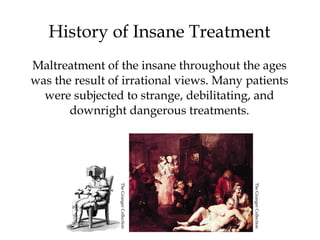
History of Insane Treatment
Maltreatment of the insane throughout the ages
was the result of irrational views. Many patients
were subjected to strange, debilitating, and
downright dangerous treatments.
TheGrangerCollection
7
History of Insane Treatment
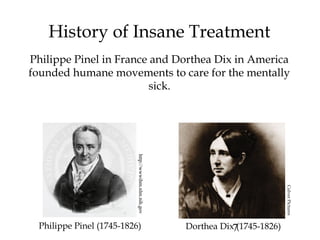
Philippe Pinel in France and Dorthea Dix in America
founded humane movements to care for the mentally
sick.
http://wwwihm.nlm.nih.gov
Philippe Pinel (1745-1826) Dorthea Dix (1745-1826)
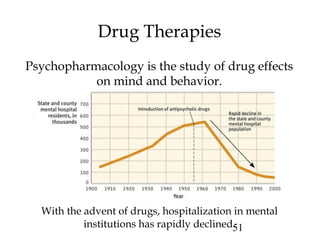
CulverPictures
8
Therapies
Psychotherapy involves an emotionally
charged, confiding interaction between a
trained therapist and a mental patient.
Biomedical therapy uses drugs or other procedures
that act on the patient’s nervous system, curing him or
her of psychological disorders.
An eclectic approach uses various forms of
healing techniques depending upon the client’s
unique problems.
9
Psychological Therapies
We will look at four major forms of
psychotherapies based on different theories of
human nature:
1. Psychoanalytical theory
2. Humanistic theory
3. Behavioral theory
4. Cognitive theory
10
Psychoanalysis
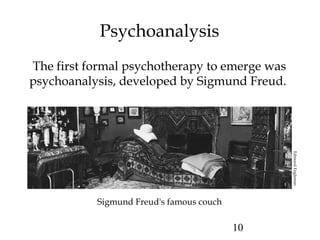
The first formal psychotherapy to emerge was
psychoanalysis, developed by Sigmund Freud.
Sigmund Freud's famous couch
EdmundEngleman
11
Psychoanalysis: Aims
Since psychological problems originate from
childhood repressed impulses and conflicts, the
aim of psychoanalysis is to bring repressed
feelings into conscious awareness where the
patient can deal with them.
When energy devoted to id-ego-superego
conflicts is released, the patient’s anxiety
lessens.
12
Psychoanalysis: Methods
Dissatisfied with hypnosis, Freud developed
the method of free association to unravel the
unconscious mind and its conflicts.
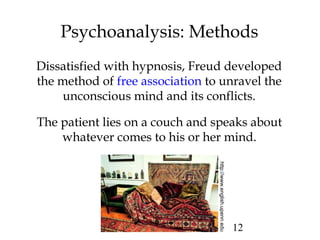
The patient lies on a couch and speaks about
whatever comes to his or her mind.
http://www.english.upenn.edu
13
Psychoanalysis: Methods
During free association, the patient edits his
thoughts, resisting his or her feelings to express
emotions. Such resistance becomes important in
the analysis of conflict-driven anxiety.
Eventually the patient opens up and reveals his
or her innermost private thoughts, developing
positive or negative feelings (transference)
towards the therapist.
14
Psychoanalysis: Criticisms
1. Psychoanalysis is hard to refute because it
cannot be proven or disproven.
2. Psychoanalysis takes a long time and is very
expensive.
15
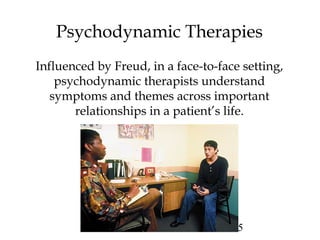
Psychodynamic Therapies
Influenced by Freud, in a face-to-face setting,
psychodynamic therapists understand
symptoms and themes across important
relationships in a patient’s life.
16
Psychodynamic Therapies
Interpersonal psychotherapy, a variation of
psychodynamic therapy, is effective in treating
depression. It focuses on symptom relief here
and now, not an overall personality change.
17
Humanistic Therapies
Humanistic therapists aim to boost self-
fulfillment by helping people grow in self-
awareness and self-acceptance.
18
Person-Centered Therapy
Developed by Carl Rogers, person-centered
therapy is a form of humanistic therapy.
The therapist listens to the needs of the patient
in an accepting and non-judgmental way,
addressing problems in a productive way and
building his or her self-esteem.
19
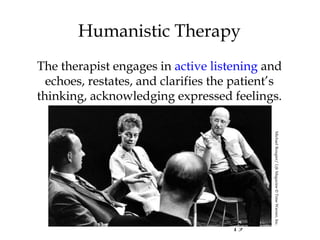
Humanistic Therapy
The therapist engages in active listening and
echoes, restates, and clarifies the patient’s
thinking, acknowledging expressed feelings.
MichaelRougier/LifeMagazine©TimeWarner,Inc.
20
Behavior Therapy
Therapy that applies learning principles to the
elimination of unwanted behaviors.
To treat phobias or sexual disorders, behavior
therapists do not delve deeply below the
surface looking for inner causes.
21
Classical Conditioning Techniques
Counterconditioning is a procedure that
conditions new responses to stimuli that trigger
unwanted behaviors.
It is based on classical conditioning and
includes exposure therapy and aversive
conditioning.
22
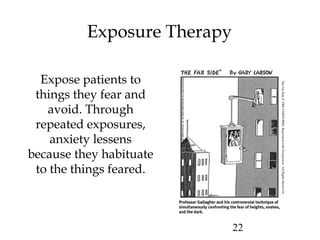
Exposure Therapy
Expose patients to
things they fear and
avoid. Through
repeated exposures,
anxiety lessens
because they habituate
to the things feared.
TheFarSide©1986FARWORKS.ReprintedwithPermission.AllRightsReserved.
23
Exposure Therapy
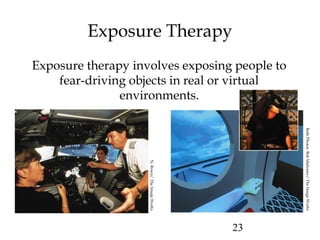
Exposure therapy involves exposing people to
fear-driving objects in real or virtual
environments.
N.Rown/TheImageWorks
BothPhotos:BobMahoney/TheImageWorks
24
Systematic Desensitization
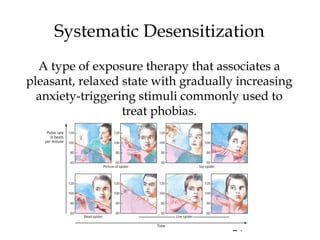
A type of exposure therapy that associates a
pleasant, relaxed state with gradually increasing
anxiety-triggering stimuli commonly used to
treat phobias.
25
Aversive Conditioning
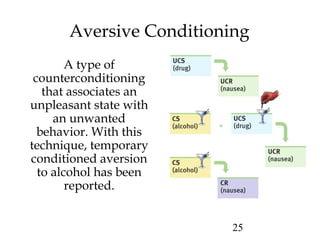
A type of
counterconditioning
that associates an
unpleasant state with
an unwanted
behavior. With this
technique, temporary
conditioned aversion
to alcohol has been
reported.
26
Operant Conditioning
Operant conditioning procedures enable
therapists to use behavior modification, in
which desired behaviors are rewarded and
undesired behaviors are either unrewarded or
punished.
A number of withdrawn, uncommunicative
3-year-old autistic children have been
successfully trained by giving and withdrawing
reinforcements for desired and undesired
behaviors.
27
Token Economy
In institutional settings therapists may create a
token economy in which patients exchange a
token of some sort, earned for exhibiting the
desired behavior, for various privileges or
treats.
28
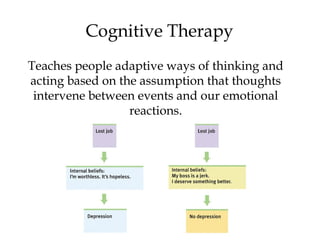
Cognitive Therapy
Teaches people adaptive ways of thinking and
acting based on the assumption that thoughts
intervene between events and our emotional
reactions.
29
Cognitive Therapy for Depression
Aaron Beck (1979) suggests that depressed
patients believe that they can never be happy
(thinking) and thus associate minor failings (e.g.
failing a test [event]) in life as major causes for
their depression.
Beck believes that cognitions such as “I can never
be happy” need to change in order for depressed
patients to recover. This change is brought about
by gently questioning patients.
30
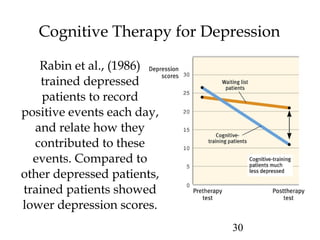
Cognitive Therapy for Depression
Rabin et al., (1986)
trained depressed
patients to record
positive events each day,
and relate how they
contributed to these
events. Compared to
other depressed patients,
trained patients showed
lower depression scores.
31
Stress Inoculation Training
Meichenbaum (1977, 1985) trained people to
restructure their thinking in stressful situations.
“Relax, the exam may be hard, but it will be
hard for everyone else too. I studied harder
than most people. Besides, I don’t need a
perfect score to get a good grade.”
32
Cognitive-Behavior Therapy
Cognitive therapists often combine the reversal
of self-defeated thinking with efforts to modify
behavior.
Cognitive-behavior therapy aims to alter the
way people act (behavior therapy) and alter the
way they think (cognitive therapy).
33
Group Therapy
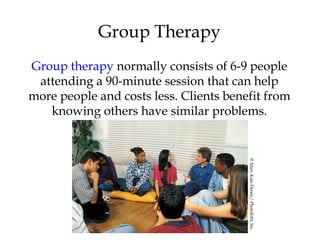
Group therapy normally consists of 6-9 people
attending a 90-minute session that can help
more people and costs less. Clients benefit from
knowing others have similar problems.
©MaryKateDenny/PhotoEdit,Inc.
34
Family Therapy
Family therapy treats the family as a system.
Therapy guides family members toward
positive relationships and improved
communication.
35
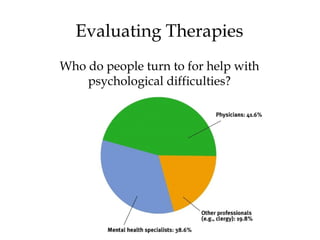
Who do people turn to for help with
psychological difficulties?
Evaluating Therapies
36
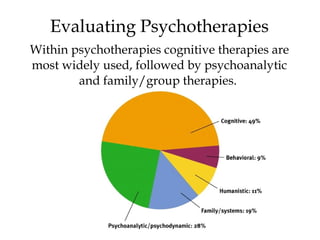
Evaluating Psychotherapies
Within psychotherapies cognitive therapies are
most widely used, followed by psychoanalytic
and family/group therapies.
37
Is Psychotherapy Effective?
It is difficult to gauge the effectiveness of
psychotherapy because there are different levels
upon which its effectiveness can be measured.
1. Does the patient sense improvement?
2. Does the therapist feel the patient has improved?
3. How do friends and family feel about the
patient’s improvement?
38
Client’s Perceptions
If you ask clients about their experiences of
getting into therapy, they often overestimate its
effectiveness. Critics however remain skeptical.
1. Clients enter therapy in crisis, but crisis may
subside over the natural course of time (regression
to normalcy).
2. Clients may need to believe the therapy was worth
the effort.
3. Clients generally speak kindly of their therapists.
39
Clinician’s Perceptions
Like clients, clinicians believe in therapy’s
success. They believe the client is better off after
therapy than if the client had not taken part in
therapy.
1. Clinicians are aware of failures, but they believe
failures are the problem of other therapists.
2. If a client seeks another clinician, the former
therapist is more likely to argue that the client has
developed another psychological problem.
3. Clinicians are likely to testify to the efficacy of their
therapy regardless of the outcome of treatment.
40
Outcome Research
How can we objectively measure the
effectiveness of psychotherapy?
Meta-analysis of a number of studies suggests
that thousands of patients benefit more from
therapy than those who did not go to therapy.
41
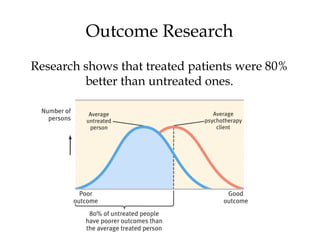
Outcome Research
Research shows that treated patients were 80%
better than untreated ones.
42
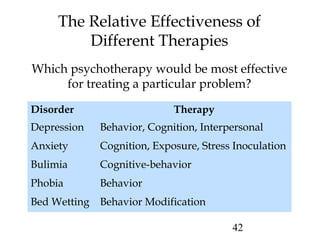
The Relative Effectiveness of
Different Therapies
Which psychotherapy would be most effective
for treating a particular problem?
Disorder Therapy
Depression Behavior, Cognition, Interpersonal
Anxiety Cognition, Exposure, Stress Inoculation
Bulimia Cognitive-behavior
Phobia Behavior
Bed Wetting Behavior Modification
43
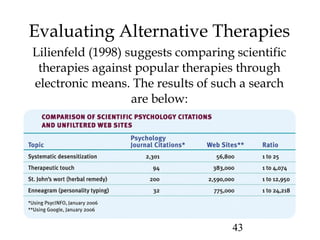
Evaluating Alternative Therapies
Lilienfeld (1998) suggests comparing scientific
therapies against popular therapies through
electronic means. The results of such a search
are below:
44
Eye Movement Desensitization and
Reprocessing (EMDR)
In EMDR therapy, the therapist attempts to
unlock and reprocess previous frozen traumatic
memories by waving a finger in front of the
eyes of the client.
EMDR has not held up under scientific testing.
45
Light Exposure Therapy
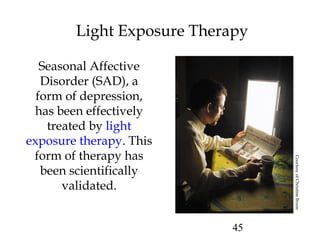
Seasonal Affective
Disorder (SAD), a
form of depression,
has been effectively
treated by light
exposure therapy. This
form of therapy has
been scientifically
validated.
CourtesyofChristineBrune
46
Commonalities Among
Psychotherapies
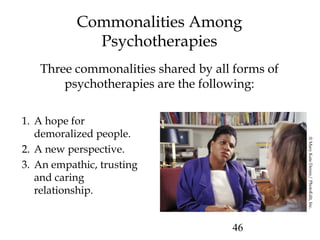
Three commonalities shared by all forms of
psychotherapies are the following:
1. A hope for
demoralized people.
2. A new perspective.
3. An empathic, trusting
and caring
relationship.
©MaryKateDenny/PhotoEdit,Inc.
47
Culture and Values in Psychotherapy
Psychotherapists may differ from each other
and from clients in their personal beliefs,
values, and cultural backgrounds.
A therapist search should include visiting two
or more therapists to judge which one makes
the client feel more comfortable.
48
Therapists & Their Training
Clinical psychologists: They have PhDs mostly.
They are experts in research, assessment, and
therapy, all of which is verified through a
supervised internship.
Clinical or Psychiatric Social Worker: They have
a Masters of Social Work. Postgraduate
supervision prepares some social workers to
offer psychotherapy, mostly to people with
everyday personal and family problems.
49
Therapists & Their Training
Counselors: Pastoral counselors or abuse
counselors work with problems arising from
family relations, spouse and child abusers and
their victims, and substance abusers.
Psychiatrists: They are physicians who
specialize in the treatment of psychological
disorders. Not all psychiatrists have extensive
training in psychotherapy, but as MDs they can
prescribe medications.
50
The Biomedical Therapies
These include physical, medicinal, and other
forms of biological therapies.
1. Drug Treatments
2. Surgery
3. Electric-shock therapy
51
Drug Therapies
Psychopharmacology is the study of drug effects
on mind and behavior.
With the advent of drugs, hospitalization in mental
institutions has rapidly declined.
52
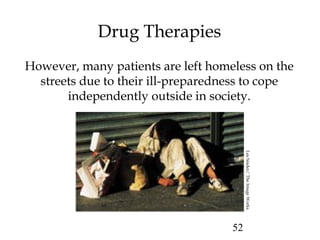
Drug Therapies
However, many patients are left homeless on the
streets due to their ill-preparedness to cope
independently outside in society.
LesSnider/TheImageWorks
53
Double-Blind Procedures
To test the effectiveness of a drug, patients are
tested with the drug and a placebo. Two groups of
patients and medical health professionals are
unaware of who is taking the drug and who is
taking the placebo.
54
Schizophrenia Symptoms
Inappropriate symptoms
present (positive
symptoms)
Appropriate symptoms
absent (negative
symptoms)
Hallucinations,
disorganized thinking,
deluded ways.
Apathy, expressionless
faces, rigid bodies.
55
Antipsychotic Drugs
Classical antipsychotics [Chlorpromazine
(Thorazine)]: Remove a number of positive
symptoms associated with schizophrenia such
as agitation, delusions, and hallucinations.
Atypical antipsychotics [Clozapine (Clozaril)]:
Remove negative symptoms associated with
schizophrenia such as apathy, jumbled thoughts,
concentration difficulties, and difficulties in
interacting with others.
56
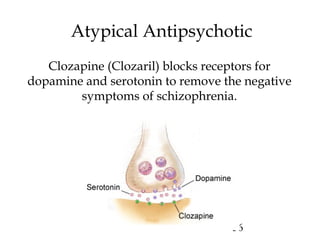
Atypical Antipsychotic
Clozapine (Clozaril) blocks receptors for
dopamine and serotonin to remove the negative
symptoms of schizophrenia.
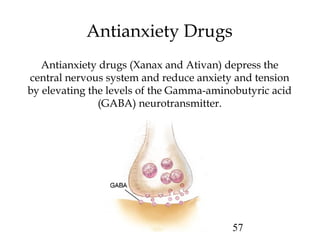
57
Antianxiety Drugs
Antianxiety drugs (Xanax and Ativan) depress the
central nervous system and reduce anxiety and tension
by elevating the levels of the Gamma-aminobutyric acid
(GABA) neurotransmitter.
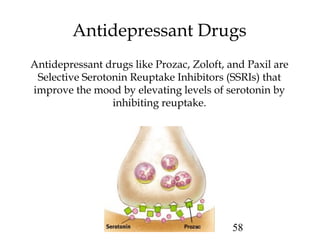
58
Antidepressant Drugs
Antidepressant drugs like Prozac, Zoloft, and Paxil are
Selective Serotonin Reuptake Inhibitors (SSRIs) that
improve the mood by elevating levels of serotonin by
inhibiting reuptake.
59
Mood-Stabilizing Medications
Lithium Carbonate, a common salt, has been used
to stabilize manic episodes in bipolar disorders. It
moderates the levels of norepinephrine and
glutamate neurotransmitters.
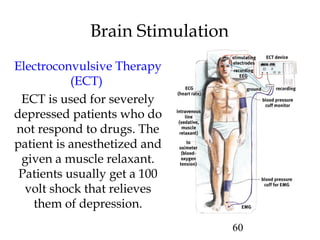
60
Brain Stimulation
Electroconvulsive Therapy
(ECT)
ECT is used for severely
depressed patients who do
not respond to drugs. The
patient is anesthetized and
given a muscle relaxant.
Patients usually get a 100
volt shock that relieves
them of depression.
61
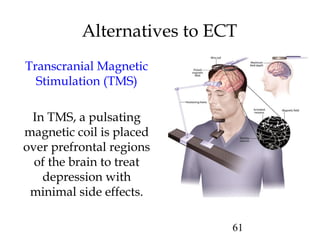
Alternatives to ECT
Transcranial Magnetic
Stimulation (TMS)
In TMS, a pulsating
magnetic coil is placed
over prefrontal regions
of the brain to treat
depression with
minimal side effects.
62
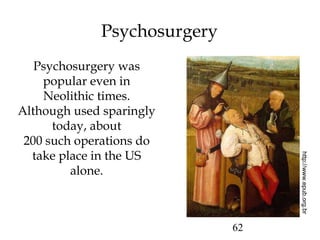
Psychosurgery
Psychosurgery was
popular even in
Neolithic times.
Although used sparingly
today, about
200 such operations do
take place in the US
alone.
http://www.epub.org.br
63
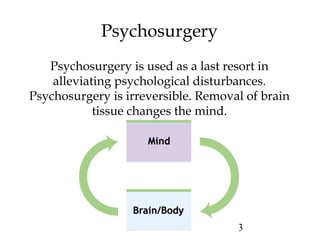
Psychosurgery
Psychosurgery is used as a last resort in
alleviating psychological disturbances.
Psychosurgery is irreversible. Removal of brain
tissue changes the mind.
64
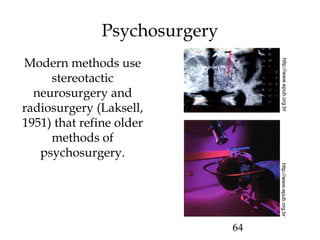
Psychosurgery
Modern methods use
stereotactic
neurosurgery and
radiosurgery (Laksell,
1951) that refine older
methods of
psychosurgery.
http://www.epub.org.brhttp://www.epub.org.br
65
Preventing Psychological Disorders
“It is better to prevent than cure.”
Peruvian Folk Wisdom
Preventing psychological disorders means
removing the factors that affect society. Those
factors may be poverty, meaningless work,
constant criticism, unemployment, racism, and
sexism.
66
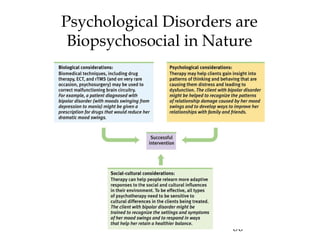
Psychological Disorders are
Biopsychosocial in Nature

Chapter 17 (therapy)

  • 1.
    1 PSYCHOLOGY (8th Edition) David Myers PowerPointSlides Aneeq Ahmad Henderson State University Worth Publishers, © 2006
  • 2.
  • 3.
    3 Therapy The Psychological Therapies Psychoanalysis  Humanistic Therapies  Behavior Therapies  Cognitive Therapies  Group and Family Therapies
  • 4.
    4 Therapy Evaluating Psychotherapies  TheEffectiveness of Psychotherapy  The Relative Effectiveness of Different Therapies  Alternative Therapies Evaluated  Commonalities Among Psychotherapies  Culture and Values in Psychotherapies
  • 5.
    5 Therapy The Biomedical Therapies Drug Therapies  Brain Stimulation Psychosurgery Preventing Psychological Disorders
  • 6.
    6 History of InsaneTreatment Maltreatment of the insane throughout the ages was the result of irrational views. Many patients were subjected to strange, debilitating, and downright dangerous treatments. TheGrangerCollection TheGrangerCollection
  • 7.
    7 History of InsaneTreatment Philippe Pinel in France and Dorthea Dix in America founded humane movements to care for the mentally sick. http://wwwihm.nlm.nih.gov Philippe Pinel (1745-1826) Dorthea Dix (1745-1826) CulverPictures
  • 8.
    8 Therapies Psychotherapy involves anemotionally charged, confiding interaction between a trained therapist and a mental patient. Biomedical therapy uses drugs or other procedures that act on the patient’s nervous system, curing him or her of psychological disorders. An eclectic approach uses various forms of healing techniques depending upon the client’s unique problems.
  • 9.
    9 Psychological Therapies We willlook at four major forms of psychotherapies based on different theories of human nature: 1. Psychoanalytical theory 2. Humanistic theory 3. Behavioral theory 4. Cognitive theory
  • 10.
    10 Psychoanalysis The first formalpsychotherapy to emerge was psychoanalysis, developed by Sigmund Freud. Sigmund Freud's famous couch EdmundEngleman
  • 11.
    11 Psychoanalysis: Aims Since psychologicalproblems originate from childhood repressed impulses and conflicts, the aim of psychoanalysis is to bring repressed feelings into conscious awareness where the patient can deal with them. When energy devoted to id-ego-superego conflicts is released, the patient’s anxiety lessens.
  • 12.
    12 Psychoanalysis: Methods Dissatisfied withhypnosis, Freud developed the method of free association to unravel the unconscious mind and its conflicts. The patient lies on a couch and speaks about whatever comes to his or her mind. http://www.english.upenn.edu
  • 13.
    13 Psychoanalysis: Methods During freeassociation, the patient edits his thoughts, resisting his or her feelings to express emotions. Such resistance becomes important in the analysis of conflict-driven anxiety. Eventually the patient opens up and reveals his or her innermost private thoughts, developing positive or negative feelings (transference) towards the therapist.
  • 14.
    14 Psychoanalysis: Criticisms 1. Psychoanalysisis hard to refute because it cannot be proven or disproven. 2. Psychoanalysis takes a long time and is very expensive.
  • 15.
    15 Psychodynamic Therapies Influenced byFreud, in a face-to-face setting, psychodynamic therapists understand symptoms and themes across important relationships in a patient’s life.
  • 16.
    16 Psychodynamic Therapies Interpersonal psychotherapy,a variation of psychodynamic therapy, is effective in treating depression. It focuses on symptom relief here and now, not an overall personality change.
  • 17.
    17 Humanistic Therapies Humanistic therapistsaim to boost self- fulfillment by helping people grow in self- awareness and self-acceptance.
  • 18.
    18 Person-Centered Therapy Developed byCarl Rogers, person-centered therapy is a form of humanistic therapy. The therapist listens to the needs of the patient in an accepting and non-judgmental way, addressing problems in a productive way and building his or her self-esteem.
  • 19.
    19 Humanistic Therapy The therapistengages in active listening and echoes, restates, and clarifies the patient’s thinking, acknowledging expressed feelings. MichaelRougier/LifeMagazine©TimeWarner,Inc.
  • 20.
    20 Behavior Therapy Therapy thatapplies learning principles to the elimination of unwanted behaviors. To treat phobias or sexual disorders, behavior therapists do not delve deeply below the surface looking for inner causes.
  • 21.
    21 Classical Conditioning Techniques Counterconditioningis a procedure that conditions new responses to stimuli that trigger unwanted behaviors. It is based on classical conditioning and includes exposure therapy and aversive conditioning.
  • 22.
    22 Exposure Therapy Expose patientsto things they fear and avoid. Through repeated exposures, anxiety lessens because they habituate to the things feared. TheFarSide©1986FARWORKS.ReprintedwithPermission.AllRightsReserved.
  • 23.
    23 Exposure Therapy Exposure therapyinvolves exposing people to fear-driving objects in real or virtual environments. N.Rown/TheImageWorks BothPhotos:BobMahoney/TheImageWorks
  • 24.
    24 Systematic Desensitization A typeof exposure therapy that associates a pleasant, relaxed state with gradually increasing anxiety-triggering stimuli commonly used to treat phobias.
  • 25.
    25 Aversive Conditioning A typeof counterconditioning that associates an unpleasant state with an unwanted behavior. With this technique, temporary conditioned aversion to alcohol has been reported.
  • 26.
    26 Operant Conditioning Operant conditioningprocedures enable therapists to use behavior modification, in which desired behaviors are rewarded and undesired behaviors are either unrewarded or punished. A number of withdrawn, uncommunicative 3-year-old autistic children have been successfully trained by giving and withdrawing reinforcements for desired and undesired behaviors.
  • 27.
    27 Token Economy In institutionalsettings therapists may create a token economy in which patients exchange a token of some sort, earned for exhibiting the desired behavior, for various privileges or treats.
  • 28.
    28 Cognitive Therapy Teaches peopleadaptive ways of thinking and acting based on the assumption that thoughts intervene between events and our emotional reactions.
  • 29.
    29 Cognitive Therapy forDepression Aaron Beck (1979) suggests that depressed patients believe that they can never be happy (thinking) and thus associate minor failings (e.g. failing a test [event]) in life as major causes for their depression. Beck believes that cognitions such as “I can never be happy” need to change in order for depressed patients to recover. This change is brought about by gently questioning patients.
  • 30.
    30 Cognitive Therapy forDepression Rabin et al., (1986) trained depressed patients to record positive events each day, and relate how they contributed to these events. Compared to other depressed patients, trained patients showed lower depression scores.
  • 31.
    31 Stress Inoculation Training Meichenbaum(1977, 1985) trained people to restructure their thinking in stressful situations. “Relax, the exam may be hard, but it will be hard for everyone else too. I studied harder than most people. Besides, I don’t need a perfect score to get a good grade.”
  • 32.
    32 Cognitive-Behavior Therapy Cognitive therapistsoften combine the reversal of self-defeated thinking with efforts to modify behavior. Cognitive-behavior therapy aims to alter the way people act (behavior therapy) and alter the way they think (cognitive therapy).
  • 33.
    33 Group Therapy Group therapynormally consists of 6-9 people attending a 90-minute session that can help more people and costs less. Clients benefit from knowing others have similar problems. ©MaryKateDenny/PhotoEdit,Inc.
  • 34.
    34 Family Therapy Family therapytreats the family as a system. Therapy guides family members toward positive relationships and improved communication.
  • 35.
    35 Who do peopleturn to for help with psychological difficulties? Evaluating Therapies
  • 36.
    36 Evaluating Psychotherapies Within psychotherapiescognitive therapies are most widely used, followed by psychoanalytic and family/group therapies.
  • 37.
    37 Is Psychotherapy Effective? Itis difficult to gauge the effectiveness of psychotherapy because there are different levels upon which its effectiveness can be measured. 1. Does the patient sense improvement? 2. Does the therapist feel the patient has improved? 3. How do friends and family feel about the patient’s improvement?
  • 38.
    38 Client’s Perceptions If youask clients about their experiences of getting into therapy, they often overestimate its effectiveness. Critics however remain skeptical. 1. Clients enter therapy in crisis, but crisis may subside over the natural course of time (regression to normalcy). 2. Clients may need to believe the therapy was worth the effort. 3. Clients generally speak kindly of their therapists.
  • 39.
    39 Clinician’s Perceptions Like clients,clinicians believe in therapy’s success. They believe the client is better off after therapy than if the client had not taken part in therapy. 1. Clinicians are aware of failures, but they believe failures are the problem of other therapists. 2. If a client seeks another clinician, the former therapist is more likely to argue that the client has developed another psychological problem. 3. Clinicians are likely to testify to the efficacy of their therapy regardless of the outcome of treatment.
  • 40.
    40 Outcome Research How canwe objectively measure the effectiveness of psychotherapy? Meta-analysis of a number of studies suggests that thousands of patients benefit more from therapy than those who did not go to therapy.
  • 41.
    41 Outcome Research Research showsthat treated patients were 80% better than untreated ones.
  • 42.
    42 The Relative Effectivenessof Different Therapies Which psychotherapy would be most effective for treating a particular problem? Disorder Therapy Depression Behavior, Cognition, Interpersonal Anxiety Cognition, Exposure, Stress Inoculation Bulimia Cognitive-behavior Phobia Behavior Bed Wetting Behavior Modification
  • 43.
    43 Evaluating Alternative Therapies Lilienfeld(1998) suggests comparing scientific therapies against popular therapies through electronic means. The results of such a search are below:
  • 44.
    44 Eye Movement Desensitizationand Reprocessing (EMDR) In EMDR therapy, the therapist attempts to unlock and reprocess previous frozen traumatic memories by waving a finger in front of the eyes of the client. EMDR has not held up under scientific testing.
  • 45.
    45 Light Exposure Therapy SeasonalAffective Disorder (SAD), a form of depression, has been effectively treated by light exposure therapy. This form of therapy has been scientifically validated. CourtesyofChristineBrune
  • 46.
    46 Commonalities Among Psychotherapies Three commonalitiesshared by all forms of psychotherapies are the following: 1. A hope for demoralized people. 2. A new perspective. 3. An empathic, trusting and caring relationship. ©MaryKateDenny/PhotoEdit,Inc.
  • 47.
    47 Culture and Valuesin Psychotherapy Psychotherapists may differ from each other and from clients in their personal beliefs, values, and cultural backgrounds. A therapist search should include visiting two or more therapists to judge which one makes the client feel more comfortable.
  • 48.
    48 Therapists & TheirTraining Clinical psychologists: They have PhDs mostly. They are experts in research, assessment, and therapy, all of which is verified through a supervised internship. Clinical or Psychiatric Social Worker: They have a Masters of Social Work. Postgraduate supervision prepares some social workers to offer psychotherapy, mostly to people with everyday personal and family problems.
  • 49.
    49 Therapists & TheirTraining Counselors: Pastoral counselors or abuse counselors work with problems arising from family relations, spouse and child abusers and their victims, and substance abusers. Psychiatrists: They are physicians who specialize in the treatment of psychological disorders. Not all psychiatrists have extensive training in psychotherapy, but as MDs they can prescribe medications.
  • 50.
    50 The Biomedical Therapies Theseinclude physical, medicinal, and other forms of biological therapies. 1. Drug Treatments 2. Surgery 3. Electric-shock therapy
  • 51.
    51 Drug Therapies Psychopharmacology isthe study of drug effects on mind and behavior. With the advent of drugs, hospitalization in mental institutions has rapidly declined.
  • 52.
    52 Drug Therapies However, manypatients are left homeless on the streets due to their ill-preparedness to cope independently outside in society. LesSnider/TheImageWorks
  • 53.
    53 Double-Blind Procedures To testthe effectiveness of a drug, patients are tested with the drug and a placebo. Two groups of patients and medical health professionals are unaware of who is taking the drug and who is taking the placebo.
  • 54.
    54 Schizophrenia Symptoms Inappropriate symptoms present(positive symptoms) Appropriate symptoms absent (negative symptoms) Hallucinations, disorganized thinking, deluded ways. Apathy, expressionless faces, rigid bodies.
  • 55.
    55 Antipsychotic Drugs Classical antipsychotics[Chlorpromazine (Thorazine)]: Remove a number of positive symptoms associated with schizophrenia such as agitation, delusions, and hallucinations. Atypical antipsychotics [Clozapine (Clozaril)]: Remove negative symptoms associated with schizophrenia such as apathy, jumbled thoughts, concentration difficulties, and difficulties in interacting with others.
  • 56.
    56 Atypical Antipsychotic Clozapine (Clozaril)blocks receptors for dopamine and serotonin to remove the negative symptoms of schizophrenia.
  • 57.
    57 Antianxiety Drugs Antianxiety drugs(Xanax and Ativan) depress the central nervous system and reduce anxiety and tension by elevating the levels of the Gamma-aminobutyric acid (GABA) neurotransmitter.
  • 58.
    58 Antidepressant Drugs Antidepressant drugslike Prozac, Zoloft, and Paxil are Selective Serotonin Reuptake Inhibitors (SSRIs) that improve the mood by elevating levels of serotonin by inhibiting reuptake.
  • 59.
    59 Mood-Stabilizing Medications Lithium Carbonate,a common salt, has been used to stabilize manic episodes in bipolar disorders. It moderates the levels of norepinephrine and glutamate neurotransmitters.
  • 60.
    60 Brain Stimulation Electroconvulsive Therapy (ECT) ECTis used for severely depressed patients who do not respond to drugs. The patient is anesthetized and given a muscle relaxant. Patients usually get a 100 volt shock that relieves them of depression.
  • 61.
    61 Alternatives to ECT TranscranialMagnetic Stimulation (TMS) In TMS, a pulsating magnetic coil is placed over prefrontal regions of the brain to treat depression with minimal side effects.
  • 62.
    62 Psychosurgery Psychosurgery was popular evenin Neolithic times. Although used sparingly today, about 200 such operations do take place in the US alone. http://www.epub.org.br
  • 63.
    63 Psychosurgery Psychosurgery is usedas a last resort in alleviating psychological disturbances. Psychosurgery is irreversible. Removal of brain tissue changes the mind.
  • 64.
    64 Psychosurgery Modern methods use stereotactic neurosurgeryand radiosurgery (Laksell, 1951) that refine older methods of psychosurgery. http://www.epub.org.brhttp://www.epub.org.br
  • 65.
    65 Preventing Psychological Disorders “Itis better to prevent than cure.” Peruvian Folk Wisdom Preventing psychological disorders means removing the factors that affect society. Those factors may be poverty, meaningless work, constant criticism, unemployment, racism, and sexism.
  • 66.

Editor's Notes

  • #9 OBJECTIVE 1| Contrast psychotherapy and the biomedical therapies, and explain how an eclectic approach or psychotherapy integration varies from either of these two main forms of therapy.
  • #10 OBJECTIVE 2| Define psychoanalysis, and discuss the aims of this form of therapy.
  • #13 OBJECTIVE 3| Describe some of the methods used in psychoanalysis, and list some criticisms of this form of therapy.
  • #16 OBJECTIVE 4| Contrast psychodynamic therapy and interpersonal therapy with traditional psychoanalysis.
  • #18 OBJECTIVE 5| Identify the basic characteristics of the humanistic therapies, and describe the specific goals and techniques of Carl Rogers’ client-centered therapy.
  • #21 OBJECTIVE 6| Explain how the basic assumption of behavior therapy differs from those of traditional psychoanalytic and humanistic therapies.
  • #22 OBJECTIVE 7| Define counterconditioning, and describe the techniques used in exposure therapies and aversive conditioning.
  • #27 OBJECTIVE 8| State the main premise of therapy based on operant conditioning principles, and describe the views of proponents and critics of behavior modification.
  • #30 OBJECTIVE 9| Contrast cognitive therapy and cognitive-behavior therapy, and give some examples of cognitive therapy for depression.
  • #34 OBJECTIVE 10| Discuss the rationale and benefits of group therapy, including family therapy.
  • #39 OBJECTIVE 11| Explain why clients tend to overestimate the effectiveness of psychotherapy.
  • #40 OBJECTIVE 12| Give some reasons why clinicians tend to overestimate the effectiveness of psychotherapy, and describe the phenomena that contribute to clients’ and clinicians’ misperceptions of this area.
  • #41 OBJECTIVE 13| Discuss the importance of outcome studies in judging the effectiveness of psychotherapies, and describe some of these findings.
  • #43 OBJECTIVE 14| Summarize the findings on which psychotherapies are most effective for specific disorders.
  • #44 OBJECTIVE 15| Evaluate the effectiveness of eye movements desensitization and reprocessing (EMDR) and light exposure therapies.
  • #47 OBJECTIVE 16| Describe the three benefits attributed to all psychotherapies.
  • #48 OBJECTIVE 17| Discuss the role of values and cultural differences in the therapeutic process.
  • #52 OBJECTIVE 18| Define psychopharmacology, and explain how double-blind studies help researchers evaluate a drug’s effectiveness.
  • #53 OBJECTIVE 18| Define psychopharmacology, and explain how double-blind studies help researchers evaluate a drug’s effectiveness.
  • #56 OBJECTIVE 19| Describe the characteristics of antipsychotic drugs, and discuss their use in treating specific disorders.
  • #58 OBJECTIVE 20| Describe the characteristics of antianxiety drugs, and discuss their use in treating specific disorders.
  • #59 OBJECTIVE 21| Describe the characteristics of antidepressant drugs, and discuss their use in treating specific disorders.
  • #60 OBJECTIVE 22| Describe the use and effects of mood-stabilizing medications.
  • #61 OBJECTIVE 23| Describe the use of electroconvulsive therapy (ECT) in treating severe depression, and describe some possible alternatives to ECT.
  • #63 OBJECTIVE 24| Summarize the history of the psychosurgical procedure known as lobotomy, and discuss the use of psychosurgery today.
  • #66 OBJECTIVE 25| Explain the rationale of preventive mental health programs, and discuss how this viewpoint illustrates the biopsychosocial perspective in psychology.