Ch. 17 – Therapy and Change
Psychotherapy
• Any treatment used by therapists to help troubled
  individuals overcome their problems.

1. Verbal Interaction
2. Development of Supportive/Trusting Relationship
3. Analysis of problems by therapist, including
   strategies to solve the problems
The Nature of Psychotherapy
• Medical Model
• Read Quote from “One Nation Under Therapy”

• “Mental Illness” = Less Social Stigma, but also less
  taking responsibility/personal efforts to overcome
  problems

• Agree or Disagree?
Main Kinds of Therapy
•   Psychoanalysis
•   Humanistic
•   Cognitive
•   Behavioral
•   Biological

Activity – Leopold is struggling in school. He has problems relating to his
   peers and completing homework because he really doesn’t care. While
   not overtly misbehaving in class, he often just ignores the instructor,
   spending much time in class day dreaming.

In groups, use each approach to try to treat Leopold. Identify his potential
    problem. What solution(s) would you suggest? What other things can you
    deduce from this scenario about potential problems?
Eclectic Approach
• Pulling in many types, using the one that works best

Strengths?

Weaknesses?
What makes a good therapist?
• Psychological Healthy
• Empathy – warmth/understanding
• Experience dealing with people/understanding
  complexities of individuals and situations
Group Therapies

• Most often grouped by issues
• Patients work together with the aid of a leader to
  resolve interpersonal problems
• Put people who are struggling with similar problems
  together.
• Includes family therapy, self-help groups

• Benefits?
• Concerns?
Does Psychotherapy Work?
• 1994 Consumer Reports Self Reported Survey
(Since not random, can’t be generalized, just see trends)

1. Therapy did help  feel better, minimize/eliminate
   symptoms, especially if lasts 6+ months
2. Improvements greatest when from psychologists,
   psychiatrists, and social workers
3. Longer therapy lasted = greater improvements
4. Type of therapy generally didn’t matter
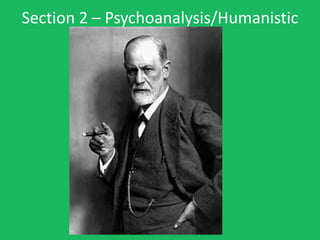
Section 2 – Psychoanalysis/Humanistic
What is Psychoanalysis?
• Therapy aimed at making patients aware of their
  unconscious motives so that they can gain control of
  their behavior.
• Overcome repression recognize and confront hidden
  impulses and feelings
• Lead to abreaction release of energy/tensions =
  growth
Resistance
• Reluctance of a patient either to reveal painful feelings
  or to examine long standing behavior patterns
Dream Analysis
• Interpret content of dreams – reveal motives

• Manifest content – actual dream content
• Latent content – hidden/symbolic meanings
Transference
• Patient feels similar feels for therapists as a different
  significant other in their life
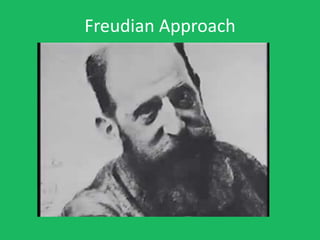
Freudian Approach
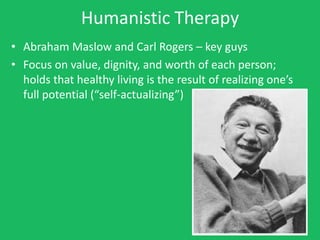
Humanistic Therapy
• Abraham Maslow and Carl Rogers – key guys
• Focus on value, dignity, and worth of each person;
  holds that healthy living is the result of realizing one’s
  full potential (“self-actualizing”)
Client-Centered Therapy
• Client and therapist are partners in therapy
• Client encouraged to discuss whatever concerns them
Nondirective Therapy
• Free flow of images/ideas, no particular direction
• Client completely in charge
• Therapist listens, encourages conversation, doesn’t give
  opinions
Active Listening
• Empathetic listening, listener acknowledges, restates,
  clarifies a person’s thoughts/concerns without arguing
  or judging
• Used in relationships also…
Section 3 – Cognitive/Behavior Therapies
Cognitive Therapies
• Changing emotions/behaviors by modifying thoughts
• Assumes that faulty cognitions are the cause of
  distorted behaviors, attitudes and emotions

Disconfirmation – evidence challenge clients thinking
Reconceptualization – work towards new belief systems
Insight – work toward understanding/deriving new or
  revised beliefs
Rational-Emotive Therapy
• Ellis (1973) – people behave in delibrate/rational ways
  based on assumptions about life.
• Therefore, problems arise from false assumptions
• So, the goal is to change those assumptions
• Techniques - Role Playing, Modeling, Persuasion
• ABC’s – Activating, Belief, Consequences
Beck’s Cognitive Therapy
• Focus on illogical thought process, disprove thoughts

• 3 Types of Illogical Thoughts
1. Overgeneralization
2. Polarized Thinking
3. Selective Attention
Bipolar and Psychotherapy
Behavior Therapies
• Focus on behavior, not thinking
• Assumption  Disturbed people learn bad behavior,
  any behavior can be unlearned, often through
  conditioning
• Reasons for behavior unimportant
Counter-conditioning
• 3 Steps
1. Anxiety hierarchy – list things, least to most anxious
2. Learn deep muscle relaxation
3. Imagine/experience each step with gradual intensity

Useful in treating phobias
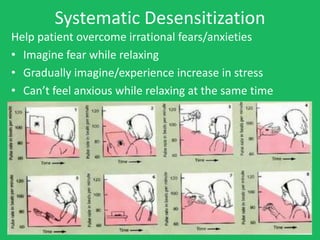
Systematic Desensitization
Help patient overcome irrational fears/anxieties
• Imagine fear while relaxing
• Gradually imagine/experience increase in stress
• Can’t feel anxious while relaxing at the same time
Aversive Conditioning
• Linking unpleasant state with an unwanted behavior in
  an attempt to eliminate the behavior

• Shot for alcoholics, feel sick
• Aversive = bad
Contingency Management
• Undesirable behavior is not reinforced, desirable
  behavior is reinforced
• Reward contingent on new behavior
Cognitive-behavior Therapy
• Try to change behavior and thinking
• Place emphasis on changing clients interpretation of
  situation
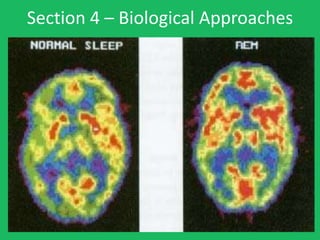
Section 4 – Biological Approaches
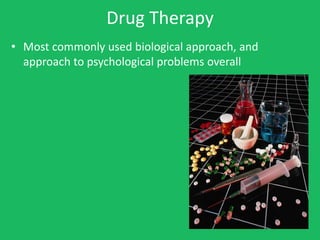
Drug Therapy
• Most commonly used biological approach, and
  approach to psychological problems overall
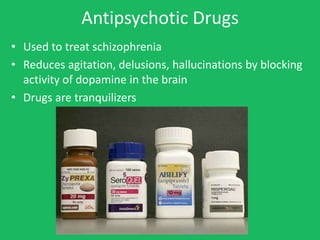
Antipsychotic Drugs
• Used to treat schizophrenia
• Reduces agitation, delusions, hallucinations by blocking
  activity of dopamine in the brain
• Drugs are tranquilizers
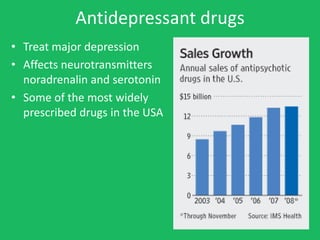
Antidepressant drugs
• Treat major depression
• Affects neurotransmitters
  noradrenalin and serotonin
• Some of the most widely
  prescribed drugs in the USA
Lithium Carbonate
• Naturally occuring salt element
(other drugs are synthetics)
• Used to treat Bipolar disorder
• Helps reduce mood swings
Anti-anxiety Drugs
•   Used to treat Anxiety disorders; slow nervous system
•   Depressives
•   Valium, Xanax
•   Side Effects – Drowsiness, Dependence
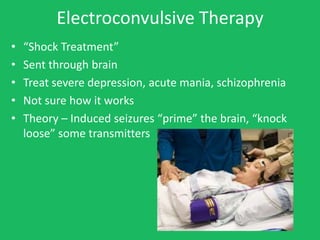
Electroconvulsive Therapy
•   “Shock Treatment”
•   Sent through brain
•   Treat severe depression, acute mania, schizophrenia
•   Not sure how it works
•   Theory – Induced seizures “prime” the brain, “knock
    loose” some transmitters
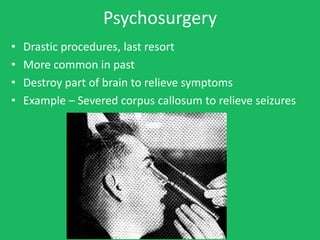
Psychosurgery
•   Drastic procedures, last resort
•   More common in past
•   Destroy part of brain to relieve symptoms
•   Example – Severed corpus callosum to relieve seizures
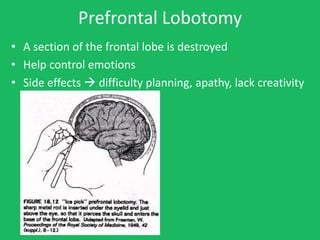
Prefrontal Lobotomy
• A section of the frontal lobe is destroyed
• Help control emotions
• Side effects  difficulty planning, apathy, lack creativity

Psychology notes ch. 17 - therapy - short

  • 1.
    Ch. 17 –Therapy and Change
  • 2.
    Psychotherapy • Any treatmentused by therapists to help troubled individuals overcome their problems. 1. Verbal Interaction 2. Development of Supportive/Trusting Relationship 3. Analysis of problems by therapist, including strategies to solve the problems
  • 3.
    The Nature ofPsychotherapy • Medical Model • Read Quote from “One Nation Under Therapy” • “Mental Illness” = Less Social Stigma, but also less taking responsibility/personal efforts to overcome problems • Agree or Disagree?
  • 4.
    Main Kinds ofTherapy • Psychoanalysis • Humanistic • Cognitive • Behavioral • Biological Activity – Leopold is struggling in school. He has problems relating to his peers and completing homework because he really doesn’t care. While not overtly misbehaving in class, he often just ignores the instructor, spending much time in class day dreaming. In groups, use each approach to try to treat Leopold. Identify his potential problem. What solution(s) would you suggest? What other things can you deduce from this scenario about potential problems?
  • 5.
    Eclectic Approach • Pullingin many types, using the one that works best Strengths? Weaknesses?
  • 6.
    What makes agood therapist? • Psychological Healthy • Empathy – warmth/understanding • Experience dealing with people/understanding complexities of individuals and situations
  • 7.
    Group Therapies • Mostoften grouped by issues • Patients work together with the aid of a leader to resolve interpersonal problems • Put people who are struggling with similar problems together. • Includes family therapy, self-help groups • Benefits? • Concerns?
  • 8.
    Does Psychotherapy Work? •1994 Consumer Reports Self Reported Survey (Since not random, can’t be generalized, just see trends) 1. Therapy did help  feel better, minimize/eliminate symptoms, especially if lasts 6+ months 2. Improvements greatest when from psychologists, psychiatrists, and social workers 3. Longer therapy lasted = greater improvements 4. Type of therapy generally didn’t matter
  • 9.
    Section 2 –Psychoanalysis/Humanistic
  • 10.
    What is Psychoanalysis? •Therapy aimed at making patients aware of their unconscious motives so that they can gain control of their behavior. • Overcome repression recognize and confront hidden impulses and feelings • Lead to abreaction release of energy/tensions = growth
  • 11.
    Resistance • Reluctance ofa patient either to reveal painful feelings or to examine long standing behavior patterns
  • 12.
    Dream Analysis • Interpretcontent of dreams – reveal motives • Manifest content – actual dream content • Latent content – hidden/symbolic meanings
  • 13.
    Transference • Patient feelssimilar feels for therapists as a different significant other in their life
  • 14.
  • 15.
    Humanistic Therapy • AbrahamMaslow and Carl Rogers – key guys • Focus on value, dignity, and worth of each person; holds that healthy living is the result of realizing one’s full potential (“self-actualizing”)
  • 16.
    Client-Centered Therapy • Clientand therapist are partners in therapy • Client encouraged to discuss whatever concerns them
  • 17.
    Nondirective Therapy • Freeflow of images/ideas, no particular direction • Client completely in charge • Therapist listens, encourages conversation, doesn’t give opinions
  • 18.
    Active Listening • Empatheticlistening, listener acknowledges, restates, clarifies a person’s thoughts/concerns without arguing or judging • Used in relationships also…
  • 19.
    Section 3 –Cognitive/Behavior Therapies
  • 20.
    Cognitive Therapies • Changingemotions/behaviors by modifying thoughts • Assumes that faulty cognitions are the cause of distorted behaviors, attitudes and emotions Disconfirmation – evidence challenge clients thinking Reconceptualization – work towards new belief systems Insight – work toward understanding/deriving new or revised beliefs
  • 21.
    Rational-Emotive Therapy • Ellis(1973) – people behave in delibrate/rational ways based on assumptions about life. • Therefore, problems arise from false assumptions • So, the goal is to change those assumptions • Techniques - Role Playing, Modeling, Persuasion • ABC’s – Activating, Belief, Consequences
  • 22.
    Beck’s Cognitive Therapy •Focus on illogical thought process, disprove thoughts • 3 Types of Illogical Thoughts 1. Overgeneralization 2. Polarized Thinking 3. Selective Attention
  • 23.
  • 24.
    Behavior Therapies • Focuson behavior, not thinking • Assumption  Disturbed people learn bad behavior, any behavior can be unlearned, often through conditioning • Reasons for behavior unimportant
  • 25.
    Counter-conditioning • 3 Steps 1.Anxiety hierarchy – list things, least to most anxious 2. Learn deep muscle relaxation 3. Imagine/experience each step with gradual intensity Useful in treating phobias
  • 26.
    Systematic Desensitization Help patientovercome irrational fears/anxieties • Imagine fear while relaxing • Gradually imagine/experience increase in stress • Can’t feel anxious while relaxing at the same time
  • 27.
    Aversive Conditioning • Linkingunpleasant state with an unwanted behavior in an attempt to eliminate the behavior • Shot for alcoholics, feel sick • Aversive = bad
  • 28.
    Contingency Management • Undesirablebehavior is not reinforced, desirable behavior is reinforced • Reward contingent on new behavior
  • 29.
    Cognitive-behavior Therapy • Tryto change behavior and thinking • Place emphasis on changing clients interpretation of situation
  • 30.
    Section 4 –Biological Approaches
  • 31.
    Drug Therapy • Mostcommonly used biological approach, and approach to psychological problems overall
  • 32.
    Antipsychotic Drugs • Usedto treat schizophrenia • Reduces agitation, delusions, hallucinations by blocking activity of dopamine in the brain • Drugs are tranquilizers
  • 33.
    Antidepressant drugs • Treatmajor depression • Affects neurotransmitters noradrenalin and serotonin • Some of the most widely prescribed drugs in the USA
  • 34.
    Lithium Carbonate • Naturallyoccuring salt element (other drugs are synthetics) • Used to treat Bipolar disorder • Helps reduce mood swings
  • 35.
    Anti-anxiety Drugs • Used to treat Anxiety disorders; slow nervous system • Depressives • Valium, Xanax • Side Effects – Drowsiness, Dependence
  • 36.
    Electroconvulsive Therapy • “Shock Treatment” • Sent through brain • Treat severe depression, acute mania, schizophrenia • Not sure how it works • Theory – Induced seizures “prime” the brain, “knock loose” some transmitters
  • 37.
    Psychosurgery • Drastic procedures, last resort • More common in past • Destroy part of brain to relieve symptoms • Example – Severed corpus callosum to relieve seizures
  • 38.
    Prefrontal Lobotomy • Asection of the frontal lobe is destroyed • Help control emotions • Side effects  difficulty planning, apathy, lack creativity