Electroconvulsive therapy
By: Vinodkumar Patil
INTRODUCTION
DEFINITION:
• It is a treatment in which a grandmal seizure is
artificially induced in an anaesthetized patient
by passing on electrical current through
electrodes applied to the patients head.
TYPES OF ECT
• A) According to technique:
▫ Direct ECT
▫ Modified ECT
• B) According to placement of electrodes
▫ Bilateral
▫ Unilateral
▫ Bifrontol
INDICATION
• 1) Depression
▫ Major severe depression especially with suicidal risk
with psychiatric features like delusions or
hallucinations
▫ Depressive stupor
▫ Puerperal depression and postpartum psychosis
▫ Poor intake of food and fluids
▫ Where the speeder recovery needed
▫ In elderly patient
▫ First-trimester of pregnancy
▫ Depression with physical illness
▫ Schizo affective depression
Conti…
• 2) Obsession or compulsion
• 3) Schizophrenia
▫ Catatonic schizophrenia and catatonic stupor
▫ Acute schizophrenic episode
▫ Intolerance or
▫ Puerperal schizophrenia
▫ First trimester of pregnancy
▫ Schizophrenia with depression
Conti…
• 4) Mania
▫ Excreted of un-cooperation behavior
▫ Bipolar mood disorder with rapid cycle
▫ Bipolar and disorder with mixed behavior
▫ Mania in the first trimester of pregnancy
• 5)Postpartum psychosis
• 6) Schizoaffective disorder
• 7) Psychosis in the first trimester of
pregnancy
Contraindications of ECT
• Increased intracranial pressure, including
tumors, hematomas, and subarachnoid
hemorrhage
• Acute myocardial infarction
• Hypertension
• Cardiac disease, aneurysm, thrombophlebitis,
bleeding disorders or where there is increased
risk of embolism
Conti…
▫ CVA
▫ Severe pulmonary disease such as pneumonia and
TB
▫ Others are fracture, dehydration, fever, glaucoma,
retinal detachment, CCF, and contraindicated for
anaesthesia
Side effects
• Deaths during ECT are due to general
anaesthesia.
• Headache and body ache
• Memory disturbance than bilateral ECTs
• Confusion may occur in the postictal perial
• Vomiting due to increased ICP
Conti…
• Memory lost from a day or a month due to
hypoxia of the brain
• Thoracic spine or long bones fracture
• Dislocation of shoulder joint and wrist
• Arrhythmia, aspiration, pneumonia, status
epilepticus
• Muscle pain, nausea
Method/Technique
• ECT can be given by a direct and indirect
method
• The patient is administered atropine sulphate
subcutaneously 0.6 mgm to 1.0 mgm, half an
hour before the treatment or IV immediately
before the treatment.
• Minor Tranquillizer like Calmpose is also used
Conti…
• A grand mal seizure is induced in the patient by
passing an electric current through the temporal
lobe.
• Atropine prolongs the period of disorientation
after the seizures
• It also reduces vomiting.
• Immediately after the ECT treatment
appropriate resuscitative and other emergency
management equipment and supplies are kept
ready.
Modified ECT
• Electroconvulsive therapy is modified with the
use of Anesthesia, muscle relaxation and
oxygenation.
• The use of anesthesia is necessary to allay
anxiety and achieve the maximum effect.
• It is used to modify the force of convulsion and
to avoid complications like bone fractures.
• Modified ECT is also used for the patients who
are recovering from heart conditions.
Conti…
• A short acting Barbiturate, methohexial sodium
(Brevital sodium) or Theopental (pentothal) 5
ml to 10 mg (1 ml = 10 mgm) and ultra short
acting depolarizing agent succinylcholine 0.3 ml
to 0.5 ml (1 ml = 20 mgm) are given
intravenously.
Observation of production of seizure
• The production of grand mal seizure is necessary
for direct and modified ECT.
• In direct ECT, the Tonic phase that is muscle
contractions last for 10 seconds
• The clonic phase that is movement or convulsion
lasts for 25 to 30 seconds
• Then the patient goes into the relaxation phase
Conti…
• With the use of anaesthesia in modified ECT,
mild grimace or blepharo-spasm, (a tonic spasm
of the eyelid muscles) is observed when the
current is applied.
• There is a slow planter flexion (reverse Babinski)
during the tonic phase and there are fine
movements of the toes during the clonic phase.
Number and frequency of ECT
treatment
• There is no clinical justification for a fixed
number of treatments.
• Peak response is attained between five and ten
treatments for patients with bipolar disorders,
manic type, schizoaffective disorders, or
catatonic schizophrenia.
• Twenty to 25 treatments may be required for
chronically ill schizophrenic patients.
Conti…
• ECT treatment is most often given three times a
week.
• The frequency of treatment can be reduced if the
patient shows a severe confusional state.
• With an extremely agitated, psychotic or suicidal
patient it may be useful to give the first few
treatments on a daily basis.
• ECT does not prevent relapse. So maintenance
treatment should be with drug and
psychotherapy.
Mode of action
• Changes in behaviour due to ECT are attributed
to an acute amnesic change in the patient.
• Many patients who are getting ECT, seem to
forget what had been bothering them during the
depressive episode.
• Biological mechanism by which a therapeutic
effect has been brought about by ECT includes
▫ Neuro-chemical, Neuro-endocrine and Neuro-
physiological.
Conti…
• Neuro-chemical investigations have shown that
the role of catecholaminergic effect is due to pre-
synaptic and postsynaptic receptor effect and
may not be due to neurotransmission.
• This effect is also achieved due to seizures
caused by ECT treatment.
Conti…
• Neuro-physiological effect due to ECT is
achieved probably due to cerebral
hypometabolic state.
• Neuro-endocrine changes have effects on
depressive illnesses. Polypeptides from the
hypothalamus change the neuro-endocrine
activity which affects thalamocortical pathways.
The axioms or widely accepted
theoretical concepts are:
• The persistent behavioural or therapeutic effect i.e.,
changes in the CNS are due to repeated ECT seizures
and not changes in the peripheral or visceral
component.
• Repeated seizures alter many brain functions like in
psychotic state, perception recall, concentration,
memory and orientation as well.
• Improvement in behaviour (clinical remission) is
characterized by a gain in weight, increased
appetite, increased duration of sleep, increased
libido, and increased interest in the environment.
Complications
• Impairment of memory may vary from mild
tendency to forget names to a severe confusion.
• To start with, the patient has a tendency to
forget all types of events but gradually it limits to
the events just before the ECT treatment
• This causes disturbance to the patient and is
relatives. They should be explained that these
changes are temporary.
Conti…
• The memory returns fully within a few weeks to
a month.
• However, the learning capacity of the patient
improves, though there is impairment of
retention in memory function.
Fractures and dislocations
• Most frequently the fracture and dislocation are
caused by muscular contraction due to ECT.
• Compression fracture of vertebrae of dorsal area
between the second and eighth-usually, fourth
and fifth vertebrae is common.
• Fracture of femur and humerus occurs in young
muscular individuals. There may be complete
rupture between head and shaft of femur due to
right restraints applied during the convulsion
phase.
Conti…
• Impacted fractures are more frequent in elderly
people.
• Dislocation of jaw is the most frequent
complication of the tonic phase. It can be totally
prevented by supporting the jaw or applying
pressure on the chin upward.
Complications in the respiratory
system
• Apnea is a physiological phenomenon in any
epileptic seizure.
• Airway should be kept clear by use of metal
airway.
• Prevent collection of saliva in the mouth by
suction.
• Turn the head to one side.
• Oxygen therapy for a short duration
Conti…
• However, if apnea is prolonged, artificial
respiration should be applied.
• To reduce the effect of barbituarates, Coramine 1
mgm to 2.5 gm should be given intravenously.
• Neurological and cardiac complications are very
rare. Thorough physical examination is required
prior to the ECT treatment.
Other complaints of patient due to
ECT
• Headache, backache, painful mastication, injury
to mouth and tongue.
• Fear due to an unpleasant experience on waking
up after the treatment.
• These complications can be prevented by
observation and early intervention by nursing
care.
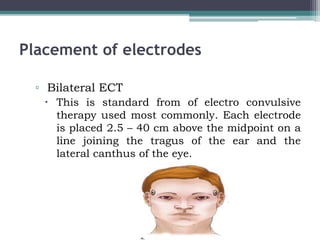
Placement of electrodes
▫ Bilateral ECT
 This is standard from of electro convulsive
therapy used most commonly. Each electrode
is placed 2.5 – 40 cm above the midpoint on a
line joining the tragus of the ear and the
lateral canthus of the eye.
Unilateral electro convulsive
Therapy
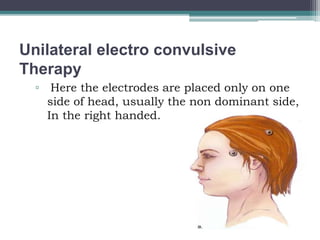
▫ Here the electrodes are placed only on one
side of head, usually the non dominant side,
In the right handed.
Voltage
• Standard dose according to American
Psychiatric association, 1978:
▫ Voltage 70-120 volts.
▫ Duration 0.7 – 1.5 seconds
Types of Seizures produced
• Grandma seizure – tonic phase lasting for 10-15
seconds
• Clonic phase lasting for 30-60 seconds
• ECT team
▫ It consists of psychiatrist, anesthetists, psychiatric
nurse, nursing aids, and ECT assistants.
Articles
• Anaesthesia applicant
• Suction apparatus
• Face mask
• O2 cylinder
• Tongue depressant
• Mouth gag
• Resuscitation
apparatus
• Full set of emergency
drug
• Defibrillator
• ECT drug
• Well equipped
recovery room
Preparation for ECT
• Consent of the patient and relatives
• Pre-medications
• Check previous findings of ECT
• Routine investigation and physical examination
• Results for re-ECT
• Explain procedure to the patient, its level of -
understanding
Conti…
• Psychosocial evaluation of memory
• Communicate the positive feeling of ECT
• Ensure the patient is NPO at least 6 hours before
the procedure
• Discourage cigarette smoking just before the
procedure to avoid increased deficiency on
managing pulmonary secretion.
• Remove dentures, eye glasses, jewellery, contact
lenses.
• Loosen the clothing
Conti…
• Empty bowel and bladder
• Monitor vitas signs
• Make sure that ET tube and a cylinder is
accessible and function in case of emergency
• Show a warm supportive altitude to recipient
• Transfer the patient to ECT with all necessary
search
• Record all investigations
During ECT
• Reassure the patient until the anesthetic effect
take place
• Position the patient in a supine position
• Administer necessary drug
• Mouth gaps placed
• O2 is given before and after administration of
side line
Conti…
• Electrical current is applied
• One attender laced hands on both eyes, near
knee point, and another attender hold the
shoulder to prevent fall and fracture and
dislocation
• After seizure occur, mouth gap is removed and
secretions suck up O2 given.
Post ECT
• Till the consciousness is regained, patient is
turned to one side to prevent aspiration.
Role of nurse in ECT treatment
• In a hospital setting where the electroconvulsive
therapy is given, the nurse should see to the
setup which includes:
▫ Waiting room or resting room
▫ Treatment room or ECT room
▫ Recovery room or aftercare room.
Waiting room or resting room
• In this room patients are asked to wait or take
rest before electroconvulsive therapy.
• The room should be calm with dim lights, light
colour of the walls. Put some flowers to give
pleasant feelings to the patient.
• There should be some magazines to read, so that
the patient can divert his mind and reduce
anxiety.
Conti…
• Lavatory (toilet) should be attached, because the
patient needs to empty his bladder and bowels
before getting ECT.
• The nurse should always be available in this
room so that the patient and relatives can clarify
their doubts.
Treatment room/CT room
• Articles for comfort of the patient:
▫ The room should be near to the waiting room.
▫ For privacy a bedside screen, well-padded low-
level beds with railings should be placed to
prevent injury due to fall.

Electroconvulsive therapy

  • 1.
  • 2.
  • 3.
    DEFINITION: • It isa treatment in which a grandmal seizure is artificially induced in an anaesthetized patient by passing on electrical current through electrodes applied to the patients head.
  • 4.
    TYPES OF ECT •A) According to technique: ▫ Direct ECT ▫ Modified ECT • B) According to placement of electrodes ▫ Bilateral ▫ Unilateral ▫ Bifrontol
  • 5.
    INDICATION • 1) Depression ▫Major severe depression especially with suicidal risk with psychiatric features like delusions or hallucinations ▫ Depressive stupor ▫ Puerperal depression and postpartum psychosis ▫ Poor intake of food and fluids ▫ Where the speeder recovery needed ▫ In elderly patient ▫ First-trimester of pregnancy ▫ Depression with physical illness ▫ Schizo affective depression
  • 6.
    Conti… • 2) Obsessionor compulsion • 3) Schizophrenia ▫ Catatonic schizophrenia and catatonic stupor ▫ Acute schizophrenic episode ▫ Intolerance or ▫ Puerperal schizophrenia ▫ First trimester of pregnancy ▫ Schizophrenia with depression
  • 7.
    Conti… • 4) Mania ▫Excreted of un-cooperation behavior ▫ Bipolar mood disorder with rapid cycle ▫ Bipolar and disorder with mixed behavior ▫ Mania in the first trimester of pregnancy • 5)Postpartum psychosis • 6) Schizoaffective disorder • 7) Psychosis in the first trimester of pregnancy
  • 8.
    Contraindications of ECT •Increased intracranial pressure, including tumors, hematomas, and subarachnoid hemorrhage • Acute myocardial infarction • Hypertension • Cardiac disease, aneurysm, thrombophlebitis, bleeding disorders or where there is increased risk of embolism
  • 9.
    Conti… ▫ CVA ▫ Severepulmonary disease such as pneumonia and TB ▫ Others are fracture, dehydration, fever, glaucoma, retinal detachment, CCF, and contraindicated for anaesthesia
  • 10.
    Side effects • Deathsduring ECT are due to general anaesthesia. • Headache and body ache • Memory disturbance than bilateral ECTs • Confusion may occur in the postictal perial • Vomiting due to increased ICP
  • 11.
    Conti… • Memory lostfrom a day or a month due to hypoxia of the brain • Thoracic spine or long bones fracture • Dislocation of shoulder joint and wrist • Arrhythmia, aspiration, pneumonia, status epilepticus • Muscle pain, nausea
  • 12.
    Method/Technique • ECT canbe given by a direct and indirect method • The patient is administered atropine sulphate subcutaneously 0.6 mgm to 1.0 mgm, half an hour before the treatment or IV immediately before the treatment. • Minor Tranquillizer like Calmpose is also used
  • 13.
    Conti… • A grandmal seizure is induced in the patient by passing an electric current through the temporal lobe. • Atropine prolongs the period of disorientation after the seizures • It also reduces vomiting. • Immediately after the ECT treatment appropriate resuscitative and other emergency management equipment and supplies are kept ready.
  • 14.
    Modified ECT • Electroconvulsivetherapy is modified with the use of Anesthesia, muscle relaxation and oxygenation. • The use of anesthesia is necessary to allay anxiety and achieve the maximum effect. • It is used to modify the force of convulsion and to avoid complications like bone fractures. • Modified ECT is also used for the patients who are recovering from heart conditions.
  • 15.
    Conti… • A shortacting Barbiturate, methohexial sodium (Brevital sodium) or Theopental (pentothal) 5 ml to 10 mg (1 ml = 10 mgm) and ultra short acting depolarizing agent succinylcholine 0.3 ml to 0.5 ml (1 ml = 20 mgm) are given intravenously.
  • 16.
    Observation of productionof seizure • The production of grand mal seizure is necessary for direct and modified ECT. • In direct ECT, the Tonic phase that is muscle contractions last for 10 seconds • The clonic phase that is movement or convulsion lasts for 25 to 30 seconds • Then the patient goes into the relaxation phase
  • 17.
    Conti… • With theuse of anaesthesia in modified ECT, mild grimace or blepharo-spasm, (a tonic spasm of the eyelid muscles) is observed when the current is applied. • There is a slow planter flexion (reverse Babinski) during the tonic phase and there are fine movements of the toes during the clonic phase.
  • 18.
    Number and frequencyof ECT treatment • There is no clinical justification for a fixed number of treatments. • Peak response is attained between five and ten treatments for patients with bipolar disorders, manic type, schizoaffective disorders, or catatonic schizophrenia. • Twenty to 25 treatments may be required for chronically ill schizophrenic patients.
  • 19.
    Conti… • ECT treatmentis most often given three times a week. • The frequency of treatment can be reduced if the patient shows a severe confusional state. • With an extremely agitated, psychotic or suicidal patient it may be useful to give the first few treatments on a daily basis. • ECT does not prevent relapse. So maintenance treatment should be with drug and psychotherapy.
  • 20.
    Mode of action •Changes in behaviour due to ECT are attributed to an acute amnesic change in the patient. • Many patients who are getting ECT, seem to forget what had been bothering them during the depressive episode. • Biological mechanism by which a therapeutic effect has been brought about by ECT includes ▫ Neuro-chemical, Neuro-endocrine and Neuro- physiological.
  • 21.
    Conti… • Neuro-chemical investigationshave shown that the role of catecholaminergic effect is due to pre- synaptic and postsynaptic receptor effect and may not be due to neurotransmission. • This effect is also achieved due to seizures caused by ECT treatment.
  • 22.
    Conti… • Neuro-physiological effectdue to ECT is achieved probably due to cerebral hypometabolic state. • Neuro-endocrine changes have effects on depressive illnesses. Polypeptides from the hypothalamus change the neuro-endocrine activity which affects thalamocortical pathways.
  • 23.
    The axioms orwidely accepted theoretical concepts are: • The persistent behavioural or therapeutic effect i.e., changes in the CNS are due to repeated ECT seizures and not changes in the peripheral or visceral component. • Repeated seizures alter many brain functions like in psychotic state, perception recall, concentration, memory and orientation as well. • Improvement in behaviour (clinical remission) is characterized by a gain in weight, increased appetite, increased duration of sleep, increased libido, and increased interest in the environment.
  • 24.
    Complications • Impairment ofmemory may vary from mild tendency to forget names to a severe confusion. • To start with, the patient has a tendency to forget all types of events but gradually it limits to the events just before the ECT treatment • This causes disturbance to the patient and is relatives. They should be explained that these changes are temporary.
  • 25.
    Conti… • The memoryreturns fully within a few weeks to a month. • However, the learning capacity of the patient improves, though there is impairment of retention in memory function.
  • 26.
    Fractures and dislocations •Most frequently the fracture and dislocation are caused by muscular contraction due to ECT. • Compression fracture of vertebrae of dorsal area between the second and eighth-usually, fourth and fifth vertebrae is common. • Fracture of femur and humerus occurs in young muscular individuals. There may be complete rupture between head and shaft of femur due to right restraints applied during the convulsion phase.
  • 27.
    Conti… • Impacted fracturesare more frequent in elderly people. • Dislocation of jaw is the most frequent complication of the tonic phase. It can be totally prevented by supporting the jaw or applying pressure on the chin upward.
  • 28.
    Complications in therespiratory system • Apnea is a physiological phenomenon in any epileptic seizure. • Airway should be kept clear by use of metal airway. • Prevent collection of saliva in the mouth by suction. • Turn the head to one side. • Oxygen therapy for a short duration
  • 29.
    Conti… • However, ifapnea is prolonged, artificial respiration should be applied. • To reduce the effect of barbituarates, Coramine 1 mgm to 2.5 gm should be given intravenously. • Neurological and cardiac complications are very rare. Thorough physical examination is required prior to the ECT treatment.
  • 30.
    Other complaints ofpatient due to ECT • Headache, backache, painful mastication, injury to mouth and tongue. • Fear due to an unpleasant experience on waking up after the treatment. • These complications can be prevented by observation and early intervention by nursing care.
  • 31.
    Placement of electrodes ▫Bilateral ECT  This is standard from of electro convulsive therapy used most commonly. Each electrode is placed 2.5 – 40 cm above the midpoint on a line joining the tragus of the ear and the lateral canthus of the eye.
  • 32.
    Unilateral electro convulsive Therapy ▫Here the electrodes are placed only on one side of head, usually the non dominant side, In the right handed.
  • 33.
    Voltage • Standard doseaccording to American Psychiatric association, 1978: ▫ Voltage 70-120 volts. ▫ Duration 0.7 – 1.5 seconds
  • 34.
    Types of Seizuresproduced • Grandma seizure – tonic phase lasting for 10-15 seconds • Clonic phase lasting for 30-60 seconds • ECT team ▫ It consists of psychiatrist, anesthetists, psychiatric nurse, nursing aids, and ECT assistants.
  • 35.
    Articles • Anaesthesia applicant •Suction apparatus • Face mask • O2 cylinder • Tongue depressant • Mouth gag • Resuscitation apparatus • Full set of emergency drug • Defibrillator • ECT drug • Well equipped recovery room
  • 36.
    Preparation for ECT •Consent of the patient and relatives • Pre-medications • Check previous findings of ECT • Routine investigation and physical examination • Results for re-ECT • Explain procedure to the patient, its level of - understanding
  • 37.
    Conti… • Psychosocial evaluationof memory • Communicate the positive feeling of ECT • Ensure the patient is NPO at least 6 hours before the procedure • Discourage cigarette smoking just before the procedure to avoid increased deficiency on managing pulmonary secretion. • Remove dentures, eye glasses, jewellery, contact lenses. • Loosen the clothing
  • 38.
    Conti… • Empty boweland bladder • Monitor vitas signs • Make sure that ET tube and a cylinder is accessible and function in case of emergency • Show a warm supportive altitude to recipient • Transfer the patient to ECT with all necessary search • Record all investigations
  • 39.
    During ECT • Reassurethe patient until the anesthetic effect take place • Position the patient in a supine position • Administer necessary drug • Mouth gaps placed • O2 is given before and after administration of side line
  • 40.
    Conti… • Electrical currentis applied • One attender laced hands on both eyes, near knee point, and another attender hold the shoulder to prevent fall and fracture and dislocation • After seizure occur, mouth gap is removed and secretions suck up O2 given.
  • 41.
    Post ECT • Tillthe consciousness is regained, patient is turned to one side to prevent aspiration.
  • 42.
    Role of nursein ECT treatment • In a hospital setting where the electroconvulsive therapy is given, the nurse should see to the setup which includes: ▫ Waiting room or resting room ▫ Treatment room or ECT room ▫ Recovery room or aftercare room.
  • 43.
    Waiting room orresting room • In this room patients are asked to wait or take rest before electroconvulsive therapy. • The room should be calm with dim lights, light colour of the walls. Put some flowers to give pleasant feelings to the patient. • There should be some magazines to read, so that the patient can divert his mind and reduce anxiety.
  • 44.
    Conti… • Lavatory (toilet)should be attached, because the patient needs to empty his bladder and bowels before getting ECT. • The nurse should always be available in this room so that the patient and relatives can clarify their doubts.
  • 45.
    Treatment room/CT room •Articles for comfort of the patient: ▫ The room should be near to the waiting room. ▫ For privacy a bedside screen, well-padded low- level beds with railings should be placed to prevent injury due to fall.