1
PSYCHOLOGY
(8th Edition)
David Myers
PowerPoint Slides
Aneeq Ahmad
Henderson State University
Worth Publishers, Š 2006
2
Developing Through the
Life Span
Chapter 4
What do you think this means?
My heart leaps up when I behold
A rainbow in the sky:
So was it when my life began;
So is it now I am a man;
So be it when I shall grow old,
Or let me die!
The Child is father of the Man;
- “My Heart Leaps Up” W. Wordsworth
4
Developing Through the Life Span
Prenatal Development and
the Newborn
 Conception
 Prenatal Development
 The Competent Newborn
Infancy and Childhood
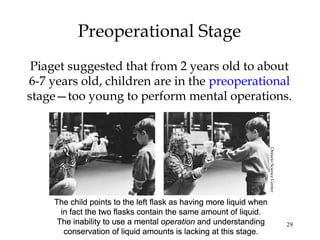
 Physical Development
 Cognitive Development
5
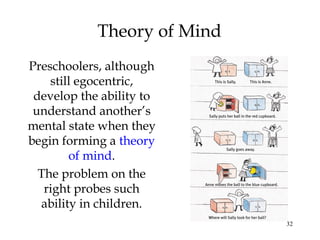
Developing Through the Life Span
Adolescence
 Physical Development
 Cognitive Development
 Social Development
 Emerging Adulthood
Adulthood
 Physical Development
6
Developing Through the Life Span
Adulthood (continued)
 Cognitive Development
 Social Development
Reflections on Two Major
Developmental Issues
 Continuity and Stages
 Stability and Change
7
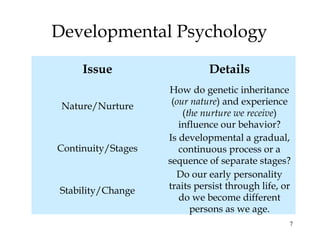
Developmental Psychology
Issue Details
Nature/Nurture
How do genetic inheritance
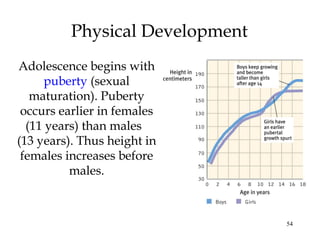
(our nature) and experience
(the nurture we receive)
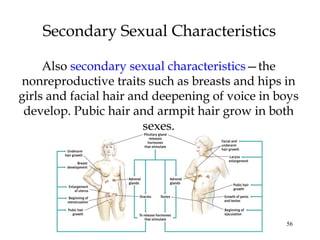
influence our behavior?
Continuity/Stages
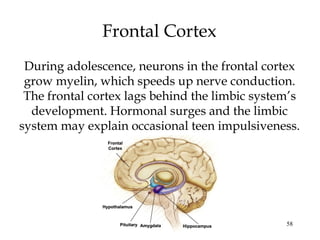
Is developmental a gradual,
continuous process or a
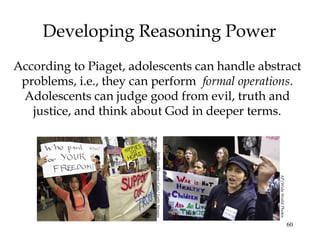
sequence of separate stages?
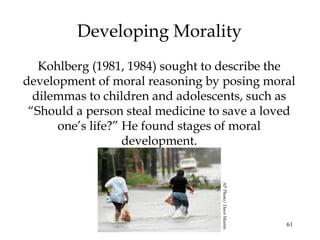
Stability/Change
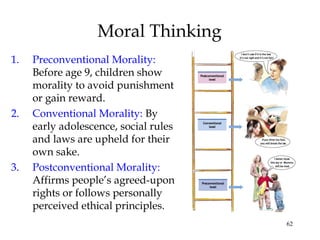
Do our early personality
traits persist through life, or
do we become different
persons as we age.
8
Prenatal Development and the
Newborn
How, over time, did we come to be who we are?
From zygote to birth, development progresses
in an orderly, though fragile, sequence.
9
Conception
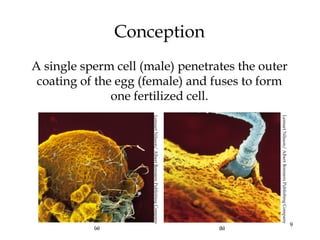
A single sperm cell (male) penetrates the outer
coating of the egg (female) and fuses to form
one fertilized cell.
LennartNilsson/AlbertBonniersPublishingCompany
10
Prenatal Development
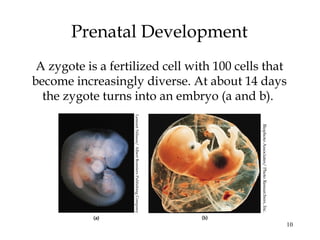
A zygote is a fertilized cell with 100 cells that
become increasingly diverse. At about 14 days
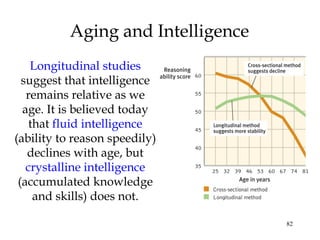
the zygote turns into an embryo (a and b).
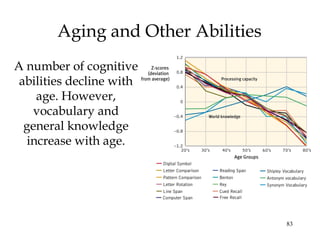
LennartNilsson/AlbertBonniersPublishingCompany
BiophotoAssociates/PhotoResearchers,Inc.
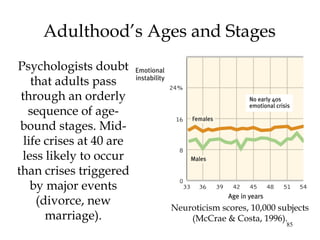
11
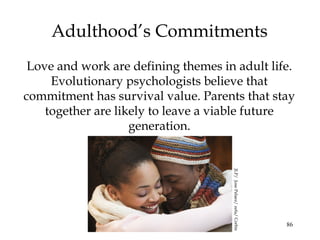
Prenatal Development
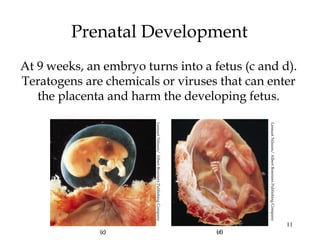
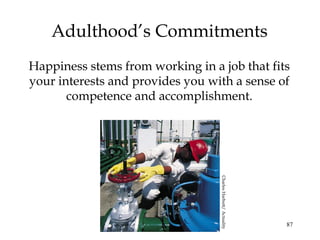
At 9 weeks, an embryo turns into a fetus (c and d).
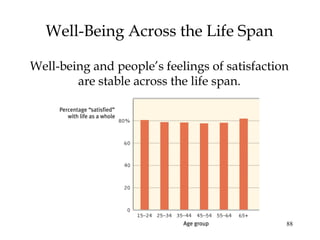
Teratogens are chemicals or viruses that can enter
the placenta and harm the developing fetus.
LennartNilsson/AlbertBonniersPublishingCompany
12
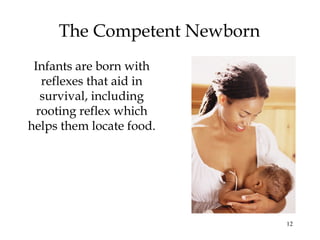
The Competent Newborn
Infants are born with
reflexes that aid in
survival, including
rooting reflex which
helps them locate food.
13
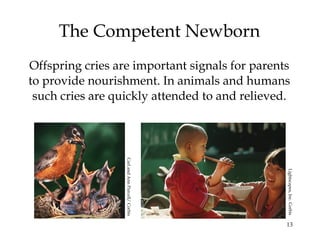
The Competent Newborn
Offspring cries are important signals for parents
to provide nourishment. In animals and humans
such cries are quickly attended to and relieved.
CarlandAnnPurcell/Corbis
Lightscapes,Inc.Corbis
14
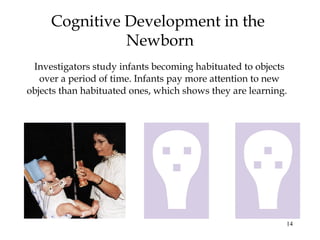
Cognitive Development in the
Newborn
Investigators study infants becoming habituated to objects
over a period of time. Infants pay more attention to new
objects than habituated ones, which shows they are learning.
15
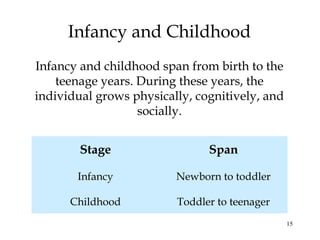
Infancy and Childhood
Infancy and childhood span from birth to the
teenage years. During these years, the
individual grows physically, cognitively, and
socially.
Stage Span
Infancy Newborn to toddler
Childhood Toddler to teenager
16
Physical Development
Infants’ psychological development depends on
their biological development. To understand
the emergence of motor skills and memory, we
must understand the developing brain.
17
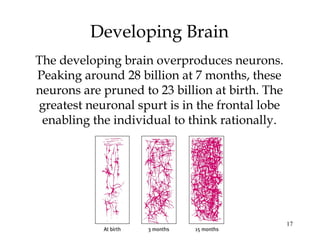
Developing Brain
The developing brain overproduces neurons.
Peaking around 28 billion at 7 months, these
neurons are pruned to 23 billion at birth. The
greatest neuronal spurt is in the frontal lobe
enabling the individual to think rationally.
18
Maturation
The development of the brain unfolds based on
genetic instructions, causing various bodily and
mental functions to occur in sequence—
standing before walking, babbling before
talking—this is called maturation.
Maturation sets the basic course of
development, while experience adjusts it.
19
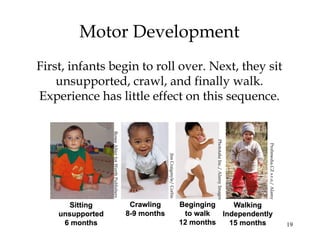
Motor Development
First, infants begin to roll over. Next, they sit
unsupported, crawl, and finally walk.
Experience has little effect on this sequence.
ReneeAltierforWorthPublishers
JimCraigmyle/Corbis
PhototakeInc./AlamyImages
Profimedia.CZs.r.o./Alamy
20
Maturation and Infant Memory
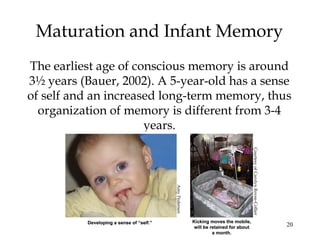
The earliest age of conscious memory is around
3½ years (Bauer, 2002). A 5-year-old has a sense
of self and an increased long-term memory, thus
organization of memory is different from 3-4
years.
AmyPedersen
CourtesyofCarolynRovee-Collier
21
Cognitive Development
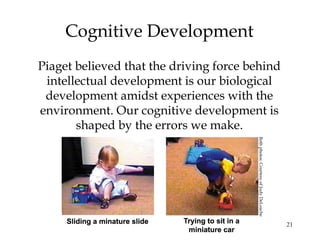
Piaget believed that the driving force behind
intellectual development is our biological
development amidst experiences with the
environment. Our cognitive development is
shaped by the errors we make.
Bothphotos:CourtesyofJudyDeLoache
22
Schemas
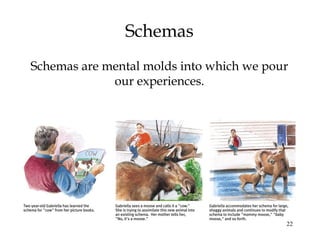
Schemas are mental molds into which we pour
our experiences.
23
Assimilation and Accommodation
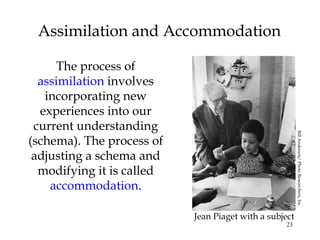
The process of
assimilation involves
incorporating new
experiences into our
current understanding
(schema). The process of
adjusting a schema and
modifying it is called
accommodation.
Jean Piaget with a subject
BillAnderson/PhotoResearchers,Inc.
24
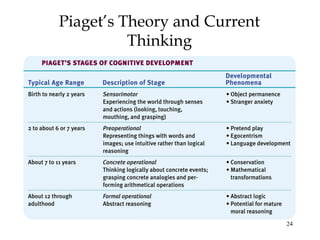
Piaget’s Theory and Current
Thinking
25
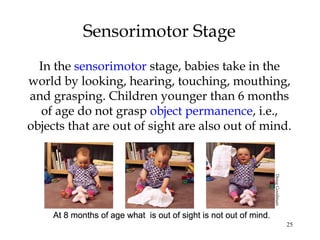
Sensorimotor Stage
In the sensorimotor stage, babies take in the
world by looking, hearing, touching, mouthing,
and grasping. Children younger than 6 months
of age do not grasp object permanence, i.e.,
objects that are out of sight are also out of mind.
DougGoodman
Object Permanence
26
27
Sensorimotor Stage: Criticisms
Piaget believed children in the sensorimotor
stage could not think —they do not have any
abstract concepts or ideas.
However, recent research shows that children
in the sensorimotor stage can think and count.
1. Children understand the basic laws of
physics. They are amazed at how a ball can
stop in midair or disappear.
28
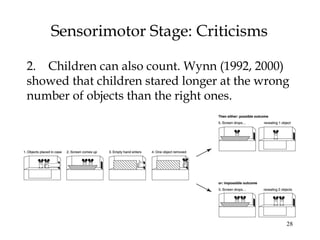
Sensorimotor Stage: Criticisms
2. Children can also count. Wynn (1992, 2000)
showed that children stared longer at the wrong
number of objects than the right ones.
29
Preoperational Stage
Piaget suggested that from 2 years old to about
6-7 years old, children are in the preoperational
stage—too young to perform mental operations.
OntarioScienceCenter
30
Preoperational Stage: Criticism
DeLoache (1987) showed that children as young
as 3 years of age are able to use mental
operations. When shown a model of a dog’s
hiding place behind the couch, a 2½-year-old
could not locate the stuffed dog in an actual
room, but the 3-year-old did.
31
Egocentrism
Piaget concluded that preschool children are
egocentric. They cannot perceive things from
another’s point of view.
When asked to show her picture to mommy, 2-
year-old Gabriella holds the picture facing her
own eyes, believing that her mother can see it
through her eyes.
32
Theory of Mind
Preschoolers, although
still egocentric,
develop the ability to
understand another’s
mental state when they
begin forming a theory
of mind.
The problem on the
right probes such
ability in children.
33
Concrete Operational Stage
In concrete operational stage, given concrete
materials, 6- to 7-year-olds grasp conservation
problems and mentally pour liquids back and
forth into glasses of different shapes conserving
their quantities.
Children in this stage are also able to transform
mathematical functions. So, if 4 + 8 = 12, then a
transformation, 12 – 4 = 8, is also easily doable.
34
Formal Operational Stage
Around age 12, our reasoning ability expands
from concrete thinking to abstract thinking. We
can now use symbols and imagined realities to
systematically reason. Piaget called this formal
operational thinking.
35
Formal Operational Stage
Rudiments of such thinking begin earlier (age 7)
than what Piaget suggested, since 7-year-olds
can solve the problem below (Suppes, 1982).
If John is in school, Mary is in school. John is in
school. What can you say about Mary?
36
Reflecting on Piaget’s Theory
Piaget’s stage theory has been influential globally,
validating a number of ideas regarding growth
and development in many cultures and societies.
However, today’s researchers believe the
following:
1. Development is a continuous process.
2. Children express their mental abilities and
operations at an earlier age.
3. Formal logic is a smaller part of cognition.
37
Social Development
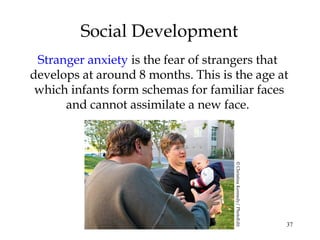
Stranger anxiety is the fear of strangers that
develops at around 8 months. This is the age at
which infants form schemas for familiar faces
and cannot assimilate a new face.
ŠChristinaKennedy/PhotoEdit
38
Origins of Attachment
Harlow (1971) showed
that infants bond with
surrogate mothers
because of bodily
contact and not because
of nourishment.
HarlowPrimateLaboratory,UniversityofWisconsin
39
Origins of Attachment
Like bodily contact, familiarity is another factor that
causes attachment. In some animals (goslings),
imprinting is the cause of attachment.
AlastairMiller
40
Attachment Differences
Placed in a strange situation, 60% of children
express secure attachment, i.e., they explore
their environment happily in the presence of
their mothers. When their mother leave, they
show distress.
The other 30% show insecure attachment. These
children cling to their mothers or caregivers and
are less likely to explore the environment.
41
Secure Attachment
Relaxed and attentive caregiving becomes the
backbone of secure attachment.
BerryHewlett
42
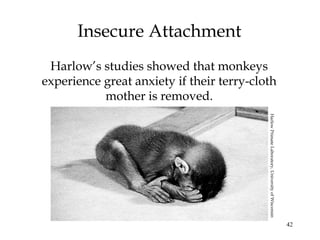
Insecure Attachment
Harlow’s studies showed that monkeys
experience great anxiety if their terry-cloth
mother is removed.
HarlowPrimateLaboratory,UniversityofWisconsin
43
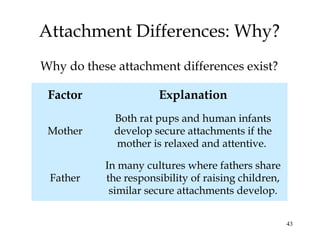
Attachment Differences: Why?
Why do these attachment differences exist?
Factor Explanation
Mother
Both rat pups and human infants
develop secure attachments if the
mother is relaxed and attentive.
Father
In many cultures where fathers share
the responsibility of raising children,
similar secure attachments develop.
44
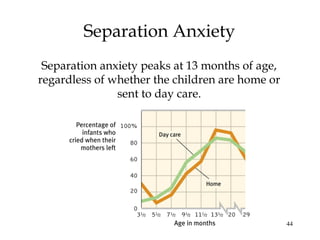
Separation Anxiety
Separation anxiety peaks at 13 months of age,
regardless of whether the children are home or
sent to day care.
45
Deprivation of Attachment
What happens when circumstances prevent a
child from forming attachments?
In such circumstances children become:
1. Withdrawn
2. Frightened
3. Unable to develop speech
46
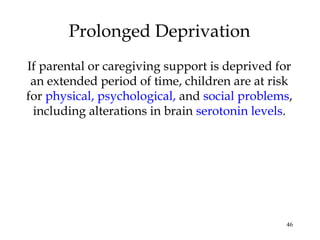
Prolonged Deprivation
If parental or caregiving support is deprived for
an extended period of time, children are at risk
for physical, psychological, and social problems,
including alterations in brain serotonin levels.
47
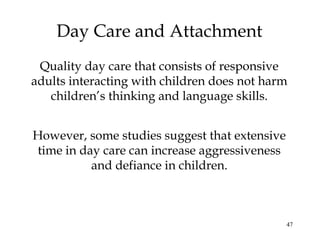
Day Care and Attachment
Quality day care that consists of responsive
adults interacting with children does not harm
children’s thinking and language skills.
However, some studies suggest that extensive
time in day care can increase aggressiveness
and defiance in children.
48
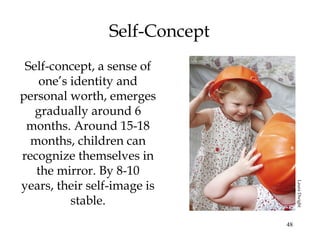
Self-Concept
Self-concept, a sense of
one’s identity and
personal worth, emerges
gradually around 6
months. Around 15-18
months, children can
recognize themselves in
the mirror. By 8-10
years, their self-image is
stable.
LauraDwight
Quiz Over Piaget in 5 min
49
50
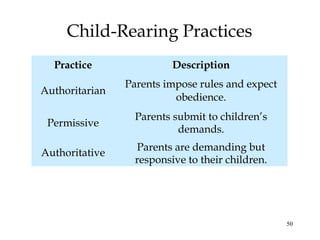
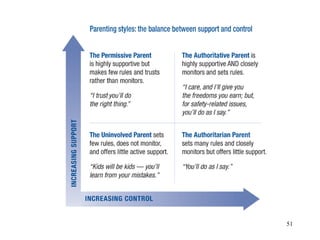
Child-Rearing Practices
Practice Description
Authoritarian
Parents impose rules and expect
obedience.
Permissive
Parents submit to children’s
demands.
Authoritative
Parents are demanding but
responsive to their children.
51
52
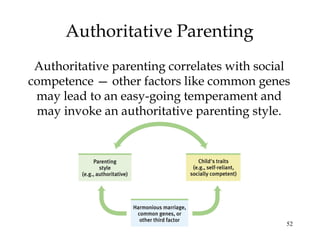
Authoritative Parenting
Authoritative parenting correlates with social
competence — other factors like common genes
may lead to an easy-going temperament and
may invoke an authoritative parenting style.
53
Adolescence
Many psychologists once
believed that our traits
were set during
childhood. Today
psychologists believe that
development is a lifelong
process. Adolescence is
defined as a life between
childhood and adulthood.
APPhoto/JeffChiu
54
Physical Development
Adolescence begins with
puberty (sexual
maturation). Puberty
occurs earlier in females
(11 years) than males
(13 years). Thus height in
females increases before
males.
55
Primary Sexual Characteristics
During puberty primary sexual characteristics —
the reproductive organs and external genitalia —
develop rapidly.
EllenSenisi/TheImageWorks
56
Secondary Sexual Characteristics
Also secondary sexual characteristics—the
nonreproductive traits such as breasts and hips in
girls and facial hair and deepening of voice in boys
develop. Pubic hair and armpit hair grow in both
sexes.
57
Brain Development
Until puberty, neurons increase their connections.
However, at adolescence, selective pruning of the
neurons begins. Unused neuronal connections are
lost to make other pathways more efficient.
58
Frontal Cortex
During adolescence, neurons in the frontal cortex
grow myelin, which speeds up nerve conduction.
The frontal cortex lags behind the limbic system’s
development. Hormonal surges and the limbic
system may explain occasional teen impulsiveness.
59
Cognitive Development
Adolescents’ ability to reason gives them a new
level of social awareness. In particular, they may
think about the following:
1. Their own thinking.
2. What others are thinking.
3. What others are thinking about them.
4. How ideals can be reached. They criticize
society, parents, and even themselves.
60
Developing Reasoning Power
According to Piaget, adolescents can handle abstract
problems, i.e., they can perform formal operations.
Adolescents can judge good from evil, truth and
justice, and think about God in deeper terms.
WilliamThomasCain/GettyImages
AP/WideWorldPhotos
61
Developing Morality
Kohlberg (1981, 1984) sought to describe the
development of moral reasoning by posing moral
dilemmas to children and adolescents, such as
“Should a person steal medicine to save a loved
one’s life?” He found stages of moral
development.
APPhoto/DaveMartin
62
Moral Thinking
1. Preconventional Morality:
Before age 9, children show
morality to avoid punishment
or gain reward.
2. Conventional Morality: By
early adolescence, social rules
and laws are upheld for their
own sake.
3. Postconventional Morality:
Affirms people’s agreed-upon
rights or follows personally
perceived ethical principles.
63
Moral Feeling
Moral feeling is more than moral thinking. When
posed with simulated moral dilemmas, the
brain’s emotional areas only light up when the
nature of the dilemmas is emotion-driven.
64
Moral Action
Moral action involves doing the right thing.
People who engage in doing the right thing
develop empathy for others and the self-
discipline to resist their own impulses.
65
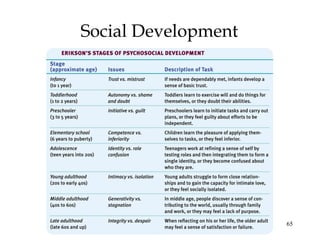
Social Development
Who Am I?
66
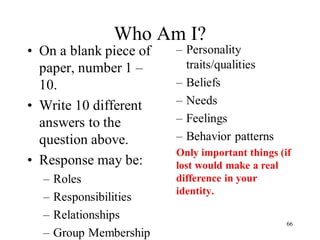
Who Am I?
• What would life be like if any of these were
no longer true?
• Now rank in order of importance.
– To determine rank consider the adjustment
required if you lost the item
67
68
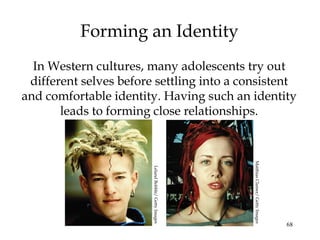
Forming an Identity
In Western cultures, many adolescents try out
different selves before settling into a consistent
and comfortable identity. Having such an identity
leads to forming close relationships.
LelandBobble/GettyImages
MatthiasClamer/GettyImages
69
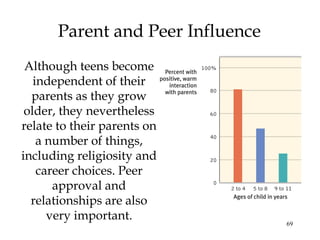
Parent and Peer Influence
Although teens become
independent of their
parents as they grow
older, they nevertheless
relate to their parents on
a number of things,
including religiosity and
career choices. Peer
approval and
relationships are also
very important.
70
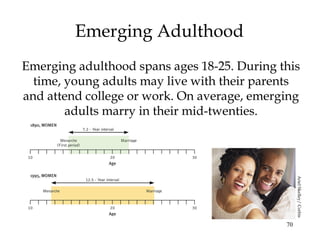
Emerging Adulthood
Emerging adulthood spans ages 18-25. During this
time, young adults may live with their parents
and attend college or work. On average, emerging
adults marry in their mid-twenties.
ArielSkelley/Corbis
71
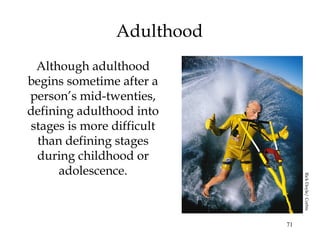
Adulthood
Although adulthood
begins sometime after a
person’s mid-twenties,
defining adulthood into
stages is more difficult
than defining stages
during childhood or
adolescence.
RickDoyle/Corbis
72
Physical Development
The peak of physical performance occurs around
20 years of age, after which it declines
imperceptibly for most of us.
73
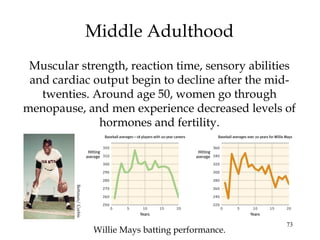
Middle Adulthood
Muscular strength, reaction time, sensory abilities
and cardiac output begin to decline after the mid-
twenties. Around age 50, women go through
menopause, and men experience decreased levels of
hormones and fertility.
Willie Mays batting performance.
Bettman/Corbis
74
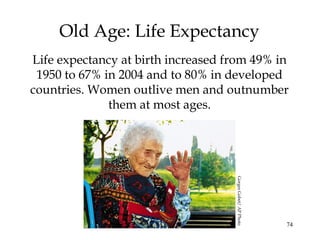
Old Age: Life Expectancy
Life expectancy at birth increased from 49% in
1950 to 67% in 2004 and to 80% in developed
countries. Women outlive men and outnumber
them at most ages.
GorgesGobet/APPhoto
75
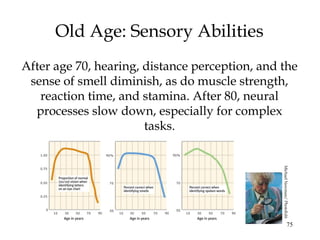
Old Age: Sensory Abilities
After age 70, hearing, distance perception, and the
sense of smell diminish, as do muscle strength,
reaction time, and stamina. After 80, neural
processes slow down, especially for complex
tasks.
MichaelNewman/PhotoEdit
76
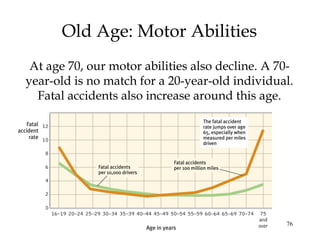
Old Age: Motor Abilities
At age 70, our motor abilities also decline. A 70-
year-old is no match for a 20-year-old individual.
Fatal accidents also increase around this age.
77
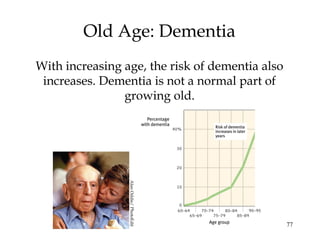
Old Age: Dementia
With increasing age, the risk of dementia also
increases. Dementia is not a normal part of
growing old.
AlanOddie/PhotoEdit
78
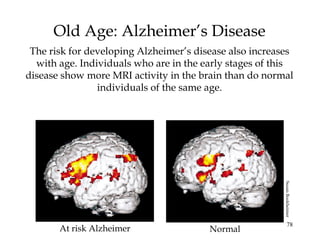
Old Age: Alzheimer’s Disease
The risk for developing Alzheimer’s disease also increases
with age. Individuals who are in the early stages of this
disease show more MRI activity in the brain than do normal
individuals of the same age.
At risk Alzheimer Normal
SusanBookheimer
79
Cognitive Development
Do cognitive abilities like memory, creativity, and
intelligence decline with age the same way
physical abilities do?
80
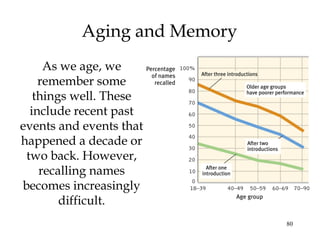
Aging and Memory
As we age, we
remember some
things well. These
include recent past
events and events that
happened a decade or
two back. However,
recalling names
becomes increasingly
difficult.
81
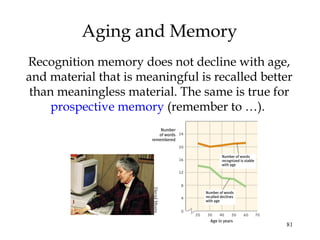
Aging and Memory
Recognition memory does not decline with age,
and material that is meaningful is recalled better
than meaningless material. The same is true for
prospective memory (remember to …).
DavidMyers
82
Aging and Intelligence
Longitudinal studies
suggest that intelligence
remains relative as we
age. It is believed today
that fluid intelligence
(ability to reason speedily)
declines with age, but
crystalline intelligence
(accumulated knowledge
and skills) does not.
83
Aging and Other Abilities
A number of cognitive
abilities decline with
age. However,
vocabulary and
general knowledge
increase with age.
84
Social Development
Many differences between the young and old are
not simply based on physical and cognitive
abilities, but may instead be based on life events
associated with family, relationships, and work.
85
Adulthood’s Ages and Stages
Psychologists doubt
that adults pass
through an orderly
sequence of age-
bound stages. Mid-
life crises at 40 are
less likely to occur
than crises triggered
by major events
(divorce, new
marriage).
Neuroticism scores, 10,000 subjects
(McCrae & Costa, 1996).
86
Adulthood’s Commitments
Love and work are defining themes in adult life.
Evolutionary psychologists believe that
commitment has survival value. Parents that stay
together are likely to leave a viable future
generation.
JLP/JosePelaez/zefa/Corbis
87
Adulthood’s Commitments
Happiness stems from working in a job that fits
your interests and provides you with a sense of
competence and accomplishment.
CharlesHarbutt/Actuality
88
Well-Being Across the Life Span
Well-being and people’s feelings of satisfaction
are stable across the life span.
89
Successful Aging
90
Death and Dying
There is no “normal”
reaction or series of grief
stages after the death of
a loved one. Grief is
more sudden if death
occurs unexpectedly.
People who reach a
sense of integrity in life
(in Erikson’s terms) see
life as meaningful and
worthwhile.
ChrisSteele-Perkins/MagnumPhotos
91
Developmental Issues
Researchers who view development as a slow,
continuous process are generally those who
emphasize experience and learning. Biologists,
on the other hand, view maturation and
development as a series of genetically
predisposed steps or stages. These include
psychologists like Piaget, Kohlberg and Erikson.
Continuity and Stages
92
Developmental Issues
Lifelong development requires both stability and
change. Personality gradually stabilizes as
people age. However, this does not mean that
our traits do not change over a lifetime. Some
temperaments are more stable than others.
Stability and Change

Chapter 4 (development)

  • 1.
    1 PSYCHOLOGY (8th Edition) David Myers PowerPointSlides Aneeq Ahmad Henderson State University Worth Publishers, Š 2006
  • 2.
  • 3.
    What do youthink this means? My heart leaps up when I behold A rainbow in the sky: So was it when my life began; So is it now I am a man; So be it when I shall grow old, Or let me die! The Child is father of the Man; - “My Heart Leaps Up” W. Wordsworth
  • 4.
    4 Developing Through theLife Span Prenatal Development and the Newborn  Conception  Prenatal Development  The Competent Newborn Infancy and Childhood  Physical Development  Cognitive Development
  • 5.
    5 Developing Through theLife Span Adolescence  Physical Development  Cognitive Development  Social Development  Emerging Adulthood Adulthood  Physical Development
  • 6.
    6 Developing Through theLife Span Adulthood (continued)  Cognitive Development  Social Development Reflections on Two Major Developmental Issues  Continuity and Stages  Stability and Change
  • 7.
    7 Developmental Psychology Issue Details Nature/Nurture Howdo genetic inheritance (our nature) and experience (the nurture we receive) influence our behavior? Continuity/Stages Is developmental a gradual, continuous process or a sequence of separate stages? Stability/Change Do our early personality traits persist through life, or do we become different persons as we age.
  • 8.
    8 Prenatal Development andthe Newborn How, over time, did we come to be who we are? From zygote to birth, development progresses in an orderly, though fragile, sequence.
  • 9.
    9 Conception A single spermcell (male) penetrates the outer coating of the egg (female) and fuses to form one fertilized cell. LennartNilsson/AlbertBonniersPublishingCompany LennartNilsson/AlbertBonniersPublishingCompany
  • 10.
    10 Prenatal Development A zygoteis a fertilized cell with 100 cells that become increasingly diverse. At about 14 days the zygote turns into an embryo (a and b). LennartNilsson/AlbertBonniersPublishingCompany BiophotoAssociates/PhotoResearchers,Inc.
  • 11.
    11 Prenatal Development At 9weeks, an embryo turns into a fetus (c and d). Teratogens are chemicals or viruses that can enter the placenta and harm the developing fetus. LennartNilsson/AlbertBonniersPublishingCompany LennartNilsson/AlbertBonniersPublishingCompany
  • 12.
    12 The Competent Newborn Infantsare born with reflexes that aid in survival, including rooting reflex which helps them locate food.
  • 13.
    13 The Competent Newborn Offspringcries are important signals for parents to provide nourishment. In animals and humans such cries are quickly attended to and relieved. CarlandAnnPurcell/Corbis Lightscapes,Inc.Corbis
  • 14.
    14 Cognitive Development inthe Newborn Investigators study infants becoming habituated to objects over a period of time. Infants pay more attention to new objects than habituated ones, which shows they are learning.
  • 15.
    15 Infancy and Childhood Infancyand childhood span from birth to the teenage years. During these years, the individual grows physically, cognitively, and socially. Stage Span Infancy Newborn to toddler Childhood Toddler to teenager
  • 16.
    16 Physical Development Infants’ psychologicaldevelopment depends on their biological development. To understand the emergence of motor skills and memory, we must understand the developing brain.
  • 17.
    17 Developing Brain The developingbrain overproduces neurons. Peaking around 28 billion at 7 months, these neurons are pruned to 23 billion at birth. The greatest neuronal spurt is in the frontal lobe enabling the individual to think rationally.
  • 18.
    18 Maturation The development ofthe brain unfolds based on genetic instructions, causing various bodily and mental functions to occur in sequence— standing before walking, babbling before talking—this is called maturation. Maturation sets the basic course of development, while experience adjusts it.
  • 19.
    19 Motor Development First, infantsbegin to roll over. Next, they sit unsupported, crawl, and finally walk. Experience has little effect on this sequence. ReneeAltierforWorthPublishers JimCraigmyle/Corbis PhototakeInc./AlamyImages Profimedia.CZs.r.o./Alamy
  • 20.
    20 Maturation and InfantMemory The earliest age of conscious memory is around 3½ years (Bauer, 2002). A 5-year-old has a sense of self and an increased long-term memory, thus organization of memory is different from 3-4 years. AmyPedersen CourtesyofCarolynRovee-Collier
  • 21.
    21 Cognitive Development Piaget believedthat the driving force behind intellectual development is our biological development amidst experiences with the environment. Our cognitive development is shaped by the errors we make. Bothphotos:CourtesyofJudyDeLoache
  • 22.
    22 Schemas Schemas are mentalmolds into which we pour our experiences.
  • 23.
    23 Assimilation and Accommodation Theprocess of assimilation involves incorporating new experiences into our current understanding (schema). The process of adjusting a schema and modifying it is called accommodation. Jean Piaget with a subject BillAnderson/PhotoResearchers,Inc.
  • 24.
  • 25.
    25 Sensorimotor Stage In thesensorimotor stage, babies take in the world by looking, hearing, touching, mouthing, and grasping. Children younger than 6 months of age do not grasp object permanence, i.e., objects that are out of sight are also out of mind. DougGoodman
  • 26.
  • 27.
    27 Sensorimotor Stage: Criticisms Piagetbelieved children in the sensorimotor stage could not think —they do not have any abstract concepts or ideas. However, recent research shows that children in the sensorimotor stage can think and count. 1. Children understand the basic laws of physics. They are amazed at how a ball can stop in midair or disappear.
  • 28.
    28 Sensorimotor Stage: Criticisms 2.Children can also count. Wynn (1992, 2000) showed that children stared longer at the wrong number of objects than the right ones.
  • 29.
    29 Preoperational Stage Piaget suggestedthat from 2 years old to about 6-7 years old, children are in the preoperational stage—too young to perform mental operations. OntarioScienceCenter
  • 30.
    30 Preoperational Stage: Criticism DeLoache(1987) showed that children as young as 3 years of age are able to use mental operations. When shown a model of a dog’s hiding place behind the couch, a 2½-year-old could not locate the stuffed dog in an actual room, but the 3-year-old did.
  • 31.
    31 Egocentrism Piaget concluded thatpreschool children are egocentric. They cannot perceive things from another’s point of view. When asked to show her picture to mommy, 2- year-old Gabriella holds the picture facing her own eyes, believing that her mother can see it through her eyes.
  • 32.
    32 Theory of Mind Preschoolers,although still egocentric, develop the ability to understand another’s mental state when they begin forming a theory of mind. The problem on the right probes such ability in children.
  • 33.
    33 Concrete Operational Stage Inconcrete operational stage, given concrete materials, 6- to 7-year-olds grasp conservation problems and mentally pour liquids back and forth into glasses of different shapes conserving their quantities. Children in this stage are also able to transform mathematical functions. So, if 4 + 8 = 12, then a transformation, 12 – 4 = 8, is also easily doable.
  • 34.
    34 Formal Operational Stage Aroundage 12, our reasoning ability expands from concrete thinking to abstract thinking. We can now use symbols and imagined realities to systematically reason. Piaget called this formal operational thinking.
  • 35.
    35 Formal Operational Stage Rudimentsof such thinking begin earlier (age 7) than what Piaget suggested, since 7-year-olds can solve the problem below (Suppes, 1982). If John is in school, Mary is in school. John is in school. What can you say about Mary?
  • 36.
    36 Reflecting on Piaget’sTheory Piaget’s stage theory has been influential globally, validating a number of ideas regarding growth and development in many cultures and societies. However, today’s researchers believe the following: 1. Development is a continuous process. 2. Children express their mental abilities and operations at an earlier age. 3. Formal logic is a smaller part of cognition.
  • 37.
    37 Social Development Stranger anxietyis the fear of strangers that develops at around 8 months. This is the age at which infants form schemas for familiar faces and cannot assimilate a new face. ŠChristinaKennedy/PhotoEdit
  • 38.
    38 Origins of Attachment Harlow(1971) showed that infants bond with surrogate mothers because of bodily contact and not because of nourishment. HarlowPrimateLaboratory,UniversityofWisconsin
  • 39.
    39 Origins of Attachment Likebodily contact, familiarity is another factor that causes attachment. In some animals (goslings), imprinting is the cause of attachment. AlastairMiller
  • 40.
    40 Attachment Differences Placed ina strange situation, 60% of children express secure attachment, i.e., they explore their environment happily in the presence of their mothers. When their mother leave, they show distress. The other 30% show insecure attachment. These children cling to their mothers or caregivers and are less likely to explore the environment.
  • 41.
    41 Secure Attachment Relaxed andattentive caregiving becomes the backbone of secure attachment. BerryHewlett
  • 42.
    42 Insecure Attachment Harlow’s studiesshowed that monkeys experience great anxiety if their terry-cloth mother is removed. HarlowPrimateLaboratory,UniversityofWisconsin
  • 43.
    43 Attachment Differences: Why? Whydo these attachment differences exist? Factor Explanation Mother Both rat pups and human infants develop secure attachments if the mother is relaxed and attentive. Father In many cultures where fathers share the responsibility of raising children, similar secure attachments develop.
  • 44.
    44 Separation Anxiety Separation anxietypeaks at 13 months of age, regardless of whether the children are home or sent to day care.
  • 45.
    45 Deprivation of Attachment Whathappens when circumstances prevent a child from forming attachments? In such circumstances children become: 1. Withdrawn 2. Frightened 3. Unable to develop speech
  • 46.
    46 Prolonged Deprivation If parentalor caregiving support is deprived for an extended period of time, children are at risk for physical, psychological, and social problems, including alterations in brain serotonin levels.
  • 47.
    47 Day Care andAttachment Quality day care that consists of responsive adults interacting with children does not harm children’s thinking and language skills. However, some studies suggest that extensive time in day care can increase aggressiveness and defiance in children.
  • 48.
    48 Self-Concept Self-concept, a senseof one’s identity and personal worth, emerges gradually around 6 months. Around 15-18 months, children can recognize themselves in the mirror. By 8-10 years, their self-image is stable. LauraDwight
  • 49.
    Quiz Over Piagetin 5 min 49
  • 50.
    50 Child-Rearing Practices Practice Description Authoritarian Parentsimpose rules and expect obedience. Permissive Parents submit to children’s demands. Authoritative Parents are demanding but responsive to their children.
  • 51.
  • 52.
    52 Authoritative Parenting Authoritative parentingcorrelates with social competence — other factors like common genes may lead to an easy-going temperament and may invoke an authoritative parenting style.
  • 53.
    53 Adolescence Many psychologists once believedthat our traits were set during childhood. Today psychologists believe that development is a lifelong process. Adolescence is defined as a life between childhood and adulthood. APPhoto/JeffChiu
  • 54.
    54 Physical Development Adolescence beginswith puberty (sexual maturation). Puberty occurs earlier in females (11 years) than males (13 years). Thus height in females increases before males.
  • 55.
    55 Primary Sexual Characteristics Duringpuberty primary sexual characteristics — the reproductive organs and external genitalia — develop rapidly. EllenSenisi/TheImageWorks
  • 56.
    56 Secondary Sexual Characteristics Alsosecondary sexual characteristics—the nonreproductive traits such as breasts and hips in girls and facial hair and deepening of voice in boys develop. Pubic hair and armpit hair grow in both sexes.
  • 57.
    57 Brain Development Until puberty,neurons increase their connections. However, at adolescence, selective pruning of the neurons begins. Unused neuronal connections are lost to make other pathways more efficient.
  • 58.
    58 Frontal Cortex During adolescence,neurons in the frontal cortex grow myelin, which speeds up nerve conduction. The frontal cortex lags behind the limbic system’s development. Hormonal surges and the limbic system may explain occasional teen impulsiveness.
  • 59.
    59 Cognitive Development Adolescents’ abilityto reason gives them a new level of social awareness. In particular, they may think about the following: 1. Their own thinking. 2. What others are thinking. 3. What others are thinking about them. 4. How ideals can be reached. They criticize society, parents, and even themselves.
  • 60.
    60 Developing Reasoning Power Accordingto Piaget, adolescents can handle abstract problems, i.e., they can perform formal operations. Adolescents can judge good from evil, truth and justice, and think about God in deeper terms. WilliamThomasCain/GettyImages AP/WideWorldPhotos
  • 61.
    61 Developing Morality Kohlberg (1981,1984) sought to describe the development of moral reasoning by posing moral dilemmas to children and adolescents, such as “Should a person steal medicine to save a loved one’s life?” He found stages of moral development. APPhoto/DaveMartin
  • 62.
    62 Moral Thinking 1. PreconventionalMorality: Before age 9, children show morality to avoid punishment or gain reward. 2. Conventional Morality: By early adolescence, social rules and laws are upheld for their own sake. 3. Postconventional Morality: Affirms people’s agreed-upon rights or follows personally perceived ethical principles.
  • 63.
    63 Moral Feeling Moral feelingis more than moral thinking. When posed with simulated moral dilemmas, the brain’s emotional areas only light up when the nature of the dilemmas is emotion-driven.
  • 64.
    64 Moral Action Moral actioninvolves doing the right thing. People who engage in doing the right thing develop empathy for others and the self- discipline to resist their own impulses.
  • 65.
  • 66.
  • 67.
    Who Am I? •What would life be like if any of these were no longer true? • Now rank in order of importance. – To determine rank consider the adjustment required if you lost the item 67
  • 68.
    68 Forming an Identity InWestern cultures, many adolescents try out different selves before settling into a consistent and comfortable identity. Having such an identity leads to forming close relationships. LelandBobble/GettyImages MatthiasClamer/GettyImages
  • 69.
    69 Parent and PeerInfluence Although teens become independent of their parents as they grow older, they nevertheless relate to their parents on a number of things, including religiosity and career choices. Peer approval and relationships are also very important.
  • 70.
    70 Emerging Adulthood Emerging adulthoodspans ages 18-25. During this time, young adults may live with their parents and attend college or work. On average, emerging adults marry in their mid-twenties. ArielSkelley/Corbis
  • 71.
    71 Adulthood Although adulthood begins sometimeafter a person’s mid-twenties, defining adulthood into stages is more difficult than defining stages during childhood or adolescence. RickDoyle/Corbis
  • 72.
    72 Physical Development The peakof physical performance occurs around 20 years of age, after which it declines imperceptibly for most of us.
  • 73.
    73 Middle Adulthood Muscular strength,reaction time, sensory abilities and cardiac output begin to decline after the mid- twenties. Around age 50, women go through menopause, and men experience decreased levels of hormones and fertility. Willie Mays batting performance. Bettman/Corbis
  • 74.
    74 Old Age: LifeExpectancy Life expectancy at birth increased from 49% in 1950 to 67% in 2004 and to 80% in developed countries. Women outlive men and outnumber them at most ages. GorgesGobet/APPhoto
  • 75.
    75 Old Age: SensoryAbilities After age 70, hearing, distance perception, and the sense of smell diminish, as do muscle strength, reaction time, and stamina. After 80, neural processes slow down, especially for complex tasks. MichaelNewman/PhotoEdit
  • 76.
    76 Old Age: MotorAbilities At age 70, our motor abilities also decline. A 70- year-old is no match for a 20-year-old individual. Fatal accidents also increase around this age.
  • 77.
    77 Old Age: Dementia Withincreasing age, the risk of dementia also increases. Dementia is not a normal part of growing old. AlanOddie/PhotoEdit
  • 78.
    78 Old Age: Alzheimer’sDisease The risk for developing Alzheimer’s disease also increases with age. Individuals who are in the early stages of this disease show more MRI activity in the brain than do normal individuals of the same age. At risk Alzheimer Normal SusanBookheimer
  • 79.
    79 Cognitive Development Do cognitiveabilities like memory, creativity, and intelligence decline with age the same way physical abilities do?
  • 80.
    80 Aging and Memory Aswe age, we remember some things well. These include recent past events and events that happened a decade or two back. However, recalling names becomes increasingly difficult.
  • 81.
    81 Aging and Memory Recognitionmemory does not decline with age, and material that is meaningful is recalled better than meaningless material. The same is true for prospective memory (remember to …). DavidMyers
  • 82.
    82 Aging and Intelligence Longitudinalstudies suggest that intelligence remains relative as we age. It is believed today that fluid intelligence (ability to reason speedily) declines with age, but crystalline intelligence (accumulated knowledge and skills) does not.
  • 83.
    83 Aging and OtherAbilities A number of cognitive abilities decline with age. However, vocabulary and general knowledge increase with age.
  • 84.
    84 Social Development Many differencesbetween the young and old are not simply based on physical and cognitive abilities, but may instead be based on life events associated with family, relationships, and work.
  • 85.
    85 Adulthood’s Ages andStages Psychologists doubt that adults pass through an orderly sequence of age- bound stages. Mid- life crises at 40 are less likely to occur than crises triggered by major events (divorce, new marriage). Neuroticism scores, 10,000 subjects (McCrae & Costa, 1996).
  • 86.
    86 Adulthood’s Commitments Love andwork are defining themes in adult life. Evolutionary psychologists believe that commitment has survival value. Parents that stay together are likely to leave a viable future generation. JLP/JosePelaez/zefa/Corbis
  • 87.
    87 Adulthood’s Commitments Happiness stemsfrom working in a job that fits your interests and provides you with a sense of competence and accomplishment. CharlesHarbutt/Actuality
  • 88.
    88 Well-Being Across theLife Span Well-being and people’s feelings of satisfaction are stable across the life span.

  • 89.
  • 90.
    90 Death and Dying Thereis no “normal” reaction or series of grief stages after the death of a loved one. Grief is more sudden if death occurs unexpectedly. People who reach a sense of integrity in life (in Erikson’s terms) see life as meaningful and worthwhile. ChrisSteele-Perkins/MagnumPhotos
  • 91.
    91 Developmental Issues Researchers whoview development as a slow, continuous process are generally those who emphasize experience and learning. Biologists, on the other hand, view maturation and development as a series of genetically predisposed steps or stages. These include psychologists like Piaget, Kohlberg and Erikson. Continuity and Stages
  • 92.
    92 Developmental Issues Lifelong developmentrequires both stability and change. Personality gradually stabilizes as people age. However, this does not mean that our traits do not change over a lifetime. Some temperaments are more stable than others. Stability and Change

Editor's Notes

  • #8 OBJECTIVE 1| State the three areas of change that developmental psychologists study, and identify the three major issues in developmental psychology.
  • #10 OBJECTIVE 2| Describe the union of sperm and egg at conception.
  • #11 OBJECTIVE 3| Define zygote, embryo and fetus, and explain how teratogens can affect development.
  • #13 OBJECTIVE 4| Describe some of the abilities of the newborn, and explain how researchers use habituation to assess infant sensory and cognitive abilities.
  • #18 OBJECTIVE 5| Describe some developmental changes in the child’s brain, and explain why maturation accounts for many of our similarities.
  • #20 OBJECTIVE 6| Outline four events in the motor development sequence from birth to toddlerhood, and evaluate the effects of maturation and experience on that sequence.
  • #21 OBJECTIVE 7| Explain why we have few memories of experiences during our first three years of life.
  • #22 OBJECTIVE 8| State Piaget’s understanding of how the mind develops, and discuss the importance of assimilation and accommodation in this process.
  • #25 OBJECTIVE 9| Outline Piaget’s four main stages of cognitive development, and comment on how children’s thinking changes during these four stages.
  • #37 OBJECTIVE 10| Discuss psychologists’ current views on Piaget’s theory of cognitive development.
  • #38 OBJECTIVE 11| Define stranger anxiety.
  • #39 OBJECTIVE 12| Discuss the effects of nourishment, body contact, and familiarity on infant social attachment.
  • #41 OBJECTIVE 13| Contrast secure and insecure attachment, and discuss the roles of parents and infants in the development of attachment and an infant’s feelings of basic trust.
  • #46 OBJECTIVE 14| Assess the impact of parental neglect, family disruption, and day care on attachment patterns and development.
  • #49 OBJECTIVE 15| Assess the impact of parental neglect, family disruption, and day care on attachment patterns and development.
  • #51 OBJECTIVE 16| Describe three parenting styles, and offer three potential explanations for the link between authoritative parenting and social competence.
  • #54 OBJECTIVE 17| Define adolescence.
  • #55 OBJECTIVE 18| Identify the major physical changes during adolescence.
  • #61 OBJECTIVE 19| Describe the changes in reasoning abilities that Piaget called formal operations.
  • #62 OBJECTIVE 20| Discuss moral development from the perspectives of moral thinking, moral feeling, and moral action.
  • #66 OBJECTIVE 21| Identify Erickson’s eight stages of psychosocial development and their accompanying issues.
  • #69 OBJECTIVE 22| Explain how search for identity affects us during adolescence, and discuss how forming an identity prepares us for intimacy.
  • #70 OBJECTIVE 23| Contrast parental and peer influences during adolescence.
  • #71 OBJECTIVE 24| Discuss the characteristics of emerging adulthood.
  • #74 OBJECTIVE 25| Identify major physical changes that occur in middle adulthood.
  • #75 OBJECTIVE 26| Compare life expectancy in the mid-twentieth and early twenty-first centuries, and discuss changes in sensory abilities and health (including frequency of dementia) in older adults.
  • #81 OBJECTIVE 27| Assess the impact of aging on recall and recognition in adulthood.
  • #83 OBJECTIVE 28| Summarize the contribution of cross-sectional and longitudinal studies to our understanding of the normal effects of aging on adult intelligence.
  • #86 OBJECTIVE 29| Explain why the path of adult development need not be tightly linked to one’s chronological age.
  • #87 OBJECTIVE 30| Discuss the importance of love, marriage, and children in adulthood, and comment on the contribution of one’s feelings of self-satisfaction.
  • #89 OBJECTIVE 31| Describe trends in people’s life satisfaction across the life span.
  • #91 OBJECTIVE 32| Describe the range of reactions to the death of a loved one.

  • #92 OBJECTIVE 33| Summarize current views on continuity versus stages and stability versus change in lifelong development.