LANGUAGE
HISTORY AND
CHANGE
Chapter 17 – study of the
language
George YULE
LINGUISTICS
Carlos Lara
Family trees
 The Sanskrit language, whatever be its antiquity, is
of a wonderful structure; more perfect than the
Greek, more copious than the Latin, and more
exquisitely refined than either, yet bearing to both
of them a stronger affinity, both in the roots of
verbs and in the forms of grammar, than could
possibly have been produced by accident.
 During the nineteenth century, a term came into
use to describe that common ancestor. It
incorporated the notion that thiswas the original
form(Proto) of a language that was the source of
modern languages in the Indian subcontinent
(Indo) and in Europe (European).
Language history and change
 Proto-Indo-European established as some type of
“great- great-grandmother,” scholars set out to
identify the branches of the Indo-European family
tree, tracing the lineage of many modern
languages.
 Indo-European is the language family with the
largest population and distribution in the world,
but it isn’t the only one. There are about thirty such
language families containingmore than 6,000
different individual languages.
Language history and change
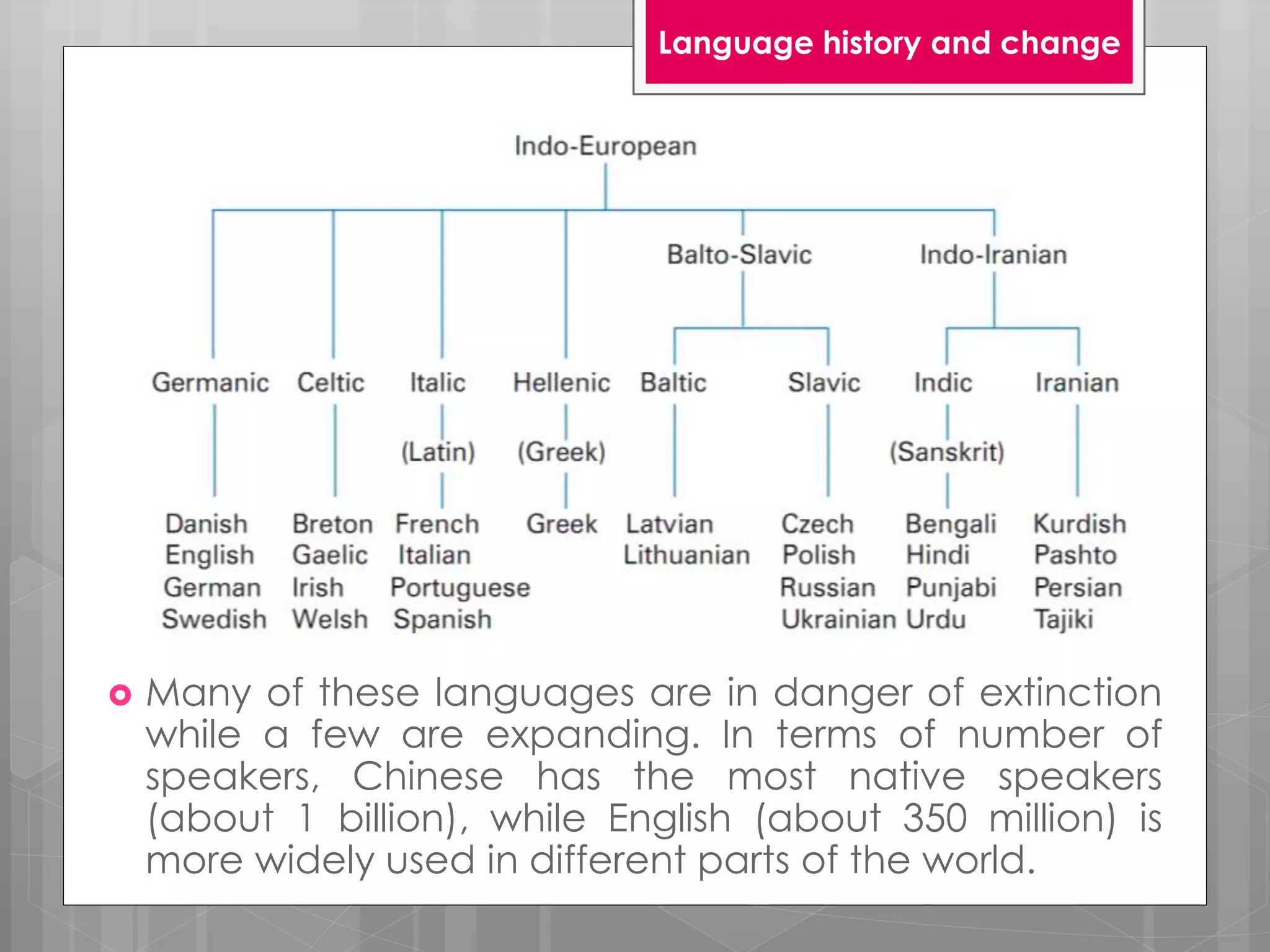
 Many of these languages are in danger of extinction
while a few are expanding. In terms of number of
speakers, Chinese has the most native speakers
(about 1 billion), while English (about 350 million) is
more widely used in different parts of the world.
Language history and change
Family connections
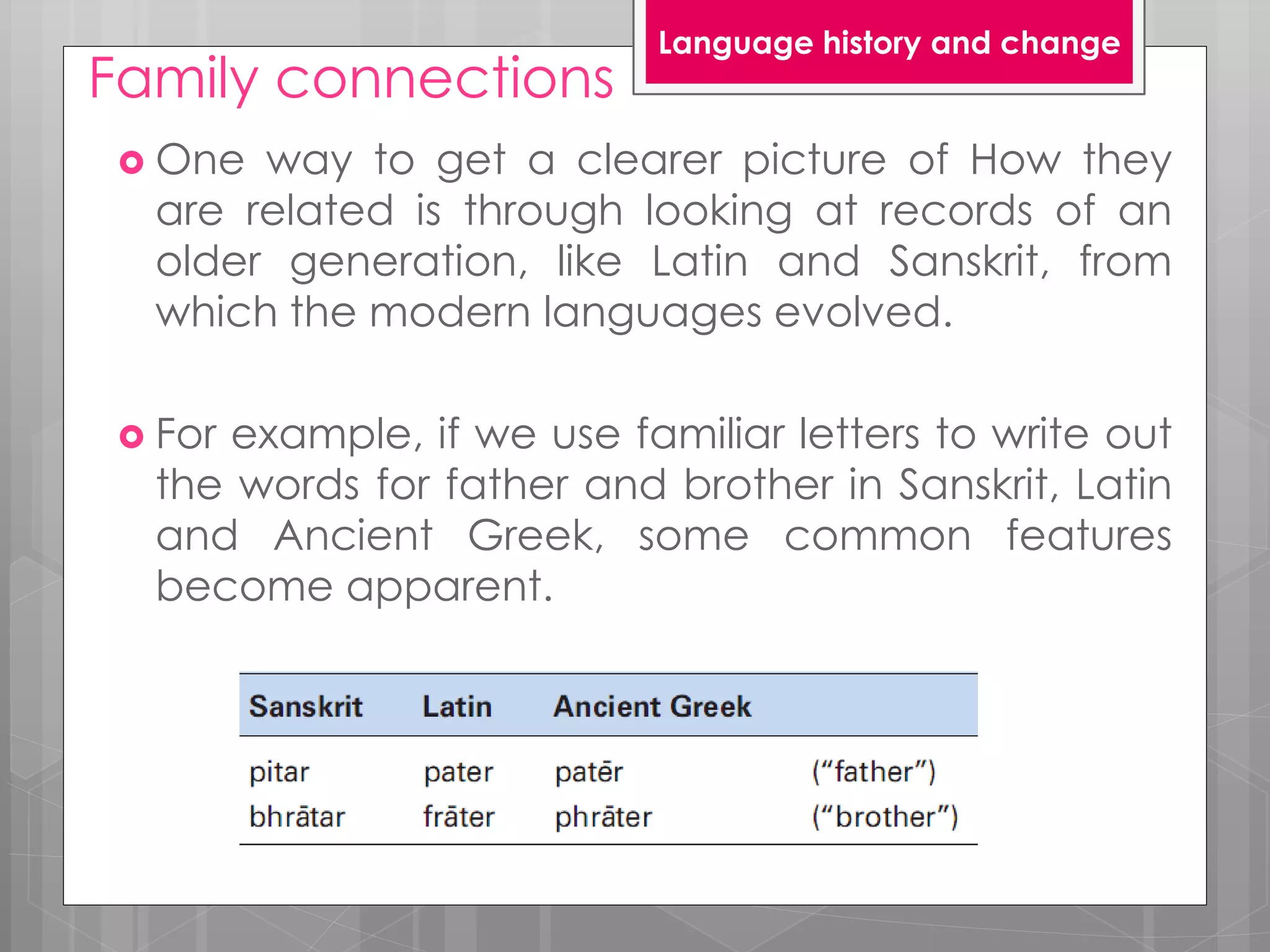
 One way to get a clearer picture of How they
are related is through looking at records of an
older generation, like Latin and Sanskrit, from
which the modern languages evolved.
 For example, if we use familiar letters to write out
the words for father and brother in Sanskrit, Latin
and Ancient Greek, some common features
become apparent.
Language history and change
Cognates
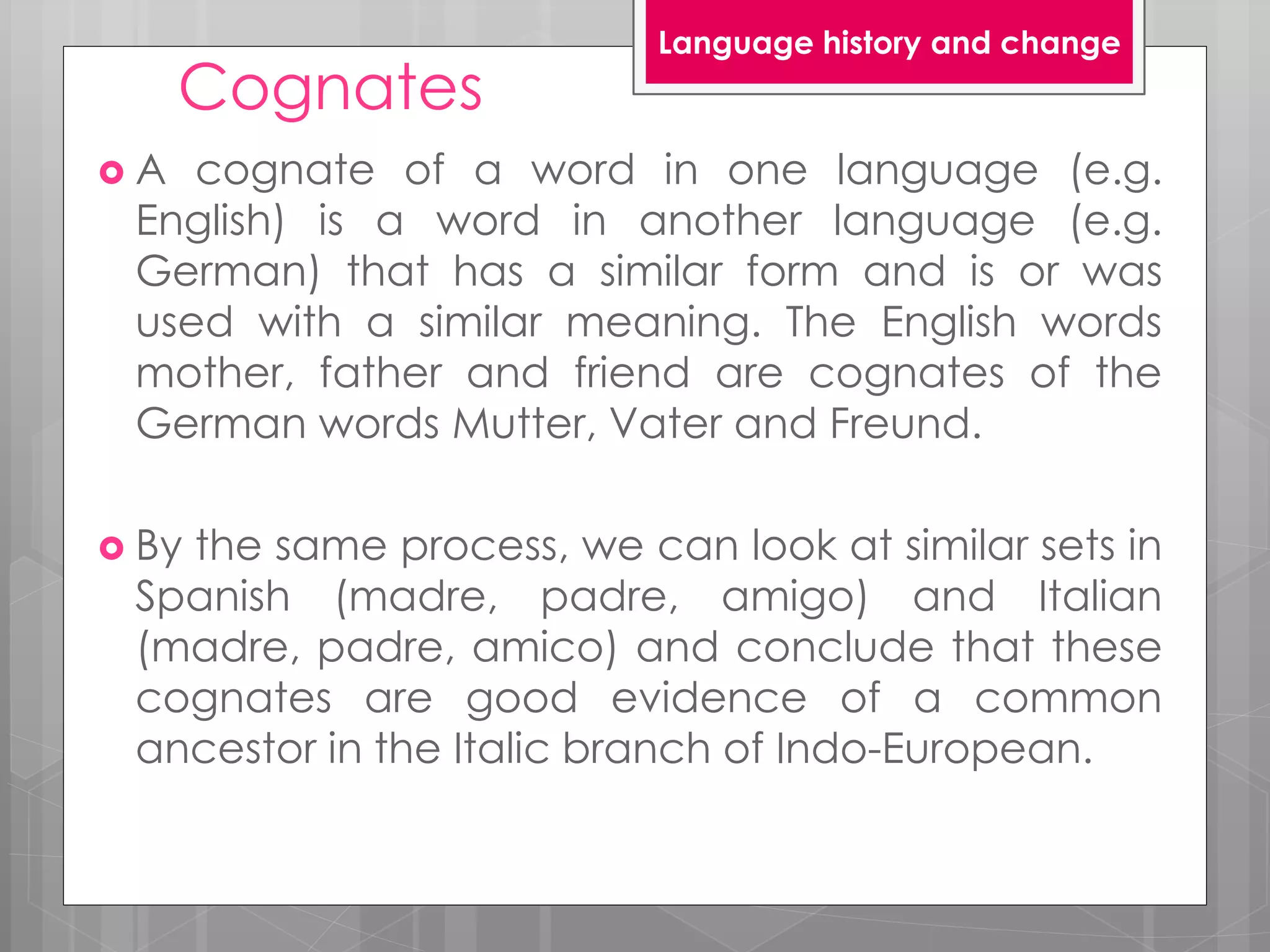
 A cognate of a word in one language (e.g.
English) is a word in another language (e.g.
German) that has a similar form and is or was
used with a similar meaning. The English words
mother, father and friend are cognates of the
German words Mutter, Vater and Freund.
 By the same process, we can look at similar sets in
Spanish (madre, padre, amigo) and Italian
(madre, padre, amico) and conclude that these
cognates are good evidence of a common
ancestor in the Italic branch of Indo-European.
Language history and change
Comparative
reconstruction
 Using information from these sets of cognates, we
can embark on a procedure called comparative
reconstruction. The aim of this procedure is to
reconstruct what must have been the original or
“proto” form in the common ancestral language.
 The majority principle is very straightforward. If, in a
cognate set, three words begin with a [p] sound
and one word begins with a [b] sound, then our
best guess is that the majority have retained the
original sound (i.e. [p]).
Language history and change
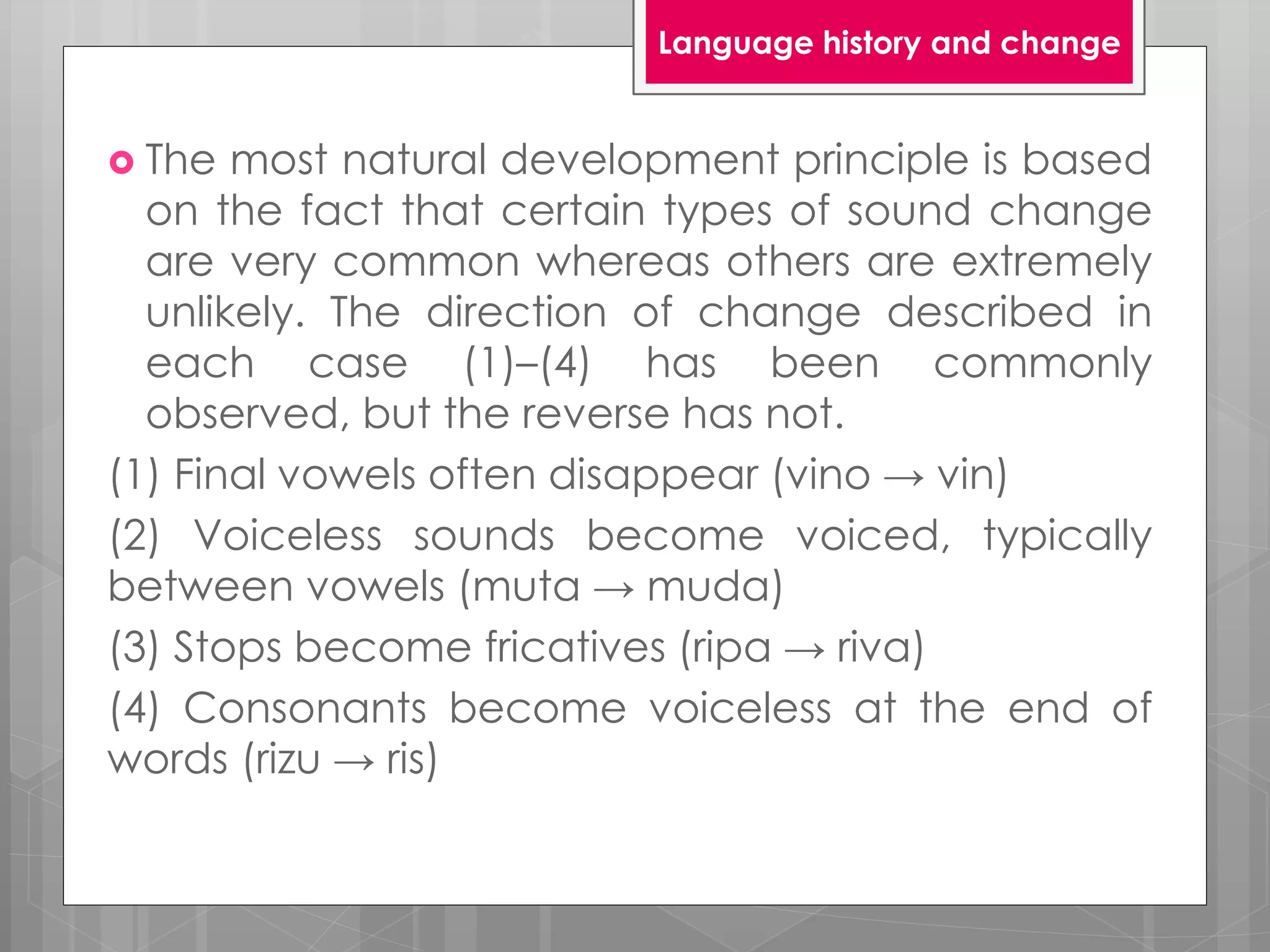
 The most natural development principle is based
on the fact that certain types of sound change
are very common whereas others are extremely
unlikely. The direction of change described in
each case (1)–(4) has been commonly
observed, but the reverse has not.
(1) Final vowels often disappear (vino → vin)
(2) Voiceless sounds become voiced, typically
between vowels (muta → muda)
(3) Stops become fricatives (ripa → riva)
(4) Consonants become voiceless at the end of
words (rizu → ris)
Language history and change
Sound
reconstruction
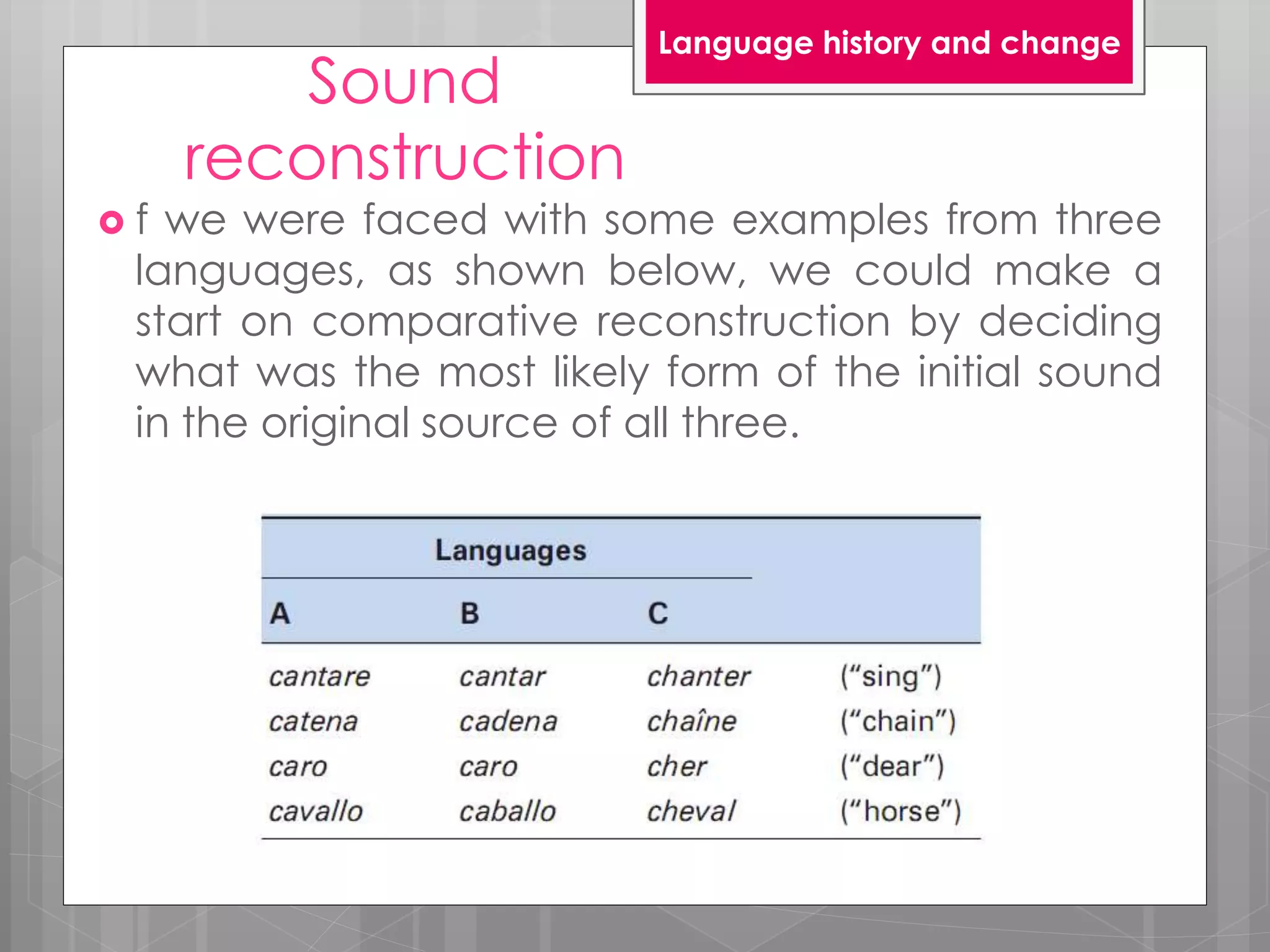
 f we were faced with some examples from three
languages, as shown below, we could make a
start on comparative reconstruction by deciding
what was the most likely form of the initial sound
in the original source of all three.
Language history and change
 Since the written forms can often be misleading,
we check that the initial sounds of the words in
languages A and B are all [k] sounds, while in
language C the initial sounds are all [ʃ] sounds.
 Through this type of procedure we have started
on the comparative reconstruction of the
common origins of some words in Italian (A),
Spanish (B) and French (C).
 In this case, we have a way of checking our
reconstruction because the common origin for
these three languages is known to be Latin.
Language history and change
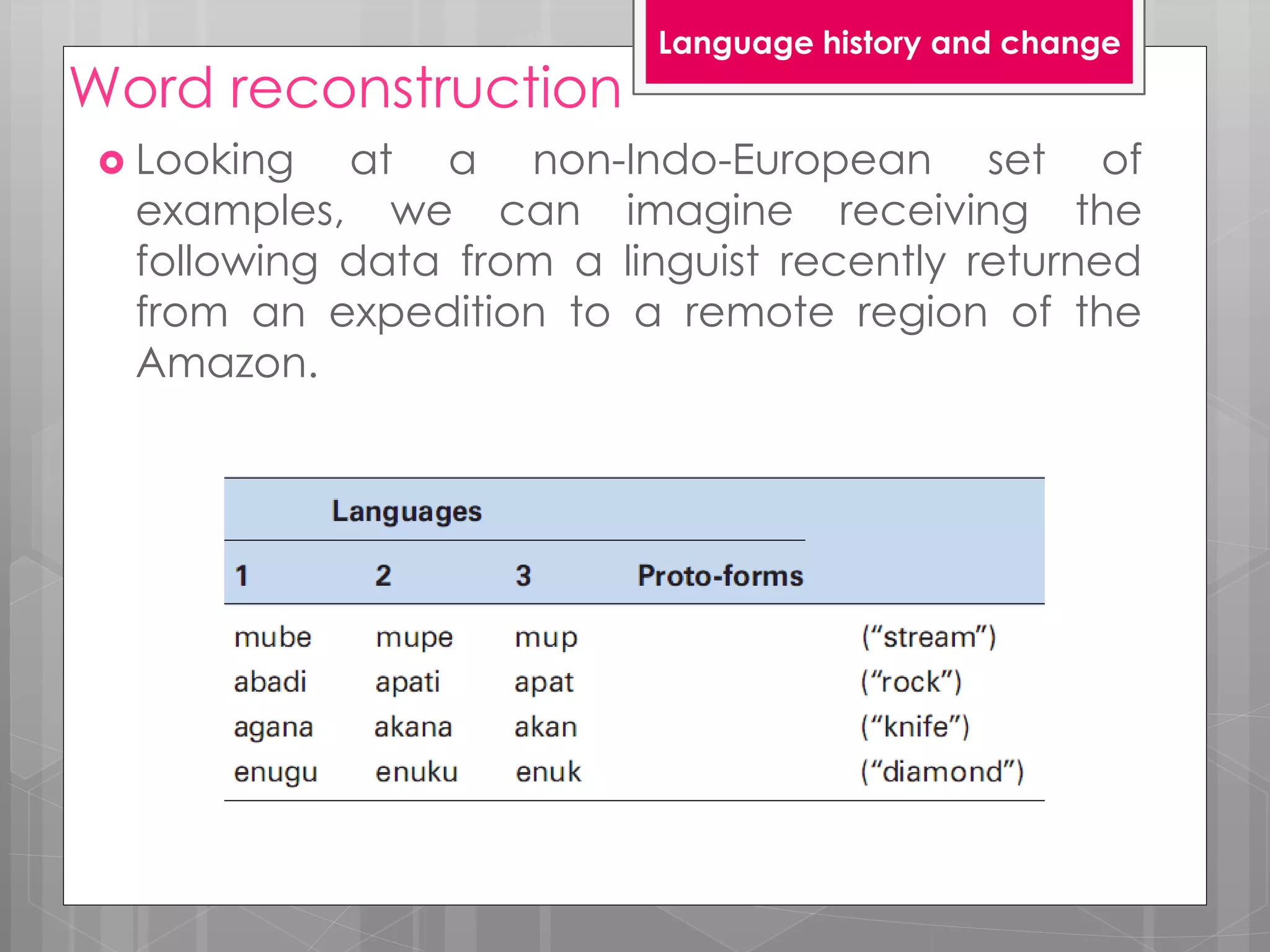
Word reconstruction
 Looking at a non-Indo-European set of
examples, we can imagine receiving the
following data from a linguist recently returned
from an expedition to a remote region of the
Amazon.
Language history and change
 Using the majority principle, we can suggest that
the older forms will most likely be based on
language 2 or language 3. If this is correct, then
the consonant changes must have been [p] →
[b], [t] → [d] and [k] → [ɡ] in order to produce
the later forms in language 1. There is a pattern in
these changes that follows one part of the “most
natural development principle,” i.e. voiceless
sounds become voiced between vowels. So, the
words in languages 2 and 3 must be older forms
than those in language 1.
Language history and change
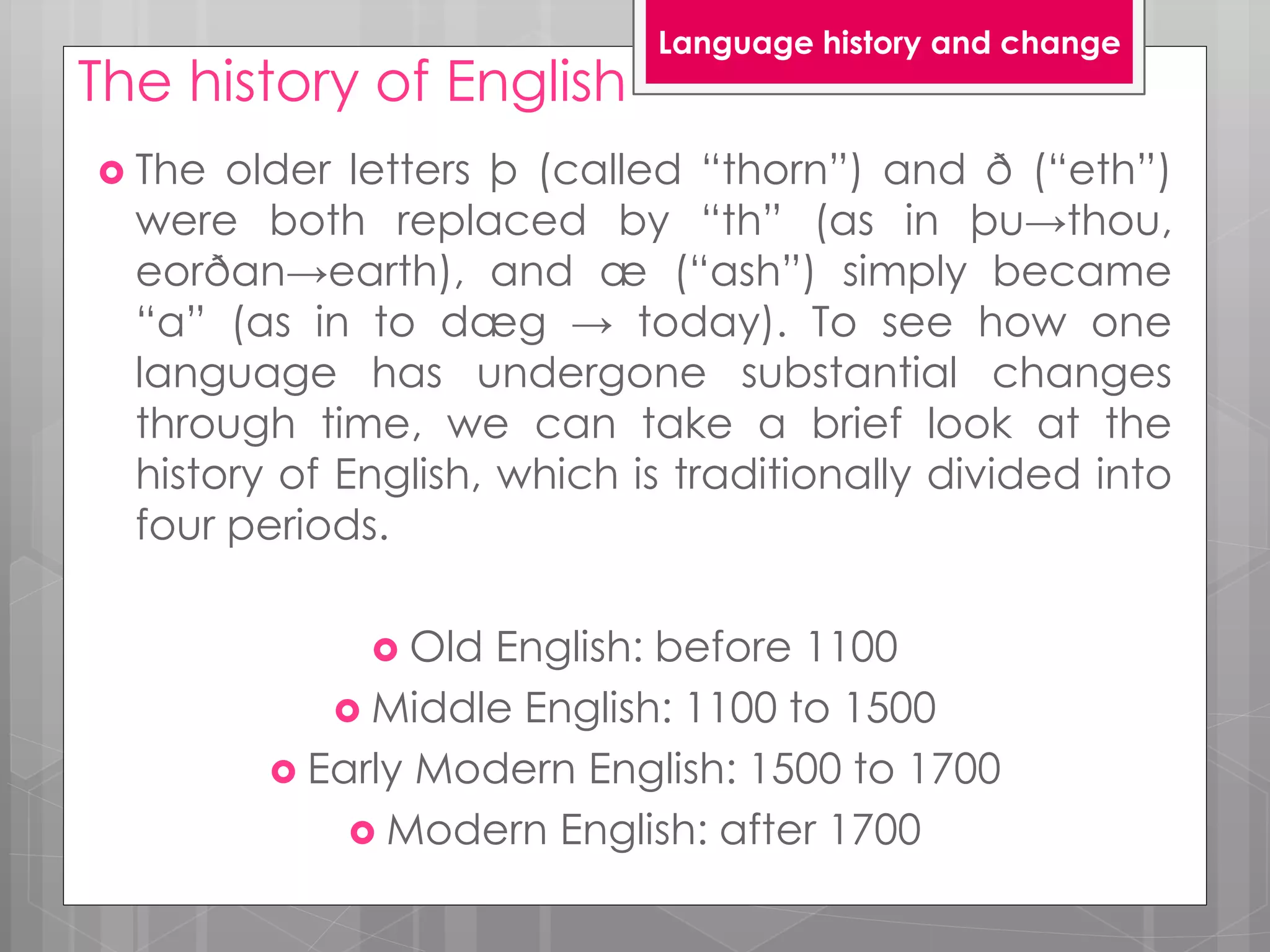
The history of English
 The older letters þ (called “thorn”) and ð (“eth”)
were both replaced by “th” (as in þu→thou,
eorðan→earth), and æ (“ash”) simply became
“a” (as in to dæg → today). To see how one
language has undergone substantial changes
through time, we can take a brief look at the
history of English, which is traditionally divided into
four periods.
 Old English: before 1100
 Middle English: 1100 to 1500
 Early Modern English: 1500 to 1700
 Modern English: after 1700
Language history and change
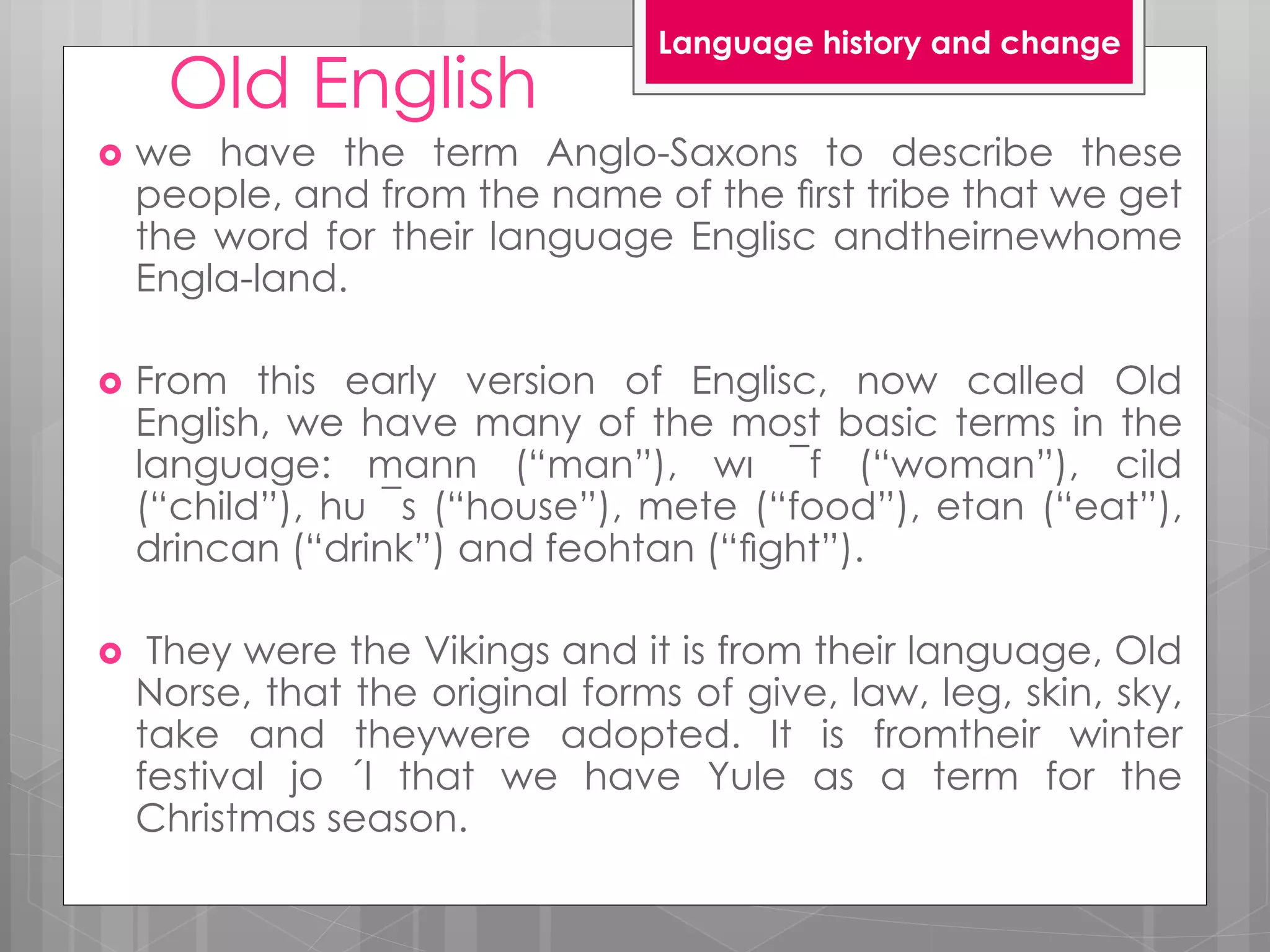
Old English
 we have the term Anglo-Saxons to describe these
people, and from the name of the first tribe that we get
the word for their language Englisc andtheirnewhome
Engla-land.
 From this early version of Englisc, now called Old
English, we have many of the most basic terms in the
language: mann (“man”), wı ¯f (“woman”), cild
(“child”), hu ¯s (“house”), mete (“food”), etan (“eat”),
drincan (“drink”) and feohtan (“fight”).
 They were the Vikings and it is from their language, Old
Norse, that the original forms of give, law, leg, skin, sky,
take and theywere adopted. It is fromtheir winter
festival jo ´l that we have Yule as a term for the
Christmas season.
Language history and change
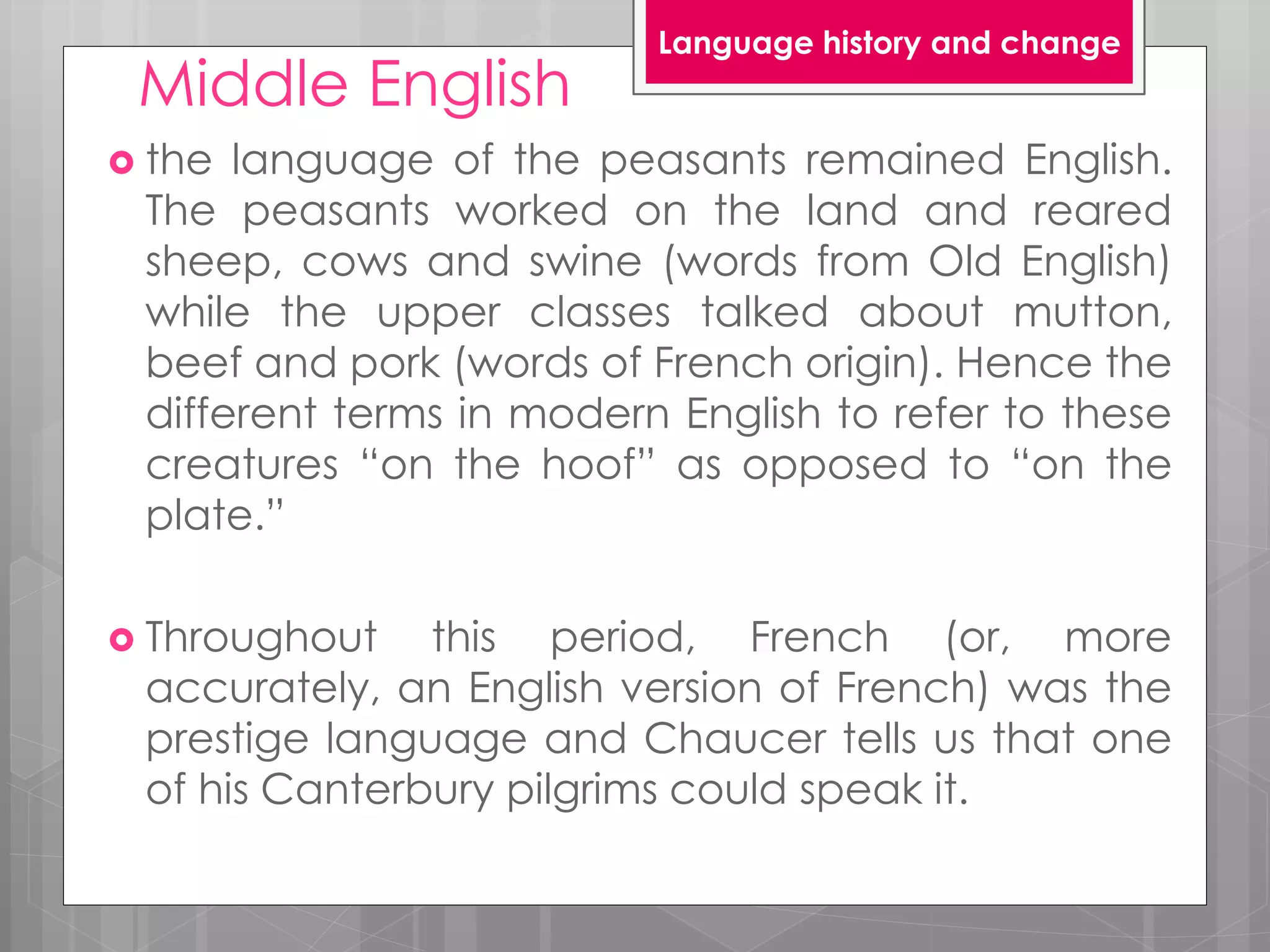
Middle English
 the language of the peasants remained English.
The peasants worked on the land and reared
sheep, cows and swine (words from Old English)
while the upper classes talked about mutton,
beef and pork (words of French origin). Hence the
different terms in modern English to refer to these
creatures “on the hoof” as opposed to “on the
plate.”
 Throughout this period, French (or, more
accurately, an English version of French) was the
prestige language and Chaucer tells us that one
of his Canterbury pilgrims could speak it.
Language history and change
 he was cleped Madame Eglentyne Ful wel she
song the service dyvyne, Entuned in her nose ful
semely, And Frenche she spak ful faire and fetisly.
 Most significantly, the vowel sounds of Chaucer’s
timewere very different fromthose we hear in
similar words today. Chaucer lived in what would
have sounded like a “hoos,” with his “weef,” and
“hay” might drink a bottle of “weena” with “heer”
by the light of the “mona.”
 The effects of this general raising of long vowel
sounds (such as [oː] moving up to [uː], as in mo
¯na→moon) made the pronunciation of Early
Modern English, beginning around 1500,
significantly different from earlier periods.
Language history and change
Sound changes
 sound loss: a sound change in which a particular
sound is no longer used in a language (e.g. the
velar fricative [x], in Scottish loch, but not in
Modern English).
 The initial [h] of many Old English words was lost,
as in hlud → loud and hlaford →lord. Some words
lost sounds, but kept the spelling, resulting in the
“silent letters” of contemporary written English.
 Another example is a velar fricative [x] that was
used in the older pronunciation of nicht as [nɪxt]
(closer to the Modern German pronunciation of
Nacht), but is absent in the contemporary
formnight, as [naɪt].
Language history and change
 The sound change known as metathesis involves a
reversal in position of two sounds in a word. This
type of reversal is illustrated in the changed
versions of these words from their earlier forms.
acsian → ask frist → first brinnan → beornan (burn)
bridd → bird hros → horse wæps → wasp
The reversal of position in metathesis can sometimes
occur between non-adjoinin sounds. The Spanish
word palabra is derived from the Latin parabola
through th reversal of the [l] and [r] sounds.
Language history and change
 Another type of sound change, known as
epenthesis, involves the addition of a sound to the
middle of a word.
 æmtig → empty spinel → spindle timr → timber
 The addition of a [p] sound after the nasal [m], as
in empty, can also be heard in some speakers’
pronunciation of something as “sumpthing.”
Language history and change
 One other type of sound change worth noting, though
not found in English, occurs in the development of other
languages. It involves the addition of a sound to the
beginning of a word and is called prothesis. It is a
common feature in the evolution of some forms from
Latin to Spanish, as in these examples.
 schola → escuela (“school”)
 spiritus → espı´ritu (“spirit”)
 Spanish speakers who are starting to learn English as a
second language will some- times put a prothetic vowel
at the beginning of some English words, with the result
that words like strange and story may sound like
“estrange” and “estory.”
Language history and change
Syntactic changes
 we find the Subject-Verb-Object order most
common in Modern English, but we can also find a
number of different orders that are no longer
used.
 For example, the subject could follow the verb, as
in ferde he (“he traveled”), and the object could
be placed before the verb, as in he hine geseah
(“he saw him”), or at the beginning of the
sentence, as in him man ne sealde (“no man
gave [any] to him”).
 and ne sealdest þu¯ me næfre a¯ n ticcen
 and not gave you me never a kid
Language history and change
Semantic changes
 Less obviously, many words have ceased to be
used. Sincewe no longer carry swords (most of us,
at least), theword foin, meaning “the thrust of a
sword,” is no longer heard.
 A common Old English word for “man” was were,
but it has fallen out of use, except in horror films
where the compound werewolf occasionally
appears.
 A number of expressions such as lo, verily or egad
are immediately recognized as belonging to a
much earlier period, along with certain medieval-
sounding names such as Bertha, Egbert and
Percival.
Language history and change
 An example of broadening of meaning is the
change from holy day as a religious feast to the
very general break from work called a holiday.
We have broadened the use of foda (fodder for
animals) to talk about all kinds of food.
 Old English words such as luflic (“loving”) and
hræd (“quick”) not only went through sound
changes, they also developed more complex
evaluative meanings (“wonderful” and
“preferentially”), as in their modern uses: That’s a
lovely idea, but I’d rather have dinner at home
tonight.
Language history and change
 The reverse process, called narrowing, has
overtaken the Old English word hund, once used
for any kind of dog, but now, as hound, used
only for some specific breeds.
 Another example is mete, once used for any
kind of food, which has in its modern form meat
become restricted to only some specific types.
 A different kind of narrowing can lead to a
negative meaning for some words, such as
vulgar (which used to mean simply “ordinary”)
and naughty (which used to mean “having
nothing”).
Language history and change
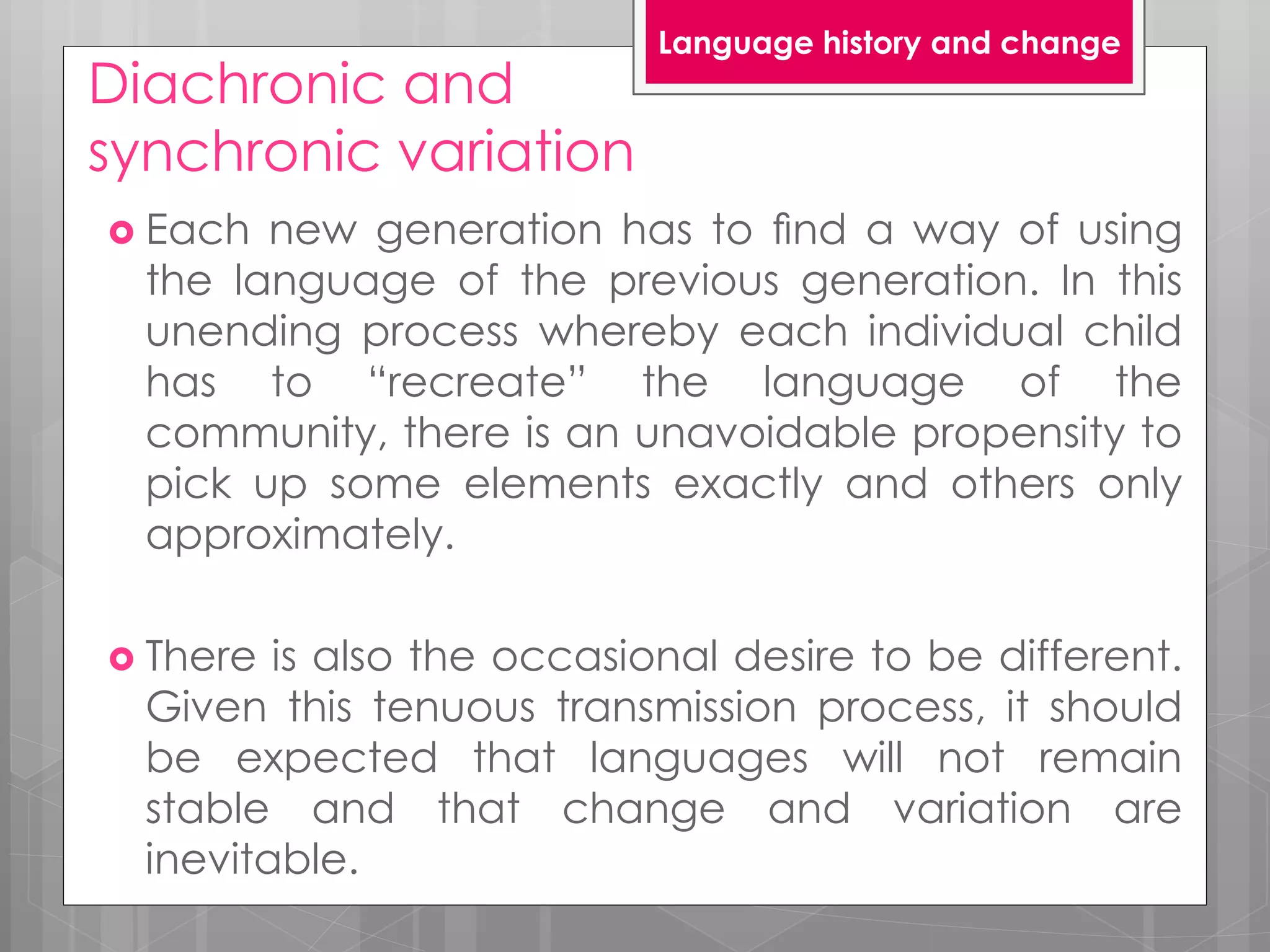
Diachronic and
synchronic variation
 Each new generation has to find a way of using
the language of the previous generation. In this
unending process whereby each individual child
has to “recreate” the language of the
community, there is an unavoidable propensity to
pick up some elements exactly and others only
approximately.
 There is also the occasional desire to be different.
Given this tenuous transmission process, it should
be expected that languages will not remain
stable and that change and variation are
inevitable.
Language history and change
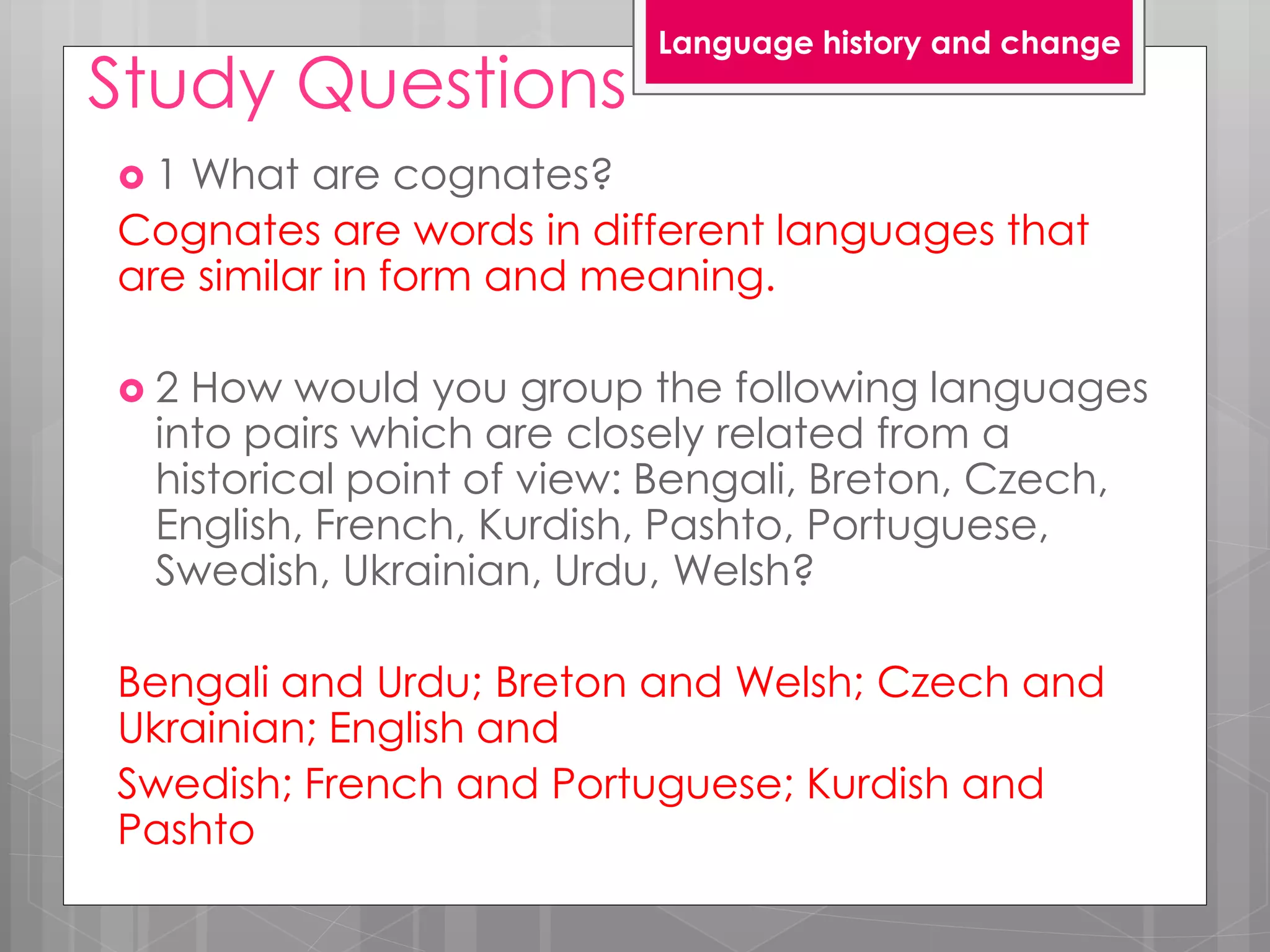
Study Questions
 1 What are cognates?
Cognates are words in different languages that
are similar in form and meaning.
 2 How would you group the following languages
into pairs which are closely related from a
historical point of view: Bengali, Breton, Czech,
English, French, Kurdish, Pashto, Portuguese,
Swedish, Ukrainian, Urdu, Welsh?
Bengali and Urdu; Breton and Welsh; Czech and
Ukrainian; English and
Swedish; French and Portuguese; Kurdish and
Pashto
Language history and change
 3 On the basis of the following data, what are the
most likely proto-forms?
Most likely proto-forms: cosa, capo, capra (initial [k],
voiceless [p] voiced [b])
Language history and change
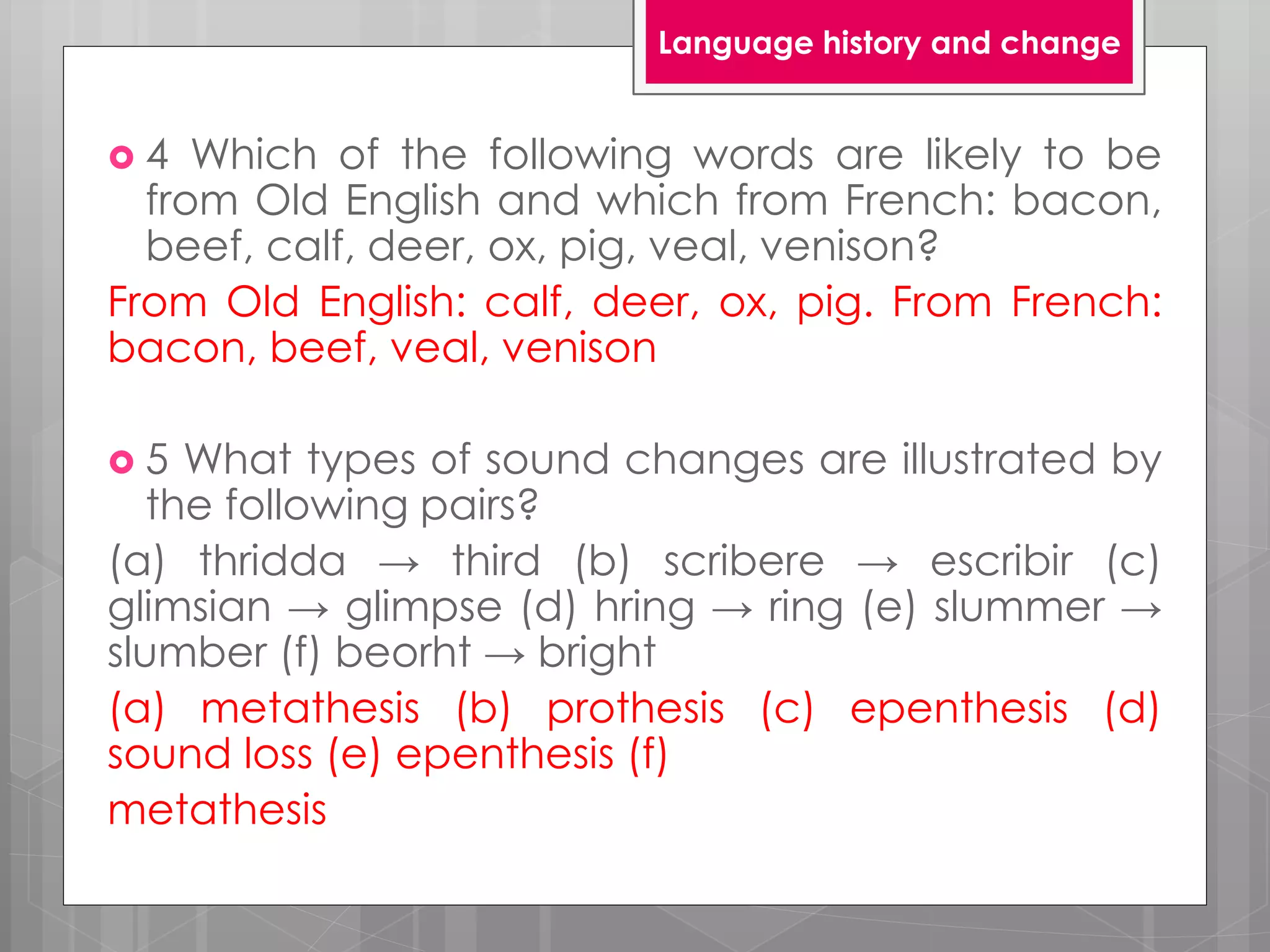
 4 Which of the following words are likely to be
from Old English and which from French: bacon,
beef, calf, deer, ox, pig, veal, venison?
From Old English: calf, deer, ox, pig. From French:
bacon, beef, veal, venison
 5 What types of sound changes are illustrated by
the following pairs?
(a) thridda → third (b) scribere → escribir (c)
glimsian → glimpse (d) hring → ring (e) slummer →
slumber (f) beorht → bright
(a) metathesis (b) prothesis (c) epenthesis (d)
sound loss (e) epenthesis (f)
metathesis
Language history and change
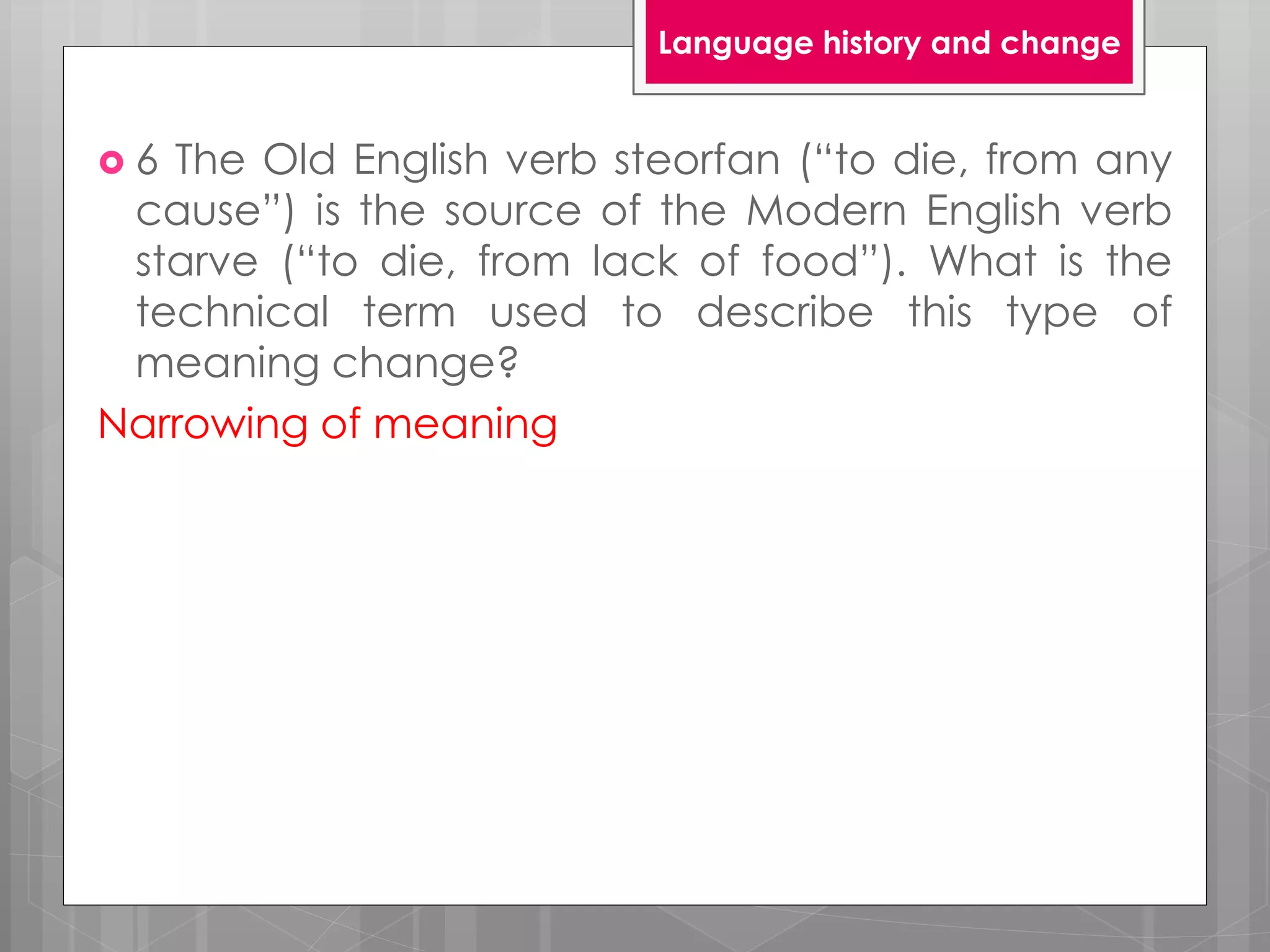
 6 The Old English verb steorfan (“to die, from any
cause”) is the source of the Modern English verb
starve (“to die, from lack of food”). What is the
technical term used to describe this type of
meaning change?
Narrowing of meaning
Language history and change
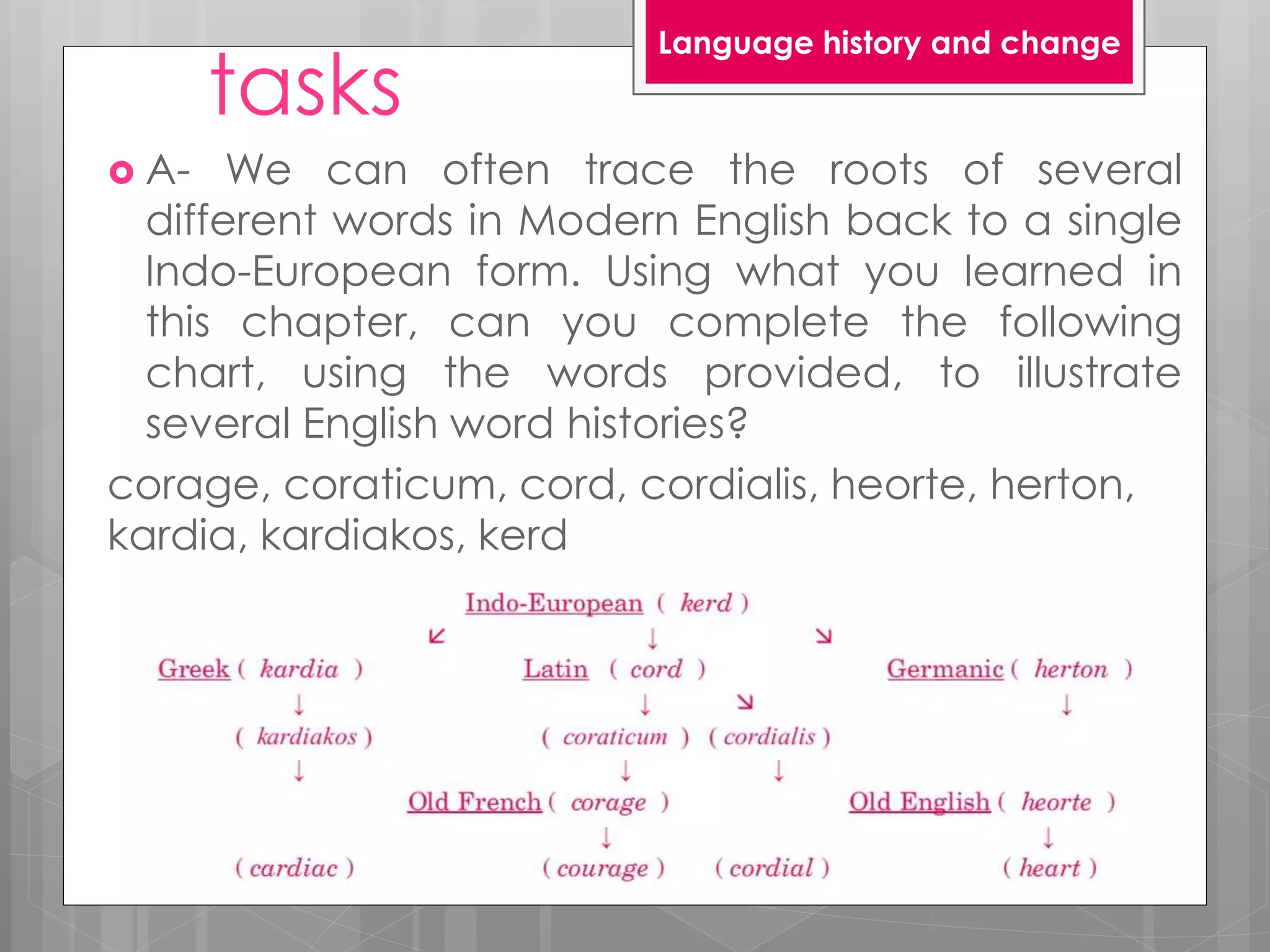
tasks
 A- We can often trace the roots of several
different words in Modern English back to a single
Indo-European form. Using what you learned in
this chapter, can you complete the following
chart, using the words provided, to illustrate
several English word histories?
corage, coraticum, cord, cordialis, heorte, herton,
kardia, kardiakos, kerd
Language history and change
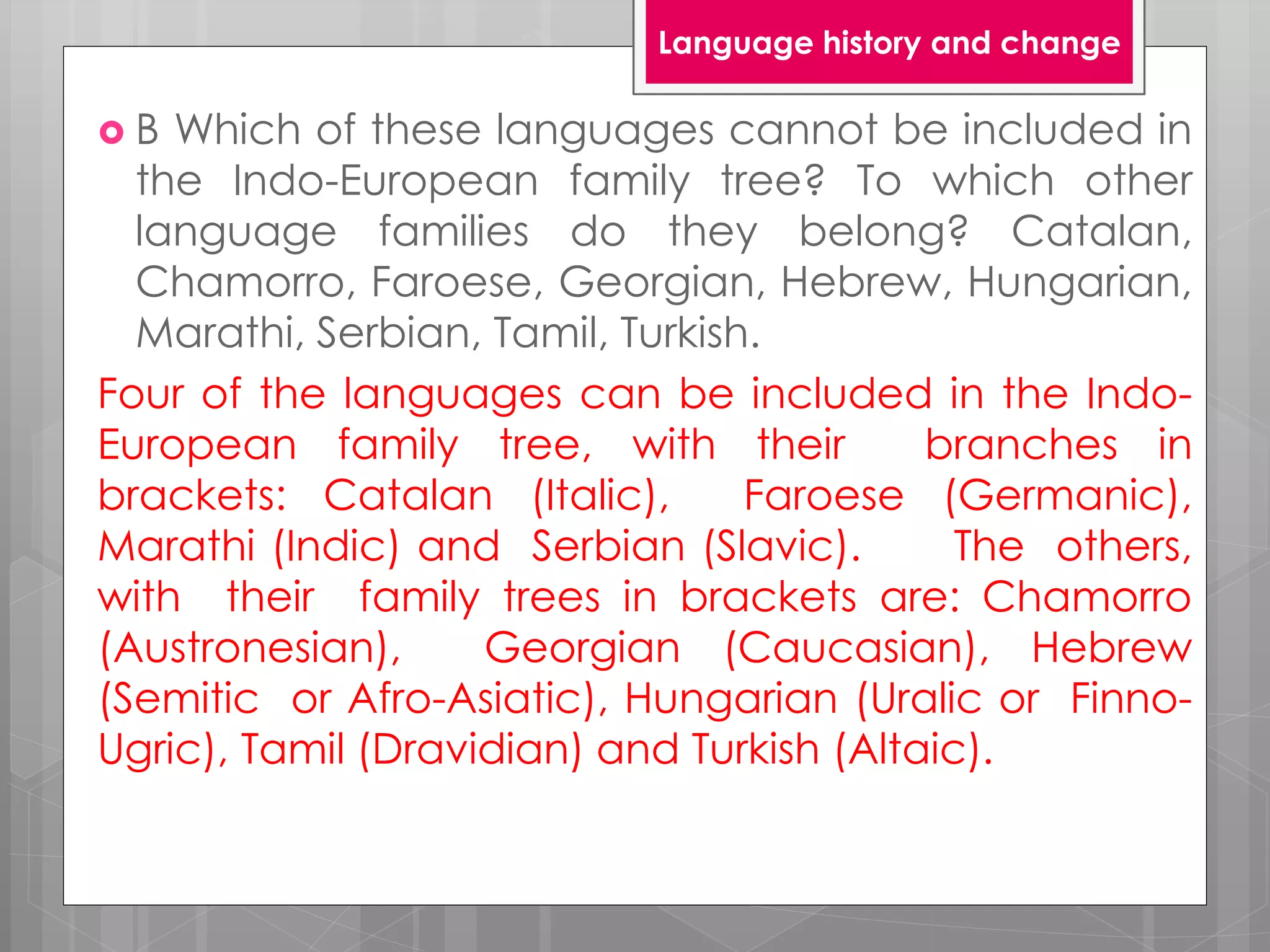
 B Which of these languages cannot be included in
the Indo-European family tree? To which other
language families do they belong? Catalan,
Chamorro, Faroese, Georgian, Hebrew, Hungarian,
Marathi, Serbian, Tamil, Turkish.
Four of the languages can be included in the Indo-
European family tree, with their branches in
brackets: Catalan (Italic), Faroese (Germanic),
Marathi (Indic) and Serbian (Slavic). The others,
with their family trees in brackets are: Chamorro
(Austronesian), Georgian (Caucasian), Hebrew
(Semitic or Afro-Asiatic), Hungarian (Uralic or Finno-
Ugric), Tamil (Dravidian) and Turkish (Altaic).
Language history and change
 C A Danish linguist, Rasmus Rask, and a German writer more famous for fairy tales,
Jacob Grimm, both working in the early nineteenth century, are credited with the
original insights that became known as “Grimm’s Law.” What is Grimm’s Law and how
does it account for the different initial sounds in pairs of cognates such as these from
French and English (deux / two, trois / three) and these from Latin and English (pater /
father, canis / hound, genus / kin)?
 Grimm’s Law
Indo-European consonants underwent a series of regular sound changes in the
development of the Germanic branch that did not happen in the Italic branch (and other
branches). As a descendant of the Germanic branch, English has a number of words that
show the results of the sound changes when compared to French and Latin words (both in
the Italic branch). Grimm’s Law is essentially a small set of rules that show how most of those
changes took place in a regular pattern. Voiceless stops such as [p], [t] and [k] became
voiceless fricatives [f], [θ] and [h] in the Germanic branch, but not in the Italic branch, as
illustrated by the pairs pater/father, tres/three and canis/hound. Voiced stops such as [d]
and [ɡ] became voiceless stops [t] and [k], as in the pairs duo/two and genus/kin. These
are examples of the regular patterns of change described by Grimm’s Law and can still be
found in the differences between first consonants of the French/English cognates deux/two
and trois/three. The basic set of changes is presented here, with Indo-European
consonants on the left and Germanic consonants on the right.
 voiceless stops /p, t, k/ voiceless fricatives /f, θ, h/
 voiced stops /b, d, g/ voiceless stops /p, t, k/
voiced aspirated stops /bh, dh, gh/ voiced stops /b, d, g/ The circular nature of these
sound change rules is considered to be a good feature.
Language history and change
 D What happens in the process of change known
as “grammaticalization”? Can you find out how
the grammaticalization process made it possible
for the English verb forms go and will to be used in
sentences such as I’m gonna be late and I’ll be at
work until six?
In historical studies, grammaticalization is the process
by which a form with lexical meaning (a lexical
morpheme) develops into one with grammatical
function (a grammatical or inflectional morpheme).
Language history and change
 E Describe what happened in any documented case
of “language death.”
One of the most detailed accounts of language death
involves the (near) demise of Gaelic in northern
Scotland. Although it has undergone a revival in recent
years and is taught as a second language in many
Scottish schools, Gaelic became a language with fewer
and fewer native speakers.
Until the eighteenth century, Scottish Gaelic was
spoken throughout the northern areas and in the
western islands. An unfortunate combination of failed
rebellions and economic changes led to a large-scale
displacement of the Gaelic-speaking population
during the late eighteenth and early nineteenth
centuries.
Language history and change
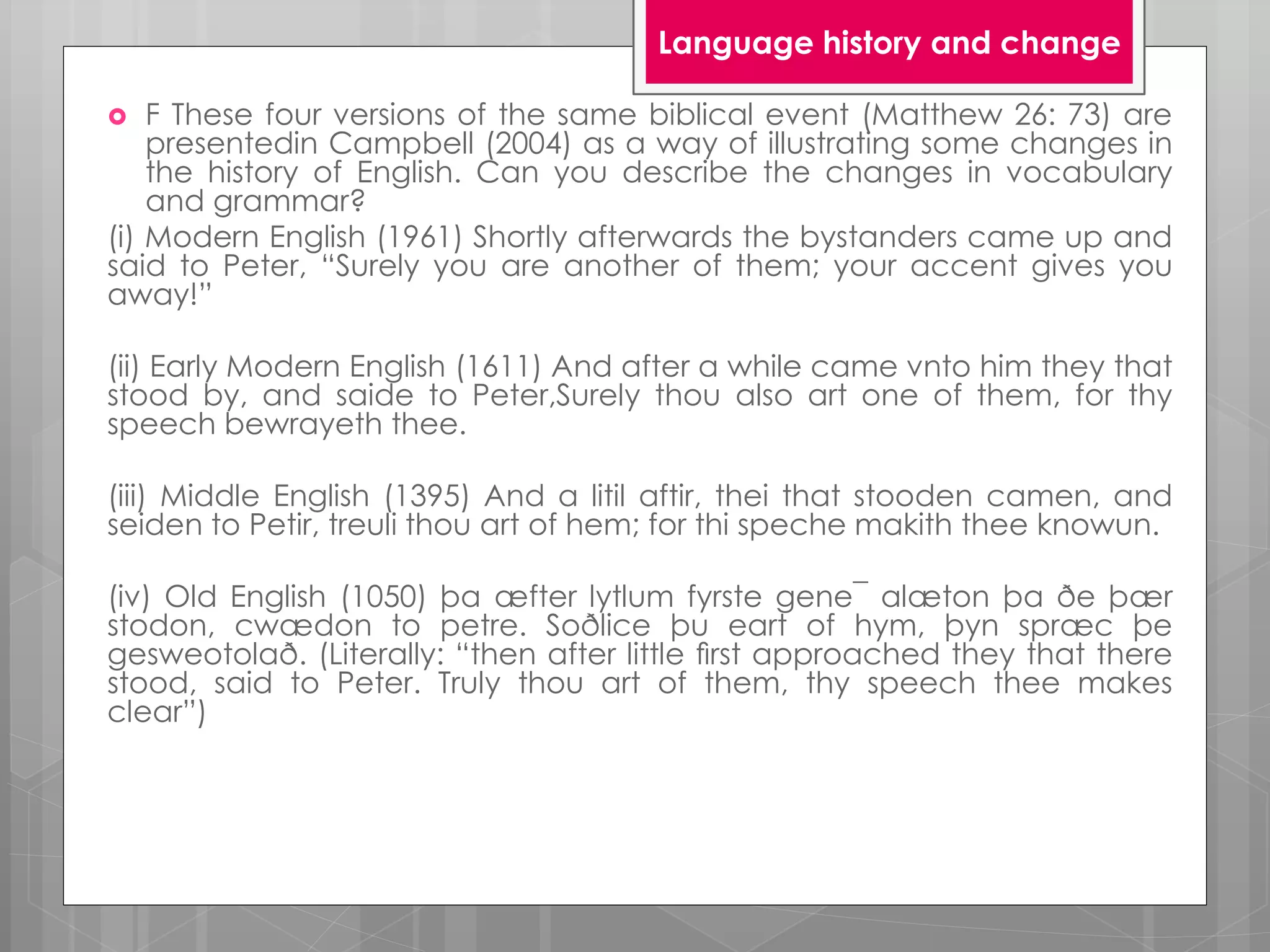
 F These four versions of the same biblical event (Matthew 26: 73) are
presentedin Campbell (2004) as a way of illustrating some changes in
the history of English. Can you describe the changes in vocabulary
and grammar?
(i) Modern English (1961) Shortly afterwards the bystanders came up and
said to Peter, “Surely you are another of them; your accent gives you
away!”
(ii) Early Modern English (1611) And after a while came vnto him they that
stood by, and saide to Peter,Surely thou also art one of them, for thy
speech bewrayeth thee.
(iii) Middle English (1395) And a litil aftir, thei that stooden camen, and
seiden to Petir, treuli thou art of hem; for thi speche makith thee knowun.
(iv) Old English (1050) þa æfter lytlum fyrste gene¯ alæton þa ðe þær
stodon, cwædon to petre. Soðlice þu eart of hym, þyn spræc þe
gesweotolað. (Literally: “then after little first approached they that there
stood, said to Peter. Truly thou art of them, thy speech thee makes
clear”)
Language history and change
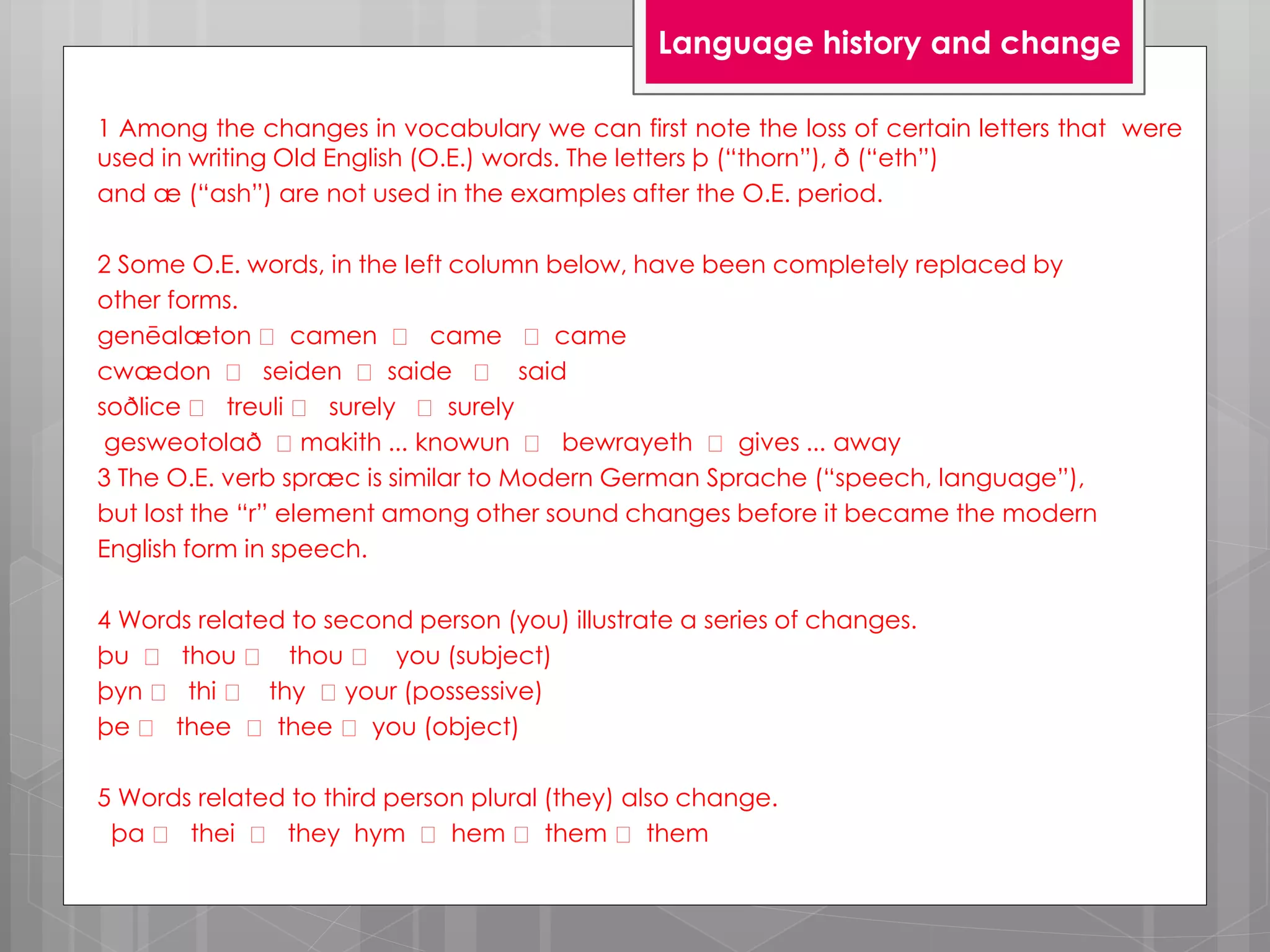
1 Among the changes in vocabulary we can first note the loss of certain letters that were
used in writing Old English (O.E.) words. The letters þ (“thorn”), ð (“eth”)
and æ (“ash”) are not used in the examples after the O.E. period.
2 Some O.E. words, in the left column below, have been completely replaced by
other forms.
genēalæton camen came came
cwædon seiden saide said
soðlice treuli surely surely
gesweotolað makith ... knowun bewrayeth gives ... away
3 The O.E. verb spræc is similar to Modern German Sprache (“speech, language”),
but lost the “r” element among other sound changes before it became the modern
English form in speech.
4 Words related to second person (you) illustrate a series of changes.
þu thou thou you (subject)
þyn thi thy your (possessive)
þe thee thee you (object)
5 Words related to third person plural (they) also change.
þa thei they hym hem them them
Language history and change
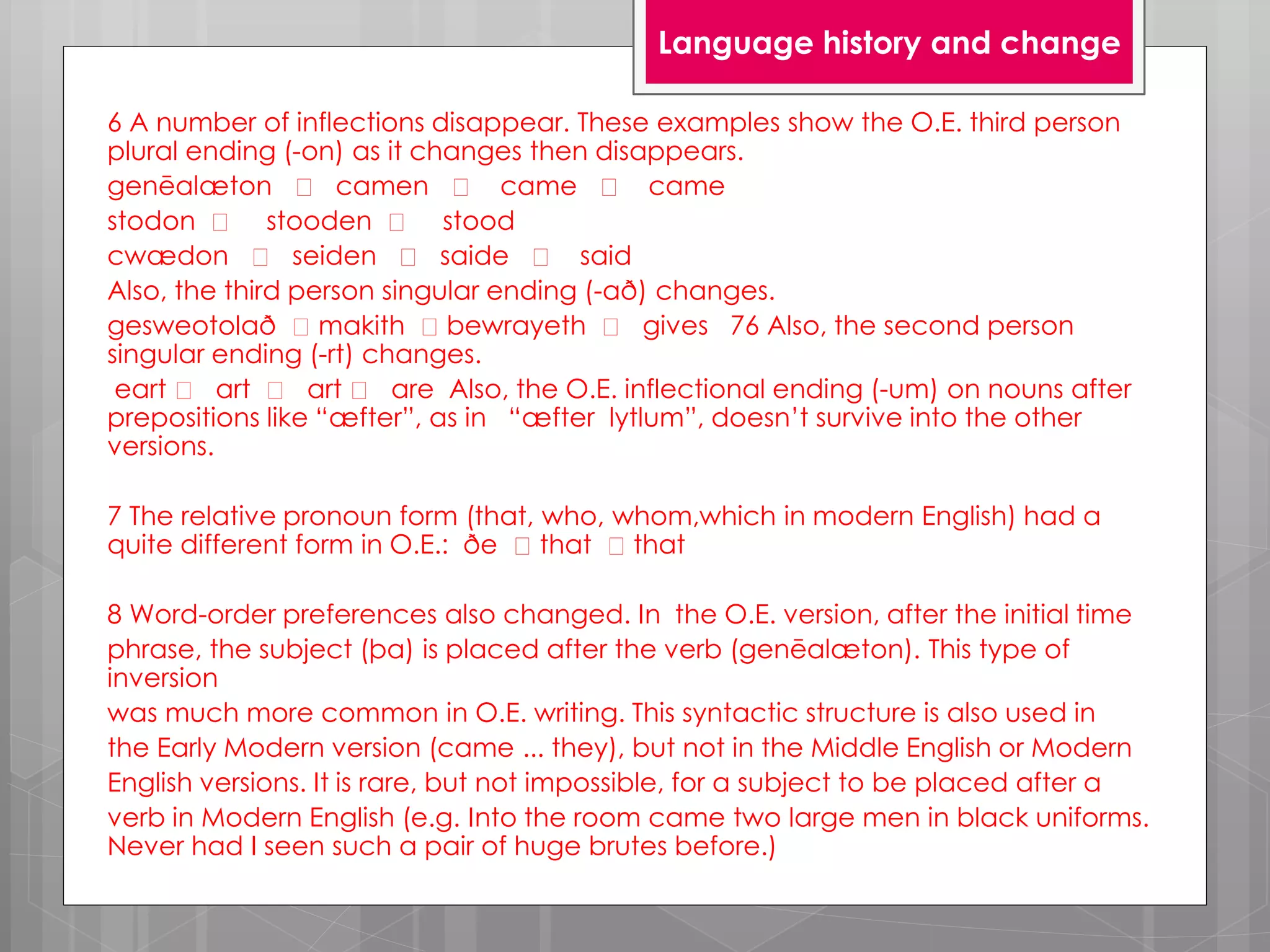
6 A number of inflections disappear. These examples show the O.E. third person
plural ending (-on) as it changes then disappears.
genēalæton camen came came
stodon stooden stood
cwædon seiden saide said
Also, the third person singular ending (-að) changes.
gesweotolað makith bewrayeth gives 76 Also, the second person
singular ending (-rt) changes.
eart art art are Also, the O.E. inflectional ending (-um) on nouns after
prepositions like “æfter”, as in “æfter lytlum”, doesn’t survive into the other
versions.
7 The relative pronoun form (that, who, whom,which in modern English) had a
quite different form in O.E.: ðe that that
8 Word-order preferences also changed. In the O.E. version, after the initial time
phrase, the subject (þa) is placed after the verb (genēalæton). This type of
inversion
was much more common in O.E. writing. This syntactic structure is also used in
the Early Modern version (came ... they), but not in the Middle English or Modern
English versions. It is rare, but not impossible, for a subject to be placed after a
verb in Modern English (e.g. Into the room came two large men in black uniforms.
Never had I seen such a pair of huge brutes before.)
Language history and change

Chapter 17 language history and change

  • 1.
    LANGUAGE HISTORY AND CHANGE Chapter 17– study of the language George YULE LINGUISTICS Carlos Lara
  • 2.
    Family trees  TheSanskrit language, whatever be its antiquity, is of a wonderful structure; more perfect than the Greek, more copious than the Latin, and more exquisitely refined than either, yet bearing to both of them a stronger affinity, both in the roots of verbs and in the forms of grammar, than could possibly have been produced by accident.  During the nineteenth century, a term came into use to describe that common ancestor. It incorporated the notion that thiswas the original form(Proto) of a language that was the source of modern languages in the Indian subcontinent (Indo) and in Europe (European). Language history and change
  • 3.
     Proto-Indo-European establishedas some type of “great- great-grandmother,” scholars set out to identify the branches of the Indo-European family tree, tracing the lineage of many modern languages.  Indo-European is the language family with the largest population and distribution in the world, but it isn’t the only one. There are about thirty such language families containingmore than 6,000 different individual languages. Language history and change
  • 4.
     Many ofthese languages are in danger of extinction while a few are expanding. In terms of number of speakers, Chinese has the most native speakers (about 1 billion), while English (about 350 million) is more widely used in different parts of the world. Language history and change
  • 5.
    Family connections  Oneway to get a clearer picture of How they are related is through looking at records of an older generation, like Latin and Sanskrit, from which the modern languages evolved.  For example, if we use familiar letters to write out the words for father and brother in Sanskrit, Latin and Ancient Greek, some common features become apparent. Language history and change
  • 6.
    Cognates  A cognateof a word in one language (e.g. English) is a word in another language (e.g. German) that has a similar form and is or was used with a similar meaning. The English words mother, father and friend are cognates of the German words Mutter, Vater and Freund.  By the same process, we can look at similar sets in Spanish (madre, padre, amigo) and Italian (madre, padre, amico) and conclude that these cognates are good evidence of a common ancestor in the Italic branch of Indo-European. Language history and change
  • 7.
    Comparative reconstruction  Using informationfrom these sets of cognates, we can embark on a procedure called comparative reconstruction. The aim of this procedure is to reconstruct what must have been the original or “proto” form in the common ancestral language.  The majority principle is very straightforward. If, in a cognate set, three words begin with a [p] sound and one word begins with a [b] sound, then our best guess is that the majority have retained the original sound (i.e. [p]). Language history and change
  • 8.
     The mostnatural development principle is based on the fact that certain types of sound change are very common whereas others are extremely unlikely. The direction of change described in each case (1)–(4) has been commonly observed, but the reverse has not. (1) Final vowels often disappear (vino → vin) (2) Voiceless sounds become voiced, typically between vowels (muta → muda) (3) Stops become fricatives (ripa → riva) (4) Consonants become voiceless at the end of words (rizu → ris) Language history and change
  • 9.
    Sound reconstruction  f wewere faced with some examples from three languages, as shown below, we could make a start on comparative reconstruction by deciding what was the most likely form of the initial sound in the original source of all three. Language history and change
  • 10.
     Since thewritten forms can often be misleading, we check that the initial sounds of the words in languages A and B are all [k] sounds, while in language C the initial sounds are all [ʃ] sounds.  Through this type of procedure we have started on the comparative reconstruction of the common origins of some words in Italian (A), Spanish (B) and French (C).  In this case, we have a way of checking our reconstruction because the common origin for these three languages is known to be Latin. Language history and change
  • 11.
    Word reconstruction  Lookingat a non-Indo-European set of examples, we can imagine receiving the following data from a linguist recently returned from an expedition to a remote region of the Amazon. Language history and change
  • 12.
     Using themajority principle, we can suggest that the older forms will most likely be based on language 2 or language 3. If this is correct, then the consonant changes must have been [p] → [b], [t] → [d] and [k] → [ɡ] in order to produce the later forms in language 1. There is a pattern in these changes that follows one part of the “most natural development principle,” i.e. voiceless sounds become voiced between vowels. So, the words in languages 2 and 3 must be older forms than those in language 1. Language history and change
  • 13.
    The history ofEnglish  The older letters þ (called “thorn”) and ð (“eth”) were both replaced by “th” (as in þu→thou, eorðan→earth), and æ (“ash”) simply became “a” (as in to dæg → today). To see how one language has undergone substantial changes through time, we can take a brief look at the history of English, which is traditionally divided into four periods.  Old English: before 1100  Middle English: 1100 to 1500  Early Modern English: 1500 to 1700  Modern English: after 1700 Language history and change
  • 14.
    Old English  wehave the term Anglo-Saxons to describe these people, and from the name of the first tribe that we get the word for their language Englisc andtheirnewhome Engla-land.  From this early version of Englisc, now called Old English, we have many of the most basic terms in the language: mann (“man”), wı ¯f (“woman”), cild (“child”), hu ¯s (“house”), mete (“food”), etan (“eat”), drincan (“drink”) and feohtan (“fight”).  They were the Vikings and it is from their language, Old Norse, that the original forms of give, law, leg, skin, sky, take and theywere adopted. It is fromtheir winter festival jo ´l that we have Yule as a term for the Christmas season. Language history and change
  • 15.
    Middle English  thelanguage of the peasants remained English. The peasants worked on the land and reared sheep, cows and swine (words from Old English) while the upper classes talked about mutton, beef and pork (words of French origin). Hence the different terms in modern English to refer to these creatures “on the hoof” as opposed to “on the plate.”  Throughout this period, French (or, more accurately, an English version of French) was the prestige language and Chaucer tells us that one of his Canterbury pilgrims could speak it. Language history and change
  • 16.
     he wascleped Madame Eglentyne Ful wel she song the service dyvyne, Entuned in her nose ful semely, And Frenche she spak ful faire and fetisly.  Most significantly, the vowel sounds of Chaucer’s timewere very different fromthose we hear in similar words today. Chaucer lived in what would have sounded like a “hoos,” with his “weef,” and “hay” might drink a bottle of “weena” with “heer” by the light of the “mona.”  The effects of this general raising of long vowel sounds (such as [oː] moving up to [uː], as in mo ¯na→moon) made the pronunciation of Early Modern English, beginning around 1500, significantly different from earlier periods. Language history and change
  • 17.
    Sound changes  soundloss: a sound change in which a particular sound is no longer used in a language (e.g. the velar fricative [x], in Scottish loch, but not in Modern English).  The initial [h] of many Old English words was lost, as in hlud → loud and hlaford →lord. Some words lost sounds, but kept the spelling, resulting in the “silent letters” of contemporary written English.  Another example is a velar fricative [x] that was used in the older pronunciation of nicht as [nɪxt] (closer to the Modern German pronunciation of Nacht), but is absent in the contemporary formnight, as [naɪt]. Language history and change
  • 18.
     The soundchange known as metathesis involves a reversal in position of two sounds in a word. This type of reversal is illustrated in the changed versions of these words from their earlier forms. acsian → ask frist → first brinnan → beornan (burn) bridd → bird hros → horse wæps → wasp The reversal of position in metathesis can sometimes occur between non-adjoinin sounds. The Spanish word palabra is derived from the Latin parabola through th reversal of the [l] and [r] sounds. Language history and change
  • 19.
     Another typeof sound change, known as epenthesis, involves the addition of a sound to the middle of a word.  æmtig → empty spinel → spindle timr → timber  The addition of a [p] sound after the nasal [m], as in empty, can also be heard in some speakers’ pronunciation of something as “sumpthing.” Language history and change
  • 20.
     One othertype of sound change worth noting, though not found in English, occurs in the development of other languages. It involves the addition of a sound to the beginning of a word and is called prothesis. It is a common feature in the evolution of some forms from Latin to Spanish, as in these examples.  schola → escuela (“school”)  spiritus → espı´ritu (“spirit”)  Spanish speakers who are starting to learn English as a second language will some- times put a prothetic vowel at the beginning of some English words, with the result that words like strange and story may sound like “estrange” and “estory.” Language history and change
  • 21.
    Syntactic changes  wefind the Subject-Verb-Object order most common in Modern English, but we can also find a number of different orders that are no longer used.  For example, the subject could follow the verb, as in ferde he (“he traveled”), and the object could be placed before the verb, as in he hine geseah (“he saw him”), or at the beginning of the sentence, as in him man ne sealde (“no man gave [any] to him”).  and ne sealdest þu¯ me næfre a¯ n ticcen  and not gave you me never a kid Language history and change
  • 22.
    Semantic changes  Lessobviously, many words have ceased to be used. Sincewe no longer carry swords (most of us, at least), theword foin, meaning “the thrust of a sword,” is no longer heard.  A common Old English word for “man” was were, but it has fallen out of use, except in horror films where the compound werewolf occasionally appears.  A number of expressions such as lo, verily or egad are immediately recognized as belonging to a much earlier period, along with certain medieval- sounding names such as Bertha, Egbert and Percival. Language history and change
  • 23.
     An exampleof broadening of meaning is the change from holy day as a religious feast to the very general break from work called a holiday. We have broadened the use of foda (fodder for animals) to talk about all kinds of food.  Old English words such as luflic (“loving”) and hræd (“quick”) not only went through sound changes, they also developed more complex evaluative meanings (“wonderful” and “preferentially”), as in their modern uses: That’s a lovely idea, but I’d rather have dinner at home tonight. Language history and change
  • 24.
     The reverseprocess, called narrowing, has overtaken the Old English word hund, once used for any kind of dog, but now, as hound, used only for some specific breeds.  Another example is mete, once used for any kind of food, which has in its modern form meat become restricted to only some specific types.  A different kind of narrowing can lead to a negative meaning for some words, such as vulgar (which used to mean simply “ordinary”) and naughty (which used to mean “having nothing”). Language history and change
  • 25.
    Diachronic and synchronic variation Each new generation has to find a way of using the language of the previous generation. In this unending process whereby each individual child has to “recreate” the language of the community, there is an unavoidable propensity to pick up some elements exactly and others only approximately.  There is also the occasional desire to be different. Given this tenuous transmission process, it should be expected that languages will not remain stable and that change and variation are inevitable. Language history and change
  • 26.
    Study Questions  1What are cognates? Cognates are words in different languages that are similar in form and meaning.  2 How would you group the following languages into pairs which are closely related from a historical point of view: Bengali, Breton, Czech, English, French, Kurdish, Pashto, Portuguese, Swedish, Ukrainian, Urdu, Welsh? Bengali and Urdu; Breton and Welsh; Czech and Ukrainian; English and Swedish; French and Portuguese; Kurdish and Pashto Language history and change
  • 27.
     3 Onthe basis of the following data, what are the most likely proto-forms? Most likely proto-forms: cosa, capo, capra (initial [k], voiceless [p] voiced [b]) Language history and change
  • 28.
     4 Whichof the following words are likely to be from Old English and which from French: bacon, beef, calf, deer, ox, pig, veal, venison? From Old English: calf, deer, ox, pig. From French: bacon, beef, veal, venison  5 What types of sound changes are illustrated by the following pairs? (a) thridda → third (b) scribere → escribir (c) glimsian → glimpse (d) hring → ring (e) slummer → slumber (f) beorht → bright (a) metathesis (b) prothesis (c) epenthesis (d) sound loss (e) epenthesis (f) metathesis Language history and change
  • 29.
     6 TheOld English verb steorfan (“to die, from any cause”) is the source of the Modern English verb starve (“to die, from lack of food”). What is the technical term used to describe this type of meaning change? Narrowing of meaning Language history and change
  • 30.
    tasks  A- Wecan often trace the roots of several different words in Modern English back to a single Indo-European form. Using what you learned in this chapter, can you complete the following chart, using the words provided, to illustrate several English word histories? corage, coraticum, cord, cordialis, heorte, herton, kardia, kardiakos, kerd Language history and change
  • 31.
     B Whichof these languages cannot be included in the Indo-European family tree? To which other language families do they belong? Catalan, Chamorro, Faroese, Georgian, Hebrew, Hungarian, Marathi, Serbian, Tamil, Turkish. Four of the languages can be included in the Indo- European family tree, with their branches in brackets: Catalan (Italic), Faroese (Germanic), Marathi (Indic) and Serbian (Slavic). The others, with their family trees in brackets are: Chamorro (Austronesian), Georgian (Caucasian), Hebrew (Semitic or Afro-Asiatic), Hungarian (Uralic or Finno- Ugric), Tamil (Dravidian) and Turkish (Altaic). Language history and change
  • 32.
     C ADanish linguist, Rasmus Rask, and a German writer more famous for fairy tales, Jacob Grimm, both working in the early nineteenth century, are credited with the original insights that became known as “Grimm’s Law.” What is Grimm’s Law and how does it account for the different initial sounds in pairs of cognates such as these from French and English (deux / two, trois / three) and these from Latin and English (pater / father, canis / hound, genus / kin)?  Grimm’s Law Indo-European consonants underwent a series of regular sound changes in the development of the Germanic branch that did not happen in the Italic branch (and other branches). As a descendant of the Germanic branch, English has a number of words that show the results of the sound changes when compared to French and Latin words (both in the Italic branch). Grimm’s Law is essentially a small set of rules that show how most of those changes took place in a regular pattern. Voiceless stops such as [p], [t] and [k] became voiceless fricatives [f], [θ] and [h] in the Germanic branch, but not in the Italic branch, as illustrated by the pairs pater/father, tres/three and canis/hound. Voiced stops such as [d] and [ɡ] became voiceless stops [t] and [k], as in the pairs duo/two and genus/kin. These are examples of the regular patterns of change described by Grimm’s Law and can still be found in the differences between first consonants of the French/English cognates deux/two and trois/three. The basic set of changes is presented here, with Indo-European consonants on the left and Germanic consonants on the right.  voiceless stops /p, t, k/ voiceless fricatives /f, θ, h/  voiced stops /b, d, g/ voiceless stops /p, t, k/ voiced aspirated stops /bh, dh, gh/ voiced stops /b, d, g/ The circular nature of these sound change rules is considered to be a good feature. Language history and change
  • 33.
     D Whathappens in the process of change known as “grammaticalization”? Can you find out how the grammaticalization process made it possible for the English verb forms go and will to be used in sentences such as I’m gonna be late and I’ll be at work until six? In historical studies, grammaticalization is the process by which a form with lexical meaning (a lexical morpheme) develops into one with grammatical function (a grammatical or inflectional morpheme). Language history and change
  • 34.
     E Describewhat happened in any documented case of “language death.” One of the most detailed accounts of language death involves the (near) demise of Gaelic in northern Scotland. Although it has undergone a revival in recent years and is taught as a second language in many Scottish schools, Gaelic became a language with fewer and fewer native speakers. Until the eighteenth century, Scottish Gaelic was spoken throughout the northern areas and in the western islands. An unfortunate combination of failed rebellions and economic changes led to a large-scale displacement of the Gaelic-speaking population during the late eighteenth and early nineteenth centuries. Language history and change
  • 35.
     F Thesefour versions of the same biblical event (Matthew 26: 73) are presentedin Campbell (2004) as a way of illustrating some changes in the history of English. Can you describe the changes in vocabulary and grammar? (i) Modern English (1961) Shortly afterwards the bystanders came up and said to Peter, “Surely you are another of them; your accent gives you away!” (ii) Early Modern English (1611) And after a while came vnto him they that stood by, and saide to Peter,Surely thou also art one of them, for thy speech bewrayeth thee. (iii) Middle English (1395) And a litil aftir, thei that stooden camen, and seiden to Petir, treuli thou art of hem; for thi speche makith thee knowun. (iv) Old English (1050) þa æfter lytlum fyrste gene¯ alæton þa ðe þær stodon, cwædon to petre. Soðlice þu eart of hym, þyn spræc þe gesweotolað. (Literally: “then after little first approached they that there stood, said to Peter. Truly thou art of them, thy speech thee makes clear”) Language history and change
  • 36.
    1 Among thechanges in vocabulary we can first note the loss of certain letters that were used in writing Old English (O.E.) words. The letters þ (“thorn”), ð (“eth”) and æ (“ash”) are not used in the examples after the O.E. period. 2 Some O.E. words, in the left column below, have been completely replaced by other forms. genēalæton camen came came cwædon seiden saide said soðlice treuli surely surely gesweotolað makith ... knowun bewrayeth gives ... away 3 The O.E. verb spræc is similar to Modern German Sprache (“speech, language”), but lost the “r” element among other sound changes before it became the modern English form in speech. 4 Words related to second person (you) illustrate a series of changes. þu thou thou you (subject) þyn thi thy your (possessive) þe thee thee you (object) 5 Words related to third person plural (they) also change. þa thei they hym hem them them Language history and change
  • 37.
    6 A numberof inflections disappear. These examples show the O.E. third person plural ending (-on) as it changes then disappears. genēalæton camen came came stodon stooden stood cwædon seiden saide said Also, the third person singular ending (-að) changes. gesweotolað makith bewrayeth gives 76 Also, the second person singular ending (-rt) changes. eart art art are Also, the O.E. inflectional ending (-um) on nouns after prepositions like “æfter”, as in “æfter lytlum”, doesn’t survive into the other versions. 7 The relative pronoun form (that, who, whom,which in modern English) had a quite different form in O.E.: ðe that that 8 Word-order preferences also changed. In the O.E. version, after the initial time phrase, the subject (þa) is placed after the verb (genēalæton). This type of inversion was much more common in O.E. writing. This syntactic structure is also used in the Early Modern version (came ... they), but not in the Middle English or Modern English versions. It is rare, but not impossible, for a subject to be placed after a verb in Modern English (e.g. Into the room came two large men in black uniforms. Never had I seen such a pair of huge brutes before.) Language history and change

Editor's Notes

  • #23 However, themost sweeping change in the formof English sentences was the loss of a large number of inflectional suffixes from many parts of speech. Notice that, in the previous examples, the forms sealde (“he gave”) and sealdest (“you gave”) are differ- entiated by inflectional suffixes (-e, -est) that are no longer used in Modern English. 232 The Study of LanguageNouns, adjectives, articles and pronouns all had different inflectional forms according to their grammatical function in the sentence