The event that marks the end of the Old
English period, and the beginning of the
Middle English period, is the arrival of the
Norman French in England, following their
victory at Hastings under William the
Conqueror in 1066.
It was the last invasion in England but had an
enormous influence in many aspects of
British life: habits, language, society,
literature, justice, etc.
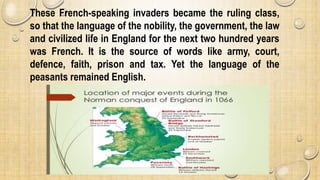
These French-speaking invaders became the ruling class,
so that the language of the nobility, the government, the law
and civilized life in England for the next two hundred years
was French. It is the source of words like army, court,
defence, faith, prison and tax. Yet the language of the
peasants remained English.
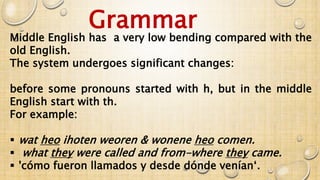
Middle English has a very low bending compared with the
old English.
The system undergoes significant changes:
before some pronouns started with h, but in the middle
English start with th.
For example:
 wat heo ihoten weoren & wonene heo comen.
 what they were called and from-where they came.
 'cómo fueron llamados y desde dónde venían‘.
Grammar
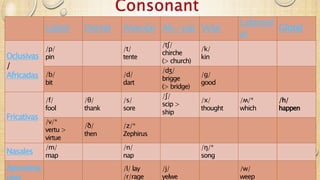
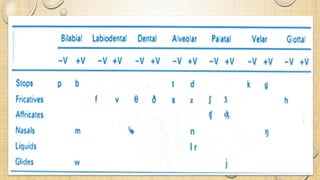
Labial Dental Alveolar Alv.-pal. Velar
Labiovel
ar
Glotal
Oclusivas
/
Africadas
/p/
pin
/t/
tente
/tʃ/
chirche
(> church)
/k/
kin
/b/
bit
/d/
dart
/dʒ/
brigge
(> bridge)
/ɡ/
good
Fricativas
/f/
fool
/θ/
thank
/s/
sore
/ʃ/
scip >
ship
/x/
thought
/ʍ/*
which
/h/
happen
/v/*
vertu >
virtue
/ð/
then
/z/*
Zephirus
Nasales
/m/
map
/n/
nap
/ŋ/*
song
Aproxima
ntes
/l/ lay
/r/rage
/j/
yelwe
/w/
weep
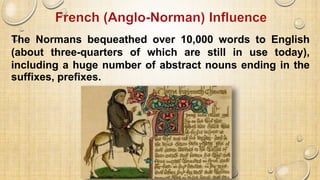
The Normans bequeathed over 10,000 words to English
(about three-quarters of which are still in use today),
including a huge number of abstract nouns ending in the
suffixes, prefixes.
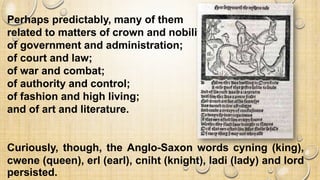
Perhaps predictably, many of them
related to matters of crown and nobility;
of government and administration;
of court and law;
of war and combat;
of authority and control;
of fashion and high living;
and of art and literature.
Curiously, though, the Anglo-Saxon words cyning (king),
cwene (queen), erl (earl), cniht (knight), ladi (lady) and lord
persisted.
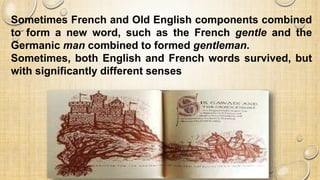
Sometimes French and Old English components combined
to form a new word, such as the French gentle and the
Germanic man combined to formed gentleman.
Sometimes, both English and French words survived, but
with significantly different senses
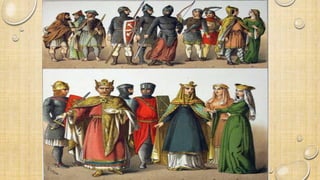
Their exposure to various culture enabled Normans to bring together
elements from different cultures and this reflected in their clothing as well.
Norman Men’s Clothing
Until the middle of the 10th century, Normans relied mainly on their
battlefield prowess to thrive since they had few other means of earning
sufficient subsistence. Consequently, Norman men dressed conservatively
and in a way which reflected their martial interests.
Norman Women’s Clothing
Exposure of Norman society to many different cultures was better reflected
in the dressing of Norman women. The typical dress of a Norman noble
woman included a chemise, a gown and a cloak. The chemise was the
primary layer of dress worn by the women and was unusually long in
length. On top of it, the women wore a gown which was loose in fitting and
was knee-length.
Finally, a cloak was worn on top of the gown. The gown’s neck-opening
usually carried elaborate embroidery while precious brooches were used to
clasp a cloak in place. Towards the late 11th and 12th centuries, cloaks
evolved to include bands used together with the brooches which ran
around the shoulders of the wearer, giving the cloak a tighter look.
Middle English
Middle English

Middle English

  • 2.
    The event thatmarks the end of the Old English period, and the beginning of the Middle English period, is the arrival of the Norman French in England, following their victory at Hastings under William the Conqueror in 1066. It was the last invasion in England but had an enormous influence in many aspects of British life: habits, language, society, literature, justice, etc.
  • 3.
    These French-speaking invadersbecame the ruling class, so that the language of the nobility, the government, the law and civilized life in England for the next two hundred years was French. It is the source of words like army, court, defence, faith, prison and tax. Yet the language of the peasants remained English.
  • 4.
    Middle English hasa very low bending compared with the old English. The system undergoes significant changes: before some pronouns started with h, but in the middle English start with th. For example:  wat heo ihoten weoren & wonene heo comen.  what they were called and from-where they came.  'cómo fueron llamados y desde dónde venían‘. Grammar
  • 5.
    Labial Dental AlveolarAlv.-pal. Velar Labiovel ar Glotal Oclusivas / Africadas /p/ pin /t/ tente /tʃ/ chirche (> church) /k/ kin /b/ bit /d/ dart /dʒ/ brigge (> bridge) /ɡ/ good Fricativas /f/ fool /θ/ thank /s/ sore /ʃ/ scip > ship /x/ thought /ʍ/* which /h/ happen /v/* vertu > virtue /ð/ then /z/* Zephirus Nasales /m/ map /n/ nap /ŋ/* song Aproxima ntes /l/ lay /r/rage /j/ yelwe /w/ weep
  • 15.
    The Normans bequeathedover 10,000 words to English (about three-quarters of which are still in use today), including a huge number of abstract nouns ending in the suffixes, prefixes.
  • 16.
    Perhaps predictably, manyof them related to matters of crown and nobility; of government and administration; of court and law; of war and combat; of authority and control; of fashion and high living; and of art and literature. Curiously, though, the Anglo-Saxon words cyning (king), cwene (queen), erl (earl), cniht (knight), ladi (lady) and lord persisted.
  • 17.
    Sometimes French andOld English components combined to form a new word, such as the French gentle and the Germanic man combined to formed gentleman. Sometimes, both English and French words survived, but with significantly different senses
  • 18.
    Their exposure tovarious culture enabled Normans to bring together elements from different cultures and this reflected in their clothing as well. Norman Men’s Clothing Until the middle of the 10th century, Normans relied mainly on their battlefield prowess to thrive since they had few other means of earning sufficient subsistence. Consequently, Norman men dressed conservatively and in a way which reflected their martial interests.
  • 19.
    Norman Women’s Clothing Exposureof Norman society to many different cultures was better reflected in the dressing of Norman women. The typical dress of a Norman noble woman included a chemise, a gown and a cloak. The chemise was the primary layer of dress worn by the women and was unusually long in length. On top of it, the women wore a gown which was loose in fitting and was knee-length. Finally, a cloak was worn on top of the gown. The gown’s neck-opening usually carried elaborate embroidery while precious brooches were used to clasp a cloak in place. Towards the late 11th and 12th centuries, cloaks evolved to include bands used together with the brooches which ran around the shoulders of the wearer, giving the cloak a tighter look.

Editor's Notes

  • #16 Suffixes: “-age”, “-ance/-ence”, “-ant/-ent”, “-ment”, “-ity” and “-tion” prefixes “con-”, “de-”, “ex-”, “trans-” and “pre-”.
  • #17 crown and nobility (e.g. crown, castle, prince, count,duke, viscount, baron, noble, sovereign, heraldry) government and administration (e.g. parliament, government, governor, city) of court and law (e.g. court, judge, justice, accuse, arrest, sentence, appeal, condemn, plaintiff, bailiff, jury, felony, verdict, traitor, contract, damage, prison) war and combat (e.g. army, armour, archer, battle, soldier, guard, courage, peace, enemy, destroy) authority and control (e.g. authority, obedience, servant, peasant, vassal, serf, labourer, charity); fashion and high living (e.g. mansion, money, gown, boot, beauty, mirror, jewel, appetite, banquet, herb, spice, sauce, roast, biscuit) art and literature (e.g. art, colour, language, literature, poet, chapter, question).
  • #18 (e.g. the Old English doom and French judgement, hearty and cordial, house and mansion, etc).