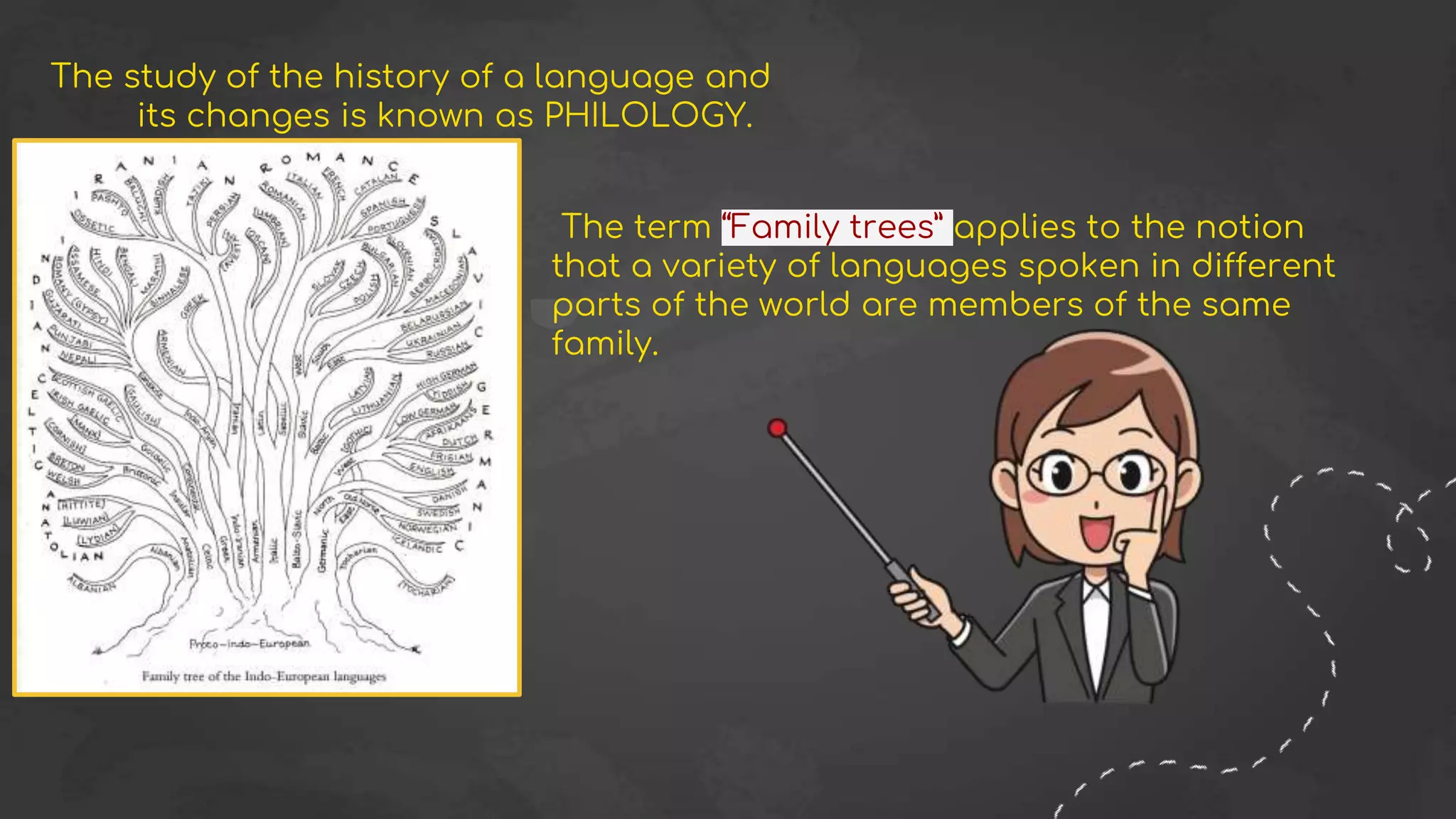
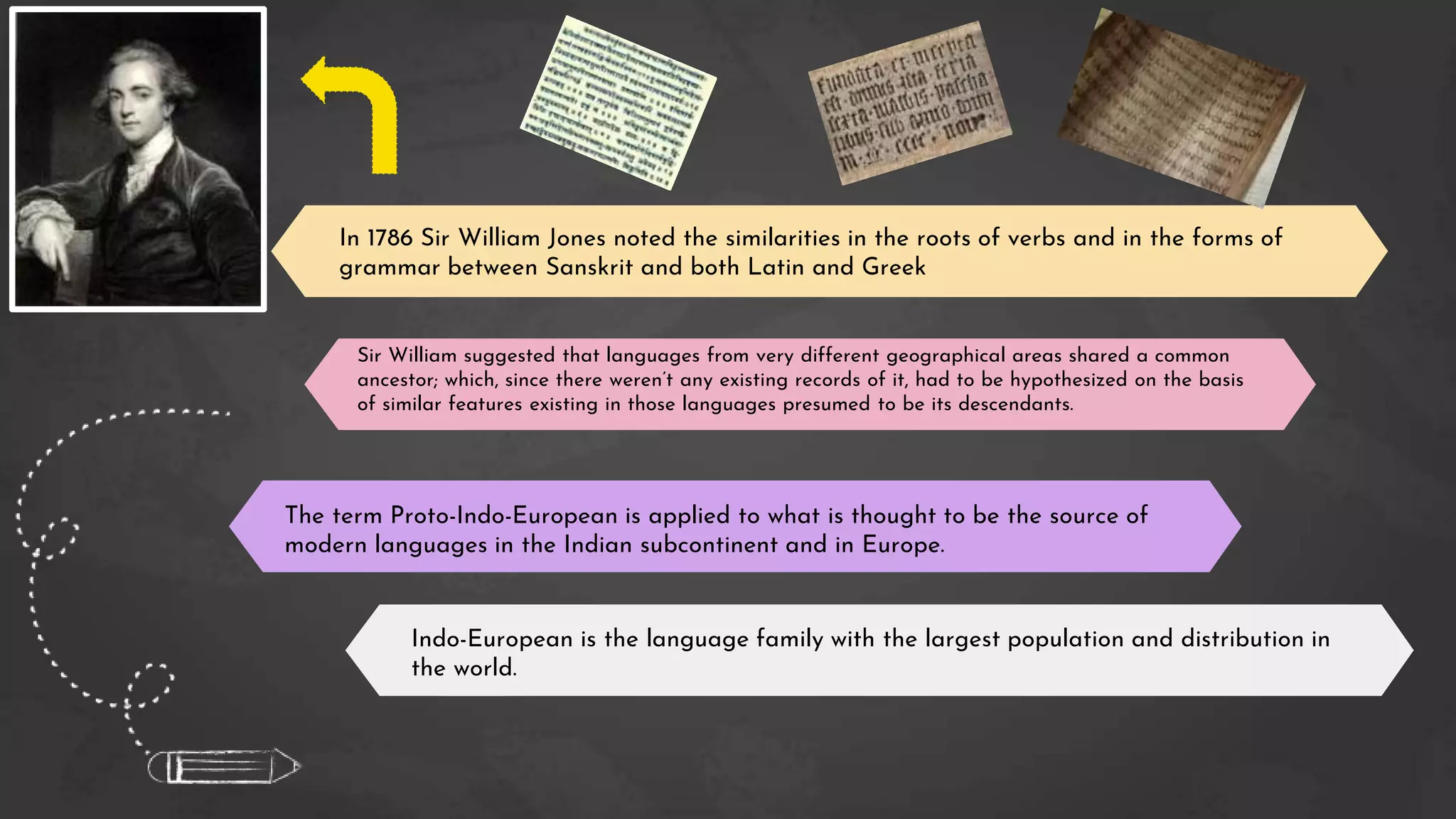
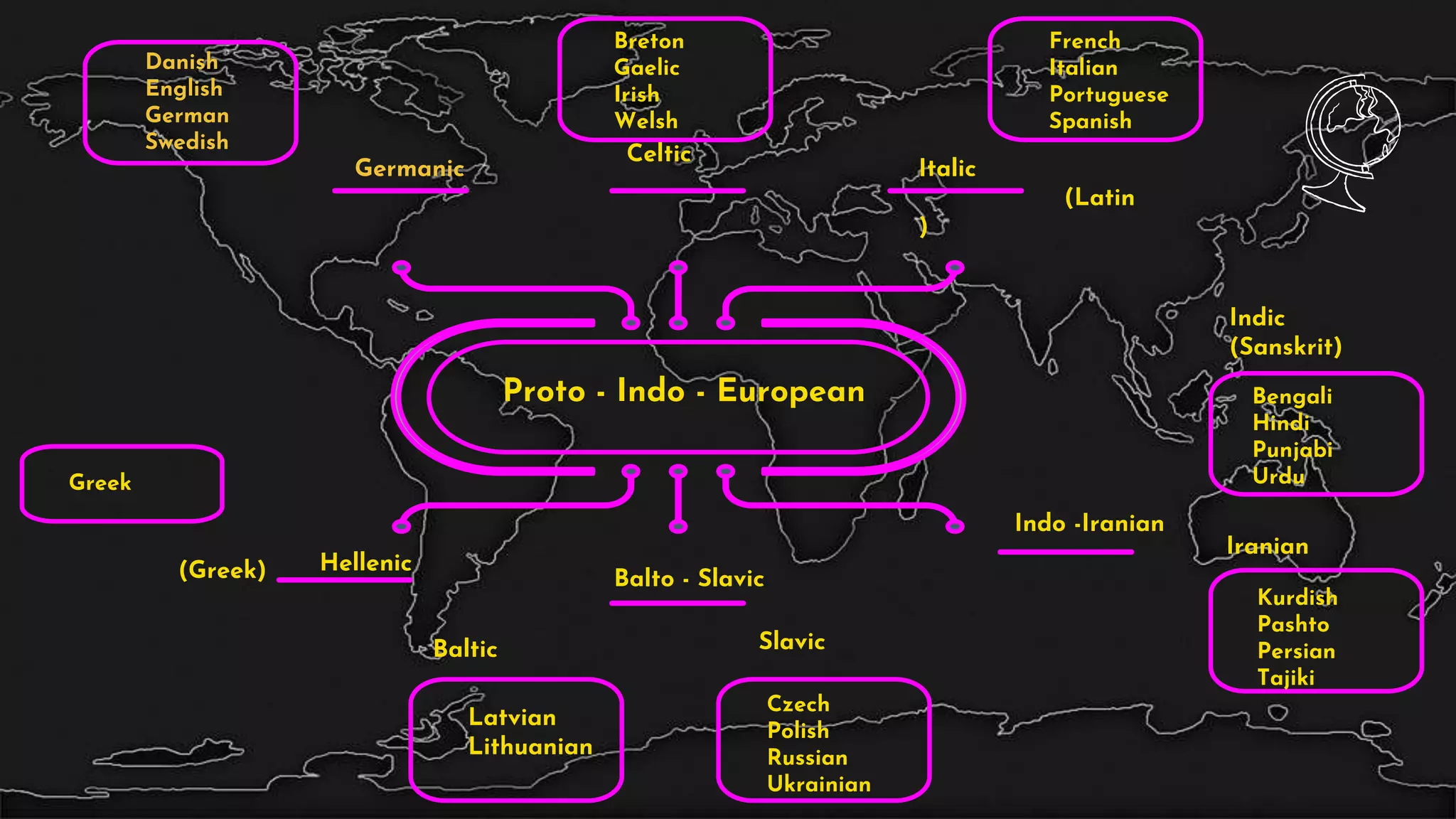
The document discusses the history and development of languages from a common ancestral tongue. It focuses on the Indo-European language family and how Sir William Jones first proposed in 1786 that Sanskrit, Latin, and Greek shared a common ancestor based on similarities in grammar and word roots. This common ancestor was termed Proto-Indo-European. Linguists have since reconstructed aspects of this proto-language by comparing cognates across related languages and applying principles like the majority principle and natural sound changes. The document also summarizes the development of English from Old English to Modern English and factors influencing language change like invasions and social upheaval.
![There are actually 6,912 languages in the world. Some are in danger of extinction while some are expanding.
Similarities, such as using the same writing or pronunciation, among languages of older generations are good evidence for
proposing Family Connections among modern languages .
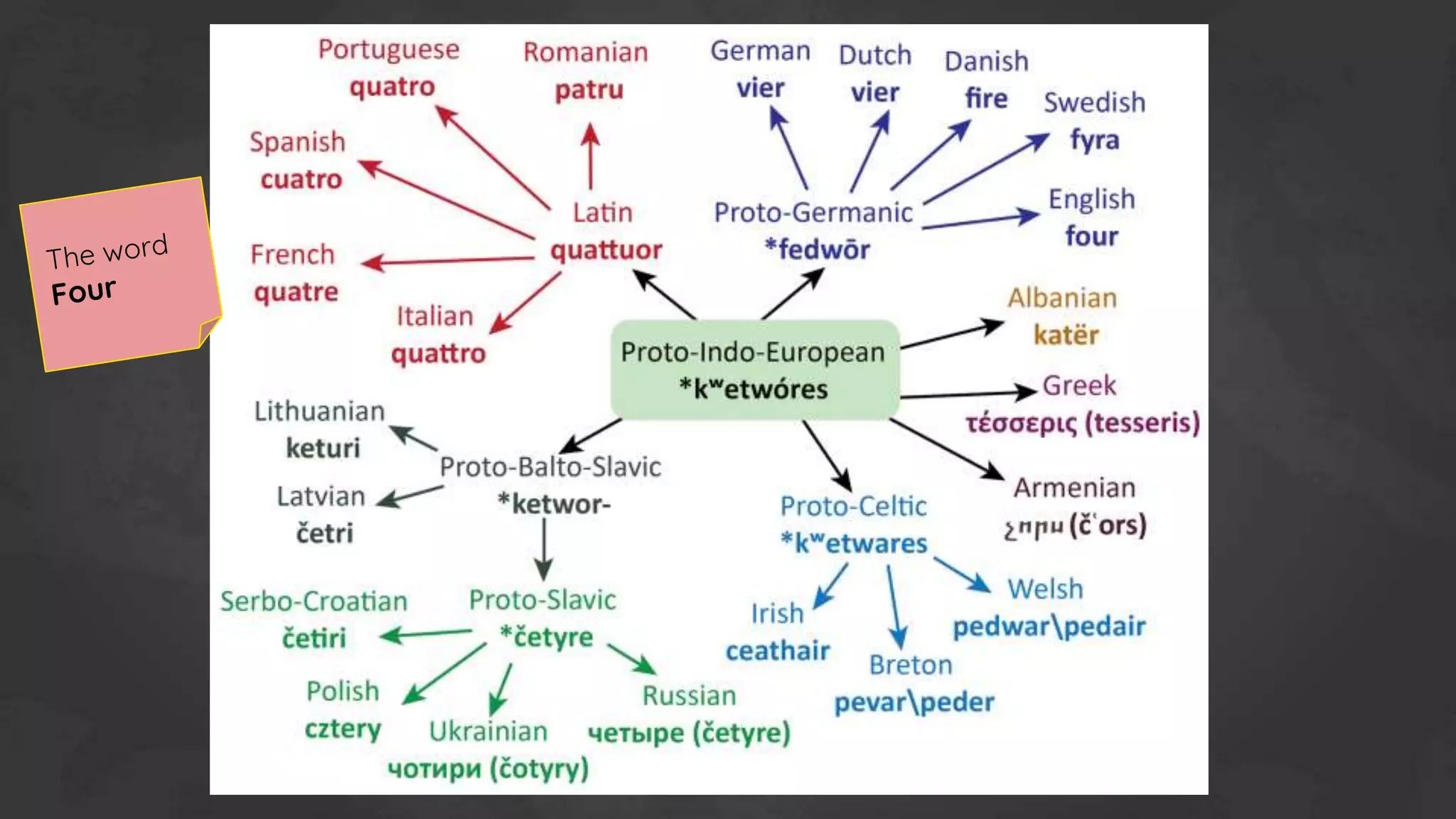
COGNATES Words from different languages that have a similar form and are or were used with a similar meaning
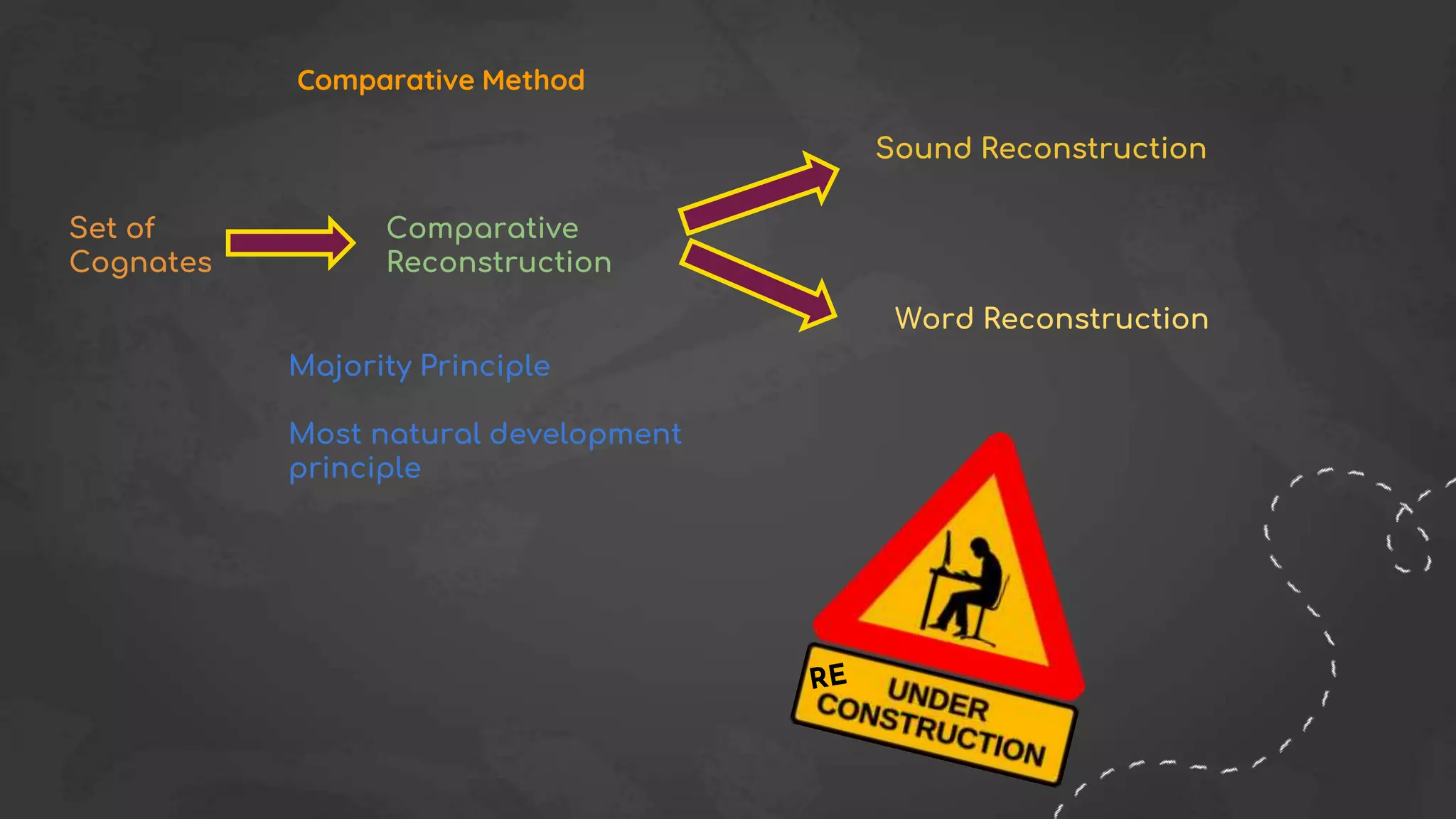
Comparative
Reconstructio
n
Aims to reconstruct what must have been the
original or “proto” from in the common
ancestral language.
This procedure operates on the basis of
GENERAL PRINCIPLES
The Majority Principle.
If, in a cognate set, three words begin with a [p]
sound and one word begins with a [b] sound,
then it is guessed that the majority have retained
the original sound [p]
The Most Natural Development
Principle.
This principle is based in the
fact that certain types of sound
change are very common
whereas others are extremely
unlikely.
(1)Final vowels often disappear
(2)voiceless sounds become voiced
(3)Stops become fricatives
(4)Consonants become voiceless at
the end of words](https://image.slidesharecdn.com/copyofsimpleblackboardbackgroundbyslidesgo-200914202457/75/Copy-of-simple-blackboard-background-by-slidesgo-7-2048.jpg)
![Sound
Reconstruction
Deciding what was the most likely
form of the initial sound in the original
source of different related languages
by comparing cognate words in those
languages.
A B C
cantare cantar chanter sing
catena cadena chaine chain
caro caro cher dear
cavallo caballo cheval horse
A and B begin with the [k] sound, a stop consonant.
According to the majority principle the initial sound [k] is closer
to the original sound.
According to the most natural development principle stop
sounds tendo to change into fricatives such as the [*] sound.
Again everything points to [K] as the original sound.
The reconstruction of proto-forms is an
attempt to determine what a language
must have been like before any written
records.
Word Reconstruction](https://image.slidesharecdn.com/copyofsimpleblackboardbackgroundbyslidesgo-200914202457/75/Copy-of-simple-blackboard-background-by-slidesgo-8-2048.jpg)
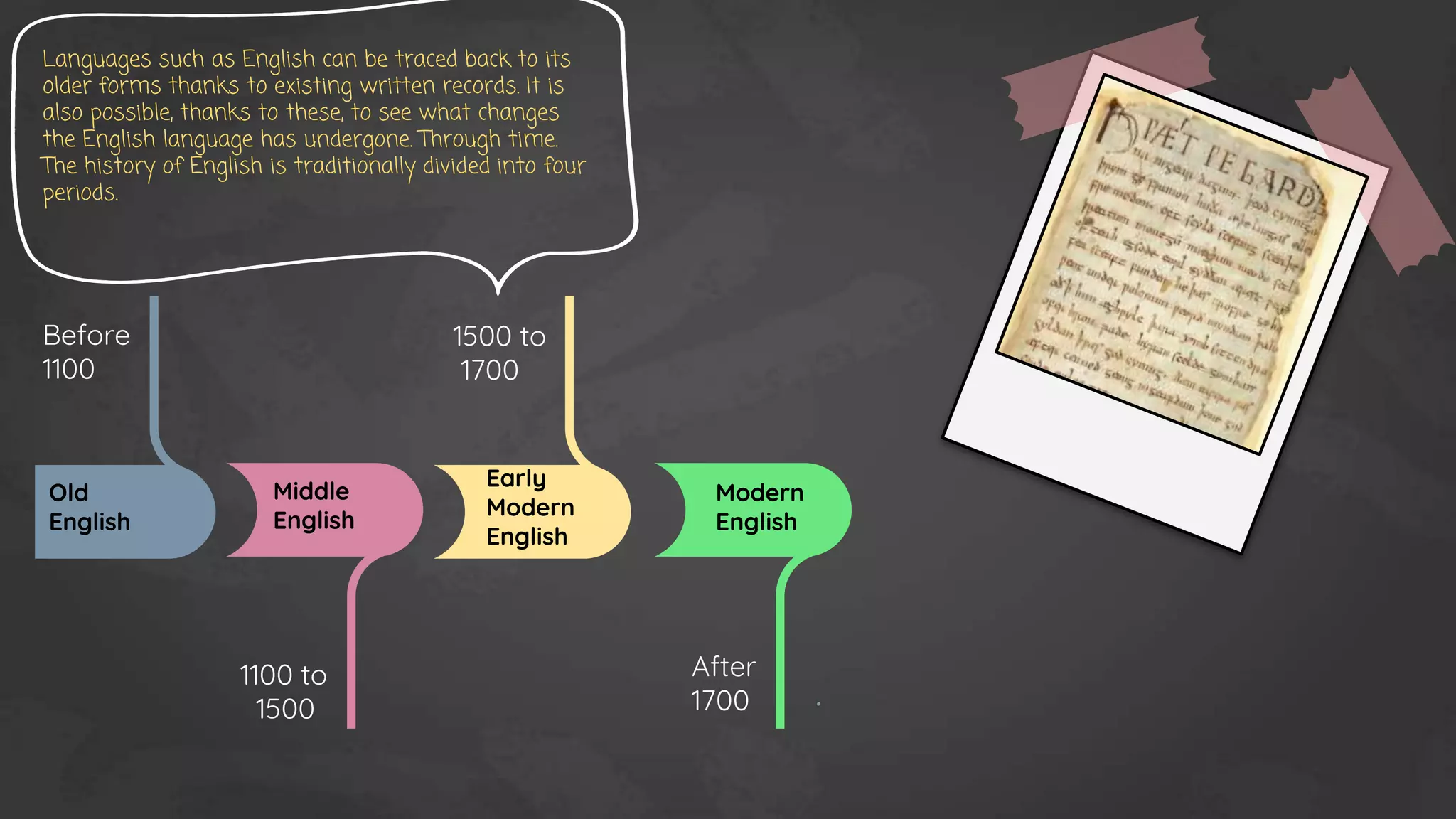
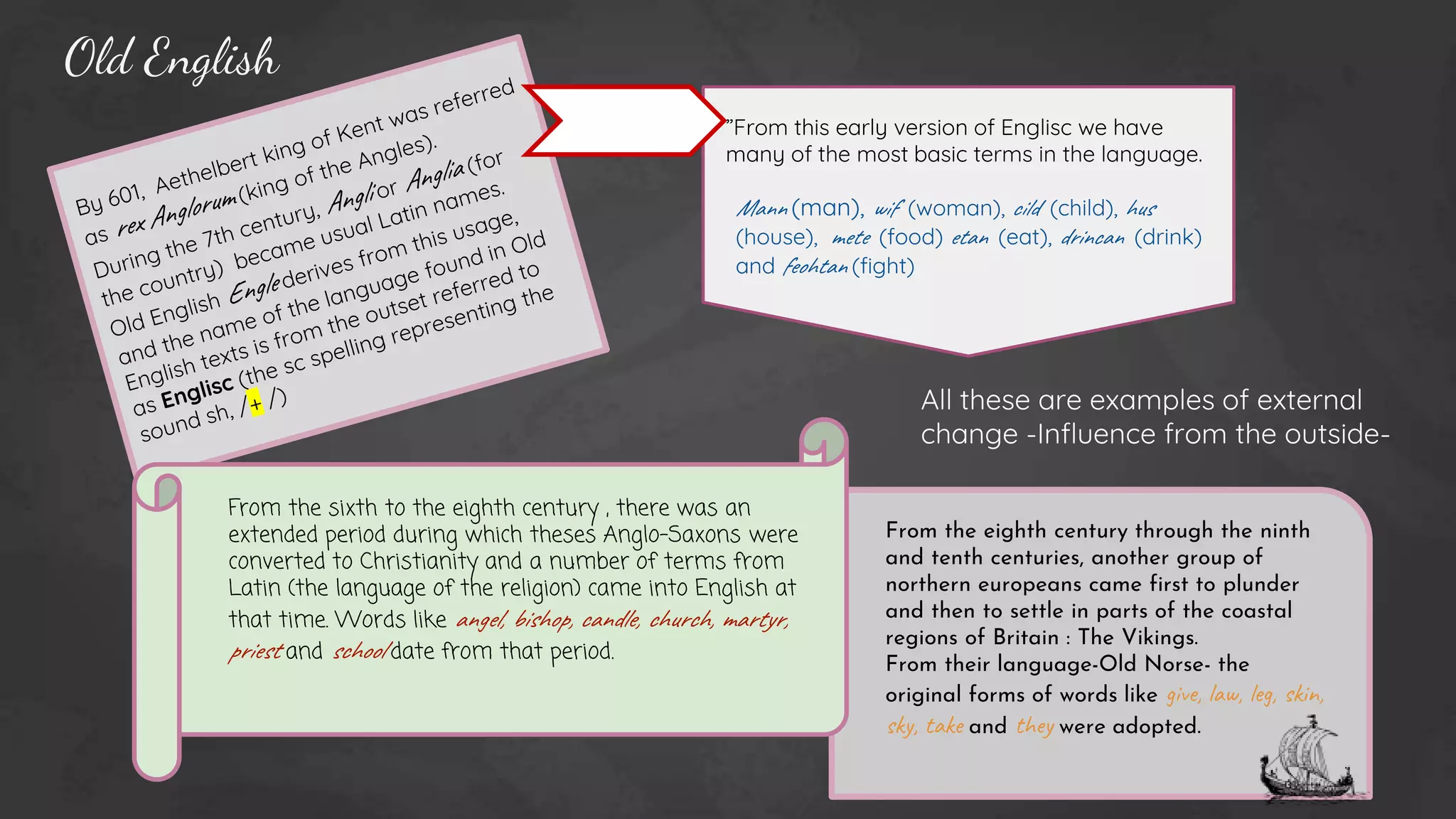
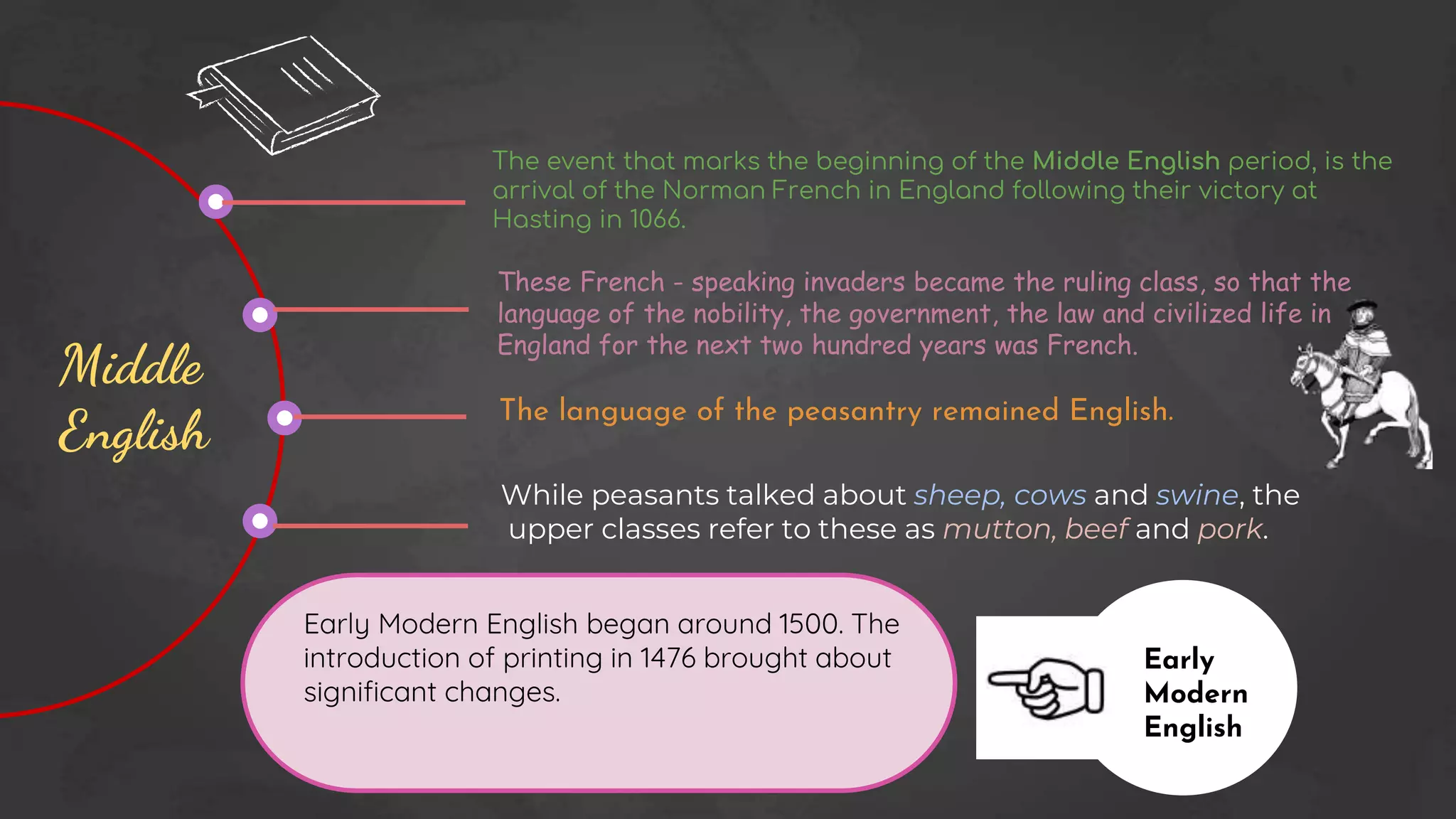
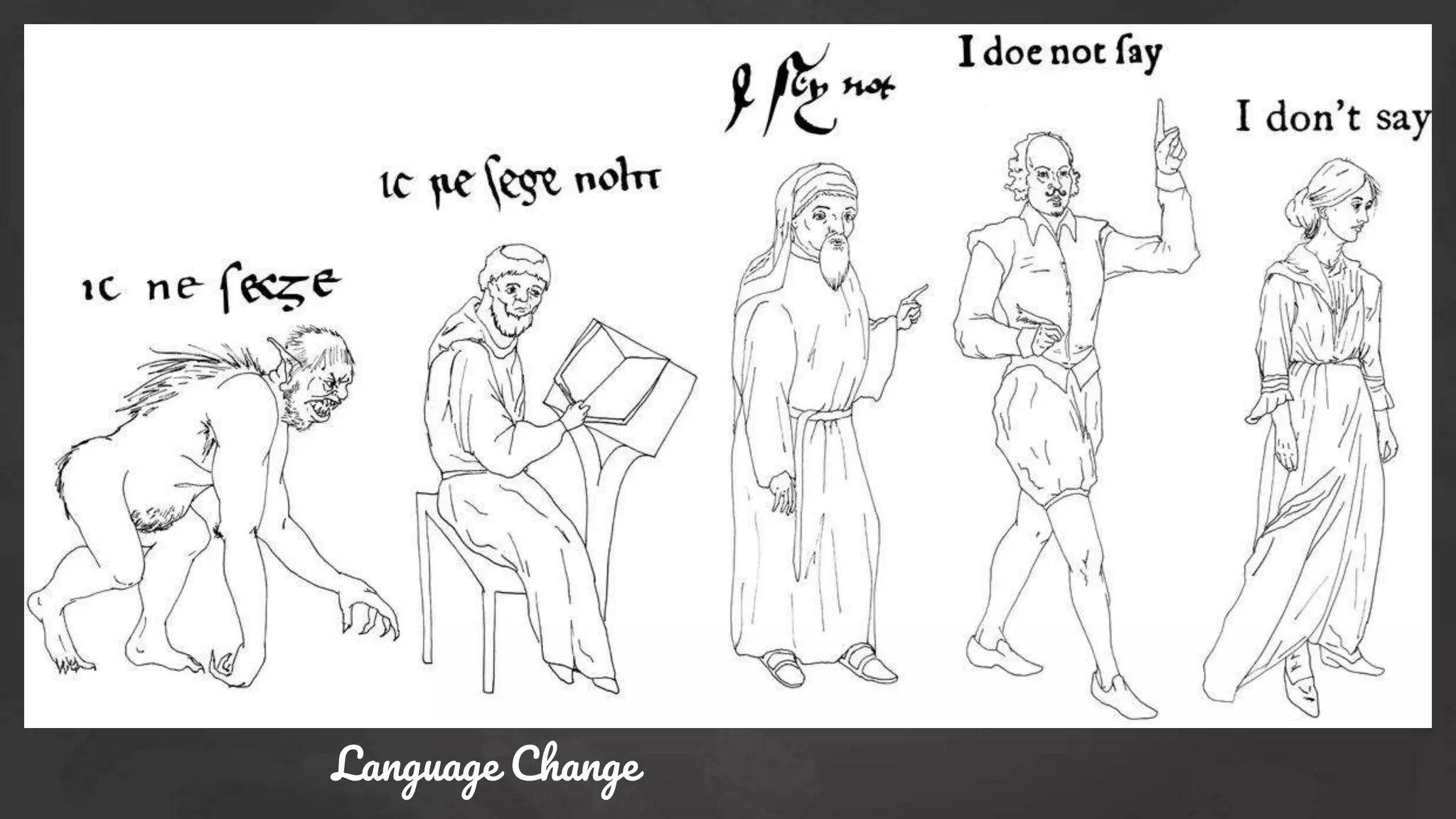
![Internal Change
Changes that occured within the historical development of English
( and other languages) that don’t seem to be caused by outside
factors. Diachronic variation.
SOUND CHANGES
Sound Loss Some words lost sounds, but kept the spelling,
resulting in the “silent letters” of contemporary written English.
Words with initial velar stops [k] & [g] are no longer
pronounced before nasals, yet are still present in the written
form. E.g: knee // gnaw
Metathesis It involves a reversal in position of two sounds in a
word. E.g: frist first
Epenthesis It involves the addition of a sound to the middle of
the word. E.g: spinel spindel
Prothesis It involves the addition of a sound to the beginning of
a word. It is a common feature in the evolution of some forms
from Latin to Spanish. E.g: schola escuela
SYNTACTIC CHANGES
Different word order
ferde he he traveled
Use of the negative
not gave (ne sealde) This is no longer grammatical
Double negative
You not gave never
Loss of inflectional suffixes
Sealde (he gave) sealdest ( you gave)
Inflectional suffixes that are no longer used
SEMANTIC CHANGES
Words that ceased to be used
Were (man)
Broadening
holy day holiday
Narrowing
hund (any dog) hound](https://image.slidesharecdn.com/copyofsimpleblackboardbackgroundbyslidesgo-200914202457/75/Copy-of-simple-blackboard-background-by-slidesgo-13-2048.jpg)