Historical Linguistics
Based on slides by Laura Grestenberger, Vienna
1
Intro
• Language change is the cause of the language variation we have talked about
• Languages change all the time
• Phonology
• Morphology
• Syntax
• (lexical) Semantics
• a common misconception: languages change because speakers are “too lazy” to
speak “correctly”
• language acquisition and language contact seem to be the relevant factors
2
Intro: language change
Attitudes toward language change is almost always overwhelmingly negative
Prescriptivism in ancient Rome: the Appendix Probi (3rd
/4th
century CE)
• contains a prescriptive list of word pronunciations:
• speculum non speclum “say speculum, not speclum” (Italian specchio “mirror”)
• calida non calda “say calida, not calda” (Italian caldo “hot”)
• auris non oricla “say auris, not oricla” (French oreille “ear”)
• … Latin was changing (eventually into the modern Romance languages), and
even back then, some people were unhappy about it.
3
Intro: language change
This seems to be universal across languages and culures:
"Even the discarded written words and expressions of the olden times were
better, and the everyday words of the present are becoming very poor. Of old
they said, 'Kuruma motage-yo' (Take up the carriage), and 'Hi kakage-yo' (Raise
the lamp wick) ; but now men say, 'Mote age-yo' (Pick it up) and 'Kaki age-yo'
(Poke it up)." -Yoshida Kenko, 1330 CE
4
Historical Linguistics
• The subfield of linguistics that studies language change
• Historical linguists study language variation at earlier stages of a given language
• Old English, Middle English
• Old French, Middle French
• … and reconstruct even earlier stages based on the actually attested evidence
(we’ll define what that means)
5
Literature
• Campbell, Lyle (1998), Historical Linguistics: An Introduction. 2nd
ed., Cambridge, Mass.:
MIT Press.
• Crowley, Terry and Claire Bowern (2010), An Introduction to Historical Linguistics. 4th
ed., Oxford University Press.
• Hale, Mark (2009), Historical Linguistics: Theory and Method. Wiley-Blackwell.
• Hock, Hans Henrich (1991), Principles of Historical Linguistics. 2nd
ed., Mouton de
Gruyter.
• Rindge, Don and Joseph F. Eska (2013), Historical Linguistics: Toward a Twenty-First
Century Reintegration. Cambridge University Press.
6
Literature
More advanced:
• Baxter, William H. and Laurent Sagart (2014), Old Chinese: A New Reconstruction. Oxford
University Press.
• Campbell, Lyle (2000), American Indian Languages: The Historical Linguistics of Native
America. Oxford University Press.
• Fortson, Benjamin W. IV (2009), Indo-European Language and Culture: An Introduction. 2nd
ed., Wiley-Blackwell.
(Intro to comparative Indo-European linguistics)
• Roberts, Ian (2007), Diachronic Syntax. Oxford University Press
(syntactic change in English & Romance languages)
7
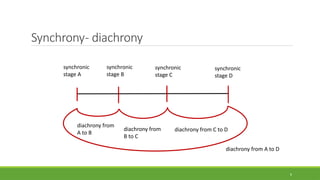
Synchrony- diachrony
• Synchronic linguistics studies the properties of speakers’ grammars at a given
linguistic stage X
• So far we’ve only looked at language synchronically
(Greek sún ‘with, together’ + khrónos ‘time’)
• Diachronic linguistics studies the changes in speakers’ grammars across time
(between stage X and stage Y)
(Greek diá ‘through, across’ + khrónos ‘time’)
• This distinction goes back to Ferdinand de Saussure.
8
Synchrony- diachrony
9
synchronic
stage B
synchronic
stage A
synchronic
stage C
synchronic
stage D
diachrony from
A to B
diachrony from
B to C
diachrony from C to D
diachrony from A to D
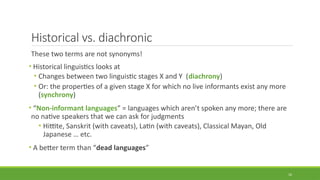
Historical vs. diachronic
These two terms are not synonyms!
• Historical linguistics looks at
• Changes between two linguistic stages X and Y (diachrony)
• Or: the properties of a given stage X for which no live informants exist any more
(synchrony)
• “Non-informant languages” = languages which aren’t spoken any more; there are
no native speakers that we can ask for judgments
• Hittite, Sanskrit (with caveats), Latin (with caveats), Classical Mayan, Old
Japanese … etc.
• A better term than “dead languages”
10
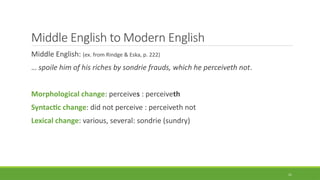
Middle English to Modern English
Middle English: (ex. from Rindge & Eska, p. 222)
… spoile him of his riches by sondrie frauds, which he perceiveth not.
Morphological change: perceives : perceiveth
Syntactic change: did not perceive : perceiveth not
Lexical change: various, several: sondrie (sundry)
11
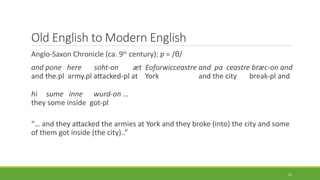
Old English to Modern English
Anglo-Saxon Chronicle (ca. 9th
century): ƿ = /θ/
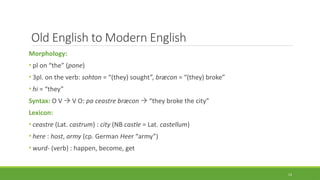
and ƿone here soht-on æt Eoforwicceastre and ƿa ceastre bræc-on and
and the.pl army.pl attacked-pl at York and the city break-pl and
hi sume inne wurd-on …
they some inside got-pl
“… and they attacked the armies at York and they broke (into) the city and some
of them got inside (the city)..”
12
Old English to Modern English
Morphology:
• pl on “the” (ƿone)
• 3pl. on the verb: sohton = “(they) sought”, bræcon = “(they) broke”
• hi = “they”
Syntax: O V  V O: ƿa ceastre bræcon  “they broke the city”
Lexicon:
• ceastre (Lat. castrum) : city (NB castle = Lat. castellum)
• here : host, army (cp. German Heer “army”)
• wurd- (verb) : happen, become, get
13
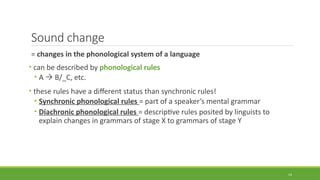
Sound change
= changes in the phonological system of a language
• can be described by phonological rules
• A  B/_C, etc.
• these rules have a different status than synchronic rules!
• Synchronic phonological rules = part of a speaker’s mental grammar
• Diachronic phonological rules = descriptive rules posited by linguists to
explain changes in grammars of stage X to grammars of stage Y
14
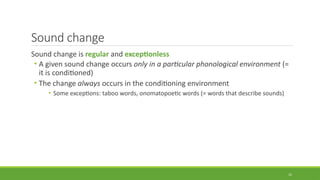
Sound change
Sound change is regular and exceptionless
• A given sound change occurs only in a particular phonological environment (=
it is conditioned)
• The change always occurs in the conditioning environment
• Some exceptions: taboo words, onomatopoetic words (= words that describe sounds)
15
Sound change
16
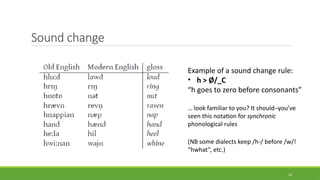
Example of a sound change rule:
• h > Ø/_C
“h goes to zero before consonants”
… look familiar to you? It should─you’ve
seen this notation for synchronic
phonological rules
(NB some dialects keep /h-/ before /w/!
“hwhat”, etc.)
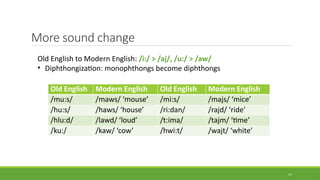
More sound change
Old English Modern English Old English Modern English
/mu:s/ /maws/ ‘mouse’ /mi:s/ /majs/ ‘mice’
/hu:s/ /haws/ ‘house’ /ri:dan/ /rajd/ ‘ride’
/hlu:d/ /lawd/ ‘loud’ /t:ima/ /tajm/ ‘time’
/ku:/ /kaw/ ‘cow’ /hwi:t/ /wajt/ ‘white’
17
Old English to Modern English: /i:/ > /aj/, /u:/ > /aw/
• Diphthongization: monophthongs become diphthongs
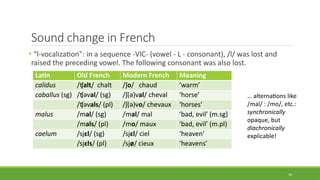
Sound change in French
• “l-vocalization”: in a sequence -VlC- (vowel - L - consonant), /l/ was lost and
raised the preceding vowel. The following consonant was also lost.
18
Latin Old French Modern French Meaning
calidus /ʧalt/ chalt /ʃo/ chaud ‘warm’
caballus (sg) /ʧəval/ (sg) /ʃ(ə)val/ cheval ‘horse’
/ʧəvals/ (pl) /ʃ(ə)vo/ chevaux ‘horses’
malus /mal/ (sg) /mal/ mal ‘bad, evil’ (m.sg)
/mals/ (pl) /mo/ maux ‘bad, evil’ (m.pl)
caelum /sjɛl/ (sg) /sjɛl/ ciel ‘heaven’
/sjɛls/ (pl) /sjø/ cieux ‘heavens’
… alternations like
/mal/ : /mo/, etc.:
synchronically
opaque, but
diachronically
explicable!
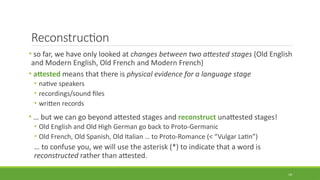
Reconstruction
• so far, we have only looked at changes between two attested stages (Old English
and Modern English, Old French and Modern French)
• attested means that there is physical evidence for a language stage
• native speakers
• recordings/sound files
• written records
• … but we can go beyond attested stages and reconstruct unattested stages!
• Old English and Old High German go back to Proto-Germanic
• Old French, Old Spanish, Old Italian … to Proto-Romance (< “Vulgar Latin”)
… to confuse you, we will use the asterisk (*) to indicate that a word is
reconstructed rather than attested.
19
Reconstruction
… it probably won’t come as a shock that English and German are related, and
French and Italian.
What about:
• Hindi and English
• Armenian and Swedish
• Russian and Welsh
20
The comparative method
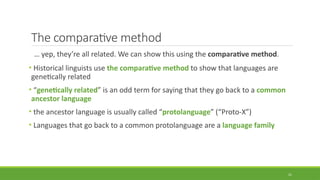
… yep, they’re all related. We can show this using the comparative method.
• Historical linguists use the comparative method to show that languages are
genetically related
• “genetically related” is an odd term for saying that they go back to a common
ancestor language
• the ancestor language is usually called “protolanguage” (“Proto-X”)
• Languages that go back to a common protolanguage are a language family
21
The comparative method
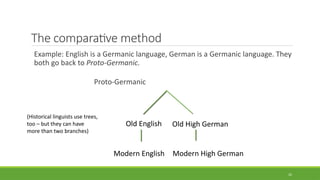
Example: English is a Germanic language, German is a Germanic language. They
both go back to Proto-Germanic.
Proto-Germanic
22
Old English Old High German
Modern English Modern High German
(Historical linguists use trees,
too – but they can have
more than two branches)
The comparative method
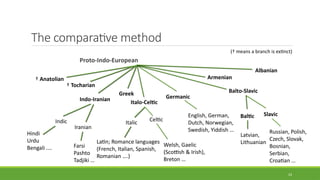
23
Proto-Indo-European
† Anatolian
† Tocharian
Indo-Iranian
Greek
Italo-Celtic
Balto-Slavic
Germanic
Armenian
Albanian
Indic
Iranian
Hindi
Urdu
Bengali .... Farsi
Pashto
Tadjiki …
Italic
Celtic
Latin; Romance languages
(French, Italian, Spanish,
Romanian ….)
English, German,
Dutch, Norwegian,
Swedish, Yiddish …
Baltic Slavic
Russian, Polish,
Czech, Slovak,
Bosnian,
Serbian,
Croatian …
Latvian,
Lithuanian
Welsh, Gaelic
(Scottish & Irish),
Breton …
(† means a branch is extinct)
The comparative method
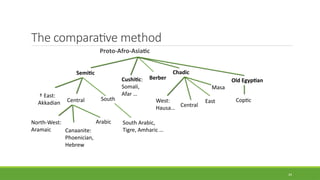
Proto-Afro-Asiatic
24
Semitic
Cushitic:
Somali,
Afar …
Berber
Chadic
Old Egyptian
† East:
Akkadian Central South
North-West:
Aramaic Canaanite:
Phoenician,
Hebrew
Arabic South Arabic,
Tigre, Amharic …
West:
Hausa… Central
East Coptic
Masa
The comparative method
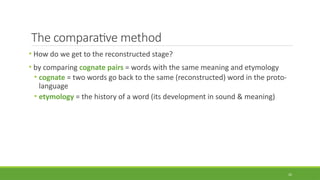
• How do we get to the reconstructed stage?
• by comparing cognate pairs = words with the same meaning and etymology
• cognate = two words go back to the same (reconstructed) word in the proto-
language
• etymology = the history of a word (its development in sound & meaning)
25
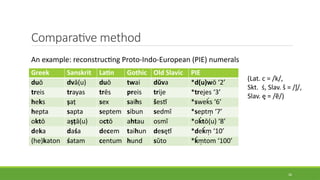
Comparative method
Greek Sanskrit Latin Gothic Old Slavic PIE
duō dvā(u) duō twai dŭva *d(u)wō ‘2’
treis trayas trēs ƿreis trije *trejes ‘3’
heks ṣaṭ sex saihs šestĭ *sweḱs ‘6’
hepta sapta septem sibun sedmĭ *septm̩ ‘7’
oktō aṣṭā(u) octō ahtau osmĭ *oḱtō(u) ‘8’
deka daśa decem taihun desętĭ *deḱm̩ ‘10’
(he)katon śatam centum hund sŭto *ḱm̩ tom ‘100’
26
An example: reconstructing Proto-Indo-European (PIE) numerals
(Lat. c = /k/,
Skt. ś, Slav. š = /ʃ/,
Slav. ę = /ẽ/)
Reconstruction
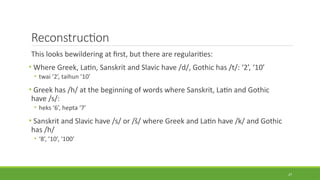
This looks bewildering at first, but there are regularities:
• Where Greek, Latin, Sanskrit and Slavic have /d/, Gothic has /t/: ‘2’, ‘10’
• twai ‘2’, taihun ’10’
• Greek has /h/ at the beginning of words where Sanskrit, Latin and Gothic
have /s/:
• heks ‘6’, hepta ‘7’
• Sanskrit and Slavic have /s/ or /š/ where Greek and Latin have /k/ and Gothic
has /h/
• ‘8’, ’10’, ‘100’
27
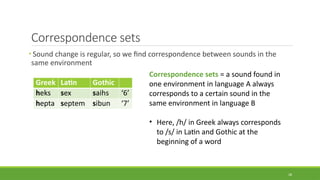
Correspondence sets
• Sound change is regular, so we find correspondence between sounds in the
same environment
28
Greek Latin Gothic
heks sex saihs ‘6’
hepta septem sibun ‘7’
Correspondence sets = a sound found in
one environment in language A always
corresponds to a certain sound in the
same environment in language B
• Here, /h/ in Greek always corresponds
to /s/ in Latin and Gothic at the
beginning of a word
Reconstruction
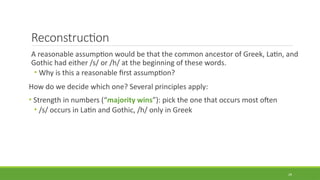
A reasonable assumption would be that the common ancestor of Greek, Latin, and
Gothic had either /s/ or /h/ at the beginning of these words.
• Why is this a reasonable first assumption?
How do we decide which one? Several principles apply:
• Strength in numbers (“majority wins”): pick the one that occurs most often
• /s/ occurs in Latin and Gothic, /h/ only in Greek
29
Reconstruction
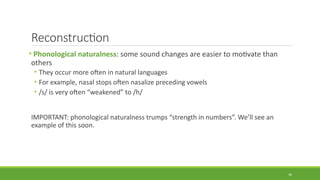
• Phonological naturalness: some sound changes are easier to motivate than
others
• They occur more often in natural languages
• For example, nasal stops often nasalize preceding vowels
• /s/ is very often “weakened” to /h/
IMPORTANT: phonological naturalness trumps “strength in numbers”. We’ll see an
example of this soon.
30
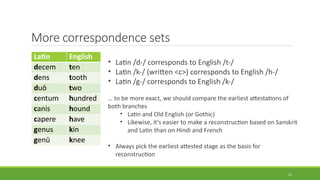
More correspondence sets
Latin English
decem ten
dens tooth
duō two
centum hundred
canis hound
capere have
genus kin
genū knee
31
• Latin /d-/ corresponds to English /t-/
• Latin /k-/ (written <c>) corresponds to English /h-/
• Latin /g-/ corresponds to English /k-/
… to be more exact, we should compare the earliest attestations of
both branches
• Latin and Old English (or Gothic)
• Likewise, it’s easier to make a reconstruction based on Sanskrit
and Latin than on Hindi and French
• Always pick the earliest attested stage as the basis for
reconstruction
Reconstructing Proto-Polynesian
32
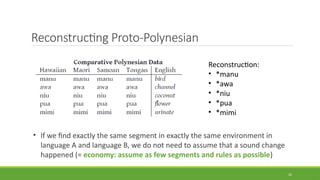
Reconstruction:
• *manu
• *awa
• *niu
• *pua
• *mimi
• If we find exactly the same segment in exactly the same environment in
language A and language B, we do not need to assume that a sound change
happened (= economy: assume as few segments and rules as possible)
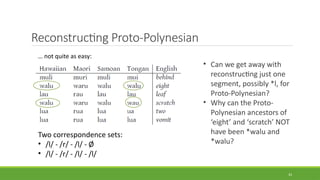
Reconstructing Proto-Polynesian
33
… not quite as easy:
Two correspondence sets:
• /l/ - /r/ - /l/ - Ø
• /l/ - /r/ - /l/ - /l/
• Can we get away with
reconstructing just one
segment, possibly *l, for
Proto-Polynesian?
• Why can the Proto-
Polynesian ancestors of
‘eight’ and ‘scratch’ NOT
have been *walu and
*walu?
Reconstructing Proto-Polynesian
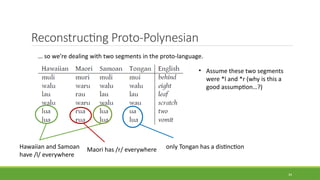
34
… so we’re dealing with two segments in the proto-language.
• Assume these two segments
were *l and *r (why is this a
good assumption…?)
Hawaiian and Samoan
have /l/ everywhere
Maori has /r/ everywhere only Tongan has a distinction
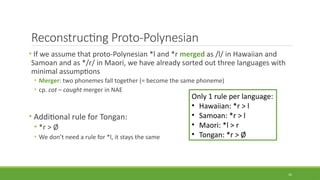
Reconstructing Proto-Polynesian
• If we assume that proto-Polynesian *l and *r merged as /l/ in Hawaiian and
Samoan and as */r/ in Maori, we have already sorted out three languages with
minimal assumptions
• Merger: two phonemes fall together (= become the same phoneme)
• cp. cot – caught merger in NAE
• Additional rule for Tongan:
• *r > Ø
• We don’t need a rule for *l, it stays the same
35
Only 1 rule per language:
• Hawaiian: *r > l
• Samoan: *r > l
• Maori: *l > r
• Tongan: *r > Ø
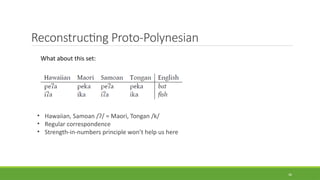
Reconstructing Proto-Polynesian
36
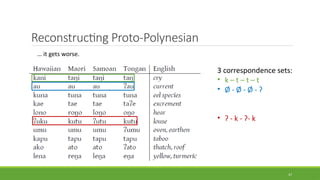
What about this set:
• Hawaiian, Samoan /ʔ/ = Maori, Tongan /k/
• Regular correspondence
• Strength-in-numbers principle won’t help us here
Reconstructing Proto-Polynesian
37
3 correspondence sets:
• k – t – t – t
• Ø - Ø - Ø - ʔ
• ʔ - k - ʔ- k
… it gets worse.
Reconstructing Proto-Polynesian
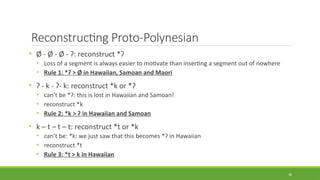
• Ø - Ø - Ø - ʔ: reconstruct *ʔ
• Loss of a segment is always easier to motivate than inserting a segment out of nowhere
• Rule 1: *ʔ > Ø in Hawaiian, Samoan and Maori
• ʔ - k - ʔ- k: reconstruct *k or *ʔ
• can’t be *ʔ: this is lost in Hawaiian and Samoan!
• reconstruct *k
• Rule 2: *k > ʔ in Hawaiian and Samoan
• k – t – t – t: reconstruct *t or *k
• can’t be: *k: we just saw that this becomes *ʔ in Hawaiian
• reconstruct *t
• Rule 3: *t > k in Hawaiian
38
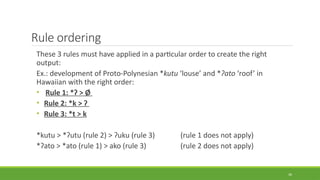
Rule ordering
These 3 rules must have applied in a particular order to create the right
output:
Ex.: development of Proto-Polynesian *kutu ‘louse’ and *ʔato ‘roof’ in
Hawaiian with the right order:
• Rule 1: *ʔ > Ø
• Rule 2: *k > ʔ
• Rule 3: *t > k
*kutu > *ʔutu (rule 2) > ʔuku (rule 3) (rule 1 does not apply)
*ʔato > *ato (rule 1) > ako (rule 3) (rule 2 does not apply)
39
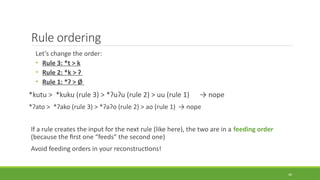
Rule ordering
Let’s change the order:
• Rule 3: *t > k
• Rule 2: *k > ʔ
• Rule 1: *ʔ > Ø
*kutu > *kuku (rule 3) > *ʔuʔu (rule 2) > uu (rule 1) → nope
*ʔato > *ʔako (rule 3) > *ʔaʔo (rule 2) > ao (rule 1) → nope
If a rule creates the input for the next rule (like here), the two are in a feeding order
(because the first one “feeds” the second one)
Avoid feeding orders in your reconstructions!
40
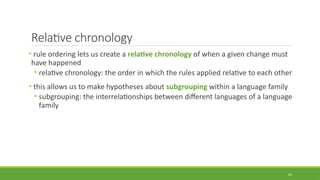
Relative chronology
• rule ordering lets us create a relative chronology of when a given change must
have happened
• relative chronology: the order in which the rules applied relative to each other
• this allows us to make hypotheses about subgrouping within a language family
• subgrouping: the interrelationships between different languages of a language
family
41
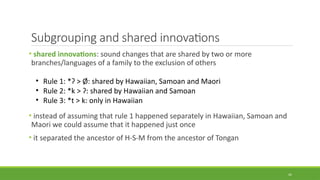
Subgrouping and shared innovations
• shared innovations: sound changes that are shared by two or more
branches/languages of a family to the exclusion of others
• instead of assuming that rule 1 happened separately in Hawaiian, Samoan and
Maori we could assume that it happened just once
• it separated the ancestor of H-S-M from the ancestor of Tongan
42
• Rule 1: *ʔ > Ø: shared by Hawaiian, Samoan and Maori
• Rule 2: *k > ʔ: shared by Hawaiian and Samoan
• Rule 3: *t > k: only in Hawaiian
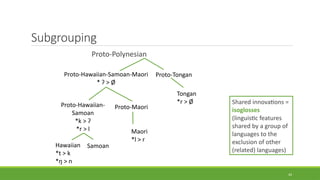
Subgrouping
Proto-Polynesian
43
Proto-Hawaiian-Samoan-Maori
* ʔ > Ø
Proto-Tongan
Proto-Hawaiian-
Samoan
*k > ʔ
*r > l
Proto-Maori
Tongan
*r > Ø
Maori
*l > r
Hawaiian
*t > k
*ŋ > n
Samoan
Shared innovations =
isoglosses
(linguistic features
shared by a group of
languages to the
exclusion of other
(related) languages)
Subgrouping and reconstruction
• subgrouping depends on phonological and morphological isoglosses (less on
syntax and the lexicon)
• Ex. Armenian: many loanwords from Persian and other Iranian languages
• English: Germanic language, but lots of loanwords from Latin and French
• the comparative method allows us to arrive at very detailed reconstructions of
proto-languages
44
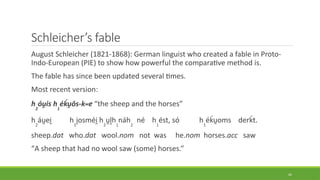
Schleicher’s fable
August Schleicher (1821-1868): German linguist who created a fable in Proto-
Indo-European (PIE) to show how powerful the comparative method is.
The fable has since been updated several times.
Most recent version:
h2
óu̯is h1
éḱu̯ōs-kwe “the sheep and the horses”
h2
áu̯ei̯ h1
i̯osméi̯h2
u̯l̥h1
náh2
né h1
ést, só h1
éḱu̯oms derḱt.
sheep.dat who.dat wool.nom not was he.nom horses.acc saw
“A sheep that had no wool saw (some) horses.”
45
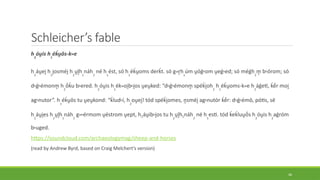
Schleicher’s fable
h2
óu̯is h1
éḱu̯ōs-kwe
h2
áu̯ei̯h1
i̯osméi̯h2
u̯l̥h1
náh2
né h1
ést, só h1
éḱu̯oms derḱt. só gwr̥hx
úm u̯óǵhom u̯eǵhed; só méǵh2
m̥ bhórom; só
dhǵhémonm̥ h2
ṓḱu bhered. h2
óu̯is h1
ékwoi̯bhi̯os u̯eu̯ked: “dhǵhémonm̥ spéḱi̯oh2
h1
éḱu̯oms-kwe h2
áǵeti, ḱḗr moi̯
aghnutor”. h
1
éḱu̯ōs tu u̯eu̯kond: “ḱludhí, h
2
ou̯ei̯! tód spéḱi̯omes, n̥sméi̯aghnutór ḱḗr: dhǵhémō, pótis, sē
h2
áu̯i̯es h2
u̯l̥h1
náh2
gwhérmom u̯éstrom u̯ept, h2áu̯ibhi̯os tu h2
u̯l̥h1náh2
né h1
esti. tód ḱeḱluu̯ṓs h2
óu̯is h2
aǵróm
bhuged.
https://soundcloud.com/archaeologymag/sheep-and-horses
(read by Andrew Byrd, based on Craig Melchert’s version)
46
Schleicher’s fable
This version is not that good … but it’s recited by Michael Fassbender. So.
From Prometheus (2012)
https://www.youtube.com/watch?v=ZTOcA_y1R_U
47
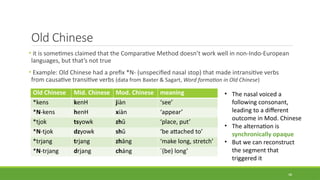
Old Chinese
• it is sometimes claimed that the Comparative Method doesn’t work well in non-Indo-European
languages, but that’s not true
• Example: Old Chinese had a prefix *N- (unspecified nasal stop) that made intransitive verbs
from causative transitive verbs (data from Baxter & Sagart, Word formation in Old Chinese)
48
Old Chinese Mid. Chinese Mod. Chinese meaning
*kens kenH jiàn ‘see’
*N-kens henH xiàn ‘appear’
*tjok tsyowk zhǔ ‘place, put’
*N-tjok dzyowk shǔ ‘be attached to’
*trjang trjang zhāng ‘make long, stretch’
*N-trjang drjang cháng `(be) long’
• The nasal voiced a
following consonant,
leading to a different
outcome in Mod. Chinese
• The alternation is
synchronically opaque
• But we can reconstruct
the segment that
triggered it
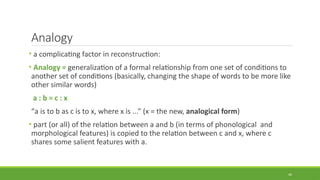
Analogy
• a complicating factor in reconstruction:
• Analogy = generalization of a formal relationship from one set of conditions to
another set of conditions (basically, changing the shape of words to be more like
other similar words)
a : b = c : x
“a is to b as c is to x, where x is ...” (x = the new, analogical form)
• part (or all) of the relation between a and b (in terms of phonological and
morphological features) is copied to the relation between c and x, where c
shares some salient features with a.
49
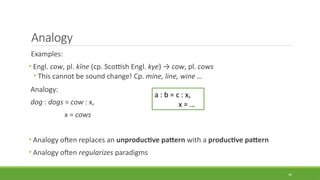
Analogy
Examples:
• Engl. cow, pl. kīne (cp. Scottish Engl. kye) → cow, pl. cows
• This cannot be sound change! Cp. mine, line, wine …
Analogy:
dog : dogs = cow : x,
x = cows
• Analogy often replaces an unproductive pattern with a productive pattern
• Analogy often regularizes paradigms
50
a : b = c : x,
x = …
Analogy
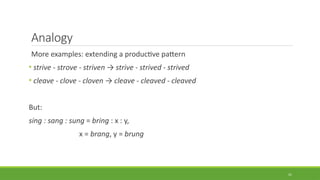
More examples: extending a productive pattern
• strive - strove - striven → strive - strived - strived
• cleave - clove - cloven → cleave - cleaved - cleaved
But:
sing : sang : sung = bring : x : y,
x = brang, y = brung
51
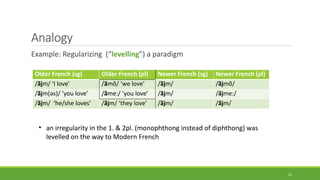
Analogy
Example: Regularizing (“levelling”) a paradigm
52
Older French (sg) Older French (pl) Newer French (sg) Newer French (pl)
/ãjm/ ‘I love’ /ãmõ/ ‘we love’ /ãjm/ /ãjmõ/
/ãjm(ǝs)/ ‘you love’ /ãme:/ ‘you love’ /ãjm/ /ãjme:/
/ãjm/ ‘he/she loves’ /ãjm/ ‘they love’ /ãjm/ /ãjm/
• an irregularity in the 1. & 2pl. (monophthong instead of diphthong) was
levelled on the way to Modern French
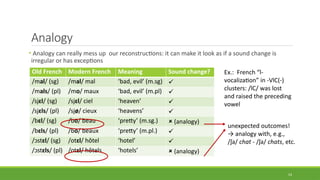
Analogy
• Analogy can really mess up our reconstructions: it can make it look as if a sound change is
irregular or has exceptions
53
Old French Modern French Meaning Sound change?
/mal/ (sg) /mal/ mal ‘bad, evil’ (m.sg) 
/mals/ (pl) /mo/ maux ‘bad, evil’ (m.pl) 
/sjɛl/ (sg) /sjɛl/ ciel ‘heaven’ 
/sjɛls/ (pl) /sjø/ cieux ‘heavens’ 
/bɛl/ (sg) /bo/ beau ‘pretty’ (m.sg.)  (analogy)
/bɛls/ (pl) /bo/ beaux ‘pretty’ (m.pl.) 
/ɔstɛl/ (sg) /otɛl/ hôtel ‘hotel’ 
/ɔstɛls/ (pl) /otɛl/ hôtels ‘hotels’  (analogy)
Ex.: French “l-
vocalization” in -VlC(-)
clusters: /lC/ was lost
and raised the preceding
vowel
unexpected outcomes!
→ analogy with, e.g.,
/ʃa/ chat - /ʃa/ chats, etc.
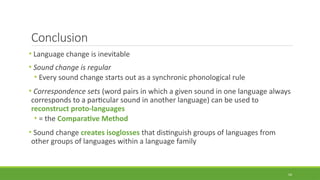
Conclusion
• Language change is inevitable
• Sound change is regular
• Every sound change starts out as a synchronic phonological rule
• Correspondence sets (word pairs in which a given sound in one language always
corresponds to a particular sound in another language) can be used to
reconstruct proto-languages
• = the Comparative Method
• Sound change creates isoglosses that distinguish groups of languages from
other groups of languages within a language family
54

presentation Historical Linguistics 2021.pdf

  • 1.
    Historical Linguistics Based onslides by Laura Grestenberger, Vienna 1
  • 2.
    Intro • Language changeis the cause of the language variation we have talked about • Languages change all the time • Phonology • Morphology • Syntax • (lexical) Semantics • a common misconception: languages change because speakers are “too lazy” to speak “correctly” • language acquisition and language contact seem to be the relevant factors 2
  • 3.
    Intro: language change Attitudestoward language change is almost always overwhelmingly negative Prescriptivism in ancient Rome: the Appendix Probi (3rd /4th century CE) • contains a prescriptive list of word pronunciations: • speculum non speclum “say speculum, not speclum” (Italian specchio “mirror”) • calida non calda “say calida, not calda” (Italian caldo “hot”) • auris non oricla “say auris, not oricla” (French oreille “ear”) • … Latin was changing (eventually into the modern Romance languages), and even back then, some people were unhappy about it. 3
  • 4.
    Intro: language change Thisseems to be universal across languages and culures: "Even the discarded written words and expressions of the olden times were better, and the everyday words of the present are becoming very poor. Of old they said, 'Kuruma motage-yo' (Take up the carriage), and 'Hi kakage-yo' (Raise the lamp wick) ; but now men say, 'Mote age-yo' (Pick it up) and 'Kaki age-yo' (Poke it up)." -Yoshida Kenko, 1330 CE 4
  • 5.
    Historical Linguistics • Thesubfield of linguistics that studies language change • Historical linguists study language variation at earlier stages of a given language • Old English, Middle English • Old French, Middle French • … and reconstruct even earlier stages based on the actually attested evidence (we’ll define what that means) 5
  • 6.
    Literature • Campbell, Lyle(1998), Historical Linguistics: An Introduction. 2nd ed., Cambridge, Mass.: MIT Press. • Crowley, Terry and Claire Bowern (2010), An Introduction to Historical Linguistics. 4th ed., Oxford University Press. • Hale, Mark (2009), Historical Linguistics: Theory and Method. Wiley-Blackwell. • Hock, Hans Henrich (1991), Principles of Historical Linguistics. 2nd ed., Mouton de Gruyter. • Rindge, Don and Joseph F. Eska (2013), Historical Linguistics: Toward a Twenty-First Century Reintegration. Cambridge University Press. 6
  • 7.
    Literature More advanced: • Baxter,William H. and Laurent Sagart (2014), Old Chinese: A New Reconstruction. Oxford University Press. • Campbell, Lyle (2000), American Indian Languages: The Historical Linguistics of Native America. Oxford University Press. • Fortson, Benjamin W. IV (2009), Indo-European Language and Culture: An Introduction. 2nd ed., Wiley-Blackwell. (Intro to comparative Indo-European linguistics) • Roberts, Ian (2007), Diachronic Syntax. Oxford University Press (syntactic change in English & Romance languages) 7
  • 8.
    Synchrony- diachrony • Synchroniclinguistics studies the properties of speakers’ grammars at a given linguistic stage X • So far we’ve only looked at language synchronically (Greek sún ‘with, together’ + khrónos ‘time’) • Diachronic linguistics studies the changes in speakers’ grammars across time (between stage X and stage Y) (Greek diá ‘through, across’ + khrónos ‘time’) • This distinction goes back to Ferdinand de Saussure. 8
  • 9.
    Synchrony- diachrony 9 synchronic stage B synchronic stageA synchronic stage C synchronic stage D diachrony from A to B diachrony from B to C diachrony from C to D diachrony from A to D
  • 10.
    Historical vs. diachronic Thesetwo terms are not synonyms! • Historical linguistics looks at • Changes between two linguistic stages X and Y (diachrony) • Or: the properties of a given stage X for which no live informants exist any more (synchrony) • “Non-informant languages” = languages which aren’t spoken any more; there are no native speakers that we can ask for judgments • Hittite, Sanskrit (with caveats), Latin (with caveats), Classical Mayan, Old Japanese … etc. • A better term than “dead languages” 10
  • 11.
    Middle English toModern English Middle English: (ex. from Rindge & Eska, p. 222) … spoile him of his riches by sondrie frauds, which he perceiveth not. Morphological change: perceives : perceiveth Syntactic change: did not perceive : perceiveth not Lexical change: various, several: sondrie (sundry) 11
  • 12.
    Old English toModern English Anglo-Saxon Chronicle (ca. 9th century): ƿ = /θ/ and ƿone here soht-on æt Eoforwicceastre and ƿa ceastre bræc-on and and the.pl army.pl attacked-pl at York and the city break-pl and hi sume inne wurd-on … they some inside got-pl “… and they attacked the armies at York and they broke (into) the city and some of them got inside (the city)..” 12
  • 13.
    Old English toModern English Morphology: • pl on “the” (ƿone) • 3pl. on the verb: sohton = “(they) sought”, bræcon = “(they) broke” • hi = “they” Syntax: O V  V O: ƿa ceastre bræcon  “they broke the city” Lexicon: • ceastre (Lat. castrum) : city (NB castle = Lat. castellum) • here : host, army (cp. German Heer “army”) • wurd- (verb) : happen, become, get 13
  • 14.
    Sound change = changesin the phonological system of a language • can be described by phonological rules • A  B/_C, etc. • these rules have a different status than synchronic rules! • Synchronic phonological rules = part of a speaker’s mental grammar • Diachronic phonological rules = descriptive rules posited by linguists to explain changes in grammars of stage X to grammars of stage Y 14
  • 15.
    Sound change Sound changeis regular and exceptionless • A given sound change occurs only in a particular phonological environment (= it is conditioned) • The change always occurs in the conditioning environment • Some exceptions: taboo words, onomatopoetic words (= words that describe sounds) 15
  • 16.
    Sound change 16 Example ofa sound change rule: • h > Ø/_C “h goes to zero before consonants” … look familiar to you? It should─you’ve seen this notation for synchronic phonological rules (NB some dialects keep /h-/ before /w/! “hwhat”, etc.)
  • 17.
    More sound change OldEnglish Modern English Old English Modern English /mu:s/ /maws/ ‘mouse’ /mi:s/ /majs/ ‘mice’ /hu:s/ /haws/ ‘house’ /ri:dan/ /rajd/ ‘ride’ /hlu:d/ /lawd/ ‘loud’ /t:ima/ /tajm/ ‘time’ /ku:/ /kaw/ ‘cow’ /hwi:t/ /wajt/ ‘white’ 17 Old English to Modern English: /i:/ > /aj/, /u:/ > /aw/ • Diphthongization: monophthongs become diphthongs
  • 18.
    Sound change inFrench • “l-vocalization”: in a sequence -VlC- (vowel - L - consonant), /l/ was lost and raised the preceding vowel. The following consonant was also lost. 18 Latin Old French Modern French Meaning calidus /ʧalt/ chalt /ʃo/ chaud ‘warm’ caballus (sg) /ʧəval/ (sg) /ʃ(ə)val/ cheval ‘horse’ /ʧəvals/ (pl) /ʃ(ə)vo/ chevaux ‘horses’ malus /mal/ (sg) /mal/ mal ‘bad, evil’ (m.sg) /mals/ (pl) /mo/ maux ‘bad, evil’ (m.pl) caelum /sjɛl/ (sg) /sjɛl/ ciel ‘heaven’ /sjɛls/ (pl) /sjø/ cieux ‘heavens’ … alternations like /mal/ : /mo/, etc.: synchronically opaque, but diachronically explicable!
  • 19.
    Reconstruction • so far,we have only looked at changes between two attested stages (Old English and Modern English, Old French and Modern French) • attested means that there is physical evidence for a language stage • native speakers • recordings/sound files • written records • … but we can go beyond attested stages and reconstruct unattested stages! • Old English and Old High German go back to Proto-Germanic • Old French, Old Spanish, Old Italian … to Proto-Romance (< “Vulgar Latin”) … to confuse you, we will use the asterisk (*) to indicate that a word is reconstructed rather than attested. 19
  • 20.
    Reconstruction … it probablywon’t come as a shock that English and German are related, and French and Italian. What about: • Hindi and English • Armenian and Swedish • Russian and Welsh 20
  • 21.
    The comparative method …yep, they’re all related. We can show this using the comparative method. • Historical linguists use the comparative method to show that languages are genetically related • “genetically related” is an odd term for saying that they go back to a common ancestor language • the ancestor language is usually called “protolanguage” (“Proto-X”) • Languages that go back to a common protolanguage are a language family 21
  • 22.
    The comparative method Example:English is a Germanic language, German is a Germanic language. They both go back to Proto-Germanic. Proto-Germanic 22 Old English Old High German Modern English Modern High German (Historical linguists use trees, too – but they can have more than two branches)
  • 23.
    The comparative method 23 Proto-Indo-European †Anatolian † Tocharian Indo-Iranian Greek Italo-Celtic Balto-Slavic Germanic Armenian Albanian Indic Iranian Hindi Urdu Bengali .... Farsi Pashto Tadjiki … Italic Celtic Latin; Romance languages (French, Italian, Spanish, Romanian ….) English, German, Dutch, Norwegian, Swedish, Yiddish … Baltic Slavic Russian, Polish, Czech, Slovak, Bosnian, Serbian, Croatian … Latvian, Lithuanian Welsh, Gaelic (Scottish & Irish), Breton … († means a branch is extinct)
  • 24.
    The comparative method Proto-Afro-Asiatic 24 Semitic Cushitic: Somali, Afar… Berber Chadic Old Egyptian † East: Akkadian Central South North-West: Aramaic Canaanite: Phoenician, Hebrew Arabic South Arabic, Tigre, Amharic … West: Hausa… Central East Coptic Masa
  • 25.
    The comparative method •How do we get to the reconstructed stage? • by comparing cognate pairs = words with the same meaning and etymology • cognate = two words go back to the same (reconstructed) word in the proto- language • etymology = the history of a word (its development in sound & meaning) 25
  • 26.
    Comparative method Greek SanskritLatin Gothic Old Slavic PIE duō dvā(u) duō twai dŭva *d(u)wō ‘2’ treis trayas trēs ƿreis trije *trejes ‘3’ heks ṣaṭ sex saihs šestĭ *sweḱs ‘6’ hepta sapta septem sibun sedmĭ *septm̩ ‘7’ oktō aṣṭā(u) octō ahtau osmĭ *oḱtō(u) ‘8’ deka daśa decem taihun desętĭ *deḱm̩ ‘10’ (he)katon śatam centum hund sŭto *ḱm̩ tom ‘100’ 26 An example: reconstructing Proto-Indo-European (PIE) numerals (Lat. c = /k/, Skt. ś, Slav. š = /ʃ/, Slav. ę = /ẽ/)
  • 27.
    Reconstruction This looks bewilderingat first, but there are regularities: • Where Greek, Latin, Sanskrit and Slavic have /d/, Gothic has /t/: ‘2’, ‘10’ • twai ‘2’, taihun ’10’ • Greek has /h/ at the beginning of words where Sanskrit, Latin and Gothic have /s/: • heks ‘6’, hepta ‘7’ • Sanskrit and Slavic have /s/ or /š/ where Greek and Latin have /k/ and Gothic has /h/ • ‘8’, ’10’, ‘100’ 27
  • 28.
    Correspondence sets • Soundchange is regular, so we find correspondence between sounds in the same environment 28 Greek Latin Gothic heks sex saihs ‘6’ hepta septem sibun ‘7’ Correspondence sets = a sound found in one environment in language A always corresponds to a certain sound in the same environment in language B • Here, /h/ in Greek always corresponds to /s/ in Latin and Gothic at the beginning of a word
  • 29.
    Reconstruction A reasonable assumptionwould be that the common ancestor of Greek, Latin, and Gothic had either /s/ or /h/ at the beginning of these words. • Why is this a reasonable first assumption? How do we decide which one? Several principles apply: • Strength in numbers (“majority wins”): pick the one that occurs most often • /s/ occurs in Latin and Gothic, /h/ only in Greek 29
  • 30.
    Reconstruction • Phonological naturalness:some sound changes are easier to motivate than others • They occur more often in natural languages • For example, nasal stops often nasalize preceding vowels • /s/ is very often “weakened” to /h/ IMPORTANT: phonological naturalness trumps “strength in numbers”. We’ll see an example of this soon. 30
  • 31.
    More correspondence sets LatinEnglish decem ten dens tooth duō two centum hundred canis hound capere have genus kin genū knee 31 • Latin /d-/ corresponds to English /t-/ • Latin /k-/ (written <c>) corresponds to English /h-/ • Latin /g-/ corresponds to English /k-/ … to be more exact, we should compare the earliest attestations of both branches • Latin and Old English (or Gothic) • Likewise, it’s easier to make a reconstruction based on Sanskrit and Latin than on Hindi and French • Always pick the earliest attested stage as the basis for reconstruction
  • 32.
    Reconstructing Proto-Polynesian 32 Reconstruction: • *manu •*awa • *niu • *pua • *mimi • If we find exactly the same segment in exactly the same environment in language A and language B, we do not need to assume that a sound change happened (= economy: assume as few segments and rules as possible)
  • 33.
    Reconstructing Proto-Polynesian 33 … notquite as easy: Two correspondence sets: • /l/ - /r/ - /l/ - Ø • /l/ - /r/ - /l/ - /l/ • Can we get away with reconstructing just one segment, possibly *l, for Proto-Polynesian? • Why can the Proto- Polynesian ancestors of ‘eight’ and ‘scratch’ NOT have been *walu and *walu?
  • 34.
    Reconstructing Proto-Polynesian 34 … sowe’re dealing with two segments in the proto-language. • Assume these two segments were *l and *r (why is this a good assumption…?) Hawaiian and Samoan have /l/ everywhere Maori has /r/ everywhere only Tongan has a distinction
  • 35.
    Reconstructing Proto-Polynesian • Ifwe assume that proto-Polynesian *l and *r merged as /l/ in Hawaiian and Samoan and as */r/ in Maori, we have already sorted out three languages with minimal assumptions • Merger: two phonemes fall together (= become the same phoneme) • cp. cot – caught merger in NAE • Additional rule for Tongan: • *r > Ø • We don’t need a rule for *l, it stays the same 35 Only 1 rule per language: • Hawaiian: *r > l • Samoan: *r > l • Maori: *l > r • Tongan: *r > Ø
  • 36.
    Reconstructing Proto-Polynesian 36 What aboutthis set: • Hawaiian, Samoan /ʔ/ = Maori, Tongan /k/ • Regular correspondence • Strength-in-numbers principle won’t help us here
  • 37.
    Reconstructing Proto-Polynesian 37 3 correspondencesets: • k – t – t – t • Ø - Ø - Ø - ʔ • ʔ - k - ʔ- k … it gets worse.
  • 38.
    Reconstructing Proto-Polynesian • Ø- Ø - Ø - ʔ: reconstruct *ʔ • Loss of a segment is always easier to motivate than inserting a segment out of nowhere • Rule 1: *ʔ > Ø in Hawaiian, Samoan and Maori • ʔ - k - ʔ- k: reconstruct *k or *ʔ • can’t be *ʔ: this is lost in Hawaiian and Samoan! • reconstruct *k • Rule 2: *k > ʔ in Hawaiian and Samoan • k – t – t – t: reconstruct *t or *k • can’t be: *k: we just saw that this becomes *ʔ in Hawaiian • reconstruct *t • Rule 3: *t > k in Hawaiian 38
  • 39.
    Rule ordering These 3rules must have applied in a particular order to create the right output: Ex.: development of Proto-Polynesian *kutu ‘louse’ and *ʔato ‘roof’ in Hawaiian with the right order: • Rule 1: *ʔ > Ø • Rule 2: *k > ʔ • Rule 3: *t > k *kutu > *ʔutu (rule 2) > ʔuku (rule 3) (rule 1 does not apply) *ʔato > *ato (rule 1) > ako (rule 3) (rule 2 does not apply) 39
  • 40.
    Rule ordering Let’s changethe order: • Rule 3: *t > k • Rule 2: *k > ʔ • Rule 1: *ʔ > Ø *kutu > *kuku (rule 3) > *ʔuʔu (rule 2) > uu (rule 1) → nope *ʔato > *ʔako (rule 3) > *ʔaʔo (rule 2) > ao (rule 1) → nope If a rule creates the input for the next rule (like here), the two are in a feeding order (because the first one “feeds” the second one) Avoid feeding orders in your reconstructions! 40
  • 41.
    Relative chronology • ruleordering lets us create a relative chronology of when a given change must have happened • relative chronology: the order in which the rules applied relative to each other • this allows us to make hypotheses about subgrouping within a language family • subgrouping: the interrelationships between different languages of a language family 41
  • 42.
    Subgrouping and sharedinnovations • shared innovations: sound changes that are shared by two or more branches/languages of a family to the exclusion of others • instead of assuming that rule 1 happened separately in Hawaiian, Samoan and Maori we could assume that it happened just once • it separated the ancestor of H-S-M from the ancestor of Tongan 42 • Rule 1: *ʔ > Ø: shared by Hawaiian, Samoan and Maori • Rule 2: *k > ʔ: shared by Hawaiian and Samoan • Rule 3: *t > k: only in Hawaiian
  • 43.
    Subgrouping Proto-Polynesian 43 Proto-Hawaiian-Samoan-Maori * ʔ >Ø Proto-Tongan Proto-Hawaiian- Samoan *k > ʔ *r > l Proto-Maori Tongan *r > Ø Maori *l > r Hawaiian *t > k *ŋ > n Samoan Shared innovations = isoglosses (linguistic features shared by a group of languages to the exclusion of other (related) languages)
  • 44.
    Subgrouping and reconstruction •subgrouping depends on phonological and morphological isoglosses (less on syntax and the lexicon) • Ex. Armenian: many loanwords from Persian and other Iranian languages • English: Germanic language, but lots of loanwords from Latin and French • the comparative method allows us to arrive at very detailed reconstructions of proto-languages 44
  • 45.
    Schleicher’s fable August Schleicher(1821-1868): German linguist who created a fable in Proto- Indo-European (PIE) to show how powerful the comparative method is. The fable has since been updated several times. Most recent version: h2 óu̯is h1 éḱu̯ōs-kwe “the sheep and the horses” h2 áu̯ei̯ h1 i̯osméi̯h2 u̯l̥h1 náh2 né h1 ést, só h1 éḱu̯oms derḱt. sheep.dat who.dat wool.nom not was he.nom horses.acc saw “A sheep that had no wool saw (some) horses.” 45
  • 46.
    Schleicher’s fable h2 óu̯is h1 éḱu̯ōs-kwe h2 áu̯ei̯h1 i̯osméi̯h2 u̯l̥h1 náh2 néh1 ést, só h1 éḱu̯oms derḱt. só gwr̥hx úm u̯óǵhom u̯eǵhed; só méǵh2 m̥ bhórom; só dhǵhémonm̥ h2 ṓḱu bhered. h2 óu̯is h1 ékwoi̯bhi̯os u̯eu̯ked: “dhǵhémonm̥ spéḱi̯oh2 h1 éḱu̯oms-kwe h2 áǵeti, ḱḗr moi̯ aghnutor”. h 1 éḱu̯ōs tu u̯eu̯kond: “ḱludhí, h 2 ou̯ei̯! tód spéḱi̯omes, n̥sméi̯aghnutór ḱḗr: dhǵhémō, pótis, sē h2 áu̯i̯es h2 u̯l̥h1 náh2 gwhérmom u̯éstrom u̯ept, h2áu̯ibhi̯os tu h2 u̯l̥h1náh2 né h1 esti. tód ḱeḱluu̯ṓs h2 óu̯is h2 aǵróm bhuged. https://soundcloud.com/archaeologymag/sheep-and-horses (read by Andrew Byrd, based on Craig Melchert’s version) 46
  • 47.
    Schleicher’s fable This versionis not that good … but it’s recited by Michael Fassbender. So. From Prometheus (2012) https://www.youtube.com/watch?v=ZTOcA_y1R_U 47
  • 48.
    Old Chinese • itis sometimes claimed that the Comparative Method doesn’t work well in non-Indo-European languages, but that’s not true • Example: Old Chinese had a prefix *N- (unspecified nasal stop) that made intransitive verbs from causative transitive verbs (data from Baxter & Sagart, Word formation in Old Chinese) 48 Old Chinese Mid. Chinese Mod. Chinese meaning *kens kenH jiàn ‘see’ *N-kens henH xiàn ‘appear’ *tjok tsyowk zhǔ ‘place, put’ *N-tjok dzyowk shǔ ‘be attached to’ *trjang trjang zhāng ‘make long, stretch’ *N-trjang drjang cháng `(be) long’ • The nasal voiced a following consonant, leading to a different outcome in Mod. Chinese • The alternation is synchronically opaque • But we can reconstruct the segment that triggered it
  • 49.
    Analogy • a complicatingfactor in reconstruction: • Analogy = generalization of a formal relationship from one set of conditions to another set of conditions (basically, changing the shape of words to be more like other similar words) a : b = c : x “a is to b as c is to x, where x is ...” (x = the new, analogical form) • part (or all) of the relation between a and b (in terms of phonological and morphological features) is copied to the relation between c and x, where c shares some salient features with a. 49
  • 50.
    Analogy Examples: • Engl. cow,pl. kīne (cp. Scottish Engl. kye) → cow, pl. cows • This cannot be sound change! Cp. mine, line, wine … Analogy: dog : dogs = cow : x, x = cows • Analogy often replaces an unproductive pattern with a productive pattern • Analogy often regularizes paradigms 50 a : b = c : x, x = …
  • 51.
    Analogy More examples: extendinga productive pattern • strive - strove - striven → strive - strived - strived • cleave - clove - cloven → cleave - cleaved - cleaved But: sing : sang : sung = bring : x : y, x = brang, y = brung 51
  • 52.
    Analogy Example: Regularizing (“levelling”)a paradigm 52 Older French (sg) Older French (pl) Newer French (sg) Newer French (pl) /ãjm/ ‘I love’ /ãmõ/ ‘we love’ /ãjm/ /ãjmõ/ /ãjm(ǝs)/ ‘you love’ /ãme:/ ‘you love’ /ãjm/ /ãjme:/ /ãjm/ ‘he/she loves’ /ãjm/ ‘they love’ /ãjm/ /ãjm/ • an irregularity in the 1. & 2pl. (monophthong instead of diphthong) was levelled on the way to Modern French
  • 53.
    Analogy • Analogy canreally mess up our reconstructions: it can make it look as if a sound change is irregular or has exceptions 53 Old French Modern French Meaning Sound change? /mal/ (sg) /mal/ mal ‘bad, evil’ (m.sg)  /mals/ (pl) /mo/ maux ‘bad, evil’ (m.pl)  /sjɛl/ (sg) /sjɛl/ ciel ‘heaven’  /sjɛls/ (pl) /sjø/ cieux ‘heavens’  /bɛl/ (sg) /bo/ beau ‘pretty’ (m.sg.)  (analogy) /bɛls/ (pl) /bo/ beaux ‘pretty’ (m.pl.)  /ɔstɛl/ (sg) /otɛl/ hôtel ‘hotel’  /ɔstɛls/ (pl) /otɛl/ hôtels ‘hotels’  (analogy) Ex.: French “l- vocalization” in -VlC(-) clusters: /lC/ was lost and raised the preceding vowel unexpected outcomes! → analogy with, e.g., /ʃa/ chat - /ʃa/ chats, etc.
  • 54.
    Conclusion • Language changeis inevitable • Sound change is regular • Every sound change starts out as a synchronic phonological rule • Correspondence sets (word pairs in which a given sound in one language always corresponds to a particular sound in another language) can be used to reconstruct proto-languages • = the Comparative Method • Sound change creates isoglosses that distinguish groups of languages from other groups of languages within a language family 54