Photosynthsis Part B
Dr. Naveen Gaurav
Associate Professor and Head
Department of Biotechnology
Shri Guru Ram Rai University
Dehradun
C4 Cycle (HSK Pathway or Hatch Slack and Kortschak Cycle):
C4 cycle may also be referred as the di-carboxylic acid cycle or the β-carboxylation pathway or Hatch
and Slack cycle or cooperative photosynthesis (Karpilov, 1970). For a long time, C3 cycle was considered
to be the only photosynthetic pathway for reduction of CO2 into carbohydrates. Kortschak, Hartt and
Burr (1965) reported that rapidly photosynthesizing sugarcane leaves produced a 4-C compound like
aspartic acid and malic acid as a result of CO2 – fixation.
It was later supported by M. D. Hatch and C. R. Slack (1966) and they reported that a 4-C compound
oxaloacetic acid (OAA) is the first stable product in CO2 reduction process. This pathway was first
reported in members of family Poaceae like sugarcane, maize, sorghum, etc. (tropical grasses), but later
on the other subtropical plant like Atriplex spongiosa (Salt bush), Dititaria samguinolis, Cyperus
rotundus, Amaranthus etc. So, the cycle has been reported not only in the members of Graminae but
also among certain members of Cyperaceae and certain dicots.
Structural Peculiarities of C4 Plants (Kranz Anatomy):
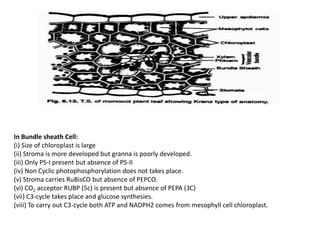
C4 plants have a characteristic leaf anatomy called Kranz anatomy (Wreath anatomy – German meaning
ring or Helo anatomy). The vascular bundles in C4 plant leaves are surrounded by a layer of bundle
sheath cells that contain large number of chloroplast. Dimorphic (two morphologically distinct type)
chloroplasts occur in C4 plants (Fig. 6.13).
In Mesopyll cell:
(i) Chloroplast is small in size
(ii) Well developed grannum and less developed stroma.
(iii) Both PS-II and PS-I are present.
(iv) Non cyclic photophosphorylation takes place.
(v) ATP and NADPH2 produces.
(vi) Stroma carries PEPCO but absence of RuBisCO.
(vii) CO2 acceptor is PEPA (3C) but absence of RUBP
(viii) First stable product OAA (4C) produces.
In Bundle sheath Cell:
(i) Size of chloroplast is large
(ii) Stroma is more developed but granna is poorly developed.
(iii) Only PS-I present but absence of PS-II
(iv) Non Cyclic photophosphorylation does not takes place.
(v) Stroma carries RuBisCO but absence of PEPCO.
(vi) CO2 acceptor RUBP (5c) is present but absence of PEPA (3C)
(vii) C3-cycle takes place and glucose synthesies.
(viii) To carry out C3-cycle both ATP and NADPH2 comes from mesophyll cell chloroplast.
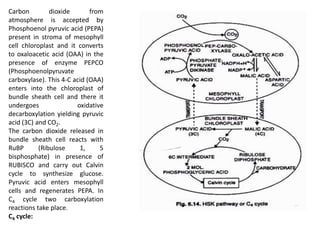
Carbon dioxide from
atmosphere is accepted by
Phosphoenol pyruvic acid (PEPA)
present in stroma of mesophyll
cell chloroplast and it converts
to oxaloacetic acid (OAA) in the
presence of enzyme PEPCO
(Phosphoenolpyruvate
carboxylase). This 4-C acid (OAA)
enters into the chloroplast of
bundle sheath cell and there it
undergoes oxidative
decarboxylation yielding pyruvic
acid (3C) and CO2.
The carbon dioxide released in
bundle sheath cell reacts with
RuBP (Ribulose 1, 5
bisphosphate) in presence of
RUBISCO and carry out Calvin
cycle to synthesize glucose.
Pyruvic acid enters mesophyll
cells and regenerates PEPA. In
C4 cycle two carboxylation
reactions take place.
C4 cycle:
Significance of C4 Cycle:
1. C4 plants have greater rate of carbon dioxide assimilation than C3 plants because PEPCO
has great affinity for CO2 and it shows no photorespiration resulting in higher production of
dry matter.
2. C4 plants are better adapted to environmental stress than C3 plants.
3. Carbon dioxide fixation by C4 plants requires more ATP than C3 plants for conversion of
pyruvic acid to PEPA.
4. Carbon dioxide acceptor in C4 plant is PEPA and key enzyme is PEPCO.
5. They can very well grow in saline soils because of presence of C4 organic acid.
Crassulacean Acid Metabolism (CAM Pathway):
It is a mechanism of photosynthesis which occurs in succulents and some other plants of dry
habitats where the stomata remain closed during the daytime and open only at night. The
process of photosynthesis is similar to that of C4 plants but instead of spatial separation of
initial PEPcase fixation and final Rubisco fixation of CO2, the two steps occur in the same
cells (in the stroma of mesophyll chloroplasts) but at different times, night and day, e.g.,
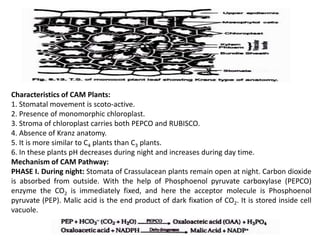
Sedum, Kalanchoe, Opuntia, Pineapple (Fig. 6.13). (CAM was for the first time studied and
reported by Ting (1971).
Characteristics of CAM Plants:
1. Stomatal movement is scoto-active.
2. Presence of monomorphic chloroplast.
3. Stroma of chloroplast carries both PEPCO and RUBISCO.
4. Absence of Kranz anatomy.
5. It is more similar to C4 plants than C3 plants.
6. In these plants pH decreases during night and increases during day time.
Mechanism of CAM Pathway:
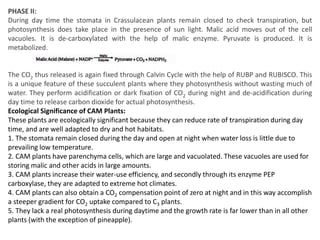
PHASE I. During night: Stomata of Crassulacean plants remain open at night. Carbon dioxide
is absorbed from outside. With the help of Phosphoenol pyruvate carboxylase (PEPCO)
enzyme the CO2 is immediately fixed, and here the acceptor molecule is Phosphoenol
pyruvate (PEP). Malic acid is the end product of dark fixation of CO2. It is stored inside cell
vacuole.
PHASE II:
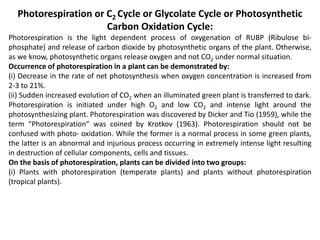
During day time the stomata in Crassulacean plants remain closed to check transpiration, but
photosynthesis does take place in the presence of sun light. Malic acid moves out of the cell
vacuoles. It is de-carboxylated with the help of malic enzyme. Pyruvate is produced. It is
metabolized.
The CO2 thus released is again fixed through Calvin Cycle with the help of RUBP and RUBISCO. This
is a unique feature of these succulent plants where they photosynthesis without wasting much of
water. They perform acidification or dark fixation of CO2 during night and de-acidification during
day time to release carbon dioxide for actual photosynthesis.
Ecological Significance of CAM Plants:
These plants are ecologically significant because they can reduce rate of transpiration during day
time, and are well adapted to dry and hot habitats.
1. The stomata remain closed during the day and open at night when water loss is little due to
prevailing low temperature.
2. CAM plants have parenchyma cells, which are large and vacuolated. These vacuoles are used for
storing malic and other acids in large amounts.
3. CAM plants increase their water-use efficiency, and secondly through its enzyme PEP
carboxylase, they are adapted to extreme hot climates.
4. CAM plants can also obtain a CO2 compensation point of zero at night and in this way accomplish
a steeper gradient for CO2 uptake compared to C3 plants.
5. They lack a real photosynthesis during daytime and the growth rate is far lower than in all other
plants (with the exception of pineapple).
Photorespiration or C2 Cycle or Glycolate Cycle or Photosynthetic
Carbon Oxidation Cycle:
Photorespiration is the light dependent process of oxygenation of RUBP (Ribulose bi-
phosphate) and release of carbon dioxide by photosynthetic organs of the plant. Otherwise,
as we know, photosynthetic organs release oxygen and not CO2 under normal situation.
Occurrence of photorespiration in a plant can be demonstrated by:
(i) Decrease in the rate of net photosynthesis when oxygen concentration is increased from
2-3 to 21%.
(ii) Sudden increased evolution of CO2 when an illuminated green plant is transferred to dark.
Photorespiration is initiated under high O2 and low CO2 and intense light around the
photosynthesizing plant. Photorespiration was discovered by Dicker and Tio (1959), while the
term “Photorespiration” was coined by Krotkov (1963). Photorespiration should not be
confused with photo- oxidation. While the former is a normal process in some green plants,
the latter is an abnormal and injurious process occurring in extremely intense light resulting
in destruction of cellular components, cells and tissues.
On the basis of photorespiration, plants can be divided into two groups:
(i) Plants with photorespiration (temperate plants) and plants without photorespiration
(tropical plants).
Site of Photorespiration:
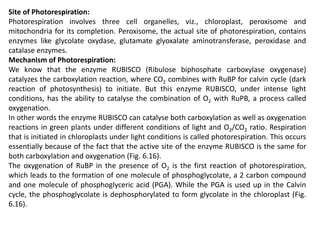
Photorespiration involves three cell organelles, viz., chloroplast, peroxisome and
mitochondria for its completion. Peroxisome, the actual site of photorespiration, contains
enzymes like glycolate oxydase, glutamate glyoxalate aminotransferase, peroxidase and
catalase enzymes.
Mechanism of Photorespiration:
We know that the enzyme RUBISCO (Ribulose biphosphate carboxylase oxygenase)
catalyzes the carboxylation reaction, where CO2 combines with RuBP for calvin cycle (dark
reaction of photosynthesis) to initiate. But this enzyme RUBISCO, under intense light
conditions, has the ability to catalyse the combination of O2 with RuPB, a process called
oxygenation.
In other words the enzyme RUBISCO can catalyse both carboxylation as well as oxygenation
reactions in green plants under different conditions of light and O2/CO2 ratio. Respiration
that is initiated in chloroplasts under light conditions is called photorespiration. This occurs
essentially because of the fact that the active site of the enzyme RUBISCO is the same for
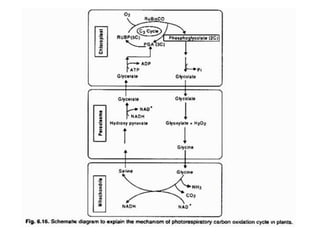
both carboxylation and oxygenation (Fig. 6.16).
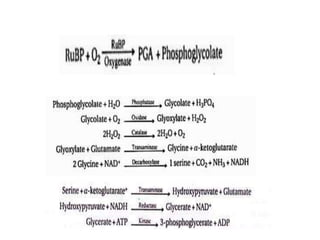
The oxygenation of RuBP in the presence of O2 is the first reaction of photorespiration,
which leads to the formation of one molecule of phosphoglycolate, a 2 carbon compound
and one molecule of phosphoglyceric acid (PGA). While the PGA is used up in the Calvin
cycle, the phosphoglycolate is dephosphorylated to form glycolate in the chloroplast (Fig.
6.16).
Factors Affecting Photosynthesis:
Photosynthesis is affected by both environmental and genetic (internal) factors. The
environmental factors are light, CO2, temperature, soil, water, nutrients etc. Internal or
genetic factors are all related with leaf and include protoplasmic factors, chlorophyll
contents, structure of leaf, accumulation of end product etc.
Some of the important factors are discussed below:
1. Concept of Cardinal Values:
The metabolic processes are influenced by a number of factors of the environment. The
rate of a metabolic process is controlled by the magnitude of each factor. Sachs (1860)
recognized three critical values, the cardinal values or points of the magnitude of each
factor. These are minimum, optimum and maximum. The minimum cardinal value is that
magnitudes of a factor below which the metabolic process cannot proceed.
Optimum value is the one at which the metabolic process proceeds at its highest rate.
Maximum is that magnitude of a factor beyond which the process stops. At magnitudes
below and above the optimum, the rate of a metabolic process declines till minimum and
maximum values are attained.
2. Principle of Limiting Factors:
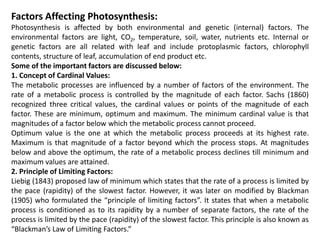
Liebig (1843) proposed law of minimum which states that the rate of a process is limited by
the pace (rapidity) of the slowest factor. However, it was later on modified by Blackman
(1905) who formulated the “principle of limiting factors”. It states that when a metabolic
process is conditioned as to its rapidity by a number of separate factors, the rate of the
process is limited by the pace (rapidity) of the slowest factor. This principle is also known as
“Blackman’s Law of Limiting Factors.”
3. External Factors:
The environmental factors which can affect the rate of photosynthesis are carbon dioxide, light,
temperature, water, oxygen, minerals, pollutants and inhibitors.
1. Effect of Carbon dioxide:
Being one of the raw materials, carbon dioxide concentration has great effect on the rate of
photosynthesis. The atmosphere normally contains 0.03 to 0.04 per cent by volume of carbon dioxide. It
has been experimentally proved that an increase in carbon dioxide content of the air up to about one
per cent will produce a corresponding increase in photosynthesis provided the intensity of light is also
increased.
2. Effect of Light:
The ultimate source of light for photosynthesis in green plants is solar radiation, which moves in the
form of electromagnetic waves. Out of the total solar energy reaching to the earth, about 2% is used in
photosynthesis and about 10% is used in other metabolic activities. Light varies in intensity, quality
(wavelength) and duration.
The effect of light on photosynthesis can be studied under following three headings:
(i) Intensity of Light:
The total light perceived by a plant depends on its general form (viz., height of plant and size of leaves,
etc.) and arrangement of leaves. Of the total light falling on a leaf, about 80% is absorbed, 10% is
reflected and 10% is transmitted. Intensity of light can be measured by lux meter. Effect of light intensity
varies from plant to plant, e.g., more in heliophytes (sun loving plants) and less in sciophytes (shade
loving plants). For a complete plant, rate of photosynthesis increases with increase in light intensity,
except under very high light intensity where phenomenon of Solarization’ occurs, (i.e., photo-oxidation
of different cellular components including chlorophyll). It also affects the opening and closing of
stomata thereby affecting the gaseous exchange. The value of light saturation at which further increase
is not accompanied by an increase in CO2 uptake is called light saturation point.
(iii) Duration of Light:
Longer duration of light period favours photosynthesis. Generally, if the plants get 10 to 12 hrs. of
light per day it favours good photosynthesis. Plants can actively exhibit photosynthesis under
continuous light without being damaged. Rate of photosynthesis is independent of duration of light.
3. Effect of Temperature:
The rate of photosynthesis markedly increases with an increase in temperature provided other
factors such as CO2 and light are not limiting. The temperature affects the velocity of enzyme
controlled reactions in the dark stage. When the intensity of light is low, the reaction is limited by the
small quantities of reduced coenzymes available so that any increase in temperature has little effect
on the overall rate of photosynthesis.
At high light intensities, it is the enzyme-controlled dark stage which controls the rate of
photosynthesis and there the Q10 = 2. If the temperature is greater than about 30°C, the rate of
photosynthesis abruptly falls due to thermal inactivation of enzymes.
4. Effect of Water:
Although the amount of water required during photosynthesis is hardly one percent of the total
amount of water absorbed by the plant, yet any change in the amount of water absorbed by a plant
has significant effect on its rate of photosynthesis. Under normal conditions water rarely seems to be
a controlling factor as the chloroplasts normally contain plenty of water.
Many experimental observations indicate that in the field the plant is able to withstand a wide range
of soil moisture without any significant effect on photosynthesis and it is only when wilting sets in
that the photosynthesis is retarded. Some of the effect of drought may be secondary since stomata
tend to close when the plant is deprived of water. A more specific effect of drought on
photosynthesis results from dehydration of protoplasm.
5. Effect of Oxygen:
Excess of O2 may become inhibitory for the process. Enhanced supply of O2 increases the rate of
respiration simultaneously decreasing the rate of photosynthesis by the common intermediate
substances. The concentration for oxygen in the atmosphere is about 21% by volume and it seldom
fluctuates. O2 is not a limiting factor of photosynthesis.
An increase in oxygen concentration decreases photosynthesis and the phenomenon is called Warburg
effect. [Reported by German scientist Warburg (1920) in Chlorella algae]. This is due to competitive
inhibition of RuBP-carboxylase at increased O2 levels, i.e., O2 competes for active sites of RuBP-
carboxylase enzyme with CO2. The explanation of this problem lies in the phenomenon of
photorespiration. If the amount of oxygen in the atmosphere decreases then photosynthesis will increase
in C3 cycle and no change in C4 cycle.
6. Effect of Minerals:
Presence of Mn++ and CI– is essential for smooth operation of light reactions (Photolysis of
water/evolution of oxygen) Mg++, Cu++ and Fe++ ions are important for synthesis of chlorophyll.
7. Effect of Pollutants and Inhibitors:
The oxides of nitrogen and hydrocarbons present in smoke react to form peroxyacetyl nitrate (PAN) and
ozone. PAN is known to inhibit Hill’s reaction. Diquat and Paraquat (commonly called as Viologens)
block the transfer of electrons between Q and PQ in PS II.
Other inhibitors of photosynthesis are monouron or CMU (Chlorophenyl dimethyl urea), diuron or
DCMU (Dichlorophenyl dimethyl urea), bromocil and atrazine etc., which have the same mechanism of
action as that of violates. At low light intensities potassium cyanide appears to have no inhibiting effect
on photosynthesis.
4. Internal Factors:
The important internal factors that regulate the rate of photosynthesis are:
1. Protoplasmic factors:
There is some unknown factor in protoplasm which affects the rate of photosynthesis. This factor affect
the dark reactions. The decline in the rate of photosynthesis at temperature.above 30°C or at strong
light intensities in many plants suggests the enzyme nature of this unknown factor.
2. Chlorophyll content:
Chlorophyll is an essential internal factor for photosynthesis. The amount of CO2 fixed by a gram of
chlorophyll in an hour is called photosynthetic number or assimilation number. It is usually constant for
a plant species but rarely it varies. The assimilation number of variegated variety of a species was found
to be higher than the green leaves variety.
3. Accumulation of end products:
Accumulation of food in the chloroplasts reduces the rate of photosynthesis.
4. Structure of leaves:
The amount of CO2 that reaches the chloroplasts depends on structural features of the leaves like the
size, position and behaviour of the stomata and the amount of intercellular spaces. Some other
characters like thickness of cuticle, epidermis, presence of epidermal hairs, amount of mesophyll tissue,
etc., influence the intensity and quality of light reaching the chloroplast.
5. CO2 Compensation Point:
It is that value or point in light intensity and atmospheric CO2 concentration when the rate of
photosynthesis is just equivalent to the rate of respiration in the photosynthetic organs so that there is
no net gaseous exchange. The value of light compensation point is 2.5 -100 ft. candles for shade plants
and 100-400 ft. candles for sun plants. The value of CO2 compensation point is very low in C4 plants (0-5
ppm), where as in C3 plants it is quite high (25-100 ppm). A plant can not survive for long at
compensation point because there is net lose of organic matter due to respiration of non-green organs
and dark respiration.
Thank you
References: Online notes, notes from research papers and Books by google search Engine

Photosynthsis b

  • 1.
    Photosynthsis Part B Dr.Naveen Gaurav Associate Professor and Head Department of Biotechnology Shri Guru Ram Rai University Dehradun
  • 2.
    C4 Cycle (HSKPathway or Hatch Slack and Kortschak Cycle): C4 cycle may also be referred as the di-carboxylic acid cycle or the β-carboxylation pathway or Hatch and Slack cycle or cooperative photosynthesis (Karpilov, 1970). For a long time, C3 cycle was considered to be the only photosynthetic pathway for reduction of CO2 into carbohydrates. Kortschak, Hartt and Burr (1965) reported that rapidly photosynthesizing sugarcane leaves produced a 4-C compound like aspartic acid and malic acid as a result of CO2 – fixation. It was later supported by M. D. Hatch and C. R. Slack (1966) and they reported that a 4-C compound oxaloacetic acid (OAA) is the first stable product in CO2 reduction process. This pathway was first reported in members of family Poaceae like sugarcane, maize, sorghum, etc. (tropical grasses), but later on the other subtropical plant like Atriplex spongiosa (Salt bush), Dititaria samguinolis, Cyperus rotundus, Amaranthus etc. So, the cycle has been reported not only in the members of Graminae but also among certain members of Cyperaceae and certain dicots. Structural Peculiarities of C4 Plants (Kranz Anatomy): C4 plants have a characteristic leaf anatomy called Kranz anatomy (Wreath anatomy – German meaning ring or Helo anatomy). The vascular bundles in C4 plant leaves are surrounded by a layer of bundle sheath cells that contain large number of chloroplast. Dimorphic (two morphologically distinct type) chloroplasts occur in C4 plants (Fig. 6.13). In Mesopyll cell: (i) Chloroplast is small in size (ii) Well developed grannum and less developed stroma. (iii) Both PS-II and PS-I are present. (iv) Non cyclic photophosphorylation takes place. (v) ATP and NADPH2 produces. (vi) Stroma carries PEPCO but absence of RuBisCO. (vii) CO2 acceptor is PEPA (3C) but absence of RUBP (viii) First stable product OAA (4C) produces.
  • 3.
    In Bundle sheathCell: (i) Size of chloroplast is large (ii) Stroma is more developed but granna is poorly developed. (iii) Only PS-I present but absence of PS-II (iv) Non Cyclic photophosphorylation does not takes place. (v) Stroma carries RuBisCO but absence of PEPCO. (vi) CO2 acceptor RUBP (5c) is present but absence of PEPA (3C) (vii) C3-cycle takes place and glucose synthesies. (viii) To carry out C3-cycle both ATP and NADPH2 comes from mesophyll cell chloroplast.
  • 4.
    Carbon dioxide from atmosphereis accepted by Phosphoenol pyruvic acid (PEPA) present in stroma of mesophyll cell chloroplast and it converts to oxaloacetic acid (OAA) in the presence of enzyme PEPCO (Phosphoenolpyruvate carboxylase). This 4-C acid (OAA) enters into the chloroplast of bundle sheath cell and there it undergoes oxidative decarboxylation yielding pyruvic acid (3C) and CO2. The carbon dioxide released in bundle sheath cell reacts with RuBP (Ribulose 1, 5 bisphosphate) in presence of RUBISCO and carry out Calvin cycle to synthesize glucose. Pyruvic acid enters mesophyll cells and regenerates PEPA. In C4 cycle two carboxylation reactions take place. C4 cycle:
  • 5.
    Significance of C4Cycle: 1. C4 plants have greater rate of carbon dioxide assimilation than C3 plants because PEPCO has great affinity for CO2 and it shows no photorespiration resulting in higher production of dry matter. 2. C4 plants are better adapted to environmental stress than C3 plants. 3. Carbon dioxide fixation by C4 plants requires more ATP than C3 plants for conversion of pyruvic acid to PEPA. 4. Carbon dioxide acceptor in C4 plant is PEPA and key enzyme is PEPCO. 5. They can very well grow in saline soils because of presence of C4 organic acid. Crassulacean Acid Metabolism (CAM Pathway): It is a mechanism of photosynthesis which occurs in succulents and some other plants of dry habitats where the stomata remain closed during the daytime and open only at night. The process of photosynthesis is similar to that of C4 plants but instead of spatial separation of initial PEPcase fixation and final Rubisco fixation of CO2, the two steps occur in the same cells (in the stroma of mesophyll chloroplasts) but at different times, night and day, e.g., Sedum, Kalanchoe, Opuntia, Pineapple (Fig. 6.13). (CAM was for the first time studied and reported by Ting (1971).
  • 6.
    Characteristics of CAMPlants: 1. Stomatal movement is scoto-active. 2. Presence of monomorphic chloroplast. 3. Stroma of chloroplast carries both PEPCO and RUBISCO. 4. Absence of Kranz anatomy. 5. It is more similar to C4 plants than C3 plants. 6. In these plants pH decreases during night and increases during day time. Mechanism of CAM Pathway: PHASE I. During night: Stomata of Crassulacean plants remain open at night. Carbon dioxide is absorbed from outside. With the help of Phosphoenol pyruvate carboxylase (PEPCO) enzyme the CO2 is immediately fixed, and here the acceptor molecule is Phosphoenol pyruvate (PEP). Malic acid is the end product of dark fixation of CO2. It is stored inside cell vacuole.
  • 7.
    PHASE II: During daytime the stomata in Crassulacean plants remain closed to check transpiration, but photosynthesis does take place in the presence of sun light. Malic acid moves out of the cell vacuoles. It is de-carboxylated with the help of malic enzyme. Pyruvate is produced. It is metabolized. The CO2 thus released is again fixed through Calvin Cycle with the help of RUBP and RUBISCO. This is a unique feature of these succulent plants where they photosynthesis without wasting much of water. They perform acidification or dark fixation of CO2 during night and de-acidification during day time to release carbon dioxide for actual photosynthesis. Ecological Significance of CAM Plants: These plants are ecologically significant because they can reduce rate of transpiration during day time, and are well adapted to dry and hot habitats. 1. The stomata remain closed during the day and open at night when water loss is little due to prevailing low temperature. 2. CAM plants have parenchyma cells, which are large and vacuolated. These vacuoles are used for storing malic and other acids in large amounts. 3. CAM plants increase their water-use efficiency, and secondly through its enzyme PEP carboxylase, they are adapted to extreme hot climates. 4. CAM plants can also obtain a CO2 compensation point of zero at night and in this way accomplish a steeper gradient for CO2 uptake compared to C3 plants. 5. They lack a real photosynthesis during daytime and the growth rate is far lower than in all other plants (with the exception of pineapple).
  • 8.
    Photorespiration or C2Cycle or Glycolate Cycle or Photosynthetic Carbon Oxidation Cycle: Photorespiration is the light dependent process of oxygenation of RUBP (Ribulose bi- phosphate) and release of carbon dioxide by photosynthetic organs of the plant. Otherwise, as we know, photosynthetic organs release oxygen and not CO2 under normal situation. Occurrence of photorespiration in a plant can be demonstrated by: (i) Decrease in the rate of net photosynthesis when oxygen concentration is increased from 2-3 to 21%. (ii) Sudden increased evolution of CO2 when an illuminated green plant is transferred to dark. Photorespiration is initiated under high O2 and low CO2 and intense light around the photosynthesizing plant. Photorespiration was discovered by Dicker and Tio (1959), while the term “Photorespiration” was coined by Krotkov (1963). Photorespiration should not be confused with photo- oxidation. While the former is a normal process in some green plants, the latter is an abnormal and injurious process occurring in extremely intense light resulting in destruction of cellular components, cells and tissues. On the basis of photorespiration, plants can be divided into two groups: (i) Plants with photorespiration (temperate plants) and plants without photorespiration (tropical plants).
  • 9.
    Site of Photorespiration: Photorespirationinvolves three cell organelles, viz., chloroplast, peroxisome and mitochondria for its completion. Peroxisome, the actual site of photorespiration, contains enzymes like glycolate oxydase, glutamate glyoxalate aminotransferase, peroxidase and catalase enzymes. Mechanism of Photorespiration: We know that the enzyme RUBISCO (Ribulose biphosphate carboxylase oxygenase) catalyzes the carboxylation reaction, where CO2 combines with RuBP for calvin cycle (dark reaction of photosynthesis) to initiate. But this enzyme RUBISCO, under intense light conditions, has the ability to catalyse the combination of O2 with RuPB, a process called oxygenation. In other words the enzyme RUBISCO can catalyse both carboxylation as well as oxygenation reactions in green plants under different conditions of light and O2/CO2 ratio. Respiration that is initiated in chloroplasts under light conditions is called photorespiration. This occurs essentially because of the fact that the active site of the enzyme RUBISCO is the same for both carboxylation and oxygenation (Fig. 6.16). The oxygenation of RuBP in the presence of O2 is the first reaction of photorespiration, which leads to the formation of one molecule of phosphoglycolate, a 2 carbon compound and one molecule of phosphoglyceric acid (PGA). While the PGA is used up in the Calvin cycle, the phosphoglycolate is dephosphorylated to form glycolate in the chloroplast (Fig. 6.16).
  • 12.
    Factors Affecting Photosynthesis: Photosynthesisis affected by both environmental and genetic (internal) factors. The environmental factors are light, CO2, temperature, soil, water, nutrients etc. Internal or genetic factors are all related with leaf and include protoplasmic factors, chlorophyll contents, structure of leaf, accumulation of end product etc. Some of the important factors are discussed below: 1. Concept of Cardinal Values: The metabolic processes are influenced by a number of factors of the environment. The rate of a metabolic process is controlled by the magnitude of each factor. Sachs (1860) recognized three critical values, the cardinal values or points of the magnitude of each factor. These are minimum, optimum and maximum. The minimum cardinal value is that magnitudes of a factor below which the metabolic process cannot proceed. Optimum value is the one at which the metabolic process proceeds at its highest rate. Maximum is that magnitude of a factor beyond which the process stops. At magnitudes below and above the optimum, the rate of a metabolic process declines till minimum and maximum values are attained. 2. Principle of Limiting Factors: Liebig (1843) proposed law of minimum which states that the rate of a process is limited by the pace (rapidity) of the slowest factor. However, it was later on modified by Blackman (1905) who formulated the “principle of limiting factors”. It states that when a metabolic process is conditioned as to its rapidity by a number of separate factors, the rate of the process is limited by the pace (rapidity) of the slowest factor. This principle is also known as “Blackman’s Law of Limiting Factors.”
  • 13.
    3. External Factors: Theenvironmental factors which can affect the rate of photosynthesis are carbon dioxide, light, temperature, water, oxygen, minerals, pollutants and inhibitors. 1. Effect of Carbon dioxide: Being one of the raw materials, carbon dioxide concentration has great effect on the rate of photosynthesis. The atmosphere normally contains 0.03 to 0.04 per cent by volume of carbon dioxide. It has been experimentally proved that an increase in carbon dioxide content of the air up to about one per cent will produce a corresponding increase in photosynthesis provided the intensity of light is also increased. 2. Effect of Light: The ultimate source of light for photosynthesis in green plants is solar radiation, which moves in the form of electromagnetic waves. Out of the total solar energy reaching to the earth, about 2% is used in photosynthesis and about 10% is used in other metabolic activities. Light varies in intensity, quality (wavelength) and duration. The effect of light on photosynthesis can be studied under following three headings: (i) Intensity of Light: The total light perceived by a plant depends on its general form (viz., height of plant and size of leaves, etc.) and arrangement of leaves. Of the total light falling on a leaf, about 80% is absorbed, 10% is reflected and 10% is transmitted. Intensity of light can be measured by lux meter. Effect of light intensity varies from plant to plant, e.g., more in heliophytes (sun loving plants) and less in sciophytes (shade loving plants). For a complete plant, rate of photosynthesis increases with increase in light intensity, except under very high light intensity where phenomenon of Solarization’ occurs, (i.e., photo-oxidation of different cellular components including chlorophyll). It also affects the opening and closing of stomata thereby affecting the gaseous exchange. The value of light saturation at which further increase is not accompanied by an increase in CO2 uptake is called light saturation point.
  • 14.
    (iii) Duration ofLight: Longer duration of light period favours photosynthesis. Generally, if the plants get 10 to 12 hrs. of light per day it favours good photosynthesis. Plants can actively exhibit photosynthesis under continuous light without being damaged. Rate of photosynthesis is independent of duration of light. 3. Effect of Temperature: The rate of photosynthesis markedly increases with an increase in temperature provided other factors such as CO2 and light are not limiting. The temperature affects the velocity of enzyme controlled reactions in the dark stage. When the intensity of light is low, the reaction is limited by the small quantities of reduced coenzymes available so that any increase in temperature has little effect on the overall rate of photosynthesis. At high light intensities, it is the enzyme-controlled dark stage which controls the rate of photosynthesis and there the Q10 = 2. If the temperature is greater than about 30°C, the rate of photosynthesis abruptly falls due to thermal inactivation of enzymes. 4. Effect of Water: Although the amount of water required during photosynthesis is hardly one percent of the total amount of water absorbed by the plant, yet any change in the amount of water absorbed by a plant has significant effect on its rate of photosynthesis. Under normal conditions water rarely seems to be a controlling factor as the chloroplasts normally contain plenty of water. Many experimental observations indicate that in the field the plant is able to withstand a wide range of soil moisture without any significant effect on photosynthesis and it is only when wilting sets in that the photosynthesis is retarded. Some of the effect of drought may be secondary since stomata tend to close when the plant is deprived of water. A more specific effect of drought on photosynthesis results from dehydration of protoplasm.
  • 15.
    5. Effect ofOxygen: Excess of O2 may become inhibitory for the process. Enhanced supply of O2 increases the rate of respiration simultaneously decreasing the rate of photosynthesis by the common intermediate substances. The concentration for oxygen in the atmosphere is about 21% by volume and it seldom fluctuates. O2 is not a limiting factor of photosynthesis. An increase in oxygen concentration decreases photosynthesis and the phenomenon is called Warburg effect. [Reported by German scientist Warburg (1920) in Chlorella algae]. This is due to competitive inhibition of RuBP-carboxylase at increased O2 levels, i.e., O2 competes for active sites of RuBP- carboxylase enzyme with CO2. The explanation of this problem lies in the phenomenon of photorespiration. If the amount of oxygen in the atmosphere decreases then photosynthesis will increase in C3 cycle and no change in C4 cycle. 6. Effect of Minerals: Presence of Mn++ and CI– is essential for smooth operation of light reactions (Photolysis of water/evolution of oxygen) Mg++, Cu++ and Fe++ ions are important for synthesis of chlorophyll. 7. Effect of Pollutants and Inhibitors: The oxides of nitrogen and hydrocarbons present in smoke react to form peroxyacetyl nitrate (PAN) and ozone. PAN is known to inhibit Hill’s reaction. Diquat and Paraquat (commonly called as Viologens) block the transfer of electrons between Q and PQ in PS II. Other inhibitors of photosynthesis are monouron or CMU (Chlorophenyl dimethyl urea), diuron or DCMU (Dichlorophenyl dimethyl urea), bromocil and atrazine etc., which have the same mechanism of action as that of violates. At low light intensities potassium cyanide appears to have no inhibiting effect on photosynthesis.
  • 16.
    4. Internal Factors: Theimportant internal factors that regulate the rate of photosynthesis are: 1. Protoplasmic factors: There is some unknown factor in protoplasm which affects the rate of photosynthesis. This factor affect the dark reactions. The decline in the rate of photosynthesis at temperature.above 30°C or at strong light intensities in many plants suggests the enzyme nature of this unknown factor. 2. Chlorophyll content: Chlorophyll is an essential internal factor for photosynthesis. The amount of CO2 fixed by a gram of chlorophyll in an hour is called photosynthetic number or assimilation number. It is usually constant for a plant species but rarely it varies. The assimilation number of variegated variety of a species was found to be higher than the green leaves variety. 3. Accumulation of end products: Accumulation of food in the chloroplasts reduces the rate of photosynthesis. 4. Structure of leaves: The amount of CO2 that reaches the chloroplasts depends on structural features of the leaves like the size, position and behaviour of the stomata and the amount of intercellular spaces. Some other characters like thickness of cuticle, epidermis, presence of epidermal hairs, amount of mesophyll tissue, etc., influence the intensity and quality of light reaching the chloroplast. 5. CO2 Compensation Point: It is that value or point in light intensity and atmospheric CO2 concentration when the rate of photosynthesis is just equivalent to the rate of respiration in the photosynthetic organs so that there is no net gaseous exchange. The value of light compensation point is 2.5 -100 ft. candles for shade plants and 100-400 ft. candles for sun plants. The value of CO2 compensation point is very low in C4 plants (0-5 ppm), where as in C3 plants it is quite high (25-100 ppm). A plant can not survive for long at compensation point because there is net lose of organic matter due to respiration of non-green organs and dark respiration.
  • 17.
    Thank you References: Onlinenotes, notes from research papers and Books by google search Engine