Chapter 15
The Laws of Thermodynamics
15-1 The First Law of Thermodynamics
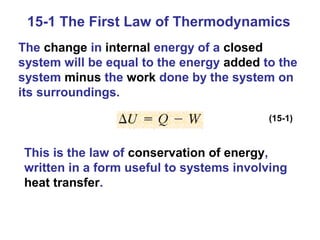
The change in internal energy of a closed
system will be equal to the energy added to the
system minus the work done by the system on
its surroundings.

                                          (15-1)


This is the law of conservation of energy,
written in a form useful to systems involving
heat transfer.
15-2 Thermodynamic Processes and the
             First Law

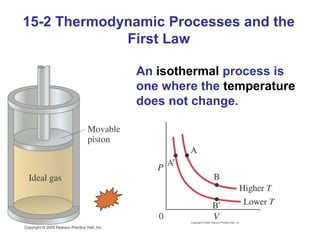
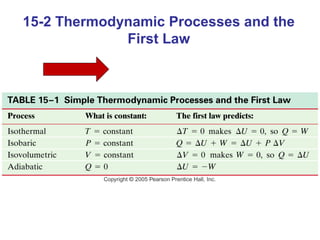
               An isothermal process is
               one where the temperature
               does not change.
15-2 Thermodynamic Processes and the
             First Law

In order for an isothermal process to take
place, we assume the system is in contact
with a heat reservoir.
In general, we assume that the system
remains in equilibrium throughout all
processes.
15-2 Thermodynamic Processes and the
             First Law

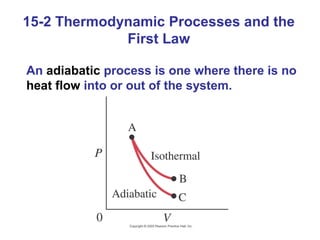
An adiabatic process is one where there is no
heat flow into or out of the system.
15-2 Thermodynamic Processes and the
              First Law
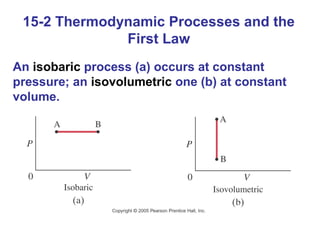
An isobaric process (a) occurs at constant
pressure; an isovolumetric one (b) at constant
volume.
15-2 Thermodynamic Processes and the
              First Law

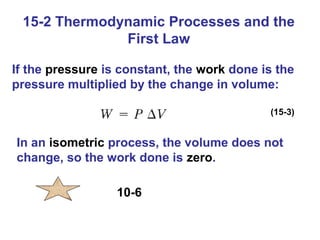
If the pressure is constant, the work done is the
pressure multiplied by the change in volume:

                                            (15-3)


In an isometric process, the volume does not
change, so the work done is zero.

                  10-6
15-2 Thermodynamic Processes and the
             First Law
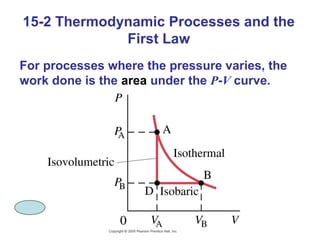
For processes where the pressure varies, the
work done is the area under the P-V curve.
15-2 Thermodynamic Processes and the
             First Law
15-4 The Second Law of
      Thermodynamics – Introduction


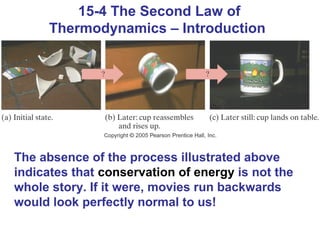
The absence of the process illustrated above
indicates that conservation of energy is not the
whole story. If it were, movies run backwards
would look perfectly normal to us!
15-4 The Second Law of
     Thermodynamics – Introduction

The second law of thermodynamics is a
statement about which processes occur and
which do not. There are many ways to state the
second law; here is one:


Heat can flow spontaneously from a hot object
to a cold object; it will not flow spontaneously
       from a cold object to a hot object.
15-5 Heat Engines
 It is easy to produce thermal energy using
 work, but how does one produce work using
 thermal energy?


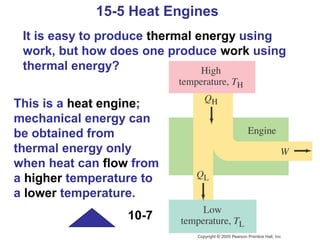
This is a heat engine;
mechanical energy can
be obtained from
thermal energy only
when heat can flow from
a higher temperature to
a lower temperature.
                  10-7
15-5 Heat Engines

We will discuss only engines that run in a
repeating cycle; the change in internal energy
over a cycle is zero, as the system returns to its
initial state.
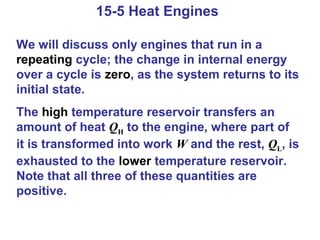
The high temperature reservoir transfers an
amount of heat QH to the engine, where part of
it is transformed into work W and the rest, QL, is
exhausted to the lower temperature reservoir.
Note that all three of these quantities are
positive.
15-5 Heat Engines
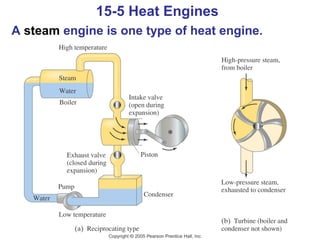
A steam engine is one type of heat engine.
15-5 Heat Engines
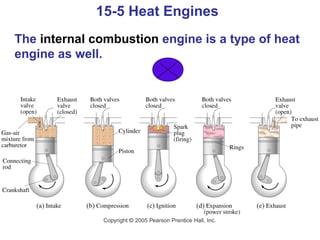
The internal combustion engine is a type of heat
engine as well.
15-5 Heat Engines


Why does a heat engine need a temperature
difference?
Otherwise the work done on the system in one
part of the cycle will be equal to the work done
by the system in another part, and the net work
will be zero.
15-5 Heat Engines
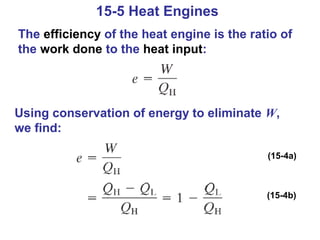
The efficiency of the heat engine is the ratio of
the work done to the heat input:


Using conservation of energy to eliminate W,
we find:

                                            (15-4a)


                                            (15-4b)
15-5 Heat Engines
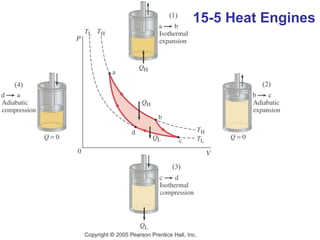
The Carnot engine was created to examine the
efficiency of a heat engine. It is idealized, as it
has no friction. Each leg of its cycle is reversible.
The Carnot cycle consists of:
• Isothermal expansion
• Adiabatic expansion
• Isothermal compression
                                      10-9
• Adiabatic compression
An example is on the next slide.
15-5 Heat Engines
15-5 Heat Engines
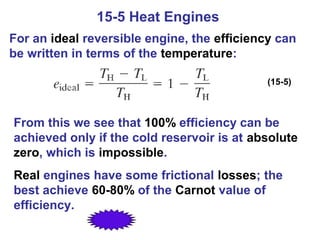
For an ideal reversible engine, the efficiency can
be written in terms of the temperature:

                                            (15-5)


From this we see that 100% efficiency can be
achieved only if the cold reservoir is at absolute
zero, which is impossible.
Real engines have some frictional losses; the
best achieve 60-80% of the Carnot value of
efficiency.

Chapter 15 thermodyanamic

  • 1.
    Chapter 15 The Lawsof Thermodynamics
  • 2.
    15-1 The FirstLaw of Thermodynamics The change in internal energy of a closed system will be equal to the energy added to the system minus the work done by the system on its surroundings. (15-1) This is the law of conservation of energy, written in a form useful to systems involving heat transfer.
  • 3.
    15-2 Thermodynamic Processesand the First Law An isothermal process is one where the temperature does not change.
  • 4.
    15-2 Thermodynamic Processesand the First Law In order for an isothermal process to take place, we assume the system is in contact with a heat reservoir. In general, we assume that the system remains in equilibrium throughout all processes.
  • 5.
    15-2 Thermodynamic Processesand the First Law An adiabatic process is one where there is no heat flow into or out of the system.
  • 6.
    15-2 Thermodynamic Processesand the First Law An isobaric process (a) occurs at constant pressure; an isovolumetric one (b) at constant volume.
  • 7.
    15-2 Thermodynamic Processesand the First Law If the pressure is constant, the work done is the pressure multiplied by the change in volume: (15-3) In an isometric process, the volume does not change, so the work done is zero. 10-6
  • 8.
    15-2 Thermodynamic Processesand the First Law For processes where the pressure varies, the work done is the area under the P-V curve.
  • 9.
  • 10.
    15-4 The SecondLaw of Thermodynamics – Introduction The absence of the process illustrated above indicates that conservation of energy is not the whole story. If it were, movies run backwards would look perfectly normal to us!
  • 11.
    15-4 The SecondLaw of Thermodynamics – Introduction The second law of thermodynamics is a statement about which processes occur and which do not. There are many ways to state the second law; here is one: Heat can flow spontaneously from a hot object to a cold object; it will not flow spontaneously from a cold object to a hot object.
  • 12.
    15-5 Heat Engines It is easy to produce thermal energy using work, but how does one produce work using thermal energy? This is a heat engine; mechanical energy can be obtained from thermal energy only when heat can flow from a higher temperature to a lower temperature. 10-7
  • 13.
    15-5 Heat Engines Wewill discuss only engines that run in a repeating cycle; the change in internal energy over a cycle is zero, as the system returns to its initial state. The high temperature reservoir transfers an amount of heat QH to the engine, where part of it is transformed into work W and the rest, QL, is exhausted to the lower temperature reservoir. Note that all three of these quantities are positive.
  • 14.
    15-5 Heat Engines Asteam engine is one type of heat engine.
  • 15.
    15-5 Heat Engines Theinternal combustion engine is a type of heat engine as well.
  • 16.
    15-5 Heat Engines Whydoes a heat engine need a temperature difference? Otherwise the work done on the system in one part of the cycle will be equal to the work done by the system in another part, and the net work will be zero.
  • 17.
    15-5 Heat Engines Theefficiency of the heat engine is the ratio of the work done to the heat input: Using conservation of energy to eliminate W, we find: (15-4a) (15-4b)
  • 18.
    15-5 Heat Engines TheCarnot engine was created to examine the efficiency of a heat engine. It is idealized, as it has no friction. Each leg of its cycle is reversible. The Carnot cycle consists of: • Isothermal expansion • Adiabatic expansion • Isothermal compression 10-9 • Adiabatic compression An example is on the next slide.
  • 19.
  • 20.
    15-5 Heat Engines Foran ideal reversible engine, the efficiency can be written in terms of the temperature: (15-5) From this we see that 100% efficiency can be achieved only if the cold reservoir is at absolute zero, which is impossible. Real engines have some frictional losses; the best achieve 60-80% of the Carnot value of efficiency.