Unit No:01
Thermodynamics
Prof. Yash B. Parikh
M.Tech (Computer Integrated Manufacturing)
B.E.(Mechanical Engineering)
Assistant Professor
Department of Mechanical Engineering
First Law of Thermodynamics
2
 This law of thermodynamics is a particular statement
of the general principles of law of conservation of
energy applied to heat & work transfer.
 The law states that, “Energy can neither be created
nor destroyed but it can only be converted from one
form to another”.
 Though the law can not be prove analytically, it has
never been disproved & on the contrary many
experiments have verified its statement.
Joule’s Experiment
3
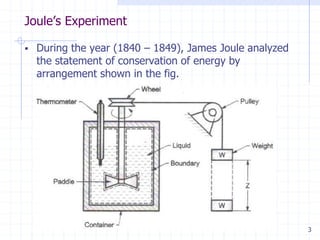
 During the year (1840 – 1849), James Joule analyzed
the statement of conservation of energy by
arrangement shown in the fig.
Joule’s Experiment
4
 It consists of a paddle wheel arrangement with the
liquid filled in an insulated container.
 When the weight falls, it supplies the work energy
equals to its potential energy to paddle wheel &
causes to rotate it.
 This causes the fluid to heat up due to friction
between the paddle wheel & the fluid.
 As a result of work transfer the temperature of the
liquid rises, which is measured with the help of the
thermometer.
Joule’s Experiment
5
 The system has undergone a process (1-A-2) as
shown.
Joule’s Experiment
6
 Now the heat is transferred from liquid to
surrounding till the system returns to its original state
of pressure & temperature.
 The heat transferred is shown by process (2-B-1).
Joule’s Experiment
7
 With such experiment Joule concluded that in every
case the work input W was always proportional to
heat transfer Q at the end of the cycle.
 Mathematically we can write,
ʘʃ d’W = J ʘʃ d’Q
Where, J is a constant known as mechanical
equivalent of the system.
Joule’s Experiment
8
 In M.K.S unit J = 4.187 kJ/k cal
 In S.I unit J = 1 J/Nm
 Since W and Q are both measured in J or Nm we can
write,
ʘʃ d’W = ʘʃ d’Q
Corollaries of First Law
9
 The first law of thermodynamics has the number of
important consequences, which forms corollaries.
(A corollary is a statement that follows readily from
a previous statement.)
 There are three main corollaries of first law,
Corollary 1 (Perpetual Motion Machine 1)
 A machine operating on a cycle and producing work
continuously or periodically without absorption of
energy at the same time is known as perpetual
motion machine.
 Therefore, the first law can also be stated in
following terms,
Corollaries of First Law
10
 “It is impossible to construct a perpetual motion
machine of first kind”.
i.e. no machine working over a cycle can produce
energy without corresponding expenditure of energy.
 Converse of PMM 1 is also true.
i.e. there can not be any machine which would
consume work energy without some other form of
energy appearing simultaneously.
Corollary 2
11
 While studying thermodynamics we come across with
processes rather than cycles.
 When a system executes a process, the net heat
transfer equals to sum of net work transfer and
change in stored energy, dE.
d’ Q = d’ W + dE
 This is known as First law for a process.
Corollary 3
12
 For an isolated system, there are no mass & energy
transfer, i.e. dQ = 0 & dW = 0.
Therefore, (dE)isolated = 0
 Total energy of an isolated system remains constant.

Thermal 06

  • 1.
    Unit No:01 Thermodynamics Prof. YashB. Parikh M.Tech (Computer Integrated Manufacturing) B.E.(Mechanical Engineering) Assistant Professor Department of Mechanical Engineering
  • 2.
    First Law ofThermodynamics 2  This law of thermodynamics is a particular statement of the general principles of law of conservation of energy applied to heat & work transfer.  The law states that, “Energy can neither be created nor destroyed but it can only be converted from one form to another”.  Though the law can not be prove analytically, it has never been disproved & on the contrary many experiments have verified its statement.
  • 3.
    Joule’s Experiment 3  Duringthe year (1840 – 1849), James Joule analyzed the statement of conservation of energy by arrangement shown in the fig.
  • 4.
    Joule’s Experiment 4  Itconsists of a paddle wheel arrangement with the liquid filled in an insulated container.  When the weight falls, it supplies the work energy equals to its potential energy to paddle wheel & causes to rotate it.  This causes the fluid to heat up due to friction between the paddle wheel & the fluid.  As a result of work transfer the temperature of the liquid rises, which is measured with the help of the thermometer.
  • 5.
    Joule’s Experiment 5  Thesystem has undergone a process (1-A-2) as shown.
  • 6.
    Joule’s Experiment 6  Nowthe heat is transferred from liquid to surrounding till the system returns to its original state of pressure & temperature.  The heat transferred is shown by process (2-B-1).
  • 7.
    Joule’s Experiment 7  Withsuch experiment Joule concluded that in every case the work input W was always proportional to heat transfer Q at the end of the cycle.  Mathematically we can write, ʘʃ d’W = J ʘʃ d’Q Where, J is a constant known as mechanical equivalent of the system.
  • 8.
    Joule’s Experiment 8  InM.K.S unit J = 4.187 kJ/k cal  In S.I unit J = 1 J/Nm  Since W and Q are both measured in J or Nm we can write, ʘʃ d’W = ʘʃ d’Q
  • 9.
    Corollaries of FirstLaw 9  The first law of thermodynamics has the number of important consequences, which forms corollaries. (A corollary is a statement that follows readily from a previous statement.)  There are three main corollaries of first law, Corollary 1 (Perpetual Motion Machine 1)  A machine operating on a cycle and producing work continuously or periodically without absorption of energy at the same time is known as perpetual motion machine.  Therefore, the first law can also be stated in following terms,
  • 10.
    Corollaries of FirstLaw 10  “It is impossible to construct a perpetual motion machine of first kind”. i.e. no machine working over a cycle can produce energy without corresponding expenditure of energy.  Converse of PMM 1 is also true. i.e. there can not be any machine which would consume work energy without some other form of energy appearing simultaneously.
  • 11.
    Corollary 2 11  Whilestudying thermodynamics we come across with processes rather than cycles.  When a system executes a process, the net heat transfer equals to sum of net work transfer and change in stored energy, dE. d’ Q = d’ W + dE  This is known as First law for a process.
  • 12.
    Corollary 3 12  Foran isolated system, there are no mass & energy transfer, i.e. dQ = 0 & dW = 0. Therefore, (dE)isolated = 0  Total energy of an isolated system remains constant.