Laws Of Thermodynamics
• Zeroth Law Of Thermodynamics
• First Law Of Thermodynamics
• Second Law Of Thermodynamics
Zeroth Law:
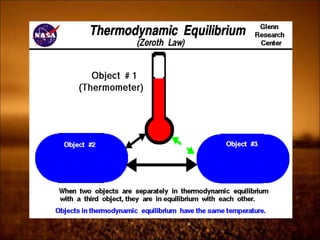
• The zeroth law of thermodynamics
states that if two bodies are in thermal
equilibrium with a third body, they are also
in thermal equilibrium with each other.
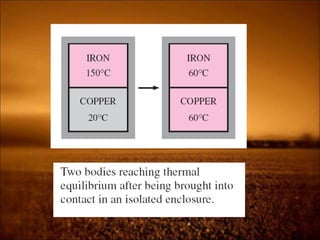
• when a body is brought into contact with
another body that is at a different
temperature, heat is transferred from the
body at higher temperature to the one at
lower temperature until both bodies attain
the same temperature
Zeroth Law:
• By replacing the third body with a
thermometer, the zeroth law can be
restated as
“two bodies are in thermal equilibrium if both
have the same temperature reading even if
they are not in contact.”
Outcome Of Zeroth Law:
• It Serves as the basis for
“ TEMPERATURE MEASUREMENT ”
This law allows us to build thermometers. For example the length
of a mercury column is used as a measure to compare the
temperatures of the two other objects.
First Law Of Thermodynamics
• It Is also known as Conservation Of Energy
Principle.
“energy can be neither created
nor destroyed during a process; it
can only change forms and total
amount of energy in the universe
always remains constant”
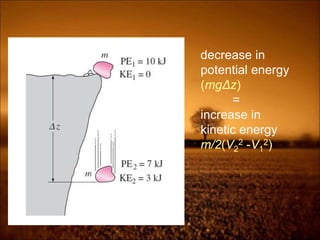
decrease in
potential energy
(mgΔz)
=
increase in
kinetic energy
m/2(V2
2 -V1
2)
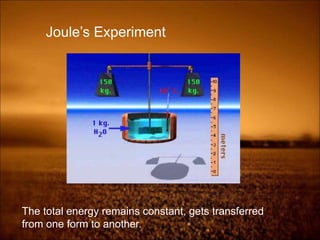
Joule’s Experiment
The total energy remains constant, gets transferred
from one form to another.
“ The increase in the internal energy of a system is
equal to the amount of energy added by heating
the system, minus the amount lost as a result of
the work done by the system on its
surroundings.
”
essence of the first law is the
existence of the property total energy
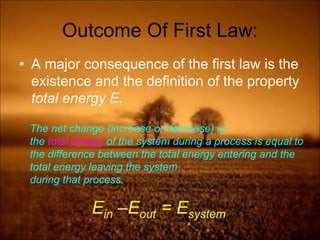
Outcome Of First Law:
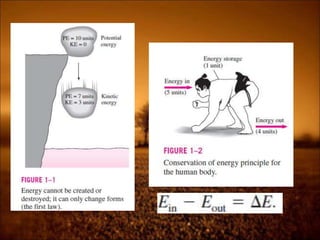
• A major consequence of the first law is the
existence and the definition of the property
total energy E.
The net change (increase or decrease) in
the total energy of the system during a process is equal to
the difference between the total energy entering and the
total energy leaving the system
during that process.
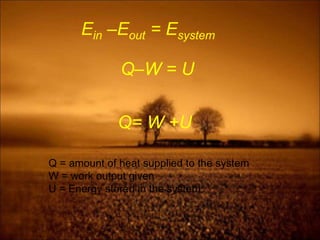
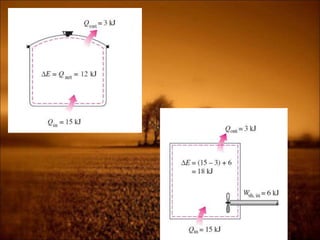
Ein –Eout = Esystem
Ein –Eout = Esystem
Q–W = U
Q = amount of heat supplied to the system
W = work output given
U = Energy stored in the system
Q= W +U
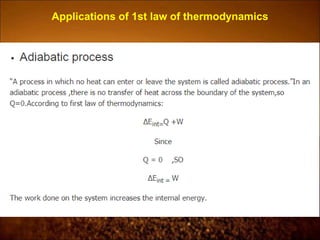
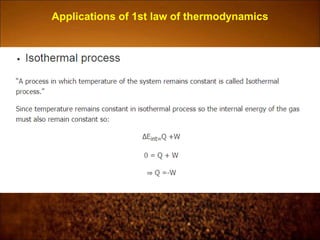
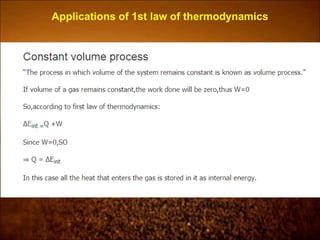
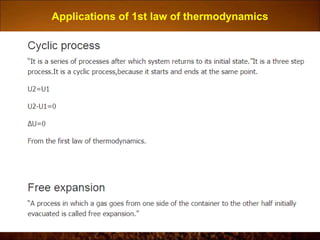
Applications of 1st law of thermodynamics
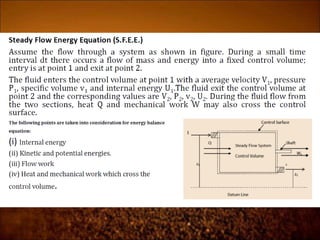
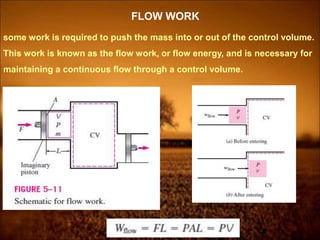
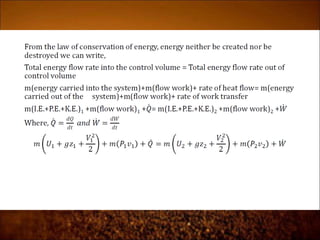
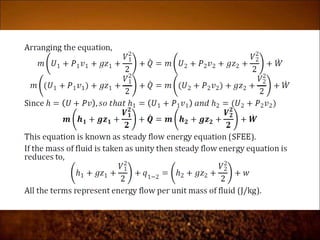
some work is required to push the mass into or out of the control volume.
This work is known as the flow work, or flow energy, and is necessary for
maintaining a continuous flow through a control volume.
FLOW WORK
Limitation Of First Law:
Note that the first law makes no reference to the
magnitude of the total energy of a closed system
at a state.
It simply states that
the change in the total energy during
an adiabatic process must be equal
to the net work done.
1
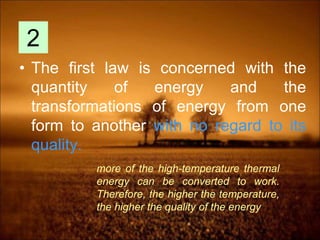
• The first law is concerned with the
quantity of energy and the
transformations of energy from one
form to another with no regard to its
quality.
2
more of the high-temperature thermal
energy can be converted to work.
Therefore, the higher the temperature,
the higher the quality of the energy
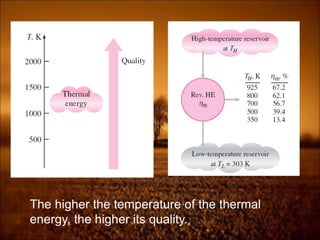
The higher the temperature of the thermal
energy, the higher its quality.
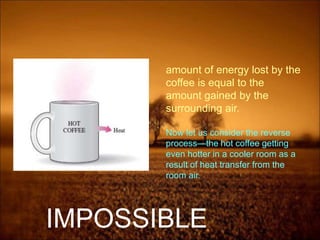
amount of energy lost by the
coffee is equal to the
amount gained by the
surrounding air.
Now let us consider the reverse
process—the hot coffee getting
even hotter in a cooler room as a
result of heat transfer from the
room air.
IMPOSSIBLE
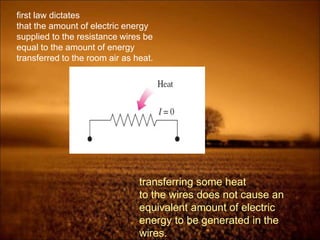
first law dictates
that the amount of electric energy
supplied to the resistance wires be
equal to the amount of energy
transferred to the room air as heat.
transferring some heat
to the wires does not cause an
equivalent amount of electric
energy to be generated in the
wires.
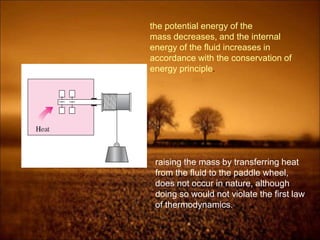
the potential energy of the
mass decreases, and the internal
energy of the fluid increases in
accordance with the conservation of
energy principle.
raising the mass by transferring heat
from the fluid to the paddle wheel,
does not occur in nature, although
doing so would not violate the first law
of thermodynamics.
The first law places no restriction on
the direction of a process, but satisfying
the first law does not ensure that the
process can actually occur.
Processes occur in a certain direction,
and not in the reverse direction.
3
This inadequacy of the first law to
identify whether a process can take
place is remedied by introducing
another general principle, the second
law of thermodynamics.
1
2
3
magnitude Of Total Energy
Quality Of Total Energy
Direction Of Process
•Some Basics
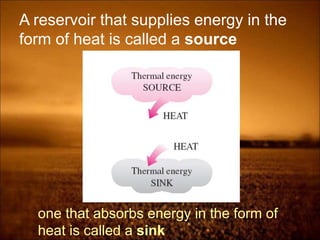
A reservoir that supplies energy in the
form of heat is called a source
one that absorbs energy in the form of
heat is called a sink
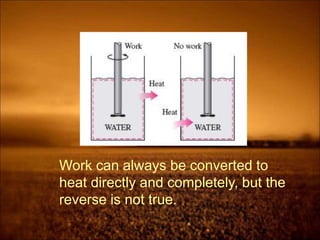
Work can always be converted to
heat directly and completely, but the
reverse is not true.
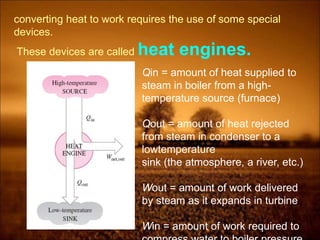
converting heat to work requires the use of some special
devices.
These devices are called heat engines.
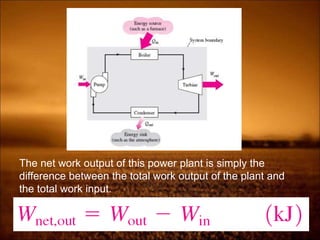
Qin = amount of heat supplied to
steam in boiler from a high-
temperature source (furnace)
Qout = amount of heat rejected
from steam in condenser to a
lowtemperature
sink (the atmosphere, a river, etc.)
Wout = amount of work delivered
by steam as it expands in turbine
Win = amount of work required to
1. They receive heat from a high-temperature source
(solar energy, oil furnace, nuclear reactor, etc.).
2. They convert part of this heat to work (usually in the
form of a rotating shaft).
3. They reject the remaining waste heat to a low-
temperature sink (the atmosphere, rivers, etc.).
4. They operate on a cycle.
The net work output of this power plant is simply the
difference between the total work output of the plant and
the total work input.
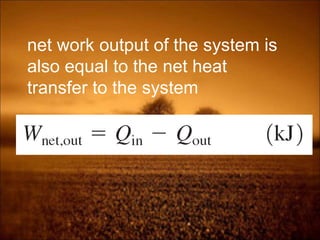
net work output of the system is
also equal to the net heat
transfer to the system
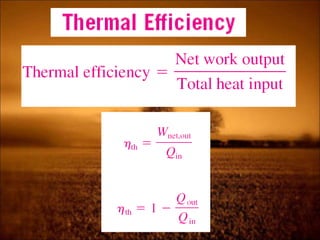
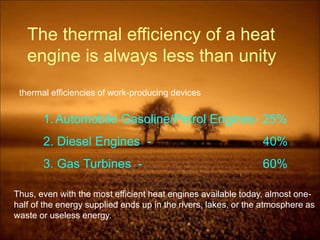
The thermal efficiency of a heat
engine is always less than unity
thermal efficiencies of work-producing devices
1.Automobile Gasoline/Petrol Engines- 25%
2. Diesel Engines - 40%
3. Gas Turbines - 60%
Thus, even with the most efficient heat engines available today, almost one-
half of the energy supplied ends up in the rivers, lakes, or the atmosphere as
waste or useless energy.
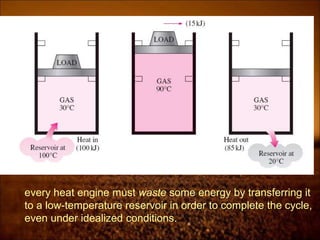
every heat engine must waste some energy by transferring it
to a low-temperature reservoir in order to complete the cycle,
even under idealized conditions.
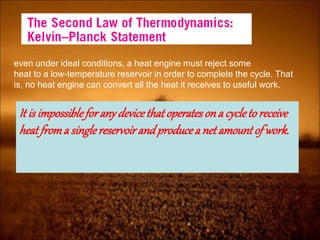
even under ideal conditions, a heat engine must reject some
heat to a low-temperature reservoir in order to complete the cycle. That
is, no heat engine can convert all the heat it receives to useful work.
It is impossibleforany devicethatoperatesona cycleto receive
heatfroma singlereservoirandproducea netamountof work.
no heat engine can have a thermal
efficiency of 100 percent
Note that the impossibility of having a
100 percent efficient heat engine is not
due to friction or other dissipative
effects. It is a limitation that applies to
both the idealized and the actual heat
engines
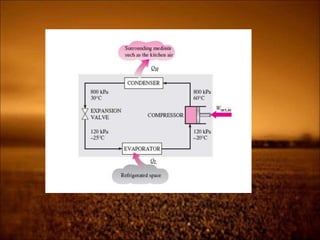
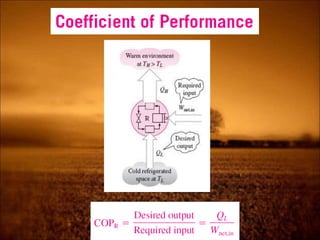
The transfer of heat from a low-temperature medium to a
high-temperature one requires special devices called
refrigerators.
The objective of a refrigerator is to maintain
the refrigerated space at a low temperature
by removing heat from it.
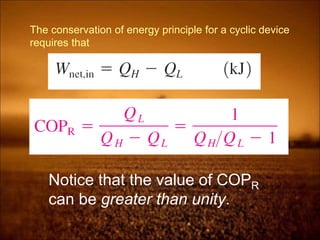
The conservation of energy principle for a cyclic device
requires that
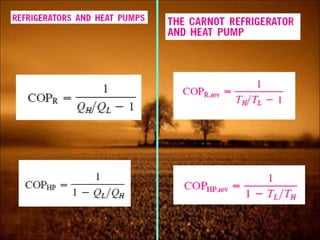
Notice that the value of COPR
can be greater than unity.
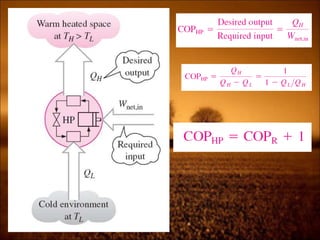
Another device that transfers heat from a low-temperature
medium to a high-temperature one is the heat pump,
The objective of a heat pump, however, is to
maintain a heated space at a high temperature.
This is accomplished by absorbing heat from a
low-temperature source
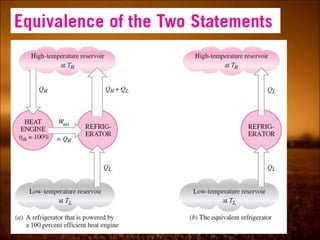
Clausius statement, which is related to refrigerators
or heat pumps.
It is impossible to construct a device that operates in a cycle and produces no effect
other than the transfer of heat from a lower-temperature body to a higher-
temperature body.
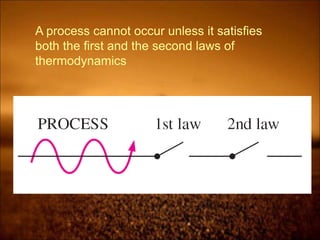
A process cannot occur unless it satisfies
both the first and the second laws of
thermodynamics
We have repeatedly stated that a process cannot take
place unless it satisfies both the first and second laws of
thermodynamics.
Any device that violates either law is
called a perpetual-motion machine
perpetual-motion machine of the first kind (PMM1)
perpetual-motion machine of the second kind (PMM2)
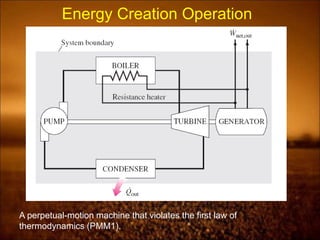
A perpetual-motion machine that violates the first law of
thermodynamics (PMM1).
Energy Creation Operation
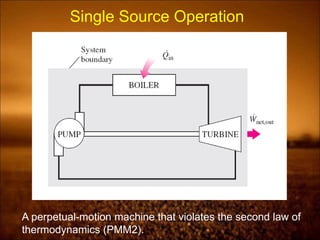
A perpetual-motion machine that violates the second law of
thermodynamics (PMM2).
Single Source Operation
The second law of thermodynamics states that no heat
engine can have an efficiency of 100 percent.
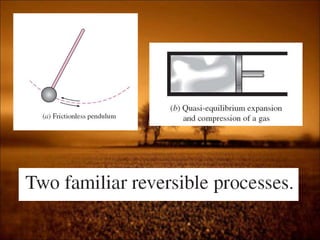
A reversible process is defined as a process
that can be reversed without leaving any
trace on the surroundings
Processes that are not reversible are called
irreversible processes.
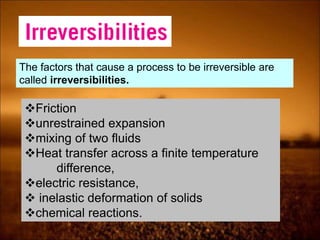
The factors that cause a process to be irreversible are
called irreversibilities.
Friction
unrestrained expansion
mixing of two fluids
Heat transfer across a finite temperature
difference,
electric resistance,
 inelastic deformation of solids
chemical reactions.
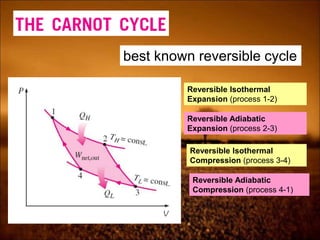
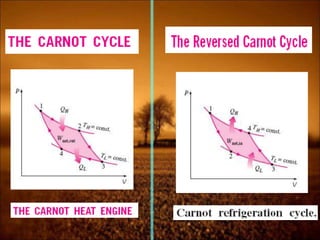
best known reversible cycle
Reversible Isothermal
Expansion (process 1-2)
Reversible Adiabatic
Expansion (process 2-3)
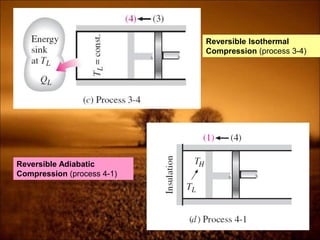
Reversible Isothermal
Compression (process 3-4)
Reversible Adiabatic
Compression (process 4-1)
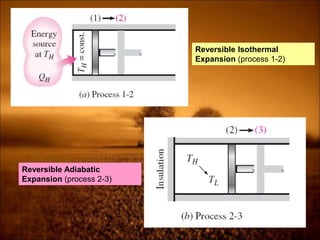
Reversible Isothermal
Expansion (process 1-2)
Reversible Adiabatic
Expansion (process 2-3)
Reversible Isothermal
Compression (process 3-4)
Reversible Adiabatic
Compression (process 4-1)
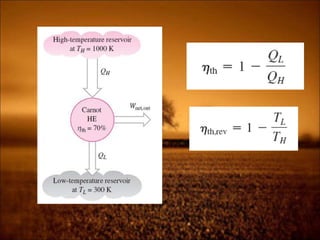
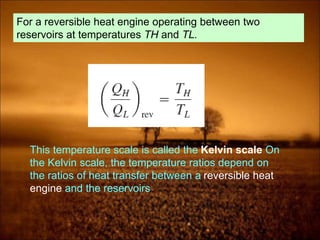
For a reversible heat engine operating between two
reservoirs at temperatures TH and TL.
This temperature scale is called the Kelvin scale On
the Kelvin scale, the temperature ratios depend on
the ratios of heat transfer between a reversible heat
engine and the reservoirs
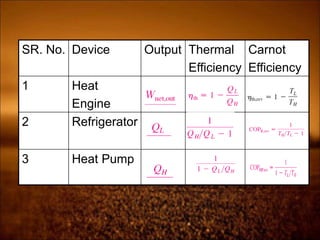
SR. No. Device Output Thermal
Efficiency
Carnot
Efficiency
1 Heat
Engine
2 Refrigerator
3 Heat Pump
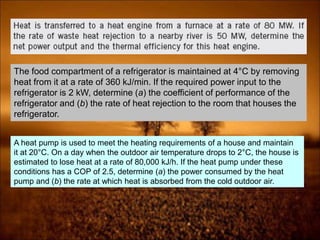
The food compartment of a refrigerator is maintained at 4°C by removing
heat from it at a rate of 360 kJ/min. If the required power input to the
refrigerator is 2 kW, determine (a) the coefficient of performance of the
refrigerator and (b) the rate of heat rejection to the room that houses the
refrigerator.
A heat pump is used to meet the heating requirements of a house and maintain
it at 20°C. On a day when the outdoor air temperature drops to 2°C, the house is
estimated to lose heat at a rate of 80,000 kJ/h. If the heat pump under these
conditions has a COP of 2.5, determine (a) the power consumed by the heat
pump and (b) the rate at which heat is absorbed from the cold outdoor air.
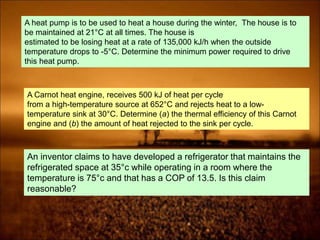
A heat pump is to be used to heat a house during the winter, The house is to
be maintained at 21°C at all times. The house is
estimated to be losing heat at a rate of 135,000 kJ/h when the outside
temperature drops to -5°C. Determine the minimum power required to drive
this heat pump.
A Carnot heat engine, receives 500 kJ of heat per cycle
from a high-temperature source at 652°C and rejects heat to a low-
temperature sink at 30°C. Determine (a) the thermal efficiency of this Carnot
engine and (b) the amount of heat rejected to the sink per cycle.
An inventor claims to have developed a refrigerator that maintains the
refrigerated space at 35°c while operating in a room where the
temperature is 75°c and that has a COP of 13.5. Is this claim
reasonable?
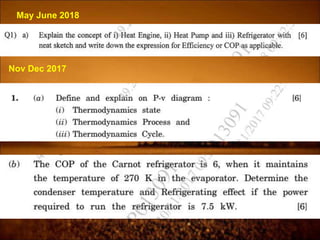
May June 2018
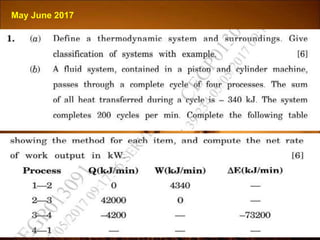
Nov Dec 2017
May June 2017
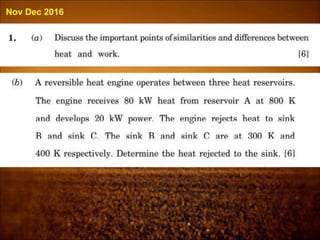
Nov Dec 2016

Lecture No.2.ppt

  • 1.
  • 2.
    • Zeroth LawOf Thermodynamics • First Law Of Thermodynamics • Second Law Of Thermodynamics
  • 3.
    Zeroth Law: • Thezeroth law of thermodynamics states that if two bodies are in thermal equilibrium with a third body, they are also in thermal equilibrium with each other.
  • 4.
    • when abody is brought into contact with another body that is at a different temperature, heat is transferred from the body at higher temperature to the one at lower temperature until both bodies attain the same temperature
  • 6.
    Zeroth Law: • Byreplacing the third body with a thermometer, the zeroth law can be restated as “two bodies are in thermal equilibrium if both have the same temperature reading even if they are not in contact.”
  • 7.
    Outcome Of ZerothLaw: • It Serves as the basis for “ TEMPERATURE MEASUREMENT ” This law allows us to build thermometers. For example the length of a mercury column is used as a measure to compare the temperatures of the two other objects.
  • 9.
    First Law OfThermodynamics • It Is also known as Conservation Of Energy Principle. “energy can be neither created nor destroyed during a process; it can only change forms and total amount of energy in the universe always remains constant”
  • 10.
    decrease in potential energy (mgΔz) = increasein kinetic energy m/2(V2 2 -V1 2)
  • 12.
    Joule’s Experiment The totalenergy remains constant, gets transferred from one form to another.
  • 13.
    “ The increasein the internal energy of a system is equal to the amount of energy added by heating the system, minus the amount lost as a result of the work done by the system on its surroundings. ” essence of the first law is the existence of the property total energy
  • 14.
    Outcome Of FirstLaw: • A major consequence of the first law is the existence and the definition of the property total energy E. The net change (increase or decrease) in the total energy of the system during a process is equal to the difference between the total energy entering and the total energy leaving the system during that process. Ein –Eout = Esystem
  • 15.
    Ein –Eout =Esystem Q–W = U Q = amount of heat supplied to the system W = work output given U = Energy stored in the system Q= W +U
  • 17.
    Applications of 1stlaw of thermodynamics
  • 18.
    Applications of 1stlaw of thermodynamics
  • 19.
    Applications of 1stlaw of thermodynamics
  • 20.
    Applications of 1stlaw of thermodynamics
  • 22.
    some work isrequired to push the mass into or out of the control volume. This work is known as the flow work, or flow energy, and is necessary for maintaining a continuous flow through a control volume. FLOW WORK
  • 36.
    Limitation Of FirstLaw: Note that the first law makes no reference to the magnitude of the total energy of a closed system at a state. It simply states that the change in the total energy during an adiabatic process must be equal to the net work done. 1
  • 37.
    • The firstlaw is concerned with the quantity of energy and the transformations of energy from one form to another with no regard to its quality. 2 more of the high-temperature thermal energy can be converted to work. Therefore, the higher the temperature, the higher the quality of the energy
  • 38.
    The higher thetemperature of the thermal energy, the higher its quality.
  • 39.
    amount of energylost by the coffee is equal to the amount gained by the surrounding air. Now let us consider the reverse process—the hot coffee getting even hotter in a cooler room as a result of heat transfer from the room air. IMPOSSIBLE
  • 40.
    first law dictates thatthe amount of electric energy supplied to the resistance wires be equal to the amount of energy transferred to the room air as heat. transferring some heat to the wires does not cause an equivalent amount of electric energy to be generated in the wires.
  • 41.
    the potential energyof the mass decreases, and the internal energy of the fluid increases in accordance with the conservation of energy principle. raising the mass by transferring heat from the fluid to the paddle wheel, does not occur in nature, although doing so would not violate the first law of thermodynamics.
  • 42.
    The first lawplaces no restriction on the direction of a process, but satisfying the first law does not ensure that the process can actually occur. Processes occur in a certain direction, and not in the reverse direction. 3
  • 43.
    This inadequacy ofthe first law to identify whether a process can take place is remedied by introducing another general principle, the second law of thermodynamics. 1 2 3 magnitude Of Total Energy Quality Of Total Energy Direction Of Process
  • 44.
  • 45.
    A reservoir thatsupplies energy in the form of heat is called a source one that absorbs energy in the form of heat is called a sink
  • 46.
    Work can alwaysbe converted to heat directly and completely, but the reverse is not true.
  • 47.
    converting heat towork requires the use of some special devices. These devices are called heat engines. Qin = amount of heat supplied to steam in boiler from a high- temperature source (furnace) Qout = amount of heat rejected from steam in condenser to a lowtemperature sink (the atmosphere, a river, etc.) Wout = amount of work delivered by steam as it expands in turbine Win = amount of work required to
  • 48.
    1. They receiveheat from a high-temperature source (solar energy, oil furnace, nuclear reactor, etc.). 2. They convert part of this heat to work (usually in the form of a rotating shaft). 3. They reject the remaining waste heat to a low- temperature sink (the atmosphere, rivers, etc.). 4. They operate on a cycle.
  • 49.
    The net workoutput of this power plant is simply the difference between the total work output of the plant and the total work input.
  • 50.
    net work outputof the system is also equal to the net heat transfer to the system
  • 52.
    The thermal efficiencyof a heat engine is always less than unity thermal efficiencies of work-producing devices 1.Automobile Gasoline/Petrol Engines- 25% 2. Diesel Engines - 40% 3. Gas Turbines - 60% Thus, even with the most efficient heat engines available today, almost one- half of the energy supplied ends up in the rivers, lakes, or the atmosphere as waste or useless energy.
  • 53.
    every heat enginemust waste some energy by transferring it to a low-temperature reservoir in order to complete the cycle, even under idealized conditions.
  • 54.
    even under idealconditions, a heat engine must reject some heat to a low-temperature reservoir in order to complete the cycle. That is, no heat engine can convert all the heat it receives to useful work. It is impossibleforany devicethatoperatesona cycleto receive heatfroma singlereservoirandproducea netamountof work.
  • 55.
    no heat enginecan have a thermal efficiency of 100 percent Note that the impossibility of having a 100 percent efficient heat engine is not due to friction or other dissipative effects. It is a limitation that applies to both the idealized and the actual heat engines
  • 56.
    The transfer ofheat from a low-temperature medium to a high-temperature one requires special devices called refrigerators. The objective of a refrigerator is to maintain the refrigerated space at a low temperature by removing heat from it.
  • 59.
    The conservation ofenergy principle for a cyclic device requires that Notice that the value of COPR can be greater than unity.
  • 60.
    Another device thattransfers heat from a low-temperature medium to a high-temperature one is the heat pump, The objective of a heat pump, however, is to maintain a heated space at a high temperature. This is accomplished by absorbing heat from a low-temperature source
  • 62.
    Clausius statement, whichis related to refrigerators or heat pumps. It is impossible to construct a device that operates in a cycle and produces no effect other than the transfer of heat from a lower-temperature body to a higher- temperature body.
  • 64.
    A process cannotoccur unless it satisfies both the first and the second laws of thermodynamics
  • 65.
    We have repeatedlystated that a process cannot take place unless it satisfies both the first and second laws of thermodynamics. Any device that violates either law is called a perpetual-motion machine perpetual-motion machine of the first kind (PMM1) perpetual-motion machine of the second kind (PMM2)
  • 66.
    A perpetual-motion machinethat violates the first law of thermodynamics (PMM1). Energy Creation Operation
  • 67.
    A perpetual-motion machinethat violates the second law of thermodynamics (PMM2). Single Source Operation
  • 68.
    The second lawof thermodynamics states that no heat engine can have an efficiency of 100 percent. A reversible process is defined as a process that can be reversed without leaving any trace on the surroundings Processes that are not reversible are called irreversible processes.
  • 70.
    The factors thatcause a process to be irreversible are called irreversibilities. Friction unrestrained expansion mixing of two fluids Heat transfer across a finite temperature difference, electric resistance,  inelastic deformation of solids chemical reactions.
  • 71.
    best known reversiblecycle Reversible Isothermal Expansion (process 1-2) Reversible Adiabatic Expansion (process 2-3) Reversible Isothermal Compression (process 3-4) Reversible Adiabatic Compression (process 4-1)
  • 72.
    Reversible Isothermal Expansion (process1-2) Reversible Adiabatic Expansion (process 2-3)
  • 73.
    Reversible Isothermal Compression (process3-4) Reversible Adiabatic Compression (process 4-1)
  • 75.
    For a reversibleheat engine operating between two reservoirs at temperatures TH and TL. This temperature scale is called the Kelvin scale On the Kelvin scale, the temperature ratios depend on the ratios of heat transfer between a reversible heat engine and the reservoirs
  • 78.
    SR. No. DeviceOutput Thermal Efficiency Carnot Efficiency 1 Heat Engine 2 Refrigerator 3 Heat Pump
  • 79.
    The food compartmentof a refrigerator is maintained at 4°C by removing heat from it at a rate of 360 kJ/min. If the required power input to the refrigerator is 2 kW, determine (a) the coefficient of performance of the refrigerator and (b) the rate of heat rejection to the room that houses the refrigerator. A heat pump is used to meet the heating requirements of a house and maintain it at 20°C. On a day when the outdoor air temperature drops to 2°C, the house is estimated to lose heat at a rate of 80,000 kJ/h. If the heat pump under these conditions has a COP of 2.5, determine (a) the power consumed by the heat pump and (b) the rate at which heat is absorbed from the cold outdoor air.
  • 80.
    A heat pumpis to be used to heat a house during the winter, The house is to be maintained at 21°C at all times. The house is estimated to be losing heat at a rate of 135,000 kJ/h when the outside temperature drops to -5°C. Determine the minimum power required to drive this heat pump. A Carnot heat engine, receives 500 kJ of heat per cycle from a high-temperature source at 652°C and rejects heat to a low- temperature sink at 30°C. Determine (a) the thermal efficiency of this Carnot engine and (b) the amount of heat rejected to the sink per cycle. An inventor claims to have developed a refrigerator that maintains the refrigerated space at 35°c while operating in a room where the temperature is 75°c and that has a COP of 13.5. Is this claim reasonable?
  • 81.
  • 82.
  • 83.