Unit No:01
Thermodynamics
Prof. Yash B. Parikh
M.Tech (Computer Integrated Manufacturing)
B.E.(Mechanical Engineering)
Assistant Professor
Department of Mechanical Engineering
Throttling Process
2
 Whenever a substance expands from a region of
relatively high pressure across a restriction or small
opening under a steady flow without heat transfer.
e.g. the puncture of a tyre is a throttling process.
 The pressure drop takes place so rapidly that there is
neither sufficient time nor surface area for heat
transfer to take place.
 Throttling process is a.k.a. isenthalpic process.
 Expansion of a gas through a large opening is called
a free expansion.
e.g. bursting of tyre is the case of free expansion
process.
Throttling Process
3
 Only difference between the two is in free expansion
gas leaves with larger velocity whereas in throttling
change in velocity is negligible.
Limitations of First Law of Thermodynamics
4
 Heat is transferred from hot body to cooler
surroundings. However reverse of this is not possible.
 In Joules experiment, reverse process is not possible.
i.e. raising the weight by transferring heat from fluid
to the paddle wheel is not possible.
1. The processes can proceed in a particular direction
only.
2. All processes involving conversion of heat into work
& vice-versa are not equivalent.
Second Law of Thermodynamics
5
 According to First law of thermodynamics heat and
work are mutually interchangeable.
 This law does not mention about the direction flow of
heat.
 Second law of thermodynamics gives the direction of
flow of heat energy.
 It is important to understand how heat energy is
converted into mechanical work.
Heat Engine
6
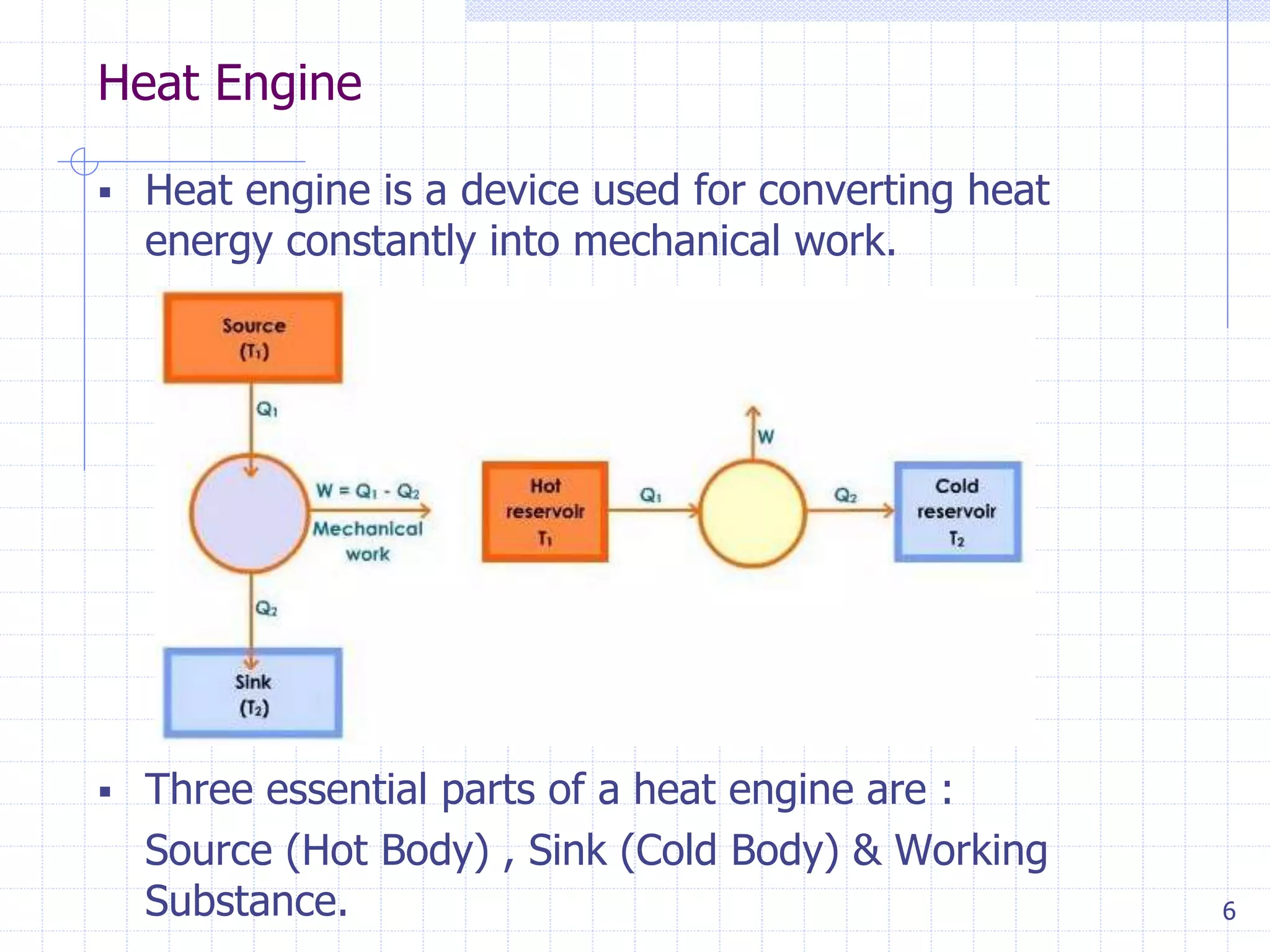
 Heat engine is a device used for converting heat
energy constantly into mechanical work.
 Three essential parts of a heat engine are :
Source (Hot Body) , Sink (Cold Body) & Working
Substance.
Heat Engine
7
 Heat Source : A heat reservoir which supplies heat to
a system.
 Heat Sink: A heat reservoir which absorbs heat from
a system.
 Heat Reservoir : The source of infinite heat energy.
Finite amount of heat absorbed or rejected will not
affect its temperature
e.g. Ocean, Lakes, Atmosphere.
Thermal Efficiency of a Heat Engine
8
 Heat energy is never converted completely into
mechanical energy.
i.e. efficiency of heat engine is never equals to 100%.
It’s given by,
Efficiency = External W.D. / Heat absorbed from Source
Statements of Second Law
9
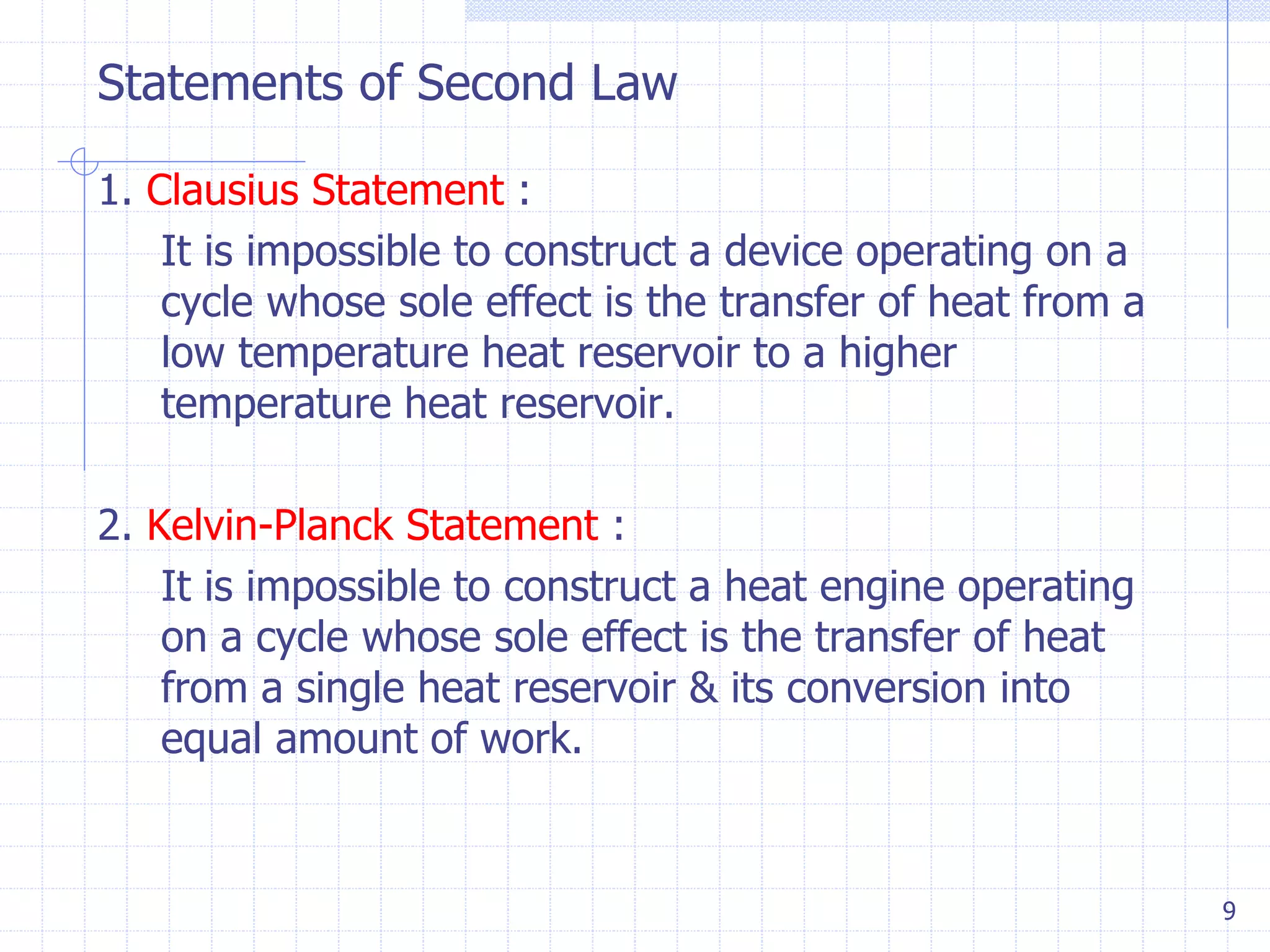
1. Clausius Statement :
It is impossible to construct a device operating on a
cycle whose sole effect is the transfer of heat from a
low temperature heat reservoir to a higher
temperature heat reservoir.
2. Kelvin-Planck Statement :
It is impossible to construct a heat engine operating
on a cycle whose sole effect is the transfer of heat
from a single heat reservoir & its conversion into
equal amount of work.
Refrigerator & Heat Pump
10
Refrigerator :
It’s a device operating on a cycle which removes heat
from a low temperature body and rejects it to a body
at high temperature on the expense of external work.
Heat Pump :
If the system delivers heat energy at higher
temperature than that of ambient temperature.
e.g. heater
Coefficient of Performance (C.O.P)
11
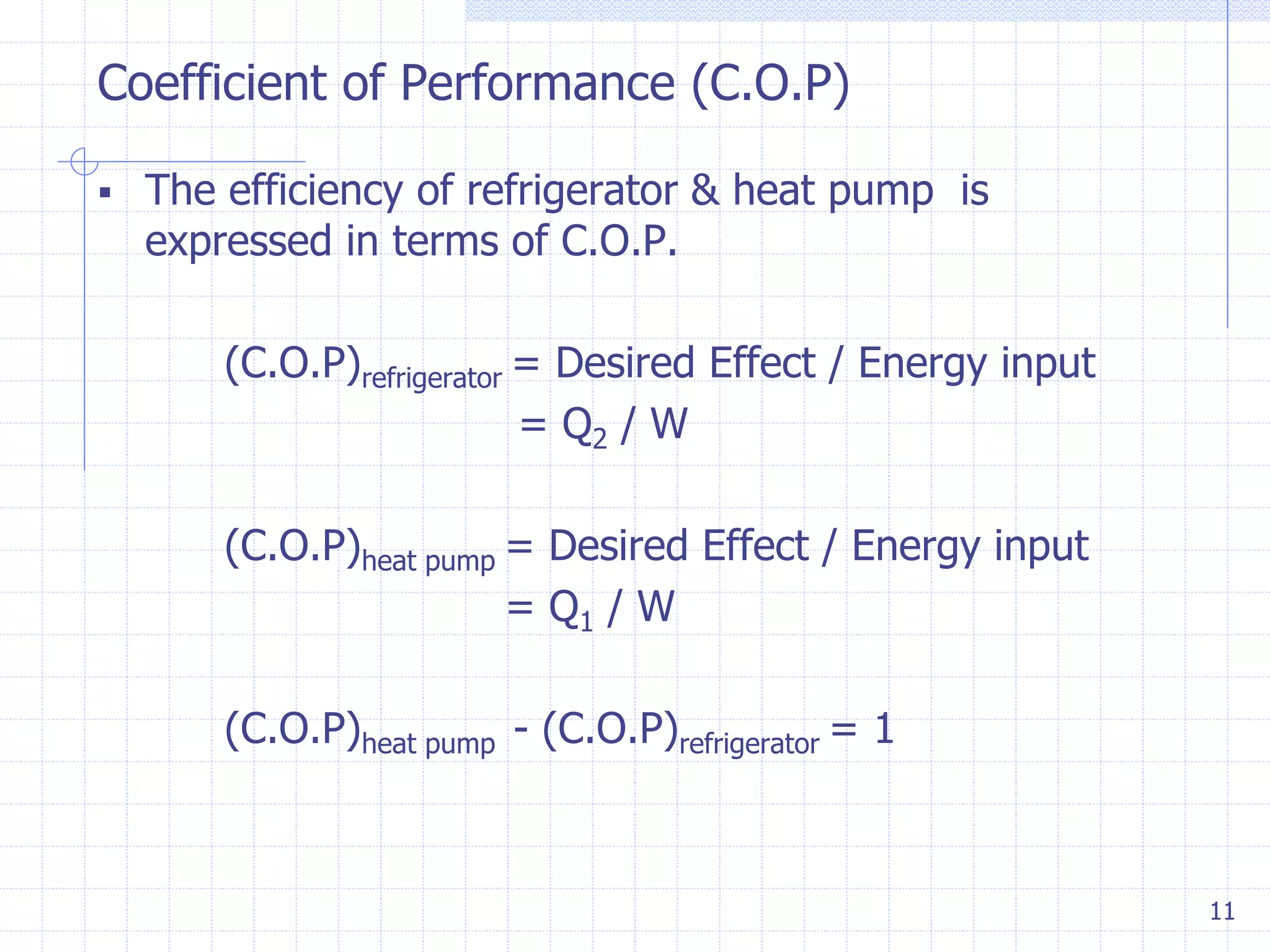
 The efficiency of refrigerator & heat pump is
expressed in terms of C.O.P.
(C.O.P)refrigerator = Desired Effect / Energy input
= Q2 / W
(C.O.P)heat pump = Desired Effect / Energy input
= Q1 / W
(C.O.P)heat pump - (C.O.P)refrigerator = 1
Example
12
 Heat pump is used to maintain house at 23 degree C.
The house is losing heat to outside air through walls
at 60000 kJ/hr. While energy generated in house by
various appliances is 4000 kJ/hr. For a C.O.P of 1.5,
find required power input in kW, supplied to the heat
pump. 6 Marks

Thermal 07

  • 1.
    Unit No:01 Thermodynamics Prof. YashB. Parikh M.Tech (Computer Integrated Manufacturing) B.E.(Mechanical Engineering) Assistant Professor Department of Mechanical Engineering
  • 2.
    Throttling Process 2  Whenevera substance expands from a region of relatively high pressure across a restriction or small opening under a steady flow without heat transfer. e.g. the puncture of a tyre is a throttling process.  The pressure drop takes place so rapidly that there is neither sufficient time nor surface area for heat transfer to take place.  Throttling process is a.k.a. isenthalpic process.  Expansion of a gas through a large opening is called a free expansion. e.g. bursting of tyre is the case of free expansion process.
  • 3.
    Throttling Process 3  Onlydifference between the two is in free expansion gas leaves with larger velocity whereas in throttling change in velocity is negligible.
  • 4.
    Limitations of FirstLaw of Thermodynamics 4  Heat is transferred from hot body to cooler surroundings. However reverse of this is not possible.  In Joules experiment, reverse process is not possible. i.e. raising the weight by transferring heat from fluid to the paddle wheel is not possible. 1. The processes can proceed in a particular direction only. 2. All processes involving conversion of heat into work & vice-versa are not equivalent.
  • 5.
    Second Law ofThermodynamics 5  According to First law of thermodynamics heat and work are mutually interchangeable.  This law does not mention about the direction flow of heat.  Second law of thermodynamics gives the direction of flow of heat energy.  It is important to understand how heat energy is converted into mechanical work.
  • 6.
    Heat Engine 6  Heatengine is a device used for converting heat energy constantly into mechanical work.  Three essential parts of a heat engine are : Source (Hot Body) , Sink (Cold Body) & Working Substance.
  • 7.
    Heat Engine 7  HeatSource : A heat reservoir which supplies heat to a system.  Heat Sink: A heat reservoir which absorbs heat from a system.  Heat Reservoir : The source of infinite heat energy. Finite amount of heat absorbed or rejected will not affect its temperature e.g. Ocean, Lakes, Atmosphere.
  • 8.
    Thermal Efficiency ofa Heat Engine 8  Heat energy is never converted completely into mechanical energy. i.e. efficiency of heat engine is never equals to 100%. It’s given by, Efficiency = External W.D. / Heat absorbed from Source
  • 9.
    Statements of SecondLaw 9 1. Clausius Statement : It is impossible to construct a device operating on a cycle whose sole effect is the transfer of heat from a low temperature heat reservoir to a higher temperature heat reservoir. 2. Kelvin-Planck Statement : It is impossible to construct a heat engine operating on a cycle whose sole effect is the transfer of heat from a single heat reservoir & its conversion into equal amount of work.
  • 10.
    Refrigerator & HeatPump 10 Refrigerator : It’s a device operating on a cycle which removes heat from a low temperature body and rejects it to a body at high temperature on the expense of external work. Heat Pump : If the system delivers heat energy at higher temperature than that of ambient temperature. e.g. heater
  • 11.
    Coefficient of Performance(C.O.P) 11  The efficiency of refrigerator & heat pump is expressed in terms of C.O.P. (C.O.P)refrigerator = Desired Effect / Energy input = Q2 / W (C.O.P)heat pump = Desired Effect / Energy input = Q1 / W (C.O.P)heat pump - (C.O.P)refrigerator = 1
  • 12.
    Example 12  Heat pumpis used to maintain house at 23 degree C. The house is losing heat to outside air through walls at 60000 kJ/hr. While energy generated in house by various appliances is 4000 kJ/hr. For a C.O.P of 1.5, find required power input in kW, supplied to the heat pump. 6 Marks