Chapter 13
Temperature and Kinetic
       Theory
13-2 Temperature and Thermometers
Temperature is a measure of how hot or cold
something is.
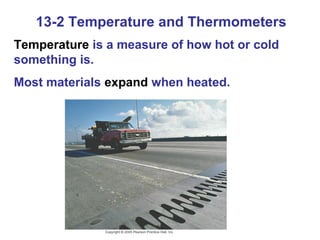
Most materials expand when heated.
13-2 Temperature and Thermometers
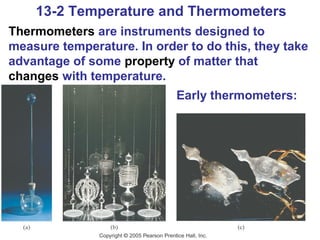
Thermometers are instruments designed to
measure temperature. In order to do this, they take
advantage of some property of matter that
changes with temperature.
                            Early thermometers:
13-2 Temperature and Thermometers

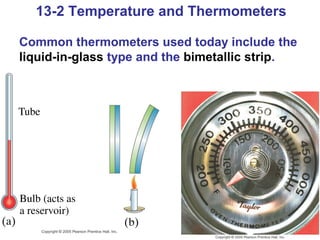
Common thermometers used today include the
liquid-in-glass type and the bimetallic strip.
13-2 Temperature and Thermometers


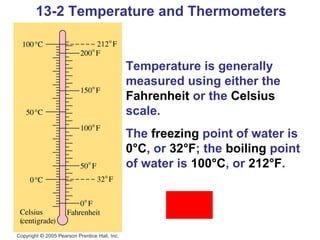
           Temperature is generally
           measured using either the
           Fahrenheit or the Celsius
           scale.
           The freezing point of water is
           0°C, or 32°F; the boiling point
           of water is 100°C, or 212°F.
13-4 Thermal Expansion


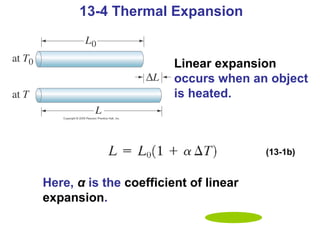
                        Linear expansion
                        occurs when an object
                        is heated.


                                       (13-1b)


Here, α is the coefficient of linear
expansion.
13-4 Thermal Expansion


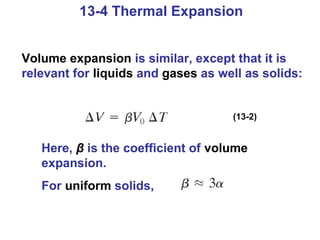
Volume expansion is similar, except that it is
relevant for liquids and gases as well as solids:


                                    (13-2)


   Here, β is the coefficient of volume
   expansion.
   For uniform solids,
13-4 Thermal Expansion
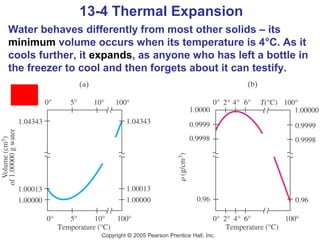
Water behaves differently from most other solids – its
minimum volume occurs when its temperature is 4°C. As it
cools further, it expands, as anyone who has left a bottle in
the freezer to cool and then forgets about it can testify.
13-7 The Ideal Gas Law
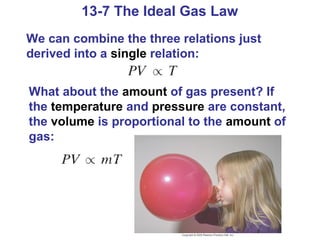
We can combine the three relations just
derived into a single relation:


What about the amount of gas present? If
the temperature and pressure are constant,
the volume is proportional to the amount of
gas:
13-7 The Ideal Gas Law

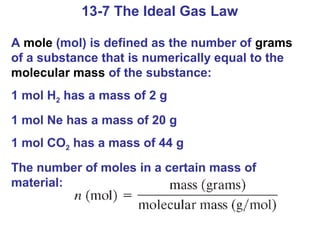
A mole (mol) is defined as the number of grams
of a substance that is numerically equal to the
molecular mass of the substance:
1 mol H2 has a mass of 2 g
1 mol Ne has a mass of 20 g
1 mol CO2 has a mass of 44 g
The number of moles in a certain mass of
material:
13-7 The Ideal Gas Law
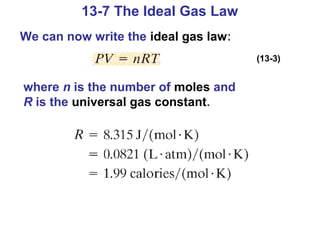
We can now write the ideal gas law:
                                      (13-3)


where n is the number of moles and
R is the universal gas constant.
13-8 Problem Solving with the Ideal Gas Law
Useful facts and definitions:
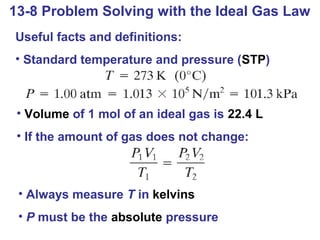
• Standard temperature and pressure (STP)


 • Volume of 1 mol of an ideal gas is 22.4 L
 • If the amount of gas does not change:


 • Always measure T in kelvins
 • P must be the absolute pressure
13-10 Kinetic Theory and the Molecular
    Interpretation of Temperature
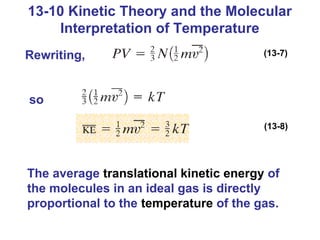
Rewriting,                              (13-7)


so

                                        (13-8)


The average translational kinetic energy of
the molecules in an ideal gas is directly
proportional to the temperature of the gas.
13-10 Kinetic Theory and the Molecular
     Interpretation of Temperature


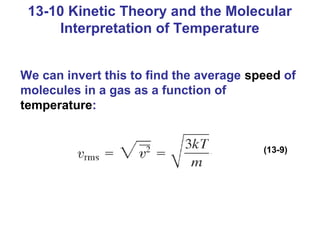
We can invert this to find the average speed of
molecules in a gas as a function of
temperature:


                                         (13-9)
13-11 Distribution of Molecular Speeds
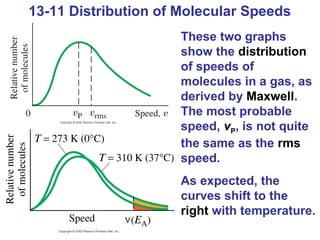
                      These two graphs
                      show the distribution
                      of speeds of
                      molecules in a gas, as
                      derived by Maxwell.
                      The most probable
                      speed, vP, is not quite
                      the same as the rms
                      speed.
                      As expected, the
                      curves shift to the
                      right with temperature.

Ppa6 lecture ch_13

  • 1.
  • 2.
    13-2 Temperature andThermometers Temperature is a measure of how hot or cold something is. Most materials expand when heated.
  • 3.
    13-2 Temperature andThermometers Thermometers are instruments designed to measure temperature. In order to do this, they take advantage of some property of matter that changes with temperature. Early thermometers:
  • 4.
    13-2 Temperature andThermometers Common thermometers used today include the liquid-in-glass type and the bimetallic strip.
  • 5.
    13-2 Temperature andThermometers Temperature is generally measured using either the Fahrenheit or the Celsius scale. The freezing point of water is 0°C, or 32°F; the boiling point of water is 100°C, or 212°F.
  • 6.
    13-4 Thermal Expansion Linear expansion occurs when an object is heated. (13-1b) Here, α is the coefficient of linear expansion.
  • 7.
    13-4 Thermal Expansion Volumeexpansion is similar, except that it is relevant for liquids and gases as well as solids: (13-2) Here, β is the coefficient of volume expansion. For uniform solids,
  • 8.
  • 9.
    13-4 Thermal Expansion Waterbehaves differently from most other solids – its minimum volume occurs when its temperature is 4°C. As it cools further, it expands, as anyone who has left a bottle in the freezer to cool and then forgets about it can testify.
  • 10.
    13-7 The IdealGas Law We can combine the three relations just derived into a single relation: What about the amount of gas present? If the temperature and pressure are constant, the volume is proportional to the amount of gas:
  • 11.
    13-7 The IdealGas Law A mole (mol) is defined as the number of grams of a substance that is numerically equal to the molecular mass of the substance: 1 mol H2 has a mass of 2 g 1 mol Ne has a mass of 20 g 1 mol CO2 has a mass of 44 g The number of moles in a certain mass of material:
  • 12.
    13-7 The IdealGas Law We can now write the ideal gas law: (13-3) where n is the number of moles and R is the universal gas constant.
  • 13.
    13-8 Problem Solvingwith the Ideal Gas Law Useful facts and definitions: • Standard temperature and pressure (STP) • Volume of 1 mol of an ideal gas is 22.4 L • If the amount of gas does not change: • Always measure T in kelvins • P must be the absolute pressure
  • 14.
    13-10 Kinetic Theoryand the Molecular Interpretation of Temperature Rewriting, (13-7) so (13-8) The average translational kinetic energy of the molecules in an ideal gas is directly proportional to the temperature of the gas.
  • 15.
    13-10 Kinetic Theoryand the Molecular Interpretation of Temperature We can invert this to find the average speed of molecules in a gas as a function of temperature: (13-9)
  • 16.
    13-11 Distribution ofMolecular Speeds These two graphs show the distribution of speeds of molecules in a gas, as derived by Maxwell. The most probable speed, vP, is not quite the same as the rms speed. As expected, the curves shift to the right with temperature.