Colligative Properties – Vapor Pressure XII Grade
The Lowering Vapor Pressure
Vapor Pressure
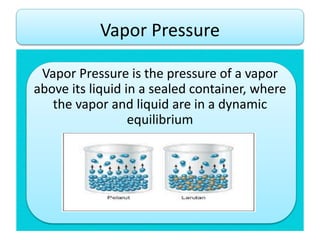
Vapor Pressure is the pressure of a vapor
above its liquid in a sealed container, where
the vapor and liquid are in a dynamic
equilibrium
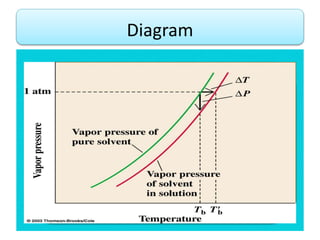
Diagram
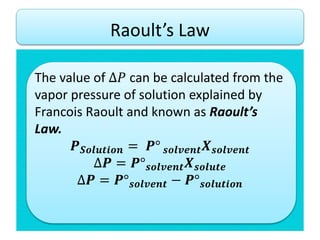
Raoult’s Law
The value of ∆𝑃 can be calculated from the
vapor pressure of solution explained by
Francois Raoult and known as Raoult’s
Law.
𝑷 𝑺𝒐𝒍𝒖𝒕𝒊𝒐𝒏 = 𝑷° 𝒔𝒐𝒍𝒗𝒆𝒏𝒕 𝑿 𝒔𝒐𝒍𝒗𝒆𝒏𝒕
∆𝑷 = 𝑷° 𝒔𝒐𝒍𝒗𝒆𝒏𝒕 𝑿 𝒔𝒐𝒍𝒖𝒕𝒆
∆𝑷 = 𝑷° 𝒔𝒐𝒍𝒗𝒆𝒏𝒕 − 𝑷° 𝒔𝒐𝒍𝒖𝒕𝒊𝒐𝒏
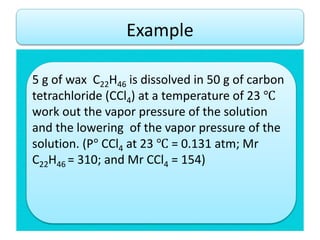
Example
5 g of wax C22H46 is dissolved in 50 g of carbon
tetrachloride (CCl4) at a temperature of 23 ℃
work out the vapor pressure of the solution
and the lowering of the vapor pressure of the
solution. (P° CCl4 at 23 ℃ = 0.131 atm; Mr
C22H46 = 310; and Mr CCl4 = 154)
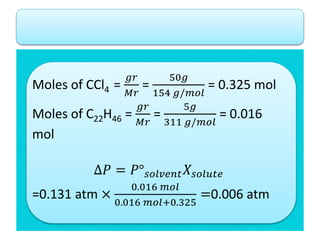
Moles of CCl4 =
𝑔𝑟
𝑀𝑟
=
50𝑔
154 𝑔/𝑚𝑜𝑙
= 0.325 mol
Moles of C22H46 =
𝑔𝑟
𝑀𝑟
=
5𝑔
311 𝑔/𝑚𝑜𝑙
= 0.016
mol
∆𝑃 = 𝑃° 𝑠𝑜𝑙𝑣𝑒𝑛𝑡 𝑋𝑠𝑜𝑙𝑢𝑡𝑒
=0.131 atm ×
0.016 𝑚𝑜𝑙
0.016 𝑚𝑜𝑙+0.325
=0.006 atm
Colligative Properties Grade XII Semester 1
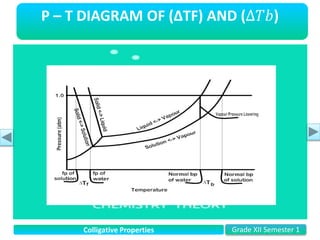
P – T DIAGRAM OF (∆TF) AND (∆𝑇𝑏)
Freezing Point Depression
• is the decrease of the freezing point of a
solution relative to the freezing point of
its pure solvent
• Freezing point depression (∆Tf)
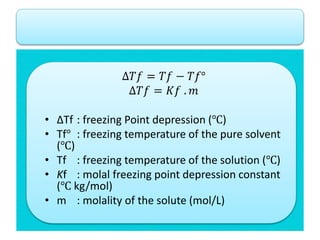
∆𝑇𝑓 = 𝑇𝑓 − 𝑇𝑓°
∆𝑇𝑓 = 𝐾𝑓 . 𝑚
• ∆Tf : freezing Point depression (℃)
• Tf° : freezing temperature of the pure solvent
(℃)
• Tf : freezing temperature of the solution (℃)
• Kf : molal freezing point depression constant
(℃ kg/mol)
• m : molality of the solute (mol/L)
Boiling Point Elevation
• What is boiling point elevation?
• How does the influence of solute to
boiling point elevation explain?
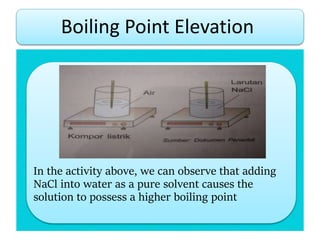
In the activity above, we can observe that adding
NaCl into water as a pure solvent causes the
solution to possess a higher boiling point
Boiling Point Elevation
Definition
Boiling point elevation (∆𝑇𝑏) is the increase
of the boiling point of a solution relative to
the boiling point of its pure solvent
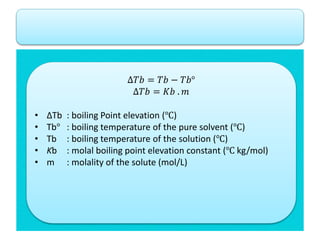
∆𝑇𝑏 = 𝑇𝑏 − 𝑇𝑏°
∆𝑇𝑏 = 𝐾𝑏 . 𝑚
• ∆Tb : boiling Point elevation (℃)
• Tb° : boiling temperature of the pure solvent (℃)
• Tb : boiling temperature of the solution (℃)
• Kb : molal boiling point elevation constant (℃ kg/mol)
• m : molality of the solute (mol/L)
Example
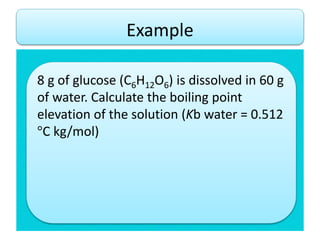
8 g of glucose (C6H12O6) is dissolved in 60 g
of water. Calculate the boiling point
elevation of the solution (Kb water = 0.512
°C kg/mol)
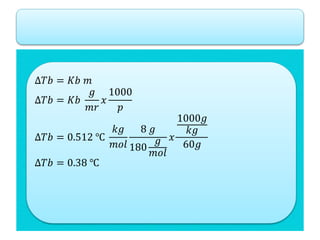
∆𝑇𝑏 = 𝐾𝑏 𝑚
∆𝑇𝑏 = 𝐾𝑏
𝑔
𝑚𝑟
𝑥
1000
𝑝
∆𝑇𝑏 = 0.512 ℃
𝑘𝑔
𝑚𝑜𝑙
8 𝑔
180
𝑔
𝑚𝑜𝑙
𝑥
1000𝑔
𝑘𝑔
60𝑔
∆𝑇𝑏 = 0.38 ℃
Have you ever
heard about
“osmosis”?
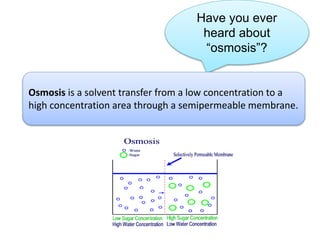
Osmosis is a solvent transfer from a low concentration to a
high concentration area through a semipermeable membrane.
Where
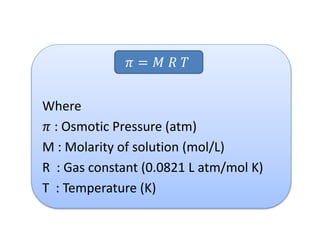
𝜋 : Osmotic Pressure (atm)
M : Molarity of solution (mol/L)
R : Gas constant (0.0821 L atm/mol K)
T : Temperature (K)
𝜋 = 𝑀 𝑅 𝑇
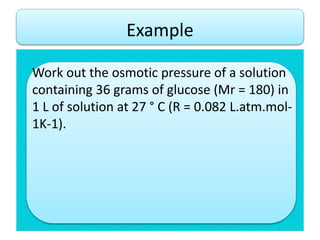
Work out the osmotic pressure of a solution
containing 36 grams of glucose (Mr = 180) in
1 L of solution at 27 ° C (R = 0.082 L.atm.mol-
1K-1).
Example
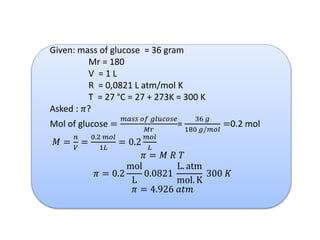
Given: mass of glucose = 36 gram
Mr = 180
V = 1 L
R = 0,0821 L atm/mol K
T = 27 °C = 27 + 273K = 300 K
Asked : 𝜋?
Mol of glucose =
𝑚𝑎𝑠𝑠 𝑜𝑓 𝑔𝑙𝑢𝑐𝑜𝑠𝑒
𝑀𝑟
=
36 𝑔
180 𝑔/𝑚𝑜𝑙
=0.2 mol
𝑀 =
𝑛
𝑉
=
0.2 𝑚𝑜𝑙
1𝐿
= 0.2
𝑚𝑜𝑙
𝐿
𝜋 = 𝑀 𝑅 𝑇
𝜋 = 0.2
mol
L
0.0821
L. atm
mol. K
300 𝐾
𝜋 = 4.926 𝑎𝑡𝑚
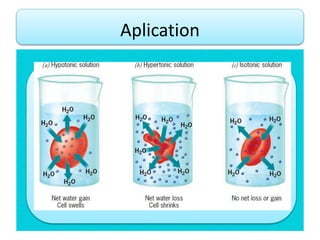
Aplication
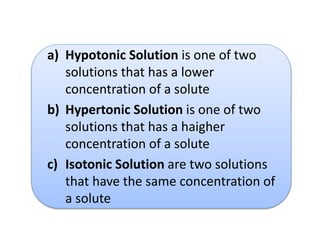
a) Hypotonic Solution is one of two
solutions that has a lower
concentration of a solute
b) Hypertonic Solution is one of two
solutions that has a haigher
concentration of a solute
c) Isotonic Solution are two solutions
that have the same concentration of
a solute
Colligative Properties – Vapor Pressure XII Grade
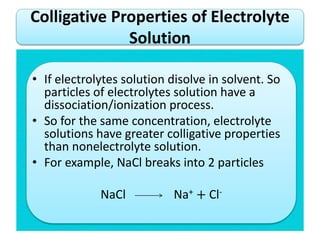
• If electrolytes solution disolve in solvent. So
particles of electrolytes solution have a
dissociation/ionization process.
• So for the same concentration, electrolyte
solutions have greater colligative properties
than nonelectrolyte solution.
• For example, NaCl breaks into 2 particles
NaCl Na+ + Cl-
Colligative Properties of Electrolyte
Solution
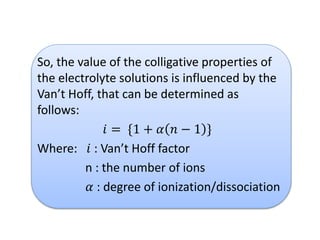
So, the value of the colligative properties of
the electrolyte solutions is influenced by the
Van’t Hoff, that can be determined as
follows:
𝑖 = {1 + 𝛼 𝑛 − 1 }
Where: 𝑖 : Van’t Hoff factor
n : the number of ions
𝛼 : degree of ionization/dissociation
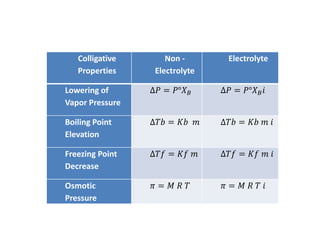
Colligative
Properties
Non -
Electrolyte
Electrolyte
Lowering of
Vapor Pressure
∆𝑃 = 𝑃°𝑋 𝐵 ∆𝑃 = 𝑃°𝑋 𝐵 𝑖
Boiling Point
Elevation
∆𝑇𝑏 = 𝐾𝑏 𝑚 ∆𝑇𝑏 = 𝐾𝑏 𝑚 𝑖
Freezing Point
Decrease
∆𝑇𝑓 = 𝐾𝑓 𝑚 ∆𝑇𝑓 = 𝐾𝑓 𝑚 𝑖
Osmotic
Pressure
𝜋 = 𝑀 𝑅 𝑇 𝜋 = 𝑀 𝑅 𝑇 𝑖
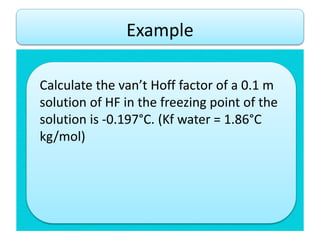
Calculate the van’t Hoff factor of a 0.1 m
solution of HF in the freezing point of the
solution is -0.197°C. (Kf water = 1.86°C
kg/mol)
Example
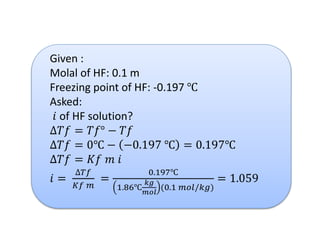
Given :
Molal of HF: 0.1 m
Freezing point of HF: -0.197 ℃
Asked:
𝑖 of HF solution?
∆𝑇𝑓 = 𝑇𝑓° − 𝑇𝑓
∆𝑇𝑓 = 0℃ − −0.197 ℃ = 0.197℃
∆𝑇𝑓 = 𝐾𝑓 𝑚 𝑖
𝑖 =
∆𝑇𝑓
𝐾𝑓 𝑚
=
0.197℃
1.86℃
𝑘𝑔
𝑚𝑜𝑙
(0.1 𝑚𝑜𝑙/𝑘𝑔)
= 1.059

Colligative Properties

  • 1.
    Colligative Properties –Vapor Pressure XII Grade The Lowering Vapor Pressure
  • 2.
    Vapor Pressure Vapor Pressureis the pressure of a vapor above its liquid in a sealed container, where the vapor and liquid are in a dynamic equilibrium
  • 3.
  • 4.
    Raoult’s Law The valueof ∆𝑃 can be calculated from the vapor pressure of solution explained by Francois Raoult and known as Raoult’s Law. 𝑷 𝑺𝒐𝒍𝒖𝒕𝒊𝒐𝒏 = 𝑷° 𝒔𝒐𝒍𝒗𝒆𝒏𝒕 𝑿 𝒔𝒐𝒍𝒗𝒆𝒏𝒕 ∆𝑷 = 𝑷° 𝒔𝒐𝒍𝒗𝒆𝒏𝒕 𝑿 𝒔𝒐𝒍𝒖𝒕𝒆 ∆𝑷 = 𝑷° 𝒔𝒐𝒍𝒗𝒆𝒏𝒕 − 𝑷° 𝒔𝒐𝒍𝒖𝒕𝒊𝒐𝒏
  • 5.
    Example 5 g ofwax C22H46 is dissolved in 50 g of carbon tetrachloride (CCl4) at a temperature of 23 ℃ work out the vapor pressure of the solution and the lowering of the vapor pressure of the solution. (P° CCl4 at 23 ℃ = 0.131 atm; Mr C22H46 = 310; and Mr CCl4 = 154)
  • 6.
    Moles of CCl4= 𝑔𝑟 𝑀𝑟 = 50𝑔 154 𝑔/𝑚𝑜𝑙 = 0.325 mol Moles of C22H46 = 𝑔𝑟 𝑀𝑟 = 5𝑔 311 𝑔/𝑚𝑜𝑙 = 0.016 mol ∆𝑃 = 𝑃° 𝑠𝑜𝑙𝑣𝑒𝑛𝑡 𝑋𝑠𝑜𝑙𝑢𝑡𝑒 =0.131 atm × 0.016 𝑚𝑜𝑙 0.016 𝑚𝑜𝑙+0.325 =0.006 atm
  • 7.
    Colligative Properties GradeXII Semester 1 P – T DIAGRAM OF (∆TF) AND (∆𝑇𝑏)
  • 8.
  • 9.
    • is thedecrease of the freezing point of a solution relative to the freezing point of its pure solvent • Freezing point depression (∆Tf)
  • 10.
    ∆𝑇𝑓 = 𝑇𝑓− 𝑇𝑓° ∆𝑇𝑓 = 𝐾𝑓 . 𝑚 • ∆Tf : freezing Point depression (℃) • Tf° : freezing temperature of the pure solvent (℃) • Tf : freezing temperature of the solution (℃) • Kf : molal freezing point depression constant (℃ kg/mol) • m : molality of the solute (mol/L)
  • 11.
    Boiling Point Elevation •What is boiling point elevation? • How does the influence of solute to boiling point elevation explain?
  • 12.
    In the activityabove, we can observe that adding NaCl into water as a pure solvent causes the solution to possess a higher boiling point Boiling Point Elevation
  • 13.
    Definition Boiling point elevation(∆𝑇𝑏) is the increase of the boiling point of a solution relative to the boiling point of its pure solvent
  • 14.
    ∆𝑇𝑏 = 𝑇𝑏− 𝑇𝑏° ∆𝑇𝑏 = 𝐾𝑏 . 𝑚 • ∆Tb : boiling Point elevation (℃) • Tb° : boiling temperature of the pure solvent (℃) • Tb : boiling temperature of the solution (℃) • Kb : molal boiling point elevation constant (℃ kg/mol) • m : molality of the solute (mol/L)
  • 15.
    Example 8 g ofglucose (C6H12O6) is dissolved in 60 g of water. Calculate the boiling point elevation of the solution (Kb water = 0.512 °C kg/mol)
  • 16.
    ∆𝑇𝑏 = 𝐾𝑏𝑚 ∆𝑇𝑏 = 𝐾𝑏 𝑔 𝑚𝑟 𝑥 1000 𝑝 ∆𝑇𝑏 = 0.512 ℃ 𝑘𝑔 𝑚𝑜𝑙 8 𝑔 180 𝑔 𝑚𝑜𝑙 𝑥 1000𝑔 𝑘𝑔 60𝑔 ∆𝑇𝑏 = 0.38 ℃
  • 18.
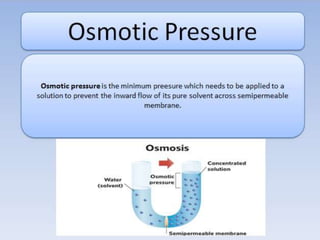
    Have you ever heardabout “osmosis”? Osmosis is a solvent transfer from a low concentration to a high concentration area through a semipermeable membrane.
  • 20.
    Where 𝜋 : OsmoticPressure (atm) M : Molarity of solution (mol/L) R : Gas constant (0.0821 L atm/mol K) T : Temperature (K) 𝜋 = 𝑀 𝑅 𝑇
  • 21.
    Work out theosmotic pressure of a solution containing 36 grams of glucose (Mr = 180) in 1 L of solution at 27 ° C (R = 0.082 L.atm.mol- 1K-1). Example
  • 22.
    Given: mass ofglucose = 36 gram Mr = 180 V = 1 L R = 0,0821 L atm/mol K T = 27 °C = 27 + 273K = 300 K Asked : 𝜋? Mol of glucose = 𝑚𝑎𝑠𝑠 𝑜𝑓 𝑔𝑙𝑢𝑐𝑜𝑠𝑒 𝑀𝑟 = 36 𝑔 180 𝑔/𝑚𝑜𝑙 =0.2 mol 𝑀 = 𝑛 𝑉 = 0.2 𝑚𝑜𝑙 1𝐿 = 0.2 𝑚𝑜𝑙 𝐿 𝜋 = 𝑀 𝑅 𝑇 𝜋 = 0.2 mol L 0.0821 L. atm mol. K 300 𝐾 𝜋 = 4.926 𝑎𝑡𝑚
  • 23.
  • 24.
    a) Hypotonic Solutionis one of two solutions that has a lower concentration of a solute b) Hypertonic Solution is one of two solutions that has a haigher concentration of a solute c) Isotonic Solution are two solutions that have the same concentration of a solute
  • 25.
    Colligative Properties –Vapor Pressure XII Grade
  • 26.
    • If electrolytessolution disolve in solvent. So particles of electrolytes solution have a dissociation/ionization process. • So for the same concentration, electrolyte solutions have greater colligative properties than nonelectrolyte solution. • For example, NaCl breaks into 2 particles NaCl Na+ + Cl- Colligative Properties of Electrolyte Solution
  • 27.
    So, the valueof the colligative properties of the electrolyte solutions is influenced by the Van’t Hoff, that can be determined as follows: 𝑖 = {1 + 𝛼 𝑛 − 1 } Where: 𝑖 : Van’t Hoff factor n : the number of ions 𝛼 : degree of ionization/dissociation
  • 28.
    Colligative Properties Non - Electrolyte Electrolyte Lowering of VaporPressure ∆𝑃 = 𝑃°𝑋 𝐵 ∆𝑃 = 𝑃°𝑋 𝐵 𝑖 Boiling Point Elevation ∆𝑇𝑏 = 𝐾𝑏 𝑚 ∆𝑇𝑏 = 𝐾𝑏 𝑚 𝑖 Freezing Point Decrease ∆𝑇𝑓 = 𝐾𝑓 𝑚 ∆𝑇𝑓 = 𝐾𝑓 𝑚 𝑖 Osmotic Pressure 𝜋 = 𝑀 𝑅 𝑇 𝜋 = 𝑀 𝑅 𝑇 𝑖
  • 29.
    Calculate the van’tHoff factor of a 0.1 m solution of HF in the freezing point of the solution is -0.197°C. (Kf water = 1.86°C kg/mol) Example
  • 30.
    Given : Molal ofHF: 0.1 m Freezing point of HF: -0.197 ℃ Asked: 𝑖 of HF solution? ∆𝑇𝑓 = 𝑇𝑓° − 𝑇𝑓 ∆𝑇𝑓 = 0℃ − −0.197 ℃ = 0.197℃ ∆𝑇𝑓 = 𝐾𝑓 𝑚 𝑖 𝑖 = ∆𝑇𝑓 𝐾𝑓 𝑚 = 0.197℃ 1.86℃ 𝑘𝑔 𝑚𝑜𝑙 (0.1 𝑚𝑜𝑙/𝑘𝑔) = 1.059