© 2008 Cisco Systems, Inc. All rights reserved. Cisco ConfidentialPresentation_ID 1
Chapter 12:
Introduction to
Switched Networks
Routing and Switching
Presentation_ID 2© 2008 Cisco Systems, Inc. All rights reserved. Cisco Confidential
Chapter 1
1.0 Introduction
1.1 LAN Design
1.2 Switched Environment
1.3 Summary
Presentation_ID 3© 2008 Cisco Systems, Inc. All rights reserved. Cisco Confidential
Chapter 1: Objectives
Upon completion of this chapter, you will be able to:
 Describe convergence of data, voice, and video in the context of
switched networks.
 Describe a switched network in a small-to-medium-sized business.
 Explain the process of frame forwarding in a switched network.
 Compare a collision domain to a broadcast domain.
Presentation_ID 4© 2008 Cisco Systems, Inc. All rights reserved. Cisco Confidential
Converged Networks
Growing Complexity of Networks
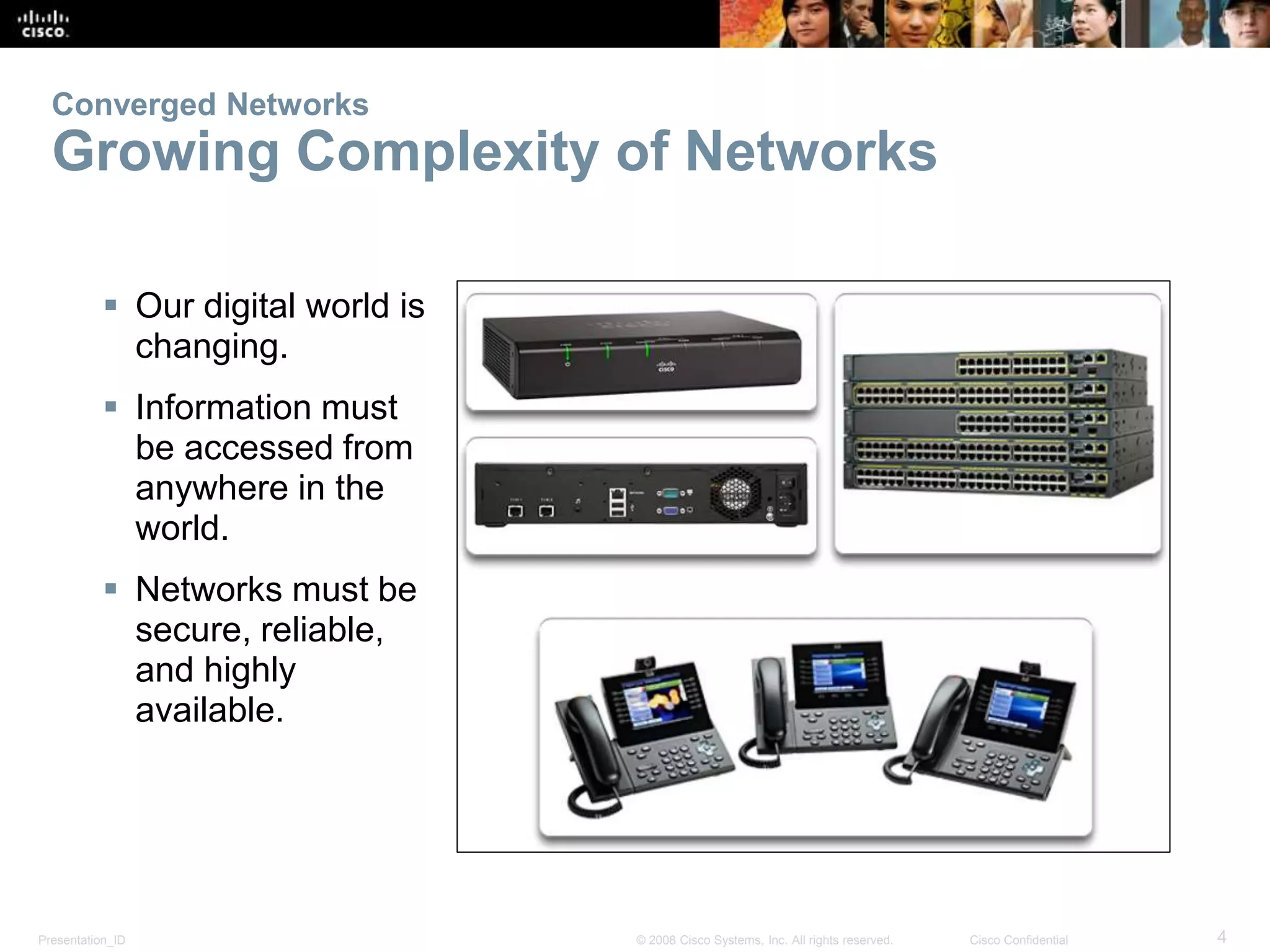
 Our digital world is
changing.
 Information must
be accessed from
anywhere in the
world.
 Networks must be
secure, reliable,
and highly
available.
Presentation_ID 5© 2008 Cisco Systems, Inc. All rights reserved. Cisco Confidential
Converged Networks
Elements of a Converged Network
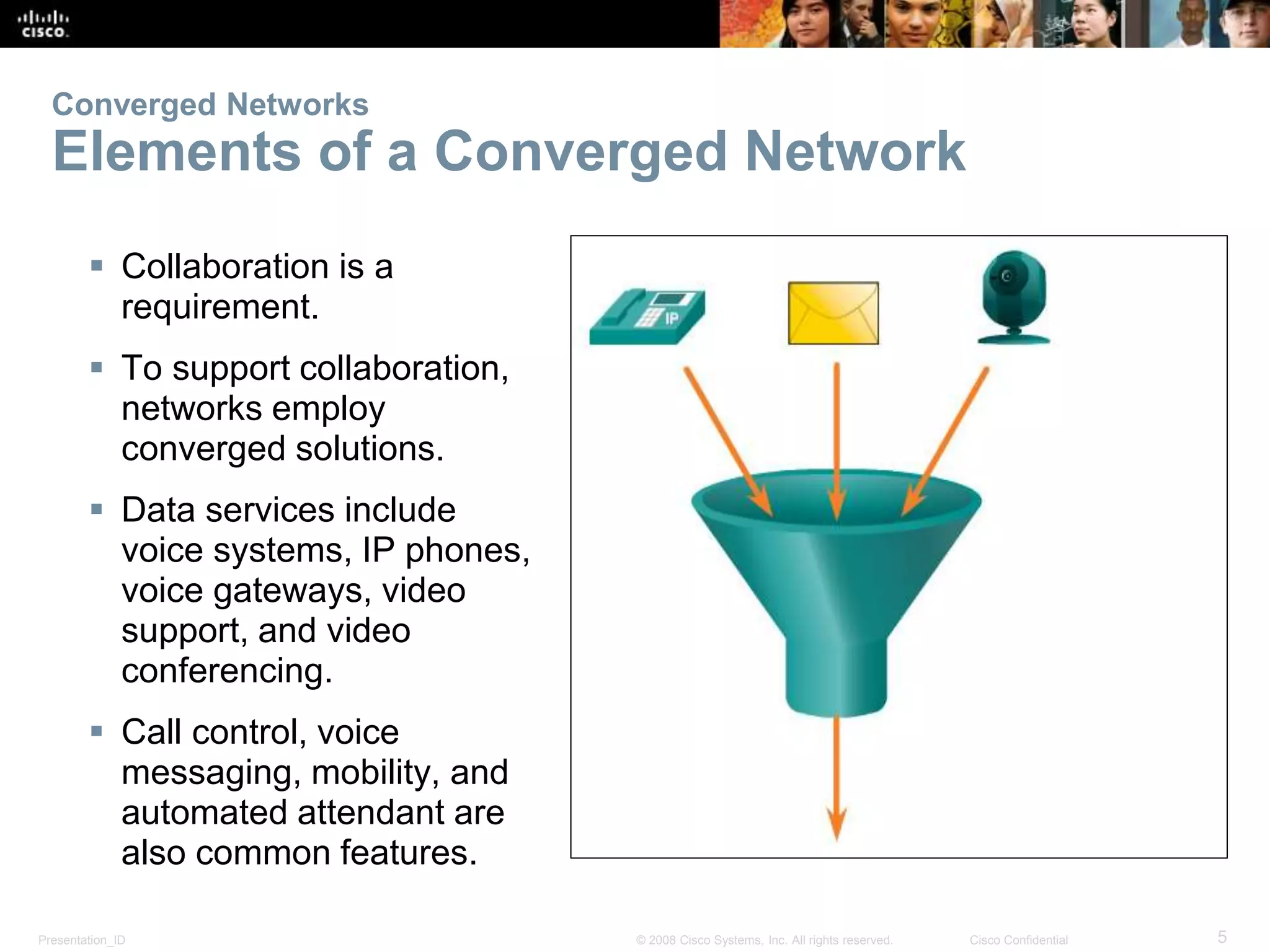
 Collaboration is a
requirement.
 To support collaboration,
networks employ
converged solutions.
 Data services include
voice systems, IP phones,
voice gateways, video
support, and video
conferencing.
 Call control, voice
messaging, mobility, and
automated attendant are
also common features.
Presentation_ID 6© 2008 Cisco Systems, Inc. All rights reserved. Cisco Confidential
Converged Networks
Benefits of a Converged Network
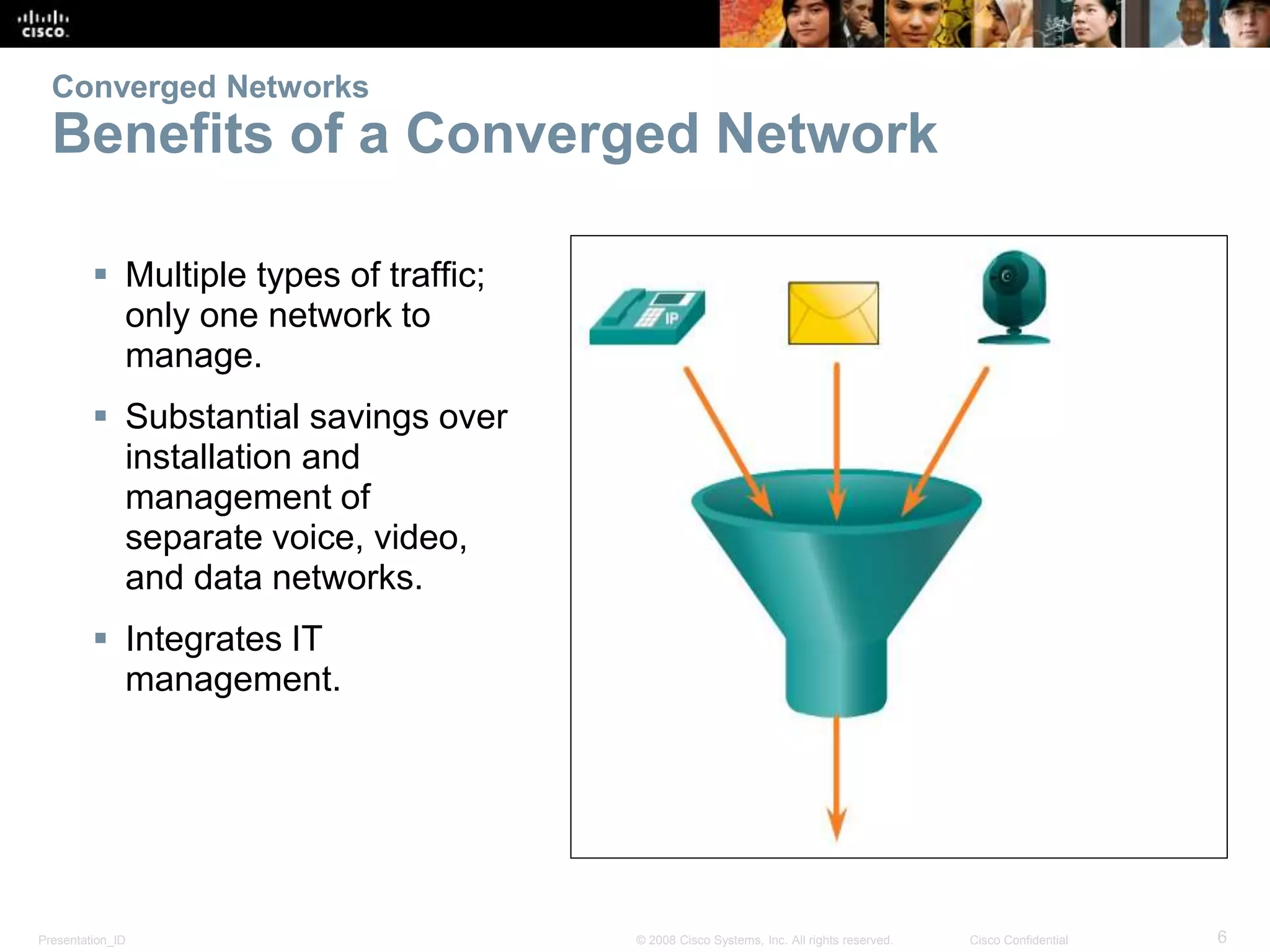
 Multiple types of traffic;
only one network to
manage.
 Substantial savings over
installation and
management of
separate voice, video,
and data networks.
 Integrates IT
management.
Presentation_ID 7© 2008 Cisco Systems, Inc. All rights reserved. Cisco Confidential
Converged Networks
Borderless Switched Networks
 The Cisco Borderless Network is a network architecture that
allows organizations to connect anyone, anywhere, anytime,
and on any device securely, reliably, and seamlessly.
 Cisco Borderless Network is designed to address IT and
business challenges, such as supporting the converged
network and changing work patterns.
Presentation_ID 8© 2008 Cisco Systems, Inc. All rights reserved. Cisco Confidential
Converged Networks
Hierarchy in the Borderless Switched
Network
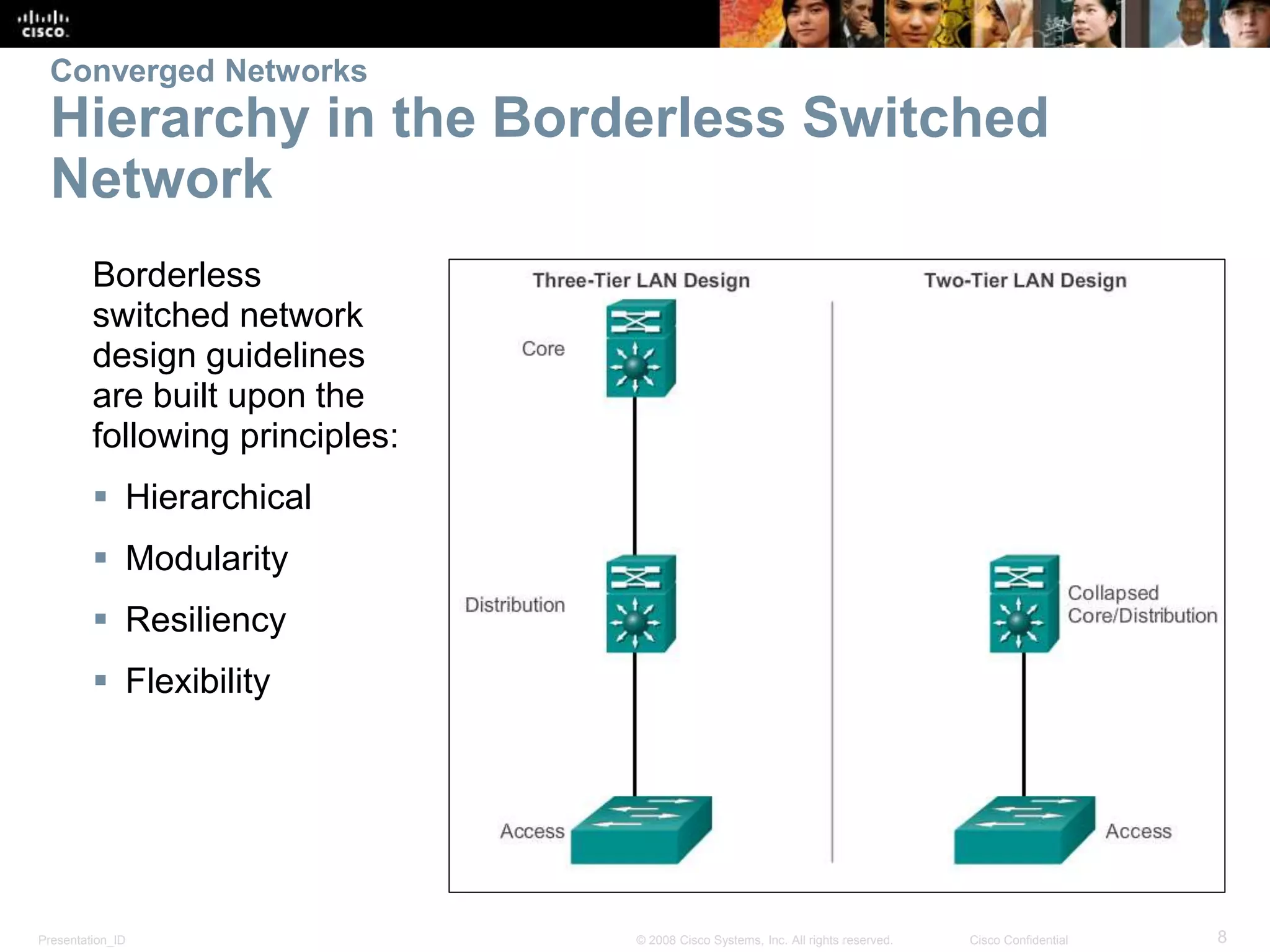
Borderless
switched network
design guidelines
are built upon the
following principles:
 Hierarchical
 Modularity
 Resiliency
 Flexibility
Presentation_ID 9© 2008 Cisco Systems, Inc. All rights reserved. Cisco Confidential
Converged Networks
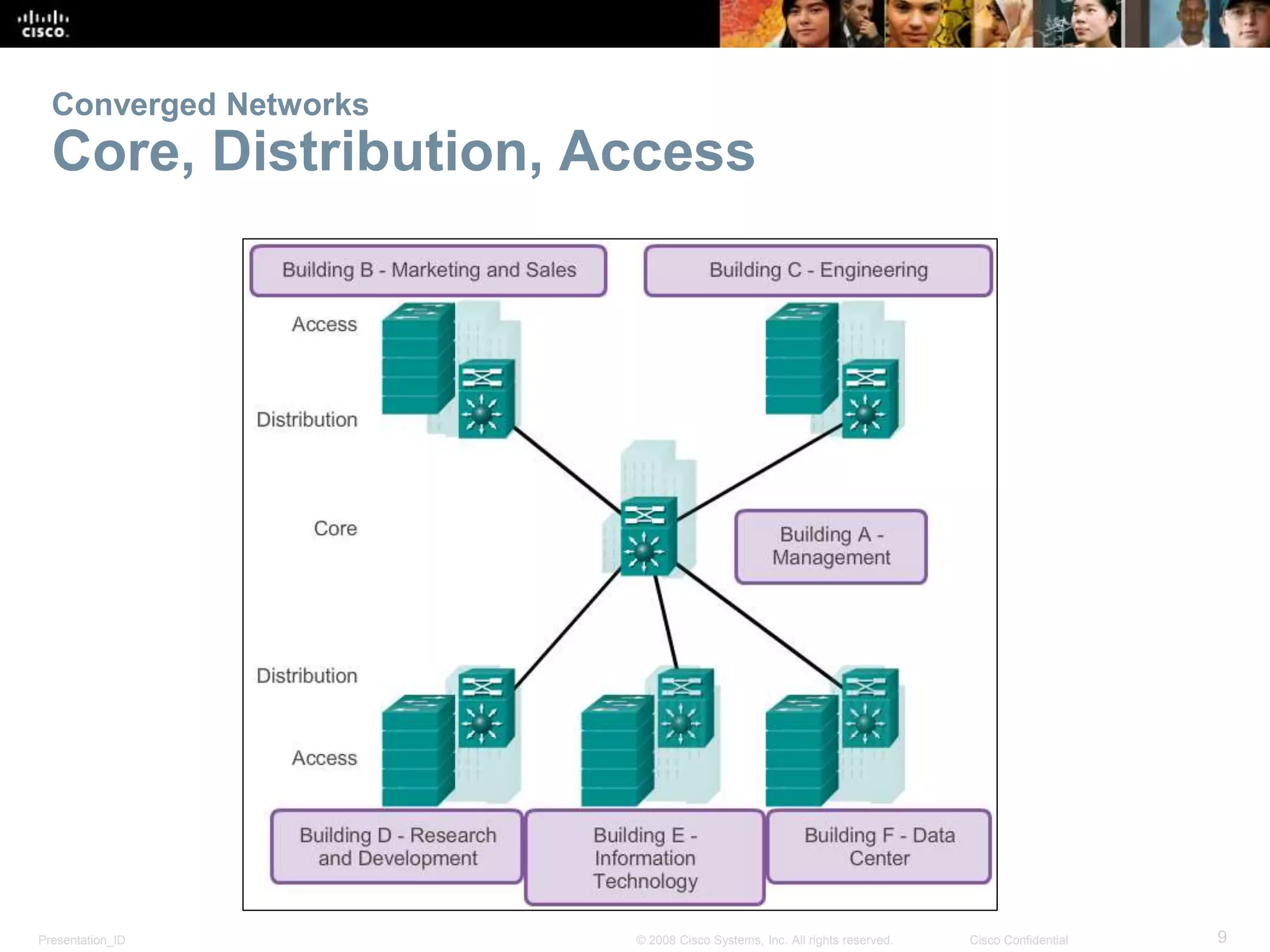
Core, Distribution, Access
Presentation_ID 10© 2008 Cisco Systems, Inc. All rights reserved. Cisco Confidential
Switched Networks
Role of Switched Networks
 Switching technologies are crucial to network design.
 Switching allow traffic to be sent only where it is needed in most
cases, using fast methods.
 A switched LAN:
 Allows more flexibility
 Allows more traffic management
 Supports quality of service, additional security, wireless, IP
telephony, and mobility services
Presentation_ID 11© 2008 Cisco Systems, Inc. All rights reserved. Cisco Confidential
Switched Networks
Form Factor
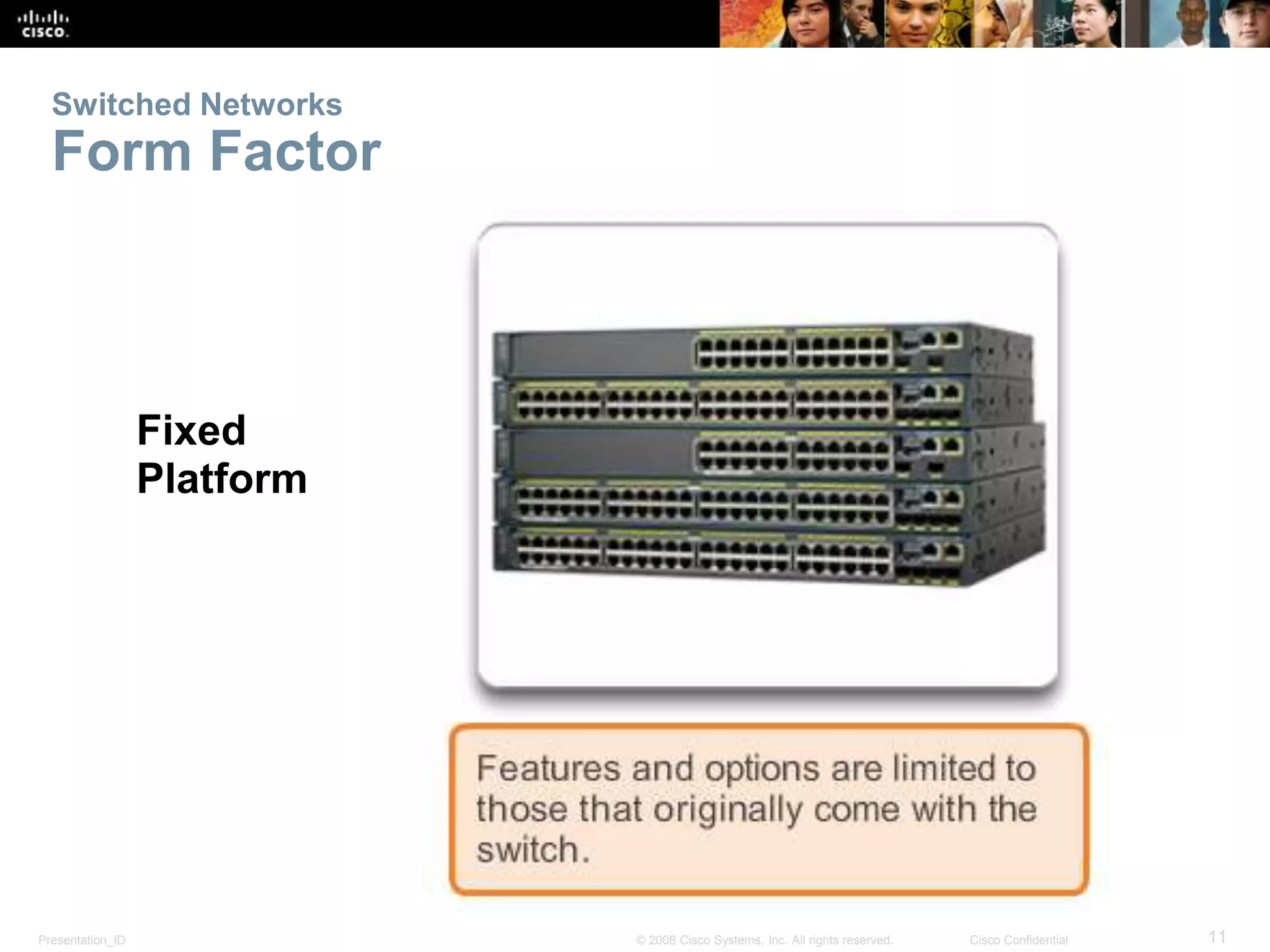
Fixed
Platform
Presentation_ID 12© 2008 Cisco Systems, Inc. All rights reserved. Cisco Confidential
Switched Networks
Form Factor (cont.)
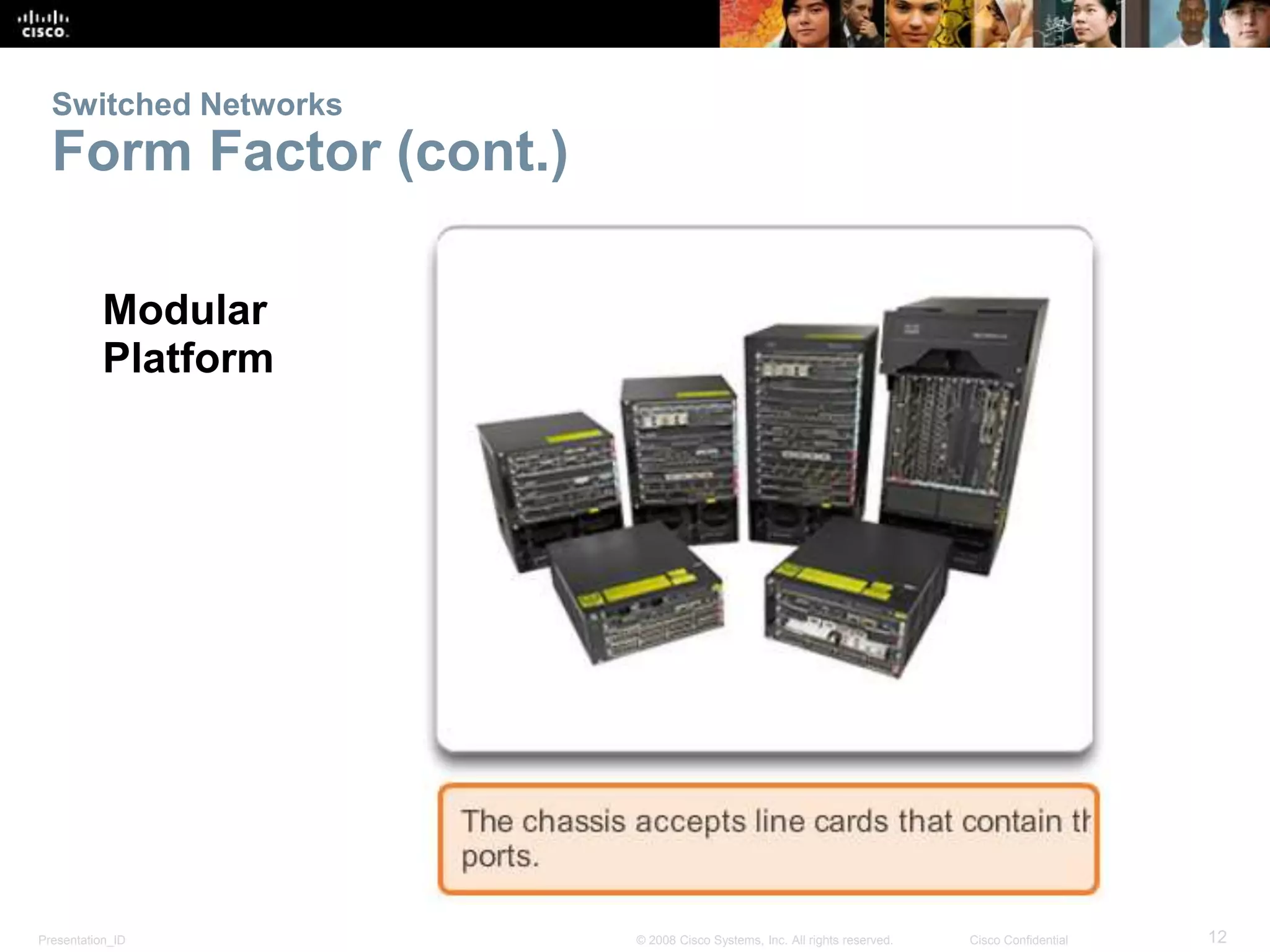
Modular
Platform
Presentation_ID 13© 2008 Cisco Systems, Inc. All rights reserved. Cisco Confidential
Switched Networks
Form Factor (cont.)
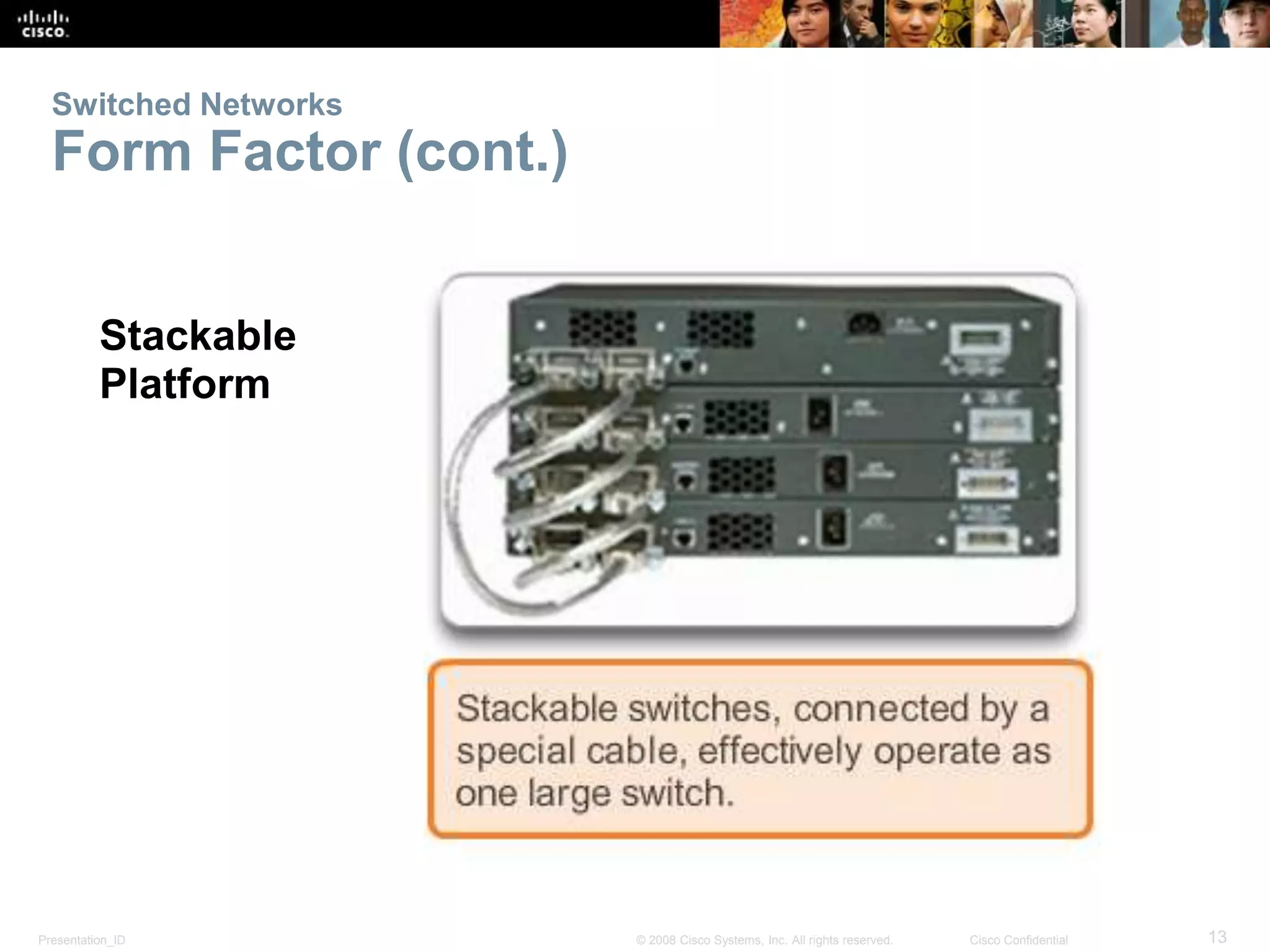
Stackable
Platform
Presentation_ID 14© 2008 Cisco Systems, Inc. All rights reserved. Cisco Confidential
Frame Forwarding
Switching as a General Concept
 A switch makes a decision based on ingress and a destination
port.
 A LAN switch keeps a table that it uses to determine how to
forward traffic through the switch.
 Cisco LAN switches forward Ethernet frames based on the
destination MAC address of the frames.
Presentation_ID 15© 2008 Cisco Systems, Inc. All rights reserved. Cisco Confidential
Frame Forwarding
Dynamically Populating a Switch MAC
Address Table
 A switch must first learn which devices exist on each port before it
can transmit a frame.
 It builds a table called a MAC address or content addressable
memory (CAM) table.
 The mapping device <-> port is stored in the CAM table.
 CAM is a special type of memory used in high-speed searching
applications.
 The information in the MAC address table used to send frames.
 When a switch receives an incoming frame with a MAC address that
is not found in the CAM table, it floods it to all ports, but the one that
received the frame.
Presentation_ID 16© 2008 Cisco Systems, Inc. All rights reserved. Cisco Confidential
Frame Forwarding
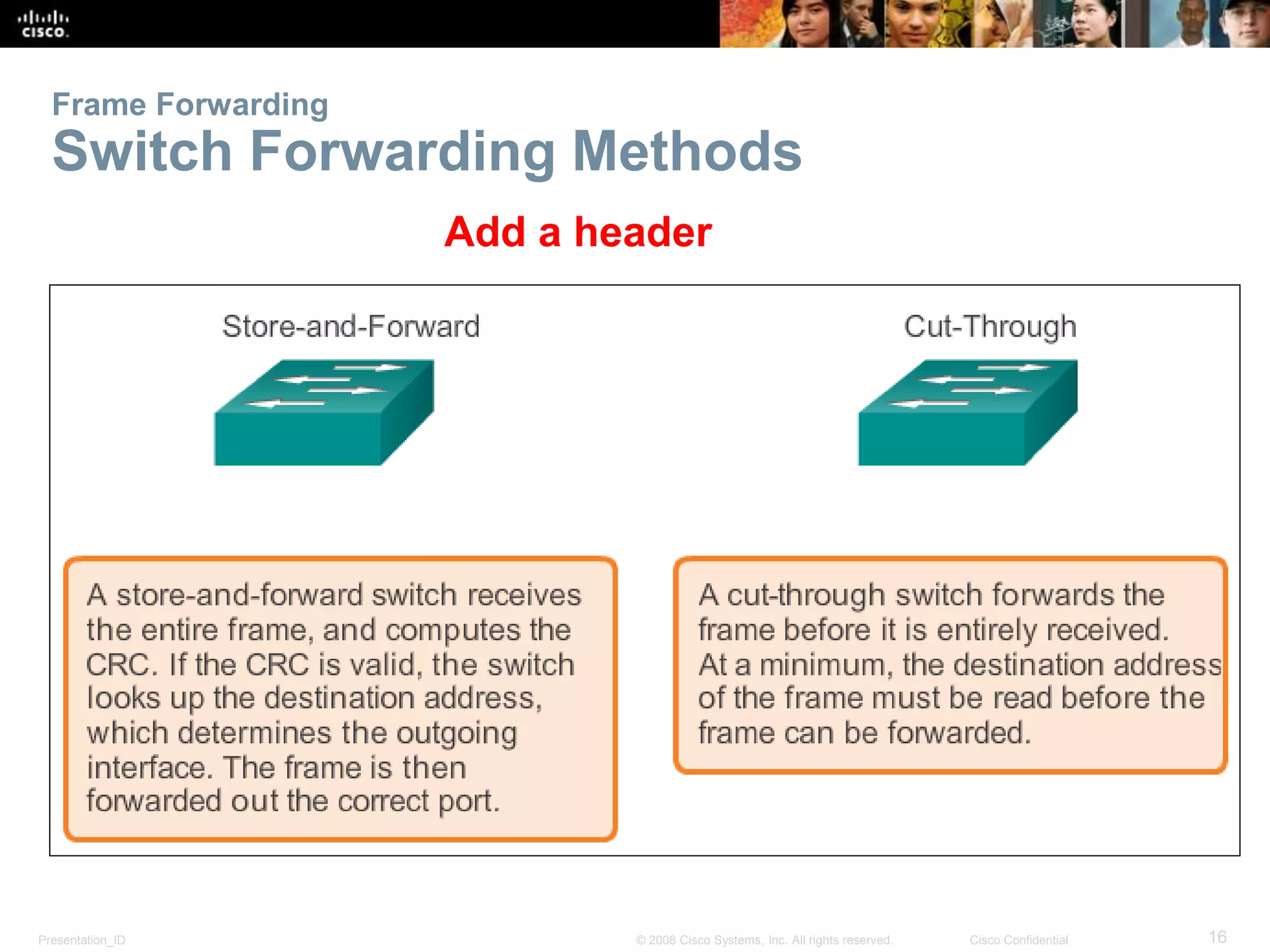
Switch Forwarding Methods
Add a header
Presentation_ID 17© 2008 Cisco Systems, Inc. All rights reserved. Cisco Confidential
Frame Forwarding
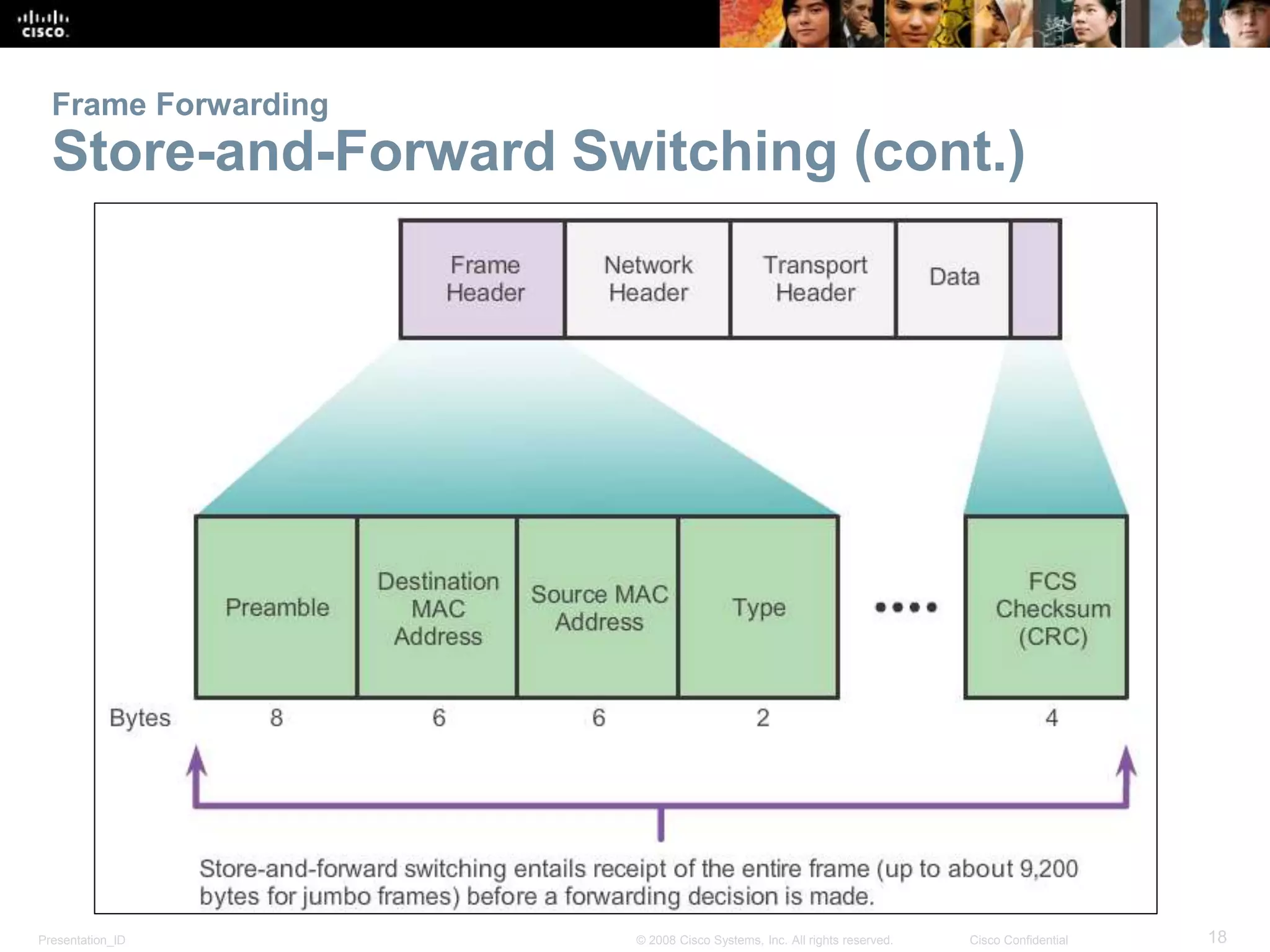
Store-and-Forward Switching
 Allows the switch to:
 Check for errors (via FCS
check)
 Perform automatic
buffering
 Slower forwarding process
Presentation_ID 18© 2008 Cisco Systems, Inc. All rights reserved. Cisco Confidential
Frame Forwarding
Store-and-Forward Switching (cont.)
Presentation_ID 19© 2008 Cisco Systems, Inc. All rights reserved. Cisco Confidential
Frame Forwarding
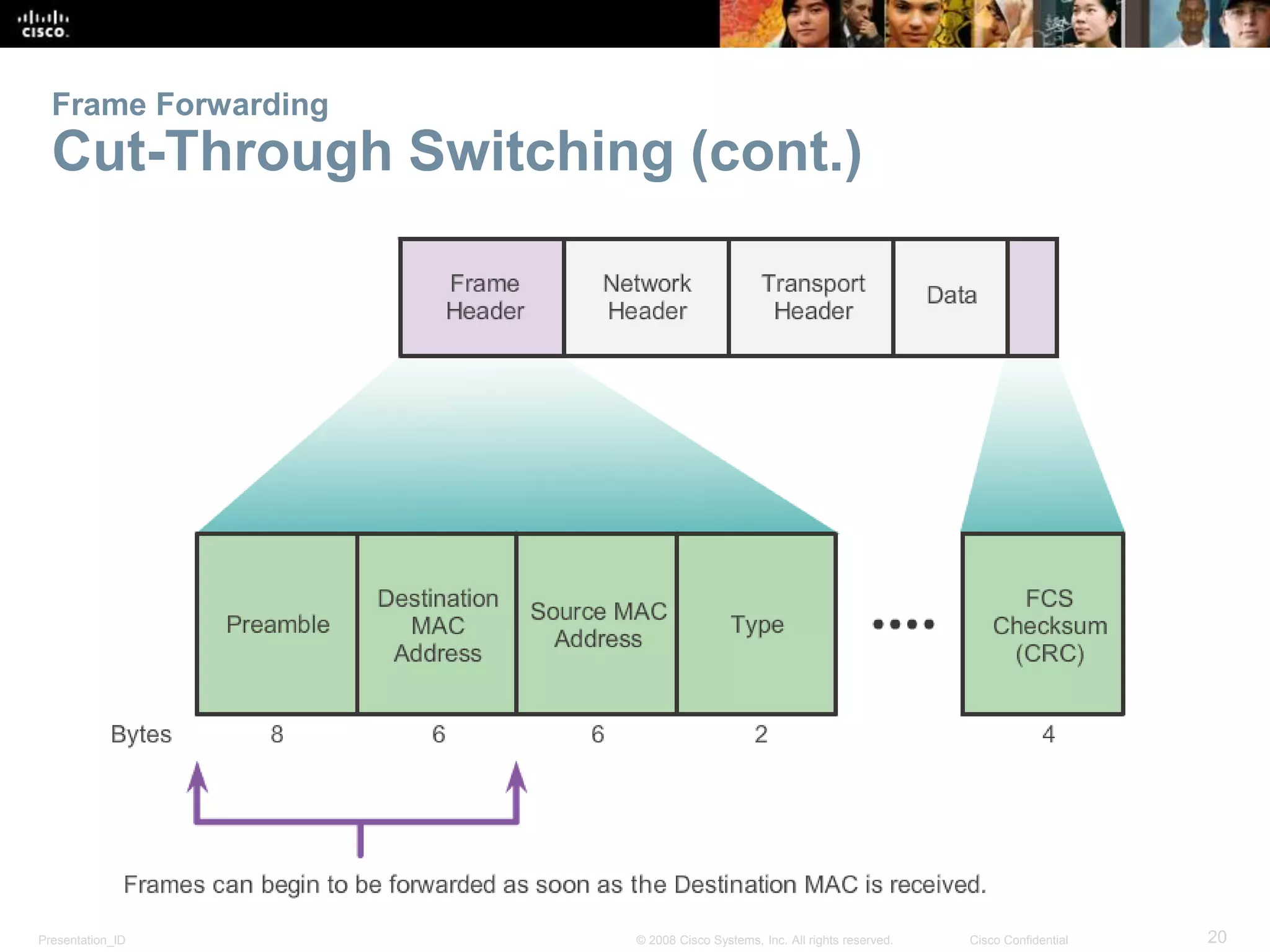
Cut-Through Switching
 Allows the switch to start forwarding in about 10 microseconds
 No FCS check
 No automatic buffering
Presentation_ID 20© 2008 Cisco Systems, Inc. All rights reserved. Cisco Confidential
Frame Forwarding
Cut-Through Switching (cont.)
Presentation_ID 21© 2008 Cisco Systems, Inc. All rights reserved. Cisco Confidential
Switching Domains
Collision Domains
A collision domain is the segment where devices must compete to
communicate.
 All ports of a hub belong to the same collision domain.
 Every port of a switch is a collision domain on its own.
 A switch break the segment into smaller collision domains, easing
device competition.
Presentation_ID 22© 2008 Cisco Systems, Inc. All rights reserved. Cisco Confidential
Switching Domains
Broadcast Domains
A broadcast domain is the extend of the network where a broadcast
frame can be heard.
 Switches forward broadcast frames to all ports; therefore, switches
do not break broadcast domains.
 All ports of a switch, with its default configuration, belong to the
same broadcast domain.
 If two or more switches are connected, broadcasts are forwarded to
all ports of all switches, except for the port that originally received
the broadcast.
Presentation_ID 23© 2008 Cisco Systems, Inc. All rights reserved. Cisco Confidential
Switching Domains
Alleviating Network Congestion
Switches help alleviating network congestion by:
 Facilitating the segmentation of a LAN into separate collision
domains
 Providing full-duplex communication between devices
 Taking advantage of their high-port density
 Buffering large frames
 Employing high-speed ports
 Taking advantage of their fast internal switching process
 Having a low, per-port cost
Presentation_ID 24© 2008 Cisco Systems, Inc. All rights reserved. Cisco Confidential
Chapter 1: Summary
In this chapter, you learned:
 The trend in networks is towards convergence using a single set of
wires and devices to handle voice, video, and data transmission.
 There has been a dramatic shift in the way businesses operate.
 There are no physical offices or geographic boundaries constraints.
Resources must now be seamlessly available anytime and
anywhere.
 The Cisco Borderless Network architecture enables different
elements, from access switches to wireless access points, to work
together and allow users to access resources from any place at any
time.
Presentation_ID 25© 2008 Cisco Systems, Inc. All rights reserved. Cisco Confidential
Chapter 1: Summary (cont.)
 The traditional, three-layer hierarchical design model divides the
network into core, distribution, and access layers, and allows each
portion of the network to be optimized for specific functionality.
 It provides modularity, resiliency, and flexibility, which provides a
foundation that allows network designers to overlay security,
mobility, and unified communication features.
 Switches use either store-and-forward or cut-through switching.
 Every port on a switch forms a separate collision domain allowing for
extremely high-speed, full-duplex communication.
 Switch ports do not block broadcasts and connecting switches can
extend the size of the broadcast domain, often resulting in degraded
network performance.
Presentation_ID 26© 2008 Cisco Systems, Inc. All rights reserved. Cisco Confidential

Chapter 12 : Introduction to switched networks

  • 1.
    © 2008 CiscoSystems, Inc. All rights reserved. Cisco ConfidentialPresentation_ID 1 Chapter 12: Introduction to Switched Networks Routing and Switching
  • 2.
    Presentation_ID 2© 2008Cisco Systems, Inc. All rights reserved. Cisco Confidential Chapter 1 1.0 Introduction 1.1 LAN Design 1.2 Switched Environment 1.3 Summary
  • 3.
    Presentation_ID 3© 2008Cisco Systems, Inc. All rights reserved. Cisco Confidential Chapter 1: Objectives Upon completion of this chapter, you will be able to:  Describe convergence of data, voice, and video in the context of switched networks.  Describe a switched network in a small-to-medium-sized business.  Explain the process of frame forwarding in a switched network.  Compare a collision domain to a broadcast domain.
  • 4.
    Presentation_ID 4© 2008Cisco Systems, Inc. All rights reserved. Cisco Confidential Converged Networks Growing Complexity of Networks  Our digital world is changing.  Information must be accessed from anywhere in the world.  Networks must be secure, reliable, and highly available.
  • 5.
    Presentation_ID 5© 2008Cisco Systems, Inc. All rights reserved. Cisco Confidential Converged Networks Elements of a Converged Network  Collaboration is a requirement.  To support collaboration, networks employ converged solutions.  Data services include voice systems, IP phones, voice gateways, video support, and video conferencing.  Call control, voice messaging, mobility, and automated attendant are also common features.
  • 6.
    Presentation_ID 6© 2008Cisco Systems, Inc. All rights reserved. Cisco Confidential Converged Networks Benefits of a Converged Network  Multiple types of traffic; only one network to manage.  Substantial savings over installation and management of separate voice, video, and data networks.  Integrates IT management.
  • 7.
    Presentation_ID 7© 2008Cisco Systems, Inc. All rights reserved. Cisco Confidential Converged Networks Borderless Switched Networks  The Cisco Borderless Network is a network architecture that allows organizations to connect anyone, anywhere, anytime, and on any device securely, reliably, and seamlessly.  Cisco Borderless Network is designed to address IT and business challenges, such as supporting the converged network and changing work patterns.
  • 8.
    Presentation_ID 8© 2008Cisco Systems, Inc. All rights reserved. Cisco Confidential Converged Networks Hierarchy in the Borderless Switched Network Borderless switched network design guidelines are built upon the following principles:  Hierarchical  Modularity  Resiliency  Flexibility
  • 9.
    Presentation_ID 9© 2008Cisco Systems, Inc. All rights reserved. Cisco Confidential Converged Networks Core, Distribution, Access
  • 10.
    Presentation_ID 10© 2008Cisco Systems, Inc. All rights reserved. Cisco Confidential Switched Networks Role of Switched Networks  Switching technologies are crucial to network design.  Switching allow traffic to be sent only where it is needed in most cases, using fast methods.  A switched LAN:  Allows more flexibility  Allows more traffic management  Supports quality of service, additional security, wireless, IP telephony, and mobility services
  • 11.
    Presentation_ID 11© 2008Cisco Systems, Inc. All rights reserved. Cisco Confidential Switched Networks Form Factor Fixed Platform
  • 12.
    Presentation_ID 12© 2008Cisco Systems, Inc. All rights reserved. Cisco Confidential Switched Networks Form Factor (cont.) Modular Platform
  • 13.
    Presentation_ID 13© 2008Cisco Systems, Inc. All rights reserved. Cisco Confidential Switched Networks Form Factor (cont.) Stackable Platform
  • 14.
    Presentation_ID 14© 2008Cisco Systems, Inc. All rights reserved. Cisco Confidential Frame Forwarding Switching as a General Concept  A switch makes a decision based on ingress and a destination port.  A LAN switch keeps a table that it uses to determine how to forward traffic through the switch.  Cisco LAN switches forward Ethernet frames based on the destination MAC address of the frames.
  • 15.
    Presentation_ID 15© 2008Cisco Systems, Inc. All rights reserved. Cisco Confidential Frame Forwarding Dynamically Populating a Switch MAC Address Table  A switch must first learn which devices exist on each port before it can transmit a frame.  It builds a table called a MAC address or content addressable memory (CAM) table.  The mapping device <-> port is stored in the CAM table.  CAM is a special type of memory used in high-speed searching applications.  The information in the MAC address table used to send frames.  When a switch receives an incoming frame with a MAC address that is not found in the CAM table, it floods it to all ports, but the one that received the frame.
  • 16.
    Presentation_ID 16© 2008Cisco Systems, Inc. All rights reserved. Cisco Confidential Frame Forwarding Switch Forwarding Methods Add a header
  • 17.
    Presentation_ID 17© 2008Cisco Systems, Inc. All rights reserved. Cisco Confidential Frame Forwarding Store-and-Forward Switching  Allows the switch to:  Check for errors (via FCS check)  Perform automatic buffering  Slower forwarding process
  • 18.
    Presentation_ID 18© 2008Cisco Systems, Inc. All rights reserved. Cisco Confidential Frame Forwarding Store-and-Forward Switching (cont.)
  • 19.
    Presentation_ID 19© 2008Cisco Systems, Inc. All rights reserved. Cisco Confidential Frame Forwarding Cut-Through Switching  Allows the switch to start forwarding in about 10 microseconds  No FCS check  No automatic buffering
  • 20.
    Presentation_ID 20© 2008Cisco Systems, Inc. All rights reserved. Cisco Confidential Frame Forwarding Cut-Through Switching (cont.)
  • 21.
    Presentation_ID 21© 2008Cisco Systems, Inc. All rights reserved. Cisco Confidential Switching Domains Collision Domains A collision domain is the segment where devices must compete to communicate.  All ports of a hub belong to the same collision domain.  Every port of a switch is a collision domain on its own.  A switch break the segment into smaller collision domains, easing device competition.
  • 22.
    Presentation_ID 22© 2008Cisco Systems, Inc. All rights reserved. Cisco Confidential Switching Domains Broadcast Domains A broadcast domain is the extend of the network where a broadcast frame can be heard.  Switches forward broadcast frames to all ports; therefore, switches do not break broadcast domains.  All ports of a switch, with its default configuration, belong to the same broadcast domain.  If two or more switches are connected, broadcasts are forwarded to all ports of all switches, except for the port that originally received the broadcast.
  • 23.
    Presentation_ID 23© 2008Cisco Systems, Inc. All rights reserved. Cisco Confidential Switching Domains Alleviating Network Congestion Switches help alleviating network congestion by:  Facilitating the segmentation of a LAN into separate collision domains  Providing full-duplex communication between devices  Taking advantage of their high-port density  Buffering large frames  Employing high-speed ports  Taking advantage of their fast internal switching process  Having a low, per-port cost
  • 24.
    Presentation_ID 24© 2008Cisco Systems, Inc. All rights reserved. Cisco Confidential Chapter 1: Summary In this chapter, you learned:  The trend in networks is towards convergence using a single set of wires and devices to handle voice, video, and data transmission.  There has been a dramatic shift in the way businesses operate.  There are no physical offices or geographic boundaries constraints. Resources must now be seamlessly available anytime and anywhere.  The Cisco Borderless Network architecture enables different elements, from access switches to wireless access points, to work together and allow users to access resources from any place at any time.
  • 25.
    Presentation_ID 25© 2008Cisco Systems, Inc. All rights reserved. Cisco Confidential Chapter 1: Summary (cont.)  The traditional, three-layer hierarchical design model divides the network into core, distribution, and access layers, and allows each portion of the network to be optimized for specific functionality.  It provides modularity, resiliency, and flexibility, which provides a foundation that allows network designers to overlay security, mobility, and unified communication features.  Switches use either store-and-forward or cut-through switching.  Every port on a switch forms a separate collision domain allowing for extremely high-speed, full-duplex communication.  Switch ports do not block broadcasts and connecting switches can extend the size of the broadcast domain, often resulting in degraded network performance.
  • 26.
    Presentation_ID 26© 2008Cisco Systems, Inc. All rights reserved. Cisco Confidential