© 2008 Cisco Systems, Inc. All rights reserved. Cisco ConfidentialPresentation_ID 1
Instructor Materials
Chapter 4: Introduction to
Switched Networks
CCNA Routing and Switching
Routing & Switching Essentials v6.0
Presentation_ID 4© 2008 Cisco Systems, Inc. All rights reserved. Cisco Confidential
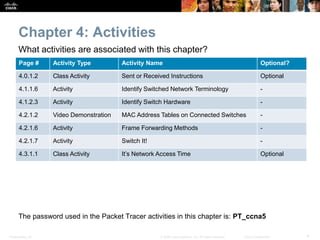
Chapter 4: Activities
What activities are associated with this chapter?
Page # Activity Type Activity Name Optional?
4.0.1.2 Class Activity Sent or Received Instructions Optional
4.1.1.6 Activity Identify Switched Network Terminology -
4.1.2.3 Activity Identify Switch Hardware -
4.2.1.2 Video Demonstration MAC Address Tables on Connected Switches -
4.2.1.6 Activity Frame Forwarding Methods -
4.2.1.7 Activity Switch It! -
4.3.1.1 Class Activity It’s Network Access Time Optional
The password used in the Packet Tracer activities in this chapter is: PT_ccna5
© 2008 Cisco Systems, Inc. All rights reserved. Cisco ConfidentialPresentation_ID 13
Chapter 4: Switched
Networks
Routing and Switching Essentials v6.0
Presentation_ID 14© 2008 Cisco Systems, Inc. All rights reserved. Cisco Confidential
Chapter 4 - Sections & Objectives
4.1 LAN Design
• Explain how switched networks support small to medium-sized businesses.
• Explain how data, voice, and video are converged in a switched network.
• Describe a switched network in a small to medium-sized business.
4.2 The Switched Environment
• Explain how Layer 2 switches forward data in a small to medium-sized LAN.
• Explain how frames are forwarded in a switched network.
• Compare a collision domain to a broadcast domain.
© 2008 Cisco Systems, Inc. All rights reserved. Cisco ConfidentialPresentation_ID 15
4.1 LAN Design
Presentation_ID 16© 2008 Cisco Systems, Inc. All rights reserved. Cisco Confidential
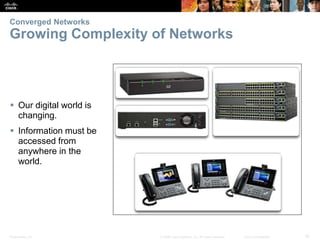
Converged Networks
Growing Complexity of Networks
 Our digital world is
changing.
 Information must be
accessed from
anywhere in the
world.
Presentation_ID 17© 2008 Cisco Systems, Inc. All rights reserved. Cisco Confidential
Converged Networks
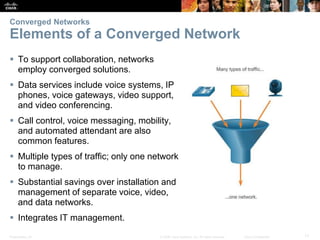
Elements of a Converged Network
 To support collaboration, networks
employ converged solutions.
 Data services include voice systems, IP
phones, voice gateways, video support,
and video conferencing.
 Call control, voice messaging, mobility,
and automated attendant are also
common features.
 Multiple types of traffic; only one network
to manage.
 Substantial savings over installation and
management of separate voice, video,
and data networks.
 Integrates IT management.
Presentation_ID 18© 2008 Cisco Systems, Inc. All rights reserved. Cisco Confidential
Converged Networks
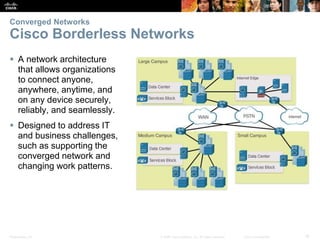
Cisco Borderless Networks
 A network architecture
that allows organizations
to connect anyone,
anywhere, anytime, and
on any device securely,
reliably, and seamlessly.
 Designed to address IT
and business challenges,
such as supporting the
converged network and
changing work patterns.
Presentation_ID 19© 2008 Cisco Systems, Inc. All rights reserved. Cisco Confidential
Converged Networks
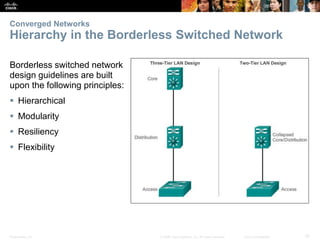
Hierarchy in the Borderless Switched Network
Borderless switched network
design guidelines are built
upon the following principles:
 Hierarchical
 Modularity
 Resiliency
 Flexibility
Presentation_ID 20© 2008 Cisco Systems, Inc. All rights reserved. Cisco Confidential
Converged Networks
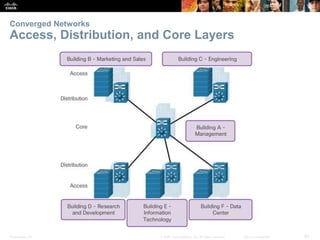
Access, Distribution, and Core Layers
Presentation_ID 21© 2008 Cisco Systems, Inc. All rights reserved. Cisco Confidential
Switched Networks
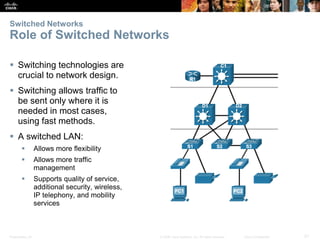
Role of Switched Networks
 Switching technologies are
crucial to network design.
 Switching allows traffic to
be sent only where it is
needed in most cases,
using fast methods.
 A switched LAN:
 Allows more flexibility
 Allows more traffic
management
 Supports quality of service,
additional security, wireless,
IP telephony, and mobility
services
Presentation_ID 22© 2008 Cisco Systems, Inc. All rights reserved. Cisco Confidential
Switched Networks
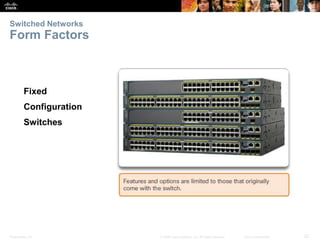
Form Factors
Fixed
Configuration
Switches
Presentation_ID 23© 2008 Cisco Systems, Inc. All rights reserved. Cisco Confidential
Switched Networks
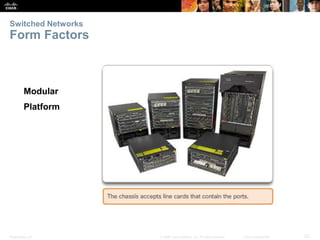
Form Factors
Modular
Platform
Presentation_ID 24© 2008 Cisco Systems, Inc. All rights reserved. Cisco Confidential
Switched Networks
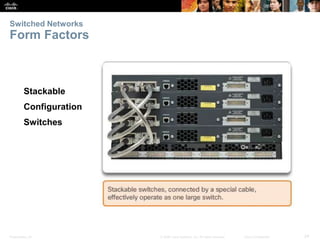
Form Factors
Stackable
Configuration
Switches
© 2008 Cisco Systems, Inc. All rights reserved. Cisco ConfidentialPresentation_ID 25
4.2 The Switched Environment
Presentation_ID 26© 2008 Cisco Systems, Inc. All rights reserved. Cisco Confidential
Frame Forwarding
Switching as a General Concept in Networking and
Telecommunications
 A switch makes a decision based on ingress and a destination port.
 A LAN switch keeps a table that it uses to determine how to forward
traffic through the switch.
 Cisco LAN switches forward Ethernet frames based on the
destination MAC address of the frames.
Presentation_ID 27© 2008 Cisco Systems, Inc. All rights reserved. Cisco Confidential
Frame Forwarding
Dynamically Populating a Switch MAC Address
Table
 A switch must first learn which devices exist on each port before it
can transmit a frame.
 As a switch learns the relationship of ports to devices, it builds a table
called a MAC address or content addressable memory (CAM) table.
 CAM is a special type of memory used in high-speed searching
applications.
 The information in the MAC address table is used to send frames.
 When a switch receives an incoming frame with a MAC address that
is not found in the CAM table, it floods it to all ports, except the one
that received the frame.
Presentation_ID 28© 2008 Cisco Systems, Inc. All rights reserved. Cisco Confidential
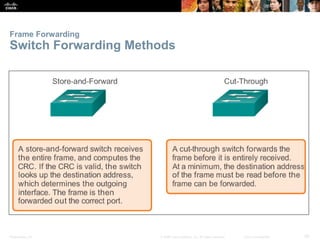
Frame Forwarding
Switch Forwarding Methods
Presentation_ID 29© 2008 Cisco Systems, Inc. All rights reserved. Cisco Confidential
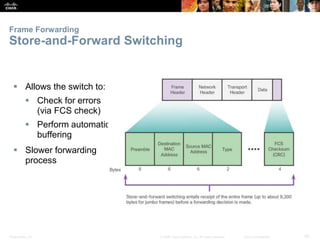
Frame Forwarding
Store-and-Forward Switching
 Allows the switch to:
 Check for errors
(via FCS check)
 Perform automatic
buffering
 Slower forwarding
process
Presentation_ID 30© 2008 Cisco Systems, Inc. All rights reserved. Cisco Confidential
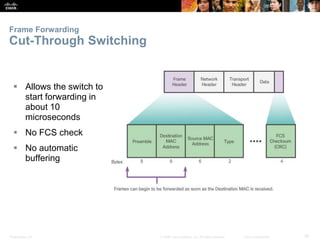
Frame Forwarding
Cut-Through Switching
 Allows the switch to
start forwarding in
about 10
microseconds
 No FCS check
 No automatic
buffering
Presentation_ID 31© 2008 Cisco Systems, Inc. All rights reserved. Cisco Confidential
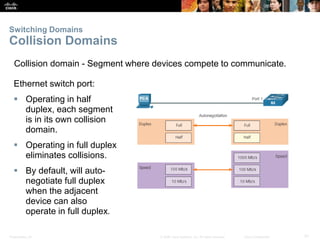
Switching Domains
Collision Domains
Ethernet switch port:
 Operating in half
duplex, each segment
is in its own collision
domain.
 Operating in full duplex
eliminates collisions.
 By default, will auto-
negotiate full duplex
when the adjacent
device can also
operate in full duplex.
Collision domain - Segment where devices compete to communicate.
Presentation_ID 32© 2008 Cisco Systems, Inc. All rights reserved. Cisco Confidential
Switching Domains
Broadcast Domains
A broadcast domain is the extent of the network where a broadcast
frame can be heard.
 Switches forward broadcast frames to all ports; therefore, switches
do not break broadcast domains.
 All ports of a switch, with its default configuration, belong to the same
broadcast domain.
 If two or more switches are connected, broadcasts are forwarded to
all ports of all switches, except for the port that originally received the
broadcast.
Presentation_ID 33© 2008 Cisco Systems, Inc. All rights reserved. Cisco Confidential
Switching Domains
Alleviating Network Congestion
Switches help alleviate network congestion by:
 Facilitating the segmentation of a LAN into separate collision
domains.
 Providing full-duplex communication between devices.
 Taking advantage of their high-port density.
 Buffering large frames.
 Employing high-speed ports.
 Taking advantage of their fast internal switching process.
 Having a low, per-port cost.
© 2008 Cisco Systems, Inc. All rights reserved. Cisco ConfidentialPresentation_ID 34
4.3 Chapter Summary
Presentation_ID 35© 2008 Cisco Systems, Inc. All rights reserved. Cisco Confidential
 The trend in networks is towards convergence using a single set of wires and devices to
handle voice, video, and data transmission.
 There has been a dramatic shift in the way businesses operate.
 There are no physical offices or geographic boundaries constraints. Resources must now
be seamlessly available anytime and anywhere.
 The Cisco Borderless Network architecture enables different elements, from access
switches to wireless access points, to work together and allow users to access resources
from any place, at any time.
 The traditional, three-layer hierarchical design model divides the network into core,
distribution, and access layers, and allows each portion of the network to be optimized for
specific functionality.
 It provides modularity, resiliency, and flexibility, which provides a foundation that allows
network designers to overlay security, mobility, and unified communication features.
 Switches use either store-and-forward or cut-through switching.
 Every port on a switch forms a separate collision domain allowing for extremely high-
speed, full-duplex communication.
 Switch ports do not block broadcasts and connecting switches can extend the size of the
broadcast domain, often resulting in degraded network performance.
Chapter Summary
Summary
Presentation_ID 38© 2008 Cisco Systems, Inc. All rights reserved. Cisco Confidential
Presentation_ID 39© 2008 Cisco Systems, Inc. All rights reserved. Cisco Confidential

CCNA2 Verson6 Chapter4

  • 1.
    © 2008 CiscoSystems, Inc. All rights reserved. Cisco ConfidentialPresentation_ID 1 Instructor Materials Chapter 4: Introduction to Switched Networks CCNA Routing and Switching Routing & Switching Essentials v6.0
  • 2.
    Presentation_ID 4© 2008Cisco Systems, Inc. All rights reserved. Cisco Confidential Chapter 4: Activities What activities are associated with this chapter? Page # Activity Type Activity Name Optional? 4.0.1.2 Class Activity Sent or Received Instructions Optional 4.1.1.6 Activity Identify Switched Network Terminology - 4.1.2.3 Activity Identify Switch Hardware - 4.2.1.2 Video Demonstration MAC Address Tables on Connected Switches - 4.2.1.6 Activity Frame Forwarding Methods - 4.2.1.7 Activity Switch It! - 4.3.1.1 Class Activity It’s Network Access Time Optional The password used in the Packet Tracer activities in this chapter is: PT_ccna5
  • 3.
    © 2008 CiscoSystems, Inc. All rights reserved. Cisco ConfidentialPresentation_ID 13 Chapter 4: Switched Networks Routing and Switching Essentials v6.0
  • 4.
    Presentation_ID 14© 2008Cisco Systems, Inc. All rights reserved. Cisco Confidential Chapter 4 - Sections & Objectives 4.1 LAN Design • Explain how switched networks support small to medium-sized businesses. • Explain how data, voice, and video are converged in a switched network. • Describe a switched network in a small to medium-sized business. 4.2 The Switched Environment • Explain how Layer 2 switches forward data in a small to medium-sized LAN. • Explain how frames are forwarded in a switched network. • Compare a collision domain to a broadcast domain.
  • 5.
    © 2008 CiscoSystems, Inc. All rights reserved. Cisco ConfidentialPresentation_ID 15 4.1 LAN Design
  • 6.
    Presentation_ID 16© 2008Cisco Systems, Inc. All rights reserved. Cisco Confidential Converged Networks Growing Complexity of Networks  Our digital world is changing.  Information must be accessed from anywhere in the world.
  • 7.
    Presentation_ID 17© 2008Cisco Systems, Inc. All rights reserved. Cisco Confidential Converged Networks Elements of a Converged Network  To support collaboration, networks employ converged solutions.  Data services include voice systems, IP phones, voice gateways, video support, and video conferencing.  Call control, voice messaging, mobility, and automated attendant are also common features.  Multiple types of traffic; only one network to manage.  Substantial savings over installation and management of separate voice, video, and data networks.  Integrates IT management.
  • 8.
    Presentation_ID 18© 2008Cisco Systems, Inc. All rights reserved. Cisco Confidential Converged Networks Cisco Borderless Networks  A network architecture that allows organizations to connect anyone, anywhere, anytime, and on any device securely, reliably, and seamlessly.  Designed to address IT and business challenges, such as supporting the converged network and changing work patterns.
  • 9.
    Presentation_ID 19© 2008Cisco Systems, Inc. All rights reserved. Cisco Confidential Converged Networks Hierarchy in the Borderless Switched Network Borderless switched network design guidelines are built upon the following principles:  Hierarchical  Modularity  Resiliency  Flexibility
  • 10.
    Presentation_ID 20© 2008Cisco Systems, Inc. All rights reserved. Cisco Confidential Converged Networks Access, Distribution, and Core Layers
  • 11.
    Presentation_ID 21© 2008Cisco Systems, Inc. All rights reserved. Cisco Confidential Switched Networks Role of Switched Networks  Switching technologies are crucial to network design.  Switching allows traffic to be sent only where it is needed in most cases, using fast methods.  A switched LAN:  Allows more flexibility  Allows more traffic management  Supports quality of service, additional security, wireless, IP telephony, and mobility services
  • 12.
    Presentation_ID 22© 2008Cisco Systems, Inc. All rights reserved. Cisco Confidential Switched Networks Form Factors Fixed Configuration Switches
  • 13.
    Presentation_ID 23© 2008Cisco Systems, Inc. All rights reserved. Cisco Confidential Switched Networks Form Factors Modular Platform
  • 14.
    Presentation_ID 24© 2008Cisco Systems, Inc. All rights reserved. Cisco Confidential Switched Networks Form Factors Stackable Configuration Switches
  • 15.
    © 2008 CiscoSystems, Inc. All rights reserved. Cisco ConfidentialPresentation_ID 25 4.2 The Switched Environment
  • 16.
    Presentation_ID 26© 2008Cisco Systems, Inc. All rights reserved. Cisco Confidential Frame Forwarding Switching as a General Concept in Networking and Telecommunications  A switch makes a decision based on ingress and a destination port.  A LAN switch keeps a table that it uses to determine how to forward traffic through the switch.  Cisco LAN switches forward Ethernet frames based on the destination MAC address of the frames.
  • 17.
    Presentation_ID 27© 2008Cisco Systems, Inc. All rights reserved. Cisco Confidential Frame Forwarding Dynamically Populating a Switch MAC Address Table  A switch must first learn which devices exist on each port before it can transmit a frame.  As a switch learns the relationship of ports to devices, it builds a table called a MAC address or content addressable memory (CAM) table.  CAM is a special type of memory used in high-speed searching applications.  The information in the MAC address table is used to send frames.  When a switch receives an incoming frame with a MAC address that is not found in the CAM table, it floods it to all ports, except the one that received the frame.
  • 18.
    Presentation_ID 28© 2008Cisco Systems, Inc. All rights reserved. Cisco Confidential Frame Forwarding Switch Forwarding Methods
  • 19.
    Presentation_ID 29© 2008Cisco Systems, Inc. All rights reserved. Cisco Confidential Frame Forwarding Store-and-Forward Switching  Allows the switch to:  Check for errors (via FCS check)  Perform automatic buffering  Slower forwarding process
  • 20.
    Presentation_ID 30© 2008Cisco Systems, Inc. All rights reserved. Cisco Confidential Frame Forwarding Cut-Through Switching  Allows the switch to start forwarding in about 10 microseconds  No FCS check  No automatic buffering
  • 21.
    Presentation_ID 31© 2008Cisco Systems, Inc. All rights reserved. Cisco Confidential Switching Domains Collision Domains Ethernet switch port:  Operating in half duplex, each segment is in its own collision domain.  Operating in full duplex eliminates collisions.  By default, will auto- negotiate full duplex when the adjacent device can also operate in full duplex. Collision domain - Segment where devices compete to communicate.
  • 22.
    Presentation_ID 32© 2008Cisco Systems, Inc. All rights reserved. Cisco Confidential Switching Domains Broadcast Domains A broadcast domain is the extent of the network where a broadcast frame can be heard.  Switches forward broadcast frames to all ports; therefore, switches do not break broadcast domains.  All ports of a switch, with its default configuration, belong to the same broadcast domain.  If two or more switches are connected, broadcasts are forwarded to all ports of all switches, except for the port that originally received the broadcast.
  • 23.
    Presentation_ID 33© 2008Cisco Systems, Inc. All rights reserved. Cisco Confidential Switching Domains Alleviating Network Congestion Switches help alleviate network congestion by:  Facilitating the segmentation of a LAN into separate collision domains.  Providing full-duplex communication between devices.  Taking advantage of their high-port density.  Buffering large frames.  Employing high-speed ports.  Taking advantage of their fast internal switching process.  Having a low, per-port cost.
  • 24.
    © 2008 CiscoSystems, Inc. All rights reserved. Cisco ConfidentialPresentation_ID 34 4.3 Chapter Summary
  • 25.
    Presentation_ID 35© 2008Cisco Systems, Inc. All rights reserved. Cisco Confidential  The trend in networks is towards convergence using a single set of wires and devices to handle voice, video, and data transmission.  There has been a dramatic shift in the way businesses operate.  There are no physical offices or geographic boundaries constraints. Resources must now be seamlessly available anytime and anywhere.  The Cisco Borderless Network architecture enables different elements, from access switches to wireless access points, to work together and allow users to access resources from any place, at any time.  The traditional, three-layer hierarchical design model divides the network into core, distribution, and access layers, and allows each portion of the network to be optimized for specific functionality.  It provides modularity, resiliency, and flexibility, which provides a foundation that allows network designers to overlay security, mobility, and unified communication features.  Switches use either store-and-forward or cut-through switching.  Every port on a switch forms a separate collision domain allowing for extremely high- speed, full-duplex communication.  Switch ports do not block broadcasts and connecting switches can extend the size of the broadcast domain, often resulting in degraded network performance. Chapter Summary Summary
  • 26.
    Presentation_ID 38© 2008Cisco Systems, Inc. All rights reserved. Cisco Confidential
  • 27.
    Presentation_ID 39© 2008Cisco Systems, Inc. All rights reserved. Cisco Confidential