Instructor Materials
Chapter 4: Switched
Networks
CCNA Routing and Switching
Routing and Switching Essentials v6.0
3
© 2016 Cisco and/or its affiliates. All rights reserved. Cisco Confidential
Chapter 4: Switched
Networks
Introduction to Networks 6.0 Planning
Guide
Chapter 4: Switched
Networks
CCNA Routing and Switching
Routing and Switching Essentials v6.0
12
© 2016 Cisco and/or its affiliates. All rights reserved. Cisco Confidential
 4.1 LAN Design
• Explain how switched networks support small to medium-sized businesses.
• Explain how data, voice, and video are converged in a switched network.
• Describe a switched network in a small to medium-sized business.
 4.2 The Switched Environment
• Explain how Layer 2 switches forward data in a small to medium-sized LAN.
• Explain how frames are forwarded in a switched network.
• Compare a collision domain to a broadcast domain.
Chapter 4 - Sections & Objectives
13
© 2016 Cisco and/or its affiliates. All rights reserved. Cisco Confidential
4.1 LAN Design
14
© 2016 Cisco and/or its affiliates. All rights reserved. Cisco Confidential
Converged Networks
 The words converged network can mean several things to a network engineer:
(1) a single network designed to handle voice, video, and data;
(2) an internal network where the Layer 3 devices, such as routers, have a
complete routing table to be able to accurately and efficiently send data to
a remote destination; and
(3) a switch network that has completed calculations that result in a single path
through the switch network.
• One of the primary benefits of transitioning to the converged network is that
there is just one physical network to install and manage.
15
© 2016 Cisco and/or its affiliates. All rights reserved. Cisco Confidential
Converged Networks
Growing Complexity of Networks
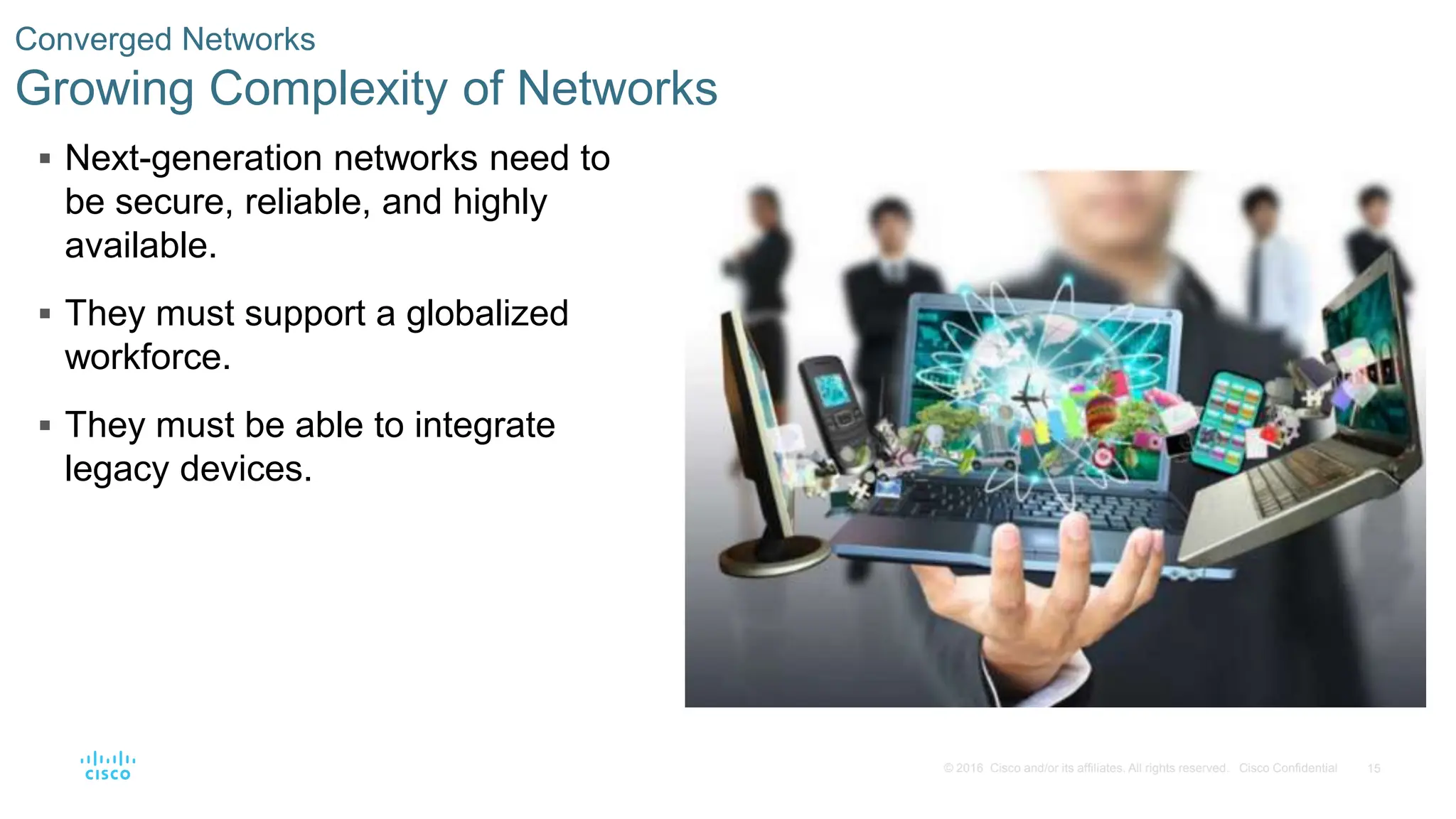
 Next-generation networks need to
be secure, reliable, and highly
available.
 They must support a globalized
workforce.
 They must be able to integrate
legacy devices.
16
© 2016 Cisco and/or its affiliates. All rights reserved. Cisco Confidential
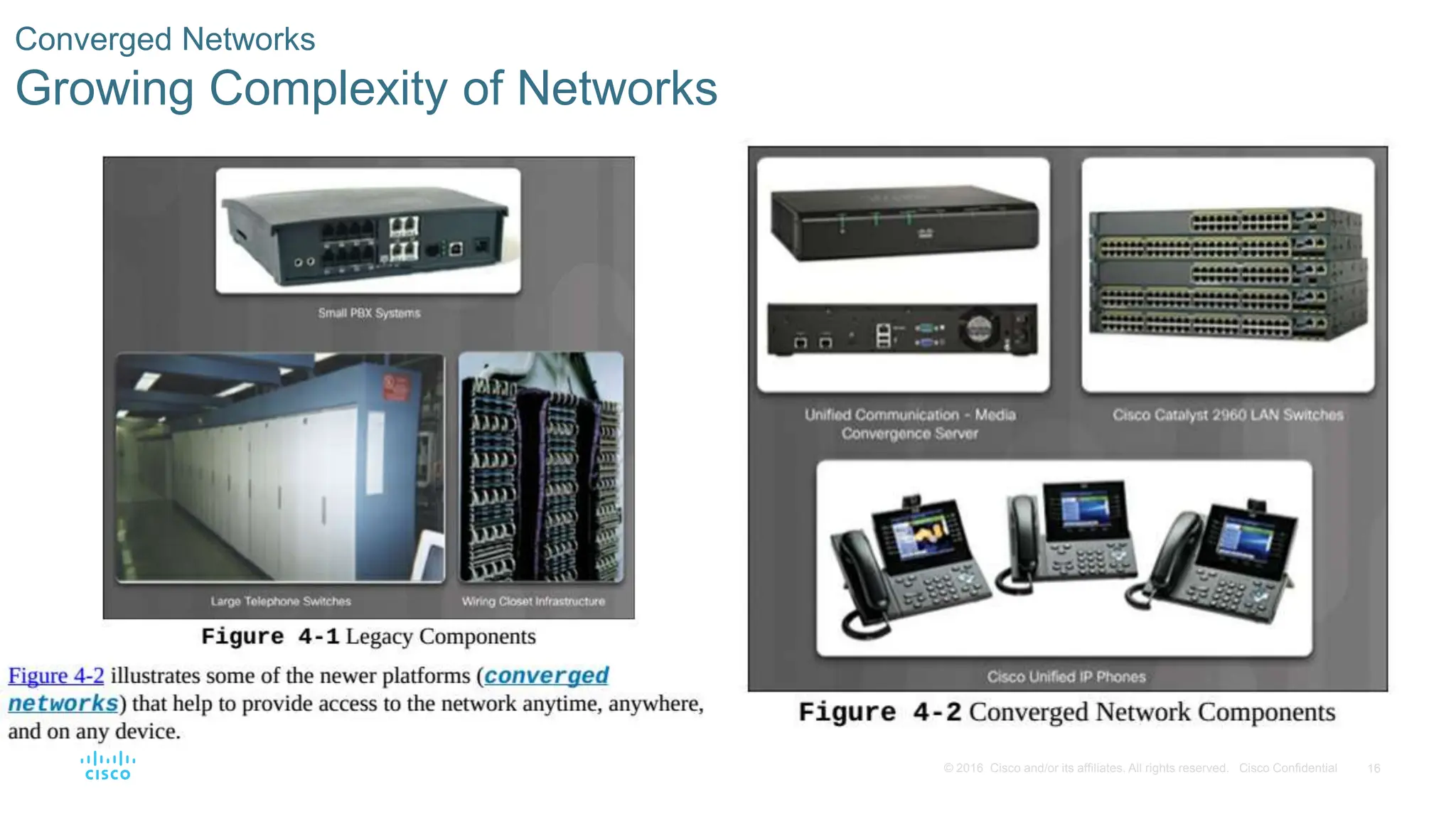
Converged Networks
Growing Complexity of Networks
17
© 2016 Cisco and/or its affiliates. All rights reserved. Cisco Confidential
Converged Networks
Elements of a Converged Network
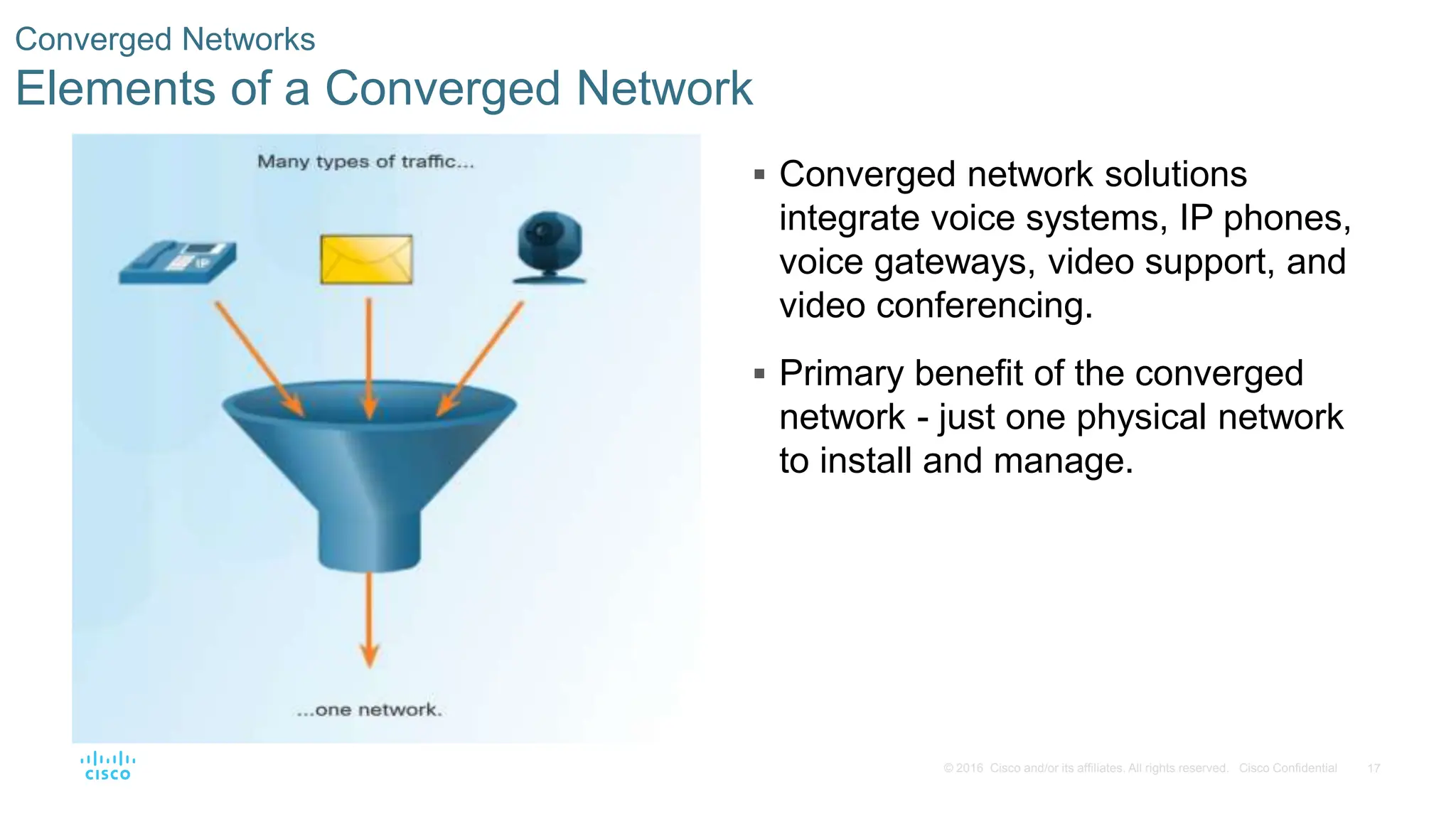
 Converged network solutions
integrate voice systems, IP phones,
voice gateways, video support, and
video conferencing.
 Primary benefit of the converged
network - just one physical network
to install and manage.
18
© 2016 Cisco and/or its affiliates. All rights reserved. Cisco Confidential
Converged Networks
Elements of a Converged Network
 Including data services, a converged network with collaboration support may
include the following features:
• Call control
• Voice messaging
• Mobility
• Automated attendant
 converged network solution also
• provides PC softphone application support
• point-to-point video so that users can enjoy personal communications with the same
ease of administration and use as a voice call.
19
© 2016 Cisco and/or its affiliates. All rights reserved. Cisco Confidential
Converged Networks
Cisco Borderless Networks
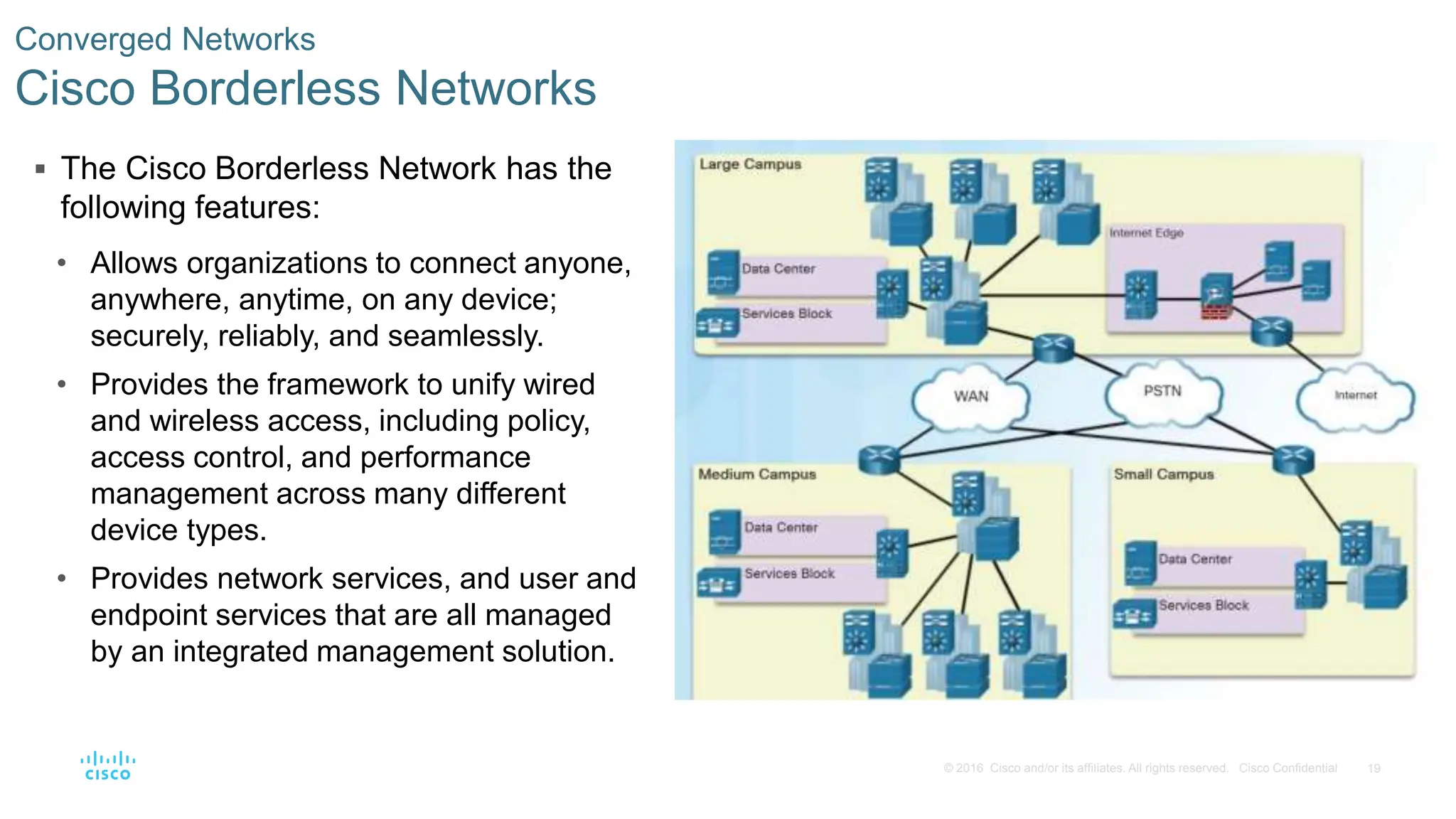
 The Cisco Borderless Network has the
following features:
• Allows organizations to connect anyone,
anywhere, anytime, on any device;
securely, reliably, and seamlessly.
• Provides the framework to unify wired
and wireless access, including policy,
access control, and performance
management across many different
device types.
• Provides network services, and user and
endpoint services that are all managed
by an integrated management solution.
20
© 2016 Cisco and/or its affiliates. All rights reserved. Cisco Confidential
Converged Networks
Hierarchy in the Borderless Switched Network
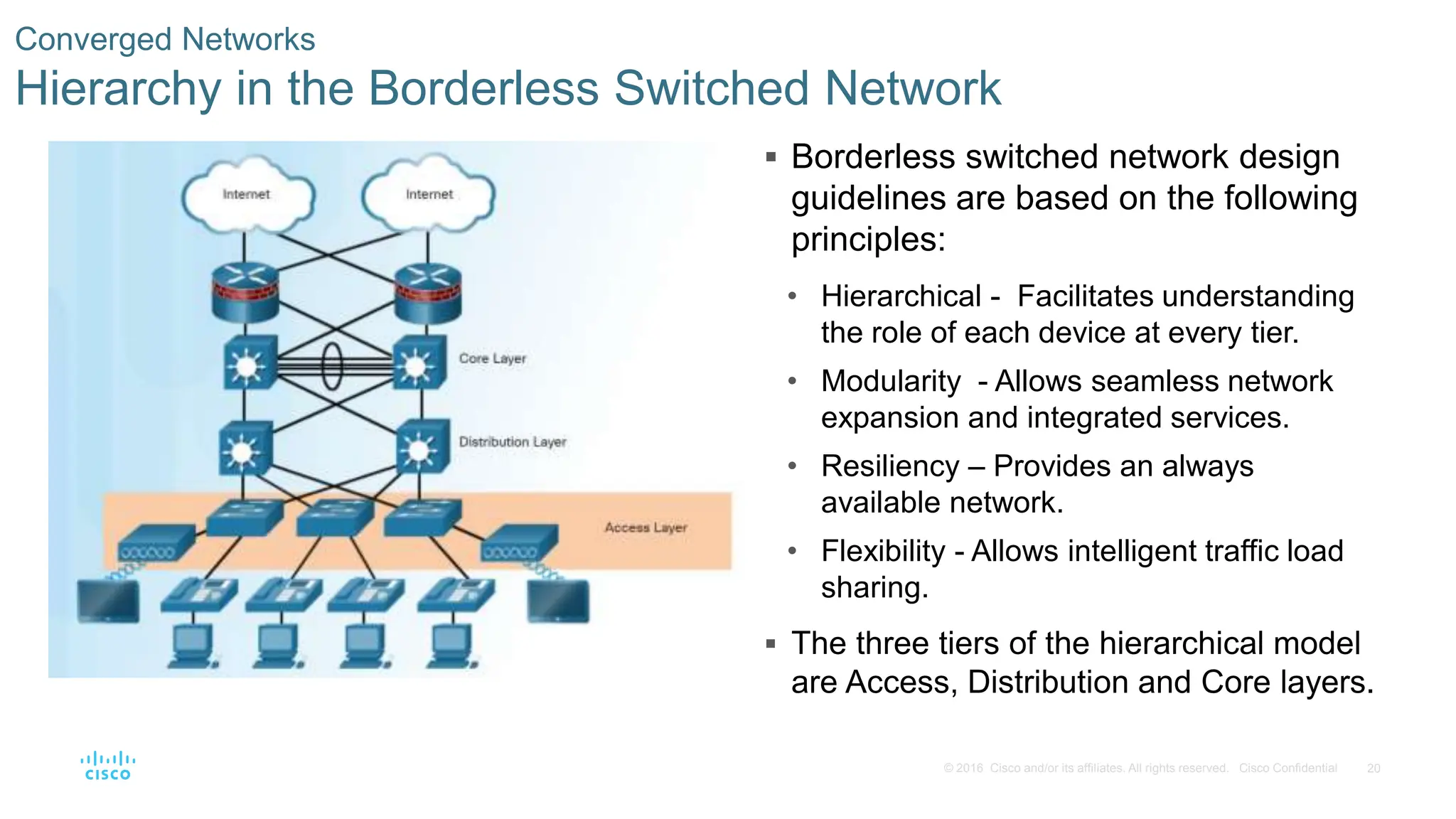
 Borderless switched network design
guidelines are based on the following
principles:
• Hierarchical - Facilitates understanding
the role of each device at every tier.
• Modularity - Allows seamless network
expansion and integrated services.
• Resiliency – Provides an always
available network.
• Flexibility - Allows intelligent traffic load
sharing.
 The three tiers of the hierarchical model
are Access, Distribution and Core layers.
21
© 2016 Cisco and/or its affiliates. All rights reserved. Cisco Confidential
Converged Networks
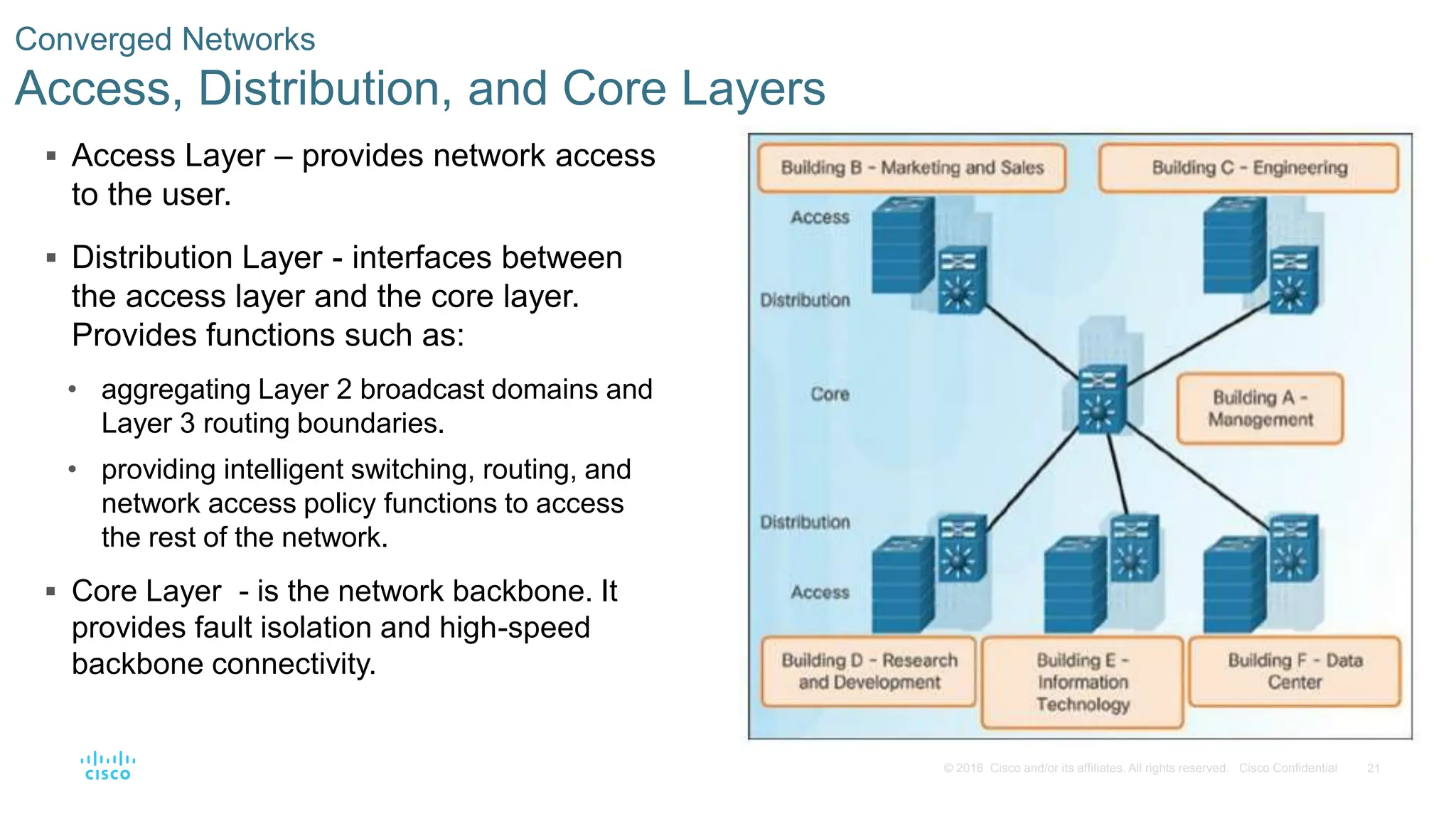
Access, Distribution, and Core Layers
 Access Layer – provides network access
to the user.
 Distribution Layer - interfaces between
the access layer and the core layer.
Provides functions such as:
• aggregating Layer 2 broadcast domains and
Layer 3 routing boundaries.
• providing intelligent switching, routing, and
network access policy functions to access
the rest of the network.
 Core Layer - is the network backbone. It
provides fault isolation and high-speed
backbone connectivity.
22
© 2016 Cisco and/or its affiliates. All rights reserved. Cisco Confidential
Converged Networks
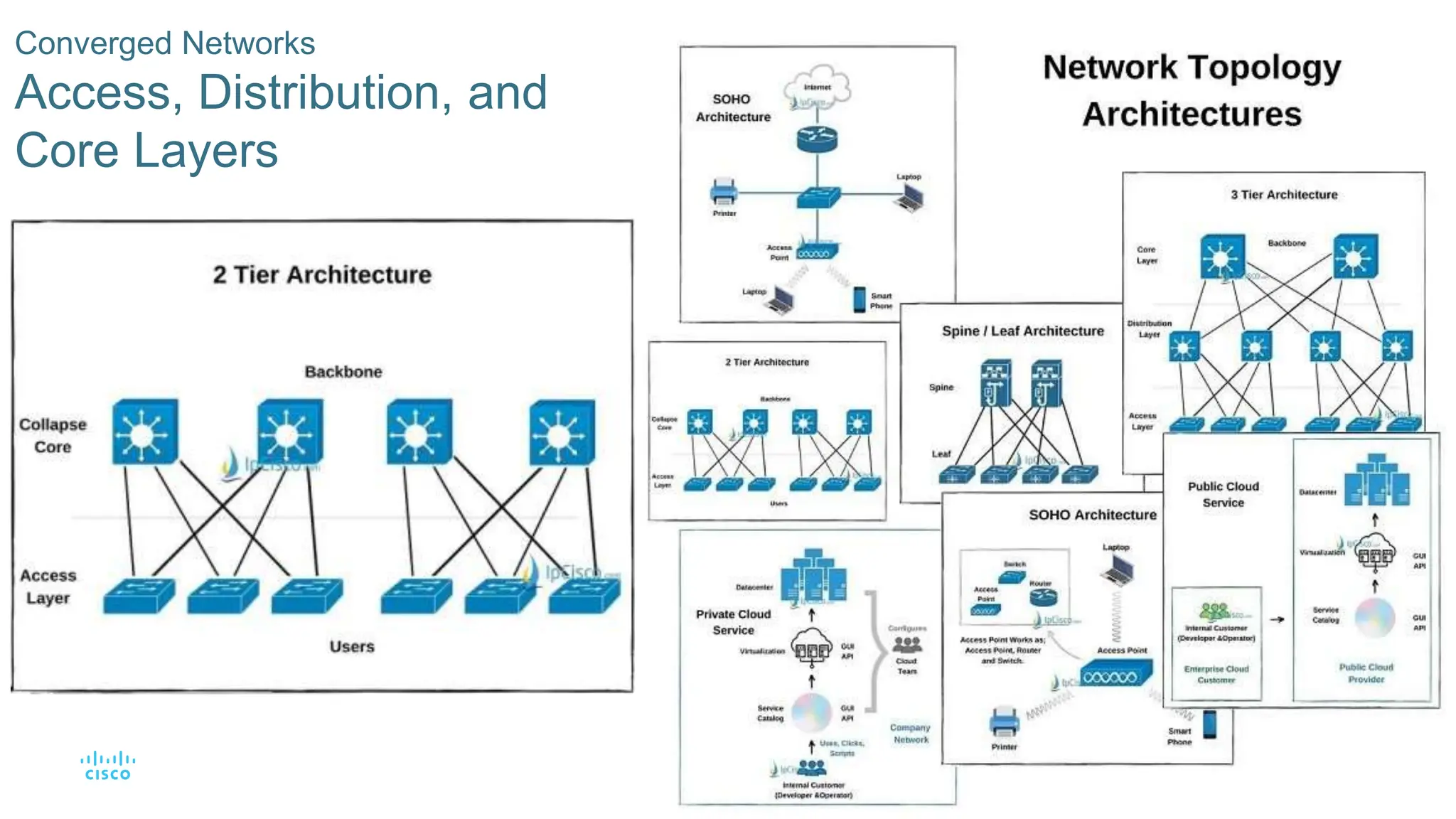
Access, Distribution, and
Core Layers
23
© 2016 Cisco and/or its affiliates. All rights reserved. Cisco Confidential
Converged Networks
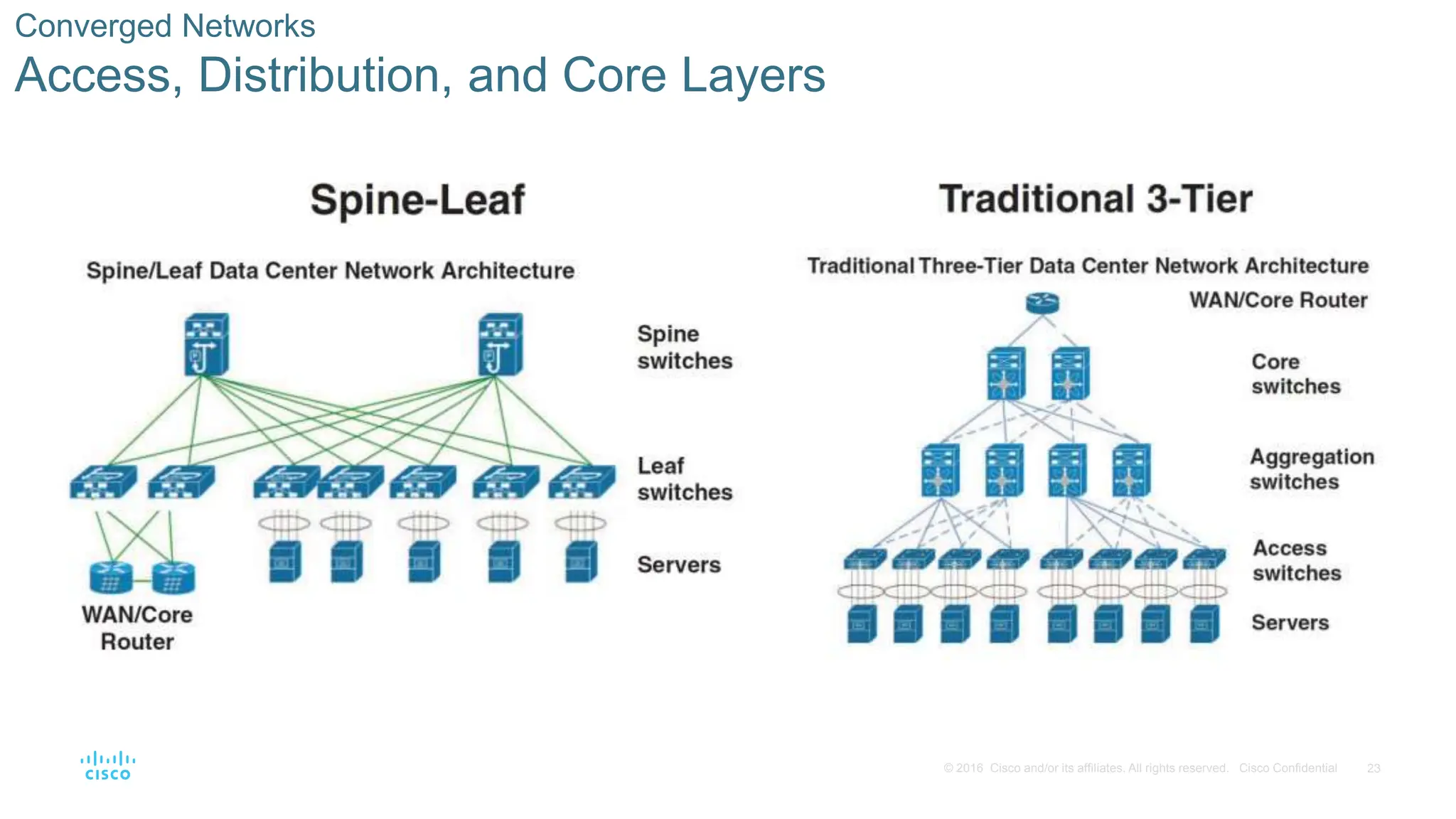
Access, Distribution, and Core Layers
24
© 2016 Cisco and/or its affiliates. All rights reserved. Cisco Confidential
Converged Networks
Access, Distribution, and Core Layers
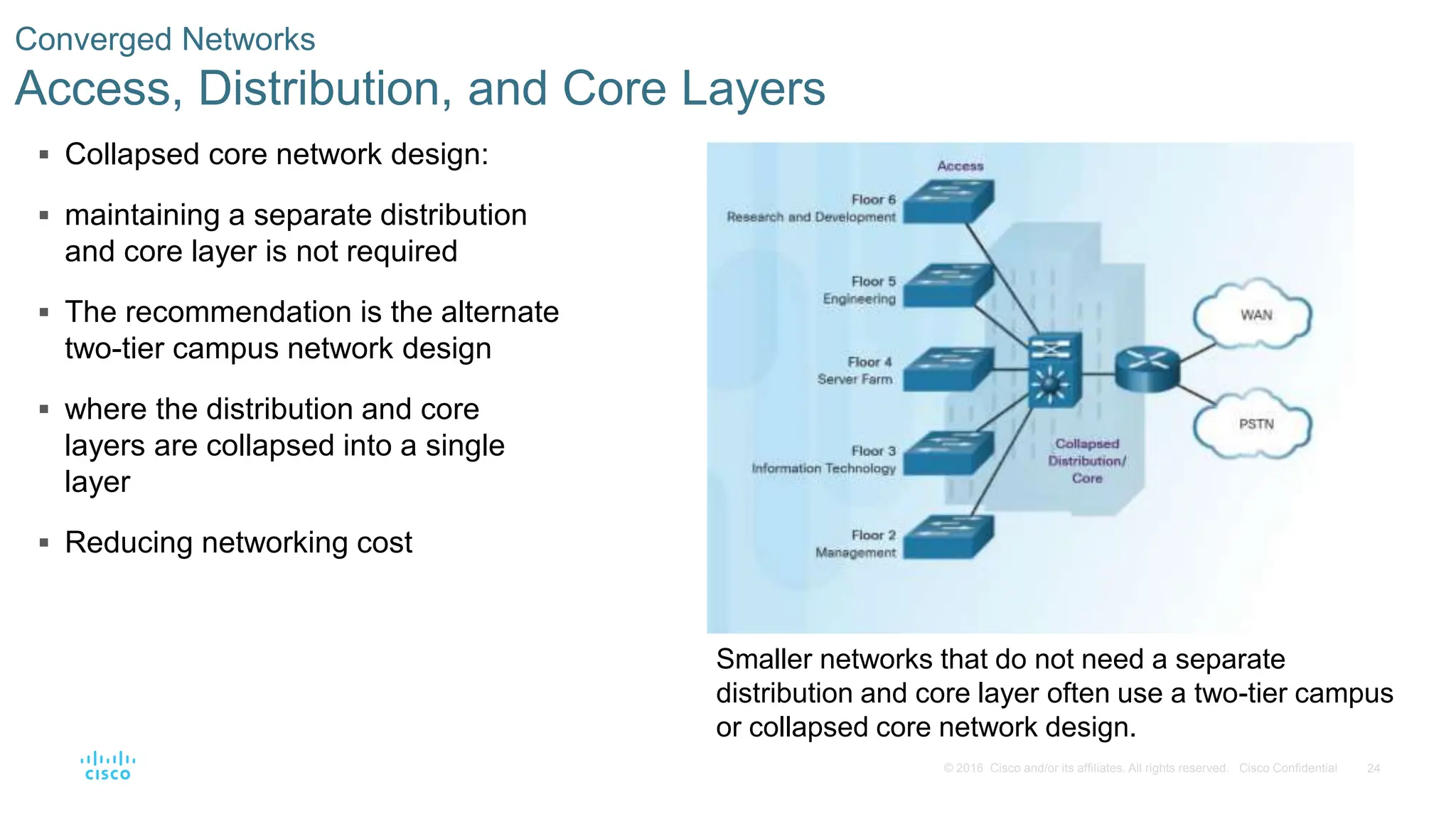
Smaller networks that do not need a separate
distribution and core layer often use a two-tier campus
or collapsed core network design.
 Collapsed core network design:
 maintaining a separate distribution
and core layer is not required
 The recommendation is the alternate
two-tier campus network design
 where the distribution and core
layers are collapsed into a single
layer
 Reducing networking cost
25
© 2016 Cisco and/or its affiliates. All rights reserved. Cisco Confidential
Switched Networks
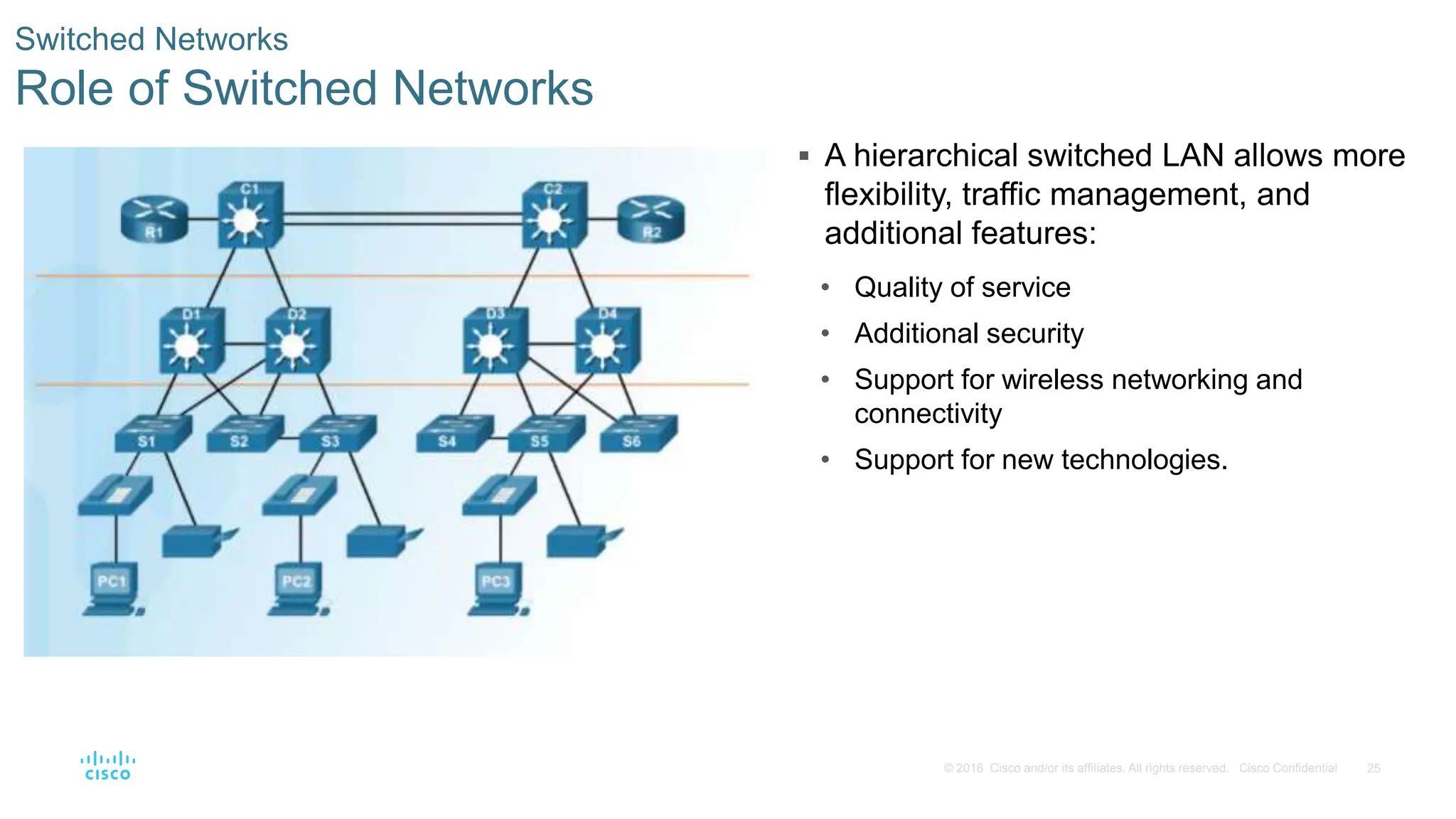
Role of Switched Networks
 A hierarchical switched LAN allows more
flexibility, traffic management, and
additional features:
• Quality of service
• Additional security
• Support for wireless networking and
connectivity
• Support for new technologies.
26
© 2016 Cisco and/or its affiliates. All rights reserved. Cisco Confidential
Switched Networks
Form Factors
 Common business considerations when selecting equipment include the following:
• Cost—The cost of a switch depends on the number and speed of the interfaces, supported features, and
expansion capability.
• Port density—Network switches must support the appropriate number of devices on the
network.
• Power—It is now common to power access points, IP phones, and even compact switches
using Power over Ethernet (PoE). In addition to PoE considerations, some chassis-based
switches support redundant power supplies.
• Reliability—The switch should provide continuous access to the network.
• Port Speed—The speed of the network connection is of primary concern to end users.
• Frame buffers—The ability of the switch to store frames is important in a network where there may be
congested ports to servers or other areas of the network.
• Scalability—The number of users on a network typically grows over time; therefore, the switch should
provide the opportunity for growth.
27
© 2016 Cisco and/or its affiliates. All rights reserved. Cisco Confidential
Switched Networks
Form Factors
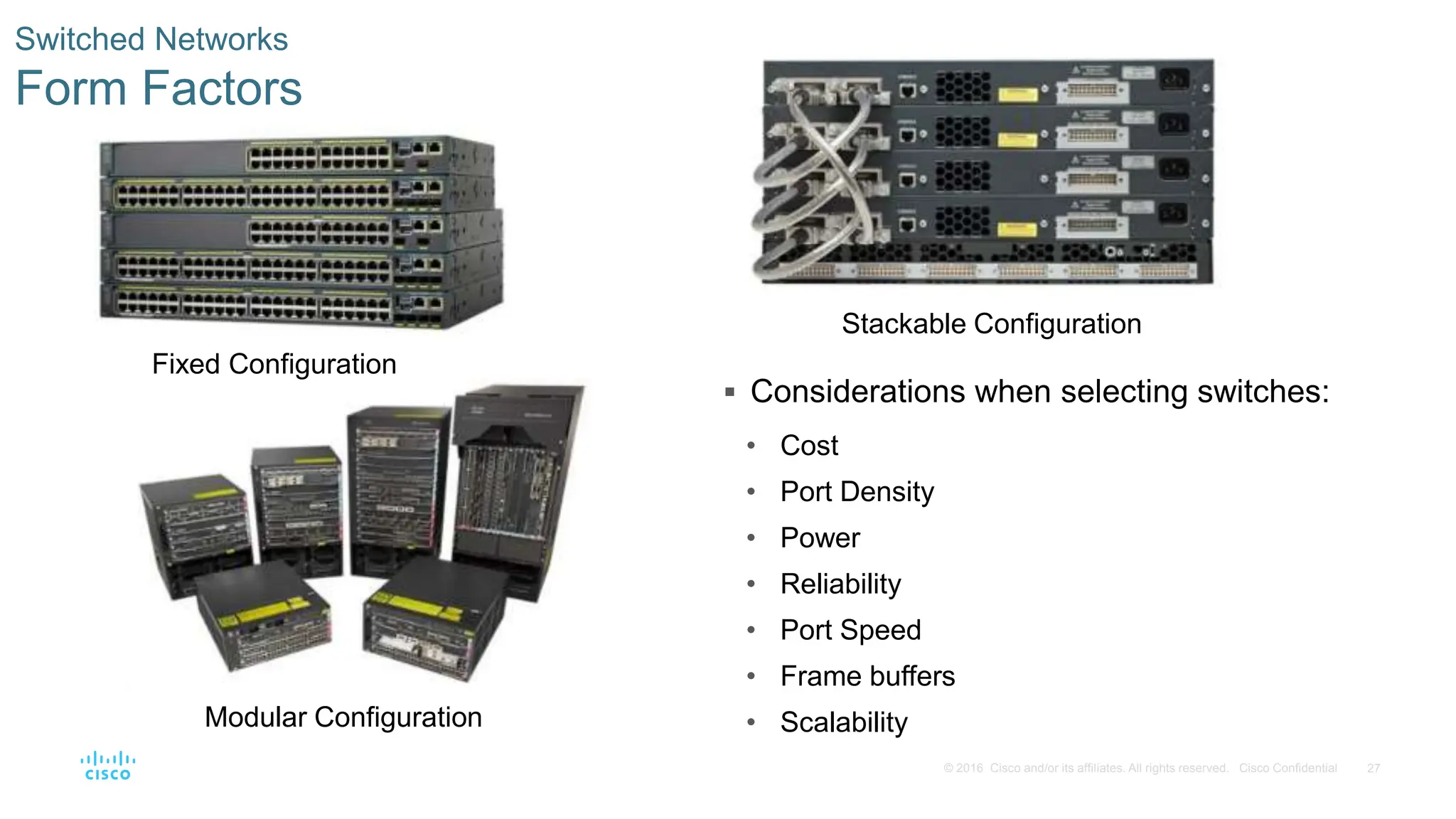
 Considerations when selecting switches:
• Cost
• Port Density
• Power
• Reliability
• Port Speed
• Frame buffers
• Scalability
Fixed Configuration
Modular Configuration
Stackable Configuration
28
© 2016 Cisco and/or its affiliates. All rights reserved. Cisco Confidential
4.2 The Switched
Environment
29
© 2016 Cisco and/or its affiliates. All rights reserved. Cisco Confidential
Frame Forwarding
Switching as a General Concept in Networking and
Telecommunications
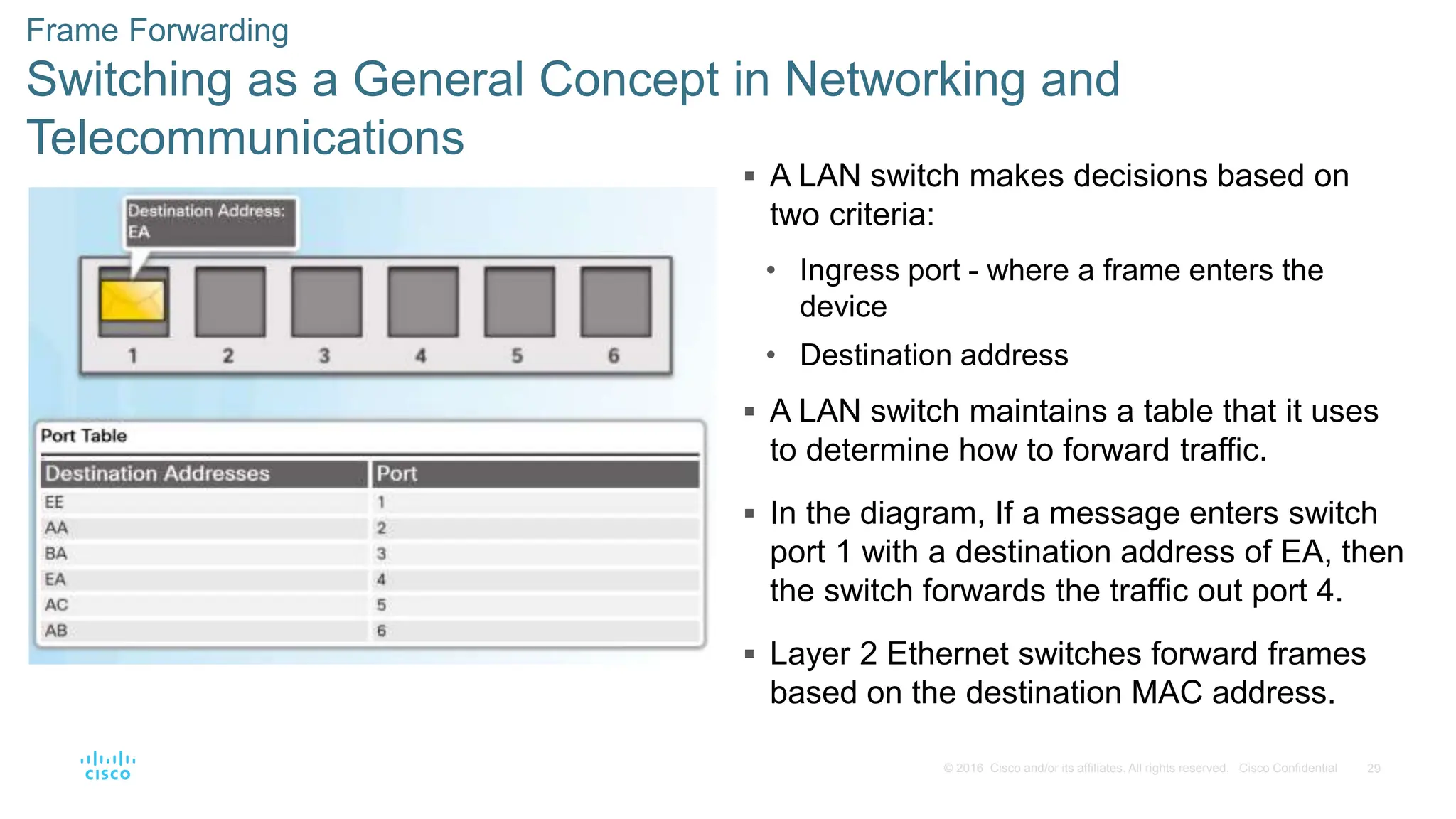
 A LAN switch makes decisions based on
two criteria:
• Ingress port - where a frame enters the
device
• Destination address
 A LAN switch maintains a table that it uses
to determine how to forward traffic.
 In the diagram, If a message enters switch
port 1 with a destination address of EA, then
the switch forwards the traffic out port 4.
 Layer 2 Ethernet switches forward frames
based on the destination MAC address.
30
© 2016 Cisco and/or its affiliates. All rights reserved. Cisco Confidential
Frame Forwarding
Video Demonstration - MAC Address Tables on Connected
Switches
 The video explains how a switch builds
its MAC address table by recording the
MAC address of each device connected
to each of its ports.
31
© 2016 Cisco and/or its affiliates. All rights reserved. Cisco Confidential
Frame Forwarding
Dynamically Populating a Switch MAC Address Table
 A switch learn which devices exist on each port to transmit a frame
 The switch builds MAC address table in the content addressable memory (CAM).
 The switch uses the information in the MAC address table to send frames.
 The following two-step process is performed on every Ethernet frame that enters a switch.
 Step 1. Learn—Examining the Source MAC Address
 Step 2. Forward—Examining the Destination MAC Address
32
© 2016 Cisco and/or its affiliates. All rights reserved. Cisco Confidential
Frame Forwarding
Dynamically Populating a Switch MAC Address Table
 A switch learn which devices exist on each port to transmit a frame
 The switch builds MAC address table in the content addressable memory (CAM).
 The switch uses the information in the MAC address table to send frames.
 The following two-step process is performed on every Ethernet frame that enters a switch.
 Step 1. Learn—Examining the Source MAC Address
 Every frame is checked (examining the frame’s source MAC address and port
number) where the frame entered the switch:
 If the source MAC address does not exist, added to the table along with the
incoming port number.
 If the source MAC address does exist, the switch updates the refresh timer for
that entry. By default, most Ethernet switches keep an entry in the table for five
minutes.
33
© 2016 Cisco and/or its affiliates. All rights reserved. Cisco Confidential
Frame Forwarding
Dynamically Populating a Switch MAC Address Table
 A switch learn which devices exist on each port to transmit a frame
 The switch builds MAC address table in the content addressable memory (CAM).
 The switch uses the information in the MAC address table to send frames
 The following two-step process is performed on every Ethernet frame that enters a switch.
 Step 2. Forward—Examining the Destination MAC Address
 If the destination MAC address is a unicast address, the switch find match
between the destination MAC address of the frame and an entry in its MAC
address table:
 If the destination MAC address is in the table, forwards the frame out the
specified port.
 If the destination MAC address is not in the table, the switch forwards the frame
out all ports except the incoming port. This is called an unknown unicast.
(broadcast or a multicast)
34
© 2016 Cisco and/or its affiliates. All rights reserved. Cisco Confidential
Frame Forwarding
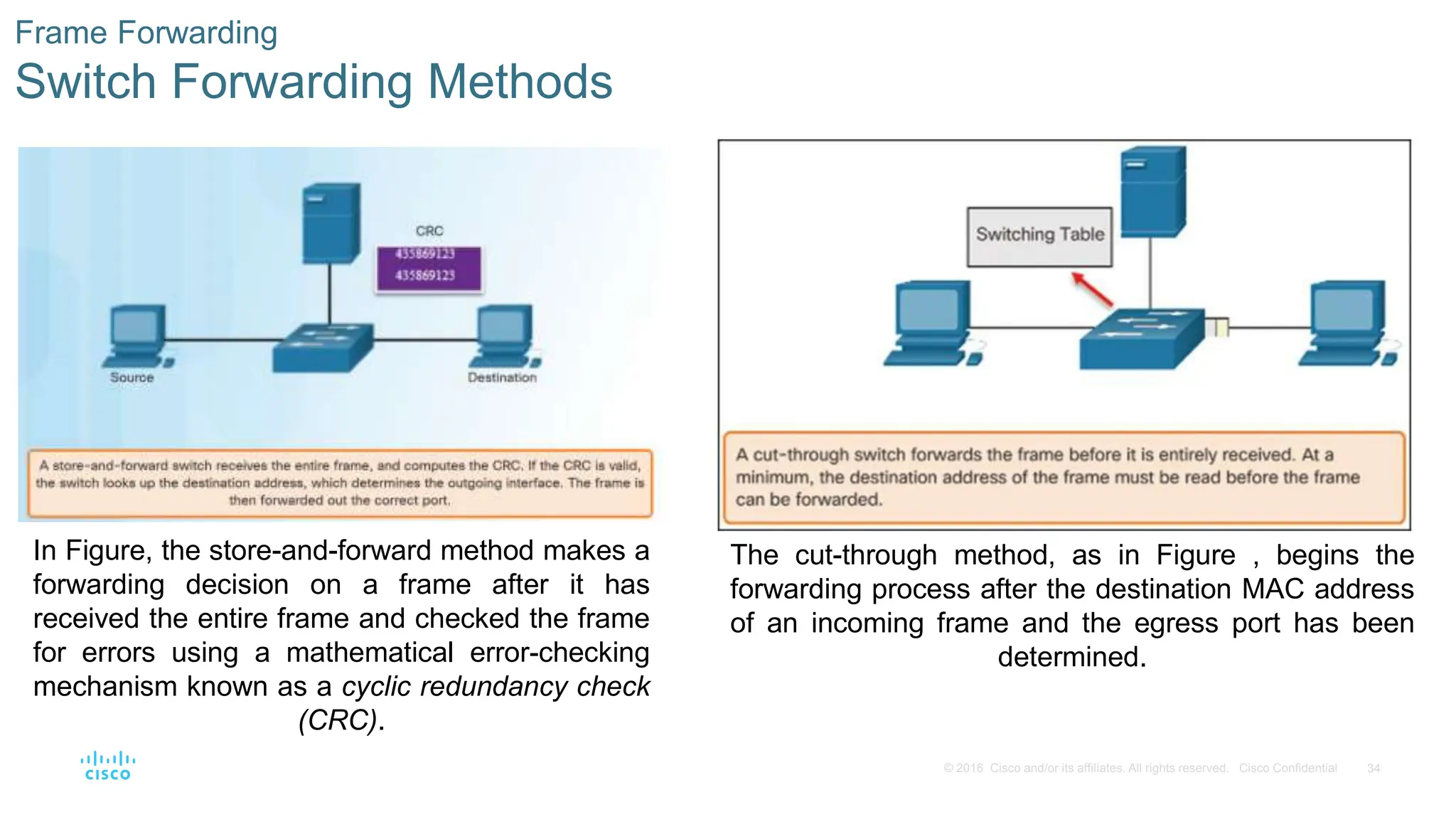
Switch Forwarding Methods
In Figure, the store-and-forward method makes a
forwarding decision on a frame after it has
received the entire frame and checked the frame
for errors using a mathematical error-checking
mechanism known as a cyclic redundancy check
(CRC).
The cut-through method, as in Figure , begins the
forwarding process after the destination MAC address
of an incoming frame and the egress port has been
determined.
35
© 2016 Cisco and/or its affiliates. All rights reserved. Cisco Confidential
Frame Forwarding
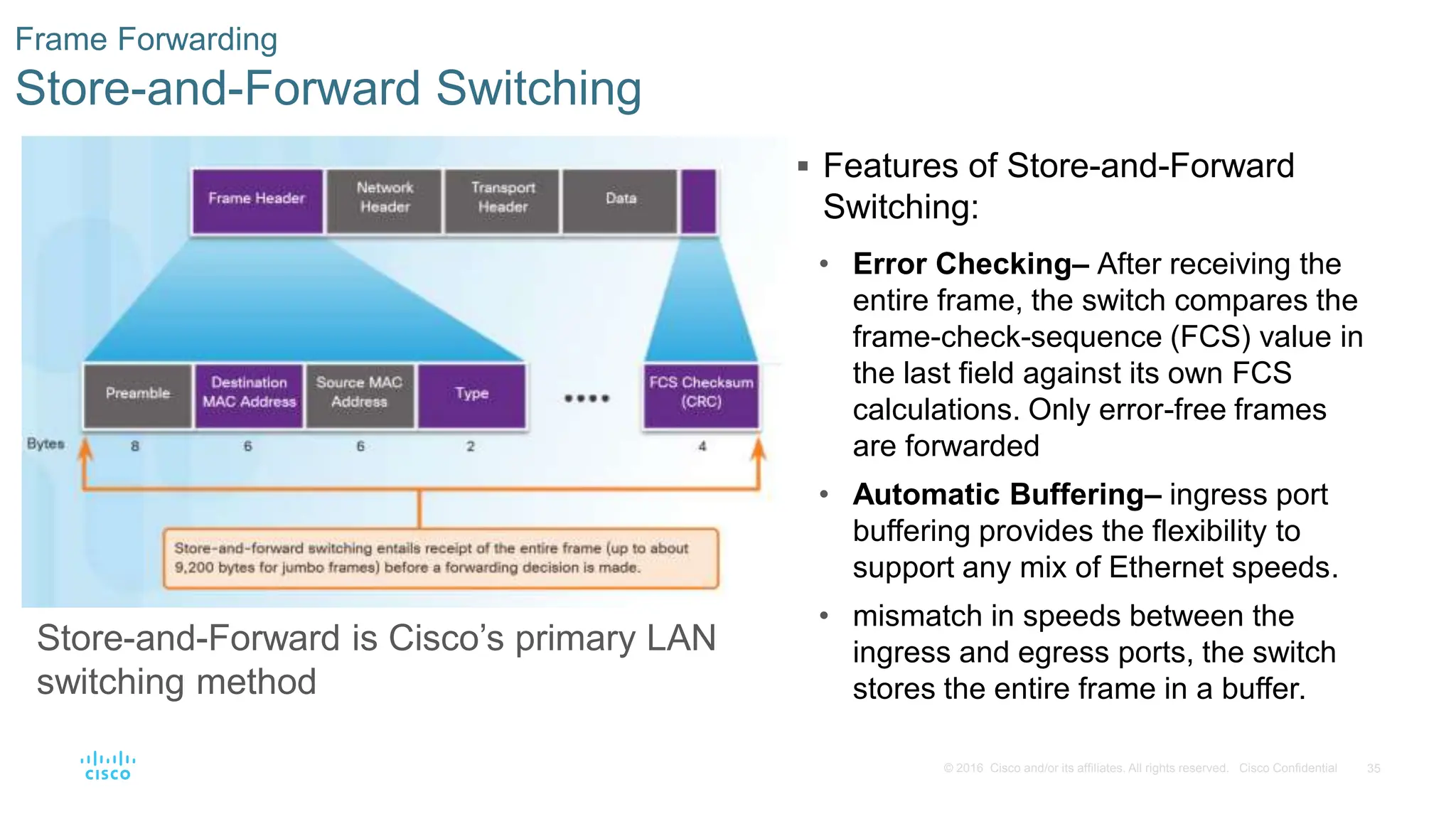
Store-and-Forward Switching
 Features of Store-and-Forward
Switching:
• Error Checking– After receiving the
entire frame, the switch compares the
frame-check-sequence (FCS) value in
the last field against its own FCS
calculations. Only error-free frames
are forwarded
• Automatic Buffering– ingress port
buffering provides the flexibility to
support any mix of Ethernet speeds.
• mismatch in speeds between the
ingress and egress ports, the switch
stores the entire frame in a buffer.
Store-and-Forward is Cisco’s primary LAN
switching method
36
© 2016 Cisco and/or its affiliates. All rights reserved. Cisco Confidential
Frame Forwarding
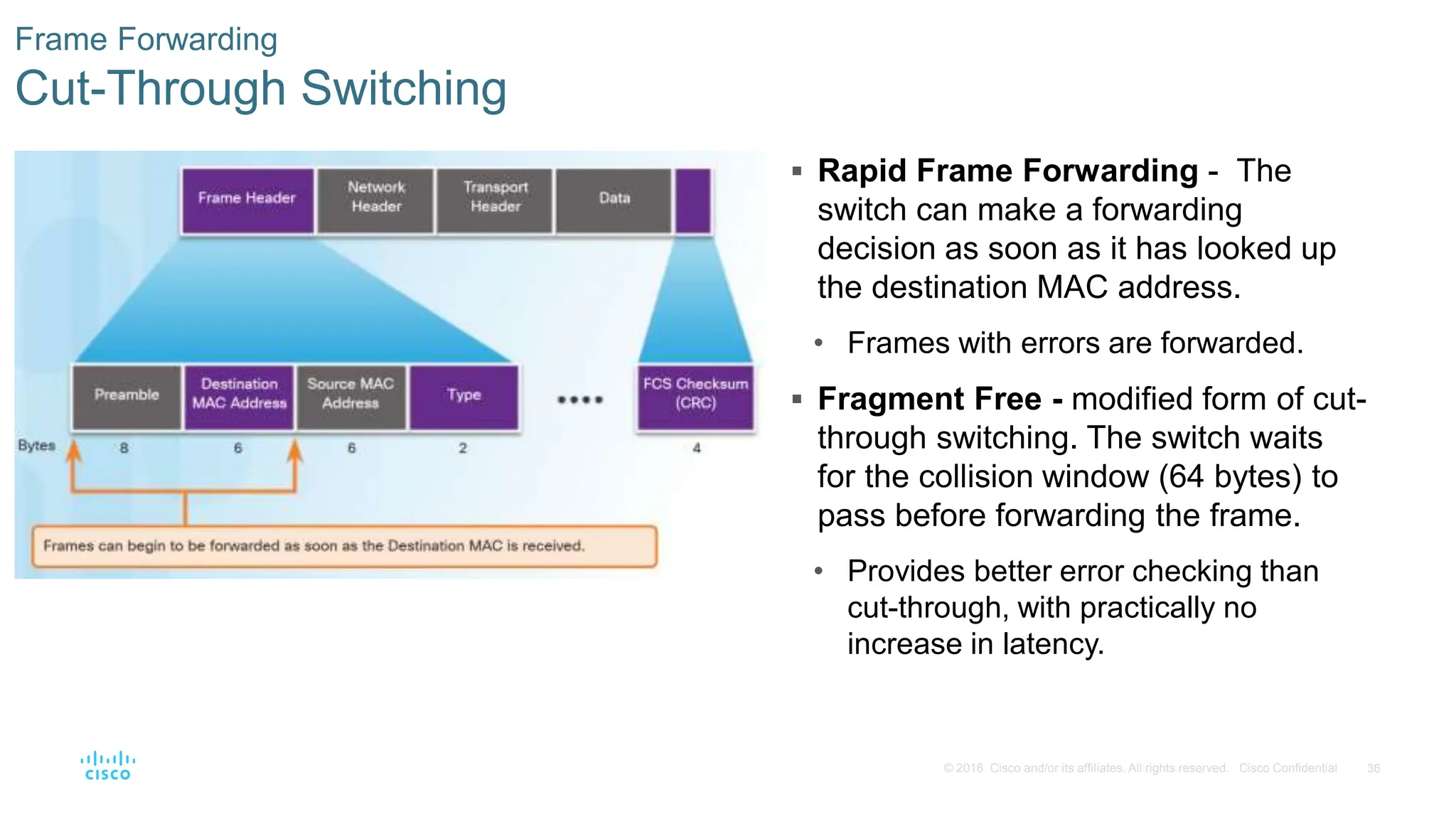
Cut-Through Switching
 Rapid Frame Forwarding - The
switch can make a forwarding
decision as soon as it has looked up
the destination MAC address.
• Frames with errors are forwarded.
 Fragment Free - modified form of cut-
through switching. The switch waits
for the collision window (64 bytes) to
pass before forwarding the frame.
• Provides better error checking than
cut-through, with practically no
increase in latency.
37
© 2016 Cisco and/or its affiliates. All rights reserved. Cisco Confidential
Switching Domains
Collision Domains
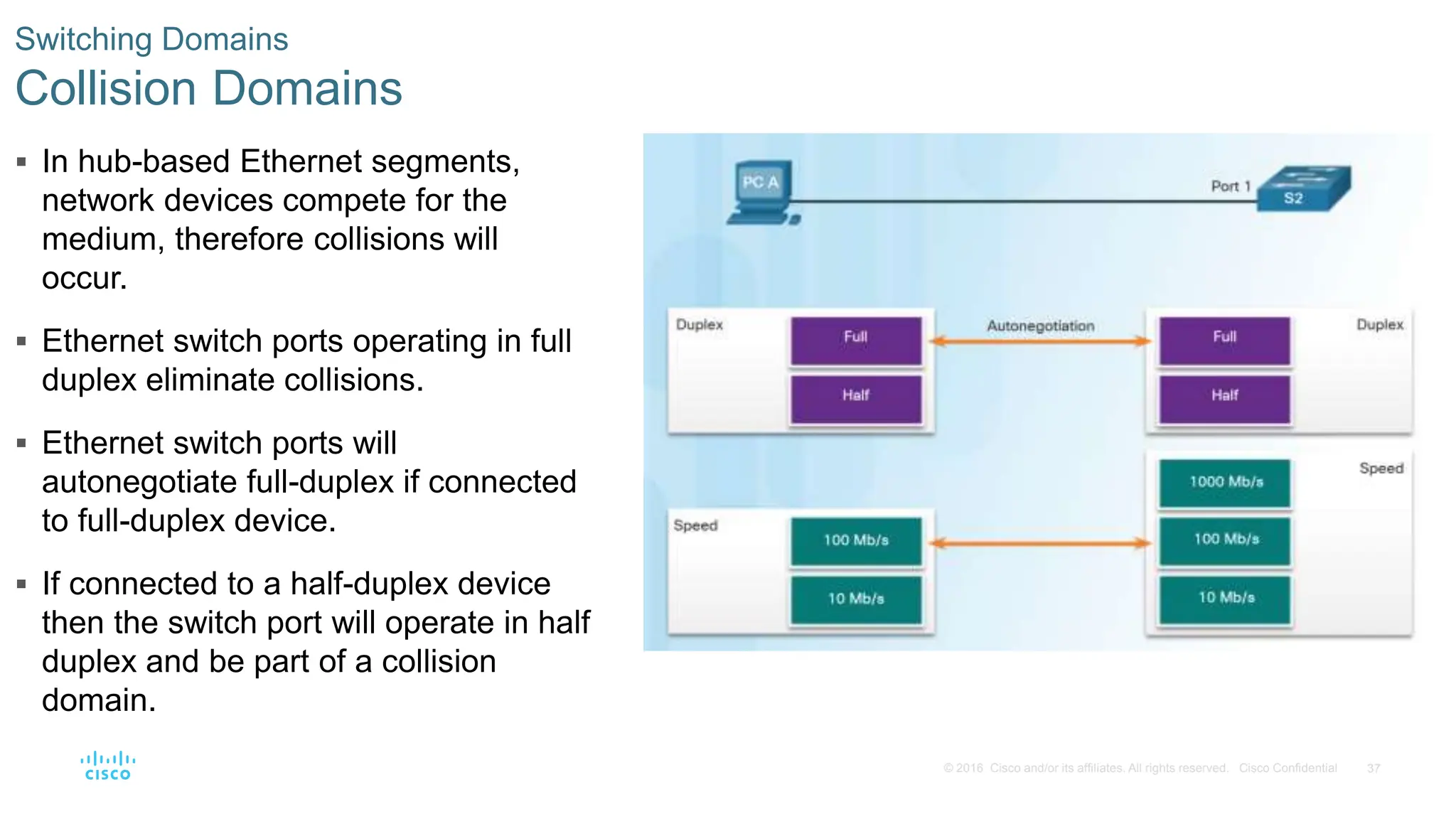
 In hub-based Ethernet segments,
network devices compete for the
medium, therefore collisions will
occur.
 Ethernet switch ports operating in full
duplex eliminate collisions.
 Ethernet switch ports will
autonegotiate full-duplex if connected
to full-duplex device.
 If connected to a half-duplex device
then the switch port will operate in half
duplex and be part of a collision
domain.
38
© 2016 Cisco and/or its affiliates. All rights reserved. Cisco Confidential
Switching Domains
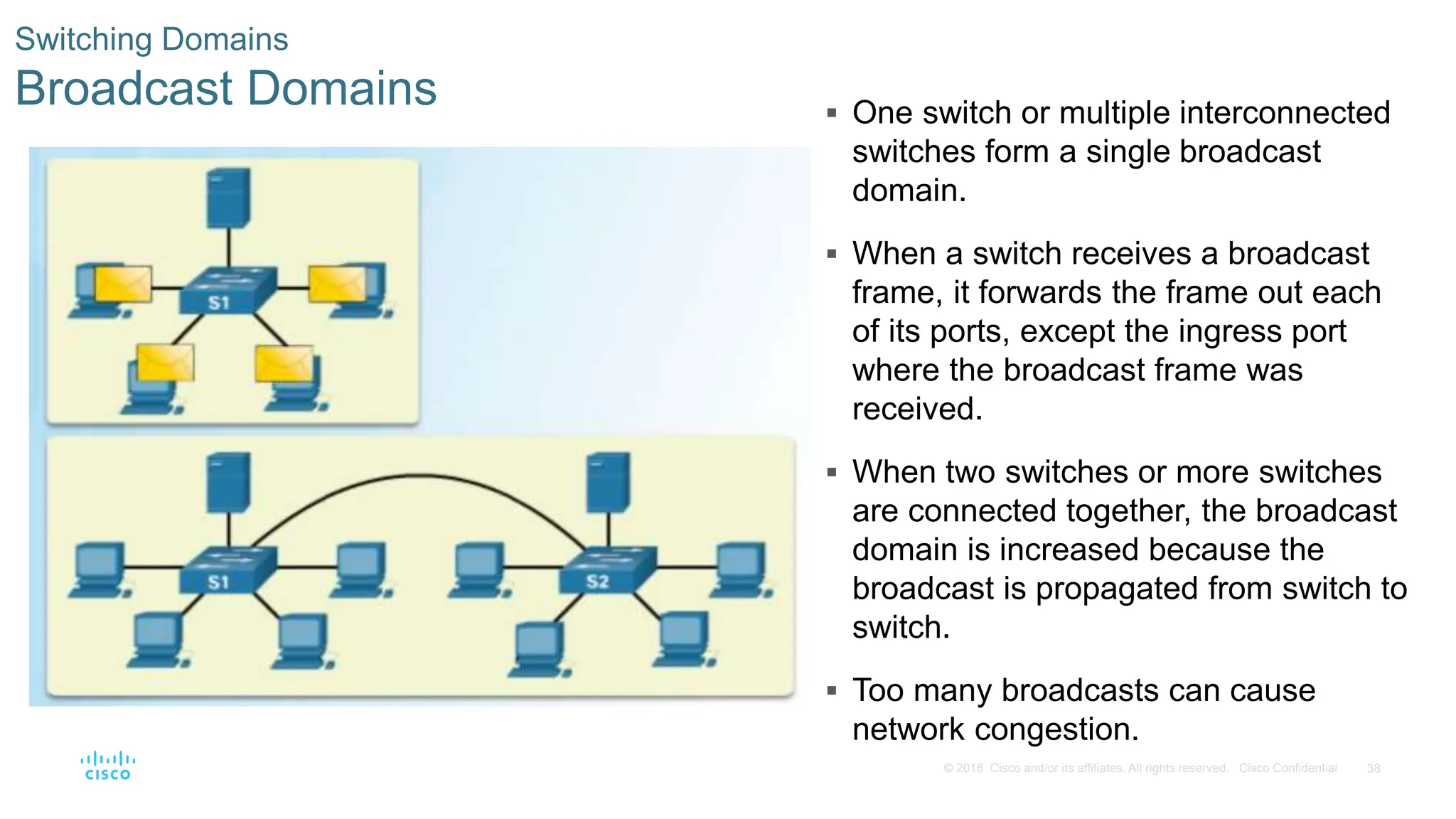
Broadcast Domains  One switch or multiple interconnected
switches form a single broadcast
domain.
 When a switch receives a broadcast
frame, it forwards the frame out each
of its ports, except the ingress port
where the broadcast frame was
received.
 When two switches or more switches
are connected together, the broadcast
domain is increased because the
broadcast is propagated from switch to
switch.
 Too many broadcasts can cause
network congestion.
39
© 2016 Cisco and/or its affiliates. All rights reserved. Cisco Confidential
Switching Domains
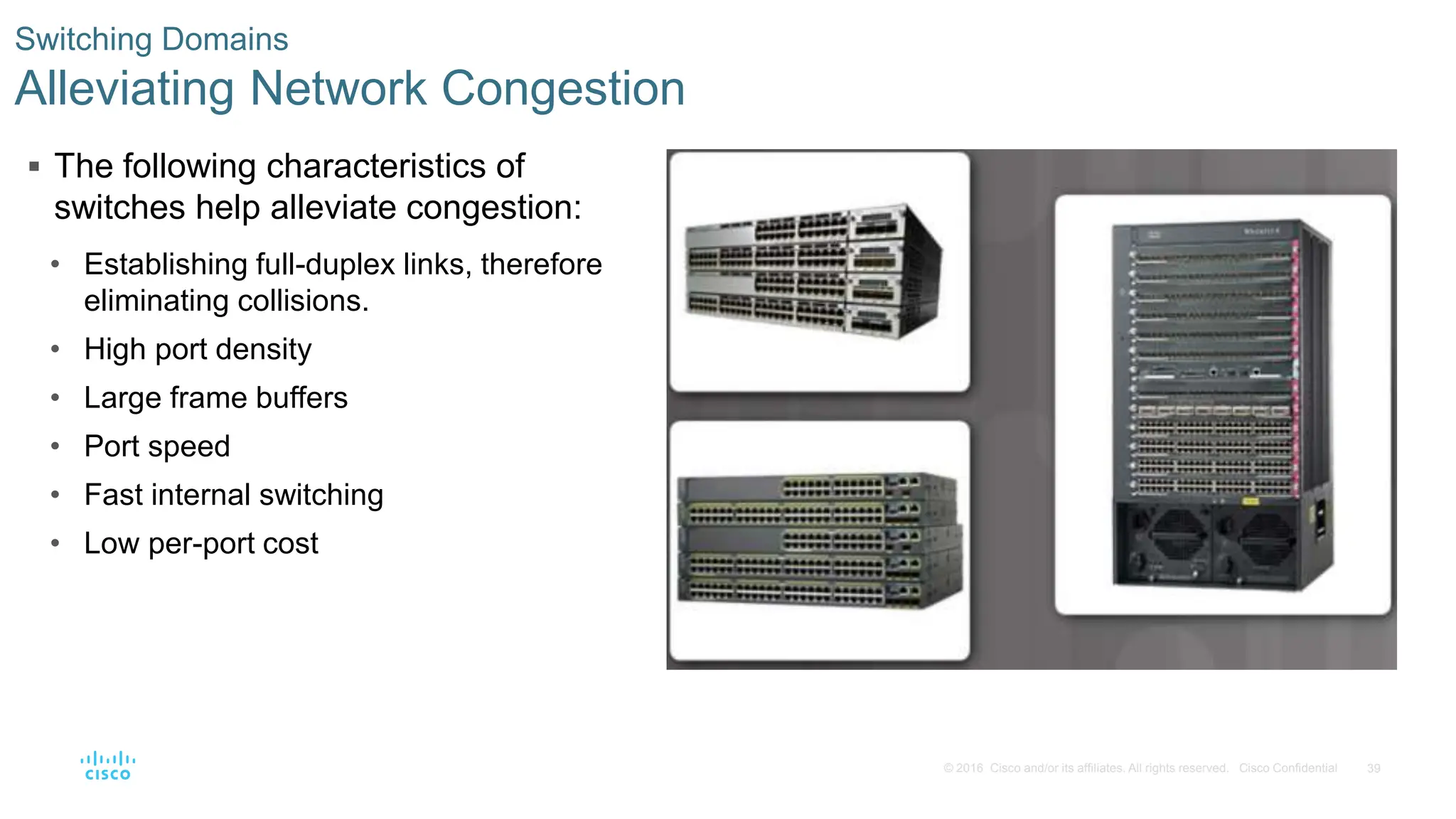
Alleviating Network Congestion
 The following characteristics of
switches help alleviate congestion:
• Establishing full-duplex links, therefore
eliminating collisions.
• High port density
• Large frame buffers
• Port speed
• Fast internal switching
• Low per-port cost
40
© 2016 Cisco and/or its affiliates. All rights reserved. Cisco Confidential
4.3 Chapter Summary
41
© 2016 Cisco and/or its affiliates. All rights reserved. Cisco Confidential
Conclusion
Chapter 4: Switched Networks
 Explain how switched networks support small to medium-sized businesses.
 Explain how Layer 2 switches forward data in a small to medium-sized LAN.
CCNA_RSE_Chp4 and their working principles.pptx

CCNA_RSE_Chp4 and their working principles.pptx

  • 1.
    Instructor Materials Chapter 4:Switched Networks CCNA Routing and Switching Routing and Switching Essentials v6.0
  • 2.
    3 © 2016 Ciscoand/or its affiliates. All rights reserved. Cisco Confidential Chapter 4: Switched Networks Introduction to Networks 6.0 Planning Guide
  • 3.
    Chapter 4: Switched Networks CCNARouting and Switching Routing and Switching Essentials v6.0
  • 4.
    12 © 2016 Ciscoand/or its affiliates. All rights reserved. Cisco Confidential  4.1 LAN Design • Explain how switched networks support small to medium-sized businesses. • Explain how data, voice, and video are converged in a switched network. • Describe a switched network in a small to medium-sized business.  4.2 The Switched Environment • Explain how Layer 2 switches forward data in a small to medium-sized LAN. • Explain how frames are forwarded in a switched network. • Compare a collision domain to a broadcast domain. Chapter 4 - Sections & Objectives
  • 5.
    13 © 2016 Ciscoand/or its affiliates. All rights reserved. Cisco Confidential 4.1 LAN Design
  • 6.
    14 © 2016 Ciscoand/or its affiliates. All rights reserved. Cisco Confidential Converged Networks  The words converged network can mean several things to a network engineer: (1) a single network designed to handle voice, video, and data; (2) an internal network where the Layer 3 devices, such as routers, have a complete routing table to be able to accurately and efficiently send data to a remote destination; and (3) a switch network that has completed calculations that result in a single path through the switch network. • One of the primary benefits of transitioning to the converged network is that there is just one physical network to install and manage.
  • 7.
    15 © 2016 Ciscoand/or its affiliates. All rights reserved. Cisco Confidential Converged Networks Growing Complexity of Networks  Next-generation networks need to be secure, reliable, and highly available.  They must support a globalized workforce.  They must be able to integrate legacy devices.
  • 8.
    16 © 2016 Ciscoand/or its affiliates. All rights reserved. Cisco Confidential Converged Networks Growing Complexity of Networks
  • 9.
    17 © 2016 Ciscoand/or its affiliates. All rights reserved. Cisco Confidential Converged Networks Elements of a Converged Network  Converged network solutions integrate voice systems, IP phones, voice gateways, video support, and video conferencing.  Primary benefit of the converged network - just one physical network to install and manage.
  • 10.
    18 © 2016 Ciscoand/or its affiliates. All rights reserved. Cisco Confidential Converged Networks Elements of a Converged Network  Including data services, a converged network with collaboration support may include the following features: • Call control • Voice messaging • Mobility • Automated attendant  converged network solution also • provides PC softphone application support • point-to-point video so that users can enjoy personal communications with the same ease of administration and use as a voice call.
  • 11.
    19 © 2016 Ciscoand/or its affiliates. All rights reserved. Cisco Confidential Converged Networks Cisco Borderless Networks  The Cisco Borderless Network has the following features: • Allows organizations to connect anyone, anywhere, anytime, on any device; securely, reliably, and seamlessly. • Provides the framework to unify wired and wireless access, including policy, access control, and performance management across many different device types. • Provides network services, and user and endpoint services that are all managed by an integrated management solution.
  • 12.
    20 © 2016 Ciscoand/or its affiliates. All rights reserved. Cisco Confidential Converged Networks Hierarchy in the Borderless Switched Network  Borderless switched network design guidelines are based on the following principles: • Hierarchical - Facilitates understanding the role of each device at every tier. • Modularity - Allows seamless network expansion and integrated services. • Resiliency – Provides an always available network. • Flexibility - Allows intelligent traffic load sharing.  The three tiers of the hierarchical model are Access, Distribution and Core layers.
  • 13.
    21 © 2016 Ciscoand/or its affiliates. All rights reserved. Cisco Confidential Converged Networks Access, Distribution, and Core Layers  Access Layer – provides network access to the user.  Distribution Layer - interfaces between the access layer and the core layer. Provides functions such as: • aggregating Layer 2 broadcast domains and Layer 3 routing boundaries. • providing intelligent switching, routing, and network access policy functions to access the rest of the network.  Core Layer - is the network backbone. It provides fault isolation and high-speed backbone connectivity.
  • 14.
    22 © 2016 Ciscoand/or its affiliates. All rights reserved. Cisco Confidential Converged Networks Access, Distribution, and Core Layers
  • 15.
    23 © 2016 Ciscoand/or its affiliates. All rights reserved. Cisco Confidential Converged Networks Access, Distribution, and Core Layers
  • 16.
    24 © 2016 Ciscoand/or its affiliates. All rights reserved. Cisco Confidential Converged Networks Access, Distribution, and Core Layers Smaller networks that do not need a separate distribution and core layer often use a two-tier campus or collapsed core network design.  Collapsed core network design:  maintaining a separate distribution and core layer is not required  The recommendation is the alternate two-tier campus network design  where the distribution and core layers are collapsed into a single layer  Reducing networking cost
  • 17.
    25 © 2016 Ciscoand/or its affiliates. All rights reserved. Cisco Confidential Switched Networks Role of Switched Networks  A hierarchical switched LAN allows more flexibility, traffic management, and additional features: • Quality of service • Additional security • Support for wireless networking and connectivity • Support for new technologies.
  • 18.
    26 © 2016 Ciscoand/or its affiliates. All rights reserved. Cisco Confidential Switched Networks Form Factors  Common business considerations when selecting equipment include the following: • Cost—The cost of a switch depends on the number and speed of the interfaces, supported features, and expansion capability. • Port density—Network switches must support the appropriate number of devices on the network. • Power—It is now common to power access points, IP phones, and even compact switches using Power over Ethernet (PoE). In addition to PoE considerations, some chassis-based switches support redundant power supplies. • Reliability—The switch should provide continuous access to the network. • Port Speed—The speed of the network connection is of primary concern to end users. • Frame buffers—The ability of the switch to store frames is important in a network where there may be congested ports to servers or other areas of the network. • Scalability—The number of users on a network typically grows over time; therefore, the switch should provide the opportunity for growth.
  • 19.
    27 © 2016 Ciscoand/or its affiliates. All rights reserved. Cisco Confidential Switched Networks Form Factors  Considerations when selecting switches: • Cost • Port Density • Power • Reliability • Port Speed • Frame buffers • Scalability Fixed Configuration Modular Configuration Stackable Configuration
  • 20.
    28 © 2016 Ciscoand/or its affiliates. All rights reserved. Cisco Confidential 4.2 The Switched Environment
  • 21.
    29 © 2016 Ciscoand/or its affiliates. All rights reserved. Cisco Confidential Frame Forwarding Switching as a General Concept in Networking and Telecommunications  A LAN switch makes decisions based on two criteria: • Ingress port - where a frame enters the device • Destination address  A LAN switch maintains a table that it uses to determine how to forward traffic.  In the diagram, If a message enters switch port 1 with a destination address of EA, then the switch forwards the traffic out port 4.  Layer 2 Ethernet switches forward frames based on the destination MAC address.
  • 22.
    30 © 2016 Ciscoand/or its affiliates. All rights reserved. Cisco Confidential Frame Forwarding Video Demonstration - MAC Address Tables on Connected Switches  The video explains how a switch builds its MAC address table by recording the MAC address of each device connected to each of its ports.
  • 23.
    31 © 2016 Ciscoand/or its affiliates. All rights reserved. Cisco Confidential Frame Forwarding Dynamically Populating a Switch MAC Address Table  A switch learn which devices exist on each port to transmit a frame  The switch builds MAC address table in the content addressable memory (CAM).  The switch uses the information in the MAC address table to send frames.  The following two-step process is performed on every Ethernet frame that enters a switch.  Step 1. Learn—Examining the Source MAC Address  Step 2. Forward—Examining the Destination MAC Address
  • 24.
    32 © 2016 Ciscoand/or its affiliates. All rights reserved. Cisco Confidential Frame Forwarding Dynamically Populating a Switch MAC Address Table  A switch learn which devices exist on each port to transmit a frame  The switch builds MAC address table in the content addressable memory (CAM).  The switch uses the information in the MAC address table to send frames.  The following two-step process is performed on every Ethernet frame that enters a switch.  Step 1. Learn—Examining the Source MAC Address  Every frame is checked (examining the frame’s source MAC address and port number) where the frame entered the switch:  If the source MAC address does not exist, added to the table along with the incoming port number.  If the source MAC address does exist, the switch updates the refresh timer for that entry. By default, most Ethernet switches keep an entry in the table for five minutes.
  • 25.
    33 © 2016 Ciscoand/or its affiliates. All rights reserved. Cisco Confidential Frame Forwarding Dynamically Populating a Switch MAC Address Table  A switch learn which devices exist on each port to transmit a frame  The switch builds MAC address table in the content addressable memory (CAM).  The switch uses the information in the MAC address table to send frames  The following two-step process is performed on every Ethernet frame that enters a switch.  Step 2. Forward—Examining the Destination MAC Address  If the destination MAC address is a unicast address, the switch find match between the destination MAC address of the frame and an entry in its MAC address table:  If the destination MAC address is in the table, forwards the frame out the specified port.  If the destination MAC address is not in the table, the switch forwards the frame out all ports except the incoming port. This is called an unknown unicast. (broadcast or a multicast)
  • 26.
    34 © 2016 Ciscoand/or its affiliates. All rights reserved. Cisco Confidential Frame Forwarding Switch Forwarding Methods In Figure, the store-and-forward method makes a forwarding decision on a frame after it has received the entire frame and checked the frame for errors using a mathematical error-checking mechanism known as a cyclic redundancy check (CRC). The cut-through method, as in Figure , begins the forwarding process after the destination MAC address of an incoming frame and the egress port has been determined.
  • 27.
    35 © 2016 Ciscoand/or its affiliates. All rights reserved. Cisco Confidential Frame Forwarding Store-and-Forward Switching  Features of Store-and-Forward Switching: • Error Checking– After receiving the entire frame, the switch compares the frame-check-sequence (FCS) value in the last field against its own FCS calculations. Only error-free frames are forwarded • Automatic Buffering– ingress port buffering provides the flexibility to support any mix of Ethernet speeds. • mismatch in speeds between the ingress and egress ports, the switch stores the entire frame in a buffer. Store-and-Forward is Cisco’s primary LAN switching method
  • 28.
    36 © 2016 Ciscoand/or its affiliates. All rights reserved. Cisco Confidential Frame Forwarding Cut-Through Switching  Rapid Frame Forwarding - The switch can make a forwarding decision as soon as it has looked up the destination MAC address. • Frames with errors are forwarded.  Fragment Free - modified form of cut- through switching. The switch waits for the collision window (64 bytes) to pass before forwarding the frame. • Provides better error checking than cut-through, with practically no increase in latency.
  • 29.
    37 © 2016 Ciscoand/or its affiliates. All rights reserved. Cisco Confidential Switching Domains Collision Domains  In hub-based Ethernet segments, network devices compete for the medium, therefore collisions will occur.  Ethernet switch ports operating in full duplex eliminate collisions.  Ethernet switch ports will autonegotiate full-duplex if connected to full-duplex device.  If connected to a half-duplex device then the switch port will operate in half duplex and be part of a collision domain.
  • 30.
    38 © 2016 Ciscoand/or its affiliates. All rights reserved. Cisco Confidential Switching Domains Broadcast Domains  One switch or multiple interconnected switches form a single broadcast domain.  When a switch receives a broadcast frame, it forwards the frame out each of its ports, except the ingress port where the broadcast frame was received.  When two switches or more switches are connected together, the broadcast domain is increased because the broadcast is propagated from switch to switch.  Too many broadcasts can cause network congestion.
  • 31.
    39 © 2016 Ciscoand/or its affiliates. All rights reserved. Cisco Confidential Switching Domains Alleviating Network Congestion  The following characteristics of switches help alleviate congestion: • Establishing full-duplex links, therefore eliminating collisions. • High port density • Large frame buffers • Port speed • Fast internal switching • Low per-port cost
  • 32.
    40 © 2016 Ciscoand/or its affiliates. All rights reserved. Cisco Confidential 4.3 Chapter Summary
  • 33.
    41 © 2016 Ciscoand/or its affiliates. All rights reserved. Cisco Confidential Conclusion Chapter 4: Switched Networks  Explain how switched networks support small to medium-sized businesses.  Explain how Layer 2 switches forward data in a small to medium-sized LAN.