More Related Content

PPTX

PPTX
CCNA (R & S) Module 03 - Routing & Switching Essentials - Chapter 4 
PPTX

PPTX
CCNA_RSE_Chp4 and their working principles.pptx 
PDF
introduction to switched networks - JARINGAN KOMPUTER 
PPTX
rsinstructorpptchapter1final-141024021337-conversion-gate01 
PDF
CCNAv5 - S2: Chapter1 Introsuction to switched networks 
PPTX
KPUCC-Rs instructor ppt_chapter1_final Similar to CCNA_RSE_Chp4 - Switched Networks for CCNA

PPTX
Chapter 12 : Introduction to switched networks 
PPTX
CCNA 2 Routing and Switching v5.0 Chapter 1 
PPTX
SRWE_Module_2.pptx Networking Courses IT 
PPTX

PDF
ENSA_Module_11 - Network Design.pdf.mtzm 
PDF
ITN3052_04_Switched_Networks.pdf 
PDF
Presentation-1-Switching Concepts-BIS1O.pdf 
PPTX
ScaNv6_instructorPPT_Chapter1 LAN Design 
PPT
Chapter 1 How to Design a LAN 
PPTX
CCNA (R & S) Module 01 - Introduction to Networks - Chapter 5 
PPTX
Itn instructor ppt_chapter5_ethernet 
PPTX
CCNA CISCO Chapter 01 Routing Concepts and Network 
PPTX
Ccna routing and_switching_chapter-4-5 
PPT

PPTX
Encor chapter 1_packet forwarding 
PPTX
CCNA_RSE_Chp1-1 Routing Concepts for Network 
PPT

PPT

PPT

PPTX
Switching Concepts presentation More from MonchaiPhaichitchan1

PPTX
CCNA_RSE_Chp10-01 for Networking Engineer.pptx 
PPTX
CCNA_RSE_Chp9-01 for Networking Engineer.pptx 
PPTX
CCNA_RSE_Chp6 Virtual Local Area Network 
PPTX
CCNA_RSE_Chp5 Switch Configuration For Network 
PPTX
CCNA_RSE_Chp3 - Dynamic Routing of Network 
PPTX
CCNA CISCO Chapter 02 Routing Concepts and Network Recently uploaded

PPTX
Combining Induction and Transduction for Abstract Reasoning.pptx 
PDF
Incident Response Planning with a Foundation Model 
PDF
DIGITAL FORENSICS - Notes for Everything.pdf 
PDF
Knowing and Doing: Knowledge graphs, AI, and work 
PDF
Digit Expo 2025 - EICC Edinburgh 27th November 
PDF
API206-S: Transforming Supply Chains with Amazon Bedrock AgentCore - AWS re:I... 
PDF
Igniting the Future: Copilot trends, agentic transformation and product roadm... 
PPTX
The Landscape of Computer Software Development Companies 
PDF
Safeguarding AI-Based Financial Infrastructure 
PDF
Empowering Productivity with Clever Prompts and Intelligent Agents 
PDF
TrustArc Webinar - Looking Ahead: The 2026 Privacy Landscape 
PDF
How Mobile Apps Are Shaping the Future of Digital Innovation ![Vibe Coding vs. Spec-Driven Development [Free Meetup]](https://cdn.slidesharecdn.com/ss_thumbnails/vibecodingvsspecdrivendevelopment-251209105622-43f455e7-thumbnail.jpg?width=640&height=640&fit=bounds)
PDF
Vibe Coding vs. Spec-Driven Development [Free Meetup] 
PDF

PDF
Ransomware_Resilience_Strategic_Playbook.pdf 
PDF
Session 1 - Solving Semi-Structured Documents with Document Understanding 
PDF
Accelerating Responsible AI Adoption in Public Sector and Private Organizations. 
PDF
ElyriaSoftware — Powering the Future with Blockchain Innovation 
PPTX
Ritesh_kumar_Aatmanirbhar Bharat: Make in India, Make for the World.pptx 
PDF
Guided Substation Engineering with CoMPAS: Simplifying IEC 61850 CCNA_RSE_Chp4 - Switched Networks for CCNA
- 1.
- 2.
2
© 2016 Ciscoand/or its affiliates. All rights reserved. Cisco Confidential
4.1 LAN Design
• Explain how switched networks support small to medium-sized businesses.
• Explain how data, voice, and video are converged in a switched network.
• Describe a switched network in a small to medium-sized business.
4.2 The Switched Environment
• Explain how Layer 2 switches forward data in a small to medium-sized LAN.
• Explain how frames are forwarded in a switched network.
• Compare a collision domain to a broadcast domain.
Chapter 4 - Sections & Objectives
- 3.
3
© 2016 Ciscoand/or its affiliates. All rights reserved. Cisco Confidential
4.1 LAN Design
- 4.
4
© 2016 Ciscoand/or its affiliates. All rights reserved. Cisco Confidential
Converged Networks
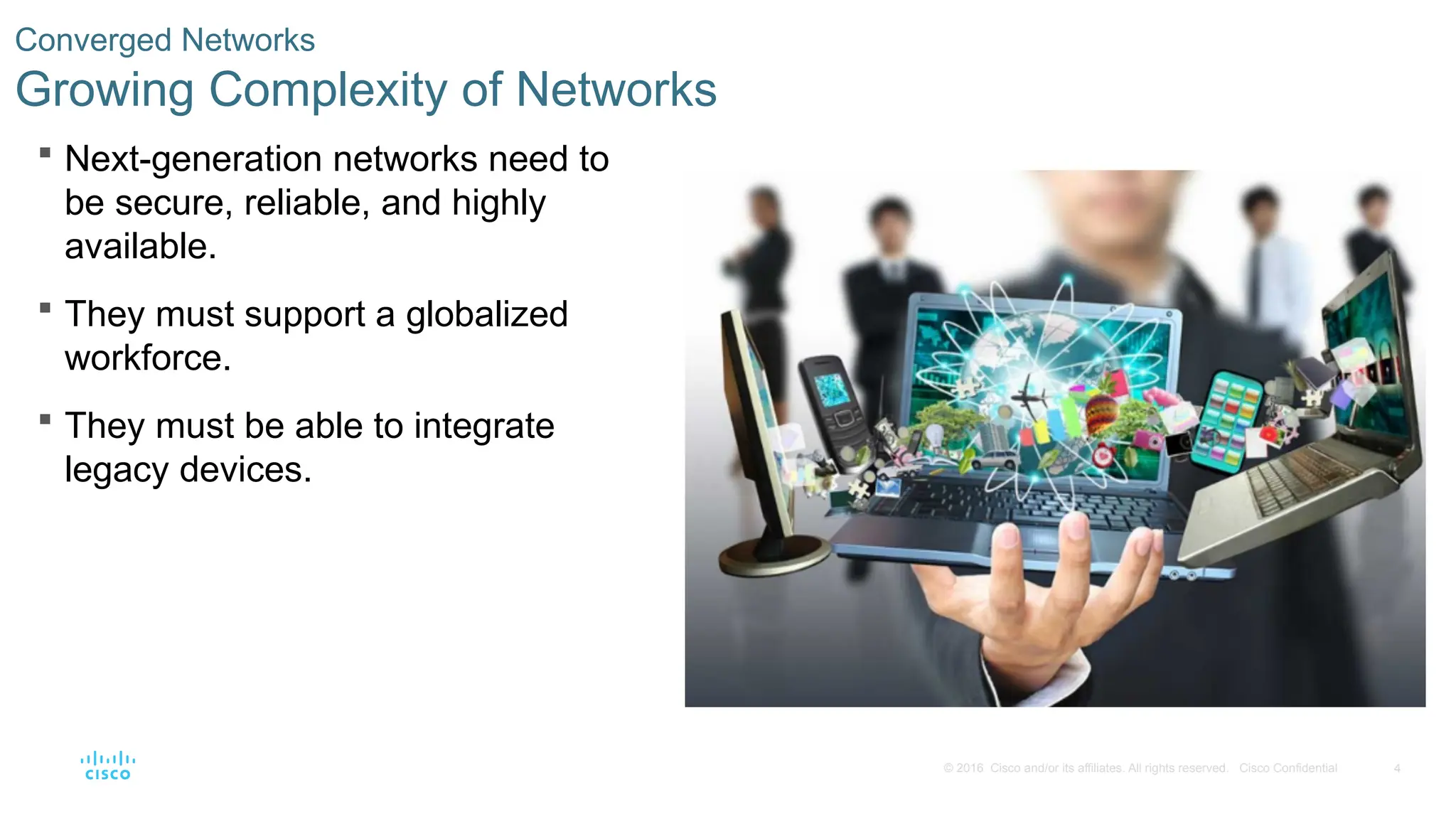
Growing Complexity of Networks
Next-generation networks need to
be secure, reliable, and highly
available.
They must support a globalized
workforce.
They must be able to integrate
legacy devices.
- 5.
5
© 2016 Ciscoand/or its affiliates. All rights reserved. Cisco Confidential
Converged Networks
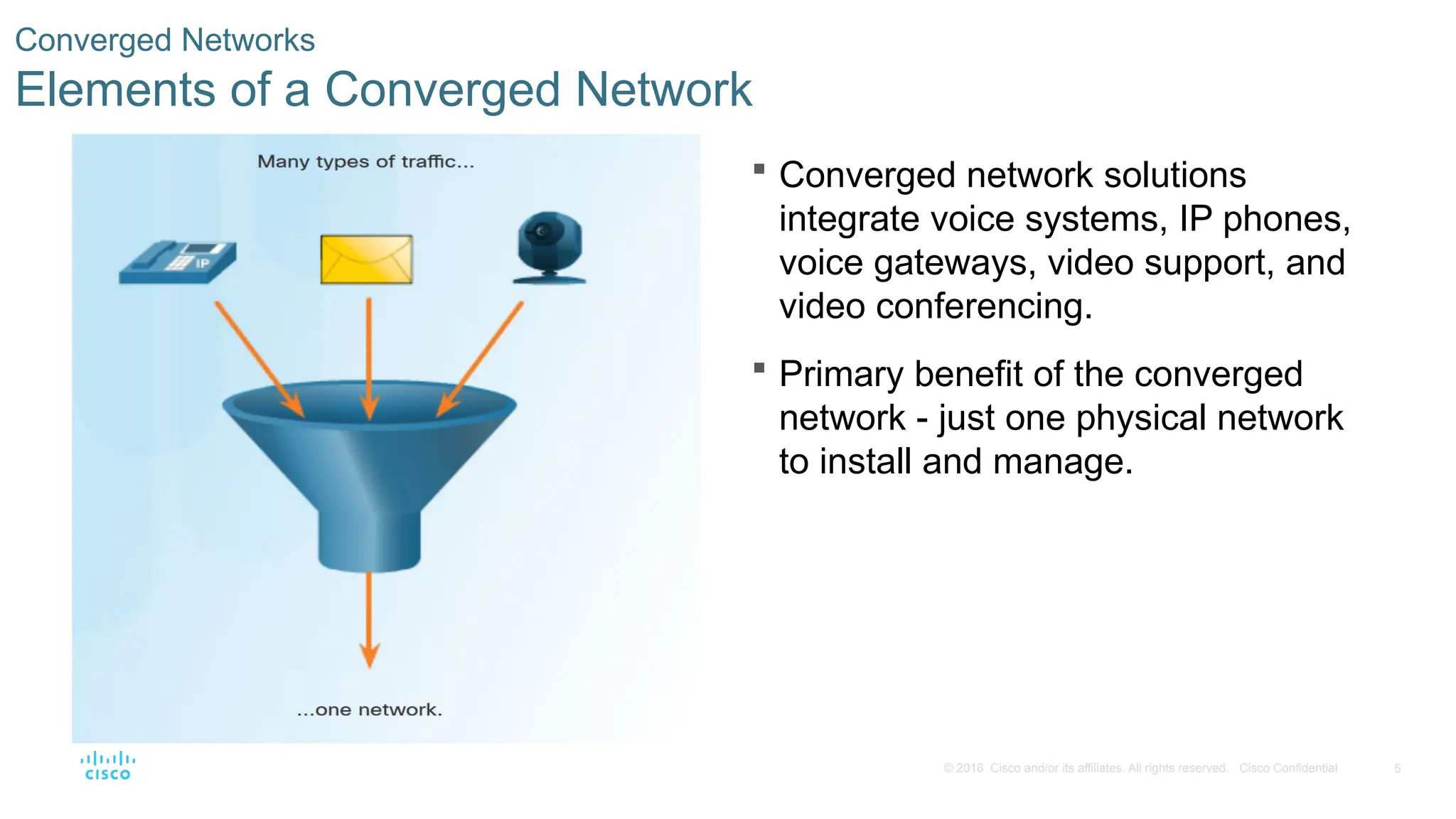
Elements of a Converged Network
Converged network solutions
integrate voice systems, IP phones,
voice gateways, video support, and
video conferencing.
Primary benefit of the converged
network - just one physical network
to install and manage.
- 6.
6
© 2016 Ciscoand/or its affiliates. All rights reserved. Cisco Confidential
Converged Networks
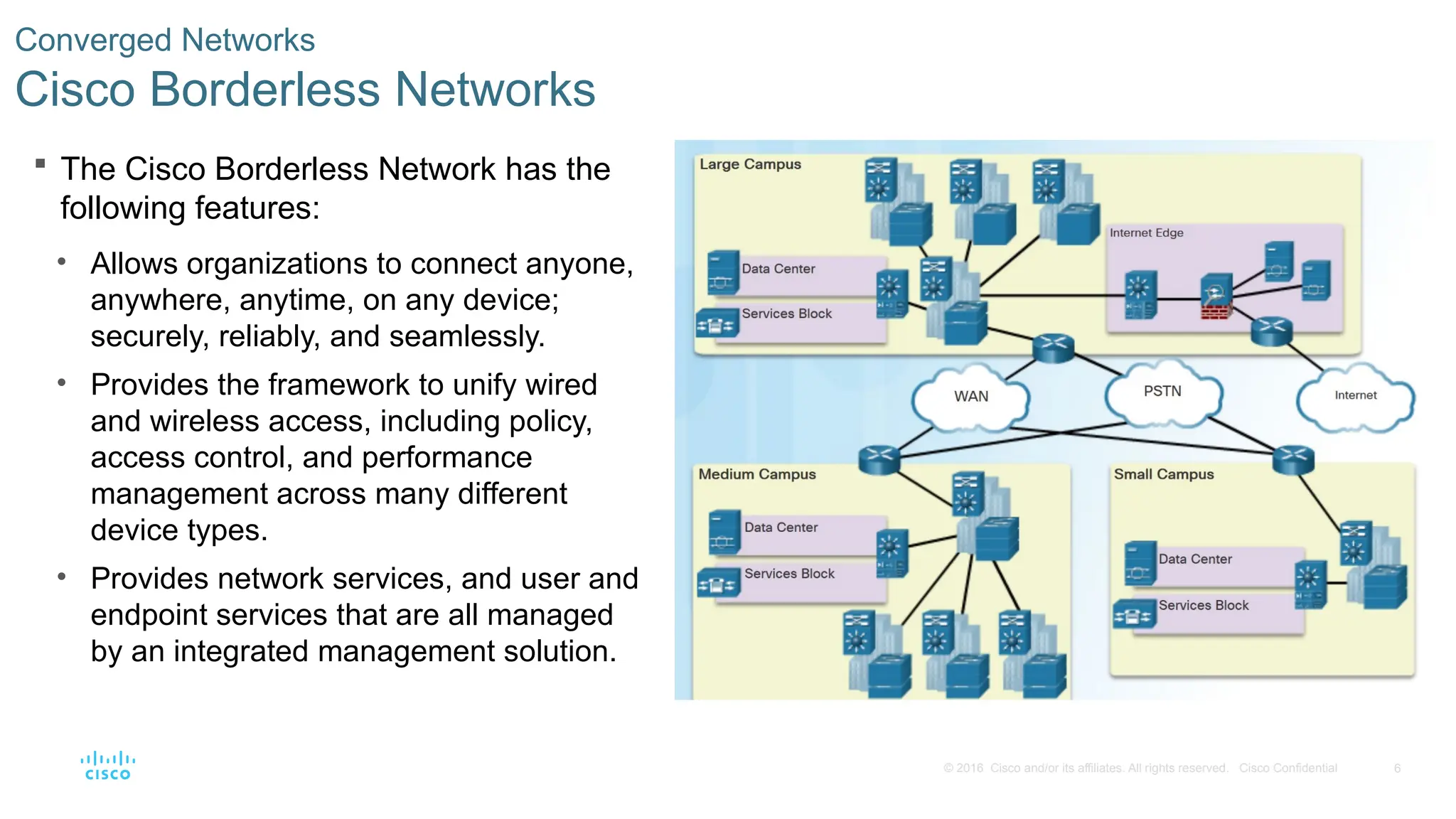
Cisco Borderless Networks
The Cisco Borderless Network has the
following features:
• Allows organizations to connect anyone,
anywhere, anytime, on any device;
securely, reliably, and seamlessly.
• Provides the framework to unify wired
and wireless access, including policy,
access control, and performance
management across many different
device types.
• Provides network services, and user and
endpoint services that are all managed
by an integrated management solution.
- 7.
7
© 2016 Ciscoand/or its affiliates. All rights reserved. Cisco Confidential
Converged Networks
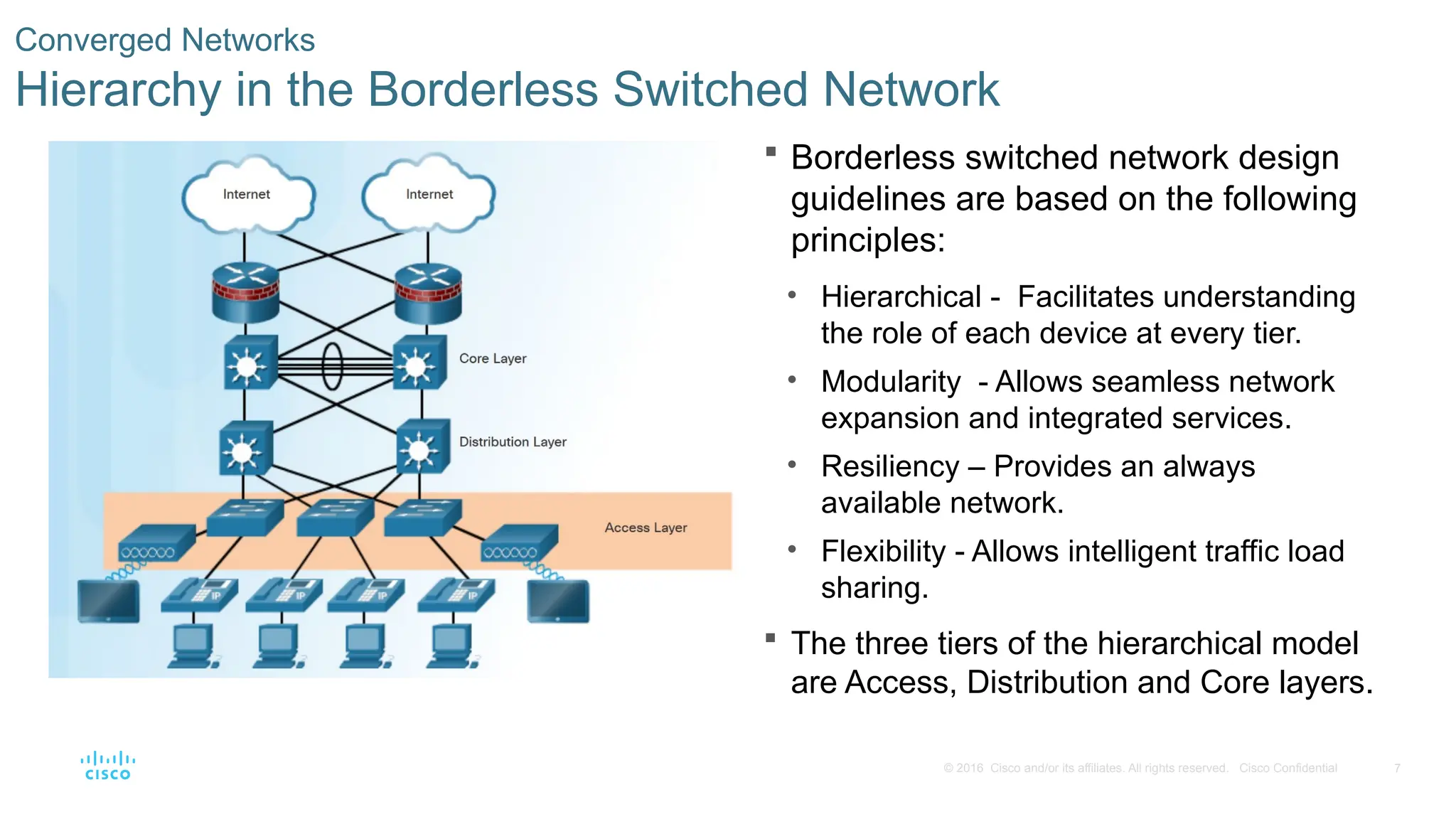
Hierarchy in the Borderless Switched Network
Borderless switched network design
guidelines are based on the following
principles:
• Hierarchical - Facilitates understanding
the role of each device at every tier.
• Modularity - Allows seamless network
expansion and integrated services.
• Resiliency – Provides an always
available network.
• Flexibility - Allows intelligent traffic load
sharing.
The three tiers of the hierarchical model
are Access, Distribution and Core layers.
- 8.
8
© 2016 Ciscoand/or its affiliates. All rights reserved. Cisco Confidential
Converged Networks
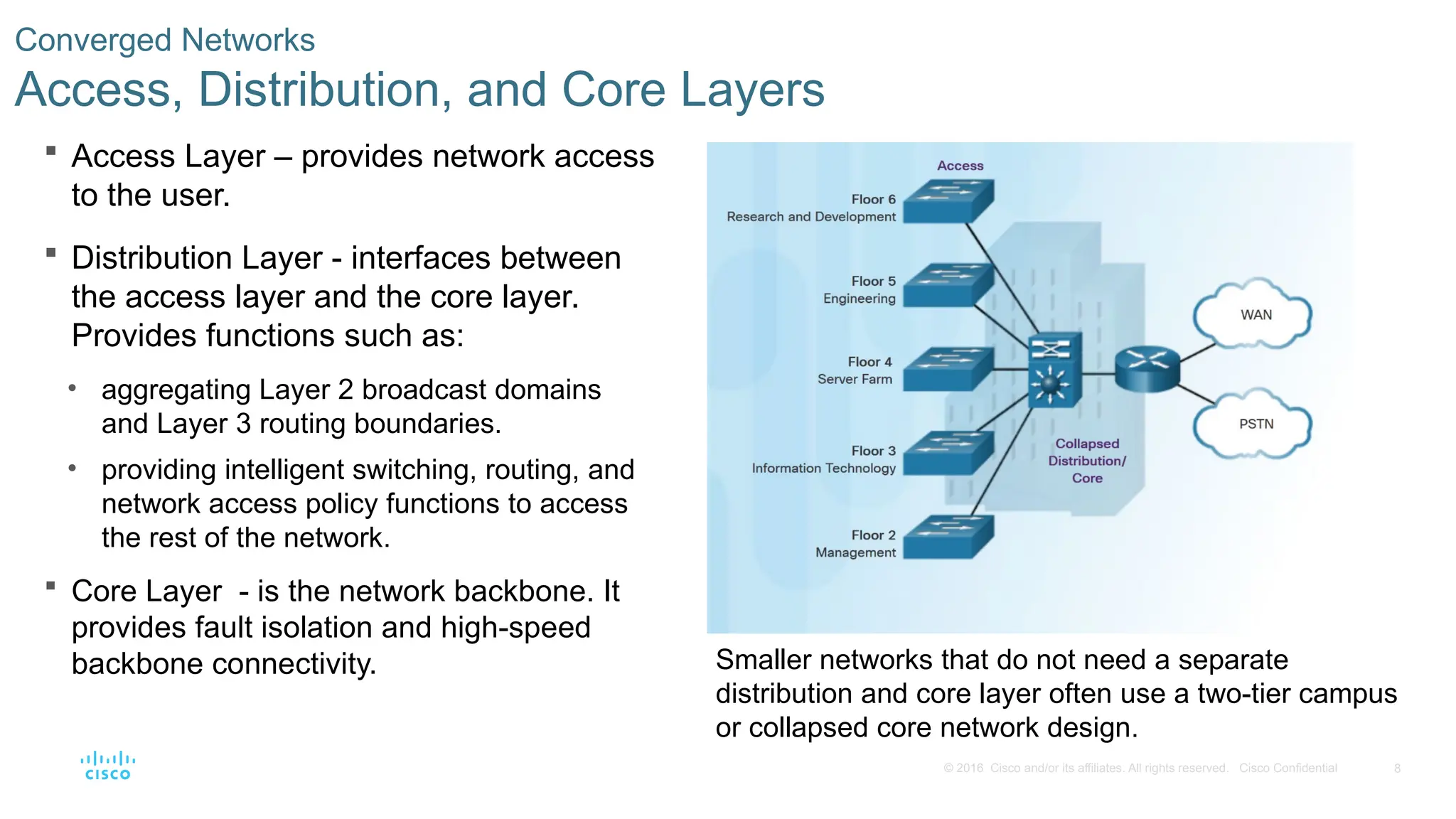
Access, Distribution, and Core Layers
Access Layer – provides network access
to the user.
Distribution Layer - interfaces between
the access layer and the core layer.
Provides functions such as:
• aggregating Layer 2 broadcast domains
and Layer 3 routing boundaries.
• providing intelligent switching, routing, and
network access policy functions to access
the rest of the network.
Core Layer - is the network backbone. It
provides fault isolation and high-speed
backbone connectivity. Smaller networks that do not need a separate
distribution and core layer often use a two-tier campus
or collapsed core network design.
- 9.
9
© 2016 Ciscoand/or its affiliates. All rights reserved. Cisco Confidential
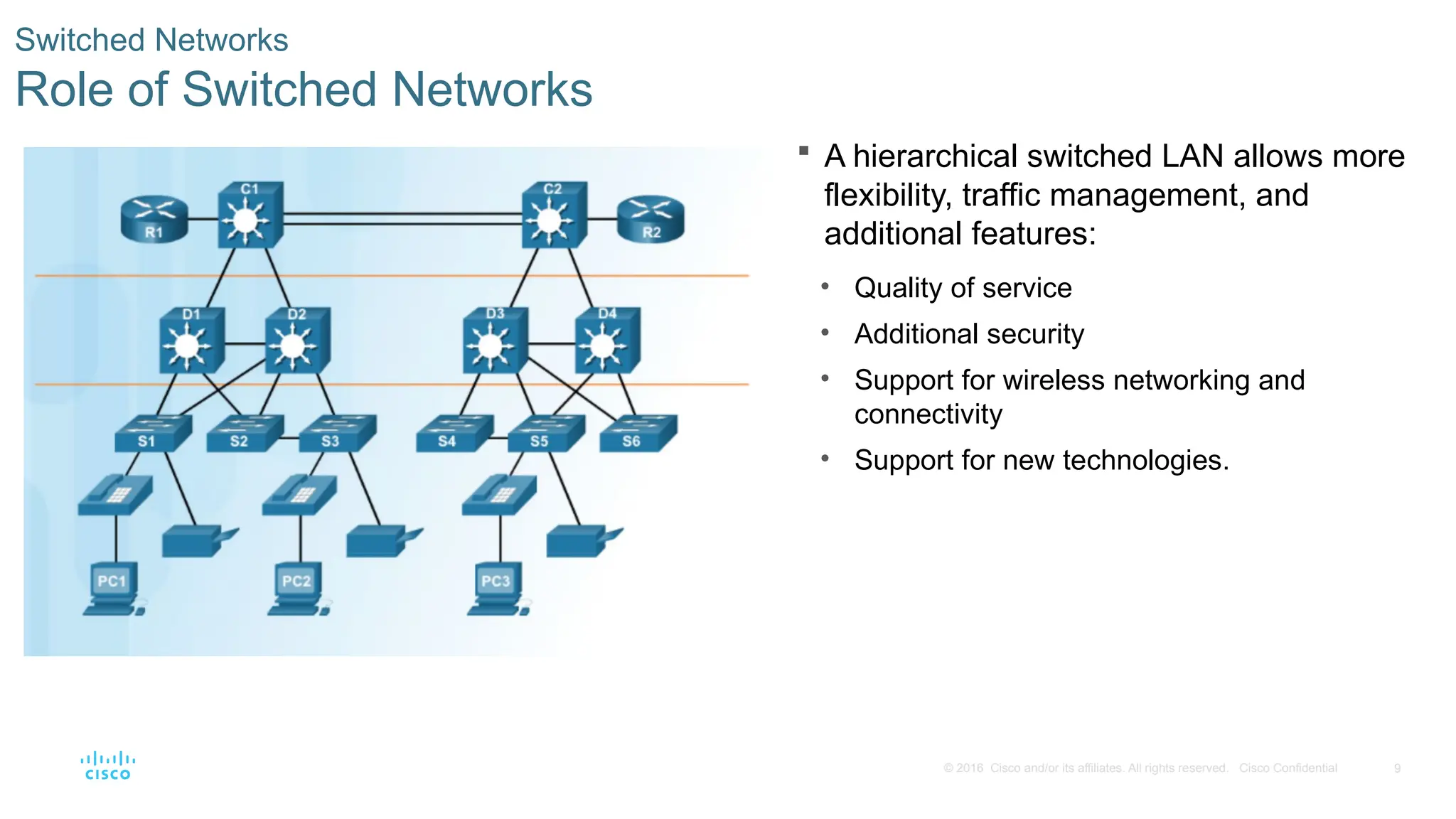
Switched Networks
Role of Switched Networks
A hierarchical switched LAN allows more
flexibility, traffic management, and
additional features:
• Quality of service
• Additional security
• Support for wireless networking and
connectivity
• Support for new technologies.
- 10.
10
© 2016 Ciscoand/or its affiliates. All rights reserved. Cisco Confidential
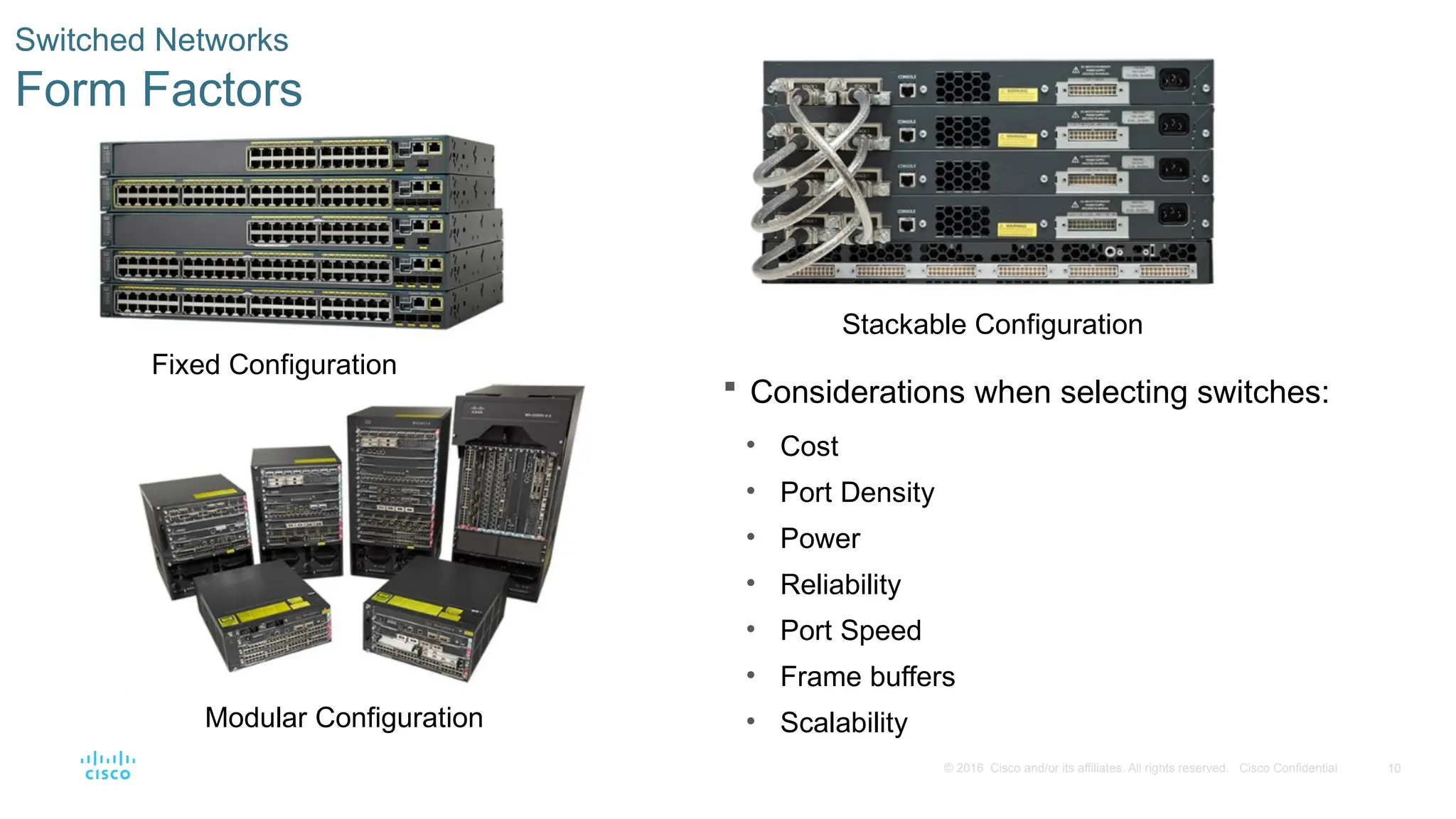
Switched Networks
Form Factors
Considerations when selecting switches:
• Cost
• Port Density
• Power
• Reliability
• Port Speed
• Frame buffers
• Scalability
Fixed Configuration
Modular Configuration
Stackable Configuration
- 11.
11
© 2016 Ciscoand/or its affiliates. All rights reserved. Cisco Confidential
4.2 The Switched
Environment
- 12.
12
© 2016 Ciscoand/or its affiliates. All rights reserved. Cisco Confidential
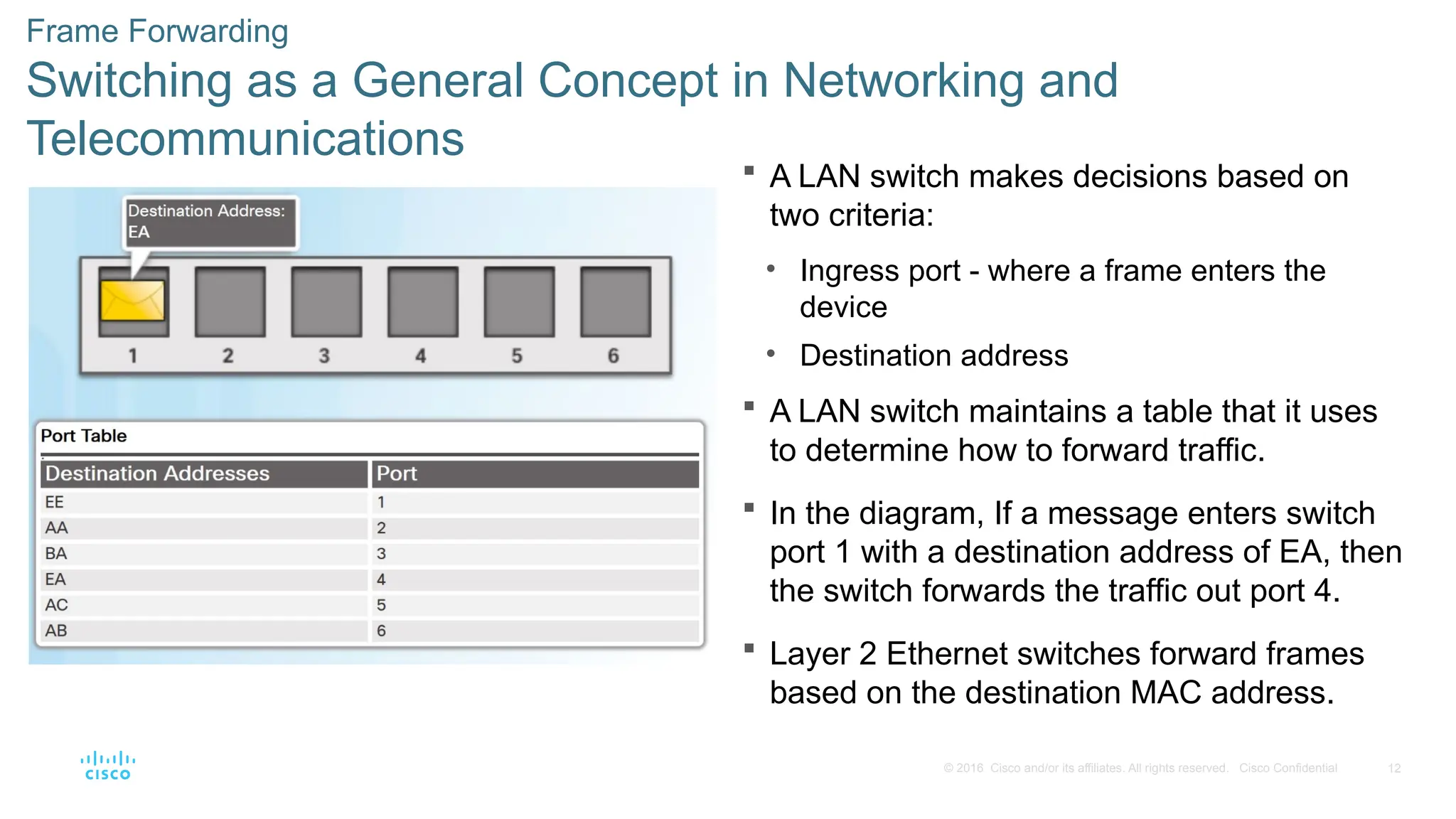
Frame Forwarding
Switching as a General Concept in Networking and
Telecommunications
A LAN switch makes decisions based on
two criteria:
• Ingress port - where a frame enters the
device
• Destination address
A LAN switch maintains a table that it uses
to determine how to forward traffic.
In the diagram, If a message enters switch
port 1 with a destination address of EA, then
the switch forwards the traffic out port 4.
Layer 2 Ethernet switches forward frames
based on the destination MAC address.
- 13.
13
© 2016 Ciscoand/or its affiliates. All rights reserved. Cisco Confidential
Frame Forwarding
Video Demonstration - MAC Address Tables on Connected
Switches
The video explains how a switch builds
its MAC address table by recording the
MAC address of each device connected
to each of its ports.
- 14.
14
© 2016 Ciscoand/or its affiliates. All rights reserved. Cisco Confidential
Frame Forwarding
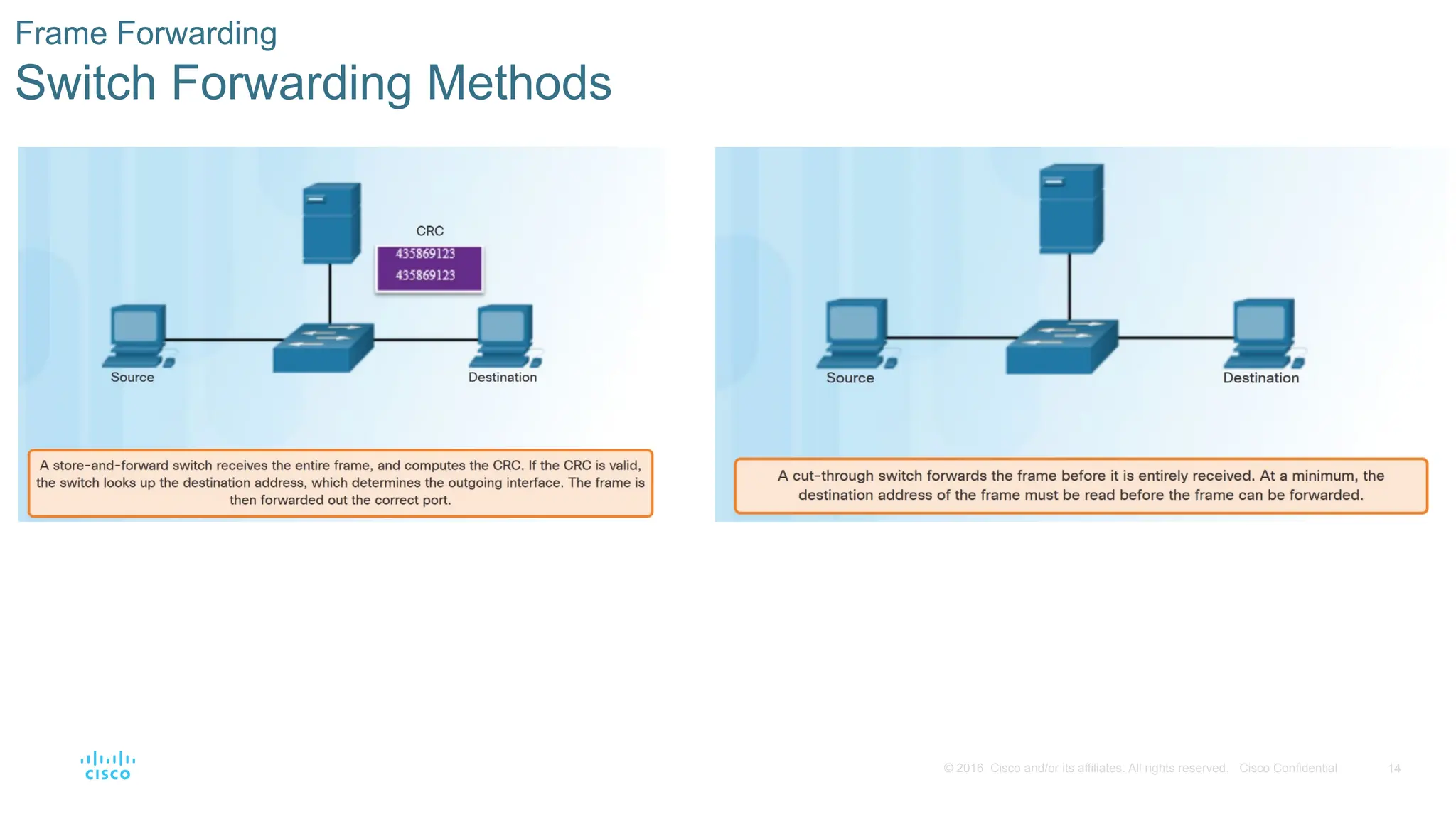
Switch Forwarding Methods
- 15.
15
© 2016 Ciscoand/or its affiliates. All rights reserved. Cisco Confidential
Frame Forwarding
Store-and-Forward Switching
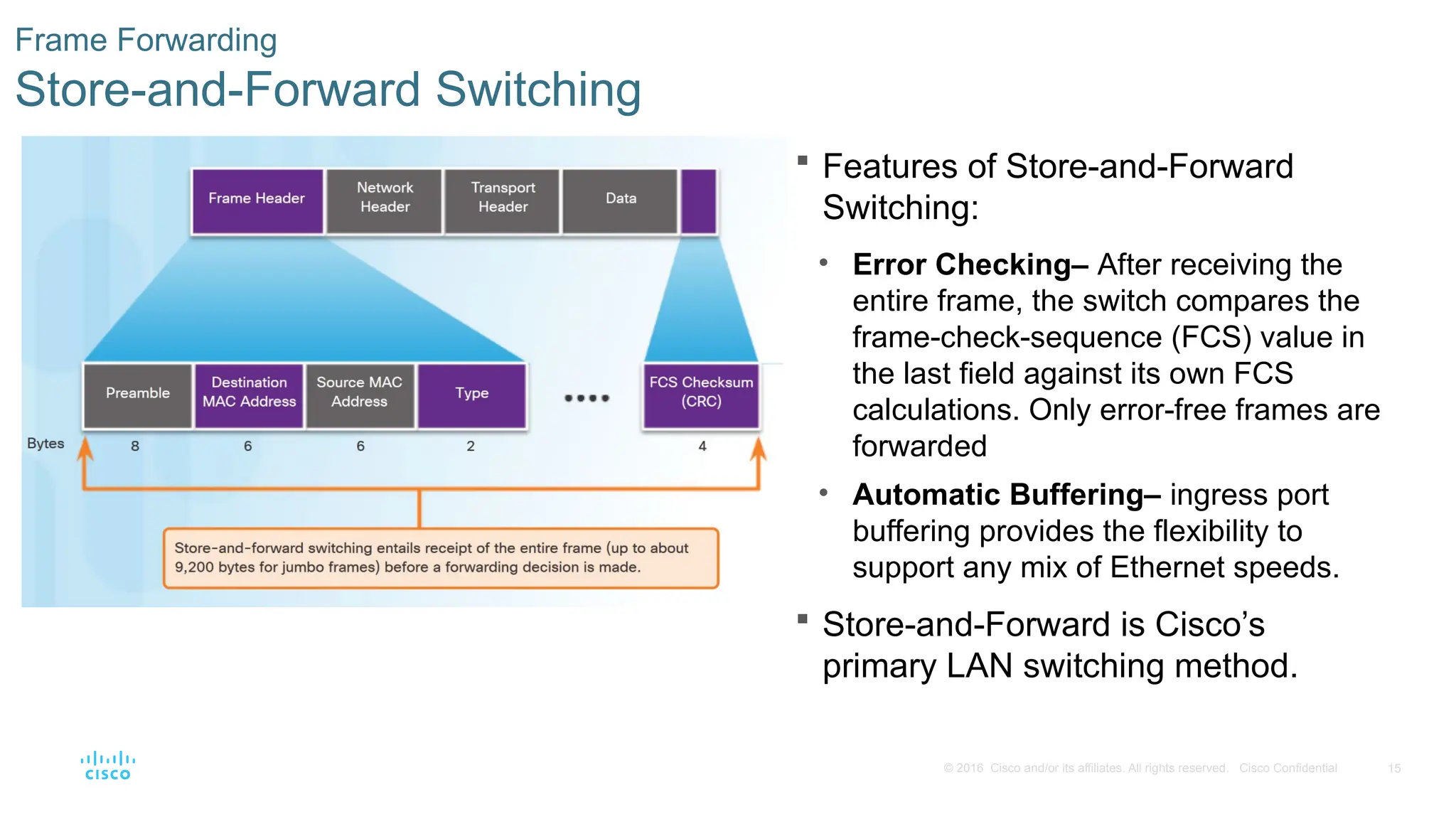
Features of Store-and-Forward
Switching:
• Error Checking– After receiving the
entire frame, the switch compares the
frame-check-sequence (FCS) value in
the last field against its own FCS
calculations. Only error-free frames are
forwarded
• Automatic Buffering– ingress port
buffering provides the flexibility to
support any mix of Ethernet speeds.
Store-and-Forward is Cisco’s
primary LAN switching method.
- 16.
16
© 2016 Ciscoand/or its affiliates. All rights reserved. Cisco Confidential
Frame Forwarding
Cut-Through Switching
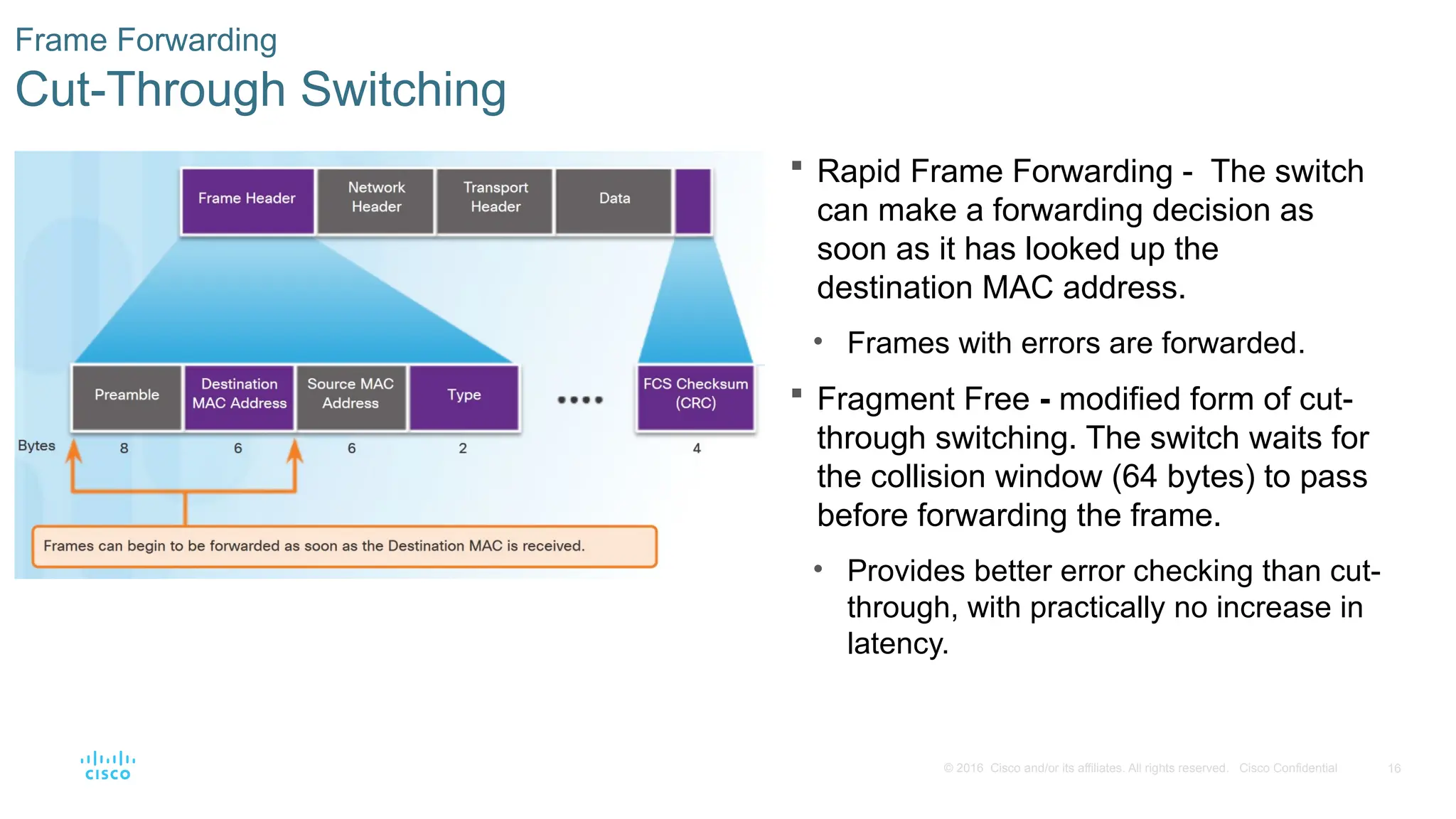
Rapid Frame Forwarding - The switch
can make a forwarding decision as
soon as it has looked up the
destination MAC address.
• Frames with errors are forwarded.
Fragment Free - modified form of cut-
through switching. The switch waits for
the collision window (64 bytes) to pass
before forwarding the frame.
• Provides better error checking than cut-
through, with practically no increase in
latency.
- 17.
17
© 2016 Ciscoand/or its affiliates. All rights reserved. Cisco Confidential
Switching Domains
Collision Domains
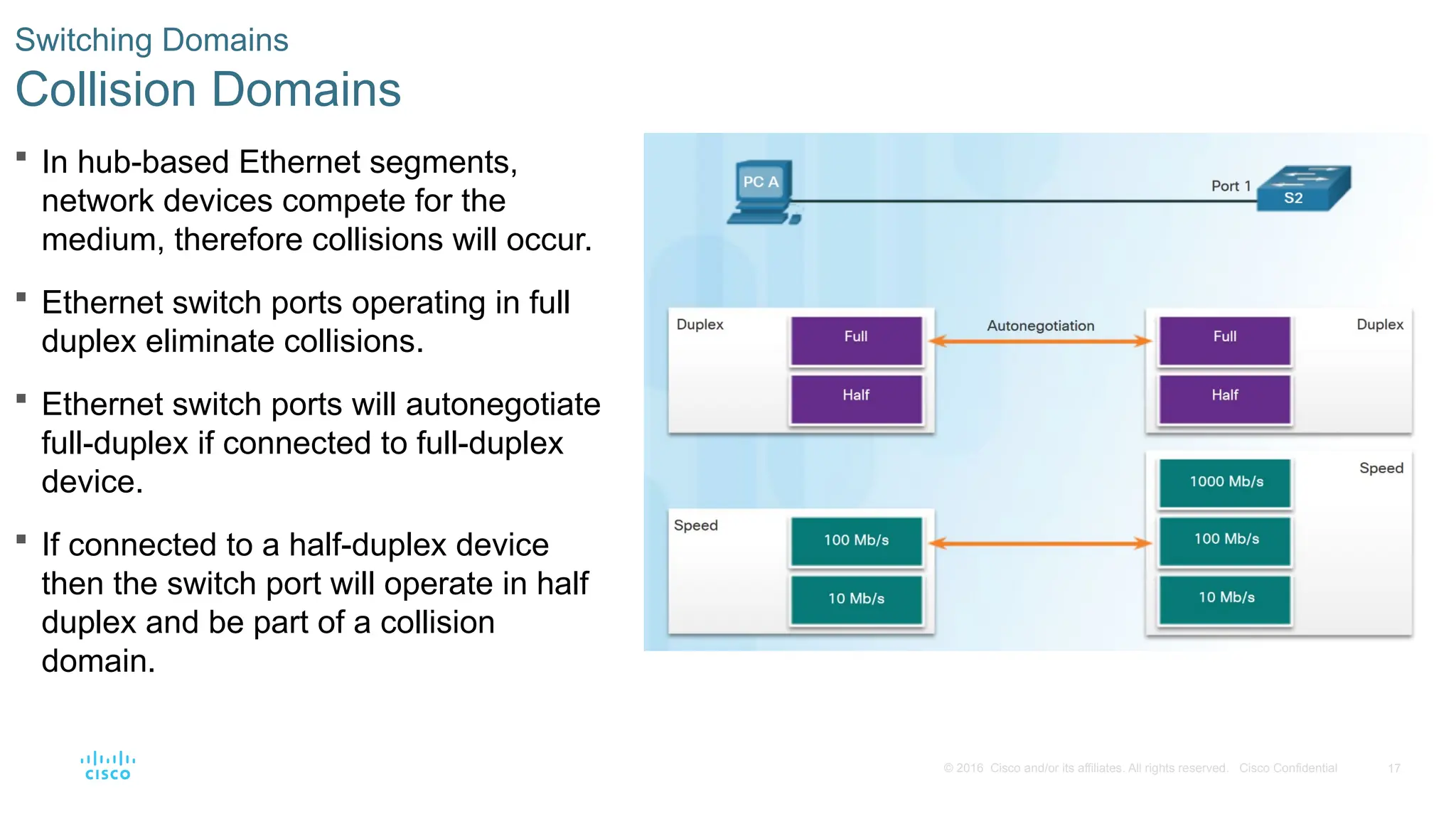
In hub-based Ethernet segments,
network devices compete for the
medium, therefore collisions will occur.
Ethernet switch ports operating in full
duplex eliminate collisions.
Ethernet switch ports will autonegotiate
full-duplex if connected to full-duplex
device.
If connected to a half-duplex device
then the switch port will operate in half
duplex and be part of a collision
domain.
- 18.
18
© 2016 Ciscoand/or its affiliates. All rights reserved. Cisco Confidential
Switching Domains
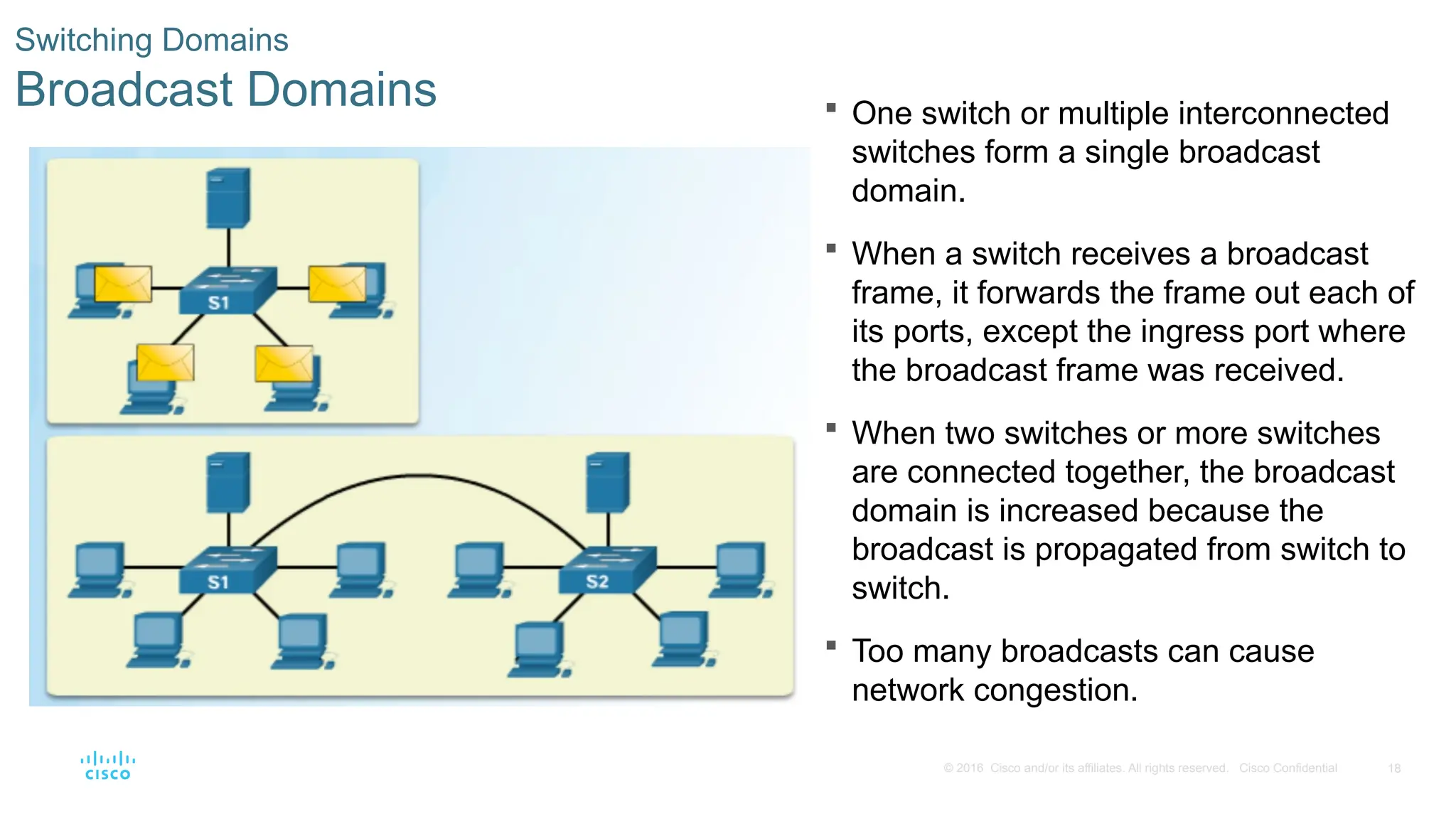
Broadcast Domains One switch or multiple interconnected
switches form a single broadcast
domain.
When a switch receives a broadcast
frame, it forwards the frame out each of
its ports, except the ingress port where
the broadcast frame was received.
When two switches or more switches
are connected together, the broadcast
domain is increased because the
broadcast is propagated from switch to
switch.
Too many broadcasts can cause
network congestion.
- 19.
19
© 2016 Ciscoand/or its affiliates. All rights reserved. Cisco Confidential
Switching Domains
Alleviating Network Congestion
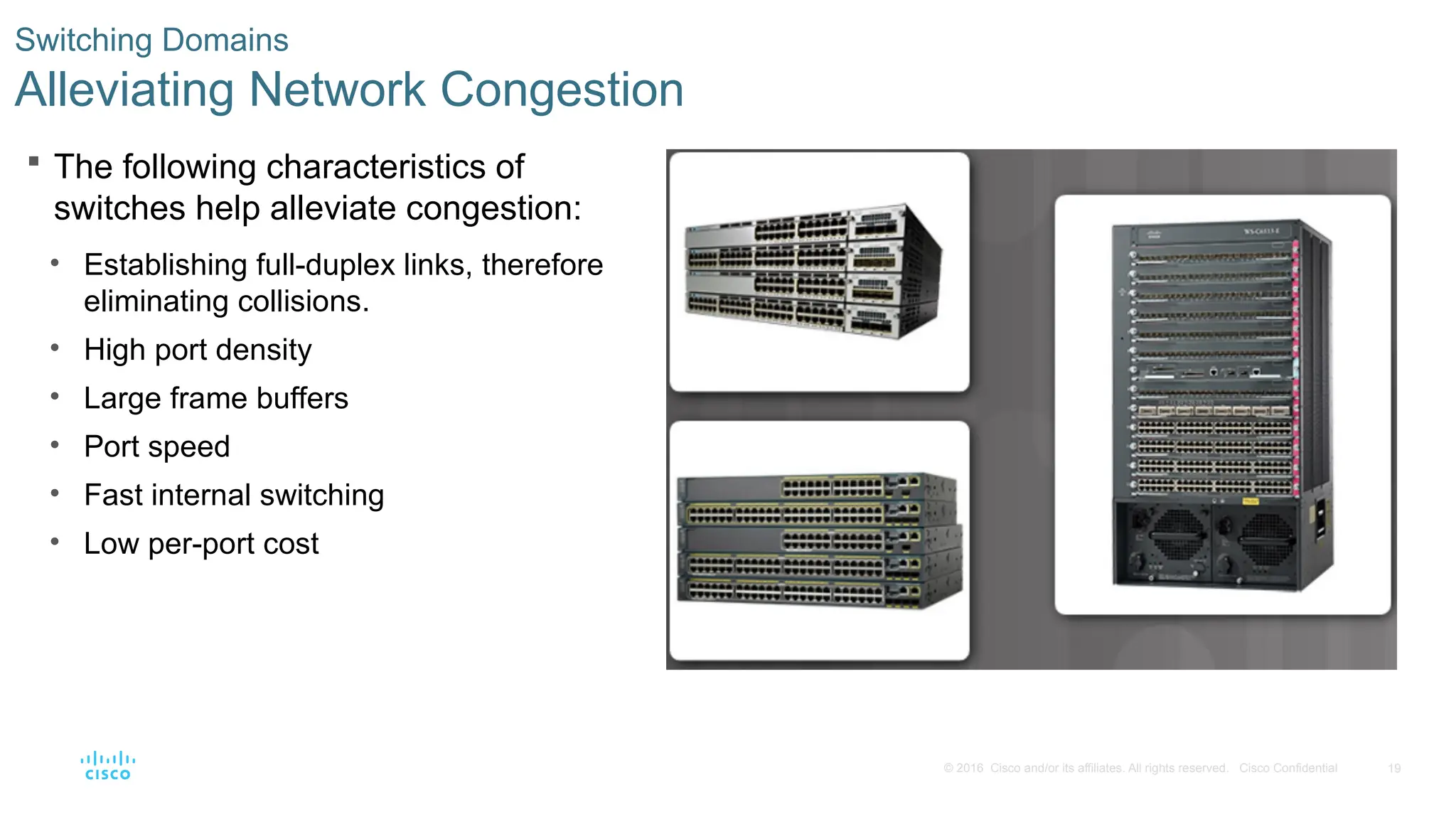
The following characteristics of
switches help alleviate congestion:
• Establishing full-duplex links, therefore
eliminating collisions.
• High port density
• Large frame buffers
• Port speed
• Fast internal switching
• Low per-port cost
- 20.
20
© 2016 Ciscoand/or its affiliates. All rights reserved. Cisco Confidential
4.3 Chapter Summary
- 21.
21
© 2016 Ciscoand/or its affiliates. All rights reserved. Cisco Confidential
Conclusion
Chapter 4: Switched Networks
Explain how switched networks support small to medium-sized businesses.
Explain how Layer 2 switches forward data in a small to medium-sized LAN.
Editor's Notes
- #1 Cisco Networking Academy Program
Routing and Switching Essentials v6.0
Chapter 4: Switched Networks
- #2 Cisco Networking Academy Program
Routing and Switching Essentials v6.0
Chapter 4: Switched Networks
- #3 4 – Switched Networks
4.1 – LAN Design
- #4 4.1 – LAN Design
4.1.1 – Converged Networks
4.1.1.1 – Growing Complexity of Networks
- #5 4.1 – LAN Design
4.1.1 – Converged Networks
4.1.1.2 – Elements of a Converged Network
- #6 4.1 – LAN Design
4.1.1 – Converged Networks
4.1.1.3 – Cisco Borderless Networks
- #7 4.1 – LAN Design
4.1.1 – Converged Networks
4.1.1.4 – Hierarchy in the Borderless Switched Network
- #8 4.1 – LAN Design
4.1.1 – Converged Networks
4.1.1.5 – Access, Distribution, and Core Layers
- #9 4.1 – LAN Design
4.1.2 – Switched Networks
4.1.2.1 – Role of Switched Networks
- #10 4.1 – LAN Design
4.1.2 – Switched Networks
4.1.2.2 – Form Factors
- #11 4 – Switched Networks
4.2 – The Switched Environment
- #12 4.2 – The Switched Environment
4.2.1 – Frame Forwarding
4.2.1.1 – Switching as a General Concept in Networking and Telecommunications
- #13 4.2 – The Switched Environment
4.2.1 – Frame Forwarding
4.2.1.2 – Video Demonstration - MAC Address Tables on Connected Switches
- #14 4.2 – The Switched Environment
4.2.1 – Frame Forwarding
4.2.1.3 – Switch Forwarding Methods
- #15 4.2 – The Switched Environment
4.2.1 – Frame Forwarding
4.2.1.4 – Store-and-Forward Switching
- #16 4.2 – The Switched Environment
4.2.1 – Frame Forwarding
4.2.1.5 – Cut-Through Switching
- #17 4.2 – The Switched Environment
4.2.2 – Switching Domains
4.2.2.1 – Collision Domains
- #18 4.2 – The Switched Environment
4.2.2 – Switching Domains
4.2.2.2 – Broadcast Domains
- #19 4.2 – The Switched Environment
4.2.2 – Switching Domains
4.2.2.3 – Alleviating Network Congestion
- #20 4 – Switched Networks
4.3– Summary
- #21 4.3 – Summary
4.3.1 – Conclusion
4.3.1.3 – Chapter 4: Switched Networks
- #22 New Terms and Commands
- #23 New Terms and Commands