By Jaspreet Bassan
 Phar-Mor Case example
 Motivations for Financial Statement Fraud
 Framework for detecting financial statement
fraud
 Fraud Exposure rectangle
 Company started in 1982 selling a variety of
household products and prescription drugs at
low prices
 Idea of “Power Buying”
 1985 Phar Mor had 15 stores
 By 1992, 310 stores with revenue of $3billion
 About 6 years later they started losing money
and engaged in creative accounting too
disguise this to maintain their appearance of
success
 Had Finn not agreed to Micahel Monus’s
expense manipulation early on in 1985,
before the bigger frauds started, do you think
the Phar-Mor fraud would have progressed to
the extent that it did?
 Support high stock price
 Increase stock price
 Maximize management bonus or net worth
 Pressure on Management too perform
 Strategic Reasoning- ability of a fraud perpetrators
likely method of concealing a fraud.
 Use of game theory- Predicting behaviour based on
an individuals best response given that individuals
motivations and the individuals beliefs regarding the likely
behaviour of their opponent.
 Zero-order reasoning- occurs when an auditor and
auditee consider only conditions that directly affect
themselves but not the other party. i.e. their own incentives
such as audit fees
 First-order Reasoning- means that the auditor
considers conditions that directly affect the auditee.
 Higher order reasoning- occurs when the auditor
considers additional layers of complexity, including how
management may anticipate the auditor’s behaviour.
 What types of fraud schemes is management
likely to use to commit financial statement
fraud?
 What typical tests are used to detect these
schemes?
 How could management conceal these
schemes?
 How could the typical test be modified so as
to detect the concealed scheme?
Management Backgrounds:
• Have any of the key executives been involved with
other organizations in the past? If so of what
nature?
• Are most board members independent?
• Is the Chairperson independent from the CEO?
• Do any of members of management have criminal
background?
• Have any members of management had
any past regulatory or legal troubles?
Managements Motivations:
 Is the personal worth of any of the key executives tied up in
the organization?
 Is management compensation performance based?
 Do they have a reputation for guiding companies to higher
expectations?
 Are the jobs of Management at risk?
 Is the organizations reported financial
performance decreasing?
Managements influence in Making Decisions
for the Organization:
 Who are the key members of management and the board of
directors who have the most influence?
 Do one or two people have dominant influence within the
organization?
 Is the management style more authoritative or democratic?
 Is the organizations management centralized or
decentralized?
Relationship with financial institutions
 Is the organization highly leveraged through bank or other
loans?
 Do the banking relationships appear normal? Or are their
unusual attributes? Such as geographical location
 With what financial institutions does the organization have
significant relationships with?
Relationship with Auditors
 Have frequent disputes occurred with the current or predecessor
auditors?
 Has auditor change occurred? If so, for what reason?
 Has management placed unreasonable demands on the auditor,
including unreasonable time constraints?
Relationship with Lawyers
 Has any attempt been made to hide litigation from the auditors?
 Has the company been involve in litigation concerning matters
that could adversely affect the company’s financial results?
 Are any other lawyer relationships questionable?
Relationship with investors
 Is the organization in the process of issuing an initial or
secondary public debt offering?
 Are-any investor related law suits pending?
 Are any investor relationships questionable?
Relationship with Regulatory bodies
 Do management show a disregard for regulatory
authorities?
 Are their significant disputes with tax authorities?
 Has their been a history of security law violations?
 Does the company have an overly complex organizational
structure involving numerous or unusual legal?
 Is a legitimate business purpose apparent for each separate
entity of the business?
 Is the audit committee primarily comprised of insider or
outsiders?
 Is the audit committee passive or active and independent
 Does the organization have offshore business activities
without any apparent business purpose?
 Is the performance of the company similar or contrary to
other firms in the industry?
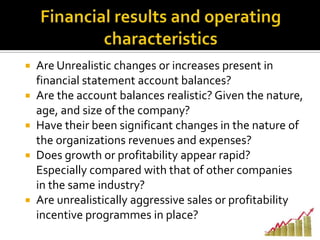
 Are Unrealistic changes or increases present in
financial statement account balances?
 Are the account balances realistic? Given the nature,
age, and size of the company?
 Have their been significant changes in the nature of
the organizations revenues and expenses?
 Does growth or profitability appear rapid?
Especially compared with that of other companies
in the same industry?
 Are unrealistically aggressive sales or profitability
incentive programmes in place?
 Motivations behind financial statement fraud
 The use of strategic reasoning to expose
fraud
 The fraud exposure rectangle
1. Management and directors
2. Relationship with others
3. Organization and Industry
4. Financial results and operating
characteristics
Chapter 11 b :Financial Statement fraud

Chapter 11 b :Financial Statement fraud

  • 1.
  • 2.
     Phar-Mor Caseexample  Motivations for Financial Statement Fraud  Framework for detecting financial statement fraud  Fraud Exposure rectangle
  • 3.
     Company startedin 1982 selling a variety of household products and prescription drugs at low prices  Idea of “Power Buying”  1985 Phar Mor had 15 stores  By 1992, 310 stores with revenue of $3billion  About 6 years later they started losing money and engaged in creative accounting too disguise this to maintain their appearance of success
  • 4.
     Had Finnnot agreed to Micahel Monus’s expense manipulation early on in 1985, before the bigger frauds started, do you think the Phar-Mor fraud would have progressed to the extent that it did?
  • 5.
     Support highstock price  Increase stock price  Maximize management bonus or net worth  Pressure on Management too perform
  • 6.
     Strategic Reasoning-ability of a fraud perpetrators likely method of concealing a fraud.  Use of game theory- Predicting behaviour based on an individuals best response given that individuals motivations and the individuals beliefs regarding the likely behaviour of their opponent.
  • 7.
     Zero-order reasoning-occurs when an auditor and auditee consider only conditions that directly affect themselves but not the other party. i.e. their own incentives such as audit fees  First-order Reasoning- means that the auditor considers conditions that directly affect the auditee.  Higher order reasoning- occurs when the auditor considers additional layers of complexity, including how management may anticipate the auditor’s behaviour.
  • 8.
     What typesof fraud schemes is management likely to use to commit financial statement fraud?  What typical tests are used to detect these schemes?  How could management conceal these schemes?  How could the typical test be modified so as to detect the concealed scheme?
  • 10.
    Management Backgrounds: • Haveany of the key executives been involved with other organizations in the past? If so of what nature? • Are most board members independent? • Is the Chairperson independent from the CEO? • Do any of members of management have criminal background? • Have any members of management had any past regulatory or legal troubles?
  • 11.
    Managements Motivations:  Isthe personal worth of any of the key executives tied up in the organization?  Is management compensation performance based?  Do they have a reputation for guiding companies to higher expectations?  Are the jobs of Management at risk?  Is the organizations reported financial performance decreasing?
  • 12.
    Managements influence inMaking Decisions for the Organization:  Who are the key members of management and the board of directors who have the most influence?  Do one or two people have dominant influence within the organization?  Is the management style more authoritative or democratic?  Is the organizations management centralized or decentralized?
  • 13.
    Relationship with financialinstitutions  Is the organization highly leveraged through bank or other loans?  Do the banking relationships appear normal? Or are their unusual attributes? Such as geographical location  With what financial institutions does the organization have significant relationships with?
  • 14.
    Relationship with Auditors Have frequent disputes occurred with the current or predecessor auditors?  Has auditor change occurred? If so, for what reason?  Has management placed unreasonable demands on the auditor, including unreasonable time constraints? Relationship with Lawyers  Has any attempt been made to hide litigation from the auditors?  Has the company been involve in litigation concerning matters that could adversely affect the company’s financial results?  Are any other lawyer relationships questionable?
  • 15.
    Relationship with investors Is the organization in the process of issuing an initial or secondary public debt offering?  Are-any investor related law suits pending?  Are any investor relationships questionable? Relationship with Regulatory bodies  Do management show a disregard for regulatory authorities?  Are their significant disputes with tax authorities?  Has their been a history of security law violations?
  • 16.
     Does thecompany have an overly complex organizational structure involving numerous or unusual legal?  Is a legitimate business purpose apparent for each separate entity of the business?  Is the audit committee primarily comprised of insider or outsiders?  Is the audit committee passive or active and independent  Does the organization have offshore business activities without any apparent business purpose?  Is the performance of the company similar or contrary to other firms in the industry?
  • 17.
     Are Unrealisticchanges or increases present in financial statement account balances?  Are the account balances realistic? Given the nature, age, and size of the company?  Have their been significant changes in the nature of the organizations revenues and expenses?  Does growth or profitability appear rapid? Especially compared with that of other companies in the same industry?  Are unrealistically aggressive sales or profitability incentive programmes in place?
  • 18.
     Motivations behindfinancial statement fraud  The use of strategic reasoning to expose fraud  The fraud exposure rectangle 1. Management and directors 2. Relationship with others 3. Organization and Industry 4. Financial results and operating characteristics