FINANCIAL
STATEMENT FRAUD
NAWAL SYAFIQ MOKHTAR
CHAPTER 4:
Financial statement fraud refers to
the deliberate or intentional
misstatement or misrepresentation of
an organization’s financial statements.
Often, this is done by omitting or
exaggerating information to make
the organization’s financial position
and performance look better or to
hide evidence of embezzlement or
similar crimes.
What is financial statement fraud?
Types of financial statement fraud
Within Generally Accepted Auditing Standards (GAAS), an auditor
is mainly concerned with fraud that leads to a material
misstatement within the financial statement. There are two
specific types of intentional misstatements that are relevant to
auditors:
Misstatements that result from fraudulent financial reporting,
including omissions, misrepresentation or misclassifying
amounts or disclosures in financial statements
Misstatements resulting from misappropriation of assets
Revenue recognition fraud
Revenue recognition fraud refers to when
an organization falsifies or misrepresents
their financial statements by improperly
recognizing revenue. This may include
recording fake sales, prematurely
recognizing revenue, or inflating sales
numbers.
Premature
recognition of
revenue.
Recording fictitious
sales or inflating sales
figures.
Liability and expense manipulation
Expense manipulation occurs when the
organization’s expenses are understated to
increase profits (on paper). This may involve
misclassifying expenses, delaying
recognition of expenses or capitalizing
costs that should be expensed.
Delaying recognition of
expenses.
Capitalizing expenses instead
of recognizing them in the
income statement.
Omitting liabilities from the
balance sheet.
Underestimating obligations
such as pensions or contingent
liabilities.
An organization may inflate the value of
their property, inventory or investments
to inflate their net worth or underreport
debt or obligations to make their financial
position appear stronger.
Improper asset valuation
Inflating asset
values.
Recording non-
existent assets or
failing to write
down impaired
assets.
Improper disclosures
An organization may misrepresent
financial arrangements to cover risks or
reduce their liabilities. They may also fail
to disclose transactions, especially those
with related parties like executives or
subsidiary companies.
Failing to disclose
related-party transactions
or off-balance-sheet
arrangements.
Omitting or
misrepresenting
significant risks.
There isn’t one reason why
organizations stoop to financial
statement fraud, but
understanding the common
fraud risk factors and
motivations can help with
detection and prevention.
Financial statement fraud risk factors
Financial pressure
Pressure from internal management or
external stakeholders to meet financial
targets such as revenue growth or profit
goals
Pressure to avoid triggering loan defaults
or other consequences if the
organization reports their actual financial
standing
Pressure on individuals to meet specific
metrics to earn a bonus or other
incentive
Opportunities
Weak internal controls allow individuals
to exploit weaknesses and commit
financial statement fraud without
detection
Complex accounting transactions create
opportunities to misrepresent or
manipulate information
A weak ethical structure or minimal focus
on ethics contribute to an environment
where unethical behavior, even fraud,
may go unchecked.
External influences
Pressure to meet market expectations or
achieve industry benchmarks from
analysts, investors, or even peers drive
the organization to submit fraudulent
financial statements to appear more
competitive
Adverse economic conditions prompt the
organization to commit financial
statement fraud to project the
appearance of stability and avoid stock
price declines
Motivations for Financial Statement Fraud
Pressure to Meet Expectations
1.
Achieving earnings forecasts or benchmarks.
Maintaining stock prices and market confidence.
Personal Gains
2.
Securing performance-based bonuses or incentives.
Insider trading benefits.
Concealing Poor Performance
3.
Hiding declining financial health.
Avoiding covenant breaches with creditors.
Pressure from Stakeholders
4.
Investors or management demanding higher profits.
Meeting regulatory requirements.
Often, it’s easier to determine
an error rather than fraud,
because those responsible are
likely to do what they can to
hide the evidence. But while it
can be difficult to recognize
financial statement fraud, there
are some common red flags.
Signs of financial statement fraud
Unusual trends or variations
Increases or decreases in revenue
that are inconsistent with industry
norms or economic conditions
Unexplained changes in gross
margins that can’t be attributed to
legitimate business factors
Significant variations in expense
ratios or cost structures compared to
either historical data or industry
competitors
Weak internal controls
Lack of adequate separation of
duties that allow individuals within
the organization to initiate,
approve and record transactions
without oversight
Opportunities for management or
key personnel to override
established controls without valid
reasons
Accounting irregularities
Unusual or undocumented journal
entries; pay particular attention to
those made near the end of
reporting periods
Incorrectly categorized transactions
may mask the reality of underlying
economic events
Overly complex transactions or
arrangements can be used to
obscure information
Performance outliers
Significant transactions or
entities that deviate from typical
business patterns or lack
necessary supporting
documentation
Instances of non-recurring or
one-time items that inflate the
financial performance
Behavioral indicators
Management avoids or is
reluctant to provide transparent
explanations of information
when asked
Management shows lifestyle
changes or behaviors that are
out of alignment with the
organization’s reported financial
results
Additional signs of financial statement fraud
Inconsistent or slow responses from
third parties during confirmation
procedures
Frequent or substantial adjustments
made to account balances or
financial statements with no
reasonable explanation
Inconsistent or omitted financial
disclosures, footnotes or
supplemental information
Preventing and detecting financial
statement fraud
The main responsibility for preventing and detecting fraudulent financial
statement lies with both the organization’s governance and management.
Under the oversight of governance, management should strongly focus on
preventing fraud by reducing opportunities and deter it by increasing the
likelihood of detection and punishment to those caught. This requires
fostering a culture of honesty and ethics, actively supported by governance.
Governance must also oversee these practices to prevent manipulation of
financial reporting, like managing earnings to change how financial
statements are viewed by users regarding the organization’s performance
and profitability.
Promoting ethical behavior
Recommending the implementation of whistleblower
programs
Providing training on fraud risk, detection and ethical
responsibilities
Assisting the organization to develop and implement
fraud prevention programs
Making recommendations to strengthen internal controls
Advising management on the importance of maintaining
effective internal controls
Communicating any fraud or material misstatements to
those charged with governance
Complying with legal and regulatory requirements
Preventing financial statement fraud
A Framework for Detecting Financial
Statement Fraud
Detecting financial statement fraud is critical to
ensuring the integrity of financial reporting and
maintaining stakeholder trust. Here's a structured
framework for detecting financial statement fraud:
Assessing the
organization’s
susceptibility to
fraud and
identifying risk
factors
Objective: Define the purpose and key components of the fraud
detection system.
Risk Assessment:
Identify high-risk areas in financial statements (e.g., revenue
recognition, asset valuation).
Focus on industries or entities with a history of fraud or weak
controls.
Standards and Regulations:
Adhere to relevant standards like International Financial
Reporting Standards (IFRS) or Generally Accepted Accounting
Principles (GAAP).
Incorporate legal requirements such as Sarbanes-Oxley Act
compliance.
Establishing a Fraud Detection Framework
Analyzing financial
ratios and
comparing them to
industry
benchmarks
Objective: Use quantitative and qualitative analyses to detect anomalies.
Ratio Analysis:
Assess key ratios (e.g., current ratio, debt-to-equity, profit
margin) for irregularities.
Compare with industry benchmarks and historical trends.
Horizontal and Vertical Analysis:
Identify unusual variances over time (horizontal) or
discrepancies in the proportional makeup of financial statements
(vertical).
Benford’s Law:
Analyze numerical distributions to detect unnatural patterns in
reported figures.
Analytical Procedures
Assessing the
organization’s
susceptibility to
fraud and
identifying risk
factors
Objective: Identify red flags that signal potential fraud.
Management Behavior:
Overly aggressive earnings targets or significant pressure to
meet financial benchmarks.
Reluctance to provide necessary documentation during audits.
Accounting Practices:
Unusual or complex journal entries near reporting dates.
Frequent changes in accounting policies without clear
justification.
Operational Indicators:
Significant, unexplained variances in operational performance.
High turnover in accounting or finance staff.
Fraud Risk Indicators
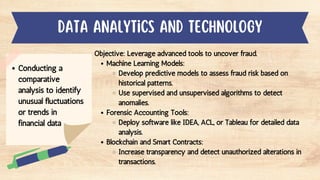
Conducting a
comparative
analysis to identify
unusual fluctuations
or trends in
financial data
Objective: Leverage advanced tools to uncover fraud.
Machine Learning Models:
Develop predictive models to assess fraud risk based on
historical patterns.
Use supervised and unsupervised algorithms to detect
anomalies.
Forensic Accounting Tools:
Deploy software like IDEA, ACL, or Tableau for detailed data
analysis.
Blockchain and Smart Contracts:
Increase transparency and detect unauthorized alterations in
transactions.
Data Analytics and Technology
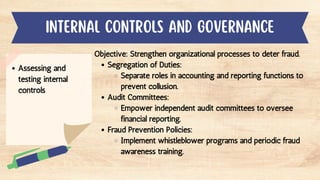
Assessing and
testing internal
controls
Objective: Strengthen organizational processes to deter fraud.
Segregation of Duties:
Separate roles in accounting and reporting functions to
prevent collusion.
Audit Committees:
Empower independent audit committees to oversee
financial reporting.
Fraud Prevention Policies:
Implement whistleblower programs and periodic fraud
awareness training.
Internal Controls and Governance
Assessing
management’s
representations,
including evaluating
their integrity and
interviewing key
personnel
Objective: Respond to detected anomalies or allegations of fraud.
Transaction Testing:
Scrutinize specific transactions for authenticity and
compliance with standards.
Interview Techniques:
Conduct interviews with management and employees to
gather insights.
Forensic Audits:
Engage forensic accountants to conduct an in-depth
examination of records.
Investigative Procedures
Testing
transactions to
verify the
occurrence,
completeness and
accuracy of
recorded
transactions
Objective: Communicate findings and enhance the detection
framework.
Fraud Reporting:
Document and report suspected fraud cases to
appropriate stakeholders.
Feedback Mechanism:
Regularly update the fraud detection framework based on
new fraud schemes and regulatory changes.
Continuous Monitoring:
Deploy ongoing monitoring systems to track financial
data in real-time.
Reporting and Continuous Improvement
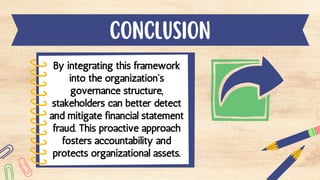
By integrating this framework
into the organization's
governance structure,
stakeholders can better detect
and mitigate financial statement
fraud. This proactive approach
fosters accountability and
protects organizational assets.
CONCLUSION

CHAPTER 4 FINANCIAL STATEMENT FRAUD.pdf

  • 1.
  • 2.
    Financial statement fraudrefers to the deliberate or intentional misstatement or misrepresentation of an organization’s financial statements. Often, this is done by omitting or exaggerating information to make the organization’s financial position and performance look better or to hide evidence of embezzlement or similar crimes. What is financial statement fraud?
  • 3.
    Types of financialstatement fraud Within Generally Accepted Auditing Standards (GAAS), an auditor is mainly concerned with fraud that leads to a material misstatement within the financial statement. There are two specific types of intentional misstatements that are relevant to auditors: Misstatements that result from fraudulent financial reporting, including omissions, misrepresentation or misclassifying amounts or disclosures in financial statements Misstatements resulting from misappropriation of assets
  • 4.
    Revenue recognition fraud Revenuerecognition fraud refers to when an organization falsifies or misrepresents their financial statements by improperly recognizing revenue. This may include recording fake sales, prematurely recognizing revenue, or inflating sales numbers. Premature recognition of revenue. Recording fictitious sales or inflating sales figures.
  • 5.
    Liability and expensemanipulation Expense manipulation occurs when the organization’s expenses are understated to increase profits (on paper). This may involve misclassifying expenses, delaying recognition of expenses or capitalizing costs that should be expensed. Delaying recognition of expenses. Capitalizing expenses instead of recognizing them in the income statement. Omitting liabilities from the balance sheet. Underestimating obligations such as pensions or contingent liabilities.
  • 6.
    An organization mayinflate the value of their property, inventory or investments to inflate their net worth or underreport debt or obligations to make their financial position appear stronger. Improper asset valuation Inflating asset values. Recording non- existent assets or failing to write down impaired assets.
  • 7.
    Improper disclosures An organizationmay misrepresent financial arrangements to cover risks or reduce their liabilities. They may also fail to disclose transactions, especially those with related parties like executives or subsidiary companies. Failing to disclose related-party transactions or off-balance-sheet arrangements. Omitting or misrepresenting significant risks.
  • 8.
    There isn’t onereason why organizations stoop to financial statement fraud, but understanding the common fraud risk factors and motivations can help with detection and prevention. Financial statement fraud risk factors
  • 9.
    Financial pressure Pressure frominternal management or external stakeholders to meet financial targets such as revenue growth or profit goals Pressure to avoid triggering loan defaults or other consequences if the organization reports their actual financial standing Pressure on individuals to meet specific metrics to earn a bonus or other incentive
  • 10.
    Opportunities Weak internal controlsallow individuals to exploit weaknesses and commit financial statement fraud without detection Complex accounting transactions create opportunities to misrepresent or manipulate information A weak ethical structure or minimal focus on ethics contribute to an environment where unethical behavior, even fraud, may go unchecked.
  • 11.
    External influences Pressure tomeet market expectations or achieve industry benchmarks from analysts, investors, or even peers drive the organization to submit fraudulent financial statements to appear more competitive Adverse economic conditions prompt the organization to commit financial statement fraud to project the appearance of stability and avoid stock price declines
  • 13.
    Motivations for FinancialStatement Fraud Pressure to Meet Expectations 1. Achieving earnings forecasts or benchmarks. Maintaining stock prices and market confidence. Personal Gains 2. Securing performance-based bonuses or incentives. Insider trading benefits. Concealing Poor Performance 3. Hiding declining financial health. Avoiding covenant breaches with creditors. Pressure from Stakeholders 4. Investors or management demanding higher profits. Meeting regulatory requirements.
  • 14.
    Often, it’s easierto determine an error rather than fraud, because those responsible are likely to do what they can to hide the evidence. But while it can be difficult to recognize financial statement fraud, there are some common red flags. Signs of financial statement fraud
  • 15.
    Unusual trends orvariations Increases or decreases in revenue that are inconsistent with industry norms or economic conditions Unexplained changes in gross margins that can’t be attributed to legitimate business factors Significant variations in expense ratios or cost structures compared to either historical data or industry competitors
  • 16.
    Weak internal controls Lackof adequate separation of duties that allow individuals within the organization to initiate, approve and record transactions without oversight Opportunities for management or key personnel to override established controls without valid reasons
  • 17.
    Accounting irregularities Unusual orundocumented journal entries; pay particular attention to those made near the end of reporting periods Incorrectly categorized transactions may mask the reality of underlying economic events Overly complex transactions or arrangements can be used to obscure information
  • 18.
    Performance outliers Significant transactionsor entities that deviate from typical business patterns or lack necessary supporting documentation Instances of non-recurring or one-time items that inflate the financial performance
  • 19.
    Behavioral indicators Management avoidsor is reluctant to provide transparent explanations of information when asked Management shows lifestyle changes or behaviors that are out of alignment with the organization’s reported financial results
  • 20.
    Additional signs offinancial statement fraud Inconsistent or slow responses from third parties during confirmation procedures Frequent or substantial adjustments made to account balances or financial statements with no reasonable explanation Inconsistent or omitted financial disclosures, footnotes or supplemental information
  • 21.
    Preventing and detectingfinancial statement fraud The main responsibility for preventing and detecting fraudulent financial statement lies with both the organization’s governance and management. Under the oversight of governance, management should strongly focus on preventing fraud by reducing opportunities and deter it by increasing the likelihood of detection and punishment to those caught. This requires fostering a culture of honesty and ethics, actively supported by governance. Governance must also oversee these practices to prevent manipulation of financial reporting, like managing earnings to change how financial statements are viewed by users regarding the organization’s performance and profitability.
  • 22.
    Promoting ethical behavior Recommendingthe implementation of whistleblower programs Providing training on fraud risk, detection and ethical responsibilities Assisting the organization to develop and implement fraud prevention programs Making recommendations to strengthen internal controls Advising management on the importance of maintaining effective internal controls Communicating any fraud or material misstatements to those charged with governance Complying with legal and regulatory requirements Preventing financial statement fraud
  • 23.
    A Framework forDetecting Financial Statement Fraud Detecting financial statement fraud is critical to ensuring the integrity of financial reporting and maintaining stakeholder trust. Here's a structured framework for detecting financial statement fraud:
  • 24.
    Assessing the organization’s susceptibility to fraudand identifying risk factors Objective: Define the purpose and key components of the fraud detection system. Risk Assessment: Identify high-risk areas in financial statements (e.g., revenue recognition, asset valuation). Focus on industries or entities with a history of fraud or weak controls. Standards and Regulations: Adhere to relevant standards like International Financial Reporting Standards (IFRS) or Generally Accepted Accounting Principles (GAAP). Incorporate legal requirements such as Sarbanes-Oxley Act compliance. Establishing a Fraud Detection Framework
  • 25.
    Analyzing financial ratios and comparingthem to industry benchmarks Objective: Use quantitative and qualitative analyses to detect anomalies. Ratio Analysis: Assess key ratios (e.g., current ratio, debt-to-equity, profit margin) for irregularities. Compare with industry benchmarks and historical trends. Horizontal and Vertical Analysis: Identify unusual variances over time (horizontal) or discrepancies in the proportional makeup of financial statements (vertical). Benford’s Law: Analyze numerical distributions to detect unnatural patterns in reported figures. Analytical Procedures
  • 26.
    Assessing the organization’s susceptibility to fraudand identifying risk factors Objective: Identify red flags that signal potential fraud. Management Behavior: Overly aggressive earnings targets or significant pressure to meet financial benchmarks. Reluctance to provide necessary documentation during audits. Accounting Practices: Unusual or complex journal entries near reporting dates. Frequent changes in accounting policies without clear justification. Operational Indicators: Significant, unexplained variances in operational performance. High turnover in accounting or finance staff. Fraud Risk Indicators
  • 27.
    Conducting a comparative analysis toidentify unusual fluctuations or trends in financial data Objective: Leverage advanced tools to uncover fraud. Machine Learning Models: Develop predictive models to assess fraud risk based on historical patterns. Use supervised and unsupervised algorithms to detect anomalies. Forensic Accounting Tools: Deploy software like IDEA, ACL, or Tableau for detailed data analysis. Blockchain and Smart Contracts: Increase transparency and detect unauthorized alterations in transactions. Data Analytics and Technology
  • 28.
    Assessing and testing internal controls Objective:Strengthen organizational processes to deter fraud. Segregation of Duties: Separate roles in accounting and reporting functions to prevent collusion. Audit Committees: Empower independent audit committees to oversee financial reporting. Fraud Prevention Policies: Implement whistleblower programs and periodic fraud awareness training. Internal Controls and Governance
  • 29.
    Assessing management’s representations, including evaluating their integrityand interviewing key personnel Objective: Respond to detected anomalies or allegations of fraud. Transaction Testing: Scrutinize specific transactions for authenticity and compliance with standards. Interview Techniques: Conduct interviews with management and employees to gather insights. Forensic Audits: Engage forensic accountants to conduct an in-depth examination of records. Investigative Procedures
  • 30.
    Testing transactions to verify the occurrence, completenessand accuracy of recorded transactions Objective: Communicate findings and enhance the detection framework. Fraud Reporting: Document and report suspected fraud cases to appropriate stakeholders. Feedback Mechanism: Regularly update the fraud detection framework based on new fraud schemes and regulatory changes. Continuous Monitoring: Deploy ongoing monitoring systems to track financial data in real-time. Reporting and Continuous Improvement
  • 31.
    By integrating thisframework into the organization's governance structure, stakeholders can better detect and mitigate financial statement fraud. This proactive approach fosters accountability and protects organizational assets. CONCLUSION