REVENUE- RELATED FINANCIAL
STATEMENT FRAUDS
Chapter 12 A
Julien Hachet
09/09/2013
1
OUTLINE
 Key points
 A Major Issue
 Causes
 The Sunbeam Corporation Case
 Possible Fraud Schemes
 Identification of Revenue-Related Fraud Symptoms
2
KEY POINTS
 Identification of revenue-related financial statement
fraud schemes.
 Ways to search for symptoms of revenue-related
financial statement fraud.
 Importance of, and ways to follow up on, revenue-
related fraud symptoms.
3
A MAJOR ISSUE
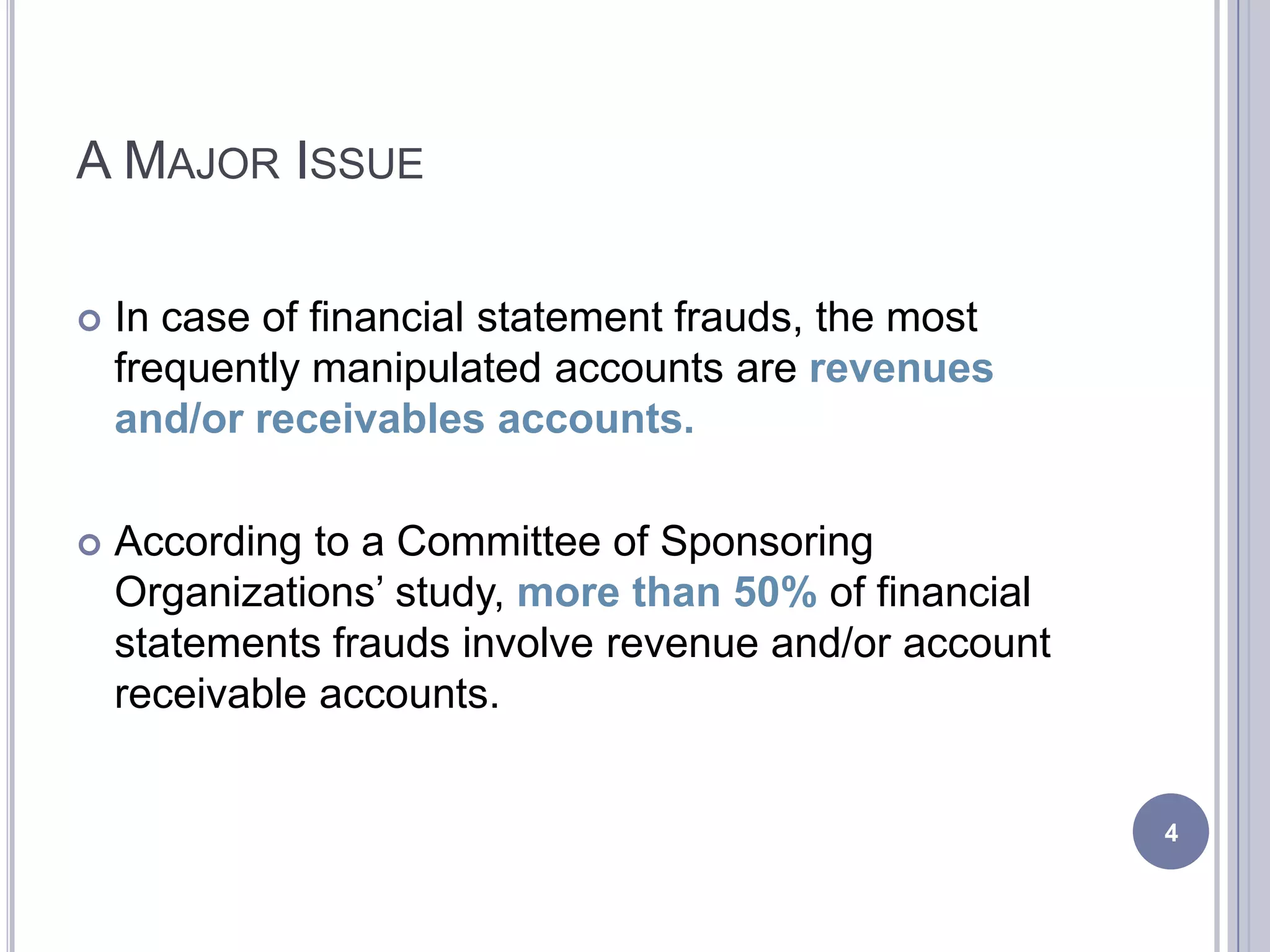
 In case of financial statement frauds, the most
frequently manipulated accounts are revenues
and/or receivables accounts.
 According to a Committee of Sponsoring
Organizations’ study, more than 50% of financial
statements frauds involve revenue and/or account
receivable accounts.
4
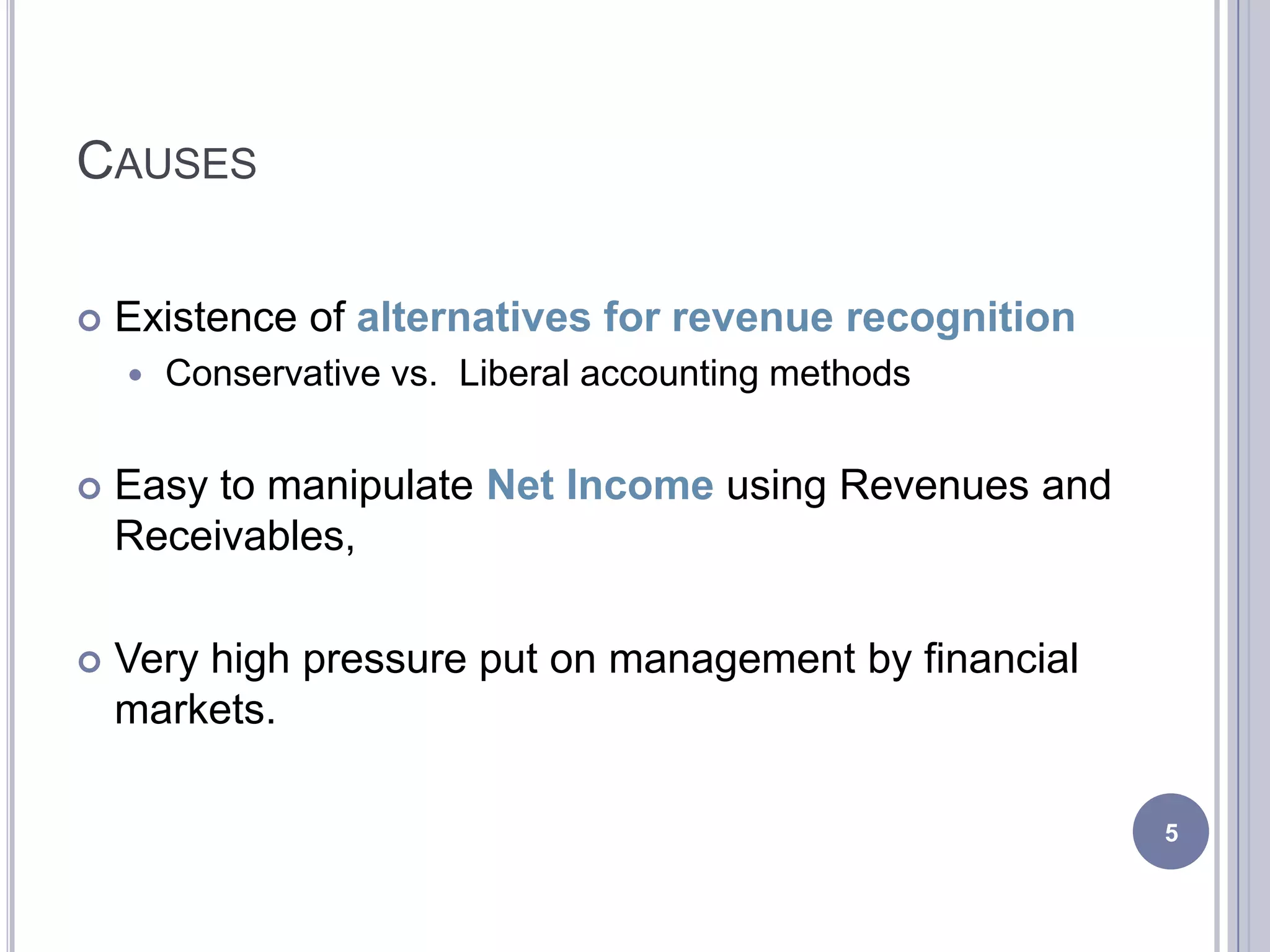
CAUSES
 Existence of alternatives for revenue recognition
 Conservative vs. Liberal accounting methods
 Easy to manipulate Net Income using Revenues and
Receivables,
 Very high pressure put on management by financial
markets.
5
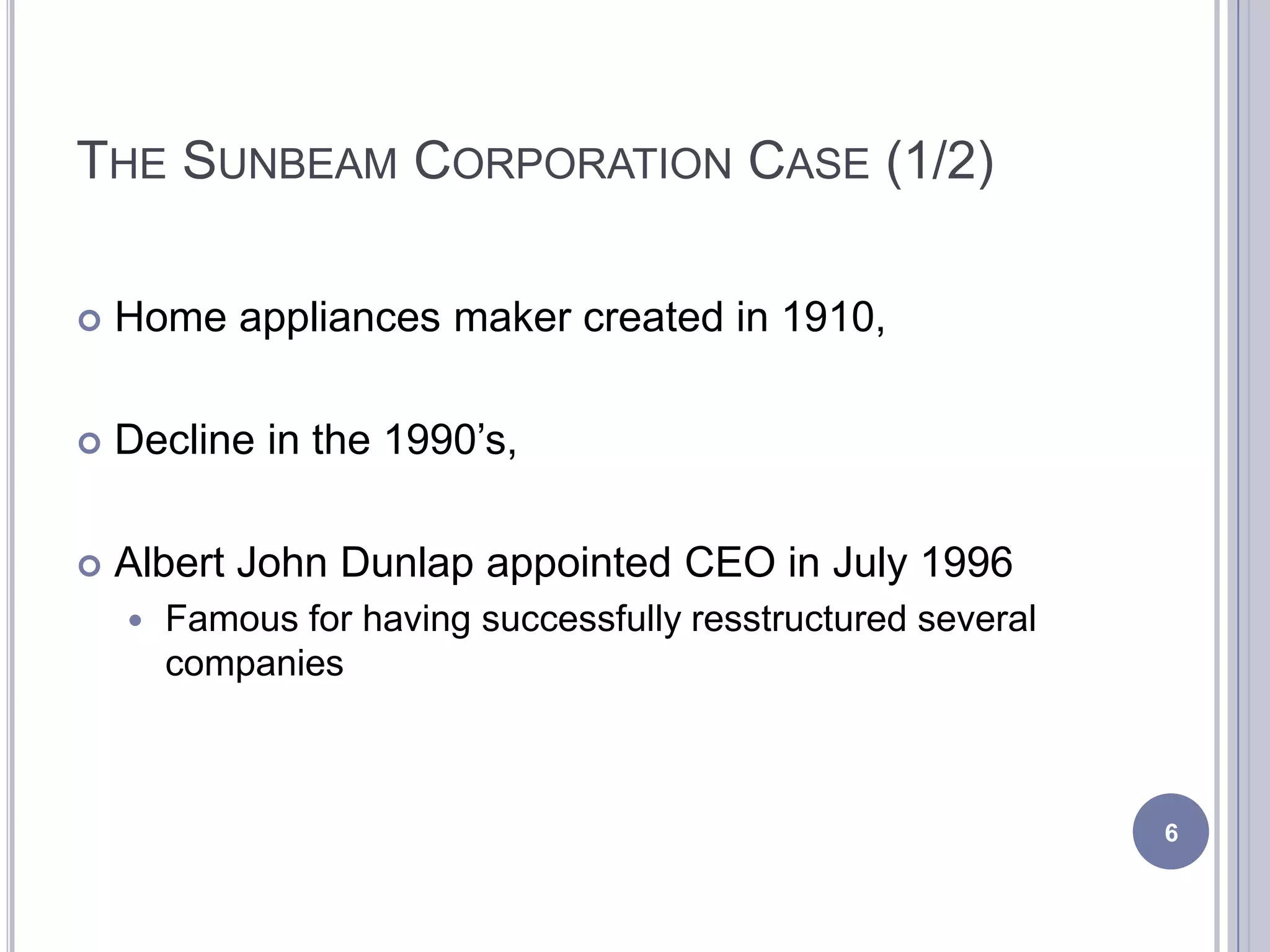
THE SUNBEAM CORPORATION CASE (1/2)
 Home appliances maker created in 1910,
 Decline in the 1990’s,
 Albert John Dunlap appointed CEO in July 1996
 Famous for having successfully resstructured several
companies
6
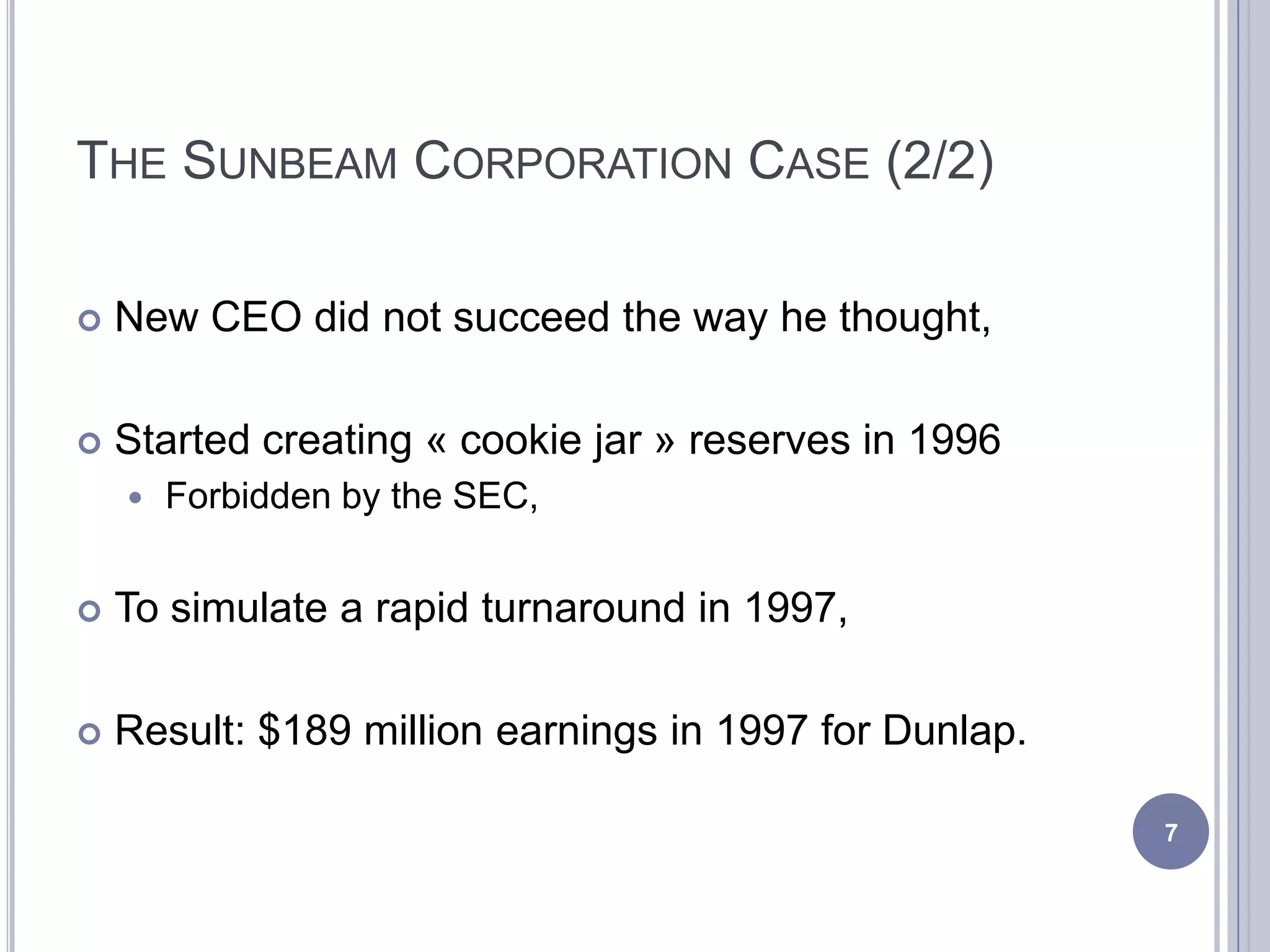
THE SUNBEAM CORPORATION CASE (2/2)
 New CEO did not succeed the way he thought,
 Started creating « cookie jar » reserves in 1996
 Forbidden by the SEC,
 To simulate a rapid turnaround in 1997,
 Result: $189 million earnings in 1997 for Dunlap.
7
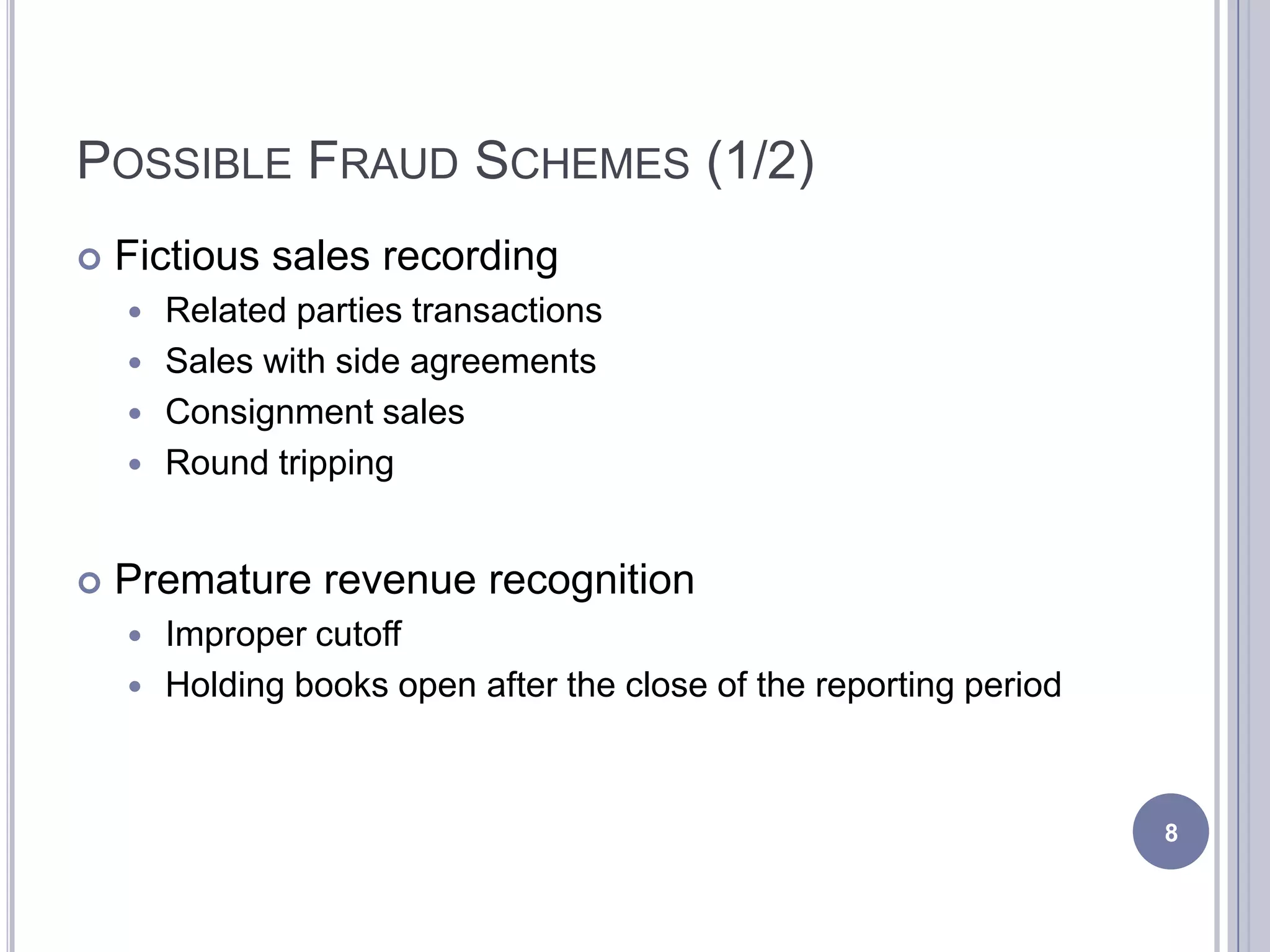
POSSIBLE FRAUD SCHEMES (1/2)
 Fictious sales recording
 Related parties transactions
 Sales with side agreements
 Consignment sales
 Round tripping
 Premature revenue recognition
 Improper cutoff
 Holding books open after the close of the reporting period
8
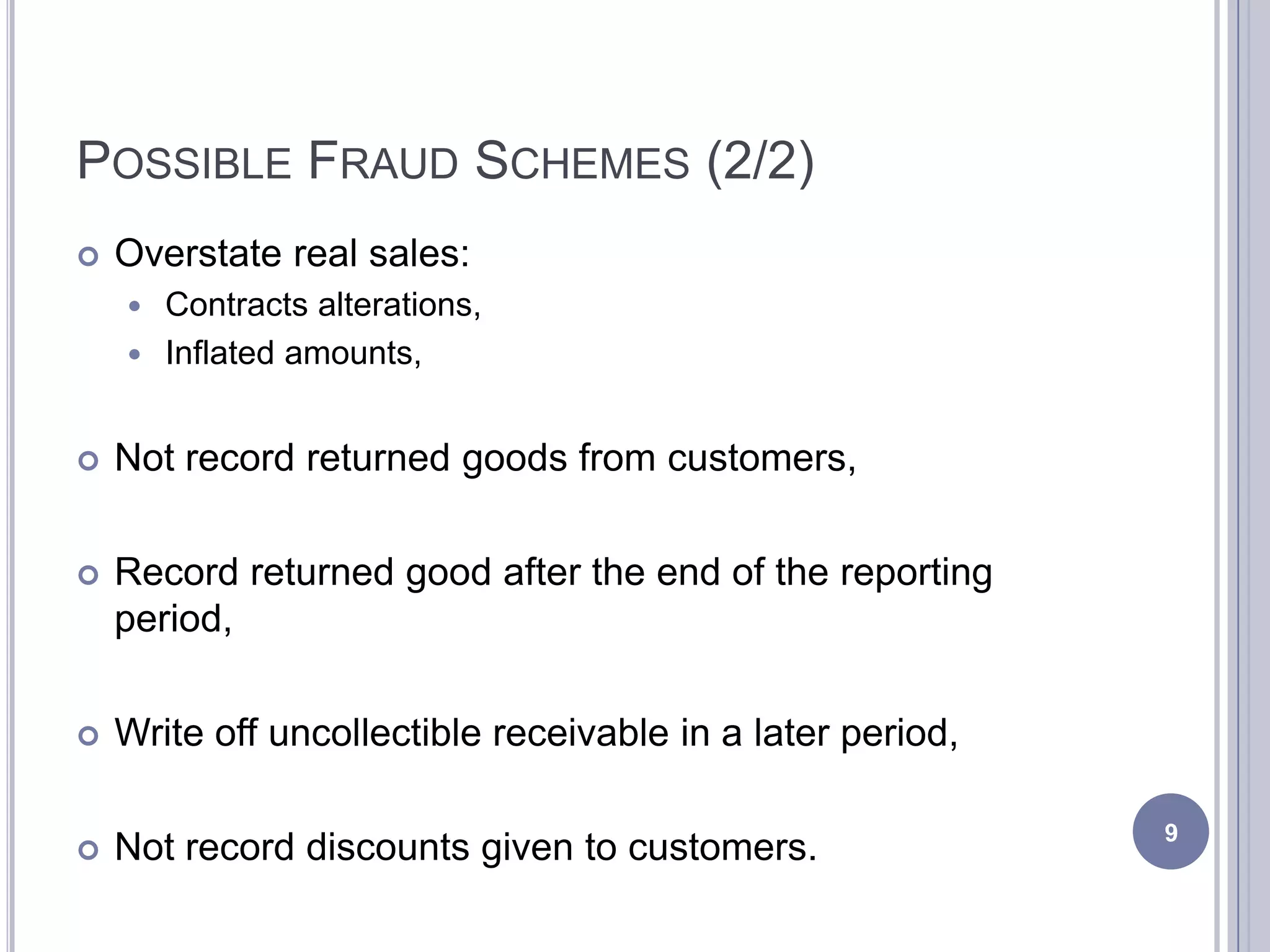
POSSIBLE FRAUD SCHEMES (2/2)
 Overstate real sales:
 Contracts alterations,
 Inflated amounts,
 Not record returned goods from customers,
 Record returned good after the end of the reporting
period,
 Write off uncollectible receivable in a later period,
 Not record discounts given to customers. 9
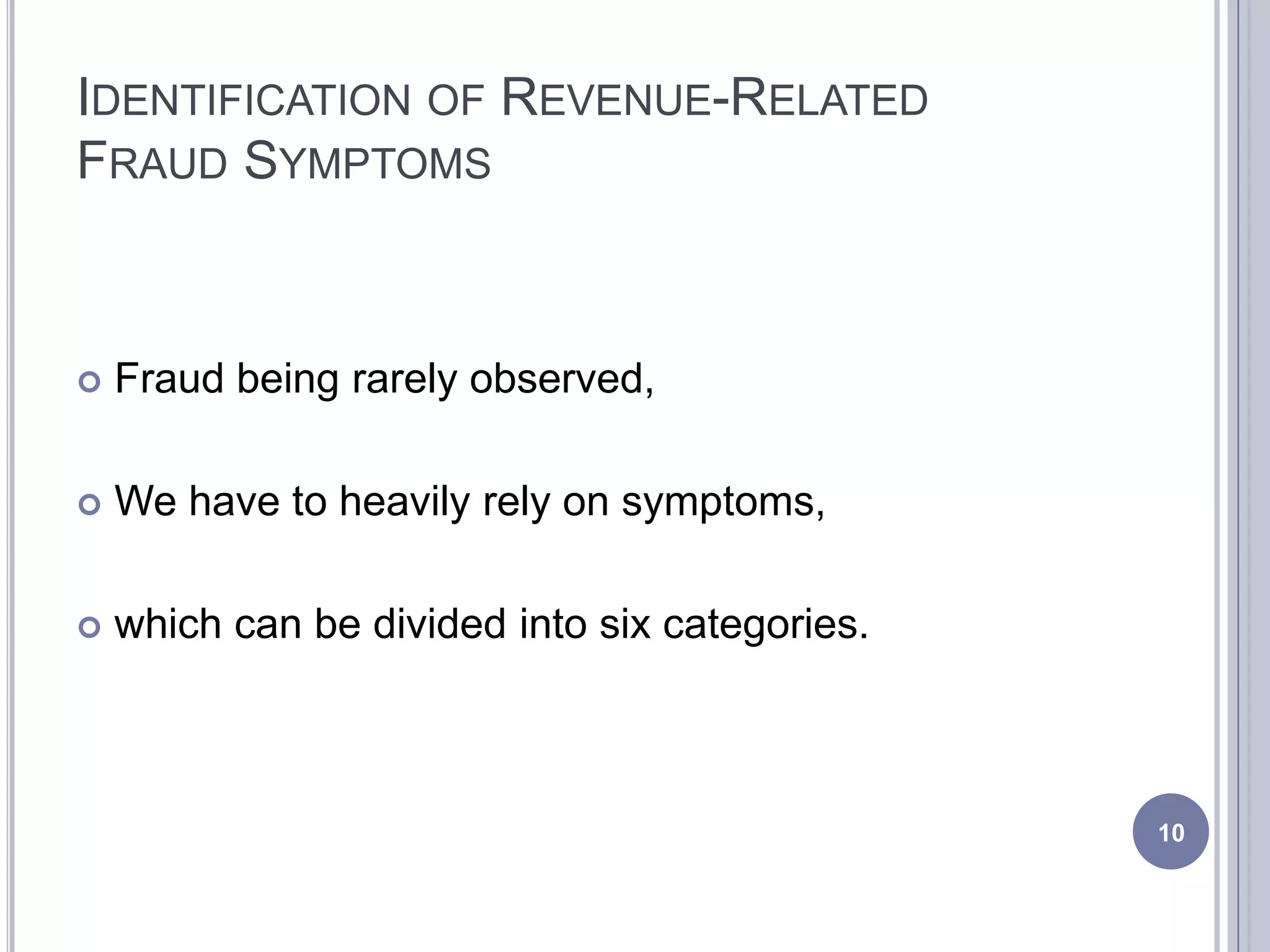
IDENTIFICATION OF REVENUE-RELATED
FRAUD SYMPTOMS
 Fraud being rarely observed,
 We have to heavily rely on symptoms,
 which can be divided into six categories.
10
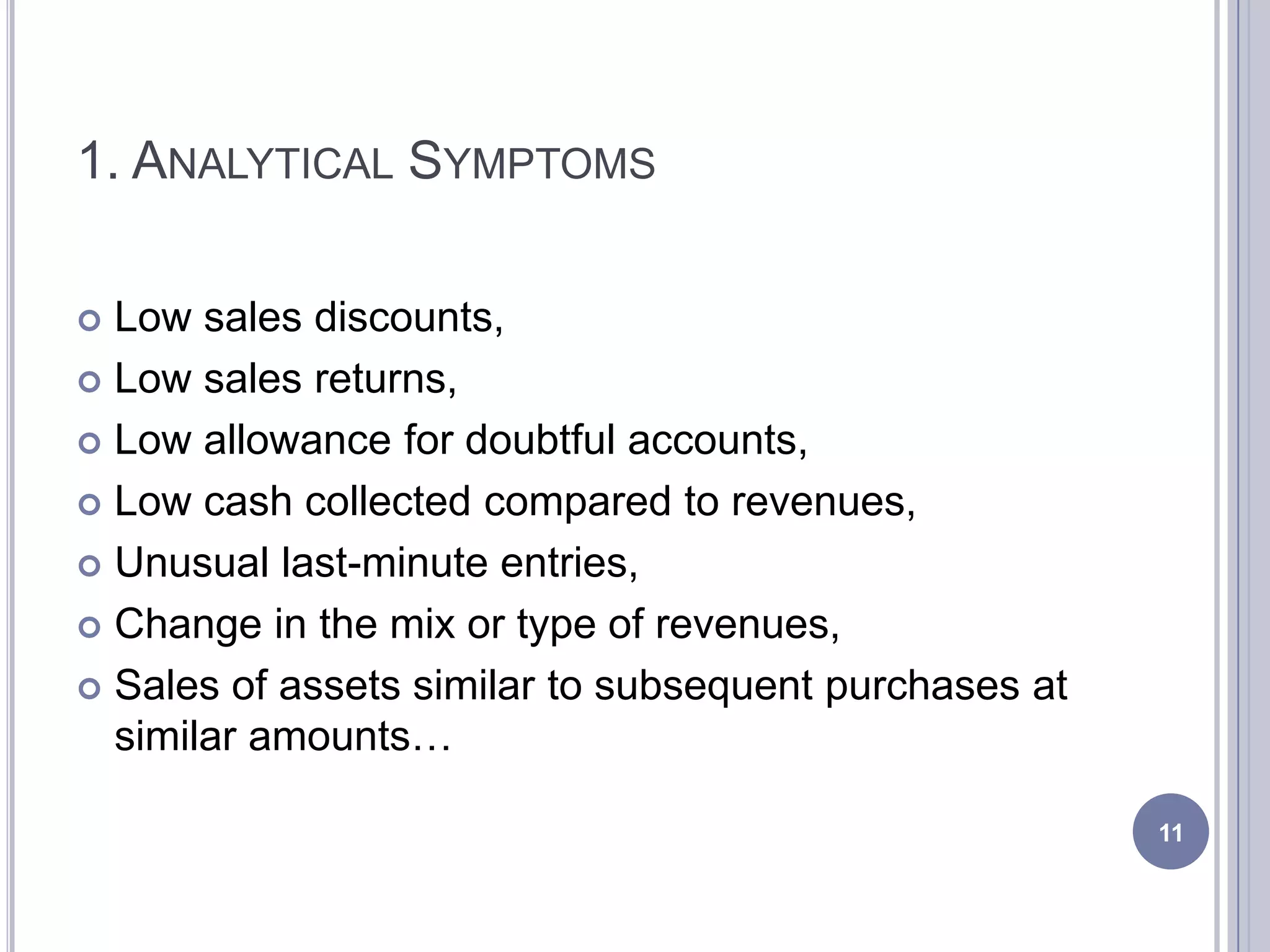
1. ANALYTICAL SYMPTOMS
 Low sales discounts,
 Low sales returns,
 Low allowance for doubtful accounts,
 Low cash collected compared to revenues,
 Unusual last-minute entries,
 Change in the mix or type of revenues,
 Sales of assets similar to subsequent purchases at
similar amounts…
11
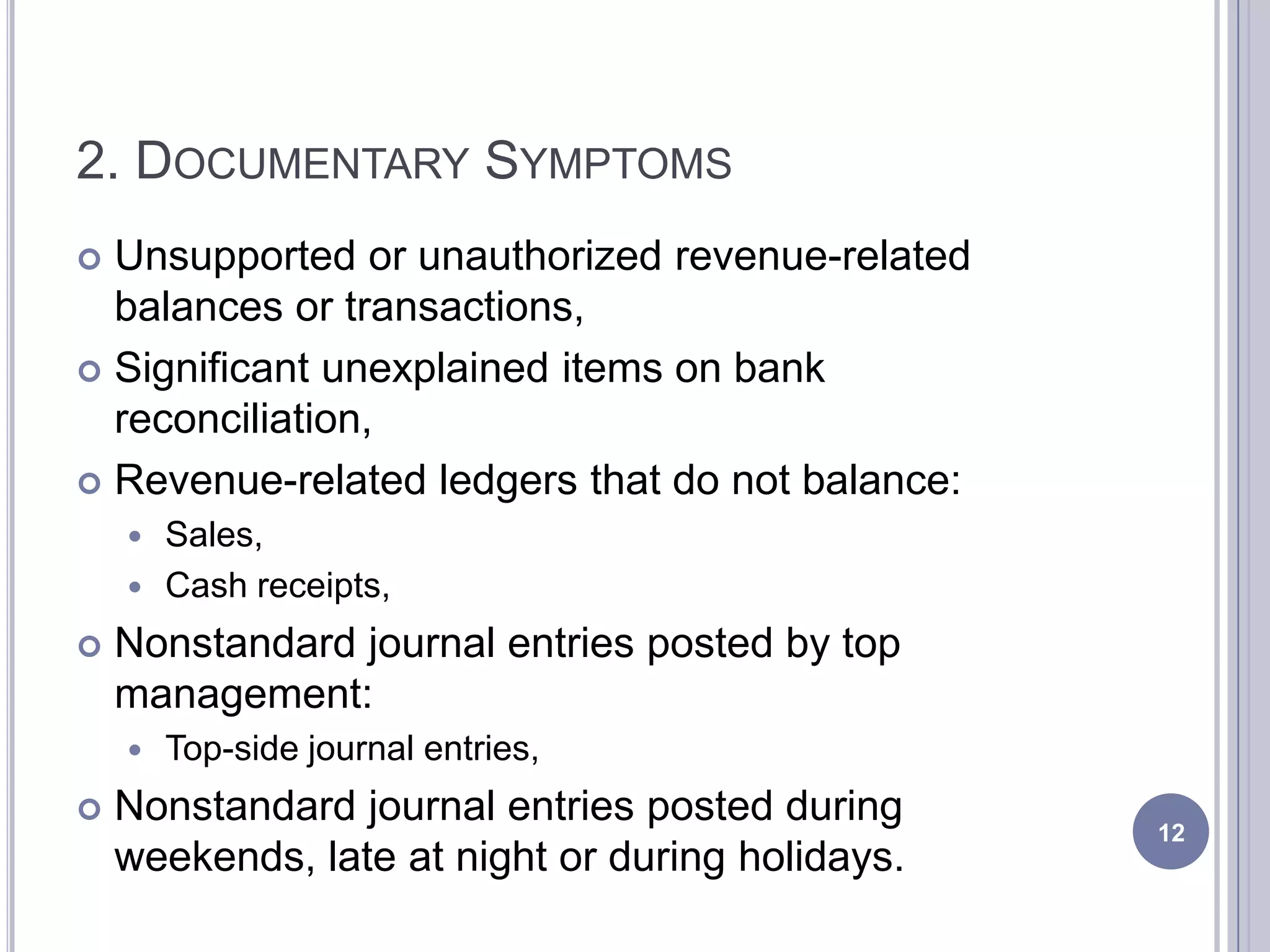
2. DOCUMENTARY SYMPTOMS
 Unsupported or unauthorized revenue-related
balances or transactions,
 Significant unexplained items on bank
reconciliation,
 Revenue-related ledgers that do not balance:
 Sales,
 Cash receipts,
 Nonstandard journal entries posted by top
management:
 Top-side journal entries,
 Nonstandard journal entries posted during
weekends, late at night or during holidays.
12
3. CONTROL SYMPTOMS
 Management override of significant internal control
activities,
 New, unusual or large customers that have not
gone through the customer-approval process,
 Weaknesses in the cutoff process.
13
4. BEHAVIORAL OR VERBAL SYMPTOMS
 Inconsistent, vague or implausible responses from
employees or management,
 Denied access to facilities, employees, records,
customers or vendors,
 Undue time pressure imposed by management to
solve complex issues
14
5. LIFESTYLE SYMPTOMS
 Major sale of company stock at unusual dates:
 Around earnings releases,
 Significant bonuses tied to meeting earnings
forecasts,
 Executives’ personal net worth tied up in company
stock.
15
6. TIPS AND COMPLAINTS
 Tips or complaints from the company whistle-
blowing system or any other way,
 Fraud disclosure at companies with which this
company does significant business.
16
KEY POINTS REMINDER
 Numerous revenue- and inventory related frauds,
 Many transaction can be used,
 Overstate (or understate) Net Income by:
 Mistating revenue,
 Focusing on Analytical symptoms is the best way to
discover fraud schemes.
17

Chapter 12:Revenue and Inventory Fraud by J Hachet

  • 1.
    REVENUE- RELATED FINANCIAL STATEMENTFRAUDS Chapter 12 A Julien Hachet 09/09/2013 1
  • 2.
    OUTLINE  Key points A Major Issue  Causes  The Sunbeam Corporation Case  Possible Fraud Schemes  Identification of Revenue-Related Fraud Symptoms 2
  • 3.
    KEY POINTS  Identificationof revenue-related financial statement fraud schemes.  Ways to search for symptoms of revenue-related financial statement fraud.  Importance of, and ways to follow up on, revenue- related fraud symptoms. 3
  • 4.
    A MAJOR ISSUE In case of financial statement frauds, the most frequently manipulated accounts are revenues and/or receivables accounts.  According to a Committee of Sponsoring Organizations’ study, more than 50% of financial statements frauds involve revenue and/or account receivable accounts. 4
  • 5.
    CAUSES  Existence ofalternatives for revenue recognition  Conservative vs. Liberal accounting methods  Easy to manipulate Net Income using Revenues and Receivables,  Very high pressure put on management by financial markets. 5
  • 6.
    THE SUNBEAM CORPORATIONCASE (1/2)  Home appliances maker created in 1910,  Decline in the 1990’s,  Albert John Dunlap appointed CEO in July 1996  Famous for having successfully resstructured several companies 6
  • 7.
    THE SUNBEAM CORPORATIONCASE (2/2)  New CEO did not succeed the way he thought,  Started creating « cookie jar » reserves in 1996  Forbidden by the SEC,  To simulate a rapid turnaround in 1997,  Result: $189 million earnings in 1997 for Dunlap. 7
  • 8.
    POSSIBLE FRAUD SCHEMES(1/2)  Fictious sales recording  Related parties transactions  Sales with side agreements  Consignment sales  Round tripping  Premature revenue recognition  Improper cutoff  Holding books open after the close of the reporting period 8
  • 9.
    POSSIBLE FRAUD SCHEMES(2/2)  Overstate real sales:  Contracts alterations,  Inflated amounts,  Not record returned goods from customers,  Record returned good after the end of the reporting period,  Write off uncollectible receivable in a later period,  Not record discounts given to customers. 9
  • 10.
    IDENTIFICATION OF REVENUE-RELATED FRAUDSYMPTOMS  Fraud being rarely observed,  We have to heavily rely on symptoms,  which can be divided into six categories. 10
  • 11.
    1. ANALYTICAL SYMPTOMS Low sales discounts,  Low sales returns,  Low allowance for doubtful accounts,  Low cash collected compared to revenues,  Unusual last-minute entries,  Change in the mix or type of revenues,  Sales of assets similar to subsequent purchases at similar amounts… 11
  • 12.
    2. DOCUMENTARY SYMPTOMS Unsupported or unauthorized revenue-related balances or transactions,  Significant unexplained items on bank reconciliation,  Revenue-related ledgers that do not balance:  Sales,  Cash receipts,  Nonstandard journal entries posted by top management:  Top-side journal entries,  Nonstandard journal entries posted during weekends, late at night or during holidays. 12
  • 13.
    3. CONTROL SYMPTOMS Management override of significant internal control activities,  New, unusual or large customers that have not gone through the customer-approval process,  Weaknesses in the cutoff process. 13
  • 14.
    4. BEHAVIORAL ORVERBAL SYMPTOMS  Inconsistent, vague or implausible responses from employees or management,  Denied access to facilities, employees, records, customers or vendors,  Undue time pressure imposed by management to solve complex issues 14
  • 15.
    5. LIFESTYLE SYMPTOMS Major sale of company stock at unusual dates:  Around earnings releases,  Significant bonuses tied to meeting earnings forecasts,  Executives’ personal net worth tied up in company stock. 15
  • 16.
    6. TIPS ANDCOMPLAINTS  Tips or complaints from the company whistle- blowing system or any other way,  Fraud disclosure at companies with which this company does significant business. 16
  • 17.
    KEY POINTS REMINDER Numerous revenue- and inventory related frauds,  Many transaction can be used,  Overstate (or understate) Net Income by:  Mistating revenue,  Focusing on Analytical symptoms is the best way to discover fraud schemes. 17