Sarbanes – Oxley Act of 2002“The most significant piece of legislation to hit the securities field since the New Deal”Presented by:Cabillos, ChristineCaminong, CharisseLacambacal, Angelica AprilPrudente, Mary GraceYap, Karen
Sarbanes – Oxley Act of 2002Also known as “Public Company Accounting Reform and Investor Protection Act” in the Senate.“Corporate and Auditing Accountability and Responsibility Act” in the House.Commonly called as Sarbanes-Oxley, Sarbox or SOX.
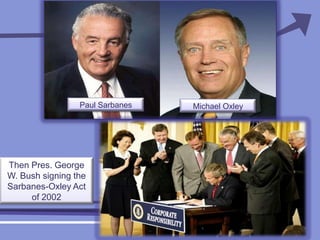
Enacted on July 30, 2002 and named after sponsors, U.S. Senator Paul Sarbanes and U.S. Representative Michael G. Oxley.Paul SarbanesMichael OxleyThen Pres. George W. Bush signing the Sarbanes-Oxley Act of 2002
Reasons for Sarbanes – Oxley ActReaction to a number of major corporate and accounting scandals including those affecting Enron, Tyco International and WorldCom.To bolster accounting, internal control and auditing standards at public corporations to protect investors.Enhance corporate internal auditing and financial reporting control mechanisms to easily detect fraud.Restore the public confidence in both public accounting and publicly traded securities.Assure ethical business practices through heightened levels of awareness and accountability.
Reasons for Sarbanes-Oxley ActIncludes reforms in corporate governance and the accounting profession intended to:Improve corporate financial reporting and internal controlStrengthen audit committeesChange the relationship between the auditor and clientImprove auditor independenceProvide additional auditor assurance over internal controlProvide oversight and regulation for auditors of publicly traded companies.
Sarbanes – Oxley ActContains 11 Titles:Public Company Accounting Oversight Board (PCAOB) Auditor IndependenceCorporate ResponsibilityEnhanced Financial DisclosuresAnalyst Conflicts of InterestCommission Resources and AuthorityStudies and ReportsCorporate and Criminal Fraud AccountabilityWhite-Collar Crime  Penalty EnhancementsCorporate Tax ReturnsCorporate Fraud and Accountability
SOX Affects…External AuditorsInternal AuditorsBoard of directors and CommitteesTop ExecutivesSenior ManagersAttorneys, both internal and externalRegulators
Major Provisions of SOXChief executives and financial officers are held responsible for their companies’ financial reports.Executive officers and directors may not solicit or accept loans from their companies.Insider trades are reported more quickly.Insider trades are prohibited during pension-fund blackout periods.Disclosure of executive compensation and profits is mandatory.
Internal audits and review and certification of audits by outside auditors are mandatory.There will be criminal and civil penalties for securities violations.There will be longer jail sentences and larger fines for executives who intentionally misstate financial statements.Audit firms may no longer provide actuarial, legal, or consulting services to firms they audit.
Sarbanes Oxley Act of 2002
I. Public Company Accounting Oversight Boardconsists of 9sections and establishes the Public Company Accounting Oversight Board, to provide independent oversight of public accounting firms providing audit services. creates a central oversight board tasked with registering auditors, defining the specific processes and procedures for compliance audits, inspecting and policing conduct and quality control, and enforcing compliance with the specific mandates of SOX.
II. Auditor Independenceconsists of nine sections and establishes standards for external auditor independence, to limit conflicts of interest.It also addresses new auditor approval requirements, audit partner rotation, and auditor reporting requirements.It restricts auditing companies from providing non-audit services (e.g., consulting) for the same clients.
III. Corporate Responsibilityconsists of eight sections and mandates that senior executives take individual responsibility for the accuracy and completeness of corporate financial reports. It defines the interaction of external auditors and corporate audit committees, and specifies the responsibility of corporate officers for the accuracy and validity of corporate financial reports.It enumerates specific limits on the behaviors of corporate officers and describes specific forfeitures of benefits and civil penalties for non-compliance.
IV. Enhanced Financial Disclosuresconsists of nine sections and describes enhanced reporting requirements for financial transactions, including  off- balance sheet transactions, pro-forma figures and stock transactions of corporate officers. requires internal controls for assuring the accuracy of financial reports and disclosures, and mandates both audits and reports on those controls. requires timely reporting of material changes in financial condition and specific enhanced reviews by the SEC or its agents of corporate reports.
V. Analyst Conflict of Interestconsists of only one section, which includes measures designed to help restore investor confidence in the reporting of securities analysts.defines the codes of conduct for securities analysts and requires disclosure of knowable conflicts of interest.
VI. Commission Resources and Authorityconsists of four sections and defines practices to restore investor confidence in securities analysts. defines the SEC’s authority to censure or bar securities professionals from practice and defines conditions under which a person can be barred from practicing as a broker, advisor, or dealer.
VII. Studies and Reportsconsists of five sections and requires the Comptroller General and the SEC to perform various studies and report their findings.Studies and reports include the effects of consolidation of public accounting firms, the role of credit rating agencies in the operation of securities markets, securities violations and enforcement actions, and whether investment banks assisted Enron and Global Crossing and others to manipulate earnings and obfuscate true financial conditions.
VIII. Corporate & Criminal Fraud Accountabilityconsists of seven sections and is also referred to as the “Corporate and Criminal Fraud Accountability Act of 2002”.It describes specific criminal penalties for manipulation, destruction or alteration of financial records or other interference with investigations, while providing certain protections for whistle-blowers.
IX. White-Collar Crime Penalty Enhancementsconsists of six sections and is also called the “White Collar Crime Penalty Enhancement Act of 2002.”increases the criminal penalties associated with white-collar crimes and conspiracies.recommends stronger sentencing guidelines and specifically adds failure to certify corporate financial reports as a criminal offense.
X. Corporate Tax Returns consists of only one section.states that the Chief Executive Officer should sign the company tax return.
XI. Corporate Fraud and Accountability consists of seven sectionsand called as “Corporate Fraud Accountability Act of 2002”.It identifies corporate fraud and records tampering as criminal offenses and joins those offenses to specific penalties. It also revises sentencing guidelines and strengthens their penalties.enables the SEC to resort to temporarily freezing transactions or payments that have been deemed "large" or "unusual".
Non-ComplianceWhat happens depends on which section of the act they’re out of compliance with.Non compliance penalties range from the loss of exchange listing, loss of Director and Officer insurance to multimillion dollar fines and imprisonment. It can result in a lack of investor confidence. A CEO or CFO who submits a wrong certification is subject to a fine up to $1 million and imprisonment for up to ten years. If the wrong certification was submitted "willfully", the fine can be increased up to $5 million and the prison term can be increased up to twenty years.
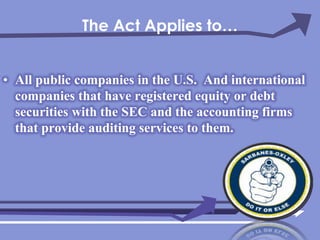
The Act Applies to…All public companies in the U.S.  And international companies that have registered equity or debt securities with the SEC and the accounting firms that provide auditing services to them.
InsightsThe SOX act talks about the public accounting firms. They experienced a lot of scandals like Enron, Tyco International, Adelphia, Peregrine Systems and WorldCom. They just want to protect the accounting firm because there are a lot of investors that will be affected.Having the Sarbanes Act assures an ethical business culture in the company. It serves as a discipline standard.
InsightsThe SOX protects the firm and costumers from having serious conflicts like fraud and the like.It warns us not to commit serious and scandalous wrong doing in the companies/workplace.
References:http://www.theepochtimes.com/n2/images/stories/large/2010/06/30/bush.jpghttp://www.tristarsearch.com/images/img2.gifhttp://www.slideshare.net/vinaya.hs/sarbanesoxley-act-soxhttp://www.allbusiness.com/government/business-regulations/11410-1.htmlhttp://www.marcusletter.com/Sarbanes-Oxley.htm
References:http://www.ehow.com/about_5526341_reasons-sarbanes-oxley-act.htmlhttp://en.wikipedia.org/wiki/Sarbanes%E2%80%93Oxley_Acthttp://www.ehow.com/list_7591161_impacts-sarbanesoxley-act.htmlhttp://www.sox-online.com/basics.html

Sarbanes-Oxley act

  • 1.
    Sarbanes – OxleyAct of 2002“The most significant piece of legislation to hit the securities field since the New Deal”Presented by:Cabillos, ChristineCaminong, CharisseLacambacal, Angelica AprilPrudente, Mary GraceYap, Karen
  • 2.
    Sarbanes – OxleyAct of 2002Also known as “Public Company Accounting Reform and Investor Protection Act” in the Senate.“Corporate and Auditing Accountability and Responsibility Act” in the House.Commonly called as Sarbanes-Oxley, Sarbox or SOX.
  • 3.
    Enacted on July30, 2002 and named after sponsors, U.S. Senator Paul Sarbanes and U.S. Representative Michael G. Oxley.Paul SarbanesMichael OxleyThen Pres. George W. Bush signing the Sarbanes-Oxley Act of 2002
  • 4.
    Reasons for Sarbanes– Oxley ActReaction to a number of major corporate and accounting scandals including those affecting Enron, Tyco International and WorldCom.To bolster accounting, internal control and auditing standards at public corporations to protect investors.Enhance corporate internal auditing and financial reporting control mechanisms to easily detect fraud.Restore the public confidence in both public accounting and publicly traded securities.Assure ethical business practices through heightened levels of awareness and accountability.
  • 5.
    Reasons for Sarbanes-OxleyActIncludes reforms in corporate governance and the accounting profession intended to:Improve corporate financial reporting and internal controlStrengthen audit committeesChange the relationship between the auditor and clientImprove auditor independenceProvide additional auditor assurance over internal controlProvide oversight and regulation for auditors of publicly traded companies.
  • 6.
    Sarbanes – OxleyActContains 11 Titles:Public Company Accounting Oversight Board (PCAOB) Auditor IndependenceCorporate ResponsibilityEnhanced Financial DisclosuresAnalyst Conflicts of InterestCommission Resources and AuthorityStudies and ReportsCorporate and Criminal Fraud AccountabilityWhite-Collar Crime Penalty EnhancementsCorporate Tax ReturnsCorporate Fraud and Accountability
  • 7.
    SOX Affects…External AuditorsInternalAuditorsBoard of directors and CommitteesTop ExecutivesSenior ManagersAttorneys, both internal and externalRegulators
  • 8.
    Major Provisions ofSOXChief executives and financial officers are held responsible for their companies’ financial reports.Executive officers and directors may not solicit or accept loans from their companies.Insider trades are reported more quickly.Insider trades are prohibited during pension-fund blackout periods.Disclosure of executive compensation and profits is mandatory.
  • 9.
    Internal audits andreview and certification of audits by outside auditors are mandatory.There will be criminal and civil penalties for securities violations.There will be longer jail sentences and larger fines for executives who intentionally misstate financial statements.Audit firms may no longer provide actuarial, legal, or consulting services to firms they audit.
  • 10.
  • 11.
    I. Public CompanyAccounting Oversight Boardconsists of 9sections and establishes the Public Company Accounting Oversight Board, to provide independent oversight of public accounting firms providing audit services. creates a central oversight board tasked with registering auditors, defining the specific processes and procedures for compliance audits, inspecting and policing conduct and quality control, and enforcing compliance with the specific mandates of SOX.
  • 12.
    II. Auditor Independenceconsistsof nine sections and establishes standards for external auditor independence, to limit conflicts of interest.It also addresses new auditor approval requirements, audit partner rotation, and auditor reporting requirements.It restricts auditing companies from providing non-audit services (e.g., consulting) for the same clients.
  • 13.
    III. Corporate Responsibilityconsistsof eight sections and mandates that senior executives take individual responsibility for the accuracy and completeness of corporate financial reports. It defines the interaction of external auditors and corporate audit committees, and specifies the responsibility of corporate officers for the accuracy and validity of corporate financial reports.It enumerates specific limits on the behaviors of corporate officers and describes specific forfeitures of benefits and civil penalties for non-compliance.
  • 14.
    IV. Enhanced FinancialDisclosuresconsists of nine sections and describes enhanced reporting requirements for financial transactions, including  off- balance sheet transactions, pro-forma figures and stock transactions of corporate officers. requires internal controls for assuring the accuracy of financial reports and disclosures, and mandates both audits and reports on those controls. requires timely reporting of material changes in financial condition and specific enhanced reviews by the SEC or its agents of corporate reports.
  • 15.
    V. Analyst Conflictof Interestconsists of only one section, which includes measures designed to help restore investor confidence in the reporting of securities analysts.defines the codes of conduct for securities analysts and requires disclosure of knowable conflicts of interest.
  • 16.
    VI. Commission Resourcesand Authorityconsists of four sections and defines practices to restore investor confidence in securities analysts. defines the SEC’s authority to censure or bar securities professionals from practice and defines conditions under which a person can be barred from practicing as a broker, advisor, or dealer.
  • 17.
    VII. Studies andReportsconsists of five sections and requires the Comptroller General and the SEC to perform various studies and report their findings.Studies and reports include the effects of consolidation of public accounting firms, the role of credit rating agencies in the operation of securities markets, securities violations and enforcement actions, and whether investment banks assisted Enron and Global Crossing and others to manipulate earnings and obfuscate true financial conditions.
  • 18.
    VIII. Corporate &Criminal Fraud Accountabilityconsists of seven sections and is also referred to as the “Corporate and Criminal Fraud Accountability Act of 2002”.It describes specific criminal penalties for manipulation, destruction or alteration of financial records or other interference with investigations, while providing certain protections for whistle-blowers.
  • 19.
    IX. White-Collar CrimePenalty Enhancementsconsists of six sections and is also called the “White Collar Crime Penalty Enhancement Act of 2002.”increases the criminal penalties associated with white-collar crimes and conspiracies.recommends stronger sentencing guidelines and specifically adds failure to certify corporate financial reports as a criminal offense.
  • 20.
    X. Corporate TaxReturns consists of only one section.states that the Chief Executive Officer should sign the company tax return.
  • 21.
    XI. Corporate Fraudand Accountability consists of seven sectionsand called as “Corporate Fraud Accountability Act of 2002”.It identifies corporate fraud and records tampering as criminal offenses and joins those offenses to specific penalties. It also revises sentencing guidelines and strengthens their penalties.enables the SEC to resort to temporarily freezing transactions or payments that have been deemed "large" or "unusual".
  • 22.
    Non-ComplianceWhat happens dependson which section of the act they’re out of compliance with.Non compliance penalties range from the loss of exchange listing, loss of Director and Officer insurance to multimillion dollar fines and imprisonment. It can result in a lack of investor confidence. A CEO or CFO who submits a wrong certification is subject to a fine up to $1 million and imprisonment for up to ten years. If the wrong certification was submitted "willfully", the fine can be increased up to $5 million and the prison term can be increased up to twenty years.
  • 23.
    The Act Appliesto…All public companies in the U.S. And international companies that have registered equity or debt securities with the SEC and the accounting firms that provide auditing services to them.
  • 24.
    InsightsThe SOX acttalks about the public accounting firms. They experienced a lot of scandals like Enron, Tyco International, Adelphia, Peregrine Systems and WorldCom. They just want to protect the accounting firm because there are a lot of investors that will be affected.Having the Sarbanes Act assures an ethical business culture in the company. It serves as a discipline standard.
  • 25.
    InsightsThe SOX protectsthe firm and costumers from having serious conflicts like fraud and the like.It warns us not to commit serious and scandalous wrong doing in the companies/workplace.
  • 26.
  • 27.