
AUDIT
&
ASSURANCE
“
⊡ Tasnim Ansari – 16221009
⊡ Mehedi Hassan Bappy – 16221021
⊡ Debanik Chakraborty – 16221025
⊡ Syed Ishtiak Uddin Ahmed – 16221031
⊡ Nusrat Jahan Mimi - 16221061
Group Members
The word audit is derived from a Latin word
"Audrie" which means "to hear". During the
medieval times when manual book-keeping was
prevalent, auditors in Britain used to hear the
accounts read out for them and checked that the
organization’s personnel were not negligent or
fake.
History of Audit
An audit is an objective inspection and evaluation of the
financial statements of an organization to make sure that
the records are a fair and accurate representation of the
transactions they claim to represent. It can be done
internally by employees of the organization, or externally
by an outside firm.
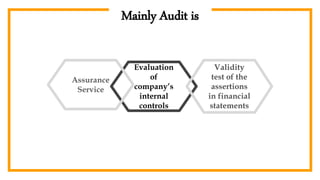
Mainly Audit is
Evaluation
of
company’s
internal
controls
Assurance
Service
Validity
test of the
assertions
in financial
statements
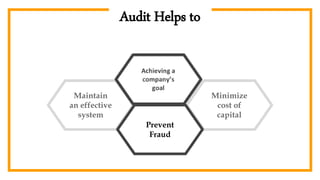
Audit Helps to
Maintain
an effective
system
Minimize
cost of
capital
Prevent
Fraud
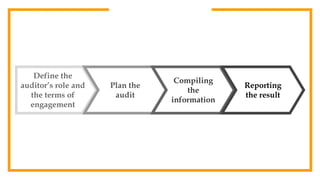
Auditing Process
Define the
auditor’s role and
the terms of
engagement
Plan the
audit
Compiling
the
information
Reporting
the result
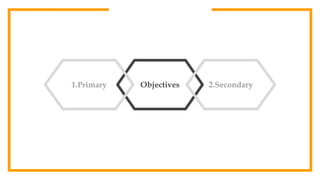
Objectives of Audit
Objectives1.Primary 2.Secondary
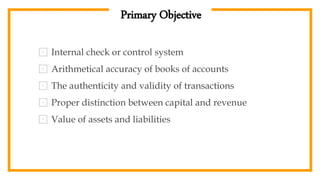
Primary Objective
⊡ Internal check or control system
⊡ Arithmetical accuracy of books of accounts
⊡ The authenticity and validity of transactions
⊡ Proper distinction between capital and revenue
⊡ Value of assets and liabilities
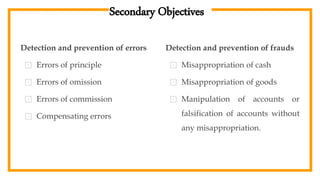
Secondary Objectives
Detection and prevention of errors
⊡ Errors of principle
⊡ Errors of omission
⊡ Errors of commission
⊡ Compensating errors
Detection and prevention of frauds
⊡ Misappropriation of cash
⊡ Misappropriation of goods
⊡ Manipulation of accounts or
falsification of accounts without
any misappropriation.
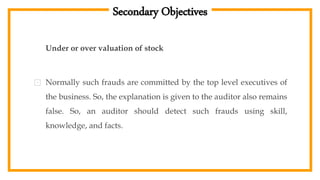
Secondary Objectives
Under or over valuation of stock
⊡ Normally such frauds are committed by the top level executives of
the business. So, the explanation is given to the auditor also remains
false. So, an auditor should detect such frauds using skill,
knowledge, and facts.
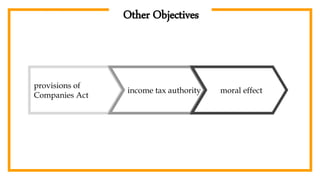
Other Objectives
income tax authority
provisions of
Companies Act
moral effect
“Responsibilities of Working
Capital Management
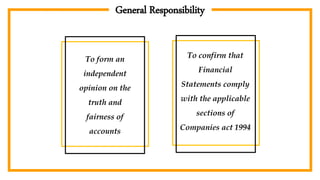
General Responsibility
To form an
independent
opinion on the
truth and
fairness of
accounts
To confirm that
Financial
Statements comply
with the applicable
sections of
Companies act 1994
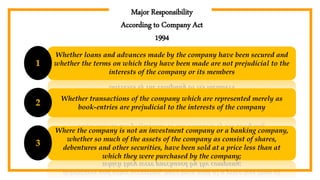
Major Responsibility
According to Company Act
1994
Whether loans and advances made by the company have been secured and
whether the terms on which they have been made are not prejudicial to the
interests of the company or its members
1
Whether transactions of the company which are represented merely as
book-entries are prejudicial to the interests of the company
2
Where the company is not an investment company or a banking company,
whether so much of the assets of the company as consist of shares,
debentures and other securities, have been sold at a price less than at
which they were purchased by the company;
3
Major Responsibility
According to Company Act
1994
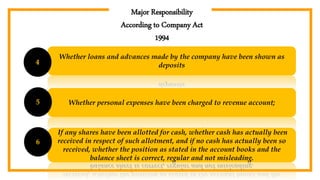
Whether loans and advances made by the company have been shown as
deposits4
Whether personal expenses have been charged to revenue account;5
If any shares have been allotted for cash, whether cash has actually been
received in respect of such allotment, and if no cash has actually been so
received, whether the position as stated in the account books and the
balance sheet is correct, regular and not misleading.
6
Responsibility Regarding Fraud
An auditor’s responsibility regarding fraud are
assessing risk of material misstatement.
Responsibility Regarding Fraud
In this case they should take consideration of:
Where the company’s system is weak and how the management can penetrate
fraud.
The circumstances that could indicate earning management which leads to
fraudulent activities
The known internal and external factors that could lead to fraud
Any unusual behavior or changes in the management or employees
Management’s involvement in overseeing employees who have access to cash that
often leads to misappropriation.
Expectation Gap
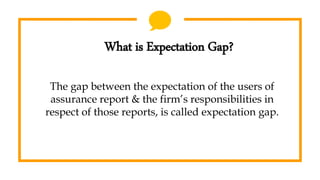
What is Expectation Gap?
The gap between the expectation of the users of
assurance report & the firm’s responsibilities in
respect of those reports, is called expectation gap.
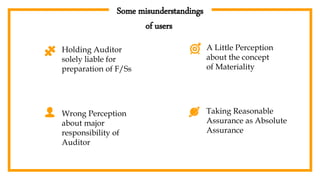
Some misunderstandings
of users
Holding Auditor
solely liable for
preparation of F/Ss
Wrong Perception
about major
responsibility of
Auditor
A Little Perception
about the concept
of Materiality
Taking Reasonable
Assurance as Absolute
Assurance
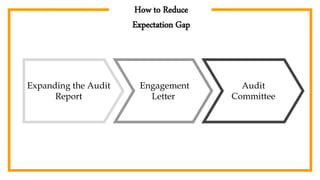
How to Reduce
Expectation Gap
Expanding the Audit
Report
Engagement
Letter
Audit
Committee
Audit Evidence
&
Audit Report
“Audit Evidence
Auditing is primarily concerned with the verification and
examination of the accounting data.
Auditing evidence is the information collected for review of a
company's financial transactions, internal control practices and
other factors necessary for the certification of financial statements
by an auditor or certified public accountant.
“Audit Report
An audit report is a written opinion of an auditor regarding an
entity's financial statements
Relevant matters- An auditor's report is ultimately intended to provide
reasonable assurance that there are no material errors within an
organization's financial statements. Auditors are required to report privately
to those charged with governance on various matters arising from the audit.
Auditor need to report some relevant matters to the authority. Those matters
include:
 General approach
 Significant risk and exposures
 Audit adjustments
 Material uncertainties
 Significant disagreements
 Expected modifications
 Uncorrected misstatement
Assurance report - The ISRE (international Standard on Review Engagement)
says’ the review report should contain a clear written concept of negative
assurance. Based on the work performed, the auditor should assess whether
any information obtained during the review indicates that financial statement
does not give a true and fair view in accordance with the identified financial
reporting framework.
“
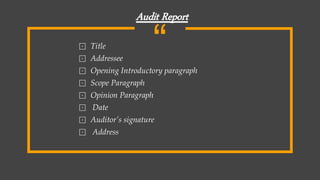
Audit Report
⊡ Title
⊡ Addressee
⊡ Opening Introductory paragraph
⊡ Scope Paragraph
⊡ Opinion Paragraph
⊡ Date
⊡ Auditor’s signature
⊡ Address
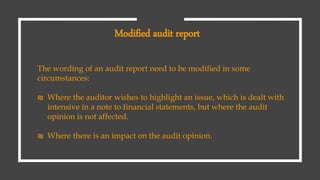
The wording of an audit report need to be modified in some
circumstances:
₪ Where the auditor wishes to highlight an issue, which is dealt with
intensive in a note to financial statements, but where the audit
opinion is not affected.
₪ Where there is an impact on the audit opinion.
Modified audit report
“
Thank You

Audit & Assurance

  • 1.
  • 2.
    “ ⊡ Tasnim Ansari– 16221009 ⊡ Mehedi Hassan Bappy – 16221021 ⊡ Debanik Chakraborty – 16221025 ⊡ Syed Ishtiak Uddin Ahmed – 16221031 ⊡ Nusrat Jahan Mimi - 16221061 Group Members
  • 3.
    The word auditis derived from a Latin word "Audrie" which means "to hear". During the medieval times when manual book-keeping was prevalent, auditors in Britain used to hear the accounts read out for them and checked that the organization’s personnel were not negligent or fake. History of Audit
  • 4.
    An audit isan objective inspection and evaluation of the financial statements of an organization to make sure that the records are a fair and accurate representation of the transactions they claim to represent. It can be done internally by employees of the organization, or externally by an outside firm.
  • 5.
  • 6.
    Audit Helps to Maintain aneffective system Minimize cost of capital Prevent Fraud
  • 7.
  • 8.
    Define the auditor’s roleand the terms of engagement Plan the audit Compiling the information Reporting the result
  • 9.
  • 10.
  • 11.
    Primary Objective ⊡ Internalcheck or control system ⊡ Arithmetical accuracy of books of accounts ⊡ The authenticity and validity of transactions ⊡ Proper distinction between capital and revenue ⊡ Value of assets and liabilities
  • 12.
    Secondary Objectives Detection andprevention of errors ⊡ Errors of principle ⊡ Errors of omission ⊡ Errors of commission ⊡ Compensating errors Detection and prevention of frauds ⊡ Misappropriation of cash ⊡ Misappropriation of goods ⊡ Manipulation of accounts or falsification of accounts without any misappropriation.
  • 13.
    Secondary Objectives Under orover valuation of stock ⊡ Normally such frauds are committed by the top level executives of the business. So, the explanation is given to the auditor also remains false. So, an auditor should detect such frauds using skill, knowledge, and facts.
  • 14.
    Other Objectives income taxauthority provisions of Companies Act moral effect
  • 15.
  • 16.
    General Responsibility To forman independent opinion on the truth and fairness of accounts To confirm that Financial Statements comply with the applicable sections of Companies act 1994
  • 17.
    Major Responsibility According toCompany Act 1994 Whether loans and advances made by the company have been secured and whether the terms on which they have been made are not prejudicial to the interests of the company or its members 1 Whether transactions of the company which are represented merely as book-entries are prejudicial to the interests of the company 2 Where the company is not an investment company or a banking company, whether so much of the assets of the company as consist of shares, debentures and other securities, have been sold at a price less than at which they were purchased by the company; 3
  • 18.
    Major Responsibility According toCompany Act 1994 Whether loans and advances made by the company have been shown as deposits4 Whether personal expenses have been charged to revenue account;5 If any shares have been allotted for cash, whether cash has actually been received in respect of such allotment, and if no cash has actually been so received, whether the position as stated in the account books and the balance sheet is correct, regular and not misleading. 6
  • 19.
    Responsibility Regarding Fraud Anauditor’s responsibility regarding fraud are assessing risk of material misstatement.
  • 20.
    Responsibility Regarding Fraud Inthis case they should take consideration of: Where the company’s system is weak and how the management can penetrate fraud. The circumstances that could indicate earning management which leads to fraudulent activities The known internal and external factors that could lead to fraud Any unusual behavior or changes in the management or employees Management’s involvement in overseeing employees who have access to cash that often leads to misappropriation.
  • 21.
  • 22.
    What is ExpectationGap? The gap between the expectation of the users of assurance report & the firm’s responsibilities in respect of those reports, is called expectation gap.
  • 23.
    Some misunderstandings of users HoldingAuditor solely liable for preparation of F/Ss Wrong Perception about major responsibility of Auditor A Little Perception about the concept of Materiality Taking Reasonable Assurance as Absolute Assurance
  • 24.
    How to Reduce ExpectationGap Expanding the Audit Report Engagement Letter Audit Committee
  • 25.
  • 26.
    “Audit Evidence Auditing isprimarily concerned with the verification and examination of the accounting data. Auditing evidence is the information collected for review of a company's financial transactions, internal control practices and other factors necessary for the certification of financial statements by an auditor or certified public accountant.
  • 27.
    “Audit Report An auditreport is a written opinion of an auditor regarding an entity's financial statements
  • 28.
    Relevant matters- Anauditor's report is ultimately intended to provide reasonable assurance that there are no material errors within an organization's financial statements. Auditors are required to report privately to those charged with governance on various matters arising from the audit. Auditor need to report some relevant matters to the authority. Those matters include:  General approach  Significant risk and exposures  Audit adjustments  Material uncertainties  Significant disagreements  Expected modifications  Uncorrected misstatement
  • 29.
    Assurance report -The ISRE (international Standard on Review Engagement) says’ the review report should contain a clear written concept of negative assurance. Based on the work performed, the auditor should assess whether any information obtained during the review indicates that financial statement does not give a true and fair view in accordance with the identified financial reporting framework.
  • 30.
    “ Audit Report ⊡ Title ⊡Addressee ⊡ Opening Introductory paragraph ⊡ Scope Paragraph ⊡ Opinion Paragraph ⊡ Date ⊡ Auditor’s signature ⊡ Address
  • 31.
    The wording ofan audit report need to be modified in some circumstances: ₪ Where the auditor wishes to highlight an issue, which is dealt with intensive in a note to financial statements, but where the audit opinion is not affected. ₪ Where there is an impact on the audit opinion. Modified audit report
  • 32.